Every day the Good Good Good team collects the best good news in the world and shares it with our community. Here are the highlights for this week!
If you want to get good news in your inbox every day, join the Goodnewsletter — the free daily newsletter designed to leave you feeling hopeful.
The Best Positive News We’re Celebrating This Week —
China’s emissions fell 3% in Q3 2026 — the largest drop since COVID
A result of both the Hormuz crisis and declining coal use, China’s carbon dioxide emissions fell by 3.1% in the third quarter of 2026, its largest quarterly reduction since COVID lockdowns in 2022.
It also means the country’s emissions have declined by an estimated 0.5% year to date. It also extends a “flat or falling” trend that began in March 2024 and has lasted more than two and a half years.
China’s energy demand has continued to increase in recent decades, but more and more of that demand is being met by renewable sources, as China is the leader in renewable energy deployment globally.
Why is this good news? Even in a country where demand for electricity and energy continues to rise, this decline demonstrates we don’t need fossil fuels to meet it.
An 80-cent plastic pouch is saving thousands of women from dying in childbirth
→ Read more (Gifted link)
The global death rate from malaria has nearly halved since 2000
The latest data from the World Health Organization shows the global death rate from malaria has been nearly halved since 2000 — and it’s declined by 96% since 1900.
If the death rate from malaria were the same as it was in 1900, around 16 million people would die annually — today, it’s around 610,000. In the first half of the 20th century, most malaria victims died in the Asian tropics.
That region’s progress made progress since then possible. Today, more than 9 in 10 malaria deaths occur in Africa — so the more recent progress largely occurred in Africa.
New study shows that ‘queer friendships’ are good for your health
→ Read more
Just days after completing CPR training class, a New Jersey teen saved a newborn’s life
Ariana Leonardis had only finished her CPR training two days earlier when she heard parents in a nearby parking lot frantically trying to get help for their 3-week-old baby who wasn’t breathing.
She sprang into action, getting the parents’ permission to begin CPR, and the baby began responding, coughing and crying. The baby was conscious when ambulance crews arrived.
Leonardis’ cousin was there with her, and not only called 911, but also helped translate what the parents were saying, as they were crying for help in Spanish. A lesson he’d learned the week before helped him understand the baby wasn’t breathing.
An Indigenous-led group just received a 120-acre plot of land taken from Native Americans over 400 years ago
More than 400 years ago, the Pilgrims aboard the Mayflower met the local Nauset Native American tribe on Cape Cod Bay in Massachusetts. Now, a 120-acre plot of land overlooking that meeting spot was transferred to the Native Land Conservancy.
The milestone comes after years of work from Indigenous leaders, conservationists, and environmentalists to transfer the land from the Nature Conservancy to the Indigenous-led group as part of the nationwide #LandBack effort.
Historians say the land’s Indigenous roots trace back tens of thousands of years. The Nauset are part of the Wampanoag Nation, which helped the Pilgrims survive their first Thanksgiving.
Why is this good news? There is increasing pressure to develop the little space that’s left of Cape Cod’s open land. Now, it’s in the hands of the Native Land Conservancy, which, among other stewardship initiatives, plans to preserve the habitat on the property for sea turtles that nest in the marsh grasses.
→ Read more (Gifted link)
This farm spent $100K a year to keep 10,000 gophers at bay. Then they realized coyotes could do the work for them
Electric trucks made up 50% of China’s heavy truck sales in September
In September, a total of 33,100 electric big rigs were sold in China, representing just over half of all heavy trucks sold that month and a 37% increase from a year ago.
The increase coincided with declining demand for diesel, which is on track to fall by about 230,000 barrels per day in 2026.
In 2024, new-energy vehicles made up 13.6% of heavy trucks sold in China. In 2025, sales tripled to a 28.9% share, and now, just two years later, it’s already over half of sales.
The world’s largest wildlife crossing just had its first animal visitor, weeks before it officially opens
Cameras just captured a coyote using California’s Wallis Annenberg Wildlife Crossing, weeks before it’s set to be officially completed on December 2. It’s the first large mammal to use what will be the world’s largest wildlife crossing.
Spanning 10 lanes of freeway, the $114 million project will reconnect fragmented habitats for wildlife in the area, and will help reduce animal-vehicle collisions.
One of the biggest goals for the project is to assist the area’s mountain lions, which are facing critically low genetic diversity as close relatives mate, expanding their territory to find food and mates.
Why is this good news? Research continues to prove the effectiveness of wildlife crossings — and this coyote visitor shows animals are ready for them, too. This bridge in particular will save both human and animals’ lives, and help area wildlife thrive.
→ Read more
You may also like: The world’s largest wildlife overpass is coming to California this year. It will help animals safely cross 10 highway lanes
For every anti-trans bill that passed in 2026, seven times as many failed: ‘It’s grueling work, but it makes a difference’
→ Read more
The share of the global population living in extreme poverty has declined
Set at just $3 per day, the World Bank’s International Poverty Line is an extremely low bar. The share of the global population living below this line has declined in the last generation, from 36% in 2020, to 10% in 2024.
But even progress against higher poverty lines has been significant: The share of the global population living on less than $5 a day has declined from 57% to 25%, and on less than $10 a day, from 74% to 53%.
While this is incredible progress to note and celebrate, it’s important to also acknowledge that 81% of people in the world still live on less than $30 a day, about $900 a month.
More good news of the week —
An apprenticeship program has trained hundreds of college and high school students to become bilingual healthcare workers. States across the country face a healthcare workforce shortage, but the need is particularly high in rural areas and within Spanish-speaking communities like New Mexico, where 32 of its 33 counties face a shortage.
After three months lost at sea, five survivors were rescued on a remote island. (Gifted link) A boat missing since July ran ashore on the Pacific island nation of Kiribati, more than 3,000 miles from its intended destination.
Grammy-nominated singer-songwriter Kelsea Ballerini launched “Musicians On Call” at Dolly Parton Children’s Hospital. The program brings live, volunteer musicians to perform at patients’ bedsides.
Offering hope for the species, scientists discovered an unexpected baby right whale off the coast of Canada. It puts the number of baby right whales discovered from the most recent birthing season at 24, the most productive year for the endangered whales since 2009 and the fourth-highest count on record.
Portable solar kits are providing essential power for cooking, electricity, and education in disaster zones. Experts say solar energy is increasingly becoming part of disaster relief as technology improves, costs fall, and humanitarian organizations recognize its fundamental need.
Sherri Shepherd made history as the first woman to play the Genie in “Aladdin” on Broadway. (Gifted link) Shepherd had previously appeared on “The Masked Singer” and “Dancing with the Stars.”
New Mexico is years ahead of schedule on its clean energy transition. While other states struggle to meet current energy demand with cleaner sources, New Mexico is building more clean energy to keep pace with an expected 40% growth in consumption by 2032.
The family of former YouTube CEO Susan Wojcicki launched a YouTube channel to fight against lung cancer. Wojcicki, a mother of five, died at age 56 in 2024, two years after she was diagnosed with non-small cell lung cancer.
A California city transformed a highway into a green, leafy oasis. The BLVD in Lancaster was redeveloped and is now home to public and private establishments, from banks, tattoo shops, and restaurants to museums, a performing arts center, and a public library.
Italy created a $2.2M fund to rescue dogs from fighting rings, and prepare them for “the happiest years of their life.” The government-backed fund supports shelters and rehabilitation facilities that provide the care and behavioral training necessary to re-home traumatized dogs.
Minnesota announces “effective end” to veteran homelessness, achieving decades-long goal. State officials said Ramsey County became the final community needed to effectively end veteran homelessness statewide, announcing the milestone on Tuesday.
In a “hugely significant milestone,” a golden eagle chick has fledged from a nest on a grouse moor in the U.K. Beaky Junior is one of five golden eagles successfully fledged in southern Scotland this year as part of a conservation effort to restore the species.
NHS patients will be offered blood tests designed to check for multiple cancers at once in some surgeries in England. The aim is to detect hard-to-diagnose abdominal cancers, including liver, ovarian and pancreatic cancer, much sooner. These cancers are often found only after they have spread.
Thanks to a “long-term approach to nature recovery,” wildlife are thriving at a UK estate despite a drought. A country house and farming estate in one of England's driest and most nature-depleted areas has an “abundance” of wildlife with more than 5,000 species recorded.
More than 1.5 million people have watched the “NAZA” documentary on killings in Gaza in less than two months. The award-winning documentary, which details Israel’s mass killing of civilians in Gaza, was released in cinemas across the world last month and has quickly become one of the year’s most-watched.
Ohio State launched the first American Sign Language major among all Big Ten universities. Ohio’s high schools played a role in forming the major, after the university learned that 180 high schools in Ohio offer ASL.
Pope Leo XIV visited a home for people with disabilities in Argentina, telling them their lives were a blessing, not a burden. In addition to hosting a Mass that drew 2.5 million people, the Pope called for the country to care for its most vulnerable, a symbolic rebuke of the president’s budget cuts.
A medical breakthrough is offering hope to people with stiff person syndrome. Some patients in a trial for the autoimmune condition, which impacts Celine Dion, have been able to return to work and resume hobbies.
Kenya’s government secured a $160 million conservation investment. Signed in partnership with a group of donors, the program aims to protect 17.3 million hectares of some of the most complex and least disturbed natural environments on Earth.
This story was originally published by The 19th
Virginia voters on Tuesday approved a constitutional amendment officially repealing the state’s ban on same-sex marriage, nearly 20 years to the day after it was adopted in 2006.
With more than 95 percent of the vote in, Virginia’s Question 2 passed with 57 percent of the vote, according to Decision Desk HQ. The 2006 measure, which legally defined marriage as a union between “one man and one woman,” also passed that year with 57 percent of the vote.
The initiative’s success is a substantial victory for Virginia’s marriage equality advocates, who spent years lobbying the legislature to put the proposal before voters. Virginia joins a growing coalition of states in striking language against same-sex marriage from its constitution. Nevada, California, Colorado and Hawaii have also repealed their bans in recent years.
In Virginia, proposed amendments to the constitution must be approved by the state House and Senate twice before they can go before voters. Just eight Republicans in the 140-seat legislature voted for the amendment when it came up for final passage in January.
Virginia’s ban on gay marriage, like those in 24 other states, has not been enforceable since 2015, when the Supreme Court issued its landmark ruling in Obergefell v. Hodges that established a federal right to marry for same-sex couples. But state LGBTQ+ rights groups have argued that recent decisions and public statements by the court’s conservative majority put that right in jeopardy.
The Supreme Court declined to take up a case challenging its same-sex marriage ruling last year, despite criticisms levied against it by two of its own justices, Clarence Thomas and Samuel Alito. In 2022, after the court overturned Roe v. Wade, the landmark 1973 decision that established the federal right to abortion, Thomas suggested the court “should reconsider” some of its other rulings, including Obergefell. In a recently published collection of speeches, Alito called the court’s Obergefell decision the “decisive point in our nation’s turn against religious liberty.”
Nationally, support for marriage equality remains high, with 65 percent of Americans registering support in a June Gallup poll. Falling support among Republicans has driven an overall decline since 2022, when support for same-sex marriage reached an all-time high of 71 percent. In a 2024 survey, 68 percent of Virginians said same-sex couples should be able to marry legally.
Republicans opposed to repealing the language in Virginia’s constitution had argued that the measure to do so was “radical and deceptive,” and tried to connect it to more politically divisive issues. One conservative Virginia nonprofit claimed without evidence that the initiative would “enshrine gender ideology into our state constitution.”
Former Lt. Gov. Winsome Earle-Sears, a Republican who lost her bid for governor last year, embarked on a statewide bus tour this summer imploring voters to “protect the lives of babies and traditional marriage” by rejecting the ballot initiative and another to establish reproductive rights.
“Tonight’s victory belongs to generations of Virginians who organized, advocated and fought for equality, often without knowing whether they would live to see this day,” said Narissa Ramen, executive director of Equality Virginia and campaign manager for Virginians for Marriage Equality, the two primary organizations backing the proposal.
Kelley Robinson, president of the Human Rights Campaign, the nation’s largest LGBTQ+ rights group, called the ballot measure’s passage “a big and important win.”
“We must work to carry this momentum across the country to ensure our marriages are protected in every state in the nation,” she said.
Featured Image: via Visit Alexandria
Written by Brooke Migdon
This story was originally published by The 19th
Six transgender and nonbinary candidates made history on Election Day by winning races in states that have never elected a trans person into their legislature before. These candidates will expand LGBTQ+ political power at a time when their rights are increasingly under attack nationwide. All races are called according to projections by Decision Desk HQ.
Georgia
Bentley Hudgins will be Georgia’s first nonbinary and first Japanese-American lawmaker after winning their bid to represent State House District 90 in east Atlanta. They easily defeated their opponent, Republican Samantha Boston, in the deep-blue district.
Hudgins, a 33-year-old democratic socialist, spent the last three years advocating for LGBTQ+ rights in the Georgia statehouse through their work with the Human Rights Campaign. But LGBTQ+ issues were not core to their campaign: They ran on affordability, expanding healthcare access and broadly protecting civil rights. Those issues are personal for them. As they had told The 19th, Hudgins faced homelessness and barriers to accessing care for cluster headaches and seizures. They were diagnosed as legally deaf at 19, and had to have their eardrums rebuilt.
Many of Hudgins’ campaign goals, like raising the state minimum wage to $20 an hour or creating an earned income tax credit to give money to lower-income Georgia families, depend on whether Democrats gain enough leverage in the state House to influence policymaking. The party needs to gain 10 seats in the chamber to reach a majority — and as of Wednesday morning, that feat looks possible.
Michigan
Joanna Whaley, a hospital chaplain, will be the first trans person elected to Michigan’s state legislature after winning her race for House District 2, outside Detroit. A former megachurch pastor who has spoken openly about surviving years of “conversion therapy” as a young adult, Whaley acknowledged after winning her primary in August that her victory was “a defining moment for state history,” but added that her campaign “has never been about history.”
She handily defeated her opponent, Republican Ron Kokinda, with 63 percent of the vote.
Whaley ran on securing fair wages for workers, supporting statewide job training programs and lowering the cost of utilities and medical debt. She was endorsed by U.S. Rep. Sarah McBride of Delaware, the only trans member of Congress, and Abdul El-Sayed, who became the nation’s first Muslim senator on Tuesday. She was also backed by progressive advocacy groups and Democrats in the state legislature.
Whaley’s primary was contentious at times. In April, her Democratic opponent, former Michigan state Rep. Frank Liberati, claimed Whaley had violated state campaign law by omitting her deadname, or the name she used before transitioning, from the affidavit of identity she submitted to run for office. A county clerk denied Liberati’s challenge to Whaley’s candidacy in May.
In an interview with The 19th on Wednesday, Whaley said she was grateful to voters who crossed party lines to support her campaign. She heard from some Republicans that she was the first Democrat they had ever voted for.
“Our community has been so wonderful. They are just the most kind, good-hearted people who didn’t care who I was — they cared that I wanted to work for them,” she said. “To have Republicans voting for me means the world, and to have people all across the political spectrum believing in what we can do has been really awesome.”
Alabama
Allison Montgomery will be Alabama’s first trans lawmaker after winning her bid for state House District 25, defeating incumbent Republican Rep. Phillip Rigsby. A software engineer and lifelong Alabamian, Montgomery ran on broadening access to healthcare, strengthening workers’ rights and eliminating the state’s grocery tax.
“I know the headlines tomorrow are gonna be provocative and catchy, but let’s focus on the most important part of this victory: we showed that a truly grassroots campaign that stands on its policies and its principles has a real shot in Alabama,” Montgomery said in a statement on Tuesday after her race was called. “We the people are tired of attempts to distract us with culture war issues, whether we’re in a minority group or not. We the people know corporate interests use these issues to pit us against one another while they pick our pockets.”
She added: “I’m going to work especially hard for those who hate me, because they deserve a better Alabama as much as anyone.”
Washington
Jaelynn Scott will be Washington’s first trans state lawmaker — and the first out Black trans state lawmaker elected in the country — after winning her bid for state House District 37 in southeast Seattle. She easily defeated her opponent, independent Evon McCorkle, a college student, with 88 percent of the vote.
Scott, a member of the Democratic Socialists of America, is the executive director of the Lavender Rights Project, a Black- and trans-led civil rights nonprofit based in Seattle. Her pitch to voters centered largely on affordability, universal healthcare and taxing large corporations and billionaires. In an interview with The 19th on election night, Scott said she plans to lead “with love and compassion and empathy.”
“It’s pretty surreal,” she said of her barrier-breaking win. “The fact is, people that look like me and have my identity in 2026 are used to being under attack — not leading. I think it was because of what’s happening to us, and really maybe even a bit of fear about what might happen to me and my community, that inspired me to run. I never thought we would get this far.”
Wisconsin
Dina Nina Martinez-Rutherford will be the first trans person elected to the Wisconsin state legislature after winning her race for state House District 76. She defeated her opponent, Republican Nina Chat, with more than 90 percent of the vote in the deep-blue district.
Martinez-Rutherford, a former food service worker, comedian and small business owner, made history in 2023 as the first trans woman elected to the Madison Common Council in the state capital. She’s spoken previously about experiencing housing and financial insecurity.
Martinez-Rutherford’s campaign centered largely on economic issues, promising to fight for a living wage tied to inflation, affordable housing and access to quality healthcare.
“I’m honored to have made history, but that’s the last thing on my mind,” she told The 19th in an interview Wednesday morning. “It wasn’t ever about history; it was just about making sure that people are taken care of.”
Florida
In a hyperlocal race that still breaks national barriers, Quinnie Perez is projected to win her seat on the Orange County Soil and Water Conservation District. This humble board lacks a budget and has little power, but Perez winning the position in Seat 1 makes her the first trans woman ever elected in Florida.
Perez ran on supporting farmworkers with fair wages and safe conditions, highlighting her family history as the daughter of Mexican farmworkers, as well as wetland restoration and building green infrastructure.
Several other transgender candidates still made history, although they didn’t win. They ran in deep-red, conservative districts, taking on difficult fights without any guarantee of success. Some were the first Democrats to run for their seats in decades, signaling a new energy to run for office among trans people even as their identities become increasingly politicized. Others have had their candidacies or ability to vote questioned by local authorities due to their gender identity.
Georgia
After Bella Bautista decided to run for Georgia State House District 14, she went on to become the first trans woman to win a legislative primary in Georgia. Her race was a long shot: Her district hasn’t elected a Democratic state representative since 1996. She ran anyway.
She is the first Democrat to run for this seat since 2010 — and it put a target on her back. As she told The 19th, this campaign cost her privacy and peace, leaving her feeling isolated in her rural and heavily conservative district. But she said she was determined to challenge the status quo. Her campaign focused on affordability, protecting rural land and fighting data centers.
Kansas
Bobby Robertson Jr., a trans woman and financial analyst, lost her race for Kansas House District 73. But she still broke barriers as the first Democrat to challenge this seat in 10 years.
She decided to run for office after the statehouse passed SB 244, a law that invalidated thousands of trans Kansans’ drivers licenses based on gender identity, over the governor’s veto. She wrote several letters to her state representative, Republican Rick Wilborn, explaining how the law would hurt her and her family. According to Mother Jones, she asked him to meet. She never got a response. So she decided to act.
Avery Rowland, another trans woman in Kansas, ran to represent House District 2, in the bottom-right corner of the state. According to a report by Kansas Reflector, a state GOP official questioned her eligibility to vote over the state law that targeted trans residents’ drivers licenses.
Ohio
Arienne Childrey previously challenged Republican incumbent Angie King in Ohio’s House District 84 in 2024 and lost. She lost again this election cycle.
Trans Ohioans have seen overt efforts to keep them off of the ballot in the state. Childrey’s ability to run for office was challenged in 2024 because she omitted her deadname on petition paperwork. She had legally changed her name years ago and had no idea about the obscure Ohio elections law that brought her candidacy into question.
Arizona
Aiden Swallow, a military veteran of nearly two decades, lost her bid for Arizona House District 19 to former Republican state Sen. David Gowan. Swallow previously ran for Congress in Arizona’s 6th district, but dropped out of that race last year to run for the statehouse.
In this race, she faced two Republicans on the ballot as well as another Democrat, Jackie Anderson, a retired emergency room nurse.
Swallow’s campaign took a hard line against President Donald Trump and the MAGA movement in a GOP-controlled district — and that stance was personal. She was kicked out of the military in 2025 due to Trump’s nationwide ban on trans service members, which was allowed to stay in place by the Supreme Court. She was removed from her military position without retirement benefits, according to her campaign website.
Featured Image: usbotschaftberlin/Flickr (Public Domain)
Written by Orion Rummler and Brooke Migdon
The best good news of October 2026 came down to these 16 stories, ranked by how many times they were viewed on Instagram. Our 1,028,157 Instagram followers gave them a total of 260,594 likes, 33,710 shares, and 9,180 saves.
The number one story, “Democrats introduced a bill that would ban Flock cameras nationwide,” led with 662,272 views. Stories about Native communities took three of the 16 spots.
Megan Burns, Good Good Good’s social media editor, wrote every story below, and each appears as she published it on Instagram.
For more good news, sign up for our daily emails or our print newspaper filled with positive news.
| Rank | Story | Views | Likes | Shares | Saves |
|---|---|---|---|---|---|
| 16 | Six Flags installed California’s largest solar carport | 159,001 | 5,213 | 667 | 150 |
| 15 | 11,000 acres of ancestral homeland were just returned to a Native tribe in Maine | 177,435 | 12,577 | 2,011 | 464 |
| 14 | Kentucky is erasing $250 million in medical debt for more than 130,000 residents | 199,582 | 4,853 | 454 | 131 |
| 13 | ‘Heated Rivalry’ producers launch real-life Irina Foundation | 208,536 | 9,321 | 2,364 | 289 |
| 12 | Native tribe in Arizona passes data center moratorium on its nearly 1 million-acre reservation | 228,141 | 17,137 | 1,580 | 553 |
| 11 | Patagonia is giving people $100 to help their friends vote | 258,615 | 9,302 | 1,607 | 394 |
| 10 | Native Hawaiians are giving ‘DeTours’ to decolonize the island | 304,884 | 16,691 | 1,489 | 1,548 |
| 9 | MapQuest adds new ‘Surveillance Layer’ that displays Flock camera locations | 318,859 | 18,331 | 5,123 | 1,355 |
| 8 | In a new study, bleached corals recovered in a record seven weeks after touching healthy coral | 338,903 | 15,732 | 2,151 | 837 |
| 7 | Georgia ‘shattered’ its first day early voting record for a midterm | 392,109 | 19,358 | 2,614 | 342 |
| 6 | Animal shelters are rehoming ‘unadoptable’ cats on farms to replace rat poison: ‘Our program has ended euthanasia for feral cats entirely’ | 403,649 | 29,427 | 4,252 | 949 |
| 5 | Deforestation in the Brazilian Amazon is at its lowest level in nearly 40 yearsRan only in our Oct. 22 roundup | — | — | — | — |
| 4 | In just 10 months, North America’s largest wildlife overpass has reduced animal-vehicle collisions by 91% | 426,403 | 22,452 | 3,265 | 618 |
| 3 | New York City is banning horse-drawn carriages starting in 2028 | 451,011 | 13,839 | 2,232 | 285 |
| 2 | Carey Mulligan and Marcus Mumford just raised $7.65M for children in war zones | 506,658 | 39,391 | 2,514 | 673 |
| 1 | Democrats introduced a bill that would ban Flock cameras nationwide | 662,272 | 26,970 | 1,387 | 592 |
| Total | 5,036,058 | 260,594 | 33,710 | 9,180 |
Ranked by views. Instagram stats as of Oct. 31, 2026.
16. Six Flags installed California’s largest solar carport
159,001 views · 5,213 likes · 667 shares · 150 saves

One of the largest in the U.S., it will produce enough electricity to offset both the amusement park and neighboring Hurricane Harbor Los Angeles.
Visitors to Six Flags Magic Mountain will return to cooler cars after a day at the amusement park thanks to the new solar carport. The largest in California and one of the largest in the entire country, the 12.37-megawatt installation will offset 100% of the park’s annual energy usage — and that of a neighboring water park.
One of the largest solar carport projects in the country, it uses bifacial panels, which collect sunlight reflected from the ground, too. The installation will also allow employees and customers to return to cooler vehicles that have been shaded all day.
15. 11,000 acres of ancestral homeland were just returned to a Native tribe in Maine
177,435 views · 12,577 likes · 2,011 shares · 464 saves

The first phase in what will be one of the largest land returns between a U.S. nonprofit and tribal nation, the Penobscot Nation will receive a total 30,000 acres.
Maine’s Penobscot Nation just received 11,000 acres of its ancestral homeland, the first phase in a land transfer that will eventually return around 30,000 acres to the tribal nation.
When the swath of land initially came up for sale, the Trust for Public Land purchased it with the goal of returning it to the tribe. In total, the tribe will receive around 30,000 acres, the rest of which will be returned after another $12 million is raised.
Once complete, the transfer from the Trust for Public Land back to the Penobscot Nation will eventually be one of the largest between a U.S. nonprofit and a tribal nation. The tribe already has plans for how it will steward, restore, and conserve the land.
14. Kentucky is erasing $250 million in medical debt for more than 130,000 residents
199,582 views · 4,853 likes · 454 shares · 131 saves

Gov. Andy Beshear designated $2.5 million to Undue Medical Debt, a nonprofit that has eliminated more than $49 billion in debt nationwide.
Kentuckians are about to see some medical debt relief. Gov. Andy Beshear just signed an executive order creating the Team Kentucky Medical Debt Relief Program to eliminate $250 million in medical debt, impacting over 130,000 residents.
The order directs $2.5 million to Undue Medical Debt, which can purchase $100 worth of medical debt for just $1. The program specifically targets residents who owe at least 5% of their annual income for medical bills or earn at or below 400% of the federal poverty level, around $100,000 for a family of three.
The relief will come in partnership with Undue Medical Debt, national organization that negotiates with hospitals to acquire medical debt for pennies on the dollar. There’s no application or process people need to do to request relief, they’ll automatically be notified.
“Medical debt isn’t a choice — it’s what people are faced with after a serious accident, cancer diagnosis, and more. Relieving this debt is the right thing to do to help Kentuckians who are overwhelmed by these extreme costs, which can cripple families for years, if not a lifetime.”
— Kentucky Gov. Andy Beshear
13. ‘Heated Rivalry’ producers launch real-life Irina Foundation
208,536 views · 9,321 likes · 2,364 shares · 289 saves

With Kate Spade New York as its inaugural donor, the foundation will “champion LGBTQIA2S+ and underserved communities through participation in sports and the arts.”
From the page to the tv screen, and tv screen to real life: the Irina Foundation from “Heated Rivalry” is now a real-life charity. Launched by executive producers Jacob Tierney and Brendan Brady, the real-life Irina Foundation will help build “a world where LGBTQIA2S+ individuals and underserved communities experience genuine belonging and opportunity through organized sports and arts programs.”
“Heated Rivalry” executive producers Jacob Tierney and Brendan Brady just launched the Irina Foundation, which will “champion LGBTQIA2S+ and underserved communities through participation in sports and the arts.” Characters Shane Hollander and Ilya Rozanov start a charity by the same name, in honor of Ilya’s mother, in Rachel Reid’s “Game Changers” universe.
Kate Spade New York is the foundation’s inaugural donor with a founding contribution, and it already has support from men’s grooming brand Harry’s.
12. Native tribe in Arizona passes data center moratorium on its nearly 1 million-acre reservation
228,141 views · 17,137 likes · 1,580 shares · 553 saves

The Hualapai Tribal Council said the facilities pose “a direct and severe threat to the tribe’s sacred water, lands, environment, and way of life.”
The Hualapai Tribe in northern Arizona shares a 108-mile border with the Colorado River. Amid growing concerns over the impact of data centers on surrounding communities and the environment, the tribe’s council just passed a resolution opposing “the irresponsible development of hyperscale data centers” powering AI, saying they pose “a direct and severe threat to the tribe’s sacred water, lands, environment, and way of life.”
The data center moratorium applies to the tribe’s entire nearly 1 million-acre reservation.
“Moving forward, we will always protect our air. We will always protect our land, and we will always protect our water. Hualapai Tribe will stand strong with any community — and we will oppose these data centers.”
— Duane Clarke
Hualapai chairman, in an interview with KJZZ
11. Patagonia is giving people $100 to help their friends vote
258,615 views · 9,302 likes · 1,607 shares · 394 saves

The company announced it’s giving up to 112,000 customers a $100 discount on Patagonia merchandise for helping three friends make a plan to vote.
An estimated 11.2 million “environmental voters” don’t participate in elections, and Patagonia launched a new campaign to get more people who’ve care about the climate and environment out to the polls — by giving them $100 in merchandise credit.
As of October 1, Patagonia’s website says they’ve met their $11.2 million goal, meaning at least 112,000 people have helped three of their friends or family members make a plan to vote in the midterms.
The company is giving a $100 credit to up to 112,000 customers who enroll three people in a program that encourages registered voters to cast a ballot in the midterms. Patagonia’s chief executive said “The 11.2 Million Vote Project” was an effort to “cut through the apathy” and hopelessness people are feeling.
10. Native Hawaiians are giving ‘DeTours’ to decolonize the island
304,884 views · 16,691 likes · 1,489 shares · 1,548 saves

Through tour guides and literature, Hawaii’s Indigenous communities are decolonizing travel and protecting the islands.
In 2015, Hawaii received 8.6 million arrivals, most of them Americans from the lower 48 states, who spent $15 billion that year alone. But tourists and visitors rarely consider what processes took place to enable such a mass tourist presence to exist within Hawaii.
Hawaii’s Indigenous communities are working to educate settlers and tourists alike on the island’s colonial past and present through “demilitarization tours” – or DeTours – that highlight historic points of U.S. intervention on the islands. And it’s all in an effort to repatriate Indigenous lands to Kānaka Maoli, the Hawaiians native to the islands.
9. MapQuest adds new ‘Surveillance Layer’ that displays Flock camera locations
318,859 views · 18,331 likes · 5,123 shares · 1,355 saves

Like traffic and incident layers, users can toggle the layer on and off to display “known license place readers ... and other outdoor surveillance cameras”.
MapQuest just debuted its new “Surveillance Layer” feature that lets users see where “known license plate readers” from companies like Flock Safety are located on their driving route.
There has been a growing public opposition to the surveillance devices after cases of alleged police misuse, canceled city contracts, and more.
The feature can help drivers plan routes that reduce their exposure to the devices — and MapQuest joins a growing number of platforms and websites helping people avoid being surveilled by the cameras.
8. In a new study, bleached corals recovered in a record seven weeks after touching healthy coral
338,903 views · 15,732 likes · 2,151 shares · 837 saves

Initially discovered by accident by Stanford University scientists, the approach could help restore coral reefs as rising sea temperatures cause more severe and frequent coral bleaching events.
When an accident in the lab becomes a breakthrough discovery: Stanford scientists just discovered that bleached coral, when touched with a healthy coral from the same colony for just a few days, can make a full recovery in just seven weeks.
The bleached coral continued to recover after it was no longer touching the healthy coral. The scientists noted that the solution wasn’t ready for wide-scale application in the ocean, and it could not protect coral from rising sea temperatures: “There is still a huge need to reduce heatwaves and protect all of Earth’s life from rapid climate stress.”
7. Georgia ‘shattered’ its first day early voting record for a midterm
392,109 views · 19,358 likes · 2,614 shares · 342 saves

More than 188,000 Georgians voted on day one of early voting, about 50,000 more people than cast a ballot in the 2022 midterm election.
Black voters drove the high turnout numbers, making up more than 36% of early votes cast on day one, 6% higher than in the 2024 election.
Georgia’s secretary of state said, “This record-breaking turnout proves that voters have confidence in the integrity of our elections.”
Why is all this good news? Voting is a critical first step in fighting for the change you want to see in the world. Strong voter turnout helps ensure elected officials better reflect the people they represent — and the change they want to see.
6. Animal shelters are rehoming ‘unadoptable’ cats on farms to replace rat poison: ‘Our program has ended euthanasia for feral cats entirely’
403,649 views · 29,427 likes · 4,252 shares · 949 saves

“Barn cat” programs are a win-win: Cats get shelter, food, and water, and farmers see reduced rodent populations without the use of poisons or chemicals.
The Helping Animals Rescue Team in Tennessee has helped adopt out 634 cats to local farmers since 2015 – it “has ended euthanasia for feral and semi-feral cats at our local shelter entirely.”
HART Rescue is one of many nonprofits and shelters across the United States that rehome feral cats through barn cat programs.
5. Deforestation in the Brazilian Amazon is at its lowest level in nearly 40 years
Ran only in our Oct. 22 roundup

Between August 2025 and July 2026, 1,288 square miles of forest were cleared, the lowest level since records began in 1988.
Deforestation in the Brazilian Amazon is at its lowest level in nearly 40 years — a “historic achievement.”
4. In just 10 months, North America’s largest wildlife overpass has reduced animal-vehicle collisions by 91%
426,403 views · 22,452 likes · 3,265 shares · 618 saves

A stretch of highway in Colorado used to see an animal-vehicle collision about once a day — in the past 10 months, thanks to a massive wildlife crossing, there have been just two total. Including a 209-by-200-foot bridge, the largest overpass in North America, the crossing has reduced animal-vehicle collisions by 91% in the 10 months it’s been open. Editor’s note: The title slide should read “… about once per day” (“at least once per day” is incorrect).
That 91% drop is thanks to North America’s largest wildlife overpass that spans six lanes of Interstate 25. Connecting 39,000 acres of wildlife habitat, it includes a 209-by-200-foot bridge, five underpasses, and miles of fencing to direct animals toward the crossings.
3. New York City is banning horse-drawn carriages starting in 2028
451,011 views · 13,839 likes · 2,232 shares · 285 saves

New York City is officially banning horse-drawn carriages, after years of backlash and a growing number of public and animal safety-related incidents. Most recently, an 18-year-old tourist died after falling from a carriage over the summer.
The bill comes after years of backlash and both public and animal safety incidents. Notably, the bill also prohibits the horses from being sold to slaughterhouses and sets up a “workforce transition program” for the carriage drivers, who are unionized, including job placement, financial compensation, and more.
2. Carey Mulligan and Marcus Mumford just raised $7.65M for children in war zones
506,658 views · 39,391 likes · 2,514 shares · 673 saves

The couple are founding global ambassadors of Children in Conflict. Their annual Wassail benefit raised “more money than we have ever raised before.”
Both founding ambassadors of Children in Conflict, Mulligan and Mumford host an annual star-studded Wassail benefit. This year, it was hosted for the first time in Los Angeles and featured performances from Mumford & Sons, Brandi Carlile, and Jensen McRae.
This year’s benefit also raised a record $7.65 million to protect, educate, and provide mental health support “to over one million children” living in war zones and high-conflict areas.
As founding ambassadors, the couple also travel to the areas where Children in Conflict works globally.
1. Democrats introduced a bill that would ban Flock cameras nationwide
662,272 views · 26,970 likes · 1,387 shares · 592 saves

Introduced by Rep. Alexandria Ocasio-Cortez and Sens. Bernie Sanders and Jeff Merkley, the Ban Flock Act would prohibit federal agencies from using automated license plate readers.
Featured Image: Colorado Department of Transportation, Crave, Courtesy of Six Flags Magic Mountain
After her friend fainted at school, 15-year-old Aanya Mansani felt panic bubbling up when no one nearby knew her medical information or who to contact.
“That experience made me realize that during emergencies, the problem isn’t always a lack of willingness to help, but a lack of accessible information,” the Texas-based teen told Good Good Good.
That crisis inspired her to create Emergen, a QR-code-based emergency medical information platform.
“[It] allows bystanders to access essential information, including allergies, medications, medical conditions, and trusted contacts, simply by scanning a QR code with a smartphone,” Mansani said. “No app download or login is required.”
Most modern smartphones have a built-in Emergency SOS mode, but Mansani’s technology turns any everyday object — like a student’s ID badge, bookbag, or phone case — into an emergency tool. It’s especially useful for younger students who do not have phones, or do not have access to them during the school day.
According to Mansani, the tool also puts privacy first.
“One of Emergen's key innovations is its tiered-access approach to privacy,” Mansani explained. “Bystanders can access essential emergency information, while an additional access level is being developed and tested to allow verified medical professionals to view more detailed medical information. This approach is designed to balance immediate accessibility with the protection of sensitive health information.”

The tool also includes “masked calling,” which allows bystanders to call an emergency contact without exposing personal phone numbers.
“I learned how to turn a real-world safety problem into a practical solution by researching gaps in emergency response and designing Emergen to make critical information accessible within seconds,” Mansani told Good Good Good.
The high schooler perfected her design using feedback from her family, classmates, teachers, her school nurse, and a Battalion Fire Chief with Frisco Fire Department EMS.

“[They] helped ensure the solution addressed real emergency needs,” she said. “This process taught me how to balance usability, privacy, and technology while building a solution designed for real emergencies when every second matters.”
After inventing Emergen, Mansani and her team won the junior division grand prize at the 2026 Technovation World Summit, one of the world’s largest tech competitions for girls.
“Winning [this prize] was an incredible milestone, but my larger goal is to bring Emergen into schools and communities, helping people feel more prepared to respond during emergencies,” Mansani said.
You may also like: Teen scientists invent brain-controlled bionic prosthetic leg for their friend — and win prestigious $50K prize
Featured Image: Courtesy of Technovation
Andrew Mears is a poet who lives in North East England, a region with the country’s worst rates of homelessness. In 2025, he had an idea to recruit 100 writers to write 100 poems about homelessness, compile them in a book, and donate the sales to his neighborhood shelter.
In a matter of months, he self-published the anthology, “Words on a NE Street.” By Christmas, Mears had sold enough copies to donate £4,200 to Newcastle Helping Street Friends — a small nonprofit run by volunteers.
“For me, it's about getting homelessness in conversations,” Mears told the BBC.

Ruth Parker, the chief executive of Newcastle Helping Street Friends’ Emmaus center, said that the majority of Mears’ donation would ensure that companions — or people who were previously unhoused — can continue getting care through supported housing.
“Meeting Andy [and] his friends and reading the poems has been overwhelming for staff and companions,” Parker said, referencing Mears’ many poetry readings for the center. “The kindness and compassion they have shown gives optimism to the companions, making them feel more positive about their future and being part of a community that cares.”

In the future, Mears hopes that his book inspires more poets across England to band together and write their own anthologies.
“They can go and run with it, ‘Words on a Liverpool Street,’ or ‘Words on a Birmingham Street,’” Mears said. “Hopefully, this is just the beginning.”
Below is an excerpt from the book, “The Homeless Life” by Margaret Montgomery:
"A vagabond, a vagrant with no fixed abode.
A transient, a tramp, taking the high road.
An itinerant, a swagman, no partner, no one to call brother.
A man of the road, walking heavily, one step in front of the other.
Dispossessed, without a roof, destitute.
Forsaken, down and out, a life of disrepute.
Travelling, labouring or begging, a hobo free from strife.
Such were the semi-romantic notions of the wandering life.
Nowadays, the homeless begging on our city streets,
Are usually young and use the pavements as seats.
Sofa surfing, rough sleeping is what we say today,
Describing a night on a friend’s couch, or lying in a doorway.
There are over one million empty properties in the UK.
It would be easy to turn them into homes, many people say.
Then house the 350,000 people who are in temporary accommodation.
Surely this solution is possible with commitment and a bit of determination.
20,000 squatters already occupy empty offices and shops.
But the problems faced by the 4,000 street sleepers are more difficult to stop.
There are many reasons, and it’s not straightforward why someone ends up on the street.
But anyone there would swap it for a bed in a home in a heartbeat.
When was their path in life determined?
Do some people’s lives start off overburdened?
Is our life’s journey confirmed at birth?
Is it influenced by where we hailed from on earth?
Some people’s hours of labour cannot earn enough,
For a roof over their head and healthy foodstuff.
Another person could have a good job, a good wage,
Enabling them to write a different story on their life’s page.
Is it a question of making a good or bad choice?
Is it important whether you have a ‘listened to’ or a ‘dismissed’ voice?
Does the successful person deserve everything they’ve got?
Does the homeless person deserve their lot?
Seeing people on the streets pulls at my heart strings.
But my sympathy for the homeless doesn’t change things.
My support and donations hardly make an impact.
And years of normalising the sight of street sleepers has remained intact.
It’s shameful that the government can leave people neglected.
They could spend money, give support, so people are respected.
Onlookers may pity the homeless as if it’s a forever state.
But by empowering them we could ensure they have a different fate.":
A version of this article originally appeared in the 2026 Storytelling Edition of the Good Newspaper.
You may also like: How Denver Tackled Homelessness While Saving Money
Featured Image: MART PRODUCTION/Pexels
This story was originally published by The 19th.
As a nurse in the neonatal intensive care unit, Jean Stone knows what it really means to live in a country with no paid parental leave.
She’s watched this scene play out so many times it’s almost the norm: Once their babies stabilize in the NICU, parents often return to work to preserve whatever parental leave they have left for when their babies come home. Stone calls the parents in the middle of the day to update them — starting each call with, “Everything is OK” — and watch them come in at the end of their workday, their faces reflecting the relief of reunion.
“They carry that weight of not being there,” Stone, who works at UPMC Magee-Womens Hospital in Pittsburgh, told The 19th.
Five months ago, she and the other nurses at Magee, who are in the middle of negotiating a union contract, decided to do something about it. They came together with a coalition of working parents, advocates and some elected leaders to draft a proposal for a paid leave program in Allegheny County. They launched their campaign on Mother’s Day, May 10.

(Courtesy of SEIU Healthcare Pennsylvania)
Tuesday night, they won.
The Allegheny County Council voted 11 to 4 to pass 12 weeks of paid parental leave — the first county-level paid leave policy in the nation.
Under the policy, both birthing and non-birthing parents would receive three months of paid parental leave within the first year of childbirth, adoption, foster placement or a stillbirth. Parents would have their jobs and health benefits protected while on leave, but to qualify they need to be full-time employees for at least six months or part-time workers with a minimum of 625 logged work hours. All businesses with 15 or more employees would be required to offer the benefit.
The chamber Tuesday night was packed by supporters of the proposal. They spent hours testifying about their personal experiences giving birth without the aid of paid leave, including one mother who had a stillbirth at 41 weeks gestation and said her husband took three weeks off to care for her but had no paternity leave. “You just don’t know how you’re going to survive another second, let alone trying to work,” she said.
Council Vice President John Palmiere said he had had his doubts about where he landed on the issue, but the stories shared moved him. He was a “yes.” When the final vote was tallied, the crowd broke into an applause punctuated by shouts of “thank you!”
The passage was a decisive step forward for a movement that has won every victory inch by inch. The United States is the only industrialized nation without a federal paid leave policy. Workers here have access to unpaid leave only through the Family and Medical Leave Act. In lieu of a federal policy, 14 states and Washington, D.C., have passed their own state-level paid leave programs over the past 20 years. Pennsylvania isn’t one of them.
The county’s policy differs from other state-level programs, and it opens the door for other counties to do the same. Usually, paid leave policies are administered by state governments through money from a social insurance fund that employers and employees typically pay into. Allegheny’s policy would put the onus on most employers to fund the benefit, which was the piece of the proposal that received the most pushback. The original proposal was scaled back from 18 weeks to 12, with an exception for employers with fewer than 15 employees.

(Courtesy of SEIU Healthcare Pennsylvania)
It was an outpouring of community support that ultimately propelled the policy forward. A year ago, when the nurses, nurse practitioners and lactation consultants at Magee got together to form a union, they put out a public survey asking the community to weigh in on what would make patient care and maternal health better. More than a thousand responses came in, and though the survey didn’t ask about it directly, “people wrote in in astonishing numbers that, ‘what we need is real paid parental leave across the board,’” Stone said.
Already, the nurses were hoping to include a paid parental leave request in their contract negotiations — at the time, they only got two weeks of paid leave — but it was “kind of beautiful that it came back as a priority for the community, too,” Stone said.
The nurses leading the push say this is also about improving maternal health outcomes for mothers in a county where severe maternal morbidity — unexpected outcomes following labor and delivery, such as hemorrhage or sepsis — rose 55 percent from 2016 to 2022. Black women, in particular, face even worse maternal health outcomes.
“I care for mothers who develop postpartum preeclampsia, who are recovering from complicated C-sections, infections, mastitis, endometritis and other serious complications,” said Marchel Robinson, a registered nurse at Magee during a Labor Day parade in Pittsburgh. “My patients don’t choose these complications. They don’t choose when their bodies need time to heal. They don’t choose when they need another doctor’s appointment, another week at home or even another month to recover. And they shouldn’t have to choose between healing, caring for their newborn and keeping a paycheck.”
For Stone, paid leave is also a retention policy. Nurses, a workforce that is nearly 90 percent women, are leaving the healthcare field in droves.
“We see our coworkers come back way too early into a job that is so physically demanding and emotionally demanding to then be essentially away from your baby for 13 hours,” Stone said, forcing many to step into less demanding roles or leave the workforce altogether.

(Courtesy of SEIU Healthcare Pennsylvania)
Stone said she is hopeful the passage in Allegheny County could lend some momentum to a statewide policy, which already has some bipartisan support and passed the state House before stalling in the Senate this past legislative session.
Nationwide, the issue is immensely popular. An AP-NORC poll conducted last summer found that two-thirds of Americans support requiring employers to provide paid leave for parents, including a majority of Republicans, independents and Democrats.
Dawn Huckelbridge, the founding director of Paid Leave for All, a national advocacy organization pushing for federal paid family and medical leave, said the passage in Pennsylvania shows there is “so much demand” for such policies. But, she cautioned, “we can’t keep doing this piecemeal, because you can’t have someone with rights in one zip code and not have them in another.”
Stone said this moment could be an inflection point.
“I hope it’s one of the things that will maybe someday be recognized as an early example of when things started to change,” she said.
Featured Image: Lucy Rose Rucio, a nurse at UPMC Magee-Womens Hospital, holds her daughter, Dora, while speaking to reporters at the Allegheny County Courthouse in Pittsburgh, Pennsylvania on October 20, 2026. (Courtesy of SEIU Healthcare Pennsylvania)
Written by Chabeli Carrazana
On October 24, the Oregon Zoo shared a video of three rescued sea otters swimming, splashing, and tossing pumpkins into hoops.
The three sea otters, Juno, Lincoln, and Uni Sushi, regularly play basketball in their Steller Cove habitat — and the rubber ball they traditionally play with is swapped out for pumpkins around Halloween.
“Positive-reinforcement training like the sea otters’ basketball routine plays a critical role in animal well-being, and using novel items like mini pumpkins helps keep it even more interesting,” the Oregon Zoo wrote in the video’s caption. “Ottermatic all stars!”
“This must be one of the happiest jobs to have in the world,” one YouTube user commented.

One otter, Juno, is especially drawn to the activity. According to zookeepers, she “dribbles” her ball by swimming with it before she goes in for the slam dunk.
“Juno loves to play basketball,” Nicole Nicassio-Hiskey, the zoo’s senior marine life keeper, said in a press release. “She gets so excited whenever we bring the ball out for her training sessions. And she’s good too!”

The tradition started years ago, when Oregon Zoo caregivers trained a rescued sea otter, Eddie, to dunk balls through a custom-made hoop mounted to the rock wall of his habitat to exercise his arthritic elbow joints.
“Eddie, nearly 21 years old when he died in 2018, was one of the oldest known sea otters in the world and earned worldwide fame for his dunking skills,” the Oregon Zoo stated on its website.
Sea otters can live an average of 20 years in captivity, compared to 10 to 15 years in the wild.
In December 2018, Uni Sushi was found stranded on a beach near Santa Cruz and was brought to Monterey Bay Aquarium's rescue and care program. Although the program strives to rewild animals whenever possible, the U.S. Fish and Wildlife Service deemed her non-releasable.
In May 2019, Uni Sushi joined Juno and Lincoln at Oregon Zoo’s Steller Cove. Juno and Lincoln share similar backstories — they were both found as orphaned pups along the California coast in 2013 and 2017, respectively.

In addition to housing and rehabilitating rescue sea otters, the Oregon Zoo works with the Elakha Alliance, a Native tribe-led initiative that spearheads reintroduction efforts along the Oregon coast for the endangered species.
Recently, the Elakha Alliance and the Oregon Coast Aquarium launched a three-year study to survey the seafloor for sea otter reintroduction.
In Washington and Oregon, researchers are using scuba divers and underwater cameras to measure the abundance of sea otter prey, like urchins, crabs, and abalone.
“Sea otters provide powerful benefits to their environment,” Shawn Larson, senior conservation research manager at the Seattle Aquarium, said in a statement. “When otters are present, kelp forests and eelgrass meadows thrive. There is more food for other animals in the system, and the system itself is more resilient to climate change.”
The data will help the conservationists learn whether the coast is clear for formal introduction.
“Understanding the ecology of the Oregon Coast is a really important step in reintroducing them,” said Bacchieri of the Elakha Alliance. “In terms of whether we eventually see sea otters along the coast anytime soon, this is a big deal project.”
Watch Juno, Lincoln, and Uni Sushi meet for the first time:
You may also like: Sea otters have become the unsung heroes of the sea, simply by snacking on sea urchins
Featured Image: Screenshot via @oregonzoo/YouTube
A new study from researchers at Michigan State University and the University of Kentucky shed light on the importance of having friends with shared identities in the LGBTQ+ community.
By analyzing data collected from a two-year survey titled the “American Friendship Project,” the researchers found that those who had at least one friend of the same identity (like two bisexuals, or two lesbians) reported greater life satisfaction and less loneliness than those without a friend of the same identity.
The study also found that a person in that same community with at least one friend of a similar — but not identical — identity reported greater well-being than those without any LGBTQ+ peers in their friend group.

“Queer people are routinely advised to build a community with people of their same identity for social connection, support, and solidarity,” the authors wrote in the study. “This community often serves as a familial network and sometimes a proxy for traditional family connections.”
Their work was published in the journal LGBTQ+ Family, which is the first scientific journal to address the experiences of lesbian, gay, bisexual, transgender, and queer individuals in the context of familial relationships.

“These descriptive results suggest that queer people with a queer friend generally report positive well-being despite a potential increase in loneliness, whether the friend is of the same sexual identity or just also queer,” they explained.
A version of this article originally appeared in the 2026 Pride Edition of the Good Newspaper.
You may also like: These trans and nonbinary candidates just made history
Featured Image: Polina Tankilevitch/Pexels
Pablo J. Venegas is the lead herpetologist in Peru for the Rainforest Partnership. For nearly 20 years, the organization has worked with Indigenous communities to lead rainforest protection and anti-deforestation efforts.
In addition to implementing conservation projects on the ground, the Rainforest Partnership tasks scientists like Venegas with surveying the Peruvian Tropical Andes to capture the diversity of native amphibians and reptiles and assess their conservation status.
In 2021 and 2025, Venegas led a team on ten expeditions through remote forests, isolated mountain ranges, and high-altitude grasslands of the Tropical Andes — widely considered one of the most biologically diverse regions on the planet.
“During these surveys, they documented the richness, ecology, natural history, health, and conservation status of more than 80 amphibian and 30 reptile species,” the Rainforest Partnership stated on its website.
“Among them were approximately 50 frog species and 23 lizard species new to science. So far, 20 amphibian species and eight reptile species have been formally described and published in scientific peer-review journals, while others are currently in the process of scientific description and publication.”

On October 16, Venegas and his peers — Luis A. García-Ayachi, Allesandro Catenazzi, and Santiago Ron — published their latest findings, formally introducing another five frog species that they discovered in the Peruvian Amazon.
“We describe five new species of the Pristimantis lacrimosus group based on morphological traits, molecular data, and, in two species, bioacoustic [characteristics],” Venegas and his co-authors observed in the study, which was published in the scientific journal Zootaxa.
“The five new species can be distinguished from their congeners by the combination of features such as snout shape, presence or absence of [distinct nose bumps], skin texture, size, and coloration pattern,” the researchers explained.
The five species, found at elevations ranging from 183 to 1,778 meters, ranged from the Amazon lowlands of Huánuco to the slope of Junín in central Peru.
The herpetologists classified them as Pristimantis basicordellum, Pristimantis culmecordellum, Pristimantis rhodocanthus, Pristimantis solitarius, and Pristimantis aisatipoki.
On October 17, the Rainforest Partnership shared the discovery on its Instagram account — singling out one frog species in particular.

“One has a special connection to Rainforest Partnership: Pristimantis aisatipoki,” the organization wrote in an Instagram caption. “Discovered in 2019 during a Rainforest Partnership expedition in San Antonio, Satipo — the place where our conservation work in Peru began.
“A cloud-forest inhabitant, this frog is known from three nearby localities along the Pampa Hermosa River, at elevations of 1,466–1,723 meters. Researchers observed individuals calling at night from leaves of small trees and shrubs.”
According to the Rainforest Partnership, its name “tells a story.”
“Aisatipoki comes from the Asháninka language, meaning ‘those who arrive’ or ‘those who settle,’ honoring Satipo’s history and biodiversity,” the organization explained.
So far, the organization’s work has been featured in 26 peer-reviewed publications, with more to come.
“We can only protect what we know exists,” the Rainforest Partnership wrote. “Every new discovery reminds us why exploring, understanding, and protecting these forests matter.”
You may also like: 16,000 new species are discovered every year. Experts say discovery 'far outpaces the rate of species extinctions'
Featured Image: Pablo J. Venegas, et al
The Tropical Forest Forever Facility (TFFF), which was created to fund long-term conservation of tropical forests, recently received a $500-million pledge, over 10 years, from the Netherlands, a significant boost for forest conservation.
The Netherlands announced the pledge in an Oct 26 press release and estimated that the TFFF has the potential to protect 800 to 900 million hectares (2.0 to 2.2 billion acres) of tropical forest, an area roughly 200 times the size of the Netherlands.
The long-term goal is to create a $125 billion endowment fund for the TFFF. Current pledges add up to roughly $7.8 billion.
The TFFF was launched by Brazil at the 30th U.N. Climate Change Conference in November 2025. It’s a partnership between tropical countries that need funding to protect their forests, investors and donor countries that want to address climate change and biodiversity loss through mitigating deforestation.
The collaboration includes the private sector, Indigenous Peoples and Local Communities, the World Bank, scientists, economists, finance experts, and civil society partners.
The TFFF is modeled like a sovereign wealth fund in which governments and private investors contribute to an investment fund and those investment gains, or profits, are then distributed to tropical countries to keep their forests standing.
The hope is that predictable revenue from the TFFF will incentivize permanent conservation of forests over unsustainable development including logging, mining and ranching.
Forest conservation is monitored using satellite imaging and scientific monitoring protocols to provide transparency and ensure forests are being protected.
However, the TFFF has received criticism. “In my view, as an economist, I would say that TFFF has severe flaws,” Bard Harstad, an environmental economist at Stanford University in the U.S. told Mongabay in an email.
He expressed skepticism about the long-term economic solvency of the TFFF, saying the finance model is based on the fund generating enough profit to satisfy both investors and compensate tropical forest countries.
He’s concerned that funds may not materialize as promised, misleading participating countries. “Then, after they are disappointed, the willingness to allocate funds to tropical forest conservation can be harmed for decades.”
The recent $500 million pledge came the day after Brazil’s runoff election in which incumbent President Luiz Inácio Lula da Silva, who has pledged to end deforestation by 2030, beat challenger Flávio Bolsonaro, a climate change denier who pledged to not demarcate any Indigenous land in Brazil.
Harstad noted concerns that governments can reverse their pledge to conserve TFFF-funded forests, “if someone like Bolsonaro should return to power in the future.”
Harstad recommends instead solutions like sustainability-linked bonds (SLBs), which have been used in Uruguay to lower bond interest rates, and attract investments, when deforestation rates are low.
Still, the recent TFFF investment has been praised by conservationists including Merijn van Leeuwen, director of Nature Conservation with WWF-Netherlands, who said it is a “major breakthrough for the protection of tropical forests worldwide.”
Featured Image: Baby mountain gorillas playing in Bwindi Impenetrable Forest, Uganda. Image by Charles J. Sharp via Wikimedia Commons (CC BY-SA 4.0).
Written by David Brown. This article was originally published by Mongabay
This story was originally published by The 19th
Missouri voters rejected an effort to overturn their state’s abortion protections, according to a projection by Decision Desk HQ, ensuring that the procedure will remain legal and enshrined in the state constitution despite dedicated efforts by Republican leadership.
Amendment 3 would have reversed the results of a 2024 vote that enshrined abortion protections into the state constitution and made Missouri the first state with a constitutional ban on the procedure. It would also have banned gender-affirming care for transgender minors, which is already illegal in the state.
The measure’s failure offers a rebuke to efforts by Missouri’s Republican leaders, who largely oppose abortion. Amendment 3 was put forth by Republican lawmakers who, troubled by the 2024 vote’s results, hoped a second vote might result in the undoing of abortion rights. The state’s first lady, Claudia Kehoe, served as treasurer for the campaign to pass Amendment 3.
Polling conducted this summer suggested that while Missouri voters largely supported abortion rights, they opposed keeping gender-affirming care legal for trans minors, a point emphasized by Amendment 3’s backers.
“We’re trying to do everything. We’ve had canvassers knocking on thousands of doors,” Tom Estes, a Republican state Senate staffer working on the pro-Amendment 3 campaign, told The 19th earlier this year. “There are several pieces of this that resonate really well, that we may not have gotten last time. The number one piece of that is the trans issue.”
The campaign also argued that the abortion protections enacted two years ago had made the procedure unregulated and dangerous, suggesting that the new ban would protect women and children.
The reality, according to abortion providers in the state, has been different: Abortion has been highly regulated and only sporadically available. Even prior to the fall of Roe v. Wade in 2022, abortions in Missouri had become almost impossible to obtain, the result of a maze of restrictions enacted by the state’s conservative legislature. By 2022, only one clinic in the state offered abortion, in St. Louis.
“I would love to provide abortion services four to six days a week in Springfield,” Dr. Margaret Baum, the chief medical officer at Planned Parenthood Great Rivers, told The 19th at the end of August. “I think the demand is there.”
Featured Image: Jesse Paul/Instagram
Written by Shefali Luthra
This story was originally published by The 19th
Native American women have secured two historic firsts on Tuesday. Democrat Deb Haaland is projected to become the first Native woman governor after winning her race in New Mexico, and Democrat Peggy Flanagan is set to become the first Native woman to secure a U.S. Senate seat after her victory in Minnesota, according to Decision Desk HQ.
Haaland, a Laguna Pueblo member and a former secretary of the Interior, easily defeated Republican Gregg Hull. Haaland promised voters she would improve the state of public education in New Mexico and would tackle the rising cost of living, having experienced economic instability herself before launching a small salsa-making business. She is the third consecutive woman to hold the office in the state.
Voters in New Mexico also made history by marking the first time a state has elected two women of color to New Mexico’s top jobs: Stephanie Garcia Richard will serve as Haaland’s lieutenant governor; previously, she was the first woman and first Latina to be elected as the state’s commissioner of public lands.
Flanagan, Minnesota’s lieutenant governor, is Ojibwe and a member of the White Earth Nation. She won her race after a closely fought primary where she faced questions about whether her progressive bona fides would sink Democrats’ chances at holding onto the seat. Flanagan has promised voters that she will address rising costs and corruption.
She defeated Republican Michele Tafoya, a sportscaster and talk show host, who campaigned heavily on the state’s $9 billion welfare fraud scandal, blaming Democrats for a lack of oversight and promising to back legislation to deport immigrants convicted of fraud and force states to implement “anti-fraud” measures. She also promised to be a “tough-on-crime” voice in Congress and to protect Trump-era tax cuts. Tafoya would have been the first Hispanic senator from Minnesota and the first Republican woman to represent the state in the Senate.
“Our democracy functions best when it accurately reflects the people it seeks to represent, and so having a Native American woman serving in the U.S. Senate is good for our democracy,” Flanagan said in an interview with The 19th. In their time in public office, both Flanagan and Haaland made strides to address the epidemic of violence facing Native Americans, particularly women.
In Alaska, a hyper-competitive race for an open U.S. Senate seat could return former Rep. Mary Peltola, the first Alaska Native elected to Congress, back to Washington. She, too, would make Senate history alongside Flanagan by bringing representation for Native American women to the chamber.
Native American women make up about 1.5 percent of the U.S. population. To reach equitable representation in Congress, voters would need to elect at least seven Native American women. Rep. Sharice Davids of Kansas, a member of the Ho-Chunk Nation, was the only Native woman serving in the last legislative session. She is projected to win her race to serve for a fifth term, according to Decision Desk HQ. First elected in 2018, she is the longest-serving Native woman in Congress. She is also the first openly LGBTQ+ Native person to hold a legislative seat.
She’ll be joined by Claire Valdez of the Ysleta Del Sur Pueblo. The democratic socialist, who was endorsed by New York Mayor Zohran Mamdani, is projected to win her election to represent New York’s 7th Congressional District according to Decision Desk HQ. She’s the first Native woman to represent the state.
N’kiyla “Jasmine” Thomas, of the Chickasaw Nation, lost her U.S. Senate race in Oklahoma. The democratic socialist beat out a moderate in the primaries but had a long shot of winning the seat. The Cook Political Report rated the race as solidly Republican. Oklahoma has never elected a woman to serve in the U.S. Senate, according to the Center for American Women and Politics.
While far from seeing parity in representation, Indigenous women are winning elections at higher rates than ever, according to data provided by Advance National Political Leadership and Indian Country Today, a nonprofit news outlet.
The organizations’ most recent data finds that the number of Indigenous candidates grew to a historic high this year, with at least 355 Native candidates running for local, state and federal office. Half of these candidates were women, 47 percent were men and 3 percent identified as trans, two-spirit or nonbinary. In 2024, Native women made up a majority of the 253 candidates. They represented 53 percent of all candidates who won their races.
Featured Image: Department of the Interior/Public Domain
Written by Jessica Kutz and Mel Leonor Barclay
This story was originally published by Grist. Sign up for Grist's weekly newsletter here. This coverage is made possible through a partnership between Grist and Interlochen Public Radio in northern Michigan.
Even when they’re young, the characteristic iridescent hues of the Arctic grayling are noticeable at the right angle.
On a brisk morning in September, fish and wildlife biologist Sean Leask counted and measured hundreds of these fish, which were raised at the Grand Traverse Band of Ottawa and Chippewa Indians’ streamside rearing facility, located just outside Traverse City in northern Michigan.
“Some of these might be catchable by the end of next year,” Leask said. “I don’t know what their growth will look like in the wild.”
That’s because Arctic grayling haven’t been seen in Michigan waters for almost a century. By the 1930s, industrial activity like logging and overfishing, along with competition from non-native fish, had decimated their numbers. But three northern Michigan tribes and the state are trying to change that by reintroducing the fish to local waters.
“Our taking care of them and helping them to reestablish their population helps us to reestablish ourselves, our culture, and our traditions,” said Tina Frankenberger, the Grand Traverse Band’s tribal environmental resiliency lead.
Their work joins broader efforts by tribes around the country to restore native species — from salmon to oysters to condors — that are culturally and economically important, while also strengthening the ecosystems that these species depend on against threats like climate change.
One year into raising and releasing grayling to northern Michigan waterways, biologists with the Michigan tribes are grappling with questions about whether the fish are surviving and how to adapt their efforts to extreme weather. No released grayling have been seen in the wild. Flood conditions and the small number of fish they began with are complicating survey work.
But the tribes remain optimistic that their restoration efforts will improve as they collect more data in the coming years. Biologists think it will be around six to eight years before they can tell if grayling reintroduction has been successful.
“This is an experiment,” said Dan Mays, inland policy biologist for the Grand Traverse Band. “We’re trying our best.”

Vivian La/IPR News
In the summer and early fall, the Grand Traverse Band raised around 8,000 young grayling and released them into the Boardman-Ottaway River. They’re one of three northern Michigan tribes that received grayling eggs from a state hatchery in 2025, along with the Little River Band of Ottawa Indians and the Little Traverse Bay Bands of Odawa Indians. This was the culmination of years of planning plus millions of dollars in combined state, federal, and private funding to restore ecosystems. The eggs for Michigan’s reintroduction efforts were sourced from the Chena River in Alaska, a state where Arctic grayling are plentiful and more genetically diverse than the only remaining population in the Lower 48, in Montana’s Big Hole River.
Mays is already feeling more optimistic about the number and the size of the grayling that the Grand Traverse Band raised compared to last year, when a power outage at the tribe’s rearing facility killed a majority of the grayling.
“Overall, four times as many grayling,” he said. “We’re also stocking a higher proportion of bigger grayling this year. Greater size, greater survival.”
Raising the grayling is one challenge. Tracking the fish to see whether they’ve survived is another. None of the three northern Michigan tribes have recaptured a grayling yet.
“It’s like looking for a needle in a haystack, and the haystack is the size of a river,” said Alex Ontkos, an inland fisheries biologist with the Little River Band of Ottawa Indians. Earlier this year, this tribe stocked 391,000 grayling eggs using in-stream incubators on the Manistee River near Kalkaska. Not all of those eggs hatched, with viability rates estimated around 50 to 60 percent, Ontkos said.
Unlike the Grand Traverse Band, the Little River Band let larvae hatch directly into the incubators, grow into tiny fry, then leave the incubator. While biologists observed tens of thousands of fry leaving the incubators, they have yet to see or recapture a grayling.
“I don’t think that that’s because they’re not out there,” Ontkos said. “It’s just a matter of being in the right place at the right time.” The team with the Little River Band will continue to survey for fish this fall.
Being in the right place at the right time has been trickier for another northern Michigan tribe.
Kris Dey, the hatchery manager for the Little Traverse Bay Bands of Odawa Indians, said two years of ice storms and extreme flooding in parts of northern Michigan have made it hard to tell how fish are surviving or growing, as parts of the watershed are still swollen or blocked by storm debris.
“All the places that we scouted for years and prepped and prepared,” Dey said, “we have not had a great time getting out into the river and evaluating where they’re at and how they’re doing.”
Looking ahead, Dey worries about how a shifting climate might affect grayling restoration efforts beyond worsening extreme weather. The Arctic fish species thrives in cold waters, and Dey said Michigan waterways will likely trend warmer in the future.
“Trying to plan for a warmer future is very, very difficult,” Dey said.
And even after a successful reintroduction, some tribes are grappling with maintaining a species’ stability. Thanks to efforts from the St. Croix Chippewa Indians of Wisconsin, lake sturgeon have made a comeback in the Lake Winnebago watershed, but scientists question whether populations can adapt quickly enough to warming winters.

Vivian La/IPR News
In northern Michigan, biologists said there are ways to adapt their grayling efforts for a changing climate. Dey wants to upgrade the Little Traverse Bay Bands’ current egg incubator system to allow the grayling to grow more before release, in hopes of increasing their likelihood of surviving in the wild.
“Climate change and the dramatic weather that we’re having may make us do things in a different way,” Dey said.
While none of the partner tribes have recaptured a grayling yet, there have been signs of the grayling stocked last year by the team with the Grand Traverse Band. Monitors along the Boardman-Ottaway River have picked up some signals from fish tagged prior to release last year. Leask with the Grand Traverse Band said the signals could’ve been from a brown trout or an otter with a grayling in its stomach, but he wants to be optimistic.
“I’m hopeful they were a live fish with a tag,” Leask said. “It wasn’t many, but enough to give you a little hope.” The tribe plans to do predation studies next year to find out which animals are eating the grayling.
After counting and measuring, staff with the Grand Traverse Band waded out into the north branch of Boardman-Ottaway River with buckets of grayling. Frankenberger sprinkled some tobacco on the water in an Anishinaabe tradition that helps their ancestors hear prayers more clearly, she said.
After saying her prayer, Frankenberger gently tipped the bucket, then watched the grayling slowly disperse downstream in the Boardman-Ottaway River.
“I think about them reestablishing their connection to this river,” she said. “I like to think it’ll help rebuild those connections for our people.”
Featured Image: Ryan Hagerty/USFWS
Written by Vivian La.
- Irrawaddy dolphins, the Mekong River’s sole cetaceans, are viewed as sacred animals by Mekong communities, and are also an important source of tourism revenue.
- The species’ population has dropped steeply since the 1990s, due to hunting, entanglement in fishing gear and habitat degradation.
- The Anlong Chheu Teal pool, along the Laos-Cambodia border stands as a cautionary tale: The pool’s last dolphin died in 2022, and tourism subsequently cratered.
- Six calves were confirmed to be born this year in Cambodia, increasing the population to 118 and bringing hope that the species can rebound if dolphins and their habitats are protected
KAMPI, Cambodia — At nine in the morning, the sun beats down on the Mekong River as Heang Koeurn turns off the motor of his boat and bobs on the water. He has done this every morning for 11 years, and he still leans forward the same way when he waits: elbows on his knees, eyes scanning the water for a gray curve to break the surface. Finally, he spots what he’s looking for: Irrawaddy dolphins, the river’s sole cetaceans.
Just meters away, a boat carries about half a dozen foreign tourists who squint and point as, one after another, the dorsal fins of a group of Irrawaddy dolphins (Orcaella brevirostris) crest above the water.
“Irrawaddy dolphins are very important for our community,” Koeurn says, drifting his boat slowly on the water. “People here can make more income from tourists by driving them to see the beauty of Irrawaddy dolphins.”
But the Mekong River, a lifeline for millions of people across Southeast Asia, is in ecological crisis, threatening the survival of Irrawaddy dolphins — and with it the livelihoods and traditions of communities along the river.

Habitat in tatters
The Mekong River cuts through northern Stung Treng province along Cambodia’s border with Laos, where deep pools shelter unique aquatic species such as the giant freshwater stingray.
The Kampi pool, a 60-meter- (nearly 200-feet-) deep stretch of the river in Cambodia’s Kratie province, is one of three deep pools that are home to the Mekong’s last surviving population of Irrawaddy dolphins.
The population of these dolphins in Cambodia’s stretch of the Mekong River has collapsed from an estimated 200 individuals in the late 1990s to a little over 100 today, with losses driven by hunting, bycatch in gillnets, and habitat degradation. The species has already been lost in most of its historic range, which once spanned the Mekong Delta, the Tonle Sap Lake and the Mekong’s tributaries.
“Dolphins are important for various reasons,” says Ian Baird, professor of geography at the University of Wisconsin-Madison, U.S., who has researched the impact of large dams in the Mekong. “They have economic value related to tourism. They also have value in relation to cultural and environmental heritage.”
“They are a source of Cambodian national and local pride,” he says. “They may also inspire people to protect the river and its tributaries from the impacts of more dams in the future.”
Irrawaddy dolphins are regarded as sacred animals in both Laos and Cambodia, with communities across the Mekong River in Cambodia treating the dolphins as representing the ancestral spirit of the river.

Despite ongoing conservation efforts and the species’ spiritual and economic importance, its future is at risk.
“The main threats are gillnets and electrofishing. Many people in our community are aware of the importance of conservation but people from other places tend to intrude into our community fishing grounds to commit these crimes,” Koeurn says.
The proliferation of dams has also profoundly changed the ecology of the river. To date, there are more than 160 operational dams along the Mekong River and its tributaries, including 13 dams on the mainstream. Baird says that upstream dams are not known to be directly killing Mekong’s Irrawaddy dolphins, but they are altering the river’s hydrology, degrading seasonally flooded forests and changing fish communities that dolphins depend on for food.

The fight against illegal fishing
Veang Tino, a patroller based at the Kampi Conservation Center, says the main killer of Irrawaddy dolphins is not overt poaching for meat or trade, but accidental entanglement in fishing gear — especially gillnets and long-line hooks set illegally in core habitats. Calves are particularly vulnerable, often dying when their mothers become trapped or when they stray into nets themselves.
Electrofishing is banned throughout Cambodia, but gillnets are only prohibited within protected core habitat zones along a 180-kilometer (112-mile) stretch of the river in Kratie and Stung Treng provinces, established in 2012 to conserve the dolphins. In the same year, the fisheries department employed 72 river guards to patrol this part of the Mekong River to stop fishers from using illegal methods in the Irrawaddy dolphin habitat. By 2025, the Ministry of Land Management designated the habitat as state land.
The depth of the Kampi pool helps shelter the mammals from fishers’ nets, but they are more vulnerable when they enter surrounding waters, Tino explains.
Officials say law enforcement has improved but remains uneven. In 2022 alone, about 36,000 meters (118,110 feet) of gillnets, 7,000 fishing hook nets, and 500 m (1,640 ft) of mesh fishing nets were confiscated and destroyed in the protected zones.


“We cannot leave Irrawaddy dolphins behind as they are the Mekong River’s ecological treasure. The use of gillnets is the main threat to them. That is why conservation efforts must be enforced to combat the illegal fishing methods,” Tino says.
“We need everyone, from the local community themselves to the government, working in tandem with each other to conserve Irrawaddy dolphins,” he says. “Law enforcement does not have full capacity to address these issues.”
He adds that patrollers are generally concentrated around the Kampi pool, following the dolphins’ behavior patterns. But illegal fishers are able to observe and adapt to the patrollers’ patterns, while patrols have limited numbers and lack equipment.
At the Kampi river guard station, a sparse building on the river shore adorned with faded river maps and fish identification posters, patroller Kem Sophat says river guards face real physical risk when confronting illegal fishers, who sometimes carry weapons and have been known to use violence to protect their operations.
Sophat also complains about river guards’ low income from their taxing work. River guards, he adds, earn $5-$7.50 per day of patrolling, while using their own boats for patrols and paying for their own meals.
“We come from other parts of Kratie,” Sophat says. “It is quite far from where we are based to do patrolling. The income is small, but it is out of the goodness of our hearts we keep doing this job because we specialize in patrolling.”

‘Like losing a star from the sky’
“We should care about these dolphins for many reasons. Intrinsically they are a very beautiful part of nature,” says Frances Gulland, chair of the U.S.-based Marine Mammal Commission, an independent government agency. “We lose them, we lose a species, another species lost from the earth, which is like losing a star from the sky. For communities along the Mekong, they provide livelihoods through ecotourism.”
For one Cambodian village, the cost of failed conservation is impossible to ignore. Anlong Chheu Teal dolphin pool, which straddles the Laos-Cambodia border, lost its last Irrawaddy dolphin in 2022.
“Before, we didn’t have enough boats to drive to see Irrawaddy dolphins and Mekong treasures like the flooded forest, when there were still Irrawaddy dolphins, and the ecotourism was well organized,” says Phoy Vanna, community leader of Anlong Chheu Teal. “But the number of tourists has declined since the last Irrawaddy dolphin died in 2022.”
Vanna recalls that in 2007 there were eight dolphins in this stretch of the river. By 2018, only three remained.

The last one, a male dolphin named “the lonely dolphin” by the community, was reported dead on Feb. 15, 2022, after being entangled in illegal fishing gear — marking the extinction of the Irrawaddy dolphin in this section of the Mekong River. Vanna says that dolphin bones were displayed for visitors at the community hall to commemorate the species’ presence and importance to the community.
He says he has witnessed firsthand the change in the Mekong. He points to fluctuating water levels caused by dam construction and climate change as a major threat. “These changes are threatening the river’s ecosystem,” he says.
When a Mongabay reporter visited the Anlong Chheu Teal dolphin community in late April this year, the Don Sahong Dam could be clearly seen just a short distance away. It is located less than 2 km (1.2 mi) from the Cambodian border in southern Laos, and has been operating on the Mekong since 2020. Researchers have identified the site as a critical gateway for fish migration throughout the Lower Mekong Basin.
Interviews with villagers echo Vanna’s assessment. “When all the dolphins died, only about 40% of tourists still came to see the tree roots, the waterfall and other sites along the river,” one boat driver says. “Things are changing for the worse,” he laments. “It’s hard to make a living.”

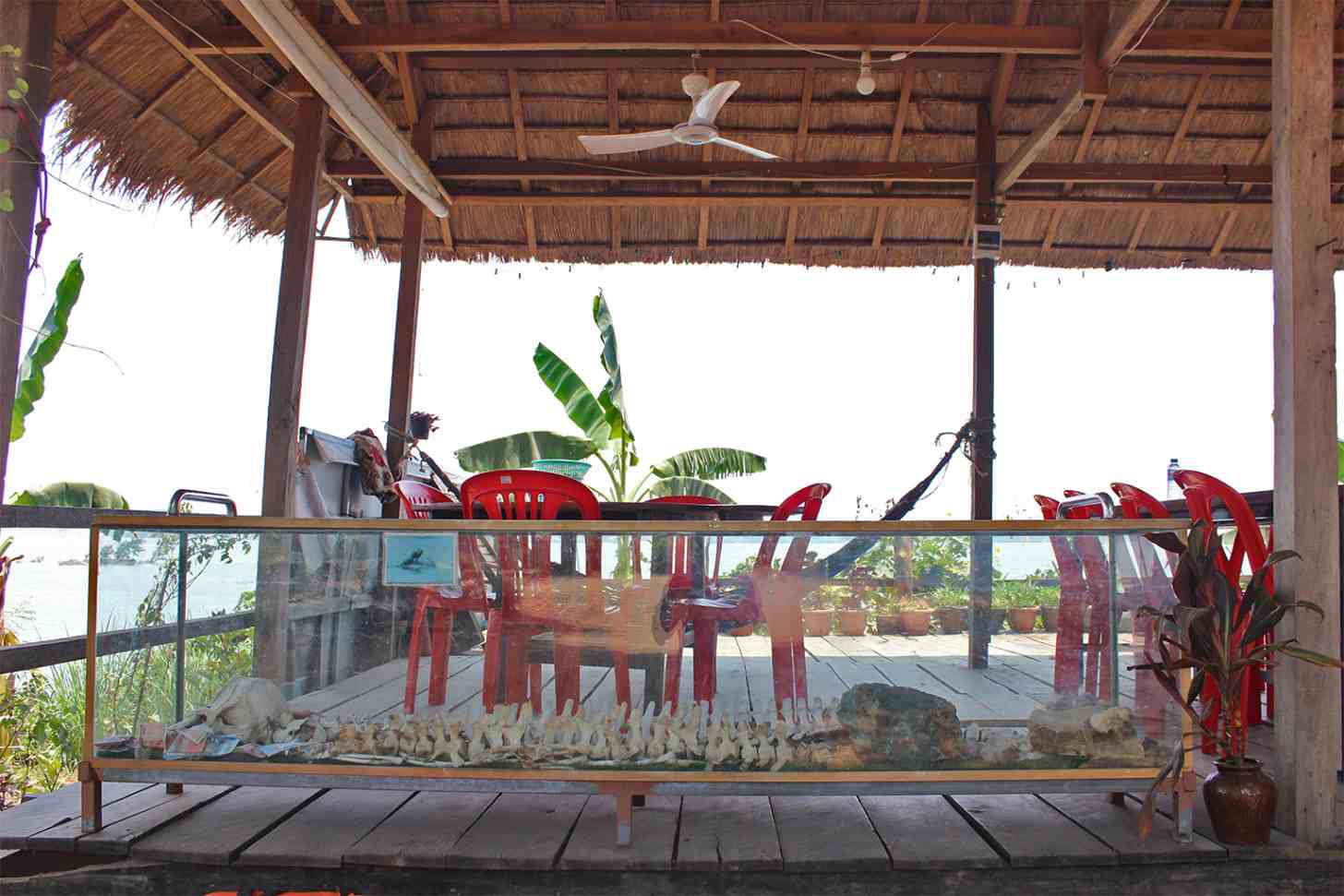
A new sign of hope
By late June, conservationists had confirmed at least six calves born this year along the 120-km (75-mi) stretch of the Mekong that runs through Kratie and Stung Treng provinces — five in Kratie and one in Stung Treng — lifting the estimated population to 118 individuals. Officials say this is a strong signal that the population is still reproducing and capable of recovery if threats are kept in check.
I Sanaroth, Kampi fisheries chief, tells Mongabay that gillnets in particular are still used within the protected habitat zones but at a small scale. The conservation work, he adds, is undertaken by the Fisheries Administration (FiA), with financial and technical support from WWF-Cambodia and other development partners.
In 2014, the FiA and WWF-Cambodia launched a joint initiative to balance Mekong dolphin conservation with community livelihoods, helping fishing households reduce their reliance on wild fish while involving them in protecting aquatic ecosystems.
“The population of the Mekong Irrawaddy dolphins has increased due to joint conservation. Our work is not done. Authorities, with support from conservation groups, are stepping up patrols and prosecutions to hold illegal fishers accountable,” Sanaroth says.
For now, in Kratie at least, the mornings still bring the same ritual: boats gliding out before the heat sets in, engines cutting near known feeding grounds, and the wait for a gray curve to break the surface.
Featured Image: A newborn Irrawaddy dolphin calf, approximately three days old, was seen on Feb. 17, 2026, by a research team from the Kratie Fisheries Administration and the WWF-Cambodia research team, at the Kampi Dolphin Viewing Site in Cambodia’s Kratie Province. Image © Lor Kimsan/WWF Cambodia
Written by Eung Sea
This article was originally published by Mongabay
This story was originally published by The 19th
ATLANTA — Keisha Lance Bottoms is projected to become the next governor of Georgia and the nation’s first Black woman governor, according to Decision Desk HQ.
Bottoms took the stage Tuesday night in front of a boisterous crowd waving “Madam Governor” signs.
“Georgia has always been a state where we didn’t settle for what was before us, but we have always fought for better,” Bottoms said. “In acts big and small, we all have the ability to shape our future. That is the legacy that we have in Georgia. It’s the legacy that comes with responsibility, and it is that responsibility that I will take to the governor’s office.”
Bottoms, the former mayor of Atlanta, prevailed in one of the most competitive races of the cycle in a state that helped elect President Donald Trump just two years ago. She took on Republican Rick Jackson, a billionaire healthcare executive who flooded the race with his wealth, contributing more than $200 million to his own bid.
Bottoms ran on promises to take on the rising cost of living. She promised to give municipalities the option of doing away with grocery taxes as well as taxes on diapers, baby formula and feminine hygiene products. She also proposed to do away with the state’s tax on car insurance premiums and homeowner’s insurance, and to lower the state’s gas tax.
Bottoms also promised to expand Medicaid, a longtime goal for Democrats in the state. She said she wanted to create a pathway to free technical education and community college in the state, and vowed to pause the construction of new data centers in Georgia.
Bottoms campaigned as a mom with a working-class background and generations of Georgia roots, sharing with voters the impact of her father’s incarceration and her mother’s years as the owner of a hair salon.
She rarely talked about the history-making potential of her campaign, and the potential to give Black women unprecedented representation at the state level in Georgia, but also a seat at the table at the National Governors Association and the Democratic Governors Association, powerful political organizations that have never had a Black woman in their ranks.
The historic nature of her campaign — not just in Georgia but the entire country — was not lost on the ground. Before her speech, the crowd danced along to a mix of decade-spanning hip-hop and classic R&B. When the DJ played “Got to Be Real” by Cheryl Lynn, Delta Sigma Thetas in the crowd let out a sea of “oo-oop!”
When R&B singer Tyrese asked people to join an acapella rendition of the Sam Cooke standard “A Change is Going to Come,” people wiped away tears as they sang.
The high level of enthusiasm for U.S. Sen. Jon Ossoff, who won his reelection bid, also helped lift Bottoms and the rest of the Democratic ticket. Ossoff, Bottoms and downballot Democrats regularly campaigned together under the slogan, “United for Georgia.”
At her election night party, Bottoms recognized Ossoff, who cruised to reelection Tuesday.
“You voted for the whole ballot energy and reelected my friend Jon Ossoff,” said Bottoms, noting that the state now has a Democratic governor and two Democratic senators.
In her campaign, Bottoms emphasized the importance of this election on Black voting rights, which she vowed to protect from federal and state-level attacks. Looming over Black Georgians is the potential for redistricting, made possible by the U.S. Supreme Court’s April ruling weakening key provisions of the 1965 Voting Rights Act. Republican leaders shelved a plan to redraw the state’s political maps backed by current GOP Gov. Brian Kemp, but some Democrats believe Republicans are simply putting it off until after the election to avoid voter backlash.
For many Black women in Georgia, Bottoms’ election is a milestone that resonates with them and sends a message about the direction of their state and their country.
While Bottoms rarely directly addressed that yearning, in one of the final speeches of the cycle, she asked voters to visualize her journey as a young Black girl to the state’s top job.
“I was recently asked if I always wanted to be the governor of Georgia, and the answer is no. But I vividly recall those rare days when my grandmother didn’t ride the bus home from her job at Davison’s department store in Lenox, and the excitement I had when my mother would pick her up from work. We’d leave our home on the west side of Atlanta early, so that we could take the long streetway into Buckhead, and the most exciting part of that drive for me was passing the governor’s mansion,” Bottoms said during a rally in Morrow, Georgia.
“I remember looking at it as we drove by and saying, ‘I want to go in there one day.’”
“But 50 years later, I will not just walk into the governor’s mansion, but the state capital as well, bringing with me the hopes and dreams of little boys and girls all across Georgia who are counting on their governor to make decisions about their future that will make all things possible.”
More than an hour before the official election results watch party for Bottoms was set to begin, supporters had begun to line up in droves inside the Marriott Marquis in downtown Atlanta, many of them in official Bottoms shirts, others in homemade accessories celebrating the campaign. The energy level was high and the excitement was palpable; it was clear that people wanted to be in the room if and when history was made.
Linda Lewis, 62, traveled to Atlanta from Chicago to attend the watch party; she said Bottoms is her cousin. “It’s been a fight,” Lewis said of the campaign — adding that Bottoms was actively trying to counter misinformation. “I feel positive. I feel real positive.”
Valerie Wilson of Atlanta described herself as “65 years young.” She was at the watch party because she “wanted to be a part of history being made, and to be able to tell my grandkids” that she had been a part of making it possible. “We gotta have her,” Wilson said of Bottoms. “I like what she’s planning to do for us and I think she’s really the only option. She got to be it for us.”
Wilson said her top issue this election was expanding Medicaid; she has a grandson with special needs and is concerned about his not being able to get care without this coverage. She also said she hoped to see universal Pre-K programs implemented in the state. Waiting for the results to come in, Wilson said she was “praying really, really hard that this goes the way it’s supposed to go.” If Bottoms did not win, she said, she would be “distraught.”
Jackson attacked Bottoms’ record as mayor of Atlanta throughout the cycle, criticizing her handling of the 2020 unrest following the murder of George Floyd in Minneapolis. “As Mayor, Keisha Lance Bottoms LET ATLANTA BURN,” a Jackson flier read.
Jackson ran on promises to cut the state’s income tax and use his business experience to bring in new jobs. Jackson appealed to voters by describing his journey from a child in an unstable home and eventually foster care to a prolific career in business.
Jackson’s bid was bolstered by Kemp’s popularity as the sitting governor, but Trump was also an anchor on Jackson, who tried to distance himself from the president in the final months of the election. Trump’s unpopularity this cycle, largely driven by voters’ anger at the impact of his policies on the cost of gas and food, made for an ultracompetitive race in a state that favored him in 2024.
Quantavius Foster, 35, drove in from Swainsboro in southwest Georgia, a nearly three-hour trip by car. “What brings me here tonight is the one and only good in the hood, Keisha Lance Bottoms,” Foster said. Foster said she attended a Bottoms rally earlier this year in Statesboro and was moved by Bottoms’ story of her upbringing.
“There were no cameras rolling or anything, and it just showed me the genuineness that she has, so she deserved my support and everyone else’s support.”
Foster said she hopes that Bottoms will be a “bridge over troubled water,” someone able to “set the tone for both parties and individuals.”
Mariel Padilla contributed to this report.
Featured Image: Executive Office of the President of the United States/Public Domain
Written by Jennifer Gerson, Mel Leonor Barclay and India Rice
On social media, Aarti Malhotra goes by the name “Internet Ki Mummy,” and she’s basically the internet’s mom.
But she was Arvey’s mother first.
Arvey was Malhotra’s teenage son, and he lit her life up “like a rainbow.” Despite living in a conservative community in Faridabad, India, Malhotra encouraged Arvey to be himself.

But at school, he was often bullied for being gay, once to the point of being sexually assaulted.
By age 16, Arvey had found an online community where he could express himself, wearing earrings, makeup, and a saree for Diwali. But the video soon spread beyond his friends, and the comment section turned hateful. A few days later, Arvey died by suicide.

In the wake of his passing, Malhotra — a schoolteacher and staunch LGBTQ+ activist — turned to the internet to share her son’s story. Over time, young Indians ashamed of their identity began looking to her as a “virtual ma.”
“These parents remain silent, failing to advocate for their children’s rights,” Malhotra wrote in Orato. “In contrast, these brave kids express pride in my efforts, and I commit to ensuring they can lead healthy lives.”

Malhotra regularly uses her social media platform to fight cyberbullying and share resources for teenagers struggling with depression and suicidal thoughts.
“Now, I am dedicated to fighting for justice, not only for Arvey but for all those who have suffered at the hands of bullies,” she continued. “Arvey left me with a profound responsibility — to fight for LGBTQ+ rights and stand against bullying. His simple desire for love and acceptance went unfulfilled, but I will continue to fight so that others may find the acceptance they deserve.”
You may also like: New study shows that 'queer friendships' are good for your health
Featured Image: Screenshot via @internetkimummy/Instagram
Open a honey bee hive on a warm afternoon and the first thing you’ll notice is movement.
Thousands of bees stream across the frames, tending brood, processing nectar and pollen, building wax, and maintaining the colony. A constant hum of activity and the smell of honey fill the air.
But this bustling environment is also home to something much smaller: a vast community of bacteria and fungi.
Some are harmless. Some are essential. Others can cause serious disease.
For honey bees, living together in such dense numbers creates an obvious problem. An infection that enters a colony has tens of thousands of potential hosts. Yet healthy honey bee colonies are remarkably good at keeping harmful microbes under control. How do they do it?
Our new research, published in ISME Communications, suggests that part of the answer lies in the way the hive is organized.
Mapping the hive’s defences
To understand how a colony keeps microbes under control, we first need to look at the hive as a whole.
The hive is not one place. Thousands of hexagonal wax cells are packed into combs, serving as nurseries, pantries, and storerooms.
At the center is the brood, tended by nurse bees. Beyond it are the food stores, and at the edge is the entrance, where foragers come and go. Bees modify these spaces with materials they collect and produce.
Plant resins are turned into propolis, a sticky antimicrobial glue used to seal cracks and line parts of the hive. Nectar becomes honey, and pollen is fermented into “bee bread”.
Each of these materials has been studied before, but we wanted to know whether they work together as part of a coordinated defense system.
So we sampled 24 colonies from five apiaries in New South Wales, collecting honey, propolis, pollen, wax, and nurse and forager bees.
We used DNA sequencing to map bacterial and fungal communities, tested the ability of hive materials to inhibit microorganisms, and used nuclear magnetic resonance spectroscopy (a chemical fingerprinting technique) to investigate their composition.
This allowed us to look at the hive as one connected system.
A floor plan for fighting disease
What we found was striking.
A healthy hive is not a sterile one. Many of the microorganisms living in and around a colony are harmless or beneficial, so eliminating them all would be neither possible nor desirable.
Instead, the colony uses different kinds of defense in different places: selective protection around the vulnerable brood and broader antimicrobial activity in more exposed parts of the hive.
Different materials also have different antimicrobial chemistry. For example, honey relies heavily on hydrogen peroxide — the same molecule in a bottle of antiseptic.
Propolis leans on flavonoids, the same class of plant compounds that give red wine and green tea their antioxidant kick.
Pollen’s defences look more like fermented food, rich in the short-chain acids produced by fermentation.
Rather than relying on one all-purpose disinfectant, the colony combines multiple types of antimicrobial activity across different parts of the hive. In effect, the hive has a chemical floor plan for disease defense.
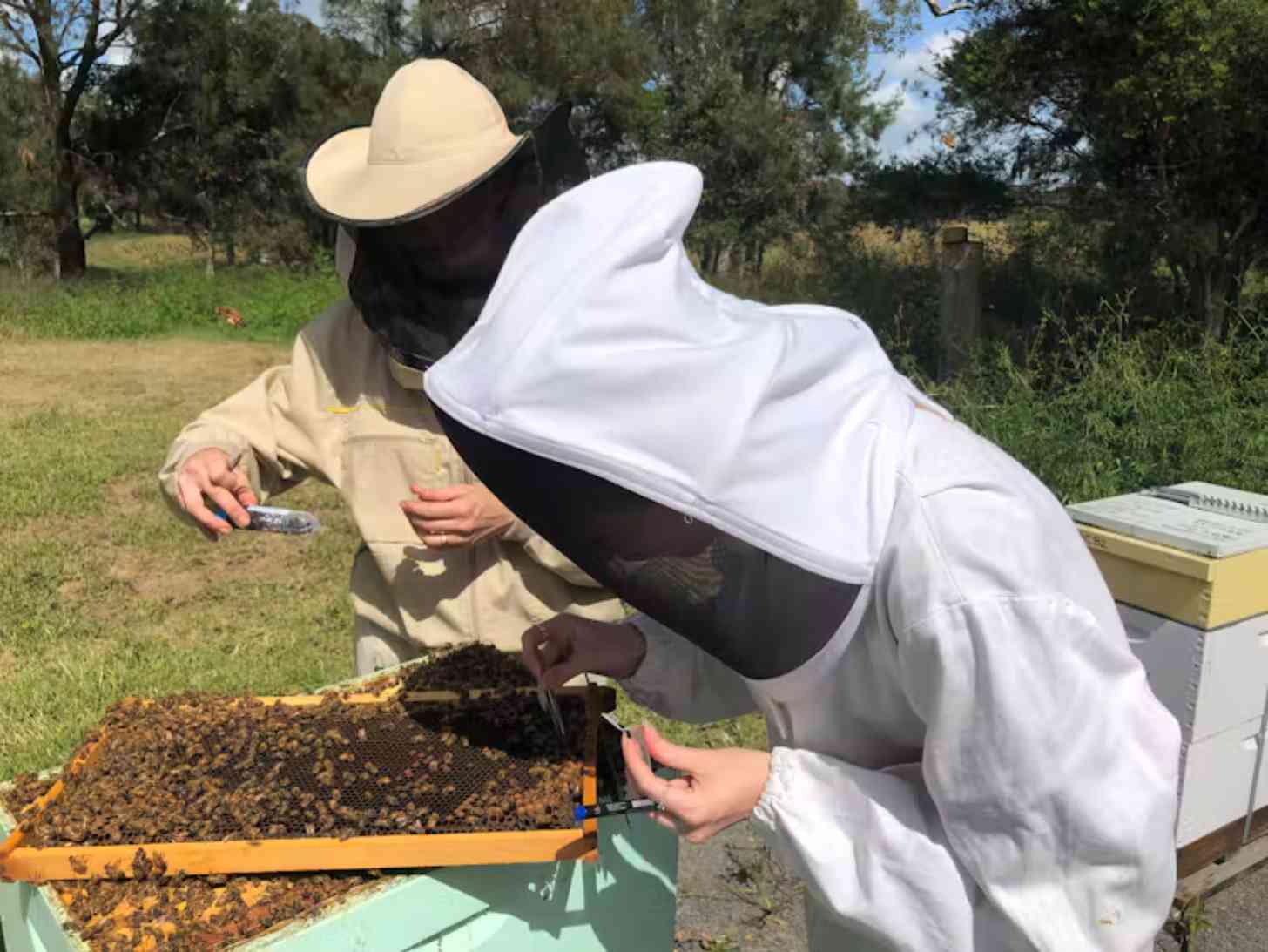
The landscape becomes part of the defense system
Perhaps the most important finding emerged when we looked beyond the hive.
The strongest predictor of the chemical potency of hive materials wasn’t disease history or health status. It was which apiary the hive came from.
This points to the surrounding landscape. Bees typically forage only a few kilometres from home, so local plants determine not only what they eat, but also the raw materials available for their chemical defences.
A colony surrounded by diverse flowering plants may therefore have access to a broader chemical toolkit than one foraging in a simplified landscape dominated by a single crop.
In other words, much of a colony’s chemical defences are built from what is growing outside its front door.
A broader view of bee health
We often think about threats to bee health in direct terms: the varroa mite, pesticides, and pathogens.
But our findings suggest that the ecological complexity of the landscape around a hive may also shape its ability to cope with disease.
As native vegetation is cleared and flowering resources become less diverse, bees lose access to a wider range of plants and the resources they provide. Maintaining diverse habitat around bee colonies could therefore be an important part of supporting healthy colonies.
And this idea may extend beyond honey bees. Ants, termites and stingless bees also use antimicrobial compounds to protect their colonies, often drawing on materials collected from their surroundings.
For these animals, the landscape may provide more than food and shelter.
It may provide part of their medicine cabinet.
This article by Kenya Fernandes from University of Sydney was originally published by The Conversation
In 2020, Jeff Robertson of Holly Springs, North Carolina accidentally started a new holiday tradition — and now it’s one that over 600 households across the United States participate in.
That Halloween, Robertson went “a little overboard” with his spooky yard display. His skeleton army attracted attention across the state, with horror fans traveling hours to see it.
“My family started this in 2020 after meeting a young child battling cancer whose family brought her to our house to see our Halloween decorations,” Robertson told Good Good Good.
“That night we had a family huddle and said, ‘This is kind of cool that we’re on the news, but you know, let’s kind of take the spotlight off of us,” Robertson further explained in an interview with St. Jude Inspire. “Like, how can we use this for good?’”
“We all agreed that we should start a fundraiser for St. Jude Children’s Research Hospital.”
That fundraiser, Skeletons for St. Jude, has sparked an annual tradition that’s still going strong today.
“Join hundreds of home haunters across the country raising money for St. Jude Children’s Research Hospital — so families never get a bill for treatment, travel, housing, or food,” Skeletons for St. Jude said in a statement. “Same haunt you already build. Way bigger reason.”
To date, Skeletons for St. Jude has raised over $1.1 million.

“Thank you to all of our team members who have made Jeff’s dream more than a reality!” Skeletons for St. Jude said on its website.
“We look forward to you joining us to bring additional attention and awareness — during your haunts — of the children being treated at St. Jude Childrens Hospital and the awesome work they do there!”
This year, Skeletons for St. Jude hopes to shatter its earlier fundraising records.
“This year, year 7, we embark on our next goal of two million dollars raised for this awesome organization.”

A week out from Halloween, 202 participating households had already added their address to the “Fright Map” website, so that they could easily be found online by prospective donors.
In total, 625 homes are set to join the “haunt” — which extends from Halloween through December 25.
In Grand Rapids, Michigan, Jeffery Broking has spent the month of October setting up his display at his grandmother’s house. In total, he’s installed over 40 animatronics.

“I’ve been dealing with seizures the past few years, and I’ve met lots of sick kids and their families,” Broking told WDIO ABC. “I just want to give back.”
One house in Willits, California already had a 12-foot flaming skeleton (safely) burning on its lawn.
“We will be handing out candy and may have a few special surprises,” participant Krystle Coffman told Willits reporter Kym Kemp.
Roughly 2,900 miles away, Elizabeth Stripling was working on her own display in Delmar, Maryland as she laid out skeletons, pumpkins, tombstones, and spiderwebs on her and her neighbor’s lawns.

“The more I learned about it, I thought, why not?” Stripling said in an interview with news station WMDT. “I’m already decorating and I’ve already got skeletons, so I’ll just go ahead and gives me an excuse to build to my collection. And it brings such joy to the kids in the neighborhood.”
Like other “haunters” across the country, Stripling will have a donation jar on her lawn where passing neighbors can donate to the cause.

“We think a lot about kids at Halloween. And that’s what Saint Jude is all about. It’s all about kids,” said Stripling, who serves as the director of outreach and training at the Kennedy Krieger Institute’s Center for Autism Services.
“They’re not feeling well if they’re there in the hospital and … this is something that might bring them a little light too, to know that there are people out here thinking about them on Halloween night, wishing they could be celebrating with them.”

You may also like: To dazzle adopters, shelter pets pose in donated Halloween costumes
Featured Image: Skeletons for St. Jude/Facebook
Every day the Good Good Good team collects the best good news in the world and shares it with our community. Here are the highlights for this week!
If you want to get good news in your inbox every day, join the Goodnewsletter — the free daily newsletter designed to leave you feeling hopeful.
The Best Positive News We’re Celebrating This Week —
Nurses in Pennsylvania fought to secure the nation’s first countywide 12-week paid parental leave policy
After watching parents return to work while their babies were still in intensive care, Pittsburgh nurses joined with a coalition of working parents, advocates, and some elected leaders to draft a proposal for a paid leave program in Allegheny County.
And they just won — the Allegheny County Council voted 11 to 4 to pass 12 weeks of paid parental leave — the first county-level paid leave policy in the nation.
Both birthing and non-birthing parents will receive three months of paid parental leave within the first year of childbirth, adoption, foster placement, or a stillbirth, with job and health benefits protection.
Why is this good news? The United States is the only industrialized nation in the world that doesn’t offer any parental leave. The policy these nurses and advocates just got passed could serve as an inflection point for others to do the same.
→ Read more
EV sales in the US are rising again. Here’s why the recovery is set to last
→ Read more
China’s first national parks have already dramatically improved the surrounding environment
In October 2021, China officially established its first five national parks. And new data shows they’ve achieved incredible progress in improving key ecosystems and rising populations of flagship species.
The parks cover a combined area of 230,000 square kilometers, integrating more than 120 protected areas. The parks have helped speed up the restoration of mountains, rivers, forests, lakes, and deserts, restore habitats and ecological corridors, and more.
Wildlife conservation has seen significant improvements: Wild Siberian tigers rose from 27 to 72, and the wild Amur leopard population has risen from 42 to 115.
A personalized mRNA-based melanoma vaccine significantly reduced the risk of cancer recurrence or death
In a new clinical trial, a personalized mRNA-based melanoma vaccine reduced the risk of recurrence or death within two years by 42%.
The vaccine is custom-made to target the unique genetic mutations of each person’s melanoma, and is the first of its kind to show positive results in a phase III trial.
Of the trial patients who received the vaccine alongside an immunotherapy treatment, 82% were alive and recurrence-free after two years, compared to 70% who only received the traditional melanoma treatment.
Why is this good news? The vaccine’s success could have positive implications for other types of cancer, too, and one doctor said the findings were “a foundational shift in our approach to cancer” that had “not been achieved before in the history of cancer drug development.”
Oregon Zoo shares footage of rescued sea otters playing basketball with pumpkins: ‘It plays a critical role in their well-being’
→ Read more (and watch!)
A record number of women are running for state legislatures in the US this year
In the 2026 midterm elections, a record 3,824 women are running for state legislatures across the 46 states with seats on the ballot, up from the previous record of 3,621 women candidates in 2022.
Women make up just over one-third of all state legislative candidates this midterm election cycle, and more than two-thirds of the candidates are Democrats.
While the U.S. currently has a record level of representation in state legislatures, about one-third, it’s nowhere near parity. Republicans also lag significantly behind, as about 64% of women in state legislatures are Democrats.
A record two-thirds of car sales in China are now electric vehicles
For the first time, new-energy vehicles — including battery electric vehicles and plug-in hybrids — made up 67% of new car sales in China in September.
In 2020, NEVs made up just 6% of new car sales in 2020 — and have risen dramatically since, to 58% so far in 2026, and a record 67% in September alone.
Analysts point to the rising fuel costs due to the Iran war and say the rapidly growing fleet of electric vehicles in the country has offset demand for 143 million barrels of oil since the Hormuz crisis began.
Why is this good news? Denmark recently achieved the historic milestone of electric vehicles accounting for 97% of new car sales — but critics said that figure is highly achievable in such a small country. China is one of the largest countries in the world — both in terms of land area and population, showing that significant progress in EV adoption is possible anywhere.
Plus, these EVs will increasingly be powered by renewables.
→ Read more
15-year-old makes it easier to access someone’s medical info in a crisis with a simple QR code scan
→ Read more
Battery storage is now cheaper than open-cycle gas in 43 markets globally
Of the 43 markets modeled globally, a new report found that the levelized cost of electricity for four-hour battery storage “crossed a critical threshold” and is now cheaper than open-cycle gas in every single one.
The report showed that single-axis tracker solar — panels that rotate to follow the sun — are the cheapest new-build power source in nearly all markets modeled, and battery storage “decisively” beat gas.
While progress is lagging in North America due to tariffs, shifting clean energy policies, and demand from data centers, the cost of storage and solar are declining exponentially everywhere else thanks to supply chain integration.
Airbnb launched an initiative to provide 1 million free nights of emergency housing every year for people in crisis
Effective immediately, Airbnb announced it will donate 10 cents from every booking to Airbnb.org, its nonprofit arm that houses people affected by everything from natural disasters to wars.
The initiative will provide the nonprofit with $500 million over the next five years and enable it to offer 1 million free nights of emergency housing every year.
Since it was established six years ago, Airbnb.org has provided 1.6 million free nights of emergency housing to over 250,000 people, including after the 2025 LA wildfires, the 2023 earthquake in Turkey, and refugee crises.
What’s the nuance? Airbnb has come under criticism, including a lawsuit from the City of Los Angeles, for price gouging in the aftermath of the LA wildfires, when hosts allegedly violated California law for inflating prices above 10%. Airbnb says it took action and sent error messages to any hosts inflating prices by more than 10%.
→ Read more
Honey bee hives have their own ‘immune system.’ Here’s how tens of thousands of bees stay healthy together
→ Read more
Solar energy and storage accounted for nearly 1 million jobs in the EU in 2025
In 2025, the solar photovoltaic and battery storage industries provided 982,000 full-time jobs in the European Union, with solar alone accounting for 874,000 jobs.
Germany led the way in solar employment, with 165,000 full-time jobs, followed by Spain and Italy. For the first time since the reporting began, utility-scale solar jobs were slightly higher than rooftop solar, making up 50.2% of jobs.
The rise in employment coincided with growth in deployment, as the EU added 69 gigawatts of solar capacity last year, and 27 gigawatt-hours of batteries.
→ Read more
More than 600 households have raised $1.2 million for St. Jude with Halloween yard displays
Since 2020, Skeletons for St. Jude has encouraged families to decorate their homes for Halloween and raise awareness for children’s cancer research.
The tradition started when Jeff Robertson of Holly Springs, North Carolina went “a little overboard” with his spooky yard display — people drove for hours to see it. His family turned it into a fundraising opportunity, and now, over 600 households across the United States participate annually.
It’s since raised nearly $1.2 million total, and this year, participants embark on their next goal: $2 million.
Why is this good news? Celebrating holidays like Halloween is even more fun when it can also give back to others. Whether helping families access food or raising money for childhood cancer research — the things we already love, like going all-out for Halloween, can also be a force for good.
→ Read more
To help families struggling with food insecurity, here are some other items you can offer trick-or-treaters
→ Read more
A man in Texas has thrifted all year long to give away thousands of free Halloween costumes this year
When he was growing up, Christophe Waggoner’s family didn’t have the money to purchase fancy, expensive Halloween costumes, though he dreamt of having something special. When he noticed some kids in his neighborhood having a similar experience, he did something about it.
In 2017, he started collecting costumes to give to kids for free who couldn’t afford them and established his charity, October’s Child.
For the first five years, he thrifted costumes, masks, and accessories and stored them in his garage. Now, they take up multiple storage units, and he’s donated more than 8,000 costumes total — he expects to give away around 4,000 costumes this Halloween alone.
→ Read more
More good news of the week —
New York City is getting a new fleet of electric school buses. It’s part of an ongoing initiative showing how the city can replace thousands of its polluting diesel buses with cleaner models in a way that benefits the stressed-out urban grid rather than overwhelming it.
In a major conservation milestone, hilsa fish returned to a region of India they’d not been seen in for decades. Officials called it a significant milestone in river restoration and aquatic biodiversity conservation.
Angelina Jolie’s foundation has spent two decades removing 4.8 miles of wire snares from a forest in Cambodia. The more than 150,000-acre forest is home to elephants and pangolins, and the foundation “started with one aim: to work alongside local communities to clear the most heavily mined land in Cambodia.”
More than 200 Wikipedia employees voted overwhelmingly to join a labor union. Workers across departments, including software engineering, finance, and communications, at the Wikimedia Foundation are now part of the Communication Workers of America labor union.
A teen became the first person to have a testicular tissue transplant in the United Kingdom. The teen received the transplant following chemotherapy, which can permanently damage the cells needed to produce sperm, leaving children who undergo it at risk of infertility in adulthood.
Scientists are transferring and storing U.S. climate data in Germany. The move comes amid fears that the Trump administration could meddle with the data ahead of the next critical United Nations climate assessment.
A free Turnstile benefit concert raised more than $209,000 to support humanitarian work in Palestine, Sudan, and Lebanon. An estimated 60,000 people attended the free concert, held on the National Mall in Washington, D.C., reaching capacity as some fans watched from outside the event barricades.
A Florida city is paying residents to replace their grass lawns with drought-resistant native plants. Tampa’s Florida-Friendly Landscaping Incentive Program gives homeowners rebates for replacing portions of their lawns with Florida-friendly plants, saving them money on their water bill and providing habitat for critical pollinators and native species.
Volunteers just planted more than 109,000 trees to create a new forested area. (May require login) The volunteers have planted more than 500,000 trees in the last two growing seasons to “support wildlife, help tackle climate change, and improve wellbeing.”
Tech giants in Finland announced a plan to help Ukraine build its own sovereign satellite system. The country currently relies on Starlink, run by U.S.-based SpaceX, but it’s not reliable and has seen repeated, ongoing disruptions in recent weeks.
A breakthrough PTSD treatment achieved a 68% remission rate in a clinical trial. The newly FDA-cleared personalized brain stimulation treatment also reported a 52% reduction in symptoms, and it could pave the way for more precise treatments for other mental health conditions.
Kenya secured a $160 million conservation program to protect 173,000 square kilometers of land. The Thamani Asili initiative, which means “value of nature” in Kiswahili, will focus on key biodiversity hotspots, protecting some of the most complex and least disturbed natural environments on Earth.
New data shows that “nature-based” solutions could save insurers and policyholders billions of dollars. Wetlands restoration and wildfire prevention can drive down insurers’ costs and skyrocketing home insurance premiums.
New York City is offering free pet food at 22 food pantries across all five boroughs. The new city-funded program aims to relieve financial strain on pet owners and help them avoid surrendering their animals to shelters.
A German startup is testing a cooling system that uses magnets, water, and metal alloys instead of refrigerants. Magnetic cooling could offer a new alternative to conventional refrigeration technology — the industry alone accounts for around 7% of global greenhouse gas emissions.
Macklemore kicked off his Free Palestine tour, featuring a virtual appearance by a Palestinian journalist and activist. On the first night in Dublin, renowned journalist and activist Bisan Owda made a virtual appearance, along with a screening of Palestinian children singing in Gaza.
Six baby dolphins were born in Cambodia this year, bringing one of the world's rarest dolphins to 118. Irrawaddy dolphins, the Mekong River’s sole cetaceans, are viewed as sacred animals by Mekong communities and are also an important source of tourism revenue.
A new report shows the US energy grid has plenty of capacity to accommodate widespread adoption of heat pumps. The report found three-quarters of U.S. homes — around 109 million — could adopt the technology, which would significantly reduce greenhouse gas emissions and dramatically reduce electric bills.
The first electric, solar-powered refrigerated trailer just made its first delivery in Australia. Refrigerated trailers are critical for hauling fresh food from the farm to the supermarket, but they are powered by extremely polluting diesel generators with lots of carbon emissions.
India has restored 21.76 million hectares of deforested land between 2011 and 2020. The country has reached nearly 84% of its Bonn Challenge target of restoring 26 million hectares by 2030.
The Netherlands pledged $500 million to help Brazil conserve tropical forests. Brazil launched the Tropical Forest Forever Facility in November 2025 as a partnership between tropical countries that need funding to protect their forests, investors, and donor countries that want to mitigate deforestation.
Chappell Roan raised over $2 million for trans youth at her two-night Super Graphic Spectacular benefit concert. The benefit, which featured appearances from artists like MUNA and PinkPantheress, supported her Midwest Princess Project, which supports the LGBTQ+ community, specifically trans youth.
Smithsonian scientists recreated the first 2 billion years of the universe. Called Lumina, the groundbreaking simulation recreates the universe’s first 2 billion years, showing how dark matter, gas, and radiation interacted to give rise to the earliest stars, galaxies, and black holes.
NJ Transit is expanding a program that puts art exhibitions in bus and train stations. The TRANSITional Art Project includes murals and photography from New Jersey-based artists featured in temporary visual art exhibitions at bus and train stations across the state.
Cincinnati has given out nearly $1 million to residents fighting climate change. The city’s Seeds of Change program is funding community gardens, composting efforts, solar installations, a bike repair program, and more.