This story was originally published by The 19th.
As a nurse in the neonatal intensive care unit, Jean Stone knows what it really means to live in a country with no paid parental leave.
She’s watched this scene play out so many times it’s almost the norm: Once their babies stabilize in the NICU, parents often return to work to preserve whatever parental leave they have left for when their babies come home. Stone calls the parents in the middle of the day to update them — starting each call with, “Everything is OK” — and watch them come in at the end of their workday, their faces reflecting the relief of reunion.
“They carry that weight of not being there,” Stone, who works at UPMC Magee-Womens Hospital in Pittsburgh, told The 19th.
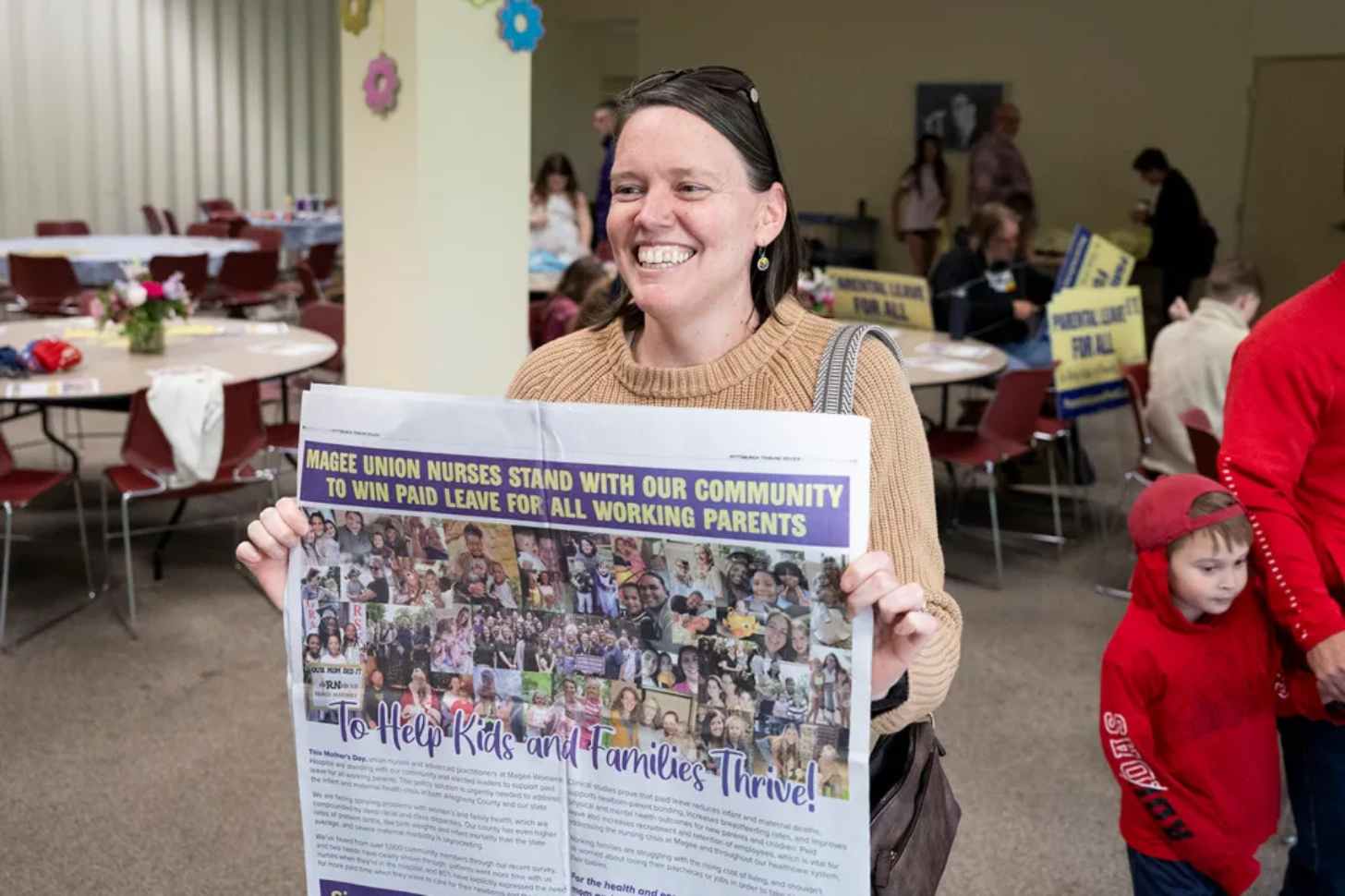
Five months ago, she and the other nurses at Magee, who are in the middle of negotiating a union contract, decided to do something about it. They came together with a coalition of working parents, advocates and some elected leaders to draft a proposal for a paid leave program in Allegheny County. They launched their campaign on Mother’s Day, May 10.
Tuesday night, they won.
The Allegheny County Council voted 11 to 4 to pass 12 weeks of paid parental leave — the first county-level paid leave policy in the nation.
Under the policy, both birthing and non-birthing parents would receive three months of paid parental leave within the first year of childbirth, adoption, foster placement or a stillbirth. Parents would have their jobs and health benefits protected while on leave, but to qualify they need to be full-time employees for at least six months or part-time workers with a minimum of 625 logged work hours. All businesses with 15 or more employees would be required to offer the benefit.
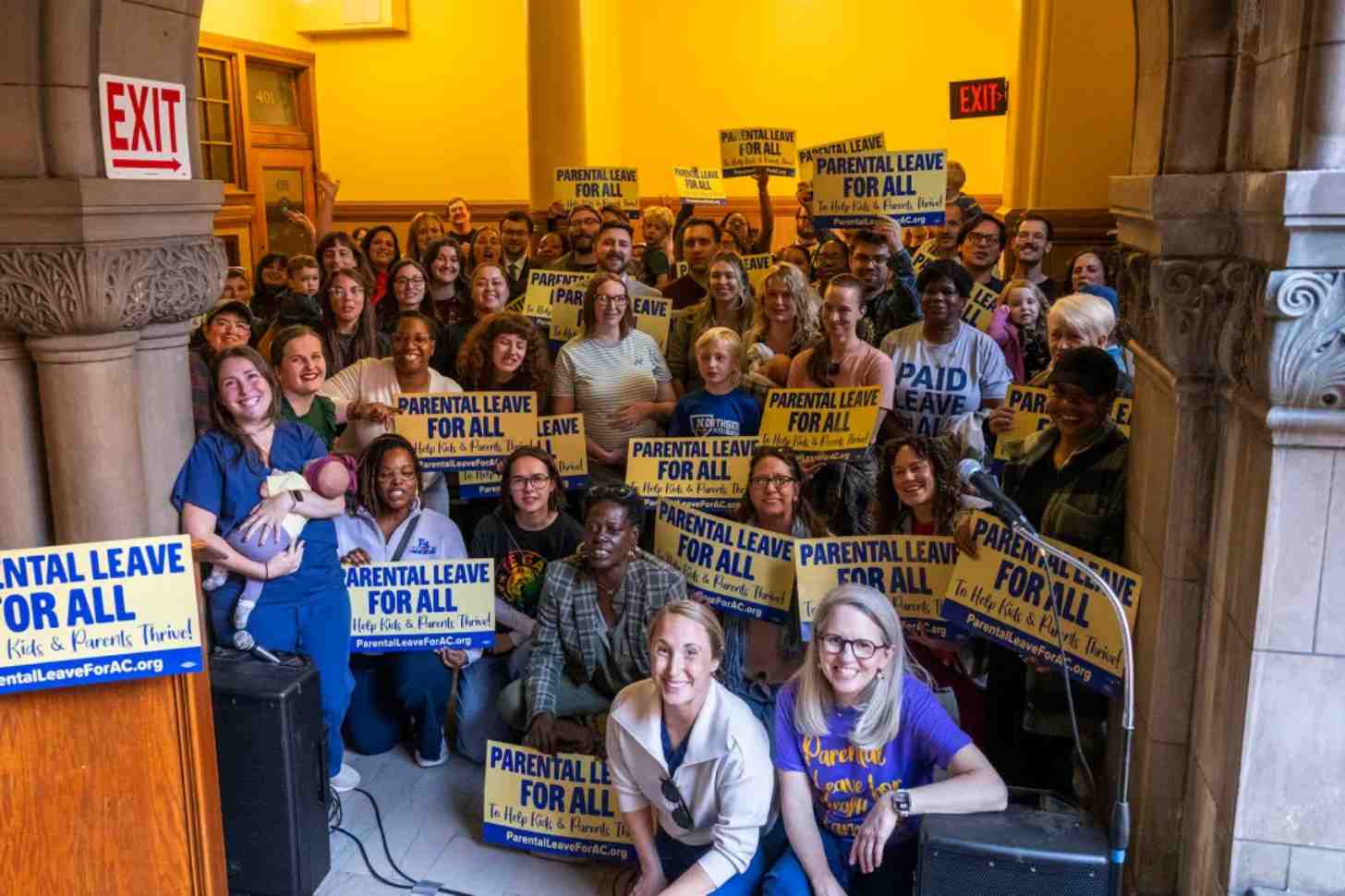
The chamber Tuesday night was packed by supporters of the proposal. They spent hours testifying about their personal experiences giving birth without the aid of paid leave, including one mother who had a stillbirth at 41 weeks gestation and said her husband took three weeks off to care for her but had no paternity leave. “You just don’t know how you’re going to survive another second, let alone trying to work,” she said.
Council Vice President John Palmiere said he had had his doubts about where he landed on the issue, but the stories shared moved him. He was a “yes.” When the final vote was tallied, the crowd broke into an applause punctuated by shouts of “thank you!”
The passage was a decisive step forward for a movement that has won every victory inch by inch. The United States is the only industrialized nation without a federal paid leave policy. Workers here have access to unpaid leave only through the Family and Medical Leave Act. In lieu of a federal policy, 14 states and Washington, D.C., have passed their own state-level paid leave programs over the past 20 years. Pennsylvania isn’t one of them.
The county’s policy differs from other state-level programs, and it opens the door for other counties to do the same. Usually, paid leave policies are administered by state governments through money from a social insurance fund that employers and employees typically pay into. Allegheny’s policy would put the onus on most employers to fund the benefit, which was the piece of the proposal that received the most pushback. The original proposal was scaled back from 18 weeks to 12, with an exception for employers with fewer than 15 employees.
It was an outpouring of community support that ultimately propelled the policy forward. A year ago, when the nurses, nurse practitioners and lactation consultants at Magee got together to form a union, they put out a public survey asking the community to weigh in on what would make patient care and maternal health better. More than a thousand responses came in, and though the survey didn’t ask about it directly, “people wrote in in astonishing numbers that, ‘what we need is real paid parental leave across the board,’” Stone said.
Already, the nurses were hoping to include a paid parental leave request in their contract negotiations — at the time, they only got two weeks of paid leave — but it was “kind of beautiful that it came back as a priority for the community, too,” Stone said.
The nurses leading the push say this is also about improving maternal health outcomes for mothers in a county where severe maternal morbidity — unexpected outcomes following labor and delivery, such as hemorrhage or sepsis — rose 55 percent from 2016 to 2022. Black women, in particular, face even worse maternal health outcomes.
“I care for mothers who develop postpartum preeclampsia, who are recovering from complicated C-sections, infections, mastitis, endometritis and other serious complications,” said Marchel Robinson, a registered nurse at Magee during a Labor Day parade in Pittsburgh. “My patients don’t choose these complications. They don’t choose when their bodies need time to heal. They don’t choose when they need another doctor’s appointment, another week at home or even another month to recover. And they shouldn’t have to choose between healing, caring for their newborn and keeping a paycheck.”
For Stone, paid leave is also a retention policy. Nurses, a workforce that is nearly 90 percent women, are leaving the healthcare field in droves.
“We see our coworkers come back way too early into a job that is so physically demanding and emotionally demanding to then be essentially away from your baby for 13 hours,” Stone said, forcing many to step into less demanding roles or leave the workforce altogether.

Stone said she is hopeful the passage in Allegheny County could lend some momentum to a statewide policy, which already has some bipartisan support and passed the state House before stalling in the Senate this past legislative session.
Nationwide, the issue is immensely popular. An AP-NORC poll conducted last summer found that two-thirds of Americans support requiring employers to provide paid leave for parents, including a majority of Republicans, independents and Democrats.
Dawn Huckelbridge, the founding director of Paid Leave for All, a national advocacy organization pushing for federal paid family and medical leave, said the passage in Pennsylvania shows there is “so much demand” for such policies. But, she cautioned, “we can’t keep doing this piecemeal, because you can’t have someone with rights in one zip code and not have them in another.”
Stone said this moment could be an inflection point.
“I hope it’s one of the things that will maybe someday be recognized as an early example of when things started to change,” she said.
Featured Image: Lucy Rose Rucio, a nurse at UPMC Magee-Womens Hospital, holds her daughter, Dora, while speaking to reporters at the Allegheny County Courthouse in Pittsburgh, Pennsylvania on October 20, 2026. (Courtesy of SEIU Healthcare Pennsylvania)
Written by Chabeli Carrazana.