The Tropical Forest Forever Facility (TFFF), which was created to fund long-term conservation of tropical forests, recently received a $500-million pledge, over 10 years, from the Netherlands, a significant boost for forest conservation.
The Netherlands announced the pledge in an Oct 26 press release and estimated that the TFFF has the potential to protect 800 to 900 million hectares (2.0 to 2.2 billion acres) of tropical forest, an area roughly 200 times the size of the Netherlands.
The long-term goal is to create a $125 billion endowment fund for the TFFF. Current pledges add up to roughly $7.8 billion.
The TFFF was launched by Brazil at the 30th U.N. Climate Change Conference in November 2025. It’s a partnership between tropical countries that need funding to protect their forests, investors and donor countries that want to address climate change and biodiversity loss through mitigating deforestation.
The collaboration includes the private sector, Indigenous Peoples and Local Communities, the World Bank, scientists, economists, finance experts, and civil society partners.
The TFFF is modeled like a sovereign wealth fund in which governments and private investors contribute to an investment fund and those investment gains, or profits, are then distributed to tropical countries to keep their forests standing.
The hope is that predictable revenue from the TFFF will incentivize permanent conservation of forests over unsustainable development including logging, mining and ranching.
Forest conservation is monitored using satellite imaging and scientific monitoring protocols to provide transparency and ensure forests are being protected.
However, the TFFF has received criticism. “In my view, as an economist, I would say that TFFF has severe flaws,” Bard Harstad, an environmental economist at Stanford University in the U.S. told Mongabay in an email.
He expressed skepticism about the long-term economic solvency of the TFFF, saying the finance model is based on the fund generating enough profit to satisfy both investors and compensate tropical forest countries.
He’s concerned that funds may not materialize as promised, misleading participating countries. “Then, after they are disappointed, the willingness to allocate funds to tropical forest conservation can be harmed for decades.”
The recent $500 million pledge came the day after Brazil’s runoff election in which incumbent President Luiz Inácio Lula da Silva, who has pledged to end deforestation by 2030, beat challenger Flávio Bolsonaro, a climate change denier who pledged to not demarcate any Indigenous land in Brazil.
Harstad noted concerns that governments can reverse their pledge to conserve TFFF-funded forests, “if someone like Bolsonaro should return to power in the future.”
Harstad recommends instead solutions like sustainability-linked bonds (SLBs), which have been used in Uruguay to lower bond interest rates, and attract investments, when deforestation rates are low.
Still, the recent TFFF investment has been praised by conservationists including Merijn van Leeuwen, director of Nature Conservation with WWF-Netherlands, who said it is a “major breakthrough for the protection of tropical forests worldwide.”
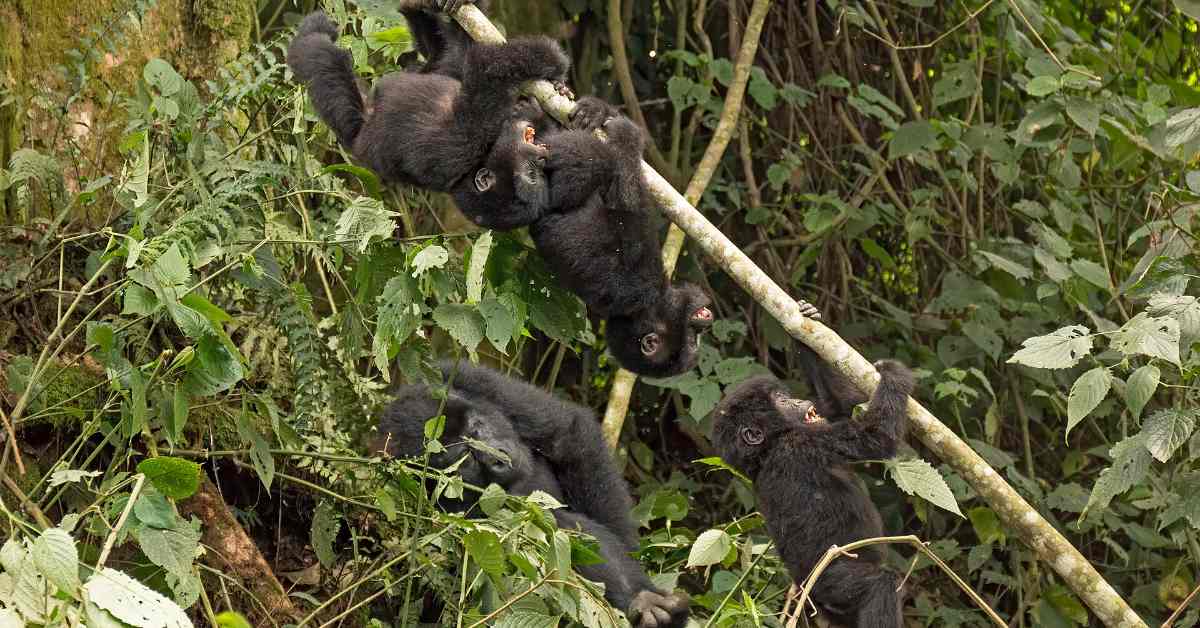
Featured Image: Baby mountain gorillas playing in Bwindi Impenetrable Forest, Uganda. Image by Charles J. Sharp via Wikimedia Commons (CC BY-SA 4.0).
Written by David Brown. This article was originally published by Mongabay