Over 40 million U.S. adults have an anxiety disorder. Anxiety can stem from a number of reasons: a big event, an ongoing problem, or a buildup of small but stressful issues.
The core of anxiety, however, often lies in the desire to be perfect: the idea that one’s life has to be imperfection-free in order to be fulfilling.
Perfection is both unattainable yet highly sought — when we experience moments of stress or sadness, we’re likely to get frustrated and panic.
That’s why mental health influencer Poppy Jamie is letting go of perfection and encouraging others to do the same. Instead of chasing perfection, Poppy’s chasing happiness — and she wants you to join her on the journey.
A few years ago, Poppy was suffering from high levels of anxiety from all facets of her life. Prior to becoming an author and mental health advocate, Poppy was a lifestyle and media personality who worked for titans like MTV and Snapchat. But after suffering from chronic anxiety and burnout from her high profile career, Poppy decided to re-evaluate her health instead.
She believed that, in order to combat her pain, she had to get rid of all her problems. “I thought I was going to be happy when I had no problems, when I wasn’t insecure anymore, when I’d reach that point. I didn’t realize that a world of no problems didn’t exist,” she told the Sounds Good podcast.
Her journey to healing began by recognizing that in order to be happy, she had to stop chasing perfection. “Being happy was totally accepting that my life was going to be constantly messy,” Poppy said.
As she lessened the pressure to be perfect, her number of problems decreased, too. When Poppy stopped trying to erase her problems, they erased themselves on their own. While on her transformational journey to self-acceptance, Poppy decided to write about it.
Poppy’s book — Happy Not Perfect: Upgrade Your Mind, Challenge Your Thoughts, and Free Yourself From Anxiety — follows Poppy’s journey as a mental health influencer and the research she collected from mental health experts on living a peaceful, perfectionless life.
The book emphasizes the idea of progress over perfection, something that Poppy is incorporating into her own life.
“I think that's really important because as soon as we put these crazy expectations on ourselves or on others, we're always going to not only let ourselves down, but also other people are going to let us down,” she said. “And then we're going to be in a constant state of disappointment or unrealistic expectations.”
To combat these moments of disappointment, Poppy uses a few techniques which she’s written about in her book and shared with Good Good Good.
One technique Poppy describes — known as the ‘diffusion’ technique — involves reprogramming how we identify with our emotions. For example, instead of saying, ‘I’m feeling stressed,’ Poppy encourages her audience to rephrase these negative emotions to ‘my mind is feeling stressed.’ “We’re reminding ourselves that I am not my emotion today,” she said.
These reprogrammed sentences remind us that emotions are both temporary and perpetually changing; they do not define our character, but rather how our mind reacts to different experiences.
It’s essential to label our feelings instead of ignoring them, as the experts recommend. “There was a study done and through brain imaging, they found that when people labeled the emotion they were feeling, the emotional center actually deactivated it,” she said.
By addressing how we feel, our brain is free to process those feelings and eventually move on. Poppy found that the more she addresses her feelings without letting them define her, the more in-tune and connected she feels with herself.
On the Sounds Good podcast, Poppy cited Dr. Hawkins — a psychiatrist and researcher who came up with the ‘scale of consciousness’ — as another source of guidance. Dr. Hawkin’s research found that “guilt, shame, fear actually had a very low vibration (meaning a poor state of mental health).
So when we're in those states, we're really vibrating at a lower rate,” Poppy explained on Sounds Good.
When we’re feeling positive emotions, however — peace, joy, acceptance, etc — we vibrate at an extremely high rate. That means when we do things that naturally raise the vibration of our body, like taking deep breaths, going on a walk, or doing yoga, our emotions are positively impacted.
Poppy describes it as “upgrading the connection with yourself.” She advises people to get in touch with their bodies and emotions so that they can combat their inner critic.
Poppy leaves us with one overarching theme: to pause as much as we can. This means taking a moment each day where we process what’s happening to us, big or small. ‘Pausing’ essentially means allowing ourselves to be still throughout the day.
While the nature of life and humanity is to do things on time and as fast as possible, Poppy believes in the power of taking a moment to admire all of life’s moments. “The pause is where our freedom lies,” she said. There is always space for reflection, gratitude, and finding your freedom.
It’s clear that Poppy has found her own freedom through methods of emotional regulation. Being happy doesn’t mean living a perfect life — it means living the hardships it brings.
The best free and paid sites to find diverse stock photography — and why representation in stock images matters
They’re everywhere in mass media: filler images of nondescript models doing mundane activities (see: woman laughing while eating a salad) used as stock imagery for website articles, marketing, and advertising, etc.
But stock photography, like any commercial industry, has a diversity problem.
When there’s a lack of inclusion in stock photography, it trickles all the way down to the projects they’re used for.
Studies show that when marginalized groups aren’t able to see themselves in the media, it has a drastic and negative impact on their ideas of self-worth.
Not only does this hurt vulnerable communities, but it’s also a missed opportunity to highlight exactly how brilliantly diverse the world is.
When stock photography isn’t done well, it can have truly harmful repercussions. For example, there have been multiple instances in the past where stock photography has unintentionally perpetuated racist, ableist, and overall damaging stereotypes.
At best, marginalized groups are tokenized in stock photography.
At worst, it reinforces violent tropes against some of the most vulnerable members of our society.
Ultimately, we take our cues from visual elements and when there’s a lack of representation, it sends a coded message to the audience of who and who isn’t allowed to be seen.
Thankfully, there are people doing the incredible work of making stock photography more diverse.
Some of the links below may be affiliate links, which means that if you make a purchase via one of these links, we may receive a commission at no cost to you. As always, Good Good Good independently reviews and vets all resources we share.
If you’re someone who uses stock photography in your work, here are the best stock imagery libraries where you can make a difference to your audience by using inclusive media:
Free Stock Photo Sites for Diverse Photography:
1. Unsplash
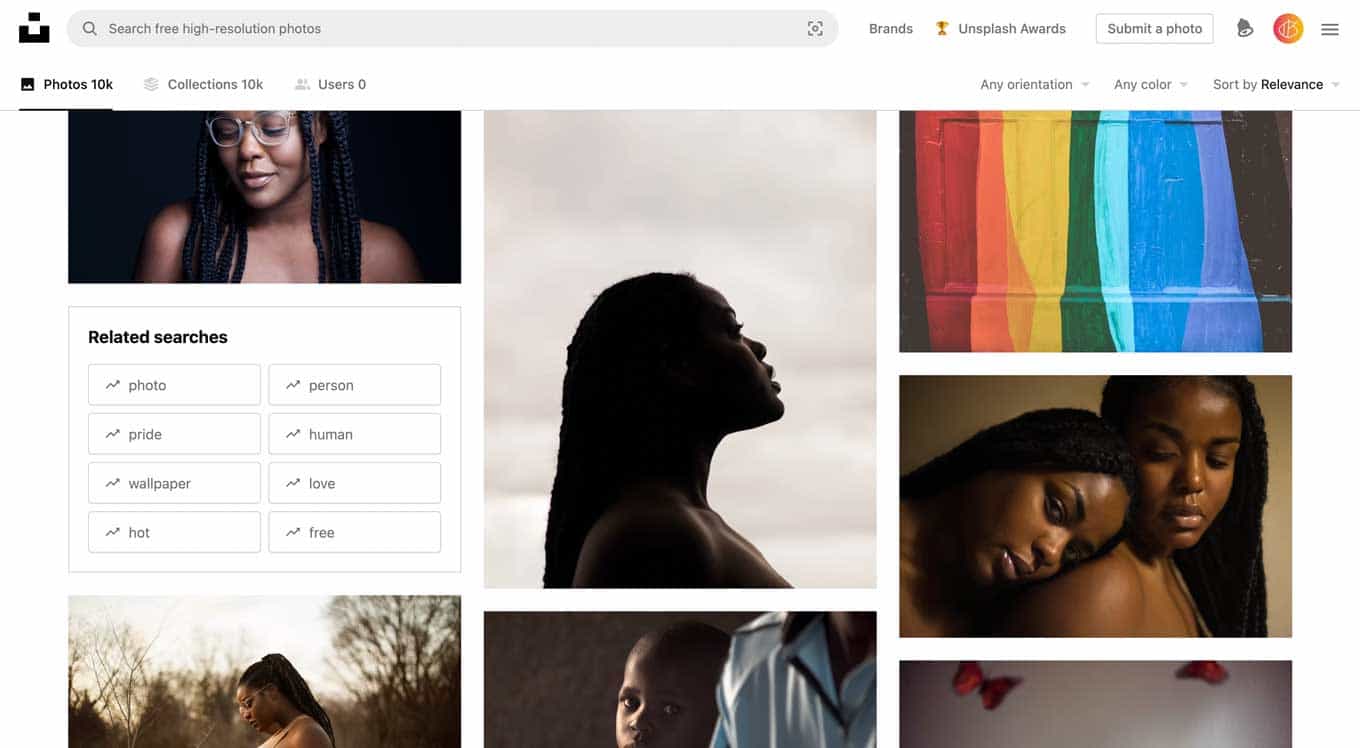
Unsplash is a popular user-friendly platform that you can use to search for specific tones or concepts.
Photographers are able to directly host their work for free use on Unsplash (via a Creative Commons license) and it sorts by category, collection, and similar imagery.
While it’s one of the bigger free photo platforms out there, with a wide variety of images, it’s worth noting that not all photos are guaranteed to have signed photo releases for models.
You’ll also have to work a bit harder to find photos that aren’t tokenizing.
P.S. Good Good Good shares photos of the Goodnewspaper on Unsplash for anybody to use.
2. The Gender Spectrum Collection by VICE
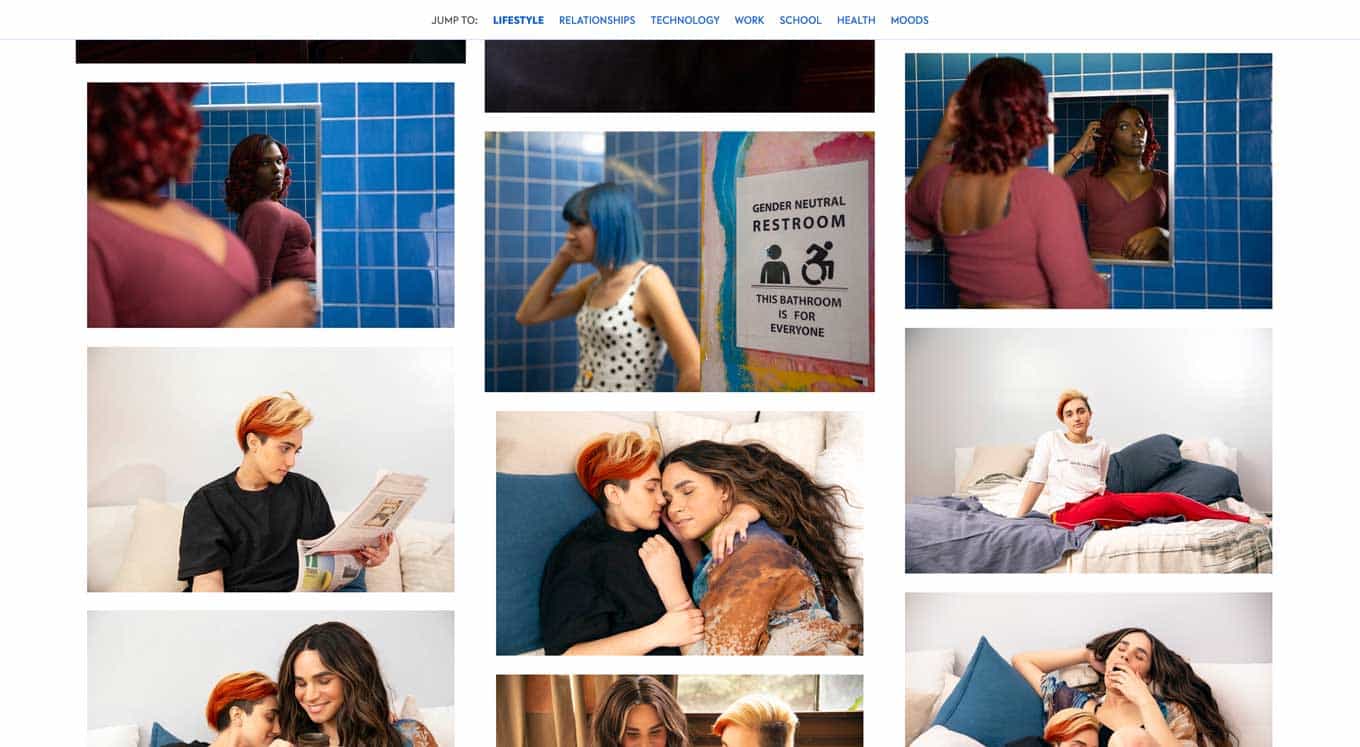
The Gender Spectrum Collection is a free LGBTQ+ stock photo library featuring images of trans, non-binary, and gender non-conforming models that go beyond the stereotypes.
This collection aims to help the media better represent members of these communities as people not defined by their gender identities.
They've also included each model's gender identification in the caption of each other to help editors avoid making assumptions.
3. Nappy
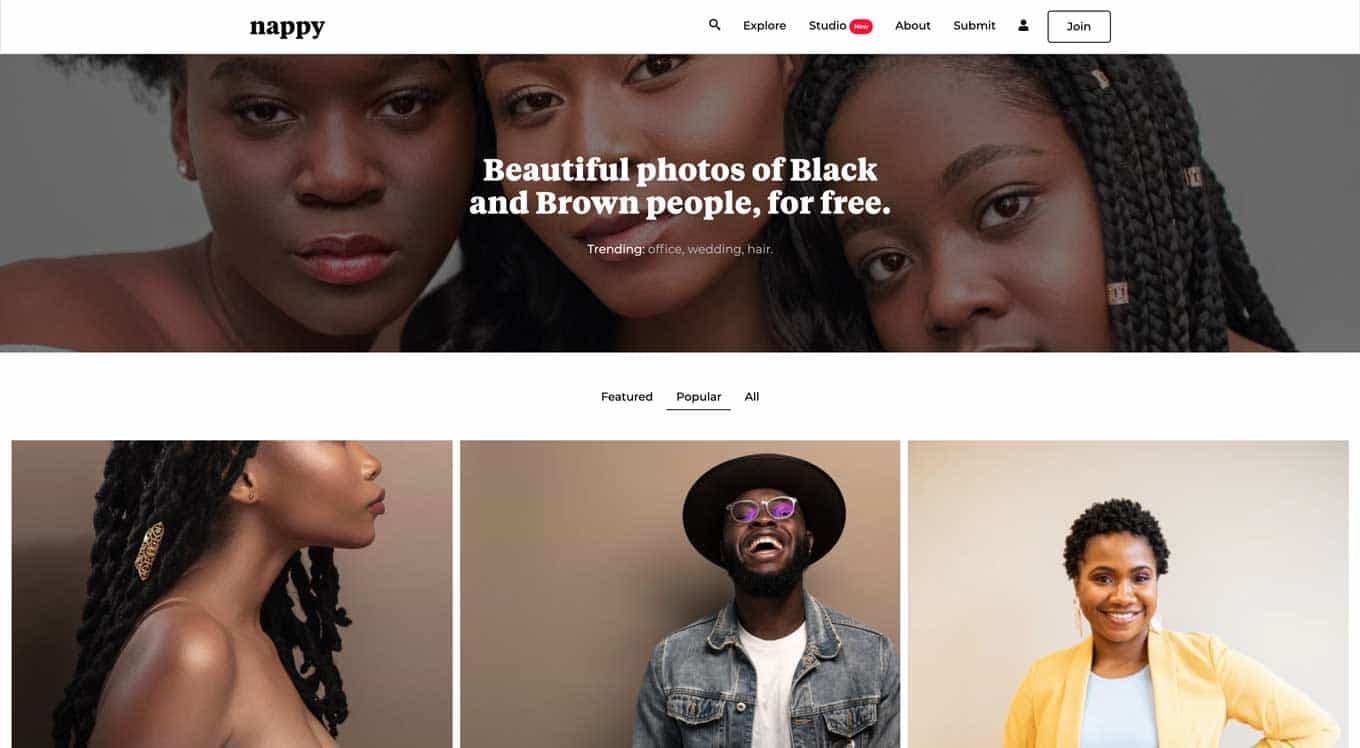
Nappy provides free beautiful, high-resolution photographs of Black and Brown people to startups, brands, agencies, and more.
They’re working to help people be more inclusive to dark-skinned people and making it easier for companies to be purposeful about representation in their designs, presentations, and advertisements.
4. Iwaria
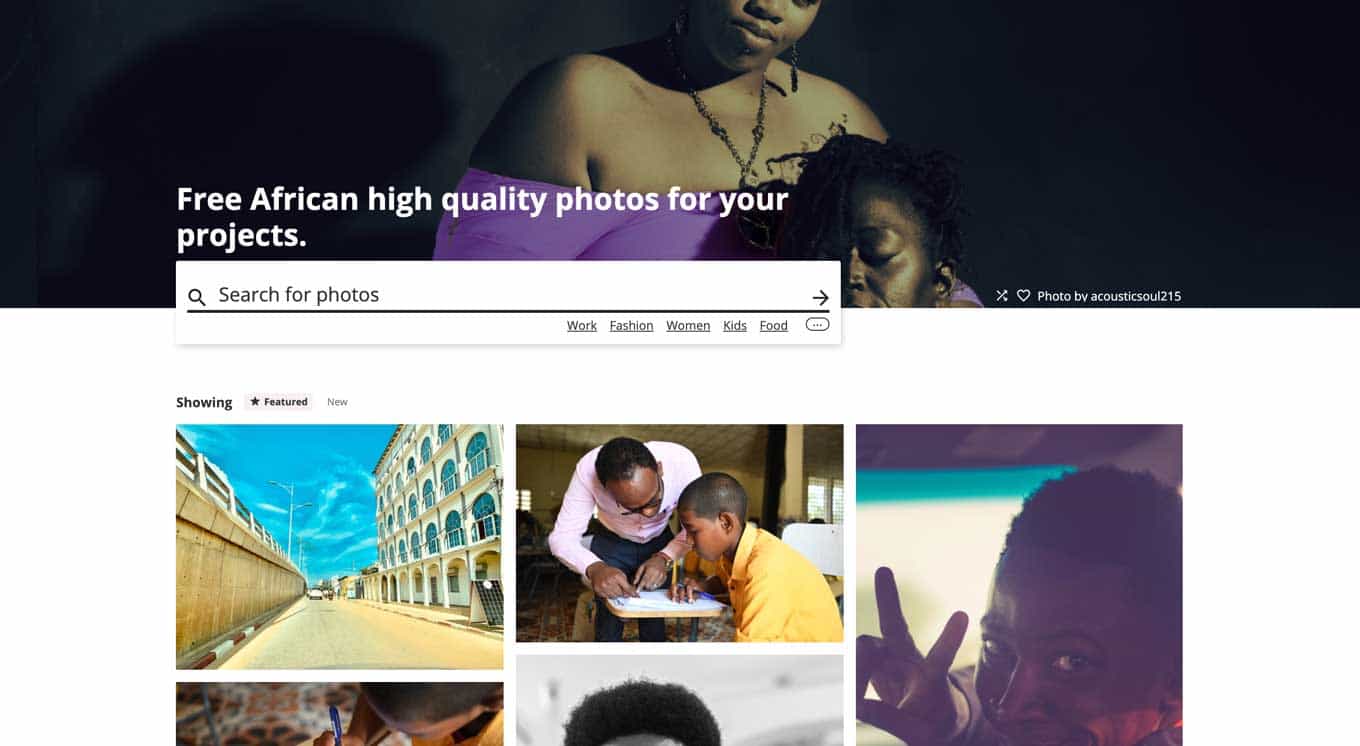
One of photography’s biggest issues is the representation around Africa and Black people that don’t fall into being racist or stereotypical in the way that Africa is typically depicted in the media.
Thankfully, Iwaria is working to fix that by offering a variety of high quality, free African photography that ranges from food, people, landscape, and more.
5. Women of Color In Tech

The tech industry is notorious for not being as diverse as it could be, despite the number of BIPOC women who work in it.
To challenge ideas of who belongs in the tech world, WOC In Tech is asking people to use their photography in pieces about entrepreneurs, software engineers, infosec professionals, IT analysts, marketers, and other people who make up the tech ecosystem. If you work in the tech sector and are looking for images of women in tech, look no further.
6. UK Black Tech
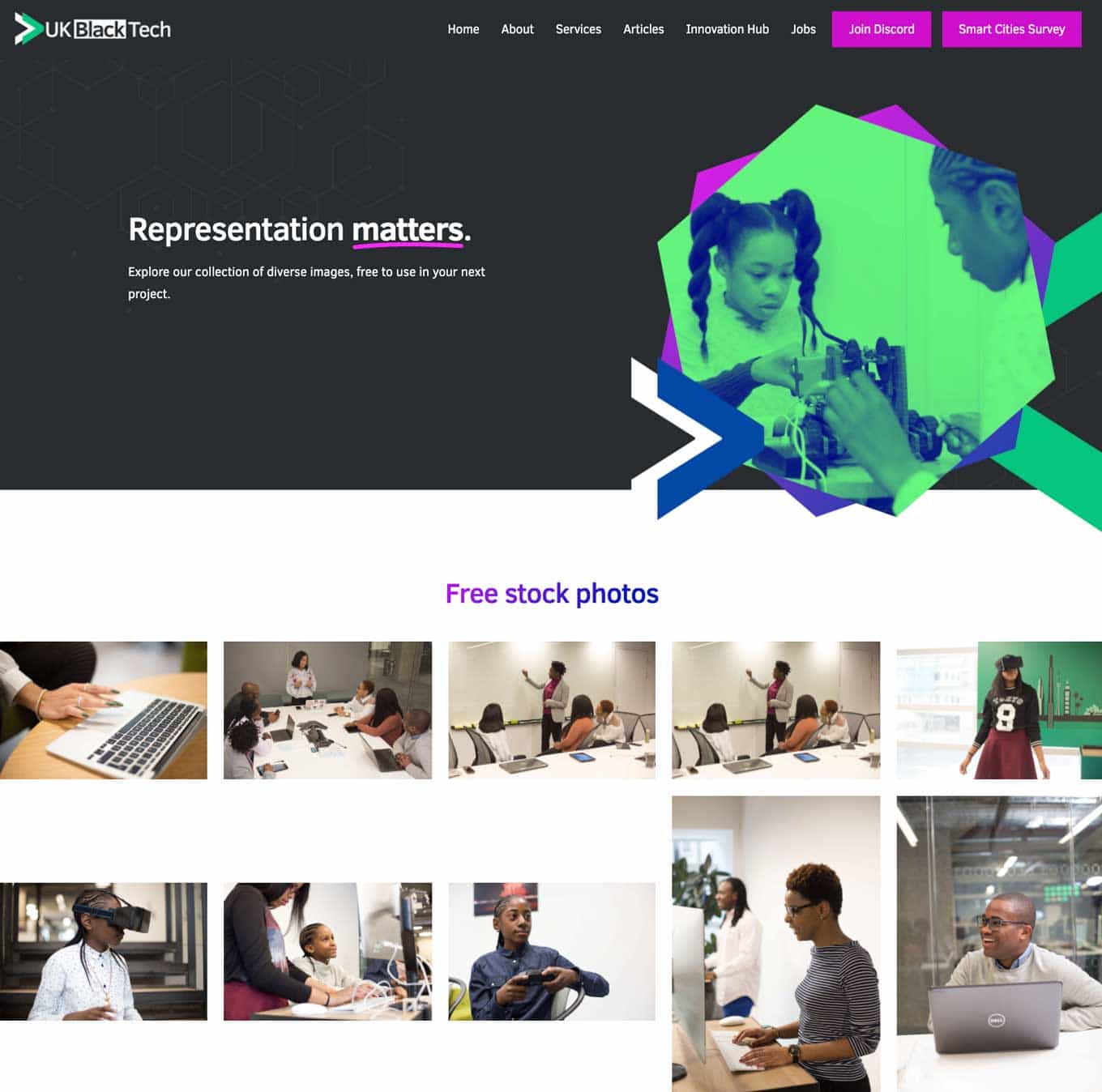
UK Black Tech supports, promotes, represents, and encourages the continued growth of diverse innovators and tech innovation across the UK.
One of their initiatives is to provide free stock photography of Black people in technology that can be accessed and used with appropriate credit.
Regardless of whether or not you’re in the UK, using these images for diversity and inclusion will be relevant to wherever you’re based.
Paid Stock Photo Platforms with Diverse Models
1. Stocksy
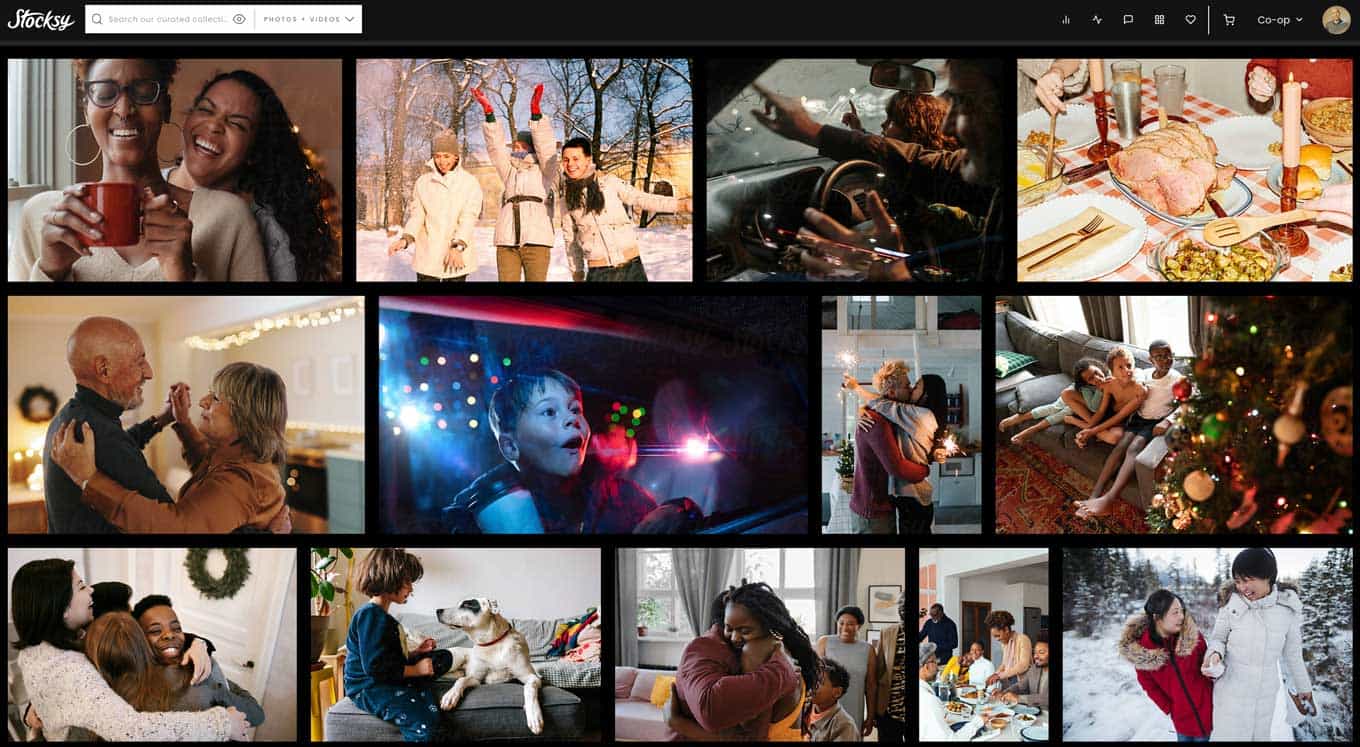
Stocksy is a diverse photography and videography marketplace that ethically and sustainably pays their creators for their work. In contrast to the way many stock photos look like stock, Stocksy focuses on authentic stock photos.
They have a fair pay program where 50 percent of regular purchases and 75 percent of extended license purchases go directly into their creators' pockets.
Their photographs are highly curated for quality — and their diverse creators are located in 75 countries around the world.
Stocksy intentionally seeks out photos that depict a diversity of skin tones, diversity of age, diversity of nationality, diversity of ethnic backgrounds, diversity of ability, and diversity of body sizes.
Pricing is based on licensing use and can range from $15 to $500 per photo.
TONL
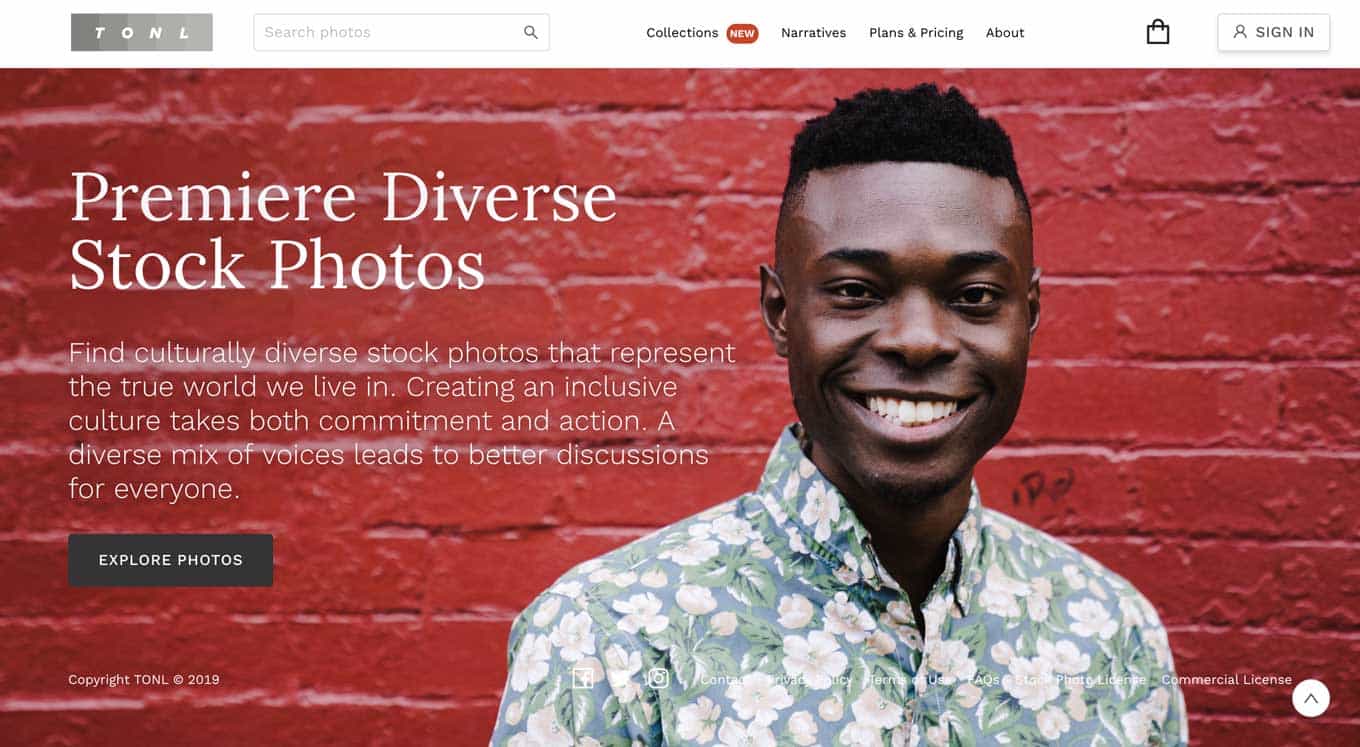
The founders of TONL, Karen Okonkwo and Joshua Kissi, set out to diversify the digital landscape for creatives after experiencing a real lack of representation online.
Now, TONL seeks to humanize the lives of BIPOC folks and challenge the stale, homogenous look of traditional stock photography by showcasing the many ethnical backgrounds of everyday people.
Their "Narrative" approach includes storytelling stock photos and text that includes context of the models and what they represent — including themes like "Traveling While Black", "Black Maternal Health", and "Active Allyship."
TONL offers a-la-carte pricing starting at $25 — or you can sign up for a monthly subscription plan to get rates under $2 per photo.
By the way, we bought the header image for the top of this blog post from TONL!
Diversity Photos
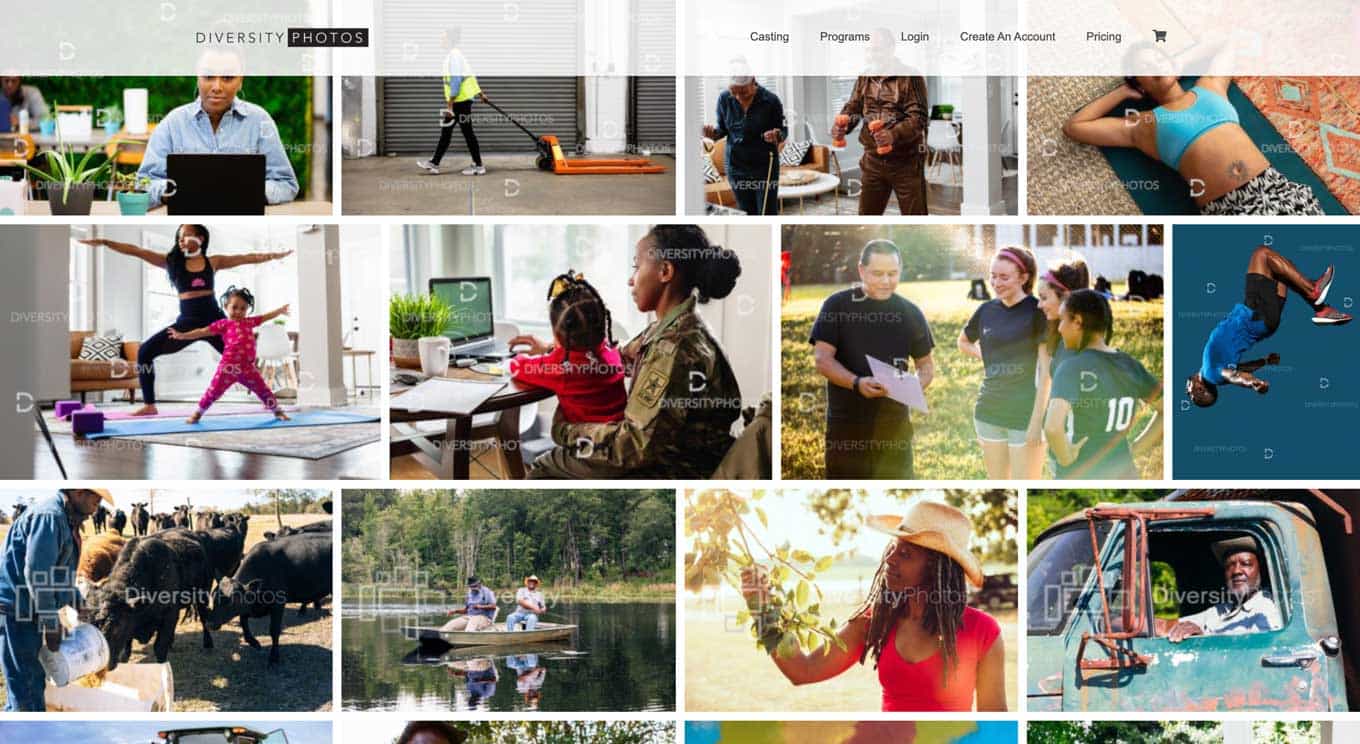
Not only does Diversity Photos offer inclusive photography, they also have programs that reinvest back into the BIPOC, disabled, and queer communities they photograph.
Their goal is to help creatives develop additional revenue streams and diversify their portfolios while shooting diverse stock images and video.
Their pricing ranges from $25 to $50 per photo, depending on your plan.
CreateHER Stock
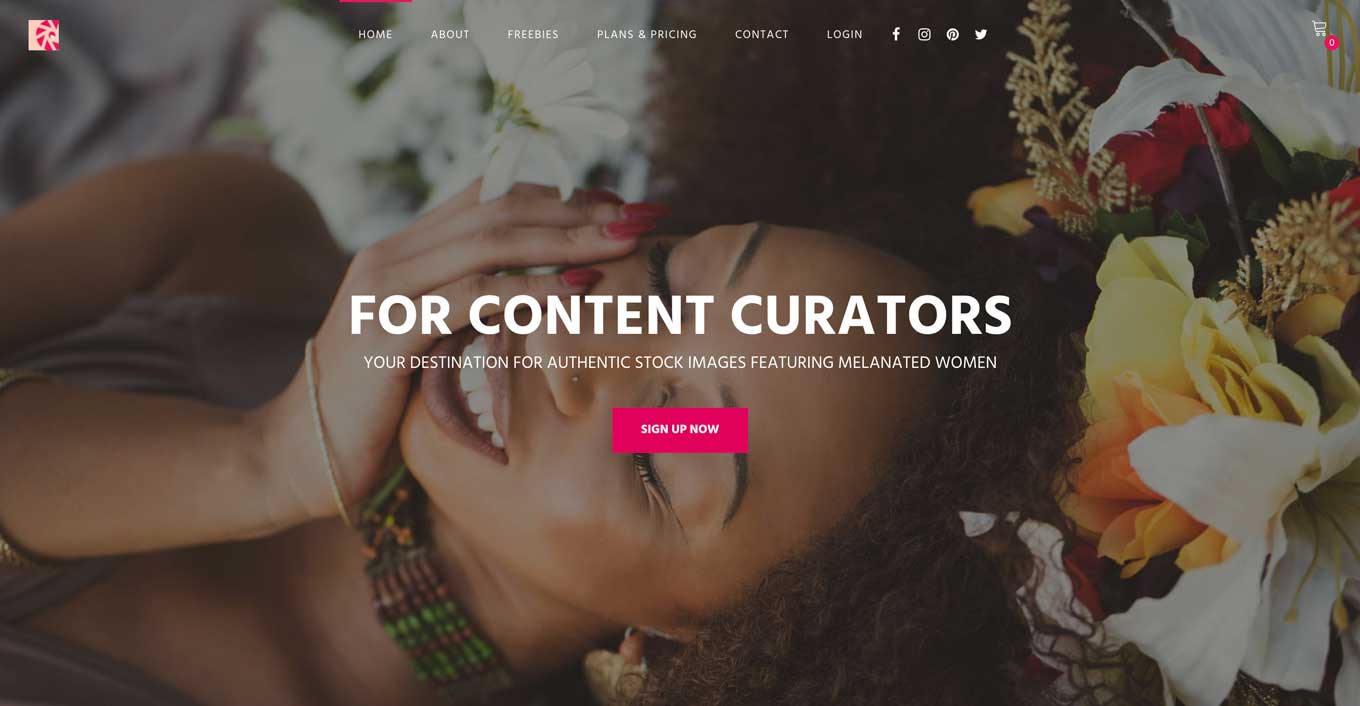
CreateHER Stock is a grassroots resource and digital pantry for inclusive stock photos of women that can be used for lifestyle, business, and everyday content creation for bloggers, creatives, and growing influencers.
They feature primarily Black women — described by CreateHER Stock as 'melanated women' — to humanize their lives and combat stereotypes.
Their pricing options include 4 tiers: blogger ($10/month), brand ($35/month), tribe ($65/month), and influence ($99/year).
Black Illustrations
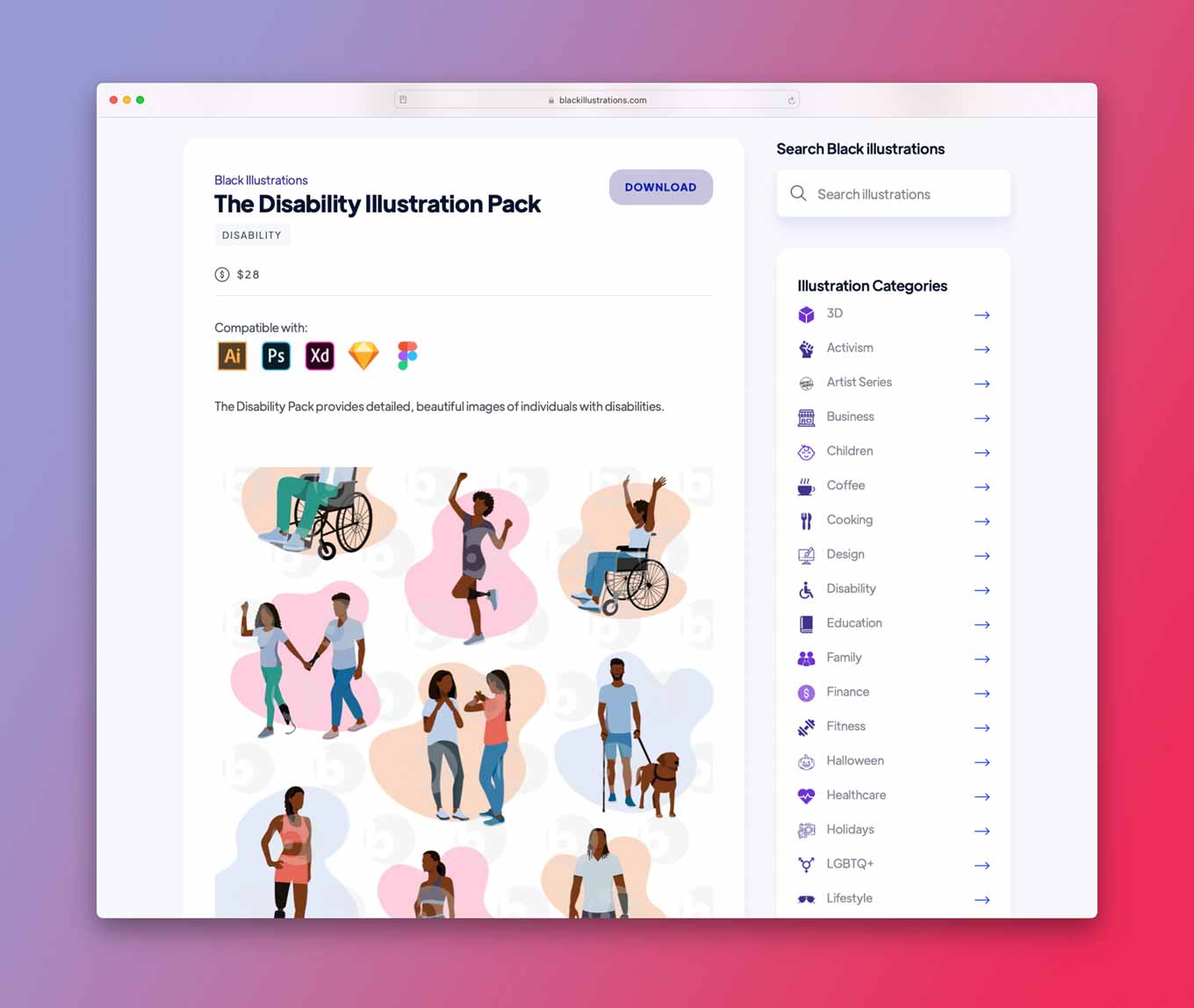
While not exactly photography, Black Illustrations provides diverse illustrated images for you to use in your online projects.
Each pack features dozens of images, bundled together in groups like The Disability Pack, The STEM Pack, The Pride Pack, The Afro-Latin Pack, and The Kids Pack.
Downloads include files in PNG, JPG, Sketch, XD, and other formats — all at a cost of $28-$49 per bundle. They also have a number of free packs available to get you started.
Traditional Stock Photo Platforms

Of course, you can still find diverse stock photography on the OG platforms Adobe Stock, Shutterstock, iStock, etc.
But to ensure true representation that isn’t damaging, you need to be intentional with your choices.
This can mean consulting with experts on your team or just being extra careful when finding media.
When in doubt, it’s always better to lean into the winds of caution and do your background research on what is and isn’t harmful.
Hire Creators of Color, Disabled Creators, LGBTQ+ Creators, and Other Diverse Creators

Lastly, a great way to get great inclusive photography is by hiring photographers and artists of diverse lived experiences (and not just during Pride or Black History Month).
When you hire diverse creators — people with disabilities, people of color, LGBTQ+ people, people outside of the United States, people of different ages — you’re supporting diversity efforts in front and behind the camera and leaning into their lived experiences as people of color. This also helps more creators of color get paid and more exposure for their work.
Want to learn more? Check out our podcast episode about how to support creators of color with photographer Aundre Larrow.
Ultimately, mass media is everywhere and it sends subliminal messages to our brains. If you're responsible for the imagery shown on your platform, you have the opportunity to make a meaningful and positive difference.
When we’re more thoughtful about using inclusive imagery — particularly as we consider race, gender, age, etc — the whole world benefits.
- Camera trap footage taken between 2013 and 2018 revealed that about 55 endangered Amur tigers (commonly referred to as Siberian tigers) are now living in northeastern China.
- Experts say the tigers’ reemergence in the region is largely due to Chinese national policies favoring environmental stewardship, including the Natural Forest Protection Project and the establishment of several reserves.
- According to a recent paper, northeastern China could actually support about 310 tigers, including 119 breeding females, if further efforts are taken to minimize human pressures and ecological corridors are established between tiger habitats.
- While tiger numbers are growing in China, the species continues to face threats of poaching, habitat loss and fragmentation, and human-wildlife conflict.
There was a time when tiger expert Dale Miquelle wasn’t sure if there’d ever be a substantial population of Amur tigers (Panthera tigris altaica) in China again.
In the 1990s, Miquelle and his colleagues estimated there to only be about eight of these big cats, also commonly referred to as Siberian tigers, left in northeastern China.
But in the last eight years, change has come in leaps and bounds: recent camera trap footage reveals there are at least 55 Amur tigers living in forests in northeastern China.
“Persistent efforts to protect tigers have paid off,” Miquelle, director of the Wildlife Conservation Society (WCS) Russia, said in an email. “Change has not come quickly, but there has been slow, steady progress, and we see there are great opportunities for even more recovery.”
According to a recent study in Biological Conservation, of which Miquelle is a co-author, camera trap footage taken between 2013 and 2018 identified 55 Amur tigers in four forested landscapes in northeastern China: Laoyeling, Zhang-Guangcailing, Wandashan, and the Lesser Khinghan Mountains.
The scientists also genetically analyzed tiger scat, urine and hair to identify 30 tigers in the region. However, only Laoyeling is believed to support a breeding population, the paper suggests.
The reason for the tigers’ sudden appearance in northeast China is due, in a large part, to a Chinese national policy called the Natural Forest Protection Project (NFPP), Miquelle said.
“By stopping [the] harvest[ing] of trees in many parts of China, they essentially made whole villages whose economy was based on timber harvest economic wastelands,” Miquelle said.
“Many of these people have had to leave the region to find new work, thereby pulling more and more people out of the forests.” With the timber industry shutting down, the forests were able to recover, and that’s “a big reason why tigers are expanding.”

The NFPP was part of the Chinese government’s “huge sweeping policy change” that has shifted the country toward environmental stewardship and wildlife protection, Miquelle said.
Another big change happened in 2001, when the government established at least three nature reserves, including the Hunchun National Nature Reserve, to provide critical habitat for Amur tigers and Amur leopards (Panthera pardus orientalis).
And in 2016, China established the Northeast Tiger Leopard National Park (NTLNP), which spans nearly 15,000 square kilometers (5,800 square miles) in northeast China, encompassing the Hunchun National Nature Reserve and representing the largest tiger refuge in the world.
“China is working hard to turn this [national park] into a model for conservation in China,” Miquelle said.
Aimin Wang, director of WCS China, said that, overall, local people have been supportive of the environmental changes orchestrated by the government and the reemergence of tigers in the region.
However, he said the establishment of the NTLNP has caused a few issues since people can no longer use this land to graze their cattle.
“This is quite a big issue now and the government is looking for solutions for that,” Wang told Mongabay in a Zoom interview.
Amur tigers are currently the most endangered of all big cat subspecies. In the 1930s, scientists believed there to be as few as 20 to 30 Amur tigers left, mainly in Russia.
But drastic conservation measures led to a slight recovery of the subspecies, and the most recent population census in 2010 estimates there are about 350 Amur tigers living in the region.
John Goodrich, chief scientist and tiger program director for Panthera, the global wild cat conservation organization, said the discovery of the 55 tigers in northeastern China is “great news” since species tend to fare better when their range isn’t limited to one country.
“While they have done reasonably well there [in Russia], having all of a single species residing in one country is risky,” Goodrich told Mongabay in an email.
“For example, Amur tiger numbers declined dramatically in the early 90s with the political and social challenges of Perestroika. Now the risk is spread over two countries.”
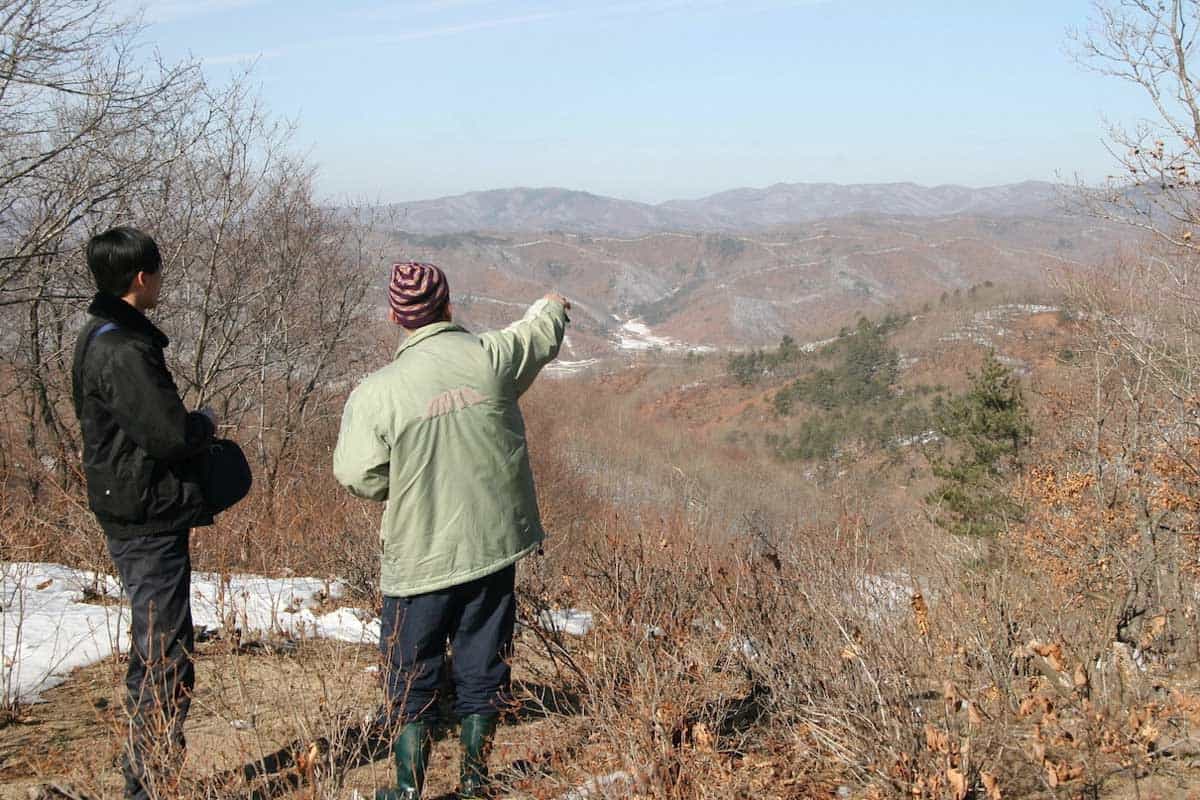
Amur tigers may have a foothold in northeastern China now, but they will face the same threats they would face anywhere in the world, Goodrich said. This includes poaching, prey loss, habitat loss and fragmentation, and human-wildlife conflict.
Amur tigers will also face a number of threats linked to climate change, although northeastern Asia should continue to provide suitable habitat for the subspecies, Miquelle said.
“A warming climate will mean that there may be more and better habitat in northeast China in the future (and definitely more potential habitat in Russia),” he said. “But with a more variable or drier climate, forest fires pose a serious threat to tiger habitat.”
In their recent paper, Miquelle and his co-authors argue that northeastern China could support a much larger “meta-population” of Amur tigers if additional efforts are made to minimize human impacts, and to create ecological corridors between tiger habitats. They write that if appropriate measures are taken, the region could actually support about 310 tigers, including 119 breeding females.
“There is still a long way to go to build a viable future for tigers in northeast China, but the situation looks good,” Miquelle said. “National leaders of both Russia and China have demonstrated a sincere interest in Amur tiger conservation, providing a strong foundation for their recovery.”
This article was originally published on September 21st, 2021 by Mongabay — and was republished with consent.
How many lives have coronavirus vaccines saved in the U.S.?
Clinical trials demonstrate how effective vaccines are individually, but the real world shows how effective they are at a population level.
More than 200 million U.S. residents have gotten at least one shot of a COVID-19 vaccine with the expectation that the vaccines slow virus transmission and save lives.
Researchers know the efficacy of the vaccines from large-scale clinical trials, the gold standard for medical research.
The studies found the vaccines to be very effective at preventing severe COVID–19 and especially good at preventing death. But it’s important to track any new treatment in the real world as the population-level benefits of vaccines could differ from the efficacy found in clinical trials.
For instance, some people in the U.S. have only been getting the first shot of a two-shot vaccine and are therefore less protected than a fully vaccinated person.
Alternatively, vaccinated people are much less likely to transmit COVID-19 to others, including those who are not vaccinated. This could make vaccines more effective at a population level than in the clinical trials.
I am a health economist, and my team and I have been studying the effects of public policy interventions like vaccination have had on the pandemic.
We wanted to know how many lives vaccines may have saved due to the states’ COVID-19 vaccination campaigns in the U.S.
Building an accurate model
In March 2021, when weekly data on state COVID-19 vaccinations started to become reliably available from state agencies, my team began to analyze the association between state vaccination rates and the subsequent COVID-19 cases and deaths in each state.
Our goal was to build a model that was accurate enough to measure the effect of vaccination within the complicated web of factors that influence COVID–19 deaths.
To do this, our model compares COVID-19 incidence in states with high vaccination rates against states with low vaccination rates.
As part of the analysis, we controlled for things that influence the spread of the coronavirus, like state–by–state differences in weather and population density, seasonally driven changes in social behavior and non-pharmaceutical interventions like stay-at-home orders, mask mandates and overnight business closures.
We also accounted for the fact that there is a delay between when a person is first vaccinated and when their immune system has built up protection.
Vaccines saved lives
To check the strength of our model before playing with variables, we first compared reported deaths with an estimate that our model produced.
When we fed it all of the information available – including vaccination rates – the model calculated that by May 9, 2021, there should have been 569,193 COVID-19 deaths in the U.S. The reported death count by that date was 578,862, less than a 2% difference from our model’s prediction.
Equipped with our well-working statistical model, we were then able to “turn off” the vaccination effect and see how much of a difference vaccines made.
Using near real-time data of state vaccination rates, coronavirus cases, and deaths in our model, we found that in the absence of vaccines, 708,586 people would have died by May 9, 2021.
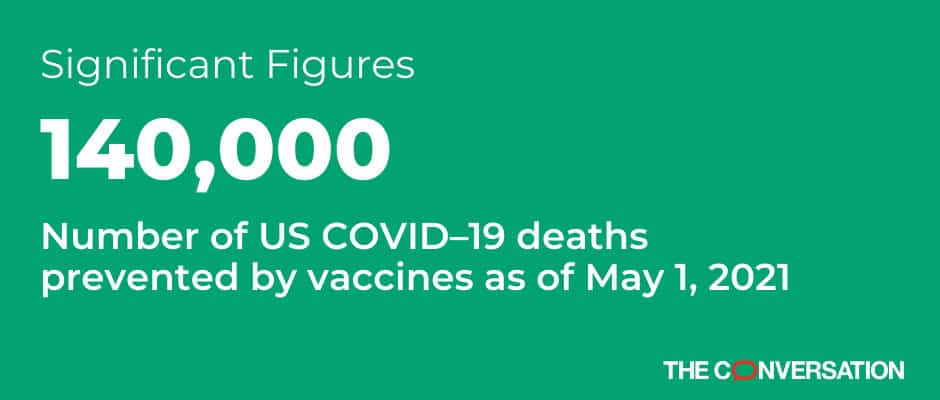
"Our model suggests that vaccines saved 140,000 lives by May 9, 2021."
We then compared that to our model estimate of deaths with vaccines: 569,193. The difference between those two numbers is just under 140,000. Our model suggests that vaccines saved 140,000 lives by May 9, 2021.
Our study only looked at the few months just after vaccination began. Even in that short time frame, COVID-19 vaccinations saved many thousands of lives despite vaccination rates still being fairly low in several states by the end of our study period.
I can say with certainty that vaccines have since then saved many more lives – and will continue to do so as long as the coronavirus is still around.
This article was originally published by The Conversation on October 15th, 2021 — and was republished with permission.
In July 2018, a century-old red oak went live on Twitter. The account @awitnesstree, tweeting from the Harvard Forest in Petersham, Massachusetts, introduces itself in its bio:
Witnessing life as a tree in a changing environment for more than a century. Views are my own – sort of (data translated by scientists and communicators at HF).
Every few days, the tree updates its 9,118 followers. On February 24 2020 it posted: “The last 2 days were extremely hot for February. When is this heatwave going to end?”
The day before, it had complained even more:
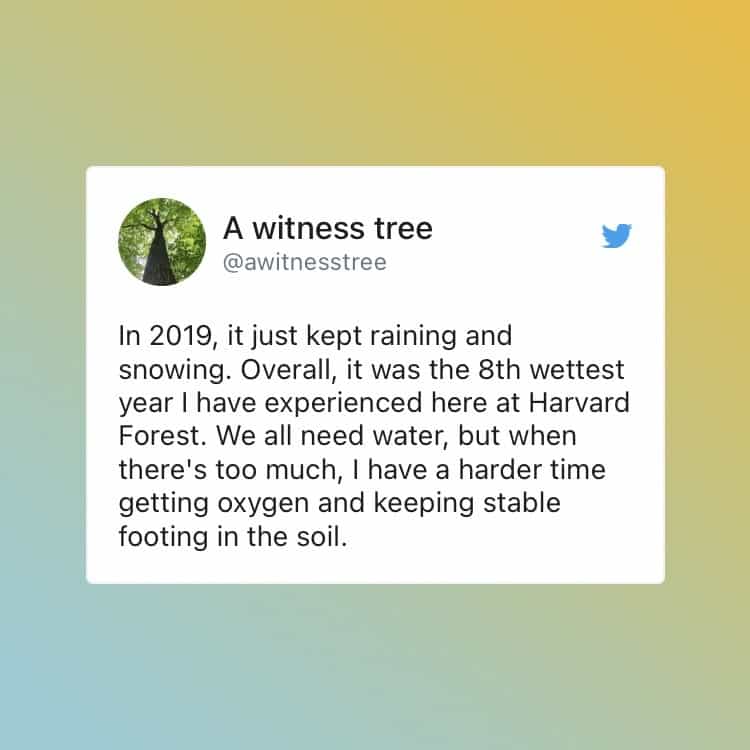
Now, after a hiatus due to COVID-related challenges, the Witness Tree is coming back online.
The tree’s messages are based on data from a suite of sensors on and around its trunk, using a real-time approach to tree monitoring pioneered by Witness Tree’s inspiration and sister project TreeWatch.net.
Led by Ghent University, TreeWatch.net set up its first tweeting tree in 2016, and currently monitors sensor data from 21 trees across Belgium, Germany, India, the Netherlands and the UK.
The sensors fitted to Harvard’s Witness Tree include a ribbon embedded in its trunk to track water flow, a spring-loaded pin pushing against its bark to monitor shrinkage and swelling and a camera to capture leaf growth.
Continuous data streams from these sensors tell us how the tree is affected by changes in its immediate environment. This technology is still in its infancy, but it shows exceptional promise.

By analysing data from Witness Tree and TreeWatch.net, we have already learned that drought can cause a tree’s stomata – the openings on the underside of its leaves – to close. The closed stomata block water intake, disrupting tree growth. More frequent droughts may therefore lead to less carbon uptake by trees and forests.
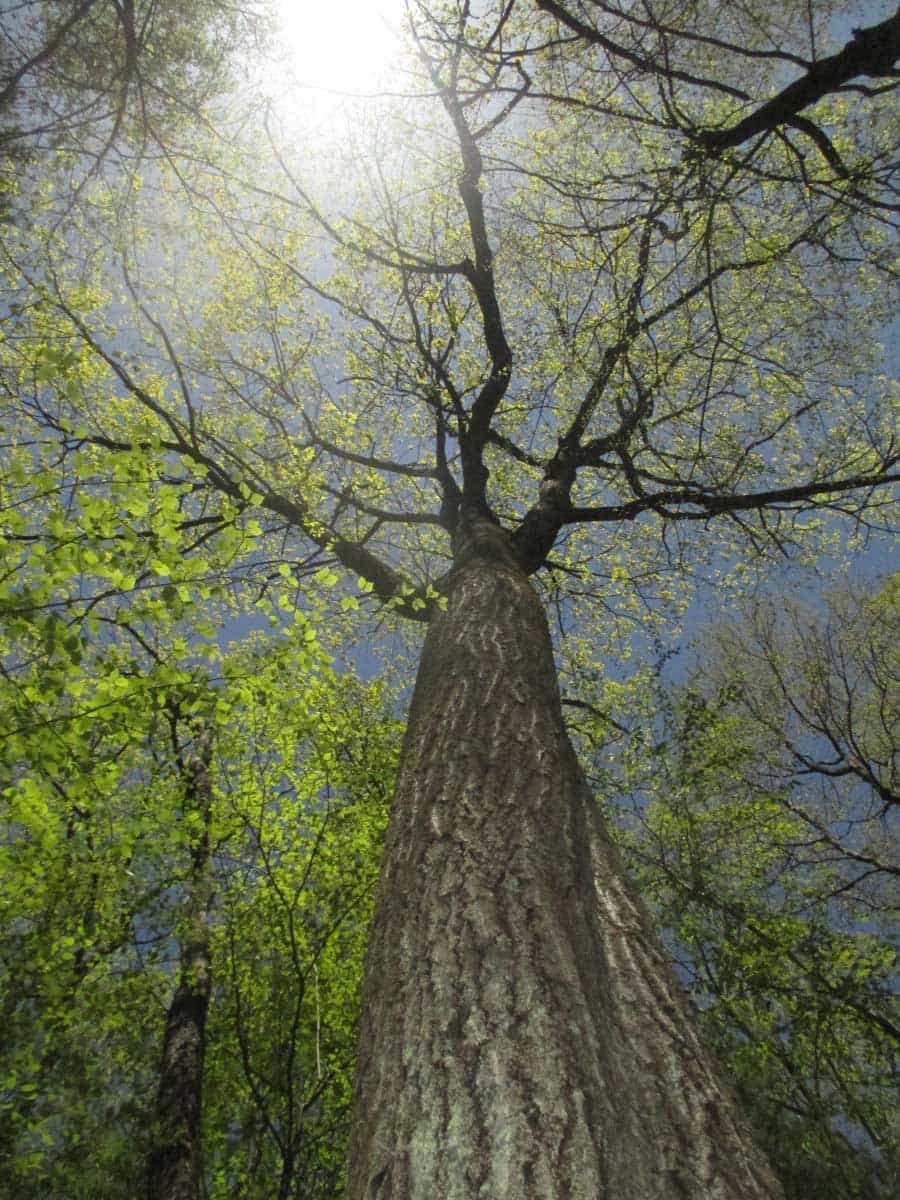
Forthcoming studies even indicate that individual trees respond differently to the same heat waves, and that water transport in trees can react instantly to the presence of a solar eclipse. With the sun obscured by the moon, stomata close as they would do at night, immediately reducing water intake.
As we continue to assess incoming data from Witness Tree and TreeWatch.net, we will surely learn even more about how trees affect – and are affected by – their surroundings.
Science communication
The red oak at Harvard Forest, along with its Asian and European cousins at TreeWatch.net, is first and foremost a rich source of scientific data. But at the same time that data, when converted to tweets by custom-built algorithms, turns the Witness Tree into a platform for science communication research.
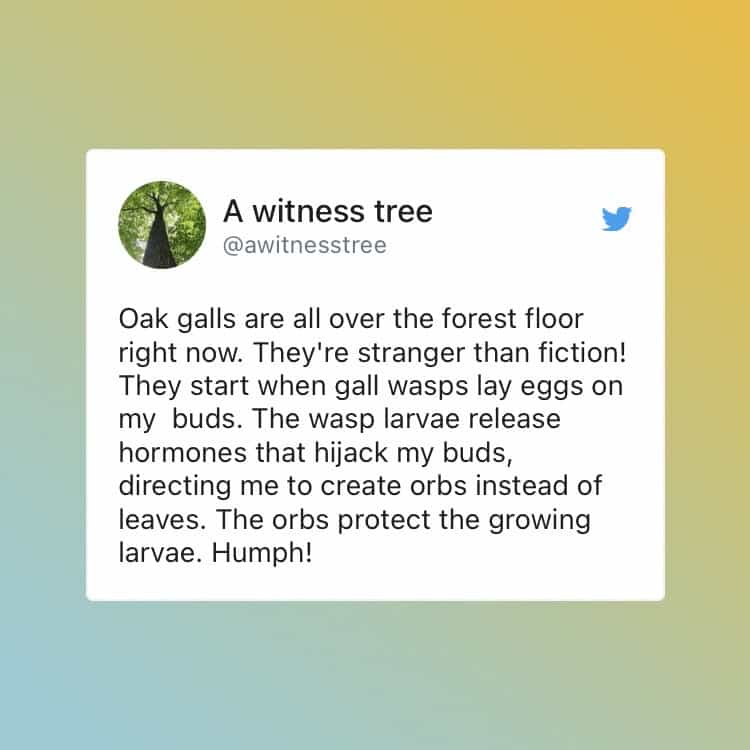
Behind the scenes, a computer program analyses the incoming numbers from Witness Tree’s sensors: cross-checking against pre-programmed thresholds for normal activity, looking for abrupt changes, and compiling summaries.
For each key data feature, including daily water use, sap flow dynamics, stem shrinkage, and trunk growth, the researchers at Harvard Forest have provided the program with several different prewritten message templates.
The program chooses one of these templates, inserts the relevant data, and posts the completed message on Twitter as if in the tree’s own voice.
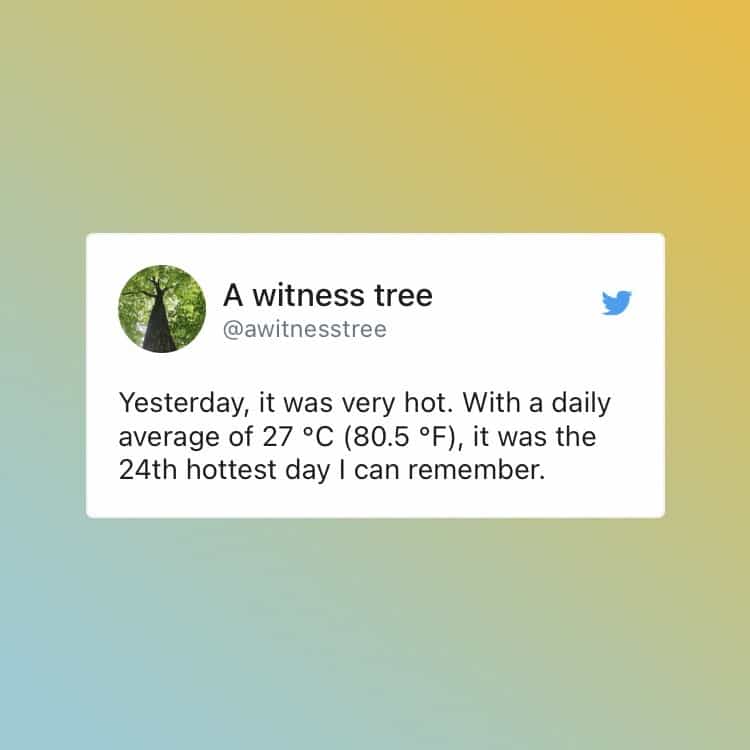
Because the messages are chosen from templates at random, they can be used as a testing ground to study how the public prefers to engage with different topics and writing styles.
Preliminary results suggest, somewhat surprisingly, that the Witness Tree’s followers engage equally with data-driven and narrative-based tweets.
The addition of multimedia – through images, videos, or data visualization – generates more responses, likes, and retweets. Any posts that directly concern climate change seem to attract the most attention.
In fall, I drop seeds (acorns) that are food for 100+ types of wildlife. Many of these animals, like squirrels and blue jays, carry my acorns a great distance before storing them underground. They become accidental gardeners of new trees! pic.twitter.com/hDvy9T8fEA
— A witness tree (@awitnesstree) November 6, 2019
The future
To gain access to even more data, both the Witness Tree project and TreeWatch.net are expanding. The single Witness Tree will soon become part of a forest network spread over urban, suburban, and rural areas to study how trees function in different environments.
Future witness trees with fine particulate matter sensors sensitive to poor air quality could help grow awareness about environmental stress factors faced by humans and trees alike.
New trees monitored by TreeWatch.net will measure carbon lost due to tree respiration, paving the way for more accurate carbon accounting.
By cementing our understanding of how trees contribute to the carbon cycle, we will be in a better position to reduce carbon output globally.
Long-term, Witness Tree and TreeWatch.net aim to work together to build a vast, international network of tweeting trees: in other words, an internet of trees.
The data from this “internet” will provide invaluable insights into the wellbeing of our forest ecosystems – from detecting early signs of drought and tracking the impact of pests and pathogens to forecasting sap flow for maple syrup production.

As we have learned more about how trees interact with the ecosystems that they visually define, trees have often been represented as social creatures in recent research and popular writing.
In a way, Witness Tree and TreeWatch.net play into this idea by giving their trees a human-like voice. They use personification as a tool to communicate effectively with a wide audience.
But it would be counterproductive to take this metaphor too seriously, because each tree’s voice is in fact a fiction fed by automated messages.
Really, it’s the data talking – and the story that data tells is the brutally honest reality of environmental change.
This article was originally published by The Conversation — and was made available to Good Good Good.
An excerpt from the new book, You Are Here (For Now), by Adam J. Kurtz:
Sometimes I get too caught up in my phone and all the terrible things happening in the world.
I open the phone and yes, sure, I feel connected to my friends and the specific blend of opinions I’ve invited into my feed, but there is an overwhelming amount of news that is hard to digest and a pervasive, low-level feeling of panic and dread.

I have felt this regularly for a few years and have taken some steps to mitigate, such as turning off all news media push notifications on my phone and occasionally muting the sources of information that I need a break from.
The reality is not that bad things have suddenly started happening with alarming frequency (although in some ways, the results of our actions as a whole, such as ignoring climate science, have absolutely brought us here).
The truth is that humans have long been completely terrible to each other, corporations have put profits over people, and some of us have been turning a blind eye to the suffering of others. Whether this is a conversation we’re all having or not, these things are occurring. And now we’re seeing more of it.
Technology has made capturing and distributing information incredibly easy, and so we are witnessing, sometimes in real time, crimes against humanity.

We are witnessing, sometimes as it happens, people dying, suffering, or causing harm to others. There is so much of it, and it’s all around us, and it can be overwhelming, and so at a certain point the impulse is to just log off. The impulse is to disconnect and shut down.
What’s most healthy for you right now and most healthy for all of us in the long term may not be the same thing. It’s my feeling that taking some time away from the endless news cycle is helpful and sometimes necessary, especially if you are in close proximity to the subject.
Basically, if you’re feeling particularly overwhelmed, opt out. Take the time you need and once you feel safe again, come back in.

For most of us, the endless cycle of “sadness, outrage, desire to take action, manageable action, keep moving” is unsustainable. The pent-up rage, tight shoulders, and clenched jaw help nobody and take years off your own life. There has to be a balance.
"One thing to remember is that good people are out there. Good things are happening. While outrage tends to spread faster, good news exists too."
One thing to remember is that good people are out there. Good things are happening. While outrage tends to spread faster, good news exists too.
In fact, it’s often not newsworthy at all, because by definition, the commonplace activity that is ever present around us isn’t news. There is overwhelmingly so much goodness in the everyday experience of being alive, so many positive interactions and occurrences in our communities, that it is simply not reported to the same degree.

So we focus on the things that need changing, or the sensational headlines that blend fact with emotion for the sake of shock-entertainment, and forget that everyday people are doing everyday things.
Every single day, someone is saying something positive to someone else out of kindness or gratitude. Every single day, someone is doing one small action that betters another person’s life, even if they don’t know it. Every single day, people are preparing meals for the ones they love. Every single day, people are going to work, even if they’d rather not, to care for, impact, or better other people’s lives. Every single day, you are doing some good, even if you don’t think about it that way.
Opting out of the constant stream of negative for a bit doesn’t mean pretending it isn’t happening.
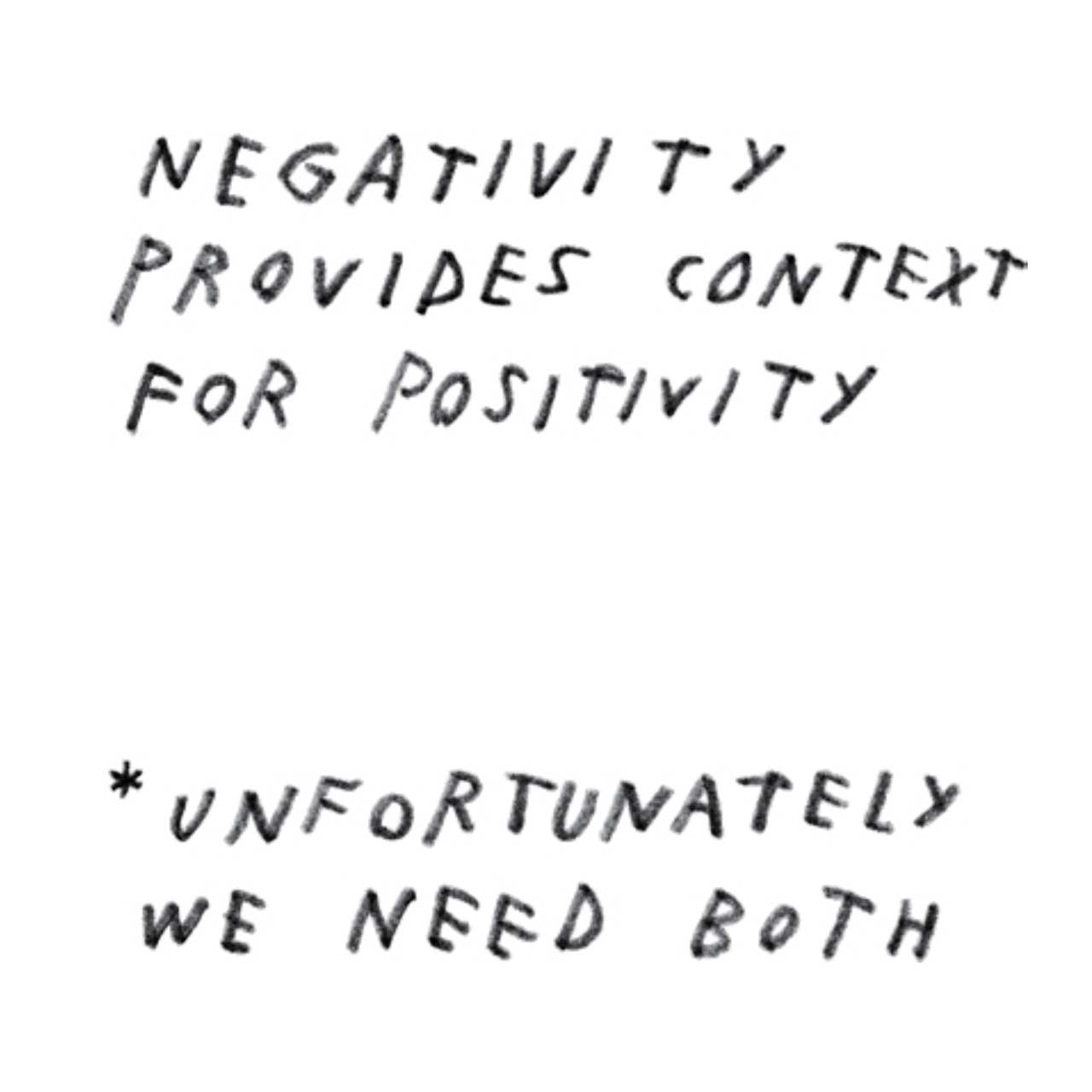
Your bubble might feel safe for a while but it will always, always burst. Bubbles are beautiful iridescent floaty magic but incredibly thin and literally empty. The bubble is not sustainable. It is a wonderful place to visit, to feel temporarily childlike (assuming you had a pleasant childhood) but there is an expiration date.
If you need a reprieve, allow it, but keep one eye open to the reality on the other side of your rainbow perimeter because even a bubble has to exist in space, and space is complicated.
The most sustainable solution I can think of is one where “good vibes” and “bad vibes” and midrange “OK vibes” coexist. It is only when all our vibes can vibe together that we can ever truly reach vibe equilibrium, not a temporary bubble but a novelty mold of fruit and cream and hope and fear suspended in red Jell-O forever.

This unfortunate dessert is the closest thing to reality as we know it, a mixed bag of good and bad that has to be acknowledged equally because a little bit of everything is happening at all times.
You can pick around and eat your favorite fruits first, but eventually you’ll be left with nothing but a soggy pile of canned pear slices and you’ll have to eat those too.
This chapter, Bad News Pears, was excerpted from You Are Here (For Now) by Adam J. Kurtz.
When life feels uncertain, or just plain out of control, making intentional choices can help us move forward and find our way. Sometimes all it takes is a gentle nudge, but for anyone waiting for that big, obvious sign from the universe: This is it!
This candid collection of essays and artwork is full of reflections, encouragement, and insights on the theme of personal transformation — realistic perspectives to help you move from “staying alive” to nurturing and celebrating the person you know you really are.
From the generous and slightly jaded mind of artist Adam J. Kurtz, these pages explore mental health, identity, handling setbacks, and finding humor in the unknown—and will be a touchstone for seekers, graduates, creatives, and anyone who’s trying to figure out what’s next (and maybe even feel a little hopeful about it).
Get your copy of You Are Here (For Now) on Amazon, Bookshop, Libro.fm, or wherever you buy books.

From renting tractors to monitoring crops by satellite, a slew of agri-tech innovations have emerged over the last decade to serve Africa's long-neglected small-scale farmers
— Smallholder farmers produce one-third of the world's food
— Global food production needs to grow by nearly 60% by 2050
— Over 400 agri-tech solutions in sub-Saharan Africa
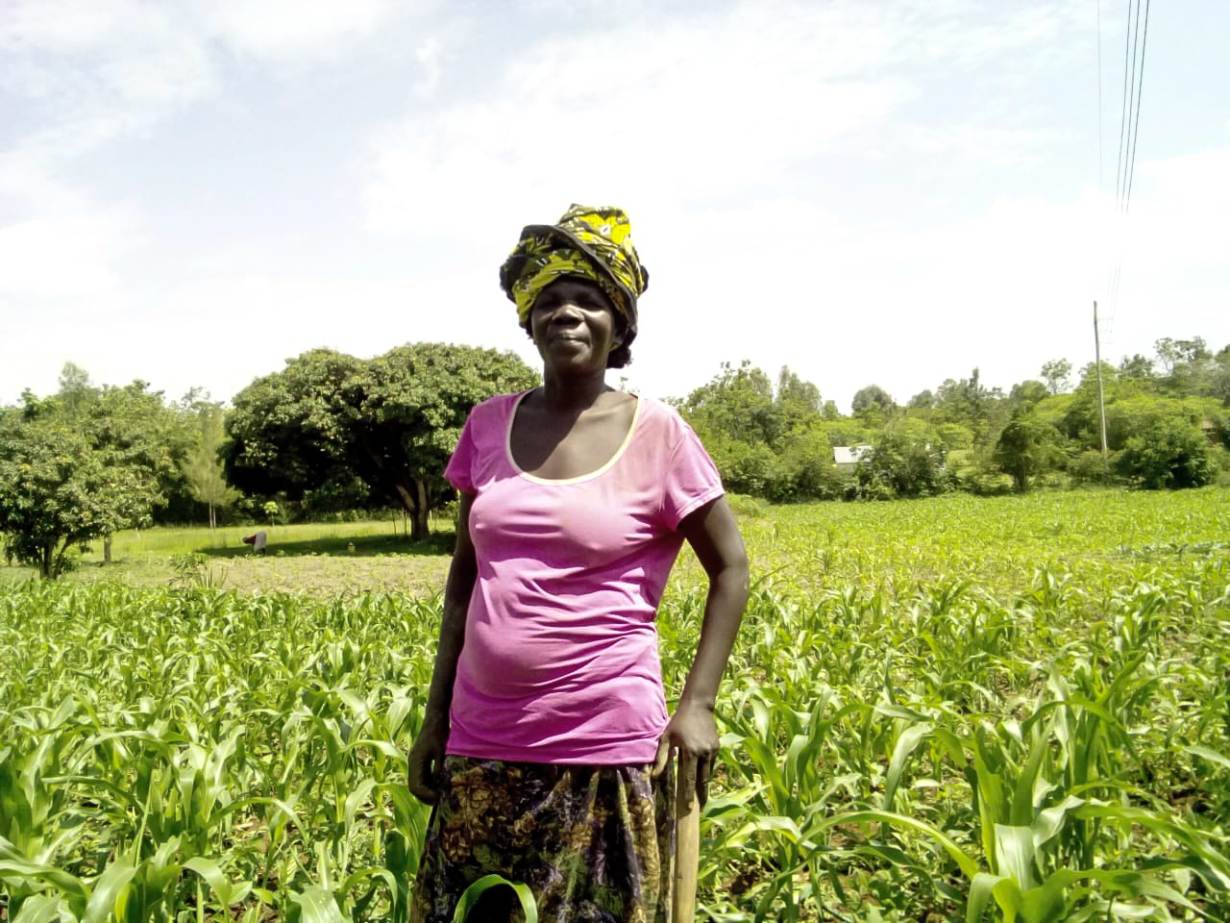
Until a year ago, it would take Pamela Auma a whole month to prepare the land on her farm in western Kenya for planting ahead of the rainy season.
With hoe in hand, the mother-of-seven spent her days digging up the one-acre (0.4-hectare) plot - roughly the size of a football field - and praying she would finish in time to sow her maize and beans crops before the rains arrived.
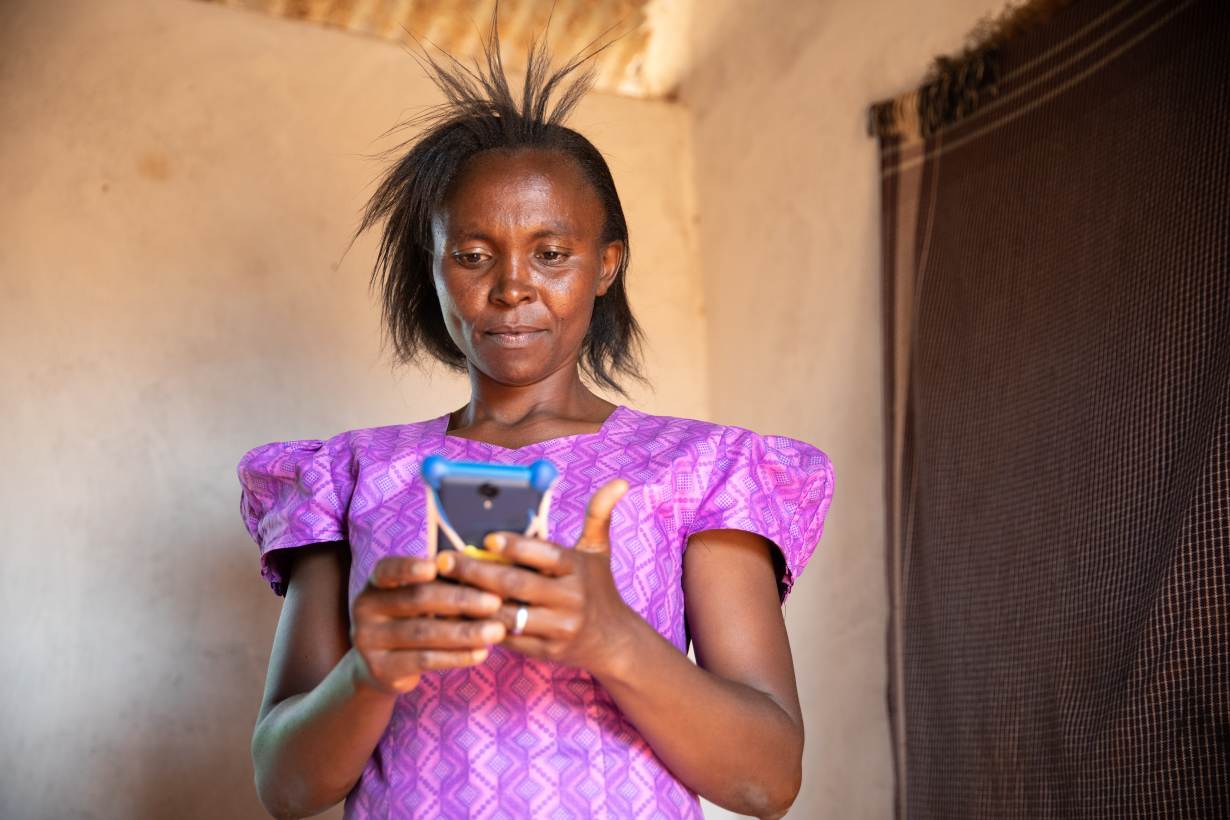
These days, the same job takes her less than two hours, with the help of a tractor she hired through Hello Tractor, a Kenya-based smartphone app that connects small-scale farmers with nearby tractor owners.
"The tractor is much better than doing it by hand. It gives a quality job and works very fast," said Auma, 52, by phone from her farm near the city of Kisumu.
"Before it was hard to find a tractor to hire and it was very costly. Now, the booking agent can quickly find a tractor owner near me by using his phone."
Across Africa, a growing number of smallholder farmers are tapping into digital technologies to access information, services and products to improve efficiency, boost crop yields and increase incomes.
From Nigeria to Ghana to Kenya, a slew of innovations in agricultural technology - or agri-tech - have emerged over the last decade to serve small farmers, who have long been neglected yet are crucial to the continent's food security.
These range from SMS weather alerts and mobile apps offering credit, seeds, and machinery to more advanced solutions such as precision farming, which uses satellite, drone imagery, and soil sensors to provide real-time data on crop health.
Aloysius Uche Ordu, director of the Africa Growth Initiative at the Brookings Institution, a Washington think-tank, said this digitalization of farming has the potential to transform the sector.
"Africa is the world's breadbasket – or should be. It has vast arable land, grows a wide variety of crops, and has vast irrigation potential with seven major rivers," said Ordu.
"Yet, Africa imported $43 billion worth of food items in 2019. Digital technologies ... are eliminating the traditional inefficiencies of smallholder food production and helping to close the yield gap."
Rush To Feed The World
More than 80% of the world's 600 million farming households are smallholders who own less than two hectares of land, says the United Nations' Food and Agriculture Organization (FAO).
Taking up 12% of arable land globally, these small growers produce more than one-third of the world's food.
But smallholder farmers across the region face a plethora of challenges.
Farm work is labor intensive and time-consuming. Most farmers face limited market reach, have little information to improve their output, and cannot access credit or insurance to help them get hold of quality agricultural services and inputs such as seeds, fertilizers, and machinery.
On top of that, increasingly erratic weather attributed to climate change is hitting crop yields and COVID-19 lockdowns have stifled their ability to access supplies and sell their produce.
But while many farmers struggle to grow enough to make a living, the world needs more food, fast.
The World Resources Institute predicts the global population will reach close to 10 billion by 2050, and to feed that number of people, food production will need to grow by nearly 60%.
'Uber For Tractors'
Digital technologies are key to making sure the world has enough to eat, say agri-tech innovators.
Taking advantage of Africa's fast-growing network of mobile phone users, there are now more than 400 digital agricultural solutions in use across sub-Saharan Africa, according to a 2020 report by global telecoms industry lobby GSMA.
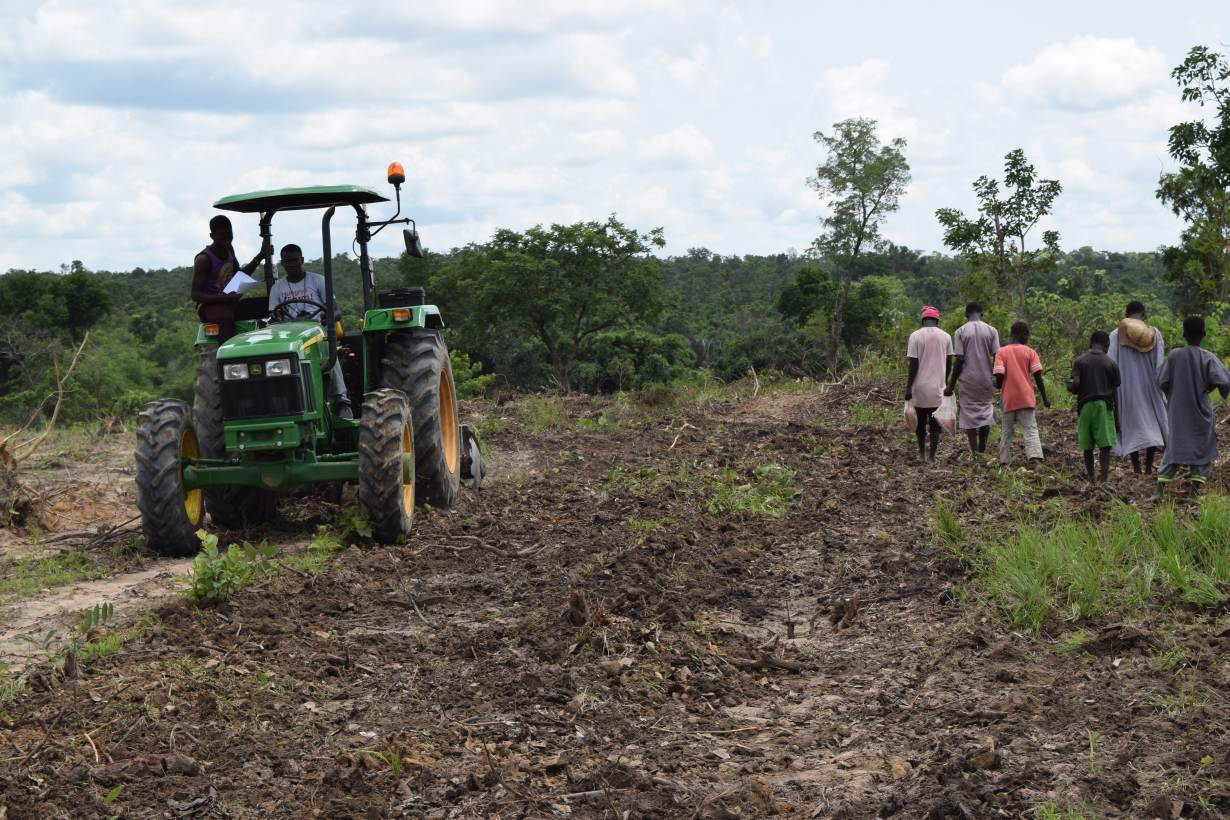
Hello Tractor, the app Auma uses to help with her farm work, operates in 13 countries including Nigeria, Kenya and Tanzania and is often described as an "Uber for tractors".
The app lets tractor owners rent their machines to smallholders in their area and allows farmers to pool together to rent a vehicle at affordable rates.
The tractors are fitted with GPS devices so owners can monitor their location and activity.
"Mechanization is so important to be a productive farmer. But, small farmers have labor and time constraints where they have a very short window to plant and if they don't plant on time, they lose yield," said Hello Tractor's CEO Jehiel Oliver.
"So this technology is a way to get this expensive equipment to farmers."
Since launching in 2014, the company has served about half a million farmers, said Oliver, adding that 55% of the app's customers were using a tractor for the first time.
There are also apps, like DigiFarm in Kenya, which act as one-stop shops that let farmers bypass middlemen to access low-cost seed and fertilizers, loans and insurance providers, and bulk purchasers.
In Ghana, Farmerline - a voice services and SMS platform - provides farming advice, weather forecasts, market prices, and financial tips to about 1 million small growers.
Moses Dery Sekyere, 41, who grows beans, maize, and millet on a 10-acre farm in southern Ghana's Ashani region, said he subscribed to Farmerline in September.
"The information shared with me about harvesting techniques and post-harvest storage has been really beneficial to me this planting season," he said in emailed comments.
"Now I know how to better handle my produce after harvesting them."
PlantVillage Nuru app can scan a diseased plant and give advice on how to treat it, while more hi-tech solutions like Nigerian start-up Zenvus use sensors to analyze soil data such as temperature and nutrients so farmers know what fertilizer to apply and when to irrigate.
Digital Divide
Korie Betty Maru, founder of Digital Farmers Kenya, a Facebook group with more than 436,000 members that shares advice and farming technologies, said small-scale farmers are eager to adopt technology and modern ways of farming.
"Be it finding new buyers for their produce, seeking advice from agronomists on fighting pests, or trying out more efficient products such as solar pumps for irrigation," she said.
Yet despite their abundance, many digital solutions struggle to scale and fail to improve the lives of farmers, researchers have found.
A study by Netherlands-based Technical Centre for Agricultural and Rural Co-operation (CTA) shows more than 33 million smallholder farmers in Africa have registered for some form of digital service, but less than a third use them enough to feel the full benefits.
Internet access is also still out of reach for most small growers in sub-Saharan Africa, where penetration rates are about 26%, says the GSMA.
And women farmers are being left out due to the digital divide - the GSMA reports women in sub-Saharan Africa are 13% less likely than men to own a mobile phone.
In a region where 40–50% of smallholder farmers are women, only a quarter are registered users of digital services, according to the CTA.
Researchers say major investments need to be made in building information and communication technology (ICT) infrastructure and improving digital literacy in rural areas.
Elias Nure, who heads the digital climate-smart agriculture team at the charity Mercy Corps' AgriFin initiative, which provides specialized digital solutions to farmers, said one of the biggest challenges is adapting these tools.
"Some of these solutions are unbelievable, such as precision agriculture tools, remote sensing tools, blockchain tools and artificial intelligence," said Nure.
"But, a lot of them are not developed for African farmers and may not be 100% tailored for smallholders."
Reporting by Nita Bhalla, Editing by Jumana Farouky. This article was originally published by the Thomson Reuters Foundation, the charitable arm of Thomson Reuters, that covers the lives of people around the world who struggle to live freely or fairly. Visit news.trust.org
The United Nations has recognized the right to a healthy environment to be one of human rights in a landmark recognition.
In a statement, UN High Commissioner for Human Rights, Michelle Bachelet, called on member states to take action to give prompt and real effect to the right to a healthy environment.
Ms. Bachelet said that she was “gratified” that the decision “clearly recognizes environmental degradation and climate change as interconnected human rights crises.”
“Bold action is now required to ensure this resolution on the right to a healthy environment serves as a springboard to push for transformative economic, social and environmental policies that will protect people and nature,” she said, according to the Associated Press.
Per UN News, the new resolution acknowledges the damage inflicted by climate change and environmental destruction on millions of people across the world. It also underscores that the most vulnerable segments of the population are more acutely impacted.
According to the World Health Organization (WHO), 24 percent of all global deaths, roughly 13.7 million deaths a year, are linked to the environment, due to risks such as air pollution and chemical exposure.
🔴 BREAKING
— UN Human Rights Council (@UN_HRC) October 8, 2021
UN Human Rights chief Michelle Bachelet hails landmark recognition by the UN Human Rights Council that having a healthy environment is a human right.
▶️https://t.co/Br5ryBXS5m pic.twitter.com/tnvQdZXdaj
“We must build on this momentum to move beyond the false separation of environmental action and protection of human rights. It is all too clear that neither goal can be achieved without the other,” Bachelet said.
This is great news for the future of humanity: with this historic decision, this means the UN will be taking climate action more seriously on a global scale.
Like many good things in life, wind turbines don’t last forever.
But disposing of retired turbine blades has become a headache for the renewable energy industry. They’re made of materials that can’t easily be recycled.
But from cycle shelters to bridges, life-expired blades are finding innovative new uses around the world. And the first 100% recyclable turbine blades have just been produced in Denmark.
Up to 85% of an existing wind turbine, including the steel mast and electrical components made of metals like copper, can be recycled, but not the turbine blades, which already account for 10% of Europe's fiber-reinforced composite material waste.

The University of Strathclyde estimates that by 2050 there will be 2 million tonnes of wind turbine waste needing safe disposal globally by 2050.
In the past, blades which include fiberglass or glass-reinforced polymers (GRP), have been dumped in landfills or incinerated. Germany has already banned composite materials from landfills and other nations are also imposing full or partial bans.
Related: How To Recycle Shoes
Related: This Organization Is Recycling Textiles
Recycling for cyclists
The Danish port city of Aalborg, where the new recyclable blades are being made, has found an innovative new use for old blades, by turning them into bike shelters for the city’s cyclists.
The materials that make the blades hard to recycle also make them durable and strong.

Nine out of ten Danes own a bike, and cycling accounts for a quarter of all journeys of under 5km in the country. But the Scandinavian climate can be hard on bikes left out of doors, especially in winter.
In Ireland, which will have 11,000 tonnes of decommissioned turbine blades to dispose of over the next four years, University College, Cork has come up with a plan to use some of them to build a bridge on a greenway - a 22km path and cycleway on the track of an old railway line.
The designers say that as well as being structurally strong, the blades’ gentle curves will add an aesthetically attractive feature to the 5-meter span bridge across the Midleton to Youghal Greenway in East Cork which is due to open in 2023.
In the UK meanwhile, retired blades are being used in place of steel to reinforce concrete walls by contractors building the country’s new HS2 high-speed rail line.

“Reusing old turbine blades reduces waste, cuts demand for new steel, and reduces the carbon generated during the production of concrete,” said HS2 innovation manager Rob Cairns.
“If our world-first pilot project goes well, we could see a waste product from the energy industry becoming an essential material for the construction sector in the future.”
Elsewhere, researchers at the Georgia Institute of Technology in the United States recently used a large section from a 100-meter blade as the roof of a small conventionally built house. Scientists have also tested the properties of decommissioned blades for use as power line poles.
Chemical breakdown
Danish company Vestas Wind Turbine Systems working with Aarhus University has created a process to chemically break down turbine blades to extract epoxy resin plastic from them which can then be used to make new blades.
Meanwhile, Norwegian wind farm builders Akers Offshore Wind and Strathclyde University have devised a pioneering way of extracting the fiberglass from redundant turbine blades for reuse which they say could meet 50% of global glass fiber demand if implemented worldwide.
“GRP scrap is a challenge not only for the wind power industry, but for all industries reliant on GRP materials in their production and manufacturing,'' Akers' Mats Ektvedt told Euro News.
“This includes car manufacturing, maritime vessels, oil and gas production, construction, sporting goods, and more. Our focus now is on the recycling of wind turbine blades, but our goal is to develop recovery processes robust enough to handle other kinds of waste,” he added.
The World Economic Forum says 90% of all plastics produced worldwide are never recycled. The Forum’s Global Plastic Action Partnership is working with business and world leaders to end dumping, increase recycling and create a circular economy in plastics.
This article was originally published by the World Economic Forum and was made available to Good Good Good.
The COVID-19 pandemic has exacerbated homelessness. Throughout the pandemic, shelters reduced capacity to comply with public health protocols, people lost jobs and affordable housing remained elusive.
With a rise in tent cities and makeshift accommodations, homelessness has gained visibility.

Local municipal authorities across Canada have worked to enforce bylaws. Many have dismantled encampments to the dismay of activists and people experiencing homelessness.
These events, media coverage, ensuing protests, and policy discussions raise important questions about public space: How should it be used? Who is the public? And the question I am concerned with here is, what are the implications of pushing people who are homeless out of these “inclusive spaces”?
Homelessness stigma in public spaces
Public spaces, such as parks and sidewalks, are typically thought to belong to everyone. However, many scholars have emphasized that there are rules and unsaid expectations that include and exclude.
Very few spaces exist where people who are homeless can feel like they belong.
Bylaws that criminalize behaviors associated with homelessness — like panhandling — and hostile architecture — like a street bench with a central armrest that prevents people from lying down — are ways of pushing people out of a particular space.

Excluding people experiencing homelessness from public spaces can perpetuate stigmas. These social stigmas typically take the form of labeling, stereotyping, a separation of “us and them” and a loss of social status.
Sociologist Ervin Goffman famously described stigma as “a spoiled identity” based on stereotypes rather than inherent qualities.
Homelessness stigmas discredit individuals from participating in social life and limit access to social resources. These stigmas work against efforts to address homelessness because they can lead people to avoid essential services.
Social infrastructure
A natural approach to addressing stigma is to bring people together by forming relationships — in personal relationships, people know each others’ personal stories and aspirations, making them less inclined to rely on prejudice and harmful stereotypes.
“People are hard to hate close up. Move in.”
Brené Brown, who researches courage, vulnerability, shame, and empathy captures the essence of this idea with her catchphrase: “People are hard to hate close up. Move in.”
And social infrastructure is the systems and environments that facilitate encounters and relationships, so social scientists have positioned social infrastructure as an antidote to social inequality and fragmentation.
Examples of social infrastructure include community centers, schools, and public ice rinks; any space where people can meet and establish social relationships.
Social infrastructure is essential to community wellness, it offers grounds for people to pool resources, receive and offer support and navigate social differences.

Strong social infrastructure is accessible, safe, and malleable to the public’s shifting interests, needs, and challenges.
Excluding those who are homeless from public spaces not only deepens stigmas that lead to the avoidance of essential services. It can also further marginalize them from the benefits of participating in communal life.
Spaces for people who are homeless
Thankfully, some institutions seek to offer public spaces for people who are homeless.
Public libraries and faith-based organizations, such as mosques, churches, and non-profits grounded in religious belief, are two examples.
While public libraries and faith-based organizations are both quintessential examples of social infrastructure, they differ in significant ways.
Both have strengths and limitations when it comes to creating social connections.
Faith-based organizations can be spaces where deep friendships form. These organizations bring people together regularly into a social and spiritual environment.
However, they also have several barriers, such as history or reputation of excluding based on identity.

In contrast, a core value of public librarianship is to remove barriers to services.
Often described as a “community hub,” public libraries bring people together from all walks of life.
Nevertheless, they must balance their enormous mandate to address the informational, learning, and leisure needs of diverse populations with bounded resources.
Partnering for stronger social infrastructure
While these two institutions alone may not be able to solve the issue of social stigma, looking at how they provide spaces for people experiencing homelessness is a good place to start.
Hamilton Public Library’s Parkdale branch in Ontario is an example of a partnership between a faith-based organization and a public library. This library branch is in an affordable housing residence, operated by Indwell.
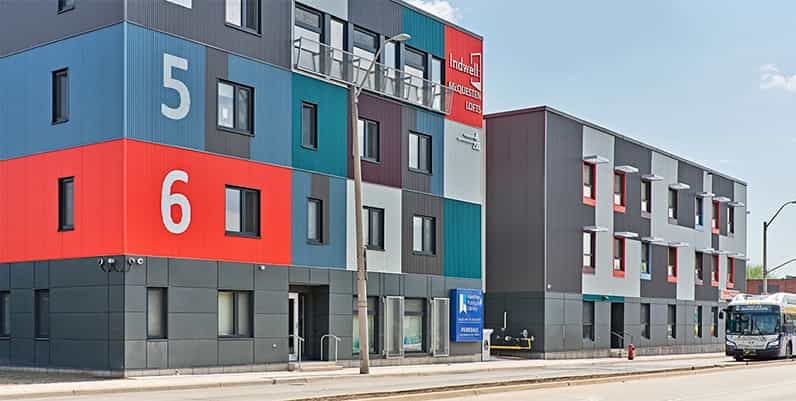
Indwell describes itself as “a Christian charity that creates affordable housing communities that support people seeking health, wellness, and belonging.”
As the Parkdale branch only recently opened in July 2021, it presents a budding opportunity to examine how these two types of social infrastructure coalesce to provide inclusive social spaces for people who are homeless.
Partnerships between organizations with shared interests and complementary strengths hold promise when it comes to developing novel solutions to complex problems.
There are several examples of both faith-based organizations and public libraries sharing their spaces with social workers, healthcare professionals and local enterprises.
For example, a pilot project in Philadelphia showed that having a social worker and a nurse working in a public library from 9 a.m. to 5 p.m. helped connect people experiencing homelessness with appropriate health care.
The authors attributed some of this intervention’s success to the public library’s financially accessible community space. Partnerships allow organizations to do more than they could alone for those who are homeless.
Looking for creative ways to strengthen social infrastructure for marginalized groups may be an important step towards building a more equitable society post-COVID-19.
This article was originally published by The Conversation and was republished with permission.
Editor's note: Instances of the phrase "homeless people" were changed to "people experiencing homelessness", per house style.
Clean energy jobs rose to 12 million last year even amid the pandemic but officials say green employment must come with decent conditions and bring in more women.
The number of jobs in renewable energy worldwide increased in 2020, despite the huge economic disruptions caused by the COVID-19 pandemic, with the growing industry holding up better than fossil fuels, international agencies said on Thursday.
In an annual report on clean energy employment, the International Renewable Energy Agency (IRENA) and the International Labour Organization (ILO) said there were 12 million jobs in renewable energy and its supply chains last year, a third of them in solar power.
That was a rise from 11.5 million jobs in 2019.
"The year 2020 demonstrated that not even a global pandemic can slow the advance of renewable energy," wrote IRENA Director-General Francesco La Camera in a foreword.
The COVID-19 crisis, together with the challenges of global warming, "reinforces the need for a just and inclusive transition toward a clean, reliable energy supply and sustainable, healthy, climate-friendly jobs", he added.'
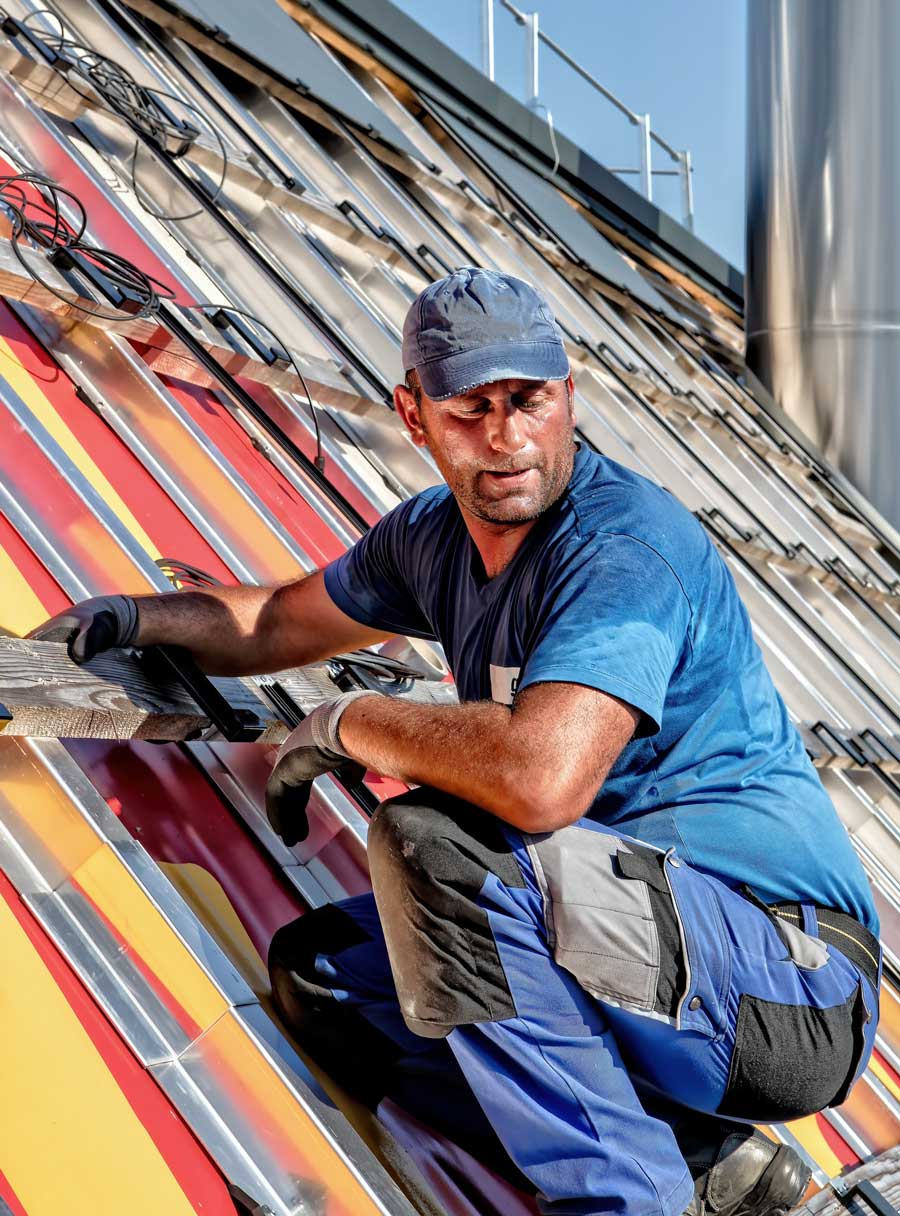
Achieving a fair shift from coal, oil, and gas to solar, wind, bioenergy, and hydropower will require efforts to train workers in new skills and build local supply chains, the report said.
Social protection will also be needed for those who lose jobs in high-carbon activities like coal mining, it added.
Lockdowns to contain the COVID-19 pandemic did disrupt some parts of the renewables industry in 2020, it noted, including a slight dip in employment in biofuels due to lower transport use.
Off-grid solar lighting sales also suffered in developing countries but companies were able to limit job losses with financial help from governments, the report said.
Martha Newton, the ILO's deputy director-general for policy, said the continued growth of renewable energy jobs worldwide amid the pandemic was "a very encouraging signal".
But gaining the maximum social and economic benefits from the clean energy shift would require looking beyond just the number of jobs, she told the report launch by video.
"We need an approach to energy transition conducive to decent work creation" - meaning jobs that boost equity, security, and human dignity, she said.
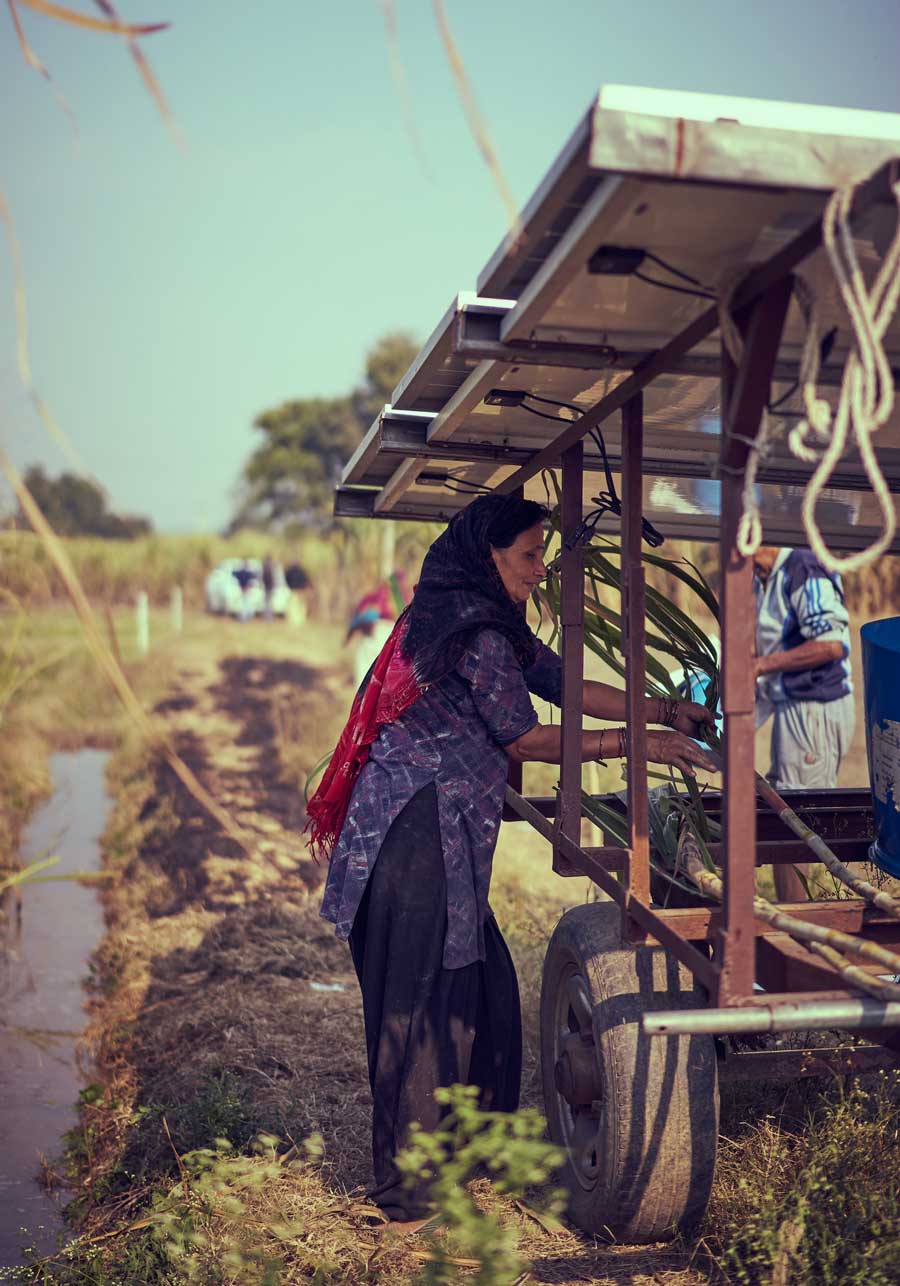
The report stressed the need to bring more women into renewable energy jobs, though they already hold 32% of those, on average, compared to 22% in the oil and gas sector.
Claver Gatete, Rwanda's minister of infrastructure, said his East African nation was encouraging girls to study engineering, offering them internships in clean energy firms, and setting gender targets for the industry.
Globally in 2020, the solar photovoltaics sector accounted for about 4 million jobs, biofuels for 2.4 million, hydropower for 2.2 million, and wind energy for 1.25 million, the report said.
Nearly four in 10 renewable energy jobs were in China, with Brazil, India, the United States, and European Union states holding the next highest numbers.
Other places expanding clean energy employment include Vietnam and Malaysia, which export solar equipment; Indonesia and Colombia, with large agricultural supply chains for biofuels; and Mexico and Russia, where wind power is growing.
In sub-Saharan Africa, solar jobs are expanding in countries from Nigeria to Togo and South Africa, the report noted.
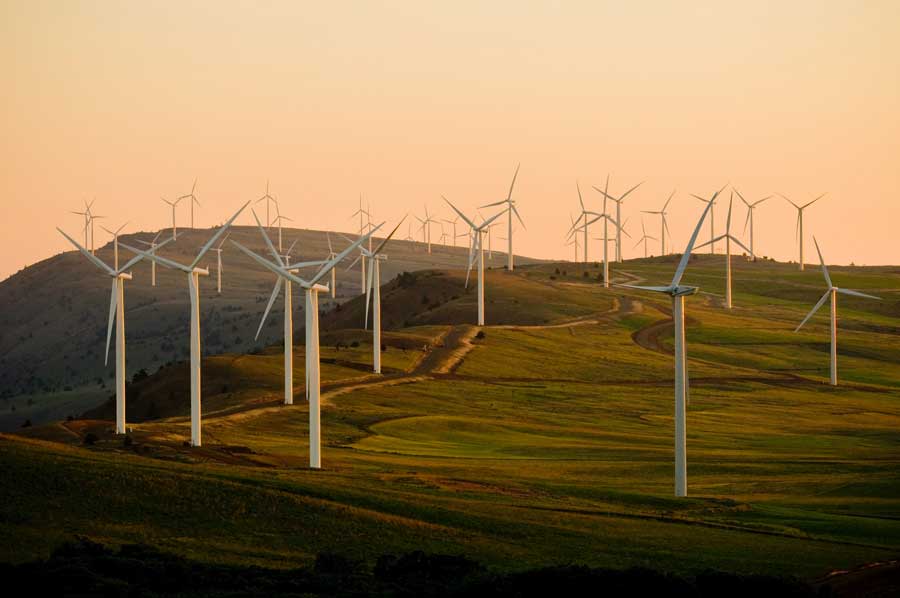
It authors estimated that if governments limit global warming to 1.5 degrees Celsius above preindustrial levels, their most ambitious goal, the renewable energy sector could grow to 38 million jobs by 2030 and 43 million by 2050.
That is about double the number that would be created under current climate action plans and pledges, which fall short of meeting the Paris Agreement goals, it noted.
Sharan Burrow, general secretary of the International Trade Union Confederation which represents 200 million workers in more than 160 countries, said every part of the economy would need to transition to a greener model to cut emissions to net zero.
That's "a good news story", she said, because for every 10 jobs in renewable energy, 5-10 are created in manufacturing supply chains and more in services, transport, and logistics.
If those jobs come with good conditions, a minimum wage, and labor rights such as the ability to form unions and bargain collectively, "that's about development, that's about community renewal, that's about aspirations", she told the report launch.
Reporting by Megan Rowling; editing by Laurie Goering. This article was originally published by the Thomson Reuters Foundation, the charitable arm of Thomson Reuters, that covers the lives of people around the world who struggle to live freely or fairly. It was republished with permission. Visit news.trust.org/climate
During the pandemic, commuter trains ran nearly empty while buses shuttled essential workers. Now, cities are reevaluating where they spent their transit dollars.
Shavel’le Olivier relies on Boston’s public transit to do her shopping, run errands, and visit family. She lives in Mattapan, a neighborhood in the southwest corner of the city where 74 percent of residents are Black and 16 percent Hispanic.
It can take an hour to travel less than five miles from her house on the bus, due to heavy traffic. She grew up thinking that’s just the way things work, but now she’s questioning the status quo.
Bus route 28, which serves the neighborhoods of Mattapan, Roxbury, and Dorchester — where two-thirds of Boston’s Black residents live — gets some of the highest ridership in the city. That was true before the pandemic, and remains true today.
Yet despite the essential role it plays, route 28, like many urban bus lines nationwide, gets just a small share of overall transit investment.
“Communities of color are always left out when it comes to the resources that are needed to enhance our community,” Olivier said.
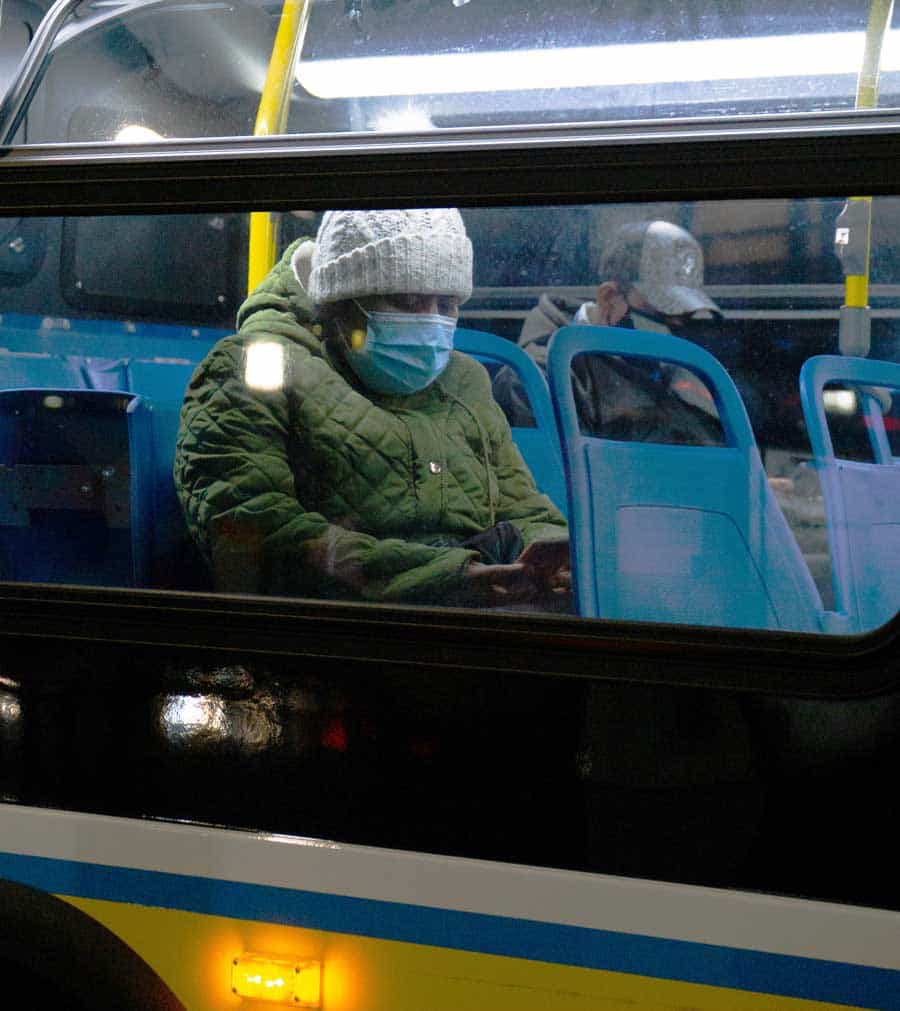
The COVID-19 pandemic exposed long-standing inequities in public transportation networks across the United States.
In city after city, suburban trains ran nearly empty while neglected bus systems continued to carry essential workers to their jobs in hospitals, grocery stores, and warehouses.
Costly new and expanded rail lines, built over the past two decades, suddenly went unused.
The long-standing underinvestment in urban transit only added to racial injustice exacerbated by a pandemic that disproportionately killed Black and Latino people.
Now, transit agencies from Boston to Atlanta to Chicago are belatedly awakening to the reality that has been there all along — and reevaluating their resources to address those inequalities.
Prior to COVID-19, the Massachusetts Bay Transportation Authority, or MBTA, planned a $30 billion makeover of its commuter rail system to better serve affluent suburbanites — riders who quickly abandoned the city’s trains and have yet to return.
“COVID-19 reduced our ridership to the kind of folks who are utterly dependent on transit,” said Steve Poftak, general manager of the MBTA, speaking at a transit conference last year.
The agency operates Boston’s commuter rail, subway, bus, and light rail lines. “They do not have work-from-home options, and it’s really made a tremendous impact on our understanding of how people depend on the transit system.”
Monica Tibbits-Nutt, a transportation planner who served as vice-chair of the MBTA’s oversight board from 2019 to 2021, said, “We have a very ugly history of transportation here dissecting and destroying historical communities of color.”
In U.S. urban areas, 23 percent of Black people and 15 percent of Latino residents use public transit, compared to just 7 percent of white people.
In U.S. urban areas, 23 percent of Black people and 15 percent of Latino residents use public transit, compared to just 7 percent of white people.
Buses are the most-used form of public transit, yet from 2010 to 2019, less than 8 percent of the money spent nationally on transportation went to bus lines, according to data compiled by Yonah Freemark, a researcher at the Urban Institute, a policy think tank based in Washington, D.C.
Moreover, federal public transportation grant and loan programs prioritize new construction over existing systems: New capital projects have received four times the funding of maintenance and operating expenses over the past decade.
Disparities in public transportation give white communities better access to jobs, healthcare, grocery stores, and other necessities of life.
According to an ongoing study from the Transit Center, a New York-based advocacy group, Black and Latino residents in Washington, D.C. can reach just 62 percent of the jobs available to white residents within 45 minutes using only public transportation. In New York, it’s 56 percent; in Chicago, 58 percent.
“The magnitude of what we found was surprising,” said Mary Buchanan, a researcher on the study.
As COVID-19 dragged on and altered ridership, the pandemic became a wake-up call for many transit agencies. Some are now reassessing their networks, with a priority on investing in better bus systems for more equitable service.
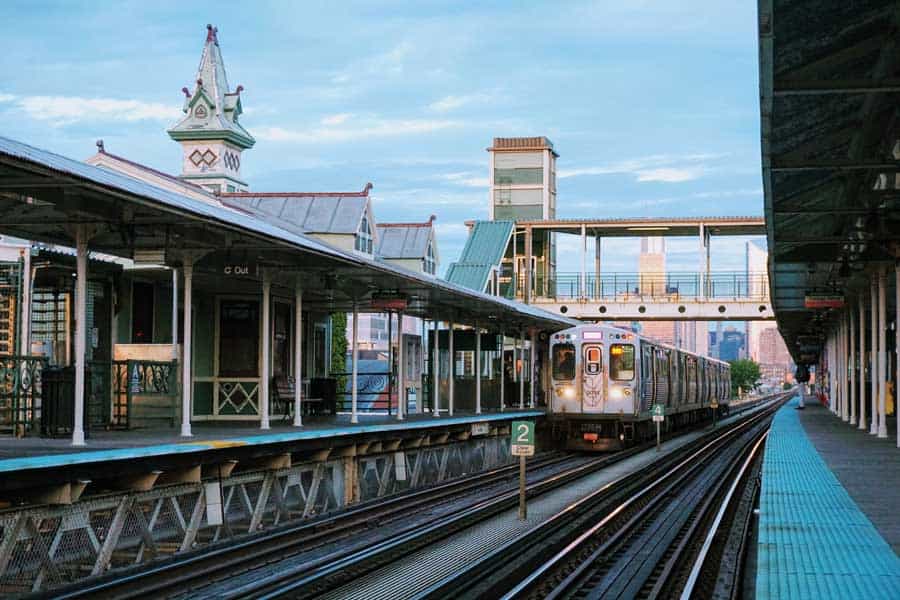
The Chicago Department of Transportation published a new strategic plan in July, calling it, “the first commitment of a city transportation department to comprehensive mobility justice.”
In April, the Southeastern Pennsylvania Transportation Authority, or SEPTA, announced it would undergo a complete redesign of its bus system. In a press release, SEPTA said the project was part of a wider plan that “sets the goal of building a better, more equitable future for the Philadelphia region.”
One city’s transit agency was ahead of the curve on both equity issues and recognizing the needs of bus riders. It may set the bar for others to reach.
Los Angeles Metro set forth a formal equity plan in 2018 and last year established the Office of Equity and Race. Its executive director is KeAndra Cylear Dodds, who worked previously in government and non-governmental organizations on affordable housing and transportation.
Metro is infusing equity considerations across its infrastructure projects, transit services, and agency budgets.
“A really crucial part of getting to more equitable outcomes is looking at where you spend your money,” Cylear Dodds said.
This year, LA Metro is rolling out a makeover of its entire bus system, a project that started three years ago. Routes are being redesigned with more frequent service and better connections.
The work is focused on major road corridors — Crenshaw Boulevard, Compton Avenue, and Santa Monica Boulevard, for example – so that systems better reach many underserved communities.
Metro’s goal is to increase access to bus lines that run every 10 minutes or less from 48 percent to 80 percent.
More weekend, midday, and evening service will enable riders to reach schools, daycares, doctors, stores, and shift work.
Cylear Dodds meets often with her peers at other transportation agencies. She sees a lot of interest within government on equity issues, but says that transit agencies are just catching up.
Cylear Dodds meets often with her peers at other transportation agencies. She sees a lot of interest within government on equity issues, but says that transit agencies are just catching up.
Atlanta is a city with a long history of underinvestment in public transportation, particularly in Black and low-income communities.
But MARTA, the region’s transit system, like other U.S. transit agencies, is now reworking its bus system, said Nathaniel Smith, founder of the Partnership for Southern Equity, a nonprofit based in Atlanta. Smith said MARTA has invited him and other community leaders to take part in the redesign.
Saba Long lives in Atlanta’s Midtown neighborhood, which is well-served by bus and rail transit. She doesn’t own a car. She describes the buses as clean and new, adding, “I’ve never felt uncomfortable on the bus.”
MARTA is adding 40 new miles of express bus lines, 22 miles of light rail, and additional buses on 32 routes — allowing more neighborhoods in the city to be as connected as Midtown.
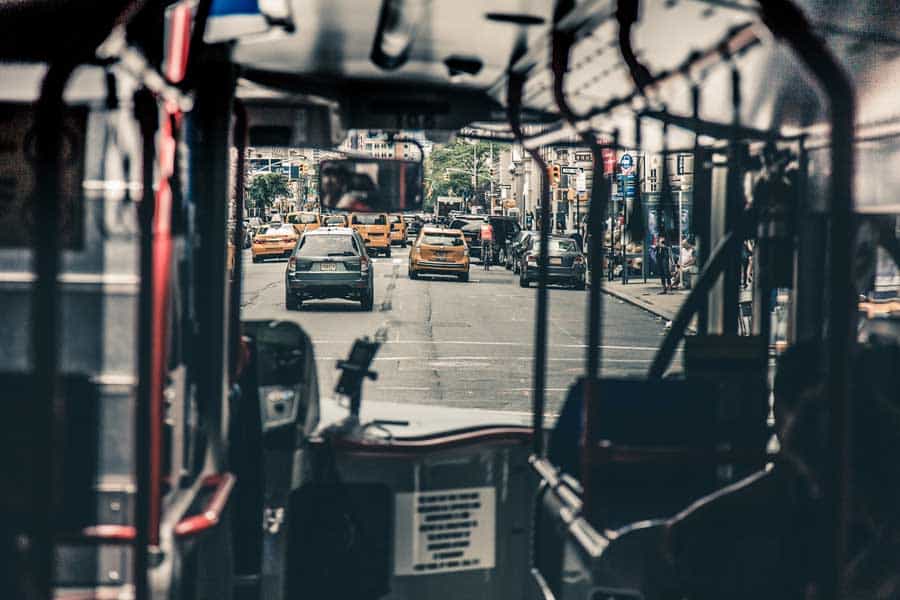
New York City, Washington, D.C., and Boston are also planning to improve their bus networks, with more frequent service, extended hours, dedicated bus lanes, and routes that better match community needs.
While some efforts began before the pandemic, 2020 laid bare the unmet needs of lower-income communities and communities of color.
Many cities aim to reduce single-occupancy vehicles to meet climate goals and enhance pedestrian safety.
Rail lines do that at scale, but they are expensive and time-consuming to build.
The 2,740-page, $1 trillion bipartisan infrastructure bill passed by the Senate authorizes nearly $107 billion for public transit and more than $102 billion for passenger and freight rail. If it is enacted and all funds are appropriated, it will mark the largest-ever federal investment in transit and the largest federal investment in passenger rail since the start of Amtrak.
The bill will fund low- or zero-emission buses, more maintenance for public transit vehicles and facilities, accessibility improvements to bus stops and rail stations, and planning for transit-oriented development.
It will also significantly increase the share of bus investment and add equity-oriented language for transportation planners to address social issues, including household incomes, housing, and employment.
But while that sounds impressive, the bill also includes $303.5 billion for highway projects, which Transportation for America describes as “doubling down on a dinosaur.” The legislation also fails to prepare for a long-term shift in work arrangements.
A McKinsey & Company study commissioned by Massachusetts warns that hybrid and remote work could reduce commuter rail ridership in Boston 15 percent to 50 percent. That could lead to more automobile use, as already seen in Boston, San Francisco, Seattle, Manhattan, and Chicago, where traffic is nearly back to pre-pandemic levels but commuter rail ridership remains low.
No city will abandon its billions of dollars in commuter rail assets, so they are seeking ways to make them more useful to transit-dependent individuals.
These riders need trains that run more like buses: more frequently throughout the day, night, and weekends. San Francisco’s Caltrain, the Los Angeles commuter railroad Metrolink, and the MBTA in Boston are adjusting schedules to serve these riders.
But economic realities may constrain what transit agencies can do if riders don’t return. And in many areas, these agencies don’t own the tracks their commuter trains run on. Adding more trains must be negotiated with an often uncooperative freight railroad.
“Frequent bus service can be accomplished on existing city streets tomorrow.”
However, Freemark points out that, “frequent bus service can be accomplished on existing city streets tomorrow.”
The need is clear: In Boston, bus ridership on some routes has recovered to 70 percent to 87 percent of pre-pandemic levels. Commuter rail has struggled to get above 20 percent.
“It’s just a reallocation of resources to the places that it’s needed most,” Tibbits-Nutt says.
“If you cannot do it, we are not going to be able to address the equity here. We’re not going to be able to desegregate these neighborhoods and communities. It is impossible unless we are able to do that.”
This story is part of the SoJo Exchange from the Solutions Journalism Network, a nonprofit organization dedicated to rigorous reporting about responses to social problems. It was originally published by Grist on October 19th, 2021.
Wildfires often hit low-income, minority families the hardest. Talent, Oregon, offers a home-grown housing solution to the displacement that follows.
When the Almeda Fire hit southern Oregon on Labor Day weekend just over a year ago, Christy Brooks was on her way home from her daughters’ school after picking up books and a computer in preparation for the coming year.
The air was smoky and smelled burnt, but Brooks doesn’t remember feeling overly concerned.
She stopped to buy drinks at a Chevron station. Five minutes later, when she came out and started driving to her mobile home at an RV park on the outskirts of the community of Talent, the sky had darkened and had an angry orange tinge.
That was scary enough, “but when it started to rain ash, I knew something was wrong, something was really wrong” said Brooks.
She fled with her 6- and 12-year-old daughters, narrowly escaping the fires that destroyed more than 4,000 homes across the region and scorched 1 million acres.

Brooks stayed at a friend's house in nearby Junction City for a few weeks before returning to her trailer. It was still standing, so she wasn’t eligible for FEMA assistance, but it had been extensively damaged by smoke and heat, and the water that was used to fight the flames had caused mold to proliferate.
Still, with nowhere else to go, she and her daughters stayed there until the Red Cross deemed it unlivable and put them up in a motel in Ashland, several miles away, for three months.
Finally, the Phoenix-Talent School District provided them with an RV and a spot to park it at Emigrant Lake, just over 12 miles south of Ashland. It was in a different school district, and several other displaced families were also living there.
“Their concentration was shot after the fire.”
In the last three decades, climate change has more than doubled the amount of area burned in the U.S, most of it in the West, and the fires to come are likely to be even more frequent and larger.
But not everyone will be equally affected. A recent study from the University of Washington found that communities of color are twice as vulnerable to wildfires as other, largely white communities.
And children — who experience disrupted routines more acutely than adults — are hit the hardest.
The sense of displacement, lack of a permanent home and constant, confusing reshuffling can lead to mental health issues and affect educational outcomes.
“Their concentration was shot after the fire,” Brooks said, speaking of her daughters. “They need something stable — not wondering if they have to move somewhere else, or switch rooms. They need to feel safe.”
Now, the city of Talent is working to provide that stability through a new initiative: providing long-term affordable housing in the local school district for those displaced by the fires.
Affordable housing was already lacking in the region before the fires, said Michelle Glass, director of Rogue Action Center, a southern Oregon housing justice nonprofit that works at the intersection of housing, climate, and racial justice. So in 2019, the city began accepting proposals from developers to create what was called the Gateway project, a 4.5-acre mixed-use housing development with a focus on affordable housing.
Then the 2020 fires tore through the Rogue Valley, destroying an estimated 600 homes in Talent, including some of the last remaining affordable housing, many in low-income Latino neighborhoods.

Between 1,500 and 2,000 people were displaced in Talent alone. The housing shortage had become a full-blown crisis.
More than 24,000 Oregonians applied for FEMA assistance after the fires, but over 57% of them were turned down.
Now, a year later, hundreds of Oregonians are still living in hotel and motel rooms, far from their schools and workplaces.
The disruption was especially hard on school-aged children. “Kids are widely known to be the most vulnerable group post-disaster,” said Betty Lai, a clinical psychologist at Boston College who studies how children respond to disasters.
Children are more vulnerable to air pollution and physical trauma, as well as to the emotional impact of losing their homes and possessions. It also disrupts their education, especially when they end up housed in a different school district.
“When you’re a child that is from a more vulnerable or marginalized group, you’re at higher risk of experiencing recovery stressors. So those are things like not being able to go back to school, missing more school days, having to move multiple times,” said Lai. “And all of those pieces are risk factors for mental health distress and troubles with school.”
Research consistently shows that children need to return to their own communities after traumatic events.
This is especially true in places like Talent, where almost half of the children in the school-district are Hispanic and many children live below the poverty level.
They rely on schools for more than just an education; they also need access to free meals, counseling, and homelessness assistance.
“When you’re a child that is from a more vulnerable or marginalized group, you’re at higher risk of experiencing recovery stressors.”
“We know that kids are connected to their teacher and their peers and their activities in their school,” said Brent Barry, superintendent of the Phoenix-Talent School District. “It is so important to keep that continuity because that helps with academics, social, emotional and mental health.”
After the fire, the Talent Urban Renewal Agency and the Phoenix-Talent School District switched gears and — with the help of donations from the state, private sponsors, and nonprofit organizations — developed a plan to create transitional housing for fire survivors while permanent affordable housing is being built.
Currently, 53 temporary housing units are available for local families who aren’t eligible for FEMA, with those who have school-aged children being prioritized. The families will start moving in this month.
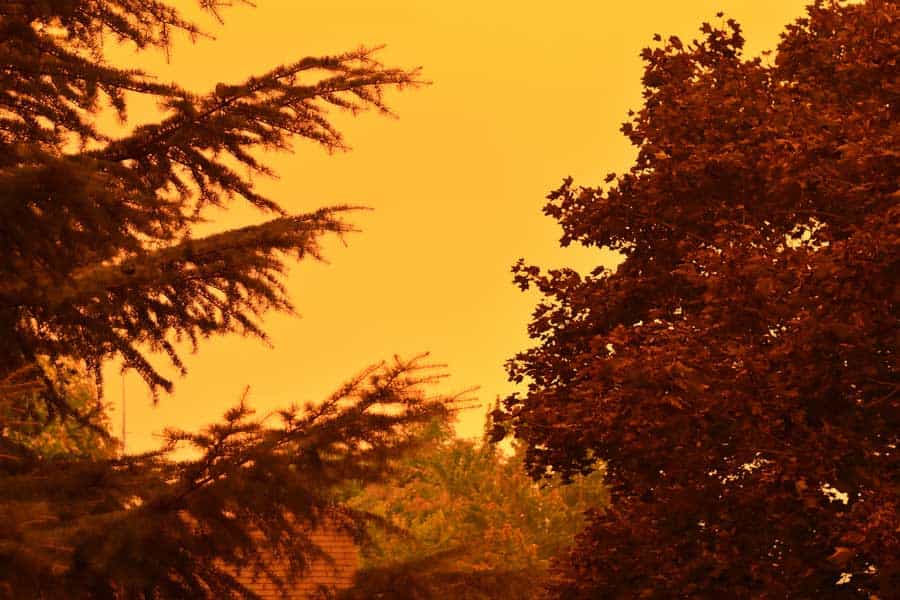
“This is the first time a city or state has taken an innovative project of creating transitional housing from a natural disaster,” said Jon Legarza, executive director of the Talent Urban Renewal Agency, who is helping to build the project. Legarza has worked in post-disaster housing recovery for years. “Normally, it’s just FEMA, and then everyone else is lost in the aftermath.”
“I think it’s a great project,” said Erica Ledesma, though she doesn’t see it as a permanent solution and notes some frustration that the Latino community wasn’t included more in the process.
The fire intensified the housing crisis in part because people didn’t own their land, she said; they simply rented, and so were also threatened with eviction.
Plus, they lacked access to many of the state and federal grants for rebuilding designed for homeowners.
Ledesma, who worked closely with the Latino community after the fires, assessing their needs, was moved to co-found her own organization, Coalición Fortaleza.
The organization aims to create more resident-owned communities or cooperative housing models to help counter the extreme housing inequality that exists.
“Most people want to buy their homes, but credit is such a barrier for people, especially when they're seasonal workers,” she said.
Brooks, who lives with a disability that currently makes it impossible for her to drive, is one of the 53 families selected to move to the Gateway project.
She is relieved to find a stable place closer to the community services she and her children depend on. She’ll be able to move onto a temporary spot in the Gateway project, and later on, she’ll move into permanent affordable housing.
“Being in town would be the biggest blessing right now,” she said. She’s excited to be inside the city and have grocery stores within walking distance, and be closer to the doctors and the school. “Out here, we are so far away.”
This story is part of the SoJo Exchange from the Solutions Journalism Network, a nonprofit organization dedicated to rigorous reporting about responses to social problems. It was originally published by High Country News on October 8th, 2021.
A simple letter-grading system in the U.K. has led to a significant shift towards ecologically greener foods.
Neon yellows, soothing blues, and revitalizing greens: the average supermarket aisle is a riotous, colorful battle for a customer’s attention, according to Dr. Brian Cook, a senior researcher at the University of Oxford.
Every aspect of a food product’s packaging is designed to trigger specific emotions, sending persuasive information — whether true or not — to the brain.
“But almost never does that information tell you the environmental impact of that product,” says Cook. “There’s a lot of noise but little fact for consumers. That needs to change.”
Cook, who leads Oxford’s Health Behaviors team at the Livestock, Environment and People (LEAP) project, believes that a tried-and-tested system has the potential to transform the way that we eat: labeling.
Just as labels showing a food’s dietary content or place of origin have helped improve our understanding of nutrition and ethical sourcing, Cook says a similar system could be used to combine a range of ecological indicators — from greenhouse gas emissions to water use — to show a product’s environmental impact.
During the pandemic, Cook’s team conducted an experiment in which “customers” were given fake money to select from 20,000 supermarket items.
Each had a label showing that product’s ecological impact, based on four indicators: greenhouse gas emissions, biodiversity loss, water pollution, and water use.
The result was a “statistically significant” shift towards ecologically greener foods, including around a 10 percent reduction in meat consumption. “It proved to be effective,” he says.
Now the next step — real-world testing — is underway. In May, the team launched a trial of the labeling system with the U.K.-based food services business Compass Group at 13 of its cafeterias.
They found the most effective design was a globe symbol colored green, orange, or red with a letter in the center from A to E, to signify the eco score of the food — a vegetable soup, for example, was rated A, while a lemon, spring onion, cheese, and tuna bagel was given an E.
Early next year, a second trial is planned across Compass Group’s office spaces and university sites with the researchers looking to see the impact on a younger, more educated demographic.
The efforts speak to a wider appetite for a label-led change in diets that is spreading across Europe. The NGO Foundation Earth will launch a trial of a traffic light-based label system in U.K. and European supermarkets such as Tesco and Morrisons this fall.
And in 2024, the European Commission is set to propose an EU-wide scoring system as part of its “Farm to Fork” strategy.
Meanwhile, in France, some businesses have already been using an eco-score label for almost a year.
It comes after the French Ministry for Ecological Transition (ADEME), which evaluated the environmental impact of 2,500 categories of products and published its findings in a free, open-source database known as Agribalyse last summer, launched a design competition for a national eco-score label. The winner is set to be announced early next year.
“When you consume a steak, you should know the environmental impact of it,” says Lucas Lefebrve, co-founder of French online organic store La Fourche, which rolled out the eco label for its store-brand products using the database in January. “We need to help and encourage consumers by giving them good information.”
Since then, Lefebrve says there has been an increase in demand for meat alternatives such as seitan, which have better eco ratings than real meat.
“The impact of the labels is already tangible,” adds Lefebrve, who says he is in negotiations with French, Belgian and German distributors to introduce his form of label.
Proponents say that while radical institutional change is key to halting irreversible global warming, eco labels aren’t mere crumbs in the grand recipe of the climate.
Food production is responsible for a quarter of all greenhouse gas emissions.
And research by WWF and the environmental consultancy ECO2 Initiative has found that we can cut our individual emissions in half simply by changing our diets.
Even switching between seemingly similar foodstuffs could have a huge impact. Dr. Cook cites research from 2018 that found the environmental impact of beef could vary 18-fold depending on how it was produced.
“You only need to be able to nudge 25 percent of the population from E to B or C and that could have a huge impact,” he says.
Polling suggests that a shift in behavior is likely if better information is provided to the public.
According to polling by Elementar UK, 68 percent of respondents said the origin of food is either “very” or “quite” important in influencing their shopping, but 25 percent said they were “unsatisfied” or “very unsatisfied” with the information they are given.
Anna Cohen, agriculture lead at France Nature Environnement (FNE), an NGO that provides consultation on eco labeling to companies, says the example of Nutri Score, a labeling system based on nutritional values that launched in France in 2016, has shown the concept works.
“It can create a more sustainable agriculture network,” says Cohen. “The labels can help people make their decisions.”
But Jean-Pierre Schweitzer, policy officer at the European Environmental Bureau, which reviewed two French initiatives, Eco-score and Planet-score, warns that deciding on a methodology for scoring could be more complex than it seems.
“The devil is very much in the detail of how the score is calculated,” he says. “It combines quantitative and qualitative information. Who decides what is important? It’s a political issue. And what if we don’t have real data but only estimates?”
The scoring system could produce some eyebrow-raising, though informative results. According to experts, a banana imported by boat from Colombia, for example, could have a better score than an out-of-season tomato grown locally in a greenhouse.
And while the health benefits of almonds are well-known, its water requirements — growing a single almond requires 1.1 gallons of water — could saddle them with dismal scores.
Dr. Cook accepts that numerous challenges lie in wait. What works on a website might not work in a bustling city restaurant or sprawling supermarket.
Another challenge is striking the right balance between the information being detailed, effective, and convincingly reliable. Calculating scores for products could prove a gargantuan task too — and would require political will.
But he believes the past success of labeling schemes shows these obstacles can be overcome.
“In the grand scheme of the climate, it’s a low hanging fruit [in terms of action that we can take],” he says.
This story is part of the SoJo Exchange from the Solutions Journalism Network, a nonprofit organization dedicated to rigorous reporting about responses to social problems. It was originally published by Reasons to be Cheerful on October 19th, 2021.
Jason Wang is a believer in second chances. When Jason was fifteen, he was sentenced to twelve years in prison for aggravated robbery. But his story didn’t begin or end there.
Growing up, Jason was the only Asian American kid in the home states where he grew up (first New Jersey, then Georgia, then Iowa, and landing in Texas); he decided to join a gang as a way of belonging.
After being convicted of a gang-related crime, Jason went on to experience the brunt of the injustices embedded in the criminal justice system and the systematic disproportionalities people of color face.
Now, he’s working to improve the same system that couldn’t help him.
Jason recalls the conditions he grew up in on the Sounds Good podcast, most of which were a product of the generational poverty his family faced: “I remember growing up in this apartment where there were rats running through the hallway, gunshots downstairs. It was a really dangerous neighborhood.”
This, however, was not the end of their struggles.
The family settled down in a town where everyone, except Jason, was white. He found it difficult to connect with people and was often picked on by other kids for his race; his home life was also difficult because of the domestic abuse he suffered at the hands of his father.
Jason recounts moments with his father where he would physically and verbally abuse him, telling him that he would “not be able to amount to anything.”
When Jason was thirteen years old, he met a local Asian gang who called themselves ‘Snakeheads.’ After some time, they became family for Jason — they represented the safety, security, and love that he always craved.
But it didn’t last long. When he was fifteen, Jason was arrested in the garage of his mother’s home in Iowa for aggravated robbery. He then received a twelve-year sentence.
Reflecting on his first court appearance at fifteen, Jason Wang tells Good Good Good that he is grateful for his time in prison.
“I do know for a fact that I needed to go to prison at that point in my life,” he explains. “Because if I had not been caught in that moment, I would have done far worse.”
Jason’s intervention, to him, was necessary — but it was this intervention that also tried to fail him during his time in prison and after his release.
The Experience of Being a Teenager Inside a Maximum Security Prison in Texas
Recalling his time in prison, Jason described it to the Sounds Good podcast as inhumane. “It's like processing cattle. If you've ever watched any of those videos, it really is just a system of just pushing you through this entire process… By this point, they see me by my prison number, and I still remember it to this day. 1104457.”
He went on to describe the brutality of the violence that he and other children experienced while incarcerated. “[Correctional officers] used pepper spray, slamming kids against walls and grounds and all sorts of just really, really heavy-handed tactics. And so it's just a very dangerous place to be. People were getting stabbed.”
According to a United States Justice Department report described by the New York Times, “In 2019, prison staff [in Texas] used force against incarcerated children almost 7,000 times — equivalent to six times per child who was confined that year. Over the years, nearly a dozen staff members have been arrested on charges of sexual abuse against juveniles, and complaints about mayhem inside the facilities — gang wars, fights, and suicide attempts — are common.”
In addition to the violence that youth in prison experienced, Jason criticized the lack of proper education available to him and other incarcerated youth.
“Education was a complete joke. We would have classrooms where you would have 30 kids from different age ranges, with different education levels. And because you had all these different factors, what the teachers would do is they would give us crossword puzzles just to keep us busy.”
“So what happens? An eleven-year-old kid who goes into the prison system for truancy gets out of the prison system at 16, goes to a public school where he's held back four grades. He's made fun of because he is the dumbest kid in the class and also the biggest kid in the class.”
“What do you think that kid is going to end up doing? And sure enough, kids were coming back into the prison in droves. You would see one can get released, a couple of months would go by. He'd be right back where he started.”
The Experience of Returning From Prison
After Jason served his sentence, he realized just how difficult it was for an ex-felon to rebuild their life post-prison. He was consistently rejected from job and career opportunities for a mistake he made at fifteen years old.
Due to a unique law in Texas which only required Jason to serve a minimum three year prison sentence, Jason was released early.
Thanks in part to Jason’s own self-advocacy and the work of lawmakers, Jason was one of few folks lucky enough to receive a short sentence and experience life after prison. (His advocacy led to thousands of other youth being released from maximum-security prisons to community programs.)
The time spent in prison is not the only struggle that ex-felons will face. Once folks are released from prison, their chances of returning to prison are extremely high, also known as recidivism.
When you consider the trauma and mental health challenges that those incarcerated experienced before entering the prison system and while incarcerated within the criminal justice system, as well as the lack of resources and education available to people in prison, it’s no surprise that recidivism rates are high.
As of 2020, approximately 2 out of 3 people released from prisons in the United States were rearrested within three years.
After getting out of prison, Jason decided to dedicate his life to ending high recidivism rates and generational poverty, ensuring that others wouldn’t have to experience the struggles he experienced.
Jason told Sounds Good, “The current status quo produces somebody who is positioned, who is set up to fail once they are released from prison. If we really want to fix this problem, we have to invest in rehabilitation.”
When Jason left prison, he felt lost — the effects of facing solitary confinement at fifteen and having readjusted to the world three years later were extremely difficult for him.
Although he was released from prison and free to continue his life, he had seen and experienced more than he imagined during his three year sentence.
Not only did he have to rebuild his life, but he had to work through the traumatizing experience of isolation in prison and the broken criminal justice system.
He moved back in with his mother, who had been supportive throughout his entire time in prison, and decided to go to college, attending the University of Texas at Dallas and receiving a master’s degree in business and science.
When you have a criminal record, it’s hard to find and be offered social and career-based opportunities.
Oftentimes, returning citizens have to share the details of their criminal record, attain a vehicle they don’t have access to, or figure out how to renew an outdated ID or paperwork.
That’s why so many people end up back in prison — because they’ve been set up to have no place to go.
Despite having significantly changed his life, and getting his master’s degree, Jason described how he struggled to find a job. “I was getting turned down job after job after job, even for menial jobs, jobs that really didn't pay much at all. And after being rejected 40 or 50 times, I'll be honest, there was a point where I just said, ‘Look, man, I was doing much better back in the streets before I went to prison.’”
Founding FreeWorld
Jason tells Good Good Good that while he does believe in paying the price for a crime committed, he also believes in the humanity of those convicted.
While prisons exist to punish those who have committed crimes, they seldom invest further in the rehabilitation or future success of their inmates. “
The truth of the matter is 95 percent of the people who go to prison will be released at some point,” Jason explains. They cannot readjust to their new life alone — which inspired his organization FreeWorld.
FreeWorld is a certified minority-led 501(c)3 nonprofit organization — which focuses on criminal justice reform and ending generational poverty and recidivism, while also helping “returning citizens earn high wage careers to thrive on their own terms.”
“We called this company FreeWorld because FreeWorld is prison slang for life outside of prison,” Jason explained.
“When I was in prison, I always dreamed about getting out into the free world. And here it was that that dream had become reality. And so I named my company after that dream that I had in prison.”
“An example of this is that when I was in prison, I always dreamed about getting out into the free world. And here it was that that dream had become reality. And so I named my company after that dream that I had in prison.”
What Does FreeWorld Do For The Formerly Incarcerated?
The organization brings together different innovators specialized in creating economic and social opportunities through workshops, masterclasses, funding, and mentoring.
The organization specifically offers returning citizens a career in trucking because of the industry’s high demand for drivers and the well-paying opportunities it affords.
When describing the first year of running FreeWorld, Jason said, “[It] was all about testing out this theory where we would literally just pay for people to go to trucking school to get their license and just see what happens next.”
Quickly, he found that, while the trucking aspect was successful, many of the individuals they were serving were still struggling.
He described how many of the issues that people were facing were the same issues he had faced when he had gotten out of prison. “And so we started to build out wrap-around services for the trucking program. If somebody is homeless, then we have a list of housing partners that we offer to get them shelter over their head.”
“If they don't have transportation, we use Uber, and we will literally send a text message out to our students and give them free rides so they can get wherever they need to go.”
On Sounds Good, Jason shared, “If you get out, you don't have any identification. And it's crazy to think that when you're in prison, the prison knows exactly who you are. But as soon as you leave those gates, you're dead to them. They have no idea who you are and the process of getting a birth certificate, a social security card or driver's license — if any of your audience have ever gone to a DMV before, you can imagine, that's a pretty frustrating process.”
And so FreeWorld helps with the simple, menial, annoying process of simply getting people access to formal forms of identification.
Once someone in the program has housing, transportation, and identification, FreeWorld supports them with continued education.
Jason says that 76% of the people who apply to their program are minorities and about 70% of them have never had a GED, high school diploma, or college degree.
FreeWorld built up a trucking curriculum from the ground up, hiring as many people with criminal histories as possible to staff their organization. They then pay students $1500 to go to a local trucking school to get actual behind the wheel experience.
“And so when you look at this program, from application to getting into a career, it all takes 45 days with all your identification, a job, education, everything,” Jason describes.
Graduates of FreeWorld earn approximately $200,000 within the first three years of graduating, with a 100 percent employment rate.
Less than one percent of FreeWorld graduates have gone back to prison, compared to the 67.8 percent of people who are rearrested within three years of leaving prison.
Once someone has received successful employment (and make over $50,000), they allocate a portion of their salary to another person in the program, offering “10% of [their] monthly income towards the next student for 36 payments.”
“And not only is this model going to allow us to get to a point of self-sustainability, but I am a firm believer that each of us who have gone to prison have hurt people. That's the reason why we were incarcerated,” Jason says.
“So when we are in a position where we are successful, it is our duty and our responsibility to give back and pay it forward to pay off this debt, which in reality will never be paid off. But it is our responsibility to help our community break out of these generational cycles of poverty recidivism.”
“So when we are in a position where we are successful, it is our duty and our responsibility to give back and pay it forward to pay off this debt, which in reality will never be paid off. But it is our responsibility to help our community break out of these generational cycles of poverty recidivism.”
FreeWorld isn’t only offering a job and a paycheck to its participants; it’s also helping people find a place to belong and reminding them that they don’t have to return to a life of crime.
Jason uses his voice to fight against the idea that incarceration is the path to rehabilitation. “We are spending money on a solution that doesn't work,” Jason says. “And we're not giving people the opportunity to thrive after prison.”
Instead of spending taxpayer’s money on funding a failing system, Jason encourages policy makers to use these dollars to fund rehabilitation resources such as workshops, mentorship, and therapy. And in the meantime, he’s working to play a role in solving the problem himself.

FreeWorld is an opportunity for ex-felons to experience life beyond prison. It’s a reminder that, despite their pasts, they can work towards a better future.
Jason is empowering returning citizens by helping them get well-paying jobs in a high-demand industry. FreeWorld offers a chance to receive rehabilitation and avoid recidivism altogether.
You can learn more about FreeWorld’s work by following them on Twitter and Facebook and learn more about them at joinfreeworld.com.
African farmers have built sand dams to hold onto scarce river water — but solar-powered water pumps in Kenya are making access hugely easier
— Sand dams to collect water can be difficult and dangerous to access
— About 98% of Kenyan farmers rely on rain for irrigation
— Solar water pumps in Kenya cut effort to move water and create no pollution
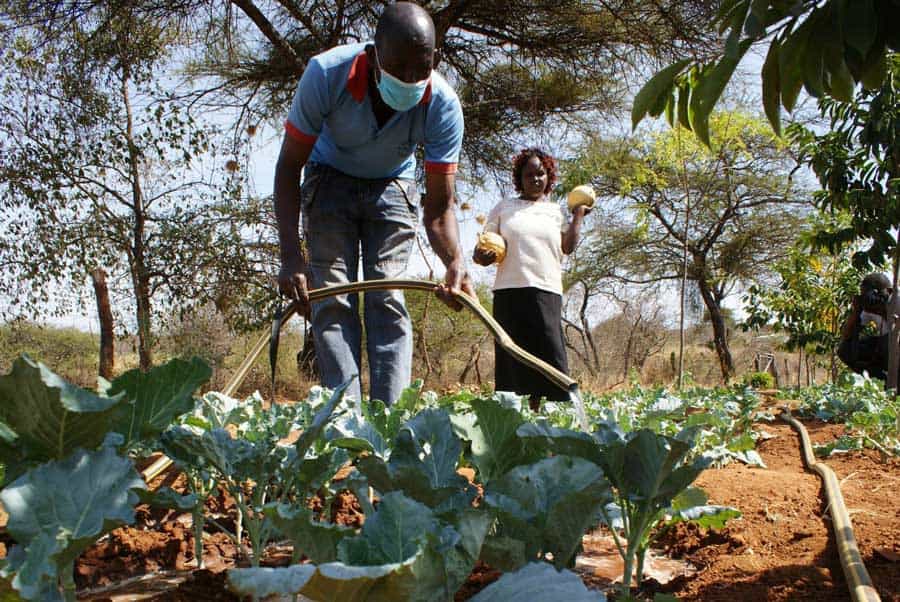
Even at 80 years old, Raphael Mauyu, a dairy farmer from southeast Kenya, has no plans to retire. But not long ago, he worried that his advancing age would soon make it impossible to carry on his labor-intensive job.
Mauyu's six dairy cows require a regular supply of water and getting it to the farm at his home in the village of Mwithini every day was exhausting, time-consuming, and potentially dangerous, he said.
The nearest river only flows during the two rainy seasons of the year, so the community has built sand dams — barriers across the river that trap sand, which in turn captures and holds water — to store river water to use when they need it.
The dams are a popular trick in Kenya's parched regions, but one with risks.
"It is often dangerous to walk along seasonal river courses carrying heavy and unstable loads like water because of quicksand," said Mauyu, walking past his field where hired hands were preparing the soil for planting.
They no longer have to worry while they fetch water.
But these days, Mauyu and other farmers in Mwithini no longer have to worry while they fetch water, after the installation of a new solar-powered system that pumps water from the dams to a safe collection point for the community to use.
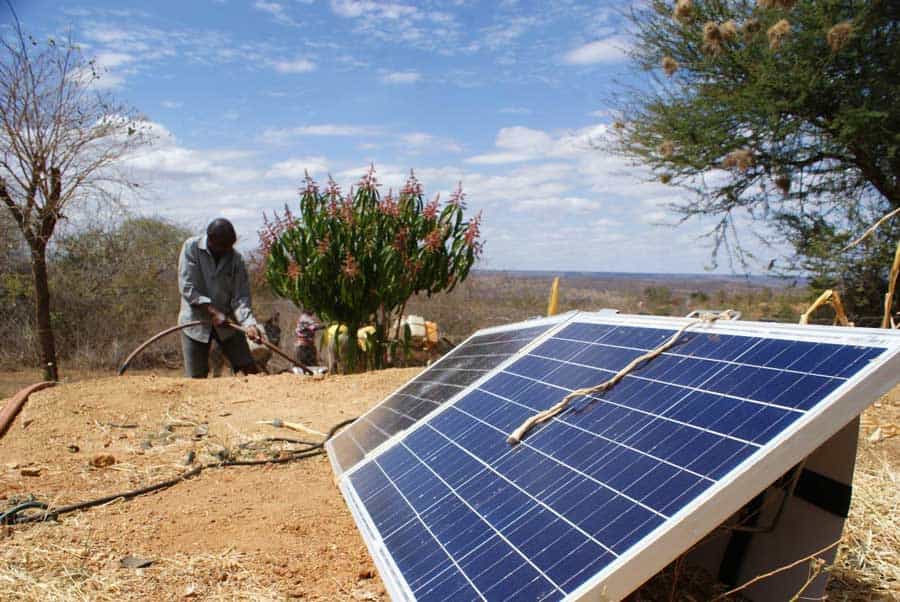
As countries around the world suffer increasingly severe droughts and water shortages, farmers and water experts say finding cheap, convenient, and non-polluting ways to access year-round water are more important than ever.
In February, the World Bank and the Makueni County government worked with farmers to install a 32-cell solar unit in Mauyu's village, one of more than a dozen off-grid solar projects the World Bank has helped set up around Kenya.
A spokesperson for the World Bank directed interview requests to the Makueni government, which did not respond to several requests for comment.
Under the $150 million project, solar pumps are provided free of charge, with maintenance costs covered by users paying a small fee for the water they collect.
Mauyu said the solar pump in his village can pull enough water in a day to fill a 100,000-liter storage tank — enough to irrigate over 50 acres of land.
While that amount does not meet all the villagers' daily water demands, the farmer said it is more than they need to water their livestock.
And when the area is hit by a long dry spell, the tanks provide enough water for basic needs to see the community through to the next heavy rainfall, he added.
"I want to use this water to grow fodder on my farm. This will save me from experiencing livestock feed shortages when the rains are inadequate," Mauyu said.
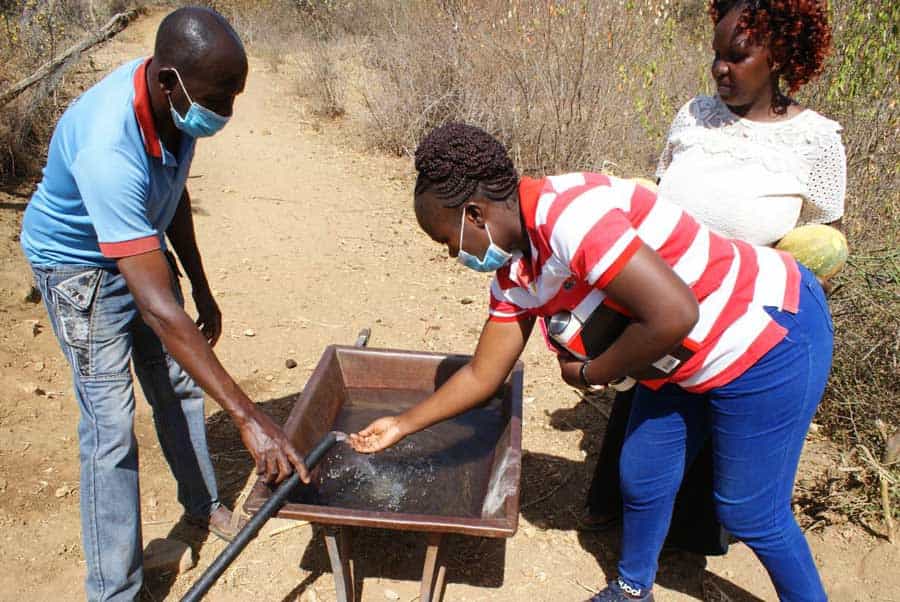
'Giving Life To a Dying Land'
According to United Nations Water, nearly a third of the world's population lives in water-scarce countries.
In Kenya — one of those countries — about 98% of farming is rain-fed and "highly susceptible" to climate change, according to the country's Climate Smart Agriculture Strategy.
To meet their water needs in the face of diminishing supplies, more than 20 farmers in the village of Kalawa, also in Makueni county, have bought their own private solar-energy systems to pump water from dams on their farms.
They said the technology has saved their livelihoods in the midst of recurring droughts the region has been experiencing since the late 1990s.
"I feel like I am giving life to dying land. Solar energy has really helped us to take rainwater harvesting to another level."
"I feel like I am giving life to dying land. Solar energy has really helped us to take rainwater harvesting to another level," said Kaloki Mutwota, 59, who uses solar power to pump water to his fields from his own rainwater harvesting dam.
Before investing in his new irrigation system, Mutwota said he used to rely on rains to water his crops, which resulted in poor yields or sometimes total crop failure.
Other farmers in the area struggled with manual pumps or used polluting petrol-powered systems before they also made the switch to solar, he said.
With more younger Kenyans choosing to work in the city rather than toil in the fields, solar pumps also allow older farmers to make a living for longer, said Dominic Omondi, an agricultural officer working in Kalawa.
In communities where people use hip or hand pumps, it takes two or more people — and a lot of muscle power — to draw water from a river or well, Omondi noted. A solar-powered pump only needs one person to operate it.
"When (people) get older, it becomes difficult for them to use manual pumping for water. But a person using solar pumps can sit back and the technology will do most of the work for them," he said.

Solar Potential
More than half of Kenya's electricity is sourced from renewables, mostly hydropower and geothermal energy, with less than 1% generated through solar power, according to a 2018 report by the Stockholm Environment Institute (SEI).
At a climate summit in January, Kenyan President Uhuru Kenyatta declared the country will generate all of its electricity from renewable sources by 2030.
Phyllis Wakiaga, chief executive officer of the Kenya Association of Manufacturers, said for the country to reach that goal more needs to be done to encourage the widespread adoption of renewable energy.
That includes persuading banks to back renewable energy project, she said.
"The major barrier remains financing, majorly due to reluctance by financial institutions to fund such projects," Wakiaga said in an email.
"We need to sensitize the local banking sector to appreciate the need to support solar projects."
($1 = 110.7000 Kenyan shillings)
Reporting by Kagondu Njagi, Editing by Jumana Farouky and Laurie Goering. This article was originally published by the Thomson Reuters Foundation, the charitable arm of Thomson Reuters, that covers the lives of people around the world who struggle to live freely or fairly. It was made available to Good Good Good. Visit news.trust.org.
Despite the profound impact of the COVID-19 pandemic on the vulnerable in the United States, the percentage of Americans in food-insecure households held steady in 2020 at 10.5%, figures released on Sept. 8, 2021, show.
Although unchanged from 2019, the new numbers are important for two main reasons.
First, food insecurity – the state of being unable to adequately provide food for yourself or your family – has become one of the leading, if not the leading, indicator of well-being for vulnerable Americans.
And with 38.3 million food-insecure Americans, the number of people affected is still high.
Second, the fact that the overall rate did not increase despite a serious economic downturn underscores the importance of government intervention when it comes to getting food to Americans who need it.
Government Intervention
That food insecurity stayed stable was due to various government actions. The Trump administration and Congress funded economic relief and stimulus packages that supplemented the incomes of millions of Americans.
For some households, these measures meant their income was higher than it was before the COVID-19 pandemic. As a consequence, these families had enough money to pay for a food-secure diet.
Meanwhile, the U.S. Department of Agriculture provided the maximum Supplemental Nutrition Assistance Program (SNAP) benefit for all recipients on a temporary basis.
This policy change represented a huge increase for many families – up to roughly $620 a month for a family of four.
And the agricultural supply chain was enormously successful in the face of a global pandemic. This success meant there were few shortages of food and only small increases in prices.
Nonprofit Support
The importance of charitable food assistance also can’t be overstated.
Food banks and food pantries responded nimbly and quickly to an unprecedented increase in demand and provided assistance to at least 60 million Americans in 2020. This was a 50% increase from 2019.
It isn’t all good news, though. The food insecurity gap between white- and Black-led households widened from 2019 to 2020. In 2019, the rates were 7.9% of white-led households and 19.1% of Black-led households; in 2020, they were 7.1% and 21.7%.
That means Black Americans are around three times more likely to be food-insecure than white people.
Related Stories:
— What is Mutual Aid — And How Can I Get Involved?
— How Feeding America Has Shifted Their Operations During The Coronavirus Pandemic
— Meet The App That Helps People Find Public Benefits
— Researchers Used State Data To Find Out How Many Lives COVID Vaccines Have Saved. And It's Really Good News.
But everything would have been much, much worse both during the COVID-19 pandemic and before the pandemic were it not for the existence of SNAP.
This nutrition program has been shown to alleviate food insecurity in study after study.
As the government’s response to the COVID-19 pandemic has demonstrated, the United States can, I believe, assure a “right to food” in the United States through government interventions, especially through expansions in benefits and SNAP eligibility.
This article was originally published by The Conversation and was made available to Good Good Good.
The lung cancer death rate grows smaller every year.
In 2021, a report from the American Cancer Society, Centers for Disease Control and Prevention, National Cancer Institute, and North American Association of Central Cancer Registries showed that we’ve seen a 2.2 percent decrease in male deaths from cancer.
For women, the cancer death decrease is a little less than 2 percent over the past four years.
Young adults and adolescents have experienced a 0.9 percent decrease in cancer deaths, while rates in children have decreased by 1.4 percent.
The stories of lung cancer and other cancer survival prove the efficient and hard work of cancer researchers, who are creating a real difference for people with cancer and survivors of it.

According to the National Institute of Health, the decline in lung cancer deaths is due to the public’s decrease in smoking and scientific advances made by doctors, nurses, and researchers.
The declining rate in all cancer deaths is also inclusive of all racial and ethnic groups.
Karen Knudsen, the Chief Executive Officer of the American Cancer Society, told the Center for Disease Control that “the declines in lung cancer and melanoma death rates are the result of progress across the entire cancer continuum — from reduced smoking rates to prevent cancer to discoveries such as targeted drug therapies and immune checkpoint inhibitor.”
These advances and their subsequent results prove the impact that science, research, and the general medical community have on the human body. Scientists are the driving force behind maintaining human existence for the past 250 years.

For women, children, and multiple marginalized communities who have often faced the brunt of fatal diseases, these milestone advances are life-changing. That means some of our most vulnerable communities are being protected by scientists and researchers.
The National Cancer Institute (NCI) explained that the annual cancer report confirmed that death rates for children below the age of fifteen continue to decline.
NCI stated that “overall cancer incidence rates in children and AYAs [adolescent and young adults] increased in all racial/ethnic groups except American Indian/Alaska Native children where rates remained stable.”
Out of the 19 most common cancers in men, 11 of these conditions are causing less and less fatal consequences for its survivors. For women, who are often victim to 20 of the most common cancers, 14 of these conditions are experiencing a downwards trend.

Science is working, and researchers are working alongside scientists to create a world where cancer is entirely curable and non-fatal.
Knudsen explained that, in order to create a 0 percent death rate for cancer patients, everyone must be offered preventative health services.
“We must continue to find innovative ways to reach people across the cancer care continuum — from screening and early detection to treatment and support for survivors,” she said.
According to a report by the National Cancer Institute, Black and African American communities have higher rates of general cancer deaths than any racial or ethnic group for most, but not all, cancer types.
Additionally, rates of smoking and drinking — which can cause lung and liver cancers — are higher among the LGBTQIA+ community than heterosexual people.

Dismantling health disparities means understanding how marginalized communities are disproportionately affected by cancer.
According to Betsy Kohler, Executive Director of the North American Association of Central Cancer Registries, it is critical to be conscious of social, economic, and other institutional factors that can prevent someone from making a doctor’s appointment, paying for hospital bills, or accessing insurance.
“Social and economic indicators, particularly based on small area assessments, are increasingly important to understanding the burden of cancer,” Kohler explained.
To make even greater advancement in the declining death rates, the National Cancer Institute is working on early detection research for all patients who may have lung cancer.
These preventative measures include CT scans, markers in blood and sputum, and computer programs which can detect more detailed diagnoses of cancer.

Effective treatment of lung cancer includes options like surgery, radiation, chemotherapy, targeted therapy, and immunotherapy — all of which, through research, have been proven effective in several cases of lung cancer.
The Institute has also created NCI-funded research programs which are ‘seeking ways to address lung cancer more effectively.’
The research targets the biological substrates of lung cancer, as well as the social factors that can expose people to the risk of cancer or prevent them from seeking assessment and treatment.
That means the more research that’s collected, the more progress can be made in preventative and treatment services, leading to a steeper rapid decline of lung cancer deaths.
And that means the hope for more cancers to decrease in deaths grows greater each day.
Science is creating a real and tangible impact on the lives of cancer patients. We must continue offering accessible and equitable services that can help create a survivable world for everyone, regardless of race, class, age, or gender.
All vintage archive imagery courtesy of the National Cancer Institute
You might also like these articles about cancer:
Indigenous communities are often misunderstood and misrepresented by mainstream media and politics.
Yet, Indigenous activists have always been at the frontlines of global issues to preserve the sacredness of Earth and stand for human rights.
The impact of colonialism has left Indigenous people on the backburner of representation and accessibility, in all its mediums.
As native people to their land, Indigenous people are protectors of our systems of water and land — and we can learn from them.
For example, Indigenous communities often have ‘water protectors,’ or cultural organizers, who are passionate about preserving clean water systems in lakes, rivers, and oceans.
Recently, local North and South Dakotan water protectors have stood at the Standing Rock Reservation to speak out against crude oil structures — such as the Dakota Access Pipeline — which can pollute water systems.
Beyond the protection of water systems, Indigenous activists are also fighting against the marginalization they face.
The violent oppression of Indigenous people, such as displacement, racism, and classism, are the reason they make up 15 percent of the world’s most poor populations. And yet, they continue fighting to preserve Earth’s greatest treasure: nature.
If you want to stand in solidarity with Indigenous communities, here is a list of Indigenous activists whose work you can learn from, support, and follow right now:
Sarah Deer
Lawyer and Professor at the University of Kansas, Muscogee Nation of Oklahoma (Lawrence, Kansas)
Sarah Deer is an activist, lawyer, and professor of Women, Gender, and Sexuality Studies at the University of Kansas.
In 2013, Sarah was a key activist in fighting for the reauthorization of the Violence Against Women Act, a law which ‘expanded tribal jurisdiction to prosecute non-Native perpetrators of domestic and sexual violence.’
Sarah has also expanded on her ideas in her book aimed to end sexual violence against Indigenous communities.
Jasilyn Charger
Member of the Cheyenne River Sioux Tribe (Eagle Butte, South Dakota)
After noticing the mental health crisis among teens in the Cheyenne River Reservation, located in South Dakota, Jasilyn Charger and her friends started the One Mind Youth Movement, an organization which facilitates outreach, unity, and education through human connection.
Jasilyn also played an essential role in fighting against the Dakota Access Pipeline by organizing an anti-pipeline water run. Jasilyn has used her passion for community care and climate justice to advocate for Indigenous peoples.
You can follow more of Jasilyn’s work on Instagram.
Autumn Peltier
Indigenous Canadian Water Activist, Wikwemikong First Nation (Ontario, Canada)
Autumn Peltier is a seventeen-year-old water activist. In fact, at the age of eight, she delivered her first speech to the First Nations people in Canada.
Autumn has spoken to politicians and policy-makers on the importance of preserving water — a sacred part of Indigenous communities and culture. Recently, Autumn was named chief water commissioner by the Abnishinabek Nation: a group of political activists and advocates.
You can learn more about Autumn by following her on Instagram.
Nathan Phillips
Former Director of Native Youth Alliance and Member of Nebraska’s Omaha Tribe (Ohama, Nebraska)
Nathan Phillips is the former director of the Native Youth Alliance, a nonprofit organization of young Native American leaders sparking culture-based community change and upholding traditional Indigenous culture.
Nathan was also present at the Standing Rock protests of 2016 and 2017, which fought against the development of an oil pipeline in North Dakota.
Nessa Turnbull-Roberts
Bundjalung woman and winner of the 2019 Young People’s Human Rights Medal (Sydney, New South Wales)
In 2019, Vanessa Turnbull-Roberts was recognized as one of Australia’s leading Indigenous activists.
Vanessa is a human rights activist for advocates for child housing rights — as a child who was forcibly taken from her family, Vanessa now works to abolish out-of-home care in Australia.
You can follow more of Vanessa’s work advocating for human rights through Twitter and Instagram.
Larissa Crawford
Anti-racism Researcher and member of the Pyramid Lake Paiute Tribe (Alberta, Canada)
Larissa Crawford is a published researcher, artist, and climate change activist.
She’s the founder of Future Ancestors Services, an Indigenous and Black-owned, youth-led service that is focused on climate justice through an anti-racist lens.
Larissa is passionate about preserving the sacred nature of people and planet Earth and focuses her transformational services on accessibility, anti-racism, and anti-ageism.
You can follow Larissa on Instagram.
Txai Suruí
Indigenous environmentalist and Amazonian preservation activist (Rondônia, Brazil)
Among many Indigenous activists in South America is Txai Suruí, who is working to preserve the Amazonian forest.
Txai is fighting against the deforestation and land-grabbing that is so common for rainforests across the world. 58.4% of the Amazonian rainforest borders Brazil, making it a large part of South America’s greenery and iconic nature preservations — Txai works with other Indigenous Brazilian activists to stop the forest from being torn down.
You can follow more of her work on Instagram and Twitter.
In order to represent Indigenous people in our communities, it is essential to stand behind the activists who are fighting for their right to be heard, seen, and understood.
You can start by learning from and supporting these activists who are working to build a better world.
This article has been updated to include details about the final days of the campaign and the success of cleanup efforts in the months since — congratulations to all who participated!
YouTubers all across the digital realm banded together for a good cause: saving our oceans.
TeamSeas — an initiative from popular YouTubers MrBeast and Mark Rober — asked content creators to use their influence to raise awareness about the current state of our oceans.
Their ambitious goal is to raise $30 million dollars to take 30 million pounds of trash out of the waters and partner with other YouTubers to spread the word.
Describing why they decided to be launch a campaign focused on cleaning up oceans, the creators shared: "Our ocean, rivers and beaches are full of plastic trash. It’s estimated that there are 200M tons of plastic already circulating in marine environments, with an estimated 11M tons entering the ocean EVERY YEAR. Pollution from bottles, bags, straws, and abandoned fishing gear is a health crisis for our entire planet. So we’re going to remove the equivalent of 85 football fields covered a foot deep in trash."
In a leaked private video shared with YouTube creators, creators like Hank Green, Physics Girl, MKBHD, Colin and Samir, and Safiya Nygaard expressed their support for the project, and it's expected they'll share TeamSeas videos on their channels with millions of subscribers.
In a series of tweets, MrBeast and Mark Rober said that they already had thousands of creators signed on to be a part of the collaboration — with hundreds joining in just days before the official October 29th launch date.
On October 29th at exactly 1pm Pacific time, MrBeast publicly announced the campaign in a YouTube video titled "I Cleaned The World's Dirtiest Beach #TeamSeas."
This new initiative came after a successful TeamTrees campaign that raised $20 million dollars before 2020 to plant 20 million trees in partnership with The Arbor Day Foundation. They ended up raising $23,166,880 by the end of 2020, earning more than 1 billion views across all #TeamTrees videos.
MrBeast and Mark Rober described how they spent months working with top environmental nonprofits to ensure they can guarantee that for every $1 donated to the campaign, there will be one less pound of trash in the ocean.
To accomplish this, they set out with a three-prong approach to clean up beaches, rivers, and oceans around the world. Why? Because all streams of water are interconnected and all waste — including those from rivers and beaches — inevitably ends up in the ocean.
To help clean the beach and parts of the ocean already polluted, they partnered with the Ocean Conservancy to organize beach cleanups, as well as in-ocean cleanup.
TeamSeas is also working with The Ocean Cleanup, which will focus on rivers. 80 percent of the plastic that flows to the oceans comes from 1% of rivers in the world.
To combat this, they’ll be placing trash-collecting technology in the worst polluting rivers. This has been done with massive success in the Dominican Republic.
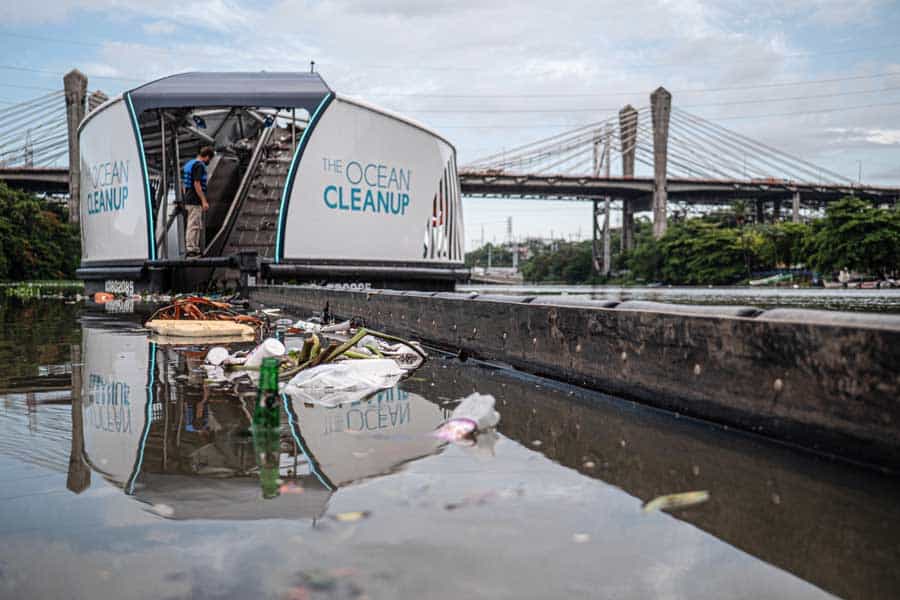
100 percent of the money raised goes directly to their nonprofit partners.
To raise 30 million dollars by the end of the year, the TeamSeas campaign asked creators to upload their own videos about cleaning up the ocean.
And asked everyone — subscribers, influencers, anyone who wants to do good — to get involved by helping the videos trend. They also partnered with YouTube to curate and elevate creators who choose to participate in raising awareness for TeamSeas.
No matter the niche or demographic a content creator has, there’s some way to find the intersection of ocean conservation and their regular content. After all, what happens to the oceans affects all of us.
TeamSeas Progress
Did TeamSeas reach their goal?
As of the morning of December 31st — the final day of the project — #TeamSeas has raised $25,630,743 USD to remove trash from oceans, rivers, and beaches.
The TeamSeas community was already 85.44% of the way to their goal of raising $30,000,000 by January 1st, 2022. (Especially thanks to an anonymous $2,000,000 donation this week.)
By midnight, TeamSeas reached their goal of raising $30,000,000 to remove 30,000,000 pounds of trash from the ocean.

On the final day of the campaign, Austin Russell, among the world's youngest billionaires, contributed 4,000,000 to the campaign. This came days after Russell launched a $70,000,000 charity fund.
"When we started this campaign 64 days ago with a wave of YouTube videos and a call to action, we had no idea where you'd take it. Today, right now, we know the answer," the TeamSeas crew shared in an email to supporters.
"30 million pounds. That's mountains of trash and plastic out of our ocean, our rivers, our beaches. Across the planet. Celebrate. Soak it up. You earned all of it."

According to TeamSeas, more than 600,000 donors from 191 countries contributed to the project over the course of two months. The most common donation was $5 — proving that a lot of small positive actions can add up to a lot of impact.
More than 10,000 videos were created — and they received more than 850,000 views.
It only took 7 days for #TeamSeas to raise their first $12,956,730. Only 30 days into the project — #TeamSeas had raised $16,623,289.
How much trash has TeamSeas removed from the ocean so far?
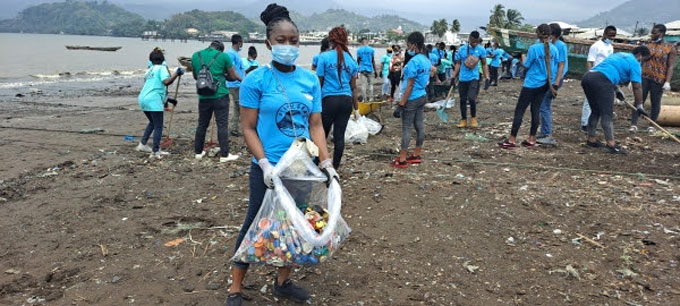
TeamSeas has committed to removing 1 pound of trash for every $1 raised. This makes keeping track of how much plastic will be removed really easy.
As of January 3rd, 2021, #TeamSeas has raised $30,282,934 to remove trash from the ocean — meaning that more than 30,282,934 pounds of trash will be removed.
The TeamSeas project isn't immediately removing all of the trash as each dollar is raised — but has committed to removing plastic and trash from rivers, beaches, and oceans in the coming weeks and months.
In a June 8th, 2022 update to supporters, the TeamSeas team announced that they had just crossed the 3,000,000 pound mark, meaning they had cleaned up 10% of their total goal.
Can I keep donating to TeamSeas?
Yes, you can continue to donate to TeamSeas anytime. The money raised will continue to go directly to their nonprofit partners, and the website will continue to update with the total number of pounds of trash removed from the ocean.
How To Get Involved with TeamSeas
While TeamSeas has successfully completed its goal, you can continue to support the campaign through these original action steps.
1. Watch #TeamSeas Videos
Many creators are donating the Google AdSense revenue they make from their #TeamSeas YouTube videos towards TeamSeas. By watching videos tagged with #TeamSeas, you could be financially supporting the project — with no cost to yourself. And no matter what, you'll be boosting #TeamSeas content in the YouTube algorithm and helping more people find them. Check out the more than 20,000 YouTube videos tagged with #TeamSeas.
2. Make a Donation
To support the cause, you can visit the TeamSeas website and make a donation towards the $30 million goal. Even small donations will add up to make a difference.
3. Install the Tab for TeamSeas
The team at Tab for a Cause has created Tab for TeamSeas — a browser extension that allows you to raise money for TeamSeas every time you open a new tab.
4. Create Videos and Content to Raise Awareness
If you’re a content creator, you have the next two months to make dedicated videos or content to keep the momentum going. Fill out this form to be part of their network of content creators working for this great cause. (They'll also give you access to b-roll footage, an FAQ page, and more details.)
TeamSeas says they will be active across all major platforms (like YouTube, TikTok, Twitch, Instagram, Reddit, Snapchat, and Facebook) and they're encouraging supporters to participate, create, and share #TeamSeas content wherever makes the most sense for your audience.
When you upload your video, social post, or livestream — tag your post with the #TeamSeas hashtag and direct everyone to TeamSeas.org where they can contribute and track fundraising progress.
5. Join a #TeamSeas Cleanup
TeamSeas announced that they're planning community cleanups that will bring fans and supporters together to make a difference in real life. Invitations for cleanups will be announced on Instagram and Twitter.
This initiative is a creative and impactful way to make an actionable difference in the fight against climate change that goes further than social media normally does.