“Ideas can come from anywhere,” acclaimed author and entrepreneur Rashmi Bansal once wrote, “You could be sitting in a tub and have a eureka moment. Or in a bus or at your dining table.”
For 14-year-old Sirish Subash, his “eureka moment” came at the kitchen sink.
“My parents always insist that I wash my produce before consuming it,” Subash told Minnesota Public Radio. “I wondered, how necessary is this really, and how effective is the washing. Does it really work to ensure that your produce is clean?”
That line of thinking led him to a deep dive into the world of pesticide use and the reality of how “clean” grocery store produce actually is.
He was shocked by the results.
According to a 2024 study by the Environmental Working Group, “75% of all conventional fresh produce sampled had residues of potentially harmful pesticides.”
So, Subash set out to create an invention that could identify pesticides on fruit and vegetables, in real time, at the grocery store.

“There’s a significant amount of pesticides entering our diet, but they’ve been linked to a variety of health issues, from Alzheimer's to Parkinson's, even certain cancers,” Subash explained in his video submission to the 3M Young Scientist Challenge, an annual contest geared towards middle-school students.
“The current methods of detecting pesticides, the ones that are designed for at-home use… typically require the chopping up of produce, and applications … that render the produce un-consumable,” Subash continued.
He went on to explain that other methods, that leave the produce consumable and intact, require study in a lab with expensive equipment.
“That’s why I designed PestiSCAND, a handheld app that’s a pesticide detector,” Subash said, holding up his invention — a device that uses AI machine learning to measure the wavelengths of light reflecting off produce and analyze the data.
After the teen, who is based in Snellville, Georgia, threw his hat in the ring for the competition, he went on to become one of nine other top finalists in the 3M Young Scientist Challenge.
Under the mentorship of 3M senior research engineer Aditya Banerji, he was able to fully develop his device and even begin the steps of turning the invention into an iPhone app.
Earlier this month, Subash was selected as the official winner of the 2024 challenge and given a $25,000 cash prize.
“Like many other students, my fundamental passion is science, though I believe a novel idea is like a seed, such that it will only get so far without the proper guidance and cultivation,” Subash told 3M when asked why he sought out the summer mentorship program.
He said that “recognition for the countless hours” he’s dedicated to his research was gratifying, but he places real value in the opportunity to work with accomplished scientists who are experts in their field of research — like Banerji.

“[They] may help not only to expand my current project into something so much greater,” Subash said. “But to impart guidance and inspiration that will define my educational career and cultivate more, and potentially more important, scientific research in the future.”
With a hefty cash prize in hand to fund his next endeavors, Subash’s future is bright — and he wants to do his part in making sure the future is bright for everyone else, too.
“In 15 years, I hope to be designing and building devices that can help make the world a better place,” Subash told 3M, “especially with climate change and environmental issues.”
Header images via 3M and Tero Vesalainen / Free Range Stock
Every day the Good Good Good team collects the best good news in the world and shares it with our community. Here are the highlights for this week!
If you want to get good news in your inbox every day, join the Goodnewsletter — the free daily newsletter designed to leave you feeling hopeful.
The Best Positive News We’re Celebrating This Week —
An ambitious plan to provide electricity to 300 million people in Africa by 2030 is now underway
Thanks to an initial $30 billion investment from the World Bank and African Development Bank, Mission 300, a plan to bring electricity to 300 million Africans by 2030 is now underway.
The collaborative effort from governments, foundations, climate organizations, and more will work to raise $90 million total to support Mission 300’s goals.
Africa accounts for nearly three-quarters of the world’s population without access to electricity. Countries like South Sudan, Burundi, and Chad have electrification rates below 12%.
Why is this good news? More than 600 million people in Africa currently don’t have access to electricity, and the continent has just over a 43% energy access rate — the lowest in the world. Something many of us perhaps take for granted, lack of access to energy has a myriad of negative impacts, like restricting economic growth, access to education, making food, and more.
People adopted and fostered hundreds of animals in Palm Beach County before Hurricane Milton made landfall
With Hurricane Milton just days away from making landfall, Palm Beach County Animal Care and Control put out an urgent call for help: it needed fosters and forever families for the more than 200 cats and dogs in its shelter.
The Palm Beach County community responded swiftly and overwhelmingly — the shelter ended up having to turn people away because there were no animals left to care for. Within two days, 117 cats and 113 dogs were adopted or placed in foster homes.
While the community suffered damage from the storm itself, the shelter was making preparations knowing that it would likely need space to take in and shelter animals post-storm, too.
And it was right, the shelter is already caring for at least 16 dogs and 16 cats found wandering the streets post-Milton, waiting to be reconnected with their owners — or to find their forever homes, too.
→ Read more
A revolutionary new children’s hospital just opened in Zurich, with architecture designed to “help the healing process”
Swiss architectural firm Herzog & de Meuron just unveiled their latest creation: a revolutionary new children’s hospital that upends traditional hospital design, which they say neglects “basic human needs.”
Their design, which also comes with a lower price tag than comparable hospital builds, addresses “the curiosity of children” — with thoughtful touches like a low-level reception desk, cubbyholes and lookout windows, and coated walls that invite patients to draw away.
The Kinderspital has been in the works for 14 years, and is an experiment in how architecture can help the healing process — and the roles that light, views, scale and proportion of spaces, and materials play in that process.
Why is this good news? The medical advancements we’ve made throughout history are remarkable — and much like offering mental health support and care, considering how we can reimagine the physical surroundings of sick children to improve their health outcomes is important, too.
A Chicago man ran 26.2 miles around his neighborhood block and raised over $12,000 for the community homeless shelter
One day before a record 50,000 people ran in the iconic Chicago Marathon last weekend, Lincoln Park resident Matt Brusich — decided to race 26.2 miles around his own city block.
To reach the official marathon mileage, that would equate to nearly 80 laps around the block. Ready to lace up his sneakers, Brusich also wanted to do something meaningful with the challenge.
He used the opportunity to raise money for the Lincoln Park Community Shelter, a homeless shelter and nonprofit right in the heart of his community.
By the time the race had been completed on Saturday, Brusich racked up about $11,000 in donations, and his pledge page now boasts over $12,000, as gifts keep pouring in after the fact.
→ Read more
People donated over $193,000 to help rebuild a queer bar that opened weeks before it was destroyed by Helene
Branden Davis and his husband Davie opened DayTrip — a bar and coffee shop where they’d host LGBTQ+ fundraisers, burlesque shows, dog adoptions, and more — just weeks before Hurricane Helene destroyed it.
A friend of the couple started a GoFundMe to rebuild the “cozy and quirky place for friends and neighbors to come and feel welcome.” To date, it’s raised over $193,000 from thousands of donors.
Overwhelmed by the support, the pair plan to rebuild DayTrip, compensate employees who lost wages from the storm, and donate to support local volunteering efforts.
→ Read more
More good fundraising news:
- In a single weekend, tattoo artists raised over $74,000 for Palestinians in need.
- Pop star and “Midwest princess” Chappell Roan has raised over $160,000 to support LGBTQ+ and human rights.
- John and Hank Green’s annual 48-hour “Project for Awesome” livestream fundraiser has raised $23 million for charity since 2007.
Coal generation in a group of 38 countries has fallen 52% since its peak in 2007
Countries in the Organization for Economic Cooperation and Development’s have reduced their coal by half for the first time since it peaked in 2007.
Coal generation fell to 17% of total OECD electricity generation in 2023, a 52% reduction from its peak of 37% in 2007. Solar and wind generation accounted for 87% of the decrease in coal generation.
When the UK’s last coal power plant closed on September 30, it became the 14th of the 38 OECD countries to achieve a coal-free power system.
Three-quarters of OECD countries have committed to achieving coal-free power generation by 2030. Even among those that haven’t, wind and solar power are continuing to grow significantly.
With over 300,000 ballots cast, Georgia more than doubled its first-day early voting record
In 2020, a then-record 136,000 Georgia voters participated in the first day of early voting. This year, over 328,000 Georgia residents cast their ballot on day one — more than doubling the previous record.
Election officials predicted another 200,000 votes would be cast on the second day of early voting, and also expect turnout to continue to increase in the final week of early voting in the state.
Despite the record-shattering turnout, both voters and the state’s election office said there were minimal reports of long lines, except at popular voting locations in metro areas.
Why is this good news? Record-breaking voter turnout for elections is good news for a democracy whose elected officials best represent the people. With around two-thirds of eligible voters participating in the 2020 election, that leaves so many who did not — Georgia setting a record pace for voter participation is good news in this election cycle.
→ Read more
Grocery stores that donate expiring food — instead of price discounting or discarding — make higher profits
→ Read more
A California university just added a climate change course requirement to graduate
The University of California San Diego just implemented an innovative requirement for students, effective this fall — all students must take a climate change course to graduate.
Intended to “prepare students for the future that they really will encounter,” the course must cover at least 30% climate-related content and address two of four areas: scientific foundations, human impacts, mitigation strategies, and project-based learning.
The requirement won’t add any time to a student’s schedule, and 41 classes at UC San Diego already meet the requirement, like “The Astronomy of Climate Change”, “Gender and Climate Justice”, and “Environmentalism in Arts and Media”.
Why is this good news? A student’s time in higher education is intended to prepare them for a future career of their choice — and as climate change continues to impact more areas of life, careers are no exception. Whether you’re a doctor, chef, teacher, designer, or entrepreneur… they’re all impacted by the climate crisis — this requirement helps prepare students for that reality.
Volunteers cleaned up litter left behind by “leaf-peeping” visitors in New Hampshire
As fall is fully underway across the country, leaf-peeping season is in full swing. Tourists have flocked to destinations with exceptional foliage, though officials say crowds are “overwhelming” state parks across the Northeast.
While this influx of visitors can bring a boost to the local economy, they also bring… their garbage.
After seeing photos of the larger crowds, Siobhan Smith knew that a volunteer effort would be needed to clean up the trash left behind by leaf-peepers. She and her friend, Noah, hiked up one of the most popular destinations — filling up two large trash bags along the way.
They volunteered their time and effort to make sure others could enjoy the beautiful views — and encouraged others to adhere to the same Leave No Trace principles.
More good news of the week —
The U.S. EPA finalized a rule to replace all lead pipes in homes within a decade. Lead poisoning can cause irreversible damage to the nervous system and the brain and poses a specific risk to infants and children.
The U.K. government is funding a £120 blood test that could detect the 12 most common cancers before symptoms develop. It’s providing £2.5m via the National Institute for Health and Care Research to improve the speed of the test, which checks for cancers like breast, lung, prostate, pancreatic, and brain cancers.
A tiny parasitic wasp helped save one of the world’s rarest birds from extinction. Wasps released on Nightingale Island have protected Wilkins’ bunting by halting the spread of invasive, mold-causing insects.
Mimicking wetlands, mini-artificial islands are helping filter Missouri’s lakes and ponds from contaminants. The artificial floating islands are a promising solution to water pollution after agricultural and urban development destroyed about 90% of the state's natural wetlands.
Indigenous people in British Colombia are combining modern science with ancestral principles to protect the land. The Heiltsuk Nation’s ancestral laws center on respect, responsibility, reciprocity, and stewardship for all sentient beings — and have shaped their interaction with their environment.
A library in Ohio is providing free resources to aspiring nonprofit and business owners who lost manufacturing jobs. Part of a growing movement to provide more than books to the public, in 2018, Toledo was one of 12 public library systems awarded grants to explore ways to engage entrepreneurs in their communities.
A Navajo woman is using horses to help register voters and get people to the polls. Allie Young’s voter registration events will culminate with 100 Indigenous voters riding on horseback to a polling station in Arizona on election day.
Colombia launched a new investment portfolio to transition away from fossil fuels and adapt to climate change. Hoping to generate around $40 billion, the portfolio will help fund eco-tourism, a fair energy transition, and conservation and restoration of ecosystems.
Transforming treatment in crisis zones, British scientists developed a tool kit to make limb-saving devices. Rather than waiting for them to be flown in, the doctors developed kits that could be distributed locally so people can make their own devices using conventional equipment in the event of a natural disaster or war.
Weeks before Halloween, scientists discovered a critical new ‘orange and black’ salamander species. Around the globe, salamanders are considered a “linchpin” species, serving as prey for other vital species and curbing the overpopulation of pests.
Thanks to the city of Seoul’s restoration initiatives, a river ecosystem is showing significant signs of recovery. Since 2007, the number of trees along the Han River has doubled to more than 3 million, and the diversity of species in the area has surged by nearly 30%.
A study found that more bystanders are stepping in to administer naloxone to people who’ve overdosed on opioids. Overdose deaths declined by 3% in 2023, and the nearly 25,000 patients who received naloxone from an untrained bystander before paramedics arrived could have helped lead to the decline.
Nebraska’s Supreme Court upheld voting rights for people convicted of felonies who had finished their sentence. Lawmakers had restored voting rights to more people convicted of felonies, but a dispute over the law had led to pre-election confusion — this ruling helped bring clarity.
Volunteers and scientists are working to save endangered baby turtles in Canada. They collect eggs of at-risk turtle species from a conservation area in east Ottawa to save them from predators, watch over them, and then release them a couple of months later.
A county in Oregon filed the first-ever climate deception lawsuit against a natural gas company. The lawsuit accuses the state’s largest natural gas utility of being responsible for “a substantial portion” of greenhouse gas emissions and deceiving the public about their harm.
Kate Barr, who is running for state senate in North Carolina’s 37th District, says she was “gerrymandered out of a chance.”
So she’s running her campaign on the promise that she won’t win.
North Carolina is indeed one of the most gerrymandered states in the country. Gerrymandering, defined by Merriam-Webster, is the practice of dividing or arranging a territorial unit into election districts in a way that gives one political party an unfair advantage in elections.
According to the Brennan Center for Justice, gerrymandering has been used to undermine democracy for centuries. That said, in recent years, the Republican Party has been known for its redistricting tactics, and in 2022, North Carolina’s State Supreme Court even ruled that the state constitution allows partisan gerrymandering.

In 2022, the state had “fair maps,” and sent seven Democrats and seven Republicans to Congress, Barr wrote in a column. This year, with redistricted lines, she said, the state is projected to send three Democrats and 11 Republicans.
While Barr is a staunch Democrat, and gerrymandering itself is inherently partisan, her campaign isn’t intended to sway people any one way, but rather to shed a light on the democratic process and the need to protect free and fair elections.
Barr makes a point to show that North Carolina is not the only gerrymandered state in the nation, with at least 16 states scoring with a grade of “C” or lower on Princeton’s nonpartisan redistricting report card.
But North Carolina does get a failing grade; what Barr calls “a devastating distinction.”

“If one party gets control of the process or one faction gets control of the process, then they can have free reign,” said Professor Sam Wang, who heads the Princeton Gerrymandering Project.
In other words, Barr said at a recent rally, “In a gerrymandered state like North Carolina, it means representatives are choosing their voters instead of voters choosing their representatives.”
Wang added, to CBS News: “The danger of politicians picking their voters is that there is an overwhelming temptation to self-deal and have a situation where they never have to face competition.”
That is the exact case in Barr’s district. She is projected to lose by 34 points. Even if everyone in her party came out to vote in her favor — what she calls a “blue tsunami” — she would still lose by 20 points.
The mom of two is a PTO president, planning board member in her community, volunteers for the Davidson Housing Coalition, and works remotely as a behavioral scientist at the University of Michigan’s Center for Academic Innovation.
Running a campaign — even one designed to fail — is no small feat, on top of everything else.
But that campaign — accented by sparkly t-shirts that read “Loser,” or “Clear eyes, full hearts, can’t win” — puts fun front and center.

“If I’m going to lose, we might as well have a little fun, raise a little hell, and shine a light on the impacts of gerrymandering along the way,” Barr shares on her website.
Sure, it’s a playful bit that educates people about civic engagement, but how do voters actually fight their way out of a gerrymandered state?
Barr said the answer is in judicial races.
While some states have used ballot initiatives to put map-making control in the hands of independent commissions, North Carolina’s citizens can’t put measures on the ballot, meaning folks against gerrymandering will need to retake control of the State Supreme Court.
Barr offers some suggestions for which justices to elect to North Carolina’s Supreme Court, but even if all goes according to her plan, it likely cannot come to fruition until the 2030 Census. She’s playing the long game.
“I know that seems like a long time from now,” she writes.
“That’s why, for all of us in highly gerrymandered states, we have to keep our wits about us and find some ways to have fun on this journey to fair elections.”
In the meantime, she employs the usual political tactics: Yard signs, merch, media appearances, and fundraising (which pays for her educational materials and event appearances featuring an 80’s cover band, for instance).
Instead of presenting major policy plans, her website offers resources and voting guides for “busy people” in Iredell and Mecklenburg counties. Instead of telling supporters how she would make a difference as an elected official, she educates them on the fact that she won’t even get a chance to try.
Barr is unburdened by traditional campaigning and is therefore vocal about her liberal beliefs (the right to abortion, common sense gun laws, and funding public education are listed on her website).
But her main goal right now is simply to show North Carolina’s voters that elections don’t have to be this way.
“Crack some jokes. Pack your election night watch parties. And, of course, run for office even if you know you can’t win,” Barr imparts in her column.
“You will still raise awareness and make a difference in the future. Find the joy, and we will fight our way forward.”
Header image courtesy of Kate Barr Can't Win
It’s difficult to walk through a neighborhood in America without hearing the constant hum of HVAC units.
89% of households in America have an HVAC (heating, ventilation, and air conditioning) system, and most residential homes use a split system, with both outdoor and indoor components.
The indoor component has evaporator coils, air filters, and a blower to pump air throughout the house, while the outdoor component condenses refrigerant and dissipates heat with a constant, running fan.
For decades, in millions of homes, the wind energy coming off of those outdoor fans has been languishing in backyards as wasted potential — but now scientists have figured out a way to harness it.
This year, Spanish researchers at the Distance University of Madrid explored transforming “artificially generated wind gusts” into clean electricity “through small wind turbines.” In early October, they published their findings in the scientific journal Nature.
To test their theory about HVAC systems, the team — Isabel Gil-García, Ana Fernández-Guillamón, and Álvaro H. Montes-Torres — applied small vertical turbines to “chillers” at a data center in Colombia.
The data center had three units — one which rotated weekly and two which were constantly running — in order to pump cold air into the facility to cool the facility’s computer equipment.
According to the study, the 16 fans of the chillers consumed a total of 336.39 MWh (megawatt-hours) annually, but generated a net electricity of 467.6 MWh. These metrics accounted for a 9% loss due to unplanned downtime and maintenance.
Overall, this led to a 131.2 MWh surplus of energy — but those small vertical turbines could harness that surplus, feeding renewable energy sources into the electrical grid or fulfilling other electrical needs at the facility.
They posited that this redirection and implementation of power could be easily applicable to residential and commercial HVAC units around the globe, potentially using that “leftover” clean energy to power itself — and the same household it was heating and cooling.
The scientists urged that solutions like this are more critical than ever.
“The need to reduce global emissions leads us to look for various sources of clean energy,” Gil-García and her colleagues wrote in their study, praising the “large-scale” advancements of wind technology in recent years in “both marine and terrestrial environments.”
It has indeed been a record decade for wind technology, with constantly evolving conversations on the creation and efficiency of wind farms, floating wind turbines, and wind-powered electric charging stations.
“However,” Gil-García and her colleagues wrote, “we often underestimate the capacity of certain human activities and production processes to generate clean energy, wasting their true potential.”

Powered by this desire to study the “overlooked” potential of man-made devices, the Distance University of Madrid scientists realized that common HVAC units could be the answer scientists have been looking for.
“This work estimates an annual clean energy production of approximately 468 MWh, avoiding about 300 metric tons of CO2 emissions,” the team wrote, suggesting that the data center in Colombia was just a starting point.
At first, clamping attachments to HVAC systems on a global scale would be expensive — the initial cost of nine micro wind turbines, installation, and equipment comes to $1,23,101. With an estimated lifespan of 20 years, and an annual maintenance cost of $1,109, the price was projected to increase by 12 percent.
But the scientists stated that the price would take a turn three years in, creating a positive return on investment “and an attractive internal rate of return of 50.69% over a 20-year period,” ultimately making their solution an economically viable one, too.
Concluding their research, the scientists wrote: “By adopting proactive policies and encouraging innovation, we can significantly reduce our environmental impact, save energy, and move towards a more sustainable world for future generations.”
Header image via Free Malaysia Today (CC BY 4.0)
Young adult readers likely know John Green for his teen romance “The Fault in Our Stars,” which deals a heart-tugging story about love amid terminal cancer.
But in the 12 years since its publication, the author has pivoted to writing — and educating — about a number of other conditions.
Most recently, he has turned his attention to tuberculosis, the world’s deadliest infectious disease.
From countless TikToks about the topic and a full-length introductory lecture on TB to successful internet campaigns lobbying pharmaceutical companies to make TB testing and treatment more accessible, the fluffy-haired writer has become the spokesperson for TB.
Green had previously alluded to the fact that he was writing a nonfiction book about the disease (following his last young adult novel that grapples with obsessive-compulsive disorder, “Turtles All The Way Down”), but it was officially announced Tuesday morning.

Green’s newest book — and second work of nonfiction — “Everything Is Tuberculosis: The History and Persistence of Our Deadliest Infection” will be published this spring.
Publisher Crash Course Books, a new imprint of Penguin Young Readers, said the book will detail the experiences of a young TB patient named Henry, who Green met in 2019 when traveling with Partners in Health, a global nonprofit Green and his brother, Hank, have long supported.
In the years since that visit, Green amplified his efforts to eradicate TB, a disease that is completely preventable and curable but still claims the lives of over a million people every year.
“This book is the culmination of a long journey toward trying to understand how a disease that has been curable since the 1950s continues to kill over a million people every year,” Green said in a statement.
“I’m thrilled to be publishing it as the first title from Crash Course Books, and so grateful to all the TB researchers and survivors whose generosity with me made it possible for me to tell this story.”
According to a statement, the book will build on Green’s years of activism and education, interweaving Henry’s story with the medical and social history of the disease.
“Tuberculosis has been entwined with humanity for millennia,” a description for the book reads. “Once romanticized as a malady of poets, today tuberculosis is a disease of poverty that walks the trails of injustice and inequity we blazed for it.”
Per the book’s description, it aims to be a resource that “humanizes and gives hope” to the “ongoing struggle” to address the disease.
This struggle is one Green knows increasingly well, having worked alongside TB advocates and experts from Doctors Without Borders and Stop TB Partnership, and even speaking before the United Nations on the subject.
He has also personally donated over $1 million to the cause, all while consistently raising awareness about the prevalence and context of TB internationally. This book promises to tie it all together.
“Whether writing fiction or nonfiction, John Green has a gift for bringing truth to storytelling, and storytelling to truth,” Green’s editor, Julie Strauss-Gabel, said in a statement.
“Confronting and inspiring, in ‘Everything Is Tuberculosis,’ John distills centuries of history and science through one essential human story.”
Green’s talent to make overwhelming subjects into understandable stories is the capstone of his career as a writer, educator, and creator, Strauss-Gabel said.
She added: “This same craft sits at the heart of the landmark educational media brand Hank and John Green have been building together for more than a decade, guided by the principle that we learn best when we go beyond the facts to truly understand why those facts matter.”
“Everything Is Tuberculosis: The History and Persistence of Our Deadliest Infection” will be published on March 18, 2025, and is now available for preorder, wherever books are sold.
Header images courtesy of John Green/Crash Course Books
Folk-pop star Noah Kahan is often dressed head-to-toe in some version of khaki, flannel, or denim.
This makes his latest endeavor one of his most on-brand yet.
Kahan and L.L. Bean announced a new partnership together Tuesday, which pays homage to the Grammy-nominated songwriter’s Vermont roots.

The launch included a limited-edition collection of footwear (the infamous Bean Boots did indeed make the cut), apparel, and accessories (a quickly sold-out Boat & Tote was also part of the release).
They called it “The Northern Attitude Collection,” named after one of the singer’s hit songs.
According to a press release, all of the items were co-designed by Kahan and are inspired by the “rugged, natural beauty of the region and the fortitude that bonds New Englanders.”
That fortitude isn’t just referring to the durability of the outdoor brand’s fabrics, but also to Kahan's own mental health.

Along with the eight-piece collection, L.L. Bean donated $100,000 to Kahan’s mental health initiative: The Busyhead Project. To date, he has raised over $2 million for the fund, which invests in rural mental health programs, resources, and information to fight the stigma around mental illness.
“There is something unspoken that bonds New Englanders — a shared grit and resolve we all need to survive the long, cold winter months,” L.L. Bean’s chief marketing officer Nick Wilkoff said in a statement.
“Noah shares that with the world through his music, and we're proud to share that with our customers and his fans through this collection, which includes some of our most iconic Made-in-Maine goods that we've been crafting for generations.”
Kahan also talked up the company’s craftsmanship.

“I grew up wearing my brother’s Bean Boots, so the brand has always been a part of my life,” he said.
The through-line of all the products in the collection is a muted color palette that reflects Kahan’s “Stick Season” album and aesthetic. Illustrations of his beloved German Shepherd, Penny, are also seen on a number of the apparel and accessories.
“Wearing L.L.Bean makes me feel like I’m outside, even if I’m not, and this is important because going outside is self-care for me, especially when it comes to my mental health,” Kahan continued in a statement.
“Including Penny is also just so special, as she’s been my closest confidant during the creation and launch of ‘Stick Season,’ so this collection is really personal and nostalgic for me.”

In a video debuting the partnership, Kahan can be seen playing with Penny outdoors, casually enjoying nature from a makeshift tree stump chair, and showing off the items designed with the brand.
“L.L. Bean thinks I’m handsome, so we made a clothing line together,” he quipped in the Instagram caption. “Thank you so much… for donating 100k to Busyhead. It is going to make a huge difference.”
This is not Kahan’s first time working with beloved brands to support the cause of mental health support. Earlier this year, he also released a signature ice cream flavor with Ben & Jerry’s, called “Northern Latte-Tude,” which raised $15,000 for The Busyhead Project.
L.L. Bean has also made “significant investments in research and programming focused on the mental health benefits of time outside,” according to a press release. This includes the brand’s annual “off the grid” campaign for Mental Health Awareness Month, which encourages people to enjoy nature for the sake of their well-being.
“We’re honored to partner with Noah to share a piece of New England with the world,” Wilkoff said, “while creating greater awareness around the mental health benefits of time outdoors.”
“The Northern Attitude Collection” ranges in price from $29.95 to $249 and is available to shop now.
Header image courtesy of L.L. Bean
In 1982, social scientists James Q. Wilson and George L. Kelling introduced the “broken windows theory,” or the idea that smaller crimes — like broken windows — lead to more serious ones.
Nearly two decades later, in 2000, New Yorker author Malcolm Gladwell popularized the same theory in his book “The Tipping Point.”
“In a city, relatively minor problems like graffiti, public disorder, and aggressive panhandling … are all the equivalent of broken windows, invitations to more serious crimes,” Gladwell wrote, relating Wilson and Kelling’s theory to his experience living in New York City in his 30s.
“The Tipping Point” was a huge hit — selling over 1.7 million copies by 2006 — and the subject became a hot topic in the new millennium.
Now, 24 years later, Gladwell has revisited his debut book with chagrin, making a formal apology on stage at TEDNext in Atlanta, Georgia.

“Here’s the thing that I have come to understand about that explanation I gave about why crime fell in New York,” Gladwell said. “I was wrong.”
“For the first time in a quarter century I re-read my book. I’m not someone who likes to revisit things, but I did it and it was a uniquely complicated experience.”
Gladwell did not create — or single handedly purport — the “broken windows theory,” but in his TED Talk, he admitted that his work had a great degree of influence on New York City’s public policies for years to come.
In the early 2000s, police forces in New York adopted harsher tactics to crack down on small crimes, with “zero tolerance” approaches to petty crimes like fare evasion, littering, and loitering.
This led to the introduction of “stop-and-frisk” policies in 2002. Between 2003 and 2013, police made over 100,000 stops every year, heavily targeting minorities. In 2013, 56% of people stopped were Black and 29% were Latino. The majority of them were 14 to 24 years old.
Now looking back, Gladwell realized that the broken windows theory — which largely beget all of these policies — had been clearly tested.

“There was a classic, natural experiment to see whether that theory worked,” Gladwell said. “The natural experiment was a court case, maybe one of the most famous court cases in New York history.”
Gladwell pointed to David Floyd’s federal class action lawsuit against the City of New York in 2013, in which Floyd challenged “stop and frisk,” citing that he was unlawfully stopped without reasonable suspicion.
He won the case, with Judge Scheindlin ruling that the New York Police Department had violated the Fourth and Fourteenth Amendments in their treatment of Floyd.
“And overnight, the ‘broken windows’ era in New York City policing ends … so this is the perfect natural experiment,” Gladwell said. “You have New York before Floyd and after Floyd.”
“If you believe in the power of ‘broken windows’ policing then your expectation has to be that after the Floyd case, when ‘broken windows’ goes away, crime’s gonna go back up, and I should tell you in 2013, in the wake of the Floyd case, everybody thought crime was going to go back up.”

Gladwell acknowledged that alongside the NYPD, the city government, and the very judge that ruled on Floyd’s case, he himself expected crime rates to skyrocket.
But instead, crime rates dropped.
“In fact,” Gladwell said, “crime undergoes a second, even more miraculous decline [than the 1990s]… New York gets rid of ‘broken windows’ and crime starts to fall, and fall, and fall all over again.”
The author went on to say that although the broken windows theory was been proven hollow, government figures and political candidates continue to parrot the theory time and again.

“For that misunderstanding, I think I bear some of the blame,” Gladwell said. “I was the one who wrote this book saying this was the greatest tactic ever in stopping crime … I told the story like I knew the answer.”
Gladwell further explores the ramifications of his debut novel in his new book “Revenge of the Tipping Point: Overstories, Superspreaders, and the Rise of Social Engineering” which was released in early October.
With 24 years of hindsight, he told the audience he had realized that it was important as a writer and reporter to lead with vulnerability and curiosity — not brazen certainty.
TED hosts two to three main conferences annually, and the TED Talks at each event are typically released online several months after they are given in-person. Gladwell’s TED Talk will likely be released online in the coming year.

After Gladwell wrapped his Talk, TED’s chief program and strategy officer Monique Ruff-Bell joined him on stage for an interview.
“Did you ever think about: What if they got it wrong?” Ruff-Bell asked. “What if it was wrong? And innocent people were going to have to experience this? What were your thoughts about that back then?”
“Well, I wasn’t thinking about that,” Gladwell admitted. “I was in a little bubble and I was seeing the world from one perspective … I like to think I’m a little wiser now.”

Editor's note: This article was updated to correct a formatting issue that caused some paragraphs to be unintentionally repeated.
Header photo: Malcolm Gladwell speaks at TEDNext. October 22 - 24, 2024. Atlanta, GA. Photo: Gilberto Tadday / TED
Good Good Good has been covering TED's annual conference and spinoff events — like TED Women, TED Next, and TED Countdown — as press since 2023. Our journalists watch TED Talks live and interview speakers after they get off stage, giving Good Good Good the opportunity to share stories like this before TED Talks are released online.
With mounting anxieties about the climate crisis — particularly surrounding goals to reduce carbon emissions — action and innovation are needed now more than ever.
The Intergovernmental Panel on Climate Change has determined that greenhouse gasses must be removed from the atmosphere to reverse the rise of carbon dioxide. In other words, carbon capture is vital to limit global warming.
Between advancements in carbon sequestration and massive moves to renewable energy, we’re making global progress. But it’s still not fast enough.
Today’s carbon capture technologies, according to University of California Berkeley scientists, work well only for concentrated sources of carbon, like power plant exhaust.
They say innovations are needed to efficiently capture CO2 from the ambient air that surrounds us — where concentrations of CO2 are much lower and harder to absorb.
So, those UC Berkeley researchers set out to find a solution.

Their new research, published today in Nature, points to a new material that could help rid the air all around us of CO2.
This material — a bright yellow powder that resembles turmeric — is called a covalent organic framework. It is made from a porous material that captures carbon dioxide from ambient air.
“We took a powder of this material, put it in a tube, and we passed Berkeley air — just outdoor air — into the material to see how it would perform,” Omar Yaghi, a chemistry professor and senior author of the latest research, said in a statement.
“It was beautiful. It cleaned the air entirely of CO2. Everything.”
These results are groundbreaking. Yaghi said the new material could be easily integrated into carbon capture systems already deployed to remove CO2 from refinery emissions or to capture atmospheric carbon and store it underground.

“I’m excited about it because there’s nothing like it out there in terms of performance,” Yaghi added. “It breaks new ground in our efforts to address the climate problem.”
The scientists say that just 200 grams of the material can absorb up to 20 kilograms of carbon in a year — which is approximately the same absorption potential as a tree.
Graduate student Zihui Zhou also worked on the research and said that capturing “flue gas,” or the mixture of gasses that exists in the atmosphere, is a “way to slow down climate change.”
“Direct air capture is a method to take us back to like it was 100 or more years ago,” Zhou said.
Currently, CO2 emissions are 50% higher than they were prior to the industrial revolution.

While this exciting development is especially timely, Yaghi and fellow researchers have been developing this material for the past 20 years.
Yaghi is the inventor of covalent- and metal-organic frameworks: these crystalline, porous structures that provide a surface area for gasses to stick to or be absorbed.
His lab created a promising version of what is now their groundbreaking discovery two years ago, but after hundreds of cycles of absorption, it unfortunately kept breaking down.
Their work was cut out for them: Understand why MOFs degrade when capturing gasses from the air.
“Trapping CO2 from air is a very challenging problem,” Yaghi said. “It’s [energy] demanding, you need a material that has high carbon dioxide capacity, that’s highly selective, that’s water stable, oxidatively stable, recyclable. It needs to have a low regeneration temperature and needs to be scalable. It’s a tall order for a material.”

Eventually, working with colleagues in Germany and Chicago, Yaghi and his team designed a stronger material, named COF-999. The framework is held together by covalent carbon-carbon and carbon-nitrogen double bonds (instead of metals), which are among the strongest chemical bonds in nature.
Now, their material can withstand contaminants from acids and bases, to water, sulfur, and nitrogen, all while still successfully capturing carbon from the air.
“This COF has a strong chemically and thermally stable backbone, it requires less energy, and we have shown it can withstand 100 cycles with no loss of capacity,” Yaghi said.
“No other material has been shown to perform like that. It’s basically the best material out there for direct air capture.”
Now, the researchers hope to use artificial intelligence to speed up the design of even better carbon capture materials — the kind that can be deployed to help tangibly address the impacts of climate change.
Header image courtesy of Zihui Zhou, UC Berkeley
It’s estimated that 48% of global workers experience burnout — and that type of stress and mental exhaustion is not something that can be cured with a weeklong vacation or sporadic “self-care days.”
To actually reduce burnout, Simone Stolzoff believes that people need to shift the way they think about work completely.
“If we want to actually change our relationship with work, we have to go deeper,” Stolzoff explained in a TED Talk at TEDNext in Atlanta, Georgia.

Stolzoff is a San Francisco-based writer who specializes in labor journalism. In 2023, he published “The Good Enough Job: Reclaiming Life From Work.”
“It’s about work and identity,” Stolzoff told Good Good Good, fresh off the TED stage. “It’s about how work has come to be so central to Americans’ identities, and the double-edged look into work as our primary source of meaning and purpose and actualization.”
Overall, Stolzoff thinks the antidote to burnout is leading a well-rounded life. But having a healthy work-life balance is easier said than done.
“What we do matters, and yet we’re all more than what we do,” Stolzoff told Good Good Good. “And so how do you square those two ideas?”
It’s a complex issue. But in his TED Talk, Stolzoff offered one potential solution.
“In the U.S., ‘What do you do?’ is often the first question we ask when we meet someone new,” he said.
Stolzoff invited the audience to try a different approach.

“I encourage you to add two small words to your question,” Stolzhoff said. “Instead, ask them, ‘what do you like to do?’”
He continued: “Maybe you like to cook, maybe you like to write, maybe you do some of those things for work or maybe you don’t, but ‘What do you like to do?’ is a question that allows each of us to define ourselves on our own terms.”
This idea, Stolzhoff explained — that work is just a slice of someone’s life and not integral to their personhood — is only possible when people clock out with intention and prioritize the relationships and hobbies that really fulfill them.
“It may sound simple, but if we want to derive meaning from aspects of our life other than work, we have to do things other than work,” he emphasized.
That doesn’t necessarily mean reading 52 books in a year, or training for “an ultra marathon.”
Stolzoff suggested “starting small,” by playing piano for 10 minutes a day, taking a walk with a friend, or simply putting your phone on airplane mode when you spend time with your kids.
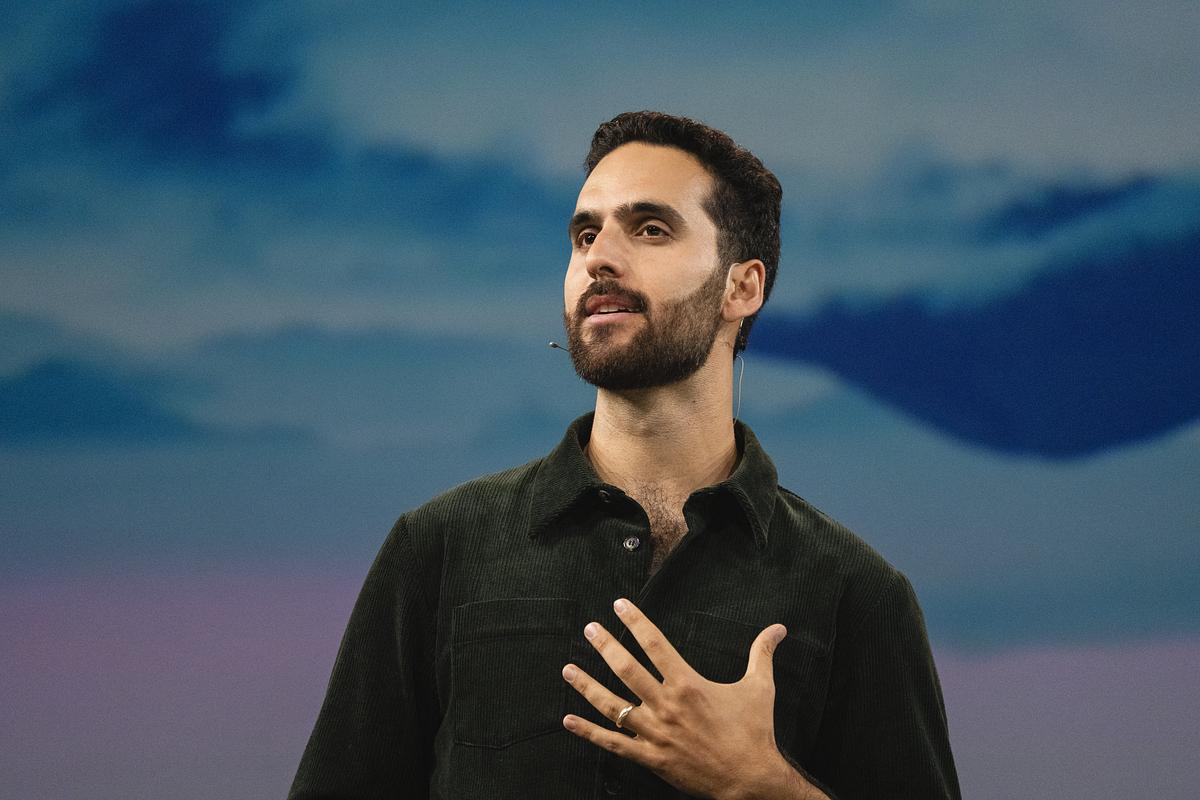
And when it comes to Stolzoff himself, he tries to practice what he preaches.
“I play on an ultimate frisbee team. My wife and I have recently taken up salsa dancing. I’m a parent, I’m a good friend,” he told Good Good Good.“I think that's the point that I really want to leave people with. We contain multitudes, and all of these identities are plants. They need time and attention in order to grow.”
“The more multifaceted we can see ourselves,” he said, “the more resilient we are, the stronger foundation we have — and ultimately — the happier we will be.”
Header photo: Simone Stolzoff speaks at TEDNext. October 22 - 24, 2024. Atlanta, GA. Photo: Gilberto Tadday / TED
Every year, millions (but perhaps billions) of monarch butterflies make their autumnal journey to the oyamel fir forests and hilly terrain of the Monarch Butterfly Biosphere Reserve northwest of Mexico City.
56,259 hectares in size, the reserve is a safe haven for the species, after enduring a formidable migration from Canada and the United States every winter.
However, as rising temperatures, droughts, and disease threaten this sanctuary — by 2090, the reserve’s habitats are expected to deteriorate, and with them, the monarchs — scientists are desperate to find a new home for the orange winged-beauties.

On the slopes of the Nevado de Toluca volcano, about 80 miles away from the current biosphere, scientists are creating that new home — and helping the oyamel fir forests migrate there, too.
The technique is aptly called “assisted migration,” and would ideally situate the forest at a higher elevation to protect the species they house.
“We’re doing something different,” Dr. Cuauhtémoc Sáenz-Romero, a researcher at the Universidad Michoacana de San Nicolás de Hidalgo in Michoacán, told National Geographic.
“If we don't do this, the trees in the monarch reserve are going to die.”

While natural areas like forests do move naturally, changing directions and elevations over time, they do not move as quickly as climate change.
To help, the scientists are collecting seeds from a place with a specific climate — the monarch’s reserve — and moving them to an area that would have a similar climate in the future.
“Desperate times call for desperate measures,” Karen Oberhauser, a conservation biologist at the University of Wisconsin–Madison, told Science News, about these efforts.
“If we don’t help organisms move around, you know, we’re just going to lose a lot of ecosystems.”

Oberhauser is not involved in this particular project, an experiment that began in 2017 when Sáenz-Romero and team began moving seeds from the reserve to a nursery at 9,800 feet of altitude to help them adjust.
In 2021, local Indigenous community members helped plant the seedlings on the northeast slope of the volcano, staggering them at four different altitudes and planting them under protective “nurse plants.”
Six years later — in 2023 — scientists found that at two of those altitudes (11,800 and 12,400 feet, respectively), nearly 70% of those fir seedlings had survived.
They now had proof — to accompany their hope — that assisted migration could be a solution.
Sally Aitken, a professor in Forest and Conservation Sciences at the University of British Columbia, was not part of this assisted migration study but has done her own field tests to move endangered tree species in Canada.
“These types of experiments are tremendously important,” she told National Geographic, but cautioned: “We can’t implement these as solutions unless we know they’re solutions.”

Moving a tree outside of its normal growth range could damage the individual trees, of course, but it could also have unintended ecological consequences for the other species in that ecosystem.
Some skeptics also worry if the butterflies will be able to find their new homes, should the oyamel fir trees thrive in their new environment.
But Sáenz-Romero said the butterflies are already seeking new, colder sites to settle in. On the Nevado de Toluca volcano, the temperature is one degree Celsius colder than the same elevation in the monarch’s existing reserve.
While the future of the monarchs remains to be seen — and Sáenz-Romero emphasizes that their current reserve must remain protected — he hopes this latest research convinces more stakeholders to consider the new potential of assisted migration.
He concluded in his research: “These planted stands could ultimately serve as overwintering sites for the monarch butterfly under warmer climates.”
Header image courtesy of Rafael Saldaña (CC BY 2.0)
As a Deaf man, Adam Munder has long been advocating for communication rights in a world that chiefly caters to hearing people.
The Intel software engineer and his wife — who is also Deaf — are often unable to use American Sign Language in daily interactions, instead defaulting to texting on a smartphone or passing a pen and paper back and forth with service workers, teachers, and lawyers.
It can make simple tasks, like ordering coffee, more complicated than it should be.
But there are life events that hold greater weight than a cup of coffee.
Recently, Munder and his wife took their daughter in for a doctor’s appointment — and no interpreter was available.

To their surprise, their doctor said: “It’s alright, we’ll just have your daughter interpret for you!”
In a TED Talk at TEDNext in Atlanta, Georgia, Munder took the audience back to this pivotal day at the doctor’s office.
“Can you imagine going to a doctor’s appointment, and being told by the doctor that your 7-year-old is going to relay the information to you?” Munder asked the crowd in ASL, as an interpreter translated.
That day at the doctor’s office came at the heels of a thousand frustrating interactions and miscommunications — and Munder is not isolated in his experience.
“Where I live in Arizona, there are more than 1.1 million individuals with a hearing loss,” Munder said, “and only about 400 licensed interpreters.”

In addition to being hard to find, interpreters are expensive. And texting and writing aren’t always practical options — they leave out the emotion, detail, and nuance of a spoken conversation.
ASL is a rich, complex language with its own grammar and culture; a subtle change in speed, direction, facial expression, or gesture can completely change the meaning and tone of a sign.
“Writing back and forth on paper and pen or using a smartphone to text is not equivalent to American Sign Language,” Munder emphasized. “The details and nuance that make us human are lost in both our personal and business conversations.”
His solution? An AI-powered platform called Omnibridge.
“My team has established this bridge between the Deaf world and the hearing world, bringing these worlds together without forcing one to adapt to the other,” Munder said.
Trained on thousands of signs, Omnibridge is engineered to transcribe spoken English and interpret sign language on screen in seconds.
To test an alpha version of his invention, Munder welcomed TED associate Hasiba Haq on stage.

“I want to show you how this could have changed my interaction at the doctor appointment, had this been available,” Munder said.
He went on to explain that the software would generate a bi-directional conversation, in which Munder’s signs would appear as blue text and spoken word would appear in gray.
At first, there was a brief hiccup on the TED stage. Haq, who was standing in as the doctor’s office receptionist, spoke — but the screen remained blank.
“I don’t believe this; this is the first time that AI has ever failed,” Munder joked, getting a big laugh from the crowd. “Thanks for your patience.”
After a quick reboot, they rolled with the punches and tried again.
Haq asked: “Hi, how’s it going?”
Her words popped up in blue.
Munder signed in reply: “I am good.”
His response popped up in gray.

Back and forth, they recreated the scene from the doctor’s office. But this time Munder retained his autonomy, and no one suggested a 7-year-old should play interpreter.
Munder’s TED debut and tech demonstration didn’t happen overnight — the engineer has been working on Omnibridge for over a decade.
“It takes a lot to build something like this,” Munder told Good Good Good in an exclusive interview, communicating with our team in ASL. “It couldn't just be one or two people. It takes a large team, a lot of resources, millions and millions of dollars to work on a project like this.”
After five years of pitching and research, Intel handpicked Munder’s team for a specialty training program. It was through that backing that Omnibridge began to truly take shape.
But Munder’s journey started long before then — he has dreamed of technology like this since he was a child.
Growing up, his grandparents were voracious storytellers with rich histories, and he was eager to hear their stories — but his mother wasn’t always available to bridge the gap between her son and her parents.

“I wanted to be able to talk to them, but I didn't always have that ability to do that,” Munder recalled. “So there's a lot of frustration growing up in not being able to express myself, not being able to be understood, not [being] able to understand what was going around me.”
For Munder, Omnibridge is not just a gift to his younger self, but a future service to the Deaf community at large.
“Our dream is that the technology will be available to everyone, everywhere,” Munder said. “I feel like three to four years from now, we're going to have an app on a phone. Our team has already started working on a cloud-based product, and we're hoping that will be an easy switch from cloud to mobile to an app.”
In order to achieve that dream — of transposing their technology to a smartphone — Munder and his team have to play a bit of a waiting game. Today, their platform necessitates building the technology on a PC, with an AI engine.
“A lot of things don't have those AI PC types of chips,” Munder explained. “But as the technology evolves, we expect that smartphones will start to include AI engines. They'll start to include the capability in processing within smartphones. It will take time for the technology to catch up to it, and it probably won't need the power that we're requiring right now on a PC.”

At its heart, Omnibridge is a testament to the positive capabilities of artificial intelligence.
But it is more than a transcription service — it allows people to have face-to-face conversations with each other. There’s a world of difference between passing around a phone or pen and paper and looking someone in the eyes when you speak to them.
It also allows Deaf people to speak ASL directly, without doing the mental gymnastics of translating their words into English.
“For me, English is my second language,” Munder told Good Good Good. “So when I write in English, I have to think: How am I going to adjust the words? How am I going to write it just right so somebody can understand me? It takes me some time and effort, and it's hard for me to express myself actually in doing that. This technology allows someone to be able to express themselves in their native language.”
Ultimately, Munder said that Omnibridge is about “bringing humanity back” to these conversations.
“We’re changing the world through the power of AI, not just revolutionizing technology, but enhancing that human connection,” Munder said at the end of his TED Talk.
“It’s two languages,” he concluded, “signed and spoken, in one seamless conversation.”
Header image courtesy of Gilberto Tadday / TED
Good Good Good has been covering TED's annual conference and spinoff events — like TED Women, TED Next, and TED Countdown — as press since 2023. Our journalists watch TED Talks live and interview speakers after they get off stage, giving Good Good Good the opportunity to share stories like this before TED Talks are released online.
Every day the Good Good Good team collects the best good news in the world and shares it with our community. Here are the highlights for this week!
If you want to get good news in your inbox every day, join the Goodnewsletter — the free daily newsletter designed to leave you feeling hopeful.
The Best Positive News We’re Celebrating This Week —
After her late husband told her women shouldn’t vote, an 81-year-old Georgia widow just voted for the first time ever
Betty Cartledge turned 82 yesterday, but cause for celebration came a few days earlier in the week, when the then-81-year-old voted in her first election.
Cartledge told a local news crew that she had never voted before, despite having the right to for her whole life, because her late husband “didn’t think she should.”
After he passed away in 2023, she realized that it wasn’t too late to exercise her right to vote. So, arm in arm with her niece, she entered the early voting location in Georgia to see the inside of a voting booth for the first time ever.
Why is this good news? While women in the U.S. have now had the right to vote for more than a century, “heads of households” (and even politicians) who believe women should not vote have suppressed a subset of women from exercising their rights.
Still, women are a force in elections, registering and voting at higher rates than men in every presidential election since 1980.
→ Read more
When he learned 75% of produce was crawling with pesticides, a teen invented a handheld AI chemical scanner for in-store use
→ Read more
New data shows a significant increase in the number of fathers taking parental leave in the Netherlands
In the second year of its new parental leave program, there was a 20% increase in the number of people applying for parental leave in the Netherlands. Around 170,000 applications were received from August 2023 to August 2024 — compared to 140,000 the year prior.
Notably, around 40% of the applications came from fathers — a significant increase from the 33% of applications the previous year. This shows that while parental leave is still more often requested by mothers — that gap is closing.
On average, parents took 8.2 of the 9 weeks of paid parental leave available to them. That time is in addition to the 16 weeks of maternity leave available to new mothers, six weeks of partner leave available within the first six months of birth, and 17 weeks of unpaid parental leave available until their child turns eight.
Studies show immediate and long-term benefits to both children and parents when parental leave policies are in place — and they are taken advantage of.
After a 100-year effort, Egypt has been officially declared malaria-free by the World Health Organization
In an achievement hailed as “truly historic” by the WHO, Egypt has joined 44 countries and one territory to officially be declared malaria-free.
Authorities in Egypt launched their first efforts to eradicate malaria around 100 years ago. And while this certification is an incredible achievement, the country will continue its work to maintain that status.
A country is certified as malaria-free when its transmission chain is interrupted for at least three consecutive years.
Why is this good news? Malaria still kills at least 600,000 people every year — nearly all of them in Africa, and it’s been a consistent presence in Egypt since ancient times.
Thanks to global progress in treating and preventing the deadly disease, more and more countries are achieving malaria-free status — equating to thousands of lives saved every year.
A North Carolina state senate candidate is running a race she’s guaranteed to lose to raise awareness about gerrymandering
Kate Barr, who is running for state senate in North Carolina’s 37th District, says she was “gerrymandered out of a chance” — so she’s running her campaign on the promise that she won’t win.
Gerrymandering is the practice of dividing or arranging a territorial unit into election districts in a way that gives one political party an unfair advantage in elections — and North Carolina is one of the most gerrymandered states in the country.
In 2022, the state’s Supreme Court even ruled that the state constitution allows partisan gerrymandering.
While Barr is a Democrat, and gerrymandering itself is inherently partisan, her campaign isn’t intended to sway people any one way, but rather to shed light on the democratic process and the need to protect free and fair elections.
New York just hit its distributed solar energy production goal — one year ahead of schedule
One year ahead of its goal, New York just reached 6 gigawatts of distributed solar installed across the state — enough to power over one million homes.
Initially slated for 2025, the milestone was laid out in the state’s Climate Leadership and Community Protection Act, which aims to generate 70% of the state’s electricity from renewables by 2030 and 100% by 2040.
The state now sets its course toward reaching its next goal: 10 GW by 2030. And with another 3.4 GW of solar projects already underway, it’s confident it can achieve that goal too.
Why is this good news? The science is clear: while it’s not too late to solve the climate crisis, we have very little time to massively reduce our dependence on fossil fuels. Rapid, exponential growth in the renewable energy sector is helping — and New York proves we can meet and exceed the goals we’ve set to limit warming.
→ Read more
Portugal is now home to the largest Marine Protected Area network in Europe
In an effort to help achieve the goal of protecting 30% of the world’s land and oceans by 2030, Portugal just became home to the largest Marine Protected Area network in Europe — located in the Azores archipelago.
Home to deep-sea corals, whales, dolphins, sharks, and more, the Azores’ critical underwater ecosystems will now be protected from damaging activities like fishing.
The addition of the MPAs means 15% of the archipelago’s waters are fully protected, and 15% are highly protected — 287,000 square kilometers in total.
Why is this good news? The historic “30 by 30” agreement is critical for protecting marine ecosystems and local economies — but currently, just 8% of the ocean is protected in some way. MPAs have also been proven to be good for underwater habitats, help with carbon sequestration, boost fish stocks, preserve tourist attractions, and more. This is a major step in the right direction.
Adding two words to the phrase ‘What do you do?’ can humanize the way we approach work — rather than reinforce hustle culture
→ Read more
New data shows global electricity generation from solar will quadruple by 2030 — and push coal power into decline
New data from the International Energy Agency shows solar will overtake nuclear, wind, hydro, gas, and coal to be the world’s largest source of electricity by 2033.
This, along with the rapid expansion of clean, efficient electricity will push fossil fuels into decline, with the data indicating that energy-related CO2 emissions will peak in 2025.
Notably, it also found that electric vehicles are now expected to displace 6 million barrels of oil per day — up from 4 billion barrels as projected in last year’s data.
→ Read more
South Carolina is building its first-ever monument to an African American
During the Civil War, Robert Smalls famously donned Confederate clothes in order to steal a slaveholder’s ship and sail his family and a dozen others to freedom.
But South Carolina is honoring him with the state’s first-ever monument to an African American for another reason — Smalls helped rewrite the state’s constitution to give Black men equality post-Civil War.
The idea to honor Smalls with a monument has been in the works for years, until this year, when a proposal was unanimously passed in both the state House and Senate.
Why is this good news? As one representative acknowledged, the state has “a lot of good and bad history” but Smalls’ story represents “good history.” Memorializing the stories of people who helped fight for justice, equality, and human rights is what we ought to be dedicating our monuments to.
Monarch butterflies could be wiped out by 2090 — a group of scientists are moving a forest to save them
Rising temperatures, droughts, and disease are threatening a 56,259-hectare safe haven for millions (maybe billions) of monarch butterflies.
By 2090, the Monarch Butterfly Biosphere Reserve’s — located northwest of Mexico City — habitats are expected to deteriorate, and with them, the monarchs. So scientists have been working for years to create a new home for them.
On the slopes of the dormant Nevado de Toluca volcano, about 80 miles away from the current biosphere, scientists are making that new home — and helping the oyamel fir forests the monarchs love migrate there, too.
They’re using a technique called “assisted migration” to situate the forest at a higher elevation to protect the species they house — and have new proof that it’s working.
→ Read more
More good news of the week —
Scientists invented a new “bioplastic” that degrades in water faster than paper to replace Styrofoam and single-use plastics. Following years of testing, the plastic-like polymer derived from wood pulp has been found to be the fastest-degrading bioplastic material tested in seawater.
Medical schools in Europe launched a network to train future doctors on the risks of climate change. The group of 25 schools in 12 countries aims to prepare 10,000 students in the next three years to recognize and manage climate-related health problems like those linked to extreme heat and air pollution.
Researchers created a device that can detect a heart attack in minutes, not hours. The quicker a heart attack is diagnosed, the quicker blood flow is returned to the heart, and the less damage is done, which improves patient outcomes.
Experts found that simple attachments to HVAC systems could divert 300 metric tons of CO2 emissions. The wind energy coming off of the systems’ outdoor fans has been wasted potential — but now scientists have figured out a way to harness it.
A zoo in Poland is celebrating the birth of four critically endangered Sumatran tigers. The tigers’ numbers have dwindled to around 400 in the wild, and the zoo waited to announce the cubs’ arrival until they were sure they would survive.
Medicaid will now cover traditional healing practices for Native Americans in four states. The Centers for Medicare & Medicaid Services announced the two-year pilot program that applies at Indian Health Service facilities, tribal facilities, and urban Indian organizations.
Voters in Brazil elected a record number of Indigenous people in its latest municipal elections. Earlier this month, 256 Indigenous people were elected mayors, vice mayors, and city councilors, the most in the country’s history and an 8% increase over 2020.
A breakthrough treatment for Type 2 diabetes eliminated the need for insulin in 86% of patients. The treatment, which combines combining ReCET and semaglutide, was safe and well-tolerated and will be tested in further trials to confirm the results.
Innovative conservation efforts are protecting mountain gorillas in Rwanda while uplifting local communities. By the 1980s, mountain gorillas in Rwanda were on the brink of extinction due to poaching and habitat loss — today, there are more than 600 mountain gorillas in the country thanks to the conservation efforts.
In a carbon capture breakthrough, Berkeley researchers used a turmeric-like powder to “clean the air entirely” of CO2. The IPCC has determined that carbon capture is vital to limit global warming, and while we’re making progress, current technologies are limited.
A group of former prisoners are making sure those leaving prisons have the support they need to reenter the community. Most reentry programs aren’t informed by previously incarcerated people’s perspectives and experiences, so they often miss the mark.
A U.S. federal court blocked the construction of a proposed 32-mile natural gas pipeline through Middle Tennessee. Two of the three-member judge panel ruled there was a risk of “irreparable harm” if the construction began, and a lawsuit filed challenging the environmental impacts of the project will continue.
Renewable energy capacity in India just hit a major milestone — accounting for 46% of the country’s total power. After years of effort to build solar parks, wind farms, and hydroelectric projects, the country’s total renewable energy capacity now exceeds 200 gigawatts.
Engineers just unveiled a new AI model that could help predict and control the spread of future pandemics. While disease outbreaks are inevitable, new techniques, tools, and resources like this can help prevent large pandemics like COVID-19 in the future.
Canada’s parliament passed a bill that would cover the cost of contraception and diabetes drugs. With an estimated one in five Canadians struggling to pay for subscriptions, the new bill would help people “make choices about contraception based on what’s best for their lives, not their wallets.”
Many of us have likely lost track of the amount of times we’ve rinsed out a glass bottle or plastic jug and thought “wait, can I recycle this?”
In the United States, recycling laws are different in every state, and regulations and sorting can even differ among companies and contractors in a given city. This can make it exceedingly difficult to know exactly what and how to recycle.
Most companies have sorters — both human and automated — that can help reduce recycling contamination in waste facilities, but the frustrating fact of the matter is that many of the items we toss in the recycling bin don’t actually get recycled, becoming yet another addition to our landfills.
Labor shortages in recycling and waste management are also a hurdle to smooth operations in the industry, making the act of recycling a lot more messy than it should be.

In Chicago, one new facility is hoping that artificial intelligence can help combat these issues.
The Back of the Yards facility run by LRS opened in 2023 and processes about 28 tons of material per hour at standard operation, and has the capacity to process 35 tons an hour.
Upon opening this facility, LRS “invested on the front end to reduce labor,” building an automation-forward materials recovery facility, or MRF. At the time of its opening, LRS had eleven employees working per shift and was considering the use of “robots” in the future, according to Waste Dive.
Well, the future is here.
The facility has “hired” a new AI robot to recover aluminum cans and plastic water bottle from streams of waste, diverting them from landfills.

These robots use an “optical scanner” trained to spot aluminum within 10-15 milliseconds, sending a robotic arm to grab it from the stream of trash.
Since first being employed last year, the aluminum-hungry robot has already snagged more than a million cans from the “last chance” line, according to Axios Chicago.
And the “last chance” line is where that robot predominantly works, as the last line of defense to catch any human error in previous sorting.
“We’re glad this robot isn’t running ‘gang-busters’ speed because that means we did our jobs,” LRS sustainability manager Joy Rifkin said in a video. “Plastic bottles and aluminum cans are being sorted properly, and this is just recovering anything that didn’t go through the system correctly.”
Though, the robot — which is actually named RecycleOS, a creation by EverestLabs — could move even faster.
According to EverestLabs’ website, the system is designed to outperform manual sorting of recyclables by two to three times.
And with the U.S. under-performing in recycling aluminum cans (which are “infinitely recyclable,” according to the Can Manufacturers Institute, although the U.S. recycles just 45% of them), this simple AI application could have a major impact.
Once cans are rescued, creating new materials from recycled aluminum takes just 5% of the energy needed to make one “from scratch,” Axios reported.
And in a report sponsored by the Ball Corp, recycling one ton of aluminum cans offers three times more emissions benefits than recycling a ton of cardboard.
Aside from the huge environmental benefits, by maximizing the amount of aluminum sorted, LRS can devote its human workforce to other important matters: Educating the people of Chicago.
Major education programs are also still at the heart of improving recycling, aiming to teach people that they still have a role to play in getting waste where it needs to be.

“We work really hard to educate our communities on the fact that aluminum is infinitely recyclable, and in under 90 days that beverage can can be back on your shelf with a new beverage inside it,” Rifkin said in a statement.
Part of this includes inviting community members to the facility itself to see innovations and processes first-hand and get a better idea of the complex operations of modern recycling.
Since 2023, the facility has welcomed over 800 visitors from academia, industry, government, and community groups.
“So many people don’t realize in addition to machines and equipment that are maintained to ensure we can sort at a high level, there are actual human beings who have to deal with these materials,” Rifkin added.
Well, humans and robots.
For those who would rather stay home, LRS has also designed an online tool that provides transparency in Chicago’s recycling processes. It allows users to zoom in on specific neighborhoods, homes, or schools, to see how recycling works — from collection, to sorting, and finally, circulation.
With a number of advancements, LRS is eager to use every tool at its disposal to improve Chicago’s recycling.
Rifkin said: “This is a super cool education tool and interactive map that really showcases our commitment to the city.”
Header image courtesy of Everest Labs
This year, the world marked the 79th anniversary of the nuclear bombings on Hiroshima and Nagasaki.
To honor the tragic events and shed light on the threat of the nuclear arms race, artists and cultural icons such as Yoko Ono, Paris Jackson, Alok Vaid-Menon, and more, took part in a global arts demonstration: #CranesForOurFuture.
Incorporating origami cranes in fashion designs, social media posts, and even wheat-pasted posters in busy city streets, activists called for a future without nuclear weapons.

The project is part of a larger initiative by the Hiroshima and Nagasaki Prefectures, The Nuclear Threat Initiative, and The Hiroshima Organization for Global Peace.
It’s all inspired by the story of Sadako Sasaki, a girl who survived the bombing of Hiroshima when she was just 2 years old.
Sasaki unfortunately died due to the long-term effects of radiation poisoning a decade later, but during her short time on earth, she found solace in the centuries-old Japanese tradition of folding paper cranes, wishing on each folded wing that she might live.
Before her death, Sasaki and her friends folded 1,300 paper cranes, which became a universal symbol for peace, hope, and resilience. They also become the small but mighty symbol for nuclear disarmament.

Although NTI has been doing this work for decades, Cranes For Our Future is a newer iteration, developed in 2021.
Utilizing social media and public art, these efforts have been supported by major cultural figures, global security leaders, and current and former U.S. representatives alike.
This year’s fashion design element included a dress by Olivia Cheng, the creator of label Dauphinette. The dress contained 300 itty-bitty paper cranes quilted within panels of recycled vinyl.
“It represents a type of beauty that none of us have lived within our lifetimes,” Cheng said in an interview with NTI.

“We’ve created a world where life could be so vastly affected by a tangible object like nuclear weapons. We’ve already gotten rid of so many nuclear weapons, and yet, the risk has not diminished significantly.”
It’s true; today, 13,000 nuclear weapons are owned by just nine countries, with some being 80 times more powerful than the ones originally created and deployed by the U.S. in 1945.
With ongoing global conflict and the complexities of modern technology, advocates say humanity is one mistake away from a disaster that could change everything.
“It doesn’t need to be this way,” former U.S. Secretary of Energy Ernest J. Moniz said in a statement. Moniz is now the co-chair and CEO of NTI.
“A single girl inspired a global movement with her story and the symbol of the paper crane. And when the last nuclear arms race was spinning out of control, people joined forces to call for a safer world, leading to the elimination of 80% of global nuclear arsenals,” Moniz continued.
“We can finish the job.”
A version of this article was originally published in The 2024 Art Edition of the Goodnewspaper. Get your own Goodnewspaper by becoming a good news subscriber today.
Header image courtesy of Yuu Khoang/Unsplash
For people who might be on the fence about adopting a new family member, the perfect photo can be a eureka moment that communicates, “that is my dog.”
And with shelters across the country overcrowded with adoptable pets — from guinea pigs to German shepherds — creating more opportunities for people to stumble upon their new family members is of utmost importance.
Pet retailer Chewy teamed up with animal shelters in South Florida, Boston, and Seattle, to showcase some of their adoptable pets — not just with perfect lighting or puppy-dog eyes, but with some adorable Halloween costumes.
“Chewy has donated all sorts of items to shelters, from holiday toys [and] Halloween costumes, to essential items they need such as food, medications, and treats,” Diane Pelkey, Chewy’s vice president of communications and public relations, told Good Good Good.
“These moments help brighten the mood of both shelter staff and the animals, and bring the festive spirit during a special time of year. Adoptable pets often attend Halloween and holiday events, so having costumes available to wear allows their personalities to shine and prospective adopters to see a different side to them.”

At Saving Sage Animal Rescue in South Florida, one of the biggest show-stoppers was Miley, a 5-year-old female Pitbull who has been at the shelter for two years.
Dressed as a dog-sized disco ball, she shined for the camera, and was marketed as a “ball of energy” who “would love to find a dancing partner for her disco ball.”
Saving Sage also showed off Cashmere, a 5-year-old adoptee who donned a set of hair rollers fresh out of the salon.

Goldie, the cat (turned bear) made the perfect cuddle companion, while Xena was on cloud nine in her rainbow costume.
Pelkey said these adorable moments can attract more adopters when exciting holidays approach.

“The holiday season, which kicks off with Halloween, is one of the most popular times to adopt pets,” Pelkey said. “We want to encourage future pet parents to bring home these animals to make holidays happier and more fulfilling for both of them.”

Furry friends at the American Rescue League of Boston also turned heads, with some adorable kittens who couldn’t quite fit in their lion’s mane.
Their critters also dressed up, with Drew the guinea pig donning a bumblebee look, and Mumu the guinea stunning as a bright red fire engine, though the rescue was sure to clarify that he “unfortunately can’t help extinguish fires.”

“We can think of pets’ photos online kind of like their social media profile, featuring their best photo. When potential adopters are searching for a pet online, sometimes they are looking for a specific breed, age, or size in a future pet, but often they are looking at photos and which one they have an instant connection with,” Pelkey added.
“The best way to present these animals and attract adopters is by showing off a pet’s unique attributes and personalities.”

This was especially true for Paco, a senior Chihuahua whose granny costume is perhaps the most accurate in the bunch.
“Shelters and rescues are also often operating with a lean team with hundreds of animals under their care,” Pelkey said, “so they have expressed how grateful they are for professional photos.”

The Seattle Humane Society was certainly grateful for this opportunity, highlighting dogs Iggy (who brought home the bacon in a fluffy pig costume), and Minnie Mouse (a three-legged female whose witch costume was the total opposite of her sweet personality).
“We are haunted by how amazing all of the photos turned out during a recent Spooky Season collaboration… starring some of our amazing shelter dogs,” Seattle Humane wrote in an Instagram post.
“We hope to see them treated to their new families well before Halloween! Thank you to Chewy for letting them shine, and for all of these cute costumes we’ll definitely be using again.”

According to Pelkey, the majority of these animals are still available and searching for their forever home. Anyone interested in adopting them can reach out directly to the shelters involved in the campaign.
For adoptable animals outside of these areas, Chewy also has an Adoptable Pets service that connects thousands of dogs and cats with their future pet parents, based on location, personality traits, breed, and more.

“With so many amazing pets available for adoption [shelter teams] are always looking for creative ways to show off their animals,” Pelkey said, “and make sure as many potential adopters see them as possible.”
Header images courtesy of Chewy
Perhaps best known for her role as Haley Dunphy in the hit sitcom “Modern Family,” Sarah Hyland has also taken on a much more vulnerable role in recent years: Domestic violence survivor and advocate.
She was honored for her activism last week when Variety granted her its Power of Women Courage Award. The honor was presented by Purina — and for good reason.
In an acceptance speech, Hyland spoke about her own story, but also advocated for countless survivors who are supported by their pets — pets they may have to leave behind to seek refuge in a shelter or safe home.

“October is Domestic Violence Awareness Month and, while it is not the easiest topic to talk about, it is of the utmost importance that we do,” Hyland began her acceptance speech, fighting back tears.
“There was a time when the only being I could trust with my true feelings and felt the safest with was with my dog, Barkley,” she continued. “He got me through the worst years of my life and I know I wouldn’t be able to make it out without him.”
According to RedRover, a nonprofit that provides support for people in their pets amid crisis, nearly half of all domestic violence victims stay in abusive situations rather than leave their pet behind.
Purina’s Purple Leash Project works in partnership with RedRover to help increase the number of pet-friendly domestic violence shelters nationwide and spread awareness about this issue.

Their goal is to make 25% of all domestic violence shelters pet-friendly by 2025, and ultimately, “change the landscape of domestic violence services for survivors with pets.”
In her speech, Hyland said she was “so grateful” for these efforts, adding that pet-friendly shelters make it so that “domestic abuse survivors don’t have to make an impossible choice between their safety and the safety of their pets.”
Not only do shelter limitations make it difficult for survivors to access safety; pets are also often used as leverage in abusive situations.

According to the National Coalition Against Domestic Violence, 71% of women in domestic violence shelters reported that their abuser threatened, injured, or killed a pet as a means of control.
Gaining back a level of control over one’s situation can be fundamental in finding freedom from violence.
“I know the bond between a survivor and their pet is crucial, especially during the darkest days,” Hyland said.

Since 2019, Purina and RedRover have provided more than 55 Purple Leash Project grants to help domestic violence shelters across the country become pet-friendly.
Two of those recent recipients include Women’s Advocates in St. Paul, Minnesota, and LiveSafe Resources in Marietta, Georgia.
These funds will help create spaces for pets to stay with their owners in their own apartments, so that “they may heal together,” Women’s Advocates development coordinator Tiana Daun, said in a statement.
“This support will help us finalize the building of our pet sanctuary to become the first domestic violence shelter in Northwest Georgia to provide this life-saving program to survivors and their animal family members,” LiveSafe Resources CEO Lisa Mello, added.
@varietymagazine Sarah Hyland delivers an emotional speech while accepting the inaugural Variety Courage Award presented by Purina
♬ original sound - Variety
As a devoted dog mom — who is now happily married (and often shares snaps on Instagram with her husband and pups) — Hyland made it clear: She wouldn’t be here without the support of both the human and animal companions that saw her through the worst of her abuse.
And those who love and support her know it, too.
“Sarah’s personal experience has made her a strong advocate for the role dogs play in our emotional well-being, and her love for her dogs over the years – Barkley, Carl and Boo – mirrors what so many of us feel—especially women who've been abused,” Julie Bowen, Hyland’s “TV mom,” said in her remarks at the event.
“Sarah’s courage to stand up for herself has inspired countless others to do the same.”
Header image courtesy of Purina
From Wabasha, Minnesota to Rock Island, Illinois, the Upper Mississippi River National Wildlife and Fish Refuge stretches across 261 river miles and protects more than 240,000 acres of Mississippi River floodplain.
This year, the refuge celebrates 100 years. But its origins were hard fought.
In 1922, the United States Department of Agriculture set the plans in motion for a major project: to drain wetlands along 300 miles of the Upper Mississippi River.
Fortunately, a local conservation group — the Izaak Walton League of America — led a grassroots effort to stop the drainage and safeguard the land as a wildlife refuge.
“It was a huge success to protect a really large area, and if we didn't have that protection on this place, it would look a lot different now,” Kendra Pednault, manager of the refuge’s McGregor District, told Iowa Public Radio.
Scott Kovarovics — who serves as the executive director of the IWLA today — gave props to the league’s first president, Will Dilg, for spearheading the campaign.
Even back then, Kovarovics said, Dilg and his colleagues “knew the value of the marshes and the wetlands and the backwaters” and “the incredible habitat they provided.”
Despite being a regional issue, the league tapped into its national reader base — through the magazine Outdoor America — to shine a light on their campaign to save the river habitat.
“It was a phenomenon — the first conservation group with a mass membership. Although concentrated in the Midwest, practically every state was represented,” historian Stephen Fox wrote in a Winter 2001 issue of Outdoor America, an article that was recently republished for the centennial event.
The league also recruited women from the General Federation of Women’s Clubs to join them in a country-wide letter-writing campaign to Congress.
In a 1923 issue of Outdoor America, league member Cora C. Whitely pledged her support to Dilg’s campaign in a letter to the editor.
Winter wrote: “Ever since I heard of the proposal to drain the Winneshiek Bottoms — and especially since I realized that the plan is opposed by scientific experts, government officials as well as by nature-lovers and sportsmen — I have wanted to help, in some way, to put a stop to a project so fraught with evil consequences.”
Alongside the published letter, the magazine staff wrote: “The slogan of [the GFWC] is ‘the promotion of all movements looking towards the betterment of life.’ What surer betterment of life can there be than that exemplified in the preserving for all time of our priceless American outdoor heritage?”

On June 7, 1924 — after two years of grassroots campaigning — Congress passed the “Upper Mississippi River Wild Life and Fish Refuge Act.”
Today, the refuge is home to 518 distinct species: including 306 types of birds, 119 fish, 51 mammals, and 42 freshwater mussels.
According to the Wisconsin Department of Natural Resources, the refuge is a migration corridor for millions of birds each year, including 60% of all North American birds, and 40% of all North American waterfowl.
As IWLA conservationists, U.S. Fish & Wildlife Service members, and refuge employees and volunteers look ahead to the next 100 years, they are constantly looking for ways to strengthen and preserve the habitat’s rich biodiversity.
“You can get lost in the maze of islands, and there's so many places to explore,” said Billy Reiter-Marolf, a U.S. Fish and Wildlife Service biologist.
“I just really hope that it just doesn't get simplified and become all water with a few reed canary grass islands, because it's just such a treasure, and there's so much to learn out there.”
Header image via Brandon Jones/USFWS
While climate disasters and record-high temperatures have brought climate change to the everyday experience of most humans, for a long time, “global warming,” has invoked mental images of shrinking ice caps and desperate polar bears.
And the Arctic is indeed warming rapidly — at three to four times the global average.
With that in mind, new research out of the University of California, Riverside suggests the slowing of a key ocean current could help reduce projected warming by up to 2 degrees Celsius.
The study looked into the effects of slowing the Atlantic Meridional Overturning Circulation, or AMOC. This current transports heat from the tropics to higher latitudes, and slowing it down could provide some relief to the Arctic.

“The AMOC is a critical component of our climate system because it moves heat around the globe,” said Yu-Chi Lee, UCR graduate student and first author of the study. “We found that its weakening reduces the amount of heat reaching the Arctic, which slows down the rate of warming.”
Temperatures in the Arctic are predicted to rise by a devastating 10 degrees Celsius by the end of the century, but the new study shows that slowing the AMOC current could mean that temperatures will only rise by 8 degrees Celsius.
What’s the nuance?
Of course, a rise in temperature by 8 degrees is still incredibly severe. Slowing ocean currents alone will not save us.
As sea ice melts, animals (like polar bears) face habitat loss. Additionally, as sea ice disappears, water absorbs more sunlight and causes even more warming.
As Wei Liu, UC Riverside associate professor of climate change and co-author of this research puts it: “The AMOC slowdown may offer some temporary relief in the Arctic, but this is not a simple good-news story.”

Additionally, the AMOC slowdown may reduce warming, but it may also cause other disruptions to the climate system, including a potential shift in the Intertropical Convergence Zone, a tropical rain belt.
If this zone moves more southward due to the slowdown, more areas could experience droughts, which would also impact agriculture and water supply — especially in Africa.
“The overall impact on ecosystems and weather patterns, both in the Arctic and globally, could still be severe,” Lui said.
The research team used a coupled climate model, which factors in interactions between the ocean, atmosphere, land, and sea ice, to run simulations on future Arctic warming.
Their two simulations included one that allowed the AMOC to slow “under the influence of rising greenhouse gasses,” and another that artificially maintained the current’s strengths.
The simulations pointed to how significantly Arctic warming is tied to the AMOC slowdown, though it also positions scientists to better understand the big picture.

“While the AMOC slowdown might provide some short-term benefits, its broader impacts show us that even small shifts in ocean circulation can cause ripple effects across the planet,” Lee said.
While a slowing AMOC current could reduce some of the most devastating impacts of a warming planet, it is also an indication that more work must be done to reverse (or capture) emissions.
The scientists hope that their latest research provides a new benchmark to help curb the impacts of climate change before it’s too late.
“Climate change is far from a one-region issue,” Lee added. “The future of the Arctic — and the world — depends on how we respond today.”
Header image courtesy of AWeith (CC BY-SA 4.0)
Allyson Felix making it easier for women to vote like a mother.
Olympic champion Allyson Felix and the national nonprofit organization Chamber of Mothers are joining forces to tackle one of the biggest hurdles that prevent mothers—particularly Black moms in under-resourced communities—from voting: access to childcare.
This partnership will be brought to life in three markets, North Carolina, New York and Los Angeles with partners POLITISIT, Brella, Vivvi, Bumo and Smart Sitting.
In North Carolina, Felix and COM are working with nonprofit Politisit to reimburse up to two hours of child care for parents who are early voting or heading to the polls on election day.

“Parents can hire their trusted local babysitter and know that they’ll be covered for up to two hours of childcare while they head to the polls to cast their ballot,” COM shared on its website.
In Western North Carolina, Politisit will reimburse a full day of care, following the devastation of Hurricane Helene in the region.
How do parents access this? All they have to do is fill out a Google Form with information on the kind of care they will need and how much it will cost.
“Why North Carolina?” COM continued. “Black mothers there continue to be severely under-resourced, North Carolina is a child care desert, their vote here truly matters, and so many have been further challenged by the recent horrific storm.”
In Felix’s hometown of Los Angeles, moms can access childcare vouchers for early voting and Election Day voting, as well.
Through a partnership with the initiative, child care provider Brella will offer a full day of free child care for kids ages 3 months to 6 years old.
The company also notes that it will offer the same support in its core service areas, which include New York, Jersey City, Hoboken, Philadelphia, and Chicago. Those interested can similarly fill out a form on Brella’s website.
“You should never have to choose between your profession, your passions, and motherhood,” Felix said in a statement. “I’m honored to… tell moms that this election, you don’t have to choose between voting and motherhood. This election, you can do both.”
Lastly, in New York City and Westchester, families will be able to access Election Day child care in select Vivvi locations in the state. The child care and early learning provider will offer up to a full day of child care.
“This means you have time to research and fill out your sample ballot, head to the polls, wait in line, and cast your official vote without having to stress one bit over child care,” COM said.
Interested parties can fill out a form to find care through Vivvi.
While these service areas reach a large number of voters in major cities across the country, lack of access to child care remains a potent issue of the moment — a concern many parents may bring with them as they cast their ballots.
COM and Felix are also sharing a library of resources to make voting easier for mothers, including guides on how to take time off from work, get transportation to the polls, find rules about bringing children to the polls, and more.
A nonpartisan “Vote Like A Mother” educational platform also provides insights on candidates’ stances on child care, paid family leave, and maternal health. Folks can build a sample ballot to come prepared to the polls, as well.
In an Instagram comment about the initiative, Felix summed up her feelings in a short statement.
“Nothing should stop us,” she wrote. “Let’s do this.”
Header images courtesy of Allyson Felix/Instagram and Kārlis Dambrāns (CC BY 2.0)
With just a few days left until Halloween, the National Park Service is helping wildlife fans get ahead of the ‘carve.’
NPS released a new slew of pumpkin carving templates for Jack-O-Lantern festivities, with designs that are full of delight — and maybe even fright.
It’s all part of its annual pumpkin carving challenge, in which participants are encouraged to use the templates (or come up with their own designs!) to create national park-themed pumpkins and share them on social media.

To make things easier, NPS shared seven templates, featuring wolves, fall foliage, spiders, bats, beloved “fat bears,” and even a bison tossing a tourist, per some wildlife safety stories that made headlines among national parks this year.
While most templates are adorably festive, the aforementioned tourist-tossing design, titled “Close Encounter” is ideally spooky enough to knock some sense into future visitors.
The design depicts a tourist being tossed in the air by a frighted bison, inspired by a number of viral videos depicting irresponsible visitors getting too close for comfort.
Along with the design, NPS shared a link to wildlife safety tips, encouraging visitors to have “unscary” wildlife encounters on park sites.
Mostly, though, the NPS is just excited for another fun fall season.
“Orange you excited for autumn? Get ahead of the carve by creating a gourd-geous park pumpkin this fall season and give ‘em pumpkin to talk about,” NPS writes in a blog post.
The agency encourages folks to post photos on social media using the hashtags #FindYourPark or #EncuentraTuParque to join a digital pumpkin patch. And don’t forget to dispose of your pumpkin properly at the end of the season!
All of the designs can be found below and are available to download and print for free at home (or at your local library!).
The Close Encounter
“Few things are more terrifying than people getting too close to wildlife,” NPS writes. “National parks are packed with creatures of all shapes and tooth sizes.”

The Batty One
Did you know that national parks are roosting grounds or migratory stops for millions of bats? The NPS encourages folks to learn how to protect bats in their neighborhoods.

The Autumn Leaves
Leaf-peeping is a seasonal activity that brings thousands to state and national parks. Just be sure to leave no trace and clean up after yourself!

The Camper
Bundle up and camp responsibly this season! Always be sure to know more about fire restrictions to ensure the safety of you and the ecosystems around you.

The Full Moon
Tap into your inner werewolf with this design and pay homage to the stunning night skies in national parks or in your own neighborhood — visible without light pollution.

The Web Designer
No fears about creepy-crawlers here! Let this spider-centric template empower you to get connected to conservation inside and out of the country’s national parks.

The Fat Bear
These guys might be friend-shaped, but you’ll still want to be bear-y careful around them — especially as they gear up for hibernation! Once again, we urge you to practice wildlife safety.

Header images courtesy of NPS