Jenna Fischer, who stars as the beloved Pam in “The Office,” has taken to Instagram to share a very personal update for Breast Cancer Awareness Month.
“I never thought I’d be making an announcement like this but here we are,” she writes. “Last December, I was diagnosed with Stage 1 Triple Positive Breast Cancer. After completing surgery, chemotherapy and radiation I am now cancer free.”
The actress and mom goes on to detail her experience getting diagnosed and receiving treatment, as well as all of the support she found along the way.
Her journey actually started nearly a year ago, when she posted a photo on Instagram preparing for her routine mammogram, quoting her TV boss Michael Scott and jokingly reminding her audience to “take care of your ticking time bags.”
But inconclusive results made her appointment a lot less comedic. After some more tests, she received the news.
“Triple positive breast cancer is an aggressive form of breast cancer, but it is also highly responsive to treatment,” Fischer explained. “Luckily, my cancer was caught early and it hadn’t spread into my lymph nodes or throughout the rest of my body.”
Along with a lumpectomy, she underwent both chemotherapy and radiation, and in her post, said she is finally going public, since she is “ready to ditch the wigs,” after losing her hair.
Now officially cancer-free, her energy is spent sharing a message to her many female followers: Schedule the mammogram.
“You can also ask your doctor to calculate your Breast Cancer Risk Assessment Score and get any additional screenings required,” she said. “I’m serious, call your doctor right now.”
She added that her tumor was so small that it would not have been felt in a physical exam.
“If I had waited six months longer, things could have been much worse,” Fischer added. “It could have spread.”
She also said that seeing other women share about their mammograms on social media was initially what reminded her to make her annual appointment.
“Consider this your kick in the butt to get it done,” she wrote.
According to the National Breast Cancer Foundation, this year, an estimated 310,720 women and 2,800 men will be diagnosed with invasive breast cancer. But, when caught in its earliest, localized stages, the five-year relative survival rate is 99%.
Fischer has lived out these statistics, and because of innovations in medicine, and the unwavering support of her loved ones, she is now on the other side.
After a heartfelt note of thanks to her family and friends, Fischer made one final plea on Instagram.
“Take it from Pam and her Pam Pams,” she said, once again quoting Michael Scott.
“Get ‘em checked, ladies. And know that should you get a breast cancer diagnosis, there is a village waiting to care for you.”
Header image courtesy of Jenna Fischer/Instagram
Looking for an excuse to adopt a dog? Drew Barrymore and Dave Bautista have you covered.
This month — Adopt a Shelter Dog Month — the two acclaimed actors are leaning into their roles as dog parents to help the American Society for the Prevention of Cruelty to Animals get adoptable pups into loving homes.
Throughout the month, both Barrymore and Bautista will post ASPCA adoptable dogs on their social media channels, calling their audiences to adopt or foster in honor of the awareness month.

Barrymore posted her first installation of the campaign on Instagram this morning.
“Douglas and I are thrilled to partner with the ASPCA to raise awareness about dog adoption and fostering,” she wrote, accompanying a photo of her and her pooch.
“Shelters across the country are full,” she continued. “The work they do on the front lines every day is critical in caring for thousands of animals in need of loving homes.”
It’s true; animal shelters across the country are overflowing.
According to a press release from ASPCA, last year, 3.2 million dogs entered animal shelters in the United States, and only 2.2 million of them were adopted.
When this happens, shelter teams are overworked and left with minimal resources to care for an increasing proportion of animals with higher medical and behavioral needs who stay longer in the shelter.
Along with these pets remaining in cages instead of in loving homes, overcrowding also makes it nearly impossible to rescue more animals in need, with nowhere to house and care for them.
Sharing their stories — and adorable photos — on social media helps everyday dog lovers find their new family members. And with the reach of Barrymore and Bautista, who have a combined total of 23.5 million followers on Instagram, these furry friends are sure to find their permanent safe havens.
“We are thankful for the support of Drew Barrymore and Dave Bautista, who have proven to be compassionate ambassadors for dogs in shelters,” said Matt Bershadker, CEO of ASPCA.
“This Adopt a Shelter Dog Month, we hope Drew and Dave’s efforts will inspire the public to adopt or foster a pet, making an impact that ripples throughout shelters nationwide while creating space for more dogs in need.”
The actors will also highlight The Rescue Effect, a campaign that showcases the impact that adopting or fostering a pet can have on these crowded shelters.
“When you adopt or foster, you create a ripple effect that helps save even more animals nationwide,” Barrymore wrote on Instagram.

She has also begun highlighting adoptable dogs on her Stories, including Loofah and Dibo, both available for adoption at the ASPCA Adoption Center in New York City.
Barrymore has been a lifelong supporter of animal welfare causes and has adopted her dog, Douglas, four cats, a bearded dragon, and a snake.
Her menagerie of adopted pets, plus her public efforts, led to her winning the ASPCA Compassion Award in 2016, which is given to individuals in arts and entertainment who have “made outstanding contributions to animal welfare,” according to the ASPCA.
“As a dog rescuer for over 22 years, I applaud the work you do and am humbled and grateful to be in your company,” she wrote to the organization in 2016, after winning the award. “Animals will teach us kindness and a world where we are all good to each other, is the world I wish to live in.”

Bautista is also a well-known dog-lover who has used his platform — both as a wrestler and actor — to support pet adoption and animal protection. He currently owns four adopted pit bulls and champions the “bully” breed.
“Every day, my rescue dogs Ollie, Maggie, Penny and Talulah, show me why all shelter pets deserve compassion, care and unconditional love. They’ve changed my life in the best way as much as I’ve changed theirs,” Bautista said in a statement.
“By choosing to adopt, I not only gave them second chances at life, but also helped create room at my local shelter for other rescue pets to find good, loving families. A positive future for shelter pets starts with someone like you, or me.”
Header image courtesy of ASPCA
In recent years, leaps in eco-friendly architecture have been spurred by technological innovations, such as walkable solar-powered flooring and “smart” houses that self-regulate cooling and heating systems.
But now scientists are rewinding the clock and discovering how 400-year-old roofs may hold the key to future decades of bio-based building materials.
The roofs in question are located off the coast of the Danish mainland on a large island named Læsø — and the town, despite being 11,000 miles away from New Zealand, looks surprisingly reminiscent of a Hobbit village from “The Lord of the Rings.”
The resemblance lies in the island’s mushroom shaped cottages, which are topped with 90-pound heaps of hand-spun dried eelgrass. Some of these homes, and their roofs, have survived close to 400 years, sitting untouched and undamaged despite weather and time.
And now scientists have found evidence that eelgrass isn’t just sustainable — and ultimately, biodegradable — it also stores massive amounts of carbon dioxide.
According to a 2023 report from the Environmental Protection Agency, eelgrass is capable of removing carbon dioxide from the environment up to 35 times faster than rainforests.
Back in the 17th century, eelgrass roofs were utilized out of necessity. Danish islanders had little to no access to timber and other building materials for their roofs, so they looked to the beach for alternative solutions, repurposing shipwrecked wood and miles of eelgrass.
Unlike seaweed, which is a type of algae, eelgrass is a flowering plant that grows in shallow waters and has thick, anchoring roots — something that has aided in keeping those eelgrass roofs so formidable.
The roofing process involved drying the eelgrass in fields for two weeks, bundling and twisting the eelgrass into thick ropes, and then weaving those ropes into the rafters.
“In the old days, you could build a roof in one day with help from up to 100 of your fellow islanders — women and children while the men were sailing,” Henning Johansen, one of the last “master eelgrass thatchers,” told Smithsonian Magazine.
Today, the emerging evidence of eelgrass as a carbon-storing architecture alternative has ignited newfound interest in the plant.
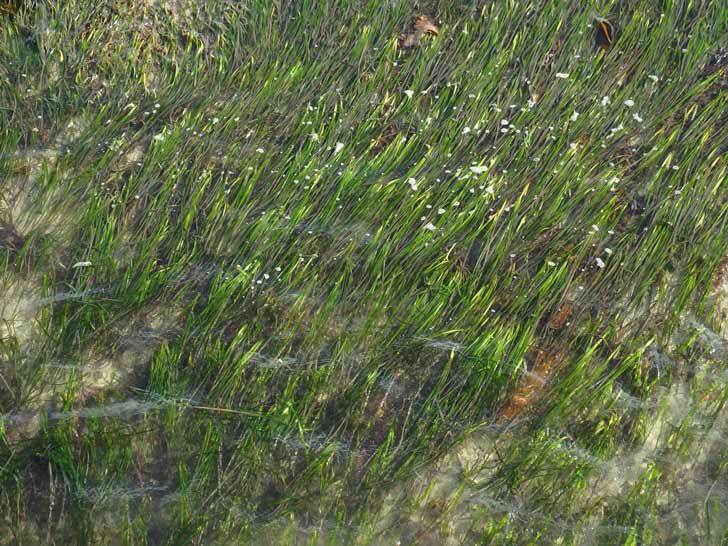
But Kathryn Elizabeth Larsen — an architectural technologist and co-founder of Reef Circular, a company that builds bioconcrete out of shell waste — has had her eye on eelgrass for years.
In a 2019 dissertation for the Copenhagen School of Design and Technology, Larsen combined eelgrass with seagrass plates to build structured wood panels with insulation, waterproof and vaporproof “membranes,” and timber posts. Her goal was to explore its potential in architecture.
“Imagine a building material that is rot resistant, fire resistant, non-toxic, insulates comparably with mineral wool, and can be used to create carbon negative buildings … this material has been used for centuries already around the world — until we forgot how to use it,” Larsen explained.
Her conclusion: “Eelgrass has an incredible potential as a world-wide building material.”
But future use of eelgrass relies on the conservation of the plant today.
“At the moment, the seagrass community is really looking at how we can create nurseries for seagrass to aid in the restoration of degraded meadows rather than for supplying construction or other activities,” Richard Lilley, founding director of a widespread restoration charity called Project Seagrass, told Smithsonian Magazine.
“There is a rationale for commercializing seagrass production, but ecologically sustainable production needs to be at the heart of that business model, and the numbers for doing that simply don’t add up at the moment.”
Lilley is right. The green, multi-talented plant has been through the ringer in the last century.
In the 1930s, a wasting disease almost wiped the eelgrass out completely in Læsø. And now erosion, coastal pollution, and human activity have led to another dramatic decline in the last two decades.
Fortunately, as climate scientists, engineers, and architects fund new research into the long-term protection of eelgrass meadows, locals in Læsø still have a large amount of “eelgrass wrack” washing up on their beaches — which is perfect for building those traditional “Hobbit-looking” homes.
“[It’s] important to acknowledge the ecological role of eelgrass for beach communities, salt meadows and for natural shore protection,” explained Dorte Krause-Jensen, a marine ecologist at Denmark’s Aarhus University. “So the wrack should also not be overly exploited.”
“However,” Krause-Jensen added, “where the wrack is in any way being removed to clear the beaches, it might as well be used.”
Header images via TrineBM (CC BY-SA 3.0) and Ingrid Taylar (CC BY 2.0)
When Hurricane Milton made landfall in Polk County, Florida last night, a mother and her four children (ranging in ages 4 to 11) became trapped by rapidly rising water in their homes.
The mom, Amber Henry, said the family’s refrigerator began to float, at which point, she turned the power off in her house. Then, she and her children sat on an oven and counter to avoid the water.
“I called my mom and said ‘I think me and my children are about to drown to death,’” Henry told WFLA News.
But, in a stroke of luck, the news crew was also nearby, including WFLA’s Beth Rousseau, who spotted Henry signaling for help near a window in a neighbor’s house. The mother had rushed there with her kids, after seeing the water levels were a bit more manageable next door.
“She was terrified,” Rousseau said. “She said the water was rising fast, and she needed to get her babies out.”
Henry said she had already evacuated further inland, hoping to avoid the worst of the storm, but when water began coming in from a window, she knew things were serious. At this point, she called emergency services, but with the increasingly hazardous conditions, first responders could not reach them.
However, the WFLA crew had been driving to an address with reported flooding and got to a road they could not pass, Rousseau said in a broadcast.
“We hopped out to do a live hit, just like we’re doing right now, and that is when we started hearing someone calling for help from a house that water was absolutely inundating,” Rousseau said on camera.
With the help of the news team, and the help of a local samaritan and their car’s headlights, the family found a path out, wading through the water to safety.
“Thank God I looked out the window. I don’t know what told me to look out the window,” Henry said, after the fact in an interview with Rousseau. “But I saw you guys, and you guys came to save us.”
Henry and her children had been sitting in water since 9 p.m. and were unable to flee until around 5 a.m.
Footage from the news crew shows the family walking through knee-high water to safety, guided by headlights and the spotlight Rousseau was using for her news report.
“I was terrified,” Henry said. “I just told them I was scared but we have to have bravery. My children literally prayed, they just prayed.”
Rousseau is also seen on camera helping lift one of Henry’s sons out of the water. The crew then helped the family get into a vehicle, and from there, took them to a nearby shelter.
Henry and her children are now recovering in that shelter, along with countless other community members whose homes were flooded.
She said, “my prayers were answered.”
“We are just thankful they are safe,” Rousseau said.
In the aftermath of the storm this morning, officials say Milton knocked out power to more than 3 million customers and generated 150 tornadoes. At this time, nine deaths have been reported, compounding the devastating loss caused by Hurricane Helene just weeks prior.
More helpers, responders, and agencies are already on the ground helping residents of the area, with more to emerge in the coming hours and days.
Header image courtesy of WFLA News
The volunteers who take part in search-and-rescue operations and then support disaster survivors belong to organizations that have become more formal and established over the past decade.
That’s what we found after spending more than four years volunteering alongside eight of these groups to better understand their role and the motivations of the people who participate in these efforts.
We did this research as part of a larger team of sociologists, an urban planning scholar and emergency management specialists. All of us worked alongside civilian volunteer search-and-rescue groups from Louisiana and Texas between 2017 and 2022 during and after many hurricanes, including Harvey and Laura, the winter storm known as Uri and other major disasters.
While we volunteered with these organizations, we observed them in action and interviewed their leaders and volunteers to learn why they were making the time and taking personal risks to save others. Many cited their personal values, expressed their need to belong to a group, and said it had helped them find a sense of purpose.
Others shared that they were motivated by their personal circumstances and experiences or feelings of guilt, or that this kind of volunteering gave them a deep sense of satisfaction.
“I lost everything I owned in Katrina. They deemed my family’s property uninhabitable,” said a boater we’ll call Dylan to protect his anonymity. “I can’t sit here after knowing what it is to lose everything.”
Some volunteers said that one reason why they have repeatedly done this work is to counter stereotypes about people who engage in these efforts. When he’s heard people say, “Oh you’re just out there, doing it for the spotlight,” said Roger, he told us he wants to respond by saying, “Yeah, dude. If you flood, call me, I’ll come get you.”
While the organizations we researched were based in Louisiana and Texas, the volunteers who participate in these efforts come from across the U.S. and, in some cases, other countries. One volunteer we met was from the United Kingdom.
Why it matters
Since Hurricane Katrina struck the Gulf Coast in 2005, volunteers have been participating in search-and-rescue efforts after big disasters — especially in that region. But these volunteers come from all over.
Many of these groups are known as “Cajun Navy” organizations. Whether or not these organizations use the Cajun Navy branding in their names they share, a common mission of helping others in emergencies.
These volunteers aren’t just operating boats and helicopters. Others serve as dispatchers, handle logistics, and run social media operations.
Over time, some of the organizations have begun to team up with local emergency responders, signing memorandums of understanding with them. They partner with government agencies while assisting in disaster response and relief efforts, but they primarily operate with autonomy and are able to travel where they perceive the need is greatest.
This kind of group tends to dissolve after a disaster is over, instead of evolving into an established nonprofit.
But many of the eight groups we studied have become nonprofits or are in the process of doing so.
How we do our work
We were able to do this research by becoming volunteers ourselves. We took part in dispatch operations on the ground and remotely, and we supported logistics planning. We also observed and, in some cases, participated in search-and-rescue training and operations in the water and on land.
The Research Brief is a short take about interesting academic work.
This article by Kyle Breen, from Texas A&M International University, and J. Carlee Purdum, from University of Houston, was originally published by The Conversation.

Hurricane Milton made landfall Wednesday night as a “dangerous Category 3” storm near Siesta Key, on Florida's central west coast, according to the National Hurricane Center.
In its wake, the storm has left over 3 million customers without power and caused “catastrophic damage” across the region. Immense winds from the storm also generated 150 tornadoes, adding to the destruction Floridians saw from Hurricane Helene just a couple of weeks prior.
As of the writing of this article, at least 10 people have been declared dead, and thousands are at risk for further flooding in the coming hours and days.
The loss of life and impact on the communities in both Helene’s and Milton’s paths is unfathomable — and both the immediate and long-term needs are vast.
If you’re reading this, it’s likely because you want to help and care about making a difference for those who’ve been impacted by Hurricane Milton.
You’re in the right place. When we see tragedy like this happen in the news, it’s important to not tune it out. Instead, pay attention and truly feel the heartbreak of it — then, look for and be inspired by the people stepping in to help, and use that energy to make a difference ourselves.
How to make a difference
After we’ve allowed ourselves to feel the weight of the pain and heartbreak associated with bad news, and look for hope and helpers in the midst of it — we always have the opportunity to join in and make a difference, too.
Here are some ways to help — whether you’re local or far away:
Donate to national organizations
Here are just a few large-scale organizations that have helpers on the ground in the region.
- American Red Cross
- World Central Kitchen
- Feeding America
- United Way
- Salvation Army
- CARE
- Project HOPE
- The Humane Society of the United States’ Emergency Animal Relief Fund
- Baby2Baby
- Save The Children
- Direct Relief
- Aerial Recovery
- Samaritan’s Purse
Donate to local organizations
Local organizations, recovery funds, and mutual aid groups have been deployed across the region most impacted by Milton. Find donation links and updates below:
- Florida Disaster Fund
- Feeding Tampa Bay
- Metro Ministries
- Community Foundation Tampa Bay
- Gulf Coast Community Foundation
- Collier Comes Together
Volunteer locally
Organizations in the affected area are seeking volunteers to help distribute resources and support crucial aid efforts. While many of us are not local to the region, those who are nearby are encouraged to join in a myriad of volunteer opportunities.
(Note: If you aren't in the area, the best way you can help is by supporting local efforts with a donation. Keeping roads clear for rescue crews and local relief agents is vital in maintaining safety in these already devastated areas).
For local volunteers, check out:
Contact your elected officials and ask them to take climate action
Climate scientists agree, the intensity and extent of the devastation brought by Hurricane Helene — and now, Hurricane Milton — was made worse by climate change.
While we can’t go back in time and burn less fossil fuels — we can make a difference now to secure a safer future and prevent future climate disasters.
In addition to talking about how this disaster is connected to climate change in our own conversations and holding media outlets accountable for how they talk about climate change — this is a great time to tell your elected officials that you want them to take meaningful climate action.
We’re making incredible progress in the U.S. and globally in reducing emissions, but we need to work even faster — and incorporate climate mitigation efforts into our plans — to limit the most severe impacts of global warming.
Columbus Day celebrations in the United States — meant to honor the legacy of the man credited with "discovering" the New World — are almost as old as the nation itself.
The earliest known Columbus Day celebration took place on Oct. 12, 1792, on the 300th anniversary of his landing.
But since the 1990s, a growing number of states have begun to replace Columbus Day with Indigenous Peoples Day — a holiday meant to honor the culture and history of the people living in the Americas both before and after Columbus' arrival.
The Conversation spoke with Susan C. Faircloth, an enrolled member of the Coharie Tribe of North Carolina and professor of education at Colorado State University, to learn the history of Indigenous Peoples Day and what it means to American education.
First, why is Columbus Day a problem?
For many Indigenous peoples, Columbus Day is a controversial holiday. This is because Columbus is viewed not as a discoverer, but rather as a colonizer. His arrival led to the forceful taking of land and set the stage for widespread death and loss of Indigenous ways of life.
When did Indigenous Peoples Day come about?
In 1990, South Dakota — currently the state with the third-largest population of Native Americans in the U.S. — became the first state to officially recognize Native Americans' Day, commonly referred to as Indigenous Peoples Day in other parts of the country.
More than a dozen states and the District of Columbia now recognize Indigenous Peoples Day. Those states include Alabama, Alaska, Hawaii, Idaho, Iowa, Louisiana, Maine, Michigan, Minnesota, New Mexico, North Carolina, Oklahoma, Oregon, South Dakota, Vermont, Virginia, and Wisconsin.
How does Indigenous Peoples Day change things?
Indigenous Peoples Day offers an opportunity for educators to rethink how they teach what some have characterized as a "sanitized" story of the arrival of Columbus. This version omits or downplays the devastating impact of Columbus' arrival on Indigenous peoples.
Indigenous Peoples Day is an opportunity to reconcile tensions between these two perspectives.

Research has shown that many schools do not accurately represent Indigenous peoples when they teach history. I think this is true not only on Indigenous Peoples Day, but throughout the school year.
Researchers have found that K-12 schools tend to teach about Native Americans as if they existed only in the past.
By revising the curriculum to better reflect both past and current histories and stories of Native peoples, educators can more accurately teach students about their cultures, histories, and traditions.
Has there been any pushback?
Yes, the shift from Columbus Day to Indigenous Peoples Day has met resistance from communities across the country. In 2021, parents in Parsippany, New Jersey, protested the local school board's decision to celebrate Indigenous Peoples Day in place of Columbus Day.
Among other things, they cited lack of community input, failure to honor the legacy of Italian immigrants, and the need for a "more balanced picture of Columbus."
In response, the school board removed the names of all holidays from its calendar. Now the holidays are just referred to as "days off."
What resources do you recommend for Indigenous Peoples Day?
I would recommend "Lies My Teacher Told Me About Christopher Columbus" by sociologist and educator James Loewen.
I would also recommend "An Indigenous Peoples' History of the United States for Young People" by historian Roxanne Dunbar-Ortiz.
These books help illustrate both the impact of the arrival of Columbus on the Indigenous peoples of the Americas and the role of Indigenous peoples in the founding of the United States. This is information that is typically absent in K-12 schools.
Other resources are available from organizations such as the National Museum of the American Indian, Learning for Justice, and IllumiNative. These resources include sample lesson plans, books, and videos that reflect the diversity of Native American peoples and tribes.
For example, one lesson plan from IllumiNative provides opportunities for students to learn about Indigenous Peoples Day and at the same time explore ways to honor and protect the land, air, and water.
Such lessons are important, as they address the ways in which conservation of natural resources is essential to the economic self-determination and self-sufficiency of Native nations.
This article was produced by The Conversation, reviewed and distributed by Stacker Media, and republished with permission.
Imagine for a moment you could perceive the world like a bee. Bees have the fastest color vision in the animal world, about five times faster than humans', enabling them to navigate the world with extreme efficiency and speed.
While humans might let their gaze wander over a flower field and appreciate the colors, bees perceive each individual flower as they zip by.
Also, if you were a bee, you couldn't see red, but you would see ultraviolet light humans can't see, so you'd be able to detect ultraviolet flower colors. Bees actually have five eyes; three additional smaller eyes called ocelli help them navigate, a bee's version of GPS.
"The superpowers they have make me feel so inadequate," Alexandra Daisy Ginsberg tells Reasons to be Cheerful at her art studio at the Somerset House in London.
"I can't see polarized light; I can't see the electric charge of flowers; I can't smell the scent plumes from fields of flowers in the distance. I can't memorize the locations of all the flowers I visited, and that's just a small list of my failings as a human."
Ginsberg's journey into researching how pollinators perceive the world started in the spring of 2020, when the British artist was asked to design a sculpture to raise awareness about pollinators.
"Instead of making a sculpture about pollinators, I thought it would be better to make a sculpture for pollinators," she says, and points to studies that show a decline of 75% of pollinators over 27 years in Germany due to insecticides, pests, and climate change. The data from other countries is similar. "That led me to the question, what do pollinators like? What would they enjoy?" she explains.
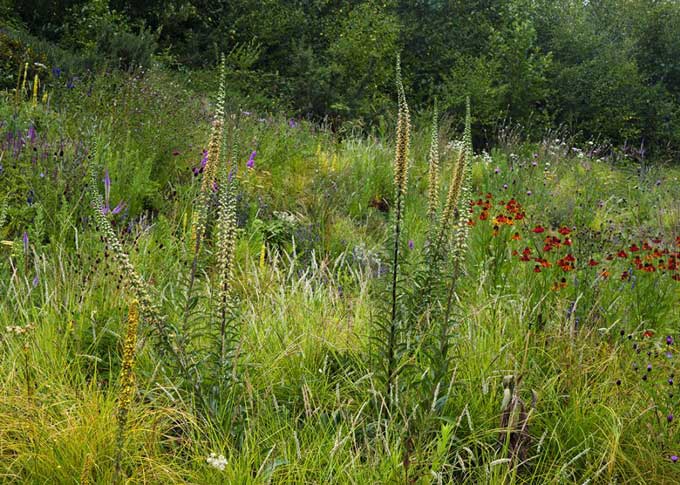
The result was the first Pollinator Pathmaker Edition, a 180-foot-long permanent garden installation with 7,000 plants at the Eden Project, Cornwall, that opened as part of the Create a Buzz project in 2021.
In 2022 Ginsberg added 11 meandering beds in Kensington Gardens, London, and in 2023, a garden in the front yard of the Natural History Museum in Berlin followed by 15 community gardens around Berlin.
A New Vision for Gardens — Designed for Pollinators, Not People
The gardens are not designed to please humans but rather pollinators, including birds, bats, moths, wasps, and beetles. Working with scientists, horticulturalists, and Google, Ginsberg learned that each pollinator has specific needs, comes out at specific times and often needs a very specific plant to feed or lay eggs.
Monarch butterflies need native milkweed, for instance, and bumblebees love Cynara cardunculus, a type of artichoke.
Ginsberg developed the "altruistic algorithm" with string theory physicist Przemek Witaszcyk to support the maximum pollinator species possible, including endangered plants from a curated selection chosen solely for their benefits to pollinators.
As humans, we rarely question our perception of the world. But seeing the world from a bee's perspective might open our eyes to their significance.
Without bees, we'd lose 87% of our crops, most flowers, and fruit. Bees are crucial for our survival. And yet, most of us never stop to consider how they navigate the world.
"It's crucial to highlight this very important concept that the world is not the same for everyone and the world that we see as humans is just one version," Ginsberg says.
During the pandemic isolation, she took a deep dive into the science, finding out bees are even smart enough to master mathematical calculations and that bumblebees enjoy playing ball.
Ginsberg was "amazed to discover some insects are equipped with 15-dimensional color perception," she says. "We cannot even imagine how the world looks to them. This opened up all these questions about consciousness, sentience, and species."
In addition to the big public gardens, Ginsberg's free DIY algorithm toolbox allows amateur gardeners to plug in their own yard conditions and turn their patch into living artwork as well.
They can see 3D visualizations of their unique garden blooms on their screens.
However, "it only becomes art once it is actually planted," Ginsberg says. She is wearing a black blouse with daisies, fitting for her name, and applied the algorithm to her own small garden outside of London as well.
She originally studied architecture and then worked for 10 years with synthetic biologists, "essentially researching how humans can exploit nature, the opposite of the Pollinator Pathmaker."
Both the University of Exeter and the Natural History Museum are conducting studies, surveying the sites and comparing them with wildflower meadows and other gardens. The studies are not completed yet, but initial findings point to a significant increase in biodiversity in the Pollinator Pathmaker territory, including some species you wouldn't normally find in the middle of Berlin.
Ginsberg emphasizes that "an artwork is a proposition and a provocation rather than a solution, because it's not a solution to the biodiversity crisis. But it is exploring the idea of agency." She sees Pollinator Pathmaker as "a response to human-made ecological damage. By creating for other species, it uses art to give us empathy and agency to care for them."
So far, the algorithm only has databases for Europe, but Ginsberg is currently designing the first version for the U.S. Her vision is to "create the largest ever climate positive artwork together, by planting living artworks for pollinators around the world."
This means adding new plant databases region by region as she gets funding.
Ginsberg hopes her gardens will spread across the globe, eventually dotting the planet with pollinator playgrounds. A bee-lievable vision.
This article was produced by Reasons to be Cheerful, reviewed and distributed by Stacker Media, and republished with permission.
For many people across the Southeastern United States, their autumn has been off to a catastrophic start.
As Floridians pick up the pieces after Hurricane Milton, thousands of people are still recovering from flooding, mudslides, and collapsing infrastructure.
Across North Carolina, 48,499 are still without power two weeks after Hurricane Helene made landfall, and as the death toll continues to climb, 1,412 people have been reported missing.
Amidst the devastation and heartbreak, one Asheville local turned to their city’s subreddit, looking for stories of hope.
“It's been a week the trauma is settling in and we all could use a break,” Reddit user t-just-rando posted one week into the state’s recovery. “So if anyone has good or positive news let's hear it! For our mental health, and for each other!”
In the days since, 245 people commented to share their “good news.”
“Our neighbor lost their cat the day of the storm,” one user responded. “They found him this morning hiding on a vacant apartment porch. We are all so happy for them!”
“We got power back last night and I got to take my first hot shower in a week this morning,” another local commented. “It's the little pieces of normalcy that make it all worth it.”
“The Flush Brigade, comprised of six trucks and 75 volunteers, helped flush 1,964 toilets in nine Asheville communities,” said another.
“World [Central] Kitchen is here with hot meals,” one user responded, in recognition of the Chef José Andrés’ nonprofit, which has been serving over 16,000 hot meals a day in Florida, Georgia, Tennessee, and North Carolina.
“I don't have to eat something from a can unless I want to!” the user continued, saying the Meatloaf and Indian dishes were a welcome break in routine. “It's like frickin’ Christmas!”
One user linked to a local news story about the Western North Carolina Nature Center, which is home to endangered species like red wolves, red pandas, and ‘mudpuppy’ salamanders, exclaiming that “all of their animals are alive and accounted for!”
“We did not lose a single animal, which is unbelievable,” confirmed Nature Center director Chris Gentile in an interview with the Citizen Times. “And all our staff members are accounted for, healthy, happy.”
Others chimed in with the gratitude they felt for volunteers and local nonprofits, like BeLoved Asheville, Brother Wolf Animal Rescue, and the Buncombe County Family Assistance Center, the last of which distributed over 5,000 care packages to households in need.

“I have run out of words to describe the kind of heroics I've seen daily,” one local wrote. “There are so so so many helpers. People are out here just talking and trying to take care of each other.”
Outside of Asheville, people across the country are looking for good news, too. It’s been a long two weeks, with back-to-back hurricanes, 48 tornadoes ripping through Florida, an enormous chemical fire in Georgia causing a mass evacuation of 90,000 people.
But there is always good news, if you know where to look: a local news team saved a family in peril, rescue crews saved stranded Manatees, animal shelters coordinated rescue efforts up and down the east coast, and ‘Cajun Navy’ volunteers are putting lifesaving organizations in place that will exist for years to come.
And for some people, it’s the little things that give them hope.
In Florida, a TikTok user posted a video of their dog happily splashing through flood waters from Milton, with the caption: “Oh to be a dog.”
“This is the hurricane content we needed to see,” a TikTok user replied.
“This is how I want to be when tough situations arise,” wrote another.
“It's not about having the best of everything,” a commenter said, “but making the best of everything you have.”
@isabellajuliaw Oh to be a dog #hurricanemilton #hurricaneaftermath #flooding #dogsoftiktok #zoomies #hurricane #florida #relatable ♬ Hurricane - Bridgit Mendler
Header mage via Federal Emergency Management Agency
In a lot of ways, Malala Yousafzai is not like any other girl in the world. She has survived a gunshot to the head for bravely attending school in Pakistan under Taliban rule, won a Nobel Peace Prize, advocated for girls’ education across the globe, and has co-produced a Broadway musical with Hillary Clinton.
And yet, at the end of the day, she is also just another Swiftie in a worldwide sea of Taylor Swift fans.
In an interview on “TODAY” earlier this week, Yousafzai spoke about a handful of her upcoming projects. Then the topic of The Eras Tour came up — which the activist attended this summer. It was her very first concert.
“You got to do something kind of fun this summer,” host Al Roker said to Yousafzai. “You actually went to your first concert, and lo and behold, Malala is a Swiftie fan.”
She corrected him: “Not just now. I have been a Swiftie fan since my childhood.”

Joyful chuckles resounded among the show’s interviewers, but then Yousafzai told a powerful story about the meaning of the pop star’s music.
“I remember that very well,” she began. “It was a time when peace had just been restored… the Taliban were no longer in our hometown. And my friend and I, we loved music because music was once banned by the Taliban. So we became Swifties.”
Yousafzai then told a story about how she and her friend were on a school trip in nature, surrounded by a waterfall in the mountain.
“We were so confident that we told our classmates and teachers that we want to announce and sing this song,” she continued. “We stood on this rock, and we started singing ‘Love Story’ by Taylor Swift.”
For those who are not fluent in Swift’s discography, “Love Story” is the hit single from her second album “Fearless,” (now “Fearless: Taylor’s Version”, if you’re in on the lore).
“I get to be at her concert this year and live through all her eras,” Yousafzai said, fondly looking back on her experience at The Eras Tour. “But, ‘Fearless’ is where I started, and ‘Fearless’ is what I carry with me.”
Yousafzai had shared this story in an Instagram post earlier this year when she attended Swift’s concert in London. But in August, she added a somber reminder.
“Three years ago, the Taliban regained power in Afghanistan,” she wrote. “Once again, music no longer plays on the streets, and girls and women are barred from school, work, and public life. One day, I hope we will live in a world where every girl will be able to enjoy music and live out her wildest dreams.”
Malala’s foray into entertainment and music
The longtime activist does not just have her own special connection to music. Alongside her work to improve access to girls’ education around the world, Yousafzai has ventured into producing musicals and documentaries under her production company: Extracurricular.
Alongside former Democratic presidential candidate Hillary Clinton, she has helped produce “Suffs,” a musical about the women’s suffrage movement in the United States.
Her next production is a feature-length documentary called “The Last of the Sea Women,” which premiered on Apple TV today. It follows the lives of the Haenyeo, a “band of feisty grandmother warriors” on South Korea’s Jeju Island.
These warriors, often called “real-life mermaids” battle against oceanic threats, but their traditions and way of life are in imminent danger.

Also on “TODAY,” Yousafzai spoke about another project she was proud of, and co-produced with Jennifer Lawrence, called “Bread & Roses.”
The film will be available on Apple TV soon and follows three women fighting to recover their human rights in Afghanistan.
“I have been an advocate for the Afghan girls for the past three years, since the Taliban took over Kabul and imposed a ban on girls’ education,” Yousafzai said in the interview.
“Afghanistan is the only country in the world that does not allow girls beyond grade six to be in school, it has banned women from work, and they’re living under systematic oppression that… human rights experts are calling a gender apartheid.”
She says the film captures the strength and resilience of the women fighting back.
“These women are activists,” she said. “They are standing up for their rights, and you get to see that in this documentary.”
One might even call them fearless.
Header images courtesy of Japan Cabinet Secretariat, Cabinet Public Relations Office (CC BY 4.0) and Malala Yousafzai/Instagram
Every day the Good Good Good team collects the best good news in the world and shares it with our community. Here are the highlights for this week!
If you want to get good news in your inbox every day, join the Goodnewsletter — the free daily newsletter designed to leave you feeling hopeful.
The Best Positive News We’re Celebrating This Week —
A mobile home park in Vermont was transformed into a net-zero energy affordable housing neighborhood
Proving you can achieve net-zero energy on a budget, a community in Vermont transformed a neglected trailer park into an affordable housing community.
McKnight Lane in Waltham, Virginia features 14 modular homes equipped with solar panel systems and a battery — alongside extra insulation, efficient appliances, heat pumps, and triple-pane windows to minimize electricity consumption overall.
Not only do residents not have to worry about high electric bills, especially in the winter, but they were also built as affordable housing units — made available to “households earning at or below 50% and 60% of the area median income.”
Why is this good news? This project, a model for others like it, addressed multiple problems in the area all at once: it increased the amount of affordable housing available, restored a neglected neighborhood, and achieved net-zero emissions.
A TikToker is using the internet fame of Moo Deng the hippo and Pesto the penguin to raise money for wildlife charities
If you’ve been on the internet at all in the last few weeks, you’ve likely met Moo Deng — a feisty pygmy hippopotamus at a Thai zoo — and Pesto — a massive King penguin chick at an Australia zoo.
One TikTok user saw an opportunity to use their overnight internet fame to make a difference.
Joining a third viral baby animal, the giant panda Hua Hua born at a research base in China, the trio are the first members of what TikTok creator @indipine has dubbed the “Knights of the Rotund Table.” Others have since joined, nominated, and voted on by Indy’s followers.
So far, all of the baby animals that have joined the “Rotund Table” are endangered, threatened, or vulnerable species on the decline. That’s why Indy started featuring wildlife sanctuaries, rescues, and nonprofits in her daily poll.
With votes topping 250,000 each day, Indy is using the opportunity to fundraise for wildlife sanctuaries like the KSTR Wildlife Rescue, and Alaska Sealife Center.
→ Meet the rest of the knights
Ahead of Hurricane Milton, animal shelters are rescuing cats and dogs in the storm’s path across Florida
With evacuation orders in place for counties across Southwest Florida ahead of Milton, staff from the Humane Society of Broward County jumped in to help their sister branch in Manatee County, which is preparing for a “direct hit.”
And this is all just days after Hurricane Helene brought devastation across northern Florida, and especially in east Tennessee and Western North Carolina.
The collaboration to help animals impacted by Helene and Milton has brought together rescues, shelters, and boarding kennels across the country — one nonprofit and a kennel in D.C. and Northern Virginia teamed up to take in 100 animals alone.
→ Read more
More good news for disaster relief:
- FEMA and the NFL teamed up to designate a number of football stadiums as official shelters for future emergencies.
- A local candle shop is providing light for people without power in the aftermath of Helene.
- Even before this year’s record-breaking hurricane season, climate scientists were helping Caribbean families get prepared.
The Arctic ozone reached a record high in March 2024
New research shows that, since the 1970s, March 2024 was a record-high month for Arctic ozone levels — and there was an overall increase from winter 2023 to 2024.
Following this record-high month, ozone levels persisted at an above-average level through September 2024.
Those findings are particularly significant since springtime has been historically associated with ozone depletion due to higher CFC levels coinciding with low-pressure polar vortices.
The researchers said it’s early evidence that CFC levels are indeed declining in the atmosphere, helping the “Earth’s sunscreen” begin to recover over the long term.
MIT researchers developed a “revolutionary” solar-powered desalination system to help bring clean water to millions
Without the use of any external power or batteries, MIT researchers say they’ve created a desalination system that’s powered directly from sunlight.
The “revolutionary” technology adjusts with the amount of sunlight available — producing more desalinated water as sunlight increases, and less as it decreases. This helps maximize output and waste less available energy.
This system is expected to significantly reduce the cost of desalination compared to other technologies, primarily because conventional methods rely on grid power — MIT’s new invention is completely solar-powered.
Why is this good news? Parts of the world like India, North Africa, and the Middle East experience high levels of water scarcity, and technologies like this could help provide low-cost efficient ways to bring clean water to those communities.
New data shows pollution at the Port of Los Angeles is at its lowest levels since 2005
Pollution levels at the two largest ports in the U.S. — the Ports of Los Angeles and Long Beach — are at their lowest levels since records began in 2005.
Newly released data found that in 2023, cancer-causing diesel particulate matter was down 91%, carbon emissions were down 24%, and smog-forming pollutants were down 74% from 2005 levels.
Remarkably, despite a return to normal operating levels, overall emissions are now lower than in 2020 at the height of the COVID-19 pandemic.
A variety of factors helped contribute to the lower pollution levels, but it’s primarily due to more efficient diesel trucks, more electric trucks, and more electric cargo-handling equipment.
The two ports are among the largest sources of carbon pollution and smog in Southern California — so this progress is great news both for human health and the health of the environment.
Australia just announced it will protect 52% of its ocean territory — more than any other country in the world
Australia’s government is finalizing protections for a 300,000-square-kilometer expansion of a sub-Antarctic marine park, and once it does, it will officially have protected more ocean territory than any other country in the world.
Quadrupling the size of an existing marine reserve, it will add habitat protection zones and national park areas, and bring the country’s total protected ocean territory to 52% — far exceeding the agreed-upon global target of protecting 30% of the world’s oceans by 2030.
Experts are calling this a “huge environmental win,” as the protected areas are “wildlife havens” and the sanctuary-level status affords them the highest level of conservation.
What’s the nuance? A major government report found that Australia was not doing enough to adequately protect its environment, which was in “poor and deteriorating health.” While this is an incredible step in the right direction, scientists are still concerned about critical marine ecosystems not having the recommended sanctuary-level protection.
Interrupting their live report, a Florida news crew rescued a family from Hurricane Milton waters
When Hurricane Milton made landfall in Florida, Amber Henry had already evacuated further inland with her four children, but still didn’t escape rising waters from the storm — she called emergency services, but with the increasingly hazardous conditions, first responders could not reach them.
However, the WFLA News crew had been driving to an address with reported flooding and got to a road they could not pass. Stopping to do a live report, they heard Henry calling for help.
The news team quickly jumped into action to help, alongside a local samaritan and their car’s headlights, and the family found a path out, wading through the water to safety.
Why is this good news? Stories like this are an important reminder that opportunities to help are all around us — they may not come in the most dire, treacherous circumstances, but often we have all we need to help make a difference, and even save a life.
After seeing the consequences of fast fashion firsthand, an Irish woman started a campaign to prevent waste
When Mary Fleming went on a trip to Kenya, she saw a mound of secondhand clothing next to and spilling into a river — and it opened her eyes to the consequences of fast fashion and overconsumption.
Once a fervent shopper, Fleming was inspired to lead a campaign all about preventing waste by swapping, reusing, repairing, and repurposing clothes.
She founded Change Clothes, a non-profit that helps people rent, exchange, and buy used clothes as well as gives tutorials in mending and upcycling garments.
In addition to teaching people about how to mend their clothes to extend their lifespan, Change Clothes is also out to reach communities where secondhand clothes are stigmatized, “We’re trying to change perceptions.”
The swap shop can be a “great gateway drug” in introducing people to the possibilities of secondhand clothing. And her efforts are working: Change Clothes’ swap shop, pop-ups, and classes have been so popular, they outgrew their original space and moved into a larger space in the city center.
More good news of the week —
Greece has seen a record number of sea turtle nests and surviving hatchlings as the species makes an extraordinary resurgence. Conservationists have been working for more than two decades to save the Caretta caretta sea turtle, which has existed for 100 million years.
For the first time in decades, the FDA is considering approval for a new, safe sunscreen ingredient. Other countries have been using bemotrizinol for decades, and experts hope its approval will bring new, popular sunscreens on the market and help reduce skin cancer.
After a successful trial, more women in Australia will now be able to access oral contraceptive pills over the counter. People can get a resupply of their pill from a certified pharmacist without needing to go back to the doctor for a new prescription – as long as they have been taking the medication for two years.
Scientists mapped 50 million neural connections in a fly brain, a “huge leap” in understanding human brains, too. The most detailed analysis of the brain of an adult animal ever produced, the new research sheds new light into “the mechanism of thought.”
Cheaper versions of a “game-changing” HIV prevention drug will now be made available to over 120 countries. The twice-yearly injection showed strong results for complete HIV prevention in women, and similar results in men.
A “landmark victory” for trans rights, a top EU court just ruled that gender identity changes must be recognized in all member states. The decision impacts millions of transgender people, ensuring their identities are respected and recognized, regardless of where they live or travel within the EU.
A group of evangelical environmentalists are ramping up their faith-based climate activism in the weeks before Election Day. Leaders at Evangelical Environmental Network have seen an uptick in interest from their evangelical peers, especially those who have experienced extreme weather events themselves.
Part of a series of holiday dolls, Mattel’s first-ever Diwali Barbie doll sold out online in one day. The company collaborated with Indian fashion designer Anita Dongre to release the doll before the Hindu holiday, celebrated between October 31 and November 1.
Making rail travel more accessible and affordable, Portugal introduced a €20 monthly pass for all train services. The initiative is intended to help the country reach its environmental goals and offer citizens an affordable way to commute and explore.
Vertical solar panels are a new solution for colder, less sunny regions, yielding 20% more energy than traditional panels. Earlier this year, Ullevaal Stadium in Oslo became home to the world’s largest vertical solar panel installation on a roof, placing the stadium at the forefront of renewable energy innovation.
Adobe is working to make it easier for artists to protect their work from AI scraping. The software company’s new tool helps creators watermark their artwork and opt out of having it used to train generative AI models.
Scientists in the UK are developing the world’s first vaccine to prevent ovarian cancer. One of the most common forms of cancer in women, the disease kills nearly 26,000 women in the European Union every year.
A new drug combination stopped lung cancer from advancing for more than 40% longer than standard treatment. Doctors are celebrating the “amazing” trial results in treating the world’s leading cause of cancer death, which accounts for about 1.8 million deaths every year.
Atlantic sturgeon fish were just reintroduced in a Swedish river for the first time ever. The keystone species was driven to functional extinction in Europe in the mid-twentieth century and a 42,000-euro grant is supporting their historic reintroduction in Sweden’s largest river.
Drones are helping bring HIV prevention medicine and test kits to young people in Kenya. Drones are dropping the supplies at concerts and football matches in the country, where young people are less exposed to messaging about HIV.
With the hubbub of a record-breaking 50,000-runner Chicago Marathon this weekend, one runner — Matt Brusich — decided to race against just one competitor: Himself.
The Lincoln Park resident created what he called a “homegrown marathon,” running the iconic 26.2 miles within the space of his own city block the day before the actual marathon took place in the Windy City.
He was inspired on his daily dog walk around the neighborhood — from Cleveland Avenue to Dickens to Mohawk to Armitage, and back to Cleveland — with his Schnauzer, Fred, according to Runner’s World.

To reach the official marathon mileage, that would equate to nearly 80 laps around the block. Brusich was ready to lace up his sneakers, but he wanted to do something meaningful with the challenge.
“Aside from it being something silly and a training towards a physical fitness goal, I thought it would be neat to see my home block from a different perspective,” he writes on his (also very homegrown) website.
“And raise some awareness [and] funds for a good cause.”
That good cause? The Lincoln Park Community Shelter, a homeless shelter and nonprofit right in the heart of his community.

Gearing up for the race, Brusich received pledges from friends, family, and community members, and even managed to have the race sponsored by a local pizza joint: DiNucci’s.
The restaurant donated a portion of sales of a pie named after the runner “Matt’s Homegrown Hot Honey Hustle pie” to the shelter that day — and fed a number of unhoused community members in the process.
He also managed to get the event officially sanctioned by the U.S. Track and Field National Office.

By the time the race had been completed on Saturday, Brusich racked up about $11,000 in donations, and his pledge page now boasts over $12,000, as gifts keep pouring in after the fact.
“Thank you for your help… in supporting both me and a local effort and well-established charity,” Brusich wrote on his website. “It means more than you know.”
His final time was 5:51:57, but Brusich was intermittently slowed down throughout the day, as he took on themed challenges in order to celebrate fundraising goals, per reporting from Runner’s World.
About every 10 blocks he changed directions. In one lap, he dressed as a banana while another runner in a gorilla costume chased him. He took his dog for a run. He drank a can of Budweiser in exchange for a $100 donation.

And when it was all finally over, he finished his journey to the “Rocky” theme, while friends and loved ones cheered voraciously, showering him in confetti.
On his website, Brusich doubled down on his mission.
“I am beyond fortunate to call Lincoln Park my neighborhood, and at that owning such a beautiful home,” he wrote. “Whatever I can do to assist those in my community without such a home will never be enough, though it is important to try anyhow.”
Header image courtesy of Matt Brusich
Forget the Kardashians. For nearly a decade, the only ‘famous families’ researchers Jörn Theuerkauf and Henri Bloc have been obsessed with are the 15 families of birds they’re carefully tracking through a sanctuary in New Caledonia as they track their conservation efforts.
The birds in question are kagus — also known as cagous — flamboyant, blueish-gray birds that can only be found on that particular island country in the South Pacific.
The kagu is peculiar for a number of reasons. It can fly, but it’s regarded as “nearly flightless.” It primarily toddles around on the ground, but it does extend its wings and flips up its trademark “mohawk” crest for mating displays.
They also bark like a dog — a sound more akin to a Yorkie “yap” than a Rottweiler “woof” — and partake in morning duets, or as one zoologist noted, “screaming challenges.”
Considered one of the most unique birds in the world, kagus have been beloved by the Indigenous Kanak tribes of New Caledonia for countless years.
Unfortunately, after Europeans colonized the island in 1853 at the behest of Emperor Napoleon III, the kagu was no longer worshiped. Over the next century, they were trapped, domesticated, and forced to contend with a flurry of invasive animals brought on to the island by colonizers, including pigs, rats, dogs, and cats.
Today, kagus are still under grave threat from these predators. For years, rats and pigs have continued raiding and decimating kagu nests, while stray cats and dogs prey on the birds themselves.
“These invasive mammals nearly caused the outright extinction of the species in 2017,” wildlife rehabilitation specialist Tim Mihocik wrote for The Revelator, “when two stray dogs entered the Parc des Grandes Fougeres wildlife refuge of New Caledonia and went on an unparalleled killing spree.”
Theuerkauf and Bloc were there on that horrific day, when they found 30 kagus dead in the sanctuary. In 2020, a similar event caused a ban of dogs — even those on leashes — from entering the park, and a program was implemented to curb the stray dog population, which had grown wildly out of control.
But Theuerkauf and Bloc’s conservation work — through the Nature Warden brigade — has not been in vain.

As national concern for the kagus has grown, the team has consistently spent a decade recording the bird’s behaviors, setting up trail cameras by nests, and tracking their recovery.
And the researchers have been blown away by their progress.
“The population has probably tripled since 2017,” Theuerkauf told The Guardian. “We are therefore soon at the maximum number of birds possible in the park.”
When that maximum is reached, the kagus won’t be at a loss. Jean-Marc Meriot operates Blue River Provincial Park (also known as le Parc Provincial de la Rivière Bleue) — a National Park about two hours away from Theuerkauf and Bloc’s sanctuary — and has the space for potential future generations to continue thriving.
In that park, 60 birds were recorded there in 1984. Now, Marriott estimates that that number has grown to 1,000.
“We now have forest areas with new pairs of kagus,” he told The Guardian.
“The kagu population is doing very well, it is constantly expanding and things couldn’t be better.”
Header image via Frank Liebig / Wikimedia Commons (CC BY-SA 3.0 DE)
Canadian civil engineering student Ariz Bhimani was 20 years old when he was diagnosed with testicular cancer.
He continued his studies through his orchiectomy, chemotherapy, recurrent cancer, and — eventually — his remission.
Throughout treatment, Bhimani shouldered immense physical pain, and mental stress, but one thought kept surfacing in his brain: He absolutely hated wearing underwear.
“Back in 2019, after my diagnosis, I felt a lack of support and compression from my underwear and experienced a significant amount of chafing on my surgical site,” Bhimani explained to the Aurora Banner, a local news outlet in Aurora, Canada.
“So I combined my civil engineering skills and my experience to develop something better.”
Bhimani created the underwear he wished he’d had, the “Recovery Boxer Brief.”
It was a garment with precision compression and support, with optional pockets for hot and cold anatomical gel packs.

In 2023, the Recovery Boxer Brief first place for “empowering invention” in University of Windsor’s EPICentre competition.
Fast forward a year to early October, when Bhimani’s business — BRFZY — caught the attention of Futurpreneur’s Rock My Business, a free Canadian workshop which issues $10,000 grants to selected winners.
Bhimani was recently announced as one of eight business owners who received the grant.
Currently, the Recovery Boxer Briefs are awaiting official launch, and BRFZY has a waitlist available for sign up. The website states that although Bhimani’s cancer journey served as inspiration for the product, the hope is that it helps people going through a variety of life events, from vasectomy to hip replacement, down to an unexpected sports injury.
“BRFZY not only offers a practical product but also symbolizes the triumph of the human spirit over life-altering obstacles,” reads a mission statement on Bhimani’s company website.
“[It’s] encouraging users to take control of their recovery journey and reclaim pride in their healing process.”
Header image via Ariz Bhimani / BRFZY
Among the many coveted fan interactions the world’s most famous artists have on stage — receiving Taylor Swift’s infamous “22” hat at The Eras Tour, for example, or having Harry Styles call your ex — on-stage gender reveals have become a growing trend at live events.
Earlier this month at a show in Inglewood, California’s Kia Forum, Kacey Musgraves was asked to take part in a fan’s big reveal.
The notoriously sassy country star — donning a shimmery green dress (not unlike Tinker Bell’s signature look) — had a few words before she agreed to the request.
“Here’s what I’m gonna say,” she said, in a video shared on TikTok. “I will open this and tell you the gender if you promise that when they grow up — if they decide that’s not the gender that they feel like they are — will you honor that?”
The singer outstretched her arm toward the fan, almost rolling her eyes, communicating that her request is the most obvious requirement a new parent must meet.
The fan agreed.
“Will you honor that?” Musgraves echoed. “You will?!”
Then, the very official envelope was passed up through the crowd and onto the stage.
Before opening it, Musgraves said off-handedly: “This is the last one I’m ever doing.”
She fiddled with the envelope for a moment, and once again reiterated her point, with “Jeopardy!” music coming from her band in the background.
“But for real, do you promise that if they don’t feel like the gender they are, that you will love and support them no matter what?” Musgraves asked again.
The crowd roared in response, the future parents included.
It’s important to note that what Musgraves is referring to is the biological sex of the child, which is different from gender identity, though the two can certainly overlap, according to the National Institutes of Health.
Gender reveals often refer to the biological sex and physiological characteristics of a person, like reproductive organs, hormones, or chromosomes. Gender, on the other hand, refers to socially constructed characteristics experienced by men and women (or, in this case, boys and girls).
@sararamirez854 Kacey Musgraves gender reveal #kiaforum #fyp #kaceymusgraves #kaceymusgravesconcert #genderreveal ♬ original sound - Sara Ramirez
Musgraves has long been a supporter of the LGBTQ+ community and even won GLAAD’s Vanguard Award in 2022. The honor is given to an entertainment figure who does not identify as LGBTQ+ but displays a strong commitment to the community.
The “Deeper Well” singer has used her platform to speak up against anti-trans legislation in her home state of Texas, as well as advancing other LGBTQ+ voices in country music.
On the Red Carpet for the awards in 2022, Musgraves told journalists that she “would jump in front of a moving train for the LGBTQ community,” according to Them.
This history of support for queer and trans folks makes it unsurprising that she would go to bat for the community — and a future member of society — in this fan interaction.
After skimming the medical document, Musgraves made the announcement. “You’re having a boy,” she smiled. “Congratulations.”
While making the moment special for this individual, Musgraves also used it to sow the seeds of support for a new family — and for everyone watching in the audience.
“This is so funny and beautiful and important,” one TikTok user commented on the video of the fan interaction.
Another added: “That’s a great way to use your voice to project more love into the world.”
Header images courtesy of Sara Ramirez/TikTok and Dave Godreau/Unsplash
Two summers ago, field scientists dipped aquatic nets into a puddle on the highest peak of Doi Soi Malai mountain in northwestern Thailand.
They pulled three newts up with their nets, marveling at their distinct V-shaped heads, “knob-like warts,” and orange-and-black coloration.
They had discovered a new species: the Tylototriton soimalai (also known as the Doi Soi Malai crocodile newt.)
On October 15, Porrawee Pomchote — a professor at Chulalongkorn University, Thailand — and his colleagues finally released their findings to the public.
“The new species is the seventh recorded species of the genus Tylototriton reported in Thailand … [and] is currently restricted to the hill evergreen forests of Doi Soi Malai,” wrote Pomchote and his team in their study, which was published in the scientific journal ZooKeys.
The Doi Soi Malai crocodile newt joins a colorful array of aquatic salamanders species. In Thailand, only six species of crocodile newt, from the subgenera Tylototriton and Yaotriton, had been previously recorded.
Crocodile newts are a primitive species. Some, like the Western Himalayan crocodile newt, have fossils that date all the way back to the Miocene period (13-25 million years ago).
Although they are ancient, they’re also increasingly rare to find. According to the Center for Biological Diversity, 60% of salamander species are threatened with extinction.
On the official website for Tourism Thailand, the site describes Mae Teun Wildlife Sanctuary as a temperate pine forest lost in a “sea of fog” 1,600 meters above sea level.
“What’s interesting,” the website reads, “is the salamander and axolotl … salamanders are very ancient, rare animals. If you are able to see any of them, you are so lucky.”
The researchers were indeed very fortunate on their expedition.
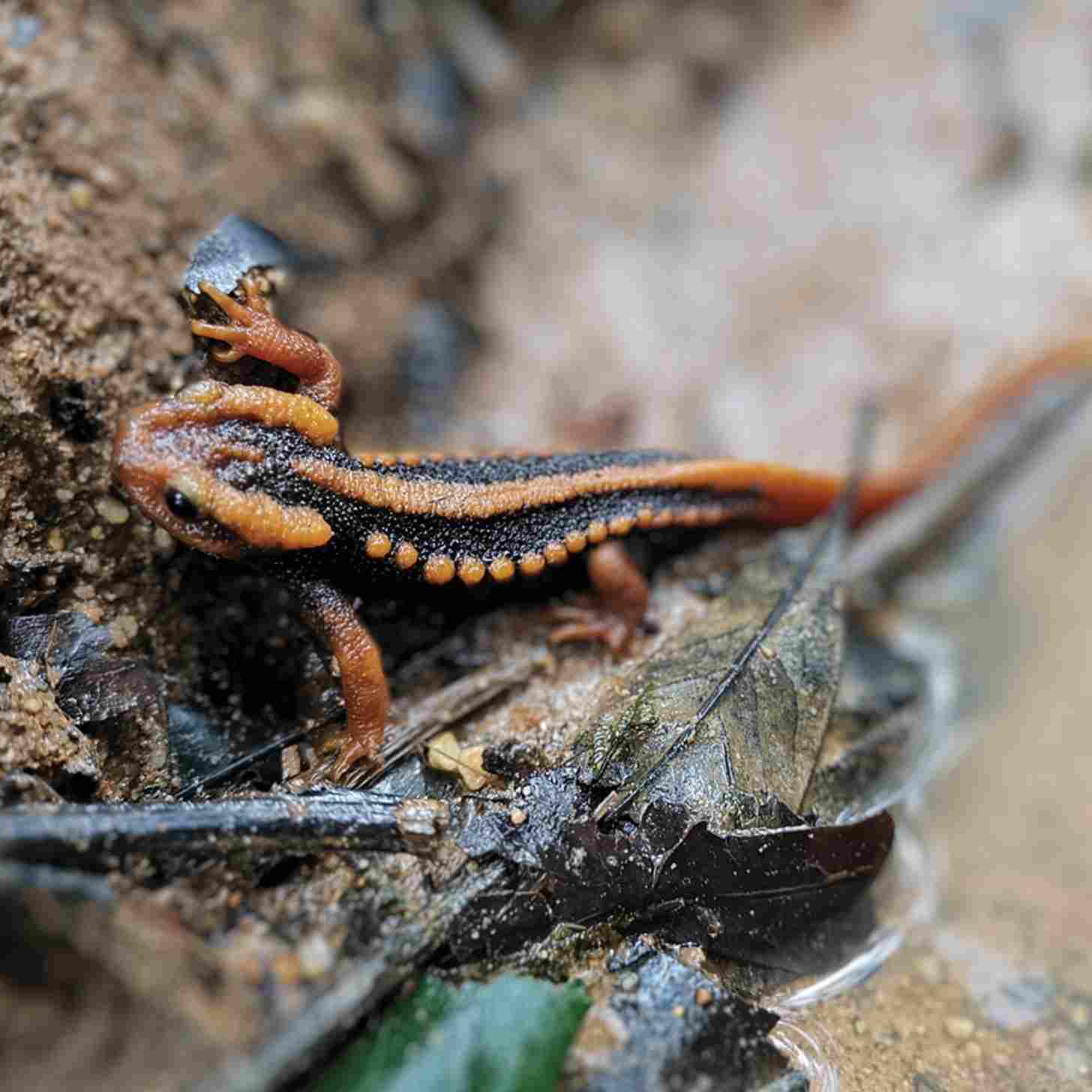
In addition to three large adult males, they also came across several baby newts — in their larval stage — swimming in the same mud puddle, which was found along a major roadway winding through Doi Soi Malai National Park.
According to the study, the “two larvae were discovered and photographed,” but they wriggled out of their leaf to “hide in the puddle” before being measured.
Upon catching the adult newts — and spotting the younger larvae — the researchers knew that they had stumbled onto an important breeding site in the park.
In an effort to protect the vulnerable site, and countless more, the researchers suggested that the park close roadways to cars and vehicles during breeding season (April to August) so that the growing newts wouldn’t be disturbed by mountain bikers and road trippers.
In their paper, the researchers also proposed that the Tylototriton soimalai be listed on the IUCN Red List of Threatened species, under the status of endangered — after inferring that the population size of the new crocodile newt species was surprisingly small.

Before surmising their exploration, the researchers took time to decry the human activity that was putting the Doi Soi Malai crocodile newt, and their diverse habitat of neighbors, in harm’s way.
“In addition to the road disturbances mentioned earlier, both the areas surrounding and within Mae Tuen Wildlife Sanctuary have been heavily impacted by habitat alteration and deforestation, leading to forest fragmentation,” Pomchote and his colleagues wrote.
“A conservation plan is urgently needed for this new species.”
Around the globe, salamanders are considered a “linchpin” species. They serve as prey for other vital species, while also slurping up mosquitos and curbing the overpopulation of numerous pests.
They’re also a vital indicator of environmental health issues. In forests, ponds, swamps, and wetlands, salamanders gravitate towards clean, healthy water.
So when it comes to larger conservation efforts, they serve as the “canary in the coal mine” when it comes to pinpointing vulnerable regions on the decline.
Jason Goldberg, a U.S. Fish and Wildlife Service biologist, has been fighting for the protection of salamanders for years, both abroad and at home.
“If we lose salamanders,” Goldberg said in a statement, “we lose an important part of what keeps many of our forests and aquatic ecosystems vital, along with the benefits those ecosystems provide for the American people.”
Header image via Frédéric Gloor (CC BY-NC-SA 2.0)
As fall is fully underway across the country, leaf-peeping season is in full swing. Tourists have flocked to destinations with exceptional foliage, though officials say crowds are “overwhelming” state parks across the Northeast.
While this influx of visitors can boost the local economy, their impact on natural spaces has not gone unnoticed.
In New Hampshire this weekend, a group of local friends paid a visit to Franconia Notch State Park in the White Mountains. But unlike the thousands of tourists, they weren’t there to see the changing leaves.
“As soon as I saw the pictures, I said, ‘Oh, there’s going to be a big mess tomorrow,’” Siobhan Smith told WMUR News. “I don’t think I’ve ever seen crowds that big; it was definitely fully packed on the trail.”

With those crowds comes their garbage.
Smith knew that a volunteer effort would be needed to clean up the trash left behind by leaf-peepers. Earlier this week, she and her friend, Noah, hiked up Artist’s Bluff, one of the most popular destinations in the area (which has been called the “Instagram capital of the world” by The Boston Globe).
“Just seeing the photos, and us working in the Notch and seeing all of the people who’ve come through the tram, we’ve just realized that no one wants to go up there when there’s trash everywhere,” Smith said.
From water bottles to dirty diapers, the pair picked up countless items in just one morning. They filled two large trash bags, and left one clear message.
“Carry in, carry out,” Smith told WMUR News.

Leave No Trace principles are essential to maintaining beloved outdoor areas and respecting the life that surrounds them. If visitors hope to achieve their dream autumnal experience atop the New Hampshire bluff, they’ll have to do their part to keep it beautiful.
For Smith, who has lived and worked in the area for years, it’s simple.
She said, “I think just having pride in our community and seeing how beautiful it can be without garbage is truly important.”
State park workers also joined in litter removal efforts, which is only one challenge that comes with larger crowds. Crowded conditions also lead to accidents, and with officials seeing a spike in rescues, they’re cautioning visitors to come prepared.

New Hampshire officials are also working to implement new rules for visitors.
Jace Wirth, the general manager at Franconia Notch State Park and Cannon Mountain, told The Boston Globe that the level of visitor volume this weekend was exceptionally high.
“There were a lot of people, and there was a lot of trash,” Wirth said.
The state park is considering charging a fee to park or selling timed-entry tickets to control the flow of tourists, Wirth added.
“We are considering some options for the future,” Greg Keeler, a spokesperson for New Hampshire State Parks, also added, “to make it a better experience and protect the environment.”
Header images courtesy of White Mountains Visitor Center and Siobhan Smith/Facebook
Winnie, an adorable golden retriever, has always been a star in her owner, Gabi Riessen’s eyes.
The service dog assumed her position with Riessen, who has postural orthostatic tachycardia syndrome (often referred to as POTS), about 18 months ago.
The college sophomore, who now studies at the University of Northern Iowa, started at a different college but realized she needed more help participating in band and theater due to her disability.
The Panther Marching Band has welcomed her — and her furry accommodation — with open arms. Winnie has joined the UNI marching band as an unofficial member, and now, the whole world is seeing how much of a star she truly is.
“I’m part of the marching band,” Reissen told KCRG News. “So she is, too.”
While Winnie has embraced the extra attention, she hasn’t let the fame go to her head.

“There’s so many people watching her, and she eats it up,” Riessen said in a blog post shared by UNI. “She loves the attention. Every time I would walk by, the whole student section would ask, ‘Can I pet your dog?’ She just likes feeling helpful and useful.”
Riessen’s condition can cause a number of symptoms when someone transitions from lying down to standing up, like an increased heart rate, dizziness, fainting, and fatigue.
Winnie’s role as a service dog is to notice changes in Riessen’s physiology that might come on prior to fainting. From there, Winnie can direct her to a safe spot to avoid injury and get the care she needs.
“Winnie has made it where I can be like a normal person again,” Reissen said. “I can do band because she'll let me know if I’m okay, and I can go to my classes. Before her, we didn't know if college was going to be an option.”
Winnie supports Reissen on and off the field, and when it’s time for a marching band performance, the retriever dons her own uniform: A purple shirt and matching cowboy hat — complete with a gold plume — to match the human members of the band.
She also wears headphones on the field to protect her hearing, given that Reissen is a percussionist.
Of course, it took a moment to ensure that Winnie would feel at home with the musicians. The band’s director, Justin Mertz, was open to figuring everything out.
“When I came in, we weren’t sure if I was going to march or if I was just going to be in the frontline,” Reissen said, of her position in the band.
“Mertz said ‘let’s try it,’ and we did.”
“I’m a music educator, and we believe music is for everyone,” Mertz told KCRG News. “It’s our mission to provide these musical educational opportunities for every single student.”
According to Reissen, Winnie is still working on her “spatial awareness,” but she’s gotten the hang of marching forward and backward with the Panthers.
“Honestly, I think she’s a better marcher than me,” Reissen joked. “She’s just really good at adapting to any situation I put her in.”
Now making national headlines, Winnie has won the hearts of audiences everywhere. But at the end of the day, Reissen is proudest not of her dog’s musical inclinations, but of her ability to make the world easier to navigate.
“Obviously, I don't have a visible disability. So some people look at me and wonder why I need a dog,” Reissen said.
“At UNI, I walk around and everyone gets excited to see a dog. It just makes me feel good. I belong here.”
Header image courtesy of University of Northern Iowa
Plenty of us have been haunted by images of washed up trash on the shorelines of the planet’s oceans, our takeout containers mocking us as they sit wholly in-tact after decades.
That’s why scientists at the Wood Hole Oceanographic Institution have been working for years to study the lifespans of plastics in the ocean.
They have studied what types of plastic products, like straws or food wrappers, most commonly contribute to plastic pollution. And as the field evolves to create more biodegradable alternatives to plastic, their work is paramount.

After years of testing, a new version of cellulose diacetate (CDA), a plastic-like polymer derived from wood pulp, has been found to be the fastest-degrading bioplastic material tested in sea water.
WHOI scientists say it is a promising replacement for foam and plastics, like Styrofoam, which can litter the environment indefinitely.
The scientists, who published their discovery in ACS Sustainable Chemistry & Engineering, found that adding small pores — called foaming — to CDA material made it degrade 15 times faster than other CDA-based items, and even faster than paper.
“What excites me most about this study is its translational nature. This study is the culmination of years of research focusing on understanding the fundamental controls on CDA biodegradation in the ocean,” said Collin Ward, senior author of the study.

“We translated the foundational knowledge into the design of a new material that simultaneously meets consumer needs and degrades in the ocean faster than any other plastic material we know of, even faster than paper,” Ward added.
“It’s a great success story in a field that often focuses on the negative aspects of plastic pollution rather than working towards solutions to the problem.”
Ward and his colleagues worked with scientists from the bioplastic manufacturing company Eastman, which provided funding and supplies for the study.
The researchers monitored “foamed” and solid CDA in a tank of continuously flowing seawater, which was sourced from Martha’s Vineyard Sound. They also controlled the temperature, light exposure, and other environmental variables to mirror a natural marine environment where these materials would end up.
After 36 weeks of monitoring the materials, the team found that the CDA foams lost 65-70% of their original mass. In other words, they were over halfway through degrading after a little over eight months.

“Using continuous flowing seawater tanks enables us to bring the dynamics of the microbially active ocean into the lab,” lead author Bryan D. James said in a statement.
“The ocean is continually changing, and it was important that we replicated this environment by replenishing microbes and nutrients, making for a much more environmentally realistic experiment.”
This is not the first time these researchers have used the seawater tank.
In previous work, they found that straws made from their foamed CDA degraded 190% faster than solid CDA materials. With further research, they are now optimistic in the practical use of foamed CDA.
The study’s authors say that replacing the traditional single-use plastics and Styrofoam materials that are still commonly used in takeout containers or cups is their top priority.
Fortunately, they are already entering the market, thanks to Eastman, which has launched a compostable, lightweight tray made from foamed CDA.
“Partnerships between industry and academia are essential for accelerating solutions to the most urgent global challenges, where academia can provide unique insights, and industry partners can use those insights to develop solutions at scale,” said Jeff Carbeck, vice president of corporate innovation at Eastman.
“That is how our collaboration with WHOI works; they significantly broadened our understanding of how our commercial and developmental materials degrade.”

Working with Eastman as an industry partner informed the scientists’ research to ensure their findings could be scalable. By offering a “turn-key replacement for Styrofoam goods,” companies like Eastman can create CDA solutions without investing in new equipment, Ward explained.
Carbeck added that the properties of this bioplastic foam make them well-situated for packaging and insulation applications — without causing harm to ocean environments, should they end up there.
“Embracing biodegradable materials for consumer goods is a critical step towards preserving our environment, reducing plastic pollution, and fostering sustainability for future generations,” Carbeck said.
It’s a sentiment the scientists share.
Ward added, “Advancing new plastics not made from fossil fuels, are compostable, and don’t persist in the environment as pollution, can be a win for consumers and the environment.”
Header images courtesy of Ivan Radic (CC BY 2.0) and Rachel Mann, @Woods Hole Oceanographic Institution
On October 20, Georgia resident Betty Cartledge turns 82. But cause for celebration came earlier in the week, on October 16, when the 81-year-old voted in her first presidential election.
“I’m 81 today, but Sunday I’ll be 82,” Cartledge told WSB-TV 2 anchor Audrey Washington. “I’m going to vote for the first time in my life.”
Cartledge was accompanied by her niece Wanda Moore, and was seen walking arm-in-arm with her as they entered a polling station in Covington, Georgia.
It was the first time Cartledge had ever seen the inside of a voting booth.
Cartledge told the local news crew that she had never voted before, because her late husband “didn’t think she should.”
In 2023, her husband of many years passed away. Now a year later, she realized that it wasn’t too late to exercise her right to vote.
“I was so young and everything when we got married,” Cartledge said. “I didn’t ever think about it. And then when I got old, I still didn’t think about it, [didn’t] think it would count.”

By the time Cartledge was born in October 1942, women had been eligible to vote for just over two decades (the 19th Amendment became part of the U.S. Constitution on August 18, 1920) but voting was not equal.
Voting discrimination laws kept Black Americans, Native Americans, Asian Americans, Hispanics, and overwhelmingly, women of color, from exercising their right to vote until the Voting Rights Act passed in 1965.
The 20th century was filled with other “stops and starts” in women’s suffrage. Puerto Rican women did not gain suffrage until 1935, and although Guam was acquired as a U.S. territory at the same time as Puerto Rico, the 19th Amendment did not extend to Guamanians until 1968.
Some women, like Cartledge, had the right to vote their entire lives. But pressure from the “heads of the household,” like fathers and husbands, has suppressed a subset of women from exercising their rights.
Even some women — who work in the political sphere themselves — believe that women “shouldn’t have the right to vote.”
But those limiting beliefs haven’t held women voters back from being a tour-de-force in modern elections.
According to the Center for American Women and Politics, “women have registered and voted at higher rates than men in every presidential election since 1980.”
In fact, in recent years, women have averaged 10 million more votes than men.
Before Cartledge departed from the polling station, she didn’t divulge who she voted for, but she told her local news station that she enjoyed the experience.
“It was neat, it was good,” Cartledge said, hoping that her first time wouldn’t be her last. “If I’m here, I’ll be back again.”
Header image via K. Latham / Flickr (CC BY-NC-SA 2.0)