There’s been a heartbreaking rise in antisemitic attacks — both across the U.S. and around the world. Antisemitism isn’t new, and the Jewish community is devastatingly familiar with hate crimes, discrimination, and physical and verbal attacks.
Fighting antisemitism at home and around the world is going to take all of us.
We're standing with the Jewish community, and committing to do our part to offer support, speak out against antisemitism in any form when we see it happening.
Here's what’s happening, and how you can help take action, advocate, and support the Jewish community.
How to fight antisemitism in your community and around the world:
Recently, there’s been a sharp increase in the number of antisemitic attacks both in the U.S. and globally. Heartbreakingly, the Jewish community is too familiar with antisemitism, but it’s something we can all be a part of ending, right where we are, and around the world.
If we want to make a difference, we need to pay attention to the heartbreak.
At Good Good Good, we share good news — but that doesn’t mean we ignore the heartbreak, pain, and injustice in the world.
We can’t take action to create good in the world unless we first pay attention to, acknowledge, and mourn the problems in the world.
Right now, the Jewish community is experiencing a sharp rise in antisemitic attacks. It’s important that we pay attention to it so that each of us can take meaningful action to create a more equal, equitable, and inclusive world.
What’s happening in the Jewish community right now:
The Anti-Defamation League (ADL) said they received 205 reports of antisemitic incidents from May 10 to 23, and 126 from April 26 to May 9.
- In Times Square, New York City, a 29-year-old Jewish man was beaten by a group of people amidst pro-Israel and pro-Palestine protests.
- In Los Angeles, a group of Jewish diners were attacked by people shouting anti-Israel comments.
- In Skokie, Illinois a window was broken and a sign reading “Freedom for Palestine” left behind at a synagogue.
- Online, the ADL said it found 17,000 tweets between May 7 and 14 with some variation of the phrase “Hitler was right.”
- In Germany, rocks were thrown at the doors of a synagogue in Bonn and Israeli flags burned outside a synagogue in Münster.
- In North London, a man chanted anti-Jewish slurs from a convoy of cars.
The Jewish community has been experiencing increased antisemitism for years.
According to the ADL, in the last 5 years:
- 63% of U.S. Jews say they have experienced or witnessed some form of antisemitism
- 56% have heard antisemitic comments, slurs or threats targeting others
- 25% say they have been targeted by antisemitic comments, slurs or threats
- 9% say they have been physically attacked in the last five years because they are Jewish
- 59% of Jewish Americans polled said they feel Jews are less safe in the U.S. today than they were a decade ago
How to be a good neighbor:
Take bystander intervention training.
When we witness discrimination, injustice, or antisemitic rhetoric or actions taking place, we can step in to stop it. This not only helps the victim feel supported, but you could help keep the situation from escalating further, and potentially even save a life.
Start by making yourself familiar with Hollaback’s 5 D’s of bystander intervention:
- Distract: Derail the incident by interrupting it, ignoring the harasser and engaging directly with the person being targeted. This takes attention away from them
— Ask the target for directions or the time, drop something, or strike up a conversation about a random topic. - Delegate: Ask for assistance, for a resource, or for help from someone in a position of authority. Work together with a friend or other bystanders to distract, while you find help.
— Find a supervisor, bus driver, flight attendant, security guard, teacher, etc. and ask them to intervene. NOTE: Before you call 911, ask the person being harassed if they want you to.
- Document: It can be helpful for the target to have a video of the incident, but do it safely and responsibly. Laws about recording in public vary, so check local laws first.
— If you do record: Keep a safe distance, film street signs or other landmarks that help identify the location, and say the day and time.
- Delay: Even if you can’t act to intervene in the moment, you can make a difference by checking in on the person who was harassed after the incident is over.
— Ask if they’re okay, and tell them you’re sorry that happened to them. Offer to stay with them if they’d like, help them find resources they want to report the incident.
- Direct: Assess your safety first, and if you want to directly respond to the harassment by confronting what’s happening. If you do, keep it short, and be firm and clear when you speak up about the harassment.
— You might say “That’s inappropriate, disrespectful, not okay, etc.” or “Leave them alone” or “That’s homophobic, racist, antisemitic, etc.”
Take Hollaback’s full active bystander training at ihollaback.org/harassmenttraining.
Listen to our podcast episode with Hollaback founder Emily May about how to intervene.
Fight antisemitism right where you are.
Learn about the ways you may unknowingly harbor antisemitic thoughts, or perpetuate cliches with your words or actions.
Ask yourself, Who do I continue to dehumanize? Who do I view as a threat? Who do I believe is worth less than “us”? If we each did this self-reflection in our own lives, some of these acts of hate towards others may be avoided entirely.
Reach out to your Jewish friends and neighbors, and if you’re able, offer your support.
Commit to creating peace in your own life. In your home, faith communities, workplace, and in the policies you advocate for — at home and around the world.
According to the United Nations High Commissioner for Refugees the end of 2020, there were nearly 26.4 million refugees around the world forced to flee their homes because of war, violence, conflict or persecution.
Almost half of them are under the age of 18, some are members of the LBGTQ+ community, some are artists, poets, and creators, some are entrepreneurs — and each has their own unique story and experience.
On World Refugee Day, we want to celebrate their contributions to our communities and the whole world — and step in to help support them.
There are so many organizations around the world working to support refugees — scroll to read about a few of them, and the ways you can help, too!
How To Donate To, Volunteer With, and Support People And Families Fleeing War And Conflict:
According to the UNHCR, there are nearly 26.4 million refugees around the world who have been forced to flee their homes because of war, violence, conflict or persecution. Around half of them are under the age of 18 — each with a unique experience and story to tell.
We can all help support refugees in our communities and around the world — here’s how:
1. How to help LGBTQ+ refugees
It's still illegal to be LGBTQ+ in 70 countries. In these countries, LGBTQ+ people have no human rights protections, face violence and discrimination, and could lose employment or housing. In 11 countries, queer people face the death penalty.
Since 2006, Rainbow Railroad has helped more than 800 persecuted LGBTQ+ people from 38 countries travel to safety — addressing both LGBTQ+ persecution and a global refugee crisis.
→ Learn more and make a donation at rainbowrailroad.org
→ Listen to our podcast episode with the founder of Rainbow Railroad
2. How to help refugee artists and creators
Creative expression is a powerful tool for healing from the trauma of leaving your home.
→ Narratio activates, supports, and highlights the creative expression of displaced young people. Engage with their poetry, art, photography, and storytelling at narratio.org
→ MADE51 offers refugee artisans a way to earn an income, rebuild their livelihood, and re-establish their independence. Shop beautiful refugee-made products at made51.org
3. How to support refugee small business owners and entrepreneurs
According to a 2018 study from the National Immigration Forum, 13% of refugees are business owners (compared to 9% of people born in the U.S.). In 2015, refugee-owned businesses generated $4.6 billion in income.
These businesses make our communities special, but refugees often face barriers like access to startup funding and loans.
→ Encourage your company to support refugee entrepreneurs and small businesses through nonprofit The Tent Partnership for Refugees, invest directly into refugee ventures through Refugee Investment Network, and of course shop and eat at refugee-owned businesses in your community.
4. How help refugees in your community
Many cities around the U.S. have refugee resettlement and support programs you can get involved with. And if not, you can help start one!
→ If you're a person of faith, encourage your congregation to get involved with the refugee community. Check out these Jewish, Christian, and Islamic nonprofits: HIAS, World Relief, and Islamic Relief USA.
→ Volunteer with local initiatives that welcome and support refugees. Visit Welcoming America's resource to find organizations in your area — and how to start one if there isn’t one yet!
→ We've actually put together the most comprehensive list of organizations that support refugees in the United States, organized by state. You can check out the full list, and find a specific way to get involved with refugee nonprofits in your community.
5. Make a difference for refugees around the world
At the end of 2020, the UNHCR estimated at least 82.4 million people around the world had been forced to flee their homes as a result of persecution, conflict, human rights violations, etc. — among them, nearly 26.4 million are classified as refugees.
UNHCR, the UN Refugee Agency, is a global organization dedicated to saving lives, protecting rights, and building a better future for refugees, forcibly displaced communities and stateless people.
Help support their work by raising awareness (like sharing this article!) and making a donation at unhcr.org
Share this as an Instagram post
Share this post on Instagram → How To Help Refugees
In June hundreds of families fled their Christian community to a neighboring Muslim community when they came under attack by about 300 armed men who began shooting sporadically and burning down homes, according to BBC.
An imam in the community rushed to aid the families, hiding more than 250 men, women, and children in his mosque and home.
Violence is not new to the central region of Nigeria where the attacks occurred. Farming communities and cattle herders often clash over land access and grazing rights. And the disputes are usually intensified over racial tension — the herders are mainly Muslim, while the farmers are mainly Christian.
A 2016 report from SBM Intel suggests Nigeria’s pastoral conflict was the cause of more deaths than Boko Haram.
If the imam had not intervened to help the fleeing families, the death toll could have been much higher. The villagers stayed with the imam for five days before moving to a camp for displaced people, where more than 2,000 people now live.
I've been thinking a lot this week about what it means to create change in the world. There are a few key components that go into this:
1. Truth — As Bernice King, the daughter of Martin Luther King Jr., alludes to in our centerfold poster, we have to be fully aware of the pain and heartbreak in the world in order to have an authentic form of hope — not naivety. Only then can we take action.
2. Imagination — Our ability to create change has to begin with imagining what the future could hold. What does a better world look like? When we dream that up and share it, we can inspire ourselves and others to actively work toward creating that better world.
3. Boldness — It's not easy to change up the status quo. We can say we want change all day long, but sometimes when it actually comes, it feels uncomfortable. It's difficult. Lean in anyway. Push through the discomfort. Something better is on the other side.

To all those points, Issue 05 of the Goodnewspaper has been an issue for change for us at on Goodnewspaper team. Entering our second year of creating this newspaper, we've made a few changes to ultimately help fulfill our goals.
We have more pages, more action, and more hopefulness. We're more committed than ever to our goals of celebrating change and becoming change. So that's why this is an issue of change.
Please enjoy some good news worth celebrating:
A Father In Seattle Is Recruiting Helpers to End School Lunch Debt
When Jeff Lew learned students at his children’s Seattle-area school were being shamed for being unable to afford lunch, he jumped into action, launching a GoFundMe campaign to help erase school lunch debt.
At some schools, students who can’t afford lunch are given a cold meal or even must wear a bracelet further setting them apart from other students.
Lew raised more than $50,000 for the Seattle school district and went on to raise more than $50,000 for the entire state of Washington. And he’s inspired a nationwide trend.
All across the country, more than 100 GoFundMe campaigns have raised more than half a million dollars to eliminate school lunch debt.
This Group of Journalists Wants to Save Democracy by Staffing Newsrooms
Newsrooms are dwindling at the local level. Nearly 30 years ago daily and weekly newspapers employed more than 450,000 people, but by January 2016 that number shrunk to 173,000, according to the U.S. Bureau of Labor Statistics.
This is a problem for our news consumption.
Local news is vital for functioning communities. Journalists serve as watchdogs and advocates on behalf of the public, demanding accountability from government officials and corporations.
News organizations with larger reaches — national or even state-wide news — just can’t touch on every issue affecting each community. Local news is worth fighting for.
An organization founded by two veteran journalists aims to fill local newsrooms again. The group, called Report for America, will install 1,000 journalists in understaffed newsrooms by 2022.
The nonprofit sends emerging journalists to newsrooms in under-covered corners of America to report on communities and issues for 1–2 years.
Think of it as the journalism version of national service programs such as Teach for America. Fellowship participants are carefully selected based on skills, character, and commitment to public service journalism. The program is currently in its pilot stage.
A Teenager Helped Save Six Lives By Leaving Notes On a Bridge

A teenager in the English town Sunderland has helped save six lives, according to local police. The 18-year-old college student, Paige Hunter, tied more than 40 uplifting messages — and the area’s crisis hotline — to a bridge because she wanted to show support for people experiencing a mental health crisis.
One note says: “Even though things are difficult, your life matters; you’re a shining light in a dark world, so just hold on.”
The police force praised Paige for her work in supporting vulnerable people in the community who need support.
Ethiopia and Eritrea Are No Longer At War
Leaders of Ethiopia and Eritrea have signed a peace agreement and formally declared that the two countries are no longer in a state of war.
A peace deal that ended a border conflict killing tens of thousands of people almost 20 years ago was never fully implemented, and the two nations have experienced tension ever since.
Normal relations were never resumed because the two nations did not agree on the border line. But now the countries have agreed to re-establish political, economic, and diplomatic ties, according to BBC.
Ethiopia’s new prime minister, Abiy Ahmed, who has been leading the country for only about three months, has now lifted a state of emergency, freed political prisoners, and announced economic reforms.
For almost two decades, it was impossible to travel directly between the two countries. But flights will now resume, and telephone lines will be re-connected. Family members who have been divided are now able to call one another for the first time since the war and could even begin flying directly between the two countries.
Mormon Musicians Are Showing Up to Support LGBTQ Youth in Utah

Imagine Dragons frontman Dan Reynolds formed LoveLoud Foundation as a response to the high teen suicide rate in Utah.
Reynolds, a Mormon, was conflicted about how the Mormon church and the LGBTQ+ community have historically been at odds. The LoveLoud music festival, now in its second year, aims to bridge the gap between the two communities.
Last year the Church of Jesus Christ of Latter-day Saints issued a statement applauding the LoveLoud Foundation and festival for its mission to promote tolerance and respect and preventing teen suicide.
This year members of Utah’s government named July 28, 2018 — the day of this year’s festival — “LoveLoud Day in Utah.”
The festival included musical acts by Imagine Dragons, Zedd, and Tyler Glenn, the lead singer of Neon Trees who is Mormon and came out as gay in 2014.
Apple CEO Tim Cook, who is openly gay and grew up in a conservative, religious community of Alabama, also spoke at the festival.
“Me doing this right now is me living my Mormonism,” Reynolds told CNN. “And what my mom taught me: Love always.”
The FDA Just Approved a Drug that Treats Recurring Malaria

Authorities in the United States have approved a drug to treat recurring malaria, which affects more than 8 million people each year.
This particular kind of malaria is the most common malaria outside of Sub-Saharan Africa, and it’s difficult to fight worldwide.
This type of malaria poses a challenge because it can lay dormant in the body’s liver for years, but when it reawakens a mosquito can carry malaria-infected blood to another person.
The FDA has now approved a drug that flushes the parasite out of the liver in a single use.
There already exists a medication that works similarly, but it requires users to take the medication for two weeks, and many users stop taking it after they feel better a few days in.
There’s hope for the drug’s success. Along with bed nets and other precautions, the drug could reduce malaria around the world.
The next step is for regulators in other countries to assess the drug for use in countries where this form of malaria is a significant problem.
PS: A new malaria vaccine is on the way!
Friendship Moved This Former Neo-Nazi to Remove His Swastika Tattoos

An unlikely friendship all began when probation officer Tiffany Whittier was assigned the case of Michael Kent more than a decade ago.
Kent, a white man who, while serving time in prison, got tattoos exhibiting his neo-Nazi beliefs, left a life of hate behind him. His change of heart started during time spent with Whittier, a black woman.
Whittier visited Kent’s home, which was full of Nazi flags and displays, to ensure he was not violating his probation after he left prison.
She half-jokingly suggested to Kent that he replace the Nazi symbols on his walls with smiley faces. He did.
A few years later Kent completed his probation, but he and Whittier remained in each other’s lives.
He said it was the respect she showed him that eventually led him to removing the Nazi symbols from his home — out of respect for her.
Over time his views on race evolved, leading to him covering his swastika and other “white pride” tattoos.
“She gave me a chance, and it opened my eyes,” Kent told ABC News.
The Global Solar Market Grew Almost 30 Percent Last Year
Solar is the world’s fastest-growing power source, seeing more technology growth last year than fossil fuels and nuclear combined.
Nations around the world increased the world’s solar capacity by 29.3 percent in 2017 by installing 98.9 gigawatts of new capacity, according to data from the industry association SolarPower Europe.
Nearly 90 percent of the world’s solar energy capacity was installed in the last seven years, according to news organization IFLScience.
The nations leading the way in growing our global solar industry? China comes in at #1 and continues to be the world leader in solar power, accounting for 53 percent of the new capacity last year. The U.S. and India follow.
If more nations follow the trend we could continue to see solar energy shine, and we could imagine a world powered by renewable resources.
This Project Aims to Connect Cultural Leaders to Their Hometown Elections
We’re all connected to where we’re from. No matter how far our careers, relationships, or other circumstances pull us away from the towns where we grew up, we hold those communities in a dear part of our hearts.
An initiative called The Hometown Project connects cultural leaders to their hometowns to help raise awareness of local campaigns and other important issues.
These well-known people, which the project calls Hometown Energizers, work to increase voter turnout in local elections. These energizers, often figures notable for their artistic, athletic, or academic achievements, invoke a sense of pride in communities when they return to their hometown to draw attention to local issues in a meaningful way.
The project has recruited energizers including actors Mark Ruffalo and Connie Britton to excite their hometowns into engaging with local elections. Who’s the most famous person from your hometown?
France Outlawed Catcalling Women In Public
After a vote, France has now outlawed catcalling women in public. The new law came after a shocking attack on a woman in Paris who responded to a catcaller.
When Marie Laguerre stood up to a man making lewd noises to her outside of a cafe, he hit her.
Motivated by the violence she experienced, Laguerre launched a website on which women can share their experiences of sexual harassment.
The new law is encouraging because in France catcalling has long been protected as a foundational and harmless aspect of “French romance.”
But a line needed to be drawn because gender-based violence disproportionately affects women and gender- nonconforming people around the world.
The World Has More Trees Than It Did 35 Years Ago

This might come as a surprise: Worldwide tree cover has grown — not shrunk! — by 2.24 million square kilometers — the size of Texas and Alaska combined — in the last 35 years, according to a paper in the science journal “Nature.”
By analyzing satellite data, researchers from the University of Maryland assesses agricultural expansion, climate-driven expansion and contraction of ecosystems, and forest clearing and recovery.
Ultimately the study found that tree cover loss in the tropics was dominated by tree cover gain in other regions, driven by agricultural abandonment in parts of Europe, Asia, and North America, rising temperatures allowing forests to grow closer to the north and south poles, and a massive tree planting program in China.
Sadly, the research also confirms a large-scale loss of our planet’s most biodiverse ecosystems, particularly in the tropical rainforests. Researchers concluded that 60 percent of all change during the study period were associated with human activity.
While Earth might have more trees than it did 35 years ago, we can’t allow this to mask the reality that some of our planet’s most productive and biodiverse biomes have been damaged, degraded, and destroyed at our own hands. Replacing natural landscapes with crops or bare land reduces nature’s capacity for sustaining complex ecosystems.
To reduce your impact on deforestation, reduce, reuse, and recycle (in that order), reduce your meat intake, and demand action from politicians to protect our forests so we can enjoy and sustain a green planet for years to come.
Dads Are More Available For Their Kids Today
According to sociologists at BYU and Ball State, today’s dads are engaging more with their children and are more involved in their lives both physically and emotionally.
“Most dads see themselves as playing an equally important role in helping their children as mothers do,” said Kevin Shafer, co-author of the study, to BYU News.
While previous research shows many fathers struggle with navigating masculine norms and emotional availability with their children, over the past several decades fatherhood norms have changed and continue to change because of shifting paternal expectations and behaviors.
“As current social trends are pushing for men’s increased familial involvement, we see more fathers stepping up to engage more actively in their children’s lives in various ways,” said Lee Essig, another co-author of the study, to BYU News.
We all get them: junk mail crammed into our mailboxes with advertisements and preapproved credit card applications that we didn’t ask for. According to New York University, approximately 5.6 million tons of catalogs and other direct mail advertisements end up in U.S. landfills annually.
What junk mail does to the environment:
While it may seem like a mindless task to simply toss out junk mail we don’t care for, the environmental impact of that adds up quickly. According to the CNAD, the average American household receives junk mail equal to 1.5 trees every year, which is more than the 100 million trees for all U.S. households combined.
The CNAD also found that 44 percent of junk mail ends up being thrown away unopened, but only half — 22 percent — ends up recycled. The companies sending junk mail are, of course, primarily responsible for this harm — but we can play a role in putting an end to unnecessary waste with these simple steps.
How to unsubscribe from junk mail:
The first thing you can do to get rid of junk mail is registering with the Mail Preference Service of the Direct Marketing Association. While this won't prevent junk mail from finding their way to your mailbox completely, it'll help by listing you in their database as "Do Not Mail." It's important to note that direct marketers are not legally obligated to check the database, but many of them use their services to send bulk mail.

A second option is to go to Opt Out Pre Screen, which will allow you to remove your name and address from companies that send you mortgage, credit card, and insurance offers. It's a centralized website run by the four major credit bureaus in the United States: TransUnion, Experian, Innovis, and Equifax. The reason why Opt Out PreScreen is so effective is because any offer that checks your credit score has to go through one or more of those companies.
And lastly, if all other options fail, there's also the option to contact companies that send you junk mail directly. Your information is ultimately your personal data and you have every right to ask companies not to sell it to third parties, or use it for unsolicited marketing purposes.
Stopping junk mail from reaching your mailbox is a simple, but deeply effective way to play a part in stopping unnecessary waste. And it’s also saving time for you too; according to the CNAD, the average American spends eight months over the course of their life opening junk mail.
Taking 5-10 minutes to subscribe through the programs listed above is not only great for the environment, but a better investment of your own time as well.
Amazon, the company that catapulted founder Jeff Bezos to billionaire status (and to the edge of space), has long been touted as environmentally unfriendly; the company emits the same level of carbon emissions as the country of Norway, according to a report released by Amazon in 2019.
Its impact on both the environment and the lives of its workers has catalyzed conscious consumers to switch to alternative companies that are more ethical, environmentally friendly, and aligned with their personal values.
The good news about switching from Amazon is that there are plenty of options online to meet a variety of needs (not to mention all of the in-person, small business, and secondhand shopping you can do, too!)

By the way, some of the links in this article are affiliate links, which means if you make a purchase after clicking a link, we may earn a commission at no extra cost to you. Thank you!
Reasons To Consider Amazon Alternatives:
There are a lot of reasons to consider minimizing or eliminating your support of Amazon. For the sake of simplicity, here’s a quick rundown:
- Amazon has a significant negative impact on the environment, despite its attempts to minimize (or greenwash) its carbon footprint.
- Amazon contributes to overconsumption, which harms both laborers and the environment.
- Amazon has historically treated its employees and contractors poorly (and knows it).
- Amazon doesn’t play fair with employees who want to unionize.
- Amazon collects data about businesses that sell on its site and then uses that data (and its monopoly powers) to develop, promote, and sell its own competing products.
- Amazon’s vast scale and capital have allowed it to dramatically lower prices (maybe even at a loss). This predatory pricing puts competitors out of business — and may be an antitrust issue.
- Amazon is full of more low-quality junk than ever.
- Amazon collects a lot of data about you.
- Because it is ubiquitous in daily life, Amazon all but forces small businesses to sell on its platform. Three-quarters of independent retailers say Amazon’s dominance is a major threat to their survival, and only 11% say they’ve had a positive selling experience on the platform.
- There are a lot of great products and services that simply aren’t available on Amazon — but are sold by independent sellers (like our Goodnewspaper, for example). By only shopping on Amazon, you’re missing out on the opportunity to support a local or independent business.
Our Criteria
We’ve outlined our favorite online Amazon alternatives for you. But first, here is the criteria we followed in recommending these brands and marketplaces to you:
- Sustainability & Ethics: The brands on this list have made clear their commitment to the environmental and to fair labor practices. Many have third-party certifications to back up these commitments.
- Accessibility & Experience: We know that many use Amazon for its delivery speed, variety of products, accessibility in rural communities, cheap pricing, and wide range of products. We aimed to find alternatives that offer at least some similar benefits to help consumers who must prioritize affordability and accessibility.
Reminder: It’s still progress if you’re able to switch away from Amazon for some of your purchases, if not all of them.
The Best Alternatives to Amazon For Shopping
Package Free Shop
Category: Sustainable home, beauty, and kitchen
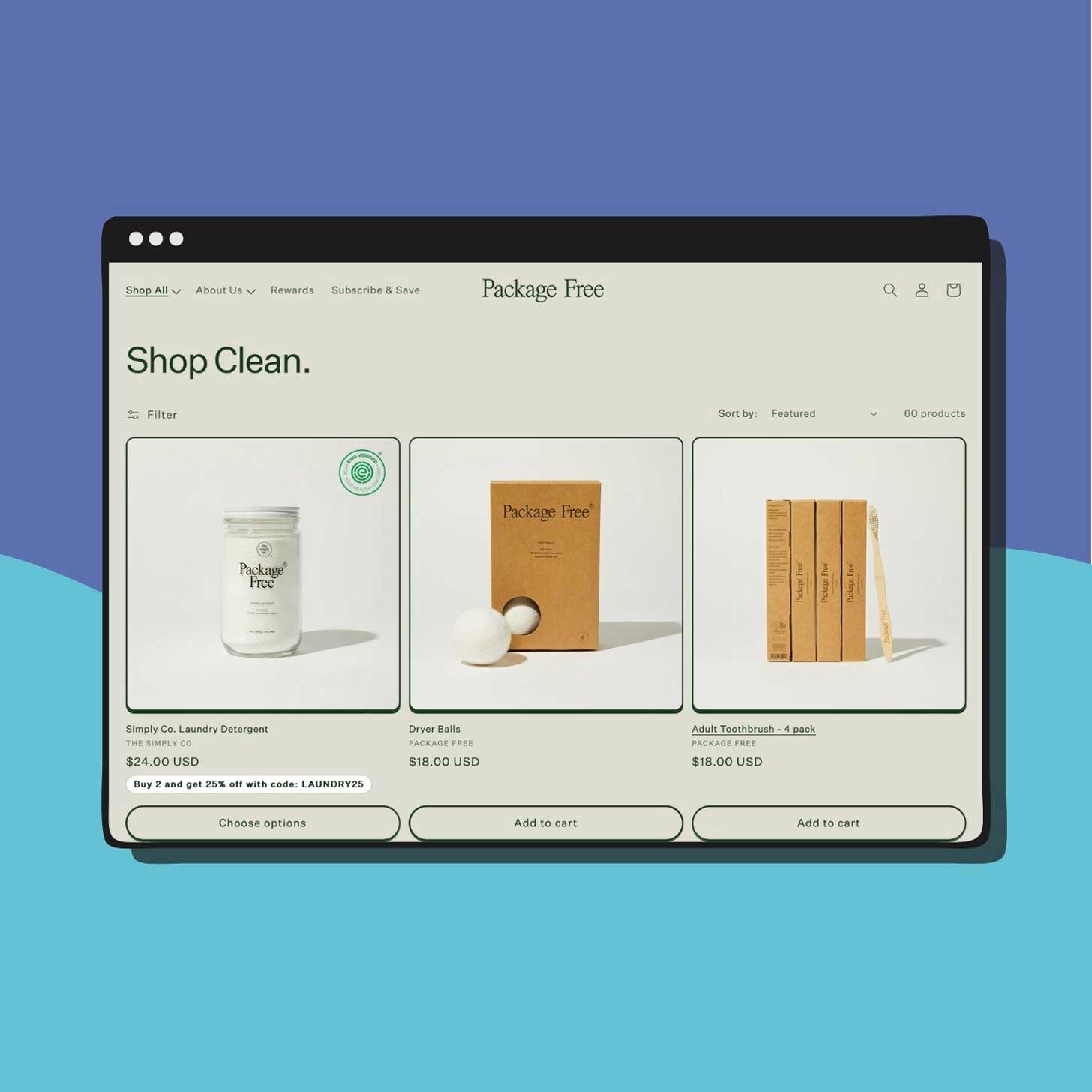
Why It’s Better Than Amazon: Package Free Shop is an online marketplace committed to helping shoppers find the most sustainable versions of the items they use daily.
Additionally, Package Free’s shipping materials are 100% plastic-free (making the company’s name very fitting). The retailer also donates to like-minded organizations and touts policies and principles that are thoughtful to both people and the planet.
You can also set up “Subscribe & Save” orders through Package Free, just like you might on Amazon.
Thrive Market

Category: Grocery, household, and personal care
Why It’s Better Than Amazon: On Thrive Market, you can become a Member for roughly $5-$12/month (depending on if you pay annually or monthly) and easily do all your shopping through its site.
Our editors found that it’s easier to shop here because you don’t have to think as hard about your shopping decisions, knowing that a majority of the brand’s offerings are already aligned with your values. It also eliminates a lot of grocery trips, with everything you need showing up in one weekly shipment.
Thrive Market works to ethically source all of its products, ensures that 90% of waste in its warehouses is recycled, composted, or reused, and offers carbon-neutral shipping in sustainable packaging. The company is also a certified B Corp.
Hive
Category: Grocery and personal care
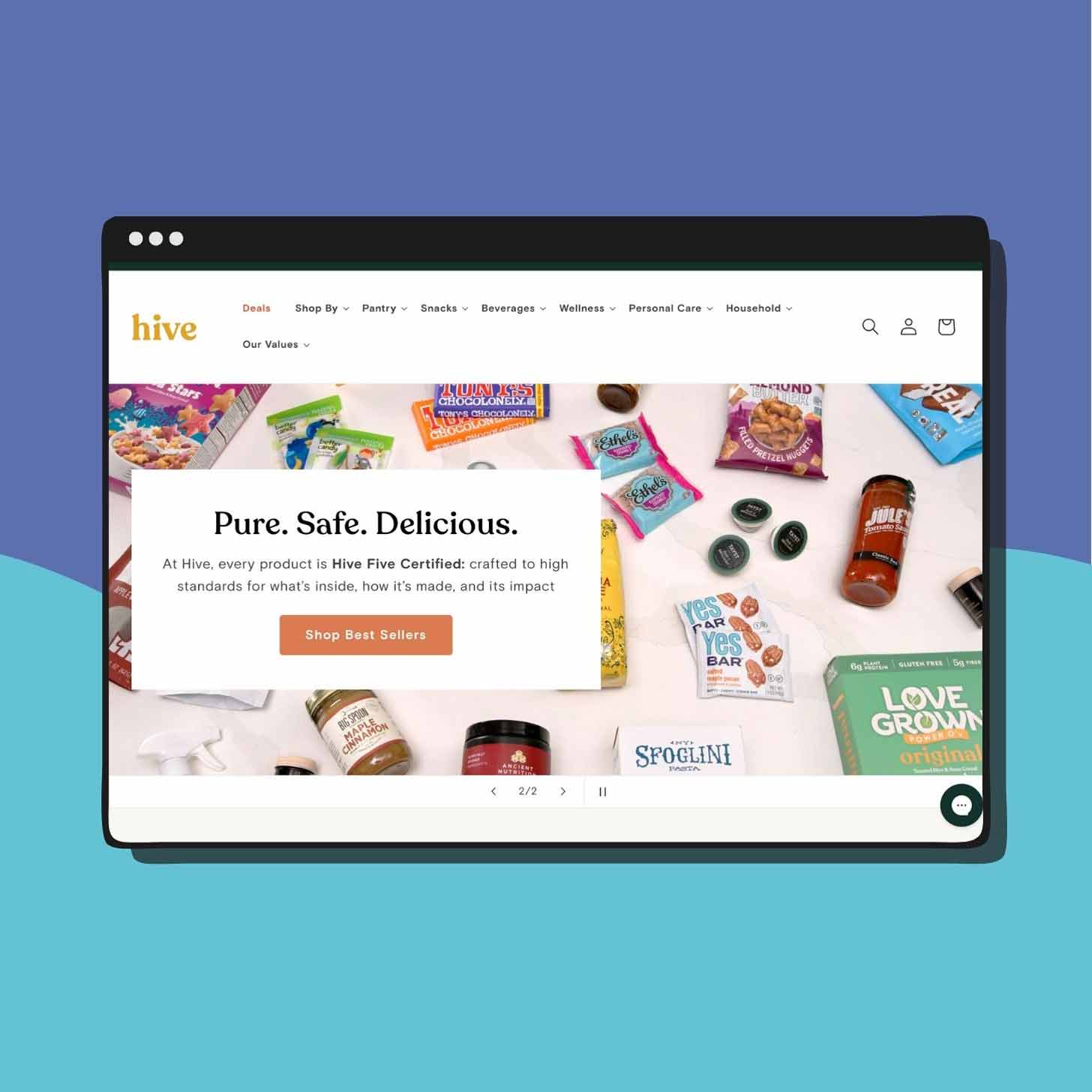
Why It’s Better Than Amazon: Hive is an online grocery marketplace that sticks to five core values: Ingredient integrity, responsible production, clean packaging, leading change (like social and industry impact efforts), and “raveworthy” quality. Each product page details which of these criteria are met — as well as how and why.
Hive also has a robust recycling guide for the various kinds of packaging you might encounter in your grocery products, like cans, cartons, and more. Hard-to-recycle items can be processed through TerraCycle — Hive will even send you a prepaid envelope to do so!
Misfits Market

Category: Grocery
Why It’s Better Than Amazon: Misfits Market is an online grocer that makes high-quality food more affordable and accessible and helps break the cycle of food waste.
By working directly with farmers and food producers, the brand “rescues” food that is still perfectly good to eat, saving shoppers up to 40% compared to traditional grocery options (like Amazon delivery or ordering through Whole Foods).
They also offer other pantry staples, wine, and grocery items and do not require you to pay a set subscription fee. Once you sign up, you can access the items offered in the market and add as few (as long as you meet the $35 order minimum) or as many items as you’d like.
→ Check out our full review of Misfits Market
Grove Collaborative
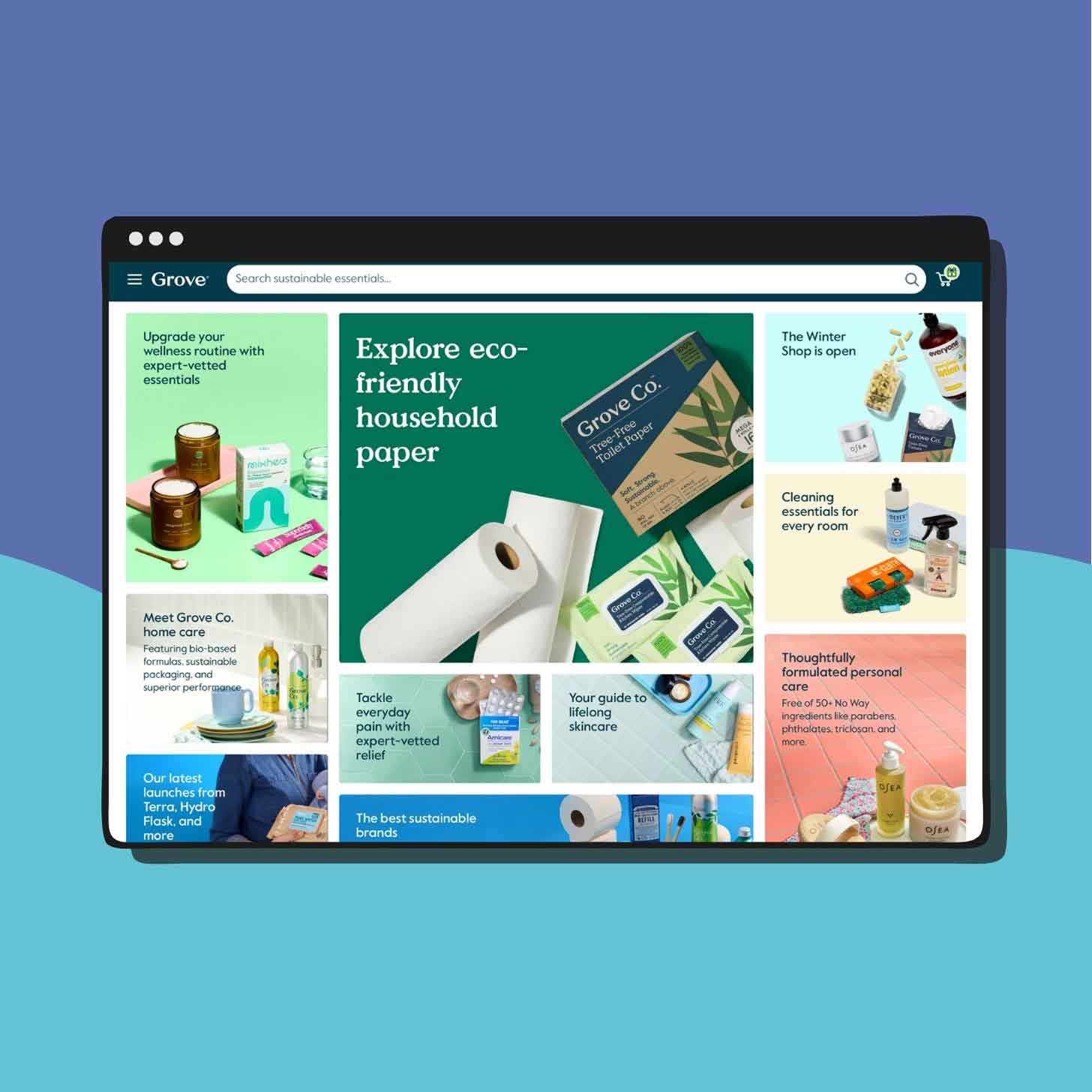
Category: Cleaning, personal care, and pantry staples
Why It’s Better Than Amazon: Grove Collaborative takes the ease of shopping for home essentials on Amazon and makes it ethical. The site exclusively offers products that meet all four of the brand’s core values: uncompromisingly healthy, beautifully effective, ethically produced, and cruelty-free.
The Grove Collaborative site (and app) makes it easy to order products and get regular refills shipped at an appropriate cadence. The company will never sneakily charge you for a new shipment without letting you know (three times) first.
Plus, all of Grove’s shipments are carbon neutral, and it’s also a certified B Corp.
Blueland
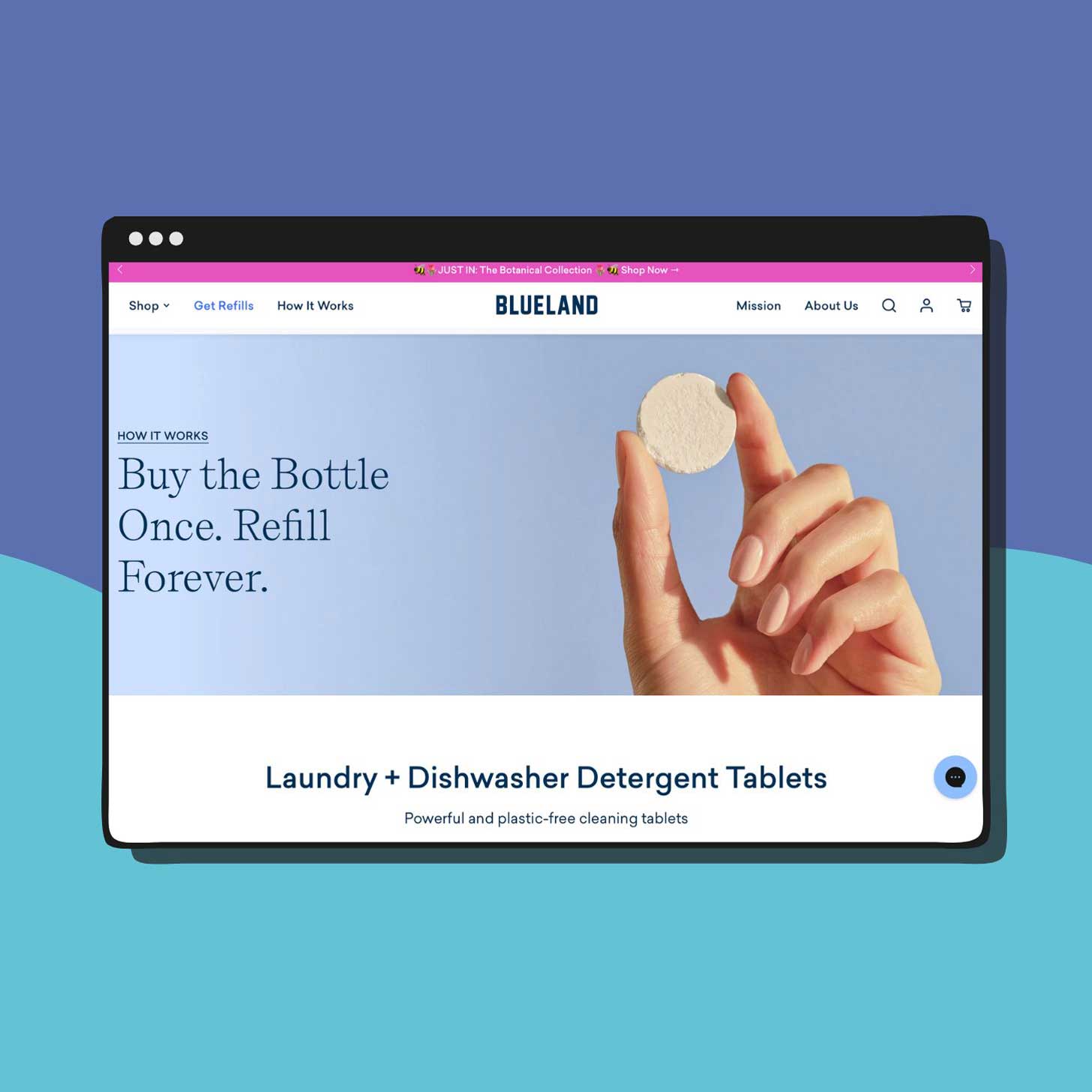
Category: Refillable soaps and cleaners
Why It’s Better Than Amazon: Instead of buying pre-packaged cleaning products and soaps, Blueland offers refillable hand soap, as well as dish, laundry, bath, and spray cleaners.
After purchasing a Starter Kit, shoppers can buy refill tablets and powders, which are packaged in industrially compostable packaging. (Plus, the lightweight packages minimize shipping emissions!) Its cleaners are made with safe ingredients and come in classic scents, and shoppers can get a discount when they buy their refills in bulk.
Blueland is also a B Corp and certified cruelty-free by Leaping Bunny. Additionally, the brand works with Black-owned businesses and partners, makes diversity a priority in every hiring decision, and gives all team members paid time off for political and civic engagement. (This is in addition to Blueland’s own policy work to reduce single-use plastics on state and federal levels).
BLK + GRN
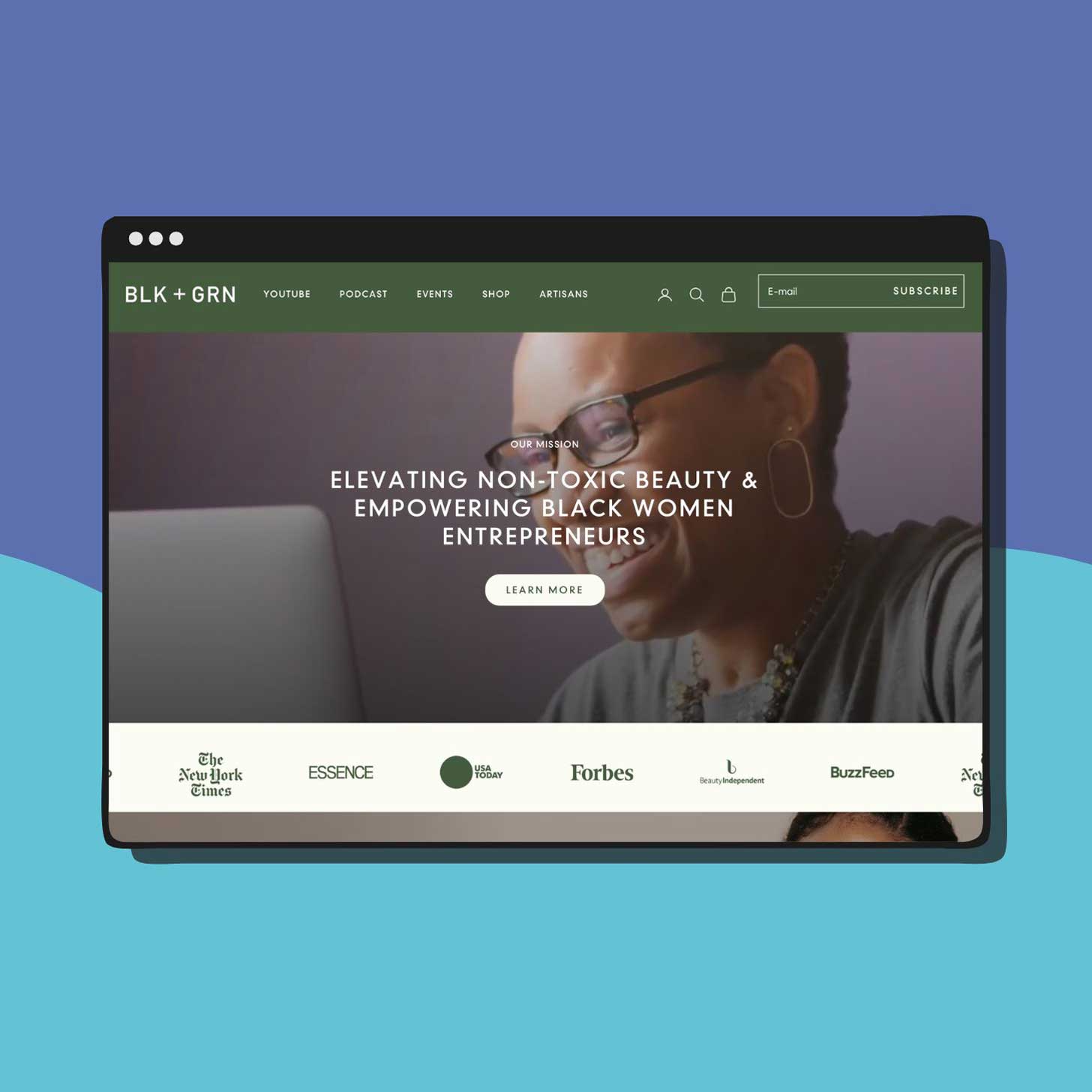
Category: Health and beauty
Why It’s Better Than Amazon: BLK + GRN is a marketplace that aims “to normalize access to non-toxic products targeted to Black women” and “to fund Black women entrepreneurs who create non-toxic personal care products.”
BLK + GRN ensures that none of the products listed on its site include harmful ingredients like parabens, petroleum, coal tar, heavy metals, or any of the others on its “Toxic Twenty” list. Plus, the company uplifts Black artisans, who are chosen by Black health experts, and makes it easy to support Black-owned businesses.
Additionally, all products on BLK + GRN’s site go through a rigorous vetting process.
Credo

Category: Health and beauty
Why It’s Better Than Amazon: Credo created The Dirty List and The Credo Clean Standard to define products that don’t use ingredients that are linked to cancer, hormone disruption, allergies, environmental harm, and toxins.
Its online site only sells products that align with these standards — so it’s an easy way to cut down on the amount of time you spend researching the products you buy.
Additionally, Credo has created a Pact Program to make it easy for shoppers to drop off their hard-to-recycle beauty product packaging and “recycle your empties” in order to earn reward points and reduce waste.
EarthHero

Category: Sustainable home goods, gifts, kitchen supplies, and more
Why It’s Better Than Amazon: EarthHero’s goal is to make sustainable shopping simple — and it lives up to that mission. Every product on EarthHero’s site goes through its “proprietary 5-Step Sourcing Methodology.”
Additionally, EarthHero is a certified B Corp, a member of 1% for the Planet, and allows you to filter and shop by values like Vegan, Plastic-free, LGBTQ+ Empowering, Made in the USA, Black-owned, and more.
Public Goods

Category: Home goods, health and beauty
Why It’s Better Than Amazon: Public Goods sells body, home, and cleaning products in bottles made from 100% recycled, post-consumer plastic, sources biodegradable alternatives to single-use plastics, and sources tree-free materials for all paper products. Additionally, every shipment is carbon offset.
Whether you’re shopping for body soap and shaving cream, or floor cleaner and coffee filters, Public Goods carries eco-friendly options for all shoppers. A membership of $49 a year will get you 20% off all of your purchases, and free shipping on orders $45 or more — or you can just shop the list price.
Public Goods also works with Eden Reforestation to restore healthy forests, planting over 363,000 trees to date. The brand also donates all of its near-expired food products to partnering nonprofits to help people facing food insecurity.
Readers can take 15% off their Public Goods order with code GOODGOODGOOD15.
Bookshop.org
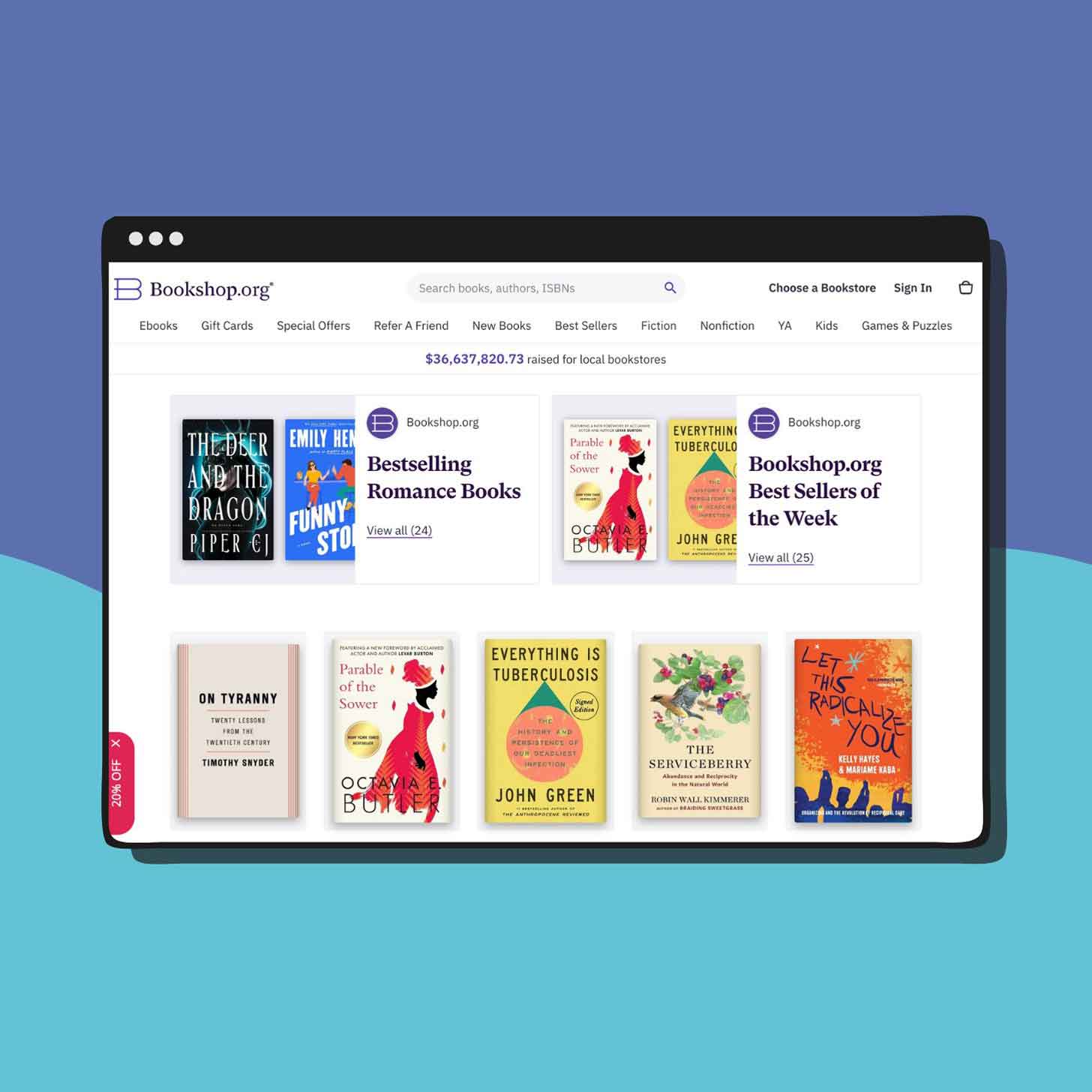
Category: Books
Why It’s Better Than Amazon: Bookshop is hands-down the best way to ethically buy books online. Its website is easy to use, it makes discovering your next great book simple, and most importantly, every purchase supports an independent bookstore of your choosing.
According to Bookshop, “Amazon sells over 60% of all books in the US and is growing. That shift threatens the future of bookstores and will hurt readers, authors, and publishers who rely on a diverse, healthy ecosystem for books.” Its founders created Bookshop to allow book lovers to shop online and do good at the same time.
Bookshop is also a B Corp and Climate Neutral certified.
→ Looking for more online bookstores that aren’t Amazon? Explore our guide.
Libro.fm
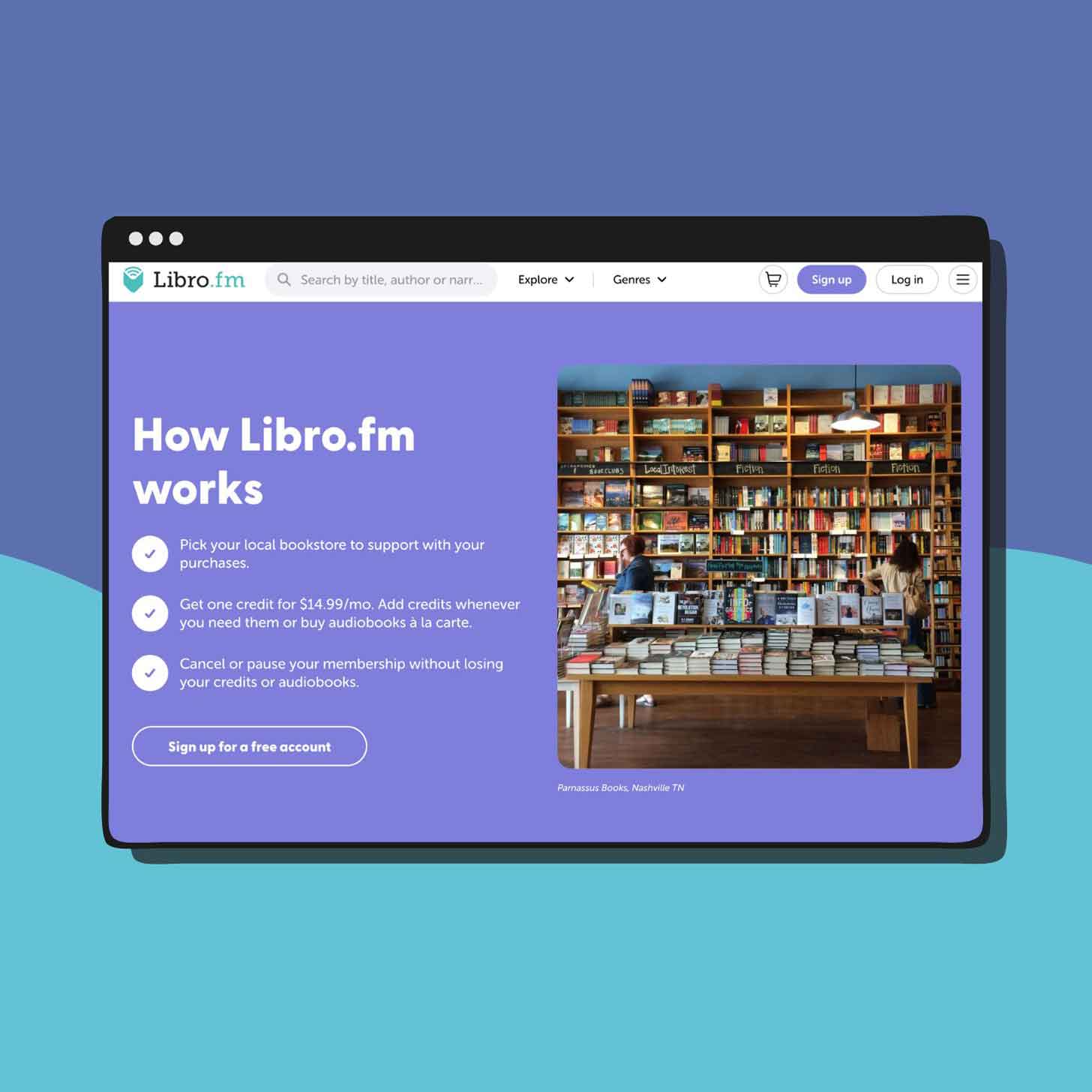
Category: Audiobooks
Why It’s Better Than Amazon: Libro.fm is the ethical version of Audible (which is owned by Amazon). Like Audible, Libro.fm has an easy-to-use app, a $15 monthly membership cost, and operates on a “credits” model.
But unlike Audible, every time you download an audiobook, you directly support the independent bookstore of your choosing (instead of a trillion dollar corporation).
Libro.fm also does a great job pointing shoppers to audiobooks from diverse and underrepresented authors. Plus, they’re a Social Purpose Corporation, committed to serving readers and bookstores above all else.
→ Looking for more Audible alternatives for audiobooks? Explore our guide.
Kobo
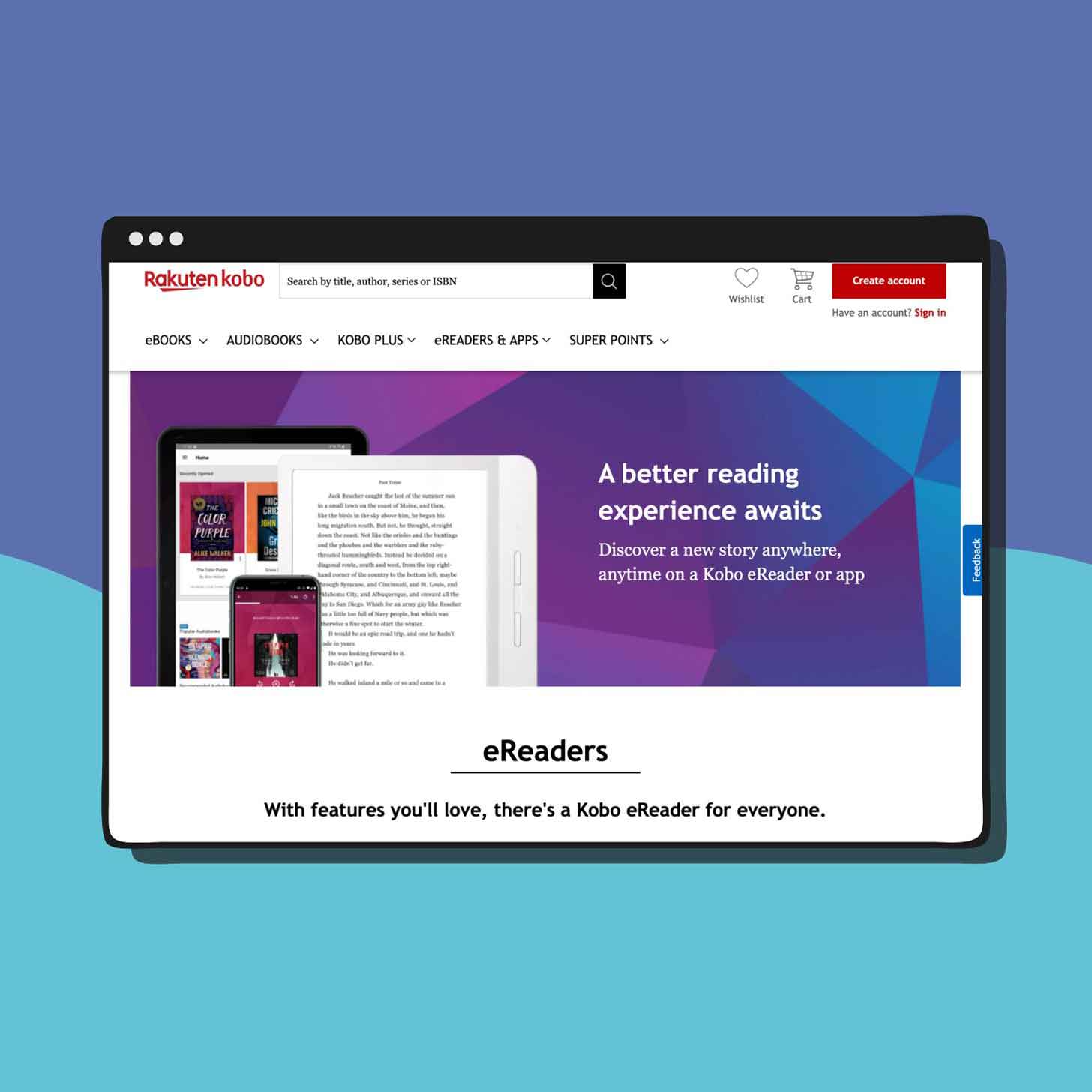
Category: E-books and e-readers
Why It’s Better Than Amazon: Looking for a Kindle alternative? Rakuten Kobo is a much more environmentally friendly option. Plus, you can still shop from a huge library of e-books, or pair your device with your OverDrive account to download books from your local library, just like you might on a Kindle.
Kobo offsets 100% of the carbon emissions associated with shipping their e-readers. Plus, Kobo offers a free mail-in recycling option for when your e-reader has reached the end of its lifespan. The Kobo Clara 2E model is also made with recycled plastic!
→ Check out our full review of Kobo e-readers!
BackMarket

Category: Tech
Why It’s Better Than Amazon: BackMarket is a global marketplace where you can purchase refurbished tech, from smartphones and laptops to gaming consoles and home appliances.
While you can purchase used items on Amazon, BackMarket is a certified B Corp and has a rigorous vetting program to make sure the tech you purchase has been tested and restored to perfect working condition. Plus, the company has diverted an estimated 1.3 million metric tons of carbon emissions since its inception in 2014.
According to BackMarket, a refurbished smartphone uses 91.3% less raw materials, 86.4% less water, generates 89% less e-waste, and puts 91.6% less carbon emissions into our atmosphere compared to brand new. Plus, refurbished tech is an average of 70% cheaper than new products.
Who Gives A Crap
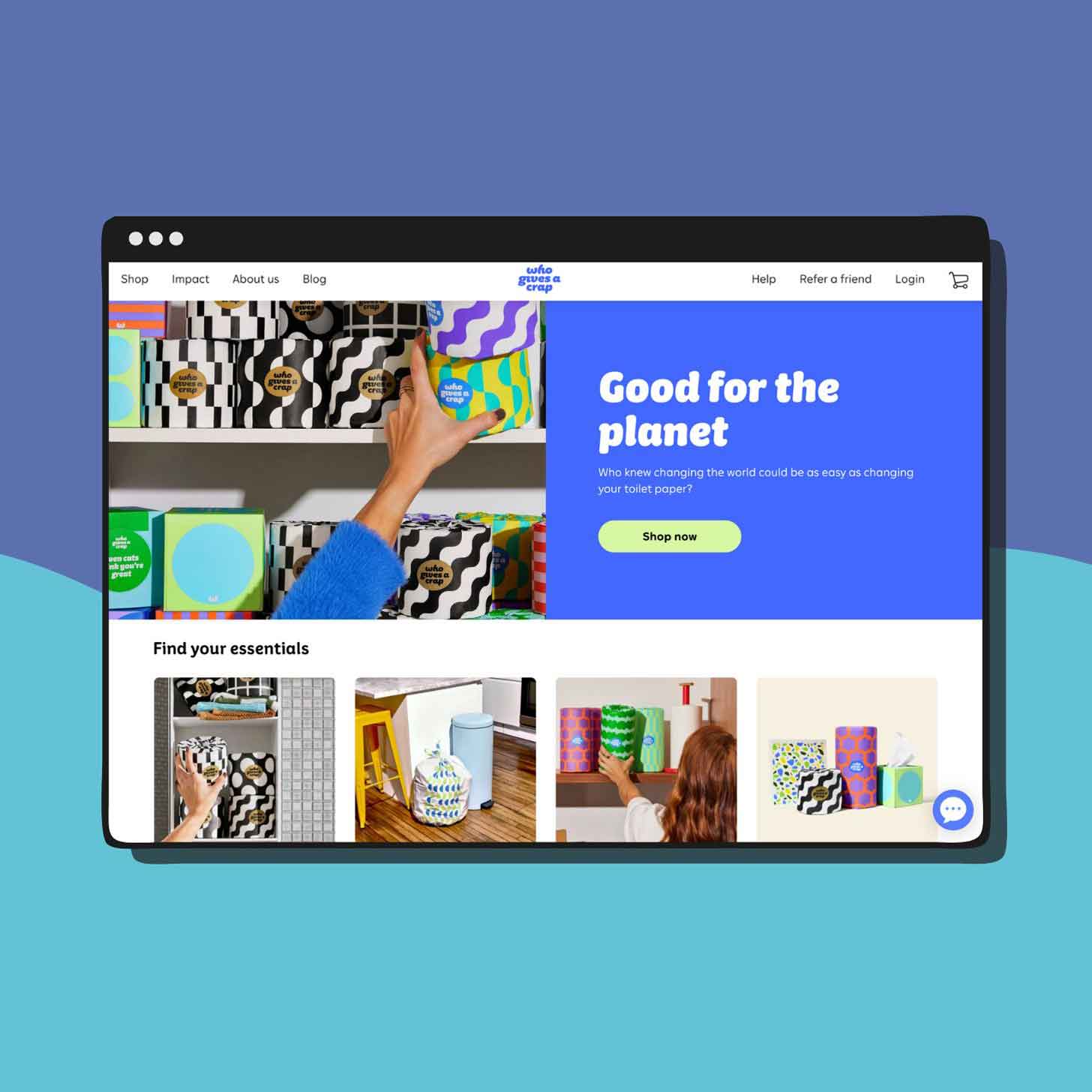
Category: Paper goods
Why It’s Better Than Amazon: With essentials like toilet paper, paper towels, trash bags, tissues, and more, Who Gives A Crap has all of your daily cleaning goods without any ethical dilemmas. Paper products are made with bamboo or recycled paper, and waste bags are made with recycled plastics or compostable materials.
As a B Corp, Who Gives A Crap donates 50% of profits to clean water and sanitation initiatives around the globe. So far, they’ve donated over $9.5 million to help people access vital services.
Plus, Who Gives A Crap uses electric vehicles for delivery, partners with Pachama to ensure its shipping is carbon neutral, and its warehouse is powered by solar panels that, yes, spell “crap.”
Customers can also choose subscription options to save on recurring orders.
Chewy
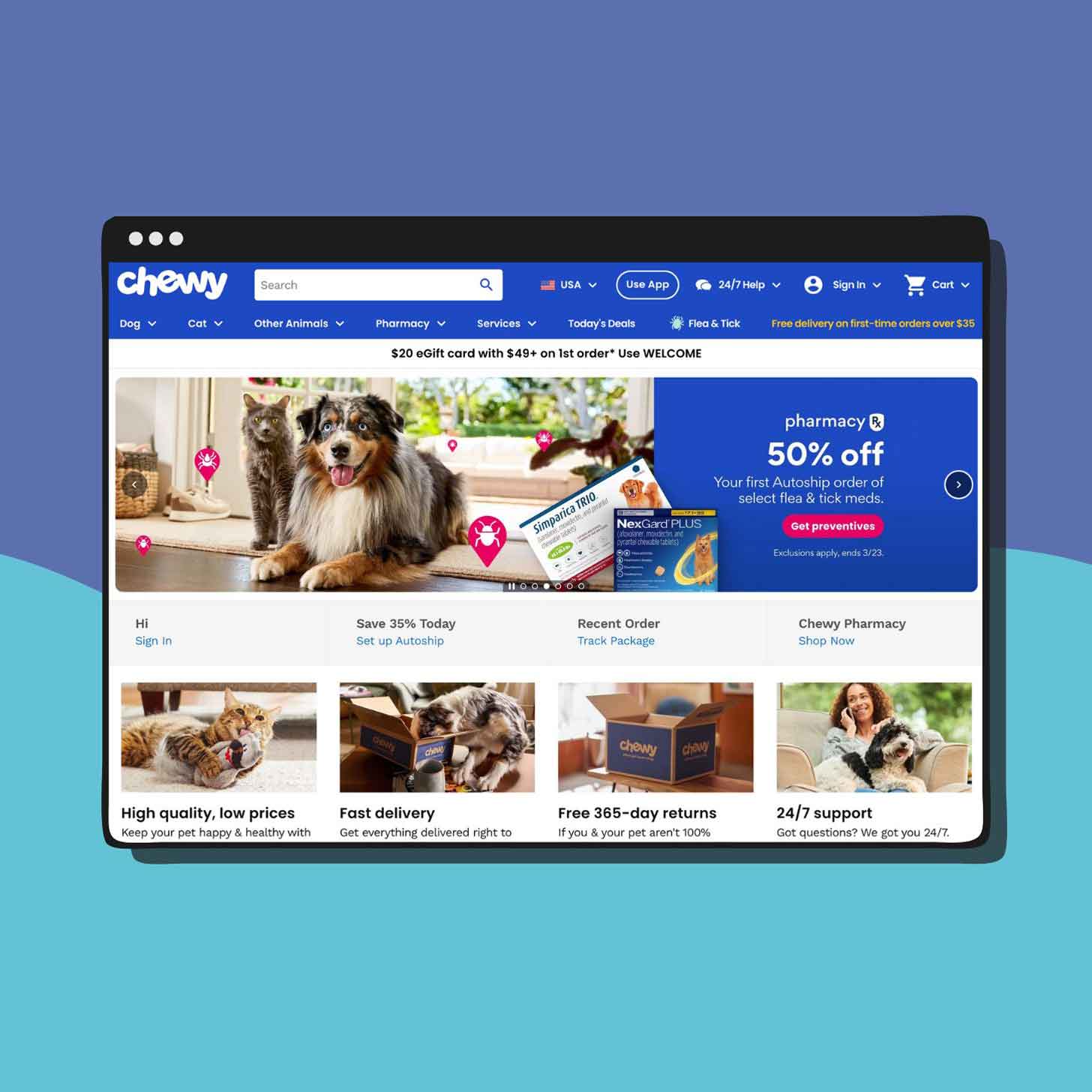
Category: Pet care
Why It’s Better Than Amazon: Carrying over 3,500 pet care brands, Chewy is the go-to marketplace for all of your furry friends’ needs. With easy subscription options, free and fast shipping on orders over $50, and a reputation for incredible customer service, Chewy beats out the competition (ahem, Amazon) any day.
Plus, since 2012, Chewy has donated more than $183 million in products for shelter and rescue animals. They partner with shelters and rescues in all 50 states, help facilitate pet adoptions, and make it easy to donate to shelters.
While Chewy does not appear to have any specific sustainability initiatives, the marketplace features a variety of eco-friendly pet products.
Uncommon Goods

Category: Gifts, home goods
Why It’s Better Than Amazon: Uncommon Goods is passionate about discovering creative and unique goods from all over the world while uplifting independent makers and merchants.
The site divides products up to make it easy to shop for eco-friendly products, goods from Black makers, or from women-owned businesses. You can also become a Perks Member and receive free and fast shipping.
Uncommon Goods is a founding B Corp and donates $1 for every purchase you make. Plus, their products have always been leather, feather, and fur-free.
Etsy

Category: Unique gifts, handmade items, and custom products
Why It’s Better Than Amazon: Rather than giving your money to big corporations, every Etsy purchase is an opportunity to support an individual creator or entrepreneur. It’s also a perfect place to find the next cool thing that’s not yet available anywhere else.
Etsy uses 100% renewable energy for the power used by its data centers, global offices, and its remote employees — plus, the company offsets carbon emissions on all shipping and packaging.
eBay

Category: Basically everything
Why It’s Better Than Amazon: When you choose to buy a used product (whether it’s tech, clothing, furniture, or whatever else) on eBay, you’re extending the life of that product and ensuring nothing new needs to be manufactured. Selling things you’re no longer using offers the same benefits. (We listed eBay as one of our favorite “online thrift stores.”)
In addition to making it easy to buy second-hand products and extend the life of products you no longer use, eBay also supports two initiatives that give back.
eBay for Charity allows sellers to donate all or part of their proceeds to a charity they care about. It also makes it easy for buyers to shop with sellers aligned with their values.
The eBay Foundation supports nonprofits that “address and remove barriers to entrepreneurship for people who identify with historically excluded groups.” The foundation has granted more than $76 million since 1998.
Good.Store
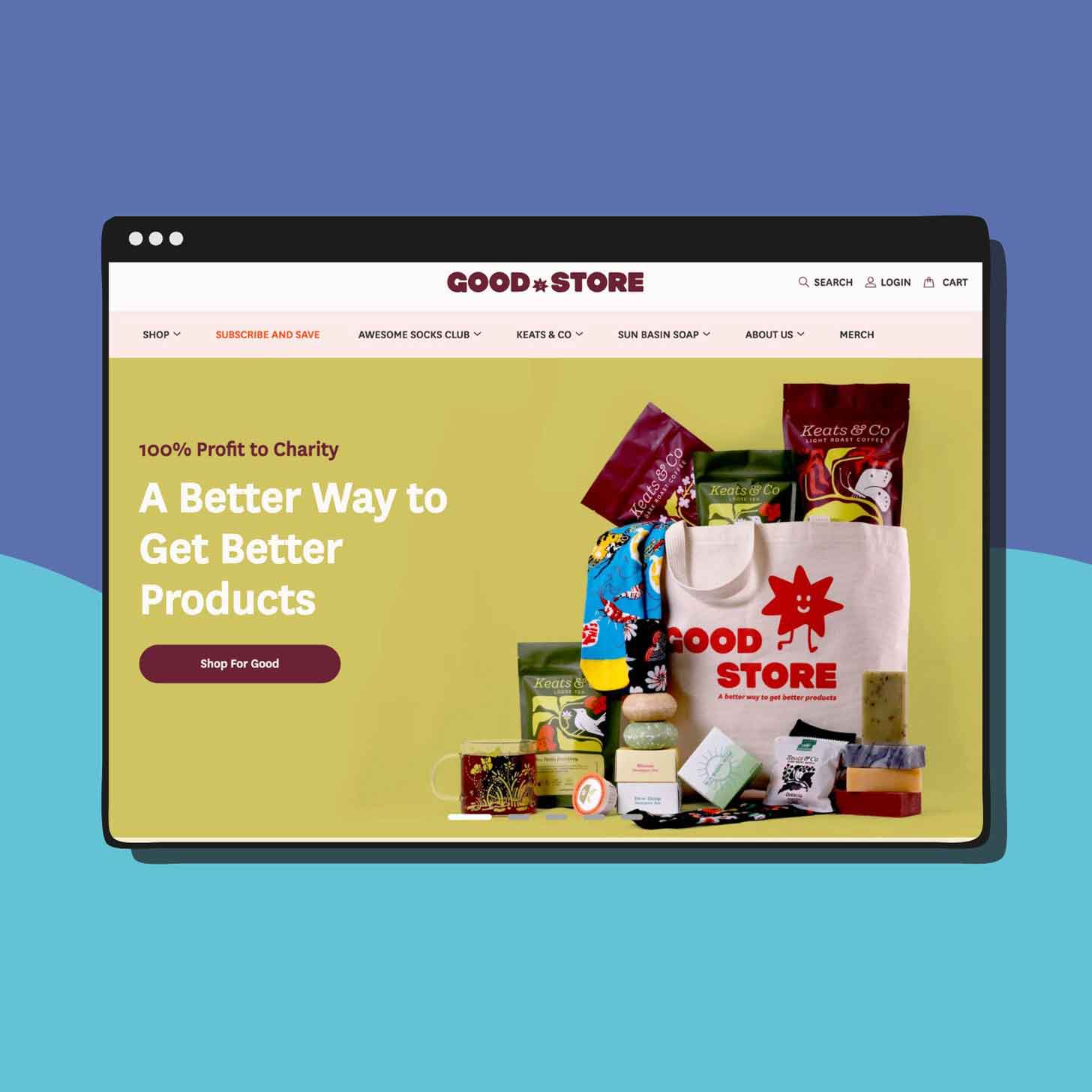
Category: Coffee, tea, soap, eco-friendly cleaning supplies, personal goods
Why It’s Better Than Amazon: Created by internet philanthropists John and Hank Green, Good.Store sells everyday items with 100% of proceeds going to charity. With soaps, teas, coffee beans, socks, and other accessories, the shop is the perfect place to find gifts or set up monthly subscriptions.
All purchases benefit Partners in Health, a global nonprofit that improves healthcare equity in low-income areas worldwide. As of February 2025, over $9.7 million has been donated by Good.Store purchases.
Good.Store also recently launched an eco-friendly cleaning supplies line, with all profits benefiting coral reef restoration.
Readers can take 10% off their Good.Store order with code GOODGOODGOOD.
→ Learn more about Good.Store!
Ten Thousand Villages
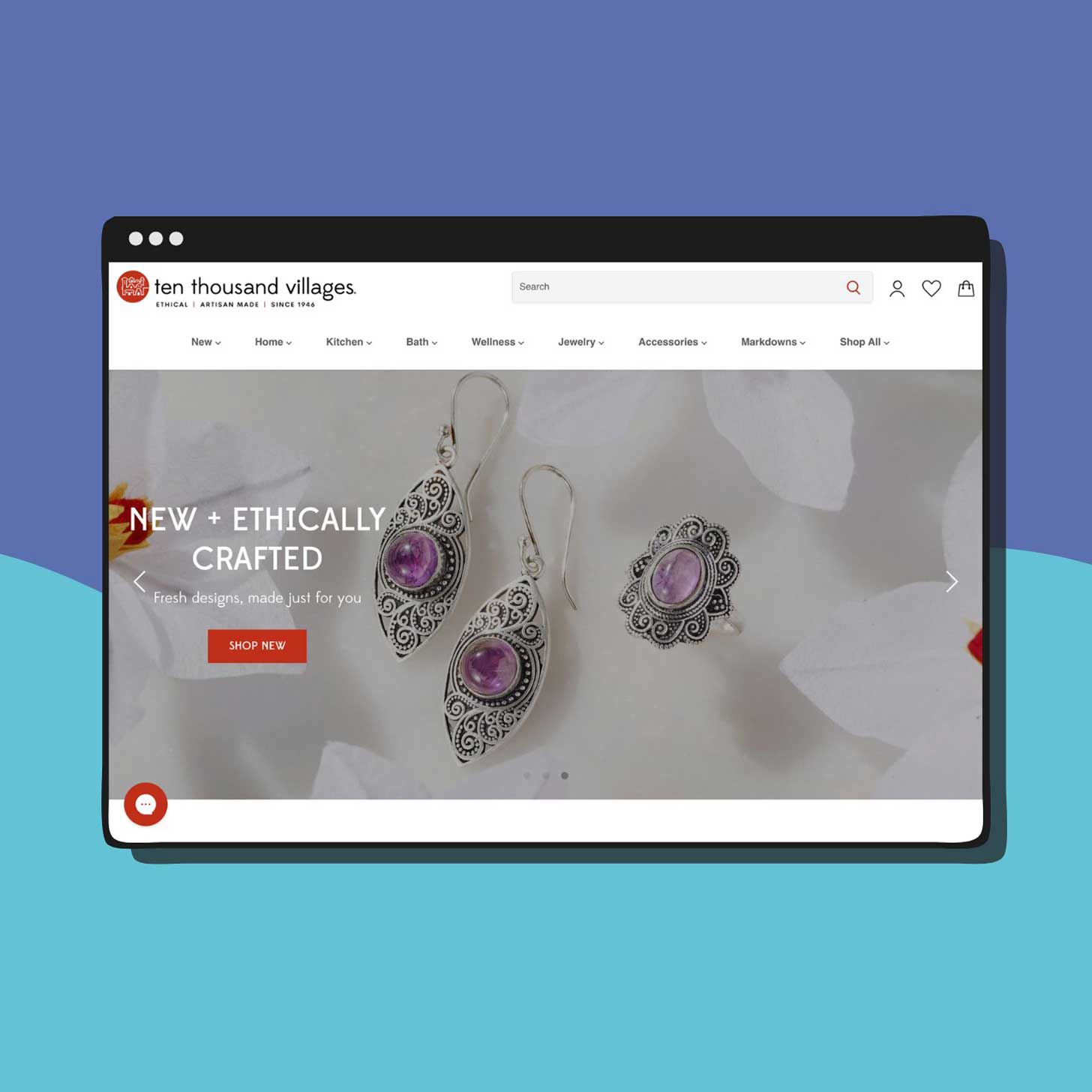
Category: Artisan-made gifts and accessories
Why It’s Better Than Amazon: Ten Thousand Villages celebrates craft and culture by bringing the work of global makers to the online marketplace.
As a Fair Trade company, it pays all its artisans a living wage in safe work conditions. The company’s name comes from inviting shoppers to join in its work to empower makers in (now, way more than) ten thousand villages.
DoneGood
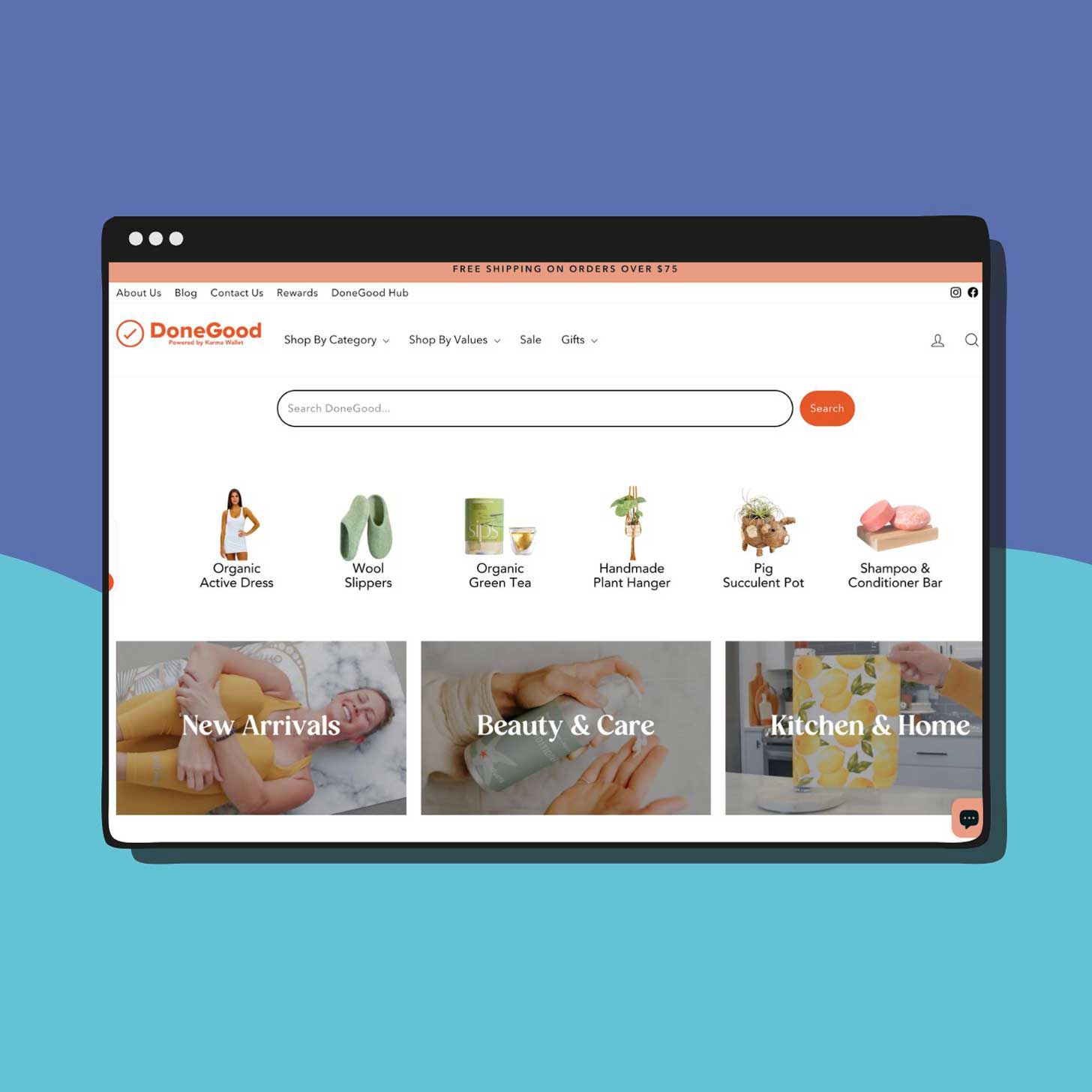
Category: Gifts, clothing, accessories
Why It’s Better Than Amazon: DoneGood is an ethical marketplace with over 120 ethical brands, doing the work to make sure every purchase you make does good for people and the planet.
The brand (a creation of its parent company Karma Wallet) is B Corp certified and a member of 1% For The Planet. All brands that appear on the marketplace are pre-vetted for sustainable values and ethical business practices.
Shoppers can sort products by category or by value, making it easy to support small businesses that empower workers, are women-owned, cruelty-free, and more.
NOVICA
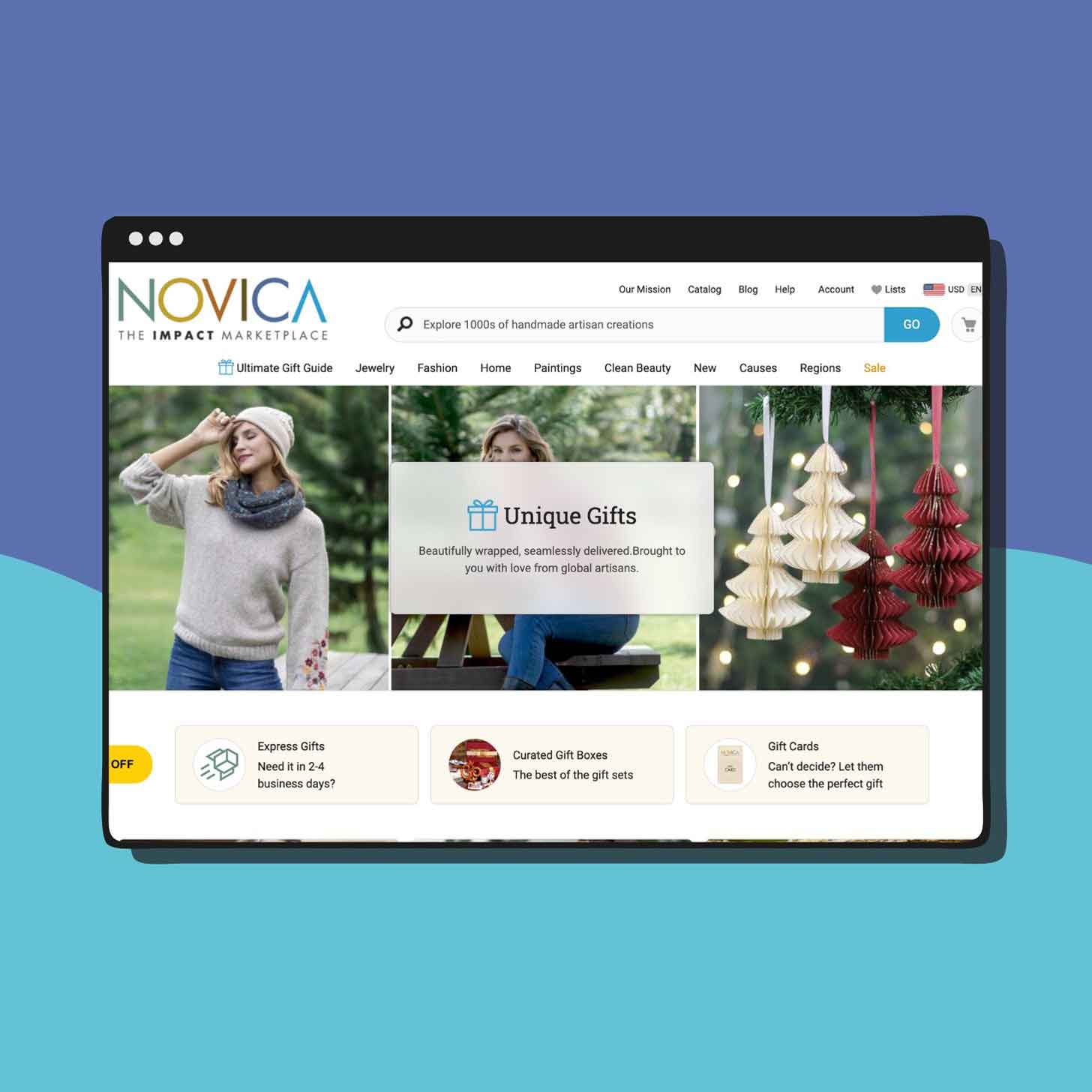
Category: Artisan-made gifts and home goods
Why It’s Better Than Amazon: Describing itself as “the world’s largest impact marketplace,” NOVICA sells products handmade by talented artisans from around the world.
NOVICA is a certified B Corp, is a proud part of the Fair Trade movement, allows you to support a cause as you shop, and supports the work of global artisans. Every purchase helps artisans support families, uplift communities, and overcome adversity.
More Guides to Amazon Alternatives


Mountain gorillas — an endangered species — survive in only two regions in the world: the Virunga Massif (a chain of volcanoes in East Africa) and Uganda’s Bwindi Impenetrable National Park (located in south-western Uganda in the Kanungu District).
After being on the brink of extinction, mountain gorillas population has almost doubled in size thanks to conservation efforts. Since mountain gorillas live primarily in forests in high altitudes, protected reserves exist in order to ensure they do not fall prey to traps, snares, poachers, and deforestation, as well as other threats to their livelihoods and wellbeing.
According to the World Wide Fund for Nature, the mountain gorilla population in 1989 was estimated to be as low as 620 total and they were expected to be extinct by the millennium.
Since then, countries where mountain gorillas reside — Rwanda, Uganda, and the Democratic Republic of Congo — have been working to conserve and protect these magnificent creatures.
Every five years, the WWF aids conservationists and organizations to census the populations of mountain gorillas by working with the International Gorilla Conservation Program.
This allows the people working with gorillas to get a good idea of gorilla numbers and see if conservation efforts are working to improve the population.
The censuses undertaken by these countries, with the support of wildlife conservation organizations, are huge collaborative efforts that involve the Protected Area Authorities in the Democratic Republic of Congo, Rwanda, and Uganda, civil society organizations, and research institutions.
Beginning in 1902— when mountain gorillas were first discovered by mankind— their numbers have been steadily declining and they were placed on the endangered species list.
But since conservation efforts have increased, the last few censuses conducted by these countries have demonstrated that the population of mountain gorillas in both national parks are steadily increasing.
"In the Virunga volcanoes, where an isolated group of mountain gorillas live, the population rose from roughly 380 in 2003 to approximately 480 in 2010 — a 26 percentage increase in 7 years."
In the Virunga volcanoes, where an isolated group of mountain gorillas live, the population rose from roughly 380 in 2003 to approximately 480 in 2010 — a 26 percentage increase in 7 years.
There was also roughly a 32 percent increase In Bwindi Impenetrable National Park when the population increased from around 302 in 2006 to an estimated 400 in 2011.
The population living in Uganda's Bwindi Impenetrable National Park, and the adjacent Sarambwe Reserve in the Democratic Republic of the Congo, has increased to 459 individuals.
"The overall total population of mountain gorillas is now over a thousand, at 1,063."
Combining these numbers with the gorillas living in the Virunga mountain range of Rwanda and Congo, the overall total population of mountain gorillas is now over a thousand, at 1,063
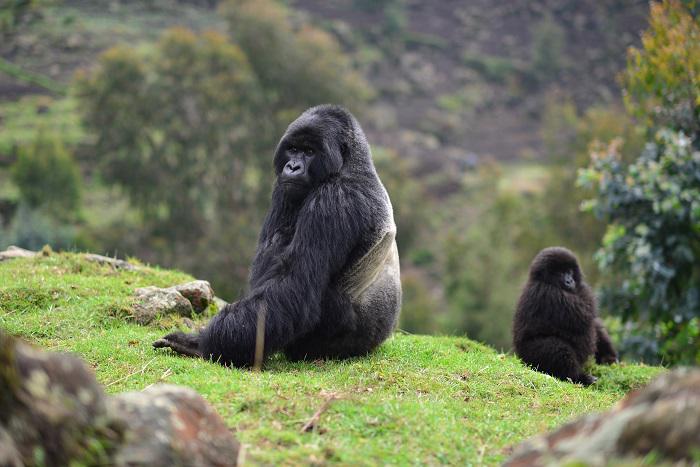
“Mountain gorillas are one of the most protected species on the planet,” Dr Tara Stoinski, president, CEO and Chief Scientific Officer of the Dian Fossey Gorilla Fund, said.
“Today we see what a concerted effort by multiple stakeholders can do to reserve a seemingly hopeless situation. It takes hard work by community members, government leaders, and conservationists — but it can be done.”
This is incredible news for conservationists around the world (and those who support them through advocacy, donations, and more).
The rise in mountain gorilla numbers shows that by working together towards a common goal, no matter how big or how small, real change can be enacted, and the results are quickly visible. It also demonstrates that conservation has a bright future — and that more species can be saved.
On her most recent stay at Coffee Creek Correctional Facility in Wilsonville, Oregon, 45-year-old Adria White knew that she needed more than a drug treatment program.
She was up for release soon, and while that program, which she’d participated in twice before, included useful tools like mindfulness training and behavioral therapy, it did little to prepare her for getting a job on the outside.
“You learn coping skills,” says White, who became dependent on methamphetamines at around age 30. “But when you get out and you’re poor and struggling, that doesn’t solve your life problems.”
So when her cellmate told her about Lettuce Grow, a sustainable gardening program that takes place at 16 Oregon prisons and juvenile detention centers, she signed up, hoping the skills she’d gain would help her land a job at a nursery or start a community garden in her hometown.
Though she had zero prior gardening experience, White, it turns out, has a green thumb. Soon she was digging her hands into the small garden plot on the medium security side of the prison, planting mainly flowers and herbs.
“I spent a lot of hours out there — as many as I was allowed. I fell in love with my plants. There’s a bond,” she says. Dahlias became her favorite flower. “They are fast and they are so eye-catching!”
She also loved the aroma of the herbs — particularly lavender and sage — and shared them with others. “Women started rubbing lavender on their Covid masks,” she laughs.
One of the privileges of the gardening program is that participants are permitted to go outside when the yard isn’t officially open.
“I was like, ‘This is cool. I can go outside and no one is out there!’” she says. Over time, her gardening work became more than just a chance for some limited freedom from confinement. It grew into a full-fledged passion.
White was scheduled to take the next sustainable gardening class in September, right after she’d moved to minimum security, but the entire prison was evacuated due to wildfires.
When prisoners and staff returned to the facility, a Covid outbreak resulted in a lockdown that barred all visitors including the Lettuce Grow staff and volunteers.
“As a precaution we had provided the class with the text books and class materials, just in case we got shut out,” says Lettuce Grow director Rima Green. White, undeterred, worked her way through the class materials on her own.
“That’s no mean feat,” emphasizes Green. The curriculum, from Oregon State University’s Extension Service, is a college-level class.
Green and staff were finally allowed back into Coffee Creek in March, and got to know White as they gardened with her, side by side.
Green was so impressed by White’s skills and determination that she hired White, who was released in May, to be a part-time employee at Lettuce Grow, which is a program of the Portland-based nonprofit Growing Gardens.
In her new job, White is doing office work such as correspondence, surveys and coordination with volunteers.
Other graduates of the Lettuce Grow program have gone on to find jobs at Portland Nursery, a family-run garden center with two locations, and other horticultural-related businesses in Oregon.
Lettuce Grow was founded by attorney and master gardener Sarah Van Roo in 2009 with 15 incarcerated people in two Oregon prisons. Van Roo’s original intent was to improve the nutritional quality of the meals served to residents, some of whom she’d befriended while teaching yoga at Coffee Creek.
In 2015, Lettuce Grow merged with Growing Gardens, which promotes food security by building gardens at schools and in residents’ backyards.
Today, 11 years later, Lettuce Grow serves 200 incarcerated people in Oregon each year, providing them with valuable job skills and a respite from the drudgery of prison life.
Those enrolled in the program are able to take classes like the Oregon Food Bank’s Seed to Supper class, Oregon State University’s Sustainable Gardening class and an advanced Greenhouse Management class.
Because participants cultivate a vegetable garden on site, Lettuce Grow also gives prisoners access to healthy, delicious food, like fresh-from-the-garden tomatoes, spinach, snap peas, kale, lettuce, summer squash and broccoli.
In 2020, even amid the pandemic, the State Corrections system grew 365,536 pounds of food. Some 97 percent of that went into the institutions’ kitchens. (The rest was delivered to food banks across the state.)
This total does not include the produce grown in federal prisons in Oregon like the one in Sheridan, where residents harvested 100,000 pounds of food in 2020, all of which was consumed at the prison cafeteria.
But the program’s most impressive data may be that which shows participants have just a four percent recidivism rate — the national average at state correctional systems, according to the Bureau of Justice Statistics, is 68 percent within three years.
White was hired as a prison gardener when she moved to the minimum security facility within Coffee Creek. When she got there in September, the garden had seen better days due to staffing shortages and one uncooperative correction officer.
“It had been neglected, with the quarantine and the fires,” she says. “And the voles!” Despite being a menace to the garden, the voles became popular with the gardeners, who gave them names and treated them like pets.
Meanwhile, White spent so much time weeding that at night she dreamt she was pulling weeds. She was paid $50 per month for four 40-hour weeks — a very small sum, but one that is fairly typical for what incarcerated folks earn.
There’s a lot of creativity at Coffee Creek’s minimum security garden. One woman has designed a “Three Sisters” garden of corn, beans and squash. Another used flowers to recreate the album cover of Pink Floyd’s The Dark Side of the Moon. White grew flowers and herbs, and with other gardeners harvested vegetables and fruits for Coffee Creek’s cafeteria. That was probably the most rewarding part of the job, White says.
“When we got the fruits and vegetables on the trays, every single woman was grateful. You could hear every woman talk about it. They would tell us thank you,” she says. “I also had people come up to me throughout the day while I was working and say how much the garden means to them — how seeing the flowers, having a place to sit down and see something natural instead of cement and barbed wire were good for the soul.”
Coffee Creek currently has about 800 residents, all of whom are women. At the cafeteria, the lines were always longer in summer, when the women knew that the garden’s abundance would show up on their trays. The tomatoes were the most popular item.
“In prison, they don’t ever serve tomatoes,” says White. “Some people — especially if they were lifers — when they got fresh organic tomatoes on their tray, it was an overwhelming sensory experience. There is a lot of emotion in eating a fresh tomato when you haven’t in ten years.”
For White, the garden had the added bonus of soothing her anxiety.
“I’m kind of reclusive. Being social is challenging for me,” she says. “I thought, ‘I’ll never be able to get a job, I’m so weird in public.’”
But gardening, of course, is a solitary pursuit, and White says getting better at it gave her confidence and made her realize that she can do something to make money. The first thing she did after being released this May, she says, was plant a garden at her daughter’s house.
“Every time I get anxious, I go into the garden,” she says. “The transition from prison life can be really tough. For me, to have something positive — something new to keep my mind busy until I have my perspective back — that has been huge.”
Unsurprisingly, the pandemic had a big impact on the program. None of Lettuce Grow’s 32 volunteers statewide were able to visit the facilities for months, and a number of the sustainable gardening and greenhouse management classes were cancelled.
At some sites, classes were conducted by members of the prison staff or even by incarcerated tutors themselves. At facilities like Coffee Creek — which had a number of lockdowns — there were no classes.
Everything White learned while in minimum security was from getting her hands dirty and from gleaning tips from fellow gardeners, or from Green and Mirabai Collins from Lettuce Grow, who were finally allowed in in March
But with vaccination rates increasing in Oregon prisons — at press time the prison vaccination rate was 71 percent, higher than the statewide rate — some facilities are starting to pilot face-to-face visitations, and Green is hopeful that volunteers will soon be allowed back in.
For White, learning how to garden has been nothing short of transformational.
She’s already found another gardening project to sink her hands into — she recently stumbled upon a community garden near her daughter’s house that was overgrown and neglected.
When she called the number for the volunteer organizer, the fellow who answered said he’d moved to California. Would she like to take it over?
White accepted the task, and is now eager to get in there and start weeding. She envisions a zen garden with lots of flowers.
“I want it to be a healing space,” she says. “It creates a healing energy instead of stress.”
This story is part of the SoJo Exchange from the Solutions Journalism Network, a nonprofit organization dedicated to rigorous reporting about responses to social problems. It was originally published by Reasons to be Cheerful.
Community colleges across the country are leveraging federal coronavirus relief dollars to forgive student debt accrued during the pandemic, a move some administrators hope will stanch continuing enrollment declines at the two-year institutions.
The money, available through both the Coronavirus Aid, Relief, and Economic Security Act and the more recent American Rescue Plan Act, allows eligible colleges to wipe out student debt and provides grants directly to students in need. At El Paso Community College in Texas, for example, administrators last week cleared more than $3 million in debt for roughly 4,700 students using CARES Act funding, then encouraged eligible students to apply for additional financial aid via allocations from ARPA.
“Students have been adversely affected by the pandemic and we want them to be able to stay on their path to completing their degree," Keri Moe, the college’s associate vice president of external relations, communication and development, said in a statement. “We want to help students find the resources to emerge from the pandemic, regain financial stability and to be able to continue to pursue their dreams."
Other two-year colleges have announced similar measures. Connecticut State Colleges and Universities, a 17-campus system with a mix of two- and four-year colleges, said last week it would forgive $17 million in debt that community college students “took on or could not repay because of the pandemic.” The policy will impact more than 18,000 students, with no strings attached and no requirement that recipients enroll in classes in the future.
“Community college students have been hit especially hard by Covid-19,” Terrence Cheng, the system’s president, said in a statement. “By eliminating the debt those students owe to institutions, we are removing a hurdle that prevents far too many people from continuing their educational journeys.”
Enrollment Still Falling
Enrollment at community colleges has suffered throughout the pandemic, with numbers continuing to slide despite widespread vaccine availability. Spring enrollment at two-year institutions nationwide declined by 9.5% this spring, with roughly 476,000 fewer students than the same time in 2020, according to National Student Clearinghouse data released last month. Among all institutions of higher learning, community colleges accounted for more than 65% of undergraduate enrollment losses, according to the data.
The continuing decline is a concern for community colleges, which typically see enrollment increases during recessions as unemployed workers return to school to learn new skills. But the pandemic proved difficult for traditional community college students to weather, as many come from low-income backgrounds, are first-generation learners and often attend school while juggling work and dependent care—all populations that were disproportionately affected by Covid-19.
“They lost jobs, suffered food insecurity, and lacked access to vital services—to say nothing of the devastating harm caused to those afflicted with the virus,” Dr. Jane Gates, provost and senior vice president of academic and student affairs at Connecticut State Colleges and Universities, said in a statement. “It is no wonder that so many students saw the debt they owed to our colleges pile up.”
Technical colleges in Madison and Milwaukee, the Community College of Philadelphia and Bergen Community College in Paramus, New Jersey, have also announced plans to use federal dollars to cancel debt. In most cases, students’ accounts are wiped automatically, with no application process or other action necessary.
“Financial concerns often present the most significant barrier to earning a college degree—especially given the pandemic’s effect on the finances of our students,” Eric M. Friedman, president of Bergen Community College, said in a statement. “By erasing past-due tuition, students can return...to continue their path to a degree without debt hanging over their heads.”
Four-year colleges have also utilized relief money to erase debt, including Delaware State University, South Carolina State University and Wilberforce University, all Historically Black Colleges and Universities.
“This is a tremendous weight I won’t have to carry,” Romaun Myers, one of more than 2,500 South Carolina State students to have debt cleared, told the university in a statement. “I’m a first-generation college student, one of the only boys on my mom’s side of the family. I have to make it so I can provide for my family.”
This story is part of the SoJo Exchange from the Solutions Journalism Network, a nonprofit organization dedicated to rigorous reporting about responses to social problems. It was originally published by Route Fifty.
We created this post in partnership with Moon March to share the behind-the-scenes of the creation of the all-new Good Good Good site.
When Good Good Good launched in 2015, we always knew that our goal was to reach as many people as possible with real good news (not just feel good news). Over time, our team and audience grew, but our mission of finding the helpers — and inspiring new ones — never changed.
When the time came to expand our work beyond social media and our print Goodnewspaper to a content-forward website, we wanted to find a creative agency that aligned with our values and had deep experience building enduring brands.
Enter Minneapolis-based Moon March: A creative agency that partners with causes, campaigns and companies that are creating a better future.

This year, Good Good Good has been working with Moon March to transform our website into a robust online magazine.
We’re truly so excited about the impact this site will have in our mission to help people feel more hopeful and do more good. And we’re proud of the creative journey Moon March took us on to get to this point.
With Moon March’s expertise, we were able to achieve our objectives:
- Help people feel more hopeful — enable the website to be the primary source for our community to find good news in the midst of the heartbreak, pain, and injustice of the world.
- Help people do more good — enable our website to be a trusted resource for how to make the most meaningful impact across a variety of important topics and current events.
- Don’t just tell people what kind of good news we care about — actually showcase it through our content.
- Bring more people into the Good Good Good community — attract the right people. We reach the most inspiring and impactful people in the world and we want everything we share to help attract more of this special kind of person, and to provide value to their lives so they can continue moving the needle for good.
“What I liked about Moon March is that they had an interesting perspective and angle that I thought was really compelling. And they focus on brands doing good.
Their empathy and understanding of mission driven companies really brought out that value. They really understood what we were about even when we weren't fully successful at communicating it.”
— Branden Harvey, Founder of Good Good Good
About Moon March:
Prior to starting Moon March, Josh Chambers had 10 years of marketing and entrepreneurial work under his belt - including an award winning financial tech startup. He ran strategy for large agencies in New York and worked with clients like Reebok, Viacom, Ninja Turtles, Google, Advil, Puma, and more.
Josh’s experience as an entrepreneur, coupled with running global brands, gave him a clear vision of what kind of agency he wanted to run and what clients he wanted to help achieve their goals. Like Good Good Good, Josh wanted to create change in the world for the better — and now he’s working with companies who are doing just that.

You can get to know Josh on a personal level in our podcast episode with him about navigating change as an opportunity for growth. Josh is also an executive coach and an expert in walking the challenging road between one stage of life and the next.
“I build teams around specific projects and have a SWAT team approach. So sometimes the project can be about fifteen people — sometimes it's three people — but it's only ever people that have at least ten years of experience, and they're the best at what they do.”
— Josh Chambers
Identifying the need for a new website with Moon March:
Prior to beginning the design process, we worked on how to best communicate exactly what Good Good Good does so our website can be clear for our new audiences.
During this process, Moon March:
Helped us set a clear goal for the website:
We knew what we wanted to do with the website, but Moon March knew best how to get there. “If you had any chance of competing with other magazines, it needed to read and feel like a magazine,” said Josh. “Good Good Good needed to stop looking like a marketing site, but also needed to not look like a blog. it needed to be comparable to print and everyone in print has a legit online magazine presence.”
Gave honest feedback about our growth opportunities:
During the appraisal period, Moon March helped us identify what wasn’t working about our messaging on our old site. “As an empathetic outsider, Josh was able to understand and communicate our core values better than we could at the time — and that was one of the big reasons why I knew that this would make for a great partnership,” said Branden.
Established the foundation for the brand:
In order to build a website for Good Good Good, Moon March had to really understand us and help solidify our brand strategy — and that started with a lengthy interview process. “The first thing that I did was I talked to Branden for four hours,” said Josh. “Why did you start this? Where did it come from? What's worked, what hasn't worked? I take that and I condense that into about six or seven sentences, which becomes the foundation for our brand moving forward.”
Gathering the components for the website:
After establishing our goals for the website, the next stage Moon March walked us through was making a collaborative plan for building out the design.
Here’s what Moon March did to prepare the actual work:
Decide the key features:
Much like finding the ingredients for a meal, the team at Moon March was able to identify what we needed on the website to communicate our brand. Together we looked at content based sites (digital media websites like Mother Jones, Supermaker, etc) to see what attributes aligned with Good Good Good.
- Make good news shareable. The world needs more good news - and we wanted the site to be easy to screenshot, share on social media, and send to friends.
- Look good while we do good. Gone are the days of impact-driven brands sacrificing aesthetics. We knew this site needed to be beautiful.

Understood our audience:
Good Good Good didn’t want a website for just anyone; we wanted a space for people who are looking for real good news and ways to make a meaningful difference. This helped Moon March design a site that spoke to people who are changemakers or changemakers-to-be.
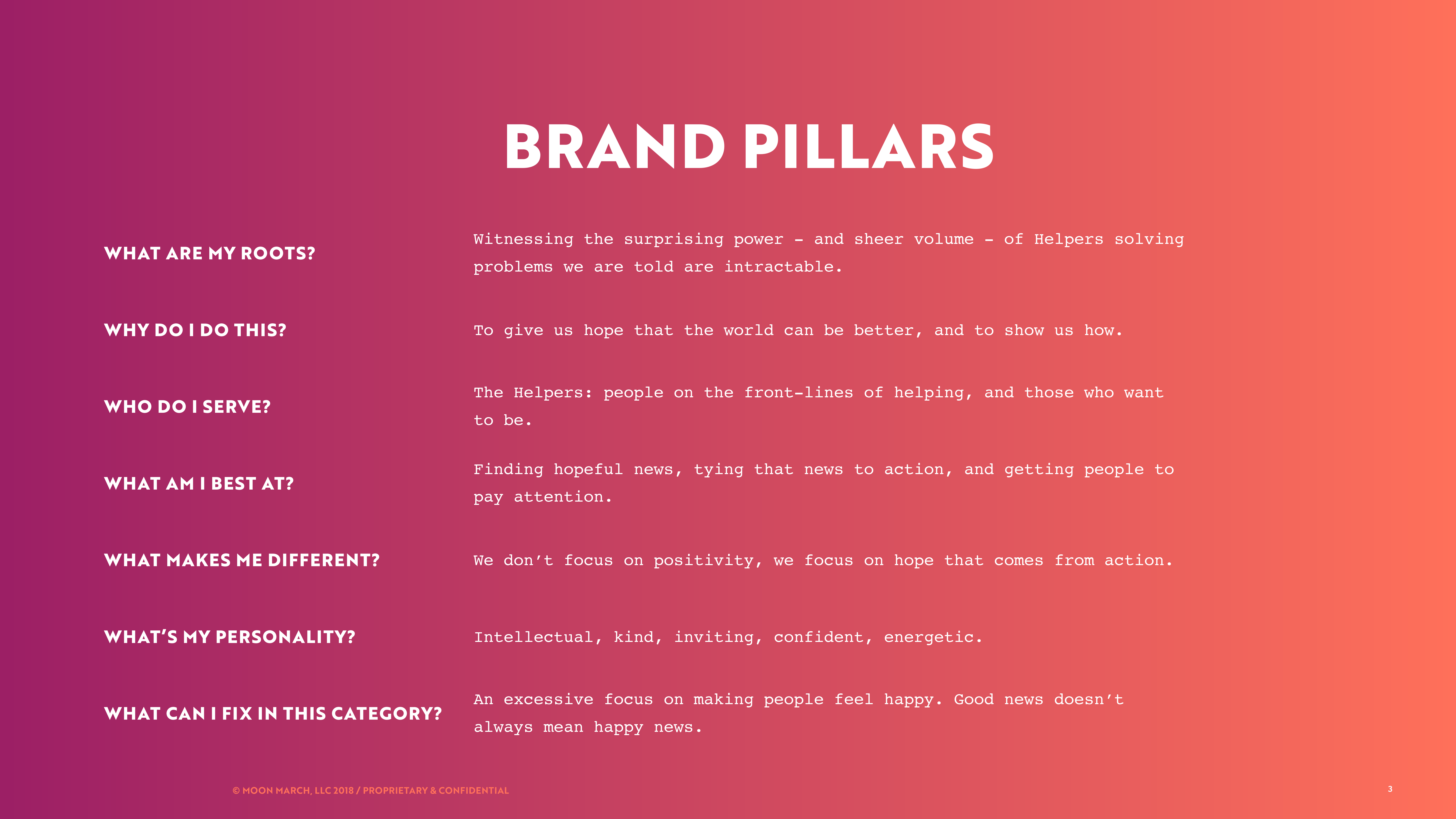
Over the finish line with Moon March:
One of the many unique benefits of working with Moon March is how it was a step by step process; the team worked with us so we were included in decision making. By keeping an open line of communication, we understood exactly why they were doing what they were doing and why it was best for Good Good Good.
This is what Moon March did:
Chose a vibrant color palette:
We wanted the aesthetic of the website to be bold, like the people who create change in the world. “When I landed on this color palette, it felt like something that illustrations could mix beautifully with,” said Josh. “It's a nice base. I wanted to keep this blue in this purple reserved for mostly typography. And especially because this is a magazine, the color shouldn't overpower anything.”

Paid attention to the little things:
No detail is too small with Moon March. For example, they added round corners to the design of our site so it would feel more friendly — and they were right.

Prioritized accessibility:
We relied on their expertise to ensure that the Good Good Good website would be user-friendly to all users. From the typeface to the color scheme, the team at Moon March helped us to support all users in navigating the new website.

Thanks to the brains over at Moon March, the new Good Good Good website is everything we imagined and more. Their willingness to work with us on bringing our vision to life — while lending us their expertise on how to best do that — was crucial in creating a website that felt authentic and true to Good Good Good.
For more information on how to work with Moon March, visit moonmarch.com or email them at hello@moonmarch.com
Running is often touted as one of the most accessible sports there is — in theory, you need zero equipment, just your body (hey, some people run barefoot). It doesn’t cost anything, and you can do it anywhere. Its low barrier to entry means nearly anyone can try it.
While running is, by nature, a solo sport, it’s also one of the most community-centric sports because many people choose to join a running group or train together. And because it’s open to all skill levels, the running community is just as diverse as the people in it.
The runners profiled below all use running as a platform to build community and fight for justice — for both people and the planet.
Get to know these 7 impact-driven runners and running groups you should follow on Instagram:

Alison Mariella Désir
Désir is an activist, speaker, author, and mental health advocate who uses running as her vehicle for change. She founded the New York-based running group Harlem Run and Run 4 All Women, an initiative that has raised over $150,000 for Planned Parenthood and $270,000 for Black Voters Matter.
She’s the co-chair of Running Industry Diversity Coalition, which seeks to make the running industry more equitable and inclusive — and has helped raise $230,000 to date for the 2:23 Foundation, a nonprofit that was formed to pursue justice for Ahmaud Arbery, the Black man who was killed in 2020 while jogging.
Alison is currently working on a book, “The Unbearable Whiteness of Running,” out October 2022. She’s been featured by Under Armour, Shape, Vogue, and Women's Running named her one of the "Power Women of 2021."
Running To Protest
After getting chased from a protest by the police, co-founder Coffey (who goes by his last name only) turned his usual easy run into a marathon. Now Coffey, a Brooklyn-based filmmaker, writer, actor, and activist, is leading hundreds through New York’s boroughs in search of racial justice. Running To Protest is a movement led by runners protesting monthly with dialogue, running, and meditation.
The first event took place on June 14th, 2020 when 700 runners met at the East River Amphitheater in Manhattan, New York, wearing masks on their faces and clad in white clothing. They were running in response to the reckoning on white supremacy and racial violence that had spread around the United States. Hundreds of runners flooded the bridges and streets of New York at this event and those to follow, demanding justice for Black people.
Clare Gallagher
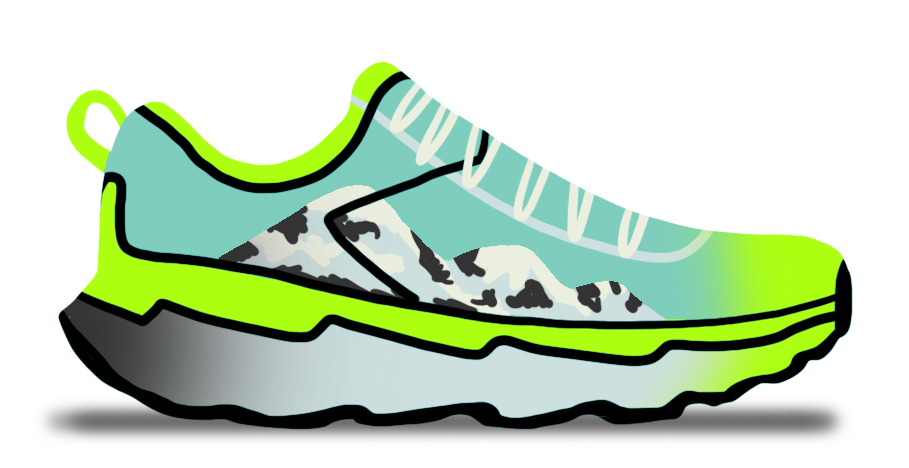
Boulder-Colorado-based endurance athlete and environmental advocate Clare Gallagher studied ocean health at Princeton University before becoming a professional runner in 2016. She’s the co-founder of Protect Our Winters, a climate advocacy organization and has testified at Colorado’s state capitol on air quality and renewable energy bills.
She’s sponsored by Patagonia, Petzl, La Sportiva, and Honey Stinger. She is an ambassador for Winter Wildlands Alliance.
Faith E. Briggs
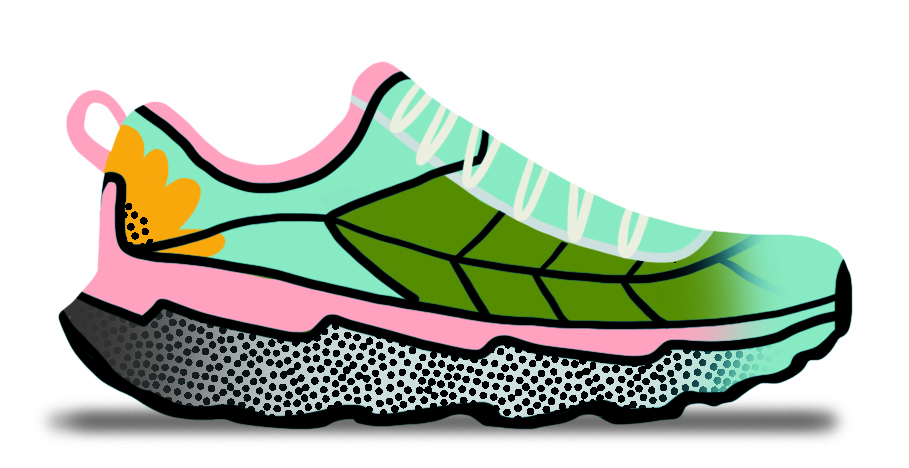
Briggs is a runner, environmental advocate, filmmaker, and creative producer passionate about representation. She produced and is featured in the documentary “This Land,” which explores the impact of shrinking public land through the lens of running and inclusion. She launched a podcast about the project in March.
She writes about how she got to know Portland, Oregon through running and how running has helped her understand the region's complicated yet continuous fight for equity and inclusion.
“I think the best way to fall in love with a city is through running,” she told Runner’s World. “In Portland, hard conversations around gentrification and houselessness are as much a part of this city as the parks, bike lanes, and quirky restaurants filled with amazing food and incredible people. That dissonance, and the desire to find common ground, is a huge part of this city.”
Runners for Public Lands
Runners for Public Lands is an inclusive running community dedicated to environmental justice, advocacy, and conservation. The Ventura, California-based organization is passionate about equitable access to nature, climate, public lands, and green space advocacy, and hands-on conservation work.
The volunteer-led organization launched on Earth Day in 2019 and collaborates with environmental organizations and corporate partners to educate runners on environmental issues and help runners transition from individual environmental awareness to collective environmental stewardship.
Jordan Daniel
Daniel is a Los Angeles-based Indigenous runner, community organizer, and activist who founded the activist organization Rising Hearts. She combines her love of running and wellness with her calling to help those who are often overlooked in our society, including BIPOC people, the LGBTQ+ community, and people with disabilities.
“[Running is] now paving the way for our next generations of native youth and athletes,” Daniel told the Girl Soup blog in 2020. “It's an incredible platform and tool — it's a great opportunity to have these discussions, to give visibility to the things that you are most passionate about.
Vasu Sojitra
Sojitra, who self-identifies as a disabled person of color and Indian-American, is an athlete and disability access strategist who “uses #ninjasticking to bring intersectionality to the outdoors.” When he was only nine months old, Sojitra was diagnosed with septicemia, resulting in the amputation of one of his legs. When he summited the Grand Teton in 2014, his friend coined the term “ninja sticks” for the crutches he uses while running, skiing, skating, and in everyday life — and it’s stuck ever since.
He’s the first adaptive athlete for The North Face, a founding member for The Outdoor F.U.T.U.R.E Initiative, the co-founder of Inclusive Outdoors Project, and a disability access strategist for The Avarna Group, In Solidarity Project, and independently.
This story originally ran in The Sports Edition of the Goodnewspaper. The Goodnewspaper is our monthly print newspaper filled with good news.
You can join thousands of subscribers who get access to more exclusive stories like these, our private community space, a free inspiring poster, and so much more. Become a subscriber today.
When John McAvoy was 18 years old, he was handed two life sentences. Now he’s the only Nike-sponsored Ironman triathlete.
As a young boy, McAvoy didn’t realize it yet, but he was raised in a family of career criminals.
The year he was born, in 1983, his uncle orchestrated a heist of £26 million worth of gold, diamonds, and cash from a warehouse in Heathrow as a member of an infamous robbery gang.
At the time, it was chalked up as the crime of the century, and while many of the gang members were convicted, most of the loot was never recovered.
He told The Independent that in 2004, The Telegraph published an article chronicling the evolution of organized crime in Britain. It singled out five of the most prominent individuals who had shaped the country’s scene in recent decades.
Three of those five men, he recalled, played a part in his upbringing, and he was on course to take over the family business.
By the time he was a teenager, he had lost all interest in school and had started to plan for a life of crime. His stepfather, who had his own history of robberies and arrests, took him under his wing.
At 16 he began helping the criminals he considered role models to secure the intelligence they needed to execute their heists. He stalked security vans, memorizing their schedules, and he moved arms across the country.
At 18 years old, McAvoy was slapped with his first prison sentence for possession of firearms after police foiled a plot to rob a bank. McAvoy was chased and caught by an officer on foot.
He served three years in prison, including a year in solitary confinement.
During his sentence, he discovered fitness, toned up, and left prison “unrecognizable,” he told The Independent.
When I made the decision in 2009 to step on a rowing machine in the prison gym.
— John McAvoy (@johnmcavoy2) April 10, 2021
I never thought it would literally take me to the top of a mountain 🏔💫 pic.twitter.com/A9dLOzA2BL
As soon as he left his first prison term, London’s criminal underworld welcomed him back with open arms. Less than two years later, in 2005, he was given a life sentence for conspiracy to commit robbery and possession of firearms with intent to commit robbery, after committing to helping his stepfather’s friend with a major heist.
After two years in the highest security section of the infamous Belmarsh Prison, known as “Britain's Guantanamo Bay,” McAvoy was moved to another prison, where he was granted a greater degree of freedom.
In 2009, one of McAvoy’s closest friends was killed during an attempted heist in the Netherlands. McAvoy was deeply struck by the loss and became aware of the fact that he did not want to follow in his friend’s footsteps.
Life, he told The Independent, took on a new sense of fragility — and that was a powerful catalyst for change.
Almost overnight his attitude shifted. He became aware of the fact that there was an alternative to crime. He started seeking distance from his fellow inmates, isolating himself and focusing on the academic opportunities available to him behind bars.
His inmates constantly discussed the crimes they would commit as soon as they got out. McAvoy, meanwhile, just wanted to change.
The day after he learned of his friend’s death, he went to the prison’s gym and sat on a battered rowing machine. He entered a state of near-meditation, and on that first day he rowed 32 kilometers (nearly 20 miles). He was hooked.
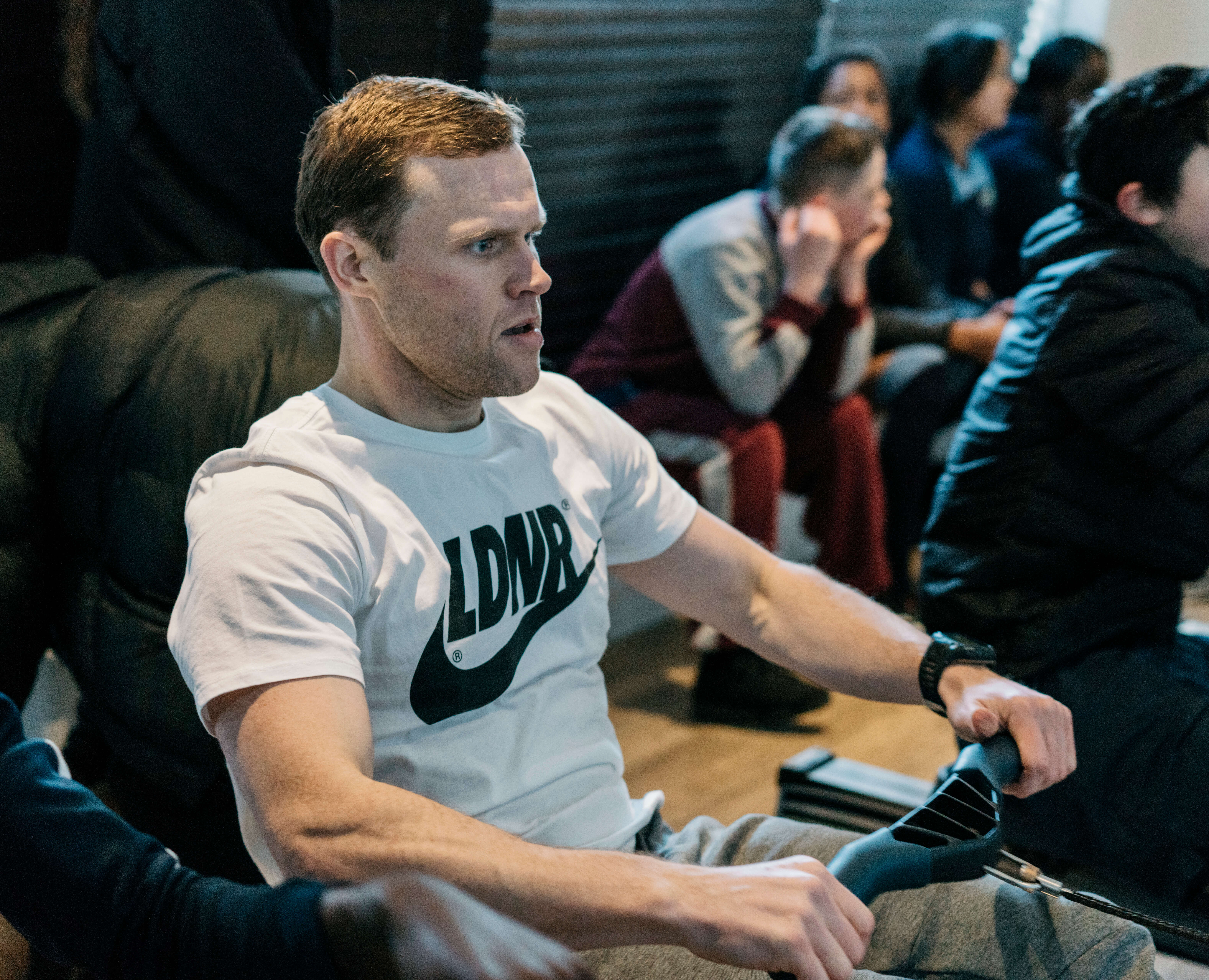
During his first month of rowing, McAvoy covered one million meters. Four months later, he’d rowed the equivalent of the distance across the Atlantic.
He raised money for a children’s charity, and his life beyond the prison’s gym changed, too. He developed a passion for the study of physiology and the power of the human body, and he read textbooks and memoirs of exceptional athletes.
Within 16 months of starting to row, McAvoy had broken three world records and eight British records. He smashed the record for the fastest marathon on an indoor rowing machine by seven minutes. He also crushed the record for the longest continuous row (45 hours) and the farthest distance rowed over 24 hours (265 kilometers). He still holds many British records.
In 2012, after almost a decade behind bars, McAvoy was finally granted parole.
He set his sights on triathlons and, at the age of 30, bought his first bike on eBay. He taught himself to swim with the help of YouTube. And the very next year, he completed his first Ironman.
By 2016, he had shaved hours off his time, and a growing media presence won him a Nike sponsorship contract.
Now he travels the world competing, making speeches and hosting workshops as the only Nike-sponsored Ironman triathlete.
He still has to ask his parole officer for permission to leave the country every time he leaves for an international excursion.

Apart from the world of sports, he’s particularly proud of the work he’s done in campaigning for prison reform.
He’s a sought-after motivational speaker, and he visits prisons and correctional facilities regularly. Because of his past, offenders don’t consider him a figure of authority and often open up to him, he told The Independent.
McAvoy’s story of redemption teaches other offenders that they, too, can change their lives.
And when asked whether he has any regrets, he told The Independent that he has none.
“I don’t believe in failure as long as you keep going,” he said. “You either win or you learn.”
This story originally ran in The Sports Edition of the Goodnewspaper. The Goodnewspaper is our monthly print newspaper filled with good news.
You can join thousands of subscribers who get access to more exclusive stories like these, our private community space, a free inspiring poster, and so much more. Become a subscriber today.
As the Bootleg Fire in southern Oregon swept toward him last week, Pete Caligiuri of The Nature Conservancy hustled to lay out water pipes and start the sprinklers to wet down the area surrounding a remote research station. The approaching wildfire had raged so fiercely that it had begun generating its own weather. Clouds of hot smoke formed towering thunderheads, which cast lighting down among the dry trees and urged the flames forward with gusts.
The Nature Conservancy had been preparing for this moment for decades. The Jim Castles research station sits at the north end of the Sycan Marsh reserve: 30,000 acres of mixed wetland and dry pine forest in the Klamath Basin, which the nonprofit acquired in the 1980’s. The conservation group worked with the Klamath Tribes that call this area home to restore the forested areas to the landscape that existed before Americans took over the land and began putting out fires. They cut down small trees, leaving fire-adapted specimens like thick-barked ponderosa pines, and they began setting fires, allowing them to consume decades of needles and branches on the forest floor.
The Bootleg Fire, now the largest in the country, is testing these methods. And the results offer a lesson for woodland communities throughout the West struggling to adapt to harsher fire seasons brought on by rising temperatures. As Caligiuri, the conservancy’s forest program director, was getting the sprinklers going around the station, he was also listening intently to the voices of firefighters crackling through a radio. “What we were hearing was that, as the fire moved out of the denser forest into these areas that had been treated, it came down out of the canopy of the trees and dropped to the ground,” Caligiuri said.
That’s exactly what the conservationists had hoped would happen when the Bootleg Fire reached them. The fire moved gently along the ground and did not harm the research station. Caligiuri stressed that it’s far too early to consider his story as anything more than anecdotal evidence. But there’s abundant published science that supports the underlying theory.
“We have overwhelming evidence that when we treat forests by removing fuels, it generally — not always, you can never say always, but generally — moderates fire behavior,” said Maureen Kennedy, a professor who studies forest fires at the University of Washington, Tacoma.
Kennedy studied a similar situation as the one unfolding in the Sycan Marsh, following the 2011 Wallow Fire in Arizona. She looked closely at the places where people had thinned the forest around two small towns, Alpine and Greer, preparation that probably saved them. Forest treatments like this work by spacing out fuel, Kennedy said. When there is a continuous ladder of branches and small trees from the ground to the canopy, it allows fire to rise up into the treetops. And when trees are close together, fires move from one to the next, growing hotter and hotter. Trees that are farther apart, however, encourage fires to fall to the ground. It makes sense, intuitively, but it’s still surprising when a wall of flame settles down and begins creeping across the forest floor, Kennedy said.
“No matter how many times I study it, no matter how much sense it makes in theory, it’s still amazing,” she said. “When you look at photographs from the Wallow Fire, that landscape was nuked, it was burning so hot that there were only blackened sticks that used to be trees left behind. Then, as you move into the treatment area the trees are brown, and then further in, they are green.”
You can see the same thing in a photo (below) taken after the 2020 North Complex Fire, near Quincy, California. There, too, the fire mellowed when it reached the area where workers had removed fuels, said Hannah Hepner, program manager for the Plumas County Fire Safe Council.
”That aerial photo is pretty incredible, and that is precisely where the fuels treatment took place,” Hepner said. But, she cautioned, these images shouldn’t set expectations too high: Fire behavior is unpredictable, and some areas always burn more severely than others. Just across the street from that photo, she said, the fire continued to blacken trees — though even there, previous forest management allowed firefighters to get down a narrow road and save a wood shingled building.
Examples abound: Forest management near Paradise, California, preserved the Pine Ridge School — a small island of standing structures amid the devastation of the Camp Fire. For years, other foresters thought John Mount was crazy for purposefully setting fires on the land that he managed for the electric company, Southern California Edison. But last September, the massive Creek Fire surrounded that land, licking up against it from three sides, but then settling to the ground and sparing trees.
Today, Mount’s heretical ideas have become mainstream. The story is different in coastal wet forests or in brushland, which evolved with less frequent fires. But it seems clear that the arid pine forests of the American West are much more resilient to fire when they are not packed with small trees, brush, and a century of dry foliage. “Fires are natural, inevitable, and necessary in these dry forests, and we removed them,” Kennedy said.
In the next few years, scientists will scrutinize the Sycan Marsh to see how the Bootleg Fire reacted to different types of forest management, Caligiuri said, which will help people understand how to tame wildfires. There’s a long way to go, but neighbors across the West are organizing community groups to thin trees and conduct prescribed burns, while state and federal agencies are ramping up spending to increase this kind of management. People are starting to move in the right direction, Hepner said, “and yet sometimes conditions seem to be outpacing us.”
This story is part of the SoJo Exchange from the Solutions Journalism Network, a nonprofit organization dedicated to rigorous reporting about responses to social problems. It was originally published by Grist on July 26th, 2021.
Last summer, the Charleston, South Carolina City Council approved an ordinance permitting homeowners in every area of the city to construct backyard cottages and garage apartments, formally known as accessory dwelling units (ADUs), on their property. The law was part of a series of efforts to bring more affordable housing to the city, where, according to a 2020 report, half of renters and a third of homeowners are cost-burdened, home prices are rising faster than wages, and new supply falls well behind demand.
Permitting ADUs wouldn’t solve the problem, says Geona Shaw Johnson, director of the city’s Department of Housing and Community Development, but it could help. Still, Johnson says, the city knew from looking at other cities’ experiences that relaxing the rules alone wouldn’t generate a glut of new backyard apartments.
“As we have looked at this across the country, most ADU initiatives get out of the gate pretty slowly,” she says. “It’s not likely people are running to local governments and raising their hand and saying, ‘I want to sign up right away.’”
So to complement the new zoning rules, Charleston is planning to launch a small program aimed at helping homeowners finance the construction of accessory dwelling units, as the Post and Courier first reported. The city is planning to spend around $200,000 to help up to 10 homeowners pay for the construction of new units, according to Johnson.
Under the new rules, which limit occupancy to two adults at most, the units can be used to house friends or family for free or leased to anyone earning up to 80 percent of the area median income, which would mean a single tenant who earns up to $45,400 or a couple earning up to $51,850.
Johnson says the city is planning to finalize the program and begin accepting applications sometime this summer.
“Charleston is doing this because we have identified ADUs as one additional opportunity … to effectuate change,” she says. “Our goal is to increase the availability of housing, and we see this as an opportunity to do it.”
Cities and states have struggled to find ways to increase their inventory of low-cost housing over the last decade, and many have pursued policies that they hope will add density to areas zoned for single-family dwelling. Minneapolis made headlines in 2019 by approving rules to allow duplexes and triplexes in single-family districts around the city. Oregon passed a similar law in 2019. The same year, the California legislature passed a series of laws making it easier for homeowners to build backyard apartments and convert garages to residences. In general, laws that allow homeowners to add units to their own property have proven to be less politically challenging than laws that allow for multifamily development in areas previously zoned for single-family use. But a proposal to allow ADUs has recently proven to be controversial in the Connecticut legislature, passing only after “huge concessions” from proponents, as the Connecticut Mirror reported.
California has seen a significant uptick in ADU applications as it has loosened restrictions over the last several years. But permitting ADUs is only half the battle, as Laurie Goodman, vice president for housing finance policy at the Urban Institute, has argued. The other critical component is helping homeowners, particularly those with limited incomes, to finance construction. In 2019, the United Planning Organization in Washington, D.C., launched a pilot program to help homeowners finance ADUs, financed by Citi Community Development, but the program was only big enough to help two homeowners, as Next City reported. Other cities like Boston have created larger programs to help homeowners add new units to their properties. But programs that are subsidized by local funding are impossible to bring to a large enough scale to make a real impact, Goodman says.
“You have to not only have zoning relaxed, but you can’t have other hiccups,” Goodman says. “And with ADUs the other hiccups are the cost and the lack of standardization and know-how.”
Existing financing tools are inadequate, Goodman says. For one thing, existing options for many homeowners to borrow against the value of their house aren’t enough to pay for an accessory dwelling unit. Banks will make renovation loans that take into account the market value of a property after it’s improved, Goodman says, but won’t often consider the future rental earnings in that calculation.
“You need an instrument that is geared toward ADU financing that gives you credit for both the improved value and the future value of the rents,” she says.
City policies can make it easier to build ADUs, but banks, along with federal mortgage companies Fannie Mae and Freddie Mac, should step in to create the necessary financing tools, Goodman says. Though she admits it’s tricky to design a solution, especially for cash-limited homeowners who would most benefit from having an extra unit on their property. What’s needed, she says, is a construction loan that can then be turned into a mortgage product. In Charleston, for example, even a $20,000 grant would cover only a fraction of the estimated $170,000 cost to build an 850-square-foot unit, according to Johnson.
“If it were easy, it would have already been done,” Goodman says.
Los Angeles has developed a successful financing and design program for ADU builders called the Backyard Homes Project, as Next City has reported. In Charleston, the Department of Housing and Community Development is trying to follow suit. The ADU financing program will be funded partly by the city, and partly through a grant from the AARP that the Department is hoping to receive. The Department is also trying to line up other tools to help homeowners create accessory dwelling units, like providing architectural drawings that homeowners can work from to create simple, low-cost units, Johnson says, similar to a program in San Diego. The financing program is small, but Johnson says she hopes it demonstrates the value and feasibility of ADU construction for homeowners.
“Anything and everything we’ve seen that might be an obstacle to getting housing built, we’re trying to remove those obstacles,” she says.
This story is part of the SoJo Exchange from the Solutions Journalism Network, a nonprofit organization dedicated to rigorous reporting about responses to social problems. It was originally published by Next City on June 22nd, 2021.
If you’re among the 25% of Americans averse to needles, you’re probably not surprised by the COVID-19 immunization stall. Even for those who want immunity, bribes with beer or lottery tickets may not be enough to override anxiety made worse by pervasive images of needles in the media.
As a physician specializing in pain management, I study the impact of pain on vaccination. Research-proven adult interventions for pain, fainting, panic and fear can make vaccination more tolerable. At a minimum, understanding the reasons needle fear has become common might make the embarrassment easier to bear.
Why needle anxiety has increased
Needle fear has increased dramatically since a landmark 1995 study by J.G. Hamilton reported that 10% of adults and 25% of children feared needles. In that paper, adult patients who remembered when their fear began described a stressful needle experience around age 5.
The childhood experiences of the patients usually related to an unexpected illness; at the time the Hamilton participants were in preschool, vaccines were scheduled only until age 2. For most people born after 1980, however, booster injections given between ages 4 to 6 years became a routine part of the vaccine experience. The timing of boosters maximizes and prolongs immunity, but unfortunately falls within the age window when phobias form. A 2012 Canadian study of 1,024 children found that 63% of those born in 2000 or later now fear needles. In a 2017 study, my colleagues and I confirmed this increase in prevalence: Half of preschoolers who got all their boosters on one day – often four or five injections at once – were still severely afraid of needles as preteens.
Unsurprisingly, needle fear affects how willing teens and adults are to get vaccinated. A 2016 study found needle fear to be the most common reason teens didn’t get a second HPV vaccine. Health care workers are no exception: A 2018 study found that 27% of hospital employees dodged flu vaccines due to needle fear. And most recently, an April 2021 national survey of 600 not-yet-COVID-19-vaccinated U.S. adults found that 52% reported moderate to severe needle fear.
Potential solutions for adults
For children, evidence shows that addressing their fear and pain while distracting them from the procedure is most effective in reducing distress.
While adults are not just big children, combining these concepts with findings from available adult injection studies suggest a few potential interventions. For the many who want a vaccine but need some support, here’s what we know:
1. Pain reduction
Relieving injection pain may reduce needle fear by giving patients a feeling of control. For example, a group of patients in New Zealand were repeatedly missing their monthly antibiotic injections for rheumatic heart disease. Their doctors created a special clinic, offering either anesthetics, a vibrating cold device or both during the shot. The interventions in 107 adults reduced pain and fear by 50% after three months. Six months later, half the patients still used the interventions, and the special “missed dose” clinic was no longer needed.
Specifically for vaccination, applying a vibrating cold device to the injection site a minute prior to injection, then pressing just above the site during injection, relieved pain and improved satisfaction for adults, and was most effective for those with needle fear. A horseshoe-shaped plastic device using sharp prongs to confuse the nerves also reduced injection pain but increased anxiety, possibly due to discomfort from the prongs themselves.
Cold spray doesn’t help reduce vaccination pain for children, but has been shown to be more effective than topical anesthetics for adult injections.
2. Psychological therapy
Exposure-based therapy involves asking a patient to rank anxiety caused by parts of a procedure, like seeing a picture of a tourniquet or thinking about sharp things, and gradually exposing them to these parts in a controlled environment. Free self-guided resources are available for fears ranging from flying to spiders. However, none of the three studies testing this approach on adult needle fear showed long-term fear reduction.
One of the studies that taught techniques to reduce fainting, however, was considered a success. Fainting, or vasovagal syncope, and needle fear are often conflated. While passing out due to injections is more common with anxiety, it is often a genetic response. Tensing the stomach muscles increases the volume of blood the heart can pump, keeping blood in the brain to prevent lightheadedness during needle procedures.
3. Distraction
Surprisingly, there are no studies on adults using distraction for injections. Two studies, however, have found that pretending to cough reduces pain from blood draws.
Dropping F-bombs could also help: A recent study found that swearing reduced pain by one-third compared to saying nonsense words. Distraction with virtual reality games or videos has been shown to be more effective in children, although there have been mixed results in adults.
Mentally engaging tasks may also help. A visual finding task given to children during intramuscular shots has been shown to reduce pain and fear, with 97% rating the experience more pleasant than previous blood draws. Adults may need a more complicated task, but a similar intervention could work for them as well.
Use multiple interventions and go in with a plan
To reduce needle fear, research suggests the more interventions, the better. A 2018 study summarizing research on vaccine pain concluded that patient-operated cold and vibration devices combined with distraction techniques were most effective. Canada has implemented a practical national needle fear intervention for their vaccine rollout, emphasizing preparing ahead to help make vaccine day more comfortable.
Adults who don’t like needles are in the majority. Taking control of your vaccination experience may be the best way to combat needle anxiety.
This story is part of the SoJo Exchange from the Solutions Journalism Network, a nonprofit organization dedicated to rigorous reporting about responses to social problems. It was originally published by The Conversation on June 11th, 2021.
Up and down the United States, legislators are writing and passing bills that ban trans children from participating in sports — but trans athletes are advocating for their right to play.
In June, Florida Governor Ron DeSantis signed a law that bans transgender girls and women from competing on female sports teams at high school and college levels. In West Virginia, Governor Jim Justice signed a law that prohibits trans girls and women from competing in women's sports at any public high school or college.
These infringements on the lives of trans people through legislative means and procedures have become a real cause of concern for trans athletes like Schuyler Bailar, who is the first trans athlete to compete in the NCAA.
Schuyler Bailar was assigned female at birth and accepted onto the women’s swimming team. As it became clearer to him that he wanted to transition, he grappled with losing the chance to compete in the sport he loved, until his coach suggested the men’s team to him. After a gap year, Bailar became the first transgender athlete to compete in the NCAA.
Bailar told Yahoo that he believes these bills are harming the wellbeing of trans children.
“When these bills attack kids, it says ‘you don’t belong here,’" Bailar said. “A lot of trans kids don’t have the support from their parents, teachers, or friends. For the government to add onto that — that they don’t belong in sports, it’s a massive message to these kids that they don’t belong.”
Furthermore, Bailar says the argument that transgender athletes should not be able to compete with cisgender athletes is misguided. These bills, Bailar told Yahoo, aren't talking about elite level or professional sports.
“There are already rules and regulations for trans people,” he said to Yahoo. “I had to submit labs to take testosterone as a trans man to prove that my testosterone levels were at a fair level.”
Bailar is concerned with the invasive methods schools would use to identify the sex of student athletes.
“Everyone has to be tested,” he said. “Some of these bills are proposing genital tests for children. To me, that’s so privacy violating.”
To combat this, Bailar’s website contains over 144 anti-trans bills active in the United States right now. Most of the bills are targeted toward trans children — and most of the sports bills are specific to trans girls.
Chris Mosier, the founder of transathlete.com, is an American transgender advocate and athlete — he was the first openly transgender man to compete in an Olympic trial alongside other men. In 2010, he publicly self-identified as a transgender man, after competing in his first race as a man, and in 2011, Mosier was featured in The New York Times prior to competing in the Nautica New York City Triathlon.
Another trans athlete is Laurel Hubbard, a weightlifter and the first openly transgender athlete to compete in the Olympic Games. She was selected to compete at the 2020 Summer Olympics and will now compete as part of New Zealand’s Olympic Team.
One of the earliest trans athletes was Renée Richards, a high-profile tennis player who started playing in women's tournaments in 1976. In 1977, she filed a lawsuit claiming that the USTA violated her civil rights by introducing the Barr body test — which identifies a person's sex chromosomes — and the New York Supreme Court ruled in her favor, ruling her legally female and agreeing that the Barr body test as the sole determinant of sex was “grossly unfair.”
At a time when the rights of transgender people are constantly under threat by legislative bodies, it is important to remember that trans people have always been present in history — and sports — whether visibly or not.
Thanks to trans athletes taking a stand against these bills, people are becoming more aware of the issues and able to help push back against anti-trans legislation.
This story originally ran in The Sports Edition of the Goodnewspaper in August 2021. The Goodnewspaper is our monthly print newspaper filled with good news. You can join thousands of subscribers who get access to more exclusive stories like these, our private community space, a free inspiring poster, and so much more. Become a subscriber today.
Malaysia’s Kinabalu Park, which surrounds Mount Kinabalu, the 20th-largest peak in the world, is home to a nickel mine like none other. In lieu of heavy machinery, plumes of sulfur dioxide, or rivers red with runoff, you’ll find four acres of a leafy-green shrub, tended to since 2015 by local villagers. Once or twice per year, they shave off about a foot of growth from the 20-foot-tall plants. Then, they burn that crop to produce an ashy “bio-ore” that is up to 25 percent nickel by weight.
Producing metal by growing plants, or phytomining, has long been tipped as an alternative, environmentally-sustainable way to reshape – if not replace – the mining industry. Of 320,000 recognized plant species, only around 700 are so-called “hyperaccumulators,” like Kinabalu’s P. rufuschaneyi. Over time, they suck the soil dry of metals like nickel, zinc, cobalt, and even gold.
While two-thirds of nickel is used to make stainless steel, the metal is also snapped up by producers of everything from kitchenwares to mobile phones, medical equipment to power generation. Zinc, on the other hand, is essential for churning out paints, rubber, cosmetics, pharmaceuticals, plastics, inks, soaps, and batteries. And, as supplies of these hard-to-find metals dry up around the world, demand remains as strong as ever.
The idea of phytomining was first put forth in 1983 by an agronomist at the U.S. Department of Agriculture named Rufus L. Chaney. Other research groups before the Malaysia team have shown that the solar-powered and carbon-neutral metal extraction process works in practice — a key step to winning over mining industry investors, who have insisted on field trials of several acres to show proof of principle. The most recent data out of Kinabalu Park, a UNESCO-listed heritage site located on the island of Borneo, is finally turning industry heads, as they shows the scales have tipped in favor of phytomining’s commercial viability.
“We can now demonstrate that metal farms can produce between 150 to 250 kilograms of nickel per hectare (170 to 280 pounds per acre), annually,” said Antony van der Ent, a senior research fellow at Australia’s University of Queensland whose thesis work spurred the Malaysia trial. At the midpoint of that range, a farmer would net a cool $3,800 per acre of nickel at today’s prices – which, van der Ent added, is “on par with some of the best-performing agricultural crops on fertile soils, while operating costs are similar.”
Take, for instance, palm oil – a crop as notorious for its profitability as its role in driving deforestation in Asia and Africa. Farmers planting oil palm trees, prior to the pandemic, stood to clear 2.84 metric tons (3.12 tons) of crude oil annually on average – or $2,710 in today’s prices. For farmers in Malaysia and Indonesia, where 90 percent of the world’s palm oil is grown, nickel farming might just prove a more attractive option.
“At this stage, phytomining can go full-scale for nickel immediately, while phytomining for cobalt, thallium, and selenium is within reach,” van der Ent said.
While van der Ent’s team has won over some in the mining industry, adoption of phytomining isn’t yet on the fast track. That’s despite the Malaysia plot and other examples suggesting that while plants are of course less capital intensive and more environmentally friendly than traditional mining, they are also more efficient. Still, in an industry that van der Ent characterizes as resistant to change, phytomining’s immediate future could be more as a complement to traditional mining than its replacement.
Several Indonesian nickel mining companies are now looking to partner with van der Ent’s Malaysia team. “We have lined up several industry partners who’ve agreed to implement trials in Indonesia,” he said. “But due to COVID, this development is currently on hold.”
When travel restrictions are lifted and borders open up, van der Ent hopes to show that there are a number of advantages to phytomining that traditional mining simply can’t offer. “There is an abundance of unconventional ores that could be unlocked through phytomining,” he said. One example is soil abundant in tropical regions that typically contain 0.5 to 1 percent nickel by weight, which is below the cut-off where a company could profitably implement conventional strip mining.

Antony van der Ent, left, and his colleague Sukaibin Sumail, a local field researcher, examine a P. rufuschaneyi at the test plot in Kinabalu Park. Courtesy of Antony van der Ent
Strip mining takes place in thick layers of soil containing more than 1 percent nickel by weight that occur in places like Brazil, Cuba, Indonesia, the Philippines, and New Caledonia, the French territory in the South Pacific. This process involves removing a layer of soil or rock, referred to as overburden, before mining that seam for the target metal. And it comes at great environmental cost. Because nickel is difficult to extract, the process calls for heavy machinery that runs on diesel and generates carbon, as well as large, acid-leaching installations needed to separate the metal from its ore.
Those nickel-rich soils, however, are becoming increasingly scarce — and it might well be that an undersupply eventually drives more and more companies to embrace phytomining. That, and the fact that bio-ore contains 20 to 30 percent nickel by weight, and is also more compact and cheaper to transport than typical ores – which hover around the one to three percent mark by weight.
Still, regardless of how the Indonesia partnerships eventually go, it’s unlikely that major mining companies will swap out strip mines for shrubbery overnight. That’s why phytoremediation, a spin-off technology which complements mining rather than replacing it, might just be the thin end of the wedge.
Currently, as strip mining happens, the surrounding topsoil becomes littered with toxic metal tailings. This layer typically has to be dug out, carted off, and sold to landfills, often at great cost to the mine operator. In the case of coal extraction, the cost of rehabilitation, for strip-mined land, averages $71,000 per acre. In the E.U. alone, there are an estimated 130 million acres in need of clean up. It’s a hefty bill for mining companies – and that’s if they choose to foot it at all. High-profile inquiries in Indonesia, Australia, and the U.S. show mining companies are all too often willing to shirk rehab responsibilities.
The residue, though, is commonly composed of nickel, cobalt, sodium, and cadmium. With a little physical or chemical treatment of the soil, one can create precisely the conditions in which certain hyperaccumulators thrive – it’s as simple as planting a seed and recovering the additional ore at a later date. “Trash from treasure,” as van der Ent put it.
Marcus Radford, an environmental consultant based in Western Australia, added that phytomining on these sites is a win-win. It would make mine remediation cheaper, quicker, and easier. Add to that, it would revitalize the local ecosystem. “It’s a way of putting back, rather than taking away,” he said.
Phytoremediation has been tested in France, Greece, Albania, and Italy, but the experiments have seen varying levels of success. In Italy’s Tuscany region, for example, researchers planted various cottonwood and willow species over arsenic-contaminated pyrite waste. While both plants grew successfully in challenging conditions, arsenic wasn’t recovered at a significant level. That said, small-scale phytoremediation in France and elsewhere, has been shown to recover nickel, zinc, and cadmium.
In order for the mining industry to adopt phytoremediation, the practice will need boardroom backing, van der Ent explained, adding that the support turns on wide-scale implementation. Scaling up, however, requires funding, so there’s a bit of a chicken-and-egg problem.
“It’s only uptake by industry that is holding up translation of phytomining to large-scale application,” van der Ent said. “Industry invariably asks for a field-scale demonstration of phytomining to prove operational viability, but is not prepared to fund such a pilot project. I firmly believe that once a proven field demonstration at scale exists, this will attract funding.”
Van der Ent is optimistic that the pandemic-delayed push into Indonesia will do the trick. Just to be sure, though, he’s also planning to scale the Malaysia trial up to nearly 50 acres – which would call for the application of an industrial-scale hydrometallurgical plant, which separates the target metal, in this case nickel, from its ore via a water-based medium. They won’t have to manually burn the crop as they are doing now – meaning the process will be carbon negative, as opposed to what van der Ent labels as carbon neutral.
Once COVID restrictions lift, he hopes the team will bring new life to the term “smelting plants.”
This story is part of the SoJo Exchange from the Solutions Journalism Network, a nonprofit organization dedicated to rigorous reporting about responses to social problems. It was originally published by Grist on August 3rd, 2021.
Radio programs made for and by young people are helping to address sensitive social issues like teen pregnancy, abuse, and child marriage
— In rural Africa, many rely on radio for information
— Project trains young Malawians to cover sensitive subjects
— Shows address child marriage, abuse and teenage pregnancy
BLANTYRE, July 26 (Thomson Reuters Foundation) - When Doreen Sakala fell pregnant as a 15-year-old schoolgirl in Malawi, she felt alone and worried about her future - until one day she switched on the radio.
She was stunned to hear young people discussing the educational challenges faced by pregnant teenagers in the southeastern African country, where youth-led radio is helping tackle taboos from child marriage and sexual abuse to HIV.
"Listening to the radio opened up my eyes to the opportunities I can have if I work hard in school," Sakala, now 20, told the Thomson Reuters Foundation from the Mudzi Wathu radio station in central Malawi.
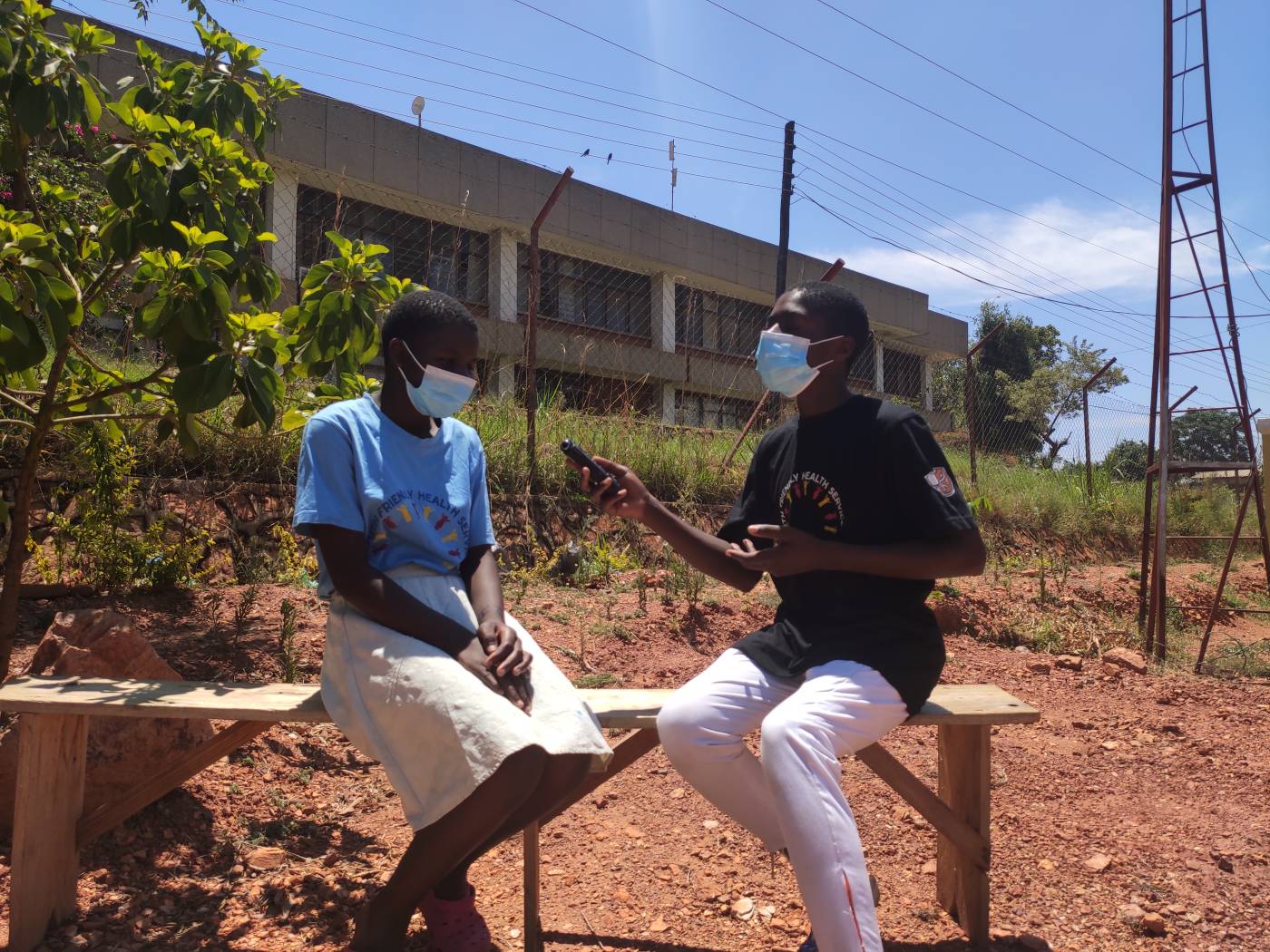
Youth reporters Chisomo Naraku (L) and Essau Banda (R) practice recording an interview during one of DRP’s training sessions in central Malawi, November 7, 2020. Handout via Chiko Moyo
In many parts of rural Africa, radio is the only source of information. Across the continent, 54% of African youth use radio as their main news source, according to a pan-African survey by the South African-based Ichikowitz Family Foundation.
Five years after Sakala first began listening to the "Let's Shine" radio program, she felt she was ready to go back to complete her secondary school education, and dreams of training to become a doctor.
"I want to finish my education ...(so I can) assist my baby and people in my community," she said.
The radio show that inspired her, which is made by and for young people, is part of an initiative led by Developing Radio Partners (DRP), U.S.-based charity that works with local radio stations in low-income countries.
It is estimated to have reached three million youth since it went on air in 2017 in Malawi, where teenage pregnancies, child marriages and sexual violence have increased since the pandemic began last year.
Charles Rice, the head of DRP, said the rate of child marriages had declined in communities where the organization is working with local stations.
"It really demonstrates the power that radio and well-trained reporters can have on critical social issues," he said.
Role Models
About 400 youth reporters have been trained so far to research and host radio shows with nine stations across the country, covering culturally taboo topics including sexually transmitted diseases and contraception.
"We don't just train the reporters how to do journalism, we also provide them with life skills, and then they become role models for all youth in their communities," Rice said.
For many vulnerable youth, radio can inspire them to make necessary changes or seek help, said Meclina Chirwa, 32, who works as a presenter at Lilongwe-based Timveni Radio, which has also sought to address sensitive issues.
"On a daily basis, we receive over 200 calls ... We reach out to people that we can't reach physically," she said.
"We've had several scenarios where girls have been calling to complain of abuse they are facing in their homes and we've followed up ... some of the girls ended up being in our care and support," she added.
Far from Malawi's big cities, the chief of Nzenje village near the Zambian border, said teen-led radio shows have contributed to the dissolution of six child marriages, with another three currently in the process of being dissolved.
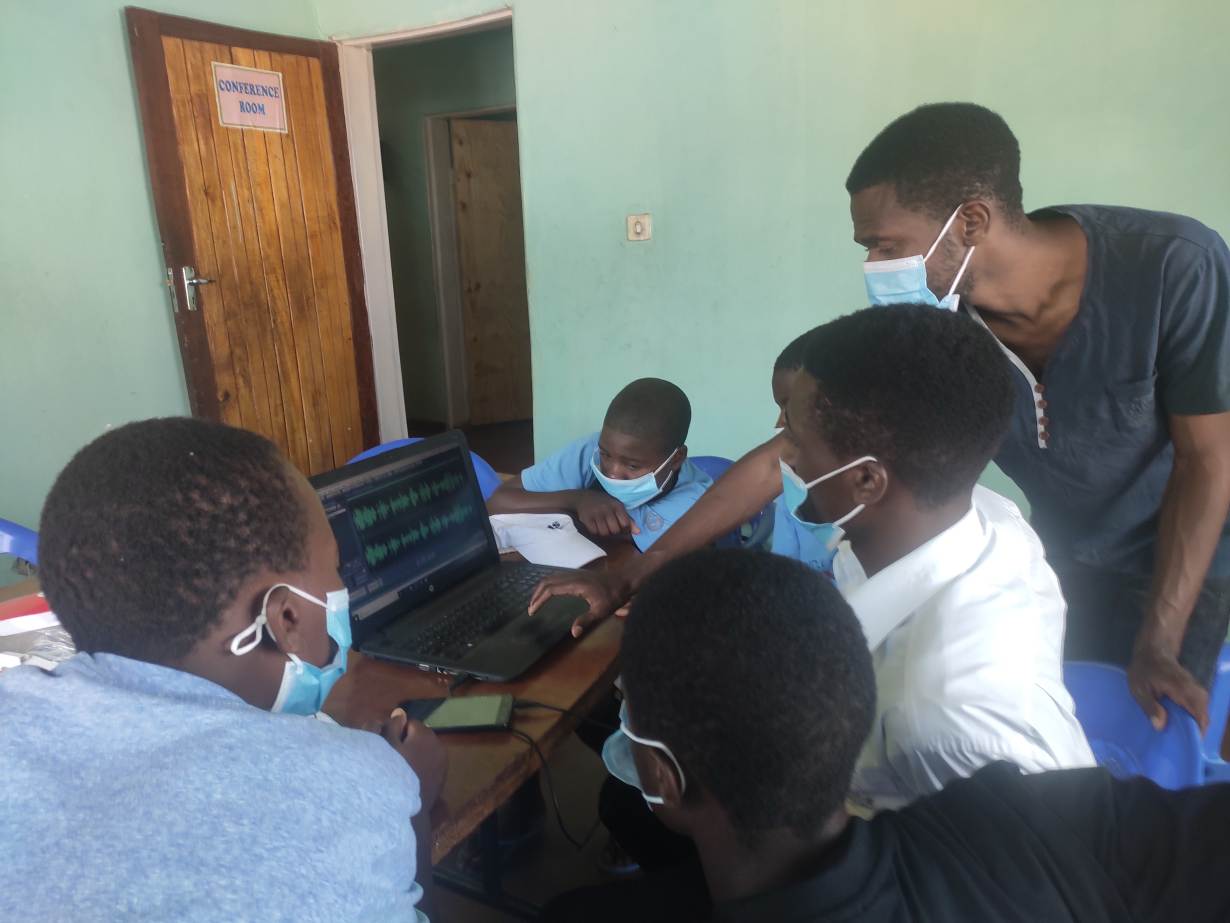
Child marriage is illegal in Malawi, a country of about 18 million people, but convictions are rare and the practice remains common.
"While some rules protecting children are in place, most leaders have not been enforcing them ... these radio programs have brought light to us when we were in the dark," said the village chief, Lawrence Lungu.
Despite facing ridicule from her peers when she returned to school five years after her baby was born, Sakala said she is determined to fight for her education, particularly because she knows she is not alone.
"Other students were talking behind my back but I knew the reason why I was there so it was easy to ignore them," she said.
Chiko Moyo, a radio trainer for DRP, said the aim of the radio shows was not just to reduce the number of unwanted teen pregnancies, but also about showing teenage mothers their lives are not over.
"It's a question of mindset," said Moyo. "If you can change someone's thinking, you can change how they act."
Originally published on July 26th, 2021. Writing by Kim Harrisberg @KimHarrisberg; Editing by Helen Popper. This story was published with permission from the Thomson Reuters Foundation, the charitable arm of Thomson Reuters, that covers the lives of people around the world who struggle to live freely or fairly. Visit news.trust.org
Muslim women's group 'Aisyiyah is helping the environment and local communities by restoring forests, tackling climate problems, and raising awareness on the need to reduce waste
SUKOHARJO, Indonesia — On a grass verge by a road dissecting miles of rice fields in Central Java province, a group of volunteers with 'Aisyiyah, Indonesia's oldest Islamic women's movement, walk along a row of mahogany, sengon and teak trees they recently planted.
A short drive away, Ismokoweni, who leads 'Aisyiyah's local environmental chapter and goes by one name, picks her way past painted gravestones towards an area of damaged forest where the group has also planted seedlings.
After a drought dried up wells here, members purchased gallons of water from the local utility for affected households, Ismokoweni told the Thomson Reuters Foundation shortly before Eid al-Fitr, which marks the end of the holy month of Ramadan.
"We are creative women," said Hening Purwati Parlan, national head of 'Aisyiyah's environment wing, the LLHPB. "We are not rich, but we have solutions."
'Aisyiyah was founded in 1917 to advocate for education at a time when girls did not receive formal schooling.
Today 'Aisyiyah, part of Indonesia's larger Muhammadiyah organization, has at least 4 million members with branches throughout the world's largest Muslim-majority country, where more than 80% of the population of about 270 million identify as Muslim.
'Aisyiyah has drawn on its national network to advocate for reproductive rights and prevent child marriage.
It also operates thousands of schools and runs diverse social programs to promote breast-feeding and improve child and maternal nutrition, among other things.
Alimatul Qibtiyah, a professor who sits on the National Commission on Violence against Women and is an 'Aisyiyah member, said the group cooperates with the national government as well as many other organizations, including from different faiths.
In recent years, it has increasingly turned its attention to the environment.
"We bring the Hadith (teachings of the prophet Muhammad) to explain why the impact of climate change is important," said Hening.
In 2015, 'Aisyiyah's leadership set up its LLHPB environment wing to increase women's capacity to respond to climate change and natural disasters.
'Aisyiyah also runs a "Green Ramadan" program, holding evening talks on how families can reduce waste and the use of plastics during the Islamic fasting month.
"It is explained in the Koran that it is important to do good in the month of Ramadan," Rahma Susanti, head of the LLHPB in West Kalimantan province, said in an online interview.
"Protecting our ecosystem and environment is one of these good things."
Eco-Jihad
Last month, in the run-up to Ramadan, Hening a former journalist who now works as an environmental consultant, called for Muslim women to observe an "eco-jihad".
"Jihad is an Arabic word that literally means striving or struggling, especially with a praiseworthy aim," Hening told the Thomson Reuters Foundation. "So eco-jihad means striving to protect our ecosystem."
'Aisyiyah volunteers said the term resonated among women who see stewardship of the environment as elemental to their faith.
"We have to consider that all the damage we do now will have a fatal impact in the future," said Rahma in West Kalimantan.
In Sumatra's Riau province, the LLHPB is preparing to work with the national peatland and mangrove restoration agency to rehabilitate degraded forests and land.
Women volunteers in Kalimantan, meanwhile, are helping with wildfire prevention efforts.
Teaching of environmental principles is nothing new in the world's second-largest religion, which says humans are guardians of the natural environment.
A 2013 study in West Sumatra province by British and Indonesian researchers found that environmental awareness increased when the message was delivered in Islamic talks and lessons, especially among women.
The Indonesian Ulema Council, established in 1975 as the country's main clerical body, has issued a series of environmental edicts against the burning of land and illegal logging since 2010.
Root and Branch Reform
Forestry experts say reforestation initiatives have faced numerous challenges in Indonesia, such as weak seedlings and poor maintenance once the trees have been planted.
"Increasingly, communities are being expected to have greater roles in tree-planting initiatives," said Ani Adiwinata Nawir, a scientist with the Indonesia-based Center for International Forestry Research.
The peatland and mangrove restoration agency plans to work with community groups and businesses to meet a national target of replanting 600,000 hectares of mangrove forests by 2024.
Most of Indonesia's planet-heating emissions stem from land conversion and the government has pledged to reduce emissions by at least 29% by 2030 from a business-as-usual scenario, requiring radical reforms to how land and forests are treated.
Indonesia's environment ministry has prioritized almost 4 million hectares for rehabilitation by 2030, which it expects will require billions of trees to be planted this decade.
The trees along the road in Sukoharjo are a fraction of the 4,700 seedlings planted by 'Aisyiyah volunteers since the end of last year.
In March, 'Aisyiyah announced plans to plant 5 million fruit trees in homes and gardens, partly to boost food security during the coronavirus pandemic.
Volunteers said the environmental work would continue to be funded mainly by donations and their own fundraising activities.
"Jihad really means to struggle," said Hening. "Everyone in their life struggles to do the best (they can)."
This story was published with permission from the Thomson Reuters Foundation, the charitable arm of Thomson Reuters, that covers the lives of people around the world who struggle to live freely or fairly. It was originally published on May 13th, 2021. Visit news.trust.org/climate
The pandemic fatigue is real.
So many of us followed all the health and safety guidelines, got vaccinated as soon as we could, and are ready to move on to post-pandemic life. However, due to the new, highly contagious delta variant, cases are surging again around the U.S., especially in states with low vaccination rates.
We need to keep doing our part to take care of each other, and people around the world — here’s how:
1. Get vaccinated
The data is clear: all of the COVID-19 vaccines are safe and highly effective at protecting you and your loved ones from the coronavirus. In measuring the side effects of both, scientists say the risk in getting COVID-19 is far greater than the risk associated with getting vaccinated.
Currently, around 95% of those hospitalized with COVID-19 are unvaccinated — and 99% of those who have died from the virus were unvaccinated. There are “breakthrough” cases among the vaccinated — because vaccines aren’t 100% effective — but symptoms are much milder and rarely result in hospitalization.
If you have concerns about getting the vaccine, your questions are valid! But make sure you act on them: Schedule an appointment to talk through them with your doctor, visit the CDC’s COVID-19 resource center for helpful information, or seek out information from experts in infectious disease and/or public health.
While we don’t recommend getting all your information on social media, there are some infectious disease experts who use social media to help communicate complex ideas. We’ve learned a lot from Laurel Bristow, MSc and Jessica Malaty Rivera, MS on Instagram.
Plus, Dolly Parton endorses the vaccine. And America loves Dolly.
2. Be a vaccine advocate among your friends and family
Because COVID-19 is a global pandemic impacting the entire population, individual action alone can’t bring an end to it — we have to take a community-based public health approach. We have to consider others and be good neighbors!
The good news is, most people who aren’t getting the vaccine aren’t conspiracy theorists or anti-vaxxers. If your friend or family member has legitimate questions or concerns about the vaccines, that’s okay! They deserve to be listened to — forcing it on them, or judging their choice isn’t helpful.
The New York Times put together an interactive vaccination chatbot to walk you through the best ways to listen, be a resource for, and encourage your loved ones who are hesitant about the vaccine.
And if you want to learn more about why a public health approach matters, read this article about the delta variant from Ellie Murray, a professor of epidemiology at Boston University School of Public Health.
You may come across people who have received some misinformation surrounding the vaccine. The News Literacy Project compiled a helpful guide to combat misinformation in general, and related to the vaccines:
1/ Across the U.S., #misinformation about #COVID19 —> stubborn vaccine hesitancy. Many holdouts don't trust institutions - gov officials, scientists, news outlets - but might they listen to you? It's worth a shot.
— The News Literacy Project (@NewsLitProject) August 10, 2021
Our resource: https://t.co/SuZrBYtieD pic.twitter.com/puHiXzbFnh
3. Help people around the world get vaccinated
The WHO reported more than 4 billion COVID-19 vaccine doses have been administered globally — more than 80% of them to high- and upper-middle income countries, though they account for less than half the world’s population.
The pandemic can’t “end” until the entire world has equitable access to vaccines — not just wealthy, well-resourced countries. Without it, there will continue to be variants, which will spread around the world, even to highly vaccinated countries.
Contact your elected officials to ensure the COVAX global vaccination program gets the doses and funding it needs.
4. Wear a mask when you’re indoors or unable to socially distance
The world got a slight reprieve from mask-wearing as the vaccines proved highly effective in stopping the spread of the virus. Now, however, the delta variant is proving to be much more contagious and life-threatening than past strains of the virus.
In order to protect others who may not yet be (or in some cases, are unable to be) vaccinated, follow the CDC guidelines for wearing a mask indoors, or when you’re unable to keep a 6-foot distance between yourself and others.
Masks are incredibly effective at stopping the spread of the virus — wear one!
5. Take care of yourself and others
The only way we’ll get through this is if we do it together. Keep being a good neighbor by being mindful of:
Restaurant workers — If you’re dining (locally!) in-person, wear your mask when your server comes to your table, and tip at least 20%.
Local businesses — Keep supporting local. Wave or say a masked “hello” to workers, and adhere to shop protocols (if you aren’t sure what they are, ask).
Mental health — We’re still going through individual and collective trauma. Get enough sleep, ask for help, spend time outside when you can — it will help you take care of others, too!
If this guide was helpful, share it on Instagram to help others continue to take care of each other in the the midst of COVID-19, combating misinformation, and working toward global vaccine equity.