Every day the Good Good Good team collects the best good news in the world and shares it with our community. Here are the highlights for this week!
If you want to get good news in your inbox every day, join the Goodnewsletter — the free daily newsletter designed to leave you feeling hopeful.
The Best Positive News We’re Celebrating This Week —
Norway is on track to be the first country to eliminate diesel and petrol car sales — and did it without banning them
In 2024, nine out of 10 new cars sold in Norway were fully battery-powered — putting the country on track to only add new electric cars to its roadways by 2025.
Fully electric cars accounted for 88.9% of new cars sold last year, up from 82.4% in 2023 — led primarily by Tesla, Volkswagen, and Toyota.
Notably, the country achieved this milestone without adding any ban on combustion-engine cars. Acknowledging that “people don’t like to be told what to do,” the country instead heavily incentivized purchases of electric vehicles and imposed higher taxes on diesel and petrol cars.
Why is this good news? While decarbonizing the transportation industry must also involve public transit and alternative forms of transportation, moving away from combustion engine personal vehicles is also essential to reducing planet-warming emissions. Norway is giving us all a glimpse of an emission-free future.
Access to abortion care has improved globally in the last three decades
Over 20 years ago, the World Health Organization noticed high maternal mortality rates in places around the world — many of those deaths were due to unsafe abortions. And where abortion was highly restricted — maternal mortality rates from unsafe abortion were high.
As a result, it recommended removing barriers to accessing abortion as a key part of basic health care in order to reduce death and improve reproductive health outcomes.
While a handful of countries have added restrictions to accessing abortion care, like the United States — far more have followed those guidelines and improved access to care.
Sixty countries total have improved access in the past 30 years, while just four have further restricted access. Among those with improved access, the quality and safety of abortion care has also improved — and maternal health along with it.
President Biden banned new offshore oil and gas drilling in most US coastal waters
Responding to calls from coastal communities around the U.S., President Biden used his authority under the Outer Continental Shelf Lands Act to ban new offshore drilling for oil and gas in almost all U.S. coastal waters.
The move will protect offshore areas along the East and West coasts, the eastern Gulf of Mexico, and parts of Alaska’s Northern Bering Sea from future oil and gas leasing projects. Because of the nature of the ban, experts say it would be challenging to reverse in the future.
The order does not impact large portions of the Gulf of Mexico, where the majority of drilling already occurs.
Why is this good news? The incoming presidential administration has stated its plans to expand offshore drilling, and this move from the outgoing administration will protect more waters from that fate.
Expanding drilling would be detrimental not only to the climate crisis at large, but to marine and coastal ecosystems, coastal communities (and their local economies), and the people (and future generations) who call these places home. It’s also unnecessary, as we continue to exponentially invest in a clean energy economy that’s better and healthier for people and the planet.
→ Read more
A 12-year-old girl in Scotland designed a solar-powered sleeping bag for her homeless neighbors
The Primary Engineer MacRobert Medal competition asks UK students: “If you were an engineer, what would you do?”
And, seeing “so many people sleeping rough on the streets of Glasgow,” 12-year-old Rebecca Young knew: she wanted to help members of her community facing homelessness.
So, the Scottish student invented a solar-powered heated blanket with the goal of helping unhoused people keep warm.
Her now award-winning design is integrated into a backpack and powered by the sun, allowing for easy, on-the-go use.
→ Read more
The U.S. finalized a new rule to remove medical debt from credit reports, impacting millions of Americans
Originally proposed in the summer of 2024, the U.S. Consumer Financial Protection Bureau just finalized a new rule to remove medical debt from consumer credit reports.
The decision will erase an estimated $49 billion in unpaid medical bills from the credit reports of around 15 million people.
The rule goes into effect in March, and while it’s expected to face legal challenges, some major credit companies have already taken voluntary steps to implement it.
Why is this good news? For too long, an unexpected illness or diagnosis has left people with unpaid medical bills that have impacted their credit score and their ability to take out a loan, get a mortgage, and more. An unexpected medical event shouldn’t decide whether or not a person can buy a home, buy a car, start a business, and more.
An 8-year-old invented a “self-regulating bracelet” to help neurodivergent kids communicate in school
When 8-year-old Zoeya Khan was tasked with engineering a project that brings a creative solution to the world, she designed something to help her neurodivergent peers.
Her invention, The Self Regulation Bracelet is designed to improve communication in classrooms for neurodivergent students — including young people who have conditions like autism, ADHD, dyslexia, and more.
Khan’s design looks like a simplified smartwatch, with a round white face that contains a button-activated system. That system then provides visual responses through colored lights, which can enable communication solutions between students, peers, and teachers.
Indonesia just launched a nationwide program to provide free meals to nearly 90 million children and pregnant people
To fight the stunting of growth that impacts 21.5% of children under 5 years old in Indonesia, the country just launched its ambitious Free Nutritious Meal program.
The program will feed nearly 90 million children and pregnant people in the country through 2029. Specifically, the program aims to feed the country’s 83 million schoolchildren across 400,000 schools.
In addition to fighting malnutrition, the program is also intended to help raise the income of the country’s farmers.
What’s the nuance? The program is expected to cost $28 billion total through 2029, and critics worry it’s not affordable. But the new government said it ran the cost calculations and “We are capable.” Plus, the health and wellness of the country’s younger generations is an investment that it expects to pay dividends in the long run.
→ Read more
A Los Angeles veterinarian is caring for dozens of pets in need of shelter from the wildfires
After taking in her brother’s rabbit and cat as they fled the Palisades fire, Annie Harvilicz immediately thought of all the other pets that would need shelter from the fires.
Harvilicz runs two veterinary hospitals and quickly put out a call on Facebook inviting people to bring their animals to her if they needed.
In addition to calls from people offering to volunteer their help, people took her up on her offer. With around 20 dogs, 20 cats, and one rabbit — she expected to see even more animals come into her care in the coming days, and even brought some to her home.
Why is this good news? Harvilicz said that many of the pet owners contacting her own multiple pets, and while they “might be able to take one dog or cat to a hotel but not two or three.” Harvilicz also was stocked with essential supplies like food and bedding.
More good news of the week —
A team of “avalanche rescue dogs” help save lives and keep skiers safe at a Northern California ski resort. Just like all kinds of rescue dogs, they’re trained to use their agility and sense of smell to find and rescue people trapped in snow — and they can do it faster than any team of humans.
Thanks to conservation efforts, Kazakhstan’s snow leopard population has reached near-historic levels. Snow leopards face threats including poaching, expanding economic activities, climate change, and conflicts with local communities, and to mitigate these risks, efforts are being made to establish new protected areas.
For the first time in the country’s history, Iceland’s government is made up of and led by a majority women. The government has more women than men, all party leaders are women, and both the president and prime minister are women.
Belgium is now the first country in the EU to ban the sale of disposable vapes. The ban is intended to combat both their widespread use by children and their environmental damage and follows a similar ban in Australia and another to come in England later this year.
Kansas City announced a new “wellness court” to help people struggling with mental health disorders and addiction. Previously, as the court system would try to determine charges for crimes involving mental health and addiction, it realized that accurate assessments were difficult until a person is stabilized and maintaining sobriety.
Now in effect, New York employers must provide paid leave for pregnant workers to attend prenatal medical appointments. Valid for physical exams, end-of-pregnancy care, fertility treatments, and more, New York is now the first state to offer this kind of paid leave, which its governor pushed for to reduce infant and maternal mortality rates.
LGBTQ veterans and the U.S. Pentagon reached a historic settlement over “Don’t Ask, Don’t Tell” discharges. The agreement could restore veterans’ benefits to military service members who were discharged, sometimes dishonorably, on the basis of their sexual orientation under the policy, which ended in 2011.
New technology is helping protect and save highly endangered right whales. While there used to be thousands of right whales, only about 370 remain — hunting reduced their numbers to around 100 or less in the 1930s, and human activity is still their main cause of death.
Under a new bill, New York is charging fossil fuel companies for damage from climate change. The new law requires companies responsible for substantial greenhouse gas emissions to pay into a state fund for infrastructure projects meant to repair or avoid future damage from climate change.
New Jersey just joined five other states in expanding protections for libraries amid surging book bans. In the 2023-2024 school year, there were 10,000 instances of book bans across the U.S. — nearly three times as many as the year before.
Helping people get a fresh start, local newspapers in the U.S. are deleting or updating old crime stories. While people who’ve committed minor crimes can get their records cleared or hidden from job applications, there isn’t a similar process in another place where information lives forever: the internet.
Scientists say they’ve discovered the “Achilles heel” of drug-resistant bacteria and can fight infection without drugs or harmful chemicals. New tactics in controlling infection are desperately needed, with antibiotic-resistant bacteria expected to claim as many as 2 million lives each year by 2050.
The U.S. government bought land in Grand Teton National Park to protect it from private development. The sale will return approximately $69.6 million to Wyoming’s Common School Permanent Fund within the first 10 years.
All city buildings in Chicago now rely on 100% renewable energy. The move is projected to cut the carbon footprint of the country’s third-largest city by approximately 290,000 metric tons of carbon dioxide each year — the equivalent of taking 62,000 cars off the road, according to the city.
Thanks to conservation efforts, Massachusetts beaches have seen a four-decade-record number of Piping Plover nests. Since 1986, a conservation program has helped monitor and protect the state’s vulnerable beach-nesting birds like the Piping Plover, which at one point had fewer than 200 breeding pairs.
When Maria Sellick was growing up, her dad would jokingly tell her he’d walk from London to Wolverhampton for her — a 124 mile trek — to illustrate that he’d do anything for her.
In November 2021, Maria died from sudden cardiac arrest when she was walking home from work in Wolverhampton in the cold. She was only 17.
Cardiac arrest is the sudden loss of all heart activity due to an irregular heart rhythm.
According to the American Heart Association, more than 350,000 Out of Hospital Cardiac Arrests (OHCA) occur each year.
If performed immediately, CPR can double or triple the chance of survival from OHCA. But only 40% of people who experience an OHCA get the immediate help that they need before professional help arrives.
Sadly, Maria was walking alone when she had her cardiac episode. But Santino Sellick has carried her in his heart every day since.
Three years after her death, Santino realized that the date that would have marked Maria’s 21st birthday was fast approaching — and he decided it would be a perfect opportunity to follow through on the promise he made her years ago.
“All her life I used to say to Maria that, ‘I'd walk from London for you,’” he told the BBC.
“It was just a show of love but in a jesting type of way, and it kept going round and round in my head,” he continued.
“I spoke to my wife and said ‘I'm going to walk from London,’ and my wife gave me the thumbs up.”

On January 1 of this year, Sellick and his friends set out on a six-day trek to raise money for local charities in Maria’s name — including the UK nonprofit Cardiac Risk in the Young.
In addition to supporting families that have lost loved ones to cardiac arrest, the nonprofit aims to prevent deaths through awareness campaigns and early heart screening programs.
Braving blisters and biting wind, Sellick and his friends slept in tents along the route and wore sweatshirts in Maria’s name, spreading her story as they walked.
On January 7 — Maria’s birthday — they completed the 124-mile hike from London back to Sellick’s home in Codsall, near Wolverhampton.
Santino said memories of his daughter motivated him to keep going every step of the way.
“My feet are battered, swollen, I have blisters everywhere and my skin has ripped off them but I wanted to prove to her that she was my child,” Santino said.
In the end, Santino raised more than £7,000 on their charity walk.
In an interview with the BBC, Maria’s mother Michelle was overwhelmed with pride.
“All the lads that joined him I can't thank them enough,” she said. “And all the superheroes who have donated [are] absolute legends.”
Santino said he was overwhelmed with “gratitude, emotions, and love” when he returned home to his wife and three children.
“I hope she'd be proud,” Santino said of Maria. “I know she would laugh that infectious laugh straight away, and I know she'd say I'm mad, but I'd see her lip curl into a smile of pride and that's what I want to do.”
“I want to keep her memory alive and I want to also keep it alive in the type of person that she was.”
Header image courtesy of the Sellick Family
According to the U.S. Fire Administration, while most Americans have a fire extinguisher in their home, only a small percentage of adults know how to actually use one.
While fire departments offer training to ensure fire safety in the home, one student in Sarasota, Florida has another idea.
Henry Zhou was a senior at Pine View High School when he first introduced The Smartvolly, a “smart” fire extinguisher that automatically puts out fires.
“Residential fires still harm hundreds of thousands of people each year and cause billions of dollars in property damage, so I was thinking, how do I help solve this issue,” Zhou told WFTS News last year.

With the help of the high school’s entrepreneurial club, they designed SmartVolly to be affordable and automatic — with the added ability of connecting to phones via a mobile app.
“It connects to cellular devices so you can monitor temperature levels and sensor values for the device, and it automatically extinguishes a fire once a certain temperature is met,” Zhou explained to WFTS News.
The prototype gained the attention of the National Society of High School Scholars, awarding the team a $10,000 grant to bring the idea to fruition. Zhou and peers were also recognized by Florida Rep. Greg Steube in a Congressional App Challenge.

“I wouldn’t pursue it if I wasn’t optimist,” Zhou told WFTS News, “and I 100% believe in the device right now I’m getting a patent.”
His optimism isn’t because of the exciting accolades — though, those don’t hurt. It’s because he knows that the current way people protect their homes from fires isn’t working.
“Fire extinguishers are manual, and fire alarms can’t extinguish fires,” Zhou and peers wrote for their entry in the Congressional App Challenge.
“Our solution to this problem was… SmartVolly, a cheap automatic fire detector and extinguisher that detects fires in front of the device using temperature readings and extinguishes them using a fire retardant powder to avoid water damage.”
Based on prototype videos, the device looks like a slim decorative item that could easily be placed in a kitchen, a central location for fire risks.
According to Zhou, it can extinguish fires within a one-meter radius of the front of the device.
The device simply monitors temperatures, and if they exceed a warning threshold, users will first receive a warning notification on their mobile app. If those temperatures exceed an extinguisher threshold, users receive an alert that the device will automatically extinguish the fire.
The extinguisher can also be manually set off from the app at any time.

While it’s unclear what the next step in the Smartvolly journey will be, its website indicates that a Kickstarter campaign is in the works to help get this device into homes as soon as possible.
“Smartvolly gives you peace of mind, knowing your loved ones and your home are well-protected from fires,” Zhou says in a promotional video for the product, “even when you are away from home.”
Header image courtesy of Smartvolly
As hundreds of thousands of Californians grieve the loss of their homes and communities in the face of record-breaking wildfires this week, countless have shown up to help.
Officials report that an estimated 10,000 structures and more than 35,000 acres have been in the Palisades and Eaton fires, with over 180,000 forced to evacuate in recent days.
Aid agencies and nonprofits have stepped in to provide food, temporary shelter, and other essentials, but for many who have lost everything, the rebuilding process begins immediately.
Seconds Market, a secondhand clothing organization based in Los Angeles, normally buys gently used clothes from locals and hosts pop-up sales in the LA area for secondhand shoppers.
But in the wake of this devastation, Seconds Market decided to use its platform to connect Californians in need with clothing donors from across the country.
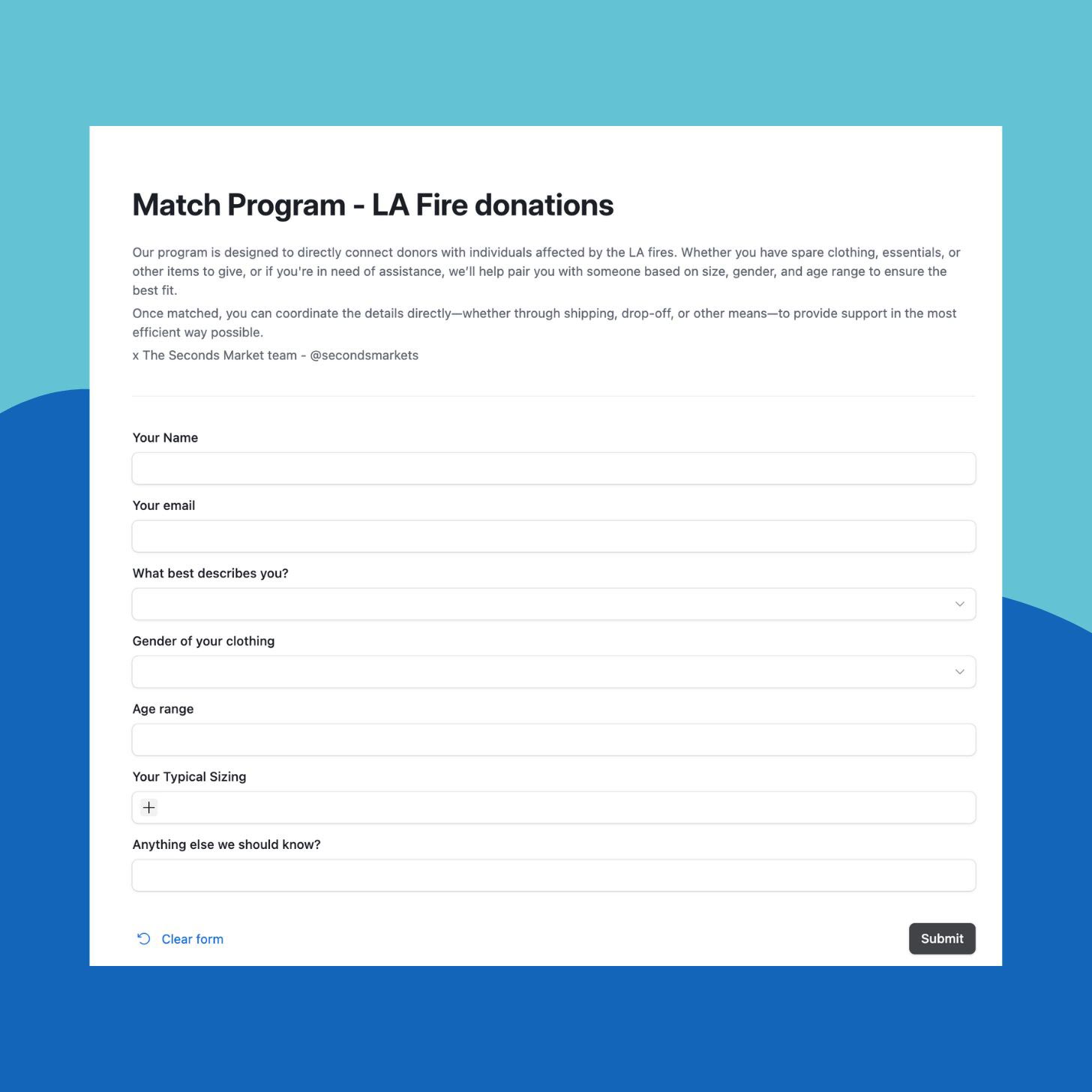
“Have spare clothes lying around? A Poshmark or Depop pile? We’ll connect you with someone who needs them,” the group shared on Instagram on Wednesday.
“Wearing secondhand is hot, but donating to your community is hotter.”
Their post directs followers to a sign-up link where people can request support or volunteer to donate items. Folks are then paired up, based on clothing size, age, and gender to ensure that people get items that are appropriate for them.
Over the course of 48 hours, 20,000 donors had signed up, according to the Seconds Market Instagram page.
Iluka, the founder of Seconds Market, shared that the match program is different from a donation drop-off, helping people get their needs met by having items shipped directly to them, rather than using the labor required to sort through donated items.
That said, she shared in an Instagram story that she was hoping to set up a free “store” so that fire victims could shop for donated items in the coming days and weeks, as well.
“This match initiative was a way for me to connect friends who wanted to help LA victims directly. Helping one person would’ve been a win in my book,” Iluka wrote in a statement.
“Since ‘launch’ we’ve had 20,000 (and counting) of you from across the U.S. sign up to donate — directly from your closets — wardrobe to wardrobe.”
Donors are responsible for the cost of packaging and shipping items after being connected with someone in need — and donations are not limited to clothing, but rather anything they can offer their “match.”
Experts suggest that major influxes of donations can be overwhelming to folks immediately working to rebuild their lives, though anecdotal evidence from others who have survived house fires suggests that it helps to be given something right away instead of having to go shopping amid recovery.
It’s that immediate need Iluka hopes to fill with Seconds Market.
She wrote on Instagram: “[This is] giving 20,000 people the opportunity to have one less thing to worry about when they wake up today.”
Pangolins are mammals covered in scales from head to toe, with long tails, sticky tongues, and adorably short forearms that are often held out together in a way that bears a slight resemblance to a small, pleading Dickensian child.
They are one of the most trafficked animals on the planet.
According to the World Wildlife Fund, over a million pangolins were trafficked over a ten-year period for their meat, skins, and scales in countries like Vietnam and China — and even the United States.
Due to the decimation of their populations around the globe, all eight species of pangolin are endangered and protected under the Convention on International Trade in Endangered Species of Wild Fauna and Flora (CITES), the highest international trade agreement of wild animals and plants.
But recently, biologists made new headways in pangolin research, when scientists from the Zoological Survey of India conducted DNA analysis on an array of confiscated pangolins.
Shockingly, one pangolin turned out to be a new species of Asian pangolin, which researchers dubbed the Indo-Burmese pangolin (Manis indoburmanica).
Upon analyzing the structure and function of the specimen’s DNA, the biologists were able to trace the pangolin’s evolutionary lineage back to a species that diverged from the Chinese pangolin (Manis pentadactyla) approximately 3.4 million years ago.
“This discovery is a testament to the power of modern genetic tools in uncovering hidden diversity,” Mukesh Thakur, lead biologist, said in a statement.
“The Indo-Burmese pangolin not only enriches our understanding of Asian pangolins but also emphasizes the need for region-specific conservation efforts.”
“It is a privilege to contribute to such an important discovery,” added Lenrik Konchok Wangmo, a scholar at the University of Calcutta who was a pivotal figure in the study.
“This species adds a new dimension to pangolin conservation, highlighting the importance of protecting their habitats from threats like poaching and habitat degradation.”

Thakur, Wangmo, and their colleagues said that the species’ belated discovery indicates that the species may be in small numbers — and highlights how vulnerable pangolins are as a whole.
“Pangolins are among the most heavily trafficked mammals globally,” Thakur told the Indian Express.
“Recognizing this species as distinct highlights its vulnerability and the pressing need for collaborative conservation measures across its range.”
In addition to trafficking, pangolins are under threat from deforestation and industrialization — which shrinks their habitats and forces them to forage for food at unnatural times.
Looking for food during the day, under less tree coverage, leaves them at risk for predators like leopards, hyenas, and pythons.
Across Asia and Africa, pangolins are critical for environmental health. The Nature Conservancy even refers to them as “guardians of the forest” because they primarily feed on termites and protect trees from destruction, creating a balanced ecosystem.
This latest discovery of the Indo-Burmese pangolin, found in parts of Arunachal Pradesh in northeast India — and possibly in Nepal, Bhutan, and Myanmar — indicates that more work lies ahead for pangolin conservationists.
“This remarkable finding demonstrates the critical role of scientific research in uncovering biodiversity and informing conservation action,” said Dhriti Banerjee, the director of ZSI.
“Protecting the Indo-Burmese pangolin is essential to safeguarding the ecological integrity of the Indo-Burma region.”
Header image via Shukran888 / Wikimedia Commons (CC BY-SA 4.0)
When Portland, Oregon teacher Sam Balto started Bike Bus PDX, an initiative that leads students on a healthy and eco-friendly biking commute to school en masse, he made sure to have a solid playlist on deck.
One of his favorite artists to add to the mix? Justin Timberlake.
Since the inception of this particular Bike Bus in 2022 (many others exist across the country), Balto has shared plenty of videos of the joy-filled morning commute, music blaring from his Bluetooth speakers.
In October, Balto posted a video, blasting Timberlake’s “Trolls” hit “CAN’T STOP THE FEELING!,” extending an invite to the singer.
“Justin Timberlake, come join our bike bus,” Balto said, as hordes of students rode by. “We would love to have you.”
Millions of people on both TikTok and Instagram viewed the video and encouraged the singer to stop by.
And on Sunday, January 12, he finally did.

While Timberlake wasn’t able to make it on the route during the school week, about 200 children and their families made a special Sunday exception to ride with the star.
They took a half-mile ride through the neighborhood to Alameda Elementary School, according to Oregon Live, with Timberlake’s team playing the hits and taking photos with students and teachers.
“It was a day to celebrate our children, the community, physical activity, and joy,” Balto — who was a physical education teacher at Alameda Elementary School — wrote in an Instagram post, thanking Timberlake.
“Your presence made it extra extra extra special ride for everyone,” he continued. “Core memory unlocked!!!”
Balto now runs the nonprofit Bike Bus World, to help implement more of these alternative commute communities everywhere.
“By fostering camaraderie and providing a sense of security, the Bike Bus encourages kids to embrace cycling as a fun and social activity,” the Portland organization’s website explains.
“This initiative not only reduces traffic congestion and carbon emissions, but also instills a lifelong habit of active transportation in young individuals.”
By riding as a group, Balto is able to lead kids in a safe and engaging way, while also helping them develop the skills they need to cycle safely on their own as they grow up.
“I think it’s pretty important to prioritize children’s mobility and physical activity especially when it sets kids up for success at school,” Balto told Oregon Live in October.
“We should do everything we can to create a safe environment for kids to do things like rollerblade, go walking, biking so they can be successful with independence and autonomy.”
And hanging out with pop stars? That’s just a bonus.
As Balto told Oregon Live, “I think that Justin Timberlake joining the Bike Bus would set a great example for how people can get around — on a bike — for everyday transportation.”
“Thank you, Coach Balto for letting me and The Tennessee Kids join your morning ride yesterday,” Timberlake added in an Instagram caption. “You’re bringing joy to a lot of people out here.”
Header image by David Benhaim
On January 7, fast-moving wildfires erupted in Southern California, ripping across thousands of acres in Los Angeles.
As the LAFD races to contain the various fires, fire crews have flown out from Texas, Denver, Montana, and even Mexico to aid in the fight.
And on January 9 — over 1,000 miles away in Colorado — firefighters from the Loveland Fire Rescue Authority were facing their own unique challenge: pulling a horse out of a frozen pond.
“LFRA responded to a large animal ice rescue late this afternoon on South County Road 13,” read a post on the Loveland Fire Rescue Authority Facebook page.
“A horse found a way through a fence and onto a frozen pond, which unfortunately could not hold the weight of the horse.”
According to the post, the horse — which is blind in one eye — was trapped in the middle of the pond and was unable to make its way back to shore.
Soon, all hands were on deck as help from the Berthoud Fire Protection District, Larimer County Sheriff's Office, Thompson Valley EMS and City of Loveland, Colorado’s Government Water and Power Department arrived at the scene to provide assistance.
Working quickly, the firefighters donned “ice rescue suits” and jumped into the frigid waters, breaking the ice with axes and sledgehammers to carve out a pathway for the animal.
In the end, the horse was led to shore with a series of ropes and guiding hands.

“The rescued horse was warming up and recovering as crews picked up equipment and returned to service,” the fire department assured locals.
“Happy to report a good outcome on this incident,” Berthoud Fire Protection District responded on Facebook.
In the comments, locals chimed in to show their appreciation for the firefighters on duty.
“What a remarkable rescue those people pulled off,” one person commented.
“So glad that you guys are dedicated to rescuing any living creature!” replied another.
“With all the bad news about fires,” one person wrote, “it is a joy to read about and to see these heroes in action.”
Header image via Loveland Fire Rescue Authority
Living in downtown Toronto, construction manager Ryan Donais saw first-hand how the homelessness crisis impacted the people of his city and realized he could help be a part of the solution.
“It breaks my heart to see the housing crisis everywhere, with tents in parks and people sleeping outside. Tents are for camping, not for housing,” Donais wrote on a GoFundMe page.
So, he invented Tiny Tiny Homes, a mobile home camper that attaches to a bicycle and provides temporary shelter for people experiencing chronic homelessness.
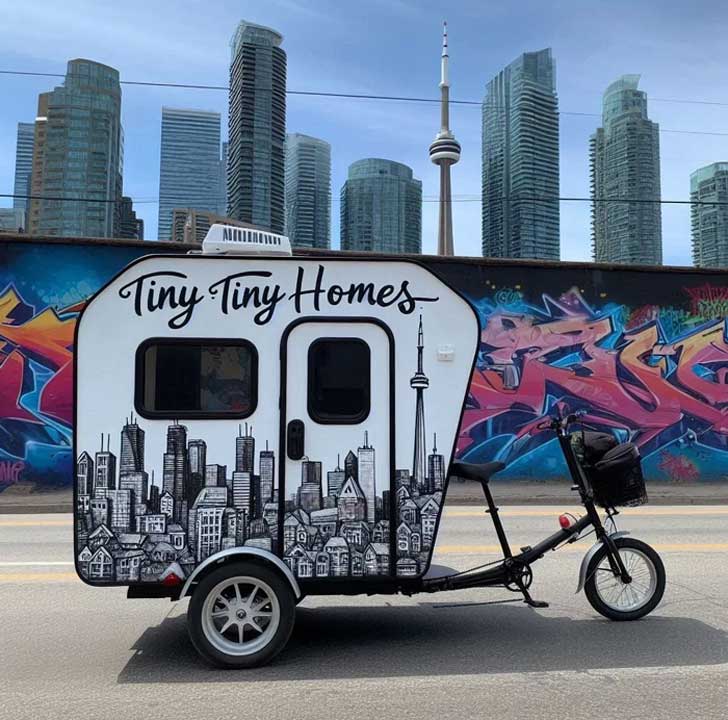
Each Tiny Tiny Home model is insulated, weatherproof, and watertight, with thoughtful essentials, including a sofa that converts into a bed, solar-powered electricity, a desk, and 12 cubic feet of under bed storage.
The small units also have electricity and heat, running water, and safety features like smoke and carbon monoxide detectors and a fire extinguisher. Future prototypes will also include a camping toilet and sink.
According to CBC, the units are also designed with Ontario's e-bike regulations in mind so that they can legally travel on the city's bike lanes if they have to be moved.
Donais launched a GoFundMe to help buy materials to build out these mobile homes and has raised over $90,000, just shy of his goal of $100,000.

“The first model, I funded myself,” he explained on the fundraising page. “Each unit costs around $5,000 (not including sweat equity) to build, and I will ensure that every penny is spent wisely to create a safe and comfortable home for those who need it the most.”
Since the summer, Donais has also created a registered nonprofit to help bring more of these shelters into the world.
According to the Tiny Tiny Homes website, the organization’s mission is to “replace unsafe tent encampments with secure, mobile homes and help rebuild lives with dignity and hope.”
For Terra Sawler, who moved into one of the mobile home units after spending close to three years living on the street, that mission has been accomplished.
“This is definitely the safest and warmest I've been since I've been out here,” Sawler told CBC. “When you're out on the street, you don't sleep every night. You sleep every couple nights … I've had my shoes stolen off my feet, I've had my [sleeping] bag cut off, it's a dog-eat-dog world out here.”
While Donais is happy to help people as much as he can, he knows his shelters aren’t meant to be permanent, and he told CBC he wishes he didn’t have to build them at all, pushing the local government to provide more safe, affordable housing to people in need.
“It’s terrible that we’re letting people sleep outside,” he said. “Housing is the answer.”
The crisis is also a personal one for him; Donais shared that his brother has faced homelessness and addiction over the years, as well.
“I want every homeless person to have one of these,” he said. “Tent encampments are not a healthy environment.”
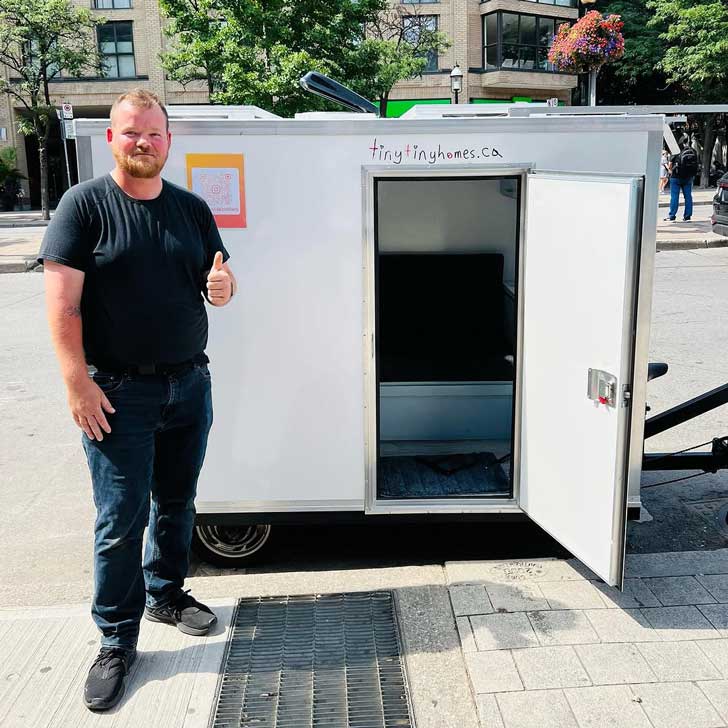
As Donais gains more funding, he hopes to rent a larger shop to build and store materials, therefore lowering the cost of each unit. He also hopes his new nonprofit status will help garner the support of grants and other public supporters.
Above all, he has one simple goal: to construct more units and give them away to people in need.
“We aim to scale production, increase distribution, and forge new partnerships, making Tiny Tiny Homes a viable housing solution for those in need across more communities,” Donais shares on his website. “Together, we can turn small homes into big changes.”
Header images courtesy of Ryan Donais/Tiny Tiny Homes
When she was growing up in La Jolla, California, it was impossible for Renee Wang to ignore the rising homelessness crisis in her hometown.
“In my home state of California there are over 160,000 unhoused people, both sheltered and unsheltered,” Wang told The 74. “In San Diego, only half the homeless people can be accommodated by the existing shelter system.
So, at just 16 years old, Wang proposed a solution: creating tiny homes that were easy to construct, install, and replicate on a massive scale.
Her source of inspiration? LEGO bricks and Rubik’s cubes.
Her model — which she dubbed Rubix — is built to be “cheaper, faster, and far more efficient” than comparable tiny home products.
“The tiny home can be assembled by interlocking ten prefabricated 3D components — and each of the components accommodates a certain living space, like a kitchen, a bathroom, or a bedding area, or storage,” Wang explained.
With sustainability in mind, Wang chose bamboo and recycled plastic for her construction materials.
“Even some LEGO products, which meet the highest standards of safety and health, are being made from recycled plastics,” Wang wrote on her website: Stories of the Streets.
“My design embraces this sustainable approach by using recycled plastic products for plumping pipes, mechanical wires, water tanks, etc.”
The models are also “entirely off-grid,” so that the Rubix homes could double as temporary housing for survivors of natural disasters.
“It has an independent plumbing system so it can also be used in natural disaster relief,” Wang said.
Additionally, the tiny homes can generate their own electricity through rooftop solar panels.
“The electric power usage can be 100% generated from the solar panels even on the shortest days of the year in places with very little sunlight,” Wang proposed.
“[And] in colder or hotter areas, additional batteries can be added to the upper part of the mechanical compartment.”

In 2023, Wang won a $25,000 scholarship from The Davidson Fellows Scholarship Program in San Diego for her Rubix project.
Since then, Wang has been busy perfecting her design, building plywood models, and meeting with experts to gain guidance on next steps.
“Currently, I’m fundraising to create the prototype and I’m aiming for $30,000 — because the shelter beds in San Diego cost $50,000 to maintain per year as opposed to a tiny home that could cost $30,000 or less for a one-time purchase,” Wang told The 74.
“I’ve been in communication with a lot of different city council members and other nonprofits that are interested in seeing it be implemented in San Diego and in other places around the country.”
Above all, Wang said the most rewarding part of her project so far has been meeting with unhoused people and getting their input on her designs.

“I not only managed to collect the appropriate data for the development of my project, but was also graced by their positivity, resilience, and kindness through the trials and tribulations of their lives,” Wang told The Davidson Institute.
“It was these individuals who inspired me, motivated me, and compelled me to overcome any difficulties.”
For Wang, Rubix is more than a unique architectural feat. It’s a passion project directly tied to her fight to end homelessness for her neighbors.
“It’s intended to support independent living with dignity for the homeless population,” Wang said.
Header image via Davidson Institute / Stories of the Street
On January 17, 2025, dog-loving Austinites will celebrate the city’s newest holiday: Matilda Day.
Earlier this month, Austin City Council Member José “Chito” Vela announced the special day, which honors the late rescue dog, Matilda, a beloved companion to local woman Amanda Stronza.
Matilda was a local internet sensation, with Stronza sharing vibrant photos and stories of the pup on social media until and after Matilda passed away at the age of 18 in 2023.

The holiday’s goal is to raise funds for the nonprofit Austin Pets Alive! and its work to provide support and care to senior animals. Last year, before the holiday was city-official, the organization raised over $21,000, surpassing its initial goal of $19,000, in honor of Matilda’s would-be 19th birthday.
This year, their goal is $20,000, representing Matilda’s birthday once again.
“I am so thrilled to see Matilda’s memory honored this way,” Stronza said in a statement. “She was deeply loved by so many, and it only makes sense to channel some of that love to pups who need it most, especially the senior dogs.”

This year’s fundraising campaign is again devoted to the care of senior dogs. Donors can contribute to feed a furry friend; provide two weeks’ worth of sheltering for a senior dog; cover the spay or neuter of a shelter animal; or even provide a wheelchair for paralyzed animals, giving them the opportunity to walk and socialize with others.
Most of all, though, Stronza hopes the holiday raises awareness about the needs of senior pets and promotes adoption for older animals.
According to the American Society for the Prevention of Cruelty to Animals, senior dogs in shelters have a significantly lower adoption rate compared to younger dogs. While younger dogs have about a 60% adoption rate, senior dogs have an adoption rate of 25%, meaning they face the risk of euthanasia — or never finding a loving home.
The long-term goal, according to APA!, is to expand Matilda Day into a national event that inspires senior pet adoption across the country.

“My dream is something like Giving Tuesday, but for dogs,” Stronza wrote in an Instagram post, “a day devoted to extra care and love for senior pups in shelters.”
In a holiday dedication ceremony earlier this month, Vela and Stronza both spoke about the importance of caring for senior pets — especially those in shelters.
“While I was talking, I am pretty sure Matilda, her stardust, was Snoopy Dancing all over City Hall. I am so deeply grateful for the love of so many of you here, and for the magic of that moment,” Stronza shared on Instagram.

“Matilda’s impact through her life and legacy has helped countless lives of senior dogs at APA!,” Dr. Ellen Jefferson, President and CEO of Austin Pets Alive! said in a statement.
“Her legacy shows us what’s possible when a community comes together to care for the animals who need us most. But there are still countless senior pets waiting for their chance. On Matilda Day, let’s honor her memory by turning compassion into action for our companion animals.”
Header image courtesy of Amanda Stronza
Wichita, Kansas man Spencer (who prefers not to share his last name online) has been mowing lawns since he was 11 years old. This led him to start his business, SB Mowing, which offers traditional lawn and landscaping care services — but it also does a whole lot more.
After going viral on TikTok for his satisfying time-lapse videos, Spencer began offering free lawn care to neighbors in need, racking up a whopping 11.8 million followers on the app over the years.
His most recent endeavor was to help his neighbor, Beth, whose overgrown yard was so out of control that the city was going to charge her $240 to cut it — a fee she couldn’t afford.

“I got a call from a friend at the city, and she told me that there is an elderly lady that is in desperate need of help,” Spencer wrote on a GoFundMe page. “So I stopped by her house, and her lawn was getting CRAZY!”
Spencer took care of it, and shared a video of his work on January 9, which quickly became one of his most-viewed of all time, with over 94 million views to date. Beth was overcome with gratitude.
But as his TikTok comments filled up, with people encouraging him to raise funds for her property to be maintained regularly, the compassion people had for Beth blossomed into something even bigger.
“I shared the video… on my social media platforms, and a lot of people are wanting to donate to help her fix some of the accessibility issues around her home,” Spencer wrote on a GoFundMe page.

Beth, who is seen in the videos with a cane, mentioned that she had some broken windows and that it was hard for her to navigate her driveway and home.
Spencer hoped to fundraise enough to provide Beth a ramp, a new driveway, a chairlift to help her move through her home, a lawncare contractor — and if funds were available — some repaired windows and a new, more accessible bed. The original goal for the fundraiser was $100,000.
Within a few days, however, over 32,000 people pitched in to raise a whopping $810,000. And the number continues to rise, with small donations of $5, $10, or $25 coming through.
Spencer told Beth about the fundraiser and visited her again a few days later to tell her it had raised over $500,000 at that point.
“You know how I was setting up that GoFundMe for you? That was yesterday that I started that, and in about 24 hours, 21,000 people donated to it,” Spencer told Beth in another video, holding her hands in his.
She gasps and begins to cry, her small voice responding, “there’s no fire here.”
Beth is referencing the devastating wildfires in Los Angeles, California, where thousands have been displaced and lost their homes.
“There’s no fire here,” Spencer laughs, “but there’s you.”
@sbmowing Beth's reaction to people donating over $500,000! Be sure to subscribe to my YouTube channel to follow her journey over the next few months #sbmowing #neighbors #elderly #helpingothers #accessibility #gofundme #donations ♬ original sound - SB Mowing
Before Spencer tells Beth how much has been raised, they take a deep breath together, and he reads some of the encouraging messages donors have left for her.
“You deserve every bit of this money. I hope our donations help to brighten your life,” one donor, Amanda, wrote. “You seem like an absolute sweetheart. I am grateful to have a chance to help you.”
On GoFundMe, Spencer wrote that, aside from fixing any of Beth’s accessibility issues, some leftover money will be given to her in cash, with the rest donated to local nonprofits that help other people in similar situations.
A report from the Joint Center for Housing Studies of Harvard University found that 6.8 million American households report difficulties navigating or using their homes. And as residents age, the likelihood of reporting a disability — and therefore, difficulties in their home — increases.

Beth represents those communities of people — and Spencer and his followers represent all of the people who want to help make her life easier.
When Spencer told Beth about the fundraiser, she responded, aghast: “Oh, my god. Why?”
“They kinda fell in love with you and your story,” Spencer told her, about his followers. “We just wanted to come together as a community and help you out and get you to a better spot.”
Beth replied, in awe: “Those are the things dreams are made of.”
Spencer encourages his followers to follow along on YouTube to keep up with Beth and the fundraiser.
“I really appreciate everyone that donates to help Beth out,” he wrote on the fundraiser. “I will make sure that the money goes towards fixing all of the items above or any other accessibility issues that Beth needs.”
Header image courtesy of SB Mowing/YouTube
Michael J. Fox was diagnosed with Parkinson’s disease at 29 years old — just one year after the “Back to the Future” trilogy came to a close.
And although Fox might be the most famous person in the world with Parkinson’s disease, he is far from the only.
The World Health Organization estimates that over 8.5 million people have the progressive brain disorder, which can impair movement and cause tremors and contractions.
After going public with his diagnosis, the celebrity-turned-philanthropist launched The Michael J. Fox Foundation for Parkinson’s Research in 2000.
In the 25 years since, Fox’s foundation has been invaluable to the medical community’s global fight to find a cure for Parkinson’s disease.
To date, they have raised over $900 million for research programs with the goal of eliminating Parkinson’s disease “in our lifetime” — and new research shows that they are one step closer to that goal.
Recently, the foundation partnered with global healthcare company Grifols to identify the biomarkers of Parkinson’s disease well before symptoms appear, a crucial breakthrough that could help slow — or altogether stop — the condition from progressing.
“At MJFF, our mission is to accelerate breakthroughs for people living with Parkinson’s by funding diverse and innovative approaches,” Shalini Padmanabhan, senior vice president of translational research at MJFF, said in a statement.
“Identifying reliable biomarkers for Parkinson’s disease is essential to unlocking earlier diagnosis and more effective treatments,” Padmanabhan continued.
“Grifols’ research on a plasma-based biomarker to detect PD as its earliest stage – before progression begins – aims to help us understand the biology of individuals who may be at risk and paves the way for transformative breakthroughs in care and prevention.”
As a pioneer in the plasma industry, Grifols has collected more than 100 million plasma samples that are emblematic of thousands of rare and chronic diseases — including Parkinson’s.

The company’s vast library of samples offers researchers at the Michael J. Fox Foundation the unique opportunity to analyze plasma samples that go back up to 10 years.
“Our groundbreaking initiative leverages Grifols’ one-of-a-kind storehouse of well-preserved plasma samples, the most comprehensive technology platforms and our unique plasma proteomics expertise,” said Dr Jörg Schüttrumpf, Grifols’ chief scientific innovation officer.
“Going back in time to search for the earliest signs of PD, even before symptoms appear, has potential to revolutionize PD management,” he said.
“The hope is to accelerate and ultimately develop new diagnostics and disease-modifying therapeutics that could mitigate or even prevent the condition from manifesting itself.”
Header image via Pexels / The Michael J. Fox Foundation for Parkinson’s Research
As blazing wildfires continue to scorch through Los Angeles, California, thousands of people have been temporarily displaced or rendered homeless by the ongoing disaster.
As nonprofits throw open their doors, restaurants offer free meals, and crowdfunded campaigns roll in thousands of donations, there are an overwhelming number of resources cropping up — both from people wanting to help and those seeking aid.
In the chaos, one teen wanted to make it easy for everyone to find information in one, tidy place: a website called save-la.org.
“I wanted to make it so if you wanted to help or if you needed help, it could all be in one website, a one-stop shop,” Ruben Varghese — a 16-year-old who lives in South Bay, Los Angeles — told NBC Bay Area.
“I am deeply passionate about helping people, especially during these challenging times,” Varghese explained on the website’s homepage.
“This website is my effort to make a positive impact and provide resources to those who need them most.”
The Save LA website is sectioned off into six distinct sections: cash donations, supply donations and drop-off locations, volunteer opportunities, safe shelter options, financial assistance, and food banks.
The volunteer resource guide is the most comprehensive list on the website.
Links include food and supply centers looking for volunteers, animal shelters looking for temporary foster parents, and opportunities to host wildfire victims who are temporarily homeless.

“With so many Angelenos under evacuation orders and first responders coming in from all over the country, this is a way to open your home if you are able,” Varghese wrote online.
“You can [also] host through Airbnb to offer free stays to people in times of crisis.”
Overall, Varghese wanted to make it easy for victims to find help — and for helpers to lend a hand.
“I just want the people who got victimized by these fires to have some sort of home and shelter and some way of living in this hard time,” Varghese explained to NBC.
Image via Los Angeles County Economic Development Corporation
Seventh graders at Thurgood Marshall Middle School in Rockford, Illinois are learning about STEM — but they’re also learning about real-world challenges.
The students have taken on a new project: assembling “solar suitcases” to help bring electricity to schools in Uganda’s Bidi Bidi Refugee Settlement, which is home to 270,000 South Sudanese refugees.
It’s an initiative led by We Share Solar, a nonprofit that provides science and technology learning projects for students that then go on to benefit other students in low-income areas of the world.

The project introduces middle schoolers to fundamental electrical concepts, like positive and negative charges, voltage, amps, and wiring, ultimately producing a 12-volt DC solar power system that will be distributed among the refugee community.
“We’ve learned many things like positives and negatives, amps, volts, all that stuff, and how to wire stuff together,” Pratham Mehta, one of the Thurgood Marshall students, told WIFR News.
“We’re taking all this stuff for granted, and other countries don’t have all this stuff, like electricity.”
The suitcases will bring electricity to 40 schools in the refugee settlement, which provide education to over 12,000 students. They are designed to be easily transported (thus the suitcase design), which makes them ideal for off-grid locations, like a refugee camp.

The panels in the suitcase collect sunlight and harness the energy in a built-in battery. It can then provide power to up to five light bulbs for 50 to 60 hours a week. Depending on the capacity of the system, it can also help power small electronics like phones or radios.
For people in the Bidi Bidi settlement — one of the largest refugee settlements in the world — this kind of power can make an enormous impact.
In fact, We Share Solar has deployed over 1,000 suitcases to “energy-scarce locations” across the world, with more than 500,000 students and teachers benefitting from the power they provide.

“The We Share Solar education program serves youth twice,” Hal Aronson, co-founder of the organization, said, “first as an educational experience for American youth and second as a renewable power and lighting system for youth in parts of the world that lack electricity.”
Along with connecting students to learning opportunities, the organization ensures each device is tested by a professional to ensure it is built to withstand energy demands. Then, the suitcases are installed by trained partners in destination countries, and students and teachers alike learn about the new clean energy technologies they have implemented.
At the start of the 2024 school year, the We Share Solar program was implemented in 13 Illinois schools, training educators in the curriculum and setting up the project across the state.

“This is just the beginning,” a Facebook post from We Share Solar states. “These passionate teachers will now guide their students in building solar cases, providing a hands-on STEM experience with real-world impact.”
For Thurgood Marshall teacher Stacy Wallace, the impact was clear.
“The students were just really wowed by the fact [of] how cramped the classroom was and that they’re sitting on benches with little bitty tables with not a lot of supplies,” Wallace told My State Line. “So, I think just realizing that something as little as light can make a lot of difference.”
Header image courtesy of Thurgood Marshall Middle School/Facebook
McCormick Place Convention Center in Chicago is the largest convention center in North America. It’s also largely covered with glass — and for years it’s been the cause of a staggering amount of bird deaths.
In fact, in October 2023, at least 1,000 birds died from colliding into the building on a single day as they migrated south for winter.
“Anywhere you’ve got glass, you’re going to have birds hitting the windows,” Bryan Lenz, a director at the American Bird Conservancy, told The Guardian.
In the United States, up to 1 billion birds die each year from window collisions, and the skies of Chicago are particularly affected, as it serves as a critical migratory corridor.
Fortunately, after the incident in October 2023, the public petitioned for McCormick Place to take responsibility and prevent future casualties.
“A thousand birds in one day is staggering, but no less sobering is the tens of thousands that have died here through the years,” conservationist Annette Prince told board members that fall.
“Just as [McCormick Place] seeks to welcome visitors to Chicago from around the world, please implement the long overdue measures that will ensure that millions of invaluable and irreplaceable avian visitors that we host each year will have safer passages through our city.”
Prince’s plea was paired with a petition from Chicago Bird Alliance president Judy Pollock, which garnered 10,000 signatures in just a matter of days.
“This is an example where our city can make a huge difference for these birds,” Pollock said.
“I don’t want any death of any kind,” replied Larita Clark, CEO of the Metropolitan Pier and Exposition Authority — which oversees McCormick Place. “We’re going to do our part.”
Over a year later, it seems the board members behind McCormick Place were true to their word.
In a move supported by the American Bird Conservancy, they consulted with Feather Friendly, a company that installs bird-friendly window deterrents on a residential and commercial scale.
In 2024, Feather Friendly added bird-safe film to the exterior of the building— the equivalent of two football fields worth of windows.
The polka dot formation on the film disrupts the reflection of the glass, making it easier for birds to detect and avoid.

And now, according to data recorded during the fall migration period, bird collision deaths at McCormick Place dropped by as much as 95%.
“We didn’t know what we were going to do [at first], we just knew we needed to do something,” Clark told WTTW, a Chicago-based news station, “so we’re ecstatic that it’s been such an amazing outcome.”
U.S. Fish and Wildlife Service Director Martha Williams said that the progress is “monumental.”
“McCormick Place Lakeside Center deserves hearty appreciation and recognition for the steps they have taken to drastically reduce bird collisions at their facility,” said Williams.
“The U.S. Fish and Wildlife Service applauds the leadership displayed by the Metropolitan Pier and Exposition Authority to make their buildings less dangerous for migratory birds. Their efforts will encourage others across the nation to take steps to make glass and lighting safer for migratory birds.”
Header images via Paul Groleau / Feather Friendly & Sayefotograf / Pexels
On January 1, Massachusetts officially prohibited elephants, lions, tigers, primates, giraffes, and bears from being used in traveling circus environments.
Going forward, the new law authorizes civil penalties ranging from $500 to $10,000 per animal.
The result comes at the heels of over two decades of advocacy and was widely supported across the state, with more than two-thirds of Massachusetts voters supporting the ban.
“For years, circuses have harmed the welfare of animals for the sake of entertainment,” Governor Healey expressed in an official statement, as the bill was signed into law. “I’m thankful to the Legislature for taking the steps needed to prevent this kind of animal mistreatment in Massachusetts.”
“Some of the most majestic creatures on our planet should not be treated inhumanely simply for profit or entertainment,” Senate President Karen E. Spilka added in agreement.
Although larger circus companies, like Ringling Brothers and Barnum & Bailey, have resumed operation post-pandemic without elephants, tigers, lions, and more in their shows regional circuses, fairs, and carnivals have only recently come under fire for their treatment of animals.
As the new year rang in, Massachusetts joined New Jersey, Hawaii, California, Colorado, and Maryland in banning the use of wild animals in circuses.
In Massachusetts, exemptions include animals performing in zoos and on movie sets — activities that are monitored by the American Zoo and Aquarium Association (AZA) and the American Humane Association (AHA) respectively.

Preyel Patel, the Massachusetts state director for the Humane Society, said the new law protects animals from enduring abusive training methods, prolonged confinement, and harmful environments.
“This historic legislation marks the end of an era where tigers, elephants and other wild animals are forced to perform under deplorable conditions including being whipped and forced into small cages to travel from show to show across the commonwealth,” Patel told the Associated Press.
Officials hoped this would also bring attention to the protection of the many endangered and vulnerable species that have long been associated with circus life, including Asian elephants and wild tigers.
“These animals are often subject to cruel and inhumane treatment, including prolonged periods of confinement and other forms of neglect and abuse, all to provide entertainment,” said House Minority Leader Representative Bradley H. Jones Jr.
“While several communities in the Commonwealth have already implemented local bans, a statewide ban on traveling animal acts is long overdue.”
Header image via Flickr (CC BY-NC-ND 2.0)
When Minnesota Governor Tim Walz became Kamala Harris’s Vice Presidential nominee in the back half of 2024, the campaign’s supporters quickly fell in love with his family.
Walz’s wife, Gwen, became a prominent, empowered maternal figure and teacher to the greater public. Meanwhile, their son Gus’s proud cries of “that’s my dad!” at the Democratic National Convention won hearts; and their daughter, Hope, brought a joyful, relatable presence to the campaign trail.
Following the election in November, Hope found a welcoming audience on TikTok, where she posted pragmatic pep talks and cozy video diaries, sharing behind-the-scenes family anecdotes, “what’s in my Baggu?” insights, and even introducing her boyfriend to the world.

The 24-year-old joined her dad for the duration of the whirlwind campaign but has returned home to Bozeman, Montana, where she works at a homeless shelter and as a ski instructor.
Although the future is uncertain for TikTok, she plans to continue posting content on social media, helping an online community come together in, well, hope, for the big changes ahead.
Hope sat down with Good Good Good to share how she’ll be spending Inauguration Day, ways people can get involved in the causes they care about, and what book she and her dad plan to read next in their father-daughter book club.
Answers have been edited for length and clarity.
A Q&A with Hope Walz
Kamrin Baker, Good Good Good: Tell me how you’re managing this moment in time.
Hope Walz: I mean… obviously it’s been a weird time because there’s this TikTok ban that people are starting to freak out about and then there’s also the upcoming inauguration and the new administration. It honestly kind of feels apocalyptic on at least my side of the internet.
But, I’m really just in the mode of controlling what I can control. I can’t stop the TikTok ban. I can’t stop the inauguration from happening. That stuff is going to happen. So I just have to control what I can control.
I’m just kind of leaning into what I can do, like the work that I have at the shelter. I got booked to ski instruct on Inauguration Day. Thank God I’m working, and I don’t have to see that.
I won’t say it’s business as usual, but I’m just kind of trying to push forward in that way because there is nothing that we can do about it other than lean into our people.
[Editor’s note: I asked Hope more details about her Inauguration Day plans later in this interview.]
KB: Where are you finding hope and joy as we move closer to this next stage?
HW: I mean, I won’t kid about it. It’s obviously terrifying and it’s very easy to just get paralyzed with that fear. And I don’t think anybody knows what the world’s going to look like come Monday [Inauguration Day], and that’s a very scary thing.

But I am kind of leaning into this idea, you know, I won’t say we’ve been here before, but we have seen a Trump presidency before. We’ve seen apps get banned before. And people always find a way to keep pushing through. I think you do that by working in your communities.
So I’m finding a lot of hope in my co-workers and just my community at large. I’m finding so much joy in skiing, and that’s a very privileged thing to be able to do, but finding the joy of being able to go on a walk and knowing you have a body that allows you to do that, and just those little things that will keep us moving forward.
KB: Tell me a little bit more about the work that you do. I know you work in a warming center, right? And I hear you’re contemplating going to grad school? Tell me about that and what drew you to this work.
HW: Yes, I am. So, my degree was in criminology, which is really like a sociology degree with a focus. I always knew that I wanted to be people-focused. I started out studying political science and I was like “this is way too much theory.” Like, this stuff happens, but what really affects things are people, and behaviors, and how people react to each other. So that’s kind of why I went that route.
Then when I graduated, I decided I wasn’t quite ready to get a nine-to-five, sit-down job or go to grad school yet, but I still wanted to do something in that direction. One of my friends worked at the center and I was like, “I’ll apply.”
So now, I do the overnights at the shelter, and I do a lot of direct services. They say in the field of social services, “it’s a lot of just referring people to other people,” so I get to be like, “You should come in tomorrow at 10:00 and speak to these people and they’ll be able to help you with this,” or “You can go here and they can get you a voucher for this.”
It’s just a lot of human connection. You see people at their most vulnerable and get to be that solid, stable person.
I do think I’m going to either apply to start [grad school] this coming fall, or a year from now — I guess, to get my masters of social work. I don’t know if I necessarily want to go into the field long term, but I think I want to do policy or some sort of political consulting, anything in that realm.
Again, when I was in poly-sci, I was like “this is not real,” so I want to come from having a degree and having experience on the ground, knowing what people actually go through and what actually helps.
So, I think I’ll do that. It may change. We’ll see.
KB: What’s your advice for people who want to get involved with helping their most vulnerable community members but maybe don’t have that education or don’t have that professional training?
HW: It all starts, I think, with your comfortability level. So, I made a video and I said “go volunteer at your high school ticketing counter at a sports game.” Like, that stuff matters, too. And if you are feeling uncomfortable or quite ready to walk into a shelter or a warming center, start by bringing food to the food bank. Those little things really do add up.
I put out a call to action on a wish list for the shelter and it sold out in three days. And to me, that just showed that people are looking for ways to help; they just need direction.
I urge people to Google-search nonprofits in your area. Organizations — a lot of times on their website — they have volunteer opportunities and at the place I’m at, we have a wonderful group of volunteers. A lot of people are there very consistently.
I will say people come in the first time and they’re like, “I’m a little nervous right now. I don’t know what to expect.” That’s a completely normal thing. But they leave and they’re like, “That was amazing. I’ll be back tomorrow.” If you come in with an open mind, it’s amazing, and it’s so fun, so just dive in with an open mind.
KB: Moving on to the inauguration. You mentioned that you work that day, but walk me through your day, start to finish. How are you getting through it? What are you doing? Maybe you can provide a blueprint for the rest of us.
HW: I think I’m not going to look at social media. I think there’s going to be a lot of news coming out because [Trump] has a billion executive orders coming out. And truthfully, I’m not going to pay attention to it because I know that I will see what I need to see.
We need to know what’s going on, but I think it’s going to be very scary for a lot of people because it’s just going to come fast and be objectively hurtful for a lot of people.
So on the actual day, I’m not going to go on social media. That’s just for my own mental health. And then the day after, I will get back on and kind of regroup and see where I can go.
And for me personally, I think it’ll be a little hard to watch because I could have seen myself there, as well.

But, like I said, I’m working, and I get to ski instruct, so I’m doing something that I love to do.
And then I’m going to make sure to do some extra self-care. I’m not cooking that day. I’m getting something fun for dinner. I’m doing an extra thing like a face mask or something and then just kind of preparing for what’s to come. I think the first day will honestly be the scariest just because there is going to be so much.
KB: Something that I think a lot of people resonate with about you and your family is that you guys are kind of just…normal. You just represent a happy, normal family, which feels very rare in politics. How did you maintain that sense of normalcy when you were on the campaign trail last year?
HW: I think it started out with just being grounded just in general. My dad has now been in elected office since 2006. We hadn’t experienced anything to the level in which we did [in 2024], but we did have experience in that. And my parents worked really hard to keep my brother and I’s childhood the way it would have been if he hadn’t been in office. I grew up in the same house and I went to public school and that whole thing. And that I think really just set the groundwork.
Yes, my dad does this. He’s a public official, but I’m normal and I’m like everyone else.
I think when we did get kind of thrust in this, we knew that in order to get through it, and in order to be the people we needed to be for the country, we had to keep our humanity.
I remember, the first week when we were on that joint rally tour with the Vice President, we were sitting in a hotel in Phoenix and there were big windows looking out into the city and the mountains, and I just started laughing.
My dad’s like, “What are you laughing about?” and I’m like, “Can you believe you’re running for Vice President? What do you mean you’re running? And we’re sitting here right now?”
And there’d be moments throughout the campaign that we just start laughing, like “This is the craziest thing we’ve ever experienced.”

I think being able to recognize the just absurdity of what was going on around us allowed us to really kind of stay grounded. I was pretty much full-time traveling with him, and it was just such a fun thing to do together — and to meet all of these amazing people and see the entire country. I’d never been to most of these places before, and I like to say I saw the best of America.
Being able to do that with my dad was just a very humbling experience, and I think we definitely recognized the significance of what we were doing. I think we were portrayed as the way we actually are because we’re authentic in that way. And it was just cool to see people connect to that.
KB: It’s obviously not the same thing as this moment in time, but I imagine your experience going into the campaign was probably similar to this time for many Americans. Like, you’re filled with this uncertainty, maybe a little bit of anxiety, just all this overwhelm. For people who feel like they’re about to embark on a time of uncertainty or abnormality, what is your advice for staying afloat and staying true to your values?
HW: During the vetting process or “Veepstakes,” as they like to call it, I was spiraling. I was in the process of moving to a new spot. I got strep throat. There was a point where I was just doom-scrolling for a week straight. I found myself leaning on my friends a lot to just watch a dumb movie or a reality TV show, or talk about things outside of what was happening in my life.
I found leaning on my community was super important.
And then, stepping into that uncertainty, the day before my dad was picked, my parents called me and they’re like, “You should maybe come home. This is actually a possibility.”
So I booked a last-minute flight, and I was feeling super anxious. But when I got home, things were very normal. My mom had some dresses on the bed that I would potentially wear, and they were all ugly and horrible, but we figured it out.
I was just like, “Okay, this is where I’m at right now. Whatever is going on outside of this right now, it matters, but I just have to kind of focus and be in the moment.”
There’s a saying — I don’t know who said it — it’s “be where your feet are.” So there might be all of this doomsday stuff around you, but where your feet are, if you’re doing the good work, you’re leaning on your friends, your family, your community, that’s where you are. That’s where you have to be.
It doesn’t help to just take in all of this really scary stuff. When, hopefully not, but when it inevitably gets bad, then I think it’s just recognizing that we can organize and we can get through it together.
I talk about community a lot. It’s kind of beating an old drum here. But really, if you have your community around you, I really do think we’re going to be okay.
KB: I really feel that too. I’ve seen a lot of people share about how your dad was a representation of a stand-in dad that they wish they had, or a dad that they had before they lost him to some harmful beliefs. It’s so special you continue to share glimpses into your life and your family, but what would you say to those people who feel like they lost the hope that he represents?
HW: I am very strategically putting that [content] out there because I know that there was a sense of community around him in that way. That feeling was a super powerful thing for our entire family and it really put in perspective just how lucky that I am.
So, I have been putting stuff out there, sharing him, because I know it does make a difference for people seeing that. It makes them feel safe and that is super important, and hopefully I can keep doing that on whatever app we’re all on.
I really think when we saw this displayed on a national level in a way that we probably haven’t before, it gave a lot of people hope. But there are Tims all over the place.
It might not be your dad, but they are there. And it might not even be a father figure. It might be a friend, or anyone else. There are people like my dad everywhere, and I think that’s why he resonated.
KB: I love how graciously you share him, too. I want to give you space here to be yourself and be an individual and be your own person, but it also seems like you just genuinely have such a deep love and appreciation for your family, and it doesn’t seem to offend you that this is a central conversation.
HW: No, not at all. On one of my videos, there were a fair amount of comments when I said something like, “when we got into this,” referring to my family stepping into this experience. And people commented and said they really liked how I framed that, and that it’s a very Midwestern thing.
I think I’m so confident in who I am as an individual because when my family did get into this, even in 2006, when my dad first ran, it was a family thing. It’s always been all of us, and that’s just how we do things.
It’s never just him. If it wasn’t for my mom, he wouldn’t be where he is. And if it wasn’t for him, she wouldn’t be where she is. It’s a thing we all do together.
KB: That’s so special. OK, let’s end on some fun lightning round questions. Who was your favorite person you met on the campaign trail?
HW: Maggie Rogers.
KB: What’s your favorite Kamala-inspired TikTok sound?
HW: I mean, anything with the coconuts. That was the beginning of a super fun and hopeful time. I look back on those fondly.
KB: Three things that give you hope.
HW: Okay, let’s see.
Women.
The sun. I’m so grateful to live in a place that is sunny a lot.
Good journalism. There’s not enough of that.
KB: What’s your go-to Midwestern-ism?
HW: I get a lot of comments on the way I pronounce “bag.” But the “yeah, no, yeah,” I say that a lot.
KB: What’s your go-to nonprofit you support?
HW: I work for one, so I’m going to say HRDC here in Bozeman.
But there’s also another one I’ll plug here in Bozeman; Big Sky Youth Empowerment. We take kids who may not have the opportunity to go outside and do outdoor activities, we ski with them at Big Sky, or take them climbing and hiking. I used to mentor for them, so that’s a good one.
And also the Human Rights Campaign.
KB: What’s your skiing hot take?
HW: If you make fun of other skiers, you’re not a real skier. If you’re on skis, you’re a skier.
KB: Favorite vegan or vegetarian dish?
HW: I love a good falafel wrap with pickled onions and hummus.
KB: What’s the best thing you do for your mental health right now?
HW: I have really gotten into skin care, to my bank account’s detriment.
KB: What’s something you’re looking forward to in 2025?
HW: I’m hopefully going to Nepal! My dad and I were supposed to go but then the trip got cancelled because we had to run.
But I also think just seeing communities come together. I think we’re seeing that with the LA wildfires, and that was pretty amazing. It sucks that it’s out of survival and necessity, but I do think that’s going to be a really cool thing we see more of.
KB: Wait, can I just say I love you being like “yeah, something came up so we couldn’t go on our trip anymore.”
HW: Something came up!
KB: Lastly, what is the next book on your book club list with your dad?
HW: Oh gosh. I really kind of want to get him to read “A Court of Thorns and Roses” by Sarah J. Maas. I just started it, but I don’t know if that would go well.
KB: Oh my gosh. Can you imagine everyone joining in with him and reading it at the same time?
HW: I know. That would be hilarious. We’ll see. He does take my book recommendations sometimes, so we’ll see.
Header image courtesy of Governor Tim Walz/Design by Good Good Good
Forget Charmin, Cottonelle, or Quilted Northern. In Japan, there’s a new toilet paper roll on shelves, and it’s nothing like the others.
The Shibushi Osaki Roll is the world’s first toilet paper made from recycled diapers — and it’s available to purchase at seven stores in southwest Japan’s Kyushu.
While it may be difficult to wrap one’s head around, the team of local governments and private firms behind the Shibushi Osaki Roll say the toilet paper is perfectly safe to use — and could be a game-changer for the environment.
“Please support this eco-friendly product, which aims to promote a sustainable society by reusing local resources,” said Takumi Obo, a spokesperson for the Osaki municipal government’s SDGs Promotion Council, which is leading the product’s roll-out.

The project was spearheaded by the city of Shibushi and the town of Osaki in Kagoshima Prefecture. The two municipalities have a joint waste management system and came together to begin recycling disposable diapers.
The two cities collected 98 tons of diapers and other used hygiene products. They were all sterilized, deodorized, and bleached before being shredded into a pulp. From there, the treated materials were mixed with recycled paper at a local Poppy Paper Co. plant and transformed into rolls of toilet paper.
In the first two months of production, 30,000 rolls were created and are now being sold for just 400 yen — or about $2.70 — per dozen.
While it may not be something people think about while doing their business, the traditional pulp toilet paper most of us are used to has a significant environmental impact.
According to The World Counts, 712 million trees are felled yearly to produce virgin pulp toilet paper, which contributes to deforestation worldwide. And for a single roll of toilet paper, 1.5 pounds of wood are required for production.
Additionally, one roll of toilet paper requires up to 37 gallons of water to be produced, while recycled toilet paper takes up about half of that.
Disposable diapers are also a major waste management issue. In fact, disposable diapers are the third-largest single consumer item in landfills. And they take an estimated 500 years to decompose.
The Shibushi Osaki Roll represents a new frontier for a wood, waste, and water-saving alternative in Japan. And while these two municipalities tackle a small piece of that larger issue, the effort could prove viability on a much larger, global scale
“This initiative could help diversify the ways to secure raw materials,” Satoshi Yoshida from Poppy Paper Co., told The Mainichi, “especially as used paper supplies are expected to decline with the rise of paperless systems and a shrinking population.”
Header image courtesy of Osaki Municipal Government's SDGs Promotion Council
Every day the Good Good Good team collects the best good news in the world and shares it with our community. Here are the highlights for this week!
If you want to get good news in your inbox every day, join the Goodnewsletter — the free daily newsletter designed to leave you feeling hopeful.
The Best Positive News We’re Celebrating This Week —
20,000 people signed up to donate clothes and essentials to LA fire victims through an online secondhand marketplace
Seconds Market, a secondhand clothing organization based in Los Angeles, normally buys gently used clothes from locals and hosts pop-up sales in the LA area for secondhand shoppers.
In the wake of the devastation caused by the LA wildfires, it decided to use its platform to connect Californians in need with clothing donors from across the country.
In 48 hours, Seconds Market said 20,000 donors had signed up. They’ll be connected with someone who requested support based on clothing size, age, and gender. They also are looking to set up a free “store” so locals can shop for what they need, too.
Good to know: Experts suggest that major influxes of donations can be overwhelming to folks immediately working to rebuild their lives. Still, others who have survived house fires have also shared that it helps to be given something right away instead of having to go shopping amid recovery.
There was record-breaking clean energy progress all around the world in 2024
Last week, we shared the news that the U.S. government permanently closed most federal waters — more than 625 million acres — to offshore oil and gas drilling.
It’s a great way to kick off a year of more good climate action. And as the year-end data rolls in, there are even more stories of progress in fighting climate change via transitioning away from fossil fuels toward clean energy sources across the globe. In 2024...
📍 In Great Britain, wind power alone provided more electricity than ever before, and all renewables together generated around 56% of electricity.
📍 In Germany, renewables made up a record 59% of electricity generation and became the “backbone of the system” in the country.
📍 In Poland, a record 29% of its power came from renewable sources, showing great progress in a country that still heavily relies on coal.
📍 In India, the “transformative growth” of its renewable energy sector led to it surpassing 200 GW of installed capacity, making up 46% of the country’s total installed capacity.
→ Read more stories of progress for the planet
Following years of campaigning from activists, Thailand has now banned imports of toxic plastic waste
Thailand is one of several Southeast Asian countries where developed nations have historically paid to import plastic waste. Following China’s ban on plastic waste imports in 2018, the country became the leading destination for the waste.
Between 2018 and 2021, Thai officials said more than 1.1 million tonnes of plastic scraps were imported from Japan, Europe, the U.S. and the U.K.
Many factories would burn this waste rather than recycle it, which led to damaging conditions for both people and the planet. Thanks to years of campaigning by activists, both people and the environment will be better protected from this hazardous waste.
Why is this good news? For those living in developed nations, dumping toxic waste in other countries is not a sustainable solution to the plastic waste crisis. While much larger solutions are necessary to solve this crisis (like a global plastics treaty), Thailand’s refusal to be dumping grounds in the meantime is very good news — and could help lead to more urgency in addressing the plastic waste crisis.
Thanks to more public transit and fewer polluting vehicles, Barcelona’s air quality has improved for the second year in a row
In 2024, Barcelona’s air quality improved for the second year in a row, reaching the lowest levels of nitrogen dioxide ever recorded. Nitrogen dioxide is a pollutant mainly linked to vehicle traffic.
The city credits new and improved measures to increase the use of public transit in the city as well as the implementation of Low Emission Zones, or ZBEs, throughout the city where certain polluting vehicles are not allowed to drive.
Additionally, the number of electric and hybrid cars increased over the course of the year, and the number of the most polluting vehicles declined.
Together, these changes resulted in a nearly 6% drop in nitrogen dioxide levels at one monitoring station, and record low levels at others.
→ Read more
(P.S. Did you know Barcelona’s subway system is also now powering EVs with regenerative braking?)
The U.S. Supreme Court denied oil and gas companies’ attempt to block lawsuits over climate damage
Right now, a number of lawsuits are looking to hold the fossil fuel industry liable for billions of dollars in damages from climate disasters because of their alleged role in driving the climate crisis.
The lawsuits argue that the companies deceived the public about how fossil fuels contribute to climate change. In response, governments in states like California, Colorado, and New Jersey are looking to hold them responsible for billions in damages from wildfires, rising sea levels, and more.
The companies appealed to the U.S. Supreme Court to block the lawsuits — and the court just rejected that appeal, allowing the lawsuits to continue.
Why is this good news? The evidence connecting a rise in the burning of fossil fuels by humans with unprecedented global warming is vast — and new investigations show that fossil fuel companies have been aware of that connection since the 1970s.
As it stands, individuals and communities impacted by climate disasters made worse by that warming are responsible for footing the bill for the damages — via insurance, out-of-pocket costs, and tax dollars. Allowing these lawsuits to continue is good news for justice and accountability.
→ Read more
A Toronto man invented ‘tiny tiny’ homes that fit on the back of bicycles to combat rising homelessness
Living in downtown Toronto, construction manager Ryan Donais saw first-hand how the homelessness crisis impacted the people of his city and realized he could help be a part of the solution.
So, he invented Tiny Tiny Homes, a mobile home camper that attaches to a bicycle and provides temporary shelter for people experiencing chronic homelessness.
Each Tiny Tiny Home model is insulated, weatherproof, and watertight, with thoughtful essentials: a sofa that converts into a bed, solar-powered electricity, storage, safety features, and much more.
Donais acknowledged that they’re not meant to be permanent — and that he wishes he didn’t have to build them at all, pushing the local government to provide more safe, affordable housing to those in need.
After 15 months of war, Israel and Hamas just agreed to a six-week ceasefire deal in Gaza
After months of negotiations facilitated by the U.S., Egypt, and Qatar, Israel and Hamas agreed to a deal to pause the fighting in Gaza for six weeks and release both Israeli hostages held in Gaza and Palestinian prisoners in Israel.
The exact details and phases of the deal have yet to be made public, but officials have said it will likely go into effect on Sunday. It would also involve allowing people in Gaza to return to what remains of their homes and allowing in much-needed humanitarian aid.
Why is this good news? On October 7, 2023, Hamas killed 1,200 soldiers and civilians and took more than 250 hostages in Israel. In the months since, Israel’s attacks in Gaza have killed a reported more than 46,000 people, reduced the region to rubble, left the region on the verge of famine, and displaced around 90% of the 2.3 million people living there.
While heartbreakingly long overdue, this ceasefire will at least temporarily stop the death toll, reunite loved ones, and hopefully be the start of a journey toward true peace, justice, and healing in the region.
A Los Angeles teen created a ‘one-stop shop’ website to help wildfire victims more easily find the support they need
As blazing wildfires continue to scorch through Los Angeles, California, thousands of people have been temporarily displaced or rendered homeless by the ongoing disaster.
As nonprofits throw open their doors, restaurants offer free meals, and crowdfunded campaigns roll in thousands of donations, there are an overwhelming number of resources cropping up — both from people wanting to help and those seeking aid.
In the chaos, one teen wanted to make it easy for everyone to find information in one, tidy place.
Ruben Varghese, a 16-year-old Angeleno, launched save-la.org to help give victims an easier way to find everything from food to free housing.
→ Read more
A 14-year-old created a viral “Altadena Girls” recovery fund to help teen girls impacted by the Eaton fire
In response to the destruction caused by the Los Angeles fires, people have moved quickly and collectively to meet the immediate, essential needs of those impacted.
In an effort to help her classmates whose Altadena homes were destroyed by the Eaton fire, 14-year-old Avery Colvert started “Altadena Girls” to gather donations including beauty and hair products and new clothing.
Shared by high-profile brands, artists like Charlie XCX, and celebrities like Paris Hilton, the initiative went viral and grew to nearly 32,000 followers on social media over a few days — resulting in a packed-out distribution center for teen girls in Altadena to come “shop.”
Why is this good news? While meeting immediate safety needs like food, water, clothing, and shelter is essential in the midst of this disaster — mental health is important to care for, too.
As Colvert put it: “They’ve lost everything, and I want them to feel a sense of normalcy when nothing else in their life is normal.”
→ Read more
The U.S. government is taking action to support public servants, outdoor recreation, immigrants, and more
With the inauguration of the next presidential administration coming up on Monday, the current administration has used its final days and weeks in office to protect more land, support retired public servants, commemorate important history, and more.
Whether via legislation or executive branch power, these points of progress in politics are important to celebrate:
- The Social Security Fairness Act was signed into law, enhancing retirement benefits for firefighters, police officers, teachers, and more public servants.
- The Expanding Public Lands Outdoor Recreation Experiences Act was signed into law to improve outdoor recreation opportunities in national parks and forests.
- The Women’s Suffrage National Monument Location Act was signed into law, authorizing the first and only monument dedicated to American women’s history to be built on the National Mall.
- The Department of Homeland Security extended Temporary Protected Status for immigrants from Venezuela, El Salvador, Sudan, and Ukraine.
- Another 150,000 borrowers had their student loans forgiven, bringing the total number of people who have had their debt canceled under the Biden-Harris administration to over 5 million.
- Honoring tribal requests, President Biden signed a proclamation designating two new national monuments in California, which prevents drilling, mining, and other development.
- Notably, with that national monument designation, Biden will have protected about 674 million acres of federal land, more than any other president in history.
More good news of the week —
After confiscating a shipment of trafficked animals, biologists identified a new critically endangered pangolin species. Across Asia and Africa, pangolins are critical for environmental health — called the “guardians of the forest” because they primarily feed on termites and protect trees from destruction, creating a balanced ecosystem.
A first-of-its-kind test can detect different types of asthma with a nasal swab. The research focused on Black and Puerto Rican children, who have higher rates of asthma and asthma-related deaths, and researchers hope the test can help match patients with better treatments.
Celebrated by activists, an oil and gas lease sale in the Arctic National Wildlife Refuge received no bids. After receiving very few bids four years ago when the land was last opened, the Interior Department said it demonstrated that “there are some places too special and sacred to put at risk with oil and gas drilling.”
The world’s first blood test for endometriosis is a step closer to reality after a successful recent trial. The blood test was 99.7% accurate at distinguishing severe cases of endometriosis from patients without the disease but with similar symptoms — and 85% accurate even in earlier stages of the disease.
To help prevent house fires, a teen invented a “smart fire extinguisher” that automatically puts out flames. According to the U.S. Fire Administration, while most Americans have a fire extinguisher in their home, only a small percentage of adults know how to actually use one.
A dad walked for six days straight in the cold to raise thousands of dollars for charity in his daughter’s memory. Santino Sellick’s daughter died at just 17 years old, and he and some friends walked 124 miles from London back to his home in Codsall — sleeping in tents, braving blisters, and fighting the cold along the wa
Run by a nonprofit, a wildfire-tracking app is providing real-time, life-saving information to people in Los Angeles. The app Watch Duty is run by volunteers and full-time employees, including retired firefighters and dispatchers, to provide live updates on fire conditions — sometimes faster and more reliably than the city’s alert system.
The UK government has backed a £15 million fund to repackage food that would go to waste and donate it instead. Grants starting from £20,000 will be given to the not-for-profit food redistribution sector in England to repackage surplus farm food and deliver it to homeless shelters, food banks, and charities.
In a first for Ireland and the UK, event venues in Belfast will completely eliminate single-use plastic cups. With major venues coming on board, the initiative aims to address “one of the biggest sustainability challenges affecting us all — single-use plastic.”
Michael J. Fox funded new diagnostic testing that could detect Parkinson’s ‘even before symptoms appear.’ The actor’s charitable foundation has just unlocked the key to flagging the disease early, putting us one step closer to ending Parkinson’s for good.
Despite ongoing efforts to roll them back, an LGBTQ+ rights group says workplace protections and benefits have actually improved in the U.S. The Human Rights Campaign’s 2025 Corporate Equality Index revealed that 765 of the 1,449 companies graded received a perfect score, 28% more than last year.
A UK conservation charity announced plans to restore 250,000 hectares of nature across England, Wales, and Northern Ireland. A total area 1.5 times the size of Greater London, the National Trust celebrated its 130th anniversary by unveiling the “moonshot” plans to address the nation’s climate and nature crises.
British Sign Language added new vocabulary so the deaf community can discuss climate change. While terms such as greenhouse gases, carbon footprint, and sustainability have quickly slipped into everyday use in English, turning them into sign language is a more complicated process.
“Sing Sing” is the first film to ever be released in movie theatres and prisons simultaneously. The film follows a group of men enrolled in a prison theater program and will screen inside correctional facilities in 46 states, making it available to nearly a million incarcerated people across the U.S.
Sister Simona Brambilla just became the first woman to lead a major Vatican department. She was appointed by Pope Francis, who has named other women to high-ranking positions in an effort to give women greater leadership roles in the Roman Catholic Church.
Thanks to polka-dotted windows, thousands of bird deaths were prevented on a Chicago high-rise building (paywall). Since the bird-safe film was applied last summer, bird collisions with the McCormick Place building are down 95% — and could provide a model for other buildings to follow suit.
Tony Hawk’s illustrious skateboard career has followed him well into his 56 years of life, as he continues to leave an indelible mark on the skating industry.
But he has also dedicated much of his career to giving back and doing good. While his nonprofit The Skatepark Project has invested millions in building safe, public skate parks across the country, his most recent endeavor has been raising funds for Los Angeles wildfire relief.
Countless celebrities have donated and volunteered to support the thousands impacted by California’s recent, devastating fires, but Hawk decided to take a creative approach to do his part.
Using Cameo, a platform where famous athletes, celebrities, and creators make customized video greetings for fans, Hawk has raised over $15,000 in support of World Central Kitchen’s efforts to feed Angelenos displaced by the fires.

According to Hawk’s Cameo profile, each video costs $99 and has a 24-hour turnaround time. Given his donation numbers, it can be assumed that at least 150 people have supported this initiative.
“Hey everyone,” Hawk said in a recent Instagram post. “I just wanted to say thank you for all of the Cameo requests as we raise money for World Central Kitchen and their relief efforts to those affected in the fires in Los Angeles.”
He went on to add that he was now taking requests in any language.
“It’s been a great success so far, and now thanks to my friends at Letz Chat, I can offer them in any language,” he said. “I’m not multilingual, but through their magic, they can provide my voice in any language.”
According to Letz Chat’s website, Hawk is an ambassador for the company, which offers instant language translation and analytics products for websites across the world.
The skateboarder then shared a few examples of Cameos made in other languages, including some in Spanish, French, Italian, and more.
“Let’s keep this thing going through the end of the month,” he added.
On his Cameo page, a banner in support of World Central Kitchen is prominently displayed, alongside some ideas and prompts for potential donors.
“Whether it’s birthday shoutouts, pep talks, or special occasions, Tony tailors each message with his signature wit and charm,” the page reads. “From offering skateboarding advice to former pro skaters, to surprising kids with their own personalized video, no request is too big or small for this legendary boarder.”
Dozens of positive reviews from fans have also come pouring in over the past couple of weeks, following the wildfires.

“Tony went above and beyond for this Cameo,” one person wrote. “It blew my son away — he said it was the best day of his life.”
“This is one of the best things I have ever received and I can’t wait to show my dad,” another added. “Thank you for taking the time to personalize this and for supporting LA wildfire relief. You are amazing.”
World Central Kitchen also commented on Hawk’s Cameo fundraiser on Instagram.
“Thank you so much for supporting our efforts in Southern California,” the nonprofit wrote.
Since the fires broke out, the nonprofit and its hundreds of local volunteers have helped deliver more than 200,000 meals to first responders and families in need.
Header image courtesy of Tony Hawk/Instagram