For those experiencing chronic homelessness — being homeless for a year or longer while living with a condition like mental illness, substance use disorder, a physical disability, or HIV/AIDS, according to the U.S. Department of Housing and Urban Development — the best relief they can receive is a safe, dignified place to live.
Many states and cities have purchased former hotels and motels to provide these folks with a consistent, supportive living space. Some of these programs are coming to a close, but private nonprofits and development companies still believe there is merit to these methods.
In Des Moines, Iowa, a former Days Inn is nearing its final stages of renovation and will soon reopen as The Monarch Apartments: an affordable housing project with supportive services for adults and couples recovering from chronic homelessness.

It will be the first “hotel conversion to Permanent Supportive Housing” in the state of Iowa.
Margo Miller, who will oversee the program, is eager to begin moving people in.
“The great thing about this is it’s a single-site permanent supportive housing, which means we’re going to get 40 people off the streets at one time and into housing,” Miller told The Des Moines Register.
“I’m excited about that because I think this model — this single-site permanent supportive housing — is the way to end homelessness in Polk County. I think it’s attainable if we continue to do projects like this in our community.”
The model she speaks of includes individual apartments for 40 tenants, all of which will be newly renovated and fully furnished, with a number of essentials donated from the community.

“It’s more than just the four walls that they can call home,” added Miller, who said that having furniture and essentials instills a sense of pride in residents. “There are end tables and a couch and plates in the kitchen.”
In addition to these living quarters, The Monarch Apartments will also include gathering spaces, as well as immediate access to resources, on-site case managers, live-in peer staff, and other professionals dedicated to helping people navigate sobriety and other mental health conditions.
“Housing is attainable and sobriety is attainable, and treating your mental health isn't as scary as it seems,” Miller said. “These people will be able to walk alongside them and say: ‘You know what? I’ve been there.’”

The project is being led by Anawim Housing, a nonprofit behind 673 housing units in Iowa. This particular permanent housing project will be for individuals who have experienced chronic homelessness and have been referred by Primary Health Care, the county’s entry point for people who are unsheltered, meaning they don’t have a place to sleep at night.
Tenants will be required to sign a lease agreeing to pay rent and utilities, though access to the supportive services will be included as long as they’re living there.
“Each person will have a lease and a door that locks. The apartments will belong to them, and they can do all the things that you or I would expect to do if we lived in an apartment,” Cynthia Latcham, president of Anawim Housing, said in a press conference for the new facility.
Built on the Housing First model, The Monarch Apartments aims to meet people’s immediate needs, so they can go on to take care of the other challenges in their lives.
“Housing is the solution to homelessness,” Latcham continued. “Housing is hope, and housing is healthcare, and housing is the foundation for people being able to do more with their lives on an every-single-day basis.”

The apartments are also located in close proximity to public transit, as well as a number of employment opportunities, including area restaurants, car washes, and other hotels.
“Whether it’s being a laundry person or a housekeeper in a hotel, working at one of the fast food restaurants in the area, there’s a lot of opportunity for employment that’s close,” Miller said.
While construction is still underway, Miller said she hopes the apartments will be complete by early March of this year.
And community advocates are ready to keep up the momentum.
“Anawim Housing … not only are they building homes, but they are building hope in our community,” Polk County Supervisor Angela Connoly said in a press conference.
“They provide shelter to those in need, but also wrap their arms around them to provide the skills and the services that can bring long-term stability … So, when are we going to do the next hotel?”
Header image courtesy of Anawim Housing
In partnership with Chewy, animal shelters across the country want to set you up on a date with your perfect match during “Dogs’ Date Out.”
Singles, couples, friends, families, and dog lovers of all kinds are encouraged to spend their Valentine’s Day by taking a local shelter pup out on a date.

Those who participate will receive a Chewy Date Kit, complete with all the necessities for a successful day on the town, including toys, treats, and even poop bags.
Shelters hope this playful “rent-a-dog” approach will help people fall in love with their ideal companion, or even inspire folks to foster a dog before committing to adoption.
Whether the date consists of a leisurely stroll, a field trip to the pet store, a more high-energy hike, or an afternoon at a dog-friendly brewery, humans and canines alike will get the time to form an extra-special bond on the day of love.

Interested participants can talk to the shelter staff to learn what interests or fears their dog “date” has before rushing into snuggles or planning a big adventure.
This activity provides a much-needed kennel break for dogs in shelters and gives them the space, opportunity, and safety to relax and enjoy a day “meant to be filled with love,” a blog post from Chewy states.
“Shelter animals have so much love to give,” Diane Pelkey, vice president of communications and PR at Chewy, told Good Good Good.
“Dogs’ Date Out is the perfect way to showcase their personalities beyond the shelter.”

Although the shelters would love for these Valentine’s dates to turn into something a little more committed, the joy people find in this experience may also be a catalyst to foster a temporary furry friend, donate to their local animal shelter, or simply make a difference in the lives of animals.
Pelkey added: “We are passionate about giving deserving adoptable pets more opportunities to find loving homes and connect with people looking for a companion.”
Those interested in a fling with a furry friend can find participating shelters below:
Arizona
Arkansas
California
Colorado
Florida
- Humane Society Naples
- SPCA Florida
- SPCA of Brevard
- Jacksonville Humane Society
- Broward County Animal Care
Georgia
Illinois
Indiana
Iowa
Michigan
Minnesota
Mississippi
Missouri
Montana
Nevada
New Mexico
New York
- Animal Care Centers of NYC
- Humane Society of Walden
- Lollypop Farm, Humane Society of Greater Rochester
North Carolina
Ohio
Oregon
Pennsylvania
- Animal Care Sanctuary
- Providence Animal Center
- Humane Society of Lackawanna/Griffin Pond Animal Shelter
South Carolina
Tennessee
Texas
- SPCA of Brazoria County
- Garland Animal Shelter & Adoption Center supported by Friends of Rescue Animals
- Friends of Dallas Animal Services
- Williamson County Regional Animal Shelter
- Aggieland Humane Society
Virginia
Washington
Wyoming
Header image courtesy of Chewy
This story was originally published by The 19th and was republished with permission.
In the most expensive city in North Carolina, affordable housing can be hard to find — and teachers are especially hard hit. Charlotte-Mecklenburg Schools (CMS) is responding with a three-part plan to ensure district educators can make themselves at home.
The district launched the “At Home in CMS” initiative to retain and gain more teachers as it faced nearly 300 vacancies in 2024 throughout district schools. The program will offer apartments at below-rate rent, homeownership opportunities for teachers and eventually build its own housing development. CMS joins other school systems around the country grappling with rising housing costs and stagnant educator salaries.
“By investing in housing for our teachers, we’re also investing in the future success of our students,” said CMS Superintendent Crystal Hill during the program launch event.

CMS first discovered housing affordability was an issue for its educators through a district-wide survey in which half of the respondents reported spending more than 50 percent of their monthly income on their mortgage and utilities, with 61 percent of teachers saying housing may impact whether they continue to work with CMS.
Educators’ starting pay in Charlotte is $48,637 and the average rent is $1,950 a month. The average sale price of a home in Mecklenburg County is close to $577,000, according to Canopy Realtor Association. CMS teachers are strapped.
“We are working to design and support the full teacher life cycle, from our first touchpoint during recruitment through their full careers and all points — hiring, onboarding, beginning years, ongoing development, and recognition — in between,” said Jessica Saunders, media relations specialist for CMS. “At Home in CMS is crucial in helping us to recruit and retain educators, decreasing our vacancy rate and allowing our schools and our district to shift our focus on supporting the excellent ones we have here in CMS.”
In a study last year, the National Council on Teacher Quality, a research group that works to ensure every child has an effective teacher, found that teachers are unable to afford housing in many metropolitan areas — like Charlotte. This issue has exacerbated staffing challenges at school districts across the country, increased eviction fillings and exceeded the record number of people unhoused.
These harsh effects of rising housing costs are impacting women educators the most.
Seventy-seven percent of K-12 public school teachers are women, according to the National Center for Education Statistics for the 2020-2021 school year, the most recent year available. This gender imbalance in education leaves more women than ever choosing between their careers and housing.
The CMS plan aims to create housing stability for educators across the city as the district partners with developers to rent below-market-rate units to CMS employees at 34 of the most high-need schools. The program will also assist employees with finding existing down payment assistance programs that lead to homeownership, working to retain even more educators who once had plans to leave the profession.
In 2022, a survey from the National Education Association (NEA), the largest labor union in the country that represents public school personnel, found that more than 55 percent of their members reported they were planning to leave the profession earlier than expected.
“All students deserve a caring, qualified and committed teacher in their classroom. Unfortunately, inadequate pay, the rising cost of living, and skyrocketing student debt have made it much more difficult to attract and retain educators because they cannot afford to stay in the education profession they love,” NEA President Becky Pringle told The 19th.
CMS continues to advocate for salary increases for its teachers and says they “are doing what they can here to keep more money in teachers’ pockets and deliver a stronger experience for them,” Saunders said. “We are seeking to make living in our district more affordable, so that those who want to teach in CMS can also afford to live here.”
In the future, CMS plans to build a $30 million rental community for educators with close to 100 units. The district has not yet selected a location for the community, but its goal is to break ground in 2025 and start leasing to teachers by 2027.
“We as CMS won’t be making those decisions in terms of who gets in and who gets put on a waitlist, but there will be an appropriate process for that,” Nancy Brightwell, the chief of recruitment and retention at CMS, said during the program launch event.
Not all CMS educators approve of the new housing initiative, with some teachers calling the plan offensive and a “slap in the face” because they see low salaries as the root of the problem, according to reporting by The Charlotte Observer and WCNC.
The district also views teacher salaries as an issue, Hill said, and she’s working at the state level for an increase in her educators’ pay.
Other CMS teachers believe that any aid is helpful at this point. Genita Nashville, a middle-school teacher in Charlotte, told WCNC Charlotte at the unveiling of the initiative that the assistance would be life-changing for her family.
“With more manageable housing costs, I can save for summer trips [and] medications for my son who has moderate asthma,” Nashville said.
While a housing community solely for teachers is new to Charlotte, it is not the first of its kind.
Similar concepts to tackle teacher shortages and address housing affordability have been popping up across school districts nationally. California has been leading the charge with housing developments for educators in places like Los Angeles, Santa Clara and Jefferson Union. CMS administrators traveled to Santa Clara to explore how their complexes serve teachers.
The Santa Clara Unified School District has provided housing for its teachers since 2001. Over time the district has constructed close to 70 units for educators to live in and has helped teachers save for homeownership. The district reduced rent to 80 percent of the market rate, which CMS is also planning to do.
“While there has been a trend of school districts providing subsidized housing or other affordable housing to attract teachers, housing incentives do not replace paying educators a competitive salary that compensates them for the professionals they are,” Pringle said.
Since the “At Home in CMS” program launched, the school system has received more than 150 teacher applications from six schools.
“Educators, parents and communities are coming together to demand long-term solutions to long-term problems to ensure that every student has what they need to succeed,” Pringle said. “We must start by addressing the chronic underfunding of the education profession and make a commitment to all educators, including substitutes and education support professionals, that they will have the competitive salaries and benefits needed to support their families.”
Header image by Florian Schmid on Unsplash
Across the country, thousands of public schools face closures due to low enrollment.
But Detroit, Michigan-based nonprofit Life Remodeled is welcoming vacant schools into a new era.
The organization, which has invested $56 million in revitalizing Detroit neighborhoods, primarily works to purchase vacant properties and work with dozens of area organizations to provide life-changing resources to community members.

Its first remodel — the Durfee Innovation Society — opened in 2017. A former elementary and middle school, the building is now what the organization calls “an opportunity hub,” providing resources like after-school programs, career preparedness, and support in accessing healthcare, financial literacy, and more.
“The Durfee Innovation Society is an Opportunity Hub,” Brandi Haggins, the organization's vice president of Opportunity Hubs, told CBS News. “We call it that because we’ve taken an old school building that probably would have set back vacant, and we housed it with the best and brightest nonprofits in Detroit.”
She continued: “An Opportunity Hub is a place where individuals can come and get opportunities that they deserve, that they probably otherwise would not have access to.”

The building is home to over 35 organizations, including Nursing Detroit, Big Brothers Big Sisters, and Starfish Family Services.
Since it opened, the Durfee Innovation Society has provided 3,400 Detroit students with after-school programming, 5,600 with job opportunities, and 13,400 children and families with resources and support.
Ultimately, the organization says, 25,000 Detroiters take part in Durfee’s programs every year.

These numbers represent exciting milestones, but they are also in competition with what Life Remodeled is up against.
According to the organization, 88% of third graders in Detroit read below grade level. 30% of Detroiters can’t access the healthcare they need. And Detroit residents’ median household income is 50% less than suburban residents.
School closures impact low-income communities hardest, with low enrollment rates causing school districts to consolidate resources — and infrastructure.
In 2017, Durfee Elementary School merged with a local high school, and Life Remodeled swooped in to save the space.

“It’s not just community history; It’s personal history for a lot of people,” Haggins told CBS News in 2024. “What better way to work with the community than to reopen their school building into something that still belongs to them?”
The services available at the hub are free to anyone in the community. Nonprofits housed there pay for their space “at cost,” meaning they only pay what it takes to keep the building up and running.
It’s a model that seems to be working.
“The best part about being involved is seeing the actual change be made,” Charles Spears, the youth alliance president for Durfee Innovation Society, told CBS News. “You know, a lot of people talk about it. But when you get to see first hand, you actually see what is happening. It’s just like, wow, there is literally opportunity for all.”

Now, Life Remodeled is onto their next project: another “opportunity hub” on the east side of Detroit. The new property, formerly Winans Performing Arts Academy, is a 90,000-square-foot space that plans to open in December of 2025.
It’s called Anchor Detroit, and it’s located in the Denby community — an area in which residents “face significant poverty and lack access to opportunities related to educational attainment, job opportunities, and health and wellness resources,” according to a press release from Life Remodeled.

More than 50,000 square feet of the space will be leased by nonprofit partners, who will bring more after-school youth programs, workforce development initiatives, and health resources to the area.
“When the Winans Academy asked us to consider repurposing their building, the Denby Neighborhood Alliance leaders told us loud and clear that they wanted to partner with us to turn this beautiful school building into a hub of opportunity similar to our Durfee Innovation Society,” Life Remodeled CEO Chris Lambert said in a statement. “We are inspired and encouraged to move forward.”
Anchor Detroit is currently being renovated to prepare for its reopening and will reportedly include a “significant presence” for arts and culture programs.

Once it opens, Life Remodeled estimates the new space will support 18,000 community members per year.
“This should be a nationwide model for other schools that have closed across the country,” Haggins told CBS News. “I think taking a school building, or any historical building that means something to a community, and repurposing it into something that’s for the community — that’s huge and necessary.”
Header images courtesy of Life Remodeled
Wilmington, North Carolina has served as the idyllic background for numerous films and television shows — from “Dawson’s Creek” to “The Summer I Turned Pretty.”
But despite its dreamy depictions on the silver screen, the city of Wilmington is not immune to an issue that is pervasive across the country: rising cases of homelessness.
The U.S. Department of Housing and Urban Development estimates that 649,535 people — across all 50 states — are currently experiencing homelessness.
The latest data suggests that the number of unhoused people in Wilmington rose from 347 in 2022 to 558 in 2023 — with estimations that rates have grown to “epidemic” proportions in 2025.
Although these numbers may seem small in comparison to larger cities, the homeless population in Wilmington is largely relegated to its downtown area — 300 city blocks.
Eliza Baldwin, the county's strategy manager, attributed chronic homelessness to Wilmington’s packed shelters, which are frequently at capacity.
Baldwin noted that although shelters serve immediate needs — like food, shelter, and showers — there are still overarching barriers in place when it comes to applying for housing and social services.
Especially when it comes to people who have fled from domestic violence, experience substance dependence, or have a record of incarceration.
“They express a deep need for safety and security as a foundation for overcoming their current situation,” Baldwin told Star News — a Wilmington-based news outlet.
“And while many acknowledge the existence of numerous resources, they also highlighted the cumbersome and often overwhelming process of finding them and qualifying for them.”
As homelessness rises, so does the cost of housing. In the last decade, the gross rent in the city has skyrocketed by 50%.
That problem came to a head in January 2020, when 30 homeless advocates and medical personnel convened to discuss the possibility of building a tiny home community for the homeless — many of whom were regular patients at the local hospital.
Under the guidance of Dalton Thomas, a local anesthesiologist, the advocacy group drew inspiration from Eden Village of Springfield, Missouri: America’s first tiny home community for those experiencing chronic homelessness.
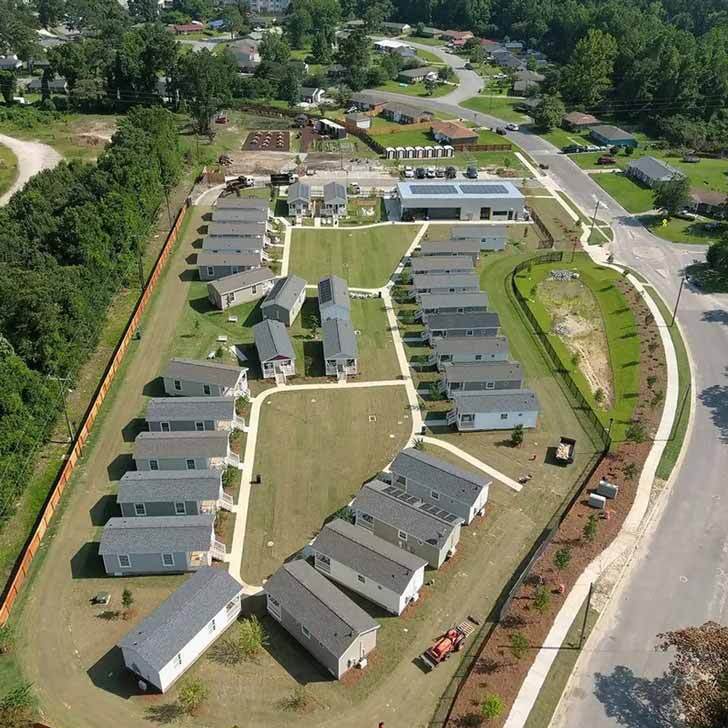
“I ran across the group in Springfield, Missouri — my hometown,” Thomas said in an interview with Humans Fighting Homelessness. “We brought the Springfield guys out to meet everybody, to talk through what Eden Village was and see if we could actually get enough momentum to go — and the people just started lining up.”
By April 2020, Eden Village of Wilmington raised over $500,000 in donations to begin building the 31-unit tiny home community — and numerous fundraisers led by local businesses continued to bolster support for the project.
After three years of construction and planning, 31 wheelchair-accessible, fully furnished homes were built in a round-circle fashion — bookended by a community garden and a clubhouse center.
By December 2024, every home was occupied by someone who had once lived on the streets.
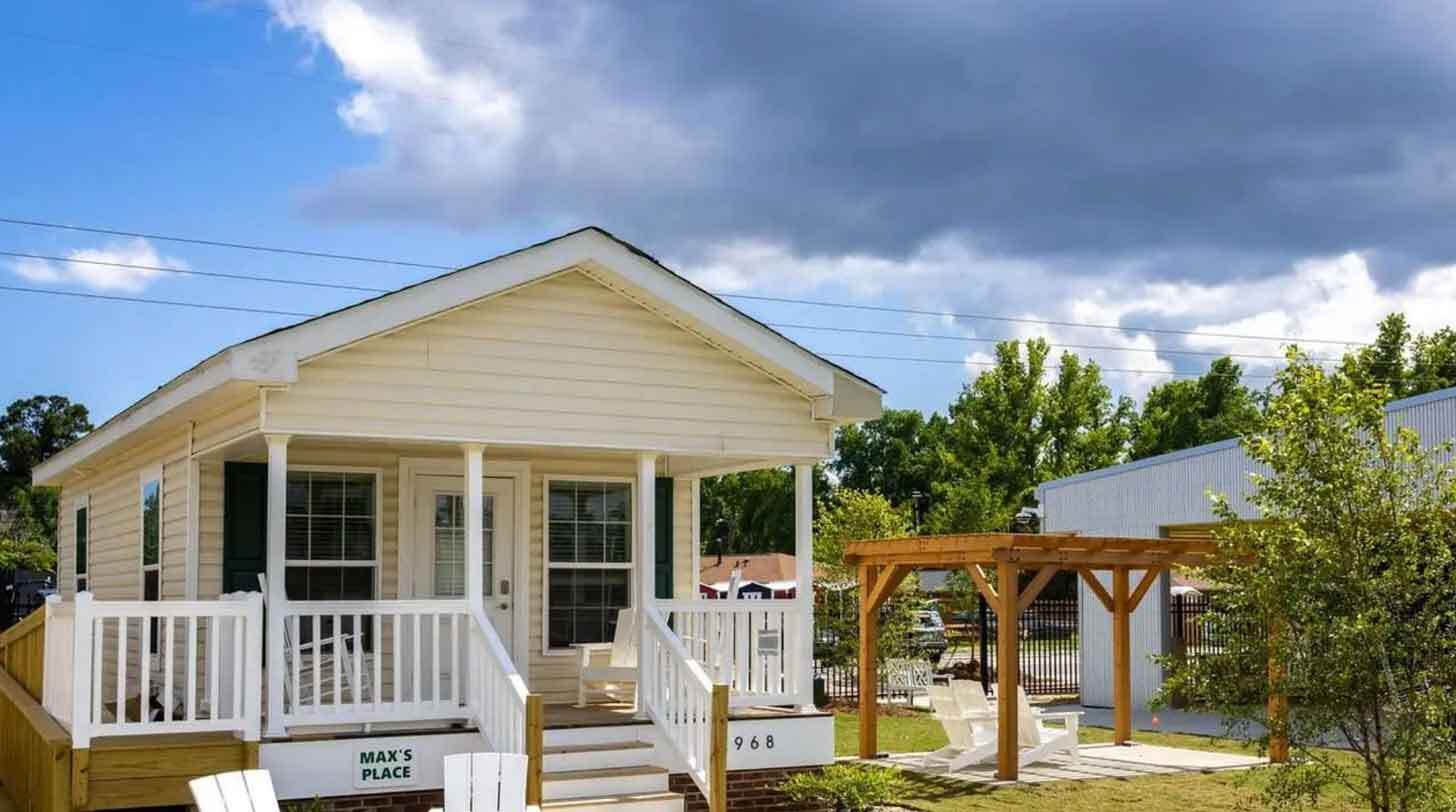
To qualify for housing, residents had to be “chronically homeless” in Wilmington for longer than a 12-month period. They also went through an application process that proved that they had a physical or mental illness that made them a high-cost burden to the public.
Housing costs are subsidized by sources that include disability, social security, veteran benefits, family support, and work income.
When asked how long residents can stay in Eden Village, the nonprofit replied: “Forever.”
“Eden Village is designed to allow housing to those that may never be able to do it on their own,” explained a statement on the Eden Village website.
“Most residents that qualify to live in an Eden Village are individuals that, due to mental health, physical limitations or extenuating circumstances, are incapable of moving to a fully independent stable home life, which has led them to their chronically homeless status that qualified them in the first place.
“If residents meet the minimum requirements and are a good neighbor to other residents,” the nonprofit continued, “they are welcome to stay in their home.”
Shawn Hayes — the Executive Director of Eden Village — told WECT 6 News that the community is all about giving people another shot in life.
He said, “To be in a home that’s in a community where people care for you and care about you, it’s a beautiful thing.”
Header image via ironypoisoning (CC BY-SA 2.0) and Eden Village of Wilmington
Life-threathening hypothermia can occur when temperatures are between 32 and 50 degrees Fahrenheit. But most warming centers and homeless shelters do not open until temperatures descend much colder.
For people who are unsheltered — meaning, they have no place to sleep that is fit for human habitation — hypothermia is a grave risk. Additionally, using fire or other warming methods poses other safety risks, like outdoor encampments catching fire and burning those inside.
While the ultimate solution to these problems would be stable and permanent housing for those in need, a Czech organization has invented an emergency shelter that could help people in the meantime.
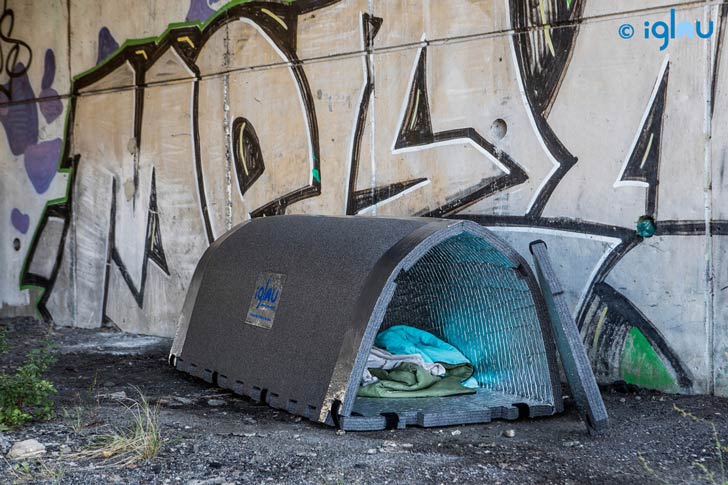
It’s called the Iglou.
This emergency shelter is indeed igloo-shaped, an arch-like structure that is made with materials that help retain heat for unsheltered people to stay when the temperatures drop.
“It’s made of a special material that ensures the igloo is 18 degrees warmer than outside,” Hana Bauerová, from the organization Prevent Prachatice, told Radio Prague International. “So our clients don’t freeze to death.”
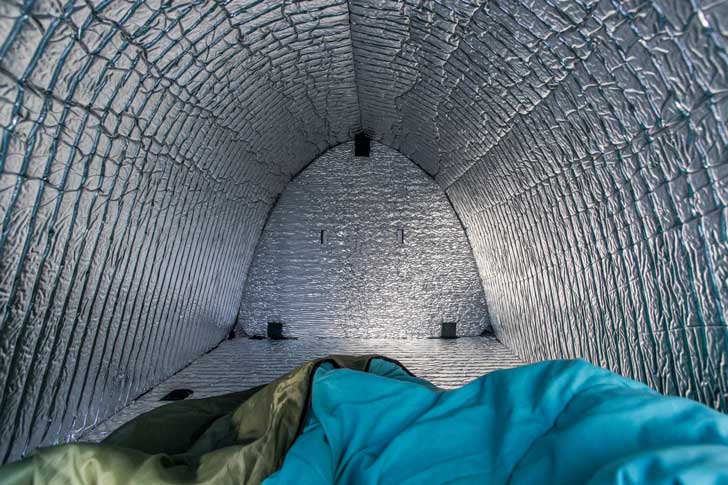
The interior of the Iglou is made with a silver heat-trapping thermal material and the shelters are easy to set up, with two people assembling the foldable frame. Iglou structures are also non-flammable.
“If a client smoked in there, they couldn’t catch anything on fire,” Bauerová added.
The city of Prachatice (which lies near the German and Austrian borders) has purchased some Iglou structures in collaboration with Prevent, an organization that helps people facing addiction, homelessness, and support services for people in need.
Structures will be lent out in coordination with social workers, prioritizing individuals who are actively engaging with assistance programs in the city.
“We provide Iglous only to cities and charities with night shelters or with outreach workers who frequently visit people experiencing homelessness,” the Iglou website explains.
“These charities know the circumstances of people sleeping rough and can best decide who needs an Iglou.”
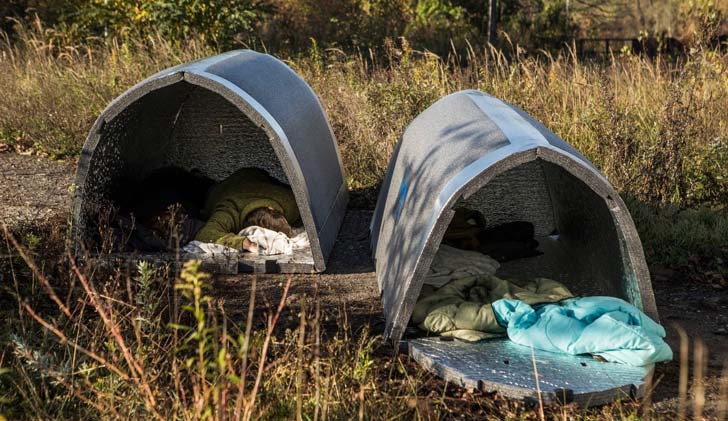
According to Iglou, more than 1,200 of these thermal shelters have been distributed in 10 locations in Europe and Canada.
Of course, more robust solutions are needed across the globe to combat rising levels of homelessness. But in the meantime, the inventors of Iglou are hopeful that their shelter can provide a small reprieve from the cold.
“Iglou is an emergency shelter and only used for that purpose,” Iglou wrote on Facebook. “We believe all the ones who want should have a real home. But we also know the reality and thousands are still sleeping rough during freezing nights, and some freeze to death. The Iglou is for them to prevent that.”
Header image courtesy of Iglou
In December, nearly one hundred cyclists took to the streets of London on the same night — their bags and backpacks bursting with food, clothing items, and toiletries — to deliver them to people in need.
“This only happens once a year,” seven-year-old Ben told the BBC while sitting atop his own bike. “And everybody helps the homeless. They go on a big bike ride around the city.”
"I have everything I need, but other people don't,” added Ben’s twin brother, Ted. “Some people, they need things, they need help — that's why I'm here today.”
The Christmas rideout has become an annual tradition for the C86ERZ — an independent volunteer network founded by local Londoner Verral Paul Walcott.
But Walcott’s generosity is not just limited to late December. For him, it’s a weekly routine.
Since 2014, the graphic designer-turned-philanthropist has been using his platform to coordinate hundreds of thousands of donations from schools, libraries, and households and deliver them to unhoused neighbors.
One local — named David — said that he was actually familiar with Walcott’s videos years before he ended up on the streets himself.
“During [COVID] lockdown I was scrolling through Facebook and I came across one of his posts,” David told CBS Chicago. “I just thought it was incredible.”
Years later, while experiencing homelessness, David was offered a job. After realizing he required work boots, he took a chance and reached out to Walcott, saying: “I really need help.”
When Walcott came through with the boots, no questions asked, David said it “warmed his heart.”
“Because of his kind heart — and his help — I managed to build up myself again,” said David, who now volunteers alongside Walcott as a C86ERZ cyclist.
Today, Walcott estimates that his volunteer network is 700 cyclists strong. Through his social media platform, Walcott coordinates Amazon wish lists for his homeless neighbors and then alerts fellow volunteers of drop-off locations in their area.
The wish list — which anyone can view and help purchase online to aid in donation — runs the gamut of first aid kits, ready-to-eat meals, chapstick, hats, and toilet paper rolls.
“I asked the community for help,” Walcott said simply, speaking from things he’s witnessed in the streets. “There’s situations where people’s tents are being slashed, or people’s tents are being set on fire — their shoes and socks are being stolen.”

Walcott said hitting the city streets on two wheels helps them cover more ground and reach spaces that are not always accessible by car.
“With a bike you can go to various locations very fast or even change location based on when you've been notified when someone needs help,” Walcott told the BBC.
Charitable rideouts are becoming more common and not just in England.
A similar grassroots approach was adopted by cyclists in East Los Angeles over a decade ago. BikePGH in Pittsburgh has been recruiting cyclists to deliver essential goods to unhoused folks since 2015. And Austin Bicycle Meals delivered roughly 5,000 hot meals to their homeless neighbors in 2024.
“Ninety-nine percent of people are just happy to receive help and feel compassion,” Austin Bicycle Meals co-founder Claire Harbutt told Modern Farmer.
“[We just] say we have free food, and ask them if they’d like any. You’ll see these people visibly relax when they realize we aren’t there to harass them or yell at them for being on a bench we want to sit on.”
“We aren’t there to do harm; we’re there to give them something they might want.”
Before the Harris Community Village was a hybrid apartment complex and homeless shelter in Tooele, Utah, it was an elementary school.
Harris Elementary School permanently closed in 2018, and the property was quickly scooped up by the Tooele County Housing Authority.
Now, the repurposed school provides 66 units of permanent housing for low-income households, which sits next to a 44-bed shelter.

The Village is also home to seven family rooms, a community kitchen, an emergency food pantry, and 24-7 childcare.
Most of the services are provided by contractor Switchpoint, a nonprofit that supports people experiencing poverty and homelessness.
According to affordable housing lender RMCRC’s website: “All of this culminates in a warm, inviting community for those who are struggling and provides a springboard for them to overcome poverty.”
In both the permanent apartments and emergency shelter residencies, tenants are provided support and case management services, so long as they abide by an agreement with the housing authority and Switchpoint.

Switchpoint does not allow drugs or alcohol in its facilities, which does not make it a “low barrier” or easily accessible facility for people needing emergency shelter while also navigating addiction.
“We hold people accountable to try to better themselves while they’re here,” Jeff Quayle, Switchpoint’s real estate development director, told Utah News Dispatch. “And if they don’t want to do that, then we ask them to move along.”
But in a small city like Tooele, which is located in a rural area about 35 miles west of Salt Lake City (where a majority of Utah’s homeless services are located), the school-turned-shelter fills a need for people who are ready to stay sober, improve their lives, and achieve self-sufficiency.

Kenna Morrison, a Harris Community Village resident, moved into the emergency shelter units after living in her car and encampments for over a month. She had relapsed after 13 years of sobriety.
“Those people are doing great things,” she told Deseret News about the people behind the Village. “It means a lot. It really does.”
Morrison grew up in Tooele, and some of her childhood friends even attended the school that is now the place she calls home.
“It’s wonderful here,” she said. “This is like the Ritz of the Ritz of homeless shelters. We have three meals a day. We’ve got warm showers, warm beds. Everything is just nice.”

The freshly renovated facility still maintains its bones as an elementary school, including a kitchen and cafeteria that serves 500 meals a day (including about 300 for Meals on Wheels community members, according to Utah News Dispatch).
Its all-in-one approach is the first of its kind in the area, one that even garnered the support of Governor Spencer Cox, when he hosted a ceremonial bill signing to celebrate a number of homelessness and behavioral health bills passed by the Utah Legislature in 2024.
Gov. Cox told reporters that renovating old elementary schools and combining shelter and housing in one central location is an idea that should be replicated across the state.
“I think this is a wonderful model,” the governor said at the event, “and one we’ll be talking to more counties about.”

Although the Village is a milestone in eradicating homelessness in Tooele, it did come with a hefty price tag. The project cost an estimated $31 million — paid for using funds from the state, Tooele County, The Church of Jesus Christ of Latter-day Saints, and a myriad of other private donations, according to Switchpoint.
But if it can be replicated, Switchpoint executive director Carol Hollowell told Utah News Dispatch, it should.
“It doesn’t have to be a school,” she said. “It could be any kind of empty building. If you look at how much empty space there is from empty malls, office spaces, warehouses, it could be any kind of empty space that could be converted into a great campus.”
Header image courtesy of BHB Structural
This story was originally published by Grist. Sign up for Grist’s weekly newsletter here.
On a freezing cold Wednesday afternoon in eastern Kentucky, Taysha DeVaughan joined a small gathering at the foot of a reclaimed strip mine to celebrate a homecoming. “It’s a return of an ancestor,” DeVaughan said. “It’s a return of a relative.”
That relative was the land they stood on, part of a tract slated for a federal penitentiary that many in the crowd consider another injustice in a region riddled with them. The mine shut down years ago, but the site, near the town of Roxana, still bears the scars of extraction.
DeVaughan, an enrolled member of the Comanche Nation, joined some two dozen people on January 22 to celebrate the Appalachian Rekindling Project buying 63 acres within the prison’s footprint.
“What we’re here to do is to protect her and to give her a voice,” DeVaughan said. “She’s been through mountaintop removal. She’s been blown up, she’s been scraped up, she’s been hurt.”

The Appalachian Rekindling Project, which she helped found last year, wants to rewild the site with bison and native flora and fauna, open it to intertribal gatherings, and, it hopes, stop the prison.
The environmental justice organization worked with a coalition of local nonprofits, including Build Community Not Prisons and the Institute to End Mass Incarceration, to raise $160,000 to buy the plot from a family who owned the land generationally.
Retired truck driver Wayne Whitaker, who owns neighboring land and had considered purchasing it as a hunting ground, told Grist he was supportive. “There’s nothing positive we’ll get out of this prison,” he said.
The penitentiary has been a gleam in the eye of state and local officials and the Bureau of Prisons since 2006. It has always sparked sharp divisions in Roxana and beyond and was killed in 2019 after a series of lawsuits, only to be quietly resurrected in 2022. Last fall, the bureau took the final step in its approval process, clearing the way to begin buying land.
Some in Letcher County, which saw 5.2 percent of its population leave between 2020 and 2023 and grapples with a 24 percent poverty rate, believe the prison will replace jobs and tax revenue lost with the decline of coal. Federal prison construction has boomed in central Appalachia as mining has faltered, with 8 of the 16 penitentiaries built there, often atop mines, located in Kentucky alone.
“Those are all expressions of the economic crisis that has occurred due to the collapse of the coal industry, and for which the prisons and the jails are proposed,” said Judah Schept, a professor of justice studies at Eastern Kentucky University.
In his book Coal, Cages, Crisis, Schept noted that mine sites are considered ideal locations for prisons or a dumping ground for waste, rather than places of ecological value, as some biologists have argued. The Roxana site has been reclaimed, meaning re-vegetated with a forest that now shelters a number of rare species, including endangered bats.
Opponents argue that a prison will bring more environmental problems than jobs. Letcher County was 1 of 13 counties ravaged by catastrophic flooding in 2022, a situation exacerbated by damage strip mining caused to local watersheds. The prison slated for Roxana will exacerbate the problem.
The Bureau of Prisons estimates it will damage 6,290 feet of streams and about 2 acres of wetlands. (The agency has promised to compensate the state.)
DeVaughan said the purchase also is a step toward rectifying the dispossession that began with the forced removal and genocide of Indigenous peoples. The Cherokee, Shawnee, and Yuchi made their homes in the area before, during, and after colonization, and their thriving nations raised crops, ran businesses, and hunted bison that once roamed Appalachia.
In all the time since, coal, timber, gas, and landholding companies have at times owned almost half of the land in 80 counties stretching from West Virginia to Alabama. Several prisons sprang from deals made with coal companies, something many locals consider the continuation of this status quo.
Changing that dynamic is a priority for the Appalachian Rekindling Project, which hoped to buy more land to protect it from extractive industries and return its stewardship to Indigenous and local communities. DeVaughn said Indigenous peoples throughout the region will be welcome to use the land as a gathering place.
The Eastern Band of Cherokee Indians, Cherokee Nation, and United Keetoowah Band did not respond to requests for comment.
DeVaughan sees its work establishing a new vision of economic transition for coalfields, one that relies less on “dollars and numbers” and more on “healing and restoration” of the land and the Indigenous and other communities that live there.
She is working with some personal connections in the Cheyenne and Arapaho nations to acquire a herd of bison and plans to work with local volunteers, scientists, and students to inventory the site’s flora and fauna.
The plot sits at the edge of the 500-acre site outlined for the prison, which would hold over 1,300 people in the main facility and adjoining camp. A representative of the Bureau of Prisons told Grist land acquisition will continue.
This isn’t the first time the agency has hit such a pothole. Six years ago, Letcher County master falconer Mitch Whitaker refused to sell nearly 12 acres, requiring the agency to revise its plans.
The prospect of doing so again led Representative Hal Rogers, who represents the area in Congress and has been the leading champion for the prison, to lambaste ARP and its allies.
“This land purchase comes as no surprise from a group led by Kentucky outsiders and liberal extremists,” he said in a statement.
But many of those on hand that Wednesday to celebrate the sale were local residents like Artie Ann Bates, who grew up in Letcher County and saw waves of strip mining damage her family’s land. “It’s just really hard seeing a place you love be destroyed,” she said.
The purchase is a “sign of progress,” she added, bundled up at the foot of the mine site alongside her neighbors.
Correction: This story originally stated Wayne Whitaker as the owner of the land purchased by the ARP. Whitaker did not own the land, but owns land adjoining it.
Header image by Taber Andrew (CC BY-NC 2.0)
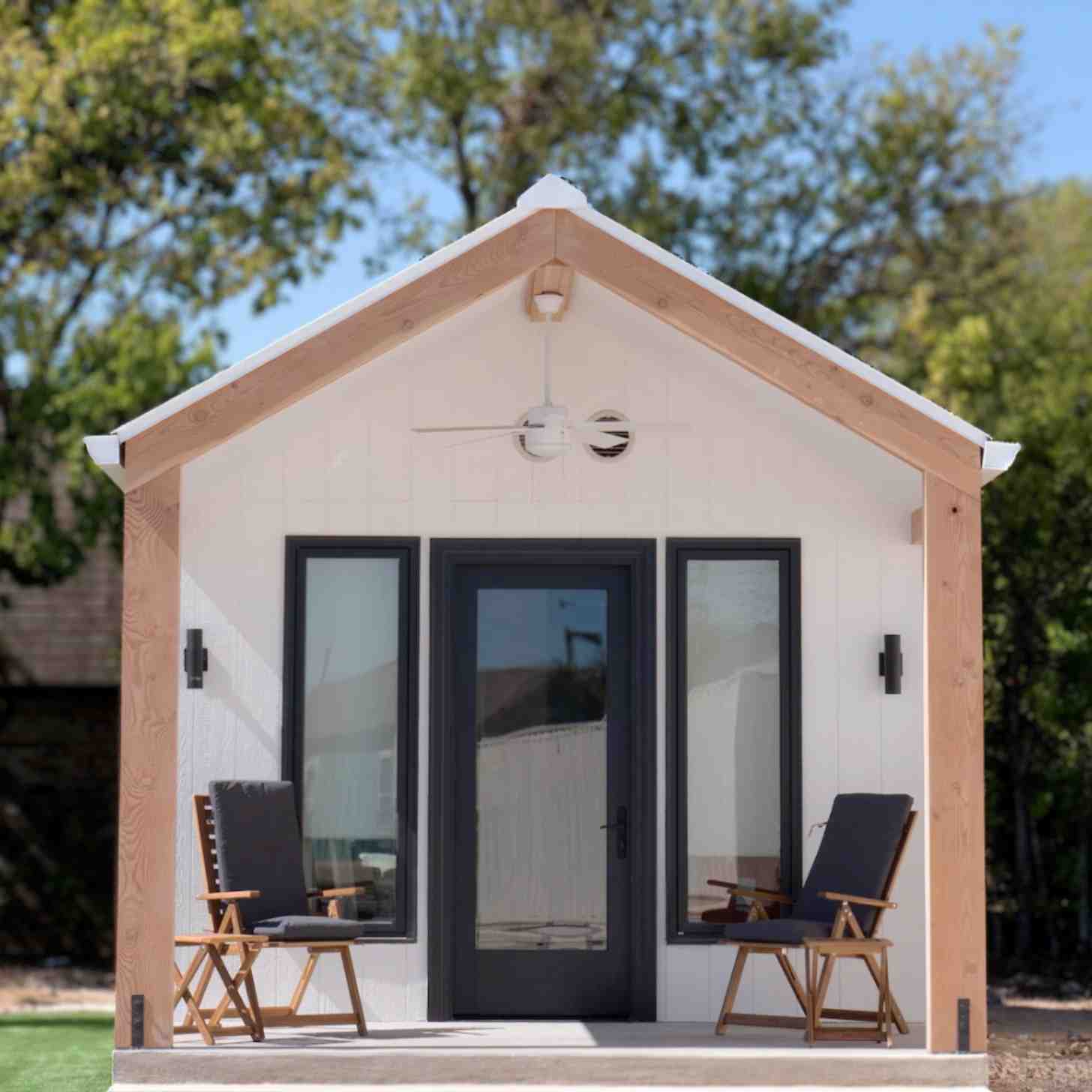
In the fall of 2024, IKEA designed, built, and donated a housing unit to Towne Twin Village in San Antonio, Texas — a tiny home community devoted to getting homeless seniors off the streets.
But this wasn’t just any tiny home — the global retailer specially designed the house with “trauma-informed design” in mind.
“As experts in small space living, innovative solutions and democratic design, IKEA U.S. is uniquely positioned to amplify this empathy-based design approach to our communities, co-workers and customers,” Sam Eisenman, sustainability business partner at IKEA U.S., said in a press release.
Trauma-informed design — also known as TID — is a research-backed approach to affordable housing.
The principles of TID focus on creating warm, open spaces that are filled with natural light, communicate a sense of calm, and built with safety in mind.
“For instance,” the company stated in the press release, “data showed a preference for a combined shower/tub as opposed to shower only — and that residents want the option to accommodate guests, so furniture that is flexible and multi-purpose increased resident satisfaction.”
More than 80% of homeless individuals have experienced life-altering trauma at some point in their lives.
In fact, according to the National Alliance to End Homelessness, people experiencing homelessness are far more likely to be victims of violent crime than they are to commit such crimes.
Many people who are chronically homeless — homeless for more than 12 months at a time — experience trauma in many forms including exposure to extreme weather, physical assault, loss of belongings, and social isolation.
Rachelle Macur, a social scientist and architect, says that TID is not simply about avoiding “triggers” — it’s about building a space in which people can “heal and flourish.”
“By working to understand people’s lived experience and combining that with the research on our biological connection with nature, we can create spaces for people and communities to heal, to have resiliency, and to thrive,” Macur told Trim Tab magazine.
Speaking for IKEA, Eisenman emphasized that their vision for the company goes beyond “home furnishing” — with the intention of creating a “better everyday life” for communities around the world.
“We are on a journey to be a facilitator of and advocate for trauma-informed design as a tool to address the root causes that contribute to the affordable housing crisis in the US,” Eisenman stated.

In the coming months, IKEA plans to break ground on similar pilot projects across the country — from Memphis, Tennessee to Washington, D.C.
The company is also developing and leading trauma-informed design training courses for their employees in order to prepare designers for future “tiny home” projects.
“This is the beginning of a journey at IKEA,” the company stated in October.
“In the long term, IKEA envisions bringing together stakeholders and advocates across all markets to support existing efforts and encourage others, across sectors, to adopt a trauma-informed approach in their respective industries.”
Header image via IKEA U.S.
A former Stay Inn Hotel in Denver, Colorado has sat vacant for approximately 18 months after the city first purchased it for $9 million.
But now, it’s back on the market for the low, low price of just $10.
The city purchased the property in 2023 and planned to use it as a shelter for people experiencing homelessness. But over the years, the boarded-up 96-unit hotel has sat untouched.

“That building has been there for so long,” Amy Beck, with homeless advocacy group Together Denver, told Denver7.
According to Denver’s Department of Housing Stability, a “necessary environmental review process which took longer than anticipated” led to the delays.
So, to get things moving, the shocking price tag has been set at $10. Of course, there are conditions.
The building will be sold-as is, meaning the buyer would be responsible for renovating the building and transforming it into “supportive housing” for homeless Denverites.
And the deal comes with a covenant that requires a 99-year commitment to providing income-restricted housing on the property.
The city estimates renovations and maintenance will cost a minimum of $5 million, so the initial sticker price is intended to help offset the expected costs, according to Denver7.
Shuttered hotels and motels are an emerging solution to the mounting homelessness crisis across the country, providing both interim and permanent housing for those who are unsheltered.
As of 2023, the city of Denver had bought or leased four hotels intended for this purpose.
But progress has wavered, especially at the Stay Inn location.
Housing advocates hope this $10 listing will finally rebuild some momentum.
According to FOX31, the procurement of the building is already in motion, as the city reportedly already has interested parties willing to take on the mantle.
“We are hopeful that the procurement will result in a path forward for delivering supportive housing at the site,” Derek Woodbury, a spokesperson for the city’s Department of Housing Stability, told FOX31.
After reviewing applicants, the city council will have the final say on the developer selected for the project. The hope is to have a buyer selected by the council later this year.
For Beck, and all of the other advocates working to get homeless people in safe, stable housing, time is of the essence.
“Please, just get it up and running because we have so many families that could fill that building right now that are living on the street, in their cars,” Beck told Denver7.
“We need that space immediately.”
Header image via Google Maps
Michelin-starred chef Adam Simmonds has a lot to celebrate when he looks back on his career as a chef.
But Home Kitchen, Simmonds’ high-end restaurant in London’s Primrose Hill, is especially notable.
From truffle mash topped with guinea fowl to winter fruits poached with red wine, the restaurant boasts a number of mouthwatering dishes — but it’s Home Kitchen’s staff that makes the restaurant exceedingly rare.
In a world-first, everyone in the fine-dining establishment — whether they are seating tables or chopping vegetables in the kitchen — has experienced homelessness.
“We’ve given it a new identity and a purpose,” Simmonds told The Guardian in September 2024, when the restaurant first opened. “Without a purpose, it’s nothing, right?”
Michael Brown, a co-founder of Home Kitchen, said the vision was borne out of his experience working at Soup Kitchen London — a nonprofit that combats homelessness through food, clothing donations, and mental health support.
He believes that Home Kitchen is a small way to combat the “very flawed public perceptions of what it is to be homeless.”
“We just thought, hang on a minute, there’s a rich resource of people who want economic opportunities,” Brown said. “We can do something about this.”
Jeremy is one of 16 employees who work at Home Kitchen. Before becoming a food runner, he struggled to find a job as he lived on the streets.
“I didn’t have a stable upbringing – no parents, no family, no support,” he told The Guardian. “And when you don’t come from a stable environment, you don’t have those support networks, you’re going to struggle.”
Home Kitchen marks Jeremy’s first job — ever. He carries his title with pride.
“We’re here to do a job, build ourselves up,” Jeremy said. “We don’t want pity, we want to be treated like everyone else. We’ve been given a chance that perhaps we have not had in our lives. And the fine dining environment, this is fantastic.”
Lily — another employee — became homeless shortly after she moved to England seeking asylum. She said she immediately felt at home when took on the job.
“I think it is like my second home and every time I come here, I come with a smile and every time I leave, I’m leaving with my smile,” Lily said.
In addition to employing people who are chronically homeless, the restaurant itself is a nonprofit organization, which supports Soup Kitchen London’s mission to feed 150 people every day.

“By simply booking a table and dining with us, you'll be making a difference,” reads a statement on the restaurant’s website.
“Your support will help us transform lives and provide more opportunities for those in need to find meaningful work.”
To set their employees up for success, every Home Kitchen staff member is given a living wage, a pre-paid travel card for transportation, and funds for a catering qualification.
“After they pass their three-month probationary period, they will attend a day release course at Westminster Kingsway College, as well as training on the job with us at Home Kitchen until they get their City & Guilds catering qualification,” Simmonds told Stir It Up magazine in January.
“I’m guessing some will stay with us and train others, which is fantastic. Or we will find them a job in the industry and follow up with them and if they’re not happy, find them other work.”
Although Home Kitchen just opened their first location in Primrose Hill, London they have their eyes set on expanding — first to the seaside town of Brighton in East Sussex, and then to San Francisco in the U.S.
But wherever Home Kitchen expands to next, Simmonds said that he and Brown are dedicated to combatting the social stigma surrounding homelessness.
“We provide the platform for them to shine — whether it’s working in the kitchen or front of house — and they’re all coming on leaps and bounds,” Simmonds said.
“They’ve faced a lot of uncertainty in life,” Simmonds admitted, “but they still have a smile — and we have a great working environment.”
Header images via Home Kitchen / Home Kitchen Instagram
For four years, volunteer knitters, crocheters, and sewists have created handmade blankets for the annual Homeless Memorial Blanket Project.
Their goal — outside of blanketing those experiencing homelessness with love and warmth — is to honor those who have lost their lives while living on the street, and advocate for a future without homelessness.

“I spent the first five months of my most recent homelessness in my car,” Maine resident Joyce Hauslein told The Progressive Magazine. “I then went to a shelter for thirteen months. While there, I constantly crocheted; I gave the afghans I made to people as gifts when they left the facility. Many of them told me it was the only blanket they had.”
Hauslein has been homeless twice; first in 1993 and again in 2020, when her landlord evicted her in order to turn her beachfront apartment into a vacation rental property.
In that second period of homelessness, she became involved with the Blanket Project.
Now housed, she continues to crochet.
“I know what it feels like to think no one cares about you,” she said.
Her efforts — along with hundreds of other crafters’ — culminate in an annual public art piece and distribution point in major cities in the eastern United States.
In prior years, the Blanket Project has displayed its donated blankets in Washington, DC, Harrisburg, Pennsylvania, and Carlisle, PA.

Most recently, in December of 2024, organizers brought nearly 1,000 blankets — gathered from all 50 states and several countries — to Philadelphia’s Independence National Historic Park.
“If we can make a square, we can sew them all together and make one blanket,” the project’s founder, Pat LaMarche, told CBS News.
LaMarche is a former TV journalist who found a passion in reporting on homelessness — and crocheting. When she wasn’t delivering the news, she’d spend time teaching about generosity through crocheting blankets at a local high school in Philadelphia.
Since 2021, with the help of other volunteers, she has led the annual project. This past year, she went on a 12-state tour to collect blankets up and down the east coast.
“If we get 30, then that’s what 30 people look like when they have nowhere to sleep,” LaMarche told CBS News.
But they collected far more than 30.

Lutheran pastor Matthew Best helps direct the Blanket Project alongside LaMarche.
“We initially intended it to be a one-day thing,” he told The Progressive Magazine. “But over time, it has become a beautiful, viral effort that keeps extending.”
“We received a blanket from Australia this year,” he continued. “We have no idea how this person heard about the project but it has been amazing, incredible really, to think about the hundreds of people who are sewing, knitting, and crocheting these blankets and spending their time and money to make something special for a complete stranger.”
After the hundreds of blankets are collected, they are laid out in a display for the public to see and learn more about the safety risks of homelessness, like hypothermia, which takes the lives of an estimated 700 unhoused people in the U.S. every year.
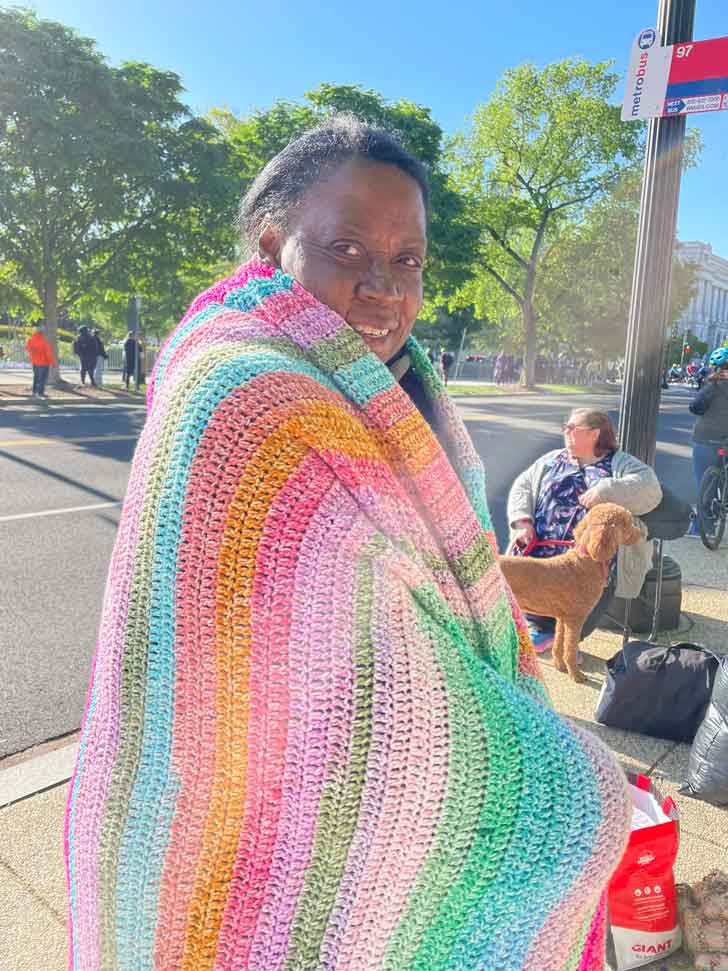
“Allowing people to be unhoused in the richest country in the history of the world is a political choice,” Best told The Progressive Magazine.
“The hundreds of quilters who donate these bed coverings are actually doing more to help the homeless than most of our policymakers.”
Blanket Project representatives continue to extend their efforts to end homelessness outside of the annual event. Last year, they blanketed the steps of the Supreme Court when federal judges ruled on Grants Pass v. Johnson, ultimately deciding that cities have the right to enforce criminal penalties for those sleeping outside.
This ruling made the annual Philadelphia project that much more resonant for LaMarche.

“The message of independence is too huge to ignore. We are at the cradle of liberty, Independence Hall,” LaMarche told CBS News. “There’s zero independence when you have to beg for everything.”
Volunteers created blankets in two sizes for families and individuals, which were then distributed to those without homes immediately following the public display.
While Philadelphia community members were encouraged to pick up blankets from the event, over 30 area outreach workers were also in attendance, collecting blankets to distribute among high-need groups in the area.
“Receiving a present like this tells the recipient that they deserve beautiful things,” LaMarche told The Progressive Magazine.
“Handmade quilts are expensive, and when an individual or family is given one, it tells them that they are worthy.”
Those interested in joining future Homeless Memorial Blanket Project events can join the organization’s Facebook group or sign up for newsletter updates.
Header image courtesy of Pat LaMarche/Facebook
Every day the Good Good Good team collects the best good news in the world and shares it with our community. Here are the highlights for this week!
If you want to get good news in your inbox every day, join the Goodnewsletter — the free daily newsletter designed to leave you feeling hopeful.
The Best Positive News We’re Celebrating This Week —
After one year of its new initiative, a Colorado city no longer has any homeless veterans living on the street
In 2023, the mayor of Denver, Colorado launched the All In Mile High initiative to reduce all homelessness in the city. Specifically, the program prioritized ending veteran “street homelessness.”
Street homelessness refers to when someone lives on the streets or in other places not intended for human habitation, with no safe or sheltered place to go at night.
In addition to sheltering more than 2,200 people experiencing homelessness, as of December 19, 2024, the city officially ended street homelessness among veterans.
Why is this good news? Veteran homelessness is a pervasive problem in America; On a single night in January 2024, over 32,000 veterans were experiencing homelessness across the country. Denver’s initiative offers a blueprint for others to follow — to provide this basic need for those who have sacrificed so much.
→ Read more
Most violent crime rates have fallen back to pre-pandemic levels in the U.S.
In 2024, the number of homicides across the United States declined by 16%, continuing a recent downward trajectory. The year prior, in 2023, criminal homicide was down by 11.6%, the largest single-year decline in two decades.
That drop means there were 631 fewer homicides in the 29 cities that provided data so far. If the data stays consistent as more jurisdictions report their data, 2024 would be among the largest single-year drops in homicides since at least 1960.
Despite this encouraging progress, 56% of Americans believe that crime has increased nationally or see it as an “extremely” or “very” serious problem — though that concern has decreased in the last year, too.
In “a historic win,” a Scottish court just ruled that the UK government’s approval of a giant new oilfield was unlawful
In 2023, the previous UK government approved the Rosebank development on the UK’s largest untapped oilfield. Now, a court in Edinburgh has ruled the approval was unlawful for not taking into account the project’s resulting carbon emissions.
Climate activists had long been advocating as part of a campaign to stop Rosebank, and scientists celebrated the decision as “a historic win” for climate action.
If the development wants to move forward, it has to account for the damage it would cause from burning oil and gas extracted from the oilfield.
Why is this good news? The International Energy Agency has repeatedly asserted that no new oil and gas exploration can happen if we’re to limit global heating to 1.5 degrees Celsius — scientists agree that limit will prevent the most catastrophic impacts of climate change.
→ Read more
The 119th U.S. Congress is the most racially and ethnically diverse in history
In the most recent U.S. Congress, 139 total senators and representatives identify as Black, Hispanic, Asian American, or Native American. In the last two decades, that number has nearly doubled.
In the House of Representatives chamber, 28% of members are Black, Hispanic, Asian, or Native American. There are also five multiracial members, including Florida Congressman Maxwell Alejandro Frost.
In the Senate, 16 members are racial or ethnic minorities, which is up from 12 in the previous Congress. And notably, two Black women are serving simultaneously in the Senate for the first time in U.S. history.
→ Read more
Iowa’s first hotel conversion to supportive housing for chronically homeless residents is opening next month
In Des Moines, Iowa, a former Days Inn is in its final stages of renovation and will soon reopen as The Monarch Apartments: an affordable housing project with supportive services for adults and couples recovering from chronic homelessness.
It will be the first “hotel conversion to Permanent Supportive Housing” in the state and it will also have 24-hour on-site supportive services like case managers, live-in peer staff, and more.
Future residents of the apartments’ 40 fully-furnished units will be referred by Primary Health Care, the county’s entry point for people who are unsheltered, meaning they don’t have a place to sleep at night.
Why is this good news? Built on the Housing First model, The Monarch Apartments aims to meet people’s immediate needs, so they can go on to take care of the other challenges in their lives: “Housing is hope, and housing is healthcare, and housing is the foundation for people being able to do more with their lives on an every-single-day basis.”
Efficient, emission-free heat pumps outsold gas furnaces in the U.S. by a larger margin than ever last year
During the first 11 months of 2024, people in the U.S. bought 37% more air-source heat pumps than gas furnaces, the second-most popular heating appliance.
That figure shatters the 21% lead heat pumps had in 2023.
While it’s important to note that sometimes multiple heat pumps are required to replace a single fossil fuel-powered appliance, the figures still show a clear momentum for the “greener” alternative — and it’s no surprise why.
Essentially two-way air conditioners that can both heat and cool, electric heat pumps have comfort, climate, and health benefits. They are three to four times as efficient as fossil fuel alternatives, are one of the most effective ways an individual can reduce emissions, and can save money.
→ Read more
To combat teacher shortages, a school district in North Carolina’s most expensive city is building housing for its educators
Charlotte is the most expensive city in North Carolina, and teachers have an especially hard time finding affordable housing. In response, Charlotte-Mecklenburg Schools launched the “At Home in CMS” initiative to retain and gain more teachers.
The district faced nearly 300 vacancies in 2024 — and in a survey, it found that 61% of teachers said housing may impact their ability to keep working with CMS. Half of the respondents said they spent more than 50% of their monthly income on rent and utilities.
This new program will offer apartments at below-rate rent and homeownership opportunities for teachers — eventually building its own housing development.
Why is this good news? A separate study last year found that teachers are unable to afford housing in many metropolitan areas, which has exacerbated staffing challenges at school districts across the country, increased eviction fillings, and exceeded the record number of people unhoused.
→ Read more
Vacant schools are being transformed into community centers, providing life-changing resources to thousands of low-income families
A group of quilters in Canada is about to donate its two thousandth quilt to a person in need
Through a long-running program called Comfort Quilt, a group of quilters in Ontario called the “Stitches from the Heart Quilt Guild” is about to donate its 2,000th quilt to a person in need.
The guild makes quilts for new residents at a long-term care home in Sault Ste. Marie to help give them some extra comfort so they “know that they’re not alone.”
The group also makes quilts for the Twinkie Foundation, which works to support children in the community traveling to southern Ontario for medical care.
🪡 One more for the quilting fans: Transgender fiber artists are using quilts to tell their stories.
The Grammys and FireAid benefit concert events are expected to raise over $120 million for LA wildfire relief
With funds from ticket sales, sponsorships, merchandise sales, and public donations, proceeds raised from the FireAid benefit concert on January 30 exceeded $100 million to benefit wildfire recovery in Los Angeles.
More than 50 million viewers across 28 streaming platforms tuned in to the FireAid benefit concert last week, which featured performances from Lady Gaga, Billie Eilish, Dave Grohl, and more.
Meanwhile, Grammys-related events and the Grammys live broadcast raised an estimated $24 million for wildfire recovery — both from event guests and from the public.
Why is this good news? While the fires in the area are now 100% contained, the long road to recovery begins. Early estimates say these could be the costliest wildfires in U.S. history at between $135 billion and $150 billion. While these fundraising efforts seem small in comparison — every little bit really does add up to make a big difference in helping people recover.
→ Read more
A bicyclist in London created a 700-person network of volunteers who hand-deliver donations to the homeless
Since 2014, graphic designer-turned-philanthropist Verral Paul Walcott has been using his platform to coordinate hundreds of thousands of donations from schools, libraries, and households and deliver them to unhoused neighbors.
Today, Walcott’s volunteer network is 700 cyclists strong. Through his social media platform, Walcott coordinates Amazon wish lists for his homeless neighbors and then alerts fellow volunteers of drop-off locations in their area.
The wish list — which anyone can view and help purchase online to aid in donation — runs the gamut of first aid kits, ready-to-eat meals, chapstick, hats, and toilet paper rolls.
→ Read more
More good news of the week —
“A major immunological breakthrough,” a new cell therapy is raising hope for curing type 1 diabetes. For the first time, a patient with type 1 diabetes has undergone an islet transplantation using genetically modified insulin-producing cells that do not require immunosuppressive drugs.
Often criticized for their energy use, a data center in Switzerland will heat 6,000 homes with recycled energy. The Geneva-based center has been recovering 100% of the energy it uses since November, and it hopes to point to a greener way to operate in the industry.
A mountain peak in New Zealand was just granted the same legal rights as a person. Taranaki Mounga and its surrounding peaks will become the country’s third natural feature in the country to gain the same rights, duties, and protections as individuals.
For the first time in two decades, the U.S. FDA just approved a new, non-opioid pain medication. The agency is prioritizing the development of non-opioid treatments, and the drug company behind it says it can be used for many times and degrees of pain and has shown no evidence that it’s addictive.
Jelly Roll and special guests hosted a benefit concert for 16,000 of LA’s incarcerated firefighters and first responders. Live Nation covered the costs of the show and helped ensure that all of the emergency responders could enjoy a night of entertainment and gratitude, as the fires were finally contained just last week.
A new $35 billion project is working to bring electricity to 300 million people in Africa via solar microgrids in the next 6 years. (Gift link) Outlined at the “Mission 300 Summit,” the project will be the biggest burst of spending on electric power generation in Africa’s history — and it will have significant climate benefits, too.
Thanks to conservation efforts, India doubled its tiger population in a decade. The efforts have included protecting the big cats from poaching and habitat loss, ensuring they have enough prey, reducing human-wildlife conflict, and increasing communities’ living standards near tiger areas.
Advocates are celebrating an “important victory” that will conserve and enhance national parks and national landscapes in England. It came after a train station expanded a parking lot that restricted access to an ancient pilgrimage path and harmed habitats, putting pressure on the government’s legal duty to protect areas of outstanding natural beauty.
The world’s smallest heart pump saved a child's life — and now it's been approved by the FDA for more young patients. The Impella 5.5 “does all the work” to help blood circulate — and it kept now 21-year-old Katrina Penney alive while she waited for a heart transplant.
Hundreds of endangered fish were rescued from waterways damaged by the Los Angeles-area wildfires. A removal of more than 250 endangered southern steelhead trout took place at Topanga Creek in a rescue operation led by the California Department of Fish and Wildlife.
Four new UK laws will address the threat of child sexual abuse images generated by artificial intelligence. When the laws pass, the UK will be the first country in the world to make it illegal to possess, create, or distribute AI tools or manuals that are designed to create child sexual abuse material.
For the first time ever, three endangered Bengal tiger cubs were spotted on camera in a Thai national park. Park rangers initially spotted a single cub with its mother on a camera trap last year, but new footage retrieved from damaged cameras confirmed it’s a litter of three.
In a “remarkable” rewilding project in Scotland, a bumblebee population is 116 times bigger than it was two years ago. In 2021, just 35 bumblebees were counted in Denmarkfield, and a 90-acre project has been working to restore nature to green spaces in an increasingly built-up area to restore the population
A global team of researchers made a breakthrough extrachromosomal DNA discovery that could revolutionize cancer research. The researchers discovered the fundamental role played by ecDNA in the spread and relapse of cancer, and it could be the main target of new, effective treatments.
A mechanical engineer in Lebanon created a chatbot that simplified access to much-needed aid for displaced people in the country. Specifically to help people who weren't directly receiving support from the government Hania Zaatari created the “aidbot” to narrow the gap between the demand and supply of aid.
Picture yourself walking through your neighborhood. You pass a woman on the street, sitting beside a cardboard sign asking for spare change.
She is a stranger experiencing homelessness, and you don’t have any cash on you. It would be easier to walk by without making any conversation.
Now, imagine a dialogue box popping up above her head, giving you insight into their life, background, and biggest needs.
With the Samaritan app, that scenario is a real-world possibility.
Suddenly, that woman isn’t a stranger anymore. That’s your homeless neighbor named Victoria — a resilient woman who was born and raised in Seattle, survived assault, and has lived on the street for 20 years.
Today, her immediate needs are: groceries, a cellphone, housing, and a simple haircut.
And with the click of a button, you could help her get her hair done for the first time in 20 years by sending her a small cashless transaction towards her goal.
“When we learn people’s stories, it’s alot harder to walk by them,” app creator Jonathan Kumar told Stand Together. “It’s a lot harder to ignore the small things you can do to help.”
“Just providing direct resources to folks is more effective sometimes, than investing in big government programs.”
Although Victoria’s story illustrates the effectiveness of the app, she is just one of many people who have been helped by Samaritan since Kumar first developed it in 2016.
In the near decade since its launch, Samaritan has expanded to ten major cities across the country, including Seattle, Oakland, and Louisville.
Where the app is active, people can donate directly to neighbors experiencing homelessness in their community, who are listed as “Samaritan Members.”
Each member is given a beacon — a small, low-energy Bluetooth device distributed by nonprofit shelters — that emits their location.
“By having the app on your phone and simply walking by, biking by, or driving by a beacon holder, you’ll receive a simple notification that shows you a bit of their story,” Kumar explained in a FAQ post.

Then, Kumar said, members can view their balance and charge it for a good or service through a partnered merchant or local nonprofit.
If the Samaritan app is not yet active in your city, you can still donate to the Action Fund.
100% of donations go to meeting the emergency funds and “strategic needs” of members as they take steps to get off the streets, including bus fare, cellphone plans, tools, new attire for prospective job interviews, and more.
Kumar hopes that the personalized approach of Samaritan will challenge the way people view homelessness — no matter where they are.
“The words of encouragement, the needs that get met by…people in your community can mean the world for someone and empower them to persevere,” Kumar said.
Header image via Samaritan App
There is a sad reality behind the pomp and circumstance of Mardi Gras celebrations: for years, parade horses were brought into the city by horse brokers only to be sold to slaughter once the fanfare died down.
“Several years ago, we began receiving reports that some of the parade horses, still distinctive with glitter and decorations from Mardi Gras, were spotted en route to slaughter in Mexico,” Jeff Dorson, founder and executive director for the Humane Society of Louisiana, told FOX 10 New Orleans.
That’s when the Humane Society of Louisiana stepped in to help.
Since 2017, the Humane Society of Louisiana’s Mardi Gras Horse Adoption Program has saved the lives of 106 parade horses.
“Once we became aware of the sad reality behind the pageantry, we mobilized our team to ensure that none of the Mardi Gras horses would ever again endure this cruel fate,” Dorson said.
This year, that life-saving operation continues.
On February 2, the first group of rescue horses arrived at the stables — including a white quarterhorse named Olaf, a shaggy brown mare named Buttercup, and a spotted saddle horse named Pongo.

In total, the program anticipates adopting out 20 horses this year, all of whom need to be pre-adopted before Mardi Gras begins on Tuesday, March 4.
Upon arrival, each horse is given a health check-up by a LASPCA vet to ensure that they’re up for the parades and in sound health.
“Adopters are welcome to have a vet check done on any horse they are considering at their expense and you can visit the stables, by appointment, and see the horses in person as well,” the nonprofit added in a Facebook comment.
An additional warning was splashed across the adoption program’s Facebook page, reminding prospective adoptees that the history of these horses is unknown.

“These are rescue horses,” the adoption program echoed in several posts. “They are not first time owner horses…We strongly recommend and encourage every adopter to work with a trainer following the adoption.”
Beneath the photos of new arrivals, horse-loving locals thanked the nonprofit’s volunteers for their hard work.
“It makes me so happy every year to see these posts,” one person wrote. “I will definitely be sharing with all my horse people. “
Adoptable Mardi Gras rescue horses can be viewed through the Mardi Gras Horses Adoption Program Facebook Page.
Header image via Humane Society of Louisiana's Mardi Gras Horses Adoption Program Facebook Page
KATHMANDU — Scientists have for the first time in 185 years confirmed the presence of the Asian small-clawed otter in Nepal, thrilling conservationists and researchers looking for clues to its existence here.
The last time the Asian small-clawed otter (Aonyx cinereus), the smallest of the world’s 13 known otter species, was recorded by scientists in Nepal was in 1839.
“After years of speculation about its presence in Nepal, we can finally confirm that the small-clawed otter lives on in the country,” said Mohan Bikram Shrestha, the lead author of a short note published in the latest edition of the bulletin of the Otter Specialist Group at the IUCN, the global wildlife conservation authority.
Although historically three species of otters are believed to occur in Nepal, modern researchers had until now only confirmed the presence of smooth-coated otters (Lutrogale perspicillata) and Eurasian otters (Lutra lutra), with a question mark hanging over the small-clawed otter. During that time, reports have come in, never confirmed until now, of small-clawed otter sightings in Makalu Barun National Park in Nepal’s eastern Himalayas and Kailali and Kapilvastu districts in the western plains.
Shrestha told Mongabay that the confirmed encounter occurred last November, when forestry department officials in Dadeldhura district, on Nepal’s western border with India, found a juvenile small-clawed otter at the confluence of the Rangun and Puntara rivers.
“As it was found in a fragile and injured state, the forest officers decided to feed and nurse it, but they didn’t know which species it belonged to,” Shrestha. The forest officers, led by Rajeev Chaudhary, shared the images and video of the animal, known locally as saano owt, with the IUCN Otter Specialist Group. The members of the group then confirmed it to be a small-clawed otter.
The discovery comes after the species was confirmed for the first time in 2022 in the Darjeeling area of neighboring India, which shares a similar topography with eastern Nepal. “Following the discovery in Darjeeling, we had been keeping our eyes open for the species in eastern Nepal, but it showed up in the west,” Shrestha said.
There have also been reports of sightings of the animal in the eastern parts of the country, but none of them have been confirmed.
The Asian small-clawed otter is classified as vulnerable to extinction on the IUCN Red List. Its range stretches from Indonesia in the east to Nepal in the west.
Like its smaller cousin, the Eurasian otter was also something of a cryptic species in Nepal, with no confirmed evidence of its presence here for decades. That changed in 2021, following discoveries in the Barekot, Roshi and Tubang rivers, then a flurry of sightings in different parts of the country.
“We hope that the discovery of the small-clawed otter in western Nepal would trigger a similar flurry of reports,” said Shrestha, who had also played an instrumental role in the rediscovery of the Eurasian otter in Nepal.
As for smooth-coated otters, although their presence in the country has never been in question, sightings of them still excite conservationists. This was especially the case in Chitwan National Park, where their reappearance in September 2023 after two decades spurred calls for more research.
“This is an incredibly significant finding,” Sanjan Thapa, deputy coordinator of the Otter Specialist Group’s Himalayan region, said of the latest development. “We had long suspected that the Asian small-clawed otter might still survive in Nepal, but without concrete evidence, its status remained uncertain.”
Thapa, part of the team that confirmed the 2023 sighting of the smooth-coated otter in Chitwan, said researchers tend to feel a bit edgy about a species when it hasn’t been reported for more than 50 years.
“We had received suggestions that we remove the small-clawed otter from the Nepal otter list as it hadn’t been found for a long time,” he said. “However, we decided not to do so in the hope that it would be rediscovered sooner or later.”

The discovery adds to the challenge of saving Nepal’s otters as the country prepares to finalize and implement an action plan for otters, Thapa said. “Now that we have concrete proof that the small-clawed otter is also found in Nepal, we need to incorporate it in our policies and programs,” he said.
Both Eurasian and smooth-coated otters are protected under the country’s Aquatic Animal Protection Act. The newly rediscovered species, however, isn’t on the list. “The first step would be to add the species to the list,” Thapa said.
In addition to this, severe degradation of Nepal’s rivers due to overexploitation has negatively impacted otters and other aquatic species. This includes the dumping of raw sewage and industrial waste, leaching of agricultural pesticides, and rapid urbanization and infrastructure developments that all undermine otter habitats across the country.
Widespread damming of rivers coupled with unsustainable fishing practices have also reduced food sources for Nepal’s otters.
“Hopefully the action plan will address some of the issues,” Thapa told Mongabay.
This article was originally published by Mongabay.
Header image by Mathias Appel via Flickr
Nour El-Naboulsi is a Burlington, Vermont farmer — but he doesn’t tend to a field of crops or a clearing of cattle.
As the executive director of Village Hydroponics, El-Naboulsi oversees the operations of a vertical hydroponic farm inside of a recycled shipping container.
Village Hydroponics came out of the success of El-Naboulsi’s other project, a mutual aid food distribution collective called The People’s Farmstand. The initiative supplies fresh, culturally relevant food to underserved communities in the area, bringing together other local farmers to grow and share surplus produce in peak growing seasons.
But El-Naboulsi saw a gap in the availability of fresh produce — especially among New American communities — during Vermont’s harsh winters. He decided to shape up a shipping container for the job.
El-Naboulsi told Vermont Public Radio the project serves a diverse community of Nepali, Somali, Iraqi, Congolese, and Burundi families.
“We have a short growing season,” El-Naboulsi told VPR. “In talking to the families … talking about the difficulties they go through, having that lack of fresh produce, or having to make difficult decisions between increased utility costs or getting, like, a nice bunch of local greens in the winter — which is hard to come by for anybody — I kind of wanted this to be the next progression.”

Not only does the shipping container model help feed more people — but it’s a smart and strategic way to farm in a changing climate.
Seedlings stay in the nursery section of the container for about three to five weeks before they are moved to individual pods. Water and nutrients come through the pipes and go to the back of the container to deliver vital nutrients to the plants. Then, the harvest happens right there, in the same indoor space.
“Food is a right for people. Nobody should be hungry. With that, while cultivating food we should be consistent of the impact that we are leaving on the environment,” Jillian Bluestein, an intern with Village Hydroponics, told WCAX3 News.
“The use of hydroponic farming could help many people in terms of farmers producing in the off-season to supplement income, as well as food supply in their community,” Bluestein added.
The goal is to harvest weekly, with Village Hydroponics growing greens like “baby lettuce mixes, Swiss chard, cilantro, bok choy, Nepali mustard greens, amaranth greens — also known as linga linga or palangi — thyme, head lettuce, collard greens, some kale,” per VPR.
As a Palestinian, El-Naboulsi said the importance of culturally significant produce cannot be understated. He and his team grow a plant called molokhia, a Palestinian spinach, which was a central part of his culture growing up — and to his resistance amid ongoing occupation in his homeland.
“Our society, unfortunately, can be really hostile and scary to refugees and immigrants and BIPOC community members, and it’s hard enough leaving your home and trying to acclimate to a new community, to a new society,” El-Naboulsi told VPR.

“For these New American community members who maybe haven’t seen that produce since they’ve arrived in the U.S., I love to envision kind of us providing those veggies, them working with us to grow those veggies, and then them connecting with each other to share a meal that makes them feel more at home.”
While Village Hydroponics is just getting started, its creative model could become a blueprint for other similar endeavors. Additionally, container farming continues to grow across sectors, with companies like Freight Farms selling container models to a clientele composed of small businesses, schools, nonprofits, healthcare facilities, and even zoos.
“Village Hydroponics stands at the forefront of climate resilience, offering a robust response to climate-related disasters through its use of shipping containers for year-round produce growth,” the Village Hydroponics website states.
The approach requires less import power during Vermont winters, which reduces food miles and carbon emissions. Village Hydroponics also uses up to 90% less water than conventional agriculture and uses renewable energy sources to power its operations.

The website continues, “Together, these strategies form a cohesive model for sustainable local food production, enhancing community resilience to climate change while promoting environmental stewardship.”
Ultimately, Village Hydroponics thrives at the intersections of climate justice, food security, and community organizing.
“I see how interconnected food and agriculture is towards community empowerment, El-Naboulsi told VPR.
“On the surface, it looks like we're just giving away free veggies,” he continued. “But we are bringing our community members into a solidarity fold, that we're trying to take down this system that we're working in.”
Header images courtesy of Village Hydroponics/Instagram
As the cost of living spikes in tandem with homelessness rates across the country, various cities have begun exploring the idea of converting vacant spaces — like former shopping malls, defunct department stores, and abandoned churches — into affordable housing units.
In July 2024, New York Governor Kathy Hochul embraced that trend by investing over $108 million into the “Liberty Landing” project: an ambitious remodeling effort that will convert a former women’s correctional facility into an affordable housing site for low-income residents and formerly incarcerated individuals.
“Every New Yorker deserves access to safe, stable, and affordable housing,” Governor Hochul said in a press statement.
“Liberty Landing represents a significant step forward in our efforts to provide inclusive housing opportunities and support to vulnerable New Yorkers.”
Daniel F. Martuscello III, the Commissioner of the New York State Department of Corrections and Community, also gave his full-throated support of the project.
“Liberty Landing will not only provide much-needed affordable housing to New Yorkers, but also support those recently released from prison in their reentry, which will ultimately promote public safety by reducing recidivism,” Martuscello said in the press release.
“I commend the Governor and those who have partnered on this project for their vision to reuse the facility in a way that will benefit those who need it most.”
The building once served as temporary housing for passing sailors before it reopened as the Bayview Correctional Facility in the 1970s. After forty years of operation, the prison shuttered its doors in October 2012 after Hurrican Sandy swept through, causing dramatic storm damage.
In the decade-plus since, it has sat vacant.
The location of the former prison is prime real estate. It’s nestled in Chelsea — one of New York City’s most expensive neighborhoods — where the cost of rent is 183% higher than the national average with a median rent price of $5,595 per month.
Karen Hu of Camber Property Group — the developer behind the conversion project — told Fast Company that she knows firsthand the struggle of maintaining a “stable life” in a high expense area like Chelsea.

“But I’m also an urban planner by training and so I know that we need a diverse set of people in the city to keep it a dynamic place,” Hu explained. “The idea of having affordable housing with Statue of Liberty views across the Chelsea piers is really fitting to me.”
Bethany Borel, an associate partner at CookFox Architects — the designers behind the project — said that the historic facade of the building will remain in place, but the interior of the building will need to be almost completely gutted to transform the prison into functional housing.
“The dimension[s] of those rooms are so small that really the cells themselves can’t be reused,” Borel told Fast Company.
In spaces where cells were once separated by a corridor, CookFox plans to outfit the building with 146 units — an assortment of studios and one and two bedroom apartments — as they completely reimagine the interior of the L-shaped building.
“Knowing that the puzzle pieces can slot in so well, it seems like a no-brainer that that’s the way we should proceed,” Borel said.
Although the project is still in its development phase, construction is set to begin in 2026. It is not clear yet how much the units will cost, but the governor has pledged to to keep the housing units “permanently affordable” and tailor them to the people who “need them most.”
But good things take time, and Hocul hopes that the Liberty Landing project will transform “a former symbol of incarceration into a beacon of hope, healing, and opportunity.”
Header image via Google Maps Bjoertvedt (CC BY-SA 3.0)
Whether people are fleeing armed conflict or extreme weather, time is of the essence when it comes to setting up temporary shelters and getting people to safety.
Simply put — when disaster strikes, every second counts.
It’s those precious seconds that concerned mechanical engineer Masoud Rais-Rohani the most when he began designing deployable emergency shelters at the University of Maine.
“How can we make it quick? How can we make it so it becomes a shelter in a matter of minutes, not hours?” Rais-Rohani recalls asking himself, in an interview with News Center Maine.
When he first began analyzing potential designs for temporary housing in 2018, the engineer tapped graduate student Anthony Verzoni for help.
Then, Rais-Rohani and Verzoni found inspiration in an unlikely place: origami.
“The results show that compound folding patterns can be accommodated in flat-foldable, thick-walled, origami-inspired shelter concepts that act mostly or fully as a single-degree-of-freedom system with maximum connectivity of the shelter panels,” the team wrote in their study, which was published in Engineering Structures in December 2022.

“Deployable shelters have many applications, including disaster relief and temporary housing,” they continued. “The ability to transport and rapidly erect such shelters is an important design consideration.”
To show off their prototypes, the team welcomed News Center Maine journalist Sam Olsen into their office at the University of Maine in 2023.
“Ultimately what needs to happen is that when it sets up completely, all of these folds need to be rigidized so that it won’t collapse onto itself,” Rais-Rohani said — pointing to their colorful sketches, which displayed how the origami shelters could be scaled up and down in size.

“Both the shelter height and roof geometry can be modified as shown,” the team wrote in their study.
“The first modification allows the roof to be extended and elevated to a height that is taller than the front wall. A gable roof and an angled (shed) roof could also be incorporated into the shelter design.”
As of 2025, there were no updates available on the team’s deployable origami shelters, but Rais-Rohani and Verzoni seemed content to play the long game.
“The ultimate goal is to see it mass produced, mainly for humanitarian relief operations,” Rais-Rohani said, adding that their eyes were on FEMA.
“It’s nice to do something with the humanitarian benefit — and hopefully disaster relief — and helping people in need,” Verzoni expressed.
Header images via The University of Maine / Masoud Rais-Rohani and Anthony Verzoni