The University of Notre Dame’s Church Properties Initiative is a project that empowers churches to use their properties for sustainable development through data-backed research.
And one of its case studies — Mission of Mary Cooperative in Dayton, Ohio — does exactly that.

Mission of Mary Cooperative was developed by Catholic laypeople, or non-ordained members of a church congregation — in the Twin Towers neighborhood of Dayton. They were facing two major issues: abandoned land and limited access to fresh, healthy produce.
In turn, they decided to use the vacant church land they owned for urban gardens that would feed the community.
In 2009, they planted a single garden. Today, they manage a network of six massive urban farming plots across four acres, growing over 75 different varieties of fruits and vegetables.

Every year, the gardens yield an estimated 65,000 pounds of produce for community members.
“Inspired by the Marianist charism, [MMC’s] founders navigated land acquisition, nonprofit incorporation, zoning regulations, property tax exemption, food subsidy programs, and grant applications,” the Notre Dame case study explains.
“The Mission of Mary Cooperative exemplifies the power of local initiative, rooted in faith, to transform underused property into a catalyst for community flourishing.”

The organization’s programming includes a community-supported agriculture program to sell produce to local consumers, as well as rented community garden beds, educational offerings, and a Neighborhood Food Council.
Mission of Mary also donates much of its food, or offers it on a sliding scale for families of all income levels.
“Urban farming allows us to transform spaces that have a negative impact on our community into productive and beautiful gardens,” the organization’s website shares.
“We now grow more than 60,000 pounds of food each year and we’re dedicated to putting as much of that harvest as possible on the tables of families in the neighborhood.”

The organization also supports resettlement efforts for refugees in the area and became the first net-zero nonprofit in Dayton through its focus on renewable energy.
“Through our work, we’re building relationships with our neighbors, building a local food system, and becoming a part of the fabric of the city,” the website continues.
These efforts are not just a good way to use vacant land but a rich part of the organization’s religious roots — those of the Marianist Catholics, an approach to Catholicism developed by a French priest in 1801.
Marianists emphasized the power of small communities to “renew Christianity” following the French Revolution.

Today, it looks like the work Mission of Mary does.
The focus on ecological development also follows the insights of Pope Francis’s term “integral ecology,” which posits that the good of human beings is inseparable from the stewardship of the natural environment.
“In some places, rural and urban alike, the privatization of certain spaces has restricted people’s access to places of particular beauty,” Pope Francis wrote in 2015.
“In others, ‘ecological’ neighborhoods have been created which are closed to outsiders in order to ensure an artificial tranquility,” he added. “Frequently, we find beautiful and carefully manicured green spaces in so-called ‘safer’ areas of cities, but not in the more hidden areas where the disposable of society live.”

The neighborhood that houses Mission of Mary’s gardens is a heavily impoverished area in Dayton, according to Notre Dame. Bisected by an intersection in the 1960s, the area was also economically devastated by industrial decline.
In 2020, the area had a median household income of $17,500, with 76% of children under the age of 5 living in poverty.
While faith-based in nature, the management of the gardens has taken skill and collaboration with government financial assistance programs, private grant funding, and more. It is this flexibility and determination that make it a success story.

“By meeting the lived reality of neighbors living in poverty, MMC ensures that the value it creates in cultivating underused land directly benefits nearby residents,” the case study concludes.
“MMC’s incremental cultivation of vacant land — and relationships — has prepared the soil for further investment in the community’s flourishing.”
Header images courtesy of Mission of Mary Cooperative
It’s not unusual to see throngs of people walk past their unhoused neighbors on the street without giving them a second glance.
But 5-year-old Eli Dewees is a boy filled with curiosity.
In late February, he walked right up to a person living on the streets and introduced himself.
Through conversation, Dewees learned that the person had recently been assaulted. He immediately began thinking of a way to protect his neighbor — and others like him — from getting hurt again.
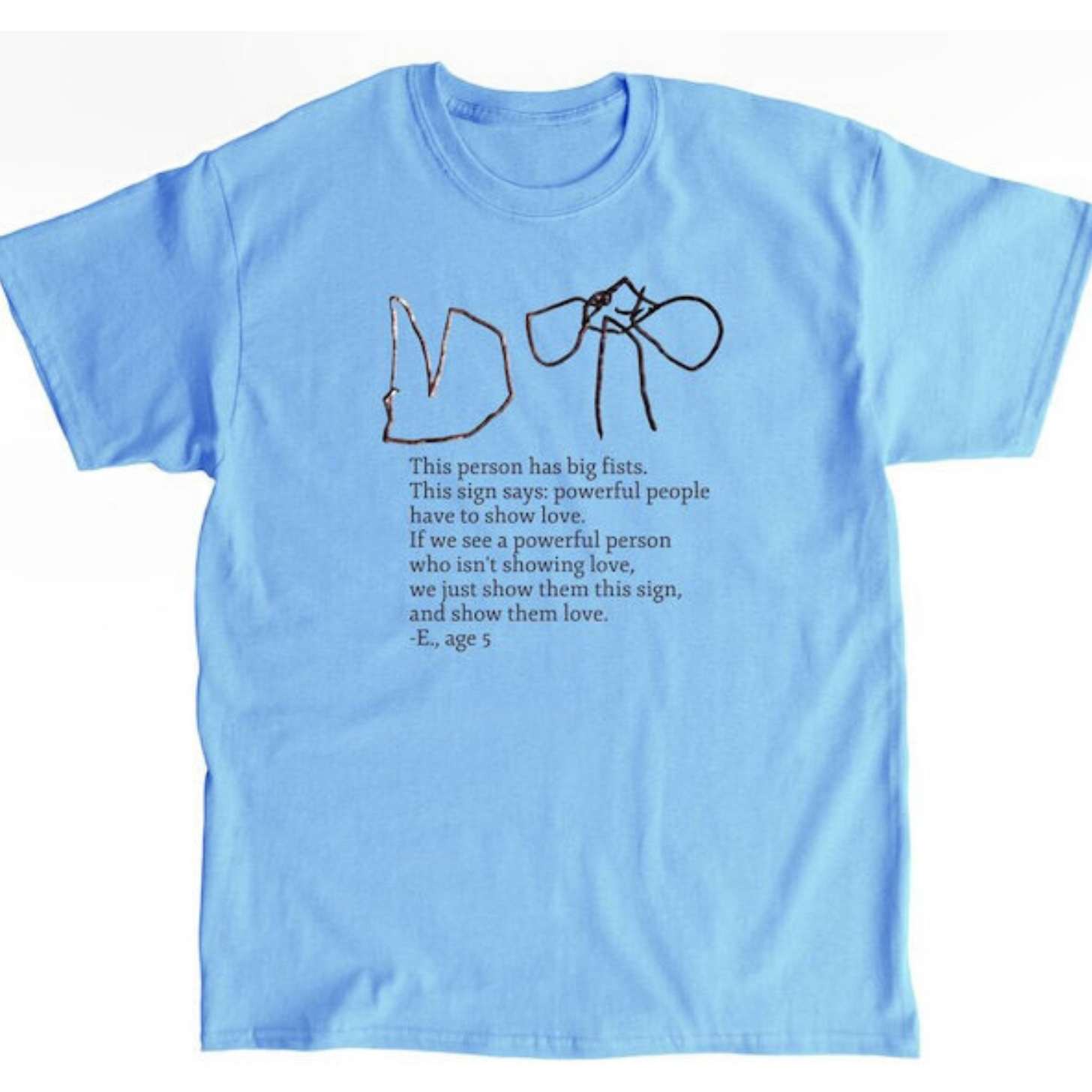
So, he got out the markers and went to work making a sign he could share his mission. He drew a large heart beside a smiling stick figure with big, looping hands raised as fists.
With the help of his mother, Toni Dewees, he wrote: “This person has big fists. The sign says: powerful people have to show love. If we see a powerful person who isn’t showing love, we just show them this sign and show them love.”
When Dewees’ mom shared his sign online, she was immediately flooded with requests from people asking if they could buy it as a t-shirt.
So the Dewees family turned to New Horizon Communities, a Washington-based nonprofit that builds tiny home villages for people experiencing homelessness in Olympia.
Through the nonprofit, they began selling “big fists” shirts — and every cent went back to the same people that Dewees wanted to help.
At the time of publication, the “big fists” shirts had helped raise an estimated $3,000 for New Horizon — enough to secure permanent housing for two more tenants in the tiny home community.
On March 7, New Horizon held a pizza party where they honored Dewees as a “Tiny House Hero.”
“It’s just so sweet to see someone young and so innocent not having any presumptions of why that person is in the situation that they’re in,” Jaycie Osterberg-Brown, a staff member at New Horizon, told JOLT News, a Washington news outlet.
Toni Dewees said that Eli and his 9-year-old brother Viper have always been interested in helping people in their community. When asked what he would do as President, Viper once said he would make sure that everyone has a home.
“It’s the ‘anything is possible’ thinking that makes things possible,” their mother shared.
New Horizon executive director Colleen Carmichael said that attitudes like that give her hope.
“You hope the work we do here gets through,” said Carmichael.
“To see a 5-year-old understand the importance of being kind and loving to everyone, that’s what’s really going to make a difference for homelessness in general.”
As “meme-able” as the shirt is, Carmichael said that the heart of Dewees’ good deed was rooted in him going up to a stranger and having a conversation with someone who was struggling — something adults could stand to learn from.
“It’s that natural inclination to love other people that fear and trauma kind of suffocates,” Carmichael said.
“He’s a good lesson that we all have that capacity to love in us, sometimes we just kind of quiet that down and now’s really the time to open that back up again.”
Eli Dewees’ design is available for purchase on Bonfire.
Header images via Eli Dewees, Toni Dewees / Panza A Washington Nonprofit Corporation / New Horizon Communities
In 2023, the U.S. Surgeon General released an urgent advisory, educating the country on the loneliness epidemic.
With this advisory, the American Medical Association was directed to develop educational programs about the impacts of social isolation, issue tools and resources for clinicians to identify and address loneliness, and work collaboratively with other organizations and agencies to improve social support for patients.
“Identifying loneliness and social isolation, especially among older adults, calls for stepped-up vigilance,” said Dr. Peter A. Hollmann, geriatrician and chief medical officer for Brown Medicine, at the 2023 AMA annual meeting.
And that’s where Life Story Club comes in.

The Brooklyn, New York-based nonprofit uses storytelling in an innovative hybrid of technology, healthcare, and human connection to boost health and wellness in older adults.
Every week, participants log onto a Zoom call, where a facilitator offers up two prompts (examples might include “What was the greatest historical event you lived through?” or “Did your parents have a story about you they loved to tell?”).
Then, other members of the club take turns sharing stories. They are also given the opportunity to record and preserve their stories to be added to a digital library or shared with loved ones.
Participants can join a Life Story Club on their own volition, but the organization also partners with healthcare teams to help older adults who are especially at risk of loneliness and social isolation.

It’s part of an emerging model of medical care called “social prescribing.” Similar to concepts like nature prescriptions and museum prescriptions, social prescribing includes non-clinical interventions or activities to improve a patient’s well-being and health.
Out of 120 existing clubs that reach over 1,200 individuals ages 60+, 82% of participants reported feeling less lonely, 95% felt supported by their club, and 92% said they feel a sense of community. 93% also experienced mood improvement since joining.
“Life Story Club was created to address a gap in our country by connecting older adults in NYC to share stories and build meaningful friendships,” said the organization’s executive director, Dr. Jennifer Wong.
“No one should face aging alone, and it is so important to bring a sense of belonging and connection to older adults.”

A quarter of Life Story Club participants come through the StoryRx program, which only started in August of 2024. Since then, 80 referrals have been placed in their own club through hospital systems like the Cleveland Clinic and Montefiore.
“I just had a conversation with a patient, and we talked about the deep loneliness she was experiencing,” said Dr. Mirnova Ceide, a gerontology specialist with Montefiore, adding that her patient felt a lack of intimacy in her relationships.
“Sometimes you have people around, but the quality of the interaction was not safe enough for her to share what she’s really feeling,” Dr. Ceide added.
But having sat in on previous Life Story Club meetings, she knew where to direct her patient.
“The Life Story Club facilitators are able to read the virtual room and are really good about bringing people in,” Dr. Ceide said. “There were conversations I really would not have expected people who didn’t know each other outside of Zoom to be able to go into, where they were able to share really difficult parts of their lives.”

As profound as these connections are, the data behind them is especially moving.
The Surgeon General’s 2023 advisory noted that loneliness can be as harmful as smoking 15 cigarettes a day and is linked to a 50% increased risk of dementia and a 30% increased risk of cardiovascular disease. All of these numbers represent a significantly increased risk of early death.
But social connection offers a 50% boost to survival odds, meaning older adults especially could have a renewed chance at a longer life through social prescriptions like StoryRx.
“This [my Life Story Club] keeps me alive,” participant Ragaa M. said in a testimonial. “Waiting every week for Friday keeps me alive. I have so many stories to share! I wish there were two Fridays a week.”
Life Story Club also facilitates in-person meetings to foster deeper connections and reinforce relationships built in virtual gatherings. Partnering with Citymeals on Wheels, the organization serves up food with a side of storytelling on these occasions.
It is here that the sharing comes full circle and turns into a celebration of life and love.
“I love the stories. I love the different people to meet, and there’s always different stories,” participant Michael Gaines said in a testimonial.
“I'm really happy that it’s available to us to be able to go back into your childhood,” he added. “Life Story [Club] is beautiful.”
Header image courtesy of Life Story Club
In 2023, Prince William launched Homewards, a five-year-long program aiming to end homelessness in the U.K.
Two years in, the program supports Invisible Cities, a social enterprise that provides employment opportunities in the tourism sector to people experiencing homelessness.
Their goal is simple: To challenge stereotypes and provide a unique and enriching experience by having formerly homeless tour guides direct walking tours in areas across the country.

Yesterday, Prince William — who is known as the Duke of Rothesay in Scotland — helped launch Invisible Cities Aberdeen, which expands tourism services to the streets of Aberdeen, a port city in northeast Scotland.
He took the inaugural tour, led by guide Angus. The guide took him through the city’s rich history and hidden stories before concluding at Trinity Hall, where the prince met with other newly trained guides.
“We believe that doing tourism differently can create significant social impact, and today’s launch proves just that,” Zakia Moulaoui Gurey, the founder of Invisible Cities, said at the event.
“By training people with lived experience of homelessness to become guides, we are not only providing employment but also challenging perceptions and sharing the untold stories of Aberdeen.”

Aberdeen is the seventh city in the U.K. that offers Invisible Cities tours, and is also a city facing rising homelessness as it transitions from its long history as an oil and gas hub.
The prince’s visit also brought in supporters from area tourism companies, which “committed to creating long-term solutions through employment and tourism,” per a press release from Invisible Cities.
“I am thrilled that Invisible Cities is launching its tours in Aberdeen,” VisitScotland regional director David Jackson said.
“Their training is vital in helping those who have found themselves homeless to gain new skills and confidence in public speaking, customer service, and storytelling.”
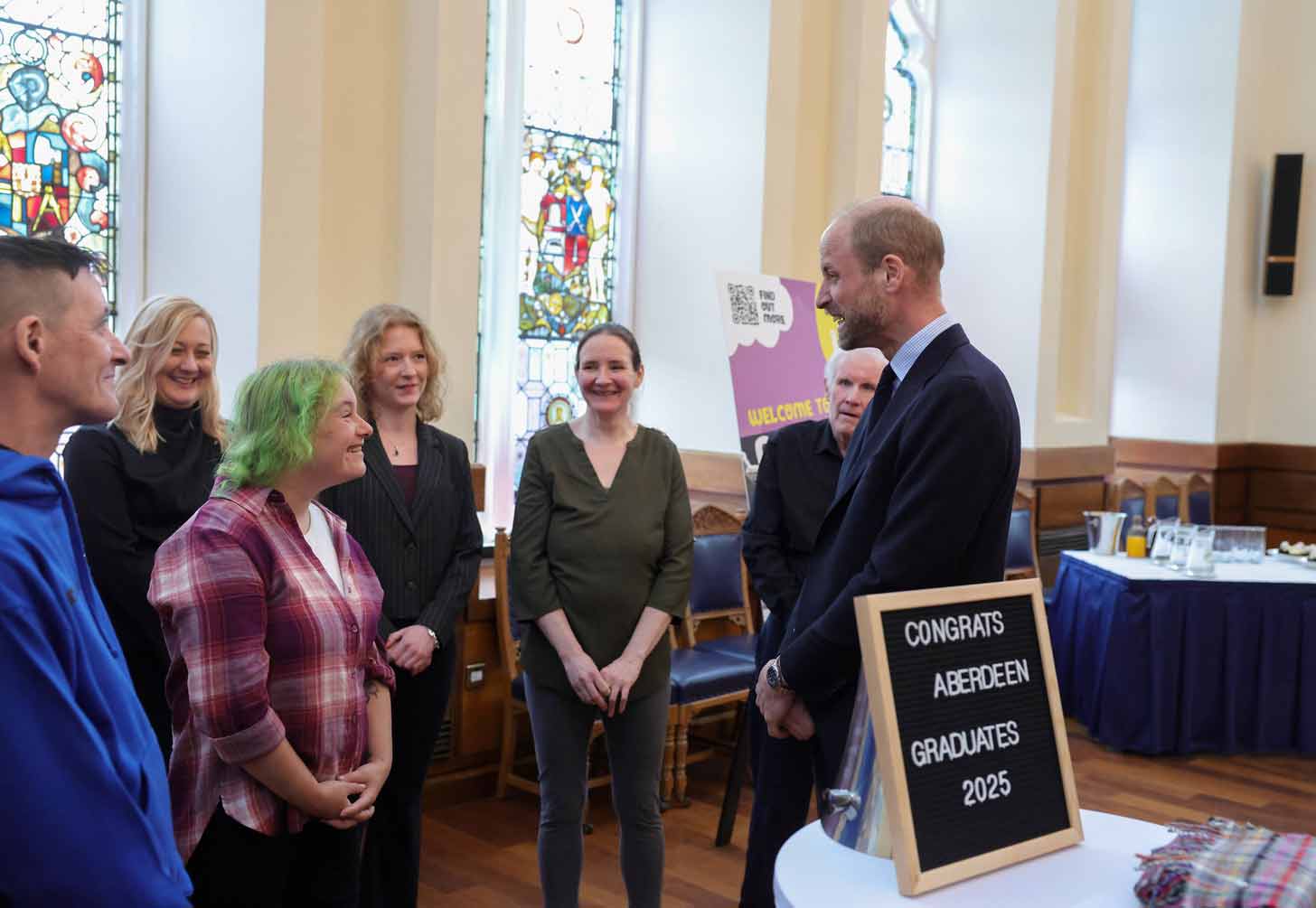
Prince William’s tour guide, Angus, is a reflection of that training.
“It is a great validation and recognition of the work we do,” Angus said. “And I hope it brings much attention to us and makes us busier!”
During his visit, the Prince also met with the first resident of a Homewards housing project in Aberdeen. The Royal Foundation has made 31 properties available in Aberdeen for those at risk of homelessness, working with national businesses like IKEA and Dunelm to provide furniture and resources for residents.
“Our focus is always on impact,” a Kensington Palace spokesperson told the BBC. “What you're seeing today is Homewards moving into its delivery phase.”
The spokesperson added that Prince William “remains laser-focused” on showing “that it is possible to end homelessness.”
Homewards focuses on six key locations across the U.K.: Northern Ireland; Sheffield; Newport; Lambeth; Bournemouth, Christchurch and Poole; and of course, Aberdeen.
With the prince’s support, Invisible Cities will soon roll out services in the five other areas of focus.
“This partnership isn’t just about providing jobs, it’s about restoring dignity, possibility, and hope,” Homewards Advocate Steven Bartlett said in a statement.
“And if we can prove what’s possible here, we can change the way the country thinks about homelessness for good.”
Header image courtesy of Invisible Cities
According to a recent poll from the National Alliance to End Homelessness, 57% of Americans believe that alcoholism and drug addiction directly lead to people losing their housing.
Beyond it being a commonly held belief, it's a sentiment that is often repeated by voices of authority across the country.
“Almost all homelessness is linked to drugs or alcohol,” Mayor Bill Wells of El Cajon, San Diego told Fox 5 during his first term.
“The homeless crisis is really a drug and substance abuse crisis,” said former U.S. Representative Dave Reichert last summer.
“I think that we see [drug use] as the true predominant driver of the crisis, even though some of the people in the political class in our progressive cities are unwilling to admit it and insist that it’s only housing,” reported Christopher Rufo, editor of Las Vegas’ City Journal.
“When I think that anyone who has a good street-level view of this can see that that’s not true.”
On March 19, UC San Francisco researchers countered those assumptions by conducting a statewide study that found that the narrative surrounding homelessness is more complicated than people may assume.
In fact, 42% of unhoused Californians reported that they began to use regularly only after they experienced homelessness for the first time.
The study was led by Margot Kushel, doctor and director of UCSF’s Benioff Homelessness and Housing Initiative, which funded the research.
“There is no question that substance use and mental-health challenges increase an individual’s risk of homelessness,” Kushel told the San Francisco Examiner after the report was released.
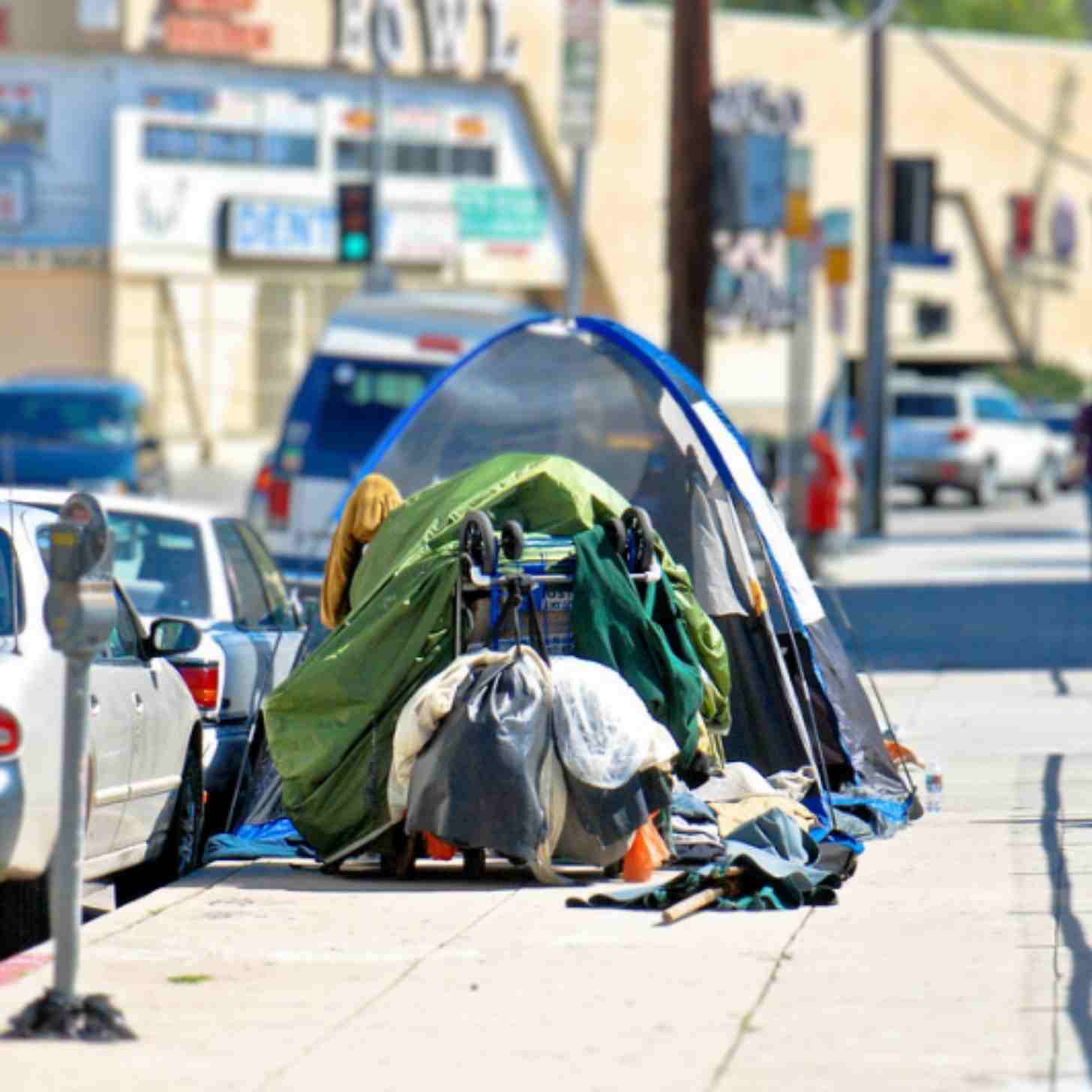
However, Kushel pointed out, the link between drug use, mental health struggles, and homelessness is not as linear as it appears.
“Homelessness increases the risk of behavioral-health challenges through a variety of mechanisms,” Kushel said, pointing to stressors like chronic pain and sickness, loss of belongings, and violent assault.
The UCSF researchers also found that “28% of those with regular drug use or current heavy alcohol use reported wanting substance use treatment, but being unable to access it during this episode of homelessness.”
The researchers also said that their data should not be undervalued, calling it “the largest representative study of homelessness in the U.S. since the mid-1990s.”
“This new UCSF BHHI report makes clear that homelessness and behavioral health are inextricably linked — and that the solutions lie in expanding supportive housing, fully integrating health and housing systems, and investing in proven evidence-based approaches,” Jeff Olivet, senior advisor at the Harvard T.H. Chan School of Public Health’s Initiative on Health and Homelessness, said in a statement.
“Policymakers and communities across the country should take these findings seriously.”
Kushel and her colleagues hoped that their data would shed light on common misconceptions surrounding homelessness. This data comes on the heels of another recent study from the university, which found that the large majority of homeless people in California are not illicit drug users.
A recent survey from Invisible People found that people were more likely to empathize with people experiencing homelessness upon learning more about their unhoused neighbors.
“I think there are a lot of news stories that touch upon the humanity of people,” a Los Angeles resident told Invisible People.
“Hearing stories from homeless people that talk about their personal struggles shows me that there is very little difference between me and them.”
Header image via Robin Kanouse / Flickr (CC BY-NC 2.0)
On Friday, March 28, a powerful 7.7 magnitude earthquake struck Mandalay, Myanmar — Myanmar’s second-largest city — with the devastation spreading throughout Thailand, all the way to Bangkok.
At the time of publication, the Associated Press reported that the deadly impacts from the earthquake had killed 144 people and injured 730 more.
“We fear it may be weeks before we understand the full extent of destruction caused by this earthquake,” Mohammed Riyas, the International Rescue Committee’s Myanmar director, said in a statement.
As first responders continue their rescue efforts, here are the people and organizations that are helping Myanmar and Thailand at this critical time — and how you can support them.
How to help victims of the Myanmar-Thailand earthquake
Donate
American Red Cross
The American Red Cross does more than provide emergency medical care. The nonprofit also provides shelter, food, clothing, toiletry items, clean-up items, and mental health support to natural disaster victims.
Myanmar Red Cross Society’s program coordinator Marie Manrique told the Anadolu Agency on March 28: “We are very concerned about the potential humanitarian impact, and really, it's a developing emergency, and our priority is to ensure that affected communities receive the help that they need as quickly as possible.”
World Central Kitchen
World Central Kitchen is a nonprofit, non-governmental organization that provides food relief in areas impacted by natural disasters and humanitarian crises.
On March 28, the organization said in a statement: “WCK’s Relief Team is en route to Southeast Asia, where a magnitude 7.7 earthquake struck Myanmar and Thailand. The quake caused massive destruction to buildings, infrastructure, and communities, and local authorities remain concerned about aftershocks and resulting tsunamis. This is a quickly evolving situation—we’ll share more information as soon as we have it.”
→ Donate to World Central Kitchen
UN Refugee Agency
The UN Refugee Agency is a humanitarian organization that already has boots on the ground in Myanmar, aiding those who have been displaced from their homes due to political violence. They have local resources and temporary shelters available to help people newly affected by the earthquakes.
In a statement, the UN Refugee Agency wrote: “UNHCR’s emergency teams are working around the clock to provide life-saving assistance and to protect those forced to flee their homes. Working together with our partners and local communities, we are distributing core relief items like mosquito nets, soap and sleeping mats [and] providing critical shelter materials such as tents, tarpaulins and bamboo poles to give people a safe place to sleep.”
→ Donate to the UN Refugee Agency
Project HOPE
Project HOPE is a humanitarian and global health organization that aims to address both urgent and long-term needs in times of crisis, including primary and mental health, shelter, water, sanitation, and hygiene.
In a statement, Project HOPE’s director of Emergency Preparedness and Response, Arlan Fuller, shared: “This is a historic earthquake in a country that has long had a history of adversity – where millions were already displaced and tens of millions were already in need of humanitarian aid – making the consequences of this disaster even more catastrophic. Project HOPE was built for these moments, and we are working to get a team on the ground as soon as possible to begin to assess the greatest health and humanitarian needs for impacted communities.”
Donate blood
Donating blood is vital, especially in the event of mass tragedies.
Use the American Red Cross site to find your local blood services location.
Note: While increased donations after a tragedy are helpful, the most effective way to ensure a stable blood supply is through regular, voluntary donations.
Stay informed
As recovery and rebuilding efforts continue, stay up-to-date by following reliable news sources.
- Reuters: an international news outlet that provides breaking news.
- The Associated Press: an outlet that prides itself in “independent, fact-based journalism.”
- Myanmar Now: a local outlet that provides news from Myanmar in both Burmese and English.
Use your platform
Share helpful guides on how to help — like this article! — on social media to keep followers and friends informed. Good Good Good will continue adding resources as they become available.
Use your voice
Contact your representatives to push for federal aid to support recovery efforts in Myanmar and Thailand. Apps like “5 Calls: Contact Your Congress” and “Democracy.io” connect users to their House, Senate, and local reps in seconds and provide pre-written scripts that make it easier than ever to hold your representatives accountable.
Every day the Good Good Good team collects the best good news in the world and shares it with our community. Here are the highlights for this week!
If you want to get good news in your inbox every day, join the Goodnewsletter — the free daily newsletter designed to leave you feeling hopeful.
The Best Positive News We’re Celebrating This Week —
The UK is planting 20 million trees as part of the first of three new national forests
Helping meet its tree-planting goals as part of a “national forest” drive, the UK announced plans to plant 20 million trees, creating 2,500 hectares of new woodland area.
The new woodland area will join existing woodlands to make up the Western Forest, the first of three new national forests promised by the government, which has a legally-binding target of 16.5% forest cover in England by 2050.
Notably, the Western Forest project is the first new national forest in the UK in 30 years and it will target increasing tree cover in urban areas like Bristol, Swindon, and Gloucester.
Why is this good news? In some areas of the future Western Forest, there is only about 7% of land covered by trees. The project is aiming to achieve 20% forest cover, and up to 30% in some areas — which will result in a number of health benefits for wildlife, for the planet, and for human beings.
A special education teacher raised thousands of dollars to pay off students’ lunch debt by dancing on TikTok
→ Read more
California added 26,000 electric vehicle chargers in just six months
Between August 2024 and February 2025, California saw a 17.1% increase in the number of public and shared private electric vehicle chargers across the state.
The state now boasts a network of more than 178,500 chargers, with 26,193 of them built just since August — making progress toward its charging infrastructure goal. This is important considering that starting next year, 35% of all new car models sold in the state must be zero-emission vehicles.
While this is important progress, the state needs to work even faster to meet its target of 1 million public chargers by the end of 2030 to support the 7 million EVs it expects to have on its roads.
→ Read more
In a world-first medical success, a man lived for 100 days with an artificial titanium heart
An Australian man made history as the first person in the world to receive a total artificial heart transplant and lived with the device for more than 100 days before receiving a donor heart transplant earlier this month.
It’s a significant milestone for heart failure treatment and the longest-recorded survival with the artificial heart technology.
The device is made from titanium and is designed to replace both ventricles of a failing heart, pumping blood to both the body and lungs.
Why is this good news? More than 23 million people suffer from heart failure annually, and only about 6,000 receive a donor heart. This medical breakthrough could help give more people in need time to wait for a donor heart transplant, too — becoming a long-term solution in itself.
→ Read more
A Goodwill van pulled up to a homeless man and offered a meal and $50 for four hours of work — and it completely changed his life
→ Read more
A Colombian marine biologist has spent his life protecting endangered pink river dolphins and their ecosystems
Colombian marine biologist Fernando Trujillo co-founded the Fundación Omacha to conserve freshwater dolphins, manatees, and other aquatic animals and ecosystems.
River dolphins are some of the most endangered cetaceans in the world — and by monitoring their health, Trujillo and his team also get insight into the health of the ecosystem around them.
Trujillo and his team test for elements like mercury, which is naturally occurring in the Earth’s crust, but becomes highly toxic when released into the air or water through things like deforestation, wildfires, and mining. Their work not only protects the endangered animals, but the rivers they live in and humans who rely on the rivers, too.
In an ‘unprecedented’ discovery, researchers found a thriving, never-before-seen ecosystem under an Antarctic ice shelf
In January, an iceberg the size of Chicago broke away from an ice shelf attached to the Antarctic Peninsula ice sheet — researchers nearby seized the opportunity to explore the ecosystem below that it left behind.
In addition to sea spiders, ice fish, and octopuses, the scientists discovered corals and sponges, whose size indicated that the ecosystem had been thriving for decades, if not hundreds of years.
With plans to return for further study, the initial expedition is providing insights into how ecosystems thrive beneath ice sheets, since deep-sea ecosystems typically rely on nutrients raining down from the surface.
What’s the nuance? While icebergs breaking off from ice sheets is normal, climate change is unnaturally accelerating the process and causing the ice sheet to shrink faster over the past few decades. Ice loss from the Antarctic Ice Sheet “is a major contributor to sea level rise worldwide.”
The trees in Los Angeles are “kicking ass” — absorbing more carbon dioxide than expected
Using sensors set up across central Los Angeles, researchers found that over the course of a year, trees absorbed up to 60% of carbon dioxide on average during the day, and that’s much more than expected.
The area they studied wasn’t “all that green” either, showing how even what might be considered a minimal addition of trees can make a big difference in air quality, which has been shown to have other important health benefits for the planet and people.
The researchers are hoping their study could be used to help L.A. and other cities in their approach to urban tree planting.
→ Read more
Further helping the city improve air quality, residents in Paris voted to make 500 more streets car-free
In a referendum, residents of Paris voted to pedestrianize 500 more streets in the city as part of the local government’s efforts to reduce the use of cars and improve air quality.
The additional car-free Parisian streets will bring the total number to nearly 700, with another 10,000 parking spots removed in addition to the 10,000 that have already been removed. Residents will help decide which streets will be impacted.
While Paris has made incredible strides, its green infrastructure — including private gardens, parks, tree-lined streets, and more — makes up about 26% of the city, lagging behind the 41% average in other European capital cities.
Why is this good news? Not only does taking cars off the road help improve air quality, but it also improves overall well-being with more people walking, biking, skating, and more. The lack of emissions and traffic also helps people connect more with their neighbors.
→ Read more
Carolina the giant rat is officially retired — she spent years detecting thousands of cases of tuberculosis, saving countless lives
→ Read more
Women’s sports bars are expected to quadruple across the U.S. this year
At the beginning of 2025, there were six bars dedicated to showing women’s sports in the entire United States. By the end of the year, there will be almost two dozen.
Already this year, three women’s sports bars have opened, and 14 more are expected to open their doors in the coming months, spanning cities from New York to San Francisco, Cleveland to Kansas City.
The exponential growth of women’s sports bars is happening alongside a surge of support for women’s college and professional sports — leading to more women’s sports events being aired on television, too.
In 2024, global renewable energy capacity saw the largest expansion ever recorded
In 2024, global renewable energy capacity increased by 15.1% year-over-year, representing the largest expansion ever recorded.
Around 92.5% of new energy capacity added last year came from renewables, with 585 total gigawatts added and bringing the total global capacity to 4,448 GW. Solar and wind accounted for more than 96% of those new renewables additions.
China built nearly 64% of this new renewable capacity, adding 278 GW of solar capacity alone last year.
What’s the nuance? While the progress is remarkable and important, the pace of growth still falls short of what’s needed to meet the COP28 goal of tripling capacity by 2030 — requiring an annual growth rate of 16.6%. Still, the growth of renewable energy is happening exponentially, so experts still project the world is on track to hit renewable energy targets by 2030.
→ Read more
A first-of-its-kind “vehicle-to-everything” program is giving away 100 free chargers to test how EVs can earn money by sending backup power to the grid
High school students in Chicago built a tiny home village for homeless veterans in Georgia
In Brunswick, Georgia, a new tiny home village composed of 30 tiny houses and a community center has just opened to serve local veterans facing homelessness — and it was all built states away by Chicago’s Northwest Suburban High School District 214 students.
A joint effort between the Nine Line Foundation, the organization behind the village, and teachers from area high schools, the project became “a great civics lesson” for Geometry Through Construction students.
The students even raised funds to help pay to send the tiny homes on their 1,052-mile trip to Georgia.
More good news of the week —
A Florida village’s composting program will reduce waste, fertilize a Native tribe’s community garden, and restore the Everglades. The “Everglades Earth Cycle” program in the village of Pinecrest is the first in the county to be sponsored by the local government, and it has already collected 90,000 pounds of food waste in just one year.
A contraceptive pill, endometriosis treatment, and IVF drug will be cheaper for thousands of Australians thanks to new health funding. The three new listings in the country’s Pharmaceutical Benefits Scheme are in addition to a $500 million package of women’s health measures introduced last month.
A new first-of-its-kind map of the London Underground helps cyclists discover the city’s green spaces. Created as a free resource by a graphic designer, the newest edition of the Greenground Map connects London’s National Cycle Network, Cycleways and the extended cycle network to parks and waterways.
More U.S. states are requiring paid medical leave, which has been shown to reduce stress and improve productivity. There is no federal law requiring paid leave in the U.S., only unpaid time off — and it doesn’t apply to everyone, like employees of small businesses — which makes the U.S. a “major outlier” amidst 95% of countries providing some form of paid leave for personal health.
In a “historic milestone for rewilding,” Chile and Argentina collaborated to save a giant flightless bird from extinction. The three-foot-tall Darwin’s rhea is locally endangered in Chile, and in turn, the country’s grasslands deteriorated, as the birds play a crucial role in dispersing seeds and renewing vegetation.
The largest supermarket in the U.K. is trialing giving away expiring food to shoppers at the end of the day. In an effort to further reduce food waste, applicable items would be offered to customers after first offering it to charities, food banks, and shop workers — and those donations could even help them make more money.
Filling in for workers who joined the war effort, women in Ukraine are working as coal miners to keep the country’s power on. While the country is still ramping up its renewable energy transition, coal is needed to meet existing demands for energy — and Ukrainian women are taking on the task, which was once considered only suitable for men.
A landmark ruling from an international human rights court protected Indigenous people from Ecuador’s powerful oil industry. Impacting at least three groups of Indigenous people, the Inter-American Court of Human Rights ordered the Ecuadorian government to protect the groups from oil operations and to leave oil in the ground underneath their lands.
The world’s largest women’s prison launched an independent newspaper written by and for inmates. The Central California Women’s Facility is home to more than 2,000 women, nonbinary, and transgender people, and The Paper Trail is amplifying their voices.
A first-of-its-kind volunteer fire brigade is helping protect LA residents from wildfires. Serving as a bridge between professional firefighters and the community, the Community Brigade is trained in basic techniques but primarily works to aid with evacuations and fire prevention through home inspections.
To help protect shrinking coastal wetlands, a new conservation effort is preserving two salt marshes in Nova Scotia. The salt marshes provide essential habitat for migratory birds and act as natural protection against storm surges and sea-level rise — and are more critical than ever since the province has lost 60% of the wetlands to development.
To help protect pollinators, the use of pesticides on U.K. farms will be cut by 10% by 2030. While activists celebrated the news, they’d hoped it would go further, since the EU’s target for member states is to reduce the use of more hazardous pesticides by 50% by 2030.
A church transformed its vacant land into a massive urban garden, donating 65K pounds of food to people in need. After seeing an abundance of abandoned land and limited access to fresh, healthy produce in its community, Mission of Mary Cooperative now manages a network of six massive urban farming plots across four acres, growing over 75 different varieties of fruits and vegetables.
Installing safety nets on the Golden Gate Bridge has been shown to reduce suicides by 73% in a year. Studying a period of time before, during, and after the nets were installed, researchers found that there were 2.48 deaths by suicide per month before, 1.83 during installation, and just 0.67 after.
Leveraging trust built over time, doctors in Atlanta are talking to their patients about the health risks associated with climate change. Hoping to depolarize the issue and break through misinformation, the doctors are explaining how the issue intersects with healthcare, like the impacts of heatwaves, allergies, infectious diseases, and malnutrition from food supply changes.
A t-shirt that monitors vital signs could help cancer patients leave the hospital sooner to recover at home. The wearable technology sends data, for vitals like blood pressure, pulse rate, and blood glucose to an app and web-based software for hospitals to monitor remotely — and users in the test group felt safer and more cared for while recovering at home.
The U.S. Supreme Court upheld a regulation requiring serial numbers, background checks, and age verification for “ghost guns.” The number of ghost guns found at crime scenes around the country had been soaring, with 27,000 recovered by law enforcement in 2023 — up from fewer than 1,700 in 2017 — and that number had flattened out or declined since the regulation was finalized.
A federal judge ordered a Colorado school district to return 19 banned books to libraries. The judge also prohibited the district from further restricting access to books “because the district disagrees with the views expressed therein or merely to further their preferred political or religious orthodoxy.”
After the L.A. wildfires destroyed places of worship, Methodist, Muslim, and Jewish congregations are gathering under one roof. Already a satellite worship space for the Islamic Center of Southern California, First United Methodist church in Pasadena also welcomed the Pasadena Jewish Temple and Center, whose synagogue burned down in the Eaton fire.
In the summer of 2021, The Johnson & Wales University campus in East Denver, Colorado ceased operations.
In the place of the college, stakeholders said, the property would be transformed into “a hub for education, economic development, and affordable housing.”

Through a partnership with the Urban Land Conservancy, Denver Public Schools, and Denver Housing Authority, the affordable housing efforts are finally in full swing.
The former campus has now been transformed into one of the city’s newest affordable housing complexes: The Mosaic Community Campus.
The campus consists of 154 apartments across four former dorm buildings and offers a combination of one-bedroom, two-bedroom, and three-bedroom apartments.

All apartments are reserved for individuals that fall within the range of 30-60% of the Area Median Income.
“This is really a flagship project for Archway Communities,” Laura Brudzynski, CEO of Archway Communities, the nonprofit developer of the new housing project, told 9News.
“It’s a unique opportunity to preserve existing historic structures and adapt them to meet today’s urgent need for affordable housing.”

A 2023 report from the Common Sense Institute of Colorado found that Denver faces a significant affordable housing shortage, with estimates suggesting a deficit of tens of thousands of units.
This new project could be a blueprint for solutions to come.
The Mosaic Community Campus’s buildings, built in 1909, were first home to Colorado Women’s College, before they were sold to Johnson & Wales. It was the first women-only educational institution in Colorado.
Because of the historic nature of both the architecture and the institution, the property has been supported by $11 million in state and federal historic tax credits, according to reporting from 9News.

Opting for adaptive reuse instead of demolishing the historic sites, developers were able to convert the existing structures into homes instead of starting from scratch.
“It can be more cost effective to preserve an existing structure,” Brudzynski added to 9News, “to utilize the bones of the building.”
But now, the property is more than just a skeleton.
The campus maintains a central quad, community kitchens, and two different school systems — a Denver School of the Arts expansion and a K-8 Episcopal school that offers sliding scale tuition.
There are also job training opportunities, including DIRT Coffee Bar, a cafe that trains and hires employees with developmental disabilities.

“I never thought I would ever be able to do something like this,” Aaron Miripol, president and CEO of the Urban Land Conservancy, the nonprofit that purchased the land, told The Denver Post in 2024.
“This is a once-in-a-generation opportunity.”
By using a community land trust model, Urban Land Conservancy partners with other organizations to rent or purchase the land and its buildings at a deep discount.
One such partner is Kitchen Network, a culinary incubator that provides education and job opportunities — as well as food. Workers in the facility can “live and work on the same campus,” director Jorge de la Torre told The Denver Post.
“We’re going to bring some affordable housing to people that might not have the ability to live in Denver,” he added.

It’s clear that the campus does not just offer an affordable place to stay — but a full and emerging community, proving that these concepts can coexist.
“Mosaic Community Campus offers an array of services aimed at community development,” the Archway website continues.
“A central quad, disc golf course, and amphitheater are just a few of the amenities in the community.”
While the 154-unit housing complex only recently opened to tenants, it has already filled 150 vacant units. With high demand — and high aspirations — the space promises a long and impactful legacy.

“We have found a great partner in Archway Communities to preserve these beautiful buildings for a community beneficial use and provide much needed affordable housing,” Aaron Martinez, Urban Land Conservancy’s COO, said in a statement.
“The land that the dorms are located on will be held in a renewable 99-year ground lease by ULC to ensure its use for community benefit in perpetuity.”
Header image courtesy of Archway Communities
Growing up in St. Cloud, Florida, 11-year-old Kenzie and 9-year-old Kayleigh became well-acquainted with hurricane season.
And when Hurricane Helene hit Florida in late September and continued up the coast — hitting Alabama, Georgia, Tennessee, South Carolina, Virginia, and more in its path — the sisters jumped at the chance to help children affected by the disaster.
Especially those still reeling from the long-term effects of the destruction months later, in Western North Carolina.
“Hurricane Helene hit, and we usually try to volunteer because we're used to hurricanes where we live,” the girls’ mother, Angela Tilsher, told CBS Mornings’ David Begnaud.
“We couldn't take a chainsaw up there, so we were like, ‘How do we affect a girl to help them quickly?’ And that's through play.”
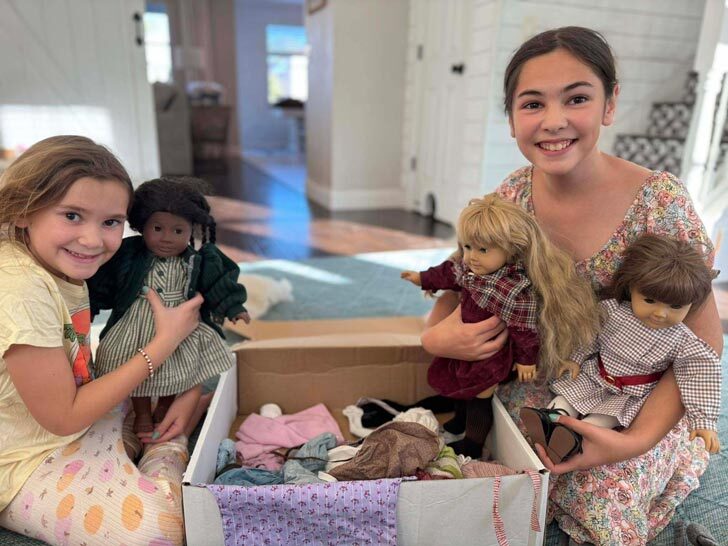
That’s when Kenzie, Kayleigh, and their mother came up with the “Anna the Appalachian” doll initiative and approached the American Girl doll company in collaboration.

“Her story is that she understands what the girls went through,” Angela said. “And that she’s going to be her new friend, to help her [know] that she’s brave, she’s strong, and she’s going to make it through this.”
CBS Mornings’ Begnaud joined the Tilsher family in Burnsville, North Carolina, on their way to deliver more dolls.
The sisters explained that Anna the Appalachian Doll is a character with her own story. But she’s also a template for over 100 custom-made dolls that Kenize and Kayleigh have helped make.
“I love her so much, and she looks just like me,” 9-year-old Addie Foxx told the sisters as she cradled her doll.
Addie was diagnosed with alopecia just before Hurricane Helene hit, and Kenzie and Kayleigh made sure to customize her doll in her likeness.
“I’m very happy and excited that we get to help out,” Kenzie told Begnaud.
“What does that excitement mean to you?” Begnaud asked the girls. “Do you want to do more of it?”
“Yes, lots more,” Kenzie replied.
“A lot more!” Kayleigh agreed, nodding.
According to Buncombe County, more than 100,000 households in Western North Carolina were severely impacted or destroyed by Hurricane Helene.
6 months later, in Asheville alone, it’s estimated that 1,548 people (including individuals and families) are still experiencing homelessness after being displaced by Helene — and many are living in hotels paid for by FEMA under its Transitional Sheltering Assistance program.
And for the families that have secured housing, many have lost beloved personal items and possessions in the disaster. For some kids, that means rebuilding treasured toy collections from scratch.
“Because of these dolls, we were able to still give my daughter something special on Christmas that we probably wouldn't have been able to do otherwise,” Addie’s mother Randi Price told CBS News, wiping tears away from her eyes.
“[Getting] a doll that represents something that she's going through is an immensely [indescribable] joy to so many little girls.”
Header images via Angela Tilsher / Facebook
In Sacramento, California sits a tiny house neighborhood where emancipated foster youth — or those between the ages of 18-24 facing homelessness — find the first place that is all their own.
Formed by First Step Communities, The Grove is a tiny-cabin community that offers housing, as well as a comprehensive program to empower young adults to transition into adulthood with support and direction.

Last week, the organization held a “cabin beautification competition” with area partners to transform the 50 tough sheds into more comfortable and dignified spaces for The Grove’s residents.
“It’s one of the most successful shelters in the Sacramento region, but we had a dream to make it even more impactful,” a social media video from First Step Communities said.
With the help of HomeAid Sacramento, Northern California Construction Training, and countless community supporters, the shabby shelters were turned into personalized and cozy homes for the young people of The Grove.
It was all part of First Step’s “Adopt-A-Cabin” program, which called for individuals or organizations to sponsor these cabins. Their donations would fund essential repairs, ongoing maintenance, and the creation of a welcoming and comfortable home environment.

Names and logos of donors would also be displayed on the cabins and they would receive regular updates on the progress of the program.
“This program was designed to empower a young person’s journey towards a brighter future by allowing the community to sponsor their temporary home at The Grove as they rebuild their lives,” First Step Communities shared on its website.
Phases 1 and 2 of the project included building the cabins and creating supportive services. Step 3 — which the beautification event kicked off — aims to “turn each cabin into more than a safe place to sleep, but a home.”

“By creating a more nurturing space, we will invite even more growth and transformation,” the website continues.
In the end, 31 companies “stepped up” to adopt cabins, and volunteers and contractors were off for the races.
First, they created concrete pathways outdoors to make it easier for residents to move about the property. Then, they turned their focus to the interiors of each cabin.
“Each team brought their own vision, creativity, and skills to the project,” the First Steps social media video shared. “Each cabin took on its own unique feel, reflecting the care and effort put into it. The best part was seeing the excitement from The Grove residents.”
@firststepcommunities The Grove, our shelter for transitional-age youth, just got a makeover! A huge thank you to HomeAid Sacramento for leading the way—this wouldn’t have been possible without you. To everyone who played a part, your generosity and hard work exceeded all expectations. The Grove residents are beyond grateful! Special thanks to all who helped on our first day: Fieldstone Communities, Greg Grant, First Step Communities Board, The Edwards Family, Angels in the Alley, D.R. Horton, BUILD 2025, First American Title Company, The Hills Group, Studio 81 International, Tier One Financial & Insurance Solutions, Lund Construction, Bilentinkoff Foundation, Citadel Premium Design, Tri Pointe Homes and Econova Landscaping and Design!
♬ positive vibes - nanaacom
This past weekend, the first 26 cabins were completed. With details like new linens, shelving, wall decor, modern furniture, and even plates of cookies welcoming residents home, the team effort transformed The Grove in just a few short hours.
“For many, this is the first time they’ve had their own space. Creating a home-like environment gives them comfort, stability, and a sense of belonging,” the First Steps video continued. “It’s a space where they can feel safe, recharge, and start dreaming bigger.”
Next weekend, volunteers and supporters will finish the remaining cabins, and landscaping will soon follow.
As the organization’s social media post said: “This is the power of people coming together to create change.”
Header image courtesy of HomeAid Sacramento
A small, quail-like bird species called the plains-wanderer hasn’t been seen in west Melbourne for decades — but thanks to new artificial intelligence technology, the bird has finally been heard.
In a flash of genius, Zoos Victoria, a zoo-based conservation organization, installed audio recorders throughout the wilds of Australia, in an effort to catalog data on local bird calls.
Across tens of thousands of hours of recordings, an AI-powered tool pinpointed the plains-wanderer by identifying its soft, low “ooming” call at two sites in western Melbourne.

Remarkably, the bird hadn’t been found in the volcanic region since 1989 — a symptom of the species’ larger decline across the country due to long-term drought and its ever-shrinking natural habitat.
Chris Hartnett, Zoos Victoria’s threatened species program coordinator, specializes in bringing species back from the brink of extinction.
Currently, she is committed to recovery actions for 27 priority species that have been flagged for extinction in the next 10-20 years — and the plains-wanderer is one of them.
For Hartnett, finding evidence of the plains-wanderer in the region was “like finding gold.”
“They’re very endearing and quite eccentric,” Hartnett told the Guardian, explaining that the females form “a shape with her wings like a jet plane and chase the males around” when courting mates.
Plains-wanderers are outliers in the avian world, as the females are larger and more colorful than their male counterparts and habitually take it upon themselves to defend their territory while their mates tend to the eggs.
Notably, as a “flagship” species, the bird is used as an indicator of healthy grasslands throughout southeastern Australia. They also play a crucial role in insect control and seed dispersal, which in turn leads to healthier habitats for other native species.
But, above all, Hartnett admires the species’ resilience.
“They’ve held on, even though the landscape has changed pretty drastically,” she said, pointing out that less than 1% of their natural habitat remained in Victoria.

That trademark “resilience” is especially remarkable, given the plains-wanderers’ penchant for particular landscapes.
“We’ve often referred to the plains-wanderer as a ‘Goldilocks species,’” Harnett said, adding that the birds liked their grassland “not too dense, not too sparse, but just right.”
In 2023, renowned “birders” Ross and Melissa Gallardy described the plains-wanderer as “one of the hardest birds” to spot in all of Australia.
Echoing Harnett’s “Goldilocks” remark, the Gallardys emphasized that the birds “require native grasslands that fit a very specific description.”
“They are extremely picky when it comes to habitat, and they are very skilled at hiding in the tuffs of grass of their preferred terrain,” the couple noted in their blog, Budget Birders.
“To put the difficulty level of this bird in perspective, there is a guide in Australia who charges $900 just to go out and see this one bird.”
“They are notoriously hard to flush,” they added, to illustrate just how elusive the plains-wanderer was. “They are so good at running away that they much prefer to go that route. They will run away and hide before you ever even knew they were there.”
Although audio recorders have proved to be crucial in renewed efforts to find the bashful bird, Harnett invited locals to report any sightings of the plains-wanderer to Zoos Victoria as they broadened conservation research on the “oddball” species.
“We welcome anyone who thinks they may have seen one of these birds on their property to get in touch,” Harnett said. “And we can put these audio recorders out there.”
Header image via Dominic Sherony (CC BY-SA 2.0)
West Japan Railway Company — or JR West — has just announced that it will build what it says will be the world’s first 3D-printed train station.
While 3D printing has emerged as a more sustainable and cost-effective construction method compared to traditional architecture, it has primarily been used to build homes or other small structures.

The new station structure in Japan, which will replace an old wooden shelter, measures about 108 square feet, similar to a tiny home or other small building.
A press release for JR West said that the company and its partners “have been considering a new endeavor to build station buildings using construction 3D printers in response to the reconstruction of aging wooden and other station buildings.”
This makes it a great case study for integrating 3D printing technology into renovating old train stations across the country.
JR West worked with Serendix, a Japanese 3D printing company that has manufactured unique 3D-printed homes in the past, to bring the new structure to life.
The construction process took place in late March, with an estimated opening date in the summer of 2025. The new station will be located in the southern prefecture of Wakayama, about 60 miles south of Osaka, at Hatsushima Station.
“The exterior shape of the building, including the foundations, will be printed using the latest 3D printer technology,” the press release explained.
“After the printed parts have undergone the necessary processing (reinforcement and concrete filling), they will be assembled on-site … The estimated construction time on the day (assembly to completion of the structure) is approximately six hours, between the last train and the first train of the day.”
JR West said this approach will shorten the construction period compared to conventional construction methods, like steel frame and traditional reinforced concrete construction.
The station was printed using an innovative reinforced concrete filament, making it “durable and resistant to corrosion,” according to JR West.

The exterior design of the structure, as shown in a computer rendering, will be a minimalist white shed with a curved roof. It will also have an image of a mandarin orange carved on the side, representing a fruit grown in the area.
This aligns with the company's effort to “create a station building that reflects the unique characteristics of the area and is loved by local residents, contributing to regional coexistence.”
According to CNN Travel, the project will provide the company — and other Japanese transit companies — a chance to explore and study “sustainable building materials and cutting-edge technologies,” to hopefully be implemented in other regions in the future.
“Using the station building to be constructed this time as a basic model, we will consider the possibility of expanding it to other stations,” JR West added in the press release.
“The introduction of this technology will address the emerging labor shortage and promote the planned renewal of railway facilities. This will increase the sustainability of railway infrastructure and make steady progress towards realizing our long-term vision of providing ‘safe, secure transportation that is friendly to people and the earth.’”
Header image by MaedaAkihiko (CC BY-SA 4.0)
When Rob Scheer was a 12-year-old walking into the foster care system in the 1970s, he carried everything he owned in a trash bag.
His case worker told him to shove his belongings into a trash bag to quickly escape an abusive home, and the pattern repeated over and over until he was an adult.
When he aged out of the system at 18, he packed a trash bag for the final time.
The five children he adopted with his husband, Reece, each had similar stories, navigating the foster care system with just a trash bag full of items to their names.

As an adult, Rob was shocked by how little the whole experience had changed since he was a kid.
“When my children arrived and each one of them had a trash bag, I knew we as a society failed,” Scheer told CBS News.
This is what spurred him to create Comfort Cases, a nonprofit that provides foster youth with their very own backpacks and luggage — instead of a plastic bag.
Since its founding in 2013, the organization has donated more than 250,000 cases to children across the United States. Recipients also get a brand new pair of pajamas, personal care items, a book, a stuffed animal, and other necessities, tied with a ribbon in their respective packs.

“The Comfort Case is a wonderful, trauma-informed invention,” Suzanne Friedman, Ph.D. shares on the nonprofit’s website.
“Children who have learned that they are unimportant receive new things of their own. Toiletries and dental supplies communicate the importance of self-care and self-worth. The stuffed toy and blanket help soothe and comfort. The book provides a healthy distraction and intuitively teaches an important component of stress management. The journal and coloring book help to calm distressing feelings.”
Scheer and his family held their first “packing party” to prepare and distribute donated items in 2013 and have since expanded across the country — including Puerto Rico — and recently in the United Kingdom.

“Children in foster care are the responsibility of the entire community,” Scheer told the Silicon Valley Voice. “Investing in their future is essential for the betterment of society.”
His efforts have paid off. In the past two years, according to CBS News, Maryland, Texas, and Oregon have all banned the use of trash bags in foster care. Similar legislation was also recently introduced in New York City.
On an individual level, thousands of young people have Scheer to thank for their restored dignity.
“To carry your stuff in a trash bag, it makes you feel like this is your fault, you’re worth nothing, none of this stuff is worth anything to anyone else,” Ashley Baker, who grew up in more than a dozen foster homes, told CBS News.
“I thought, ‘Oh, I'll grow up to be the change maker.’ But to find out there’s others who want to make that change, it does feel … so heartwarming to know.”

Even as the tides shift in local legislation, Scheer’s mission is far from over. In the 12 years since he began the organization, he has also created a scholarship and mentoring program called the Pathways Program to help young people aging out of foster care navigate the next phase in their lives with confidence.
And the Comfort Cases are the first step in that journey.
In 2024 alone, Comfort Cases distributed over 40,000 packs and hosted 69 packing parties across the country. They hope to double their efforts in 2025.
“This is a community effort from start to finish that would never have happened without the inspiration of Rob Scheer and local foster parents,” a volunteer shared in a testimonial for the nonprofit.
“I have seen children receive Comfort Cases. It is a game changer for them to have these brand new items, because it is a clear indication that someone cares about their well-being. It’s ever so much better than a trash bag. As long as there are children in need, we will keep right on packing.”
Header images courtesy of Comfort Cases
With housing costs on the rise, the idea of owning a home can feel like a fairytale.
But New Zealand couple James and Leonie have found a way to thrive in a sustainable tiny home and food forest without breaking the bank.
In a new episode of Living Big in a Tiny House, the duo shared the story of their 22-by-8-foot home.
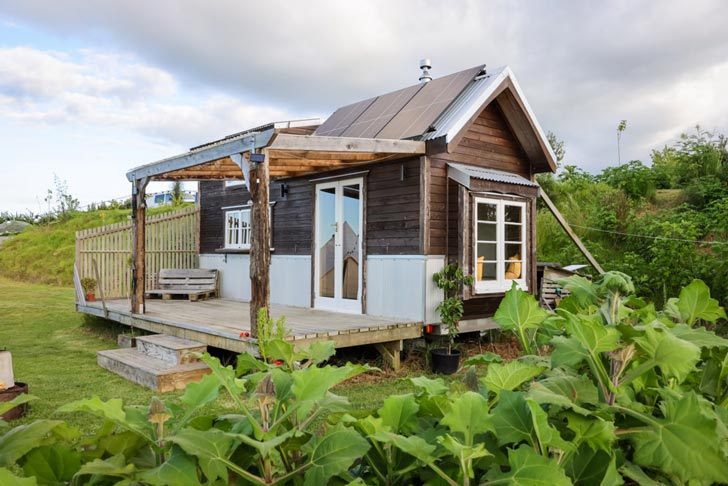
Before building their tiny house in the subtropical north side of New Zealand, the couple lived in a van while traveling, followed by a house truck, and later, a small studio. It was here that they started drafting up their own build, inspired by so many tiny home creators online.
“We started with zero savings,” James said. “We were like ‘let’s do this, you know? We’ve got, like a hundred bucks in our bank, what can we do?’ So we started saving and working towards that.”
In addition to saving up, the pair sourced plenty of secondhand materials to create their dream tiny home, starting with all of their windows.
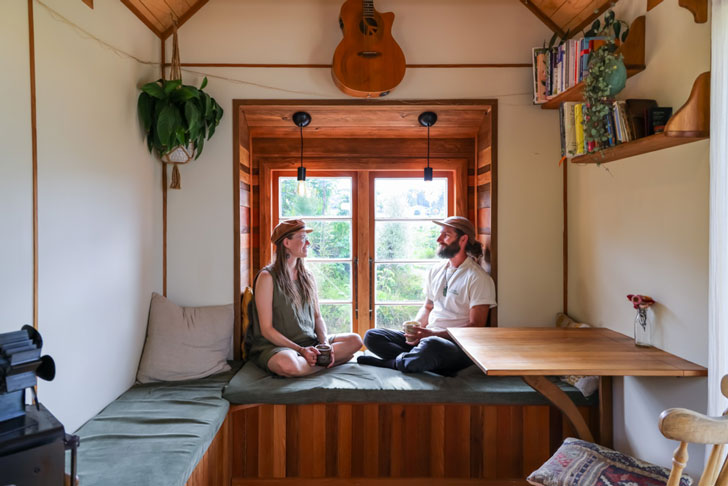
“It’s a great place to start, when you’re doing a lot of recycled and secondhand stuff, with windows,” James said. “Even being secondhand, they’re not particularly cheap … but we’re trying to keep it as eco and sustainable as possible.”
The frame of the home is crafted with timber and integrates thoughtful spatial design to maintain a sense of minimalism inside the house. And even the flooring panels were purchased from Facebook Marketplace.
“We really always like to live quite minimal, not having many things,” Leonie said. “Living in a van first really taught us to not have much. Like, I moved here with a 10-kilogram backpack. That’s how much I took. And we just realized we didn’t need much.”

While their material possessions may be limited, the richness this couple has can be found in the small-scale syntropic food forest that surrounds their home.
Syntropic agroforestry is an agriculture system that mimics natural ecosystems, which in turn produces abundant food while restoring soil health and biodiversity.
James and Leonie got lucky with their situation, setting up shop on land that their friend already owned. Instead of paying rent, they provide “land hours,” and steward the land in exchange for living on it.
“He really likes us to also be part of the land,” Leonie said. “We get to just build food forests and gardens and make it our space as well … It fits us well because we quite enjoy the work.”
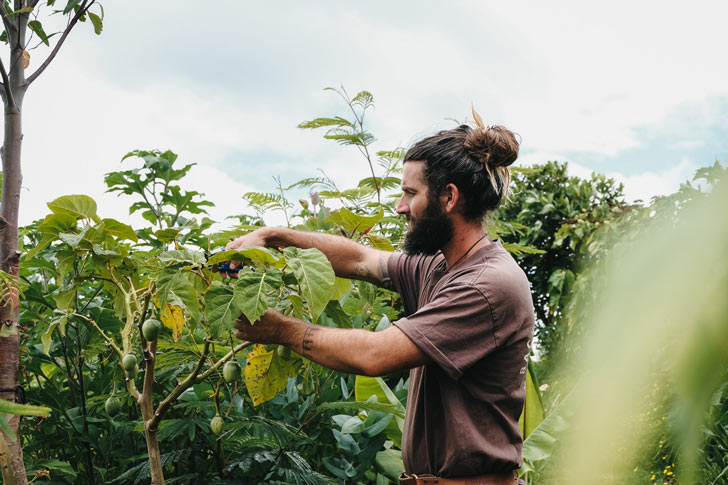
James has even taken on syntropic forestry as a business to help others plan and implement their own food forest gardens.
“It’s creating resilient food systems that [are] not only producing an abundance of food, but also regenerating the land,” James explained. “We are utilizing the power of some of these more weedy pioneer species like eucalypt and acacias to really send their roots down, break up the soil, and create organic matter.”
“We’re using lots of support species to … feed the system and create a fully regenerative system,” he added.
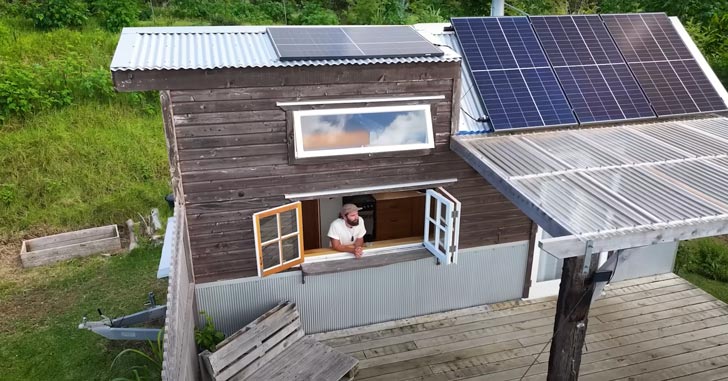
While the syntropic system makes a self-sustaining ecosystem, the couple also integrates annual permaculture plantings to round out their sustainable food production. With all of these methods at play, they can harvest food — from tomatoes and corn to berries and pumpkins — almost daily.
The food forest is a key part of the living arrangement, with a tent set up for visitors, and now a source of income for James.
“One of the things I love about syntropic agroforestry is it’s this wonderful collaboration between humans and nature,” he said. “Together, joining forces, we can accomplish in 10 years what nature might take 100 to do on its own.”
In addition to the food forest, the home is completely off-grid, utilizing solar panels, a compost toilet, and an innovative rain collection and watering system that cycles water from the home back into the garden.
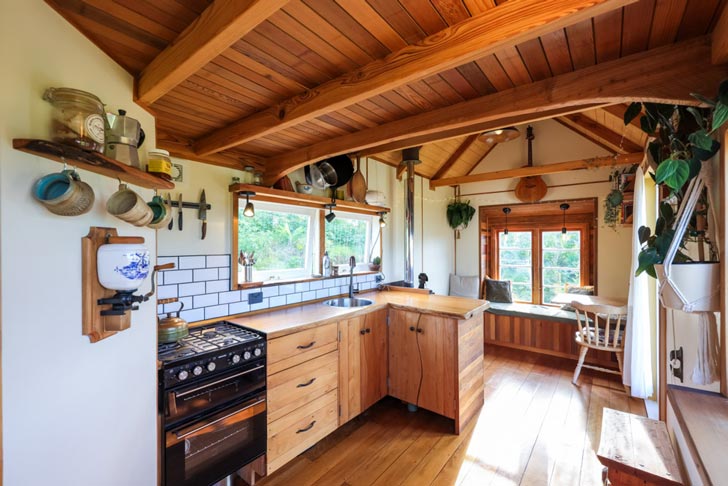
“The shower runs straight off into the banana circle,” James said, pointing to a bed of bright green plants. “All of it eventually ends up in the banana circle, feeding that and helping grow … those thirsty plants.”
Even with all of these features in mind, the couple estimates they spent about $34,000 USD total to bring their dream home to life — a figure that pales in comparison to the average cost of $520,000 USD for a traditional home in New Zealand.
And James and Leonie have no regrets.
“We designed it to our own needs. The tiny home means freedom,” Leonie said. “I find that there’s not many overheads for us, we can live a very simple life, and I don’t have much stress.”
“It really feels like home,” James added, “because we’ve created a space that we love being in.”
Header image courtesy of Living Big In A Tiny House
In 2022, Mecklenburg County scooped up an unassuming hotel in Charlotte, North Carolina — the TownePlace Suites Arrowood — for $10.5 million.
They did it with a vision in mind: to turn the hotel into apartments for people in the city experiencing homelessness.
The site — which was renamed as Forest Point Place — first began welcoming residents as early as July 2023.
But on April 1, the facility completed renovations that doubled the reach of the facility, expanding permanent affordable housing to more than 90 people.
The incoming tenants were handpicked from a pool of applicants, all of whom were over the age of 55, had underlying medical conditions, and were chronically homeless (unhoused for 12 months or longer).
Including people like Tim Barton.
“This place has really got me back on track,” Barton, a Forest Point Place tenant, told WCNC Charlotte.
“I was homeless [for] about five years, and drugs got me there, where I was at, got me down and everything,” Barton said. “They picked me back up, put me in here, and I come in here — I walk in my room, I feel like I’m walking in a mansion.”

Mecklenburg County manager Dena R. Diorio said that the project, which was laid out in the 2025 Charlotte-Mecklenburg Housing and Homelessness Strategy, comes at a time when “more than one in four homeless residents” in the larger Charlotte community is an adult over the age of 55.
“This will be an affordable housing option for individuals, couples and parents with adult children who are 55 years and older experiencing homelessness and who have other vulnerabilities,” Diorio said in a statement. “This county commitment allows these residents the opportunity to age in place.”
In addition to offering fully furnished apartments, Forest Point Place provides tenants with healthcare coordination, case management services, and events like poetry slams, movie nights, and more that help the tenants truly feel like neighbors.

“This is an opportunity for those people to live their best life, their best, healthiest life, and not have to worry about going back onto the streets or into a shelter,” Diorio said.
The renovations for Forest Point Place were led by Roof Above, a nonprofit that embraces the “housing first” approach to reducing homelessness.
“We see that older adults sometimes have less income, [which] makes them more vulnerable to homelessness, and then their health needs make independence harder,” said Liz Clasen-Kelly, CEO of Roof Above.
“This is unique, that it combines affordable housing with wraparound supports to prolong people’s independence and to give them the safety, stability and dignity at home.”

“We celebrate not just the opening of Forest Point Place,” Clasen-Kelly continued, “but the promise that lives and communities can be transformed through partnership.”
Tenants like Barton can personally attest to that transformation.
“I’m pretty much stable now,” Barton said. “I ain’t been stable in five, six years, I appreciate everything they’ve done for me. I love this place.”
Header images via Mecklenburg County
In 2024, Oklahoma City's Point in Time count concluded there were an estimated 1,838 people experiencing homelessness. This is a 28% increase from 2023, reflecting an increase in homelessness seen across the United States.
While systems-wide reforms like increases in temporary housing, or Housing First models may be considered to confront homelessness writ large, a new online platform is making it easy for locals to have a hand in helping their neighbors facing homelessness.

“We know the community wants to be part of [the] solution, but it often can be overwhelming to know how and where to plug in,” Erika Warren, communications manager for Oklahoma City’s Key to Home Partnership, told KOCO5 News.
The Key To Home Partnership is a public-private project between the City of Oklahoma and 50 partner organizations, including realtors and housing and mental health nonprofits. Together, they aim to educate the public on the issue of homelessness and lead community strategies to help those in need.
Most recently, they have unveiled a virtual dashboard where volunteers can connect with all partnering agencies to lend a hand.
“The idea is to provide one streamlined platform where all of our partnership agencies can list the needs they have and ways the community can get involved in their missions,” Warren added.
KOCO5 News calls it a “one-stop shop.”

On the dashboard, users can find volunteer opportunities like serving dinner at a local shelter, or “Warehouse Wednesday” shifts to help sort donated furniture for an area nonprofit.
From there, they can sign up for volunteer shifts, find upcoming events, and stay in the loop with specific groups.
“You can select the agencies that you want to become a fan of so you can get notifications about that,” Warren explained. “Organizations like Sisu Youth Services have ongoing needs, so things like meal trains to bring in to feed the youth but also one-time events they can populate into that site.”
The new platform is made possible through a donation from the Oklahoma City Metropolitan Area Realtors Association, which continues to rank homelessness as the local cause of “most importance,” according to the association’s president Vanessa Johnson.
“Helping the many community agencies working to solve homelessness by making it simpler for volunteers to join in will be a huge boost to their efforts,” Johnson told The Journal Record.

Those efforts are all part of a larger belief the Key To Home Partnership sums up in just a few words: “Everyone deserves a place to call home.”
“We believe that together, we can create and sustain a community where homelessness is rare, brief and non-recurring,” the city’s Key To Home webpage shares.
This is done, the page adds, “through strong public/private partnerships, supporting collaboration among stakeholders, using data to guide our strategy, and educating the public on homelessness and its solutions.”
Header photo by Jakub Żerdzicki on Unsplash
When Shaheera Alnatshia first migrated from Jordan to the United States in 2011, she was seeking a better life.
But in 2017, facing domestic violence, her husband kicked her and her four children out of the house. She was left homeless, jobless, and in crisis.
Once she was on her own, she was taken to a shelter with her children in Tennessee, and it was here that she was introduced to Goodwill.
While many know Goodwill as a thrifting destination, the organization also provides countless support services to those in need. Through a partnership with Google, folks like Alnatshia can train for and earn Google’s IT Support Professional Certification.

And that’s exactly what she did.
“The Google IT Support Professional program is a training program offered by Goodwill and developed by Google,” Ian Weir, a Goodwill training programs coordinator, said in a video. “It’s designed to help give people the skills they need for entry-level employment in the IT field.”
The process was not easy, and Alnatshia was persistent in her journey to pass the tests required to receive her certification.
“I remember I failed two times in this test,” she said. “It took me about three to four months to finish my Google IT Support Certificate.”
But ultimately, she did it.
“When I passed it, I was yelling ‘Yay! I passed it.’ And all my kids woke up and told me, ‘Mom, what’s going on?’” Alnatshia recalled.
“I told them, ‘I earned the Google IT Support Certificate.’ I told them, ‘This means so much for our life.’”
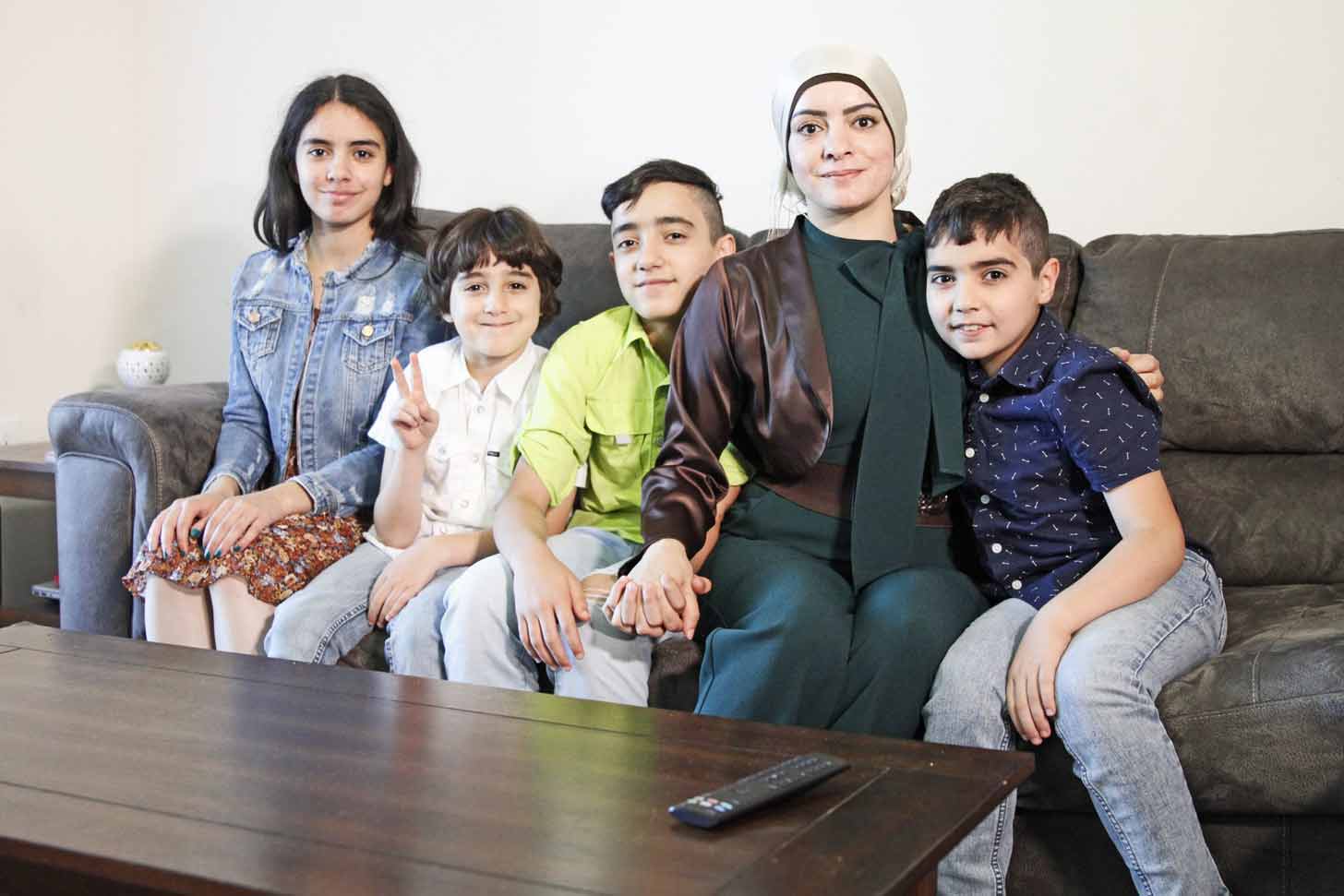
Once Alnatshia earned her certificate, she landed an apprenticeship at Accenture and later completed the Google Project Management Professional Certificate through Goodwill’s programming, as well.
“Once I started with my apprenticeship, I felt like I can earn more, I can get more, and I can do more,” Alnatshia said.
Aside from housing, the National Coalition for the Homeless says that “meaningful and sustainable employment” is paramount in creating and maintaining housing stability for vulnerable people.
“Connecting people experiencing or at-risk of homelessness with job training and placement programs is critical to ensure they have the tools they need for long-term stability and success,” the organization concludes.
While Goodwill has had its share of controversies, especially in regard to low wages and exploitative practices for its store employees, the organization represents the potential of job training and skill-building to change lives.
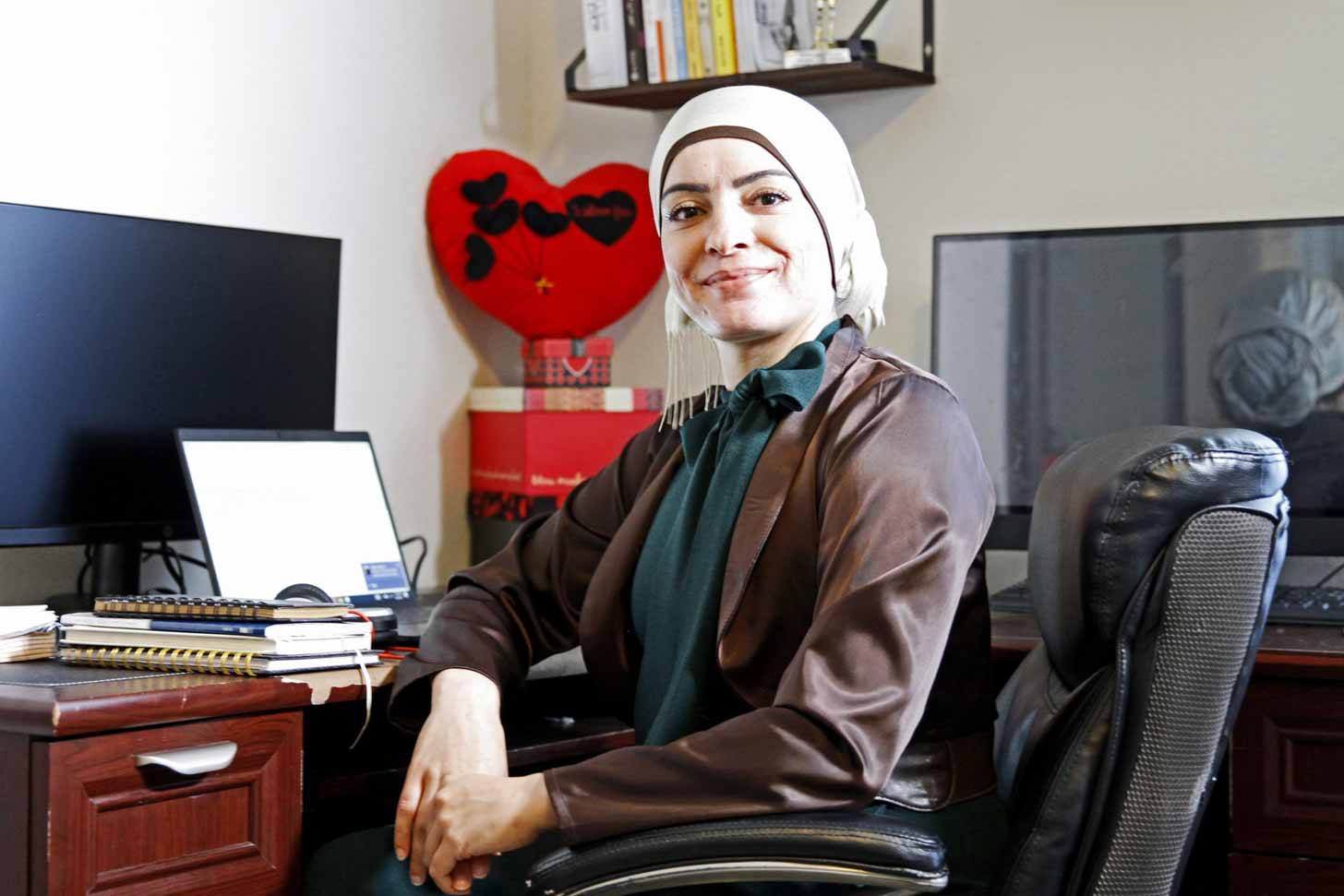
Alnatshia is a testament to this.
Now, she is thriving in a full-time, permanent role as an application development analyst with Accenture.
Since then, she has been recognized with a number of awards from Goodwill, including the Achiever of the Year Impact Award in 2021, and the GII Graduate of the Year Award in 2024.
“Goodwill opened the door for me and provided a great opportunity,” Alnatshia said in a video when she was recognized in 2024.
“They offered all the tools to be successful. I was ready, but I [didn’t] know how to start. Goodwill was the light at the end of the tunnel for us. It changed our life completely.”
Header image courtesy of Mike Mozart (CC BY 2.0)
On April 3, 2025, Jane Goodall — the renowned environmentalist, conservationist, and activist — celebrates her 91st birthday.
To celebrate, the Governor of Colorado, Jared Polis, declared a new holiday: Animals Matter Day.
“I proudly proclaim Animals Matter Day in honor of Dr. Jane Goodall, a true champion for wildlife and a beacon of hope for our planet,” Gov. Polis wrote on Instagram.

“Dr. Goodall’s groundbreaking work has inspired countless individuals to advocate for the protection of animals and their habitats. Let’s continue Jane’s legacy by fostering compassion and stewardship towards all living beings.”
At 91, Goodall has continued her tireless efforts to advocate for the planet and all living beings who inhabit it.
While Colorado’s new holiday honors her work, the Jane Goodall Institute itself issued a call to action for the more informal #GoodAllDay on April 3.
The nonprofit invited supporters — especially young people — to take action, share it on social media, and inspire others through Goodall’s Roots and Shoots program.
“Jane is lucky enough to have an amazing group of supporters who want to help her celebrate with cake and gifts, but the best gift you can give Jane is your promise to help her make a positive difference for people, other animals, and the planet we share,” the Institute’s website stated.
“Whether it's planting a tree, lending a helping hand, or simply spreading smiles, every act counts,” the Institute continued in a social media post.
Environmentalists across the globe have heeded her call.
The California Climate Action Corps, for example, planted 90,000 trees and native plants to celebrate Goodall’s big day.
“That’s what climate action looks like,” the leader of the group said in a video, echoed by a mass of “Happy Birthday Jane!” cheers from a team of students in the background.
Conservation leader Kristine McDivitt Tompkins also shared a video to celebrate Goodall, sharing her work from Argentina, where she is working to rewild countless endangered species.
“Together with the giant river otters, macaws, and jaguars making their way back to the vast Iberá wetlands, Kris and our whole team are wishing Jane a happy birthday from the wild,” Tompkins Conservation shared on its Instagram page.
“Your tenacity, love, and wisdom are a guiding force in the protection of the planet and all its biodiversity.”

And AppleTV+ even dropped a trailer for the final season of “Jane,” a series inspired by Dr. Goodall’s life and mission, just in time for the celebration.
From Colorado and beyond, her story will be recognized and honored as she writes her next chapter, with millions of supporters by her side.
“Dr. Goodall’s journey is a testament to the power of curiosity, perseverance, and hope,” the Jane Goodall Institute wrote.
“From her start as a little girl who dreamed of Africa to becoming a world-renowned conservationist, her story is one of transformation — not just for herself, but for all of us.”
Header image courtesy of Miguel McSongwe/The Jane Goodall Institute
In March, the Trump administration announced that the U.S. Agriculture Department would be required to cut $1 billion in federal funding from schools and food banks.
Part of those cuts included a pause on the Local Food Purchase Assistance Cooperative Agreement Program, which would have supplied $421 million in funding this year to food banks across the country.

Another $500 million in deliveries to food banks via the USDA’s Commodity Credit Corporation have also been halted.
And the USDA’s Emergency Food Assistance Program has paused its scheduled shipments.
According to Reuters, food banks “already strained by raising demand” say they “will have less food to distribute” because of these funding decisions.
One such case is the Food Bank of Delaware, which stands to lose an estimated 750,000 pounds — the equivalent of about 19 truckloads of about 900,000 meals — to the funding cuts.

It’s a harsh reality for food bank leaders who are already stretching their budgets to meet the needs of their communities.
“We’re constantly figuring out how we will pivot if we need to,” Food Bank of Delaware president and CEO Cathy Kanefsky told WDEL News.
“Are we going to be in the position where we can provide the food that we've been providing to the numbers of people that we have been providing it for? We don't know.”
To help alleviate these new challenges, members of the Delaware House Democratic Caucus held a donation drive at the Food Bank of Delaware.
“We’re collecting food, have a volunteer evening inside, and we're also trying to bring awareness,” Democratic State Rep. Eric Morrison told WDEL News.
“Between April and July alone, the Food Bank [of Delaware] is going to lose 900,000 meals that they would normally give out,” he added. “This is devastating to the people who use the food banks — seniors, children, individuals with disabilities, and families who are barely scraping by. It’s a lot of folks.”

Caucus members were not the only local leaders who have been helping. Delaware Governor Matt Meyer has also joined in on food and funds drives, creating weekend meal kits and supporting the efforts of the community.
Republican State Senator Dave Wilson was also in attendance, helping process donations from dozens of cars lined up with food to share.
“It’s not about Democrat, or Republican, or independents,” State Sen. Wilson told WBOC News. “Everybody has a hunger need. We’re just here to help serve.”
It’s unclear exactly how much funds the food bank has raised, let alone how much food has been donated, in response to the funding cuts. Facebook posts from the organization share milestones like 5,000 pounds and 2,475 pounds donated at recent drives.

As helpful as it is, they will need more support to make up for the loss.
“Anybody who thinks that one in five children going to bed hungry [in Delaware] is okay has got to help us figure out how to make that not happen,” Kanefsky told WDEL. “We’re going to try to figure out how to continue to feed those babies.”
State Rep. Morrison amplified those sentiments, calling on the community to continue rallying for those most in need.
“A lot of people feel that unless they’re in an elected office, they can’t do anything, but it’s not true,” State Rep. Morrison added. “We really need people volunteering at the food bank.”
“We are a beautiful state that takes care of each other,” Kanefsky told Coast TV, as well. “I have no doubt that’s what will happen, but we need everyone.”
Whether that help comes in the form of donated food, dollars, volunteer hours, or even a call to one’s federal officials to help restore funding, Kanefsky emphasized that she is energized for the efforts ahead.

“There are a lot of people that need us. Everybody knows what’s going on right now, and the need for our services has not gone down,” she told WDEL. “Now we’re finding it harder to meet that need, but that means there are people there that are needing us even more, and we’re motivated.”
She hopes volunteers feel the same.
“Nobody in this world knows what tomorrow’s going to bring; for anybody to think that they're not going to need help, someday — I hope that they don’t,” Kanefsky added to WDEL. “But most likely they will, and I think the people that are able to see that, see the world in a different way… see the opportunity to help as a calling.”
Header image courtesy of Food Bank of Delaware
Every day since March 1, 40-year-old Rob Bounds has laced up his sneakers and run 50 kilometers — regardless of pouring rain, gusty winds, and even a long-lasting tropical cyclone.
That’s because every step of the way, the Australian runner is raising money for We Are Mobilise — a national charity network that provides social services, employment services, and housing opportunities to Australians facing homelessness.
His ultimate goal? To raise $2.2 million for his unhoused neighbors.
“I’m 33 days in now, over 1,600 km run, and I’m feeling stronger than ever,” Bounds told My City Logan — a Brisbane-based news outlet — on April 3.
So far, Bounds is holding strong.
“I had a few niggles in the first 10 days – knees, hamstrings, toes – but after that, my recovery has been incredible,” he said. “Just two days ago, I finished a 50 kilometer run with the last 20 kilometers at four minutes and 35 seconds per kilometer.”
Bounds attributes his relentless pace to his strict carnivore diet — a trademark that earned him the social media moniker “The Carnivore Runner.”
By documenting his experience on Instagram and Facebook, Bounds hopes to increase awareness for rates of homelessness in Queensland, a metric that has surged by 34% in the last five years alone.
“We live in the city now and it’s everywhere – tents, people sleeping in cars, park benches. I used to be one of those people who looked the other way,” he said.
“But over these 33 days, I’ve stopped and spoken to around 50 people sleeping rough, and they’ve all been lovely, approachable people. Homelessness doesn’t discriminate, it affects people from all walks of life.”

Bounds is proud of every cent he’s raised so far, but he still has his eyes on that whopping $2.2 million goal post.
“So far we’ve raised around $5,000, and while I’m proud of that, I know we can do more,” he said. “This isn’t about me – it’s about Queensland stepping up. I just set up the platform.”
It’s a challenge directly inspired by fellow ultramarathoner Ned Brockman, who raised $2.2 million for We Are Mobilise in 2022 by running the breadth of the country — from Perth’s Cottlesloe Beach to Sydney’s Bondi Beach — in 47 days.
It’s a legendary feat that Bounds looks forward to matching, with a little help from his friends.
“I’ve had old mates from Mackay join me, local running groups like Pat Carroll’s crew have shared the journey and donated. It’s the community that’s kept me going,” he said.
“If I’ve got to run across Australia to hit that $2.2 million, then that’s what I’ll do.”
Header images via Rob Bounds / Facebook