Knowing which vaccines older adults should get and hearing a clear recommendation from their health care provider about why a particular vaccine is important strongly motivated them to get vaccinated. That’s a key finding in a recent study I co-authored in the journal Open Forum Infectious Diseases.
Adults over 65 have a higher risk of severe infections, but they receive routine vaccinations at lower rates than do other groups. My colleagues and I collaborated with six primary care clinics across the U.S. to test two approaches for increasing vaccination rates for older adults.
In all, 249 patients who were visiting their primary care providers participated in the study. Of these, 116 patients received a two-page vaccine discussion guide to read in the waiting room before their visit. Another 133 patients received invitations to attend a one-hour education session after their visit.
The guide, which we created for the study, was designed to help people start a conversation about vaccines with their providers. It included checkboxes for marking what made it hard for them to get vaccinated and which vaccines they want to know more about, as well as space to write down any questions they have.
The guide also featured a chart listing recommended vaccines for older adults, with boxes where people could check off ones they had already received.
In the sessions, providers shared in-depth information about vaccines and vaccine-preventable diseases and facilitated a discussion to address vaccine hesitancy.
In a follow-up survey two months later, patients reported that the most significant barriers they faced were knowing when they should receive a particular vaccine, having concerns about side effects and securing transportation to a vaccination appointment.
The percentage of patients who said they wanted to get a vaccine increased from 68% to 79% after using the vaccine guide. Following each intervention, 80% of patients reported they discussed vaccines more in that visit than they had in prior visits.
Of the 14 health care providers who completed the follow-up survey, 57% reported increased vaccination rates following each approach. Half of the providers felt that the use of the vaccine guide was an effective strategy in guiding conversations with their patients.
Why it matters
Only about 15% of adults ages 60-64 and 26% of adults 65 and older are up to date on all the vaccines recommended for their age, according to CDC data from 2022. These include vaccines for COVID 19, influenza, tetanus, pneumococcal disease and shingles.
Yet studies consistently show that getting vaccinated reduces the risk of complications from these conditions in this age group.
My research shows that strategies that equip older adults with personalized information about vaccines empower them to start the conversation about vaccines with their clinicians and enable them to be active participants in their health care.
What’s next
In the future, we will explore whether engaging patients on this topic earlier is even more helpful than doing so in the waiting room before their visit.
This might involve having clinical team members or care coordinators connect with patients ahead of their visit, either by phone or through telemedicine that is designed specifically for older adults.
My research team plans to conduct a pilot study that tests this approach. We hope to learn whether reaching out to these patients before their clinic visits and helping them think through their vaccination status, which vaccines their provider recommends and what barriers they face in getting vaccinated will improve vaccination rates for this population.
This article was written by Laurie Archbald-Pannone from the University of Virginia and was originally published by The Conversation.
The Research Brief is a short take on interesting academic work.
Header image courtesy of the National Cancer Institute

Every third Thursday of the month, residents of South West England’s Somerset County can tune into their local radio station and hear from some presenters that may otherwise go unheard: Homeless people.
Radio Dusthole, hosted by homeless charity service provider James Ball, features staff and clients from Julian House, a charity that helps people facing homelessness rebuild their lives.
“Our clients love music and have good banter, so it seemed like a no-brainer,” Ball said in a blog post for Julian House. “I contacted Frome FM, who loved the idea. I went in for a day of training and it’s been a staple of our activities since.”

The point of the show is not to sensationalize homelessness, but rather to provide an opportunity for people to feel confident in sharing their stories — and even their favorite songs.
“The show is a feel-good hour filled with good tunes, great banter, and fascinating stories from voices that are so often ignored,” a social media post from Julian House describes the program.
Ball works to ensure this.
“I didn’t want it to be a show about rough sleeping where it’s all downbeat and we only play ‘Another Day in Paradise’ by Phil Collins,” he told Somerset Live.
Instead, Ball engages the on-air guests with casual chats, curated tunes, and stories that “highlight the resilience and humor” of the individuals on the show.
“The clients sometimes talk about their experiences sleeping rough,” Ball clarified, “but it’s up to them if they feel comfortable discussing it.”
Steve, a guest who was homeless for 27 years, told the BBC that he was hesitant to join the show — at first.
He said that he “hasn’t got a face nor voice for radio … always rattling on.”
But with the support of Ball, Steve realized he had a natural knack for storytelling.

“We thought it was going to be a disaster, just me and James,” Steve told the BBC. “But we had so much laughter and banter, it was just unreal.”
The show is named after The Dusthole, a well-known local pub in Shepton Mallet that started taking in homeless folks during the COVID-19 pandemic. Since then, it has been taken over by Julian House, much like this monthly program on Frome FM.
“I’ve been so impressed by their composure on air,” Ball told Somerset Live. “They’re very natural hosts who just ‘get it.’”
Initially, the program was designed to help people develop career skills and experience to move into permanent, secure housing, and regain a sense of control over their lives.
But the confidence boost it provides is also vital to Julian House’s mission.
“They just loved hearing their voices coming out of the radio,” Ball said. “Building their self-esteem is such a massive part of their journey with us.”

In addition to the radio show, Julian House also offers programming like bike repair workshops and a roving social activities network that includes Tai Chi, pottery classes, rock climbing, and museum trips.
Alongside vital outreach methods that help people through substance use disorders, abuse, refugee resettlement, and any other sort of situation that may lead to housing instability, these social opportunities provide a lifeline.
“Many of our clients have to tackle social exclusion in many forms. This is not easy and often presents itself as a combination of complex issues,” Geraldine, an employment support worker, at Julian House, said in a blog post for the organization.
“These issues are widespread and can leave individuals with poor mental health, vulnerable; excluding them from social support, healthcare and economic resources, which then can lead to criminal behavior, addiction, homelessness, and unemployment.”
Whether as a radio presenter or a bike repair aficionado, Julian House’s social programs can be the difference between flourishing and floundering.
“Some have been reluctant to come, but once they have, they’ve never looked back,” Ball said of Radio Dusthole. “Everything is worth a try.”
Header image courtesy of Julian House
On March 13, wildlife experts confirmed that two endangered cougar cubs were spotted and photographed in the wilds of Michigan’s Upper Peninsula in early March — a first for the state in over 100 years.
According to the Michigan Department of Natural Resources, adult cougars have been spotted in the state in recent years (132 according to reports) but available DNA evidence has only shown evidence of the presence of males in the area.
“It's quite unique compared to previous cougar sightings because this is the first verified evidence of cubs in Michigan in more than a century,” the department explained on its official Facebook page.
Brian Roell, a wildlife biologist and large carnivore specialist based in Michigan, estimates that the pair of wild cubs are approximately 7 to 9 weeks old.
Although no mother was pictured with the cubs, Roell estimates that she could not have been far away from where they were sighted, since young cubs are highly dependent and typically tag along by their mother’s side until 18 to 24 months of age.
Roell told Michigan Live that he hoped that the family of three was quickly reunited.

“We’re just reminding folks that cougars are an endangered species in Michigan, so it is illegal to harass them and obviously you can’t hunt them,” Roell emphasized. “But at this point, we’re not releasing any more information on location or anything, just to protect her and those cubs.”
Roell said that the discovery was initially reported by a local man traversing the snow-covered roads of Ontonagon County.
“[He] saw the two young kittens running down the road and stopped, and one of them ran under his truck,” Roell said.
“He thought they were bobcat kittens, and so he took some pictures of them, and someone else actually stopped, and they both talked about them, like, ‘Oh, neat kittens.’ And then they went along [with] their day, not thinking anything of it.”
Calling the sighting “pretty exciting,” Roell said that he and his colleagues confidently believed that the mother gave birth in the state — which is substantial evidence of cougar reproduction.

“The birth was obviously in Michigan, because she didn’t carry them here from some other state,” Roell said.
In the early 1900s, cougars were hunted to the point of extinction. It wasn’t until 1973 that the species became protected under the Endangered Species Act.
Although locals expressed a mix of excitement — and concern — at the indication that cougars were returning to the state, state biologists consider it a positive development for the region.
Cougars are a keystone species. When they disappear from a food chain their absence can have negative cascading effects on the local ecosystem.
Notably, cougars reduce the overpopulation of deer — in turn reducing the presence of tick-borne illnesses and restoring balance to grasses, flowers, and vegetation — and coyotes — which grants small predators like foxes the opportunity to hunt small prey.
“There are not very many states where you can…have the potential to see a wolf, a moose, and a cougar, and so that really should be celebrated for Michigan, that we have the habitat that we do have,” Roell said.

Header images via Michigan Department of Natural Resources / Flickr (CC BY 2.0)
National Geographic has just released its inaugural “National Geographic 33” list.
Similar to lists like Forbes 30 Under 30 or TIME’s People of the Year, the list is a product of the publication’s mission and vision.
The National Geographic 33 pays homage to the brand’s 33 founders by celebrating a class of “visionaries, creators, icons, and adventurers … who are united in the belief that our world needs imaginative solutions and urgent action.”
And the planet’s favorite drag queen — Pattie Gonia — scored a spot.

Pattie’s journey began when she went viral in 2018 for hiking in six-inch heeled boots. Since then, her drag persona has skyrocketed to social media popularity, often sourcing recycled materials (and even trash) to stun in elaborate outfits while speaking about protecting the outdoors.
“I think the narrative, writ large, for the queer community is to run to big cities for acceptance,” Pattie — who uses she/her pronouns in drag — told National Geographic.
“And I feel like I ran the other way into the woods.”
Pattie (whose off-stage name is Wyn Wiley) is the co-founder of the nonprofit Outdoorist Oath, which promotes adventure, education, and climate justice through an inclusive lens.
Pattie is also a member of the board of Brave Trails, a nonprofit that offers summer camp and backpacking trips for LGBTQ+ youth.
Over the years, she has tactfully combined her art with her activism, from hosting an environmental drag show tour and collaborating with Yo-Yo Ma and Quinn Christopherson on a song about fighting for the planet, to performing at the Netflix Is a Joke festival, and giving a TED Talk about the power of joy in taking action.
Even in the complicated and uncertain moment humanity finds itself in, grappling with social injustice and a mounting climate crisis, it is the colorful makeup and connection to her community that sustains Pattie.
“[I’m] trying to take pain and turn it into something different,” she told National Geographic. “I think that’s what queer people always try to do.”
It is this commitment to celebrating queer culture — and the planet — that earned her a spot as an “Adventurer” on National Geographic’s inaugural list. (And last year, she was named one of the organization's Travelers of the Year.)

Pattie will be spotlighted in the April issue of the magazine, alongside huge names like Selena Gomez, Björk, Michelle Yeoh, Don Cheadle, Yvon Chouinard, and Jason Momoa.
“With the National Geographic 33, we’re honoring a diverse group of changemakers, from all over the world and different walks of life, who aren’t just recognizing the urgent challenges of our time, they are taking action to address them,” Nathan Lump, senior vice president and editor-in-chief of National Geographic, said in a statement.
“They all share a deep commitment to shaping a better future, and in shining a light on them and their contributions, we hope to elevate their work and showcase to a wide audience the positive impact they’re making.”
See the full list of National Geographic 33 honorees.
Header images courtesy of Djeneba Aduayom/National Geographic
In response to skyrocketing costs of living and a mounting housing crisis, architecture designer Harrison Marshall made the decision to pack his things and move into a dumpster.
Yes, really.
Marshall converted a dumpster (or a “skip,” per his British vocabulary) into a 25-square-foot tiny house that ultimately cost him about $5,000 in materials and $62 per month in rental fees.
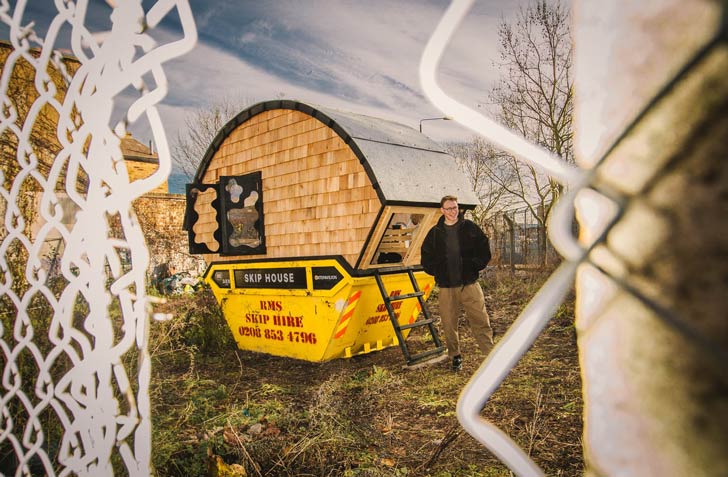
Marshall is a co-founder of CAUKIN Studios, an architecture, construction, and design firm that works on building projects that support the United Nations’ Sustainable Development Goals.
The Skip House — what Marshall affectionately named his tiny home — is part of an effort to “make a statement about the prohibitive cost of rent in London and other cities across the U.K.”
“The average cost of a one-bedroom in Southwark, a borough in South London, is around $1,850 a month,” Marshall wrote for CNBC in 2023. “That’s more than 75% of my income as an architectural designer.”
A dumpster, on the other hand, would serve as an affordable housing option and a performance art piece.
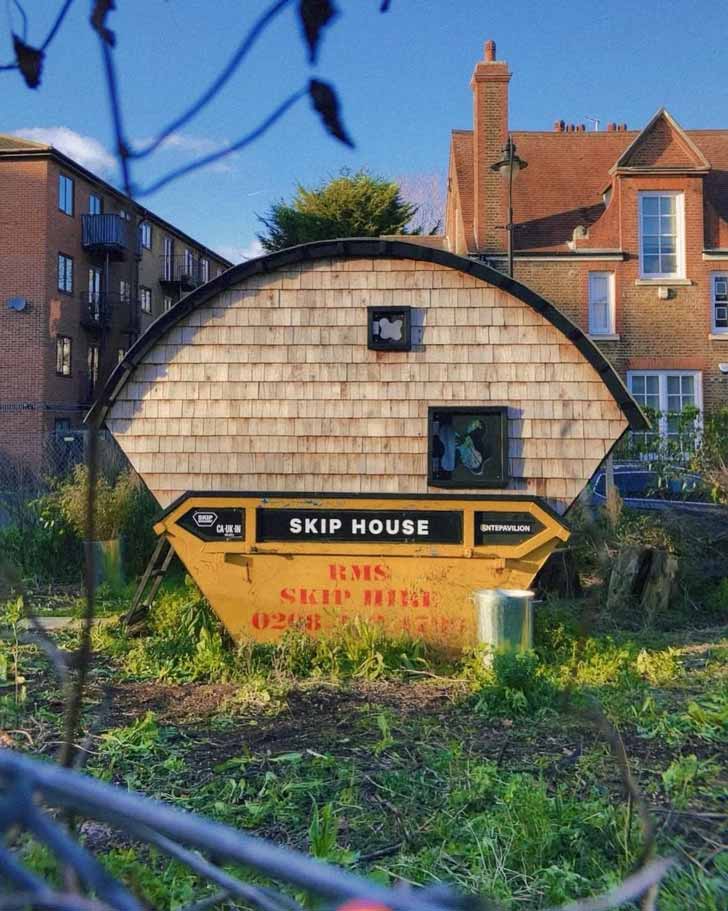
The project uses a standard 8-yard skip, with an insulated timber frame sitting within. It has a barrel roof that provides enough space to raise the bed above head-height while still maintaining the lower space for the living area.
Skip House is part of Skip Gallery, a public art initiative that encourages emerging artists to convert a skip into a piece of artwork.
“Part art installation, part social commentary, the Skip House aims to start a conversation about the U.K.’s housing crisis and explore alternative solutions,” a brief for the project states.
“The brief was to convert a skip into a liveable space — fit for sleeping, cooking, washing, and even hosting a friend or two.”
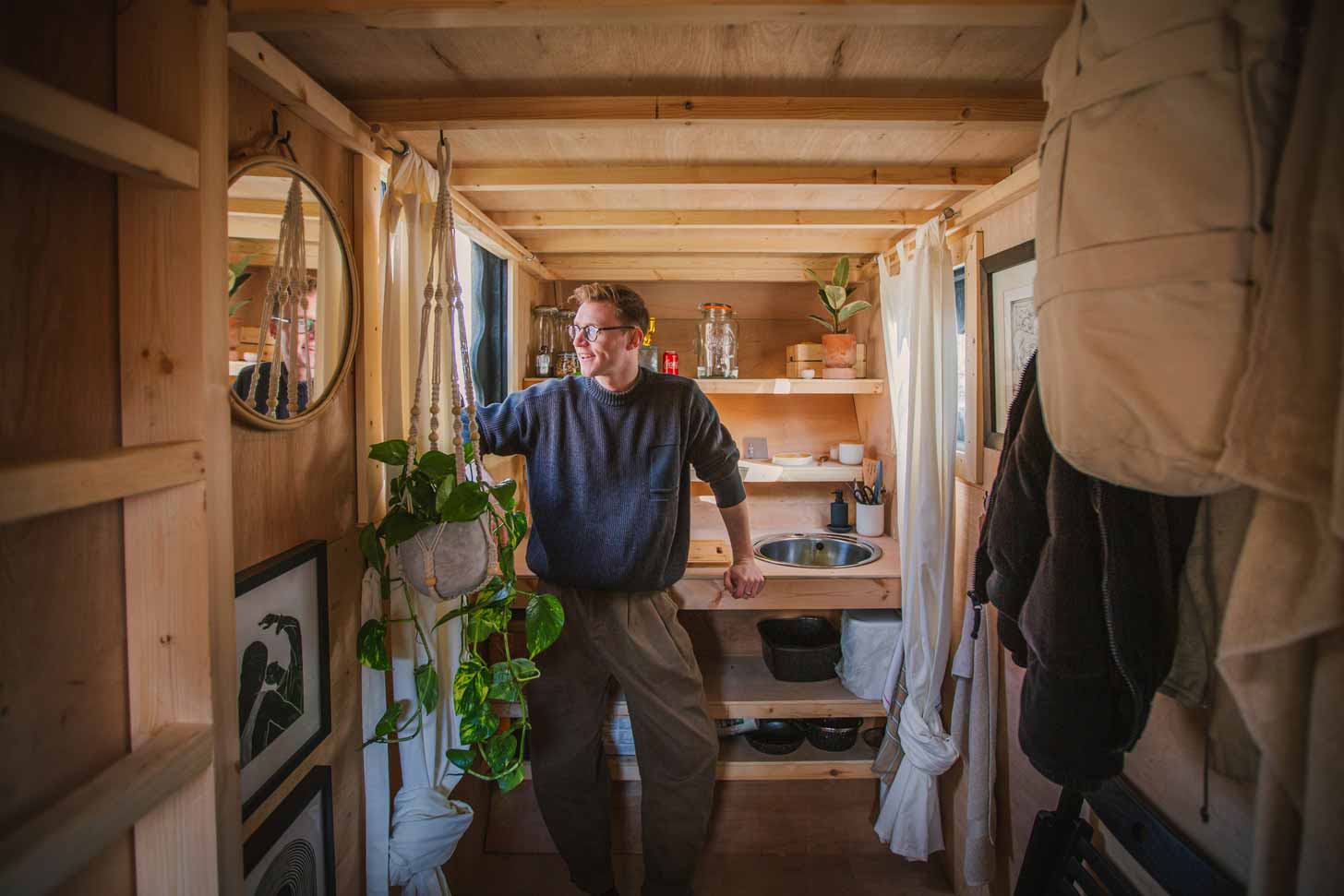
Marshall rose to the challenge.
The home is certainly a tight squeeze, with a sink and single hob stove making up a kitchen, storage space relegated to just two small walls, and a rented port-a-potty that sits on-site outside the home’s structure. There is no shower, however, so Marshall said he bathes at the gym or at work.
He was also given land to keep the Skip House on, thanks to a charity called Antepavilion that supports independent art, craft, and architecture. The home’s electricity bill is so small that it is also included in the land sponsorship, and the water supply to the home comes from a hose pipe from a neighbor’s property.
Ultimately, Marshall only lived in the space for a short period of time, though he certainly made it work and reported that he didn’t have to give away any of his possessions to do so.
“With its ups and downs, I’ve turned my living situation into an art piece. It shines light on the absurdity of London’s housing crisis in a way that makes people smile and think,” he wrote for CNBC.
After a year and a half in the home, Marshall posted on Instagram that he was still living in the Skip House, though he teased that he is onto his next home-building project.
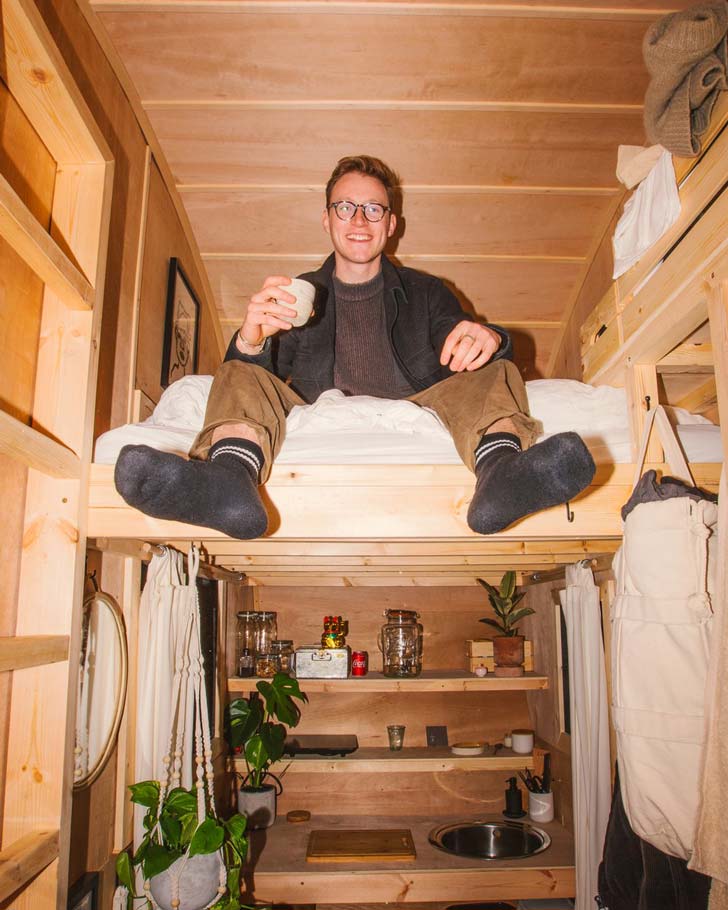
While the tiny house might have become home for him, Marshall is still rooted in reality.
“People across the country are changing the way they live to compensate for the rising cost of basic necessities,” he wrote at the start of the project.
“Living in a skip isn’t a solution, but rather an exploration and a statement. This project sits somewhere between installation art and performance art. As a designer, I’m a firm believer that creativity can be a powerful tool to break out of life’s rules.”
Header image by Katie Edwards for CAUKIN Studios
In September 2022, Alabama father Eric Bump Overstreet set out to do something unthinkable: live “homeless on purpose” for 90 days.
“These people are talked down to all the time so when you show them a little love and respect it changes them, I wanted to put a face on these people and just let people see that they are normal people just like me and you,” Overstreet told Mobile-based news outlet WKRG.
Over the course of three months, Overstreet became intimately aware of the hardships that his unhoused neighbors faced.
He spent his first 40 days living under a bridge beneath a highway overpass, and the last 50 living in a small tent.
He sweated through hot days, survived freezing nights, had run-ins with police officers, and witnessed new friends go through extreme medical ordeals.
“Every story is different, every person’s situation is different so how you take care of this is you take one person at a time as a community and find out what they need and nudge them in the right direction,” Overstreet said.
“It just made me look at people differently, maybe the way God sees them.”
As he slept on the streets, Overstreet documented his experiment on TikTok and Facebook, giving viewers a direct portal into the day-to-day life of experiencing homelessness.
“I’ve had a major heart change like truly getting to know them and living with them and experiencing their ups and downs and their fears,” said Overstreet. “It has changed my heart forever like it has really softened it. It really really humbled me.”
Overstreet paired his awareness campaign with a pledge to raise money for Driftwood Housing — a local nonprofit that provides no or low-income housing for Mobile’s chronically homeless (people who have experienced homelessness for 12 months or more).
In the end, he raised over $20,000 for the organization.

“With Eric's funds, Driftwood Housing will build two micro houses (less than 120 square feet, all-electric) or a tiny house (less than 400 square feet, all-electric with plumbing),” read a 2023 update to Eric’s GoFundMe page.
“Thank you for your pledge and/or donation to our cause! This means so much to us and our displaced neighbors living outside.”
Overstreet’s generosity didn’t end in 2023. In the years since he has continued teaming up with volunteers to hand out hot meals, donate hygiene supplies, and support the same community of people he lived alongside for months.
“I hope we’ve changed Mobile’s mind somewhat about it and I feel like that has happened,” said Overstreet. “There’s now an army of people that want to help solve it. It’s like they’ve come out of nowhere.”
Header images via Eric Bump Overstreet / Facebook
When Marcel LeBrun, CEO and co-founder of the company Radian6, sold his business to Salesforce in 2011, he began to pivot away from algorithms and toward altruism.
With a multi-million net worth — and a knack for problem-solving — combined with the housing crisis in North America, he committed to building 99 tiny homes to help house homeless residents of Fredericton, New Brunswick.
“I won the parent lottery, the education lottery, the country lottery,” LeBrun told Macleans. “It would be arrogant to say every piece of my ‘success’ was earned, when so much of it was received.”

Before coming up with the project that would ultimately become his nonprofit, 12 Neighbours, the tech tycoon traveled through the United States, Canada, and even Ghana, to see what other organizations were doing about homelessness and poverty — to see what was working.
As it turns out, tiny home communities — that give people vital resources while still respecting their dignity and autonomy — would be the way.
He decided to fund 99 of them, starting by sharing the stories of the first 12 neighbors.
A few years down the line, the village is in full swing, with over 100 240-square-foot homes available for people in need.

Compact but cozy, each home has a living room that doubles as a bedroom and comes with a fully-equipped kitchen and three-piece bathroom. The houses all have solar panels on their roofs and front porches where people can gather.
They all coalesce around a social enterprise center that houses a cafe, retail shops, workshops, and community gardens, which opened shortly after the last house was put into place.
“A lot of our systems provide support when someone showcases their deficits. Then, as they progress towards success, the supports fall away,” LeBrun said in an interview with the University of New Brunswick’s alumni magazine.
“In business as you succeed, investments increase. How can we structure things so people can unlock benefits as they succeed as opposed to having to showcase their deficits?”

The neighborhood sits on a 65-acre plot that was previously used for harvesting trees, on the north bank of the Saint John River. It’s near a major bus route, a handful of big-box stores, and adjacent to a wooded area with trails.
LeBrun took responsibility for most of the costs of building the neighborhood, with plenty of outside donations from area nonprofits and companies.
Even a church group offered up an 8,000-square-foot space, which would become the manufacturing warehouse that LeBrun filled with a team of workers who were all paid a living wage.
As for the residents of the houses, rent is kept at 30% of income, which means the large majority of residents pay a maximum of $200 — including all utilities and internet — every month.
“Marcel is literally a Godsend,” Marla Bruce, who lives in the second tiny home built in the neighborhood, told the alumni magazine.
“A year ago, I was homeless. Now I have a home, I'm not on the street and I have peace because every place where I stayed before was temporary. Here there is very much a sense of community. Marcel has a heart and a passion for what he is doing.”
LeBrun himself is a bit more humble.
“Building community and being in community is inherently rewarding,” he told Green Matters.
“Getting to know so many amazing and resilient people, who have carried and overcome so much, who have incredible strengths, is rewarding. I don’t rescue or transform anybody. But we can create a community where transformation happens.”

Residents in the neighborhood range in age from 18 to 70 and often live alone. They are not required to be sober to live in the community, but 12 Neighbours does provide substance use counseling on-site.
“We have people who have been run over by trauma, by substance abuse, by all of these things,” LeBrun told Macleans. “It’s about excavating that person, buried under their circumstances, little by little.”
12 Neighbours residents also have access to on-site personal development groups that help them obtain GEDs or find work. A handful work at a nearby pop-up coffee shop, while others work in a printshop that creates merch for the nonprofit.
And LeBrun continues to lead the way, showing up to the property more days than not, and investing his time and money in ways he hopes will make a real difference.
“The word ‘philanthropy’ is often interpreted as someone who gives money,” he told the alumni magazine.
“But the Greek roots of the word ‘philos’ and ‘anthropos’ mean to love humans. What I have discovered is spending money is the easy thing, spending yourself is the hard thing. The 12 Neighbours project is how I can best spend myself.”
Header images courtesy of 12 Neighbours
The Darwin’s rhea is a massive, flightless bird that can run up to 37 miles per hour.
Known as ñandús in Chile and choiques in Argentina, the long-necked, ostrich-like birds are common throughout Patagonia — a stretch of wilderness that is larger than 80% of the countries on the planet.
But in Chile, the three-foot-tall bird is locally endangered — and teetering towards the brink of extinction. In turn, the grasslands of Chile have deteriorated considerably in health, as Darwin’s rheas play a crucial role in dispersing seeds and renewing vegetation.
Fortunately, wildlife experts are coming together to save the rare animal from extinction — and restore the grasslands of the Patagonian steppe.
Their efforts are culminating in the first-ever international translocation and release of a wild population in the Southern Cone (an expanse that includes Brazil, Chile, Argentina, Paraguay, Peru, and Uruguay).
“We have sourced individual rheas from healthy and abundant populations in Patagonia Park, Argentina with minimal impact to the group,” Sebastian Di Martino, the conservation director of Rewilding Argentina, said in a press release.
In March, Di Martino coordinated with the Chilean Forestry Service, the Agricultural and Livestock Service, and Rewilding Chile to safely relocate 15 Darwin’s rheas from the province of Santa Cruz.

Although the journey was only 55 miles in total, it was a route that would have been impossible for the rheas to make on their own — given the number of livestock fences, enclosures, and ranchland dogs that stood in their way.
Cristian Saucedo, the director of wildlife for Rewilding Chile, said that the process for speedy capture, translocation, and reintroduction was spurred by a shared sense of urgency.
“The protocols to restore species across borders didn’t even exist until now,” Saucedo said. “Yet, out of necessity, our institutional systems are evolving to be more dynamic and responsive to crises. It’s an exciting time for rewilding.”
To mitigate concerns of avian flu, the Darwin’s rheas were carefully examined and quarantined — both in Argentina and then again in Chile. They were also briefly held in pens to help them acclimate to their new habitat.

This latest conservation mission would not have been possible without Rewilding Chile’s past success with reintroduction in April 2021, when a flock of young Darwin’s rheas were released after the chicks were handraised at the organization’s Reproduction Center.
Thanks to that venture, the local population tripled and expanded its territory by 30%.
Now, the added 15 rheas from Argentina are building onto that already thriving population.
“Today we’ve hit a historic milestone for rewilding,” said Kris Tompkins, president of Tompkins Conservation. “If we want to reverse the mass extinction crisis, international cooperation is going to be essential.”
Thompkins added: “I’m very proud of the work of our offspring organizations, and hope to say that this action broadens our expectations in restoring nature, because nature knows no borders.”
Header image via Tompkins Conservation
In Minnesota’s Twin Cities, a nondenominational church — Church of the Open Door — is doing its part in reducing homelessness.
Working with local officials and other nonprofit partners, the church is planning a 12-unit tiny house community near the back of its main building, set to be constructed by the summer of 2026.

“The resources of our church family are not ours. Every dollar and square inch of our property are God’s and to be stewarded by us for His Kingdom advancement on earth as in Heaven,” Open Door Pastor David Brickey told Christian Post.
“Jesus is our primary example of how to live and steward these resources. In that, we have re-envisioned our land and building as being less an event venue and more a homestead of healing for our community.”
According to Brickey, the homes will be divided into two sections. Eight homes will be for people experiencing “chronic homelessness,” or being homeless for at least 12 months. These individuals also often have some kind of disability.
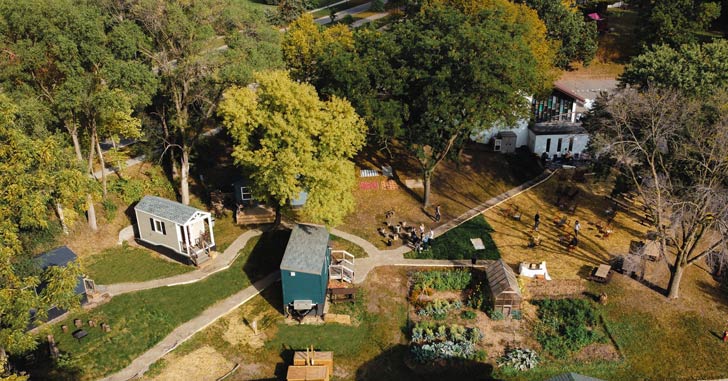
Four homes will be set aside for “Intentional Neighbors,” or people who have not experienced homelessness but want to serve as a “good neighbor” for the others on the property.
“Our primary reason is our Gospel call,” Brickey added. “We are followers of Jesus who practice the way of Jesus in our daily lives. Core to Jesus’ message and lifestyle is caring for the poor.”
Brickey said the model of the Sacred Settlement neighborhoods has been a proven success at other congregations in the Twin Cities. This includes Sacred Settlement Mosaic, a community in St. Paul, to which Brickey attributed “deep, wholistic healing” and “zero crime, zero police involvement, and zero neighbor complaints.”

Despite this, some neighbors near Open Door are not enthusiastic about the new development. A group of area residents has formed a coalition called “No Settlement Maple Grove,” citing safety concerns and a desire for rules about potential drug and alcohol use.
Settled, a nonprofit that helps churches like Open Door create these communities, has been supportive of this project.
“I would argue every major world religion has a mission to care for the poor,” Gabrielle Clowdus, founder and CEO of Settled, told the Minnesota Star Tribune.
She added that churches meet with surrounding communities to agree on plans and requirements for each community, like restricting noise or panhandling, for example.
Background checks are completed for each resident, and in a previous settlement in St. Paul, leaders chose not to admit anyone with a violent criminal history, the Star Tribune reported.

Additionally, a state law that took effect in 2024 allows churches to build Sacred Settlements without some zoning restrictions and includes outlines for safety and security.
“If they’d like to invite them off the street, into an intentional, supportive community, then local zoning won’t be a barrier for a church to carry out its mission,” Clowdus added.
Brickey remains steadfast in the church’s pursuit to help homeless community members, just as Sacred Settlement Mosaic has done in St. Paul.
“Many of the neighbors have started new professions and have restarted old ones,” he told Christian Post. “Some neighbors have been reunited with family they were separated from through their homeless season.”

In these tiny homes, residents pay between $200 and $400 in rent and help take care of the community. Inside the church, they have access to common areas with kitchens, bathrooms, showers, and living areas.
Intentional Neighbors, church members, and other volunteers help residents access services and job opportunities and drive them to appointments.
The Sacred Settlements do not have a religious requirement for residents, according to MinnPost, though each church can develop its own criteria for the community.
“It’s important to note that because this is completely privately funded, we get to choose who moves into this community based on pre-chosen criteria,” Brickey told Christian Post.
“Additionally, we are on the streets weekly and know many people experiencing homelessness in our community. Those relationships are also a key part in discerning who is a right fit.”

While the newest — and largest — Sacred Settlement in Minnesota is still in its early stages, Brickey is confident it will echo the work of the ones that paved the way.
“Our mission is to mobilize and equip the community of Christ into a lifestyle of hospitality,” the Sacred Settlement Mosaic website shares. “We believe the role of the church, both here in St. Paul and across the world, is to lift up people who our systems and cultures have pushed down. This includes the homeless.”
Header image courtesy of Settled
On the heels of his newest book release, “Everything is Tuberculosis,” and ahead of World Tuberculosis Day on March 24, John Green is celebrating efforts to eradicate the world’s deadliest infectious disease over a cup of tea.
Alongside his brother, Hank Green, John launched an online store last year called Good Store where the brothers sell goods like socks, coffee, soap, eco-friendly cleaning supplies, and loose-leaf teas, with all profits going to charity.

Keats & Co, the line of coffee and teas at Good Store, benefits Partners In Health’s global work to diagnose, treat, and prevent TB in vulnerable communities.
And just in time for the big day, the store has dropped four new flavors.
“Everyone’s favorite holiday is coming up on Monday: it's World Tuberculosis Day,” an email from Good Store reads.
“Over here at Keats & Co we’re celebrating by releasing four brand new blends of tea! We’ve got the classics, like pure peppermint and chamomile tea with a twist, plus some more experimental blends, a delightfully fruity botanical tea, and warm honey black.”
The line is aptly named after romantic poet John Keats, who died of the disease, along with many of his contemporaries.
These new flavors — Glowing Gold Chamomile, Crystal Air Peppermint, Sweet Briar Botanical, and Blooming Wild Black — are an ode to him and all others facing the illness.

If it wasn’t already clear, TB is a cause close to Green’s heart.
He has committed millions of his own money to fund solutions for TB, has educated thousands on the subject, and has even worked with his fan community — Nerdfighteria — to demand change from corporate health giants like Danaher and Johnson & Johnson.
With the release of his new book, he continues to advocate for the eradication of what he calls an “entirely preventable” disease.
“I think in the 21st century, the cause of tuberculosis is us,” Green said in an interview with CBS Evening News earlier this month.
“We know how to treat and cure this disease, so you can’t really say it’s caused by a bacteria anymore. It’s a bacteria we know how to kill. The real cause of tuberculosis in the 21st century is humans — human choice, human-built systems, systems that leave some people out and include others.”
Partners In Health is one major force helping humanity make a different choice.
“PIH has battled this inequity for more than two decades, by treating and preventing TB, its more severe, drug-resistant variants, and co-infections of HIV and TB in some of the poorest and most vulnerable communities in the world,” the nonprofit’s website shares.
“Our community-based approach to care has resulted in some of the highest cure rates and lowest treatment default rates ever recorded.”
And when people shop for tea through Green’s Good Store, they’ll get to sip on something tasty, all while supporting the cause.
Keats & Co teas are available now for one-time purchases, subscription bundles, or as a sample pack.
Header image courtesy of John Green and Good Store
Every day the Good Good Good team collects the best good news in the world and shares it with our community. Here are the highlights for this week!
If you want to get good news in your inbox every day, join the Goodnewsletter — the free daily newsletter designed to leave you feeling hopeful.
The Best Positive News We’re Celebrating This Week —
Texas broke its solar, wind, and battery records all within a single week
In the first week of March alone, Texas’ ERCOT power grid, which supplies nearly the entire state, set three records: most wind production, most solar production, and greatest battery discharge.
Just two years ago, batteries had only ever provided as much as 766 megawatts into the grid at once — that record-breaking week, it provided 4,833 megawatts. Batteries alone are now providing almost as much instantaneous power as nuclear power plants in the state.
Texas has been leading the way in renewable energy generation, producing almost twice as much wind and solar electricity as California last year. It’s also a leader in new capacity additions, averaging about 1 gigawatt per month.
Even more good: Even after offering billions of taxpayer dollars for a loan program specifically for private gas power plant developers, the state has struggled to add new gas power capacity. Renewables are just too good.
→ Read more
A homeless mom gave away $2 to help a parent in need — then the internet surprised her with $84K
→ Read more
The gender pay gap has narrowed in the U.S. over the last two decades, most significantly among younger workers
In 2024, women earned an average of 85% of what men earned, a slight narrowing over the 81% women earned compared to men two decades ago in 2003.
While that gap is still devastatingly high, the news is even better for younger workers between the ages of 25 to 34. In 2024 women in that age group earned an average of 95% of what men earned — a 5% gap compared to the 15% gap for workers of all ages.
It’s also a more noticeable difference over the long term: Compared to the 15-cent gender pay gap for all workers in 2024, in 1982 it was a 35-cent pay gap. This is important progress to celebrate (especially during Women’s History Month) as we continue work to get that gap to zero.
A groundbreaking study found that solar panels do much more than generate clean electricity — they make entire ecosystems better
While solar panels have long been touted for their cheap, clean energy production — we now know they have an even larger positive impact on the environment.
In a groundbreaking study at a massive solar installation in China’s Talatan Desert, researchers discovered that solar panels also improve soil conditions, encourage plant growth, and transform the local climate.
The researchers looked at 57 environmental indicators like soil composition, humidity, and biodiversity and found that the solar panels were revitalizing the fragile desert ecosystem — rather than harming it, as expected.
Why is this good news? While there are other environmental impacts to consider with solar panels — like the manufacturing process and end-of-life recycling — it’s incredibly encouraging to know that not only do solar panels prevent environmental damage in the form of reducing carbon emissions, but they may even be a benefit to surrounding ecosystems.
Last year, emissions in the U.K. fell to the lowest level since 1872
A new analysis of government energy data found that in 2024, the U.K.’s emissions fell by 3.6% to 371 million tonnes of carbon dioxide equivalent — the lowest since 1872 and about the same as 1926.
The decrease was driven largely by falling coal use, which reached its lowest level since 1666, following the closure of the country’s last coal-fired power plant.
There was also a drop in demand for oil and gas, an almost 40% rise in electric vehicles on the road, and record levels of clean energy. The country’s emissions have now fallen in 26 of the past 35 years.
Canada is building the world’s first full-sized, zero-carbon cement plant
With the signing of a $275 million deal between the Canadian government and materials supplier, the world’s first full-scale, carbon-neutral cement plant is a go: and it could be operational within three years.
The new cement manufacturing facility will be fitted with a carbon capture, utilization, and storage system that will absorb 1 million tonnes of carbon dioxide per year — the equivalent of taking 300,000 cars off the road.
It will boast a 95% capture rate, and all that captured carbon will be injected several kilometers underground.
Why is this good news? Cement is an incredibly carbon-intensive component of concrete, which is responsible for an estimated 7% of emissions globally. This landmark facility could lay the groundwork for future projects: reducing emissions critical to meeting net-zero commitments in Canada and potentially around the world.
Support for women’s college basketball has been on the rise, surpassing the men’s championship game viewership for the first time last year
As the 2025 NCAA women’s college basketball tournament gets underway this Friday, we’re celebrating how support for Women’s March Madness has grown in recent years.
Last year, the women’s final had more viewers than the men’s for the first time since its inception in 1982 — with 18.9 million viewers compared to 14.8. That viewership total was almost double the 2023 women’s championship game, which had almost 10 million viewers.
While stars (and rivalries) like Caitlin Clark and Angel Reese helped drive those stats in both 2023 and 2024, even with their graduation to the WNBA, women’s college basketball viewership is still up 3% over last season.
→ Read more (Gifted link)
New no-fishing zones around six major breeding grounds will protect critically endangered African penguins
Conservationists and fishing industry groups in South Africa just agreed to implement no-fishing zones around six major breeding colonies of critically endangered African penguins.
Around two of the colonies, there will be no sardine or anchovy fishing allowed for 12 miles, and more limited closures around four other colonies.
If African penguin populations continue to fall at the current rate of 7.9% annually, they will be threatened with extinction by 2035. While a century ago, there were 1 million breeding pairs — there are now fewer than 10,000.
What’s the nuance? Conservationists and the fishing industry have debated how much commercial fishing contributed to the penguin population decline, and whether restricting it would help save the species from extinction. Conservationists celebrated the step forward in protecting the penguins and acknowledged the complex factors contributing to their declining numbers.
For 90 days, a man became ‘homeless on purpose’ to see how his unhoused neighbors lived — then he raised $20K to help them
There was a 43% drop in Native American suicide rates in New Mexico
New data from New Mexico shows there was a 43% decrease in deaths by suicide from 2022 to 2023 among the state’s Native American population.
Potentially a reflection of successful tribal and state-level initiatives, which included culturally appropriate mental health care programs and decreasing stigma around mental health, the dramatic decline outpaced the overall 9% decline in suicide rates statewide.
American Indians and Alaska Natives experience 91% higher suicide rates than the general population, stemming from systemic abuses Native communities face. In New Mexico, which is home to 23 federally recognized tribes, suicide rates grew almost 56% from 2009-2018 — making this new decline especially encouraging.
→ Read more
The first satellite designed to detect wildfires early and precisely is now in orbit
With the potential to change how we respond to wildfires, the first satellite in a constellation of satellites that is specifically designed to locate wildfires early and precisely anywhere in the world is now in orbit around the Earth.
Launched by the nonprofit Earth Fire Alliance, the FireSat constellation will be made up of 50 satellites and is the first of its kind to be built specifically to detect and track fires.
Current satellite systems use low-resolution imagery, cover a smaller area once every 12 hours, and can only detect large wildfires that span a couple of acres. FireSat will be able to detect fires as small as 270 square feet — about the size of a classroom — and provide high-resolution images every 20 minutes.
Why is this good news? The FireSat project has been in the works for less than 18 months and will be essential in responding to disastrous wildfires — like the ones that hit Los Angeles earlier this year — which are predicted to continue to intensify as the world continues to experience the impacts of the climate crisis.
The owner of the last video shop in an Idaho town is keeping a small section open for a customer with Down syndrome
For Christina Cavanaugh, who has Down syndrome and is mostly nonverbal, going to the video rental store every day has been a vital part of her routine for the last fifteen years.
At Video Stop, the last video rental store in Pocatello, Idaho, new employees were even trained so that Christina could provide her account information and rent movies independently.
When the video store was set to close, Christina’s mom wasn’t sure what they’d do. But she didn’t have to worry very long: the owner of Video Stop moved a collection of movies to “Christina’s corner” in his K & B Kwik Stop location next door — so Christina could continue feeling supported in her routine.
More good news of the week —
To help confront rising rates of homelessness, a Michigan city developed “temporary legal encampment sites.” While it’s not designed to be a permanent solution, the plan does allow those experiencing homelessness at least a little more dignity and support, especially considering simply removing these encampments does nothing to improve public safety.
Relaying signals from his brain to a computer, researchers helped a paralyzed man move a robotic arm with his thoughts. Using a brain-computer interface, which worked for a record seven months without needing to be adjusted, the man was able to grasp, move and drop objects just by imagining himself performing the actions.
A new genetic study revealed that the Asian elephant population in Cambodia is larger than previously thought. Researchers collected DNA samples to identify individual animals, estimate population size, as well as overall genetic diversity — which is a “critical factor for long-term viability.”
Ireland announced it was donating over $16 million to Brazil’s Amazon Fund. Eight countries have now contributed to the fund, which aims to stop deforestation and preserve the world's largest tropical rainforest, with Ireland’s being made over the next three years.
Endangered cougar cubs were spotted in the wild in Michigan for the first time in more than 100 years. In the early 1900s, cougars were hunted to the point of extinction and became protected under the Endangered Species Act in 1973 since they’re a keystone species — meaning their absence can have negative cascading effects on the local ecosystem.
Alabama is the only state in the U.S. where fourth-grade math scores are now higher than pre-pandemic. Counties across the state have reimagined elementary school math instruction, and it’s led to a dramatic improvement in students between 2019 and 2024.
Harvard announced it will make tuition free for families making $200,000 or less annually. The expansion will enable approximately 86% of U.S. families to qualify for Harvard College’s financial aid, expanding the college’s commitment to providing all undergraduate students the resources they need to enroll and graduate.
AI robots are recovering recyclables from Chicago’s waste, saving them from the landfill. The robots use an “optical scanner” trained to spot aluminum within 10-15 milliseconds, and in just a year the aluminum-hungry robot has already snagged more than a million cans from the “last chance” line.
An innovative machine is recycling rubble into bricks to build homes for displaced Ukrainians. A single machine can make up to 8,000 bricks in a day, producing enough to construct the exterior structure of 10 homes every three days that are earthquake-, fire-, and cyclone-resistant.
One dad’s quest to address hard-to-recycle items grew into a community movement that spans seven U.S. states. Ryan Metzger started a recycling carpool in his Seattle neighborhood, collecting items in his community that would otherwise be on their way to a landfill — as demand grew, it turned into a startup that “makes it simple to get rid of your stuff responsibly.”
Japan created the world’s first toilet paper made from used disposable diapers. Spearheaded by two municipalities that share a waste management system, they collected 98 tons of diapers and other used hygiene products to be transformed into rolls of toilet paper, which traditionally have a high environmental impact.
The U.S. Supreme Court declined to hear a lawsuit intended to block climate change suits against the oil and gas industry. In a partisan effort, 19 Republican attorneys general sought to block Democratic-led states from suing fossil fuel companies for deceiving the public about the risks of their products contributing to climate change.
A post-apocalyptic board game became the first ever to win a leadership award from forestry charity FSC. Honored for its “strong sustainability themes” and for using only FSC-certified paper and wood, “Life in Reterra” is a tile-laying game about rebuilding a community in a post-collapse Earth.
Thousands of NHS patients with multiple sclerosis will have access to a life-changing “take at home” tablet. The first system in Europe to roll it out widely for patients, the tablet requires just 20 days of treatment spread over four years — a convenient alternative to existing therapies that involve regular hospital infusions, frequent self-injections, and extensive monitoring.
Hundreds of Olympic athletes are calling on the incoming IOC president to prioritize climate change. In the wake of devastating wildfires in Los Angeles, host of the 2028 Summer Olympics, 400 athletes are calling on the president to address climate change as a “current and growing harm to the sports we love.”
Researchers found just two factors could help close the hiring gap for autistic job seekers. The research found that both employer neurodiversity training paired with a candidate’s disclosure of an autism diagnosis helps level the playing field for autistic people, who can have an especially challenging time in interviews.
Armenia and Azerbaijan agreed on a draft treaty that would end nearly four decades of conflict. While the timeline for signing the deal is uncertain, it’s a significant breakthrough in the region that has seen slow, tense progress towards peace thus far as well as tens of thousands of refugees.
A major chipmaking company is launching an AI-powered platform to make it easier to learn sign language. Partnering with the American Society for Deaf Children, Nvidia’s “Signs” platform launched with 100 distinct signs, with plans to grow that to 1,000.
A Minnesota church surrendered part of its property to build “sacred settlements” for its unhoused neighbors. The model of the Sacred Settlement neighborhoods has been a proven success at other congregations in the Twin Cities, which have seen “deep, wholistic healing” and “zero crime, zero police involvement, and zero neighbor complaints.”
Kirsty Coventry just made history as the first woman to be elected president of the International Olympic Committee. Coventry is also the first IOC president from Africa and celebrated the power of sport to “unite, inspire, and create opportunities for all” and committed to “making sure we harness that power to its fullest.”
In a win for animal rights activists, Mexico City is introducing “bloodless bullfighting” in place of the traditional events. While the activists had been pushing for a complete ban, the compromise means matadors can only use their capes to draw the animals to charge, and the animals’ horns will be protected to prevent harm to matadors and other animals.
People with Down syndrome are living longer than ever — and programs are growing to support their care. While predispositions to certain conditions impact the length and quality of one’s life, the lower life expectancy of people with Down syndrome is linked to the historical inhumane practice of institutionalization.
The viral “Assume That I Can” PSA pushes back against outdated stereotypes and harmful misconceptions about Down syndrome. The ad lays out all of the limitations placed on people with Down syndrome that occur when parents, teachers, and peers operate on outdated assumptions — and what happens when those limits stop.
As part of its “Fashionista” line, Barbie introduced its first-ever Black Barbie doll with Down syndrome. Like the first Barbie with Down syndrome introduced by Mattel in 2023, this new doll was created in partnership with the National Down Syndrome Society, as well as a group of Black individuals from the Down syndrome community.
In season four of Netflix’s “Queer Eye,” viewers were introduced to Brandonn Mixon, a military veteran who co-founded the nonprofit Veterans Community Project.
As the organization’s chief project officer, he oversees the development of tiny home communities for veterans facing homelessness. Despite his efforts to help his own community, the “Queer Eye” team stepped in to give him a helping hand of his own.
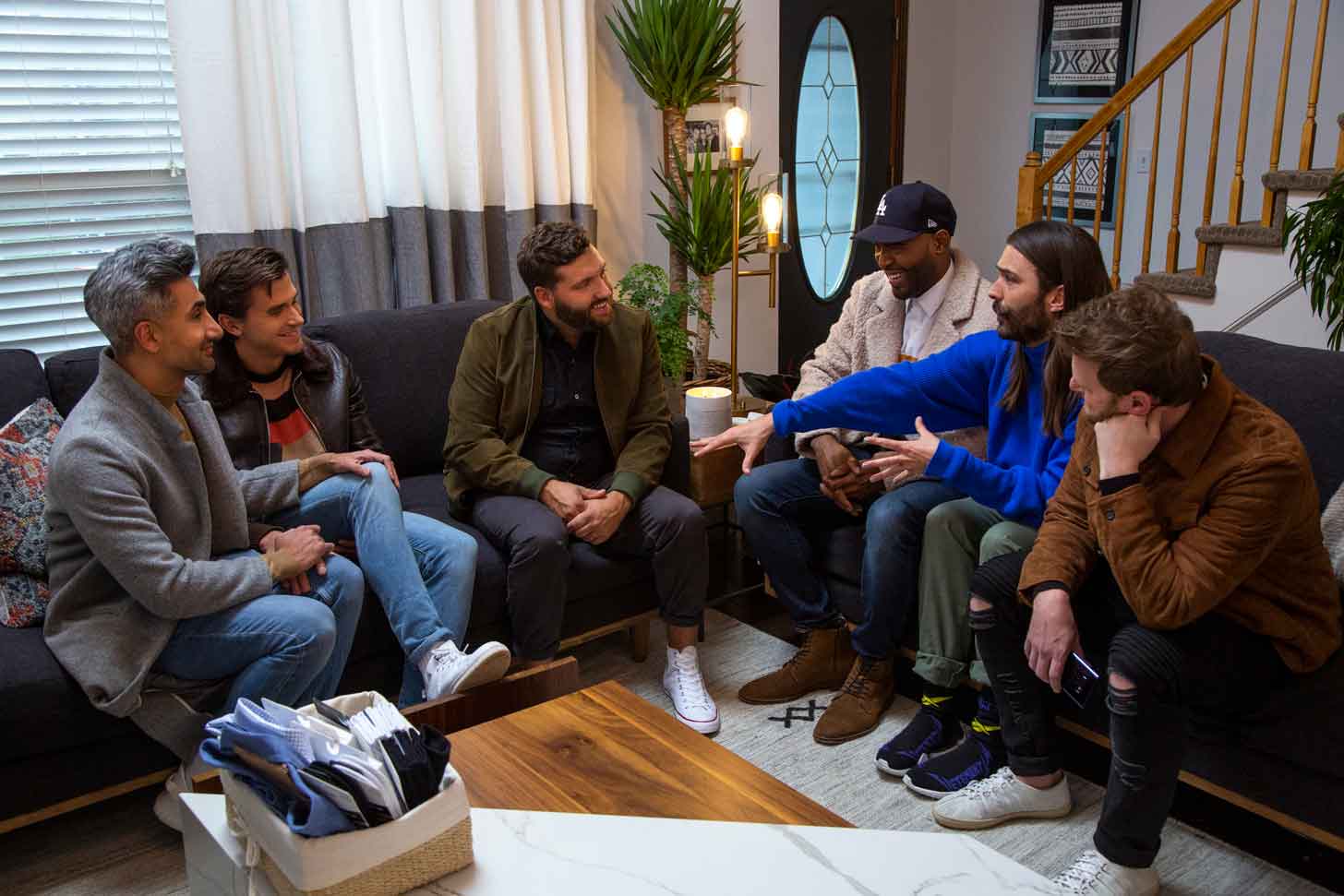
In the episode, he forged connections with the “Fab Five” and made a commitment to spend more time with his family, cooking meals and coaching his sons’ sports teams.
“When I got out of the military I felt like I got left behind, that I got abandoned,” he told Refinery29 after his episode aired.
“I’m really hoping that they [other servicemembers] see from my episode that I’m going through this and that I asked for help. I literally did this knowing I could change one of my brother or sister’s lives. If I can stop them from thinking they’re alone, it has been worth it, 110%.”

Well, nearly six years later, he’s still in the business of changing the lives of his fellow vets.
Based in Kansas City, the Veterans Community Project services more than 1,200 veterans in the Missouri area each year.
But now, it’s expanded to five other cities across the country. Last year, projects in Longmont Colorado, Sioux Falls, South Dakota, and St. Louis, Missouri celebrated a year of operation.
Next up is a 40-unit tiny home neighborhood for veterans in Milwaukee, Wisconsin.

“Really, making this dream a reality, to now changing what veterans' homelessness looks like nationally,” Mixon told KSHB 41 last year, “If you would have told me we were changing veterans' lives nationally, there’s no way. You’re talking about small-town guys in KC with a dream.”
The newest project in Milwaukee is set to begin construction this year, driven by private funds, as well as a $4 million state grant.
Tiny homes in the new community will sit on a 7-acre site and will range from 240 to 340 square feet. Each home includes a kitchen, bathroom, and sleeping areas, with eight homes set aside for veterans with families.
They will be completely free for residents to live in.
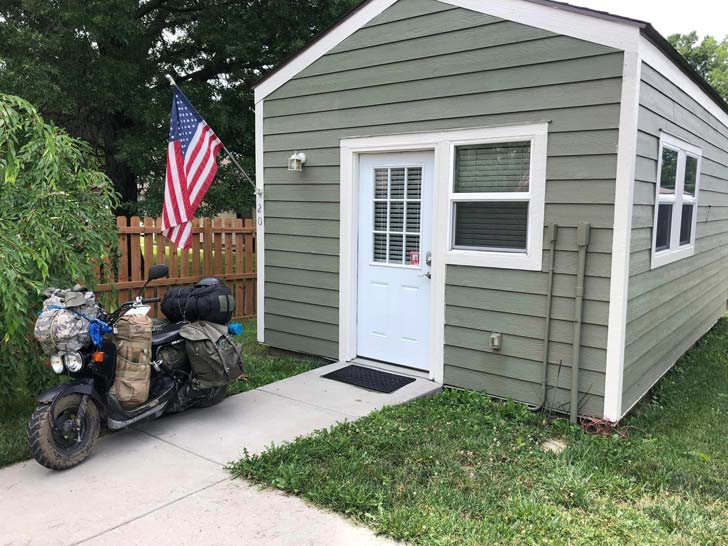
“We’re done leaving veterans behind,” Mixon told the Milwaukee Journal Sentinel.
The neighborhood will also provide social activities and case management services, education, and health and wellness programming.
Even the design elements of each home are made with vets in mind.
“Every detail of the home is designed with veterans’ needs in mind,” a plan for the Milwaukee project explains, "including placement of doors and windows to increase a sense of security for those impacted by post-traumatic stress disorder.”
Like the many tiny home developments that come before it, the goal of these communities is to help residents find stability through social connections, jobs, and case management that ultimately leads them to a more permanent housing situation.

It’s a model that seems to work.
According to Mixon, over 4,000 cities have reached out to Veterans Community Project, seeking to build veteran villages of their own.
Back home in Kansas City, the organization is planning to open a $5.8 million navigation campus next year.
“We strongly believe we really have that one shot,” he told KSHB 41. “A veteran can come there and can say, 'I need help with social security or VA enrollment or dental or healthcare services.’”
In the meantime, much of the on-the-ground work includes continuous funding for these projects, both from large corporate donors, local government contracts, and grassroots donations from neighbors who simply care about helping veterans.
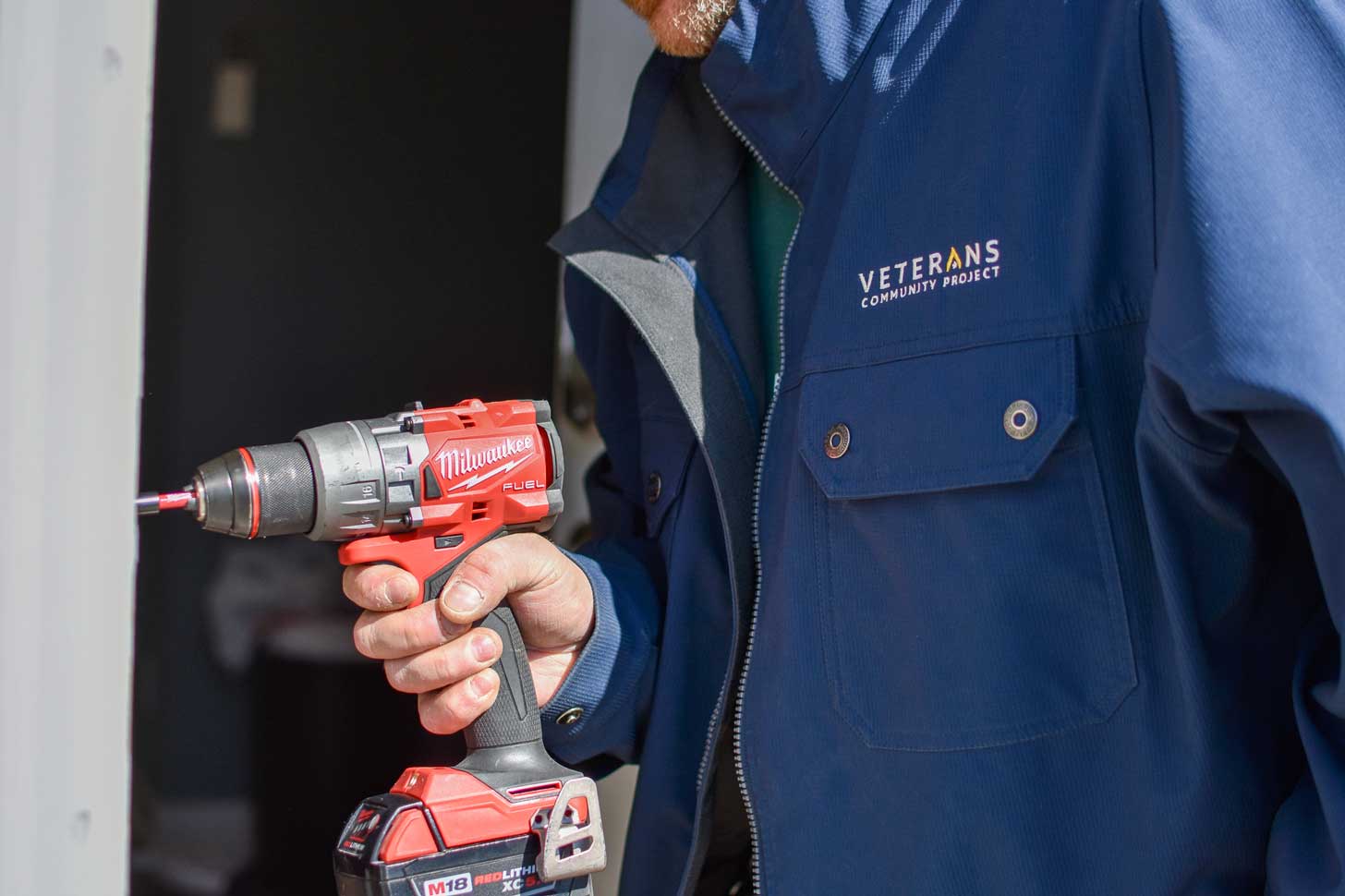
Last spring, the organization sold concert tickets at a Milwaukee music festival to help ramp up support.
“VCP is a nonprofit that serves all veterans. It doesn't matter if you’re honorably discharged, dishonorably discharged, this is your home," Mixon told 58 News Milwaukee.
“It starts in Milwaukee, it starts in Kansas City, it starts in St Louis, it starts in Glendale, it starts in Oklahoma City,” he added. “The communities take the oath, saying I'm not going to let veterans fail anymore, and Milwaukee is doing that here.”
Header image courtesy of Veterans Community Project
Claire Cao was only a senior in high school when she saw a vital need in her community — and filled it.
In 2024, the teenager spent her time outside of school volunteering at Blanchet House, a Portland-based nonprofit that serves people experiencing homelessness through food donations, clothing drives, and mental health assistance programs.
As she logged hours as a Blanchet House student ambassador, Cao soon realized how difficult it was for community members to keep track of shelter openings, rotating food service programs, and available mental health resources.
“During one afternoon meal service, I met Dano, an unhoused man who shared his struggles with accessing basic services like food and shelter,” Cao said in a recent press release.
“Left disconnected from essential services, Dano described his struggles of not knowing where to go or which shelters had available beds.”
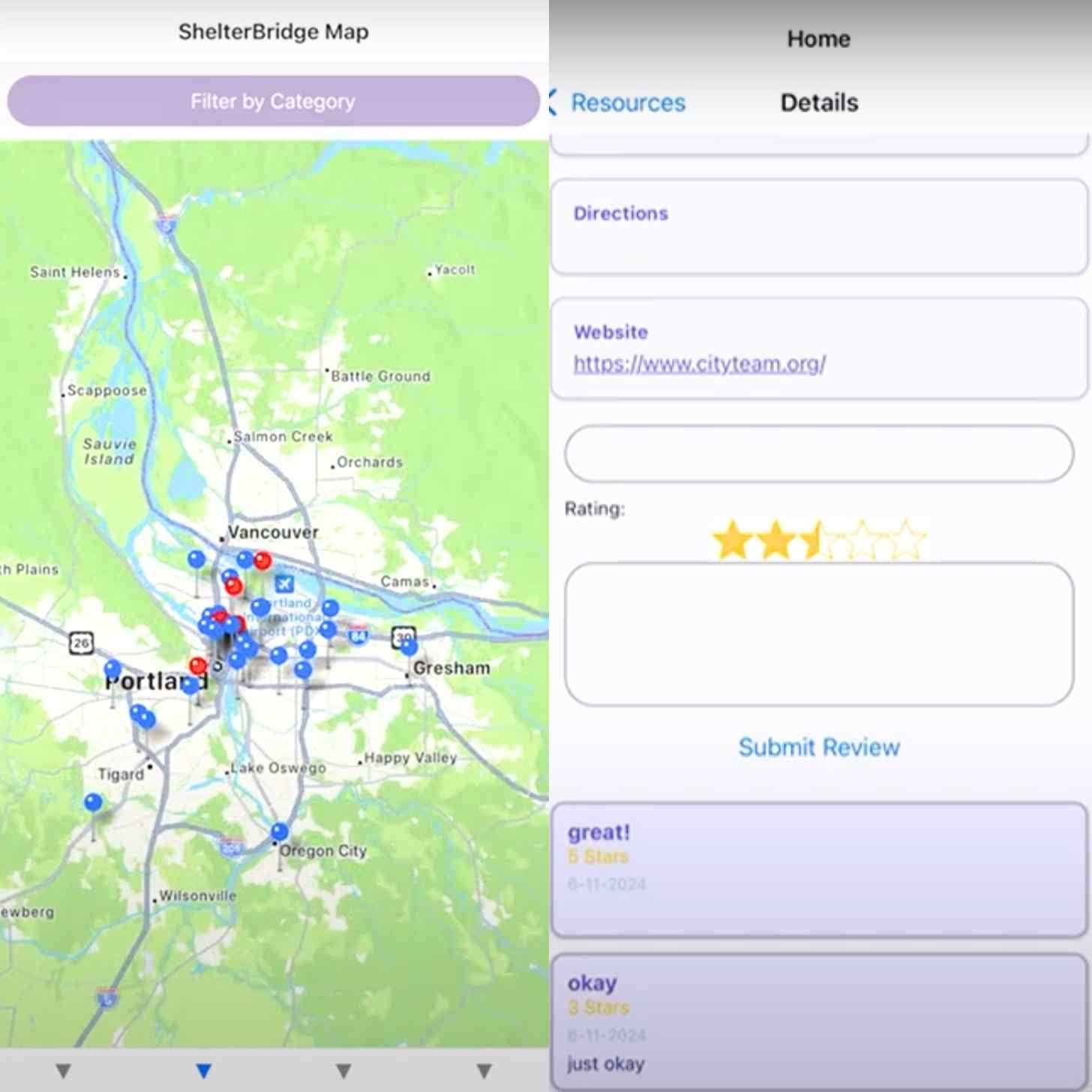
Combining her love for technology, law, and public policy, Cao pulled available resources into a database and created the ShelterBridge app, which connects users to shelters and services in their area.

“ShelterBridge wasn’t simply inspired by Dano — it was inspired by the realization that access to resources is a fundamental need that we, as a community, can do a better job of providing,” Cao emphasized.
“I wanted to use my skills to build something that could bridge that gap, ensuring that no one falls through the cracks simply because they don’t know where to turn for help.”
In addition to linking users to services in their area, the app also has a rating system similar to Yelp. This system allows people to leave star ratings and reviews on shelters, food services, hotlines, and legal aid.
The ratings not only help users differentiate between services in their area — but they also provide invaluable feedback to the nonprofits, organizations, and government programs that service them.
“We've been asking for an app like this for a number of years now,” Scott Kerman, executive director of Blanchet House, told Portland news station KGW.
In mid-January, Cao won the 2024 Congressional App Challenge in Oregon’s First District for her work with ShelterBridge — outcompeting 12,682 student submissions.
Since the app first launched, Cao and her growing ShelterBridge team — which includes enterprising high schoolers and college students from across the nation — have expanded services to California, Philadelphia, Seattle, Los Angeles, and North Carolina.
“Claire and the team she’s working with deserve all the credit in the world because they're doing something that frankly nobody else has really stepped up to do,” Kerman said.
“To have the kind of technology that we use every day with hotels and other kinds of reservations [to] help people get into safe, supportive and dignified shelter would be a game changer for our community.”
Although the app started as a class project, Cao said ShelterBridge’s success has far surpassed her expectations.
“I do hope to keep it up,” she told Oregon outlet KOIN 6 News, as she looked ahead to college and beyond. “I’ve made a lot of efforts to expand it to other cities as well — and it’s something I can mostly do from a computer or my laptop at home.”
Header images via Blanchet House / ShelterBridge
Kati Jo Christensen — a special education teacher in Utah who may be better known by her TikTok handle, @MrsCactusVibes — is using her online following to make a real difference.
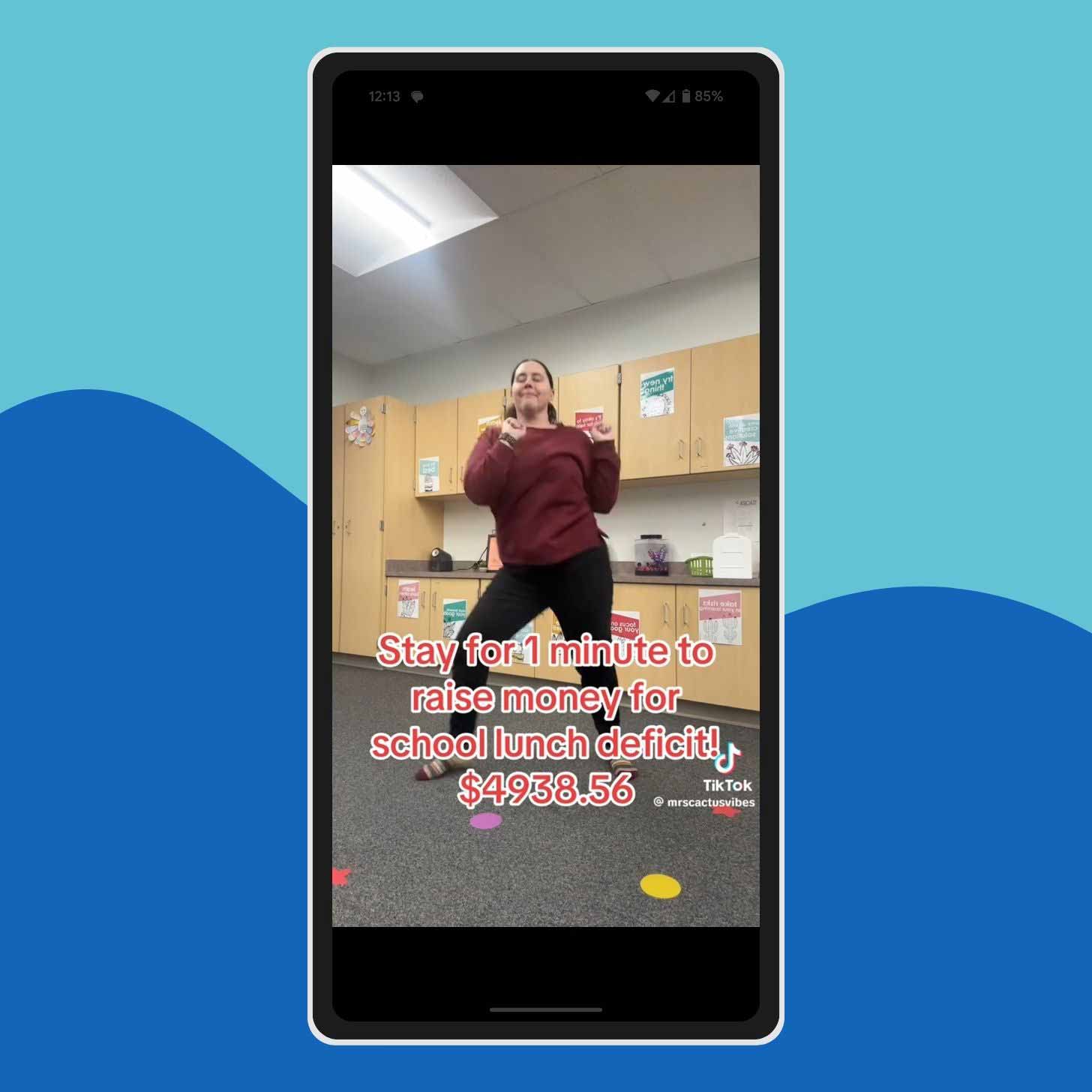
She just has one simple ask to anyone who comes across her videos: Stay for one minute.
It’s all part of her project to raise funds to clear student lunch debt. On TikTok, any person part of the app’s Creator Fund, can monetize any video over one minute in length.

So, Christensen turns her classroom into a stage for just 60 seconds, complete with a Taylor Swift, Panic! At The Disco, Coldplay, ABBA, and Post Malone soundtrack. Many viewers have also been so compelled by her moves to donate directly to her efforts.
“Anything I’m earning off of TikTok is going to the kids,” she said in a recent video. “Whether it’s a product sale, whether it’s a view, whether you’re doing a Venmo donation, all of it goes to them.”
As of this month, she has raised over $11,000 to clear the debts of students in her area.
“These kids can’t learn unless they have food in their bellies, and they’re worrying about their parents paying for it,” Christensen told The Salt Lake Tribune. “I just want to make sure that these kids aren’t feeling the weight of adult problems when they’re only in elementary.”
For the current school year, nine states across the country have legislation in place to provide universal free meals to students, but an estimated 30.4 million students nationwide still cannot afford their meals.
Instead of having the students go hungry, most schools will still feed them, but their families are left with a debt that follows them through their educational careers.
“Every time that child eats that kind of amount of how much the lunch or breakfast is, [it] goes on their school account saying that they owe so much money,” Christensen explained to The Salt Lake Tribune.
“With the deficit, it just kind of continues to rise until that parent is able to pay it off.”
Utah schools have amassed $2.8 million in school lunch debt, per the Tribune, and last year, Governor Spencer Cox announced he would use $1.2 million in federal funds to begin to alleviate some of those balances.
State lawmakers also just passed a bill to provide free meals to eligible students, with the State Board of Education required to reimburse schools for the cost.
But right now, the current debts still remain.
@mrscactusvibes Our new lunch deficit for school ##4##utah##lunchdeficit##feedthekids##creatorfund##teachersoftiktok##loveandpositivity##payoffschoollunches##dancingteachersoftiktok##dancingteachers##spedteachersoftiktok##school##classroom##govspencercox ♬ I Can Do It With a Broken Heart - Taylor Swift
“They’ll get to the point where they’re trying to graduate and get their diploma,” Christensen said of the students who still have debt. “But they can’t get that diploma until they’ve paid off all of their fees and lunch dues.”
Her TikTok dances are a grassroots way to help move the needle just a little bit faster.
She started with a goal of paying off her own school’s balance of $4,000. She saw some small successes and donations from friends and family, but after one video went viral, she met her goal within a week.
Now, she’s connecting with other area schools to pay off their balances. With the funds she’s raised so far, she’s onto school number four.
“I want to keep going with this,” Christensen said in a recent video. “I want to keep our communities working together, because sometimes that’s all we really have left — is our communities. So, let’s keep going. We have a lot of work to do.”
Header images courtesy of Kati Jo Christensen/TikTok
Recent diversity, equity, and inclusion rollbacks have led many Americans to reconsider their relationship with major retailers like Amazon and Target.
But Dacia Petrie has been waiting for this moment since 2018.
The UI and web designer started her journey as many young women do: with an Instagram page. Here, she curated Black-owned businesses and prominent Black leaders to profile and highlight.
After enrolling in web design courses at Spelman University, she later launched her app and website Black Nile in 2021.

Its name is a clever response to Amazon.
“I saw somebody in the comments saying that they’re looking for a Black Amazon,” Petrie said in a recent TikTok video.
“Sister, I’mma hold your hand when I say this. This ain’t Amazon. It’s Black Nile.”
The app’s website goes on to add that “The Nile holds a profound symbolism, rich with layers of meaning that resonate deeply with our faith in Christ, our heritage, and unique plight in history.”
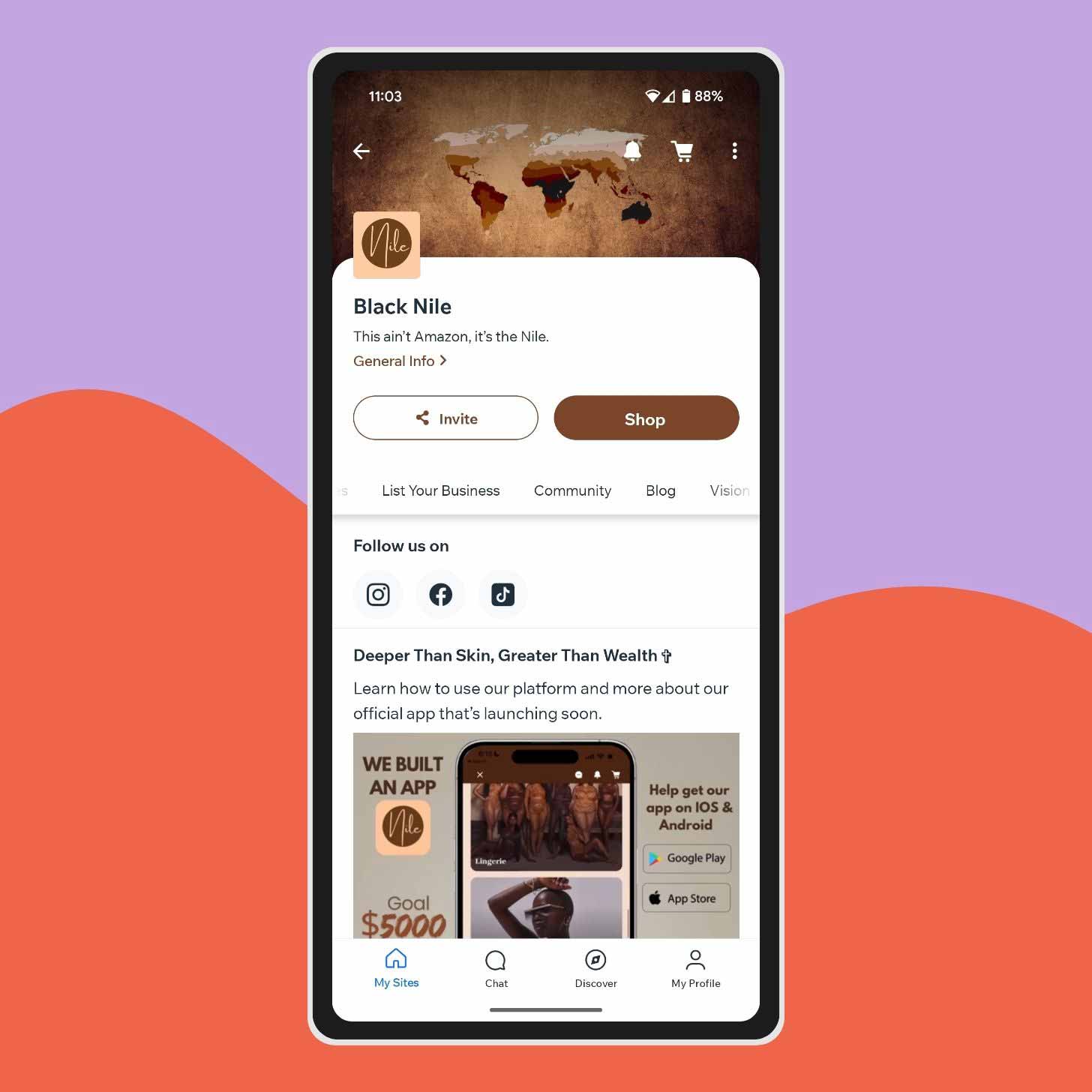
What started as Petrie’s goal to “amplify authentic representation of the African Diaspora, and bridge the global racial wealth gap” is now a Black-owned marketplace with over 3,000 Black-owned brands across over 40 product categories.
“I mean every category,” Petrie said in her TikTok video. “Skincare, haircare, nail care, feminine care, hotels and villas, hair stylists, restaurants, grocery stores, luxury wear, handbags, wedding, home and kitchen, babies and kids, swimwear, lingerie, plus-size clothing. Y’all, the list goes on.”
And it’s clear, people are eager to see what’s in store. Petrie shared on February 1 of this year that over 30,000 new members downloaded the app within 48 hours — just in time for Black History Month.

“30,000 souls crying out,” she wrote in an Instagram post. “The Nile is a chance to channel our generational cry into rivers of living water, one stream at a time.”
As of the publishing of this article, the Black Nile has over 66,000 members.
Right now, Petrie is fundraising to help bring the app to the App Store and Google Play, but users can still access it by downloading the Spaces by Wix app and searching for Black Nile.
Even with the extra steps, the app promises to offer everything shoppers — and business owners — may need.
It’s integrated with Google Maps, which allows users to locate nearby businesses. Supporters can also shop online, with a marketplace directly integrated into the app that takes users straight to the websites of individual brands.
After shopping, users can leave reviews within the app.
“I created this with the intention to make shopping with Black-owned businesses as easy as possible,” Petrie said.
“I am a UI designer and web designer, and I noticed that there are a lot of Black-owned directories, but many of them aren’t as user-friendly or optimized for our mobile devices.”
While Petrie is still working to bring her app to the mainstream, her call to action remains unwavering.
“We have taken it upon ourselves to carve out a dedicated space where quality marginalized Black-owned businesses, creators, and innovators are not just seen but highlighted and rewarded,” her website shares.
“The Black dollar is powerful, and it is time we redirect our wealth within our own communities and create our own spaces where we are accepted and celebrated — not hated or tolerated.”
Header images courtesy of Dacia Petrie/Instagram and Black Nile/Wix
In 2023, Tevin Clark relapsed — and his addiction swallowed up everything he cared about in the process. In a matter of weeks, he swiftly lost his job and his home, and when he emerged from rehab he had nowhere to turn.
“I was homeless,” Clark told local Louisville news station WAVE, gesturing to East Broadway, a nearby road. “I was up and down these streets every day.”
One day, Clark was standing outside of a homeless shelter when a Goodwill van pulled up beside him, offering him a free meal and $50 for four hours of work.
“I really just thought it was $50 a day, for real,” Clark said. “But it changed my life, actually.”
Clark had been scooped up by Goodwill’s Another Way program, an initiative that meets unhoused people where they’re at — under highways, bypasses, on street corners, and outside of shelters — and offers them part-time work.
The work in question? Cleaning and sweeping at Louisville’s Freedom Hall, a local venue that hosts everything from baseball games and concert events to horse championships.
The hope is that over time, the program workers will keep coming back. On a given day, 30-40 unhoused people can be seen filtering through the arena, readying the venue for the next big show.
As they gain job experience, they build up resumes, which helps them secure additional work.
Theodrick Gunn, a 26-year-old father of three, has worked with the program on three occasions. Another Way not only helped him apply for a state-issued ID card — it also proved to be a safe haven from larger problems in his life.
“Every time I walk in, I’m smiling,” Gunn said. “I’m happy no matter what I’m going through. I ain’t even thinking about that. I’m coming in here.”
In addition to helping Gunn and Clark get back on their feet, outreach specialist supervisor Stefphan Gholston has helped serve over 1,312 individuals for the Another Way Program since its inception in 2019.
And his job isn’t just limited to recruiting people.
According to Goodwill Kentucky, Gholston has transported 62 people to mental health treatment facilities, placed 126 more in transitional housing, and helped 133 colleagues find long-term employment.
“Because it’s hope, and it’s not a false hope,” said Gholston. “It’s a heart that’s willing to help. True help. We’re not enabling. We’re empowering. We’re making them believe again when they’re broken.”

As for Clark, he says every recent success — finding housing, earning his GED, and crossing the stage to get his diploma — is all thanks to Another Way.
Within six months of working for Another Way, he became the assistant manager at the same Goodwill branch that first helped him out.
“He’s our success story, and he’s an awesome individual,” praised one of Clark’s Goodwill colleagues.
“At once I was hopeless, helpless,” Clark said. “But now I’m none of that. I’m back.”
Header image via Mike Mozart / Flickr (CC BY 2.0)
A federal judge on Monday temporarily blocked Texas A&M University System from enforcing a ban on drag shows being held at its special event venues.
This means Draggieland will go on as planned on Thursday at the flagship university’s Rudder Theatre in College Station.
Draggieland is an annual pageant where contestants wear clothing or makeup that often, but does not always, run counter to their expected gender identity.
The contestants dance and answer questions afterward about what drag and LGBTQ culture means to them.
It has repeatedly sold out the 750-seat venue since it started in 2020.

In her ruling, Judge Lee H. Rosenthal said the student group that organizes Draggieland, the Queer Empowerment Council, was likely to succeed in showing the ban violates the First Amendment.
“Anyone who finds the performance or performers offensive has a simple remedy: don’t go,” Rosenthal wrote.
The students said while their fight isn’t over, they were overjoyed by the decision and vowed to share that joy by putting on the best show possible Thursday.
Plaintiff’s argument
The Queer Empowerment Council, which organizes Draggieland, sued after the system’s board of regents passed a resolution last month banning drag performances across all 11 campuses.
The council argued that the public universities are not allowed to censor student performances based on their personal dislike of its content or perceived ideology.
Defendant’s argument
The regents said they were trying to comply with recent executive orders issued by President Donald J. Trump and Gov. Greg Abbott telling agencies not to promote “gender ideology” or else they could lose funding from the federal and state government.
They’ve also argued drag shows mock and objectify women, which violates federal antidiscrimination law.
Broader impact
This follows previous drag show bans and First Amendment fights in court.
In 2023, Republican state lawmakers portrayed drag performances as inherently sexual and obscene.
They passed Senate Bill 12, which prohibited performers from dancing suggestively or wearing certain prosthetics in front of children. But a court struck down the law as unconstitutional.
That same year, West Texas A&M University President Walter Wendler cancelled a student drag show, similarly arguing that such performances degrade women.
The students sued, but the judge in that case has so far held that drag shows are not clearly protected under the First Amendment in part because children were expected to attend.
No children are expected to attend Draggieland.
Texas A&M’s resolution also spurred the University of Texas System to prohibit its 14 institutions from sponsoring or hosting drag shows.
This article was originally published by The Texas Tribune.
The Texas Tribune is a nonprofit, nonpartisan media organization that informs Texans — and engages with them — about public policy, politics, government and statewide issues.
In the past year, Cleveland Heights School District in Cleveland, Ohio saw an uptick in homelessness among students.
Last school year, 140 students were considered homeless, according to Bob Ivory with Students of Promise, a community organization that aims to “close the achievement gap” among middle and high schoolers in Cuyahoga County.
This year, the number has increased to 167 students. This equates to about 91 families in the district impacted by homelessness.
So, a local nondenominational church — Imani Temple Ministries — is converting a rectory into a dorm-style housing facility for five to six families — roughly 30 people.
A rectory is typically the residence a church provides a minister or priest to live in. At Imani, it will now be home to a myriad of people in need.

Women and children under the age of 16 will be welcome to stay in the space for up to 120 days, working with case managers to help them secure permanent housing and other community services, like career counseling and financial literacy programs.
Renovations are already in progress and are expected to be completed by the end of 2026, according to Cleveland.com.
The Cleveland City Council plans to give $250,000 towards funding the project with American Rescue Plan Act money.
Councilman Pernel Jones has supported Students of Promise in the past.
“How can you learn 2 plus 2 equals 4 if you’re at home struggling,” he said, “[or] without a home.”
Council President Dale Miller has also praised the project, which would expand homelessness services outside of downtown Cleveland, “so that people can get served in their own neighborhood.”

Once approved, the city’s funding would help finish renovations and go toward helping to run the facility for families in need.
Although the housing services are not exclusively for Cleveland Heights or University Heights neighbors, they are expected to make up most of the residents, since the need is so large.
Besides, Students of Promise has a lasting relationship with Imani Temple Ministries, hosting back-to-school rallies and drives to support low-income families and students to “get on the right track,” as Ivory said.
While the renovated rectory promises to provide a safe haven for countless families in the area, Students of Promise’s work will continue to uplift and support students to succeed in the Cleveland area.
“My future is promising,” the Students of Promise creed states. “But first I must promise myself that I will do my best, settle for nothing less, as I respect others, my community, and myself. I am important, yes!”
Header image courtesy of Valis55 (CC BY-SA 3.0)
In California’s Central Valley sits a 640-acre prison, which is home to more than 2,000 women, nonbinary, and transgender people.
It’s the largest women’s prison in the state — and the world.
But that is not the only thing the Central California Women’s Facility is known for. This past fall, it became home to The Paper Trail, an independent newspaper run by incarcerated writers and editors.

It was all started by Jesse Vasquez, who founded The Pollen Initiative, a nonprofit organization that helps build media centers inside prisons, after he completed his own sentence.
“Before I joined the newspaper, I had lived in silence,” he wrote for CalMatters in December of 2024.
“It’s hard to imagine you aren’t just a data point when every study about prison population presents you as a statistical outcome of a few societal ills.”
For women, he added, it can be even harder to cultivate a voice and identity, as women make up just barely 4% of the state’s prison population.
Now, The Paper Trail is the first newspaper of its kind in any women’s prison in the United States.
“[The Paper Trail] engages with community, promotes hope, creates positive solutions, and amplifies voices rarely heard,” its webpage states.

The newspaper’s team is made up of six editorial board members, seven contributing writers, and two advisers: Vasquez and Kate McQueen, a writer and editor who specializes in narratives of crime and justice.
McQueen began teaching the first cohort of community journalists in a 16-week training program in the spring of 2024, with the first issue published in September.
Support from the prison’s warden, Anissa De La Cruz has made the whole process possible.
“I have made it my mission to give the population of the women’s prison a voice,” De La Cruz wrote in the first edition of The Paper Trail. “Part of that means making space for a newspaper at CCWF, its own newspaper.”
Her willingness to give the program a home speaks to Vasquez’s motivations.

“We want to have media centers and newsrooms flourish inside these institutions primarily because for the longest time they’ve been closed institutions with no transparency, no accountability, and no exposure,” Vasquez told The Pulitzer Center last fall.
Megan Hogg, a writer for the paper, told the Pulitzer Center that programming like this has not been accessible to the women’s facility, pointing to the robust newspaper initiative at San Quentin, a men’s prison, where Vasquez got his start in community journalism.
Programs like Alcoholics Anonymous, Narcotics Anonymous, and basic education are available across all of California’s prisons, according to The Pulitzer Center, but educational, vocational, and therapeutic resources vary.
The Paper Trail is a much-needed outlet for its creators.
“It's been amazing to be a part of something starting here for women that inspired a lot of women,” Hogg told LAist. She has been incarcerated at the facility for 12 years.
“The first issue that came out, people were like ‘Oh, wow, we have a newspaper,’” she added. “You cannot find a copy now. People are like, ‘Can I look at yours?’”
The paper is distributed in print, on tablets available inside the facility, and online. It gets all its funding from The Pollen Initiative.
As for the coverage, articles in the paper include things anyone might see in their local newspaper, like stories about community events such as farmers markets and pickleball games. But other stories highlight the unique experiences of incarceration.
One recent story dove into ice as a hot commodity in the prison, and another profiled a community member who spent 45 years at the facility and finally walked free. Others explore topics like menopause behind bars and state legislation that could impact the justice system.
“The opening of this media center starts a whole new era of women being able to speak their truths,” news editor Delina Williams told LAist.
For future editions, the editorial cohort hopes to distribute the paper outside of the walls of CCWF, too.
“Hopefully the newspaper will motivate people to ask questions, and think about how they can help our community by volunteering and getting engaged,” Amber Bray, the paper’s editor-in-chief, told The Pulitzer Center.
“The Paper Trail will humanize us, humanize this community,” the paper’s layout designer Nora Igova added.
“There is still an instilled fear in the outside community around prisons. We want people to not be afraid to believe in transformation and rehabilitation, and to see us as potential neighbors.”

Anyone can read digital stories published on The Paper Trail’s website, and the first six print issues have also been digitized and added to the site.
And already, another cohort of contributors has begun their training.
“We are making history,” editor-in-chief Bray said when the first issue debuted.
“We get to show the world who we are and what we are doing inside of CCWF. Our goal is to leave some very big shoes to fill by others that come after us.”
Header image courtesy of The Pollen Initiative
Good Good Good creates a monthly print newspaper full of solutions, action guides, and good news. It’s called the Goodnewspaper. Join thousands of subscribers today — your first issue is free!
In Brunswick, Georgia, a new tiny home village composed of 30 tiny houses and a community center has just opened to serve local veterans facing homelessness.
All of the structures that make up the community? They were built by Chicago’s Northwest Suburban High School District 214 students.
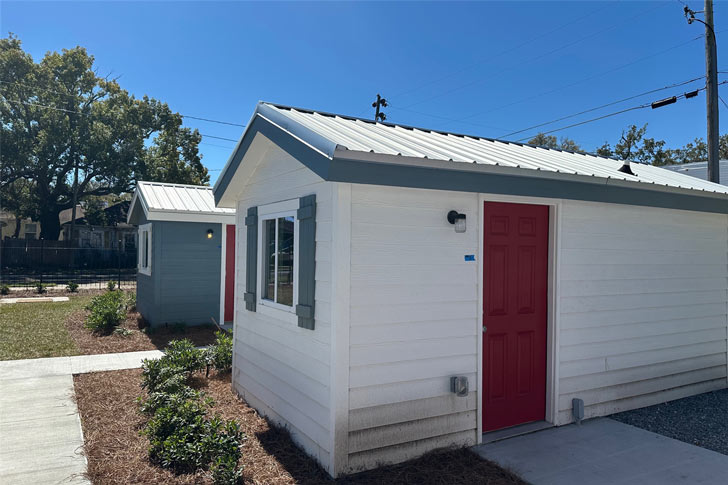
It all started a few years ago when Megan Hostler, the president and CEO of the Nine Line Foundation, connected with Rolling Meadows High School teacher Dave Wietrzak.
Down the road, Wietzrack and teachers from Buffalo Grove High School embarked on a 20-home project with their Geometry Through Construction students.
“The kids got so into it, and it turned into a great civics lesson,” Hostler told The Daily Herald. “I would send information about the foundation and the veterans we’re helping, and Jimmy (Miks, a John Hersey High School English teacher) and Dave can turn anything into a learning lesson.”
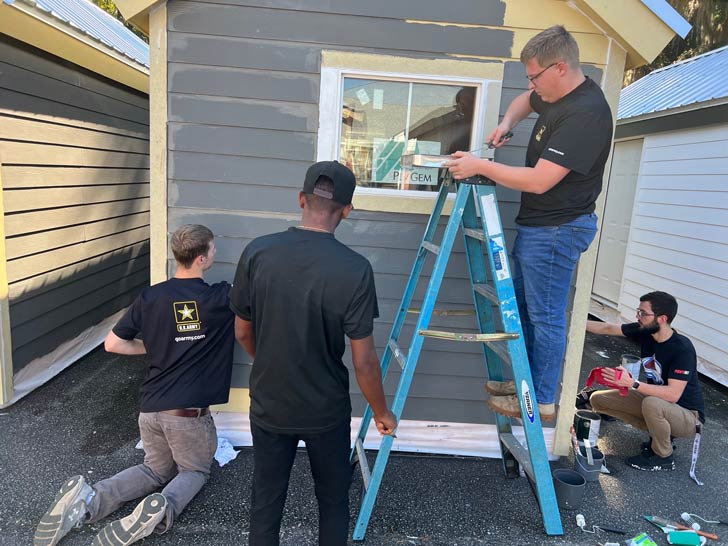
The District 214 students even raised funds to help pay to send the tiny homes on their 1,052-mile trip to Georgia.
Prior to the COVID-19 pandemic, the project was well underway but was put on hold until 2022, when students built an additional 10 tiny houses — along with an even bigger challenge.
They also set out to build the 30-by-60-foot community center that is central to the veterans’ neighborhood. The space allows residents to gather and socialize, as well as participate in counseling and therapy sessions, take continuing education courses, and receive support services.
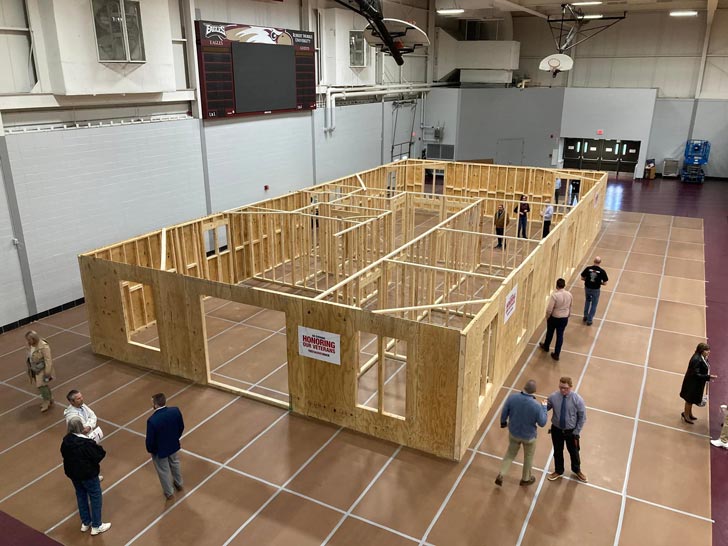
With help from a volunteer veteran construction manager and a pro architect, the students and teachers built the community center in just two days as a capstone project for students in a Construction Management and Building Trades career pathway.
After successfully completing the build, it was disassembled and shipped off to become a part of the Golden Isles Veteran Village states away.
“At first, the students’ attitude is ‘Oh, we’re just building stuff.’ But then they realize they’re not just building things; they’re changing lives,” Sean Murrin, a Buffalo Grove High School teacher, told The Daily Herald.
“That’s what I love most about this.”
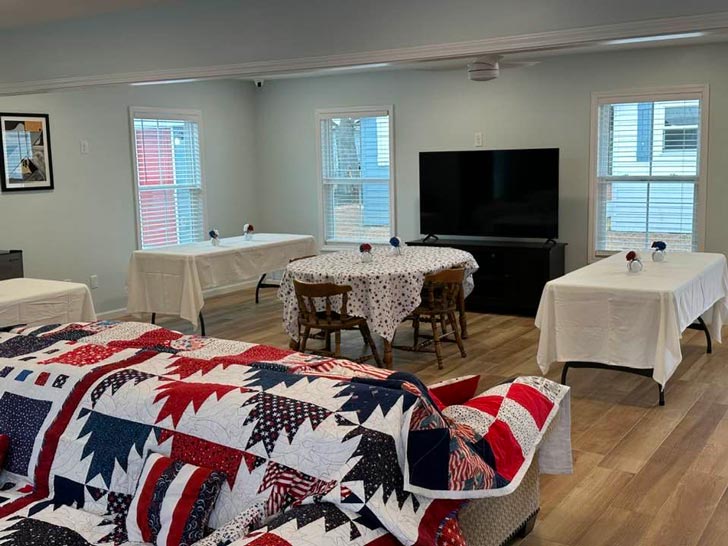
While none of the students or teachers who built the structures were present for the village’s grand opening ceremony in March of this year, Hostler said their legacy will leave a lasting impression on the community.
Fundraising paver bricks will be installed on the site’s memorial area and will recognize each participating school district, as well as the participating teachers. A handcrafted wooden American flag made by Seth Hettle of Prospect High School will also be on display.
All of the details that went into the property are part of what Hostler hopes will lead to success.
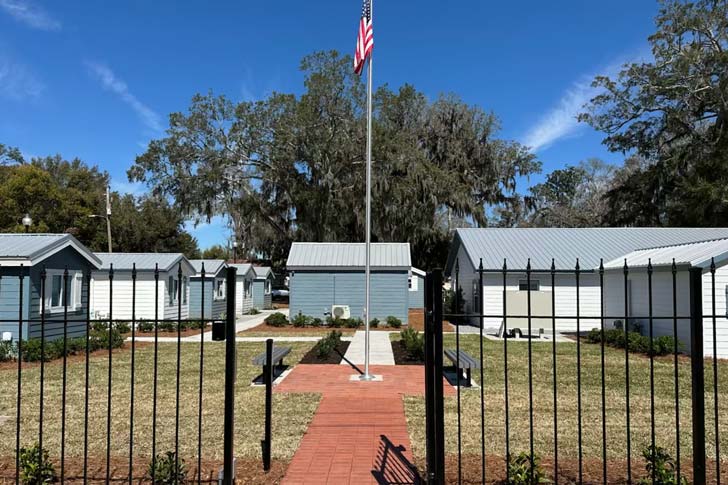
“It is a matter of reaching out and providing a hand up, not a hand out,” she said.
The Nine Line Foundation website echoes these sentiments: “By addressing the needs of the veterans, this transitional housing program, combined with the educational and job training opportunities made available … it will help them transition from the battlefield, out of homelessness, and on to a brighter future.”
Header image courtesy of Nine Line Foundation