A new study from Case Western Reserve University, a nonprofit research university in Ohio, is shedding light on a leading cause of homelessness in America.
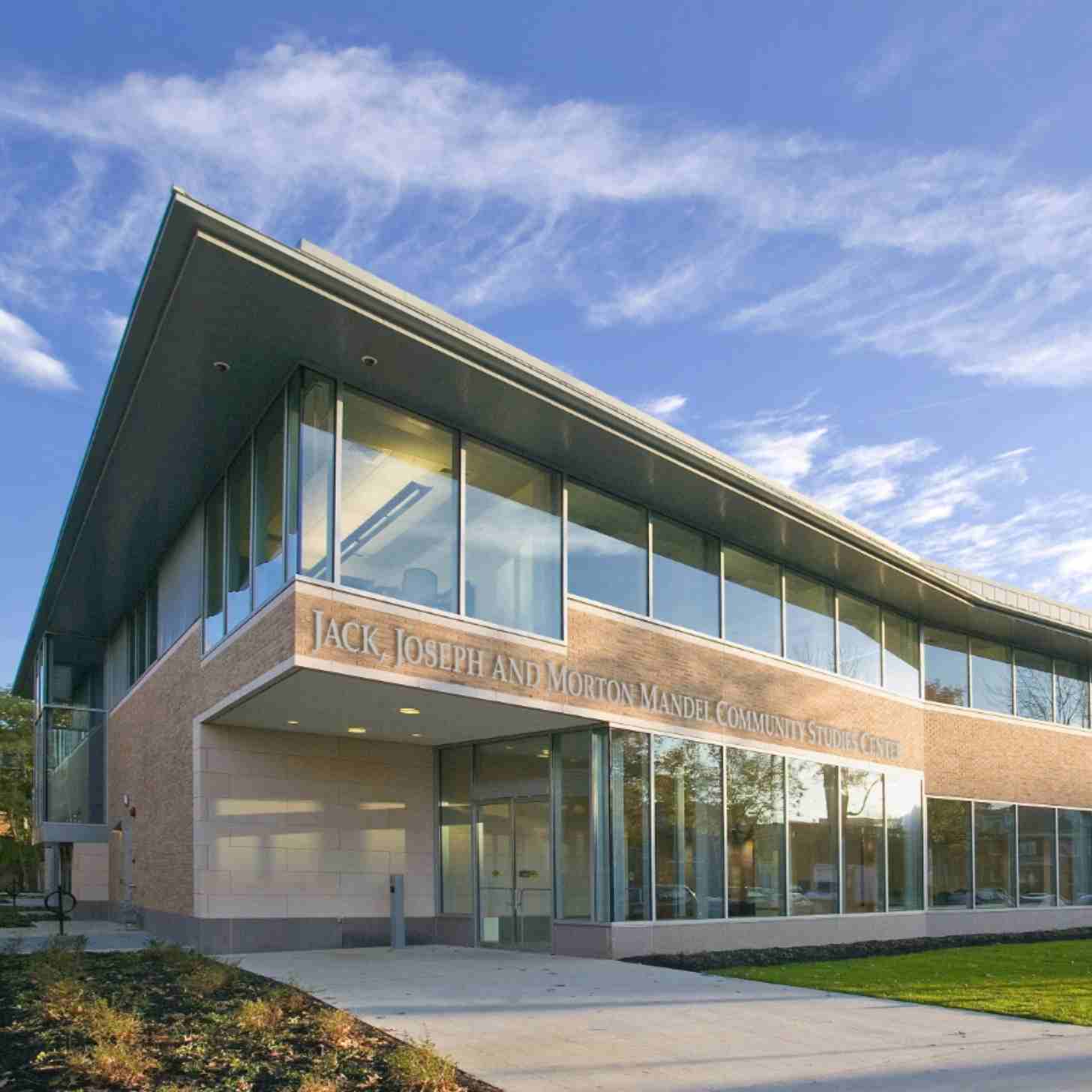
Meagan Ray-Novak — a research assistant at the Jack, Joseph, and Morton Mandel School's Center on Poverty and Community Development — led the research by conducting 40 extensive interviews with people in her community experiencing homelessness.
She says the study challenges outdated assumptions about homelessness.
“We were asking people very broadly what life was like before they became homeless, and what we found is that the majority of the population had actually experienced some type of loss,” Ray-Novak told News 5 Cleveland — a local ABC News outlet.
“Some kind of death, divorce, separation, and caretaking responsibilities that had significantly impacted their ability to stay in their home.”
Ray-Novak went on to explain that the study didn’t just show that grief was a unifying theme for people who were chronically homeless (living unhoused for more than 12 months at a time).
The study also uncovered how major trauma like this often comes at the cost of someone’s personal care.
More specifically, the death of an immediate family member or friend was often precipitated by the individual compromising their own wellbeing and livelihood to help a loved one.
“Folks are giving up their living arrangements,” Ray-Novak said plainly. “They’re either quitting their jobs or losing their jobs to take care of a family member, and that’s a loving thing to do, it’s a positive thing to do, but then recovering from that afterward is really complicated in ways that we didn’t expect at all.”
And these issues are only exacerbated by rising drug prices, high healthcare costs, and barriers to affordable assisted living facilities.
“[The data] tells us that folks make decisions based upon their relationships,” Ray-Novak said. “But it also tells us that the system isn’t supporting families in taking care of each other and keeping people out of hospice care or keeping them at home.”
According to the study, 35% of participants said the death of a parent, spouse or partner precipitated their homelessness.
And over 50% said “relational breakdowns,” like separation, divorce, and death, contributed to their “housing instability.”
When Ray-Novak asked participants if they regretted risking their stability to care for a loved one, not a single one responded “yes.”
“They all said, ‘No. My mom needed me. They were going to put her in hospice. No way was that going to happen,’” The doctoral candidate said.
“That's amazing so I think we should celebrate that…This story is really about love and caretaking.”
50-year-old Eugene Sopher knows that reality all too well. After his mother had a stroke, he moved in with her immediately.
“It’s my mother,” he told News 5 Cleveland. “The person that gave me life, that's the person above God.”
But soon after he moved in to help take care of her, he was crushed under the weight of both of their bills. He lost his home right before she passed away.
“Imagine you have nobody,” he said. “When I lost my mother, that's how I felt.”
At first, Sopher stayed with friends and family. Eventually, he felt he had overstayed his welcome and began living in his truck. His days were spent in a seemingly endless cycle of sleeping in his car, using a gym membership to shower, and searching for work.
For years, Sopher experienced homelessness through these stages: sleep, shower, search.
Then he began drawing. In his artwork, he worked through his grief and his struggles with bipolar disorder and depression.
Eventually, people started taking notice, and “everything just lined up” for him.
And in 2022, after finding housing, he displayed his work at the Chagrin Falls art exhibit.
“Like the phoenix, I’m rising from the ashes, and I’m shining,” he said.
Although Sopher found help, and motivation, through his creative outlet, most people need outside assistance.
Fortunately, more and more nonprofits (like Abode, St. Vincent de Paul Society, Gateway Rescue Mission, Coalition for the Homeless) are combining community outreach for the homeless with free counseling — to give people a space to process their grief and move forward.
At the Salvation Army of Milwaukee, Laurie is one of many onsite mental health professionals that helps unhoused people get back on their feet. She says that their emergency clinic continues to offer free counseling even after clients have transitioned to permanent housing.
“Having services like this available to folks here at the shelter enables those who use it to have more positive outcomes – improved relationships with family and others, and skills that enable them to break the cycle of homelessness,” Laurie shared.
She said: “It’s through that that people are able to receive a sense of hope.”
Header image via the Center on Poverty and Community Development
In recent decades, wind energy has surged across the globe. But most wind turbines have a life span of about 20 years, meaning the massive infrastructure boom of wind energy is now generating some waste.
The good news? Innovative professionals are finding ways to recycle decommissioned wind turbines — and the newest case study might even help you “hang ten.”
ACCIONA, a global renewable energy company, has partnered with professional surfer Josh Kerr, and his surfboard brand, Draft Surf, to create the world’s first surfboards made from decommissioned wind turbine blades.
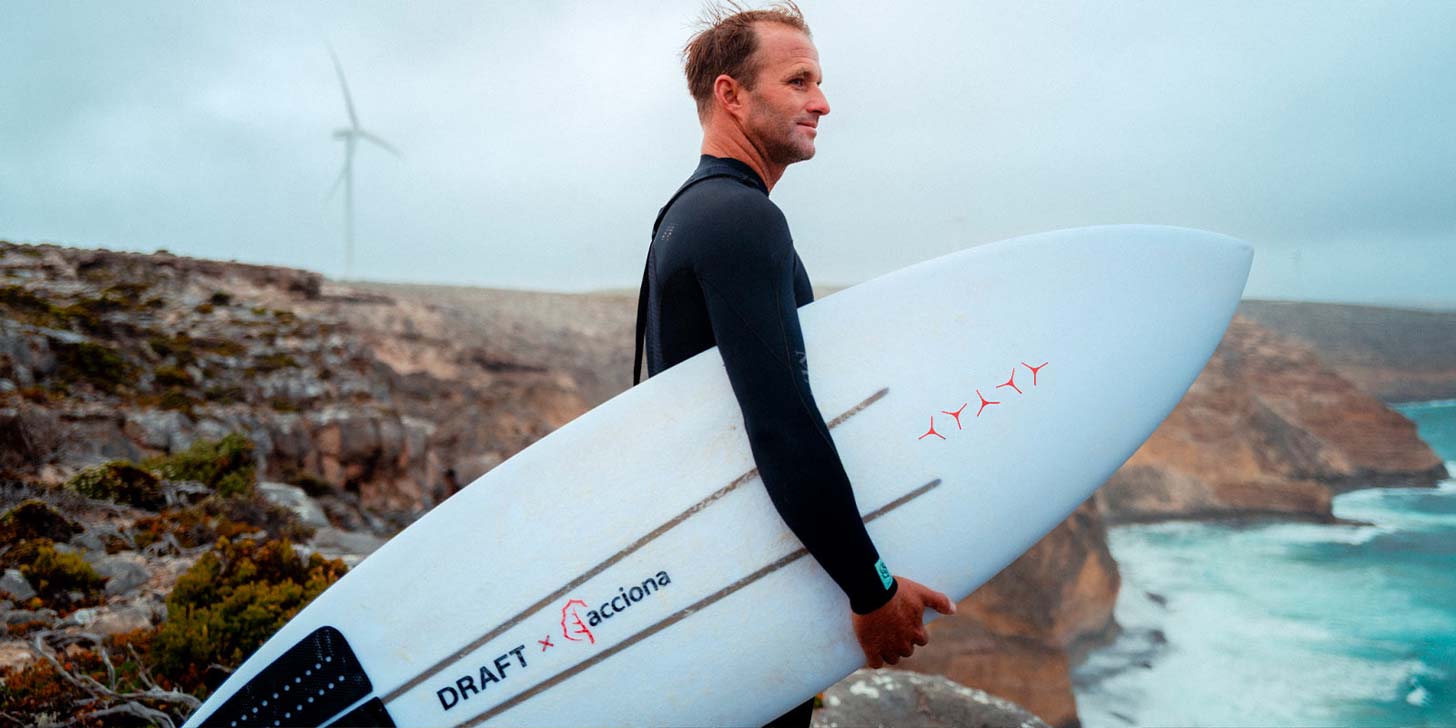
“We know that in the next 10 to 15 years, countries like Australia will have a large volume of decommissioned wind turbine blades, so we’re acting now to explore new ways to recycle and reuse the material they are built from,” ACCIONA’s global sustainability director Mariola Domenech said in a statement.
The surfboard prototype is created from a decommissioned blade from the company’s Waubra wind farm in Victoria, Australia. It features repurposed turbine blade stripes built into the deck of the surfboard “for strength and flex control.”
The fins of the board are made from recycled fiberglass and reportedly “provide stability, drive, and speed.” Lastly, the outer shell of the board incorporates recycled turbine blade particulates into the fiberglassing process.
Ten prototype boards have been made as part of ACCIONA’s “Turbine Made” initiative, which is Australia’s first program to explore innovative ways to transform retired turbine blades into new products.

Most elements that make up wind turbines are recyclable, Domenech explained in a video for the new boards. However, some composite materials in the blades are difficult to recycle; this is the material that was layered into the deck and fins of Kerr’s 10 surfboards.
“The creation of a surfboard prototype, developed locally, is an example of how we're reimagining the materials from decommissioned turbine blades and pushing the envelope of innovation when it comes to the circular economy,” Domenech added.
In the past, ACCIONA has used decommissioned blades to create sneaker soles. The company has also integrated recycled blade materials into solar trackers at a solar plant in Spain. Next, ACCIONA is developing a blade recycling plant in Navarra, Spain, which is set to become operational in 2026.
ACCIONA estimates the new plant will create 100 jobs and have a processing capacity of 6,000 tons of material per year.
“Sustainability isn’t just about reducing waste — it’s about product stewardship, ensuring that what we build today doesn’t become tomorrow’s environmental challenge,” Domenech said.
For now, pro-surfer Kerr is simply excited for what the future holds when it comes to sustainable surfing.
“When ACCIONA approached us about being part of the solution and working together to create these surfboards, we jumped at the opportunity,” he said in a statement.
“At its core, our brand is about enabling the best surviving experience with quality products in a sustainable way — which aligns with ACCIONA’s vision for Turbine Made.”
As for how well the boards handle the waves?
“Far out,” Kerr said.
“That was not what I was expecting,” he added after trialing the prototype. “We definitely pushed some boards to their limits, and they held up beautifully, performed great, and wow, the waves were something special.”
Header image courtesy of ACCIONA
Students at Sedro-Woolley High School in Washington State are ditching the traditional woodshop projects for something a little more hands-on: Building tiny houses for their homeless neighbors.
Students in the school’s Core Plus Construction class have been building the homes from the ground up in a partnership with the Low Income Housing Institute in Seattle.
“We have four tiny homes this year,” instructor Daniel Caldwell said in a press release for the school district.

“These are continuing from last year and the previous year. LIHI works with Lowe’s, and they drop off the supplies to build all of the tiny houses. We order four at a time. They drop off all the materials, and the students build them. Once we’re finished, LIHI comes to pick them up and drop off more houses for us to build.”
LIHI is a homeless solutions nonprofit that has been building tiny house shelters since 2015, as a response to the homelessness crisis in Seattle and neighboring cities.
The student-assembled homes are placed in communities operated by LIHI, many of which are in the heart of Seattle. Individuals are then assigned to the temporary structures, with central facilities, like kitchen, bathrooms, and laundry services are available to share.

“Tiny houses offer tremendous benefits over tents – they are safe, weatherproof and lockable,” the organization shares on its website.
“[They] allow program participants to reclaim their dignity and get on a path to permanent housing, employment and connection to supportive services.”
But the benefits go beyond shelter.
The hands-on project is a game-changer for students, who get to learn practical construction and problem-solving skills, as well as invaluable safety awareness.

“Overall, I would say the best skills they’re learning are problem-solving and safety,” Caldwell said. “If some of them want to go into construction, this is a great first step, but even if they don’t, most people want to be able to work on their house, make improvements, handle tools safely, and feel more confident.”
One student, senior Kylin Chance has taken two years of welding and is one of two girls working on the home-building project.
“There’s always something to do, and it keeps me busy,” Chance said. “I’ve learned about different tools, like a hand plane and a handheld saw. They’re making me do a lot of the finishing work because I have a steadier hand.”
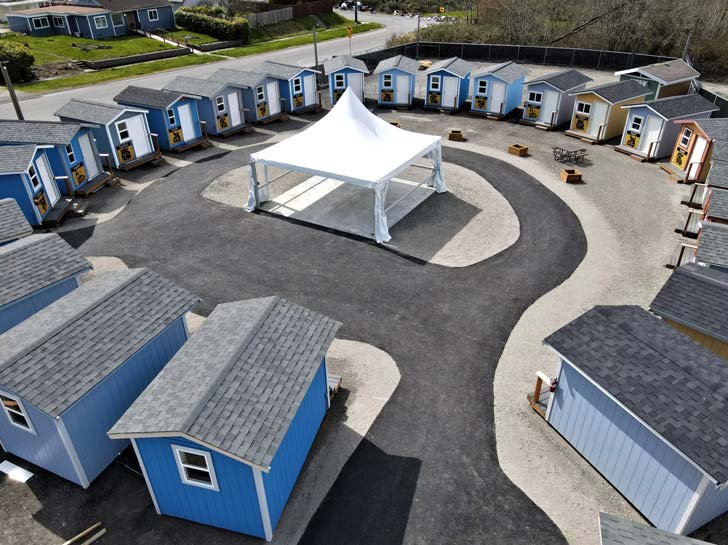
In total, 20 students in class work on the homes every day, building under the school’s stadium bleachers. The homes are painted in royal blue and white — Sedro-Woolley’s colors — to bring a little school pride into Seattle.
“(It’s rewarding when the students) realize they’re building something that’s going to someone in need,” Caldwell told GoSkagit.
Plus, it’s much cooler than math or history.
Chance added, “It’s fun to hang out with friends and learn how to build houses.”
Header image courtesy of Low Income Housing Institute
While most would prefer to be tucked into bed, sleeping in, at the crack of dawn on weekend mornings, the Montana Bar Fairies are out on the town doing their most important work.
The group of volunteers spends their Saturday and Sunday mornings patrolling the parking lots of local bars in Montana’s Flathead Valley, searching for cars left overnight.
Their goal? To reward people who have chosen not to drive home under the influence.

When they spot a car from the previous night, they discreetly leave a card and a gift card to a local coffee shop as a token of appreciation. The funding for these cards comes entirely from their own pockets.
And the mission comes straight from their hearts, as a tribute to their loved one: Bobby Dewbre, who died in March 2023, after being struck by a drunk driver. He was on his way home from celebrating his 21st birthday, just about to graduate college.
“No one goes out thinking, Oh, I'm gonna go drink tonight. I'm gonna kill someone. You know, but that's what happens,” Beth McBride, Bobby’s mother, told KPAX News.
“The intense pain that comes when you lose your child — I don't want anybody else to feel that.”

Along with the gift cards is a photo of Bobby — or another victim of drunk driving — accompanied by the story of how they died.
The organization was created just over a year ago, and (with the exception of some weather delays), Bobby’s family, including his mother, sister Carli Dewbre, and volunteers who have also lost a loved one from drunk driving, have made their rounds every single weekend since.

“It feels good to channel that anger and sadness and angst into something productive rather than just contributing to the ugliness that already exists in the world,” Dewbre told KPAX News.
Dewbre is not the only one who feels those emotions.
There are many in Montana who have lost a loved one to drunk driving. The state ranks as the worst in the nation for drunk driving, with 8.57 drunk drivers involved in fatal crashes for every 100,000 licensed drivers.
On TikTok, Dewbre also shared that the organization is open to starting chapters in other states, as well, with one already underway in Washington, started by someone who lost her sister to drunk driving.

Back home in Montana, the Bar Fairies have also been advocating for “common sense” legal reform — called “Bobby’s Law.”
The bill, which has made it to the Montana statehouse, seeks to recognize a driver’s high blood alcohol concentration in fatal accidents as inherent gross negligence. Under current law, a high blood alcohol concentration is not considered criminally negligent.

“Everybody in this room and those listening at home should know by now that Montana has one of the most lax DUI laws in the country,” the bill’s sponsor, state Rep. Braxton Mitchell, told NBC Montana earlier this year.
“It’s time we step up to the plate and pass a bill like this to prevent these preventable tragedies in the future. This should not be a partisan issue.”
Between statewide reform and the small act of thanking those who chose safety, Dewbre and her family know there is still more to be done.
@montanabarfairies #kalispell #bigfork #dontdrinkanddrive ♬ Everybody Wants To Rule The World X Electric Love - darcy stokes
On the organization’s website, they share that they hope to invest in education and school speaking, further collaboration on strengthening DUI laws, and connecting with families who have faced similar tragedies.
“Together, we can create lasting change and save lives,” the Bar Fairies website reads. “We believe in turning tragedy into hope.”
Header image courtesy of Montana Bar Fairies/Instagram
A nonprofit in Mississippi is using board games and role-playing games to raise awareness about what it’s actually like to experience homelessness.
Brandi Herrington — the executive director of community nonprofit Starkville Strong — worked with college students at Mississippi State to develop a “true to life” board game called “Housing Hustle.”
“When I did a presentation for the students about our organization, there was a big information gap on the struggles and the different variables that lead to homelessness and being displaced,” Herrington told Good Good Good.
“After that conversation, we met throughout an entire semester. They developed a board game idea and we fleshed it out.”
In Housing Hustle, which is similar to The Game of Life, players encounter the good (a work bonus!) and bad (expensive car repairs) of daily living as they navigate the board.
“It's a board game in which you roll the dice, you move forward, and you pick up cards — some which are trivia about homelessness and some which are life events that affect your gameplay,” Herrington said.
To win Housing Hustle, players must race against the clock to find permanent housing.
“What we see happening is that, every single time, the winning player has a really large extendable income,” Herrington said. “And everyone else who's on living wage or minimum wage does not finish in time.”
First created in 2022, Housing Hustle is still a crucial educational resource for the nonprofit. Throughout the year, Starkville Strong regularly brings it out for their immersive “Homeless Experience” days.
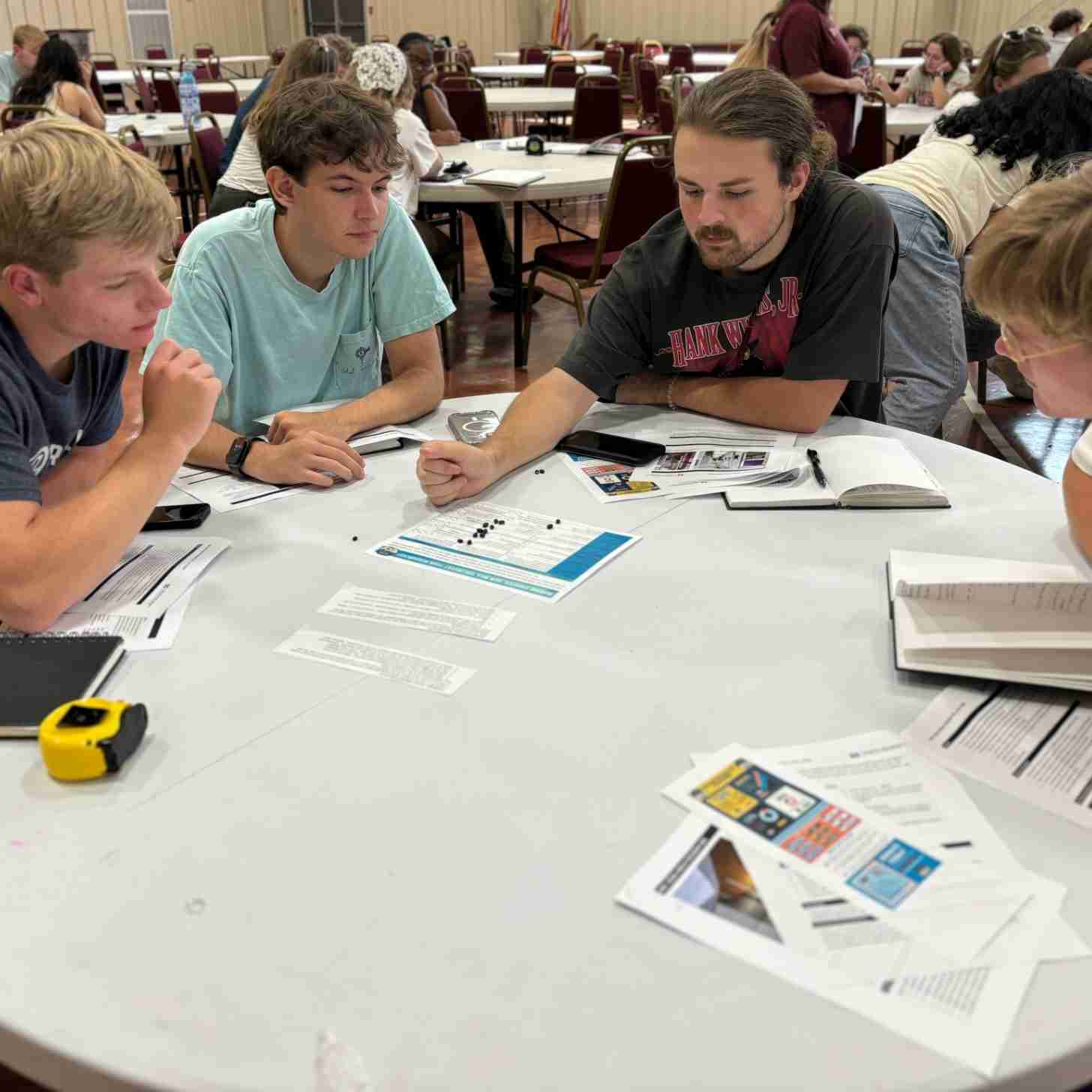
Another game that Starkville Strong hosts is the Homeless Experience Simulation, a role-playing game which challenges players to find a job and secure housing in a room that simulates a small town.
“We give participants personas and stories, and at the start of the simulation, they're homeless,” Herrington said. “There are tables set up around the room with different resources, like government assistance, and employment opportunities.”
Based on a player’s randomly assigned persona, they’re either given an ID or forced to start from scratch.
“The first whammy that most of our clients deal with is that in order to apply for federal assistance or local resources for a job, you have to have an ID — which costs money,” Herrington explained.
“If you don't have money, you have to get a job, but you can't have a job if you don't have the money to get the ID. It’s a cycle. It shows that the process of deciding not to be homeless anymore is not a decision that evokes immediate results.”
Herrington also told Good Good Good that the games — and personas — are meant to dispel common misconceptions about homelessness.
“People use words like ‘bootstraps’ and ‘pulling themselves up,’” Herrington said. “One of the first misconceptions is that homelessness is living in a box or in a tent. In rural areas, especially, and in Starkville, it's multiple families under one roof, living in an abandoned building. It's not seen as readily as someone living in a box in a tent city.”
Herrington went on to explain that the homeless population in Starkville, Mississippi is much more extensive than the “five or six” panhandlers locals see living on the streets.
“They think that's all the homelessness we have, but it's hidden. It's not seen,” she said. “And that, to them, means it doesn't exist. That’s why the homeless experience simulation matters.”
When it comes to expanding the reach of their games, Herrington would love to sit down with influential business leaders and expose them to the everyday realities of their unhoused neighbors.
“If we could get into a room with stakeholders, who have had money for so long, and get them to play this game or to do the homeless experience simulation, I think we could open up more minds,” Herrington said.
Header images via Starkville Strong / Brandi Herrington
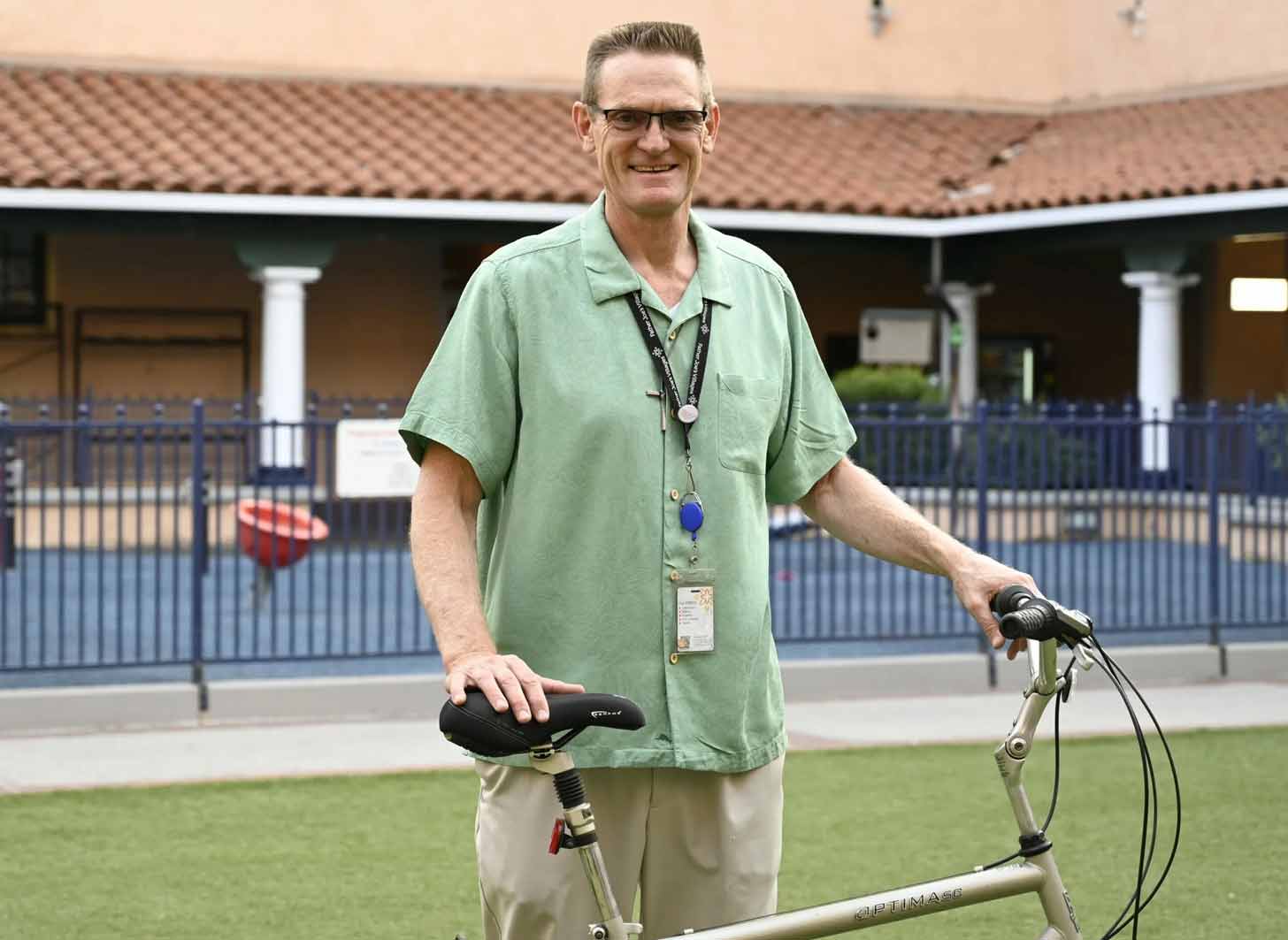
Every Thursday morning in downtown San Diego, Deacon John Roberts leads a cycling club through Father Joe’s Villages, a homeless shelter and nonprofit.
The program has been operational for the last 10 years, and Roberts credits it with helping unhoused community members improve their mental and physical health — while gaining crucial independence.
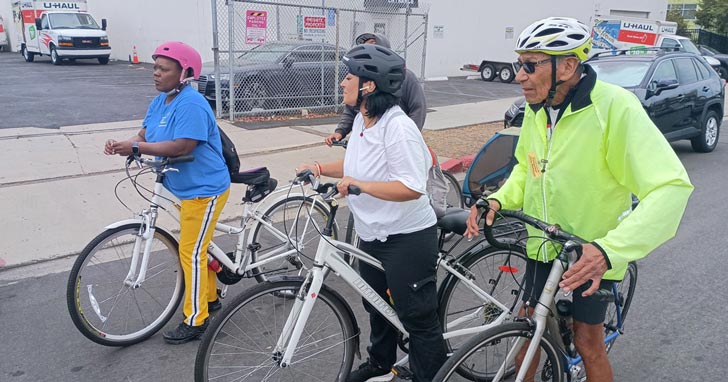
Once a week, riders embark on a 20-mile ride through San Diego. Participants don’t need a bike of their own, as cycles are donated through the nonprofit. When a rider completes their first 100 miles, they are gifted a new or gently used bike to keep.
If they continue to ride for 100 more miles, they get a one-month transit pass.
“With a bicycle and a transit pass one has all of San Diego County to explore,” Roberts told Good Good Good.
“For some, it allows them a wider job search area. For others, it allows them to explore all that San Diego has to offer, but for all it broadens their horizons and produces a boost in the health of mind, body, and spirit — and a new mobility.”
Since 2015, Roberts has led an estimated 250 individuals on rides. From 2015 to 2020, however, only about 40 participated, and they did not keep mileage records.
In 2020, Roberts began the ‘earn-a-bike’ incentive, and interest increased exponentially.
In the last five years, 220 individuals have ridden a combined total of 21,600 miles, Roberts added. And 76 of those participants have been awarded bicycles.
“When participants complete 100 miles with us, they are awarded their bike, a helmet, a lock, lights, and a saddlebag with some maintenance items,” he said.

Many have gone on to use the bike as a vital transportation resource — even if they were novices.
“One time after we had ridden a couple of miles through the city, a lady almost careened into a pole. When I asked what happened, she said she didn't know how much she could turn the bike without falling over,” Roberts said.
“After a little more inquiry, I learned that she had never ridden a bicycle before. She loved riding! She went on to earn her bike in short order, got a job, and moved on.”
Roberts said confidence is often the hardest resource for the participants to find.

“Many people are excited by the prospect of going for a bike ride, and even more so by the possibility of earning their bike,” Roberts said, “but they are not confident in their ability to complete a 20-mile ride.”
As is usually the case, however, he said folks are often elated to have completed the challenge when the ride is over.
“For most, their enthusiasm only grows with increased participation,” Roberts added. “For those who don't continue, it is more likely a change of circumstance that prevents them from continuing than a lack of desire.”
In addition to the cycling itself, folks in the program also learn about bicycle safety and how to maintain their bikes.

Through partnerships with the San Diego County Bike Coalition and Rebike San Diego, the group offers free bicycle maintenance workshops and some small repairs. The group has also partnered with the Paydak Racing Team to encourage participation in the sport of cycling overall.
“Together we encourage the development of all riders and especially the young and underserved populations,” Roberts said. “They support our operation by providing volunteers to lead rides, repair bikes, and provide cycling safety and maintenance classes.”
After a decade of this work, one thing is clear: The community is what propels Roberts — and his unhoused riding club — forward.
“Every day we ride is a good and joyful day,” he said, “and makes for a good memory.”
Header image courtesy of Rebike San Diego
When Anotiona Kolb was growing up in New Canaan, Connecticut, she knew that ticks were no joke.
In 2024, the Connecticut Agricultural Experiment Station reported that 4,000 ticks had been submitted from across the state — and 26% of them tested positive for Lyme disease.
The CDC also estimates that approximately 476,000 Americans are diagnosed and treated for Lyme disease each year, and that doesn’t account for the 20 additional infections that ticks can carry.
Kolb grew up paranoid of the parasites, checking herself for them any time she walked through forests and tall grasses.
Then she got sick.
After a year of fainting spells and constant dizziness, Kolb was misdiagnosed several times before tests confirmed what she already feared — she had Babesia and Bartonella, two rare and potentially life-threatening tick-borne illnesses.
Then in her 11th year of high school — at the King School in Stamford, Connecticut — Kolb’s personal story drove her to create a new invention: a free tick-scanning app called DETICKT IT.
The app analyzes user-submitted photos of ticks and generates a comprehensive risk assessment of the most prevalent tick-borne diseases in their region.
By using geographic location, and embedding the app with the Centers for Disease Control and Prevention’s spatiotemporal tick and pathogen surveillance statistics, Kolb was able to reduce the margin of error and provide users with the best information available.
While developing her app at the King School, Kolb sought mentorship from the school’s director of science research Victoria Schulman.
“I was thrilled she sought my opinion,” Schulman said in a press release from the King School. “I hope it's clear to Antonia and to other alums that I'm happy to continue supporting them…even after they have moved on from King.”
Today, Kolb is in her first year at Harvard University studying environmental science, engineering, and economics.
And in December 2024, Kolb became one of 34 U.S. winners honored with the Princess Diana Award for her work.

The award, which is named after the late Princess of Wales, is designed to uplift young people (aged 9 to 25) making a positive difference in the world.
“I know my mother, in whose memory you receive the Diana Award today, would be immensely proud of you,” Prince William wrote in a letter to Kolb. “I hope this award helps you to further champion your cause and support those around you.”
“Thank you for your dedication. You are extraordinary.”
Upon receiving the award, Kolb expressed her gratitude, saying, “It was an absolute honor to be named a 2024 Diana Award recipient among other talented and inspiring individuals.”
To date, DETICKT IT has over 3,000 downloads and has helped people access tick bites in real time and seek out crucial medical care.
Header image via Antonia Kolb / DETICKT IT
Every day the Good Good Good team collects the best good news in the world and shares it with our community. Here are the highlights for this week!
If you want to get good news in your inbox every day, join the Goodnewsletter — the free daily newsletter designed to leave you feeling hopeful.
The Best Positive News We’re Celebrating This Week —
Two years after a landmark deal, UN countries reached a hard-fought funding agreement to protect nature, ecosystems, and wildlife
Breaking a year-long deadlock in talks, nations just reached a funding agreement for the billions of dollars needed to protect critical ecosystems around the world.
A breakthrough enabling progress in a “very fragmented and conflicted world,” this new agreement comes two years after the initial landmark deal was reached to protect 30% of the world’s land and seas.
That “30% by 2030” deal was made to stop the rampant destruction of nature within the decade in order to protect the ecosystems and wildlife that humanity relies on for food, climate regulation, and economic prosperity.
Why is this good news? While a deal is great, it needed a real plan for achieving it to back it up — since one million species are threatened with extinction, unsustainable farming and overconsumption are destroying forests and depleting resources, and more. Experts say action is urgent — and this agreement gets the world closer to action.
Mardi Gras beads take up to 500 years to decompose, so LSU students designed a biodegradable alternative — and they turn into flowers
Los Angeles Public Library branches are providing free immigration resources to help residents
The New Americans Initiative is a longstanding, city-funded program at public libraries across Los Angeles, where anyone can meet with an immigration expert by phone or in person — completely free. The program helps people become legal permanent residents, apply for citizenship, renew green cards, and more.
Recently, given the current U.S. presidential administration’s attacks on immigrants and promise of mass deportations, demand for the free service has increased dramatically.
And it’s led the city council to take action to bolster programs like this in support of the city’s estimated 1.4 million residents who are foreign-born. The library is also planning more citizenship classes and workshops for those who may be impacted.
Why is this good news? The U.S. immigration system can be challenging and confusing to navigate, and accessing support can be equally hard to come by. Rather than leaving immigrants to figure it out on their own, programs like this help people navigate the legal system, become citizens, and not live in persistent fear.
They’re also another great reminder of how vital public libraries are to our communities.
Challenging public perception, a new study found that a large majority of homeless people in California are not illicit drug users
→ Read more
Electric vehicles made up 64% of all new cars sold in Denmark in January — up from 35% last year
Norway is leading the way among Scandinavian countries for electric vehicle sales — representing 96% of the new car market — thanks in large part to its strong EV policies. Those policies are being adopted by its neighbors and showing progress, too.
In 2024, similar policies and incentives led to electric vehicles making up 51.5% of all new car sales — up from 36.3% in 2023.
And that progress is already appearing to continue in 2025: 64% of new cars sold in January were electric vehicles. That’s up from 35% in January 2024.
→ Read more
A decommissioned wind turbine was transformed into an eco-friendly tiny home — its design is scalable to ‘2,000 houses a year’
Solar and battery storage are projected to lead new energy generating capacity in the U.S. this year
In 2025, the U.S. is expected to add 63 gigawatts of new utility-scale, electric-generating capacity. That represents nearly a 30% increase over 2024, which saw the largest capacity installation in a single year since 2002.
Solar and battery storage account for 81% of those total capacity additions — with solar alone representing more than half of the increase.
Last year, a record 30 GW of utility-scale solar was added to the U.S. grid, making up 61% of capacity additions — and that trend is expected to continue this year, with 32.5 GW slated to be added. Texas and California account for almost half of that, while Indiana, Arizona, Michigan, Florida, and New York will add more than 1 GW each.
For the first time, a river in England has been granted legal rights as a living entity
Two years ago, a district council in England decided to give the River Ouse legal rights — and now, thanks to a newly established charter, it officially has them.
Officially recognized as a living entity, the Universal Declaration of River Rights gives the waterway eight rights, including the right to flow, to be pollution-free, to have native biodiversity, and to undergo regeneration and restoration.
The River Ouse is “an essential part of the region’s ecosystem and cultural heritage,” and this sets an important precedent for enacting similar protections for other rivers, too.
Why is this good news? Currently, the river faces challenges like pollution, climate change, overuse, and development — with this legal recognition, the river’s “voice” will be represented in decisions that impact it. While the first in England, the River Ouse joins a growing movement of regions giving legal rights to nature.
Featuring a 56-panel ‘solar skin,’ a net-zero tiny home in Japan generates almost double the energy it uses
→ Read more
NFL star Travis Kelce transformed a $3.3 million mansion into transitional housing for homeless youth
Earlier this year, NFL star Travis Kelce purchased a $3.3 million mansion in Kansas City — it’s not for himself, though. Kelce transformed it into transitional housing for homeless youth.
And now, the Kansas City Chiefs tight end has officially donated the house to Foster Love, a nonprofit organization that supports children and young adults navigating the foster care system.
Kelce’s donation will specifically help young people who are unable to secure permanent housing during the “transitional ages” of 18 to 24 — a uniquely challenging time for those who grew up in foster care.
Foster Love said that Kelce also took a multi-pronged approach to his donation, by bundling free housing with mentorship opportunities and educational resources to “give these youth the tools they need to move toward independence” and “break the cycle of homelessness.”
Virginia lawmakers unanimously passed a bill to educate the public about common menstrual disorders like endometriosis and PCOS
Menstruation-related disorders or conditions like endometriosis and polycystic ovary syndrome are often painful conditions that result in irregular periods, infertility issues, depression, and more.
Around six to 13% of women around the world have PCOS, and more than half of those with the condition remain undiagnosed. Approximately 10% of women globally have endometriosis.
This new bill, which passed unanimously by lawmakers, will educate the public about these menstrual disorders by establishing a women’s menstrual health program that will direct the state’s health department to educate and train hospital staff and providers on the disorders.
Why is this good news? A lack of education, research, and understanding about menstrual disorders leads to late diagnoses — or none at all — that could save a person “years of pain and agony” if they had known earlier. This dedicated initiative will close those knowledge gaps — for those impacted and for healthcare providers.
→ Read more
A pro surfer partnered with a renewable energy company to recycle decommissioned wind turbine blades into surfboards
More good news of the week —
More than 100,000 African seeds were stored in a vault in Norway to preserve crop diversity in case of disaster. Among them are seeds critical to building climate resilience, such as the tree Faidherbia albida, which turns nitrogen into ammonia and nitrates, and Cordia africana, the Sudan teak, a tree renowned for its strength and durability.
The University of Sussex is launching the U.K.’s first climate justice undergraduate degree. Created in response to a survey that found most 14- to 18-year-olds want more rigorous climate change education, the course will equip students with a blend of expertise in climate politics, activism, and environmental human rights.
A culinary program gives transgender people in Pakistan professional training, dignity, and hope. Last year, the majority of trans people in Pakistan reported experiencing violence or abuse, and that most reported being denied employment opportunities because of their gender identity.
Small, submersible drones are being used to protect and attract sea life to artificial reefs. The drones can stay underwater for up to a month, providing continuous data and alerting scientists to any disturbance in protected waters from illegal fishing and encroaching boats.
Researchers in Austria are transforming textile waste into stronger recycled paper for packaging materials. Austria alone produced about 220,000 tons of textile waste annually, and about 80% is incinerated — a team of researchers created a sustainable solution for this valuable, would-be wasted raw material.
Researchers in the U.S. are organizing nationwide ‘Stand Up for Science’ rallies to protest attacks on scientists. In his first weeks back in office, the Trump administration has fired thousands of employees, attempted to freeze research disbursements, proposed new policies that would reduce science funding, and more.
New computer modeling shows that a disastrous Atlantic current shutdown is unlikely this century. A climate change-triggered shutdown of AMOC could wreak havoc with global rain patterns, dramatically cool Europe while warming the rest of the world, and raise sea levels on America’s East Coast — a disaster scenario fictionalized in the movie “The Day After Tomorrow.”
Farmers in the U.S. are suing the USDA for removing climate data, which they depend on to grow food, from its website. One tool that was removed allowed farmers to assess their risk level was an interactive map published by the U.S. Forest Service, which combined over 140 different datasets and allowed land managers to see how climate change is expected to impact natural resources throughout the country.
The Minnesota House rejected a bill that would have banned transgender athletes from competing on girls’ sports teams. The Minnesota High School League has allowed students to participate on teams that best align with their gender identity for 10 years, and opponents of the bill said it would discriminate against trans women and girls and has major enforcement issues.
A Denver barbershop is helping formerly incarcerated people make a career — and meet their neighbors. R&R Head Labs is built around the idea of helping people regain and sustain their footing as they reintegrate into society, with an understanding of the requirements often placed on people recently released from prison.
New wind turbine blades in the U.K. will be painted black to help prevent bird deaths. While the country is committed to boosting clean energy sources, it’s also home to large populations of seabirds, and the new trial will build on studies that suggest black blades can reduce bird collisions by 70%.
Key initiatives in Mexico are working to strengthen paths to citizenship for trans migrants. Between 2012 and 2017, a study estimated that 11,400 asylum applications were filed by LGBTQ individuals, with nearly 4,000 of them seeking asylum due to fear of persecution based on their sexual orientation or gender identity.
A hockey star is about to break the NHL record for most goals scored — and he's using it to raise money for cancer research. Washington Capitals captain Alex Ovechkin is just ten goals away from breaking Wayne Gretzky’s 894-goal record, and is donating an amount equal to each career total goal for each goal he scores until he breaks it — and encouraging others to donate, too.
Educators are rolling out a Black History curriculum across New York public schools and doing “everything we can” to protect it. The “Black Studies as the Study of the World,” a curriculum that rolled out in September and is available at all NY public schools, and is expected to test the lines of new bans on programs related to diversity and equity in schools.
Under new workers’ rights reforms, parents in Britain will be given the right to bereavement leave after a miscarriage. Impacting England, Wales, and Scotland, pregnant people and their partners will be given the right to two weeks of bereavement leave if they have suffered a pregnancy loss before 24 weeks’ gestation.
It’s no secret that interest in tiny homes is on the rise in the United States. As a solution to homelessness and sustainable, affordable residential housing, demand for these compact living quarters reflects the need for more housing nationwide.
Enter BOXABL, a modular home company, which has debuted its latest model: the Baby Box.
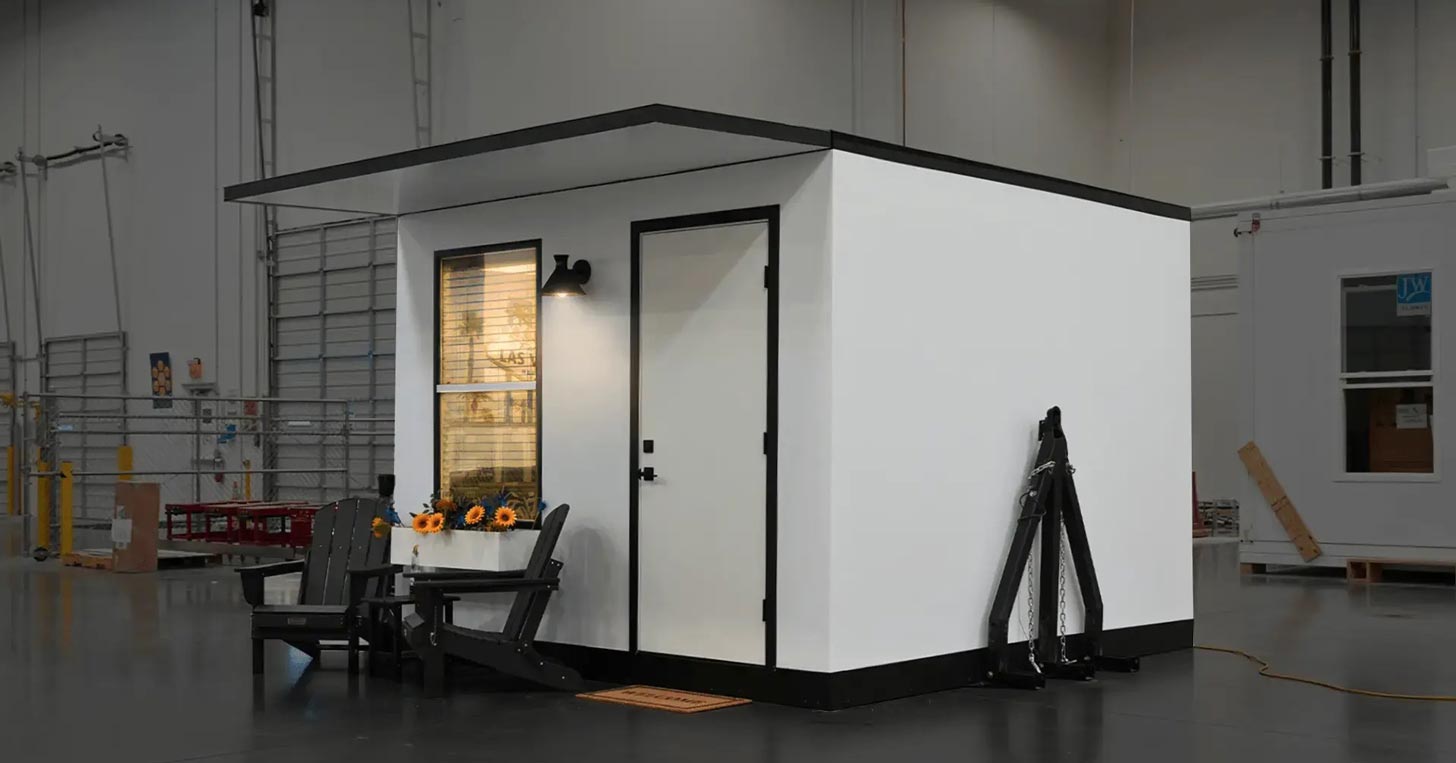
With a price tag currently set at $19,999, the Baby Box is considered a turn-key housing solution that claims to be foldable and so simple to construct that one person can set it up — without any help or tools — in just an hour.
The Baby Box is 120-square-feet in size and comes packed on a trailer. It weighs 2,900 pounds and has a 1,000-pound hitch weight, meaning it could be pulled by most SUVs or trucks, just like a traditional RV.
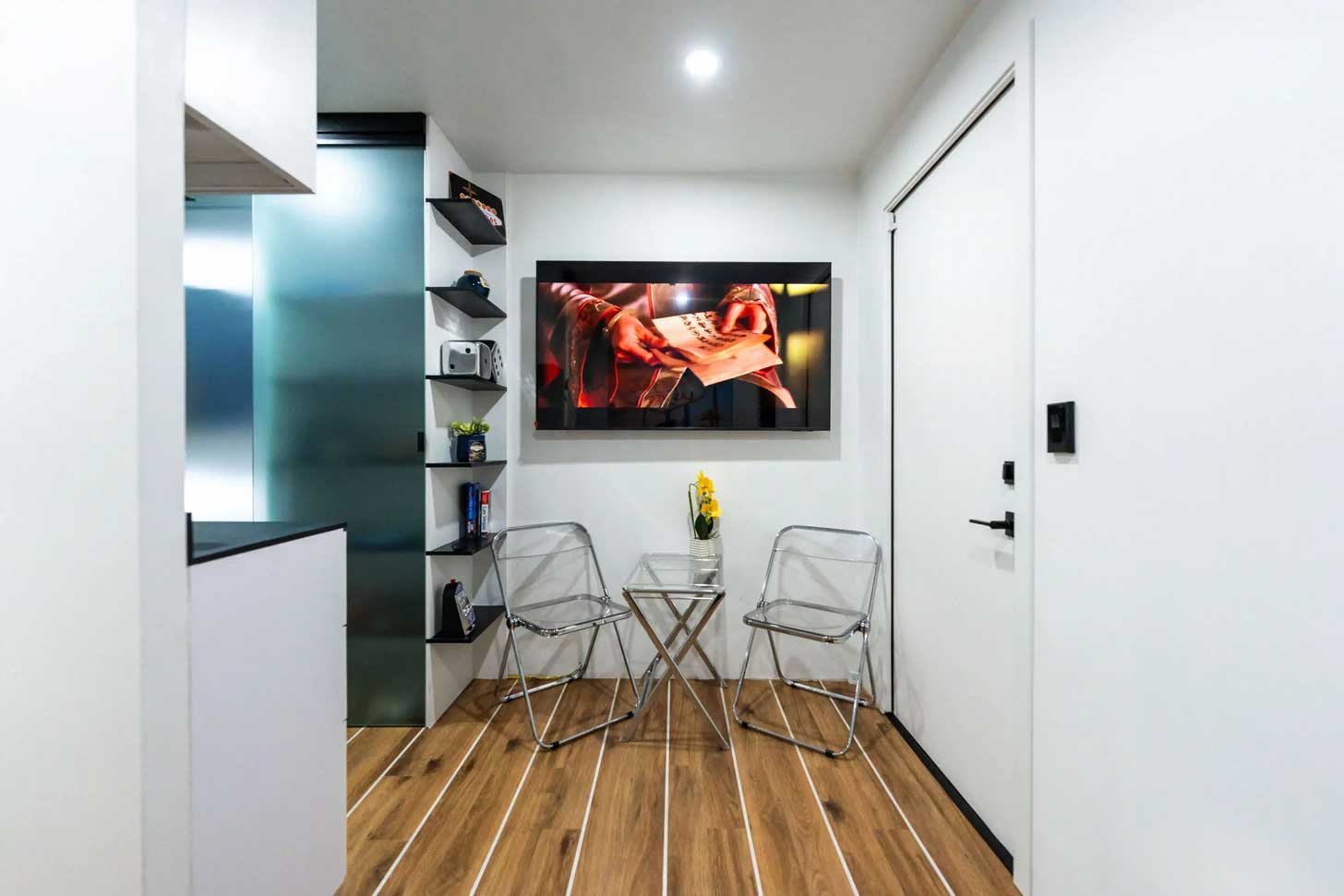
This ultra-tiny home offers a climate-controlled living space, with an air conditioner and heat pump; smoke and CO2 detectors; and a fire extinguisher. The Baby Box is also solar-compatible and can be run off of a 4.5-kW generator.
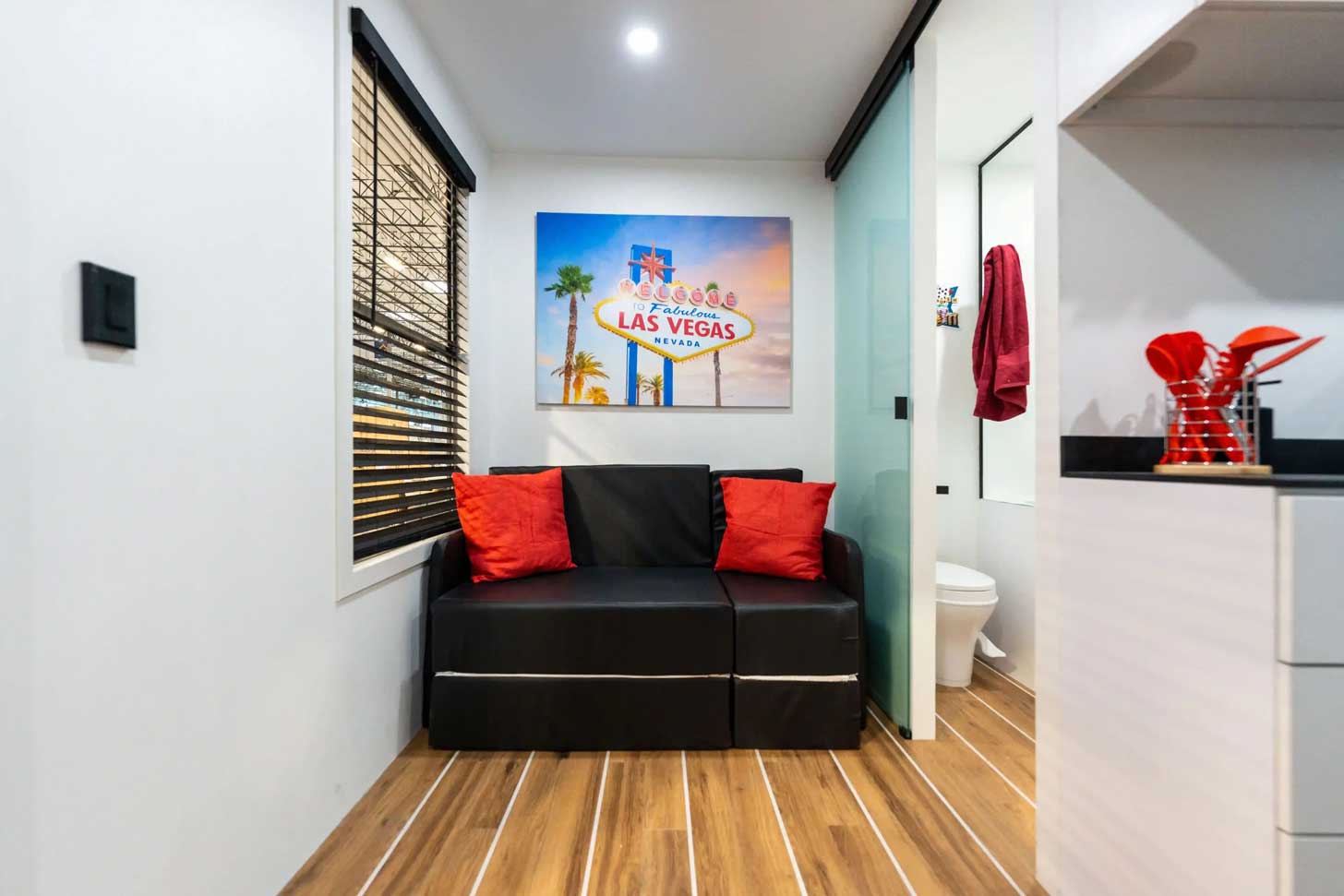
It also includes an in-house designed “SLS,” or “Sit, Lounge, Sleep,” sofa, a countertop induction stove, small refrigerator, USB outlets, a foot-operated flush toilet, and a glass shower.
Similar to an RV, the home has everything one might need to thrive — just on a small scale.
“When we began our initial research and development in 2017, we asked ourselves why housing wasn’t being mass-produced at a factory like almost every other major product category in the world,” BOXABL shares on its website.
“We’ve been able to create a platform that allows for modular, prefabricated homes that are produced at scale in a factory and can fold up for transportation to the final installation location … [which] has the potential to bring high quality, affordable homes to the mass market in ways that have never been done before.”

While the Baby Box can be a great fit for travelers or off-grid, modular living, it also offers an affordable housing option as an accessory dwelling unit, or ADU.
ADUs are becoming more commonplace in the fight to expand affordable housing in major cities across the country. They allow for development on existing properties, which helps bolster sustainable urban density and provide housing to low-income individuals who may not be able to afford property of their own.
In fact, BOXABL vendor, Pinnacle Construction, just secured its first residential construction permit in Santa Clary County, near San Jose, California.
The company will not be able to install its larger model, the BOXABL Casita, as ADUs in the county.
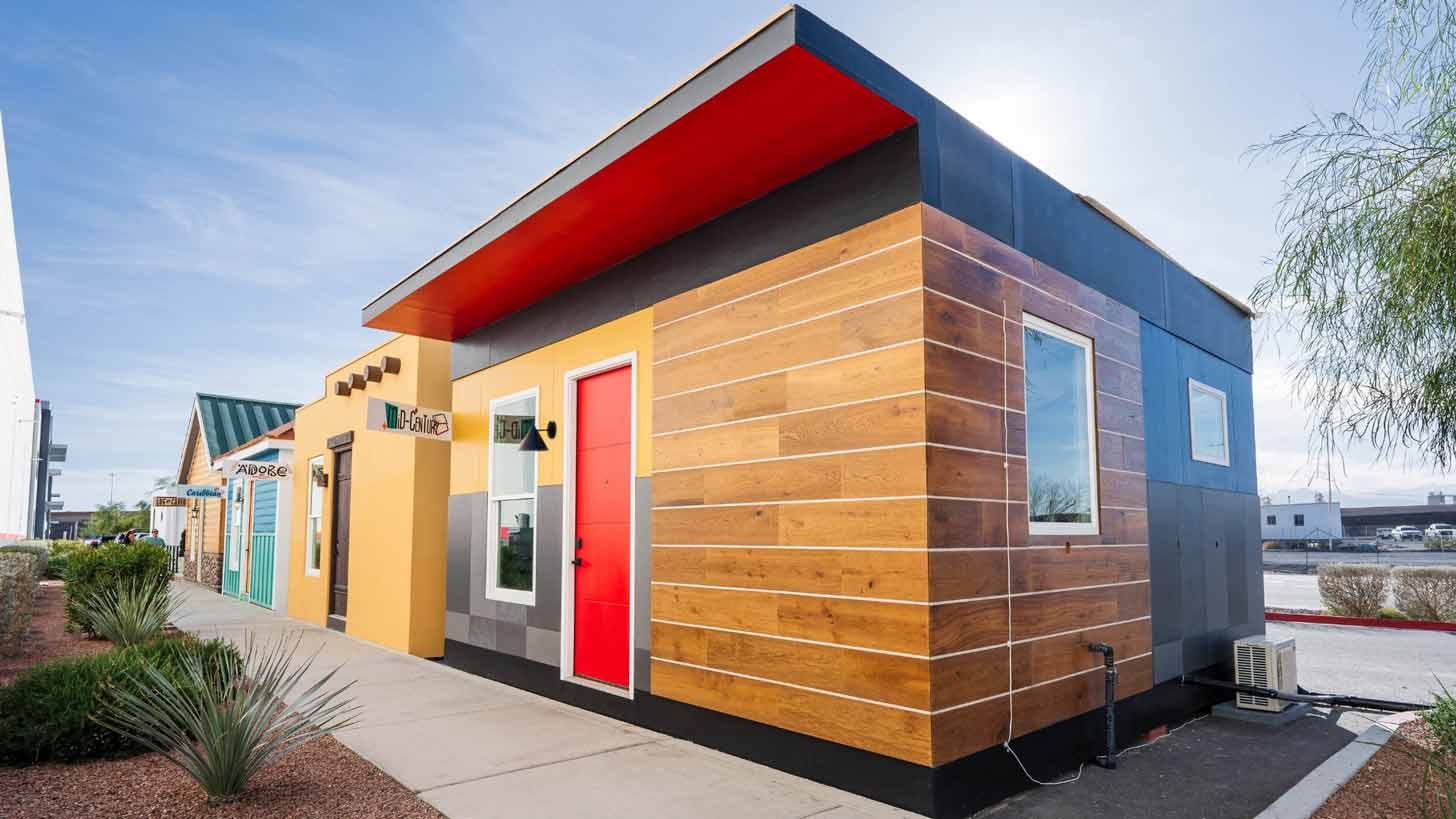
The Casita is a 361-square-foot tiny home that includes a kitchen, bathroom, and bedroom and can easily be utilized as a backyard home or “granny flat,” for homeowners to expand their living space or offer affordable housing to other members of their community.
“We’re proud to lead the way in bringing affordable, high-quality housing solutions to Santa Clara County,” Temo Corona, president of Pinnacle Construction, said in a statement.
“The BOXABL Casita is a game-changer, offering a fast, practical, and sustainable approach to meeting the growing demand for housing in our community.”
Santa Clara County is working to implement pre-approved plans for ADUs to help streamline construction and increase access to affordable housing.
While the BOXABL Casita is the first model from the company to gain construction permission from the county, the innovative nature of the Baby Box means it could soon lend itself to similar developments.

“The potential impact of our products will go way beyond just the individual consumer,” the company writes on its website.
“We believe … entities such as housing developments, governments, workforce housing projects, and tribes will be able to utilize our products to deploy their potential projects effectively, efficiently, and at scale.”
Header image courtesy of BOXABL
In 2019, Adam Colucci, Dan Spanovich, and Jesse Wig bought Bowtie High School for $100,000 in Homestead, Pennsylvania.
“We were thinking of turning it into a WeWork space, a concert hall, a beer garden. We had no shortage of ideas on what to do with the space,” Adam Colucci said in a feature for CNBC Make It.
“But after seeking consult and advice, we realized that residential is the best path forward for this building.”
Of the 31 units, 27 of them are one-bedroom apartments and four are two-bedrooms.
Colucci, Spanovich, and Wig (who are 36, 43, and 36 respectively) split the profits — and expenses — based on their proportional share within the project.
“A one-bedroom apartment rents for about $1,400 a month, and a two-bedroom rents for $1,600 a month,” Colucci said.
Before the building was sold to the friend group, it had sat vacant for nearly 10 years. The renovations, which caused nearly $3.3 million, took 18 months to complete.

The three — who are designers as well as investors — used their respective skills to gut, convert, and transform the classrooms into livable spaces.
Although they all had a hand in designing the layout of the apartments, Colucci largely focused on maintaining the historical nature of the building, from the 12-foot high ceilings to the original terrazzo floors.
“We worked closely with the National Park Services to ensure it kept its historical significance,” he said. “We went out of our way to ensure the school kept its historical look.”
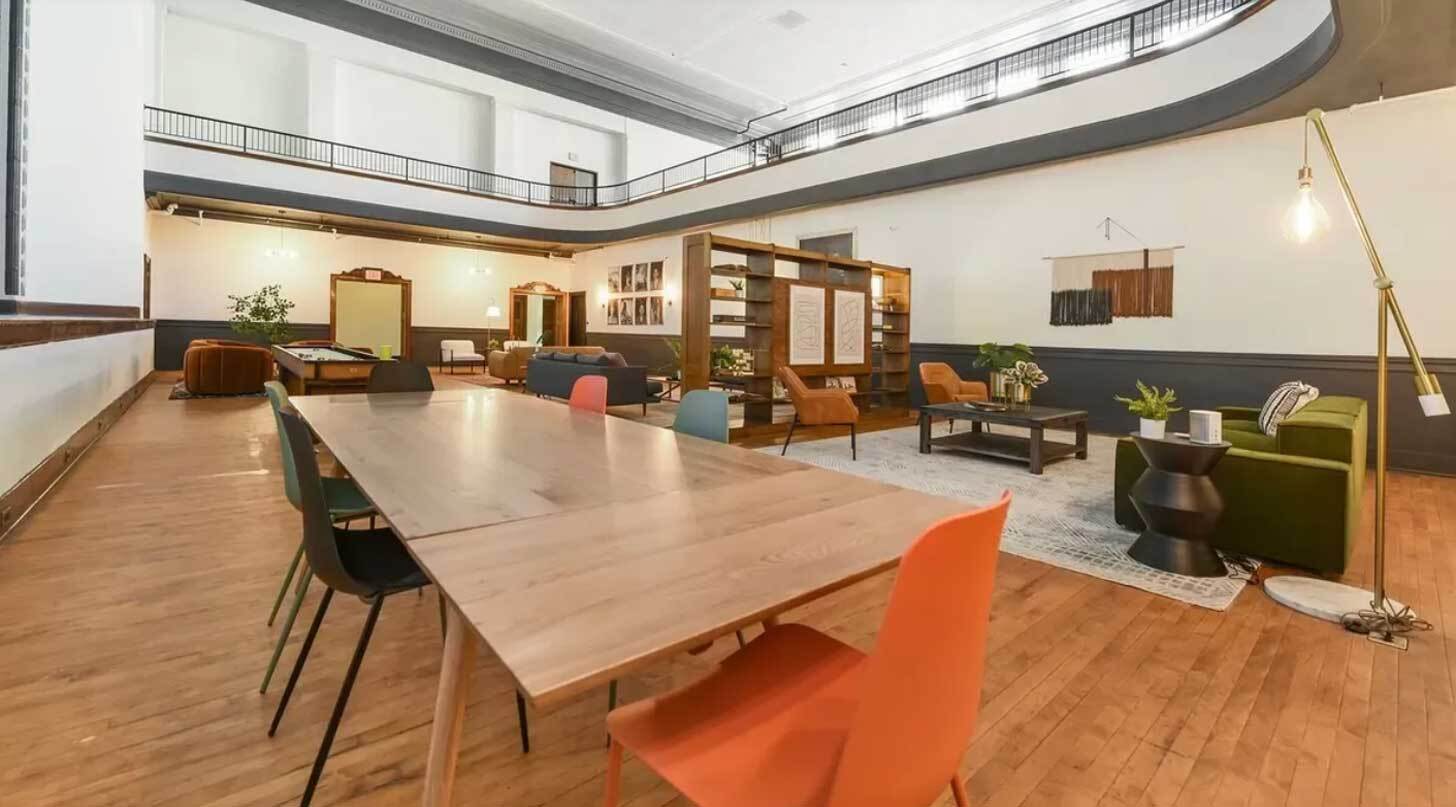
When it comes to the school’s auditorium — which serves as a common area for the building’s residents — Spanovich considers it to be “the most dramatic feature” of Bowtie High.

“We restored this space pretty much from ruin,” Spanovich said. “All of the plaster was failing, and we built that, kept all of the original flooring in the space, everything’s been professionally furnished.”
“This old bookshelf came from the space,” he added, as he leaned against the towering wooden shelf, “and we were able to incorporate that back into the auditorium.”

Down the hall from the auditorium is the gym: filled with free weights, treadmills, and cardio equipment.
Although they took out the gym’s bleachers and used the space to build storage units, the trio kept the original Bowtie High basketball court intact.
The building’s most radical transformations are in the apartments themselves, where the units have been converted into kitchens, bedrooms, and bathrooms.
But the apartments, too, have vestiges of the original school running through them.

In one apartment, Wig pointed out a chalkboard tucked behind a tenant’s couch, which was salvaged from a classroom.
After construction was complete and new tenants moved in, the trio invested the money made from the Bowtie building into the Schwab school — another abandoned school on the same street — which proved to be a much more challenging project.

“When we first entered the building, there were trees growing on the first floor and water had leaked down from the top floor,” Spanovich told CNBC Make It in a follow up interview.
“Schwab was a building that a lot of people in the community had looked at and had come to the conclusion that it just couldn’t be done. That challenge is really what drives my partners and I.”
In 2023, Spanovich, Wig, and Colucci purchased the Schwab school for $90,000 and spent $4.5 million converting it into a 33-unit apartment building.
“The best part about these is bringing these old buildings back to life,” Spanovich said.
“The feeling that you get when you walk into this building, knowing what it looked like before and knowing that people said it just couldn’t be done, and seeing life in the building...it’s the best feeling in the world.”

When a recent Instagram post recounted the story of Bowtie High, people showed their appreciation for the unique renovation project.
“More of this,” one commenter said. “Refurbish and repurpose the old before building new. So many abandoned buildings across the country waiting for new use.”
“Someone needs to do this with all of the empty office space in San Francisco,” another person wrote in agreement.
“I like when they took a few churches and made them into homes as well,” another person commented, in reference to a string of churches that have converted their property into affordable housing in recent years.
“This is a great example of creative real estate development,” one person praised. “Turning an abandoned school into a thriving apartment complex while preserving its character. It’s proof that vision and investment can breathe new life into overlooked properties!”
See a tour of the Bow Tie building below:
Header images via Adam Colucci
Hank and John Green, brothers famous for their vlogbrothers YouTube channel, wear a lot of hats: Authors, educators, philanthropists, entrepreneurs, and Internet personalities.
Along with their book releases and viral videos, the pair also run an e-commerce platform called Good Store. Here, they sell all kinds of daily products, with 100% of profits going to charity.
It all started with the Awesome Socks Club, and then a coffee subscription called the Awesome Coffee Club. After that came Sun Basin Soap, and then Keats & Co (which now houses the coffee club and also sells tea).
Each of these product lines raises funds for Partners In Health, a nonprofit that improves health outcomes and equality across the globe.
But now, Good Store has announced a new venture: EcoGeek, a “scientifically-curated cleaning subscription for the eco-conscious home.”

“One of the things that has annoyed me most about the world ever since I first stepped into a lab is how much water gets shipped around entirely unnecessarily,” Hank — known for his background in science — said in a video introducing the new line.
“When you go to the grocery store and you see, like, laundry detergent, and big plastic jugs, and spray cleaners, and hand soaps, all this stuff — I do not understand why we are creating a bunch of plastic to put a bunch of water in, when in fact the ingredients in those products are mostly solids that you yourself could dissolve in water at home.”
So, with things like cleaning powder tabs or laundry detergent sheets, EcoGeek aims to eliminate some of that unnecessary plastic use.

Playing on the name of Hank’s former environmental technology blog, the line features eco-friendly home and cleaning goods curated from a myriad of other small brands, including Sheets, Meliora, Green Llama, and some in-house branded items and accessories.
“I love that we get to partner with small businesses who have been working really hard to create fantastic products in this space,” Hank said. “We don't have to reinvent the wheel here; we can help them reach an audience they would never reach before.”
The new line features over 20 products, which can be built into a bundle or added to a subscription, ideally helping customers get their favorite items with ease — all while supporting a greater mission.

All profits will still be donated to charity, but this time, instead of global health, the Green brothers will be supporting coral reef restoration through the Coral Reef Alliance. More specifically, the profits will benefit the organization’s Maui Watershed Restoration Project.
“In West Maui, our work focuses on restoring natural filtration processes within watersheds to prevent land-based water pollution from degrading reefs,” the organization shares on its website.
“We take a “ridge to reef” approach to restore the natural function of an ahupua‘a (watershed) to filter stormwater and absorb nutrients, sediments and other chemicals.”
Hank’s love of science has made this partnership more exciting.

“One thing you might be pretty well aware of is that coral reefs support like 25% of the life in the ocean, and they’re like 0.1% of the ocean,” Hank added in his video. “We, as a species, aren’t doing great when it comes to protecting them.”
He said that he was feeling pretty hopeless about the state of the planet’s coral reefs — especially amid global warming — until he learned about the work being done by the Coral Reef Alliance.
“Heat is just one of the stressors [coral reefs] experience, and if we can lower the impact of the other stressors, they can handle the heat better,” Hank explained.
“But also, there are some corals that are more resistant to heat, and if we allow them the time, and give them the space, and help them along, there are ways where coral reefs will be able to continue to thrive in the future.”

However, he said, that work needs to be done. Fortunately, Coral Reef Alliance is doing it.
Hank added: “How better to fund it than with people making more eco-friendly choices when it comes to their cleaning supplies.”
EcoGeek products are now available on Good Store — alongside all of the other do-good products the Green brothers have championed.
Check out their All-Purpose Cleaning Tabs, Laundry Detergent Sheets, Dishwasher Tablets, Foaming Hand Soap, and more.
Header images courtesy of John Green, Good.Store, and Hank Green
Every year, Anchorage, Alaska averages 75-80 inches of snow, with winter temperatures often dipping down to 11°F to 15°F.
The weather makes for beautiful, picturesque photos of a city tucked below snow-capped mountains, but it also makes for a very difficult life for locals experiencing homelessness.
That’s why Central Lutheran Church built six tiny homes in their parking lot and welcomed homeless seniors to take shelter on their property.
“I’m just happy here,” senior resident Mark Henderstien told KTUU, an Alaskan news station.
The project was funded by In Our Backyard, an Anchorage-based nonprofit founded by members of the Central Lutheran Church.
In a mission statement, the nonprofit talks about “living in God’s abundant grace” through acts of service and compassion.
“In Our Backyard is an opportunity to be proactive in addressing the needs of our unhoused neighbors,” the nonprofit writes on its website.
“With support from multiple faith-based organizations, community groups, nonprofits, and local agencies, this project will serve as a model for other organizations to support unhoused community members in their own neighborhoods.”

In Our Backyard Board President Julie Greene-Graham said that the community embraced the tiny home residents by pitching in to donate food, blankets, and household supplies to their new neighbors.
“We want people in the community to feel good about this program and support it and so far, they have,” Greene-Graham said.
So far three people — and one labrador named Thor — have moved into the tiny home village.
The plan is to help people for six-to-nine months, but Green-Graham also said the program is built to be flexible. Each resident must follow community rules and work with a case manager while they live in their home.
“I feel it’s successful when you see people have already made changes in their lives,” Greene-Graham said.
“They’re already being more responsible; they’re already taking care of themselves better than they were before. They have hope and I think that’s huge.”

Header images via Julie Greene-Graham / In Our Backyard
In the wake of historic, devastating wildfires in the Los Angeles area earlier this year, residents who lost everything are beginning to rebuild.
With the help of Azure Printed Homes, a modular home company, many will be able to return to their properties even faster.

The company, which specializes in 3D-printed tiny homes, says its methods are 70% faster than traditional construction, printing the exterior walls of a home with a combination of fiberglass and recycled plastic in just about one day.
Speed is of the essence for approximately 12,000 Los Angelenos working to rebuild.
In fact, L.A. Mayor Karen Bass issued an emergency executive order earlier this year that eliminates regulatory hurdles for accessory dwelling units and similar structures, allowing people to easily return to their properties as they navigate rebuilding their homes.
To meet this demand — and do so with quality construction — Gene Eidelman, the co-founder of Azure Printed Homes, said the company has tripled its capacity.

In 2024 — before the wildfires — Azure’s California facility began 24/7 operations to meet the need.
“Clearly the need and the demand for high quality, sustainable and weather resistant tiny homes has never been higher,” Eidelman wrote in an op-ed for Fast Company in February.
“We are 3D printing homes from recycled polymers and fiberglass to create units that are energy efficient and sustainable, as well as weather-resistant.”
According to a report from Spectrum News, about 100,000 plastic bottles are recycled for every 120 square feet the company prints. Additionally, because there are no seams, the home’s exterior is automatically leak- and insect-proof.

But plastics are flammable. So Azure offers additional fire-retardant materials for extra resilience.
Factoring in both the printing and additional construction required, like insulation and finishing, it takes about three to five weeks to complete a unit from Azure. Once the tiny home is completed, it is transported from the company’s facility right into the yard or property of the person or family in need.
“The unit just came, and within a couple hours, it was lifted over the house,” Bogdan Popa, an Azure customer in L.A. told CBS News. “It’s so well made that probably the house will crumble before this one does.”
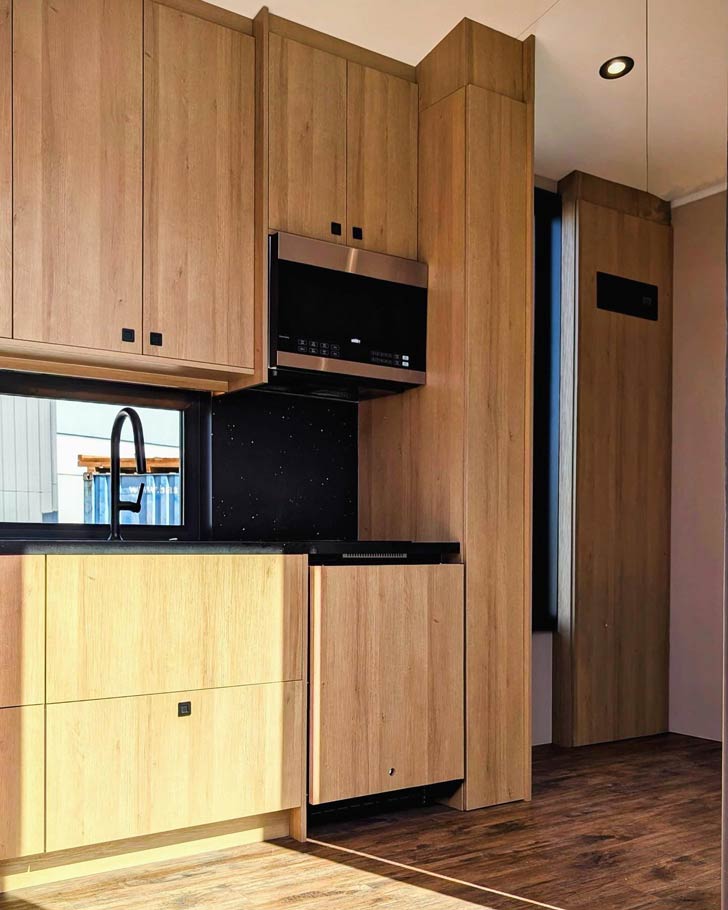
Azure’s smallest units start at a cost of about $35,000, but the company has launched a $4.2 million crowdfunding campaign to scale production and provide support to families rebuilding after the fires.
“If we were to try to rebuild after the Palisades fires, traditionally, it would take years,” Eidelman told Spectrum News. “There are lots of entrepreneurs here in L.A. It’s a get-it-done spirit, so that’s what we’re going to try to do.”
The company’s other co-founder and CEO, Ross Maguire, said that the automation is part of the beauty of what Azure offers, perfecting the method once and programming with the same kind of precision in the printers for all future projects.
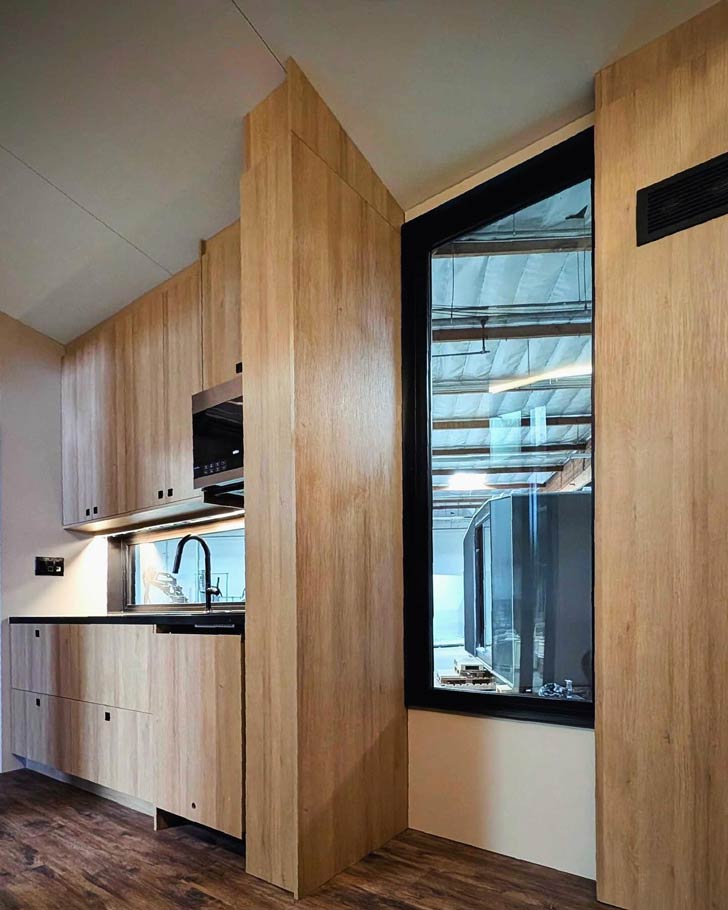
Not only does this make for speed and efficiency, but it gives Azure the time and resources to help those in need.
“The recent LA wildfires have left thousands of families without homes, and Azure is committed to being part of the solution,” Maguire said in a statement.
“This new funding campaign underscores our commitment to rapidly scale our capacity and to bring affordable, climate-resilient homes to all buyers, and most especially, to those who need them most.”
Header image courtesy of Azure Printed Homes
Lindsay Church left the Navy in 2012, having served under the United States’ “don’t ask, don’t tell” policy, which prohibited military servicemembers from being open about their sexual orientation.
“I really struggled with, am I a veteran, or am I queer?” Church told Next City. “And if I’m a veteran, I can’t be queer because they hate me here.”
Since then, Church co-founded Minority Veterans of America, a nonprofit that helps veterans that identify as gender, racial, or religious minorities.

Church’s work remains necessary, for LGBTQ+ veterans trying to regain their autonomy, as well as in fighting continuing attempts to remove transgender servicemembers from the military.
In October, Minority Veterans reached an exciting milestone: The opening of the nation’s first-ever transitional housing facility for homeless LGBTQ+ veterans.
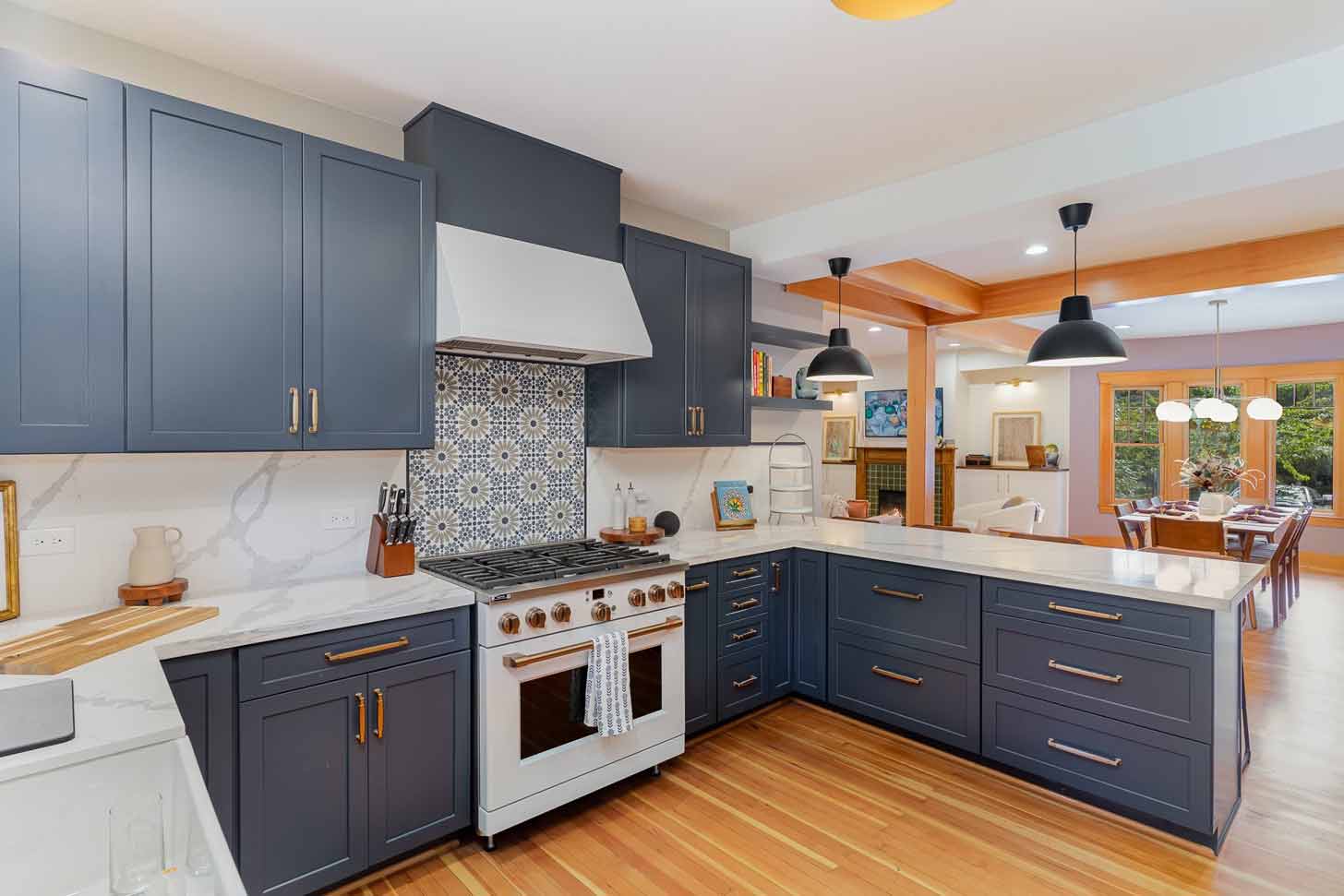
With a $1.8 million levy from King County, the organization opened Q’mmunity House, a renovated 1915 five-bedroom, two-story home in West Seattle.
Signing a 50-year contract with the county, Minority Veterans will operate the home, which gives residents a place to stay for six to 18 months as they find permanent housing.

“Today, we are filled with immense pride as we celebrate the realization of a long-held dream — Q’mmunity House,” Church said at a ribbon-cutting ceremony for the home.
“This milestone represents years of dedication and hard work to create a refuge for LGBTQ+ veterans who have too often been left behind and experienced discrimination and stigma when accessing essential services.”
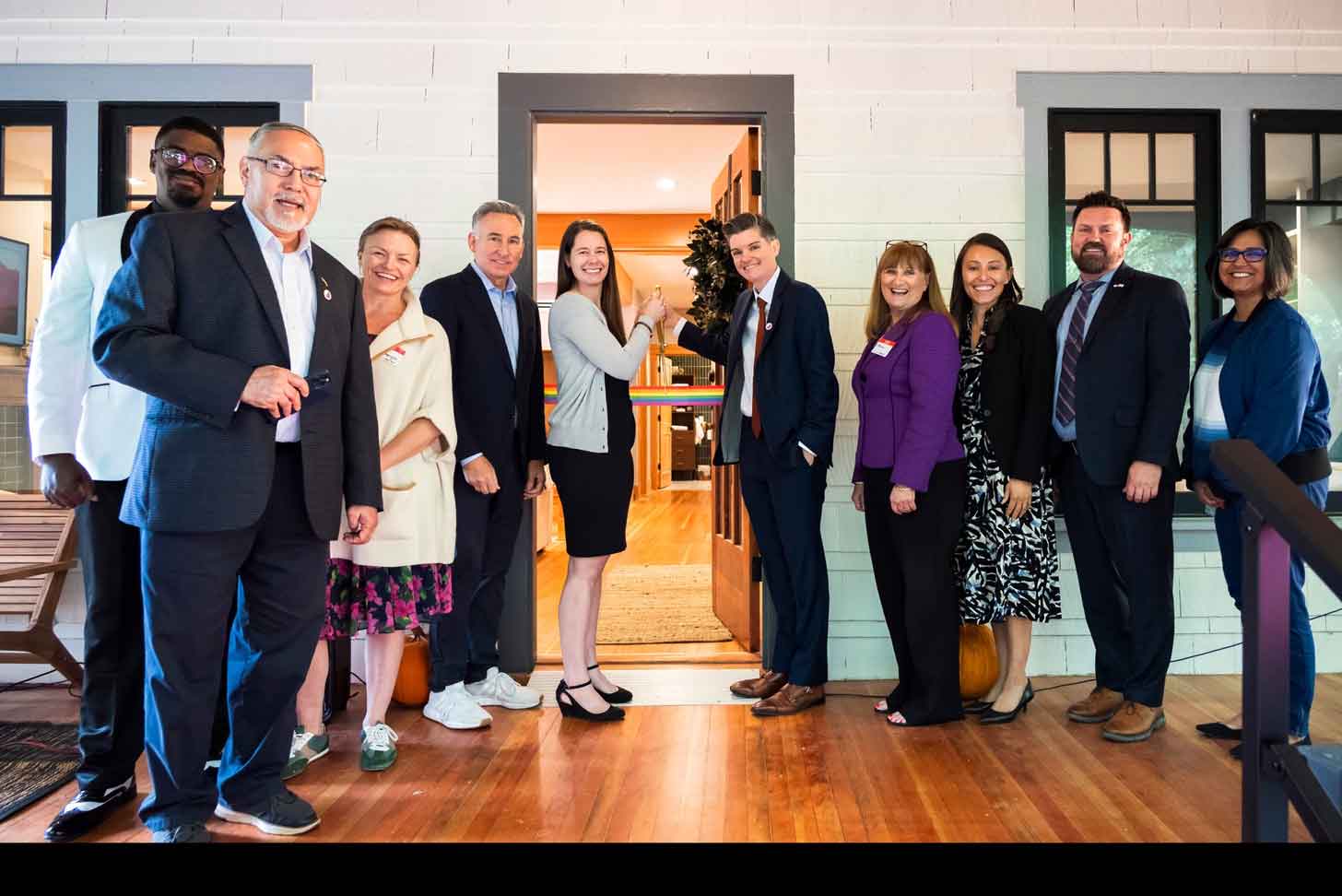
The location is safely situated in a quiet cul-de-sac with close access to the veterans center and hospital.
According to the organization’s website, Q’mmunity House aims to recognize the “unique challenges” LGBTQ+ veterans often face, including “higher rates of homelessness and discrimination.”
It’s true; 2023 report found that homelessness among veterans receiving care from the VA is three times higher for transgender veterans than for cisgender veterans.
Additionally, LGBTQ+ servicemembers who were less-than-honorably discharged under “Don’t Ask Don’t Tell” are often ineligible for housing vouchers given to other veterans.

Because of this systemic discrimination in the military, many LGBTQ+ veterans who fall on hard times are hesitant to seek assistance through government programs.
“Remember, it’s the government who punished them for outing themselves when they were service members,” Michael Kauth, executive director of the LGBTQ+ Health Program for Veterans Affairs, told KUOW.
“If you served during a time of ‘don’t ask, don’t tell,’ or during the transgender ban, if you outed yourself, you were punished by losing your career and possibly losing your benefits as a veteran,” Kauth added. “So that’s a lesson that they’ve learned and carry with them after service.”
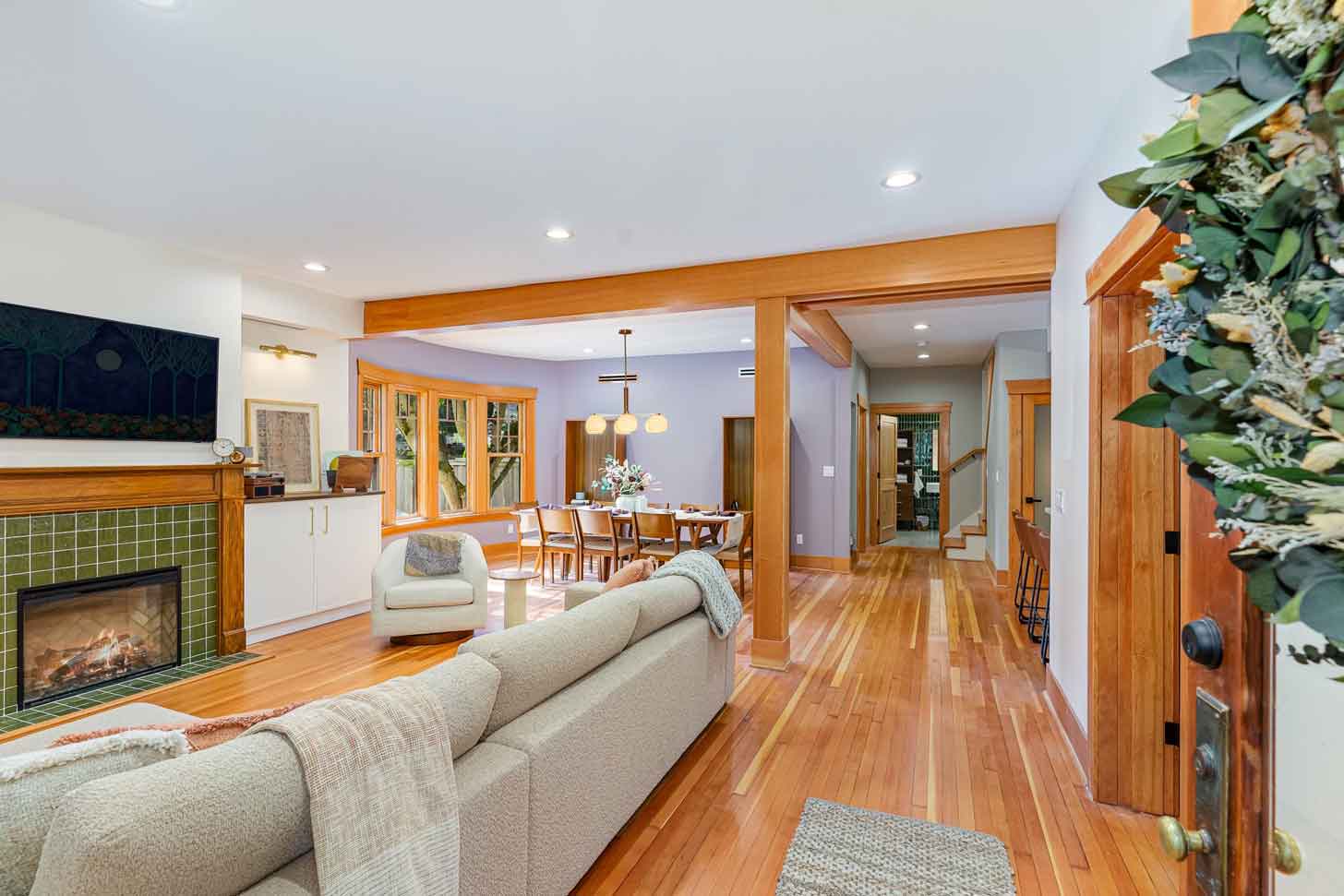
Church hopes that Q’mmunity House will be a beacon of safety and dignity for all LGBTQ+ veterans.
“At a time when LGBTQ+ veterans, service members, and their families face growing battles over healthcare and basic rights, this space represents hope, healing, and community,” Church said.
“Our goal is not only to provide shelter but to create a model for how we can build a brighter and more equitable future, where every veteran has the support, dignity, and belonging they deserve.”
Eligible LGBTQ+ veterans in King County can apply for one of five spots in the house, with those not initially selected placed on a waiting list for rooms that open up as participants move into permanent housing.
Applicants must be veterans or transitioning service members who identify as LGBTQ+, reside in the county, and have a household income of 80% or less of the county’s Area Median Income.
The first 90 days of housing will be free, and after that, residents will be charged rent, based on a percentage of income, with a cap of $300 per month.

In addition to housing for up to 18 months, residents will have access to case management and other wraparound resources for healing and growth, connecting folks to both veteran and LGBTQ+ communities in Seattle.
“This new, first-in-the-nation transitional housing for LGBTQ+ veterans will provide a historically underserved population with access to temporary housing and on-site support services,” King County executive Dow Constantine said in a statement.
“We are grateful to partner with Minority Veterans of America to fill a critical gap in services for those who have served our nation. This program ensures LGBTQ+ veterans have a safe place to build long-term stability and community here in King County.”

Church and Minority Veterans are now working with the National Coalition for Homeless Veterans to create a blueprint for creating similar spaces for unhoused veterans or marginalized identities.
“My goal is not to just say, like, we want 1,000 LGBTQ veteran transitional houses,” Church told Next City. “I actually want to see — race, gender, sexual orientation — a broader availability of resources that are tailored to meet the unique identities and needs of those communities.”
Regardless of what comes next, Church is ready to make a difference for those just like them.
“We want to encourage that healing around being a part of something again,” they said. “And allow people that space to be in community with one another in the places that they live, and to know that it can be safe to do so.”
Header image courtesy of Minority Veterans of America
In cities with high rates of displacement and homelessness, it’s increasingly common to see makeshift shelters like homeless encampments and “tent cities” crop up as unhoused people seek temporary refuge.
Major cities across the United States have been ramping up sweeps in recent years — citing it as both a safety concern and a necessary step to getting people off the streets.
But many community advocates say that encampment sweeps — without support services attached — only perpetuate cycles of chronic homelessness.
“Every time someone gets swept, it just sets us back like 10 steps,” said Duke Reiss, a peer support specialist at Blanchet House in Portland, in an interview with ProPublica.
“It makes it almost impossible to get people help because everything requires documentation.”
In 2024, ProPublica surveyed 150 people impacted by involuntary encampment sweeps.
The interviewees spoke about the devastation of losing critical items and personal belongings that ranged from social security cards, seizure medication, baby formula, wheelchairs — and even loved ones’ ashes.
Elijah Harris, a 38-year-old, was living in a tent in Hollywood, California when sanitation workers came to begin a sweep.
In the time it took him to warn friends and return to the scene, his tent and all of his belongings (birth certificate, passport, license, storage keys, and more) were gone.
When Harris tried to retrieve his items, he faced road block after road block.
“They ask you to take a picture of the front and back of your ID and then take a selfie to verify it’s you, but I couldn’t do that,” said Harris, who lost his phone in the sweep as well. “It was a disaster.”
According to ProPublica, Los Angeles officials did not comment on Harris’ case specifically, but responded in a statement saying the city “works to not unnecessarily remove anyone’s belongings.”
However, ProPublica’s research showed that Harris’ situation is not uncommon in the unhoused community.
“I was trying to get off the streets, but they set me back,” Harris said. “It’s not easy getting services, and trying to find work, and trying to save.”
Now, a new study from University of Colorado researchers is shedding light on the efficacy — or lack thereof — of forced shelter removals.
The study, published in the Journal of Urban Health, found insignificant decreases in total crimes in the days immediately following the sweeps, suggesting that encampments were not inherently linked to a rise in crime.
“The highest level finding from this research is, despite the commonly held belief that displacing people makes crime go down and makes the rest of the community safer, we did not see evidence to support that claim,” Pranav Padmanabhan — lead author and research assistant at University of Colorado Anschutz Medical Campus — told CU Anschutz.
“Previous work has shown that forcing unhoused people to move without access to services is harmful to health,” Padmanabhan said. “Until we get to the root causes of homelessness, these methods are actually not making us safer.”
Although the study from the University of Colorado centered their research in Denver, Padmanabhan believes the data has broader implications nationwide.
“While this analysis looked at only one major metro area,” she said, “I believe the lessons learned are generalizable and can be applied in other cities around the country that are struggling with what to do with encampments.”
Joshua Barocas — senior author and associate professor at the University of Colorado School of Medicine — agreed with his colleague, inviting other researchers to explore the issue.
“With the recent Supreme Court decision Grants Pass vs. Johnson that allows cities like ours to make the decision to displace people, this analysis should make us think if sweeping is the best use of resources,” Barocas said.

“As city officials juggle the needs of people experiencing homelessness and the safety concerns of the rest of the community, it’s important to consider that previous research shows encampment sweeps do not help those who are homeless, and according to this study’s results, are also not making the rest of us any safer.”
Across the country, nonprofit volunteers and social service workers are finding alternative ways to meet unhoused people where they’re at, by making regular visits to encampments to deliver hot meals, offer rides to congregate shelters and drug treatment centers, and sit side-by-side as they discuss possible financial resources like veteran and disability benefits.
The aforementioned nonprofit, Blanchet House, does all of that — and more. They even have a farm where unhoused community members can work through their sobriety in a rural setting — with 8 months of free room and board — as they assist with gardening, animal care, beekeeping, and woodworking.
“Fifty men stay with us at Blanchet House and 24 at the farm at a time,” Scott Kerman, the executive director of Blanchet House & Farm, said in a statement. “That’s 74 communities of family and friends who are now healing and receiving renewed hope for their loved ones.”
Kerman went on to talk about the importance of leading with compassion and dignity when it comes to getting people off the streets.
“Blanchet House feeds, clothes, shelters, and heals thousands of people,” Kerman said. “What’s more, the aid we provide together profoundly expresses our shared humanity.”
“By serving with compassion and without judgment, we affirm our guests’ dignity and remind them—and ourselves—that things can get better.”
Header image via Wikimedia Commons (CC BY-SA 3.0)
Across religions of all creeds and sects, there’s a unifying theme of helping one’s neighbors — and that’s a mission that pastor Michael Jones wants to prioritize for his community in the coming years.
Recently, Jones’ Village of Faith Ministries, a church based in Sandston, Virginia, joined congregations around the country in converting church property into affordable housing.
“We knew that, at some point in time, we would look to position ourselves to sell a portion of it, or all of it, to simply aid where our congregation is trying to go in the future,” Jones told Next City in January.
The church is presently eying a portion of its 1.5 acre property on its Southside location with plans to construct 192 apartments and 40 townhomes.
Jones told Next City that the homebuilding company D.R. Horton worked with the church to develop a housing plan that could meet the church’s financial goals while also keeping rent costs low.
“We know that housing is a need,” Jones said.
Jones sees a bright future for the 232 housing units yet to be built, and the 232 families that will call their property home.
Jones wants the church to be a community hub, where people can seek services, meet their neighbors, and even visit the community garden on its property.
“Our churches should not be vacant Monday through Saturday,” Jones said.

Village of Faith Ministries joins a growing number of faith-based organizations that are addressing the housing crisis in a variety of ways, whether it’s by building tiny home communities for the homeless, offering zero interest loans for low-income families, or extending rental assistance to those in need.
In response to cynicism surrounding new housing developments — often boiled down to the phrase “not in my backyard” — churches across the United States started the faith-based movement: “Yes, In God’s Backyard.”
The grassroots effort works to address the nationwide deficit of affordable housing and inspire faith leaders to use their resources to give back to their communities.
And it’s working.
Last year, a bill titled “Yes, In God’s Backyard” passed in California, which permits religious institutions to convert their land into housing without being held to local zoning regulations.
In early 2025, Virginia’s state senate considered a similar bill, “Faith in Housing for the Commonwealth” — a bill that was still under review at the time of publication.
“[We proudly support the] ‘Faith in Housing for the Commonwealth Act’ to build more affordable housing where it is most needed by allowing churches to build affordable housing on their land through a streamlined process,” the Commonwealth Housing Coalition said in a press statement.
“Today in Virginia, too many of our neighbors and community members struggle to afford a place to call home,” the coalition continued. “We have an opportunity to help more faith-based institutions help solve this problem by allowing them to build homes on their land.”
Header image via Michael Gattorna / Pexels
Rising housing costs make it feel nearly impossible to own — or even rent — a home these days.
When COVID-19 left Julius unemployed, he found himself inspired by YouTube videos of tiny homes, and decided to use all of his resources to build a home that was both affordable and sustainable.
While the Australian had no prior building experience, now his beautiful tiny home has been featured by Living Big in a Tiny House, and he’s sharing how he created the home of his dreams for just the cost of two years’ rent.
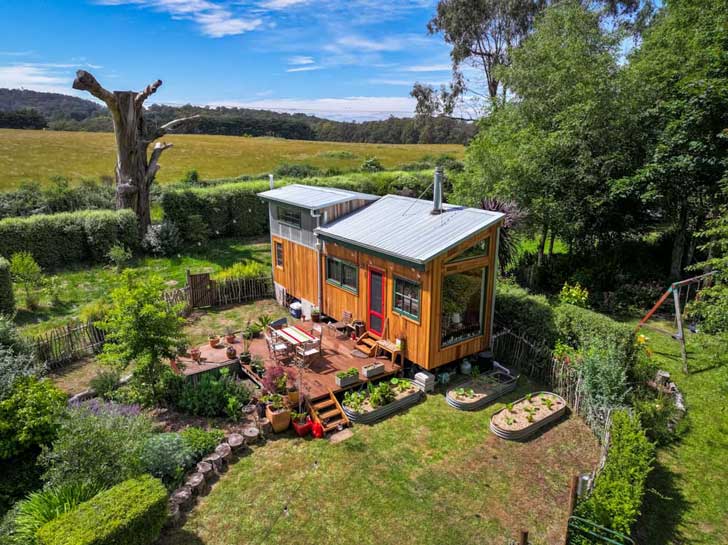
“It, I guess, just sort of evolved naturally,” Julius said in a tour of his home. “I didn't have a whole lot of money, so it was just about sort of finding things along the way and watching lots of YouTube videos of how to do stuff. With little experience building, you can't get it to look perfect, so I just embrace that look.”
Julius and his partner affectionately refer to the house as “hodgepodge,” since it was constructed with repurposed materials from companies throwing them away or houses being demolished.
The external cladding of the home is a combination of different Native Australian hardwoods from an architectural firm, and the windows were purchased secondhand through Facebook Marketplace.
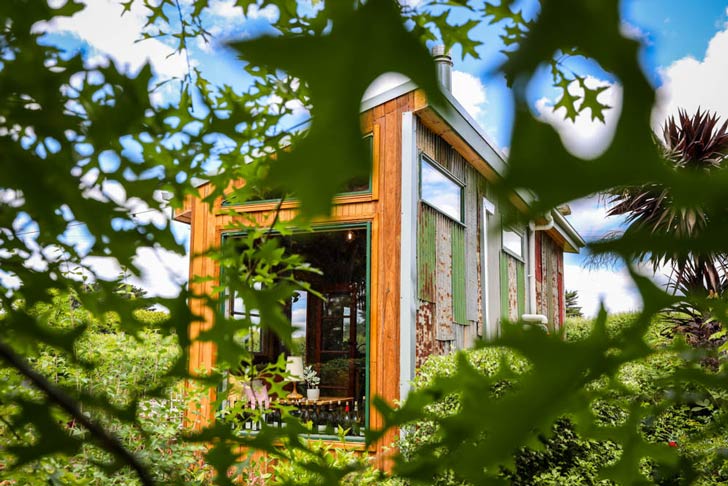
The rear and side parts of the house are also patch-worked with incongruous pieces of corrugated metal, with different shapes and colors creating something of a mosaic.
The home itself sits on a double-axle trailer. It measures about 29.5 feet in length and 8.2 feet in width, and it stays parked on a piece of land owned by his parents in Victoria, Australia.

Opting for a tiny home was an easy decision for Julius, who said he’d always been drawn to “cozy spaces,” in addition to living a more minimalist lifestyle.
“I was drawn to have less and use less and live in a way that is alternative and slightly, you know, a little bit radical … to combat some of the things that are happening in the world and the direction that the world’s traveling in.”
He acknowledged that having the land from his parents was “a massive privilege,” but ultimately made it feasible for him to live in a way that was more focused on sustainability and less on consumption.
“If you're lucky enough to have that close family dynamic, it's actually the easiest form of community to lean into,” he added.
Julius said getting support from his friends, loved ones — and even strangers — was vital in bringing the home together, with people offering time or materials to complete the build. He even downloaded the building plans from generous tiny home builders online.
“I made some really good connections with people that repurposed materials from companies that were throwing them away, or houses that were being demolished,” Julius said.

“Once you form relationships with those people they can be really wonderful resources of advice and provide you stuff that you can use.”
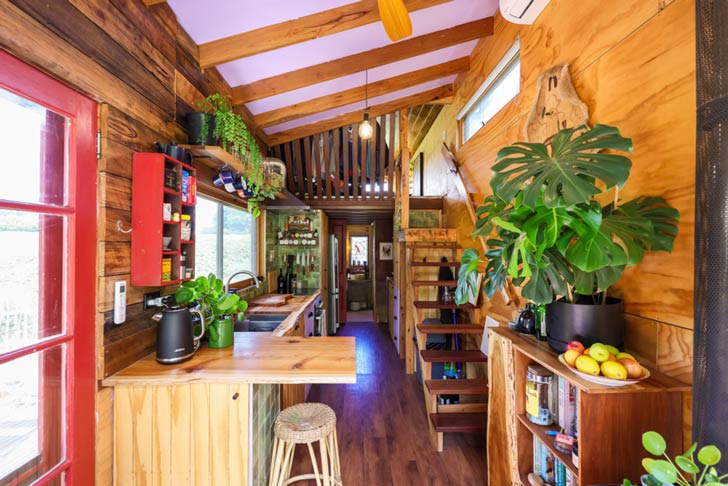
The interior of his home is also filled with secondhand or reclaimed furniture pieces, like an old kitchen cabinet upcycled into a bathroom vanity.
Utilities are also designed with intention, including a simple water tank, solar panels, and a water runoff system that sends wastewater to be repurposed in the garden.
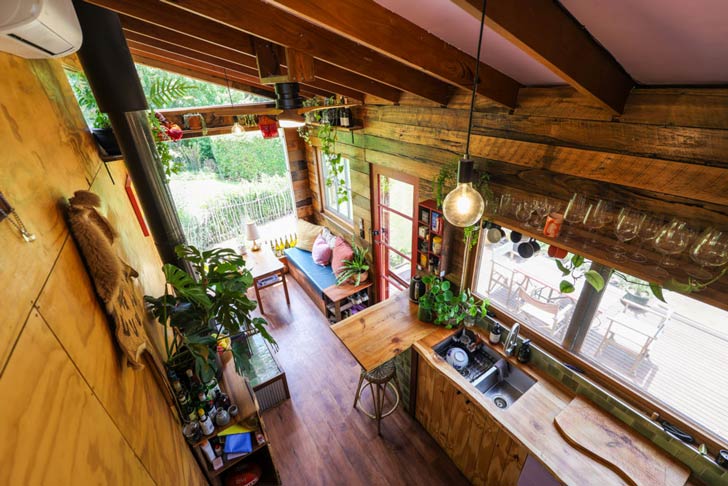
Julius describes every aspect of his home as “puzzle pieces” that came together “just one piece at a time, rather than thinking about an end product.”
The final product he has now, however, serves as a reminder that living sustainably and minimally does not mean things have to be boring.

“I think that is the best way to build, especially on a project like this where it is quite organic and you don't necessarily have to have the perfect vision for how it's all going to come out,” Julius said.
“So much of the design just gets dictated by what you find, and I think the result of that is a space that just ends up with so much more character than sort of a cold architectural design.”
Overall, Julius said he spent about $60,000 on the home, just about doubling his original budget. But in Victoria, he added, that equates to about two years of rent.

And this tiny home? It’s all his.
“I think, probably for commercial interests, there’s been this sort of wall of mystery that’s been built around building and constructing your own home, as if it's something that's really hard, and as if it's something you shouldn't accomplish,” Julius said.
“And it's not until you actually pick up a hammer and just give it a go that you realize, ‘Oh, I can actually do this.’”
Header image courtesy of Living Big In A Tiny House/YouTube
In neighborhoods across the globe — yes, even in Antarctica — it is not uncommon to find a Little Free Library, or a book-sharing box filled with a collection of free books to take, share, and enjoy.
If a location on the South Pole wasn’t enough, Little Free Library is celebrating a major milestone: Its 200,000th box.

The nonprofit that manages these 200,000 mini libraries works to increase access to literacy in urban, suburban, and rural communities all over the world. This includes programming to expand access to books among BIPOC communities, as well as efforts to fight book bans across the United States.
In sticking with this mission, the landmark 200,000th library was donated to and installed at Benjamin E. Mays IB World School, an elementary school in St. Paul, Minnesota.
The donation also marks the first of 200 Little Free Libraries that will be given to Title I schools across the U.S., in an effort to expand access to books in low-income areas.
“We are honored to recognize all the work done by our global network of stewards and supporters to reach 200,000 Little Free Libraries,” said the organization’s executive director Greig Metzger, at a ribbon-cutting ceremony for the new book box.
“But as we celebrate the past, today’s event is just as much about the future. The promising future embodied in these young scholars at Benjamin E. Mays IB World School.”
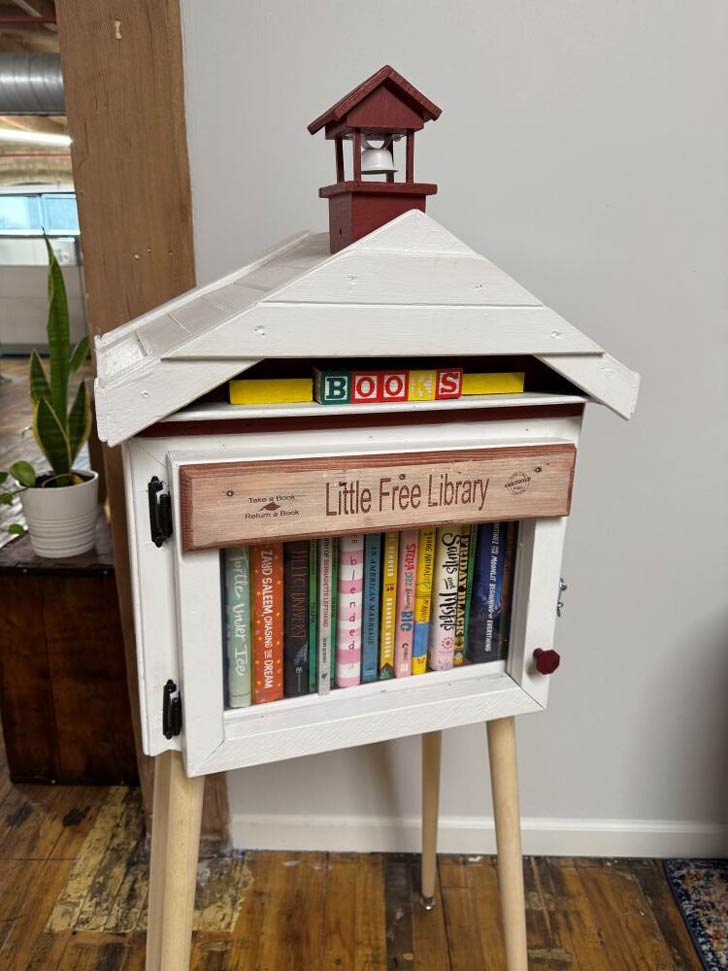
The 200,000th library is exclusively for students and is designed to resemble a one-room schoolhouse. This pays homage to the very first Little Free Library, built by the organization’s founder Todd H. Bol in 2009.
“The future where all of us, no matter our age, economic status, or residence, have the opportunity to readily access a book that can inspire, motivate, and empower,” Metzger continued.
“Working together locally as a community, a community connected through Little Free Libraries, we hope to make this opportunity a reality for all.”
The worldwide network of Little Free Libraries spans all 50 states, 128 countries, and all seven continents.
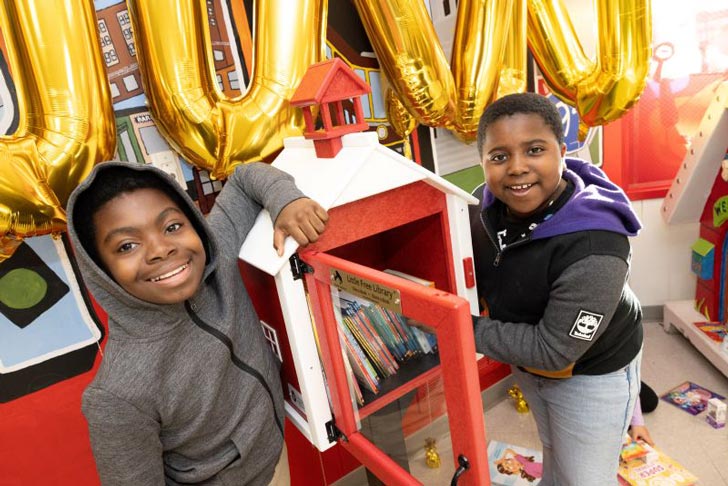
Next, 199 more Little Free Libraries will be installed at Title I elementary schools, and each of these will be stocked with 200 brand-new books.
The donated libraries are sponsored by Books Unbanned and the donated materials come from a 40,000-book donation from Penguin Random House.
“Little Free Library is an essential partner in our effort to get more books into the hands of young readers that help them understand themselves and the world around them,” Claire von Schilling, executive vice president and director of corporate communications and social responsibility at Penguin Random House, said in a statement.
“We are honored to partner with them on this meaningful milestone!”
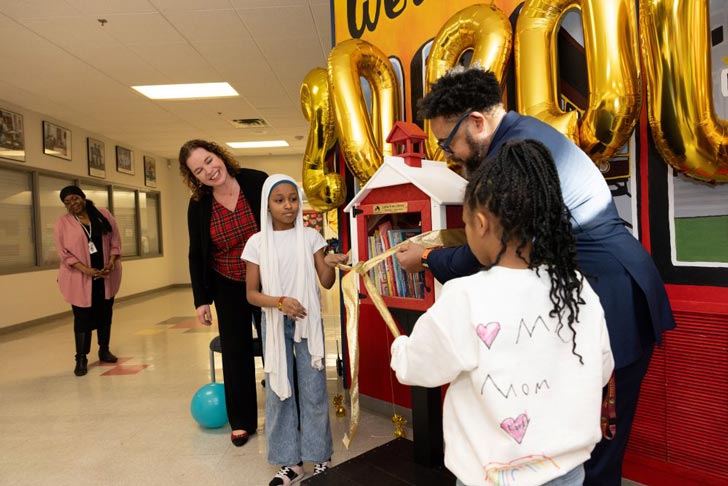
Schools receiving these libraries and books were selected through an application process, and all students in the schools are welcome to take the books home at no cost.
“Many of our students have little to no books at home, and transportation barriers prevent families from reaching the public library,” a representative from participating school Somerset Lakes Academy in West Palm Beach, Florida, said in a statement.
“A Little Free Library will serve as a crucial bridge, providing ongoing access to literature for students, their siblings, parents, and the community.”
Back in St. Paul, the 200,000th library is already set to be well-loved by the 340 students who attend Benjamin E. Mays IB World School. All students received gifted books, and 50 select students who excelled in a recent reading challenge attended the ribbon-cutting ceremony.
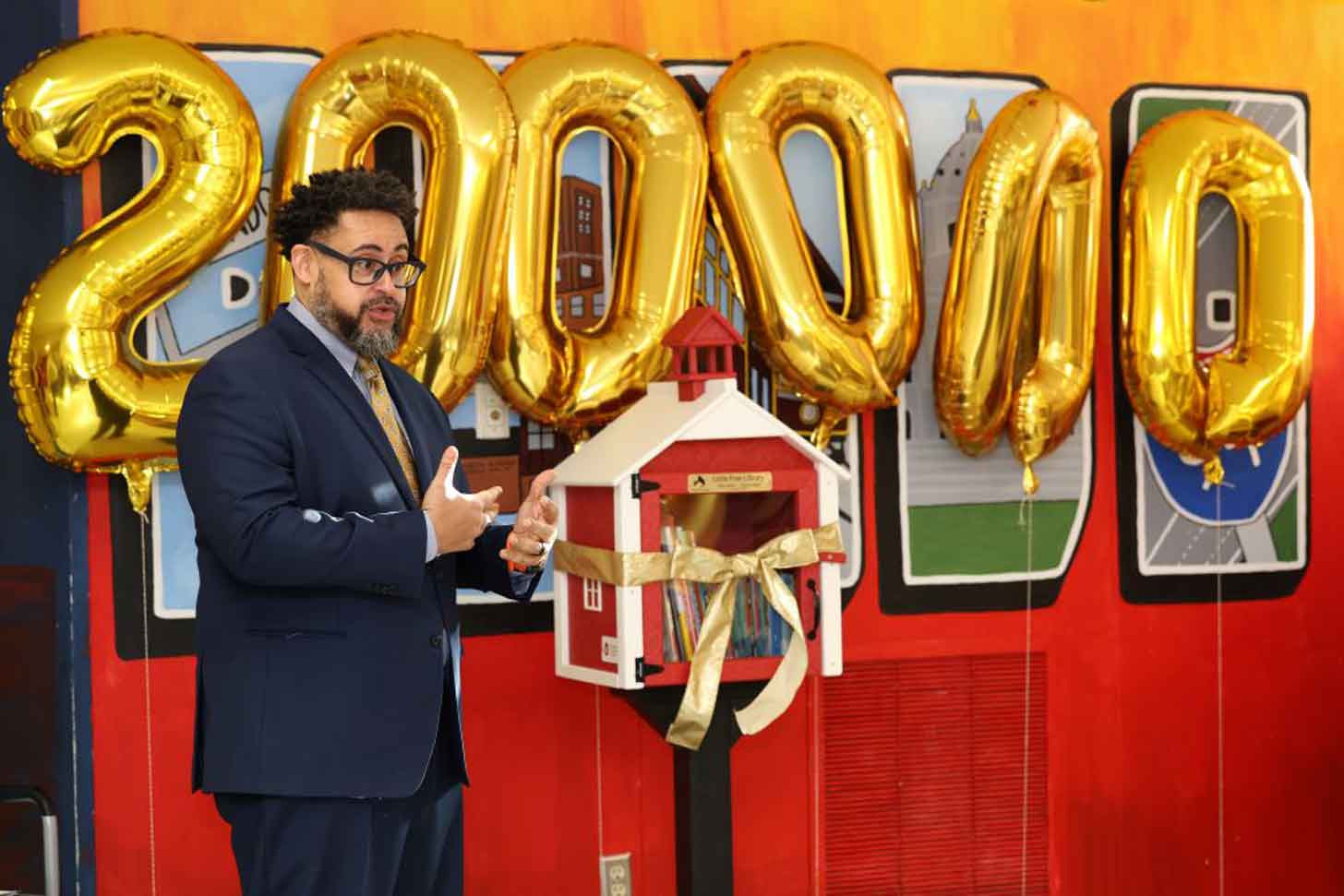
“Freedom is the road seldom traveled by the multitudes; however, literacy is the gateway to learn one’s past, present, and shape the future,” said the school’s principal, Dr. Kenneth O. Turner Jr.
“Through literacy, one can travel the world, reading and learning about historical figures who have shaped the world. Literacy can take you into space and travel the galaxies far away. Through literacy all is obtainable.”
Anyone interested in joining the “take a book, leave a book” movement of Little Free Library can build or buy their own box and register it online to be part of the official network.
Header image courtesy of Little Free Library
With a swath of U.S. cities adopting policies that would outlaw homeless encampments, advocates for unhoused people are working to fight stigmas against “tent cities.”
A new study out of the University of Colorado shows that involuntary sweeps of these camps do not improve public safety, for instance. And in San Diego, initiatives like safe sleeping camps work to provide transitional support to people with nowhere else to go.

Now, the city of Saginaw, Michigan, is taking a similar approach to address homelessness.
The City Council has announced a community partnership to establish temporary legal encampments for homeless residents displaced from a site under an interstate overpass.
“We decided to be proactive and try to establish a place where we can provide some very basic amenities that drastically improve the health, safety, and dignity of the folks in that area,” City Councilwoman Carly Rose Hammond told Mid-Michigan Now.
She added that the initiative aims to “have a positive impact on all the neighborhoods and businesses surrounding it.”
Hammond acknowledged that the plan is not designed to be a permanent solution, but it does allow those experiencing homelessness at least a little more dignity and support.

“What a legal encampment allows us to do is say, ‘Hey, we already know that these people are here. Even if we come out and destroy people’s stuff, they’re going to come back,” she told WNEM 5.
“So, what can we do to provide some basic amenities and some necessities to help so that the environment is relatively clean and relatively safe?’”
Saginaw is not a major city, but it is part of the Greater Tri-Cities Region of Central Michigan, which has an estimated population of about 378,000 people.
According to Saginaw’s 2024 Point in Time Count, there are approximately 325 individuals experiencing homelessness at any given time. And with the housing crisis on the rise, officials are hoping this move will provide more relief.
“We’ve seen the housing crisis climb and climb and climb, we’ve had more and more fallout from those social issues,” Hammond added to Mid-Michigan Now. “So [we’re] addressing this problem head-on, providing a temporary solution, and a pathway forward.”

Organizations like La Misión are part of the city’s plan to include nonprofits, businesses, community advocates, and neighbors in ensuring the success of the initiative.
Veronica Vela, who leads La Misión, said legal and accessible encampments are vital to connecting with people who need urgent resources.
“We’re out here. We actually know names there. They know us,” Vela told Mid-Michigan Now. “So when they see my truck, they’re gonna come up to my truck. So it’s more of a relationship that we have with them.”
By allowing people the space to build community in a designated and safe location, caseworkers and on-the-ground advocates can get people the help they need with more speed and consistency.
The city also plans to form a permanent subcommittee to address homelessness — ideally before it begins.
While the timeline of this new initiative — as well as the specific services it will provide — remain unclear at this time, Hammond promises a step in the right direction.
“What’s going to come out of this is a healthier, safer environment for everyone,” she told Mid-Michigan now. “We can work on long-term solutions, rather than just kicking the problem around and kicking it down the road.”
Header image by Brett Sayles/Pexels
In early March, TikTok creator Zachery Dereniowski approached a 24-year-old mother of two in a Dollar Store in Ontario, Canada.
“I really need someone’s help,” Dereniowski said. “Do you have $2 by any chance? For a soother? My baby can’t stop crying at home.”
The mother, Ronke, said she knew how important babies are, pointing out her 7-month-old sons David and Daniel. After she dug through her purse and passed over two dollars in change, Dereniowski asked her where she was from.
“I’m from Nigeria,” Ronke replied. “I’m a student, International Business and Management Logistics.”
Dereniowski returned the change, saying he felt bad. She turned down his offer, saying that “God will provide.”
“God has been helping me,” she said. “I’m here alone, without my husband…I don’t have a house of my own, a sister in my church is helping me. I’m staying with them.”

“God has been helping me back and front,” Ronke went on, “sending helpers to me.”
“Why give?” Dereniowski asked.
“One way or the other, I receive help,” she replied. “Why can’t I help? No matter how little it is?”
Then — in tradition with his other “surprise” TikToks — Dereniowski offered her $1,000 cash.

“Really? Are you sure about this?” She asked, her stunned expression turning into laughter. “$1,000?”
After the two embraced, Ronke pulled away, hand to her head. She said that just that morning she had been telling her husband on the phone that her “route” in Ontario was coming to an end.
“Thank you,” she said, folding over in relief.
On March 8, Dereniowski posted the video with a call to action to donate to Slingshot, a crowdfunding website, in Ronke’s name.
In the webpage description, Dereniowksi delved even deeper into Ronke’s story.
“Since moving to Canada to pursue her dreams of higher education, she found out she was pregnant with twins, her husband’s visa to Canada had been denied, her pregnancy had complications in which she nearly died and [was] in the hospital for over a month,” the TikToker wrote on Slingshot. “That same time, her mom had passed away overseas.”
Dereniowski added that Ronke has kept up with her education — even as she “squats” in a neighbor’s guest room with her infants.
“Let's all come together and show Ronke and her babies the power of the internet and bless them,” the TikToker encouraged. “100% of the net funds raised will go to paying Ronke’s living expenses.”
Ronke’s story is heart-wrenching — but unfortunately not uncommon.
The average cost of living in Ontario, Canada is $2,139 — which is 1.16 times more expensive than the national average.
In 2024, a report from the Association of Municipalities of Ontario revealed that more than 80,000 people in Ontario were experiencing homelessness, a 25% increase since 2022.
“The scope and scale of homelessness across Ontario’s municipalities is truly staggering,” Robin Jones, AMO president, said in a statement.
“Without real and meaningful provincial action, the quality of life and economic prosperity of Ontario’s communities is at risk. We can solve this crisis, but we need to work together.”
Fortunately, long-term affordable housing solutions are in the works on a municipal level in Ontario.
Local government funding for housing and homelessness programs surged in recent years, with funds totalling more than $2.1 billion in 2024.
January 2025 also saw the implementation of several housing laws that protect Canadian tenants from eviction (Rental Renovation License By-Law) and increase pathways to housing assistance (updates to The Household and High Need Income Limits).
Although crowdfunding stories like Ronke’s are only a small bandage on larger, systemic issues of homelessness — they remain necessary, life-saving measures for those in need as long-term change awaits.
Within hours of her Slingshot being posted, donations began to pour in for Ronke’s family from all over the world.
“Your story moved me,” one donor wrote. “May you and your babies and husband be reunited and thrive forever.”
Another donor asked for a follow-up to Ronke’s story, writing: “Please let us know how she gets on with her beautiful babies, Taiwo and Kehinde” — names traditionally given to twins in the Yoruba culture of Nigeria.
At the time of publication, the crowd-raised funds totaled $84,690.
“I cannot wait to see her reaction,” one TikTok follower commented. “You are all incredible.”
@mdmotivator “God will provide” (GoFundMe 1N B10) 🥹❤️ #kindness #mother #homeless #money #nigeria #family ♬ original sound - Zachery Dereniowski
Header images via Zachery Dereniowski / TikTok