According to a first-of-its-kind study from Portland State University, tiny homes for the homeless consistently outperform mass shelters when it comes to successfully keeping people off the streets.
The study, which was conducted from July 2021 to July 2023, found that 36% of the tiny home residents in Portland moved on to permanent housing — and only 12% of congregate shelter guests did the same.
“This may be due in part to the shorter stays in adult congregate shelters, which limits the time available to connect someone with an extremely constrained supply of affordable or supportive housing,” authors Todd Ferry, Dr. Greg Townley, and Dr. Marisa Zapata surmised in their report.
The results of that study can be found in action at the Clinton Triangle tiny village neighborhood in southeast Portland.
Alisha Wilks is one of 203 residents who live in the community. Before moving into her 10-by-10-foot home, she slept out of her truck with her partner and 8-year-old Chihuahua, Mocha.
Wilks has lupus, heart disease, and a thyroid disorder — all painful conditions that have only been exacerbated by living on the streets.
Now, she finally has a chance to catch her breath.
“Each day I rest and take care of myself, I can feel and see myself getting better,” Wilks told Oregon Live in 2024.
“I want to make sure I am healthy before I get housing because I don’t want a home to get taken away from me because I am too sick to take care of it or afford it.”
Of course, walls alone do not make a home.
The success of tiny home neighborhoods like Clinton Triangle is due in large part to the nonprofits that back them.
Urban Alchemy operates two Temporary Alternative Shelter sites in southeast Portland: one in Clinton Triangle and another in Reedway.
Like many other nonprofits across the country that have installed tiny homes for the homeless, they take a multi-pronged approach to getting people off the streets.
“Using methods rooted in love, respect, and science, it has achieved remarkable success,” Urban Alchemy’s Wellness Villages director Kaesha Green told the Southeast Examiner.
“[They’ve created] a sense of safety, health, and dignity for residents, which aligns with the city’s goal of offering transitional support and holistic services to unhoused neighbors.”
Founded in California in 2018, Urban Alchemy first set its sights on alleviating homelessness and aiding formerly incarcerated individuals in San Francisco and Los Angeles.

Today, a staff of 1,300 employees operates in California, Oregon, Texas, and Alabama.
In the years since, the company has built alternative housing sites, created career pathways, and offered counseling services for those in need.
Furthermore, 96% of Urban Alchemy’s practitioners have experienced some form of homelessness, addiction, or incarceration in their lives — which means that they know first-hand what approaches work best.
“Their unique backgrounds allow them to connect deeply with residents, offering empathy, understanding, and practical support,” Green said.
Tiny home residents like Wilks feel the impact of that personalized care when they need it most.
Although she has been hospitalized twice during her stay, she told Oregon Live that she has “never felt so loved.”
“Urban Alchemy staff came and got me from the hospital and they made me feel cared about and like it is worth living,” Wilks said. “This really is a place [where] you can restart and see a light at the end of the tunnel.”
Header images via Urban Alchemy Safe Rest Village Clinton Triangle
When Wanona Satcher founded her company, Mākhers Studio, in 2017, she knew she wanted to address the issue of affordable housing in her hometown of Atlanta, Georgia.
With a background as a landscape architect and urban designer, she understood the hurdles that already existed in the challenge of getting people in equitable housing.
“Whether you need a brick and mortar or a place to thrive and live close to where you work and play, [everyone needs a place] where you’re not defined by the zip code that you live in to be successful, which unfortunately happens,” Satcher told the Modular Building Institute.
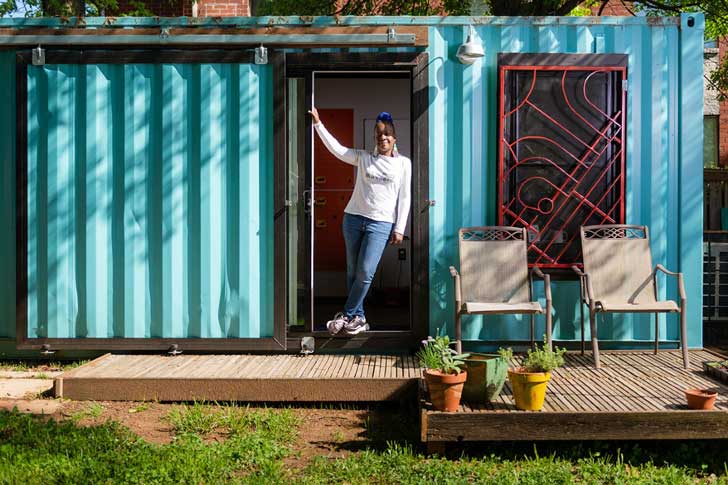
So, she decided to create what was missing: Bespoke, affordable homes for people made out of recycled shipping containers, which she has named Plug-In-Pods.
“Our Pods, an innovative modular housing technology, serve as ‘on-demand’ permanent and pop-up affordable housing, entrepreneurial, and community spaces,” Satcher writes on a funding campaign for IFundWomen.
Alongside her husband — Kevin Hamak, a Marine Corps veteran who also has a background as an architect and urban designer — she leads a team of contract engineers, architects, and craftspeople, many of whom are local veterans, LGBTQ+ community members, and women.
Together, they create custom units, veteran housing, classrooms, and modular health clinics out of shipping containers acquired from localized supply chains.
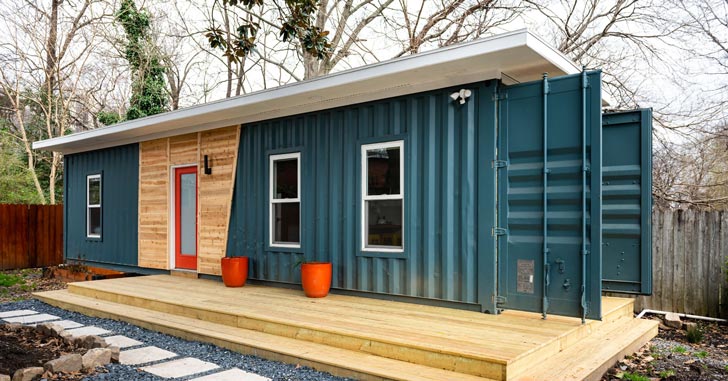
The shipping containers provide what Satcher calls “adequate, abundant, and sustainable material” that is constructed in ways that are eco-conscious and resilient.
“It’s not just about building a supply of housing,” she told WABE. “It’s also about the kind of materials that you build with, and we know that especially in public housing those materials have not been healthy.”
Mākhers Studio uses low-VOC paints and sources alternative insulation materials like hemp, on top of reinforcing the units with steel and metal to maintain energy efficiency.
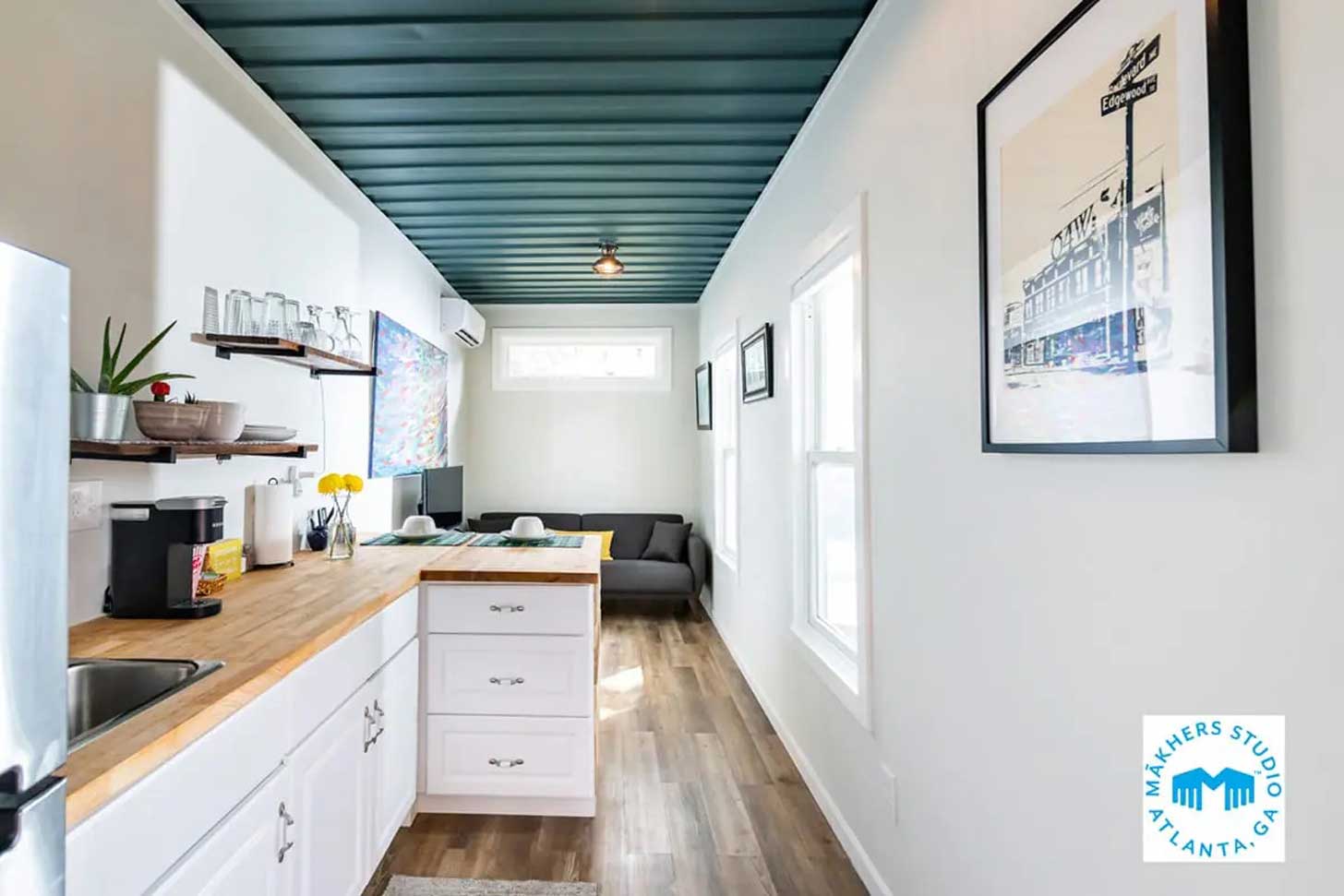
One 40-foot-long container ultimately recycles about four tons of steel, since the company uses less materials and produces an estimated 50% less landfill waste in installation than traditional construction projects.
Right now, the studio is using this model to create a series of housing projects for veterans in Durham, North Carolina.
Plenty of shipping container- and micro-housing units are dotting the country, bringing affordable housing to communities with the highest need. But supporting homeless veterans hits close to home for Satcher and Hamak.
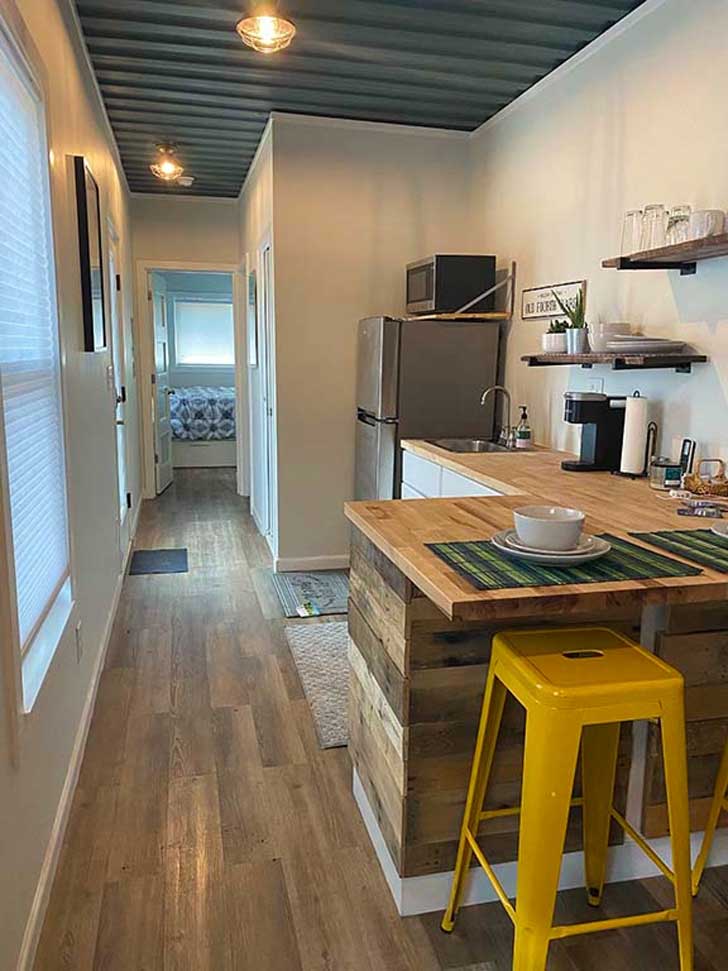
“In Durham, we’re not just building container homes for veterans, we’re also creating a courtyard space for restorative health and communal space in between these units, so that veterans have an opportunity to rehabilitate there,” she said.
“It is interesting that [we’ve] caught the eye of veterans organizations, but it makes sense, because one of the highest demographics of homelessness in the U.S. is among veterans. These organizations provide both land and amazing wraparound services, as they want to expand access for veterans to have quality spaces and restorative spaces to live.”
As a contractor for organizations providing these housing services, Satcher said Mākhers Studio leads the charge on navigating codes and zoning laws to move quickly and efficiently — without sacrificing quality.
“We manage the entire process for them from beginning to end,” she said.
The contracted projects for veteran housing communities are only part of the work the company does. Satcher and Hamak also oversee custom micro-housing units — that start around $75,000 — for marginalized homeowners like single parents, elders, and people who have experienced homelessness.
“Affordable housing is one of the most critical components of an equitable community,” Satcher told 2X Global.
Amid a surging housing crisis, vulnerable communities continue to be displaced from their communities and need alternative options to live comfortably, she added.
“We have to start thinking differently about how we live together.”
Header image courtesy of Mākhers Studio
In an ambitious new project, ICON, a 3D-printing construction technology company, will build a 100-home neighborhood for people facing chronic homelessness in Austin, Texas.
Working alongside nonprofit Mobile Loaves & Fishes, which has served the area's homeless population for more than 26 years, already houses over 390 people in its Community First! Village.
But now, a new expansion of innovative 3D-printed homes is underway.

Constructed using ICON’s Vulcan 3D printer, the structures are built with a cement-like mixture in layers to build up the basic shell of the home. From there, human workers add on roofs, doors, and any other required fixtures.
ICON’s 3D-printed homes range from townhomes to family units, measuring between 380 square feet to 1,040 square feet. The neighborhood will be the first of its kind in the country, providing both permanent and supportive housing for people emerging from chronic homelessness.

“Community First! Village is at the center of innovation in our country in terms of communities and movements that are effectively addressing homelessness,” Brook Bauguess, the vice president of marketing and communications at ICON, said in a statement.
“With the help from our friends at Lennar Foundation, we can continue our mission to deliver dignified homes for those in need and continue the long-term relationship with Mobile Loaves & Fishes.”
The neighborhood is being built in partnership with Lennar Foundation, the charitable arm of Lennar, a major homebuilding company. Lennar previously built a 100-home 3D-printed community in Central Texas, though it did not have the same philanthropic mission as this new neighborhood.

The Community First! Village will also include 1,400 new traditional builds, and once completed, alongside the 100 3D-printed homes from ICON, will be home to an estimated 1,800 previously homeless individuals.
Each home will have a front porch and will be placed around common areas that include laundry rooms, restroom and shower facilities, outdoor community spaces, and more.
“These shared areas encourage interactions among neighbors, helping them form relationships and build community,” the Mobile Loaves & Fishes website shares.
The shared areas include a cinema and amphitheater, community market, dog park, organic farm, chapel, memorial garden, health clinic, and more.

By adding these new 3D-printed structures, more homeless Austinites will finally have a safe and communal place to call home.
“We are delighted to continue our relationship with ICON and utilize their groundbreaking technology in Community First! Village as we continue building homes and bringing dignity to our neighbors who need it most,” Alan Graham, founder and CEO of Mobile Loaves & Fishes, said.
“With support from the good folks at Lennar Foundation, we are able to continue demonstrating why Community First! Village is a recognized leader in terms of communities and movements that are having a profound impact on the pandemic of homelessness in our country.”
Header image courtesy of ICON
Hussein, 62, is the owner of Rose City Grill, a halal Mediterranean grill based in Ontario, Canada. On February 18, Hussein was shocked when TikToker Zachery Dereniowski (@mdmotivator) walked in with a puzzling request: an order for 1,000 shawarmas.
“I wish we could have this business,” Hussein said, thinking that Dereniowski was cracking a joke.
“Why?” Derniowski asked. “Is this business not good right now?”
“We’re doing okay, but we’re still not breaking even,” the owner admitted.
The two continued with their transaction, and as Hussein realized that the TikToker was serious about ordering 1,000 halal shawarmas, he decided to break a deal with him.

“I can help you out with it,” he said, offering to downgrade the cost to $6 per shawarma in lieu of the typical menu price of $9.99. “We can do up to 300 in a day.”
“I want to give them to underprivileged families tonight at sunset for Ramadan,” Dereniowski said.
That hit home for Hussein.
“My family is 10 people,” he responded. “I have 8 kids. I am always struggling to make a living. Thank God, I still try, and I still do.”
After introducing himself and shaking his hand, Dereniowski asked for the grand total.
“It’s going to be around $2,000 [for the 300] but I’ll give it free,” Hussein said. “You have to think about the people who are hungry, who don’t have the money to buy food.”
“Can I leave you a tip?” The TikToker asked, as the restaurant owner tried to politely decline. “I’ve got something for you, since you’re helping me.”
Then he took $1,000 out of his wallet. But that was just the beginning.
After cooking and donating 300 shawarmas — and planning to make the full 1,000 — Hussein handed them off so that Dereniowski could fulfill his good deed as planned and disburse the hot food to local families in need.
The next day, the TikTok content creator returned to Rose City Grill, first to pay the full cost of the $2,000 worth of shawarmas, and then to tip Hussein with an additional $50,000 — a donation that was crowdfunded by his followers.
“You said you’re trying to break even with the restaurant,” Dereniowski said, when the small business owner stared at him in shock.
“I’ve spent all my life giving help,” Hussein said, head in hand. “First time I got the help. I swear to God, I owe you all my life.”

This is not the first time Dereniowski has used his platform for good.
Over the years, he’s made headlines by donating $100,000 to Mario, an immigrant living in Los Angeles who had recently lost his job, and supporting struggling musician David Kamara.
Beneath Dereniowski’s latest viral video, his comment section was flooded with people who wanted to go above and beyond to help Hussein.
One follower wrote: “As someone who lives in Windsor, I know where I’ll be going for my next shawarma!”
“So heartwarming; now I have a shawarma place to try,” another local commented.
A top comment read: “We made the right person famous.”
See the full video below:
@mdmotivator “I’m struggling trying to make a living for my family” 🥹❤️ #money #restaurant #ramadan #kindness #crowdfund #surprise #food #homeless ♬ original sound - Zachery Dereniowski
Header images via Zachery Dereniowski / TikTok
Since Russia first invaded Ukraine in 2023, millions of people have been displaced from their homes. With buildings destroyed, and an estimated 3.6 million people still internally displaced from their permanent residences, keeping them safe and housed is a major challenge.
Australia-based nonprofit Mobile Crisis Construction (MCC) has stepped in to help rebuild.

MCC sets up mobile block factories in disaster and war zones which help accelerate building and help people return to safety — and normalcy.
In these factories, a mill crushes up rubble, like old walls, glass, and debris, and presses it into recycled, interlocking blocks — reminiscent of a colorful LEGO brick.
In fact, MCC calls them LayGo bricks.
Using a little bit of clay, cement, and water, and waiting a few days to cure, the blocks can then be used to rapidly build shelter and critical infrastructure.
“The concept is to recycle and use what’s there,” Nic Matich, one of MCC’s founders, told Fast Company.

A single machine can make up to 8,000 bricks in a day, producing enough to construct the exterior structure of 10 homes every three days. MCC says the bricks are earthquake-, fire-, and cyclone-resistant, and include slots to help reinforce the structures during construction.
The interlocking shape of the blocks makes them easy to stack together, too.
“Unskilled labor can put these walls together with very limited training,” Matich added.

Matich’s background in crisis response, paired with co-founder Blake Stacey’s engineering savvy, made them a perfect match. And when they realized the war in Ukraine would require creative, long-term support, they knew they had something special on their hands.
“You should do what you can in life,” Stacey said in a video for the organization. “Making bricks and building walls, that’s my thing. If you’re a doctor, you do your thing. But for me, I make bricks, so that’s my thing.”
Each machine costs about $70,000 to $80,000 to build, and the ongoing war garnered the support needed to get their operation up and running.
One of their mobile factories is set up in a shipping container outside of Kyiv, with a small generator running operations — even when the power grid is down in the area.

Through a collaboration with a local nonprofit, the project has helped to rebuild several townhouses. In the summer of 2024, MCC announced a second mobile factory was headed to Ukraine, as well.
“It’s very simple construction, all in a row,” Matich told Fast Company. “It’s sort of a test case. [There’s] no upper limit on how much Ukraine needs.”
MCC hopes their technology proves to be replicable in other areas recovering from disaster.
“The U.N. might send in food, water, and temporary shelters,” Matich said. “And then we could have our machines roll in as a second phase response … to rebuild the area.”
Header images courtesy of Mobile Crisis Construction
Every day the Good Good Good team collects the best good news in the world and shares it with our community. Here are the highlights for this week!
If you want to get good news in your inbox every day, join the Goodnewsletter — the free daily newsletter designed to leave you feeling hopeful.
The Best Positive News We’re Celebrating This Week —
A California construction company announced its plans to 3D-print ‘inflammable homes’ for LA wildfire victims
Emergent Construction CEO Don Ajamian is all too familiar with wildfires: the Carr Fire struck his community in Redding, California and while he didn’t lose his home — many of his neighbors did.
He founded Emergent to act as a “second responder” after a disaster strikes. It 3D prints homes out of concrete, providing construction that’s not only faster and sturdier — it uses no flammable materials.
Emergent has “built” seven homes so far, six of them in Redding. Now, it’s hoping to help LA wildfire victims by providing “attractive, dignified, long-term solutions for local housing.” And it’s not just for those who can afford it — Emergent wants to help families of all socio-economic backgrounds “have a place to call home.”
Why is this good news? The clean-up and rebuilding process following the immense damage caused by the Eaton, Palisades and other fires in the Los Angeles area will take time — solutions like these are a quicker fix. Unlike other “quick fixes,” though, this one also offers safe, secure, dignified shelter for people who lost everything.
A decade ago, it took the world a year to add a gigawatt of solar power capacity — now it only takes a day
In 2004, it took about a year for the world to add one gigawatt of solar power capacity. Less than a decade later, in 2023, the same amount was added every single day on average.
One gigawatt of solar is enough to power around 200,000 homes in the U.S. — meaning the world’s capacity for powering homes with renewable energy is expanding rapidly.
Much of this growth is happening in China, which in 2023 accounted for about 43% of installed solar energy capacity globally.
It’s also a result of dramatically lower prices for solar panels, which have dropped by about 95% since 2001 from $6.21 per watt to $0.31.
A new tiny home “recovery village” in New Mexico is designed to promote sobriety among its residents
The city of Albuquerque, New Mexico recently broke ground on a new tiny home neighborhood called Recovery Gateway. The 46-mini-home community is designed to provide shelter to those facing homelessness and experiencing substance use disorder.
Sobriety in homeless shelters and transitional housing is a hot topic, as it is often a barrier to entry for these much-needed facilities. And while some “low barrier” shelters exist — meaning they do not require background or credit checks, income verification, sobriety, or an ID — they can struggle to maintain sustainable funding.
After studies showed that Albuquerque had a shortage of low-barrier recovery housing, the city got to work on Recovery Gateway to expand housing options for people living with substance use disorders.
Why is this good news? It can often be more challenging for people who are homeless to stop using substances, because they may face greater barriers to accessing treatment, have smaller support networks, decreased motivation to be and stay sober, and “may have other, higher priorities, such as finding housing or food.” A supportive community like this can be transformative.
An abandoned prison in Spain was transformed into a first-of-its-kind homeless shelter and soup kitchen — it also provides job opportunities
A nonprofit leader in the UK slept on the streets for 10 nights to learn more and better serve people experiencing homelessness, especially women
As the founder of U.K. nonprofit The Esther Project, Lianne Kirkman has worked to provide refuge, recovery, and rehabilitation to women experiencing homelessness for over a decade.
But this year, to learn more about the lived experiences of the people her organization serves, Kirkman set off on a 10-stop tour across the country, meeting with other shelters and nonprofits — and sleeping on the street for 10 nights in a row.
According to The Esther Project, 65% of Londoners in temporary accommodation are women — and they face unique hurdles that often go overlooked. Many, for example, do not feel safe in those accommodations and those who cannot access them at all also avoid the dangers of street-sleeping — leaving them without any place to go.
Kirkman used her experience to more deeply consider what women might need to feel safe indoors — and meet those needs.
→ Read more
A free children’s bookstore opened in Maryland to provide diverse reading options and improve literacy rates
Maryland-based nonprofit organization Our Kids Read just opened a free children’s bookstore at a Baltimore-area mall with the goal of promoting proficient literacy among underserved children.
On a more personal level, the organization’s executive director wants to instill a love and appreciation for reading in children — just like he had.
The Free Children’s Book Store and Literacy Hub offers thousands of donated books, supported by the Baltimore and Princeton communities, Scholastic, and others — with a focus on literature that showcases various cultures and backgrounds.
Why is this good news? In 2024, only 13% of fourth-grade students performed at or above “proficient” reading levels in Baltimore city — similarly, only 16% of eighth-graders did. While libraries are an incredible, essential resource — they aren’t always accessible (when they aren’t under threat), so more options to expand access are essential.
→ Read more
Charles Barkley called NBA All-Star game host city San Francisco the ‘armpit of America’ — then made amends by donating $250,000 and volunteering at a homeless shelter
Colorado Parks and Wildlife just acquired 120 acres to create a new wildlife management area
To conserve wildlife and increase recreational opportunities for hunters and anglers, Colorado Parks and Wildlife just acquired 120 acres to create a new wildlife management area.
The area, which includes a quarter-mile stretch along a creek, will become the Michigan Creek State Wildlife Area. Before it was conveyed to CPW, it was donated by a private landowner to the Western Rivers Conservancy to be used towards conservation efforts.
Part of the reason for this acquisition is also to increase opportunities for Coloradans to hunt and fish, but it’s important to note that those activities require a special State Wildlife Area pass, which is different from a Park Pass, and the funding supports conservation efforts and habitat health.
Why is this good news? In light of recent events related to U.S. National Parks and forests, it’s more important than ever to do whatever we can to protect wildlife, prioritize critical conservation efforts, and preserve nature. With this new wildlife area, Colorado will continue its legacy of preserving land and protecting the outdoors “for future generations to enjoy.”
→ Read more
Thanks to Alex Trebek, a former Los Angeles rollerskating rink has been transformed into a 107-bed shelter named in his honor
A retired veteran has built over 500 free ramps for his neighbors in need
Before Pete Adler enlisted in the Army, he majored in architecture. Now, after spending 25 years in equipment maintenance and supply, and another 17 years as a civilian employee, Adler is back to his architectural roots.
And it’s for a good cause: Building free ramps for his senior and disabled neighbors after learning that many people need them — but cannot afford them.
So, he assembled a group of volunteers from his church to help — and they’ve built more than 500 ramps for their neighbors in need.
Environmental groups in the U.S. just filed the first lawsuit to stop new offshore oil and gas drilling
The nonprofit law firm Earthjustice, on behalf of several environmental groups, just filed the first of what’s expected to be many lawsuits challenging the Trump-Vance administration’s efforts to expand fossil fuel production.
After taking office, President Trump issued an executive order revoking protections made under the Biden-Harris administration to protect areas along the Atlantic and Pacific coasts from drilling.
The lawsuit argues that Congress does not grant the executive branch the authority to undo protections placed on those areas. A similar effort was stopped by a judge in Alaska in 2019.
Why is this good news? Burning fossil fuels is the main driver of global warming and we need to stop producing more of them as soon as possible to avoid the worst impacts of climate change.
Plus, offshore drilling is especially risky because oil spills can travel far, quickly and damage marine ecosystems and wildlife. And even actions that come before actual drilling can damage these ecosystems.
→ Read more (Gifted link)
A new study found that tiny homes are more effective than group shelters at helping unhoused people get off the streets — for good
→ Read more
The number of unprovoked shark bites dropped dramatically in 2024 worldwide
Worldwide, there were only 47 unprovoked shark bites in 2024 — down from 69 in 2023 and significantly below the 10-year average of 70. Four of those attacks resulted in death, which is also a significant decline.
The U.S. consistently sees the highest number of unprovoked bites and saw 29 total reported incidents in 2024, one of which was fatal. Florida saw more than any other state with 14 bites, eight of them in a single county.
“Unprovoked” bites occur when a person does not initiate contact with a shark. Surfers accounted for 33% of all the unprovoked attacks globally, since turbulent waters attract fish and their predators: sharks.
More good news of the week —
Committing “to the care of God’s creation,” The Episcopal Church has now fully divested from the fossil fuel industry. Longtime leaders in ethical investing, the church restricts investments in human rights, military contracting, for-profit prisons, tobacco products, and now, fossil fuels — it also maintains a “No-Buy List” of over 200 companies involved in these industries.
A “tiny kangaroo” is bouncing back from the brink of extinction in California. Brush-tailed bettongs once inhabited more than 60% of mainland Australia, but European colonization of the country brought predators and destroyed of much of the animal’s native grassland and woodland habitats.
A beginner women’s hockey team in Minnesota is teaching others the sport with joy and inclusion. With skaters of all abilities ranging from 30 to 60 years old, the Duluth Motherpuckers are dedicated to playing beginner women’s hockey, in a supportive, low-pressure environment.
“Homeless outreach” rangers in San Francisco’s state parks give out assistance instead of citations. Balancing “enforcement with compassionate outreach,” the two outreach rangers do what the department calls “arduous and achingly bureaucratic tasks” to help set people up for success across the city’s 220 parks.
A former women’s prison in New York is becoming an affordable housing site for low-income residents and formerly incarcerated individuals. “Liberty Landing” is located in Chelsea, one of New York City’s most expensive neighborhoods where the cost of rent is 183% higher than the national average with a median rent price of $5,595 per month.
Less expensive than a brick-and-mortar alternative, cities are using “dignity buses” to combat homeless shelter shortages. In Orlando, Florida, for example, officials estimate a shortage of about 1,000 shelter beds to provide safe places to sleep for unhoused folks who would otherwise be unsheltered outside.
A coastal town in North Carolina built the first tiny home neighborhood in the U.S. for people experiencing chronic homelessness. After three years of construction and planning, 31 wheelchair-accessible, fully furnished homes were built in a round-circle fashion — bookended by a community garden and a clubhouse center.
A hotel in Denver is on the market for just $10 — its future owner must make a 99-year commitment to maintaining it as affordable housing. After an environmental review held up the city from transforming the boarded-up motel, it’s selling it for just $10 so that it can be renovated, open up, and house families in need as soon as possible.
A building in Detroit was transformed into permanent housing for veterans experiencing homelessness. Detroit is one of more than 100 communities in the United States that’s joined “Built for Zero,” a national campaign that’s supporting efforts to achieve what’s called “functional zero” through a data-driven methodology.
A vacant school in Utah was transformed into a first-of-its-kind housing, shelter, and food pantry facility. The Harris Community Village provides 66 permanent housing units for low-income households, a 44-bed shelter, seven family rooms, a community kitchen, an emergency food pantry, and 24-7 childcare.
Emergency “igloo” shelters help provide refuge for homeless individuals facing freezing temperatures. Life-threatening hypothermia can occur when temperatures are between 32 and 50 degrees Fahrenheit, but most warming centers and homeless shelters do not open until temperatures descend much colder.
- Related: Volunteers knit a massive blanket to honor the lives of homeless people who died in the cold
Hank and John Green’s annual 48-hour charity livestream just raised $3.6 million for charity — its largest total ever. The Green brothers have organized “Project For Awesome” since 2007, and while half of the money goes to charities voted on by the public, the other half is split between Save the Children and Partners in Health to support their global health efforts.
A California family-owned farm is donating hundreds of thousands of eggs to wildfire victims and first responders. Egg prices reached a record high in the U.S. last month, mostly as a result of a nationwide bird flu outbreak, as well as higher costs for feed, fuel, and labor because of inflation, and more investment in biosecurity measures to protect flocks.
Researchers at Oregon Health & Science University developed a test for earlier detection of pancreatic cancer. Pancreatic cancer is difficult to detect, giving it time to grow and spread, and deadly — this new research was funded in part with money from the National Institutes of Health, which is also facing cuts from the current U.S. presidential administration.
A software engineer and developer created an Amazon alternative for book lovers to track their reading — and it’s skyrocketing in popularity. Nadia Odunayo originally created The StoryGraph to be a companion to Goodreads, but many of its 3.8 million active users have ditched the Amazon-owned platform altogether for personal and ethical reasons.
A new three-year study found MacKenzie Scott’s $19 billion in charitable giving has been “transformational” for nonprofits. (Paywalled) The report looked at data from over 1,000 organizations that received grants from the billionaire and found that they overwhelmingly managed the money well.
Germany just passed a “historic” law backing women’s right to protection from domestic and gender-based violence. In 2023, there were 180,715 female victims of domestic violence in the country, a 5.6% increase from the previous year, while cases of sexual violence affected 52,330 women, up by 6.2%, and digital violence targeted 17,193 women, a 25% rise.
Finland’s first green hydrogen plant just started commercial production. With new restrictions taking effect for emissions in air and marine traffic in the coming years, as well as the U.S. pausing investment in clean energy, the company says it expects production and demand to increase to benefit the country.
The governor of Illinois just signed “Karina’s Law” to confiscate guns from domestic abusers. Named after a woman who was killed by her husband, who also killed their 15-year-old daughter, the new law clarifies the process for confiscating a person’s gun when they are served an order of protection during instances of domestic violence.
Thanks to conservation efforts, the American Oystercatcher population has rebounded 45% since 2008. Playing a vital role in coastal ecosystems, shorebird populations across the Americas have declined by nearly 50% over the past four decades, facing increasing threats from habitat loss, climate change, and human disturbances.
Architects turned an “oddly-shaped” parking lot into colorful tiny home village for LA’s homeless. While modest, the homes are painted in bright, welcoming colors, and residents have access to onsite meals, WiFi, showers, mental health support, job training, case management, and a small dog park.
A U.S. airport just installed the world’s first pods that convert jet blast into power. The technology is intended to relieve some of the pressure on Texas’s energy grid while enhancing resilience against shortages and complementing the state’s push for renewable energy sources.
According to the Korea Meteorological Administration, Korea has had an average of 20 earthquakes yearly since 1978.
The high rate of earthquakes — as well as tsunamis, landslides, and floods — inspired architect Shigeru Ban to create a simple solution for families displaced by natural disasters.
In 2023, the world-famous architect created and showcased “Paper Temporary House for Korea,” a project that highlighted the artist’s continuing work in innovative, easily deployable housing.
“The prototype of Paper Temporary House for Korea is a simple structure with paper tubes as columns, paper honeycomb boards with Hanji (Korean traditional paper) finish as modular wall panels, and paper tubes as roof structure,” reads a statement Ban’s official website.
“As all materials are lightweight and easy to handle, this house can be built even without skilled contractors or builders.”
Ban goes on to explain that Hanji is an adaptable material that can be used for interior walls, window units, and floor finishes — all while absorbing humidity and regulating the room temperature.
“The design also takes into consideration easy disassembly for relocation,” Ban writes. “All parts can be dismantled easily and be rebuilt with [the] same parts.”

This eco-friendly approach to design extends down to the foundation, which Ban built out of recycled crates used to carry makgeolli — a rice wine popular in Korea.
Ban also adds that the wall units and columns are modular, making it easier to expand the size of the house to accommodate larger families.
“This prototype utilizes the excellent qualities of Hanji and also explores the potential of paper,” the architect surmises.
In the years since, Ban has gone on to build a number of temporary houses around the world, from Paper Log Houses in Marigha, Morocco to Dowel Laminated Timber Housing in Suzu, Japan.

Through his work, Ban regularly engages with up-and-coming architects.
“When we were students, we were looking for star architects,” he said in an interview with Yale. “Now many students are really interested in social problems, so they come to me, and they help us. I think these young people are more socially oriented than we were.”
Ban told Yale he enjoys flying his students to disaster sites to help build shelters in real time.
“That’s the best available training.”
Header images via Shigeru Ban
Wisconsin's Green Bay Packers have a long history of philanthropy.
The NFL team’s Green Bay Packers Give Back outreach program had an impact of over $13 million in 2023, and so far this year, the team is making strides in supporting a special cause: Homelessness among veterans.
At the start of February, the team announced a $250,000 Veterans Impact Grant to Veterans 1st of Northeast Wisconsin. This grant will help address the need for affordable housing in the Green Bay area by serving local veterans facing housing insecurity.

Veterans 1st is currently building the state’s first “cottage court” of tiny homes, including 17 one-bedroom homes and four resident transitional homes for veterans in need.
The project will also feature a community center that will provide over 20 supportive services to help veterans get back on their feet.
“Thanks to the Packers Veterans Impact Grant, Veterans 1st of Northeast Wisconsin will be offering a safe, supportive tiny homes village for up to 25 veterans every five years for them to become self-sufficient with over 20 different health, wellness, and employment services,” Kim Nohr, president of Veterans 1st, said in a statement.
“Our Veterans 1st team and over 75 partner agencies will be helping to build our village and provide our residents with any services they may need.”

The Packers have long honored veterans through their philanthropic programs, including recognizing servicemembers at the start of every home game through their Operation Fan Mail initiative, as well as visiting veterans at the local VA clinic.
This is the fifth consecutive year that the team’s Give Back program has awarded a grant specifically for organizations that serve veterans and their families. In the past, the grant has gone to organizations like Veterans Outreach of Wisconsin and the Center for Veterans Issues.
In 2020, Packers president and CEO Mark Murphy said: “It is our responsibility as a society to continue supporting veterans who are facing a wide variety of challenges.”

Homelessness is especially rampant in the veteran community. On a single night in January 2024, over 32,000 veterans were experiencing homelessness in the United States.
The new tiny home community in Wisconsin will be one of many localized projects across the U.S. that aim to end veteran homelessness once and for all.
And in the same neighborhood as the “frozen tundra,” getting veterans off the streets and into safe, warm shelters is especially critical.
Built on the east side of Green Bay, the new community will also be located near the local Veterans Affairs Outpatient Clinic. Construction is set to begin later this year and it’s expected to be completed in 2027.

Veterans 1st has received $1.95 million in total donations to support the project, with a goal of raising $1 million more in additional funds to complete the new tiny home village.
“There is an incredible shortage of affordable housing in Brown County … as well as many veterans facing housing insecurity, up to 13%,” the organization’s website explains.
“By removing the concern as to where they will be living, we will be able to navigate them to resources and address individual needs as they arise.”
Header image courtesy of Evan Siegle/packers.com
Despite countless creative housing developments and advancements in policy to address the homelessness crisis in Los Angeles, California, at least 75,000 people are unhoused in L.A. County.
And for every available place of permanent supportive housing in the county, about four more are needed to meet the demand of rising homelessness.
That’s why the state is turning to predictive artificial intelligence.

Researchers from the California Policy Lab at UCLA have helped lead a major project to figure out how to best allocate housing to people most in need in L.A.
Old triage tools that the city long relied on required self-reported information from people to understand their level of vulnerability — or need — and dispatch case workers to their aid.
The team at UCLA has built a more complex predictive risk model, evaluating old data to identify which questions are most helpful in narrowing down the scope of who to help first — and working to eliminate racial biases from previous methods.
The AI model also uses criminal, hospital, and death records, alongside data from local housing authorities, to gather a more complete picture of the matter at hand.
Their work culminated in a report to help the county’s Homeless Services Authority and Homelessness Prevention Unit better support people facing homelessness.
“This report offers a clear view of the model’s effectiveness and shows that, when used carefully, predictive analytics can be instrumental in preventing individuals and families from experiencing homelessness,” said the report’s co-author Janey Rountree, the executive director of the California Policy Lab at UCLA.
“We hope this report will help other state and local governments learn from our efforts and consider similar strategies in their programs to combat homelessness.”
The report breaks down how the predictive model identifies individuals at risk of homelessness or adverse experiences of homelessness, as well as the steps case workers should take to contact these individuals.
It also includes insights on equity, sharing that the model performs consistently across race, ethnicity, and gender.
“All predictive models make errors — that’s inevitable — but what you want to make sure is that those errors don’t systematically discriminate against certain groups,” co-author Brian Blackwell told Vox.

To do this, the research team used a simple AI model called “ordinary least squares linear regression,” which is similar to the way a GPS navigates through data to find a best route to a destination: estimating the relationship between variables to predict the most accurate outcome.
In this way, the model is able to identify individuals who are otherwise not accessing other homelessness prevention services and allows case workers to proactively reach out to them.
According to a press release from the policy lab, individuals most vulnerable to homelessness do not always self-identify, may not be aware of programs that can help them, or how to connect to those programs.
“By harnessing predictive models, we’re able to identify those at high risk of homelessness who might otherwise go unseen,” Max Stevens, chief analytics officer at L.A. County’s chief information office, said.
“This approach allows us to be proactive in extending support and makes our homelessness prevention efforts more precise, responsive, and impactful.”
The new model assigns different point values to different questions in surveys among unhoused community members, with more weight given to questions that are most closely associated with negative outcomes.
Then, it provides a single number summarizing a person’s vulnerability, now with an adjusted scoring system to correct for previous racial biases.
Case workers from the Homelessness Prevention Unit then support clients with financial assistance or a myriad of other social support services.
The preliminary impact of the model showed that out of the 456 that were identified and supported by the Homelessness Prevention Unit, 86% reported living in permanent housing situations upon discharge.
In other words: The model was a success.
“If we can identify people at the highest risk of homelessness and intervene early, we have a real opportunity to prevent them from experiencing the trauma of losing their home,” said Dana Vanderford, associate director of homelessness prevention for the county’s Department of Health Services.
“By investing in the right proactive interventions, we’re not only preventing homelessness but also addressing challenges like mental health and economic stability — all of which ultimately save costs and lives.”
Although AI remains a hot topic and some housing advocates disagree with a numerical ranking system to prioritize who gets help first, those on the front lines see its potential.
“If it rolls out in the way that we hope, then it will be a huge leap in the right direction,” Debra Jackson, a housing matcher for homeless service nonprofit St. Joseph Center, told Vox.
“The goal is to move someone from unhoused to housed with the least amount of trauma.”
Header image by Russ Allison Loar (CC BY-SA 4.0)
Pope Francis, who remains in critical condition and hospitalized as he battles pneumonia in both lungs, was elected pope on March 13, 2013, after the surprise resignation of Benedict XVI.
Prior to becoming pope, he was Jorge Mario Bergoglio, archbishop of Buenos Aires, and was the first person from the Americas to be elected to the papacy.
He was also the first pope to choose Francis as his name, thus honoring St. Francis of Assisi, a 13th-century mystic whose love for nature and the poor have inspired Catholics and non-Catholics alike.
Pope Francis chose not to wear the elaborate clothing, like red shoes or silk vestments, associated with other popes. As a scholar of global Catholicism, however, I would argue that the changes Francis brought to the papacy were more than skin deep. He opened the church to the outside world in ways none of his predecessors had done before.
Care for the marginalized
Pope Francis reached out personally to the poor. For example, he turned a Vatican plaza into a refuge for the homeless, whom he called “nobles of the street.”
He washed the feet of migrants and prisoners during the traditional foot-washing ceremony on the Thursday before Easter. In an unprecedented act for a pope, he also washed the feet of non-Christians.
He encouraged a more welcoming attitude toward gay and lesbian Catholics and invited transgender people to meet with him at the Vatican.
On other contentious issues, Francis reaffirmed official Catholic positions. He labeled homosexual behavior a “sin,” although he also stated that it should not be considered a crime. Francis criticized gender theory for “blurring” differences between men and women.
While he maintained the church’s position that all priests should be male, he made far-reaching changes that opened various leadership roles to women. Francis was the first pope to appoint a woman to head an administrative office at the Vatican. Also for the first time, women were included in the 70-member body that selects bishops and the 15-member council that oversees Vatican finances. He appointed an Italian nun, Sister Raffaella Petrini, as President of the Vatican City.
Not shy of controversy
Some of Francis’ positions led to opposition in some Catholic circles.
One such issue was related to Francis’ embrace of religious diversity. Delivering an address at the Seventh Congress of Leaders of World and Traditional Religions in Kazakhstan in 2022, he said that members of the world’s different religions were “children of the same heaven.”
While in Morocco, he spoke out against conversion as a mission, saying to the Catholic community that they should live “in brotherhood with other faiths.” To some of his critics, however, such statements undermined the unique truth of Christianity.
During his tenure, the pope called for “synodality,” a more democratic approach to decision making. For example, synod meetings in November 2023 included laypeople and women as voting members. But the synod was resisted by some bishops who feared it would lessen the importance of priests as teachers and leaders.
In a significant move that will influence the choosing of his successor, Pope Francis appointed more cardinals from the Global South. But not all Catholic leaders in the Global South followed his lead on doctrine. For example, African bishops publicly criticized Pope Francis’ December 2023 ruling that allowed blessings of individuals in same sex couples.
His most controversial move was limiting the celebration of the Mass in the older form that uses Latin. This reversed a decision made by Benedict XVI that allowed the Latin Mass to be more widely practiced.
Traditionalists argued that the Latin Mass was an important – and beautiful – part of the Catholic tradition. But Francis believed that it had divided Catholics into separate groups who worshiped differently.
This concern for Catholic unity also led him to discipline two American critics of his reforms, Bishop Joseph Strickland of Tyler, Texas, and Cardinal Raymond Burke. Most significantly, Carlo Maria Viganò, the former Vatican ambassador, or nuncio, to the United States was excommunicated during Francis’ tenure for promoting “schism.”
Recently, Pope Francis also criticized the Trump administration’s efforts to deport migrants. In a letter to US Bishops, he recalled that Jesus, Mary and Joseph had been emigrants and refugees in Egypt. Pope Francis also argued that migrants who enter a country illegally should not be treated as criminals because they are in need and have dignity as human beings.
Writings on ‘the common good’
In his official papal letters, called encyclicals, Francis echoed his public actions by emphasizing the “common good,” or the rights and responsibilities necessary for human flourishing.
His first encyclical in 2013, Lumen Fidei, or “The Light of Faith,” sets out to show how faith can unite people everywhere.
In his next encyclical, Laudato Si’, or “Praise Be to You,” Francis addressed the environmental crisis, including pollution and climate change. He also called attention to unequal distribution of wealth and called for an “integral ecology” that respects both human beings and the environment.
His third encyclical in 2020, Fratelli Tutti, or “Brothers All,” criticized a “throwaway culture” that discards human beings, especially the poor, the unborn and the elderly. In a significant act for the head of the Catholic Church, Francis concluded by speaking of non-Catholics who have inspired him: Martin Luther King Jr., Desmond Tutu and Mahatma Gandhi.
In his last encyclical, Dilexit Nos, or “He Loved Us,” he reflected on God’s Love through meditating on the symbol of the Sacred Heart that depicts flames of love coming from Jesus’ wounded heart that was pierced during the crucifixion.
Francis also proclaimed a special “year of mercy” in 2015-16. The pope consistently argued for a culture of mercy that reflects the love of Jesus Christ, calling him “the face of God’s mercy.”
A historic papacy
Francis’ papacy has been historic. He embraced the marginalized in ways that no pope had done before. He not only deepened the Catholic Church’s commitment to the poor in its religious life but also expanded who is included in its decision making.
The pope did have his critics who thought he went too far, too fast. And whether his reforms take root depends on his successor. Among many things, Francis will be remembered for how his pontificate represented a shift in power in the Catholic Church away from Western Europe to the Global South, where the majority of Catholics now live.
This article was written by Mathew Schmalz from the College of the Holy Cross and was originally published by The Conversation.
Header image by Long Thiên on Flickr

The Evergreen Hostel, a historic building in the Boyle Heights neighborhood of Los Angeles, California, once provided a safe space for Japanese Americans to rebuild their lives following imprisonment in internment camps during World War II.
Now, the space is home to The Dunamis House, a group residential living facility for students and young adults facing homelessness.

It’s led by the nonprofit Los Angeles Room & Board, an organization that provides housing and critical support structures for young people transitioning into adulthood.
“We intend to continue the legacy of providing hope and opportunity,” L.A. Room & Board founder Sam Prater said in a statement.
“The Ancient Greek translation of Dunamis is ‘power’ and ‘potential’. Through the intentional work of our staff and community partners along with collaboration with the residents we’ll house, L.A. Room & Board hopes to unleash the power of our resident’s potential to create their very best lives and become more self-sufficient.”
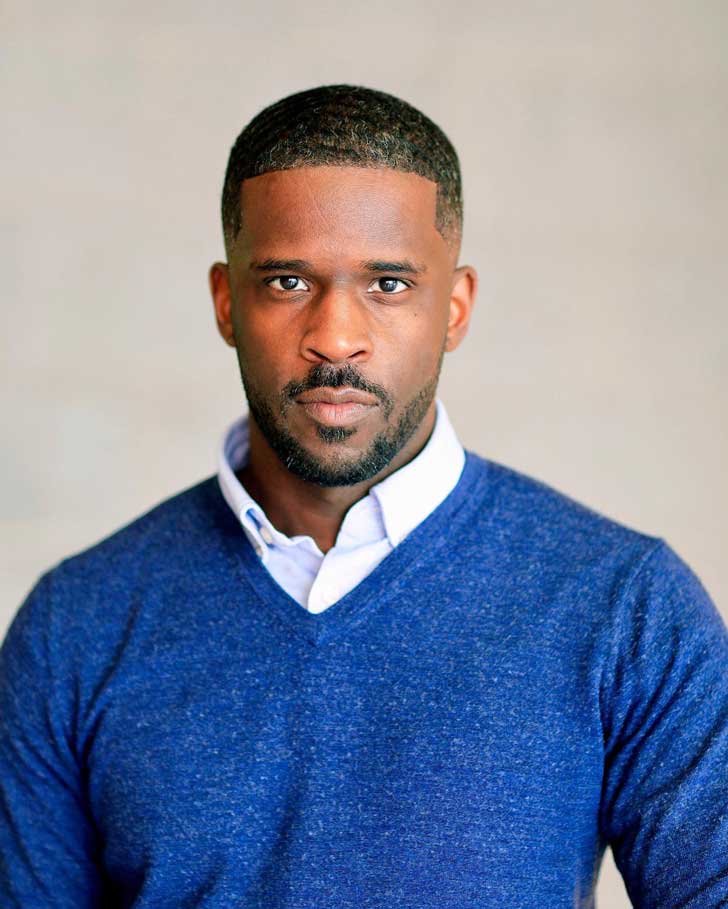
The space is reserved for young people ages 18-24 who are enrolled and currently attending college or trade school in Los Angeles County. It was the city’s first Homekey property dedicated to serving youth, part of a much larger project to create interim and permanent housing solutions for all Angelenos facing homelessness.
The Dumanis House opened in March 2023, with single and double rooms available for 40 students, in addition to a kitchen and dining area, screening room, lounge, recording studio, barbershop, inner courtyard, and on-site cafe (where residents can also work through an employment program).

According to a statewide survey during the 2022-23 school year, an estimated two-thirds of community college students in California were experiencing food insecurity, and roughly half of these students were facing homelessness. Prater founded L.A. Room & Board to help.
The nonprofit began by remodeling a former UCLA sorority house to give 15 students a place to live. The Dunamis House is now the organization’s third house.
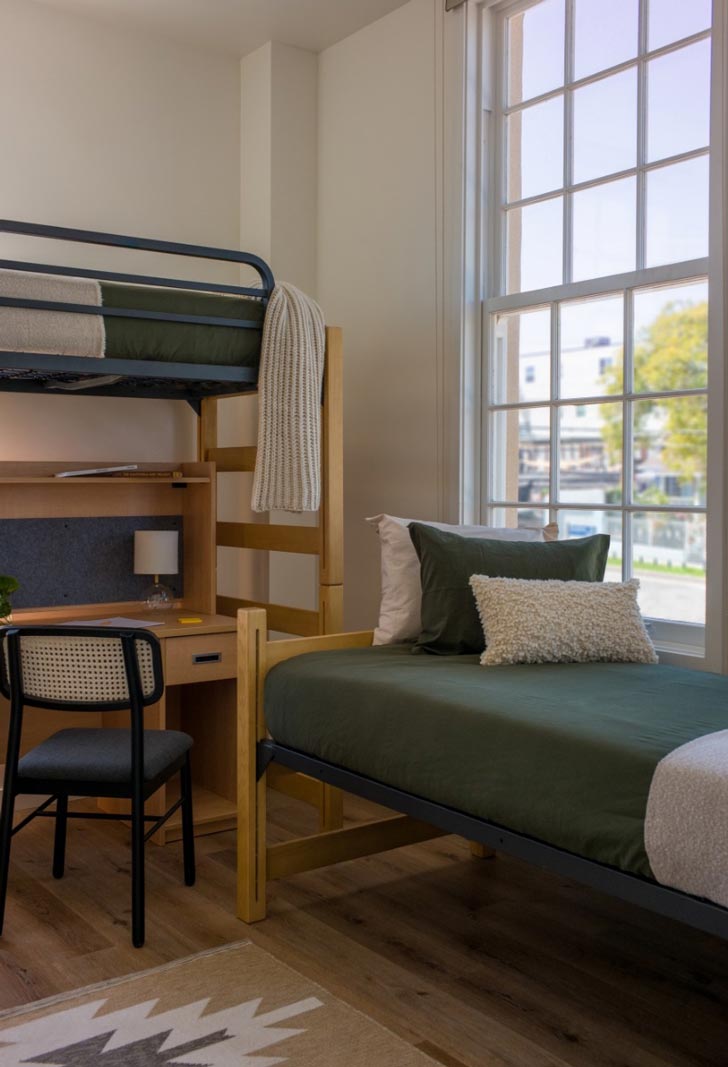
“Offering someone a safe place to sleep is only one part of our mission,” Prater told EdSource. “The real work is trying to transform lives, and through the services that we provide and our incredible team, that’s where the real work happens.”
Residents are allowed to live at Dunamis for up to three years. After this, they are given the option to move into one of the nonprofit’s other homes and are asked to pay subsidized rent, which Prater said helps guide the young adults into remaining housed after leaving the program.
Many of the residents in Room & Board’s programming have previously lived in group homes or juvenile halls, making the stylish and modern design of Dunamis a stark — and welcome — contrast.

“Colors and fabrics and light and airflow — all those things impact people’s experience in housing,” Prater told EdSource. “I wanted to kind of create a space that felt aspirational, inspirational, that felt like, ‘Oh wow, I’m proud to come home here.’”
With warm color palettes, ambient lighting, cozy and modern furniture, and sprawling, colorful murals, residents have a place to truly relax and feel at home.
Additionally, living in Dunamis includes access to healthy and nutritious meals (and cooking classes), one-on-one tutoring, mental health support, job training and career development, and community-building activities.
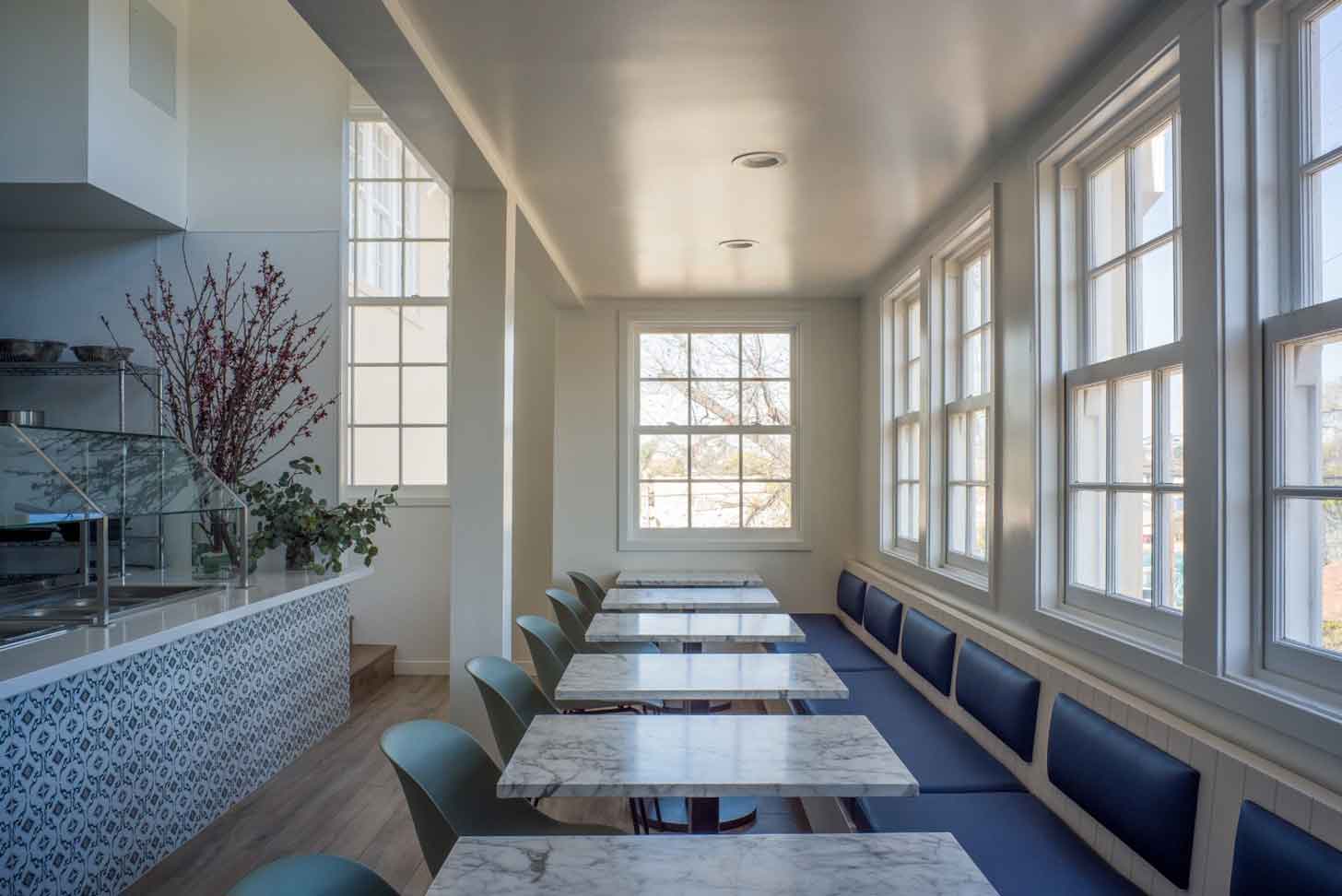
“There is no place like this. This is one of one,” Sherbert Diaz, a Dunamis resident, told EdSource. “It gave me the opportunity to understand who I am and to leave the survival mode.”
The space is also especially welcoming to LGBTQ+ students, like Diaz, who were referred to Dunamis House through the Los Angeles LGBT Center. The Center is the lead agency for the county’s coordinated entry system for youth, though referrals also come directly from area colleges and partner agencies.
Other residents, like Dream Harris, found Dunamis House after navigating homelessness their entire lives. At first, Harris thought it was “too good to be true,” shocked that the beauty of the facility — and the stability it promised — came without a price tag.

But now, given the resources to survive, Harris can finally thrive.
“This place gives me an opportunity to really sit down and think about my decisions and what I want to do in life,” Harris told EdSource.
“I was raised in the worst of the worst. I lived on the streets at one point. I was on drugs at one point,” he added. “Now I have a nice bed to sleep in every night. I have a job now. I have opportunities, so many opportunities.”
This kind of transformation stems from Prater’s own experiences, as well as his expertise in traditional university housing. After his mother died, Prater’s godfather took him and three siblings in.
“I felt safe in his home, and that was something I wanted the students to have when they walked into this space,” he told ELLE Decor.
A painting of his godfather hangs in the lobby of Dunamis.
“It serves as a reminder of what it means to love someone else’s children.”
Header image by Dušan Vuksanović/Courtesy of Ryan White Designs
In 2022, former Arizona Governor Doug Ducey spent an estimated $82 million to construct a makeshift wall along the United States-Mexico border with shipping containers.
Using over 1,000 containers in the Yuma, Arizona region, the Republican governor covered approximately 3.8 miles — but was later sued by the Department of Justice and agreed to deconstruct the wall.

When current Governor Katie Hobbs — a Democrat — was elected, she said she opposed the wall and, once in office, halted construction once and for all.
“It’s not our land to put things on,” Hobbs told Capitol Media Services in late 2022. “And I think it’s a waste of taxpayer dollars.”
In 2024, Arizona put the shipping containers up for sale, with members of the public eligible to buy them at auction, and nonprofits and government agencies — including a veterans memorial — welcome to purchase them at a flat rate of $2,000 each.
So, that’s what Tucson nonprofit Wholistic Transformation did.

The organization supports youth transitioning out of the foster care system by giving them resources — and now, housing — as they age into adulthood.
“These are young adults who experience a tremendous amount of trauma through no fault of their own,” the nonprofit’s founder and CEO Bryan Benz told AZPM.
“So we’re planning to use some of the shipping containers that were used as a wall between Arizona and Mexico,” he added. “I think there’s a symbolism in the idea that walls are to keep people out, and this container is to be used to create a home.”
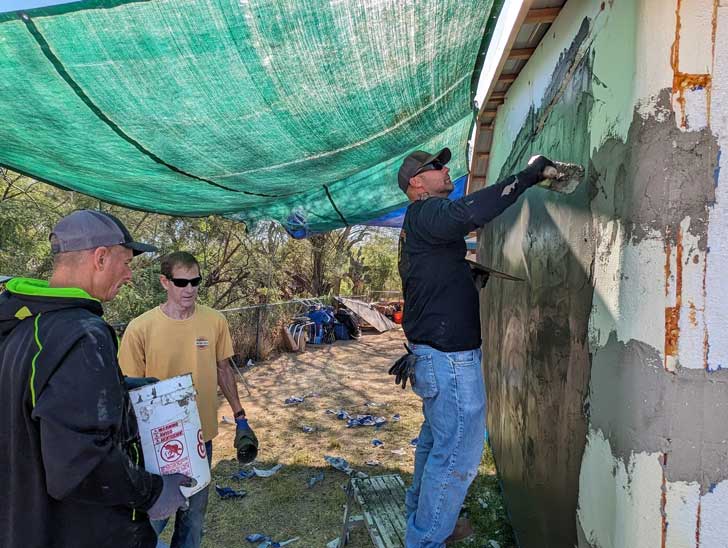
The organization’s first home has been constructed from two 20-foot containers side-by-side, offering a total of 320 square feet of living space.
When the full project is completed, there will be 12 total units, made from the same two-container approach. Each individual unit will be move-in ready, including a queen-size bed, couch, television, small kitchen, and full bathroom.
The units will welcome ten young people, along with two on-site “navigators” to help them establish their new lives.

Wholistic Transformation’s vision is not just to put a roof over the heads of these vulnerable young adults, but to give them the resources they need to thrive.
“We don’t just want to work on just their physical needs; we want to address their mental and emotional needs, we want to address their spiritual needs,” David Hughes, a navigator for the organization, told KOLD 13 News.
“We’re trying to set up a mentorship program that is a long-term commitment,” he added. “We’re trying to set up these navigators that live on site with these young people to let them know we’re here for the long haul.”

The city of Tucson only allowed the nonprofit to use these two containers on the lot next to Bethel Community Baptist Church, where the community will be located. But Benz said he hopes it’ll be a blueprint for future efforts.
“We’re using this model home to cast vision throughout our city,” he told KOLD. “We want a groundswell of community involvement, engagement, from volunteers, from donors.”
The first model is nearly finished and will serve as a tourable prototype, with construction on the whole project set to be complete in early 2026.

Residents of the homes will be asked to pay rent, but Benz said that there will be incentives that reduce costs. For example, those going to school or working will see a reduction in rent by $100. Working on the maintenance of the property itself can also reduce the cost to stay there, he told AZPM.
“People need a place to live; They need a safe environment,” Benz added. “You know, what is the responsibility to step up in this area where possible and to be a part of making a difference in affordable housing? Do we have a responsibility? I feel we do.”
Header image courtesy of Wholistic Transformation
Joshua Clark is no stranger to the loss that comes from weather disasters.
While he has overseen durable home construction projects across five continents — notably helping people rebuild in his hometown after Hurricane Katrina — Clark lost his own home in Hurricane Ida.
This experience inspired him to found Ark Container Homes, alongside artist and actor John Hubert, to build durable and sustainable homes that will last — no matter what nature unleashes.
And nature has continued its unpredictable streak.
Now living in Malibu, Clark was present for the area’s recent devastating wildfires. His home survived the fires — only to be overtaken in a landslide.
“I’m tired,” Clark said in a recent video shared with Good Good Good.
“I’m tired of breathing in the ash that used to be my community here. I’m tired of crawling through destruction stretching over the horizon. It was the same thing after the hurricanes in Louisiana … It happened again. And it’s going to keep happening.”
“I just keep asking myself, why are we building such fragile homes in a fire zone? In an earthquake zone? In a hurricane zone?” he posed.

Clark knew it was time to bring his New Orleans-based company to help rebuild in Los Angeles.
“We originally wanted a home that was comfortable, but also that could be closed up and would be exactly the way you left it when the storm has passed,” Clark said in a statement, sharing the design ethos behind Ark Container Homes.
But he also realized that they could serve a more timely purpose.
“We also realized these container homes could be a way to get people back to living on their property as quickly as possible after any disaster to oversee clean-up and reconstruction and to feel an important sense of normalcy,” he added. “We want to give people a way to get home.”
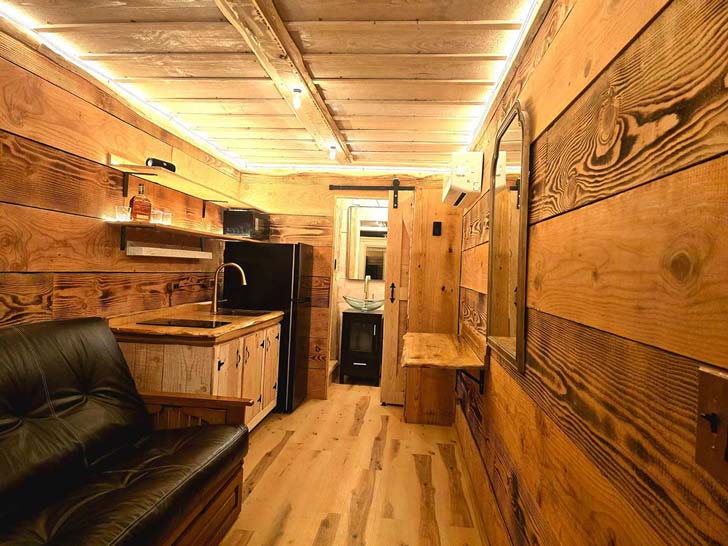
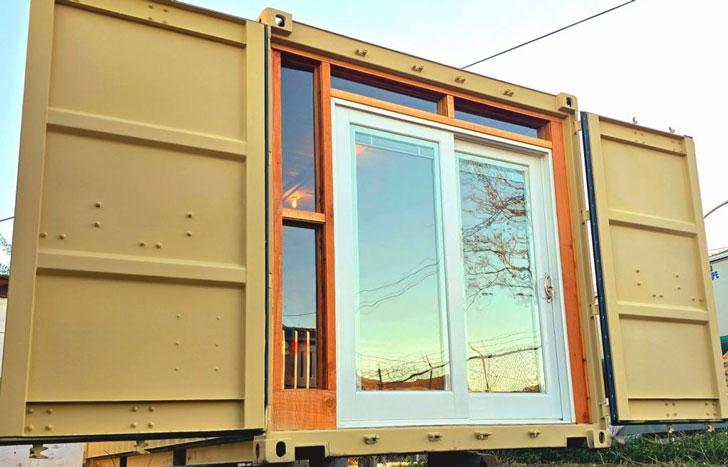
Ark Container Homes are constructed inside new storm- and fire-proof cargo containers and are fully insulated. Units are either 20 or 40 feet in length, sleeping up to three or six people, respectively.
Additionally, windows are all situated at the container’s opening and can be sealed with the unit’s original steel doors to maintain durability in times of extreme weather.
“Our mission is simple: provide homes that stand the test of time, delivering unmatched durability, comfort, and peace of mind,” Ark’s website outlines. “From the Louisiana bayou to the harshest environments on Earth, our container homes are built to last.”
Each home includes a full residential-sized bathroom; custom cabinetry, storage, and wooden interiors; a projection television; heat and air conditioning; and a full kitchen with a fridge, freezer, microwave, two-burner stove, and sink.

Homes can be tied into existing electrical and plumbing services or can operate independently using a generator or solar panels, and a water pump or gravity-fed system.
While Clark is working to get one of these units to his property in Malibu, he is currently residing in a model unit in Louisiana.
Once his immediate housing needs are taken care of, he hopes to bring an affordable housing option to those rebuilding in California on the heels of the wildfires.
Ark Container Homes retail from $39,997 to $69,997, with financing options available. A portion of every unit sold in California will support community fire brigades.
“I’m using this as an opportunity to rebuild on my own land here,” Clark said, “and also to raise money for the community fire brigades, who I watched save lives while the fire raged.”
Header image courtesy of Ark Container Homes
Throwing and catching gold, green, and purple beads is a cherished Mardi Gras tradition, but as it turns out, these petroleum-based plastic beads have a heavy impact on the New Orleans environment long after celebrations have ended.
Traditional Mardi Gras beads are produced from natural gas and oil-derived feedstock and take an estimated 500 years to decompose. And when they do, they release heavy metals and other toxins into the environment. According to Louisiana State University, they can even clog sewer systems across the city.
So, Alexis Strain and Lauren Rogers, two biological sciences students at LSU, teamed up to create a biodegradable alternative.

These efforts started in Dr. Naohiro Kato’s lab, where the professor began the work of producing Mardi Gras beads from microscopic algae in 2021. His goal was to get the beads to decompose in months instead of decades, but they were still very expensive to make and scale.
Now, his current team of students has a new approach.
Rogers and Strain are producing the beads using 3D printers with bio-based plastics called polyhydroxyalkanoates. Then, their goal is to have those bio-based plastics degrade with the help of plants and soil bacteria.
They’re called PlantMe Beads.

“Developing alternatives for Mardi Gras beads and how we celebrate Mardi Gras is certainly possible,” Strain said in a statement for the university. “And using scientific research is one of the ways that we're able to address these problems.”
Dr. Kato’s team theorized that inserting seeds into the beads could accelerate their decomposition, as the germinated seeds may attract bacteria in the soil that promotes faster breakdown of the plastics.
The beads look like tiny, spherical cages that the seeds can be placed into during production. After celebrations come to a close, the beads can be easily planted in a pot or garden at home and will grow into “Earth-friendly” plants.
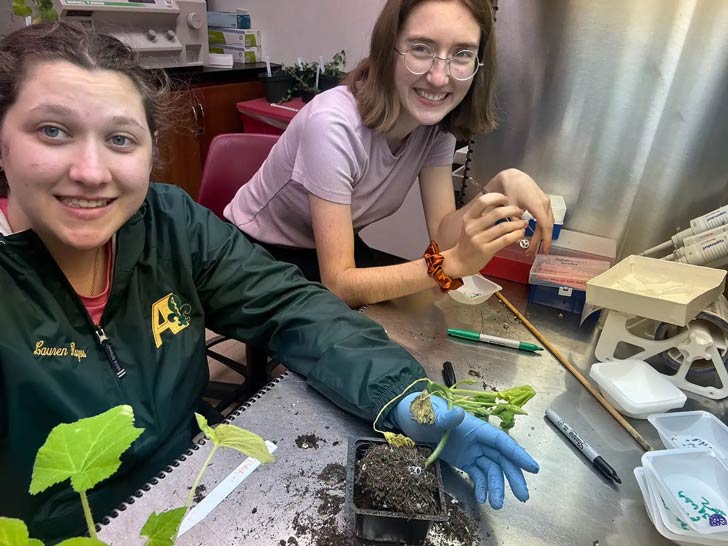
So far, sweet pea seeds have yielded the best harvest.
“We can put a little message on it and tell them, ‘Hey, take me home, plant me,” Rogers said. “And they'll start growing it and hopefully see plastic degradation within a month.”
While the researchers have proven the concept, the lab team will now focus on optimizing their final product by finding the perfect combination of plant-based polymers to use in the 3D printing process, reducing costs, and scaling production.

Currently, the beads cost 50 cents per strand, making them a competitive alternative to traditional beads.
Another cost- and energy-saving facet of the invention is that they can be created right in New Orleans, instead of being imported.
“I see 3D printing as a potential solution to some broader issues with plastic,” Strain explained, “because you can print things that are very specific to your needs without the need for transport and shipping, which can add additional ecological costs.”

Dr. Kato said the aim is to mass-produce the PlantMe Beads for Mardi Gras festivities in 2026 and is already in talks with Krewe of Freret parade organizers.
The lab also hopes to make the 3D plans for the beads an open-source resource, so people can 3D print them on their own.
“We hope PlantMe Beads will inspire many to embrace a more sustainable Mardi Gras tradition,” Dr. Kato said, “throwing and catching beads that are environmentally friendly.”
“We hope that if they get left behind,” Rogers added in a video for LSU, “... then it can bloom right there and start degrading.”
Header image courtesy of LSU Media Relations
In the fall of 2024, the City of San Diego expanded its Safe Sleeping Program, which provides safe, legal, city-approved tent encampments and supportive services for people facing homelessness.
The low-barrier option provides a safe shelter tent, electronic charging stations, housing navigation, meals, health care, transportation, veterinary care, and other supportive services at two city properties in San Diego.

Each tent can shelter up to two individuals, allowing folks to stay with a partner or caretaker while they access services.
The program was first implemented in the summer of 2023 to address unsheltered homelessness and unsafe street encampments, with 500 tents.
In 2024, Mayor Todd Gloria added 250 more tents to the program to help offset a shortage of shelter beds in San Diego.
“Safe Sleeping is a first-of-its-kind program that provides an opportunity for people who previously hadn’t accepted city services to take a crucial first step toward ending their homelessness,” Mayor Gloria said in a statement.
“Cities across the country are taking note of this innovative way to remove unsanitary encampments and get unsheltered people into care.”

Of course, while the tents provide life-saving emergency shelter, they are not a long-term solution to homelessness.
Mayor Garcia said his administration will “continue to get people off the streets and on the path to housing,” with the Safe Sleeping Program as part of a larger Comprehensive Shelter Strategy created by the city.
With two homeless shelters closing in the area at the end of 2024, the 750 tents in the Safe Sleeping rotation are paramount to keeping people safe and sheltered in times of crisis.
“Housing placements are the ultimate goal, but that can take time and there needs to be safe and secure options for people to work to end one’s experience of homelessness,” said Sarah Jarman, director of the city’s Homelessness Strategies and Solutions Department.
“With this Safe Sleeping expansion, we’re able to quickly add much-needed sheltering options while planning is underway for additional programs.”

Since the inception of the program, at least 82 people have moved from the city’s two campsites into permanent homes, according to Voice of San Diego. That’s about 10% of the people who have utilized the Safe Sleeping Program.
The Safe Sleeping locations are located on the outskirts of Balboa Park and are managed by the nonprofit Dreams for Change. The organization aims to use this initiative to help lower the barrier to entry for unhoused community members who may be hesitant to seek support.
“The biggest joy next to a client obtaining their own place is the client who we have been told has been shelter and service resistant for many years asks us to help them take that first step,” Dreams for Change CEO Teresa Smith told Voice of San Diego, “be it detox and rehab, healthcare or simply willing to explore what it will take to move forward.”
For residents of the Safe Sleeping locations, staying in encampments has often already become a norm. But receiving tent-side services, and not worrying about camping laws or harassment has made all the difference.
“It was safer being in the Safe Sleeping, because I didn't have to worry about people coming after me with a knife and gun,” resident Karen Sengstock said in a video for the nonprofit. “It helped me a lot.”
One resident, Seth Eastep, was living outside of a public library prior to moving to a Safe Sleeping location. Now, he works for Dreams for Change as a member of the onsite security team.
“People look up to me,” Eastep said in a video. “With Dreams for Change, I’m feeling that happiness back in my life. That’s driving me more towards where I gotta be.”
Smith said this kind of transformation is vital to the dignity and agency of those seeking help.
“It really helps them empower their lives,” she said. “Knowing that this is your life and we’re here to help, versus you’re in our space and you need to do what we need you to do.”
Header image courtesy of the City of San Diego
Every day the Good Good Good team collects the best good news in the world and shares it with our community. Here are the highlights for this week!
If you want to get good news in your inbox every day, join the Goodnewsletter — the free daily newsletter designed to leave you feeling hopeful.
The Best Positive News We’re Celebrating This Week —
A group of doctors just became the first in the world to cure blindness in four children with a rare genetic condition
Using a pioneering gene therapy, doctors in London have officially become the first in the world to cure blindness in children born with a rare genetic condition that causes vision loss. Those impacted are legally blind from birth.
Doctors injected healthy copies of the impacted gene into the eyes of four children between the ages of one and two during a one-hour surgery. They can now see shapes, find toys, recognize their parents’ faces, and even read and write.
One patient was from the U.S. and while his parents said it may not be the last treatment he needs in his life, the improvements so far are helping him know, see, and understand the world better.
Why is this good news? The outcomes, seen five years after the surgeries were performed, were “hugely impressive” and demonstrate the first effective treatment for “the most severe form of childhood blindness” — opening the door to treatment for young children at early stages of the disease.
An innovative machine recycles rubble into LEGO-like bricks to build homes for displaced Ukrainians
Global sales of combustion engine cars have already peaked — and electric vehicle sales are rising rapidly
In order to decarbonize the road transportation sector, the world must transition from gas-powered cars to electric vehicles and other forms of low-carbon transportation.
Based on data from the International Energy Agency, this transition is well underway: in fact, global sales of combustion engine vehicles peaked in 2018 and are now falling as electric vehicle sales grow rapidly.
While decarbonization must also involve adding more public transportation, trains, and other alternatives to personal vehicles, electric cars are also an essential part. And while more carbon is emitted in manufacturing electric vehicles, that “carbon debt” pays off quickly once they’re in use.
Canada is officially set to build the largest solar farm in North America
Medicine Hat, Alberta has more days of sunlight than any other city in Canada, making it the prime candidate for North America’s future largest urban solar park.
Once fully built out, the Saamis project would not only be able to meet the peak load demand for both industrial and commercial buildings in the city — it could also supply demand for its 65,000 residents.
Poetically, the 325-megawatt project will be situated on an old industrial site in “Gas City” — as Medicine Hat, Alberta is known due to the area’s extensive fossil gas reserves.
Even better: The project will be built on a 1,600-acre plot of land that had been contaminated by a solid waste byproduct of nitrogen production, so the land had very “limited development potential” — now, instead of sitting there useless, it will help bring clean energy to the community (which has environmental and health benefits of its own).
→ Read more
Intentionally designed for community-building, a first-of-its-kind 3D-printed neighborhood will give 100 homes to people facing chronic homelessness
→ Read more
Despite recent tragic, high-profile disasters, air traffic accidents have been declining globally
Between the collision of an airplane and helicopter in Washington, D.C. and an airplane overturning at a Toronto airport, recent high-profile tragedies involving aircraft have led to a decline in consumer confidence in flying.
However, a recent analysis of both U.S. and worldwide data found that there’s been a downward trend in air accidents over the past two decades.
In the U.S., there’s been a decline in air accidents from 2005 to 2024, despite the overall number of flights significantly increasing. In January 2025, there were 52 accidents, lower than 58 in January 2024, and 70 in January 2023.
The downward trend holds globally, too.
A historic ocean liner just began its final voyage before it becomes the world’s largest artificial reef
On its maiden voyage in 1952, the 1,000-foot SS United States shattered the transatlantic speed record, crossing the Atlantic Ocean in three days, 10 hours, and 40 minutes — beating the previous record for an ocean liner by 10 hours. It still holds that record.
Now, it’s begun its final voyage: the aging ocean liner is being towed from south Philadelphia to Alabama for prep work before officials sink it off the Florida Gulf Coast where it will become the world’s largest artificial reef.
Officials in Okaloosa County will add the iconic ship to the county’s more than 500 artificial reefs, generating tourism money, and supporting local marine ecosystems.
Why is this good news? Coral reefs support vibrant marine ecosystems, stimulate tourism and fishing industries, and protect shorelines from storms and erosion — but reefs around the world have been impacted by pollution, overfishing, and climate change. Artificial reefs like these can help restore those ecosystems, providing benefits for those of us on land, too.
→ Read more
To identify people most in need of help, Los Angeles is using a new predictive AI model to help get homeless people off the streets
New energy storage capacity in China grew by 130% in 2024 alone
By the end of 2024, China announced that the country’s new energy storage capacity had reached 73.76 gigawatts/168 gigawatt-hours — a 130% increase over 2023.
In 2024 alone, the country added 42.37 GW/101.13 GWh of new storage capacity and had an average discharge duration of 2.3 hours, up from 2.1 hours in 2023.
China also saw breakthroughs in energy storage technology in 2024 with the integration of several non-lithium storage projects, like a compressed air energy storage facility, sodium-ion battery installations, and more.
A team of scientists found that Northeastern U.S. salt marshes store 10 million cars’ worth of carbon
Scientists at the University of Massachusetts Amherst recently debuted a new, highly accurate method to quantify carbon capture in salt marshes.
They found that the salt marshes in the Northeast store approximately 10 million cars’ worth of carbon emissions in their top meter of soil — and add around 15,000 cars’ worth every year.
That’s because as waves, storms, and tides come and go, new layers of carbon-trapping sediment are continually stored in the thick salt marsh grasses. Additionally, as glaciers continue to melt, the marshes grow vertically to keep up with rising sea levels and store even more carbon.
What’s the nuance: The team also warned that the amount of carbon salt marshes store could also have the reverse impact if they’re disturbed or their natural processes altered — leading them to release those greenhouse gases and further exacerbate climate change. All the more reason to ensure these natural environments are protected.
→ Read more
A historic Los Angeles hostel got a stunning, modern makeover and now provides housing for 40 students facing homelessness
A UK man has planted more than a thousand trees in his community to restore green space in a ‘tree desert’
With less than 3% tree coverage, the Grimsby suburb of East Marsh is one of the UK’s “tree deserts.” It’s also where Billy Dasein was born and grew up.
Now an adult, Dasein is bringing his childhood dream of a tree-lined street to life with a community-benefit society called East Marsh United — and one of its highest priorities is trees because of their incredible health and community benefits.
Over the past two years, EMU has worked with members of the community and charities to plant 30 trees in the local park, 96 trees at local schools, and thousands of saplings in woodland and hedgerows.
→ Read more
Over 1,000 musicians released a ‘silent album’ to protest a proposed UK copyright law letting AI use their work
A new, proposed copyright law in the United Kingdom could make it easier for artificial intelligence companies to use the work of musicians to train their models without the artists’ permission — unless they proactively opt out.
To protest this proposed law, more than one thousand musicians — including Annie Lennox and Imogen Heap — released a “silent album” titled “Is This What We Want?” on Spotify.
The 12-track album features ambient sounds of empty studios and performance spaces to symbolize “the impact we expect the government’s proposals would have on musicians’ livelihoods.” All proceeds from streams will benefit a UK charity that supports working and retired musicians.
What’s the nuance? While some artists are excited about the potential of AI (in addition to use cases in health care, climate action, protecting wildlife, and more), critics note that most of the AI models “creating art” were actually “trained on copyrighted work without a license.”
And while the new copyright law would allow artists to opt out — that’s a “huge burden” for artists to protect their intellectual property, and doesn’t protect artists the way many think.
A grassroots movement led by women in Uganda is training the next generation of climate leaders
Girls for Climate Action is a grassroots movement in Uganda that’s training young women in the country to become experts and leaders in climate resilience and environmental protection.
Led by women in Uganda, the movement has trained more than 300 young women in parts of the country hit hardest by the climate crisis.
In addition to teaching them practical climate resiliency skills, like making a stove from natural materials, they’re ensuring women have a seat at the climate policy-making table because “they’re the ones using the energy,” knowing every step of the journey to collect firewood, make food, and more.
→ Watch more (video)
More good news of the week —
France’s parliament voted to limit the sale and production of items made using dangerous and toxic “forever chemicals.” Per- and poly-fluoroalkyl substances (PFAS) are human-made chemicals used since the late 1940s to mass produce the non-stick, waterproof, and stain-resistant treatments that coat everything from frying pans to umbrellas, carpets, dental floss, and ski wax.
An early warning system for climate “tipping points” was just given £81 million in kickstart funding. The ambitious UK project will combine fleets of drones, cosmic ray detection, and the patterns of plankton blooms with artificial intelligence and the most detailed computer models to date to detect critical tipping points.
A rare fish species thought to be extinct for 85 tears was just rediscovered in India. The last sighting of the Chel snakehead was recorded from specimens collected between 1918 and 1933 in the Himalayan region of India, leading scientists to believe the species had died out.
Thousands of people in Nigeria are suing Shell and its subsidiary over its role in oil spills that have harmed their communities. The UN reports at least 1.5 million tons of crude oil have been spilled in more than 7,000 incidents in the Niger Delta region since 1958.
In a proposed law designed to restore trust in politics, lawmakers in Wales who deliberately lie could be forced from office. Putting the country at the forefront of an issue seen globally, the changes proposed by the Welsh Parliament standards committee would make candidates in elections liable to criminal prosecution for making false statements to win votes.
After a refugee center opened, the more than 1,000 refugees who passed through helped revive a “dying” village in Spain. Of the more than 1,000 people who have passed through the refugee center since it opened in 2021, around 100 decided to stay in the village permanently once their requests for residency were granted, including 25 children.
After a federal judge blocked the ban, two hospitals in Colorado resumed providing gender-affirming care for youth. After weeks of trying to find new places to receive care, the hospitals’ announcement brought relief to families, who “should have the right to access expert medical care to support their child’s well-being, including gender-diverse youth.”
The U.S. is on a fast track toward a clean energy transition as renewables continue to fall in price, especially solar. Though adoption was bolstered by Inflation Reduction Act credits, even the unsubsidized cost of solar power still dropped almost 85 percent between 2010 and 2023 — and even if those credits are repealed or shortened it’s “here to stay.”
Scientists in Hawaii are training “hungry” marine fungi to quickly eat ocean plastics. Plastic is the biggest ocean pollutant and plastic surfaces are the fastest growing habitat in this environment, and researchers have discovered a species of fungi around the island of O’ahu that eats polyurethane plastic.
An award-winning conservationist is building canopy bridges across highways in the Brazilian Amazon to protect endangered primates. Working with local partners including Indigenous people who hold important knowledge about the wildlife in their territory, the Reconecta Project has built more than 30 canopy crossings on a major highway.
In a “tipping point” for the movement, all 50 U.S. states have now introduced some form of right to repair legislation. Wisconsin just became the final state to introduce a “right to repair” bill, while laws have been passed in six states and another 20 states are formally considering bills in the current legislative session — and the movement is gaining ground globally.
New EU rules will force companies to cover the cost of collecting, sorting, and recycling food and textile waste. For fashion in particular, new extended producer responsibility rules mean textile producers and fashion brands will have to pay a fee to help fund waste collection, sorting, and recycling, based on how circular and sustainable their products are.
Following the recommendation of a “wellbeing commission,” the Danish government is banning phones in schools. Set up in 2023 to investigate growing dissatisfaction among young people, the Danish wellbeing commission made 35 recommendations aimed at achieving a better balance between digital and analog life among young people.
Results from a small clinical trial are showing promise for a personalized mRNA vaccine to treat pancreatic cancer. Right now, fewer than 13% of people live more than five years after a pancreatic cancer diagnosis — in this trial, half of the participants mounted a lasting immune response against their cancer cells.
A first-of-its-kind heart-shaped bouy is converting wave motion into clean electricity. Wave energy has the potential to generate an estimated 29,500 TWh per year, which is nearly ten times Europe’s total annual electricity consumption, and more than all of the global annual electricity generated in 2018.
A study published by the Benioff Homeless and Housing Initiative at the University of California San Francisco is challenging public perceptions of substance use among California’s homeless population.
According to the study, which was recently published in the medical journal JAMA, a large majority of people living on the streets in California are not illegal drug users.

UCSF researchers found that contrary to popular perception, only about 37% of homeless people were using illicit drugs regularly, and 25% said they had never even used drugs.
That said, the researchers also confirmed that drug use is far more prevalent among homeless people than in the general population, with 65% reporting that they regularly used drugs at some point in their lives, and 27% reporting that they had started using drugs after becoming homeless.
The nuance continues, with 35% of respondents also saying that their drug use actually decreased after becoming homeless. This response was most common among parents who worried about losing custody of their children, according to the researchers.
What the researchers concluded is that drug use, while not as high as popular belief, is still deeply intertwined with homelessness and is both a risk factor and effect of losing housing.
“Our research shows there is an increased risk of becoming homeless if you use drugs; and that homelessness itself increases drug use because people use it as a coping strategy,” Margot Kushel, MD, director of the BHHI and senior author of the report, said in a statement.
The report was part of a larger Statewide Study of People Experiencing Homelessness from BHHI, which gathered findings from over 3,200 adults experiencing homelessness. It is the largest representative sample of the homeless population since 1996, according to UCSF.

While drug use is indeed a widespread issue among homeless communities, the public perception that illicit drug use is endemic to homelessness can be challenged with this new data.
Additionally, researchers found that the most common drugs used among the homeless population aren’t opioids, but rather methamphetamines. And many respondents had a reason for why they turn to these specific substances.
“People, particularly those who are unsheltered, may use meth to help them stay alert in unstable situations,” the researchers said.
“People are telling us that it helps them survive,” Kushel added in an interview with The LA Times. “It keeps them awake and alert. They are using it either because they are traumatized, they have been assaulted, they are afraid or depressed, using it as coping to make it all go away.”
But that doesn’t mean they want to be using the drug. The report’s findings also indicated the need for robust treatment options for homeless people navigating substance use disorders.
A significant percentage of the respondents who are homeless and use drugs regularly said they have tried — but have been unable to — receive treatment.
“One of the most poignant findings was that 1 in 5 told us they are actively seeking treatment and couldn’t get it,” Kushel told The LA Times.
Only 7% of respondents who had any use of drugs in their lifetime said they were receiving treatment.
“It’s hard to get treatment,” Kushel told The LA Times. “It shouldn’t be. You shouldn’t scrounge to save money to go somewhere and be told you’ll be put on a waiting list. That should not happen, but it does.”
The researchers pointed to housing as the obvious solution to this problem, though more immediate resources like methadone and other medications that treat opioid addiction should be readily available, they added.
“We know how to treat substance use, but it is hard to do that while people are still homeless,” said Ryan Assaf, PhD, MPH, assistant professor in the Division of Health Equity and Society at UCSF and first author of the study.
“We need to reduce barriers to substance use treatment and that includes prioritizing people’s ability to return to housing.”
Header image by Randy Laybourne on Unsplash
Along with harmful drugs like fentanyl, xylazine — also known as “tranq” — has been linked to a recent rise in overdoses across the United States.
The powerful animal tranquilizer has become a dangerous street drug, with xylazine found in the drug supply of 48 in 50 states. That means fentanyl, an already extremely deadly drug, has been made “even deadlier” when laced with tranq.
In the City of San Diego, “accidental overdose” was the leading cause of death, according to 2022 data and is especially a risk factor for people experiencing homelessness. Accidental overdoses have increased 438% between 2018 and 2022 among the city’s homeless population, a majority of which involved fentanyl.
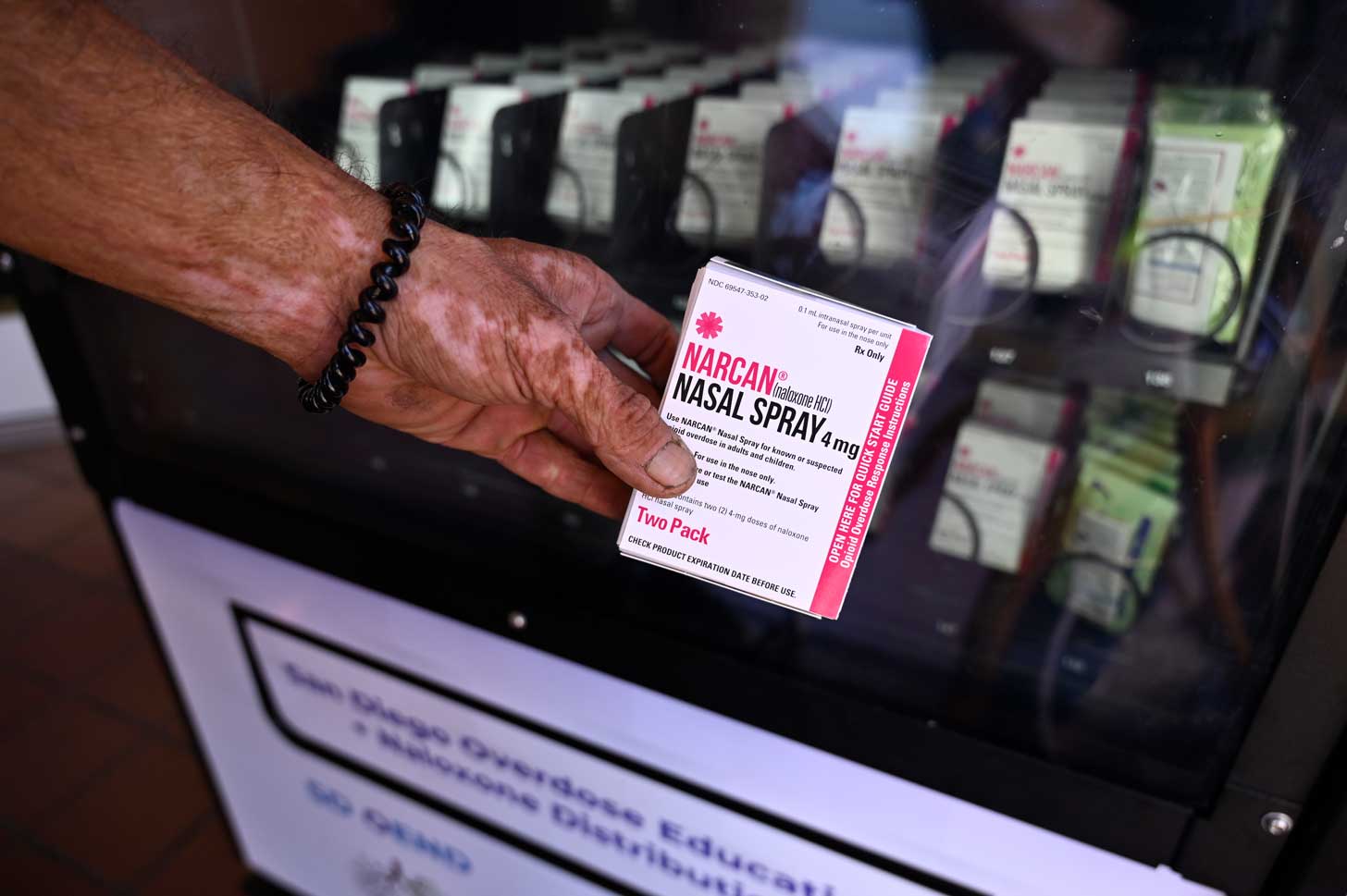
Fentanyl overdoses can be reversed with the use of medications like naloxone (popularly known as the brand name Narcan), but overdose reversal medications do not reverse the effects of xylazine.
Even more, xylazine does not have a taste or smell, making it even more dangerous when mixed with other substances, like cocaine, or methamphetamines.
San Diego Mayor Todd Gloria has sponsored a bill that would add xylazine to a list of Schedule III substances to help law enforcement prosecute drug trafficking and related deaths.
But preventing those deaths is another task entirely.
That’s why homeless support nonprofit Father Joe’s Villages has introduced xylazine test strips to its 24/7 Harm Reduction vending machines.
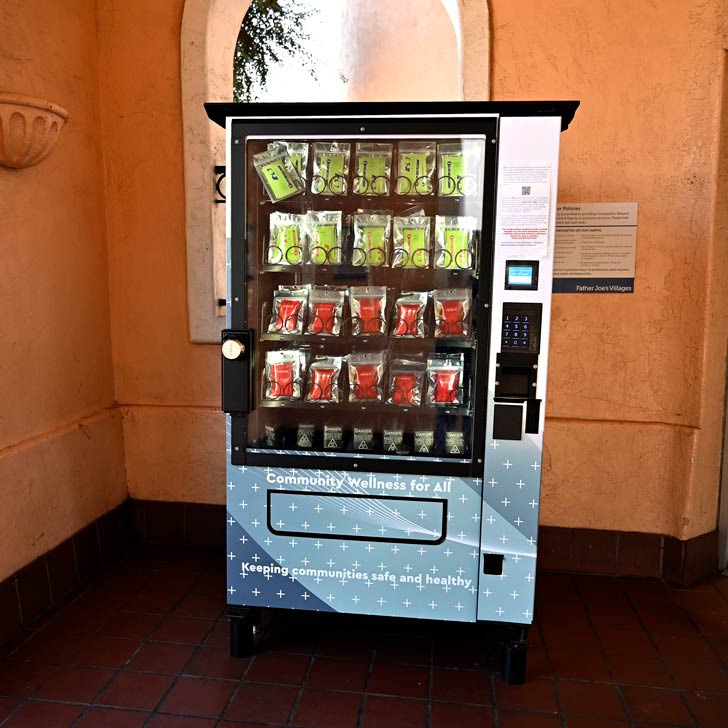
“Preventing people from accidentally ingesting the substance is key” in reducing accidental overdose deaths, a press release from the nonprofit explains.
Xylazine test strips are small strips of paper that can be placed within a sample of drugs to detect the presence of xylazine, allowing people to make more informed choices about using a given substance.
A year ago, Father Joe’s Villages installed a naloxone vending machine for homeless people who are at risk of an overdose. Now, a second vending machine includes testing strips for both fentanyl and xylazine, as well as sharps boxes and wound care kits.

“The location and ease of 24/7 access means that these machines are frequented by individuals who are housed and unhoused alike,” said Megan Partch, PhD, chief health officer for Father Joe’s Villages.
“We are a community and we’re meant to care for one another. Having these types of resources readily at hand means we can support anyone in a time of need, whether they are a family member, friend, neighbor or member of the community.”
Recent reductions in fentanyl-related deaths have been partly attributed to the widespread expansion and availability of naloxone nationwide. The hope is that easy access to xylazine test strips will yield similar progress.
“People have life-saving resources available to intervene directly instead of waiting for emergency medical services,” Partch added.
“Last week, when our Street Health team encountered someone who was in a state of overdose, we learned that community members had already administered doses of naloxone, which helped stabilize this person until help arrived.”
Father Joe’s Villages also has a Street Health team that provides substance use education, connects people to resources, and provides clinical drug and alcohol counseling to unhoused community members.

Alongside these efforts to increase awareness and safety, the vending machines are a key strategy in the organization’s harm reduction practices.
Harm reduction refers to practices that help people minimize the negative health, social and legal impacts caused by substance use, even when they are not completely ready to stop drug use.
This helps them move further along on the path to recovery and build trust with providers, like those at Father Joe’s Villages.
“The presence of the vending machines, alone, continues to be a catalyst for ongoing conversation around the overall topic of harm reduction,” Jennifer Wilkens, the manager of street health for Father Joe’s Villages, told Good Good Good.
“These conversations are opportunities to provide education, build awareness, help people gain insight and challenge their thinking around the topic, encourage compassion and understanding, and help people to recognize that they are not alone in this fight. Clearly promoted access to these supplies reminds people that they are seen and their lives and the lives of their loved ones are valued.”
Header image courtesy of Father Joe's Villages of San Diego
Since 2000, wind energy has increased drastically across the globe. In the United States alone, wind electricity generation has risen from 6 billion kilowatt-hours in 2000 to about 430 billion in 2023.
This is an increase of over 7,000%.
But most wind turbines have a life span of about 20 years, meaning much of the initial wind energy infrastructure has been or will soon be decommissioned worldwide.
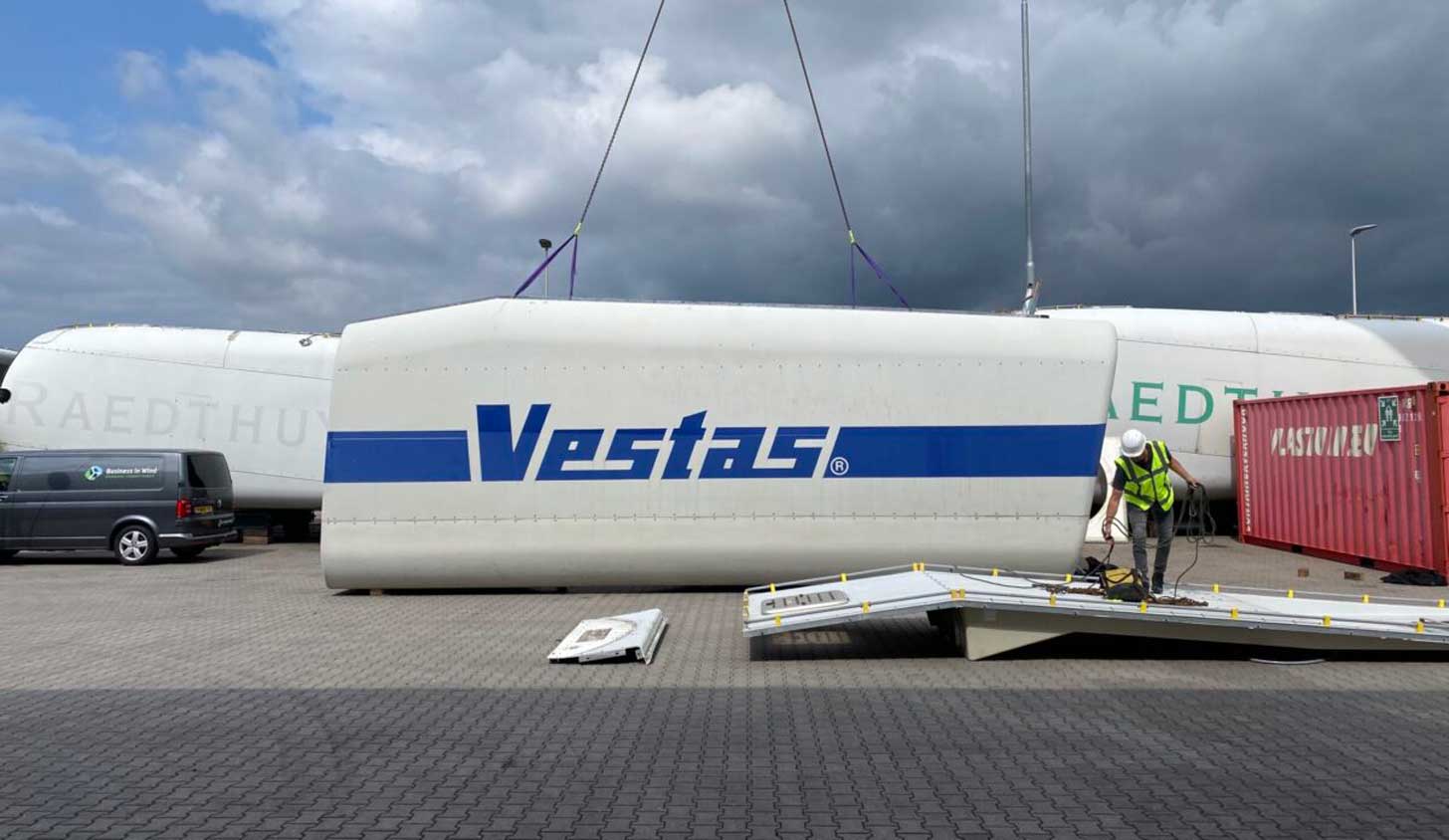
European clean energy company Vattenfall has an innovative idea for the next chapter of these wind turbines.
“We are looking for innovative ways in which you can reuse materials from used turbines as completely as possible,” said Thomas Hjort, Vattenfall’s director of innovation.
“So making something new from them with as few modifications as possible. That saves raw materials, energy consumption and in this way we ensure that these materials are useful for many years after their first working life.”
In partnership with Dutch design firm Superuse Studios, Vattenfall introduced a novel idea: A tiny home made out of a recycled wind turbine.

Their prototype includes 387-square-feet of interior space and debuted to the public at Dutch Design Week in the fall of 2024.
Designers at Superuse worked to design a building-code compliant house in the smallest available nacelle, an enclosure that houses the top part of a V80 2MW wind turbine.
This nacelle was four meters wide, ten meters long, and three meters high, and was repurposed from a turbine that stood in Austria for two decades.
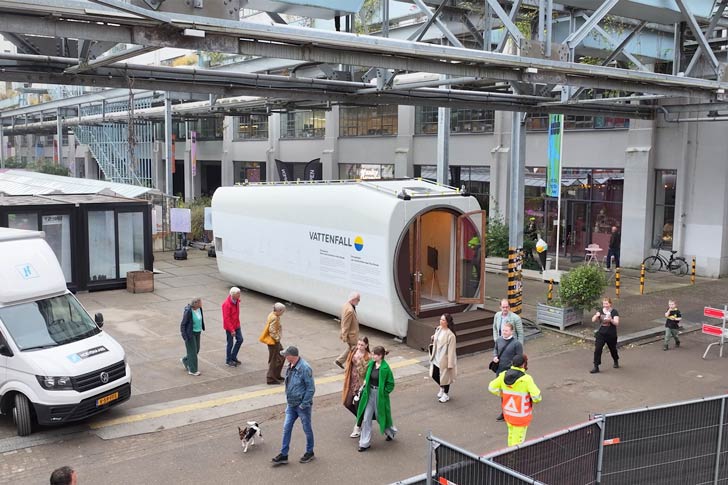
“Most parts of a wind turbine — the foundation, tower, gearbox parts and generator — are made of metal or concrete and therefore easily recyclable,” Vattenfall’s website explains. “Steel, for instance, can be melted down and reused, but the downside is that this takes a lot of energy and creates emissions.”
To convert the nacelle into a tiny home in the most sustainable way possible, the turbine decommissioning company Business in Wind removed and recycled the interior parts of the nacelle. Then, the team transported the shell of the nacelle on a flatbed truck, according to Fast Company.
Then, Superuse laid out the interior design to meet Dutch tiny home design codes and incorporated insulation and appropriate exits. The team was successful, completing a final design that includes a fully functioning toilet and shower, a kitchen with a sink and stove, a pullout couch, and an electric heat pump.
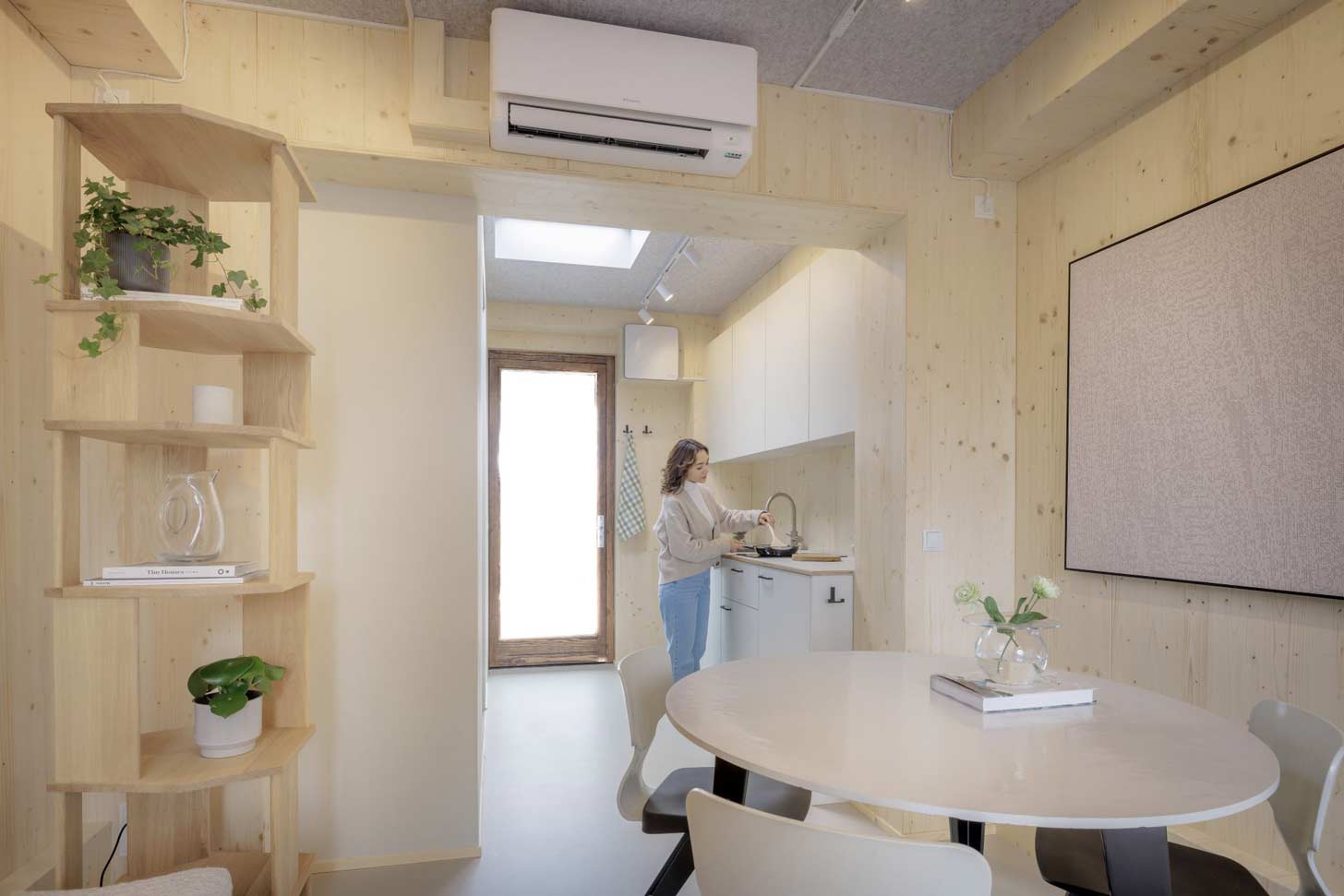
Solar panels on the roof also provide extra power, and the home even has a two-way hookup for electric vehicles, meaning the vehicle can help power the home, or vice versa.
The prototype was also furnished with sustainably made or secondhand furniture with the company Reliving. This includes a table that was made of material from a recycled wind turbine blade.
“At least 10,000 of this generation of nacelles are available, spread around the world,” Jos de Krieger, a partner from Superuse, said in a press release, about the potential to expand this kind of design.
“Most of them have yet to be decommissioned. This offers perspective and a challenge for owners and decommissioners. If such a complex structure as a house is possible, then numerous simpler solutions are also feasible and scalable.”

The existing structure is a one-off prototype, which aimed to answer Dutch Design Week’s question: “What if a decommissioned wind turbine could become a gold mine of resources?”
But Hjort said there’s a world of possibilities when it comes to a second life for these wind turbines.
“It would be possible to do 2,000 tiny houses per year, if you wanted to, on the same template [Superuse Studios created] for the next five years,” Hjort told Fast Company.

Vattenfall itself is not planning to develop real estate, but Hjort said “it’s possible to build a business on doing it,” and that the company “cannot neglect the obligation we have to push the envelope in all aspects of our life cycle.”
Superuse Studios and other collaborative partners are, however, considering a larger production scale of the tiny homes, especially following the interest garnered at Dutch Design Week.
Regardless of what happens next for the tiny home, the world will continue to seek solutions for scalable, sustainable living to combat housing and climate crises alike.
“Whether it will fly or not, who knows?” Hjort told Fast Company. “But what we are definitely saying is that it is a real opportunity. There’s interest for it.”
Header image courtesy of Vattenfall/Jorrit Lousberg
With interest in tiny homes rising in the United States — both as a solution to homelessness and a sustainable residential housing choice — architects across the globe are leaning into the concept of modular living.
One innovative case study is House W, a 1,754-square-foot home designed by Florian Busch Architects in Nakafurano, Hokkaido, Japan.

House W resides on the site of an old farmer’s barn and takes inspiration from its setting, surrounded by rice paddies and asparagus fields. Its connection to nature is also prevalent in the home’s energy efficient design, which allows it to harness nearly twice as much power as it requires every year.
“House W is FBA’s first building to generate more energy than it consumes,” the firm writes on its website.
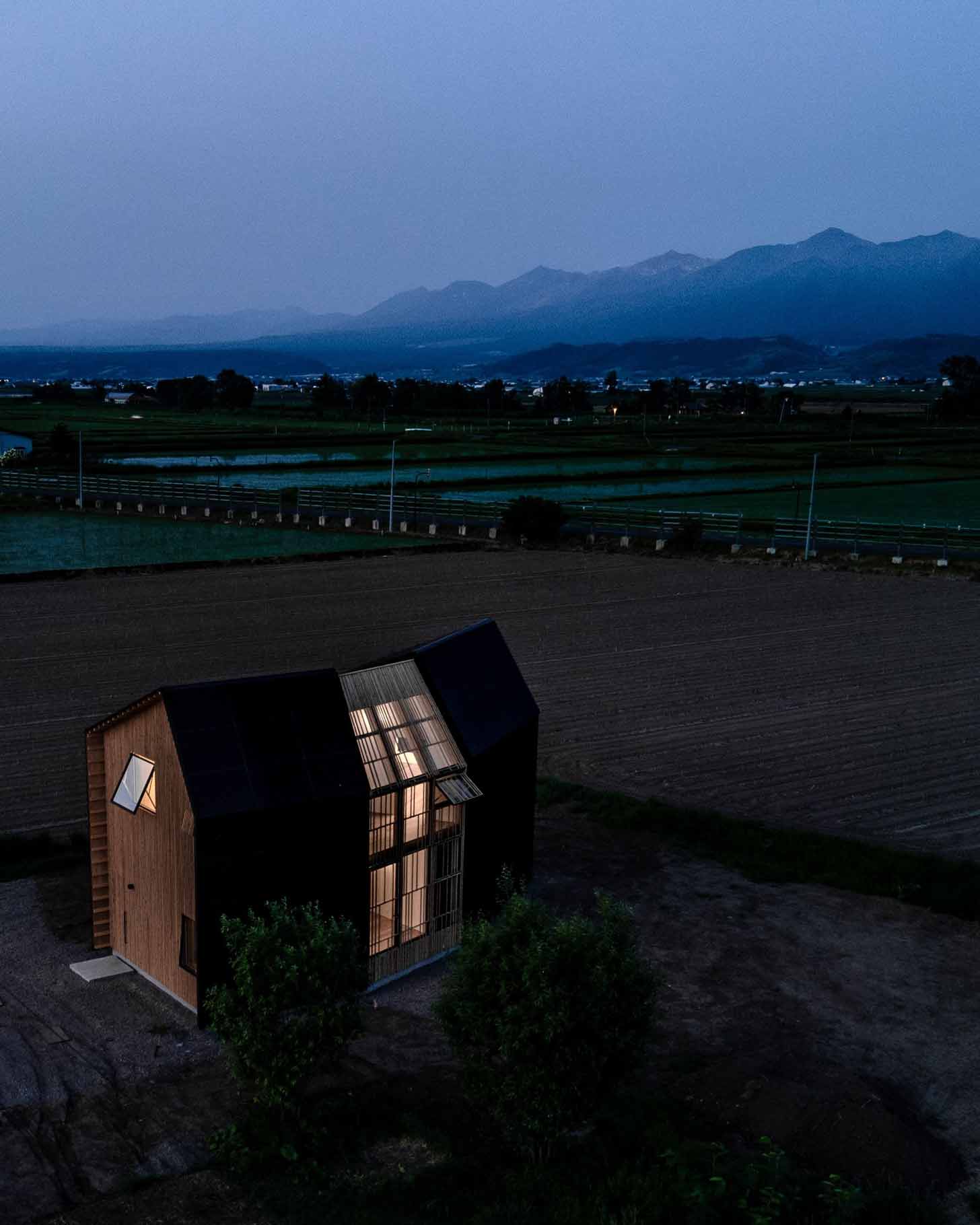
“Bucking the trend to move from the countryside to the city, the clients, a young family living in Tokyo, approached FBA to design their new home on the western edge of the Furano Plateau … renown for its cold powder-snow winters and beautiful summers.”
The client planned to live in a home that was independent from the local power grid while still staying cozy and fully functional through harsh winters.
“Their plan is ambitious: A building independent from the local power grid, generating at least as much energy as it consumes,” FBA continued. “Net zero.”

To achieve this, architects finished the exterior of the home with a 56-panel solar skin that offers a total capacity of 23 kW.
The location on the Furano Plateau is ideal for harvesting sunlight, according to the designers. Instead of adding solar panels later on, like many existing structures are required to do, the designers intentionally created the shape of the home with solar performance in mind.
While it's unclear exactly how much energy the home uses, the architects say that the solar panels alone provide almost twice as much power as its annual requirements.
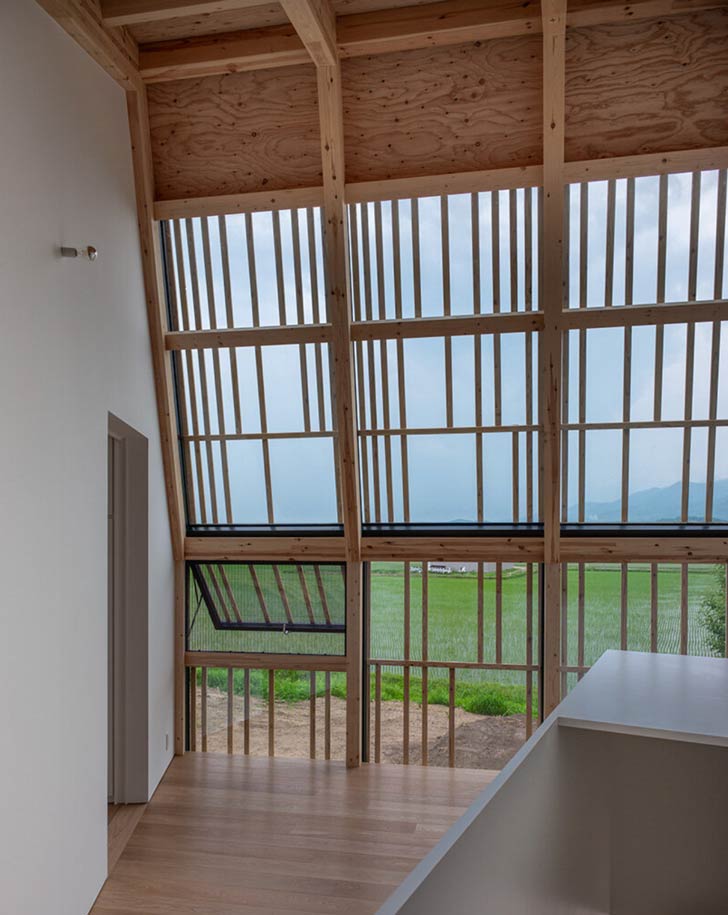
A heat pump is also connected to a nearby water source and offers constant temperature regulation year-round, as it runs underfloor heating and produces warm water for the house.
Structurally, the home is mostly made from timber and features energy-efficient glazing throughout. Inside, timber is arranged around a central glazed area to help encourage airflow, with adjustable slats in place to control sunlight depending on weather conditions.
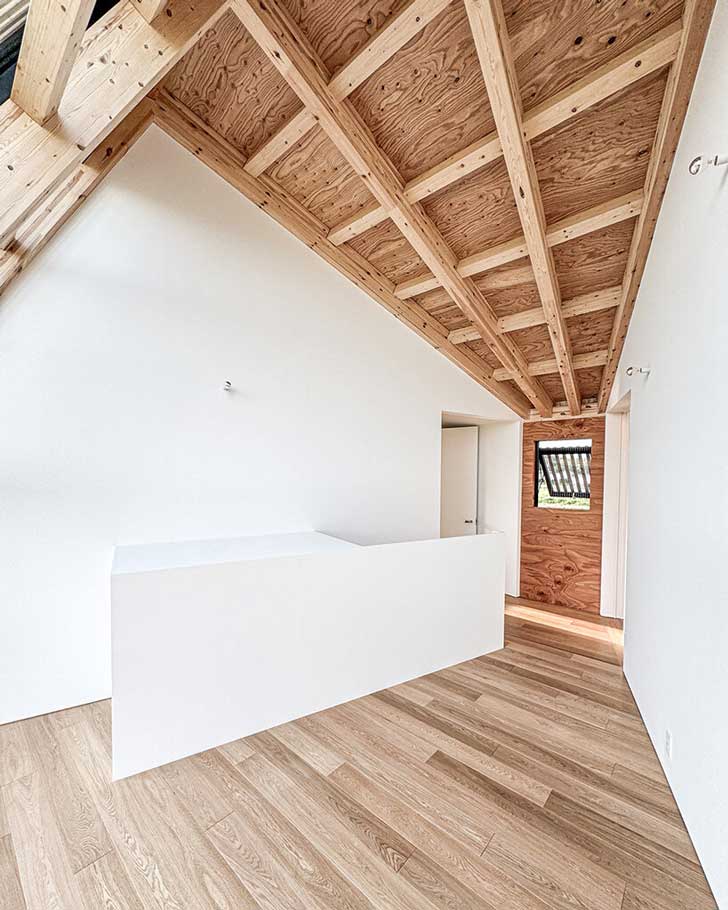
The form of the building appears to be two parts of a barn split open, which is a concept that emerged as a result of budget constraints.
“Ironically, the idea of breaking a large simple volume into pieces was triggered by an initial requirement which in the end was lifted,” the firm explains. “In light of the volatile construction market, the clients had requested to study the possibility of splitting the project into phases.”
The builders ended up constructing both phases together, as well as designing a shed for storage and workshop, which was originally intended as a future annex.
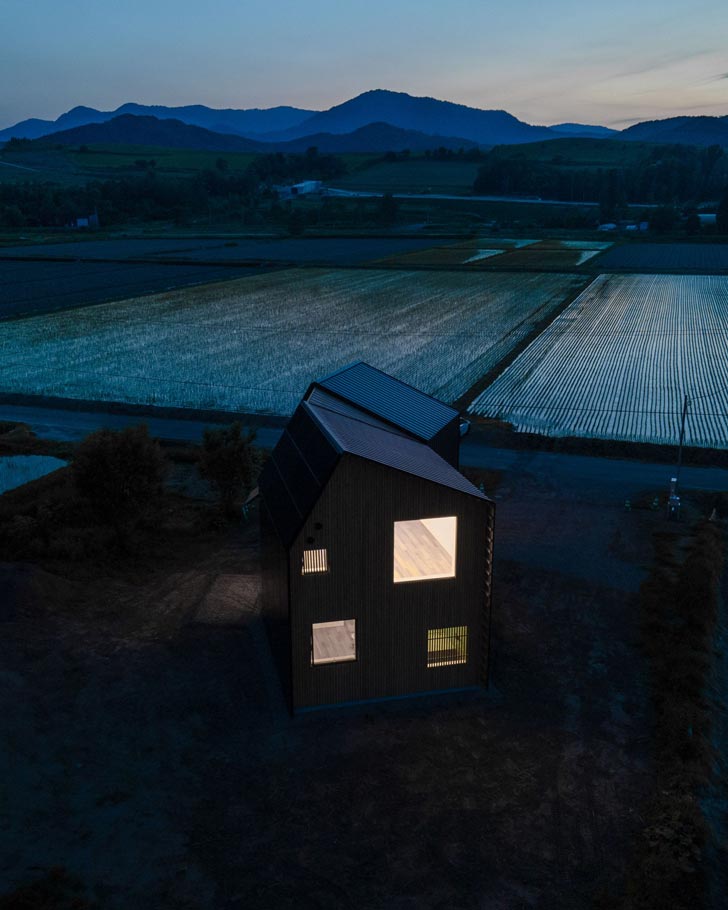
Overall, the interior of the tiny home is spread over two floors, with high ceilings and open layouts. While it is a bit larger than many other tiny homes on the market (which typically measure in at about 500 square feet or less), the design manages to meet its net-zero ambitions with ease.
“Architect Florian Busch challenges Le Corbusier’s 1923 notion of a house as a ‘machine for living in,’ suggesting instead that ‘a house is a plant for living with,’” Designboom reports. “The design concept envisions a home that behaves like a plant, responding dynamically to its environment and utilizing available resources.”
Header image courtesy of Florian Busch Architects