It’s a tale as old as time — or, as old as commercial farming and refrigeration. You scoop up a clamshell of gleaming red strawberries in the supermarket, take it home, and snack on your favorite seasonal fruit.
But then, almost as quickly as they came into your possession, you lose nearly half of those berries to mold in just a couple of days.
As it turns out, strawberries in particular are considered a highly perishable fruit.

“The strawberry is a fruit that has very high respiratory activity and a very low pH [acidity],” University of São Paulo Professor Stanislau Bogusz Junior explained. “It’s therefore very susceptible to microbial attack. It’s also very moist and the fruit is small.”
This — and the fact that strawberries have one of the highest loss rates in Brazilian supermarkets — inspired researcher Mirella Romanelli Vicente Bertolo, overseen by Professor Bogusz, to create a solution.
Bertolo and her research team at the São Carlos Institute of Chemistry of the University of São Paulo created an edible “biofilm” obtained from agricultural waste to extend the shelf-life of strawberries.
Her inquiry began during her doctoral studies under Professor Bogusz. During this time, they developed a technique that allowed them to extract antioxidants — substances with preservative properties — from the peel of a pomegranate.
“More than 40% of the pomegranate, depending on the variety, is made up of peel, which is wasted,” Bogusz explained in a statement.
“Our idea was to use this waste to obtain extracts rich in phenolic compounds with antioxidant and antimicrobial activities.”

Once they successfully had an extraction method, the researchers incorporated the antioxidants into coatings based on gelatin and chitosan.
Chitosan is a polymer found in the bodies of crustaceans — like shrimp or squid.
Bogusz said that they used the chitosan extracted from the inner shells of squid because it doesn’t cause the same problems of allergies like shrimp do.
“And we combined this material with another polymer, in this case gelatin, to improve its mechanical properties.”
It was then that they successfully developed a protective film for strawberries, as published recently in the journal Food Chemistry.
In laboratory tests, the researchers found that over 12 days of refrigerated storage, strawberries coated with the film lost 11% weight and took between six and eight days to start becoming contaminated with fungi, compared to just four days for fruit not covered with the film.
“By applying the coating, it was possible to double the shelf life of strawberries kept under refrigeration and delay the dehydration of the fruit, while preserving the taste, texture and volatile compounds that give the fruit its characteristic aroma,” Bertolo said.

The findings conclude that the material forms a film on the surface of the fruit, acting as a barrier to the passage of microorganisms (like mold), moisture loss, and gas exchange.
This modifies how much respiration the strawberry has and slows down the metabolism of the fruit after it’s been harvested.
In summary: This biofilm could keep strawberries in better condition for longer, maintaining the firmness, color, and flavor of the fruit.
“The results of the tests showed that there were no differences in the taste, aroma or visual characteristics of strawberries coated with the material compared to strawberries without the film,” Bertolo said.
Bogusz hypothesized that the material would also be effective on any other fruit.
This is a significant breakthrough, considering an estimated 40-50% of fruits and vegetables are wasted each year globally, translating to roughly 670 million tons of food.
While preventing food waste through proper storage and preparation can help, this discovery may also be part of the solution.
The researchers have filed a patent application for the formula and intend to license the technology to interested companies. Economic analyses show that the coating could cost an estimated 0.15 Brazilian Reals (or 0.02 USD) per fruit.
Bertolo concluded: “This is a cost that consumers may be willing to pay for fruit with a longer shelf life and greater usage.”
Header image by Engin Akyurt/Pexels
As March Madness wraps up and prom season approaches, a third event is sweeping across the country: kitten season.
“Kitten season is what those of us in the animal welfare community call the period of warmer months when cats are breeding more, so shelters get overrun with all these litters of adorable kittens,” explained Allana Maiden, a coordinator for Richmond Animal League, told WTVR-TV News.
“And you know, our animal control shelters just aren’t equipped to handle the volume of kittens that are coming in.”
Across the United States, kitten season largely stretches from March to October. To prepare for the annual uptick in litters, shelters and rescues are finding unique ways to gather resources — and raise awareness in their collective communities.
In Bozeman, Montana, The Heart of the Valley Animal Shelter threw a “Showering Love on Tiny Paws Kitten Shower” with a kitten “baby registry” full of much-needed items like formula, litter, and medical equipment.
In Bentonville, Arkansas, Best Friends Animal Society Pet Rescue Center hosted a beginner workshop on how to foster kittens.
“A shelter is not the best place for a kitten, so Best Friends works with rescues and shelters to take kittens out of shelters so they can be safely raised in foster homes,” a spokesperson for the rescue wrote in a press release.

Some animal rescues — like Isabel Y. Garcia Animal Shelter in Port Isabel, Texas — are even waiving adoption fees altogether.
“All the animals we have are free,” Teo Cisneros, a shelter employee, told Port Isabel-South Padre Press. “They come with their rabies shot, are sprayed, neutered, and are microchipped.”
Shelter employees and volunteers also had an urgent message for anyone who encounters a litter of kittens during kitten season: Be patient and see if the mother is nearby.
“People are kitten-napping kittens that have a mom,” Emilee Johnson, foster coordinator for the Humane Educational Society, told ABC News Channel 9 in Tennessee.
“That’s a challenge because we’re getting these kittens that would have been okay if they would have stayed where they were,” Johnson added, “and then now we’re trying our best to get them into foster homes and get them cared for when they really need to be with their mother.”
When it comes to avoiding “kitten-napping,” Johnson suggested that people use “eyes before action” and take a beat before leaping into rescue mode.
“Are the kittens, you know, fat? Are they clean? Are they quiet?” Johnson asked. “That might mean that the mom just went off to get some food, or, you know, she sees somebody, you know, peeking at her kittens, and so she’s hiding.”

“If you go up to the kittens and they’re filthy, they’re crying excessively, they look skinny at that point, you do need to take them,” Johnson advised, “because it’s most likely that the mom is not coming back.”
Overall, vets and shelter coordinators alike say that the best way to reduce high kitten birth rates — and in turn, lower euthanasia rates in overcrowded shelters — is to spay and neuter your pets.
In fact, animal rescues across the country often employ “trap, neuter, return” programs to reduce the chaos of kitten season before it even begins.
“They can have up to three litters a year, and you’re thinking if they have litters, and then their four-month-old kittens have litters, I mean it just exponentially increases super fast,” Sherri Heishman, executive director of nonprofit rescue Cat’s Cradle, told WHSV News Virginia.
For those looking for a more permanent way to help out during kitten season, prospective pet parents should look into fostering or adopting cats at overcrowded rescues and kill shelters — and that includes aging cats too, not just kittens.
“With many kittens coming into [our] pet rescue center, the shelter’s long-stay pets need to find the fosters or forever homes they deserve,” HCFL wrote in an Instagram post.
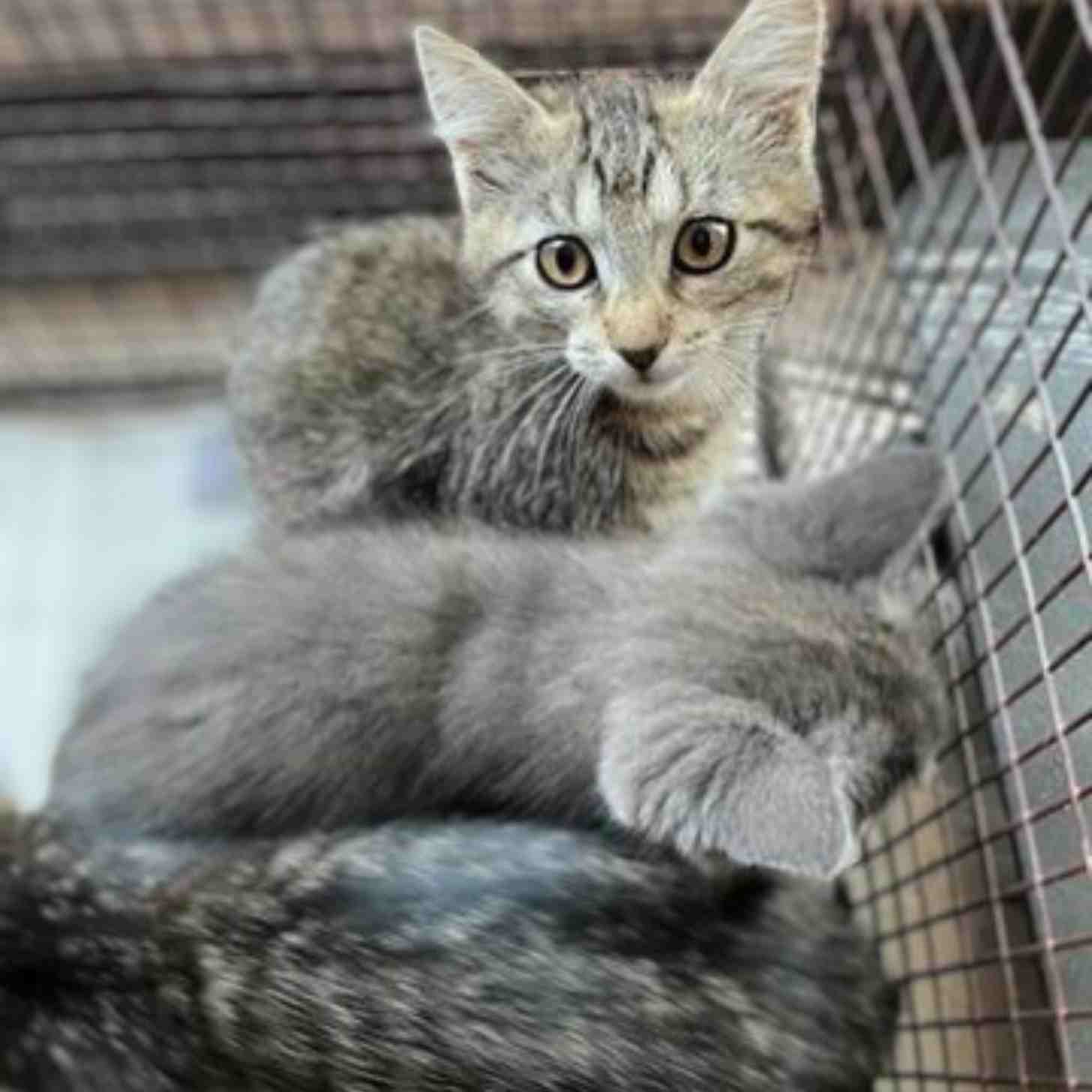
All of the cats shown throughout this article are currently adoptable through the Hillsborough County’s Pet Resource Center.
Header image via Charles Nadeau / Wikimedia Commons (CC BY 2.0)
Every day the Good Good Good team collects the best good news in the world and shares it with our community. Here are the highlights for this week!
If you want to get good news in your inbox every day, join the Goodnewsletter — the free daily newsletter designed to leave you feeling hopeful.
The Best Positive News We’re Celebrating This Week —
Japan created a plastic that both dissolves in the ocean within hours and enhances soil health
Addressing the global issues of both plastic pollution and soil degradation in a single innovation, researchers in Japan have developed an advanced biodegradable plastic that dissolves in seawater and breaks down in soil, while improving its health.
Even more impressively, the unconventional plastic dissolves in seawater within a few hours and breaks down in soil within 10 days.
It’s also made from food-safe ingredients, is completely non-toxic, and does not release harmful byproducts. Furthermore, it does not release any carbon dioxide emissions while it decomposes, and can be easily recycled.
Why is this good news? Plastic waste and marine pollution have been massive, urgent environmental issues for decades, harming marine ecosystems and marine life, and contributing to the climate crisis. Plus: Other “biodegradable” plastic alternatives mostly break down into smaller pieces or require access to industrial composting, which many communities don’t have.
→ Read more
Colombia created a first-of-its-kind territory specifically designed to protect a group of Indigenous people living in isolation
For the first time in the country’s history, Colombia has created a territory specifically designed to protect a group of Indigenous people living away from regular contact with the rest of the world.
Spanning 2.7 million acres, the territory is home to the uncontacted Indigenous Yuri-Passé people and reaffirms the country’s “commitment to their autonomy and survival.”
The result of years of advocacy by human rights and conservation groups to both recognize their rights and protect their lands, the territory’s special designation prohibits economic development and forced human contact.
Why is this good news? The Yuri-Passé people have faced increasing pressure from illegal mining and organized crime groups, which has led neighboring Indigenous communities to reach out to the government on their behalf. This new territory will proactively ensure their land and rights are protected.
→ Read more
Florida sisters donated over 100 custom “Anna the Appalachian” American Girl dolls to young girls impacted by Hurricane Helene
Two transgender teens in New Hampshire are fighting state and federal bans on participating in girls’ sports
Sixteen-year-old Parker Tirrell plays on her high school soccer team, and 15-year-old Iris Turmelle just tried out for — and made — the tennis team.
Following their own state of New Hampshire’s ban as well as President Trump’s executive order banning transgender girls in girls’ sports, the two transgender girls became the first to challenge that executive order, six months after they sued the state.
They’ve since received a court order allowing them to play, but their fight isn’t over — and they’re continuing to balance their activism with school, sports, and just being a teen. As Tirrell said, “I’m not going to stop existing just because they don’t want me to.”
Thanks to AI sound analysis, a rare, endangered bird was located for the first time in 30 years
A small, quail-like bird species called the plains-wanderer hasn’t been seen in West Melbourne, Australia for decades — since 1989 — a symptom of the species’ larger decline across the country due to long-term drought and its ever-shrinking natural habitat.
In an effort to catalog data on local bird calls, a zoo-based conservation organization installed audio recorders throughout the wilds of Australia.
Across tens of thousands of hours of recordings, an AI-powered tool pinpointed the plains-wanderer by identifying its soft, low “ooming” call at two sites in western Melbourne.
Why is this good news? While the bird technically still hasn’t been “seen,” one expert said this discovery was “like finding gold.” That’s because, among other things, the plains-wanderer is a “flagship” species, indicating healthy grasslands throughout southeastern Australia and playing a crucial role in insect control and seed dispersal.
→ Read more
Community members, donors, and companies came together to give homeless foster youth customized tiny houses in an ‘adopt-a-cabin’ campaign
After living “life in a trash bag” himself, a man has donated 250K backpacks to restore dignity for foster youth
When Rob Scheer was a 12-year-old walking into the foster care system in the 1970s, he carried everything he owned in a trash bag. And when he aged out of the system at 18, he packed a trash bag for the final time.
His five adopted children each had similar stories, navigating the system with just a trash bag full of items to their names — Scheer was shocked at how little the experience had changed.
This is what spurred him to create Comfort Cases, a nonprofit that provides foster youth with their very own backpacks and luggage. Since its founding in 2013, the organization has donated more than 250,000 cases — filled with essentials like new pajamas, personal care items, a book, and more.
England approved — then doubled — new funding for 300 school-based childcare projects
Opening up as many as 6,000 new spaces for children in the country, England’s Department for Education more than doubled its £37 million funding to help roll out 300 new school-based childcare programs.
Working parents of children older than nine months old can immediately access 15 hours of funded childcare a week — increasing to 30 hours for eligible families starting in September.
The Conservative government originally began expanding funded childcare a year ago for working parents of two-year-olds — this new round of funding builds on those efforts.
Why is this good news? In addition to lowering the cost burden for families, adding spots to improve access, and investing in critical early childhood education, the program uniquely focuses on expanding access in existing primary schools, which the government says will help with continuity for children and families, and save working parents from making multiple trips in the morning and afternoon.
A couple’s ‘fully regenerative’ tiny home includes secondhand building materials and a lush food forest — and they pay in “land hours” instead of rent
→ Read more
India has achieved a 70% reduction in under-5 child mortality since 2000, earning praise from the UN
Hailed as “exemplar” by the United Nations, India’s efforts to reduce preventable child deaths have saved millions of lives through strategic investments in its health system.
The country has achieved a 70% reduction in child mortality among children under five years old, and a 61% reduction in neonatal mortality.
In addition to providing every pregnant woman free delivery and free infant support care, the UN specifically highlighted Ayushman Bharat, which is the world’s largest health insurance program, providing annual coverage of almost $5,500 per family per year.
The UN said India’s example proves that with “political will, evidence-based strategies, and sustained investments,” these results can be achieved around the world.
→ Read more
After 900,000 meals were canceled due to USDA cuts, volunteers flooded a Delaware food bank with donations
Cuts to the U.S. Department of Agriculture have impacted food banks, farmers, schools, and students across the country — and in Delaware, volunteers are assembling to fill those gaps.
Organized by elected officials and the Food Bank of Delaware, an emergency donation drive was held at various food bank locations, with one drop-off event collecting more than 5,000 pounds of food donations.
The USDA cuts eliminated around 750,000 pounds of food for the food bank, which would have amounted to 900,000 total meals for people in need.
Why is this good news? Food Bank of Delaware feeds thousands of Delawareans annually — and their services were especially critical right now, with increasing demand due to higher grocery prices and stagnant wages.
While seemingly small, seeing the community come together to take good action is inspiring and will make an incredible impact, ensuring people who need food can access it.
Realtors, organizations, and government officials collaborated to create a ‘homelessness dashboard’ to make it easy to help those in need
→ Read more
Volunteers in the Bay Area are building DIY benches for bus stops that don’t have anywhere for people to sit
Software engineer Mingwei Samuel saw a post from Darrell Owens on social media: it was a photo of Owens’ neighbor, who’d just had surgery, sitting on a curb at a bus stop because there was nowhere for him to sit.
Samuel got to work building a bench of his own, and posted a photo of it at the bus stop — and the post went viral, gaining more than 100,000 likes.
Samuel and Owens then teamed up to create a guerrilla bus bench-building movement called the SFBA Bench Collective in the East Bay area, installing benches of their own at bus stops lacking the essential infrastructure.
More good news of the week —
Illinois returned nearly 1,500 acres of stolen land to the state’s first federally recognized tribe. Correcting a “historic injustice,” the land once belonged to Chief Shab-eh-nay of the Prairie Band Potawatomi Nation but was seized and sold by the U.S. when the chief was visiting relatives.
The WNBA Golden State Valkyries became the first in the league to surpass 10,000 season tickets sold. The expansion team is the first to join the league since 2008, and in 2024, the WNBA had its highest total attendance in 22 years with 2.35 million fans — a 48% increase over 2023 and included 54 sellout games.
A major home builder revealed its first “wildfire-resilient” community located in Southern California. The development will have 64 single-family homes that all meet the wildfire resilience standards designed to protect the homes against the three major sources of ignition during a wildfire: Flying embers, flames, and radiant heat.
Two new buoys are helping researchers listen for critically endangered right whales off the coast of Massachusetts. They are part of a larger East Coast network of buoys that will “listen for, detect, classify, and report vocalizations of large whales in near real-time” and help develop fishing restrictions, speed limits for boats, and other conservation measures.
Towns in Belgium and France have been successfully giving away free chickens for ten years to reduce food waste. To date, 5,282 hens have been distributed to residents, and not only have the residents received a plentiful supply of free eggs, but food waste has also been averted from landfill as chickens are fed kitchen scraps which would otherwise be thrown away.
The U.S. FDA approved the first new antibiotic treatment for UTIs in 30 years. Urinary tract infections are among the most common medical issues women experience, especially among older, who have lower estrogen levels that can lead to decreased levels of beneficial bacteria that suppress infection-causing bacteria.
In the 2025 NCAA women’s hockey championship, ESPN had a double-digit rise in viewership. Viewership was up 22 percent compared to last year for the same finals matchup between the Badgers and Ohio State and ESPN+ engagement saw an increase of 27% throughout the tournament compared to 2024.
Helping reduce overspray and runoff, MIT engineers developed pesticides that can stick to plant leaves. A recent study found that if farmers didn’t use pesticides, they would lose 78% of fruit, 54% of vegetable, and 32% of cereal production, but a lack of technology means they tend to be over-sprayed, leading to runoff and chemicals ending up in waterways or building up in the soil.
To fight rage-bait, a new social media app punishes users who are intentionally inflammatory and incentivizes respectful dialogue. Sez Us uses what its creators call a “reputation engine,” a feature that allows you to rate another user’s posts on the platform across five key areas: approval, influence, insightfulness, relevance, and politeness.
A first-of-its-kind underwater turbine farm will generate clean energy for thousands of people from tides in France. Located in the Channel sea current of Raz Blanchard is one of the most powerful in the world, with a development potential of around 5 to 6 gigawatts, it could produce 15 to 18 terawatt hours, supplying electricity to 8 million people.
Paris Hilton’s nonprofit gave $25,000 grants to 50 women-owned small businesses impacted by the Eaton Fire. More than 1,800 businesses were located in the Eaton and Palisades fire zones, employing 9,600 workers and generating $1.4 billion in annual sales.
Namibia just swore in the country’s first-ever woman president and second-ever directly elected woman leader. Earning 58% of the country’s vote, Netumbo Nandi-Ndaitwah is taking on the task of leading a country facing high rates of unemployment, inequality, and poverty.
A massive Attack concert broke the record for the lowest carbon emissions ever produced by a music event. The concert slashed energy-related greenhouse gas emissions by 98% compared to similar shows by being 100% battery-powered, selling 100% vegan food, and the performers opting for low-carbon transport like coaches and ferries instead of planes.
Researchers at the University of British Columbia developed a stir stick that can detect if a drink has been spiked. Spikeless looks like an ordinary stir stick, but is capable of detecting common drink-spiking drugs like GHB and ketamine within 30 seconds, potentially preventing assaults.
A Long Island man became the first in the history of New York to be cured of sickle cell anemia. A groundbreaking treatment used Beauzile’s own bone marrow in IV transfusions to create normal red blood cells.
Thanks to the Academy Award-winning film “Flow,” there’s been a surge in black cat adoptions. Black cats and dogs have historically low adoption rates for a number of reasons: ancient superstitions that they were bad omens or bad luck, they don’t photograph as well in adoption photos, and more.
With wind power more than doubling since 2020, Finland is “ahead of schedule” on phasing out coal. The closure of a coal power plant in Helsinki brought coal to less than 1% share of the country’s energy mix four years ahead of schedule.
A former middle linebacker and student at MIT is working to design a safer football helmet for players at all levels. And he’s succeeding: LIGHT Helmets’ new Apache helmet line was ranked the highest-performing helmet ever in safety tests by Virginia Tech’s renowned helmet-testing lab.
Jovanda Taylor — a nurse born and raised in Louisiana — needed a change of scenery after her mother passed away, so she set out looking for work in Houston, Texas.
But when her Certified Nurse Assistant (CNA) certification didn’t transfer across state lines, she was forced to move back to her home state — without a home to return to.
As Taylor and her boyfriend Kevin Washington hunted and applied for jobs, they were forced to sleep out of their truck with their two dogs.
“We were living in our truck, couldn’t find work, and went to food pantries—that was our excitement—but we couldn’t find any work,” Taylor told KATC, a Louisiana news outlet.
Over the course of a month, as she continued living and sleeping out of her truck, Taylor began to lose hope.
Then, in early December, she cleaned herself up at a rest stop and walked into Maison de Lafayette, a nursing and rehabilitation center in Lafayette, Louisiana.
After she had filled out an application, the hiring manager, Wendy King, noticed that Taylor didn’t have a permanent address.
So, Taylor put her “pride to the side” and asked for help.
“I pulled her to the side and said I’m homeless, living in my truck, and I needed help,” Taylor said when recounting her story on Facebook.
“Ms. Wendy sat me down and…called up Mr. Terrance St. Julian,” Taylor said, referring to the leader of Pay It Forward, Lending A Helping Hand, a local nonprofit and mutual aid organization.
“I called him,” Taylor said, tearing up at the memory. “The [company] paid for us to be in a hotel for a month… and I also got the job.”
Terry Gros, an administrator at Maison de Lafayette who worked with St. Julian to help the couple, said that they were happy to step up and give their newest employee free housing while she looked for something more permanent.
“She was in dire straits…obviously, she and her partner needed more than just a job; they needed a way to be safe,” Gros told KATC. “We asked what she needed, and we mobilized resources to support her.”

Taylor’s story is proof that anyone — regardless of college education, certification, or degree — can become unhoused.
A national study by Chapin Hall at the University of Chicago found that 29% of unhoused young adults (between the ages of 18-25) were enrolled in college or another educational program at the time that they experienced homelessness.
Every day, outdated narratives surrounding homelessness are being challenged.
Emerging studies have found that links between homelessness and substance use are much more complex than they may appear, and a growing number of nonprofits are employing “housing first” models for their clients that are actually working.
Although systemic change awaits in addressing the growing affordable housing crisis, businesses like Maison de Lafayette are setting new standards for how companies can better serve their communities today.
“I can’t thank them enough for doing that for us,” Taylor said. “It’s a big blessing.”
See more of Taylor's story below:
Header images via Laura James / Pexels
In early April, officials shared reports of a thwarted smuggling attempt in Thailand that sounds like it could have easily served as a plotline in season three of “The White Lotus.”
On April 4, Sadudee Phanpakdee, director of Thailand’s Department of National Parks, Wildlife and Plant Conservation, confirmed that officers at the Suvarnabhumi Airport Wildlife Checkpoint discovered suspicious luggage belonging to a 52-year-old passenger.
The man was en route to Tashkent, Uzbekistan, when his assorted luggage — containing 21 large foam boxes — was seized.
“The first 20 crates contained aquatic plants and animals that were legally permitted,” wrote a spokesperson for the Department of National Parks, Wildlife and Plant Conservation on Facebook.
“The last crates contained rare animals that were not permitted for export, including 10 iguanas in three plastic crates, six freshwater crocodiles in three plastic crates, and five horned frogs in one plastic crate.”
Fortunately, the officials went on to say, all 21 animals were found alive and well.
“The iguanas were sent to the Wildlife Health Management Group, Wildlife Conservation Office, Department of National Parks, while the freshwater crocodiles and horned frogs are under the care of the Suvarnabhumi Airport Fisheries Checkpoint,” the department said.

After the seizure, the officers pressed a total of three charges in relation to the country’s laws on exported protected and controlled wildlife without permission.
The department was particularly concerned with the illegal transportation of six juvenile freshwater crocodiles, which are critically endangered in Thailand.
The species, which has been declining due to wetland degradation and overhunting, is believed to have fewer than 1,000 individuals remaining in the wild.
In its post, the department added that the illegal trade of wildlife and rare animals “is a major problem affecting biodiversity worldwide.”
This latest story comes months after one of the largest seizures of illegally transported animals of all time.
In November, over 1,000 highly endangered tortoises and lemurs were smuggled into Thailand under inhumane circumstances to be sold off as exotic pets.
According to CNN, a total of 961 animals were rescued in the recovery effort. Over the course of three flights, the animals were returned to their natural habitats in Madagascar.
“By conducting operations like this and broadcasting them globally, it shows that there are arrests and exchanges happening, making people worldwide aware that possessing these animals is not right,” Attapol Charoenchansa, former director of the Department of National Parks, Wildlife, and Plant Conservation, told CNN at the time.
“Some might think that if they have the money, they can buy and collect them — but that’s not the case.”
Header images via Pixabay and Department of National Parks, Wildlife and Plant Conservation / Facebook
According to the National Low Income Housing Coalition, Texas has just 25 affordable and available rental homes per 100 “extremely low-income” households — one of the lowest ratios among all U.S. states.
Extremely low-income households, or ELIs, capture those with incomes at or below the federal poverty level, or below 30 percent of their area’s median income.
That gap sheds light not just on the housing shortages in Texas at large but on the specific housing crisis happening in the city of Austin.
In 2023, home prices in Austin fell by 1.5% statewide. But even with this decline in mind, Austin metro prices were up by 43% between 2019 and 2023.
It’s a moment that Mt. Zion Baptist Church rises to meet with grace — and action.
In March, reverend Daryl Horton announced an initiative to replace 10 existing bungalows on the church’s property with 80 affordable housing units.
Horton plans to rent the apartments out to local seniors — many of whom are church members — at affordable prices.
“We are to help those who are less fortunate, those who have fallen on hard times,” Horton told KUT News, an Austin news outlet. “That’s part of the dynamic and the heartbeat of what it means to be a person of faith.”
As the median home value in Austin doubled in the past decade, the reverend estimates that half of his congregation has been priced out of the community where they were born and raised.
“It’s such a tragedy to see how quickly East Austin has changed,” Horton said. “But what a joy it would be for people to be able to spend their twilight years…where they started.”
On Sunday, March 23, Horton requested prayers from his congregation — in the form of swiftly approved building permits.
“Y’all keep praying for the city as those permits keep going through,” Horton told the hundred-plus people in pews. “We’re gonna get it taken care of so we can continue to build what God has called us to build.”

Horton is not alone when it comes to tackling the affordable housing crisis with faith-based action.
He joins a number of churches who, in recent years, have championed the “Yes, in God’s backyard” movement — which stands in direct defiance to the NIMBY, or “Not in my backyard,” term used to disparage affordable housing projects.
Churches like Village of Faith Ministries in Virginia which is converting their 1.5 acre property into 192 apartments and 40 townhomes.
“We know that housing is a need,” pastor Michael Jones told Next City in January, adding that he was working with developers to create a housing plan that could meet the church’s financial goals while still keeping rent costs low for their neighbors.
And as churches like Village Faith Ministries work on long-term solutions to meeting housing needs, Central Lutheran Church of Anchorage, Alaska took a more direct approach.
In the full grip of winter, the church built a tiny home village in their parking lot to re-home seniors experiencing homelessness.
The project was spearheaded by In Our Backyard, a nonprofit founded by members of the Central Lutheran Church.
“In Our Backyard is an opportunity to be proactive in addressing the needs of our unhoused neighbors,” the nonprofit writes on its website.
“With support from multiple faith-based organizations, community groups, nonprofits, and local agencies, this project will serve as a model for other organizations to support unhoused community members in their own neighborhoods.”
Header image via Debby Hudson / Unsplash
These days, an average vet appointment can cost between $50 and $250, with emergency services charging much, much more.
Pet care can put a strain on anyone’s finances, but it can be a particularly heavy burden for those below the poverty line — especially for those experiencing homelessness.
“With the rising costs of vet bills, there is a small population of people who can’t access the much-needed services, and obviously the animals are still unwell and need preventative care,” veterinary surgeon Nicola Chouler told the BBC.
Fortunately, twice a month, British animal charity Bath Cats and Dogs Home runs a pet care clinic for unhoused pet owners.
“What we are doing here is making sure the animals are as well as possible and providing their owners with the peace of mind that their pets are happy and safe,” Couler said.
The free clinic is part of Bath Cats and Dogs Home’s Together Project, which is centered on keeping pets with their owners even after they’ve become homeless.
“The Together Project is delivered by voluntary vets and vet nurses from Bath Vets,” the charity wrote on its website. “As well as running the clinics, they take their backpack and hit the streets, proactively seeking out rough sleepers who haven’t been able to visit the clinic.”
“They are entirely non-judgmental, simply offering support to the homeless pet owners of Bath.”
According to the National Coalition for the Homeless, an estimated 3.5 million people in America are unhoused, and 5%-10% of those individuals have dogs, cats, or both.
The subject of unhoused people owning pets is a contentious one. At the heart of the issue, some wonder whether the pets in question are receiving adequate care.
It’s an assumption that Chouler was happy to challenge.

“These animals are so well cared for, and they’re with their owners constantly,” Chouler said. “[They’re] arguably better cared for than some housed animals.”
In recent years, there has been a growing effort to keep people with their pets when they seek temporary housing.
Today, only 15% of domestic violence shelters in the United States allow pets — a metric that The Purple Leash Project, a nonprofit partnered with Purina, is trying to change by creating more pet-friendly shelters.
And they’re not alone. Pallet is a social justice organization that builds tiny home villages for people who have experienced chronic homelessness (homelessness for 12 months or more).
Unlike congregate shelters that routinely turn animals away, Pallet villages allow residents to bring pets into their new housing accommodations.
“Most homeless people I’ve met in my time — if they have an animal, they need it because it gives them clarity, some focus, and it gives them something to live for,” one village resident, John, told Pallet, adding that his dog Walter is his best friend.
“They keep me grounded,” added Lynette, another Pallet village resident. “They're my life, really. They're my kids.”
It’s a sentiment the Together Project knows well, too, and it is their reason for existing: to keep these families safe, happy, and healthy … together.
Header image via Bath Cats and Dogs Home
On March 30, Michael Harvey (@lifebetweenthetides) stood near a beach access point at Kitsilano Beach in Vancouver, Canada.
The teacher captioned the video: “When you’re hoping someone shows up for your beach clean-up and then this happens.”
In the clip, he’s seen holding trash pick-up sticks and a yellow bucket as he waits for people to arrive. At one point, he makes smiles and waves at a person passing by off-camera, only for them to apologize and keep on walking.
In the end, no one showed.
“It’s cool,” Harvey wrote in the caption beneath the TikTok video, which had over 600,000 views at the time of publication. “I’m not dead inside. I like doing things alone anyways….”

But instead of calling it quits, Harvey stuck it out, documenting his slow-and-steady approach to cleaning up litter along the driftwood-dotted sands of Kitsilano.
“At least found 3 cans! Pretty successful if you ask me!” Harvey joked under his follow-up video.
As both videos raked in views, people rushed to the comments section to thank Harvey for cleaning up his local beaches.
“You showed up, and that made the difference,” one viewer wrote.
“I feel guilty for not coming, but I'm in New Zealand,” another quipped.
“Round of applause for still getting the beach cleaned up!!” A top comment read. “I hope the turnout and support gets bigger and bigger each time!!”
That last comment proved to be rather prescient. After Harvey went viral for his solo clean-up, he took to TikTok to send out another call to action.
“Alright, it’s official, we’re doing another beach cleanup this weekend, April 6th on Sunday, it’s gonna be at Jericho Beach, instead of Kits Beach — because I just did that one,” Harvey said. “Feel free to bring a friend or ride solo like me!”
Harvey added in the video’s caption that he was “a little scared” that no one would show up, but he was “excited to hopefully meet some new people and do something good for Mother Nature together.”
April 6 came, bringing pouring rain with it.
But even in the face of poor weather, over 30 people came to help, including neighbors, students, and even strangers inspired by Harvey’s story.
@lifebetweenthetides In the rain, you showed up. My heart is full: Thank you. To every single person who showed up—in the rain, with muddy boots and big hearts—friends, strangers, students, family. There are no words that can describe this feeling, but I will try: You are my community. You are my why. Another beach is clean, and my heart is full. This is a dream come true. This is everything. I love you all. This is @islandlifeapparel.inc #BeachCleanup #PNWCommunity #IslandLifeApparel #OceanLovers #ProtectWhatYouLove #CleanBeaches #EcoCommunity #SustainableLiving #WestCoastLife #KeepTheCoastClear #VancouverEvents #RainOrShine #CoastalCleanup #ShorelineRescueClub ♬ I Think I Like When It Rains - WILLIS
“In the rain, you showed up,” Harvey wrote in an update video, posted April 7. “My heart is full. Thank you. To every single person who showed up—in the rain, with muddy boots and big hearts—friends, strangers, students, family.”
“There are no words that can describe this feeling, but I will try: You are my community. You are my why. Another beach is clean, and my heart is full. This is a dream come true. This is everything. I love you all.”
And if the comment section was evidence enough, Harvey’s next beach clean-up crew could prove to be even bigger.
“What a great turnout! I'm keeping an eye out for the next Vancouver date,” one viewer wrote.
“I’m from Chilliwack but definitely will be coming to the next one,” said another.
“Thank you for hosting!” said a volunteer who had shown up to help on April 6. “We’ll be back.”
Header images via Michael Harvey / Tiktok
On April 8, Google debuted its latest virtual reality platform, Android XR, live on the TED 2025 main stage in Vancouver, Canada.
In a TED Talk, Shahram Izadi — head of augmented reality and extended reality at Google — said that the device came at the heels of a career dedicated almost entirely to augmented reality.
“Augmented reality and virtual reality has moved computing from the rectangular screen, to the 360 immersive display, to now even the world itself becoming the display,” Izadi told the assembled crowd. “We now refer to this broad collection of experiences as extended reality, or XR.”

Using AI and XR, Izadi and his team created the operating system Android XR, which can be worn as a heavier headset or “ordinary looking glasses.”
Izadi welcomed his colleague Nishtha up on stage to show off the virtual reality glasses.
To start, she had Gemini — Google’s AI assistant — write a haiku for the TED crowd before her.

But Izadi admitted that AI seeing, hearing, and responding in real time was pretty rudimentary. So he decided to “step it up a notch” by showing off a tool called Memory.
“For a rolling contextual window, the AI remembers what you see, without having to be told what to keep track of,” Izadi said.
“I keep losing my hotel key card,” Nishtha said, prompting Gemini. “Do you know where I last left the card?’
“The hotel key card is to the left of the music record,” Gemini responded, referencing the objects on the shelf behind her.
“For someone as forgetful as me, that’s a killer app,” Izadi joked.

Perhaps most impressive is the device’s ability to detect, translate, and transcribe languages in real time into pop-up subtitles.
“You all may have seen translation demos like this before, but what’s new now is that in addition to [Gemini] saying things in a different language, I can also speak to Gemini in a different language,” Nishtha said, speaking to Gemini in Hindi and getting a response in real time.
Next, Izadi brought out his colleague Max to test the same operating system on Samsung’s Project Moohan XR Headset.
With the “more immersive” headwear, the Google team explored Cape Town, South Africa, through a bird’s-eye view, looming over a detailed map as Gemini gave insights about a local town.

Then they switched over to a snowboarding video and asked Gemini to estimate the location of the slope by the crest of mountains in the background.
They finished off by toggling over to Stardew Valley, as Gemini offered advice for playing the video game.
In the full TED Talk, Izadi and his colleagues showed off the system’s ability to seamlessly switch between virtual reality and present reality in demos that resembled something straight out of a superhero movie.
It’s a sentiment that journalist Victoria Song echoed when she had a chance to demo an early version of the platform in December.
“I felt as close to Tony Stark in a controlled demo as I’ll ever be,” Song wrote for The Verge, adding that Gemini felt her “Jarvis.”
“I’ve tried dozens of headsets and smart glasses that promised to make what I see in the movies real — and utterly failed,” she continued.
“For the first time, I experienced something relatively close.”

Izadi teased that this was just a small sliver of what Android XR had to offer, including watching films on a “virtual big screen,” reliving memories in 3-D with Google Photos, and using “Circle to Search” to get information on something directly in front of you.
“Glasses with Android XR will put the power of Gemini one tap away, providing helpful information right when you need it — like directions, translations, or message summaries without reaching for your phone. It’s all within your line of sight, or directly in your ear,” Izadi wrote in a press release in December.
Although the exact release date for Android XR has yet to be announced, it has been slated for 2025.
Header image courtesy of Gilberto Tadday / TED
When self-described “ocean custodian” Boyan Slat took the stage at TED 2025 in Vancouver this week, he showed viewers a reality many of us are already heartbreakingly familiar with: There is a lot of trash in the ocean.
“If we allow current trends to continue, the amount of plastic that’s entering the ocean is actually set to double by 2060,” Slat said in his TED Talk, which will be published online at a later date.
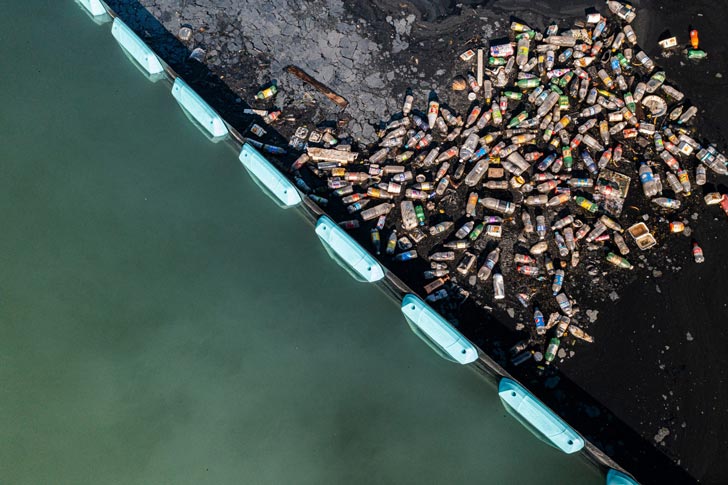
Plus, once plastic is in the ocean, it accumulates in “giant circular currents” called gyres, which Slat said operate a lot like the drain of the bathtub, meaning that plastic can enter these currents but cannot leave.
That’s how we get enormous build-ups like the Great Pacific Garbage Patch, a giant collection of plastic pollution in the ocean that is roughly twice the size of Texas.
As the founder and CEO of The Ocean Cleanup, Slat’s goal is to return our oceans to their original, clean state before 2040. To accomplish this, two things must be done.

First: Stop more plastic from entering the ocean. Second: Clean up the “legacy” pollution that is already out there and doesn’t go away by itself.
And Slat is well on his way.
When Slat’s first TEDx Talk went viral in 2012, he was able to organize research teams to create the first-ever map of the Great Pacific Garbage Patch. From there, they created a technology to collect plastic from the most garbage-heavy areas in the ocean.
“We imagined a very long, u-shaped barrier … that would be pushed by wind and waves,” Slat explained in his Talk.

This barrier would act as a funnel to collect garbage and be emptied out for recycling.
But there was a problem.
“We took it out in the ocean, and deployed it, and it didn’t collect plastic,” Slat said, “which is a pretty important requirement for an ocean cleanup system.”
Soon after, this first system broke into two. But a few days later, his team was already back to the drawing board.
From here, they added vessels that would tow the system forward, allowing it to sweep a larger area and move more methodically through the water. Mesh attached to the barrier would gather plastic and guide it to a retention area, where it would be extracted and loaded onto a ship for sorting, processing, and recycling.
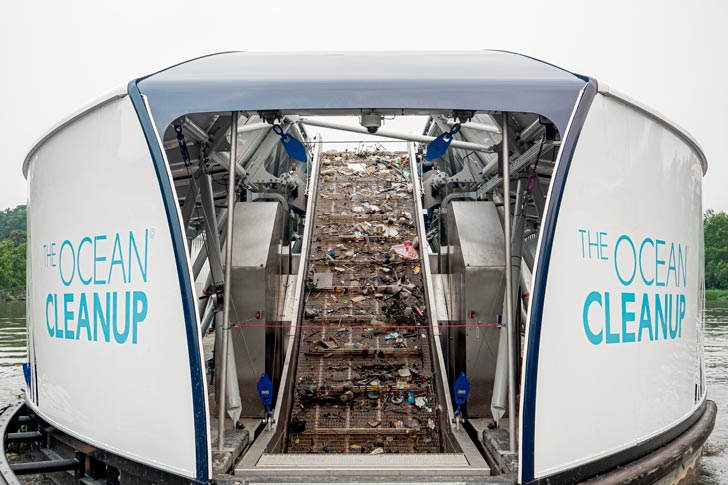
It worked.
“For 60 years, humanity had been putting plastic into the ocean, but from that day onwards, we were also taking it back out again,” Slat said, with a video of the technology in action playing on screen behind him.
To applause, he said: “It’s the most beautiful thing I’ve ever seen, honestly.”
Over the years, Ocean Cleanup has scaled up this cleanup barrier, now measuring almost 2.5 kilometers — or about 1.5 miles — in length. And it cleans up an area of the ocean the size of a football field every five seconds.

The system is designed to be safe for marine life, and once plastic is brought to land, it is recycled into new products, like sunglasses, accessories for electric vehicles, and even Coldplay’s latest vinyl record, according to Slat.
These products fund the continuation of the cleanup. The next step of the project is to use drones to target areas of the ocean that have the highest plastic concentration.
In September 2024, Ocean Cleanup predicted the Patch would be cleaned up within 10 years.
However, on April 8, Slat estimated “that this fleet of systems can clean up the Great Pacific Garbage Patch in as little as five years’ time.”
With ongoing support from MCS, a Netherlands-based Nokia company, Ocean Cleanup can quickly scale its reliable, real-time data and video communication to best target the problem.
It’s the largest ocean cleanup in history.
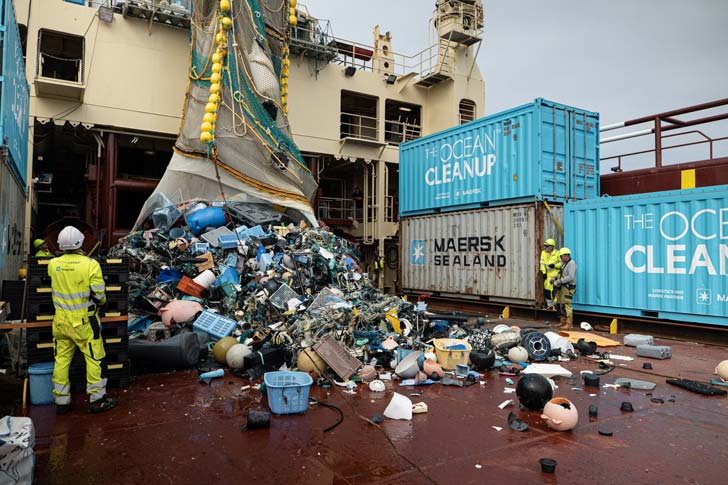
But what about the plastic pollution coming into the ocean through rivers across the world? Ocean Cleanup is working on that, too.
To study plastic pollution in other waterways, Ocean Cleanup attached AI cameras to bridges, measuring the flow of trash in dozens of rivers around the world, creating the first global model to predict where plastic is entering oceans.
“We discovered: Just 1% of the world’s rivers are responsible for about 80% of the plastic entering our oceans,” Slat said.
His team found that coastal cities in middle-income countries were primarily responsible, as people living in these areas have enough wealth to buy things packaged in plastic, but governments can’t afford robust waste management infrastructure.
Ocean Cleanup now tackles those 1% of rivers to capture the plastic before it reaches oceans.
“It’s not a replacement for the slow but important work that’s being done to fix a broken system upstream,” Slat said. “But we believe that tackling this 1% of rivers provides us with the only way to rapidly close the gap.”

To clean up plastic waste in rivers, Ocean Cleanup has implemented technology called “interceptors,” which include solar-powered trash collectors and mobile systems in eight countries worldwide.
In Guatemala, an interceptor captured 1.4 million kilograms (or over 3 million pounds) of trash in under two hours. Now, this kind of collection happens up to three times a week.
“All of that would have ended up in the sea,” Slat said.
Now, interceptors are being brought to 30 cities around the world, targeting waterways that bring the most trash into our oceans. GPS trackers also mimic the flow of the plastic to help strategically deploy the systems for the most impact.
“We can already stop up to one-third of all the plastic entering our oceans once these are deployed,” Slat said.

And as soon as he finished his Talk on the TED stage, Slat was told that TED’s Audacious Project would be funding the deployment of Ocean Cleanup’s efforts in those 30 cities as part of the organization’s next cohort of grantees.
While it is unclear how much support Ocean Cleanup will receive from the Audacious Project, Head of TED Chris Anderson told Slat: “We’re inspired. We’re determined in this community to raise the money you need to make that 30-city project happen.”
And Slat himself is determined to clean the oceans for good.
“For humanity to thrive, we need to be optimistic about the future,” Slat said, closing out his Talk.
“Once the oceans are clean again, it can be this example of how, through hard work and ingenuity, we can solve the big problems of our time.”
Header image courtesy of The Ocean Cleanup Project
Good Good Good has been covering TED's annual conference and spinoff events — like TED Women, TED Next, and TED Countdown — as press since 2023. Our journalists watch TED Talks live and interview speakers after they get off stage, giving Good Good Good the opportunity to share stories like this before TED Talks are released online.
On April 8, Rob Bredow — chief creative officer at Industrial Light & Magic and SVP of creative innovation at Lucasfilm — took to the main stage at TED 2025 in Vancouver, Canada, to talk AI.
The VFX supervisor, who co-produced “Solo: A Star Wars Story,” began his TED Talk by splashing newspaper headlines on the display behind him.
Animation Magazine warns: “Animation Guide Report Raises Alarms about AI’s Industry Impact.”
The Hollywood Reporter writes: “Jeffrey Katzenberg: AI Will Drastically Cut Number of Workers It Takes To Make Animated Movies.”
Cartoon Brew reports: “Lionsgate Signs Deal With AI company Runway, Hopes That AI Can Eliminate Storyboard Artists and VFX Crews.”
“As someone who’s been a SFX artist for over 35 years, some of these headlines are pretty disappointing,” Bredow told the crowd. “They seem to say, ‘AI is coming, and it’s coming for our jobs.’”
“It can be pretty intimidating,” he admitted. “And we’re not the only ones that are a little concerned about the future of AI.”

Even so, Bredow said, he has hope.
“I believe this is an interesting collision, you know?” Bredow said. “Of tech and art. And I believe in what George Lucas created at Industrial Light & Magic, his visual effects company.”
“He founded this 50 years ago to solve the visual storytelling challenges in his films,” Bredow continued. “And what he did was he put artists side by side with engineers. They’re working together to build, innovate, and create the future.”
“This is an artist-driven innovation,” he said. “I’m passionate about this.”
Innovation, Bredow said, is baked into the film industry.
Turning back the clock, Bredow invited the crowd to look back at the early use of computer graphics in “Jurassic Park” in 1993.
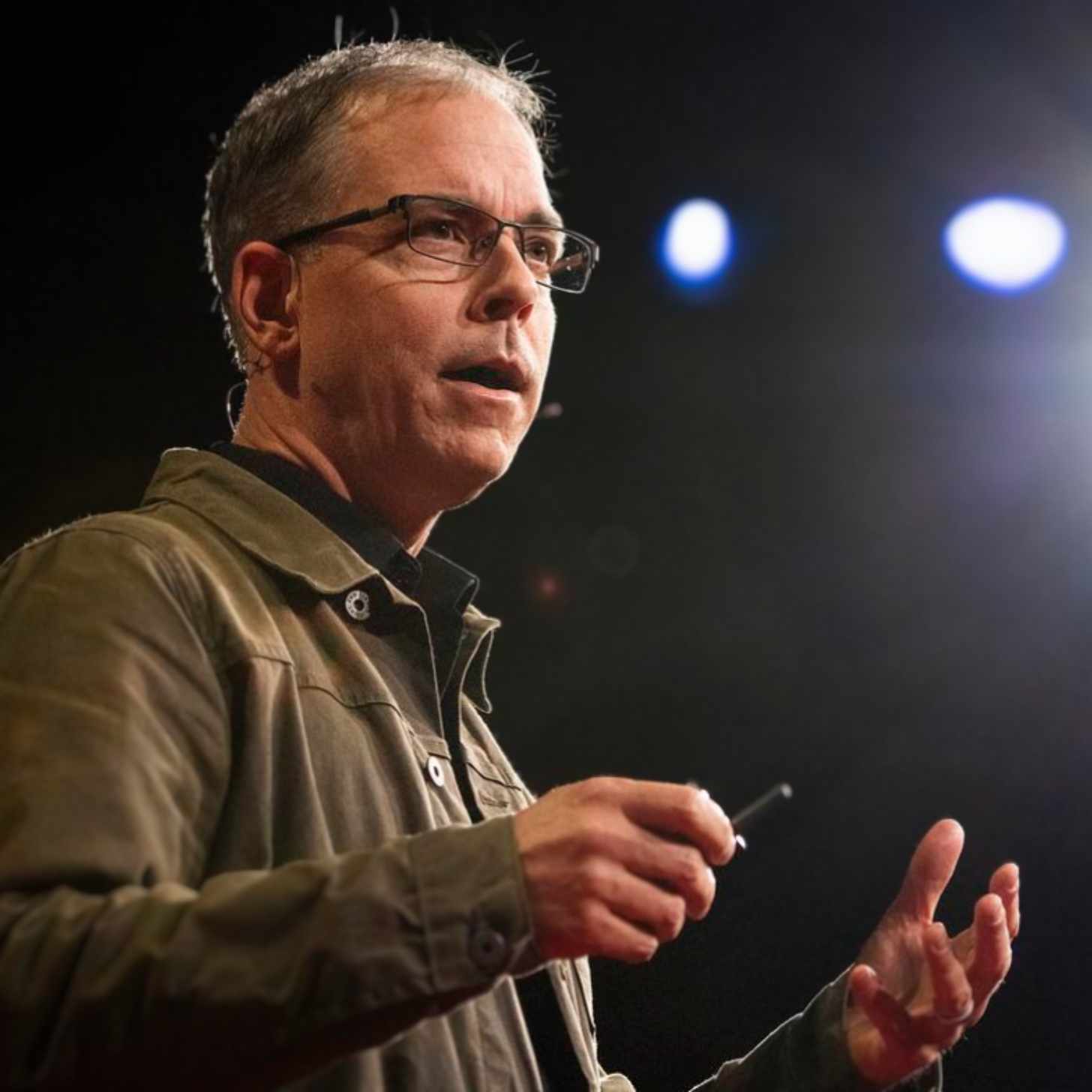
He explained how the crew used a bevy of tools at their disposal to create storyboard frames, stop-motion armatures, and frame-by-frame hand-drawn animation to create digital dinosaurs.
He then jumped forward 30 years to “Indiana Jones and the Dial of Destiny,” to break down how VFX artists used Harrison Ford’s on-set acting performance, a combination of generative AI tools, and frame-by-frame digital retouching to pull off Indiana’s de-aged likeness.
“Innovation thrives when the old and new technologies are blended together,” Bredow said.
“Just a beautiful collaboration of tech and art that elevates the storytelling and gives our artists new tools,” he added, pointing to the use of practical sets in tandem with immersive, single-sound stage LED walls in John Favreau’s “The Mandalorian” series. “That’s what we love.”
To bring his point home, Bredow then screened a short film called “Star Wars Field Guide.”
“What happens when you put the latest AI tools in the hands of talented artists?” Bredow posed before the premiere. “Both to see how good these tools are these days, and, what does it do to our artist’s imaginations? Where does it take their imaginations?”
Bredow explained that the short was created by VFX artist Landis Fields, who used the latest generative AI tools to show “the trajectory we’re on and the trajectory we want to be on next.”

“He created this in two weeks, to explore what it would feel like if you sent a probe droid out to a brand new ‘Star Wars’ planet. What would it see?”
The short went on to show fantastical aliens through a droid’s eyes, over a trademark “Star Wars” score. The creatures included tentacled manatees, monkey-faced spiders, hairy-backed crocodiles, and zebra-striped gorillas, all roaming and living in an alien world.
As the short wrapped and the TED crowd applauded, Bredow cautioned that it was “just an early work in progress.”
“Those are not final ‘Star Wars’ character designs, that’s not a finished product,” Bredow said. “For a show, for a movie, we need a team — for so many reasons.”
Instead, Bredow invited the audience to see “Star Wars Field Guide” as a type of “moving mood board” that could be used as a pre-production planning tool.
“We at Lucasfilm and ILM, we don’t think we’re just around the corner from one or two people making a film in a dark room by themselves,” Bredow said. “We benefit so much from a diverse skillset of the artists and technicians who work on our films. They bring so much creativity to our projects. That’s what we want to capitalize on.”
The Lucasfilm head finished his TED Talk, which will likely be released online in the coming year, by admitting that it’s natural for artists to be anxious about AI replacing human jobs — and it’s up to leaders in the industry to quell that anxiety and lead by example.
“As our tools continue to evolve, we take our responsibility seriously to grow and develop the talent that’s working on our projects,” Bredow said. “That’s artist-driven innovation … we need to use these tools thoughtfully and with the full permission of the talent.”
Header image: Rob Bredow speaks at SESSION 3 at TED 2025: Humanity Reimagined. April 7-11, 2025, Vancouver, BC. Photo: Gilberto Tadday / TED
Good Good Good has been covering TED's annual conference and spinoff events — like TED Women, TED Next, and TED Countdown — as press since 2023. Our journalists watch TED Talks live and interview speakers after they get off stage, giving Good Good Good the opportunity to share stories like this before TED Talks are released online.
On World Pangolin Day, February 15th, 2025, the African Pangolin Working Group opened the world’s first veterinary and rehabilitation facility soley reserved for pangolins — aptly named The Pangolarium.
“The Pangolarium (meaning a ‘place for pangolins’) is a purpose-built facility that aims to enhance the rescue, veterinary high care, rehabilitation, and reintroduction processes for pangolins rescued from the illegal wildlife trade on the west side of Limpopo Province,” The African Pangolin Working Group wrote in a press release.
“The facility is equipped with advanced medical and husbandry resources; the centre provides a facility where this vulnerable species can recover and prepare for a return to their natural habitat. It will also serve as a base camp for the APWG’s ongoing research and education initiatives.”
For years, conservationists have been sounding the alarm on the rapid decline of the pangolin: a unique, scaly mammal that resembles a “walking pinecone.”
There are eight species of pangolin (four in Africa and four in Asia), and unfortunately, all of them are IUCN Red List as vulnerable or critically endangered.
Their global decline — which was already at risk due to the destruction of their natural habitats — has been hurried along by overhunting.
Which is why the APWG has kept the exact location of the Pangolarium a highly classified secret.
For decades, poachers have targeted pangolins for their meat and scales, making them the most trafficked wild animal on the planet.
Today, pangolins can be difficult to spot in the wild, namely because there are so few left in the natural world.
For reference, when wildlife experts saw a pangolin on a trail camera in Niokolo-Koba National Park last year, it was the first time the species had been recorded in Senegal since 1999.

Beryl Makori, the project manager of the Pangolin Project, has been working with local farmers to advocate for pangolin conservation.
“I feel we are protecting the last of the pangolins,” Beryl Makori, the project manager of the Pangolin Project, told The Guardian. “We will give all it takes for a protected habitat with a viable population.”
The conservation of the endangered species is something that piqued the interest of Academy Award-winning director Pippa Ehrlich (“My Octopus Teacher”).
Her upcoming documentary, “Pangolin: Kulu’s Journey,” which is set to be released on Netflix on April 21, follows wildlife photographer Gareth Thomas as he rescues and rehabilitates a baby pangolin named Kulu.
“Pangolins are some of the most ancient and unique mammals that have ever walked the Earth,” Ehrlich told People Magazine.
“Over millions of years of evolution, they have traded their claws and fangs for protective scales and a finely tuned intuition that makes them deeply sensitive, innocent creatures: they can’t run or bite, and their only defense is to roll up in a ball.”
"When I met Gareth, I was immediately fascinated by his relationship with these gentle and mysterious animals,” Ehrlich said, “but the reason I wanted to make the film is that I believe pangolins are a symbol of our own fragile existence on this planet, along with so many of the vulnerable beings that belong here with us.”
Header images via flowcomm / Wikimedia Commons (CC BY 2.0) and Vickey Chauhan (CC BY-SA 4.0)
In the last five years, mental health needs have skyrocketed as support systems have become increasingly inaccessible.
That’s why Alison Darcy, a clinical research psychologist and health tech designer, created Woebot Health — the world’s first clinically trained therapeutic AI.
On April 9, New York Times-bestselling author Kelly Corrigan invited Darcy to the TED stage in Vancouver, Canada, to lay out the benefits — and concerns — surrounding AI therapy.
From the onset of the conversation, Corrigan honed in on a question that continues to surface in the larger discourse on AI: Is this tool meant to replace human interaction?
“It's never about replacing the great human therapists that we have,” Darcy emphasized. “Most people aren't getting in front of a therapist, and even if they are, they're not there beside you as you live your life.”
Corrigan then raised three points of concern: Who pays for the service? Are the transcripts private? And what data does Woebot train on?
The price, Darcy replied, is currently covered by a network of health services, privacy is integral to the company, and the data is built on cognitive behavioral therapy practices built by trained professionals.

“I really believe in what human therapists do,” Darcy said. “But it doesn't matter how good a therapist is. You could be the best therapist in the world. But unless you're with your patient at 2 a.m. when they are having a panic attack, you can't help them in that moment.”
“Therapy doesn't happen in a vacuum,” she added. “We all have real lives.”
But Corrigan was still skeptical.
“Sometimes I wonder,” Corrigan said, continuing to press, “if we might inadvertently be creating the conditions for a total rejection of humanity, of dumb, boring, incomplete, half-asleep humans, when you could have this thing that is so hyper-responsive. Do you feel like people, once they find Woebot, they never want to leave it?”
“A great process is just asking the person the right questions,” Darcy replied. “They're the ones that have to do all of the work.”
“They're the ones that have to shift their mindset or acknowledge their role in a conflict with somebody and tune in to their deepest, darkest, negative thinking. And that stuff is hard, and that is all on the person. The AI is just going to ask you the right questions to get there.”

Darcy also pointed out that most Woebot users aren’t sitting on the app for the full length of an hour-long session.
In fact, she said, the average length of a Woebot encounter is 5 to 6 minutes at a time.
“About 75 to 80 percent of all of those conversations are happening outside of clinic hours,” Darcy said. “The longest conversations people have are between 2 a.m. and 5 a.m.”
Darcy then paints a metaphor for the audience, likening Woebot to tennis ball machines that launch balls to players so they can practice their swing and “get better at the game with another human.”
“It very much should be about helping people develop their own resources. … These are fundamentally tools,” Darcy said.
The end goal, Darcy said, is “human betterment.”
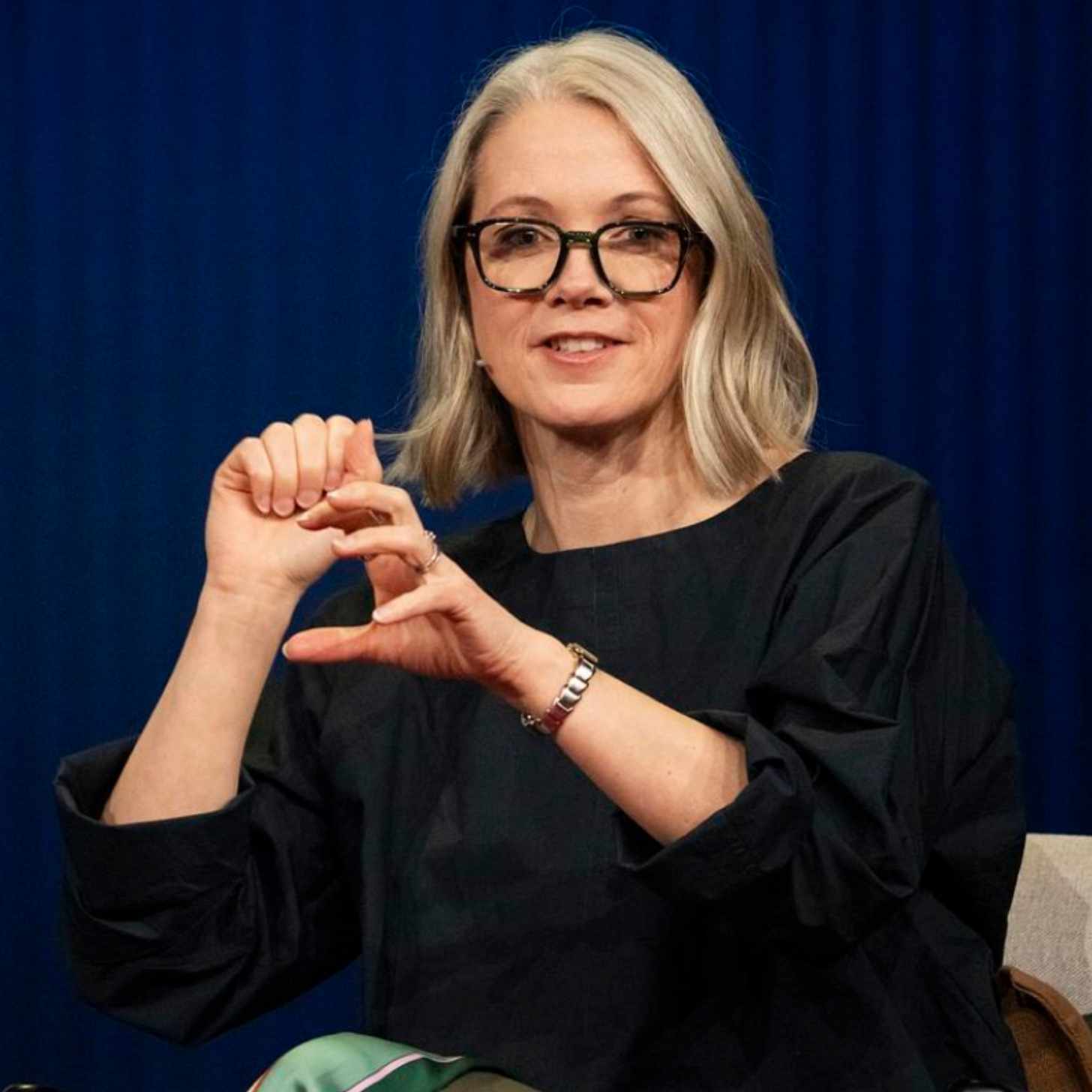
Corrigan wrapped the TED discussion — which is expected to be released online in the coming year — by asking Darcy, “Do you have a thought about which has more potential for damage, an AI or a human?”
“That is a big question,” Darcy replied, pausing to proceed carefully.
“I think the AIs have plenty of potential for damage, as do humans, and it's very early days with the technology. The thing is that we have the opportunity to develop AIs with intentionality.”
“So we'll see, fundamentally, these are just tools, and also humanity is humanity for a reason … we have to make sure that the tech is in service of humans, not the other way around.”
Header images: Host Kelly Corrigan and Alison Darcy speak at SESSION 7 at TED 2025: Humanity Reimagined. April 7-11, 2025, Vancouver, BC. Photo: Gilberto Tadday and Jason Redmond / TED
Good Good Good has been covering TED's annual conference and spinoff events — like TED Women, TED Next, and TED Countdown — as press since 2023. Our journalists watch TED Talks live and interview speakers after they get off stage, giving Good Good Good the opportunity to share stories like this before TED Talks are released online.
Since November 8, 2024, New York Times best-selling authors Brad and Kristi Montague have hosted the art exhibit “We Hope You Fail Better.”
The Montagues, who are married and have two children, opened the exhibit as an extension of their children’s book “Fail-a-bration!” which helps children learn that it’s okay to fail and make mistakes.
“The book is a picture book for all ages — and I mean it. I believe the best picture books work for children and former children,” Brad Montague told Good Good Good in September. “The language might be simple, and the illustrations are childlike, but it really is for humans of any age.”
The artists’ new exhibit, which will be on view at the Saugatuck Center for the Arts until May 16, 2025, is filled with learning stations, original works of art, and “Famous Failures from History.”
“It’s an emotional ride and playfully navigated with animated shorts, paper maché surprises, behind-the-scenes scribbles, and interactive displays,” reads a statement on the exhibit’s website.
“With humor and heart, it all culminates to a celebration — or a ‘Fail-a-bration’, sending everyone out into a community of creative, compassionate collaboration.”
Perhaps the most novel display in the exhibit is the “Dial-a-Dream” station.
“We set up a number, an actual 800 number,” Brad Montague said in a recent TikTok video. “You call it, leave a message you would have needed to hear on your roughest day. Just something kind, something true.”

The voices ranged from young to old, with one little boy telling listeners that it’s okay to “feel like a raccoon in the dumpster spewing trash,” and another inviting listeners to breathe in, adding, “you have infinite value.”
“Hundreds of hundreds of people have called in,” Montague said. “Encouraging voices from all over the world.”
“The amazing Ms. Rachel even called in,” the author said, playing a brief audio clip from the famous children's singer-songwriter, who has been known to speak out about mental health and human rights issues.
“In the gallery, we set up headphones, and some people stay for two minutes, others for an hour,” Montague said. “So go ahead, call in. I’d love to add your voice to the show. And also go see it, we’re really proud of it.”

In a comment beneath the video, one viewer wrote: “When I see stuff like this, I start to feel that spark of hope for humanity again. At the heart of it all, we just want connection and to know we’re valued to someone. This is so beautiful.”
To add an encouraging message to the helpline, helpers can dial in at 1-888-435-7163.
“Whether you call in or not,” Montague said, “I hope today you can leave a little light for somebody else, somewhere out there.”
Watch Brad’s full video below:
@bradmontague Give it a call. ❤️
♬ original sound - bradmontague
Header image courtesy of Ms. Rachel, Brad Montague / TikTok
When it comes to harvesting fruits and vegetables, food chemist Jenny Du knows that the clock starts ticking the second an orange is plucked from a tree.
“It's like a ticking time bomb,” Jenny Du said on April 10, kicking off her TED Talk at the TED 2025 main stage in Vancouver, Canada.
“It's literally this living and breathing thing that's slowly cannibalizing its own stores of energy and nutrients, just trying to stay alive until it ultimately gets eaten by microbes or some other animal like us.”
But not all produce rots the same — a sentiment that rings all too true for anyone who’s tried to buy and use a bag of spinach before it turns to wilted slime.
“Strawberries last much longer than oranges, but have you ever wondered why that is and what could be done about it?” Du posed to the crowd. “My journey in trying to figure that out started in the spring of 2013.”
Du launched the audience back in time to her days studying chemistry at the University of Santa Barbara, California, when she was trying to put her schooling to “meaningful use.”
“Two of my lab mates, James Rogers and Luis Perez, invite me to dinner, but it turns out to be a pitch disguised as dinner,” Du said. “They opened by totally flooring me with some staggering stats. The third of the food that we produce worldwide is lost or wasted before it ever has a chance to be eaten. For fresh fruits and vegetables, that number is a half.”
Du explained that waste exists in every step of food production, from the second an orange gets plucked from a tree to the transportation it requires when shipped to stores, the refrigeration used to keep it stable, and the fact that half of the oranges harvested end up never being eaten at all.
“It’s not just a waste of the food,” Du said, “it’s a waste of the land, water, fertilizers, labor, energy, fuel, packaging, and money out of farmers' and our pockets. If global food waste was a country, it’d be the third highest emitter of greenhouse gases after China and the US.”
That’s when Du, Rogers, and Perez created Apeel Sciences in a humble garage.
“We led first with some questions. How do plants protect themselves? Well, with peel. Plants, just like us, have a skin or peel, technically called the plant cuticle, and that helps to protect them from moisture loss, oxidation, and infection. What are those peels made of? Fatty acids, glycerides … these are ingredients found universally in all plants, in the peel, pulp, and seeds, and including in plants that we already eat.”
Going back to that original question of why strawberries last longer than oranges, Du explained that different fruits have different shelf lives because of the “thickness and arrangement” of their natural ingredients.

“The idea then is, can we take these harmless edible plant-based ingredients, apply them in a thin layer on the surface of fresh fruits and vegetables to help reinforce the existing natural peel? If you do that, can you help to retain peak flavor, texture, and nutrients for longer without reliance on refrigeration, pesticides, waxes, or plastics?”
To test those questions, they partnered with a local farmer to source finger limes.
“They’re literally finger-shaped, and when you cut them open, the pulp is in the shape of beets like caviar,” Du described. “They are delicious and they’re super fragrant.”
But once they’re picked, the organic limes dry out within seven days, even with refrigeration.
“We took a test batch of material that we made using leftover tomato peels, since those are rich in these fatty acids and glycerides,” Du said. “We dipped those limes in a bowl of these ingredients in water and set them aside to dry. Then we waited. We saw that we could add an extra week of freshness to these limes.”
“When we saw that for the first time, we were like, ‘Shut the front door. Oh, my God, this might actually work!’” Du recalled. “We then went and wanted to apply this little bit of extra peel to all other kinds of fruits and vegetables. Bananas, avocados, limes, green beans, tomatoes, bell peppers, cucumber, berries, you name it.”
That natural compound, which is one-tenth the size of a small raisin, formed the basis for Apeel Science’s “Apeel-protected produce.”
“Even though these materials are, of course, edible, you can wash them off by just rubbing under running water,” Du said, later adding that the compound is neutral, with “no taste, no smell.”

Since Apeel Sciences was formed in 2021, the start-up has hit some astonishing milestones.
“We've prevented 166 million pieces of produce from going to waste,” Du stated. “In doing that, that's avoided the emissions of more than 29,000 metric tons of greenhouse gas emissions, which is equivalent to planting 485,000 trees, and saved almost seven billion liters of water, or enough to fill 2,800 Olympic-size swimming pools.”
The crowd erupted into applause.
“We’re not a silver bullet to end food waste ourselves,” Du admitted. “But thankfully, there are lots of startups, scale-ups, organizations, and individuals all around the world working to transform this post-harvest space.”
“We’re optimistic that our one small innovation using common ingredients inspired by the ancient wisdom of plants is playing its part in having an impact, reinventing the food system, and helping it create abundance for it.”
Header image: Jenny Du speaks at SESSION 9 at TED 2025: Humanity Reimagined. April 7-11, 2025, Vancouver, BC. Photo: Jason Redmond / TED
Good Good Good has been covering TED's annual conference and spinoff events — like TED Women, TED Next, and TED Countdown — as press since 2023. Our journalists watch TED Talks live and interview speakers after they get off stage, giving Good Good Good the opportunity to share stories like this before TED Talks are released online.
In 2018, Rick and Kelly Bestul became the owners of King Motel off State Highway 7 on the west side of Hutchinson, Minnesota.
In the 7 years since the Bestuls took over the King Motel, they reported a growing number of guests have taken out extended stays because they didn’t have access to permanent housing.
Although Minneapolis officials say homelessness rates have dropped in the last year, the Bestuls have seen the problem grow in their neck of the woods.
“On a rural level, it is here,” Kelly Bestul told CBS News. “They tent in the summer. They come here in the winter.”
During the pandemic, the Bestuls noticed that other motels and hotels have had success converting their property into affordable housing units.

That’s when they began doing the same at both the King Motel and their other property, the newly renovated Queen’s Inn.
Average hotel rates in Minnesota range between $50 and $150 a night — meaning that a seven-night stay averages $700.
But the Bestuls capped their week-long stays at $300, knowing it’s much closer to what their guests can afford.
“This just works for them because they’ve had other houses, but they end up not being able to take care of them or don’t know how to pay all the bills,” Bestul said. “This is one-and-done because all the utilities are included.”
Bestul estimates that “80 percent” of her clientele would be homeless without their services.
“I really want to show people – [and] my husband's the same way – life doesn't have to be this deep and hard,” Bestul said. “Yes, it's an uphill climb, but it's possible.”

Header images via King Motel / Facebook
On April 2, President Donald Trump imposed a 10% tariff on goods exported from a handful of uninhabited volcanic islands near Antarctica.
Well, uninhabited by humans.
According to World Wildlife Fund Australia, two islands in the heart of the Southern Ocean — Heard Island and McDonald Islands — are home to “some of the most iconic and ecologically significant penguin species on the planet,” including the macaroni, eastern rockhopper, gentoo, and king penguins.
And now you can support those vulnerable penguin species by buying pebbles from them at the Heard Island Pebbles shop.
The website — created by Kindred Studio co-founders Milla Novak and Janelle Mais — is written from the “perspective” of the Heard Island penguins.
“When we heard Trump had put a 10% tariff on exports from our island, we were in quite a flap,” reads a statement on the Heard Island Pebbles website. “Sure, no humans live here — but maybe it was time to contribute to the global economy. So, we put our beaks together and devised a plan to launch our first ever export: pebbles.”
“Used traditionally for nest-building, romantic gestures, and chick entertainment, pebbles are now being sold to humans worldwide in a playful attempt to build their ‘nest-worth’ and give back to the environment,” Kindred Studio added in a press release.
On the Heard Island Pebbles shop, a digital pebble is listed as “a stunning symbolic purchase to donate money to conservation efforts.”
The team at Heard Island Pebble added that the illustrated graphic is “wonderful for posting on social media to show your support for the penguins of Heard Island — and your confusion on why tariffs were imposed on a human-free place.”
The shop also features a real, tangible pebble that’s “wonderful for nest building, impressing love interests, or keeping the chicks entertained.”

“If you’re not a penguin, our pebbles make great pot plant decor, paper weights or a centerpiece for weighty conversations on international trade,” the website adds. “Please note, if you live in America, pebbles will cost an extra 10%. Because tariffs [frowning face].”
The tongue-in-cheek website isn’t just good for a laugh — 100% of proceeds will be donated to WWF Australia, “to help protect the penguins of Heard Island and support broader conservation efforts in the region.”
According to WWF Australia, current protection levels for the species are inadequate.
“If we want to protect this pristine wilderness and ensure the survival of its iconic penguin species, we must take action now.”
In addition to purchasing pebbles, penguin lovers can sign an online petition calling on the Australian Minister for the Environment and Water, Tanya Plibersek, to increase protection for the critical marine habitats and even “adopt” a penguin — a donation that comes with a penguin stuffed animal and an adoption certificate.
“Adopt a penguin today and you’ll be helping to protect them and other vulnerable animals from extinction,” WWF Australia writes. “Your kindness will help defend their habitat and food sources, to ensure our incredible wildlife remain part of our world forever.”
Header images via Heard Island Pebbles / World Wildlife Fund Australia
Every day the Good Good Good team collects the best good news in the world and shares it with our community. Here are the highlights for this week!
If you want to get good news in your inbox every day, join the Goodnewsletter — the free daily newsletter designed to leave you feeling hopeful.
The Best Positive News We’re Celebrating This Week —
To address food insecurity, a group of Baltimore women is building a community fridge network
Recognizing the difficulty some folks have in being able to travel to and access local food pantries where and when they’re open, a group of four women in Baltimore wanted to bring the food to them.
The Bmore Community Fridge Network is a map of community fridges and neighborhood pantries across the city, and it’s hoping to connect nearby residents with free food.
Not only will the map help those in need of food — it will also serve those looking for places to donate food. Right now, the map has four community fridges featured, and the women are working quickly to add more.
Why is this good news? Maryland Food Bank data shows more than 90,000 city residents are food insecure, and 1 in 3 Marylanders face food insecurity. While the number of residents experiencing food insecurity is down from last year, the region’s rate is nearly twice as high as the national average.
This network is essential in making it easier to collect donations and connect people in need with fresh food that’s nearby.
Runner attempts 50 ultramarathons in 50 days for the homeless: ‘If I’ve got to run across Australia to hit $2.2M, then that's what I'll do’
→ Read more
In recent years, four countries have successfully stopped and reversed the erosion of their democracies
When looking at key aspects of democracy, like the fairness of elections and checks on government power — in the past 20 years, Thailand, Zambia, Brazil, and Poland all saw declines in democracy … some faster than others.
But all four countries have also been able to stop, and even reverse autocratization successfully. In all these instances, people resisted growing authoritarianism and were able to either partially or fully restore previous levels of democracy.
This illustrates how even when democracy deteriorates, that decline is not a permanent fixture — those losses can be recovered.
→ Read more
Undue Medical Debt is paying off $30 billion worth of medical debt for 20 million people
In a single transaction with a debt trading company, the nonprofit Undue Medical Debt (formerly RIP Medical Debt) announced it would be paying off $30 billion worth of unpaid medical debt.
The sale will impact an estimated 20 million people, mostly in Texas and Florida, with an average patient debt of $1,100 — though some debt was in the hundreds of thousands of dollars.
With the massive transaction, millions of people will be protected from being targeted by collectors.
What’s the nuance? It’s important to note that the medical debt crisis in the U.S. now touches an estimated 100 million people nationwide. So while it’s incredibly good news (and so worth celebrating!) that 20 million people will have this burden lifted, so many others still need help.
Shelters across the U.S. are celebrating ‘kitten season’ with foster workshops, rescue tips, and ‘kitten baby showers’
After 10,000 years of extinction, scientists genetically engineered a dire wolf — the breakthrough could help save threatened species
From Venezuela to Canada, dire wolves roamed across the continent until they went extinct 10,000 years ago. Now, using ancient DNA, scientists have genetically engineered the first dire wolf to live since their extinction.
While Colossal Biosciences has other species, like the wooly mammoth and the dodo, on its de-extinction wish list — their efforts are helping inform how we can protect endangered and other at-risk species right now, like the red wolf.
Experts estimate that 30% of Earth’s genetic diversity will be lost by 2050, and Colossal scientists say that genetic engineering is a vital tool to reverse this, helping humans undo “some of the bad things that we’ve done to the world already.”
Utah expanded its free school meal program to include 40,000 more students
Utah’s governor approved a bill to eliminate the state’s reduced-cost lunch program — instead, families will get those meals for free.
Starting July 1, the state is expanding the free school meals program to an additional 40,000 students in kindergarten through sixth grade. Next school year, even more students will be eligible.
The new legislation also prevents schools from “stigmatizing students who cannot afford meals” by eliminating practices like using different colored lunch trays for those on the free meals program.
Why is this good news? A reduced-price school meal in Utah costs 40 cents, but many families still struggle to afford meals, and schools in the state still have around $2.8 million in lunch debt.
Lunch debt is a huge burden for families all across the country — and this is important progress toward ensuring all kids can learn on a full stomach.
Animal charity gives free vet checkups to unhoused neighbors, whose pets are ‘arguably better cared for than some housed animals’
Fossil fuels made up less than half of the U.S. electricity mix in March for the first month on record
In March 2025, fossil fuels accounted for 49.2% of electricity generated in the U.S. — beating the previous monthly record low of 51% set last year in April.
This also means that renewable sources reached all-time highs — accounting for 50.8% of U.S. electricity for the first month on record. Nearly half of that came from wind and solar alone, which have been seeing (and will continue to see) exponential growth.
Just a decade ago, fossil fuels provided 65% of U.S. electricity generation, while wind and solar just 5.7% — that share has since more than quadrupled.
Clean energy powered over 40% of global electricity in 2024 for the first time since the 1940s
In the 1940s, the power system was about 50 times smaller than it is today. That was the last time clean energy surpassed 40% of global electricity — like it just did in 2024.
Similar to the 1940s, though, that milestone was made up largely by hydropower, one of the oldest renewable energy technologies, which made up 14% of global electricity.
And while solar only made up 7% of global electricity, it had a significant hand in the benchmark, too, since its capacity has doubled in the last three years and it’s been the world’s fastest-growing source of energy for the last 20 years.
What’s the nuance? Experts had hoped that global energy use would peak in 2023, but the global power sector grew by 1.6% last year, and that may continue as a result of increased use of artificial intelligence, data centers, electric vehicles, heat pumps, and more.
Still, experts and the data show that renewables are up for the challenge, and fossil fuels are not a part of that future.
→ Read more
Lucasfilm on AI: ‘We need to use these tools thoughtfully and with the full permission of the talent’
A man went viral after nobody showed up to his community beach cleanup — a week later, over 30 neighbors came to help
On March 30, a teacher in Vancouver posted a video holding a bucket and trash pickup sticks, waiting for people to arrive at a beach cleanup he’d organized. Nobody showed — and a heart-wrenching false alarm was even caught on camera.
But instead of calling it quits, Michael Harvey stuck it out, documenting his slow-and-steady approach to cleaning up litter along the driftwood-dotted sands of Kitsilano.
Videos of his solo endeavor went viral on social media, with many praising his efforts to make a difference. Harvey organized another pickup one week later, and this time, more than 30 neighbors showed up in the pouring rain to join him.
An architecture firm in Hawaii is building more sustainable homes out of surfboard waste
While Hawaii is seeing a shortage of housing and space for new landfills, one plentiful thing it has is surfboards. But making surfboards results in a lot of waste — so an architecture firm is using it to build homes.
Hawaii Off Grid is turning polystyrene foam offcuts from surfboard building into cinder block-style forms for building homes. The first home to use the “Surf Blocks” is nearing completion, and it could set a new precedent for home-building on the island.
The state has looked into a number of options to solve its housing issues while also keeping climate change in mind, which has devastated the island with weather events like the Maui wildfires.
Why is this good news? For a lot of reasons! This solution helps solve several issues at once: Hawaii’s chronic housing crisis, increased costs of building materials, which is partly due to them shipped to and sold at a premium in Hawaii, lack of landfill space for waste, and an abundance of surfboard waste.
→ Read more
Ms. Rachel adds voice to interactive art exhibit designed to comfort people on their ‘roughest day’
→ Read more
More good news of the week —
A plan to study “social housing” passed the Portland City Council with unanimous support. Housing developed, owned, and operated by the government would help keep the units affordable for people living in the city and address severe housing shortages that the private sector is not meeting.
A study found that shingles vaccination cut older adults’ risk of developing dementia over seven years by 20%. While it’s not clear how Alzheimer’s and other types of dementia form, certain viruses, especially those in the herpes family, have long been suspected of adding to genetic and other factors that make people more vulnerable.
Home builder Lennar is constructing 1,500 new Colorado homes with heat pumps. Ground-source heat pumps, which tap into the stable temperatures hundreds of feet beneath the Earth’s surface, are a super-efficient way to heat and cool homes — but expensive to install, unless it’s built in from the start.
There are now almost 50 rhinos living at a ranch in Uganda, part of an initiative to bring the animals back to the country. Rhinos went extinct in Uganda in the early 1980s due to poaching, trafficking, and political turmoil. Six rhinos were introduced to the former cattle ranch in 2006, and their numbers have since multiplied.
In a landmark trial, Chevron was ordered to pay more than $740 million to restore coastal wetlands in Louisiana. In the first of dozens of pending lawsuits in the state, a jury made a precedent-setting ruling that the company was accelerating land loss across the state’s rapidly disappearing coast.
An all-time record 736,000 sandhill cranes arrived in Nebraska during the peak of spring migration. The cranes all appear to be healthy, too, after wildlife biologists were on high alert after bird flu led to the death of more than 1,500 birds in Indiana.
Thailand became the 68th country in the world to ban corporal punishment of minors. UNICEF Thailand stressed the importance of the government also backing the ban with educational campaigns aimed especially at families, where using force as a teaching method is widely accepted and practiced.
A startup in Mexico is tackling a coastal city’s plastic waste problem by converting it into fuel. Petgas collects especially hard-to-recycle plastics like bottle caps and Styrofoam, and for every ton it collects and converts, it mitigates 1.5 tons of carbon. (Video)
Twenty-one animals, including some critically endangered, were rescued from an attempted smuggling at the Thailand airport. Officials were particularly concerned with the illegal transportation of six juvenile freshwater crocodiles, which are critically endangered in Thailand due to wetland degradation and overhunting.
A “pro bono bootcamp” is helping lawyers and legal professionals learn how to donate their time and skills to advance climate solutions. Beyond the high-profile climate lawsuits, the climate movement needs other kinds of legal support, like writing contracts, forming a business or nonprofit, or legal defense — the first bootcamp had 700 attendees.
Europe just launched a continent-wide research project to study the impacts of “social prescribing” on health outcomes. Social prescribing is a healthcare approach that connects patients with non-medical support services, linking patients to trained professionals who help them access community activities and services such as art and gym classes, befriending sessions, and financial advice.
New data shows the New England Aquarium’s rehabilitation program is helping injured sea turtles survive — and thrive — in the wild. The aquarium’s hospital has admitted over 500 turtles in just the past three years, and its efforts are especially important for loggerhead sea turtle populations, which are in decline.
Japan’s groundbreaking stem cell treatment helped paralyzed patients regain movement, and it could forever change paralysis treatment. The treatment specifically looked at spinal cord injuries, which pose significant challenges because the spinal cord is responsible for transmitting messages between the brain and body.
Trans-led organizations are helping build better, safer housing solutions for trans people in the U.S. Nearly one in three trans people have experienced homelessness in their lifetime, and data indicates that both homelessness and housing instability have dramatically risen in recent years among trans, nonbinary, and gender-nonconforming people.
A federal judge blocked an offshore oil and gas lease sale for not considering the impact on an endangered whale. The ruling could set a precedent for new offshore drilling activity so that it accounts for the highly endangered Rice’s whale, of which there are only an estimated 51 left in the wild.
The U.K.’s controversial first drug injection room is saving lives and connecting people in need with resources. Following similar programs in other countries, the service seeks to reduce drug-related harm in a hardcore population of injecting users, allow medical staff to prevent overdose deaths, reduce blood-borne viruses, and clean up the local area of drug debris.
The world’s first “Pangolarium” is covertly rehabilitating the most trafficked animal in the world. The exact location of the center is highly classified, since the pangolin’s global decline has been hurried along by overhunting with poachers targeting the “walking pinecones” for their meat and scales.
The Ocean Cleanup says it can clean up the Great Pacific Garbage Patch in five years. Also focused on preventing new plastic from reaching the ocean in the first place, the organization’s new-and-improved ocean cleanup technology now measures about 1.5 miles in length, and it cleans up an area of the ocean the size of a football field every five seconds.
Google demoed Android XR, the ‘Tony Stark’ glasses that translate languages in real time. Impressively, the glasses can detect, translate, and transcribe languages in real time into pop-up subtitles as well as use a “Memory” tool to help users remember where they’d misplaced forgotten items.
A Lucasfilm executive looked at “Star Wars” innovations to show how AI should be used as an artist tool, not as a replacement. Rob Bredow admitted that it’s natural for artists to be anxious about AI replacing human jobs — and it’s up to leaders in the industry to quell that anxiety, lead by example, and “use these tools thoughtfully and with the full permission of the talent.”
The creator of the world’s first clinically trained therapeutic AI shared how AI therapy can fill gaps in access and meet critical needs. Called Woebot, the service is currently covered by a network of health services, privacy is integral to the company, and the data is built on cognitive behavioral therapy practices built by trained professionals.
Bradley Tusk believes the political polarization in the United States is a result of two things: Politicians acting only to secure their seat in the next election — and everyday citizens abstaining from those elections.
“Virtually every politician makes every decision based on winning the next election — and nothing else,” Tusk said in his TED Talk at TED2025 in Vancouver, BC last week.
The solution? According to Tusk: Get more people out to vote.

In the 2024 presidential election, two-thirds of Americans turned out to vote. But in smaller elections, Tusk explained, even in New York, only 7.2% of people turned out to vote for a City Council primary.
“In this city of 8.5 million highly opinionated people, you could win a council seat with just 8,000 votes,” he said.
And those who are responsible for turnout are often those on the farthest ends of the political spectrum, or in special interest groups that are able to move money around to sway voters.
“Why can’t our politicians do the right thing for once? Because they’re held hostage by the extremes … We have to free them from their clutches,” Tusk said in the thesis of his TED Talk, which is expected to be released to the public in the coming months.
“The only way to do that is to get a lot more people voting, and the only way to do that is to meet people where they are: On their phones.”

Tusk is a venture capitalist and political strategist, best known for leading the tech regulation campaign to legalize Uber.
His 15 years working in city, state, and federal politics — combined with his knowledge of the tech space — made him equipped to be the person to bring mobile voting to the mainstream, he told Good Good Good in an interview at TED2025.
Now, he is leading the effort through his nonprofit, the Mobile Voting Project, in cities and states nationwide.
“I think, ultimately, we disenfranchise and disempower ourselves because we don’t participate in the process,” Tusk told Good Good Good.
But, he said, “we all have this device.”

In an era of rampant gerrymandering, long lines on Election Day, and a pending Senate vote on the SAVE Act, which would require people to present a birth certificate or passport to vote in federal elections, Tusk’s pitch is to bring the polls to the people — not the other way around.
“It seems to me that if you want to have broader-based rights and you want to have broader-based equity, you want more people to be engaged and empowered,” he posited, mobile voting would be a net-win.
Tusk said that the evidence already exists that putting something on smartphones will lead to people engaging more with it. But he also knows that safety is a top priority. So, he’s built a structure in which voting via smartphone is a safe, feasible reality.
Outlining an example for how he himself might vote in a New York state election, Tusk gave the TED audience a play-by-play.

“I go on the App Store, and I download the New York City Board of Elections app,” Tusk starts. Then, the app would prompt him to input his address to prove he is a registered voter in the city.
“Next is multi-factor authentication,” Tusk continued. “You know how when you forget your Google password, they send you a code, and you put that into the app? Same thing here.”
Then, the app would scan the user’s face, match it against the user’s government ID and would confirm once and for all that the voter is who they say they are.
From there, a ballot would appear on the app.
“Whenever I’m ready, I hit submit,” Tusk said. “When I hit submit, three things happen.”
First, as he outlined, the ballot is encrypted. Second, it’s anonymized. Third, the user gets a tracking code “like it’s a FedEx package,” so users can track their ballot throughout the process.
“Once it gets to the New York City Board of Elections, they air-gap it, which means they take it offline,” Tusk went on.
“And once my ballot is no longer connected to the internet, then they decrypt it, a paper copy is printed out, that gets mixed in with all the other ballots, and I know where my ballot stands because I can see through the tracking code that my ballot has been received, tabulated, and so on.”
Because the underlying code of Tusk’s mobile voting program is open source, anyone can audit and verify it, as well.

“To me, that’s a lot more secure than the way we vote right now,” Tusk said.
And to be clear, mobile voting would not replace all other methods of voting.
“If you like voting by mail, vote by mail. If you like voting in person, great, go do that,” Tusk said in his TED Talk. “If that’s you, knock yourself out. But based on turnout, that’s not most of you.”
Mobile voters would also be issued a digital sticker when voting via phone.
Regardless of ceremony, this method works.
In 2017, Tusk and his team created the Mobile Voting Project and worked with election officials in seven states, where active-duty military members who were deployed, as well as people with disabilities, could vote directly from their phones.
In one election in Seattle, voter turnout doubled — and tripled the next year — when mobile voting was employed.
In Denver, 100% of participants in a trial of mobile voting said they preferred it to traditional voting methods.
Tusk’s team has already built and “paid for” this mobile voting technology. As it is finished in the coming months, he said, it will be “free and open source to any government in the world who wants to use it.”
Now, he told Good Good Good, all that’s left is the adoption.

After the technology is released, Tusk’s organization will be introducing bills to city councils in cities across the country to adopt mobile voting in their upcoming elections.
“If we mobilize in every city where we’re running legislation, tens of thousands of people can tell their city council members and their mayors, ‘I want this thing,’” Tusk told Good Good Good.
With two children of his own, ages 16 and 18, he has hope for this transformation.
“Gen Z, to me, is my greatest hope,” Tusk added. “That’s where there’s so much opportunity.”
Overall, Tusk’s hope is in what a future with mobile voting could look like.
“We start to move things to the middle, and it starts to change the incentives for politicians, where they work together more, and they realize there’s less game for them in just screaming at each other and pointing fingers,” Tusk envisioned to Good Good Good.
“And then that inspires more faith and trust in government. That gets better, younger people wanting to run for office, to work in government. And that improves the quality of our government, which generates even more faith.”
In other words, when people have the tools to participate in the system, Tusk believes the system might actually work.
“We have a self-fulfilling process right now on the negative side,” he said, of the way the U.S. government functions.
“But we can recreate it on the positive side.”
Header image courtesy of appshunter.io on Unsplash
The affordable housing crisis is affecting people on a nationwide scale — and it’s an issue that’s hitting especially hard for vulnerable communities that are getting priced out of their own neighborhoods.
A 13-year study by the National Community Reinvestment Coalition found that gentrification impacted at least 135,000 Americans, with Black and Hispanic communities facing the highest rates of displacement in major cities.
Seven cities accounted for nearly half of the gentrification nationally: New York City, Los Angeles, Washington, D.C., Philadelphia, Baltimore, San Diego, and Chicago.
Fortunately, one city is taking significant actions to secure affordable housing for low-income families and prevent further displacement.
On April 13, Boston Mayor Michelle Wu announced that the city had successfully purchased 12 apartment buildings for $11 million to secure affordable housing for vulnerable Boston residents.
“We are so excited to announce that all of the almost 350 units at the Fairlawn Estates will be converted from market-rate housing to permanently affordable housing,” Wu told press. “The city is proud to support all of our residents through Fairlawn through a nearly $11 million investment.
“For decades, these units were known that way — an affordable place to raise a family and take care of everything that your family needed,” Mayor Wu continued.
“But over the last few years especially, the rent here was hiked up and up and up, and families were forced out of Fairlawn, out of Mattapan, and out of the city of Boston.”
As Mayor Wu addressed the crowd, throngs of locals cheered her on.

“I’m quite speechless, actually, but I’m just so happy, not just for myself but for everyone,” Annie Gordon, a Fairlawn resident who has lived in the neighborhood for 50 years, told the Boston Office of Housing.
“Somebody has to fight for everybody,” Gordon emphasized. “That’s how we looked at it. We was not going to accept anything that didn’t include the entire community because that’s how it should be.”
The acquisition is part of Mayor Wu’s larger ‘anti-displacement’ action plan, a two-year project titled “A Place to Thrive.”
The plan — which Boston’s Planning Advisory Council assisted with in December — aims to preserve affordable housing and assist residential homes and small businesses at risk of direct or economic displacement.
“To be a home for everyone, we must keep our residents, small businesses and cultural spaces rooted in our neighborhoods,” Mayor Wu said in a recent press statement.
“Our city’s growth must help stabilize communities and deepen roots. I’m grateful for every resident and community member whose feedback has informed this plan and whose love for Boston makes us who we are.”
Below the Fairlawn announcement video, people flooded the comments with praise.
“A winning issue, and humanity for our communities and families!” One Bostonian wrote.
“Thank you Boston for making this world a little better,” one commenter said.
Another replied: “Boston should be the model for America.”
Mayor Wu concluded her rousing speech by stating, “Housing is a basic human right, and we won’t rest until every resident has an opportunity to find [home] and be home, here in Boston.”
Header image via Rick Berk / Wikimedia Commons (CC BY 2.0)