Every year during National Park Week, the National Park Service kicks off the celebration with a “fee-free day” across all national parks.
This year, that takes place on April 19, with admission fees waived at any park that usually collects them.
With that in mind, parks may still collect other fees associated with camping, boat launches, or other amenities in various locations, and some parks may still require reservations and associated costs to manage crowd capacity.

Typically, these fees are in place to collect revenue in order to “enhance visitor experience,” according to the NPS.
When collected, 80% of funding from recreation fees stays in the park where it is collected, and the other 20% benefits parks that do not collect fees or only generate a small amount of revenue.
And that revenue is more important than ever in maintaining the country’s beloved park sites.
Earlier this year, in accordance with the Trump administration’s efforts to “cut federal spending,” major layoffs and budget cuts were instituted across the NPS and National Forest Service.
While many jobs have since been reinstated, federal funding and workforce in national parks remain in flux.
This is not a new dilemma.
According to the National Park Conservation Association, NPS has been dealing with a 16% decrease in staffing while national parks have experienced a 17% increase in visitation since 2011.
Along with a maintenance backlog that would require nearly $12 billion to repair vital infrastructure, the new staffing and budget cuts introduced this year only add fuel to an already dire fire.

“Park rangers protect our most incredible landscapes, historic homes, and cultural sites and keep them in good condition for future generations to experience and enjoy,” the NPCA said in a statement.
“And yet, the administration has repeatedly called for massive cuts to national park funding, which would result in fewer park rangers to defend our national parks.”
While jobs and projects hang in the balance, visitors may be the first to notice the impact of these cuts. When visiting parks this year, visitors will likely see decreases in guided tours and adventures, as well as reductions in safety features, cleanliness, and timeliness due to staffing shortages.
“Without enough funding, there will be fewer park rangers to speak for our parks and assist the millions of people who visit our national parks for a world-class experience,” NPCA added. “And it is our parks and public lands, and all who visit them, that pay the price.”
U.S. Secretary of the Interior Doug Burgum has ordered parks to remain open despite job and funding cuts, which many call an “impossible task,” per the Associated Press.

Despite this, park rangers, visitors, and volunteers will not cease their celebration of National Park Week.
“It has been a challenging time for our parks and the people who operate and protect them,” NPCA shared in a blog post. “Park staff are essential to the preservation of our national heritage, the park experiences we share, and the economic well-being of gateway communities across the country.”
Along with plenty of ways to celebrate National Park Week, NPCA will host a virtual summer camp for park lovers to celebrate and advocate for public lands.
“NPCA continues to stand up for the protection of our national parks and those who dedicate their careers to safeguarding them,” the blog post continued. “There is no ‘camp’ without ‘camp counselors.’”
Header image by NPS Photo / Mackenzie Reed
When Texas couple Lexi Newkirk, 24, and Diego, 25, decided to build their life together, they wanted to trade in their city life in Austin for something simpler.
So, they purchased two “single-use” shipping containers for $5,500 each to build their “dream home” on a $180,000 12.5-acre plot of land they purchased in 2023.

These costs, combined with an estimated $60,000 to construct the interior of their home, as well as the temporary $4,000 RV they’ve lived in throughout the build, are a hefty chunk of change in a housing market that is unaffordable for most millennials.
A 2024 report from the Joint Center for Housing Studies of Harvard University said that millions of potential homebuyers have been “priced out of the market by elevated home prices and interest rates.”
Lexi admits the cost is “more expensive than a traditional home build,” though she and Diego were able to pay for it without taking out a loan.

The pair gradually purchased necessities and built out the property using their incomes as a digital marketing agency owner and mold remediation specialist, respectively.
Although the price of the project has been more than they expected, the Newkirks told the U.S. Sun that being able to own their home was more cost-effective in the long run than paying rent or a mortgage.

“We didn’t want to put that money towards an apartment. Where my mom lives, it’s a lot of homes right on top of each other. They are all the same,” Lexi told the New York Post.
“We want to give people inspiration for different projects you can do.”
And with the virality of the couple’s TikTok videos, it’s clear people are interested in alternative ways to live.

A recent video garnered over 53 million views, with the couple’s account growing to nearly 300,000 followers.
With the new notoriety comes some speculation, particularly related to the high cost of the shipping containers.
“These are single-use shipping containers. Single-use shipping containers have only been used for one trip, whereas other shipping containers have maybe been used multiple times. If they’ve been used multiple times, there’s probably dents and holes. We wanted a blemish-free shipping container,” Lexi explained in a video.
“Do your research, and find what’s best for y’all,” she added.

In addition to using the containers, Lexi has also shared that the duo is in the process of installing solar panels and setting up a water system using dehumidifiers to bring down costs and carbon footprints associated with utilities.
The couple also plans to build a “barndominum” on their property, filling the area with gardens, chicken coops, and other farm animals like horses and cows.
Inside the 640-square-foot shipping container home are traditional characteristics of a normal home: A full kitchen, a small living room, a washer-dryer, a half-bathroom, and a basement under the house.
A spiral staircase leads to the upstairs area, which includes the couple’s bedroom, bathroom, and a sliding door that leads to an outside deck.

Huge windows also let in ample natural sunlight and even allow the couple to see the stars at night over an expanse of natural beauty, according to Lexi.
“We wanted something functional, cozy, and full of character — blending modern design with a rustic touch,” Lexi told Newsweek.
“It’s surreal to see it come to life just as we imagined.”
@lexiiiinewkirk container home!#shippingcontainerhouse #containerhome #shippingcontainerhome ♬ original sound - 🎧🔥
As for the practicality of building with these containers? The Newkirks are not the first to do it. In fact, many housing solutions for homelessness and affordable housing projects have been built with recycled shipping containers across the country.
“I highly recommend it,” Lexi told the U.S. Sun. “I totally think it is doable, and you can make some awesome homes out of shipping containers.”
Header images courtesy of Lexi Newkirk/Instagram
- Habitat loss and the illegal pet trade drove the red-tailed amazon (Amazona brasiliensis), endemic to the southeastern Brazilian coast, to fewer than 5,000 individuals by the end of the 20th Century
- Thanks to a project to install artificial nests on an island on the Paraná coast, the number of parrots almost doubled in 20 years, taking the bird from “endangered” to “near threatened” status, the only case of its kind in Brazil.
- Although trafficking has decreased since then, it remains an active threat to the species’ survival.
Parrots numbered 44460 and 44461 don’t know it yet, but they’re about to meet the human species — with all the trauma that entails. It’s late afternoon, yesterday’s rain has left a swamp on the ground and Leco has already dug his boots into the young guanandi tree, whose trunk he will climb to a height of 15 meters (50 feet). Right where, 55 days ago, the two winged siblings came into the world.
They’ve survived possums, hawks, and snakes, but they won’t escape the skillful hands of Alescar Cassilha, or Leco: just a few seconds and the two chicks, one at a time, will end up in a bag that descends to the ground, where other human hands await them.
They could be Elenise’s or Deise’s, it doesn’t matter: the trauma is the same, and the parrots respond to it with cries and flapping wings. Number 44460 is the most agitated; 44461 seems more docile.
“It must be a female,” says Deise.
We can’t tell: red-tailed amazons don’t have sexual dimorphism; only genetic testing can find out.
But for now, what matters is checking that the birds are healthy, including a thorough assessment where the body, beak, tail, wings and everything else are measured, along with feather collection and parasite research. The two siblings don’t know it yet, but at the end of this unpleasant experience they will receive a gift: a bird band each, ensuring that if they are caught in the illegal trade, they can be properly identified.
Although the band resembles an ankle monitor and their numbers seem like prisoner tags, these parrots will remain free birds. And, according to Elenise, “they’re already ready to fly.” Traumas aside, there’s no better way to get to know a human being.

On the path to extinction
We’re on Rasa Island, on the coast of Paraná state in Brazil, the center stage of the natural amphitheater that is Paranaguá Bay, where the Serra do Mar mountains wrap the Atlantic in a rocky embrace.
A protected place, therefore, and as such one of the favorites of the red-tailed amazon (Amazona brasiliensis), a bird found only along the largest stretch of preserved Atlantic Forest in Brazil — almost 3 million hectares (7.5 million acres) of continuous forest along the coasts of São Paulo, Paraná and Santa Catarina states.
The area is vast, but the parrots are few: 9,000 individuals in the wild, according to the latest census, concentrated in about a dozen communal roosts.
It’s a very specific habitat: coastal plains with shallow, sandy soils resulting from sediments of the Serra do Mar, covered by mangroves and restinga vegetation. Not by chance, it’s the same habitat as the guanandi tree (Calophyllum brasiliense), the parrot’s favorite. It’s one of the few trees able to dig strong enough roots to rise up to 30 meters (100 feet) high.
But the guanandi is also one of the preferred trees of coastal communities in that area.
It’s one of the best woods for building beams, floors, furniture, and, above all, masts and hulls of a wide variety of vessels. Local fishing communities called caiçaras have always used this tree, light and difficult to rot, to make canoes, while the Portuguese Crown valued it as a prime material for their fleet of ships — so strong it could absorb cannonballs without structural damage. It was one of Brazil’s first premium woods. It was the mahogany of the Brazilian coast. And, like mahogany, it became endangered.
The red-tailed amazon sleeps, nests, and feeds in the guanandi. They will use other trees, but the guanandi is their favorite. While its broad, high canopy provides safe shelter, its fruit is rich in protein and minerals. Additionally, the guanandi’s trunk forms natural hollows that make perfect nesting sites.
Old trees provide the best hollows — but people also targeted these. As the best guanandis were cut down, only the most deteriorated ones remained in the forest, making nests more accessible to predators and more prone to flooding during rains, drowning the chicks.
Besides the loss of guanandi trees, capture and hunting also contributed to the decline in the parrot’s population.
The parrots were targeted both for the illegal wildlife trade or local consumption, the latter particularly in the more remote communities of Paranaguá Bay (such as Rasa Island), where access to industrial meat was scarce.
“People would put glue on the tree, the parrot would stick to it, and they’d catch it to eat or sell,” recalls fisherman Antonio da Luz dos Santos, 80, a resident of Rasa Island for over 50 years.
With all these threats, the total red-tailed amazon population dwindled to just 5,000 individuals by the end of the 20th century. Or, as Antonio remembers, speaking of Rasa Island: “There were only four nests in the forest that had parrots.”


The solution: artificial nests
The island’s residents weren’t too happy when researchers from the Society for Wildlife Research and Environmental Education (SPVS), led by Elenise Sipinski, arrived around that time, venturing into what remained of the guanandi forest in search of Rasa Island’s last red-tailed amazons.
“I was one of those against SPVS here on the island. I said that if they came here, I’d shoot,” says Eriel Mendes, known as Nininho, then president of the residents’ association. “They came with this protection thing: no cutting wood, no killing parrots. Parrots were food for the people here.”
Nininho also had his own reasons. He had come to Rasa Island in the late 1980s to reoccupy the house abandoned by his grandfather and make it his base for searching for the gold “of the French pirate” — a certain Olivier Levasseur, who was shipwrecked in 1718 off the coast of Paranaguá, supposedly carrying a chest full of gold.
Since the treasure was never officially found, Nininho spent years digging through the island looking for it until finally giving up and turning to growing fruits and vegetables — to the delight of the red-tailed amazons, who wouldn’t eat everything of what Nininho planted. “I wanted to get rid of these parrots,” he says.
But when it came to saving the red-tailed amazon from extinction, Rasa Island was an inescapable destination for SPVS team, whether Nininho liked it or not.
Besides its easy access, close to the coast, and designation as an Environmental Protection Area, it’s one of the rare places that combines both resting and breeding sites for this bird. As Elenise, SPVS’s wildlife projects coordinator, says, “the parrots are more concentrated here; it’s easier to monitor.” To Nininho’s misfortune, his land neighbored the largest collective roost of red-tailed amazons.

SPVS’s main effort, however, takes place elsewhere on the island: at the breeding sites in the interior, where the large trees of the coastal Atlantic Forest provide the necessary shelter for the birds to set up their nests between September and January.
As hollows were becoming scarce — precisely because of the lack of these trees — the solution for conservationists was to build artificial nests: wooden boxes suspended in the canopy, tailor-made for the red-tailed amazon.
It was around this time that Antonio began trading the sea for the forest, using his carpentry skills — acquired before becoming a fisherman — to create the project’s first artificial nests.
“I would trade 3 kilos of shrimp for two construction planks and make the boxes,” he recalls.
In other words, guanandi trees destined to become houses also returned to the forest in the form of nests.
“Back then, people said it wouldn’t work. But one day, I went into the forest, and there was a chick inside the box. That was it, that was a path.” Antonio was an SPVS employee and worked for the organization for 23 years, responsible for monitoring the nests together with Leco.
The first 15 nests were installed in 2003, and according to Elenise, “they were 100% occupied.”
“Parrots are very smart, very observant animals. We thought they would be a bit suspicious in the first year, but even before the breeding season started they began occupying the nests.” She adds that even the predators were caught off guard: “We have camera trap footage showing a hawk trying to get into the nest, but it couldn’t.”

With the support of Loro Parque Foundation, 111 artificial nests were installed on Rasa Island and nearby smaller islands, along with another 18 on the southern coast of São Paulo.
Not all of them are made of wood: in recent years, SPVS has been testing polyethylene and PVC nests, to test the parrot’s preference. But they’re not very picky — they accept every type of nest, and even fight over them. “I’ve seen parrots rolling on the ground,” says Elenise.
With reduced predation, the guarantee of safe nests and the presence of SPVS inhibiting illegal capture, the population of red-tailed amazons began to soar, reaching the current 9,000 individuals — about 7,500 in Paraná and another 1,500 in São Paulo.
In 2004, its status on the IUCN (International Union for Conservation of Nature) Red List moved from “endangered” to “vulnerable”, and in 2017 moved up to “near threatened”, one before “least concern.” No other animal in Brazil has documented such a feat. And, in this category, it’s the only Brazilian species whose population is increasing.
Of the 9,000 parrots, 1,500 are on Rasa Island, already surpassing the number of human residents, currently around 700.
As Elenise puts it, “the island breathes parrots.”
This is especially true at dawn and dusk when their loud calls fill the air and pairs can be seen crossing the sky — this is when they are leaving or returning from their feeding grounds, usually on the mainland, where they search for native Atlantic Forest fruits.
“There are studies that say they can fly up to 30 kilometers (18,6 miles) in search of food,” explains Deise Henz, a wildlife project consultant at SPVS.


Not everything is fine
While the daily flights on Rasa Island suggest a healthy population, the same cannot be said for its largest roost, on Pinheiro Island, now protected by the Superagui National Park. Past counts found over 2,500 birds; however, in the 2024 census, researchers counted only a little over 450. What happened to the other 2,000?
SPVS suspects excessive tourism, with boats of visitors coming from nearby seaside resorts, bringing the usual noise of human gatherings, which probably scared off many of the red-tailed amazons, forcing them to relocate.
“Ideally, there should be integrated monitoring between the Navy, ICMBio [the Brazilian Ministry of Environment’s administrative arm] and environmental police to orientate tourists at the site,” suggests Elenise. Now, the task is to find where the new roost is. “They must be using a quieter area. We think it’s inside."
These at least managed to escape; others haven’t had the same luck, as traffickers, although few in number, continue to prowl the coasts looking for chicks to sell in the illegal trade. A nest was recently stolen, in fact.
“We know because the nest had a camera; the camera disappeared, and so did the parrot,” Elenise says. “Unfortunately, there are still people who want a red-tailed amazon at home.”
The twenty cameras provided by the Federal Police and installed near the most vulnerable nests helped curb illegal captures, but according to Rubens Lopes da Silva, a Federal Police officer specializing in environmental matters, what has most hindered trafficking on Rasa Island is the presence of SPVS, which he refers to as “warriors.” “You have a very strong ally on the front. The police can’t handle it alone if there’s no involvement from the third sector.”
It’s worth noting that this presence goes far beyond nest monitoring.
Elenise speaks about the important communication work that SPVS has been doing around Paranaguá Bay: “We visit the islands, talk to people, to raise awareness and inform that this species is native to the region and if it is stolen it could disappear; it’s an entire process that helps people become more afraid of stealing a chick. I wouldn’t say it’s over, but I can say it has decreased.”
Rubens is less optimistic: “It might have decreased, but it’s not over.”
The officer, who has worked for 20 years on wildlife trafficking in Paraná, acknowledges the decline in illegal captures but maintains that there is still a sufficiently active network to meet global demand.
Also, according to him, it’s an easy bird to capture: “The parrot is very predictable. Every year it seeks the same nest. Plus, it screams, so it’s not too difficult to find. Traffickers already have all the nests mapped.”


Nininho confirms the trade is active: “There are still people who sell a lot of parrots here on the island.” He also says that the poachers are using the same technique as the artificial nests idealized by SPVS: “They see the tree where the parrot’s nest is and put a box in its place. The next year, the bird goes there looking for the tree, sees the box, and builds the nest there. Then they go there and steal the chick. There are many boxes like this in the woods.”
Elenise says that none has been found yet, but Rubens does not doubt that it is possible: “They go there, learn the technique, and then do the same in another part of the island or on a more remote island nearby.”
Combating trafficking is a crucial counterpart to the implementation of artificial nests, but no conservation project for the red-tailed amazon would be complete without habitat recovery.
That is why SPVS is complementing its work on Rasa Island with reforestation efforts on the mainland. They have three Private Natural Heritage Reserves nearby, where they have been restoring the Atlantic Forest over former buffalo pastures The oldest, and neighboring Ilha Rasa, is the Papagaio-de-Cara-Roxa Natural Reserve, created in 1999, where more than 800 species of plants and another 280 species of birds have been identified.
Summing up the three reserves, 19,000 hectares (47,000 acres) have been preserved, generating an average of $1.7 million in tax incentives for the municipalities that house them, which is invested in health and education.
“Nothing in the region generates such an important economic return as the three reserves,” says Clóvis Borges, executive director of SPVS.
Forests replacing pastures mean more food for the red-tailed amazon, which promotes a rising population. More parrots, in turn, increase the dispersal of seeds from the most varied tree species of the Atlantic Forest — especially the guanandi — helping to spread the forests. This closes the virtuous cycle that ensures not only the recovery of the species but also of its habitat.

This explains why so much effort and resources are dedicated to rescuing a single species: saving it from extinction is only part of a much larger project, which is the preservation of the so-called Great Atlantic Forest Reserve — a regional development program based on the conservation of the largest continuous remnant of Brazil’s most devastated biome.
The idea, born at SPVS, is to stimulate ecotourism ventures in a mosaic of 110 conservation units that stretches over almost 3 million hectares (7.5 million acres) between São Paulo, Paraná and Santa Catarina.
“When you work with a charismatic species like the red-tailed amazon, you end up working on conservation as a whole. The only reason there are parrots is because there is forest,” says Elenise, highlighting the vital role that SPVS’s environmental education actions have had in the region, reinforcing the importance of preservation to the locals. “We always say: this parrot is here because the environment is protected, so it ends up being an umbrella species.”
As the fisherman Antonio reinforces, “people say that the parrot helps nature, right?” And he is a witness: “Right in front of my house, there is a guanandi tree that they come to eat every day. It’s covered in seeds they dropped.” Not that he doesn’t make his own contribution: “I’ve planted 197 guanandi seedlings in the woods behind my house.”

Nininho’s nests
Police chief Rubens acknowledges that the caiçara community of Rasa Island has been supporting and collaborating with the work of SPVS, and even mentions residents who previously worked as traffickers but now defend the preservation of the bird.
However, he expresses a concern: “If SPVS leaves the island one day, I think wildlife trafficking will return the way it was before. Maybe even more sophisticated.”
“Trafficking is easy money for them,” Rubens says, adding that, traditionally, it was the residents of Rasa Island themselves who captured the chicks from the nests, as the presence of a stranger would be easily noticed.
In the past, according to him, it was common for traffickers and islanders to have a prior agreement before the egg-laying season began. This would guarantee a seasonal income, which today is hindered by the presence of SPVS and its preservation project.
This presence, by the way, may not have the unanimous approval from the residents, albeit in a veiled manner. There’s even a rumor that the researchers are on Rasa Island searching for, believe it or not, the gold of a French pirate.
“People say SPVS works with minerals,” says Nininho, relying on an eccentric theory that the red-tailed amazon can sense the radiation of metals through its feet. “So, wherever the parrot goes, they find where there is gold radiation. That’s what I’ve heard.” When asked if he believes this theory, Nininho shrugs.
This is in line with Rubens’ hypothesis that, despite the engagement of the Rasa Island community in the SPVS project, “they still don’t have a developed awareness of preservation” — especially with the potential gains from illegal capture. “The solution to ending trafficking is to offer alternatives,” he suggests. “If someone invested in tourism, in family farming, it could be a solution. But you don’t see anything else replacing trafficking.”
Clóvis Borges, from SPVS, recognizes the complexity of the situation on Rasa Island, claiming that it is “an abandoned place, with no public authorities present”, and that “conservation is not just about researching, studying and monitoring the parrot.”
Using as an example the fact that SPVS introduced drinking water to the island in the 1990s, drawn from the springs of one of its reserves, he argues that, without local development, conservation does not advance. In other words, “what works is the narrative that the parrot generates jobs and income”.
In response to this, Clóvis mentions the Great Atlantic Forest Reserve and its plan to promote local development actions focused on nature tourism. Rasa Island — and its multitude of red-tailed amazons — is one of the laboratories where this is happening: “We’re working with the parrot to improve the quality of life of the communities based on the attraction that this species can bring, as part of an itinerary. The idea is that people go to Rasa Island to see parrots, not to buy them or eat them”.

This is what is happening, who would have thought, in the lands of Nininho.
After abandoning the search for the pirate’s treasure, he gave up on his own fruit garden, the one that so attracted the parrots. “Now I’m planting for them,” he says, referring to the more than 70 types of fruits he now cultivates in his backyard, most of which are those that the red-tailed amazon loves — native Atlantic Forest fruits like araçá, ingá, jerivá, bacupari — but also passion fruit, guava, orange, and many others that serve as food for both birds and humans.
The result: a collective roost with 1,500 red-tailed amazons right beside his property, one of the largest in Brazil.
“The parrots started coming a lot. I think they thought: ‘This guy is planting for us.’ Now they’re taking over here.” To top it off, Nininho allowed SPVS to install ten artificial nests in the old guanandi trees growing behind his house, making him not just one of the main partners of SPVS but also the greatest example of the project’s success.
Echoing the words of police chief Rubens, Nininho says that “parrots are now a profit for me.”
He says his life changed when he started seeing tourists arrive on Rasa Island to see one of the rarest birds in Brazil up close, along with getting to know a little of the caiçara culture. “Tourists come, spend the day here, eat our food, walk around the island, go in the mud to dig oysters with me.” Foreign tourists as well, those who pay in dollars, which Nininho now receives in his home — transformed into a guesthouse — with an English name: Nininho House.
When asked if he finally found the treasure he had been looking for, Nininho recalls when his grandmother appeared to him in a dream and said: “You’ve already found that treasure. It’s your land. Everything you put on it will be the coins you’ve always dreamed of.”
What he didn’t know at that moment was that the best thing he could put there would be an entire population of red-tailed amazons. “If you stop to count, that’s a lot of parrots,” he says, then points to the sky. “Look, they’re going to fly by right now.” At that moment, a pair of red-tailed amazons inaugurates the day’s flight, tearing through the morning sky of Rasa Island, heading toward the certainty of the forests.

This article was originally published on Mongabay.
Header Image by Xavier Bartaburu/Mongabay
On March 5, 2025, Good Good Good published a story about Kansas City Chiefs football star Travis Kelce purchasing a $3.3 million mansion to transform into transitional housing for homeless foster youth.
Our reporter confirmed the information through a social media and blog post shared by Foster Love, a nonprofit organization that supports children and young adults navigating the foster care system
“Travis Kelce bought a $3.3 million home in Kansas City in 2024 to turn it into a temporary living facility for homeless youth,” the foundation wrote on their Facebook page on March 2.
Foster Love also said that Kelce also took a multi-pronged approach to his donation, by bundling free housing with mentorship opportunities and educational resources to “give these youth the tools they need to move toward independence” and “break the cycle of homelessness.”
The organization added: “It’s inspiring to see Travis Kelce use his platform to make a real difference for vulnerable youth.”
The social media post — as well as a web page about the project on Foster Love’s website — have since been deleted.
Kelce himself also issued a correction on his podcast “New Heights” this week.
He said that the story about his donation was AI-generated, which the Kansas City Star confirmed in an article shared on April 9, 2025.
“I gotta make a little statement in the ‘don’t believe everything you read kids’ category or nice realm that you see online,” Kelce said in the podcast episode.
“Some false claims were thrown out there that I was doing something in the community that I was not. And I’m not even going to talk about it specifically. I don’t want to bring any more attention to that whole nonsense and article and all that stuff.”
He added: “If you ever want to know exactly what I’m doing in the community, just go to 87running.org. We’re always trying to get out there and get in the Kansas City community and the Cleveland community, but this time I wasn’t doing what was falsely claimed by the social channels or the outlets posting all this AI stuff. Just want to set the record straight.”
While Good Good Good’s story was certainly not AI-generated, it was created based on what we now know is false information. Because of this, the article has since been deleted to avoid spreading any other misinformation.
Good Good Good always prioritizes accuracy and integrity in our reporting. If you have any comments, questions, or concerns about our editorial process, please email us at press@goodgoodgood.co.
Header image courtesy of Erik Drost - Travis Kelce (CC BY 2.0)
When 55-year-old Texas man Doug Ruch was diagnosed with prostate cancer in 2021, he was ready to fight.
But having spent the last few years spending his life savings on treatment, he got the devastating news in January of 2025 that his cancer had metastasized and was now categorized as stage 4.
His doctor said he could undergo chemotherapy and potentially extend his life for another two years, or pass on treatment and face a life expectancy of 12-18 months.
“I thought to myself, I have two choices. I can sit at home and wait to die, or I can go out and live,” Ruch told Los Angeles news station KABC.

“I’m naturally a joyful person,” he added on a GoFundMe fundraiser, “and not even the reality that I’m dying sooner than most will change that.”
Rather than see it as a death sentence, Ruch decided to take the news as a call to action.
“My dying wish is to help as many people going through tough times as I can before I go,” he continued on GoFundMe.
With this in mind, he launched his “Dying To Serve” tour across North America, with a goal to visit and volunteer in all 50 states.

“I can’t go back, but I can go forward and help as many people as possible before I go,” Ruch told The Guardian.
Ruch launched a GoFundMe to help support his efforts, setting an initial goal of $42,000. Once he had enough to get started, he moved out of his home, packed all of his belongings into his 2017 Chevrolet Malibu in March, and headed on his way.
On his website, he shares the stops he has completed, as well as upcoming volunteer plans — many of which are in food pantries, soup kitchens, senior centers, shelters, and other charity organizations.
To date, he has raised over $52,000 to fuel the tour.

“Unfortunately, due to the broken United States healthcare system, I have spent my life savings just trying to survive these last few years,” he wrote on GoFundMe.
“That’s why I’m asking for your support. I realize it’s a big ask as we all have our own burdens to bear but I truly believe that I can and will do much good with the time I have left.”
Recently, he shared that the generous support would allow him to register Dying to Serve as a nonprofit, ideally to “inspire volunteerism long after I’m gone.”
About a month into the tour, Ruch has driven more than 4,000 miles, sleeping at hotels and Airbnbs, and attempting to keep each stay around $100.

The cancer still takes a toll on his comfort. He needs to pause the road trip to relieve himself every hour, and after facing exhaustion, he now schedules one volunteer shift roughly every three days, according to The Washington Post.
Regardless, he told The Post that he wakes up on volunteer days “so happy,” like he was “shot out of a cannon.”
Ruch sticks to a mocked-up schedule, which resembles that of a touring indie artist or sports team’s seasonal itinerary. He signs up for volunteer shifts through JustServe, VolunteerMatch, or other similar platforms.
As of April 15, he has volunteered in 13 states. And some folks in local communities come out to join him.
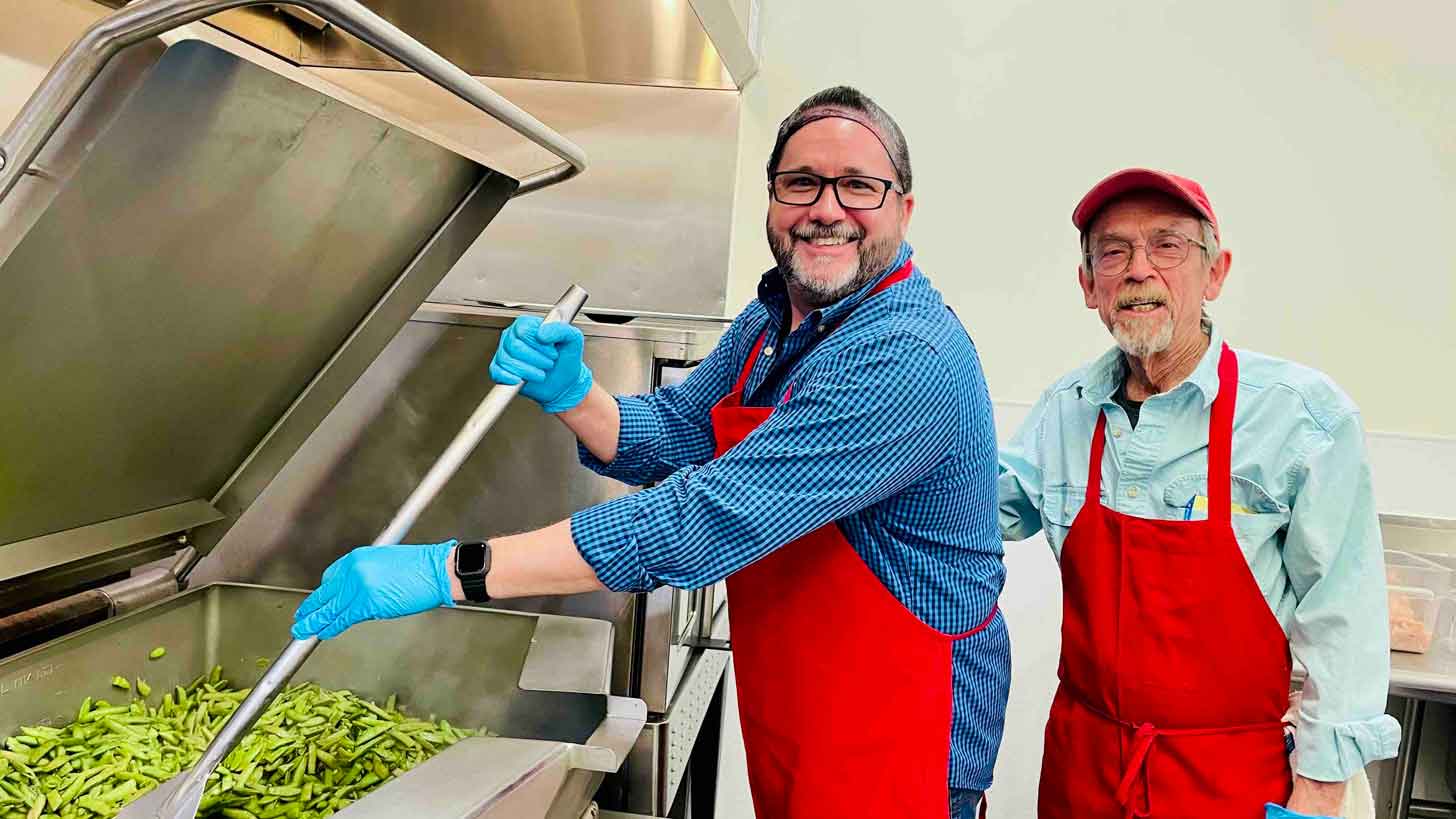
He told The Guardian that four people joined him at his stop in San Francisco after hearing his story, and that he wants nothing more than for more people to heed his call to do good as he continues on his tour.
“Help people and inspire more people to help people,” Ruch told The Guardian was his dying wish. “That’s it. That’s all.”
“If Dying to Serve can help inspire thousands of people to volunteer per year,” he added on GoFundMe, “my story will end happily.”
Header image courtesy of Doug Ruch
As honey bee colonies face decreases in natural pollen in their native habitats as a result of climate change, scientists and conservationists have been working to ensure the species’ future.
Researchers from Washington State University and APIX Biosciences may have just found a solution.
In the journal Proceedings of the Royal Society B, researchers unveiled a new food source designed to sustain bee colonies without access to natural pollen — indefinitely.
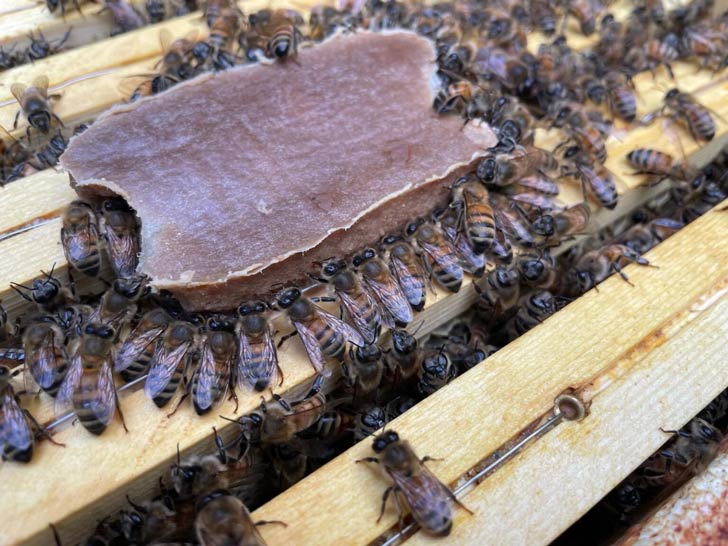
The research details successful trials where “nutritionally stressed colonies” in commercial crop pollination in Washington state thrived on the new food source.
“Changes in land use, urban expansion, and extreme weather all negatively impact nutrition for honey bees and other pollinators,” said Brandon Hopkins, P.F. Thurber Endowed Distinguished Professor of Pollinator Ecology at WSU and a co-author of the paper.
“Honey bees are generalists and do not get all their nutrition from a single source. They need variety in their diet to survive, but find it increasingly difficult to find the continuous supply of pollen they need to sustain the colony.”
The innovation is similar to man-made diets fed to livestock and pets and resembles human “Power Bars.” The food source is placed directly into honey bee colonies where young bees can process and distribute the essential nutrients.
According to a statement from WSU, it’s expected to become a potent strategy for combating colony collapse while safeguarding global food supplies that rely on bee pollination.
“Until this study, honey bees were the only livestock that could not be maintained on a man-made feed,” Dr. Patrick Pilkington, CEO of APIX Biosciences US, said.
“The reported scientific work shows in commercial field conditions that providing nutritionally stressed colonies with our pollen-replacing feed results in a major measurable step change in colony health compared to current best practices. Our product has the potential to change the way honey bees are managed.”
The food is enriched with isofucosterol, a molecule found naturally in pollen that acts as a vital nutrient for honey bees.
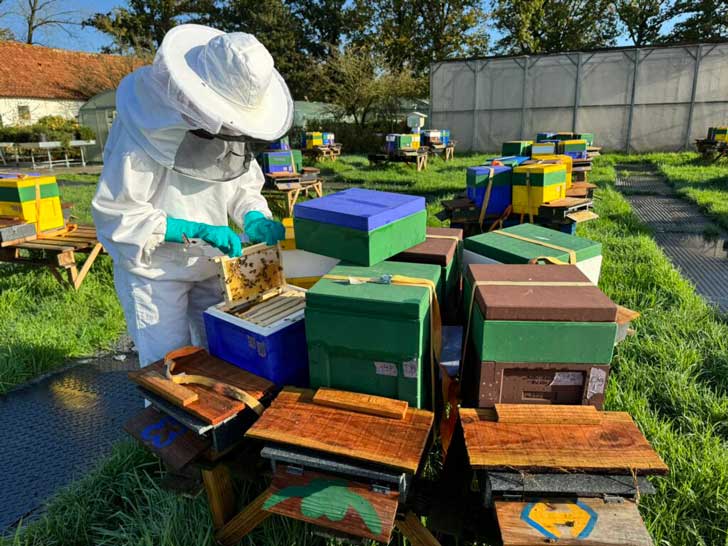
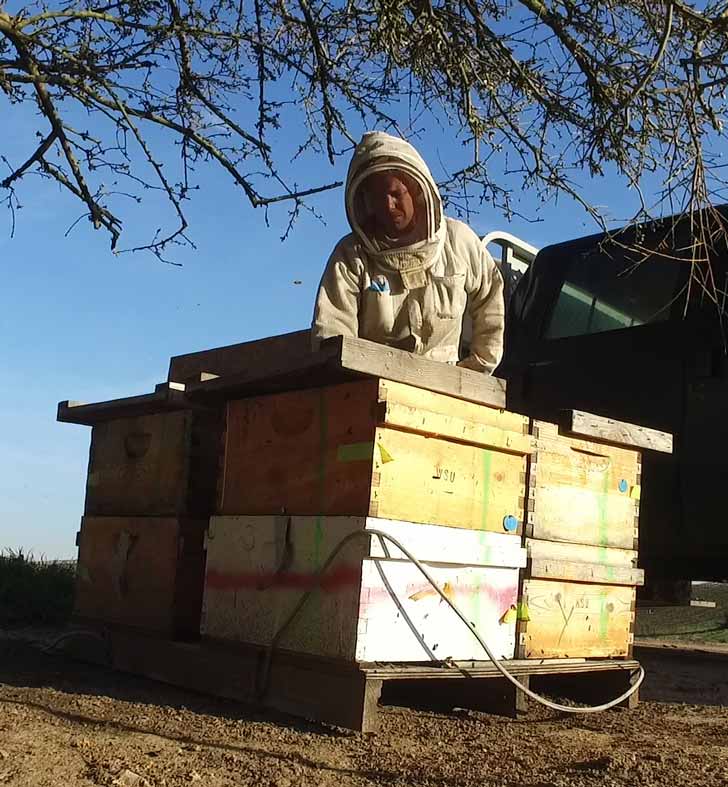
Researchers conducted field trials with “nutritionally stressed” colonies in blueberry and sunflower fields, which are both known for their poor pollen quality for bees.
Colonies fed with man-made isofucosterol-enriched food survived an entire season without pollen access, while those without it faced severe declines.
The new feed also contains “a comprehensive blend of the other nutrients honey bees require,” WSU explained.
This is promising news for honey bees, and it could transform food systems.
Considering bees’ crucial role in food systems, pollinating fruits, vegetables, nuts, and even alfalfa — a key feed for beef and dairy industries — protecting their health could keep our favorite foods on grocery stores shelves.
One such case? Blueberries.
“Some beekeepers don’t pollinate blueberries anymore because colonies suffer or die, and the pollination fees don’t cover the losses,” Hopkins explained.
“Blueberry pollen isn’t very nutritious for honey bees, and they aren’t adapted well to pollinating that crop. But if they have this supplemental food source, beekeepers may return to pollinating those fields since they know their bees are more likely to survive.”
Pilkington said the bees’ “power bars” will hopefully be on the market by mid-2026.
“We are confident that the product will positively impact beekeepers and growers once it’s available to purchase in the U.S.,” he said.
“Meanwhile, we are working with WSU and the beekeeping community across the USA to develop the best way to make use of this new tool in agricultural settings.”
Header image courtesy of APIX Biosciences
This Earth Day might finally be the chance to make your Pawnee Rangers dream come true.
“Parks and Recreation” star Nick Offerman is teaming up with the Natural Resources Defense Council to offer a sweepstakes competition to fans.

The prize? A hike for two in Los Angeles with Offerman, a self-described “notorious knucklehead who loves to walk out of doors.”
“Please help me this Earth Month in supporting the NRDC, the Natural Resources Defense Council,” he said in an Instagram Reel.
“They are fantastic. They care about our ecosystems and our health, and everything in between. You should support them.”
To enter to win, participants just have to donate to the NRDC by May 13.
“You can bring a friend, enjoy some fresh air and thoughtful conversation, and even take home a signed copy of Nick’s book,” the organization shares on the sweepstakes page.

Offerman’s book “Where the Deer and the Antelope Play: The Pastoral Observations of One Ignorant American Who Loves to Walk Outside” is described as a “humorous and rousing” set of stories “about comprehending, protecting, and truly experiencing the outdoors.”
Winners will receive a signed copy to accompany their journey with the beloved actor and humorist.
“Come out for a hike, get a book,” Offerman concludes his Instagram post. “We’ll have a chuckle.”
Entries can be made by visiting NRDC’s donation page, where visitors will be prompted to give a one-time or recurring donation.
“Your gift will power NRDC’s work to protect wildlife, public lands, clean water, and the ecosystems that make life on this planet possible,” the nonprofit shares.
“Because nature isn’t just something to admire — it’s something to defend.”
Header image by Taylor Miller/United Talent Agency
According to the National Council on Aging, roughly 80% of American households with older adults are struggling financially. For older adults to live on their own, they need social safety nets — and options for affordable housing.
According to Cece Cox, the CEO of Resource Center — an LGBTQ+ nonprofit founded in Dallas, Texas during the AIDS crisis in 1983 — the need is especially dire in older LGBTQ+ communities.
Seniors in this community tend to have fewer dependents and only recently became eligible for the benefits of legal marriage. They also face compounded experiences of social isolation, according to advocacy group SAGE.

“Because our relationships weren’t recognized legally until 2015, we often have a much lower household income than our heterosexual counterparts,” Cox told Dallas Morning News earlier this year.
So, Resource Center built Oak Lawn Place, an 84-unit affordable housing complex for LGBTQ+ seniors ages 55 and over.
The building — which resides in Dallas’s longtime “gayborhood” of Oak Lawn — opened in September 2024, with apartments priced to serve people who earn between 30% and 60% of the area’s median income.
Rents for a one-bedroom unit range from $567 to $1,118.

The building has 79 one-bedroom units, and most of the floor plans are nearly identical. They include a kitchen and living area, bedroom, bathroom, and a closet with a washer/dryer.
Five other units are designed specifically for people with hearing and vision disabilities and allow them to use light and sound cues for certain accommodations.
Part of what stands out about Oak Lawn Place is the exterior design, which features tastefully designed colored accent panels, like red, white, yellow, orange, blue, and pink. They serve as a wink to a traditional Pride flag, but don’t explicitly reproduce it.
“We didn’t want to be cliche, and we didn’t want to out the people who live here,” Cox said. “Safety is still a concern for queer people.”

Plus, the space is not exclusive to LGBTQ+ elders, though it is intentionally designed with them in mind.
“It’s a welcoming gesture,” Ron Stelmarski added. He led the design of the project for the Dallas office of Perkins & Will.
Aside from amenities like a dining area, conference room, gym, and patio deck, the main offering of Oak Lawn Place is community.
“When you’re a queer person, it’s really important to be able to find your tribe,” Cox told Next City.“We keep doing what we do because we know we’ve got to take care of our community, and we have a lot of support in doing that.”

The residents agree.
“It’s more like a community than just an apartment building,” Michael Saldivar, who has lived at Oak Lawn Place with his two dogs since its opening, told Dallas Morning News.
“Everybody here, we’re like one giant family. It’s a very unique, one-of-a-kind place,” he added.
The building includes other accommodating designs, like wide hallways, quieting acoustics, and signage chosen for optimal readability. Furniture was also selected for seniors’ maximum comfort and ease.

In total, the project cost about $31 million, with support from partners Matthews Southwest, Volunteers of America, Perkins & Will, and Spring Valley Construction.
For Cox — who joined Resource Center more than 18 years ago — it’s a dream come true. But it’s a dream that has come with incalculable loss and struggle.
“Forty-one years ago, Resource Center’s founders dreamed of a home like this, by us, for us. Their dreams were interrupted by a nightmare, the nightmare of going to funeral after funeral for friends, decimated by the early days of the AIDS pandemic,” Cox said at the opening of Oak Lawn Place.
“Our community was also fighting discrimination everywhere we turned — in houses of worship, in our families, and at work. Even though much progress has been made since then, Oak Lawn Place is one of only a handful of residential settings designed to affirm and support members of the LGBTQIA+ community, age 55+.”
Despite the heartache that comes with this progress, it is a miracle it came to fruition — especially in Texas, where lawmakers have been emboldened to introduce and pass anti-LGBTQ+ legislation in recent years.

“We built this housing development during COVID and during the last Texas legislative session with all the things that were targeted at our community,” Cox told Dallas Morning News.
“It’s miraculous in some ways that we continue to do what we’re doing, but that’s just the heart and soul of Resource Center.”
The progress is not finished yet. Soon, a new healthcare facility, Resource Center Health, will open across the street, providing even more care and support to Oak Lawn’s “gayborhood” neighbors.
“Oak Lawn Place helps make Dallas a more inclusive, inviting city,” Cox said in a statement.
“For those considering moving here and for those wondering, as a queer person, ‘Will I truly feel welcome? Are there spaces in Dallas for me?’ We are honored and proud to bring this project to life.”
Header image courtesy of Perkins & Will
Earlier this week, firefighters and forestry technicians set fire to some of Rocky Mountain National Park’s most visited terrain.
More than 60 acres of the park — within the popular Beaver Meadows entrance and visitor center — was set aflame as part of a prescribed burn.
Prescribed burns are planned fires that are often utilized to manage vegetation, restore natural woodlands, or to research a given area, according to the National Park Service.

In order to move ahead with a planned fire like this, the park must complete a fire management plan and a prescribed burn plan. The fire must also meet all conditions identified in a go/no-go checklist before ignition, NPS explains.
The prescribed fire at RMNP this week was part of a larger 1,800-acre area in the park that the NPS hopes to burn within the next five years. The objective of these fires is to protect the park and the nearby town of Estes Park from future wildfires.
“We are trying to reenact the natural process of wildfire, how it was historically throughout the area,” Nathan Hallam, fuel specialist at RMNP, told CBS Colorado. “There’s a lot that goes into it.”

As reported by CBS Colorado, the south side of the Beaver Meadows entrance was greener and had shorter shrubbery. The other side was home to visibly dry grasses and abundant shrubs. Taller grass like that is more likely to carry wildfire, experts say.
Dozens of firefighters from various agencies work together to burn the dry grass and shrubs without burning many trees.
Mikayla Moors is a former forestry technician and park ranger in Colorado who recently lost her job in a round of funding cuts and layoffs by the Trump administration.
She said that her experiences as both a ranger and forestry technician gave her a “deeper appreciation” for land management operations and the “hard work it takes to keep the places we love open.”

“These kinds of burns are important because when conditions are favorable, fuels like grasses and low shrubs are removed, as well as naturally raising the crown base height of trees,” she told Good Good Good.
“This helps decrease the likelihood that a future wildfire would move into the canopies of trees, like we saw with the East Troublesome and Cameron Peak fires in 2020.”
Hallam also noted that prescribed burns like this one have already helped save Estes Park from devastation during the aforementioned fires. When the East Troublesome Fire entered the park nearly five years ago, it stopped at a burn line that was created by a previous prescribed burn.
RMNP officials told CBS that, once complete, the prescribed burns in the full 1,800-acre area will likely protect the land “for the next five to 10 years.”
“Prescribed burns help keep our forests and parks resistant to wildfire and help the ecosystems thrive,” Moors added. “In turn, it keeps our communities safe by creating a sort of a buffer zone.”

These efforts, Moors said, are vital for park lovers and visitors to be aware of, especially in the face of uncertainty for park funding and proposed logging in national forests, as outlined by the Trump administration.
“While I am not a firefighter, I think it’s important for regular people to stay informed and support the important work being done,” Moors told Good Good Good. “You would not believe how many people it takes to keep things operational, especially with the level of visitation our parks and forests are seeing.”
Moors said recent staffing cuts have put a strain on an already overworked workforce. Although this prescribed burn was a success, she hopes it serves as an example for the vital services that happen across national parks and public lands every day.
“Parks and forests have been chronically understaffed for many years,” Moors added. “We need to be adding jobs — not taking them away — for your enjoyment of your public lands, so they can be there, unimpaired, for your children’s children and beyond.”
Header image courtesy of NPS Photos
Earlier this week, the United Kingdom’s Supreme Court ruled that the legal definition of “woman” excludes transgender women, in a landmark ruling.
Following the decision, public figures from the U.K. made their stances known, including author J.K. Rowling, who unsurprisingly celebrated the ruling, given her known history of transphobia.
But other public figures, including “Bridgerton” stars Nicola Coughlan and Charithra Chandran took to social media to passionately support the trans community.

Chandran, who is known for her role as Edwina Sharma — the “diamond of the season” — in the second season of “Bridgerton,” made an emboldened speech in a TikTok video.
“I have never felt unsafe around a trans woman — ever. My womanhood has never felt threatened by a trans woman — ever,” she said directly to the camera. “And if your womanhood has, I think that speaks more to the fragility of your womanhood than anything about trans women.”
Chandran’s video currently has over 2.4 million likes and over 9.6 million views.
“How pathetic to target one of the most oppressed groups in our society?” she continued. “Honestly? Loser behavior.”
@charithra17 Loser behaviour to target an already vulnerable and oppressed group tbh
♬ original sound - Charithra Chandran
Her “Bridgerton” co-star, Nicola Coughlan, who stole the season three spotlight in her role as Penelope Featherington, also spoke up in support of trans women this week.
“Like many people, I am completely horrified by the Supreme Court’s ruling yesterday about trans people,” Coughlan said in an Instagram Reel.
“To see an already marginalized community being further attacked in law is really stomach-turning and disgusting. And to see people celebrate it is more stomach-turning and disgusting.”
As a response, she rallied her online following to donate to Not A Phase, a U.K.-based nonprofit that provides resources and peer support groups to trans people nationwide.

Coughlan pledged to match donations up to £10,000 (or approximately $13,000 USD). As of the publishing of this article, based on the fundraiser attached to her Instagram profile, supporters have donated over £78,000 (about $103,835 USD).
The caption of Coughlan’s video reads: “Allies of the trans and non-binary community, time to come together. F–ck the Supreme Court, f—ck the TERFs, let’s raise some money.”
This is not the first time Coughlan has supported the trans community — or even the nonprofit.
Last year, during Pride Month, the actress released a song called “Shoes… More Shoes” and donated all of the streaming proceeds to Not A Phase and The Trevor Project.
“If you are a cisgender person who is an ally of a trans person, I think now is the time to just sort of speak up,” she concluded in the video she posted this week.
“Make your voice heard,” Coughlan added, “and let your trans and non-binary friends — and just the community at large — know that you’re there for them, and that you’ll keep fighting for them.”
Header image courtesy of Netflix
In February, the Ocean County Library in Toms River, New Jersey became a beacon of hope for people experiencing homelessness. It all started when a Dunkin Donuts went under, and Jon Bon Jovi’s Soul Kitchen popped up in its place.
The Jon Bon Jovi Soul Foundation — which was founded by John and Dorothea Bongiovi in 2006 — currently has five community kitchens throughout New Jersey.
Each location encourages customers to pay a suggested donation of $12 for a meal, or “pay it forward” for others in need. People who cannot afford to pay can also volunteer to work at the cafe.
It’s a restaurant model that drew criticism from Toms River Mayor Daniel Rodrick in early April, when he accused JBJ Soul Kitchen of turning the Ocean County Library into “a day shelter and soup kitchen.”
“[The New Jersey commissioners] have completely ignored all of our complaints and concerns,” Rodrick said. “Mothers shouldn’t have to walk through large gangs of intoxicated and mentally ill men with their children to borrow a book.”
Locals said that Rodrick’s claims couldn’t be further from the truth.
In a review of the restaurant, one Toms River resident wrote: “It’s a wonderful place and somewhere we should all support and celebrate.”
“Just went last week, it was nothing like what the Mayor says,” another local commented.
“Shouldn’t be any controversy over giving a hand or a meal to a family or person who’s struggling,” replied another.
“JBJ has been a big help,” Matt, 56, told the Asbury Park Press. He and his partner, Molly, lost their home during COVID-19, and have regularly relied on the JBJ Soul Kitchen meals as they live between shelters and hotels.
Other advocates included famed Toms River photographer Gregory Andrus.
“The atmosphere at Soul Kitchen is on the more quiet side, peaceful, with tired bodies and tired souls resting with coffee or a meal,” Andrus wrote earlier this week on Facebook, defending the cafe to his 70,000 followers.
Andrus added that “Soul Kitchen is more needed than ever” after “Code Blue” winter shelters closed in March.
“This is the one place that our homeless friends can feel safe, cared for, and treated like humans,” Andrus wrote.
This past winter, in the throes of “Code Blue” season, the mayor evicted Just Believe Inc. from Toms River’s Riverwood Park. Prior to eviction, the housing nonprofit had run a family warming center at the park for seven years.
“We all need to row in the same direction because homelessness was not created by anybody,” Paul Hulse, chief executive officer of Just Believe, told Asbury Park Press. “It’s been there since the beginning of creation.”
The mayor’s ire is particularly confounding to library volunteers who say that the cafe was always intended as a pop-up.
Even as Rodrick campaigns for the kitchen to close, the organization told the Asbury Park Press that the Ocean County library location is operating under a temporary lease that expires in May.
In the wake of the mayor’s most recent comments, Just Believe voiced their support for JBJ Soul Kitchen and called on the community to support the foundation.
“In light of controversy surrounding the work of the Soul Kitchen and any nonprofit organization that aids the homeless in our community, we are requesting that the community pay it forward by visiting the Ocean County Library in Toms River for lunch, 10 a.m. to 2 p.m. Tuesday through Friday,” Just Believe wrote on their Facebook page on April 14.
“[It’s] a great opportunity to raise awareness and support local nonprofit organizations on the front lines.”
The next day, the community showed up in droves.
“Thank you for your continued support of local nonprofits in Ocean County that strive to make a difference,” Just Believe wrote in an updated post. “Your support is invaluable to us. We appreciate you all.”
Even with their Ocean County library location closing in the near future, the Jon Bon Jovi Soul Foundation continues to be a crucial resource for food-insecure and unhoused people in the community at their permanent locations.
“When we first opened, people did not understand our unique ‘Pay It Forward’ model,” Dorothea Bongiovi, wife of John Bongiovi, said on March 5 when the foundation served their 200,000th meal.
"We are not a soup kitchen. We are not a pay-what-you-want restaurant. We are a unique ‘Pay It Forward’ model where those who are unable to pay volunteer their time. Those who can pay, pay for their meal and donate to pay it forward. Everyone has the same amazing meal.”
“This model has now been proven time and time again for well over a decade,” John Bongiovi added.

Header image via JBJ Soul Kitchen
Cleveland, Ohio’s Mayor Justin M. Bibb recently announced a major milestone in the city’s “A Home for Every Neighbor” initiative.
The plan was to reduce homeless encampments around the city by connecting unhoused neighbors with landlords willing to accept them as residents. Then, the city would pay rent for 12 months as residents got back on their feet.
The effort started with a pilot over the summer of 2024, successfully housing 12 individuals. Two additional phases followed in the fall, resulting in another 100 people being housed across 13 sites.

By December of last year, outreach efforts expanded to eight other locations — totalling in 154 residents housed across 47 sites citywide.
City officials had initially projected it would take 18 months to rehouse 150 or more unsheltered Cleveland residents at the time of the program’s launch.
In a recent press release, announcing the results of the most recent stage of intervention, leaders were eager to share that the city is far ahead of schedule.
“This proves that we can fix complex problems when we work together and affirms why Whole-Of-Community strategies are the right approach to solving larger issues that our city faces — whether that be homelessness, public safety, or economic development,” said Mayor Bibb.
“Local government cannot right the ship alone. Everyone needs to chip in and do their part because when they do, you see amazing results like this.”
In addition to housing, the program also connects each person with a case manager, who helps them access wraparound health and job services, as well as donated furniture, hygiene items, and groceries from partner organizations.
As part of the latest round of the program, 42 “highly vulnerable unsheltered neighbors” who were experiencing long-term homelessness and dealing with untreated disabilities were successfully engaged by the city’s services. They are now receiving ongoing support.
“This initiative demonstrates the power of targeted, compassionate intervention,” City Councilwoman Stephanie Howse-Jones said in a statement.
“By focusing on our most vulnerable neighbors, especially those dealing with long-term homelessness and disabilities, we've not only provided housing, but we've also offered a pathway to stability and support.”

Mayor Bibb first announced the Home for Every Neighbor initiative in February 2024. After proposals were vetted and consultants were chosen, the city worked to identify which geographic areas of the city to target, documented the unique needs of unhoused neighbors, and recruited landlords with signing bonuses, among other key tasks.
Once the summer pilot program was launched, success came quickly.
“To date, 154 unsheltered neighbors across 47 different sites now have homes through the initiative — with approximately 70% of them experiencing chronic homelessness,” a statement from the city shared.
Community partners supporting the initiative include I’m In Ministry, Frontline Service, Northeast Ohio Coalition for the Homeless, and more.
These partners provide services ranging from case management and connections to mental health care and drug treatment, to legal aid, charitable donations, and more.
“The people I’m In Ministry served during the ‘A Home for Every Neighbor’ project thought it was impossible for them to achieve what they received,” Deacon Lou Primozic, president and CEO of I’m In Ministry, said in a statement.
“But we made the impossible possible for every participant.”
Moving forward, the city and its partners are working on other site locations to serve and will continue to improve procedures and streamline processes.
Councilwoman Howse-Jones added: “The success of ‘A Home for Every Neighbor’ is a testament to the dedication of our community partners and the city’s commitment to ensuring no one is left behind.”
Header image courtesy of Aeroplanepics0112 (CC BY-SA 3.0)
Since 2008, homelessness rates in Finland have dropped by 75%.
It’s a feat that is even more remarkable when noting that their method of counting — and defining homelessness — is much more inclusive than other leading countries.
In Finland, for example, homelessness statistics include individuals temporarily living with friends and relatives, living in an institution, staying in hostels, congregate shelters, and “rough sleeping” outside on the streets.
Their complex method of counting homeless populations goes hand-in-hand with the country’s “Housing First” method of approaching homelessness, by recognizing that homelessness is not a black-and-white discussion — it’s a systemic issue that can manifest in a variety of ways.
In 2017, the Y-Foundation — which promotes social justice by providing affordable housing to low-income families as Finland’s “fourth-largest landlord” — released a 128-page report on successful Housing First policies.
The foundation said that Finland’s success in lowering homelessness rates can largely be attributed to the country’s “Name On The Door” approach, which was introduced to Finland’s Minister for Housing in 2007.
The methodology made a sound argument for ending homelessness from a moral, legal, and economic perspective.
“The ethical perspective means that homelessness has to be eliminated because human dignity belongs to everyone. A home is a human right,” the Y-Foundation surmised.
“The legal perspective emphasizes, for example, that according to the Constitution of Finland, anyone who is unable to acquire the necessary security for a dignified life is entitled to essential subsistence and care.”
“Eliminating homelessness is also a worthwhile investment in terms of the social economy,” the nonprofit added. “The report states that the economic conditions for eliminating long-term homelessness were better than ever (in 2007).”
Reducing homelessness has been a source of pride for the country’s leaders for nearly two decades.

In an interview with The Globe and Mail, Helsinki Mayor Juhana Vartiainen said that Housing First is “the right way to fight the problem of homelessness.”
“That’s really the fundamental idea of our policy,’ Vartiainen said, “if we give people a home, there will be very positive side-effects.”
In the last year, national cuts to income, social security, and housing support have resulted in the first notable change to homelessness trends in over 11 years.
“Helsinki has been exceptionally successful in reducing homelessness in previous years and has ensured a downward trend in the national figures,” Teija Ojankoski, CEO of the Y-Foundation, said in a press release.
“Now the number of homeless people [has] increased in Helsinki, even though an impressive number of homeless people were housed during the year.”
“Helsinki undoubtedly has the best homelessness work in the world and the results have spoken for themselves,” the CEO added. “Now it seems that so many people end up homeless that services simply cannot keep up.”
Even with the slight rise in homelessness seen locally in 2024, Finland estimates that 3,806 citizens are currently experiencing homelessness (about 0.06% of the Finnish population).
In comparison, over 771,480 Americans were counted as unhoused in January 2025 (about 0.2% of the US population).
Regardless of short-term challenges, the “Housing First” approach is still at the core of the organization’s mission.
The Y-Foundation’s head of international affairs, Juha Kahila, told The Globe and Mail: “When people have a roof over their heads, they can overcome the challenges they have in their lives and not have to worry about where they will sleep that night or where they will live next month.”
Header image via Simo Räsänen / Wikimedia Commons (CC BY-SA 4.0)
Every day the Good Good Good team collects the best good news in the world and shares it with our community. Here are the highlights for this week!
If you want to get good news in your inbox every day, join the Goodnewsletter — the free daily newsletter designed to leave you feeling hopeful.
The Best Positive News We’re Celebrating This Week —
A Tennessee city just became the first “National Park City” in North America
The city of Chattanooga, Tennessee, has been working since late 2023 to be designated as a “National Park City,” driven by the voices of residents, community leaders, businesses, and nonprofits.
After gathering thousands of signatures of support, it crafted a National Park City charter grounded in seven core commitments to people, place, and nature. And now, it’s official: Chattanooga has been named North America’s first National Park City.
The city’s mayor said they used the movement “to encourage folks to think about Chattanooga as a city in a park, rather than a city with some parks in it.”
Why is this good news? In the 1970s, Chattanooga was one of the most polluted cities in the United States. In the decades since, it's developed its parks, wildlife sanctuaries, urban landscapes, and more to make the city greener, healthier, and wilder. This historic designation is proof that with the will, effort, and investment, we can turn around even the most devastating environmental damage.
→ Read more
In a TED Talk, a chemist debuted a ‘natural peel' that extends the life of produce — from bananas to avocados — without ‘refrigeration, pesticides, waxes, or plastics’
A Minnesota couple transformed a local motel into affordable housing
In 2018, Rick and Kelly Bestul became the owners of King Motel off State Highway 7 on the west side of Hutchinson, Minnesota.
In the 7 years since the Bestuls took over the King Motel, they reported a growing number of guests have taken out extended stays because they didn’t have access to permanent housing.
Estimating that 80% of her guests would be homeless without their services, the Bestuls cap their week-long stays at $300, knowing it’s much closer to what they can afford.
→ Read more
Colorado just passed one of the most restrictive gun safety laws in the country
Colorado just made it illegal to buy, sell, and manufacture most semi-automatic firearms without background checks and training, and puts limits on who qualifies for that training — it’s one of the most restrictive gun safety laws in state history, and in the country.
It also outlaws rapid-fire conversion devices, like bump stocks, that allow semi-automatic guns to operate like automatic weapons.
The bill’s sponsor, Colorado state Rep. Tom Sullivan, whose son was murdered in the Aurora theatre shooting, wanted the bill to go further with a complete assault weapons ban, but acknowledged this version of the bill will make communities safer and save lives.
Why is this good news? We know that one critical, proven, data-backed way to reduce gun violence and prevent mass shootings is by requiring background checks on all gun sales. This new law ensures a person looking to purchase this specific kind of firearm goes through two of them: one to get a permit for training, and another through the firearm dealer itself.
While Congress passes the SAVE Act, one man wants to fix America’s low voter turnout with mobile phone voting
Women athletes will be in the majority in the Olympics for the first time in history at the 2028 Los Angeles Games
The Paris 2024 Olympics were the first in history to achieve gender parity — as demonstrated in the (now outdated) image above. That progress is continuing at the 2028 Los Angeles Games, where women competitors will be in the majority at the Olympics for the first time in history.
The shift is driven by the Olympic women’s soccer tournament, which will have 16 teams represented for the women, and just 12 for the men — the reverse was true in Paris last year. It’s also a far cry from women’s soccer’s debut in 1996, when just eight teams participated — half of the men’s 16 teams at the time.
In Los Angeles in 2028, the core quota of athletes will be pushed to 50.7% women, and 49.3% men — though of course, that’s not accounting for each individual athlete’s gender identity.
New Mexico made childcare free and lifted 120,000 families out of poverty
New Mexico is one of the poorest states in the U.S., and has long ranked worst in the nation for child wellbeing. But three years ago, it became the first U.S. state to provide free childcare to a majority of families — and its poverty rate began to fall.
The state made childcare free for families making up to 400% of the federal poverty level — about $124,000 for a family of four. About half of children in New Mexico qualified. It also raised wages for childcare workers, notably subsidizing its reimbursement rates on the actual cost of providing care, and lifting them out of poverty, too.
The result: one of the biggest changes in the country of the number of people falling below the federal poverty line and 120,000 fewer New Mexicans living in poverty.
Why is this good news? The U.S. ranks 40th on a UNICEF ranking of childcare policies in 41 high-income countries (only Slovakia is worse), with no federal, universal childcare and some of the highest childcare costs in the world. New Mexico sets an incredible example for what’s possible around the country.
Despite Trump funding cuts, these national parks will still be free to visitors for National Park Week
Sierra Leone has reduced maternal mortality rates by 74% since 2000
Maternal mortality rates have fallen by 74% in Sierra Leone since 2000, from 1,680 pregnant people dying for every 100,000 live births, to 440 per 100,000 in 2020.
While that is still heartbreakingly high — rates in the safest countries are around 100 times lower — this incredible progress, especially considering that in 2000, Sierra Leone had the highest maternal mortality rate in the world alongside South Sudan.
The country achieved this turnaround by focusing on expanding healthcare, increasing skilled medical staff retention, and improving access to medicines and treatments. In 2010, it rolled out free healthcare to both pregnant women and children.
🧦 More good: You may remember that John and Hank Green’s Awesome Socks Club and Awesome Coffee Club are building a maternal health hospital in Sierra Leone to help keep this progress going, too!
→ Read more
A land bank is protecting Altadena community members from displacement by private investors
Mere months after it was devastated by wildfires, the neighborhood of Altadena has become the target of private developers and corporations that are offering cash for burned, vacant land — which happened in Lahaina, Maui, too.
But members of the community are fighting back to protect this historically Black neighborhood and keep its strong community-oriented roots intact — the Greenline Housing Foundation, founded by a nearby Pasadena resident, just purchased its first lot in Altadena with a grant.
The foundation acts as a “land bank” to hold the property until it’s eventually transferred for community use. It offers property owners who need to sell, but want the land to stay in the community, an alternative to the big corporations.
Why is this good news? Greenline’s founder says residents of Altadena are particularly vulnerable to “disaster capitalism” due to its high concentration of Black and Brown residents, as well as seniors, who aren’t able to access resources to protect themselves.
While the tragedy has displaced and isolated residents, Greenline’s efforts will help restore the vibrant community spirit of Altadena.
In “an unlikely comeback,” one of the rarest parrot species in Brazil doubled in population — here’s how it happened
→ Read more
A man with terminal cancer is on a “Dying to Serve” tour — traveling to all 50 states to volunteer
When 55-year-old Texas man Doug Ruch was diagnosed with prostate cancer in 2021, he was ready to fight, spending his life savings on treatment. Then, in January, he got the news that his cancer had metastasized and reached stage 4.
Faced with two options — undergoing chemotherapy to potentially extend his life for another two years, or face a life expectancy of 12-18 months — Ruch chose to “go out and live.”
On GoFundMe, Ruch said his “dying wish is to help as many people going through tough times as I can before I go,” and launched his “Dying To Serve” tour across North America, with a goal of visiting and volunteering in all 50 states.
Plastic pollution along Australia’s beaches and coastlines is at its lowest level in a decade
A new survey found that plastic pollution on Australian coastlines dropped by 39% over the last decade. Additionally, there was a 16% increase in coastal areas with “no plastic debris at all.”
Three-quarters of the debris found on Australian beaches is plastic, according to the study’s co-author, with flexible plastics like food packaging presenting the most harm to wildlife.
The survey data will help identify “debris hotspots” and determine how land use influences pollution that ends up on coastlines. A key finding of the study was that areas with intensive land use and higher socioeconomic disadvantages have higher levels of pollution.
Why is this good news? The amount of plastic pollution entering marine environments is estimated to reach up to 53 million tonnes by 2030, so this news is encouraging, and proof that those estimations aren’t a done deal — we can develop strategies to prevent that waste from reaching coastlines at the source.
More good news of the week —
A study out of Germany showed how universal basic income showed a “strong positive impact” on mental health. And contrary to a common criticism of UBI, there were no significant changes in employment status over the three-year period; rather, people invested in both travel and savings, were more generous with donations, and were more social with others.
The Guardian recreated an interactive climate future risk tool that was developed by FEMA and deleted by the Trump administration. FEMA’s searchable “Future Risk Index” was designed by government employees over several years to help cities, states, and businesses across the U.S. prepare for worsening storms, wildfires, and floods.
Thanks to extensive conservation efforts, the lion population in an Indian state is likely to hit the 900 mark this year. With an ever-expanding territory in Gujarat, some estimates say the lion population could be as high as 1,500.
Boston purchased 347 market-rate apartment units to convert them into affordable housing. The acquisition is part of a larger “anti-displacement” plan to undo widespread gentrification, preserve affordable housing, and assist residential homes and small businesses at risk of direct or economic displacement.
Thousands of women with advanced breast cancer will have access to a “game-changing” breast cancer pill. In what experts call a “landmark moment,” a medicines watchdog approved the drug — which blocks an abnormal protein molecule that drives cancer cells to multiply, thereby helping slow or stop the spread of the disease — to be used on England’s National Health Service.
Many of the world’s largest shipping nations agreed to impose a minimum fee for carbon emissions. Effectively the first global tax on greenhouse gas emissions will generate an estimated $11 billion to $13 billion in revenue annually, to be invested in green shipping technology, reward low-emission ships, and support developing countries so they aren’t left behind.
Scientists developed the first fully biodegradable battery that can safely break down in soil or water within weeks. Unlike traditional lithium-ion batteries that rely on rare earth metals and toxic chemicals, the new biodegradable battery is composed of natural materials such as cellulose, salt, and carbon-based electrodes.
Paris is inscribing names of women scientists on the Eiffel Tower, joining 72 men celebrated since its construction in 1889. The initiative was spearheaded by a group of students and associations to recognize women scientists who have made significant contributions to the advancement of science, but whose names often remain unknown to the general public.
Despite opposition, lawmakers extended protections designed to reduce the risk of microplastic pollution to shipping vessels, too. The European Commission estimates that over 50,000 and possibly up to 184,000 tonnes of plastic pellets – known as nurdles and used to produce everything from toys to plastic bottles – are inadvertently released into the environment each year.
“Revolutionizing” early diagnosis, a new blood test could detect Parkinson’s disease before symptoms emerge. The simple test is also cost-effective, opening the door to more early detection of the disease, which subsequently helps “pave the way for timely interventions and improved patient outcomes.”
The Afghanistan women’s cricket team is rejoining international competition with support from the sport’s governing body. The team has been seeking support since 2021, when dozens of its players relocated to Australia after the Taliban retook control of the country and enforced bans on women’s sports.
A West Point graduate became the first woman to compete in the Army Rangers’ grueling “Best Ranger Competition.” First Lt. Gabrielle White and her teammate Capt. Seth Deltenre were among the 16 teams that made it through the three-day competition, where Ranger teams compete for accolades as the best of the elite military force.
Portugal ended child marriage, raising the minimum legal age for marriage to 18 years old without exceptions. Previously, individuals aged 16 and 17 could marry with parental consent, but this legislative change aims to eliminate child, early, and forced marriages, ensuring that all individuals enter marriage as consenting adults.
Ahead of a country-wide ban, the use of disposable vapes is already falling in the U.K. The percentage of people aged 16-24 who mainly use disposable vapes has dropped by nearly half in the last year, from 63% to 35%, and while it’s helping reduce litter, researchers believe people are just switching to refillable and rechargeable vapes, rather than quitting altogether.
Countries in the WHO reached a “historic” agreement to prepare the world for future pandemics. Negotiated over three years, the proposed agreement outlines measures to both prevent future pandemics and strengthen global collaborating, like a global supply chain and logistics network, and stronger health system resilience and preparedness.
New York City is cutting emissions and saving money by making vegetarian meals the default in public hospitals. The hospitals have now served more than 2 million plant-based meals with reports a 98% satisfaction rate, and the average vegetarian meal costs 59 cents less than meat, so the program has also saved the city more than $1 million.
Underserved students in Tampa, Florida are receiving access to dental care right at school. A recent report from the American Dental Association found in 2023, 13% of the population reported cost barriers to dental care, compared to 4-5% for other healthcare services.
This story was originally published by The 19th and was republished with permission.
Pope Francis, who as head of the Roman Catholic Church advocated for a greater acceptance of LGBTQ+ people and protection for migrants, died on Monday after a series of respiratory infections, which were particularly dangerous as he was already missing part of one lung due to a serious bout of pneumonia he experienced as a young man. He was 88.
The Vatican announced his death in a brief statement on the social media platform X.
Elected in 2013, Pope Francis was the spiritual leader of more than 1.4 billion Catholics around the world, including 53 million Catholic adults in the United States — accounting for about 20 percent of the country’s adult population.
Pope Francis, born Jorge Mario Bergoglio in Buenos Aires, Argentina, was the first in a long line of 266 popes to be from South America and the first born outside of Europe since the 8th century.
The pope, also the first to be a member of the Jesuit Order, was beloved by many progressive Catholics and lauded for his priorities of uplifting marginalized communities, protecting immigrants and advocating for environmental justice. According to a 2024 Pew Research Center survey, about 75 percent of U.S. Catholics viewed Pope Francis favorably.
But he was also a polarizing figure. He struggled to manage the ongoing sexual abuse crisis that plagued his predecessor, Pope Benedict XVI. Pope Francis met with survivors and attempted to pass reforms within the Church, but victims continue to come forward.
Under his leadership, the Church allowed baptized lay people — including women — to head most administrative departments and put more women in senior Vatican roles than under any other pope. There was also a growing dissatisfaction among Republican Catholics and those that identify as conservative, according to Pew.
He was a contrast from his more traditionalist predecessor, Benedict XVI: Notably, Pope Francis put restrictions in 2021 on the Latin Mass typically favored by conservative American Catholics and again in 2023 after some conservative bishops openly defied him.
Pope Francis characterized some American conservatives as “backward” in a private meeting with priests in August 2023. “When you go backward, you make something closed off, disconnected from the roots of the church,” he added. In many ways, the ideological clashes among American Catholics reflected a broader culture war between conservatives and progressives.
During his tenure, here’s what Pope Francis said on a number of issues:
LGBTQ+ People
In July 2013, Pope Francis famously replied: “If someone is gay and he searches for the Lord and has good will, who am I to judge?” when asked about gay priests. The pope told reporters while on a plane returning from his first papal trip that people shouldn’t be marginalized for their sexual orientation, but must be integrated into society.
The Catholic Church says LGBTQ+ people should be respected and not discriminated against, but continues to maintain that homosexual activity is “intrinsically disordered.”
In May 2018, Pope Francis told Juan Carlos Cruz, a gay man, that “God made you like this and he loves you,” according to the AP. Cruz, the main whistleblower in a sex abuse scandal in the Catholic Church in Chile, was invited by the pope to discuss his case alongside other victims of a predatory priest. The Vatican declined to confirm or deny the remarks because they were part of a private conversation.
In January 2023, Pope Francis said that “being homosexual isn’t a crime” and called laws that criminalize homosexuality “unjust” in an exclusive interview with the AP. He reiterated, however, that the Catholic Church holds that homosexual activity is sinful.
The comments came after at least 20 states introduced “Don’t Say Gay” legislation — laws that restrict public school teachers from discussing LGBTQ+ history or people in public elementary schools.
In October 2023, Pope Francis signed a document that said that under certain circumstances trans people can be baptized as Catholics and serve as godparents. The document came months after the United States Conference of Catholic Bishops issued their own guidelines to stop Catholic hospitals from providing gender-affirming transition care.
In December 2023, Pope Francis published a declaration addressing if, when and how priests or deacons could bless same-sex couples. Blessings of people are allowed, the pope ruled — but same-sex unions remain excluded.
“There are several occasions when people spontaneously ask for a blessing, whether on pilgrimages, at shrines, or even on the street when they meet a priest,” according to the declaration text. “Such blessings are meant for everyone; no one is to be excluded from them.”
Still, the declaration also clarified that the blessing should “never be imparted in concurrence with the ceremonies of a civil union” and cannot be performed with any “clothing, gestures or words that are proper to a wedding.”
In March 2024, Pope Francis approved a declaration, reportedly in the works for five years, that called gender-affirming surgery a grave violation of human dignity.
“Creation is prior to us and must be received as a gift,” Pope Francis said in the declaration. “At the same time, we are called to protect our humanity, and this means, in the first place, accepting it and respecting it as it was created.”
Abortion and reproductive care
Pope Francis has always maintained that “abortion is murder” and a “grave sin,” and the Catholic Church is strictly opposed to the procedure in all cases.
In September 2015, Pope Francis announced that the Catholic Church would allow priests all over the world to grant forgiveness for abortions. Before the decision, only bishops and priests granted special permission were allowed to lift the penalty of excommunication from the Church and absolve the sin of procuring an abortion.
However, most American priests already had permission from their bishops to do this for decades.
In September 2021, a reporter asked Pope Francis about whether politicians who support abortion should be able to receive Communion during Mass. At the time, American Catholic bishops were debating whether President Joe Biden and House Speaker Nancy Pelosi — both practicing Catholics who also support abortion rights — should be barred from Communion.
Pope Francis responded that he didn’t want to speak directly to the United States but “the principle.”
“If we look at the history of the church, we can see that every time the bishops did not act like shepherds when dealing with a problem, they aligned themselves with political life, on political problems,” Pope Francis said, adding that he had never refused anyone Communion.
In May 2023, Pope Francis wrote a letter that maintained the Church’s stance against in vitro fertilization and artificial birth control, encouraged adoption and called on Catholic universities to study alternative methods for those struggling with fertility.
In a declaration he approved in March 2024, Pope Francis once again called for an end to the practice of surrogacy, which he compared to “trafficking,” and argued that people do not have a “right to a child” because that approach fails to “respect the dignity of that child as a recipient of the gift of life.”
“I deem deplorable the practice of so-called surrogate motherhood, which represents a grave violation of the dignity of the woman and the child, based on the exploitation of situations of the mother’s material needs,” he said in the declaration. “A child is always a gift and never the basis of a commercial contract.”
Immigration
As the first Latin American pontiff, Pope Francis had long been vocal about caring for migrants and calling on countries to welcome, protect and integrate them.
In February 2016, during Trump’s first presidential campaign, Pope Francis traveled to the U.S.-Mexico border where he held a Mass. When asked about Trump’s campaign promise to build a wall, the pope responded that anyone who builds a wall rather than a bridge is “not a Christian.”
In 2017, the pope didn’t explicitly refer to Trump or the United States but he repeated his appeal during a weekly address to not build walls but to “live in peace with everyone.” The comments came amid Trump’s controversial executive order barring people from seven Muslim-majority countries from entering the United States.
“In the social and civil context as well, I appeal not to create walls but to build bridges,” Pope Francis said. “To not respond to evil with evil. To defeat evil with good, the offense with forgiveness. A Christian would never say ‘you will pay for that.’ Never.”
In an unusually targeted letter to the American bishops, dated February 10, 2025, Pope Francis took direct aim at the Trump administration’s policy of mass deportations.
“I have followed closely the major crisis that is taking place in the United States with the initiation of a program of mass deportations,” Pope Francis wrote. “The rightly formed conscience cannot fail to make a critical judgment and express its disagreement with any measure that tacitly or explicitly identifies the illegal status of some migrants with criminality.”
It is unusual for a pope to directly attack a particular policy or government, especially a democracy.
Pope Francis recognized in his letter that it is a nation’s right to “defend itself and keep communities safe from those who have committed violent or serious crimes while in the country or prior to arrival,” but he goes on to say that any policy “built on the basis of force” will end badly.
The pope also seemed to respond to comments from Vice President JD Vance, a Catholic, in which he used medieval Catholic theology — referred to as “ordo amoris” — to defend mass deportations. In a Fox News interview, Vance said he believed you love your family, neighbor, community and country before focusing and prioritizing the rest of the world.
In his letter to the bishops, Pope Francis said: “Christian love is not a concentric expansion of interests that little by little extend to other persons and groups. … The true ordo amoris that must be promoted is that which we discover by meditation constantly on the parable of the ‘Good Samaritan’, that is by meditating on the love that builds a fraternity open to all, without exception.”
Climate change
Pope Francis repeatedly emphasized that climate change disproportionately impacts the poor and marginalized, especially women and children, and views environmental degradation as a social and ethical issue, calling for urgent action and a shift in perspective.
In May 2015, Pope Francis published one of his first encyclicals — a letter from the pope that interprets church doctrine. It was called “Laudato Si’” and focused on climate justice and global equity, the first in history to be dedicated to the environment.
“Climate change is a global problem with grave implications: environmental, social, economic, political and for the distribution of goods,” Pope Francis wrote in the encyclical, which was published ahead of a United Nations climate change conference in Paris.
“It represents one of the principal challenges facing humanity in our day. Its worst impact will probably be felt by developing countries in coming decades.”
In his first visit to the United States in September 2015, Pope Francis gave an address at the White House. He spent more time on climate change than any other subject.
“It seems clear to me also that climate change is a problem which can no longer be left to a future generation,” Pope Francis said.
“When it comes to the care of our common home, we are living at a critical moment of history. We still have time to make the changes needed to bring about a sustainable and integral development, for we know that things can change.”
Header image by Alfredo Borba (CC BY-SA 4.0)
For Xiye Bastida, the fight against climate change is an integral part of her identity.
In fact, it’s practically genetic. The 23-year-old climate justice activist is a product of two parents who met each other at the first Earth Summit in 1992, she shared in her most recent TED Talk, which premiered on Earth Day.

“They were the only people I knew talking about climate change,” Bastida said. “That fire was passed on to me — the fire to stand up when almost nobody else is.”
This metaphor of fire was consistent throughout her TED Talk, especially as she outlined her first-hand experience with climate injustice, as her hometown in Mexico faced catastrophic flooding when she was just 13.
“This fire also prepared me for the very worst,” she said.
The water in the flooding came from one of the most contaminated rivers in the Americas, polluted by dozens of factories in the region, and harming Bastida’s Indigenous community — and others like it — beyond just water damage.
“This is the moment that I realized that the climate crisis wasn’t just about the climate disasters — the floods, the wildfires, the warming — but really magnifying a lot of injustices,” she said. “It was a turning point for me. I went on to pursue relentless climate activism.”
Bastida was instrumental in organizing Fridays For Future climate strikes as a high school student, drawing in young people from around the globe, and culminating in the 2019 youth-led march in New York City, drawing more than 300,000 participants.

Now, Bastida continues to champion Indigenous knowledge as a member of the Otomi-Toltec Indigenous community in central Mexico and as an ambassador to the United Nations Climate Change High-Level Champions.
In her TED Talk, she acknowledged the challenges her work presents.
Now, she said, she faces the struggle of “knowing the magnitude of the crisis and knowing that no one is caring about it as we were,” coupled with “this feeling that our government and our institutions are not doing enough.”
She asked: “How do we stay active? How do we stay engaged?”
First, she had to redefine what “hope” means in the face of such immense struggle.
“Hope is like that internal force within you, the fire that gives you direction, ambition,” Bastida said.
“For my Indigenous community, fire is sacred. We tell stories around the fire, we do sweat lodges around the fire, and sometimes we do ceremonies that last for weeks, and we have a fire keeper. That is the same inside each and every one of us. My elders ask me: How is your fire doing? What they mean is: How is your conviction?”
And from there, Bastida outlined a blueprint for hope anyone can apply to their own climate activism.
Xiye Bastida’s blueprint for hope amid the climate crisis
Step one: Reframe climate anxiety.
Bastida spoke to the climate anxiety feeling so many of us grapple with.
“We have been told time and time again we are headed toward climate apocalypse,” she said.
But then, she reframed that fear with a reality check.

“And I ask: Haven’t many communities suffered apocalypse? Haven’t many communities ended with colonization, with displacement?” Bastida said. “I choose to say we are not headed toward apocalypse; We are rising from many.”
She said that this reframe allows people to understand that humans are already building back and growing in resilience, not awaiting an impending doom.
Step two: Learn from nature.
Bastida said that she grew up learning that nature is wise, and that it was humans’ responsibility to act in reciprocity, harmony, and balance with the planet.
But — as she pointed out — that can’t be done until people truly observe and immerse themselves in nature.
“A few years ago, I was walking down a beach and I saw how with each step, my footprints would be marked on the sand. The stronger I stepped, the deeper the footprints would be,” Bastida said.
This experience reminded her of how she was often told to leave a mark on the world.

“If I truly wanted to leave a mark, I would stand still and I would stay sunk,” she remarked. “Are we losing the bigger picture? Are we not making it where we need to be because we are too focused on making our mark?”
This moment, she supplied, actually instilled in her what is most important: The feeling of connection and stewardship nature brings.
Step three: Practice conscious and vivid imagination.
Bastida pointed to the fact that every story most have about the future is one of death and destruction — cities frozen over, or sources of water completely dried up.
“We just have a collective imagination of the future that is one in which we are not thriving with nature,” she said. “We have been predisposed to that.”
But the challenge she posited is to imagine a positive future.
“Some of the most beautiful times I share with my fellow climate activists is when we sit together and we ask, ‘What does the future look like if we win?’”
She practiced it right there on stage.

“I imagine taking my granddaughter to see the reefs. I imagine taking my grandson to see the ice. I imagine a world where we don’t have to run from hurricanes or wildfires. I imagine a world where we are connected and our kids get to experience the world in which we have the privilege to see,” Bastida said, tearing up.
She ended her Talk, imploring viewers to see the possibilities of the future, just as she does.
“My ask from you is that you see my fire and you mirror it,” Bastida said. “My ask from you is that you shine so bright that the future can see you.”
Header image by Gilberto Tadday / TED
Good Good Good has been covering TED's annual conference and spinoff events — like TED Women, TED Next, and TED Countdown — as press since 2023. Our journalists watch TED Talks live and interview speakers after they get off stage, giving Good Good Good the opportunity to share stories like this before TED Talks are released online.
Pope Francis, the Catholic Church’s first Latin American pontiff, has died, the Vatican announced on April 21, 2025. He was 88. Francis had served as pope for 12 eventful years, after being elected on March 13, 2013 after the surprise resignation of Benedict XVI.
Prior to becoming pope, he was Jorge Mario Bergoglio, archbishop of Buenos Aires, and was the first person from the Americas to be elected to the papacy. He was also the first pope to choose Francis as his name, thus honoring St. Francis of Assisi, a 13th-century mystic whose love for nature and the poor have inspired Catholics and non-Catholics alike.
Pope Francis chose not to wear the elaborate clothing, like red shoes or silk vestments, associated with other popes. As a scholar of global Catholicism, however, I would argue that the changes Francis brought to the papacy were more than skin deep. He opened the church to the outside world in ways none of his predecessors had done before.
Care for the marginalized
Pope Francis reached out personally to the poor. For example, he turned a Vatican plaza into a refuge for the homeless, whom he called “nobles of the street.”
He washed the feet of migrants and prisoners during the traditional foot-washing ceremony on the Thursday before Easter. In an unprecedented act for a pope, he also washed the feet of non-Christians.
He encouraged a more welcoming attitude toward gay and lesbian Catholics and invited transgender people to meet with him at the Vatican.
On other contentious issues, Francis reaffirmed official Catholic positions. He labeled homosexual behavior a “sin,” although he also stated that it should not be considered a crime. Francis criticized gender theory for “blurring” differences between men and women.
While he maintained the church’s position that all priests should be male, he made far-reaching changes that opened various leadership roles to women. Francis was the first pope to appoint a woman to head an administrative office at the Vatican. Also for the first time, women were included in the 70-member body that selects bishops and the 15-member council that oversees Vatican finances. He appointed an Italian nun, Sister Raffaella Petrini, as President of the Vatican City.
Not shy of controversy
Some of Francis’ positions led to opposition in some Catholic circles.
One such issue was related to Francis’ embrace of religious diversity. Delivering an address at the Seventh Congress of Leaders of World and Traditional Religions in Kazakhstan in 2022, he said that members of the world’s different religions were “children of the same heaven.”
While in Morocco, he spoke out against conversion as a mission, saying to the Catholic community that they should live “in brotherhood with other faiths.” To some of his critics, however, such statements undermined the unique truth of Christianity.
During his tenure, the pope called for “synodality,” a more democratic approach to decision making. For example, synod meetings in November 2023 included laypeople and women as voting members. But the synod was resisted by some bishops who feared it would lessen the importance of priests as teachers and leaders.
In a significant move that will influence the choosing of his successor, Pope Francis appointed more cardinals from the Global South. But not all Catholic leaders in the Global South followed his lead on doctrine. For example, African bishops publicly criticized Pope Francis’ December 2023 ruling that allowed blessings of individuals in same sex couples.
His most controversial move was limiting the celebration of the Mass in the older form that uses Latin. This reversed a decision made by Benedict XVI that allowed the Latin Mass to be more widely practiced.
Traditionalists argued that the Latin Mass was an important – and beautiful – part of the Catholic tradition. But Francis believed that it had divided Catholics into separate groups who worshiped differently.
This concern for Catholic unity also led him to discipline two American critics of his reforms, Bishop Joseph Strickland of Tyler, Texas, and Cardinal Raymond Burke. Most significantly, Carlo Maria Viganò, the former Vatican ambassador, or nuncio, to the United States was excommunicated during Francis’ tenure for promoting “schism.”
Recently, Pope Francis also criticized the Trump administration’s efforts to deport migrants. In a letter to US Bishops, he recalled that Jesus, Mary and Joseph had been emigrants and refugees in Egypt. Pope Francis also argued that migrants who enter a country illegally should not be treated as criminals because they are in need and have dignity as human beings.
Writings on ‘the common good’
In his official papal letters, called encyclicals, Francis echoed his public actions by emphasizing the “common good,” or the rights and responsibilities necessary for human flourishing.

His first encyclical in 2013, Lumen Fidei, or “The Light of Faith,” sets out to show how faith can unite people everywhere.
In his next encyclical, Laudato Si’, or “Praise Be to You,” Francis addressed the environmental crisis, including pollution and climate change. He also called attention to unequal distribution of wealth and called for an “integral ecology” that respects both human beings and the environment.
His third encyclical in 2020, Fratelli Tutti, or “Brothers All,” criticized a “throwaway culture” that discards human beings, especially the poor, the unborn and the elderly. In a significant act for the head of the Catholic Church, Francis concluded by speaking of non-Catholics who have inspired him: Martin Luther King Jr., Desmond Tutu and Mahatma Gandhi.
In his last encyclical, Dilexit Nos, or “He Loved Us,” he reflected on God’s Love through meditating on the symbol of the Sacred Heart that depicts flames of love coming from Jesus’ wounded heart that was pierced during the crucifixion.
Francis also proclaimed a special “year of mercy” in 2015-16. The pope consistently argued for a culture of mercy that reflects the love of Jesus Christ, calling him “the face of God’s mercy.”
A historic papacy
Francis’ papacy has been historic. He embraced the marginalized in ways that no pope had done before. He not only deepened the Catholic Church’s commitment to the poor in its religious life but also expanded who is included in its decision making.
The pope did have his critics who thought he went too far, too fast. And whether his reforms take root depends on his successor. Among many things, Francis will be remembered for how his pontificate represented a shift in power in the Catholic Church away from Western Europe to the Global South, where the majority of Catholics now live.
This article was written by Mathew Schmalz from the College of the Holy Cross, and was originally published by The Conversation.
Header Image by Ashwin Vaswani on Unsplash

Earlier this month, the Trump administration ended millions of dollars in funding to the United Nations World Food Program.
The funding cuts specifically targeted emergency programs helping to keep millions of people fed — and alive — around the world, including places like Afghanistan, Syria, Yemen, and 11 other impoverished and conflict-affected countries, according to the Associated Press.
“This could amount to a death sentence for millions of people facing extreme hunger and starvation,” The World Food Program posted on social media site X, following the announcement.
The projects were reportedly canceled “for the convenience of the U.S. Government” at the direction of Jeremy Lewin, a top official at Elon Musk’s Department of Government Efficiency, who also oversaw the elimination of USAID programs, per the Associated Press.
Despite the WFP’s commitment to “work tirelessly to reach vulnerable communities with vital food assistance in hunger hot spots around the world,” the organization’s need for financial contributions has become clear in the wake of losing federal funding.
One notable figure who has stepped in to help is children’s entertainer, educator, and activist Rachel Accurso. Or — as she’s more commonly known — Ms. Rachel.
This morning, Accurso shared on Instagram that she and her husband, Aron, would be donating $1 million to the World Food Program’s U.S. branch.
“This gift will help WFP provide 2 million lifesaving meals to those who need it most,” the agency shared in the caption. “We are beyond grateful for their support — it will truly save and change lives.”
The post also highlighted the couple’s “deep commitment to ending hunger for children and their families all around the world.”
This move, while especially generous, is certainly not Accurso’s first foray into international aid.
The self-proclaimed children’s rights activist has received heat for her support of children in Gaza, as well as her words of kindness during Pride Month last year.
Despite one group’s recent calls for a Department of Justice investigation into her support of Palestine, Accurso is not backing down.
“Children have human rights,” she wrote in a recent Instagram post. “These rights are not just for some children, they are for all children. Standing up for children, especially those who are most vulnerable, is the right thing to do.”
Her donation to the WFP seems to be an especially relevant one, though she did not specifically address recent funding cuts by the Trump administration.
“In a world with more than enough food for all, the existence of starving children is a devastating failure of our shared humanity,” Accurso added on the WFP’s announcement.
“No person should starve in a world with enough food for all precious people.”
Header images courtesy of Rachel Accurso and UNWFP
Dogs have long been utilized as superior sniffers — in the military, in search and rescue operations, healthcare screening, and even in protecting the planet.
But for most dog owners, canine companions find a meaningful life sniffing local grasses, plants — and other critters’ feces — on a regular old walk.
For Professor X, a Belgian Malinois who fills the role of Mobile Bay National Estuary Program’s Wastewater Detection Canine, it’s the best of both worlds.

Professor X (lovingly called “X” for short) is the passion project of the estuary, U.S. Food and Drug Administration, Alabama Department of Public Health, Cities of Fairhope and Mobile, Mobile County, and Alabama Department of Environmental Management.
He’s got a lot of fans cheering him on.
But his biggest coaches are Paul Orcutt, the dog trainer and handler for the program, and Cody Aloi, the project management for the wastewater detection program at MBNEP.
Orcutt has "roughly 35 years of experience” in training military and defense dogs to find explosives, according to Aloi, who has 16 years of his own experience in the military.

“Paul and I met while in training to go to Iraq, and we have taken lessons learned from finding IEDs — bombs — with dogs to finding bacteria,” Aloi told Gulf Coast Media.
Together, these veterans have initiated a “proof-of-concept” with MBNEP, leveraging their expertise and X’s “roughly 300 million olfactory receptors” to detect human wastewater in the region.
According to NBC 15 News, wastewater contamination is a major environmental challenge that MBNEP confronts — as well as a persistent global issue.
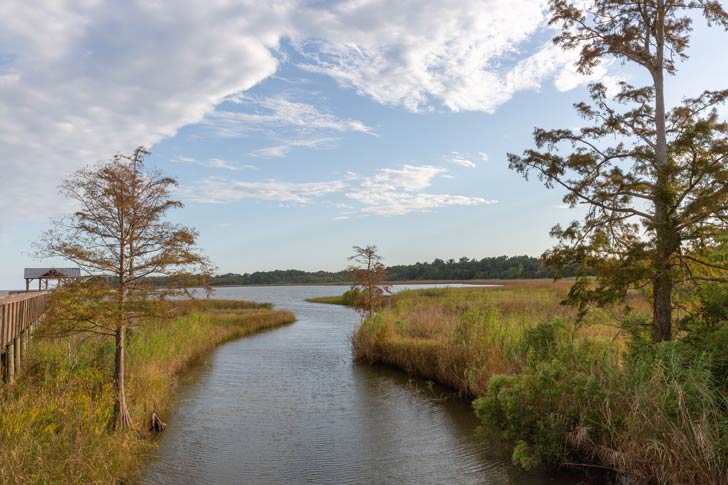
Traditional methods for tracking wastewater contamination can be time-consuming and costly, creating hurdles to achieving clean water and healthy ecosystems.
In fact, the operating costs for canine tracking are estimated to be “at least one order of magnitude lower than those for lab-based microbial source tracking initiatives,” according to NBC 15 News.
So, X has been enlisted as a faster, cheaper solution.

To do this, trainers create “scent profiles” using polymer tubes that “create a snapshot of a target odor profile” in which X can perfect his skills of detecting untreated wastewater.
In his training, X scored an overall accuracy score of 0.99, which indicates that this approach can lead to quicker response and mitigation of contaminated water, according to Aloi.
“Pathogens are a significant source of water impairment worldwide, and this program helps identify these human-source bacteria,” Aloi told Gulf Coast Media. “This program will be used as a screening tool to target efforts before costly laboratory testing needs to be conducted.”
Once samples are positively identified by X, they will then be sent to a lab for analysis. All of this data can then be applied, according to a social media post from MBNEP, “to reduce harmful raw sewage in our waterways and help create a clean water future.”
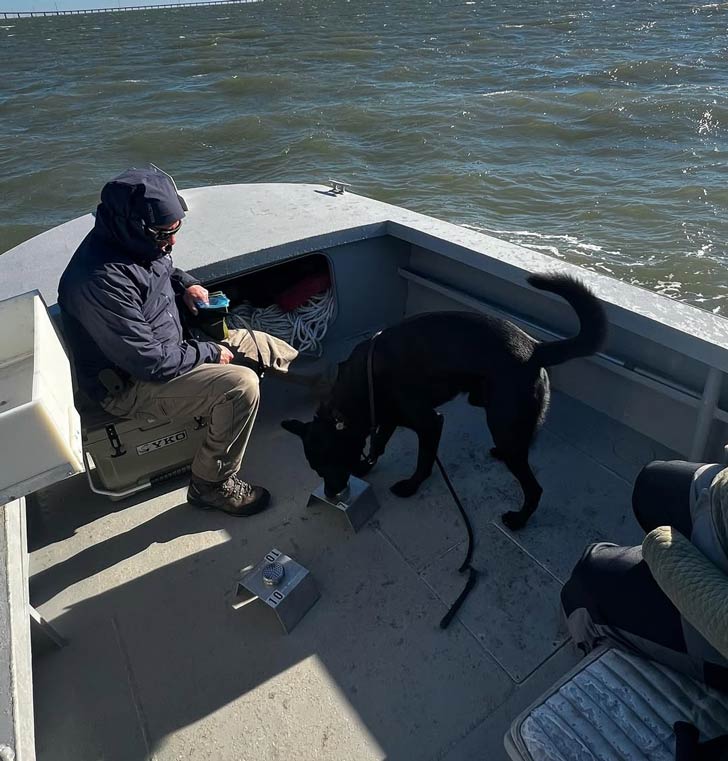
This program will be implemented in water cleanup efforts in West Fowl River, Fly Creek, and Peterson Branch — all areas in Alabama where high bacteria levels affect both water quality and shellfish harvesting.
Although X is still training, and future implementations of this approach will depend on the pilot project’s success, Aloi and team are confident.
“Immediate next steps would include utilizing this program in other watersheds within the MBNEP service area,” a release from the organization reads. “Beyond this, applying this methodology in the environmental realm is virtually limitless.”
Header images courtesy of Mobile Bay National Estuary Program
Some truths are so universal that even children recognize them. And whether someone is trying to get a driver's license, renew an ID, or register a vehicle, it’s a truth universally acknowledged that going to the DMV (The Department of Motor Vehicles) is a modern nightmare.
Sowmya Nandyala, a 13-year-old from Frisco, Texas, is several years away from earning her learner’s permit.
But when her parents called in to schedule an appointment at their local DMV — and they were put on a “six-month” waitlist — Nandyala knew that it was a symptom of a much larger issue.
“The only way to get a fast appointment was going 60 miles north,” Nandyala told KVUE, an Austin-based outlet, last summer.
“I was surprised how no one had thought of something to find faster appointments to actually solve this problem when it’s been such a widespread problem for so long.”
Using her STEM skills, Nandyala created DriveIt, an app that matches prospective clients with cancelled DMV appointments based on their zip code, distance, and preferred date.
“We have a technology that automatically scans for appointments tailored to your preferences and then we automatically book it for you, saving you months of time,” Nandyala said.
Just three months after DriveIt launched, Nandyala estimated that her app had collectively saved customers over “10 years” of wait time.
“[One client's] appointment changed from May 13th to April 8th, and the day he actually used [DriveIt] was April 8th,” Nandyala said. “He was able to get a same-day appointment through DriveIt and that saved him over a month and four days of time.”
Currently, DriveIt operates primarily in Texas, but Nandyala hopes to expand it to more states as she gains more funding.
“Our goal is to eventually offer our services nationwide to help individuals across the country access DMV appointments with ease,” Nandyala wrote on her official website.
“From navigating complex appointment systems to providing real-time updates, DriveIt is dedicated to making the DMV journey efficient and stress-free,” Nandyala added.
“But our commitment goes beyond convenience – we're empowering communities by giving individuals control over their time and access to vital services.”
Header image via OregonDOT / Wikimedia Commons (CC BY 2.0)