In March, Utah’s state government passed a law banning the display of certain flags in schools and other “government property.”
While the bill itself does not name specific types of flags that would be banned, one of its sponsors, Republican State Rep. Trevor Lee, posted on social media that the bill would “ban Pride flags” from Utah schools.
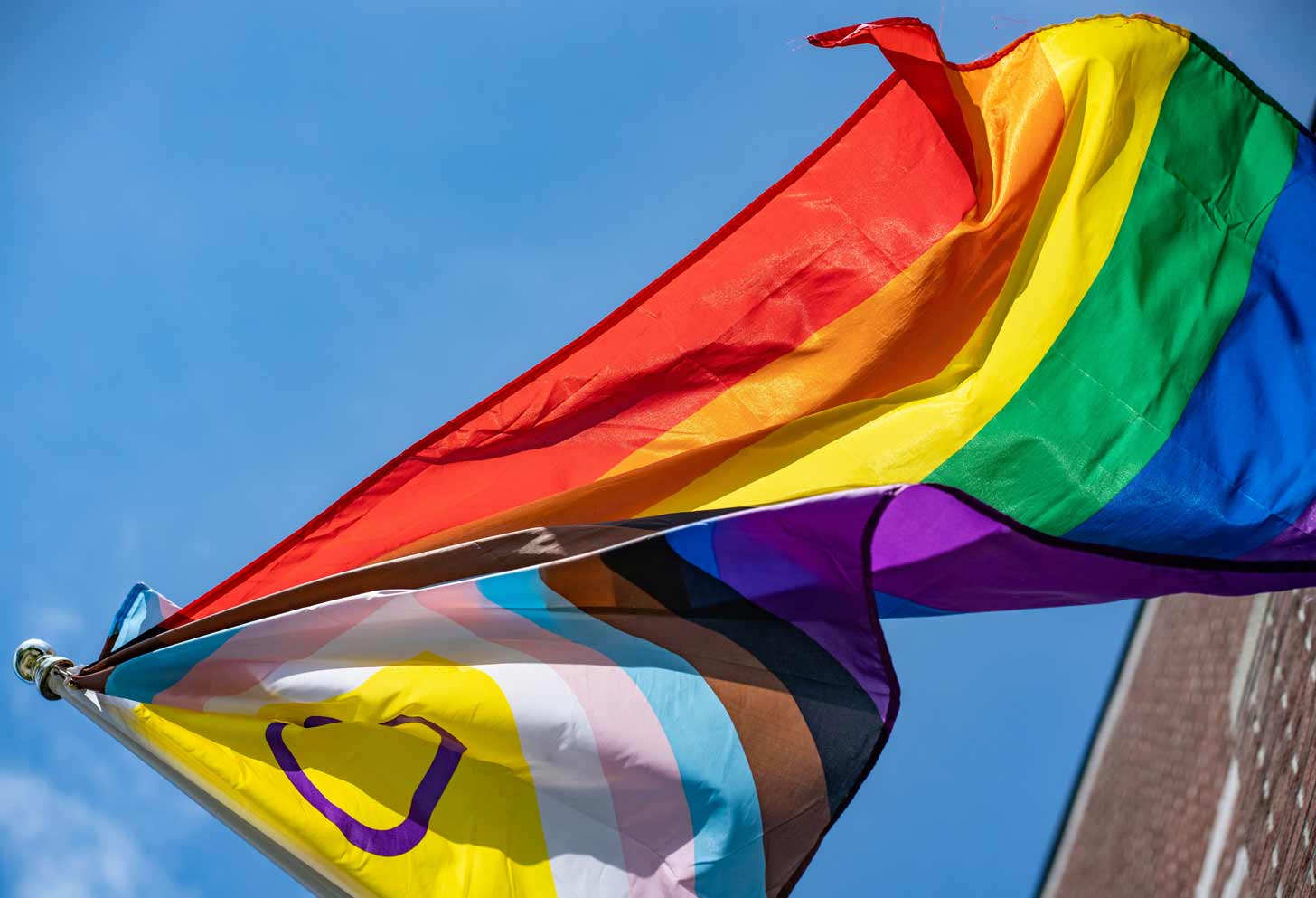
According to the law, the only flags acceptable to fly are approved state and city flags and the American flag.
Now that the law is in effect, state or local government buildings will be fined $500 a day for flying any flag other than those approved by lawmakers, according to the Associated Press.
Leaders and LGBTQ+ communities alike have come together to creatively protest the new law, including Salt Lake City Mayor Erin Mendenhall, who introduced three new “official” city flags. They incorporate the existing Salt Lake City flag design into new iterations that celebrate LGBTQ+ pride, trans pride, and Juneteenth.
The City Council unanimously adopted Mendenhall’s proposal in early May.

“Our City flags are powerful symbols representing Salt Lake City’s values,” Mendenhall said in a statement. “I want all Salt Lakers to be able to look up at these flags and be reminded that we value inclusion and acceptance — leaving no doubt that we are united as a city and people, moving forward together.”
Progressive community members have applauded Mendenhall’s move toward inclusion, and have their own plans to protest the statewide flag ban, too.
Gabi Finlayson and Jackie Morgan of Elevate Utah, a political action committee, are on a mission to “dismantle single-party rule” in Utah by helping Democrats, independents, and “anyone ready to govern with sanity, integrity, and public trust” get elected.
Much of their work is ultimately centered around sharing compelling narratives and campaigns on social media. And for Pride Month, they’ve made some new merch to get their message across.
“Remember how Salt Lake City was super iconic and they passed three new official city flags, like the Pride flag, the trans flag, and the Juneteenth flag?” Finlayson said in a recent TikTok video. “Me, too.”
To match that level of “iconic,” the duo debuted their Pride collection in the video, which was created in collaboration with Alliance for a Better Utah.
The collection includes the all-new Salt Lake City flags, which feature text that reads: “Good luck banning f(l)ags.”

“All of the proceeds from those flags go to local nonprofits that are supporting the queer community right here in Utah,” Finlayson added.
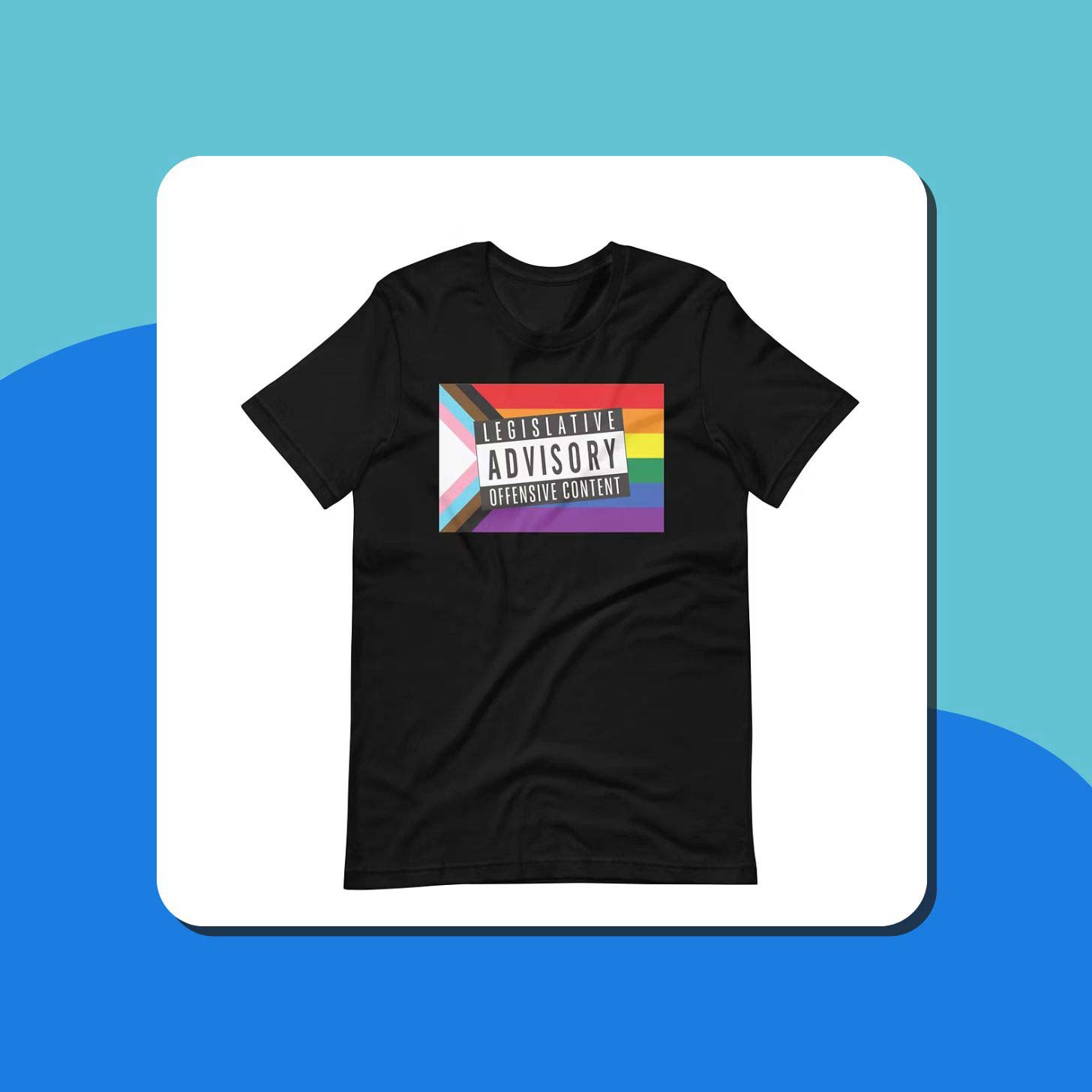
With dozens of designs, the group’s website (ThisIsNotAPrideFlag.com) also features the Pride flag with a “Legislative Advisory: Offensive Content” sticker slapped over it, as well as a rainbow-fied Delicate Arch illustration that simply reads “Utah Proud.”
Other designs include highly Utah-specific references, including a rainbow gradient that reads “Not Today, Trevor Lee;” an image of a waterfall accompanied by “I came out at The Mayan;” and a photo of Church of Latter-Day Saints religious leader Brigham Young, surrounded by his three wives that says, “What if the wives were bi?”
“These may only be funny if you’re from Utah or have lived here too long,” Finlayson laughed.

Ultimately, the designs are a commentary on a culture that has long suppressed LGBTQ+ freedom and expression.
“These flags have historically been symbols of visibility, belonging, and celebration,” the online shop reads. “The Utah Legislature turned them into contraband. Mayor Mendenhall and the Salt Lake City Council turned them into a protest. We’re turning them into a movement and a fundraiser for our community.”
While it’s unclear what organizations will be the beneficiaries of this fundraiser, Finlayson emphasized that the messages of these items will make a real impact.
“Get your Pride merch, get ready for Pride,” she said, “and let’s remind the Utah legislature that we have never needed their permission, and we never will.”
Header image by Chris Robert on Unsplash
A group of undergraduate engineering students at Rice University — Adam Vuong, Cristiana De Sousa, Issy Tai, and Santiago Brent — aren’t just classmates. They’re Kunde’s Friends.
Kunde is a Houston dog who lost his vision to advanced glaucoma, and the quartet of engineers decided to turn his journey into a learning opportunity.
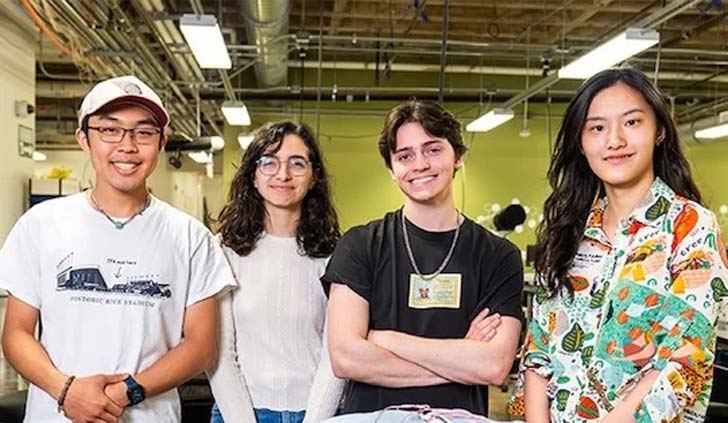
Building off of a previous project that utilized LiDAR (or Light Detection and Ranging) sensors, the group designed a wearable vest that helps blind dogs like Kunde safely navigate their surroundings.
It uses haptic feedback powered by a stereoscopic camera, which gives real-time spatial information without restricting Kunde’s natural movement or play.
Traditional solutions for blind dogs include rigid “halo” frames and e-collars that can be bulky and uncomfortable, providing yet another confusing obstacle for blind pets to socialize and explore.
Kunde’s owners reached out to the Oshman Engineering Design Kitchen at Rice to look for a new solution to help their beloved furry friend move through his journey into vision loss with ease.
The students signed up for the task.
“Existing devices tend to be bulky or uncomfortable, and they rely on the dog bumping into things as tactile feedback, which is not ideal,” Vuong said in a statement.
“We wanted to create something that would give Kunde the independence to move around and interact with his environment without constant collisions and stress.”
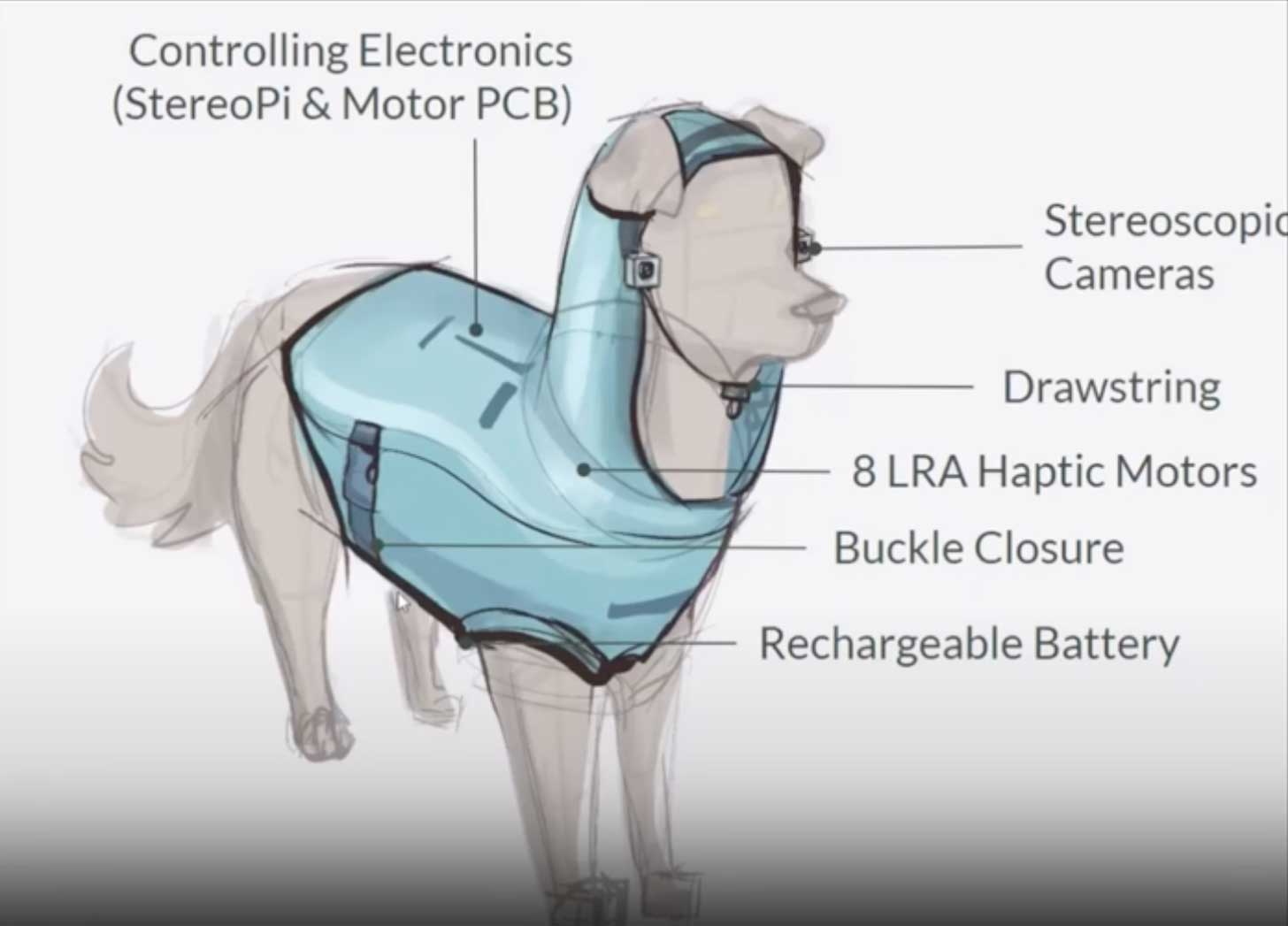
The team’s design is a lightweight vest fitted with something called “linear resonant actuator motors,” which are commonly used in wearables and smartphones that vibrate. These motors alert the dog when obstacles are near.
Additionally, a set of stereoscopic cameras are (comfortably) mounted atop Kunde’s head to capture real-time depth information. This information is processed by a custom printed circuit board and a stereoscopic vision-processing computer module.
Then, the information is sent to Kunde as vibrations on different parts of the vest, depending on the proximity and location of the obstacles.
“Kind of like giving Kunde a second set of eyes, the cameras create a depth map,” Tsai explained. “The closer an obstacle is, the stronger the vibration on that side of the vest.”
The idea is that Kunde can learn what those vibrations mean and adjust his path without human intervention.
And it can be done without costing an arm and a leg.
“The ability to use very cheap cameras in order to create a very complex depth map is pretty amazing, compared to using thousands of dollars of LiDAR equipment or AI cameras,” Brent said in a video for the university.
“I would say the fact that we can create all of this for, I'd say, under $150, and create a very clear, crisp stereoscopic image for this computer vision is pretty insane.”
That doesn’t mean the invention has come without challenges. The team had to create flexible yet protective casings for the electronics and balance their weight distribution, so Kunde could still rely on his natural movements.
They also had to waterproof critical components of the design and adapt it to the Texas heat.
“We had to figure out how to embed electronics into a wearable vest that’s breathable, soft and rugged enough for a dog who loves to play,” said De Sousa. “It was a real exercise in creative problem-solving.”
Kunde’s Friends believe this low-cost application could potentially be used for “cross-species” application, including in human rehabilitation technology and therapeutic uses.
“This project shows that with the right combination of low-power sensors and haptic feedback, it is possible to provide real-time spatial guidance in a lightweight, unobtrusive way,” Brent said.

Kunde is still working with the team to test the invention, with video footage showing the fluffy black dog walking with confidence, albeit a little clumsily, with the new wearable attached to his head and chest.
The final prototype will ideally offer a range of up to eight meters and battery life of about two hours, with an adjustable strap that can allow the device to be changed, “depending on Kunde’s mood,” De Sousa explained.
As the students finalize their work, they hope to create a device that works not just for Kunde, but all the other dogs like him.
“The team has made exciting progress, and while there’s still more development ahead to fully meet the client’s needs, they’ve already demonstrated the power of having a real-world challenge to drive meaningful design,” the team’s mentor Heather Bisesti said.
“It’s motivating for students to see how their work can make a direct difference in someone’s — or some dog’s — life.”
Header image courtesy of Niraj Yadav/Pexels
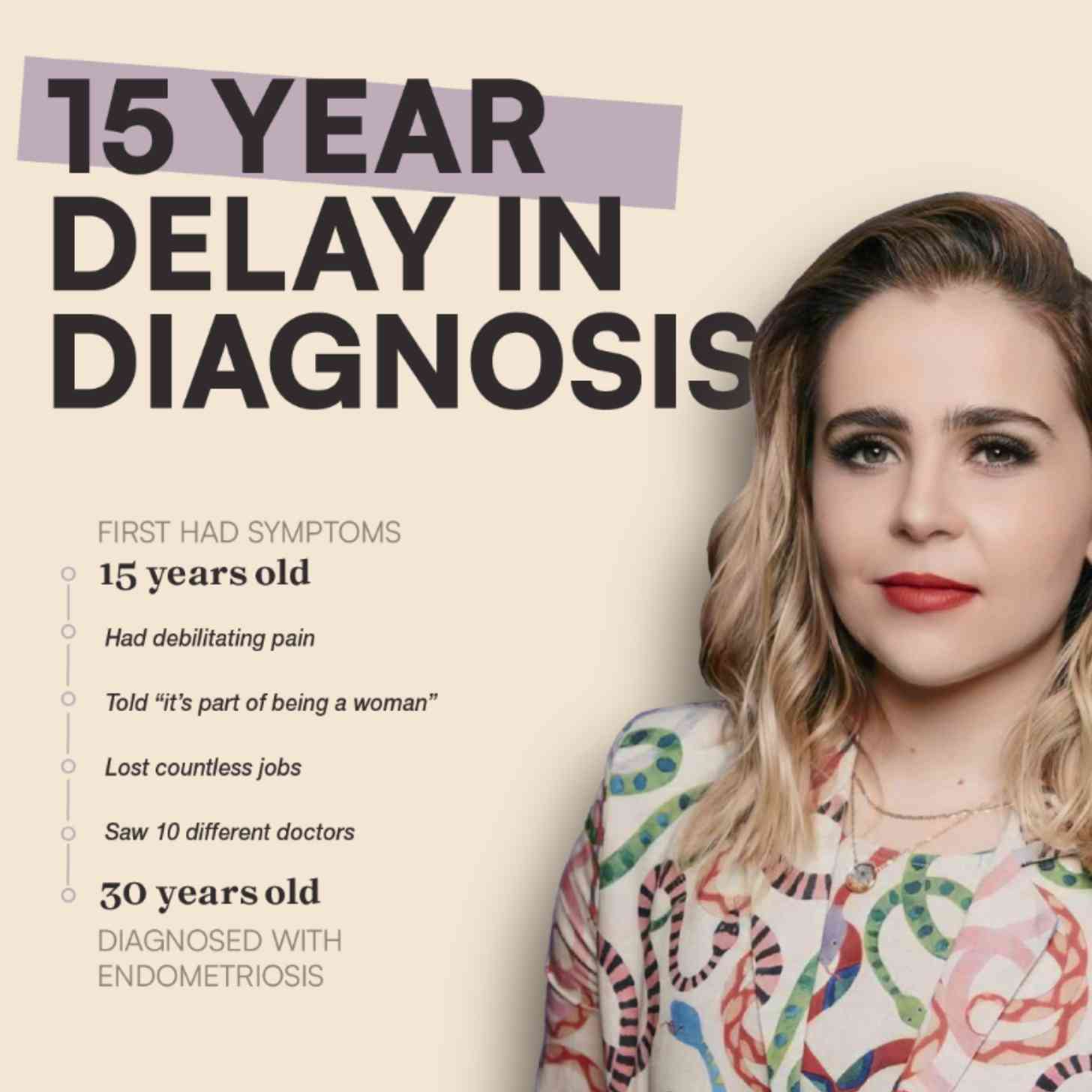
Actress Mae Whitman had an early start in the industry.
At age five, she made her acting debut as Meg Ryan’s daughter in “When a Man Loves a Woman” (1994). At seven, she starred in “Independence Day” (1996).
But it was at age 15, before filming the comedy series “Arrested Development,” that Whitman experienced the stomach-churning symptoms of endometriosis — a painful disease in which cells of the uterine lining grow outside of the uterus.
From there, Whitman went on an arduous medical journey.
Throughout her teens and twenties, the “Parenthood” and “Good Girls” star saw 10 different doctors, lost countless jobs, and was told that her daily pain — which she likened to “being shot with a cannonball in the stomach” — was dismissed as “part of being a woman.”
Whitman, now 36, said it took her 15 years to get diagnosed with endometriosis.
“One of the most difficult factors of this somehow isn’t the gunshot-wound pain,” Whitman told Glamour in an interview that was recirculated in a new awareness campaign for Think Endo and the Mayo Clinic.
“It’s the psychological pain that you experience,” she explained. “It’s also the unknowing that really adds to the psychological damage.”
According to the World Health Organization, endometriosis affects roughly one in 10 women around the globe — but it can take an average of four to 11 years to diagnose and treat.
In 2024, charity and education campaign Endometriosis UK released a report that explored medical negligence and misdiagnosis in endometriosis patients.
“Worryingly, 78% of our respondents who later went on to receive a diagnosis of endometriosis had experienced one or more doctors telling them they were making a ‘fuss about nothing’ or similar comments and many had the severity of their symptoms questioned by healthcare practitioners,” the report stated.
“Endometriosis may have a significant, sometimes devastating impact on all aspects of life: education, career, relationships, sexual relationships, fertility and quality of life. Despite this,” the report said, “it is a disease that the majority of people have never heard of.”
“Without awareness, pain and symptoms can be dismissed and brushed aside as ‘normal’ when they are anything but. Without a diagnosis, treatment can’t be accessed, and the disease may progress.”
Whitman has long been vocal about endometriosis awareness and women’s health at large.
In addition to recently partnering with the Think Endo awareness campaign, Whitman is an executive producer of “Below the Belt,” a documentary that follows four endometriosis patients as they navigate the U.S. health care system.
In an interview with the World Economic Forum, documentary director Shannon Cohn said that co-producers Whitman, Rosario Dawson, and Corinne Foxx all felt motivated to fund the project due to their personal experiences with endometriosis and delayed diagnoses.
“That’s what it’s about…everybody kind of putting their weight behind it, using their platforms to say, okay, enough is enough,” Cohn said. “Let's shine a light on this issue.”
In 2020, when Whitman was finally diagnosed after her 15-year delay, Glamour asked her if people with endometriosis can still pursue their dreams.
Whitman responded with a resounding: “Hell yeah.”
“I think you can pursue your dreams even more with endometriosis,” she said. “I think it can make you an unbelievably strong person. And it can make you someone that can't be held back by anything because, I'll tell you, if I can get through those pain waves that I had, I can do absolutely anything.”
Header image via Think Endo
For two decades, Theresa Fyffe was a medical researcher. Now, she’s focused on a different kind of medicine: Coral triage.
Fyffe is the executive director of the Great Barrier Reef Foundation, an organization that connects and funds on-the-ground work to restore the world’s largest coral reef.

She likens the coral reef crisis to the medical world where she started her career.
“Many cancers don’t have a cure, but a cancer diagnosis is no longer a death sentence, due to the expanding toolkit of treatments. This is how we must think of coral reefs,” Fyffe said in a recent TED Talk.
“Yes, we need a cure; the solutions to climate change itself. But right now, corals also need treatments to buy them time.”

Half of the world’s coral reefs have already been lost to climate change, and Fyffe said that by 2050, 90% of corals could be gone.
“We could witness their extinction in our lifetime,” she said. “Coral reefs are the absolute lifeblood of a thriving ocean. They are too big and too important to fail.”
Home to more than a quarter of all marine life, coral reefs are also food, livelihoods, and coastal protection for more than a billion people worldwide. Their biggest threat is a warming ocean.
Coral polyps, the tiny organisms that build reefs, are incredibly sensitive to higher temperatures. When stressed by heat, they expel the algae that nourishes them, which in turn exposes their skeletons and turns them white. This is called coral bleaching.
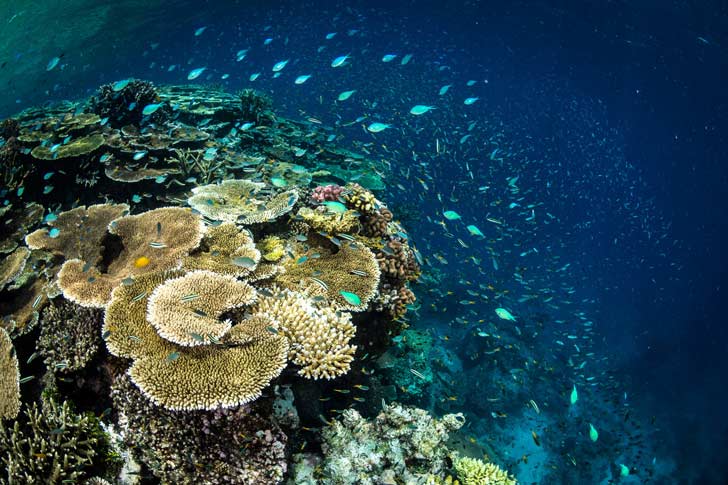
But, Fyffe said: “A bleached coral isn’t dead, but it is sick and starving. If temperatures stay too high for too long, it dies.”
The good news is that scientists have discovered a number of heat-tolerant corals, which makes it entirely possible to breed more of them.
And reef restoration work has been around since the 1970s, mainly through coral gardening, where scientists take small pieces of coral, grow them in an underwater nursery, and replant them in a reef when they’re big and strong.
While important, Fyffe said, this approach is “slow, expensive, and very difficult to scale.” In fact, this method led to less than 200,000 corals planted around the world’s oceans last year, many of which did not survive.

Fortunately, the Great Barrier Reef Foundation is on the frontlines of a breakthrough.
Over the last five years, Fyffe said, 350 Australian scientists and engineers have been working to scale reef restoration.
In this time, they have developed an automated process that can produce millions of baby corals, naturally increase their heat tolerance, and deploy ceramic cradles for mass deployment. This means divers do not have to manually plant each and every baby coral by hand.

“We’ve made more advancements in the last five years than the previous 50,” she said.
The experts are implementing the solution by targeting the reefs that are most connected to other reefs via the ocean’s natural currents. That means the offspring of the corals they plant will subsequently spread throughout the ocean, repopulating more areas with little to no effort from the scientists.
With this approach, Fyffe said, restoring as little as 3% of reefs can drive the recovery of 50% of the entire ecosystem.

“By 2031, we will be planting 1.2 million heat-tolerant, surviving corals per year, about 30 times more of what is planted across the Pacific today,” she said. “This is restoration at an unprecedented scale.”
To get the idea off the ground and into the water, the organization has packaged this technology into “micro nurseries” that coastal communities can own and operate.
“We’re going out with local communities into their corals’ space and looking at corals that have survived bleaching events,” Fyffe explained to Good Good Good. “We know that they’ve got heat-tolerance, so we bring them back to the micro-nurseries, and then they spawn.”

Picking the heat-tolerant corals is essentially a breeding tactic to increase populations of corals that can handle a more stressful ocean. Researchers have also found that the algae living inside corals can become heat-tolerant, as well, leading them to “swap” which algae is included in the repopulation process.
“We’re just speeding it up in a lab setting, ramping up that peak tolerance,” Fyffe said. “The way that we look at the work we’re doing is we’re supporting natural recovery, but we’re just giving Mother Nature a helping hand.”
Once those heat-tolerant corals are brought to the lab, scientists use a device called an auto-spawner, which essentially concentrates all of the egg and sperm from a spawning event down to a certain density. From there, the auto-spawner helps settle baby coral polyps into the ceramic cradles that will be sent back into the water.

“It all happens in an automated production line. Corals go in, coral spawns, spawns concentrated, and then they settle on these devices,” Fyffe said. “Then a couple of days later, the devices are then dropped off the side of a boat in an area where we know that we've got a degraded reef that needs restoring. It's amazing. It's actually really simple.”
While the Great Barrier Reef Foundation works with key partners like the Australian Institute of Marine Science, Marine Park Authority, and area universities, the goal is for the on-the-ground work to be owned and managed by the saltwater First Nations peoples.
“We know the technology on its own isn’t enough,” Fyffe said in her TED Talk. “To have real impact, this tech needs to be in the hands of those on the front lines, those that know the oceans best. [We’re] blending modern innovation with their ancient knowledge.”

Together with tourism operators, Indigenous communities offer regenerative tourism, all while sustaining their own livelihoods and environments.
“When we looked at expanding into the Pacific in providing the micro-nurseries to communities, we didn't want to provide something that ended up being a stranded asset. How do they maintain that in the long term?” Fyffe told us.
By building on partnerships that already existed between tourism ventures and First Nations communities in the South Pacific, the Foundation has helped facilitate the capacity to manage these micro-nurseries at scale.
“We've got a fantastic group of Indigenous rangers — and a really big cohort of female Indigenous rangers. We’re looking at getting them [trained on] these sexual reproduction coral processes and having them being the ones that are delivering and running these nurseries.”
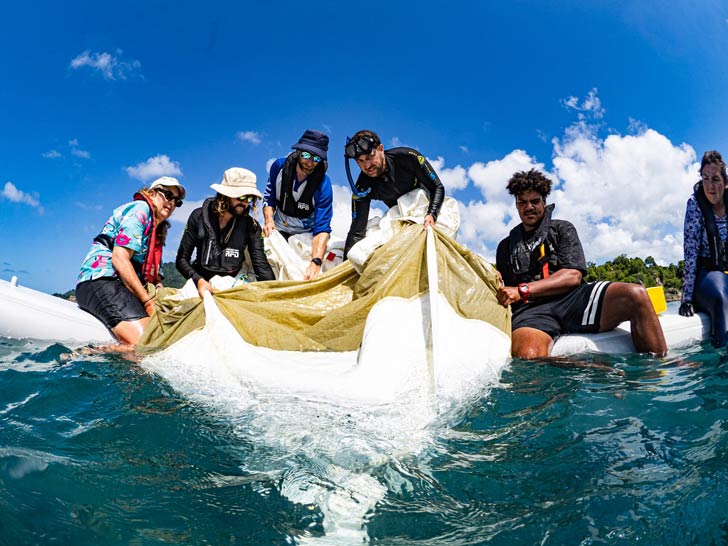
While a strategic economic approach and a breakthrough in protecting the reef ecosystem, the deployment of this initiative is also a spiritual calling for the people who call these coastal communities home.
“[Coral reefs] anchor the economies of over 100 nations and hold deep cultural significance for saltwater First Nations peoples who see coral reefs as their families and creators of life,” Fyffe said in her TED Talk.
“We have a plan — a lifeline … to sustain not just coral reefs but the livelihoods, cultures, and futures they safeguard.”
Fyffe knows that the real cure to the coral reef crisis is to slow the rate of warming, to tackle the two-degree future that climate change presents. But in the meantime, she feels confident in this work, which was recently bolstered by a large donation from TED’s Audacious Project.
“We have this thing called Reef Grief, and it’s real. A researcher who started this work 30 years ago had their favorite reef. That reef isn’t there anymore. It’s gone. It’s rubble,” Fyffe told us. “How do you keep them going? You show them the reef that should be.”
She echoed this call for hope as she wrapped up her TED Talk.
“For many coral reefs, unfortunately it is already too late,” she said. “But for half of the world’s reefs, including the Great Barrier Reef, there is still time. These corals haven’t given up. They are still resilient. They can still regenerate. So if the corals haven’t given up, how can we?”
Header image courtesy of Tourism and Events Queensland
According to a new survey by Road Scholar — a nonprofit that provides travel and education services to seniors — 94% of older adults who “age adventurously” report higher levels of happiness, with some even saying they feel just as happy now as they did in their 20s or 30s.
When it came to defining what it means to “age adventurously,” the pool of 300 respondents (aged 50 to 98) categorized the term as traveling, staying physically active, and continuing to learn and grow as they got older.
And the good news is that people are traveling more than they used to.
About 50% of respondents said they traveled more than their parents’ generation, with a majority of women saying they had more “independence” than their mothers had been afforded.
When asked, “What’s the most adventurous thing you’ve done since you turned 50?” the respondents had a wide range of answers.
“Traveled independently after my husband passed away,” wrote one woman.
“Became a Master Gardener,” one person stated.
“Got my first tattoo!” said another.
When it came to setting travel goals, answers were equally diverse. Although one respondent said that they wanted to visit more than 50 countries, others had more accessible goals in mind.
“I don’t have to run a marathon, but I want to run around the yard with my grandkids,” Kim Francis, 67, stated in the report. “I don’t need to stand on my head, but I want to stand in line at Disneyland.”
The Road Scholar study is backed by data from researchers at University College London’s Centre for Transport Studies, which found that people who regularly travelled more than 15 miles away from home reported better health.

It also found that links between travel and wellbeing were more significant in respondents aged 55 years and over.
Dr. Paulo Anciaes, the lead author of the study, theorized that travel and exploration are inherently linked to socialization.
“Travel constraints are significantly related to social participation, and social participation is then significantly related to self-reported health,” Anciaes told Medical News Today.
Anciaes’ findings were in line with research from the National Institute on Aging, which found that social isolation in older people poses greater health risks.
“Loneliness acts as a fertilizer for other diseases,” Steve Cole, director of the Social Genomics Core Laboratory at the University of California, told the NIA.
“The biology of loneliness can accelerate the buildup of plaque in arteries, help cancer cells grow and spread, and promote inflammation in the brain, leading to Alzheimer’s disease. Loneliness promotes several different types of wear and tear on the body.”
In the spirit of promoting adventure and social health, the Road Scholar report signed off by encouraging people to travel — and travel together.
“Since 1975, Road Scholar has defied aging stereotypes every day, proving that adventure does not have an expiration date,” James Moses, CEO of Road Scholar, said in a press release.
“We want to inspire an Age Adventurously movement and encourage people around the world to take part in Age Adventurously Day, sharing their stories and empowering others to join the lifelong adventure.”
You may also like: This national park just expanded its adaptive excursions, allowing disabled visitors to bike, camp & kayak
Header image via Xu Duo / Unsplash
Every day the Good Good Good team collects the best good news in the world and shares it with our community. Here are the highlights for this week!
If you want to get good news in your inbox every day, join the Goodnewsletter — the free daily newsletter designed to leave you feeling hopeful.
The Best Positive News We’re Celebrating This Week —
An ‘extremely fearful shutdown foster dog’ is inspiring millions on ‘Tiki Tok’ with his transformative recovery
With a combined 1 million+ following on Instagram and TikTok, writer Isabel Klee is a dog-centric content creator who takes her audience along on her fostering journey.
But no dog she’s fostered has captured the attention of the internet quite like her 23rd, Tiki. His time with Klee and her family was a test to see if being out of a shelter would help him overcome his debilitating anxiety.
Klee believes “every dog deserves a chance,” and Tiki got his. It took time, but in just over 25 days of Klee’s care, he’s hopped on the couch, sat in her lap, accepted lots of pets and kisses, ventured outdoors, and most recently, played with toys.
Even better: Together with Muddy Paws Rescue, the organization that saved Tiki, Klee created a “Be Brave Like Tiki” T-shirt — 100% of the proceeds go back to Muddy Paws to “save so many more dogs just like Tiki.”
→ Read more
‘Hacks’ star Hannah Einbinder raises $60K on Instagram for doctors on the ground in Gaza
Documenting what needs restoring, Indigenous women in India are making “dream maps” to protect lands from climate change
In India’s eastern state of Odisha, Indigenous villagers have continued traditional practices of fishing, farming millet and rice, and foraging leaves and fruit for millennia.
Now, those practices are under threat from the climate crisis, with dwindling fish and other resources, and increasingly unpredictable monsoon rains.
With help from a local NGO, Indigenous women from 10 villages have surveyed and mapped out the resources that are dwindling, and what needs restoring on “dream maps” — depicting their villages in their most ideal states. They plan to submit their maps and data to government officials as a first step in requesting funds to preserve and restore them.
Harvard is offering free courses on US history, civic engagement, and politics
While Harvard University has offered free online courses for several years, with tensions rising in relation to the Trump administration, more attention is on the institution than ever.
In its commitment to serving the American people, not only has the university has expanded its financial aid offerings this year, it also released 122 free courses for 2025 that anyone with access to a computer can take.
While it is unclear if they have been offered in response to the administration, 40 government classes are also available online to anyone who wants to learn (some free, some with a fee) — including lessons on constitutional foundations, U.S. public policy, and civic engagement in a constitutional democracy.
Why is this good news? Higher education, especially when it comes to being an engaged, knowledgeable citizen, should be accessible to everyone. While civics lessons are taught in public schools, it’s often not enough to gain a true understanding of U.S. government and politics.
It’s very good news that Harvard is offering its educational resources to anyone and everyone who wants to continue learning.
Scientists believe penguin poop might be cooling Antarctica by kicking off an atmospheric chain reaction
→ Read more
Offering familial support to those who may not have it, a group of dads invite Pride attendees to ‘play catch’
John Piermatteo — an ally and father of two, including one nonbinary child — wanted to come up with a creative way to show familial support to LGBTQ+ people at Pride events.
Remembering how much tossing a ball around with his dad meant to him growing up, he started Play Catch With A Dad in 2019.
After a pause due to the COVID-19 pandemic, Piermatteo came back with lifelong friends joining him at Play Catch With a Dad events. He would take the offering on the road for Pride festivals across Pennsylvania — and nationwide, including at two of the country’s largest Pride gatherings.
→ Read more
California approved $59.5 million in grant funding to preserve some of the state’s most ecologically significant habitats
In the face of federal funding cuts for some of the country’s critical habitats for rare plants and animals, California’s Wildlife Conservation Board just approved $59.5 million in grant funding to ensure they’re protected.
The funding will preserve nearly 23,000 acres of some of the state’s most ecologically important habitats, like the Salton Sea, which is at risk of drying out and releasing toxic dust if left unattended. It’s crucial wetland habitat for the endangered desert pupfish as well as several migratory bird species.
A $14.75 million grant will acquire nearly 6,500 acres of land known as Rancho Cañada Larga, which is home to at least 20 special-status species, including the California red-legged frog and the Southern California steelhead.
Why is this good news? While incredibly good news for Californians, the reality is that protecting critical ecosystems is good for the entire country (and the world) — each of us depends on healthy, thriving ecosystems for our survival, too.
Woman transforms clothing waste into building materials to solve ‘global south housing crisis’
A runner invented a sustainable, reusable alternative to the thousands of disposable water cups used at races
While running the California International Marathon in 2019 and grabbing cups of water along the route to stay hydrated, Kristina Smithe was quietly tallying how much waste these events produce.
She did the math on the way home, estimating that around 150,000 single-use cups were used per event. Even if they’re made of paper, these cups usually have a plastic lining that makes them difficult to biodegrade.
So, she also came up with an alternative solution: a lightweight silicone cup that could be used over and over. After testing them at a race in 2021, her business, Hiccup Earth, now has 70,000 cups it rents out to races to replace single-use cups.
→ Read more
A Colorado cactus was removed from the endangered species list after nearly 50 years
The Colorado hookless cactus has been a federally threatened species for nearly 50 years. Now it’s making a recovery, leading the U.S. Fish & Wildlife Service to take it off the endangered species list.
The cactus is a small, barrel-shaped cactus with pink flowers that bloom in late April and early May. Recent data shows the species is “more abundant than previously known at the time of listing.”
Thanks to the help of recovery partners like the Bureau of Land Management, the Colorado Natural Heritage Program, and the Denver Botanic Gardens, threats to the cactus have been eliminated or reduced. The service says it will continue to monitor the cactus to ensure its long-term stability.
Why is this good news? As the world faces devastating plant and animal species loss, stories like this Colorado cactus remind us that — with the right investment, attention, and care — extinction is not inevitable.
Shipping containers make up new ‘hurricane-proof eco-hotel’ in Florida’s Everglades National Park
More good news of the week —
Scientists discovered a deep-sea “pancake” octopus species on a monthslong voyage in Australia. The “flapjack” octopus is a subset of the dumbo family that is named after its incredible shapeshifting abilities, which allow it to balloon out “like a tiny gelatinous umbrella” and flatten its body like a pancake to evade predators.
Teaching them the art and science of winemaking, inmates are crafting fine Italian wine on a remote Tuscan island. It all started with a wine family dynasty, who recognized the land’s potential for making wine and for the wine to “be a part of something greater, a part of the rehabilitation of these men.”
An immigrant- and family-owned dry cleaner offers free services for unemployed people going to a job interview. Ali Shirkhodaei’s newest service at Lux Cleaners & Alterations provides free, speedy outfit cleanings to any unemployed customer heading to a job interview — and about 5 to 10 customers use the service every week.
Belgium’s parliament voted to officially abandon its decades-old plan to phase out nuclear power. In response to growing interest and investment in nuclear power as a clean energy source — it already accounts for 40% of the country’s total power generation, followed by gas at 21% and wind at 19%.
New Mexico’s recreational marijuana tax is funding a basic income program for vulnerable families. The program provides $750 monthly payments to 80 families in two districts where students struggle with low academic performance, as well as financial counseling to the families.
A recycling team in Connecticut is collecting oyster shells from restaurant trash bins to rebuild oyster habitat. Empty oyster shells play a key role in the oyster life cycle: Oyster larvae attach to shells, where they grow into adults and form reefs that improve water quality, prevent coastal erosion, and create habitat for other marine life. (Gifted link)
Paris unveiled a massive, steel star monument as a memorial to LGBTQ+ victims of the Nazi regime. The monument is located in public gardens at the heart of Paris, and aims to fulfill a duty to remember and to fight discrimination, according to the city’s mayor.
A Korean-born artist is passing along a centuries-old dye tradition to art students in Maryland. The class at the Maryland Institute College of Art uses plants like indigo and marigold to create hues of blue and gold through a meticulous process of soaking plants to get the right color.
In a “historic day,” Italy’s high court ruled that same-sex female couples who whose IVF abroad can both be legally recognized as parents. The court found that denying legal recognition to the non-biological mother violates constitutional principles of equality and personal identity and violates the child’s rights to care, education, and emotional continuit from both parents.
Colorado’s governor signed a bill to protect wild bison by classifying them as big game wildlife. The bison would migrate to Colorado from states where they do have protections, so the new law ensures they stay protected across state lines.
Beekeepers in North Carolina are helping revive honeybee populations in the aftermath of Hurricane Helene. It’s estimated that 70% to 90% of working beehives in the mountains were destroyed by Helene, so 10-12 beekeeping groups from around the state came together, each took a county, and started working to restore hives.
A clean energy workforce training program at a community college in Central Illinois is creating jobs and investing in underresourced communities. Long known for its Caterpillar, Firestone Tire, and other factories, Decatur, Illinois was funded as a clean energy workforce hub under the state’s 2021 Climate and Equitable Jobs Act — and it’s been incredibly successful.
Municipal officials in the town of Łańcut, Poland, have abolished the country’s last remaining “LGBT Ideology Free” zone. Although legally unenforceable, activists said the “LGBT Ideology Free” zones — in their attempts to stigmatize, exclude, and indirectly discriminate against LGBTQ+ people — sent the message that queer people were not welcome in these areas.
A team of scientists has developed the first mRNA bird-flu vaccine for cattle, which would help reduce the risk of human outbreaks. Researchers have been working to contain outbreaks before they can spread to humans, and early results of the vaccine trial show a strong immune response, though they still have to be peer-reviewed.
Solar energy is booming in Niger, the sunniest country in the world, which is often hit by power cuts. An unprecedented energy shortage in 2023 was a turning point for the country, with sales of increasingly cheap solar panels rising and new projects coming online.
A European Union court ruled that Marine Protected Areas must be safeguarded from harmful fishing practices such as bottom trawling. The court rejected a challenge brought by a German fishing association seeking to annul conservation measures, upholding the legal duty to ensure meaningful protection of vulnerable marine ecosystems at risk from destructive practices.
Every year, an estimated 1 billion birds die in building collisions in the United States. Birds are also vulnerable to becoming injured in urban environments, getting their delicate legs stuck in power lines, barbed wire, and railings.
Conservation experts and wildlife advocates are on the front lines in making city environments more accessible for the animals that dwell in them, implementing solutions such as bird-safe glass and light pollution reduction.
But solutions are also needed to help heal these injuries when they arise.

Enter: BirdAid.
Created by product designers Zay Kim, Chaewon Lee, and Jungmin Park, BirdAid is a first-aid kit easy enough for anyone to use.
Their idea was to create a simple and straightforward approach that would not require removal once a bird’s leg had healed from an injury.
What they developed is a dissolvable tablet made of eggshell calcium, agar powder, and potato starch, as well as naturally colorful additives like gardenia, basil, and beetroot.
“BirdAid began by selecting safe, biodegradable materials for injured birds. We tested decomposition cycles to match healing needs, and then refined ID markers for easy use,” the designers share on a Behance page.
“Treatment trials ensured comfort and function. Finally, we prepared for mass production and sustainable packaging — making bird first aid simple and accessible.”
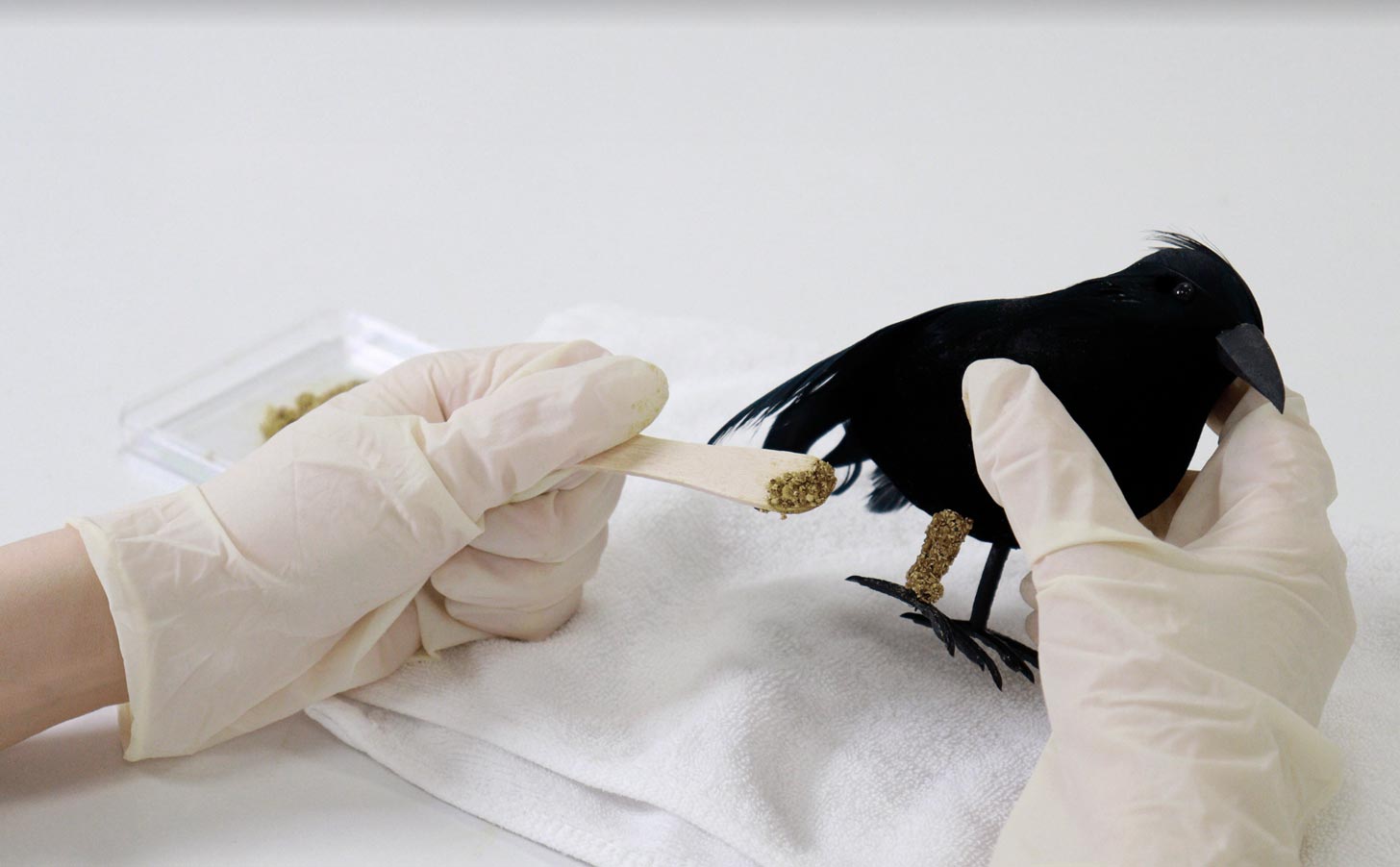
Here’s how it works: The eggshell base of the tablets offers a “unique combination of properties,” according to the designers, including “natural calcium to support bone recovery,” while breaking down seamlessly in nature.
The eggshells also offer a “symbolic link” to birds, representing both fragility and life.
Additionally, the mix includes agar powder and potato starch to help control the decomposition rate of the splint, depending on the injury’s severity.
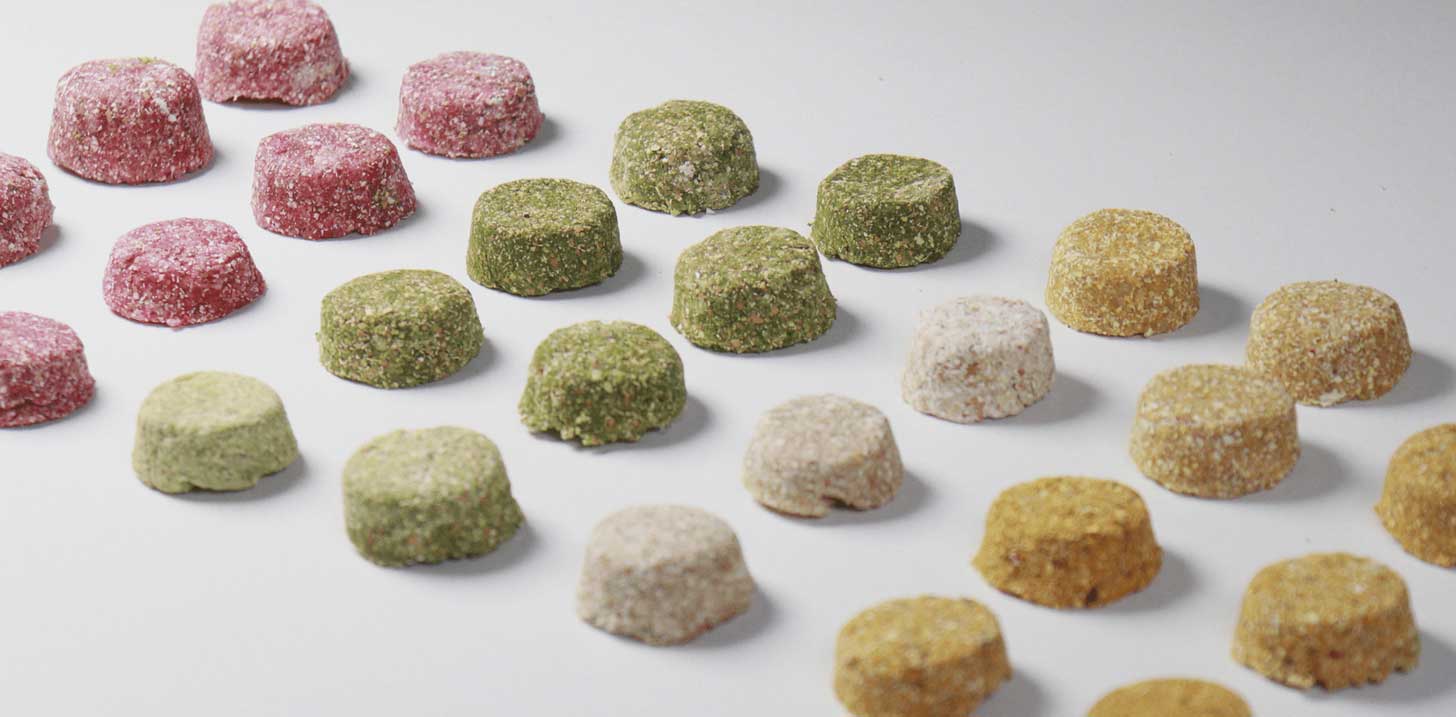
Each tablet includes these properties and comes in a red, yellow, or green color. Red tablets, which include beetroot, are designed for complete fractures or injuries where the bird’s leg may appear bent or misaligned.
Yellow tablets, which are colored with gardenia, are for injuries in which the bird struggles to put weight on an injured leg and exhibits visible swelling, likely a partial fracture.
The green tablets, colored by basil, help heal hairline fractures, in which a bird is limping but can still walk and perch.
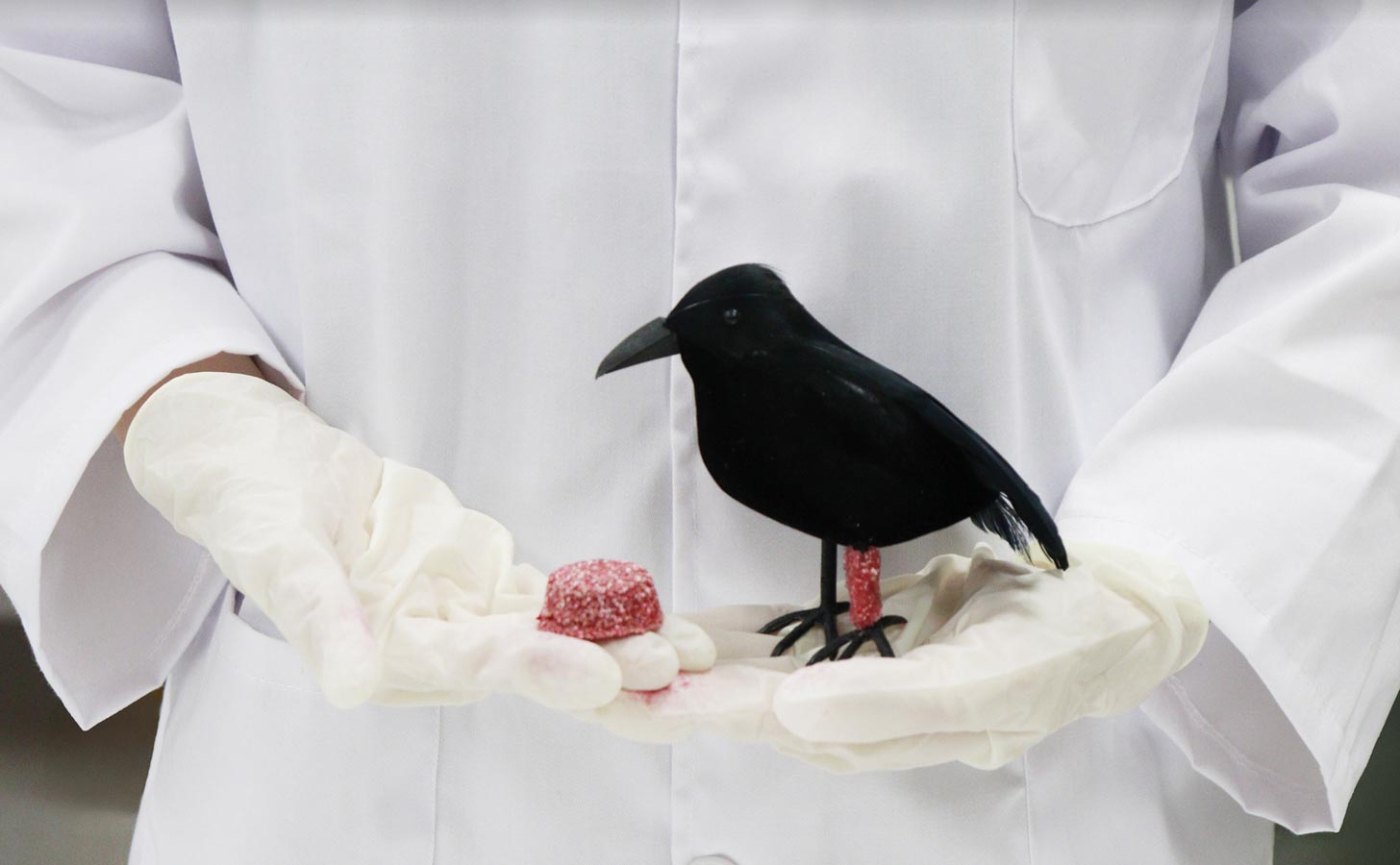
“To help users quickly identify the severity of an injury, we developed three splint variations with different decomposition rates,” the designers write.
“Each is infused with natural plant powders — gardenia, basil, and beetroot — which not only color the material but also signal the expected duration of support.”
Upon opening the kit, users take the correctly colored tablet out and simply crush it — while wearing gloves and using an applicator like a popsicle stick or tongue depressor. Once crushed into a paste-like material, it can be applied to the injury, where it will harden and help heal the injury.
To apply the splint correctly, the BirdAid package offers a QR code that links to an app, where users can get step-by-step instructions, visual guides, and assessment tools, to assist in treating the injury, without any prior experience.

“The biodegradable materials ensure that the splint naturally detaches over time, eliminating the need for follow-up intervention,” the designers write.
“For wild birds, this kit offers a second chance at mobility and survival. As urbanization continues to impact wildlife, providing a simple and effective way to support injured birds helps maintain ecological balance and coexistence between nature and cities.”
While the designers share that they have conducted successful real-world trials, it’s unclear if or when the product will reach consumer markets.
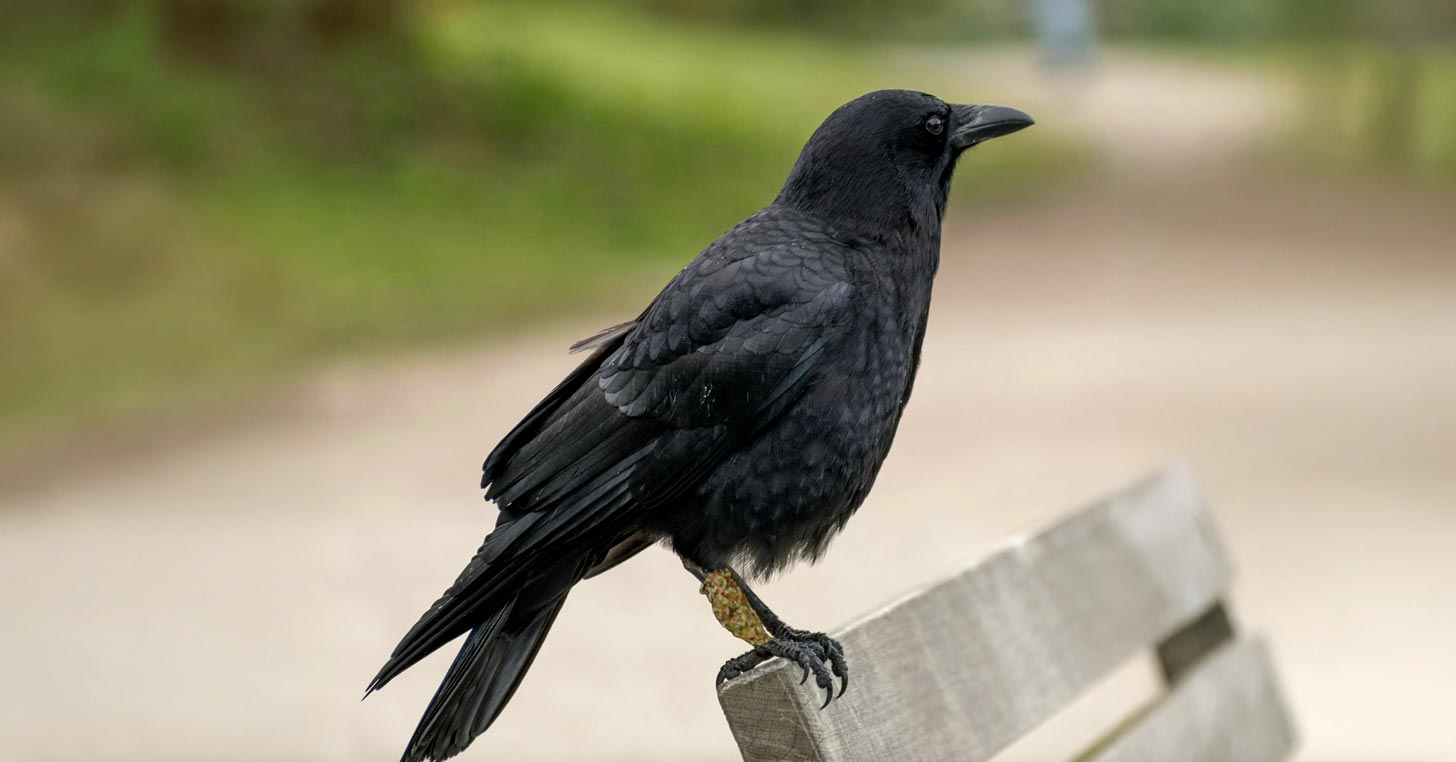
BirdAid is designed for every-human use, but right now, amid concerning rates of Avian Influenza in wild animals, it is probably best to let wildlife experts take care of bird injuries, especially if you do not have any personal protective equipment.
Still, the invention represents a step forward in support for urban wildlife, even if still in development.
“BirdAid offers a simple yet powerful way to support wildlife with minimal impact on nature,” its designers share. “It is a small, accessible gesture that brings compassionate care into everyday life.”
Header image courtesy of Zay Kim, Chaewon Lee, and Jungmin Park/Behance
For decades, Asheville, North Carolina, has served as a “go-to” vacation destination.
Framed by the Blue Ridge Mountains and Great Smoky Mountains National Park, the idyllic city has long been known for its rich fall foliage, historic 800-acre Biltmore estate, and booming arts district.
But when Hurricane Helene ploughed through the lower half of the East Coast in late September 2024, Asheville was hit by a surge of floods that killed 72 people and displaced 200,000 more.
In the immediate aftermath, officials cautioned tourists to stay clear of Asheville and the surrounding areas in western North Carolina.
But after months of rebuilding, many locals say they’re not just ready for tourists to return — they’re relying on it.
“I live in Asheville but work in the Smokies,” Joe Yarkovich, a wildlife biologist for Great Smoky Mountains National Park, told The Saturday Evening Post in April. “Everything in the park got hit way less hard than what you saw around Asheville.”
“There were trees down, and there was some flooding, but if you want to plan a hiking or camping trip in the Smokies this spring, it’s totally doable,” Yarkovich explained. “Folks don’t realize it, but about 90%of the park has reopened.”
And it’s not just any park. Great Smoky Mountains National Park is the most-visited national park in the United States.
And thanks to an ambitious cataloguing project, entomologist Becky Nichols reported that the park is home to at least 22,143 different kinds of species, including 19 rare firefly species.
“It’s one of the most biodiverse places on Earth,” Nichols emphasized.
One firefly species, the blue ghost firefly (Phausis reticulata), is so rare that it can only be found in the Southern Appalachian mountains.
And every summer, the bioluminescent bugs fill the forests with a steady glow of soft blueish-white light, attracting thousands of tourists to the national park and surrounding woods.
When the floods receded, Nichols was concerned about the fireflies that may have been affected by the storms.
“As far as fireflies are concerned, the larvae live underground for a year before they pupate as adults,” Nichols said. “Undoubtedly there is going to be some impact, especially in the eastern corner of the park, which got hit the worst.”
“The low-lying areas on the North Carolina side of the park were inundated. So yes, I would expect there will be some impact from the storm, but,” Nichols cautioned, “there will be enough reserves of other larvae. They’ll come back.”
And they have.
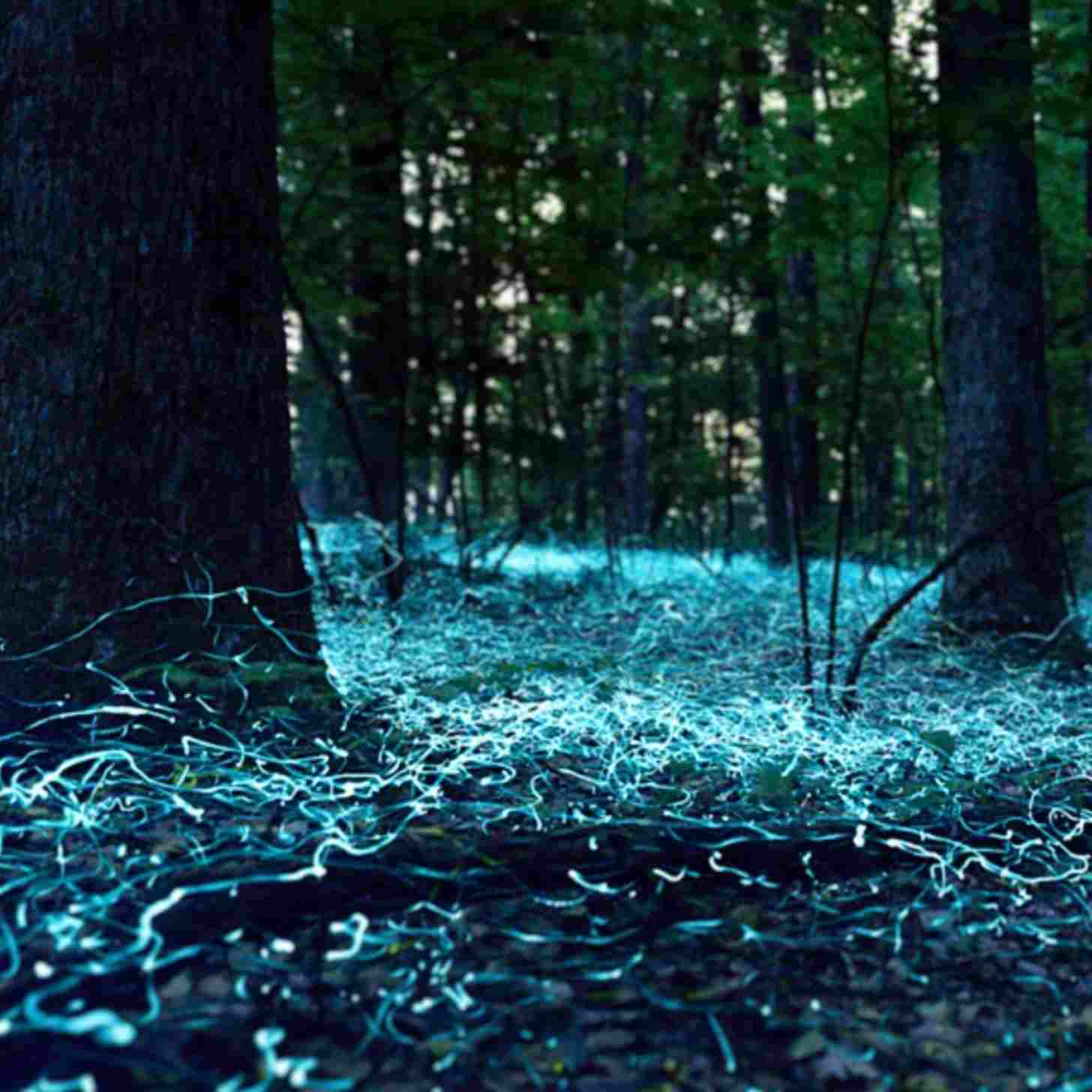
Since early May, park rangers and local tour guides have been walking visitors through the woods to see the blue, glowing beetles up close.
“Every year, the Blue Ghost Firefly Tour offers visitors a magical glimpse into one of nature’s most captivating sights,” Dallas Martin of Asheville’s FIND Outdoors said in a recent press release.
“This event is not just about experiencing the beauty of the fireflies,” Martin added, “it's an opportunity to learn about conservation, the delicate balance of our forest ecosystems, and how we can protect these incredible species for generations to come.”
Another popular attraction is Asheville’s synchronous firefly viewings — an annual phenomenon in which synchronous fireflies (Photinus carolinus) gather en masse and twinkle together in harmony.
The sightings have become so popular that Great Smoky Mountains National Park began holding lotteries so that winners can view the beetles at select times, without overwhelming them with light pollution from flashlights, headlights, and phone flashes.
Nicole Will of Asheville Wellness Tours told the BBC that blue ghosts are especially “sensitive to light.”
“If you're more familiar with fireflies, they're blinking in the backyard, they don't care that your porch light is on,” Will explained. “But [blue ghost] fireflies, if your phone screen lights up… they're like, 'nope'.”
According to Will, the firefly tours and lotteries have brought a much-needed surge of tourism back to the city.
“It's a huge morale boost to have people frequent our small businesses,” Will said. “Asheville [is] unique in terms of the concentration of locally owned businesses here.”
“Almost anywhere you turn, you're going to be supporting someone who has been through this traumatic period,” she said. “And what we do all day, every day, is share and hope to connect people more deeply to Asheville and the region.”
See the fireflies in action:
You may also like: Climate Change is Killing Fireflies; Here’s Why (and How) We Should Protect Them
Header image via Bobby Bradley / Visit Asheville
National parks across the country just began their peak visitor season, but in a quiet little corner of Denali National Park, it’s also peak puppy season.
On May 3, 2025, the national park welcomed five new sled dogs to their mushing crew: Squall, Storm, Graupel, Dew, and Fog. While the pups were still acclimating to things earth-side for most of May, they are now available to be seen on a livestream, known to fans as the Puppy Cam.

The Denali Kennels have been the only sled dog kennel in the NPS for over 103 years, and one of the oldest in the U.S. as a whole. Each year, Denali aims to breed or adopt one litter of sled dogs, which might have anywhere from one to six or more pups.
This year’s pack of five is named after words that describe various ways that water influences the weather, since the Denali Kennels and the National Weather Service are celebrating 100 years of weather data collection by the park’s mushing rangers.

Aside from being unbearably cute, these puppies are part of an important lineage. Mushing, or dog-sledding, is a cultural tradition that dates back thousands of years among Indigenous peoples of Alaska.
It also happens to be the most effective mode of transportation for National Park Service rangers during Denali’s harsh winters. In heavy snow and winter weather, NPS rangers patrol the park’s vast areas of designated wilderness to gain valuable data and weather information.
Denali is home to two million acres of federally-designated wilderness, meaning rangers have a long journey to traverse. That means it’s key for their trusty companions to be ready for the job.

Careful breeding ensures that dogs are born with qualities suitable for the challenges of being a Denali sled dog.
“Physical traits include long legs to break trail through deep snow, compact paws to resist buildup of ice between toes, and sturdy coats and puffy tails to keep warm in the depths of sub-arctic weather,” the NPS explains.
And if you’re wondering if the dogs like the spotlight, well, they’re bred for that, too.
“Character traits include tenacity, an unbridled love to pull and run as part of a team, and social skills that tolerate [the] attention of many thousands of admirers to visit the kennels each summer,” the NPS continues.

Outside of the livestream — which includes adorable feeding times, and sometimes a glimpse at the elder sled dogs — Denali visitors can tour the kennels and see the pups in person at the park daily. Educational sled dog programs are also offered throughout the summer season.
Funding for the Puppy Cam programming comes from a partnership with Alaska Geographic and proceeds from its Denali Park Store.
With budget cuts threatening both the NPS and the National Weather Service, these types of private partnerships bolster the park’s popular programming.
The Puppy Cam shows a small look into the lives of the sled dog puppies, who are about four weeks old as of the publishing of this article.
For the first two months of their lives, the puppies will continue to nurse, sleep, and gain weight (more than a pound a week) at the kennels. After six weeks, they are also handled by adults and children to be socialized for park programming, according to the NPS.

The pups’ paws and mouths are also regularly examined to get them acquainted with wearing booties and dental exams as they age.
“Kennel staff take the puppies for walks, giving them opportunities to explore puddles, climb steep slopes, and amble over willow bushes and tundra,” an informational page from the NPS shares. “This familiarizes the puppies with the environment and helps them become confident and secure in their surroundings.”
By six months old, the pups are old enough to observe the older dogs in their early-season training runs, ambling alongside, until a few weeks later, when they are harnessed, too. The puppies do not get leashed to sleds until they are seven or eight months old for short runs with well-trained adult dogs.
“The pups develop into working sled dogs very quickly. By the end of their first winter, they will already have several hundred miles of experience running in harness,” the NPS shares.
“This first winter of training is so significant to their physical and mental development that by the time their second winter comes around, they will be hooked up into [the] team as full-fledged sled dogs.”
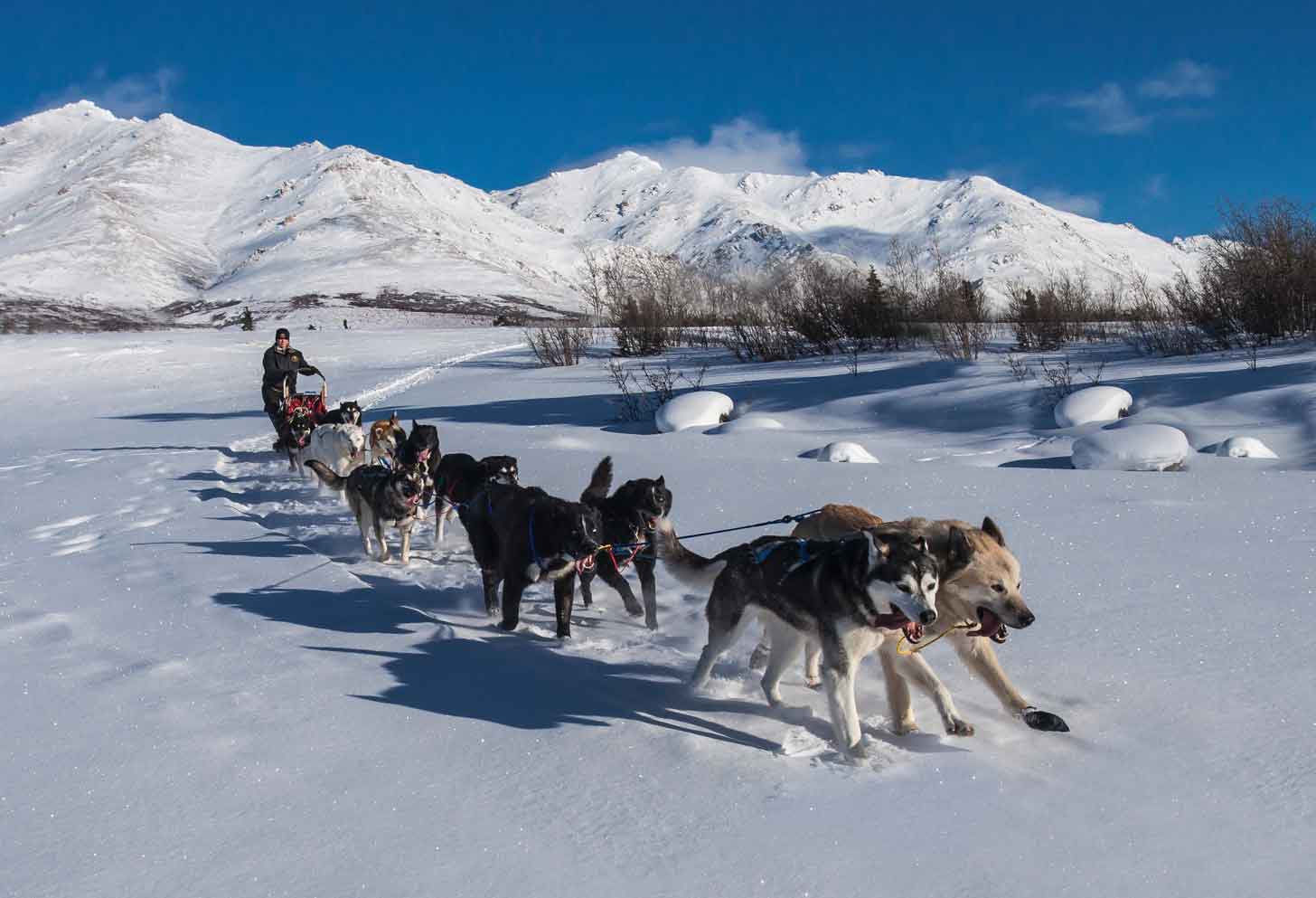
While these pups would likely be happy to take their posts for the love of the game, their responsibilities are real and important to the conservation of Denali National Park and its cultural heritage.
“The dogs, and the kennels where they live, represent important pieces of the American story. These are the only sled dogs in the United States that help protect a national park and the wildlife, scenery, and wilderness therein, and it has been this way since the birth of the park,” the NPS shares.
“This special group of dogs is tasked with preserving unimpaired the natural and cultural resources and values of the national park system for the enjoyment, education, and inspiration of this and future generations.”
But for now, they’re doing their part just by being cute.
Check in on the Puppy Cam.
Header image courtesy of NPS Photo / Kent Miller
This story was originally published by Grist. Sign up for Grist’s weekly newsletter here.
In the depths of the COVID-19 pandemic, Justin Bibb was living in a tight, one-bedroom apartment in Cleveland, Ohio. He couldn’t open his windows because his home was an old office building converted to residential units — not exactly conducive to physical and mental well-being in the middle of a global crisis.
So he sought refuge elsewhere: a large green space, down near the lakefront, that he could stroll to.
“Unfortunately,” Bibb said, “that’s not the case for many of our residents in the city of Cleveland.”
A native of Cleveland, Bibb was elected the 58th mayor of the city in 2021. Immediately after taking office, he took inspiration from the “15-minute city” concept of urban design, an idea that envisions people reaching their daily necessities — work, grocery stores, pharmacies — within 15 minutes by walking, biking, or taking public transit.
That reduces dependence on cars, and also slashes carbon emissions and air pollution. In Cleveland, Bibb’s goal is to put all residents within a 10-minute walk of a green space by the year 2045, by converting abandoned lots to parks and other efforts.
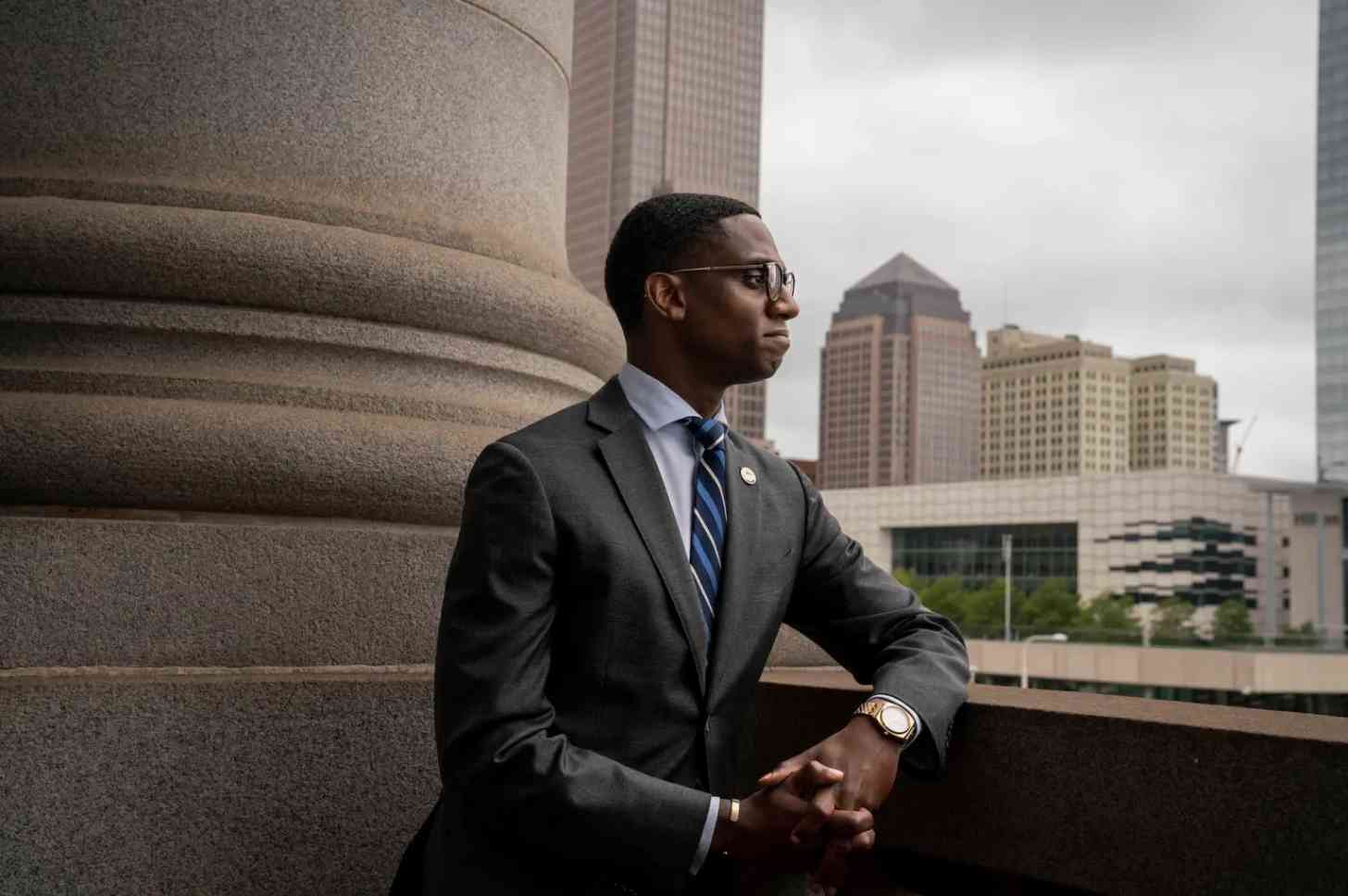
Cleveland is far from alone in its quest to adapt to a warming climate. As American cities have grown in size and population and gotten hotter, they — not the federal government — have become crucibles for climate action: Cities are electrifying their public transportation, forcing builders to make structures more energy efficient, and encouraging rooftop solar.
Together with ambitious state governments, hundreds of cities large and small are pursuing climate action plans — documents that lay out how they will reduce emissions and adapt to extreme weather — with or without support from the feds. Cleveland’s plan, for instance, calls for all its commercial and residential buildings to reach net-zero emissions by 2050.
For local leaders, climate action has grown all the more urgent since the Trump administration has been boosting fossil fuels and threatening to sue states to roll back environmental regulations.
Last week, Republicans in the House passed a budget bill that would end nearly all the clean energy tax credits from the Biden administration’s signature climate law, the Inflation Reduction Act.
“Because Donald Trump is in the White House again, it’s going to be up to mayors and governors to really enact and sustain the momentum around addressing climate change at the local level,” said Bibb, who formerly chaired Climate Mayors, a bipartisan group of nearly 350 mayors.
City leaders can move much faster than federal agencies, and are more in-tune with what their people actually want, experts said.
“They’re on the ground and they’re hearing from their residents every day, so they have a really good sense of what the priorities are,” said Kate Johnson, regional director for North America at C40 Cities, a global network of nearly 100 mayors fighting climate change. “You see climate action really grounded in the types of things that are going to help people.”

Shifting from a reliance on fossil fuels to clean energy isn’t just about reducing a city’s carbon emissions, but about creating jobs and saving money — a tangible argument that mayors can make to their people.
Bibb said a pilot program in Cleveland that helped low- to moderate-income households get access to free solar panels ended up reducing their utility bills by 60 percent. The biggest concern for Americans right now isn’t climate change, Bibb added. “It’s the cost of living, and so we have to marry these two things together,” he said. “I think mayors are in a very unique position to do that.”
To further reduce costs and emissions, cities like Seattle and Washington, D.C. are scrambling to better insulate structures, especially affordable housing, by installing double-paned windows and better insulation. In Boston last year, the city government started an Equitable Emissions Investment Fund, which awards money for projects that make buildings more efficient or add solar panels to their roofs.
“We are in a climate where energy efficiency remains the number one thing that we can do,” said Oliver Sellers-Garcia, commissioner of the environment and Green New Deal director in the Boston government. “And there are so many other comfort and health benefits from being in an efficient, all-electric environment.”
To that end, cities are deploying loads of heat pumps, hyper-efficient appliances that warm and cool a space. New York City, for instance, is spending $70 million to install 30,000 of the appliances in its public housing. The ultimate goal is to have as many heat pumps as possible running in energy-efficient homes — along with replacing gas stoves with induction ranges — and drawing electricity from renewables.
Metropolises like Los Angeles and Pittsburgh are creating new green spaces, which reduce urban temperatures and soak up rainwater to prevent flooding. A park is a prime example of “multisolving”: one intervention that fixes a bunch of problems at once.
Another is deploying electric vehicle chargers in underserved neighborhoods, as Cleveland is doing, and making their use free for residents. This encourages the adoption of those vehicles, which reduces carbon emissions and air pollution. That, in turn, improves public health in those neighborhoods, which tend to have a higher burden of pollution than richer areas.
Elizabeth Sawin, director of the Multisolving Institute, a Washington, D.C.-based nonprofit, said that these efforts will be more important than ever as the Trump administration cuts funding for health programs.
“If health care for poor children is going to be depleted — with, say, Medicaid under threat — cities can’t totally fix that,” Sawin said. “But if they can get cleaner air in cities, they can at least have fewer kids who are struggling from asthma attacks and other respiratory illnesses.”
All this work — building parks, installing solar panels, weatherizing buildings — creates jobs, both within a city and in surrounding rural areas. Construction workers commute in, while urban farms tap rural growers for their expertise.
And as a city gets more of its power from renewables, it can benefit counties far away: The largest solar facility east of the Mississippi River just came online in downstate Illinois, providing so much electricity to Chicago that the city’s 400 municipal buildings now run entirely on renewable power.
“The economic benefits and the jobs aren’t just necessarily accruing to the cities — which might be seen as big blue cities,” Johnson said. “They’re buying their electric school buses from factories in West Virginia, and they’re building solar and wind projects in rural areas.”
So cities aren’t just preparing themselves for a warmer future, but helping accelerate a transition to renewables and spreading economic benefits across the American landscape.
“We as elected officials have to do a better job of articulating how this important part of public policy is connected to the everyday lived experience,” Bibb said. “Unfortunately, my party has done a bad job of that. But I think as mayors, we are well positioned to make that case at the local level.”
Header image by KBO Bike on Unsplash
Adam Bigelow is a lot like his fellow Bostonites: He runs on Dunkin’.
Well, actually, on Friday, June 6 — National Donut Day — he’ll be biking on Dunkin’.

The social cycler is no stranger to silly challenges. In May of 2024, he biked to every Taco Bell in Rhode Island. And in 2023, he biked across the United States in 70 days.
But this year, his challenge is personal.
This year, his journey is all in honor of his girlfriend, Lily, who was diagnosed with Multiple Sclerosis while on a camping trip in Grand Teton National Park last year.
“I felt pretty powerless, but I wanted to help,” he said in a recent social media video. “I love biking, and when I found out that the National MS Society has charity bike rides that go to the tip of Cape Cod each year, I signed up.”
Bigelow said he wanted to “do something fun” before the actual charity ride, and that’s how he came up with the idea: He would bike to all of Boston’s 96 Dunkin’ locations, across 80 miles, eating 5,000 calories in Munchkins, in one day.
In another social media video, Bigelow mapped out the ride, noting that he ran into one major problem: “Boston is actually much bigger than I realized.”
@big.adam.bikes I’m biking to every single Boston Dunkin on June 6th. That’s 80 miles, 96 locations, and 5,000 calories of munchkins. #biking #bikingadventures #boston #dunkin #citytour #logistics #nationaldonutday ♬ original sound - Big Adam Bikes
Although downtown Boston is home to 24 Dunkin’ locations, he realized, there were over three times as many in the surrounding neighborhoods.
“I did a pretty thorough cross-reference of the Dunkin’ website with Google Maps, and in total, there are 119 Dunkin’s in the Boston area,” he explained. “From there, I excluded 19 locations because they’re either in sports venues, at the airport, or they’re closed for health code violations.”
From there, he had to find the shortest path. He concluded that he will begin the ride in East Boston at 4:30 a.m. when the first Dunkin’ opens.
He’ll ride throughout the city, moving south, until he reaches Dorchester, which will prompt him to turn around and head north until he reaches his final location at its 7:30 p.m. closing.
Bigelow said that even if he only stops for five minutes at each location, it’ll be a tight ride. Still, he hopes to eat Munchkins, the brand’s signature donut holes, throughout the day.
As sweet — and maybe stomachache-inducing — as this ride is, Bigelow said it’s “all to raise awareness for MS.”
@big.adam.bikes I’m biking to 96 Dunkins to raise money for MS. Link in my bio! #boston #dunkin #nationaldonutday #biking #charityevent #bikems #capecodgetaway #nationalmssociety ♬ original sound - Big Adam Bikes
On his fundraising page, where he has already collected over $2,000 of his $3,000 goal, Bigelow is offering incentives for his supporters.
“To tie it all together, anyone who donates will be entered to win a Dunkin’ Donuts gift card,” he said. He’s also offering incentives like signed bike prints and social media shoutouts during the ride.
“I’d love to do something a little meaningful, a little ridiculous, and something super Boston,” he said, “together.”
Bigelow’s roommate is also joining the mission, and for every $30 he raises, he will cut off an inch from his jeans, continuing to wear them while riding the charity race.
“Someone very close to me was diagnosed with MS last year, and I wanted to turn something I love (riding bikes and doing ridiculous things) into something that can make a difference,” Bigelow writes on his fundraiser. “Every dollar raised will go toward research, support, and ultimately, a cure.”
Header images courtesy of Adam Bigelow and Dunkin'
In the face of increasing bans on transgender athletes in competitive sports, professional women’s rugby players have responded with a resounding: “Ruck you.”
Sasha Acheson, a professional English rugby player, wanted to stage a protest in response to World Rugby, which became the first international sports federation to ban trans women at an elite level in 2020, citing “significant” safety concerns.
According to The Telegraph, World Rugby’s decision was based on data that showed “at least a 20-30% greater risk” of injury when a female player is tackled by someone who has gone through male puberty.
But Acheson and her peers know that trans women are women, and they deserve an equal opportunity to play.

So, Acheson organized “The Ruck You Match,” which put trans players toe to toe with cisgender women to disprove the supposed threat trans athletes present to their cis counterparts.
And it took place on June 1, kicking off Pride Month in Oslo, Norway.
The match set out to challenge the perception that trans women have physical advantages over cis women, with seven trans women playing against seven cisgender international women’s rugby players.
The score ended at 34-7, with the cis women scoring 34 points, and the trans women seven points when, towards the end of the game, they made “one pivotal change,” according to social media posts by the organizers: “When trans women and cis women mixed teams and came together.”

Leading up to the match, organizers also shared important statistics on social media to debunk inaccurate claims, showing that there were zero recorded injuries by trans women rugby players.
They also broke down the impact of World Rugby’s policies on athletics globally, which have now led to heavily politicized debates about trans women athletes worldwide.
“It’s not just about the facts. It’s about these teams showing up and physically playing against each other. It’s about this group of cis women showing that they’re not afraid to play against trans women, that they don’t want this,” sports commentator Coach Jackie J said in a video.
“When you watch this match, it’s just like watching any other women’s rugby match — and women’s rugby is a very physical game, which more so proves that the point that trans women aren’t a threat.”

Not only did an enthusiastic crowd support this event, but pro rugby players also chimed in on social media.
“I’m supporting the Ruck You match because this game is built on women of all shapes and sizes, different backgrounds, different stories, and I know sport has the power to make this change,” Red Roses player and Olympian Meg Jones shared on social media.
“[Rugby] is incredible because it’s inclusive, communities come together and any shape, any size can play it,” added Poppy Cleall of the Red Roses.
“That’s why I love rugby and that’s why I hope rugby continues to be that safe space for people, that place where anyone can feel like they can come to and be supported. Teamwork is so vital in rugby and this is an opportunity for me to say, ‘I have your back.’”
Alix Fitzgerald was one of just a few trans rugby players who became ineligible to play female community rugby in England after the country’s Rugby Football Union followed in World Rugby’s footsteps, banning trans women from the game in 2022.

According to The Telegraph, there were believed to be six transgender women playing community rugby at the time of the ban.
“For me, rugby is an embodiment of physicality, of being present in the world,” Fitzgerald said in a video ahead of the match. “I am out and I am proud. I could have taken a different route. I could have said absolutely nothing and gone and played rugby … but I didn’t because that’s not the right thing to do. I’m here because I love this sport. I love these people I play with.”
“Forming community around rugby has been the core of my adult life,” another trans team member, Maddison, shared on social media before the game. “To join with cis women and trans women on the pitch together is as natural as I can imagine.”
The match was believed to be the first of its kind, staged at the International Gay Rugby Cup. The players also ran a fundraiser on GoFundMe to fuel the game, with any additional donations going to Good Law Project in their fight against the U.K. Supreme Court’s recent ruling on the definition of “woman.”
And when the players got off the field on Sunday, drenched in sweat, smiles plastered on their cheeks, Fitzgerald was just one of countless women united in the bond of sisterhood.
“It’s really hard to describe what the sensation is like,” Fitzgerald said in a post-game interview, covering her face as she cried. “To do a thing that you love with people you just look up to … it’s just life. Just to run around on a stupid field in Oslo and just have fun with people, it’s life. That’s all.”
Header image courtesy of George Cherry
Swedish-American artist and activist Michele Pred has been creating guerrilla public art installations across the United States for years now.
In previous works, she has installed large-scale billboards illustrating the American flag with abortion pills to protest abortion bans at strategic locations, such as the 2024 Republican National Convention in Milwaukee, Wisconsin.
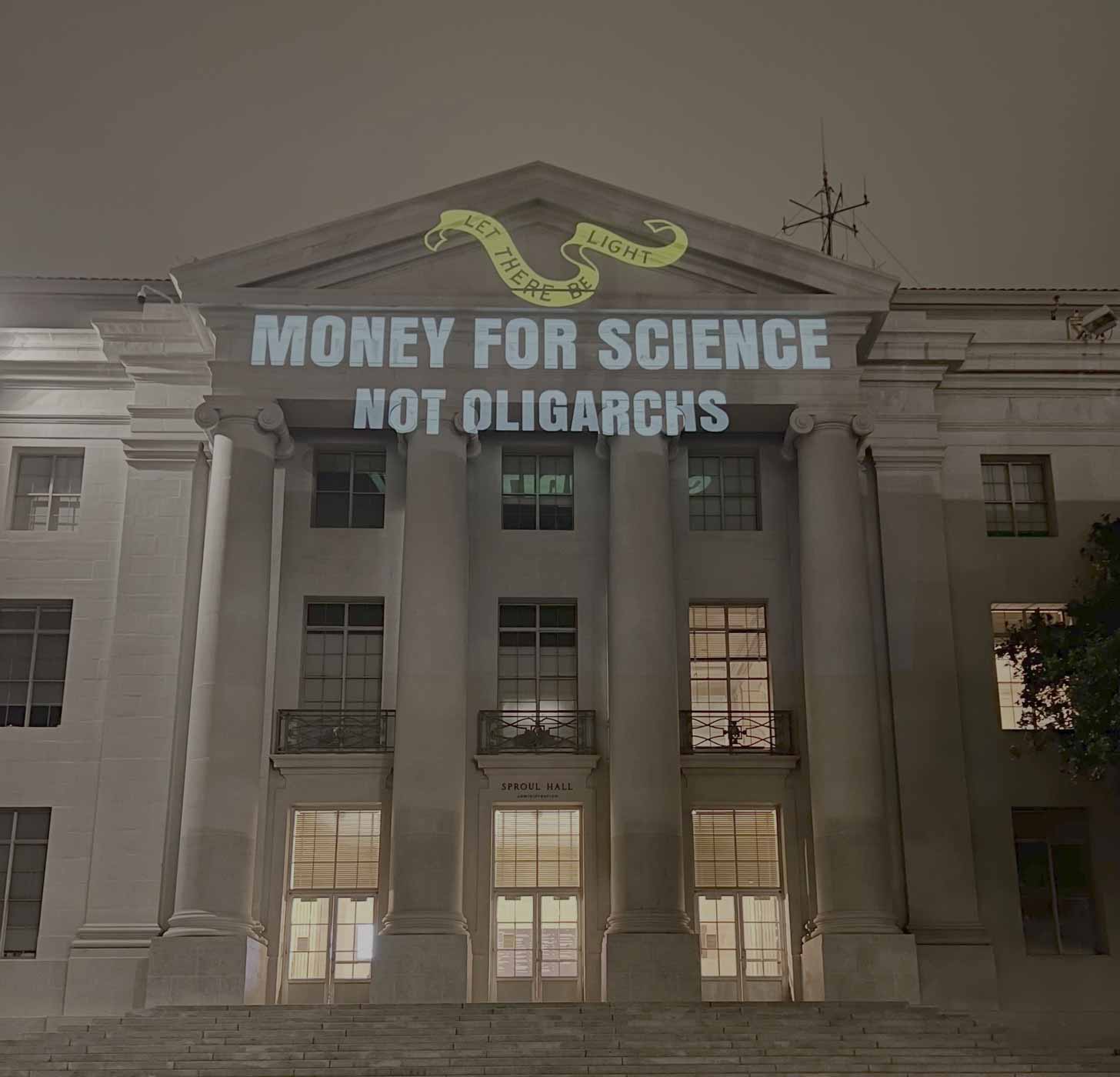
In recent months, following the Trump administration’s new policies around diversity, equity, and inclusion, as well as funding cuts to public health and scientific research, Pred has projected a list of “forbidden words” onto the Guggenheim Museum, along with snappy phrases like “Money for Science, Not Oligarchs” on the U.C. Berkeley campus.
“I like to respond quickly [to political issues], and with the projections, you can be very immediate,” Pred told KQED earlier this year.
“These issues in education have been prevalent in the news this week and it made me want to seize the moment. Being able to respond in real time is helpful. The artwork is therapy.”

Although she has been creating public feminist artworks for years now, the projections began two weeks after the presidential election in November 2024.
First, Pred displayed an image urging then-President Biden to ratify the Equal Rights Amendment on the National Gallery of Art in Washington, D.C.
Since then, Pred has continued her projection work — inspired by artists like Christy Chan and Alan Marling — on the Guggenheim Museum and the Federal Building in San Francisco.
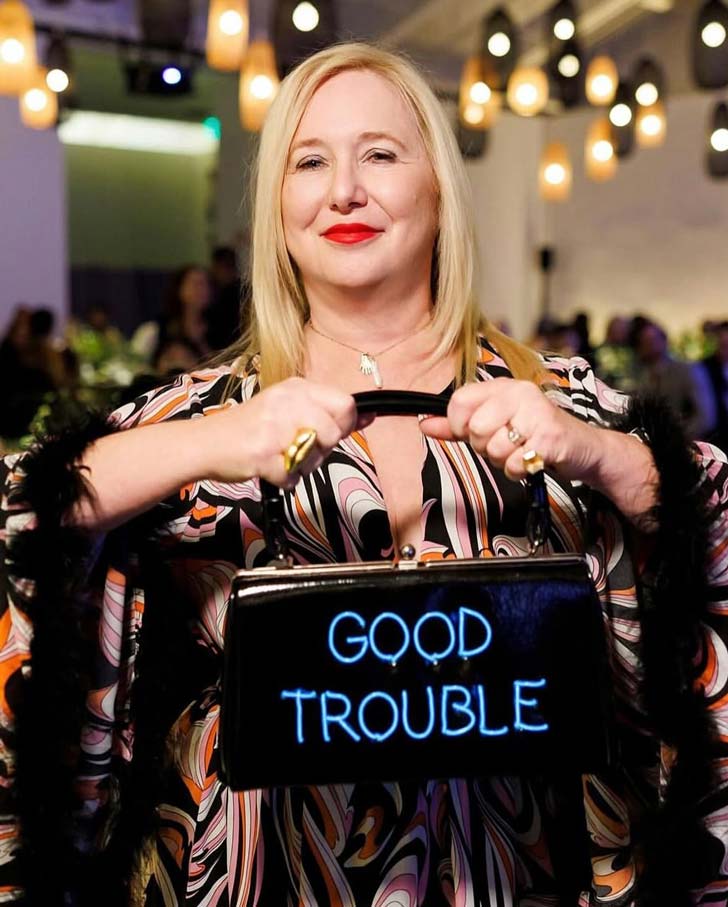
But most recently, she’s taken her work to the great outdoors.
About four days ago, under the cover of night, Pred ventured out to Yellowstone National Park to project a message she said “couldn’t wait:” Stop the cuts to the national parks.
The cuts she speaks of are those led by the Department of Government Efficiency, which fired thousands of employees from the National Park Service and U.S. Forest Service, as well as attempts to eliminate vital federal funding that protects and stewards public lands.
Her projections included a take on her signature statement: “Money for parks, not oligarchs,” accompanied by the silhouette of a buffalo.
Another reads, “This land is your land.”
And one more shares the message, “Sacred land needs sacred care.”

“Our parks are sacred spaces — protecting wildlife, preserving history, and offering us all a connection to something bigger,” Pred shared in an Instagram post. “Slashing their funding threatens the very essence of what makes them national treasures.”
Her work is reminiscent of a recent billboard campaign which advertised the country’s national parks, but with a twist.
“Death Valley National Park,” one reads. “Heat deaths rise, safety staff cut. Made possible by D.O.G.E.”
Highlighting the need to protect these public lands, and the people who work for them, seems to be a common theme for activists under the current Trump administration.
But for Pred, it’s simply a continuation of her long-held beliefs to imbue “cultural and political meaning behind everyday objects.”

“This projection is part of my ongoing series of guerrilla public art actions, shining light (literally) on urgent issues,” Pred shared in accompaniment with her national park images.
“Our environment, our access, and our future depend on bold action now.”
You may also like: Federal budget cuts are impacting national parks. Here are 5 ways you can help
Header image courtesy of Michele Pred/Instagram
On October 9, 2024, as Hurricane Milton barrelled down, Florida Highway Patrol-Tampa posted a video of one of their state troopers approaching a bull terrier on the side of the road.
In the brief video clip, the abandoned dog — which was chained to a fence and belly deep in water — growls and whines in fear as the trooper approaches.
“It’s okay, buddy,” the trooper says gently in the video. “I don’t blame you, it’s okay, buddy, it’s okay.”
The video, which racked up over 12 million views on social media site X, was captioned: “Do NOT do this to your pets please.”
Fortunately, the bull terrier — later named “Trooper” — slowly warmed up to the state trooper and was taken to a local veterinarian, where he received “a clean bill of health.”
From there, Leon County Humane Society took over. For two months, the rescue took care of Trooper and shared his story online. In December, they announced that Trooper had finally been adopted.
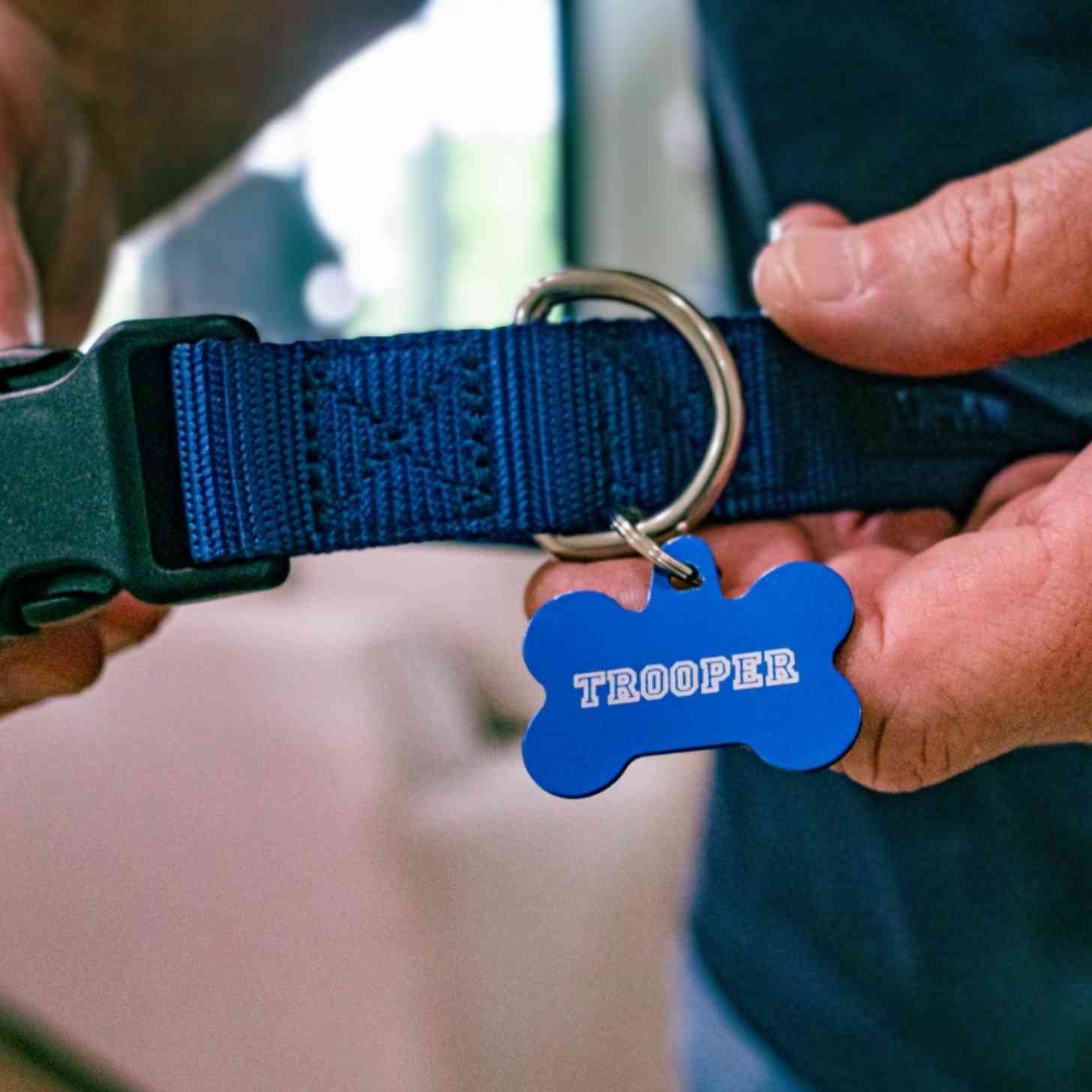
“From the moment he was introduced to his new Mom and Dad, you could see that it was a perfect match,” the rescue shared on Facebook. “In other meetings, Trooper would normally be visibly on edge and uncomfortable, but with Frank and Carla, Trooper seemed immediately at ease.”
“He happily accepted the toy gift they offered, tore it to shreds, and then trotted over to the couple to lean in for pets and cuddles. He’d take breaks to run back to Amy [a volunteer] and express his excitement over having them there, then he’d run back and get more pets, over and over.”
The Leon County Humane Society said that Trooper’s harrowing rescue had brought in potential adoptees from all over the country.
“There were no shortages of applications for Trooper,” the rescue stated. “Dog lovers nationwide were emailing to inquire about adopting this famous dog who had been through so much. It was no small task to go through these applications, but we’re confident we made a great choice for Trooper.”
Trooper’s legacy continued to circulate even after his adoption, and on May 28, the Florida Senate unanimously voted to pass Bill 150, “Trooper's Law,” which would make restraining and abandoning pets during a natural disaster a third-degree felony.
“Across Florida, we have seen horrifying instances of animal cruelty that demand a stronger response,” said Florida Governor Ron DeSantis, who also signed “Dexter’s Law” — a bill which strengthens penalties for aggravated animal cruelty.
“I was proud to sign Trooper’s Law and Dexter’s Law today,” DeSantis said in a press statement. “Florida stands by man’s best friend.”
If they succeed in the House of Representatives and beyond, the pet-friendly laws will take effect on October 1, 2025.
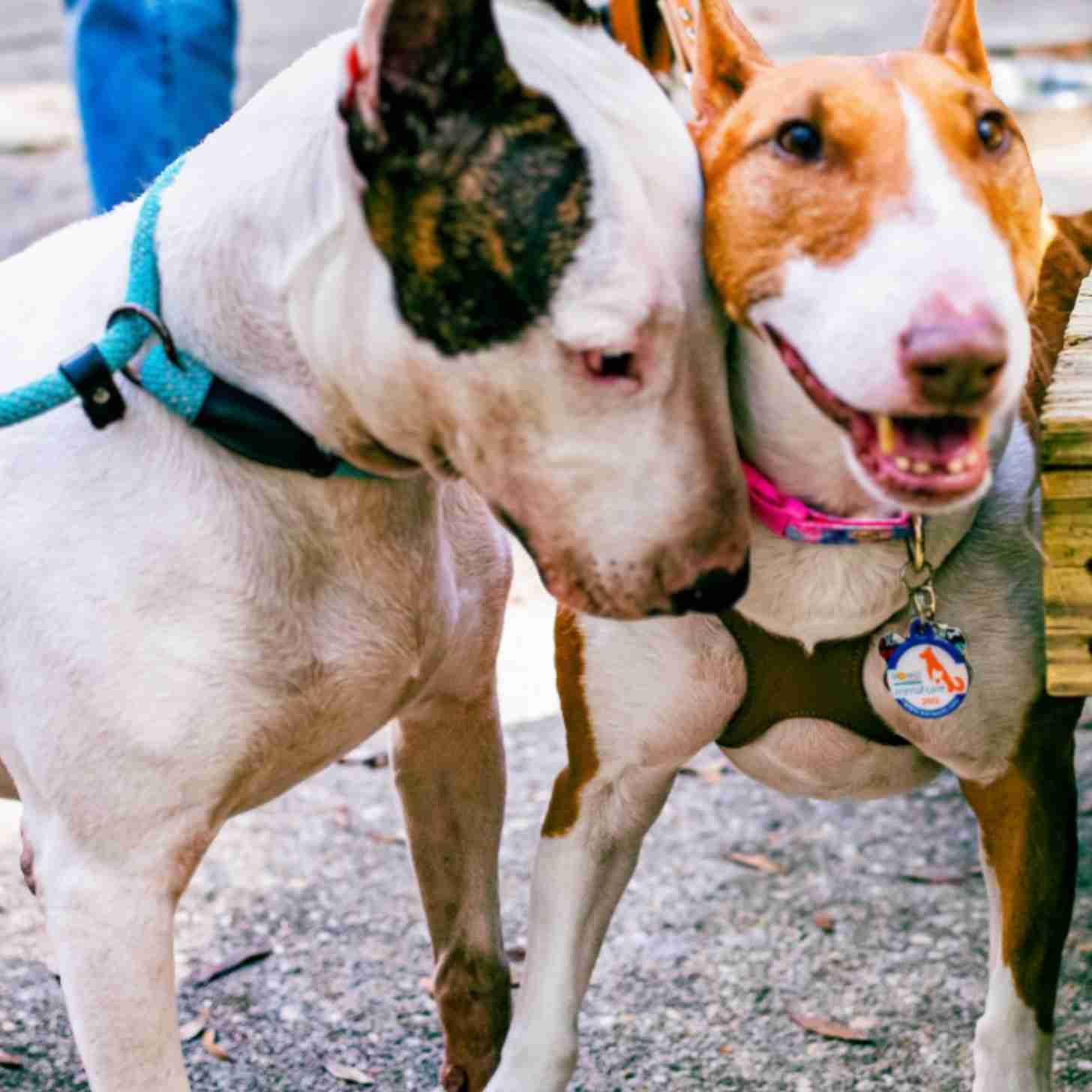
After the Florida Senate passed “Trooper’s Law,” Trooper himself earned a shout-out and a “14/10” star rating from WeRateDogs — a social media account that highlights heartwarming dog stories and runs the 15/10 Foundation, a nonprofit that helps shelter dogs with behavioral or medical issues get adopted.
“This is Trooper,” WeRateDogs posted to Instagram on June 2. “Last October, he was rescued from knee-deep water during Hurricane Milton in Florida. He had been tied to a fence post and abandoned by his previous owners… Fortunately, Trooper has since found a loving family to call his own, and his legacy is helping to prevent other dogs from facing the same abuse he experienced.”
Beneath the post, Instagram users flooded the comments section with well-wishes.
“Outstanding! We need laws like this in every state,” said one top commenter.
“Seeing this happen last year broke my heart,” one follower replied. “So glad to see this outcome for him — much love to him and his new family.”
Another wrote: “Shout out to the police that found him, Leon County Humane Society for caring for him and finding him a home, and to his new ‘pawrents.”
As Trooper’s rescue inspires new laws — and continues to touch new people — Leon County Humane Society reminded animal lovers that there are more than 3.3 million shelter dogs across the country with heartbreakingly similar stories.
“Your support helps us jump to the aid of animals in need and provide routine and often lifesaving care, along with allowing us to devote our time and effort toward making sure animals are set up for success and our community has necessary support for the pets and their people,” the rescue wrote on Facebook.
“Adopt. Foster. Volunteer. Donate. “Tell ‘Em Trooper Sent You.”
Header images via Leon County Humane Society Facebook / Florida Highway Patrol-Tampa - X
In the horrors of occupation and violence, Palestinians have lost their homes and loved ones, but they have also seen countless cultural institutions, hospitals, libraries, and educational facilities leveled in the Gaza Strip.
As of May 27 of this year, UNESCO has verified damage to 110 historical sites in the Gaza Strip since October 2023.
They include 13 religious sites, 77 buildings of historical and/or artistic interest, three depositories of movable cultural property, nine monuments, one museum, and seven archeological sites.
“All our heritage sites are clearly marked, yet the Israeli military strikes, the tanks and the bulldozers continue,” an archaeologist told AlJazeera back in 2024. “But I have faith all this will end. Even if they attempt to destroy our past, we will build back Gaza’s future.”

Although the destruction continues, allies across the globe are working to preserve important cultural artifacts and contemporary art from Palestine.
In Woodbridge, Connecticut, Faisal Saleh opened the first Palestinian Museum in the Western Hemisphere in 2018. It includes historic photos, artifacts, embroidery pieces, and artworks throughout Palestinian history.
“The mission of the Palestine Museum is to preserve the Palestinian history and culture and to tell the Palestinian story through the arts,” Saleh said in a video about the original museum.
The Connecticut museum is also home to a large mural by a Palestinian refugee honoring Rachel Corrie, an American activist who was killed in 2003 by an Israeli bulldozer when she was in Gaza protesting the destruction of Palestinians’ homes.
“We want to focus on the arts because we feel they are an effective means to tell the Palestinian story to the world,” Saleh told The Urban Activist last year. “People have a lot of respect for culture and are more likely to listen and understand through the arts. They speak to people’s hearts.”
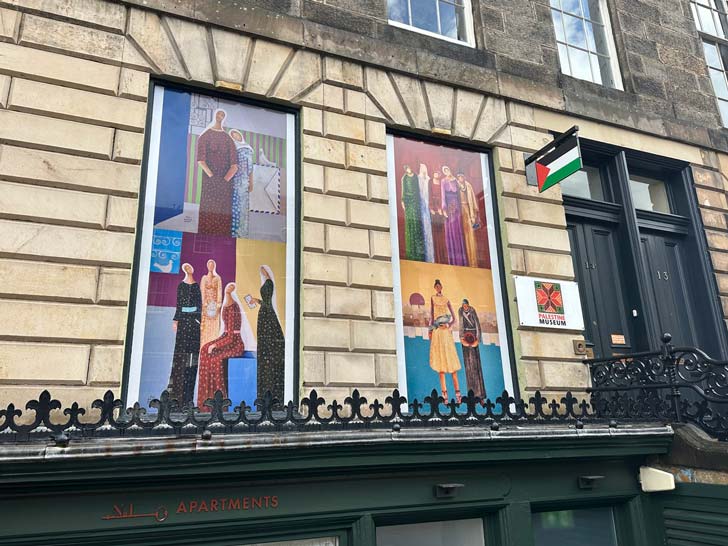
Now, he has expanded the reach of his efforts in a new museum branch located in Edinburgh, Scotland. This gallery focuses specifically on contemporary art by Palestinians and is the first of its kind to debut in Europe.
Home to paintings, sculptures, and installations by Palestinians, Saleh said it aims to counteract the “dehumanization” of his people by giving their culture and narrative a place to shine.
“We want people to see our artwork and to see that Palestinians are human,” he told Herald Scotland. “All these efforts to dehumanize and to erase the Palestinians are not working, and we are hereby opening a museum that is full of beautiful artwork.”

The Edinburgh location opened on Nakba Day of this year, the anniversary of the mass displacement of Palestinians from their homeland in 1948. Saleh’s parents lost everything in the Nakba and gave birth to him just three years later. He grew up in the West Bank and emigrated to the United States with his family in 1969.
He hopes both branches of the museum can offer a glimpse into Palestinian history and provide some comfort for people like him.
“Whether they're under occupation or in the diaspora, I think coming to the Palestine Museum goes a long way in giving people moments during which they can feel at home,” he said in a video.
“They can feel that they are in Palestine, even though it’s just a feeling, it gives them a feeling of comfort.”
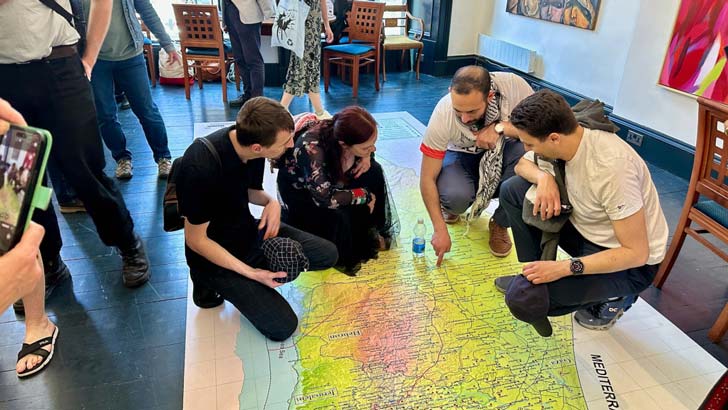
The Edinburgh museum features pieces from local artists and Palestinian immigrants, as well as art directly from the frontlines of the occupied Gaza Strip.
“We have children’s drawings from Gaza that are being exhibited,” Saleh told Herald Scotland. “We also have some installations representing the forced evacuations. We have a keffiyeh bundle. It’s a bundle of memories that represents what Palestinians leave when they get kicked out of their homes.”
The museum will also exhibit work by local artists in Edinburgh, including a bronze bust sculpture of Dr. Hussam Abu Safiya, who has been detained by the Israeli military since December 2024. Another Edinburgh artist will exhibit three smaller sculptures that depict Palestinians mourning their dead children.
“These pieces don’t focus on violence. That’s not what we’re here to show,” Saleh told The New Arab. “These pieces speak to what Palestinians carry — grief, loss, but also hope, life, and resilience.”
Although many of the pieces in the new museum spark big emotions, Saleh has created something he has seen act as a stand-in homeland for his people.
“By opening this museum, we assert our presence and history, despite all efforts to silence us,” he told The New Arab.
“It’s not just about art — it’s about showing the world who we are.”
Header image courtesy of Palestine Museum Scotland
A new study from researchers at Swansea University, Wales, revealed a surprising truth about the social behavior of baboons.
In the Cape Peninsula of South Africa, the research team studied 78 distinct travel movements of a group of wild chacma baboons (Papio ursinus).
In their 36-day trial, clear patterns emerged in the ways the baboons arranged themselves while walking.
When it came to explaining the baboon’s self-ordered movements, the team tested several theories that were consistent with other species.
First, they hypothesized that the baboons were walking in a formation that protected the youngest and most vulnerable among them, the same way that elephants often do.
Secondly, they studied whether they were arranging themselves strategically to better compete for resources.
Lastly, the researchers questioned if they were ordering themselves based on the influence of a group leader.
But the prevailing theory — and ultimate conclusion of the study — found that baboons simply preferred to walk beside their closest friends.
“We find no evidence that progression orders are adaptive responses to minimize an individuals’ risk, maximize their resource acquisition, or are the result of decision-makers leading the group,” Marco Fele, the study's lead author, wrote in Behavioral Ecology.
“Instead, we find that individuals’ positions are predicted by pairwise affiliations, resulting in consistency in order, with more dominant individuals occupying central positions in progressions.”
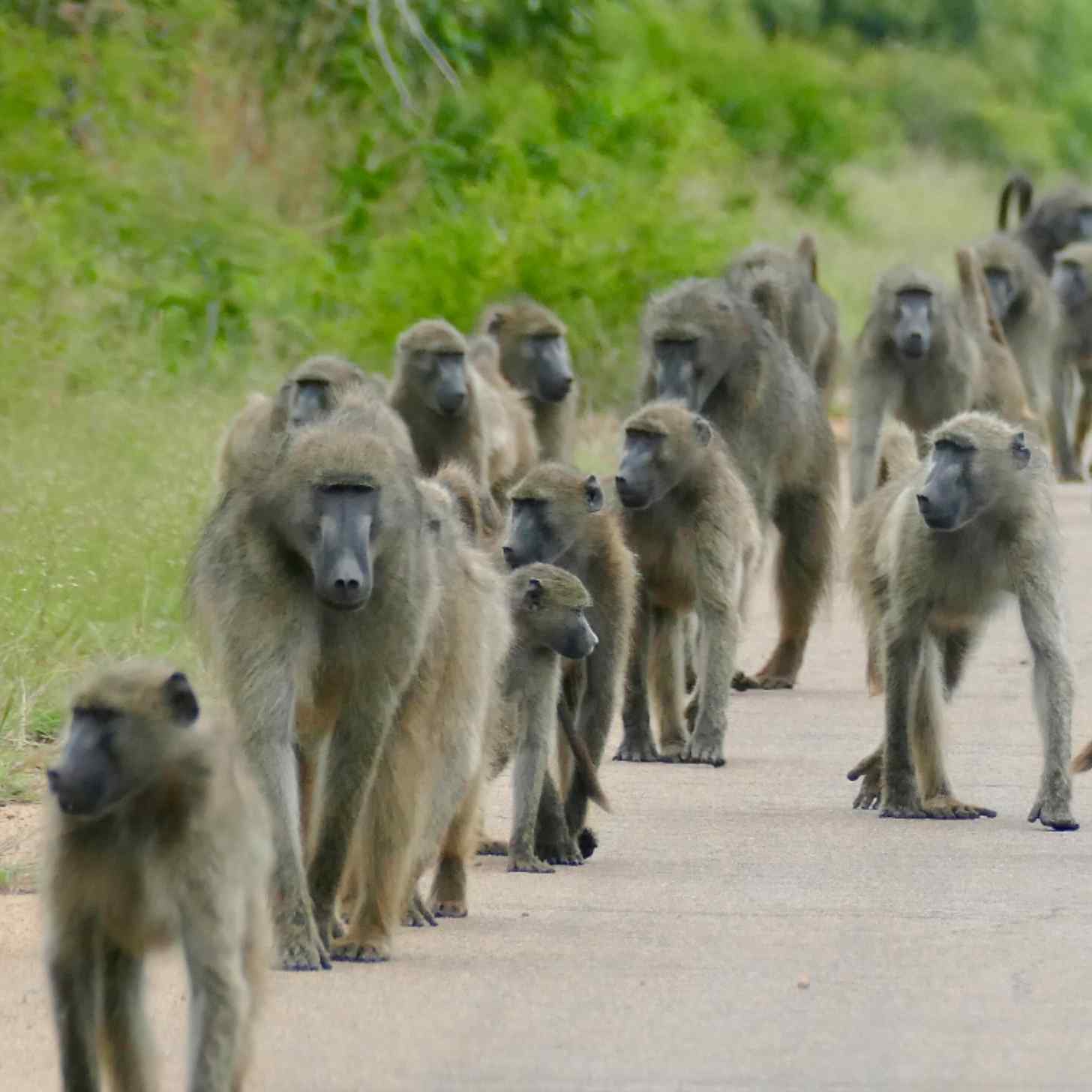
“Surprisingly, the consistent order we see for the baboons we studied isn't about avoiding danger like we see in prey animals when they position themselves in the middle of their social group,” Dr. Andrew King, associate professor and study co-author, told Swansea University, “or for better access to food or water like we see in the movements of plains zebra.”
“Instead,” King explained, “it's driven by who they're socially bonded with. They simply move with their friends, and this produces a consistent order.”
King also noted that the baboons at the head of the “troop” aren’t inherently “leaders.”
“In the baboon group we studied, the more socially connected, higher-ranking individuals usually walk in the middle of the group, while lower-ranking baboons are often out in front or at the rear,” King said.
“During these group movements — like heading to a familiar sleeping spot — it's likely that the group already knows where they're going. So, the baboons at the front aren't really leading; they're just out ahead.”
Although baboons are not listed as endangered, they have faced mounting threats from human interference and habitat loss.
Studies like these provide greater insight into baboons and how they use cooperation and social bonding to overcome emerging challenges of habitat degradation and climate change.
“The key to the success of baboons is living in a troop,” a Love Nature narrator said in the 2024 documentary “Baboons: Rules of the Troop.”
“The bond shared by [a baboon and] his family is the fabric of every baboon society and the secret to their success over millions of years as they continue to adapt to new challenges, living each moment by the rules of the troop.”
Header image via Diego Delso / Wikimedia Commons (CC BY-SA) and Bernard DUPONT / Wikimedia Commons (CC BY-SA 2.0)
If you have a TikTok or Instagram account, you’ve likely stumbled on at least one installment of “Track Star,” Jack Coyne’s person-on-the-street-style interview shorts.
In these clips, Coyne tests the music knowledge of everyday people and musicians themselves in a quick “double-or-nothing” game. They are given a curated playlist and must identify the artist behind the song they’re listening to, and the more they get correct, the more money they earn.
Lucy Dacus, Kevin Bacon, Bon Iver’s Justin Vernon, and the Haim sisters have all been guests. But Coyne’s latest interviewee has officially stolen the show.
“Before we get to the music, can you just introduce yourself?” Coyne says into a microphone, on a set that doesn’t look so different from the other streets he frequents.
“Oh yes,” his guest says. “Elmo is Elmo.”

The red Muppet dons adorable yellow headphones and participates in a bit of banter with Coyne before locking in for his own “Track Star” game.
Coyne asks if Elmo thinks it’s important for kids to learn about music.
“Well, Elmo loves music,” the Sesame star replies earnestly. “It makes Elmo happy. Sometimes music can make you sad, or happy, or make you think about things you didn’t think about before. When Elmo wakes up in the morning, Elmo likes to listen to jazz.”
With that in mind, Coyne tosses Elmo a low-ball song selection to begin, with $5 on the line. In the background, viewers hear Stevie Wonder’s “Superstition.”
Within seconds, Elmo nods his head and starts singing along.
“Stevie Wonder!” he exclaims. “That’s Elmo’s boy, Stevie! Who doesn’t love Stevie Wonder?”
What follows is a playlist, delicately balanced with Sesame Street tunes like “Elmo’s Song,” and “C is for Cookie,” along with favorites from past Sesame guests, like Feist, Norah Jones, and Billy Joel.
And Elmo gets them all right, song after song. And he’s competitive about it, too.
“How much money? How much money?” he asks in between rounds.
As the total gets higher, he is delighted. “Elmo can’t even count to 40!”
But another standout moment happens when Elmo gets swept away in the music, singing along to Billie Eilish’s “Happier Than Ever.”
He tilts his head back to croon, his vibrato audible over the pop star’s track, and then reminisces about when she visited Sesame Street herself.
“She was right here,” Elmo said, pointing to the famous stoop. “It was amazing.”
Coyne mentions he’d love for Eilish to visit “Track Star,” too, and Elmo takes it upon himself to extend an invitation.
“Aye, Billie, yo Billie, do the show,” he says direct-to-camera. “He’s a nice guy, and you can win $80.”
In the end, Elmo racks in a total of $640.
Incredulously, he says: “That can’t be right.”
But it is. And it leads Coyne to pose a question to the enthusiastic Muppet.
“What if, instead of giving you the cash, we give the cash to Sesame Workshop, and we teach more kids about music, and letters, and learning?”
“Okay, sure,” Elmo agrees. “Elmo would have no idea what to do with $640.”
On screen, a receipt for a donation shows the proof of “Track Star’s” donation, and in the video’s caption, Coyne shares a heartfelt note of gratitude.
“Having Elmo on Track Star was easily the highlight of my year. Elmo has been an idol of mine since I was a toddler, and we had so much fun talking about music and artists who have visited Sesame Street over the years,” he writes.
“It was so surreal to be on the neighborhood set and meet characters that I’ve loved for as long as I can remember. Huge thanks to the wonderful team at Sesame Workshop for making this happen.”
Although $640 is a big deal to Elmo, Sesame Workshop relies on a lot more funding from its viewers and private supporters to maintain its legacy of over 50 years of children’s media and outreach around the world.
On its website, the nonprofit shares: “With a mission to help children everywhere grow smarter, stronger, and kinder, we reach families in more than 150 countries with playful early learning so we can empower each generation to build a better world.”
Header image courtesy of Track Star/YouTube
Dan Mancina has been a skateboarder since the age of seven, but when he was 13, he was diagnosed with rhinitis pigmentosa, a degenerative eye disease that rendered him almost completely blind by 22.
He hit pause on his skateboarding for a couple of years in his early 20s, but decided to pick it back up again, now using a white cane to shred more confidently.
Now almost 38, he’s a professional skateboarder, relearning tricks, and even completing the course at the Paris 2024 Olympic Games.

Although he’s learned to find his way with tactile markers like cracks in the asphalt and pre-mapped courses, he wants a better experience for fellow visually impaired skaters.
About seven years ago, he started dreaming of creating the world’s first adaptive skatepark right in his hometown of Detroit, Michigan.
Finally, the park is a reality.
Called “The Ranch,” the 5,000-square-foot skatepark is completely accessible, allowing both seasoned low-vision boarders to take it for a spin and newcomers to the sport to feel welcome.
“I think of it as giving them the opportunity to try it out,” Mancina told Olympics.com earlier this year. “Traditionally, there’s not as many opportunities for sports for the blind, so really it's just giving that as an option. Not everybody wants to skate, but everyone should have at least the opportunity to try it.”

In a recent video, blind content creator Anthony S. Ferraro, who reviews and documents his experiences in accessible environments to an audience of over 1.4 million on TikTok, showed off the park’s features.
“I’m blind and this is the world’s first-ever adaptive skatepark,” he exclaims, jumping off a fixture at the park.
“Built for the blind, by the blind,” Mancino chimes in.
Ferraro shows off a 40-foot-long flat bar that is surrounded with plenty of room to set up, so skaters can feel their way through the course, with a ledge to match, for hands or canes to find stability.
“When you can’t see, it’s hard to go in a straight line sometimes, so this gives you plenty of room so you know you can go left or right,” he says, pointing to a quarter pipe that is longer and wider than what someone might find in a traditional skatepark.
@asfvision World’s first ever adaptive skatepark “The Ranch” built for the blind by the blind aka @Dan Mancina ♬ original sound - Anthony S. Ferraro
Other features include rollers, bank ramps, and ledges, with manual pads and platforms, all designed to be easier to navigate for people with vision impairments or in wheelchairs.
“It's just the size of everything,” Mancina explained to Olympics.com. “The quarter pipe, it's 45 feet wide. Your average quarter pipe in a skatepark may be eight feet wide. The ledge – your average skatepark ledge is eight, maybe 10 feet. My ledge is 40 feet long. Same with the flat bar.”
“It just gives you more time to figure out where you are, line yourself up,” he added. “Not being able to see something, you got to feel it and figure out where you're at. You might veer a little bit, but you have a lot of room for error.”
That’s exactly what Ferraro illustrates on his board, accompanied by his cane, pointing out minute details that he especially appreciates as a disabled skateboarder.
“Even this crack lines you up perfectly with the manny pad,” he says in his video, pointing to an obstacle that’s used to practice and improve manual, or wheelie, tricks.
Ledges are also strategically placed to use as a guide when performing tricks, which Ferraro demonstrated in a video, skating with ease. All of the skatepark’s features are set up to be a guide for one another, allowing skaters to creatively use the environment to move from one obstacle to the next.

Auditory cues are also placed throughout the park in the form of beepers, which warn a skater about a dangerous drop or guide them to a particular obstacle. Mancina also said he’s been experimenting with adhesive tile and bricks that skaters can feel as they roll over, designating certain areas of the course.
“Also if you have some vision, the features have great contrast, so you can see them easily,” Ferraro adds.
Obstacles at The Ranch are dark green to set them apart from gray cement, and colored duct tape also helps provide guidance.
“I'm definitely not creating any new obstacles,” Mancina told Olympics.com. “It's just the things that I enjoy skating and then adapting that to make it easier to skate as a blind person or in a wheelchair … That's the big thing — adapting things that I like to skate to make them more skateable.”
Next up, he plans to host workshops and camps for other visually impaired skaters who want to learn how to skate with a white cane.

“Dan plans to host monthly skate workshops and skateboard lessons for local youth and adults who are blind and visually-impaired, annual adaptive contests to help push for skateboarding the Paralympics, as well as us[ing] park adaptations to influence future public skateparks,” Mancina’s website shares.
While he plans his programming, Mancina said the park is open to anyone who wants to visit. It’s privately managed, but he said any disabled skaters can reach out to skate it, just like his good friend Ferraro.
“It’s been so inspiring to watch this come to reality. I’ve never had a place where I can skate with full confidence, not to mention a great environment to learn new stuff from Dan,” Ferraro ends his video.
“Thanks for building this park, Dan, [you’re] a true pioneer.”
Header image courtesy of Keep Pushing Inc/Crowd Digital Marketing
When Texan high schoolers Samuel Skotnikov, Changyoung Kim, and Eeshaan Prashanth found out that their friend Aiden’s prosthetic leg was uncomfortable and difficult to use, they decided to make him a better one.
And what they created has gone on to both improve Aiden’s life and win them over $50,000 in scholarships.
The team, made of 16- and 17-year-olds, started simple, measuring Aiden’s walking motion with his usual prosthetic leg.
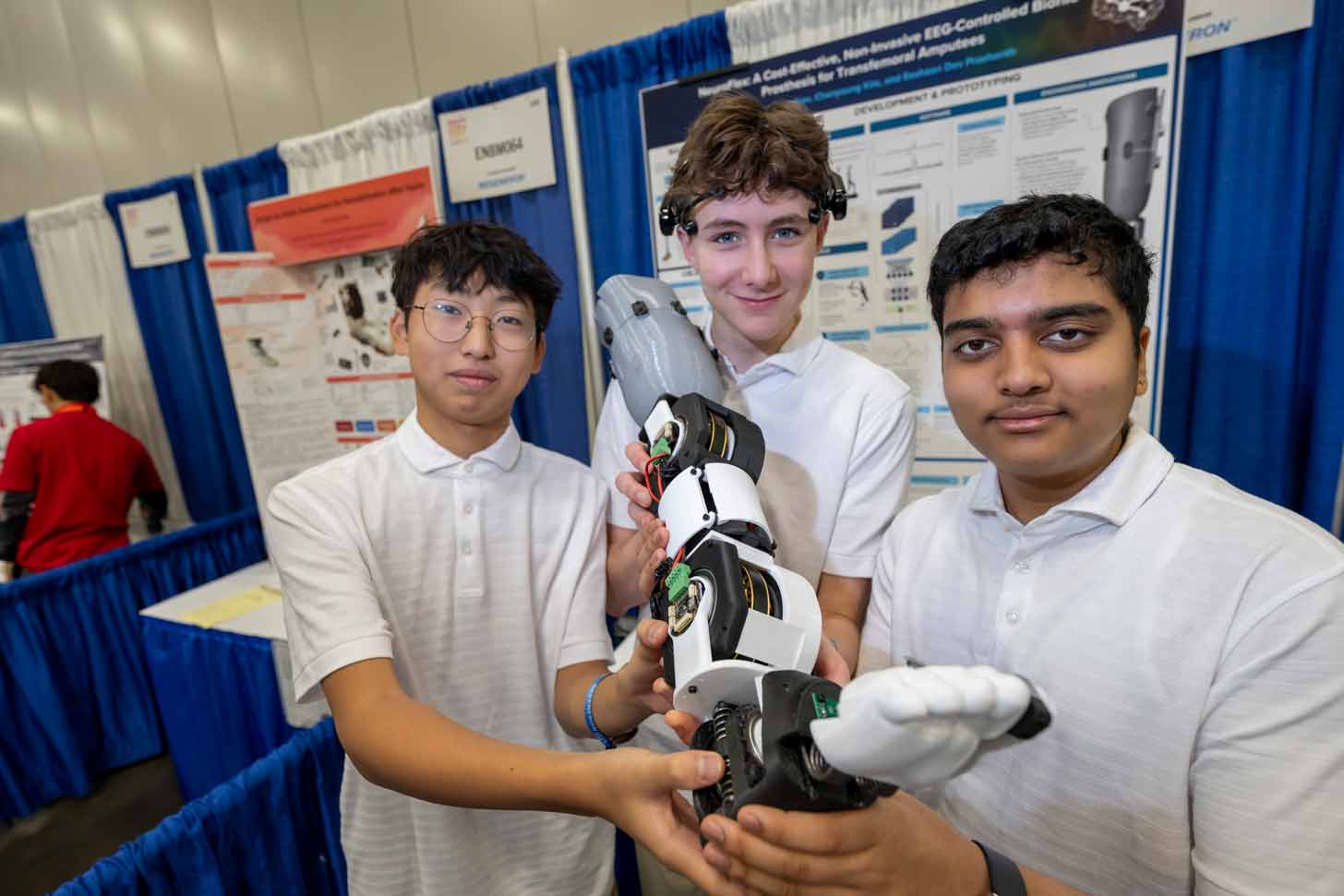
They noticed that the prosthetic’s stiffness required the remaining part of Aiden’s leg to work much harder than his other leg, and they wanted to ease the burden.
“It started around helping our friend. He shared with us his struggle and how his current prosthetic was not really helping him out,” Skotnikov said. “That made us dive into the research of prosthetics with the whole goal of creating something better for him.”
They designed their version of a prosthetic leg, NeuroFlex, to be powered by Aiden’s brain, not his limbs.
It works by translating the wearer’s brain signals through an EEG (electroencephalography) headband. The signals tell NeuroFlex how the wearer wants to move, and the prosthetic uses its motors to support that movement.
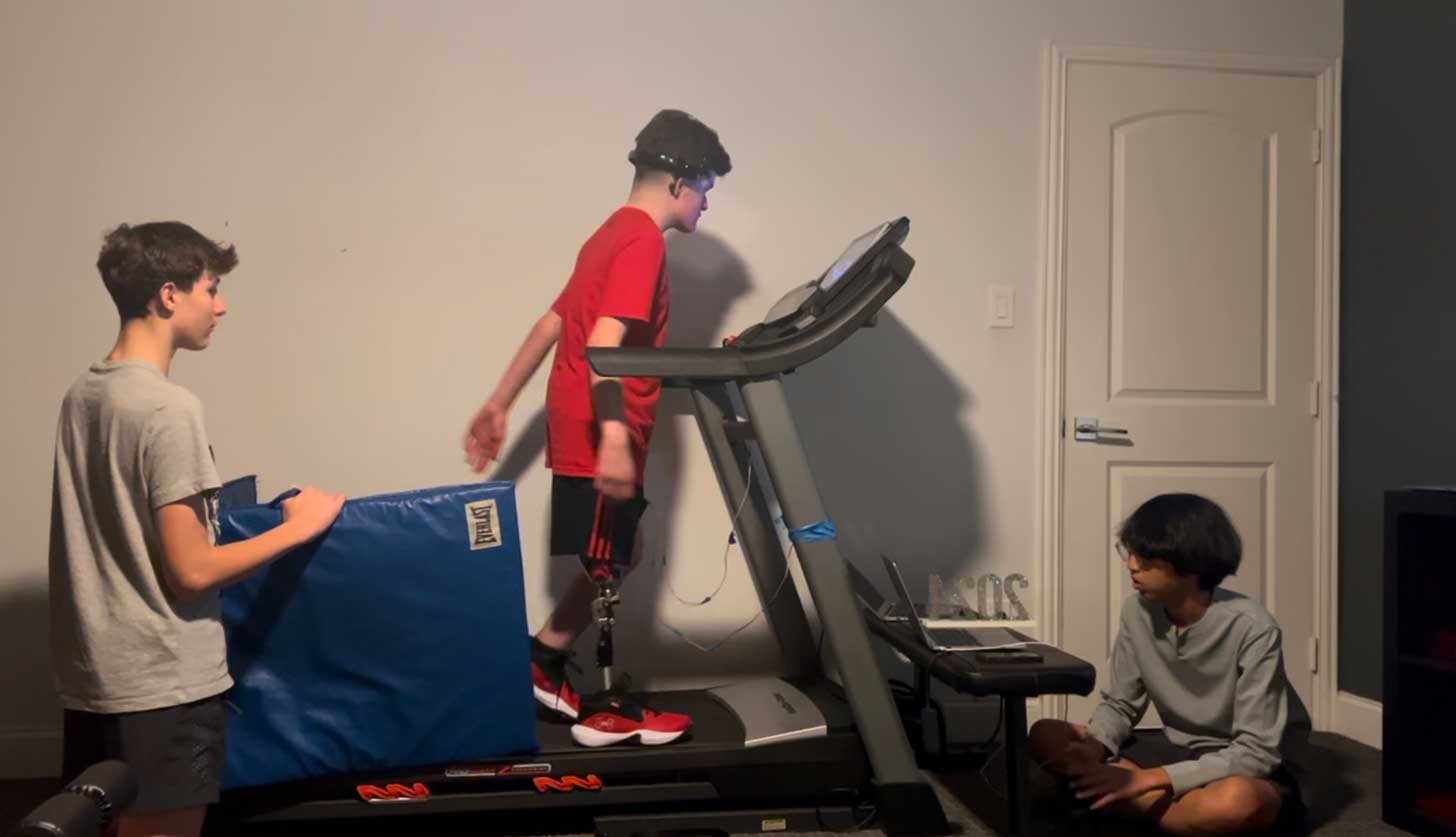
“First, EEG signals are filtered, reducing interference. Next, IMUs [Inertial Measurement Units] detect gait cycle changes, improving adaptation,” the teen scientists wrote about their invention.
“A hybrid machine learning model extracts movement features through a spike-frequency method, classifying user intent with 98.67% accuracy. Finally, an active loop continuously refines movements, reducing energy expenditure by 35% compared to conventional prostheses.”
That means their design successfully anticipates Aiden’s movement 98% of the time.
The teens also designed an ankle with more realistic joints, which “enhance natural movement” by using motors for precise joint control.
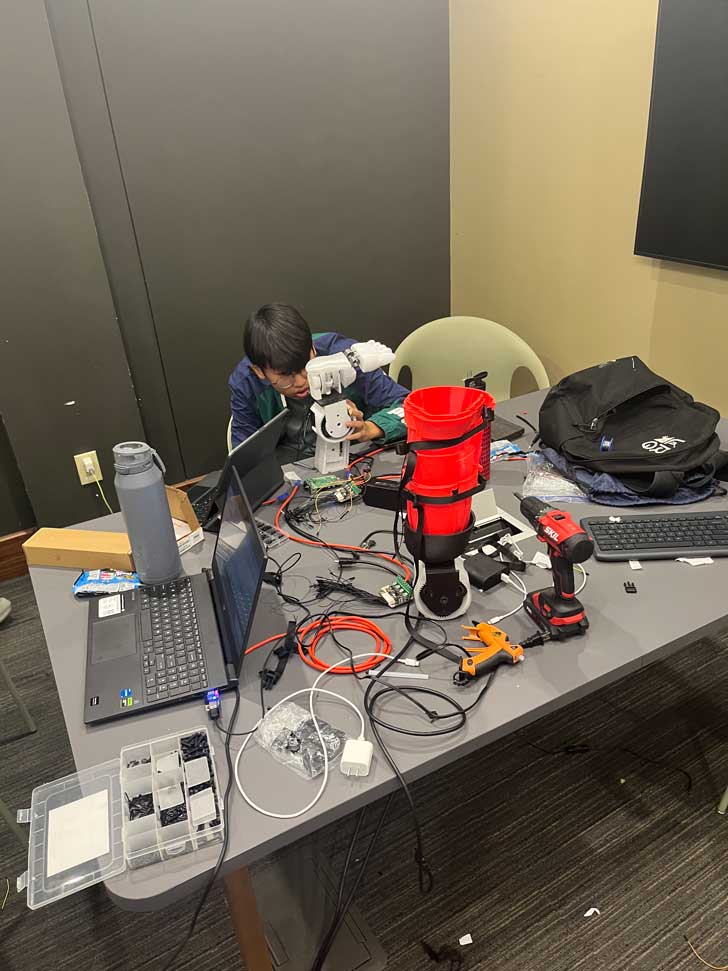
The best part is that the NeuroFlex is much more cost-effective compared to other bionic prosthetics on the market.
“Current lower limb prostheses rely on cumbersome procedures, need risky surgery, and are prohibitively expensive. As a result, many lower-limb amputees experience unnatural gait patterns and excessive energy expenditure, leading to discomfort and long-term health complications,” the teens wrote.
Their invention costs about $1,000 to make and operate, compared to the approximate cost of $100,000 for traditional bionic prosthetics.
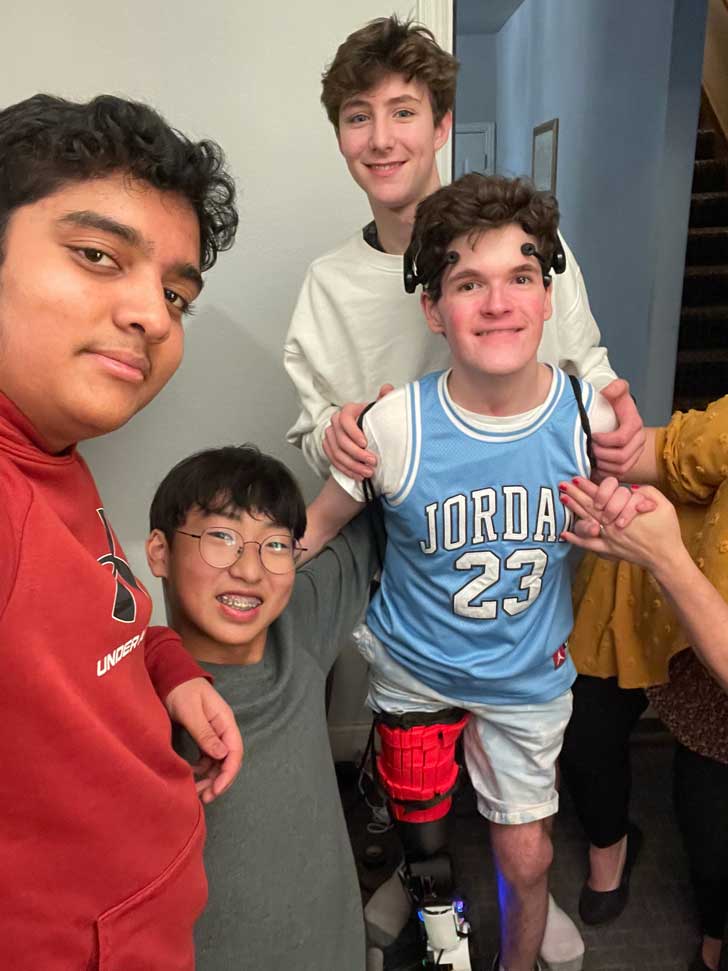
“NeuroFlex combines high-accuracy subconscious control, adaptive gait mechanics … offering a practical and affordable solution for the lower limb prosthetics market.”
Skotnikov, Kim, and Prashanth presented their findings at the 75th Regeneron International Science and Engineering Fair by Society for Science in Columbus, Ohio.
Their invention earned them the $50,000 third-place prize in the Gordon E. Moore Award for Positive Outcomes for Future Generations category. The team also received first place in a Biomedical Engineering category of the contest and was awarded an additional $6,000.
The fair hosted more than 1,600 students from over 60 countries, making this achievement that much more exciting.

“I’m at a loss for words right now,” Skotnikov said after winning the award. “We really just want to take our project and help a lot more people than just our friend Aiden.”
“We want to spread the technology and help other people as well,” Prashanth added.
“Just do what you’re passionate about,” Skotnikov concluded. “Don’t do it just for the science fair; do it for someone that you actually, genuinely want to help.”
Header image courtesy of Society for Science
For book lovers of all kinds, the reading world presents many debates: Are audiobooks real books? Is it ethical to buy my books secondhand? Does ditching Amazon actually harm indie authors who rely on sales?
The choice to shop anywhere — from a big box retailer, or from a myriad of Amazon alternatives — is a personal choice, colored by plenty of external factors.
But two bibliophiles in the United Kingdom — Gemma Lovett and Sara Montgomery — have added one more option to the mix.
The pair has just debuted their new online bookshop: BookKind.

Like any online book retailer, it has thousands upon thousands of titles. But it also presents one distinct offering: A 10% portion of all sales will benefit eight charities that support causes like health, literacy, environment, racial justice, humanitarian aid, and more.
Right now, nonprofit partners include:
- Maggie’s, a cancer support organization
- Mental Health Foundation, which funds mental health research and treatments
- Dementia UK, which provides nurses, specialists, and support to families navigating memory loss
- Read For Good, a group that donates books to young people in need
- The Runnymede Trust, a legacy racial justice organization with 50 years of advocacy work
- Surfers Against Sewage, a group that cleans the oceans through community cleanups and anti-pollution advocacy
- War Child UK, a global nonprofit that advocates for and helps children in war zones
- Great Ormond Street Hospital Charity, which improves the quality of life for children with rare and complex illnesses
The selection process for onboarding these charities was personal, with Montgomery bringing in her own lived experiences with familial loss to dementia and cancer.
Their give-back efforts will also include an “Acts of BookKindness” initiative in which they donate books to schools and hospitals. The pair has already committed to giving 500 books to a local school.
“We really want to feel like people are engaging with this at all levels, both from customers, but also within the industry,” Montgomery told The Bookseller.
“It would be amazing if [marketing and publicity teams] would like to tie their campaigns to BookKind in a really meaningful way,” Lovett added.
This strategic thinking makes sense, seeing as both Lovett and Montgomery are executives at Monwell, a company that manages e-commerce bookstores for media brands in the U.K., and now, BookKind.

Their backgrounds led to the realization that they wanted to combine bookselling with social impact, jumping on when they “saw an opportunity to really align the everyday act of book buying with supporting causes that matter.”
Their model is similar to Bookshop.org, an online bookseller that donates a portion of all its sales to independent bookshops of the shoppers’ choice. When BookKind shoppers add titles to their cart, they are told how much of their total will go to one of the nonprofit partners, and they can opt in or out of a specific cause.
“Having successfully launched bookshops for big media brands such as the Guardian and the Times, we wanted to do something on our own – and to give back,” Montgomery told The Guardian.
She added that the company plans to “grow BookKind into one of the U.K.’s leading book retailers while making a meaningful impact by supporting charities that help the most vulnerable people in society and address critical global challenges.”
While based in the U.K., the outlet does ship to other countries, including the United States. For book shoppers who remain with retailers like Amazon for the cost and shipping benefits, BookKind leaders say they’ll have to consider what’s most important to them.
“You could probably buy your books from cheaper places, but we keep our prices aligned with the recommended retail price so that as much money as possible goes to charity,” a spokesperson from BookKind told The Guardian.
Still, U.K. shoppers can benefit from “fast deliveries” and free postage on orders over £25.

BookKind offers over 200,000 titles and can sort them “by cause” on the website, including books about mental health, LGBTQ+ books, books about the environment, children’s books featuring disabilities, and many others.
The brand’s motto, to “read generously,” carries multiple meanings.
“It’s both, read a lot, read as much as you can, buy books, read books, share books, talk about books, read books to children,” Montgomery told The Bookseller.
“But then it also has the double meaning of — you can buy books and do good.”
Lovett chimed in, adding that it also means “feeling good about where you’re book shopping.”
As for the charity partners, they’re eager to collaborate with empathetic readers looking to make a difference with their new reads.
“With representation comes inspiration, and so we’re proud to support BookKind’s ambition to broaden people’s literary collections to include more books by authors of colour and from a range of different backgrounds and perspectives,” said Ellie Ikiebe of Runnymede Trust.
“This is how we can build empathy and a sense of belonging and understanding in an increasingly fractured society.”
You may also like: 88 quotes that prove books and reading can change your life and the world
Header image by RDNE Stock Project/Pexels