While many know Miami, Florida for its bustling nightlife and vibrant displays of art and culture, its beaches are also home to a similarly colorful ecosystem under the sea.
Just a couple hundred feet offshore, Miami Beach is the keeper of the Great Florida Reef, the third-largest coral reef in the world and the only living coral barrier reef in the continental United States.
It’s also one that is in desperate need of protection.
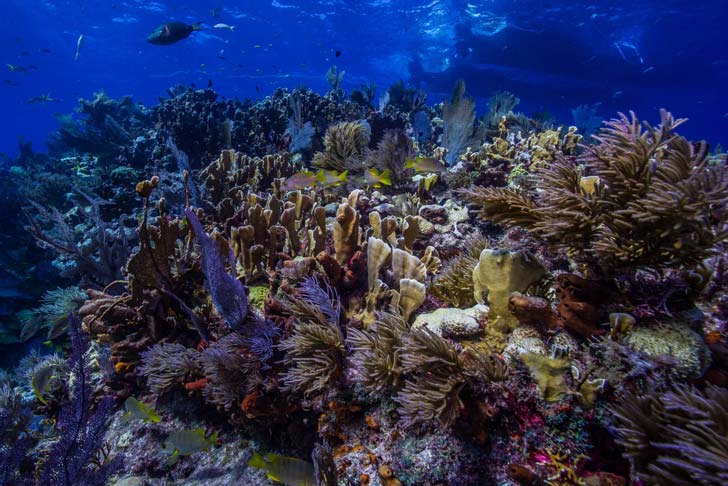
Like its global counterparts, the Great Florida Reef has been in sharp decline since the 1980s. Facing threats like bleaching due to elevated water temperatures, sea-level rise, and the spread of disease, both coral and the other organisms that thrive in the reef are at risk of extinction.
But experts are experimenting with a theory: Maybe art can save it.
With construction starting this year, the Great Florida Reef will soon feature a 7-mile public art installation: The Reefline.
Both a sculpture park and a snorkeling trail, the development will also serve as an artificial reef to offer shelter to fish, which will, in turn, help corals thrive.
“How do we turn doomsday into optimism?” Reefline founder and artistic director Ximena Caminos asked NBC News.
“Mother Nature is the ultimate artist,” she added. “What we’re doing is giving nature and amplifying that marine habitat, because it’s needed.”
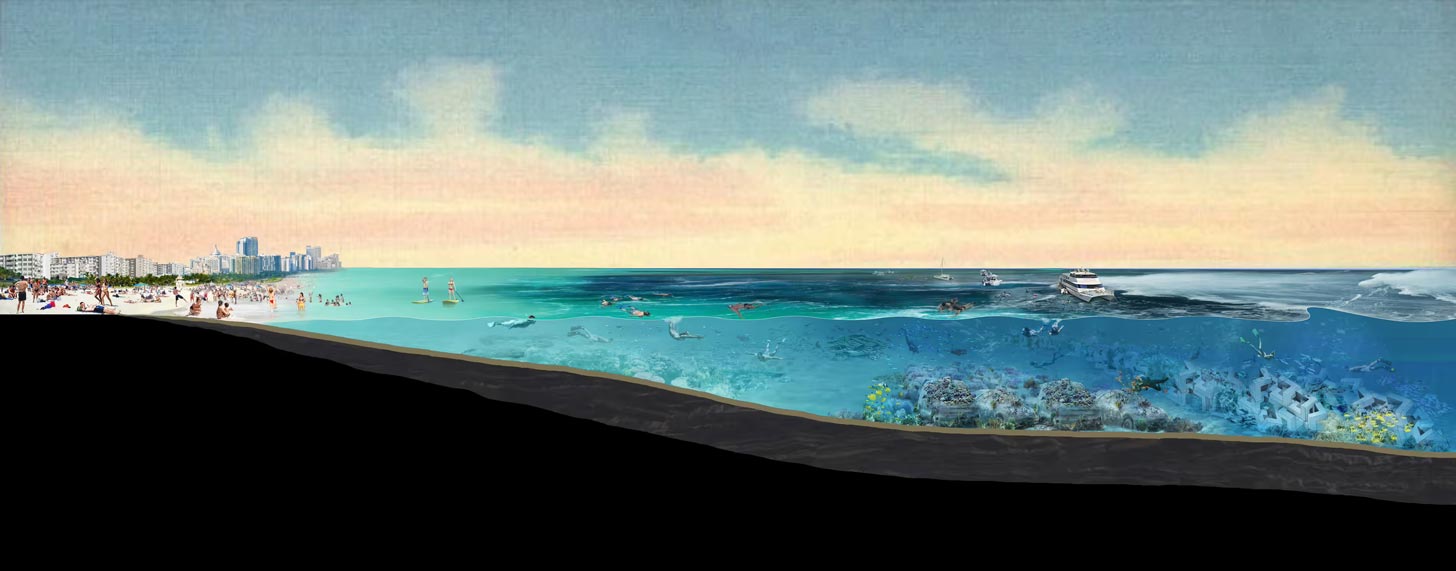
Artificial reefs aren’t a new approach, but this combination of science, artistry, and tourism on Miami Beach is.
Colin Foord, Reefline’s coral expert, said that the design of the sculptures included in the underwater park will rescue dislodged, climate-resilient corals and plant clones on the project’s hybrid reef.
“We are accelerating the development of a fully healthy coral reef by decades by putting out small pieces of coral that we are growing here in the lab,” Foord told NBC News.

New marine communities will also help prevent beachfront erosion.
And inviting snorkelers to strap on their flippers will help them appreciate — and consequently, protect — the magnificent mileage under the sea.
“When you put the mask on and you get into the water, it’s like time slows down,” Foord added.
“I think that if more people have that type of opportunity, then that helps change public perception about the need to protect the environment.”
The park will be located 600 feet offshore and will run north along the coastline of the beach for seven miles. Partially funded by a $5 million bond approved by Miami voters in 2022, Reefline will open in phases over several years. Phase I is being implemented right now.
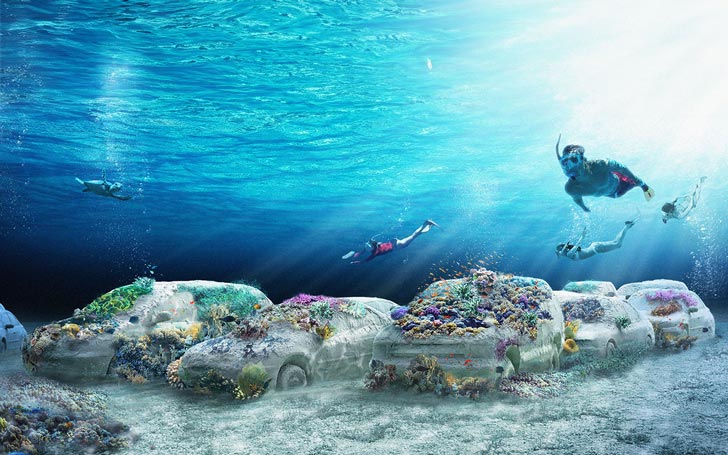
The first exhibition in Phase I is a piece by Leandro Erlich called “Concrete Coral.” A revised version of a sand installation portraying a 60+ car traffic jam displayed on the beach in 2019, this new piece includes 22 cars and trucks, congregating on the ocean floor as a representation of the impact of emissions on the planet.
It is also seeded with Coral Loks, devices that help plant baby corals into the artificial reef.
The second installation is called "Miami Reef Star," which will feature a massive 90-foot star that will be so large it can be visible from aircraft landing over the beach.

"Miami Reef Star" will be part of "Star Compass," a series of three large-scale pieces — one of which is a 100-piece life-size elephant sculpture — and will be composed of dozens of smaller stars, all of which will act as a hybrid coral reef.
The modules are being 3D printed using a material called CarbonXinc and will also contain Coral Lok. CarbonXinc is an eco-friendly concrete that pulls carbon out of the atmosphere, turning the Reef Star into a carbon sink, too.
“There’s a massive amount of engineering that went into this,” artist Carlos Betancourt, the creator of "Miami Reef Star," told The Guardian.
“We’re working with marine biologists, scientists from the University of Miami … we’ve learned intensely about this.”
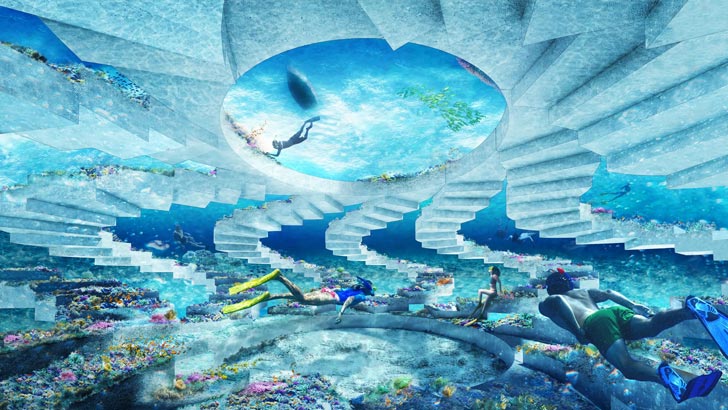
Other future phases will include a sculpture modeled after the heart of a blue whale, as well as a series of pieces that will come to form a “breakwater” that helps prevent coastal erosion.
And visitors can enjoy it all in what the city calls “an underwater art crawl.”
While no boat or bulky scuba gear is required, it might help to wear a mask and flippers, as visitors swim out from the shore to see and interact with the submerged sculptures.
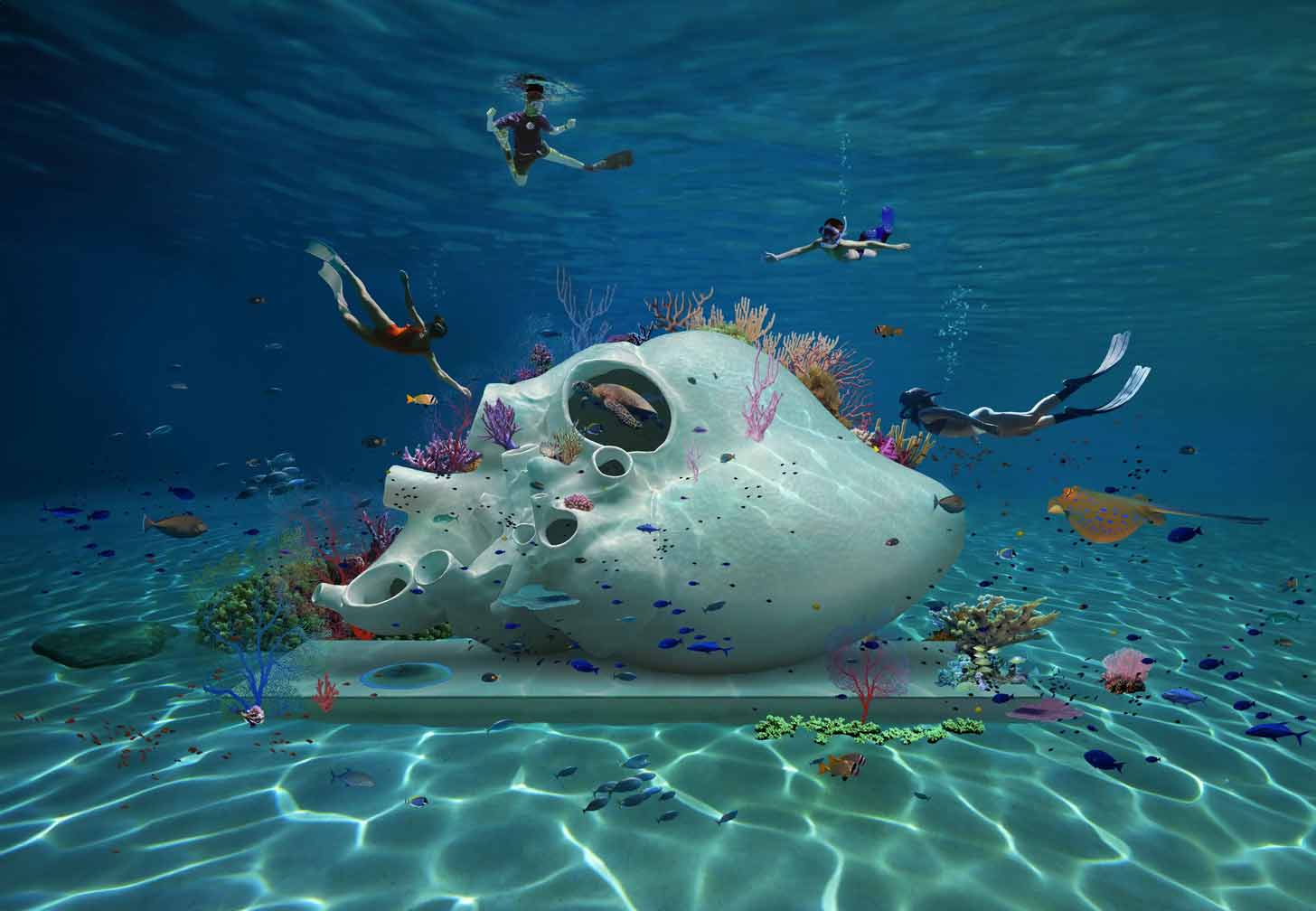
“Much of the artwork raises awareness of the delicate marine ecosystem and often presents a thought-provoking call to action for sustainability,” Greater Miami & Miami Beach shared in a statement.
“The Reefline not only offers a free and accessible way for the public to view art, but it presents the chance for snorkelers to experience Miami’s rich array of sea life, from colorful fish to sea turtles.”
While the project will take time to fully come to fruition, Caminos believes it could be a defining landmark of the future.
“[The Reefline] has the power to inspire people to act,” she told The Guardian. “The oceans are our heritage, and they are dying in silence because they don’t have a voice. They need someone to stand up for them. The world is at a very complex moment, and messages of hope are needed.”
Header image courtesy of Reefline
Once a raunchy dating podcast on Barstool Sports, Alex Cooper’s wildly successful “Call Her Daddy” has pivoted quite a bit since moving to Spotify.
The show now features guests like Vice President Kamala Harris, Simone Biles, Monica Lewinsky, and most recently, 91-year-old Dr. Jane Goodall.
The acclaimed environmentalist and primatologist sat down with Cooper for a nearly hour-long interview, where topics ran the gamut.

“This episode might be a little different than what you're used to on ‘Call Her Daddy’ every week,” Cooper started the podcast. “I know a lot of you come here to get to know some of the biggest celebrities on a more intimate level, and it obviously doesn't hurt when they spill some tea, but sometimes I think it's good to switch it up and step away from the conversations that we're having on social media constantly.”
“I wanted to sit down with someone who has spent their life truly connected to the real world,” Cooper continued. “And that is why this conversation with Jane is genuinely so special.”
Recorded a day before Goodall’s 91st birthday, Cooper gifted Goodall a bottle of whiskey, to which the environmentalist said, “I don’t much like water.”
After the birthday libations, Goodall told Cooper this conversation was part of a tour across the United States dedicated to “helping people understand that we’re going through very dark times” and bringing them together to “make the world a better place.”
Goodall has long been a force for positive change. Best known for her groundbreaking research on chimpanzees in Tanzania in 1960, Goodall spent decades protecting chimpanzees and their habitats.
In 1977, she founded the Jane Goodall Institute to help conserve chimpanzees and help young people take action for the natural environment and their own communities through her Roots & Shoots program.
Now in her later years, Goodall is reflecting on all the work she’s done, while imparting vital wisdom to the next generation to take good care of the planet and all who inhabit it. In fact, she told Cooper that she travels about 300 days a year to get her message out to the world.
“I do it because I have to,” Goodall said. “It probably sounds strange to you, but now being 90, I feel that I was put on this planet with a mission. Right now, we’re going through dark times, and the big problem is people are losing hope.”
Goodall went on to add that people will approach her and say they feel helpless with all of the problems going on in the world.
“I say, ‘Well you can’t solve the problems of the world, but what about where you live? Your community is there,” Goodall said. “You don’t like litter on the pavement, or you don’t like that they’re planning to dig up a little forest to put yet another super mall — go and do something about it.”
Cooper asked if she ever feels like it’s too much of a burden to carry.

“This mission keeps me going,” Goodall responded. ‘There's so much to do, and if we lose hope we're doomed. If you lose hope you become apathetic and do nothing.”
She emphasized, however, that she’s not alone, with the Jane Goodall Institute operational in 25 countries, and Roots & Shoots chapters in 75 countries, all inspiring young people to take on humanitarian and environmental work.
Goodall also spoke of her humble beginnings and how she has always felt a connection to nature. She told a story about how when she was just one and a half years old, her mother found her in her room, surrounded by a “whole handful of wriggly earthworms.”
Instead of getting angry, her mother told her, “Jane, you were looking so intently, I think maybe you were wondering how they walk without legs.”
Because her mother did not crush her curiosity, Goodall said, she was able to flourish into the scientist she is today.
“That was the making of a little scientist, asking questions, not getting the answer, deciding to find out for yourself, making a mistake, and not giving up,” she said.
And her early years required tenacity. Goodall said that she was just 5 years old when World War II began, and she pinched pennies to buy a secondhand book — “Tarzan of the Apes” — from a used bookstore when she was a little girl.
It was this experience that planted a seed: “I will grow up, go to Africa, live with wild animals, and write books,” she said.
Goodall’s mom continued to foster her curiosity and told her to take advantage of every opportunity to find her way.
“That’s the message I take around the world, particularly in disadvantaged communities,” Goodall said. “I wish mom was alive, and maybe she's listening, to the number of people who said ‘Jane, I want to thank you; you've taught me because you did it, I can do it too.”
You may also like: Jane Goodall shares TikTok 'hot take' for young voters: 'You do actually care about your future’
Goodall also spoke a bit more about her legacy and what it meant to be a woman at the helm of science back in the day. She said she was lucky because her field wasn’t “male-dominated,” because she essentially created the field. Very few people were out in the wild with her and the chimpanzees.

She did experience her own share of objectification, however, once she was printed on the cover of National Geographic, telling Cooper that she received many comments about her legs being the only reason she was being celebrated by the magazine.
But she took it in stride.
“Back then, all I wanted was to get back to the chimps so if my legs were getting me the money, thank you legs!” she laughed.
“And if you look at those covers, they were jolly nice legs.”
National Geographic did indeed help bankroll much of Goodall’s research, which is all she wanted to be doing.
“I could spend hours and hours alone in the rainforest learning more about the chimpanzees but also about this complex ecosystem where every plant and animal has a role to play, and they're all interdependent,” Goodall said.
“What I discovered was that if you're out in a beautiful place with someone you love … then it's human beings in a beautiful environment. But when I was alone there, I was just part of that world, not separated from it by being a human in that world.”
Cooper pointed out that many young people these days might not have that kind of spiritual connection with nature because of the ways technology has infiltrated the modern world.
Goodall agreed but added that she finds the most hope when working with young people and how they can creatively build the future.
“They choose a project to help people, a project to help animals, or a project to help the environment, and they share this with each other,” Goodall said of her Roots & Shoots program.
“Once they do, they roll up their sleeves, they work very hard because they chose the project, and they're making a difference. “They’re planting trees, they're picking up trash, they're raising money to help refugees, they're volunteering in soup kitchens or animal shelters.
“The main message of Roots & Shoots is for everybody, every day you live, you make an impact on the planet, and you have to choose what sort of impact you make.”
As she rounded out the interview, she kept coming back to the idea of forging one’s own path and empowering young people to have the confidence and resources they need to follow their dreams — just like she did.
“Young people are changing the world, and once they know the problems … then you empower them to take action in ways that they choose,” Goodall said.
“I go around visiting them and they're so full of enthusiasm. So we've got to create a world where their hope is viable.”
Goodall’s full “Call Her Daddy” interview can be seen below:
Header image courtesy of Call Her Daddy/YouTube
In 2022, a team of scientists set out on a deep-sea voyage on behalf of Australia’s leading science agency: the Commonwealth Scientific and Industrial Research Organisation.
As they explored 1,500 meters below sea level, the scientists estimated that they discovered over 1,000 undiscovered species in and around Carnarvon Canyon and Gascoyne Marine Parks in Western Australia.
Since their monthlong voyage back in 2022, the team of marine researchers and taxonomists has been hard at work cataloguing the many species they spotted lurking in the watery depths.
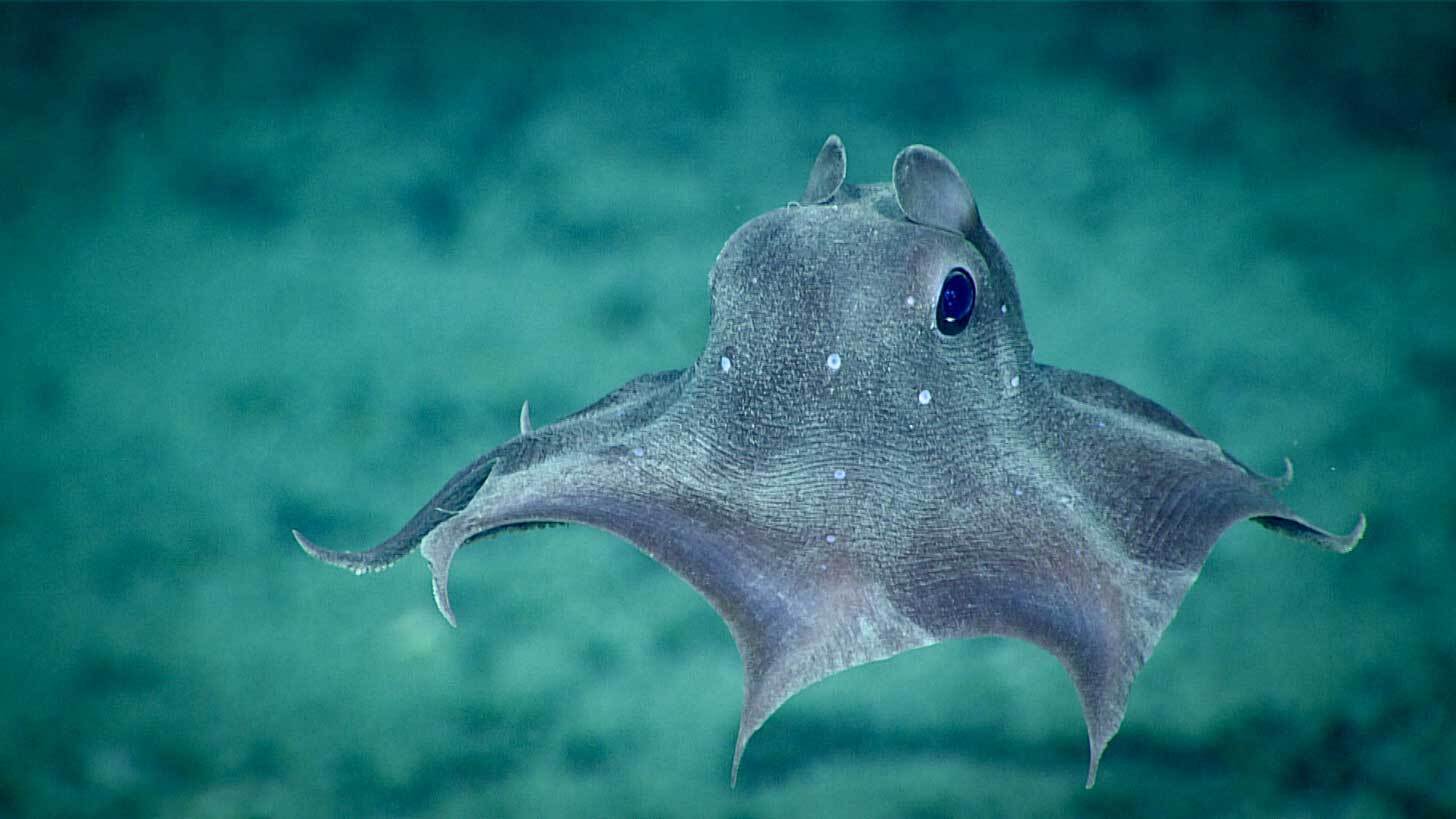
Among them is a “rare and unusual” new species of dumbo octopus: the Carnarvon flapjack octopus.
Dumbo octopuses live in the deepest reaches of the ocean, and are named after the famous Disney elephant due to their prominent ear-like fins.
The “flapjack” octopus is a subset of the dumbo family that is named after its incredible shapeshifting abilities, which allow it to balloon out “like a tiny gelatinous umbrella” and flatten its body like a pancake to evade predators.
The new species, which has blood-red tentacles and huge eyes, is also very small in size, only reaching four centimeters in diameter.
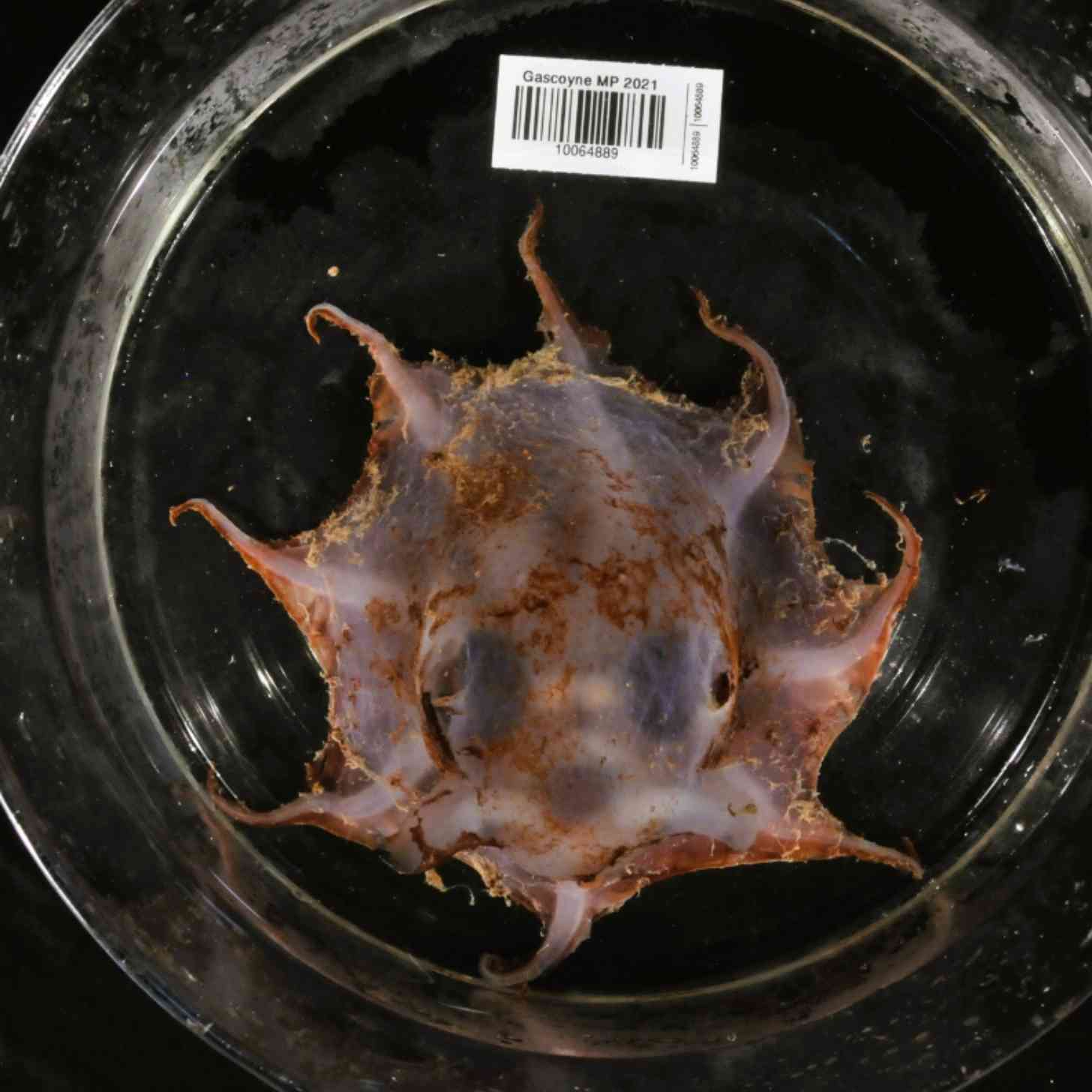
On May 12, Tristan Verhoeff, a doctor and volunteer systematic taxonomist at the Tasmanian Museum and Art Gallery, finally published his team’s discovery of the creature.
Verhoeff said that the Carnarvon flapjack octopus is unique to one specific region of northwestern Australia and that its presence adds “extra value to these recently established marine parks.”
“Australia has a higher biodiversity of dumbo octopus species compared to other countries but many of these species have only been recorded or described in the past few years,” Verhoeff explained in a press release.
“This species discovery increases our understanding of Australia’s deep-sea ecology and biodiversity,” he continued. “Describing new species is also essential for future work on their ecology, and assessing populations for conservation.”
Too little is currently known about flapjack octopuses, and other dumbo octopuses, to accurately estimate their population size. But on a global scale, octopuses of all kinds have been threatened by upticks in overfishing, habitat destruction, and pollution.
In addition to being highly intelligent, octopuses are hugely beneficial to their environment.
Like other species of octopus, the Carnarvon flapjack octopus feeds on small marine life like worms and crustaceans, which helps protect seagrass beds and coral reefs from overgrazing.
In turn, they also serve as food for key ocean predators like sharks, dolphins, and large fish.
Since their 2022 voyage, Verhoeff and his team have been carefully leafing through centuries of “comparative material” and “old literature” at local museums to ensure that their findings are as accurate as possible.
“Many of the new species I have described have been in museums and other collections for decades, awaiting someone to notice them,” Verhoeff said.
Lisa Kirkendale, head of the aquatic zoology department at the Western Australian Museum, told CSIRO that the discovery “illustrates how little we still know about the deep sea in this area.”
“The Indian Ocean is truly a frontier for marine biodiversity research and the WA Museum is the region’s institutional hub as we move forward to address this challenge,” she said.
“In Australia, we need to better support taxonomists, like Tristan, to continue to document fabulous new species, such as the Carnarvon flapjack octopus.”
Header image via CSIRO
Writer Isabel Klee is no stranger to the triumphs and challenges of fostering rescue dogs. As a dog-centric content creator who shares heartfelt stories and vlogs with her own dog, Simon, she has taken a combined 1 million+ followers on Instagram and TikTok along on her fostering journey, as well.
There have been standout stars in the past, but none have captured the attention of the internet quite like Tiki, her 23rd foster, and what she initially called “her most difficult foster yet.”
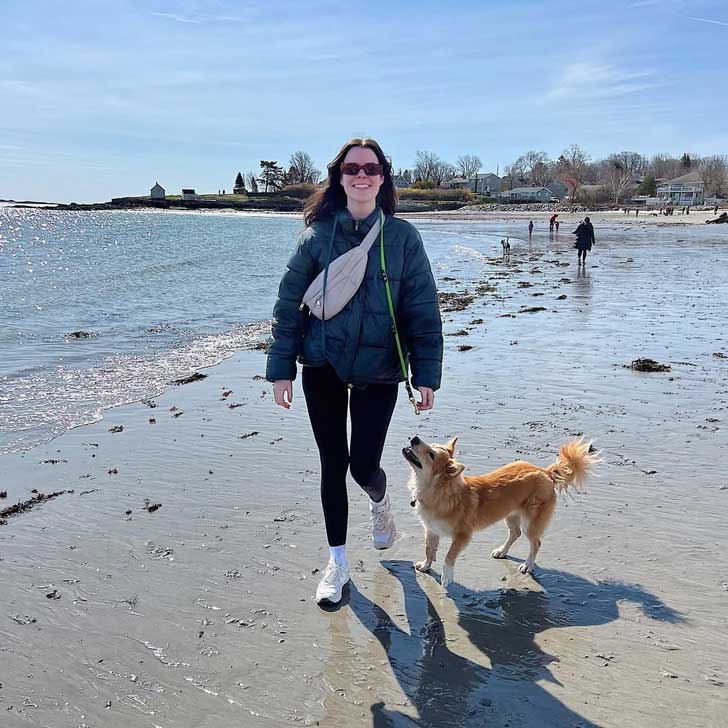
In April, Klee shared a video on social media, saying that she did not know what to expect with her new temporary friend.
“A group of dogs came into the ASPCA; They were not in the best shape,” Klee prefaced.
“For a little bit of context, the ASPCA deals with a lot of criminal cases, legal cases, complex community cases, in which the information about the previous owners and the dogs are extremely sensitive. For that reason, I am not going to share any of the backstory.”
Tiki was described by the ASPCA and nonprofit Muddy Paws Rescue as “by far the most shut down of the group.”
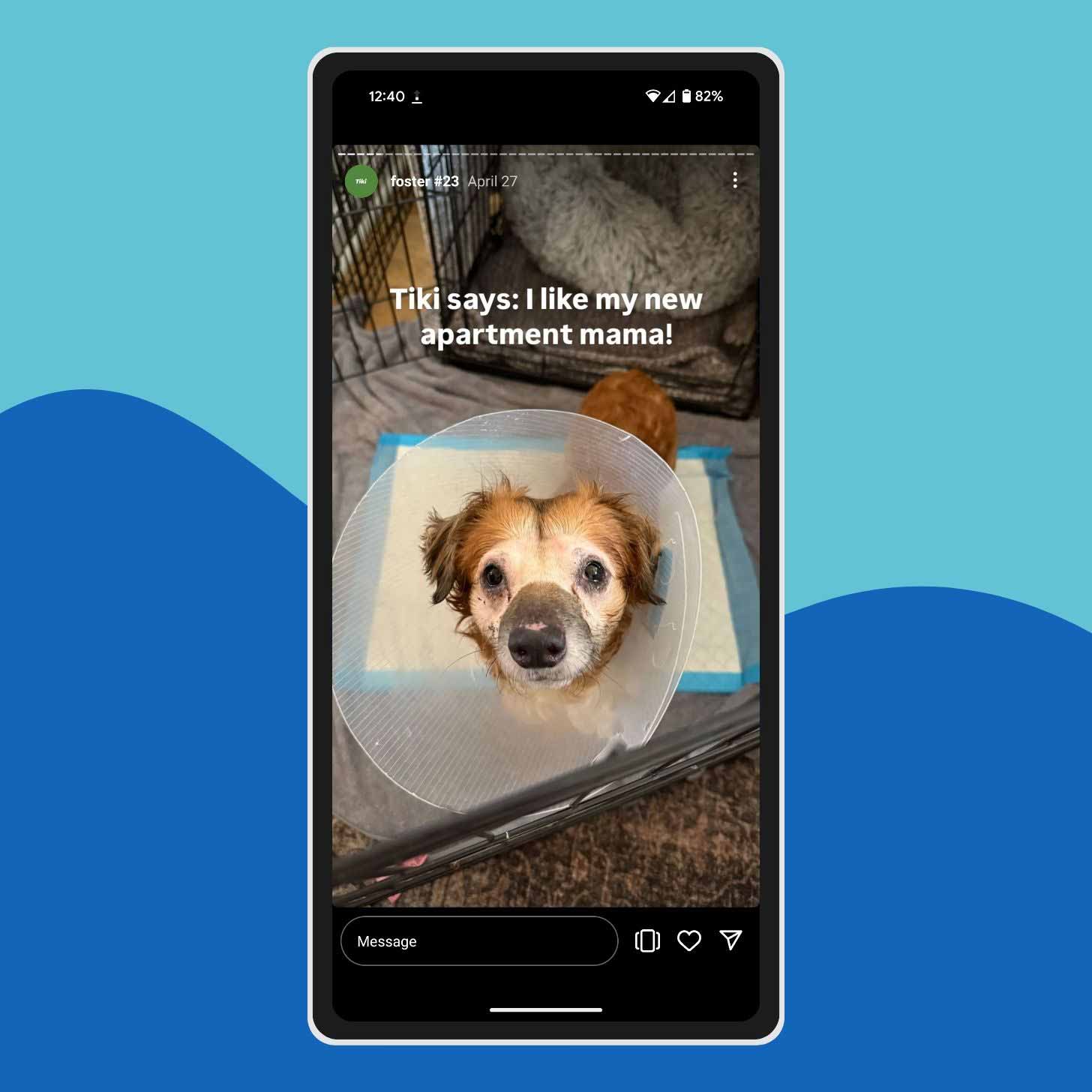
With all of this in mind, Klee still dove headfirst into making him feel welcome in his new home.
“Tiki is quite literally paralyzed with fear,” she said before picking him up. “They say that he does not move from his bed — ever — unless it’s the middle of the night. He is completely terrified of being handled. He bites people. He loses control of his bowels.”
Behaviorists had even debated if Tiki would get better, and his time with Isabel and her family would be a test to see if being out of a shelter would help him overcome his debilitating anxiety.
“I believe that all dogs should be given a chance,” Klee said. “Tiki deserves a chance to heal and get better. My goal is to provide him a safe space. We’re going to take it really slow and just see what happens.”
Just a little over 25 days later, Klee’s patience has paid off.

Tiki’s daily updates have taken TikTok and Instagram by storm, dubbing the former social media site “Tiki Tok.”
In the first few vlogs, Klee showed clips of the fearful little mutt (with an adorable raccoon-like mask) staying contained to his safety net, a kennel and adjoining puppy gate with potty pads, food, and water accessible to the pup.
But then, he started getting curious.
In later videos — around days 11 and 12 — Tiki began emerging from his kennel and exploring Klee’s New York apartment, sniffing a very dutiful Simon, and even nearing the humans in the home.
“I just know this dog is so close to letting me pet him,” Klee said in her Day 11 video. “I swear I can see the gears turning in his mind. Like, occasionally, he’ll forget he’s terrified and seems excited to see me.”
Since then, Tiki has had a dental procedure, hopped on the couch, sat in Klee’s lap, accepted lots of pets and kisses, ventured outdoors, and as of today, played with toys.

His progress has been rapid and remarkable, and millions of people have cheered him on around the world. He has even garnered praise from celebrities like Kylie Kelce, Glennon Doyle, and Abby Wambach.
“I think Tiki is providing us all with some hope that we could all use right now,” Klee said in a recent video.
But one question keeps popping up in her comment section: “Are you going to adopt Tiki?”
“I knew this would happen because it’s happened with literally every single foster I’ve had,” Klee said. “I know the sentiment comes from a good place. You see how happy the dog is with me, and therefore I should keep the dog.”
But as much love as Klee has for her brave little companion, she offered another perspective.
“Over 6 million animals enter the shelter system every single year,” she said. “Shelters all over the country are over capacity, with pop-up kennels filling the hallways just to try to make more space. Not only that, but over 600,000 animals were euthanized last year, some of which because there’s simply no place for them to go. So, there are millions of Tikis around the world. Millions of Tikis who need me and need us.”
Although plenty of people want Tiki to become a “foster fail,” Klee said hundreds of people have also messaged her saying that they’ve been inspired to foster a dog, too.
“I know you all love Tiki,” Klee said. “I love him, too, and giving him up will be so hard. But my greatest lesson in fostering is that you don’t have to own something to love it. Sometimes you have to let that love go, and let it spread further and wider than you ever thought possible.”
While Tiki will soon find a forever family of his own, he is still healing in the home of Klee, her fiance Jacob (who commenters have nicknamed Mr. Isabel), and her soul dog, Simon.
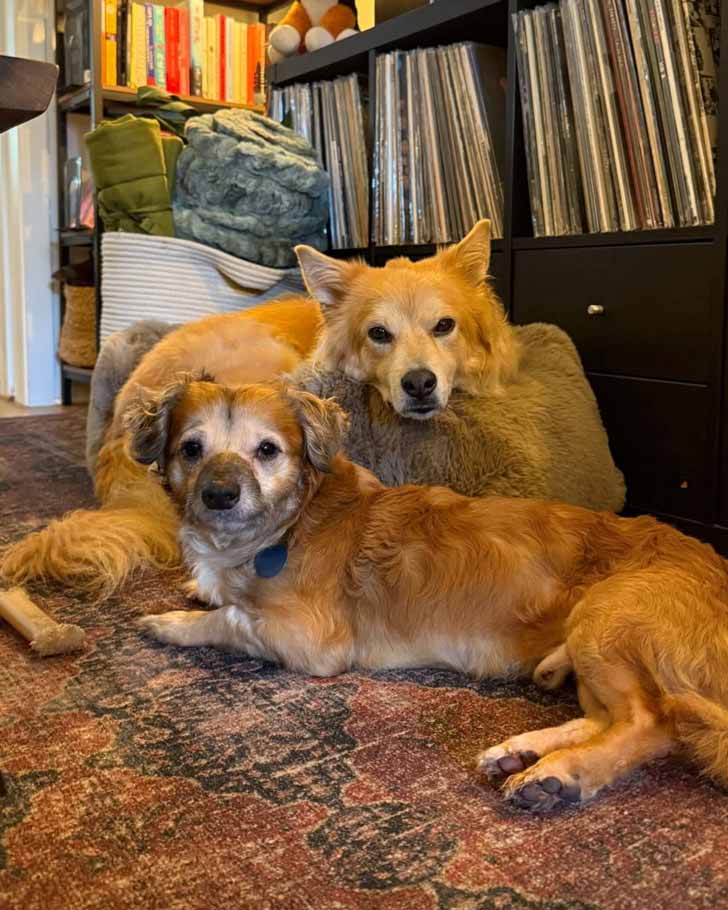
“He gets braver and braver every single day,” Klee said in her most recent update.
And Klee — whose debut memoir “Dogs, Boys, and Other Things I’ve Cried About” will be published soon — she’s in it for the long haul.
“You undid a lifetime of fear and trauma for him in ~3 weeks,” one TikTok commenter wrote.
“We don’t deserve dogs, but you definitely do.”
Header images courtesy of Isabel Klee/TikTok
Earlier this week, a photo of a large transgender pride flag hanging atop the famous face of El Capitan in Yosemite National Park made the rounds.
Reports shared that the 55-by-35-foot flag was hung by the group “Trans Is Natural,” a coalition of LGBTQ+ and ally climbers.
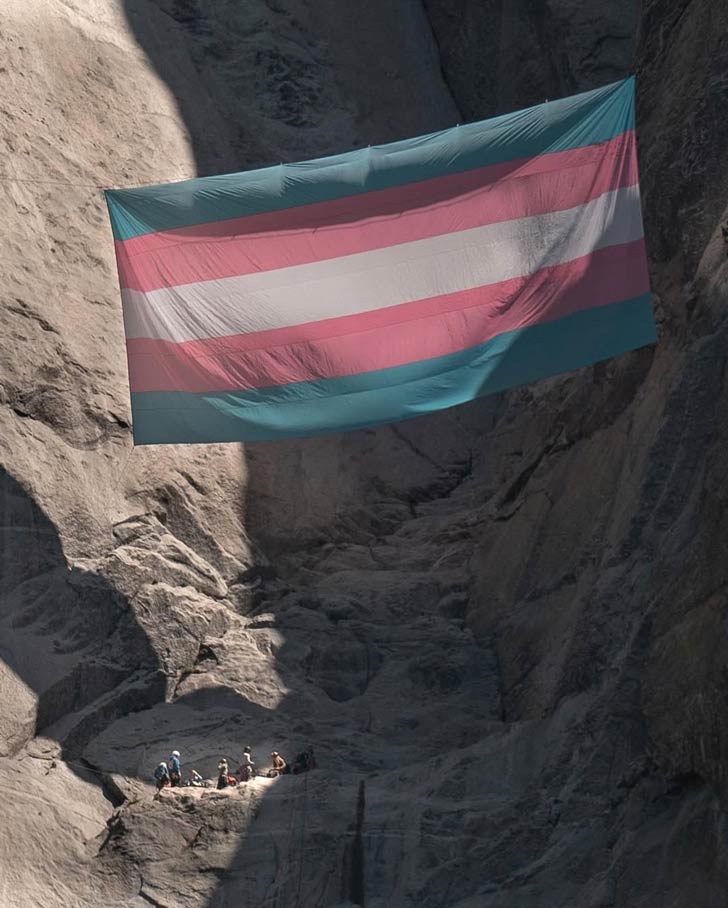
But one of those climbers might be a familiar face to those in the outdoorsy LGBTQ+ community: Drag queen Pattie Gonia.
“Some carry hate; we carry the largest trans pride flag to ever be flown in a national park,” Pattie Gonia said in a social media video after the fact.
They unfurled the flag on El Capitan, she added, “to prove a point: That trans is natural.”

A clip showed organizers signing the flag with sharpies, Pattie Gonia’s message reading: “Let this flag fly higher than hate.”
The action was a response to the Trump administration’s actions against transgender individuals, which includes excluding them from serving in the military, as well as attempts to ban trans athletes from competitive sports, deprive them of gender-affirming care on a federal level, and more.
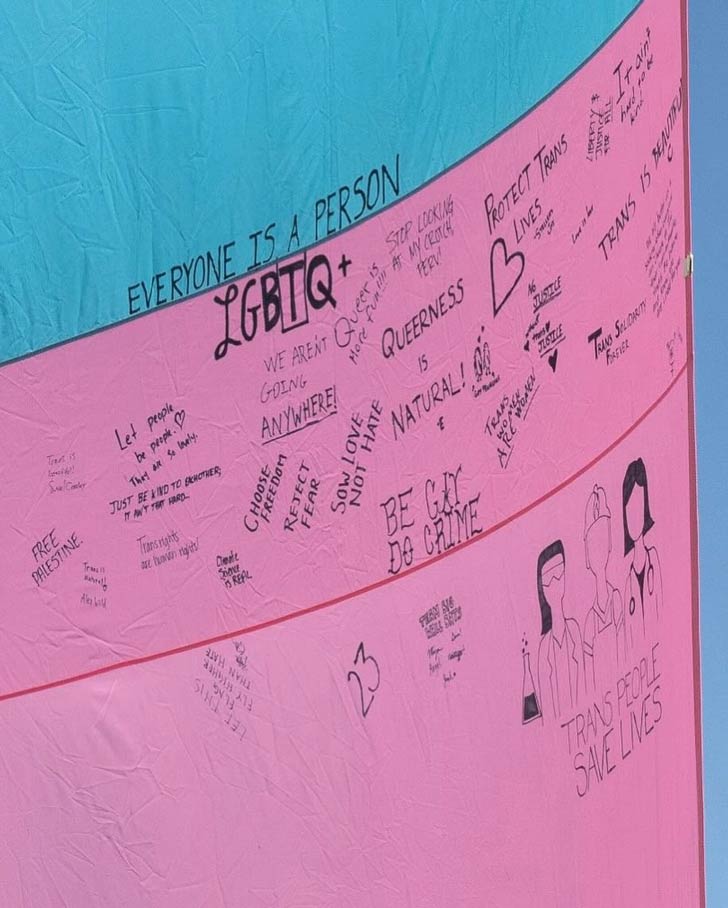
It also comes after the Trump administration has targeted national parks and public lands, firing thousands of federal workers from agencies the National Park Service and U.S. Forest Service.
This has also included the attempt to wipe LGBTQ+ history from federal websites, including the removal of trans individuals from the Stonewall National Monument website.
“The Trump administration and transphobes would love to have you believe that being trans is unnatural,” Pattie Gonia continued. “But species that can transition sexes can be found on every continent and in every ocean on planet earth.”

In a statement for Trans Is Natural, she also added: “We’re done being polite about trans people’s existence. Call it a protest, call it a celebration — either way, it’s giving elevation to liberation.”
The efforts of the group is reminiscent of another similar move from February of this year, when activists hung an upside-down American flag over El Capitan after layoffs slashed the NPS workforce.
According to SF Gate, Yosemite park officials ordered the pride flag be taken down shortly after it made its debut — and it was.

Still, photos of the flag flying high have made their impact across social media, and activists are pleased with their efforts.
“The flag stands as a visual and spiritual anchor for all those who have been made to feel out of place in their bodies or in this country, and a steadfast reminder to allies to show up and make their solidarity loud,” Trans Is Natural organizers said in a statement.
“Trans existence is not up for debate,” SJ Joslin, another organizer with the group, added. “We are social workers, public servants, parents, and neighbors. Being trans is a natural, beautiful part of human and biological diversity. We can only make progress when we embrace diversity, not erase it.”
@pattiegonia TRANS IS NATURAL.
♬ original sound - pattiegonia
Header images courtesy of Pattie Gonia/Instagram
In Lin-Manuel Miranda’s “Hamilton” tune “Non-Stop,” castmates ask him: “Why do you write like you’re running out of time?” and while the sentiment is intended for the titular Alexander Hamilton, the same could be asked of Miranda himself.
The award-winning actor, singer, songwriter, rapper, and filmmaker is known for churning out show-stopping beats in children’s movies, producing musicals, and starring in many of his own projects. He was also named to TIME100’s philanthropy list earlier this week.

Now more than ever, it seems, he deserves a moment to slow down.
And he’s certainly not alone.
Today, in concurrence with Mental Health Awareness Month, Miranda partnered with mental health app Calm and tourism organization Discover Puerto Rico to debut a suite of audio relaxation tools, centered around his home island.

The new collection includes two guided meditations, two soundscapes, a “Breathe Bubble,” and a “Sleep Story,” narrated in both English and Spanish by Miranda.
The Sleep Story is named “Adventures in Puerto Rico” and promises to guide listeners on a “peaceful journey” through the island’s natural beauty.
It weaves together music, storytelling, and personal anecdotes from Miranda and highlights sites like Old San Juan, La Parguera Bioluminescent Bay, and Flamenco Beach.

Listeners will also hear about the Lin-Manuel Miranda Gallery, a destination located in Vega Alta, Miranda’s hometown, where he spent his childhood summers.
“Puerto Rico is where my roots are, where my family is, and where I go to feel grounded,” Miranda said in a statement. “Recording this Sleep Story allowed me to share the magic of the Island in a new way: through its sounds, its stories, and the quiet beauty that fills every corner.
The other audio materials were created by on-island sound engineers and Calm’s production team, “spotlighting Puerto Rico as a top destination for travelers prioritizing wellness.”
Both Calm and Discover Puerto Rico spokespeople said they were eager to bring authentic island talent to the table to bring this experience to life.

“Created with authentic field recordings and artistic contributions from Puerto Rican talent, this partnership offers listeners a true sense of the Island’s rhythm and Boricua spirit,” said Davelyn Tardi, public relations director at Discover Puerto Rico.
Fergal Walker, the vice president of partnerships at Calm, added that the partnership offers a “unique opportunity” for listeners to “experience the transformative power of the island.”
“We’ve created bespoke content to invite listeners to journey through Puerto Rico in an immersive way while finding a bit of calm and rest as well as a deeper connection to themselves and the world around them,” Walker added.

To make the content more accessible to everyone, Discover Puerto Rico is giving away a year-long Calm Premium membership to 1,700 people. (Once the free memberships are claimed, additional participants can still enjoy 50% off Calm Premium through the same link until May 21, 2026.)
For Miranda, this kind of project is a no-brainer, considering his long-time love for the island and efforts to tell Puerto Rican stories, highlight its most stunning sites, and advocate for its people.
“Puerto Rico invites you to slow down, breathe deeply, and rediscover a sense of wonder,” Miranda concluded. “I hope listeners feel that peace, and that pull to explore it for themselves.”
Header images courtesy of Calm
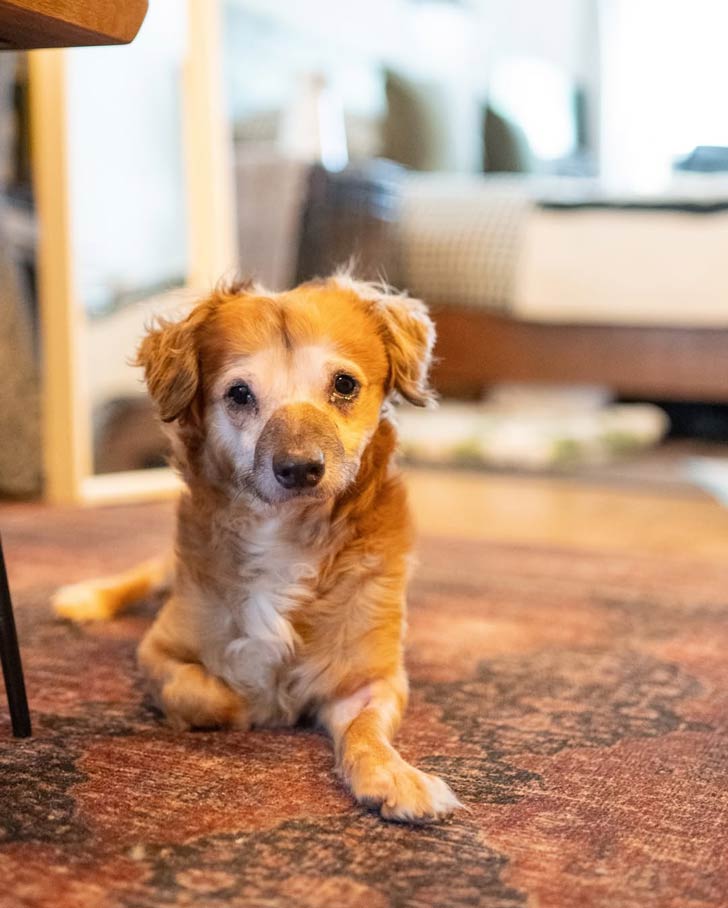
Tiki, the “extremely fearful shutdown foster dog,” has taken the internet by storm.
A foster dog in the care of dedicated dog mom Isabel Klee, Tiki was what she called her “most difficult foster yet.”
But that was about a month ago.
From humble beginnings of debilitating fear, biting, accidents, and no desire to eat, Tiki has become full of personality and bravery, with Klee sharing milestones of his healing journey on TikTok and Instagram every day for the past 27 days.
In just a few weeks, Tiki has had a dental procedure, hopped on the couch, sat in Klee’s lap, accepted lots of pets and kisses, ventured outdoors, played with toys, and most recently, jumped on the bed to seek cuddles.
This dog — who behaviorists considered giving up on — has transformed into a playful and spunky character that has given countless viewers a shared goal to root for: The triumph of little Tiki.
“I think Tiki is providing us all with some hope that we could all use right now,” Klee said in a recent video.
The little mutt — with a distinctly adorable white mask — was initially saved by the ASPCA and then put into the care of Muddy Paws Rescue, a New York-based animal rescue which Klee has long supported as a foster parent.
And when Tiki’s fans inevitably ask how they can support his journey, Klee has encouraged them to donate to the rescue nonprofit.
But now, she said in a new video, his fanbase can do something “even better.”
“I have worked with Muddy Paws Rescue to create a ‘Be Brave Like Tiki’ T-shirt,” Klee announced. “100% of the proceeds go back to Muddy Paws, which means these T-shirts will help us save so many more dogs just like Tiki.”

The shirts were designed by artist Hannah Simpson and are available in unisex sizes S-2XL. They cost $40 each.
“While there’s only one Tiki, there are thousands of pups just like him in shelters and in our foster homes waiting for their chance to be chosen,” Muddy Paws shared in an Instagram post about the shirts.
“That’s why we launched this limited edition ‘Be Brave Like Tiki’ shirt, reminding the world that if an extremely fearful shutdown foster dog can be brave, anyone can be.”
Klee has shared that hundreds of people have sent her messages saying they’ve been inspired to foster or adopt a dog after discovering Tiki’s story online.
Even the comment section on the T-shirt announcement garnered similar support.
“You're changing lives Tiki,” one person wrote. “I think we're getting our first fosters this weekend!”
“Our mama just ordered one,” an account from the perspective of two dogs added. “When we move into our new house we hope to become foster brothers! You and Tiki have inspired us.”
Although Klee continues to get comments urging her to adopt Tiki as her own, she doubles down on her commitment to all foster dogs.
“Over 6 million animals enter the shelter system every single year. Shelters all over the country are over capacity, with pop-up kennels filling the hallways just to try to make more space,” she said in a recent video.
“Not only that, but over 600,000 animals were euthanized last year, some of which because there’s simply no place for them to go. So, there are millions of Tikis around the world. Millions of Tikis who need me and need us.”
While it’s unclear how long these shirts will be available and how much money they may raise, they are a symbol of a growing movement to encourage animal fostering all around the world.
“I know you all love Tiki,” Klee concluded in her video. “I love him, too, and giving him up will be so hard. But my greatest lesson in fostering is that you don’t have to own something to love it. Sometimes you have to let that love go, and let it spread further and wider than you ever thought possible.”
Tiki’s shirts are now available to purchase online.
Header images courtesy of Muddy Paws Rescue
This story was originally published by Grist. Sign up for Grist’s weekly newsletter here.
In December 2022, Matthew Boyer hopped on an Argentine military plane to one of the more remote habitations on Earth: Marambio Station at the tip of the Antarctic Peninsula, where the icy continent stretches toward South America. Months before that, Boyer had to ship expensive, delicate instruments that might get busted by the time he landed.
“When you arrive, you have boxes that have been sometimes sitting outside in Antarctica for a month or two in a cold warehouse,” said Boyer, a Ph.D. student in atmospheric science at the University of Helsinki. “And we’re talking about sensitive instrumentation.”
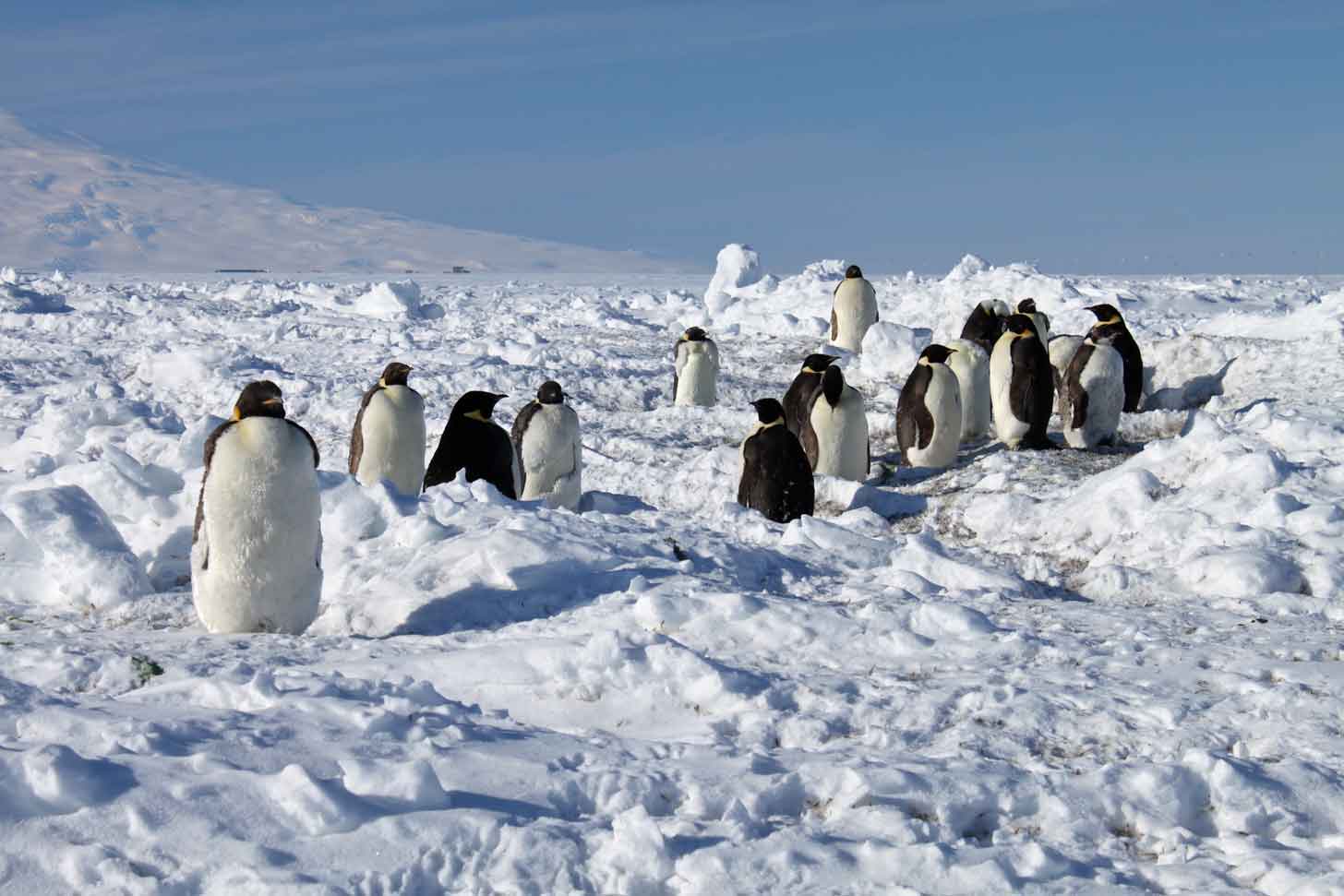
But the effort paid off, because Boyer and his colleagues found something peculiar about penguin guano. In a paper published on Thursday in the journal Communications Earth and Environment, they describe how ammonia wafting off the droppings of 60,000 birds contributed to the formation of clouds that might be insulating Antarctica, helping cool down an otherwise rapidly warming continent.
Some penguin populations, however, are under serious threat because of climate change. Losing them and their guano could mean fewer clouds and more heating in an already fragile ecosystem, one so full of ice that it will significantly raise sea levels worldwide as it melts.
A better understanding of this dynamic could help scientists hone their models of how Antarctica will transform as the world warms. They can now investigate, for instance, if some penguin species produce more ammonia and, therefore, more of a cooling effect.
“That’s the impact of this paper,” said Tamara Russell, a marine ornithologist at Scripps Institution of Oceanography, who studies penguins but wasn’t involved in the research. “That will inform the models better, because we know that some species are decreasing, some are increasing, and that’s going to change a lot down there in many different ways.”
With their expensive instruments, Boyer and his research team measured atmospheric ammonia between January and March 2023, summertime in the southern hemisphere.
They found that when the wind was blowing from an Adelie penguin colony 5 miles away from the detectors, concentrations of the gas shot up to 1,000 times higher than the baseline. Even when the penguins had moved out of the colony after breeding, ammonia concentrations remained elevated for at least a month, as the guano continued emitting the gas. That atmospheric ammonia could have been helping cool the area.
The researchers further demonstrated that the ammonia kicks off an atmospheric chain reaction. Out at sea, tiny plantlike organisms known as phytoplankton release the gas dimethyl sulfide, which transforms into sulphuric acid in the atmosphere. Because ammonia is a base, it reacts readily with this acid.
This coupling results in the rapid formation of aerosol particles. Clouds form when water vapor gloms onto any number of different aerosols, like soot and pollen, floating around in the atmosphere.
In populated places, these particles are more abundant, because industries and vehicles emit so many of them as pollutants. Trees and other vegetation spew aerosols, too. But because Antarctica lacks trees and doesn’t have much vegetation at all, the aerosols from penguin guano and phytoplankton can make quite an impact.

In February 2023, Boyer and the other researchers measured a particularly strong burst of particles associated with guano, sampled a resulting fog a few hours later, and found particles created by the interaction of ammonia from the guano and sulphuric acid from the plankton.
“There is a deep connection between these ecosystem processes, between penguins and phytoplankton at the ocean surface,” Boyer said. “Their gas is all interacting to form these particles and clouds.”
But here’s where the climate impacts get a bit trickier. Scientists know that in general, clouds cool Earth’s climate by reflecting some of the sun’s energy back into space.
Although Boyer and his team hypothesize that clouds enhanced with penguin ammonia are probably helping cool this part of Antarctica, they note that they didn’t quantify that climate effect, which would require further research.
That’s a critical bit of information because of the potential for the warming climate to create a feedback loop. As oceans heat up, penguins are losing access to some of their prey, and colonies are shrinking or disappearing as a result.
Fewer penguins producing guano means less ammonia and fewer clouds, which means more warming and more disruptions to the animals, and on and on in a self-reinforcing cycle.
“If this paper is correct — and it really seems to be a nice piece of work to me — [there’s going to be] a feedback effect, where it’s going to accelerate the changes that are already pushing change in the penguins,” said Peter Roopnarine, curator of geology at the California Academy of Sciences.
Scientists might now look elsewhere, Roopnarine adds, to find other bird colonies that could also be providing cloud cover. Protecting those species from pollution and hunting would be a natural way to engineer Earth systems to offset some planetary warming.
“We think it’s for the sake of the birds,” Roopnarine said. “Well, obviously it goes well beyond that.”
Header image courtesy of Eli Duke (CC BY-SA 2.0)
In March of this year, comedian and actress Hannah Einbinder accepted the Visibility Award from the Human Rights Campaign for expanding LGBTQ+ representation on-screen through her role in HBO’s “Hacks.”
Passionately addressing attendees, her acceptance speech went viral.
“My queerness is a tradition of social justice, as is my Judaism,” she said. “To me, these are traditions of humanity, of care for human life — all human life, equally.”
From there, she used the rest of her time at the podium to speak up on behalf of Palestinians.

“As a queer person, as a Jewish person and as an American, I am horrified by the Israeli government’s massacre of well over 65,000 Palestinians in Gaza,” Einbinder said.
“I am ashamed and infuriated that this mass murder is funded by our American tax dollars. It should not be controversial to say that we should all be against murdering civilians.”
While this speech became perhaps her most well-known example of Palestinian solidarity, Einbinder has long stood in opposition to the Israeli occupation of Gaza.
As a participant of Artists 4 Ceasefire, she has used her platform to elevate calls to end the violence through a permanent and lasting ceasefire, alongside others in the entertainment industry.
Einbinder has also worked with a campaign called “Fund Abortion, Not War,” which supports abortion funds that have received backlash and funding cuts due to their advocacy for Palestinians.
“‘Fund Abortion, Not War’ is a campaign to uplift these abortion funds through financial, public, and communal support,” Einbinder wrote in a social media post.
“Fund abortion because the war on bodies extends across borders, and the struggle for bodily autonomy is intertwined.”

Most recently, she has encouraged her fans and followers to donate to an organization called PAL Humanity, a collective led by two female doctors on the ground in Gaza.
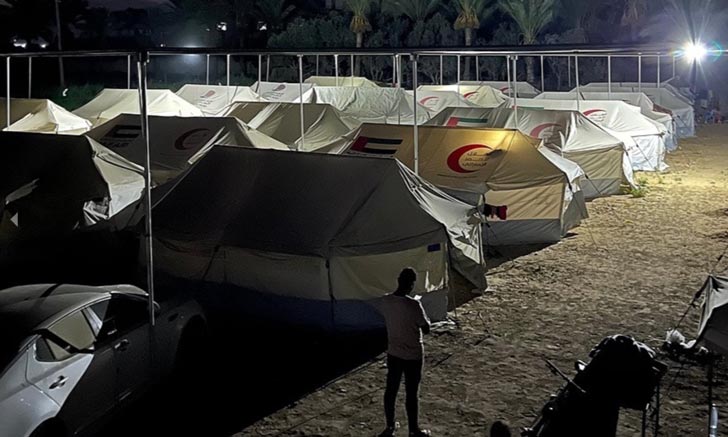
They are fundraising to help those in Northern Gaza access immediate humanitarian relief, with a goal of $50,000 for medical aid and $100,000 to support clean water access, food security, and shelter initiatives.
So far, Einbinder and her followers have raised $60,000 for the organization.

“Gd bless you all,” Einbinder shared in an Instagram story yesterday. “We raised $60,000 for PAL Humanity so far!! This is an amazing org I will continue to boost.”
According to the collective, all funds will go towards emergency water, food, and shelter, as well as medical support, building desalination stations for clean water, and education and stability for Gaza’s children.
“Thousands remain displaced without access to food or adequate shelter. We are distributing sweet water through deliveries, essential food supplies, and providing tents to offer temporary refuge,” PAL Humanity writes on its fundraising page.

“Every donation is a lifeline for families in desperate need.”
Einbinder amplified this message in another Instagram Story, sharing a video of PAL Humanity doctors at work.
“This is what your donations go to,” she wrote. “Supplies are so expensive due to scarcity as a result of Israel’s blockade of all aid at the border of Gaza.”
Although Israeli officials have said they would open the border to aid, countless Palestinians are still waiting for food, according to The New York Times.
Global nonprofit World Central Kitchen, which has provided 130 million meals in the area in the last 19 months, has been forced to halt operations without the necessities needed to continue.
“There are four WCK warehouses in Jordan filled with food for the people of Gaza… rice, oil, flour, vegetables,” the organization shared on social media this week. “Over 100 trucks loaded and ready to arrive to the border crossing in less than an hour… But still, the government of Israel is not permitting us to enter with aid.”
Earlier this week, Einbinder also shared another Artists 4 Ceasefire post that reads: “Now is the time to speak up.” It demands a ceasefire, especially in the wake of United Nations leaders sharing that 14,000 babies in Gaza are at risk of severe malnutrition — and death — if they don’t receive immediate aid.
While the future is uncertain for the people of Gaza, Einbinder and her fans have given invaluable support, doing what they can to help the people on the ground.
“North Gaza is facing an unprecedented humanitarian crisis. Families have lost everything — homes, loved ones, and access to basic necessities,” PAL Humanity shared.
“Even in the face of devastation, the people remain resilient and full of hope, and we are committed to standing with them.”
Header images courtesy of Hannah Einbinder and PAL Humanity
Since 2021, the Mountains to Sea Conservation Trust has been holding a new type of beauty pageant: the “Fish of the Year” competition.
The contest, which is open to public vote in New Zealand, was designed to get landlubbers more involved in marine life, particularly in local conservation efforts and restoration projects.
The eagle ray won 2021 and 2022 back-to-back before passing the crown to giant oceanic manta rays in 2023.
But this year, “the good people of New Zealand” chose a dark horse in the competition: the blobfish.
“We and the people of New Zealand had had enough of other fish getting all the headlines,” New Zealand More FM radio hosts Sarah Gandy and Paul Flynn said in a press release.
“The blobfish had been sitting patiently on the ocean floor, mouth open waiting for the next mollusk to come through to eat,” they added.
“He has been bullied his whole life and we thought, 'Stuff this, it’s time for the blobfish to have his moment in the sun,' and what a glorious moment it is.”
The blobfish has long been regarded as an “aesthetically challenged” species. In 2013, it was named the “world's ugliest animal” at the British Science Festival in Newcastle, England.
Although the title seems mocking, Ugly Animal Preservation Society president Simon Watt said the campaign was actually meant to spotlight the underdogs of the animal kingdom.
“Our traditional approach to conservation is egotistical,” he told BBC News after the blobfish won the “ugly” contest.
“We only protect the animals that we relate to because they're cute, like pandas,” he explained. “If extinction threats are as bad as they seem, then focusing just on very charismatic megafauna is completely missing the point.”
“I have nothing against pandas,” he added, “but they have their supporters. These species need help.”
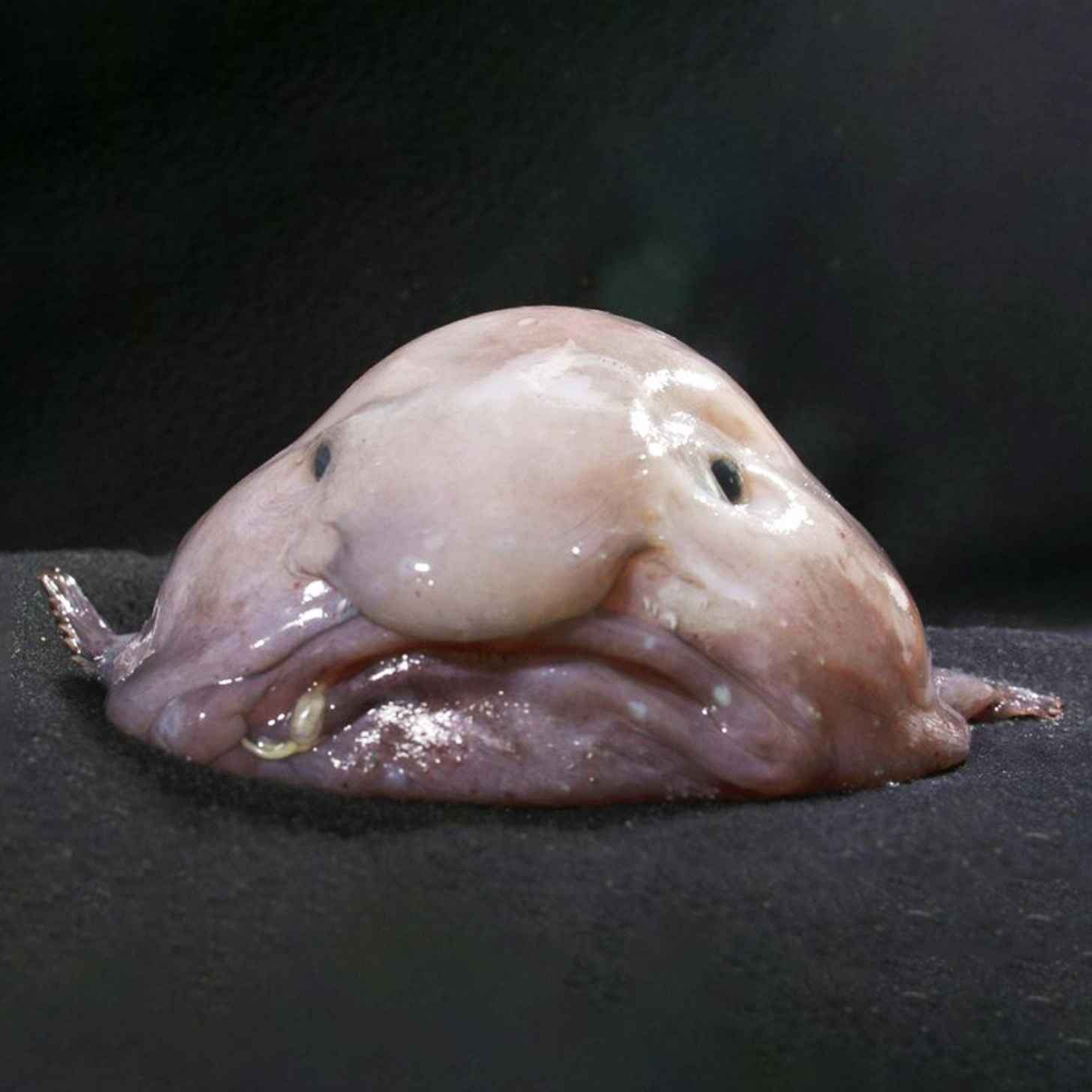
Ironically, the blobfish (or Psychrolutes marcidus) isn’t even as ugly as it appears.
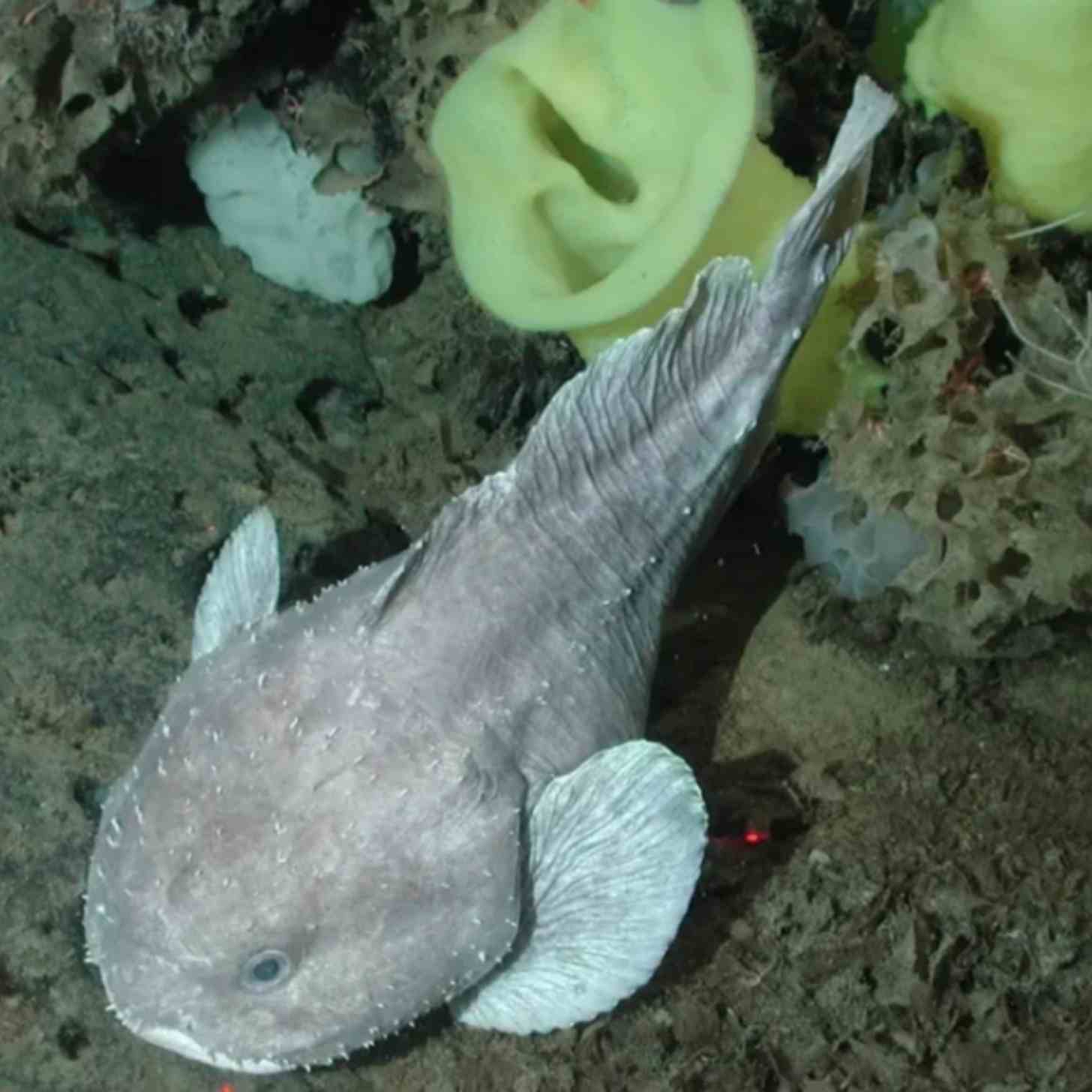
“Turns out, that’s not what a blobfish looks like,” TikTok user Elena Kilgore said in 2023, pointing to a picture of a deceased blobfish dubbed “Mr. Blobby.”
“That’s just what a blobfish looks like when you take it out of its home and put it on a table in a lab.”
It’s the same sentiment that marine biologist Russell Arnott has been trying to spread for years.
In 2020, he replied to a prompt online that asked: “What is a common misconception about an animal that you would like to dispel forever?”
“That the blobfish is ugly,” Arnott wrote on social media site X. “You wouldn't look so great either if you'd just undergone a rapid depressurisation of 120 atmospheres.”
In an interview with National Geographic, the scientist elaborated on the blobfish’s infamous legacy.
“The fish only looks like a miserable, pink lump when it has been torn from its home, and suffered devastating tissue damage due to the rapid depressurization as it was dragged to the surface,” Arnott told National Geographic.
“In its natural habitat — thousands of feet underwater — the misunderstood blobfish looks like a normal fish.
According to the Mountains to Sea Conservation Trust, the blobfish narrowly beat out the orange roughy by just 277 votes in the “Fish of the Year” contest.
“We have no problem with the blobfish winning,” said spokesperson Aaron Packard, who was gunning for the orange roughy. “It's still a win for deep-sea ecosystems and raises awareness about the environmental impacts of destructive bottom trawling.”
In the end, the real winner is the growing interest in marine conservation efforts.
The competition saw a huge uptick in traffic from the year prior, with more than 5,500 New Zealanders taking part in the vote, up from 1,021 in 2024.
“More than 10,000 Kiwis visited the website to learn about freshwater and marine fish that call our waters home,” said Mountains to Sea Conservation Trust Co-Director Kim Jones.
“We’re absolutely thrilled New Zealanders have taken such an interest in our native fish, and the conservation challenges affecting them.”
You may also like: Photos of the 21 Ugliest Animals 📸 + How To Protect Them
Header image via Mountains to the Sea Conservation Trust
Over the past 10 years, it has been increasingly common for Pride attendees to spot a joyful adult wearing a “Free Mom Hugs” or “Free Dad Hugs” T-shirt in the crowd of a parade.
But dad and ally John Piermatteo wanted to come up with another creative way to show familial support to LGBTQ+ people who might not have that kind of love at home.
He thought about something simple and straightforward that meant a lot to him growing up: tossing around a ball with his dad in the backyard.
So, he started Play Catch with a Dad in 2019.

It was simple. Piermatteo got a Nerf football, hand-painted a sign and leaned it against a tree, and waited for people to come. He chose a good locale — York Equality Fest in York, Pennsylvania.
Although Piermatteo himself is not part of the LGBTQ+ community, he is a father of two, including a nonbinary child. Already familiar with Pride events, he was prepared to meet people where they were at.
“I had no idea how the concept might be received. It took several trips past my sign before anyone engaged,” he told LGBTQ Nation. “I watched people go by looking at the sign out of the side of their eye, then, on the next pass, they might make eye contact with me. Finally, I would see them walking with purpose directly at me.”
“’Can I play catch with you?’ they would ask. We would toss the ball a few times, and then I’d give them a hug.”
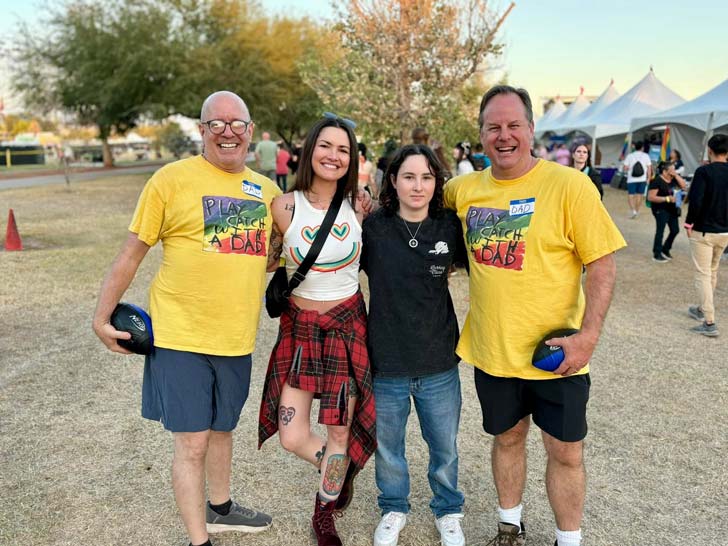
After a pause due to the COVID-19 pandemic, Piermatteo came back with a bang, rallying lifelong friends to join him at his next Play Catch With a Dad event. In the years following, he would take the offering on the road for Pride festivals across Pennsylvania — and nationwide.
Place Catch With a Dad even had its spot at San Francisco Pride in 2023 and San Diego Pride in 2024, two massive Pride gatherings that bring in up to a million attendees each.
“Roughly two out of every five interactions result in the attendee crying in our arms,” Piermatteo told LGBTQ Nation. “We have even had people walk by, see the sign, then burst into tears. It can be an incredibly emotional experience for both the attendees and the dads.”
When it’s just him, his throwing arm gets a bit tired. But the movement has grown to a public Facebook group, with nearly 200 volunteers joining in on the fun. Every father who joins Piermatteo wears a nametag that simply says “Dad.”

For Pride 2025, Piermeatteo and his friends will travel to Phoenix, Chicago, and Baltimore, where Play Catch With A Dad will be a fixture for the Orioles’ Pride Night at Camden Yards.
“We have straight dads, we have gay dads. We have dads that have gay children and dads who have straight children,” Piermatteo said of the group. “What unites us is our desire to help.”
While it’s a small gesture — that requires very little athleticism — it means a lot.
“Some of them said, ‘My dad stopped doing things with me,’ or ‘Our relationship just completely changed,’” Piermatteo told WellSpan. “Others said, ‘I never really had a dad, so it was nice to play catch with one.’”
Piermatteo now has an ongoing relationship with Pennsylvania’s Rainbow Rose Center, which hosts him at York’s annual Pride event.
“A lot of people have lost access to a father figure and that is particularly true in the LGBTQIA+ community, where people often face a broken family after they come out,” Tesla Taliaferro, the board president of the Rainbow Rose Center, said.
“A few minutes of playing catch is a way for these dads to say, ‘I see you, I support you, I respect you,’ and ‘I love you. I am glad you are here.’”

While the movement slowly takes hold at Pride events in the U.S., Piermatteo hopes it can one day have a similar reach as Free Mom Hugs, which has become a global movement for stand-in LGBTQ+ familial support.
“Maybe someday,” he told WellSpan, “it will be all over the place.”
But for now, he’s making a difference for even just one individual. On Facebook, an anonymous contributor left the group a note of thanks.
“Seeing this group come up on my Facebook reminded me of the moments I got to play catch at San Diego Pride,” they said. “... the warm and genuine hug that the dad there gave me, along with a ‘You’re doing great, kiddo.’ Thank you for what you are doing. It means so much.”
It’s emblematic of Piermatteo’s overall goal: “To help someone heal, if just a little bit, one toss at a time.”
Header image courtesy of John Piermatteo/Play Catch With a Dad
Every day the Good Good Good team collects the best good news in the world and shares it with our community. Here are the highlights for this week!
If you want to get good news in your inbox every day, join the Goodnewsletter — the free daily newsletter designed to leave you feeling hopeful.
The Best Positive News We’re Celebrating This Week —
In a medical first, US doctors rewrote the DNA of an infant with a severe genetic disorder
Doctors in the U.S. just became the first to treat a baby with a customized gene-editing therapy after the infant was diagnosed with a sever genetic disorder.
The infant was born with CPS1 deficiency, a condition that impacts one in 1.3 million people, and means they lack a liver enzyme that converts ammonia, causing a buildup that can damage the liver and other organs. It kills about half of those affected in early infancy.
While previously, patients could receive liver transplants, babies with severe disease can suffer too much damage by the time they are big enough to operate on. The breakthrough was possible thanks to “years and years of progress” in gene editing research.
Why is this good news? The international medical community says this medical milestone has the potential to treat many other genetic diseases by rewriting faulty DNA after an affected child is born.
Scientists invent ‘smelling gel’ that seduces coral to dying reefs in restoration efforts
→ Read more
For the first time, clean energy has caused China’s carbon dioxide emissions to drop despite an increase in demand
A new analysis found that carbon dioxide emissions in China were down 1.6% year-on-year in the first quarter of 2025, and by 1% in the past 12 months.
Typically, emissions declines have been because of less demand — but for the first time, it happened while demand was surging and was because the electricity supply came from new wind, solar, and nuclear energy sources.
The analysis found that growth in clean power generation has overtaken the current and long-term average growth in demand, further pushing out fossil fuels. And this trend is expected to continue all year.
Thousands of community members rallied to reinstate a trans teacher in California after they were fired
A high school teacher in Los Angeles, Henry Zahid, came out as trans in their second year of teaching. Despite resounding support from students and colleagues, he received notice earlier this year that he was fired from his teaching position.
They were terminated through a process called “non-reelection,” which includes reasons like “immoral or unprofessional conduct, conviction of a felony, or substance abuse issues.” None of those reasons applied to Zahid.
Zahid was determined to fight his “discriminatory” firing. And after two emotional addresses to the school district board, an investigation by the Equal Opportunity Section, and over 2,000 letters of support from community members, he has been reinstated.
Why is this good news? If not for Zahid bravely standing up to fight their wrongful termination, we probably would have never heard their story, and thousands wouldn’t have had the opportunity to stand behind them in support. Zahid’s story is a reminder that, as attacks like these continue, we all have the opportunity to stand up and fight back — and we won’t be alone.
A prison that once held suffragists was transformed into affordable apartments a century later
Violent crime is falling rapidly across the U.S., driven by success in places like Baltimore
According to one analyst, 2025 is on track to be the least murderous year nationwide since the 1960s. That trend is being driven by cities like Baltimore.
So far this year, there have only been 45 homicides in the city— down by one-third from the same time last year. In all of last year, there were 199 total homicides — the fewest the city had seen in over a decade. In 2021, that figure was 344.
Experts and activists point to various explanations, both local and national, for the decline, but one unique to Baltimore was its local “Group Violence Reduction Strategy” that brought together community groups, prosecutors, and the police department.
→ Read more
A ‘historic’ step for Indigenous rights, Colombia formally recognized Indigenous local governments across the Amazon
In a precedent-setting decision that both secures Indigenous rights and protects the Amazon rainforest, Colombia took a leading position in Latin America by formalizing Indigenous local governments.
In a process that’s been ongoing since 2018, not only does the formalization give Indigenous communities land titles, it also grants them self-governing authority — implementing a legal framework that lets them function as official local governments.
One Indigenous leader called the decree “historic,” saying it’s been something communities have been seeking “for over 30 years,” and there are hopes that it will inspire other countries to do the same.
Why is this good news? Other Latin American countries typically only grant land titles, with Indigenous territories intersecting municipalities and forcing them to navigate conflicting public systems.
By giving Indigenous groups direct authority over their territories, it will help streamline governance and, importantly, help protect forests critical to combating climate change.
Transgender musician sings a duet with themself before and after hormone therapy: ‘It’s all me’
Deforestation reached a new record low in Brazil in 2024
In 2024, deforestation declined in all six nature biomes in Brazil for the first time in six years — and total deforestation was 32.4% lower than in 2023.
It’s the second year in a row of lower deforestation, breaking 2023’s record drop of 11% over 2022.
While Brazil still lost the equivalent of 8,000 football fields daily in 2024, the progress is notable and important as the country works toward eradicating illegal deforestation by 2030 to become a leader in the fight against climate change.
A new 7-mile-long underwater art exhibit in Miami raises awareness and helps save coral reefs
Just a couple hundred feet offshore, Miami Beach is home to the Great Florida Reef, the third-largest coral reef in the world and the only living coral barrier reef in the continental United States. It also desperately needs protecting.
Like its global counterparts, the Great Florida Reef has been in sharp decline since the 1980s. But experts are experimenting with a new approach to save it: art.
With construction starting this year, the reef will soon feature a 7-mile public art installation: The Reefline. Both a sculpture park and a snorkeling trail, the development will also serve as an artificial reef to offer shelter to fish, which will, in turn, help corals thrive.
Why is this good news? Like reefs around the world, the Great Florida Reef faces threats like bleaching due to elevated water temperatures, sea-level rise, and the spread of disease, which all put both coral and the other organisms that thrive in the reef at risk of extinction.
→ Read more
‘I’m in love with the birds and the river’: how ecotourism helped a small Colombian town recover from war
In the last 50 years, measles vaccines have prevented over 90 million deaths worldwide
Sixty years ago, over 90% of children globally were infected by measles, and for those who developed symptoms, a quarter would be hospitalized. In just the U.S., there were 3 to 4 million cases every year, which resulted in tens of thousands of hospitalizations and hundreds of deaths.
The first effective measles vaccine was developed in 1963 and made its way around the world over the next two decades. In just the last 50 years, those vaccinations have prevented over 90 million deaths globally.
Without those vaccines, 2 to 3 million people would die annually from measles, making them likely the most life-saving vaccines currently on offer in the world.
→ Read more
A U.S. House committee removed a budget bill amendment that would require the sale of nearly 500,000 acres of federal public land
When lawmakers added an amendment to a major budget bill that would have required the sale or transfer of around 500,000 acres of federal public land in Utah and Nevada — conservationists, outdoor enthusiasts, and citizens in general were outraged.
Now, under pressure from House Republicans who said they wouldn’t support the budget at all if it included the land-sale amendment, leadership from the House Rules Committee removed it — ensuring these lands stay protected.
The lawmakers and advocates both feared that it would lead to a new precedent for selling federal lands, and removing access for hikers, anglers, and other outdoor enthusiasts who enjoy them, and could lead to it happening elsewhere.
What’s the nuance? The “One Big Beautiful Bill Act” passed the House and is now headed for the Senate. While it’s very good news that the land-sale amendment was removed, the bill still contains devastating cuts to health care, food assitance, and clean energy, adds to the national deficit, and contains major tax breaks for corporations and top earners.
For the first time since the 1950s, Detroit is leading the state of Michigan in population growth
In a “historic turnaround,” the city of Detroit’s population grew for the second year in a row, jumping by around 12,500 people, after consistently declining for over 50 years.
It’s also leading the entire state of Michigan in population growth. The milestone demonstrates the city’s “comeback” after decades of people fleeing and the historic 2013 bankruptcy.
Some of the key factors in the city’s “surging growth” are improved neighborhoods, better city services, new job centers, crime reduction, and a “world class sports and entertainment district.”
More good news of the week —
Japan’s Ayami Sato made history as the first woman to play for a Canadian professional men’s baseball league. Sato has also led Japan’s women’s national team to six World Cup medals, is the only woman to win three consecutive MVP awards in 2014, 2016, and 2018, and was selected as an All-Star twice at the Women’s Baseball World Cup.
Helping the shipping industry eliminate its emissions, the world’s first commercial-scale e-methanol plant opened in Denmark. Up until now, zero-emission shipping fuels, such as green ammonia and e-methanol, which are produced using renewable energy, have tended to be more expensive than conventional fuel, largely because they are not produced at scale.
A “lost” gecko species thought to be extinct — or not exist at all — was rediscovered after 30 years. Two Endangered Wildlife Trust researchers found specimens of the Blyde Rondavel flat gecko, which was first identified in the same canyon in Mpumalanga Province in northeastern South Africa in 1991, never to be seen again.
A museum opened in the Czech Republic where German businessman Oskar Schindler saved 1,200 Jews during World War II. The site, a former textile factory, was stolen by the Nazis from its Jewish owners in 1938 and turned into a concentration camp, and is now the Museum of Survivors dedicated to the Holocaust and the history of Jews in this part of Europe.
Researchers say “inverse vaccines” could be a “holy grail” treatment for autoimmune diseases. They are developing an approach that targets only the specific part of the immune system that’s gone rogue, known as “inverse vaccines” because they suppress a particular part of the immune system, rather than amplifying it, as existing vaccines do.
Guyana’s parliament passed an oil pollution bill that holds companies liable for damages caused by oil spills. The country became Latin America’s fifth-largest exporter of oil last year, and this new legislation includes penalties for companies that don’t comply with regulations, including suspending licenses to explore and produce oil.
Using COVID relief funds, a county and a nonprofit erased the medical debt of 310,000 residents of a Florida county. Similar to other local governments, Orange County commissioners approved a $4.5 million contract last August with Undue Medical Debt (formerly RIP Medical Debt) to forgive bills totaling about $472.5 million.
Measuring 130 meters long, the world’s largest battery-powered ship was launched by an Australian boatbuilder. Calling it “a giant leap forward in sustainable shipping” and the “most important” project it has ever done, the ship will carry up to 2,100 passengers and 225 vehicles across the River Plate on the border between Argentina and Uruguay.
A new, first-of-its-kind guidance recommends more options for pain management at the gynecologist. The American College of Obstetricians and Gynecologists released new guidelines for physicians to better treat pain during common in-office procedures, including intrauterine device insertion, endometrial biopsy, hysteroscopy, intrauterine imaging, and cervical biopsy.
To alert drinkers to date rape drugs, a college student invented a color-changing straw — and it’s reusable. Providence College sophomore Neve Palmeri’s invention was born out of personal experience, after her cousin’s drink was spiked while she was on vacation in Aruba, leading to a “terrifying experience.”
Explorers discovered a new, metallic “striking blue” frog species on an expedition in the Amazon. It was a new species of poison dart frogs, which are small but hugely significant in the greater food web of the Amazon for helping control local insect populations and serving as an “indicator species” for ecosystem health.
A new system of tracking elephants wearing GPS collars is helping protect people and animals in Zimbabwe. Dangerous encounters between people and elephants have grown more frequent as climate change worsens competition for food and water.
A green space in Altadena that was damaged in the Eaton Fire is has been rejuvenated and is now a “super-park.” Funding to refurbish the park came from many different sources, including the FireAid benefit concert, which helped rebuild two new, three-story structures that are completely ADA accessible and the very first structures of their kind anywhere.
Once a sales associate at Lush, Dylan Mulvaney’s exclusive bath bomb has raised more than $30k for trans nonprofits. A pink rose-shaped accessory with notes of “feel-good florals, gorgeous pink luster,” 75% of each “Late Bloomer” bath bomb sold went to support trans-led organizations “working to ensure that trans people thrive.”
Developed “with the most vulnerable people in mind,” scientists in Mexico made a tortilla for people with no refrigerator. This wheat flour version contains probiotics that not only add nutrients to the Mexican staple food item, they preserve it for weeks without refrigeration, which is a luxury that many families in impoverished communities do not have.
In a “landmark moment for sexual health,” the world’s first gonorrhea vaccine is rolling out in England. Gonorrhea cases in England topped 85,000 in 2023, the highest since records began in 1918, and with warnings over some strains being resistant to antibiotics the vaccine hopes to tackle these rising rates of infection.
To demonstrate that “trans is natural,” drag queen Pattie Gonia unveiled the “largest-ever trans pride flag” at Yosemite National Park. It was also in response to the Trump administration’s actions against transgender individuals, which include excluding them from serving in the military, attempting to ban them from competitive sports, depriving them of gender-affirming care, and more.
In a “game-changing” procedure, surgeons at UCLA Health performed the first-ever human bladder transplant. The transplant recipient was a 41-year-old father of four who had previously lost most of his bladder during a tumor removal process, leaving the remainder too small and compromised to work.
A federal judge blocked President Trump’s executive order dismantling the Department of Education. The judge also ordered the agency to reinstate employees who were fired in mass layoffs, which the groups who brought the lawsuit said amounted to an illegal shutdown of the department, leaving it unable to carry out responsibilities required by Congress.
Zoo keepers raised an endangered rockhopper penguin after it was born as part of a breeding program. Wild populations of the penguin species have declined by more than 57% in the last 27 years, and this European breeding programme is vital in creating a healthy and genetically diverse backup population in conservation zoos.
This summer, any American can add ‘Harvard University’ to their resume — for free.
The university has offered free online courses for several years, but with tensions rising in relation to the Trump administration, more attention is on the institution than ever.
Since the start of Donald Trump’s second term as president, he has waged war with Harvard, threatening to withhold federal funds from the institution if its leadership does not comply with his demands.
These demands include “audits” of academic programs and departments (including the viewpoints of students, faculty, and staff), and changes to Harvard’s governance structure and hiring practices, according to the Harvard Gazette.

“The University will not surrender its independence or relinquish its constitutional rights,” Harvard President Alan Garber wrote in a message to the community as a response to these demands.
He added: “No government — regardless of which party is in power — should dictate what private universities can teach, whom they can admit and hire, and which areas of study and inquiry they can pursue.”
As a result, the Trump administration has frozen more than $3 billion in research grants and attempted to revoke the school’s ability to enroll international students.
Harvard is suing the federal government for both of these actions.
Most recently, President Trump has sent a letter to all federal agencies, instructing them to end contracts with Harvard, totaling about $100 million, and essentially severing ties between the federal government and the university.
Still, Harvard is holding strong, maintaining its reputation as a cultural and educational institution that represents the American people.
“I don't know fully what the motivations are, but I do know that there are people who are fighting a cultural battle. I don't know if that is what is driving the administration. They don't like what's happened to campuses, and sometimes they don't like what we represent,” Garber told NPR.
“What I can tell you is Harvard is a very old institution, much older than the country. And as long as there has been a United States of America, Harvard has thought that its role is to serve the nation.”

In its commitment to serving the American people, the university has expanded its financial aid offerings this year.
Harvard has also released 122 free courses for 2025 that anyone with access to a computer can take, completely free of charge.
While it is unclear if these courses have been offered in response to the Trump administration, 40 government classes (some free, others with a fee) are available online to anyone who wants to learn.
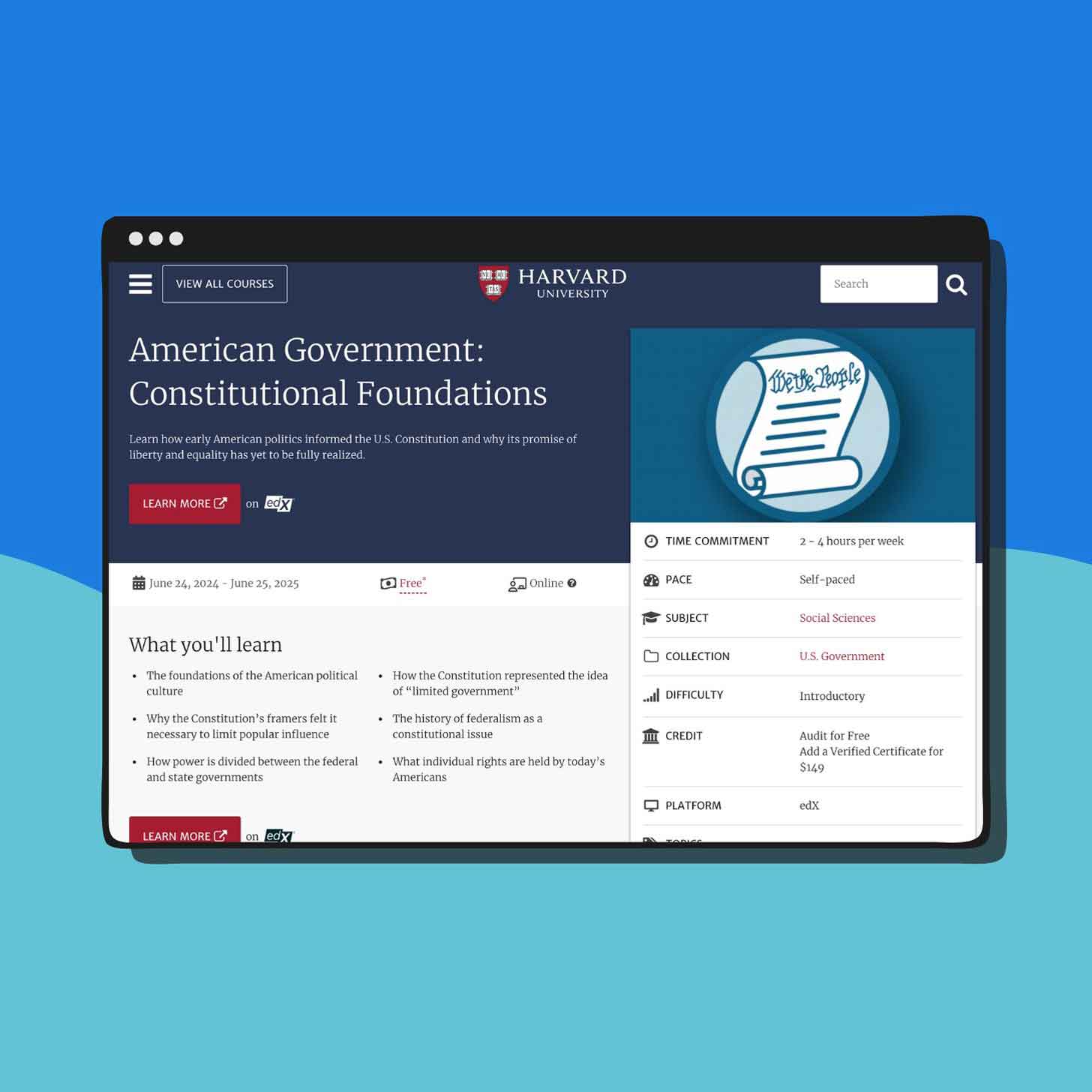
Of the free government classes offered, some include lessons on constitutional foundations, U.S. public policy, citizen politics in America, an overview of the three branches of government, civic engagement in a constitutional democracy, and how to build public leadership.
Harvard offers free courses in multiple disciplines, including humanities, art and design, business, health and medicine, computer science, and more. Some courses include a brief one-time lecture, while others can last up to 16 weeks.
Many courses are available for free, and enrollees simply must create an online account to access them. Those who want to get a verified certificate after completing a course can pay a fee. And since all of the courses are available online and for a wide range of students, they can be taken at any pace.
Other free courses that are not categorized as government subjects include other helpful social skills, like salary negotiating, resilient leadership, strengthening community health programs, humanitarian response to emergencies, the health effects of climate change, and even an introduction to critical thinking.
Although free courses have long been an offering of the university — and others, including MIT and Yale — thousands on social media are responding with pride to Harvard’s ongoing commitment to accessible education and free expression.
“They’re offering free, college-level courses online for every U.S. citizen — and not just random stuff,” TikTok creator Tall Nate shared online this weekend, in a video reaching more than 5 million viewers.
“There’s no gatekeeping, there’s no tuition; just access. So yeah, that means I go to Harvard now. And so do you!”
Commenters flooded Tall Nate’s video, expressing enthusiasm for the offerings, sharing what classes they have already signed up to take, and even eagerly bragging about their new Harvard sweatshirts to represent their “new” school.
“I learned how to code from Harvard’s free resources back in COVID,” one person commented. “I took their classes and even ‘graduated’ with a certificate. It helped me land a job … I will definitely take this course, too, to learn and to support!”
“The whole catalog is poppin’ tbh,” another wrote.
“Let’s get educated,” another said. “May Harvard always remain on the right side of history; with the people, for the people.”
Those interested in enrolling can find a full catalog of free courses online now.
Header image by Grace DuVal/Harvard University
As a hot summer approaches and experts continue to figure out the most affordable and environmentally-friendly ways to cool buildings, German researchers have invented a new facade to automatically cool and heat buildings.
In a partnership between Germany’s universities of Stuttgart and Freiburg, scientists embarked on a nearly decade-long research project to best understand how to regulate solar thermal energy in buildings.

The result is the FlectoLine facade, a 83.5-square-meter shade system that consists of 101 “flaps” made from fiber-reinforced plastic laminates.
Each flap has flexible hinges and can bend elastically with the help of compressed air. In the cold weather, the flaps fold together to ensure that as much heat and light as possible can penetrate the interior of the building. In hot weather, the flaps unfold to provide shade.
Best of all, this happens automatically. The system’s controller uses machine learning to predict optimal settings for different kinds of weather, and solar modules have been installed to ensure this all happens with clean energy.

“In light of the challenges posed by climate change, architecture must take new directions,” said University of Stuttgart researcher Edith A. Gonzalez. “With FlectoLine, we have successfully demonstrated how much potential adaptive facades hold in this regard.”
Right now, a prototype of the FlectoLine is installed at the University of Freiburg’s Botanical Garden.
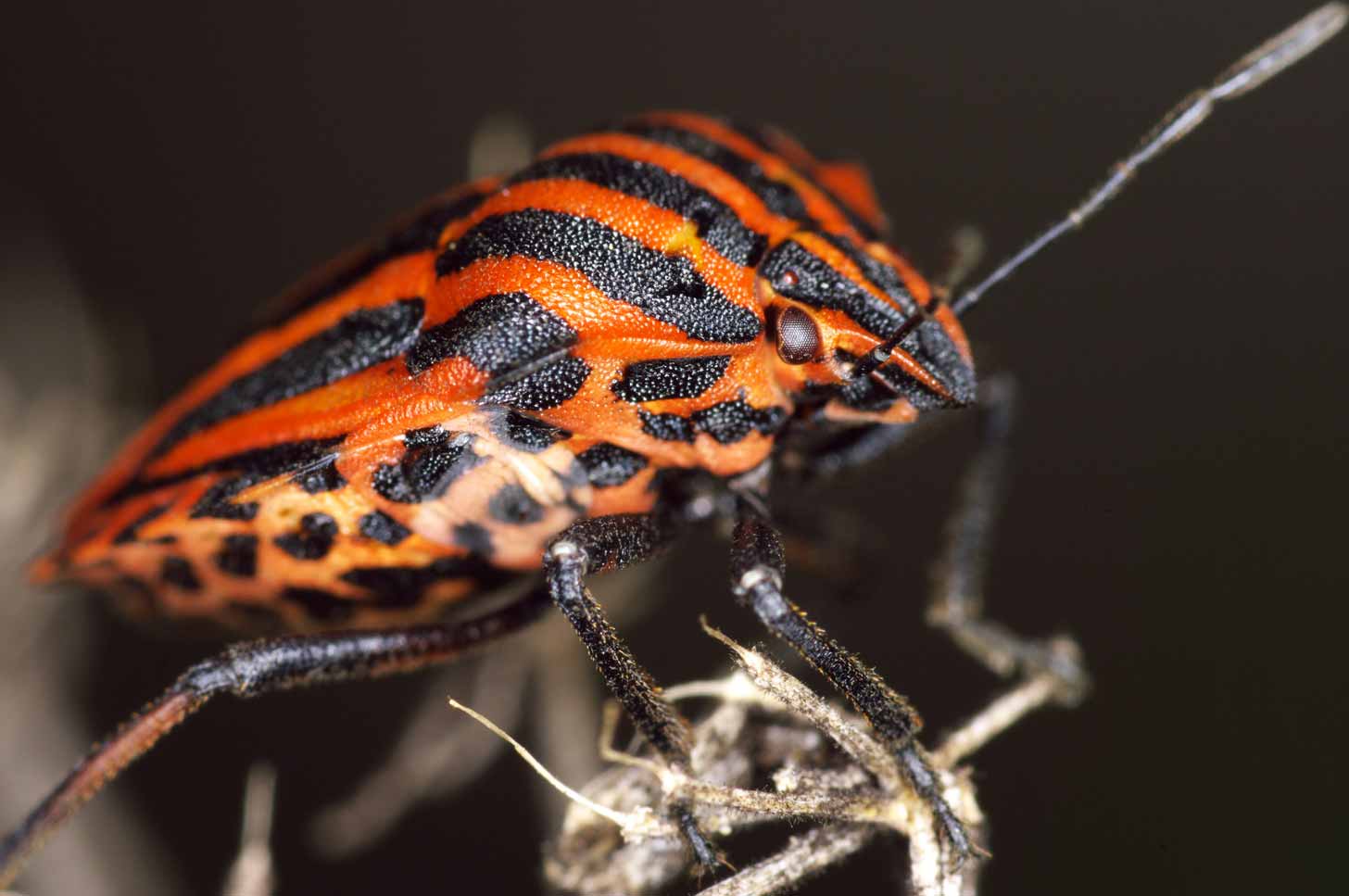
It’s a fitting location, given that the researchers were inspired by two biological mechanisms to create the shade system: the waterwheel plant and the striped bug.
“The waterwheel plant is a carnivorous plant that can close its traps to catch small animals such as water fleas. We were inspired by this mechanism,” Matthias Ridder, a research associate at the University of Stuttgart said in a statement.
“The striped bug provided insights into the material structure of the shading elements: by varying stiffness across different wing areas, it can precisely deform its wings to perform highly accurate movements — just like the shading elements of FlectoLine.”
The waterwheel plant — or the Aldrovanda vesiculosa — is an endangered species, declining over the last century with only 50 confirmed populations worldwide in Europe, Africa, Asia, and Australia. In the eastern United States, however, invasive populations of the plant do exist.
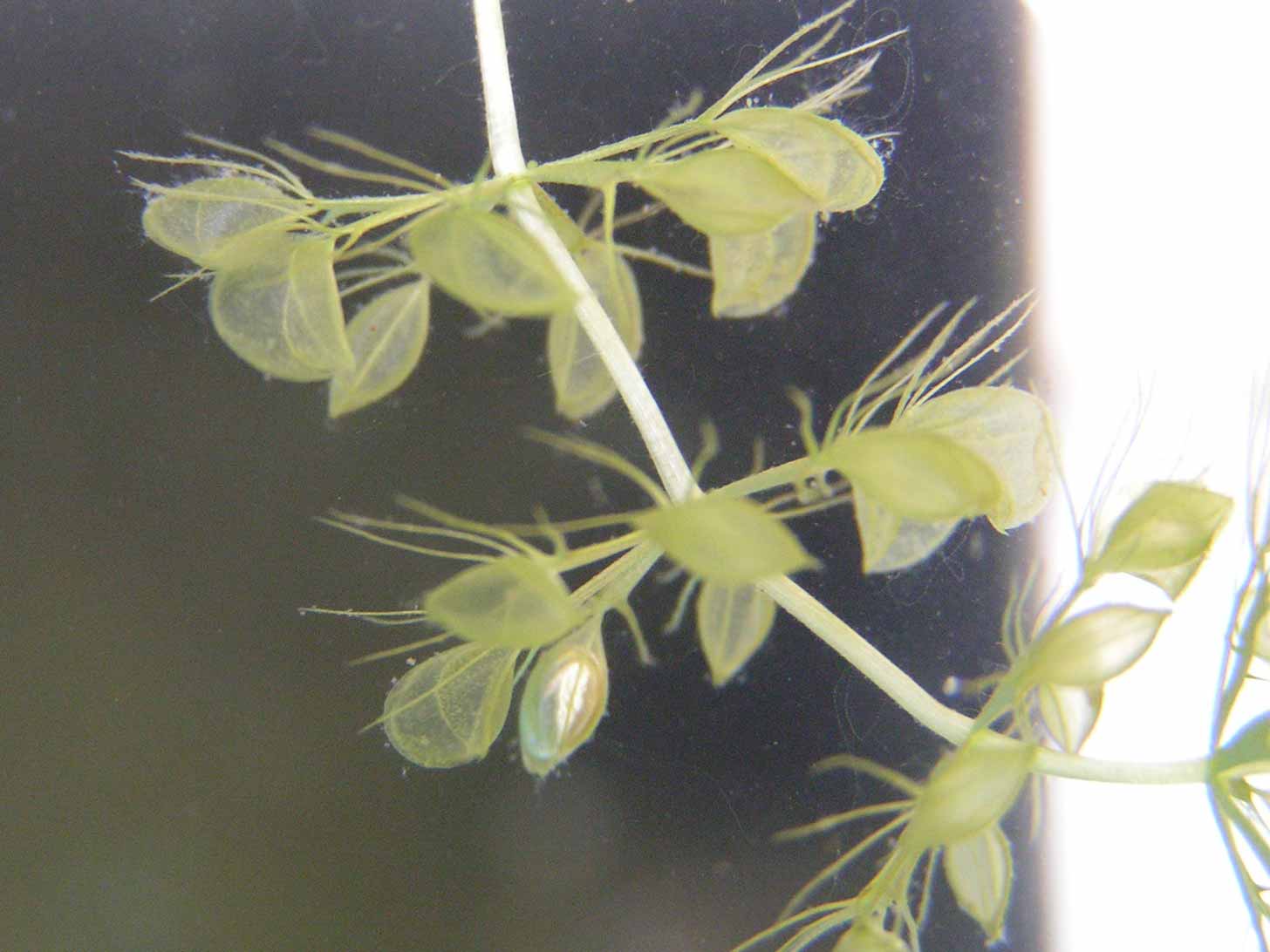
While its home in nature might be more challenging to nail down, Germany’s researchers hope the waterwheel plant-inspired shade system will last for at least 15 years.
In fact, the FlectoLine includes a protective outer layer that provides excellent weather resistance, making it a durable addition to building exteriors.

The researchers also subjected the invention to 20,000 test cycles, including weathering, fire, and wind tests, ensuring that it would remain stable for at least 15 years.
Their commitment has paid off. Earlier this month, the researchers were honored with the MVV Foundation for the Future prize at the Award for Bio-Inspired Innovations Baden-Württemberg.

“Reimagining façades as active responsive components, presents opportunities to enhance building performance and foster innovative architecture that reduces energy consumption and carbon footprints,” the researchers shared on their website.
“[FlectoLine’s] ability to regulate solar gain, ventilation, and thermal performance positions them as a critical component in reducing energy demands and supporting sustainable urban development.”
Header image courtesy of ITKE/ITFT Universität Stuttgart
South African entrepreneur Phumla Makhoba is on a mission to solve the “global south housing crisis.” And she’s doing it by using clothing waste.
Her invention, Texiboard, is a material that combines fibers found in textile waste with lime cement to create a durable, affordable, and circular building material.

The result is a textured, white square, almost tile-like, that is created with recycled materials — not emission-generating wood or concrete.
“It can be used to make furniture, flooring, walls, or even your entire home,” Makhoba said in a video for social media account We Got Earth.
The first iterations of the Texiboard included colorful cotton threads that were compressed together, with multiple attempts to remove cracks and seams and perfect the ratios of size, shape, and material mass.
With her design firm, Studio People, Makhoba has been working since 2022 to perfect the TexiBoard.
Makhoba has since created a solid panel, with shredded textile fiber and natural lime cement fully cured. Finally, it can be formed into a full sheet of building material.

Once realized, the Texiboard will confront the estimated 92 million tons of clothing waste generated around the globe each year. But it will also provide safe and stable housing that Makhoba says only 20% of South Africans can afford.
“Growing up, I saw two worlds: one with polished buildings, and one built from scrap,” she said in a video. “I always wondered, why do some people get homes that last and others get homes that leak?”
Now, the Texiboard design is available as an open-source resource, and Makhoba and her team host in-person workshops for locals living in shacks to learn how to build their own supportive and sustainable housing.

“Just having a roof isn’t enough,” Makhoba said. “A real home should protect you from the weather, work for your daily life, and not fall apart in five years.”
Her approach includes a full theory of change. Right now, Studio People is in the input process, building partnerships and funding to scale their operation. From there, they hope to develop a fully sustainable supply chain to manufacture and sell Texiboards and help build affordable housing for people in need.
Once that dream is realized, Makhoba outlines the tangible output of this work: Economically inclusive waste management, circular building materials, green jobs, and a sustainable housing and manufacturing market.
“Informal settlements can be transformed when we all work together,” she shares on the Studio People website. “Texiboard is the seed of innovation that will create updated trade jobs in the innovative building industry.”
Although the Texiboard is still being completely perfected, the goal is to provide a weather-proof, cost-effective, and circular way to house people by democratizing the act of building.
“Our goal is to create an egalitarian and sustainable urban environment, helping shack dwellers and youth out of poverty,” Studio People shared on LinkedIn.
“We empower the underdog, including people and businesses, to co-create solutions in our fight against the housing crisis, unsustainable building materials, and unemployment — one board at a time.”
Header image by Ravit Bennier Cohen on Unsplash
In September 2018, three scientists — Nick Evans, Dylan Leonard, and Cormac Price — set out to explore the KwaZulu-Natal Midlands of Boston, South Africa.
Although they went looking for the elusive Bilbo’s rain frog (breviceps bagginsi), which researcher Les Minter named after a certain hobbit in 2003, they ended up stumbling upon something even more magical.
“A thunderstorm with heavy rains had just passed — perfect for rain frog activity,” Evans, a reptilian and amphibian specialist, recounted in a Facebook post on May 21.
“We pulled over on the side of the road after hearing rain frogs calling,” he continued. “We didn't notice the call being any different to the one on the frog app, at the time.”
“Rain frogs,” he pointed out, “are not easy to find.”
When they eventually pinpointed the distinct “chirping” sound of a rain frog’s call on the rain-slicked slope, they realized that it was slightly different from the hobbit-named species they were looking for.
“It looked like a Plaintive rain frog, yet the call was different to that,” he explained. “It sounded similar to Bilbo's, which is what they were, presumed to be, when first heard by herpetologist Marius Burger in 1999.”
“It turns out,” Evans exclaimed, “we were looking at a new species!”
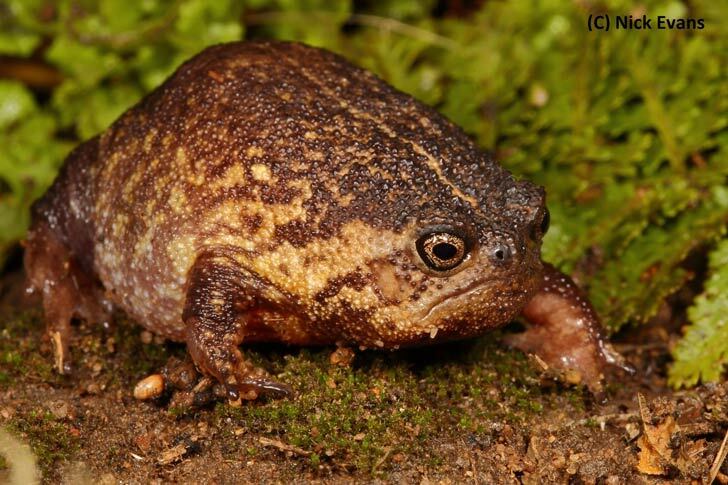
Rain frogs are noteworthy for their large eyes, round, full-bellied bodies, and distinct downturned mouths, which give them a “grumpy looking” expression — and the newly discovered “Boston rain frog” is no different.
Despite their frowny faces, the meme-worthy amphibians are key to happy habitats. Their mere presence in an ecosystem is an indicator of strong environmental health, they serve as a critical food source for other animals in the food web, and keep invasive insect populations in check.
After taking extensive photos and recordings, the trio sent them off to the “rain frog man” himself, Minter, and South African frog expert Louis Du Preez.
When it came to officially introducing the new species to the taxonomical records, the species’ 2018 discovery was only just published in the African Journal of Herpetology on May 19.
Across Facebook and Instagram, the three scientists celebrated the frog’s long-awaited induction into the scientific record.
“Finally,” Evans said, “the Boston rain frog (Breviceps batrachophiliorum) has just recently been officially described!”
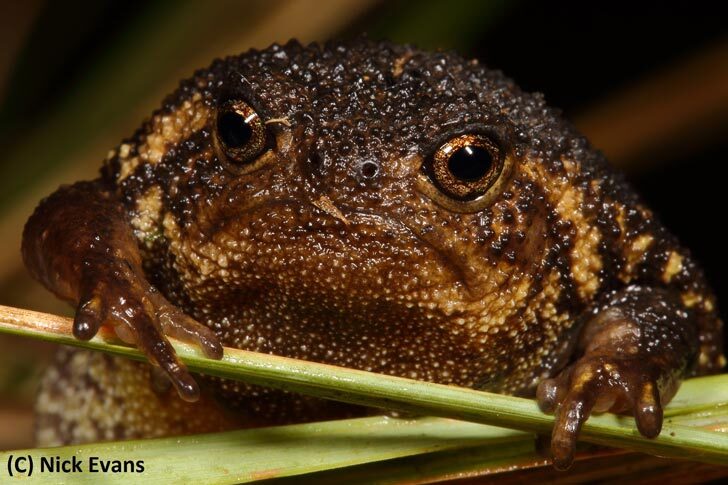
Tangentially, the researchers pointed out that their new discovery did have an added implication — it drastically reduced the previously accepted population range of the Bilbo’s rain frog.
“We now know their range does not extend from where they do occur, Babanango, to the Midlands,” Evans said, adding that the “big range reduction” meant the species’ conservation status had jumped from Vulnerable to Critically Endangered.
Fortunately, expeditions like this have a silver lining. When the accuracy of a species' range and population size is updated, it means that conservationists are better positioned to protect it.
Evans wrapped his Facebook post by writing: “You just never know what you'll find when you're out in nature.”
Hear the Boston rain frog's distinct call:
You may also like: New 'striking blue' species discovered in the Amazon
Header image via Nick Evans
Last summer, a gaggle of Oregon State University students mingled with bee-loving locals as they attended classes at a “mini bee school” in the Dufferin Park Wetlands of Kamloops, British Columbia.
Under the tutelage of expert melittologists (bee entomologists) like Boonie Zand, the students took a two-day workshop on catching, observing, and cataloging bees.
In the end, the students walked away as trained contributors for a new “bee atlas” for the Native Bee Society of B.C. — the first bee record of its kind in the Canadian province.
Modelled after the Oregon Bee Atlas, the record was designed to aid conservation efforts by training locals to identify bee species — and help classify new ones.
“The interior has the highest diversity in the province of British Columbia, which is the most diverse for bees in all of Canada,” Zand told Kamloops News last September.
“There's somewhere probably between 300 and 400 bees in the central and interior area here,” she explained. “Bees really like it kind of hot and dry, and we get a lot of interesting stuff that kind of sneaks up here from further south.”
Months later, the growing bee atlas has proved very fruitful.
So far, B.C. Bee Atlas volunteers have collected over 2,400 specimens in the province and recorded 110 different species.
They even discovered several new specimens of Perdita, or “fairy bees” — solitary little bees that are less than two millimeters long.

And Zand thinks the new bees present an exciting mystery.
“In 2018 a species checklist was published for British Columbia, and it has two species of Perdita on it,” Zand explained.
“We collected a few specimens of a Perdita that does not occur on that list, and so it's not one of the two species that we know occur here, so I'm still trying to figure out exactly what species it is.”
For Zand, and her fellow bee lovers at the Native Bee Society of B.C, the bee atlas is long overdue.
“There's stuff we don't know that it's here in B.C., and even for the species that we know occur here we often don't know exactly where they all occur,” Zand said.
“This is the stuff we're going to keep finding, new records and kind of range expansions where we find things in places we didn't realize they occurred.”
Zand said Kamloops is a “hotbed” of bee diversity because bees love the region’s hot, dry climate.
“You're going to have a lot more species that you might find there than in other places, like on the coast or further up in the north,” she said, in reference to the atlas’ growing catalog.
“So it's a great spot to find new records, [which] help us learn more about the bee diversity of British Columbia.”
You may also like: It’s been a good year for bees — 6 new species discovered in Pennsylvania, following global trend
Header image via Jade Lyf / Native Bee Society of BC
LGBTQ+ and ally shoppers need not look far back into the catalogs of Pride Months past to see an endless slew of cringe-worthy, corporate slop marketed as queer-affirming merch.
In recent years, major retailers — especially Target — have received flack for their Pride Month collections, and have even removed items made by LGBTQ-owned brands from shelves.
While some may find corporate Pride collections tasteless or outdated, worst of all, they are a symptom of a larger issue: rainbow washing.
Rainbow washing (sometimes also referred to as pinkwashing) is when a company displays superficial and inauthentic support for the LGBTQ+ community by profiting off of Pride Month, without supporting marginalized shoppers or employees year round.
This is especially true, once again, for Target. The big box giant has quietly begun displaying its 2025 Pride collection (which features placeholder text on its tags) without acknowledging a growing consumer frustration with its rollback of diversity, equity, and inclusion programs.
Although shopping for new Pride merch every year is certainly not a requirement, the good news is that there are plenty of brands — both major retailers and small, indie businesses — that do get it right.
If you’re looking to support an LGBTQ-owned business or give back to organizations supporting LGBTQ+ communities, here are our recommendations for Pride Month 2025.
By the way, some of the products and links in this article are partners and affiliates, which means if you make a purchase after clicking a link, we may earn a commission at no extra cost to you. Everything in this article was independently and honestly written by the Good Good Good team. Thank you!
The best give-back Pride merch of 2025
The American Civil Liberties Union

That’s right, the ACLU has one of the best Pride collections out there this year. From a T-shirt quoting Marsha P. Johnson to a reusable Baggu bag that says “Support Your Local Drag Queens,” this merch shop is full of thoughtful apparel designs that truly re-center the meaning of the occasion.
The best part is that all proceeds go right back into the ACLU’s nationwide efforts to defend and protect transgender rights.
→ Shop the ACLU’s Pride collection
Bombas
Bombas has always had a robust give-back approach to business. Since its inception, the brand has donated an essential clothing item to people experiencing homelessness for every item purchased, and they just surpassed 150 million donations.
For Pride Month, Bombas is focused on the reality that LGBTQ+ youth are 120% more likely to experience homelessness compared to their peers. So, every Pride item purchased will also be an item that is donated to organizations serving LGBTQ+ individuals facing homelessness.
Plus, the collection is just super cute! It features plenty of comfy, colorful socks, as well as gender-neutral underwear.
→ Shop the Bombas Pride collection
Levi’s

If you’re looking for a subtle and timeless Pride look, Levi’s is the place to search.
With small, colorful embroidery on denim hats and tote bags, as well as bolder looks, like a fully embroidered jacket reading “I know you know,” the collection does a great job of incorporating the brand’s signature styles with a queer twist.
The stand-out piece of the collection is a T-shirt with a pink triangle that reads: “United for freedom, our diversity is our strength.”
Levi’s also commits to a $100,000 annual donation to Outright International in support of its Pride collection, supporting human rights all over the world.
→ Shop the Levi’s Pride collection
Lucy & Yak
Lucy & Yak is a United Kingdom-based brand famous for its colorful dungarees and jumpsuits. This year, the brand’s Pride collection is titled “The Bonds Between Us” and features a graphic tee, jumpsuit, and dungaree shorts, all designed by artist Amanda Lobos.
“Her captivating style is a reflection of her experiences as a young, black bisexual artist and her vibrant, joyful, and bold motifs are a desire to celebrate life and to encourage others to do the same,” the product page shares.
In its marketing, Lucy & Yak also included biographies about its diverse spectrum of LGBTQ+ models, as well as a roundtable discussion about what being in the queer community means to them.
In addition to this, 100% of the profits from this collection will be split among three charities: Nai Bhor Sanstha, Nutshell, and ParaPride.
→ Shop the Lucy & Yak Pride collection
Bark

Who said Pride wasn’t for pets? Bark — the company behind the Bark Box subscription — has created a hilarious Pride dog toy collection that will have your pup slaying all month long.
Some standouts include Slay The Dragon Queen, Loud and Proud Cloud, and The Gaylien.
“At BARK we put our money where our snouts are,” the company adds on its Pride product pages. “A portion of proceeds from the Pride collection will go to our friends at Kaleidoscope Youth Center.”
These items are only available as part of new or existing Bark Box subscriptions.
Editor's note: Bark has recently come under scrutiny for a message shared by an employee that the company would not be advertising the Pride collection this year. Bark CEO Matt Meeker has shared an apology on social media, adding that 100% of the revenue from this collection will now be donated and that the brand has no intent to remove the collection from its online store.
→ Shop the Bark Pride collection
Converse
For Pride this year, Converse has introduced a “Proud To Be” collection, which is a 10-year-anniversary collection of its very first Pride products, which debuted in 2015.
To do this, the brand is including older designs from years’ past, as well as a simple customizable Pride sneaker that features options to include a nonbinary, trans, lesbian, and bisexual pride flag emblem.
Additionally, Converse is celebrating nearly $3.4 million donated to local, national, and international organizations supporting LGBTQ+ people since its first Pride campaign.
This year, purchases will benefit nonprofit partners including the It Gets Better Project, The Ali Forney Center, BAGLY Inc, and The Theater Offensive.
→ Shop the Converse Pride collection
The best LGBTQ-designed Pride collections of 2025
Gay Pride Apparel

Gay Pride Apparel is an independent business founded by two first-generation Mexican-Americans — Jesus and Sergio — in 2019. After attending New York City Pride in 2018, the pair realized they wanted to create a brand that could help people celebrate Pride all year long.
This year’s collection includes a shirt that reads “No Pride For Some Without Liberation For All,” and features a photo of Marsha P. Johnson and Sylvia Rivera, as well as bandanas for various LGBTQ+ identities, and embroidered hats with fun phrases like “The Gays Are Gaying.”
They offer apparel, accessories, flags, and home goods that give back to LGBTQ+ organizations every year. Gay Pride Apparel donates via direct fundraising campaigns, collaborations with nonprofits, and by sponsoring nonprofit events.
→ Shop the Gay Pride Apparel 2025 Pride collection
Wildfang

Wildfang is a queer and female founded fashion brand that “rethinks gender norms.”
Since its inception, Wildfang has given over $1 million to good causes, and it even achieved a Guinness World Record for the world’s longest drag show, which raised over $300,000 for The Trevor Project.
The brand doesn’t have an official Pride collection, but they have collaborated with Vivian Wilson, a trans model and personality best known for her standing up to her father, Elon Musk.
As part of the collection, Wildfang has released a shirt designed by Wilson that reads: “Existing Shouldn’t Be Revolutionary.” All profits of the design will be donated to The Trevor Project.
→ Shop Wildfang’s Vivian Wilson collection
Mythical

The online shop of Youtube personalities Rhett and Link of Good Mythical Morning, Mythical creates a robust Pride collection every year, with new designs from LGBTQ+ artists.
This year, the collection includes a new retro rainbow stripe sweatshirt by artist Carra Sykes, as well as long-time favorites, like tees that read “Everybody knows I love lesbians,” and logo products in varying LGBTQ+ colors.
All profits go to Outright International and the Los Angeles LGBT Center, which Mythical has already supported with $150,000 in donations.
→ Shop Mythical’s Pride collection
Flavnt Streetwear

Flavnt Streetwear is a queer-owned Pride shop that operates online year-round. All purchases support the Marsha P. Johnson Institute or for gender-affirming surgeries. To date, Flavnt has raised over $50,000 to help people get the care they need.
The brand carries binders, apparel, and accessories, and while the whole year is dedicated to celebrating Pride, its latest capsule collection is perfect for June.
Favorite tee designs display phrases including: “LGBTQIA people have always existed,” “Hot trans boy summer,” “Queer & thriving,” “Sapphic summer,” and “Make America queer again.”
→ Shop Flavnt Streetwear’s 2025 Pride collection
TomboyX

TomboyX is a swim and underwear brand created by couple Fran and Naomi in 2013. They offer products specifically for trans and nonbinary shoppers, with gender affirming swim and underwear, and safer alternatives to binders.
This year’s Pride collection features bras, underwear, and swimwear in a wide array of rainbow colors. Whether you’re looking for a bold gradient swimsuit, a more subdued boxer brief, or a playfully patterned bralette, TomboyX has it.
Although it doesn’t seem like the brand is donating to any particular organization for Pride Month, it is a certified B corp and is made up of a diverse team.
“Our team is 30% LGBTQ+, 77% female-led, and 35% BIPOC,” TomboyX’s website reads. “When it comes to suppliers, we prioritize women-owned businesses, environmental certifications, and living wages.”
→ Shop the TomboyX 2025 Pride collection
Header images courtesy of Bombas, Levi's, Gay Pride Apparel, ACLU, Wildfang, Converse, and TomboyX
Since the 1960s, visitors of Florida’s Everglades National Park have flocked to the Flamingo Lodge, located on the south end of the wildlife-rich region.
Originally built with cinderblock construction, the lodge faced back-to-back hurricanes, Katrina and Wilma, leading to its demolition in 2009.
Rebuilding it seemed like a pipe dream. With more furious and frequent hurricanes and tropical storms, as well as dwindling finances, stakeholders thought it was the end of an era.

But National Park Service employees and private tourism partners persisted.
“There were many reasons to rebuild Flamingo Lodge. We heard from visitors that generations of people who had come that this was a destination, the opportunity to spend the night inside a national park and expand and enhance their experience,” Allyson Gantt, the NPS chief of communications for Everglades, told The Guardian.
“You’re there to see the stars at night, see the sun rise, or hear the birds in the morning, or to encounter the mosquitoes at night, to see the difference from the daytime.”

So, they began rebuilding. The lodge’s parent company, Flamingo Adventures, started by rehabilitating its campsite, marina, and general store, but quickly realized the lodge would need to be able to withstand the inevitable extreme weather events of the future.
Previously, the lodge offered more than 100 rooms and a swimming pool. Now, it’s a more petite 24-room hotel, built entirely from durable steel shipping containers.
The containers form four individual clusters of six rooms, plus a separate restaurant and bar. They sit atop 13-foot concrete pillars, designed to withstand hurricane-force winds.

“Sustainability was hugely important and integrated into the design and the building of the lodge. It was finding that balance, just like we do with many things in the National Park Service, between what we have today and what we want to take into the future,” Gantt told The Guardian.
“In light of sea level rise predictions and climate change impacts, we sort of circled back to the drawing board to make sure we were doing our due diligence to use the right materials.”

The new shipping container approach complies with building codes and adds an even more thoughtful element of sustainability to the hotel, which also features low-flow plumbing fixtures, energy-efficient windows, LED lighting, and solar panels.
Flamingo Lodge reopened at the end of 2023 and is ready to welcome visitors for a new summer season, which begins on June 1 of this year.

It’s an exciting time for the NPS, as the hotel is the only one that exists inside the national park. For about 15 years, the only other option visitors had was to camp in the park or find lodging nearly an hour away in Florida City.
The hotel also illustrates the persistence and cooperation required of the NPS, especially in the face of a $12 billion maintenance backlog, along with severe staff and funding cuts by the Trump administration.
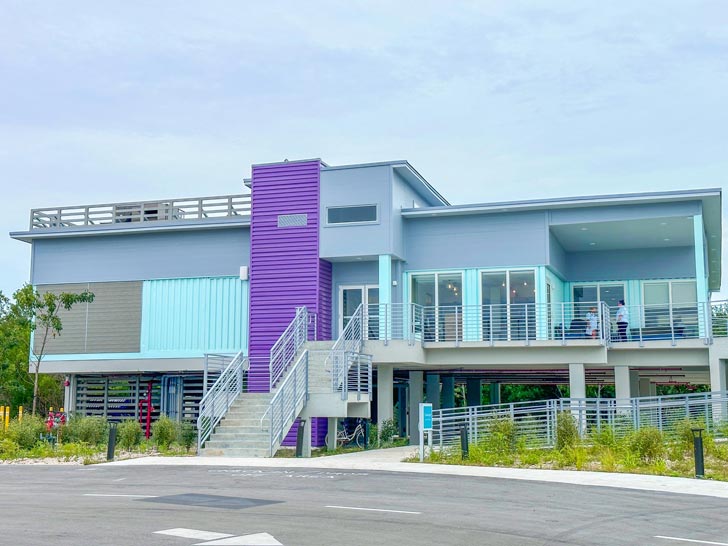
Flamingo Adventures vice president of hospitality, Laura Sherman, told The Guardian that the private-public partnership between her company and the NPS is vital to ensuring people can enjoy these public spaces, even in a changing climate.
“When you think about the Everglades, you think about the wildlife, the fauna, and the ecosystem that’s the only one like it in the world,” Sherman said. “To be able to develop and build something like this, where people can come and stay and experience it all, it’s a once-in-a-lifetime experience for some. It’s really very special.”
Gantt feels the same way.
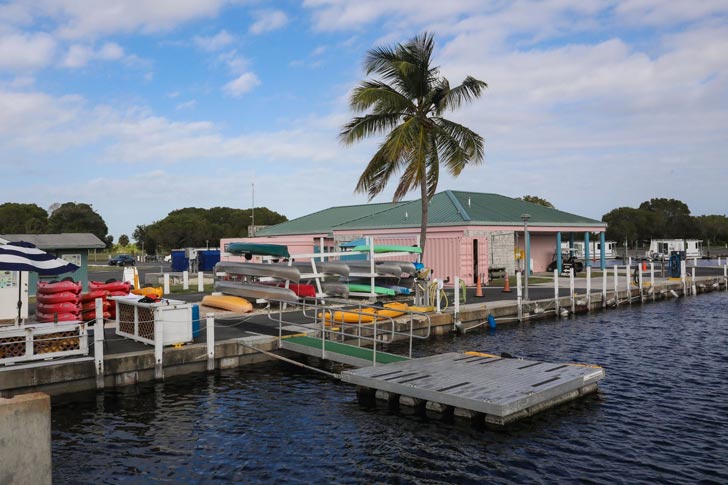
“Incorporating considerations for durability in the face of climate change for both the new lodge and visitor center provides resiliency for these visitor facilities,” Gantt told Travel & Leisure.
“We hope the new lodge, restaurant, and visitor center will encourage more travelers to discover and rediscover this unique public land.”
Header image courtesy of Flamingo Adventures
In March, Utah’s state government passed a law banning the display of certain flags in schools and other “government property.”
While the bill itself does not name specific types of flags that would be banned, one of its sponsors, Republican State Rep. Trevor Lee, posted on social media that the bill would “ban Pride flags” from Utah schools.
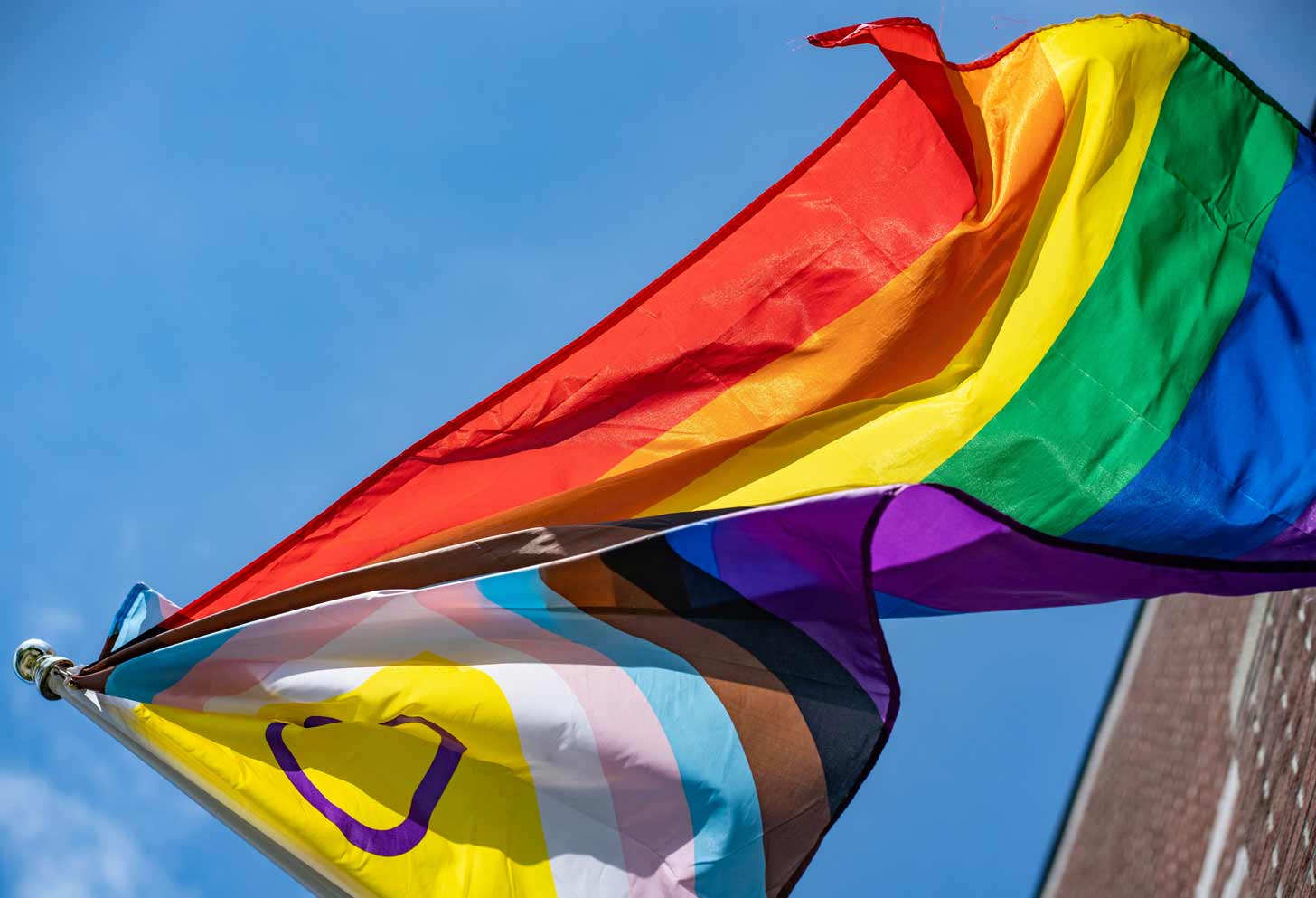
According to the law, the only flags acceptable to fly are approved state and city flags and the American flag.
Now that the law is in effect, state or local government buildings will be fined $500 a day for flying any flag other than those approved by lawmakers, according to the Associated Press.
Leaders and LGBTQ+ communities alike have come together to creatively protest the new law, including Salt Lake City Mayor Erin Mendenhall, who introduced three new “official” city flags. They incorporate the existing Salt Lake City flag design into new iterations that celebrate LGBTQ+ pride, trans pride, and Juneteenth.
The City Council unanimously adopted Mendenhall’s proposal in early May.

“Our City flags are powerful symbols representing Salt Lake City’s values,” Mendenhall said in a statement. “I want all Salt Lakers to be able to look up at these flags and be reminded that we value inclusion and acceptance — leaving no doubt that we are united as a city and people, moving forward together.”
Progressive community members have applauded Mendenhall’s move toward inclusion, and have their own plans to protest the statewide flag ban, too.
Gabi Finlayson and Jackie Morgan of Elevate Utah, a political action committee, are on a mission to “dismantle single-party rule” in Utah by helping Democrats, independents, and “anyone ready to govern with sanity, integrity, and public trust” get elected.
Much of their work is ultimately centered around sharing compelling narratives and campaigns on social media. And for Pride Month, they’ve made some new merch to get their message across.
“Remember how Salt Lake City was super iconic and they passed three new official city flags, like the Pride flag, the trans flag, and the Juneteenth flag?” Finlayson said in a recent TikTok video. “Me, too.”
To match that level of “iconic,” the duo debuted their Pride collection in the video, which was created in collaboration with Alliance for a Better Utah.
The collection includes the all-new Salt Lake City flags, which feature text that reads: “Good luck banning f(l)ags.”
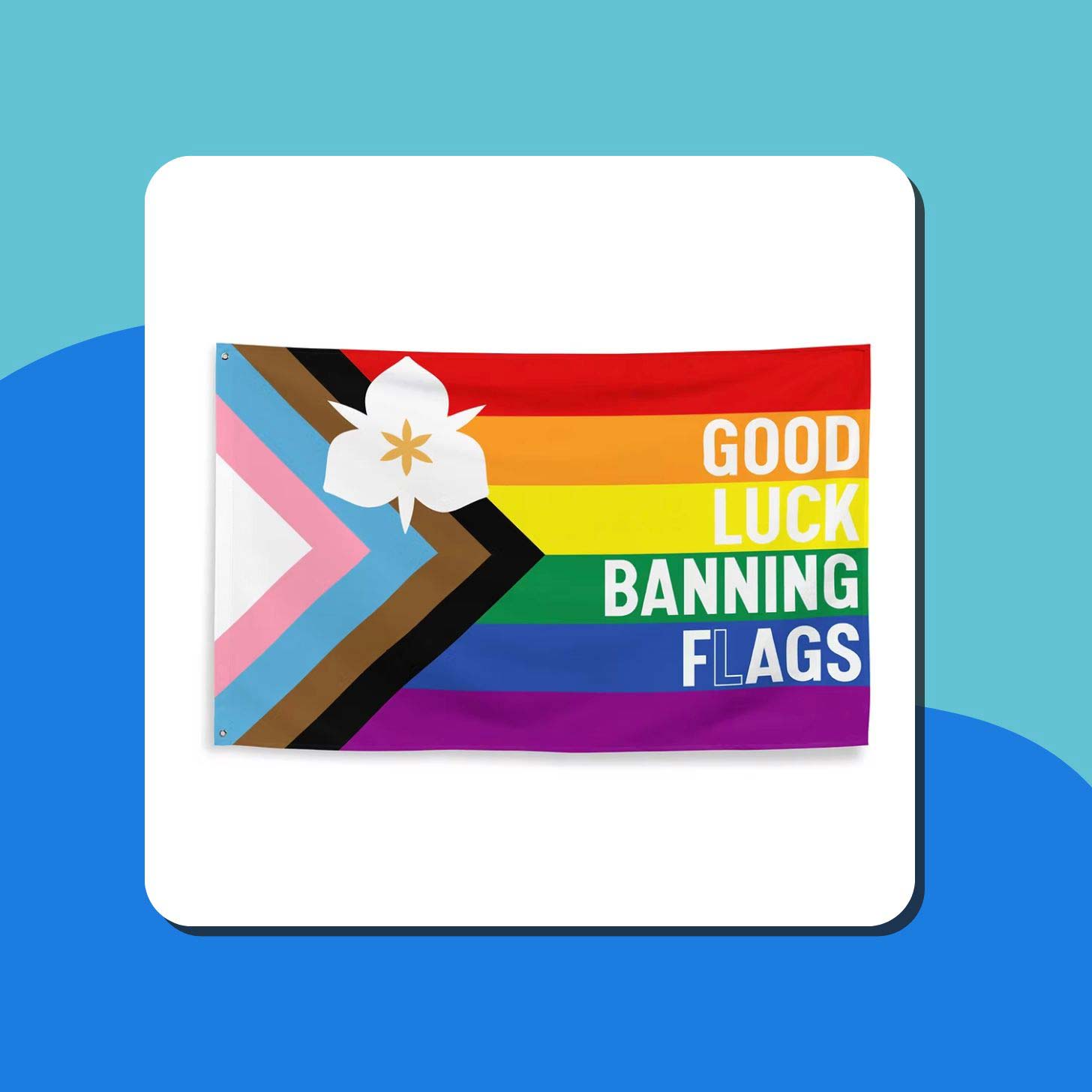
“All of the proceeds from those flags go to local nonprofits that are supporting the queer community right here in Utah,” Finlayson added.
With dozens of designs, the group’s website (ThisIsNotAPrideFlag.com) also features the Pride flag with a “Legislative Advisory: Offensive Content” sticker slapped over it, as well as a rainbow-fied Delicate Arch illustration that simply reads “Utah Proud.”
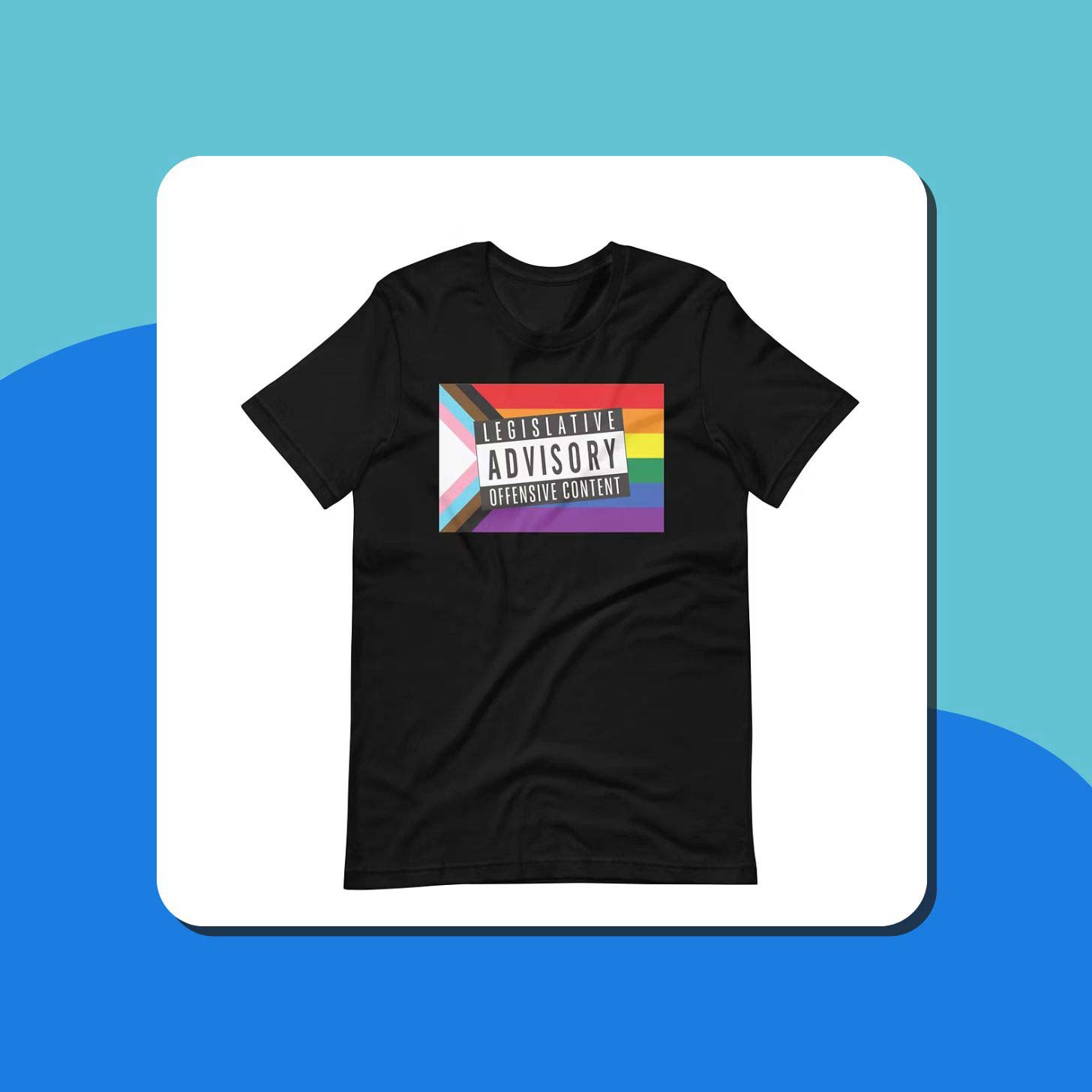
Other designs include highly Utah-specific references, including a rainbow gradient that reads “Not Today, Trevor Lee;” an image of a waterfall accompanied by “I came out at The Mayan;” and a photo of Church of Latter-Day Saints religious leader Brigham Young, surrounded by his three wives that says, “What if the wives were bi?”
“These may only be funny if you’re from Utah or have lived here too long,” Finlayson laughed.

Ultimately, the designs are a commentary on a culture that has long suppressed LGBTQ+ freedom and expression.
“These flags have historically been symbols of visibility, belonging, and celebration,” the online shop reads. “The Utah Legislature turned them into contraband. Mayor Mendenhall and the Salt Lake City Council turned them into a protest. We’re turning them into a movement and a fundraiser for our community.”
While it’s unclear what organizations will be the beneficiaries of this fundraiser, Finlayson emphasized that the messages of these items will make a real impact.
“Get your Pride merch, get ready for Pride,” she said, “and let’s remind the Utah legislature that we have never needed their permission, and we never will.”
Header image by Chris Robert on Unsplash