Earlier this week, Forbes released its 2024 edition of 30 Under 30, an annual list that highlights 600 young go-getters across 20 industries in North America.
With the help of independent judges, the Forbes editorial team evaluated over 11,000 candidates to compile this list, full of innovative entrepreneurs, culturally impactful artists — and our favorite: do-gooders.
While there is certainly some criticism of the 30 Under 30 competition — including Forbes’s own “Hall of Shame” for past honorees who have become more dubious household names — the annual list, like its cousins “Spotify Wrapped” and “TIME Person of the Year,” give us a cultural touchpoint to reflect upon.
More importantly, it introduces us to people who are making a difference in the world, who inspire us with bold and exciting solutions, and make the world (and the internet!) a more welcoming, inclusive place.
With that in mind, we’ve compiled our own small list of activists and change-makers you shouldn’t overlook in this year’s 30 Under 30.
These Activists Were Among This Year’s Forbes ‘30 Under 30’
Dylan Mulvaney
TikTok Creator, @dylanmulvaney

Seemingly overnight, Dylan Mulvaney has turned into a household name. The transgender actress, comedian, and content creator hard-launched her transition through a TikTok series called “Days of Girlhood,” where she highlighted her journey every day in front of millions of viewers — receiving over a billion views.
While the past year has brought a slew of political vitriol her way, Mulvaney has stood firm in her positive demeanor, while still setting boundaries.
One of the most enjoyable and expressive LGBTQ+ influencers to follow, Mulvaney is a shining example of joy, hope, and empowerment for trans folks everywhere.
→ Check out Dylan’s essay about her first Pride as a trans woman!
Leah Thomas & Kiana Kazemi
Co-founders, Intersectional Environmentalist

In 2020, Leah Thomas took to Instagram to teach the world what it meant to practice intersectional environmentalism.
Soon after, she launched a nonprofit and educational hub: Intersectional Environmentalist. The climate justice collective creates and shares educational resources for over 500,000 followers and consults for major companies.
Thomas brought Kiana Kazemi on board as a co-founder and programming director of the organization while Kazemi was a student at UC Berkeley, and last year, Thomas published her book, “The Intersectional Environmentalist.”
Together, the pair leads a team of thoughtful, optimistic climate justice leaders who hope to save the world.
→ Read a full Q&A with Leah Thomas
Keith Lee
TikTok Creator, @keith_lee125

Keith Lee is TikTok’s resident food reviewer, whose viral videos have helped hundreds of local restaurants and struggling eateries survive an unpredictable economy.
Lee is a former professional fighter and father of two who has now accumulated over 15 million followers on TikTok, with his food review videos garnering over 630 million likes.
Every time he reviews a new place, the masses follow. He also encourages viewers to donate to local business owners’ Venmo or Cashapp, to help them succeed further.
“We went from not being able to pay the bills to now having to hire people to come and help us,” Yasser Zermeno, owner of Aroma Latin American Cocina, told NBC News. “We call it the Keith effect.”
Brittany Sinitch
Founder, The Unbreakable Organization

Brittany Sinitch is a teacher who survived the 2018 school shooting at Marjory Stoneman-Douglas High School in Parkland, Florida during her first year as a teacher.
Throughout the healing process that followed, she became a staunch gun reform activist and founded The Unbreakable Organization, which helps school communities heal from trauma and build emotional resilience.
The nonprofit shares resources about coping with tragedy, engages in personal story-building, works to eliminate financial barriers to professional mental health support, and has an Unbreakable Scholarship for first-generation college students. (It has awarded $18,000 in scholarships to 18 students.)
“We are humans, and we break,” The Unbreakable Org website reads. “Our hope is that you know when you are ready, you can always put your pieces back together and start again.”
Franziska Trautmann and Max Steitz
Co-founders, Glass Half Full
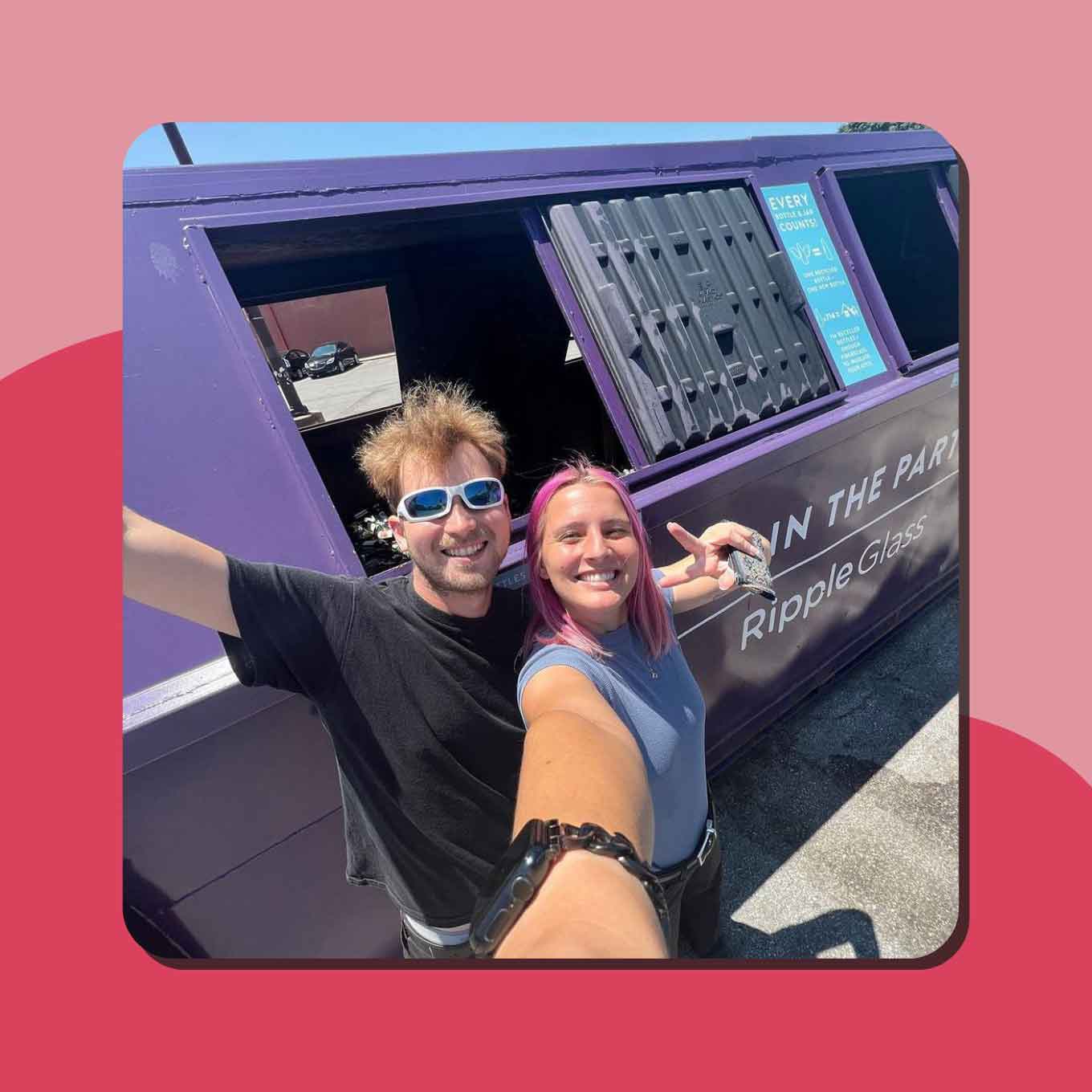
It all started with a bottle of wine. Franziska Trautmann and Max Steitz were at the end of their college careers when they were commiserating about their city’s inaccessible glass recycling program over a drink. They began brainstorming what it would look like to implement their own grassroots glass recycling program.
So, the duo started Glass Half Full. The company collects glass from residents and businesses in New Orleans — and was the city’s first glass recycling plant.
Glass Half Full converts its recycled materials into beach-like sand and glass cullet, which is then used for disaster relief, eco-construction, new glass products, and more.
The ultimate goal is to use its recycled sand to begin restoring Louisiana’s fragile shoreline. To date, the duo has diverted more than 6 million pounds of glass from Louisiana landfills and plans to expand into Alabama, Mississippi, and Florida.
→ Listen to our interview with Franziska Trautmann
Ceri Riley
Co-founder, SciShow Tangents

Ceri Riley is a queer, biracial woman in STEM who is passionate about making accessible and inclusive educational media. Under Hank Green’s production company, Complexly, Reilly has led several teams as they produce content that uplifts historically marginalized voices and sources of knowledge.
This year, she also helped forge a partnership with Arizona State University that would provide an accessible opportunity for people to earn college credits through watching Complexly’s educational videos. Additionally, she co-hosts the podcast SciShow Tangents — which makes science fun (and a little competitive) for everyone.
→ Learn more about how you can earn college credit by watching YouTube
Sav Rodgers
Founder, Transgender Film Center

Sav Rodgers, a trans filmmaker and screenwriter, founded the nonprofit Transgender Film Center in 2020. Since then, the center has partnered with major studios to help Rodgers realize his goal of connecting transgender stories with audiences worldwide.
These partnerships include career development labs with Netflix, Career Boot Camps with Warner Brothers, and more.
Additionally, this year the center funded $100,000 in grants to up-and-coming trans filmmakers. Oh, and Rodgers debuted his hit LGBTQ+ romance documentary, “Chasing Chasing Amy,” at the 2023 Tribeca Festival.
Taylor Cassidy
Content Creator & Educator, @taylorcassidyj

Taylor Cassidy’s TikTok bio almost tells you everything you need to know: “Black history like you’ve never learned before.”
Cassidy started her project “Fast Black History” in 2020 when she was just 17 years old, creating her own web series in response to the lack of meaningful curriculum in her middle and high school syllabi.
She then created another show focusing specifically on Black creatives called “Black Girl Magic Minute.” By keeping her lessons succinct, dynamic, and engaging, she became a radio host for Sirius XM’s TikTok radio, as well as a correspondent for Nickelodeon’s Nick News.
Also in 2023, she became the first youth speaker at the UN’s International Day for the Rememberance of the Trans-Atlantaic Slave Trade — continuing her mission of uplifting young people through the power of education.
→ Meet some other TikTok teachers you need to follow
Header images courtesy of Keith Lee; Franziska Trautmann and Max Steitz; Dylan Mulvaney
From renewable energy capture to eco-friendly building power, industries of all kinds are working to develop innovative alternatives to technologies that have proven to be detrimental to the environment.
Construction materials are no exception.
The building sector is the second largest industry responsible for plastic consumption, and it’s responsible for more than a third of energy-related greenhouse gas emissions worldwide.
Standard construction materials — like steel, wood, and reinforced concrete — are major pollutants of air, land, and water, and contribute to issues like deforestation.
So it makes sense that the industry is looking to innovation — and timeless sustainable practices — to change the course.
In fact, materials derived from agro-industrial waste have become increasingly popular in the building sector, as researchers and engineers work to figure out ways to give life to what used to be considered waste.
Most recently, researchers from the Universidad Tecnológica de Panamá have published their findings on a new eco-friendly form of thermal insulation.
And let’s just say this: Anyone who says print journalism is dead might want to try recycling first.
Thermal insulation can be made from recycled materials.
Researchers in Panama have developed a rice husk-based insulation material and studied its thermal and mechanical properties with hopes of contributing to a new generation of building materials.
Their research, which was published in “Frontiers of Built Environment,” followed a four-ingredient recipe: shredded rice husks, recycled and shredded newspaper (which provided cellulose and structure), borax (to make the mix resistant against fungi and fire), and glue (to act as a bonding agent).
In Panama, rice husk is considered agricultural waste and is typically sent to landfills or incinerated. By repurposing it as insulation material, it creates a double layer of sustainability: removing agricultural waste from the environment and replacing eco-unfriendly building materials with something that already exists.
“Here we show that is possible to create alternative insulating material from recycled newspaper and rice husk,” Nacarí Marín Calvo, a researcher at the Universidad Tecnológica de Panamá, and the first author of the article, said in a statement.
“The developed material has competitive thermal conductivity compared to many natural and recycled insulation materials.”

The material was tested in various compositions. For example, the first mix was made from 14% newspaper, 9% rice husk, 15% borax, and 62% glue.
In following compositions, the amount of rice husk was increased, while the amount of newspaper was decreased.
The researchers used three mixtures to study the behavior of the ingredients, looking at thermal conductivity (the ability of the material to conduct heat), as well as the maximum stress and compression the material can withstand before breaking.
“We found that the results were similar in all three compositions in k-values [thermal conductivity], maximum stresses, and compressive strength values,” Marín Calvo said.
They also found that the material compared to the thermal conductivity and strength of traditional materials, like cardboard, cement, and sand, as well as other recycled insulation materials.
In summary, the rice husk-base material is a sustainable alternative and can be used to insulate environmentally-friendly buildings.
Researchers also believe the material could have a future in other industries, depending on other configurations of the ingredients to increase the material’s durability.
Marín Calvo added: “We can conclude that the material could also potentially be used in various engineering domains, including the production of lightweight components, construction panels, and sustainable packaging.”
Further research is still needed to implement this material widely.
While this discovery is cause for celebration, researchers also pointed out that they’d want to conduct more studies to confirm the material’s insulating properties in different climates.
Panama is known for its high humidity, and to use this material elsewhere, other tests would need to be done to see how the rice husk and newspaper blend would perform in other conditions.
“As a part of future research, we are evaluating the degradation of the developed material under ambient controlled conditions,” Marín Calvo said.
Regardless, it’s exciting to see these developments — and gives us some ideas about how the lifespan of our Goodnewspaper can be even more sustainable.
Header image courtesy of OJjnr (CC BY 4.0)
Whether the culprit is an overzealous gift-giving grandparent, the endless accumulation of new and improved items, or your kiddo’s rapidly changing interests, there’s a good chance that — if you’re a parent — you have a surplus of toys in your home.
As kids grow out of things, holidays cycle through again and again, and we all work to reduce our carbon footprints, the next order of business that needs addressing is where to donate all of those gently used toys.
While it’s totally acceptable to go the route of reselling or sharing toys with another family member or friend, there are plenty of children who do not have the privilege of having their own toy collection.
This is where you can make a difference! As you do your part to mitigate the world’s plastic and e-waste problems (toys make up about 6% of landfill waste worldwide and produce more electronic waste than vapes), you’ll also be supporting children in need.
To make this easier, we’ve rounded up a list of charities and organizations that are always on the lookout for toy donations, as well as other options you can access in your community.
The Best Organizations That Accept Toy Donations
Second Chance Toys
Founded in 2006, Second Chance Toys rescues and recycles plastic toys and donates them to community organizations that service children in need.
The organization partners with a number of drop-off locations across the U.S. By navigating the online map, you can find an accredited location near you, register as a donor, sign up for a time to drop off your toys (or have them picked up), and you’re good to go!
Before you gather your toys for donation, be sure to check out Second Chance Toys’ Getting Started Kit to make sure you’ve got the right stuff. The organization only accepts clean plastic toys with no small or missing parts (and batteries must be functioning and secured within the toy).
Toys For Tots
Toys for Tots is a nonprofit created by the U.S. Marine Corps Reserve that was founded in 1991 with the goal of providing toys to less fortunate children around the holidays.
Local campaigns are conducted annually in over 800 communities across all 50 states, distributing an average of 8 million toys every year.
While Toys for Tots only accepts new, unwrapped toy donations, this is a great way to donate any unused items that have accumulated in your household (or maybe you were given a duplicate toy as a gift!).
Find a local chapter and donation location in your area by using the Toys for Tots Search Tool.
Ronald McDonald House
The Ronald McDonald House houses thousands of children and families every year who undergo critical medical care. During that time, it’s important for young people to have access to toys and play items!
The organization does not accept used toys, but if you have any new and unopened (and unwanted) toys, you can donate them to one of hundreds of locations across the country.
And if you’re just in the spirit of giving, you can also explore your local chapter’s current Ronald McDonald House wish list, as well.
Stuffed Animals for Emergencies
Is there anything more comforting than snuggling up with a soft stuffed animal?
Stuffed Animals for Emergencies (SAFE) accepts stuffed animal donations and distributes them to children in need who have been impacted by natural disasters or other emergency situations.
SAFE accepts new and used stuffed toys, no matter how loved they are. The organization also accepts donations of items like blankets, books, kids clothes, and baby items.
Over 25 years, SAFE has donated over 350,000 stuffed animals to children in need. Find a chapter in your area, sign up to host a stuffed animal drive, or locate an “urgent needs” location to support.
Operation Homefront
Operation Homefront is a great option if you’re looking to support veteran, wounded, and active-duty military families.
The organization accepts new and used toy and game donations to provide for military families that are relocated. For more than a decade, the organization has partnered with Dollar Tree to act as donation collection points during the holiday season in November and December.
However, you don’t have to visit a Dollar Tree store to donate. Operation Homefront makes it easy to set up a collection bin at your office, store, school, or church, as well.
To find donation locations or volunteer events in your area, visit Operation Homefront’s Facebook page.
Cradles to Crayons
Cradles to Crayons operates in Boston, Chicago, and Philadelphia, providing low-income families with the essentials they need — free of charge.
Of course, part of this includes toys! Cradles to Crayons accepts new and almost-new toys through grassroots community drives and corporate donations.
From there, donations are processed and packaged by volunteers in the organization’s warehouse: The Giving Factory. Then, packages full of essentials are distributed to local low-income families.
Learn more about what you can donate and find a local drop-off near you.
The Arc
The Arc is a community-based advocacy organization for people with intellectual and developmental disabilities. Local chapters of the organization accept donations of physical items in good condition — including toys — that can be sold in their thrift stores.
These stores provide work experience for adults with disabilities. Find your local chapter to find out what items they accept and schedule a donation pick-up.
Habitat For Humanity
Habitat for Humanity helps families build and improve the places they call home. To do this, the organization has a number of Habitat ReStore thrift stores that sell pre-loved items.
You can donate goods like games and toys, as well as furniture, household items, and appliances to any local Habitat ReStore. All proceeds go to building affordable housing for local families.
Goodwill
Another easy donation point is Goodwill. The popular thrift store provides career counseling, skills training, and more for job seekers in need.
And they certainly accept toys! Among all kinds of gently-used items, you can bring toys and games to any Goodwill donation center to be sold in their retail stores.
Additionally, you can ask for a tax benefit receipt upon donating.
Salvation Army
The Salvation Army is a Protestant Christian church and charitable organization that was founded way back in 1865 in London. But the give-back element of the organization is how it’s best recognized in the U.S.
You can donate your new and used toys, stuffed animals, books (and other goods like clothes and housewares) to the Salvation Army. They will then be sold at the organization’s thrift stores, funding more charity work in your community.
Find your local Salvation Army and even schedule a free donation pick-up.
Other Places To Donate Toys
Foster Care Programs
Foster care or children’s shelters in your area will likely be happy to take your pre-loved toys. In a turbulent environment, these items can be especially grounding and significant in the lives of young people.
You can go online to search for programs in your area, call and ask to learn more about how to make a donation, and get to gathering your goodies!
Even if a local program does not accept donations, they may be able to direct you to specific children in need who would most appreciate your pre-loved items.
Need a place to start? Check out the Child Welfare Information Gateway to find contact information for an agency near you.
Daycare Centers
Imagine dropping off your kiddo at daycare — along with a big box of toys they no longer play with. Your local daycare centers are another great avenue for donating used toys, especially wooden or plastic toys that are durable and easy to clean.
Just be sure to check in ahead of time to make sure the daycare centers in question are accepting donations!
Local Libraries
While libraries are already usually pretty well-stocked with a large variety of items you can check-out, they’ll usually never turn down some more resources for the community!
A great way to discard used toys or books is by donating games and toys during a community book sale at the library. Check in with your beloved librarian ahead of time to see what kinds of donations might be accepted.
After-School Programs
Similar to daycare centers, after-school programs may also be interested in giving your toys a new life.
Who knows? They could be shared with younger children who need supplies to play and explore after school, or they can be repurposed as art supplies or robotics projects for older students.
Again, be sure to ask before you attempt to make a donation for maximum efficacy.
Children’s Hospitals
Hospitals are one place where kids are in dire need of a distraction, and toys come in really handy. Many hospitals or doctor’s offices gladly accept donated toys for patients to play with in the waiting room, or as a coping tool in the exam room.
One thing to remember, though, is that most hospitals have strict hygiene policies and might not accept used toy donations. Mount Sinai Children’s Hospital has a great list of toy donation suggestions, but be sure to call ahead at your local hospital to learn about specific requirements.
Shelters
Shelters that serve unhoused children and families, or those impacted by domestic violence, are a great option for donating your used toys.
Find a shelter or safe home near you and ask if they accept these donations and what parameters they may have in place.
Animal Shelters
No luck sharing your toys with other kids? If you have stuffed animals to donate, some adoptable dogs from your local animal shelter would certainly be happy to take them off your hands!
Of course, check in with your local shelter, but most times, you’ll want to avoid donating plushies with any small parts, like button eyes or electronic packs. Stay away from any materials that could be ripped off or ingested, or that could be harmful to animals, like beads or plastic.
Just be warned: You may come in with the goal to get some faux furry friends off your hands, but it will also be tempting to leave with a real one. (We’re not stopping you!)
Fire Departments
First responders like firefighters, EMTs, or police officers may keep stuffed animals or other small toys on hand to comfort kids on the heels of a traumatic event.
Many fire departments and other local agencies will host toy drives around the holidays, but you can also reach out to see if anyone is accepting these donations throughout the year, as well.
Faith-Based Organizations
Faith-based organizations, like churches, mosques, synagogues, and other community centers, often serve as a generalized drop-off location for all kinds of donated goods.
Many are happy to accept donations of toys, games, crafts, or books for members to use — or to distribute to folks in need throughout the community.
Call up your local faith-based organization and ask if they’ll accept your items, or if they can point you in the direction of the best place to donate.
Recycling Programs
If your toys have truly been so loved that they don’t have much of a life cycle outside of your family toybox, you can recycle them instead of throwing them in the trash. First, look into your local recycling guidelines to see if they can be easily accepted from your curb.
Otherwise, you can look into programs like TerraCycle, which partners with Hasbro to recycle toys and turn them into new raw materials to keep the fun going on indefinitely.
Buy-Nothing Groups
Buy-Nothing Groups are some of the best corners of the internet. It’s where people in your area go to offer up free items that they no longer use — no strings attached.
Whether these take the shape of Facebook Marketplace listings, posts on your NextDoor app, or the Buy Nothing Project itself, you can offer up your used toys to someone in your community who can give them a better life.
The Buy Nothing Project has a great forum to find an established group in your area.
Museums
Your Barbie could be the next big thing. Believe it or not, you might be able to donate your toys to a museum!
Museums love cultural artifacts like these to enhance their exhibits — especially the Strong Museum of Play. Additionally, children’s museums may even accept used toys to be played with in communal areas.
As usual, be sure to contact the museum you have in mind to learn more.
Every day the Good Good Good team collects the best good news in the world and shares it with our community. Here are the highlights for this week!
If you want to get good news in your inbox every day, join the Goodnewsletter — the free daily newsletter designed to leave you feeling hopeful.
The Best Positive News We’re Celebrating This Week —
A judge created an effective alternative to sending kids to prison for life
Judge John Phillips, motivated by the realization that he was sending young people to prison for life, founded Rancho Cielo in Salinas, California, to provide an alternative path for at-risk youth.
The program, launched in 2003, aims to help students overcome challenges related to poverty, dysfunction, trauma, and pain by offering a supportive, therapeutic environment. Rancho Cielo provides vocational programs in construction, auto and diesel repair, welding, culinary arts, and agricultural technology, along with academic and career pathways. The success of the program is evident: 84.8% of its graduates do not re-offend, compared to 40% of youth in the county's juvenile justice system who have another encounter with the law.
The Rancho Cielo campus looks like a high-end private school, with colorful and well-equipped buildings, providing a positive and enriching atmosphere for students. The program goes beyond traditional education by offering comprehensive support, including clothing, transportation, and assistance with various subjects.
The school's unique funding model, combining public and private partnerships, allows for additional resources and training opportunities not typically available in public schools. The success of vocational programs, such as the automotive and diesel mechanic program, has led to innovative expansions like focusing on vintage auto repair to meet local needs.
Why is this good news? Rancho Cielo's impact extends beyond providing education; it transforms students' lives by offering practical skills, emotional support, and opportunities for personal growth. The school's commitment to "at-promise" students, reaching them before they become entangled in the legal system, demonstrates a proactive approach to addressing socio-economic challenges. Rancho Cielo's success in reducing recidivism, providing vocational training, and preparing students for college or well-paying jobs makes it a model that could be replicated in other communities, addressing the broader issue of education and support for at-risk youth across the nation.
An innovative, TikTok-viral helmet aims to reduce concussions in surfers
After a personal surfing injury made him realize the lack of effective head protection for casual surfers, Davon Larson was inspired to create an innovative helmet designed to reduce concussions.
He found existing helmets on the market to be bulky and unattractive, more suited for professional surfers. The Surf Skull aims to provide a low-profile, stylish, and affordable option for leisure surfers, starting at just $58.
Surfers are increasingly at risk of concussions due to the growing popularity of the sport and crowded line-ups. Thankfully, the Surf Skull, designed to resemble a bucket hat, features a bump-cap insert for protection. And it's also available in a baseball cap style!
Larson’s TikTok video about the helmet gained viral attention, with over 920,000 views in a week. Supportive comments showed interest not only from surfers but also from individuals engaged in other activities like rollerblading, biking, climbing, skateboarding, water skiing, and more.
Why is this good news? The Surf Skull represents an innovative solution to address the safety concerns of surfers. By providing a low-profile, stylish alternative to traditional helmets, Surf Skull aims to encourage more surfers to prioritize head protection. And by raising awareness about the risks of concussions and offering an affordable option for surfers, it ultimately contributes to a safer and more protected outdoor experience for enthusiasts.
First-of-its-kind app revolutionizes access to information for Florida foster youth
Bay Area Legal Services, a nonprofit law firm in Tampa Bay, Florida, has introduced FosterPower, a groundbreaking website and mobile app aimed at providing essential and accessible information for foster youth in the state.
Developed by attorney Taylor Sartor, the app addresses the critical need for improved information exchange among foster youth, particularly regarding life skills, independent living, mental health care, education, and legal protections.
Launched in May 2023, FosterPower specifically targets the foster youth population in Florida, which has garnered national attention due to concerns about an overburdened child welfare system. As of 2022, there were more than 24,000 youth under the age of 18 in Florida's foster care system, with many lacking awareness of their benefits, protections, and legal rights, according to Taylor Sartor, who has dedicated over six years of service to foster youth at Bay Area Legal Services.
The app's primary goal is to simplify complicated legal information, making it easily understandable for youth in foster care. FosterPower covers a range of common topics, including independent living benefits, medical information, education, the court process, placement, protections for LGBTQ+ youth, monetary allowance, and more. Since its launch in May 2023, the app has garnered over 3,400 downloads, and the website has been used by 8,200 users.
Why is this good news? The app's impact is particularly significant as it provides foster youth with accessible information on devices they often retain even during transitions between homes. The combination of digestible content and reliable information on smartphones can be transformative for young individuals navigating the complexities of the child welfare system. Sartor envisions using Florida as a blueprint and collaborating with other states to duplicate the information, ensuring that foster youth nationwide have access to information about their benefits, protections, and legal rights. With nearly 400,000 foster children in the United States, FosterPower stands as a pioneering initiative with the potential to positively impact the lives of foster youth across the country.
Child mortality rates have declined substantially over the course of history
Child mortality rates have significantly decreased in recent history, marking a notable achievement. About two centuries ago, approximately 50% of children did not survive until puberty. However, by 2020, the global average had dropped to 4.3%, with improvements attributed to factors such as enhanced nutrition, access to clean water, sanitation, neonatal healthcare, vaccinations, medications, and reductions in poverty, conflicts, and famine. Some affluent countries, including Iceland, Japan, and Norway, have achieved child mortality rates as low as 0.4%, indicating substantial progress and emphasizing the potential for further advancements.
What’s the nuance? Child mortality rates vary widely across the globe. Declines in mortality rates have not been uniform globally, with certain areas, particularly in Southern Africa, experiencing increases in child mortality during the 1990s and 2000s, largely attributed to the HIV/AIDS epidemic. Child mortality remains a significant global challenge, with approximately 5 million children under the age of five dying each year — around 14,000 deaths daily, or ten deaths every minute. Most of these deaths are from preventable causes.
Although there has been a decline in child deaths over time, especially considering the rising global population, the scale of this loss continues to be a tragic reality impacting not only the children but also their families, friends, and communities. There is an ongoing need for further progress in reducing child mortality rates through preventive measures such as vaccination, basic medication, rehydration treatment, nutrition supplementation, neonatal healthcare, and more.
Hairdressers are being trained as mental health ambassadors for women in West Africa
The Bluemind Foundation has launched an innovative initiative to address the severe lack of accessible mental health care in West and Central Africa by training hairdressers as mental health ambassadors.
In countries where mental health therapy is scarce and awareness is limited, the program has empowered hairdressers to provide much-needed support. This initiative is particularly significant in the World Health Organization's Africa region, which has the highest suicide rate globally and some of the lowest public expenditures on mental health.
Marie-Alix de Putter, the founder of the Bluemind Foundation, designed the program in 2018 based on the observation that African women spend a significant amount of time in hair salons. By training hairdressers, the initiative reaches women in spaces where they are comfortable. And the informal and affordable setting of the salon provides a safe space for clients to share their struggles, allowing stylists to offer gentle guidance and support during the hairstyling process.
Hairdressers undergo three days of training, learning how to ask open-ended questions, spot nonverbal signs of distress, and avoid gossip or detrimental advice. These "mental health ambassadors" play a crucial role as they often become confidantes for clients who share their financial struggles, emotional pain, or experiences of domestic violence during salon visits. Recognizing the impact of their role, hairdressers refer clients to professional therapists when necessary.
The Bluemind Foundation has trained approximately 150 women in mental health counseling across West and Central African cities, recognizing the critical need for mental health care in one of the world's poorest regions.
Why is this good news? In many African countries, the shortage of mental health workers is alarming, with an average of only 1.6 mental health workers per 100,000 people, compared to the global median of 13, according to the World Health Organization. The Bluemind Foundation's program not only addresses the mental health gap by training hairdressers — it also seeks to destigmatize mental health issues in communities where such topics remain foreign concepts, and its unique approach represents a step toward addressing the mental health crisis in West and Central Africa, recognizing the importance of community engagement and culturally sensitive interventions.
→ Read more
Innovative VR experiences offer an escape from painful medical procedures
New virtual reality (VR) devices, such as Smileyscope, have emerged as innovative tools to alleviate pain during medical procedures, particularly benefiting children undergoing blood draws or IV insertions. Recently FDA-cleared, Smileyscope provides an immersive underwater adventure, significantly reducing self-reported pain levels (up to 60%) and anxiety levels (up to 40%) in clinical trials with over 200 children aged 4 to 11.
Smileyscope's efficacy transcends mere distraction; it leverages VR to engage the brain with diverse stimuli, effectively closing the "gates" through which pain signals travel. Going beyond conventional approaches, Smileyscope offers immersive encounters directly linked to medical procedures, offering a positive reframing of the stimuli.
In the realm of chronic pain management, pioneering efforts like RelieVRx, FDA-authorized in 2021, introduce VR therapies to address the intricate challenges of persistent pain. RelieVRx is designed to teach chronic pain sufferers various strategies, including mindfulness, cognitive behavioral therapy (CBT), and relaxation.
Going beyond distraction, the device focuses on imparting skills that address both the physiological and psychological aspects of chronic pain. With a home-use design, RelieVRx enhances accessibility by enabling patients to access behavioral pain treatment without scheduled therapist appointments.
Why is this good news? By providing an immersive and positive environment, these technologies alleviate anxiety and reduce self-reported pain levels, making medical interventions less distressing and influencing their future interactions with the health care system. This is particularly crucial in childhood, as negative experiences can lead to avoidance behaviors that may impact seeking health care in the future. By providing an engaging escape during medical procedures, VR interventions like Smileyscope and RelieVRx offer new possibilities for improving pain management and patient outcomes.
A teen in Iowa grew 7,000 pounds of veggies and gave them all away
Lauren Schroeder, a 17-year-old from Iowa, embarked on a mission to address the lack of fresh produce in donations at a community food nonprofit when she was 14. With the support of her family, Lauren utilized half an acre of their farm to grow 15 varieties of vegetables.
Securing a grant from the National FFA Organization — a youth agricultural education group — she planted her first batch in the spring of 2022.
Despite the challenges of Iowa's hot and dry summers, Lauren diligently watered her crops daily, investing hours before and after softball practice. She learned the intricacies of vegetable farming through online research, emphasizing a commitment to sustainability and nutrition.
Over two years, Lauren expanded her garden to a full acre, incorporating 10 additional plant varieties, including herbs, pumpkins, cauliflower, and jalapeños. In this time, she donated over 7,000 pounds of produce to various local groups, such as food banks, soup kitchens, nursing homes, and social service nonprofits.
Lauren plans to continue her project, aiming to grow another 13,000 pounds of produce to reach a total of 20,000 pounds by 2025, the year she intends to attend college for diagnostic medical sonography. Lauren remains motivated, expressing a desire to expand her garden to two acres and provide even more fresh produce to those in need.
→ Read more
More good news of the week —
A Uganda-based company is repurposing discarded banana leaves and stems to create high-quality, biodegradable textiles. The company has been successful in making versatile and strong fabric, leading to the creation of various everyday goods, including rugs, clocks, eyeglass cases, lampshades, and clothing.
Under a new deal, some of Toyota's future hybrid and electric cars will likely be powered by U.S.-built batteries made from recycled minerals stripped from old Priuses. This move signals the beginning of a potential circular battery supply chain in the U.S.
Researchers at the University of Cambridge have developed a floating artificial leaf that can turn sunlight, water, and carbon dioxide into synthetic fuel. The technology involves creating “carpets” of these artificial leaves that would float on lakes and rivers, using sunlight to convert water and carbon dioxide into fuel.
Dutch sewage waste is being explored as a heat source for millions of homes in the Netherlands as part of a government initiative to disconnect homes from the gas system by 2050. This sustainable heating source involves capturing warmth from showers, toilets, and wastewater to create a year-round heat source, which could significantly contribute to the transition away from fossil fuels.
A growing number of U.S. states are addressing food waste concerns by implementing programs that redirect edible food from supermarkets and businesses to food pantries instead of landfills. There is a call for a coordinated national effort to achieve the 2015 goal set by the U.S. Department of Agriculture and Environmental Protection Agency to reduce food waste by 50% by 2030.
Researchers have developed “biohybrid microrobots” designed to remove micro- and nano-plastics from water without causing further pollution. In tests, the robots demonstrated a high removal efficiency, offering a potentially cost-effective and environmentally friendly solution for tackling plastic pollution in aquatic environments.
Researchers have developed a prototype heat pump that could eliminate the use of environmentally damaging gasses in air conditioners and refrigerators. The technology could provide an environmentally friendly alternative to existing heat pumps by eliminating the need for harmful refrigerants like hydrofluorocarbons or ammonia.
The U.S. Energy Department is funding clean energy projects in former coal communities as part of a $1 trillion infrastructure package. These initiatives, spanning West Virginia, Texas, Pennsylvania, and Colorado, aim to create jobs, particularly in manufacturing, addressing the challenge of transitioning workers from declining fossil fuel industries to the clean energy sector while boosting domestic manufacturing.
In response to the declining European perch population in Italy's Lake Maggiore, a team of local divers and filmmakers have successfully revived a centuries-old tradition of creating fish nurseries. The underwater nurseries, inspired by a 17th-century fishing tradition, have proven successful, hatching millions of eggs and fostering a lively underwater ecosystem, with the initiative aiming to protect the iconic European perch and reconnect communities with the lake's biodiversity.
New York has completed the installation of its first offshore wind turbine at the South Fork Wind, marking the state's first offshore wind farm. The 130-megawatt project will be the first completed utility-scale wind farm in federal waters in the U.S and is expected to generate enough clean energy to power 70,000 homes, reduce carbon emissions by 6 million tons over 25 years, and create jobs in the Northeast during its construction.
Record-breaking sea turtle nesting has been observed on U.S. beaches, particularly in Florida. Over 133,840 loggerhead turtle nests and 76,500 green turtle nests have been recorded, breaking previous records.
Google's new geothermal project in Nevada is now operational, providing clean energy to the grid serving two Google data centers. Google sees geothermal energy as a key component of its plan to achieve 24/7 carbon pollution-free electricity by 2030, providing a consistent power source compared to weather-dependent wind and solar energy.
Researchers have developed an eco-friendly thermal insulation material using shredded rice husks and recycled newspaper. The sustainable material has competitive thermal conductivity compared to other natural and recycled insulation materials, offering potential applications in environmentally-friendly buildings and other engineering domains.
The average life expectancy in the U.S. increased in 2022, marking an improvement from 2021. Most gains result from fewer COVID deaths.
In response to the war in Ukraine, a British online platform is connecting givers worldwide with Ukrainian families in need of toys. One of its initiatives, Circle of Toys, facilitates the donation of pre-loved toys to Ukrainian children, fostering joy, normalcy, and creativity through its 1,600+ volunteers.
We may have found the perfect pet for you: no walks, litter scoops, or vet bills required. For every axolotl virtually adopted through the National Autonomous University of Mexico’s “AdoptAxolotl” campaign, the fish-like salamander has a chance of bouncing back from the brink of extinction.
With a $30 donation, you can adopt an axolotl, give it a name, and receive an adoption certificate by mail. For $10, donors can buy a meal for an axolotl. The “dinner date” even comes with a personalized thank you letter from the university.
The critically endangered axolotl — which roughly translates to “water monster” in the ancient Aztec language of Nahuatl — is an aquatic salamander with a finned tail, external gill stalks, and a trademark smile.
The species was first discovered in the 13th century by Aztec settlers, who named the creature after Xolotl, the god of fire and lightning. According to Aztec mythology, Xolotl transformed himself into a salamander to avoid sacrifice.
Although they are not nearly as mystical as their namesake implies, axolotls are renowned for their regenerative abilities and are capable of regrowing tails, limbs, gills, and even parts of their eyes and brain.
In the still-water lakes where they live, axolotls were once top predators. As carnivores, they eat mollusks, worms, crustaceans, and fish, and help control the overpopulation of lake organisms.
Unfortunately, the amphibian has been sharply declining in numbers across all 18 species. According to scientists backing the university’s fundraiser, its population density has plummeted by 99.5% in just two decades.
“In 1998 there were 6,000 axolotls per square kilometer. The last census was carried out in 2014 and there were only 36,” UNAM researcher Luis Zambrano González explained to Euro. “Thanks to those censuses we realized that it is on the verge of extinction and if we do not do something it will be lost to wildlife in a few years.”
In the wild, axolotls are only found in two natural habitats in the world: Lake Chalco and Lake Xochimilco in the Valley of Mexico. UNAM Institute of Biology ecologists attribute the population decline to pollution, urban development, and the gradual rise of invasive fish species — like carp and tilapia — that feed on axolotl eggs.
“The money raised from our adoption program helps the axolotl habitat rehabilitation, the conservation of local wildlife, and the strengthening of chinampera agricultural practices,” reads a mission statement on UNAM’s fundraising page.
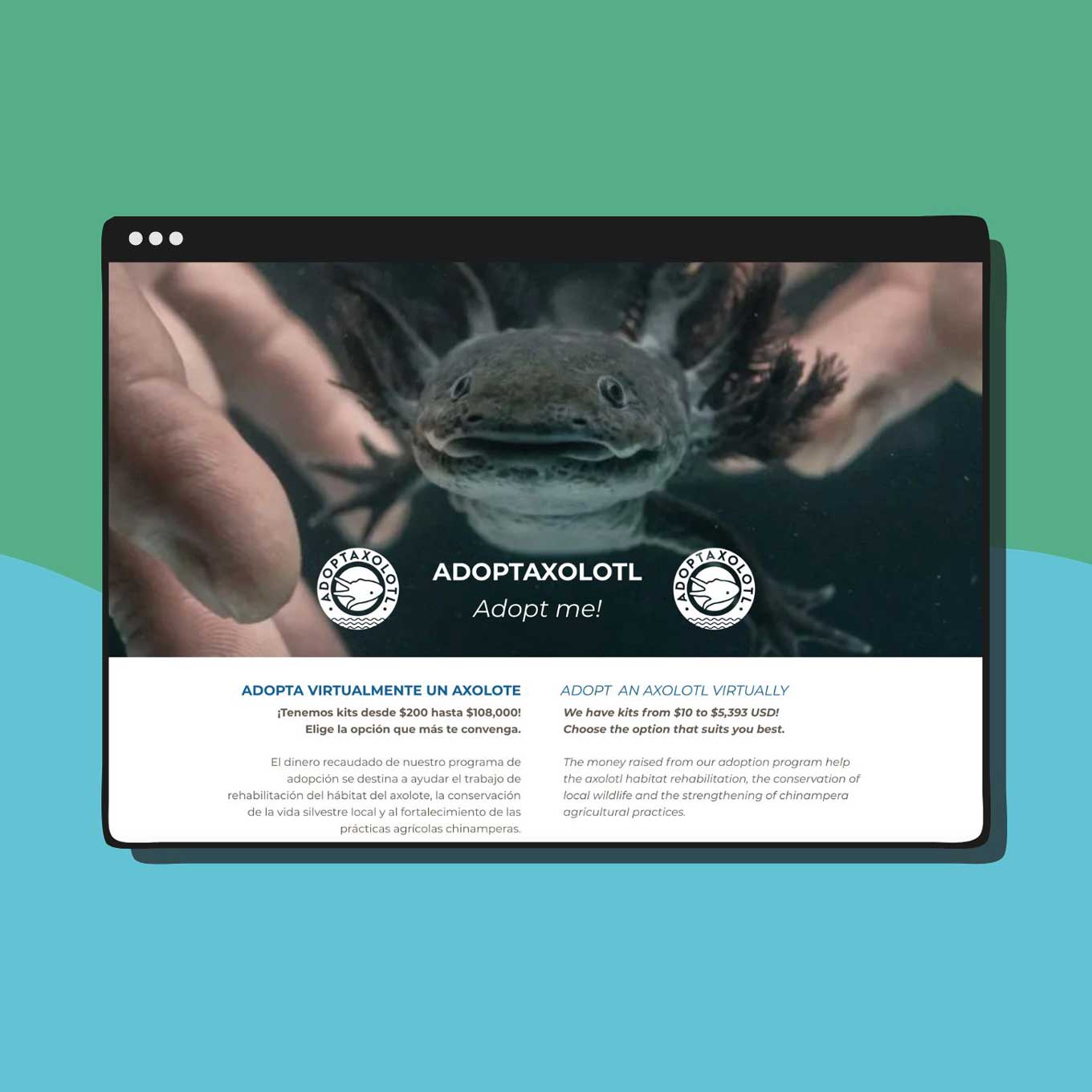
“Chinampera” or chinampas are pest-free aquatic sanctuaries, modeled after indigenous agricultural methods. For $450, donors can provide enough money to build a chinampa refuge and even earn a visit to the axolotl colony itself.
In last year’s campaign, the “AdoptAxolotl” fundraiser accrued 456,000 pesos — the equivalent of about USD $26,500 — across 498 donations. But in order for the axolotls to make a significant, lasting recovery in the wild, experts say they need to do 10 times better this year.
“We know what to do. We know where to do it. And we know that if we do that in those places, we will have a healthy population of axolotls,” Zambrano told NPR. “But if society doesn't care too much, it doesn't matter what we know. It will go extinct.”
Header images courtesy of Utkina Daria (CC BY 4.0) and National Autonomous University of Mexico
There are a number of movies that romanticize road trips. The common thread you will observe in these movies is characters taking their road trip on an impulse.
Pack the essentials, jump into their cars or RVs, and drive off.
Sorry to disappoint you, but this is a myth.
Road trips on impulse without proper planning will have all the equilibrium of a house built on jelly.
A lot of planning and groundwork has to be done before you take off on a road trip.
The most important one is the health of your vehicle.
Car care is vital, particularly before a road trip, so our partners at Way.com have compiled this list of fundamental checks to complete before your upcoming road trip turns into your worst nightmare.
What To Inspect on Your Vehicle Before Going on a Road Trip:
1. Tires
Tires are vital for your safety as well as driving comfort. A well-maintained tire will help reduce your fuel consumption. So, it is essential to check their condition before your trip.
- Replace: Do the penny test on your tires. Stick a penny into the groove with Abraham Lincoln's head facing into it. If you see the top of the head or close to it, replace your tires. If there are damages like punctures, exposed cords, or sidewall bulges, replace them immediately.
- Rotation: Ensure your tire pressure is correct. Your driving habits can make tires wear at different rates. Swap your tires from right to left or front to rear, which will help them last longer because each spot wears down a tire in different areas. As soon as you notice that one side of your tire tread has worn down significantly faster than the other side replaces them.
- Air pressure: The ominous "Next Gas 130 Miles" sign can spell disaster for you if you are running low on gas. An underinflated tire is guaranteed to waste gas while an overinflated tire will make the ride quality worse because they're less compliant. Wrong air pressure causes tires to wear unevenly. You can find the right amount of air your tire will need from the owner's manual. You must check your tire pressure before your road trip.

2. Fluids
For the uninitiated, there are six essential fluids in your car. Regular service of these fluids will ensure that your mileage will not be affected. If you're going to hit a service milestone mid-trip, you may want to take care of that job early.
- Engine: Oil is critical for an engine. Many automakers recommend changing your oil every 7,500 to 10,000. If you've got an oil change within your recommended timeframe, use the dipstick to check the oil condition and fill level. If it's black, gritty, or below the minimum fill line, get it checked out right away.
- Radiator: Radiator fluid works to extract heat from the engine and dissipates it through the radiator. A low coolant level will likely result in overheating. Check your coolant and top it off if need be.
- Brake: If the brake oil is contaminated, or if there is a formation of bubbles in the lines, the pedals will feel spongy. You will need to remove those air bubbles out of the lines.
- Power–steering: Power steering is used to make turning the wheel easy at any speed, but if the fluid is contaminated, then the steering will be less responsive. Check the level and condition of your fluid every time you change your car's oil.
- Transmission: Transmission fluid helps gears mesh smoothly, and if the fluid is past the change date, shifting of the gear will be uncomfortable. Check your owner's manual for the recommended service interval for your specific car.
- Windshield: Adding windshield washer fluid is basic: get a jug of fluid at any gas station, then use a funnel to fill up your reservoir if it gets low.
3. Brake Pads
They wear away with use, eventually becoming too thin to work effectively. When this happens, there is an irritating screeching or squealing noise. If you notice these, replace the brake pads to make your road trip safer.
4. Air Filters
The air filters in your cars prevent dust, debris, and bugs from entering the engine and interior. Once they reach their capacity, they can become clogged, impacting engine performance, fuel economy, and interior air quality. Take your vehicle to the nearest service center and check the quality.
5. Belts and Hoses
There are a few obvious signs of trouble that anyone can spot under the hood. Press the belts down to make sure they're tight. The belts should fit in perfectly into the clasp. If the belt has teeth, none of the teeth should be loose. If the belt does skip any teeth, don't force it. Check the hoses at both ends to see if there are any fluid leaks.
Car care can be expansive, expensive, and exasperating. But to enjoy a magical, marvelous, and magnificent road trip, make sure to do these basic checks.
This story was originally published by Stacker and republished with permission pursuant to a CC BY-NC 4.0 License.
It has recently been brought to our attention — by TikTok user Elena Kilgore (@polkadothead) — that one of the world’s ugliest animals is not, in fact, that ugly.
Meet the blobfish: A fish you have undoubtedly made fun of before for its droopy features, unseemingly round “nose,” and all around sad demeanor. In 2013, the blobfish was named the ugliest animal in the world by the Ugly Animal Preservation Society.
And while we certainly want to preserve blobfish for years to come — we’d like to clear the record that the image many of us have seen that represents the blobfish is not as accurate as we’ve been led to believe.
(And if you want to be especially respectful, the blobfish’s real name is Psychrolutes marcidus.)
“I feel like this picture has been circulated a lot of places and we were like ‘blobfishes are hideous, they’re disgusting,’” Kilgore said in a TikTok.
“Turns out, that’s not what a blobfish looks like. That’s just what a blobfish looks like when you take it out of its home and put it on a table in a lab.”
And it’s true.
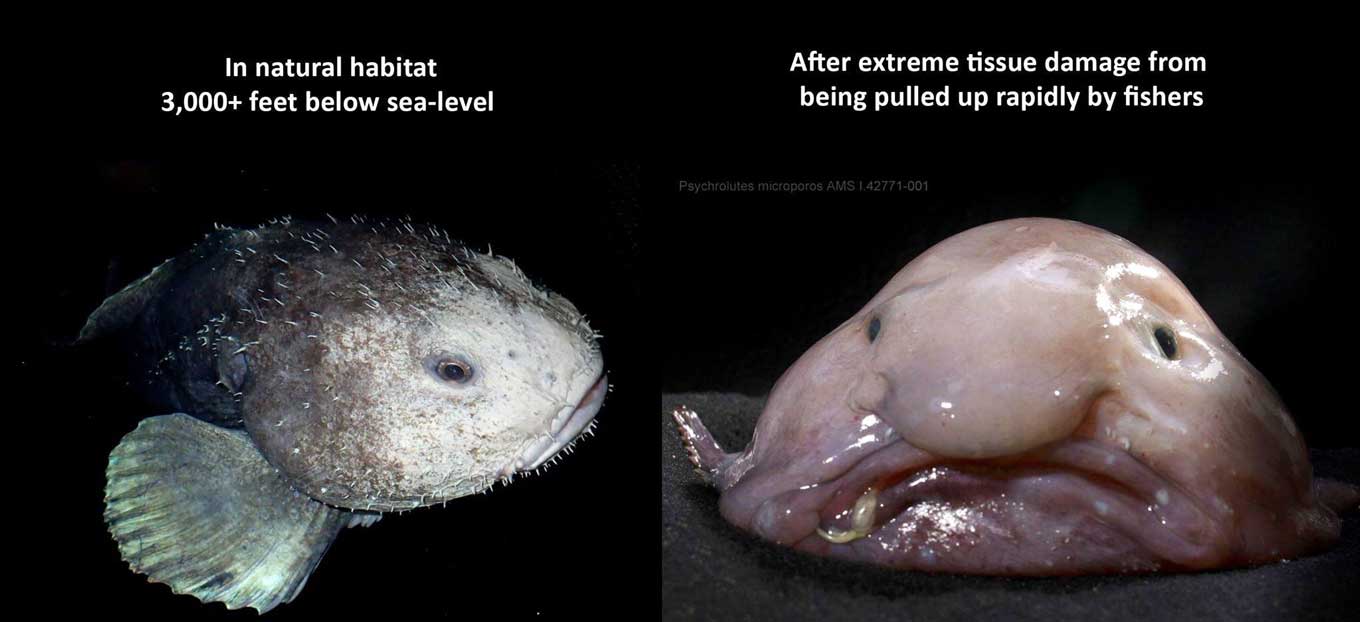
According to scientist Richard Arnott for National Geographic, the viral image of the blobfish has become what he called “a vast bullying campaign.”
“The fish only looks like a miserable, pink lump when it has been torn from its home, and suffered devastating tissue damage due to the rapid depressurization as it was dragged to the surface,” National Geographic writes.
“In its natural habitat — thousands of feet underwater — the misunderstood blobfish looks like a normal fish.”
The “ugly” persona that blobfish hold is all due to immense trauma (ain’t that always the way?).
In their natural habitat, the blobfish is a deep-sea fish that lives in the waters off of the coasts of Australia and Tasmania. They do have a very unique physiology, with “bulbous heads, large jaws, tapered tails, and feathery pectoral fins,” per National Geographic.
What is so fascinating is that instead of scales, blobfish have loose, flabby skin and live without strong bones or thick muscles. They truly rely on the water pressure in the deep sea to hold their shape together — and that’s why they seemingly turn into an entirely different creature when they’re pulled to the surface.

“If you took me and put me on the bottom of the ocean, at the depths of 3,000 feet under the ocean, I’d be looking wrecked, too, for sure,” Kilgore added in her TikTok.
It is particularly difficult to study these fish in their natural environments — so what we know about them unfortunately comes from their dead, depressurized forms.
And while it’s important to know about these fish and protect them (they are most threatened by destructive human activities like deep-sea fishing, bottom trawling, and the earth’s changing temperatures), harming them in the name of science hardly keeps them safe.
“Leave blobfishes be,” Kilgore said. “Be nicer to blobfishes.”
Kilgore’s video, which has received over a million views, has drawn commenters to support the “justice for blobfish” cause.
“So only displaced blobfishes look rough,” one user empathized. “Like me out of my habitat (bed).”
“The blobfish deserves a public apology,” another person wrote. “Thank [you] for this PSA.”
The Ugly Animal Preservation Society — which is at the helm of ugly blobfish propaganda — does have good intentions, aiming to raise awareness of the need to protect the fish, along with other ugly animals, which are less likely to be researched or protected than “cuter” creatures.
But the organization isn’t a nonprofit — and has unfortunately upheld the misconceptions surrounding blobfish.
If you want to do your part to protect the blobfish — and its rightful, deep-sea environment — you can check out organizations like:
- Deep Sea Conservation Coalition, which aims to fight deep-sea mining
- Ocean Conservancy, which advances ocean protections across the board — and is generally a net-good for blobfish everywhere
- Incredible Oceans, an ocean literacy and digital training hub for young marine conservationists
Header images courtesy of Elena Kilgore and Richard Arnott
As solar panels heat up beyond 25°C, their efficiency decreases markedly. Green roofs moderate rooftop temperatures. So we wanted to find out: could green roofs help with the problem of heat reducing the output of solar panels?
Our research compared a “biosolar” green roof — one that combines a solar system with a green roof — and a comparable conventional roof with an equivalent solar system. We measured the impacts on biodiversity and solar output, as well as how the plants coped with having panels installed above them.
The green roof supported much more biodiversity, as one might expect. By reducing average maximum temperatures by about 8°C, it increased solar generation by as much as 107% during peak periods. And while some plant species outperformed others, the vegetation flourished.
These results show we don’t have to choose between a green roof or a solar roof: we can combine the two and reap double the rewards.
How was the study done?
Many studies have tested a single rooftop divided into “green roof” and “non-green roof” sections to measure the differences caused by vegetation. A problem with such studies is “spatial confounding” — the effects of two nearby spaces influencing one another.
So, for example, the cooler green roof section could moderate the temperature of the non-green section next to it.
In studies that use distinct buildings, the buildings might be too far apart or too different in construction to be comparable.
The two buildings in our study were the same height, size and shape and located next to each other in Sydney’s central business district. The only difference was Daramu House had a green roof and International House did not.
We selected a mix of native and non-native grasses and non-woody plants, which would flower across all seasons, to attract diverse animal species.

The biosolar green roof and conventional roof had the same area, about 1860 square meters, with roughly a third covered by solar panels. Vegetation covered about 78% of the green roof and the solar panels covered 40% of this planted area.
To identify which species were present on the roofs we used motion-sensing cameras and sampled for DNA traces. We documented changes in the green roof vegetation to record how shading by the solar panels affected the plants.
How did the panels affect the plants?
In the open areas, we observed minimal changes in the vegetation cover over the study period compared to the initial planted community.
Plant growth was fastest and healthiest in the areas immediately around the solar panels. Several species doubled in coverage. We selected fast-growing vegetation for this section to achieve full coverage of the green roof beds as soon as possible.
The vegetation changed the most in the areas directly below and surrounding the solar panels. The Baby Sun Rose, Aptenia cordifolia, emerged as the dominant plant. It occupied most of the space beneath and surrounding the solar panels, despite having been planted in relatively low densities.
This was surprising: it was not expected the plants would prefer the shaded areas under the panels to the open areas. This shows that shading by solar panels will not prevent the growth of full and healthy roof gardens.

What were the biodiversity impacts?

We used environmental DNA (eDNA) surveys to compare biodiversity on the green roof and conventional roof. Water run-off samples were collected from both roofs and processed on site using portable citizen scientist eDNA sampling equipment to detect traces of DNA shed by the species on the roof.
The eDNA surveys detected a diverse range of species. These included some species (such as algae and fungi) that are not easily detected using other survey methods. The results confirmed the presence of bird species recorded by the cameras but also showed other visiting bird species went undetected by the cameras.
Overall, the green roof supported four times as many species of birds, over seven times as many arthropods such as insects, spiders and millipedes, and twice as many snail and slug species as the conventional roof. There was many times the diversity of microorganisms such as algae and fungi.
Encouragingly, the green roof attracted species unexpected in the city. They included blue-banded bees (Amegilla cingulata) and metallic shield bugs (Scutiphora pedicellata).

How did the green roof alter temperatures?
The green roof reduced surface temperatures by up to 9.63°C for the solar panels and 6.93°C for the roof surfaces. An 8°C reduction in average peak temperature on the green roof would result in substantial heating and cooling energy savings inside the building.
This lowering of temperatures increased the maximum output of the solar panels by 21-107%, depending on the month. Performance modelling indicates an extensive green roof in central Sydney can, on average, produce 4.5% more electricity at any given light level.

These results show we don’t have to choose between a green roof or a solar roof. We can combine them to take advantage of the many benefits of biosolar green roofs.
Biosolar roofs can help get cities to net zero
The next step is to design green roofs and their plantings specifically to enhance biodiversity. Green roofs and other green infrastructure may alter urban wildlife’s activities and could eventually attract non-urban species.
Our green roof also decreased stormwater runoff, removed a range of run-off pollutants and insulated the building from extremes of temperature. A relatively inexpensive system provides all of these services with moderate maintenance and, best of all, zero energy inputs.
Clearly, biosolar green roofs could make major contributions to net-zero cities. And all that’s needed is space that currently has no other use.
This article was republished with permission from the original publisher.
We’ve all been in a situation where we just don’t know what to say.
You’re past the point of needing an ice breaker, and you’re not exactly comfortable enough to whip out the conversation cards, but you still want to connect with someone in a meaningful way. How do you get the ball rolling? What deep questions do you ask?
Please — we beg you — don’t start with the weather.
Whether you’re at a party or work event, spending some time with the people you’re closest to, or meeting someone for the first time (say, on a date), we are confident that there is a meaningful or engaging topic of conversation to embark upon.
To make it easier, we’ve collected some conversation starters that are perfect for kicking off a meaningful visit with nearly anyone.
Conversation Starters That Are Sure To Get the Ball Rolling
For Anyone
- What’s been the best part of your day so far?
- What’s the most interesting thing that’s happened to you this week?
- What song have you had stuck in your head this week?
- How are you really doing?
- Do you collect anything?
- What do you do for a living?
- What do you wish you did for a living?
- Describe your perfect weekend.
- If you weren’t here, where would you be?
- What were you doing before you got here?
- What did you want to be when you grew up?
- Can you speak more than one language?
- What’s your favorite kind of music? Do you have a favorite artist or band?
- Do you prefer to be surrounded by mountains or the ocean? Why?
- What is one thing you can’t live without?
- Who is your favorite celebrity couple?
- What kinds of things are on your to-do list today?
- What’s something that’s made you smile recently?
- What do you do to relax or have fun?
- Tell me more about your work or interests.
- What was the last movie you really enjoyed?
- Is there a song or album you can’t stop listening to these days?
- Do you listen to podcasts? Do you have a favorite?
- Tell me more about your hometown.
- Do you have any hidden talents?
- What does your name mean?
- What’s your favorite comfort food?
- Do you think you’re an introvert or extrovert?
- What is something about you that people are surprised to learn?
- Have you seen that viral video/meme?
- If you could befriend a fictional character, who would it be?
For a Party or Event
- How do you know the host?
- What are you snacking on?
- What are you drinking?
- Have you been to this area before? What are some of your favorite spots nearby?
- What’s the best gift you’ve ever received?
- What did you bring for the host?
- Do you have a favorite party game?
- What’s your go-to dance move when you hit the floor?
- Do you have a specific karaoke song?
- If any celebrity could crash this event, who would you want it to be? Why?
- What’s the weirdest party theme you’ve experienced?
- If you were in charge of planning this event, what would you choose to make it even better?
- If this was a costume party, what would you be wearing?
- What song do you think would get everyone here on their feet?
- Do you have any stand-out memories from birthday parties as a child?
- What else are you getting up to this weekend?
- If you had an unlimited budget, what would your dream party or event include?
- What’s your signature drink or dish to bring to a party?
For Friends
- What’s a skill you’ve always wanted to learn but haven’t yet?
- What goals are you working toward these days?
- What’s one habit you want to get rid of and one habit you want to keep?
- What’s the last thing you bought that you really loved?
- What’s a memory from our friendship that still makes you smile?
- Who do you most admire, and how has that person had an impact on your life?
- Tell me about a time you overcame a really big fear.
- If you could switch lives with me for a day, what’s the first thing you’d do?
- What’s the most meaningful lesson you’ve learned in the last year?
- How have your priorities changed this year?
- What is the nicest thing anyone has ever done for you?
- What’s the nicest thing you’ve done for anyone?
- What do you think is your most controversial opinion?
- What would you do if you won the lottery?
- If you could go back in time, what one situation would you approach differently?
- What would your younger self be surprised to know about you?
- What is something you’ve been embarrassed about recently?
- When was the last time you cried?
- When was the last time you laughed so hard you cried?
- What’s the worst piece of advice you’ve ever gotten?
- Do you sing in the shower?
- What weird conspiracy theory or theories do you believe?
- What trends from our teenage years do you think were the worst?
- What’s cool now that you think will be totally uncool in a few years?
- What always makes you smile when you’re feeling down?
- How is your family doing?
- Have you checked in with any old friends recently?
- What big travel plans do you have for the future?
- If you could change your name, what would you change it to?
- What do you think we’d talk about if social media didn’t exist?
- What recipes have you cooked recently?
- How have you been caring for your mental health?
- What areas of your life do you need more support in these days?
- Are there any areas in your home you want to redecorate or renovate?
- Have you been working on any DIY or personal projects lately?
For Parents
- When did you decide you wanted to be a parent?
- What’s one piece of advice you wish you knew when you were my age?
- What was your favorite toy as a child?
- What are some of your favorite memories of your childhood?
- What are some of your favorite memories of my childhood?
- What do you miss about being my age?
- What do you wish you’d known before having kids?
- What advice do you have for saving money?
- What’s the first big purchase you made as an adult?
- How did you choose my name? Were there any others you were considering?
- How do you envision our relationship evolving as I grow older?
- What are your proudest moments as a parent so far?
- How has parenthood changed you as a person?
- What was the funniest thing I did as a kid that still makes you laugh?
- What’s your favorite family tradition? Why is it special to you?
- What’s the best piece of parenting advice you received from your own parents?
- How has your parenting style evolved since I was born?
- How do you handle disagreements or arguments about parenting decisions?
- What was your favorite book or story you remember reading to me when I was little?
- What do you think was the best kid’s TV show I watched as a child?
- What would you say our family values are?
- What’s your favorite family dish we eat together?
- What’s the most important lesson you want me to carry into the rest of my life?
For Siblings
- Looking back on our childhood, what do you think is your happiest memory?
- What good traits have you inherited from our parents?
- What not-so-good traits have you inherited from our parents?
- What do you think everyone in the family will be doing 10 years from now?
- Do you think we should start any new traditions when we have our own families? Like what?
- What food, scent, or feeling reminds you most of home?
- What’s the best inside joke we have?
- Who do you think is the funniest member of our extended family?
- What’s the best piece of advice you’ve received from me?
- How do you think we’ve influenced each other over the years?
- How do you want our relationship to continue to evolve?
- What habit or characteristic about me do you think is most annoying… or endearing?
- What’s something you appreciate about our relationship that others might not understand?
- If our lives were a sitcom, what would be the title of our show?
- Let’s describe each other in three words.
- If we could go back in time to relive one family holiday, which would you pick? Why?
- What’s something you’ve learned from me that you didn’t expect?
- If we were a team in a trivia contest, what category do you think we’d dominate?
- Do you have a favorite childhood photo of us together?
- What is the best lesson you’ve learned from our parents?
- If you were to change one thing about our childhoods, what would it be?
For a Date
- What do you wish people better understood about you?
- What do you want most out of a relationship?
- How do you like to be supported in difficult times?
- What do you like to do in your alone time?
- What kinds of activities do you think we’d be good at together?
- Who in your life brings you the most joy?
- What’s your biggest pet peeve?
- What is your biggest hot take?
- Where is your favorite place you’ve ever traveled?
- If you could achieve anything by the end of this year, what would it be?
- What are your biggest values in life, and how do you practice them day-to-day?
- What was the last concert you went to?
- What hobby do you wish you had more time for?
- Do you believe in astrology? What’s your sign?
- If your life had a soundtrack, what would be the top three songs?
- Have you ever heard of love languages? Do you know what yours is?
- What’s something you learned from your most recent relationship?
- Do you prefer spontaneous adventures or being cozy at home?
- What do you think is important for a healthy and successful relationship?
- How do you usually resolve disagreements or conflict?
- Describe your ideal date night. Money is no object!
- How would you describe your sense of humor?
- What makes you feel loved and appreciated?
- What is your favorite [Taylor Swift, Beyonce, Kendrick Lamar, etc.] song? Why?
- What is your favorite holiday? Do you have any special memories attached to it?
- What compliment do you receive most often? Is it easy for you to accept?
- What is your favorite thing about yourself?
- What attracted you to me?
- Do you have pets? Tell me about them! (Bonus points for pictures)
- What are your biggest fears?
- Do you have any nicknames?
- Tell me about the worst pickup line you’ve ever gotten.
For Kids
- What is your favorite animal?
- Do you have any siblings?
- What subject is the most fun to learn about in school?
- What do you do when you get home from school?
- What’s something interesting you learned recently?
- What food would you eat every day if you could?
- What’s your favorite color?
- Who are your best friends?
- How old are you turning this year?
- What kinds of projects have you been working on in school?
- What do you want to be when you grow up?
- Do you have any pets? What are they like?
- If you could decorate your room in any way, what would it look like?
- Who is your favorite TV show or video game character? Why?
- What’s your favorite outfit to wear?
- Who is your teacher? What are they like?
- What’s your favorite game to play?
- What’s your favorite thing about your parents?
- What food is your least favorite?
- What is your favorite thing to do at recess or playtime?
- What’s the best bedtime story?
- If you were a superhero, what powers would you want to have?
- Do you know any knock-knock jokes?
- Do you have any special talents?
- If you had a spaceship, where would you travel in the universe?
- How do you like to celebrate your birthday?
- If you could have a dinosaur as a pet, what kind would you choose?
- Who is your favorite Disney character?
- If you could have a robot do one chore for you, what would it be?
- What’s the best ice cream flavor in the world?
- What’s the best present you’ve ever been given?
- What’s your favorite school lunch?
- What did you have as a snack today?
For Coworkers or Networking
- What led you to choose this as your career?
- What professional accomplishments are you proudest of?
- What was your first job? How did it lead to where you are today?
- What inspires you to do your best work?
- What is most fulfilling about your work?
- What do you think makes someone a good manager or leader?
- What’s your favorite project you’ve worked on this year?
- How do you maintain a healthy work-life balance?
- What do you look for in a collaborator or teammate?
- What do you think are the biggest challenges facing your industry right now?
- Do you work remotely or in-person with your colleagues?
- Are there any interesting skills you’d like to learn that would make your job easier or more fun?
- What kind of workplace practices make for a healthy and engaging atmosphere? How do you wish your workplace would implement some?
- Are you working on any personal passion projects these days?
- How do you define success for yourself?
- What are your best time management tips?
- Do you consider yourself organized and strategic, or are you more of a free, creative thinker?
- Have you had any mentors that have significantly impacted your career?
- How do your company or organization values reflect your personal values?
- Who is someone in your industry or professional world that you look up to?
- How do you stay motivated during dull or mundane parts of your job?
- What is the best thing about your job?
- What is the most challenging thing about your job?
— New research found higher abundance and diversity of bats on farms with 65% or greater shade cover — still common on cocoa farms in places like Cameroon, but rare in major cocoa-producing areas of Ghana and Côte d’Ivoire.
— Related research has established that bats and birds can reduce the amount of pesticides cocoa farmers use, but also find yields decline where shade cover is greater than 30%.
— Researchers hope to find optimal levels of shade from native trees for agroforestry systems that provide homes for friendly bat and bird species while maximizing yields for farmers.
Insect-eating bats that prey on pests in cocoa farms prefer farms that retain large, old-growth trees that shade the plantations. Researchers aiming to find a “sweet spot” in agroforestry systems that supports maximum biodiversity surveyed bat diversity on 28 cocoa farms in south central Cameroon. They found the greatest abundance and diversity of bats on farms with 65% or higher shade cover — mimicking natural forest conditions in this region.
“What our study found is that to maintain insectivorous bats, we not only need shade cover but we need that to be provided by very big, old-growth trees,” Diogo Ferreira, a lead author on the paper, published in the journal Biological Conservation, told Mongabay in an interview.
Bats that depend on fruit and nectar, however, prefer high-shade conditions from planted trees, which often provide cocoa farmers with a source of secondary income. Common species on the surveyed farms included avocado, mango, orange and lemon trees, and safou, sometimes known as African plum (Dacryodes edulis), said Ferreira, a Ph.D. student at the Centre for Research in Biodiversity and Genetic Resources (known by its Portuguese acronym, CIBIO).
The researchers surveyed bat diversity on farms with a variety of shade tree cover; they consisted of high shade with more than 65% cover, medium cover between 35 and 65%, and “low shade cocoa” between 20 and 35% cover.
“We propose that if we want to keep both of the bat guilds, we need higher levels of shade cover,” Ferreira said.
For Olivier Honnay, a conservation ecologist at Belgian university KU Leuven, who was not involved in the study, the overall findings confirm that high-shade conditions benefit insectivorous bats in the same way as it does with other species, such as ants, birds and frogs.
“This study is a valuable addition to the existing literature, also because (as far as I know) there have been no studies that have dealt with bat diversity in cocoa agroforestry systems in the Afrotropics,” he wrote in an email.

Finding the shade ‘sweet spot’
“If you could manage farms to get them as close as possible to 65% shade without sacrificing much cocoa yield, you’d nail the appropriate shade level for a biodiversity- or bat-friendly certification,” said Luke Powell, a co-author of the paper and principal researcher with CIBIO’s TROPIBIO program and the University of Glasgow.
Honnay said he agrees that high-shade cocoa agroforestry can contribute to bat conservation, but cautioned against firm conclusions in the absence of baseline comparisons between such farms and natural forest systems. He also added a note of caution over promoting a 65% shade guideline.
“This is certainly a very important and robust conservation guideline. However, the key question in this agroforestry system is: what is the effect of such a high shade on cocoa yields and farmer income?”
Past research suggests cocoa yields drop off after 30% shade cover is reached, but the researchers say the presence of bats can bring a host of ecosystem services that can also benefit farmers. In a separate study in Cameroon, Ferreira and his team found birds and bats can help enhance yields by consuming large amounts of pests that would otherwise require pesticides to control, but only when shade cover is high.
However, ecosystem services rarely fully compensate for shortfalls in income, Honnay said. “The best way forward would be to offer farmers a price premium when they maintain high shade levels and big old trees, for example through a certification program,” he said.
It remains to be confirmed which tree species encourage greater bat abundance. An additional aim of the ongoing research is to identify which trees act as “keystones,” enabling a higher diversity of bats on farms. The researchers say further study is needed, but the kapok or cotton tree (Ceiba pentandra var. guineensis) and African oil-nut tree (Ricinodendron heudelotii) may play important roles for bats.
“In future studies, we want to investigate all these different species of shade trees that are associated with the different species of bats,” Ferreira said. Separate research by the same group is investigating which species of birds and bats are the most voracious consumers of cocoa pests by analyzing DNA found in their feces and matching this to bugs, Powell said.
The hope is that by bringing their recent shade findings together with these lines of research, it will be possible to optimize farms with native tree types that provide both shade and homes for those bat and bird species, which in turn are the most effective consumers of cocoa pests.
“If you know that the forest robin, for example, is eating tons of the main cocoa pest — the brown capsid — you can then understand it needs tree species X, Y and Z to build its nest,” Powell said. “Then you’re sort of unlocking that part of the puzzle.”

Bats on the farm beyond Cameroon
The researchers suggest their findings may be relevant for other cocoa-growing countries in Central and West Africa, such as Ghana and Côte d’Ivoire . These two countries produce the vast bulk of the world’s cocoa — at the cost of great swaths of deforestation that continue to expand in some areas. Agroforestry is considered a key approach to slowing and even reversing forest loss linked to cocoa.
“In Cameroon there are still a lot of these high-shade farms, but if you go to Ghana or Ivory Coast we see there is more low-shade cocoa,” Ferreira said. “The same criteria could be applied but we need to let the forest regenerate in these farms.”
In terms of wider bat conservation, Evans Ewald Nkrumah, a researcher at Ghana’s Kwame Nkrumah University of Science and Technology, who was not involved in the study, said cocoa agroforestry could be beneficial, but added that factors other than shade levels and tree type may be equally important to biodiversity on farms.
“Some shaded cocoa farms may have no understory vegetation but high leaf litter cover. In farms like this, some species are likely to use these farms as mere commuting routes to access richer potions of the landscape.”
He also pointed to availability of food or roosts and proximity to natural primary forest as other factors affecting a cocoa farm’s suitability as habitat for wildlife.
Social factors, too, could play a role in promoting or suppressing bat biodiversity: “If [farmers] believe the bats are pests, for example, they will eradicate their roost or at the extreme even persecute them for perceived threats,” Nkrumah wrote.
Such negative perceptions are a threat to bat species across the globe.
Taken together, these environmental and social factors could ultimately influence the species’ abundance on cocoa farms in other areas too.
This article was originally published by Mongabay.
Whether you’re looking for a delicious new vegetable to try, you’re a teacher looking for a great classroom resource, you care about protecting vegetable species around the planet, or you’re simply practicing for a food-themed trivia night — we’ve got you covered with the ultimate vegetable resource.
Vegetables are commonly identified as the edible parts of plants, which can include roots, stems, leaves, flowers, and sometimes immature fruits. They encompass a wide range of flavors, from earthy and bitter to mild and savory. Vegetables are nature’s nourishment, offering a rich source of nutrients, ready to be incorporated into a myriad of dishes.
And sure, we’ve all heard of arugula, broccoli, and zucchini — but what about kohlrabi, romanesco, and salsify?
We’ve collected the ultimate list (truly, it might just be the largest on the internet) of vegetable names — from A to Z — so you can explore every kind of fruit imaginable.
Why did we write this article? Because a plant-based diet is better for animals and the planet. And because choosing to eat (and pick) seasonal fruits and vegetables can make a world of difference as well. And lastly, because it’s valuable to know about the beautiful range of (yummy) plants on planet Earth so we can fight to protect their biodiversity.
You can also explore our complete list of fruits from A-Z.
We hope you discover something new — and maybe even share your newfound favorite vegetable with a friend.
A quick note before you bite into a new-found veggie: Some of these vegetables cannot be consumed raw — and others could easily be confused with non-edible plants. Please use caution and care.
You might also like: Good news articles about food
Complete List of All Vegetables — In Alphabetical Order
- Acorn Squash
- Adzuki Bean
- African Eggplant
- African Horned Cucumber
- Agati
- Alfalfa Sprout
- All Blue Potato
- Amaranth Leaf
- Ambercup Squash
- Anaheim Pepper
- Ancho Pepper
- Angelica
- Aonori
- Apazote
- Arame
- Arikara Squash
- Armenian Cucumber
- Arracacha
- Arrowhead
- Arrowroot
- Artichoke
- Arugula
- Ash Gourd
- Asian Greens
- Asparagus
- Aubergine
- Baby Boo Pumpkin
- Bac Ha
- Bambara Groundnut
- Bamboo Shoot
- Banana Pepper
- Banana Squash
- Baobab Leaves
- Basil
- Batata
- Bean Sprouts
- Beetroot
- Belgian Endive
- Bell Pepper
- Bintje Potato
- Bitter Melon
- Black Bean
- Black Krim Tomato
- Black Radish
- Black Salsify
- Black Tomato
- Black-Eyed Pea
- Black-Eyed Susan Vine
- Blue Corn
- Blue Pea
- Bok Choy
- Borage
- Borlotti Bean
- Boston Marrow Squash
- Breadfruit Leaves
- Breadnut
- Broad Beans
- Broad-Leaf Arrowhead
- Broccoflower
- Broccoli
- Broccoli Rabe
- Broccolini
- Brussels Sprout
- Burdock
- Butter Bean
- Butter Lettuce
- Butternut Squash
- Cabbage
- Calabrese
- Canna
- Cannellini Bean
- Cantaloupe
- Capsicum
- Caraway
- Cardoon
- Carnival Squash
- Carrot
- Cassabanana
- Cassava
- Cauliflower
- Cavolo Nero
- Celeriac
- Celery
- Celtuce
- Ceylon Spinach
- Chameleon Plant
- Chamomile
- Chard
- Chayote Shoots
- Chayote Squash
- Cheddar Cauliflower
- Cherry Pepper
- Cherry Tomato
- Chervil
- Chervil Root
- Chickpea
- Chickpeas
- Chicory
- Chinese Artichoke
- Chinese Broccoli
- Chinese Cabbage
- Chinese Toon
- Chinese Water Chestnut
- Chioggia Beet
- Chive
- Choko
- Chrysanthemum Greens
- Cilantro
- Cluster Beans
- Collard Greens
- Coriander
- Corms
- Corn
- Courgette
- Cress
- Cresson
- Crookneck Squash
- Crosne
- Cucamelon
- Cucumber
- Cymbopogon
- Daikon
- Dandelion Green
- Dasheen
- Datil Pepper
- Daylily
- Delaware Sweet Corn
- Delicacy White Kohlrabi
- Delicata
- Delicata Squash
- Dickinson Pumpkin
- Dill
- Dorset Naga Pepper
- Drumstick
- Drumstick Tree Leaves
- Dulse
- Edamame
- Eddoe
- Eggplant
- Egyptian Onion
- Elephant Garlic
- Endive
- English Cucumber
- Ensete
- Epazote
- Ethiopian Kale
- Fairytale Eggplant
- Fat Hen
- Fava Bean
- Fayot Bean
- Fennel
- Fenugreek
- Fiddlehead Ferns
- Field Cucumber
- Fingerlimes
- Fingerling Potato
- Fiorentino Tomato
- Flat Beans
- Flat Italian Onion
- Flat White Boer Pumpkin
- Flint Corn
- Fluted Pumpkin
- French Bean
- French Sorrel
- Fresh Herbs
- Frisee
- Frisée
- Fuki
- Futsu Squash
- Galangal
- Garbanzo Beans
- Garden Cress
- Garden Rocket
- Garlic
- Garlic Scapes
- Gem Squash
- German Butterball Potato
- Gherkin
- Gigante Bean
- Ginger
- Glasswort
- Globe Artichoke
- Gobo
- Gold Rush Squash
- Golden Samphire
- Gongura
- Good King Henry
- Goutweed
- Grape Leaves
- Great Northern Bean
- Green Bean
- Green Onion
- Green Pepper
- Green Seaweed
- Green Tomato
- Green Zucchini
- Guar
- Habanero Pepper
- Hamburg Parsley
- Hatch Chiles
- Heirloom Tomato
- Herbs
- Hijiki
- Hispi Cabbage
- Hokkaido Squash
- Honey Bear Squash
- Honeynut Squash
- Horseradish
- Hot Pepper
- Huauzontle
- Hubbard Squash
- Hyacinth Bean
- Ice Cream Bean
- Ice Plant
- Iceberg Lettuce
- Idaho Potato
- Indian Mustard
- Indigo Rose Tomato
- Irish Moss
- Italian Broccoli
- Italian Parsley
- Italian Red Onion
- Ivory Gourd
- Jabuticaba
- Jalapeño
- Japanese Mustard Greens
- Japanese Sweet Potato
- Jersey Royal Potato
- Jerusalem Artichoke
- Jerusalem Artichoke Leaves
- Jicama
- Jojoto
- Kabocha Squash
- Kai-lan
- Kailaan
- Kailan
- Kale
- Kamo Kamo
- Kangkong
- Kelp
- Kennebec Potato
- Keriberry
- Kidney Bean
- King Edward Potato
- Kinh Gioi
- Kohlrabi
- Komatsuna
- Kombu
- Konjac
- Kovakkai
- Kudzu
- Kuka
- Kurrat
- Lablab Bean
- Lacinato Kale
- Lagos Bologi
- Lakota Squash
- Land Cress
- Lavender
- Laver
- Leaf Celery
- Lebanese Cucumber
- Leek
- Legumes
- Lemon Grass
- Lentil
- Leren
- Lettuce
- Lima Bean
- Lollo Rosso
- Long Bean
- Lotus Root
- Lovage
- Lumina Pumpkin
- Lupins
- Maize
- Malabar Nightshade
- Malabar Spinach
- Malanga
- Mallow
- Malta
- Mangel-Wurzel
- Mangelwurzel
- Mangetout
- Marjoram
- Marrow
- Marsh Samphire
- Mashua
- Methi
- Mibuna
- Microgreens
- Miner's Lettuce
- Mizuna
- Molokhia
- Monks Beard
- Mooli
- Morel Mushroom
- Moringa
- Mouse Melon
- Mozuku
- Mung Bean
- Mustard Greens
- Napa Cabbage
- Nasturtium
- Navy Bean
- Navy Beans
- Nettles
- New Potato
- New Zealand Spinach
- Nopal
- Nopalito
- Nori
- Oakleaf Lettuce
- Oca
- Ogo
- Ogonori
- Oil Palm
- Okinawan Sweet Potato
- Okra
- Olida
- Onion
- Orach
- Orange Bell Pepper
- Orange Cauliflower
- Orange Tomato
- Oregano
- Oyster Plant
- Pak Choi
- Palm Heart
- Pandan
- Papalo
- Parsley
- Parsley Root
- Parsnip
- Pattypan Squash
- Pea
- Pea Shoots and Tendrils
- Pear Squash
- Périgord Truffle
- Perilla
- Perilla Leaves
- Peruvian Purple Potato
- Pickling Cucumber
- Pie Pumpkin
- Pigeon Pea
- Pignut
- Pimento
- Pinkbean
- Pinto Bean
- Pipicha
- Pitwaa
- Plantain Lily Leaves
- Pointed Cabbage
- Porophyllum Ruderale
- Potato
- Prairie Turnip
- Prickly Pear Cactus
- Prickly Pear Cactus Pad
- Prunella
- Pucuk Manis
- Pūhā
- Pulse
- Pumpkin
- Purple Asparagus
- Purple Bell Pepper
- Purple Brussels Sprout
- Purple Cabbage
- Purple Carrot
- Purple Cauliflower
- Purple Corn
- Purple Kale
- Purple Lettuce
- Purple Majesty Potato
- Purple Potato
- Purple Radish
- Purple Sprouting Broccoli
- Purple String Bean
- Purple Tomato
- Purple Yam
- Purslane
- Quamash
- Queen Anne's Lace
- Queensland Blue Squash
- Quince
- Quinoa Leaves
- Radicchio
- Radish
- Radish Leaves
- Rainbow Carrot
- Rainbow Chard
- Rakkio
- Ramp
- Ramsons
- Rapini
- Rauriki
- Red Bean
- Red Bliss Potato
- Red Cabbage
- Red Gold Potato
- Red Kuri Squash
- Red Leaf Lettuce
- Red Onion
- Red Orach
- Red Pepper
- Red Russian Kale
- Red Sorrel
- Red Warty Thing Squash
- Red Wing Onion
- Rhubarb
- Rock Samphire
- Rocket
- Romanesco
- Romanesco Broccoli
- Romanesco Cauliflower
- Rosa Bianca Eggplant
- Roselle
- Roselle Leaves
- Rosemary
- Rosette Bok Choy
- Russian Banana Potato
- Russian Blue Potato
- Rutabaga
- Salad Burnet
- Salicornia
- Salsify
- Saltbush
- Samphire
- San Marzano Tomato
- Sassafras Leaves
- Satoimo
- Sauropus Androgynus
- Savoy Cabbage
- Scallion
- Scallion
- Scallop Squash
- Scallopini
- Scorzonera
- Sea Asparagus
- Sea Beet
- Sea Kale
- Sea Vegetables
- Seabeach Sandwort
- Seakale Beet
- Seaweed
- Serrano Pepper
- Sesbania Flower
- Shallot
- Shiitake Mushroom
- Shishito Peppers
- Shiso
- Shungiku
- Silverbeet
- Skirret
- Snap Pea
- Snow Pea
- Soko
- Soko
- Sorrel
- Soybean
- Soybean Leaves
- Spaghetti Squash
- Spinach
- Split Pea
- Spring Greens
- Spring Onion
- Sprouted Beans and Seeds
- Sprouts
- Squash
- Squash Blossoms
- Stevia
- Stokes Purple Sweet Potato
- Striped Eggplant
- Sugar Snap Pea
- Sugar Snap Peas
- Summer Cilantro
- Summer Squash
- Sunchoke
- Surinam Spinach
- Swedes
- Sweet Corn
- Sweet Leaf
- Sweet Onion
- Sweet Pepper
- Sweet Potato
- Sweet Potato Leaves
- Sweet Woodruff
- Sweetheart Cabbage
- Swiss Chard
- Tabasco Pepper
- Taro
- Taro Leaves
- Taro Root
- Tarwi Bean
- Tat Soi
- Tatsoi
- Tatsoi
- Tepary Bean
- Tetragon
- Thai Basil
- Thai Chili Pepper
- Thai Eggplant
- Thistle
- Three-Cornered Leek
- Thyme
- Tinda
- Tomaccio
- Tomatillo
- Tomato
- Topinambur
- Torpedo Onion
- Tree Collard
- Trinidad Moruga Scorpion Pepper
- Truffle
- Tuberous Nasturtium
- Turban Squash
- Turmeric
- Turnip
- Tuscan Kale
- Ube
- Udo
- Udupi Mattu Gulla Eggplant
- Ulluco
- Umbrella Squash
- Upland Cress
- Urad Bean
- Urfa Biber
- Utazi Leaves
- Utrecht Blue Wheat
- Vates
- Velvet Bean
- Verdolaga
- Vidalia Onions
- Vietnamese Balm
- Vietnamese Coriander
- Vigna Radiata
- Virginia Creeper
- Vitelotte
- Vitelotte Potato
- Vivaldi Potato
- Voavanga
- Walking Onion
- Walla Walla Sweet Onion
- Wasabi
- Water Chestnut
- Water Dropwort
- Water Pepper
- Water Spinach
- Water Yam
- Watercress
- Wax Bean
- Wax Gourd
- Welsh Onion
- West Indian Gherkin
- Wheat Sprouts
- White 7 Pot Pepper
- White Asparagus
- White Bean
- White Cabbage
- White Onion
- Wild Garlic
- Wild Leek
- Wild Rocket
- Winged Bean
- Winged Pea
- Winter Melon
- Winter Purslane
- Winter Squash
- Witch Hazel
- Witchgrass
- Witloof
- Wood Sorrel
- Worcester Berry
- Wrinkled Crinkled Cress
- Xà Lách
- Xanthosoma Brasiliense
- Xanthosoma Sagittifolium
- Xi Lan Hua
- Xi Yang Ca
- Xia Ku Cao
- Xiang Chun
- Xoconostle
- Ya Pear
- Yacon
- Yam
- Yam Bean
- Yardlong Bean
- Yarrow
- Yellow Bean
- Yellow Beet
- Yellow Cucumber
- Yellow Onion
- Yellow Pepper
- Yellow Squash
- Yellow Summer Squash
- Yellow Tomato
- Yellow Zucchini
- Yerba Buena
- Yokan
- Yu Choy
- Yukon Gold Potato
- Zebra Tomato
- Zhe Fruit
- Zigzag Vine Fruit
- Ziziphus
- Zucca Melon
- Zucchetta
- Zucchini
- Zuni Bean

You might also like: Ultimate List of Positive Words | Ultimate List of Mood Words | Ultimate List of Emotions | Ultimate List of Personality Traits | Ultimate List of Good Character Traits
Plus, explore more vegetable name articles:
- Vegetables That Start with A
- Vegetables That Start with B
- Vegetables That Start with C
- Vegetables That Start with D
- Vegetables That Start with E
- Vegetables That Start with F
- Vegetables That Start with G
- Vegetables That Start with H
- Vegetables That Start with I
- Vegetables That Start with J
- Vegetables That Start with K
- Vegetables That Start with L
- Vegetables That Start with M
- Vegetables That Start with N
- Vegetables That Start with O
- Vegetables That Start with P
- Vegetables That Start with Q
- Vegetables That Start with R
- Vegetables That Start with S
- Vegetables That Start with T
- Vegetables That Start with U
- Vegetables That Start with V
- Vegetables That Start with W
- Vegetables That Start with X
- Vegetables That Start with Y
- Vegetables That Start with Z
- Complete List of All Vegetables from A-Z
- Complete List of All Fruits from A-Z
- Complete List of All Fruits and Vegetables (Combined)
- Complete List of Vegan Groceries
- Complete List of Animals from A-Z
Have you ever looked at your dog, thought something along the lines of “you’re so perfect, it’s like you descended from heaven,” and stared into their inexplicably adoring eyes?
Well, the Heavenly Avalanche Rescue Dogs might just put your pup’s Earth Angel title to the test.
Nearly all resorts in the area have a ski patrol team, many that include dogs who are trained for the specific — and rare — instance in which an avalanche threatens the safety of humans on the hills.
Heavenly Mountain Resort in South Lake Tahoe lays claim to a 60-person ski patrol team and seven avalanche rescue dogs, who are known as the HARD team. And it goes generations-deep.

Ryan McParland is a ski patrol member and dog handler and told California’s KCRA 3 News that the dog program developed in the late ’80s and early ’90s.
“It’s like an additional resource for us as a trained professional rescue group to help if a situation goes awry in the case of an avalanche condition,” McParland told KCRA.
Just like all kinds of rescue dogs, these pups are trained to use their agility and sense of smell to find and rescue people trapped in snow — and they can do it faster than any team of measly, old humans.
Part of this, the American Kennel Club shares, is thanks to a dog’s natural instinct to see these rescue missions as a game.
Avalanche rescue dogs are trained from an early age to hone in on their hide-and-seek skills, tapping into the dog’s hunting and prey drives. But those innate sensibilities are far from carnivorous; they are simply urgent — and life-saving.
“You progressively make it harder and harder to get through that wall [of snow],” Bill Vore, a ski patrol handler from another ski resort — Jackson Hole Mountain Resort — told the AKC about the dogs’ training regimen.
“And then the dogs just realize, if I dig a little bit, I get to find that person, I get to play the game.”

The canines fit to undergo this rigorous training are usually high-energy, obedient dogs who are in good physical condition and are extremely loyal.
They must be; it’s up to them to save victims who have fallen prey to avalanches. While it may seem uncommon, there were 30 avalanche deaths reported by the American Avalanche Association and the US Forest Service National Avalanche Center in the 2022–2023 season.
“People who go skiing at resorts don’t normally carry avalanche gear,” Vore told the AKC. “Our only way to find these people is with the help of a dog. I mean, not with their help. The dog does all the work, and we just kind of follow them around.”
While there are a number of ski resorts across the country who boast skilled rescue dog teams, the Heavenly Ski Patrol has gained a bit of a cult following.
The team of seven is made up of some extremely good girls and boys: Golden retrievers Peak, Yuba, Zephyr, and Althea; a black Labrador named Vader; a German Shepherd called Shiya; and an Australian Shepherd named Wheeler.

Their training exercises and adventures are documented on social media, showing the pups in action — or sporting some spiffy outdoor gear. In fact, the dogs even make an appearance in the resort’s safety videos, educating visitors how to safely enjoy the facilities.
During the off-seasons, dogs continue training — but their social media and community admiration also earn them dollars — which they donate to organizations and individuals within the local Lake Tahoe community.
“The Heavenly Patrol Fund was created at the turn of the century when an injured patroller needed support,” the team’s nonprofit arm explains on its website.
In its over two decades of service, the fund has donated nearly $300,000 to people and organizations in Lake Tahoe.
“The Heavenly Ski Patrol Fund was established for the benevolent purpose of raising funds to support a variety of charitable needs within the community.”
The fund’s beneficiaries include over 20 organizations, like the Team Tahoe Special Olympics, Tahoe Paws, SOS Outreach, Keep Tahoe Blue.
Hosting fundraiser events (which include some very high-profile pup meet-and-greets), the Heavenly Ski Patrol shows how dogs can be used for good, in the snow, in the sky — and beyond.
Header images courtesy of Heavenly Avalanche Rescue Dogs
“Radical Monarchs,” an emerging organization for Black and Brown youth aged 8 to 11, is gaining recognition as a progressive alternative to the long-established Girl Scouts of the USA.
Founded in 2014 in the San Francisco Bay Area, this unique troop, co-founded by Marilyn Hollinquest and Anayvette Martinez, is dedicated to fostering advocacy skills among children, empowering them to contribute positively to their communities and strive for a more just and joyful world.

The organization, now boasting 104 enrolled children in cities like Denver, Minneapolis, and Washington, has introduced a distinctive badge system.
In contrast to traditional badges focusing on activities like first aid or painting, Radical Monarchs’ badges delve into crucial social justice issues.
For instance, the “Radical Roots” badge encourages historical exploration, with troop members in Richmond, California, visiting the Rosie the Riveter National Historical Park to learn about the contribution of Black women during World War II.
Other badges cover topics such as consent, self-defense, and fostering respect for individuals who are plus-size or disabled.

The genesis of Radical Monarchs can be traced back to co-founder Martinez’s reluctance to enroll her daughter, Lupita, in a local Girl Scouts troop due to its lack of diversity.
Wanting an organization that centered on the experiences of young girls of color and awarded badges based on social justice issues rather than conventional activities, Martinez, supported by Hollinquest, initiated the Radical Monarchs troop.
As Radical Monarchs prepares to celebrate its 10th anniversary in 2024, the founders are actively considering expanding to new locations, with applications received from cities like Columbus, Ohio; Long Beach, California; and Brooklyn, New York.
Why is this good news?

Radical Monarchs addresses the need for greater inclusivity and representation in youth organizations.
By specifically catering to Black and Brown children aged 8 to 11, the organization ensures that girls of color see themselves reflected in leadership roles and activities, fostering a sense of belonging.
Radical Monarchs continues to provide a vital and empowering experience for young girls of color, offering hope for a more inclusive and equitable future.
I have worn Bombas socks exclusively for eight years. Seriously, I found something I loved and stuck with it.
I didn’t set out to only wear Bombas socks, but over time, all of my non-Bombas socks wore out or got demoted to the back of my sock drawer.
Of course, I was initially drawn to Bombas for the ways they give back. I figured, if I have to buy socks anyway, I might as well buy socks that give back. (I’ve since written a whole article about other sock brands that give back.)
Ultimately, I’ve stuck with Bombas socks for their comfort, sustainability (they last a long time!), and consistent quality.
While I have a few big critiques, I created this guide to help people who are on the fence about whether or not to pay a premium for Bombas socks.
This article isn’t sponsored by Bombas in any way, but some of the links in this article are affiliate links, which means if you make a purchase after clicking a link, we may earn a commission at no extra cost to you. Everything Good Good Good recommends is genuine and uninfluenced by brands. Thank you!
How Bombas gives back
Unless you’ve been living under a rock, you’ve heard or seen a podcast or TV ad for Bombas. “Socks, underwear, and T-shirts are the most requested items in homeless shelters,” their ad copy reads. “Bombas was founded to help.”
As the founder of a positive media company, their mission immediately caught my attention. For every pair of socks (or other products) purchased, they would donate to someone experiencing homelessness.
This isn’t just marketing fluff, Bombas actually distributes their products to folks who need them. In fact, the most recent Impact Report says that the brand has donated more than 100 million new clothing items to 3,500+ giving partners in all 50 U.S. states since its founding.
The Impact Report goes on to share that 71% of Giving Partners say that Bombas donation products were helpful tools for outreach and relationship building — and 74% said that receiving these donations freed up room in an organization’s budget to focus on other items and initiatives that needed funding.
In case you’re curious, Bombas sometimes donates specific versions of their products that are specifically engineered for people experiencing homelessness. For example, the company might donate all-black products, to show less visible wear — and products treated with antimicrobial treatment that allow them to last longer in between washes, if necessary.
Other times, they simply donate their normal clothes, chosen to support a specific community. Standard Bombas dress socks are donated to help job seekers, “Hex Tec Performance” running socks are donated to sporting organizations, and colorful collab socks are designed for kids going back to school so they can express their personalities.
As someone who is usually a bit skeptical about brands who tout their do-good endeavors, I’ve found Bombas’ approach to giving back to be refreshingly thoughtful and helpful.
On top of this, they’re a Certified B Corp. And I love that they continue to use their advertising and influence to bring awareness to the important issue of homelessness.
(Bombas actually previously sponsored one of my colleagues’ articles about homelessness, allowing our team to have the budget to bring these important articles to life. I love that they do stuff like that — but I want to be clear that this article is not sponsored and Bombas has zero clue I’m even writing it.)
What makes Bombas socks unique
Bombas claims it spent two years doing research and development “to create the perfect sock.” That’s, like, half of an undergrad degree. Apparently, they even tested more than 100 calf tension levels to find the perfect level of tightness.
Their big features are a “Y-Stitched Heel,” a “Stay-Up Design,” “No Toe Seam,” and a “Cushioned Footbed.”
From my experience, it seems like Bombas took a standard sock and figured out all the big and small things that might annoy people about them… and then built solutions to each of those.
This level of intentionality in design is what makes Bombas stand out from other socks.
What I like about Bombas socks
For the record, I’ve tried wearing some other socks in the last few years. So I have things to compare them to.
I’ve been gifted socks from Bonobos, MeUndies, and Happy Socks. They’re fine, but some of them I’ve given away and others have been forgotten in the back of my sock drawer.
I picked up a 12-pack of Adidas quarter socks for 50% off when I received a pass to their employee store. For the price, they were fine, but when I’m wearing them I find myself wishing they were Bombas.
I’ve given other socks a fair shot — but I continue to choose Bombas.
Here’s my breakdown on why that is:
They’re built to last.
I just did a sock inventory and ran the numbers. Of the 48 total Bombas socks I have purchased since 2017... 5 have gotten lost, 12 have holes in them, and 31 of them are left to be worn.
(I’m not counting my first-ever order of Bombas socks in 2015 — all of which have worn out — because nobody expects socks to last eight years.)
Based on the purchase dates from my receipts, I’ve calculated that approximately:
- 100% of my Bombas socks have lasted more than 2 years.
- 91.67% of my Bombas socks that have worn out lasted more than 4 years.
- 50% of my Bombas socks that have worn out lasted more than 6 years.
- None of my Bombas socks lasted more than 8 years.
I feel like that’s a pretty solid lifespan.
Overall, I’ve found that the socks don’t pill, they develop holes much less frequently than other socks, and they hold their shape quite well.
They stay “nice” for a long time.
I personally don’t like to have a ton of different kinds and colors of socks because it makes putting my laundry away even more annoying than it needs to be.
So, for each length/style of socks, I essentially just have one color. Every few years, when I’ve lost some socks to the washing machine or realize that I need more of one kind — I just order the same socks in the same color.
Normally, this would be a recipe for disaster, because an old well-worn sock isn’t going to fit the same as a brand-new sock. (And it creates that uneven, “one sock is tighter than the other” feeling. I hate that!)
But with Bombas, this hasn’t been my experience. I can mix and match a sock from three years ago with a brand-new sock and not even be able to tell the difference.
In fact, as a part of writing this article, I tried to differentiate the socks I bought three years ago from the socks I bought one year ago. I couldn’t figure it out — which is amazing.
They fit everyone well.
Unlike some sock brands, Bombas doesn’t just take a one-size-fits-all approach. They offer a Small, Medium, Large, and Extra Large size in almost every sock. (With Small, Medium, and Large being categorized as “Women’s” and Medium, Large, and Extra Large being categorized as “Men’s.”)
Plus, their honeycomb design keeps socks tight (but not too tight) on your feet no matter where you fall on the foot-size spectrum.
I like that my socks feel snug and secure but that they don’t cut off my circulation or make me uncomfortable.
No toe seams!
Most pairs of socks have two pieces of fabric that come together right at your toe line, creating a seam that you can feel along the front of your little piggies. Bombas figured out a way to “hand-stitch” this to remove that annoying sensation from your sock-wearing experience.
This might be my most favorite thing about Bombas. As a person who is very sensitive to how fabrics feel on my body, Bombas are the first socks I’ve worn in my life that feel “invisible” to me.
Once Bombas are on my feet — I don’t think about them anymore. I don’t feel the way the socks come together; I don’t have to think about how the fabric feels on my feet and legs; I don’t worry about them falling down or sliding around; and I don’t even worry about them making me sweaty. They’re just engineered well.
They offer a Happiness Guarantee.
I actually had a seam rip on my Bombas underwear recently. (That’s a whole other review.) I was bummed, because they were only a few months old, so I Googled to see what their replacement policy was.
I was surprised and delighted to find that Bombas offers a lifetime “Happiness Guarantee.” Their FAQ page describes it as, “If your socks don’t fit, we’ll help you return or exchange them. If your shirt develops a hole, we’ll replace it. Dog chewed up your socks, we’ll replace them.”
I sent them a photo of my torn underwear and within a week they sent me not just one new pair of underwear — but a replacement for the whole six-pack I had originally purchased!
Obviously, if you abuse this, they’ll cut you off. (I found that mentioned in their terms and conditions page.) But if you’re just a regular person who finds a hole or two in your socks earlier than you think is appropriate, it’s amazing that this exists!
They’re pretty sustainable.
While Bombas is a B Corp, they’re not necessarily touted for intentionally using sustainable materials, donating to environmental organizations, or thoughtful sourcing of materials. (In fact, Good On You rated Bombas as 2 out of 5 — “Not good enough.”)
But, beyond materials, a big part of sustainability is all about minimizing your impact on the environment.
Because Bombas socks last significantly longer than other socks, you don’t have to buy replacements as often. My quick math tells me that I will probably buy anywhere between 30-60% fewer total socks in my lifetime if I keep buying Bombas.
It’s also worth mentioning that in 2022, Bombas began partnering with climate experts at Watershed to help them create short- and long-term plans to measure and reduce their emissions. They use some recycled fabrics — and also partnered with For Days to create their own Take Back Bag to recycle old clothing.
They align with my values.
In addition to giving back with every purchase, I’m a fan of their other initiatives.
They support refugee families in my hometown of Portland, Oregon; their employees consistently volunteer to do all kinds of good; they cover phone bills for unhoused folks; and they also thoughtfully support communities that are disproportionately impacted by homelessness — like people of color, Indigenous communities, and LGBTQ+ youth.
Plus, all of this is done with some degree of transparency because they’re certified by B Corp.
What I don’t like about Bombas socks
As I’ve already made abundantly clear, I love Bombas and have found them to be the best socks I’ve ever worn. With that being said, I do think there are a few key notes that are worth mentioning:
The price.
There’s no denying that Bombas socks are expensive. (Even when I snag a Black Friday deal, that final total during checkout is a little unsettling..)
But, when I calculate my price-per-wear, it’s clear that these are worth the upfront cost. A quick back-of-the-envelope calculation tells me my average cost-per-wear on each pair of socks is less than 32 cents.
If you’re wondering if Bombas are worth the money, the answer is undoubtedly yes. While they’re certainly priced higher than competitors, these socks last a long time, feel incredibly comfortable, and give back to those in need.
Plus, last time I checked, Bombas still gives you 20% off your first order if you enter your email address. I would definitely recommend loading up on your first order to maximize your savings. (And remember that you can return them later if you hate them or if they don’t meet your standards.)
They’ve gotten better and worse.
Bombas has evolved through the years. When I first started shopping for their socks, the options were limited to just a few colors and styles. But even from their early days, they were making great socks.
Either as a result of diversifying their offerings or increasing the scale of their production, I do think some of their products have decreased in quality. My first few socks from Bombas lasted almost five years before they finally wore holes in the heels from wear.
My newer socks are now lasting about three years before I start to notice threads coming loose or discover holes developing along the “Y-Stitch” or near the toes.
Three-plus years is still incredible for socks I wear every day — but I do think it’s worth noting that I’ve run into more quality control issues than I used to.
At the same time, I do feel like the newer socks stretch out less, continue to stay up on my leg without falling down, and also offer new “features” and “technology” (those feel like funny ways to describe socks) that the old socks never did.
Should you buy them?
I know for certain that I’ll keep buying Bombas.
Bombas socks aren’t just popular because of their unique marketing and thoughtful give-back program. After wearing Bombas exclusively for eight years, I have found that they genuinely make high-quality socks that feel good and last a long time.
(From a sustainability standpoint, I don’t recommend buying Bombas if you already have enough socks you like. Keep wearing what you have until they wear out. But if you’re already in the market for new socks, I cannot recommend Bombas highly enough.)
Here’s what I’d recommend you buy:
All-Purpose Performance Calf Socks
(Men’s | Women’s)
While I originally owned the “Solids Calf Socks” — I’ve come to appreciate the “All-Purpose Performance Calf Socks” as a superior sock. The “All Purpose” look almost identical to the “Solids” — but they feel more comfortable, sweat-proof, and versatile. I could wear them to a work conference or wear them in the gym.
There are a few differences between the two, but it seems the main one is that the “All Purpose” socks have more polyester than cotton — while the inverse is true for the “Solids” socks. I wouldn’t have guessed that and assumed the fabric was the same until I wrote this article. You can’t go wrong with either direction.
All-Purpose Performance Ankle Socks
(Men’s | Women’s)
While Bombas has some running-, golf-, and other sport-specific socks, I’ve found these socks to be perfect for just about anything athletic.
You might also like:
- I have one pair of “Merino Wool Blend Performance Calf Socks” (Men’s | Women’s) and think it’s perfect for days when my feet might get a little wet from the rain. I added a three-pack to my birthday list this year.
- Most dress socks suck; Bombas Dress Socks (Men’s) don’t.
- My wife loves her Lightweight Socks (Women’s) from Bombas.
- You can explore Bombas’ whole collection of socks (Men’s | Women’s) and more (Men’s | Women’s).
Here’s what I’d recommend you stay away from:
I really value consistency and sustainability in a pair of socks — and so I have a hot-take: While Bombas’ limited-edition socks (like their Pixar collection, holiday collections, or other collabs) are cute and undoubtedly great quality — if I lose one sock out of the pair, then I have to toss the other sock, too. I can’t just mix it into the rest of my batch of same-colored socks.
Similarly, I never buy their mixed-color packs, either. If I order a 3-pack in a black, grey, and white… and then lose one of the grey… I’ve effectively lost the whole pair.
So, I recommend skipping out on any non-traditional socks and any multi-color packs if you want your overall sock collection to last longer.
I also didn’t love their no-show socks… but it’s hard to blame Bombas for that because I think no-show socks probably give everyone “the ick,” regardless of who makes them.
And here’s what I haven’t tested yet, but want to:
I’ve never tried their compression socks —but my coworker bought them when she was pregnant and absolutely raved about them.
When I finally wear through my lousy Adidas quarter socks (they’re only a year old and they’re falling apart), I’m going to try out Bombas’ version.
I’ve never tried Bombas’ long underwear or their T-shirts, but if they’re anything like their socks, I know I’m going to love them.
I’ll keep this article updated from year to year, with details on how my socks are holding up.
Every day the Good Good Good team collects the best good news in the world and shares it with our community. Here are the highlights for this week!
If you want to get good news in your inbox every day, join the Goodnewsletter — the free daily newsletter designed to leave you feeling hopeful.
The Best Positive News We’re Celebrating This Week —
An organization in New Jersey successfully created a replicable model to make emergency shelters for disabled communities
Following the challenges faced by disabled individuals during Hurricane Sandy in 2012, the Alliance Center for Independence (ACI) in New Jersey initiated a replicable shelter model to make temporary housing more inclusive for disabled people.
In response to life-threatening situations observed during previous disasters, ACI organized overnight shelter simulation exercises, bringing together disabled community members, emergency management professionals, and volunteers to practice every step of an emergency shelter experience.
The initiative has evolved into a successful model that not only familiarizes the disability community with emergency shelter experiences but also facilitates learning opportunities for emergency management personnel, effectively addressing the common problem of excluding disabled individuals from the planning process.
The model has been adopted by other New Jersey counties, with ACI providing resources and support to emergency management agencies interested in implementing similar simulations. These simulations have proven invaluable, offering insights into diverse needs, including mobility, language interpretation, medication requirements, and service animal assistance.
Through roundtable discussions, disabled individuals share their specific needs, contributing to the development of guidelines that enhance the inclusivity of temporary housing for disabled community members. Survey results from participants have indicated increased preparedness and knowledge about evacuation and shelter options, making the model a potentially valuable national approach to improving emergency shelter accessibility and inclusivity.
Why is this good news? ACI’s initiative addresses a critical issue concerning the accessibility of emergency shelters for disabled individuals — a group that has historically faced exclusion and challenges during disasters. By proactively organizing replicable shelter simulation models, ACI is not only raising awareness about the unique needs of the disabled community but also actively involving them in the planning process.
The success and adoption of this model by other New Jersey counties indicate its potential as a national model, offering a comprehensive and holistic approach to creating safe and accessible spaces for disabled individuals during emergencies. Ultimately, this initiative contributes to a more equitable and supportive disaster response system, reducing the vulnerability of disabled individuals and enhancing community resilience.
Clean energy is attracting nearly twice as much investment as fossil fuels
The International Energy Agency's World Energy Outlook has highlighted a notable shift in global investment trends: Clean energy projects are now attracting almost double the funding compared to fossil fuels.
In 2023, clean energy projects are expected to receive over $1.7 trillion in investments, a stark contrast to the roughly $1 trillion directed toward fossil fuels, marking a significant change from just five years ago when the investment ratio between clean energy and fossil fuels was equal.
Why is this good news? The encouraging trend reveals a growing financial commitment to sectors like low-emissions power, energy efficiency, batteries, and electrification. Notably, most energy investment is directed toward low-emissions power (encompassing renewables and nuclear energy). The evolving landscape reflects a shift toward sustainability — efforts must be sustained (and increased!) to redirect financial resources toward sustainable and low-carbon alternatives.
A social justice-focused alternative to Girl Scouts is gaining popularity
"Radical Monarchs," an emerging organization for Black and Brown youth aged 8 to 11, is gaining recognition as a progressive alternative to the long-established Girl Scouts of the USA.
Founded in 2014 in the San Francisco Bay Area, this unique troop, co-founded by Marilyn Hollinquest and Anayvette Martinez, is dedicated to fostering advocacy skills among children, empowering them to contribute positively to their communities and strive for a more just and joyful world.
The organization, now boasting 104 enrolled children in cities like Denver, Minneapolis, and Washington, has introduced a distinctive badge system. In contrast to traditional badges focusing on activities like first aid or painting, Radical Monarchs' badges delve into crucial social justice issues.
For instance, the "Radical Roots" badge encourages historical exploration, with troop members in Richmond, California, visiting the Rosie the Riveter National Historical Park to learn about the contribution of Black women during World War II. Other badges cover topics such as consent, self-defense, and fostering respect for individuals who are plus-size or disabled.
The genesis of Radical Monarchs can be traced back to co-founder Martinez's reluctance to enroll her daughter, Lupita, in a local Girl Scouts troop due to its lack of diversity. Wanting an organization that centered on the experiences of young girls of color and awarded badges based on social justice issues rather than conventional activities, Martinez, supported by Hollinquest, initiated the Radical Monarchs troop.
As Radical Monarchs prepares to celebrate its 10th anniversary in 2024, the founders are actively considering expanding to new locations, with applications received from cities like Columbus, Ohio; Long Beach, California; and Brooklyn, New York.
Why is this good news? Radical Monarchs addresses the need for greater inclusivity and representation in youth organizations. By specifically catering to Black and Brown children aged 8 to 11, the organization ensures that girls of color see themselves reflected in leadership roles and activities, fostering a sense of belonging. Radical Monarchs continues to provide a vital and empowering experience for young girls of color, offering hope for a more inclusive and equitable future.
Occupational therapy students helped make toys more accessible for children with disabilities
Occupational therapy students at Thomas Jefferson University, under the guidance of adjunct professor Zach Samalonis, recently undertook a project to enhance the accessibility of toys for children with disabilities.
Their focus was on a dome-shaped lantern with intricate light projections activated by small, hard-to-press buttons. Recognizing the challenge this presented for children with limited dexterity, Samalonis and his students embarked on a mission to transform these toys into inclusive and user-friendly devices.
The solution involved disassembling the lanterns and replacing the original buttons with large, 3D-printed alternatives that could be easily activated with minimal force. To execute this project, the students utilized open-source plans provided by Makers Making Change, a nonprofit organization based in British Columbia.
The collaborative effort extended further as the modified toys were handed over to representatives from TechOWL, an assistive technology program at Temple University, for distribution to children in the Philadelphia area.
Tynesa McArthur, one of the occupational therapy students involved in the project, expressed her enthusiasm, stating, "I'm not an engineer, so this is cool." The sentiment was echoed by other students, who highlighted the unique and gratifying experience of actively contributing to the creation of assistive devices.
Why is this good news? This collaborative effort between Jefferson students, Makers Making Change, and TechOWL exemplifies the intersection of education, innovation, and inclusivity, making strides toward creating a more accessible and equitable environment for children with disabilities during the festive season and beyond.
2,000 white rhinos bred in captivity will be rewilded across Africa to protect the species
In a significant rewilding effort, a project in Africa is set to release 2,000 white rhinos bred in captivity into national parks over the next decade.
The initiative, spearheaded by the nonprofit organization African Parks and supported by the South African government, comes as a response to the identified risk factors outlined in the World Economic Forum's Global Risks Report 2023, which emphasizes the impending threats of biodiversity loss and ecosystem collapse.
The 2,000 rhinos, originally bred at a large-scale farm dedicated to conservation, were at risk due to financial challenges, prompting the intervention of African Parks, which secured the farm through emergency funding. Over the next 10 years, the rhinos, released in groups of approximately 300 per year, are expected to contribute to biodiversity and ecosystem health, aiding in nutrient cycling, carbon storage, and generating tourism revenues for local communities.
The rewilding initiative reflects a broader commitment to address the pressing global concerns of biodiversity decline, aligning with the recommendations of the Global Risks Report that emphasize community resilience and local adaptation for effective biodiversity preservation and climate change mitigation.
Why is this good news? This initiative represents a proactive response to environmental challenges, fosters biodiversity conservation, and showcases collaborative efforts for the well-being of a critically endangered species and the ecosystems it inhabits. It marks a positive step toward the conservation and protection of the species, which has faced near-extinction threats in the past century. The project not only aims to boost existing rhino populations but also create new ones, contributing significantly to biodiversity in the region.
→ Read more
A Native-led company is installing solar farms for tribal nations across the U.S.
Cody Two Bears, a member of the Sioux tribe in North Dakota, founded Indigenized Energy, a native-led energy company with a unique mission—installing solar farms for tribal nations in the United States.
This initiative arises from the historical reliance of Native Americans on the U.S. government for power, a paradigm that is gradually shifting. The spark for Two Bears' vision ignited during the Standing Rock protests in 2016, where he witnessed the arrest of a fellow protester during efforts to prevent the construction of the Dakota Access Pipeline on sacred tribal land. Disturbed by the status quo, Two Bears decided to channel his activism into action and create tangible change.
His company, Indigenized Energy, addresses a critical issue faced by many reservations: poverty and lack of access to basic power. Reservations are among the poorest communities in the country, and in some, like the Navajo Nation, many homes lack electricity. Even in regions where the land has been exploited for coal and uranium, residents face obstacles to accessing power.
Renewable energy, specifically solar power, is a beacon of hope for tribes seeking to overcome these challenges. Not only does it present an environmentally sustainable option, but it has become the most cost-effective form of energy globally, thanks in part to incentives like the Inflation Reduction Act of 2022. Tribal nations can receive tax subsidies of up to 30% for solar and wind farms, along with grants for electrification, climate resiliency, and energy generation.
And Indigenized Energy is not focused solely on installing solar farms — it also emphasizes community empowerment through education and skill development. In collaboration with organizations like Red Cloud Renewable, efforts are underway to train Indigenous tribal members for jobs in the renewable energy sector. The program provides free training to individuals, with a focus on solar installation skills. Graduates, ranging from late teens to late 50s, receive pre-apprenticeship certification, and the organization is planning to launch additional programs to support graduates with career services such as resume building and interview coaching.
Why is this good news? The adoption of solar power by Native communities signifies progress toward sustainable development, cultural preservation, and economic self-determination, contributing to a more equitable and environmentally conscious future. These initiatives are part of a broader movement toward "energy sovereignty," wherein tribes strive to have control over their own power sources. This movement represents not only an economic opportunity and a source of jobs for these communities but also a means of reclaiming control over their land and resources, signifying a departure from historical exploitation and an embrace of sustainable practices deeply rooted in Indigenous cultures.
This Yale student created a device that could improve communication for people with hearing impairments
A 23-year-old computer science student at Yale University, Madhav Lavakare, developed an innovative augmented reality (AR) device that attaches to any pair of glasses and aims to assist people with hearing impairments by projecting real-time subtitles in their field of vision. Lavakare was inspired to create TranscribeGlass after a friend with hearing loss faced challenges in communication and dropped out of school.
Unlike previous attempts at assistive technology, TranscribeGlass is an attachment device that can pick up speech or audio from a distance, making it versatile for various settings, such as lecture halls.
The AR device, weighing less than 15 grams, can be affixed to any glasses and connects to a mobile app, allowing users to customize preferences such as font size and text-scrolling speed. The device's beta version is priced at $55, with the final version expected to cost around $95. The TranscribeGlass app supports English for early users, with plans to expand language support in the near future.
While existing assistive technologies like hearing aids and cochlear implants have limitations, TranscribeGlass aims to provide a comprehensive solution by offering real-time captions directly in the user's field of view. The glasses introduce an affordable and versatile solution to improve communication for individuals with hearing impairments and enhance their overall quality of life.
→ Read more
More good news of the week —
A Swedish company has introduced an autonomous weeding robot that uses AI-powered machine vision to identify and pluck weeds with metal fingers, reducing the need for herbicides. In trials, the robot allowed farmers to grow onions with 70% fewer herbicides — plus the integration of 5G technology contributes to sustainable farming practices, with the first "5G onions" showing extended shelf life and improved taste.
Massachusetts just became the fifth state in the U.S. to make prison and jail calls free. Advocates argue that this move is crucial for enhancing rehabilitation, reducing recidivism, and improving community safety, addressing the financial burden on families and racial inequities exacerbated by the high costs of prison communications.
A speech language pathologist collaborated with the Virginia Beach Parks and Rec Foundation to introduce communication boards at 11 parks and recreation centers in Virginia Beach, promoting inclusivity. The large boards feature pictures illustrating playground equipment, emotions, actions, and more, benefiting families with nonverbal family members.
Electric and hybrid vehicle sales in the U.S. reached a record high in the third quarter of 2023, comprising 17.7% of all vehicle sales, while gas-powered vehicle sales hit an all-time low of 82%. The surge in EV sales is attributed in part to declining prices, with the average cost of a battery-powered vehicle dropping to just over $50,000.
Virgin Atlantic has completed the first transatlantic flight using sustainable aviation fuels (SAF) in a Boeing 787 filled with 50 tonnes of SAF derived from waste fats and corn production residues. The flight, from London's Heathrow to New York's JFK airport, is seen as a significant milestone in the aviation industry's efforts to reduce emissions, with airlines aiming to achieve 10% SAF use by 2030 as part of the UK government's plan to address aviation emissions.
Indonesia has launched a $20 billion investment plan to accelerate its power sector decarbonization and aims to reduce carbon dioxide emissions in the on-grid power sector to 250 million metric tons by 2030. Indonesia, one of the largest greenhouse gas emitters globally, plans to increase the share of renewable energy in its power generation to 44% by 2030.
Dominica is establishing the world's first marine protected area for sperm whales, designating nearly 300 square miles on the western side of the Caribbean island as a reserve. The reserve will not only protect the whales but also contribute to fighting climate change by preserving the nutrient-rich defecation of sperm whales, which creates plankton blooms capturing carbon dioxide in the atmosphere.
Bioarchitects in Mexico are turning to traditional clay adobe building techniques to create modern structures and reduce the ecological footprint of the construction industry. Imagina cultural center in central Mexico is one such building, constructed mainly from locally dug clay adobe and designed to demonstrate bioconstruction principles and the potential to significantly reduce carbon emissions from the construction sector by minimizing cement use.
Electrifying all health care facilities in developing countries using solar energy could eliminate the risk of deaths due to power outages. The proposal will be presented at Cop28, with Salvatore Vinci from the World Health Organization emphasizing the feasibility of achieving this goal within five years.
Detroit is projected to have its lowest homicide rate in 60 years, with city and county leaders attributing the success to a partnership formed by Detroit Police Chief James White in 2021. The coalition aimed to restore the criminal justice system in Detroit and Wayne County to pre-Covid operations, addressing issues such as reducing the felony gun case backlog with key strategies including state funding, virtual dockets, hiring visiting judges, and efforts to increase pay for prosecutors.
A 17-year-old is spreading holiday cheer by delivering her signature Silly Socks to seniors in nursing and assisted living facilities. As the founder of Socks 4 Seniors, the teen started the initiative in seventh grade and has since sent socks to 92 facilities across 48 states, aiming to bring color and fun to seniors' feet during the holiday season.
Microsoft's Seeing AI app, aimed at assisting blind and low-vision individuals, has expanded to Android devices, offering features like detailed image descriptions and document question-answering. The app, designed to improve the quality of life for the over 3 billion Android users globally, reads text, identifies objects, and recognizes people, among other functionalities.
Chemists at Northwestern University have developed a new catalyst that can break down Nylon-6 — a durable plastic found in fishing nets, carpets, and clothing — in a matter of minutes. The catalyst, which does not require toxic solvents or extreme conditions, can recover 99% of the plastic's original building blocks in a process that could play a crucial role in upcycling Nylon-6 waste into higher-value products, offering a more sustainable solution for the global plastic problem.
A report reveals that 83% of new power capacity created in 2022 was renewable, with solar and wind contributing the most. Currently, approximately 40% of the world's power generation is from renewable sources, thanks to rapid increases in the past decade.
The federal government has allocated $110 million in grants to fund 19 wildlife crossing projects across the United States, with the aim of reducing deadly crashes between animals and cars. The funding, part of the Bipartisan Infrastructure Law, will support projects that construct wildlife crossings near busy roads, add fencing, and employ tracking and mapping tools.
Vegetables are commonly defined as the edible parts of plants — which can include roots, stems, leaves, flowers, and sometimes immature fruits. They’re nature’s nourishment — offering us a rich source of nutrients, ready to be incorporated into a myriad of dishes.
We’ve collected the ultimate list of vegetable names that start with A — all the way from Acorn Squash to Aubergine.
Why did we write this article?
- Eating a plant-based diet is better for animals and the planet.
- Choosing to eat seasonal fruits and vegetables can make a world of difference.
- It’s valuable to know about the beautiful range of (yummy) plants on planet Earth so we can fight to protect their biodiversity.
We hope you discover something new — and maybe even share your newfound favorite vegetable with a friend. (Don’t forget to check out our ultimate list of fruits, too!)
You might also like: Good news articles about food
More vegetables that start with: A | B | C | D | E | F | G | H | I | J | K | L | M | N | O | P | Q | R | S | T | U | V | W | X | Y | Z
A quick note before you bite into a new-found veggie: Some of these vegetables cannot be consumed raw — and others could easily be confused with non-edible plants. Please use caution and care.
Vegetables That Start with the Letter A —
- Acorn Squash
- Adzuki Bean
- African Eggplant
- African Horned Cucumber
- Agati
- Alfalfa Sprout
- All Blue Potato
- Amaranth Leaf
- Ambercup Squash
- Anaheim Pepper
- Ancho Pepper
- Angelica
- Aonori
- Apazote
- Arame
- Arikara Squash
- Armenian Cucumber
- Arracacha
- Arrowhead
- Arrowroot
- Artichoke
- Arugula
- Ash Gourd
- Asian Greens
- Asparagus
- Aubergine
Plus, explore more vegetable name articles:
- Vegetables That Start with A
- Vegetables That Start with B
- Vegetables That Start with C
- Vegetables That Start with D
- Vegetables That Start with E
- Vegetables That Start with F
- Vegetables That Start with G
- Vegetables That Start with H
- Vegetables That Start with I
- Vegetables That Start with J
- Vegetables That Start with K
- Vegetables That Start with L
- Vegetables That Start with M
- Vegetables That Start with N
- Vegetables That Start with O
- Vegetables That Start with P
- Vegetables That Start with Q
- Vegetables That Start with R
- Vegetables That Start with S
- Vegetables That Start with T
- Vegetables That Start with U
- Vegetables That Start with V
- Vegetables That Start with W
- Vegetables That Start with X
- Vegetables That Start with Y
- Vegetables That Start with Z
- Complete List of All Vegetables from A-Z
- Complete List of All Fruits from A-Z
- Complete List of Vegan Groceries
You might also like: Ultimate List of Positive Words | Ultimate List of Mood Words | Ultimate List of Emotions | Ultimate List of Personality Traits | Ultimate List of Good Character Traits
Vegetables are commonly defined as the edible parts of plants — which can include roots, stems, leaves, flowers, and sometimes immature fruits. They’re nature’s nourishment — offering us a rich source of nutrients, ready to be incorporated into a myriad of dishes.
We’ve collected the ultimate list of vegetable names that start with U — all the way from Ube to Utrecht Blue Wheat.
Why did we write this article?
- Eating a plant-based diet is better for animals and the planet.
- Choosing to eat seasonal fruits and vegetables can make a world of difference.
- It’s valuable to know about the beautiful range of (yummy) plants on planet Earth so we can fight to protect their biodiversity.
We hope you discover something new — and maybe even share your newfound favorite vegetable with a friend. (Don’t forget to check out our ultimate list of fruits, too!)
You might also like: Good news articles about food
More vegetables that start with: A | B | C | D | E | F | G | H | I | J | K | L | M | N | O | P | Q | R | S | T | U | V | W | X | Y | Z
A quick note before you bite into a new-found veggie: Some of these vegetables cannot be consumed raw — and others could easily be confused with non-edible plants. Please use caution and care.
Vegetables That Start with the Letter U —
- Ube
- Udo
- Udupi Mattu Gulla Eggplant
- Ulluco
- Umbrella Squash
- Upland Cress
- Urad Bean
- Urfa Biber
- Utazi Leaves
- Utrecht Blue Wheat
Plus, explore more vegetable name articles:
- Vegetables That Start with A
- Vegetables That Start with B
- Vegetables That Start with C
- Vegetables That Start with D
- Vegetables That Start with E
- Vegetables That Start with F
- Vegetables That Start with G
- Vegetables That Start with H
- Vegetables That Start with I
- Vegetables That Start with J
- Vegetables That Start with K
- Vegetables That Start with L
- Vegetables That Start with M
- Vegetables That Start with N
- Vegetables That Start with O
- Vegetables That Start with P
- Vegetables That Start with Q
- Vegetables That Start with R
- Vegetables That Start with S
- Vegetables That Start with T
- Vegetables That Start with U
- Vegetables That Start with V
- Vegetables That Start with W
- Vegetables That Start with X
- Vegetables That Start with Y
- Vegetables That Start with Z
- Complete List of All Vegetables from A-Z
- Complete List of All Fruits from A-Z
- Complete List of Vegan Groceries
You might also like: Ultimate List of Positive Words | Ultimate List of Mood Words | Ultimate List of Emotions | Ultimate List of Personality Traits | Ultimate List of Good Character Traits
Vegetables are commonly defined as the edible parts of plants — which can include roots, stems, leaves, flowers, and sometimes immature fruits. They’re nature’s nourishment — offering us a rich source of nutrients, ready to be incorporated into a myriad of dishes.
We’ve collected the ultimate list of vegetable names that start with B — all the way from Basil to Butternut Squash.
Why did we write this article?
- Eating a plant-based diet is better for animals and the planet.
- Choosing to eat seasonal fruits and vegetables can make a world of difference.
- It’s valuable to know about the beautiful range of (yummy) plants on planet Earth so we can fight to protect their biodiversity.
We hope you discover something new — and maybe even share your newfound favorite vegetable with a friend. (Don’t forget to check out our ultimate list of fruits, too!)
You might also like: Good news articles about food
More vegetables that start with: A | B | C | D | E | F | G | H | I | J | K | L | M | N | O | P | Q | R | S | T | U | V | W | X | Y | Z
A quick note before you bite into a new-found veggie: Some of these vegetables cannot be consumed raw — and others could easily be confused with non-edible plants. Please use caution and care.
Vegetables That Start with the Letter B —
- Baby Boo Pumpkin
- Bac Ha
- Bambara Groundnut
- Bamboo Shoot
- Banana Pepper
- Banana Squash
- Baobab Leaves
- Basil
- Batata
- Bean Sprouts
- Beetroot
- Belgian Endive
- Bell Pepper
- Bintje Potato
- Bitter Melon
- Black Bean
- Black Krim Tomato
- Black Radish
- Black Salsify
- Black Tomato
- Black-Eyed Pea
- Black-Eyed Susan Vine
- Blue Corn
- Blue Pea
- Bok Choy
- Borage
- Borlotti Bean
- Boston Marrow Squash
- Breadfruit Leaves
- Breadnut
- Broad Beans
- Broad-Leaf Arrowhead
- Broccoflower
- Broccoli
- Broccoli Rabe
- Broccolini
- Brussels Sprout
- Burdock
- Butter Bean
- Butter Lettuce
- Butternut Squash
Plus, explore more vegetable name articles:
- Vegetables That Start with A
- Vegetables That Start with B
- Vegetables That Start with C
- Vegetables That Start with D
- Vegetables That Start with E
- Vegetables That Start with F
- Vegetables That Start with G
- Vegetables That Start with H
- Vegetables That Start with I
- Vegetables That Start with J
- Vegetables That Start with K
- Vegetables That Start with L
- Vegetables That Start with M
- Vegetables That Start with N
- Vegetables That Start with O
- Vegetables That Start with P
- Vegetables That Start with Q
- Vegetables That Start with R
- Vegetables That Start with S
- Vegetables That Start with T
- Vegetables That Start with U
- Vegetables That Start with V
- Vegetables That Start with W
- Vegetables That Start with X
- Vegetables That Start with Y
- Vegetables That Start with Z
- Complete List of All Vegetables from A-Z
- Complete List of All Fruits from A-Z
- Complete List of Vegan Groceries
You might also like: Ultimate List of Positive Words | Ultimate List of Mood Words | Ultimate List of Emotions | Ultimate List of Personality Traits | Ultimate List of Good Character Traits
Vegetables are commonly defined as the edible parts of plants — which can include roots, stems, leaves, flowers, and sometimes immature fruits. They’re nature’s nourishment — offering us a rich source of nutrients, ready to be incorporated into a myriad of dishes.
We’ve collected the ultimate list of vegetable names that start with C — all the way from Cabbage to Cucumbers.
Why did we write this article?
- Eating a plant-based diet is better for animals and the planet.
- Choosing to eat seasonal fruits and vegetables can make a world of difference.
- It’s valuable to know about the beautiful range of (yummy) plants on planet Earth so we can fight to protect their biodiversity.
We hope you discover something new — and maybe even share your newfound favorite vegetable with a friend. (Don’t forget to check out our ultimate list of fruits, too!)
You might also like: Good news articles about food
More vegetables that start with: A | B | C | D | E | F | G | H | I | J | K | L | M | N | O | P | Q | R | S | T | U | V | W | X | Y | Z
A quick note before you bite into a new-found veggie: Some of these vegetables cannot be consumed raw — and others could easily be confused with non-edible plants. Please use caution and care.
Vegetables That Start with the Letter C —
- Cabbage
- Calabrese
- Canna
- Cannellini Bean
- Cantaloupe
- Capsicum
- Caraway
- Cardoon
- Carnival Squash
- Carrot
- Cassabanana
- Cassava
- Cauliflower
- Cavolo Nero
- Celeriac
- Celery
- Celtuce
- Ceylon Spinach
- Chameleon Plant
- Chamomile
- Chard
- Chayote Shoots
- Chayote Squash
- Cheddar Cauliflower
- Cherry Pepper
- Cherry Tomato
- Chervil
- Chervil Root
- Chickpea
- Chickpeas
- Chicory
- Chinese Artichoke
- Chinese Broccoli
- Chinese Cabbage
- Chinese Toon
- Chinese Water Chestnut
- Chioggia Beet
- Chive
- Choko
- Chrysanthemum Greens
- Cilantro
- Cluster Beans
- Collard Greens
- Coriander
- Corms
- Corn
- Courgette
- Cress
- Cresson
- Crookneck Squash
- Crosne
- Cucamelon
- Cucumber
- Cymbopogon
Plus, explore more vegetable name articles:
- Vegetables That Start with A
- Vegetables That Start with B
- Vegetables That Start with C
- Vegetables That Start with D
- Vegetables That Start with E
- Vegetables That Start with F
- Vegetables That Start with G
- Vegetables That Start with H
- Vegetables That Start with I
- Vegetables That Start with J
- Vegetables That Start with K
- Vegetables That Start with L
- Vegetables That Start with M
- Vegetables That Start with N
- Vegetables That Start with O
- Vegetables That Start with P
- Vegetables That Start with Q
- Vegetables That Start with R
- Vegetables That Start with S
- Vegetables That Start with T
- Vegetables That Start with U
- Vegetables That Start with V
- Vegetables That Start with W
- Vegetables That Start with X
- Vegetables That Start with Y
- Vegetables That Start with Z
- Complete List of All Vegetables from A-Z
- Complete List of All Fruits from A-Z
- Complete List of Vegan Groceries
You might also like: Ultimate List of Positive Words | Ultimate List of Mood Words | Ultimate List of Emotions | Ultimate List of Personality Traits | Ultimate List of Good Character Traits
Vegetables are commonly defined as the edible parts of plants — which can include roots, stems, leaves, flowers, and sometimes immature fruits. They’re nature’s nourishment — offering us a rich source of nutrients, ready to be incorporated into a myriad of dishes.
We’ve collected the ultimate list of vegetable names that start with D — all the way from Daikon to Dill.
Why did we write this article?
- Eating a plant-based diet is better for animals and the planet.
- Choosing to eat seasonal fruits and vegetables can make a world of difference.
- It’s valuable to know about the beautiful range of (yummy) plants on planet Earth so we can fight to protect their biodiversity.
We hope you discover something new — and maybe even share your newfound favorite vegetable with a friend. (Don’t forget to check out our ultimate list of fruits, too!)
You might also like: Good news articles about food
More vegetables that start with: A | B | C | D | E | F | G | H | I | J | K | L | M | N | O | P | Q | R | S | T | U | V | W | X | Y | Z
A quick note before you bite into a new-found veggie: Some of these vegetables cannot be consumed raw — and others could easily be confused with non-edible plants. Please use caution and care.
Vegetables That Start with the Letter D —
- Daikon
- Dandelion Green
- Dasheen
- Datil Pepper
- Daylily
- Delaware Sweet Corn
- Delicacy White Kohlrabi
- Delicata
- Delicata Squash
- Dickinson Pumpkin
- Dill
- Dorset Naga Pepper
- Drumstick
- Drumstick Tree Leaves
- Dulse
Plus, explore more vegetable name articles:
- Vegetables That Start with A
- Vegetables That Start with B
- Vegetables That Start with C
- Vegetables That Start with D
- Vegetables That Start with E
- Vegetables That Start with F
- Vegetables That Start with G
- Vegetables That Start with H
- Vegetables That Start with I
- Vegetables That Start with J
- Vegetables That Start with K
- Vegetables That Start with L
- Vegetables That Start with M
- Vegetables That Start with N
- Vegetables That Start with O
- Vegetables That Start with P
- Vegetables That Start with Q
- Vegetables That Start with R
- Vegetables That Start with S
- Vegetables That Start with T
- Vegetables That Start with U
- Vegetables That Start with V
- Vegetables That Start with W
- Vegetables That Start with X
- Vegetables That Start with Y
- Vegetables That Start with Z
- Complete List of All Vegetables from A-Z
- Complete List of All Fruits from A-Z
- Complete List of Vegan Groceries
You might also like: Ultimate List of Positive Words | Ultimate List of Mood Words | Ultimate List of Emotions | Ultimate List of Personality Traits | Ultimate List of Good Character Traits