Poet, playwright, and author Susan Griffin was a feminist above all else.
“Poetry is like music,” Griffin told The New York Times in 2024, a year before she died at the age of 82. “It expresses things you haven’t quite integrated into your rational mind. It’s the cutting edge of social change. Things would come out in poetry that later could be articulated in policy or ideas.”
Throughout her storied career, Griffin published 21 books, tackling far-ranging subjects from war and inherited trauma (“A Chorus of Stones,” 1992, a Pulitzer finalist) to ecofeminism (“Woman and Nature,” 1978).
The latter likened male violence against women to the environmental destruction of the planet by capitalist means.
Tying together science, ecology, and women’s history, “Woman and Nature” would go on to become a touchstone for the feminist movement, inspiring the next generation of women to embrace environmentalism as interchangeable with women’s rights.
“He says that woman speaks with nature. That she hears voices from under the earth,” Griffin wrote in 1978. “That wind blows in her ears and trees whisper to her. That the dead sing through her mouth and the cries of infants are clear to her. But for him this dialogue is over.”

“He says he is not part of this world, that he was set on this world as a stranger,” she continued. “He sets himself apart from woman and nature.”
“And so it is Goldilocks who goes to the home of the three bears, Little Red Riding Hood who converses with the wolf, Dorothy who befriends a lion, Snow White who talks to the birds, Cinderella with mice as her allies, the Mermaid who is half fish, Thumbelina courted by a mole.”
“We are the bird’s eggs. Bird’s eggs, flowers, butterflies, rabbits, cows, sheep; we are caterpillars; we are leaves of ivy and sprigs of wallflower.”
“We are women. We rise from the wave. We are gazelle and doe, elephant and whale, lilies and roses and peach, we are air, we are flame, we are oyster and pearl, we are girls. We are woman and nature. And he says he cannot hear us speak.”
“But we hear.”
After Griffin passed away from Parkinson’s disease in 2025, feminist author Rebecca Solnit memorialized her, saying that her work married complex ideas and magical prose with ease.
“I can’t think of anyone else who brought that kind of poetics and visionary quality to writing about intensely political subjects,” Solnit praised.
A version of this article originally appeared in The Feminist Edition of the Goodnewspaper.
You may also like: As a teacher in Afghanistan, she tested the water fountains every morning to protect her girls from poison
Featured Image: Mark Sarfati for the East Bay Express, Berkeley, CA (CC BY-SA 4.0)
Dolly Parton had first-hand experience of the effects of limited literacy. Her father could not read or write. He was, she once said,
the smartest man I have ever known but I know in my heart his inability to read probably kept him from fulfilling all of his dreams.
This sentiment fueled her passion for encouraging childhood literacy. It drove her to establish the Imagination Library, with the goal of inspiring “a love of reading and learning from a young age."
Launched in 1995, the Imagination Library sends children enrolled in the program a free, age-appropriate, culturally inclusive book in the mail every month from birth until their fifth birthday. The program began in Sevier County, Tennessee — Parton’s home county — before spreading across the world.
It has established roots in Australia, Canada, the United Kingdom, the United States, and Ireland.
To date, the Imagination Library has distributed 318 million books, with 3.4 million books sent out monthly across these regions.
The Australian program was officially launched in 2013 and now operates in more than 430 locations. Currently, nearly 50,000 Australian children are receiving a free book every month.
Building foundational skills
For the past five years, I have been working firstly on a research project in Tamworth into the effects of the Imagination Library program. As Head of Research at United Way Australia, distributors of the Imagination Library in Australia, I am not involved in the delivery of the program itself. All the data I analyzed was de-identified.
The Tamworth region has produced rich data on early childhood literacy. It boasts 98% enrollment of newborns in the Imagination Library program.
The research conducted in Tamworth was then extended to a global sample. Data has been collected from over 86,000 caregivers across the five countries the Imagination Library is delivered in. This study is currently the largest dataset in the world on shared book reading in the home.
One of the key findings from Tamworth was that the program encouraged caregivers to read to their children. Compared to the average Australian child, children in the Imagination Library in Tamworth were found to be read to more often, for longer, and have more books in the home. Further, these early reading routines were maintained.
The worldwide evidence showed that children enrolled in the Imagination Library were significantly more likely to display foundational early literacy skills and to develop an interest in reading compared to those not on the program.
In Australia, enrolled children were found to be nine times more likely to be interested in books, 17 times more likely to join in during shared book reading, and six times more likely to demonstrate key emerging literacy skills than those who were not enrolled.

Participants in the study also reported improvements in family interactions during shared book reading. These benefits were evident across socioeconomic differences.
The effects of the program are represented by Abby and her partner, who are raising two boys in regional NSW, aged three and 10 months. They heard about the Imagination Library through a midwife at Tamworth Hospital. Both parents work full time. Although they value reading, they struggled with consistency.
The monthly book delivery removed the guesswork: no browsing, no uncertainty about developmental fit. Says Abby: “It’s simple, it’s free, and the impact goes beyond just the books. It creates connection, routine, and joy.”
Lifelong reading
These results reflect studies into similar book distribution programs. Developing early literacy skills is known to correlate with reading success in later life. The most frequently reported benefit was a strong love of books and reading. Three quarters of participating children in Tamworth asked to be read to daily.
In Australia, the NAPLAN results in 2026 show that a third of Australian children are not meeting Year 3 reading benchmarks. For a skill so fundamental to success across all areas of life, this is a disconcerting reality for a country that prides itself on its education.
A report for the Australian government in 2024 found that children with little to no reading in the home were ten times more likely to grow up with poor language and cognitive development.
The simple act of getting more books into the hands of more children has a significant effect.
Over the years, Dolly Parton’s Imagination Library has spread the gift of reading to households across the world, regardless of their circumstances. Her dream was to ensure all children grow up with books, instilling a lifelong love of reading.
Every 1.3 seconds, a child somewhere in the world receives a free book from Dolly, and her legacy is rekindled.
This article was written by Claire Galea from Western Sydney University and was originally published on The Conversation.
Featured Image: Dolly Parton's Imagination Library/Facebook
In 1969, the city of Osburn, Idaho built a bridge over Interstate-90 and the South Fork of the Coeur d’Alene River in anticipation of the city’s growth. But soon after, a mining company bought up a large parcel of land and blocked residential expansion.
The company demolished half of the bridge, and what was left was essentially a “bridge to nowhere,” according to High Country News.
It was something long-haul trucker and Osburn resident Carl Wilson saw potential in, however.
As an avid outdoorsman spending his days on the road, Wilson took notice of the sheer amount of roadkill on highways and started to wonder: Could the unused bridge be repurposed into a wildlife crossing?
“Carl was concerned about the elk herd that crossed I-90 near the overpass and regularly got hit on the freeway. He rallied neighbors, local businesses, and state partners to bring the vision forward,” Idaho’s Department of Game and Fish wrote about Wilson.

It took about a decade to turn his question into a reality — and Wilson didn’t live to see it come to fruition.
Finally, in 2021, the state began working alongside Osburn residents to secure grants and install wildlife infrastructure. The design also incorporated nearby I-90 bridges along the Coeur d’Alene River to create an underpass, as well.
But by the time Wilson died in December of 2022, it still wasn’t complete. However, he had the foresight to pass the torch to someone else: Kirsten Voorhees, a fourth-generation Silver Valley resident and civil engineer.
“He had no problem hustling,” Voorhees told High Country News. “He never gave up.” But, as she added, “One person can’t do it all himself.”
Just a year before his passing, Voorhees got involved with the effort. She had a personal connection with wildlife-vehicle collisions, too. When she was 16, she hit a whitetail deer on the freeway while driving alone late at night. She was told she was lucky to be alive.
When Wilson was worried he might not live to see the project’s completion, he made Voorhees promise she’d continue the fight.
“I told him, ‘You have my word,’” Voorhees said. “Whatever it takes. It became a blood oath.”
And she kept her promise.

With the support of grants from the Rocky Mountain Elk Foundation (of which Wilson was a longtime supporter), National Fish and Wildlife Foundation, and the Yellowstone to Yukon Conservation Initiative, the $645,000 project found its final funders.
Fencing and bridge retrofits were completed in August 2025, and in the year since, camera traps have captured deer and elk using the crossing with ease.
“Before funnel fencing led them to the overpass, these animals crossed Interstate 90, endangering motorists and themselves,” the state’s Fish and Game department shared on Facebook in March of this year.
“They now enjoy a safe alternative. Fish and Game, along with project partners, is excited to see the overpass being used and expects use will only increase in the future.”

High Country News reports that the retrofitted bridge is only temporary, with the state’s Department of Transportation planning to remove it within 10 years, due to its lack of clearance for large semi-trucks.
But Vorhees said that the reduction in human-wildlife collisions during that time is still worth it — and will hopefully inspire an even better, higher overpass in the future.
Most of all, though, she will keep working to ensure Wilson’s legacy.
“Carl’s vision is the story,” she said in a statement for the Idaho Fish and Game Department.
“He cared deeply, and he convinced others in the community to care as well. He found and brought together the people who could make it happen — and that led to action. Our community wants him to receive credit for this project and to be remembered for it.”
You may also like: Family sells 136-year-old farm to make way for wildlife crossing deemed 'a lifeline' for mountain lions
Featured Image: Courtesy of Idaho Fish and Game
Evolutionary biologist Santiago Ron and his peers at the Pontifical Catholic University of Ecuador have recently discovered a new frog species that was hiding in plain sight for over a century.
Unlike other species that are new to science — which are often rare or restricted to certain regions — the Milpe robber frog is widely distributed across 16 million acres in the Chocó forests of western Ecuador and southern Colombia.
It’s also incredibly easy to detect, thanks to a mating call that sounds remarkably similar to the chirp of a smoke detector.
Researchers set the record straight on the Milpe robber frog in a new study published in the international journal ZooKeys on July 24.
“The Pristimantis milpe is one of the most widespread species of Pristimantis in the Pacific basin,” Ron and his co-authors observed.

“Moreover, it can be locally abundant and conspicuous due to its loud advertisement call … Therefore, it is astounding that such a common species remained undescribed until now.”
The frogs are also fairly easy to distinguish within their own species. Females have a distinctive coloration on the groin and thighs, featuring orange or light blue markings mixed with black spots, while males exhibit more uniform golden-brown coloration.

“The fact that such a common species remained ‘invisible’ to taxonomy highlights the importance of correctly establishing the link between the name-bearing types and natural populations,” the researchers said.

For over a century, the Milpe robber frog had been mistaken for the Pristimantis subsigillatus, or Salidero robber frog.
“Upon re-examination of the holotype of Pristimantis subsigillatus, we conclude that the populations currently ascribed to P. subsigillatus are not conspecific with the holotype,” the researchers wrote, meaning they were not “of the same species.”
Instead, it was more closely related to P. latidiscus, a species that had been described four years prior from a nearby locality.

The discovery effectively left a population of frogs — historically misidentified as P. subsigillatus — without a valid scientific identity.
“That such a common species has gone unnoticed under the wrong name for decades highlights the importance of correctly connecting scientific names with living populations in nature,” said biologist Jhael Ortega, a Ph.D. student at Virginia Tech and one of the study authors.
This isn’t the first time an animal has been mistaken for another for decades. In 2025, entomologist Peter Huemer examined 100 specimens of a moth that scientists had long identified as the common oak carcina moth, Carcina quercana.
Using genetic analysis, he determined that some of these moths were actually a genetically distinct species called Carcina ingridmariae.
The discovery was made in Northern Cyprus, which is located roughly 40 miles south of Turkey and widely considered one of the Mediterranean basin’s most biologically diverse regions.
“It is without doubt the prettiest species I have encountered in my long scientific career,” Huemer said in a press release.
So he named it after his wife and lab partner.
“The new [species] is dedicated to my wife, Ingrid Maria, who for so many years accompanied and supported me during fieldwork and long hours of analysis in the laboratory,” Huemer wrote in the scientific journal Alpine Entomology.
You may also like: Scientists discovered a new species of horned lizard in Thailand. They named it after Rhaenyra's dragon in 'House of the Dragon'
Featured Image: Santiago R. Ron
This year, Petfinder, an online pet adoption platform, turned 30. To celebrate, the company is working to “make a wish come true” for shelter pets across the country.
“Petfinder is marking this milestone year with a new initiative that grants shelter pets three wishes: a full bowl, a flight to a better chance at adoption, and a home of their own,” a press release from the company said.

From August 17 to November 16 of this year, specific digital actions on the Petfinder platform will count toward a donation of roughly 1.5 million pounds of pet food from Purina.
Here’s how it works: Favoriting a pet profile or creating an adopter profile on Petfinder both provide one meal for a shelter pet. Submitting an adoption inquiry form provides a full day of meals.

Petfinder’s “Runway to Forever” campaign will also fund two rescue flights that will relocate pets from high-intake shelters to communities that are ready to adopt.
This initiative, which is funded in partnership with Greater Good Charities, will bring more than 100 pets from overcrowded shelters to communities where they have greater chances of adoption. One flight is headed from Los Angeles, California, to New Jersey, to give pets a new opportunity to find loving homes.

“Through this 30-Year Celebration with Petfinder, every meal funded and every mile flown helps vulnerable, harder-to-place pets who need it most, and that's exactly the kind of collective effort that fuels our mission to amplify the good for communities globally,” said Jeremy Colborn, director of transport for Greater Good Charities, said in a statement.
“We’re so happy to partner with them in this campaign to provide millions of meals and lifesaving flights to animals nationwide.”

Since 1996, Petfinder has helped facilitate 40 million adoptions across more than 12,000 shelters and rescue groups nationwide.
Those interested in bringing home a new furry friend can visit Petfinder today for a chance to adopt one of the shelter pets featured in the anniversary campaign.
“Thirty years ago, Petfinder had a simple idea: make it easier for pets and people to find each other. Over three decades, Petfinder helped turn that idea into a movement, reshaping the entire companion animal landscape, turning countless hopeful searches into wagging tails, happy homecomings, and a new standard for how people find their next best friend,” Kristen Beckerle, Petfinder’s brand director, said.

“As Petfinder celebrates 30 years of happy tails, we wanted to take the opportunity to give back to the pets still waiting, not just celebrate the ones who've already found their way home.”
You may also like: This 277-dog pool party just broke a Guinness World Record. Now all of the pools are being donated to shelters
Featured Image: Courtesy of Petfinder
LINCOLN — The Nebraska State Capitol’s unofficial feline mascot could soon become a permanent fixture outside the historic building he brought warmth and love to for a decade.
Until this spring, Cameron the “Capitol Cat” made a home away from home at the Capitol near his downtown Lincoln residence with his owner, Dianna McGinnis. After long legislative days, staffers and lawmakers alike would greet Cameron, even on nights after heated filibusters or those that stretched toward midnight. Many found relief as he awaited their attention.
Cameron retired in May as the unofficial Capitol greeter when McGinnis moved to assisted living. But his pawprint on lawmakers, staff, and community members well beyond Nebraska could soon live on with a statue on the south side of the Capitol off Goodhue Boulevard.

The life-size bronze statue of Cameron would be about 18-20 inches tall and sit atop a pedestal made from Indiana limestone, about 28-32 inches in height. The limestone is proposed to mirror the stone facing and architectural trim of the historic Nebraska State Capitol.
“I mean, let’s be real, it would be so freaking cute and everybody would get their picture by it, and his little head would be petted, and it’d be shiny gold because everybody would rub his little head coming in,” state Sen. Jana Hughes of Seward, who is helping the project, said Friday.
No state or taxpayer funds would go toward the statue.
Hughes, who joined the Legislature in 2023, and former state Sen. Anna Wishart of Lincoln, who served between 2017 and 2025, will pitch the privately funded project to the Nebraska Capitol Environs Commission on Friday. The meeting is for feedback initially, and the supporters would need final approval before the statue could be affixed near the Capitol.

The commission includes seven voting members — five appointees from the Lincoln mayor and two from the Nebraska governor — who oversee the Capitol Environs District and associated architecture, landscaping, urban planning, and real estate.
The purpose of the commission is to maintain and enhance a “dignified setting” for the Capitol, encourage appropriate improvements in the district and protect vistas to the Capitol.
‘Heartwarming story’
Hughes said she first heard of the statue idea around the time lawmakers adjourned in April from one of her constituents, Scott Shafer, who works for the Nebraska Commission on Indian Affairs. Using artificial intelligence, she created a rendering of how the statue could look. However, the final design would fall to the storied sculptor supporters hope to hire.
Benjamin Victor of Boise, Idaho, the artist behind the Ponca Chief Standing Bear and Dr. Susan La Flesche Picotte statues on Lincoln Mall north of the Nebraska Capitol has agreed to sculpt the bronze Cameron.
“What a warm idea for a sculpture,” Victor said Monday.
Victor sculpted Nebraska’s Chief Standing Bear statue in Statuary Hall in the U.S. Capitol. He has sculpted three other statues in Statuary Hall, the only living sculptor with that honor:
- Civil rights leader, journalist and author Daisy Lee Gatson Bates, who fought for school integration and assisted the Little Rock Nine (Arkansas).
- Agronomist Norman Borlaug, who developed high-yield, disease-resistant wheat varieties and is often called the “father of the Green Revolution” (Iowa).
- Paiute writer, activist, and lecturer Sarah Winnemucca, who was one of the first Native American women to testify before Congress (Nevada).
In his handful of trips to the Nebraska Capitol, Victor said, he met Cameron on multiple occasions. He said it’s awesome to see Cameron’s impact.
“We all know our pets touch our hearts, and they’re part of our lives, and they’re part of our families,” Victor said. “But then to see a cat that just hung around the Capitol all the time and got to know everybody, it’s really kind of an amazing story and a heartwarming story and a wonderful thing as an artist to get to do something like that.”
Supporters had originally thought of adding a bronze Cameron closer to the entrance to the Capitol. However, commission regulations in the Lincoln Municipal Code say the “Capitol Square,” the four blocks where the Capitol sits, is meant to be a “complete and finished design.”
‘As old as the stone’
Wishart said people have been missing Cameron amid his celebrity status in Lincoln, a city of more than 300,000. In Wishart’s daily life, the former lawmaker said, she meets with people who ask about Cameron and tell her they previously drove by just to say “hi” to the Capitol Cat.
“We think that it’s important for his presence to be permanent, because he was such an important little figure there every day at the Capitol,” Wishart said.
With Cameron’s daily presence, Wishart said, it was hard to remember when he first started showing up but believes it was around 2018. She remarked that it almost felt as if Cameron knew when the Capitol would be busy, “and you see him trotting down the street from his home to come and see everybody.”
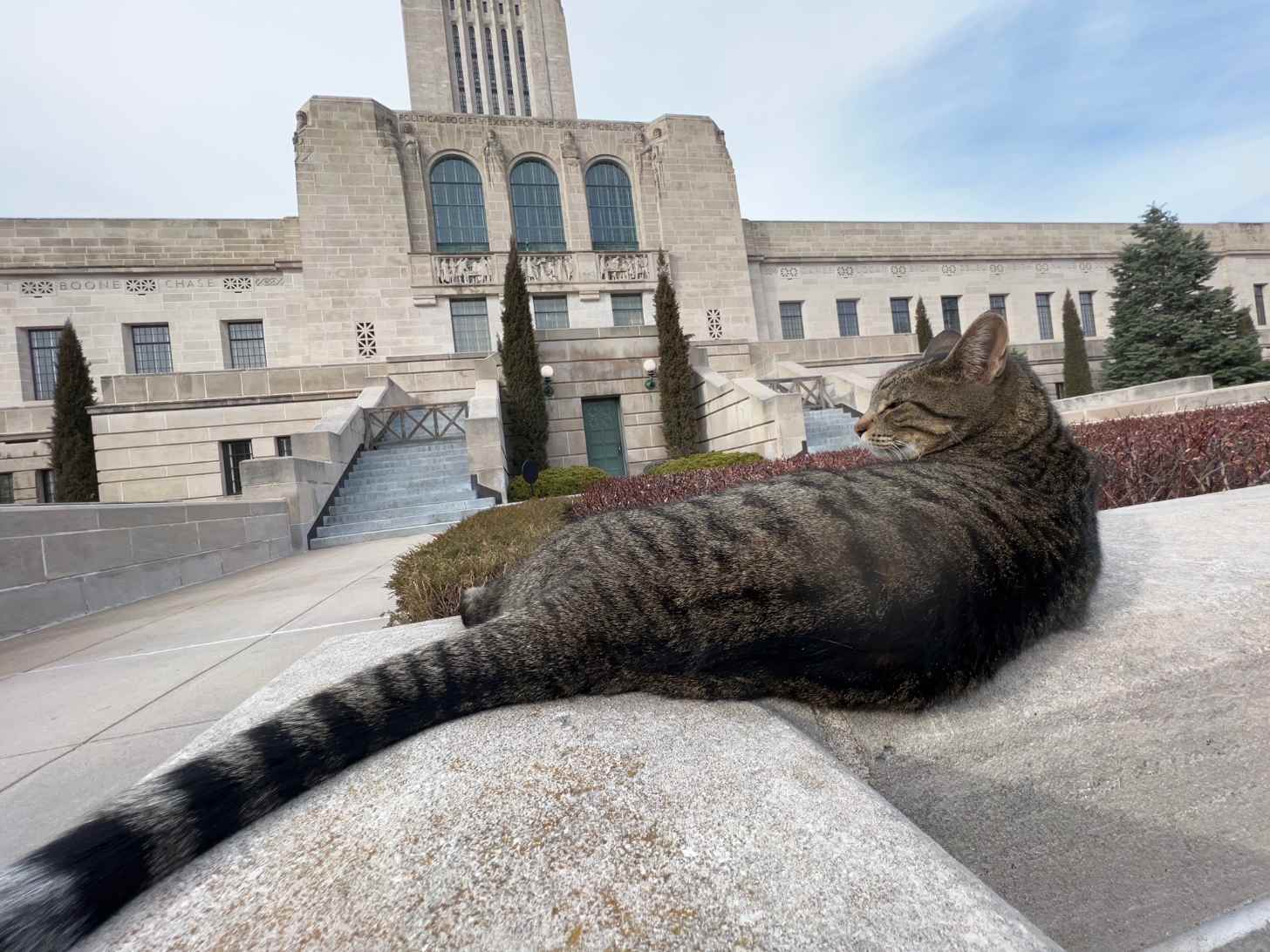
“It almost feels like he’s as old as the stone of the Capitol,” Wishart said of his presence.
One of the goals, Wishart said, is also to get the statue up “as soon as possible” for McGinnis, who relocated due to serious health decline and chronic pain in recent months. Wishart noted Cameron always had a positive presence and brought out “shared humanity.”
A storied legacy
John Shaw, a local photographer who published a book about Cameron that is sold at a gift shop in the Capitol, among other Cameron merchandise, is also helping the project.
Shaw said Cameron’s family is “very on board” and excited. As of Tuesday afternoon, the fundraising campaign had raised almost $3,500 toward its $37,500 goal just a few days after launching. Shaw has also agreed to donate profits from his photo book about Cameron to the project through October.
The cost includes Victor’s estimate and ongoing maintenance. Meeting materials indicate minimal upkeep with materials “designed to withstand Nebraska seasonal cycles without degradation.”
While Shaw was not necessarily an animal photographer, he said he always enjoyed photographing Cameron. He has two adopted cats of his own — littermates, which his daughters named Toby, after “The Office” character, and Peanut, for a marking on his nose.
After publishing his book and writing about Cameron’s retirement, Shaw said, he heard the “deeply emotional stories” people had about Cameron well beyond Nebraska.
Shaw said those stories were about “how they might have had loss in their life, and they came and saw Cameron and how it touched them and reminded them of people they had lost and how comforting he was.”
‘Peaceful constant on the south steps’
Also endorsing the statue is Nebraska’s top legislator, Speaker John Arch of La Vista.
Arch, who is finishing his eighth and final year, including four as speaker, wrote in a supporting letter that he saw the “intense energy, long hours, and rigorous debate” in the Legislature.
“In a setting dedicated to high-stakes public policy, Cameron served a unique and comforting purpose,” Arch wrote. “For over a decade, he was a peaceful constant on the south steps and lawns — offering a quiet moment of warmth to senators, legislative staff, page classes, and constituents alike as they entered and exited the building.”
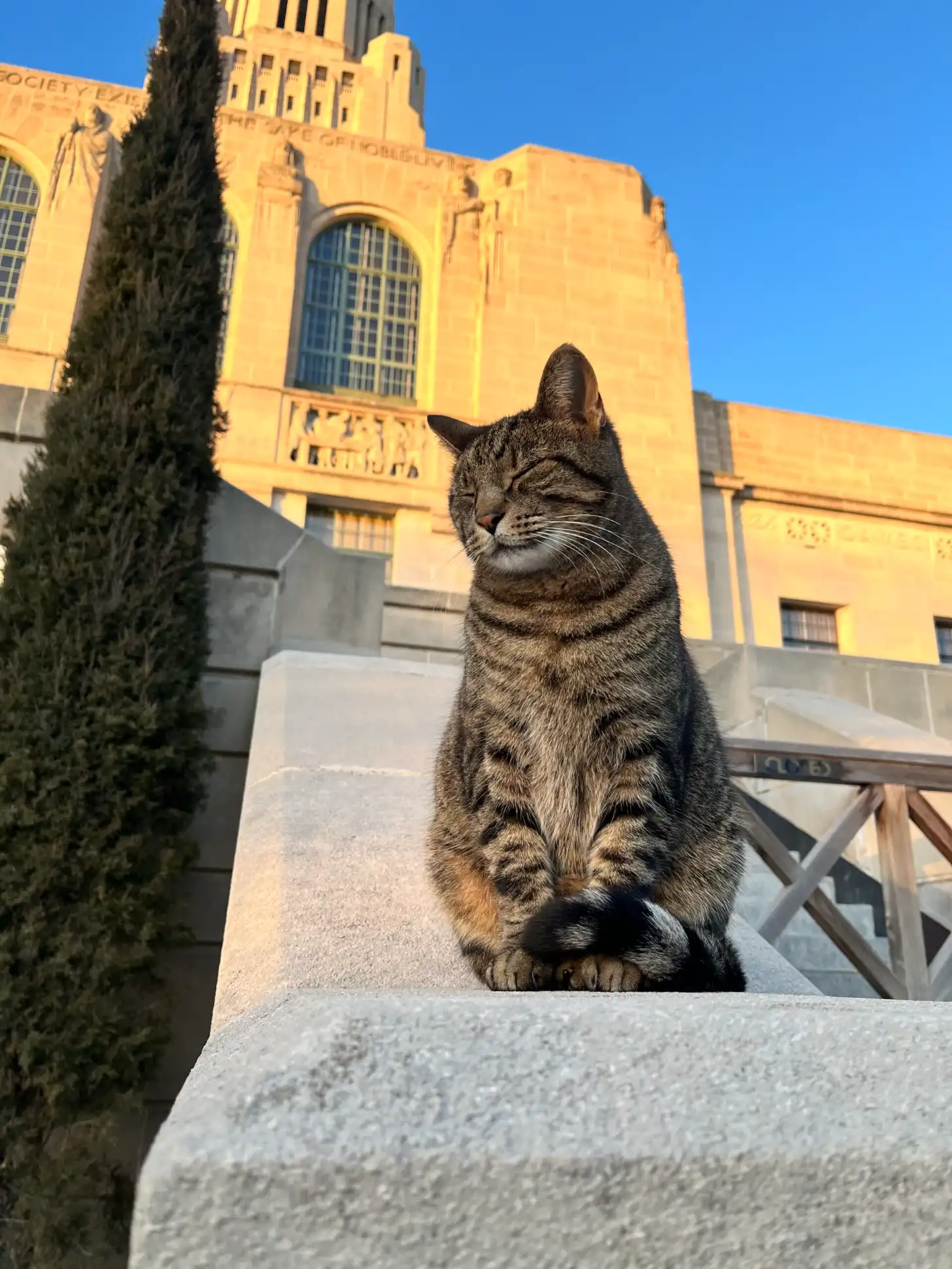
On one hand, lawmakers work “tirelessly” to represent Nebraskans, Arch said. Yet Cameron “represented the sheer goodwill of our Capitol culture.” Arch said Cameron’s retirement — after a tenure longer than modern lawmakers — marked the “end of a remarkable era.”
Wrote Arch: “Moving his memorial site directly across the street to the south grounds allows us to preserve his story and connection to the Capitol campus while respecting the physical integrity of the building itself.”
The Capitol Environs Commission meeting is 8:30 a.m. Friday in Lincoln.
This article was originally published by the Nebraska Examiner.
Featured Image: Erin Bamer/Nebraska Examiner
More than 54,000 children have received school clothing allowance funds as of Monday while the Morrisey administration continues to vet applications during the school year. In a new twist in the administration’s handling of the program, some low-income children who didn’t apply for the money have now received the back-to-school financial assistance.
West Virginia’s school clothing allowance program gives low-income students $200 for new clothes and shoes. The program launched later than expected under Gov. Patrick Morrisey, then ran out of funding after just a week.
It is now under investigation by Morrisey after he alleged this month that parents could be using the money elsewhere.
Students returned to school before thousands of applications were processed, frustrating lawmakers who felt the program shouldn’t have faced any disruptions when it was most needed.
A spokesperson for Morrisey said 3,696 remaining children will receive their school clothing benefit no later than Aug. 29.
“Based upon those families who are in the final stages of the enrollment process, DoHS projects that it will provide the [school clothing allowance] benefit to an additional 3,696 children this school year for a total of 57,436 kids. This total exceeds the number served last year by nearly 150 children,” Ann Moore, deputy communications director for Morrisey, told West Virginia Watch.
Moore said the administration will spend $11.5 million this year on the school clothing allowance program — $100,000 more than last year.

The state Department of Human Services also recently automatically deposited the clothing voucher benefit to children ages 4 to 10 who received it last year and met the eligibility requirements this year.
These children were already receiving help from other federal welfare programs, including Temporary Assistance for Needy Families, but weren’t required to apply this year for school clothing assistance.
“They did not have to reapply,” Moore said.
The state previously issued automatic school clothing assistance to eligible children during the COVID-era, but returned to required applications last year under Morrisey.
Moore didn’t respond to a question about how the 4 to 10 age range had been selected for the automatic deposit.
West Virginia pays for the school clothing allowance through federal TANF funding. The money is meant to help low-income families safely remain with their families and avoid the foster care system. States have broad flexibility with how they spend TANF dollars.
Morrisey has defended decisions around the long-standing clothing assistance program this year, pointing to the state’s looming deficit in TANF funds. The state has less than 13 months — $41 million — in TANF carryover funds at this point, according to Morrisey. TANF spending has increased under his administration.
While Morrisey said he was focused on making sure the federal funding was sustainable in the future, lawmakers pressed for more information about how the governor is spending the money and still have outstanding requests.
As program and applications were under review, Barboursville Mayor Chris Tatum wanted to make sure children in his area had new clothes before heading back into classrooms.
Tatum launched a fundraiser on his Facebook page this month, quickly raising $20,000.
“What I learned is how important that $200 actually is,” Tatum said. “That’s two or three outfits for a kid to go to school in. The need is there beyond me.”
Tatum and his daughter filled hundreds envelopes with gift cards and cash, then met families at city hall and made in-person deliveries to schools and homes across Cabell County. The mayor worked with the local schools to make sure they were reaching children in need.
“This was just about easing the worry and taking one worry off a kid’s plate,” Tatum said. “If that made their day walking into school, that’s all this was about.”
This article was originally published on West Virginia Watch.
Featured Image: Zoshua Colah/Unsplash
Young people in Hawaii now meet regularly with the state’s Department of Transportation to offer input on public transit, bike lanes, and other strategies to help the department transition away from fossil fuels.
Establishing the Hawai‘i Youth Transportation Council was just one of the outcomes of the landmark 2024 settlement of the Navahine v. Hawai‘i DOT lawsuit, which was brought by 13 young plaintiffs.
Their lawsuit alleged that the DOT wasn’t making progress toward the climate goals set by the state, violating the plaintiffs’ constitutional right to a clean and healthful environment.
They settled the lawsuit in 2024 before it went to trial, and the DOT is now required to decarbonize transportation by 2045 and, through the youth council, to listen and incorporate the priorities of young Hawaiians.
Yale Climate Connections spoke with Charlotte Madin, one of the plaintiffs, and with Joanna Zeigler, a staff attorney at Our Children’s Trust who led the case.
This interview has been edited and shortened for clarity.

The impact of Navahine v. Hawai‘i DOT
Yale Climate Connections: Charlotte, what got you concerned about climate change in the first place?
Charlotte Madin: I was born in Sydney, Australia, and I lived there until I was eight years old. And while I lived there, my family and I would often experience really large heat waves that would make us essentially have to evacuate our home and go to the nearest air-conditioned place because my mother was concerned that my sister and I would be sick or have health concerns due to this heat.
The entire time I’ve lived in Hawaii, about eight years now, I’ve noticed the beautiful ocean and the biodiversity of the coral reefs just slowly becoming less and less healthy, which is really challenging to see, especially since both my parents are marine biologists.
So seeing that happen in real time in front of me was really scary. And then, in 2021, I was on the Big Island when there was a really large fire. There was ash raining from the sky. My grandmother had a concussion and couldn’t get to the hospital because the fire was blocking a route.
YCC: What inspired you to get involved in the lawsuit and to become a plaintiff?
Madin: When I was 12 years old, I did a short presentation for my community organization with a friend, and soon afterward she mentioned a lawsuit that she was joining that she told me would help us have a cleaner and healthier environment. Then later, her mom reached out and asked my mom, “Does your daughter want to join?” And I was like, “Yeah, if there’s a chance to help the environment while I’m still young, getting started early, I’ll take it.”
I had always been interested in climate change and in environmentalism and how we can sustain our climate for as long as possible, if not forever. And this just seemed like a really great jumping-off point for me.
YCC: Can you tell me a little bit about what it was like being a plaintiff?
Madin: I wasn’t really sure what was going to be expected of me when I joined the case. But over time it became clear that it was really helpful for me to appear at events surrounding our case to muster support from the community.
As for the actual legal dealings, I was deposed by lawyers from the Hawai’i Department of Transportation when I was 13 or 14, which was quite an experience. It was a lot of questions for three or four hours. And so that was probably one of the most defining moments of my career as a plaintiff in this case.
YCC: That must have been very intimidating. What was that like, and what did you do to prepare for that?
Madin: Yeah, it was very intimidating. I remember being really, really nervous for the days leading up to the deposition. But I was told to tell the truth — you know, they won’t be able to find anything wrong with that, take it slow, take a deep breath if you need to, and don’t feel pressured to answer anything.
And that advice served me well throughout the deposition. By the end of it, I was exhausted, but I was really happy and proud of what I accomplished and what I’d done.
YCC: Can either of you give me a little bit of an overview of what the lawsuit alleged?
Joanna Zeigler: There were two constitutional provisions that were brought in the lawsuit. The first one is the public trust doctrine, which provides that the state shall conserve and protect Hawaii’s natural beauty and all of its natural resources for the benefit of present and future generations.
The second constitutional provision brought in the case was the right to a clean and healthful environment. And that gives each person the right to a clean and healthful environment as defined by the Hawaii statutes.
YCC: How much was the Department of Transportation relying on fossil fuels when this began? And can you put that in the context of any carbon reduction goals or mandates that had already been set prior to this?
Zeigler: The transportation sector is the largest source of greenhouse gas emissions in Hawaii, and transportation emissions are projected to continue to rise. Historically, HDOT’s planning of ground transportation has been very car-centric, prioritizing projects such as road expansion and maintenance rather than projects that reduce greenhouse gas emissions, such as pedestrian, bicycle, and transit expansion and expansion of EV infrastructure.
So without breaking that “business-as-usual” planning process of planning for more and more cars on the road, emissions from transportation would continue to be a problem.
YCC: What are some of the major points that the settlement requires the government to do?
Zeigler: The settlement requires HDOT to decarbonize the transportation sector by 2045, which means zero emissions from ground, marine, and inter-island air transportation. And the settlement provides benchmarks and requirements for what HDOT needs to do to reach zero emissions.
So for example, HDOT agreed to draft a greenhouse gas reduction plan, which is its road map to how it will reach zero emissions by 2045, with benchmarks for 2030, 2035, and 2040. HDOT also agreed to complete the pedestrian, bicycle, and transit network within five years of when the settlement was reached and increase EV infrastructure.
And so this settlement is a complement to the state laws which require statewide net-negative emissions by 2045 and require HDOT to decarbonize the transportation sector. But now we have this enforceable contract to help hold HDOT accountable for its part in decarbonizing the transportation sector. So the youth are in a contract with HDOT, and HDOT has made these promises to the youth to decarbonize.
And one other aspect of the settlement is that HDOT created the youth council. It’s an opportunity for youth from across Hawaii to provide feedback and let HDOT know what their priorities are so that HDOT can take those into consideration when it’s planning and prioritizing projects.
So there are so many aspects of the settlement that are really exciting, and watching it unfold has been a tremendous accomplishment.
YCC: What is the significance of this particular case?
Zeigler: This is the first youth-led climate change case to have reached a settlement agreement, and HDOT came to an agreement that will have a tremendous impact on the youth’s future and the future of Hawaii.
This is an example of what can be accomplished when government works with the youth, rather than against them, by sitting down at the table and truly listening to why the youth brought the case and what they were hoping to accomplish.
So with the settlement, HDOT has a backstop to the policies and practices that it puts in place, and the legislature also has a role to play to make sure that the state policies are in place to promote decarbonizing transportation so that HDOT can fulfill its agreement.
Other states can look to the progress that Hawaii is making and how it is improving the lives of its citizens and hopefully use Hawaii as a model for what can be accomplished with government cooperation.
YCC: Are youth lawsuits an effective approach to climate action and to holding some of these entities accountable?
Zeigler: Courts have a role to play in climate justice because the courts are there to ensure that the legislative and executive branches are acting within the confines of state statutes, or as in our cases, within the confines of the state or United States Constitution.
So in our system of checks and balances, the court must interpret the Constitution and make sure that the actions of the state are not violating these youths’ fundamental rights, which include the right to live in a world with a stable climate system.
YCC: Charlotte, what are some of the parts of the plan that you’re most excited about and some of the priorities that you want to make sure are seen through throughout this process?
Madin: I love the youth council aspect of the plan, and it’s been super exciting because I get to meet all these incredible young people from all around Hawaii and to hear their ideas and what they hope for, and to also be able to have this voice in not only the Hawaii Department of Transportation’s planning, but also, because of this, being given an intro into legislation and how bills work.
YCC: Is there anything else that either of you wanted to add to help people understand about this?
Madin: Well, I guess a message for the young people out there: You always have a voice, and you always have a choice with how you use that. And utilizing the power of democracy and utilizing the legal system, you can do big things with your voice.
So never give up your voice, and don’t let others silence you. Just do what you believe, and everything will work out fine in the end.
This article was originally published by Yale Climate Connections.
Featured Image: Robin Loznak/Courtesy of Our Children’s Trust
Although it’s part of an industry famous for changing slowly, New Mexico’s largest utility has moved quickly to update its electricity supply to cleaner alternatives.
The Public Service Company of New Mexico, or PNM, said it delivered 80% carbon-free electricity in 2025 after investing in solar energy, batteries, and wind. During the daytime, the sun powers fans, air conditioners, and more across the state. In the evening, solar energy stored in batteries keeps the lights on, while the wind turns turbines that meet other electricity needs. (For details, see part one of this story.)
This remarkable transformation to a climate-friendly system has unfolded in just five years. As recently as 2021, power plants fueled by climate-warming coal and gas generated nearly 80% of PNM’s total electricity.
“We know it’s the right thing,” said Laurie Williams, PNM’s senior vice president of integrated planning and transmission development.
An ambitious policy
Much of this progress stems from a state law passed in 2019 called the Energy Transition Act. It contains a series of renewable energy mandates, beginning with a statewide standard of 50% renewable energy by 2030.
Investor-owned utilities like PMN must generate 80% of their electricity from renewable sources by 2040 and achieve 100% zero-carbon electricity by 2045.
PNM is ahead of schedule. The company said that it will meet the zero-carbon requirement by 2040, five years before the deadline.
Williams explained that the transformation of the company’s energy supply is not solely motivated by complying with state laws.
“I would say it’s been more driven by the culture,” she said.
Over her 34 years with the company, “We’ve understood more and more about climate and the impacts on climate of traditional fossil fuels,” she said. “We’ve got to be part of solving the problem,” she added. “So I think there’s been a shift in mindset.”
PNM formerly owned the majority of a large coal power plant called the San Juan Generating Station. This plant closed in 2022, and PNM opted to replace all of its capacity from the coal power plant with renewables.
‘A chance to diversify the economy here’
The Energy Transition Act sets aside money to help workers who lost their jobs due to the closure of the coal plant and nearby coal mine as well as for the development of new renewable energy in the same county as the former coal plant.
Advocates criticized the program for a three-year delay in distributing the money, but funding did get allocated and spent. The state government reported that 2,800 workers have been retrained so far, well above the target of 2,000 workers.
“There’s not a lot of opportunity in New Mexico. It’s an area that, you know, we struggle,” Williams said.
She pointed out that the state’s economy is largely dependent on oil and gas. But New Mexico’s vast renewable energy resources offer new pathways to prosperity.
“It feels like there is a chance to diversify the economy here in a way that could be really meaningful for the citizens and for the future of the state,” she said.
Many Native Americans worked at the San Juan coal plant and mine. The Energy Transition Act established a fund specifically to help Native American communities with the energy transition. Every tribe that lives near a fossil fuel power plant that closes gets automatic membership on a committee that helps decide how and where funds should be allocated.
Money has been spent on sustainable agriculture, food sovereignty, irrigation, new solar projects, worker retraining, and direct payments to displaced workers.
Small-scale solar
Utilities aren’t the only ones on a building spree. Small-scale solar installations in New Mexico more than doubled from 2020 through 2025, and PMN reports that over 13,000 of its customers have solar panels.
Those who can’t or don’t want to put solar panels on their homes can purchase small shares of large solar farms. Sixteen community solar projects operate in the state, and 31 more are planned for a total of 200 megawatts of shared solar power coming online.
The Biden-era Inflation Reduction Act granted New Mexico $156 million to help build solar power for low-income communities, but the Trump administration clawed the money back.
Not just clean, but also cheap
As New Mexico’s grid gets cleaner, the state is also avoiding the price hikes that have become common around the country.
Nationwide, residential electricity prices have spiked by 32% in the last five years (May 2021 through May 2026). In New Mexico, prices have increased by just 7% during that same time frame.
The state’s electricity prices remain below average, with residential electricity at $0.14 per kilowatt-hour in May 2026 compared to the national average of $0.18 per kWh, and household electricity bills in New Mexico are among the lowest in the country.
One last piece of the puzzle: interconnection
When more renewables are added to a grid, more pieces need to be connected. In many locations, new renewables projects face a multiyear waiting time to be plugged into the grid, which slows the transition to cleaner energy sources.
“The moral of the renewables story is transmission,” Williams said. “You must have significant levels of interconnection to all of your neighboring entities.”
New Mexico developed policies to bring renewables online quickly, reliably, and cheaply, including quick turnaround times for reviewing and approving applications for new projects, low fees for interconnecting, and transparency in data sharing and reporting to the public.
New Mexico was the only state to earn an “A” grade for interconnection policies in a recent report by the Interstate Renewable Energy Council and Vote Solar.
Williams explained some of the myriad engineering challenges that go into converting a traditional fossil-fueled electricity system into the grid of the future.
“This really is the biggest math problem on the planet to solve, kind of a generational challenge, but really, really fun and really interesting, but not at all straightforward,” she said.
A lot goes on behind the scenes every time an air conditioner kicks into gear. But at least in some places, the web of decisions, policies, and infrastructure is producing a more climate-friendly way to keep lights, fans, and air conditioners running, even in the heat of summer. And that’s pretty cool.
This article was originally published by Yale Climate Connections.
Featured Image: Matthew Henry/Unsplash
This story was originally published by Grist. Sign up for Grist’s weekly newsletter here.
Repeated record-breaking heat waves cooked the European continent this summer, delivering the region’s hottest June on record. A simultaneous, though possibly related, drought shriveled rivers to record lows.
In addition to their impact on public health, the dual crises put pressure on Europe’s energy system: Wind power struggled under stagnant conditions created by heat waves, and “thermal” power plants — nuclear, gas, and coal plants — had to reduce their output as European waterways warmed and dried, taking away water used for their cooling systems.
Solar power proved the only major energy source that performed better than normal during Europe’s summer of extremes, experts found. When paired with batteries, it helped supply thousands of AC units during historic hot conditions.
Scientists are still trying to understand why so many recurring heat waves materialized this summer, but studies have found that individual heat events are more likely and more intense because of climate change. The intensity of the June heat wave that scorched Western Europe was roughly 200 times more likely in today’s fossil fuel-warmed climate than it would have been two decades ago, one study found.
As the continent continues to warm and Europeans install more cooling systems to cope — just 23% of households currently have access to or use air conditioning — experts say this summer provides lessons for the future.
Extreme temperatures in late June bumped up Italy’s power demand by 28% compared to the previous week, according to the energy think tank Ember. In France, that number was 14%.
Electricity and natural gas prices spiked in evening hours as demand grew highest and solar generation ended, with some prices hitting their highest levels since the 2022/2023 winter gas crisis following Russia’s invasion of Ukraine.
As demand and prices were climbing, power generation in some areas was falling. In the United Kingdom, five gas plants reduced their output by a combined 2.5 gigawatts in generation because heat reduced their cooling systems’ effectiveness. At the same time, heat-induced low wind speeds halved the country’s typical wind farm generation in June.
Historic dryness dropped river levels across Europe: England and Wales reported their driest July on record, while water levels in the Danube River in central and Eastern Europe reached record lows, exposing WWII shipwrecks and prehistoric relics. Europe’s hydropower production hit its lowest July level in a decade, and multiple countries curtailed nuclear power generation as warm, low rivers threatened water supplies for cooling.
France lost 18% of its nuclear capacity to “environmental factors” in mid-July, Ember found, extending a trend of summertime nuclear outages that has plagued the country in recent years. French nuclear plants often use river water as a vital component of their cooling systems, drawing the water in at natural temperatures and then discharging it back into the rivers slightly warmer. Because French law caps the temperature of this discharged water to protect aquatic life, plants must reduce cooling operations and related power generation when the intake water from rivers is already warm because of heat waves or drought.
But where these sources faltered, solar shone through.
European heat waves tend to deliver optimal conditions for solar power: clear, sunny days. Europe’s solar panels produced 17% more power during the summer’s heat waves than they normally do, stabilizing the grid as afternoon cooling demand climbed, according to Ember. Battery systems helped deliver this solar power into the evening hours, when heat still lingered and air conditioners cranked to allow households to sleep.
“The next challenge is the evening period. Temperatures often remain high after sunset and AC demand can stay elevated, even as solar production declines,” said Walburga Hemetsberger, CEO of SolarPower Europe, an industry group. “This is why battery storage is becoming such an important part of the energy transition.”
For as much as this summer’s extreme heat strained Europe’s grid, the continent’s cooling demand has a lot of room to grow: About half of households in Italy and Spain have air conditioning, and a quarter in France — compared to 90% in the United States.
“There are places where we just can’t do without it now,” Marine Tondelier, national secretary of the Ecologist Party, said this June, a reversal in the party’s longstanding argument against air conditioning because of its greenhouse gas emissions.
France’s state-owned utility plans to spend over $10 billion to adapt its nuclear and hydropower plants to warmer temperatures and lower water availability over the next 15 years, including investments in equipment that cools the water nuclear plants discharge into rivers so that it complies with environmental standards.
But adapting to that new demand could also take new generation and storage, especially as grids simultaneously increase demand from data centers.
Solar and batteries have already been growing at a breakneck pace across Europe, with 36 gigawatt-hours installed in 2025, a 48% increase over new additions the previous year. Battery installations saw their 12th straight year of growth in 2025, according to industry group SolarPower Europe.
“Extreme price spikes during heatwaves are a blaring signal for regulatory changes that increase power system flexibility,” said Beatrice Petrovich, a senior energy analyst covering Europe at Ember. “Treating this summer as a turning point for energy storage would be an opportunity to remove existing barriers.”
Featured Image: Jochen Eckel/Getty Images via Grist
In the past decade, study after study has come to a troubling conclusion: Trust in news and journalism has declined dramatically.
The public’s loss of trust corresponds with the explosive development of our information ecosystem. The more options audiences have to find news elsewhere, the less trust the public has placed in traditional forms of journalism.
However, trust in journalism was displaced long before the rise of digital and social media.
That’s especially true for Black communities that have been harmfully misrepresented by mainstream outlets. Research, for example, has consistently shown how the news media has contributed to overrepresentation of Black people in crime coverage, which contributes to a litany of negative outcomes and perceptions.
Scholars, including me, have detailed how mainstream journalism continues to marginalize and misrepresent Black people. That especially happens in protest, crime, and health coverage. It’s no surprise that Black communities have a long history of turning away from mainstream journalism.
As such, a closer look at these communities can also give us insights into how to win some of that trust back.
Trust takes two
Despite past harmful coverage, some Black people trust media anyway.
In a recent study I conducted with colleagues, we identified places where people do still trust media and focused on the next essential question: Why?
To answer this, we turned to Minneapolis and Saint Paul, Minnesota, to learn from journalists trusted by Black communities. In 2022, two years after the murder of George Floyd, our research team began surveying over 100 Black community members and residents to ask them about whom they trusted to tell them the news.
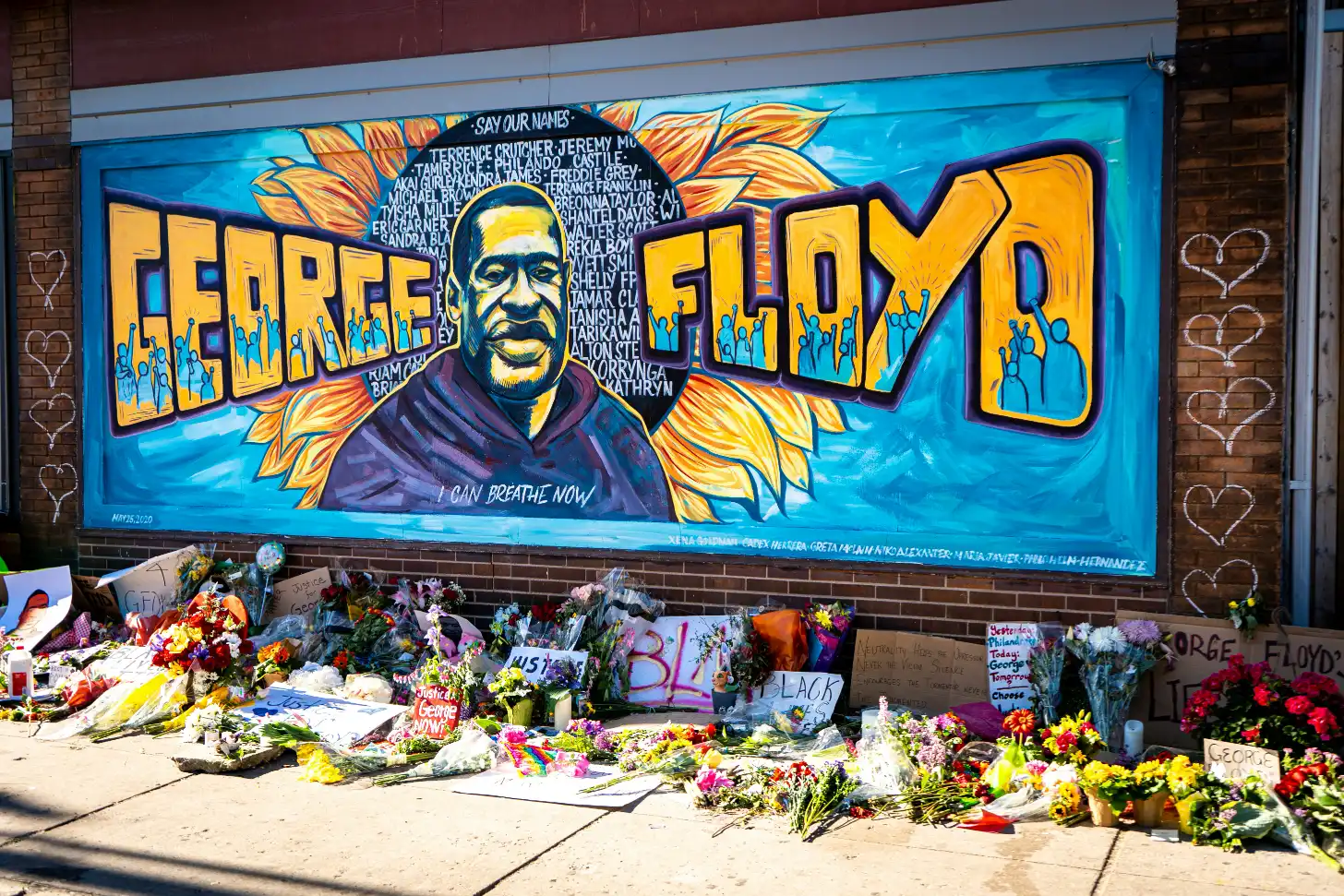
Although news organizations weren’t the No. 1 answer, community members named many journalists, including those working at mainstream outlets and community papers. So we connected with 17 trusted journalists who reported in the area after the murder — or during the police officer trials — to learn more about how they built trust.
We learned that the trusted journalists in this community embraced an ethic of love, a set of principles proposed by Black feminist scholar bell hooks that weave together the dimensions of care, commitment, responsibility, knowledge, and respect.
We also found that building trust takes the engagement of two parties. No one practice from journalists can fix the trust crisis; it takes communities to engage, forgive, and voice concern.
What communities do to make trust possible
We found that the most overlooked piece to building media trust is the willingness of a community to engage with journalists. Instead of saying “no comment” or avoiding the camera, community members offered their perspectives and knowledge openly. Sometimes these discussions served as essential background knowledge. Other times, it led to being quoted directly in news coverage.
Journalists also perceived communities’ willingness to provide feedback as an opportunity to build and retain trust. Sometimes the feedback was critical. When a reader was upset about how a story was framed, they pushed back. Other times the feedback provided affirming support.
From these journalists’ perspectives, their trusted status was a product of the community’s willingness to share both knowledge and feedback.
How journalists built trust
There are some key practices that helped journalists gain trust with audiences: active listening, being accurate and demonstrating care. But we also found two distinct practices that were helpful for building meaningful community relationships: diligence and deference.
For trusted journalists, diligence meant spending more time with the community. Some attended hours-long events from beginning to end. Others waited until the end of an event to connect with sources, waiting and observing as time passed. Diligence also often demanded a continuous presence in the community — beyond what the job required.
In one instance, a journalist described staying at a community protest long after the event they were covering ended. For another journalist, it meant reporting on the same public safety beat for years, so long that everyone in the community he covered knew his name. Whatever the case, diligence always equated to time.
Diligent journalists couldn’t just connect with the community over a tragedy; they had to connect well beyond the event that made the news. For some, this meant riding on public transportation and being a regular at the local shops.
For others, it meant showing up at events and community spaces during their time off. This showed communities that journalists cared about people, not just the headline.
Deference was a conscious task that involved honoring the boundaries, rules, and expectations of community members. If someone said no pictures, a camera was pointed elsewhere — even if everyone was in a public space. If a community member asked for silence, those boundaries were respected.
The cultural boundaries that bind many Black communities, such as the respect for elders and aunties alike, were honored and respected in informal communication — and sometimes in coverage.
Importantly, deference required that journalists drop the assumption that they had all the answers. For many, this required a practice of intentional humility. Instead of assuming they already knew the narrative, trusted journalists deferred to the lived experiences of the community and allowed people the autonomy to tell their own stories in their own words.
The future of trust
I believe what we learned from these trusting relationships can serve as a blueprint for a more inclusive understanding of how trust is built and sustained.
For journalists and Black communities in Minnesota, this approach helped reduce harm and build personal connection. Most journalists we spoke to thought it was essential work to fulfill the democratic promise to serve and inform the public.
But these lessons aren’t a one-size-fits-all formula for the entire media industry or for all communities. The journalists in our study acknowledged this, too, noting that they are trusted by some community members, not all.
Building trust is highly contextual. For journalists, practicing deference and yielding authority are necessary steps when repairing relationships in communities that have experienced historical harm. But those same practices might not work with all groups.
For example, yielding authority to individuals or communities intentionally trying to spread misinformation could lead to complicity and diverge from the goals of journalism.
People often treat trust as a universal good, but whom journalists and communities choose to trust matters just as much as how they build it.
This article was written by Danielle K. Brown from Michigan State University and was originally published on The Conversation.
Featured Image: Anna Keibalo/Unsplash
In 2023, Sergeant Cassandra Taylor retired from the Army with 28 years under her belt. It’s a military career she’s proud of — but it's also one that was filled with many unwelcome advances from her superior officers, including one that ended in sexual assault.
Despite another servicemember witnessing the incident, the man who assaulted her retired without penalty. Her anger and frustration lit a flame in her, and Taylor began speaking up about sexism in the military, hoping to create a safe, welcoming community for women like her.
That advocacy later led to the creation of Top Flight Defense, Inc., a Chicago-based nonprofit “created by women veterans, for all women.”
Through her nonprofit, Taylor offers free mental health services for survivors of domestic violence and assault, as well as combat veterans with PTSD.
“We focus on the overall health and mental wellness of women veterans and the women in their community,” Taylor said.
Taylor is also the author of “Why I Serve,” a book that blends her personal experience with the shared accounts of 68 other women veterans.
“Women have been serving and loving America long before America loved her, but that never stopped the heart of a warrior,” Taylor writes in the memoir.

Taylor’s courage has inspired women like Navy veteran Deanna Davis, who credits Taylor with helping her work through her own trauma.
“She talked about her experience, but she also talked about [how] she overcame it. And how she spoke up about it encouraged me,” Davis told WGN9. “It memorialized the fact that I served and it meant something. Me, staying there, even after what happened, was for something.”
A version of this article originally appeared in The Feminist Edition of the Goodnewspaper.
You may also like: Poet Susan Griffin believed environmentalism was synonymous with feminism: 'We are air, we are flame, we are oyster and pearl'
Featured Image: RDNE Stock project
On August 7, Colorado Parks and Wildlife shared a glimpse of a lynx family in the wild.
“A rare sight to see: A lynx kitten and adult spotted by a trail camera in Colorado,” the agency stated in an Instagram post.
“Lynx breed in late winter, and after a gestation period of about nine weeks, females produce a litter of one to four kittens in May or June,” the account explained. “Kittens stay with their moms for about nine months, after which they venture out on their own.”
Adult lynxes weigh roughly 30 pounds. The grayish, spotted cat is about three feet long, with a short black-tipped tail, oversized hind feet, and distinctive long tufts on its ears.

The lynx has been listed as an endangered species in Colorado since 1976, due to fur trapping and widespread habitat loss.
In the 1990s, Colorado Parks and Wildlife launched a seven-year effort to reintroduce the species into the San Juan Mountains by relocating other populations from Alaska and Canada.
In 1999, 96 lynx were released in the area near Creede and north of Durango. Today, at least 100 lynx are estimated to live in Colorado, suggesting those early introduction efforts have remained stable over the last three decades.
In late November 2024, the U.S. Fish and Wildlife Service proposed new critical habitat designations for threatened Canada lynx. For the first time, that included areas in the southern Rockies.
“The science and the law support critical habitat protections for lynx in the southern Rockies. It’s what they need to have a fighting chance at survival in the face of our warming climate,” Matthew Bishop, senior attorney at the Western Environmental Law Center, said in a statement.

“We’ve had to push the Fish and Wildlife Service for every inch of progress on Canada lynx recovery efforts, and are hopeful the agency is beginning a new chapter of good-faith recovery efforts for this ecologically significant and iconic wild cat.”
“The lynx is a keystone species in the southern Rockies ecosystem. Once considered extirpated, the lynx is back and reproducing in western Colorado’s forests,” agreed Peter Hart, legal director at Wilderness Workshop.
“Colorado’s high mountains provide increasingly important refugia for lynx as the climate warms. If we want this species to persist and thrive, we need to protect critical habitat here.”
You may also like: Trail cameras capture rare footage of elusive African serval kittens, a cat that looks like a 'stretched out cheetah'
Featured Image: KiraDartmoorZoo (CC BY-SA 4.0)
The Wildlife Conservation Society’s Bronx Zoo has just announced a major milestone: Since 2024, the zoo has officially helped rescue and rehabilitate more than 800 North American box turtles saved from the illegal wildlife trade.
In partnership with the United States Fish and Wildlife Service, the zoo has been a vital lifeline for the endangered turtles since October 2024, in what officials are calling “an unprecedented surge in turtle trafficking.”
Most of the turtles are believed to have been collected from the wild for the international wildlife pet trade, but when the turtles are confiscated from traffickers in New York-area airports, the reptiles are brought to the Bronx Zoo for help.

“The Wildlife Conservation Society’s Bronx Zoo plays a critical role in combating the illegal wildlife trade by partnering with law enforcement agencies to provide triage, quarantine, veterinary care, rehabilitation, and placement for confiscated turtles and tortoises,” Kevin Torregrosa, WCS Bronx Zoo curator of herpetology, said in a press release.
Many of the turtles arrive at the zoo severely dehydrated, emaciated, injured, or suffering from disease after rough handling and enduring poor transport and holding conditions.

“Our expertise allows us to stabilize and care for these animals while supporting ongoing investigations and helping ensure they ultimately have the best possible future,” Torregrosa said.
In the past two years, the majority of turtles rescued by the zoo are North American box turtles, particularly eastern box turtles, three-toed box turtles, ornate box turtles, and Florida box turtles. A handful of other species intercepted from trafficking include Gulf Coast box turtles, spotted turtles, and diamondback terrapins.

Many of the confiscated turtles are protected under the Convention International Trade in Endangered Species of Wild Fauna and Flora, while others are protected by state laws. For example, it is illegal to collect or possess Eastern box turtles in New York and New Jersey.
Individual box turtles are not the only ones who suffer; but their species as a whole. The species is a “long-lived” animal, which means they mature slowly and have low reproductive rates. Wild populations struggle to replace adults that are trafficked and taken out of their natural environments.

“Removing large numbers of breeding adults from the wild can devastate local populations,” Torregrosa said. “It may take decades — or even generations — for those populations to recover, if they recover at all.”
But, experts at the zoo are there to give these turtles the best possible chance to recover.
When a new turtle arrives, they undergo a comprehensive intake exam, as veterinarian teams assess their condition, administer fluids and medical treatments, document injuries, test for disease, and record basics like weight, species, and sex. Then, the turtle is appropriately placed into quarantine or rehabilitation.

Not all turtles survive, but many do recover with the help of expert care. Once rehabilitated turtles are healthy, they are transferred according to USFWS.
“Depending on the species, health status, circumstances of the case, and legal requirements, animals may be placed with accredited zoological institutions or conservation organizations or, when appropriate and permitted, returned to protected habitat in the wild,” a press release from WCS explained.
“These efforts not only rescue individual animals but also contribute to broader efforts to combat wildlife trafficking, protect threatened and endangered species, and safeguard wild turtle and tortoise populations,” Torregrosa added.
You may also like: This 'turtle-sniffing dog' searches miles of New York woods to save endangered species
Featured Image: Terria Clay/Wildlife Conservation Society
NASA astronaut and Artemis II Mission Specialist Christina Koch was honored Wednesday with the Order of the Tar Heel, the highest award bestowed by the North Carolina Commissioner of Labor. Koch, a Jacksonville native and N.C. State University graduate, became the first woman to travel beyond low Earth orbit, and with her crew broke the record for the farthest distance humans have ever traveled in space.
“Her accomplishments with NASA have made history, but her commitment to encouraging students to pursue STEM education may be among her most important contributions,” said Labor Commissioner Luke Farley, at the award ceremony at the historic Labor Building in downtown Raleigh.
The award recognizes Koch’s work with NASA as well as her ongoing advocacy for science, technology, engineering, and mathematics education.

Koch said her mission would not have been possible without countless workers, all willing to contribute their unique talents to make the mission a success. A-B Emblem of Weaverville, North Carolina, was among the businesses recognized for producing the Artemis II patch, which was designed by the astronauts.
“I like to think we are a partnership because in NASA, so many jobs, high-skilled manufacturing and technical jobs, are created by a love of wanting to explore,” Koch said.
Developing a strong STEM workforce, starts with engaging students in science and math at a very young age.
As part of Wednesday’s special event, Koch took questions from two dozen enthusiastic elementary school students.
When you were my age, did you already know you wanted to be an astronaut?
“I did know I wanted to be an astronaut, but I also knew it was going to be really hard and probably not very likely,” Koch answered. “So, I went for my dream and I worked towards that goal. I also made sure that along the way I did things that I found really fun and that brought me joy.”
What’s your favorite planet, other than Earth?
“I like Jupiter! [It] has a huge magnetic field and beautiful lights like the auroras,” Koch said.
Just like the Northern lights, Koch said, the light will dance in the sky from the magnetic field of a whole planet.
“That happens on Jupiter just like it happens on Earth, and I think that’s pretty cool.”
What’s it feel like when you sleep upside down in space?
“Without gravity it feels the same as sleeping upside down as the right side up,” Koch said. “There’s no gravity to keep you in the bed. It’s just amazing.”
Could you see the dark side of the moon?
“It’s the far side of the moon. It’s never facing Earth, but the sun actually lights it up just as much as it lights up the side that faces us,” Koch said. “It was beautiful.”

Koch answered one last question from NC Newsline: What’s next for an astronaut who has seemingly achieved all her goals?
“I haven’t actually figured that one out,” she said.
In the short term, she plans to restore her family’s sailboat, a past time she enjoyed with her father growing up in Jacksonville.
“That actually has been one of the most exciting things that I’ve taken on recently — getting back to my family, and then trying something that scares me, which is what I always tell people they have to do.”
Koch said she hopes the students will embrace their own unique talents and find a way to give back to their community.
“You can make [it] happen when you’re supporting the people around you,” Koch said.
This article was originally published on NC Newsline.
Featured Image: Clayton Henkel/NC Newsline
The Indian Ocean accounts for about a fifth of global ocean area, with 90% of it reaching deeper than 3,280 feet. Yet compared to the Pacific and Atlantic, its deep-sea biodiversity is relatively understudied — particularly the seamounts of the ocean’s central eastern region.
An expedition that surveyed dozens of these volcanic underwater mountains around the Christmas and Cocos islands, located southwest of the Indonesian island of Jakarta between Australia and Sri Lanka, has revealed remarkable marine animal biodiversity along the Indian Ocean seafloor.
Published in Deep-Sea Research Part II: Topical Studies in Oceanography in June, the resulting study details 149 new species, including a sea cucumber from the genus Oneirophanta, a new fish from the greeneye family (Chlorophthalmus), and a parasitic barnacle from the genus Rhizolepas.

Researchers surveyed at depths ranging from 308 to 17,818 feet, mapping a dark abyssal seafloor punctuated by 40 to 120-million-year-old volcanic seamounts that can be up to 43 miles across. They had never been studied before, study lead author Tim O’Hara, a marine scientist at Museums Victoria in Melbourne, told Mongabay.
“People had been around the islands in shallow water before, but no one had looked at life in the deep. It was a massive hole in the data,” O’Hara said.

Mapping remote underwater mountains
Getting to these sites required time. The islands are so remote that, leaving from Darwin on the northern coast of Australia, it took nearly seven days to arrive at Christmas Island. Cocos is nearly 600 miles southwest of Christmas.
The islands are external territories of Australia. In 2020, two years before establishing them as the Indian Ocean Territories Marine Parks, the Australian government approved the expedition to better understand their marine biodiversity.

The international team of 33 researchers began by mapping the seafloor and 22 seamounts in 2020 — including the Green Eye, named after the fish family Chlorophthalmus found there.
These massive underwater mountains rise nearly 3,300 feet above the seafloor and interrupt deep-sea currents, creating a nutrient oasis for filter feeders and other animals.
To conduct deep-sea research, Australia’s Commonwealth Scientific and Industrial Research Organisation commissioned a custom-built research vessel, the RV Investigator, in 2014.
Previously, Australia had primarily focused on studying coastal waters off the country’s mainland, only reaching a depth of 9,842 feet, according to O’Hara. The Investigator expanded the team’s research capacity, allowing them to survey depths reaching 3.10 miles.

Life in the depths
O’Hara told Mongabay that one of the most intriguing aspects of the expedition was discovering new seamounts. One included a caldera, a bowl-shaped crater that forms after a volcanic eruption. In a nod to J.R.R. Tolkien’s The Lord of the Rings, the researchers named this caldera the Eye of Sauron — as its center resembles an eye. They discovered it at a depth of 10,180 feet, and a distance of 175 miles from Christmas Island.
While researchers did not sample the caldera, they did collect from the seamounts and found that species assemblages gradually shifted as they went deeper.

Living at these depths is difficult.
“It’s dark, it’s cold,” Jim Barry, a senior scientist at the Monterey Bay Aquarium Research Institute in the U.S. state of California who was not involved in the study, told Mongabay. Animals here depend on material sinking from the surface for food.
This is where seamounts may help, Barry added.
“If you’re on a seamount, as this current is coming by and hits the seamount, that flow accelerates across the top,” he said. “If you’re a filter feeder that needs food, you may be able to optimize feeding by positioning yourself in an area where the currents are faster.”

More than 22 million years of evolution
To collect these species, the researchers primarily used a beam trawl, a 13-foot-wide beam with a long net attached. The Investigator pulled it forward with a 5 mile-long wire so that it dragged along the seafloor at a walking pace.
The net mainly caught jellyfish and worms. A smaller, conical net, 3-feet-long and 1.5-foot-wide and attached above the other net, caught tiny crabs, lobsters, and other crustaceans that the larger net missed.

Researchers recorded footage with a deep-towed camera and collected data on temperature, salinity, and amount of dissolved oxygen in the water. They also collected environmental DNA — genetic material shed by organisms — revealing the species in the area. Researchers found 1,059 species in total and have identified 149 new to science.
“I am just amazed that every time we go somewhere and look carefully, we discover so many new species in the deep sea,” Barry said. “One of the surprises to me was all the fish.”
Twenty-three had not been previously identified in Australian territorial waters, according to the study.
O’Hara said the most memorable find was the 1,000 shark teeth pulled up during the last trawl along the Cocos Abyssal Plain, covering more than 22 million years of evolution. The teeth included those of great white sharks (Carcharodon carcharias), mako (Isurus oxyrinchus), tiger (Galeocerdo cuvier), and even prehistoric Megalodon (Otodus megalodon) fossils.
At the site, which researchers named “The Shark Graveyard,” they also found polymetallic nodules (manganese nodules), including within the shark teeth. These mineral-rich rocks are highly sought after in deep-sea mining and used in electric vehicle batteries, wind turbines, and renewable energy.

Future research and threats
Since this expedition, O’Hara told Mongabay, other scientists are exploring seamounts in the Coral Sea Marine Park off Australia’s northeast coast and a German research vessel, Sonne, is examining the seafloor structure off the east coast of New Zealand.
As oceans face threats from climate change, including rising surface ocean temperatures, marine heatwaves, overfishing, and deep-sea mining — which all impact benthic ecosystems — deep-sea research remains important, according to O’Hara and Barry.
“It is the last frontier,” O’Hara said. “We really need to know how the deep sea works. We can’t see it from the surface; no one experiences the deep sea except a few people [who] go down [in] submarines. I’d love to go further out in the Indian Ocean.”
This article was originally published by Mongabay.
Featured Image: Courtesy of Benjamin Healley/Museums Victoria
Bricks & Minifigs, a specialty Lego store in Wilmington, North Carolina, is used to working with creative customers.
But then, they met Shelby Cash and a rescue kitten from Coastal Carolina Kittens: Little Star.
“It might sound trite, but our goal each day is to create our own slice of LEGO magic for our customers,” Bricks & Minifigs shared on Facebook in late July. “Today the magic found us from one of our customers, and we were happy to be able to step up!”

Little Star was born with cerebellar hypoplasia, commonly known as wobbly-head syndrome. The kitten has had an underdeveloped cerebellum from when she was born and has had trouble walking.
She’ll have the condition her whole life but can learn how to adapt; most cats do with a wheelchair. But those custom cat wheelchairs can cost hundreds, if not a thousand dollars.
“That’s when Shelby called us,” Bricks & Minifigs wrote.
Someone had suggested she find an expert to build one using Lego Technic blocks — at least while she’s still growing.

“Our employee Ryan was up to the challenge, crafting a custom-made set of wheels for Little Star today,” Bricks & Minifigs reported.
“After a few adjustments, we're happy to report Little Star took some steps with her new wheelchair. Way to go Ryan, and thank you to Shelby for brightening our day!”
But Little Star wasn’t the only kitten that the shop helped.

Less than a month later, Bricks & Minifigs of Wilmington heeded the call of Rescue Connect and kitten Rex. The 4-month-old kitten was also born with wobbly-head syndrome. The experts caring for Rex estimated a wheelchair would cost about $1,800 — and he would grow out of it in about a month.
So, they reached out to the resident Lego cat wheelchair experts. This time, it was employee Michael Hawley who built Rex’s chair.
“I’d say some of my earliest conscious memories are with Legos,” Hawley told WECT 6 News. “My older sisters used to terrorize me when I was younger. In order to fend for myself, I would have to build my own ‘Home Alone’ contraptions to get back at them. They don’t make Lego sets for that, so I had to get creative.”
That skill came in handy again for Rex, who was outfitted with the perfect temporary wheelchair.
“It was honestly a great feeling,” Hawley said. “I’m just glad to be a part of it.”
Like Little Star before him, this wheelchair will help improve Rex’s quality of life and make it easier for vets to support his daily care.
“It’s hard when you’re in rehab and you watch them struggle and struggle and you don’t know what their future is going to be,” Rex’s foster mom, Jennifer Witkowski, said.
“It’s nice when you get that moment of hope they might have a normal life.”
You may also like: Rescue crew miraculously saves family dog who was swept out to sea: 'An emotional reunion'
Featured Image: Bricks & Minifigs Wilmington/Facebook
July 14 was an unusual day for Chase Guello, an operating supervisor at River Reach Construction. He was just getting his day started when he realized a small kitten had fallen into the site’s excavator and was crying for help.
“Rescue mission for the day,” Guello said in the video, which has since garnered over 610,000 views. “Normally, it’s a piece of equipment. Right now, it’s this little guy. There’s a cat stuck.”
After taking off the excavator’s skid plate with a drill, Guello watched in surprise as the kitten plopped straight down in what Instagram users called “a superhero landing.”
The brand of the equipment, Komatsu, would go on to inspire the kitten’s name, which was shortened to “Sue.”
In a follow-up video posted the same day, Guello said that they searched the construction site thoroughly but found no sign of Sue’s mother or siblings.

Although their hopes for a reunion were dashed, Guello knew that Sue would be in safe hands, explaining that his mother’s friend worked at One of a Kind Pets, a pet rescue and adoption center in Akron, Ohio.
“She has a lot of experience in fostering kittens,” Guello said. “So she is going to take care of the kitten for the next two to three weeks until the kitten’s old enough, and then it is going to get turned over to our shop mechanic.”
“His name is Jared; he grew up on a farm, has a lot of experience with animals also,” Guello said. “The kitten will go back and forth from work to his house with them every day until she’s old enough to be a shop cat.”
Guello continued posting updates of Sue throughout July, saying that she had gotten a clean bill of health at the vet and was adjusting well to life with Jared.
On July 30, River Reach shared photos of Sue sporting a custom-sized hard hat and safety vest, made by Komatsu itself.
“We think Sue is ready for the job site!” the company wrote on Instagram.

“Huge thank you to [Komatsu North America] for the continued support, and an even bigger thank you to all of you for the incredible love you’ve shown this little one. We truly appreciate every like, comment, and message. It means more than you know.”
River Reach is a leading environmental restoration contractor in the state of Ohio.

Since 1992, it has specialized in river and stream restoration, dam removal and dredging, wetland mitigation, environmental remediation, and stormwater management.
Guello said Sue’s journey has shined an unexpected light on his family’s company.
“I’m far from a celebrity,” Guello said in an Instagram Live on August 28. “Just happened to rescue a little kitty on a construction site, is all.”
“I’m just glad I can share it with you guys and that our company is getting a little bit of exposure,” he added. “It’s definitely cool seeing people take a little bit — and I understand you’re more interested in the cat — but taking a little bit of interest in the work that we do and that we give back to the environment.”
In his latest update, Guello estimated that Sue was at least two months old and already fast outgrowing her custom-made equipment.
“Kamatsu is sending us a bigger hat and bigger vest,” he laughed.
You may also like: A woman walked into a shelter and asked to see their 'least wanted dog.' Then she showed the internet how truly lovable she was
Featured Image: RiverReach Construction/Instagram
Gov. Mikie Sherrill signed legislation Thursday requiring data centers to report their water and energy use to state energy regulators every six months, touting it as a highlight of her plan to “hold data centers accountable.”
Sherrill, a Democrat who pledged months ago to seek limits on data center construction, said during a bill signing ceremony in South Brunswick that she will not “let these developers operate in the shadows.”
“New Jerseyans deserve to know how much water and electricity the data centers coming into their community will use. Data center companies often treat their usage statistics like a trade secret,” she said.

Data center critics have said their mammoth power needs are behind rising electric rates. Sherrill pledged during her campaign for governor last year to freeze those rates for New Jerseyans.
The law requires operators to disclose total energy consumption, energy used for cooling and IT equipment, peak daily water use, water sources, and backup power supplies to the state Board of Public Utilities twice a year. Bill sponsor Sen. Teresa Ruiz said the reporting requirement should be “the start of an ongoing public record” rather than a one-time disclosure.
That data would be summarized for public release, but a provision of the law limits how much of that information could be released to the public under the state Open Public Records Act.
Advocates say that carve-out undercuts the law’s transparency goal. Ben Dziobek, executive director of Climate Revolution Action Network, griped that state officials are claiming to offer “guardrails” for data center construction while declining to actually cap what data centers can build or consume. Companies will be able to report without any independent verification or audit, he noted.
He and other environmental activists said the legislation Sherrill signed does not go far enough. They have called for Sherrill to issue a statewide moratorium on all data center construction.
“Data center reporting for energy and water use after the damage is done is the antithesis of guardrails,” said Jaclyn Rhoads, executive director of the Pinelands Alliance. “New Jersey is paving the way for data centers to contaminate our air and waterways while leaving the public to suffer. We demand more of our government officials. Pass a moratorium now.”
Sherrill pushed back on the idea that a statewide moratorium would be the right approach, saying that data centers who want to build in New Jersey will “play by our rules.”
“We don’t have to choose between innovation and accountability, and we won’t,” she said.
More than three dozen New Jersey towns have voted to block new data centers, largely after public pressure from residents.
Sherrill also announced new state guidance aimed at helping municipalities negotiate community benefits agreements with data center developers. She said the agreements are meant to get towns and developers “on the same page” on issues like noise and lighting before construction starts, secure local infrastructure investments, and lock in prevailing wage and project labor agreement standards on the biggest projects.
“We know these companies drive a hard bargain, so I’m not going to leave communities on their own to negotiate,” she said.
She also signed legislation Thursday that would end a $500 million tax credit program that encouraged the development of new data centers, a program created under Sherrill’s predecessor in an attempt to lure AI companies to the Garden State.
This article was originally published by New Jersey Monitor.
Featured Image: Oak Ridge National Laboratory/Flickr (CC BY 4.0)
For conservationists, it’s no secret that wildlife crossings have become a vital tool to save the lives of animals from vehicle collisions around the world.
While many might imagine the massive highway overpasses when they think of wildlife crossings, there are other innovative options uniquely made for specific animals, like salamander tunnels or canopy ropes for monkeys.
In Costa Rica, sloth conservationists have been building aptly-named “sloth crossings,” to help protect wild sloths and reconnect their natural habitats.
The Sloth Conservation Foundation, otherwise known as SloCo, has been instrumental in bringing these sloth crossings to the canopies of Costa Rica.

“Behind power line electrocutions, the biggest threats to the survival of wild sloths in Costa Rica are dog attacks and road traffic collisions,” the organization writes on its website.
“Both occurrences stem from habitat fragmentation forcing sloths to descend to the floor and crawl across the ground where they are extremely vulnerable. In order to keep the sloths safely up in the trees and away from danger, we build Sloth Crossing bridges across roads and in places where the once-continuous rainforest has been disturbed by development.”
The artificial bridges are simple rope systems that are installed between trees to link fragmented sections of the forest together, giving wildlife a safe route of passage.
“Our most basic Sloth Crossing design consists of a single rope secured between two hardwood trees,” SloCo explained on its website.
“We then grow carefully-chosen species of native vine, which can grow up to 3 feet per day and reach a diameter of over 1 foot, along the rope, which will eventually create a natural bridge for wildlife.”

A more extensive design of the sloth crossing includes support posts and a flat metal grid, where plants and vines are grown. This adds some stability and vegetation cover, though it’s more expensive and difficult to install. A simple regular rope costs just $200 to install, according to the foundation.
Regardless of what type of crossing is built, each one includes camera traps, which begin to record when heat or movement, though sometimes the sloths move too slowly to trigger the detection technology.
One camera trap set up by the foundation was able to capture some adorable images of sloths using the rope bridge — as well as other forest-dwelling species.

“Over the course of six months, the camera took over 6,000 photos. 4,000 of those images were of howler monkeys using the bridge,” SloCo shared in an update. “According to our preliminary analysis, it seems that kinkajous and opossums are among the first species to use the bridges, with the first crossings witnessed within days of installing the bridge.”

While many sloths have snuck by cameras undetected, the foundation is encouraged by its efforts.
According to Ecoflix Foundation, which funds conservation projects including the sloth crossings, over 400 bridges have been installed across Costa Rica so far, reconnecting over 19,000 acres of forest, and leading to an 82% reduction in wildlife injury and conflict in target areas.

One other upside to the bridges is that they mitigate inbreeding among sloths.
“Sloths are very vulnerable to habitat loss because it makes travelling to find a mate very difficult. As the world’s slowest mammal, sloths cannot run nor jump, and so any gap in the forest canopy represents a major barrier to movement,” SloCo explained.
“It is very important that sloths are able to move far enough away from their immediate relatives to avoid accidentally breeding with them in the future. When inbreeding happens, it causes something called ‘a loss of genetic diversity’ in the population, and this is really bad news for the health of wild sloths.”
Installing these rope bridges gives sloths a chance to safely inhabit their natural environment and maintain a healthy population. They also empower local communities to get involved in wildlife conservation.

While SloCo does install crossings over roads, they also work with Costa Rican landowners to install them “anywhere connectivity has been broken.” That might include across gardens, fences, driveaways, or between schools and restaurants.
“We believe that innovative, forward-thinking conservation strategies can bridge the gap between human development and the natural world,” SloCo shares on its website, “creating solutions that allow both sloths and people to flourish, side by side.”
You may also like: Critics doubted a $1.46B wildlife crossing. Trail cameras tell a success story: '75 recorded uses each night'
Featured Image: Courtesy of Sloth Conservation Foundation