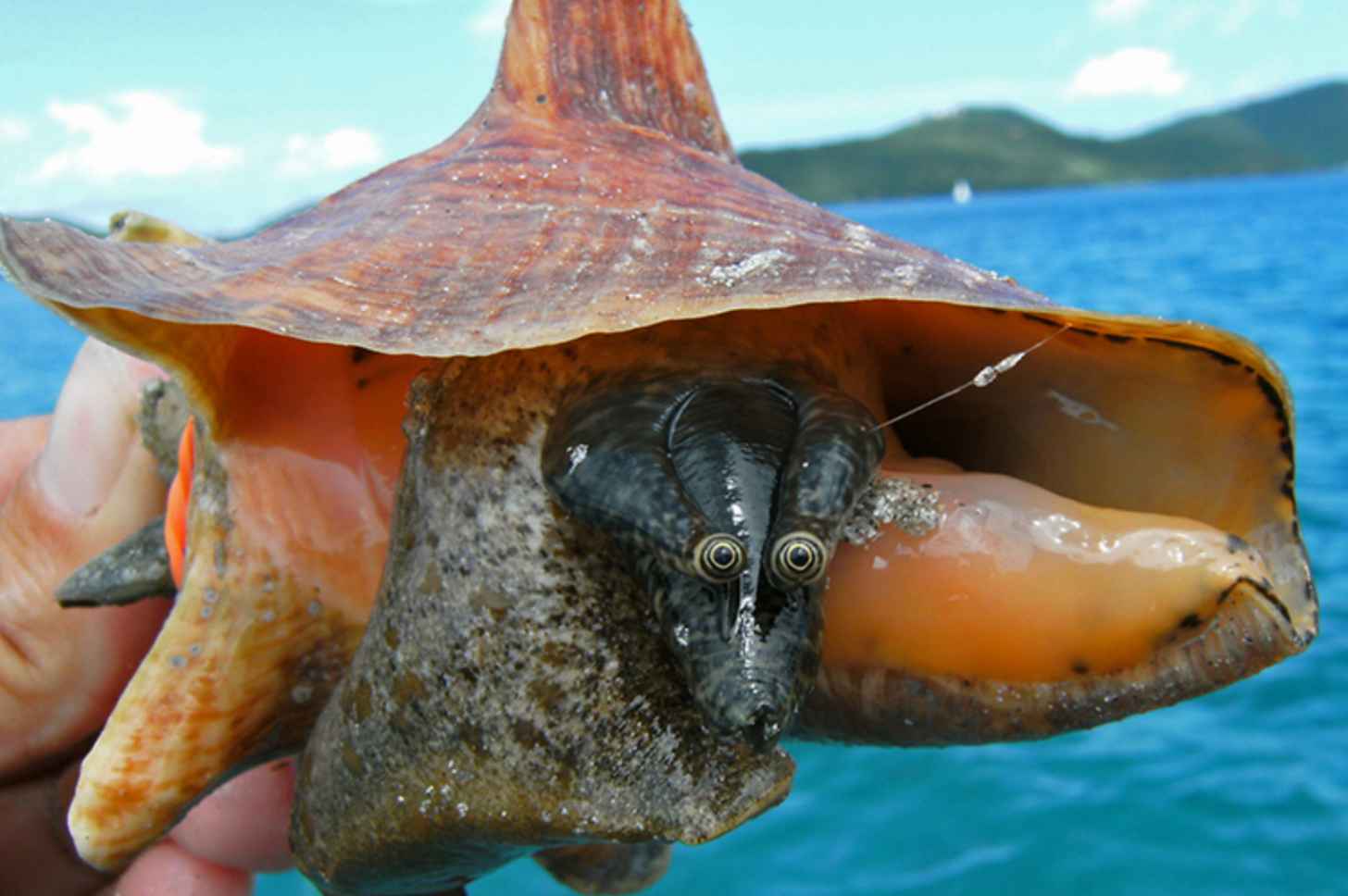
- International demand for queen conch meat and shells has led to severe overharvesting, while habitat degradation, pollution, and warming waters add further threats.
- In a bid to slow the decline of the queen conch, researchers are partnering with local conservation organizations across the Caribbean to establish a network of mobile hatcheries aimed at protecting the giant marine snail through its vulnerable early life stages.
- The goal is not only to nurture developing conch, but to create community spaces where local people can learn about the queen conch life cycle and participate in restoration efforts.
- However, some researchers have doubts about whether aquaculture alone can restore wild conch fisheries.
Queen conch were once so abundant that fishers in many parts of the Caribbean could wade into knee-deep waters and gather armfuls of the pink, whorled shells. Today, however, the giant marine snails are in decline across the Gulf of Mexico and the Caribbean Sea, while some populations have already collapsed.
Growing demand for queen conch (Aliger gigas) meat and shells has led to overharvesting; habitat degradation, pollution, and warming waters add further threats.
Despite a 1992 CITES Appendix II listing to regulate their international trade, seasonal restrictions and bans by several Caribbean countries to address overfishing and juvenile harvesting, and a 2024 designation as a threatened species under the U.S. Endangered Species Act, few queen conch survive to adulthood compared to historical baselines.
In a bid to slow the species’ decline by helping more conch reach reproductive age, scientists are deploying an innovative set of solar-powered mobile hatcheries to shelter them through their vulnerable early life stages.
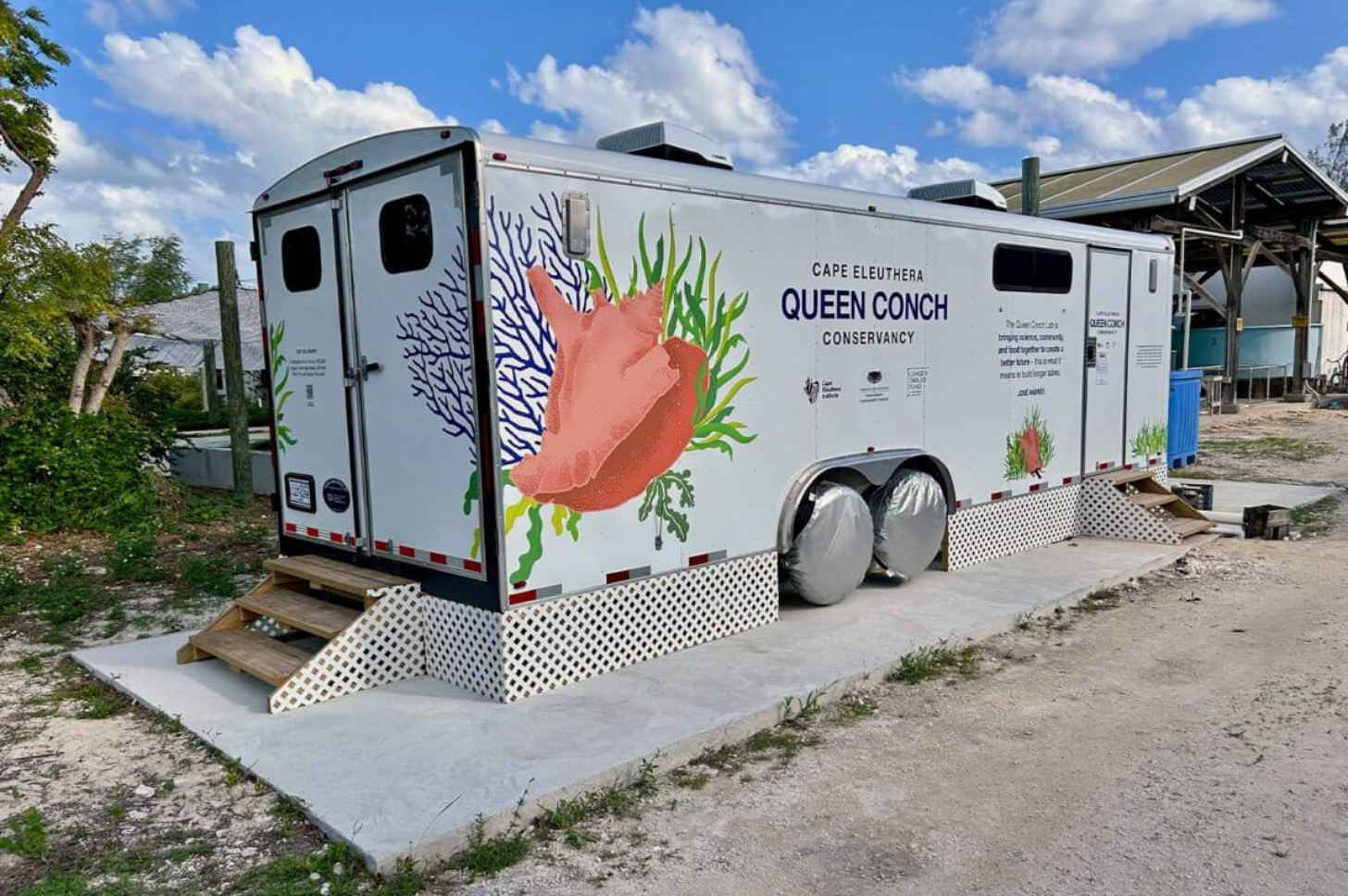
The Queen Conch Lab, affiliated with Florida Atlantic University in the U.S., partners with local conservation organizations to deploy the hatcheries. The aim is not just to build nurseries that will nurture and protect developing conch, but to create community learning spaces where students and other visitors can gain knowledge about the species’ life cycle and participate in restoration efforts, according to Megan Davis, director of the QCL and a research professor at FAU’s Harbor Branch Oceanographic Institute.
“By bridging aquaculture, fishery, conservation, and restoration all in one place [at the mobile hatchery], the local community gains an understanding of all the aspects needed for good management of the conch species,” Davis told Mongabay by email.
In June, QCL’s eighth mobile lab, on the island of Eleuthera, Bahamas, celebrated its first hatch and plans to release up to 2,000 juvenile conch per year. That number is large, but a 2022 study published in Fisheries Science & Aquaculture found that only one in 4,000 to 10,000 juveniles typically survives to adulthood, hindering the species’ ability to replenish its numbers.
According to the study, predation by other marine animals drives much of the high mortality of juvenile conch, followed by fishing of underage conch and the disturbance of their shallow-water nurseries by environmental and climate-related stressors.
Hatcheries inspiring hope
During spawning season, an adult female queen conch produces an egg mass containing hundreds of thousands of eggs. After fertilization, the larvae undergo a 21-day development cycle, floating in the ocean before metamorphosing into juvenile conch and settling on the sea floor. But surviving through these early life stages is challenging — and that’s where the QLC mobile hatcheries come in.
First, fishers find a female queen conch and collect about a quarter of its total egg mass. Back at the lab, the harvested eggs incubate for four to five days. After hatching, thousands of small veligers — plankton-sized larvae — feed on phytoplankton also grown in the hatchery.
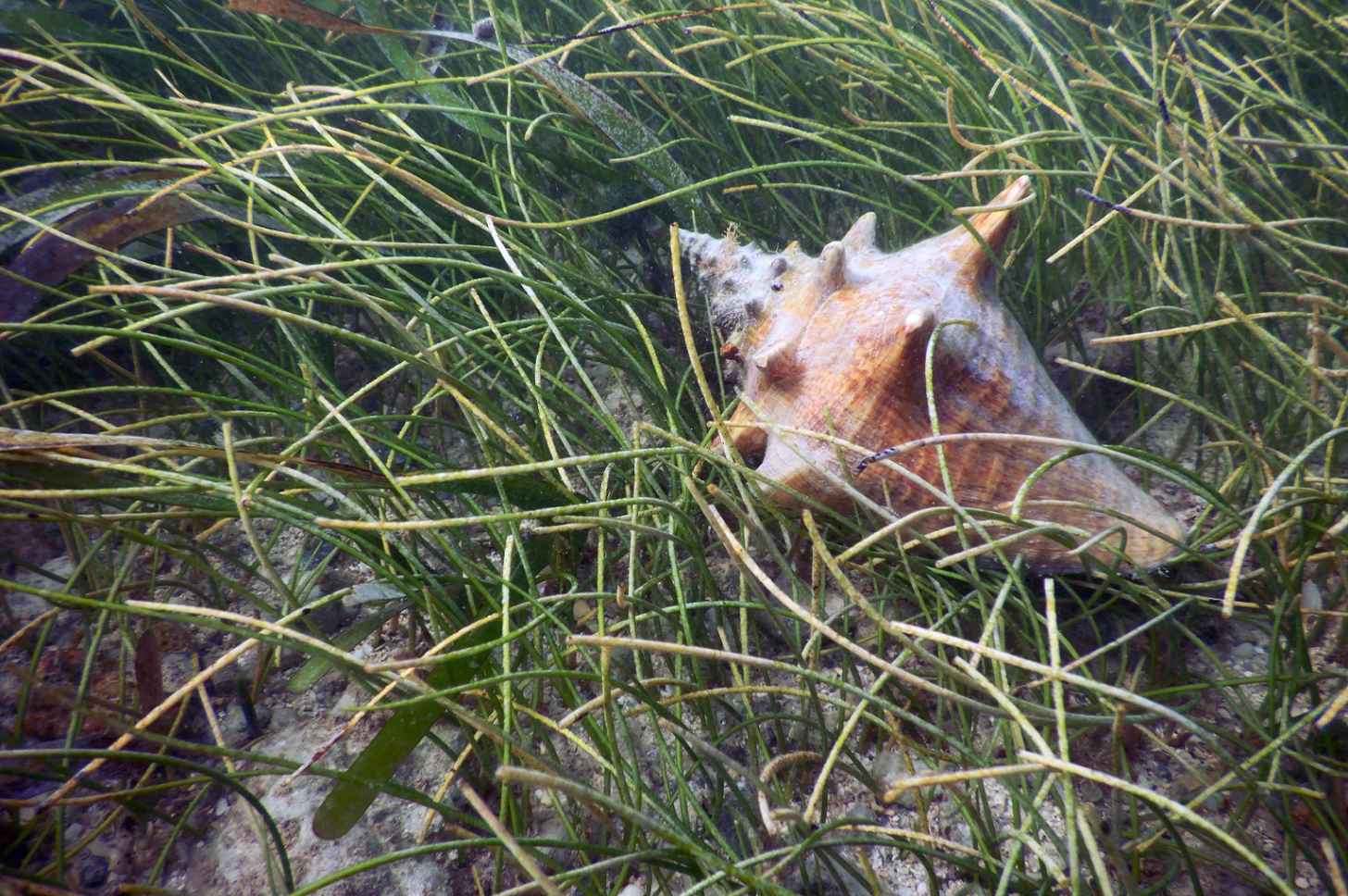
Once ready for metamorphosis, staff place them on trays submerged in seawater with seagrass blades containing diatoms — their favorite food while living on the seafloor — cuing them for transformation from free-swimming larvae to their more recognizable crawling snail form. Two months later, the staff will transfer them to sand-bottom trays to grow another 3-3.5 inches.
At a year old, the juvenile conch are moved out of the lab to protective acclimation pens for one to two months, where they grow accustomed to life back at sea before transferring to a wild conch nursery. It will be another two to three years before they reach adulthood.

Community connections
The mobile nature of the labs, which are about 8 feet wide and 20 feet long, allows them to be easily shipped from Florida to Caribbean islands or towed to a more secure site in the event of a hurricane or other extreme weather. While the hatcheries utilize solar power, rising sea and air temperatures necessitate connecting to the local power grid during the hottest periods of the year, Davis said.
This additional power source enables use of air-conditioning units, along with water chillers that cool the warmer seawater entering the hatchery’s larval tanks.

Since the first mobile lab launched in 2022, communities in Jamaica, Puerto Rico, and the Bahamas have worked with the QCL to establish additional hatcheries, with more planned for Cataño, Puerto Rico; Fort Pierce, Florida; and Providenciales, Turks and Caicos Islands. Davis said interest has grown as she and her team showcase the hatcheries on social media and promote their vision for a regional network across the Caribbean.
Each hatchery employs two to three people. Local staff, some trained from scratch with no prior marine biology experience, maintain the labs and grow food for the conch, and manage visiting groups primarily from local schools.
The hatcheries, in Davis’ vision, function as educational resources for communities familiar with conch as a seafood product, but have not had opportunities to learn about the species’ life cycle or threats.
“Sharing about the life cycle helps the community members know that a conch takes a long time to grow before it is (should be) fished,” she said.
Education, but not yet restoration
Andrew Kough, a research biologist at the Shedd Aquarium in Chicago, Illinois, in the U.S., and lead author of a 2025 review paper on conch aquaculture’s potential for wild population restoration, agrees that conch aquaculture, including the mobile hatcheries, provides a great opportunity for education and community engagement.
Up to now, though, no peer-reviewed research has supported the idea that aquaculture can substantively repopulate wild conch fisheries, Kough told Mongabay in a Zoom interview.
Kough views conch aquaculture as providing a useful symbol to help people connect with ocean conservation.
“However, where that barrier seems to fall off is in the translation from taking that symbol and turning it into repopulation in the wild,” Kough said, adding that more research is needed to determine the impact of conch aquaculture on fisheries replenishment.
Davis, who co-authored a 2023 study with Kough on conch development, agrees on the need for further research. She said she’s hopeful the release of several thousand conch from a stationary hatchery in Curaçao in 2025 — along with a Jamaica mobile hatchery’s planned release of juveniles into protective enclosures later this year — will result in more conch reaching maturity and reproducing in the wild.
But ultimately, Davis contends the success of the mobile hatcheries is best measured by their ability to support community-driven conservation efforts. While the impact of restorative aquaculture efforts remains inconclusive, she said the hatcheries are important in showing that “there will always be a way to grow conch.”
This article was originally published on Mongabay.
Featured Images: Jennifer Doerr/Wikimedia Commons (Public Domain) and Megan Davis/Florida Atlantic University Queen Conch Lab
Smoking and vaping continued to decline among middle school and high school students in 2025, according to the United States Food and Drug Administration’s 2025 National Youth Tobacco Survey, released in July 2026. This annual, school-based survey has been tracking smoking and other nicotine product use in American youth ages 11 to 18 since 1999.
Perhaps most excitingly, the survey found that smoking — the leading cause of preventable death and disease in the U.S. and worldwide — is at a historic low among U.S. youth, at just 1.4%.
By contrast, in 1997 — when smoking rates in U.S. youth were the highest ever recorded — 36% of U.S. high school students reported currently smoking, and 70% reported having tried smoking at least once.
Meanwhile, the use of nicotine vapes, or e-cigarettes, fell to 5.2% in 2025, the lowest it’s been since its peak in 2019.
On the other hand, young people’s use of nicotine pouches — small pouches that are placed between the lip and gum and are available in different flavors and strengths — has risen over the past five years. The new survey shows that this rate is now stable compared with the previous year and remains relatively low at 1.7%.
We are public health researchers who study the use of tobacco products. We delved into this survey to see what it tells us about tobacco use in the U.S. more broadly and how use among young people in the U.S. stacks up against their peers in other countries.
New products on the market
With the introduction of nicotine vapes in the early 2010s and, more recently, nicotine pouches in the mid-2010s, the tobacco and nicotine market has been in flux. This is particularly true for the youth market, where smoking has fallen so substantially.
Some researchers estimate that vaping has significantly reduced the numbers of people who smoke from ages 16 and up, with e-cigarettes acting as a substitute for cigarettes.
The harm from smoking comes from a deadly mix of chemicals released when tobacco leaf is burned. Regulated nicotine vapes and pouches do not contain tobacco leaf and do not involve burning. Therefore, they pose substantially fewer risks than smoking. But these new ways of consuming nicotine are not risk-free.
The risks from e-cigarettes vary from product to product, depending largely on what substances are in e-liquids. E-cigarettes on the FDA’s authorized list of vaping products have been extensively tested and designated as “appropriate for the protection of public health,” meaning they have the potential to prevent and reduce tobacco-related disease and other health harms. But the U.S. e-cigarette market is largely dominated by unauthorized products.
Depending on what’s in them, e-cigarettes can pose risks to heart, circulatory, lung, and oral health. The FDA continues to approve new vaping products, and recently — and somewhat controversially — the list expanded to include flavored vapes.
High on the list of public health concerns is young people’s use of these products, because early use of nicotine is one of the biggest risk factors for lifelong addiction.
While smoking in 11- to 18-year-olds has continued to decrease, adult smoking in the U.S. has remained relatively stable. Older people continue to smoke at higher levels than young people, so they are most at risk of smoking-related harms.
The global picture
It’s difficult to get a complete picture of tobacco and nicotine use around the world. Many countries have no recent data on their population’s e-cigarette use, and countries that have conducted surveys may not have data from the same years. The questions and product definitions used in these surveys can also be inconsistent.
For this reason, it makes sense to compare the U.S. only with other countries such as Canada, Germany, the Netherlands, and the U.K. that have similar populations, data coverage, and policies.
In 2024, the World Health Organization looked at available data from different countries in order to better understand the global picture of tobacco and nicotine product use.
The biggest difference between the U.S. and comparable countries is in people 18 and under, although this data is the hardest to compare accurately due to survey differences. In the latest reported data considered by the WHO, the U.S. has a notably lower rate of e-cigarette use in this age group.
Though the numbers are hard to compare directly, Canada, Germany, the U.K., and the Netherlands all had relatively higher rates of vaping in young people compared with the U.S. We do not yet know the cause of this phenomenon, though it aligns with the FDA’s findings on decreasing smoking and relatively low level of nicotine pouch use in people ages 11 to 18.

The WHO report also shows that in 2000, almost 50% of U.S. adults reported current smoking, a higher proportion than in comparable countries like Canada and Germany, but similar to smoking in the U.K. Current reported smoking among U.S. adults has dropped rapidly over the past two decades, falling below an estimated 10% in 2024. It has also dropped rapidly in the U.K.
Much of that decline is likely caused by public health policies and public messaging about the harms of smoking. Adult smoking rates also declined in Canada, the Netherlands, and Germany over the same period, but less dramatically.
Drawing again from WHO data, reported use of e-cigarettes among U.S. adults was higher than in some comparable countries such as the Netherlands or Germany. The U.S. policy approach to e-cigarettes is more similar to that of the U.K., intentionally nudging people toward vaping instead of smoking to reduce health risks. Both countries have similar rates of adult e-cigarette use.
Looking ahead
Just because tobacco and nicotine use is declining among young people in the U.S. and in some other populations, it doesn’t mean that these substances are no longer a public health problem. Adult usage is holding steady, and there’s no guarantee that young people will continue abstaining.
The past year has seen a growing number of influencers, many of whom are aligned with the Make America Healthy Again movement, promoting nicotine as a health product. Recent years have also seen the rise of “cigfluencers” — celebrities and influencers who openly promote smoking.
One study even found that many people wrongly believe that vaping and pouch use are as harmful or even more harmful than smoking.
It would be a public health catastrophe if smoking rates were to go up again, so we will be watching for next year’s numbers to see how these smoking and nicotine use trends among young people continue to evolve.
This article was written by Holly Jarman and Claire L. Ma from University of Michigan and Jamie Hartmann-Boyce from UMass Amherst, and was originally published on The Conversation.
Featured Image: Fatih Korku/Pexels
Every day the Good Good Good team collects the best good news in the world and shares it with our community. Here are the highlights for this week!
If you want to get good news in your inbox every day, join the Goodnewsletter — the free daily newsletter designed to leave you feeling hopeful.
The Best Positive News We’re Celebrating This Week —
Kazakhstan just released its first tiger into the wild, 70 years after they were last seen
At the end of July, an adult female Amur tiger called Umit — which means “hope” in Kazakh — leapt from her cage on the back of a pickup truck as she was released into the wilderness of a 1.1 million-acre nature reserve in southeastern Kazakhstan.
It’s the first time in the 70 years since they were wiped out that a wild tiger will roam in the country.
The reserve was established in 2018 to create the conditions for the tigers’ return to the wild, including efforts to increase the population of their natural prey, such as Bukhara deer and kulan. The preparations took over a decade.
Good to know: The area where Umit was released was actually once inhabited by the extinct Caspian tiger. The Kazakh government chose to release Amur tigers after research showed their genetic makeup was almost identical to that of Caspian tigers, which went extinct due to habitat loss and hunting by humans.
After a weeklong rescue effort, over 60 cats have been saved from an abandoned sailboat: ‘They’re incredibly resilient’
→ Read more
Loggerhead sea turtles are having a record nesting season on the East Coast, especially Florida
A nearly 10-mile stretch of Florida beach just north of West Palm Beach is seeing a record number of loggerhead sea turtle nests, with just over 13,000 total nests. It’s a huge jump from nearly a decade ago, in 2007, when there were only around 3,600.
Experts credit both the Endangered Species Act and state laws for supporting the loggerheads’ comeback.
Just up the coast, Georgia is expected to see more than 4,000 nests, breaking a nearly 40-year record. In North Carolina, nests have already reached the same numbers as last year, and the nesting season still isn’t over.
→ Read more
A new movement is turning school playgrounds into green spaces and community centers
The nonprofit Trust for Public Land has helped hundreds of schools across 26 U.S. states transform their playgrounds from an expanse of unshaded blacktop into shady, green oases both for students and the community.
It’s part of the nonprofit’s larger vision to ensure everyone in the country can get to a quality park within a 10-minute walk of their home.
Beyond adding color with murals and painted basketball courts, and other natural elements — like climbing boulders and tree stumps — the redesigns all have climate change in mind, with green spaces, rain gardens, and more to mitigate climate impacts and keep temperatures cooler.
Even better: Trust for Public Land isn’t coming in and redesigning the spaces on their own. Students survey each other and work together to decide what they want on their playground, and administrators, custodians, recess monitors, and afterschool caretakers weigh in, too: “The users are the designers.”
You may also like: Good News: Tiny urban green spaces can cool cities and save lives
Humans used to kill lions in this African village. Now, they get health benefits in exchange for saving big cats
→ Read more
Deforestation in Brazil’s Amazon reached its lowest level in 13 years
New satellite data revealed that deforestation in the Brazilian Amazon is at a 13-year low, with 1,110 square miles deforested between August 1, 2025, and July 31, 2026, 36% lower than the previous 12-month period.
It’s also 55.6% lower than the average area deforested in the last decade.
The country has pledged to eliminate all illegal deforestation by 2030, and has continually made progress toward achieving that goal.
The Great Barrier Reef is finally showing “signs of recovery” after dramatic declines
The Great Barrier Reef, which has been widely heralded as the Earth’s “largest living structure,” spans over 1,400 miles off the coast of Queensland, Australia — the size of a small country. For the past 15 years, the health of the coral reef has fluctuated dramatically, but a new report from the Australian Institute of Marine Science found “promising signs of recovery,” with coral cover actually increasing in several regions.
From 2025 to 2026, the northern reef’s coral cover increased from 30% to 35.1%, while the central reef’s coral cover increased from 28.6% to 31.6% — both above long-term averages.
Although climate change and coral bleaching remain very real threats, Australian scientists now have verifiable proof that the reef is becoming more resilient over time.
Even better: In early 2026, after a marine heatwave posed mass coral bleaching threats, a huge monsoon arrived just in time. The cloudy, rainy weather cooled the reef, giving the coral time to grow their symbiotic algae and survive another bleaching event.
→ Read more
You may also like: Satellite imagery and AI help uncover an Ireland-sized addition to global coral reefs
Researchers tracked sea turtles in the ocean with satellite tags. It revealed something they had never known before
→ Read more
Wind and solar have now overtaken fossil fuels for electricity generation in Germany
New data revealed that wind and solar generated 44% of Germany’s electricity in 2025, overtaking fossil fuels. This milestone puts the country on track to fully phase out coal “much sooner” than originally planned.
Germany introduced its landmark renewable energy law in 2000, and has since seen its share of wind and solar generation skyrocket. At the same time, coal fell from supplying more than half of its electricity to just 21%.
The country first aimed to eliminate coal entirely by 2038, but is now expected to do that even sooner.
A federal judge halted a major land deal in Izembek National Wildlife Refuge
In 2025, Interior Secretary Doug Burgum, serving the Trump administration, approved a land exchange involving 490 acres of Alaska’s Izembek National Wildlife Refuge.
The deal involved the construction of a road connecting the remote town of King Cove to an airport for emergency evacuations. However, 10 miles of that road would cut directly through the refuge’s protected wetlands.
On August 18, Judge Sharon Gleason sided with environmental groups and Alaska Native groups, ruling that the Interior Department’s land exchange violated several federal laws, including the Endangered Species Act and the Alaska National Interest Lands Conservation Act.
Why is this good news? Izembek’s wetlands are home to one of the world’s largest beds of eelgrass, which feeds a quarter-million migratory birds every fall and provides refuge for more than 200 species, from brown bears to Pacific salmon. Alaska Natives have argued that construction would disrupt not just the environment but also the lives of local tribes, who subsist from the land through hunting and fishing.
→ Read more (Gifted link)
A photographer left trail cameras in a remote Kenyan forest for months. He uncovered a hidden ‘wildlife highway’
→ Read more
‘Bearded, burly’ trans men are entering women’s restrooms in Kansas to protest the state’s anti-trans bathroom ban
In early August, three self-described “bearded, burly” transgender men wearing yellow “Compliance Crew” shirts used the women’s bathrooms at a municipal water park in a Kansas town.
Part of a protest group, the men were acting in compliance with a new anti-trans bathroom ban in the state — requiring people to use the bathroom that matches the sex listed on their birth certificate — to bring attention to the “absurdity” and unintended consequences of the new law.
Putting their own safety at risk in an effort to protect others, the police were called on the men, who then had to provide “uncomfortable descriptions” of their bodies and genitalia to the officers.
→ Read more
Zion is now the first national park to offer an all-terrain wheelchair for public use
Zion National Park just took a huge step toward making the parks more accessible to disabled visitors, debuting the first all-terrain wheelchair lending program for the public.
National parks around the U.S. have accessibility equipment, but it’s owned by nonprofits. Zion is now the first to own the equipment, and four others are reportedly “making steps” to do so, too.
The wheelchair is made by Extreme Motus, and cofounder Ryan Grassley has been taking his best friend, who has cerebral palsy, on adventures with it for the past seven years and has been advocating for their availability at national parks for years, too.
What’s the nuance? The lending program is available to guests on a first-come, first-served basis, with no reservations, which people have pointed out could make it difficult for disabled people to plan their visit to the park around the wheelchair’s availability.
→ Read more
The Trump administration wants to scrub national park history. Meet the librarians preserving it anyway
Cities across Latin America have reached a historic milestone of 10,000 electric buses
In mid-August, during Latin America’s largest transport and mobility event, the International Council on Clean Transportation announced that cities across the region officially had over 10,000 electric buses in operation.
The historic milestone was reached after 80 cities in 13 Latin American countries prioritized the electrification of their bus fleets, with Santiago, São Paulo and Bogotá leading with more than 7,000 electric buses in operation across the three cities.
The operation of these buses is estimated to avoid more than 10 million tonnes of CO2 emissions every year, with officials calling it a “turning point in the decarbonization of public transport.”
More good news of the week —
Trail cameras capture a litter of cougar kittens, the first babies seen in Minnesota in over a century. Experts believe the litter could indicate a growing population of the big cats in the region.
Scientists transformed sheep’s wool into a new material that helps regrow damaged bone. Researchers at King’s College London believe the agricultural byproduct holds great promise in regenerative medicine.
Scotland has officially banned glue traps, after years of advocacy from animal rights campaigners. With the law now in full effect, it is illegal to buy, possess, or use a glue trap, which often proves deadly to birds, bats, and fox kits.
After the first full year of a maternal RSV vaccination campaign in the U.K., newborn ICU admissions dropped by 50%. The program is offered to women from 28 weeks of pregnancy to protect newborns, who are at higher risk of severe illness from RSV.
New York City is on track to record its fewest reported rat sightings since the pandemic. Rat sightings are down 22% in the first seven months of 2026 compared to a year earlier, a drop attributed to a “war on rats” campaign initiated by former mayor Eric Adams.
After conservationists released wild bison in Romania, plant biomass in the region increased by 30%. The bison herds have been roaming the Tarcu Mountains for a decade, aiding the growth of grass, shrubs, and flowers along the way.
A new report found that a late summer monsoon led to “signs of recovery” in the Great Barrier Reef. Cycles of disturbance and recovery threaten to turn the reef’s colorful coral gardens into algal-dominated seascapes — then back again — and these cycles are becoming more volatile as our world warms.
Independence County in Arkansas voted unanimously to pass a five-year data center moratorium. The latest and longest to pass in the state, the county also passed a three-year moratorium on wind turbines, pushing back on projects approved behind-the-scenes without input from residents.
Niger restored five million hectares of grassland without planting any trees. 33 African countries committed to the African Forest Landscape Restoration Initiative to jointly restore 129 million hectares of degraded land by 2030, an area larger than Germany and France combined.
Europe’s largest battery is now online in Scotland. “Coalburn 1 will enhance the flexibility and resilience of the UK electricity system, support the integration of more renewable power, and contribute to lowering costs for consumers.”
A new vaccine could eliminate a major cause of a deadly diarrheal disease. While it’s made the headlines in the U.S. recently, around the world, diarrhea is a constant, deadly threat — over 1 million people die from illnesses related to it every year, nearly half children under age 5.
Restoring habitats and mitigating floods, “horizontal levees” could protect coastal cities and wildlife from rising seas. Most levees look like steep, barren embankments or riprap-clad seawalls, designed to prevent flooding by adding extra feet of height — this new kind of levee has the same impact, with wider benefits.
After 38 years, passenger trains are running between Finland and Sweden again. After several decades on hold, parts of the route have also now been electrified, making it possible to travel by electric train all the way from Helsinki to Haparanda.
A community fund in an Idaho town is helping farmworkers fight extreme heat and wildfire smoke. The fund first began in 2020 to help farmworkers with COVID-19-related expenses, since undocumented workers could not receive stipends for medical or other necessities.
A city in Poland unveiled benches made from recycled beverage cartons. Białystok currently recycles 53% of its municipal waste, and the composite material also has potential use cases in construction and transport.
Scientists have successfully trialed “fridge-free” vaccines in patients for the first time. (May require login) Currently, most vaccines need to be refrigerated or frozen, and around half are wasted every year, primarily because they become unusable when they get too hot or too cold.
The Columbus Zoo celebrated the first birthdays of its two Asian elephant calves by launching an awareness month. Their birthday celebration will highlight the calves’ growth and development, their role as ambassadors for an endangered species, and conservation efforts to protect the species.
A nonprofit in Atlanta is helping refugee women find strength and healing in the outdoors. The Refugee Women’s Network comes into these women’s lives in the months and years after resettlement, when government resources are gone, but people are still rebuilding their lives.
Notoriously hard to spot in the wild, two critically endangered California condors just photobombed a trail camera. ALERT: California has over 1,200 cameras set up across the state to monitor wildfires. Two condors took an interest in one trail camera high above a mountaintop.
A startup is matching Bay Area students in need of housing with boomer homeowners who have rooms to spare. The students trade their time to support retired homeowners who need a little extra help — and get a cheap place to stay.
Olivia Rodrigo paid for a fan’s final semester of college, and kept it a secret for over a year. The fan, Jamie Causey, a University of Alabama graduate, posted a video on TikTok sharing the incredible story, which she kept to herself for more than a year.
With humpback whale entanglements on the rise, Oregon is trying innovative “rope-free crab traps.” The Oregon Fish and Wildlife Commission adopted new rules to enforce a vessel monitoring system and to begin testing pop-up gear in a state crab fishery.
An NHS clinic-on-wheels is helping more UK women get screened for cervical cancer. There are just over 4 million women in England who are not up to date with their cervical screening, and that number is rising.
New Jersey approved 16 agrivoltaics projects totaling over 52 megawatts. The first in its Dual-Use Pilot Agrivoltaics program, each project will pair solar generation with active farming, including soybeans, hay, grains, vegetables, fruit, and livestock.
Australia is working to catch 5,000 of the world’s smallest penguins to vaccinate them against bird flu. Capturing wildlife to vaccinate them is difficult, particularly because the bird flu vaccination requires they be caught twice, for two doses.
Bamboo tiny homes in Myanmar survived a 7.7 magnitude earthquake, and they were built for the price of a smartphone. The simple one-room homes could be a new blueprint for scalable disaster housing.
The first test flight of the largest all-electric aircraft used just $5 of electricity. The flight lasted nearly half an hour and comes at a time when jet fuel prices have skyrocketed because of the U.S. war with Iran.
Conservationists created a “coastal corridor” in Florida designed to preserve and support vulnerable marine life. It replicates the state’s wildlife corridor, an 18 million-acre project that provides a safe, contiguous habitat where rare or threatened land-based species can flourish.
A farmer had six words for an AI company’s offer to buy her land for $26 million. The family initially agreed to sell the land, but when they learned that the property would be used for data centers fueling artificial intelligence, they issued a six-word response.
A personalized mRNA-based cancer vaccine succeeded in a large, late-stage trial among high-risk patients with melanoma. The individualized vaccine, paired with an existing immunotherapy, is the first and only combination regimen to demonstrate potential to extend melanoma patients’ lifespans.
A new species of seahorse was just discovered by an international team of researchers at Tuticorin harbour in southern India — and it was overlooked for more than a century.
“The thorny seahorse, Hippocampus histrix, has long been treated as a single, widely distributed species ranging from the Red Sea and western Indian Ocean to the western Pacific,” co-author Shalu Kannan observed in the new study, which was published in the scientific journal “Zootaxa” on August 5.
“Morphological and molecular evidence now demonstrate that this broad concept encompasses at least three diagnosable species.”
Those three species include the aforementioned H. histrix, the Hippocampus jayakari — a seahorse discovered in 1900 with a “shorter and deeper snout” and spines “confined to alternating tail rings” — and a third seahorse that had long been mistaken for both.
The newest entry is a spiny seahorse that is just 16 centimeters long (or about 6 inches) with a short snout. It has spines along its body and tail, with five short spines on its head that form an elevated “crown.”

The researchers named the new species Hippocampus amandavincentae after Amanda Vincent, who is widely considered the “mother” of seahorse research and conservation.
“This honor makes my heart glow,” Vincent said in a press release for the University of British Columbia. “It’s amazing that such a wonderful creature was hiding in plain sight.”
Vincent, who doubles as the director and co-founder of the University of British Columbia’s Project Seahorse, was the first biologist to study seahorses underwater.
She also executed the first trade surveys on seahorses and developed the first seahorse field conservation program.
“I surveyed the array of fishes dragged up by trawlers in Tuticorin, India, where this new species was first found, and missed it completely,” she said. “Now I have yet another special reason to push hard at ending bottom trawl fishing.”
Bottom trawl fishing, which drags heavy nets across the seafloor, sweeping up marine life and entire habitats in its path, is one of the most destructive fishing practices on a global scale.

According to Project Seahorse, bottom trawl fishing catches thousands of fish species every year, many of which are the ocean’s most at-risk animals.
In early 2026, researchers at the University of British Columbia published a study that drew upon more than 9,000 records of fish species reported in bottom trawls from 1895 to 2021.
“This is the clearest picture we’ve had of the breadth of bottom trawling,” said lead author Sarah Foster, senior researcher and program leader at UBC’s Project Seahorse. “It reveals just how many species are being caught, and how much we have been missing.”
Most bottom trawl fishing practices occur within national waters, but they face major enforcement gaps.
“We can’t manage what we don’t know,” Foster said. “When we remove thousands of species without understanding the impacts on their wild populations, we risk destabilizing the very systems that fisheries depend on.”
In addition to being the world’s leader in seahorse conservation research, Project Seahorse has completed assessments for the International Union for Conservation of Nature’s Red List of Threatened Species, generated 35 marine protected areas, built alliances of subsistence fishers, and ushered in new national legislation.
Vincent said that she hopes the honorific for the exciting new species shines a spotlight on her marine conservation organization.
“The timing is especially meaningful as it coincides with celebrating 30 years of Project Seahorse achievements,” Vincent said. “I’m deeply grateful to my friends and colleagues for this kindness.”
You may also like: Scientists discovered a new species of horned lizard in Thailand. They named it after Rhaenyra's dragon in 'House of the Dragon'
Featured Image: Katy Ramm/Pexels
When Congress passed the so-called “big, beautiful” spending bill last year, which was signed into law by President Donald Trump on July 4, 2025, lawmakers approved $46.5 billion for a border wall expansion.
That expansion includes a plan for a 175-mile stretch of 30-foot-tall steel bollard walls along the United States-Mexico border. The wall would be constructed in Texas’s Hudspeth, Jeff Davis, and Presidio counties, and notably in Big Bend National Park and the surrounding Big Bend region.
The plan includes three separate border wall projects — Big Bend 1, 2, and 3 — and federal contracts were awarded to each of them in March, totaling nearly $3 billion in construction costs, with a timeline for completion sometime in 2027.

Two other construction areas are reportedly part of U.S. Customs and Border Protection construction projects.
Earlier this month, bulldozers began arriving at the national park, but a groundswell of pressure from local activists seems to have halted the project — for now.
People across the political spectrum have spoken out in opposition to Trump’s border wall plans in Big Bend, including cattle ranchers, environmentalists, sheriffs, Republican senators, and more.
The 801,163-acre expanse of Big Bend National Park is larger than the state of Rhode Island, with more than half a million visitors every year. The park sits along 500+ miles of Texas borderlands, including the Rio Grande, and the larger Big Bend region encompasses 77 Texas counties.
It’s a big area to defend, and people, many associated with the grassroots activism group No Big Bend Wall, have taken on the mantle of protecting the public land and the people most connected to it.
On Monday, August 17, CBP Commissioner Rodney Scott, announced all construction work in the national park was being temporarily suspended.
“Last night I put a pause on all activity in that park as far as construction goes ‘till I can get down there and do a personal evaluation,” he said in a video posted to social media site X.

Activists with No Big Bend Wall are still not backing down.
“Big Bend National Park is one part of a CBP sector stretching more than 500 miles across the Texas borderlands. And across that sector, border infrastructure is still planned,” the group shared in a social media statement this week.
“Communities are still affected. Private landowners are still holding the line. Public and ancestral lands are still at stake. We welcome every acre that has been spared. We celebrate every plan that has changed. But here’s the important part: Plans changed because people fought to change them.”
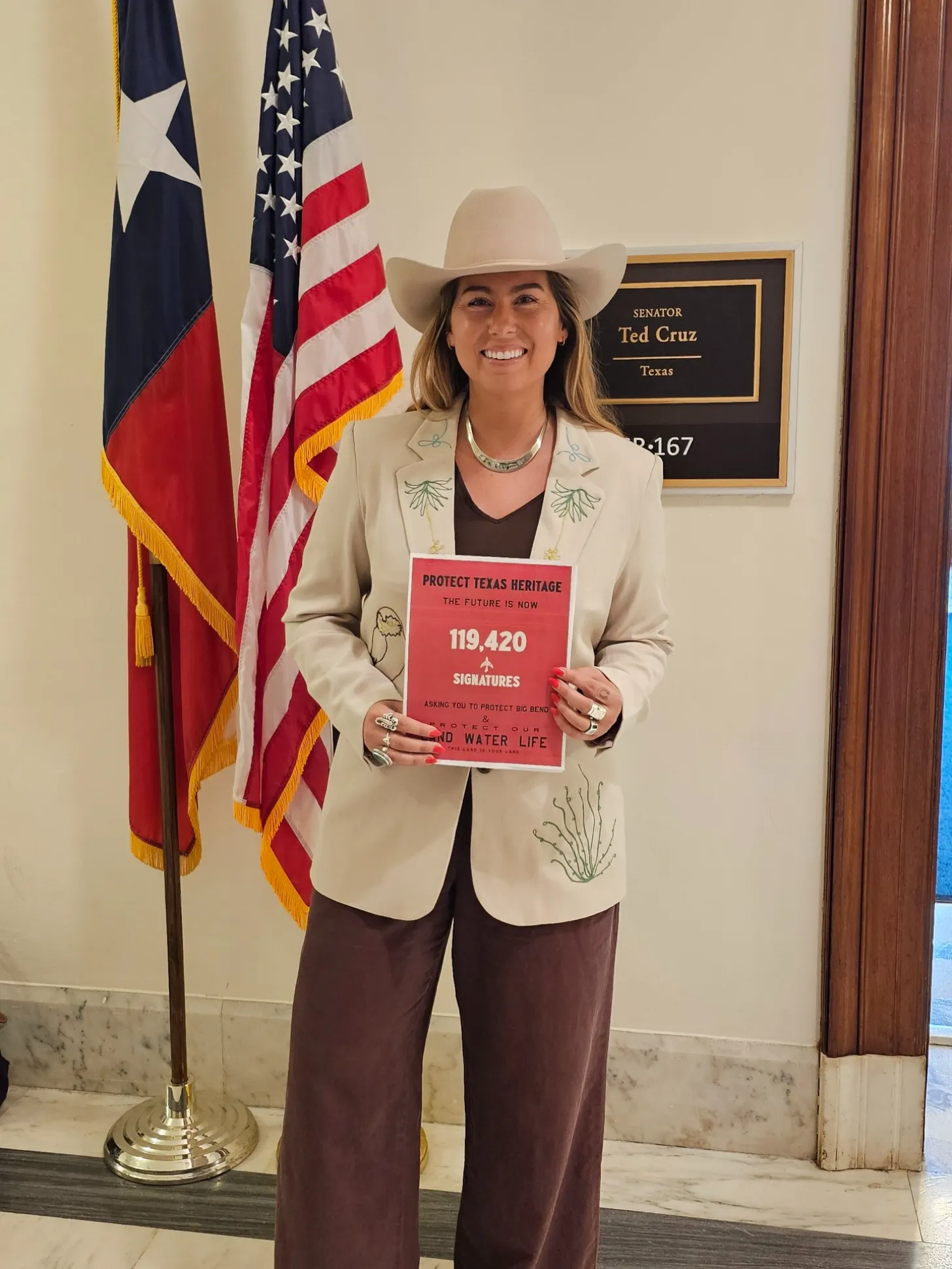
A local Texas photographer and No Big Bend Wall’s director of strategy, Anna Claire Beasley, spoke with Good Good Good about the group’s activism up to this point — and what they hope to achieve in the coming weeks and months.
Answers have been edited for length and clarity.
Meet the bipartisan group trying to stop Trump’s Big Bend border wall
Good Good Good: What's the latest that's been happening in the Big Bend region with regard to the border wall?
Anna Claire Beasley: No Big Bend Wall formed in February, after the federal government announced plans for 30-foot steel bollard walls and other “Smart Wall” border infrastructure throughout the Big Bend Sector.
One thing that's really important to understand is that when we say "Big Bend," we're not just talking about Big Bend National Park. The Customs and Border Protection Big Bend Sector covers more than 500 miles of the border and includes Big Bend Ranch State Park, Big Bend National Park, Black Gap Wildlife Management Area, Seminole Canyon, Lake Amistad, private ranches, ancestral lands, and communities throughout the region.
The plans have changed dozens of times since February, and that's part of what has made this so confusing for the public. Right now, 30-foot steel bollard walls are still planned for project areas 1 through 3, and vehicle barriers are planned throughout project area 5.
The federal government has recently emphasized that “no wall is planned” for parts of Big Bend National Park, but that framing really misses the larger picture. Those steel bollard walls are still being planned and constructed throughout the broader Big Bend Sector.
Our response to Commissioner Scott also highlights some of our key concerns and questions about the proposed infrastructure specific to the national park, including patrol roads, technology, vehicle barriers, and more. That’s not to mention the local resources, including limited water, that this construction would drain from the area.
Aside from the lack of transparency and concerns about their plans, we also believe the scale of these projects simply isn't supported by what's actually happening here.
The Big Bend Sector represents roughly 26% of the entire southern border, while accounting for less than 2% of apprehensions, and apprehensions here fell dramatically last year.
We're talking about billions of taxpayer dollars being spent on infrastructure that, in some places, is being proposed on top of cliffs and terrain where vehicles physically cannot cross. That’s why we've continued to say: This isn't opposition to border security. It’s opposition to wasteful, destructive infrastructure that isn't grounded in the realities of this region.
Good Good Good: How is No Big Bend Wall opposing these efforts from the federal government?
Anna Claire Beasley: We’ve been working every lever available to us — locally, statewide, and federally.
That includes supporting legal efforts, working directly with private landowners who are being approached about access to their property, tracking county regulations and permitting requirements, engaging elected officials, building relationships with other organizations, and sharing information and strategy across hundreds of miles of borderland.
We've also been working to make sure the people who actually live here have a seat at the table.

We've brought together landowners, county officials, business owners, conservationists, Indigenous voices, and other local stakeholders because decisions this consequential shouldn't be made thousands of miles away without meaningful consultation with the communities they affect.
And increasingly, we're not just saying "no." We're working to articulate what smarter border security could actually look like in a place like Big Bend — solutions that are precise, fiscally responsible, technologically modern, and informed by the people who understand this landscape.
Public advocacy is certainly part of our work — letters, petitions, media, social media, public comments — but there is a tremendous amount happening behind the scenes as well.
Our goal is to use every peaceful, lawful avenue available to protect this region.
Good Good Good: What progress have you seen so far that's giving you hope?
Anna Claire Beasley: One of the things giving us the most hope is that the plans have changed. They have changed repeatedly since February, and we don't think that happens in a vacuum.
It shows us that public pressure, local opposition, scrutiny, and organizing matter.
We're also seeing an incredibly diverse coalition emerge around this issue. People who may disagree on plenty of other things are finding common ground around protecting private property, preventing government waste, preserving public lands, and making sure border security decisions actually make sense for the communities along the border.

Especially in the last two weeks, we are seeing that this issue has become a national one.
What began as a very local fight has grown into a much larger conversation about Big Bend, how taxpayer dollars are being spent, and whether a one-size-fits-all approach to border security makes sense — with some Republican representatives believing that this issue could affect how people vote in November.
There's still a tremendous amount of work ahead of us, and construction moving forward in parts of the region is heartbreaking.
But we've seen enough movement to know that speaking up matters. The plans are not immutable, and we're going to keep pushing.
Good Good Good: How can those who want to support your efforts to stop a border wall in the region contribute?
Anna Claire Beasley: The biggest thing right now is to help us tell the full story.
There's a lot of messaging focused specifically on whether a 30-foot wall is being built inside Big Bend National Park. But Big Bend National Park is only one piece of a more than 500-mile sector.
We need people to understand that 30-foot steel bollard walls are still planned elsewhere in the sector, vehicle barriers are still planned, and private, public, and ancestral lands throughout the region remain affected.
Follow @nobigbendwall on Instagram, share our updates, sign up for our newsletter, and help us get accurate information outside of the region.
We also need people to contact their elected officials — wherever they live — and ask questions about how these billions of taxpayer dollars are being spent.
Ask why infrastructure is being proposed in one of the lowest-crossing sectors of the southern border. Ask whether local officials and landowners were meaningfully consulted. Ask whether these projects actually reflect the terrain and security needs of the region.
And, of course, donations make a huge difference. We’re a locally-driven organization taking on an enormous federal project, and those resources allow us to support legal work, communications, research, organizing, and the people doing this work on the ground.
You don't have to live in Big Bend to have a stake in what happens here. These are public lands, taxpayer dollars, private property rights, cultural landscapes, and part of our shared national heritage.
We need people everywhere to help us protect them.
You may also like: Following budget cuts and layoffs, national park rangers host a bake sale to take on $1.2 billion deficit
Featured Image: Natalie Newman/@nobigbendwall/Instagram
Servals are an African wild cat that, according to National Geographic, “look a bit like cheetahs who stretched out after a nap and just decided to stay that way.”
The spotted cats are medium-sized with long legs and necks and are native to central and southern Africa’s grasslands, wetlands, and forests.
They are exceptional hunters, using their long legs and large ears to scan over tall grasses, take huge leaps into the air, and run as fast as 50 miles per hour.
Servals are not particularly endangered, but researchers don’t know too much about them, given that they are an elusive and sly mammal. But a new sighting might just change that.

Over the last year in western Tanzania, more than 300 camera traps were set up by researchers with Panthera, an international big cat conservation nonprofit. The cameras took 150,000 photos of lions, leopards, and a handful of other smaller mammals recorded for the first time in the area.
But one of the most exciting discoveries came in the form of footage of a serval with a rare morph coat pattern, recorded for the first time in Tanzania.
“When reviewing the photos from our first camera trap surveys in western Tanzania in 2025, we were very excited to come across two different kinds of servals: normal servals, which have black spots, and ‘servaline’ servals, which have smaller, freckle-like spots,” Dr. Charlotte Searle, senior ecologist and data specialist with Panthera Tanzania, told Good Good Good in an email.
“Both colorations are the same species, but the servaline morph is much more rare, with the few confirmed records coming from sites in the Republic of Congo, Rwanda, and Uganda. The photos from our surveys in Luganzo-Tongwe and Ugalla Game Reserves are the first confirmed records of this color morph in the country.”

Searle added that seeing a serval is already “quite a lucky occurrence,” so seeing a servaline serval was “really something special.”
The main goal of the camera trap study was to learn more about big cats in the Luganzo-Tongwe and Ugalla reserves, where Panthera is working with the Tanzania Wildlife Management Authority to strengthen protections for species like lions and leopards.
Researchers found that lion populations are especially threatened in the area by bushmeat snares, vehicle strikes, and human encroachment. Leopard populations were a bit more encouraging, but Panthera researchers believe both species show “real potential for recovery if threats are addressed now.”

Camera trap research also provides valuable insights into wildlife as a whole in a given area.
“The sites we work in in western Tanzania are very wild, and the animals there can be skittish as they’re not used to people, so we haven’t had the good luck of seeing one yet,” Searle said of the servaline serval spotted during these surveys.
“Luckily for us, camera traps are unobtrusive and can be left in the field for months at a time, so they have a tendency to unveil new and exciting insights that we would be unlikely to see in person.”

In addition to the servaline servals, in 2025, Panthera’s cameras documented rare melanistic genets and bushbabies, and confirmed the presence of a number of species that weren’t known to be in the area.
“Given the lack of research across many of Africa’s wilderness areas, this shows us how much more there is left to learn about the continent’s wildlife populations,” she said.

Trail cameras continue to be vital to conservation research, allowing experts to collect clear images and contextual data of rare and elusive species. Panthera began operating in Tanzania in 2025, Searle said, and these findings will contribute to a much larger body of research supporting the region’s wildlife.
“We used the data collected through these initial surveys to establish baselines of lion and leopard population status in each reserve,” Searle concluded.
“By repeating these surveys on a regular basis, we will be able to monitor how lions and leopards — and a number of other species they live alongside — respond to management interventions and threats, which will help ensure our collaborative conservation efforts are effective and evidence-based.”
You may also like: Trail cameras capture rare footage of elusive leopard species, dubbed 'the ghost of the forest'
Featured Image: Courtesy of Panthera
In March, a terminally ill New Yorker who went by “Mr. Spencer” shared a final wish: That his beloved German shepherds would go to a loving home.
According to CBS News and WCBS, a local nonprofit called NYC Second Chance Rescue took custody of his dogs — Bowie and Nikki — soon after he was hospitalized.
When he asked to say his final goodbyes, the rescue granted his wish, bringing them into his hospital room for an emotional farewell.
“It was a tearjerker, seeing them get so excited to see their owner,” Jennifer Brooks, the founder of NYC Second Chance Rescue, told WCBS. “They laid near his bed. We stayed for quite a while.”

For months, Bowie and Nikki shared a kennel together under loving care at NYC Second Chance Rescue. Although Nikki was friendly with other dogs, Bowie needed to be homed in a place without pets, which made it difficult to adopt them out together.
Every month, NYC Second Chance Rescue would share updates on the duo and remind followers that they were up for adoption.
“Nikki is 10. Bowie is 4. Both are incredibly well-trained, people friendly, well-mannered, and deeply loving dogs who have clearly been cherished their entire lives,” the rescue wrote in an Instagram post.
“Truly, they are all the companionship anyone could ever need. Calm, loyal and incredibly devoted, they bring comfort simply by being beside you.”
Bowie was finally adopted in July after he was highlighted on the rescue’s “Second Chance Spotlight” on Instagram.
“Bowie found his forever home last weekend and, given the love he’s received online, I’m posting about his journey settling into his new home,” his new owner, Wendy, commented. His journey continues on the social media account @bowie_thegsd.

At the time of publication, Nikki was in hospice foster care, still looking for her forever home.
“Nikki is a beautiful German Shepherd with a gentle soul and kind eyes that tell a story of loyalty and love,” NYC Second Chance Rescue wrote for Wagtopia, an adoption website. “Nikki is a loving and devoted companion who enjoys human connection and thrives in a caring environment. She has a calm demeanor and a warm, friendly nature that makes her a wonderful addition to a home looking for a loyal and steady presence.”

“If you’re ready to open your heart to a truly special dog, Nikki is ready to return that love tenfold and become a cherished part of your life.”
On August 24, NYC Second Chance Rescue gave an update on Nikki.
“Nikki is in a loving hospice home being spoiled for the rest of her time with some doggie foster siblings,” a representative from the rescue told Good Good Good. “She was diagnosed with degenerative myelopathy, which will progress, so she will start using a wheelchair soon to help keep her mobile for as long as possible.”
Interested in adopting Nikki? Reach out to NYC Second Chance Rescue.
You may also like: A hospice patient's last wish was to snuggle a golden retriever with 'puppy breath.' Gladdie was the girl for the job
Featured Image: NYC Second Chance Rescue
After a three-year hiatus, the beloved sports comedy “Ted Lasso” is back on Apple TV+ with a record-breaking return.
In the premiere episode, Ted Lasso (Jason Sudeikis) reunites with old friends Rebecca Welton (Hannah Waddingham), Keeley Jones (Juno Temple), and Leslie Higgins (Jeremy Swift), who have flown to Kansas City to ask him to coach AFC Richmond’s first women’s soccer team.
In the same episode, Higgins — the club’s director of operations — plans to visit the Kansas City Jazz Museum, only to find it closed. After a brief chat with a museum tour guide, he decides to visit the Negro Leagues Baseball Museum instead.
There, Higgins learns about baseball legends like Satchel Paige, including his famous quote: “Ain’t no man can avoid being born average, but there ain’t no man got to be common.”
Upon learning about the segregation and adversity that baseball players like Paige, Josh Gibson, Oscar Charleston, and Cool Papa Bell faced, Higgins can’t help but draw comparisons between their story and modern-day discrimination in sports.
“You know, their story is quite similar to how women in England weren’t allowed to play football for years,” he tells the tour guide, Charles (played by Milan Carter).

After Charles shoots him a skeptical look, Higgins backtracks, apologizing and saying it’s “much, much, much, much” worse.
However, when Higgins notes that women weren’t allowed in England’s professional leagues until 1971, Charles admits: “Damn – that’s recent as hell.”
“The storyline was very interesting,” Bob Kendrick, the president of the Negro Leagues Museum, told Major League Baseball’s official blog. “They were looking at the history of the Negro Leagues and comparing it to the history of soccer. It forms a tremendous kind of odd, but interesting parallel.”
Kendrick first met Sudeikis — star, showrunner, and co-creator of “Ted Lasso” — back in 2022.
Ever since that encounter, Sudeikis, a Kansas City native himself, has been working on a way to organically incorporate the museum into the award-winning series.

Since the season four premiere, Google Search trends indicate searches related to Paige and the Negro Leagues Baseball Museum have increased by more than 5,000% compared to last year.
“It’s a natural boost to the organization,” Kendrick said. “It’s going to introduce the museum to a lot of people who are fans of his show, but likely who have never heard of the Negro Leagues Baseball Museum.”
“I dare believe that it’ll entice a lot of folks to make the trek out to Kansas City to experience it. Any time that you can establish a platform that shines a bright light on the work that we’re doing, we’re always excited about it,” he said, adding that the episode made him emotional.
“And to have one of your own tout why this place is so important, and to see fit that it's written into the script, man, it’s just so special.”
You may also like: Why we're craving utopian fiction, from the hope of 'Project Hail Mary,' to the wholesomeness of 'Ted Lasso'
Featured Image: “Ted Lasso” season four aired on August 5. Photo courtesy of Apple TV+
For conservation experts and road ecologists, it’s no secret that wildlife corridors like overpasses, underpasses, and tunnels work wonders to prevent wildlife-vehicle collisions.
According to Pew Charitable Trusts, wildlife crossings can cut large mammal collisions by up to 97%, and each prevented wildlife-vehicle collision can save up to $110,000 in costs. States that have implemented structures like wildlife overpasses also see their investment come back in spades, with these crossings reducing crashes by 90%.
But it’s always exciting to see the exact number of lives saved for each crossing.

The Washington State Department of Transportation recently announced that there have officially been 10,000 recorded crossings along the I-90 Snoqualmie Pass overpass since it first opened.
“Want a success story? In July, we recorded the 10,000th successful crossing on our I-90 Snoqualmie Pass wildlife overcrossing,” WSDOT shared in a social media post. “Between that overcrossing and our 11 undercrossings on Snoqualmie Pass, we’ve seen nearly 40,000 crossings since 2014.”
That means trail cameras picked up at least 10,000 instances of an animal using the wildlife corridor to cross the interstate safely.
“Between 2019-2023, we removed 39,258 carcasses from state highways,” WSDOT added on social media. “In the stretch of I-90 Snoqualmie Pass where the overcrossing and undercrossings exist… that number has shrunk to nearly zero.”

Conservation Northwest was a key organization in advocating for and implementing the Snoqualmie Pass crossing and continues to work toward improving habitats and wildlife outcomes along I-90.
“This structure has helped restore the ecological integrity of the North and South Cascades by reducing wildlife vehicle collisions, reconnecting habitat, and allowing herds and solitary travelers alike to move safely through one of Washington’s most important wildlife corridors,” the group shared on social media earlier this month.
“These crossings now serve as a national model for how transportation and conservation goals can align to restore ecological function across major highways,” Conservation Northwest added on its website.
The group is now working on expanding wildlife corridors across the interstate, in hopes of bridging the habitats spanning the Cascade Mountains and Olympic Peninsula.
State officials seem to agree with the efficacy of these advancements, even if they may take a few years to come to fruition.
“There’s a few reasons we built these structures. For one, it allows wildlife to safely access their full range of habitat. Isolated wildlife populations lead to weaker genetics over time,” WSDOT explained in its social media post.
“Wildlife crossings also carry an economic benefit. On average, a deer collision carries an economic cost of around $15,000. For elk, that figure jumps to $54,000. Fewer collisions can save the state hundreds of thousands of dollars each year.”
The Snoqualmie Pass structure has proven to be a success, and has inspired further advances, WSDOT said on social media.

“Between now and 2031, we have plans to build an additional 15 undercrossings and one more overcrossing along Snoqualmie Pass East,” WSDOT announced.
“Our mission is keeping travelers connected to wherever they need to go, no matter if it’s by wheel, foot, paw, or hoof.”
You may also like: Family sells 136-year-old farm to make way for wildlife crossing deemed 'a lifeline' for mountain lions
Featured Image: Courtesy of Conservation Northwest
Following severe storms in Northwest Indiana earlier this month, thousands of residents in Gary, Indiana remain without power — 12 days later.
Storm winds reached up to 100 miles per hour, knocking down tree limbs and poles, destroying power infrastructure, and leaving the town in the dark.
Indiana Gov. Mike Braun has activated the National Guard to assist with restoration efforts, and President Trump has approved an emergency declaration for the state. The Federal Emergency Management Agency can now assist with recovery efforts, but Gary mayor Eddie Melton continues to pressure the Northern Indiana Public Service Company to restore the city’s power.
“We’re at day 12, and 12 days is too long for families to be without power,” Melton said in a video address on Sunday, urging NIPSCO to restore power by the end of the day on Tuesday, August 25.
“Twelve days is too long for parents to worry about their children, and for businesses to lose revenue, and for families to wonder when the relief is finally going to come. Today, I want the people of Gary to know this. I want you to know that I share their frustration.”
In addition to impassioned pleas from local officials and the assistance of aid organizations, two public figures are stepping in to help out: Acclaimed food influencer Keith Lee and Indiana Pacers basketball player Tyrese Haliburton.
The pair have partnered with the Salvation Army, Ace Hardware, and city officials to host a relief drive for locals, distributing food and supplies, and coming together to enjoy a little music.
According to The Guardian, organizers said Lee committed $15,000 in supplies for the event, and Haliburton matched with his own $15,000.
“Gary, Indiana has been without power for the last nine days,” Lee said in a video posted on social media over the weekend. “Nobody was talking about it, and I thought it was crazy so I made a video. And now … people are talking about it.”
This led him to his big announcement.
“My family and Salvation Army will both be bringing trucks full of supplies,” he said. “Tyrese Haliburton found out what we was doing, and he matched our contributions. That is amazing.”
“We’re gonna have supplies, a DJ provided directly by the city of Gary, and I got over a thousand messages from restaurants and food trucks and people who sell food who want to get involved,” Lee continued. “So we’re gonna open it up for everyone who wants to contribute.”
It’s unclear how many people will be served by the event, planned to take place at Roosevelt Park Pavilion, but Lee promised “food and supplies while they last” on his Instagram story Monday morning.
“I know it’s not turning the power on,” Lee said. “But it is a place for community. If you want some supplies or need some supplies, come get some. If you want some food or need some food, come get some. If you want to listen to some music or need that sense of people being around you, come get some.”
Lee has made his fame from uplifting small, independently-owned food vendors and restaurants, especially supporting BIPOC communities. Gary, which is a predominantly Black city, is no exception.
“If there is anything that we can possibly do, I’m gonna do it. And I mean that from the bottom of my heart,” Lee said in a subsequent video. “If I can do anything to make sure that … everybody knows that we a community and we gonna stand together, I’mma do that.”
You may also like: Amid Spokane fires, local bootmaker turns headquarters into refuge for firefighters, distributes new shoes for free
Featured Images: Screenshot via @cityofgary_in/Instagram, @keith_lee125/Instagram
In the abandoned mining town of Gothic, Colorado, scientists at the Rocky Mountain Biological Laboratory are helming the world’s longest-running studies of free-living mammals — second only to Jane Goodall’s research on chimpanzees.
Their subject? Yellow-bellied marmots.
Since 1962, the RMBL has been tracking generations of marmots. The research has been vital to the global science community, with thousands of data points on animal communication, relationships, and adaptations to climate change.
Daniel Blumstein, a University of California, Los Angeles ecology and evolutionary biology professor who has led the program for years, said the study was largely funded by the National Science Foundation over the past decade.
Then the funding stopped. After three attempts to secure funding through the NSF, Blumstein realized that they had hit a wall with their biggest donor.
His lab is far from the first, or last, casualty in recent cuts to science-backed studies. So far, the Trump administration has cut more than $700 million in NSF grants in its second term.
So the team at RMBL decided to turn to more creative means.
Emily Renkey, a first-year master’s student in Blumstein’s lab, is credited with their first “viral” fundraising endeavor: a G-rated OnlyFans account called “OnlyMarms.”
“Sometimes I’m just posting the videos I think will get the most ‘aws,’” told SFGate. “But my favorite is when I find footage of a particular behavior, and I can use that to educate people.”
The second campaign is “Fat Marmot Week,” a nod to “Fat Bear Week,” an online tournament that celebrates brown bears of Alaska's Katmai National Park and Preserve as they pack on pounds ahead of winter.

“The largest of the true hibernators, marmots bulk up all summer to survive the winter,” the researchers wrote on the official Fat Marmot Week website.
“Fat Marmot Week is an opportunity to get folks excited about yellow-bellied marmots, one of our favorite alpine residents, and to share the science behind their weight gain.”
To track marmots for their research, scientists at RMBL use non-toxic fur dye to paint distinct shapes on their backs and give them small, numbered metal ear tags, or “earrings,” allowing researchers to identify each animal and better monitor their behaviors.
Those distinct shapes often inspire their unusual names, like “Dan’s Hat,” “Open Kite,” and “Paper Plane.”
Voting will be open from 9 a.m. to 9 p.m. EST on August 24, August 26, and August 28. The marmot with the largest “estimated weight” will be announced on August 29, and the winner of the popular vote will be announced on August 30.
Meet the contenders of Fat Marmot Week
Dan’s Hat

Researchers describe Dan’s Hat as the “cool aunt who’s part of Stonehenge’s matriline.” Matrilines are groups that form when adult females let their daughters stay in their social group instead of sending them off on their own.
“She didn’t breed this year and was hoping to be an aunt until a badger ate all of her nieces and nephews,” the team of researchers observed.
Citroen

Citroen is a recent addition to the “marmot manor,” having first appeared in late May.
“As Open Kite’s new man, Citroen has taken his role as stepdad to last year's pups very seriously,” the researchers wrote. “We are excited to see just how chunky this boy can get!”
Open Kite

Open Kite is described as a “girl boss who runs the RMBL townsite!”
“With no male to mate with, she was able to allocate all of her energy to self-maintenance,” the researchers wrote on their website. “While we’re proud of her mass gain, she’s declined to weigh in for our contest this year! We’ll keep trying.”
Dawn

Dawn is a dependable father — despite his unusual hobby.
“Dawn is a very special boy who enjoys the taste of rocks,” RMBL researchers wrote. “He is a father to many of the litters over the past 5 years and watches carefully over his pups while they play. His first order of business every year is to travel across his territory and check in on his ladies.”
Stonehenge

Stonehenge lives on the “marmot equivalent of a castle” — a stone wall within their habitat. She is also a “big mama” and “queen of the Bench colony matriline.”
“She reproduced this year only to lose her litter to a hungry badger,” the researchers wrote. “Never phased, she’s been focusing on self-care since then and is gaining mass nicely!”
1

Simply named after the number one, this marmot is described as “one proud mama!”
“She is extremely watchful of her babies,” researchers observed. “When not on the lookout, 1 enjoys landscaping and decorating her burrow, which she shares with another mother, 2.”
Dandelion

Dandelion is a bit more introverted than the other marmots.
“She is a shy queen and young mother with six pups!” The researchers wrote. “Dandelion can often be found soaking up some sun on her favorite rock. She shares her burrow with her sister, Paper Plane, but will sometimes kick her out when she needs more space.”
G

G, short for Goblin, is “one loud and proud marmot.”
“He has a need for speed and no time for walking,” RMBL reported. “He runs from burrow to burrow at his colony, but that doesn’t seem to stop him from packing on the pounds. You better not mess with his ladies — he is not afraid of a fight and will defend them without hesitation.”
Ready to vote? Head to the Fat Marmot Week official website.
You may also like: California condors are critically endangered and hard to spot in the wild. Two just photobombed a trail camera
Featured Image: Rocky Mountain Biological Laboratory
- In the Colombian department of La Guajira, at South America’s northernmost tip, Indigenous Wayuu fishers from the community of Punta Gallinas are working with marine biologists to conserve and document shark populations.
- Despite a 2021 law banning targeted shark and ray fishing in Colombia, the meat remains a vital protein source in one of the country’s most remote and food-insecure regions.
- Colombian shark conservation initiative Proyecto Puyuii is working with Wayuu fishers to record shark species in the understudied waters of La Guajira, implementing sustainability measures such as larger-mesh nets, safe release techniques, and avoiding longlines.
- With sustainable tourism touted as a potential economic alternative to shark fishing, some fishers argue that compensation will need to be offered before they can afford to stop.
LA GUAJIRA, Colombia — Feet from the ocean, four sharks and a ray lie dead on the wind-battered sand. Above them stands Wilfrido Arends, 46. The blade of a short knife glints in his hand.
Carefully, he bends down to cut a small fin from the underside of one shark — an endangered species known as a blacknose (Carcharhinus acronotus). He hands the sample to a woman next to him, who places it delicately in a vial.
A tape measure is passed over the still glistening back of the dead shark. Each measurement is read out and noted down.
Arends, a fisher from Colombia’s Wayuu Indigenous community, is spearheading shark research and conservation in Punta Gallinas, a Wayuu community where shark meat is part of the traditional diet. Home to around 50 families, the community sits at the northernmost tip of South America.
“If we wipe out our sharks, I think that further down the line we will miss them,” says Arends, who is known locally as “Caracas.”
Together with researchers from Colombian shark conservation initiative Proyecto Puyuii, Arends and other Wayuu fishers are documenting shark diversity in the largely unstudied waters of La Guajira.
“There’s almost no data on anything,” says Diego Cardeñosa, a marine biologist at Florida International University in the United States. A member of Proyecto Puyuii, he has been training Wayuu fishers to record the shark species they catch.

A 2021 law banned shark and ray fishing in Colombia, with a 2024 revision subsequently allowing the incidental bycatch of 15 species. Despite the ban, the meat remains an important source of protein for Wayuu communities across this stretch of arid desert coast — one of the most food-insecure regions in the country.
While commercial poaching is the leading threat to shark populations in Colombia, biologists say that without additional research, even traditional subsistence hunting can increase pressure on sharks, possibly affecting their numbers or threatening endangered species — as happened with overconsumption of turtles.
Proyecto Puyuii aims to promote economic alternatives for fishers, minimize pressure on the local shark population with scientific research, and implement sustainable fishing practices.
The consumption of sharks is accepted by the project, as it is a traditional practice and form of subsistence. But directed shark fishing (generally practiced with longlines in the deeper ocean) is not encouraged. A more sustainable model would limit consumption to incidental bycatch, which depending on the species is not illegal, and include safe release techniques of juveniles.
“If the fisher earns more showing it than killing it, there’s the solution,” says Felipe González, who co-founded the project with Arends over a decade ago. “How do we make these sharks worth more alive than dead?”
‘I gave up shark-directed fishing many years ago’
Like many Wayuu boys in the region, Arends began fishing at the age of 9. As a child, he watched his grandparents hunt shark species ranging from hammerheads to tiger sharks (Galeocerdo cuvier).
“As I got older I took to fishing them too, because it was a custom of the Wayuu,” says Arends, who recalls participating in a once booming trade that saw shark meat and fins exchanged for money, fuel, or resources with buyers in neighboring Venezuela.

“You’d sell it and buy fuel to keep fishing,” he remembers. “We’d buy nets and hooks. That’s how we kept ourselves going.”
At this time, fishers in Punta Gallinas would use artisanal longlines specialized for shark fishing, as well as finer-mesh gillnets that result in higher levels of shark bycatch. According to Arends, the trade began to disappear from Punta Gallinas over a decade ago, before vanishing from the community with the 2021 prohibition.
Local fishers told Mongabay that other Wayuu communities do still participate in a market, with buyers from the towns of Riohacha and Uribia paying around 50,000 Colombian pesos (about $15) per kilo for shark fins.
Though the fin trade is absent in Punta Gallinas, shark meat is still commonly consumed in the community, forming the key ingredient in a traditional dish known as salpicón. Oil is also extracted from the carcasses and used for cooking, while the liver is used in the production of a traditional cough medicine.
Whatever meat is not consumed by the fisher’s own family is typically sold to locally owned hotels and restaurants. Biologists have not assessed the mercury levels (which could be harmful at high concentrations) of shark meat in Punta Gallinas. González says it may be low and is currently not a concern of the project.
“It’s an important protein source,” Arends says, “the first source we have here to feed ourselves and our children is shark.”
Despite the ongoing subsistence use in his community, Arends is determined to promote shark conservation.
“Now I fish mostly with nets — I’ve stopped using what we call the longline, because that fishing is more directed at sharks,” he says. “I gave up shark-directed fishing many years ago.”

Since the early 2000s, Arends has worked on community-based mangrove and sea turtle conservation. Locals report that sea turtles, once a common sight, have disappeared from the area due to overconsumption in local Wayuu communities.
“What happened with the turtles — we don’t want the same thing to happen with the sharks,” he says.
He and other Punta Gallinas fishers began to use large-mesh nets to avoid catching juvenile sharks, focusing instead on other fish species by placing nets away from the open sea, where sharks are commonly found.
If he catches a shark incidentally, it will be released if found alive.
Locals report that these measures have been widely adopted in Punta Gallinas. And, according to Arends, around 17 boats out of an estimated 20 in the community no longer practice shark-directed fishing. Numbers aren’t available on how many have also changed to larger-mesh nets.
“You feel like your programming has been changed — from hunter to protector,” he says. “You feel almost the same as what the animals feel.”
‘A high concentration of shark species’
Though still largely understudied, biologists believe that the waters around Punta Gallinas are likely to contain a wealth of shark diversity.
“In La Guajira and other parts of the Colombian Caribbean, there appears to be a high concentration of ray and shark species,” says Camilo Garcia, professor of marine biology at the National University of Colombia, who mapped the distribution of sharks and rays across the Colombian Caribbean using research data from as far back as the 1960s.


Though his work identified a total of 90 species, he describes the inventory as “incomplete” and believes that further research is needed to establish sustainable catch levels and ensure the sustainability of current and future fishing practices.
In Punta Gallinas, Wayuu fishers have reported the presence of species ranging from tiger and silky sharks to endangered blacknose and the critically endangered smalleye hammerhead (Sphyrna tudes).
Cardeñosa believes that Proyecto Puyuii’s drive to document shark species is a crucial step toward facilitating more informed conservation measures in the future, such as fishing quotas and conservation areas.
As part of the project, Wayuu fishers measure every shark they catch, with dated fin samples passed to Arends for storage.
“This is going to give us a bigger picture of the species composition of the fishery, how much they’re catching and whether it can be sustainable,” Cardeñosa says. “Then we can start to formulate more advanced projects.”
‘What are we going to live off?’
Amid mounting food and water insecurity across La Guajira’s desert coast, a potential transition away from shark fishing is a challenging proposition for some communities. The Wayuu fishers Mongabay spoke to generally consider the 2021 law unfair on communities that still subsist on shark.
Locals report that a lack of rain in 2025’s wet season resulted in widespread plant and livestock death. Luzmila Arends, sister of Wilfrido, reports losing around 247 of her 300 goats after the failed rainy season left little vegetation to feed them. Goats are another common source of meat in Wayuu communities.

Meanwhile, one in three children in the region suffers from chronic malnutrition.
“Many people live off of shark meat,” says Juan Manuel Uriana, 33, leader of the fishers’ association in Bahía Hondita, a larger Wayuu community about 4 miles from Punta Gallinas. “Since there’s no other way for people to live, they do it to survive … they know it’s a crime now.”
According to Uriana, many of the 120 fishers in Bahía Hondita use hooks and longlines to catch sharks and rays, a trade they still rely on for survival.
“You have to compensate people. Then they would stop fishing shark,” he says. “What are we going to live off?”
Proyecto Puyuii members hope that sustainable tourism can provide alternative opportunities. The project is currently affiliated with a Wayuu-run hotel and kite surfing school in the area, a short drive from the famous Taroa sand dunes — a renowned beauty spot.
“The idea is that the money stays in the community,” González says, “that the tourist arrives, sleeps in their guesthouse, eats what they prepare, uses their boats and their guides.”
For some in Punta Gallinas, this has already become a reality.
“I’m earning more now,” says Alexi López, 56, uncle of Wilfrido Arends. Once one of Punta Gallinas’ most prolific shark fishers, he now makes most of his living driving cars and boats for tourists. “It’s easier [than fishing] because I go out, am done in two hours and am back home again.”
Luzmila Arends runs a local guesthouse, which offers visitors the chance to accompany fishers on boat outings.
She hopes that economically viable alternatives will help the community to shift away from a historical dependence on shark meat.
“It’s all culture,” she says. “It’s not that we talk today and tomorrow it’s done, but that people go forwards with that vision for the future. It won’t happen overnight.”

‘Better we release them’
Even amongst those who live off shark fishing, there is evidence of a growing willingness to protect what remains.
“If this project works out, we can participate in conservation, we can work with this,” Uriana says. “The people are open to it.”
In May 2026, fishers in Bahía Hondita caught a large female tiger shark. On opening the animal, they found that it was pregnant. “One of the boys was going to gather [the pups] to take them away,” Uriana says. “I said: no, why are you going to take them? Better we release them.”
According to marine biologists, the protection of young sharks is of particular importance for a sustainable fishery. “More dangerous is fishing juveniles,” Garcia says. “If you catch them, especially before they’ve reproduced, you’re destroying the population directly.”
Using safe release techniques learned from Proyecto Puyuii, Uriana released 43 living tiger shark pups into the ocean.
He speaks from behind dark glasses and the low brim of a cap. “We started releasing them with the children,” he says.

A group of young boys, aged between 8 and 12, watches on as he talks. Uriana gestures to them. “They already know how to fish,” he says.
Back on his fishing boat, Wilfrido Arends scans the horizon, one hand guiding the onboard motor at the rear. A ragged black flag, marking the position of his net, appears from behind the crest of a wave.
Without a word, his 22-year-old son moves to haul it into the boat. He is nicknamed “Caraquitas” (“Little Caracas”) after his father.
“Everything we’ve tried to do is to leave something for our children,” says Arends, whose granddaughter and one of his sons want to become marine biologists. Arends, himself, dreams of one day establishing a shark research center in Punta Gallinas.
“Our ancestors have left this to us,” he says. “We want to leave something better for those who come next.”
This article was originally published on Mongabay.
Featured Image: Euan Wallace/Mongabay
In spring, on the traditional and treaty lands of the Mississaugas of the Credit, young children, Anishinaabe storytellers, and educators walk together with Aki (Land) and Nibi (Water).
I’m a researcher and professor of early childhood and someone of French-Canadian and Hungarian descent living as a guest in Tkaronto/Toronto. I’m among the educators exploring children’s land-based learning in a children’s forest nature program in the Humber Arboretum, in the west Humber River Valley in the northwest part of Toronto.
Outdoor and nature-based programs support children’s connections with the natural world and the development of ecological awareness. Yet, my early experiences engaging with outdoor learning — in conjunction with the TRC’s Calls to Action related to fostering respect for Indigenous knowledge and worldviews among all students, and developing culturally appropriate early childhood education programs for Indigenous families — suggested another possibility.
What if outdoor play also helps children learn how to live in kinship with the natural world?
Dandelions, bees as teachers
During our spring walk on the land as part of the program, we hear those who are returning (red-winged blackbirds) and those who stayed (green frogs). We notice buzzing bees landing on dandelions, among the first flowers to bloom in spring.
In these ways, together — by paying attention to what we see — children and adults walking together receive the gifts of Mother Earth. We also receive these gifts through stories: As shared by Anisihinaabe participants, the bird and frog songs are singing the land and the waters awake.
As an educator, I share with children that dandelions are one of the first foods for emerging native bees — pollinators that help more flowers grow. I invite children to pause and wonder: What are the dandelion and bee teaching us?

When one child reaches to pick a dandelion, the other children gently encourage their friend not to take it. They remember other times we have paused and wondered about dandelions, and talked about them. It’s the bees’ “first juice,” they explain.
The dandelion is left — a choice, a practice, a way of being in relation.
Moments like these became central to my research focused on early childhood education and practice that promotes children’s play and learning, particularly in outdoor and natural spaces.
Rather than simply asking what children learn outdoors, I became interested in what responsibilities emerge through relationships with the natural world.
Caring for places, beings around us
In returning daily to the arboretum, children, educators, and storytellers revisited encounters between the dandelion and the bee. Together, we discovered new ways of caring for the places and beings around us.
Children wondered about the sticks, acorns, and snail shells they were drawn to.
In early childhood education, materials children handle and play with are often called “loose parts.”
As children collect, contain, group, and transport such “parts,” they explore ideas about movement, space, and relationships through imaginative play. These same explorations unfolded daily in the Arboretum.
Children often want to carry their collections out of the arboretum. Sometimes these same sticks, rocks, and pine cones became “loose parts” for indoor play or art activities. Without intending to, it’s easy to forget that these are already part of ongoing relationships.
How we engage outdoors
Walking on the land with Indigenous perspectives invites us to ask different questions about how we engage outdoors and with different loose parts: Should we leave the sticks where we found them? Who needs these sticks? Could they come home with us? Do they belong to someone else?
A fallen stick becomes shelter for insects. An empty snail shell provides calcium for deer in winter or becomes a home for native bees in spring.
As children debate whether a dandelion, stick, or snail shell could or should leave the forest (and sometimes choose to return what they have taken), they are learning how to be in a reciprocal relationship with the natural world.
Rather than seeing these materials as resources to collect, use, and discard, we begin to see them as gifts. Each belongs to a living web of relationships. Gifts invite gratitude, care, and reciprocity. They encourage us to ask: What responsibilities come with receiving this gift? How do we say thank you?
Research suggests that children carry these understandings about the natural world into their homes and communities. They encourage families not to mow or weed dandelions until the flowers become seed heads.
Temporary works of art
Robin Kimmerer, a Potawatomi professor of environmental biology, suggests that sometimes gratitude means honorable harvesting — for example, gathering a few echinacea flower petals for tea and leaving most to feed pollinators, asking first, giving thanks, and sharing.
In our program, sometimes nature’s gifts become temporary works of art before continuing their own stories in the forest.
Reciprocity is not an abstract idea. Even young children can begin to practice respecting and caring for the living world through everyday experiences.
These opportunities and choices invite children to see materials not simply as resources, but as part of a wider web of relationships.
Walking gently together
As a non-Indigenous researcher and early childhood education professor, I have come to understand these experiences through Etuaptmumk, or Two-Eyed Seeing.
Shared by Mi'kmaw Elder Albert Marshall, this gift of multiple perspectives invites us to weave Indigenous and other ways of knowing for the benefit of all. Plants, animals, and other-than-human beings are part of our shared world.
This perspective is especially important at a time when biodiversity — including pollinators and other insects — is declining worldwide. This is driven in large part by extractive ways of thinking that treat the natural world primarily as a resource rather than a relationship.
In Elder Marshall’s words, menaraj pemwije'tul'tik — a Mi'kmaw teaching meaning “to walk together gently” — invites us to live with intention, humility, and care for all, including the smallest beings.
This shift begins by rethinking our relationships with children, families, communities, and nature. Increasingly, early childhood education is advancing this work as part of ongoing reconciliation.
It invites educators to co-learn in relationship with Indigenous communities and through different ways of knowing.
Begins with paying attention
While educators must consider ethical and reciprocal ways of building relationships with Indigenous communities and with Indigenous knowledge, nurturing children’s sense of kinship with the natural world does not require designated natural spaces, specialized knowledge, or specific clothing and equipment.
Everyday encounters matter. What can educators or families do? Plant pollinator and food gardens, watch snails and insects together, learn new bird stories grounded in Indigenous language and names, and play outdoors when it rains.
Follow a StoryWalk and explore children’s literature. These become opportunities to practice curiosity, care, and reciprocity.
These everyday encounters remind us that acknowledging Land is not only something we say, but something we live — through relationships and responsibilities.
Ultimately, learning with dandelions, bees, and the everyday gifts of the natural world invites us to rethink our relationships.
Rather than asking: “What can we do with this?” when we see blossoms, sticks, shells, or acorns, perhaps we might instead ask: “What are our responsibilities in our relationship with the natural world?”
This article was written by Louise Zimanyi from Royal Roads University and was originally published on The Conversation.
Featured Image: Andriy Oliynyk/Unsplash
Norma Listman and Saqib Keval, husband and wife co-founders of Michelin-starred restaurant Masala y Maíz, are no strangers to the uniting power of food.
Their Mexico City fine dining establishment was born out of their respective East African, Indian, and shared Mexican culinary traditions, representing their intersecting identities and migrations across the world.
And when the COVID-19 pandemic hit the service industry, they wanted to find a way to use the restaurant as a tool to bring people together, even when it was especially hard to do so.
That’s when they started Paga Lo Que Puedas, or Pay What You Can, a one-day event in which guests could dine at a luxury restaurant for whatever cost they were able to pay.

“We began Paga Lo Que Puedas/Pay What You Can at Masala y Maíz during the pandemic, when our restaurant, our community and our industry were struggling,” the pair told Good Good Good in an email.
“We wanted to make the restaurant more accessible while creating a tangible way to support our neighbors and keep our staff working. It started as a small gesture, but it was also an experiment in trust: What happens when we remove the fixed price from the menu and ask people to honestly decide what they are able to pay for their meal?”
The experiment had astounding results, and the initiative became a recurring event. Last year, 20 other Mexico City restaurants joined in.
Now, for this year’s Pay What You Can Day on August 26, 2026, 100 other restaurants from 14 countries will join Masala y Maíz in the offering.
They include locations in some of the world’s major cities, and acclaimed spots that have also been awarded Michelin stars or boast beloved titles. Restaurants operate just as they normally would, with a fully operational kitchen and staff earning their same wages and tips.
The only difference is what diners choose to pay.

“When we invited other restaurants to join us, we had no idea how people would respond,” Listman and Keval said. “To see this initiative grow from Masala y Maiz to a true global day of hospitality makes us feel hopeful that there are so many like-minded chefs and restaurateurs around the world who believe in community-centered hospitality and using their restaurants to create change.”
The duo said that the growing interest in these shared values reflect the realities many face, as diners reduce their excursions in the wake of increasing costs of living, and chefs and restaurant teams face their own hurdles in maintaining operations in a tumultuous economy.
“The chefs participating in this initiative are all united by the desire to make the industry more inclusive and make their dining rooms more accessible,” Listman and Keval explained.
“Restaurants are increasingly expensive to operate, but they are also increasingly difficult for many people to access. Hospitality has become a privilege only available to the few who can afford to pay for it. As dining out becomes more expensive, it also becomes more segregated along lines of class and race. That goes against why so many of us joined this industry in the first place.”

The Paga Lo Que Puedas model, they said, invites both diners and restaurants to “confront those contradictions.”
“It creates space for a different kind of exchange, rooted in dignity, mutual trust and the belief that hospitality should bring people together across differences, not reinforce who can and cannot afford a seat at the table.”
In this unprecedented event that unites fine dining restaurants across the globe, Listman and Keval anticipate a simple, yet impactful result.
“We hope that diners are able to reflect on the labor, care and knowledge that goes into a good meal and acknowledge the workers who make it happen,” they said.
“For restaurants, we hope it demonstrates that generosity and sustainability do not have to be opposing ideas, and that a restaurant can be more than a place of transaction: it can be a platform for building community.”

Both parties should anticipate joy and belonging, in addition to a delicious bite — and probably some lines out the door.
“Paga Lo Que Puedas depends on mutual trust: restaurants trusting their guests, guests trusting restaurants, and everyone recognizing their responsibility to care for one another,” Listman and Keval concluded.
“We hope people leave imagining what becomes possible when restaurants help build communities rooted in mutual care, trust, and hospitality — not just for one day, but as an everyday practice.”
Below is a list of restaurants participating in 2026’s Paga Lo Que Puedas/Pay What You Can. Check out the event’s website for a full list of participating restaurants.
New York City
- Kabawa, led by Chef Paul Carmichael, recognized by the MICHELIN Guide for New York and ranked #4 on The New York Times list of 100 best restaurants in New York City.
- HAGS, praised by Bon Appétit as one of the “Best New Restaurants of 2023” and spotlighted by The New York Times.
- Vato, Chef Fidel Caballero’s casual daytime bakery and sister to Michelin-starred restaurant Corima.
- Hellender, spotlighted by Bon Appetit, The New York Times, and Eater and led by rising star, Chef Yara Herrera.
Washington, D.C.
- Albi, the Michelin-starred Palestinian restaurant listed as number 33 in North America’s 50 Best Restaurants and led by Chef Michael Rafidi.
- Oyster Oyster, the Michelin-starred vegetarian restaurant led by Chef Rob Rubba
Austin, Texas
- Comadre Panaderia, located in Austin, Texas and helmed by Food & Wine’s “Best New Chef” Mariela Camacho.
- Nixta Taqueria, Michelin Green Star-recipient and James Beard Award-winning restaurant located in Austin, Texas.
- Lenoir, recognized by Michelin
- L'Oca d'Oro
Houston, Texas
New Orleans, Louisiana
- Casimiro, Chef Ana Castro’s soon-to-open Mexican breakfast and lunch restaurant, located in New Orleans.
- Ayu Bakehouse
Oakland, California
- Bombera, Chef Dominica Rice-Cisnero’s Michelin-recognized restaurant located in Oakland, California.
- Understory, a worker-owned restaurant and collective based in Oakland, California.
- Sfizio
San Francisco, California
Baltimore, Maryland
Atlanta, Georgia
- Kamayan, Michelin-recognized Filipino restaurant
- El Ponce
- Vinny's Mutual Aid Bakery
Nashville, Tennessee
Boston, Massachusetts
- Barra, named best "Mexican Restaurant” from Boston Magazine
- Comfort Kitchen, recognized as one of the “Best Restaurants in Boston” from The New York Times
International
- Mexico:
- Columbia:
- Spain: Casa Dulce Panadería Mexicana
- Nigeria: El Padrino
- India:
- Turkey:
- Foxy Nişantaşı, a Michelin-recognized restaurant and wine bar
- Todos Los Días
- The Rabbit Hole at Olympos Mountain Lodge
- Capra Çukurbağ
- Todos Los Dias
- Cuba: Grados
- Australia: Kolkata Social
- Brazil: Midi Forneria E Enoteca
- Denmark: Wasted
- Peru: Piedra
- Italy: Alma Latina
- Portugal: A la Mexa
You may also like: Minneapolis cafe vows to be 100% free to 'everyone except ICE' as long as agents are in MN
Featured Image: @masalaymaiz/Instagram
Low-income expectant parents in Arkansas should be able to have their doula care covered by Medicaid starting Sept. 1, Elizabeth Pitman, director of the Division of Medical Services for Arkansas Medicaid, told lawmakers Thursday.
The Arkansas Legislative Council on Friday approved the rules for Medicaid’s coverage of doulas, part of a 2025 law requiring the program and private insurance to cover such services for Arkansans. The council’s rules subcommittee gave preliminary approval Thursday.
Doulas provide emotional, physical, educational, and logistical support to parents-to-be and serve as middlemen between them and other medical professionals. The coverage requirement law was aimed at improving the state’s maternal health outcomes.
Madison Jones of Cabot said she’s looking forward to having a doula’s help when she has her second child in December. She could not afford a doula when she had her first child in 2024, and “another voice in the delivery room” would have helped her push back against the medical professionals that didn’t respect her wishes for her birth plan, she said.
“It’s really hard to speak for yourself when you’re in the middle of a huge transition, a painful transition at that, and you can’t really put your focus into both,” Jones said.
There’s one more bureaucratic hurdle to clear before the state can fully implement the policy: enrolling certified community-based doulas in the program, said Annie Hill, who runs the Bright Blessings doula service in Cabot.
Hill said she hopes the state can fast-track enrollment so as many clients as possible can receive care starting Sept. 1 as promised. She also said Medicaid reimbursement will not be financially profitable for her business but will broadly expand her client base.
“I’m incredibly excited that we’re this close to putting it into practice,” Hill said.

Doulas must be certified with the Arkansas Department of Health before they can enroll with DHS as Medicaid providers, DHS spokesperson Gavin Lesnick said Friday. The agency will reach out to prospective providers via email, and its website will launch a page with Medicaid enrollment information and training materials on Sept. 1, Lesnick said.
“[The Division of Medical Services] is committed to supporting these efforts as expeditiously as possible, and we are typically able to complete this process in 15 days or fewer,” he said.
DHS missed the legally required Dec. 31, 2025 deadline to put forth the Medicaid coverage rules for public comment, drawing frustration from doulas and their clients who hoped Medicaid would cover their 2026 births.
Private insurance companies also were not yet covering doula care in Arkansas at that time, doulas and clients both said.
After DHS made the rules public in February and collected feedback, the U.S. Centers for Medicare and Medicaid Services “engaged in multiple rounds of reviews and questions” before approving the rules in July, Lesnick said.
Insurance coverage for doula care was among the recommendations from a task force Republican Gov. Sarah Huckabee Sanders created in 2024 to improve Arkansas’ maternal healthcare landscape. Arkansas consistently has among the nation’s highest maternal and infant mortality rates.
Additionally, rural Arkansans face increasingly long drives to hospitals that deliver babies. Several labor and delivery units have closed due to financial strain in the past several years, leaving 53 of Arkansas’ 75 counties without delivering hospitals.
A 2022 study from the American College of Obstetricians and Gynecologists found that longer drives to delivering hospitals increase the risk of health problems for mothers and newborns.
Hill is working to spread the word to expectant parents in Cabot that the state is making doula care more affordable. Biliah Muhammad owns an indoor playground and said she’s advertising the policy to low-income parents among her customers.
Muhammad said she was on Medicaid when she gave birth in February and would have appreciated being able to afford Hill’s services.
“That help wasn’t available to me, and now it is, and we can spread the word and help other mamas who can’t afford it [otherwise],” she said.
This article was originally published by the Arkansas Advocate.
Featured Image: Pavel Danilyuk/Pexels
Earlier this month, emergency responders received reports of a dog in distress in the waters of Pollock Beach in Gqeberha, South Africa.
Initial observations noted that the dog had been swept over 650 feet offshore and was struggling to stay afloat.
A duty crew from the National Sea Rescue Institute was nearby on routine training and responded to calls from NSRI’s Emergency Operations Center, launching a rescue craft and rescue swimmers at once.
Lifeguards also joined the rescue, with a bystander who had paddled out on a rescue board also in tow.
“When the NSRI rescue craft arrived on the scene, half a kilometer offshore, an NSRI rescue swimmer entered the water and secured the dog, bringing him safely aboard,” a news statement from NSRI explained.

“Wrapped in blankets and warmed by the rescue swimmer’s body heat, the dog, appearing hypothermic, was brought safely to the NSRI Gqeberha rescue station, where warming procedures continued.”
Thanks to the swift action of everyone involved, the dog was saved and returned to his family. His name is Bean, and he’s an Australian Shepherd. A contact number on his collar led rescuers to his owners, who arrived at the rescue station “for an emotional reunion.”

“Bean … is believed to have broken free of his leash during an afternoon walk and plunged into the ocean,” the NSRI statement recapped.
“As his owners and bystanders tried to retrieve him, he was caught in a rip current and swept out to sea.”

Bean’s big side quest reminds dog owners everywhere just how important it is to ensure pups have collars and tags with up-to-date contact information.
“Bean is now safely home,” NSRI concluded, “where he enjoyed a warm shower and is recovering in the care of his owners.”
You may also like: Harbor seals abandon their pups when beach-goers get too close. These mom-shaped pillows help save the babies' lives
Featured Image: Courtesy of National Sea Rescue Institute
Since 1975, Canine Companions has been pairing service dogs with adults, children, and veterans with disabilities — completely free of charge.
On August 21, the nonprofit shared a video on social media that quickly garnered over a quarter of a million views, with one Instagram user calling it “the best thing anyone will see on social media today.”
In the Instagram Reel, service dogs were given a chance to reunite with the volunteers who trained and raised them one last time before they “graduated.”
The emotional video was filled with a lot of happy whines, wagging tails, and one black labrador that completely knocked their former trainer onto the ground with excitement.
“So beautiful,” one person commented. “They can be a puppy one last time before heading out into the world with their person. Congratulations on puppy raisers, brand new service dogs, and new handlers.”
“This is 100% the way it goes!” another Instagram user said. “I and my daughter raised several puppies, and the puppy raisers will often wonder if they will be remembered, and the answer is an overwhelming yes! Always!”

“In my experience, they never forget you,” one dog trainer chimed in. “No matter how long you have to wait.”
Tami Kelly, a PR representative for Canine Companions, told Good Good Good that this tradition is a regular occurrence for dogs trained through the nonprofit.
“Right before they graduate as service dogs matched with a person who needs them, most of our dogs reunite with the volunteers who raised them from eight weeks to about 18 months of age,” Tami Kelly said via email. “These reunions are so heartwarming.”
According to Kelly, less than 1% of people with disabilities have a service dog.
“Canine Companions is battling a global shortage of service dogs that can only be solved by recruiting more volunteer puppy raisers,” she said. “More than 500 people are currently waiting for a Canine Companions service dog, with thousands more in need.”
To support Canine Companions’ mission, or become a service dog trainer yourself, you can learn more at the organization’s official website.
Watch the emotion reunions below:
You may also like: A man's final wish from his hospital bed: 'Find my dogs a forever home'
Featured Image: Screenshots via @canineorg/Instagram
The yurts are open for business.
This Friday, the gates will officially open at Maryland’s newest state park, Savage Highlands, unlocking some 55,000 acres of Western Maryland woodlands outside of Frostburg for public use, free of charge.

But already, online bookings are open for overnight stays at four small but luxurious yurts — at a cost of about $200 per night — as well as $20-a-night primitive campsites along the property’s hiking trails, complete with a fire ring, picnic table, and bear-proof storage container.
Once a privately held vacation resort called Savage River Lodge, anchored by a rustic ski lodge with its own restaurant, the facility used to be geared toward adults, advertising romantic getaways for couples and even charging added fees for children to tag along.

But the state park service is determined to welcome families. In other words, out with the loveseats and in with the sofa beds.
“Under state ownership, children and families will experience this remarkable property together at a price point in line with what our Maryland state park visitors can afford,” said Angela Crenshaw, director of the Maryland Park Service, during an opening event for the state park on Saturday. “That represents a meaningful shift from a private past.”
For now, the yurts and campsites are open for bookings through the end of October. The state plans to close them over the winter due to the bumpy condition of the steep gravel road entering the property, which the state is hoping to repair.
State parks officials say even more improvements are in the works at Savage Highlands, which they hope will become a hub for visitors to other nearby state lands, including nearby Savage River State Forest, New Germany State Park, and Dan’s Mountain Wildlife Management Area.
The property also features 18 quaint cabins — which, like the yurts, have electricity, indoor plumbing and other amenities — but several need new roofs, so the state has opted against opening them to reservations, likely until next spring. Those facilities will likely come at a similar nightly cost to the yurts, officials said.
Other things also still remain unfinished. The lodge will be open to any visitors — both day hikers and overnight campers — come Friday, with its plush armchairs beneath the taxidermied head of an antlered buck, and its sprawling deck with Adirondack chairs and benches aplenty, overlooking the park’s forested surroundings.
But state officials are still puzzling through how they might utilize the old restaurant space in the lodge. Maybe it could be a wedding venue. Maybe a contractor could serve food of some sort.

The jury is still out, but one thing is for sure: “Park rangers are not the kind of cooks you want in the lodge,” joked Jonas Williams, director of planning for the park service.
The state purchased the property for $8.7 million in 2024, an eyebrow-raising figure to some critics, especially given that it does not include the investments the state must make to modernize the facility and add new features.
But state officials consider it a worthy investment, especially considering high visitorship, which reached a peak of 21 million visitors at all state parks in 2020, forcing the state to temporarily close a small group of the most popular parks 292 times because they had reached capacity. And even amid budget crunches, the state has the cash set aside.

The money to purchase the Savage property came from Program Open Space special funds, derived from a portion of the state’s transfer tax.
At Savage Highlands, in addition to the new cabin roofs, the park service plans to build ADA-accessible additions to two cabins, so that they each have a private bedroom on the ground floor, Williams said. Currently, the cabins have loft bedrooms reached by climbing a small staircase. The state also wants to add stoves to the cabins, which only have a microwave, sink, and miniature fridge, Williams said.
The yurts, of which there are eight on the property, currently have heated floors and a wood stove but no other heating or cooling, the state has already added small air conditioning units, and is considering enhanced window HVAC units.
The state also evaluated the park’s roughly 5.75 miles of hiking trails, implementing new trail designs to replace routes deemed unsuitable for long-term public use.

Despite the price tag, at least one of the three members of the Maryland Board of Public Works, who must approve land purchases and other infrastructure costs incurred by the state government, thought it was an easy sell.
Maryland Comptroller Brooke Lierman (D), a former Baltimore City delegate, said she began traveling to the property with her family while it was still in private hands, during the coronavirus pandemic.
“When the secretary came to me and said, ‘Hey, we have this idea about bringing this into the state park system,’ I did not need a lot of convincing,” Lierman said.
Lierman made a return trip on Saturday to attend the park’s opening ceremony.
“My son, who’s now 13, actually remembers the cabin that we stayed in, remarked on, ‘Oh, we had s’mores down there by the campfire,’ and remembered the hike that we went on,” Lierman said.
The state is eyeing additional park openings following the uniquely high popularity of the state park system during the coronavirus pandemic.

In May, the state opened Freedman’s State Park in Montgomery County. The state is currently in the planning phase for Wicomico County’s first state park, a 445-acre property called Wetipquin Creek State Park, and is soon to open a new natural resources management area at Holly Beach Farm in Anne Arundel County, a 293-acre waterfront parcel donated by the Chesapeake Bay Foundation in 2024.
The state also accepted the donation earlier this year of Catoctin Furnace Cemetery at Cunningham Falls State Park.
Over the last year, the state has also implemented — and then expanded — a new online registration requirement for daytime visitors to some of its most popular parks, including Sandy Point, Rocky Gap Swallow Falls, and parts of Gunpowder Falls.
Department of Natural Resources Secretary Josh Kurtz, who oversees the Park Service, hears it all from state park visitors.
“People either tell you what bathrooms were dirty when they went to the park, or some wild story or adventure that they had in our parks,” Kurtz said on Saturday.
“Moving forward, there will be marriages here. There will be proposals here. There will be first hikes here. There will be first campsites here. There will be first s’mores here,” Kurtz said. “And I think those are the kind of things that leave a lasting indelible mark on people.”
For one Maryland couple, the memories began this past weekend. Newly married Matt Smith and his wife, Maggie Leathers-Smith, of Pikesville, were hiking on their honeymoon in West Virginia when they learned that they had won a free stay at Savage Highlands, and would become the first members of the general public to stay at the newly minted state park.

The couple were participating in the Miles for Maryland challenge for 2026, which pushes participants to hike 250 miles in honor of the nation’s 250th anniversary this year, and received the free stay after a random draw for program participants.
“We’re very fortunate in Maryland to have this now for the public,” Smith said. “I didn’t know this existed privately, and just learning about it recently, it’s like: Wow.”
Maryland Senate President Bill Ferguson (D-Baltimore City) also made the trek from Charm City, and stayed in a yurt at the new park Friday night.
He told the small crowd on Saturday how he and his family turned to an Eastern Shore state park after a contentious General Assembly session this year, marked by Ferguson’s feud with Maryland Gov. Wes Moore (D) over mid-decade congressional redistricting, and a trying primary election, during which Ferguson defeated the most formidable challenger of his political career.

The family’s trip to a cabin at the state park brought far quieter moments beside the campfire, Ferguson said, including a heart-to-heart with his son about his plans for the beginning of high school.
“It was that moment of connection between a father and a son that was unbelievably powerful in the middle of Tuckahoe State Park. To me, that is what these investments do,” Ferguson said.
In 2022, in the wake of record park visitorship during the pandemic, the General Assembly passed the Great Maryland Outdoors Act, which set aside tens of millions for park acquisitions and improvements.
On Saturday morning, Ferguson said he texted a picture from Savage Highlands to Rep. Sarah Elfreth (D-3rd), who was the lead sponsor of the Great Outdoors bill as a state senator.
I said, “This is everything you imagined,’” Ferguson told the crowd.
This article was originally published by Maryland Matters.
Featured Image: Christine Condon/Maryland Matters
This story was originally published by Grist. Sign up for Grist’s weekly newsletter here.
On Charlie Hamilton’s regular Amtrak rides from Seattle to Portland, Oregon, and Vancouver, British Columbia, he passes some of the country’s most spectacular vistas: the Puget Sound coast and the Skagit Valley. On clear days, he can even see Mount Rainier.
But perhaps the most beautiful sight is not the natural wonders of the Pacific Northwest. It’s the cars and trucks inching along the highway.
“It’s nice to be able to be going along there and going faster than what people on Interstate 5 are doing. We kind of like that bit,” said Hamilton, who leads the train advocacy organization All Aboard Washington.
Indeed, riding the train in the Pacific Northwest can take about as long as driving. The trip between Seattle and Portland takes about 3 hours and 30 minutes by either mode, even though the train makes six stops along the way.

Amtrak plans to begin rolling out 83 new trainsets, dubbed Airo, this fall, starting with eight on the Pacific Northwest’s Cascades route. The trains will eventually serve more than a dozen routes in places like New England, Pennsylvania, and much of the mid-Atlantic region.
The $8-billion investment is expected to reduce trip times on multiple routes, though Amtrak did not say by how much, and the trains can reach speeds of up to 125 mph. The Cascades trains will also carry 317 passengers — significantly more than the current Cascades rolling stock — and will boost reliability and comfort, according to an Amtrak spokesperson.
Improved hardware could also help advance All Aboard Washington’s vision of more frequent rail service in the region.
“Having trains once an hour would be very helpful, and the Airo trainsets would make it possible to do that,” Hamilton said.
The Airo trains also represent a significant and long overdue refresh for Amtrak, which still has trains that date to the 1970s. The carrier has said the new hardware will provide “significant environmental benefits” while making the rider experience more pleasant. The rollout follows the introduction of new NextGen Acela trains on the Northeast Corridor last summer.
Amtrak’s refresh comes after the Biden administration made a historic $66 billion investment in passenger and freight rail through the Infrastructure Investment and Jobs Act. But it arrives at a tumultuous moment.
Despite Amtrak setting ridership records for two consecutive years, the Trump administration has proposed severe cuts to passenger rail funding. Still, the federal government did announce $3 billion in funding, including $2 billion to purchase trains, for Amtrak in August.
Rail carries 8% of the world’s passengers, yet accounts for just 2% of global transportation energy demand. In that sense, the Airo trains will help make a clean form of transport even cleaner.
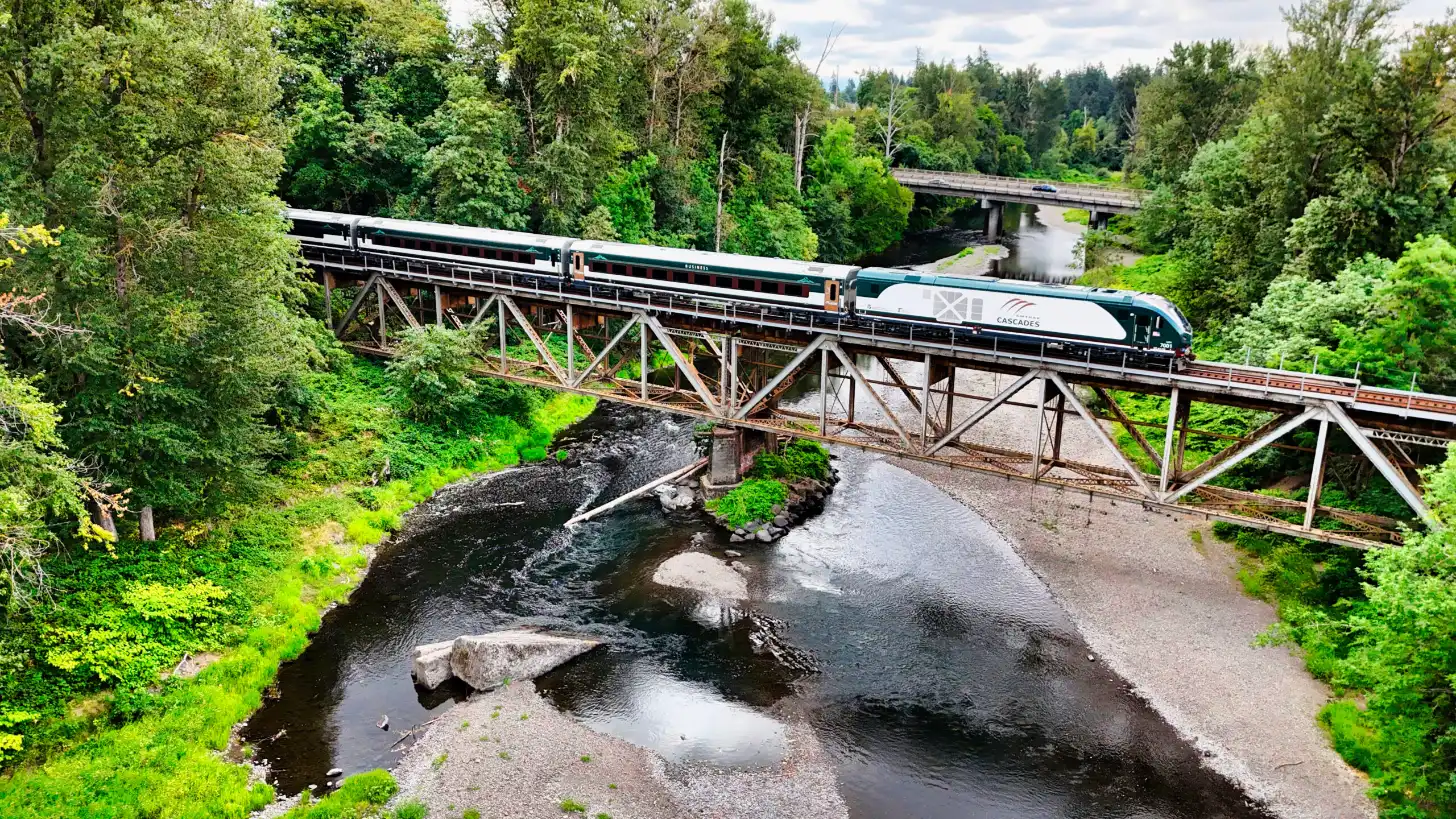
Alex Scott, a professor of supply chain management at the University of Tennessee-Knoxville, said rail’s efficiency comes in part from carrying many people at once.
“If you can get a fully well-utilized rail car, be it humans or products, those are still more efficient than everybody going in different cars, even if they’re electric cars,” he said.
The trains, built in the U.S. by Siemens, feature electric and diesel propulsion, allowing them to operate on both conventional and electrified routes. While much of the U.S. passenger rail network remains unelectrified, employing new diesel-powered trains can still reduce emissions.
“The locomotives they make now, even if they’re not electric, are a heck of a lot cleaner than the old ones, and so upgrading equipment, be it electric or not, is a good answer,” Scott said.
Airo locomotives meet the Environmental Protection Agency’s Tier 4 emissions standards — the agency’s strictest rules for locomotive engines — significantly reducing particulate matter and nitrogen oxide emissions.
Riders on the Northeast Regional route will climb aboard Airo trains in 2027. The new rolling stock will especially benefit riders traveling between Virginia and the Northeast who can wait as long as an hour at Union Station in Washington, D.C. while Amtrak swaps the diesel engine it uses south of the capital to the electric one it uses northbound to Boston. The new trains can quickly transition from diesel to electric power without changing locomotives.
“It’s a win for the environment, it’s a win for the people that are sitting in traffic,” Virginia Passenger Rail Authority spokesperson Karina Romero said. “We definitely want more trains in Virginia.”
Virginia has invested $6 billion in its Transforming Rail in Virginia program. According to Romero, the combination of new trains and improved infrastructure will give riders a more reliable experience.
“You can put down fabulous infrastructure and great tracks,” she said, “but you’ve definitely got to have the equipment to roll on.”
Featured Image: Courtesy of Amtrak
Rachel, who goes by @rachelishaa on social media, is a self-described “animal influencer.” Her bio on TikTok reads: “I make shelter dogs famous.”
Every week, Rachel visits a shelter dog and shares their story with the internet. It often leads to a surge of interest for dogs — and adoption success stories — that have been held in kennels for months, if not years.
Most recently, Rachel shined a light on Nancy, a pit bull that had “zero adoption applications.”
“Her owner just passed away, and she became very depressed,” Rachel explained in the video, which was posted on August 24.
So Rachel decided to take Nancy out for a “day trip” to cheer her up.

“She had the best day ever,” the influencer said, showing video footage of Nancy covering her face in kisses, wagging her tail, and playing with new toys in the park.
“But I promised her I would help her get adopted, so every week I visited her [and] she was always happy to see me,” Rachel said.
Through Rachel’s videos, the internet got to see a completely different side of Nancy. The pit bull, who had been barely able to lift her head off the floor of her kennel, was full of energy and excitement.
In addition to giving her a “break from shelter life,” Rachel also took the time to start Nancy’s training to make her more adoptable.

And it worked. After weeks of training and weekly playdates, Nancy finally got adopted.
“Have the best life ever, Nancy!” Rachel said in the video. “I love you.”

A recent study by the Pit Bull Coalition found a vast disparity in the representation of pit bulls in animal shelters across the United States.
In 2023, pit bulls and “pit bull-type dogs” accounted for just 5% of all dogs in the U.S., but 22% of dogs entering shelters — making them the most common breed type in the American shelter system.
More alarming still: 40% of all dogs euthanized in shelters are pit bulls.
According to Bronwen Dickey, journalist and author of the book “Pit Bull: The Battle over an American Icon,” that disparity in the shelter system comes down to myth and misconception.
And when it comes to what a pit bull is, that definition is constantly expanding.
“The biggest misconception is that the term pit bull refers to one distinct breed when really it refers to at least four pedigreed breeds of dogs and then all these other dogs that get lumped into the category,” Dickey explained on NPR’s Fresh Air.
That includes the American pit bull terrier, American Staffordshire terrier, the Staffordshire bull terrier, and the American bully.
“But increasingly,” she said, “because those dogs are kind of generic looking and they share these characteristics with at least 25 other breeds of dogs, such as smooth coats or blocky heads — then anything becomes a pit bull.”
Fresh Air host Terry Gross then pointed to common misconceptions surrounding pit bulls.
“One is that they’re natural fighters and they’re hardwired to kill,” she posed. “Is that true?”
“No, there is absolutely no credible scientific evidence of that,” Dickey stressed. “You have specific subpopulations that have been used over time in the illegal pursuit of dogfighting, but they really can’t be held up as the standard for all pit bulls in America.”
She then went on to say that it would be as ridiculous as comparing Navy SEALS to the “standard for all American men.”
“There’s no evidence at all that this entire huge group of dogs — that there is anything different about them whatsoever,” she said.
Watch Rachel and Nancy's full journey below:
@rachelishaa I met a dog who had zero adoption applications, here is what happened. #shelterdog #rescuedog #animalrescue #shelterdog #rescue ♬ original sound - welcome
You may also like: Rescue crew miraculously saves family dog who was swept out to sea: 'An emotional reunion'
Featured Image: Screenshots via @rachelishaa/TikTok