The Trump administration has shut down innumerable climate programs, including public-facing sources of information.
All is not lost, though, partly because of significant efforts to retrieve that information, and partly because other nonprofit sources of user-friendly data have continued without interference.
Here are some of the best places to find understandable dashboards, maps, and analysis for what can seem like overly complicated information.
Where to find "rescued" climate data
Climate.us

One of the most important government sites shut down by Trump was climate.gov — a NASA-run collection of information written for the general public, not just experts.
Fortunately, a few dedicated individuals have come to the rescue with this substitute site. In her overview of this project at Grist, Kate Yoder writes that the new site “preserves climate dashboards, maps, blogs, and explanatory articles of the earlier site," and its goal is to ‘build an enduring, independent, and scientifically rigorous platform that the world can rely on for climate communication, education, and engagement’.”
Yoder’s title suggests the larger context she also addresses: “The plan to make climate science harder to erase.” For another context, that of gender, see Jenae Barnes’s piece in The 19th, “Trump dismantled a federal climate website. These women rebuilt it.”
“‘Canary in a Coal Mine’: Data Scientists Restore a Climate Justice Tool Taken Down by Trump" by Anika Jane Beamer for Inside Climate News is another good story about the efforts to rescue useful government information, focused on the Climate and Economic Justice Screening Tool.
Beamer covers related efforts as well and offers many useful links, including to the Public Environmental Data Partners list of several such recovery projects, including the new version of the tool.
For a comprehensive list of all the climate-related projects that Trump’s administration has killed, see this site created by the Sabin Center for Climate Change Law at the Columbia Law School.
On offer here are three primary tracking tools: the Climate Backtracker, the Inflation Reduction Act Tracker (co-maintained with the Environmental Defense Fund), and the Silencing Science Tracker (co-maintained with the Climate Science Legal Defense Fund).
The Sabin Center also offers a global litigation database, an attribution database, and other resources.
Climate Central

Climate Central is a major source of user-friendly data visualizations, and its homepage is a gateway to numerous data collections and visualizations. (This nonprofit is an “independent group of scientists and communicators who research and report the facts about our changing climate and how it affects people’s lives.”)
- To see how the climate has changed in your city (or one near you), see the Climate Shift Index.
- To see that same information in visually compelling colored stripes, see the Warming Stripes database. You can read about the annual “Show Your Stripes Day” on June 20 here. Knitters and other fiber artists may already know about the related Tempestry Project.
- Other Climate Central resources address sea level rise, fire weather days, and billion-dollar weather and climate disasters. The disaster page is another recovery story, as this piece by Sophie Hurwitz in Grist explains: “Trump killed a crucial disaster database. This nonprofit just saved it.”
Reuters Climate Monitor

The Reuters Climate Monitor compares today’s temperatures to historic averages — in particular places, over continents and around the globe — and in several different ways: plain numbers, simple graphs, and a searchable map with temperature colors.
Updated daily, it covers a truly impressive range of locations, including not just cities but also national parks, small towns, and even roads.
Our World In Data: Climate Change

Among the many topics addressed by this nonprofit organization is climate, and its data offerings are rich, with somewhat technical information rendered in understandable graphics.
Pages focus not only on climate change itself but also on related topics such as CO2 and greenhouse gases, energy, wildfires, air pollution, environmental impacts of food, and natural disasters.
Mapping The Unmapped

Subtitle: “Can a crowdsourced map of the world help save millions of people from climate disaster?”
Unlike the other sources noted in this collection, this piece in Grist by Maddy Crowell tells the fascinating story about the difficult creation of a data source — in the form of mapping places that have been too remote, poor, or lightly inhabited for entities like Google Earth to cover but where, nevertheless, disaster relief may be sorely needed.
The volunteer mapping is coordinated by the Humanitarian OpenStreetMap Team, and their platform is OpenStreetMap.
Project Cosmos

Just launched by Carbon Brief, this enormous database is intended primarily for an academic audience, but the visualization itself is interesting even for non-researchers.
Rendered “as an interactive ‘cosmos’ — a vast network graph in which each publication appears as a ‘star’ — the database reveals how different fields of climate research relate to and build upon one another.”
This graph looks like a multicolored exploding universe, with the details of color, size, and spacing representing the academic field of the authors and the number of times the publication is cited by other scholars or the network of specialists who read each other’s work.
Including over 1.8 million publications that are linked by citations, it “represents the most complete and expansive mapping of human knowledge on climate change ever assembled, tracking more than a century of academic research.”
As the home page explains, the various kinds of studies (medicine, psychology, biology, physics, and many more) can be seen in this network graph.
This article was originally published by Yale Climate Connections.
Featured Image: Goddard/Rebecca Roth/Courtesy of NASA
This story was originally published by The 19th and was republished with permission.
Jenny McBurney, a librarian specializing in government publications, was in Washington, D.C., in June when she heard the news that the Department of Interior, the agency responsible for overseeing the national park system, had produced a spreadsheet listing dozens of sites where it had removed materials deemed disparaging to Americans or unrelated to the beauty and grandeur of our national parks.
She and other people who happened to be in town for a convening about the importance of public history in telling the complete American story, decided to visit some of the places on the spreadsheet to see exactly what had been modified in the nation’s capital.
“We were calling it our little sign quest,” quipped McBurney. “We were going to go, and you know, hunt down as many as we can.”
One of the stops was the Belmont-Paul Women’s Equality National Monument, designated by the Obama administration in 2016 to honor the National Woman’s Party, which fought for women’s equality and was founded by suffragettes Alice Paul and Lucy Burns.
McBurney helped inspect the informational plaques outside the brick building until they found what they had been looking for: a recent alteration on a sign describing some of the tactics used by suffragists to fight for the right to vote.
A 2025 photo of the plaque shows the sign stating that after women were imprisoned for a protest outside of the White House in 1917, they were “beaten and force-fed when they went on hunger strikes.”
The sign now reads: “The women, many of whom came from prominent and politically connected families, demanded to be treated as political prisoners.”
The new placard also leaves out a reference that this was a turning point that helped change public opinion on women’s suffrage. In other words, they are “removing the fact that that action worked,” McBurney said.

The 19th has contacted both the National Park Service and the Department of Interior to comment about this and other removals at national park sites and did not receive a response.
The changes were alarming to Burney, who, the year before, had co-founded an organization with public historians and other women librarians called Save Our Signs. Its goal is to create a crowdsourced historical record of information signs at national park sites, in the event they are changed under the Trump administration.
“If people go to these sites and expect to see the full history, and they’re not seeing that, then that is a missed opportunity for so many people,” said McBurney. “Especially with the quiet changes on the signs where you can’t even tell that something’s been changed. They think that they’re hearing the whole story, but they’re not, and that’s not fair to them.”
The women behind Save Our Signs sprang into action after Interior Secretary Doug Burgum directed public lands officials to flag any materials that “are negative about either past or living Americans or that fail to emphasize the beauty, grandeur, and abundance of landscapes and other natural features.”

Burgum issued the directive in May 2025 to help Trump fulfill his executive order, titled “Restoring Truth and Sanity to American History” and aimed at weeding out facts the administration says are driven by ideology and spreading divisiveness.
The organization now maintains an online archive of photos of information signs at national parks as a way to preserve history.
Since that announcement, signs talking about slavery and Native American history have been removed or revised, and references to climate change have been taken out of several parks. Caught up in these revisions and erasures are also the lived experiences of women and LGBTQ+ people and the roles they played in American history.
Some of the signs removed or rewritten reference violence against women. One example is the language under a sculpture of the Civil War soldier and explorer Gustavus Cheyney Doane in Grand Teton National Park, in Wyoming describing his participation in a massacre of predominantly women, children, and elders from a band of the Blackfeet Tribe that was removed.
At Philadelphia’s Independence National Historic Park, a focal point of the Trump administration ahead of the country’s 250th anniversary, panels describing the lives of people enslaved under George Washington have been replaced with what advocates have called a sanitized, whitewashed version of history. Lost were descriptions of violence that detailed the horrors enslaved women faced, including sexual violence and family separation.
What the administration is choosing to erase from history raises a larger question, said Molly Blake, a librarian and co-founder of Save Our Signs.
“It’s instructive that this administration has chosen this as a fight, that they don’t want any reference to anything violent that happened in history, that they don’t want references to people abusing power in history. They don’t want references to even the existence of certain communities in history,” she said. “That always begs the question of why are they doing that? Why is that such a threat?”
Other signs reference women’s contributions. As first reported by The 19th last year, signs at Muir Woods National Monument were altered in California, including those stating that women played an important role in the monument’s conservation history. At Lowell National Historical Park in Massachusetts, films that delved into the history of immigrant workers and honored the “mill girls,” or women who worked in the textile mills and whose fight for labor rights helped shape modern workplace protections, were removed. Democratic Sen. Ed Markey has since published the video on his YouTube page.
The National Parks Conservation Association is part of a lawsuit challenging the removal of history in the parks. Its northeast regional director, Kristen Sykes, wants to see those videos returned to the visitor center and shown in their entirety so that visitors can have a full understanding of the lives of the people who worked there.
Sykes said it’s not just signs and films that have been a target of the order; it’s maps, social media posts, books, and brochures.
“It runs the gamut,” she said. There is also the fear that new changes and historical additions might not ever make it into the parks under the Trump administration if it conflicts with his order.
“The interpretation and content that’s distributed by the parks is often reviewed in Washington,” she said. “So there are things that have been taken down, and there is also information that maybe hasn’t been publicized.”
The changes occurring at the parks have also affected the LGBTQ+ community. In February 2025, the National Park Service deleted references to trans people from the Stonewall National Monument’s website and took down a Pride flag that hung outside of the building in New York, an important site for LGBTQ+ activism in the 1960s.

The changes had been made to meet the directive of a different executive order aimed at eradicating “gender ideology extremism.” After a legal battle, the flag returned to the monument, but the website continues to refer to the LGBTQ+ movement as the LGB movement. An article written for the national monument’s website about the role trans and queer people played in the Stonewall Riot was also taken down.
At Sunset Crater Volcano National Monument in Arizona, a sign that included a photo of a visitor holding a small Pride flag was reportedly taken down, according to the lawsuit filed by Democracy Forward, on behalf of NPCA and other organizations.
Advocates are worried more could disappear. While a legal challenge temporarily paused the removal of items from the parks in June, a federal appeals court ruled a month later the administration could continue its efforts.
Over 500 items have been referred by National Park Service officials to the Department of Interior for review, according to a leaked database The Washington Post reported on in March. These included a book about Black women, nonbinary and gender nonconforming people in nature at Yosemite National Park; a site bulletin about Emmett Till and the fight for civil rights waged by his mother, Mamie Till-Mobley, after his death; a book about women soldiers in the Civil War at Fort Donelson National Battlefield in Tennessee; and images that depict the torture of enslaved women at the Timucuan Ecological & Historic Preserve in Florida.
At the Castillo de San Marcos National Monument in Florida, the back cover of a book was flagged for commenting on the “shockingly late ratification of the 19th Amendment guaranteeing women’s suffrage.” At Cape Hatteras National Seashore in North Carolina, a junior ranger book was reviewed for “appropriateness” for stating that some women pirates disguised themselves as men.
For Antoinette Burton, a historian and professor at the University of Illinois, the changes feel somewhat random — either very broad in scope or very subtle. That has made her wonder who exactly is behind the changes and what methodology they are using to determine what to scrub and what to keep.
“How does it all get operationalized?” she asked. “That would be important to know because if they’re doing the administration’s work, why don’t we know who they are?”
She sees the changes in the parks as part of an ongoing struggle to interpret history. “We have to shine a light on what this is doing and have a reckoning about what it means and for whom,” she said.
Long before the efforts by the Obama and Biden presidencies to diversify historic perspectives, which the Trump administration has decried as “woke ideology,” historians had been challenging the collective understanding of whose stories should be told and expanding the historical record to include the stories of women, LGBTQ+ people, and communities of color.
To Burton, dialing back those efforts reinforces the idea that these narratives actually matter. “They drive people’s identity and self-representation and conviction about the world,” she said. “One set of arguments has been ascendant in the last 50 years, and the current regime is determined to push that back into the darkness.”
Featured Image: Jace Ritchey/Courtesy of National Park Service
In Africa’s lion range countries, human-wildlife conflict is of increasing concern.
As big cats’ habitats shrink due to climate change, they turn to livestock properties to hunt. In turn, humans may be attacked by wildlife, or humans may kill wildlife out of fear or to protect their farms.
One nonprofit, Lion Landscapes, is addressing this conflict with a grassroots initiative to improve human-wildlife coexistence across East Africa. It’s called Community Camera Trapping Plus, or CCT+, a project that encourages locals to support camera trap placements for wildlife monitoring through the distribution of community benefits.
After discussions with locals, Lion Landscapes — a nonprofit associated with the Wildlife Conservation Research Unit at Oxford University — created CCT+ and its incentive structure.

Here’s how it works: Community members are trained to place and monitor trail cameras in strategic locations in their village. Every animal the cameras capture on video earns points, with more points awarded for more threatened or conflict-causing species.
For instance, a lion or hyena generates more points than a small antelope. An animal that appears to have injuries from a snare or trap earns nothing, and an animal that researchers have collared gets double points.
This gamified system in turn provides ample wildlife data for researchers. But it also helps communities.
Each quarter, points are tallied, and benefits are distributed among participating villages. The communities get to choose what they receive: Healthcare benefits, veterinary treatment, school supplies, and more.

Results and benefits are also displayed publicly, so each participating village receives something — and the process inspires some friendly competition.
CCT+ also encourages locals to reduce harm to wildlife.
“Besides earning benefits from the presence of wildlife, extra benefits can be earned if people take actions to help conservation, such as fortifying livestock enclosures, while penalties exist if people take actions that harm conservation (e.g. poisoning wildlife and snaring),” Lion Landscapes’ website reads.
“The specifics of the positive and negative conservation activities, the types of benefits, and how they will be shared are carefully co-developed with each village or village cluster and written into a conservation agreement.”
The program began with communities in Tanzania and now also operates in Kenya and Mozambique.

“This program has been very successful in helping community development and improving tolerance for wildlife on village land,” Lion Landscapes reports on its website. “It is now being adapted and scaled up internationally, and has been covered by international organizations and shortlisted for an award for conservation innovation.”
Household surveys also illustrate CCT+’s efficacy. In southern Tanzania, more people reported that they want lion numbers to increase or stay the same, view nearby wildlife positively, and recognize the personal benefits from the presence of wildlife.

It wasn’t always an easy or clear path; a case study document from Lion Landscapes reported that lion killing was not just carried out in retaliation, but rather seen as a cultural act among young warriors.
The organization has also helped to create a “Lion Guardians” program to help transition that practice toward wildlife coexistence — and human employment — rather than hunting.
“The role … enabled them to be community protectors, therefore fulfilling and respecting their traditional warrior role,” a case study from Lion Landscapes reads.
“The warriors tracked lions, warned communities of their presence nearby, helped people protect themselves and their stock, discussed the conservation value of wildlife, and worked to reduce conflict and traditional hunts.”
Informed by local communities themselves, these interventions have made a world of difference in the villages in which they have been deployed. Villagers now even seem enthusiastic about conservation.

“When images from the camera traps are gathered, DVD nights are held to showcase which wildlife species have been captured on the village land,” the Lion Landscapes case study reads.
“Initially, this was done for transparency purposes but it actually became an important way to engage the wider community and have conversations about the wildlife that was found on the village land.”
Ultimately, experts from Lion Landscapes say, the program has given locals a reason to want wildlife around.
“To reduce human-wildlife conflict long-term, the communities needed to receive benefits from the presence of wildlife,” the organization’s website reads.
“This collaborative approach incentivizes the communities to identify conservation threats which can be tackled locally, and gives them a real reason to work together to reduce those threats.”
You may also like: Rescued as poaching victims, 6 rhinos defy all odds by giving birth to calves in the wild
Featured Images: Courtesy of Lion Landscapes
A new study published by Florida State University researchers sheds new light on male green sea turtles.
The research, which followed male green sea turtles off the coast of Brazil, revealed groundbreaking discoveries about their migration strategies, which will support future conservation efforts for the marine creatures.
Male green sea turtles have been more mysterious to researchers, as they are harder to study than females, who regularly return to the same place to lay their eggs, allowing researchers to predict their movements, tag, and monitor them over time.
Males, however, rarely return to land after entering the water as hatchlings, leaving researchers with major gaps in understanding their behavior.
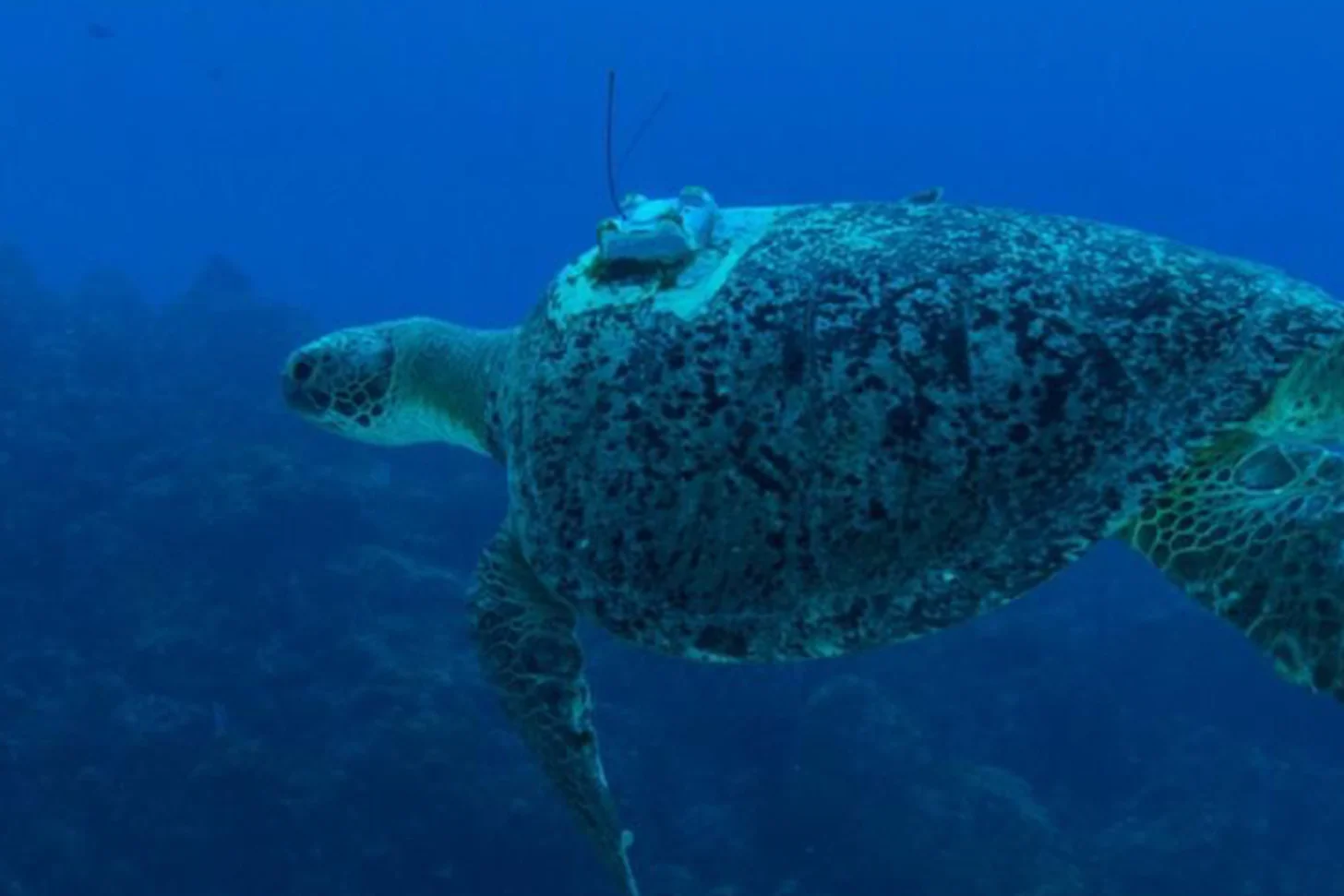
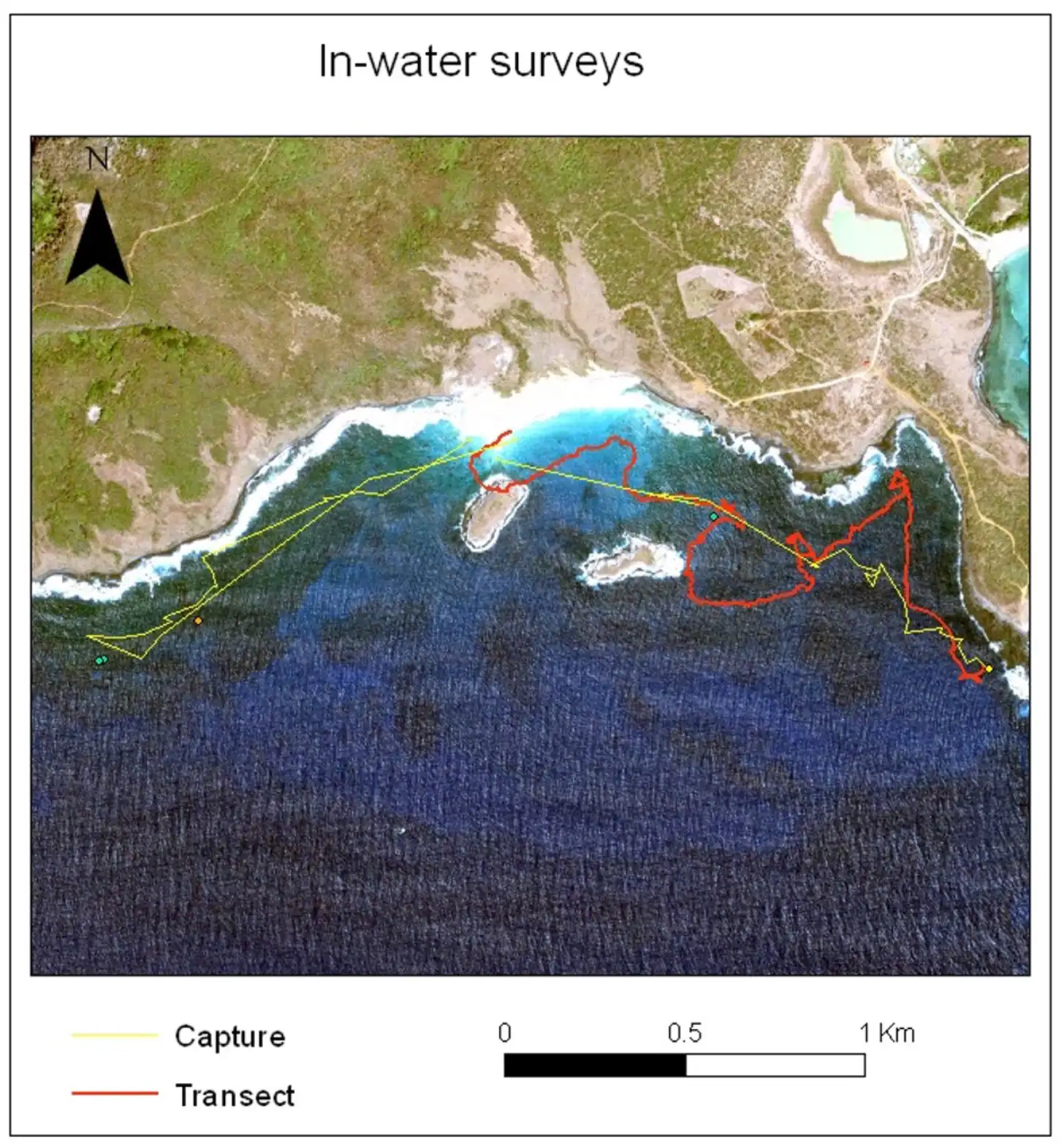
To make these latest discoveries, FSU researchers followed the same group of adult male turtles during breeding season, which occurs from late spring into early summer, from 2019 to 2022. They used satellite tags to collect data on this group of turtles.
Researchers observed two different migration behaviors: After breeding, about 80% of tagged turtles migrated about 180 to 620 miles to different foraging grounds, while 20% stayed in the same breeding area year-round.
“Many turtles undertook long-distance migrations, with some migrating for almost a month,” Armando Barsante Santos, one of the study’s co-authors and a postdoctoral researcher in the Marine Turtle Research, Ecology and Conservation Group at FSU, said in a statement.
“Their sense of navigation is impressive, and identifying paths they use during their oceanic migrations is essential for conservation management.”
For the duration of the study, satellite tags collected data on the turtle’s vertical movement, like how often they dove into the water, how deep, and for how long.
The 20% of turtles that stayed in the same breeding area made frequent and short daytime dives and long dives at night. Migrating turtles, on the other hand, displayed a variety of dives, which the researchers believe is an effort to minimize the risk of predators and reduce energy associated with migration.
This study also provides more nuance to the population balance of sea turtles.
Temperature can impact the sex of a sea turtle. Cooler incubation temperatures produce male hatchlings, while warmer temperatures produce females. As temperatures increase across the globe, more females are hatching, altering the population balance of sea turtle species overall.
“We’re interested in understanding how many female turtles one male can breed with and how males’ behavior can buffer these environmental changes,” Santos said.
“Knowing how many males are needed for a population to be resilient is important information that’s hard to obtain since males aren’t easily accessible for study.”
Ultimately, the research doesn’t just provide the world with more information about male green sea turtles; it can be used to better understand where these turtles live and thrive, improving conservation outcomes.
“Assessing the overlap between key habitats, such as migratory corridors and areas of high turtle density, and … human-made or -connected threats is crucial for redefining conservation strategies in the region,” Professor of Oceanography and Environmental Science Mariana Fuentes, another co-author and leader of the MTREC group, told the university.
“[It] can minimize the mismatch in important areas for sea turtles and marine protected areas in Brazil.”
Santos added that this kind of research provides experts with a “three-dimensional” understanding of the marine environment, which “gives us more details about how susceptible turtles might be to certain fishing gear or vessel strikes, for example.”
“With different fishing gear used at the water’s surface, in the middle water, and at the bottom of the ocean, we need to know how turtles’ use of the area overlaps with these layers,” Santos concluded.
“This can inform strategies that harmonize the use of [the] environment between humans and turtles, including enhancing the effectiveness of the marine protected areas that currently cover more than a quarter of Brazil’s waters.”
You may also like: One of the world's rarest sea turtles was found stranded 5,000 miles from home. He's finally on his way back
Featured Image: Courtesy of Thiege Rodrigues/All Angle Images
Maine will continue providing gender-affirming care despite an announcement from the Trump administration banning Medicaid from covering hormone therapy and procedures for children under 18.
The Centers for Medicare & Medicaid Services announced the rule on Tuesday, which also prohibits Children’s Health Insurance Program, or CHIP, funds from being used for this care, typically sought out by people whose gender identity is different from their sex assigned at birth.
Under CMS’s definition, gender-affirming care includes puberty blockers, cross-sex hormones, and surgical operations. The policy takes effect Oct. 13.
For children on Medicaid and CHIP who currently rely on gender-affirming hormone therapy, state plans may continue to use federal Medicaid funding for up to six months. Funds can still be used for mental health care for kids, the agency said.
“To be clear, gender-affirming care remains legal in Maine and will remain accessible to all patients at Maine Family Planning’s 18 clinics,” said Olivia Penngington, associate vice president of public affairs for the state’s largest reproductive healthcare provider.
“We will do everything in our power to provide this lifesaving care across the state and we will never turn patients away for their inability to pay or their lack of insurance coverage.”
In Maine, between 3,000-4,000 people in Maine receive gender-affirming care and 27% of those people get that funding from MaineCare, according to WMTW.
The rule is the latest in a series of actions President Donald Trump’s administration has taken to restrict gender-affirming care. Last year, Maine joined a multi-state lawsuit challenging a declaration that called treatments like puberty blockers, hormone therapy, and surgeries unsafe and ineffective for children seeking gender-affirming care.
That declaration also warned doctors that they could be excluded from federal health programs like Medicare and Medicaid if they provide those types of care. Despite the lawsuit and objections from several national medical associations that advocate for evidence-based care, the proposed Medicaid and CHIP rule has now been finalized.
“The Trump administration knows that access to this care is popular and that they can’t outright ban it,” Pennington said. “So they attack the funding sources as a backdoor ban on peoples’ personal health care decisions.”
Maine law specifically requires MaineCare, the state’s Medicaid program, to cover gender-affirming care, which means that even if this rule were to be enacted, children who rely on MaineCare would still be able to have their care covered through state funding, according to Aspen Ruhlin, community engagement manager at the Bangor-based Mabel Wadsworth Center.
The Maine Attorney General’s Office declined to comment on whether the state plans to challenge the final rule.
Much like MaineCare can still pay for abortions through state funding despite the Hyde Amendment banning federal Medicaid reimbursements to be used for the procedure, the cost of gender-affirming care for minors will shift to the state.
However, because there are a relatively small number of Maine youth seeking such care under MaineCare, Ruhlin said the cost shift would not be a big financial burden.
“I personally do not have concerns about creating some sort of financial shortfall for the state,” they said. “The concerns there are just that this is normal essential care, and the feds putting those restrictions is just really targeted intentional harm towards a marginalized community.”
The Maine Department of Health and Human Services did not respond to questions about how much gender-affirming care costs the state currently.
Some Maine providers told Maine Morning Star they’re afraid of being targeted for providing these services, which then puts this care at risk. Across the country, hospitals in both Democratic and Republican-led states have responded to Trump’s attacks on transgender health care by withdrawing care.
No Maine providers have made such announcements yet. MaineHealth said in a statement that it is “currently seeking additional information and clarification from state and federal officials with respect to this announcement,” while reinforcing its commitment to providing needed care to all patients regardless of insurance status or ability to pay.
However, Ruhlin said some patients who need hormone therapy, puberty blockers, or other types of care are foregoing it due to fear. After the announcement, staff at Mabel Wadsworth were preparing for calls from patients seeking to clarify if they could continue their treatment.
“The exceedingly anti-trans sentiments from the federal government has led to a lot of trans folks making the decision to not pursue gender-affirming hormone therapy when they otherwise feel it would be a good fit for them,” Ruhlin said.
“Because they are concerned about their safety. Not from the medications themselves — they are very safe — but because the targeting from the government keeps getting worse.”
This article was originally published by Maine Morning Star.
Featured Image: Dana DiFilippo/New Jersey Monitor
Mount Evans Home Health Care & Hospice, which serves mountain and foothill communities in Colorado, has spent 45 years fulfilling the final requests of its patients.
One recent case was Dan, a man who came to his team with one specific wish in early August: To cuddle a golden retriever with “puppy breath” before he took his last.
A team member at Mount Evans worked quickly, taking to r/Denver and r/goldenretrievers on Reddit to see if she could find a puppy in the area who could make Dan’s dreams come true.
“Our team asks patients what they have unresolved, what they need help with, and if they have any last wishes,” a spokesperson for Mount Evans, Kristen Mathias, told Good Good Good in an email.
“Dan asked his nurse to cuddle a golden retriever puppy — with puppy breath — and Geneva reached out to our team for support, who in turn reached out to the community for support.”
The r/Denver community responded quickly, with commenters suggesting area golden retriever rescue organizations and nonprofits that could be of assistance.

And then, a beacon of light: Amber Barnett Traub wrote a response.
“We have an 11-week-old golden puppy! Her breath smells more like coffee than milk, though,” she replied. “If that’s okay please let us know.”
It was more than okay.
“We saw other puppy owners respond, but it seemed most of the other puppies were a bit too old to still have puppy breath,” Traub added in an email to Good Good Good.
“Luckily, Gladdie — short for Galadriel — was 11 weeks old at the time and still had the puppy smell, so she exactly matched Dan’s wish.”

Nurse Geneva quickly connected Traub and her husband, Justin, to Dan. They were able to bring their furry friend to his home within a day.
“Gladdie had an amazing time with Dan,” Amber recalled. “She loved playing fetch with him, playing tug of war, and cuddling him on his giant beanbag couch.”
According to Mount Evans, Dan had been a dog lover his whole life.
“Dan always had golden retrievers, and his most recent dog had passed a few months prior to his diagnosis,” Cheryl Wilner, Dan's Mount Evans social worker, said. “He was heartbroken and alone.”
That sadness seemed to disappear once Gladdie was in Dan’s presence, however.

“We so enjoyed hearing Dan’s stories of his own golden retrievers, Shea, Molly, and Shanti,” Amber said, adding that Dan was eager to talk about the hikes they liked to take around his hometown.
“Dan shared that Shanti was actually diagnosed the same time that he received his diagnosis,” Amber continued, “and … she sadly passed away not too long ago. We were honored to be able to bring Gladdie to Dan for his last request, and give him a chance to feel that golden retriever love once more.”
Dan died just a few days after his visit with Gladdie and her family, but his legacy lives on with the Traubs, who were given a piece of Dan to remember him by.
“Dan graciously gifted us a ball-throwing machine that he had used with his own golden retrievers,” Amber said, “which we plan to use as soon as Gladdie is big enough.”

His final wish is also one that will stick with his caregivers at Mount Evans, one of only two 5-star hospice agencies in the state of Colorado.
“Not every patient makes a last request, but when they do, our team goes above and beyond to honor the request. Recent past requests have been as simple as a final sip of beer, or require more coordination, like helping a patient get to a grandchild's wedding,” Mathias said.
Wilner added that Dan was pleased with his visit with Gladdie, though worn out. Other staff also offered to bring another dog for a visit, but he insisted he was content with his time with Gladdie.
“It is our deepest honor and privilege to walk alongside our neighbors and community members as they near the end of life's journey,” an August 13 Facebook post from Mount Evans reads.
“Moments like these remind us of what hospice care is truly about: Cherishing life, honoring wishes, and bringing comfort when it matters most. Thank you to everyone who helps us bring these heartwarming moments to life for those we serve.”
You may also like: Stranded mountain biker saved by memorial honoring a heat stroke victim who died on the same trail
Featured Image: Courtesy of Mount Evans Home Health Care & Hospice
Oregon fishermen will begin testing ropeless crabbing technology next spring in an effort to save whales from often-fatal entanglements.
The state since 2021 has taken steps to reduce whale entanglements, including requiring additional late season crabbing tags and limiting how many crabbing pots fishermen can use and how deep they can place them, Oregon Department of Fish and Wildlife Marine Resources Program Manager Justin Ainsworth told the Oregon Fish and Wildlife Commission in a meeting Friday.
But with whale entanglements increasing, commissioners are turning to two new tools to reduce whale deaths. Rules the commission adopted Friday will require fishermen to share their vessel location with state fishery managers and allow them to test ropeless crabbing gear already allowed in California.
Traditional commercial crabbing gear requires hundreds of traps to sit on the ocean floor, each attached to a vertical line connected to a buoy on the surface. Whales can easily get entangled and injured, often fatally, in those lines, as was the case with a humpback whale freed about 20 miles off the Oregon Coast in late July that wasn’t expected to survive because the entanglement left it unable to feed.
The pop-up gear the Oregon Department of Fish and Wildlife can begin authorizing as soon as spring 2027, however, stores the rope and buoy with the trap on the seafloor. Fishermen can set a timer or trigger a release mechanism that allows the line to uncoil and buoy to surface to retrieve the catch, ensuring whales and other creatures have a clear path most of the time.
Pop-up gear is currently unlawful because all pot and trap gear must be marked at the surface with a buoy. The proposed rule would allow the Oregon Department of Fish and Wildlife to issue some experimental fishing gear permits as soon as spring 2027, and the commission could consider wider authorization if the tests prove effective.
Humpback whale entanglements on the rise
Fishing gear entanglement remains the largest threat to serious injury and mortality of whales off the West Coast.
At least 400 whales have been caught in fishing gear off the coast of Washington, California, and Oregon between 2015 and 2025, according to the National Marine Fisheries Service.
Humpback whales are the most commonly entangled whale species because their feeding season coincides with crabbing season, and warming ocean waters push their feeding grounds closer to shore where commercial crab traps are posted.
Oregon has two humpback whale populations that feed off its coast. One breeds off the coast of Mexico and is listed as threatened under the Endangered Species Act. The other, which breeds off the Pacific coast of Central America, is listed as endangered.
At least four humpback whales were entangled in 2025 in Oregon commercial Dungeness crab fishing gear — the highest number of humpback whales confirmed entangled in Oregon crab gear in any single year to date.
California’s already familiar with pop-up gear
California began issuing experimental permits for pop-up gear in 2023. Earlier this year, the state authorized it for more widespread use during times and areas when the fishery is closed to conventional gear due to entanglement risk.
Brand Little, a commercial fisherman based in San Francisco, said he was “dead set” against pop-up gear until he tried it.
“It was the first year they closed salmon in California,” Little said, referring to 2023 when California canceled the salmon season after seeing historically low population numbers. “We didn’t have anything else to do… so we went out to prove [pop-up gear] wouldn’t work, and it did work. So we’re like, ‘Well, what the hell?’ And it’s just kind of been a snowball since then.”
Now, Little has enough pop-up gear to use his 450 pots, and buying the equipment wasn’t as expensive as he originally thought.
The units themselves are expensive, Little said. They cost about $1,000 per pop-up unit. Little wasn’t willing to spend $450,000 for all his pots, but he was willing to spend money to put two $1,000 pop-up units on both sides of a string of 25 crab traps — a technique known as long-lining.
“I think the average price spent to do it was $30,000,” Little said. “Every single person that invested their $30,000 had a return on investment in the first couple of weeks of using the gear.”
Oregon is positioned differently than California, where shortened seasons have left fishermen with a narrow three-month window when whales pass by. Only fishermen using pop-up gear can fish for Dungeness crab between all of California’s crabbing season, which typically lasts from mid-November to the end of June. Oregon hasn’t reached that point, as its crabbing season remains largely unchanged.
Stephen Melz, an early pop-up gear adopter also based in San Francisco, said the gear gives California fishermen the alternative to keep fishing even when whales move close to the coast.
“If given the option to fish or not fish, I think they’re going to want to fish,” Melz said. “That’s what it comes down to, right?”
Oregon fishermen push back against vessel monitoring but stay open to pop-up gear
While the pop-up gear is optional, the commission would require fishermen in February to adopt a monitoring system that shares their vessel location via cellular networks with state fishery managers so they can enforce closed areas and understand fleet locations.
The Oregon Department of Fish and Wildlife has secured federal funding to help reimburse permit holders up to $800 for equipment. Still, several Oregon fishermen argued the program would place new burdens on small businesses.
“Our boats are routinely hit by waves and sometimes completely underwater,” said Ray Monroe, a Pacific City fisherman. “Electronics on these dories are constantly destroyed, and space is extremely limited. Installing another device that is expensive, fragile, and exposed to the harshest conditions on the coast is not reasonable.”
The technology is designed to resist harsh weather, Ainsworth rebutted, pointing to similar vessel monitoring systems in Washington and California.
Cary Johnson, a fisherman in Astoria, asked the commission to exempt small vessels from the requirement.
“None of us want to see whales entangled in our gear,” Johnson said. “It’s a bad look for our industry. We’re trying to do whatever we can to avoid that.”
Conservation groups applaud ropeless gear, push for more whale protections
Conservation advocates supported the new rules but said Oregon still needs to do more to protect whales.
They’re opposed to the department’s draft conservation plan, which outlines measures the state will take to protect whales. It proposes allowing the entanglement of up to 67 humpback whales over a 15-year period, or roughly four humpback whales a year.
Conservationists argued the plan would normalize the worst year for humpback whales rather than advance conservation measures and gear modifications to reduce whale entanglements.
And those are just the confirmed entanglements, said Ben Enticknap, a senior scientist and the Pacific campaign director at Oceana, an ocean advocacy nonprofit.
“The National Marine Fisheries Service scientists are estimating only about one in five entanglements are detected,” he said. “The department is not recognizing that piece right now that there’s these unobserved entanglements, and that needs to be made clear and incorporated into the conservation plan.”
This article was originally published by Oregon Capital Chronicle.
Wildlife photographer Will Burrard-Lucas journeyed to southwestern Kenya’s Maasai Mara National Reserve on a mission: To monitor and photograph the reserve’s endangered black rhino population.
He set up a camera trap for many months to monitor a remote river crossing deep in the nature reserve’s forests.
“For me, the opportunity was irresistible,” Berrard-Lucas wrote on his blog.
“The Maasai Mara is one of the most famous wildlife destinations on Earth, yet even here there are corners that very few people ever see. Placing cameras in areas closed to tourism offered a rare chance to document a hidden side of the Mara.”
And that he did.
The Maasai Mara rhino unit directed Berrard-Lucas to a patch of dense forest, with a small river sandwiched in between, creating a secluded valley for rhinos to drink and socialize.
“The rangers explained that rhinos regularly used the area, but were often extremely difficult to monitor there because the vegetation was thick and the animals were elusive,” Berrard-Lucas wrote.
“A camera trap could help them keep tabs on these individuals more reliably. The moment I saw the place, I knew it was perfect.”

He placed his camera on an elevated riverbank, high above the crossing, framing it so animals could be seen interacting with the environment, not taking up the whole shot. The camera was outfitted with motion sensors and flashes for nocturnal scenes.
He immediately noticed the trail was “deeply worn,” concluding that it was used regularly by all kinds of wildlife.
Soon, he would have photographic evidence to prove it.

The rangers checked the camera every couple of weeks to swap batteries and memory cards, Berrard-Lucas said, and it wasn’t long before they started to get a glimpse into the river crossing’s activity.
“It quickly became clear that the crossing was even more productive than expected. Rather than capturing the same animal time and again, the camera revealed this to be a well-used corridor for multiple rhinos moving between feeding areas,” Berrard-Lucas wrote.
“Several of these individuals had not been documented by the rangers for many months, and one had not been seen since 2023. As a result, the photographs helped confirm the continued presence of rhinos whose status in the population figures had previously remained uncertain, giving the team greater confidence in their estimates.”

The rhinos weren’t the only animals the camera caught, however.
“Elephants passed through in breeding herds,” Berrard-Lucas wrote. “A leopard appeared briefly before melting back into the forest. Hippos emerged from the river. Bushbuck and giraffe moved cautiously down to the water. The crossing had become a window into the hidden life of the Mara.”
One day, the camera even caught a photo of a greater kudu, the first recorded sighting of the animal for many years.

And it was a symbol of the power of these kinds of monitoring systems.

“Camera traps provide a rare glimpse into [the] unseen world, showing how animals move through the landscape at night and how they use quiet, sheltered corridors where they can pass undisturbed,” Berrard-Lucas concluded.
“They are not only powerful storytelling tools but valuable instruments for conservation, too, helping teams monitor elusive species and better understand how animals use the habitats they are trying to protect.”
You may also like: Trail cameras capture rare photo of an elusive lynx in the Himalayas: 'First confirmed evidence'
Featured Image: @willbl/Instagram
Caroline Grace is the founder and executive director of The Baby Kitten Rescue, a non-profit animal rescue organization based in Los Angeles, California.
She has saved the lives of countless cats and kittens and documented their stories on Instagram — but two cats in particular are going viral again years after their journey began.
The two cats in question, Oliver and Bunny, were the only two kittens in their litter. And from the moment they arrived under her roof, Grace knew that they required extra love and care.
“Bunny and Otter arrived as tiny, sick, and orphaned 3-week-olds,” Grace wrote in an Instagram post. “We nursed them back to health and helped them adapt with their disabilities.”
Both had been born with missing limbs, with Bunny missing most of her front arms from congenital bilateral hemimelia.

In addition to Otter’s own limb differences in his front paws, he had meningoencephalocele, which meant that part of his brain protruded through an opening in his skull.
At first, Otter was too young for the brain surgery required to reduce his meningoencephalocele. To keep him safe from injury and potential infection, Otter was fitted with a tiny, custom-made helmet with see-through casing.

At the six-month mark, Otter was finally greenlit for surgery. Where he once had a missing piece of skull, he was soon protected with titanium mesh.
After a month and a half, Baby Kitten Rescue and the Metropolitan Animal Specialty Hospital shared a health update on Otter: His “mohawk-like” scar had healed and he no longer needed his special helmet.
“His surgery was a success, and he made a full recovery!” Grace posted to Instagram. “He no longer has to wear a helmet and can live the rest of his life without having to worry about injury or infection to his brain.”

This also meant that Oliver and Bunny — who adapted happily and acrobatically to her limb differences, bouncing around like her namesake — were ready for their next chapter.
And a new mom.
“Bunny and Otter were pre-adopted by my friend, Megan!”Grace exclaimed in an Instagram post in 2023.
Although Grace said she couldn’t be happier, the decision didn’t come easily.
“The plan was always to find them their forever home together once they were ready. But I’ve become so bonded to them, I seriously considered keeping them,” she wrote.
“But I had to ask myself whether or not my home was the best home for them. And the honest answer is no. Bunny and Otter need a more quiet home without a constant revolving door of foster kittens.”
She emphasized that rescue work is “for the animals.”

“It’s about doing the right thing for them,” she said. “And the right thing for Bunny and Otter is a more quiet home [and] the first time they met Megan, they had an instant and palpable connection.”
Today, the two siblings are still happily living in their “forever home,” according to updates on Megan’s social media account.
“Two cats, five and a half legs, three claws, two crooked tails, one titanium skull,” the profile states. “Dynamic duo living our best lives!”
You may also like: This kitten couldn't walk on his own. So a vet made him a custom wheelchair out of Hot Wheels
Featured Image via Baby Kitten Rescue/Instagram
Alison Donnally has spent the last several years watching close family members experience physical and mental health declines while living alone as they age.
“These family tragedies highlighted for me the profound effects of living alone,” she said. “Each of these people close to me were once vibrant and independent, and after extended periods of aging in isolation, needed significant step-ups in medical care.”
Then, as she became a mother, Donnally had an a-ha moment in her journey to find childcare. She thought about the au pair system, which allows non-United States citizens to live and work alongside a family to provide childcare in exchange for subsidized living costs as they build their lives in the U.S.

“I started to wonder: why can’t ‘au pairs’ help with our aging populations too?” she reflected.
And what if those au pairs could get the help they needed to access affordable housing, too?
Living in the Bay Area, it became increasingly clear that Donnally could build something that helped two populations at once: Aging homeowners who needed a little extra help and company, and college students who are increasingly priced out of housing in the area.
So, she created JoeyCo, a startup that matches young people with often-retired homeowners.
“JoeyCo emerged as an answer to these intertwined challenges. By connecting students with older adults, we create a symbiotic relationship where both parties benefit,” Donnally explained on the startup’s website.
“Students find a safe and stable place to live and employment that fits around their school schedule. Older adults can design the support they need to live their best years at home.”

JoeyCo charges $500 for a “search fee” that helps hosts (the older homeowners) find their Joey (the college student and in-home helper). From there, hosts pay a matching fee worth one month’s rent for their Joey, and a subsequent monthly fee of $299.
That monthly fee covers ongoing support between the parties, logistics and financial management, and help with taxes and employment documents.
For the students, or Joeys, the process begins with a sliding scale that determines how much they are willing to pay in rent, an hourly wage they are willing to accept, and how many hours they are available to work per week.
“The beauty is,” JoeyCo’s website tells prospective applicants, “your rent gets more affordable the more you do as an employee.”
The tasks these students do are not formally caretaking jobs, as they cannot legally work as “carers,” doing tasks like taking people to the bathroom or managing medications, without specific training or licenses.
But aside from that, the work runs the gamut: Pet care, grocery shopping support, transportation, meal preparation, and reliable companionship.

Nanik Tagore, 22, has been a Joey with his hosts, Robert and Paige Miller, who are 70 and 72 respectively, since his sophomore year of college. Paige was diagnosed with early-onset dementia in 2023 and now relies on Tagore for some support about 10 hours per week.
“We have a weekly ‘look ahead’ meeting where we discuss the schedule, which fits around my work, sports, or studies,” Tagore recounted to Business Insider. “It might include me taking Paige to visit friends, shopping, or to the bank.”
He also helps with meals, transportation, and daily conversations.
Tagore said that he received $25 an hour when he first started with the Millers in August 2024, but the rate increased to $30 an hour in his second year. He pays $1,750 for rent, which includes a bedroom, private bathroom, and kitchenette, but about $500 per month gets recouped through his work with the hosts.
According to Zillow, the average cost of a studio apartment in the Bay Area ranges from $2,200 to $3,300 per month.

“It doesn’t feel like work,” Tagore told CBS News. “It doesn’t feel like a chore to lend a helping hand.”
Tagore graduated in May but plans to stay with the Millers until the end of 2026.
“I’m a big fan of intergenerational living,” he concluded. “I hope to dispel the myth that Gen Z and boomers can’t get along.”
As for Paige Miller? Having Tagore around is a good deal for her, too.
“It gives me back my freedom,” she told CBS News. “He’s great to have around. And he laughs at my jokes.”
You may also like: Dutch nursing home offers free rent to college students in exchange for their time and companionship
Featured Image: Courtesy of JoeyCo
Over two decades ago, the University of California, San Diego created what is now known as ALERTCalifornia, a natural-disaster and wildfire response network that monitors over 1,200 trail cameras across the state.
Through the years, animals like golden eagles have made cameos on the high-elevation equipment.
On August 17, ALERTCalifornia shared a snapshot from their “El Rancho” trail camera in which two California condors could be seen — one pecking at the camera with curiosity while the other posed in the background.
“Now that’s a great selfie!” one Facebook user said.
“He’s showing off!” another said with a laughing emoji.
“They’ve been up there quite a bit lately,” one person noted. “A couple weeks ago, there were over 20 condors.”

The image was a delight to conservationists who have been trying to revive the critically endangered species, which boasts a massive wingspan of 10 feet.
Four decades ago, the birds were almost wiped out completely by poaching, habitat loss, and lead poisoning. The last of which was due to condors scavenging the carcasses of hunted animals, which were filled with ammunition. The birds would then incidentally ingest lead as they ate, unknowingly passing it on to their chicks.
By 1982, only 22 California condors were estimated to remain in the wild.
To prevent their extinction, the United States Fish and Wildlife Service started the California Condor Recovery Program. Over the course of five years, all 22 birds were taken into wildlife refuges for a captive breeding program.
Then conservationists crossed their fingers, hoping for the best.
In 1988, a chick was born at the San Diego Zoo Safari Park, becoming the first California condor in the world to ever be bred and hatched in a zoo.
That first chick, Molloko, alleviated a lot of fears that the California condor couldn’t be bred in a zoo.
“After 1988, when she hatched … we had more and more success,” Ron Webb, lead wildlife care specialist at the San Diego Zoo Safari Park, told KTLA 5.

That captive breeding program would go on to become the saving grace for the species. Today, more than 500 California condors can be found worldwide — and roughly half of them fly free.
“We are seeing condors breeding in the wild and pairing up, and finding their own food, and doing everything that they need to do to be successful,” said Nicole Weprin, a wildlife biologist with the U.S. Fish & Wildlife Service.
You may also like: This photographer left trail cameras in a remote Kenyan forest for months. He uncovered a hidden 'wildlife highway'
Featured Image: ALERTCalifornia
In April, Good Good Good shared the remarkable journey of Syrena, a loggerhead sea turtle that was found struggling to swim in the Gulf of Mexico in 2025.
Tabitha Siegfried, a marine biologist at Florida’s Gulfarium C.A.R.E. Center, documented Syrena’s rescue and recovery over the course of 92 harrowing days, as she healed from a severe case of debilitated turtle syndrome.
“We don’t really know the underlying cause of debilitated turtle syndrome,” Siegfried said in an Instagram video. “It could be due to environmental factors or an infection [or] something that she ate. But it is characterized by excessive barnacles, lethargy, and anemia.”
“And usually when turtles are brought into a rehab facility with this disease or syndrome, their odds of survival are less than 25%,” she said.
Fortunately, Syrena beat the odds. Thanks to fluids, antibiotics, and round-the-clock care, she was cleared for release on July 14, 2025.
“I didn’t know if she’d make it,” Siegfried shared on Instagram. “But Syrena showed us what resilience looks like.”

It’s been over a year since Syrena was released back to the ocean, but Siegfried still has a lot to say about her rehabilitation journey. On August 3, she began sharing new behind-the-scenes footage and answering people’s burning questions.
For a sea turtle like Syrena, who was brought in covered in algae and barnacles, many people asked: “Why don’t you just remove all the barnacles right away?”
“Because for a turtle as sick as Syrena, doing everything at once can actually do more harm than good,” Siegfried explained. “When Syrena was rescued, she was severely debilitated, anemic, and extremely weak. Before we could think about removing hundreds of barnacles, we needed to stabilize her first.”
After Syrena gained some of her strength back, the veterinary staff could finally begin removing the barnacles.
Siegfried shared that process in a new video, which has garnered more than 5 million views.
“While the barnacles themselves weren’t the reason Syrena became sick, leaving them in place for too long can create their own problems,” Siegfried wrote in the video’s caption. “Some can become deeply attached to the shell, trap debris, or create pockets where infection or abscesses can develop. Removing them also allows us to better monitor the health of the shell as it heals.”
To make the process more comfortable for Syrena, they first soaked her in freshwater baths to weaken the barnacles that had been clinging to her shell for months — if not years.
Then they took out the flathead screwdriver.

“It may not look like a medical instrument, but it’s one of the safest and most effective tools for this specific job,” she explained.
“Rather than simply ripping them off, we gently broke the seal by crushing the inside of each barnacle first. This helps release their grip on the shell and reduces the risk of unnecessary damage to the shell and surrounding tissue.”
In the video, pops, snaps, and crunches can be heard as whole sections of barnacles are removed in turn.
“Every turtle is different, and the timing of barnacle removal depends on the individual patient’s condition. In Syrena’s case, waiting until she was more stable gave her the best chance at a safe recovery.”
In the weeks since, Siegfried has continued providing new glimpses into Syrena’s 2025 journey, all while sharing the stories of newer turtles under her care.

“Watching a turtle you’ve cared for finally disappear beneath the waves never gets old,” she wrote on August 6, under the video of a recent sea turtle release.
“Every release was a reminder that behind every success story were countless hours of work from veterinarians, technicians, volunteers, interns, and conservationists who all believed that one life was worth fighting for.”
You may also like: Woman spends 92 days saving sea turtle covered in hundreds of barnacles: 'She doesn't even look like the same turtle'
Featured Images: Screenshot via tabby.siegfried/Instagram and Harold Litwiler/Flickr (CC BY-SA 2.0)
A major push is underway to catch and vaccinate more than 5,000 little penguins in Victoria to protect them against the virulent H5N1 bird flu.
Victorian wildlife officers will carry out vaccinations at little penguin colonies at Phillip Island and St Kilda, in what the state government says is the world’s largest program to target wild birds. One little penguin at Phillip Island has already died of bird flu.
Capturing wildlife for vaccination is difficult, particularly because they may need two or more doses of the vaccine. So, how will this unprecedented program help little penguins?
A significant threat
Little penguins (Eudyptula minor) are the world’s smallest penguin, reaching a height of about 30 centimeters (or 11.8 inches) and weighing around 1.5 kilograms (or about 3.3 pounds). These charismatic birds live on the southern coast of Western Australia, South Australia, Victoria, and New South Wales, as well as Tasmania and New Zealand.
Famously, they can be found on Philip Island in Victoria, where more than 700,000 people come each year to see them emerge from the ocean at sunset and waddle up the beach to their burrows in the “penguin parade.”
The colonies at Philip Island and St. Kilda are home to around 40,000 penguins. Because large numbers of birds live close together, and the virus is highly infectious, bird flu poses a significant threat.

Capturing wildlife to vaccinate them is difficult, particularly because the bird flu vaccination requires they be caught twice, for two doses. However, little penguins are flightless, live in colonies, and return at night to the same burrow, making them easier to capture and vaccinate.
Birds affected by H5N1 may be unable to stand or fly, or may appear lethargic. They may have an unusual head or neck posture, or die suddenly in large numbers without any signs at all.
Little penguins are already under pressure from invasive predators such as cats and foxes, artificial light, roads, and overfishing. Climate change is also taking a toll, with warming oceans reducing fish numbers. A popular tourist attraction in Bicheno, Tasmania, recently had to temporarily close due to adults failing to return to shore and abandoning chicks. Ecologists believed it was linked to a sudden rise in sea temperature.
Other birds also being vaccinated
While the scale of Victoria’s vaccination program of wild birds is unprecedented, New Zealand — the land of birds — is also vaccinating around 300 captive (or flightless) individuals from five species. These include the critically endangered kākāpō (Strigops habroptilus), and endangered South Island takahē (Porphyrio hochstetteri).
Endangered captive birds in Australian zoos are being vaccinated too, including the regent honeyeater (Anthochaera phrygia), orange-bellied parrot (Neophema chrysogaster), and Western Australia’s black cockatoos.
The federal government recently authorized the use of H5N1 vaccines for priority native bird species. The inactivated viral vaccine (made of dead virus particles) had not been tested on any native birds, much less little penguins, until recently.
Why two doses are needed
Just like many of the vaccines we humans receive, this H5N1 vaccine requires a booster shot.
After the initial vaccination, the vaccinated animal’s immune system can detect foreign viral particles and develop antibodies. The first vaccine shot also produces specialized cells called memory B cells, which remember the protein makeup of the virus when they meet it again.
A second or booster vaccine is often required as part of a vaccination regime, typically after several weeks. This leads to a rapid increase in the number of antibody molecules in the blood because the memory B cells recognize the virus and trigger a wave of antibody production.
Having higher levels of antibodies in the blood increases the chances of them locating a virus in the blood stream, ultimately stopping the virus infecting the penguin.
Vaccines essential to response
Vaccines are not guaranteed to prevent an infection every time, and we cannot vaccinate all the penguins. But they are an important tools we can use to reduce the impact of bird flu on precious wildlife, and protect other animals.
The bird flu virus will continue to evolve and adapt to outsmart the host immune systems, much like COVID. Climate change will put even more stress on wildlife and induce virus adaption. Over time, new vaccines will need to be developed for new virus strains.
For now, bird flu is here, and vaccines are an essential part of the fight.
Please not approach or touch birds that are unwell or dead. Report to the Emergency Animal Disease Hotline (1800 675 888).
This article was written by Julie Old from Western Sydney University and originally published on The Conversation.
Featured Image: Wildvik/Wikimedia Commons (CC BY-SA 4.0)
Back in 2019, architecture firm Blue Temple embarked on a mission alongside spinoff construction company Housing Now: Create low-cost housing for families displaced by civil war in Myanmar’s Bago region.
The project was called Housing Now Modular Bamboo Housing, and the result is essentially what it sounds like: Small, one-room modular bamboo homes that can be built rapidly to provide disaster-proof shelter.

“We built them for the price of a smartphone — about $1,000 U.S. dollars per house,” architect and Blue Temple founder Raphaël Ascoli told Fast Company. “[And] we can just assemble like an Ikea kit.”
And they were indeed disaster-proof.
Just a week after the Blue Temple homes were finished, a 7.7-magnitude earthquake struck, its epicenter just 10 miles from where the first 26 homes were constructed.

Roads buckled. Thousands of buildings collapsed. But the small bamboo houses were completely free of damage.
The design of the homes, assembled in collaboration with local families, uses interlocking arched bamboo elements made from “small-diameter” bundled bamboo. This is a resource widely available in Myanmar with timber-grade strength.

Blue Temple designers say the homes they built are “designed to carry all seismic loads.”
“In Myanmar, bamboo is the cheapest construction material, and small-diameter species are the most abundant,” Ascoli told Dezeen. “By bundling, overlapping, and strapping them through a jig-guided system, we achieve timber-grade strength with a fraction of the cost and a fully local supply chain.”
But how does the bamboo really withstand the pressures of an ever-precarious environment prone to disasters like earthquakes?
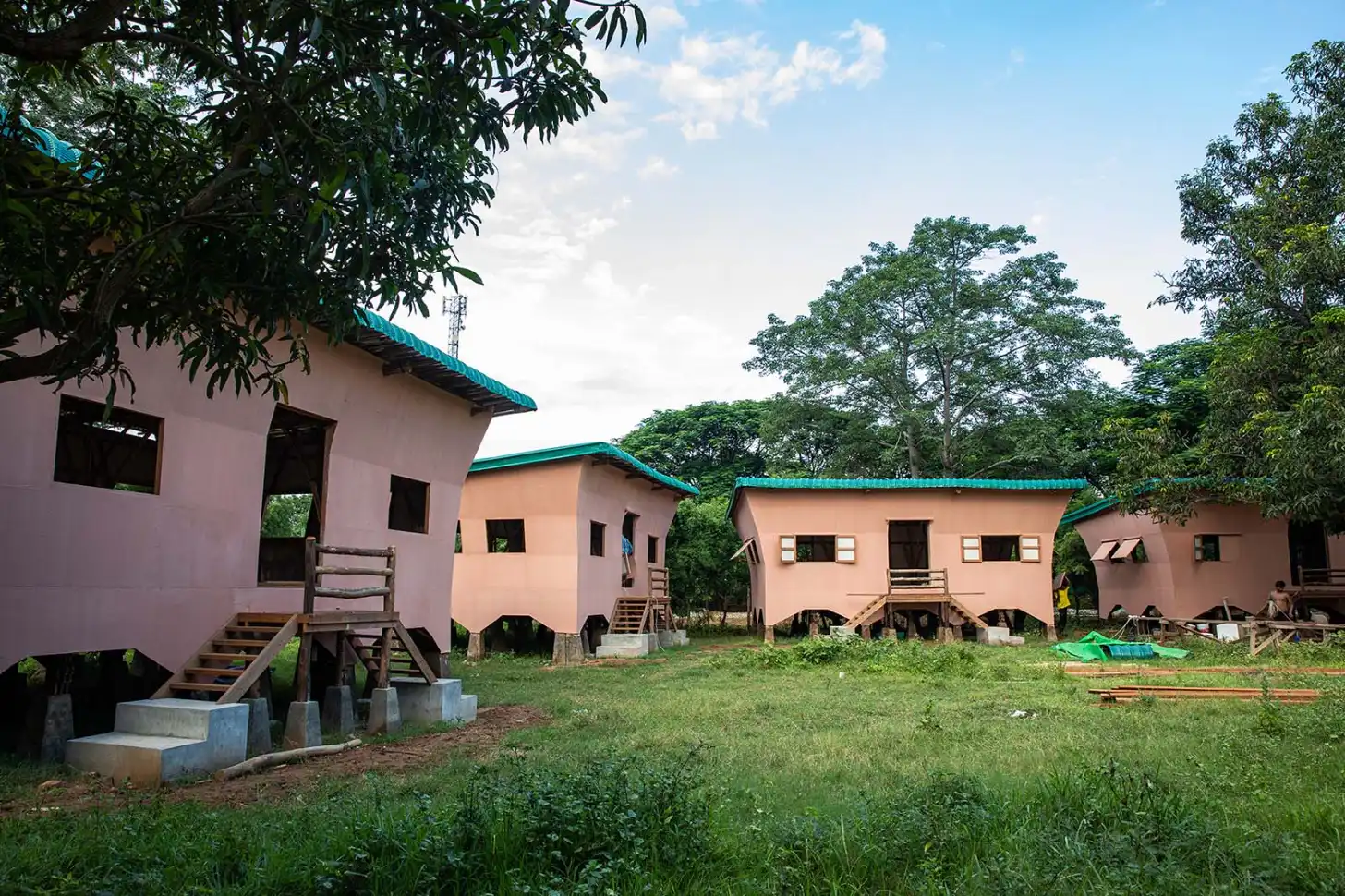
“Because of the organic [nature] of the bamboo that we weave together into the frames, it gives the house a bit of flexibility,” Ascoli explained to Fast Company. “Instead of being very stiff and brittle like concrete, it can move a little bit.”
The Blue Temple team worked on a myriad of prototypes, testing them to their breaking point, to make sure the homes could provide stability, along with scalability.

The homes are also raised on concrete plinths and have sloping roofs that shelter the structure. There are also windows on each home, with wooden steps into the main entrance. Each structure is small, with just one main room, but families use partitions and panels to separate them to make personalized layouts.
And soon, Ascoli hopes to give more families the tools they need to create their own homes. Blue Temple has recently rolled out a DIY construction manual that teaches people how to build their own bamboo homes using the methods they perfected with Housing Now.

“We’re basically trying to test out if there is an alternative to traditional humanitarian response,” Ascoli told Fast Company, as a response to the changing landscape of humanitarian aid in recent years.
The methods may evolve, but the Blue Temple mission remains the same.

“Our focus is on making high-performance architecture accessible under extreme constraints,” Ascoli told Dezeen, “using local materials, local labor, and prefabrication methods that can survive conflict and natural disasters.”
You may also like: Indian families living in slums given opportunity to transform one-room shacks into their dream homes
Featured Image: Courtesy of Blue Temple
In her home state of Florida, Sage LaJoie sees a lot of sea turtles on her daily commute.
On July 13, she was going for a morning run on the beach in Archie Carr National Wildlife Refuge when she came across a massive loggerhead sea turtle flipped on its back in the sand.
“When you spend as much time on the beach as I do, it’s pretty likely you’re going to come across marine life that needs help,” LaJoie wrote in an Instagram post.
Although LaJoie’s first instinct was to call her local Sea Turtle Preservation Society for help, a sea turtle stranding coordinator informed her that it would be hours before they could reach her location. She called two more rescues, to no avail.
“I could never leave a sea turtle alone in that position,” she said. “They are super vulnerable and can’t defend themselves at all.”
But as much as she wished she could, LaJoie knew she was not capable of flipping the sea turtle by herself. Adult loggerheads can weigh between 155 and 400 pounds.
So, LaJoie called her husband for support.
“I called him, and he quickly drove to my location, helped me dig around the sea turtle so we could safely flip her, and we got her on her flippers again!”
Surprisingly, when it came to helping a sea turtle in distress, this wasn’t LaJoie’s first rodeo. On June 16, the content creator posted a similar rescue — one that went on to garner 650,000 views.
“In honor of World Sea Turtle Day, I wanted to share an experience I had back in August of 2025,” LaJoie wrote in a video caption.
Before recounting her tale, LaJoie emphasized that the most important thing that someone should do when they find a stranded sea turtle is contact the Sea Turtle Preservation Society or Florida Fish and Wildlife Conservation Commission before handling it.
“When I found this green [sea] turtle, I called the STPS immediately,” she said. “The crazy part was, this was 2:40 p.m., meaning she had been there, on her back, for a very long time. Sea turtles nest during the night or just before dawn, so this poor sea turtle had likely been stuck like this for hours!”

“I knew she needed help, so after I called STPS, I ran about a half mile until I found a family that could help me … we worked together and were able to safely get her right side up, and we watched as she hurriedly made her way back into the water.”
LaJoie explained that they were instructed by experts to dig around her flippers to ensure they didn’t injure her as they flipped her upright.
“She seemed extremely relieved to head back into her ocean home,” she said. “As a direct neighbor of sea turtles, I feel it is my responsibility to protect and love my neighbors. I am so grateful that I found this beautiful green sea turtle that day, because otherwise, I highly doubt this vulnerable creature would have survived.”

The comments section beneath the video was filled with well wishes and praise.
“Always happy if I see more kindness to help each other for a better life,” one Instagram user said.
“I’m glad you helped her get back to the sea. I bet she was exhausted,” another commented.
One person took the time to caution other beachgoers by simply writing: “Fill in your holes.”
According to marine biologist Katherine Sayler, dramatic changes to the beach’s landscape can become harrowing obstacles to nesting sea turtles and their hatchlings.
“Keep beaches dark, flat, and clean,” advised Sayler, who serves as the southeast representative for the nonprofit Defenders of Wildlife. “That’s really the action item that everyday people can do to really help sea turtles rebound and increase in abundance.”
That includes knocking down sandcastles too — after its builder has left the beach or given their permission, of course.
“That kiddo probably got a lot of enjoyment out of building it, but now they’ve gone home, so they won’t know that their castle is no longer standing,” Salyer told Good Good Good.
You may also like: This sea turtle had an incredible 92-day recovery. See the day she finally got her barnacles removed
Although the Old Trails Fire in Spokane, Washington is now 100% contained, locals will be reeling from its destruction for the foreseeable future.
One such person is Donna Carberry.
Carberry’s home fell victim to the fire, but thankfully, with the help of her heroic dog, Shadow, she was able to escape with her life.
As the fire encroached on Carberry’s Spokane property, she had no idea her house was already on fire. She had lost her sense of smell as a lasting side effect of COVID-19.

But Shadow knew what to do.
“He kept trying to tell me nicely, and I wasn’t getting it,” Carberry said of Shadow.
So the three-year-old German Shepherd began slamming his body into Carberry’s back door, prompting her to investigate.
“By the time I got there and I opened the door up, my barn had already burned down,” she said.
At that point, the fire began to spread up the back steps of her house and was actively burning the side of the home.
“He literally saved my life,” Carberry said.
She knew she needed to evacuate but couldn’t catch her cat, Socksy. Once again, Shadow came to the rescue, gently putting his paw on the cat so Carberry could pick him up and carry him to safety.
As Carberry left the house, she saw even more destruction.
“Everything was on fire,” she said. “My truck and horse trailer burned up in the driveway ‘cause there was no time.”

Some good Samaritans in the neighborhood saw them struggling to leave the home and helped them move to safer ground on a nearby road.
“They took me over to Trails Road and sat me and the kitty and my puppy on the side of the road,” she recounted. “And it was, of course, just pandemonium.”
She decided to sit and wait it out a bit. But when she saw someone else evacuating her horses, the stranger stopped to ask how long she had been there.
“I said, ‘since noon on Saturday,’” Carberry said. “And she said, ‘Honey, it’s 8:00 on Sunday night.’”
The woman loaded Carberry and her pets in her truck and brought them to a Red Cross relief center.
Carberry had fallen during her speedy evacuation and was in need of medical attention. To recover, she would need to remain in a wheelchair, making her temporarily unable to care for her pets.

A neighbor stepped in to care for Socksy, while nonprofit Best Friends Animal Society, which was on-site at the relief center, quickly made arrangements to care for Shadow.
The nonprofit, which is leading the companion animal response for the Washington State Pet Task Force, is taking care of Shadow while Carberry recovers, ensuring he will have all the veterinary care he may need.
The organization has also helped Carberry and Shadow relocate to a safe place to stay while they rebuild.
“Best friends stepped up and stepped in and started taking care of Shadow for me,” Carberry said in a video for the organization.
“By … taking care of him, you’re taking care of me.”
“I don’t care about my stuff,” she added. “I just care about [Shadow].”
You may also like: Amid Spokane fires, local bootmaker turns headquarters into refuge for firefighters, distributes new shoes for free
Featured Image: Courtesy of Best Friends Animal Society
This story was originally published by Grist. Sign up for Grist’s weekly newsletter here.
California just became the first state to address a problem most people don’t know they have: inefficient tires.
When automakers design a new vehicle, low rolling resistance tires are one of the least expensive ways to improve fuel economy. But they must eventually be replaced, and experts say replacements are often less efficient. This can result in internal combustion vehicles burning more gasoline and EVs needing more electricity.
“It’s very difficult or impossible for consumers to know how energy efficient their tires are going to be,” said Brian Fadie, senior manager for state policy at the Appliance Standards Awareness Project. “As a result, many people unknowingly buy tires that cost them more money than necessary.”
On Monday, the California Energy Commission unanimously approved a rule that would phase in the nation’s first standards for tire efficiency. The rule is “designed to ensure that replacement tires sold in the state are at least as energy efficient, on average, as tires sold in the state as original equipment.”
It would also establish a labeling system that gives tires a “leaf” rating, to make it easier for consumers to find the best options. In addition to saving drivers money, the state projects that the changes could reduce carbon dioxide emissions by 2 million tons annually, which it says is equivalent to taking around 400,000 cars off the road.
“We are proud to approve the nation’s first replacement tire efficiency standards,” said commission chair David Hochschild, in a press release. “This action will help Californians save approximately $1 billion a year on refueling while reducing pollution and extending the range of vehicles on the road.”
California’s regulations will take effect in two phases, with the first targeting the most inefficient tires starting in 2029 and the second, stricter standard beginning in 2033.
The timeline is longer than initially proposed, to address the concerns of some manufacturers who wanted more time to adapt. The rule also comes with exemptions including snow tires and those used in competition. All-weather tires are also excluded, but the state will track them, as that growing segment may be regulated in the future.
Karim Marshall, director of climate and energy policy at the Consumer Federation of America, criticized the delayed timeline and the number of carveouts. But he said even that version of the rule marks significant progress.
“We aren’t going to let the perfect be the enemy of the good,” he said.
Bill Magavern, the policy director for the Coalition for Clean Air, a nonprofit focused on public health in California, agreed that the regulation was necessary.
“Manufacturers do not do the right thing on their own,” he said. “They need the government to set smart standards.”
Reducing the rolling resistance of a tire isn’t technically that difficult, said Fadie. Incorporating more silica, for example, improves not only efficiency but traction as well. Rubber chemistry and tread designs can also lead to gains. The debate centers around the cost of those improvements, and the tire industry appears split on the rule.
Some, like ENSO and Michelin, publicly endorsed at least parts of the rule. Speaking at Monday’s commission meeting, Francesca Mosteller, director of state and local government affairs for Michelin North America, said: “We support the efficiency goals and believe the proposed thresholds in this rulemaking are technically feasible within the defined timeframes.”
Others are opposed to the changes.
“These tires are broadly more expensive than the typical tire you find on the marketplace today,” said Christian Robinson, senior director of state government affairs for the Specialty Equipment Market Association, or SEMA, which represents the automotive parts industry. “Our concern is that this will create undue burdens on working-class families.”
The energy commission calculated that more efficient tires cost between $6 and $26 more per set, but that increase is more than offset by reduced fuel consumption. It put net savings at $85 to $153 over the lifetime of the tire when gasoline is $4.60 a gallon, though the savings could be 25% higher with this year’s price spikes. An estimate SEMA cited from consultant Gladfelty Government Relations, however, put the added cost as high as $365.20.
Robinson said he had hoped the commission would take a step back “given that there’s a disagreement about the economic impact.” But Marshall, the consumer advocate, said industry figures are misleading.
Whatever the case, the energy commission approved the rule. It’s a move that has been in the works since 2003, when the Legislature passed a law calling for such regulation. The state worked toward this goal for a few years but paused in 2007 when the federal government took over the cause. That effort never materialized and the project languished until about 2020, when the energy commission revived it.
With the rule now final, supporters say the impacts could be numerous and widespread. More efficient tires should, for instance, help EVs use less juice, easing demand on already stressed electric grids.
At the very least, the leaf rating system should make shopping easier. Similar to the Energy Star label, or the snowflake rating system for snow and all-weather tires, more leaves will mean a more efficient tire, with a four-leaf rating denoting the greatest efficiency. The one hitch is that manufacturers can choose whether or not to display the label, so consumers may have a look up the model in the state’s online database.
Everyone agrees that, given California’s size, this rule will likely spill over into other states.
“What happens in California doesn’t stay in California,” said Robinson, pointing to the state’s tailpipe emission standards, which 17 states and the District of Columbia now enforce. A similar ripple occurred with California’s LED lightbulb rules.
As for tire efficiency, Fadie said Washington and Rhode Island are among those considering following California’s lead. He added that these steps are important because, while the Golden State’s rule will likely buoy the national market, it’s not a guarantee.
“Other states,” said Fadie, “could create certainty for themselves.”
Featured Image: Pete Starman/Getty Images via Grist
Soon after the season three finale of “House of the Dragon” aired on HBO on August 9, Discover Magazine reported that the record-breaking fantasy series had inspired the name of a new species in western Thailand.
Scientists Poramad and Krittiya Trivalairat had climbed to an elevation of 4,396 feet in Thailand’s Mae Wong National Park to survey the location for dwarf mountain horned dragons.
Instead, they discovered a new type of horned dragon lizard that had never been recorded before: Acanthosaura syrax.
And it bore an uncanny resemblance to a fan-favorite dragon in the “Game of Thrones” universe.

“The specific epithet syrax is a noun in apposition, named in reference to the dragon ‘Syrax,’ the mount of Queen Rhaenyra Targaryen,” the Trivalairats and their peers observed in the study, which was published in the scientific journal Zookeys on July 31.
“This name is inspired by the species’ distinctive yellow-hued coloration, its relatively diminutive size compared to its congeners, and its significant reproductive output, reflected in its high clutch size.”
In the study, the researchers recommended that the local government and national park authorities strengthen protections for the high-elevation habitats — not just for the newly discovered lizard, but for the other imperiled species that call the region home.
“We recommend adopting this new species together with other threatened creatures: Asian forest tortoise, Oldham’s leaf turtle, grey-sided thrush, rufous-necked hornbill, and the Indochinese tiger as flagship representatives for the Mae Wong region to draw scientific and public attention to the conservation of Thailand’s rapidly changing mountain ecosystems.”

This is far from the first time that pop culture has inspired naming conventions in the scientific community.
In 2025, a glossy black wolf snake, Lycodon irwini, was named after beloved “Crocodile Hunter” star Steve Irwin.
That same year, scientists named a new species of half-male, half-female spider Damarchus inazuma after Inazuma, a genderfluid “One Piece” character.
Not long before, a species of soft coral was named Iridogorgia chewbacca after the beloved Wookie in the “Star Wars” franchise.
And back in 2023, Harrison Ford inspired the name of a new species of snake discovered in Peru’s Andes Mountains. The gesture was ironic, given the actor’s famous “Indiana Jones” quote: “Snakes, why did it have to be snakes?”
“These scientists keep naming critters after me, but it’s always the ones that terrify children,” he joked in an interview with The Hollywood Reporter. “I don’t understand. I spend my free time cross-stitching. I sing lullabies to my basil plants so they won’t fear the night.”
Ford, who has been an environmental advocate for decades and also inspired the name of an ant (Pheidole harrisonfordi) and a spider (Calponia harrisonfordi), then dropped the bit to express his gratitude.
“In all seriousness, this discovery is humbling,” he said. “It’s a reminder that there’s still so much to learn about our wild world — and that humans are one small part of an impossibly vast biosphere.”
“On this planet, all fates are intertwined, and right now, one million species are teetering on the edge of oblivion. We have an existential mandate to mend our broken relationship with nature and protect the places that sustain life.”
You may also like: Spectacular blue 'cavern creature' spotted on expedition. It's a new species
Featured Image: Courtesy of Theo Whiteman/HBO
The first fully solar-powered luxury train in Latin America is rolling into the station: Argentina’s Tren Solar de la Quebrada.
It’s been operational for about two years now, but the Quebrada solar train, located in the province of Jujuy, is still attracting new fans and tourists.
The train can hold up to 388 passengers, with 72 seated, and is powered by a 352-kilowatt-hour battery pack. This, along with “regenerative braking” on downhill parts of the journey, easily accommodates the standard 52-mile round trip on one charge.

That said, each of the six stations on the route has EV-style chargers for the train to charge up, in the event that it needs more juice. There is no combustion engine anywhere on the vehicle.
Not only does the passenger train emit no noise or emissions, but its 26-mile route connects one of UNESCO’s World Heritage Sites.
Departing from the village of Volcán, the two-car train cuts through Quebrada de Humahuaca, known as one of South America’s oldest cultural corridors.
Clocking in at about 10,000 years old, the ancient canyon was a trade route first traveled by hunter-gatherers, and later, Indigenous traders, Inca messengers, Spanish colonists, and railway workers.
Over the course of history, the route has been a constant, and now it merges that long lineage with modern solar power innovation. The route is lined with stunning rock formations and red hillsides that make for gorgeous views.
“Quebrada de Humahuaca follows the line of a major cultural route, the Camino Inca, along the spectacular valley of the Rio Grande, from its source in the cold high desert plateau of the High Andean lands to its confluence with the Rio Leone some 150 kilometers to the south,” UNESCO describes the valley on its world heritage profile.
“The valley shows substantial evidence of its use as a major trade route over the past 10,000 years. It features visible traces of prehistoric hunter-gatherer communities, of the Inca Empire, and of the fight for independence in the 19th and 20th centuries.”

For locals hoping to learn more about the region and enjoy a scenic ride — or tourists wanting an immersive experience — the Quebrada solar train provides an environmentally-friendly way to experience the site.
“One of the defining characteristics of the project is its social impact,” the train’s official site reads. “Of the more than 90,000 passengers transported in the last two years, around a third traveled as part of the Solar Train’s social responsibility program. In other words, one in three passengers accessed the experience through initiatives aimed at bringing the train closer to the community.”
The train runs daily across the 26-mile route, leaving from Volcán, and making stops in Tumbaya, Purmamarca, Posta de Hornillos, Maimará, and Tilcara. The culmination of the trip is the Hill of Seven Colors, or the Cerro de los Siete Colores, outside of Purmamarca, a “rainbow mountain” known for its beautiful stripes of color.
For a full tour of the route, there is a 360° Experience, which includes an on-board guide and six stops along villages throughout the route, giving passengers time to explore each town, along with food and activities at each destination. The total experience takes about 10 hours.

There is also a half-day option — aptly called the 180° Experience — in which passengers choose one of two round-trip routes. This includes a 15-minute break for coffee and exploration, but the total trip only lasts about an hour and a half.
The 360° Experience starts at $134 per person for visitors, while the 180° Experience starts at $53.

From the beginning, the Quebrada solar train has represented a commitment to sustainable tourism, its website reads, hoping to engage visitors in the area’s rich history while still protecting the natural environment.
“The Solar Train of the Quebrada is not only a means of transport, but a declaration of commitment to the environment and cultural heritage of the region,” the website reads, “inviting travelers to discover and preserve the beauty of Jujuy while enjoying an unforgettable journey.”
You may also like: University students invent first-ever solar-powered ambulance. It provides fully off-grid care in rural areas
Featured Image: Tren Solar de la Quebrada/Facebook
- Fieldworkers at the Jantho orangutan release forest in Aceh, Indonesia’s westernmost region, have recorded the 10th birth by orangutans successfully released back into the wild from a charity-run rehabilitation center.
- Indonesia’s forestry minister named the baby Badar, which means a full moon, and highlighted the need for consistent protection of orangutan habitats in Borneo and Sumatra islands, which are home to Indonesia’s three species of orangutan.
- However, a new study on Sumatran orangutan populations published in the September issue of “Global Ecology and Conservation” concluded that surviving populations likely declined by nearly 20% between 2011 and 2023.
Seven years after being returned to the forests of northern Sumatra from a rehabilitation facility, a female orangutan rescued from traffickers has been found nurturing a baby in the wild, giving new encouragement that reintroduced apes can establish breeding populations.
“From victim of illegal wildlife trafficking to a mother in the wild, Bulan’s journey demonstrates the long-term value of orangutan rehabilitation and reintroduction,” said M. Yakob Ishadamy, conservation lead at the Lestari Ecosystem Foundation, an organization that manages the Jantho reservation in partnership with Indonesia’s forestry ministry.
Fieldworkers confirmed the birth of the Sumatran orangutan (Pongo abelii) on May 22 this year after seeing Bulan moving across the forest canopy cradling a male infant believed to be about a month old.
Indonesia’s forestry minister named the baby Badar, a Malay word with Arabic origin meaning “full moon.” The mother’s name, Bulan, also means “moon” in Indonesian.
“This birth is proof that through consistent habitat protection, we can restore populations of endangered endemic species,” Forestry Minister Raja Juli Antony said in a statement. “Hopefully, Badar can thrive in the wild and bring a new glimmer of hope for the sustainability of our invaluable forest ecosystem.”
Indonesia established the Jantho Orangutan Release Area within the Jantho Nature Reserve in Aceh province, on the northern tip of Sumatra, in 2011. It serves as a reintroduction site for rehabilitated Sumatran orangutans recovered from the illegal wildlife trade and instances of conflict with humans.
Rescued orangutans have typically endured significant trauma, both at the time of capture and the ongoing experience of captivity.
The program aims to establish self-sustaining wild populations by returning healthy animals to a reservation habitat.
The Jantho forest sanctuary contains a high density of fig trees, which provide the primary food source for orangutans, and is connected to the Leuser Ecosystem, where the vast majority of remaining Sumatran orangutans live.
Castri Delfi Saragih, spokesperson at the Lestari Ecosystem Foundation–Sumatran Orangutan Conservation Programme, said Badar was the 10th confirmed birth in the Jantho Orangutan Release Area since the program began 15 years ago.
However, a new study published this year estimates that just 11,694 Sumatran orangutans remain in the wild, a 19.5% decline from 2011 to 2023.
While deforestation remains by far the main threat, populations in some areas have fallen faster than forest loss alone can explain, the researchers concluded, pointing to human conflict and habitat fragmentation as additional pressures.

“This is a warning that must be met with concrete action,” said Syafrizaldi Jpang, executive director of the Lestari Ecosystem Foundation–Sumatran Orangutan Conservation Programme. “With this data, we know exactly what challenges we face.”
Ujang Wisnu Barata, head of the Aceh provincial conservation agency, said Bulan’s journey from wildlife trafficking victim to mother in the wild showed rehabilitation efforts could help support orangutan populations.
“This birth demonstrates how orangutans, once victims of the wildlife trade, can be given a second chance to live and reproduce in the wild,” Ujang said. “Successes like this can only continue if their habitat remains protected.”
This article was originally published on Mongabay.
Featured Image: Andi Saputra/YEL-SOCP