A 7.4 magnitude earthquake rocked Cali, Quibdo, Pereira, and numerous other cities and towns in Colombia on Monday, according to the Associated Press.
Around 1,600 buildings have been reported damaged or collapsed, and over 3,000 people are still missing as of Tuesday morning. Colombian President Abelardo de la Espriella said the death toll is now 181, with 2,595 people hurt.
Search and rescue efforts continue as humanitarian relief organizations descend on the country.
The earthquake’s epicenter was in the northwestern department of Chocó, but the tremor was felt strongly about 150 miles away in the capital city Bogotá, CNN reported. Officials say it’s the strongest earthquake recorded in Colombia in the last decade.
Fundraising platform GoFundMe has just created a hub page to help people affected by the earthquake.
The hub contains verified fundraisers for locals who have created their own GoFundMe pages, as well as nonprofit organizations that are responding in the area. Currently, the nonprofits listed for their support in the area include All Hands & Hearts, Food For The Poor, and Americares.
The hub provides one simple page for people who want to make a difference to find fundraisers to support.
On the hub, the GoFundMe page reads, “As search and rescue efforts continue, communities across the region are beginning the long road to recovery. Find where help is needed. Support for verified relief fundraisers and nonprofits will help those affected continue their recovery. Our Trust & Safety team will continue to update this page with more fundraisers as they are verified.”
According to GoFundMe, every fundraiser displayed on GoFundMe hub pages is verified by the platform’s “Trust & Safety experts.”
Donations on GoFundMe are protected by the “GoFundMe Giving Guarantee” — which offers a full refund if something isn’t right. On rare occasions when a GoFundMe fundraiser is found to be fraudulent, misused, or otherwise violates policies, the platform will give donors their money back, no matter where they donated from, for a full year after donating.
Featured Image: Courtesy of GoFundMe
In 2023, professors from a myriad of colleges published a study on the mental health benefits of reaching out to one’s friend or family at least once a day.
The study, which was published in the science journal Communication Research, involved 900 participants from five university campuses before, during, and after the 2020 pandemic lockdowns.
Throughout the study, the students were asked to engage in one of seven social interactions and report back the same night to see how each one affected their well-being.
The seven behaviors included catching up with someone, engaging in meaningful conversation, joking around, showing compassion, listening, valuing another person’s opinion, and offering sincere compliments.
Certain students were assigned the different behaviors at random, with a control group receiving none.
Overall, researchers found that the act of intentionally reaching out to a friend or loved one, in any regard, made a notable difference in one’s well-being.
“Results suggest that engaging in as little as one communication behavior with one friend in a day can improve daily well-being,” observed Jeffrey Hall, lead author and professor of communication studies at the University of Kansas.
Christina Thomas, a licensed professional counselor, told Texas Health that the study highlights how important socializing has become, especially in the years after COVID-19 first spread.
“The truth is when we are pulled in so many directions, there is a certain level of mental isolation that we experience,” Thomas said. “Even though the study doesn’t mention a length of time, it is pretty apparent that offering a sincere compliment or catching up doesn’t really need so much of your time. [Even] small interactions foster a sense of belonging and acceptance.”
In 2026, a new study commissioned by Madrí Excepcional set out to see if there was an exact science to the “perfect” hang out.
When the beer company surveyed their British customers, they found that the ideal time for a catch-up with friends averaged out to 84 minutes.
According to those surveyed, 84 minutes is enough time to cover all the essentials that make a catch-up feel worthwhile.

In descending order, people ranked favorable conversation topics as “family updates,” “friendship group gossip,” “work news,” “relationships,” and “upcoming travel plans.”
Additionally, 62% preferred shorter, more frequent hangouts with friends than sporadic, large-scale social events.
And while nearly half of respondents said that social plans have become more scheduled than they were five years ago, nearly seven in ten people said they were open to more spontaneous hangouts with friends.
But not everyone has 84 minutes to spare every day.
In her interview with Texas Health, Thomas argued that even the smallest amount of time dedicated to checking in on a friend could make a world of difference.
“We don’t have to check in with our friends every single day, and we don’t need to spend hours on end on the phone either. It’s all about prioritizing and setting time apart for a quick text message or a call,” Thomas said.
“You can put aside about 5 minutes a day to quickly respond back to messages, whether that be at the start of your day, at the end, or somewhere in the middle.”
You may also like: New study finds that friendships literally lengthen your lifespan
Featured Image: Julio Lopez/Pexels
In January, as her curiosity about data centers grew, longtime Pennsylvania environmental activist Karen Feridun turned to Facebook to create a group she hoped would allow those who felt similar to ask questions, too.
Two months later, the group surpassed 500 members. And in the weeks that followed, the numbers continued to grow. During some weeks, more than 1,000 new people signed up.
Today, the Pennsylvania Data Center Resistance Facebook group has more than 41,000 members.
“It really took off in ways that shocked me,” Feridun said. “It’s clearly of interest to people in a way that I’ve never seen an issue be of interest.”
The influx of users to the Facebook group reflects the surging discourse about data centers across the state, seen in grassroots social media groups, internet search traffic, and the flurry of bills sponsored by state lawmakers. It’s all in response to souring public opinion as new projects are proposed across the state.

A Quinnipiac University poll of 895 Pennsylvania voters conducted last month found that 74% opposed having a data center built in their community while 16% said they supported it. Three-quarters of respondents said they were following news about AI data centers either very or somewhat closely.
“The issue’s salience to Pennsylvania voters has seen a rapid increase over the last year,” said Chris Borick, a political science professor at Lehigh University. “Not only is it an issue that Pennsylvanians increasingly said is important to them, it’s an issue that they’re incredibly concerned about in terms of the impact on their lives.”
That “meteoric” increase, as Borick noted, has altered the political landscape in the state. There’s no comparable environmental — or even general political issue — has transcended party lines like this, he added.
The Pennsylvania Data Center Resistance Facebook group began to rapidly grow this past spring. Gov. Josh Shapiro announced Amazon’s $20 billion investment to build AI data center infrastructure across Pennsylvania in June. Around that same time, Pennsylvanians began searching for information about data centers more often.
Google users from the commonwealth showed a growing interest in the search terms “data centers” and “AI data centers,” throughout 2025 until last month, according to data from Google Trends. It measures search interest relative to a term’s greatest popularity. The relative interest in both terms peaked in May.

Sarah Jackson, a professor of communications at the University of Pennsylvania, said she suspects more people are organizing around the issue not necessarily as a result of shifting public opinion, but because they are directly impacted.
“For many people, [data centers] seemed a far away thing if they knew they existed at all. But the combined economic and political power of the tech and energy industries has increasingly expanded into people’s communities,” she wrote in a statement.
Calls and messages to state legislators from constituents regarding data centers have also ballooned in recent months.
Sen. Katie Muth, (D-Berks), said it’s the number one issue her office is hearing about. Her staff said the office has received 504 emails about data centers so far this year. An additional 182 emails referenced high electricity bills as a concern relating to data centers.
And of the 807 calls her office has answered — encompassing 193 legislative issues — 72 have been about data centers.

Beth Rementer, a spokesperson for the House Democratic caucus, said that while the feedback expressed to different members varies, data center development has been among the top issues constituents contacted lawmakers about over the last six months.
“Overall, people are strongly opposed to letting data centers operate without any regulation,” she added.
Kate Flessner, a spokesperson for Senate Republicans said in a statement the perspectives of constituents are greatly beneficial to the work of the caucus.
“The issue of data centers is certainly evolving and regional perspectives throughout the Commonwealth are differing and warrant careful examination,” she said.
Borick, the political science professor, said the number of data center bills introduced by lawmakers in recent months is a clear sign they are “absolutely following opinion and concerns.”
“I think in Pennsylvania among other places, legislators in many ways were caught off-guard on how the public would respond to the proliferation of data centers and data center proposals,” he added.
During the current session of the General Assembly — which began in January 2025 and runs until November — lawmakers have introduced at least 30 bills aimed at regulating, or in some cases accelerating, data center development, according to a keyword search of the LegisScan database.

Amid budget negotiations, lawmakers introduced eight proposals on the issue in May and eight more in June.
The legislation introduced encompassed a wide range of proposals, from a three-year statewide moratorium, sponsored by Muth, to a bill sponsored by Sen. Greg Rothman (R-Cumberland) that, in its original form, would have expedited permitting and created a “regulatory sandbox” for data centers.
Several data center regulation bills were advanced by the Democratic-controlled House — including the plan backed by Shapiro — and nearly every lawmaker supported efforts to repeal an existing sales and use tax exemption for data center equipment.
Despite that consensus, the final $50.8 billion budget deal reached by lawmakers in July only included language requiring data centers with electric outputs larger than 10 megawatts to submit information annually about their energy and water usage.
“It’s hard for me to find an easy comparison point in terms of how it’s reordered things in the state in lots of ways — and so quickly,” Borick said of the politics surrounding data centers.
This article was originally published by Pennsylvania Capital-Star.
Featured Image: Peter Hall/Pennsylvania Capital-Star
COLUMBIA — A young boy looks directly into the camera with his arms wrapped around his pet rooster.
A boxer crouches in a fighting stance, gloves up in front of his face.
Nurses dressed head to toe in white in front of the home of Dr. Matilda Evans, the first Black woman licensed to practice medicine in South Carolina.

These images, featured in a collection of nearly 6,000 historic pictures by photographer Richard Samuel Roberts of Columbia’s Black families and community, are all available free to the public online for the first time.
“What we are seeing when we look at these pictures is African Americans the way they wanted to be seen and remembered,” said Rachel Young, a historian at the Center for Civil Rights History and Research at the University of South Carolina.
“We are also seeing people and places that have been erased, forgotten, or ignored by a broader historical record.”

The digitization of the Roberts collection is the culmination of a decades-long effort by the Roberts family, librarians, and researchers at the University of South Carolina.
In 1920, Roberts moved his family from Fernandina, Florida, to Columbia, settling at a home on Wayne Street in the heart of Ward One, a working-class Black neighborhood that has since been largely erased as the university has expanded.
From 4 a.m. until noon, Roberts worked as a custodian at the U.S. Post Office, earning a living to take care of his wife and five children. After his shift ended, he would go to the photography studio space he rented on Washington Street, where he captured images of his community through glass plate negative photography.

His studio was a single room, divided into dressing and waiting areas, a dark room, and a workspace. He designed special equipment to diffuse light, produce different-sized pictures and retouch negatives.
“I tell people that Richard Samuel Roberts was not simply a photographer, he was an artist, and he was also a historian,” said Bobby Donaldson, executive director of the civil rights center and a history professor at USC.
“He understood that one of his assignments was to tell a complete history of African American life in Columbia and in South Carolina, and he knew that he was telling a story that was against the prevailing narrative and stereotypes surrounding Black people,” he said.

Then, in the 1970s, former South Caroliniana Library field archivist Tom Johnson worked with the Roberts family to remove boxes of the negatives from the crawlspace of the family home, where they had been stored, to the university library, where they could be preserved.
Johnson worked with Philip Dunn, a photography instructor at the college, who took the negatives to his home dark room and developed some of them into contact sheets to see what they looked like.

What the pair found was compelling: photographs depicting a vast cross-section of Black life in the state capital during the early 20th Century, from farmers to socialites, babies to funerals, students to magicians, and businesses to community leaders.
They include Modjeska Monteith Simkins, the matriarch of the Civil Rights Movement in South Carolina, and celebrated school teacher Celia Dial Saxon.
“There’s just something different about these photos,” said Abby Cole, a spokeswoman for the university’s library system. “There’s some depth of humanity.”

The collection was officially purchased from the Roberts family estate in 2020, with “tens of thousands of dollars” raised by the University South Caroliniana Society, Cole said, without specifying. Then, in 2024 the civil rights center paid students to digitize the photos, turning them into a living collection viewable by all.
Some of the people pictured are named in the collection. The center and libraries hope people continue to engage with the collection now that it’s online by identifying those they know in the photos.
“We know photographs have a way of piquing interest and stirring up memories in individuals,” Donaldson said. “These photographs push people to dig in the deep recesses of their mind and their memory, and they begin to recall details that probably would not come as easily without images to facilitate them.”
Viewers of the collection can click a box to submit identifications or notes on each image.
Many of the people pictured have descendants who still live in Columbia today.
They include Family Court Judge Michelle Hurley. Hurley grew up in Columbia, a graduate of Heathwood Hall, Howard University, and USC School of Law. When she was younger, she worked at her family’s funeral home, writing obituaries.
The Manigault-Hurley Funeral Home served the Black community in Columbia for almost a century. Hurley’s grandmother, Anna Mae Manigault-Hurley, was the first female embalmer, white or Black, to be licensed in the state.

Hurley’s great-grandparents also lived next door to Roberts and saw first-hand the impact he had.
“People wanted their stories told, so they went to Mr. Roberts,” Hurley said.
“These photos tell the stories of people’s families, and help people identify their ancestors,” she added. “They bring that history home so people can say, ‘This is who I am, these are the people I come from.’”

One of Roberts’ surviving grandchildren, Judge Richard Warren Roberts, grew up in New York hearing stories about his grandfather.
“It’s one thing to be able to get a two-dimensional paper with your ancestry on it, but it is another thing completely to be able to see your family members in photographs like these,” he said. “You can see the clothes they wore which could signal where they were employed, or what they did for a living. These kinds of revelations infuse people with a greater sense of self.”

As a student, before coming to work for the university libraries, Cole was among those who helped digitize the collection. They scanned the thousands of the negatives, at first on a flatbed scanner and then with a high-end camera scanner. While some of the glass plates were in near perfect condition, others were cracked or deteriorating.
“It was a passion to kind of recapture that history,” Cole said.
“These are communities that have been kind of pushed aside or taken advantage of,” Cole added. “And there’s a lot of distrust historically between minorities and universities or archives, because archives decide what stories get told and in what way. This was an effort to rebuild those bridges and to show these communities we want to preserve your story, in addition to those stories that are more predominantly told.”
This article was originally published by South Carolina Daily Gazette.
Featured Image: Courtesy of USC libraries/Richard Samuel Roberts collection
Kazakhstan has released its first tiger into the wild more than seven decades since the last confirmed sighting of the big cat in the country.
On July 31, 2026, an adult female Amur tiger called Umit, which means “hope” in Kazakh, leapt from her cage on the back of a pickup truck, as she was released into the wilderness of the 1.1 million-acre Ile-Balkhash State Nature Reserve in southeastern Kazakhstan.
According to a statement issued by the Kazakhstan government on Aug. 3, Umit is fitted with a satellite tracking collar to monitor her movements and behavior in real time.
“Today we are truly witnessing a historic event,” said Kazakh Ecology and Natural Resources Minister Yerlan Nyssanbayev in the statement. “For the first time in over 70 years since tigers were wiped out in Kazakhstan, a tiger has been reintroduced to its historic range.”

The area of the Ile-Balkhash Reserve where Umit was released was once inhabited by the extinct Caspian (Turian) tiger. Its last confirmed sighting in Kazakhstan was recorded in 1948.
Umit is an Amur tiger, a population of the mainland Asian tiger (Panthera tigris tigris) native to the Russian Far East and northeastern China.
The Amur and Caspian tigers were once recognized as two distinct tiger subspecies, but the IUCN recognized both as Panthera tigris tigris in 2017.
Preparations for returning tigers to Kazakhstan have taken more than a decade, the Ministry of Ecology and Natural Resources said.
The reserve was established in 2018 to create the necessary conditions for the tigers’ return to the wild, including efforts to increase the population of their natural prey, such as Bukhara deer (Cervus hanglu bactrianus) and kulan (Equus hemionus kulan).

The Kazakh government chose Amur tigers after research showed their genetic makeup was almost identical to that of Caspian tigers, which went extinct owing to habitat loss and hunting by humans.
Umit is one of four Amur tigers gifted to Kazakhstan by Moscow. Captured from the far-eastern Russian region of Khabarovsk Krai, the animals — two adult tigers and two cubs aged around six to seven months — were flown to Kazakhstan in May 2026, ahead of Russian President Vladimir Putin’s visit.
Amur, the adult male tiger, and Turan and Ussuri, the two cubs, are currently living in adaptation enclosures in the Ile-Balkhash reserve, local Kazakh media has reported.

According to the Kazakh government’s statement, Amur is undergoing behavioral tests and will be released into the wild after they’re completed and experts confirm he’s fully prepared to survive on his own.
Meanwhile, the two cubs are expected to stay in the special enclosures until they are at least 18 months old. “After veterinary examinations and behavioral tests for each tiger are completed, an individual decision will be made on the possibility of releasing them into the wild,” the statement said.
This article was originally published on Mongabay.
Featured Image: Courtesy of Kazakhstan’s Ministry of Ecology and Natural Resources
When a wildfire is headed your way, evacuating may sound straightforward: Gather your belongings, get in the car, and leave.
In reality, it is one of the most complex decisions a person can face.
Fast-moving fires, shifting winds, heavy smoke, and limited escape routes can quickly turn an orderly evacuation into gridlock. In many wildfire-prone communities, especially those built into steep hillsides or surrounded by forests, neighborhoods often have only one or two roads leading to safety. When hundreds or even thousands of residents try to leave at the same time, traffic can slow to a crawl.
Recent disasters — including the 2018 Camp Fire that devastated Paradise, California; the Los Angeles-area fires in 2025; and now the Spokane, Washington, fires that have burned more than 800 structures — demonstrated how rapidly changing fire conditions can overwhelm evacuation plans.
In Paradise, for example, the wildfire blocked key evacuation routes, and a state report found residents were confused by the evacuation advisories.
The challenge isn’t only the roads. Extensive research shows it’s also human behavior.
Residents must decide when to leave, what to take, which route to follow, and where to go, often while under intense stress. Research has consistently shown that factors such as risk perception, preparedness, confidence in evacuation plans, and familiarity with local routes all influence whether people evacuate early, delay leaving, or choose to stay behind.
That’s where evacuation drills, like the one Spokane carried out just three months before the destructive wildfires, can make a difference.
The value of practice
Rather than asking residents to imagine what they would do during an emergency, community drills allow them to practice it. Families experience how long it takes to prepare, navigate neighborhood roads, and reach safety. Emergency managers can observe traffic patterns, identify bottlenecks, and evaluate whether existing evacuation plans are realistic.
In late April 2026, Spokane conducted a large, highly publicized evacuation drill in areas southeast of some of the neighborhoods threatened by fire a few months later, and officials and residents learned from the response.
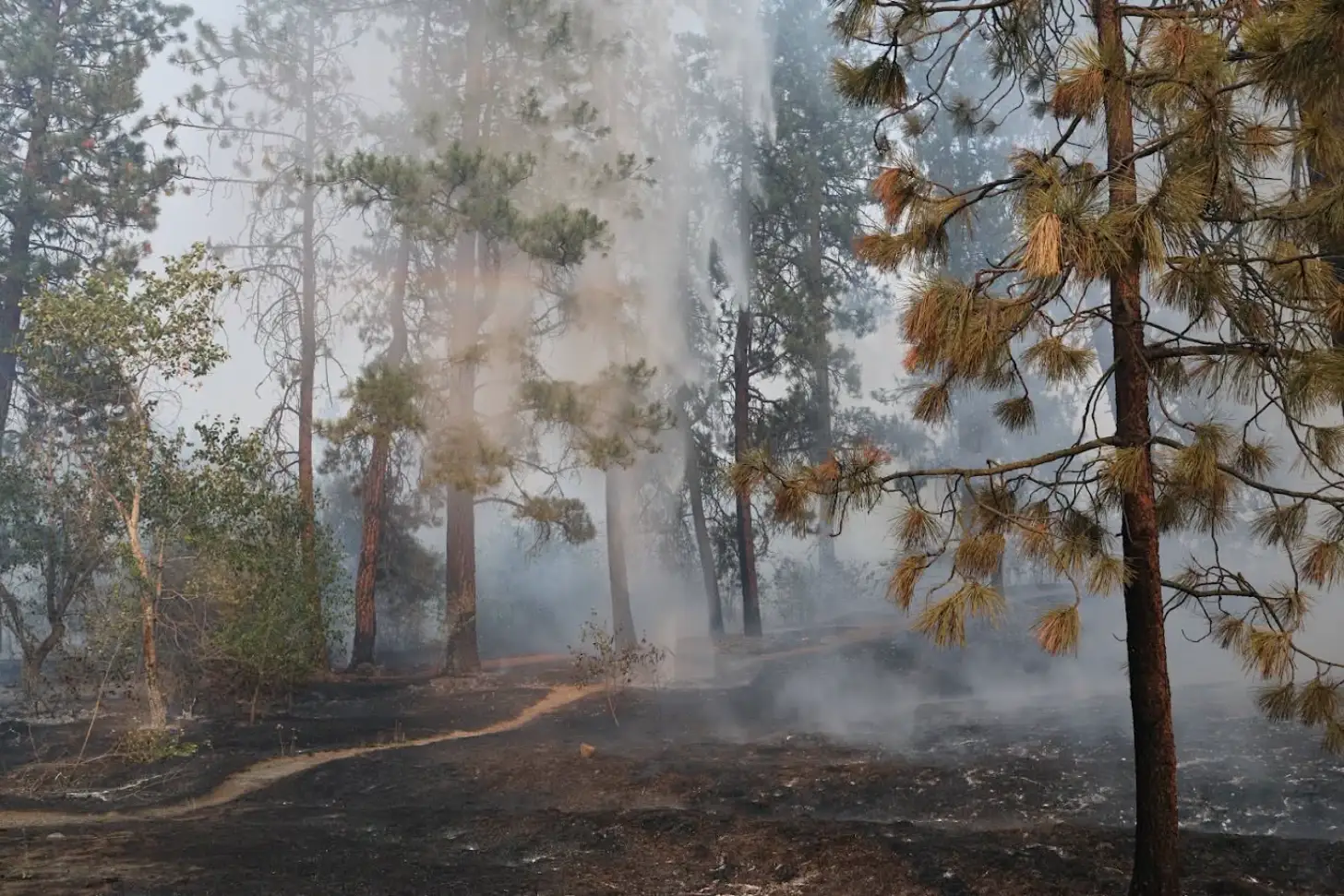
The city of Spokane, led by Director of Emergency Management Sarah Nuss, in partnership with the Spokane Fire Department, held its second community-wide wildfire evacuation drill in the Eagle Ridge neighborhood in April 2026. More than 950 vehicles participated, nearly three times the number that took part in the city’s first drill the previous year, making it one of the largest neighborhood evacuation exercises of its kind in the region.
The value of drills extended far beyond counting vehicles. The city learned about evacuation bottlenecks, the types of warnings, and directions that were most effective and other challenges. The exercise also encouraged residents to sign up for emergency alerts, familiarize themselves with evacuation routes, and think through critical decisions before an actual wildfire threatened their homes.
I’m a geoscientist who also studies disaster response at Boise State University, and I was in Spokane to assist with the evacuation drill in April. Afterward, I asked Nuss about the benefits of the drill.
“The feedback has been encouraging, particularly around preparedness and ensuring people are signed up for alerts and notifications,” Nuss told me. “Beyond the evacuation exercise itself, the event increased awareness of wildfire evacuation procedures and helped residents better understand how to prepare and respond.”
Spokane puts its lessons to work
The value of practicing before disaster strikes is no longer theoretical in Spokane. On Aug. 1, 2026, three wildfires began racing through suburban neighborhoods in high winds and dry conditions. More than 60,000 people had to quickly evacuate their homes and neighborhoods.
The city’s new understanding of evacuation response times and how to deploy traffic assistance also mattered. The city amplified fire-weather warnings that had been issued the day before, and it quickly deployed officers and National Guard troops to alert neighborhoods, direct traffic, and open emergency shelters for residents. The Veterans Affairs hospital was ready to implement its emergency plan when the “go now” order was issued to evacuate patients and medical staff to other hospitals or shelters.

The three fires, collectively known as the Spokane Complex Fire, burned hundreds of homes to their foundations as the flames moved quickly from house to house. Residents had little time to escape, yet early reports suggested everyone survived.
For those who participated in or heard about the drill, the decisions they had to make in August may have felt more familiar, helping transform preparation into action when every minute counts.
The 2026 Spokane wildfires, and the Gray and Oregon fires that burned more than 350 homes near the city in 2023, are part of a broader pattern of rising fire risk in neighborhoods at the edges of wildlands across the western United States.
As more people move into the wildland-urban interface — areas where homes and communities border or intermingle with flammable vegetation — the need for effective evacuation planning has become increasingly urgent.
So, what does an ideal evacuation look like?
The most effective evacuations begin long before a wildfire — or hurricane or tsunami — starts.
First, create a household evacuation plan. That includes thinking about the disasters your area could experience, planning where to meet, what to do if your family is separated, and knowing where you’ll go, whether that’s a shelter, a hotel, or a friend’s house.
To be ready during high-risk periods:
- Have a go bag ready with essential medications, important documents, pet supplies, and clothing.
- Identify multiple evacuation routes and a safe destination.
- Sign up for local emergency alerts and monitor trusted sources, such as the city’s or county’s emergency management websites or social media pages, for updates.
- And, of course, participate in planned evacuation drills to test your household evacuation plans. If your community doesn’t hold evacuation drills, practice the procedures and routes yourself. You’ll quickly see that getting everything and everyone out the door can be more time-consuming than you think. You can also ask your local emergency management office to hold a drill in your neighborhood.
When a wildfire is nearby, pay attention to official sources. Pack your vehicle as soon as you know there might be a problem, and be ready to go. Once an evacuation order is issued, leave promptly. Follow official routes, and expect heavy traffic and limited visibility.
It’s easier to keep everyone safe if you’ve prepared, have a plan, and have practiced it.
This article was written by Ashley Bosa from Boise State University and was originally published on The Conversation.
Featured Image: City of Spokane Fire Department/Facebook
Taxi and ambulance drivers are less likely than workers in almost any other job to die of Alzheimer’s disease. That was the surprising result of a 2024 study examining the death certificates of nearly 9 million people in the U.S.
These findings stopped me in my tracks because those two jobs rely on the same thing as my own work: Maps.
I have spent more than two decades staring at maps. Not paper maps on a wall, but digital ones with multiple layers: flood boundaries draped over census blocks, car crash hot spots plotted against road geometry, and satellite readings of rainfall stitched across river basins.
Much of my work as a civil and environmental engineer is done through GIS — that is, geographic information systems. Engineers like me hold several spatial relationships in their minds at once, reasoning about where things sit relative to one another across scales ranging from a city block to a whole watershed.
I always assumed that spatial reasoning across map layers was purely professional. But that study on taxi and ambulance drivers made me wonder whether all that mental work might be doing something good to the brain.
Taxi driver brains
Of the 9 million death certificates from January 2020 to December 2022 that researchers examined, taxi and ambulance drivers had the lowest risk of dying from Alzheimer’s disease out of 443 occupations. After adjusting for age, sex, race, ethnicity, and education, roughly 1 in 100 taxi and ambulance drivers died of Alzheimer’s, compared with 1 in 60 people overall.
This pattern did not extend to other driving jobs. The researchers concluded that the key to reducing the risk of Alzheimer’s was not driving itself but continuous real-time navigation: the constant work of locating yourself in space, tracking a destination, and updating a mental map as conditions change.
Drivers whose jobs relied on fixed or predetermined routes, like bus drivers and aircraft pilots, didn’t seem to experience a similar advantage.
Researchers believe the association between navigation-heavy work and lower Alzheimer’s risk centers on the hippocampus, a part of the brain that governs memory and spatial navigation. It’s one of the first brain regions that Alzheimer’s damages: Problems with spatial navigation and orientation are among the earliest signs of the disease, sometimes surfacing before obvious memory loss.
In one landmark 2000 study, neuroscientists compared the brains of licensed London taxi drivers with those of people who did not drive cabs. Their findings provided the first evidence via structural imaging that regions of the adult brain can measurably change under sustained navigational demand.
To earn a license, London cabbies must memorize more than 25,000 streets within a 6-mile radius of Charing Cross, a challenge known as “The Knowledge” that takes three to four years.
The researchers found that London taxi drivers had measurably more gray matter in the posterior hippocampus, a brain area tied to storing large-scale spatial maps. That volume tracked with experience: The longer someone had driven, the larger that part of the brain.
The change was built through practice, not inherited. While people who are good at navigation might gravitate to this kind of job, the job itself does have an impact on the brain.
Together, these two studies make a coherent case: Work that intensively exercises the hippocampus may reshape it, and that reshaping may protect against one of the most feared diseases of aging.
Where map specialists fit in
Cartographers, urban planners, and geospatial analysts spend their working days in sustained spatial reasoning. A geographic information system specialist might use a computer to overlap population data on flood exposure maps to find who is at risk, or read satellite imagery to map land cover after a wildfire. Researchers juggle several layers of data, coordinate systems, and scales at once.
Does spatial reasoning through a screen engage the hippocampus the way moving through a real city does?
While a taxi driver navigates from inside the scene at street level, GIS researchers picture space from above as a map — what cognitive scientists call allocentric reasoning. But these two perspectives overlap in the brain: The hippocampus also builds maps from outside viewpoints, not just from a navigator’s own position.
Research on cognitive maps points toward the same conclusion as the study on taxi drivers. In 2023, researchers ran a machine learning model on more than 22,500 people in a national dataset and were able to predict which ZIP codes had higher rates of Alzheimer’s with 84% accuracy based on how complex the environment was.
Those living in spatially complex surroundings — the kind that force active map-building, such as dense street networks with numerous intersections, diverse points of interest and landmarks, and multiple path options — were less likely to develop Alzheimer’s.

A follow-up study tied geospatial complexity in one’s environment to greater volume in the brain’s spatial navigation regions. The researchers hypothesized that routinely building cognitive maps exercises the very circuitry that Alzheimer’s attacks first. Repeatedly engaging the cognitive systems involved in spatial navigation could help delay symptoms of disease.
However, these two studies focus on where people live, not the work people do. Whether spatial reasoning through a screen exercises the same circuitry as real-life city navigation remains untested.
Protecting your brain
The implications of whether sustained spatial reasoning protects the brain reach beyond mapmakers and cab drivers. Studies have repeatedly found a link between mentally complex occupations and delayed cognitive decline and lower dementia risk, even after accounting for education.
Research on cognitive reserve — the brain’s capacity to continue functioning despite disease — can help explain why two people with a similar disease burden can show markedly different levels of cognitive impairment. If demanding spatial thinking protects the brain, then how societies design schooling, professional training, and retirement all become questions of brain health.
Spatial reasoning can be trained, and training opportunities are already widespread. GIS and remote sensing instruction are available through geography, engineering, public health. and environmental science programs worldwide.
If sustained engagement with spatial reasoning can help the brain strengthen the circuitry that Alzheimer’s attacks first, its value reaches well beyond the technical skills it builds.
This article was written by Hatim Sharif from the University of Texas at San Antonio and was originally published on The Conversation.
Featured Image: José Martín Ramírez Carrasco/Unsplash
Australia’s Great Barrier Reef is a true natural wonder: a unique and diverse underwater seascape the size of a small country.
However, cycles of disturbance and recovery threaten to turn its colorful coral gardens into algal-dominated seascapes — then back again. And these cycles are becoming more volatile as our world warms.
At the Australian Institute of Marine Science, we’ve been documenting these changes for the past four decades through our Long-Term Monitoring Program. This is one of the longest records of continuous coral reef data in the world.
Concerningly, we’ve watched the health of the Great Barrier Reef begin to fluctuate dramatically over the past 15 years. The 2024 mass coral bleaching — where a record-breaking marine heatwave bleached coral reefs from the Caribbean to the Indian and Pacific Oceans — was particularly destructive. It caused the largest single-year decline in coral ever measured in two regions.
However, our latest report reveals some promising signs of recovery.

In hot water
In 2025, the Great Barrier Reef endured its sixth coral bleaching since 2016 — one of only two back-to-back bleachings in the reef’s history.
However, our latest survey data shows the 2025 bleaching was smaller and less severe than in 2024. This means substantially less coral died, showing not all periods of bleaching have the same outcome.
A heatwave’s intensity and duration determines whether corals die or survive. If corals get relief from the heat, they can regain their symbiotic algae and survive.
On the Great Barrier Reef, sea surface temperatures generally peak between January and March. During these summer months, marine heatwaves can increase the risk of coral bleaching. Marine heatwaves occur if ocean temperatures remain unusually warm for the location and time of year for at least five consecutive days.
In spring 2025, a marine heatwave swept across the reef, raising ocean temperatures by up to 1.5°C. According to the Bureau of Meteorology’s climate trends, December 2025 was the reef’s hottest December on record since 1900. If the heatwave continued through summer, the unrelenting heat would have likely led to widespread coral bleaching.

Signs of recovery
Last year, we recorded the largest single-year decline in living coral cover in four decades of monitoring. This followed the devastating 2024 mass coral bleaching. Coral cover refers to how much of the reef surface is covered in live hard coral, compared with algae, sand, and other organisms. It’s one indicator of how healthy a reef is.
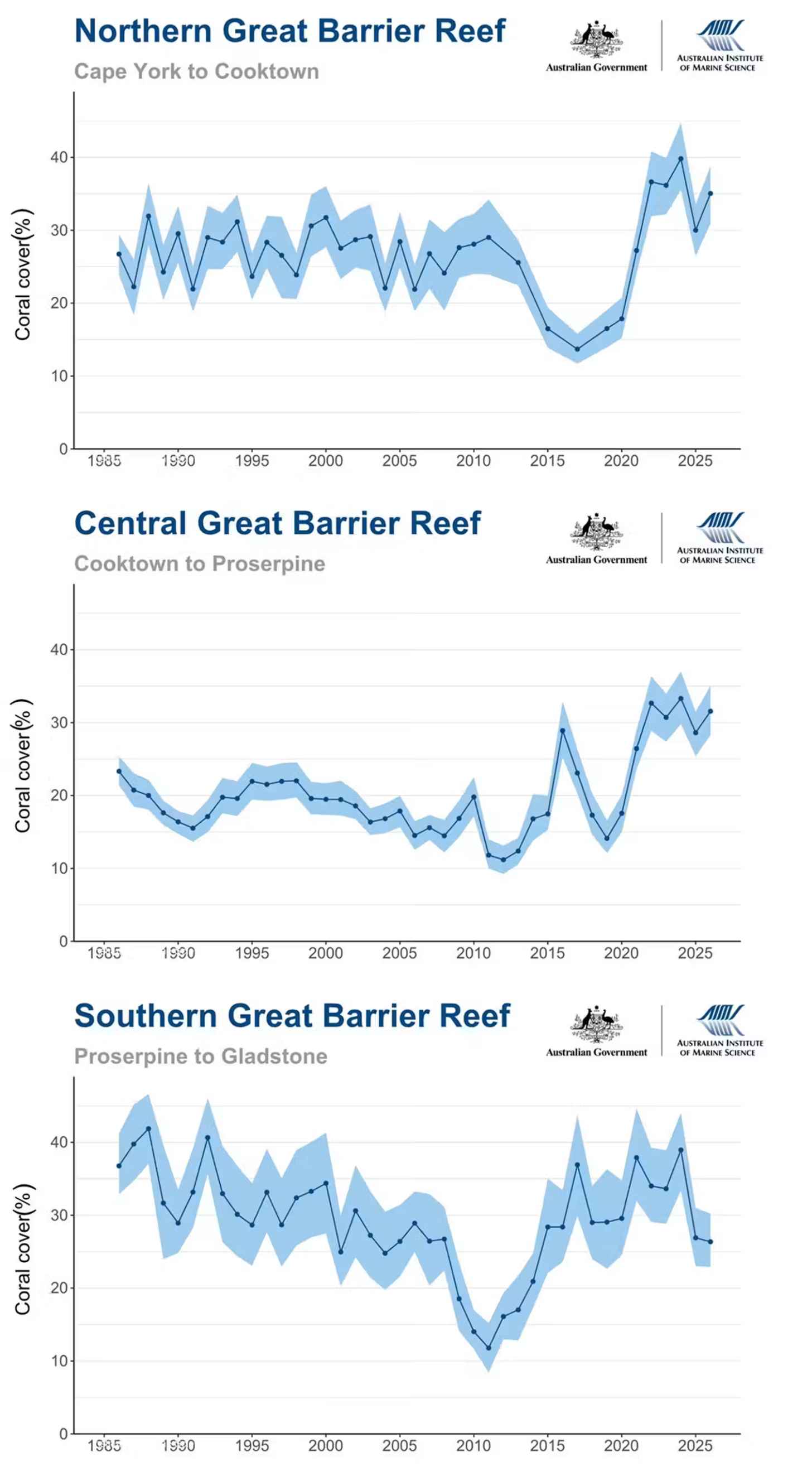
In good news, our latest report suggests coral cover increased slightly in some parts of the reef from 2025 to 2026.
In the northern region (Cape York to Cooktown), coral cover rose from 30% to 35.1%. This figure increased from 28.6% to 31.6% in the central region (Cooktown to Proserpine). This puts both regions above the long-term average of coral cover.
However, coral cover in the reef’s southern region (Proserpine to Gladstone) remained below the long-term average, decreasing slightly from 26.9% to 26.4%.
So, what is driving this?
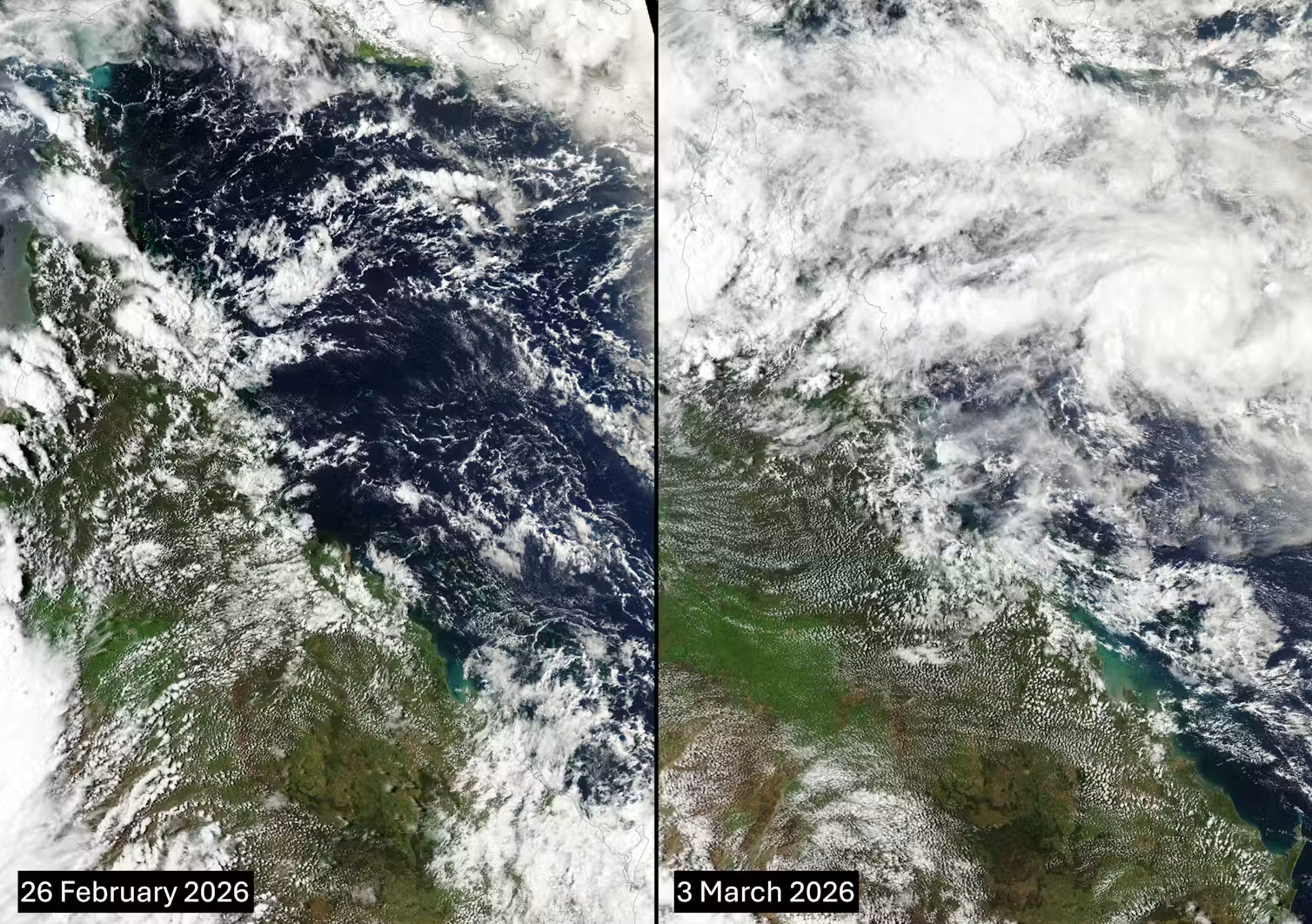
In early 2026, we noticed signs of regional coral bleaching in the northern and central Great Barrier Reef. But a monsoon soon arrived, bringing widespread cloud and rainy weather, helping to cool the reef at just the right time.
Australian monsoon activity typically coincides with the northern wet season, from October to April. During an active monsoon, clouds, rain, and winds help cool the surface of the ocean. Breaking waves and turbulence then mix hotter surface waters with deeper, cooler waters. The monsoon season also reverses winds over the tropics, so northern Australian winds blow as moist northwesterly winds.
Still challenges ahead
Our ability to assess threats to the Great Barrier Reef has vastly improved in the past decade. Global forecast systems can now predict ocean temperatures weeks to months in advance, providing early warnings of marine heatwaves and coral bleaching risks around Australia.
But the reef faces many urgent and increasing pressures.
Recent bleaching means corals are particularly vulnerable to record-breaking global ocean temperatures and a predicted strong El Niño.
Crown-of-thorns starfish are one well documented threat to the reef’s corals. Since the 1960s, there have been four waves of crown-of-thorns outbreaks, with a fifth wave currently emerging in the far north. And these coral-eating starfish will move further south in the coming years.
The reef was also hit by two tropical cyclones — Koji and Narelle — between January and March 2026. Cyclones have some cooling effect, but may whip up enormous waves that destroy coral in their path.
The Great Barrier Reef has again shown its remarkable ability to recover. But we can’t take this for granted.
Instead, we must urgently act to reduce our carbon emissions and minimize climate change. Developing science interventions offers a pathway to build the reef’s resilience and help it survive a warming future. And we must protect our marine parks to ensure the reef not only survives, but thrives.

This article was written by Jessica Benthuysen, Daniela Ceccarelli, and Mike Emslie from the Australian Institute of Marine Science and was originally published on The Conversation.
Featured Image: AIMS LTMP/ CC BY-NC-ND

On August 8, Allison Calhoun, a tour guide with Florida’s Geiger Key Paddle Hut, was leading a kayak excursion in the Florida Keys when she got a phone call asking if she could help “a little guy” in need.
When she paddled out to the location in question, she found a juvenile green sea turtle covered in tumors on its eyes and flippers.
“Thankfully we were able to get ‘Logan’ onto my kayak, to shore, and now in the care of Marathon’s Turtle Hospital,” Calhoun recounted in a Facebook post. “Our kayaking guest ‘Logan’ is here celebrating his birthday, so we decided to name the sea turtle 'Logan.’”
“Thank you to the staff at The Turtle Hospital,” she added. “They are amazing!”

From there, The Turtle Hospital continued posting updates on Logan’s rescue.
“Meet Logan,” the rescue center wrote in a Facebook post dated August 10. “This juvenile green sea turtle arrived yesterday with a heavy load of fibropapilloma tumors. Our first step will be a CT scan at the human hospital to make sure there aren’t any internal tumors we can’t see.”
Fibropapillomatosis — which can be found in all sea turtles, but most notably in green sea turtles — is a disease that causes benign, cauliflower-like tumors.

In some cases, small tumors can be relatively harmless to a sea turtle’s health. But the size and placement of debilitating tumors have been known to cause blindness or interfere with other vital functions.
After Logan is cleared for any urgent concerns, his treatment will center on making sure he’s fit enough to return to the wild.
“A healthy immune system is one of his best defenses against these tumors, so we’ll monitor his blood levels and work on getting him to a healthy place before we remove the tumors to help prevent regrowths,” the rescue center explained.

Although Logan’s future is uncertain, The Turtle Hospital remained optimistic about his outlook.
“We have a lot of work ahead,” the staff wrote, “but Logan is in good hands.”
The Turtle Hospital has been a staple in Marathon, Florida for decades. In April, they celebrated 40 years of rescuing, rehabilitating, and releasing sea turtles.

“I talk frequently about resilience, because that’s … used a lot to describe sea turtles,” hospital manager Bette Zirkelbach told Keys Weekly. “They’re amongst the oldest animals known to man, and they were in our oceans when dinosaurs were on our land.”
“I often think about the resilience of the Turtle Hospital itself. Forty years is a long time, and we’ve gone through a lot of changes in the Florida Keys,” she said. “I’m just so glad to be a part of this amazing organization.”
You may also like: Fisherman's quick thinking saves critically endangered sea turtle in the Philippines
Featured Image: The Turtle Hospital/Facebook
Florida native Sage LaJoie is used to seeing sea animals along her favorite running route in Archie Carr National Wildlife Refuge.
“When you spend as much time on the beach as I do, it’s pretty likely you’re going to come across marine life that needs help,” LaJoie wrote in an Instagram post.
On July 13, LaJoie’s penchant for keeping her head on a swivel paid off. In the early morning light, she told The DoDo that she saw something that “didn’t look right.”
“As I got closer, I realized it was the sunlight reflecting off a sea turtle's light-colored belly,” LaJoie said. “I thought to myself, ‘Oh my gosh, this can't be real.’”
It was a massive loggerhead sea turtle flipped on its back in the sand.
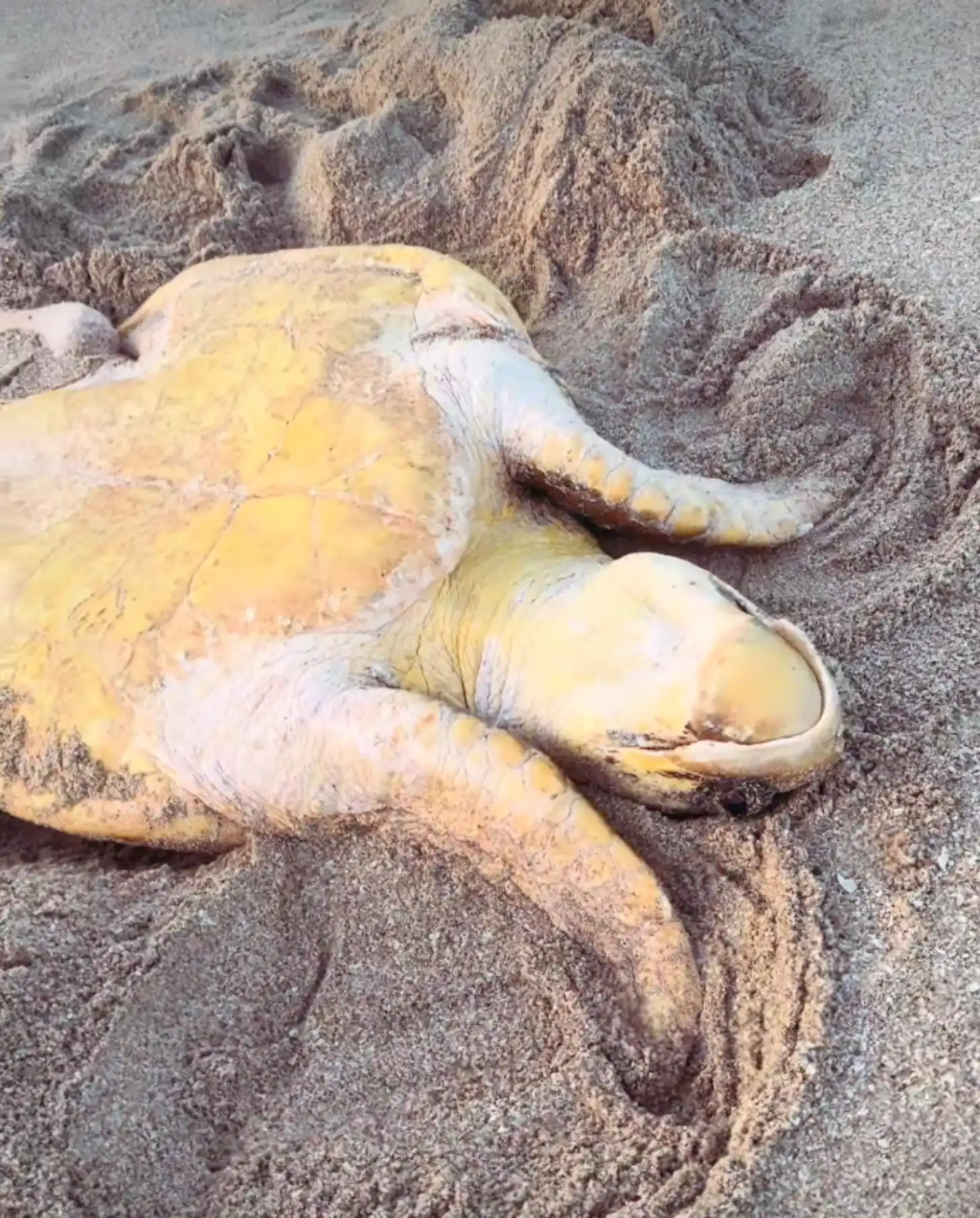
The timing was incredible. LaJoie explained that she had just helped another distressed sea turtle less than 24 hours earlier.
“I found this loggerhead sea turtle the day after I dug the stuck sea turtle out from under the boardwalk-crossover,” LaJoie said in her Instagram caption. “So, two sea turtle rescues in two days!”
Immediately, LaJoie called her local Sea Turtle Preservation Society for help. Although sea turtle stranding coordinators agreed to assist her, they informed LaJoie that it would be a long time before they could reach her location.
So, LaJoie reached out to two more rescuers in hopes of receiving faster support.
“I really, really wanted someone to get there quickly,” LaJoie told The DoDo. “Unfortunately, one didn’t text back, and one was pretty far away.”
Loggerheads are one of seven species of sea turtles — and all but one, the green sea turtle, are currently listed as endangered. Under the Endangered Species Act, it is illegal to touch a sea turtle.
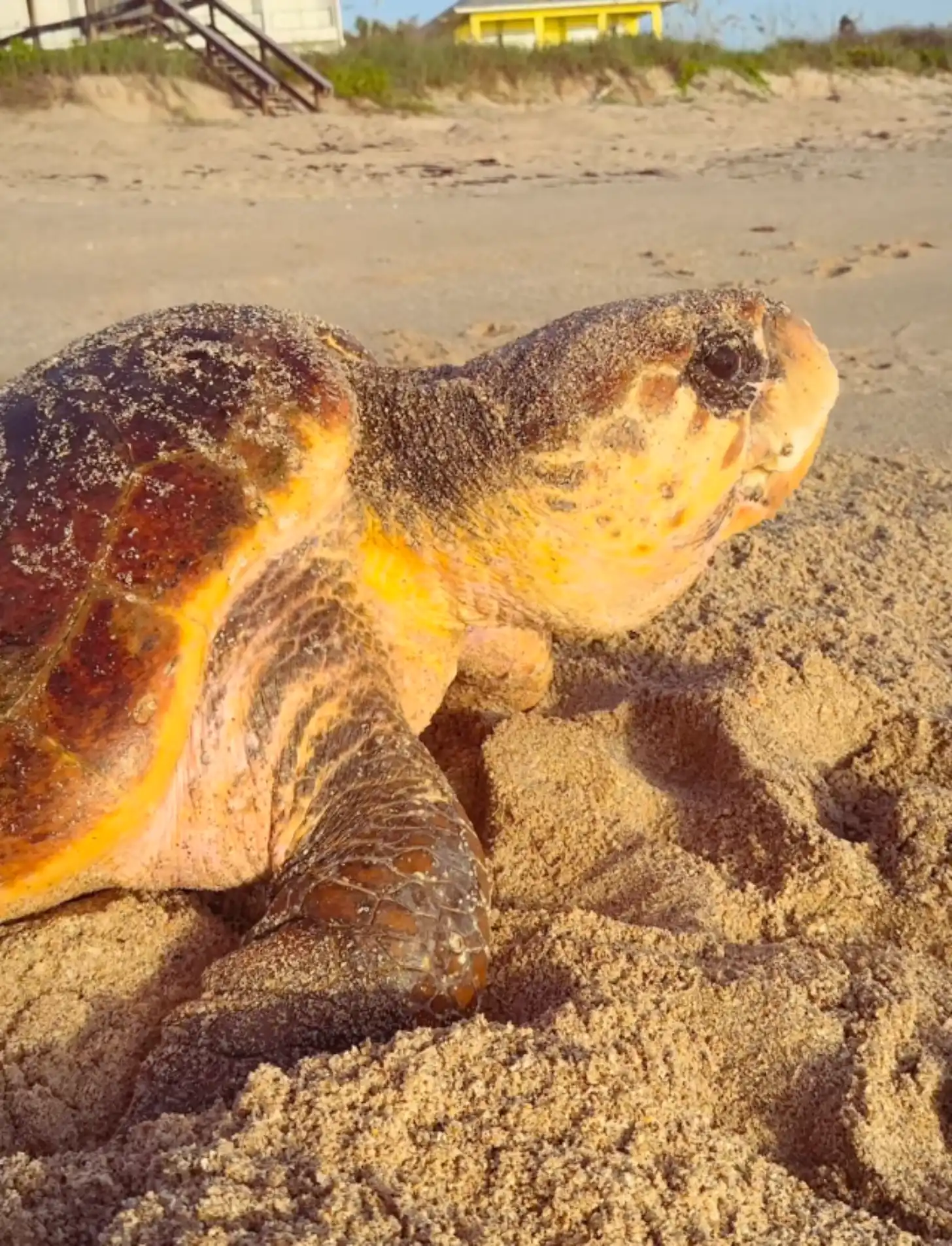
When encountering a sea turtle in the wild, experts recommend calling local authorities or marine conservation organizations.
“Handling sea turtles without proper training and permits is illegal and can cause further harm to the animal,” the Loggerhead Marinelife Center cautions. “Turtles, especially those entangled in fishing gear or showing signs of illness, require professional care. Untrained handling can exacerbate their injuries or introduce infections.”
However, in extreme circumstances, wildlife authorities may ask Good samaritans to intervene on the sea turtle’s behalf.
“I could never leave a sea turtle alone in that position,” LaJoie said. “They are super vulnerable and can't defend themselves at all.”
On average, adult loggerheads can weigh between 155 and 400 pounds, depending on their gender. LaJoie knew she couldn’t lift it on her own.
“As much as I wish I could, I’m not capable of flipping a sea turtle by myself,” she wrote on Instagram. “But … my husband to the rescue! I called him, and he quickly drove to my location, helped me dig around the sea turtle so we could safely flip her, and we got her on her flippers again!”
LaJoie said that the sea turtle was clearly “exhausted,” and rested on the sand for a while before she made her way back to the ocean.
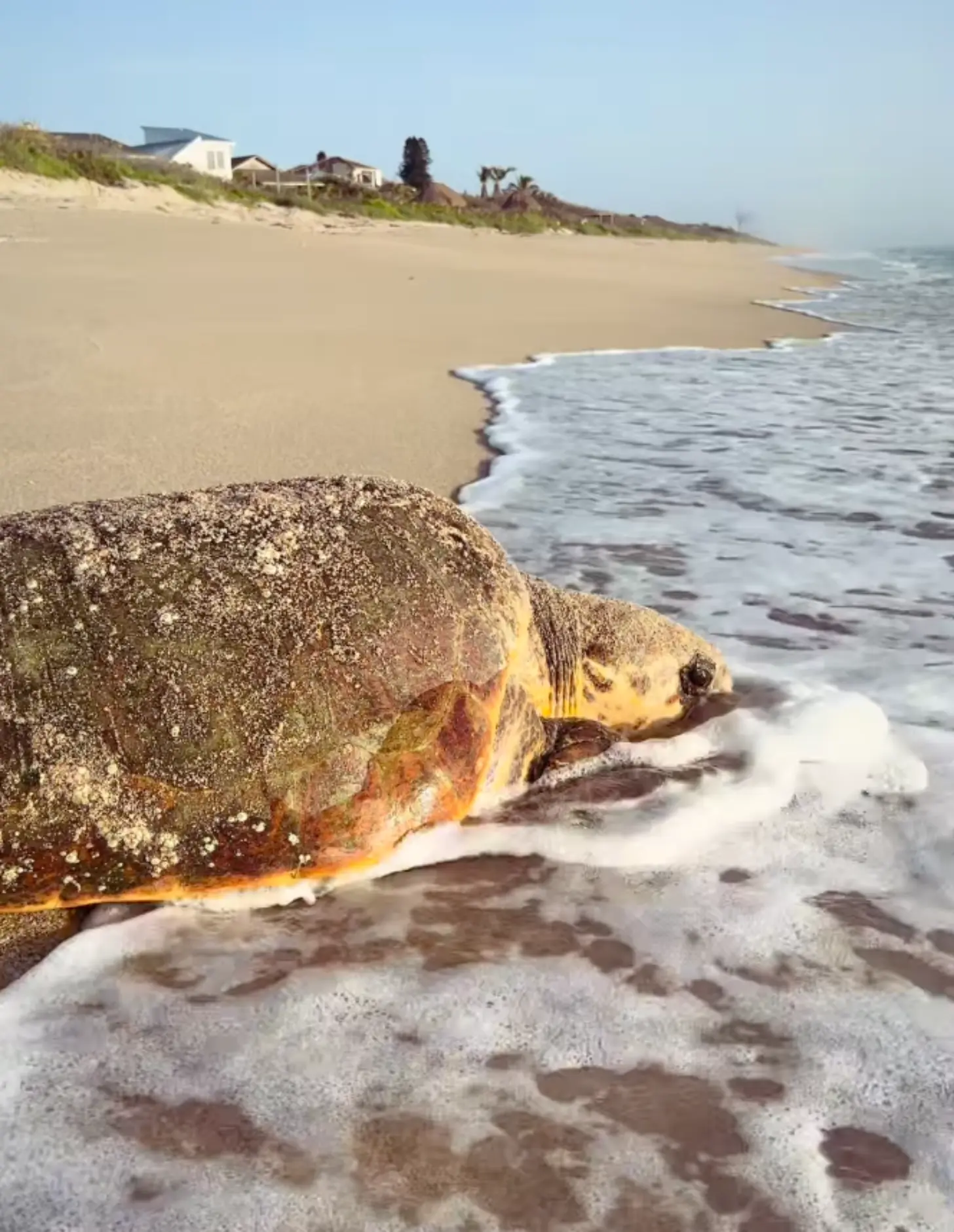
“Another sea turtle success story!” she wrote.
If you find a sea turtle in distress, you can call 1-800-SEATURTLE or use the NOAA Fisheries Stranding Contact Page to find 24-hour hotlines for your region.
See LaJoie's full rescue below:
You may also like: Kayak guide interrupts tour in the Florida Keys to paddle out to a sea turtle in distress
Featured Image: Screenshot via sagelajoie/Instagram
This story was originally published by The 19th and was republished with permission.
BLUE ASH, OHIO — The first Haitian immigrant reported to the Immigration and Customs Enforcement field office at 7:42 a.m. on Sunday. From the corner, the Catholic sisters watched, their positions on immigration stamped on banners and signs.
Sister Alice Gerdeman’s sign noted that her order, the Sisters of Divine Providence, supports “challenging systems that exclude.” Sister Sandy Howe’s sign read, “Love Your Neighbor, no exceptions.” Sister Patricia Wittberg’s took a more direct approach: “It’s so bad even the NUNS are mad!”
“Where has our conscience gone as a society?” Sister Carren Herring asked as the Haitian man walked toward the field office, where he would reemerge from hours later with a GPS tracker clamped around an ankle.
There would be a dozen or so more like him that day, mostly Springfield-area Haitian residents summoned to report to ICE after the Trump administration ended Temporary Protected Status, or TPS, for the country.
The program has allowed hundreds of thousands of Haitians to live and work legally in the United States due to violence and political instability back home.
The man paused before entering the ICE Enforcement and Removal Operations office. At the door, Springfield pastors were offering communion and prayer. He waved to the crowd of nearly 700 lining the street in support.
“ICE does not speak for the people! No neighbor of ours is illegal!” they chanted in early-morning humidity that portended an oppressively hot August day.
The group of sisters positioned on the corner in front of the office were from different orders: Sisters of Mercy, Sisters of the Precious Blood, Sisters of Charity, and Sisters of Divine Providence. They are united by their faith and shared ministry, the Ohio Sisters Justice Network, whose banner described the network’s use of “gospel justice” to protect democracy, end human trafficking, and support immigrants.

That included advocating that the Trump administration extend TPS for Haitians. Now, it means showing up to support them as immigration enforcement tightens its grip.
“I’ve had people say to me, ‘Sister, they need to come here legally.’ Well, they came here legally,” said Sister Sally Duffy, a Sister of Charity and active participant in the network. She held a handwritten orange sign that read: “Our Immigrant Brothers and Sisters have God given DIGNITY.”
“We are changing the rules,” she continued. “If it was a Bengals football game, and it was the last second on the clock, and the field goal kicker was going to make a 30-yard field goal, and all of a sudden, no, we moved him back, so now it became a 70-yard field goal, there’d be an uproar, an outrage over changing the rules.”
Late last month, ICE started sending letters to Haitians in Springfield, informing them that the Trump administration would begin to enforce the end of TPS for Haiti, a plan greenlit by the Supreme Court. Haitian immigrants have been reporting to the ICE office in this Cincinnati suburb since.
In Springfield, a city of 60,000 about an hour’s drive north of the ICE office, roughly one in four residents are Haitian — and many of them were on TPS. For months, faith-based and secular groups there have marshaled thousands of volunteers to prepare for a potential mass deportation event they fear could result in a humanitarian crisis.
Many have wondered what will happen when families are separated: Who will care for the U.S.-born, citizen children who may be left behind?
Now, these volunteers have expanded their efforts to Blue Ash, which has one of the closest ICE offices.
President Donald Trump pledged during his 2024 campaign to undertake the “largest deportation of criminals in the history of America.” He and Vice President JD Vance, who was then a U.S. senator representing Ohio, specifically targeted Haitians living in Springfield, spreading the lie that the legal immigrants were eating their neighbors’ pets. White nationalist groups descended on the city; bomb threats closed area public schools.
The Springfield community watched with trepidation as Trump’s “Operation Metro Surge” wrought havoc on much-larger Minneapolis earlier this year, leading to the deaths of two U.S. citizens, Alex Pretti and Renee Nicole Good.
Organizations working with Haitians in Springfield started stockpiling supplies and forming ICE patrols to prepare for a similar enforcement surge as in Minneapolis — but the surge never arrived.
Gregory Bovino, the commander-at-large of Trump’s Customs and Border Protection, was removed from his position in January after the deaths. Two months later, Markwayne Mullin replaced Kristi Noem as secretary of the Department of Homeland Security. Federal immigration agents dialed down their street presence in Minneapolis amid intense public backlash against the administration’s tactics, prompting a shift in enforcement strategy.
The sisters paid attention.
“They don’t want another Minneapolis … but they’d love for all the Haitians to be deported in secret,” Sister Wittberg said. “I don’t know that we can do anything but witness that this is not a Christian thing to do.”
A Department of Homeland Security spokesperson reiterated in an email that TPS was supposed to be temporary, writing: “Every day, DHS is conducting law enforcement activities across the country to keep Americans safe. DHS does not discuss ongoing or future operations.”

Catholic sisters are playing a key role among clergy and other religious leaders who have been organizing demonstrations and vigils at ICE field offices and processing centers in places like Chicago, Pittsburgh, and Philadelphia. Religious leaders present in Blue Ash on Sunday also included women serving as a Jewish rabbi, a Baptist minister, and a Muslim chaplain.
When Cincinnati-based Ignite Peace, a group founded by Catholic sisters that has since become an interfaith organization, planned the “ICE: We See You” response for Sunday, they encouraged participants to wear “religious garments.”
After all, the action would happen on a day and time when many would otherwise be attending religious services.
Sisters Anita Marie and Maria Francine, biological twins with the Sisters of Notre Dame, stood at the door to the ICE office wearing their traditional habits. Pastor Carl Ruby of Springfield’s Central Christian Church and Viles Dorsainvil, a Moravian pastor and founder of Springfield’s Haitian Support Center, offered Haitian immigrants the sacrament before their appointments.
The sisters both said they would typically be praying quietly in their rooms early on a Sunday, ahead of attending Mass.
“And this,” Sister Anita Marie said, “is a type of prayer.”
Featured Image: Amanda Becker/The 19th
British comedian and host of “Last Week Tonight,” John Oliver is known for his quick-witted political commentary. And now, he’s taking his passion for pettiness to the next level.
In late July, Oliver spoke about the beaver-laden convenience store chain, Buc-ee’s, and its commitment to suing any small business with wildlife-themed mascots.
“Buc-ee’s loves to sue other companies, particularly those with animal mascots,” Oliver said on his HBO show. “They’ve filed over a dozen lawsuits over the years and threatened a bunch more.”
“And incredibly, to date, Buc-ee’s has won nearly all of the cases it’s brought, usually because other companies opt to settle and redesign their logos, or just fold completely,” he added. “That is probably because most just don’t have the resources to fight a company this big.”
So, a staunch advocate against corporate greed, Oliver wanted to go to bat for the little guys.
“Buc-ee’s should be careful here, because as one legal expert has said, ‘The more you do this … the more you might run into somebody who has the means or the will to fight with you about it,’” Oliver said.
“And that is where we come in.”
It was at this moment he debuted his new online merch store: “Last Week Tonight’s Buc-Off Shop.” It is filled with apparel, accessories, stickers, and umbrellas featuring a red-and-yellow logo with the existing “Last Week Tonight” mascot, a squirrel named Mr. Nutterbutter.

“You can buy all of these items for a limited time at Buc-Off.com, with all profits going to Hunger Free America,” Oliver joyfully announced on his July 27th show.
According to the online shop, all of the items will be available to purchase until September 8, 2026.
It’s only been a couple of weeks since he set it up, effectively daring the Texas-based company to sue him for trademark infringement, and Oliver says he still hasn’t heard from their corporate lawyers — though Buc-ee’s continues to sue other small businesses.
“The good news is, we’ve raised almost half a million dollars for Hunger Free America so far,” Oliver exclaimed in an update earlier this week.
“The bad news is, it doesn’t seem that Buc-ee’s got the message.”
@lastweektonighthbo Since it looks like Buc-ee’s is continuing to sue the wrong people, we’re keeping our Buc-Off Shop open until further notice! Beavercreek for President!
♬ original sound - Last Week Tonight
He then went on to say that Buc-ee’s recently sued Beaver Mini Mart, a small, independently owned convenience store in Beavercreek, just outside of Dayton, Ohio. In response, locals have begun shopping at Beaver Mini Mart with even more loyalty.
“It made me want to come out and support them and just help a local business that is being, what really feels like, bullied by a big corporation,” one Beavercreek resident, Sam Bryan, told the local news.
“Reading into it more, that Buc-ee’s has gone after other companies over this, it just put a bad taste in my mouth.”
In response, Oliver promised that “we’re keeping our Buc-Off Shop open until further notice.”
“There’s still time to go Buc Wild in our Buc-Off Shop, which obviously has nothing to do with one very litigious gas station chain,” a Facebook post from “Last Week Tonight” reads, reminding the audience that proceeds go to Hunger Free America.

While donation totals climb, and it seems Oliver won’t be letting up on Buc-ee’s any time soon, it’s unclear how much the parody shop will ultimately raise for the charity.
And Hunger Free America is taking the campaign in stride.
On the home page of the nonprofit’s website, Mr. Nutterbutter is displayed proudly with a banner that reads, “As Seen on Last Week Tonight: The Buc-Off Shop Supports Our Work.”
The nonprofit then thanks Oliver for his support and reminds people they can also donate directly to the cause.
“48 million Americans and 1 in 5 children in the U.S. face hunger and struggle to get enough to eat, while massive cuts to federal food and nutrition programs are putting even more families at risk,” Hunger Free America’s website reads.
“Donations of any amount make a real difference.”
You may also like: Stephen Colbert raises over $1M for World Central Kitchen with 'Late Show' t-shirts, charity auction
Featured Image: Courtesy of HBO
In 2024, the Two Moors Pine Marten Project, an initiative of Devon Wildlife Trust in the United Kingdom, reintroduced 15 endangered pine martens in Dartmoor National Park.
Pine martens are a small mammal species classified as critically endangered in England and Wales, though they still have a strong presence in Scotland.
The destruction of wild woodlands, human-animal conflict, and decades of hunting are to blame for the species’ decline in England and Wales.
But conservation projects, like the Two Moors Pine Marten Project, are helping the weasel-like critters bounce back.

Along with the 15 pine martens released in 2024, 19 more followed in 2025, both events marking the “first attempt to re-establish a sustainable breeding population of the tree-climbing members of the weasel family to the South West since they were hunted to extinction more than 100 years ago,” a press release from Devon Wildlife Trust explained.
And now, new evidence confirms the success of these releases.
“Exclusive video footage gathered by the Two Moors Pine Marten Project shows a female marten with four of its offspring, known as kits, as they explore an Exmoor woodland,” the press release announced.
“The film clip is the first proof that pine martens released by the project are breeding on Exmoor.”
Since their initial release, trail cameras installed by conservation partners and local citizen scientists have shown that the pine martens have been active and highly mobile, though shy of people and difficult to spot.
Confirmation that they are breeding in the wild in both locations is a major win for experts.
“The news of breeding pine martens marks a wonderful moment for our project staff, our project partners, and the dozens of volunteers who have worked with us to bring this native animal back,” Ali North, Two Moors Pine Marten Project field officer in Exmoor, said in a statement.
“This has been a community effort with local people helping us in a series of key tasks ranging from building pine marten den boxes to installing and regularly checking remote cameras.”

North added that pine marten mothers typically give birth in March or April and have an average of two to three babies.
“To see four with their mum was an amazing sight,” she said, “and suggests that Exmoor is the perfect home for these animals.”
While the footage is a thrilling discovery for conservationists, they caution that it is also a sign that their efforts must continue.
“Seeing pine martens breeding on Exmoor is a hugely encouraging milestone for nature recovery in the National Park. It shows what can be achieved through careful partnership working, long-term monitoring and the support of local communities,” Ali Hawkins, a senior ecologist at Exmoor National Park Authority, said in a statement.
“While this is very positive news, the population remains small and vulnerable, so continued public support and reporting of sightings will be vital as we help this native species re-establish itself.”
While the newest footage shows the Exmoor pine martens at play, another female pine marten and her kits were recorded in Dartmoor in 2025, confirming both releases from the project have resulted in wild breeding.
That footage was captured by locals Tim and Rachael, who set up wildlife cameras to support the organization’s Citizen Science Woodland Survey.
“Since moving to the Wray Valley last year, we have been extremely lucky, as we have managed to capture quite a few trail cam videos of pine martens in the woods behind where we live,” Tim and Rachael shared in a statement.
“We have only ever filmed a single one at a time, so we couldn't believe our eyes when we downloaded this video of a mother with her two kits, playing alongside her. We feel very fortunate to have experienced this sighting and so glad to see the success of the Two Moors Pine Marten Project!”
You may also like: Rare footage of silver bear cub captured in national park livestream. Is it a pizzly bear?
Social media platforms will face a bevy of new restrictions in New Jersey that limit their use of children’s data, restrict algorithmic content recommendations to minors, and block notifications during school hours, among a range of others.
The new restrictions, which are set to take effect in September 2027, flow from legislation Gov. Mikie Sherrill signed Tuesday and are New Jersey’s bid to regulate tech giants the governor said federal policymakers had largely left to their own devices.
“Big tech isn’t just the big tobacco of our era. They are worse. They designed platforms that highjacked our kids’ attention spans,” Sherrill said at a bill signing ceremony in Jersey City. “The typical American teen spends about 35 hours a week, almost a full-time job, on platforms like TikTok, Instagram, and YouTube.”
The restrictions in the New Jersey Kids Code Act would require privacy settings on minors’ social media accounts be set to their strictest mode and would limit platforms’ ability to request minors change those settings.
It would restrict platforms’ use of children’s data to the purposes for which it was collected and bar algorithmic content recommendations unless a minor specifically requests more or less content from a given account or of a specific type.
The restrictions mandate that social media platforms limit the discoverability of children’s accounts, both to adults on their own sites and through search engines.
And the law will bar social media platforms from sending notifications to minors between 8 a.m. and 4 p.m. on school days between Labor Day and Memorial Day and block notifications between 10 p.m. and 6 a.m. at all times of the year.

“Half of parents say their children’s mental health has suffered over the past year because of social media,” said bill sponsor Assemblywoman Andrea Katz (D-Burlington). “Nearly half of teenagers say they lose sleep every single night because they feel stuck on these platforms.”
The law permits both parents and the New Jersey attorney general to sue over violations. If they’re victorious, courts could award $5,000 per violation or treble damages — an amount equal to three times the harm suffered — whichever is greater, plus attorney fees.
They can also order punitive damages for reckless or knowing violations and injunctions to bar offending conduct.
Lawmakers on Tuesday described a social media landscape that had sold children’s mental health for engagement and shifted threats that once appeared in physical spaces to digital ones.
“When I was a kid, our parents worried about strangers and who’s talking to us at the park or at the mall,” said bill sponsor Sen. Raj Mukherji (D-Hudson).
“Today, we have to worry about who’s DMing them, what algorithms are pushing into our kids’ feeds, and what sensitive information is being collected, used, even sold before they’re old enough to understand what they’re giving away.”
Meta, which operates Facebook, Instagram, and other social media platforms, did not immediately respond to a request for comment.
Other bills Sherrill signed Tuesday order the creation of a social media research center at one of the state’s public four-year universities and direct it to begin studying the efficacy of social media warning labels and disclaimers in curbing social media addiction among children.
The state’s higher education office began accepting proposals for the center Tuesday and aims to open it sometime this fall with a $500,000 appropriation from the state’s budget.
This article was originally published by the New Jersey Monitor.
Featured Image: Anne-Marie Caruso/New Jersey Monitor
On July 28, officers at Alert Bay’s Royal Canadian Mounted Police department received a call about an injured otter lying on the ‘Namgis Dock in Alert Bay, a village on Cormorant Island in British Columbia.
Locals had heard sounds of distressed animals and found three young otters entangled in various sections of a fishing net left behind on the dock.
The residents successfully freed two of the otter pups, which immediately returned to the water and reunited with their mother, who had been waiting nearby.
The third otter, however, was found in critical condition with the fishing net wrapped around its neck and restricting its breathing.
Gordon Mellish, a retired commercial fisher and carver, was one of the locals on the scene. He cut away the remaining fishing net but sadly realized the otter was unresponsive.
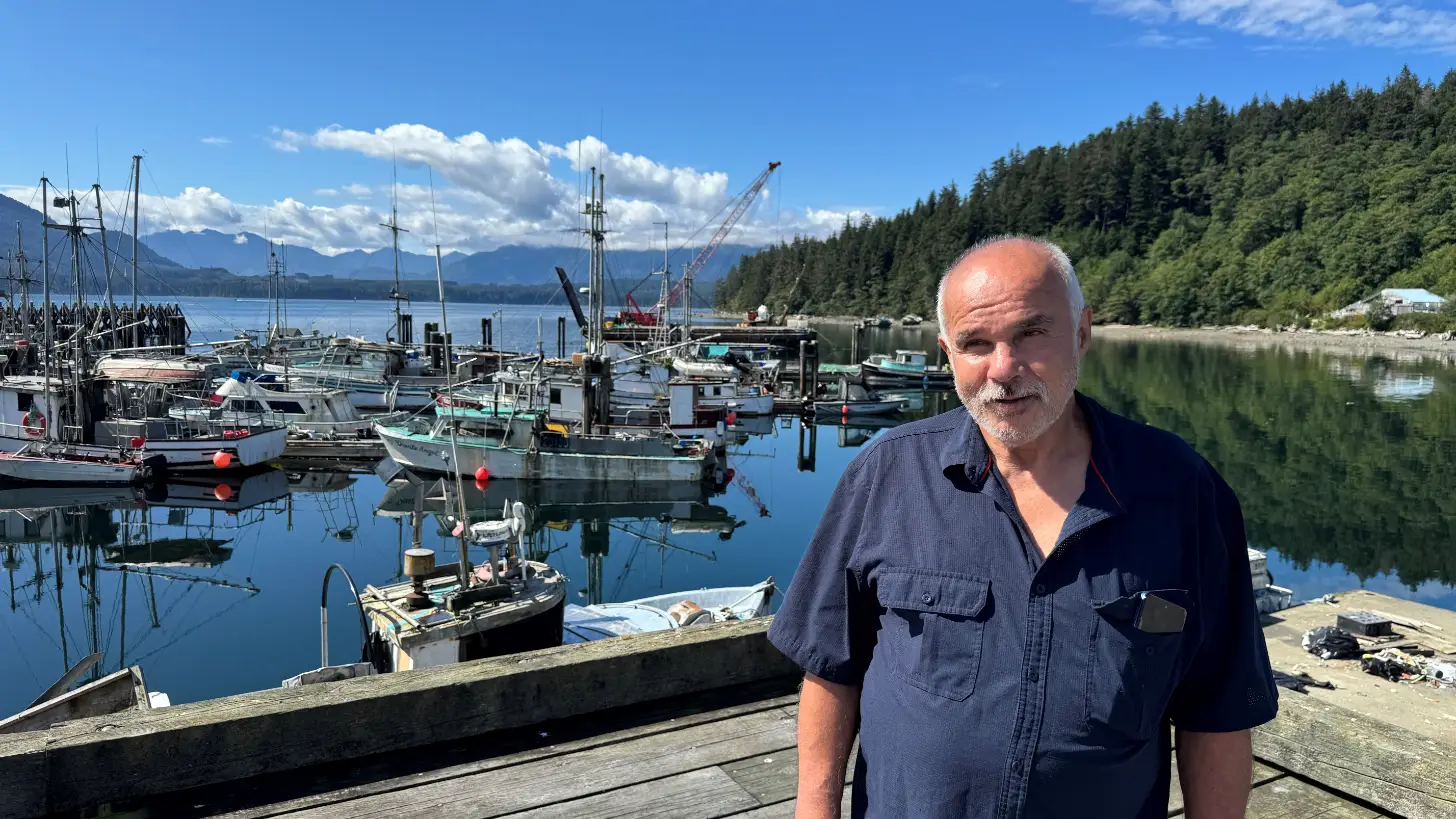
Then he began performing CPR on the small river otter, putting his mouth over the critter’s tiny snout and giving it “the breath of life.” It worked.
“Demonstrating remarkable composure and compassion, the resident performed CPR on the animal and successfully restored its breathing,” a press release from the Alert Bay RCMP said.
Mellish’s skill and determination saved the life of the juvenile otter.
“I got a call from my niece and her husband,” Mellish recounted to Vancouver Sun. “They went down to the old breakwater because they thought they could hear children crying and screaming.”
When Mellish realized he’d be dealing with otters, he rubbed fish oil on his hands so his scent would be more familiar to the animals.
Once he noticed the otter beginning to regain consciousness, he knew the CPR was working.
By then, police were on-site and contacted a local wildlife rescue, Mountainaire Avian Rescue Society, which then coordinated the safe transport of the injured otter to its wildlife rehabilitation facility.

Mellish was able to give the otter a pet before it was taken into care.
“It was so neat to have that moment,” he told the Vancouver Sun. “And then I just told her, ‘Get rest, get better, and make sure you make it back home.’”
After a week of rest and veterinary care, the otter was ready to be released back into the wild, where onlookers later saw the whole otter family reunited again. Mellish was on the beach to wish his new animal friend well.
“Before she went to swim away, she got about half her body into the water, she turned back, looked at me,” Mellish said. “We both made eye contact and she nodded her head. And then she went away.”

Local officials praised Mellish and the other locals for their efforts.
“The Alert Bay RCMP would like to recognize the quick thinking, teamwork, and dedication of the local residents whose actions helped save the young otter's life,” the press release reads.
“Their response is an outstanding example of how community members can make a meaningful difference when they take action to protect local wildlife.”
That being said, local officials also reminded area residents how important it is to ensure they clean up after themselves and are mindful of the wildlife on the island.
“Cormorant Island is home to many species of wildlife, and we all have a role to play in keeping them safe,” Sergeant David Ribeiro-Pereira, detachment commander at Alert Bay RCMP, said.
“This incident serves as an important reminder that properly securing and storing fishing gear can help prevent unnecessary harm to animals and protect the wildlife that makes our community so special.”
You may also like: Fisherman's quick thinking saves critically endangered sea turtle in the Philippines
Featured Image: Courtesy of Alert Bay RCMP
When sea turtle hatchlings arrive earthside, they have an instinctive “sea-finding” behavior that acts as an internal compass directing them toward the ocean — or whatever is the lowest and brightest horizon in their line of sight.
So when bright, artificial light is what they first see, hatchlings can quickly be misdirected and led astray.
That’s what local officials believe happened in Volusia County, Florida earlier this week when dozens of sea turtle hatchlings were seen climbing up a beach approach in the opposite direction of the ocean.

Local police officers helped round up the batch of babies.
“Overnight, VSO deputies assisted in collecting about 75 confused baby sea turtles who were trying to crawl up a beach approach,” the Volusia Sheriff's Office shared on Facebook. “The turtles were turned over to County of Volusia officials who later released them back in the ocean.”
These kinds of sea turtle interactions are not uncommon, especially during nesting season.
In July, a 400-pound nesting sea turtle found her way into a residential area and was trapped in a swimming pool in the Cayman Islands.
Soon after, about a dozen sea turtle hatchlings were rescued from a condo’s storm drain in Bonita Springs.
And before that, a man went viral on TikTok for rescuing a tiny turtle hatchling from a random sidewalk in the opposite direction of the beach.

As Florida’s Fish and Wildlife Commission reports, sea turtles typically make between 40,000 and 84,000 nests along the state’s beaches, with females laying anywhere from 80 to 120 eggs in each nest.
While this may seem like a lot, only one in 1,000 sea turtles typically makes it to adulthood. Increasing their chances of survival — and making it to the ocean in the first place — is vital to protecting the state’s endangered sea turtle species.
Local beachfront properties can do their part by following turtle-friendly lighting guidelines. And beach-goers and tourists can help, too, by keeping beaches flat and easy to navigate and reducing their own sources of artificial light.
You may also like: 400-pound sea turtle rescued from resort swimming pool after falling in and finding herself trapped
Featured image: Volusia Sheriff's Office/Facebook
On August 6, the Marine Services Unit of the Tacoma Police Department responded to sightings of cats milling aboard an abandoned boat off the waters of Owen Beach in Tacoma, Washington.
When the officers climbed aboard, they quickly realized the boat was practically overflowing with cats and kittens.
“The best way I can describe it is it looked like a Studio Ghibli movie,” responding officer John Correa told The News Tribune. “It was their boat, and they were all out and about roaming around on it.”
Within 24 hours, the marine officers, animal control officers, and forensic technicians working the case had transported 31 cats to the Humane Society for Tacoma and Pierce County.
In the following days, the officers continued coming back to the boat, just to ensure they had gotten them all. Every day, they uncovered more cats and kittens hiding in the alcoves.
“Unlike a normal case, we do need assistance with getting out there [by boat],” Cheri Page of the Tacoma Animal Control told KOMO News, noting that the cats had likely been living on the sailboat for months, if not longer. “And then there’s the challenge of the boat itself, pretty close quarters, and because it is a sailboat there’s a lot of nooks and crannies for cats to hide in.”

Rescue efforts continued throughout the week, with the total cat count rising to 61 by Wednesday, August 12.
“Over the course of six days, Tacoma Police Marine Services and Animal Control units have been meticulously working to safely remove dozens of cats from the 40-foot sailboat anchored off Owens Beach,” the Tacoma Police Department posted to Facebook on August 13.
“While we believe we have safely removed all of the cats from the boat, as any cat owner knows, cats are exceptionally good at hiding. Because there is always a possibility that a cat may remain onboard, our work isn’t quite finished.”
As they begin the legal process of having the boat moved, the police department stated that they would continue making trips out to the vessel on a daily basis to make sure that “no cats are left behind.”
They also asked for help from the community.
“If you’re enjoying our waterways or walking the paths at Owens Beach and happen to spot a cat on the sailboat in question, please: take a photo of the cat, note the date and time, include where you saw it, and send the photo and information to animal control.”

The police department then reminded locals that the sailboat was under active investigation, and that it should not be boarded under any circumstances.
“Our teams are working hard to protect the animals while also protecting the integrity of the investigation,” the Tacoma Police Department emphasized. “For now, we’ll keep checking the boat because when it comes to cats, apparently you can never be too purr-sistent.”
As of August 12, KOMO News had reported that at least 24 of the “sailboat cats” were in foster homes.

“The good news is that all of these cats are in relatively healthy condition, which makes it easier for our team,” Madi Kaeding, with the Humane Society of Tacoma and Pierce County, told KOMO News.
In addition to hosting a free adoption day event on August 20, the Humane Society encouraged locals in the Washington area to look into fostering.
“Opening your home temporarily to a pet in need helps us have the space for the next one that needs us,” they said in a press release. “All supplies and medical expenses for fosters are covered by Tacoma Humane; all you need to provide is love, patience, and a quiet place for a pet to decompress.”

For those looking to help from afar, the Humane Society of Tacoma and Pierce County invited people to make a donation on its website or donate pet supplies through the shelter’s Amazon and Chewy wish lists.
“Cats are remarkably resilient, but it only carries them so far: it’s compassion from people like you that carries them the rest of the way,” the organization wrote in a statement.
You may also like: Experts race to save baby elephant after it was found injured and abandoned on a Thai riverbank
Featured Image: Tacoma Police Department
Timmy the 270-pound loggerhead sea turtle was found “splashing erratically” in late July off the coast of the Florida Keys. Boaters spotted her in distress and called in the Coast Guard to help.
Once rescuers hoisted her up, she was taken to The Turtle Hospital in Marathon, Florida, where she was given the name “Timmy” and found to be an astonishing 70-80 years old.
“She’s now undergoing a full diagnostic workup at the Turtle Hospital,” the rehabilitation center reported when they introduced Timmy to the world on social media.
“We’ll be running a complete blood chemistry evaluation once her samples are processed by the university lab, which will help us better understand what she’s facing. Right now, we’re still searching for answers. For now, our team is monitoring her closely and providing supportive care every step of the way.”

After a full blood panel and a myriad of X-rays and other testing, rescuers still weren’t sure what caused her distress. And once she was able to rest in a shallow pool, she began behaving normally and eating voraciously.
She also began swimming more regularly.
Team members at The Turtle Hospital gave her some “spa treatments” and made sure she had a clean bill of health, and in less than a month, she was cleared to return to the ocean.
“We honestly may never know exactly what caused Timmy’s erratic behavior,” the rehab center shared in a social media comment about Timmy’s release.
“There are several possibilities, including mating activity or possibly being brushed by a boat, but we can’t say for certain. The important thing is that her blood work looks fantastic, she’s eating well, and she’s looking great in our tidal pool!”

The massive, elderly turtle gained a fan following during her time at The Turtle Hospital, and the crew invited members of the public to cheer on her release.
“A true ocean matriarch is heading back to her wild kingdom! After a full recovery at The Turtle Hospital, Timmy is officially ready to return to the sea! This 70–80-year-old, 270-pound loggerhead has already nested three times this season and has many more miles left to swim.”
On the morning of Friday, August 14, a crowd gathered at Fort Zachary Taylor Historic State Park in Key West to cheer Timmy on.
The turtle made a short journey by car from Marathon to Key West, held in a large black transport bin that required multiple people to lift.
The Turtle Hospital went live on Facebook during her release, where the turtle joyfully flapped her flippers in the tub as experts prepared to set her free. A crowd looked on, and the Coast Guard crew that rescued Timmy also came to see her off.
“She’s a big girl, and we’ve got a big crowd out here to support Timmy,” a narrator of the video described. “Timmy is a mama sea turtle. She was actually tagged prior to coming to our hospital, and she laid three nests this year. We’re excited to get mama turtle back out there!”
As a whole team tilted Timmy’s transport bin into the ocean, she was eager to hit the sand, quickly pulling herself into the water.
And then she touched the water, to cheers of “Go Timmy go!” and “Keep your head up, honey!” from onlookers, and another successful rescue was in the books.
“Release days are the best days,” Bette Zirkelbach, The Turtle Hospital’s general manager, shared on her own Instagram page. “It has been an honor to share space with this matriarch of our oceans. Just keep swimming, Timmy.”
You may also like: Kayak guide interrupts tour in the Florida Keys to paddle out to a sea turtle in distress
Featured Image: Screenshots via The Turtle Hospital/Facebook
For the first time in more than 100 years, trail camera footage has captured evidence of cougar kittens in Minnesota's Voyageurs National Park.
The videos, taken by the University of Minnesota’s Voyageurs Wolf Project, were shared with the state’s Department of Natural Resources in April of this year. They feature a female cougar feeding three large kittens.
“The Voyageurs Wolf Project has deployed hundreds of trail cameras in northeast Minnesota to help with wolf research. Those cameras have recorded footage of lone cougars eight times since 2023, but none of those cameras had recorded footage of kittens,” a press release from the Minnesota DNR explained.
“The videos of the cougar with kittens were captured by two cameras that researchers placed over a GPS-collared deer they suspected a cougar might have killed.”
Thomas Gable, the project lead for the Voyageurs Wolf Project, decided on a whim to check the cameras, expecting to see a bobcat, which was the animal his team initially believed killed the deer.
He was in for a shock.

“Looking at the footage was and still is surreal. We never anticipated seeing four cougars together in northern Minnesota,” Gable told the Minnesota DNR.
“In total, we captured around four hours of footage of this cougar family at the kill, and it was fascinating to see and hear their interactions — the mother grooming her kittens, the kittens growling and hissing at each other. We feel incredibly fortunate we were able to capture such a wild moment in such detail.”
According to Sierra Club, mountain lions, also called cougars or pumas, used to roam the entire United States but nearly went extinct in most of the country due to deliberate “eradication campaigns” over 100 years ago.
The species has made a comeback in parts of the country, but there hasn’t been a stable population of the cats east of the Dakotas. Some one-off sightings of adult cougars have occurred in Minnesota over the past couple of decades, but this is the first time researchers have proof of breeding in the region.

A 2024 study even predicted only a 30% chance that the species would reproduce in Minnesota in the next 75 years.
“Based on traits observed in the video, we estimate the kittens to be 7-9 months old, so born last fall,” John Erb, research biologist with the Minnesota DNR, said in a statement.
“The only other confirmed kittens in Minnesota turned out to be captive escapees and involved a female with two kittens that showed up and hung around a homeowner’s porch in 2001.”
Because the mother cougar birthed and raised the kittens, experts say it means she’s been in the area for some time and has established a territory.
Gable and his team have also analyzed genetic samples from the family and have a bit more insight into the babies’ backstory, but researchers and officials are eager to learn more.
“Although this is an important starting point for potential population establishment in Minnesota, predicting the future is extremely difficult,” Erb concluded.
“These kittens might not survive, potentially getting killed by wolves, a male cougar, or vehicles. They may also become part of the founding catalyst for a slow but steady increase in numbers. Time will tell, but we are clearly nearing a point where the probability of a self-sustaining population has increased.”
You may also like: Trail cameras capture adorable sighting of first wild pine marten babies born in a century
Featured Image: The Voyageurs Wolf Project/Facebook
Every day the Good Good Good team collects the best good news in the world and shares it with our community. Here are the highlights for this week!
If you want to get good news in your inbox every day, join the Goodnewsletter — the free daily newsletter designed to leave you feeling hopeful.
The Best Positive News We’re Celebrating This Week —
Baltimore is turning ‘911’ into more than just an emergency number, expanding services provided
For years, mobile crisis teams in Baltimore have helped divert applicable emergency calls from police to mental health professionals, but they had limited scope, focusing mostly on people in mental health crises.
Now the city is using some of the $400 million it received from opioid-related legal settlements to expand its emergency response offerings, operating around the clock to respond to calls that “don’t require a badge, a gun, and handcuffs to resolve.”
Baltimore saw 1.68 million 911 calls in 2024, but tens of thousands of them didn’t require police, firefighters, or an ambulance. The expanded 911 services will help people get connected to the appropriate community service.
Why is this good news? When police respond to situations that don’t require them, it can lead to higher rates of arrest and people not being connected to the actual support they need. This expansion of Baltimore’s mobile crisis teams will prioritize connecting people in need with the appropriate resources, rather than putting them in jail.
Visible mending: Why you should give your clothes a second life — and show off the repairs
→ Read more
Battery costs have declined by 99% in the last three decades
Of the 20 million electric vehicles sold globally in 2025, most of them sold for around $40,000, but some as cheap as $10,000 — sales prices only feasible because of how inexpensive batteries have become.
Today, lithium-ion batteries cost just $78 per kilowatt-hour — in 1991, they were around $9,200 per kWh. Batteries in a standard EV today cost around $5,000 — they would have cost nearly $600,000 in 1991, and $20,000 just a decade ago.
Rather than one big breakthrough, thousands of small ones have driven continuously lowering prices: incremental improvements in chemistry, manufacturing, and supply chains.
The world just passed a huge solar milestone: three trillion watts of power
The last decade and a half has been monumental for solar power. The world first crossed the 100-gigawatt mark in 2012, and by 2022 had deployed 1 terawatt — or one trillion watts — enough to meet all U.S. power demand at its peak.
Now, in 2026, the world has reached 3 terawatts, with experts seeing no sign of rapid solar deployment slowing. Experts forecast that global solar capacity will exceed 9 terawatts by 2036.
So far, high-income countries have accounted for the lion’s share of solar deployment, while photovoltaics have remained too expensive for many low- and middle-income countries. But in recent years, Pakistan, Nigeria, and the Philippines have seen huge growth in rooftop solar, and forecasters expect more of the world to benefit from the cheapest source of electricity.
Even better: The rapid uptake of solar power is often followed by a “battery boom,” as lithium-ion batteries store excess electricity during the day and release it at night. Data shows that in low-income countries such as Pakistan and the Philippines, battery adoption surges soon after solar takes off.
→ Read more (Gifted link)
Louisiana is sinking. This business is using the state’s glass bottles to restore the coastline
→ Read more
Hunger has declined globally for three consecutive years
According to the latest report from the United Nations, an estimated 645 million people faced hunger in 2025. While that’s still a heartbreakingly high number, it’s 14 million fewer than in 2024, and 43 million fewer than in 2022.
It’s the third consecutive year hunger declined globally, after surging during the COVID-19 pandemic, though hunger levels are still higher today than they were in 2019.
An estimated 7.8% of the global population experienced hunger in 2025, down from 8.1% in 2024 and 8.6% in 2022 — demonstrating that progress is possible, and we must continue to make it.
→ Read more
The nation’s first public ‘nature library’ just opened in Colorado: ‘Part REI, part library’
The Anythink Nature Library, the first public nature library in the nation, just opened in Thornton, Colorado, around 11 miles north of Denver. It’s the eighth branch of the Adams County Library.
Visitors can play in an on-site mud pit, walk along a trail system, become a green thumb in the “kinship garden,” and grab free outdoor gear for the whole family: Bird-watching kits, snowshoes, waterproof tents, telescopes, gardening equipment, and more.
It’s also powered by 300 rooftop solar panels.
Why is this good news? Beyond helping inspire a love of adventure and nature, the library will also help lower the cost barriers for locals who don’t have an annual ski pass or the materials they need for a fun, safe time outdoors.
How long is the ‘perfect hang’ with friends? It’s oddly specific
Solar just eclipsed all other electricity sources for the first time ever in Utah
In May, for the first time ever, Utah’s solar generation eclipsed all other electricity sources, the culmination of a years-long shift away from coal.
Photovoltaic panels in Utah produced nearly 1 terawatt hour in May 2026, making up nearly a third of all electricity generated in the state that month. Natural gas generated 32%, coal generated 28%, and wind generated 2%.
Solar also now supports nearly 8,000 jobs in the state, which is home to 132 solar companies. Investors committed $1.5 billion to Utah’s solar market in 2025 alone.
The only person to break the sound barrier on land just broke a new record — with a hydrogen engine
In 1997, British driver Andy Green drove a jet-powered car at 763 miles per hour in Nevada’s Black Rock Desert and became the first — and only — person to break the sound barrier on land.
Nearly a decade later, the retired Royal Air Force fighter pilot then set the land-speed record for driving a diesel-powered car, zooming through Utah’s Bonneville Salt Flats at 350 miles per hour.
On Tuesday, August 11, he returned to the salt flats to drive a car powered by two hydrogen internal combustion engines. In his latest run, Green reached 406 miles per hour, easily toppling the previous hydrogen combustion world record of 185.
Why is this good news? Although hydrogen cars aren’t currently poised to replace diesel or gasoline cars, this demonstrates that hydrogen combustion, which Green hailed as “the fuel of the future,” can deliver enormous amounts of power under extreme conditions. As the technology’s potential continues to be studied, test cases like this give engineers useful real-world data.
John Oliver has beef with Buc-ee’s. It’s led him to raise $500K for charity
→ Read more
Australia saw its ‘best year yet’ for large-scale renewable energy projects completed
In the 2025-26 financial year, and after a surge in June, Australia saw a record level of new solar, wind, and battery projects completed and join the nation’s electricity market.
With a record 9.1 gigawatts of new generation and storage capacity completed, it was the country’s best financial year yet — more than double the 4.4 gigawatts delivered the prior year.
In the June quarter alone, 3.9 gigawatts of capacity came online across 14 different projects. It also saw 42% growth in its new connections pipeline, promising continued expansion of renewable energy.
→ Read more
A group of amateur archivists is documenting national park signs to preserve US history
After the Trump administration began ordering National Park Service rangers to remove signs about slavery, Indigenous history, and the climate crisis at locations around the country, a Minnesota librarian launched an effort to preserve the information.
Jenny McBurney and several colleagues launched Save Our Signs to document every sign in the more than 400 national parks and historic sites around the U.S. before they’re removed.
The crowdsourced project is made up of mostly anonymous volunteers who submit photos of national signage to the archive — so far, over 17,000 photos have been submitted, at least one from every national park and historic site. Some have even captured “before” and “after” photos of changes that had been made.
Why is this good news? The public deserves to know the country’s history — not just “sanitized” or select parts of it. Save Our Signs is a way for everyday citizens to mobilize to fight back against the erasure of critical historical information.
Man saves otter strangled by fishing net using mouth-to-mouth CPR
Five decades of research show solar will be the world’s dominant energy source
While today’s models continue to underestimate it, two studies showed solar consistently at the top of the world’s energy systems.
Crucially, the studies synthesized decades' worth of research from independent teams and methodologies to reach their conclusion: solar will provide an estimated 61% of the world’s electricity by 2050.
Solar has emerged faster than any electricity source in human history, driven by dramatic reductions in cost, being almost universally available, and a diverse range of applications.
→ Read more
More good news of the week —
College students in New York City were facing homelessness, so a group of nuns welcomed them into their convent. At the University of Mount Saint Vincent in the Bronx, eight women pay $250 a month for a room of their own — and the stability to pursue a college degree.
A former dairy farm in England is being transformed into a new, climate-resilient nature reserve by a wildlife trust. The Avon Wildlife Trust will turn the “nature-depleted” 44-acre farm into a haven for wildlife as part of the “largest initiative [it’s] ever undertaken.”
A new study found that transgender youth in Canada very rarely detransition. The Canadian researchers found that 97% of youth who seek treatment for gender dysphoria still identify as trans years later.
The largest offshore wind farm in the U.S. is now 81% complete. Dominion Energy’s Coastal Virginia Offshore Wind delivered first power to the grid in March 2026, with each completed turbine becoming operational as installation progresses.
For the first time, solar power was Portugal’s main source of electricity in July. Last month, renewable sources accounted for 53% of consumption, with solar providing 19% of that energy, followed by hydro, wind, and biomass.
An actor’s new nonprofit is awarding thousands of dollars in scholarships to college students. After more than 400 students applied for the award, Gail Bean is awarding scholarships worth $1,913 to 22 high school seniors in the metro Atlanta area.
More than 170,000 borrowers will see $11 billion in student loan balances disappear. The “huge accomplishment” follows a federal court decision and is the largest settlement against the U.S. government in the nation’s history.
England is opening 200 new walk-in mental health centers in banks and libraries across the country. (May require login) The aim is to give those experiencing a mental health crisis or significant distress somewhere to go to get help when they need it.
Chappell Roan announced a two-night benefit event in Los Angeles to raise money for trans youth and LGBTQ+ communities. The “Super Graphic Spectacular” will take place in October, and Roan will deliver special performances at the shows.
After years of decline, Mexico’s overwintering monarch numbers were 64% higher this past winter. The increase is especially notable because it also marks a 226% jump from the winter of 2023-24, and it could mean anywhere from “a few million to tens of millions” more monarchs than the previous winter.
Trail cameras captured the “first confirmed evidence” of an elusive lynx in the Himalayas. The rare sighting challenges the perception that high-altitude rangelands are empty and barren, and even suggests a full predator-prey system.
Two dogs in Nevada are helping teach black bears to fear people again. Badger and Banjo, a pair of Karelian Bear Dogs, are trained to chase, corner, and intimidate bears so the animals relearn an important survival skill: keeping their distance from humans.
Researchers in Hawaii developed a better, low-impact way to track humpback whales by using drones. The drone-integrated tagging technology allows scientists to collect detailed data without approaching by boat, which can disrupt a whale’s natural environment.
A stranded mountain biker was saved by a memorial honoring a heat stroke victim who died on the same trail. “We’re grateful that a space created in Jeff Higgins’ memory provided shade and comfort when it was needed,” officials said.
Last year, homelessness declined across all 3 of Utah’s reporting regions. About 4,500 Utahns were experiencing homelessness during the January 2026 Point-in-Time Count, down 1.6% from the previous year.
A high schooler created a new plant-based plastic that removes microplastics from the environment as it biodegrades. For her invention, Arya Satheesh won the European category of the 2026 Earth Prize, the world’s largest environmental competition for young students.
A crane chick born on a U.K. nature reserve is giving hope that the species is thriving after 400 years. Its mother is the offspring of two first-generation Somerset cranes, which were hand-reared and released as part of The Great Crane Project between 2010 and 2014.
To improve air quality, India’s capital launched an ambitious electric vehicle adoption policy. The policy provides EV buyers with subsidies and waivers on registration fees and some road taxes, incentives to scrap gas vehicles, and it offers plans to expand the charging infrastructure.
Six thousand digitized portraits of Black history are now available and free to the public for the first time. “What we are seeing when we look at these pictures is African Americans the way they wanted to be seen and remembered,” said one historian.
A new “Sesame Street” special follows Elmo and friends as they prepare for a big storm and help their community in the aftermath. The episode was designed to help kids better understand extreme weather events as climate change affects their frequency.
A 41,000-person Facebook group is leading the fight against data center proposals in Pennsylvania. A recent poll of Pennsylvania voters found that 74% opposed having a data center built in their community while 16% said they supported it.
Two of Africa’s rarest birds broke a dry spell after the dad finally stepped in to raise his eggs, a first in 95 years. Secretarybirds are an endangered species, and like many other wild animals, the biggest threat they currently face is rapid habitat loss.
After their mailman had a stroke, Chicago neighbors rallied together to support the veteran postal worker’s recovery. So far, the residents of Old Irving Park have raised $20,000 to cover James Tate’s medical expenses.
A college student reading near a Seattle lake rescued three strangers from drowning. Lillie Vehling, who had previous lifeguard training, dove into the water and brought each of the girls to shore, one by one.
A mass evacuation drill weeks before fires broke out helped save residents of Spokane. More than 950 vehicles participated, nearly three times the number that took part in the city’s first drill the previous year, making it one of the largest neighborhood evacuation exercises of its kind in the region.
Scientists are using spider webs to develop materials that can treat burns and reverse nerve damage. Spiders produce silk from a specialized gland and use it to build incredible web structures, and scientists are figuring out how to replicate this biological feat.
New Jersey passed a new “big tech” law to regulate kids’ social media use. The law will limit social media platforms’ use of children’s data, restrict algorithmic content recommendations to minors, block notifications during school hours, and more.
The world’s first seahorse hospital is fighting to save them from extinction. In Europe and countries like Indonesia, seahorses are being poached in the millions for sale to a traditional medicine market where they are consumed as an aphrodisiac and alleged cure for impotence, asthma, and kidney problems.
After decades of drought, water is rising in the African Sahel again. The news is nuanced, as erratic but extreme rains are returning to the semi-arid region, both causing lethal floods and replenishing rivers, filling desert depressions, and restoring water to dried riverbeds.
Noah Kahan announced his second annual “Folk and Fairways” golf and concert charity event. All proceeds from the two-day event will benefit Kahan’s organization, the Busyhead Project, which promotes mental-health awareness and provides resources to local communities.