This story was originally published by The 19th and was republished with permission.
Wherever Grace Pavlock pursued a bachelor’s degree — in her native Texas or across the country — she would face the same hurdle: “I was always going to be on that cusp of homelessness and not having a place to stay.”
Staying with family was not an option, and she couldn’t afford dormitory expenses. Still, she dreamed of attending school in New York City. She set her sights on the University of Mount Saint Vincent in the Bronx, a Catholic institution that offered the major she planned to pursue — public policy — and, she said, “a beautiful campus.”
“It honestly was like the perfect fit,” Pavlock said. “Everything was great and wonderful, except for the fact that there was no way I was going to be able to afford it at all.”
Then, Pavlock learned about the university’s Dax House, a residence serving housing-insecure college women.
For just $250 a month, students like her secure a private room, a permanent address they can use to access social services, and a case manager to help them navigate challenges like health insurance coverage and career planning. The support allowed Pavlock, who had earned an associate’s degree in Texas, to be a full-time college student without constantly worrying about how she might pay for food, a roof over her head, and other necessities.
The 22-year-old rising senior is not an anomaly.
According to the Hope Center for Student Basic Needs, a research center at the Lewis Katz School of Medicine at Temple University, nearly half of college students are housing insecure, and one in seven are homeless. Many such students have already overcome barriers just to enroll in university. They are often from underrepresented backgrounds and the first in their families to attend college. Then, they might discover that their financial aid packages do not cover room and board.
All this, compounded, makes them more likely to drop out of school.

The University of Mount Saint Vincent seeks to change outcomes for housing-insecure students through Dax House, in partnership with the Sisters of Charity of New York and the homeless services nonprofit Depaul USA. The Dax Program, a national housing program Depaul USA began in 2015 to combat student homelessness, operates four residences in New York City and serves more than 90 students annually nationwide in cities such as Chicago, Los Angeles, and Philadelphia.
The collaboration goes beyond offering students a bed, school officials say. It offers them the support they need to complete their higher education and build a foundation for the rest of their lives. And unlike traditional dorm rooms that need to be vacated during school breaks, students can live in Dax House year-round. Pavlock has been spending much of her time there this summer, updating her resume to apply for fall internships with state lawmakers.
“We recognize that when students come to us, they come to us as a whole person,” said Susan R. Burns, president of the University of Mount Saint Vincent, which has a student body of 4,225.
“Things like housing or lack of housing can affect their ability to show up fully for their studies. Students may be absolutely academically capable, but can’t fully engage in college because they’re worried about where they’re going to sleep.”
The University of Mount Saint Vincent has long prioritized housing-insecure students, serving them primarily through the Mott Street Scholarship Program, which launched a decade ago and covers tuition, fees, and housing for students who have aged out of foster care or experienced homelessness as children.
But school officials realized that even students who didn’t qualify for that scholarship faced housing insecurity and could easily become homeless without dedicated support.
The Sisters of Charity of New York, a congregation of sisters in the Catholic Church, had an idea. They owned Rosary Hall, a two-story building on campus. Since they rarely used the first floor, they decided to offer it to vulnerable students. After undergoing renovations including new flooring, fresh paint, an upgraded kitchen, and a spacious living room overlooking the Hudson River, Dax House opened with a ribbon-cutting on August 13, 2024.
Eight women — juniors, seniors, and recent graduates — lived on the first floor last school year while the sisters resided on the second floor. Undergraduate women far outnumber men at the University of Mount Saint Vincent — 2,222 to 748, respectively.
Although many colleges offer emergency housing, food pantries, or motel vouchers to students, these interventions are short-term. Dax House aims to give housing-insecure students stability with its wraparound services, including year-round housing so they have somewhere to stay during winter, spring, and summer breaks.
Undergraduates can stay at Dax House for up to 24 months, while recent graduates can stay for an additional year if needed as a bridge between their studies and their careers.

“It’s not just that we provide a safe, clean space for you to be,” said Mel Reyes, Dax Program director for New York City at Depaul USA.
“There are others that are students just like you and have a level of hardship just like you. And then our case management — they meet at minimum once or twice a month with the case manager who helps them talk about goals and helps them talk about needs.”
A case manager helps students with tasks such as obtaining access to SNAP benefits, creating budgets, and applying for internships — life skills that may prevent them from becoming housing insecure in the future.
“Sometimes what goes hand in hand with not having housing is not having food and not having medical care and not knowing where to go,” Reyes said.
A number of factors contribute to housing insecurity among the college-aged population. Many relate to family instability: Students with deceased, incarcerated, or abusive family members are at risk. Others have experienced housing insecurity after fleeing from domestic violence.
Pavlock, who grew up an hour north of Houston, said that after her father died when she was in high school, she moved in with her grandparents. Her mother lived elsewhere. However, since both of her grandparents were retired, they couldn’t financially support her.
She describes her background as “rough,” with multiple family members who did not complete their education beyond middle or high school. The period before she enrolled at the University of Mount Saint Vincent and entered Dax House was “troubling,” she said.
“The amount of havoc that was going through my life and trying to figure out all this on my own was just insane because nobody in my family has ever been to college. No one knows what a FAFSA is. No one knows how hard it is to actually get scholarships and stuff like that.”
Although housing insecurity and homelessness are not uncommon for college students, the issue often goes overlooked, according to Robin Knox, development director for Depaul USA. Students experiencing these issues don’t necessarily stand out from their peers. They show up to class, participate in discussions, and turn in papers, even while struggling to get their basic needs met.
“It’s definitely a hidden issue,” Knox said. “Students don’t want to readily share their challenges. They don’t want to be looked at as not having resources compared to their peers. It’s been partially not wanting to disclose that information, not feeling like there are resources available, and there’s a little bit of — ‘I can figure it out on my own.’”
In recent years, however, soaring tuition and living costs have drawn more attention to the housing struggles of college students. Dropping out of college only puts these students in more danger of experiencing economic instability. In contrast, most students living in Dax House find employment, move into permanent housing, stay in school, or graduate, school officials said.
“This is not just an issue of providing a bed,” Burns said. “It’s about changing students’ trajectory and helping them prepare for the future beyond their time at the university.”
As college enrollment has dropped precipitously since 2010, retaining students is imperative, according to Reyes.
“There is a demographic cliff happening,” she said. “In the next few years, there will not be enough people applying to colleges. Retention has become that much more important. The Dax Program is really part of that solution.”
One student, a high school valedictorian, arrived at the University of Mount Saint Vincent’s Dax House on the verge of entering a city shelter. She received a room, a $100 grocery stipend, and a case manager who helped her secure SNAP benefits. She lived in the house for six months while working part-time; Dax House residents must work at least 10 hours per week to cover the $250 monthly rent ($350 for graduate students), which part-time jobs or work-study positions allow them to do easily.
That former resident is now a pediatric nurse making $80,000 a year, according to a university spokeswoman.

Pavlock intends to create a similar future for herself, only she wants to work in government.
“I want to do public policy and help people who can’t help themselves,” she said.
Being a Dax House resident has allowed her to participate in multiple campus clubs, get involved in a mentorship program, and take on internships. She’s interned for Broadridge, a global technology company, deepening her knowledge of finance and policy. She also served as a social media intern for Depaul USA.
“I don’t mean to brag, but I’m just so good at Canva,” she said, with a laugh, of the graphic design platform.
She’s advocated for sexual assault awareness as part of her on-campus job for the Wellness Cove, which focuses on student health and well-being. She has served as treasurer of the Model United Nations, as well as a senator for the Class of 2027 in the Student Government Association.
Without Dax House, she said, she wouldn’t have discovered her latent skills or taken on other activities.
“I’d just be working 40 hours a week,” Pavlock said. “I would not be in any clubs. I wouldn’t have any other kind of on-campus jobs or internships.”
The Dax House model is replicable, but it requires partnerships and resources.
“Funding is a large part of it,” Burns said. “Depaul USA is a nonprofit organization. They do fundraising to secure the funding necessary to provide the case managers, the residential support, and so forth. But also, they need partners in that space. The reality is, there are not enough people lobbying to change the system.”
That’s not the only challenge. Not all higher education institutions believe they have a responsibility to support housing-insecure students — even though research indicates that students who have reliable housing become more engaged on their campuses and are more likely to complete their studies.
“I can’t tell you one person that’s in my house specifically that is not an amazing leader on campus, who’s not in three to four different clubs, who’s not doing three different things on campus at one time,” Pavlock said.
“We’re so ingrained on campus that if other universities were to have a program like ours, they would see these crazy leaders emerge — because we’re given the ability to do so.”
Featured Image: Courtesy of DePaul USA
Over the last century, the Chacabuco Valley of Chile has seen some dramatic changes.
In the early 20th century, wild grasslands became pastures and fenced farmlands, cutting through native plants and driving out imperiled species like the South Andean deer, or huemul, which was hunted to the brink of extinction.
And they weren’t exactly hard to catch.
“It is an extremely trusting animal that is not afraid of humans,” Sebastian Di Martino, conservation director at the Rewilding Argentina Foundation, once told Dialogue Earth.
While the cards were stacked against the species, Doug and Kris Tompkins of Tompkins Conservation bought up an area in the valley, setting the stage for what would become Patagonia National Park and Cerro Castillo National Park.
Thanks to tireless conservation work, the valley is once again home to the rare huemul deer — though it still remains one of the world’s most endangered species.

One of the threats the species faces today is the infectious bacterium Corynebacterium pseudotuberculosis. It was first diagnosed in 2015, though it likely predates this, spreading across Chile via domestic livestock.
The resulting infection, caseous lymphadenitis, is commonly called “cheesy gland.” The debilitating, and sometimes deadly, disease leads to abscesses in the lymph nodes and internal organs — and it was decimating wild huemuls who had already faced dramatic population declines.
Researchers were able to treat the disease with antibiotics, but it proved difficult to repeatedly capture and release afflicted animals.
To create a safer, and more effective, treatment plan for afflicted huemuls, Tompkins Conservation’s offshoot organization Rewilding Chile recently opened the Huemul Rescue and Rehabilitation Center, located adjacent to Cerro Castillo National Park.

The center’s first patient is “Distraido,” a young stag who suffered from multiple large abscesses caused by the cheesy gland disease.
After a month of intensive treatment at the center, Distraido was given a clean bill of health and finally set free to rejoin his herd in the wild. To monitor his progress, wildlife rangers have continued tracking him via a high frequency transmitter.
“There’s very little knowledge of how to work with huemul deer in captivity,” Cristian Saucedo, wildlife director at Rewilding Chile, said in a press statement. “So we can actually say that the successful treatment and release of Distraido marks a before and after in huemul conservation.”
Distraido may be the first patient at the center, but he is far from the last. The center’s veterinary staff and wildlife rangers are already seeing further progress as they continue taking on new captures and transfers of sick huemuls.
“Without these interventions, the huemul deer would surely be lost to history,” said Kristine Tompkins, the president of Tompkins Conservation.
“It’s not only a symbol of Chile, but a keystone species restoring its ecosystems. By helping the huemul thrive, the work started here can reverberate for generations.”
Editor's note: An earlier version of this story inaccurately connected the huemul deer population to a proposed dam project in Patagonia. The article has been changed to remove that detail, and to clarify where the huemul deer reside. Information regarding the timeline of the Corynebacterium pseudotuberculosis outbreak has been clarified, as well.
You may also like: Funding for scientific research is at an all-time low. So conservationists turned to OnlyFans to save their marmot study
Featured Image: Fotogalilea/Wikimedia Commons (CC BY-SA 4.0)
Three states this year became the first ones to enact laws restricting companies from using personal data such as browsing history or shopping habits to set individualized prices on goods and services, a practice known as surveillance pricing.
The laws in Connecticut, Maryland, and New Jersey take different approaches to which retailers and products they cover, the discount exceptions they allow, and how violations are enforced.
Lawmakers in at least 11 states considered similar bills this year, but often faced opposition from business groups that say some of the legislation is overly broad.

Maryland’s new law, which was the first in the country and takes effect Oct. 1, applies to grocery stores of at least 15,000 square feet and third-party food delivery services.
Under the law, these businesses are prohibited from using personal data to set a price for a specific shopper for most groceries. It does, however, allow loyalty programs, subscription prices, and differences based on supply, location, or operating costs. Businesses also have 45 days to correct a violation before the state can bring an enforcement action.
New Jersey’s new law, signed by Democratic Gov. Mikie Sherrill in July, prohibits retailers from using personal data to set individualized prices for groceries and placed a one-year moratorium on the installation of new electronic shelf labels while the state studies their effects.
Retailers with these shelf labels already installed can continue to use them and maintain them.
“New Jersey families are already feeling the pressure of higher costs,” Sherrill said in a statement. “The last thing they need is companies secretly using their personal data to charge them more than someone else for the exact same product.”
Connecticut’s law, signed by Democratic Gov. Ned Lamont in June, broadly prohibits retailers and third-party delivery services from using surveillance pricing. It includes exceptions for discounts and certain price differences unrelated to a shopper’s personal data.
Consumer advocates say surveillance pricing is difficult to detect because shoppers generally cannot see what another customer is being charged.
Retail and technology groups have argued that overly broad restrictions could interfere with discounts and rewards programs and be expensive for businesses to comply.
This article was originally published by Stateline.
Featured Image: Dillon Kydd/Unsplash
- A New Orleans based business, Glass Half Full, collects glass from bars, restaurants, and drop-off sites, recycling it into new bottles and fine silica sand.
- The recycled sand is used by ReCoast, the nonprofit’s restoration arm, to restore land by building small experimental islands and berms.
- Louisiana loses roughly a football field of land to the sea every hour, a crisis that Glass Half Full’s young founder, Franziska Trautmann, describes as a looming threat.
- Early results from the glass sand restoration is promising: vegetation is returning, sediment is sticking, and wildlife is moving in; but the work is constrained by two bottlenecks: not enough glass, and not enough funding.
NEW ORLEANS, U.S. — On a cold Saturday in late January, a parade floats rolls down Royal Street painted with the image of the Louisiana coastline, eroding away. The next float displays Lady Liberty gagged and locked behind a chain-link fence.
This is Krewe du Vieux, the raunchy, mule-drawn satirical parade that has rolled through New Orleans’ French Quarter for 40 years, making political jokes few others dare to make in public. Its 2026 theme is “Save the Wet Glands,” a play on “save the wetlands.”

This year’s Krewe du Vieux Queen is Franziska Trautmann, the pink-haired co-founder and CEO of Glass Half Full, a business that takes the city’s glass bottles and turns them into sand used to rebuild Louisiana’s dwindling coast.
Growing up here, the coastal erosion crisis is “like the boogeyman,” Trautmann told me outside the Glass Half Full facility in Chalmette, Louisiana. “It’s this overwhelming thing looming in the distance.”
Most locals have heard the statistics: roughly a football field of Louisiana is lost to the sea every hour. Large areas of grassy marshes and tree-laden swamps that once knit the coast together have succumbed to erosion after more than a century of being sliced apart by roads, oil pipelines, and canals. Reduced sediment flow from the Mississippi River brings less would-be land down south. Also, the land is sinking, and the sea is rising.
But in New Orleans, where tragedy and joy are often held in the same cup, Krewe du Vieux is parading about it.
On the parade route, a reveler with a bushy black mustache peers through the face-hole of a big yellow star costume. The star raises its Miller High Life bottle and shouts “Woo!” as a brass band thumps by. Later, it tosses the bottle in a plastic bin outside Anna’s bar.
By Tuesday morning, the glass bottle is in a box truck headed just a few kilometers east to Chalmette, home to the Glass Half Full recycling plant.

Where the glass goes
Glass Half Full started in 2020 in a backyard near Tulane University, when Trautmann and her classmate Max Steitz couldn’t figure out where to recycle their wine bottles. The 20-somethings’ pipe dreams are now a full-scale operation atop a 3-acre plant just outside New Orleans.
GHF’s partner, GlassRoots, runs about 40 locations citywide where people can drop off their household glass. Additionally, dozens of restaurants and bars in town have dedicated glass bins with multiple weekly pickups.
“In 2024 alone we went through half a million pounds of glass, which is quite a bit,” Brice Abadie, general manager of the famed Carousel Bar at the Hotel Monteleone in New Orleans, told Business Insider. The bar is one of GHF’s largest glass suppliers.
“I don’t think anybody truly comprehends the amount of garbage and glassware and other things that end up in landfills until, you know, you start separating it and seeing it for yourself.”

Once the glass reaches the Chalmette facility, it’s stored in piles until process days, which occur about three times a week. Heavy machinery moves large scoops of glass into a hopper, which crushes the glass and moves it down a conveyor belt. Workers pull out anything that isn’t glass.
Past the human inspection, optical sorters separate the glass shards by color and pluck out contaminants such as labels.
Larger pieces, called cullet, are collected in a railcar. When the railcar is full (about once a month), it’s hauled by a train to Anchor Glass Container in Oklahoma and melted down into recycled glass bottles.
Glass shards too small to be cullet go through a pulverizer that grinds them into a fine, 100% silica sand, soft enough to rub against skin without cutting.


Since its inception, GHF has recycled 14 million pounds of glass, including more than 2 million pounds this year, Trautmann said in a call in July.
The plant receives nine trucks a day bringing glass from up to 140 miles away in Louisiana, Mississippi, and Alabama. GHF has the capacity to process more glass, but collection is the bottleneck.
“We need more glass!” Trautmann says to a crew of volunteers gathered at the GHF facility on a sunny Saturday in March, her back to a small mountain of sand glass.
The group has gathered to plant native species (bald cypress and water tupelo trees, giant bulrush, bulltongue, and irises) on two small islands built with glass — some of the newest land on the planet.
How to build an island
The Glass Half Full facility sits on the edge of Bayou Bienvenue, atop a former illegal dumping ground. The area used to host a lush swamp, until a shipping channel was cut and the area became flooded with seawater in the 1960s.
Just offshore, a few meters down a boardwalk, are four small islands; each is 25 feet across. These baby islands are a grand experiment. And “they’re doing really well!” Kat Fogg, project manager for ReCoast, Glass Half Full’s restoration arm, tells me.


The first two islands, closer to the shore, were built in 2024. One is made of pure Mississippi River dredge — sediment pulled from the bottom of the river. The other is a mix of half dredge and half GHF’s recycled glass sand.
To build the first islands, Fogg and her team trudged out in waders with stakes and tape to mark the perimeter. Next, they hauled biodegradable coir logs made from coconut husks to erect holding containers for the sand and sludge. One was constructed by pumping a slurry of bayou water and sand into the containment perimeter while the other was created with mechanized equipment. They let the land settle for a few weeks and then planted plants whose roots would eventually hold it in place.
The second set of islands, built in 2025, were made with containers of metal fencing wrapped in burlap instead of coir logs which, Fogg says, “were quite unwieldy.”

All four islands are now solid ground, the older two covered in thick vegetation and the newer islands freshly planted. Wildlife is already making use of the islands. Camera traps placed on the islands in 2025 have logged birds, alligators, marsh rabbits, and a river otter that used the new land as a toilet.
Fogg says they’re building two new islands in the next few months and will experiment with different holding container designs. “We’re going to keep making land,” she says.

Glass Half Full and ReCoast have worked with academic collaborators to study the properties of the glass sand and its suitability for restoration.
The resulting peer-reviewed publications report that the glass sand material is mostly silica, chemically inert, free of harmful leaching, and behaves like natural sand. Native estuarine fish, crabs, oysters, and barnacles survive in it; wetland plants, dune plants, and black mangroves have grown comparably in glass sand and natural sediment in greenhouse and field trials.
There is “great evidence that we can use recycled glass as a resource for coastal restoration,” Hank Bart, a professor at Tulane University and co-author of research examining the effects of the recycled glass sand on animals, told Mongabay in a phone call. “If we can just crush and recycle enough.”

Reviving the coast
So far, ReCoast has used recycled glass in four major restoration projects. The first went in at Big Branch Marsh on the north shore of Lake Pontchartrain. In June 2023, Glass Half Full partnered with the Coalition to Restore Coastal Louisiana and the Louisiana Department of Wildlife and Fisheries to build a 300-foot berm across a shoreline breach opened by Hurricane Ida in 2021. The blowout was letting saltwater from Lake Pontchartrain flow into freshwater marsh, killing vegetation and speeding sediment loss.
Over two days, roughly 100 volunteers stacked coffee sacks filled with 45 metric tons of recycled glass sand to form a barrier. The berm was designed to ease wave energy and allow bulrush planted behind it to take root and rebuild the marsh.
ReCoast marked a line, or transect, through the site and returned every month for a year to photograph conditions and measure change along the line. According to the group’s monitoring data, vegetation coverage rose by 60% over 12 months, and the site gained 1.25 inches of sediment.
“We’re seeing all kinds of species now and massive amount of [vegetation] spread,” Fogg says. “It’s so lush.”

Another project, at Bucktown Harbor in nearby Jefferson parish, fortified a 15-acre peninsula built by the local government to prevent erosion. Working with the Pontchartrain Conservancy and the state’s Coastal Protection and Restoration Authority, ReCoast staff and volunteers wedged burlap bags of recycled sand into the crevices between the rip-rap, the large pieces of concrete used to build the peninsula.
When Fogg returned to the site early this year to monitor progress, she didn’t recognize where she was standing. “I started walking the shoreline, and I realized I’m walking on what was rip-rap,” she says. “It’s just turned into land.”
Ken Krauss, associate director at the Louisiana Universities Marine Consortium and unaffiliated with Glass Half Full, praised their work.
“We need substrate to build land,” he told Mongabay. “Adding sand is sort of like adding chicory to the coffee. If it works, it works.”

Restoration at the end of the road
South of New Orleans, the road runs out. Past that is water. This is Pointe-au-Chien, where Pete LeBouf grew up, and where the Pointe-au-Chien Indian Tribe has run its own restoration program for years. ReCoast’s last project brought the two together.
“Whenever they talk about coastal erosion, it’s not just a story,” LeBouf, who is a member of the Pointe-au-Chien Indian Tribe, tells Mongabay in a call. “It’s something that I’ve had to deal with and seen just in my lifetime.”
LeBouf once served on the tribal council, but had to move north to Slidell. The hurricanes hit too hard, he said, the insurance got too high, and “there is no land left to slow the storms down.” He now works as an environmental scientist for a contractor monitoring the coast.
In his lifetime, an island called Timbalier, where his grandparents kept a houseboat and where he chased nutria as a child, has disappeared. A two-story camp house there now lies upside down in the water.
“I’ve watched places that I wanted to bring my kids disappear,” LeBouf says. “They don’t exist.”
He helped identify a potential restoration site while out crabbing one afternoon, on a sliver of tribal marshland. The site sits outside the floodgates of a heavily trafficked canal. Here, boat wakes and wave action had eaten a stretch of Pointe-au-Chien tribal land down to a thin land bridge between the tribe’s property and the canal. Lose that bridge, Fogg says, and everything downstream goes with it.
Here, ReCoast, along with tribal members, tribal boat captains, and dozens of volunteers, built a berm of recycled glass sand in burlap bags. Crews also planted mangroves and shrubs along the existing shoreline to reinforce it.
Because of the high salinity in the area, vegetation has been slow to come in, Fogg and LeBouf say, but the wave action has calmed, the water is shallower, and sediment is starting to stick.
“The berm’s still holding up,” LeBouf says. “I’m really kind of impressed and proud of what they’ve done with that.”
Trautmann says they hope to do more work down there, and elsewhere, but funding is limited.
Meet me at the party

To get the bottles to the marsh, Glass Half Full meets the city where it is, and during Carnival, that’s largely on St. Charles Ave.
I join a fleet of volunteers in bright-green vests manning recycling stations and brandishing collection bags as we weave through the crowds at the Saturday Uptown parades.
The scene is part block party, part triage.

The streets are littered with a wreckage of plastic: beads, cups, stuffed animals, and light-up trinkets rain down from large parade floats. Most of these prizes will be in a landfill by Ash Wednesday.
But from where I stand, I also hear the undercurrent of a steady, satisfying clink: glass bottles meeting other glass bottles in the bins. A sequin-clad merrymaker places a bottle in my bag. “Y’all’re awesome y’all,” they say with slurred speech.
“Everyone is looking for that little dopamine hit,” Stevie Frazier, a Glass Half Full volunteer, yells over the cacophony of a marching band. “And this feels like you can save the world a little bit at a time.”
This article was originally published on Mongabay.
Featured Image: Liz Kimbrough/Mongabay
Researchers have found evidence that pumas — also known as cougars and mountain lions — directly affect deer behavior in a way that could prove lifesaving for drivers.
In the study, which was published in the scientific journal Current Biology on August 5, the researchers studied highway collisions across five years and found that higher puma occupancy correlated with significantly lower collision rates.
“We found that large carnivores can make roadways safer through their effects on prey behavior and space use,” lead author Justin Suraci said in a press release.
Together with his colleagues, Suraci — who serves as senior scientist and director of wildlife conservation science at Conservation Science Partners — centered his research on the Olympic Peninsula of Washington, where roughly four big cats can be found every 100 square miles.
“Deer alter their use of both space and time where pumas are present, overlapping less with roads and reducing activity at night, when some of the most dangerous collisions occur,” said Suraci.
In an interview with Good Good Good, Mark Elbroch, the director for Panthera’s Puma Program, explained that nighttime deer collisions are generally more dangerous because of a culmination of factors: driver fatigue, speed, and that classic “deer in the headlights” reaction that causes deer to freeze on roadways.
It’s also simply harder for drivers to see.
“Ninety percent of a driver's reaction depends on sight, which loses depth perception and peripheral range in the dark,” Elbroch told Good Good Good.
As Suraci put it, road safety is a service that “large predators like pumas can provide to human communities.”
“It’s important to remember that large carnivores, like many wildlife species, can only persist if they’re able to share landscapes with people, which in many cases may require us to change our behaviors and attitudes to make coexistence possible,” said Suraci.
When it came to the number of pumas struck by vehicles, Elbroch said it happened “infrequently,” but it was not unheard of.
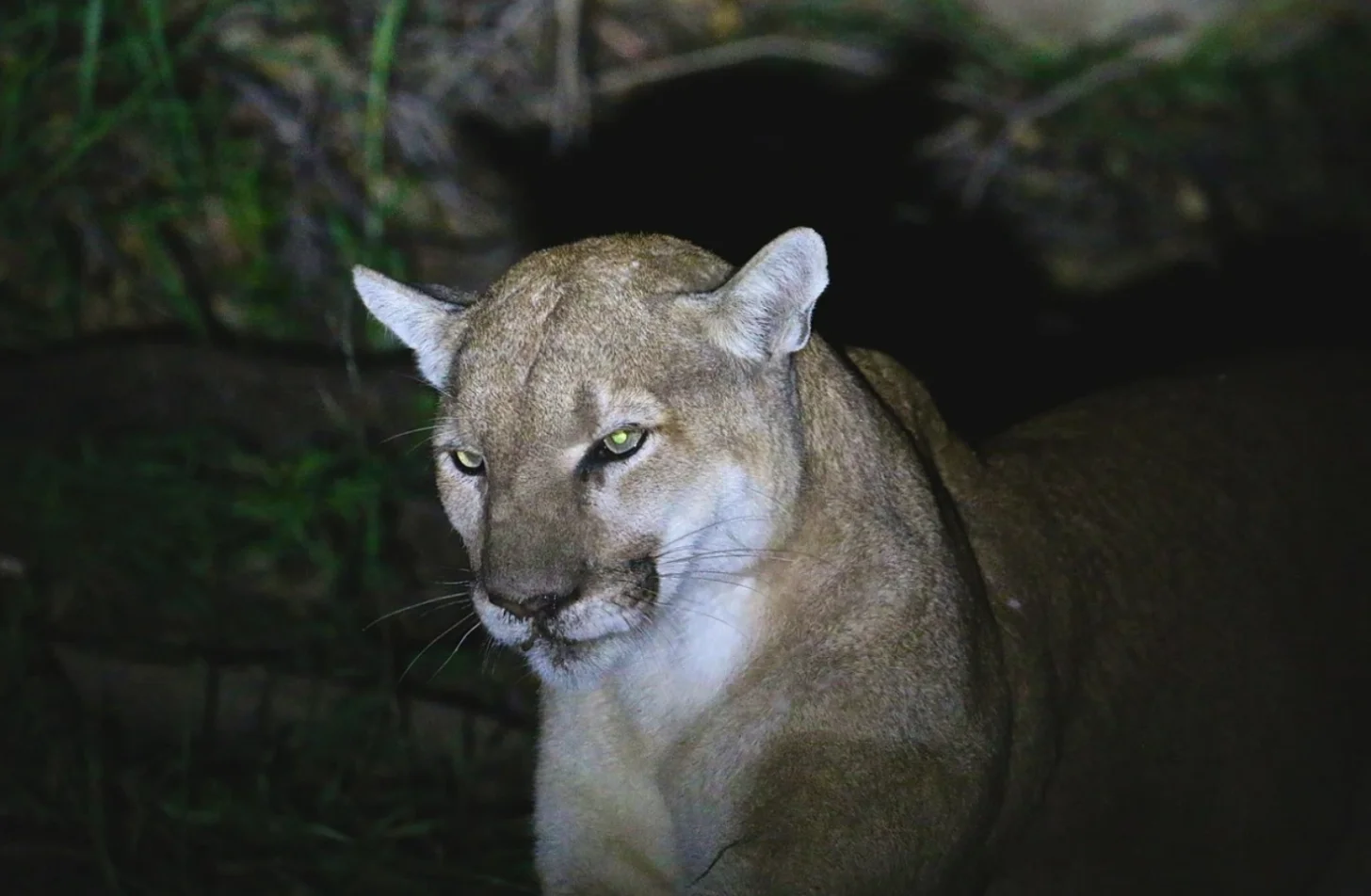
“In our system, we have had several pumas killed by cars,” he acquiesced. “We also had one remarkable recovery – the female remained roadside for 10 days, and then slowly made her recovery, ultimately returning to her usual behaviors and successfully raising kittens.”
Big cats in North America don’t have the best reputation; people often cite concerns of attacks, but Elbroch told Good Good Good that they are few and far between.
“Hundreds of thousands of deer-vehicle collisions occur every year, causing tens of thousands of injuries and roughly 200 deaths in the United States,” he stated. “As compared with 4-6 ‘attacks’ per year in recent years (more like 1-2 over longer time spans), and on average 1 person being killed every 3-5 years over the last 100 years.”
Elbroch said that stable puma populations, coupled with wildlife crossings, could lead to substantial benefits for drivers across the Pacific Northwest.
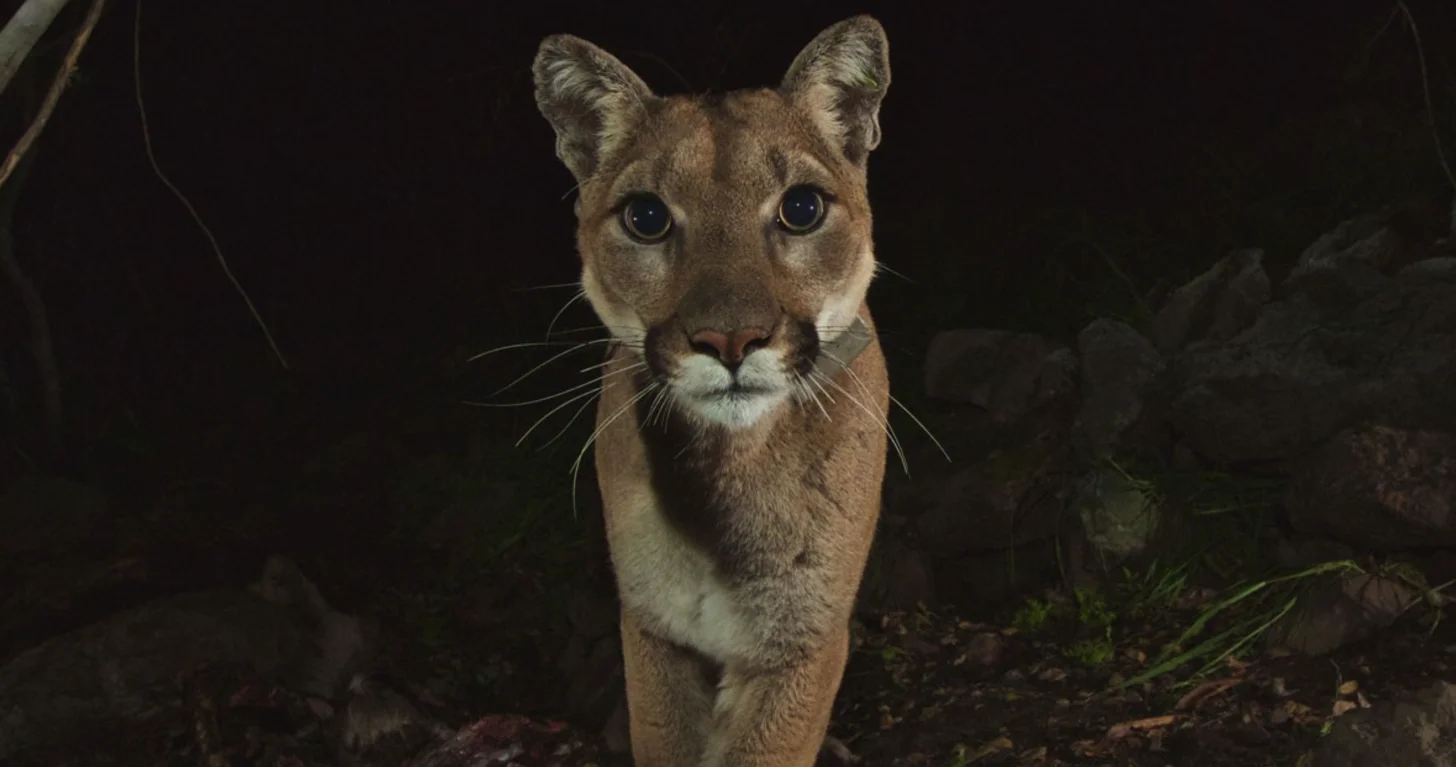
“Pumas are providing all the net benefits of wildlife bridges — which receive bipartisan support because they reduce wildlife-vehicle collisions, saving lives, reducing injuries, reducing damage to public infrastructure, and saving people millions and millions of dollars,” he said.
“By scaring deer, pumas are doing the same things … likely everywhere they coexist with people.”
When it comes to the study’s potential impacts on legislation or road safety, Elbroch is optimistic.
“We hope this influences human tolerance for wildlife, encourages management that supports coexistence, and influences transportation policy that supports wildlife coexistence with people.”
You may also like: Trail cameras show elephants, leopards, and more embracing India's 7-mile wildlife crossing months ahead of schedule
Featured Image: National Park Service
Wildfires in the Spokane, Washington area have already burned through more than 10,400 acres, destroyed 900 structures, and forced tens of thousands of people to evacuate their homes.
Firefighters have been working to contain the fires since they began on Saturday, August 1, and a man has been charged with first-degree arson for allegedly starting one of the three most aggressive fires in the area.
At this point, no deaths have been reported.
Along with fundraisers providing financial support for those affected, one local business has mobilized to turn its headquarters into a relief area for firefighters on the front lines.
JK Boots, a local work boot manufacturer, has donated a large sum of profits to Spokane residents who have lost their homes, has set up food and drink distribution for first responders, and continues to provide a “recharge station” to firefighters who need an opportunity to unwind and refuel.
“We’ve opened our headquarters to the crews on these fires,” a social media post from JK Boots, shared on August 2, said. “Hot coffee. Hot food. A place to wash up, cool off, and rest — our break room is yours.”
In the following days, other locals have donated bulk supplies and volunteered to distribute items to firefighters. JK Boots also began giving free pairs of boots to firefighters.
At first, they had a goal of giving away 50 pairs. They quickly surpassed that.

“We’re just going to keep going,” Tim Khadzhi, one of the owners of JK Boots, told The Spokesman-Review. “I don’t know when it’s going to stop.”
JK Boots has also brought relief to the firefighters, setting up at an incident command post at Mt. Spokane High School, where piles of tattered, duct-taped boots grow into mountains as the firefighters trade them for brand new shoes from the local business.

“We’ve handmade wild land fire boots in Spokane for 20 years for the people who run toward fires,” JK Boots shared on social media. “The fight came to our home. This week, they’re defending our own streets. So we’re going all in.”
The boots are made in America by hand and retail anywhere from $575 to $700. The 50 pairs the company originally promised were a $25,000 value.
Still, they continue to give them away for free.
But in addition to the JK Boots generosity, people across the country began asking if they could sponsor boots for firefighters, too. Now, individuals from anywhere can do exactly that, using a "Sponsor A Firefighter" listing on the company's website. Each listing is the same retail price as the boots that are being given away: $624.99. Supporters can also write an encouraging message that will be included when the shoes are given away.
"We are not marketing this. We are not advertising it. There are zero ad dollars behind it," JK Boots said of the sponsorship offering. "The public built this, and all we did was answer."

It's unclear how many boots have been given away thus far, but the impact is already striking.
“To buy a set of boots like that today is like 600 bucks, and for some of these kids, that’s half a month’s wages,” Brad Smith, a training specialist with the California team 7 incident management team, told The Spokesman-Review.
“We’re overwhelmed by the fact that in everybody’s loss, they’ve lost everything. They’re still rallying around our firefighters here. It’s really something.”
For Khadzhi and his team, it’s a no-brainer.
“We just wanted to do anything that we could,” Khadzhi told Inlander. “With this disaster hitting our hometown, when it’s so close, it just feels a lot different. There’s this feeling that you want to go out there and help and do whatever you can.”

The soles of one firefighter’s boots had completely melted off. He had been borrowing a friend’s boots that were a size and a half too small — until JK Boots hooked him up with a new pair.
Another firefighter’s boots were held together with duct tape “after weeks of hard work on the line with his Seattle Watershed strike team,” JK Boots recounted.

“A new pair of JK wildland fire boots was the easy part. The best part was watching his reaction,” the company wrote.
“Kenny walked around showing everyone his new boots, kicking his feet out, and smiling like he couldn’t believe it. Before long, three more members of his crew were fitted with new boots too.”
These are just two examples of countless acts of generosity at the company’s base camp over the past few days.
“What started as a simple question — ‘How can we help?’ — has turned into one of the most meaningful weeks in our company’s history,” JK Boots shared on social media.
“We’ve met wild land firefighters finishing exhausting shifts, donated boots to crews who needed them most, watched our community rally around the Spokane Complex Fires, and been reminded that the best part of being a local business is showing up when your neighbors need you.”
“We’re so thankful for every firefighter who has stopped by this week,” another post continued. “Spokane has seen firsthand what this fire season has demanded, and your work doesn’t go unnoticed. Stay safe out there.”
You may also like: GoFundMe launches hub of verified Spokane wildfire relief fundraisers
Featured Images: Courtesy of Spokane Valley Fire Department, JK Boots/Facebook
- A camera trap has recorded the Eurasian lynx at over 17,400 feet on Sikkim’s Tso Lhamo plateau, adding to limited evidence of the species in the Eastern Himalayas.
- Experts say the record highlights the ecological value of high-altitude rangelands often seen as barren cold deserts.
- Tso Lhamo supports snow leopard, Pallas’s cat, Tibetan wolf, sand fox, argali, gazelle, and kiang, suggesting a functioning predator-prey system.
A Eurasian lynx has been recorded in a camera-trap image from the Tso Lhamo plateau in Sikkim, India. This encounter marks the first confirmed photographic evidence of the species in the state. It is also the second such record from the Eastern Himalayas.
The image, captured in January 2026 at an altitude of over 17,400 feet in the Mangan district, shows the animal moving across a rocky, sparsely vegetated high-altitude slope.
The sighting comes from a long-term snow leopard and rangeland monitoring program led by the Sikkim forest department and WWF-India. The initiative tracks snow leopards and associated wildlife while studying the ecological condition of the trans-Himalayan rangelands.
The Sikkim record follows a 2025 photographic documentation of a Eurasian lynx in Arunachal Pradesh during a joint survey by WWF-India and the Arunachal Pradesh forest department.
“It highlights the ecological significance of our high-altitude rangelands and reinforces our commitment to protecting these fragile ecosystems. The cooperation of the Lachen Dzumsa (traditional local self-governance body) in facilitating access to these remote areas has been important to this work,” Sikkim’s Chief Conservator of Forests (Wildlife), Udai Gurung, said in a statement.


A meeting point of two biological worlds
For researchers, the record adds to the limited scientific understanding of Tso Lhamo, a high-altitude border landscape that remains difficult to study because of its terrain, weather, and location.
“Ladakh and Sikkim have similar trans-Himalayan elements. Ongoing monitoring exercises are evidence that forest departments and researchers are now getting such encouraging results. Since Sikkim shares an open international boundary with Tibet, and lynx are capable of long-distance movements, transboundary collaboration might reveal the overall picture for this region more clearly,” said Neeraj Mahar, a wildlife researcher who was not part of the WWF’s monitoring program and has worked on high-altitude landscapes and carnivores.
Rohan Pradeep Pandit, the associate coordinator at WWF-India works on species habitat conservation in Eastern Himalayas. According to him, the record challenges the perception that high-altitude rangelands are empty or ecologically unproductive.
“High-altitude rangelands like Tso Lhamo have long been dismissed as empty, barren, cold deserts of little ecological consequence. The presence of a wide-ranging predator like the lynx is direct evidence against that view. These are functioning, productive ecosystems, and Tso Lhamo in particular works as a biogeographic bridge between two very different biological worlds,” Pandit said.
The Tso Lhamo plateau lies in a transition zone where the steep trans-Himalaya meets the flatter Tibetan Plateau. This position allows species adapted to different high-altitude habitats to occur within the same landscape.

“Geographically, the plateau sits at the juncture where the steep, vertical trans-Himalaya meets the flatter, rolling expanse of the Tibetan Plateau. Ecologists call this kind of transition an ‘ecotone’, a boundary zone where two distinct biological communities overlap. That location is what makes Tso Lhamo significant. Species adapted to sheer, rocky cliffs occur alongside species evolved for open steppe. The lynx is one more line of evidence that the plateau is not an isolated pocket but a corridor where the biodiversity of the Central Asian steppe meets that of the Eastern Himalaya,” Pandit said.
Camera traps in the landscape have also recorded snow leopard, Pallas’s cat, Tibetan wolf, Tibetan sand fox, Tibetan gazelle, Tibetan argali, and southern kiang.
Rishi Kumar Sharma, head of the Himalayas Program at WWF-India, said the presence of several predators and wild herbivores indicates that the lynx record should not be viewed in isolation.
“It is undeniable evidence that the Tso Lhamo Plateau supports a high-quality and largely intact trans-Himalayan predator-prey system. To have three distinct wild felids — the snow leopard, the Pallas’s cat, and now the Eurasian lynx — recorded in the same landscape points to a food web healthy enough to support multiple apex and meso-predators,” Sharma said.
What remains unknown
Despite the significance of the photograph, it does not establish whether Tso Lhamo hosts a stable lynx population. Researchers do not yet know whether the photographed animal was a resident, part of a breeding population, or an occasional visitor moving through from the Tibetan side.
“What we have so far is a single photographic record after several years of intensive camera trapping, which means we cannot yet say whether the lynx is a resident, breeding animal on the plateau, or an occasional disperser moving through from the Tibetan side,” Sharma said.
“The first task is to establish the species’ own status here — how widely it is distributed across Tso Lhamo and the adjacent valleys, a first estimate of how many animals the landscape actually holds, and whether there is evidence of residency and breeding, such as repeat captures of identifiable individuals or family groups,” he added.

Pandit said knowledge of the Eurasian lynx in India has largely come from the western trans-Himalayan region, particularly Ladakh. Far less is known about its distribution, population, and habitat use in the Eastern Himalayas.
“This photographic record confirms that the lynx is very much an important predator in the Eastern Himalayan ecosystem, but it also highlights how little baseline data we actually have on them here. We cannot protect a species effectively if we are operating in the dark regarding its population size, movement patterns, and specific habitat preferences,” Pandit said.
Mahar said camera trapping should be combined with genetic research to study the species and the pressures affecting it.
“More insights could be obtained through intensive camera trapping across Sikkim trans-Himalaya, combined with non-invasive genetic identification techniques to decipher aspects of Eurasian lynx ecology and associated threats. It would be interesting to study how lynx is thriving amidst pastoralists and defense installations,” Mahar said.

Conservation pressures in a border landscape
The Tso Lhamo landscape remains ecologically functional, but it faces pressures from tourism, road traffic, waste, free-ranging dogs, and infrastructure associated with its border location.
The WWF-India press release identifies wildlife-friendly traffic management, sustainable waste management, sterilization, and vaccination of free-ranging dogs, and livestock health camps as important conservation measures.
Sharma identified free-ranging dogs as one of the most immediate concerns. Packs can prey on wildlife, compete with wild carnivores, and transmit diseases.
“These dogs hunt in packs. They compete directly with wild carnivores for prey, actively attack smaller wild species, and act as vectors for diseases like canine distemper, which can wipe out wild feline populations overnight,” Sharma said.
Road traffic associated with tourism and border logistics also increases the risk of wildlife collisions. Open waste dumps can change animal behavior, attract predators, and heighten the possibility of conflict, Sharma added.
This article was originally published on Mongabay.
Featured Image: Courtesy of Forest & Environment Department, Sikkim, and WWF-India
- India has made progress in conserving its Bengal tigers, but now it must accommodate growing numbers as they disperse from protected habitats into human-dominated areas — even as poaching is on the rise and destruction of forested land continues.
- Protected forest corridors are crucial to restoring lost or tenuous connectivity between key habitats, enabling genetic exchange between tiger populations that otherwise risk isolation and inbreeding.
- India has built more mitigation structures than any other country in Asia, including the world’s 10 largest wildlife underpasses and overpasses.
- But even as the country is reconnecting habitat, it’s also rapidly expanding road infrastructure, and even protected forests remain under threat.
RAJAJI TIGER RESERVE, India — It is early morning in late May in the hardwood sal forests of Rajaji Tiger Reserve in north India, and the heat is rising. By afternoon it will reach 102° Fahrenheit.
I am squatting on the forest floor under National Highway 72, a steady rumble of traffic above, looking at the footprints of a wild elephant in a patch of moist mud that has thus far survived this scorching summer.
This is the Teen Pani (Three Waters) underpass, just about 1,300 feet in length, but good enough to allow everything from mice to elephants to pass safely beneath the highway.
And it’s also good enough for T8, a Bengal tiger (Panthera tigris tigris) that occasionally walks through the area on his nocturnal perambulations, safe from the speeding vehicles above. T8 was one of five tigers relocated to Rajaji from Corbett Tiger Reserve in May 2025, and now roams extensively, and elusively, across this often human-dominated landscape.
The expressway above me dates back just to 2021, and it doesn’t have sound barriers, hence the noise. But it replaced the narrower, heavily trafficked old road running from Delhi to the holy Hindu town of Haridwar and on to Dehradun, the capital of the mountain state of Uttarakhand.

Now, if you walk just a short distance, a few meters off to either side of this strip, the traffic noise recedes and the forest swallows you slowly, as if absorbing you into its bloodstream, the enveloping silence highlighted only by the drilling of an unseen woodpecker, and by the insistent calls of a coppersmith barbet (Psilopogon haemacephalus), and a brain fever bird — the hawk cuckoo (Hierococcyx varius).
This jungle has survived, and even been revived, in a country of 1.4 billion people — in an economy that has grown at 6-7% per year over the last decade.
As it strives to graduate to new-generation infrastructure, India is now building large highways at precisely the time that wild tigers have rebounded to the point that the existing network of protected habitats is no longer sufficient. The big cats must disperse to find new territory.
Roads fragment habitat. For some species, they’re barriers, with traffic tantamount to a fence slicing across their habitat. For others, as in the case of big cats and elephants, they can become routes for them to use. In both cases, roadways often prove deadly.
India’s National Tiger Conservation Authority has identified four critical tiger landscapes where corridors play a key role and need protection. These corridors allow tigers room to roam, to hunt, to find water — linking key populations by allowing them to disperse and spread their genes.
Even as pressures on India’s remaining forests persist, these corridors are the hope, allowing lifesaving movement, guarding against extinction risks caused by environmental and human-made factors.
India has built more mitigation structures — overpasses and underpasses — in terms of total length, than any other country in Asia, according to Bilal Habib, a scientist at the Wildlife Institute of India, a government-run research center. Since 2017, India has created the world’s 10 largest wildlife underpasses and overpasses.
And overall, Habib tells me when I meet with him at the WII offices, “I don’t think anywhere in the world, any developing country has spent as much money as we have on mitigation, exclusively for wildlife conservation.”

Born to roam
Tigers are wired to roam and establish their own territories. A male tiger’s home range can be up to 77 square miles, depending on the amount of prey available, the type of habitat, and the density of tiger residents. They mark out their territories and guard them, sometimes fighting other males. Females have smaller home ranges, but they, too, are territorial.
Here in Rajaji Tiger Reserve, which is also a national park, it’s not easy for the cats to move. There’s a deep canal, highways, a railway, towns (some of which were once just villages), and associated disturbance slicing through and disrupting these forests at the western end of the Terai Arc landscape.
This 19,700-square-mile string of protected areas runs along the foothills of the Himalayas and their outer range, the Siwalik Hills, and east into Nepal. This landscape is tenuously connected by 19 corridors that tigers use; experts say that 10 of them “need attention.”
It’s often even slender jungle corridors like Teen Pani — snaking under and over highways, through fields, and around and between towns and villages — that connect larger patches of ecologically intact, viable habitat for wildlife populations.
These pathways have become imperative for wild tigers here and across India. The cat’s numbers have more than doubled since 1972, from an admittedly rough estimate of 1,827 to an estimated 3,682 as of the 2022 census, a figure that by now may well have been exceeded.
The Terai Arc is considered a tiger conservation success. Today, this landscape, with Corbett Tiger Reserve at its heart, supports around 560 tigers, more than triple those found here 20 years ago. It was here in Corbett Tiger Reserve that former Indian prime minister Indira Gandhi’s Project Tiger was launched in 1973, which is credited with saving India’s tigers.
India has become the species’ last true stronghold, accounting for about 75% of all the wild tigers left on Earth. Of the six subspecies, its Bengals have the best chance of long-term survival.

Elsewhere they’re struggling. The South China tiger exists only in captivity. No more than 750 Amur tigers (Panthera tigris altaica) remain in the Russian Far East, according to a 2021/2022 census, and fewer than 150 Malayan tigers are left. In mainland Southeast Asia, the Indochinese subspecies has vanished from Laos, Cambodia, and Vietnam; Thailand’s Western Forest Complex is their only bright spot, with a population brought back from the brink by determined protection.
India, on the other hand, has dramatically increased its numbers, and its tiger reserves have grown from nine in 1973 to 58 today. They now cover more than 32,600 square miles, an area the size of Austria.
But tiger density is uneven. Some reserves are overflowing, while a few may not have any tigers at all. The big cats roam across landscapes: Experts estimate that around 35% of India’s wild tigers live outside its protected area network.
There has to be some place for those tigers to go. It’s a wide-ranging and territorial species. Young cats disperse to find their own home when they leave their mothers.
It’s a biological imperative: Without safe pathways between habitats, gene flow to isolated populations is cut off, and tigers risk inbreeding and infighting. Yet the likelihood of conflict with people — or being killed by poachers — rises dramatically as the big cats venture into human-dominated landscapes.
Together, these threats compromise prospects for their long-term survival.
Road and rail infrastructure is not the only issue wildlife corridors face. With proliferating human populations, many tiger reserves are increasingly surrounded by urban sprawl. Many corridors have degraded into poor, fragmented habitat, ecologically compromised and depleted, with forest land merging into human-dominated landscapes and invaded by the domestic animals they bring, including cattle and free-ranging domestic dogs.

Compromised corridors, rising conflict
Chandrapur district in the western state of Maharashtra is a hotspot of conflict. It’s been called “an industrial and mining powerhouse,” but it’s also home to Tadoba Tiger Reserve. Tiger numbers rose there from 30-40 in 2006 to 220-300 today. The district is home to about 2.5 million people.
Both people and tigers suffer in close contact. Between 2021 and May 2025, 150 people in the area were killed by tigers. On the evening of May 26, 2026, a female tiger was struck and killed by a freight train in Chandrapur — one of at least 19 tigers killed on that route in just three years.
Tiger poaching is a relentless threat across India and has been rising in Maharashtra and Madhya Pradesh. Tigers have also been killed by illegal electric fences put up to stop other species like deer and wild boar from raiding crops.
Meanwhile, tigers continue to lose habitat even in protected areas, many of which are under threat from mines and infrastructure.
These projects gain approval at the highest levels. The National Board for Wildlife, an appointed panel tasked with review of projects in critical wildlife habitats, recently cleared a mining project within the so-called eco-sensitive zone surrounding Phen Wildlife Sanctuary in the central state of Madhya Pradesh. It’s adjacent to the storied Kanha Tiger Reserve, where George Schaller, eminence grise of wildlife biologists, studied tigers in 1963-1965, later publishing the classic work, "The Deer and the Tiger."
Earlier this year, Prakriti Srivastava and Prerna Bindra documented how the National Board for Wildlife has essentially become a rubber-stamp body for development in protected areas, Eco-Sensitive Zones, and wildlife corridors. Over the past 12 years, it has approved 97% of the project proposals brought before it. Srivastava is a former principal chief conservator of forests in the southern state of Kerala, and Bindra is a researcher, author, and former member of the board’s Standing Committee.

In one case, in Odisha state, officials redrew maps of forest areas used by elephants and, occasionally, tigers, to make land available for bauxite mining. in Maharashtra’s Gadchiroli district, an approved mining project will divert about 3.6 square miles of forest from a tiger corridor.
The Ken-Betwa project, a controversial river-linking scheme that’s been widely protested by both residents and wildlife conservationists, would submerge some 22 square miles of forest in Panna Tiger Reserve, displacing wildlife and squeezing animals into a shrunken habitat.
The project has gone through several layers of statutory approvals, and groundwork has started, but local people — some 2,000 families stand to be displaced — are still protesting it, demanding better compensation for moving out of the area. Police intervened on July 19, breaking up a protest at the site.
These ongoing pressures make functional dispersal corridors even more critical. But corridors should not become surgical fixes for compromised core habitats, experts say.
India needs to consolidate habitat and incentivize local populations to coexist with wildlife, for example by seeing tiger tourism as an opportunity, says Ullas Karanth, one of the world’s top tiger experts and a former director with the U.S.-based Wildlife Conservation Society and emeritus director of the Bengaluru-based Centre for Wildlife Studies.
Karanth says there’s still plenty of space for tigers. He estimates there are oughly 155,000 square miles of potential tiger habitat where the big cats once roamed — almost the size of the U.S. state of California. But only a small fraction of that land currently supports breeding populations of tigers.
Successfully reconnecting available habitat requires landscape-level conservation planning. While gigantic structures — that have charismatic animals going over or under them to safely cross roadways — are impressive, Karanth says, animals will only use them if there’s motivation to cross, which requires healthy habitat on the other side.
“To me the context is first to secure the core habitat,” he tells me. “India could, in fact, accommodate up to 10,000-20,000 tigers if habitats are adequately protected."

Civil engineering meets wildlife ecology
Historically, wildlife scientists and transportation agencies have had opposing agendas: Conservationists have long noted that a civil-engineering approach to roads and other infrastructure is fundamentally incompatible with ecology. For big projects, environmental impact assessments are often seen as an onerous burden, not as an important part of the process.
There is a common belief that animals restrict themselves to wildlife corridors. That’s not how it works on the ground, says wildlife biologist Ravi Chellam.
“Elegantly and clearly demarcating narrow wildlife habitats on a map and calling them corridors is not the solution,” he says. “Animals don’t limit their movements to corridors. They use a matrix of habitats available in the landscape.”
It is here that conservation organizations can and do make a difference, says Amrita Neelakantan, conservation scientist with the Coexistence Consortium, an India-based group that addresses human-wildlife conflict. It often seems as if there’s a barrier between government agencies and conservation NGOs, but these organizations often act as bridges between government departments, she tells me.
Coordination is often needed between government agencies tasked with very different mandates, looking at landscapes in very different ways, says Prachi Thatte, a conservation scientist with the Coalition for Wildlife Corridors, a group of Indian NGOs working on connectivity conservation.
“We need to think of shared space management in terms of conflict that happens while tigers move through spaces shared by people,” Thatte tells me.
The Central Indian Tiger Landscape
The vast jungles of central India were the setting for Rudyard Kipling’s The Jungle Book; today, only patchy forests remain, with critical corridors connecting viable habitats and absorbing wandering tigers.
These jungles hold about 40% of India’s estimated 3,682 wild tigers. But habitat is quickly disappearing. A new study of connectivity in six key tiger reserves — Panna, Pench, Bandhavgarh, Sanjay-Dhubri, Achanakmar, and Indravati — found that between 2005 and 2015, forest cover shrank by about 5%, while agriculture and settlements expanded.
One critical area is the transboundary Kanha-Pench corridor, which straddles the border between the states of Madhya Pradesh and Maharashtra. The most recent census found that Kanha Tiger Reserve was home to 105 tigers, while Pench held 77. There’s ample evidence of tigers using and even breeding in the lush Balaghat forest corridor that connects them.


Wild places, human faces
Tigers regularly make the news nowadays for showing up in places where they haven’t been seen in recent memory, sometimes having roamed exceedingly long distances from where they were born.
In 2023, a tiger was detected at an elevation of about 7,000 feet e in Binsar Wildlife Sanctuary in the Indian Himalayas.
In fact, these big cats are just recolonizing their historical range. At the turn of the 20th century, about 100,000 tigers roamed across India — a guesstimate by the naturalist E.P. Gee. But humans have long since occupied and transformed many of the spaces the cats previously roamed.
Take the dramatic change in the human population surrounding the Bandhavgarh and Sanjay Dubri tiger reserves, which are connected by a slender corridor. In 1901, there were around nine people per square kilometer there, or about 23 per square mile; today, there are about 223 people per square kilometer, or 578 people per square mile.
Tigers can move huge distances. In January 2024, a tiger made its way some 77 miles from Sariska Tiger Reserve in Rajasthan to agricultural fields on the outskirts of India’s National Capital Region, a sprawling urban agglomeration around Delhi of some 60 million people.
The tiger mauled two people, but officials decided to leave it alone because its radio collar indicated that it was heading back to Sariska.
But other tigers have walked out of Sariska since and will keep doing so.
Amid the challenges, WII’s Habib says he sees the development of roads as a conservation opportunity. While new road infrastructure is inevitable, he says it’s possible to build it better with the needs of wildlife in mind.
While road upgrade projects often run into opposition because they involve cutting down trees, some of these efforts offer larger long-term benefits.
“It’s about restoring the landscape, restoring ecological connectivity. We are giving land back to the ecosystem,” Habib tells me.
Indian states have also begun cooperating with each other — which has not always been the case in the past — as wide-ranging tigers and elephants increasingly move across state boundaries.

Asia’s longest wildlife underpass
Just days after visiting Teen Pani, I walked under what’s being billed as Asia’s longest wildlife underpass: a 7.5-mile structure beneath the newly opened Delhi-Dehradun Expressway, NH-72. Leopards, elephants, deer, and antelope are among the species recorded using it since it opened in April 2026.
So far, the reigning male tiger, T8, hasn’t come through. But back in 2023, as the expressway was being built, another tiger crossed over on a ramble that took it hundreds of kilometers through four states.
There’s a huge amount of forest on the other side of this underpass, which has the potential to host more than 150 tigers, Habib says, adding that “the new underpass is the key.”
“We have leopards and elephants already using it. As soon as there are more tigers, they will disperse using this underpass.”
More tigers are soon to be translocated from Corbett Tiger Reserve to the western half of Rajaji. If they breed, the cubs will grow up and wander in search of their own territories. And one night they might cautiously use this underpass to venture across state lines and into the jungles beyond. Because that’s what tigers do.
And that’s where a new set of challenges will begin. People will have to get used to coexisting with tigers in areas where they may have been absent for a generation, or far longer.
In this there is hazard, experts say, but there is also tremendous potential for restoring what’s left of India’s wild lands to what they once were.
This article was originally published on Mongabay.
Featured Image: Steve Winter/Big Cat Voices
Back in 2017, six orphaned rhinos were rescued as poaching victims from a handful of wildlife reserves operated by Ezemvelo KZN Wildlife, a nonprofit that works to improve biodiversity in the coastal South African province of KwaZulu-Natal.
Those six rhinos, all of which are white rhinos, were rescued after being abandoned when poachers killed their mothers. They spent five years in intensive rehabilitation before being able to return to the wild.
The nonprofit’s Game Capture and Veterinary Unit manages all orphaned rhino rescues and works in collaboration with a handful of government organizations, other private rhino rescues, and non-governmental organizations.

“Orphaned rhinos remain in rehabilitation for about four to five years, until they are ready to be released back into the wild,” Dumisani Zwane, the manager of the veterinary unit, said in a statement.
Zwane told News 24 that the rescued rhinos are always confused when they are taken into the care of veterinarians.
“The only thing they know is their mother,” he said. “They are very confused. They kick the buckets, they don’t want to eat, and you have to do everything possible to get them onto milk.”
The rehabilitation specialists gradually introduced them to other orphaned rhinos, and once they began forming social bonds, they started to improve. The young rhinos were mostly milk-fed for two years, before transitioning to grass and supplementary feed.
Once they were able to graze on their own, they were considered for release.
The years-long process is grueling, but now, it’s especially rewarding for conservationists like Zwane.

After the now-adult rhinos were released at carefully selected sites, Ezemvelo KZN Wildlife continued to monitor their progress. They were thrilled to discover that all six of the rhinos rescued in 2017 have now safely and successfully given birth to their own calves.
“Rehabilitating rhinos has proven to be a true conservation success. With the right intervention, orphaned rhinos can return to the wild after time spent in captivity, breed naturally, and contribute to South Africa's wild rhino population,” Zwane said in a statement.
It is a symbol of hope for the future of rhino conservation, he added.
“To have that conservation success story of them going back, living as wild rhinos, bonding with wild rhinos, and giving birth — it just completes us,” he told News 24.
“This is one feather in our cap. It is one of many conservation success stories, but it is a very important one.”
You may also like: Scientists have a new way to halt illegal poaching in South Africa: Turning rhino horns radioactive
Featured Image: Joffre Design/Unsplash
“Spider-Man: Brand New Day” turns organic web production into a superpower. In the 2026 film, Tom Holland’s character, Peter Parker, begins producing webbing inside his body and shooting it from his wrists, rather than firing synthetic web fluid from the wrist-mounted mechanical web-shooters he used in earlier films. The switch transforms a familiar superhero technology into a biological ability and highlights the spectacular properties of real spider silk.
Humans cannot shoot spider silk from their bodies, but scientists have studied this amazing material for decades, working to adapt it for a range of technological applications.
A web may look like one kind of thread, but in reality, it is a carefully engineered structure assembled from several materials. As a scientist with biomaterials expertise, I’m fascinated by how biology controls silk, from its protein building blocks, to the architecture of a finished web, and by how scientists may adapt it for medical applications.
A web is a structure, not a substance
Spider silk refers to the material that spiders produce to make webs. The web is the architecture built from it, much as steel is a material and a bridge is a structure.
All spiders make silk, although many spiders do not build webs to catch food. They also use silk for safety lines, shelters, egg cases, and wrapping prey.
A safety line is a strand of silk that trails behind a spider and can catch it if the spider slips or falls, much like a climber’s safety rope. Orb weavers are especially useful examples because their familiar wheel-shaped webs combine several types of silk, each with a distinct function. Female orb-weaver spiders can possess multiple types of silk-producing or silk-associated glands, each linked to a different task.
To build a web, orb-weaver spiders use strong silk that forms the frame and radial “spokes” of the web. The capture spiral is the looping thread that circles the web and holds insects after they strike it. A highly stretchable silk forms the capture spiral.
The frame of an orb web is not sticky, as the glue lies mainly on the capture spiral. Its droplets contain proteins, water, salts, and small molecules that help the adhesive remain soft and tacky. Other silks protect eggs or fasten threads to a surface. Another type of silk provides temporary scaffolding.
How a spider builds a web
A typical orb-weaver spider starts by bridging a gap, sometimes releasing a fine strand that drifts on the breeze until it catches another surface. The spider reinforces that line, creates a frame, and adds radial threads that meet at a central hub.
Next, it lays down a temporary spiral that acts like construction scaffolding. It places the sticky capture spiral down on that scaffolding, often removing the temporary thread as it works. Researchers found that spiders follow distinct patterns of movement produced at each construction stage.

The completed web also carries information. When an insect hits the web, vibrations from the force travel along the threads and help the spider locate the prey.
Turning liquid protein into fiber
Spider silk consists mainly of very large proteins called spidroins. Their long chains contain stiff sections that pack together, and flexible sections that stretch. When you zoom in, they resemble tiny hard blocks connected by molecular springs.
This type of protein gives some silks both strength and toughness — two related but distinct mechanical properties. Strong fibers can be pulled with a large amount of force before breaking, while tough fibers absorb lots of energy as they stretch.
Spider silk can have extraordinary toughness, and the silk woven by a type of spider called Darwin’s bark spider is one example. It builds large webs across rivers, supported by bridge lines that can span 80 feet.
In one study, its dragline silk — the strong, non-sticky silk used for structural parts of a web — absorbed more than 10 times as much energy before breaking as Kevlar, when compared by volume.
That does not mean an entire web is difficult for a person to break. Strength and toughness describe a material’s performance after accounting for a strand’s tiny cross-sectional area or volume. Each thread is extremely thin, and a web contains very little silk overall, so the absolute force needed to rupture several strands remains small.
A spider does not store finished thread inside its body. It stores concentrated silk proteins in a water-based liquid inside glands in its abdomen. As the liquid moves through a narrowing duct, water is removed, the pH falls and the balance of ions changes. Flow through the duct also exerts mechanical forces that align the proteins, which then assemble into a solid fiber.
The spider performs this conversion at ordinary room temperatures in a water-based system, without the high heat or harsh solvents often used to manufacture synthetic fibers. For a biomaterials scientist, that manufacturing process may be as impressive as the fiber.
From webs to medicines and tissue repair
As a researcher in drug delivery and tissue engineering, I see a central lesson in spider silk: A material’s performance depends not only on its ingredients, but also on how scientists process and organize them.
Rather than harvesting silk from spiders, researchers study silk by placing silk genes into bacteria or other cells. These cells manufacture engineered silk proteins that scientists can shape into particles, films, gels, fibers, and porous scaffolds.
For drug delivery, silk can act as a reservoir that holds a medicine and releases it gradually inside your body. In one laboratory study, engineered spider-silk particles released small molecules at a nearly constant rate for about two weeks.
Researchers have also explored silk particles and gels for drugs made from proteins, like insulin and antibody treatments. These systems remain experimental, but they show how a biodegradable material might protect a medicine and control its release.
Silk can also form a scaffold: a temporary three-dimensional framework that gives cells space to attach, grow, and organize during tissue repair. Scientists add cell-binding signals or other biological cues to engineered silk. These signals tell cells to attach to the silk scaffold.
Depending on the injury, a scaffold can cover a wound on the skin or be implanted inside the body to bridge or fill an area of damaged tissue.
Animal studies have tested recombinant spider silk as a covering for burn wounds, while laboratory studies have explored silk-based structures designed to support cell growth and guide nerve repair.
My research team and I have applied the same principle in 3D-printed synthetic scaffolds for bone regeneration. The scaffold provides the same type of physical support as silk scaffolds while delivering DNA instructions intended to encourage nearby cells to produce signals that support blood vessel growth and tissue repair.
The real wonder behind the webs
Scientists still cannot fully reproduce spiders’ ultimate control over silk formation or the complex architecture of their webs.
But spider silk has already inspired experimental approaches to drug delivery, wound care, and tissue engineering. Spider-Man supplies the spectacle, and real-life spiders supply the sensational materials science.
This article was written by Aliasger K. Salem from University of Iowa, and was originally published on The Conversation.
Featured Image: Martin Podsiad/Unsplash
A heroic deed is making headlines again nearly a decade after it first occurred.
On December 4, 2015, two construction workers — New Zealander Arron Culling and Queenslander Mark Machen — were visiting Papua New Guinea for a work contract. When the men saw two green sea turtles being sold for meat at a local seafood market, they bought them for $50 a piece to guarantee their freedom.
That same day, Culling took to Facebook to share photos of Machen releasing the turtles on a local beach, unaware that their story would go viral overnight.
“It’s out of control. The next morning I had 200 friend requests, and my phone was going nuts with all the alerts and messages. It’s quite amazing the power of social media,” Culling said in a 2015 interview with The Press, a local newspaper in New Zealand.
At the time, Culling said he and his friend had rescued 11 sea turtles in total.

“There is a local market a couple of [miles] from where we are staying, and we drive past there coming home from work every day,” Culling said. “In the late afternoon, about 4 p.m., the fishermen come to the market to sell what they’ve caught that day, and every now and then we see a turtle.”
On the day that Culling shared the now viral photos, the miner-turned-construction-worker said they saved three turtles in one go.
“Mark went up to the sellers and got the price down. We took them to the beach and set them free. It’s better than leaving them there to get eaten,” Culling explained.

“It’s a customary food … if they’re not sold, they just go back to a village and get eaten anyway,” he added.
Coastal communities in Papua New Guinea and across the Pacific have long depended on the ocean for their survival. Marine resources provide food, medicine, cultural and spiritual value, and income that helps families participate in the modern economy.
In the past, marine life was abundant because communities harvested only what they needed for daily living. Traditional fishing methods, such as fish traps and fishing lines, placed little pressure on the marine environment.
Today, however, growing populations and increased demand for income have led to overharvesting, causing marine resources to decline faster than they can recover, and putting particular pressure on imperiled species like sea turtles.
Fortunately, conservation groups like the Mas Kagin Tapani Association — a nonprofit backed by the United Nations — are working with poachers and harvesters village by village to create alternative livelihoods and job opportunities.
For Culling, the daily sea turtle detour at local markets was a worthwhile endeavor. He recalled the release of two in particular, one of whom needed a little extra encouragement.
“They were quite relieved to get back in the water,” he said. “The little one took off, but the big [one] was disoriented and kept coming back up the beach, so Mark waded in with it and off it went.”
You may also like: Fisherman's quick thinking saves critically endangered sea turtle in the Philippines
Featured Image: Arron Culling/Facebook
Every day the Good Good Good team collects the best good news in the world and shares it with our community. Here are the highlights for this week!
If you want to get good news in your inbox every day, join the Goodnewsletter — the free daily newsletter designed to leave you feeling hopeful.
The Best Positive News We’re Celebrating This Week —
China has planted 66 billion trees in its ‘Great Green Wall’ — they appear to be growing faster than natural forests
Since 1978, China has planted 66 billion trees — with another 34 billion planned by 2050 — as part of its “Great Green Wall” aimed at slowing the Gobi and Taklamakan deserts from spreading.
Now, a new study found that planted forests, like the Great Green Wall, increased their leaf area 66% faster than natural ones. While young trees grow faster than old ones, even when comparing similar-aged forests, planted ones still grew 4.6% faster.
Reforestation efforts have been touted as a helpful solution to absorb carbon emissions and help reverse the devastating impacts of climate change — this study backs up that strategy.
What’s the nuance? The research found that the growth rate levels out when the new trees reach about 30 to 40 years old, with noticeable declines after age 40. So, while natural forests may have the advantage in the long run — planted ones could still offer huge carbon absorption benefits.
Kentucky asked 40 people to figure out what to do about childcare. They just achieved bipartisan reform
Forest fires in the Amazon rainforest fell to an all-time low in 2025
After peaking in 2024, forest fires in the Brazilian Amazon fell to a historic low last year, coinciding with a decrease in deforestation in the world’s largest rainforest.
According to satellite data, 3.1 million hectares were burned last year, the least since records began in 1985.
The Amazon’s dense vegetation is crucial to absorbing the greenhouse gas emissions that exacerbate the climate crisis. Though experts warn that the potential arrival of an “El Niño” this summer could disrupt this progress.
→ Read more
New York City just broke ground on 50K affordable homes — the public can track construction in real-time
On his first day in office, New York City Mayor Zohran Mamdani signed three executive orders to fulfill his housing agenda, including the development of the Land Inventory Fast Track, a “multi-agency effort to identify city-controlled land that is suitable for housing.”
Exactly eight months later, the city has broken ground on a large-scale affordable housing project, utilizing more than 100 city-owned sites to build an estimated 50,000 new affordable homes for New Yorkers.
The ground-breaking also comes with a new interactive tracking tool called the LIFT Tracker, a map available to any member of the public that shows real-time progress on these housing projects and available land across the city.
Why is this good news? While New Yorkers are “priced out of their homes,” Mamdani said, the city has land suitable for homes, libraries, and other community amenities. This effort, part of a larger effort to add 200,000 units of new affordable homes in the next decade, is making sure that land is actually serving the community.
→ Read more
A small New Hampshire city is building tunnels just for salamanders. They’re already saving lives
A Colorado couple has grown thousands of tree seedlings — and given them all away for free
Since 2007, Elizabeth Black and Chris Brown have grown over 12,000 tree and shrub seedlings in their backyard and given them away for free to anyone willing to plant them.
They were inspired by an emphatic message in the documentary, “An Inconvenient Truth:” Plant trees — lots and lots of trees. That’s when Black began studying the ins and outs of seeds: collecting, planting, germinating, and propagating.
Chris Hawkins, Colorado Urban Conservation Manager for The Nature Conservancy, believes the impact of Black and Brown’s work is immeasurable. Each donated tree provides far more than simple shade — they contribute to cleaner air, cooler neighborhoods, improved stormwater management, and better habitats for birds and pollinators.
→ Read more
Leonardo DiCaprio launched a new project dedicated to saving 100 of the world’s most endangered species
Leonardo DiCaprio just announced a new conservation endeavor called the Phoenix Species Project, an ambitious initiative dedicated to recovering 100 mammals, amphibians, reptiles, birds, fish, invertebrates, and plants that face imminent extinction.
All of these species live across a range of habitats and will require a hands-on approach from the same scientists, Indigenous Peoples, local communities, and conservation leaders who have been safeguarding them from extinction for decades.
DiCaprio said that the goal of the project, which is funded in partnership with the Bezos Earth Fund, is twofold. By saving these species from extinction, they are also saving the “anchors” of the world’s forests, wetlands, and oceans.
Why is this good news? The Phoenix Species Project is not just looking to manage the decline of critically endangered animals; it aims to recover them to the point that a species can survive in the wild on its own, without any human intervention.
For 60 years, people have mispronounced the world’s third-smallest country. It just reclaimed its traditional name
More than 80% of rural households in India now have a potable water connection
Since August 2019, India’s government has been working to make sure all 193.6 million rural households in the country have access to reliable potable water through tap water connections.
At that time, only around 32.3 million rural households had tap water connections — it has since connected around 124.3 million more with tap water supply, bringing the total to 80% of households.
Having reliable access to safe, clean water is critical for sanitation, cooking, hydration, and more — and an estimated 2.2 billion people still don’t have access globally. India is making critical progress.
New basketball courts in New York City double as ‘sponges’ that mitigate flash flooding
Three years after Hurricane Ida flooded New York City, the city was looking for ways to mitigate future disasters. One solution was two “sunken” basketball courts built beside New York City Housing Authority’s South Jamaica Houses in Queens.
The Water Square courts are not just a vibrant transformation of the neighborhood’s once-derelict courts, but a built-in flood mitigation system, retaining water during flash floods. Each court can hold up to 330,000 gallons of water, half the volume of an Olympic-sized swimming pool.
It can even support even more community purposes, like movie nights or farmer’s markets.
Why is this good news? As the climate crisis continues to bring more frequent, intense weather events to our communities, solutions like this demonstrate how mitigation techniques can serve multiple purposes in how it benefits the community.
→ Read more
🧽 You may also like: As climate change worsens flooding, some places are becoming ‘sponge cities’
Today’s children could be the first generation since the 1970s to do better than their parents, new studies suggest
Germany delivered a historic 12 billion kWh of solar energy to its public power grid in July
In July 2026, Germany reached a historic milestone in its clean energy transition — feeding a record 12 billion kilowatt-hours of solar electricity into the public power grid in a single month.
An analysis also noted that the actual volume of solar power generated was even higher, since what’s consumed on-site isn’t included in public power grid statistics.
Average midday solar power output was over 40,000 megawatts, which displaced a significant amount of electricity that would have otherwise come from coal- and gas-fired power plants. The milestone underscores the country’s rapid expansion of solar power capacity.
→ Read more
Amid the Spokane wildfires, a local bootmaker is giving firefighters new work boots for free
Wildfires in the Spokane, Washington area have burned through more than 10,400 acres and forced tens of thousands of people to evacuate. Firefighters have been battling the blazes since August 1.
To help support the people on the front lines of the wildfires, not only did local bootmaker JK Boots turn its headquarters into a relief area where they can rest, cool off, and eat — it also started giving away new pairs of work boots to firefighters for free.
Replacing firefighters’ melted, duct-taped boots, JK Boots has donated over $25,000 worth of product so far.
Why is this good news? Wildland firefighting is already an incredibly dangerous job, and firefighters deserve the proper safety gear to perform their critical, life-saving duties. JK Boots stepped up to make sure these firefighters have their basic safety needs met — and to help them know they are appreciated and supported.
Rescued as poaching victims, 6 rhinos defy all odds by giving birth to calves in the wild
→ Read more
Three-quarters of eggs produced in the UK today are from free-range chickens
In the 1990s and 2000s, the vast majority of eggs produced in the UK came from hens raised in small wire cages, where the animals received living space about the size of a sheet of standard printer paper.
That has changed dramatically in the last several decades, and now 75% of eggs produced in the UK are free-range.
Studies suggest that moving chickens from even slightly larger cages to a cage-free lifestyle reduces the time they spend in pain by more than half — and this progress toward free-range eggs shows even more progress is possible.
More good news of the week —
A new study found that listening to birdsong in a forest lowers stress more than any other setting. While both the natural setting and the birdsong helped independently, the benefits were largest when combined.
A new blood test could improve the prediction of colorectal cancer recurrence risk. Awareness around recurrence risk can help doctors develop better treatment and testing plans for patients.
Belgium’s government approved a plan to end dolphin captivity nationwide by 2037 at the latest. The country’s last remaining dolphin show will have until 2037 to rehome its remaining dolphins. The ban does not impact rescue centers.
An anonymous donor gave $100K to save a senior program set to close after federal funding cuts. The donation will help the Westmoreland County program for a year, though another program in a neighboring county is still set to end without additional funding.
Nepal’s tiger population has nearly quadrupled since 2010, climbing to 429 total. Worldwide, the wild tiger population has increased from about 3,200 in 2010 to 5,357 in 2025, and India remains home to the largest population with 3,167 tigers.
A 12-year-old student from Florida created an eco-friendly adhesive inspired by mussels. Aaisha Asif took her inspiration from the shellfish, which can cling firmly to rocks even as powerful waves crash against them thanks to the strong natural adhesive they produce.
Entrepreneurs in Atlanta have recycled 30,000 pounds of glass in three years through a doorstep pickup service. Grant Wallace launched Peace of Mind Recycling in 2023 out of concern bout the world being left behind for his son’s generation, and his co-owner joined in after seeing a truckload of glass recyclables dumped into a landfill.
A kitten found on the streets in the U.K. received a life-saving blood transfusion from a blind cat named “Carrots.” The kitten, named Dandelion, is now safely in recovery alongside 64 other rescue cats at the Bradford Cat Watch Rescue and Sanctuary.
Europe just rolled out a device that can partially restore vision loss from macular degeneration. The retinal implant, which is being heralded as the “cochlear implant for blindness,” is expected to come to America in early 2027.
The U.S. Forest Service launched an ambitious project to protect the iconic whitebark trees of the Greater Yellowstone area, and it’s working. Since 2013, the federal project has annually planted 5,000 disease-resistant seedlings in Yellowstone and Grand Teton national parks.
A Bay Area woman was the first in the U.S. to receive a groundbreaking robotic breast cancer surgery. In clinical trials, the surgery had fewer complications, less scarring, and a higher success rate of preserving nipple sensation.
Despite losing his home and most equipment, a beekeeper in Gaza is working tirelessly to keep his remaining hives alive. Before the war, Ibrahim al-Dabba owned more than 400 beehives spread across eastern Gaza — now, there are only 35 left.
Virginia Gov. Abigail Spanberger restored voting rights to 66,000 people with past felony convictions. The announcement comes ahead of the November referendum that would automatically restore the right to vote after release from incarceration.
Texas broke its all-time electricity demand record twice in two days during a brutal heat wave, but the power grid held strong. The grid’s resilience was largely attributed to the state’s massive growth of solar generation, which at times exceeded 45% of all electricity being generated.
Families in India living in slums were given the opportunity to transform one-room shacks into their dream homes. The Sanjaynagar Redevelopment Project engaged 937 Sanjaynagar residents in solving their own housing crisis.
According to an independent safety study, Waymo robotaxis crashed 68% less often than human drivers. While the report aligned with company-reported safety data, it also highlighted gaps in how autonomous vehicle data is collected and compared.
A California school district completed a 3.5 megawatt solar project that will save it $48 million in energy costs. Students use data from the solar arrays to study energy production and consumption patterns in math and science modules, while the project provides a pathway for STEM education and career exposure.
Conservationists say Glen Affric in the Scottish Highlands has its first wild-born beavers in more than 400 years. A local charity said there were at least two babies known to have been born following the release of seven beavers in October and a family of four in February.
In July, electric vehicles accounted for 97% of new car registrations in Denmark. The number of electric cars on Danish roads is expected to reach one million by 2027.
Tens of thousands of young people received the first dose of the meningitis B vaccine in just 2 weeks. The NHS launched its largest-ever catch-up campaign for the virus, giving 89,261 first doses, many to people preparing to go to college in the fall.
Effective immediately, France banned all imports of hunting trophies from protected species. Lawmakers noted that the country has been one of Europe’s largest importers of hunting trophies from protected species in recent years, making the measure an important milestone for wildlife conservation.
New Mexico flipped the state’s electricity supply from majority fossil fuels to majority renewables in just five years. And even while it was building out its clean energy future, electricity prices remained cheaper than average.
For the first time in three decades, a baby puffin was spotted on England’s Dorset coast. In the 1950s, there were about 80 birds nesting there, but the number of pairs dropped to three, and there had been no definitive sightings of fledglings for 30 years.
To protect endangered animals, a wildlife vet is empowering and educating their human neighbors. Kalema-Zikusoka’s nonprofit, Conservation Through Public Health, has engaged more than 50,000 local people in health and economic initiatives – and grown Uganda’s mountain gorilla population by more than 50%.
Three U.S. states have now banned “surveillance pricing” to charge certain customers more. Connecticut, Maryland, and New Jersey have all cracked down on surveillance pricing, which uses personal data such as browsing history or shopping habits to set individualized prices on goods and services.
A new study shows that cougars cut deadly car accidents from crossing deer by up to 76%. Big cats in North America don’t have the best reputation; people often cite concerns of attacks, but experts say that they are few and far between.
Minnesota just plugged a 710-megawatt solar farm into a coal plant that once burned 30,000 tons a day. The unique approach to connecting the panels to the grid allowed it to sidestep a typically years-long connection process.
Colorado’s Youth Mental Health Corps in schools has improved student attendance and behavior. The national service initiative that places near-peer mental health navigators in middle and high schools to help support students and develop the next generation of behavioral health professionals.
India launched the first hydrogen-powered train built in the country to expand clean energy on railways. The train is made up of two hydrogen-powered driving cars and eight passenger coaches and can run at speeds of up to 47 mph and carry a maximum of about 2,600 passengers.
Conservationists in Guatemala are breeding one of the world’s most endangered lizards in a bid to save the species. They hope to rebuild wild populations decimated by habitat loss and their popularity in the illegal pet trade.
The secretarybirds of sub-Saharan Africa have a unique lifestyle: They can fly, but they spend most of their lives on foot, using their powerful feet to deliver deadly kicks to venomous snakes across the African grasslands.
Despite their hunting prowess as the “tallest raptors in the world” — and their lack of natural predators as adults — secretarybirds are an endangered species. Like many other wild animals, the biggest threat they currently face is rapid habitat loss.
Due to their shrinking habitats, experts estimate that as few as 6,700 secretarybirds remain in the wild today.
Fortunately, at the Chester Zoo in England, bird keepers have been trying to revive the birds of prey through a specialized breeding program.
On August 5, the Chester Zoo announced the arrival of five secretarybird hatchlings — a monumental feat that was nearly a century in the making.
“This is the first time secretarybirds have ever bred at Chester Zoo in our 95-year history,” Jamie Cartwright-Stock, a bird keeper behind the breeding success at Chester Zoo, said in a statement. “Seeing five healthy chicks hatch in such a short space of time is an incredible achievement for everyone involved.”
The chicks were born to a breeding pair, named John and Jolene. For years, the bird keepers had watched as Jolene laid eggs that never hatched, while her mate, John, appeared disinterested.
But in the last year, John took a sudden interest in parenting. For the first time since they were paired, he took turns sitting on the eggs beside his mate.
“The most recent breeding has been so successful because John has stepped up and shared incubation and is proving to be a brilliant Dad,” Jonathan Beilby, assistant team manager for birds at Chester Zoo, told Discover.

“Since John and Jolene arrived at the zoo only a few years ago, we’ve spent a considerable amount of time learning everything we can about their courtship behaviours, breeding biology and exactly what conditions they need to reproduce successfully,” Cartwright-Stock explained.
“We’ve refined every aspect of their care in a special behind-the-scenes breeding facility at the zoo to reach this point — it really feels like we’ve reached a major breakthrough.”
Now an exciting new phase in the breeding process begins.
“We still have so much to learn though, particularly about how secretarybirds are reared and how the youngsters develop,” Cartwright-Stock stated.
The first two chicks to hatch were hand-reared by the bird keepers so they could track each stage of their development with the utmost precision. John and Jolene raised the next three, which were hatched 10 days apart, by themselves.
“Given how precious those first chicks were, we decided to hand-rear them and document every stage of their development, recording everything we learned so it can now be shared with other conservation zoos and strengthen the breeding programme globally.”

Across Europe’s conservation breeding program for secretarybirds, there are just 79 birds in total. Andrew Owen, Head of Birds at Chester Zoo, said that they were eager to share their findings with the world.
“Every chick hatched in conservation zoos is becoming increasingly important for the future of this remarkable species,” he said. “With five new chicks, we’re playing a leading role in the conservation of these incredible birds.
Owen also underscored the importance of their conservation efforts.
“Secretarybirds have disappeared from parts of Africa where they were once common, making breeding successes like this more important than ever,” he emphasized.
“By monitoring and sharing everything we learn about these chicks, we can help improve breeding success across the entire safety-net population in zoos,” he added. “Combined with efforts to protect habitats in the wild, that gives threatened species like the secretarybird the best possible chance of long-term survival.”
You may also like: One of the world's most endangered mammals is 'extremely trusting of humans.' Chileans are racing to save it
Featured Image: Courtesy of the Chester Zoo
On August 6, the Tacoma Police Department’s Marine Services Unit responded to reports of an abandoned sailboat anchored off the shores of Tacoma, Washington.
But the boat was far from empty. When they climbed aboard, the officers found upwards of forty cats and kittens.
“Many of the cats were frightened and malnourished, requiring patience, care, and a tremendous amount of teamwork from our members,” the police department shared on Facebook.
“They will be out there for most of the day continuing their mission, but we wanted to ensure we share this with our community as many have seen our members out on the water this morning,” the post continued.

“We’re proud of our Marine Services officers, Animal Control officers, and Forensic Technicians for their compassion and dedication — not only to the people they serve, but to every member of our community who needs a helping hand.”
By the following afternoon, 31 of the cats had been gently corralled into cat carriers and transported by boat to the Humane Society for Tacoma and Pierce County.
“Unlike a normal case, we do need assistance with getting out there [by boat],” Cheri Page of the Tacoma Animal Control told KOMO News, a Washington outlet. “And then there’s the challenge of the boat itself, pretty close quarters, and because it is a sailboat there’s a lot of nooks and crannies for cats to hide in.”

Although many of the cats had fleas and lacked sanitary conditions, Page said that there were signs that a potential owner had been attempting to care for them.
“They have been clearly fed and watered, but they’ve been on that boat for some time,” she explained, noting that the cats had likely been living on the sailboat for months, if not longer.
One of the responding officers, John Correa, informed The News Tribune that the discovery had been quite the shock.

“The best way I can describe it is it looked like a Studio Ghibli movie,” Correa explained. “It was their boat, and they were all out and about roaming around on it.”
As of August 10, an investigation was still ongoing, and no arrests had yet been made. Correa told The News Tribune that their primary goal was to take care of the cats and ensure they were safe.

For Page, the incident is indicative of a larger problem.
“People start with just a few cats, and they’re not spayed or neutered, and unfortunately they do what cats do — and make more cats,” Page said. “That’s why at Tacoma Animal Control, we really emphasize that you spay and neuter your cats and dogs.”
You may also like: Blind cat helps stray kitten on the brink with life-saving blood transfusion
Featured Image: Courtesy of Tacoma Police Department
Daniel Blumstein, a UCLA ecology and evolutionary biology professor, has been running the marmot research project at the Rocky Mountain Biological Laboratory in Colorado for 25 years — and he has never seen such a profound funding freeze.
For years, the lab has largely been funded by the National Science Foundation. However, since the president took office for a second time, the Trump administration has cut more than $700 million in NSF grants. After three attempts — and failures — to renew his grant through the NSF, Blumstein and his colleagues turned to alternative methods of fundraising.
The first step? Setting up a G-rated OnlyFans for their yellow-bellied marmots, called “OnlyMarms,” a creative move that has garnered global attention.
To keep the momentum going, The Rocky Mountain Biological Laboratory also announced that they were hosting the first-ever “Fat Marmot Week,” an online tournament that pays homage to the annual “Fat Bear Week” in Alaska.
“The largest of the true hibernators, marmots bulk up all summer to survive the winter,” the RMBL researchers explained on the official Fat Marmot Week website.
“Fat Marmot Week is an opportunity to get folks excited about yellow-bellied marmots, one of our favorite alpine residents, and to share the science behind their weight gain,” they continued. “The Marmot Project at RMBL is hosting the event, and we'll share insights into the marmots we study while we root for them to get fat!”
To track the marmots for their research, scientists at RMBL use non-toxic fur dye to paint distinct shapes on their backs: marks that give them their distinctive names.
They also give them small, numbered metal ear tags that they call “earrings.”
By differentiating the marmots, the researchers are able to better monitor and analyze the rodents’ behaviors and relationships.
The 58 years of data have culminated in one of the world’s longest-running studies of free-living mammals, second only to Jane Goodall’s research on chimpanzees.
Voting for Fat Marmot Week starts on August 24, but potential voters can start studying up for the election by meeting the contenders: Dan’s Hat, Open Kite, and Citroen.
Meet the contenders for Fat Marmot Week
Open Kite

According to researchers, Open Kite is a “girl boss who runs the RMBL townsite!”
“With no male to mate with, she was able to allocate all of her energy to self-maintenance,” they explained. “While we’re proud of her mass gain, she’s declined to weigh in for our contest this year! We’ll keep trying.”
Dan’s Hat

Dan’s Hat is described by researchers as the “cool aunt who’s part of Stonehenge’s matriline,” which are groups that form when adult females let their daughters stay in their social group instead of sending them off on their own.
“She didn’t breed this year and was hoping to be an aunt until a badger ate all of her nieces and nephews,” RMBL darkly observed.
Citroen

Citroen is one of the newest additions to the RMBL marmot family, having been spotted in late May.
“As Open Kite’s new man, Citroen has taken his role as stepdad to last year's pups very seriously,” the researchers wrote. “We are excited to see just how chunky this boy can get!”
You may also like: The 'BearID Project' is using facial recognition to monitor and conserve bear species. Here's how it works
Featured Image: The Rocky Mountain Biological Laboratory Marmot Project
If there was going to be a state in the contiguous United States that was home to a “nature library,” which developers joke is “part REI, part library,” it makes sense that it would be in Colorado.
It’s not just a pipe dream for ski-happy mountain dwellers; the Anythink Nature Library, the first in the nation, just opened in Thornton, Colorado, around 11 miles north of Denver.
Here, visitors can play in an on-site mud pit, walk along a trail system, become a green thumb in the “kinship garden,” and grab free outdoor gear for the whole family: Bird-watching kits, snowshoes, waterproof tents, telescopes, wildlife cameras, gardening equipment, and more.
There are also books, but they’re mostly focused on the natural world.
The amenities don’t stop there, either. The nearly $44 million project also includes a live plant wall, a darkroom with stars projected onto the ceiling, a fireplace for chilly Colorado winters beside a heated bench, a bevy of electric vehicle chargers, a cafe on the premises, and ample natural light brought to you by walls of bird-safe glass.

Oh, and it’s all powered by 300 rooftop solar panels.
“Before we even had a design for the building, we knew we wanted an experience of muddy, dirty play,” branch manager Maria Mayo-Peaseley told Colorado Public Radio earlier this year.
“Our relationships with nature have gotten really tidy, especially for children. This will be a really special space in our community for hands-on play.”
And the community can finally take part. The Anythink Nature Library just opened to the public on Saturday, August 8. It is now the eighth branch of the Adams County Library and takes up 33,000 square feet of the 140-acre Aylor Open Space.
According to The Brighton Blade, about 5,000 people attended the library’s grand opening.
“Public libraries have always evolved alongside the needs of the community,” Mark Fink, executive director of Anything Libraries, told The Brighton Blade.
“We knew that in Adams County, our patrons enjoy the outdoors and so we decided to offer activities and material that is geared toward nature and the outdoors.”
At the time of opening, the library offered visitors access to about 550 items across 65 collections.
Officials say the Nature Library was designed with input from community members and Indigenous and Native American leaders on the Anythink Nature Library Advisory Council.
Adams County, where the library is located, is also a “minority majority community,” Fink told Colorado Public Radio, with more than 40% of residents identifying as Latine.
“This library is all about building access points for our community no matter who they are, their experience in nature, no matter their background,” Mayo-Peaseley added. “We know that not everyone comes to a relationship with nature from the same place.”
Much of the programming and offerings stem from a curriculum called The Environmental Kinship Guide, which breaks down connections to nature into four categories: Learning about nature, in nature, with nature, and for nature.
What started as a guide for educators in school spaces became the blueprint for building a library like this.
“The vision for this new library is inspired by the Environmental Kinship Guide, which reminds us that ‘everything in the natural world is interrelated and that humans are a part of this as cohabiters,’” a press release about the Nature Library reads.
“The Anythink Nature Library represents our commitment to helping everyone — kids, teens, families, and lifelong learners — discover their place in the natural world.”

While the library aims to lower the cost barriers for locals who likely don’t have an annual ski pass or the materials they need for a fun, safe time outdoors, it also hopes to inspire a love of adventure right where people already are.
“People think that nature in Colorado means going to the mountains,” Fink told Westword, “but we want to show that you can have a really amazing outdoor experience in your backyard — in the plains, on the prairie.”
You may also like: A public library in Oklahoma is offering housing right upstairs. It’s a statewide first
Featured Image: Courtesy Unfound Door/Anythink Libraries
Every fall, people from around the world turn their attention to Katmai National Park and Preserve in southern Alaska for Fat Bear Week.
The annual online tournament is a celebration of the park’s bear population, culminating in a bracket-style championship to crown the fattest bear, who spend the summer and fall gaining weight to survive their winter hibernation.
This year, Fat Bear Week doesn’t take place until the week of October 2, but fans are already flocking to the park’s bear livestream to check out the competition.
Those who decided to partake early were rewarded with the appearance of a rare silver bear cub.
The cub is estimated to be about 6 months old and was caught on camera sitting in the grass and giving a small yawn. Explore.org, the website that hosts the bear cam, said it was one of the most “unique-looking cubs” ever witnessed on the live feed.

Immediately, viewers began to wonder if it was a pizzly bear: A grizzly and polar bear mix. But experts doubt it’s anything more than a rare genetic feature.
“We have seen silver-looking bear cubs in the past, and we attribute this to the bear’s genetics. The bears in Katmai have many different fur colors, and the park does have a large population of blonde bears,” Katmai park ranger Sarah Bruce told Popular Science.
“There have been some questions surrounding whether this is a ‘pizzly’ bear, but Katmai National Park is too far south for polar bears to roam, and we have no evidence to suggest that Katmai bears travel that far north.”

Still, the cub’s appearance is garnering some positive attention ahead of the big competition in October.
The unique fur color does not signal any danger or concern, as bears do not use their fur to camouflage, and all signs point to the cub being healthy.
Since its initial on-camera appearance, the cub — the offspring of bear 677 — has continued to surprise viewers with adorable milestones.

One clip showed the bear hugging a tree stump, perhaps attempting to climb.
“677's cub is adorable,” Explore.org posted on social media. “Any nicknames come to mind? Casper, Ghost?”
Another still features 677 attempting to help her cub down from a tree, and more footage depicts mom and child traversing through the water, with the cub staying close behind so as not to get spooked by the salmon.
But the bear cam is not only reserved for adorable moments.
In late July, one mother bear was caught on camera killing and eating an unrelated cub. While heartbreaking for viewers, Katmai Conservancy, the park’s nonprofit partner, acknowledged that it is sadly a part of the natural world.
While infanticide by female adult bears does occur, rangers say this is likely the first documented case occuring at Brooks River. And it serves as a reminder to viewers that these bears are indeed wild animals with their own unpredictable instincts and behaviors.
“The bears of Katmai live without human intervention, and the bear cams provide an unfiltered look at their lives, including the difficult moments alongside the joyful ones,” the organization shared in a statement.
Naturalists spoke on the incident in a live chat and thanked viewers for their concern and connection to the park’s bears.
“Thank you for continuing to care so deeply about Katmai’s bears,” the conservancy concluded in its statement.
To keep up with the silver cub — and all the other Katmai bears — check out the livestream view all season long.
You may also like: Trail cameras capture rare footage of elusive leopard species, dubbed 'the ghost of the forest'
Featured Images: @exploreorg/Instagram
This story was originally published by Grist in partnership with The Salt Lake Tribune, a nonprofit newsroom in Utah. Sign up for Grist's weekly newsletter here.
Utah’s solar generation eclipsed all other electricity sources for the first time ever in May, the culmination of a slow but steady years-long shift away from coal. Energy experts are calling it a win for the environment and the state’s economy.
Photovoltaic panels in Utah produced nearly 1 terawatt hour in May 2026. That represented nearly a third of all electricity generated in the state that month, according to data from Ember, a global energy think tank. Natural gas generated 32 percent, coal generated 28 percent, and wind 2 percent.
“The trend of more and more solar in Utah is wonderful news for air quality, it’s wonderful news for the climate, and it’s wonderful news for jobs and the economy,” said Dan Schroeder, a physics professor at Weber State University who regularly checks energy data.
Schroeder attributes the trend to several large solar farms coming online in recent years. The 2,500-acre Green River Energy Center in the central part of the state became operational this spring, and includes 400 megawatts of solar generation and 400 megawatts of battery storage. Excelsior Energy Capital’s Faraday Solar project in Utah County, the state’s second-largest county, started providing up to 685 megawatts for the Meta data center there last fall. The Elektron Solar Project, an 80-megawatt photovoltaic farm, began sending electricity to Salt Lake City, Park City, and Summit County in June 2024.
Solar also supports nearly 8,000 jobs in Utah, according to the latest information from the Solar Energy Industries Association. The state is home to 132 solar companies, including 54 solar developers and 23 solar manufacturers. Investors committed $1.5 billion to Utah’s solar market in 2025 alone.
Oil and gas extraction, by comparison, accounted for 1,291 jobs in the state in 2025, according to the U.S. Bureau of Labor Statistics. Coal mining accounted for 1,059 in 2023, the most recent year the bureau has data for that industry. Utah had another 1,905 jobs in coal and petroleum product manufacturing last year.
The rise of solar power has helped the state wean itself off a dependence on coal. In 2017, coal generated between 64 percent and 78 percent of electricity in Utah, depending on the month. By 2023, it started accounting for less than half of the state’s power sources in certain times of the year. This spring, it was less than a third.
Electricity generation is complicated, however, and solar won’t represent a third of Utah’s portfolio every month. But with its sunny, dry climate, “Utah still has room to grow its solar percentage,” Schroeder said.
He pointed to California, which saw nearly 51 percent of its electricity generation come from solar panels in May, the most recent month that Ember has data — showing Utah has much more room to grow.
“We’re going to see milestones like this increasingly happen,” said Logan Mitchell, a climate scientist and energy analyst with Utah Clean Energy.
About 51 percent of the new utility-scale electricity generation added to the country’s grid is expected to come from solar this year, according to the U.S. Energy Information Administration. The country is likely to add another 43.4 gigawatts of solar, 24.3 gigawatts of battery storage, and 11.8 gigawatts of new wind power in 2026, compared to just 6.3 gigawatts of natural gas generation and zero new coal capacity.
Some of Utah’s electricity gets exported to other states, and some of its solar farms serve a single customer, like the project in Utah County that has a contract with Meta, the parent company of Instagram and Facebook.
Mitchell pulled the numbers from the state’s largest electricity provider, PacifiCorp, which is the parent company of Rocky Mountain Power. Turns out, another renewable energy source has seen a surge in generation in the region — wind power.
Wind blew past all other energy sources in PacifiCorp’s portfolio for Utah, Wyoming, and Idaho in December and January for the first time, according to data from the U.S. Energy Information Administration.
“Wind plus solar is on a tear right now,” Mitchell said. “We may have achieved liftoff.”
And the two power sources complement each other, Mitchell said, since wind generation is highest in the winter months, and solar produces the most electricity in the summer.
Most of PacifiCorp’s wind generation comes from facilities in Wyoming, according to Jona Whitesides, a spokesperson with Rocky Mountain Power. He said the recent sweep in wind power likely comes from the company’s investment in new turbines, including 400 megawatts added to the grid last fall at PacifiCorp’s Rock Creek II facility.
“A lot of days we are using more wind,” Whitesides said. “There are no fuel costs there; it’s essentially free.”
The Trump administration is phasing out tax incentives for wind and solar projects, however, calling them “expensive and unreliable.” But renewables combined with battery storage increasingly produce some of the cheapest, cleanest, and most consistent energy sources in the country, Mitchell said, and are not subject to the price spikes and uncertainty brought by global politics. What’s more, burning fossil fuels like coal and natural gas, which is mostly composed of methane, creates pollution and contributes to a warming planet.
Mitchell said he keeps a running list of the ways a warming West is hurting Utahns at home. A record-hot spring followed by a cold snap caused fruit farmers to lose their crops, for example. Utah also saw virtually zero snowpack over the winter, setting the stage for an explosively bad wildfire season and uncertainty about the state’s future water supply. Emergency room visits from tick bites are also on the rise in the West, Axios reports, as milder winters and earlier onset of warm temperatures help the insects thrive.
“In order to reduce those impacts in the future, we need to be reducing our emissions,” Mitchell said. “And we need to be doing it faster.”
Still, the shift in priorities at the federal level caused PacifiCorp to abandon plans to build more wind and solar projects in the next two decades, according to its latest Integrated Resource Plan update. The pivot has earned the utility criticism from renewable advocates like Utah Clean Energy.
Whitesides called the plan a “snapshot in time” that is constantly revised depending on energy costs, along with federal and state policies.
“It didn’t make financial sense to move forward with new renewable resources at this given time,” Whitesides said. “In two years, we could have a different administration. It may bring back more renewables.”
Featured Image: Rick Egan/The Salt Lake Tribune via Grist
Written by Leia Larsen
On Monday, August 3, Mesa County Search and Rescue officials were alerted to a crisis situation along Palisade Plunge Trail, a challenging, 32-mile mountain bike trail in western Colorado.
An unidentified mountain biker was enjoying the trail when they encountered a mechanical issue with their bike that threatened to strand the person in record-breaking heat about 10 miles from the end of the trail.
Fortunately, search and rescue crews were able to respond quickly and met the biker at a shade shelter on the trail.
But it wasn’t just any shade structure.

It had been built by the family and friends of Jeff Higgins last fall. Higgins was a 52-year-old cyclist who died of heat exposure and dehydration on June 11, 2022.
“The shade structure where the rider waited is part of a community memorial project created in memory of Jeff Higgins,” the Mesa County Search and Rescue department shared in a statement.
“Family and community members raised funds for the project, which was planned in partnership with the Town of Palisade, Bureau of Land Management, COPMOBA, and the Higgins family.”

According to KJCT News, Higgins also experienced a mechanical failure on his bike and was found unconscious beside the trail by three other cyclists who called for help and stayed with him.
However, those cyclists had also run out of water and needed help themselves. Higgins died, and in his honor, his family erected the shade structure as a memorial to him last November.
Less than a year since the structure was put there, it has already likely helped save a life.
“We’re thankful knowing the structure built in Jeff’s honor has now helped a rider,” Dan, Jeff Higgins’s brother, told CBS Colorado. “That’s what it was meant to do.”

The rider who found themselves stuck in 105-degree heat on August 3 got water from the search and rescue personnel to rehydrate before they all made their way downhill to safety.
“We’re grateful this mission ended safely and that a space created in Jeff Higgins’s memory provided shade and comfort when it was needed,” the search and rescue department concluded.

“Our hearts are with Jeff’s family and loved ones, and we hope it brings them comfort knowing his memory is helping others along the Plunge.”
Higgins’s widow, Amy, also shared a similar sentiment on Facebook.
“Our goal has always been to encourage riders to do what they love and return home safely to their families at the end,” she wrote. “I am so thankful the shade structure helped. I know how hot it has been this summer, and I hope many riders have been able to seek comfort there.”
You may also like: This playground sign shows kids how to sign 'friend,' 'tag,' 'play,' and more. It honors a deaf child who passed away
Featured Image: Mesa County Search and Rescue/Facebook
Marine mammal researchers at the Hawai’i Institute of Marine Biology have achieved “new heights” with the invention of a new non-invasive way to tag humpback whales in the wild.
In the past, researchers from the university’s Marine Mammal Research Program approached the giant creatures using boats, deploying tags with a long carbon-fiber pole.

Attached with suction cups, the tags are connected to a CATS cam, which has a built-in camera, pressure sensors, and accelerometers for researchers to gather data right from the whales’ backs.
But recently, they have begun deploying the suction cup tags from the sky using drones. The new approach has many benefits.
“We do not need to get close to the whales to tag them, so we don’t disturb them,” Lars Bejder, an MMRP researcher, said in a statement.
“Additionally, we are able to tag whales that we previously were not able to approach and get close to.”
In addition to gathering more insights on Hawaii's humpback whale population, the researchers say it also “opens up opportunities for low-impact research on other whales and dolphins, ultimately informing their conservation and management.”

The crew first deployed this tagging method during a February 2026 field excursion and was amazed by how they could reduce human intrusion on the whales.
They were even successful in drone-tagging a skittish, singing male humpback during its final surfacing bout, something that would have been impossible with traditional pole-tagging methods.
Overall, during the 2026 season, they successfully deployed 22 tags: seven on lactating females, one on a calf, and 14 on adult males.

“The system also allowed us to deploy and test a heart rate sensor via the CATS tags,” the MMRP researchers shared in a blog post.
“A total of seven heart rate tags were deployed across age and sex classes. These heart rate sensors provide valuable information on the dive physiology and stress levels of free-ranging animals that can be used to more directly measure the physiological costs of disturbance.”
The data collected from these tags is “critical for wildlife management,” the university reported.
Using high-resolution footage and monitors like the heart rate sensors, researchers can better understand the impact of climate events, boat and vessel traffic, or even military activities on whales.
From there, the researchers can help establish the most evidence-based strategies to mitigate harm and protect marine life.
“From an applied perspective, these tools allow managers to move beyond coarse proxies of exposure toward quantifying the actual biological consequences of disturbance,” the researchers write.
“These individual-level impacts can be propagated through bioenergetic and demographic models to forecast effects on survival, reproductive success, and ultimately, population trajectories.”
You may also like: 1.7M Americans have a chance to catch invasive fish and win cash in this 'minnow madness derby'
Featured Image: Courtesy of University of Hawaii Manoa Marine Mammal Research Program