In late May, whale watch vessels in Monterey Bay spotted and photographed an entangled humpback whale.
They saw the enormous creature swimming with trailing ropes and buoys that were identified as property of the California Dungeness crab fishery. The gear was colored with black and purple lines, markings that reflect new state rules encouraging fisheries to make identification easier.
While the whale may have broken free of the crab traps on its own, ropes remained wrapped tightly around its tail and flukes, cutting deeply into the body, Dr. Julia O’Hern, a senior cetacean scientist at Marine Life Studies, explained to the National Oceanic and Atmospheric Administration’s National Marine Fisheries Service.
These ropes posed a life-threatening risk to the whale.
But along with support from Moss Landing Laboratories, the California Department of Fish and Wildlife, and other response organizations from the West Coast Large Whale Entanglement Response Network, experts got a helping hand from the whale watching community in the area.
Photos and sighting details from whale watchers helped the Whale Entanglement Team develop a strategy to help free the whale from its trappings.
At the initial sighting in May, poor weather made it impossible to safely respond to the situation, but the whale watchers kept their eyes out for the troubled humpback and finally saw her again in late June. They identified it through an online photo database — and while the sex of the whale remains unconfirmed, the whale watchers nicknamed her “The Duchess of Anchovy.”
“They provided those photos very quickly to all of us so that we could start to track the whale,” O’Hern said. “And then we were also able to assess the body condition and just the health changes that take place while these whales are entangled.”
Because the photos and sighting details provided helpful information to responders, they were able to react quickly on July 11, when the whale was spotted again near Moss Landing.
“They’re so committed,” Peggy Stap, founder and executive director at Marine Life Studies, said of the whale watching community.
“The captains and naturalists from all of the local companies have joined many of our introductory trainings and community events,” Stap said. “We could not do it without them.”

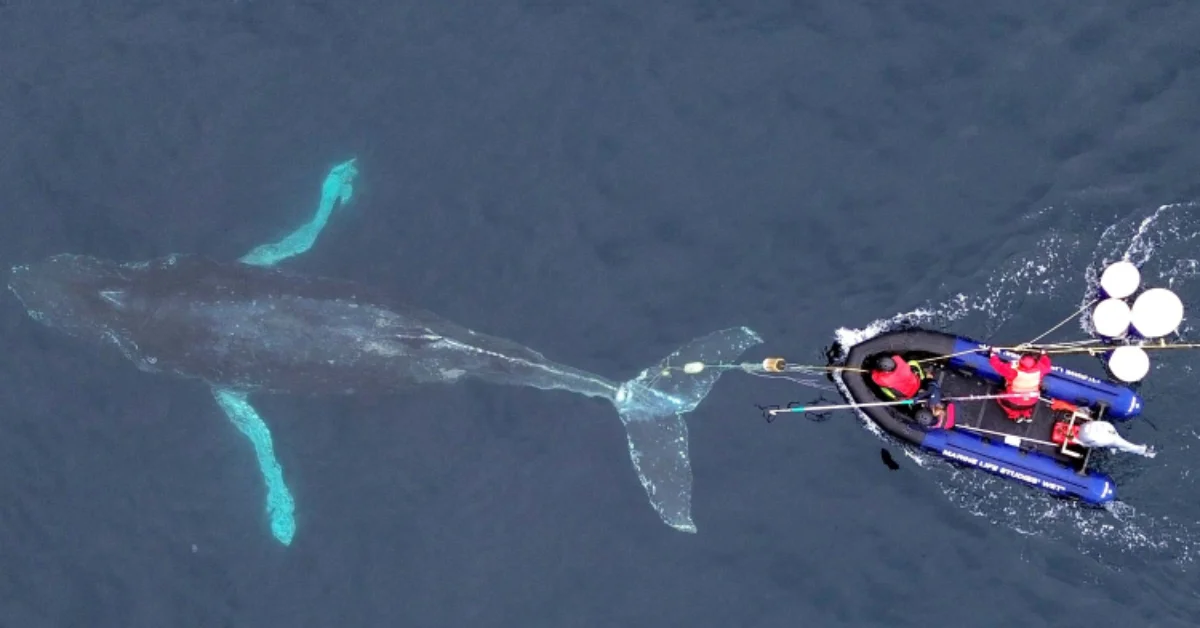
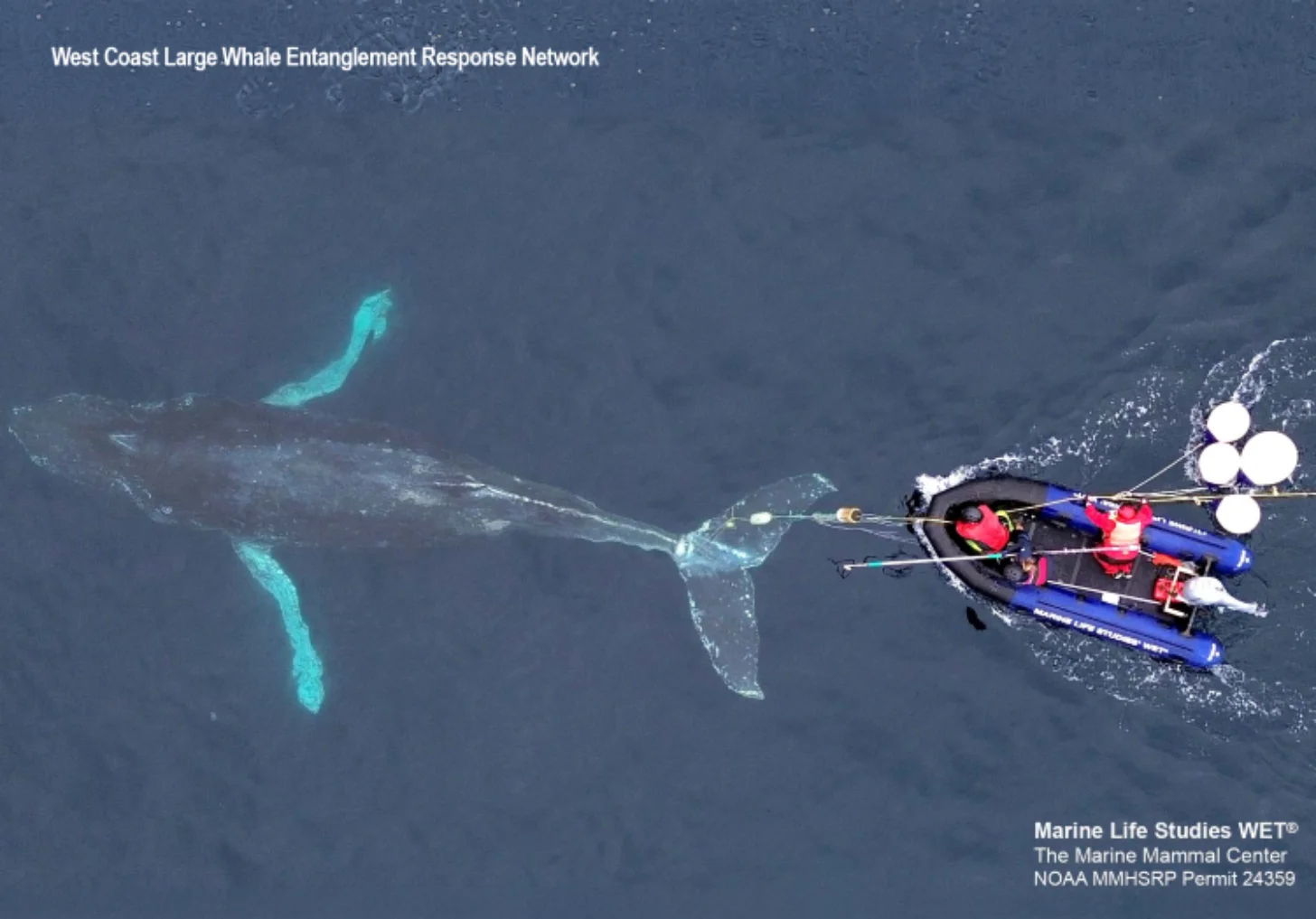
When it came time to intervene, the humpback reacted as expected; it was trying to evade predators by speeding up and diving. Eventually, the team was able to attach five large floating plastic balls to the line on the whale, temporarily slowing it down and keeping it near the surface.
O’Hern said it was important to be methodical and slow to make sure no one was hurt. That’s why only authorized responders should approach an entangled whale.
Finally, using a GoPro camera to see under the water — and about 14 miles west of Moss Landing — the team was able to get a closer look at the entanglement. Using a knife attached to a long pole, they made three cuts to the line, hoping it would release from the whale’s body.

At first, nothing happened, and the team decided to turn back and try again the next day.
But then, a miracle.
“As we began to move up the working line that connected us to the whale, there was a short little pop in the line and the rest of the gear slowly fell off,” Scott Benson, a retired NOAA Fisheries scientist and trained responder on the team, said in a statement.
“Disappointment turned to elation in a matter of seconds.”
The entanglement floated free of the whale, and The Duchess of Anchovy quickly swam away. The fishing gear was tagged from the most recent Dungeness crab season, and NOAA Fisheries is now in the process of investigating when and where the gear was set to understand the factors behind the entanglement.
“This was a great example of collaboration both on and off the water,” Lauren Saez, who helped coordinate the response for NOAA Fisheries’ West Coast Region, said in a statement.
“The team’s success led to the recovery of the gear, which our state partners traced to the Dungeness crab fishery. That will help us better understand what might have led to the entanglement in the first place.”
And the whale watching community remains keen-eyed and eager to help.
The day after the rescue mission, whale watch crews reported seeing the newly disentangled whale once again on Moss Landing. They photographed the whale feeding with other humpbacks again that evening.

“They have been sending us photos documenting what the wound looks like, and what the body condition looks like, and what the behavior looks like,” O’Hern said, of the whale watchers-turned-heroes.
“So in this case we will be able to follow the progress of the whale too, and hopefully get a feel for how the humpback whale is doing post-response.”
You may also like: Tiramisu the sea turtle couldn't even swim when rescuers found her. After months of vet care, she just returned to the ocean
Featured Image: Courtesy of The Marine Mammal Center