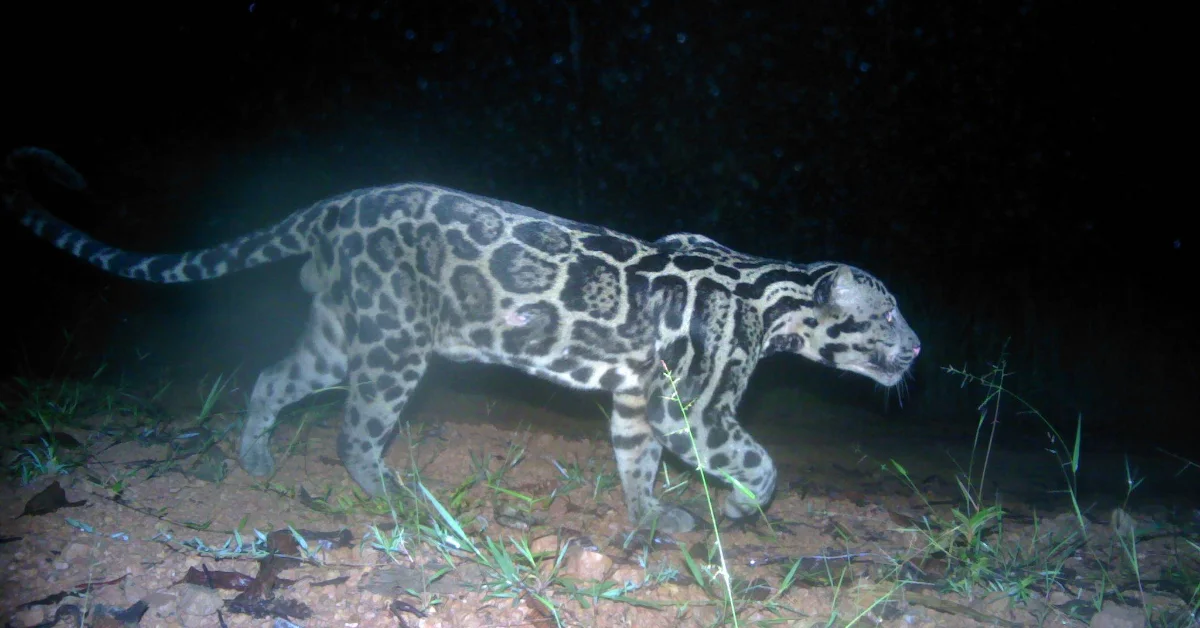
A recent study of Sunda clouded leopards includes rare footage of the highly elusive species.
The imagery was captured on trail cameras in previous years but was just released to the public with the publication of a study in the journal “Biotropica.” It features an 8.5-year-old female Sunda clouded leopard in the rainforests of Borneo, the oldest wild female Sunda clouded leopard to ever be recorded.

The Sunda clouded leopard is native to Borneo and Sumatra and is listed as Vulnerable on the International Union for Conservation of Nature’s Red List, with an estimated population of fewer than 10,000 mature individuals worldwide.
Much remains unknown about the species, however, often dubbed “the ghosts of the forest,” because of how easily they blend into their surroundings and how elusive they are to human onlookers.
But, when researchers from the Sabah Forestry Department, the Sabah Wildlife Department, global wild cat conservation organization Panthera, and local Indigenous peoples of Sabah set out to study the leopards, they became the first to document a female’s lifespan in the wild.

The never-before-seen footage and imagery was captured between 2007 and 2023 along three reserves in Sabah and observed 52 adult individuals, including 30 males and 22 females.
Researchers also took away some surprising findings: The species was far more mobile than previously assumed, with some cats traveling up to 22 miles between forest reserves. Additionally, females were 68% more difficult to detect than males, due to the fact that females spend more time in trees.

“Their physique hints at this, as their bodies are usually more slender and they have fluffier tails that help them balance,” the study’s lead author Katharina Kasper, a biologist with the Polish Academy of Sciences and the Leibniz Institute for Zoo and Wildlife Research, told Scientific American.
“Resident males, by contrast, spend much time circling and re-marking their territories [with urine], hence we capture them more often.”
The study also catalogued more information about life expectancies and the cat’s relationship with its habitat.

With the Sunda clouded leopard population on the decline, largely due to deforestation, illegal hunting, and habitat fragmentation, Kasper said this new research will be foundational to guiding future conservation efforts for the species.
“Ultimately, refined life-history estimates form a necessary foundation for assessing the population status of the Sunda clouded leopard, currently classified as Vulnerable,” the researchers concluded in their research.
You may also like: Researchers rejoice upon realizing their trail cameras captured footage of a bird that hasn't been documented in 140 years
Featured Image: Courtesy of Panthera/Sabah Forestry Department/Leibniz Institute for Zoo and Wildlife Research