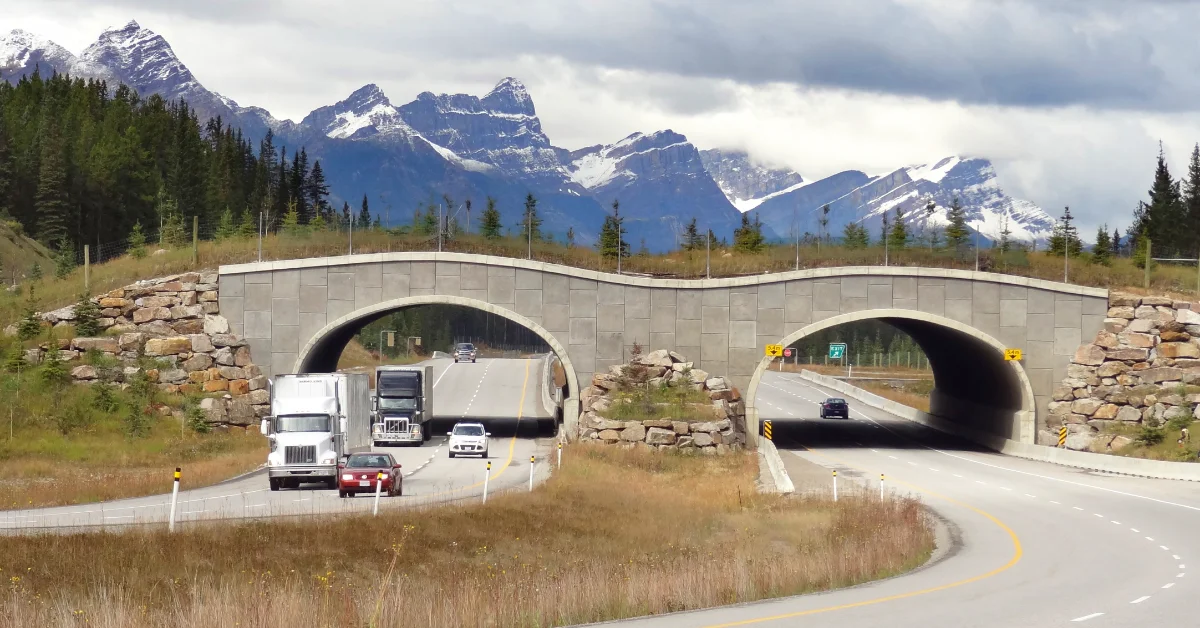
Conservationists are celebrating four exciting milestones for wildlife corridors on the heels of the legislative seasons in four states across the United States.
Those four states — Utah, Virginia, Idaho, and Oregon — have just successfully passed legislation that will bolster state transportation budgets to build more wildlife crossings and make it easier to expand wildlife crossing infrastructure.
Wildlife crossings see strong bipartisan support across the country, with lawmakers from both parties championing their development. This is likely due to the fact that overpasses and underpasses designed for animals are highly effective in reducing wildlife-vehicle collisions — some studies estimate by over 90%.
Wildlife-vehicle collisions cause about 26,000 injuries and more than 200 deaths in the U.S. annually, leading to more than $10 billion in repairs, medical care, and more, per the U.S. Department of Transportation. Plus, highways often block migration paths and have negative impacts on wildlife, like population declines and reduced biodiversity.

According to Scioto Analysis, a single wildlife crossing can prevent about 1,400 accidents over a 70-year lifespan, meaning billions of dollars can be saved by investing in wildlife corridor infrastructure.
So, states are continuing to invest in these projects.
Following success stories from states like Colorado, California, and Arizona, these four new examples show the growing interest in wildlife corridor legislation nationwide.
4 states boosting wildlife corridor efforts
Utah
In Utah, for example, lawmakers from both sides of the political aisle enacted legislation this year that establishes a designated wildlife crossing fund for the state, putting $2 million toward wildlife crossing projects annually.
Utah residents can also contribute to this fund through vehicle registrations, hunting licenses, and other permits. An important carveout in the legislation also stipulates that new solar and wind projects will need to be consulted on by the Utah Division of Wildlife Resources before breaking ground.
While a major win, the state will still need to rely on federal dollars to fully scale its wildlife corridor efforts.
“I consider it a piece of the solution,” natural resource manager for the state’s Department of Transportation, Matt Howard, told Utah Public Radio. “We still will need to seek out things like federal grants for the big overpasses, or the big, wide underpasses.”
Virginia
Similarly, Virginia Governor Abigail Spanberger just signed legislation designating a permanent fund for wildlife corridors in April. Virginia ranks among the top 10 states in the nation for wildlife-vehicle collisions, costing residents an estimated $533 million every year.
Similarly to Utah’s new bill, the new Virginia fund will ideally attract private grants and federal matching funds, while also inviting Virginians to make contributions. This can be done through their local department of motor vehicles or from individual tax returns.

“I’m really proud of this bill,” Delegate Shelly Simonds, a sponsor of the legislation, said in a statement.
“We all worry about the possibility of hitting an animal while driving. This fund gives people a meaningful way to do something about it and support efforts to help prevent these accidents before they happen. If we come together, this bill can help us gather data on where these collisions happen, develop plans to prevent them, and strengthen coordination between agencies.”
Idaho
In Idaho, lawmakers did not designate a new fund for wildlife corridors, but they did pass a resolution that supports investment in wildlife corridor infrastructure.
While the resolution does not allocate new funds, it conveys strong support for advancing “public safety and conservation of Idaho’s big game migration corridors through the development and implementation of wildlife crossings where appropriate and supported by local communities,” according to Capital Press.
Advocates say the legislative momentum in Idaho comes on the heels of the Cervidae Peak Wildlife Overpass near Boise, a 150-foot-long bridge that aims to reduce collisions between animals like mule deer and elk, and the some 14,000 daily drivers on State Highway 21 by 80%.
“As long as we’ve got local community support, wildlife crossings can be a really great thing for the state,” the resolution’s sponsor, state Rep. James Petzke, said in a hearing, “and we want to encourage Fish and Game and others to continue to work on paths to getting more of those built in some of those key migration corridors.”
Oregon
And lastly, Oregon has a new approach to funding its wildlife corridors: An increase of the state’s lodging tax by 1.25% beginning in January 2027.
The tax increase will benefit nine conservation programs. These programs will fund and build new wildlife infrastructure, research into wildlife-vehicle collision reduction, and more. According to Pew Research Trust, a bipartisan coalition of hunters, anglers, landowners, conservationists, and community leaders spent over a decade trying to pass the landmark act.

Very few states currently provide recurring funding for wildlife conservation, and the “1.25% for Wildlife” effort will translate to small increases in cost (roughly $1.25 to $2.50) to overnight stays at hotels and other short-term rentals.
The increased tax revenue is projected to raise nearly $37 million per year to support these key conservation initiatives, with about $2 million designated to wildlife corridor projects each year.
“This is a decisive victory for wildlife and a landmark moment for conservation,” Karla Raettig, the chief advocacy officer for the National Wildlife Federation, said in a statement.
“Oregon Gov. Tina Kotek has demonstrated extraordinary leadership to preserve and protect the wildlife and habitat that define Oregon. This legislation is a model for other states to follow.”
You may also like: Critics doubted a $1.46B wildlife crossing. Trail cameras tell a success story: '75 recorded uses each night'
Featured Image: WikiPedant/Wikimedia Commons (CC BY-SA 4.0)