Liberty in North Korea
Secrecy. Control. Dictatorship. Is that what comes to mind when you think of North Korea? You aren’t wrong to think this — the North Korean government makes it a top priority to make certain you think this.
But what about the people of North Korea? What about refugee issues? Or human rights issues? Or simply the everyday lives of the 25 million people living in the country?
“The general understanding of the American public when it comes to North Korea is very heavily shaped and portrayed by what we see in the media. … It’s oftentimes about the nuclear and the security issues,” says Hannah Song, president and CEO of Liberty in North Korea, an organization that rescues North Korean refugees.
“The North Korean people have been missing from this narrative for so long, which is kind of crazy when you think about it because of the fact that North Korea is a country of 25 million people,” Song says.
“Oftentimes [the] North Korean government is portrayed as being vilified or as being dangerous, and the people … get lumped up into that.”
We don’t often hear anything about the people. It’s on purpose. And the problem with excluding the North Korean people from the narrative is that the less humanity we can associate with North Korea, the less we’re compelled to change the injustices occurring there. It seems like a lost cause. But it’s not true — there’s so much we can do.
What’s happening in North Korea?
There’s a lot we don’t know about what’s going on in North Korea. The government goes to great lengths to display a carefully crafted image to the international community. We have very little opportunity to contact anyone inside the country.
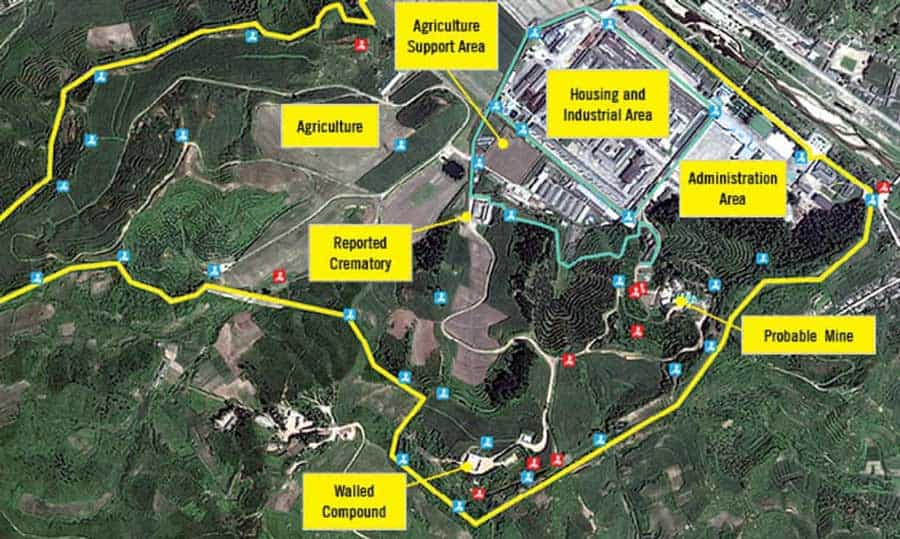
We don’t have a way to sneak a peek at political prison camps, where many North Koreans are sent without any due process for any type of political dissent or hostility toward the government — sometimes multiple generations of a family are sent to these camps for the crime of just one family member.
Amnesty International estimates that, based on satellite imagery, about 200,000 people are held in six large political prison camps in the country.
We have more information now than we used to because of the thousands of North Korean defectors who have managed to escape in the last 10 to 20 years. And their testimony tells a grave story of human rights violations.
No freedom of movement. No freedom of religion. No access to information. Enslavement, rape, torture, forced abortions and other acts of sexual violence, starvation, and even murder.
These are all crimes committed by a government on its own people.
“One of the biggest travesties that we see here is honestly that this is decades of human potential that’s been lost in North Korea because the government has prioritized absolute control above all else,” Song says.
[Editor's note: This article was originally written and published before the COVID-19 pandemic hit the world. You can read about how the pandemic is affecting North Korea here.]
North Korea: There’s Reason to Hope
Despite the terrible atrocities we have learned take place in the country from the defectors who have escaped it, there is reason to have hope for North Korea. Why? Because there are 25 million people in the country not only facing incredible challenges but overcoming them.

It’s happening at a grassroots level. In the 1990s, as many as 420,000 North Koreans died because of a severe famine in the country. The government was incapable of eradicating the famine, so the people took it into their own hands and developed a widespread — and illegal — black market system.
The creation of these markets was a turning point because the North Korean people began to find and create ways to survive on their own. They couldn’t rely on the government but came to rely on the markets to get what they needed. The result, unsurprisingly, was a sense of empowerment, which led to a series of social changes we still see unfolding today.
According to Hannah Song, there are three major positive social changes we can point to in North Korea:
- There’s a sort of de facto capitalism thriving within markets.
The government reluctantly tolerates this despite officially maintaining a socialist economy.
- North Koreans are experiencing an influx of information from the outside world through DVDs and other media materials.
These materials are opening their eyes to the reality of what’s happening both within and outside of the country.
- And strangely enough, one of the things we can be most hopeful about in North Korea is the rampant corruption. “It’s sort of a double-edged sword,” Song says.
“What corruption has done has actually allowed some relative freedom. If you have the ability to bribe an official, you could find yourself getting out of a sticky situation where perhaps you were caught with this illegal piece of media or you were caught with this illegal Chinese cell phone or if you want to travel to a few towns over, you could bribe an official and get the paperwork that you need to be able to do that.”

Like most things involving people, it’s complicated. But the people in North Korea are finding both subtle and blatant ways to subvert the injustices they face.
For one, there’s a sense of shared disobedience, especially among young people. The millennial generation living in North Korea grew up with little to no experience or memory of the government providing for them, much unlike their parents’ generation.
These young people’s experience is largely of getting what they need through the black markets instead of from the state. As a result, the younger generation — called the Jangmadang or “market” generation — has less sense of loyalty and reverence for the government.
Song says these younger North Koreans are much more curious and tolerant to risk.
On top of the subtle ways North Koreans uncover the taste of freedom within the country, more than 30,000 people have escaped the country. These defectors now have the opportunity to be agents of change for the country they escaped and the people they left behind.
Research indicates that about 50 percent of defectors actually re-establish contact with their family inside North Korea.
Of course, it’s not as simple as picking up the phone and making an international phone call. It takes a covert network and smuggled cell phones to reach family, but it’s worth it because defectors are able to send money back home through underground brokers who deliver remittances directly to family members inside the country, usually anywhere from $1,000–15,000 at one time.
The average income in North Korea is just over $1,100 USD annually, so even $1,000 is substantial spending potential.
“[The money] empowers family members in North Korea to engage in market activities, to invest in their own market activities, to bribe officials, to protect themselves, to provide themselves with goods that they need,” Song says.
The Path to Freedom for North Koreans
The path to leaving North Korea is, unsurprisingly, not easy. In many ways, it’s like a modern-day underground railroad, Song says.
It’s dangerous and lengthy — 3,000 miles by train, bus, car, and in large part by foot, all done covertly because if caught, escapees could be sent back to North Korea to face serious punishment.
Even if they make it to China, North Koreans still face danger because the Chinese government arrests and forcibly repatriates refugees.
Even if they evade arrest in China, they still face hardship because their illegal status makes them vulnerable to sex trafficking and exploitative employers since they can’t be in the public eye.

Liberty in North Korea steps in at that point to help North Korean refugees out of China. The organization operates largely by referrals received from North Koreans they’ve already helped escape who now want to help bring their families out.
The organization has a network of partners they work with in China and southeast Asia plus their own staff who helps defectors complete the last leg of their journey once they make it to China.
“When we meet them at the very tail-end of this journey, and they finally make it to southeast Asia, and we’re able to meet them and welcome them and say, ‘you are safe,’ there’s nothing like it,” Song says.
“Just the mix of emotions and just the opportunity for them to really breathe a sigh of relief and for the first time to feel safe and to really begin to dream and imagine their future.”
The work organizations like Liberty in North Korea do is to create a day when the North Korean people can achieve their own liberty, Song says. And it has to come from the people themselves because the people are the best solution.
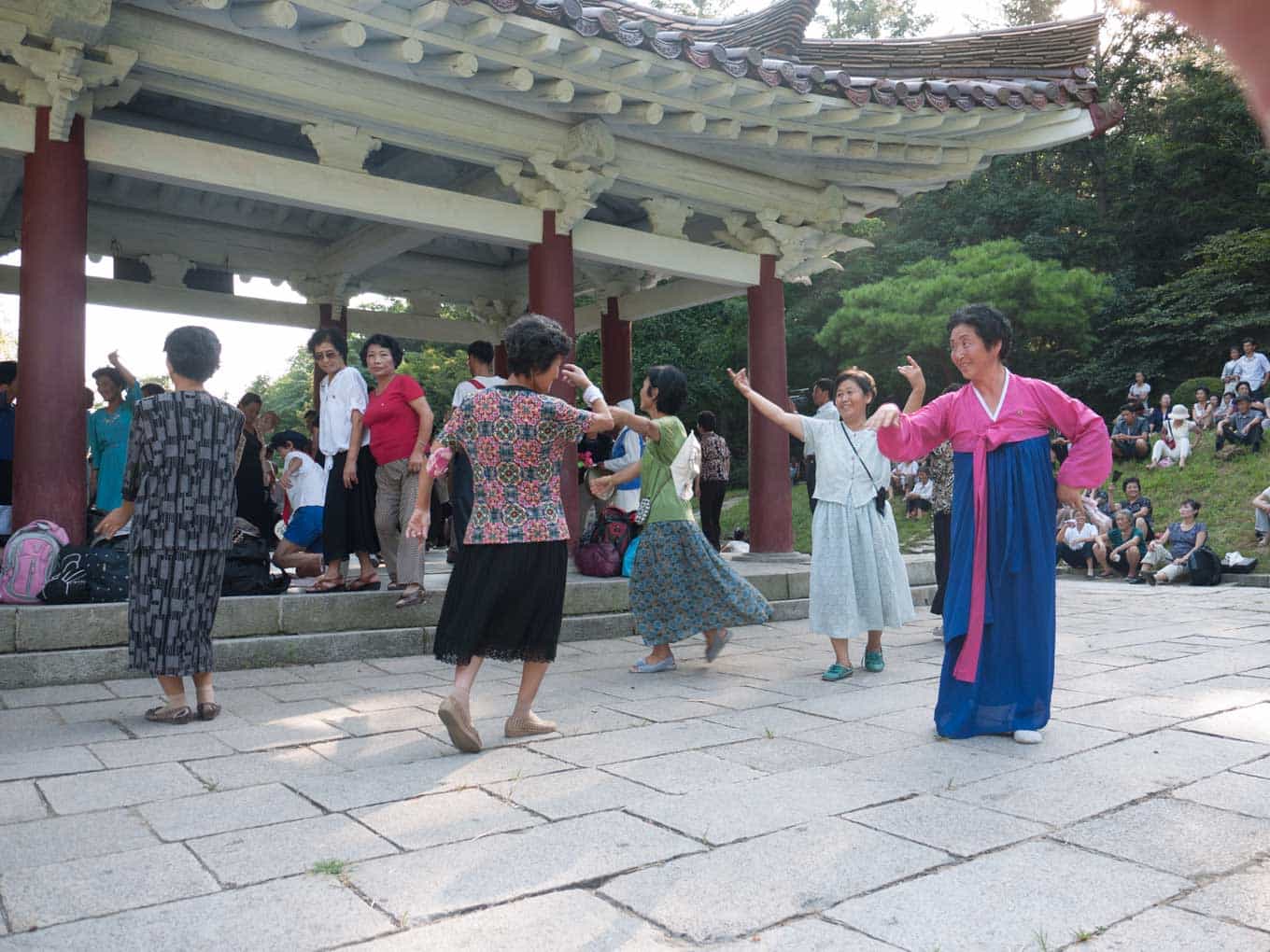
For many North Koreans, finding freedom is about creating a better future for themselves and for their families. And when it comes to the narrative of North Korea, despite the media images we see of nuclear threats, security issues, and repressive government plus the accompanying feelings of fear or defeat, we can’t forget that it all comes back to the people and collectively working toward good for those people.
“North Koreans are just like us,” Song says. “Their hopes and dreams for the future are very often the same as the hopes and dreams that we have for ourselves.”
We Need To Change the Narrative About North Korea
The neatly crafted narrative we hear about North Korea isn’t true — it’s not all nuclear weapons and military uniforms. There are plenty of ordinary North Koreans living behind that curtain.
This narrative is dangerous because it keeps the world from engaging with some of the greatest human rights injustices in the world today. The repression North Koreans experience is atrocious and deserves far more international attention and support than it’s received.
Hope for North Korea all starts with shifting the narrative.
Hope for North Korea all starts with shifting the narrative.
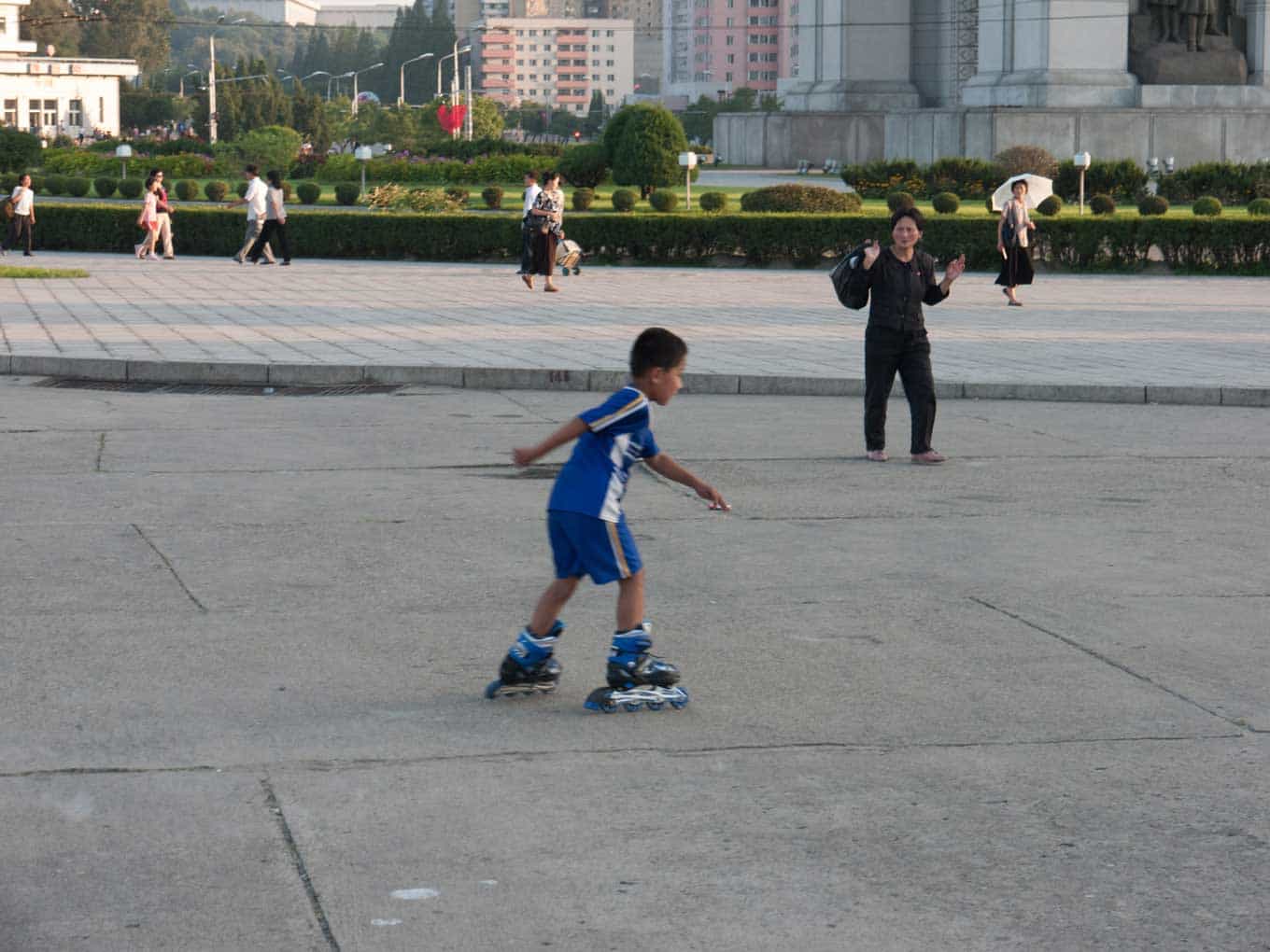
The North Korean people have shown extraordinary resilience and are uniquely positioned to create lasting change for the country because they now have more room for possibilities and perspectives than ever before. Their access to information is ever-growing, all weakening the regime.
Liberty in North Korea believes the North Korean people will achieve liberty in our lifetime. For those outside of North Korea, we can accelerate change by working to pivot the conversation toward the people.
For people and their ability to achieve their full potential, it’s always worth fighting.
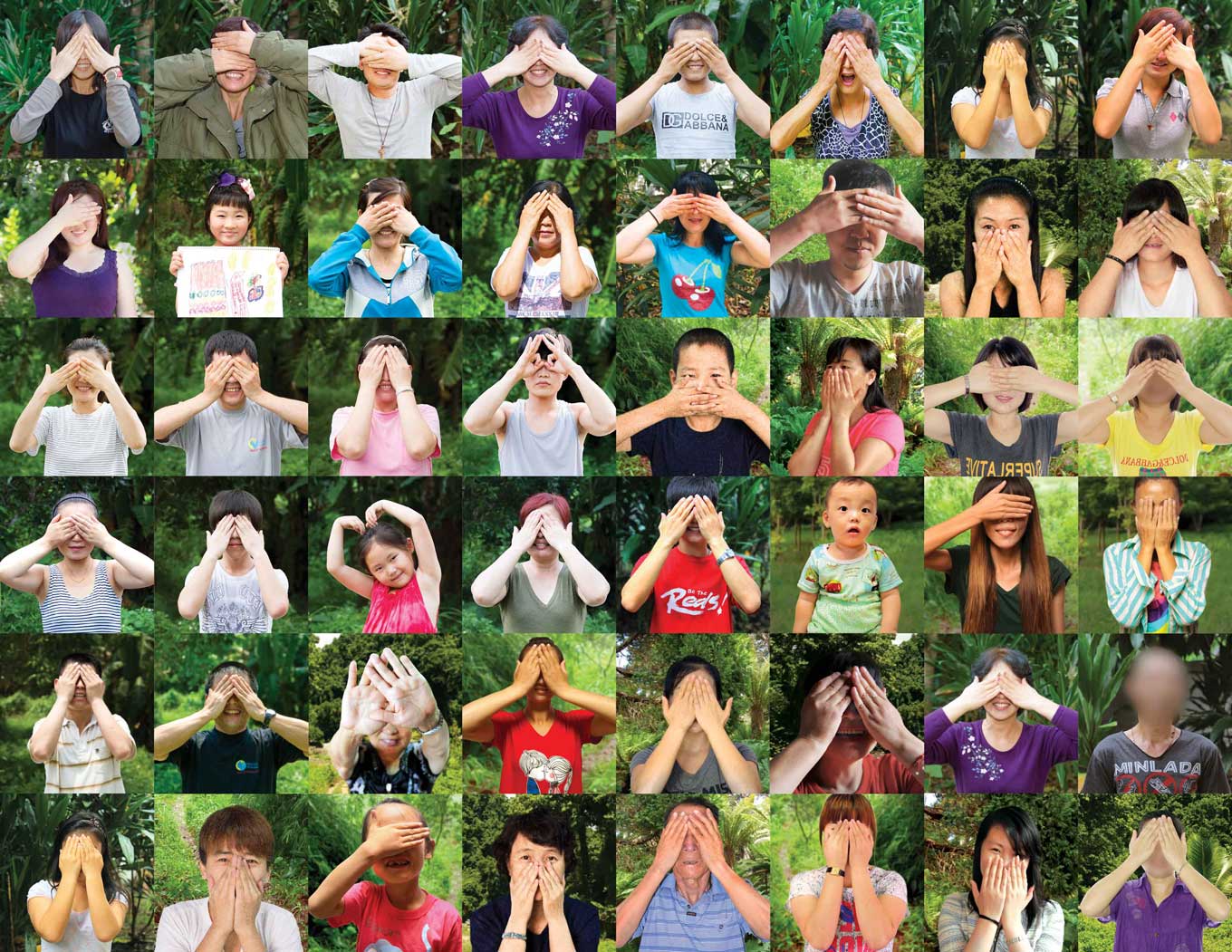
Help North Koreans
You can take action and make a difference for North Koreans and North Korean refugees by donating to Liberty in North Korea.
A version of this story originally ran in Issue 04 of the Goodnewspaper in May 2018. The Goodnewspaper is our monthly print newspaper filled with good news.
You can join thousands of subscribers who get access to more exclusive stories like these, our private community space, a free inspiring poster, and so much more. Become a subscriber today.
Related
Best Refugee Organizations to Support in All 50 States
A catalogue of organizations that serve refugees in every state in the United States
Meet the Organization Helping Refugees Heal Through Storytelling
MeWe International first launched in the Zaatari refee camp in Jordan
5 Ways to Make a Difference for Refugees
How to support refugee artists, small business owners, LGBTQ+ refugees, and more...
The students of Stoneman Douglas High School in Parkland, Florida have found themselves at the center of a national conversation about guns after the Feb. 14 mass shooting that claimed 17 lives at their high school.
These students grasped national attention for their very public calls for gun control reform. But they want to leverage the work of those who have been working long before them to imagine and create a world without gun violence.
“Those who face gun violence on a level that we have only just glimpsed from our gated communities have never had their voices heard in their entire lives the way that we have in these few weeks alone,” tweeted Emma González, a student activist from the Florida high school.
The Parkland students acknowledge it’s tragic that their Florida community was forced to reckon with the reality of gun violence unexpectedly and abruptly, while gun violence is simply nothing new for other communities.
Chicago, Houston, Milwaukee, and Parkland.
— March For Our Lives (@AMarch4OurLives) July 13, 2018
Different cities, different stories, same mission, united as one. pic.twitter.com/mGuPO2gjkK
In early March, the students from Parkland met with high school students from Chicago to discuss gun violence and its effects on their communities. The Parkland students are using their newfound national platforms to join in on and highlight the work that black students in Chicago have been leading for years.
“Young black people have been fighting to save lives through gun reform laws for years without the support and energy given to the Stoneman Douglas students,” wrote Teen Vogue columnist Lincoln Anthony Blades.
The activism these students have inspired has gone nationwide. Thousands of people turned up to the student-led March for Our Lives demonstration in March.
There were more than 800 events all around the country full of people calling for a solution to gun violence. Young people tend to be the least politically engaged, but this was among the largest student-led protests since the Vietnam War era.
You might also like:
You can learn about the heartbreaking school shooting statistics in the United States — and how to call your elected officials (with a script) to create change in the fight against gun violence — in our Good Good Good Guide
You can read quotes about preventing gun violence —in our Good Good Good roundup
You can read about the actions the Parkland students have taken to create positive change in our feature article
A version of this story originally ran in Issue 04 of the Goodnewspaper in May 2018. The Goodnewspaper is our monthly print newspaper filled with good news.
You can join thousands of subscribers who get access to more exclusive stories like these, our private community space, a free inspiring poster, and so much more. Become a subscriber today.
Chicago-based coffee shop Sip of Hope is the first coffee shop in the world putting all of its proceeds toward proactive suicide prevention and mental health education.
Jonny Boucher dreamed up the idea for the shop in November of last year, and it came to life only a few months later in late spring of 2018.
Boucher grew up just north of Chicago and by his teenage years was involved in the local punk music scene, putting on shows and organizing community spaces.
In 2010, his boss and mentor, festival promoter Mike Scanland, died by suicide. Scanland was the ninth person Boucher knew to die by suicide.
The very next year Boucher founded the organization Hope For the Day as a way to take action, as he had been deeply affected by suicide.
Now the organization works to proactively prevent suicide through physical and digital resources and campaigns, events, and educational tools.
Enter Sip of Hope, the organization’s latest project and a collaboration with Dark Matter Coffee, which supplies coffee beans for the shop.
Both the shop and the roaster see no profit — the shop’s mission is simply to raise funds for Hope For the Day.
“[Hope for the Day] has been our largest continuous charitable partner for the last four years,” said Kyle Hodges, Dark Matter communications director, to Chicago news source DNAinfo.
“When we met Jonny several years ago, he told us what he was doing, and it just struck a chord. We immediately jumped in and asked how we could help.”
In 2018, President Obama took to Twitter to celebrate the good that Sip of Hope is doing in Chicago.
Leaders like Jonny Boucher, a Chicago native who, after losing too many friends and family to suicide, started a coffee shop to offer emotional support and guidance to those who might be in need of a little more than a strong cup of coffee to get through their day. pic.twitter.com/H6XPceR6d9
— Barack Obama (@BarackObama) December 29, 2018
He tweeted, "As the year winds down and we look toward 2019, I’m asking you to make a commitment: find something you want to change in your community and take the first step toward changing it. If you need some inspiration, take a look at some of the young leaders who inspired me this year."
He then went on to highlight leaders in the United States and around the world, including Boucher's personal story.
The coffee shop is taking up a tangible space to break the silence surrounding suicide and mental health. Their timely and impactful work has garnered overwhelming support in the city of Chicago by politicians and major news outlets.
A version of this story originally ran in Issue 04 of the Goodnewspaper in May 2018. The Goodnewspaper is our monthly print newspaper filled with good news.
You can join thousands of subscribers who get access to more exclusive stories like these, our private community space, a free inspiring poster, and so much more. Become a subscriber today.
The fashion industry doesn’t want you to know the story of what’s in your closet.
The secret? Many of the people who manufacture clothing are overworked, underpaid, and unprotected.
And of the 60 million people the fashion industry employs, about 75 percent are women.
According to MIT, less than 2 percent of garment workers are paid a living wage, defined as the minimum cost to meet basic needs in a community and land just above the poverty line. It’s often higher than the minimum wage — the lowest wage companies are required by law to pay workers.
Many countries don’t have a minimum wage at all, or it can be difficult to enforce. So not only is fashion a social issue — it’s a human rights issue.
And for the socially conscious consumer, it can be difficult to determine the origins of the clothes we buy. In a slow shift that signals increasing changes in the industry, more companies recognize consumers expect their clothing-makers to take their social duty seriously.
"Not only is fashion a social issue — it’s a human rights issue."
Who Made My Clothes?
Fashion is the third-largest manufacturing industry in the world, employing about 45 million women.
The industry largely relies on cheap labor to increase profit — often employing women and child in parts of the world with oppressively low wages. These wages don’t even cover basic needs. None of it will ever be put into savings.
Many employees work in unhygienic, unsafe working conditions with very little opportunity to petition changes. In a heartbreaking and eye-opening tragedy, more than 1,100 people died and thousands more were injured when a building housing several garment factories collapsed in Bangladesh in 2013.
While many companies large and small have made worthy efforts to increase their transparency, it remains difficult to track ethical standards. Significant industry changes are complex and slow-moving. Moving the needle will take major shifts both culturally and economically on the global scale.
This is where you come in. Consumers have major buying power here.
Whatever social duty a large corporation might embrace is only intensified by pressure from buyers asking one simple question: Who made my clothes? This demand for transparency leads to greater levels of disclosure among companies — setting apart the brands that prioritize its workers.
What’s Changing?
While larger companies might be sluggish in keeping up with conscious consumers, smaller companies are popping up left and right to lead the effort and provide options for all styles.
In an act of radical transparency, Nashville-based fashion brand ABLE is publishing its wages, aiming to educate consumers on the often-harsh realities of the supply chain.
The company — which offers a wide selection of bags, shoes, denim, jewelry, and other apparel all made for and by women — performs an exhaustive audit to carefully understand a factory’s working conditions, works with the factory to improve any weaknesses, all carefully verifying information along the way. As a result, the brand has deepened relationships with their manufacturing partners.
“Our dream is that in 10 years or sooner, publishing wages will be as common as a nutritional facts label,” said ABLE founder and CEO Barrett Ward in a press release. “Publishing wages will give consumers a choice to protect those that make their products. We are publishing our lowest wage, not an average or general labor cost per product, so that consumer demand can protect the most vulnerable.”
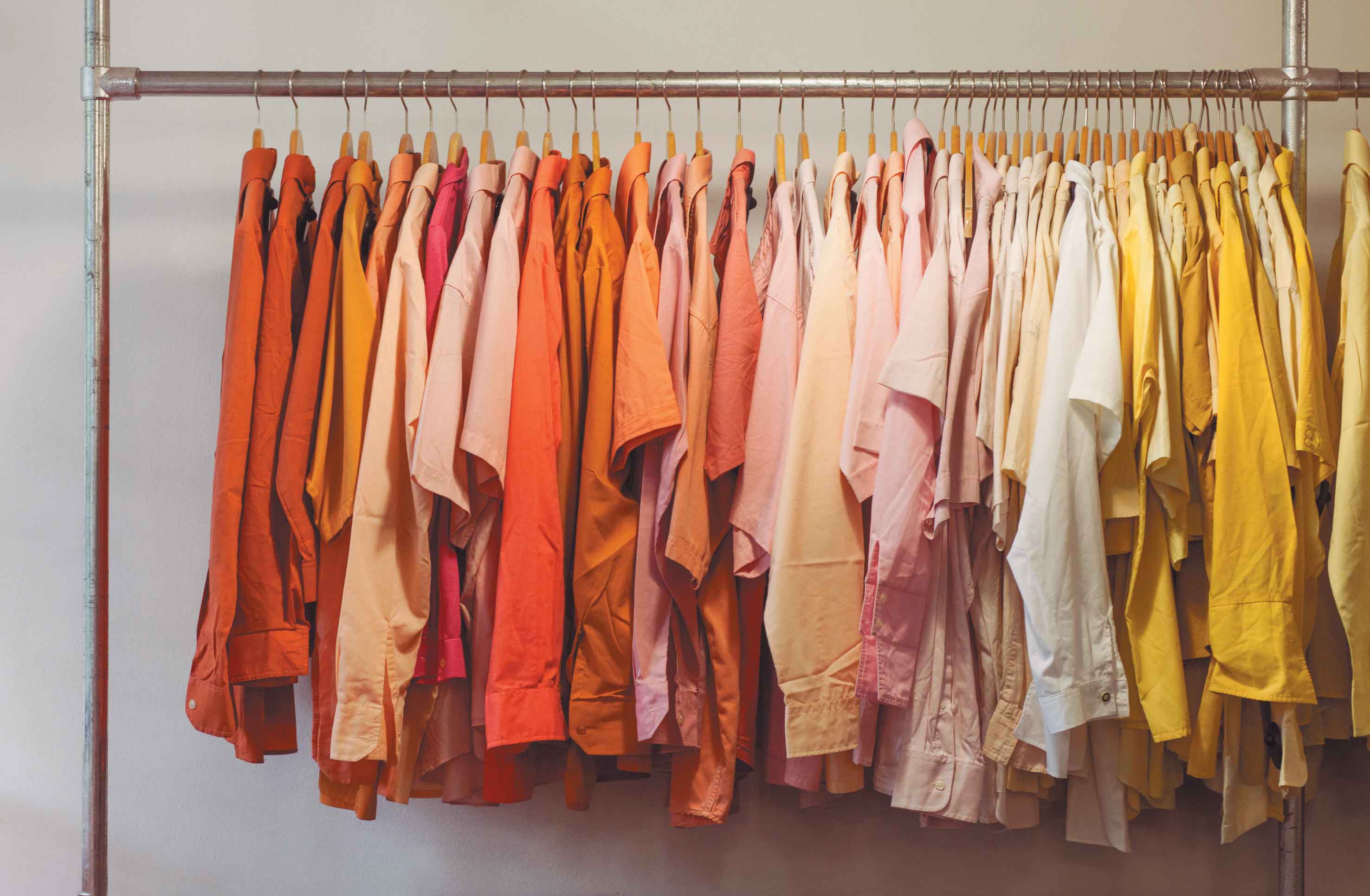
Wage and factory information is now available through the brand’s audit platform, accountABLE. The audits evaluate wages, equality, and safety and “grades” the factory on each category. The final product looks like a sort of “nutritional facts” sheet for a factory.
The company takes great care into selecting its factories through their own auditing system, prioritizing wages, hours, and working environment. Everlane employees visit the factories often and have close working relationships with their owners.
ABLE isn’t the only brand making efforts to make things right.
San Francisco-based clothing company Everlane — offering basics, denim, shoes, and bags for men and women — publishes photos, stories, and statistics from each of its factories around the world.
Everlane also publishes the actual cost (what they call the “true cost”) of creating each product — from manufacturing to labor to transportation, so you know just how much the markup is.
(Since this story was originally published, Everlane employees have challenged the company, saying their ethical image was an illusion.)
Known Supply is another company making an impact. Their on-trend clothing for men and women is all created by local artisans in communities in Uganda and Peru. Their production model empowers communities through fair wages, education, and mentoring programs.
Every product you receive is hand-signed by the woman who made it. You can then visit their website and learn about that woman — her story, her dreams, her goals, and some fun facts.
You can even leave a thank you note for her.
"Nothing pushes corporate duty like consumer demand. That’s on us."
Another thing all these companies have in common? They all make high-quality products that are meant to last for years, even decades, meaning you won’t have to toss it because it snags in the first month of wear. That’s a major environmental plus.
Demand More
When a woman makes a living wage, it has the potential to transform families and communities and even put an end to generational poverty. A living wage empowers a woman with increased safety for herself and her children, better nutrition and health, and even access to education. Plus women generally invest much of their money directly back into their family — about 80 percent, contrasted with about 30–40 percent among men.
Currently only about 0.5 to 3 percent of the cost of a clothing items goes back to the person who made it. If brands absorbed the cost of bringing workers to a living wage, it would cost only about 1 more percent of the cost of producing a garment. That’s just 10 cents of a $10 shirt.
Consumers have a clear choice. We know the facts, and now we respond. Ethical fashion doesn’t have to be underground — it’s on us to demand transparency from big brands, too, by voting with our dollar and making our voices heard. Nothing pushes corporate duty like consumer demand. That’s on us. A radical shift is possible.
A version of this story originally ran in Issue 04 of the Goodnewspaper in May 2018. The Goodnewspaper is our monthly print newspaper filled with good news.
You can join thousands of subscribers who get access to more exclusive stories like these, our private community space, a free inspiring poster, and so much more. Become a subscriber today.
Listen to our podcast episode with Barrett Ward, CEO of ABLE:
While living in Ethiopia in 2010, Founder and CEO of the lifestyle brand ABLE, Barrett Ward, saw firsthand how extreme poverty forced young women, generation after generation, to resort to prostitution as a means of supporting themselves and their families.
He saw that they needed an opportunity to earn a living with dignity, empowering themselves to end the cycle of poverty. This was the beginning of Barrett’s life’s work at ABLE.
Leading a fashion lifestyle brand might be an unlikely role for someone self-described as ‘not a fashion guy’, but that’s exactly where Barrett Ward then found himself.
Barrett is now the visionary behind the rapidly growing Nashville-based company disrupting the fashion industry with a social conscience. Today, the company employs more than 300 women in Ethiopia, Peru, Mexico, and Nashville.
In this conversation, Branden and Barrett unpack the importance of making an impact where it matters most, building a company based on radical transparency and second chances, and the importance of fostering an attitude of gratitude in your sphere.
“That was a seminal moment of my career — realizing charity needs to be the beginning point, but at some point that has to stop and we have to give people the opportunity to stand on their own two feet."
— Barrett Ward
Rhino deaths have surged in South Africa, but a group of women has reduced poaching by 76 percent within their area of operation since 2013, according to The Guardian.
Their unarmed anti-poaching unit, called the Black Mambas, has removed thousands of snares, destroyed 10 poacher camps, and put six bushmeat kitchens out of service. Their work has led to six arrests for poaching.
The country has the world’s largest rhino population but has sadly seen a huge growth in poaching since 2007, a year when just 13 were killed. More than 5,000 were killed in the eight years following. Conservationists warn the species could become extinct in the next 10 years.

In the six months before the group was formed in 2013, 16 rhinos were lost in one of the private reserves bordering Kruger National Park. But in the year following the group’s formation, that number shrunk to just three.
The 26 women, all from disadvantaged communities bordering the national park, receive paramilitary training and wildlife education before joining guards and intelligence units in the fight against poaching.
The Black Mambas cover up to 20 kilometers (more than 12 miles) by foot or vehicle at night, removing snares, setting up roadblocks, and assisting with tracking collars.
The horn is seen as status symbol in parts of Asia including Vietnam and China, where it is ground up and used as a recreational drug or medicinal cure.
It’s worth more than gold, but it has next to no treatment value. Its healing properties are no different than biting and consuming your own fingernails.
The group hopes to teach community members that local black women can get jobs and an education.
One member of the Black Mambas, Felicia Mogakane, now supports 10 family members with her salary and is able to purchase groceries and pay for school for her two sons.
In 2015 the group received the Champions of the Earth prize — the United Nations’ highest environmental honor.
A version of this story originally ran in Issue 04 of the Goodnewspaper in May 2018. The Goodnewspaper is our monthly print newspaper filled with good news.
You can join thousands of subscribers who get access to more exclusive stories like these, our private community space, a free inspiring poster, and so much more. Become a subscriber today.
More trees now than ever
This might come as a surprise: Worldwide tree cover has grown — not shrunk!
Worldwide tree cover has grown by 2.24 million square kilometers — the size of Texas and Alaska combined — in the last 35 years, according to a paper in the science journal “Nature.”

By analyzing satellite data, researchers from the University of Maryland assessed agricultural expansion, climate-driven expansion and contraction of ecosystems, and forest clearing and recovery.
Ultimately the study found that tree cover loss in the tropics was dominated by tree cover gain in other regions, driven by agricultural abandonment in parts of Europe, Asia, and North America, rising temperatures allowing forests to grow closer to the north and south poles, and a massive tree-planting program in China.

Sadly, the research also confirms a large-scale loss of our planet’s most biodiverse ecosystems, particularly in the tropical rainforests.
Researchers concluded that 60 percent of all change during the study period were associated with human activity.
While Earth might have more trees than it did 35 years ago, we can’t allow this to mask the reality that some of our planet’s most productive and biodiverse biomes have been damaged, degraded, and destroyed at our own hands.
Replacing natural landscapes with crops or bare land reduces nature’s capacity for sustaining complex ecosystems.
To reduce your impact on deforestation, reduce, reuse, and recycle (in that order), reduce your meat intake, and demand action from politicians to protect our forests so we can enjoy and sustain a green planet for years to come.
What country has the most trees?
Russia leads the world when it comes to total amount of tree cover, according to a 2020 report from the Food and Agriculture Organization of the United Nations.
It's followed closely by Brazil, Canada, and the United States.
| Country | Forest Area (Hectares) | Percent of World's Forests |
| Russia | 815,000,000 | 20.1% |
| Brazil | 497,000,000 | 12.2% |
| Canada | 347,000,000 | 8.5% |
| United States | 310,000,000 | 7.6% |
| China | 220,000,000 | 5.4% |
| Australia | 134,000,000 | 3.3% |
|
Democratic Republic of the Congo |
126,000,000 | 3.1% |
| Indonesia | 92,000,000 | 2.3% |
| Peru | 72,000,000 | 1.8% |
| India | 72,000,000 | 1.8% |
| Rest of the World | 1,375,000,000 | 33.9% |
A version of this story originally ran in Issue 04 of the Goodnewspaper in May 2018.
The Goodnewspaper is our monthly print newspaper filled with good news.
You can join thousands of subscribers who get access to more exclusive stories like these, our private community space, a free inspiring poster, and so much more.
It’s all about love.
But it takes planning, and with planning comes opinions and emotions, especially with an event as momentous as a wedding.
Thankfully you don’t have to do any one thing in your wedding. It’s your day, and if some traditions don’t feel good for you then you don’t have to participate. At the end of the day, a wedding is a celebration of love, and there’s no one right way to celebrate.
Many couples are choosing to opt out of certain traditions that can feel outdated or even downright wrong.
Here are some ways to make sure your wedding is perfectly you, while also being ethical, environmentally friendly, and serving a greater purpose:
All of the recommendations in this story are independently selected by the Good Good Good team. Some of the links may be affiliate links — which means that when you click them, we may earn a commission — which supports our ability to continue sharing good news. Thank you!
Put a (Conflict-Free) Ring on It
An engagement ring purchase makes both environmental and human rights impacts.
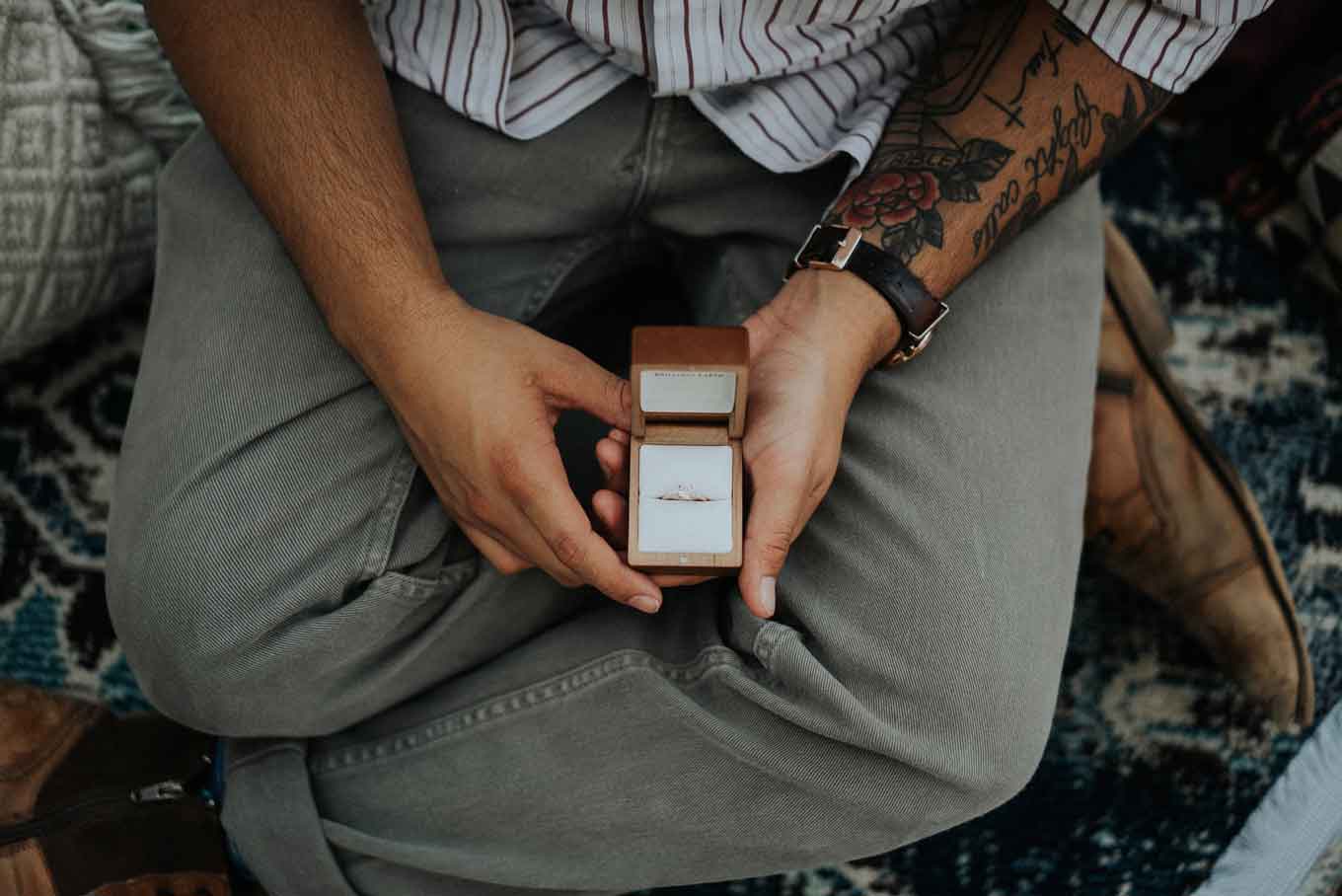
The diamond industry has been notoriously controversial since the rising popularity of diamond rings in the last century — diamond harvesting has fueled conflict, the mining of metals has damaged the environment, and miners are often underpaid and overworked in unsafe conditions.
Socially conscious brides-to-be are understandably searching for an option that she and her partner can both show off and feel good about. Thankfully there are stunning and affordable alternatives to traditionally produced diamond rings.
Search for conflict-free, environmentally friendly, or lab-created diamonds for your wedding ring
Companies like Brilliant Earth, HOLDEN, and Do Amore offer ethical options for whatever your budget.
Do Amore even donates funds from each ring purchase to building clean wells in communities without clean water by partnering with charity: water.
If you're open to a lab-grown diamond, you can check out brands like With Clarity.
Prioritize recycled and fair trade metals in your wedding ring
A single wedding ring can produce up to 20 tons of waste. Mining for precious metals can produce toxic by-product that often contaminates groundwater — killing fish and making land unusable for irrigation. The dirty water often ends up in our oceans.
Ditch the diamond altogether.
Consider using another stone — moissanite looks shockingly similar to a diamond and is manufactured instead of mined. Or go stone-free and opt for a simple band made of recycled metal.
Get a recycled or vintage wedding ring.
Buying secondhand will always be your best bet for reducing your carbon footprint and extending the lifespan of your jewelry. Etsy, pawn shops, and even eBay are great places to start searching.
Let your finger go naked!
You don’t have to wear an engagement ring. It might be a deeply held tradition but not one that makes or breaks a marriage. Some couples decide to get matching tattoos or invest in something else that signifies their love.
Wear Your Convictions on Your Wedding Day
Finding a sustainably and ethically made wedding dress might sound stressful, but you actually have numerous stylish and jaw-dropping options to browse.

See if you can buy secondhand.
Buying secondhand, borrowing, or renting your bridal gown and bridesmaid dresses is always going to be the best option to reduce your environmental impact.
Several websites including Once Wed offer clean, like-new dresses. The Budget Savvy Bride put together a helpful article about how to buy (and sell) used wedding decor.
Shop sustainable brands.
Your next best bet is to search for clothing companies that treat their supply chain well and take their environmental impact seriously.
TOMS (which has evolved to a healthier approach since their 1-for-1 campaign) offers a wedding collection — the company gives one third of profits for grassroots good, making your wedding day shoes that much more special, impactful even.
Reformation makes stunning gowns with sustainable methods and materials.
London-based Minna embraces zero waste pattern cutting techniques.
You can also check out brands like Christy Dawn, Wear Your Love, and PureMagnolia.
Your dress doesn't have to be single-use.
Rent the Runway has a bridal collection that allows you to rent instead of buy. As do all of these wonderful dress rental websites.
If you decide to sell your dress after your wedding, consider selling your gown to an organization making a difference.
Brides Do Good gives one-third of the price of your dress to charities helping protect the millions of young girls at risk for child marriage.
Make Your Wedding the Greenest Event of the Year
One wedding lasting just six hours with about 100 guests can produce more than 500 pounds of waste, according to The Green Bride Guide.
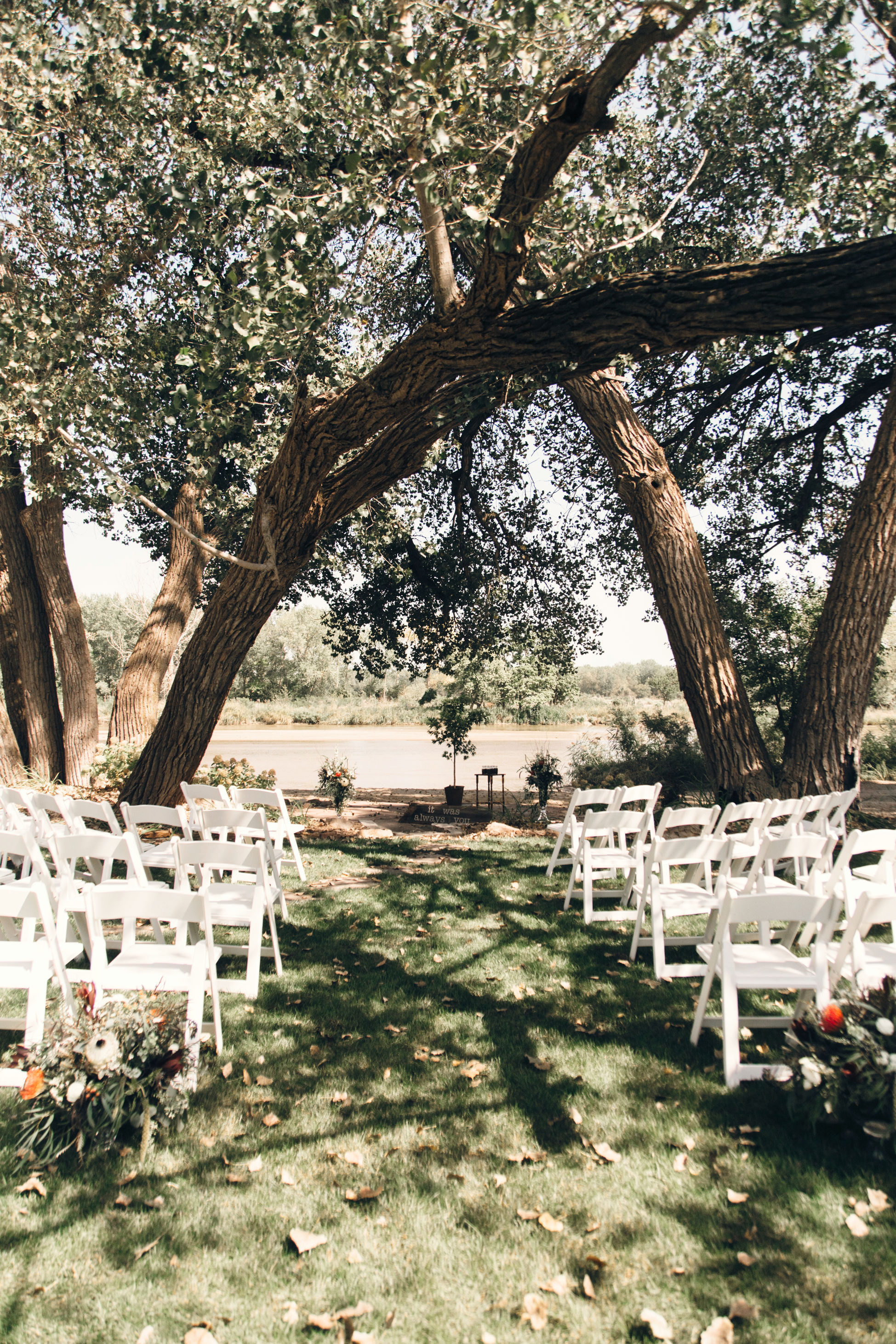
Thankfully there are both little and big choices you can make to cut waste (and maybe even cost) on your wedding day. Your guests won’t even notice they’re at an eco-friendly event.
Stay close to home if you can.
Air travel is one of the most significant aspects of many humans' carbon footprint. For those of us who love to travel, it's sad to think about the impact our vacations can have on the environment. But it's also an opportunity to easily make a difference for your wedding.
By choosing to host your wedding near where most of your wedding guests live, you can significantly reduce the amount of emissions they release by traveling via airplane. Even if some friends and family have to fly it, you'll be significantly cutting back on the number of flights being taken.
This may mean hosting a hometown wedding, near your or your partner's families, instead of where you may be living now — but it's also an opportunity to explore what kinds of new venues and vendors have come to town in recent years. You may be pleasantly surprised by your options.
If you're dreaming of a beautiful destination wedding, consider eloping or making it a micro-wedding. If you need to, you can livestream guests in with tools like Joy. By reducing the number of people at your wedding, you're saving everyone else a flight and you can feel good about reducing your carbon footprint.
Cut single-use out wherever you can.
Planning a wedding is challenging — and using single-use products can feel like an easy shortcut to make the wedding easier to pull off.
Unfortunately, that comes at the cost of the planet.
While it may take a little bit more intentionality, choosing to rent instead of buy, choose reusable over single-use, and minimizing plastic wherever possible will make a huge difference in creating a more sustainable wedding.
Rent plates, glasses, linens, and utensils that can be washed and reused instead of thrown away. Anywhere you can cut plastic and paper goods will make that much of a difference on the environmental impact your wedding makes.
Make it easy for your guests to do good.
Ask your guests to not wrap your gifts. Instead, ask guests to ship gifts directly to you. It will make packing up after your wedding that much easier when you don’t have to load up a stack of gifts. And you won’t have to throw away bags and bags of wrapping paper.
Best yet, ask your guests for digital gift cards or even to donate to a charity of your choice so there are no shipping materials involved at all.
Where you can, borrow or rent instead of buy. Buying new products puts demand in the market for new manufacturing, whereas borrowing or renting extends use on products already created.
Be extra thoughtful about your venue and vendors.
The easiest way to reduce your carbon footprint is to choose a green venue and vendors. They'll do most of the work to ensure your big day is sustainable.
By choosing trusted vendors with expertise, you can rely on their expertise instead of having to learn everything yourself. (Just make sure you know how to spot greenwashing.)
Ask your venue how they reduce their carbon footprint. If they don't immediately have an answer for you, it may be a sign they don't keep the environment top-of-mind.
Send invites and print other paper goods on sustainable, recycled, post-consumer paper. Or go fully digital and send invites and details through email or a website.
When it comes to flowers, organizations like Repeat Roses will take your floral arrangements and repurpose them for hospital rooms and other community centers.
Your wedding's food should taste good and do good.
Ask questions! Ask what your vendors do to prioritize the environment and reduce waste. Ask your caterer if their food is local and seasonal.
Don’t throw away food. Insist that the caterer donate any uneaten food to a food bank or put it in compost. You can always freeze it and take it home for leftovers!
And most importantly, the single most impactful thing you can do for your wedding is to cut meat from the menu. Too many weddings rely on the traditional "chicken, steak, or salmon" menu choices — but by minimizing animal products, you can significantly reduce the overall carbon footprint of your wedding.
This is a unique moment in your life where you can single-handedly make a choice that reduces a large amount of emissions. Plus, the world is filled with countless incredible vegetarian meals — and the right vendor will know exactly how to woo your guests.
Consider a carbon offset.
Your wedding will have an impact on the environment, but you can offset that impact by buying carbon offsets. Simply put, you can pay money to take an action like planting trees or contributing to a carbon reduction program — and it'll ensure that your wedding remains carbon neutral (or even carbon positive).
Offset your wedding with a company like Terrapass or ask your vendors to get certified through Climate Neutral.
And lastly, know that there's no such thing as a perfectly green wedding. Don't overly stress on making sure every single thing is 100% environmentally friendly.
Just do your best where you can.
Make thoughtful choices where you have the option, and commit with your partner to doing the same for the rest of your life together. Choosing to be a sustainable couple is one of the best wedding presents you can give each other.
A version of this story originally ran in Issue 04 of the Goodnewspaper in May 2018. The Goodnewspaper is our monthly print newspaper filled with good news.
You can join thousands of subscribers who get access to more exclusive stories like these, our private community space, a free inspiring poster, and so much more. Become a subscriber today.
Hungry for inspiration, resources, or just some good ole entertainment? Here’s what’s been on heavy rotation for the Good Good Good team and community.
Check out our latest picks for a few of our favorite ways to grow empathy, stay informed, and increase motivation to go out into the world and become good news:

What to Watch
“Won’t You Be My Neighbor?” | Documentary, 2018
It’s no secret the Good Good Good team members are fans of Fred Rogers. That’s why we're thrilled about the new documentary from director Morgan Neville about the life, philosophy, and legacy of Mister Rogers. It hit the big screen and found massive success. Won’t you be our neighbor?
“Human Flow” | Documentary, 2017
This German doc is all about the global refugee crisis, bringing you through stories in more than 20 countries to help you grasp both the immense scale and personal impact of large-scale human migration in our world today. The film shows the gravity of our current refugee crisis and brings the stories of the hundreds of thousands affected people straight to the forefront.
"Nanette” | Comedy Special, 2018
Hannah Gadsby’s Netflix comedy special is the most talked-about comedy special of the year. The Australian comedian provides a social commentary on comedy itself, her experiences as a gay woman, and the very nature of tension. Her comedy special has met significant critical acclaim worldwide.

What to Listen To In the Car
“Ear Hustle” | Podcast
Ear Hustle is a podcast all about life inside prison, all brought to you from the people within it. Stories are recorded and produced inside the media lab at San Quentin State Prison in California.
Check it out for difficult, honest, and sometimes funny perspectives straight from within the American prison system.
You can listen to our episode with Ear Hustle co-host Nigel Poor on our podcast, Sounds Good. And learn about reducing recidivism from Jason Wang.
“The Daily” | Podcast
This daily news podcast from the New York Times offers 20 minutes of news neatly packaged for your day. Its popularity comes from its conversational tone and accessibility; anyone can get the news they need to know just by pressing play.
Each episode has a rundown of the day’s top story and summaries of a few of biggest news stories you need to know about.

What to Subscribe To
EnneaThought for the Day | Email Newsletter
The daily newsletter just for your Enneagram type directly from the Enneagram Institute. Receive an encouragement and insight geared to assist you on your quest for self-knowledge. Don’t know which of the nine Enneagram types you are?
Check out enneagraminstitute.com for more info. (And explore more of the best newsletters to subscribe to.)
Goodnewsletter | Email Newsletter
Need a reminder of the good in the world? Every Tuesday, the Good Good Good team compiles five good news stories worth knowing about, and delivers them right to your inbox, ensuring you find hope in your weekly headlines. There’s no shortage of good news — you just have to know where to look.
Subscribe today to get good news.
The Darling Letters | Email Newsletter
Darling is all about “the art of being a woman.” Their print mag is full of visual inspiration, un-retouched photos, and articles about careers, relationships, style, travel, and more. Receive thoughtful letters from Darling founder Sarah Dubbeldam (and special guests) straight to your inbox.
Subscribe to The Darling Letters today.

What to Read
“Choose Wonder Over Worry” | Book by Amber Rae, 2018
This book by “Sounds Good with Branden Harvey” podcast guest Amber Rae will shift the way you relate to your emotions. In her book, Rae invites you to face your fear, navigate your discomfort, and rewrite the “worry myths” in your head that hold you back. And check out her newest book in our updated book recommendations list.
“The Book of Joy: Lasting Happiness in a Changing World” | Book by His Holiness The Dalai Lama & Archbishop Desmond Tutu, 2016
“How do we live a life of joy in the face of adversity?” That’s what the 14th Dalai Lama and Archbishop Tutu discuss in their 2016 book about the challenges of living a joy-filled life. These two spiritual masters want to draw you to a life brimming with joy through stories, scientific findings, and daily practices.
“Factfulness: Ten Reasons We’re Wrong About the World — and Why Things Are Better Than You Think” | Book by Hans Rosling, 2018
Physician, academic, and statistician Hans Rosling thinks most of us are wrong about the state of the world. In his latest publication, he suggests the world is richer, healthier, and less dangerous than we often think. He reveals the 10 instincts that often distort our perspectives for the worse.
We've linked to Amazon for convenience — but if you prefer to shop elsewhere, please see our collection of alternative places to buy books instead of Amazon.

Who to Follow
@zero.waste.collective | Instagram
The Zero Waste Collective is an online community dedicated to reducing waste. Their Instagram is full of beautiful visuals and tips encouraging and equipping you to live a lower-impact, sustainable lifestyle.
@tinycarebot | Twitter
💗: remember to ask someone for help if you need it please
— here's your reminder (@tinycarebot) August 21, 2021
The sweetest reminders around. Every hour @tinycarebot posts a quick message reminding you to take care of yourself, always politely saying “please.”
@twloha | Twitter and Instagram
To Write Love On Her Ams is a nonprofit dedicated to offering hope and help for people battling depression, addiction, self-injury, and suicide. They provide always have the right words to say.
All of the recommendations in this story are independently selected by the Good Good Good team. Some of the links may be affiliate links — which means that when you click them, we may earn a commission — which supports our ability to continue sharing good news. Thank you!
A version of this story originally ran in Issue 04 of the Goodnewspaper in May 2018. The Goodnewspaper is our monthly print newspaper filled with good news.
You can join thousands of subscribers who get access to more exclusive stories like these, our private community space, a free inspiring poster, and so much more. Become a subscriber today.
In the early 1890s, when Boise, Idaho was booming thanks to a gold rush, a local water company discovered something else east of the city: hot water bubbling up from beneath the Earth’s surface. The company built a wooden pipeline to transport the water to a nearby neighborhood, providing heat for several homes and businesses. This marked the nation’s first geothermal district heating system, which is still in operation today.
A century later in 1983, Boise developed another — much larger — geothermal district heating system for its downtown. Water from a naturally heated aquifer flows through a series of pipes underneath the city’s streets. The energy drawn from this water heats nearly 100 large buildings, including the city hall, banks, hotels, a convention center, and even the swimming pool at the local YMCA. The system serves a third of the downtown area, equivalent to more than 6 million square feet.
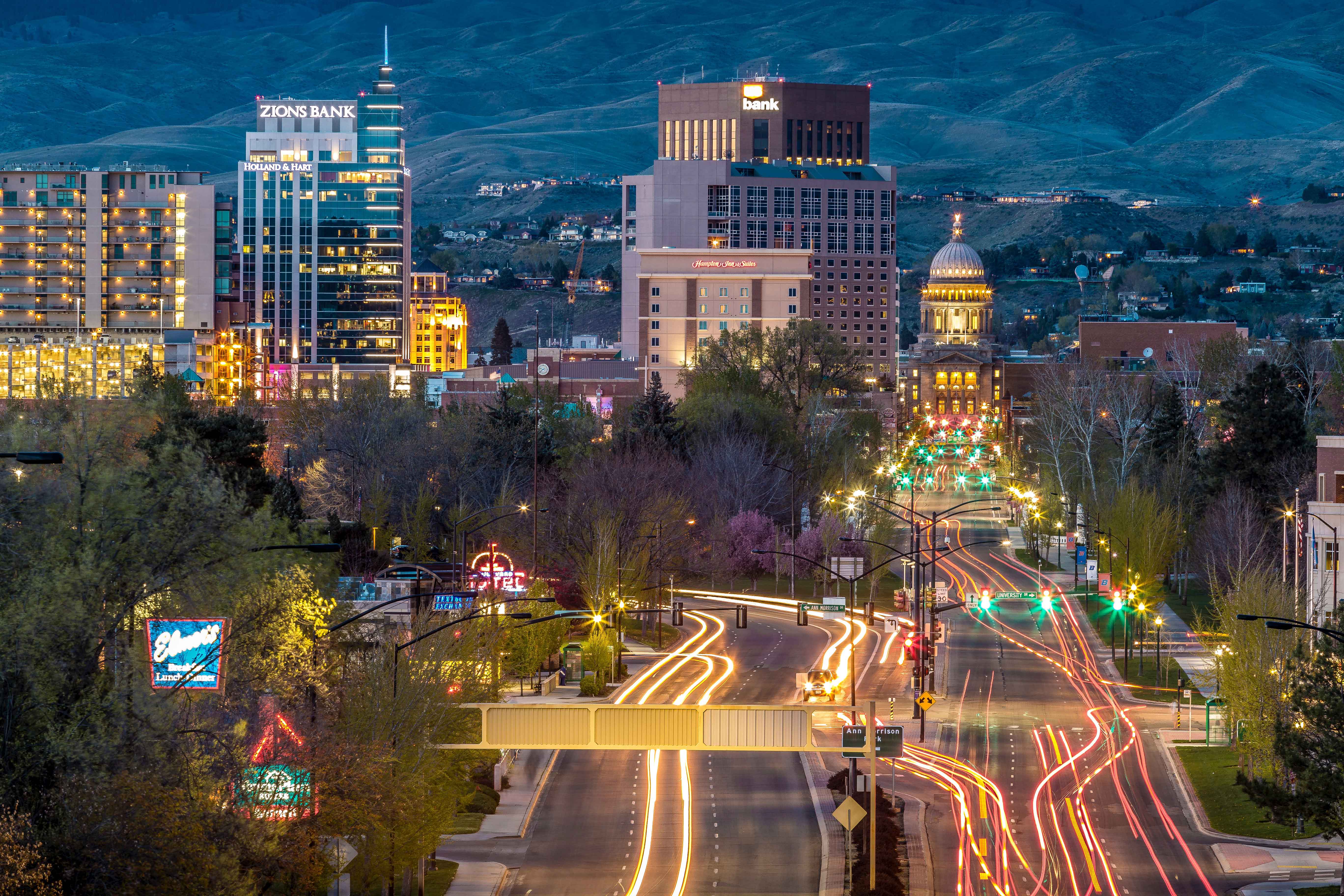
When Boise first installed its downtown heating system nearly four decades ago, “it was a pilot project,” Jon Gunnerson, the city’s geothermal coordinator, tells Next City. “Nobody knew how successful it was going to be.” Today, it is the most prominent and successful example of geothermal district heating in the country. “We’re heating the big buildings downtown, and we see a huge benefit of offsetting the energy that these large buildings would use,” Gunnerson says.
Geothermal energy harnesses the heat stored in rocks underneath the Earth’s surface. The Earth’s inner core is about 10000 degrees Fahrenheit — about as hot as the surface of the Sun — but even a few miles below the surface, temperatures can soar to well above 200 F. A fraction of this heat would be enough to satisfy the world’s energy needs. Although other renewable sources of energy, like wind and solar, have garnered more attention, geothermal energy has an important advantage over them. While solar and wind energy ebb and flow with the conditions, the Earth’s heat doesn’t fluctuate. “It’s always on, always available. It’s a 24/7 resource,” says Amanda Kolker, a geothermal geologist at the National Renewable Energy Laboratory.
Although geothermal energy can be used to generate electricity, Kolker says that it holds more promise for “direct use,” especially district heating. Geothermal electric plants require extremely high temperatures, but district heating systems like Boise’s need only what the geothermal industry calls “low temperature” heat, which is anything below about 300 F. “The distance to [these temperatures], it’s not far; we’re talking a couple of miles deep,” says Gunnerson.
Boise, for example, has dug three wells, ranging from 400 to 800 feet in depth, to capture water from the aquifer. The water, which has been heated by radioactive rock decay in foothills northeast of the city, is approximately 175 F. Once the water flows through the wells, it is piped to the downtown area, and the buildings connected to the heating system extract about 50 degrees F of heat from the water. Afterwards, the water is injected back into the aquifer, where it is reheated and can later be collected again.
“One thing that always surprises people who come and take a look at our system is the simplicity of it,” Gunnerson says. “Our geothermal program isn’t much more than a sophisticated irrigation system. We just have a small well, and we’ve got a small pump on it. It doesn’t take much energy. It pumps the water out of the ground and runs it through a network of pipes. And we have another pump that’s a little bit larger that injects this water back into the aquifer.”
Boise’s system is entirely renewable. It requires no fossil fuels, and because the water is constantly recycled in the aquifer, the system sustains itself. It is also relatively cheap to operate. Gunnerson says that his annual budget to heat all the buildings is about $750,000. Boise can also connect more buildings without much added cost.
“We’re limiting carbon emissions, we’re providing a sustainable energy, long-term,” Gunnerson says. “We’re also providing local energy, something that doesn’t have to be outsourced from overseas or a long-distance away.”
That’s not to say that it was simple for Boise to install its heating system in the 1980s. At the time, the downtown area had already been developed, so the city had to open up streets and lay down new pipelines to connect buildings to the new heating system. But Gunnerson says that the Boise community was “supportive” of the initiative.
Geothermal district heating could play an important role in the nation’s transition to clean energy. Heating and cooling for commercial and residential buildings accounts for approximately a quarter of all energy consumption in the United States. Much of this energy currently comes from fossil fuels like natural gas, fuel oil, kerosene, or propane.
Currently, there are only 23 geothermal district heating systems in America. These existing systems depend on “hydrothermal” sources, which are naturally occurring sources of hot water below the Earth’s surface that are easily accessible, as in Boise. But hydrothermal sources are mainly found in the western United States and near low-population areas. Boise is one of the few places where a hydrothermal source can be found close to a major city.
But experts believe that, with some technological innovation, low-temperature geothermal energy can be accessed almost anywhere in the country. “It’s possible in most places,” says Maria Richards, the Geothermal Lab Coordinator at Southern Methodist University. “It’s just a question of how deep [underneath the surface] do you need to go.”
In 2019, the Department of Energy released a study in which it found that there is enough geothermal energy at relatively shallow depths — less than two miles or so —around the country “to heat every U.S. home and commercial building for at least 8,500 years.” The report concluded that by 2050, there could potentially be 17,500 geothermal district heating systems in America, serving nearly 50 million households.
The government, universities, and industry are all racing to develop new technologies to access this energy. One such technology is called “enhanced geothermal systems” or EGS. According to Kolker, EGS “proposes to create a reservoir where there isn’t any.” Water is injected below the surface to create a reservoir in rocks that store heat. Once the water is heated by the rocks, it is brought back to the surface and the heat is extracted. The Department of Energy has a field laboratory in Utah where it is testing EGS for commercial use.
Another technology is called a “closed loop,” in which a fluid is injected into a pipe or wellbore that travels deep underneath the ground. Unlike with EGS, the fluid never comes into contact with hot rocks. Instead, as the water moves underneath the surface, it absorbs the heat from the rocks.
“I think the technologies are going to start proving themselves so that we can harness this geothermal energy anywhere,” says Gunnerson.
If these technologies can be successfully deployed, Boise may no longer be the lone example of urban geothermal district heating. Based on the confluence of heating demand and the availability of geothermal resources, the Department of Energy’s data suggests that district heating could be viable by 2050 in several major urban and suburban areas, including Chicago, Boston, Houston, Los Angeles, Dallas, New York, and Philadelphia. “I do think the big cities are where it needs to be targeted,” says Gunnerson. “You get more bang for your buck to heat a downtown, high density, high population area.”
Aside from the technology, the biggest obstacle to the expansion of geothermal heating is money. Kolker says that “geothermal can be a risky investment because you can drill some geothermal wells and you might be successful, you might not, but in the meantime you’ve sunk all these costs into the drilling of the well.” The upfront costs for drilling geothermal wells and installing heating systems are steep, and it can take time to recover those costs. Richards noted that production from oil & gas wells can pay off their upfront costs in a few years, “whereas in geothermal, you drill a well and you amortize that cost over 10 to 20 years.”
Government assistance could go a long way in allowing the geothermal industry to reach the ambitious goals set by the Department of Energy. The experts I spoke with mentioned several programs that might be helpful, including tax incentives for drilling, risk insurance, research & development, or even a carbon tax to even the playing field against cheap fossil-fuel alternatives like natural gas.
“Unfortunately, there’s not a lot of government horsepower to incentivize this,” says Gunnerson. “The political side needs to step up and needs to encourage use of this. That would be a huge game changer.”
This story is part of the SoJo Exchange from the Solutions Journalism Network, a nonprofit organization dedicated to rigorous reporting about responses to social problems. It was originally published by Next City on June 3rd, 2021.
When stay-at-home orders were imposed last year, 43% of small businesses in the United States closed temporarily. Businesses owned by people of color were hit especially hard, having reduced access to funding and federal relief programs.
To help, the city of Akron, Ohio, launched a unique program to reward citizens for shopping locally. For every purchase a customer makes through Akronite, a city-sponsored app, they receive “blimps” or reward points. (Goodyear Tire and Rubber, and its famous Goodyear Blimp, are based in Akron.) Blimps can be redeemed at any of the participating stores for discounted or even free services. At the end of every month, the city reimburses the businesses for these redeemed values.
“We are creating a circular economy,” says James Hardy, Akron’s deputy mayor of integrated development. “We are encouraging citizens to spend money while putting cash back into their pockets.”
The reward system works like credit card cash-back points or frequent flier programs. The more you shop, the bigger the rewards you earn. This gamification setup encourages people to shop locally, support small businesses and have fun in the process.
“When you are thinking of buying a coffee, [the reward system] makes you wonder if you should keep going to the big chain store or consider visiting the small cafe across the block,” says Michael Mazur, vice president of business development at Colu, which built the app used to run the program.
If you are constantly getting rewarded for something you were going to do anyway, it makes you want to come back for more, he adds. “You start talking about it in your social circles and it becomes a game, a friendly competition.”
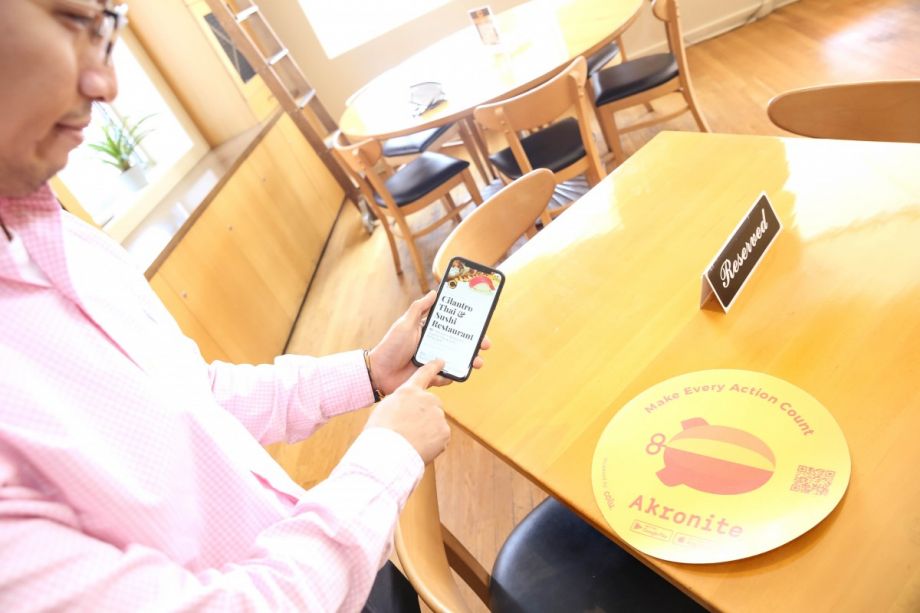
But it isn’t just the customers who are enjoying the cashback. The program gives local business owners a new way to attract customers and increase repeat visits. “It’s not just about finding new customers,” Hardy says. Businesses are seeing regulars come back more frequently, spending more money and building stronger customer loyalty.
“It benefits both parties,” says Charlie Somtrakool, who owns a local Thai and sushi restaurant downtown. “We’re making about $200 a month on top of our regular revenue while our customers get rewarded simply for coming to dine with us.”
The program also aims to help Black-owned businesses, by offering residents greater discounts for shopping at such stores. Along with financial support, the app also provides a space for nonprofits to share their stories to reach their target audiences. Additionally, the team is planning new ways to reward frontline workers, disabled merchants, and other communities needing support.
The Akron app launched in August 2020 has more than 5,000 users today, driving $500,000 worth of economic activity, based on $40,000 government investment, generating nearly $9 of economic impact per dollar spent. It’s unclear how many of those users would have spent the money anyway — versus being enticed to change their shopping habits — “but the app’s analytics and anecdotal evidence from business owners show a correlation between the app’s launch and an increase in the local economic activity,” Hardy says.
Happy with its success, the Colu team decided to expand the initiative to other cities including Boston and some regions in California.
The Boston version of the app, called B-Local, launched in April this year. It already has 300 participating businesses, about 185 of which are minority or immigrant-owned.
“[Joining the app] is a no-brainer,” says Anthony Giordano, owner of Square Root, a cafe and live entertainment venue in Boston. “We get free publicity and make extra money on the side.”
“It is a small percentage of returns, probably not enough to replace our pre-pandemic earnings, but it is basically free money and every little bit helps,” he adds.
Can B-Local recreate the Akron app’s success?
Many factors go into creating a city-wide campaign like this. So it can be difficult to pinpoint just what helped the app succeed.
Mazur believes that “boots on the ground” have a huge role to play. “Many merchants don’t check their email regularly or aren’t as fluent in English,” he says. To combat this problem and reach such owners, the team sends out ambassadors to contact merchants, explain the process and help them get started.
Talking about recreating Akron’s success in Boston, Mazur says each city is different. “Akron has been a wonderful place for us to explore this offer and see what works. We will carry these lessons to improve the B-Local experience.”
But not all plans are transferable. Boston has its own unique challenges and community needs, which the team plans to meet by continually maximizing the potential of what they have to offer. “We keep looking at the data to find ways to multiply the funds and generate bigger, better programs,” Mazur adds.
This is just the beginning, Hardy says. “We haven’t even explored the full functionality of the app yet.” They plan to introduce programs to reward people for calling the civic line to report trash, potholes, and other things that need to be taken care of. “We want to promote good civic behavior and build a strong sense of community.” Once the stay-at-home orders cease, they also plan to expand this program to live events, encouraging people to step out of their houses and explore their city more often.
“Eventually, we want people to know we care,” Hardy says. “It isn’t a silver bullet to solve all the city’s problems, but it’s a step in the right direction.”
This story is part of the SoJo Exchange from the Solutions Journalism Network, a nonprofit organization dedicated to rigorous reporting about responses to social problems. It was originally published by Next City on June 3rd, 2021.
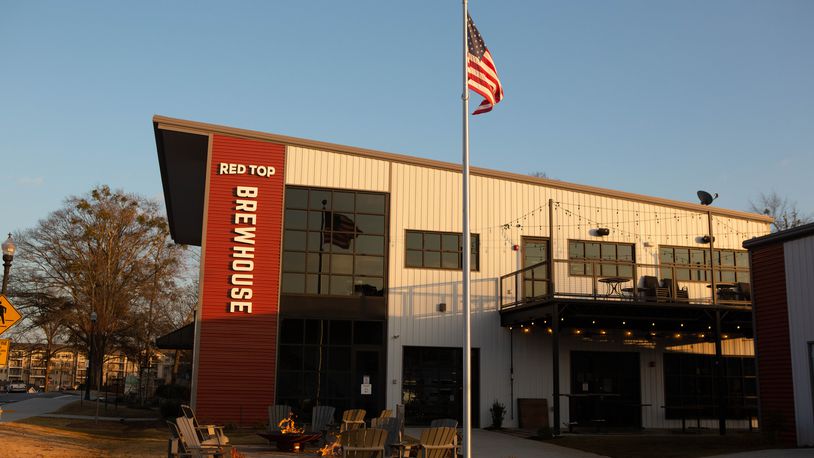
Red Top Brewhouse boasts multiple firsts: first brewery in the town of Acworth, Georgia, first operating brewpub in the history of Cobb County, Georgia, and, now, innovative leader in curbing sexual harassment.
Since it opened last August, the brewpub has had a system in place to deal with sexual harassment among patrons: code words.
Posted inside Red Top’s female, male and gender-neutral restrooms are notices that instruct guests what to do if they find themselves the recipient of untoward behavior.
“If you’re in a situation where you are in an unwanted conversation that is inappropriate or you feel that your safety is in question, simply ask your server or bartender for [CODE WORD DELETED]. We will reseat you or intercede on your behalf to extract you from that situation leading up to the removal of the offending guests,” reads the letter in the women’s restroom. (The Atlanta Journal-Constitution has agreed to Red Top management’s request not to publish the code word.)
“If you’re in a situation where you are in an unwanted conversation that is inappropriate or you feel that your safety is in question, simply ask your server or bartender for [_____].
We will reseat you or intercede on your behalf to extract you from that situation leading up to the removal of the offending guests.”
In late April, a patron used the code word for the first time. Staff acted, and the offender was removed from the premises. After the brewery shared news of the incident and its successful outcome on social media, other breweries and bars reached out to Red Top, requesting insight, so they could implement similar procedures at their establishments.
“We hope every bar and restaurant in America will copy what we are doing, because it can help lives and/or save lives,” said Red Top President Jonathan White, who founded the brewery with partner and CEO Rob Hankinson. “There are simple steps you can take and put in place easily and inexpensively. If we did not have a code word, we cannot help.”
White and Hankinson developed the protocol after researching brewery patronage across Georgia. “In general, (the clientele at) most of the taprooms were male. We saw a huge opportunity catering our business to a female demographic. We felt there are a lot of women interested in the craft beer movement, and we could represent them a little better here,” White said.
Red Top’s procedure for handling unwelcome behavior involves not only staff intervention, but also that of law enforcement, if necessary, using a different code word. “If you are in a situation that you require police intervention, ask your server for [CODE WORD] and we will immediately call the police to ensure your safety is preserved,” reads the signage in the women’s restroom.
Signs in the men’s and gender-neutral restrooms are similar, but the code words are different.
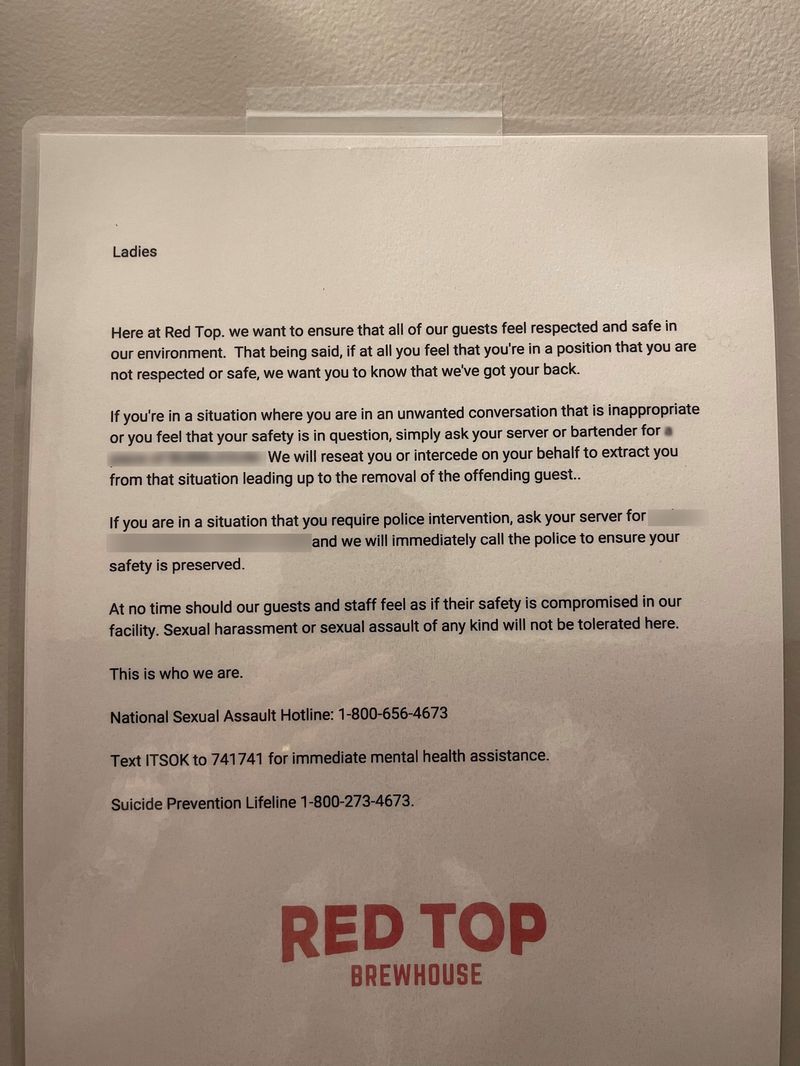
“The ultimate goal is to keep everybody safe,” White said. The notices also provide hotline numbers for sexual assault, mental health assistance and suicide prevention.
White said that staff has been trained to identify problems that call for the removal of a guest. “And, they are going to be reasonable when they escort people out,” he said. In the April incident, “the physical threshold of touch had been broken,” White said.
While the code words are designed to protect Red Top guests from sexual harassment, the company also has procedures in place to address sexual harassment in its workplace, where the majority of its front-of-house team and “a good amount” of kitchen staff is female, White said.
“We have processes written into our SOPs (standard operating procedures) to take care of it,” he said. Although the brewery has not experienced a staff complaint regarding sexual harassment, White conceded that “it is unfortunate that it is part of our industry.”
A Harvard Business Review story published in January, 2018, noted that more sexual harassment claims in the U.S. are filed in the restaurant industry than in any other, with as many as 90% of women and 70% of men reportedly experiencing some form of sexual harassment.
Co-authors Stefanie K. Johnson and Juan M. Madera cited several factors, including the fact that the majority of management and higher-paying roles are filled by men, while the typical frontline restaurant employee is “young, female, and working for a male manager.” At the time, 71% of restaurant servers were women.
“This difference in power can create an environment where sexual harassment is tolerated, ignored, or normalized, because employees do not feel comfortable confronting others about their inappropriate behavior,” Johnson and Madera wrote. “The industry’s high turnover rate — 70% annually — can also contribute to this culture, as targets of harassment are likely to leave before making any complaints.”
The pandemic has seen the exodus of many restaurant workers. Some who have stuck around have been victims of “maskual harassment,” a term coined by nonprofit One Fair Wage to describe hostile customers who demand servers remove their masks in order to get tipped.
Because sexual harassment is so pervasive in the industry, local nonprofit Giving Kitchen recently addressed the topic in a free webinar, as part of a monthlong Mind Matters campaign that focuses on mental health.
“This is the first year we put together a campaign like this,” said Jen Hidinger-Kendrick, Giving Kitchen co-founder and marketing and communications director. Open to all restaurant workers, the seminar alerted attendees to warning signs, and emphasized the importance of having a plan in place to help employees in crisis. All seminars can be viewed on the organization’s website, thegivingkitchen.org.
The majority of cases that Giving Kitchen handles through its stability network do not involve allegations of sexual harassment, but the organization is equipped to provide assistance. The injured party can fill out the Ask for Help form on the Giving Kitchen website, and the submission will “go down the pipeline,” Hidinger-Kendrick said. When harassment issues arise, case workers typically direct the food service worker to no-cost or low-cost legal aid through its Stability Network.
Hidinger-Kendrick also noted that Giving Kitchen is working on developing a “robust manager toolkit” that it can offer to food service operators and managers. Sexual harassment is one of many topics that will be addressed in the resource.
Other best-practices toolkits and training already exist within the restaurant industry. In 2018, the National Restaurant Association launched an online training suite focused on sexual harassment prevention, as part of its ServSafe Workplace training, with separate programs for managers and non-managers.
Georgia Restaurant Association CEO Karen Bremer served on the inaugural committee of the Multicultural Foodservice and Hospitality Alliance, when the organization was formed more than 30 years ago, under the arm of the National Restaurant Association.
“I moved to Atlanta in the early 1980s from the San Francisco Bay area,” recalled Bremer, who relocated with the Peasant Restaurant Group. “I can remember discussing with the leadership of my company sexual harassment. At the time, it didn’t have a name,” she said. “We looked at it from a couple different perspectives, not just man on woman. Some of that harassment was straight customers not wanting gay employees to take care of them.”
Bremer recounted a similar customer-server incident from decades past that was race-related.
More recently, she has directed some managers to the National Restaurant Association’s de-escalation training resources, developed during the pandemic to manage hostile customers. “That de-escalation training is also good to teach employees how to deal with sexual harassment,” Bremer said.
Every business should have protocols to deal with sexual harassment and workplace bullying, Bremer said. “The majority of restaurants have an employee handbook. That is at the top of the list of what you need. Some write their own, and let an attorney look it over. Some buy handbook software.”
And, she added, “It’s a common question when getting your underwriter’s insurance: Do you have a sexual harassment policy?”
“Not only can it cost you money,” Bremer said, “but it can cost you comfort level at your workplace.”
This story is part of the SoJo Exchange from the Solutions Journalism Network, a nonprofit organization dedicated to rigorous reporting about responses to social problems. It was originally published by The Atlanta Journal-Constitution on May 25th, 2021.
In 2013, about 20 wheat farmers gathered at a local pizza joint in Dayton, Washington to hear John Begley, CEO of Columbia Pulp, make his case.
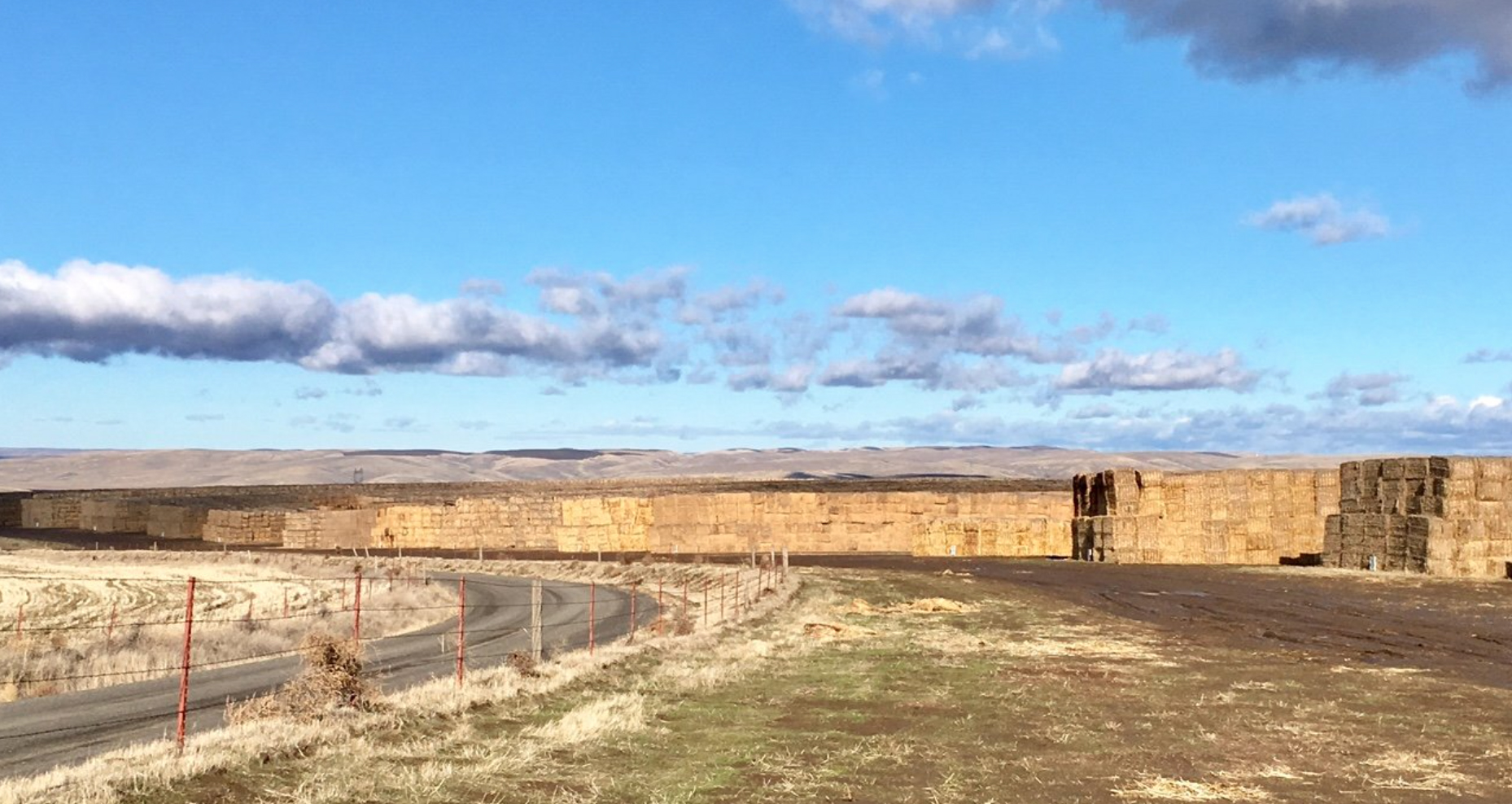
Begley and his team had big plans. He told the farmers his company would start buying up the discarded wheat straw that was left lying in their fields after they finished their harvest.
This would-be waste could be turned into pulp to make paper products, no trees required, reducing the carbon footprint of paper manufacturing and introducing a new income stream for the wheat producers.
But the farmers had been sold on plans for buying up their wheat waste for various schemes in the past — and, despite many promises, none of them had come to fruition. Skepticism was high.
“Everybody was kind of feeling each other out,” recalls Begley. The meeting turned out to be the very first step in a years-long process of building trust and showing results.
Wheat growers were brought in for tours and shown the pulp manufacturing system. Questions were answered and relationships nurtured. Finally, six years after that initial meeting, Columbia Pulp became the first tree-free pulping facility in North America, with a design capacity to process 240,000 tons of straw that the farmers would otherwise throw away each year.
What was once garbage could now be salvaged and sold for pulp to make paper products that didn’t require felling a single tree.
Saving a carbon sink
Washington’s iconic forests of Douglas fir, western hemlock and sitka spruce are some of the most efficient carbon-sequestration ecosystems in the world. Taken together, these trees scrub 35 percent of the state’s total carbon emissions. All that wood is also worth a lot of money — net timber revenues from state forestland amounted to $124 million in 2018.
The tension is evident: a state whose forests are a critical carbon sink has built an economy that relies on turning those forests into plywood, sawdust and paper products.
But Washington is also home to a vast landscape that many out-of-staters don’t know about: 2.2 million acres of wheat fields that undulate across its southeastern flank, making it America’s third largest producer of wheat.
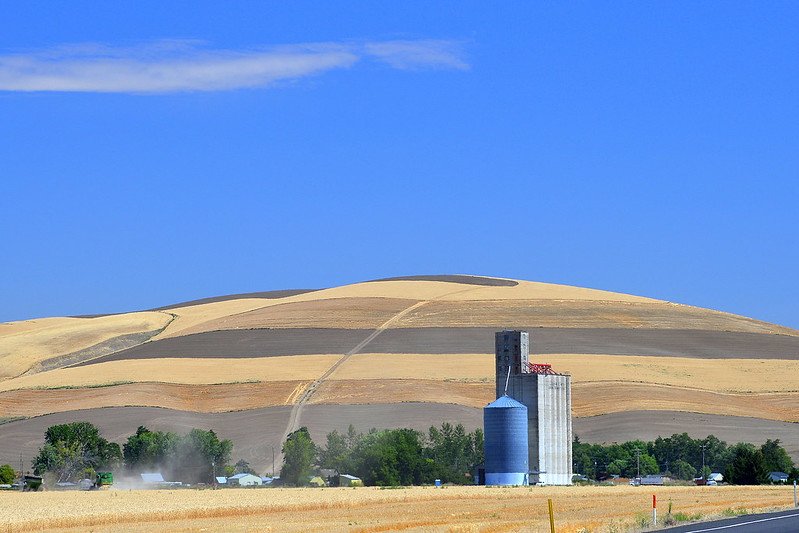
“[Wheat] farmers in the Northwest have a good product in a good market, but there are years when they run really lean,” says Ben Rankin, founder of Columbia Straw Supply, which manages relationships between local growers and Columbia Pulp.
One of the many challenges of profitable wheat production is that the stalk closest to the ground is too dense for the combine to run through, so farmers must figure out how to clear what’s left standing after the harvest.
There are essentially three options: till, burn, or bale. The first two are undesirable. Tilling dries out the soil and causes erosion, and burning fills the air with noxious smoke. That leaves baling as the most environmentally friendly option.
The question is, what to do with all those bales of unusable leftover straw?
“That’s where Columbia Straw comes in,” says Rankin, who got involved with Columbia Pulp in 2014 after seeing a need to form connections between the company and the people producing wheat.
Columbia Straw Supply works with local balers to buy up all that leftover wheat straw, which Columbia Pulp turns into pulp for paper products, giving farmers a new stream of revenue — and pushing the paper industry in a more sustainable direction.
A new kind of paper
“Man has used straw in pulp and paper since the beginning of time,” says Begley. The Egyptians used papyrus, a straw-like plant found in wetlands. But until recently, straw didn’t make sense for large-scale paper pulp manufacturing.
The reason is that straw is about two-thirds cellulose, which is what you want for pulp, and about one-third other materials. “What made it uneconomical in the old days was how to get rid of that one-third of material,” says Begley.
Mark Lewis and Bill McKean at the University of Washington took on the challenge of finding a profitable, sustainable use for this excess wheat straw waste.
Their work resulted in the Phoenix Process, which not only uses 90 percent less water and fewer chemicals than traditional tree pulping, it makes use of that final one-third of material to produce non-toxic biopolymers for fertilizer, de-icing agents and other products.
“I realized early on that it was going to work,” says Lewis, who’s been studying non-wood pulping since college. “The challenge was finding the right partners and banging my head against the wall — until I decided to start my own company.”

Lewis founded Columbia Pulp, along with Sustainable Fiber Technologies (SFT), which owns and licenses out the Phoenix Process. A recent life cycle analysis at Columbia Pulp found that the carbon footprint of this new pulping process is 76 percent lower than that of conventional tree pulps.
Part of these saved emissions come from the process itself, but a large chunk comes from simply leaving forests alone.
Clearing forests reduces carbon sequestration, and replanting those forests doesn’t revert their sequestration potential back to baseline — according to research conducted for the Canadian government, undisturbed forests sequester nearly twice as much carbon as managed ones.
To top it off, only about 25 percent of a tree gets used when it is processed to make paper.
Between the forest conservation and the more efficient processing techniques, Columbia Pulp estimates that replacing 140,000 tons of conventional pulp with its own version would save 133,000 metric tons of CO2 per year — the equivalent of what’s absorbed by 5.8 million trees.
The product is catching on. A partnership between SFT and Anheuser-Busch is now turning barley waste from beer production into the cardboard box that holds a six-pack of Corona. SFT has also licensed the Phoenix Process to Essity, one of the world’s largest producers of tissue products.
The long haul
“Once we were up and running, there was a lot of enthusiasm from local farmers,” says Rankin. “They want to pass on a farm to the next generation, so they’re invested in doing the right thing.”
So what convinced those farmers to trust in the potential of Columbia Pulp?
“We built it,” says Begley. “We put shovels in the ground.”
Just over a year after opening, operations at Columbia Pulp were halted due to Covid-19, with 90 of the original 100 employees furloughed in March of 2020.
Growers have therefore not yet seen the full potential of the mill’s straw purchasing capacity.
But operations are slowly starting up again, and 75 jobs have been restored, with 80 percent of them now filled by the original workers.

Lewis says Covid-19 caused delays in potential partnerships as well, since investors stopped meeting in person last year. But the deals with Anheuser-Busch and Essity are bolstering interest in non-wood pulp.
The possibility of new regulations restricting single-use plastics across the U.S. could open up new markets for wheat-straw pulp products, as companies look for sustainable, paper replacements.
With the technology available, pressure is mounting for paper companies. Procter & Gamble, whose Charmin toilet paper is made from 100 percent virgin forest, was recently called-out by shareholders, 67 percent of which voted in favor of a proposal to “increase the scale, pace, and rigor of its efforts to eliminate deforestation.”
“We all have to learn to become stewards and gardeners, not just extractors,” says Rankin, who points out that in the 1960s there was a big shift toward recycled paper, and today over 65 percent of paper products in the U.S. are recycled.
He’s excited to be a part of the next significant shift. Non-wood pulp, he believes, “could be the beginning of another big transformation in the industry.”
This story is part of the SoJo Exchange from the Solutions Journalism Network, a nonprofit organization dedicated to rigorous reporting about responses to social problems. It was originally published by Reasons to be Cheerful on April 27th, 2021.
Inside the hillside church where she works part time as custodian, Ana Vanegas-Rivera rests on a wooden bench and pulls out her phone wallet. She holds up a blue debit card, similar to the others in her wallet, minus her name or any issuing bank.
The card belongs to Chelsea, a blue-collar city outside Boston that is using it to give cash to around 2,000 low-income residents during a pandemic that has disproportionately hit its Latino-majority population. Every month the card is reloaded with between $200 and $400, depending on family size, allowing recipients to spend the money as they see fit.
Ms. Vanegas-Rivera’s $400 goes toward buying food, household items, school supplies, and shoes for Dylan, her third grade son. For now, the family is getting by on her modest custodian salary and disability checks, along with what her husband earns from sporadic construction jobs, so every extra dollar counts.
“It has been a big help. I’m very happy that we have this opportunity,” she says.
The pilot income program, which began in November and runs until May, has been underwritten by federal and state COVID-19 relief dollars, as well as private donations, and is geared to feeding families, as its name, Chelsea Eats, suggests.
“Our overriding goal is to get people through the spring,” says Tom Ambrosino, the city manager. “For some of our families that is the only money they have.”
Chelsea is also a national testbed for a simple idea: to help people by giving them money. Not a housing voucher, not food stamps, but a cash-equivalent payment that ensures recipients have a basic income that they can spend any way they want.
The rationale is that people know best what they need, and letting them make decisions on how to use the money, without restrictions, is direct and empowering, and doesn’t require a big bureaucracy to implement.
Chelsea is one of several U.S. cities experimenting with unconditional cash transfers to help some residents quickly – an idea that could become the basis for an alternative to traditional welfare and other safety net programs that have existed for decades.
Indeed, advocates see these cash experiments as a building block toward a federal guarantee of a basic income for all, or at least all who manifestly need it.
The idea of a universal basic income that would fill in some of the crevasses in capitalist economies isn’t new. Its supporters run the gamut from Silicon Valley millionaires to Pope Francis, who said last year it could “acknowledge and dignify the noble, essential tasks.”
But UBI has always been a provocative notion that seemed just a little too provocative, an unfathomable expense – free money for all – that nobody would want to pay.
That was before the pandemic. Once economies started closing down, governments around the world began to dig deep and spend freely, putting cash directly in people’s hands.
“I think we’re at a watershed moment,” says Luke Shaefer, a professor of social policy at the University of Michigan in Ann Arbor. “We used money to respond to an economic crisis and it wasn’t perfect, but we got money out quickly.”
Most U.S. social assistance is modest and conditioned on certain requirements, such as work and family size. Except for older adults or people with disabilities, it rarely arrives in the form of cash. This reflects an ethos of self-reliance, as well as decades of conservative criticism that welfare is wasteful and breeds dependence. Backers of basic income believe these traditional assistance programs no longer work.
Yet the politics of governments handing out cash remains complicated. Many liberals like UBI but some don’t. Many conservatives don’t like UBI but some do.
For now, momentum is building for at least some form of basic income in the face of a lopsided economy that seems to generate more losers than winners, even before the pandemic.
But the question is: How far will the idea go?

In 1967, Dr. Martin Luther King Jr. turned his attention to what he called the next phase of the civil rights struggle: an agenda for economic justice and structural reform. In his final book, “Where Do We Go From Here: Chaos or Community?,” he proposed a radical fix to the economic insecurity that many Black families faced.
“I am now convinced that the simplest approach will prove to be the most effective – the solution to poverty is to abolish it directly by a now widely discussed measure: the guaranteed income.”
A year later, Dr. King was dead. The baton for basic income then passed to President Richard Nixon, a Republican. In 1969, he proposed what was essentially a negative income tax – a tax refund for people who made little or no money. Under his plan, a family of four with no earnings would receive up to $1,600 a year, roughly $11,000 in today’s dollars.
The idea was backed by free market economist Milton Friedman, who had long favored an income guarantee based on the federal tax system. But the proposal failed to pass the Democratic-run Senate in 1971 and slipped into near-obscurity.
Fifty years on, interest in UBI as an anti-poverty tool continues to attract odd bedfellows. On the left, basic income is framed as economic justice and a corrective to corporate exploitation. Andy Stern, former president of the Service Employees International Union, considers it a sort of “national strike fund.”
In a 2016 book, “Raising the Floor: How a Universal Basic Income Can Renew Our Economy and Rebuild the American Dream,” he argues a cash allotment would allow workers to walk off the job, or threaten to walk off the job, in protest, giving them leverage to demand better pay and working conditions from corporate overlords.
On the right, there is some appetite for a basic income because it could shrink the size of government – dispersing cash doesn’t take the bureaucracy that welfare does – and give more control to recipients. According to this argument, people couldn’t try to game the system to extend or get higher payments, as critics say they do now. They’d just get money.
Charles Murray, a conservative author, hails UBI as a slayer of a welfare system that “has severely degraded the traditions of work, thrift, and neighbourliness which enabled the system to work at the outset.”
One reason UBI is back in vogue is the seemingly inexorable march of automation, which heralds a dearth of jobs in the future for all but the most skilled workers. In this scenario, UBI is not so much a safety net for hard times as a futuristic way to re-imagine wage labor and human striving.
Those who can’t find paid work would have a basic income to fall back on. Others could work in jobs they like, even though they don’t pay well, because they would have a supplemental income.
While this tech future hasn’t arrived, many entrepreneurs seem convinced that it will. Twitter Chief Executive Officer Jack Dorsey and Y Combinator, a startup incubator, have separately poured millions of dollars into basic-income experiments and advocacy. So has Chris Hughes, a Facebook co-founder who is a co-chair of the Economic Security Project, an advocacy group.
It took another tech millionaire, Andrew Yang, to turn UBI from a policy abstraction into a national conversation about the future of work. He ran for the Democratic nomination for president on a proposal that all adults receive a “Freedom Dividend” of $1,000 a month, a plan based on dire predictions of robots and computers replacing humans in the workplace.
By the time Mr. Yang ended his candidacy in February 2020, UBI was part of the political lexicon in imagining what governments should do if work does, in fact, go away. A month later, the U.S. and other major economies froze. Virtually overnight, work went away.
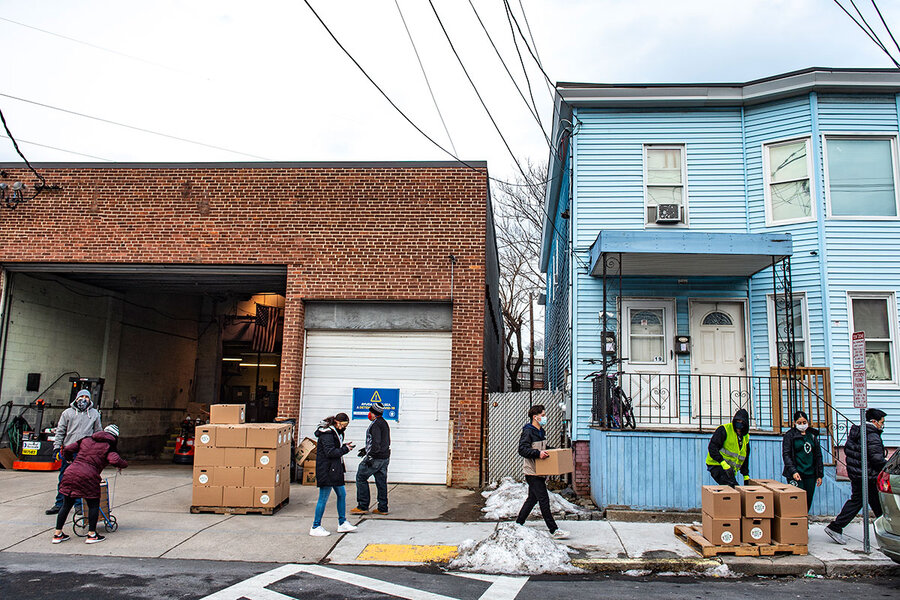
Back in Chelsea, Mr. Ambrosino, the town manager, had a problem. It was summer 2020 and he had his hands full distributing food to residents whose incomes had evaporated during lockdowns.
The densely populated city of 40,000 on Boston’s North Shore, once studded with shoe and paper factories and now home to workers in the hospitality sector and at Boston’s airport, had become a pandemic hot spot during the first wave.
Mr. Ambrosino also felt for the men and women who stood in line for hours and lugged heavy boxes of food home. “That didn’t seem like a dignified way to feed them,” he says.
So he turned to Jill Shah, an entrepreneur who, along with her husband, Niraj Shah, the founder and chief executive officer of Wayfair, has a family foundation in Boston that was supporting statewide food security initiatives. Ms. Shah looked at the logistics of trucking in food to Chelsea and wondered if there was a better way. What about just giving people cash? she asked.
Ms. Shah had grown interested in basic income through her work on community resilience and saw that Chelsea was willing to experiment in an economic crisis, provided the money could be found. “This was a perfect opportunity for us to study it,” she says.
By pooling COVID-19 relief dollars with $1 million from the Shah Family Foundation and donations from United Way and Massachusetts General Hospital, Chelsea had enough funding to support more than 2,000 households during winter months. Now it needed to select them.
When Ms. Vanegas-Rivera heard about Chelsea Eats, she decided she would apply, not just for herself but also so she could guide other families in her WhatsApp support group who might not understand the application process. In the end, most filed to join the program, which was open to all residents on low incomes.
Before the pandemic, Ms. Vanegas-Rivera, who was born in Guatemala and moved to the United States in 1997, had been making extra money by selling jewelry and cosmetics to her friends. But the family still struggled to pay bills, ran up debt, and had no savings. “We had nothing else to spare at the end of the month,” she says. “That’s how it was.”
Then her husband’s construction work dried up. So when Chelsea held a lottery in September to pick the program recipients, she was elated when she found out her number had come up. But she didn’t let on that she had gotten picked because others in her group hadn’t been selected.
“It’s a big help, definitely. We’re very grateful it happened to us,” she says. “But I’m very sad that other people don’t have access to the program.”
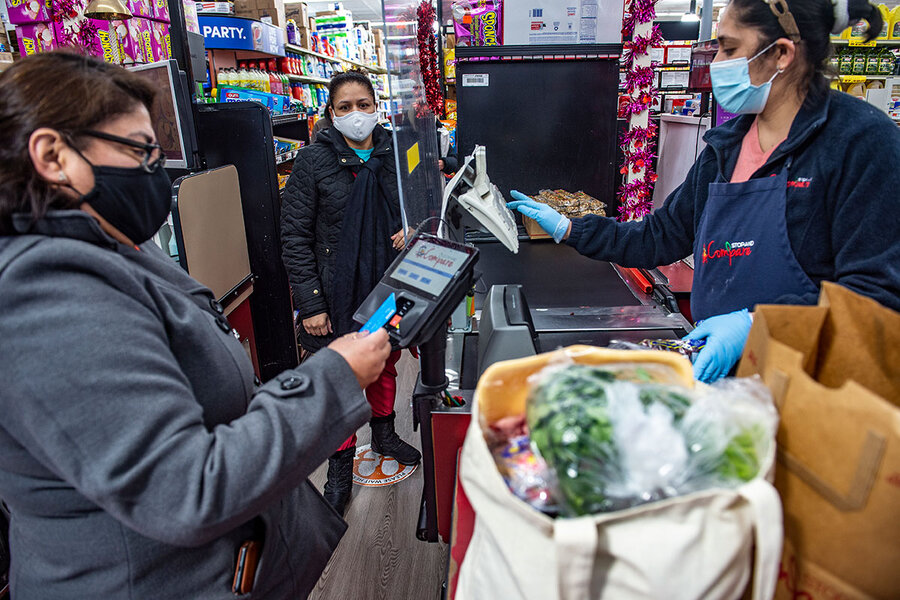
Perhaps the worst was telling Carina Meza, her neighbor, who, like her, lived in a cramped one-bedroom apartment with four children.
Ms. Vanegas-Rivera’s son Dylan played with the younger kids. The two women cooked together. Now Ms. Vanegas-Rivera had a $400 debit card to pay for groceries and her neighbor didn’t. “It felt so, not good,” she says, removing her glasses to wipe her eyes.
Of the roughly 3,600 residents who applied for Chelsea Eats, 2,074 were selected. Researchers from the Harvard Kennedy School are surveying around 1,100 of these recipients, along with 800 others who didn’t get the money, says Jeffrey Liebman, a professor of public policy who is leading the study and plans to release his findings this summer.
Thanks to the debit card, Mr. Ambrosino can track where the money goes. He says most is spent at local food markets, which means a program designed to feed Chelsea, and get city hall out of the food pantry business, is working. He also sees some liquor-store purchases and other discretionary items, as well as Amazon orders.
But he’s not worried about frivolous expenditures.
“We can trust people to spend money appropriately. Just because people are poor doesn’t mean that people are irresponsible,” he says.
"Economics has always been part of the conversation about racial equity." – Michael Tubbs, former mayor of Stockton, California, who started a basic-income experiment in the strapped city, inspired by the writings of Martin Luther King Jr.
While it’s too early to judge Chelsea’s experiment, a similar privately funded pilot program ended recently across the country in California’s Central Valley. For two years, 125 randomly selected residents in Stockton had received $500 a month; a control group received no money.
The Stockton Economic Empowerment Demonstration (SEED) was the brainchild of former Mayor Michael Tubbs. Elected in 2016 at the age of 26, he alighted on basic income as an approach to tackle deprivation in Stockton.
Residents suffered poor health and economic insecurity. Proximity to Silicon Valley’s booming tech sector hadn’t trickled down to its mostly nonwhite population of 310,000. Mr. Tubbs cites Dr. King’s writings on basic income and his own family’s struggles as inspiration for SEED.
Independent researchers have analyzed data from the program’s first year, from February 2019 to February 2020. They found that the extra $500 had a significant positive impact on household incomes, physical and mental health, and debt management. SEED recipients were more likely to be in full-time employment and to have a cushion for financial emergencies.
None of which would surprise Johannes Haushofer, an economist at Stockholm University, who has studied cash transfers in Kenya. When he analyzed the effects of cash transfers on 500 households, he found that recipients had higher incomes and more assets – in other words, they didn’t quit their jobs and just collect the assistance money.
Most used it to supplement what they were already making. Levels of domestic violence among recipients fell sharply compared with a control group, too.
The Kenya program, run by a U.S. nonprofit, GiveDirectly, has since expanded to around 20,000 households in 197 villages, making it the world's largest basic-income experiment. Some began receiving monthly transfers in 2018 that will run for 12 years, giving researchers an approximation of a UBI as an entitlement. Another group will receive two years upfront as a lump sum.
Researchers are curious how the different payouts will affect people’s lives and spending habits. “Will those bigger amounts allow you to do something more dramatic?” asks Jonathan Morduch, a professor of public policy and economics at New York University.
Perhaps the ultimate UBI experiment is underway in Maricá, Brazil, a commuter city outside Rio de Janeiro. The government there is giving cash to 42,000 of its 162,000 residents, using a local digital currency.
Experts say this could show the macroeconomic effects of cash transfers locally on inflation and other measures that don’t show up in smaller trials in cities like Stockton and Chelsea.

Still, the prospects for basic income becoming a reality in the U.S. seem more likely to turn on the success of domestic experiments. A Pew survey last August found that 45% of adults favored a $1,000-a-month federal guaranteed income; Democrats and younger voters were more likely to support the idea.
Last summer Mr. Tubbs founded Mayors for a Guaranteed Income, a national network of 40 city leaders exploring or developing basic-income pilots. Mr. Dorsey, the Twitter CEO, has donated $18 million to help seed these programs. The largest so far, in Compton, California, is giving $300-$600 a month to 800 people over the next two years.
Mr. Tubbs says the goal is to see a national income floor for families living paycheck to paycheck, but concedes that a basic income for everyone may be a step too far. “While we work towards that great goal, we need to know those who absolutely need it, get it first,” he says.
To advocates, basic income is a stabilizer that builds on federal expansions in social insurance passed during the Great Depression and to alleviate poverty in the 1960s. Natalie Foster of the Economic Security Project notes that many of the mayors drawn to basic income are millennials who see the effects of economic inequality on their communities.
“This is our generation’s addition to the safety net,” she says. “It’s the way we need to expand it for the modern economy.”
Thanks to the pandemic, this expansion may be coming into focus sooner than expected. More than 10 pieces of Democrat-sponsored legislation currently in Congress would, if enacted, provide cash to hard-up families until the U.S. economy recovers – and possibly longer.
Critics see the push as opportunism. “Policymakers are using the pandemic to advance an agenda that already existed,” says Matt Weidinger, a resident fellow at the American Enterprise Institute who studies poverty. Like other conservative scholars, he’s skeptical of the benefits of no-strings cash transfers and of the huge costs and unknown effects of a universal income.
A 2019 study found that giving $1,000 a month to every adult in the U.S. would cost roughly $3 trillion a year, or 75% of total federal spending. Eliminating Social Security, food stamps, and all other anti-poverty programs and tax benefits would only cover $1.2 trillion of that cost.
The prospect of taking money from existing programs is one reason some liberals oppose UBI. They’re worried it would gut initiatives that largely target poor people, replacing them with a program that helps everyone, which would be less progressive.
The immediate debate over the issue is less around the broad idea of giving everyone a basic income and more about using it to help families with children.
In March, when Congress passed President Joe Biden’s $1.9 trillion stimulus package, it included a fully refundable child tax credit starting at $3,000 per child, of which a portion will be paid in advance. The temporary credit phases out for individuals earning more than $75,000 a year or $150,000 for couples.
It’s essentially a cash dispersement by the IRS, similar to what President Nixon wanted to do.
While Mr. Biden’s stimulus was passed on strictly partisan lines, the idea of a child allowance has Republican support in Congress as well. In February, Sen. Mitt Romney, a Utah Republican, proposed a similar child benefit plan that would cut funding to other social programs to make it permanent. Both plans would lift millions of children out of poverty.
Taken together, the two plans show how far the political pendulum has swung toward social assistance that lets recipients spend money on what they need.
“There is a shift towards a comfort [among lawmakers] in giving cash. This is a profound shift in thinking about safety nets,” says Professor Morduch.
In Chelsea, Mr. Ambrosino doesn’t really focus much on whether the idea of a basic income is gaining ascendancy in Washington or not. His priority is simply to help families in a tough spot, and he’s happy with what he’s seeing so far with Chelsea Eats. “We’re getting money in the right hands,” he says.
Roseann Bongiovanni, a former city councilor and now executive director of GreenRoots, a local nonprofit, agrees that the extra money is helping families. But Chelsea faces challenges of housing affordability and environmental justice, and overall demand at food pantries hasn’t gone away.
“This is a short-term fix,” she says. “It’s not resolving a larger structural issue.”
Ms. Vanegas-Rivera knows that her debit card is temporary. Though she owes less on her credit cards and is managing better, her money problems haven’t gone away. What has changed, she says, is that she and her husband are no longer lining up daily at food pantries.
Every night, her son Dylan prays that the family moves into a house big enough for him to have a dog. “It breaks your heart when you hear that from a boy,” she says.
But she believes that her family can forge its own way once the pandemic is over. “I don’t want to get stuck, and we’re not going to get stuck. That’s not who we are,” she says.
This story is part of the SoJo Exchange from the Solutions Journalism Network, a nonprofit organization dedicated to rigorous reporting about responses to social problems. It was originally published by The Christian Science Monitor on April 2, 2021.
Thousands march in Copenhagen to mark WorldPride, but thoughts of the plight of the LGBTQ+ community in Afghanistan temper the partying
COPENHAGEN, Aug 21 (Openly) - Tens of thousands took to the streets in Denmark on Saturday in one of the biggest Pride marches since COVID-19 struck, with some celebrating while others expressed solidarity with LGBTQ+ people living in fear in Afghanistan.
Young people draped in rainbow flags with face paint and glitter walked alongside families with children, while gay men in leather harnesses swapped jokes with drag queens in towering high heels.
Spectators lined the streets of the capital, Copenhagen, including elderly women who exchanged kisses with men dressed in pink cat costumes, while passing cars beeped their horns in support.
"It's good to be back on the streets," retired banker Rob Lengacher, 67, told the Thomson Reuters Foundation, as the march passed through central Copenhagen.
"I've gone to several WorldPrides, and I think it's important that we're visible and that we're out and we're active."
WorldPride, which began in Rome in 2000, is held in a different city every two years. The last event, in New York in 2019 - the largest WorldPride ever, with 5 million in attendance - marked the 50th anniversary of Stonewall.
The 1969 Stonewall riots, when the LGBTQ+ community fought back against a police raid on New York's Stonewall Inn, sparked the birth of the modern-day gay rights movement - with the first ever Pride march taking place in the city the following year.
More than 200 Pride marches were cancelled last year due to the pandemic - and more have been postponed this year, including the London and New York Prides, two of the world's largest events.
Sydney's Mardi Gras, usually attended by millions, went ahead in March but with just 5,000 marchers and a ban on larger floats, a mainstay of the parade.
This year's WorldPride is the first to be held in two cities - Denmark's Copenhagen and Sweden's Malmo, some 40km apart and joined together by Europe's longest road and rail link, the Oresund Bridge, over the strait that divides the two nations.
To reduce the likelihood of coronavirus transmission, six marches set off from different points across Copenhagen on Saturday, meeting in the city's largest park to watch the closing ceremony, live-streamed from a city centre arena.
📸 @hugo_greenhalgh #WorldPride pic.twitter.com/Azs3qp84PS
— Openly 🏳️🌈 (@Openly) August 21, 2021
Protest and Party
While many marchers were joyous to be dancing in the streets after nearly two years of coronavirus restrictions and lockdowns, several performers on the main stage said it was important to remember those in countries with anti-LGBTQ+ laws.
Francesco Segala said he was thinking of gay men in Afghanistan, hiding from the Taliban who took power on Sunday.
Under the Taliban's first regime, from 1996 to 2001, there were reports that men accused of having gay sex were sentenced to death and crushed by walls pushed over by tanks.
The Taliban has said Afghans have nothing to fear but the German newspaper 'Bild' last month quoted a Taliban judge saying gay sex should be punished with a death sentence.
"We will fight for you," said 46-year-old Segala.
"You are not alone and we will continue to fight for you – and please be yourself."
Other marchers echoed Segala's sentiments that WorldPride should provide a platform for challenges affecting the LGBTQ+ community around the world.
"Events like this should maybe focus a little more on the issues," said Sebastian Ruiz, 42, speaking in City Hall Square - newly dubbed WorldPride Square.
"It's very tough what's going on today."
Poet Sylvia Thomas, 25, who was set to perform at the closing ceremony on Saturday evening, said Pride should be seen as a protest as well as a party.
"Pride means joy and so much resilience," said Thomas, an intersex and transgender activist who regularly performs at Pride events.
"It's important to let (homophobes) know we exist and that we're alive – here, there and everywhere."
Openly is an initiative of the Thomson Reuters Foundation dedicated to impartial coverage of LGBT+ issues from around the world.
Reporting by Hugo Greenhalgh @hugo_greenhalgh; Editing by Katy Migiro. This story was republished in partnership with the Thomson Reuters Foundation, the charitable arm of Thomson Reuters, that covers the lives of people around the world who struggle to live freely or fairly. Visit news.trust.org.
Cover photo by Andreas Paulsson — courtesy of Copenhagen 2021.
After beginning with some vocal stretches to warm up her voice box, Ginger Williams hums and vocalizes to match a tone played by Maureen Brogan, a student clinician.
“Good! I got 195,” Maureen reports.
“Yes!” Ginger whispers, her excitement quiet but palpable even over video conference. Her 195 signifies “195 hertz,” which falls nicely into the 180-240 range associated with a female pitch.
For Ginger, a transgender woman, this result is exactly what she is here to achieve.
What’s in a voice? For participants in Baldwin Wallace University’s (BW) transgender voice clinic, a voice means feeling like themselves. And for many trans people, security in their voice presentation is nothing less than a matter of basic safety.
Transgender people are at higher risk of experiencing violence, homelessness, and abuse, attributable to transmisogyny and transphobia in their communities.
These risks increase exponentially at the intersection of race and gender, with the Human Rights Campaign — the nation’s largest LGBTQ+ advocacy group — reporting that “fatal violence disproportionately affects transgender women of color.”
Voice therapy is thus a life-changing and potentially life-saving service for the trans community.
Dr. Amy Vaughn oversees a transgender voice clinic at BW that provides free voice therapy to trans individuals, the majority of whom are over 40.
The BW Speech Clinic is the only one in Northeast Ohio to offer free services to anyone experiencing communication disorders, and this specific program is one of a growing number of offerings in the country geared toward trans clients.
“This clinic is one of Cleveland’s best kept secrets,” according to Ginger, who has been participating in the voice clinic for over a year since hearing about it from TransFamily, a local transgender support group.
Michelle Guzowski has been participating in the clinic for over a year and a half. “When I started with the clinic, I always said I didn’t care about my voice. But as time went on and I started to work on it, I realized that I do care. And the best part is that it works the whole picture. It’s not just a voice,” she said.
Vaughn, a licensed Speech-Language Pathologist, began working at BW in 2017 as an Assistant Professor of Communication Science and Disorders and wanted to bring a transgender voice program to the university’s speech clinic after previously working with the trans community.
First advertising with a simple flyer posted to Facebook and at the LGBT Community Center of Greater Cleveland, the clinic has grown to be a meaningful part of the trans community of Northeast Ohio. The clinic meets weekly during BW’s academic terms and is run by two graduate student clinicians who are supervised by Vaughn.
Sessions begin with warm-ups to stretch and relax the neck and shoulders, followed by a series of vocal exercises in which the clinicians play a tone in a target vocal range and the group hums along. One by one, participants vocalize in the same range and their pitch is measured. Between sessions, members practice their speaking voice in their daily lives.
“I read advertisements on cars, even road signs and license plates,” said Ginger. “I fit it in whenever I can.”
Pre-pandemic, the clinic met in a small room on campus. But since the start of COVID-19, CDC restrictions have forced the group to move online as they don’t have a space where they can adequately practice social distancing.
“Proximity is really important therapeutically,” Vaughn explained. “Being online has affected that to some degree, but I also think that being online has opened some doors.”
While participants used to drive in once a week from up to 45 minutes away, now anyone in the state of Ohio can participate, thus eliminating significant transportation and time barriers.
“In the trans community, there’s a higher propensity for violence, emotional abuse, lower income regardless of educational level, so we’re talking about a marginalized population,” said Vaughn. “And some people don’t have transportation, so having to come to the clinic every week could be a roadblock to getting services. Online, we can connect with people all over Ohio.”
This month, the clinic plans to add a second group for those just starting out in voice therapy. Vaughn is excited about the opportunities to continue amplifying the services of the transgender voice clinic to the trans community across Ohio.
“The majority of people I work with just want to feel comfortable in their lives,” she said. “They deserve the same thing that everyone else I’ve seen for the past 30 years of my profession as a speech pathologist deserves — to live the best life they can live and to have the best skills and ability to be the most they can be, whatever that looks like.”
Or sounds like.
This story is part of the SoJo Exchange from the Solutions Journalism Network, a nonprofit organization dedicated to rigorous reporting about responses to social problems. It was originally published on Eye On Ohio on January 12, 2021.
Roman Hottgenroth is surrounded by lamps, dishwashers and vacuum cleaners. Computers, smartphones and TV receivers are piled high on tin shelves behind him. A group of washing machines rattles loudly in test mode, only somewhat drowned out by the bass thumping from a hi-fi system an employee is checking.
None of these products work properly, and that’s the point.
Here at Stilbruch, the department store in Hamburg, Germany run by the city’s sanitation department, only goods that others have thrown away are offered up for sale.
But before they are sold, they are checked and, if necessary, repaired in Hottgenroth’s 7,500-square-foot workshop.

A worker at the Stilbruch repair workshop. / Photo courtesy of Hamburg Sanitation Department
The process is something of a dying art. “Unfortunately, [repair] is no longer intended for most appliances,” says Hottgenroth, Stilbruch’s operations manager.
But that may be changing.
Across Europe, legislation is pushing back against a waste-based economy and restoring for citizens something companies have gradually taken away: the right to repair what they’ve bought.
Fix it or forget it
Hottgenroth sees every day how many appliances end up in the trash. Although often all they need is a fresh battery or receiver, “Spare parts are hard to come by, and all the components are soldered, glued or riveted,” he says.
This is why, while his employees can fix many products, many others are unsalvageable. “Because of their design, devices often break just when you try to open them.”
In addition, there is usually no longer any provision for upgrading and adapting devices to new technical standards. “This should be banned,” Hottgenroth says flatly.
Some political leaders agree. In November, the EU Parliament called on the European Commission to make routine repair of everyday products easier, systematic and cost-efficient.
It said that warranties should be extended, and that replacement parts should be improved and made more accessible, as should information enabling general repair and maintenance.
The EU’s existing eco-design regulations could be an instrument to reach these goals. These mandates were established years ago to improve the energy efficiency of products sold in the EU.
But in March, the first eco-design regulation that will define standards for repair and useful life will come into force.
Manufacturers of washing machines, dishwashers, refrigerators and monitors will have to ensure that components are replaceable with common tools. Instruction manuals must be accessible to specialist companies. And producers must supply spare parts within 15 days.
Cell phones, computers and tablets, however, have not yet been regulated by an EU eco-design directive, and constitute some of the most harmful consumer waste.
To this end, individual member states have moved ahead with their own regulations.
This month, France will introduce an anti-waste law with a repair index. A grade of one through ten will appear on the labels of washing machines, laptops, smartphones, TVs and lawn mowers.
This score will be calculated based on criteria such as ease of disassembly, access to repair information, and price and availability of spare parts.
The French government is also promoting modular product design, and is aiming to have 60 percent of electronic equipment in France be repairable by 2026.
Europe is one of the largest markets in the world, which means that new EU design guidelines and right to repair mandates could force manufacturers across the world to make more durable products.
The shift can’t come soon enough. At over ten million tons per year, e-waste is the fastest growing waste stream in Europe. In Germany alone, two million tons are generated annually. Repairing products and extending their useful life could play a key role in mitigating the environmental consequences of all this waste. And that’s exactly what a large majority of EU citizens want.
Nearly 80 percent would rather repair their devices than replace them. And a majority think that manufacturers should be legally obliged to facilitate the repair of digital devices or the replacement of their individual parts.
Such products have existed for some time — companies like Fairphone and Shiftphone produce sustainable, repairable smartphones, for instance. But with the EU’s new legislative mandates on the horizon, bigger players are getting ahead of the game.

Apple has launched a repair program for independent businesses, in which companies can get Apple parts, tools, training, service guides, diagnostics and resources to perform a variety of out-of-warranty repairs.
Last year the German outdoor gear company Vaude began providing customers with an index showing how repairable each of its products are.
Electrolux, a leading manufacturer of electrical appliances in Europe, has been preparing for the directive and will be ready to comply once it takes effect in March. “We will now ensure that the specific parts, according to the legislation, will be available directly to consumers,” says Viktor Sundberg, vice president of European & environmental affairs at Electrolux. “And we will make the repair information available to independent repairers for the categories requested.”
Is that sufficient? For Dorothea Kessler of iFixit Europe, the EU Parliament has indeed sent a strong signal that the continent must embrace a more sustainable circular economy. But it’s only a start.
“We will certainly have to wait a few more years for feasible measures to emerge for the most important product categories,” she says. In the process, she believes it won’t be easy for the EU to stand up to the manufacturers’ lobbies.

Consumer and environmental organizations have also welcomed the EU Parliament resolution with cautious optimism.
“The right to repair was already in the Green Deal of December 2019 as a buzzword,” says Elke Salzmann of the Federation of Consumer Organizations in Germany, referring to Europe’s commitment to become the first climate-neutral continent. “But we have to take care that the promise will be obliging.”
In the meantime, iFixit has been assigning a repairability rating to every new device on the market for years, and provides free step-by-step instructions for do-it-yourself repairs in 11 languages for 70,000 products.
Its online forum allows users to exchange ideas with other tinkerers. The online community, founded in California, now has three million monthly users in Europe and ten million worldwide.
To Kessler, it’s a movement that has as much to do with altering mindsets as fixing gadgets. “Our philosophy is that something doesn’t belong to you if you can’t open it,” she says.
This story is part of the SoJo Exchange from the Solutions Journalism Network, a nonprofit organization dedicated to rigorous reporting about responses to social problems. It was originally published by Reasons to be Cheerful on January 11th, 2021.
For generations, women in Katherine Robinson-Williams’ family have fought fires. But climate change has her fearing for her daughter’s future.
MELBOURNE, Aug 19 (Thomson Reuters Foundation) - If there’s one stereotype that volunteer firefighter Katherine Robinson-Williams wants to banish, it’s that fighting fires is a man's job.
“Firefighters come from a range of backgrounds. They aren’t always men,” said the 25-year-old from the Hunter Valley in the Australian state of New South Wales.
She should know.
Her mother, grandma and sister in law all fight fires, and she expects her baby daughter will become a firefighter, too.
Robinson-Williams is what Australians affectionately call a "firie", one of nearly 200,000 volunteers - about 1% of the population - called on to tame blazes alongside full-time firefighters.
Longer and more lethal wildfire seasons that experts say are prompted by climate change has led to a shortage of volunteers in recent years.
“There will never be enough firefighters to protect every person’s door, every person’s caravan, every person’s car, every person’s farm,” said Robinson-Williams, whose day job involves rehabilitating racehorses.
With mega fires burning from Greece to Siberia, she believes plenty more countries will have to rely on volunteers like her.
“There is never, ever going to be enough. And sooner or later, everyone else is going to actually have to step up.”
Australia's most populous state closed out its quietest fire season in a decade in early 2021, thanks to a cool, wet summer that offered a reprieve from the uncontrolled blazes that torched large swathes of the country in 2019 and 2020.
Robinson-Williams takes scant solace from one cool, wet year as she recalls the horrors of the previous two seasons.
“I have an iron stomach, but some of the things I saw broke me,” she said.
The 2019 season saw Australia's worst wildfires in decades - and Robinson-Williams was fourteen weeks pregnant as she joined crews on the ground battling blazes and evacuating towns.
“We were finding deceased animals that were caught in the blaze. We saw remnants of houses, remnants of sheds, cattle with no water troughs because they literally just disintegrated with the heat.”

Katherine Robinson-Williams in New South Wales, Australia. 2019. Handout courtesy of Katherine Robinson-Williams via Thomson Reuters Foundation
Although family and friends worried how the smoke and heat would affect her pregnancy, Robinson-Williams wore protective gear and had her doctor's approval.
“Most people have this mentality in their heads that women can't do things because they’re pregnant, and that’s not the case. I knew what my body could take,” she said.
“My mum fought fires in ’94 and ’96 when she was pregnant with me. My grandmother fought fires back in 1970 when she was pregnant with my mum.
“Until there are studies that come out in regards to firefighters and reproductive health, there is no way to know what’s safe and what’s not.”
The wildfires, known as the Black Summer, tore through the southeast, burning more than 10 million hectares, destroying thousands of homes and killing 34 people along with billions of animals.
Thick smoke enveloped several cities and air quality in the capital, Canberra, was the worst in the world at one point.
For some firefighters, the harrowing nature of the job takes a toll on their mental health.
While battling a blaze last year, Robinson-Williams and her crew were almost crushed by a falling tree. Her quick thinking saved her, but once the adrenaline wore off, she found herself struggling to process what had happened.
“It’s not spoken of in firefighting, but there is a psychological impact,” she said.
“We’re going to get pushed to the absolute brink, and we’re just going to collapse. And that time has started to come.”
As climate scientists issue warnings about more dangerous wildfires to come, Robinson-Williams fears for her baby daughter, and how the next generation of firefighters will cope.
“I’m scared. Where is going to be safe for her?”
Reporting by Seb Starcevic, Editing by Tom Finn and Lyndsay Griffiths. This story was republished through our partnership with the Thomson Reuters Foundation, the charitable arm of Thomson Reuters, that covers the lives of people around the world who struggle to live freely or fairly.
As the Swedish teenager marks the third anniversary of her first solo climate strike, here's how she built the global "Fridays for Future" movement
LONDON, August 20 (Thomson Reuters Foundation) - Swedish teen campaigner Greta Thunberg on Friday marked three years since she first started striking for climate action, telling leaders that children could not afford more empty promises at this year's U.N. climate change summit (COP26).
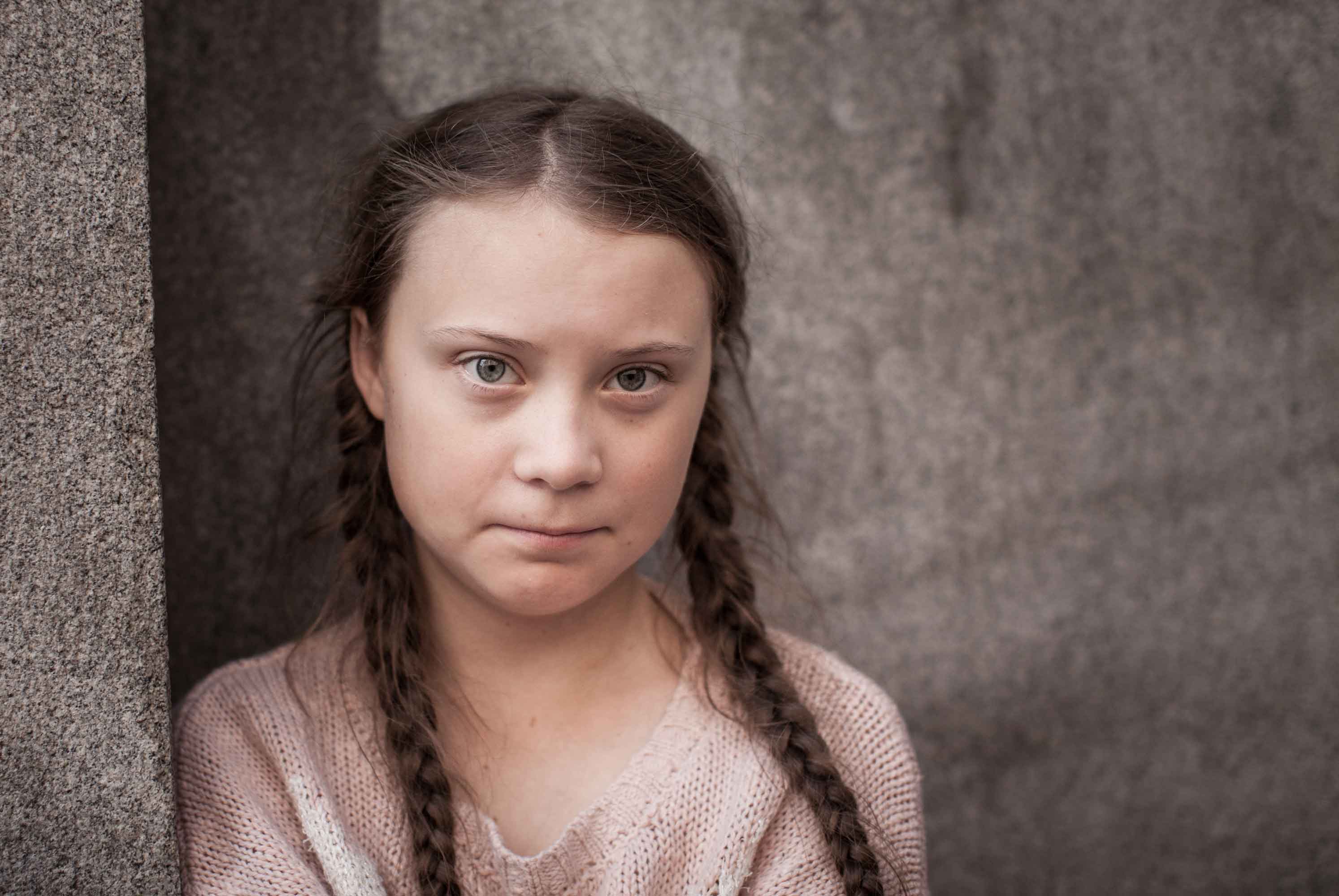
Her comments come as a U.N. children's agency (UNICEF) report found that almost all of the world's 2.2 billion children are exposed to at least one climate or environmental risk, from catastrophic floods to toxic air.
"For children and young people, climate change is the single greatest threat to our futures. We are the ones who will have to clean up the mess you adults have made, and we are the ones who are more likely to suffer now," Thunberg wrote in The New York Times on Friday, along with other youth activists.
"This is the world being left to us. But there is still time to change our climate future. Around the world, our movement of young activists continues to grow."
Thunberg shot to fame in 2018 when she began a solitary protest against global warming outside the Swedish parliament in Stockholm, skipping her Friday school classes to demand her government take action on climate change.
The 18-year-old said that in both the climate and coronavirus crises, the world must focus on helping those most in need.
Here is a timeline of Thunberg's rise from a solo climate striker to a leading global campaigner against the inequities exposed by the climate and ecological crises and the COVID-19 pandemic:
August 20, 2018: Swedish student Thunberg, then aged 15, skips school to protest outside parliament for more action against climate change.
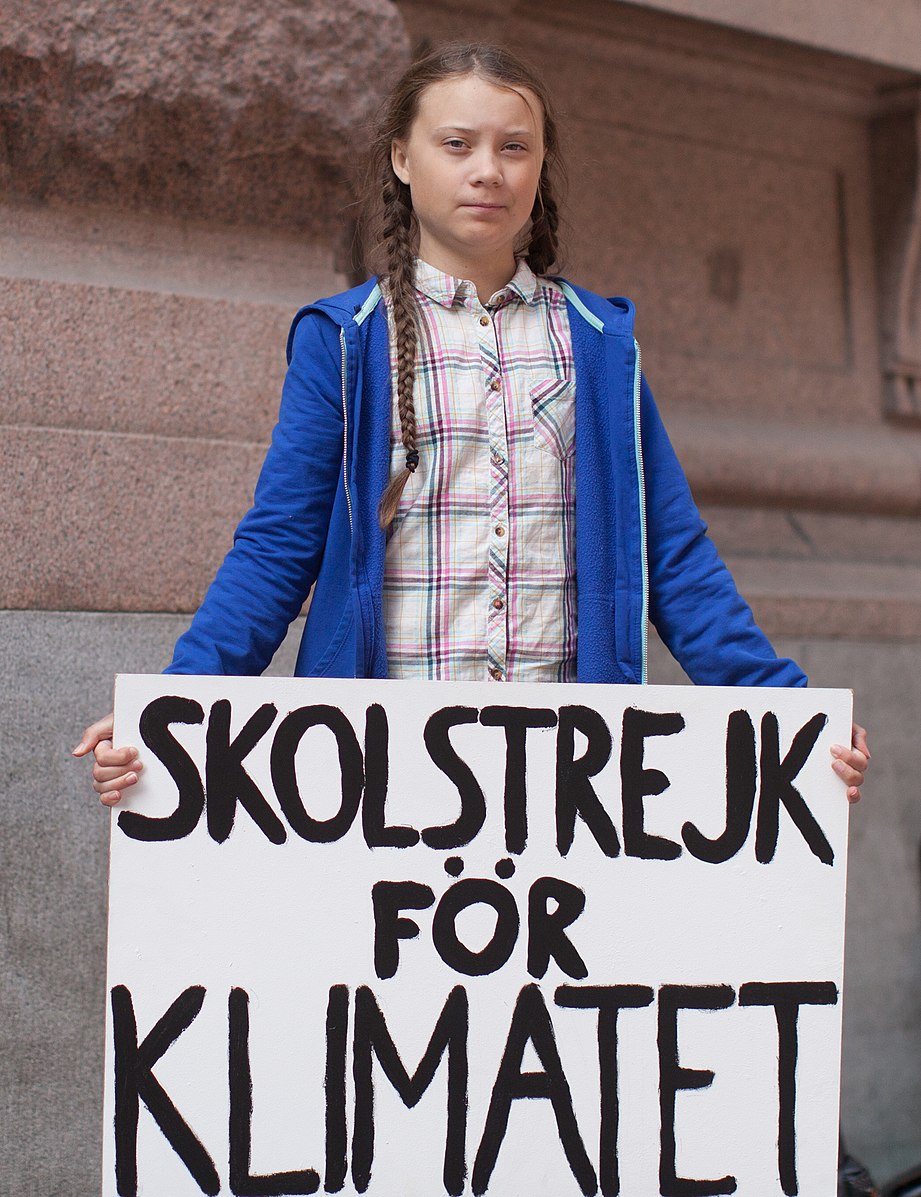
August 26, 2018: She is joined by fellow students, teachers and parents at another protest and begins attracting media attention for her climate campaign.
September 2018: Thunberg begins a regular 'strike' from classes every Friday to protest climate issues. She invites other students to join her weekly "Fridays for Future" campaign by staging walkouts at their own schools.
”We kids most often don’t do what you tell us to do. We do as you do. And since you grown-ups don’t give a damn about my future, I won’t either. My name is Greta and I’m in ninth grade. And I am school striking for the climate until election day.” 1/3 https://t.co/LrRgTD2rmE pic.twitter.com/UQPFjzTjV2
— Greta Thunberg (@GretaThunberg) August 20, 2021
November 2018: More than 17,000 students in 24 countries take part in Friday school strikes. Thunberg begins speaking at high-profile events across Europe, including U.N. climate talks in Poland.
March 2019: Thunberg is nominated for a Nobel Peace Prize. The number of students taking part in school strikes hits more than 2 million people across 135 countries.
May 2019: Thunberg is named one of the world's most influential people by Time magazine, appearing on its cover. "Now I am speaking to the whole world," she wrote on Twitter.
“Now I Am Speaking to the Whole World.”
— Greta Thunberg (@GretaThunberg) May 16, 2019
I’m on the cover of @TIME Magazine.#FridaysForFuture #SchoolStrike4Climate #ClimateStrike https://t.co/9oBQf6Sd16 pic.twitter.com/N91KYt2sz7
July 2019: Conservative and far-right lawmakers urge a boycott of Thunberg's appearance in the French parliament, mocking her as a "guru of the apocalypse" and a "Nobel prize of fear".
August 1, 2019: Thunberg hits back at "hate and conspiracy campaigns" after she was described as a "deeply disturbed messiah" leading a "cult" in an opinion column by conservative Australian commentator Andrew Bolt.
August 2019: Thunberg, who refuses to fly, sails from Britain to the United States in a zero-emissions boat to take part in a U.N. climate summit. Meanwhile, the number of climate strikers reaches 3.6 million people across 169 countries.
September 23, 2019: Thunberg delivers a blistering speech to leaders at the U.N. summit, accusing them of having "stolen my dreams and my childhood with your empty words".
September 25, 2019: Thunberg is named as one of four winners of the 2019 Right Livelihood Award, known as Sweden's alternative Nobel Prize.
October 11, 2019: Despite being bookies' favourite to win, Thunberg misses out of the Nobel Peace Prize which goes to Ethiopian Prime Minister Abiy Ahmed.
November 2019: Caught out by a last-minute switch of location for U.N. climate talks from Chile to Spain, Thunberg hitches a ride on a catamaran boat crossing back to Europe.
December 11, 2019: Thunberg denounces "clever accounting and creative PR" to mask a lack of real action on climate change in a speech at the U.N. COP25 summit as the 16-year-old became the youngest individual to be Time Magazine's person of the year.
March 13, 2020: As governments limit or ban mass gatherings to stem the spread of the new coronavirus, Thunberg urges students to make week 82 of the school strike digital, with the hashtag #ClimateStrikeOnline.
School strike week 82. In a crisis we change our behaviour and adapt to the new circumstances for the greater good of society.
— Greta Thunberg (@GretaThunberg) March 13, 2020
Join the #DigitalStrike - post a pic of you with a sign and use #ClimateStrikeOnline ! #schoolstrike4climate #fridaysforfuture #climatestrike #COVIDー19 pic.twitter.com/fZkjqN3DOw
March 24, 2020: Thunberg says the swift measures brought in to stem the coronavirus pandemic show that the world can also take the rapid action needed to curb climate change. She also says on social media that she may have caught COVID-19.
April 22, 2020: Thunberg says the 50th anniversary of Earth Day is the time to choose "a new way forward" and tackle the coronavirus and climate change at the same time.
April 30, 2020: Thunberg donates a $100,000 award she received to UNICEF to buy soap, masks and gloves to protect children from the coronavirus pandemic.
June 5, 2020: Thunberg and Fridays For Future launch a crowdfunding campaign to help communities in Brazil's Amazon rainforest during the COVID-19 crisis.
July 20, 2020: Thunberg wins the first Gulbenkian Prize for Humanity and donates the 1 million euro prize money to charitable organizations.
January 31, 2021: Thunberg is again nominated for the Nobel Peace Prize, along with Russian dissident Alexei Navalny, and the World Health Organization.
April 9, 2021: The activist says she will not attend COP26 in Glasgow, due to run Nov. 1-12, because of concerns over vaccine inequality - but later changes her mind after the UK government offers to vaccinate all participants against COVID-19.
April 13, 2021: The British Broadcasting Corporation airs a documentary series about Thunberg and her climate activism, featuring British broadcaster and naturalist David Attenborough.
April 19, 2021: Thunberg said her foundation will give 100,000 euros ($120,000) to the WHO Foundation to support the COVAX vaccine-sharing scheme.
August 20, 2021: Thunberg marks three years since she started skipping school to protest for climate action, sparking a global youth climate movement.
This article was updated on August 23, 2021.
Additional reporting by Thin Lei Win @thinink and Liam Gould, Editing by Tom Finn and Megan Rowling. This story was published with permission from the Thomson Reuters Foundation, the charitable arm of Thomson Reuters, that covers the lives of people around the world who struggle to live freely or fairly. Visit news.trust.org
To bring peace to the frontlines, we first need a proper understanding of what peacemakers do and how they do it.
There isn't currently a working definition for "peacebuilding" in dictionaries. And Charles Allen, director of partnerships for The Institute of Economics and Peace (IEP), says we can't properly center peacemaking in our rhetoric unless we establish a formal, recognized definition for it.
According to Allen, conflict remains the anchor points for telling stories of world history, while peace is simply a brief respite between wars. But peace is on purpose — it's not just a derivative of decreased conflict.
That's the difference between "negative peace" — the mere absence of violence — and "positive peace" — the deliberate creation of an environment optimal for human flourishing.
Peace is commonly framed as passive, but the institute aims to dissolve the dichotomy of war and peace, which disregards the conscious act of building peace.
IEP identifies attitudes, institutions, and structures in the world’s most peaceful countries to understand just what it takes to build peace. Peacebuilders can then use their framework to transform their communities and build and sustain positive peace.
Here's a quick rundown of the necessary components any community needs to create and sustain positive peace:
These are the eight pillars of positive peace, as defined by The Institute of Economics and Peace:
1. Well-Functioning Government
Delivers high-quality public and civil services, engenders trust and participation, demonstrates political stability and upholds the rule of law
2. Equitable Distribution of Resources
Equity in access to resources such as education, health, and, to a lesser extent, equity in income distribution
3. Free Flow of Information
Free and independent media disseminates information in a way that leads to greater knowledge and helps individuals, business, and civil society make better decisions.
4. Good Relations with Neighbors
Peaceful relations with other countries are as important as good relations between groups within a country. Countries with positive external relations are more peaceful and tend to be more politically stable, have better functioning governments, are regionally integrated, and have lower levels of organized internal conflict.
5. High Levels of Human Capital
A skilled human capital base reflects the extent to which societies educate citizens and promote the development of knowledge, thereby improving economic productivity, care for the young, political participation, and social capital.
6. Acceptance of the Rights of Others
Formal laws that guarantee basic human rights and freedoms and the informal social and cultural norms that relate to behaviors of citizens
7. Low Levels of Corruption
In societies with high levels of corruption, resources are inefficiently allocated, often leading to a lack of funding for essential services and civil unrest. Low corruption can enhance confidence and trust in institutions.
8. Sound Business Environment
The strength of economic conditions as well as the formal institutions that support the operation of the private sector. Business competitiveness and economic productivity are both associated with the most peaceful countries.
How to Support Peacemaking:
Learn
Spend some time on VisionOfHumanity.org, a guide to global peace and development for people who want to see change. It's a great resource for understanding peacemaking and is full of good news.
You can also learn from Telos Group on the principles of peacemaking.
Donate
Donate to organizations whose stated goals include preventing and resolving conflicts. You can actually find a list of 100 organizations doing unique work to build peace at allianceforpeacebuilding.org.
Work For Systemic Change
The impacts of climate change are one of the leading causes of instability in developing countries. By being intentional about fighting climate change on a personal and policy level, you help build long-term peace.
Learn More
We hosted the founder of the Institute for Economics and Peace, Steve Killelea, on our podcast, Sounds Good. The goal: Answer difficult questions like: Is the world becoming more peaceful? Or less? And how would we know if it was?
Sounds Good Podcast: Positive Peace and How We Can Get More of It
In the first half of this episode, Steve describes the difference between “positive peace” and “negative peace,” plus how the Institute developed the framework for positive peace. In the second half, Steve and Branden share good news from data the Institute has collected. You can listen here.
A version of this story originally ran in Issue 06 of the Goodnewspaper. The Goodnewspaper is our monthly print newspaper filled with good news.
You can join thousands of subscribers who get access to more exclusive stories like these, our private community space, a free inspiring poster, and so much more.
If you’re anything like us, then everyone you know Marie Kondo’d their home after her show, “Tidying Up with Marie Kondo” (based on her best-selling book), debuted on Netflix in January 2019. Immediately, seemingly every human in the Netflix-watching world began the process of decluttering their homes en masse.
And then of course COVID-19 hit and staying at home became encouraged for the health and safety of communities. With more time at home, boredom at an all-time high, and an increased recognition that the spaces we occupy can have a significant effect on our mental health and energy —Kondo's wisdom and methods became more helpful than ever.
Now, with the highly anticipated premiere of Marie Kondo's new Netflix series, "Sparking Joy with Marie Kondo" airing on August 31st on Netflix, we're ready to begin Marie Kondo'ing our lives again.
According to the KonMari website, the new show will center around Kondo applying "the fundamentals of the KonMari Method™ to businesses, relationships and communities. The impacts of tidying are delightfully surprising, emotional and transformative in the lives of the people [Kondo] meets."
And it sounds like the new series will take a more personal approach than the first season. The description of the new season continues, "Throughout the process, viewers will also step into [Kondo's] own home, meet her family and get a glimpse into how she sparks joy in her daily life."
The guiding principle of Kondo’s method is to rid your home of anything that doesn’t spark joy.
In her original show, and in her book, she recommends tackling clutter in a specific order: first, clothing, then books and paper, komono (miscellany), and finally sentimental items.
With many of us accumulating piles of things to get rid of, we want to highlight some responsible ways you can tidy your home while minimizing waste and giving back:
Clothes
While it will always be most sustainable to keep your clothes and continue to wear them, sometimes we truly don't need them anymore. As you're getting rid of clothes, here's how to make sure they continue to get some good use.
Give your clothes a second home by selling them to someone who will appreciate them.
If your clothes are name-brand and in good condition, it might be worth selling on Poshmark or thredUP.
You won’t get as much money as you initially spent, but hey, you were going to donate it anyway. Decide if the few bucks you’ll make are worth the trouble of shipping.
Poshmark takes a uniquely sustainable approach to shipping, by partnering with USPS to allow you to reuse any previous packaging you already have alongside a prepaid USPS priority mail shipping label. Similarly, it's also easy to recycle shoes.
You can also take clothing all at once to a consignment or resale shop in your town. You can even donate the money you make to a specific charity of your choosing.
Try hosting a clothing swap.
Invite friends to bring their unwanted clothing over and swap your unwanted items. Everyone leaves with new-to-them clothing at no cost! Donate whatever is leftover.
Donate your clothing in a way that's actually helpful.
Donate your clothing. But: Remember that donation centers aren’t your trash can for damaged clothes. Whatever you can’t donate because of stains, rips, or other damage, try to fix, repurpose, or recycle.
Old t-shirts can be used as rags, and sometimes animal shelters can use your warm clothing.
Madewell will take any brand of old jeans and recycle them for you as a part of their Repair, Resell, Recycle program. If your jeans are still in good condition (maybe they just don't fit you anymore), they'll partner with thredUP to resell your jeans to someone new. (Madewell jeans get listed on Madewell Forever. All others are sold through thredUP.) For jeans that aren't in good condition anymore, Madewell partners with Cotton’s Blue Jeans Go Green program to turn your old jeans into housing insulation for communities in need. Either way, they'll reward you with $20 off new ones.
Skip fast fashion from here on out.
Moving forward, skip over stores like H&M, Forever 21, and Zara. Fast fashion harms the environment and even the people who make the clothes. Instead, focus on buying used clothing, buying higher quality garments that are made to last, and, ultimately, buying less.
Books & Paper
Recycle your paper.
Paper can, of course, be recycled. (By the way, make sure you don't contaminate your recycling bin by participating in "wishful recycling".)
Minimize junk mail in the future.
To prevent accumulating too much paper in the future, switch all your bills to e-bills, cancel any unwanted subscriptions, and make an effort to cancel mailing lists. (Just not the Goodnewspaper.)
If you need help getting unsubscribed from junk mail, we created a guide to help you do just that.
Sell your books.
Similar to clothing, you can sell or donate books you no longer want — either online or locally.
In addition to local bookstores, you can sell your books through Powell's Books (even if you don't live in Portland, Oregon). Even better, they'll give you credits that you can use on more used books in the future, which is always more sustainable than buying brand-new books.
Donate your books.
If you want to donate your books, you could check if any local schools are taking donations. Operation Paperback ships books to overseas troops, and some organizations (such as Inside Books Project in Austin, Texas) sends books to people living inside prisons.
Komono
This category covers all your miscellaneous items.
Extend the life of your technology.
For tech items like computers or phone, first make sure you’ve cleared them of any data or accounts.
Many stores (like Apple) have trade-in or buy-back programs, which can be especially useful if you need to upgrade to something new anyway.
You can also try eBay, Gazelle, OfferUp, or even selling to a friend or family member through Instagram or Facebook.
FYI, you can’t simply throw away most tech items. In fact, at least half of U.S. states require you to properly recycle old electronics because of their toxic substances. But some schools or libraries might accept a donation, otherwise a quick Google search will lead you to how best to recycle your old phone or laptop in your area.
Support the right-to-repair.
In the future, we're hoping the U.S. will adopt more "right-to-repair" laws to ensure technology can be easily upgraded, and serve us for much longer periods of time.
Allow your home goods to continue to benefit your community.
For other household items such as tools, furniture, and kitchen equipment, again, you can try to sell it first before deciding to donate.
Toys can sometimes be donated to children’s hospitals, doctor’s offices, daycares, and churches. We've put together a guide to the best places to donate toys.
Your community probably has a service to pick up large items that you can’t transport yourself. Dolly is a service that will facilitate the move of large items for donations or even Craigslist transactions.
Sentimental Items
1. First, see if someone else in your family might want the sentimental item, particularly if it’s a family heirloom.
2. You can refashion many old sentimental items to better suit your taste. Stones from jewelry can be reset into modern rings, earrings, or necklaces. You can sand and repaint old furniture or even modernize it with new hardware.
While donating, repurposing, or recycling your old items might take a little extra work, it’s worth it for the sense of responsibility and sustainability in ridding your home of clutter instead of filling a landfill or mindlessly donating full trash bags.
That extra effort might just mean your item ends up in the right hands and can now spark joy for someone else. Now that you've tidied up your home, you have more free headspace. Go and use that for good.
All of the recommendations in this story are independently selected by the Good Good Good team. Some of the links may be affiliate links — which means that when you click them, we may earn a commission — which supports our ability to continue sharing good news. Thank you!