Yassin's Falafel House is the nicest place in America — and continues to give back
Yassin Terou fled his home country of war-stricken Syria seven years ago. He’s since opened a falafel shop, Yassin's Falafel House, in downtown Knoxville, Tennessee, which was awarded Reader’s Digest Nicest Place in America accolade last year.
It wasn’t easy for Terou to move to the U.S. — not everyone was welcoming because he was a refugee and didn’t speak English well. But he told ABC News he learned to “handle hate with love.”
A year ago at a Christmas gathering in downtown Knoxville a man was yelling that immigrants were preventing him from getting a job. Terou introduced himself to the man, offered to buy him dinner, and even offered him a job.
“When you break bread, you break hate.”
“I always invite anyone who hates us to the store,” Terou told Reader’s Digest. “I want them to know us more. When you break bread, you break hate.”
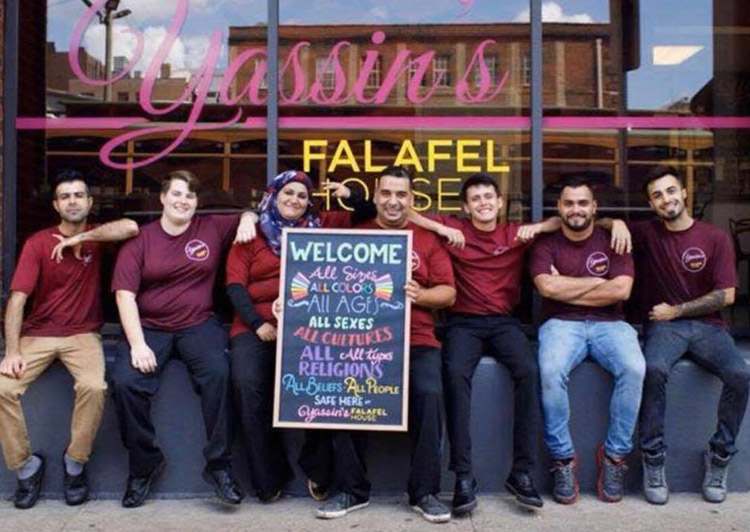
In many places around the world, strangers aren’t welcome. But at Terou’s restaurant, all people are welcome. Many of the employees at the shop are also refugees, immigrants, or Muslims. He’s also hired ex-convicts, people struggling with drug addiction, and women fleeing dangerous situations.
At the front of his store, a sign reads: “All sizes, all colors, all ages, all sexes, all cultures, all religions, all types, all beliefs, all people, safe here at Yassin’s Falafel House."
Yassin’s dream is to bring people together, all kinds of people. So at Yassin’s Falafel House, everyone is welcome—from Tennesseans who have never tried falafel to the refugees whom Yassin hires to make it—to share a sandwich and a conversation. pic.twitter.com/PhKWBpQ8Fz
— Square (@Square) January 26, 2018
The business has also developed into a hub for charitable works. When fires ripped through the nearby town of Gatlinburg, killing 14 and damaging or destroying up to 2,500 homes and businesses, Terou woke up the next day and jumped into action, renting a moving van that employees, customers, and friends loaded with water, food, and other supplies to deliver to victims.
They’ve also held fundraisers for community causes, such as Bridge Refugee Services, by donating a percentage of every falafel sold. When he won an award for his charitable work, he donated the $1,000 prize to Seeds of Abraham, a local nonprofit that connects youth from different faiths.
Terou’s extraordinary kindness is changing Knoxville for the better. Knoxville mayor Madeline Rogero told ABC News she believes Terou has "really torn down people's perceptions" of refugees and Muslims in the "heart of Appalachia."
If you’re ever in Knoxville, TN, stop by Yassin’s Falafel House. Yassin is Syrian refugee & best known for his generosity serving federal workers during the shutdown. Gyro is fantastic & I had to stop and take a pic of my baklava when I realized it was one of the best I ever had. pic.twitter.com/j0XZt76r9G
— Jomana Qaddour (@jomanaqaddour) April 20, 2019
Related
Best Refugee Organizations to Support in All 50 States
A catalogue of organizations that serve refugees in every state in the United States
Meet the Organization Helping Refugees Heal Through Storytelling
MeWe International first launched in the Zaatari refee camp in Jordan
5 Ways to Make a Difference for Refugees
How to support refugee artists, small business owners, LGBTQ+ refugees, and more...
When an architecture student’s dazzling ocean cleanup concept fizzled, she started thinking smaller — and tackled the problem at the source.
In 2012, Marcella Hansch was enjoying a dive near North Africa’s Cape Verde archipelago when she was startled by a fish bumping into her leg. When she looked underwater, she saw that it wasn’t a fish, but a plastic bag — the sea was filled with them.
The experience stayed with her. “Ever since, I’ve been seeing the plastic problem everywhere — on the streets, in the supermarket, in my own kitchen,” she says via Zoom from her office in a converted clothes factory in Aachen, Germany. “I couldn’t look away anymore.”
She decided to tackle the most visible symptom of the issue: the Great Pacific Garbage Patch, where approximately 100 million tons of debris swirl in a Texas-sized area of the central North Pacific. The problem is massive and keeps growing: Every day, we dump about 350 tons of trash into the oceans, most of it plastic. How to deal with this problem has vexed scientists and activists for decades.
So, for her master’s thesis as an architecture student, Hansch didn’t design a building, but a spectacular floating white platform shaped like a manta ray. The structure stretched 400 meters wide with combs reaching 35 meters deep. Its purpose was to fish plastic debris out of the ocean and melt it aboard the craft, with the resulting energy propelling the platform. For her invention, Hansch earned international attention and, in 2016, the German government’s Ecodesign award.
But just like the similarly eye-catching Ocean Cleanup Project by the young Dutch engineer Boyan Slat, her project was criticized by environmental activists who feared that skimming the oceans for trash could do more harm than good.
Greenpeace marine expert Thilo Maack told the German newspaper Die Welt, “Projects worth millions with surface collection ideas are spectacular and powerful, but unfortunately they do not solve the problem.” Marine biologists worried that ocean skimmers would inevitably extract living microorganisms such as plankton. And about 90 percent of trash has already sunk deeper than such devices can reach.
What’s more, “Plastic in the ocean can hardly be recycled because it has already deteriorated,” learned the 35-year-old Hansch. “Experts told me, if you really want to make a difference, you’re too late when you go into the oceans. When your basement has flooded, you want to turn off the tap first before you mop up the floor.”
But Hansch wasn’t ready to give up. “I’m thick-headed,” she declares with a laugh. She researched where plastic cleanup could be a more feasible solution and found her answer in a different sort of water: rivers.
“About 80 percent of trash reaches the oceans through the rivers,” she says. “They are basically the spigots that carry the debris into the seas.” Together with the biologist Tilman Peter Flöhr, who had already analyzed debris flows in the Chinese Yangtse and the Indian Ganges, and the journalist Clemens Feigl, she founded the everwave foundation in 2018.
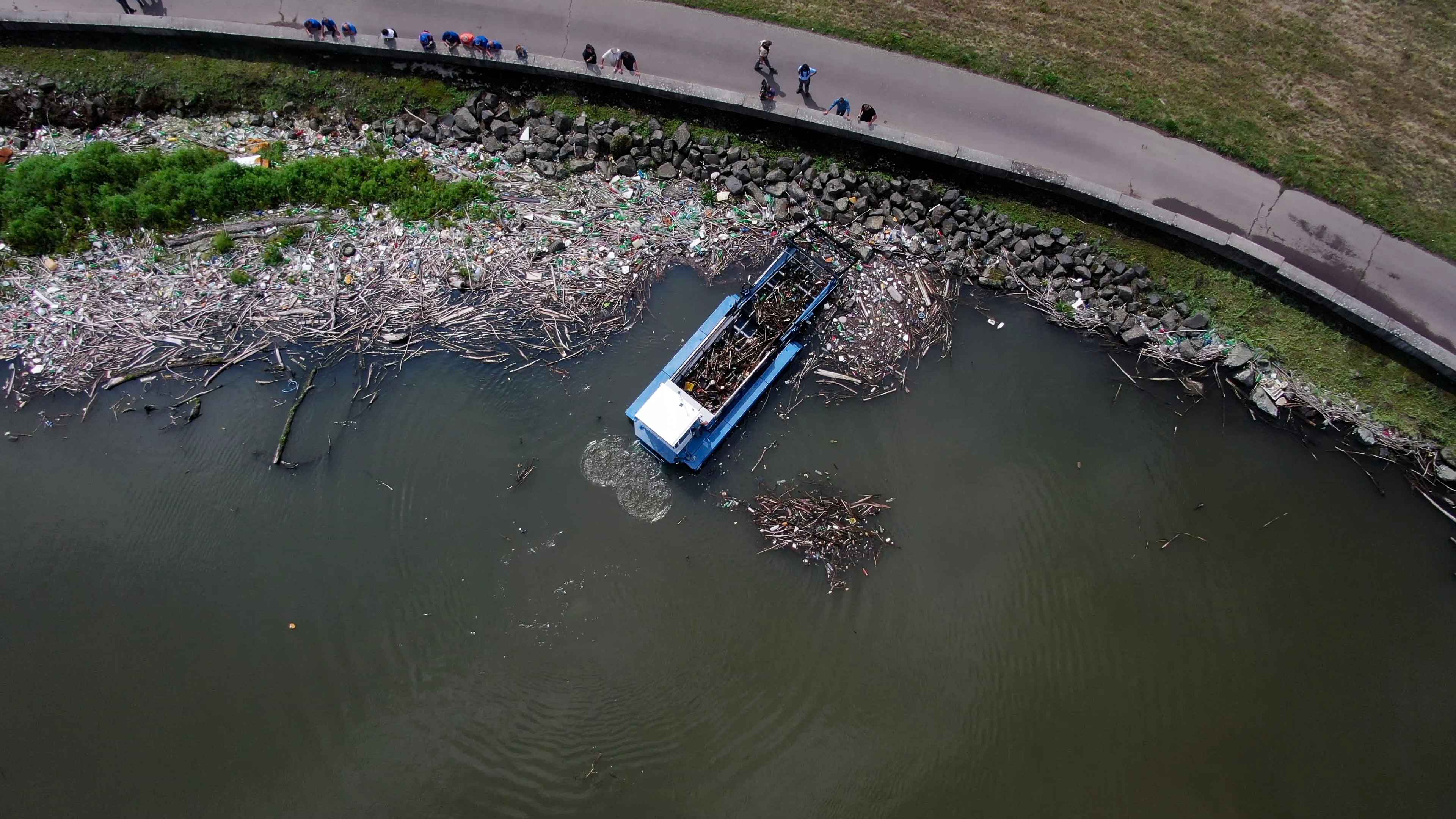
In cooperation with the German boatmaker Berky, the trio designed and built specialized boats with a conveyor ramp that can skim up to 20 tons of trash per day from rivers and lakes — a less spectacular solution than the original concept, but arguably more effective.
“That is more useful for the solution than devoting yourself to the Herculean task of cleaning the ocean of plastic waste,” says Thilo Maack. For instance, a ten-day run in the German Danube this spring sponsored by the environmental foundation of automaker Audi yielded more than 7,000 pounds of pure plastic.
After local test runs, the indigo blue CollectiX-boats had their first big deployments in Slovakia and at the Drina dam in Bosnia-Herzegovina, where vast patches of debris even shut down hydroelectric plants. “We go where we are needed the most,” Hansch explains. “Especially in the border regions, nobody feels responsible for the trash.” And when her home state in Northern Germany experienced catastrophic flooding in July, she quickly deployed one of her boats to help clear a nearby river of wood and debris.
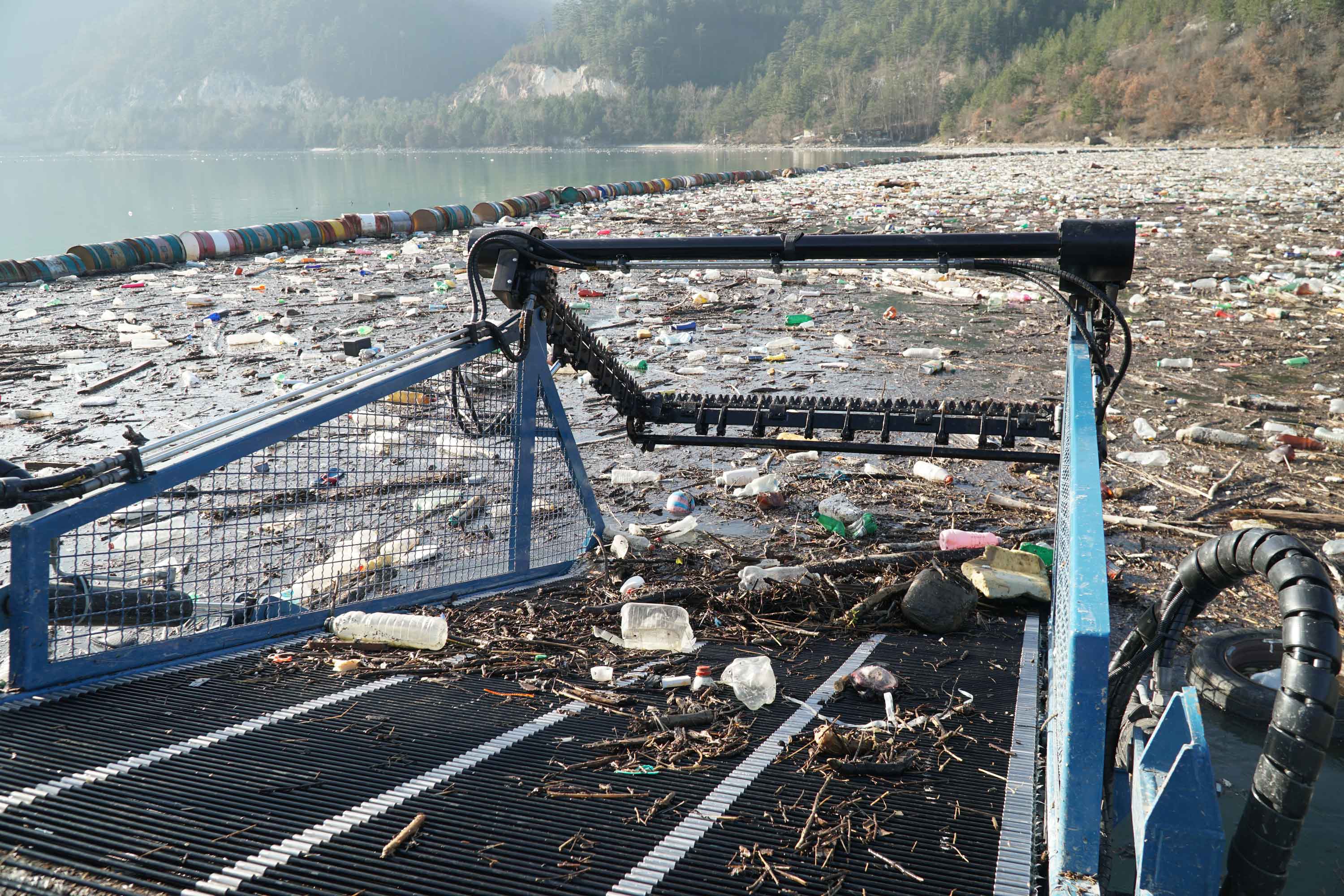
But her boats don’t just collect trash. Equipped with cameras, a drone and artificial intelligence (AI), the trash is analyzed by the German Research Center for Artificial Intelligence, one of the world’s largest nonprofit contract research institutes for AI technology. Employing the technology has two goals: First, it detects what can be recycled so that whatever is salvageable can be repurposed. And second, “We don’t just want to collect trash forever, but we want to plug the holes,” Hansch says. “We want to see where the biggest entry points and who the biggest polluters are.”
A team of engineers, biologists and environmental scientists help her. “Knowledge is power,” Hansch says. “We simply don’t know enough about trash, especially the plastic debris.” Everwave wants to inspire fundamental changes. “We see the same brand names in the trash again and again. We don’t want to wiggle our index finger at them, but when we publish pictures of our trash haul, it’s pretty obvious who the main culprits are. And people react to that; they will write to companies such as Coca-Cola and demand changes in their packaging. It also makes it pretty obvious that their recycling strategies aren’t working.”
Hansch gets upset when people tell her, “My to-go cup won’t make a difference.” She is convinced that “as consumers, we have enormous power to affect change. When consumers don’t buy that stuff, it won’t be produced.”
The focus on plastic waste has changed her own lifestyle as well. As a mother of a toddler, she doesn’t achieve “zero waste,” she confesses, “but we are extremely conscientious. You definitely won’t find a plastic bottle in our house.” She and her team also go into schools for education events and have designed a teaching children’s suitcase with age-appropriate materials about trash.
“We go where we are needed the most,” Hansch explains. “Especially in the border regions, nobody feels responsible for the trash.”
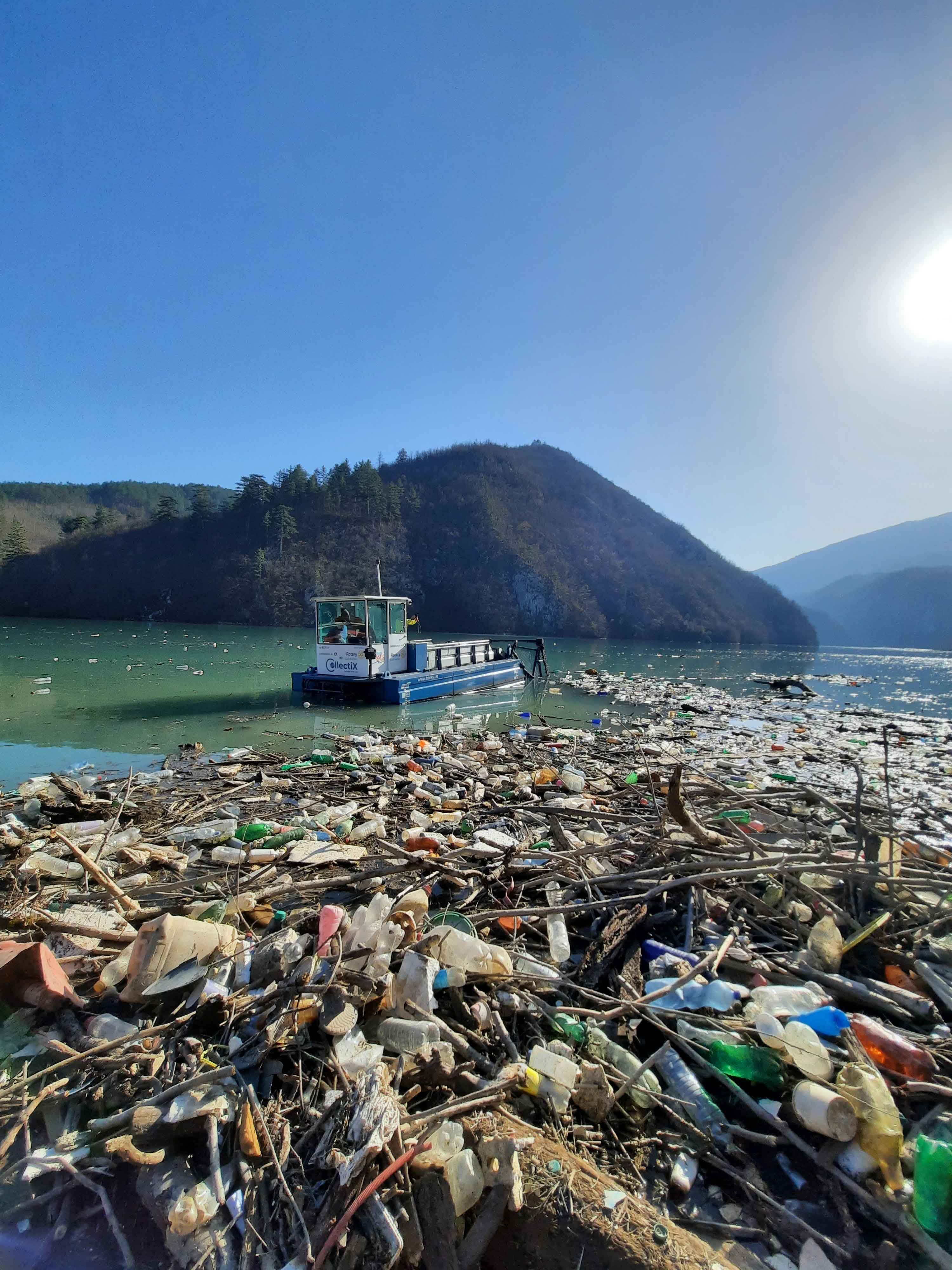
Everwave gets requests to clean up trash patches from all over the world, more than the small, donation-based organization with its 15 staff members can manage.
“That’s why we’re focused on scaling up now,” Hansch emphasizes. She is planning deployments in sub-Saharan Africa and Asia next, especially Malaysia, Indonesia and India.
“Not only because these are areas that leak a large percentage of the worldwide trash into the oceans, but also because we export a lot of our trash into these regions.” Boyan Slat, too, has refocused his cleanup work on the rivers and redesigned his original vision as a solar-powered barge-like system for rivers called the Interceptor. He has already deployed it to Indonesia and Malaysia.
To scale up, everwave is looking for investors. “Trash isn’t profitable,” Hansch says with a hint of sarcasm in her voice. “Even though everybody wants to market themselves as sustainable, at the end of the day, businesses prioritize profit.”
And yet, she is about to realize a mini-version of her original vision after all: This fall, honeycomb-shaped platforms the team designed will start anchoring in trash hotspots on rivers and lakes. Named HiveX, the platforms will be able to anchor long-term and collect trash without impacting ships.
“We are constantly asked if we can come back or stay longer.” The boats and platforms are deliberately designed simply so they can be built locally in Africa, Asia, or Eastern Europe “so that we can create jobs for the local residents.” Hansch also hopes that they will double as awareness-raising devices “so that locals start seeing trash as a valuable commodity that can be recycled.”
Everwave wants to grow and make waves worldwide. But Hansch’s true vision is that her cleanup mission will not be needed one day: when all the trash spigots have been turned off.
This story is part of the SoJo Exchange from the Solutions Journalism Network, a nonprofit organization dedicated to rigorous reporting about responses to social problems. It was originally published by Reasons to be Cheerful on August 24th, 2021.
What does upcycled food mean?
Upcycling a zero waste philosophy of creatively reusing byproducts and unlocking their highest value, finding “best” use, and improving the way we value resources, which, like recycling, enables us to do more with less, going beyond reuse
Examples of Upcycling: Turning an old climbing rope into a new dog leash, empty plastic bottles into a fleece sweater, or used cigarette butts into a brick
How I created "edible upcycling"
During our undergrad years at UCLA in the early 2010s, we found the perfect loophole to the legal drinking age: brewing our own beer.
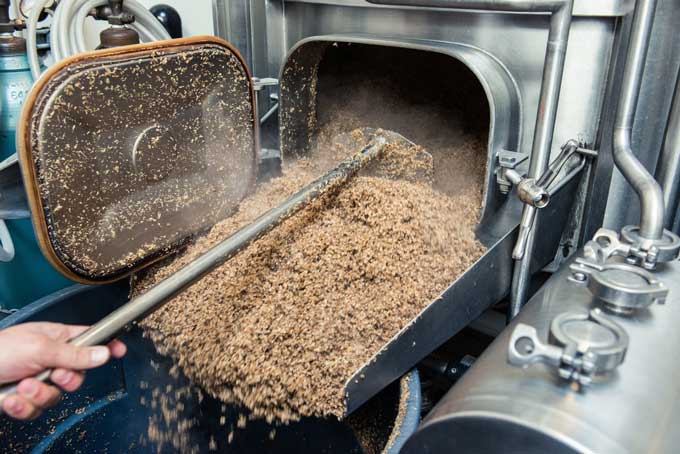
During this time, I coined the term “edible upcycling,” a way of upcycling the “spent” grain leftover from my homebrewing to use as an ingredient in bread. I would sell these loaves of bread and use the proceeds to buy the ingredients to make more beer.

While many homebrewers and large breweries see the leftover byproducts as “spent” just because they can’t be used to make more beer, to me they’re actually rendered “super” through the process.
That's because the brewing process removed the sugar from the soaked grains and left behind dietary fiber, protein, prebiotics, magnesium, iron, and zinc.
With no access to compost, tossing the grains felt wasteful, so I got creative and started a company, ReGrained. We learned breweries generate tons of this grain every batch, but they don’t have great options for offloading it, beyond animal feed as a best case.
Why is upcycled food so important?
I was blown away to learn that over 90 percent of the water footprint of beer is in the grain supply chain and that each pound of malt (what it takes to make a six-pack) uses over 300 gallons of water — the equivalent to a two-hour shower.
The environmental impact of food waste is massive. If food waste were a country, it would rank third after the United States and China in terms of impact on global warming, according to the U.N. Food and Agriculture Organization.
When food ends up in landfills, it releases methane, a greenhouse gas that is at least 28 times more potent than carbon dioxide, according to the U.S. Environmental Protection Agency. Because of a lack of available oxygen, food doesn’t break down in landfills in the same way that it would in nature or in a compost bin.
How can we make a difference by reducing food waste?
We can all do our part by minimizing the amount of food we buy so less is wasted — and by making sure we’re composting.
While the U.S. Department of Agriculture estimates that 31 percent of food waste occurs in the home, consumer-facing businesses account for at least 10 percent of waste. So we all have a part to play in being a part of the solution.
At ReGrained, we developed patented technology, SuperGrain+, to create a new supply chain for upcycled flour. We sell this flour to other companies and also use it in our own line of branded products such as nutrition bars and puffed chips.
The good news is that people working toward a solution have now expanded beyond just our operation.
Now in grocery stores you can find not only ReGrained products but a growing selection of upcycled products in the market such as Barnana (cosmetically imperfect bananas and plantain snacks), Renewal Mill (cookies and flour from okara, tofu production’s byproduct), and Toast Ale (beer made from surplus bread).
In other words, what began as an underage experiment in recreational entrepreneurship has blossomed into a food movement.
Eating upcycled is an easy and effective way to participate in the fight against food waste through a food movement that strives to identify and elevate every overlooked and underutilized ingredient stream hiding in plain sight.
When done well, upcycled food tastes great (nobody wants a product that just tastes like a good idea) and delivers on nutrition, functionality, and sustainability. Upcycling is a movement that makes both dollars and sense, so we are seeing it earn some well-deserved traction.
Snacking more sustainably by eating upcycled is one small action you can take to better align the food you eat with the planet you love. We hope it also inspires you to take a look in your own kitchen and improve your own impact. Eat up!
Dan Kurzrock is the co-founder and "Chief Grain Officer" of ReGrained and founding Executive Board Member of the Upcycled Food Association. ReGrained is an ingredient platform and packaged foods innovator that specializes in upcycling nutritious food streams. Learn more: regrained.com
A version of this story originally ran in Issue 09 of the Goodnewspaper in February 2020. The Goodnewspaper is our monthly print newspaper filled with good news.
You can join thousands of subscribers who get access to more exclusive stories like these, our private community space, a free inspiring poster, and so much more. Become a subscriber today.
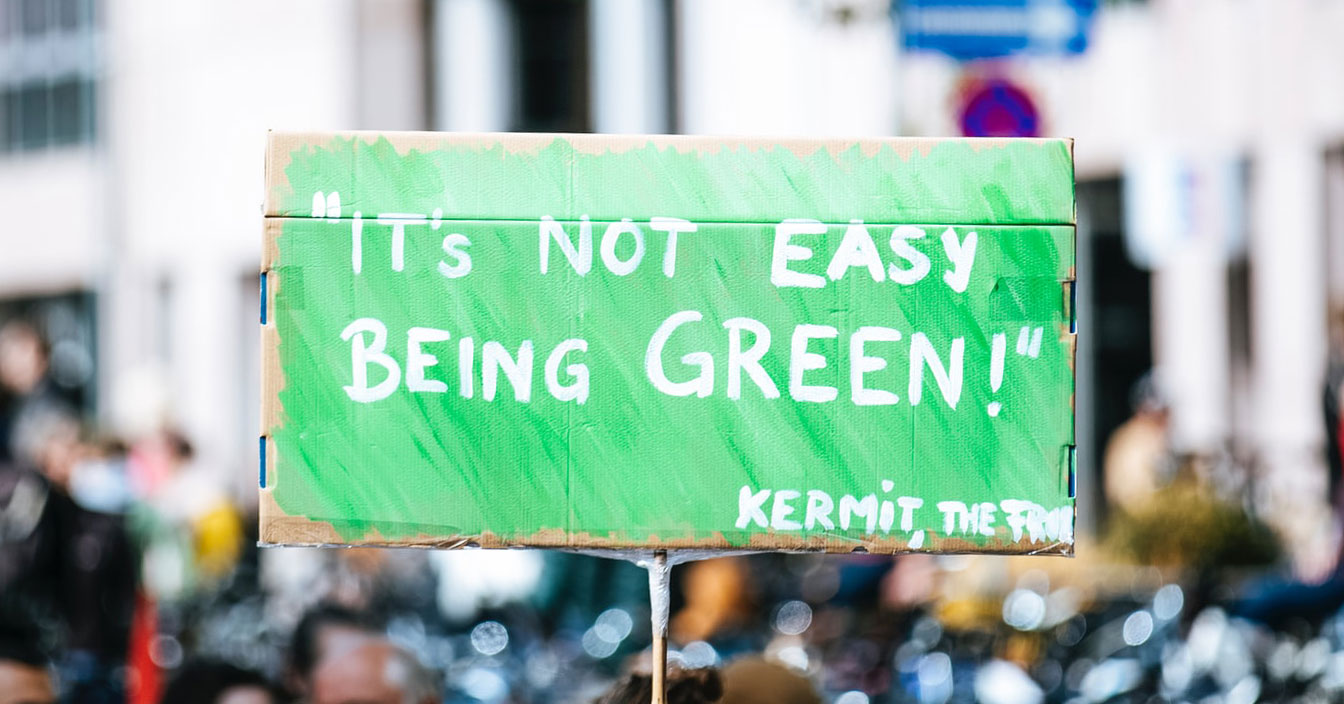
Climate change can feel hopeless. And — just like hope — hopelessness spreads.
We won’t say it’s not for good reason.
We're using up our resources. The wildfire season is on average three and a half months longer than it was a few decades ago. The 20 warmest years on record have been in the last 22 years. Half of Australia’s Great Barrier Reef is dead or dying because greenhouse gas emissions cause oceans to acidify more quickly, eating away at coral and algae. Chunks of ice are breaking off at the earth’s poles. There's more carbon dioxide in our atmosphere than any time in human history. The global sea level could rise almost two feet before the end of this century. Many animal species are at risk of extinction.
There’s every reason to take this seriously. If we don’t, things won’t change for the better. It actually could get quite worse.
But there’s hope because many talented, determined, and brilliant people around the world have defined how we can reverse some of these effects of climate change. Change is already happening, and we can be a part of it.
The small changes you make to your lifestyle might not seem like a lot — or maybe they even feel like too much, like they're overwhelming — but they do matter, and they do make a difference. Lifestyle habits such as reducing waste and accumulation, reusing products, and recycling your unwanted items all make a difference.
But it only adds up to massive change if everyone gets on board. Your part matters.
The bigger changes we make matter, too. You vote your values with your dollar when you choose where you shop, what you buy, what companies you support, who you invest in, and which politicians you vote for.
These changes cause massive ripple effects in the market because companies are motivated by profit. These changes have some of the biggest potential to protect our earth because they lead to larger, systemic changes at the corporate, industry, or policy level.
You can even go above and beyond by reaching out to your elected officials, protesting policies and tactics you disagree with, lobbying companies in your community, and fighting to change the status quo among your family members, colleagues, and friends.
It’s a lot. But take a deep breath and be encouraged, not disheartened, that the choices you make matter.
Please don’t stop caring just because it’s hard. The earth needs you and your voice.
A version of this story originally ran in Issue 09 of the Goodnewspaper in February 2020. The Goodnewspaper is our monthly print newspaper filled with good news.
You can join thousands of subscribers who get access to more exclusive stories like these, our private community space, a free inspiring poster, and so much more. Become a subscriber today.
You may have encountered someone in your life — at work, at a social event, a family member or a significant other — who does not seem OK.
Identifying that someone needs help but being unable to identify how to help them may be a difficult position to be in, especially for empaths. There's a balance between honoring someone’s privacy and being supportive.
At Crisis Text Line, we help people at some of their lowest points all day, every single day, via text message. You could say we’re experts in knowing what questions to ask to help people in their moments of crisis.
Over the last six years, we’ve collected and analyzed the anonymized data. Data allows us to understand crisis all over the country and build the best product for our Crisis Counselors and texters. Our research helps us identify how to best help people in crisis.
Does asking about suicide increase suicidal tendencies?
Overwhelmingly, we’ve found that it is essential to lead with empathy and ask direct questions when people are in emotional pain. And the most important question to ask texters in crisis: “Do you have thoughts of death or dying?”
That’s right. While the common assumption has been that inquiring about suicidality can increase suicidal tendencies, the data says that asking about suicide does not increase potential suicidality.
In reality, asking about thoughts of death or dying can open the door to a conversation that could save a lot of lives.
Our data shows that simply asking someone if they are OK opens the door for someone to feel they can ask for support and get help. It is about offering a safe and nonjudgmental space for someone to seek help.
At Crisis Text Line, we use a simple formula to assess if a texter has a plan, means, and timeframe to take their life. We always lead with an “expression of care” to let people know that we're listening and are here to support.
We found that assessing suicide risk with an "expression of care" was most likely to reduce a texter's suicidal feelings.
After using artificial intelligence to analyze our dataset of 75 million text messages — collected since Crisis Text Line launched in 2013 — we found that assessing suicide risk with an "expression of care" was most likely to reduce a texter's suicidal feelings.
Expression of care is simply letting someone know that you are there for them and want to keep them safe. “I care about you. With all that you have going on, are you thinking about ending your life?”
Our data shows when we ask about suicidal thoughts after building rapport and using the “expression of care” method, there’s no increased risk to the texter’s safety. In fact, it’s twice as effective in de-escalating a texter’s thoughts about dying than other methods.
As long as you’re validating, responding with empathy, and giving your texter room to explore their challenges, asking directly about thoughts of death and dying won’t cause them to feel more suicidal.
Our data and research show that some texters who experience thoughts about death or dying demonstrate little to no detectable signs of suicidal thinking.
This could be for a number of reasons:
Suicide can be hard to talk about. Our data shows it’s easier for texters to respond to a direct, empathetic question about suicide than it is to bring up the topic on their own.
For 67 percent of texters, their conversation with Crisis Counselors is the first time they’re sharing something they’ve never told anyone before. They may not have the words yet to describe what they’re feeling.
Because we’re providing support through text messages, it’s not possible to see physical signs of hopelessness, sadness, and pain. We may need to ask the texter directly about their thoughts of death or dying to provide them with the opportunity to express themselves.
That’s why we ask about suicide in every conversation.
If you’re looking to help the people in your life, there’s good news for you here, too. The number one thing that makes the biggest difference in a conversation about suicide?
Empathy. That’s right.
Empathy is a tool we all have and it’s seriously game-changing in even the hardest conversations. Even better, empathy is something all of us can show for each other. It’s totally free. And, it’s something everyone can show anytime, anywhere. All it takes is a few kind words.
Volunteer with Crisis Text Line
Crisis Text Line provides free, 24/7 support for those in crisis. Text CRISIS to 741741 from anywhere in the U.S. to text with a trained Crisis Counselor.
Crisis Text Line trains volunteer Crisis Counselors to help people move from a hot moment to cool and calm.
Think you have what it takes to become an Empathy MVP? Apply to become one of our volunteer Crisis Counselors and start saving lives in no time at crisistextline.org/volunteer.
Becka Ross is the Chief Program Officer at Crisis Text Line. She supports Crisis Text Line's Crisis Counselors as they help texters move from a hot moment to cool and calm. Becka recently relocated from Chicago to New York with her husband and two children.
A version of this story originally ran in Issue 10 of the Goodnewspaper in February 2020. The Goodnewspaper is our monthly print newspaper filled with good news.
You can join thousands of subscribers who get access to more exclusive stories like these, our private community space, a free inspiring poster, and so much more. Become a subscriber today.
The climate activists have been trying to get the names and details of Afghan campaigners and their families onto evacuation lists, but eight days after their first calls for help, there has been no response.
MUMBAI, Aug 27 (Thomson Reuters Foundation) - Afghan climate activists must be evacuated urgently from the conflict-torn country as they face the threat of persecution under the Taliban, but they are losing time and hope with an Aug. 31 deadline looming, campaigners said on Friday.
A group of nearly 260 activists and their families, aged one to 80 years, have been waiting to be rescued for over a week, said spokespeople for Fridays for Future, the youth climate movement started by Greta Thunberg.
"If there's anyone who can help in any way to evacuate the Fridays For Future activists from Afghanistan - please reach out urgently," Swedish teenager Thunberg tweeted on Thursday night.
If there's anyone who can help in anyway to evacuate the Fridays For Future activists from Afghanistan - please reach out urgently.
— Greta Thunberg (@GretaThunberg) August 26, 2021
(The other tweet had a spelling error) https://t.co/HBqbzgIRLW
The Afghan campaigners have been engaged in climate activism and social justice work in their country.
"Everybody is scared and feeling quite hopeless as the situation is rapidly deteriorating," said Sarah Greenfield Clark, co-founder of Climate 2025, a non-profit that supports emerging movements.
A massive airlift of foreign nationals and their families as well as some Afghans has been under way since the day before Taliban forces captured Kabul on Aug. 15.
Thousands of people have thronged Kabul airport seeking flights out since the takeover by the Taliban, with foreign forces facing an Aug. 31 deadline to leave.
On Thursday, at least two explosions struck the crowded airport gates, killing 85 people including members of the U.S. military and desperate civilians hoping to flee.
"We need help. Fridays for Future is a relatively new organization. We need better links with established humanitarian NGOs and experienced contacts to help us put these names on evacuation lists."
"We need help. Fridays for Future is a relatively new organization. We need better links with established humanitarian NGOs and experienced contacts to help us put these names on evacuation lists," Greenfield Clark told the Thomson Reuters Foundation.
"These people's lives are in danger," she added by phone from London.
Fridays for Future (FFF) activists have been trying to get the names and details of Afghan campaigners and their families onto evacuation lists with officials coordinating flights and aid agencies.
But eight days after the first calls for help were made, there had been no response, said those working on the rescue.
"Countries around the world are now indicating a withdrawal of state forces from Afghanistan over the coming days, leaving many FFF activists in grave danger," Fridays for Future said in a statement, calling for a coordinated humanitarian effort as time runs out.
"Me and the other activists feel as though we are being abandoned, even by the organizations we have worked closely with over the years," an unnamed 24-year-old climate campaigner was quoted as saying in FFF's statement.
"We feel that no one can know what we are going through, and that the rest of the world will just continue on as normal and we will be completely forgotten about after (Aug.) 31st. No one has the will to help us," the Kabul-based activist added.
Reporting by Roli Srivastava @Rolionaroll; Editing by Megan Rowling. Republished with permission from Thomson Reuters Foundation, the charitable arm of Thomson Reuters, that covers the lives of people around the world who struggle to live freely or fairly. Visit news.trust.org
Take Action
Good Good Good put together a guide on how to meaningfully respond to what's happening in Afghanistan.
Currently, the most effective way you can help is to lobby the United States government to evacuate as many people as possible. You can use the script in our guide to call your elected officials today.
A mental health agency in Charlotte run by people with lived experience opens North Carolina’s first peer-run respite center as an alternative to landing in the emergency room for mental health issues.
On a patio tucked behind an old brick two-story house, Susan Hart sat on a glider surrounded by lush green plants under the glow of string lights. She wondered aloud what it would have been like to check herself into a place like this instead of a psychiatric hospital 20 years ago.
This place, “Retreat @ the Plaza,” opened in Charlotte in early August and is run by Promise Resource Network. It’s designed to be an alternative to hospitalization for people experiencing mental health distress.
It’s the first peer-run respite house in North Carolina, meaning it’s completely staffed by people who have experienced mental illness, psychiatric hospitalizations, homelessness, incarceration, substance use or a combination of these.
The peer-run respite facility is free to participants and is designed to be a completely voluntary alternative for people who would otherwise seek mental health crisis care through the emergency room and possibly be involuntarily committed to a hospital.
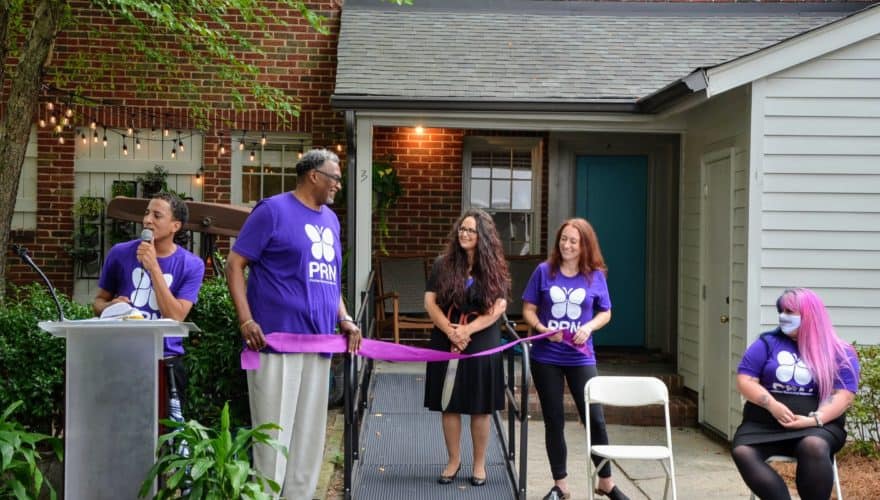
Hart, 58, still remembers how the metal doors of Holly Hills, a psych hospital in Raleigh, locked behind her when she was at one of her lowest points. The inviting front porch of the respite house with its hanging ferns, rocking chairs and bright blue door was a stark contrast to those memories.
“When you’re in a psych hospital, they take everything — down to your shoelaces — for your protection. Then they slap a diagnosis on you,” Hart explained. “I got worse before I got better.”
Alternatively, the doors at the respite house are not locked. Guests are able to come and go to the store, their job, school or wherever they want to be.
“I think this would have definitely been a healing place,” Hart said. “You’re still part of the community and not on lockdown. In this space, you can feel the warmth, the encouragement, the safety.”
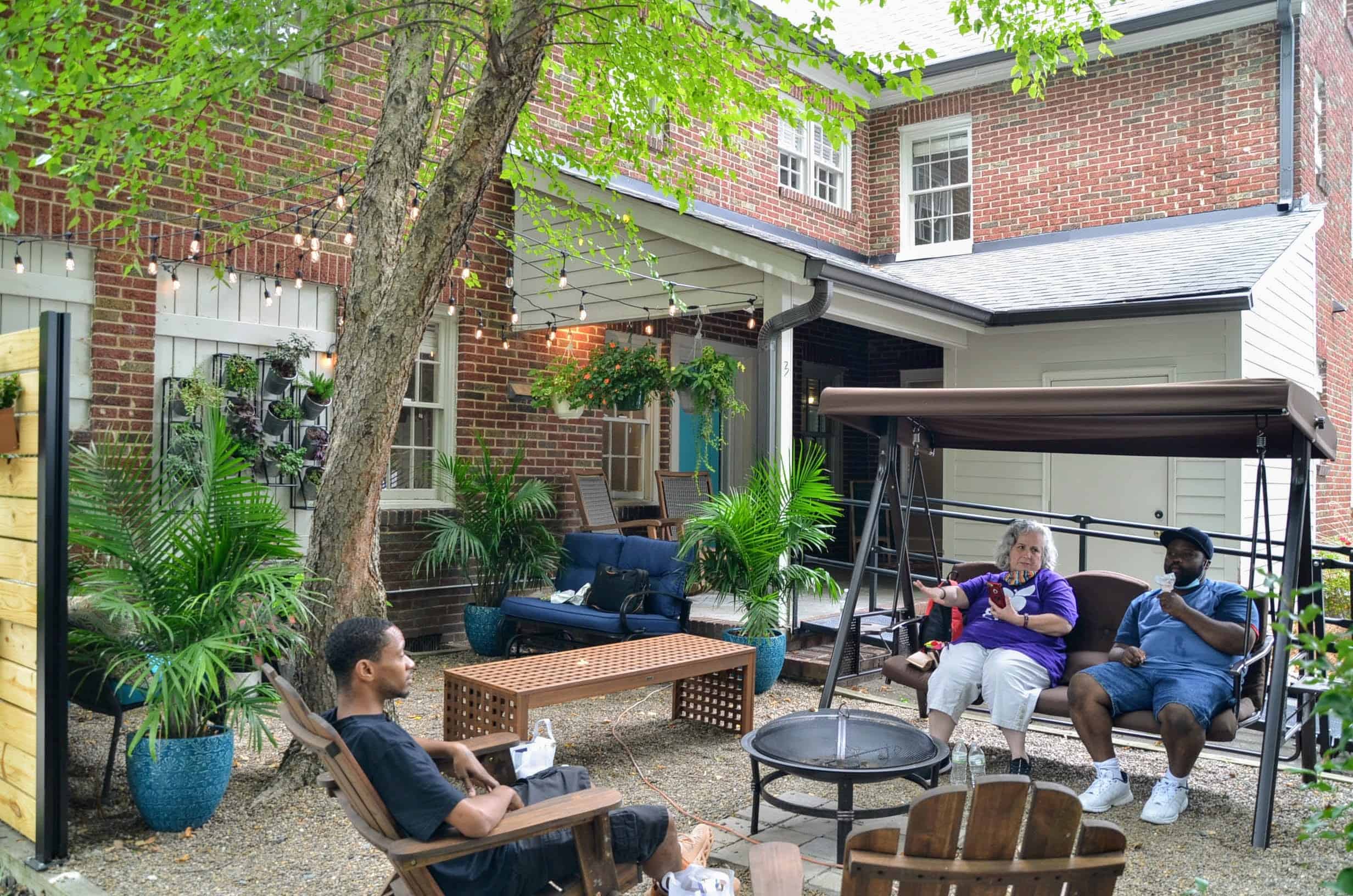
Now, Hart is in a much better place in her recovery from more serious mental health issues. She supports others through PRN’s warm line, a non-crisis support line run by people who have experienced their own mental health struggles.
Finding a different way
Mental health treatment for some in North Carolina has devolved into little more than crisis care.
More and more, patients experiencing mental health distress have found themselves on the other end of a petition for involuntary commitment, a legal mechanism that allows them to be held against their will, handcuffed and transported by law enforcement, strip searched and forced to take medication.
Involuntary commitment petitions increased by 91 percent across the state in a decade, far outpacing population growth.
“We can and we must do better,” said Promise Resource Network CEO and founder Cherene Allen-Caraco. “There is no conversation that starts with ‘shackles and restraints are healing.’ None.”
Allen-Caraco is a trauma and suicide attempt survivor who is vocally opposed to any form of forced psychiatric treatment. For years, she has advocated for and created alternatives at PRN, now taking the form of this new peer-run respite center.
“And today we will do better because of effective, less costly, less traumatizing alternatives that exist,” she said.
A peer-run respite center is a non-clinical, completely voluntary service operated by people with their own stories of mental health recovery, trauma, hospitalization, incarceration, substance use, homelessness or some combination of these.
At $111 per day per guest, a stay at the respite house costs a lot less than a stay at a state-run psychiatric hospital, which averages $1,300 per day according to the NC Department of Health and Human Services.
A Kaiser Family Foundation 2018 estimate found an even higher average cost of inpatient psychiatric treatment across North Carolina at $2,234 per day.
Peer-run respite centers were introduced in the United States in the 1990s, and Promise Resource Network’s respite is modeled after one in Massachusetts called Afiya.
A peer-run respite center is a non-clinical, completely voluntary service operated by people with their own stories of mental health recovery, trauma, hospitalization, incarceration, substance use, homelessness or some combination of these.
“Because of its success in decreasing emergency and crisis need for services by 70 percent, there are now 40 respites in the country in 12 states.”
A guest can stay at the respite house in Charlotte for up to 10 days, where one-on-one peer support is available 24/7, as well as access to all of PRN’s other classes and supports which are located next door.
“Because of its success in decreasing emergency and crisis need for services by 70 percent, there are now 40 respites in the country in 12 states,” Allen-Caraco said. “We’re 41.”
Community and state support
Several city, county, state and law enforcement officials voiced their support for Promise Resource Network and the new respite program at PRN’s ribbon-cutting celebration.
Mecklenburg County Sheriff Gary McFadden said he’d been having a tough week when he showed up to speak at the respite’s opening ceremony. He had just lost a childhood friend and two colleagues.
“It was kind of funny because everything I’m struggling with as a leader in this city and the complications of life, this is where I needed to come today,” McFadden told the crowd gathered outside the respite house. “I walked around in this fabulous, unbelievable home for people like me and others. Some of y’all don’t want to admit it but we all struggle.”
The sheriff said he was dedicated to PRN because “somebody finally got it right,” he said. “Somebody finally brought the people that can really tell the story. Those closest to the problem are often closest to the solution.”
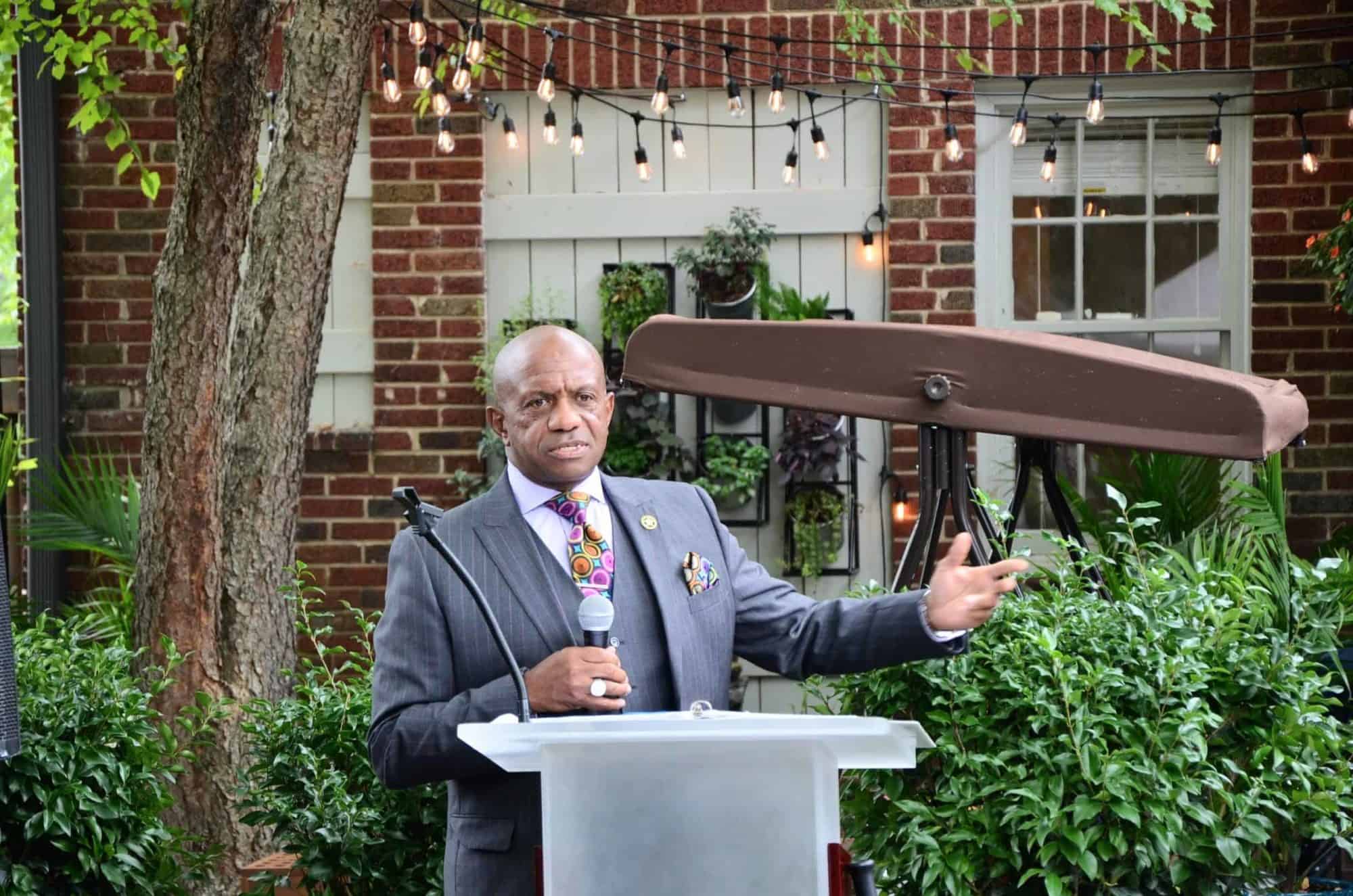
McFadden said he already called two other county sheriffs who will come to check out the respite model soon.
“There is so much right about what’s happening here today,” said Victor Armstrong, director of Mental Health at the NC Department of Health and Human Services. “You have a facility here designed by and for people with lived experience, who should be showing us the way of how to provide behavioral health services.”
Armstrong added that there is a lot that is wrong with the state’s mental health system.
“We don’t have a system that’s designed to protect and nurture the individual that’s having a mental health emergency. We have a system that’s designed to protect the rest of us from the person with mental illness,” Armstrong said. “That is wrong.”
The state’s mental health system isn’t designed to meet the needs of the people, but is “designed to squeeze these people into our funding streams, programs and into our progresses,” he explained.
Several other local luminaries wrote letters of support, which PRN peer support specialist Cedric Dean read to the audience at the celebration.
“One of the things I always say is I want to be treated as a colleague and not a convict,” said Dean, who was formerly incarcerated.
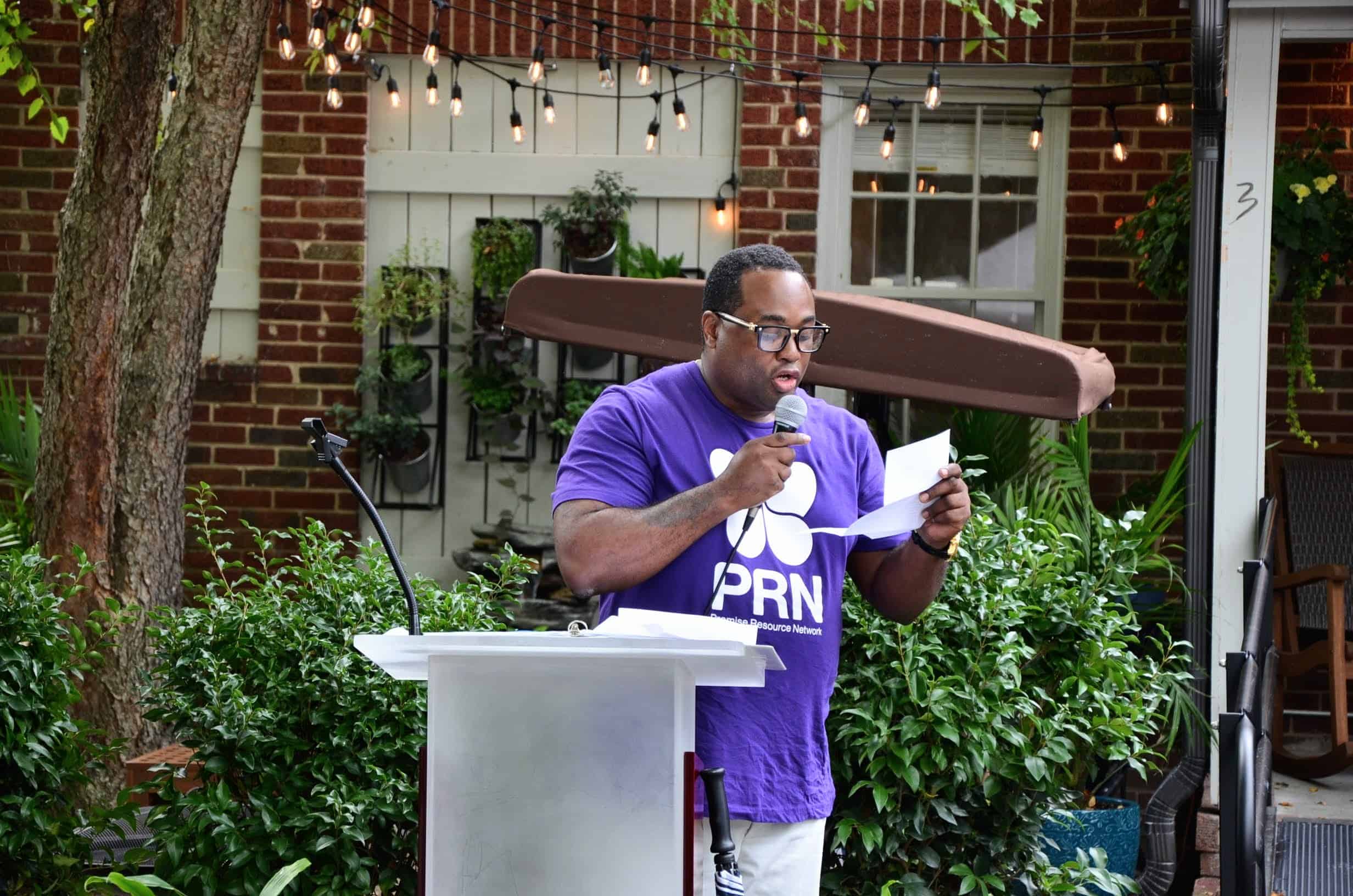
“The first colleague is one that I would have never ever thought when I was sitting in a prison cell serving life plus five years would be a colleague of mine. But his name happens to be Spencer B. Merriweather, our district attorney. He drove right here today to hand-deliver this letter,” Dean said before continuing to read the letter from the district attorney who congratulated PRN on the opening of the respite house.
Beating the odds
“In the work that I’ve done and what I’ve seen in the community, whether it’s through treatment courts or other alternative programming, when you get the right people in place, you really do see miracles,” said Bob Ward, Mecklenburg County Assistant Public Defender.
Ward is a familiar face to many PRN staff who greeted him with big hugs at the opening of the respite. Ward represents patients who have been involuntarily committed in court and sounded the alarm after he noticed his caseload increasing. He launched an effort to collect IVC data statewide and has been an advocate for alternatives to hospitalization and police involvement for people in mental health crises.
“You see people overcoming some tremendous odds,” Ward said. “This is just so encouraging.”
PRN staff provide peer support in five different court diversion programs, such as mental health court. They help people find employment and housing and keep both. PRN is embedded in other community agencies to help meet people’s basic needs of food, shelter and clothes.
“The foundation of PRN and everything we do is trauma-informed peer support. Without that, there is no Promise Resource Network,” said peer support specialist Aaron Wells.
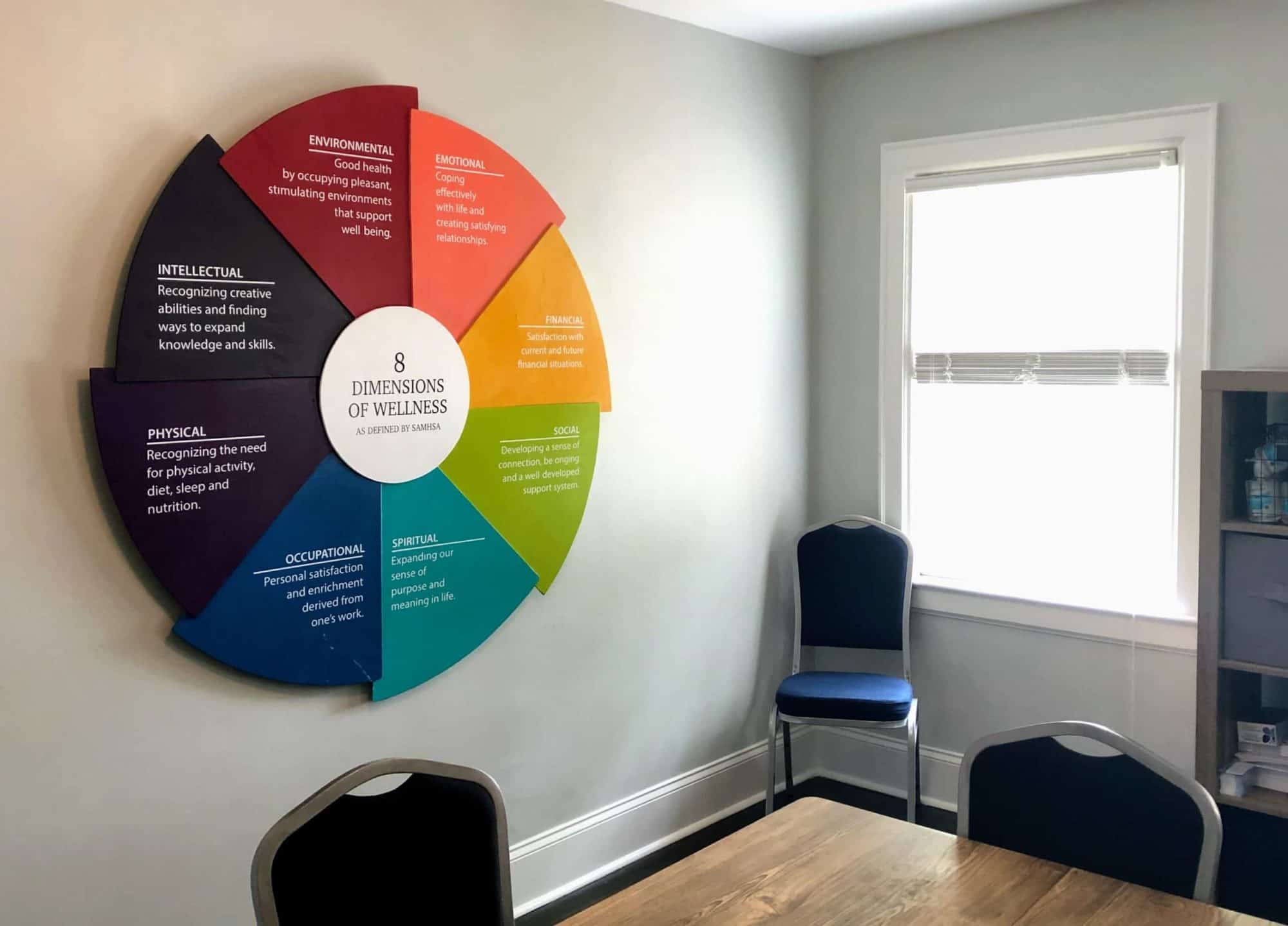
“When people are struggling, they often have no hope and think there’s nothing out there for them,” Wells explained. “That’s not true. Charlotte is the 16th largest city in the country. There’s a lot of things out there. It’s just a lot of things that are disconnected out there.”
Peers at PRN come alongside and help navigate these systems for those seeking help, Wells said.
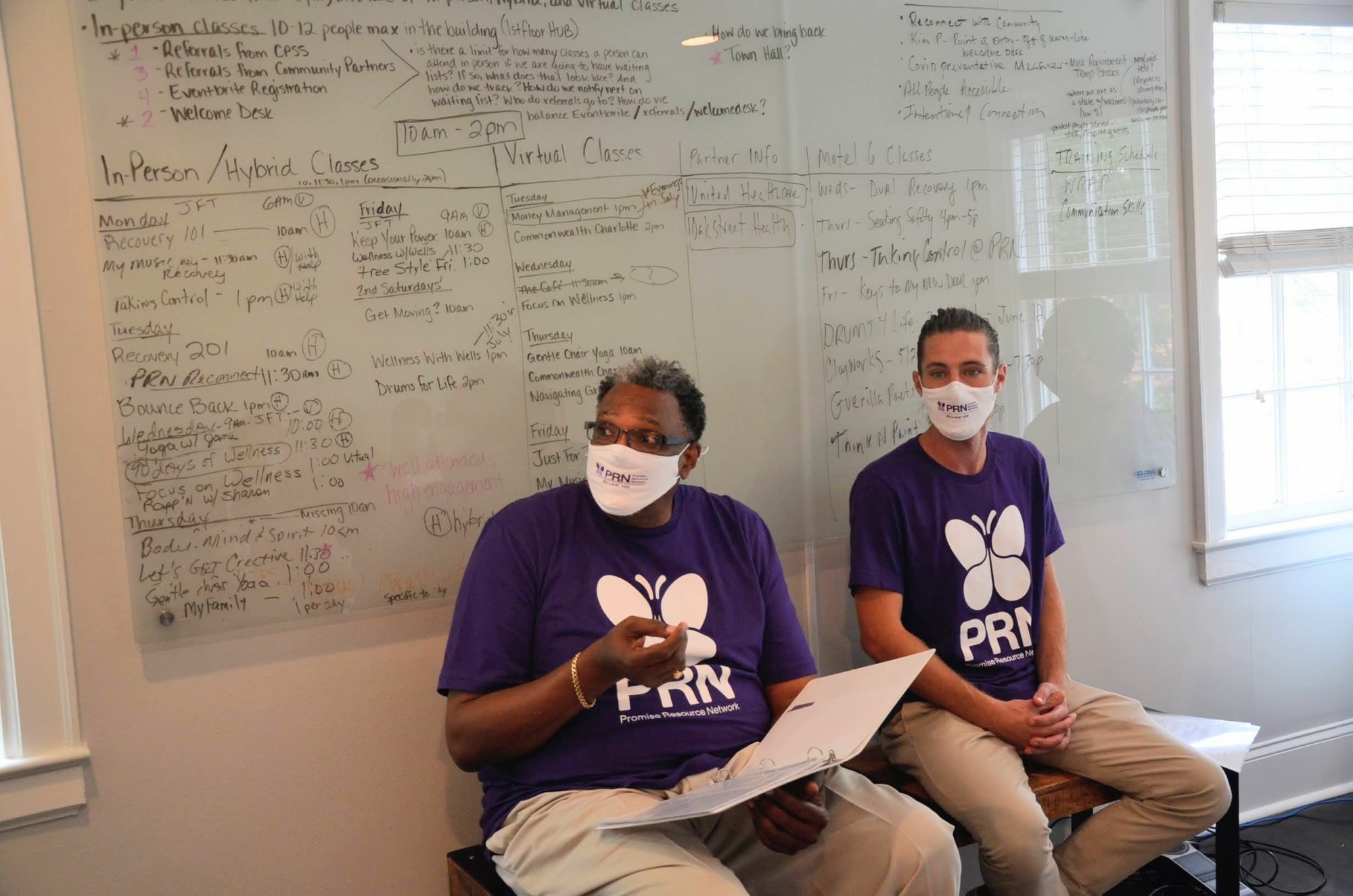
“The great thing about peer support is that the things that our life experience eliminates from other career fields, they qualify us for this,” said Wells who has experienced homelessness himself.
Wells told the story of a man coming out of long-term incarceration who he met through recovery court. All he wanted to do was be a father to his children again, but he couldn’t find housing or a job due to his criminal record, Wells said. The man was driving out of the county — in violation of his parole — to work a minimum wage job at a chicken farm.
After connecting with peer support and discussing his situation with the judge, the PRN team found him housing and a job paying a living wage in Mecklenburg County. The man was then able to regain custody of two of his children.
“It took a whole team of people to get off their own agenda of what the program looked like and actually look at a person and look at their needs,” Wells said. “And that was a happy ending.”
This story is part of the SoJo Exchange from the Solutions Journalism Network, a nonprofit organization dedicated to rigorous reporting about responses to social problems. It was originally published by North Carolina Health News on August 18, 2021.
North Carolina Health News is an independent, non-partisan, not-for-profit, statewide news organization dedicated to covering all things health care in North Carolina. Visit NCHN at northcarolinahealthnews.org.
Desperate scenes in Kabul are met with high-tech help as offers of rides, meals, and beds go online
Harrowing footage of Afghans desperate to flee has prompted charities, companies and citizens worldwide to use everyday technology to help people caught in an extraordinary crisis.
Be it air miles or apps, ride shares or group messages, all sorts of online tools — many made for easier living — have been redeployed, either to re-settle refugees on the run or help those left behind.
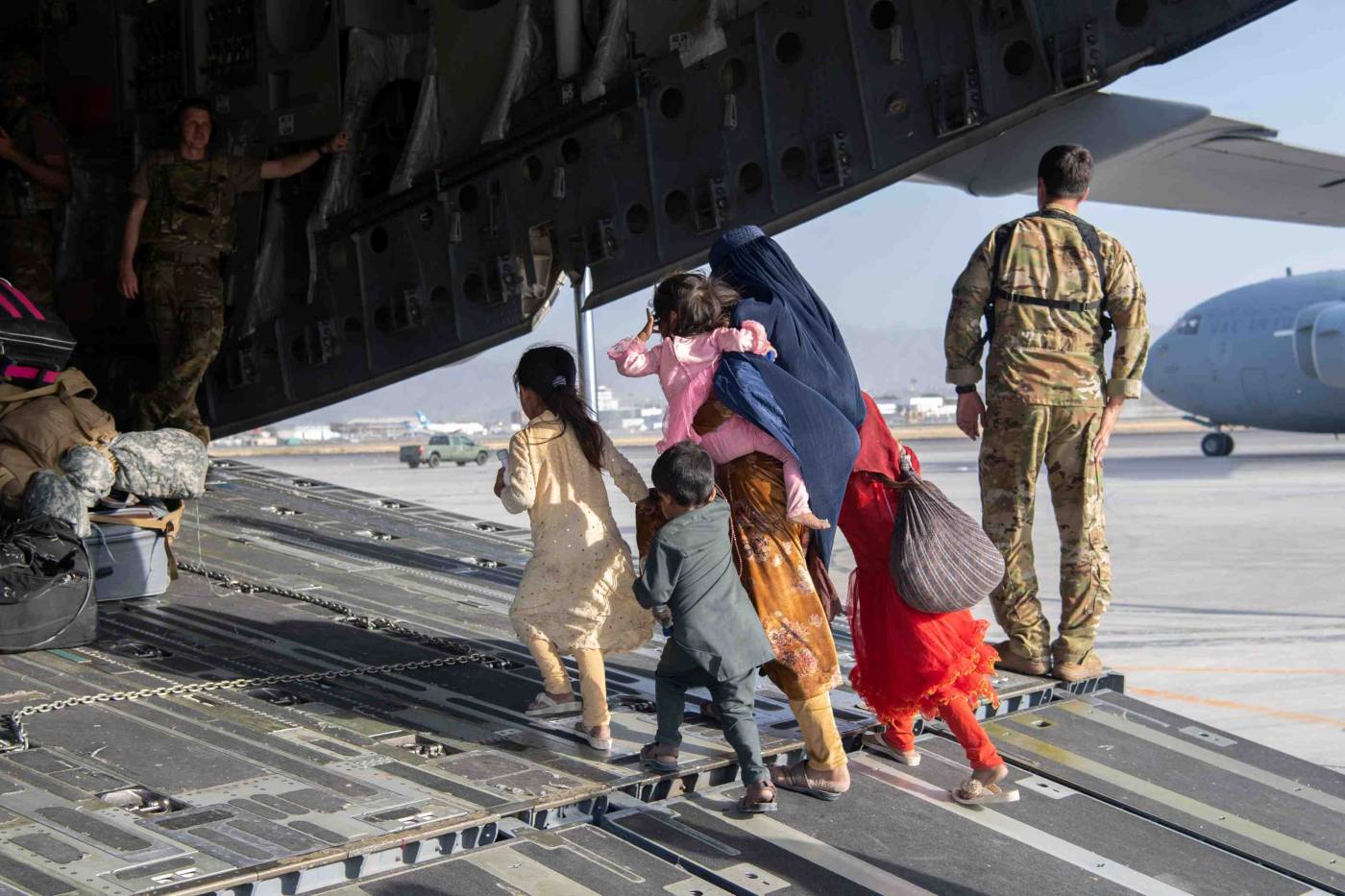
Here are seven tech-enabled initiatives in play since the Taliban resumed control, 20 years after the group was last in power and long before the smartphone changed our daily life:
1. Accommodation
People have taken to social media to offer spare rooms as part of resettlement programs, while home rental company Airbnb said on Tuesday it would provide temporary housing to 20,000 Afghan refugees worldwide.
The company said it began that process by placing 165 refugees in temporary accommodation after they arrived in the United States over the weekend, promising more details soon on how their hosts can get involved.
2. Air Miles
U.S. charity Miles4Migrants has urged frequent flyers to donate air miles to cover fares for asylum seekers and refugees.
Spokesperson Annette Ross said people had already pledged twice the amount of miles raised in the past five years.
3. Security Alerts
Afghan-based start-up Ehtesab runs a mobile app that delivers live security alerts, notifying users about anything from traffic jams to roadblocks at their location, or more grave events such as bombings and fires.
In July, as security concerns mounted, it crowdfunded to expand coverage outside Kabul and launch a text-based alert service for those who do not own a smartphone.
During the first couple years of @ehtesabaf, I was doing everything I could to try to connect with @USAID, @UNAMAnews, and @WorldBank. It all fell to deaf ears. I felt hopeless.
— Sara Wahedi (@SaraWahedi) August 26, 2021
Today, I have multiple investors lined up, and exciting collaborations ahead.
Never, ever give up.
4. Digital Footprints
Amid concerns the Taliban might use databases and digital trails to target journalists, activists, women and other vulnerable Afghans, rights groups are helping Afghans protect their online identities.
U.S.-based advocacy group Human Rights First has published a guide on how to delete digital history. Digital rights group Access Now has also collected a number of similar resources.
#NEW: In our ongoing work to equip allies & at-risk Afghans with the tools to protect their online identity from the Taliban, we've released a guide to thwarting digital surveillance - soon to be translated.
— Human Rights First (@humanrights1st) August 25, 2021
Help us circulate this vital resource widely.https://t.co/0nsrTrGqb2
5. Legal Help
Human Rights First has set up an online form for lawyers wanting to provide pro bono assistance to Afghans in need of legal support related to immigration matters.
Legal charity International Refugee Assistance Project (IRAP) has also been seeking donations to support legal aid services to fleeing Afghans.
6. Airport Pick-Up
U.S. charity Lutheran Immigration and Refugee Services (LIRS) has been asking people to donate time as well as money to help welcome Afghan refugees landing in the United States.
Volunteers can sign up to provide services like airport pick-ups, apartment set-ups, and bringing a meal.
Scenes at Washington Dulles International Airport as over 14,000 Afghan refugees have arrived in the past 12 days following their evacuation from Afghanistan. Welcome to America. pic.twitter.com/dDtLXFCPPP
— Benjy Renton (@bhrenton) August 28, 2021
7. Phone Credit
Phones are vital for asylum seekers to talk with home, keep abreast of developments and navigate their way through borders and new countries.
British charity Phone Credit for Refugees (PC4R) allows people to donate phone credit to provide mobile top-ups to help refugees stay connected and keep safe.
So happy we’ve set a new record @credit4refugees today, topping up more than 600 refugees’ phones with credit! Massive thanks to @BBCBreakfast @JayneMcCubbinTV for allowing me to talk about this fab charity, and to all the wonderful donors. #Afghanistan #RefugeesWelcome pic.twitter.com/ObnKJG0qVW
— Kay Sidebottom 🌿🕷 (@KaySocLearn) August 21, 2021
Reporting by Samuel Baugh, Editing by Umberto Bacchi and Lyndsay Griffiths. Republished with permission from the Thomson Reuters Foundation, the charitable arm of Thomson Reuters, that covers the lives of people around the world who struggle to live freely or fairly. Visit news.trust.org
On Sunday, the world watched as Kabul, the capital of Afghanistan, fell to the Taliban as the Biden administration scrambled to evacuate diplomats, aid workers and other officials.
As U.S. military helicopters quickly took to the air, whisking Americans to safety, scores of Afghan civilians waiting at the airport were left behind as they desperately attempted to board planes — some dying in the process.
Afghan New Yorkers told THE CITY that they watched these scenes unfold with a maelstrom of conflicting emotions.
“It’s your very worst nightmare coming true,” said Awesta Zarif, 30, of Astoria, Queens. “We can only look, hope, pray and wish that things get better there. And there’s guilt that you’re not there. You’re just watching [Afghanistan] from a distance and you feel so helpless.”
More than 10,000 Afghans live in the New York City-Jersey City-Philadelphia corridor, according to the latest data from the 2015 American Community Survey. Many reside in Queens, with concentrations in Flushing.
Many left decades ago, when the Soviet military invaded the country in 1979. Some arrived during the 20-year so-called U.S.-led war there. Others, the children of immigrants, haven’t experienced the panic of fleeing a home firsthand, but are now witnessing relatives and other fellow Afghans live it in real time.
The shock of the chaos in Kabul has Afghans in New York mobilizing to help their families back home and any compatriots who may soon find themselves in the city.
Bhshta Ibrahim Khail, a 24-year-old volunteer with Afghan Americans of New York, said she has been busy furiously fielding messages asking: “How can we help?”
“We’re doing everything we can to get them out of there, to speak up, to be an advocate, be a voice for the voiceless people through this crisis that they’re facing.“ Khail told THE CITY.
‘A Very Beautiful Country’
Mo Rahmati, 35, said his parents never speak about leaving Afghanistan. He knows only the vague outlines of what happened after they escaped the country in the 1980s: First to India, then Arizona as refugees, and ultimately to Woodside, Queens, where Rahmati was born and raised.
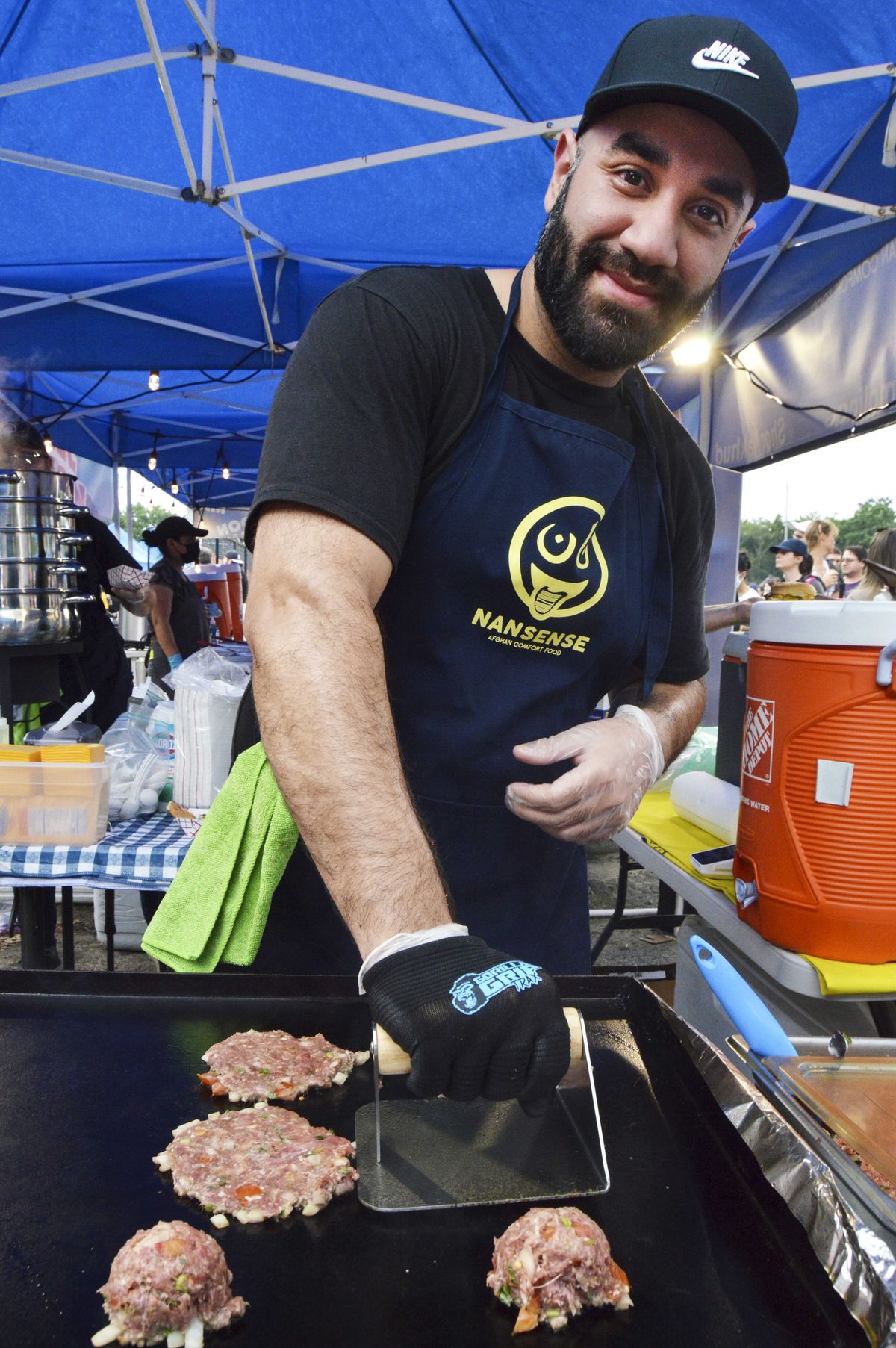
“Everything I’m watching on the news right now, I don’t like to visualize my parents going through that but I know that’s probably what they were going through as well,” said Rahmati, who founded Nansense, an Afghan food stand that operates at the Queens Night Market.
Bashir Saleh was a 20-year-old engineering student when he fled Kabul in the 1970s.
He recalled waking up one morning, heading to the university and seeing tanks and troops.
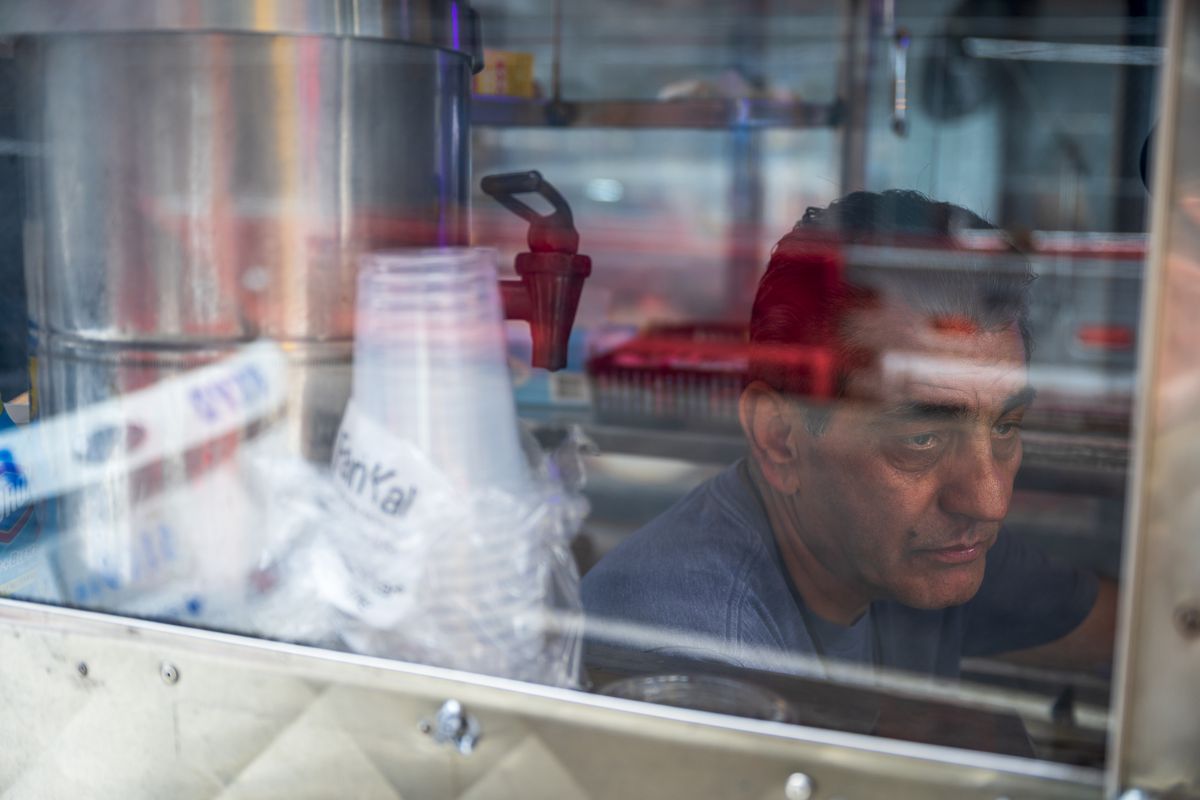
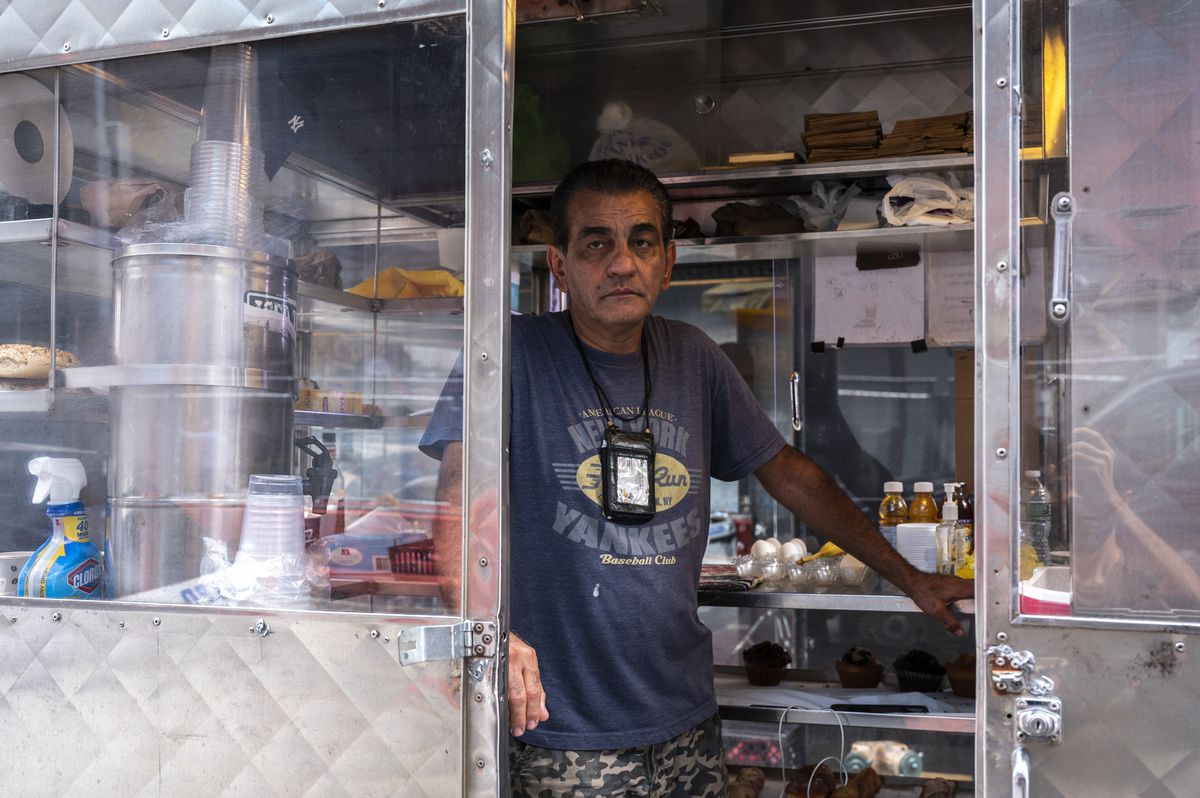
Now 64 years old, Saleh has sold coffee and pastries outside what’s now the Hard Rock Cafe in Times Square for three decades. This work allowed his four children to pursue educations and livelihoods he wasn’t able to.
“No parents want their kids to be in that situation,” said Saleh, who now lives in New Jersey. “I remember growing up we had a very beautiful country.”
When Saleh arrived in New York City with his immediate family of nine, they shared a two-bedroom apartment in Bensonhurst, Brooklyn. They received support from refugee resettlement groups and sponsorship from a church, but it wasn’t enough to survive on for long.
He took any job so that his younger siblings could stay in school. He cleaned offices, he sold ice cream, and ultimately he saved up enough to buy his own coffee cart.
Passage Proves Elusive
Saleh’s experience is not so different from Afghans arriving in the United States now. Churches and resettlement organizations still support new New Yorkers arriving as refugees.
But one main difference is numbers.
Historically, most Afghans came to the United States either as refugees or through family-based petitions, immigration attorneys said. But under the Trump administration, the refugee pathway was almost completely halted.
Since the Biden administration took office, advocates and U.S. military veterans alike have spent months demanding a quick evacuation and resettlement for those who helped American troops, like interpreters, and other Afghans threatened by the Taliban.
Many Afghans risking the violent chaos at Kabul’s airport had already been approved or were on hold for Special Immigrant Visas (or SIVs), issued to people who’ve helped U.S. military interests. But many of those have not yet been able to fly to the United States.
Camille Mackler, executive director of New York City-based nonprofit Immigrant Arc, acknowledged that lawmakers are working on additional pathways to the safety of a U.S. visa for Afghan activists and others. But with danger growing by the second on the ground there, Mackler hopes New Yorkers will “put the pressure on” Washington until “we’ve evacuated everyone who we promised to protect.”
More than 300,000 Afghan civilians are said to have aided U.S. troops during the war.
First Families Arrive
On Monday, Catholic Charities NY helped greet one of the first arrivals to the city since Kabul fell to the Taliban.
A local volunteer at Kennedy Airport lifted a sign with an Afghan family’s name, peering out through the glass partition separating immigration and arrivals. She awaited a former military interpreter and his family of six.
All seven of them, and their 10 suitcases, would have to squeeze into the one-bedroom apartment of a family member in Far Rockaway — a temporary solution, said Mario Russell, director of immigrant and refugee services for Catholic Charities.
Over 18,000 people evacuated since Sunday from Kabul airport-NATO official https://t.co/6V9qvj81m1 pic.twitter.com/QnnlMP3EQD
— Reuters (@Reuters) August 20, 2021
The trickle of Afghan refugees coming to New York generally do so because of family ties, while most resettling alone go elsewhere due the city’s high cost of living and lack of affordable housing, Russell noted.
Carmen Maria Rey, the U.S. legal director of the International Refugee Assistance Project, said that cities and states should “raise up their hands” to tell the federal government they are willing to accept and resettle refugees.
While states like Utah have publicly sent letters of support for accepting additional refugees from the country, neither Mayor Bill de Blasio nor Gov. Andrew Cuomo have issued public statements on Afghanistan.
Rep Greg Meeks (D-Queens), the chair of the Democratic chairman of the House Foreign Affairs Committee, meanwhile has invited U.S. Secretary of State Antony Blinken to face questions from his committee about the poorly planned exit strategy.
“We cannot leave [our allies] behind,” he told NY1, “because that’s keeping our word.”
Call for Aid
Russell said refugees need mental health support, job training, and, most importantly, transitional housing.
For now, he said, money, housing or Airbnb donations from regular New Yorkers “would go a long way to help and welcome and support these often young families in an incredibly difficult transition.”
Rahmati said he is donating all proceeds from this Saturday’s Queens Night Market to two organizations: Children Without Borders and Emergency Relief Afghanistan.
Matt Pelak, an Army veteran living in Bushwick, Brooklyn, said he has barely been sleeping. He works at Amazon by day and with a coalition of veterans at night calling anyone they can find in Afghanistan or elsewhere who can help bring their former interpreter colleagues safely to U.S. soil.
Pelak said fellow New Yorkers should “think about how you could offer an Afghan a job, how you could donate some furniture, donate some clothes, just be there to support them, and help them build communities when and if they arrive in New York City.”
Just last week, Wazma Wardak Hassan, the head of Afghan Americans of New York, met with the Afghan consul general to plan celebrations for the Afghan Aug. 19 Independence Day.
Instead, she spent Thursday lobbying politicians and managing offers of aid from New Yorkers — from care packages to donations and housing for refugees while waiting to hear from her own family members in Afghanistan.
“Race, color, religion, there is no place for that right now. And as unfortunate as this is happening at this particular time, it’s really bringing us under that unity.”
The charitable response, she said, has given her hope.
“This pain is something I feel that resonates with everyone,” she said, noting that the pandemic has changed how New Yorkers think about community.
“Race, color, religion, there is no place for that right now. And as unfortunate as this is happening at this particular time, it’s really bringing us under that unity.”
Marches Planned
Her and others’ work is just beginning.
A march from Times Square to the United Nations is planned on Saturday to advocate for safe passage for Afghan refugees. And next Thursday, activists are set to lead protests in nearly three dozen cities across the world, including New York, to build awareness about the growing humanitarian crisis in Afghanistan.
Zakaria Kazmi, 19, the lead organizer for next week’s protest at Bryant Park, has never set foot in Afghanistan. He said he’s maintained his connection with the country through his family and their memories, especially of their homeland’s beauty.
“We never really thought it would be safe to go back, and we always dreamed about it,” said Kazmi, of Queens Village. “I always talked about wanting one day to visit where my parents were from. And it is just crushing to think that maybe that will never come within my lifetime.”
THE CITY is an independent, nonprofit news outlet dedicated to hard-hitting reporting that serves the people of New York.
Crime is on the rise in America.
Many in the media have argued that this uptick may be because of calls to reform or defund police stemming from the George Floyd police murder in May 2020.
However, crime and murder rates were going up before the protests. In addition, few if any law enforcement agencies have been defunded or reformed. The rise in shootings and crime happened as police continued to be highly militarized, funded, and resourced.
Take Los Angeles. In the summer of 2020, as George Floyd-related protests swelled across the country and the world, the Los Angeles City Council agreed to slash $150 million from the Los Angeles Police Department’s budget.
This is a minuscule cut from the overall LAPD budget, which totaled $1.71 billion that fiscal year. And while the money was to be used for crisis response teams and to pay furloughed employees, it nonetheless failed to do anything around crime prevention or intervention.
Then, this past July, LA Mayor Eric Garcetti proposed a 3% increase in police funding, angering many activists who called for cutting the police budget and using those funds for youth programs, drug treatment, mental health assistance, and more.
Even in one of the most liberal of cities, police never really had their budgets cut. Yet, crime and murders are at their highest levels since the 1990s in LA and other major cities.
While COVID-19 claimed more than 300,000 lives in 2020, that same year gun violence and gun crime resulted in 19,000 people killed. That’s the highest death toll in more than 20 years.
Crime is not solely a police issue.
But if you can’t blame “defunding police” or policing reform for the increased killings, what can you blame?
Crime, like most issues in our industrial and post-industrial capitalist economic system, is a diamond with many facets. Police address crime mostly from the back end—after the crime has occurred.
We have a large, highly budgeted policing system, courts, and a carceral system to address this. But crime continues to rise. What’s sorely lacking is what to do on the front end, to focus on crime’s causes and underpinnings.
To paraphrase Henry David Thoreau, too many are hacking at the branches and not at the roots.
I have spent about 50 years working on reducing gang and street violence, including with gang truces and intervention, in LA and Chicago.
I’ve also consulted with communities around the country, at Native American reservations and among the urban and rural poor. I’ve been going to prisons, juvenile lockups, jails, and parolee housing for over 40 years for poetry readings, talks, and healing circles. I’ve also taught creative writing as healing from trauma in high-security facilities.
Because of my reputation, I’ve visited penal institutions and juvenile detention centers in nearly 20 states as well as in Mexico, El Salvador, Guatemala, Nicaragua, Argentina, England, and Italy, with a month teaching poetry to abandoned children in Honduras. I’ve written a book about my experiences and research called Hearts & Hands: Creating Community in Violent Times.
This is what I’ve learned about crime prevention:
1. Poverty is a major source of crime. Bad housing, bad schools, bad infrastructure, including the “poverty of access.” Poverty destroys families, their dignity, and hope. Most criminality is of want—because of lack of income, food, and other necessities. If you end poverty, you end most crime.
2. All violence, even the most “senseless,” makes sense. Get to the core. Fill the gaps in economic, health, mental health, and skills development with real resources, or they end up getting filled with increased illegal drug use (and more crime to get money for the drugs), gang warfare, and violence. Domestic violence, the No. 1 violence concern among the poor, is hardly ever investigated or treated.
3. Treatment for addiction on demand is nonexistent in too many rural and urban communities. People need high-quality and free access to health care as well as mental health care and drug treatment. People are being punished instead of receiving the help they need. We should start young, and then continue through the developmental stages to adulthood.
4. Fully address the increased access to guns in our communities. Some 2.1 million firearms sales were made from March to May 2020 alone. This demands stricter gun control laws but also—again, going to the source—why guns and drugs are easily accessible in any community, while books or art programs or safe recreational sports are almost nonexistent in the poorest areas.
5. Promote arts as essential for human development, given that we are entering a stage in human society where the arts become primary as technology develops to supersede physical and most mental labor.
How are we on the verge of concentrating on the creative capacity of each child and student, and how can we begin to do this now? This is wholly different from STEM education systems. While I’m all for science, technology, engineering, and mathematics, creativity is essential to all four aspects. The arts are not just another field—they are the key that turns all the rest.
6. We need community-driven initiation and spiritually based rites of passage for young people. This is how communities across the ages have dealt with trouble, which can’t be eradicated but can be addressed with tools, connections, and resources.
This also includes proper mentoring, in the sense of the original meaning of the word in Homer’s Odyssey. Mentor is at the helm, the captain of the “ship” that young people use in their quest to find their genius, their destiny, or their calling.
A good captain knows that a good sailor is born from rough seas, not calm ones, and that on any journey a young person can always be taken off course. A mentor helps keep the student on track. A mentor’s teachings can be imprinted in the soul of a student for a lifetime.
We know how to do this.
We know how to do this. Many cities have implemented measures such as drug and mental-health courts, treatment for mental health and drug issues, restorative/transformative justice practices, and wraparound services for the most troubled youth and adults.
But they have never been fully or adequately implemented across the country, especially in areas where such comprehensive programming is most needed.
Crime is not solely a police issue. We do police agencies a terrible disservice when we place this squarely in their laps. Most police are not trained for the multifaceted and multidimensional aspects of crime. Law enforcement officers are also subject to attack and stress, making them more susceptible to suicide or substance abuse than other professions.
We must—going to the root again—deal fully with the front end of crime as a societal, and mostly preventable, malaise. I’m convinced this would be nowhere near as costly as law enforcement, courts, and prisons now are.
I’m convinced that this is how we “care” straight, not scare straight.
I’m convinced that this is how we “win” on crime.
This article was originally published by YES! Media and was republished with permission.
As COVID-19 vaccinations in Northern Nevada plateau, community leaders are trying a different approach. Local public health and medical experts are collaborating with clergy to provide vaccines to the Latino community.
KUNR’s Natalie Van Hoozer attended a vaccination clinic at a church in Reno to see how these outreach efforts are going.
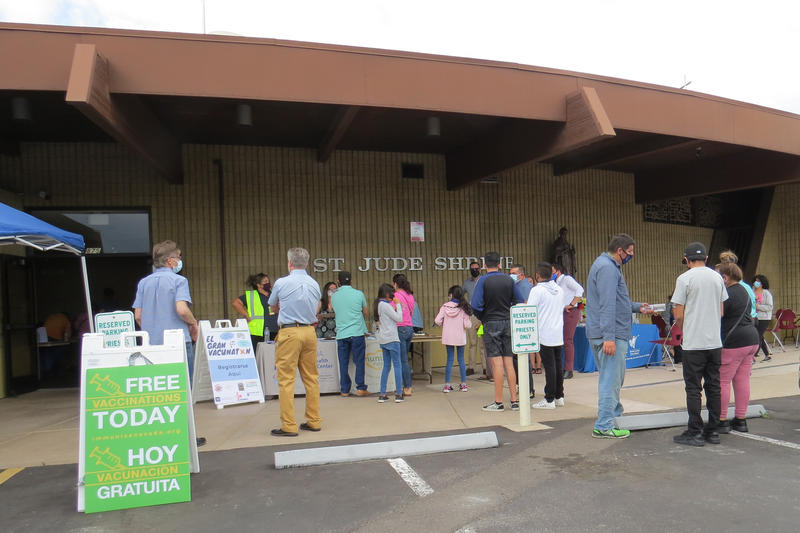
As the afternoon started to heat up in central Reno, a line of community members snaked out of Little Flower Catholic Church and into the parking lot.
Little Flower offers Spanish-language masses several times a week. That’s why organizers decided to hold a vaccine clinic here called “El Gran Vacunatón,” specifically designed for Northern Nevada’s Latino community. Resources and information were provided in both English and Spanish.
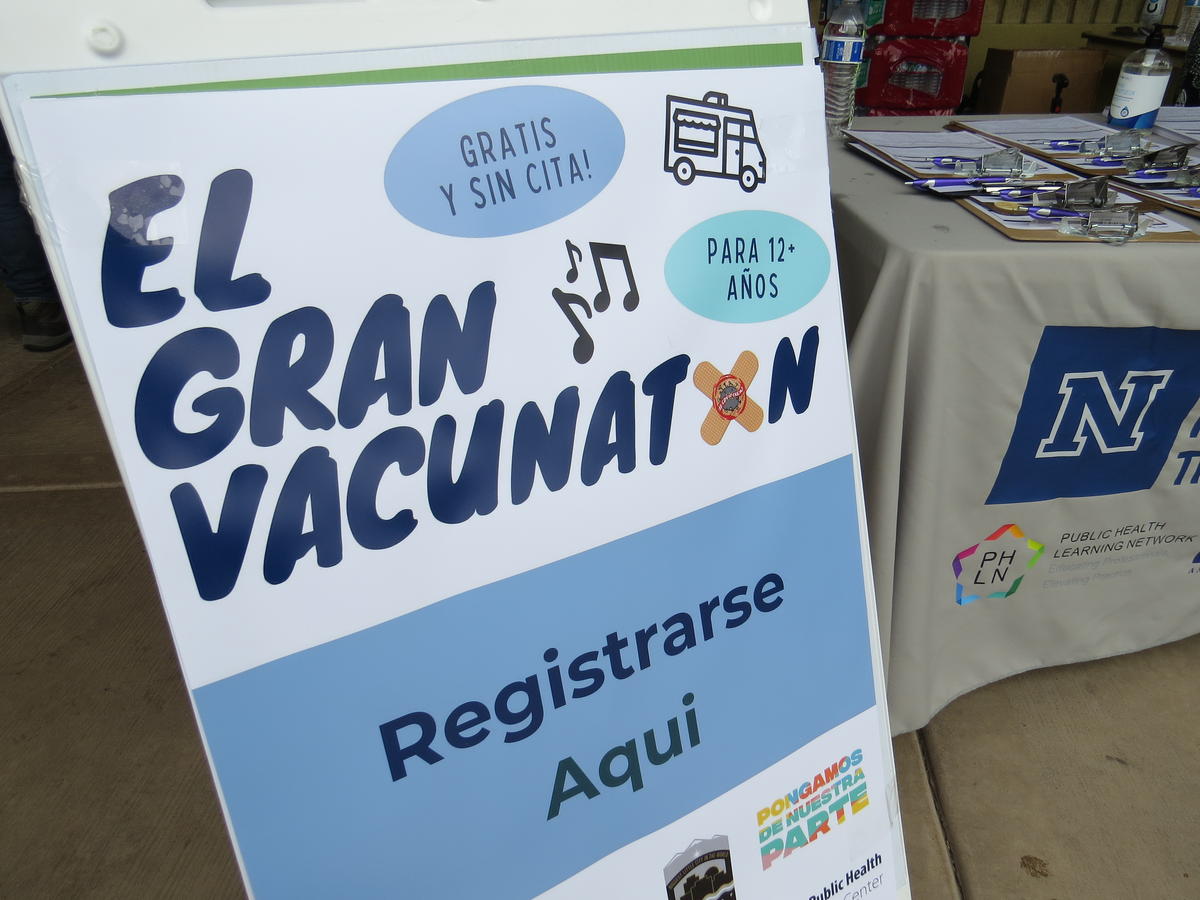
Diana Sande is the communications manager with the Nevada Public Health Training Center at the University of Nevada, Reno, School of Community Health Sciences. Sande and her team are working to bring together medical expertise, public health messaging and outreach to community leaders.
“We had people lining up and we were still setting up. It’s just been an enormous amount of people and we really thought today would be quiet,”
“We had people lining up and we were still setting up. It’s just been an enormous amount of people and we really thought today would be quiet,” she said.
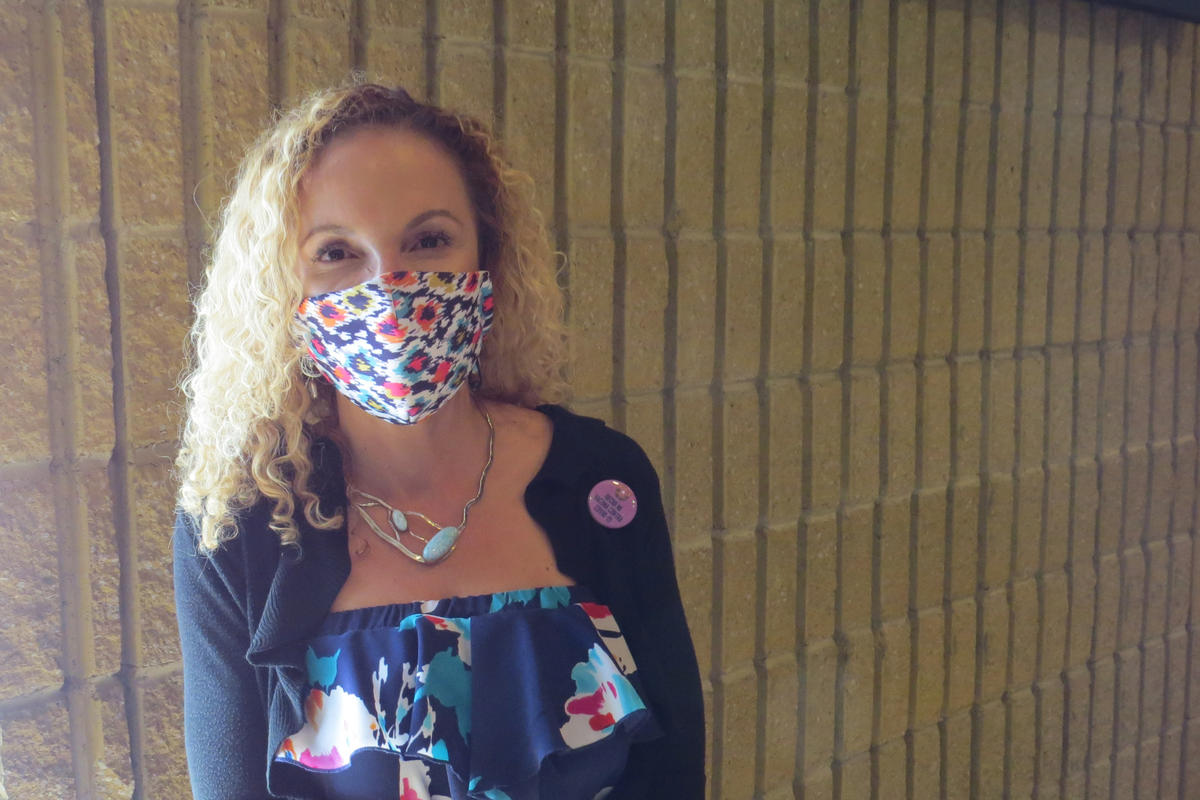
Sande says getting a turnout of 673 people at this COVID vaccine clinic, many of them Latinos, wasn’t something that happened overnight.
Before offering the clinic, she and her team partnered with students from UNR’s School of Medicine. They set up outside the church before and after services to collect surveys and answer the congregation’s questions.
“We started our outreach ... with really the objective to meet the people where they are, talk to them, and really ask questions.”
“We started our outreach here at Little Flower back in April, with really the objective to meet the people where they are, talk to them, and really ask questions, not just rest on the data that we’re hearing from other parts of the country, [but instead] really know what we’re seeing here in our town, in our home,” Sande said.
Through these regular conversations and survey responses, they began to understand what was preventing people from getting vaccinated.
“Once we were there with the people, talking to them, explaining to them, answering their questions, we found that it wasn’t the misinformation keeping them,” Sande said. “It was more about the confidence in the location, [and] the safety, based on immigration status. Just wanting more information related to the vaccine.”
To help address this lack of information, Little Flower’s Pastor Paul McCollum has also been part of the initiative, answering concerns from his congregation.
“There were lots and lots of questions. Most of them were around the safety, around some of the side effects,” he said. “As Catholics, some of them were asking about the morality of the vaccine, which I tried to address with the whole congregation, both the English and the Spanish-speaking members, early on so that they would have the information and know that it was morally acceptable and, in fact, the church was recommending folks to receive the vaccine.”
Faith-based vaccination efforts are taking place around the nation to reach historically underserved communities with distrust for the public health system and difficulty accessing services.
Faith-based vaccination efforts are taking place around the nation to reach historically underserved communities with distrust for the public health system and difficulty accessing services. In Cleveland, Ohio, for example, various historically Black churches have become vaccination sites.
In Reno, faith leaders aren’t the only ones branching out from their traditional roles to prevent the spread of the virus. To put on the bilingual clinics, UNR medical students pitched in as well.
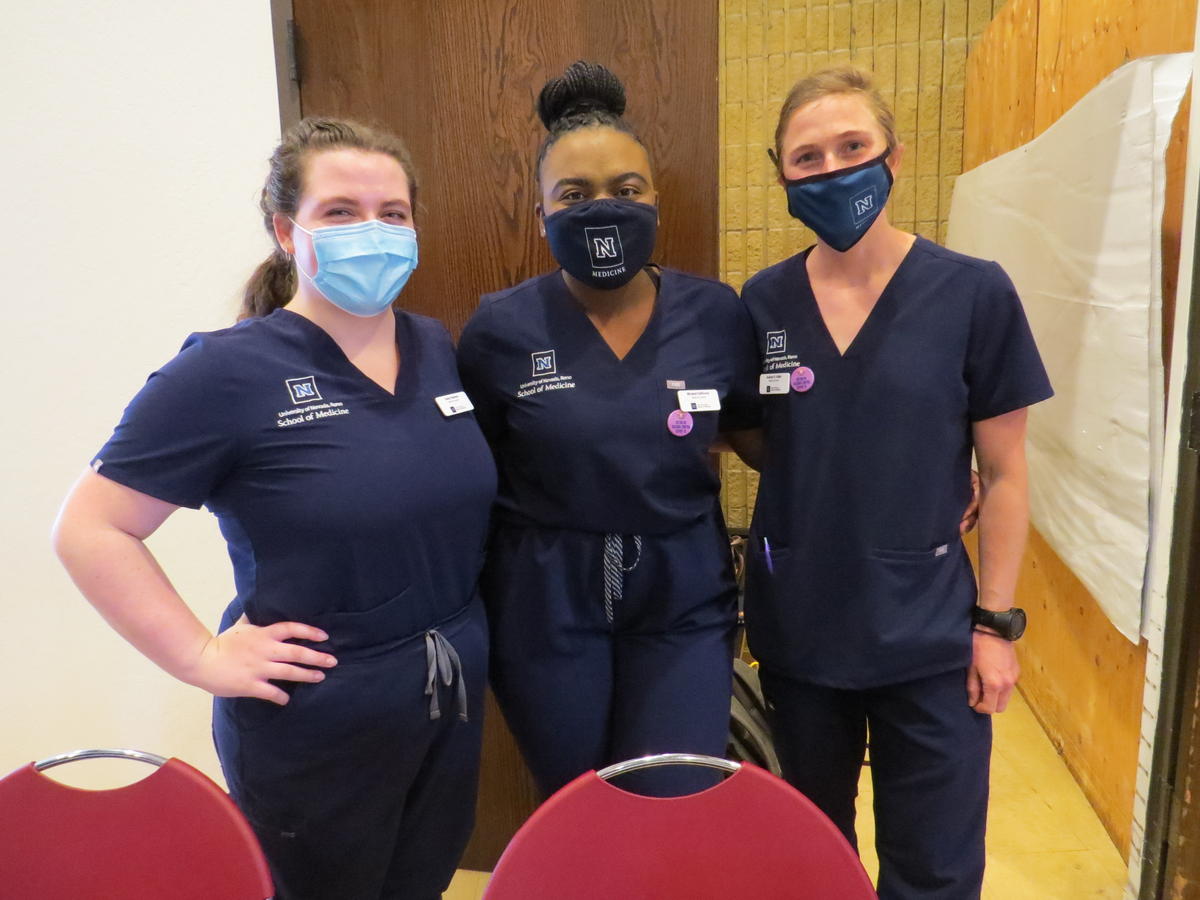
Audrey Adler is a first-year student in the medical social justice track. She was eager to become involved with outreach on a grassroots level.
“I had worked as an EMT before, so I’d been in the field. I’d worked as a medical assistant, so I had been in a clinic scenario, and I wanted to have an interaction with public health,” she said. “That was one thing that I had seen in these other roles, is just understanding the conditions in which people live and how that impacts their health, so I wanted to try to meet people at their level.”
Adler says she’s learning the importance of unifying public health messaging and medicine.
“That’s the biggest lesson I’ve learned and want to continue to explore because it’s what we know as doctors and the message that’s told to the public. If you can unify that, that can help really make a difference,” she said.
So far, this faith-based, bilingual vaccination effort has made a difference. According to the Nevada Vaccine Equity Collaborative, prior to the outreach and vaccine clinics, about 22 percent of those eligible for the vaccine in the zip code surrounding Little Flower Catholic Church were fully vaccinated. Now, after two vaccine clinics, it’s around 41 percent.
That’s a relief for organizer Diana Sande, who says she wants to keep these efforts going.
“I’m a Latina; I was born in Puerto Rico; I was raised in South America. I feel like it’s my people, and I feel like a lot of the Latinx population, they don’t have a voice, so I feel honored to be able to be that voice for them, to help them, and to bring them the information in their language, the correct information,” she said.
A third bilingual vaccine clinic is currently being planned for Little Flower Church early next month.
This story is part of the SoJo Exchange from the Solutions Journalism Network, a nonprofit organization dedicated to rigorous reporting about responses to social problems. It was originally published by KUNR on July 30th, 2021.
Sixteen years after Hurricane Katrina, Hurricane Ida hit southeastern Louisiana hard on Sunday. According to the New York Times, winds of 150 mph ran through the city: from the wreckage, one million people in Louisiana (including all of New Orleans) have no power. At the time of publication of this piece, there have been three deaths due to the storm.
One piece of good news from the hurricane is that the city's precautions after Katrina have largely worked. However, damage due to the high winds have complicated and slowed rescue and recovery efforts. Downed power lines and trees are blocking roadways, and downed cell phone towers have left many without cellular or internet service. Because of the extent of the damage, the power could reportedly be out for up to 6 weeks.
As we wait for flood waters to recede, recovery teams work to clear roadways, rescue crews reach those stranded, and electric crews work to restore power, new needs will surely arise: clearing and rebuilding homes and buildings, access to food and shelter, and more.
Here are some of the people and organizations working in Louisiana after Hurricane Ida, and how you can help, too:
Where are people already showing up to help in Louisiana?
In the context of the heartbreak, pain, and injustice of the world, Fred Rogers once said:
WHEN I WAS A BOY AND I WOULD SEE SCARY THINGS IN THE NEWS, MY MOTHER WOULD SAY TO ME, "LOOK FOR THE HELPERS. YOU WILL ALWAYS FIND PEOPLE WHO ARE HELPING."
At Good Good Good, that’s what we do. We look for the helpers. And we always find them.
Right now, rescue and relief crews in Louisiana are spending most of their time and attention on responding to this tragedy — and less time sharing about the good that they’re doing and seeing. Additionally, power lines and cell phone towers are down, complicating communication efforts. So a great deal of good news is being created — but it's not all publicly available yet.
In the coming days, we expect to see lots more stories of helpers coming out of Louisiana via local journalists, social media, and contacts on the ground — and when we do, we’ll update this story.
Here are the helpers we've seen so far:
World Central Kitchen's chefs are already on the ground serving meals to people impacted by the storm — and those helping with recovery efforts.
Found 20,000 pieces of fresh fruit for @WCKitchen meals! Reporting from our friends AJ’s Produce in New Orleans…no electricity but they jumped in to support! WCK team has been cooking non-stop because no power means no food or shops…We’ve seen many people desperate for a meal… pic.twitter.com/or8slUU7Kr
— José Andrés (@chefjoseandres) August 30, 2021
Electric crews from neighboring states (like Jacksonville, Florida and Houston, Texas) are sending trucks and teams in to help restore power as quickly as possible.
With much attention focused on New Orleans, the Louisiana-based Cajun Navy is headed to smaller towns to help clear roads.
The Cajun Navy is out rescuing people from their flooded homes in SE Louisiana and providing rescue updates on cable news. Pls consider donating to this fantastic and vital volunteer crew https://t.co/99sa8c6nCn pic.twitter.com/DEl46OraJF
— Laura Bassett (@LEBassett) August 30, 2021
Houston's Jim “Mattress Mack” McIngvale announced a massive relief effort to help families impacted by the storm, and sent a convoy of 30 trucks with "all the normal things for hurricanes," like water, non-perishable food, diapers, formula, pet food, toiletries, and more — all donated by Houstonians. Mattress Mack also opened his furniture store, Gallery Furniture, to all evacuees from Louisiana to stay at for free.
The Gallery Furniture convoy is well on its way to help the people of Louisiana after Hurricane Ida. Thank you to everyone in the Houston community that donated to our neighbors in need. Donations accepted at 6006 N Fwy. Items needed here: https://t.co/uvz6zrFq6U. God bless! pic.twitter.com/3NEVRcn8pH
— @MattressMack (@MattressMack) August 31, 2021
Before Hurricane Ida: Following Hurricane Katrina, New Orleans invested $14.5 billion into a flood protection system that worked to prevent the city from flooding. And it's proven quite effective. One organization, Glass Half Full, created a glass recycling center that turned used bottles into sandbags to protect the community.
How to help or get help if you're in Louisiana:
Take care of your physical safety.
If you're in physical danger, or need to be rescued, request help from the Cajun Navy. If you evacuated, officials in Louisiana are advising not to return until it's safe to do so. Power lines are still down, roadways are blocked by trees and debris.
If you are safe at home, stay there.
Downed cell phone towers and power lines have complicated recovery and rescue efforts. As authorities work to clear the roads, if you are safe at home, try to stay off the roads to minimize traffic.
Take care of your mental health, too.
Ida is one of the largest storms to hit the U.S., and with this storm landing in Louisiana on the 16th anniversary of Hurricane Katrina, it's likely bringing up a lot of traumatizing memories.
Whether you sheltered in place during Hurricane Ida, or are feeling triggered by the similarities in devastation Hurricane Katrina caused — reach out to Crisis Text Line for support. Text SHARE to 741741 to reach a volunteer Crisis Counselor.
If you have the means, join the Cajun Navy.
The Cajun Navy is seeking volunteers, and you can fill out this form to join their relief efforts.
How to help if you're not in Louisiana
Support existing relief efforts and people already in Louisiana. While there may be opportunities to do so in the future, right now it's not safe to travel to the states impacted by the storm to help in-person.
To support experienced local volunteers rescuing people and providing supplies, donate to Cajun Navy Relief.
The Cajun Navy is a grassroots volunteer organization made up of locals with boats and other resources to help rescue efforts.
To support an established local water conservation organization with their disaster relief efforts, donate to Imagine Water Works.
Imagine Water Works is a New Orleans-based organization focused on water management, conservation, and environmental issues like climate change. They also organize both disaster preparedness and relief efforts in the area when needed.
Donate to support Imagine Water Works
To help feed people impacted by the storm, donate to World Central Kitchen.
World Central Kitchen provides food to people in need in the wake of natural disasters wherever and whenever they hit around the world. Founded by world-renowned chef José Andrés, World Central Kitchen activates chefs around the world to ensure people have this basic need met.
Donate to support World Central Kitchen
To help take care of animals impacted by the storm, donate to the Louisiana SPCA.
While they evacuated a lot of animals before the storm, the Louisiana SPCA is also helping rescue and care for animals left behind.
Donate to support the Louisiana SPCA
We'll be updating this story as we find more Helpers — and opportunities to become Helpers. Please share this story to help more people get the support they need.
This Woman Staked Positive Signs in Yards Around Her Community — and Started a Global Movement
All over the world, mysterious signs have been popping up. They say messages like: “Don’t give up.” “You are worthy of love.” “Your mistakes don’t define you.”
The woman behind the mysterious signs, Amy Wolff, is a mom living in Oregon, who saw an opportunity to make a difference and took it.
Little did she know that their project would turn into a global movement featured on Good Morning America, Yahoo, the Washington Post, NowThis, and on countless other media.
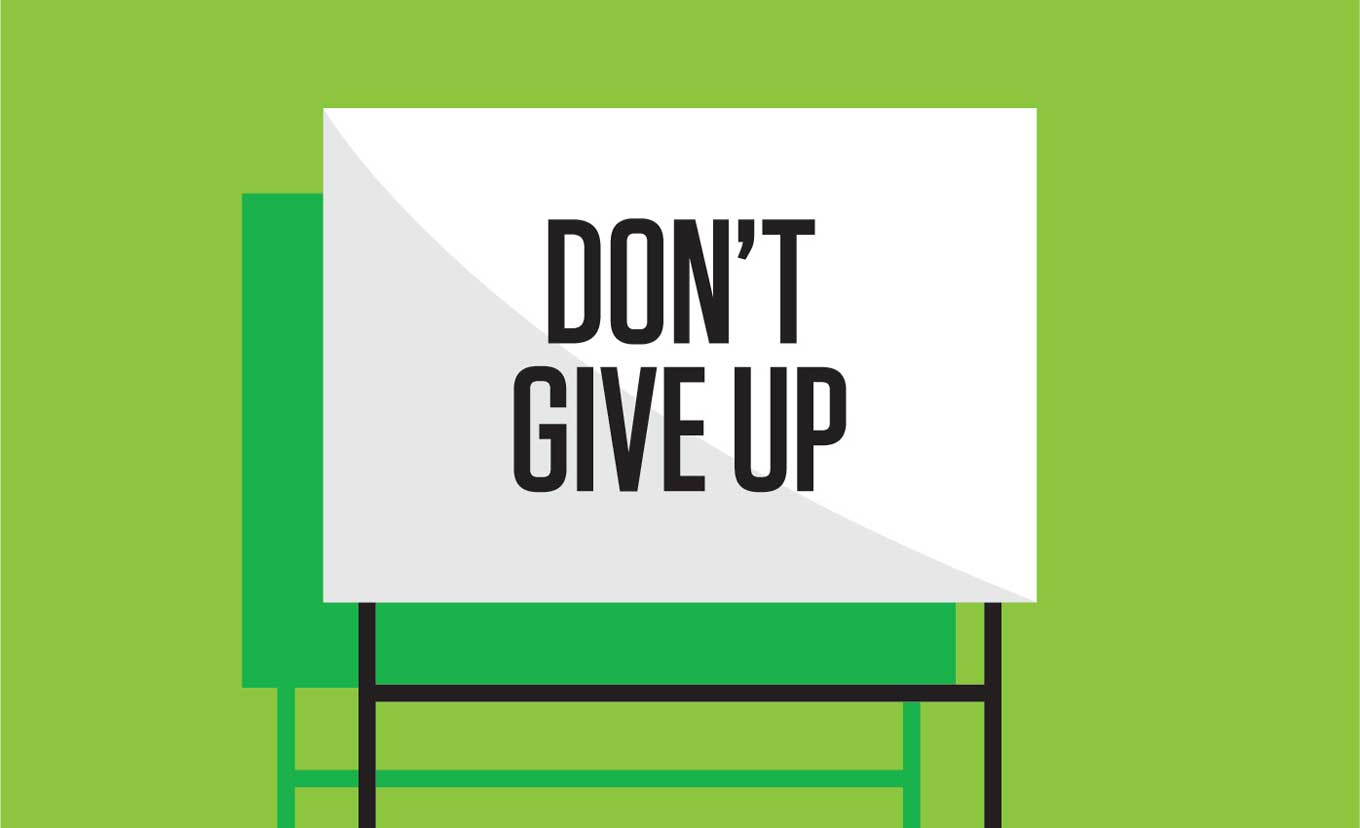
One weekend in 2017, Amy and her family anonymously staked in yards in their small town of Newberg, Oregon. They had just learned of suicide rates in their town and wanted to find a way to encourage community members.
Quickly, the signs started making a buzz around town — and began going, to some degree, viral within local community groups on Facebook. People were asking where they came from and how they could put up some of their own.
Within days, Amy incorporated Don’t Give Up as a nonprofit, and products (which the organization sells at cost, meaning she makes zero money from sales) have shipped to all 50 U.S. states and 26 countries, including the Philippines, Rwanda, Costa Rica, and Zambia.
She simply wants to create products that encourage her community.

Among other products aside from yard signs, the organization also creates car decals, pencils, temporary tattoos, and stickers.
Now the Don't Give Up movement serves more than as a response to suicide — it’s also a comforting cancer patients, those enduring the loss of a loved one, and those recovering from sexual assault and inspiring people to have the courage to leave abusive relationships or overcome addiction.
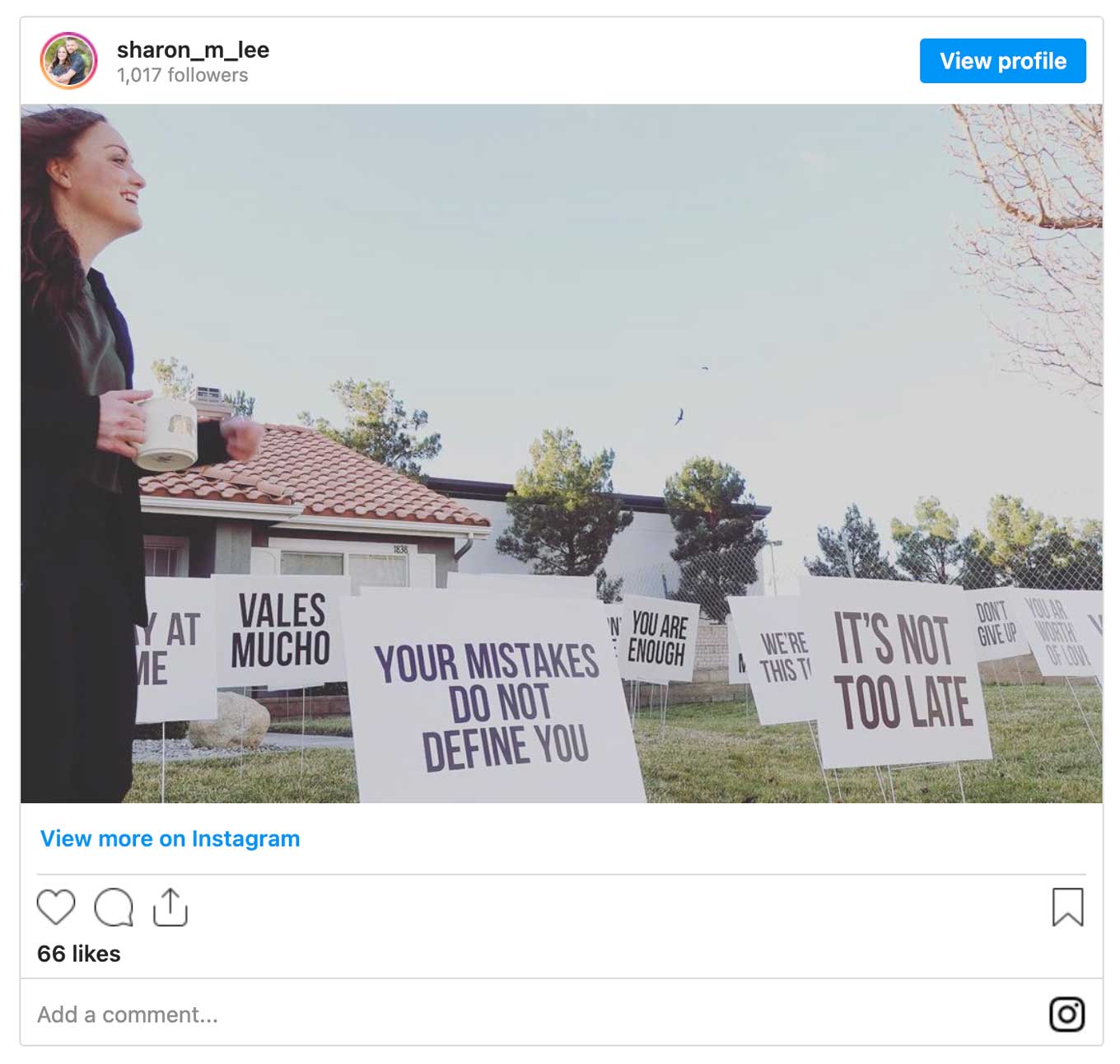
“I just had a woman knock on my door,” writes a woman on the organization’s website. “She began to cry and thank me for the signs in my yard. She lives up the road and said her son had attempted suicide and these signs were in the yard the day they came home from the hospital. She drives by every day and for her, her son, and her daughter — the reminder is profound."
Where can I get a Don't Give Up sign?
Don't Give Up movement signs are available at cost from dontgiveupsigns.com. You can buy the classic Don't Give Up sign, mini Don't Give Up signs, as well as stickers, t-shirts, and bumper stickers.
You can listen to our podcast episode with Amy Wolff about Don't Give Up — and about three myths about changing the world.
You can order Amy's book, Signs of Hope: How Small Acts of Love Can Change the World on Bookshop and Amazon.
A grassroots effort in Montreal, Canada sprung up to spread peace and tolerance, and it has turned into a global movement.
Corey Fleischer was working at a graffiti removal company when he happened to notice a swastika spray-painted on a cinder block.
Initially, he drove away, but he later returned and removed it in a matter of seconds.

Now he locates and removes hateful graffiti throughout Montreal free of charge. He calls his movement Erasing Hate.
Armed with his #ErasingHate vest and a power washer, he drives throughout Montreal eliminating racist, homophobic, anti-Semitic, and Islamophobic symbols and phrases from public spaces such as walls and sidewalks, sharing his good deeds on Instagram along the way, with the support of his tens of thousands of followers.
A key component of the movement he started is to publicly share the location of hateful graffiti so members of the community can remove it.
His followers often submit photos, and he shares them along with the graffiti's location, mobilizing people worldwide to swiftly take action to remove it. In many cases, the graffiti is gone in a matter of hours after Fleischer shares it.
You can follow Corey Fleischer on Instagram at @erasinghate where he has more than 150,000 followers.
A version of this story originally ran in The Unconventional Activism Edition of the Goodnewspaper in May 2020. The Goodnewspaper is our monthly print newspaper filled with good news.
You can join thousands of subscribers who get access to more exclusive stories like these, our private community space, a free inspiring poster, and so much more. Become a subscriber today.
When World Record Egg (@world_record_egg) dethroned Kylie Jenner as the account holder with the most-liked Instagram post, fans anxiously awaited to find out who was behind the account.
Over the course of one suspenseful month, the account posted photos of the egg slowly cracking, and everyone — ourselves included — wondered what would be revealed when the egg finally broke open.
Would it be a celebrity, a political endorsement, or a massive ad campaign?
As it turned out, it was Eugene, the egg, delivering a message of hope.
“Recently I’ve started to crack,” Eugene said. “The pressure of social media is getting to me. If you’re struggling too, talk to someone. We got this.”
The long-awaited video ends with an invitation to visit talkingegg.info, leading users to Talking Egg Foundation, a global initiative to eradicate mental health stigma by raising funds to support the foundation’s partners, including Mental Health America and Crisis Text Line.
Who's behind @world_record_egg?
Following the month-long build-up, the account’s creators were revealed to be three advertising creatives: Chris Godfrey, CJ Brown, and Alissa Khan-Whelan, who said it really did start as just a challenge to get the most-liked photo on Instagram.
But why an egg? It has “no gender, race, or religion,” Godfrey told the New York Times.
From the account’s inception, the account exploded in popularity — all organically — and it took just nine days to break the world record.
People around the world got behind the egg’s objective quickly, and it went viral. It was just so random and simple — using a stock photo of an egg to break a world record — and in many ways, it was the absurdity of the challenge that united people in their support.
The choice to use the platform for good
The trio didn’t launch the social media challenge to start a mental health initiative but saw an opportunity to do good and ran with it.
In an interview with Good Good Good, Khan-Whelan, who is co-founder and director of Happy Yolk, the umbrella company overseeing the Instagram account and foundation, said, “I would love to tell you we had a big, grand plan.”
They decided to align with a cause near and dear to them. The account’s three creators all worked in advertising and public relations, and they were struggling to connect any lasting impact to their work. Khan-Whelan said they all agreed they needed “something more” in their lives, something to work on that felt “more purposeful.”
“A lot of people were waiting for us to sell out,” Khan-Whelan said. “We had lots of different brands come to us to monetize the egg, but nothing felt right.”
After initially declining a partnership with Hulu, the Happy Yolk team ended up pitching the idea to animate the egg into a character and spread a message of mental health awareness, and the PSA premiered exclusively on Hulu after the 2019 Super Bowl.
The account’s followers were inspired that the team didn’t “sell out” by partnering with advertisers to turn a massive profit off the now-legendary post’s success. The team knew they were onto something big and quit their jobs to focus their efforts on Happy Yolk, which now also leads digital marketing campaigns for some of the world’s most recognized brands.
“[The egg campaign] gave a lot of people this feeling of hope,” Khan-Whelan said. “It seemed to connect with a lot of people.”
Now more than a year later, Happy Yolk is expanding their mission to create what Khan-Whelan calls a “positive corner of the internet.” They launched a positive news Instagram account, @sunny_side_news, and will soon announce a YouTube channel featuring Eugene in short entertaining videos that offer a mental health takeaway. The YouTube channel will be a “deep dive into Eugene as a character,” Khan-Whelan said.
“We’re in a very hyper-connected world,” Khan-Whelan said. “Social media fatigue can cause quite a heavy weight on your mind. [With our positive news account and YouTube channel], we want to make the internet feel like an easier place to be. If there’s any opportunity to bring light to the darkness, we should.”
A version of this story originally ran in The Unconventional Activism Edition of the Goodnewspaper in May 2020. The Goodnewspaper is our monthly print newspaper filled with good news.
You can join thousands of subscribers who get access to more exclusive stories like these, our private community space, a free inspiring poster, and so much more. Become a subscriber today.
An initiative called Extra Life is uniting thousands of gamers to play games and heal children through their unique fundraising effort benefitting Children's Miracle Network hospitals across North America.
Participants sign up on the group’s website, pledge to play games, and create a fundraising page where others can donate. Many participants set up big group events or host 24-hour or multi-day marathon gaming sessions for the occasion, but participants can also play at home on their own.

Children’s Miracle Network raises funds for more than 170 hospitals, which provide 32 million treatments yearly to children across the U.S. and Canada. Donations stay local to fund critical treatments and healthcare services, pediatric medical equipment, and charitable care.
The peer-to-peer fundraising strategy is unique in that few, if any, other nonprofits have pursued fundraising through gaming communities, meaning the initiative taps into a previously untouched community.
The program demonstrates what’s possible when you create compelling campaigns for nontraditional audiences, engaging new supporters that you might not otherwise reach through a walkathon or long-distance bike ride, for example.
Since its inception in 2008, Extra Life has raised more than $70 million.
A version of this story originally ran in The Unconventional Activism Edition of the Goodnewspaper in May 2020. The Goodnewspaper is our monthly print newspaper filled with good news.
You can join thousands of subscribers who get access to more exclusive stories like these, our private community space, a free inspiring poster, and so much more. Become a subscriber today.
Craftivism is the practice of the art of gentle protest.
“If we want our world to be more beautiful, kind, and fair, shouldn’t our activism be more beautiful, kind, and fair?”
This is the question posed by the UK-based organization Craftivist Collective, a social justice group committed to the art of “gentle protest.”
Craftivist Collective creates art in the hopes of changing policies and laws surrounding complex issues — by stitching messages about social and political issues such as climate change and the refugee crisis, for example, all to invite reflection and respectful conversation instead of division.
Watch "What is the Craftivist Collective? — with founder Sarah Corbett" (4:11)
“Gentleness can be a great strength, and quiet action can sometimes speak as powerfully amid the noise as the loudest voice,” Craftivist Collective writes on their website.
Craftivism has become an unlikely social and political force. The word comes from the marriage of the words “craft” and “activism.”
Using creativity as a political tool, “craftivists” are creating meaningful change and engaging with activism through quiet, creative, and compassionate acts: knitting, crocheting, sewing, and other creations.
Taking a look back in time, women embroidered banners during the suffrage movement. In war camps, women used quilting as a means to claim private space and personal expression.

Today, crafting is used to express anti-capitalist, feminist, and environmental opinions. American writer Betsy Greer coined the term “craftivism” in 2003, and it’s only grown since then.
Craftivism is for everyone who wants to make a difference: skilled artists, weary activists, introverts, people with anxiety, all who desire a better world but perhaps don’t know where to start or where and how to best prioritize their energy and time.
Craftivism is for everyone who wants to make a difference: skilled artists, weary activists, introverts, people with anxiety, all who desire a better world but perhaps don’t know where to start or where and how to best prioritize their energy and time.
Craftivist Collective, which Sarah Corbett founded in 2009, supports craftivists by providing tools, resources, events, and projects to support their endeavors.
Even the iconic activist and Nobel Peace Prize laureate Malala Yousafzai attended a workshop.
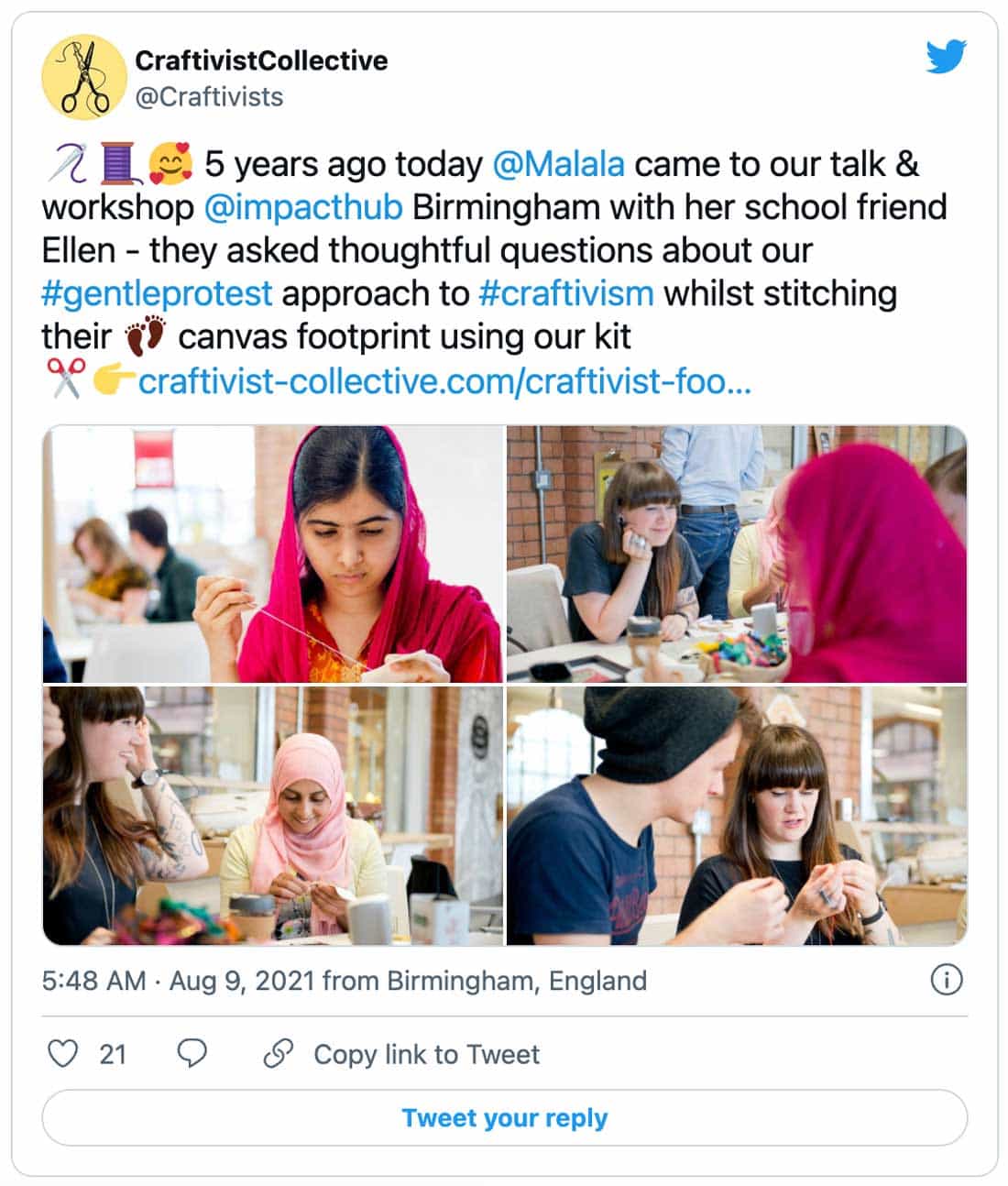
Corbett even wrote a book “for quiet activism." In her book she “[shares her] journey from burnt-out activist, tired of marching, confrontation and demonizing opposition, towards a more respectful activism: using craft to contemplate global issues, provoke thought and start conversations rather than arguments.”
Encouraging more people to join the craftivist movement, the Craftivist Collective website reads:
"If there’s time for the loud, there’s also time for the quiet. If there’s time for the fast, there’s also a need for the slow. In everyone’s heart is a desire to change things for the better – it is essential that there is an activists toolkit that is as diverse as humanity."
"Our gentle craftivism is for everyone wherever you are in the world: from skilled crafters to burnt out activists, introverts, highly sensitive people, people struggling with anxiety and those people who want to challenge injustice in the world but don’t know what to do, where to start or how to prioritise their energies and time."
Their manifesto outlines the ten principles of craftivism, covering everything from taking slow steps towards progress to embracing positivity.
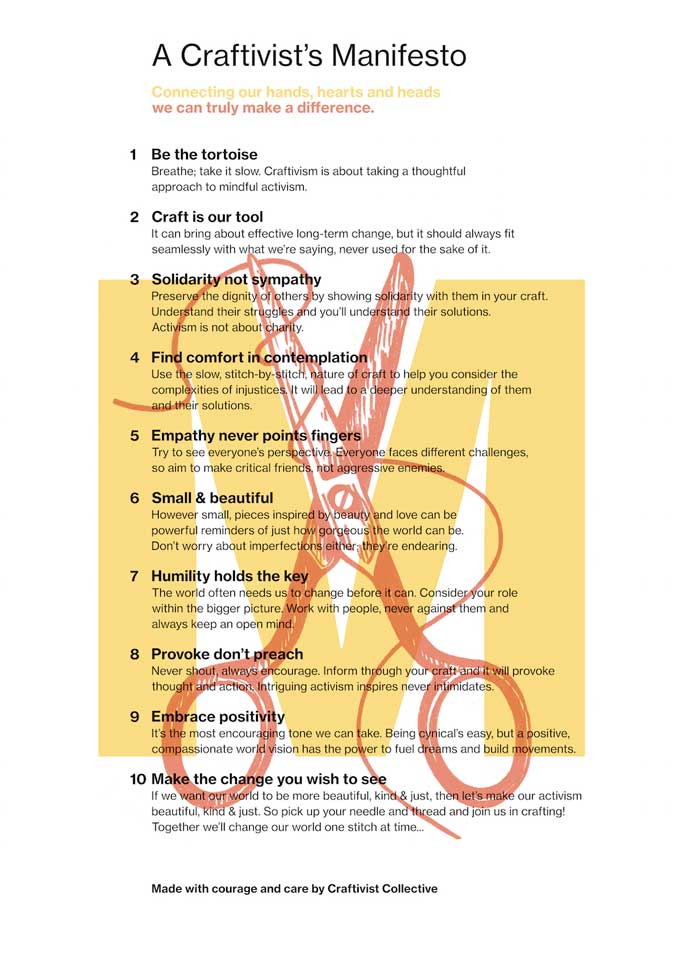
You can learn more and take steps to become a craftivist yourself by visiting the Craftivist Collective Projects page — and trying a new way to engage with issues you care about in a meaningful and strategic way.
Listen to Good Good Good's Conversation with Sarah Corbett:
In this hopeful podcast conversation, Branden Harvey and Sarah Corbett discuss how craftivism can be for everyone.
From skilled crafters to burnt out activists, gentle protest can be for those people who want to challenge injustice in the world but don’t know what to do, where to start or how to prioritize their energies and time.
Sarah also shares success stories of how the art of gentle protest has created meaningful change within governments and corporations.
A version of this story originally ran in The Unconventional Activism Edition of the Goodnewspaper in May 2020.
The Goodnewspaper is our monthly print newspaper filled with good news.
You can join thousands of subscribers who get access to more exclusive stories like these, our private community space, a free inspiring poster, and so much more.
The actor and entrepreneur's charity is taking an innovative approach to ending human trafficking
The internet has made it easier for criminals to share child pornography with a low risk of getting caught.
In fact, reports of child pornography have increased by 10,000 percent since 2004.
Additionally, the internet houses the largest marketplace for child sex trafficking.
Ashton Kutcher and Demi Moore knew that technology was playing a role in the problem but wasn’t yet part of the solution.
They pioneered a technology-led approach, called Thorn, to end online child sexual abuse by identifying victims.
Thorn, the nonprofit organization which Kutcher and Moore started in 2012, now houses the first engineering and data science team that focuses solely on combating this powerful criminal industry.

One of their products, Safer, is designed to be easily integrated for platform owners who host user-generated content to prevent child sexual abuse material from spreading.
And their flagship product, Spotlight, is used by law enforcement officers in all 50 U.S. states plus Canada to accelerate victim identification by more than 60 percent.
Spotlight uses Amazon Web Services-powered tools to identify victims.
For example, phone numbers in ads are often posted as images instead of text, making it difficult to find them using conventional searches. But Amazon’s tool, DetectText, can extract the information from images so Thorn can find children based on their last known phone number.
Another tool allows Thorn to detect and match faces to images of missing and exploited children from open web data sources, such as the National Center for Missing and Exploited Children’s register of missing children.
Through 2019, Spotlight has helped law enforcement agencies identify nearly 15,000 victims and nearly 17,000 criminals.
In August 2021, Kutcher launched a new wine brand called Outside Wine, which he describes as "outside the box".
In the same vein as Paul Newman's focus on creating product that give back, the profits from Outside Wine will support nonprofit partners.
A new charity will be added every 3 months. One of the first nonprofits supported will be Thorn.
A version of this story originally ran in The Unconventional Activism Edition of the Goodnewspaper in May 2020. The Goodnewspaper is our monthly print newspaper filled with good news.
You can join thousands of subscribers who get access to more exclusive stories like these, our private community space, a free inspiring poster, and so much more.
Every single day, nearly 1,000 empathy MVPs help thousands of texters in crisis. At Crisis Text Line, we help people in crisis move from hot moments to cool and calm via text message 24/7.
Over the last six years, we’ve trained more than 32,000 people to serve at the frontlines, using empathy to help people in crisis in their moment of need.
We’ve spent the last six years developing and iterating a program, and we’ve learned one major thing: Helping the world is the most productive when it’s part of healthy habit-building.
When you treat volunteering like you treat brushing your teeth for a full two minutes or eating your vegetables, you set yourself up for success.
What Happened
Prior to the summer of 2017, we asked our Crisis Counselors to commit to four hours a week for one year. We heard feedback that they wanted more flexibility in scheduling, so we made a huge shift in our policy: Our ask changed to 200 hours to be completed at the counselor’s own pace.
Considering the policy change was in response to community requests, we were surprised by what came next: For two years, we saw a significant, steady decrease in the number of counselors who fulfilled their commitment.
What We Did
Instead of watching the numbers continue to decline, we dove into the data to identify how and why we were seeing such a decrease in active Crisis Counselors.
Between January and June 2019, we partnered with Angela Duckworth’s team at the University of Pennsylvania to run an experiment in which we sent reminders to Crisis Counselors asking them to volunteer a certain number of hours each week to reach 200 hours. We learned that it worked to break down the 200-hour commitment into smaller, specific, attainable goals.
Then we did something bold. We reversed the policy. Seeing the results gave us the courage to reverse the policy back to four hours per week until 200 hours are reached, ideally within one year.
What We Saw
Crisis Counselors are increasing their shifts.
The average number of counselors’ monthly shifts has increased by 35 percent, meaning we’re able to reach more texters more quickly.
As the world has rapidly changed over the last several months, it has also allowed us to scale our capacity to give the same high-quality support to texters as the demand grows.
Inactive Crisis Counselors are coming back to help.
The number of inactive counselors has decreased, and reactivations (counselors who have taken time off and return to volunteer) have increased.
The fact is that there’s real science behind volunteering. It’s far more than popping in every once in a while to lend a helping hand. Just like you can’t run a marathon without making a plan, volunteering works best when it’s part of your routine with some great cheerleaders along the way.
What You Can Do
Here’s how you can take some of our tips and tricks and apply them to your life:
Make a schedule for yourself — and stick to it.
Sure, this goes for the organizations you support that rely on your consistent volunteer efforts, but it also rings true for the regular, everyday ways you show up for your community.
Make a regular routine out of calling your family, writing thank you notes, and offering to babysit for a friend who needs an extra hand.
Consistency matters. Taking a break does, too.
We're huge proponents of mental health breaks. You can’t help anyone else if you aren’t helping yourself first. Sticking to a schedule (that includes days off!) will help you show up as your best self when you’re needed most.
Find community.
Our Crisis Counselors connect with other Counselors when they’re off-shift on an internal social network. While Crisis Counselors are physically alone on their couches when they’re taking conversations, they are never alone in spirit or support.
The minute someone logs onto the platform for a shift, they’re greeted by the Crisis Text Line staff, and throughout their entire shift, they’ll connect with and seek advice from fellow Crisis Counselors.
Find something that gives you a sense of community — something that makes you feel like, “yes, we’re all in this together.”
Find something that fuels your purpose.
At Crisis Text Line, we share anonymized feedback from texters because it helps us remember why we do what we do. There’s nothing quite like hearing from someone that you’ve made their day — or maybe even saved their life.
Not everyone is motivated by the same purpose. Find what matters to you and dive in.
If there’s one thing we’ve learned in the last six years of leading a love army of Crisis Counselors, it’s that there’s no shortage of empathy in the world. Anyone can — and should — give kindness whenever they can. Sometimes it just takes some structure and support to channel all of your empathy and kindness into the world. You have what it takes to make the world a better place. And, maybe one day we’ll see you on the platform.
Think you have what it takes to become an Empathy MVP? Apply to become one of our volunteer Crisis Counselors and start saving lives in no time. crisistextline.org/volunteer
If you or someone you know is struggling, text 741741 to be connected with a trained Crisis Counselor.
A version of this story originally ran in The Unconventional Activism Edition of the Goodnewspaper in May 2020. The Goodnewspaper is our monthly print newspaper filled with good news.
You can join thousands of subscribers who get access to more exclusive stories like these, our private community space, a free inspiring poster, and so much more. Become a subscriber today.
When it comes to unconventional activism, advertising industry expert Julia Plowman sets the bar.
After stints working at ABC News, Wieden+Kennedy (where she worked on projects for Nike, Microsoft, Coca-Cola, Audi, and Old Spice), and Nike, she shifted her career to focus on solving the world’s biggest problems.
While working with the Nike Foundation, Plowman worked with research that showed investment in young girls could be a uniquely successful strategy for breaking the cycle of intergenerational poverty in the developing world.
There were organizations dedicated to adult women or to youth but none yet focused exclusively on girls.
Under the wing of the foundation, Plowman built a brand for this complex approach to combat intergenerational poverty with the goal of fueling momentum and sparking action. They called it The Girl Effect.
The Girl Effect launched with a now-iconic video that, in just over three minutes, clearly communicates the problem, opportunity, and solution.
The video quickly grabbed the world’s attention and has now been viewed more than 2.4 million times on YouTube. Katie Couric introduced it at the Clinton Global Initiative, and it appeared in a branded section airing on Oprah.
The Girl Effect raised the bar for nonprofit communication by elevating impact-driven storytelling to a level it had never been before, paving the way for more unconventional activism to follow.
We asked Plowman, who is the founder of brand strategy company folk, to share three innovative and unconventional ways change-makers have gained attention and moved the needle for good:
Activists Replaced Parisian Metro Maps to Prompt Action for Riders Experiencing Disability
Paris has the least accessible metro system in the world. There are 1.3 million people with disabilities living in the greater Paris region, which translates to 12 percent of the population.
However, only nine out of 303 metro stations are accessible for those who have motor disabilities, especially people who use a wheelchair and who struggle with mobility limitations because of age, pregnancy, use of a stroller, or a temporary health condition.
On World Mobility Day in 2019, APF France Handicap (a national movement for representation of people with disabilities) hijacked the Parisian metro maps by covering the 293 non-accessible station maps with a new map showing the only metro line accessible to all people.
The initiative quickly caught the attention of the media, Parisian mayor Anne Hidalgo, and French president Emmanuel Macron. Macron declared 60 percent of the metro would be accessible by 2024.
This public effort supports the long-time activism of disability rights activists and allies who are fighting for 100 percent accessibility.
Why Julia loves it:
It is brilliantly simple and has sparked real change. All metros should be 100 percent accessible, but 60 percent is a start.
Visitors Take the Palau Pledge to Protect Fragile Islands In the Pacific
Palau is a Pacific island chain of hundreds of natural limestone and volcanic islands, covered in lush forests and surrounded by an aquamarine lagoon. Sounds heavenly, right? Well, large-scale mass tourism threatens to destroy its fragile environment.
Palau is the first nation on earth to change its immigration laws for the cause of environmental protection.
Upon entry, visitors are required to sign a passport pledge to act in an ecologically responsible way on the island, for the sake of Palau’s children and future generations of Palauans.
Why Julia loves it:
This small nation is thinking long-term and trailblazing a new model of conscious tourism.
Advertisers Educate Consumers With Plastic Expiration Date Labels
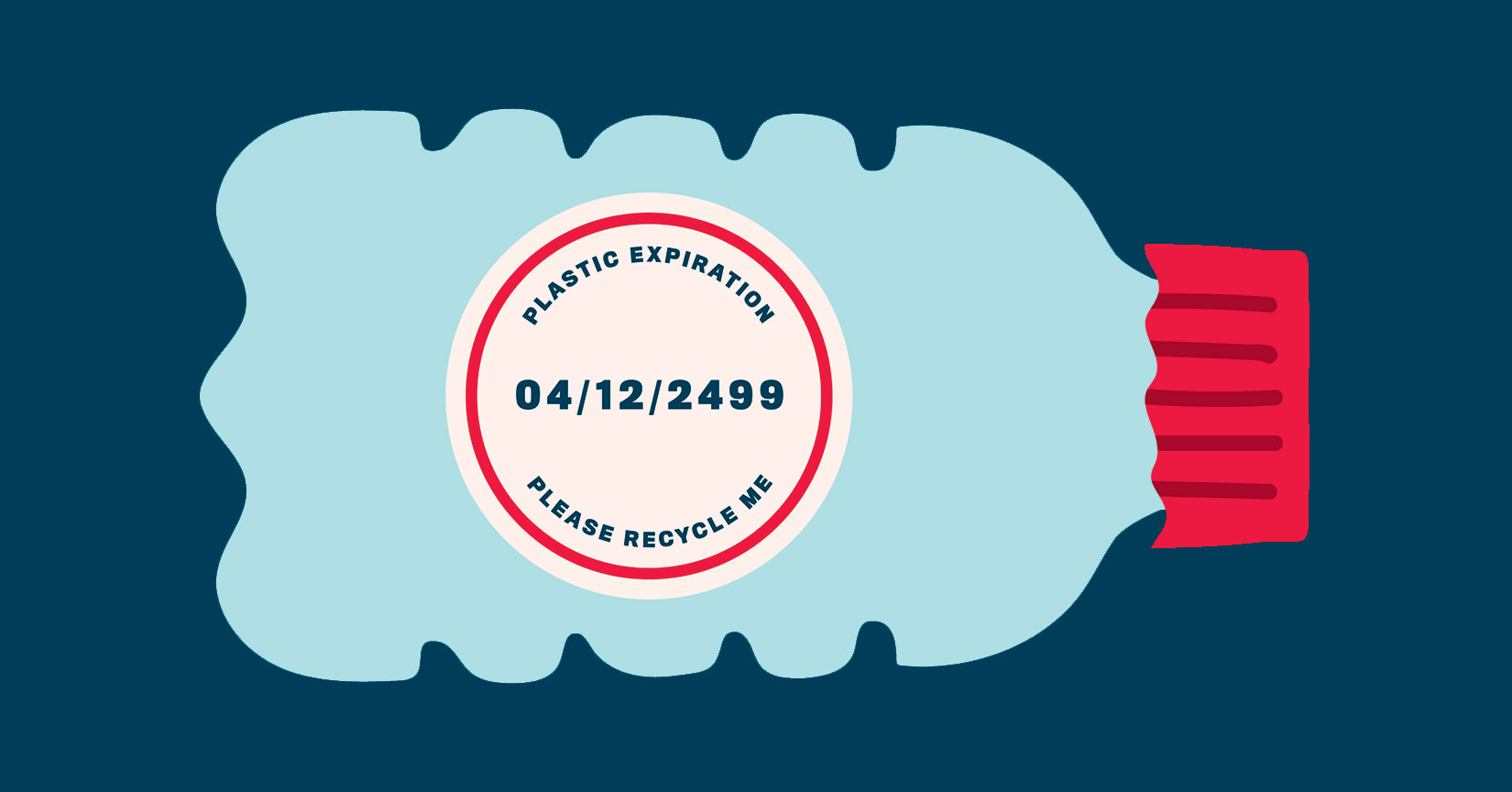
It takes up to 1,000 years for plastic to break down.
Supermarkets aren't acting fast enough to reduce plastics, so two environmentalists and advertising creatives, Gagandeep Jhuti and Joe Foale-Groves, created “plastic expiration date” stickers in a bid to educate consumers about the devastating impact plastic can have on the planet and encourage them to make informed decisions.
The duo shared their vision for the campaign:
"So, imagine this. It’s the year 3019. Animals can now be tried in court. The prisons are overflowing with pigeons. You are no longer around. But the plastic water bottle you bought with your meal deal in 2020 has finally started to decompose. Even if the future isn’t quite as weird as that, it is true that your meal deal could be pretty much immortal."
"At the moment we’ve been sneaking Plastic Expiry Date stickers onto meal deal items ourselves since the start of January, but loads of people have asked to join us in spreading stickers to their local supermarkets."
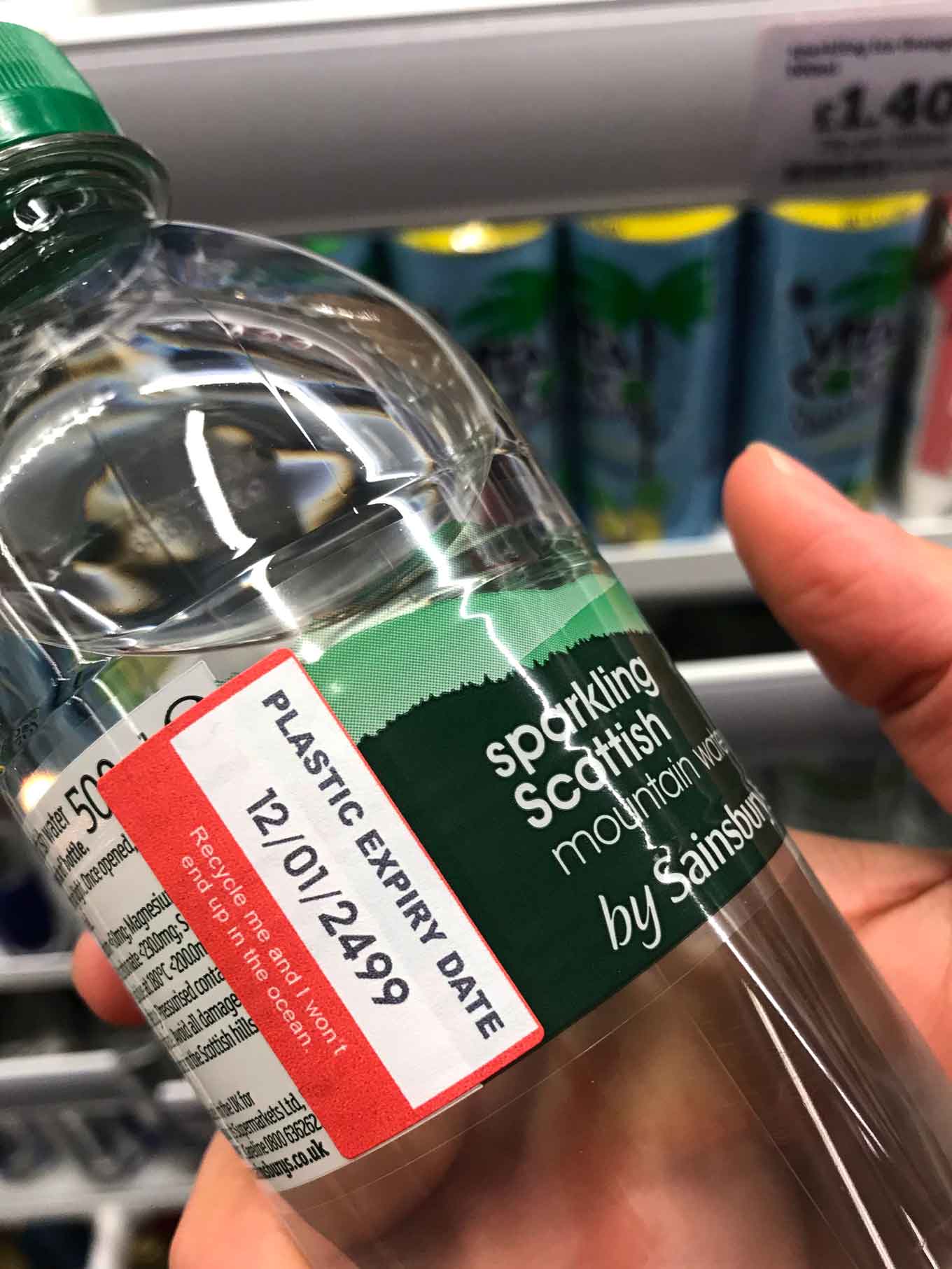
"The ultimate goal would be for supermarkets to add the Plastic Expiry Date to packaging themselves, as well as hurrying to reduce single-use plastic packaging from their shelves."
The stickers look like traditional food expiration messages, but their dates are well into the future — past our lifetimes.
Why Julia loves it:
It’s shocking to see the dates and hopefully shocks shoppers into making better choices.
Julia Plowman is a change-maker and leading expert in brand purpose.
She has lived around the world, bringing her strategic leadership, brand marketing, and social innovation expertise to companies and organizations such as Wieden+Kennedy, Nike, and The Girl Effect.
She’s the founder of folk — which partners with brands to identify, define, and create purpose-inspired strategies that drive business growth and benefit society.