— Muñoa’s Pampas cat, a small wild feline, is endemic to the Pampas grasslands that sprawl over southern Brazil, Uruguay and northeastern Argentina.
— With fewer than 100 individuals left in the wild, experts call Muñoa’s pampas cat one of the most endangered felines in the world and warn it go extinct within 10 years as its natural habitat is cleared for cropland.
— Conservation plans to save the species include switching from monocultures to extensive ranching that preserves the natural grasslands, creating a captive-breeding program, and developing a trinational conservation agreement.
— Recent floods in the Brazilian state of Rio Grande do Sul, where many Muñoa’s Pampas cat sightings have been recorded, have currently halted all local conservation efforts, putting the future of this feline at risk.
The Pampas grasslands, spanning southern Brazil, Uruguay, and northeastern Argentina, are home to a wildcat so rare that researchers consider it the most endangered of its kind in the Americas, and possibly the world.
Most sightings of this domestic cat-sized feline come from camera-trap images that have documented its distinctive fawn-colored coat, fluffy fur and black-striped legs. It’s the elusive Muñoa’s Pampas cat, also known as the Uruguayan Pampas cat (Leopardus munoai).
“There’s an estimated 100 individuals or less left in the wild,” Fábio Mazim, an ecologist from Pró-Carnívoros, a conservation nonprofit that focuses on carnivorous mammals in Brazil, told Mongabay. “It’s a species that, I believe, will be extinct in five to 10 years.”
So little is known about Muñoa’s Pampas cat that scientists can’t even agree on whether it’s a distinct species, Leopardus munoai, or a subspecies of the Pampas cat, Leopardus colocola. Although L. munoai isn’t yet recognized by the Cat Specialist Group at the IUCN, the global wildlife conservation authority, scientists began to acknowledge it as a distinct species in 2021.
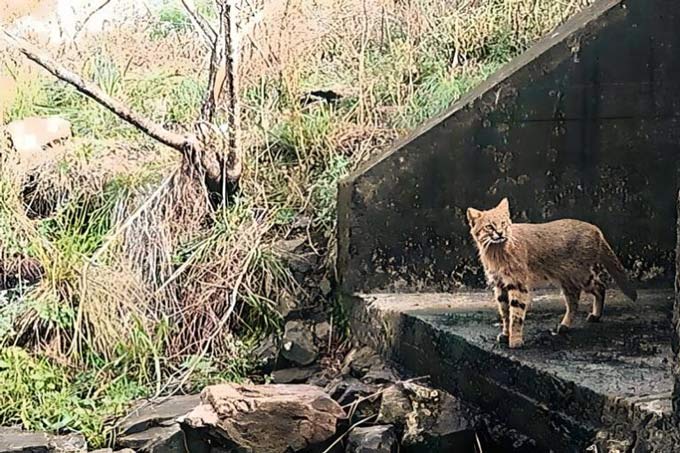
Conserving the cat hasn’t been easy. Recent floods in the Brazilian state of Rio Grande do Sul, among the worst natural disasters in the country’s history, have submerged almost the entire state and abruptly interrupted all conservation efforts to protect Muñoa’s Pampas cat.
Plans had included building a conservation alliance across the three countries where the cat occurs, educational visits to local universities and schools, meetings with state representatives, a capture campaign to fit the felines with tracking GPS collars, and monitoring 60 camera traps installed across the state — although researchers lament the possible loss of cameras in the floods.
“Everything needs to be replanned,” Felipe Peters, a biologist and small cat researcher at the Federal University of Rio Grande do Sul, told Mongabay.

Much of the little that’s known about this elusive cat comes from sporadic sightings.
In an independent project spanning 25 years, camera traps monitored by Mazim and four friends — veterinarian Paulo Wagner and biologists Maurício Santos, Moisés Barp and Yan Rodrigues — snapped just nine records of four individual cats.
Their findings include the first recorded case of melanism in Muñoa’s Pampas cat, a condition in which the fur is completely black, spotted in 2021.
“We needed to install camera traps over 50% of the area of the [Brazilian] Pampas, which covers 17.6 million hectares [43.4 million acres], demonstrating how rare this feline is,” Mazim said.
Overall, 32 records, including footprints, camera-trap images, observations, and dead individuals of Muñoa’s Pampas cat have been obtained in Brazil since 1997. More than half of these records were road kills. Despite long-term efforts to monitor the remaining cats, researchers have yet to detect a resident population.
“It seems that this cat lives like a nomad, wandering the Pampas in search of territory,” Mazim said.
Other researchers have collected four records in Argentina, representing two adults and one young individual, as well as two in Uruguay since 2000. Since the species was first described in the mid-1920s, just over 200 records have been compiled across the entire Pampas biome.
“The secretive nature and elusive behavior of small cats make them difficult to study and monitor effectively,” Wai-Ming Wong, director of small cat conservation science for Panthera, the global wildcat conservation NGO, told Mongabay.
Dwindling habitat
The main threat to Muñoa’s Pampas cat is the loss of habitat in the Pampas, the largest grassland biome in South America.
It sprawls across more than 1.2 million square kilometers (463,000 square miles), an area one-seventh the size of Brazil, with two-thirds of it lying in Argentina and the rest spread over Uruguay and the southern tip of Brazil. It’s home to more than 12,500 wildlife species, representing 9% of Brazilian biodiversity
It’s also considered one of the most altered biomes on the planet. Over the past five decades, the native vegetation has been rapidly cleared for vast monocultures of soy, rice and eucalyptus, leaving just 43% of the Pampas’s original vegetation intact.
Research and conservation in the region are often overshadowed by efforts to protect forests like the Amazon and the Atlantic Forest, which are deemed more valuable, experts say.
“The Pampas has been somewhat forgotten. The idea that a grassland is complex and biodiverse is something strange for a lot of people,” Gerhard Overbeck, vegetation ecologist and professor of botany department at the Federal University of Rio Grande do Sul, told Mongabay.
“[Society], including decision-makers and politicians, has a big forestry bias in conservation, seeing diverse environments, such as forests, [as] more deserving of protection.”
With its habitat dwindling to small pockets of vegetation, Muñoa’s Pampas cat is increasingly exposed to human-associated threats, including from domestic dogs, retaliation for preying on poultry, and being struck by motor vehicles. All of these push the cat closer to extinction.
“When there are such few individuals, any death can represent a large percentage of loss,” Mazim said.
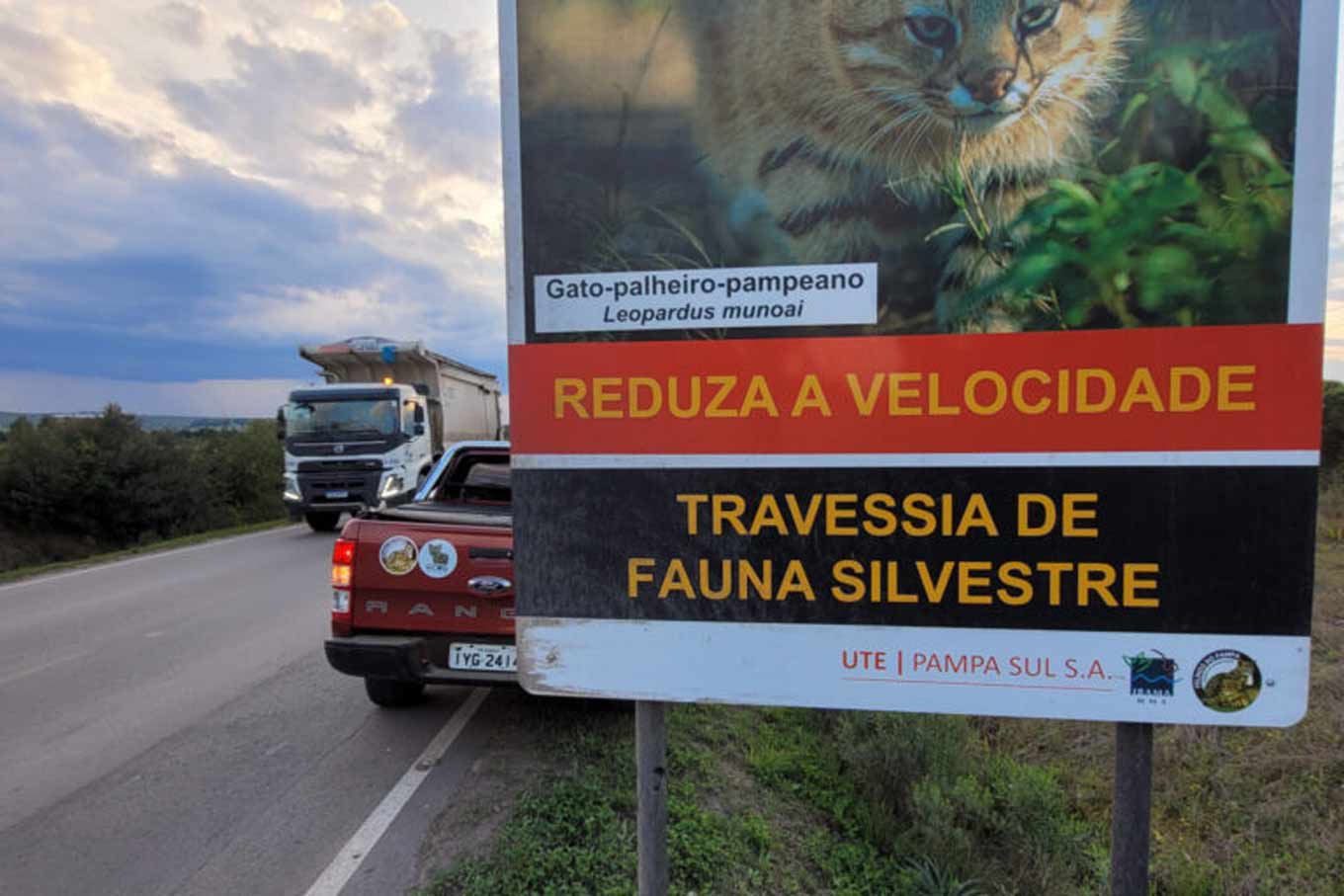
Saving Muñoa’s Pampas cat is both critical for the species itself and to protect the Pampas biome. “Conserving small cats is important for biodiversity as they play unique roles in maintaining ecosystem balance,” Wong said. “They regulate prey populations, control pest species, and contribute to ecosystem dynamics and resilience.
“Small cat presence indicates a healthy ecosystem, and their disappearance can lead to cascading effects on other species and ecosystem functions,” he added.
Saving the species
A rewilding project could boost Muñoa’s Pampas cat numbers to protect it from extinction, but it’s a complicated process.
“We’re talking about a species for which there is no information except that it is in critical danger of extinction,” Augusto Distel, a biologist from Rewilding Argentina, told Mongabay.
“The first thing we must do is find the animal to begin studying it and be able to propose captures and placement of satellite collars.”
In Brazil, researchers are exploring the idea of returning to extensive cattle ranching — a practice used for centuries in the Pampas before intensive crop farming. Unlike the latter, ranching preserves and maintains much of the original habitat.
This time around, the idea is to focus on preserving the specific natural habitat that Muñoa’s Pampas cat typically lives in.
For this to work, however, it must guarantee an income for rural landowners, “otherwise there will be no justification for maintaining the fields given the greater profitability generated by [growing] soybeans,” Mazim said.
One way of making extensive cattle ranching more profitable is to certify beef produced on native grassland as being “green” or “ecological,” Mazim said, which would give it added value.
Yet switching from croplands to extensive cattle ranching isn’t an easy transition.
A 2018 study found that cropland can yield up to 29% more profit than cattle ranching in the Pampas biome, meaning soy is far more lucrative than beef. “There is currently a lack of public policies that support extensive livestock farming,” Overbeck said.
Experts are also exploring the possibility of captive breeding of the cats until their numbers can recover, a process called ex situ management. But there are no Muñoa’s Pampas cats currently in captivity in Brazil, and attempts to breed individuals in Uruguay have proved unsuccessful.
“The creation of an ex situ breeding program is urgently needed. Even if we lose the species in the wild, we can’t let it become extinct,” Mazim said. “The Muñoa’s Pampas cat can no longer save itself; it needs help from people.”
This article was originally published by Mongabay.
Deep in the ocean lies the world’s largest active carbon reservoir, which plays a pivotal role in buffering our planet’s climate. Of the roughly 10 billion tons of carbon we emit each year, about 3 billion tons are taken up and stored in the oceans.
When we consider natural carbon storage in the deep oceans, we generally focus on phytoplankton. Trillions of these microscopic plants live in the surface waters all across the oceans. When they die, they sink to the ocean floor, transporting carbon to the depths.
But there’s a missing piece of the puzzle. Our two new studies show coastal vegetation such as seaweed forests are more important to natural carbon storage than we thought. Around 56 million tons of carbon in the form of seaweed is carried into the deep ocean each year.
For carbon to be stored for hundreds of years, it has to enter slow cycling pools of carbon in the deep ocean. But most seaweeds only grow in shallow coastal seas. How can they get there?
Rivers in the sea
For decades, deep sea explorers have reported surprising findings. Pieces of seaweed and other coastal plants appear where they shouldn’t be.
Fragments of seaweed are often caught in deep-sea trawls, or recorded by submarines and underwater robots during surveys of the ocean floor. Seaweed DNA has been detected in deep sea water and sediments in all of the world’s oceans, as deep as 4 kilometers down and up to 5,000 km from the closest seaweed forest.
But how can seaweeds travel that distance?
Our team discovered part of the answer. Seaweed can be carried by large “underwater rivers”, which flow from coastal waters along the seafloor across the continental shelf and into the deep.
These currents form when localized cooling causes cold dense coastal water to rapidly sink below warmer offshore surface waters. The dense water slides down the slope of the seafloor, following the topography like a river, and carrying with it large quantities of seaweed to deeper areas.
In Western Australia, these flows of seaweed and coastal vegetation towards the deep ocean happen most during colder months, when conditions allow these underwater rivers to form. During these months, storms often hit coastal waters, ripping up seaweed and filling the water with seaweed fragments.
These underwater rivers are a well-documented phenomenon in Australia. But are these ocean currents transporting seaweed and their carbon elsewhere?
We worked with an international team of scientists to find out. To do so, we tracked seaweed from coastal waters to the deep ocean using advanced ocean models.

The hidden role of seaweed forests in oceanic carbon export
Our findings were clear. Seaweed forests do, in fact, transfer substantial amounts of carbon to the deep ocean in many parts of the world.
This phenomenon is particularly high in the kelp forests of Australia’s Great Southern Reef, which stretches 8,000 km from Kalbarri in Western Australia to Coolangatta in Queensland.
The seaweed forests of the United States, New Zealand, Indonesia and Chile are also carbon transport hotspots.
While phytoplankton still sink vast amounts of carbon, our discovery suggests the plants of the coastal ocean transfer more carbon than we thought.
Mangroves, salt marshes and seagrass all contribute to these flows of carbon, but seaweed forests are really big contributor. These forests are made up of large brown algae such as kelp and rockweed species, which form extensive hidden forests. Seaweed forests — such as Tasmania’s disappearing giant kelp forests — are the largest and most productive coastal ecosystems on the planet.
Globally, these forests cover an area twice the size of India, and fix as much carbon during their growth as the northern forests of Canada — nearly 1 billion tons a year.
Of this carbon, our research suggests between 10 and 170 million tons makes it to the deep ocean every year.
A threatened ecosystem
Many of us don’t give seaweed much thought. But underwater seaweed forests play a vital role. These forests give shelter and home to huge numbers of fish and other marine species. They improve water quality and boost biodiversity. And now we know they help store carbon for hundreds of years.
Like many other ecosystems, underwater forests are at risk. Hotter seas from climate change, coastal development, pollution and overfishing have pushed seaweed forests to die off faster than most other coastal ecosystems.
Their fate has worsened in recent decades. The ocean is getting hotter, faster, bringing with it longer lasting and more frequent marine heatwaves.
In Tasmania, the heating ocean has brought new species to seaweed forests, which now have subtropical fish species and voracious sea urchins. These urchins are chewing through the state’s kelp forests.
In Western Australia, a severe marine heatwave struck in 2011, wiping out kelp forests along 100 km of coastline. These forests have not recovered.
When we lose seaweed forests, we lose their natural ability to transfer carbon to the deep ocean. But their loss also threatens the other species who rely on them, and the half a trillion dollars of value they provide to us.
We should think of conserving seaweed forests in the same way we do forests on land. Scaling up restoration where forests have been lost is vital to ensure these unsung plants can keep supporting us — and help store carbon.
This article by Albert Pessarrodona Silvestre, Karen Filbee-Dexter, Mirjam van der Mheen, and Thomas Wernberg, all from The University of Western Australia, was originally published by The Conversation.

This story was originally published by Grist. Sign up for Grist’s weekly newsletter here.
Island nations in the Pacific, Caribbean, and West Indies won a major international legal victory this week that puts more pressure on large governments like the European Union and China to curb their carbon emissions.
On Tuesday, the International Tribunal for the Law of the Sea, or ITLOS, in Hamburg, Germany, unanimously ruled that state parties to the United Nations Convention on the Law of the Sea have an obligation to reduce greenhouse gas emissions.
The 169 parties to the treaty include several of the world’s top emitters: China, India, the European Union, and Russia. The United States, also a big polluter, is not a party to the convention.
The tribunal said in its advisory opinion that greenhouse gases count as marine pollution and that state parties to the convention must “take all necessary measures to prevent, reduce and control marine pollution.”
“The ITLOS opinion will inform our future legal and diplomatic work in putting an end to inaction that has brought us to the brink of an irreversible disaster,” said Gaston Browne, prime minister of Antigua and Barbuda, according to Reuters.
Nikki Reisch from the Center for International Environmental Law, which supported the island nations’ case, said the advisory opinion lays the foundation to hold big polluters accountable by clarifying their obligations under international law.
Reisch said this is the first time an international court has commented on the intersection of oceans and climate change.
“It’s a landmark decision in that it adds great weight to the growing body of case law and legal interpretations underscoring states’ legal duties to urgently and drastically reduce greenhouse gas emissions to protect the environment and human rights,” she said.
“It’s a testament to the persistent courage and leadership of small island states that have really been at the forefront of the struggle for climate justice and accountability and the forefront of legal developments.”

In 2022, island nations including Palau and Vanuatu first brought the case before the tribunal.
They wanted to know what the obligations of state parties are “to prevent, reduce, and control pollution of the marine environment in relation to the deleterious effects that result or are likely to result from climate change.”
The island countries have been dealing with storms, heavy rainfall, coral bleaching, and other negative effects of climate change despite contributing relatively little carbon emissions. On islands like Vanuatu, the climate effects particularly harm Indigenous Pacific Islanders, some of whom are already facing dislocation from their ancestral villages.
Reisch said the sweeping opinion is particularly significant because it makes clear that complying with the Paris Agreement, the 2015 international treaty on climate change, isn’t enough.
The opinion said countries should also “take all measures necessary” to ensure their carbon emissions don’t damage other states or their environments.
State parties to the convention also have an obligation to support developing states with climate adaptation, especially those particularly vulnerable to climate change impacts. That includes giving them “preferential treatment in funding, technical assistance, and pertinent specialized services from international organizations,” the tribunal wrote.
The tribunal found state parties also have the legal obligation to monitor greenhouse gas emissions; to report on their observations and analyses; and to protect oceans from acidification. States may even need to restore marine habitats if they’ve been degraded, the tribunal concluded.
Sarah Cooley from the Ocean Conservancy, who gave expert testimony in the case, praised the tribunal’s embrace of climate science.
“Today’s judgment from [International Tribunal for the Law of the Sea] is a massive victory for our ocean communities impacted by climate change, and science in general,” she said.
Taylor Swift is having the opposite of a “Cruel Summer” during her Eras Tour stops in the UK this month.
Coming off of three shows at Liverpool’s Anfield Stadium — where the pop star celebrated the 100th show of the tour and claims her fans broke attendance records at the venue — a local nonprofit shared some even more exciting news.

“We're SO excited that Taylor Swift has donated to us after three incredible shows,” St. Andrews Community Network posted on X Friday morning.
“While we hope for the day ‘Everything Has Changed’ and our support is not needed, donations like Taylor's make a difference. Thank you for leaving your legacy!”
We're SO excited that @taylorswift13 has donated to us after three incredible shows🎶While we hope for the day Everything Has Changed and our support is not needed, donations like Taylor's make a difference 🫶 Thank you for leaving your legacy!
— St Andrews Community Network (@standrewslive) June 21, 2024
Join her👉https://t.co/tbd2p02hdl pic.twitter.com/S4p2732ZTo
St. Andrews Community Network is a Liverpool-based nonprofit that provides resources to churches and community groups serving community members facing poverty.
By providing food security and financial resilience to those in need, the group aims to build sustainable communities throughout Liverpool. The network operates 11 food banks and eight community food pantries in the city.
Swift herself did not announce the donation, and it has not been revealed how much the star gave, but representatives of St. Andrews said it will have a “massive” impact.

Charlotte, a fundraiser for the network, told ECHO News: “We can’t thank Taylor enough.”
“So many people are struggling at the moment and need for all our services has sadly increased over the last few years, so to have someone like Taylor supporting our endeavors and choosing to help people in crisis in Liverpool means so much and will make a massive difference,” Charlotte continued.
This is far from the first time the “Tortured Poets Department” singer has quietly donated funds during her time on the road.

Earlier this month, she did the same for the Edinburgh Food Project, and in 2023, the singer made headlines for her generous donations to food banks in North America.
As she gears up for her next streak of performances across the pond in London and Dublin, estimates suggest that her stops in the UK’s capital alone will boost the London economy by £300 million.
Swift’s financial impact and ongoing generosity is surely worth celebrating, though it seems she’s only getting started.
“I can’t believe the work ethic, creativity and dedication I get to be surrounded with every day,” the singer wrote in an Instagram post, celebrating the 100th show of the tour.
“And thank you to everyone who has come to any of the shows on The Eras Tour. It’s been the adventure of a lifetime because of you.”
While Swift continues on to Wembley Stadium this weekend, St. Andrews seems to continue to bask in the gratitude of her gift.
“We’re unbelievably grateful to Taylor for her kindness and generosity,” the organization wrote in another post on X.
“What an incredible performer and person she is.”
Header images courtesy of Ronald Woan (CC BY-SA 2.0) and Mike Bird (Pexels)
Australia’s newest national park — Cameroo Station — spans over 144 square miles, roughly the same size as the city of Las Vegas, NV.
The park, which is set to open to the public in late 2024, is also home to 158 native species
A survey, conducted in March 2024 by the National Parks and Wildlife Service, found 109 bird, 22 reptile, 13 frog, and 14 mammal species in total — 12 of which are threatened or endangered.
“Finding 12 threatened species within Comeroo Station is incredibly exciting and these surveys mark the crucial first step in the journey of transforming this extraordinary property into a national park, ensuring its protection for generations to come,” explained Penny Sharpe, the Australian minister for climate change and the environment, in a press release.

“The abundance of wildlife in this pocket of NSW is truly remarkable, especially the diverse bird species which call it home.”
Of the species surveyed, the Eastern fat-tailed gecko, South-eastern hooded robin, and pink cockatoo are endangered.
Nine more — including the little pied bat, the towering Brolga bird, and the mousey stripe-faced dunnart — are threatened species, according to Australian legislation.
“Endangered species face a very high risk of extinction in Australia in the near future, and require urgent conservation efforts to prevent their extinction,” a NPWS spokesperson told Western Plains.
“Vulnerable species face a high risk of extinction in NSW in the medium-term future,” they continued. “While not as critical as endangered species, they still need protection to ensure their survival.”

Across the board, the main reason for the animals’ declining population rates lies in deforestation and agricultural production.
For example, the pink cockatoo was only just added to the endangered species list in 2023, due to the destruction of its key habitat.
“Queensland’s high vegetation clearing rate was one of the major causes of the cockatoo’s endangered status, resulting in loss of old hollow-bearing trees,” Susan Fuller, professor at QUT’s school of biology and environmental science, told the Australian Wildlife Conservancy.

Found in the Australian outback, the park is located in the traditional Paroo and Warrego River country of the Muruwari, Budjiti, Kunja, Gurnu, and Baarkandji people.
Due to its cultural ties, the park also serves as a historical site, protecting important artifacts like ancient wells and sacred stone arrangements.
The park — rich with wetlands, swamps, and healthy river systems — is vital to the animals that live there, including the plentiful waterbird species.
“Permanent protection of this site is fantastic news for biodiversity and especially for waterbirds,” said Richard Kingsford, director of the center for ecosystem science at UNSW Sydney.
Sharpe agreed, celebrating the NPWS’ achievement in protecting the area by transforming it into a national park.
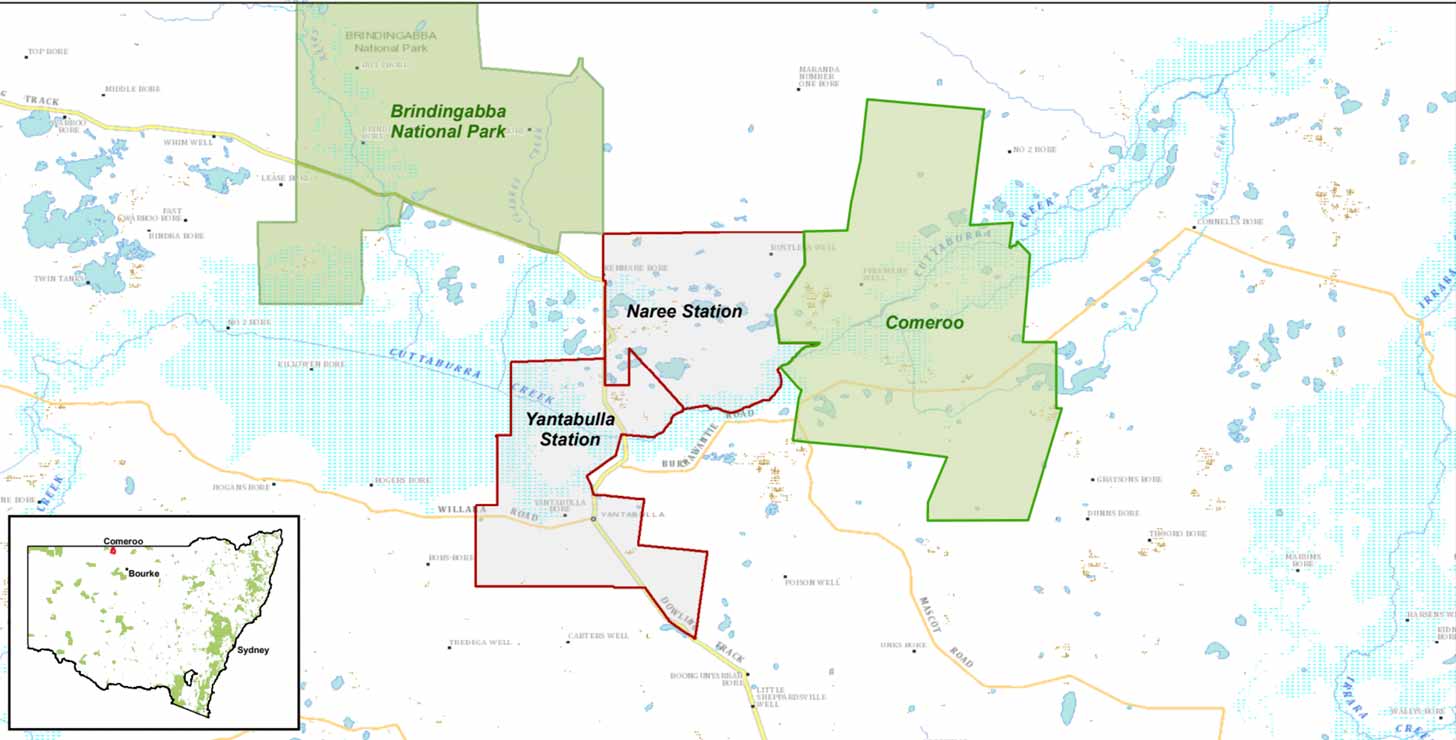
“Wetlands are some of the most endangered ecosystems on the planet, which is why this acquisition is so important,” said Sharpe. “The construction of visitor experiences and driving tours will help people explore this vast new park.”
The NPWS also believes there’s more to be explored when it comes to their conservation research.
“There are likely more threatened species out there, we hope to pick up over time,” said a spokesperson for the NPWS.
Header image courtesy of Joshua J. Smith Photography/UNSW
Every day the Good Good Good team collects the best good news in the world and shares it with our community. Here are the highlights for this week!
If you want to get good news in your inbox every day, join the Goodnewsletter — the free daily newsletter designed to leave you feeling hopeful.
The Best Positive News We’re Celebrating This Week —
A critically endangered desert fish hit a 25-year population high in one of Earth’s harshest environments
In a glimmer of hope for one of the world’s rarest fish, scientists have counted 191 Devils Hole pupfish this spring in their tiny desert habitat — the highest spring count for the critically endangered species in more than two decades.
The fish is found only in the upper reaches of a single deep limestone cave in the Mojave Desert in the western U.S. state of Nevada — the smallest known range of any vertebrate species on the planet.
Scientists are cautiously optimistic about this latest count, especially since they counted just 35 pupfish in 2013, leading to fears that the species could wink out of existence.
Why is this good news? While their numbers continue to fluctuate, successful ongoing conservation of the species has helped set a precedent for using environmental science to guide policy and legal decisions surrounding endangered species.
→ Read more
Thanks to global cooperation, the ozone layer is recovering faster than expected
In 1987, 198 nations around the world came together to ratify the Montreal Protocol on Substances That Deplete the Ozone Layer, which phased out pollutants that deplete the ozone layer.
The ozone layer is essential to sustain life on Earth. Despite protests from businesses that profited from the manufacturing and use of chlorofluorocarbons — we prioritized preserving the atmosphere (and by extension, the survival of humanity).
And a recent study found these efforts are already hugely paying off even faster than scientists expected — atmospheric levels of ozone-depleting chemicals have officially dropped for the first time ever.
Perhaps even more encouragingly, another damaging chemical replaced CFCs — hydrochlorofluorocarbons, which are still in the process of being phased out. The study found that both CFCs and HCFCs levels are down.
Scientists are celebrating the news, as it also indicates that humans are fully capable of bringing the planet back to pre-pollution norms — something we’re doing for climate change, too.
→ Read more
A breakthrough union contract for electric school bus workers is bringing better working conditions and cleaner air
For nearly a century, a substantial portion of America’s iconic yellow school buses have been manufactured at a factory in a 9,000-person Georgia town.
That factory, Blue Bird recently made history when its 1,400 employees voted to unionize with the United Steelworkers — a challenging feat in the Deep South — and because it was set to receive up to $1 billion over five years from the federal government in contracts to build more electric school buses.
Not only will factory employees be given guaranteed raises, new retirement benefits, and a profit-sharing with the company — they’ll be working to bring cleaner transportation and healthier air to communities across the country.
Why is this good news? The grants to build electric school buses — funded by the Bipartisan Infrastructure Law — included a “union neutrality” provision prohibiting grant recipients from using the funding to sway workers against joining a union.
It’s yet another example of how building a clean energy-powered future is good for the planet and for people.
With roots in the first Juneteenth, a Black Texas family has long been fighting for an accurate account of history to be taught in schools — with lessons for today’s lawmakers
Samuel Walker Houston was the son of Joshua Houston, an enslaved servant of Gen. Sam Houston — the most well-known military and political leader in Texas — who was freed on Juneteenth.
Samuel founded one of the “leading schools” in East Texas and believed that young Texans of all races needed to learn an account of history that differed from the white supremacist narrative that dominated Southern history. He joined forces with two white professors to fight against racism and racist representation of Black people in the state’s schools.
They faced plenty of pushback — with the same justification provided still today by Texas lawmakers, as many try to restrict the teaching of systemic racism in public schools.
Still, the Houston family’s inspiring story and tireless fight for an accurate portrayal of history persisted — and it’s a fight we can all join in taking up today, too.
From a historian: Juneteenth offers new ways to teach about slavery, Black perseverance, and American history
Early childhood experts say children in the U.S. will probably hear about slavery by age 5. At that age, lessons should celebrate and teach stories of Black culture, leadership, inventions, beauty, and accomplishments to better equip children to later hear about, understand, and emotionally process the terrible truths about slavery.
And while Juneteenth celebrations do not only commemorate the end of slavery, they also honor the generations of Black men and women who have fought to end slavery and for racial justice.
Even today, the holiday offers an abundance of opportunities to learn about what it means to fight for freedom and maintain a sense of self-determination in the face of oppression.
Nearly doubling their goal, a new holiday in California helped over 3,600 animals get adopted in a single day
On June 1, local, state, and national animal welfare organizations teamed up to host the first-ever California Adopt-a-Pet Day. The state’s senate even passed a resolution proclaiming the day an official holiday across the state.
The event included more than 170 participating animal shelters across the state and was a resounding success, sending a total of 3,609 pets — nearly doubling their original goal of 2,024 adoptions — to their forever homes.
The ASPCA covered the cost of adoptions, making it easier for community members to welcome a pet into their lives, while still financially supporting the animal rescue organizations in the area.
Why is this good news? California shelters have faced a large influx of animals in recent years due to ongoing economic hardships, like finding pet-friendly housing and affordable veterinary care.
For many of the new pet parents, this was the first time they visited their local shelter and adopted a shelter pet — and for at least one shelter the holiday set a new single-day adoption record.
Wealthy nations finally delivered $100 billion in climate aid they promised to developing countries
In the wake of collapsed negotiations at the United Nations climate conference in Copenhagen in 2009, wealthy nations, led by the United States, pledged to provide developing countries with $100 billion in climate-related aid annually by 2020.
The money was meant in part to ease tensions between the rich countries that had historically contributed the most to climate change and the poorer nations that disproportionately suffer the effects of a warming planet.
While they fell short of reaching that target in both 2020 and 2021, a new report just confirmed that wealthy nations finally surpassed the goal in 2022 — contributing nearly $116 billion.
What’s the nuance? While it’s welcomed news that wealthy nations have finally paid up, it’s only a very small piece of the massive estimated need. United Nations-backed research projects that developing countries will need $2.4 trillion per year by 2030 to transition away from fossil fuels and adapt to climate change.
→ Read more
To protect Scotland’s endangered salmon, a group of anglers purchased the river they’ve fished for 100 years
Formed in 1924, the Blairgowrie, Rattray and District Angling Association has become one of Scotland’s oldest angling clubs, encouraging nature stewardship and the responsible fishing of salmon, sea trout, brown trout, and other fish.
On the organization’s centennial, they have purchased the salmon fishing rights of a four-mile stretch of River Ericht to help conserve and protect wild Atlantic salmon, which was officially classified as an endangered species in Scotland last year.
The anglers confirm that they’ve seen a change in the landscape, pointing to a history of water extraction for industrial purposes, with salmon stocks falling as a result of low water levels.
And while there are hundreds of rivers in Scotland “preventing the easy passage of migratory fish” that need the same care and attention, the BRDAA is hopeful its efforts will help usher in more widespread action from the Scottish government.
→ Read more
More good news of the week —
Thought to be extinct in 1979, a new litter of endangered black-footed ferrets was just born in DC. Conservation efforts have included captive breeding, wildlife reintroductions, habitat restoration, and more — resulting in the cutest success story yet.
Three endangered horses traveled 3,000 miles to their new home — and it could mean survival for their species. The Kazakh Steppe is home to Saiga antelope, Siberian deer, foxes, badgers, Mongolian gerbils, Russian steppe tortoises — and a growing herd of wild Przewalski’s horses.
A critically endangered “walking pinecone” was just spotted in a West African country for the first time in 24 years. Due to habitat loss, deforestation, and poaching, all eight species of pangolins have been struggling for survival across Asia and Africa.
Villagers in Malawi helped arrest suspected elephant poachers in Kasungu National Park. Residents of villages just outside the park informed police about two men selling elephant meat, who were subsequently found in possession of 16.6 kilograms of ivory.
The U.S. is installing enough solar to power 70,000 homes on sites formerly used in the nuclear weapons program. It’s the first in the DOE’s Cleanup to Clean Energy initiative to repurpose federal land previously used in nuclear weapons programs for clean energy.
New research found a common type of ocean algae plays a significant role in helping cool the Earth’s climate. Scientists identified the bloom-forming Pelagophyceae algae as potentially abundant and important producers of a compound “that’s a major source of climate-cooling gases.”
An all-electric rideshare in New York City just celebrated surpassing its two-millionth ride. Offsetting over 9,000,0000 pounds of carbon emissions, it took Revel two years to get to one million rides and a quarter of that to reach two million.
Carmakers are making and selling more hybrid electric vehicles than ever before, reaching as much as 50% of total sales. In 2023, for example, 29% of Toyota's sales were hybrid vehicles and it’s expected to reach closer to 45% by the end of this year.
Saying it’s “good for the planet, good for our business,” PepsiCo just announced plans to triple its electric vehicle fleet. The company says it’s adding 50 Class 8 Tesla Semis and 75 Ford E-Transit electric vans.
Cranberry farmers in Massachusetts are transforming their old bogs into thriving, carbon-storing swamps. The Eel River Preserve, the first cranberry bog officially restored in Massachusetts, has now grown into a lush ecosystem of native wetland plants.
An international team of scientists discovered a plastic-eating fungus in the Great Pacific Garbage Patch. The patch is a massive accumulation of floating plastic debris in the North Pacific Ocean, and often the target of ocean cleanup efforts.
Portland is providing thousands of free air conditioners to residents in need this summer. The Cooling Portland initiative aims to protect low-income residents during dangerous heat waves more accessible to those in need.
Upending the LGBTQ+ vs. faith narrative, more than 120 faith groups are protecting Pride events this month. Providing protection and faith-based support for LGBTQ+ folks at 50 events throughout June, the groups will work to de-escalate extremist anti-LGBTQ+ protests from hate groups.
Officials reported more than 150 rare, endangered whale sightings off the coast of Martha’s Vineyard. In addition to North Atlantic right whales, humpbacks, minke, fin, orcas, and sperm whales, NOAA officials spotted 93 sei whales, one of the highest concentrations of the rare whale observed during a single flight.
To address the disproportionate impact of the state’s policies on people of color, Maryland’s governor pardoned over 175,000 low-level marijuana convictions. The state voted to legalize adult use of marijuana in 2022 and the governor said, “We cannot address the benefits of legalization if we do not address the consequences of criminalization.”
After one year, a Denver basic income program found significant improvements in housing outcomes. At least 45% of participants were able to have their own home or apartment by the end of the research period thanks to the basic income program.
The White House just swore in the first class of the American Climate Corps. The American Climate Corps is a brand new climate jobs training program tailored to helping young people find jobs in the green economy.
The world’s only coal-to-nuclear plant just broke ground in Wyoming. The plant is being constructed next to a retiring coal plant, will hire former coal workers, and “will be much safer and produce far less waste than conventional reactors.”
A recent World Meteorological Organization report called heat waves the “deadliest meteorological hazard” from 2015 to 2019, affecting people living on all continents, and setting new national heat records in many regions.
Canada’s top weather event in 2021 was British Columbia’s record-breaking heat, according to Environment and Climate Change Canada. The temperature in Lytton, B.C., hit 49.6 C on June 29. The following day a wildfire destroyed 90 per cent of the town, killing two people and displacing 1,200 others.
Heat waves also exacerbate existing health issues, including cardiovascular and respiratory disease. They’re associated with increased hospital admissions, psychological stress and aggressive behavior, as well as excess mortality.
During heat waves, the highest temperatures are often found in urbanized areas. Urbanization is almost always associated with an increase in paved, impervious areas, and often a decrease in greenery. Concrete and asphalt roads, and other built materials readily absorb, store and release heat, raising city temperatures, a phenomenon called the urban heat island.
Many studies have shown that urban forests can reduce the urban heat island, and many policies focus their attention on large green spaces.
Small green spaces, such as yards, rooftops and small parcels of undeveloped land, can make impressive contributions to lowering urban heat, but they are often overlooked when developing strategies for urban cooling.
The effect of small green spaces
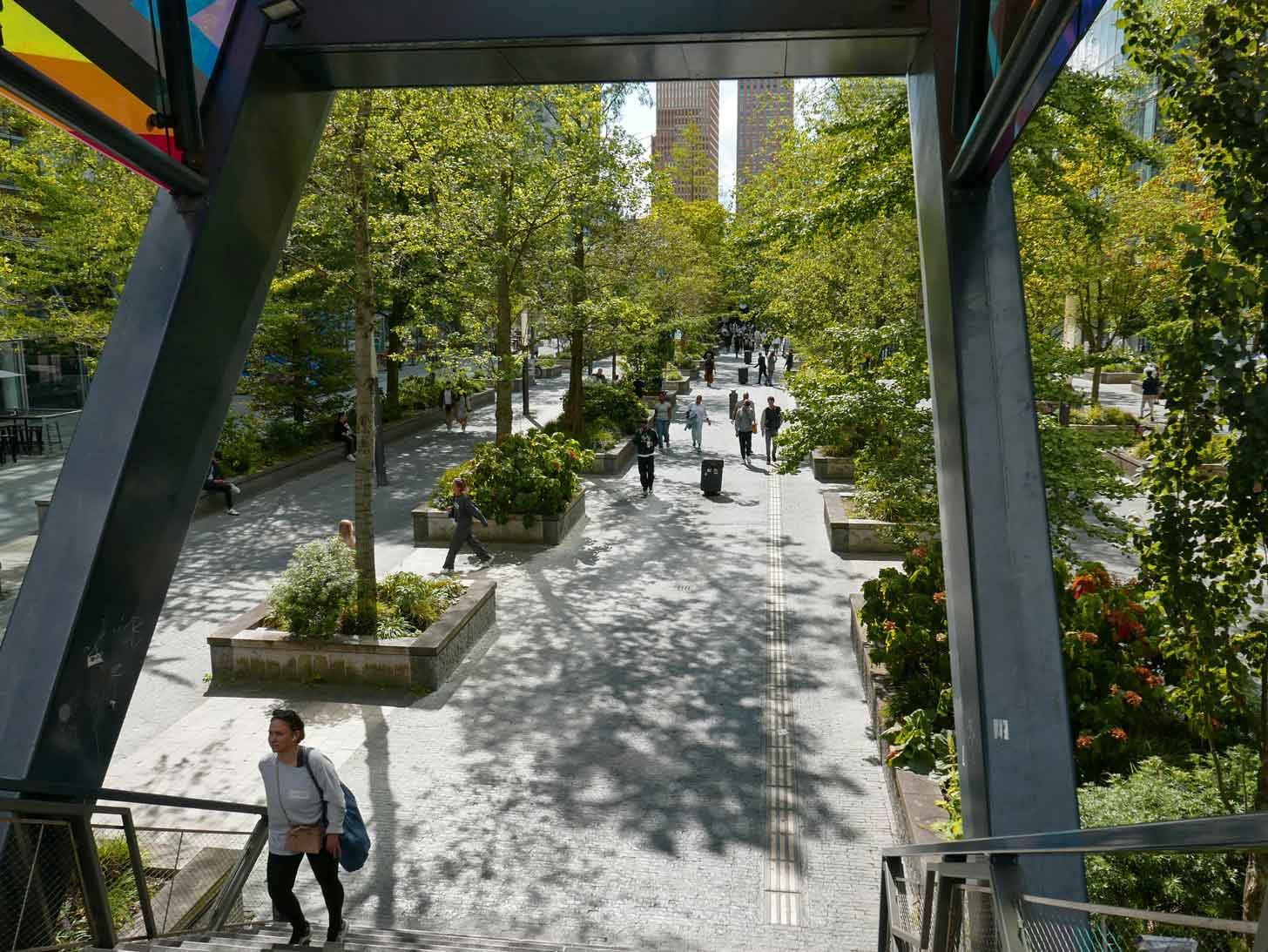
Cities rarely have the opportunity to add large green spaces to help counter the effects of heatwaves. Smaller vegetated spaces, however, can still meaningfully decrease local land temperatures.
Small green spaces, such as yards, rooftops and small parcels of undeveloped land, can make impressive contributions to lowering urban heat, but they are often overlooked when developing strategies for urban cooling.
A recent study in Adelaide, Australia, found that tree canopy cover and, to a lesser extent, grass cover decreased local daytime surface temperatures by up to 6 C during extreme summer heat conditions. Further inland, suburban yards and gardens can decrease local surface temperatures up to 5 C.
At a quite small scale, on the order of tens of square metres, trees reduced daytime surface temperatures twice as much as grass cover. But grass and other small, low-lying plants, grow relatively quickly, compared to trees.
Cities should adopt short-term and long-term strategies to respond to extreme heat, including the replacement of paved and impervious surfaces with grasses and turf, and increasing tree plantings to boost canopy coverage.
Amplifying the cooling effect
Furthermore, when managing small green spaces, city planners and foresters can select tree species based on their ability to cool the environment. Green spaces with a high diversity of tree species have a greater cooling effect in spring, summer and fall. They also have a larger maximum drop in temperature in the summer, compared to spaces that are less diverse.
For example, tree canopies with large leaves and high transpiration rates — the evaporation of water from plants occurring at the leaves — could provide more cooling.
Planting a variety of species, of different heights, can have a larger cooling effect than tall trees alone.
The structure of green space may also influence its cooling efficiency. In summer, a plant community with multiple layers of trees, shrubs and herbs can further decrease air temperature by 1 C on a sunny day and 0.5 C on a cloudy day, compared with an area only dominated by tall trees.
Tree groupings
The layout of the green spaces — their spatial configuration — is another factor that the city planners should care about when thinking of the cooling capacity of small green spaces. When green spaces are heavily fragmented — broken up into smaller pieces — spread further apart or unevenly distributed, their cooling contribution is lower.
A study investigating the spatial configuration of green spaces in two cities, Baltimore, Md., and Sacramento, Calif., showed varying results, for example.
The researchers looked at the total perimeter of green patches for each square kilometre of land (a metric called edge density) and measured the cooling effect. A greater edge density was associated with less cooling in Baltimore, but more cooling in Sacramento.
The discrepancy is likely due to the local conditions: More shade might be being cast by trees onto surfaces with cooling effects, muting their effects.
Or a green patch with a larger edge density could include a larger number of smaller and fragmented tree patches with weaker evapotranspiration (evaporation from the land surface, plus transpiration from plants).
For a manager, the trade-offs can be tricky to navigate.
But overall, trees usually have a stronger effect on cooling than grass. Planting trees in groups, not individually or in lines, is recommended for regulating the microclimate (local climate conditions near the Earth’s surface).
Small green spaces can offer a lot of summer cooling in cities. And cities can learn to manage the configuration of small green spaces better to get more cooling benefits and minimize the trade-offs.
This article by Lingshan Li from Concordia University was originally published by The Conversation.
Header image via Pixabay

Every year in the United States, there are between one and two million collisions between cars and large animals, according to the Federal Highway Administration.
In Colorado in particular, the state’s Department of Transportation reports about 4,000 wildlife collisions annually, which costs an estimated $80 million for Colorado drivers every year. While wildlife crossings and other interventions have helped, this issue still puts the lives of people and animals at risk.
So, a group of teens at STEM School Highlands Ranch, in a suburb just outside of Denver, decided to do something about it.
These teenagers — a group of four young women — have created a wildlife detection device using infrared cameras and artificial intelligence. They call it “Project Deer.”

“The current plan is to utilize an infrared camera to image the surroundings in front to detect animals and warn the driver when animals are in the environment so they can pay more attention, slow down, and be much more likely to avoid a collision,” Bri Scoville, one of the student inventors, told CBS Colorado.
Infrared cameras detect body heat (even in compromising conditions like darkness or inclement weather). From there, an algorithm tracks the heat and motion, and AI machine learning categorizes the data and logs it as an animal.
“The use of infrared is definitely new and something that hasn’t been done before,” added Siddhi Singh, a junior at STEM School Highlands Ranch.
Once the AI model detects wildlife, the detection device sends a signal to a smaller device inside of a vehicle to warn drivers with a combination of light and sound, allowing them to slow down or stop.

The team — which also includes fellow students Dhriti Sinha and Robyn Ballheim — assembled for of Samsung’s annual Solve for Tomorrow competition.
“Generally, what Samsung asks you to do is to find a problem in your community that's affecting your community and then try to use technology to solve the problem,” Tylor Chacon, the team’s sponsor and computer science teacher, told CBS Colorado.
The girls won the state contest for Colorado, which came with a prize of $12,000 to help continue building their prototype. (They also received a number of Samsung Galaxy Chromebooks.)
Fortunately, the device isn’t as costly as other complex inventions; each detection device is made of four $5 infrared sensors. Creating something accessible and ubiquitous is vital in confronting an issue as widespread as this threat to wildlife.
While the invention did not win awards at the national level, the team is continuing to perfect their design, with the help of experts in the automotive industry, as well as Colorado’s DOT.
Although CDOT has stationary wildlife sensors, the STEM School team hopes their device would be more effective — and easier to take on the go.
“We spoke with someone at Audi, they said that there are huge hopes for this device if we’re able to get this to work,” Singh told CBS Colorado.
“Getting it to work,” is more of a matter of when; not if.
Over summer break, the teens are trying out different approaches to make the prototype the best version it can be, including the use of Bluetooth systems, or mounting the device like a dashboard camera on a vehicle’s windshield.

“That’s our ultimate goal, to engineer something that anyone and everyone can put on their cars,” Singh said.
The tech is there. In fact, the team tested the prototype on their school’s therapy dog and saw resounding success.
“We were able to implement a combo of heat tracking, motion tracking and classification to build the best detection system,” Singh told Denver7 this spring.
“As a proof of concept, we strapped all the components of our design on a remote control car and with permission, tested it on Daisy, our school's therapy dog.”
Now, it’s just a matter of creating a final product that can do this vital signaling in those life-or-death moments. The team told CBS that they plan to re-enter the Samsung solve for Tomorrow competition next year, with a refined prototype.
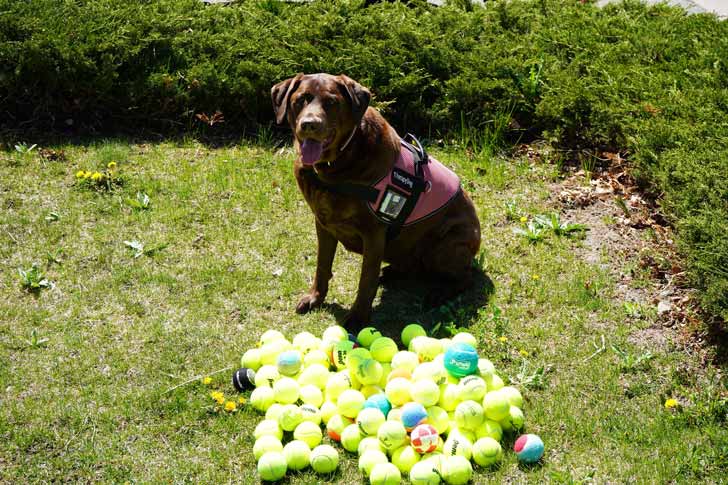
“There’s really no limit to how far the project could go,” Chacon added. “I think it’s within sight to fix this problem.”
Winning is certainly the goal, but with ongoing national coverage and support from major industry players, they also want to keep other young women in STEM from feeling like a deer in the headlights.
“We… hope that we can encourage other girls to innovate like us,” Scoville told CBS.
The team’s mentor, Chacon, sees a world of success for this project — and for those other young girls may dream up themselves.
He said: “These girls are laying the groundwork for somebody to look up to them later on and say, ‘I wanna do that, I wanna be that, look what they did, I can do that, too.’”
Header images courtesy of Can Pac Swire (CC BY-NC 2.0) and STEM School Highlands Ranch
Chicago is on track to potentially construct roughly 47 miles of new bikeways in 2024, as part of a larger pledge to add 150 miles of new and improved bikeways in just a handful of years.
Chicago’s Department of Transportation recently updated their public spreadsheet and interactive map for 2024 bikeway installations, which includes bike trails, protected bike lanes, and neighborhood greenways.
At the time of publication, 10 bikeways have been installed, 17 are underway, and 56 more are planned for construction in countless neighborhoods and city streets across the third largest city in the U.S.
The ambitious city planning project is spearheaded by Complete Streets, a program run by the CDOT which prioritizes street designs that are accessible, environmentally sustainable, and pedestrian-friendly.
2023 marked a record-breaking year for the city, with the addition of over 50 miles of bike-friendly routes.
At the end of last year, Complete Streets manager David Smith attended a city council hearing and spoke about their achievements, which included the donation of 1,350 free bikes to citizens and a record number of users utilizing the bike rental system Divvy.
“2023 really was an exciting year, and I think sets the tone and the stage for how we move forward in the years to come,” Smith told the the municipal legislation of the Chicago city council.
“When we design our streets and adopt policies that prioritize those most vulnerable, we improve the safety and accessibility for everybody using the street.”

This news comes alongside a recent announcement from the Chicago Metropolitan Agency for Planning to strengthen the city’s compliance with the Americans with Disabilities Act.
“CMAP is thrilled to continue supporting communities in their planning and implementation efforts through our technical assistance program,” said Erin Aleman, CMAP executive director, in a press release.
Aleman went on add that the Regional Transportation Authority received an “unprecedented number of applications” for city improvements.
“[This] highlights the significant demand for planning support throughout our region,” Aleman explained.
“CMAP's technical assistance program aligns with the region's comprehensive plan ‘ON TO 2050,’ and its principles of resilience, inclusive growth, and prioritized investment.”
The ON TO 2050 Plan is a 30-year strategy to better Chicago’s seven counties, with a focus on transportation safety and accessibility, improved equity, and a healthier environment for all Chicagoans.
By all accounts, Chicago is on track towards a brighter future.
The city’s increased number of protected bike paths, improved ADA compliance for public transportation, and the ON TO 2050 plan all add credence to the biggest goal of all: the state’s pledge to run completely on clean, carbon-free energy by 2050.
Howard Learner, an attorney at Chicago’s Environmental Law and Policy Center, said that he believes in Illinois’ ability to “clean up” its energy system and end reliance on fossil fuels.
“It's ambitious, it's practical, it's doable,” Learner told CBS News.
Header image via SDOT / Flickr (CC BY-NC 2.0)
— Deforestation in the Brazilian Amazon dropped to its lowest level since March 2018, according to new data from the Brazilian government.
— Deforestation for the year to date is down 40% compared to 2023, with expectations for a significant annual decline when the “deforestation year” concludes on July 31.
— Despite declining deforestation in the Amazon, the region is experiencing a rise in forest fires due to a severe drought.
— Deforestation is rising in the cerrado, an adjacent ecosystem.
Deforestation in the Brazilian Amazon continued to plummet in May, reaching the lowest level since March 2018, according to new data from the alert system run by Brazil’s national space research institute, INPE.
According to INPE’s DETER system, deforestation in May 2024 amounted to 501 square kilometers (193 square miles), an area 147 times the size of New York City’s Central Park. This tally brings the accumulated deforestation detected by DETER over the past year to 4,350 square kilometers, down 54% from the same time last year.
For the year to date, DETER has detected 1,182 square kilometers of forest clearance, down 40% from the 1,986 square kilometers recorded at this point in 2023.
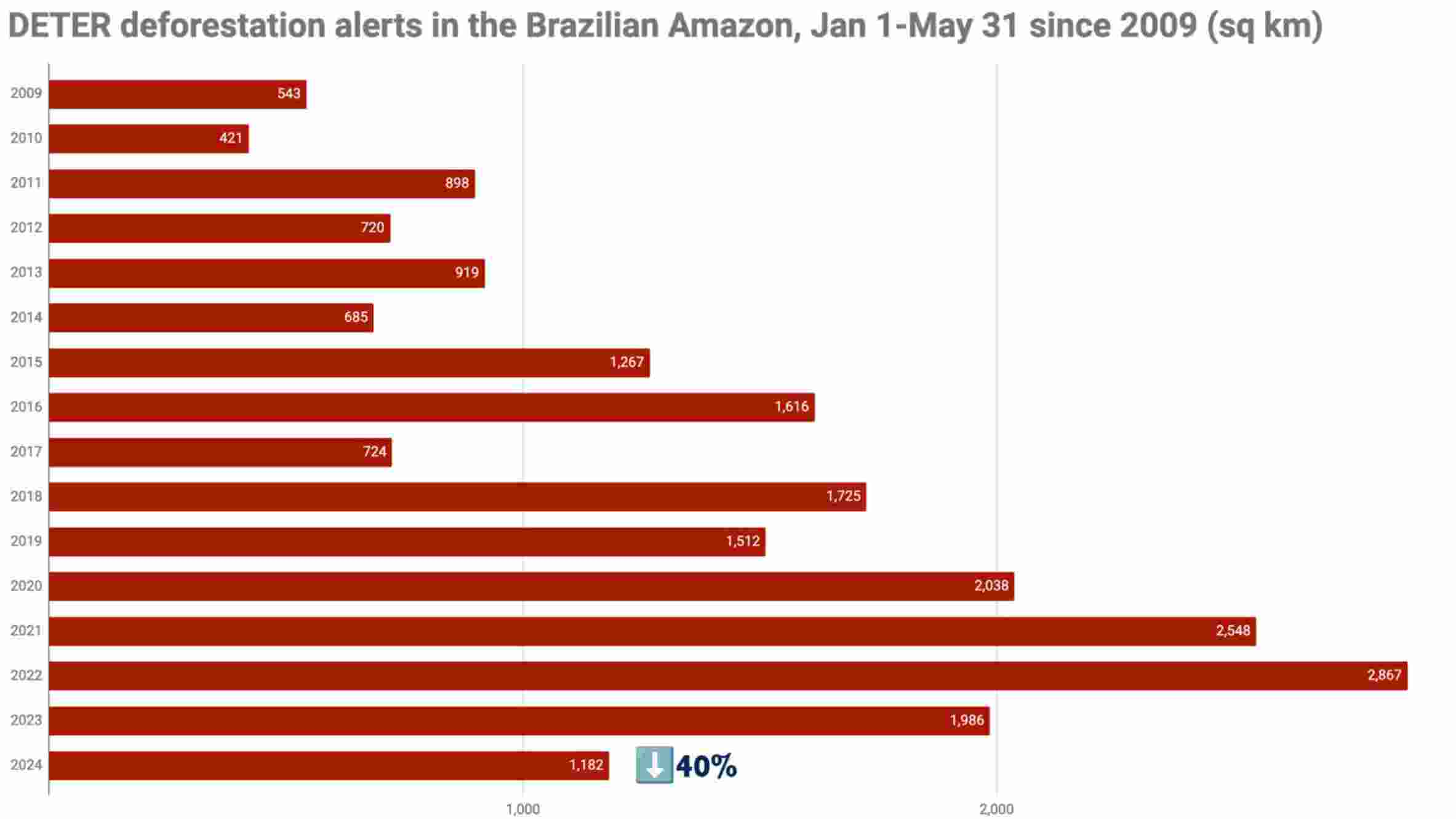
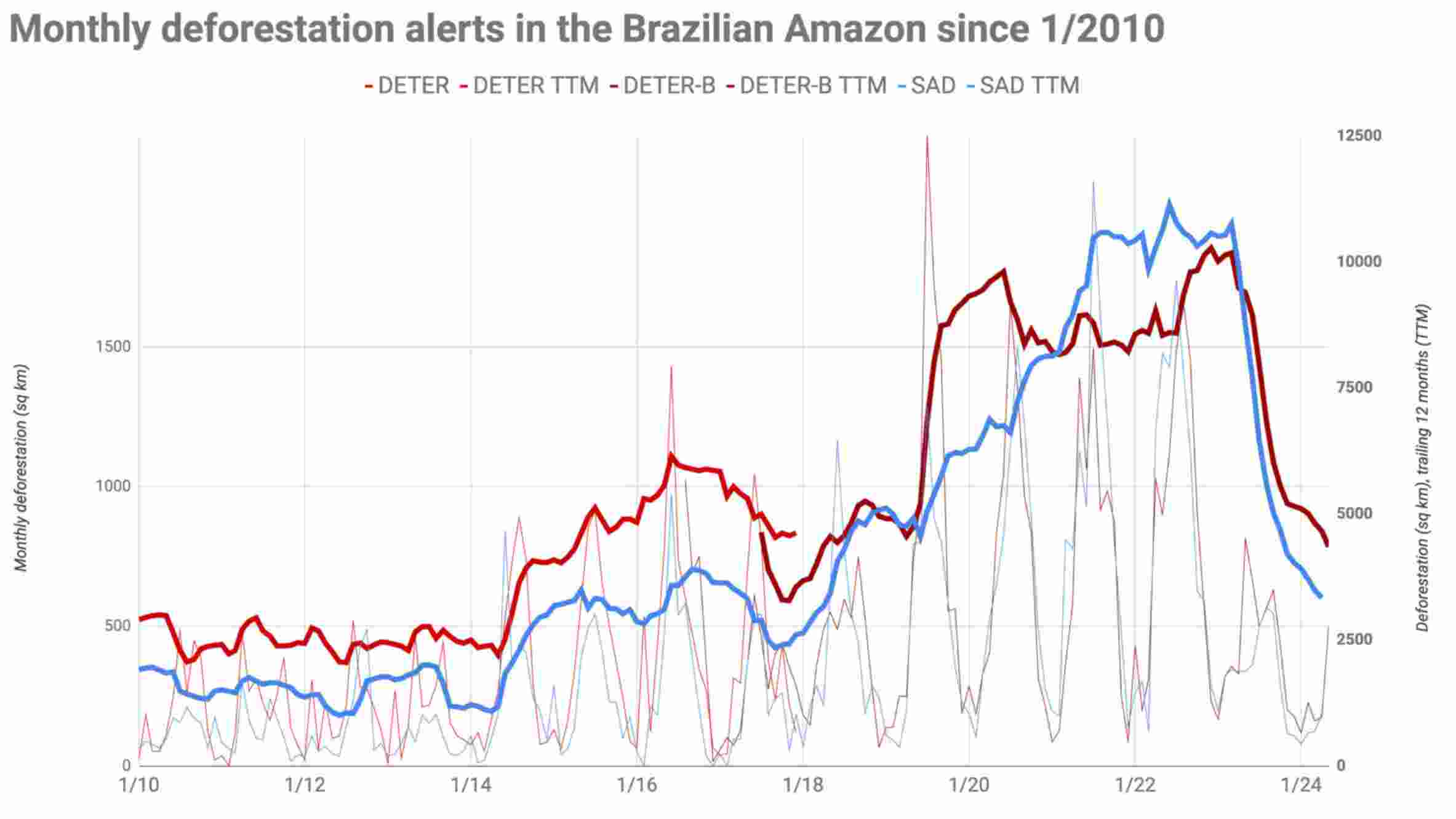
The decline in deforestation registered by DETER mirrors the trend recorded by an independent system maintained by Imazon, a Brazilian NGO. Imazon’s system is seen as a check against official data.
The alert data suggests observers should expect a sharp drop in deforestation for the 12 months ending July 31, the period Brazil uses for measuring annual deforestation. July 31 corresponds with the peak of the dry season across much of the Brazilian Amazon, when cloud cover is at a minimum, facilitating efforts to measure changes in forest cover.
For the annual assessment, Brazil uses higher resolution satellite imagery, which requires more time for analysis. In contrast, the shorter timeframe of DETER enables authorities to take action against illegal deforestation if there is interest in doing so. Data from DETER and PRODES, the annual system, have a strong correlation.
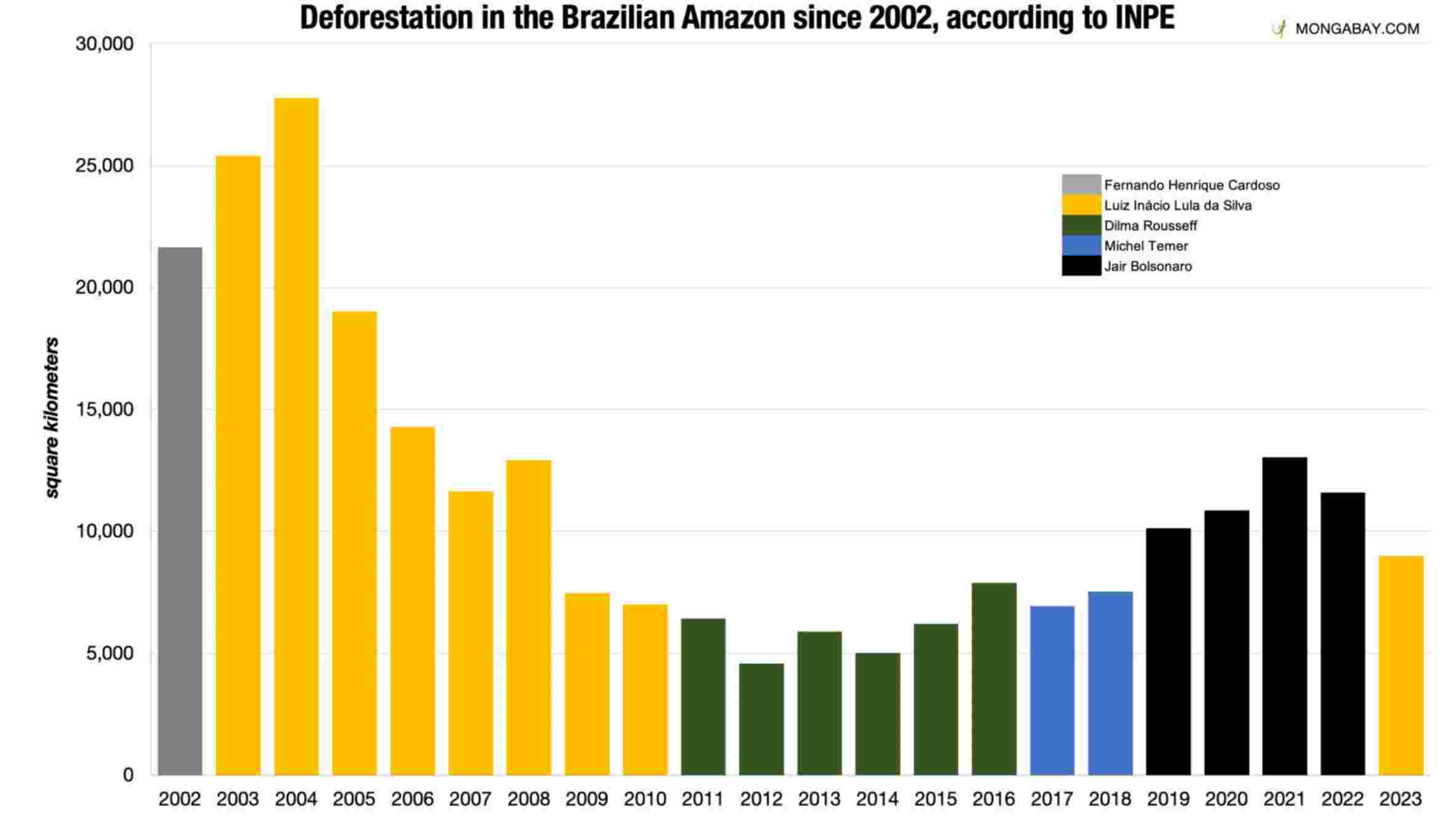
Last year, deforestation in the Brazilian Amazon amounted to 9,064 square kilometers, down 22% from 2022, and the lowest annual figure since 2018. The decline accounted for the bulk of the drop in deforestation in the Amazon as a whole, since Brazil’s portion makes up about two-thirds of Earth’s largest rainforest.
While the decline in deforestation is a positive sign for those working to protect the Amazon rainforest, a rise in forest fires corresponding with a historic drought across the region has sparked worries among conservationists.
The cumulative extent of burned area in the Amazon over the previous twelve months has reached the highest level since 2018. These burned areas are historically excluded from the deforestation tally.
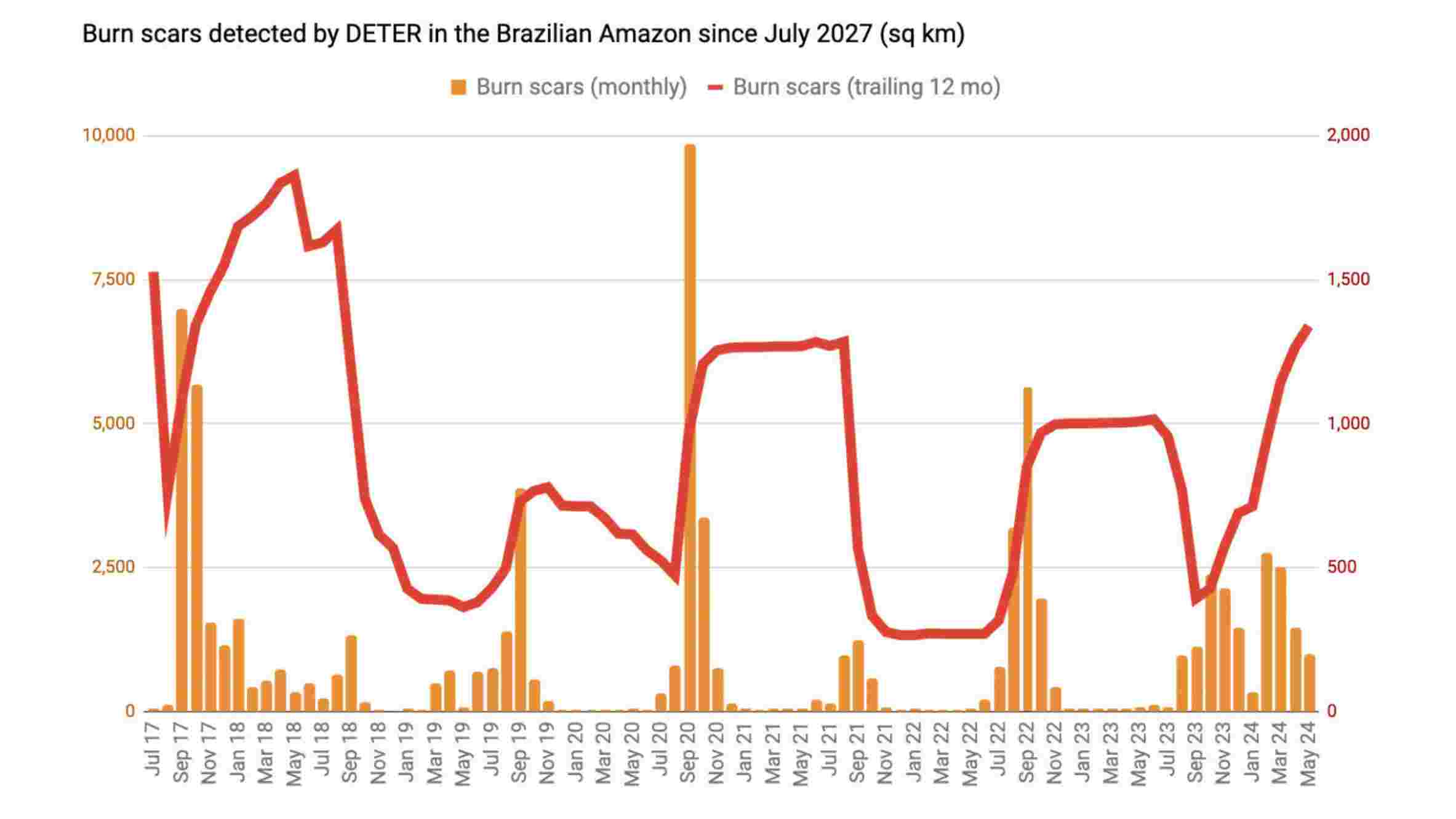
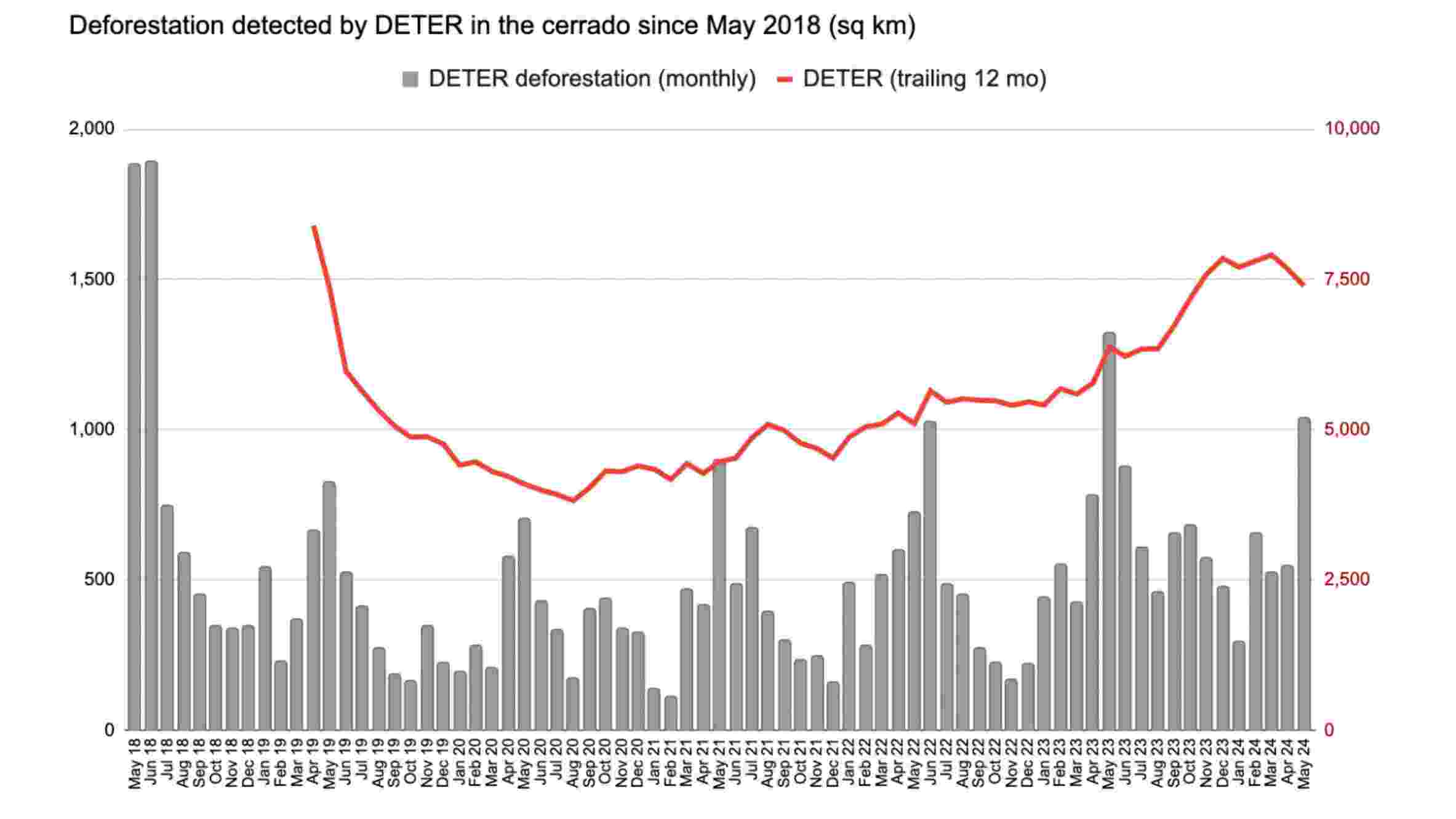
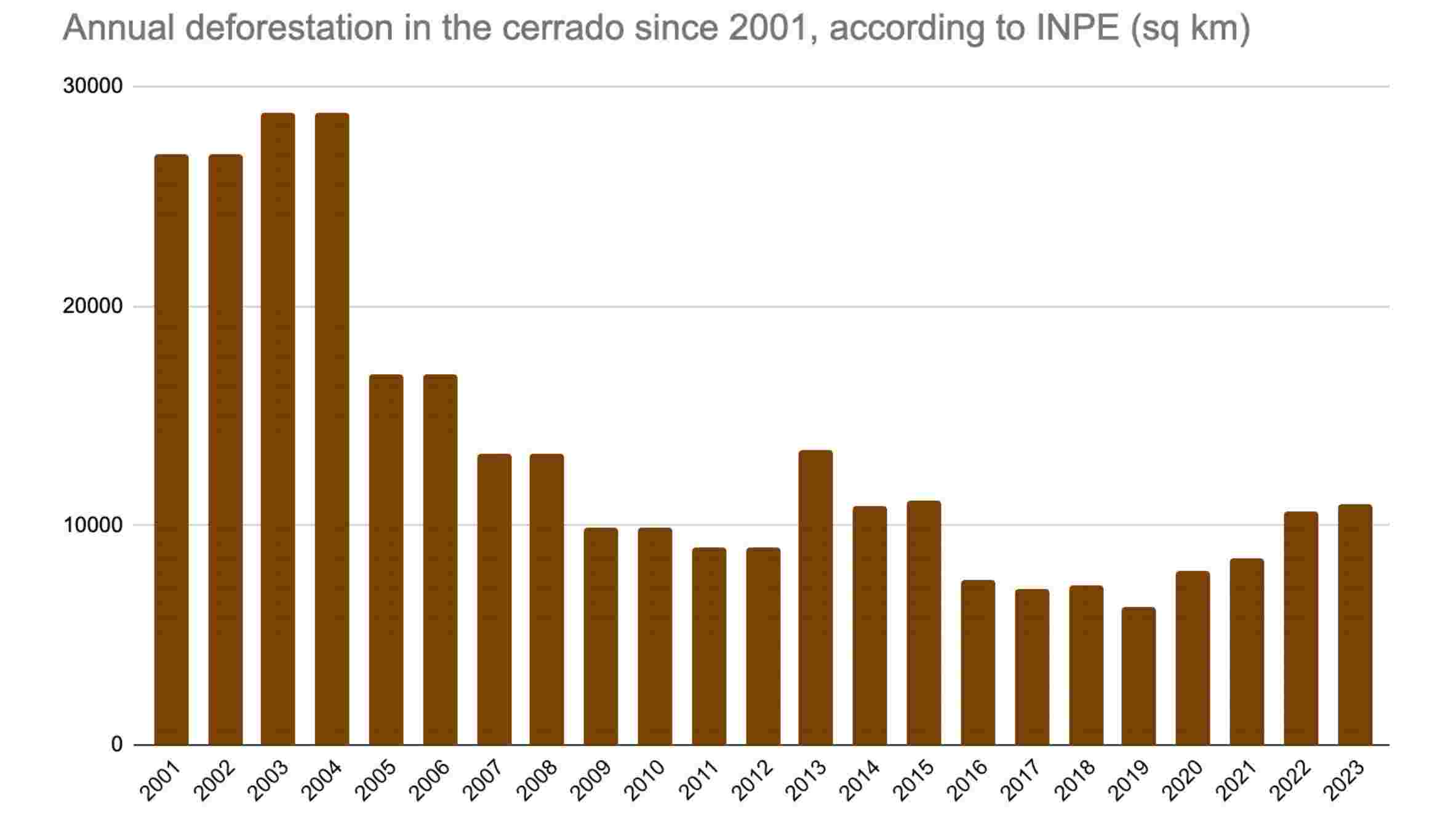
In other concerning news for environmentalists, DETER is also detecting rising deforestation in the cerrado, a dry woody savanna that borders the Amazon and is a source of rivers important to farms, ranches, and urban areas in southern South America.
Deforestation in the cerrado has reached the highest level since 2018, though it is still substantially below where it stood for most of the 2000s.
Scientists have warned that the combination of deforestation and the effects of climate change could lead to destabilization of the Amazon rainforest, prompting a vast die-off of trees across the southern and eastern parts of the region.
Such a development would affect rainfall patterns at a continental scale and trigger a widespread decline of species dependent on the rainforest ecosystem.
This article was originally published by Mongabay.
Header image: River in the Amazon rainforest. Photo by Rhett A. Butler for Mongabay.
Last night, millions of people will have tuned into Netflix and other streaming services to binge their favourite shows, including the (much anticipated) second part of Bridgerton season three.
Streaming services such as Netflix, Disney+, Stan and Prime Video have habituated us to the “all at once” series drop. And even as some services try to find ways to break the binge model, many commentators have bid farewell to the “the good old days” of appointment viewing.
Meanwhile, experts have highlighted the health concerns associated with “problematic bingeing”, including increased anxiety and depression.
But there’s an important detail missing in these conversations. And that is the fact that bingeing – the act of unrestrained and excessive indulgence – is nothing new. In fact, it exemplifies an age-old human desire to be completely immersed in story.
Far from being a new behaviour spawned by the digital age, bingeing is rooted in human history.
An ancient practice
Much like you might binge Baby Reindeer, Eric or The Walking Dead today, humans have always sought absorbing narrative experiences.
Before writing emerged, ancient oral storytelling captivated people across cultures, providing entertainment, knowledge transmission and cultural education.
Research published last year suggests Palawa Aboriginal stories from Tasmania can be traced back to events that happened 12,000 years ago, which means they may be among the oldest recorded oral stories in the world. Stories that survive hundreds of generations require constant telling and retelling.
This engagement with stories continued with the advent of written text. For millennia, large text collections has allowed immersive consumption, with examples ranging from the Panchatantra – a compilation of Indian fables dated to around 200BC – to volumes of William Shakespeare’s plays from the 1600s.
Historically, libraries, galleries and museums played a significant role in providing access to large collections of works, including books, as well as artworks and artefacts.

Eventually, the invention of the printing press revolutionised access to texts. Evidence suggests that by the 18th century, avid readers in England (that is, the upper class who could afford books) would devour novels in public or by candlelight – unable to stop until the story ended.
Literature researcher Ana Vogrinčič suggests a sort of “moral panic” emerged as the women of the time got a taste for reading:
reading in bed by the candlelight was believed to risk conflagration, while women laughing out loud over a certain scene or wobbling in emotions over another, in indecent body postures, regularly incited an offensive language, resulting in a heavily stigmatised and stereotyped image of a female novel-reader – a precursor of a modern coach potato. The reading sofa and the television couch certainly represent what 18th-century novel-reading and modern-day television-viewing seem to have in common.
Serialised literature became popular in the 19th century, with more and more writers releasing their work in instalments.
Eventually, the rise of cinema and television provided a new form of immersive storytelling. Access to home videos meant back-to-back viewing, while film screenings and double features mirrored older communal entertainment forms such as public readings and theatre attendances.

Hooked on a feeling
While bingeing has been around for as long as anyone can remember, the internet and streaming have both significantly increased our capacity for it. Perhaps this is why bingeing is framed as a modern phenomenon.
Creators must now design shows with the binge-watching model in mind, using cliffhangers, escapism and continuous arcs to encourage prolonged viewing. All of these factors (and more) combine to make a “bingeable” show.

As to why we love bingeing, this comes down to a complex interplay of emotions and brain chemistry.
Engaging with captivating stories triggers the release of dopamine, the neurotransmitter associated with pleasure, to create an addictive experience. At the same time, the human brain craves “closure”, which is something a compelling onscreen narrative will provide.
Shifting values
Bingeing today is often accompanied by feelings of guilt and unproductiveness. This seems to reflect, more than anything else, a shift in societal values regarding leisure time.
At some points in the past, prolonged engagement with stories would have been seen by certain groups as a valuable cultural activity – one that contributes to personal enrichment and social interaction.
For instance, the European Enlightenment movement of the 17th and 18th centuries encouraged people to develop a critical view of the world through as much self-education as possible. This approach to learning was thought to foster intellectual freedom and happiness, and often involved extensive engagement with written works.
Across time and cultures, humans have sought to escape reality and engage emotionally with stories. From ancient oral traditions, to modern streaming, our desire for continuous narrative consumption has remained constant.
Perhaps by recognising this historical precedent, we can come to appreciate our love of bingeing – and not feel so bad about it after all.
This article by Darius von Guttner Sporzynski from the Australian Catholic University was originally published by The Conversation.
Header image by Netflix

You’ve probably heard people say, “It’s not the heat, it’s the humidity.” There’s a lot of truth to that phrase, and it’s important to understand it as summer temperatures rise.
Humidity doesn’t just make you feel sticky and uncomfortable – it also creates extra dangerous conditions on hot days. Together, too much heat and humidity can make you sick. And in severe cases, it can cause your body to shut down.
Meteorologists talk about the risk of heat and humidity using the heat index, but it can be confusing.
I’m a risk communication researcher. Here’s what you need to know about the heat index and some better ways meteorologists can talk about the risks of extreme heat.
What is the heat index, and how is it measured?
Heat index is the combination of the actual air temperature and relative humidity:
- Air temperature is how hot or cold the air is, which depends on factors such as the time of day, season of the year and local weather conditions. It is what your thermometer reads in degrees Celsius or Fahrenheit.
- Relative humidity compares how much water vapor is in the air with how much water vapor the air could hold at that temperature. It’s expressed as a percentage.
The heat index tells you what it “feels like” outside when you factor in the humidity. For example, if it’s 98 degrees Fahrenheit (36.7 Celsius) with 55% relative humidity, it might feel more like a scorching 117 F (47.2 C).

But there’s a catch: Heat index is measured in shady conditions to prevent the sun’s angle from affecting its calculation. This means if you’re in direct sunlight, it will feel even hotter.
Apparent temperature, alerts and wet bulb
“Apparent temperature” is another term you might hear this summer.
Apparent temperature is the “feels like” temperature. It considers not only temperature and humidity but also wind speed. This means it can tell us both the heat index and wind chill – or the combination of the temperature and wind speed. When conditions are humid, it feels hotter, and when it’s windy, it feels colder.
We found that apparent temperature is even less well understood than the heat index, possibly due to the word apparent having various interpretations.

There are a few other ways you may hear meteorologists talk about heat.
Wet bulb globe temperature considers temperature, humidity, wind and sunlight. It’s especially useful for those who spend time outdoors, such as workers and athletes, because it reflects conditions in direct sunlight.
HeatRisk is a new tool developed by the National Weather Service that uses colors and numbers to indicate heat risks for various groups. More research is needed, however, to know whether this type of information helps people make decisions.
In many places, the National Weather Service also issues alerts such as excessive heat watches, warnings and advisories.
The risk is getting lost in translation
Knowing about heat and humidity is important, but my colleagues and I have found that the term heat index is not well understood.
We recently conducted 16 focus groups across the United States, including areas with dry heat, like Phoenix, and more humid areas, like Houston. Many of the people involved didn’t know what the heat index was. Some confused it with the actual air temperature. Most also didn’t understand what the alerts meant, how serious they were or when they should protect themselves.
In our discussions with these groups, we found that meteorologists could get across the risk more clearly if, instead of using terms like heat index, they focus on explaining what it feels like outside and why those conditions are dangerous.
Watches, warnings and advisories could be improved by telling people what temperatures to expect, when and steps they can take to stay safe.
Climate change is exacerbating heat risks by making extreme heat more common, intense and long-lasting. This means clear communication is necessary to help people understand their risk and how they can protect themselves.
What you can do to protect yourself
With both hot and humid conditions, extra precautions are necessary to protect your health. When you get hot, you sweat. When sweat evaporates, this helps the body cool down. But humidity prevents the sweat from evaporating. If sweat cannot evaporate, the body has trouble lowering or regulating its temperature.
Although everyone is at risk of health issues in high heat, people over 65, pregnant women, infants and young children can have trouble cooling their bodies down or may run a higher risk of becoming dehydrated. Certain health conditions or medications can also increase a person’s risk of heat-related illness, so it’s important to talk to your doctor about your risk.
Heat illnesses, such as heat exhaustion and heat stroke, are preventable if you take the right steps. The U.S. Centers for Disease Control and Prevention focuses on staying cool, hydrated and informed.
- Stay cool: Use air conditioning in your home, or spend time in air-conditioned spaces, such as a shopping mall or public library. Limit or reschedule your exercise and other outdoor plans that occur in the middle of the day when it is hottest.
- Stay hydrated: Drink more water than you might otherwise, even if you don’t feel thirsty, so your body can regulate its temperature by sweating. But avoid sugary drinks, caffeine or drinks with alcohol, because these can cause you to become dehydrated.
- Stay informed: Know the signs of heat illness and symptoms that can occur, such as dizziness, weakness, thirst, heavy sweating and nausea. Know what to do and when to get help, because heat illnesses can be deadly.

This article by Micki Olson from the University of Albany, State University of New York was originally published by The Conversation.
Header image by Jonny Kennaugh on Unsplash

In early May, as the National Audubon Society hosted its 21st annual Women in Conservation event at a swanky restaurant in Manhattan, CEO Elizabeth Gray handed out awards named after writer and conservationist Rachel Carson to recognize the next generation of women environmental leaders and activists.
But outside the event, a couple dozen of Audubon’s women staffers had gathered for a protest related to their own environmental careers.
Equipped with megaphones and wearing red union t-shirts, they held up hand-drawn signs that said things like, “CEO Gray is not an ally to women in conservation (ask her about parental leave).” Others opted for bird puns: “Owl workers deserve a fair contract.”
Their union — called the Bird Union-CWA, part of the Communications Workers of America — has been in contract negotiations with Audubon for over two years. Workers voted to unionize in September 2021 following a series of disastrous events.
In 2020, during the early days of the pandemic, the national conservation organization laid off over 100 workers.
Later that year, an investigation by Politico described a toxic workplace culture for women and people of color and the resignation of two diversity, equity and inclusion staff members.
Soon after, an internal audit — launched by the society’s board in response to the Politico reporting and conducted by the law firm Morgan Lewis — found evidence supporting the magazine’s allegation that Audubon had “a culture of retaliation, fear and antagonism toward women and people of color.”
Witnesses told the auditors that women had gotten negative performance reviews or were passed over for raises after asking for more resources. Women also pointed out significant pay disparities between themselves and men, the audit concluded.
Now, nearly three years later, union members say pay disparities remain and that union members are being left out of new benefits offered to non-union staffers like expanded paid parental leave. Meanwhile, the contract negotiations drag on.
“We are really asking for the very basic things that would allow us to survive at this organization and hopefully one day thrive,” said Sarah Friedman, a digital advertising and engagement manager with Audubon who is on the union’s organizing committee. “We want to reach a fair contract and make Audubon a better place to work and fix these problems like pay inequity.”
The union’s membership fluctuates seasonally between 252 and 260 full-time employees and accounts for a little less than a third of all staff at the Audubon Society. It primarily represents people who have jobs in conservation and science work and roles in development, finance, IT, HR and marketing. It does not include managers or executives.
In May, the union released a report about pay inequities at Audubon based on wage data provided by the organization. The analysis found that among union members, women systemically made less than men, with women of color earning the least.
In a job category that includes development, finance and marketing, for example, White men made almost 13 percent more than White women and 16 percent more than women of color. The difference in pay is similar in the job category that includes employees who do conservation and science work.
Christopher Thomas, a staff representative with CWA Local 1180, which represents the Bird Union, said that in the bargaining process, the union has sought to create pay equity across gender and race and bring transparency to how compensation works at the organization.
The union is advocating for an annual 4 percent increase across the board, he said. The union is also asking for 12 weeks of paid parental leave.
“We support across-the-board increases, and we do so because there is a mountain of historic evidence that describes that merit-based pay increases are very susceptible to bias, corruption and favoritism,” said Thomas. “We have met management half way and have included that a portion of increase be tied to merit in a number of different proposals.”

Maxine Griffin Somerville, Audubon’s chief people and culture officer, said in a statement that the union’s report is incomplete because it did not account for the salaries of non-union employees.
“It also does not account for important factors that impact compensation nor does it represent the compensation proposals that are being negotiated between Audubon and the Union right now,” she said.
Thomas said the union would welcome the data to do a pay analysis for all workers at Audubon, but needs the organization to provide it. In the meantime, union members say that discretionary raises, which are based on performance reviews and come with no guaranteed annual cost of living adjustments, lead to pay disparities over time.
Krysten Zummo, who was hired as a grassland ecologist at Audubon a year ago, said that she and a male colleague who were hired for the same job were both asked to complete self-evaluations and rank themselves on a tier that would determine their raises.
Zummo ranked herself in the middle tier because she had only worked at the organization for a few months and felt that she hadn’t yet proven her worth.
She later learned that the coworker, who had started a month later, gave himself the highest ranking.
At Audubon, Zummo said, these lower rankings directly influence what raise they are eligible for. “This is kind of how it all starts with the pay gap, the gender disparity especially,” she said. She believes a better system is one where raises are given equally to all as cost-of-living increases rather than based on merit.
A spokesperson for Audubon declined to comment on the existing pay raise system or provide details on efforts that have or are being made to address pay inequity, citing ongoing bargaining with the union.
In an emailed statement, Somerville wrote that the organization has made significant investments in compensation for all staff, including updating the way decisions are made so that they are “based fully on the job requirements and blind to individual candidates.”
The union is also fighting to increase paid parental leave. In 2021, that was just two weeks. Last year, Audubon enhanced its benefits package for non-union employees, who now receive six weeks of parental leave. But it didn’t change it for union members.
In October, the National Labor Relations Board issued a complaint, finding that the Audubon Society had “bargained in bad faith or violated the rights of their union employees” in four different cases brought by the union.
National labor law bars discriminating against employees as a way to encourage or discourage union membership – and rolling out benefits to Audubon employees that weren’t offered to union members violated that law, the board concluded.
The limited paid parental leave time affects union members who are thinking of starting families, said Friedman, who has worked at the organization for 10 years and been involved in the union since the start.
“I turn 34 in a couple of weeks. My husband and I aren’t sure if we want to have kids, but a major reason we are putting off the decision is because I work at Audubon,” she said. “I could never imagine having a child while working here under these policies.”
In her statement to The 19th, Sommerville pointed to a new strategic plan adopted last year to implement equity, diversity, inclusion and belonging at the nonprofit. The organization also announced a commitment of $25 million to the work; she declined to provide details.
She also said that Audubon has made changes in the executive leadership team, with women now making up a greater proportion of leadership than in the past.
“Our entire leadership team is wholly committed to this work so that Audubon is a best-in-class workplace where all staff thrive regardless of gender, race, age or ability,” she wrote.
The Bird Union’s effort is part of a broader trend in environmental organizations, with Greenpeace USA forming a union in 2020 and Defenders of Wildlife following in 2021.
Reflected in that shift is a desire to see gender equity in a field that, like so many others, was historically led by White men.
More women now lead these nongovernmental organizations, according to Green 2.0’s transparency report card, which analyzes employee data from environmental groups.
During an interview late last month, Thomas, the staff rep for the Bird Union, said that in recent weeks, the organization has shown signs of being more receptive to requests put forward by the union. Because of that, he’s hopeful both sides will be able to reach a deal soon.
“I think they want there to be a contract at Audubon and everyone to be able to focus on the work at Audubon,” he said. “It is also a signal for the other environmental organizations that it is really in everyone’s best interest to get to a deal and have everyone focus on the mission.”
This story was originally published by The 19th and was republished with permission.
Header image by CWA Local 1180
As the world struggles to decarbonize, it’s becoming increasingly clear we’ll need to both rapidly reduce emissions and actively remove carbon dioxide (CO₂) from the atmosphere. The latest Intergovernmental Panel on Climate Change report considered 230 pathways to keep global warming below 1.5°C. All required CO₂ removal.
Some of the most promising CO₂ removal technologies receiving government funding in the United States, United Kingdom, and Australia seek to increase the massive carbon storage potential of the ocean. These include fertilizing tiny plants and tweaking ocean chemistry.
Ocean-based approaches are gaining popularity because they could potentially store carbon for a tenth of the cost of “direct air capture”, where CO₂ is sucked from the air with energy-intensive machinery.
But the marine carbon cycle is much harder to predict. Scientists must unravel the many complex natural processes that could alter the efficiency, efficacy, and safety of ocean-based CO₂ removal before it can go ahead.
In our new research, we highlight a surprisingly important mechanism that had previously been overlooked.
If CO₂ removal techniques change the appetite of tiny animals at the base of the food chain, that could dramatically change how much carbon is actually stored.
Plankton dominate the carbon pump
Tiny marine life forms called plankton play a huge role in ocean carbon cycling. These microscopic organisms drift on the ocean currents, moving captured carbon throughout the seas.
Like plants on land, phytoplankton use sunlight and CO₂ to grow through photosynthesis.
Zooplankton, on the other hand, are tiny animals that mostly eat phytoplankton. They come in many shapes and sizes. If you put them in a lineup, you might think they came from different planets.
Across all this diversity, zooplankton have very different appetites. The hungrier they are, the faster they eat.
Uneaten phytoplankton – and zooplankton poo – can sink to great depths, keeping carbon locked away from the atmosphere for centuries. Some even sink to the seafloor, eventually transforming into fossil fuels.
This transfer of carbon from the atmosphere to the ocean is known as the “biological pump”. It keeps hundreds of billions of tonnes of carbon in the ocean and out of the atmosphere. That translates to about 400ppm CO₂ and 5°C of cooling!
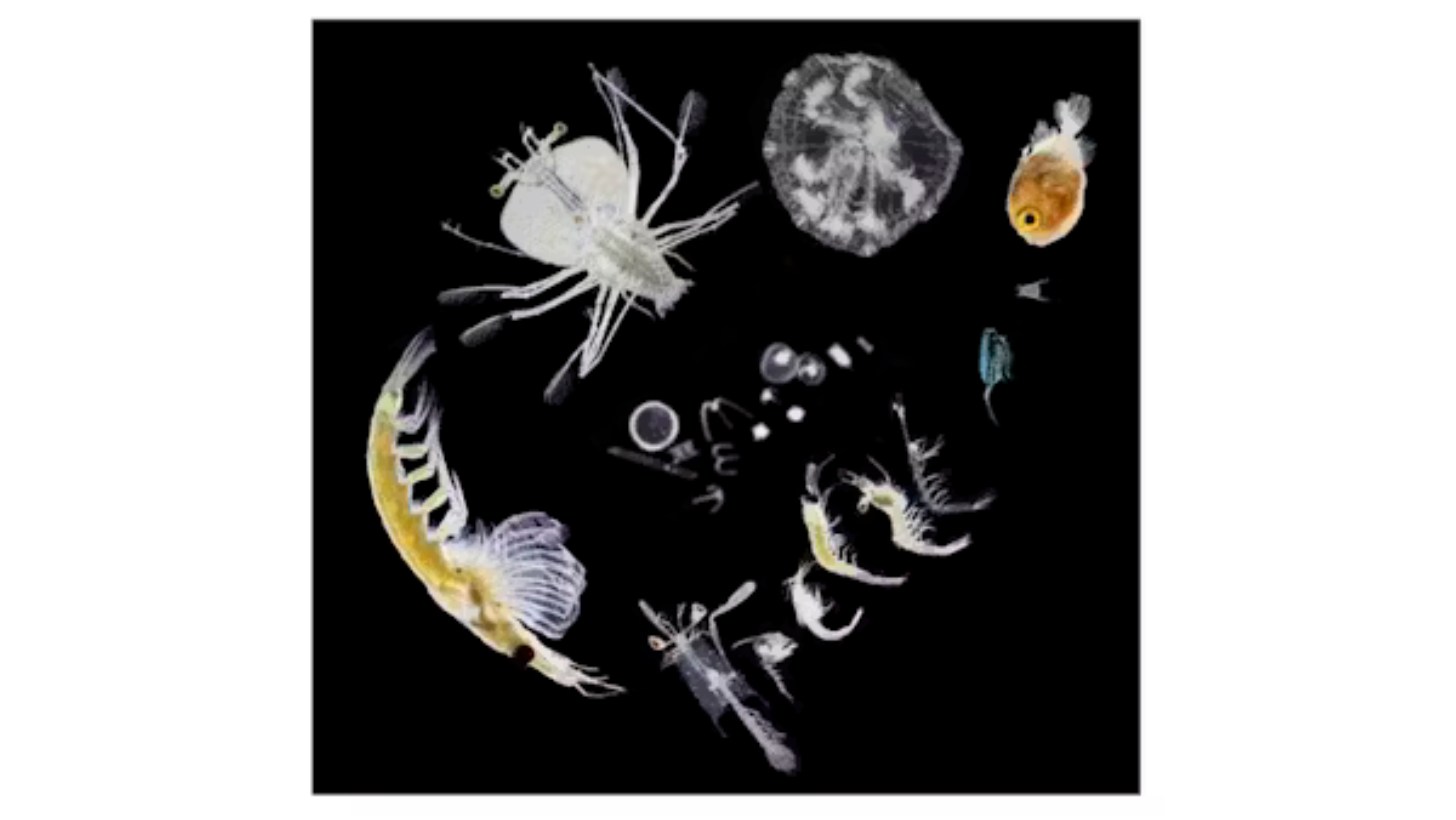
Picky eaters
In our new research we wanted to better understand how zooplankton appetites influence the biological pump.
First we had to work out how zooplankton appetites differ across the ocean.
We used a computer model to simulate the seasonal cycle of phytoplankton population growth. This is based on the balance of reproduction and death. The model simulates reproduction really well.
Zooplankton appetites largely determine the death rate. But the model’s not so good at simulating death rates, because it doesn’t have enough information about zooplankton appetites.
So we tested dozens of different appetites and then checked our results against real-world data.
To get global observations of phytoplankton seasonal cycles without a fleet of ships, we used satellite data. This is possible even though phytoplankton are tiny, because their light-catching pigments are visible from space.
We ran the model in more than 30,000 locations and found zooplankton appetites vary enormously. That means all those different types of zooplankton are not spread evenly across the ocean. They appear to gather around their favorite types of prey.
In our latest research, we show how this diversity influences the biological pump.
We compared two models, one with just two types of zooplankton and another with an unlimited number of zooplankton – each with different appetites, all individually tuned to their unique environment.
We found including realistic zooplankton diversity reduced the strength of the biological pump by a billion tonnes of carbon every year. That’s bad for humanity, because most of the carbon that doesn’t go into the ocean ends up back in the atmosphere.
Not all of the carbon in the bodies of the phytoplankton would have sunk deep enough to be locked away from the atmosphere. But even if only a quarter did, once converted to CO₂ that could match annual emissions from the entire aviation industry.
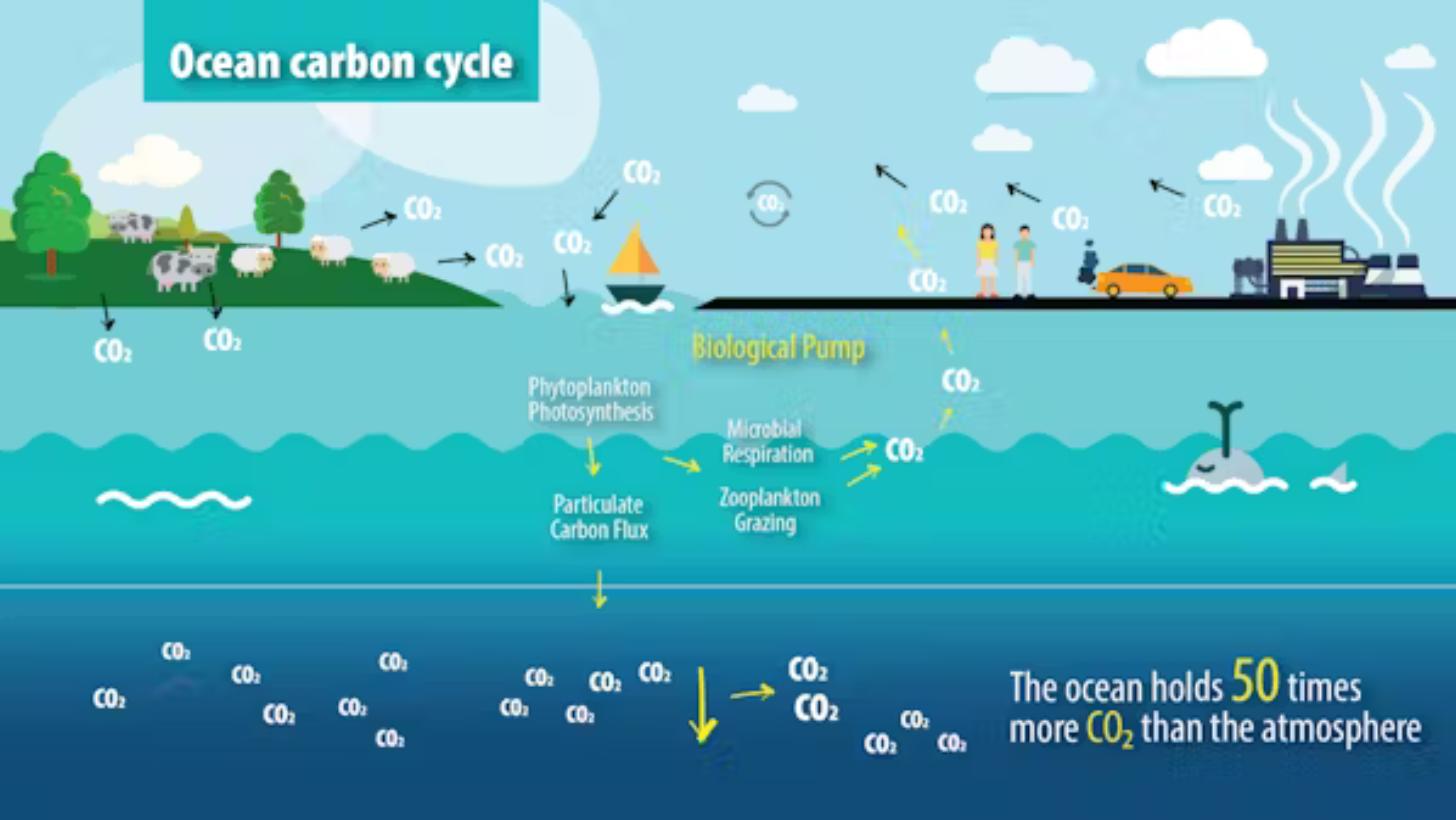
The ocean as a sponge
Many ocean-based CO₂ removal technologies will alter the composition and abundance of phytoplankton.
Biological ocean-based CO₂ removal technologies such as “ocean iron fertilization” seek to increase phytoplankton growth. It’s a bit like spreading fertilizer in your garden, but on a much bigger scale – with a fleet of ships seeding iron across the ocean.
The goal is to remove CO₂ from the atmosphere and pump it into the deep ocean. However, because some phytoplankton crave iron more than others, feeding them iron could change the composition of the population.
Alternatively, non-biological ocean-based CO₂ removal technologies such as “ocean alkalinity enhancement” shift the chemical balance, allowing more CO₂ to dissolve in the water before it reaches chemical equilibrium. However, the most accessible sources of alkalinity are minerals including nutrients that encourage the growth of certain phytoplankton over others.
If these changes to phytoplankton favor different types of zooplankton with different-sized appetites, they are likely to change the strength of the biological pump. This could compromise – or complement – the efficiency of ocean-based CO₂ removal technologies.
Moving forward from a sea of uncertainty
Emerging private-sector CO₂ removal companies will require accreditation from reliable carbon offset registries. This means they must demonstrate their technology can:
- remove carbon for hundreds of years (permanence)
- avoid major environmental impacts (safety)
- be amenable to accurate monitoring (verification).
Cast against a sea of uncertainty, the time is now for oceanographers to establish the necessary standards.
Our research shows CO₂ removal technologies that change phytoplankton communities could also drive changes in carbon storage, by modifying zooplankton appetites. We need to better understand this before we can accurately predict how well these technologies will work and how we must monitor them.
This will require tremendous effort to overcome the challenges of observing, modeling, and predicting zooplankton dynamics. But the payoff is huge. A more reliable regulatory framework could pave the way for a trillion-dollar, morally imperative, emerging CO₂ removal industry.
This article by Tyler Rohr from the University of Tasmania and Ali Mashayek and Sophie Meyjes from the University of Cambridge was originally published by The Conversation.
Header image by ESA (CC BY-SA)

Australia contains some of the world’s most biologically diverse and carbon-dense native forests.
Eucalypts in wet temperate forests are the tallest flowering plants in the world and home to an array of unique tree-dwelling marsupials, rare birds, insects, mosses, fungi and lichen, many of which have not even been catalogued by scientists.
Yet our country remains in the top ten list globally for tree cover loss, with almost half of the original forested areas in eastern Australia cleared.
This loss has been devastating for Australia’s native plants and animals and contributes to global warming through vast amounts of carbon emissions. The global biodiversity and climate change crises are inextricably linked — we cannot solve one without the other.
Earth’s ecosystems, such as forests, coastal wetlands and tundra, contain enormous amounts of carbon. But deforestation and degradation by humans is likely to send global warming past 1.5°C, even if we achieve net-zero fossil fuel emissions.
Protecting native forests is a critical way to prevent emissions, which must be achieved in parallel with a rapid transition to clean energy.
What is being overlooked in current international climate policy under the Paris Agreement is the crucial role of biodiversity in maintaining healthy ecosystems and their integrity, which keeps carbon stored in forests, not the atmosphere.
Healthy ecosystems are more stable and resilient, with a lower risk of trees dying and lower rates of carbon emissions.
The way we currently count carbon stores risk creating incentives to plant new trees rather than protect existing forests.
Yet old-growth forests store vastly more carbon than young saplings, which will take decades or even centuries to reach the same size.
On January 1 this year, both Victoria and Western Australia ended native forest logging in state forests.
This is a good start. But the rest of Australia is still logging native forests.
Extensive land clearing continues for agriculture and urban development, as well as native forest harvesting on private land.
Two states down, more to go
The end of native timber logging in two states is a chance for new approaches to our forests, which recognize the contribution of biodiversity to healthy forest ecosystems, as well as endangered species protection and clean water supplies.
Ending native forest logging isn’t entirely simple. In Victoria, consultation on the future of state forests is ongoing. The Victorian Environmental Assessment Council is due to release its final recommendations in July.
The Victorian government has also put in place a Forestry Transition Program to help forest contractors find alternative work in forest and land management. Some of these transition programs are proving controversial.
In Western Australia, around 2.5 million hectares of the state’s south-west forests will be protected under a new Forest Management Plan. Protection of these landscapes is critical, as they have been hit by another die-back event due to drought and record heat.
These forests hold significant cultural and ecological value. Known in Noongar as “djarilmari”, they are vital habitats for diverse plants and animals, including endemic species such as the ngwayir (western ringtail possum) and the giant jarrah trees.
What about other states and territories?
In New South Wales, the government is looking into proposals for a Great Koala National Park, which would bring together state forests from the Clarence Valley to south of Coffs Harbor. But with no decision yet made, logging continues along both the north and south coasts, which were also hard hit by the Black Summer bushfires of 2019-20.
In Tasmania, native forest logging fell sharply between 2012 and 2019. This cut emissions by around 22 million tons of carbon dioxide equivalent per year, equivalent to almost a quarter of Australia’s transport emissions.
Recent policy changes protecting giant trees will help protect some patches of forests. But native forest logging is set to expand in other areas, including clear felling of old-growth rainforest and tall wet eucalypt forest.
Native forest logging is slated to end in 70,000 hectares of south-east Queensland state forests at the end of this year, under a longstanding Native Timber Action Plan.
But logging and widespread land clearing continues elsewhere in the state, ensuring Australia’s place in the top 10 deforestation hotspots.
Can ending native forest logging help the climate?
We’ll need to go further and ban logging in all native forests in Australia to help meet our net-zero emissions target, while meeting timber demand from better-managed and increased plantations.
Stopping native forest logging avoids the emissions released when forests are cut and burned. It would also allow continued forest growth and regrowth of previously logged areas, which draws down carbon from the atmosphere and increases the amount held in the forest ecosystem.
The natural biodiversity of our native forests makes them more resilient to external disturbances such as climate change. These forests have larger and more stable carbon stocks than logged areas, newly planted forests and plantations.
If we compare forests protected for conservation with those harvested for commodity production in the Victorian Central Highlands, research shows conservation delivers the greatest climate benefits through continued forest growth and accumulating carbon stocks.
There are growing calls to create the Great Forests National Park to the north and east of Melbourne, which would protect a further 355,000 hectares and more than double protected forests in the Central Highlands.
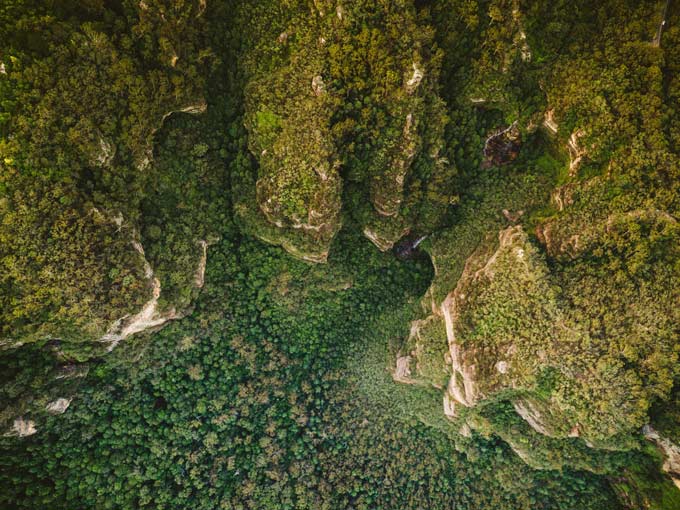
Net zero: deep, rapid, sustained cuts needed
The world’s nations are aiming to reach “net zero” by mid-century. Meeting this target will require deep and rapid cuts in carbon dioxide emissions as well as pulling carbon out of the atmosphere into land sinks, especially forests.
The land sector is unique in that it can be both a source (logging, agriculture) and a sink (forest regrowth, for instance) for carbon. The natural way forests take up carbon can be increased through natural regrowth or plantations.
Unfortunately, the current approach, based on IPCC guidelines, to counting this type of natural carbon storage can lead to perverse outcomes.
The carbon sink from forest regrowth only counts towards the “removals” part of net zero when it results from changes we make, such as ending native forest logging. It doesn’t count if it’s regrowth after a natural event such as a bushfire. It’s important to count only human-induced changes in our climate targets.
Tree planting, on the other hand, can be counted towards net-zero targets, despite the fact that newly planted trees will take centuries to sequester as much carbon as found in an old-growth forest.
This type of accounting — known as flow-based accounting — can mean a premium is placed on planting and maintaining young forests with high carbon uptake rates, overlooking the substantial benefits of protecting larger trees in native forests.
That is, this approach favors carbon sequestration (the process of taking carbon out of the atmosphere and storing it in wood) over carbon storage (the total carbon stocks already contained in a forest).
A comprehensive approach to forest carbon accounting would recognize both flows of carbon (as sequestration) and carbon stocks (as storage) contribute to the benefits that native forests offer for reducing emissions.
Carbon accounting needs more clarity
This becomes a problem when forests and fossil fuels are included in a net accounting framework, such as the one used in Australia’s national greenhouse gas inventory.
In net accounts, emissions (from fossil fuel and land sectors) within a year are added to removals, which includes the sequestration of carbon into forests and other ecosystems.
Because this type of accounting only counts the flows of carbon — not existing stocks — it omits the climate benefits of protecting existing forests, whose stored carbon dwarfs the amount Australia emits from fossil fuels each year.
But if we separated out targets for the fossil fuel and land sectors, we could properly treat forest carbon stocks as an asset, giving us incentives to protect them.
Another problem with net accounting is it treats all carbon as equivalent, meaning a ton of carbon sequestered in trees compensates for a ton of carbon from burned fossil fuels. This has no scientific basis.
Carbon dioxide emissions are effectively permanent, as the buried carbon we dig up and burn stays in the atmosphere for millennia, while carbon in trees is temporary in comparison.
As trees grow, their carbon storage compensates for earlier logging and clearing emissions, which is an important climate benefit. But we’re not comparing apples and apples — forest carbon doesn’t compensate for fossil fuel emissions.
Logging bans are important — but no substitute for ending oil and gas
While ending the clearing and logging of native vegetation is vital for both climate and biodiversity, it’s no substitute for preventing emissions from fossil fuels.
To make this clearer, we must urgently set separate targets for emissions cuts for fossil fuels and increased carbon removal in the land sector.
This will ensure phasing out fossil fuel use is not delayed by planting trees, and that the carbon stocks of biodiverse and carbon-dense native forests are protected.
This article by Kate Dooley, from The University of Melbourne, was originally published by The Conversation.
Header photo of Yabbra State Forest in northern New South Wales, Australia courtesy of Harley Kingston (CC BY-NC 2.0)

It’s no secret that most cities — and even small towns — across the U.S. are built with cars in mind.
But as of 2024, over 2 million American adults do not have access to a car.
“Nothing radicalizes you faster against the car-dependent nature of America, than going to a walkable European city,” TikTok creator Zaid Leppelin said last summer. “I’m in Amsterdam right now, and I could cry over how bike and pedestrian-friendly this city is.”
Biking has been proven to better both mental and physical health, while of course, saving the environment.
But bike lanes and paths do even more than that: they also close the gap between households of all economic backgrounds.
They connect people not just to the beauty of local parks and nature reserves but to vital resources that would otherwise only be accessible by cars or public transportation — like grocery stores, laundromats, banks, and hardware stores.
That’s why PeopleForBikes was created. The nonprofit is rooted in accelerating the infrastructure of bikeways, advancing pro-bike policies in government, and reducing barriers to access through community outreach.
“You can truly see PeopleForBikes’ vision in action with the release of our annual city ratings,” Jenn Dice, PeopleForBikes president and CEO, said to Bike Mag.
“We are committed to creating an environment where more people ride bikes more often and the U.S. is the best place in the world to ride a bike.”
On June 25, the nonprofit released their city ratings for 2024, evaluating cities — small, medium, and large — by six factors that ensure that common destinations “are accessible by safe, comfortable bike routes” that serve bikers “of all ages and abilities.”
The higher the score, from zero to 100, the better the bikeability.
The factors involved in measuring a city’s bikeability include: safe speeds, amount of protected bike lanes, connections to vital destinations, reallocated spaces, intersection treatments, and data reliability.
It’s important to note the progress that’s been made in bikeability, too. In the organization’s 2019 rankings, only 32 U.S. cities scored 50 or higher. Fast forward to today, 33 cities that scored below 50 in 2019 surpassed the 50-point mark in 2024. In total, 183 U.S. cities scored 50 and over in 2024.
Here’s how American cities measure up, based on their population size (over 300k, 50k to 300k, less than 50k).
Top 50 large US cities, ranked by bikeability
- Riverside, California - 20
- Santa Ana, California - 20
- Virginia Beach, Virginia - 21
- Raleigh, North Carolina - 21
- Mesa, Arizona - 22
- Stockton, California - 22
- Newark, New Jersey - 23
- Lexington, Kentucky - 23
- Oklahoma City, Oklahoma - 24
- Miami, Florida - 24
- New Orleans, Louisiana - 25
- Cincinnati, Ohio - 25
- Los Angeles, California - 25
- Orlando, Florida - 26
- Nashville, Tennessee - 26
- Columbus, Ohio - 27
- Tulsa, Oklahoma - 28
- Phoenix, Arizona - 29
- Kansas City, Missouri - 29
- Atlanta, Georgia - 30
- Pittsburgh, Pennsylvania - 30
- Charlotte, North Carolina - 30
- Henderson, Nevada - 31
- Irvine, California - 31
- Cleveland, Ohio - 31
- Albuquerque, New Mexico - 32
- San Diego, California - 32
- Baltimore, Maryland - 33
- San Jose, California - 33
- Boston, Massachusetts - 34
- Austin, Texas - 34
- Sacramento, California - 34
- Omaha, Nebraska - 36
- Aurora, Colorado - 37
- Tucson, Arizona - 39
- Colorado Springs, Colorado - 40
- San Juan, Puerto Rico - 41
- Detroit, Michigan - 43
- Long Beach, California - 43
- Oakland, California - 45
- Washington, District of Columbia - 46
- Denver, Colorado - 46
- Milwaukee, Wisconsin - 46
- New York, New York - 56
- Philadelphia, Pennsylvania - 58
- Portland, Oregon - 59
- St. Paul, Minnesota - 61
- San Francisco, California - 64
- Seattle, Washington - 65
- Minneapolis, Minnesota - 71
Top 50 medium US cities, ranked by bikeability
- Iowa City, Iowa - 44
- New Brunswick, New Jersey - 44
- Council Bluffs, Iowa - 44
- Flagstaff, Arizona - 44
- Petaluma, California - 44
- Coeur D'Alene, Idaho - 45
- Apple Valley, California - 45
- Elizabeth, New Jersey - 45
- Eden Prairie, Minnesota - 45
- Ann Arbor, Michigan - 46
- Alameda, California - 47
- Missoula, Montana - 47
- Woodbury, Minnesota - 47
- Broomfield, Colorado - 47
- Bozeman, Montana - 47
- Miami Beach, Florida - 47
- Santa Barbara, California - 48
- Rapid City, South Dakota - 49
- The Woodlands, Texas - 49
- Logan, Utah - 50
- Maple Grove, Minnesota - 50
- Aurora, Illinois - 50
- Fayetteville, Arkansas - 50
- Chico, California - 51
- Eau Claire, Wisconsin - 51
- Woodland, California - 52
- Salt Lake City, Utah - 52
- Arlington, Virginia - 53
- Fort Collins, Colorado - 54
- Carmel, Indiana - 55
- Palo Alto, California - 55
- Fargo, North Dakota - 55
- Bloomington, Indiana - 56
- Plainfield, New Jersey - 57
- Longmont, Colorado - 57
- Somerville, Massachusetts - 58
- West Des Moines, Iowa - 58
- Madison, Wisconsin - 60
- Grand Forks, North Dakota - 61
- La Crosse, Wisconsin - 61
- Santa Monica, California - 61
- Hoboken, New Jersey - 62
- Anchorage, Alaska - 64
- Ames, Iowa - 66
- Boulder, Colorado - 70
- Corvallis, Oregon - 70
- Ankeny, Iowa - 70
- Berkeley, California - 71
- Cambridge, Massachusetts - 72
- Davis, California - 78
Top 50 small US cities, ranked by bikeability
- Sanibel, Florida - 64
- Monona, Wisconsin - 64
- Whitefish Bay, Wisconsin - 64
- Davenport, California - 65
- Ludington, Michigan - 65
- Glenbrook, Nevada - 65
- Fayette, Alabama - 65
- Soldotna, Alaska - 66
- Lake Geneva, Wisconsin - 67
- Marshfield, Wisconsin - 67
- Balltown, Iowa - 67
- Traverse City, Michigan - 67
- Key West, Florida - 68
- Chautauqua, New York - 68
- Sonoma, California - 69
- Marquette, Michigan - 69
- Ojai, California - 69
- Point Arena, California - 69
- Oberlin, Ohio - 69
- Rogers City, Michigan - 69
- Port Townsend, Washington - 70
- Ocean City, New Jersey - 70
- Hustisford, Wisconsin - 71
- Jackson, Wyoming - 72
- Jersey Shore, Pennsylvania - 73
- Ashland, Oregon - 73
- Valdez, Alaska - 74
- Bluffton, Ohio - 75
- Aspen, Colorado - 75
- St. Marys, Ohio - 76
- Emerald Isle, North Carolina - 76
- Shorewood, Wisconsin - 76
- Thompsonville, Michigan - 77
- Carroll, Iowa - 78
- Tabor, South Dakota - 79
- Fayette, Missouri - 80
- Winnett, Montana - 80
- Woodland, Mississippi - 81
- Ashland, Wisconsin - 81
- Watford City, North Dakota - 82
- Sewanee, Tennessee - 83
- Murdock, Nebraska - 84
- Blue Diamond, Nevada - 85
- Crested Butte, Colorado - 87
- Fort Yates, North Dakota - 88
- Springdale, Utah - 89
- Washburn, Wisconsin - 89
- Harbor Springs, Michigan - 92
- Provincetown, Massachusetts - 96
- Mackinac Island, Michigan - 99
Header photo courtesy of Maixent Viau
Noah Kahan appeared on stage just outside of Denver, Colorado as sardonic and heartfelt as he does in his songs.
“Unfortunately we couldn’t fit all my generational trauma up here on stage,” he quipped before a set change that looked like his family’s living room from Strafford, Vermont.
Kahan has been touring his best-selling record “Stick Season” for over 200 shows (“We’re really milking this thing,” he said on stage). But the songs — many of which confront issues like depression, family trauma, substance abuse, and even the isolation of the COVID-19 pandemic — remain fresh for fans.

“I listen to his music every single day,” a fan, Katie Lowe, told Good Good Good at the June 25 show in Denver. “It can always be fitting. There are struggles in his songs, but somehow the music sounds upbeat. If you’re happy, it’ll go with your mood. But if you’re sad, it can offer some advice.”
What most fans might not be aware of, however, is that Kahan hopes to offer more than a soundtrack to their mental health journeys.
Behind The Busyhead Project
Last year, Kahan launched The Busyhead Project, a fundraising initiative housed under the Vermont Community Foundation that provides grant money to community organizations across the country helping to provide access to mental health support.
The goal was to raise $1 million for mental health in one year. But within the first 12 months of the project’s existence, it hit the $2 million mark.
These funds come from a portion of ticket sales, direct donations from fans, and offerings like livestream tickets to sold-out concerts that can be watched from anywhere in the world.

In its first year, Busyhead provided grants to organizations Bring Change to Mind, Jack.org, Oasis Center, Project Venture, Rural Behavioral Health Institute, Upper Valley Haven, and more.
According to an annual report, not all $2 million has been distributed yet, but a little over a quarter of those funds have been shared among more than 55 organizations in North America.
“These partners were selected by Noah for their commitment to mental health awareness, with an emphasis on local impact by providing access to resources,” a press release announcing The Busyhead Project shared.
These groups reach specific communities that have historically been unable to access mental health resources.
Project Venture, for instance, works with Indigenous youth to build healthy lifestyles by connecting to culturally-significant adventures in the outdoors.
Or there’s the Rural Behavioral Health Institute, which works in Montana schools to provide universal mental health screenings for middle and high school youth. After they identify students who may need mental health support, the nonprofit helps them access quality care.
Hand-selected local mental health nonprofits are invited to come to Kahan’s shows to raise awareness about their work and receive an accompanying donation when he visits their cities, as well.
In 2023, Dallas-based Foundation 45 used Busyhead funding for its 95 support groups, which helped provide comprehensive care to 1,140 community members for free. Similarly, We Are Family in Charleston, South Carolina utilized funds to provide 1,370 hours of LGBTQ+ affirming mental health sessions to 103 youth.
From Vermont to the world stage
While a significant portion of these funds go back into the communities Kahan visits, a major motivating factor behind The Busyhead Project is to keep the singer connected to his New England roots.
“The Upper Valley Haven serves more than 10,000 individuals annually through food, shelter, service coordination, and clinical problem solving,” one of Kahan’s Vermont nonprofit partners shared in a statement. “This donation provides significant support that will allow Haven staff to help so many vulnerable members of our community. We are proud that Noah grew up in the Upper Valley and continues to support the work the Haven has done since 1980.”
In September, Kahan will play a benefit concert in Essex Junction, Vermont for mental health.

“It’s such an honor to play in my home state and help raise money and awareness for something that is so special to me,” Kahan wrote on Instagram.
Tickets for the benefit concert were sold through a lottery system, since demand for his live performances has skyrocketed with the success of hits like “Stick Season,” “Northern Attitude,” and “You’re Gonna Go Far.”
On Friday, June 27, Kahan will release a new track, performed as a duet with country star Kelsea Ballerini, called “Cowboys Cry Too.” In a snippet, Kahan sings “I grew up wishing I could close off the way my dad did, ‘cause that man never felt a damn thing he didn’t wanna feel.”
Mental health in rural communities
The openness in Kahan’s lyrics is not always the norm in rural communities, even though he has gone on record saying mental health topics were “dinner table conversations” in his own home growing up.
According to Mental Health America, fear of negative judgment for “appearing weak” often keeps people from seeking mental health help in rural areas — especially those dominated by notoriously stressful industries like farming or manufacturing.
Kahan’s hometown of Strafford, Vermont has a population about ten times smaller than the average venue he plays. And, like other rural communities in the U.S., sees a much higher suicide rate compared to large urban communities.
Small, close-knit communities also make for a lack of privacy, making it hard for people to feel like their personal matters can be kept confidential. Unfortunately, these areas also lack mental health professionals. In fact, 65% of rural counties do not have a psychiatrist or other behavioral health professionals.
Rural communities also contend with limited access to affordable and reliable internet, making it even more challenging to search for information or connect to telehealth services.
Offering grants to local organizations that help those most in need is just one way Kahan is doing his part to make an impact beyond his music — in towns just like the one that raised him.
Fighting stigma through fan communities
Knowing how isolating rural communities can be, another core component of The Busyhead Project is to destigmatize talking about mental health by connecting with others.
At Kahan’s shows, The Busyhead Project sets up a table or tent alongside other community partners and encourages fans to contribute to a “community wall,” where they answer prompts like “I take care of my mental health by…” or “I showed up for myself today by…”

“Some of the fans who have been with Noah since the beginning and have been following on Instagram already know [about The Busyhead Project], but it’s really fun to explain it to the audience,” Busyhead’s coordinator on tour, Lindsay Rosenberg, told Good Good Good in Denver.
“His audience is so open to talking about mental health… and I’ve found that really surprising and fantastic. People are coming up to us, asking a lot of questions, and choosing to write their own stories.”
Fans can also interact more deeply and give donations through Propeller, a digital platform that connects fans to their favorite artists and causes, to earn points that help them win exclusive prizes, like concert tickets, meet and greets, merch, and more.

“The number of actions — over 33,000 — directly reflects fans doing things like donating, watching videos from Noah talking about his mental health struggles, downloading meditation apps, even getting a mental health certificate, and more,” Annie Flook, Propeller’s director of artist partnerships, explained.
“We just finished a campaign where fans could take action on Propeller to win a flyaway to see Noah at his sold-out Fenway Park show in Boston. To add, every night on tour, we offer the chance to win ticket upgrades, or signed setlists for supporting The Busyhead Project.”
Music as a means to healing
The fans are a key element to the success of The Busyhead Project, and those closest to Kahan’s fundraising work say it’s all a natural extension of his music.
Jeb Gutelius is the executive director of Jack Antonoff’s foundation The Ally Coalition and helps lead sailworks, a creative agency that connects artists with organizations and causes they care about to make change. His agency helps strategize and implement the work of The Busyhead Project.
“I feel something when I’m hearing music. So, what can we do with that — that relationship between a fan, an artist, and the music — and try to do some good?” he explained to Good Good Good.

Hannah Curtiss, a Denver transplant, is also a Vermont native like Kahan, and said his rise to fame came at a time when she needed the supportive sounds of his music. That fan-musician-art relationship made an impact on her family, too.
“His success is so astonishing, but what’s more astonishing is it’s not just people 16-25 who get into his music; it’s ages all across the board,” she told Good Good Good.
Curtiss said her dad — a 68-year-old Vermonter whose willingness to talk about his feelings may or may not resemble the father figure Kahan writes about in his music — loves how Kahan makes him feel seen, too.
“He has no shame in his own struggles,” Curtiss said, of Kahan. “He’s so open and honest about it, and it somehow makes me feel like I can be comfortable with mine, too.”
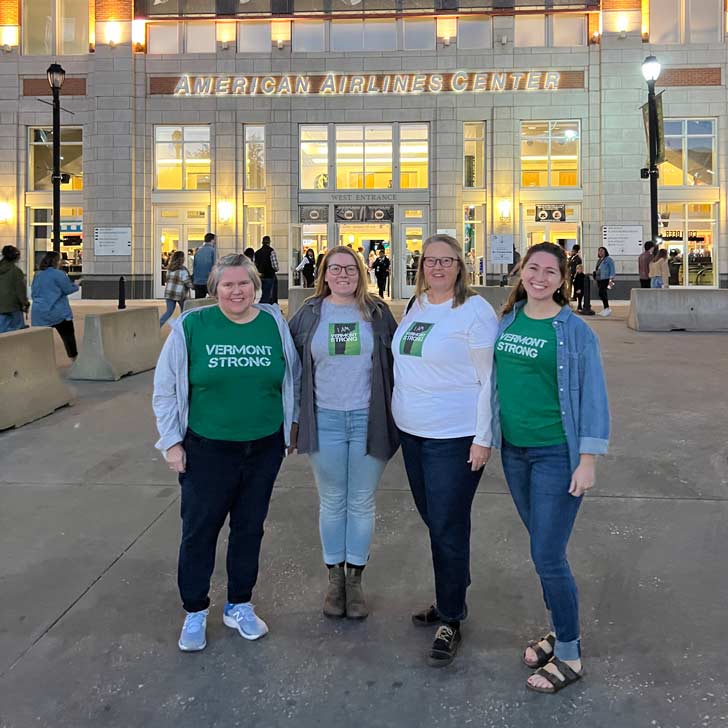
Kahan’s songs suggest a complicated relationship with his hometown and family. But despite how resonant that relationship has been for fans (18,000 people screamed “I’m mean because I grew up in New England” in Colorado this week, leaning into the irony that this likely isn’t literally true), Kahan’s connection to home really is all love.
“He is an internationally recognized artist who is insisting ‘okay, what are we doing in Vermont?’” Gutelius said. “In addition to everything else, that’s something he wants to focus on.”
Quantifying the impact of The Busyhead Project beyond dollars and cents is a tricky task, but if the hugs, hand-holding, and tear-wiping at this week’s shows are any indication, Kahan fans far and wide have found some antidote to their suffering in his work.

An antidote Kahan shares.
“I remember listening to music and hearing an artist sing something that I thought I’d been the only person in the world to feel. I remember feeling heard and feeling like it saved me and that I could go through another day because someone else out there had felt what I felt,” Kahan said in a video last year.
“It's the honor of my lifetime… to help people through their battle with mental illness and the myriad of other disorders that affect us day to day.”
Good Good Good received two press tickets to Kahan’s show in Denver to support our coverage of this story.
Header image courtesy of Pooneh Ghana
Service dogs can alleviate some symptoms of post-traumatic stress disorder for veterans, according to a study our team published in June 2024 in the medical journal JAMA Network Open.
Over the past decade, our research group has been studying whether trained service dogs can help veterans with PTSD — a mental health condition that some people develop after experiencing a traumatic event.
Building off our preliminary findings, we conducted the first and largest clinical trial of its kind to assess this complementary intervention.
We recruited 156 post-9/11 veterans from the waitlist of K9s For Warriors, a nonprofit that matches trained service dogs with veterans who have PTSD.
Of that total, 81 received service dogs and 75 remained on the waitlist throughout the three-month study.
Most had been deployed and had served in the Army, three-quarters identified as male, and the average age was 38 years old.
All veterans initially completed online surveys about their well-being and were interviewed about their PTSD symptoms by expert clinicians. We followed up three months after they either got a service dog or remained on the waitlist.
Those with service dogs had less severe symptoms and better quality of life. For example, they had milder depression and anxiety and better moods. They also had significantly lower odds of still meeting the diagnostic criteria for PTSD.
These results provide the most definitive evidence to date that service dogs are more than just pets. Our findings suggest that partnerships with these trained animals can yield lifesaving benefits for current and former service members.
Why it matters
With more than 17 U.S. military veterans dying by suicide daily, their mental health is a pressing concern.
Up to 29% of post-9/11 veterans have been diagnosed with PTSD at some point. Some treatments for PTSD are available, such as exposure therapy and medications.
But barriers to care, stigma, and high dropout rates from treatment programs limit their effectiveness; thus, there is a push to identify additional treatment options.
For example, there has been recent research on the use of the drug MDMA, combined with psychotherapy, for PTSD. However, an Food and Drug Administration advisory panel voted in June 2024 against approving the drug’s use as a PTSD treatment due to concerns about safety and the potential for abuse.
Service dogs are trained in specific tasks to help with a disability. For veterans with PTSD, a dog’s role could include interrupting a panic attack or laying across veterans’ laps to calm them. People with disabilities have a legal right to be accompanied by their service dogs in public, whether they’re at a supermarket or a baseball game.
Our findings can inform policymakers, health clinicians and insurance companies on the value of service dogs for veterans with PTSD, potentially increasing funding for groups that train and place service dogs and shortening wait times.

What’s next
We’re conducting a randomized clinical trial called the Service Dog and Veteran Experiences Study, or SERVES. It’s being done in collaboration with K9s For Warriors and Canine Companions, another nonprofit that trains and provides service dogs to veterans.
In this next study, we will have a randomized group of veterans receive a service dog early or remain on the waitlist as a control. We will follow those veterans for 12 months — rather than just three months — after they receive a service dog or not.
The SERVES study, in turn, will be followed by another randomized clinical trial funded by the Defense Department. It will investigate whether service dog partnerships can enhance the effectiveness of prolonged exposure therapy, an existing gold standard treatment for PTSD.
This article by Sarah Leighton and Kerri Rodriguez, both from University of Arizona, was originally published by The Conversation.

U.S. charitable giving declined by 2.1% to US$557 billion in 2023, but the flow of funds began to stabilize following several years of volatility.
The annual report from the Giving USA Foundation, produced in partnership with the Indiana University Lilly Family School of Philanthropy, detected a lower level of giving in inflation-adjusted terms. Giving in nominal dollars, without that adjustment, climbed by $10 billion in 2023.
Total giving has swung up and down more sharply than usual in recent years. It first spiked thanks to donors’ responses to the COVID-19 pandemic and the movement for racial justice.
The stock market’s performance has played a role too. Stocks declined sharply in 2022 after a strong three-year streak, which culminated in 2021.
Conditions were more stable in 2023: Stocks performed well. Unemployment rates remained low, and the economy grew despite fears of a recession. Though inflation remained higher than the historical norm, rates fell below the high levels reached in 2022.
In addition, Americans were not reacting to the unusual events that have shaped philanthropy in the past four years.
As two of the report’s lead researchers, we see more signs of charitable giving’s strength than weakness in this new data. For example, giving from all sources — individuals, foundations, estates and corporations — remained above 2019 levels.
Foundations are playing a bigger role
Grants from foundations receded to $104 billion in 2023 from $106 billion a year earlier. Still, for the second year in a row, nearly $1 out of every $5 going to charities came from a foundation. In contrast, about $1 out of every $20 donated to charities 40 years ago flowed from foundations.
Until the dip in 2023, giving by foundations had grown for 12 consecutive years. An important reason for this consistent growth is the way that foundations give: Most foundations give 5% of their total assets each year, the minimum amount required by law. The rest of their assets remain invested and tend to grow over time. And as foundations’ assets increase in value, the amount they give away increases too.
Giving by foundations will likely continue to grow in the years ahead because large donors, including wealthy philanthropists Bill Gates, Mike Bloomberg and Warren Buffett, have been giving more to their foundations.
In the four years ending in 2023, giving to foundations was higher than at any other time since Giving USA began tracking this data in 1978.
Giving by individuals, by far the largest source of charitable donations, tends to be more responsive to the economic conditions of a particular year than gifts from foundations. It has been more uneven in recent years as a result. Individual giving was fairly flat in 2023, declining by 2.4% to $374 billion from $384 billion a year earlier.
Starting to stabilize in 2023
Churches and other religious causes have historically received the largest share of donations, and that held true in 2023. But religious giving fell 1% to $146 billion in 2023 and has declined in four of the past six years.
Social service organizations, also known as “human services” nonprofits, meet basic needs such as hunger and homelessness. In the past, giving to these charities has gone up during economic downturns, followed by a few years of slower growth.
However, a different pattern has emerged over the past four years.
Giving to social service organizations spiked as expected in 2020, as many people sought to support low-income and otherwise vulnerable people by donating to food banks, domestic violence organizations and homeless shelters. That kind of giving then kept rising in 2021.
Giving in this area grew again in 2023 after a slight decline in 2022.
Social services giving has grown so much that it was the second-largest category for charitable giving behind religion for the second consecutive year in 2023. Until 2020, education-related giving, such as donations to colleges and universities, was usually the next largest category after religion.
The latest Giving USA report shows what American philanthropy looks like in a year that was relatively uneventful compared with the ones that came before it – 2023 was the first year since 2017 in which no unusual event or legislation caused major changes to charitable giving.
We will continue to assess these trends to better understand what happens next in American philanthropy.
This article by Anna Pruitt and Jon Bergdoll, both from Indiana University, was originally published by The Conversation.

Humans have long been fascinated by organisms that can produce light.
Aristotle, who was a scientist as well as a philosopher, wrote the first detailed descriptions of what he called “cold light” more than 2,000 years ago.
More recently, pioneering researchers like World War II Army veteran Emmett Chappelle and deep submergence vehicle pilot Edith Widder advanced the study of this phenomenon with novel technologies.
At least 94 living organisms produce their own light through a chemical reaction inside their bodies — an ability called bioluminescence.
Examples include luminous fireflies, algae that create “glow-in-the-dark” bays, small crustaceans with intricate courtship displays, and deep-sea fish and coral. Y
et despite its widespread occurrence, scientists don’t yet know when or where it first emerged, or its original function.
As marine biologists who specialize in deep-sea habitats, we know that bioluminescence is particularly common in the ocean.
This indicates that light production may give organisms from across the tree of life a fitness advantage that improves their chances of survival.
Our research focuses on octocorals — soft-bodied corals such as sea fans that have treelike shapes and are found in various places in the world’s oceans. They are a diverse and ancient group of animals that includes some 3,500 species, many of which are bioluminescent.

Octocorals can create coral gardens and animal forests in the oceans, particularly in the deep sea. These communities provide homes and nursery habitats for many other animals, including fish and sharks.
All octocorals use the same chemical reaction to bioluminesce. A 2022 study determined the evolutionary relationships among these corals. These genetic connections, and the fact that fossils of octocorals exist, make these animals an ideal focus to investigate when bioluminescence appeared and how it spread across geological time.
Testing for bioluminescence at sea
Over a decade ago, we started testing the ability of different octocoral species to bioluminesce. To produce the glowing light, corals must be stimulated either physically or chemically.
Bioluminescence first piqued our curiosity during a 2014 research cruise on the R/V Celtic Explorer over the Whittard Canyon off the southwest coast of Ireland. We were taking a tissue sample of a bamboo coral collected from the deep seafloor by a remotely operated vehicle.
The vehicle had manipulator arms that allowed the pilot to collect coral specimens and place them in sampling containers to keep the organisms alive and protected as the vehicle surfaced. After this sample came onboard the ship, we used forceps to take a single coral polyp from it in a room with low lighting and saw a flash of blue light.
Since then, we have worked with collaborators from the Monterey Bay Aquarium Research Institute and Tohoku University to record what species are able to glow, either on the ship after collection or as we observe them on the seafloor using low-light cameras.
Combined with previous published records, we now know that bioluminescence occurs in approximately 60 coral species. It’s likely that many more await discovery.
When and why bioluminescence emerged
In a study published in April 2024, we presented the oldest record in geological time for bioluminescence on Earth.
We showed that this chemical reaction evolved several millennia earlier than the previous estimate, around the time that life on Earth rapidly diversified over 540 million years ago in a period called the Cambrian Explosion.
We determined this by mapping the presence of bioluminescence onto the octocoral tree of life, a graphic tool that biologists use to show evolutionary relationships among species.
Initially, bioluminescence may have evolved to reduce free radicals — chemically unstable atoms that can damage cells. However, at some point, it evolved into a form of communication.
Our results indicate that light signaling was the earliest form of communication in the oceans, and we know that some animals that could detect light evolved during the Cambrian period.
Our research indicates that interactions involving light occurred among species during a time when animals were rapidly diversifying and occupying new habitats.
Gaining and losing light
We are continuing to test corals for bioluminescent abilities in a variety of ways. One main component involved in producing light in corals and other animals is an enzyme called luciferase.
Using DNA sequence data, we are developing a test for the genetic potential to bioluminesce that will make it easier and less invasive for us to study this trait.
We have preliminary evidence that non-bioluminescent octocorals still have homologous luciferase genes — genetic instructions that were passed down from a common ancestor of all octocorals. Why corals that can’t produce light have retained these genes is a mystery.
Do they produce very low-level light that scientists can’t detect with current methods? Or are their luciferase genes nonfunctional? Further study may show why certain octocorals appear to have lost the ability to bioluminesce, and how this loss may have affected their survival in different habitats.
Our recent results show that many corals that live in shallow waters but arose from deep-water ancestors retained the ability to bioluminesce. It is possible that some corals lost this ability over time as it became less useful in shallower ocean settings with more light.
We also are investigating how bioluminescence has evolved in other creatures, including shrimp that migrate upward from deep waters to feed in the daytime and return to deep waters at night. These animals are exposed to changing light conditions and produce light in multiple, unique ways.
As one notable example, some shrimp vomit light-making chemicals, creating a luminescent spew to fend off predators. They also have external bioluminescent light organs along their body that produce blue light.
Studying creatures like these improves our understanding of how different amounts of light in the environment, including light produced by organisms, affect the evolution of bioluminescence and influence organisms’ vision.
This can provide insight into how bioluminescence affected eye evolution and vision some 540 million years ago, when life on Earth was diversifying.
The fact that corals have been able to produce light for hundreds of millions of years implies that this ability has contributed significantly to their survival. Furthermore, our findings support the idea that bioluminescence has been a critical form of communication through geologic time for many types of animals, particularly in the deep sea.
This research has sparked new ideas for us about early animal evolution and communication. Light signaling gave animals a new way to communicate in a rapidly changing time, when new predators and a more complex landscape were emerging.
Increased sensory capabilities in the ocean could have been valuable in these conditions.
Perhaps bioluminescence is a missing piece of the puzzle that has not yet received full attention in studies of the origin and evolution of animals in deep time.
This article by Danielle DeLeo from the Florida Intenational University and Andrea Quattrini from the Smithsonian Museum was originally published by The Conversation.
Header image by Sönke Johnsen, CC BY-ND
