These giant freshwater crabs might just be your new Roman Empire.
Archaeologists studying Trajan’s Forum, a historical Roman ruin site, in 2005, discovered an ancient crab species, Potamon fluviatile. The only freshwater crab species indigenous to Italy, researchers suspect that they’ve been around the region since ancient times — far before it was known for gelato and pasta.
“Rome’s underground, especially in the area of the ancient Roman Forum, is very rich in water, with many passageways and hiding places to survive,” Marco Seminara, an environmental biologist at the Sapienza University of Rome, told National Geographic.
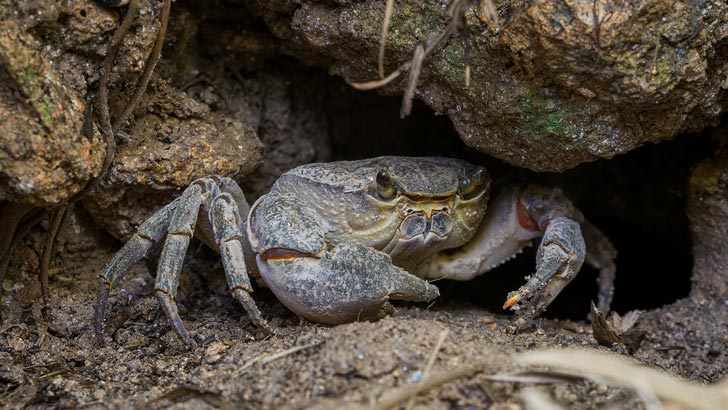
“It doesn’t surprise me that these animals have lived there for so long.”
The collapse of the Roman Empire gave the crabs a low profile to safely maneuver through the underground sewage systems of the city, surfacing only at night to feed on animal remains and other organic matter.
Nature photographer Emanule Biggi has described the crabs as a “Wall-E of nature.” He writes:
“Its fierce temperament protects it from being disturbed by many predators like water snakes and smaller birds, and even against alien species like the Louisiana freshwater crayfish.”
However, these days, data suggests that the species may be at risk.
While researchers caught and identified about 500 crabs during the height of their studies between 2004 and 2006, rising temperatures have made them nearly impossible to find.

Despite their large size — scientists say Rome’s crabs were between 13 and 20% larger than other members of the same species — they have been able to tunnel down further in their hidden canals to remain cool, as the surface of their home becomes hotter and less humid.
Human excavations are also to blame for their dwindling population, having unearthed a network of underground canals that once protected the crabs. Now, predators like seagulls and crows have breached the crabs’ habitats.
Seminara told National Geographic that these days, he finds more crab body parts than live crabs. The species is also listed as “Near Threatened” by the IUCN Red List of Endangered Species.
In order to save this species — which has been around for centuries — experts say they need the funding to study them.
In 2020, the Colosseum recruited naturalists to help study and monitor diverse species living in the area between the Colosseum and Roman Forum. Seminara joined naturalist Gianluca Damiani in this mission, but the results have been far less exciting than the original discovery of the species.
In the last three years, only six new crabs have been identified, Damiani told National Geographic.
“Now they’ve gone even deeper,” Damiani said. “They’re impossible to find.”
Although scientists are not concluding that the crabs currently face extinction, they can tell the crabs’ numbers are rapidly declining.
“We’d love to study these animals because they deserve to not only be studied but also saved,” Damiani said. “This population cannot disappear.”
Damiani and his colleagues have sought permission to implement grates and signs informing people about the crabs, though the city has denied these requests.
While he blames Rome’s desire to keep the area unchanged for tourists, Seminara argues that the interest in these crabs would be a site to behold in itself.
“Their existence is certainly folklorish. It would be like finding a crab living in Central Park,” he explained to National Geographic. “This is a unique animal.”
“The fact that in the Roman Forum there is the only large freshwater crustacean that we have in Italian waters, has and will always generate a certain amazement.”
For now, the crab species — which also lives in other Mediterranean areas like Malta and the Balkan Peninsula — is protected by local and national laws. But experts believe environmental education and communication is key in saving the crabs.
For Damiani, it starts with sharing their story.
“A few steps from the Colosseum, in the heart of Rome, extraordinary crustaceans survive,” he writes in an Instagram caption, showing his images of the crabs in their natural habitat.
“The last survivors hide among sewers and canals,” he continues, “Descending ever deeper, in an urban jungle that is rapidly changing.”
Header image courtesy of Amphipolis (CC BY-SA 2.0)
On June 27, TikTok influencer and accessibility activist Anthony S. Ferraro invited viewers to go back to summer camp for the day.
“Let’s go to Camp Abilities!” Ferraro said in front of a crowd of young campers. “This is going to be epic.”
Throughout his video, Ferraro and his family tie-dyed t-shirts, played sports, and joined campers in the dining hall for pizza.
But this particular summer camp — Camp Abilities — is unique. It’s specially designed with blind, deafblind, and have low vision campers in mind.
“We got this whole lobby full of games and activities!” Ferraro said on his way to the camp gym, where kids played goalball with Mindy Cook, an athlete who competed in the 2020 Summer Paralympics.
At breakfast, lunch, and dinner, Ferraro explained that everyone walks together from the dorms to the dining hall.
“They teach them cane techniques and how to navigate confidently,” Ferraro said, tapping his own cane as he walked. “I’ve even picked up a thing or two.”
After dinner, Ferraro played guitar and sang for the campers, as his wife and his infant daughter cheered him on.
“To see these kids blossom and get to learn from each other, and just get out of their comfort zone, and gain so much independence…this place is amazing,” Ferraro told the camera, as the day came to a close.
According to the 2022 American Community Survey, an estimated 600,000 children in the United States have visual difficulties.
Although accessibility measures have grown in leaps and bounds in recent years, there are still barriers that people who are blind, deafblind, or have low vision encounter daily including employment discrimination, denial of service, and lack of accommodation. That's why places like Camp Abilities are so necessary, so that everyone has a community they can call home, even when they're up against obstacles.
Camp Abilities was first founded in Brockport, NY in 1996 by Doctors Lauren Lieberman and Monica Lepore.
Over the course of 29 years, the camp has served over 1,400 campers and has been a vital resource for children and teenagers who want to live, learn, and play in an environment that caters to their needs.
One camper, Enrique Lomeli, said that the camp has helped him gain the confidence to play sports for the first time.
His favorite game? Goalball — a sport almost exclusively played by blind or partially blind athletes in which two teams of three score points with a basketball-sized ball and defend their goals from opponents.
“I was scared to do it, but now I’m brave to do it,” Lomeli told KGUN Tuscon.
@asfvision Let’s go to blind camp 👨🏻🦯➡️👩🏻🦯🦮🦯👀😎👁️🕶️
♬ original sound - Anthony S. Ferraro
Back at Camp Abilities, Ferraro thought back on his own childhood, and how life changing it had been for him to attend “a blind camp” growing up.
“Getting to interact with peers that are going through similar struggles, that your regular friends might not be going through, it’s like meeting family,” Ferraro said, while wearing his freshly tie-dyed Camp Abilities tee.
“I can’t even describe the joy it brings.”
Header images via Anthony S Ferraro / TikTok
Every day the Good Good Good team collects the best good news in the world and shares it with our community. Here are the highlights for this week!
If you want to get good news in your inbox every day, join the Goodnewsletter — the free daily newsletter designed to leave you feeling hopeful.
The Best Positive News We’re Celebrating This Week —
In ‘the greatest recovery of a cat species ever achieved,’ the rarest wild cat in the world is now no longer endangered
The Iberian lynx is one of the rarest cat species in the world, and after 20 years of hard-won conservation efforts, it’s officially off the endangered species list.
In 2002, the species was brought to the brink of extinction, with only 94 Iberian lynxes remaining in Spain and disappearing entirely from Portugal, where it was declared locally extinct.
The main cause of the Iberian lynx’s decline was its disappearing food source, which was affected by agricultural production and disease, as well as by poaching and highway construction.
Why is this good news? The Iberian lynx’s recovery is proof of all the good that conservation efforts can do if we invest in them long-term. Conservationists focused on projects over the course of two decades and thanks to those efforts, the species’ population increased twenty-fold — so much that it was removed from the endangered species list entirely.
The number of children who died before their fifth birthday reached a historic low in 2022
According to the latest estimates from the United Nations, 4.9 million children died before their fifth birthday in 2022 — fewer than ever before. And while that number is still heartbreakingly high, it’s incredible progress.
This historic achievement is thanks to “midwives and skilled health personnel helping mothers safely deliver their newborns, health workers vaccinating and protecting children against deadly diseases, and community health workers who make home visits to support families to ensure the right health and nutrition support for children.”
Thanks to decades of effort from individuals, communities, and entire countries, the global under-5 mortality rate has declined by 51% since 2000. Several countries, like Cambodia, Malawi, Mongolia, and Rwanda saw under-5 mortality reduced by more than 75%.
And it’s proof that we can make even more progress to end all preventable child deaths — progress which we desperately need to continue making.
Most of the remaining child deaths are due to preventable or treatable causes like birth complications and preterm birth, and diseases like malaria and pneumonia.
It can feel conflicting to celebrate achieving a milestone like this when so many children are still dying — but it’s important progress to celebrate as we continue working to reduce child deaths even more by ensuring equitable access to high-quality health care, maternal health care, vaccinations, disease diagnosis, and more.
Achieving a major reforestation milestone, the Democratic Republic of Congo has planted 90% of its 1 billion trees goal
The Democratic Republic of Congo loses 500,000 hectares (1.2 million acres) of forest cover every year due to shifting cultivation, mining, and illegal and informal logging.
To address this widespread deforestation, a Congolese government program aspired to plant 1 billion trees between 2019 and 2023, aiming to strengthen climate resilience, alleviate poverty and protect biodiversity.
While they didn’t meet their goal, they reached a remarkable 90% of their target — and the organization behind the reforestation effort plans to continue planting more trees even after the government program comes to an end.
More good tree news:
- While we still have a long way to go to improve tree cover, the world has more trees than it did 35 years ago.
- Though we should avoid cutting them down whenever possible, “reforestation hubs” are making sure trees that are cut down go on to serve another useful purpose.
- Using a strategy long cultivated by Native American tribes, ecologists are helping save ancient sequoia trees with “good fires.”
- Using data collected from sensors, researchers are creatively saving forests by letting trees tweet.
A university professor is using concrete and corals to help protect Miami during hurricane season
As part of a team of engineers, biologists, and social scientists, University of Miami professor Diego Lirman is developing a solution to protect Miami’s coastlines from the impacts of hurricanes — which are intensifying due to climate change.
And with 2024 predicted to be a record-breaking year for hurricanes, their solution couldn’t come at a better time.
The group is using a combination of “grey” and “green” infrastructure — combining concrete and coral to create the “Sea Hive,” a 12-foot-long stacked pyramid structure made of hexagonal concrete tubes placed in about 30 feet of water.
From the side, they look like beehives, and those openings allow water and wave energy to filter through them — collecting that energy in the Sea Hive rather than letting it make it to shore.
In their lab simulations, the structure reduced wave energy by 60 to 70 percent — and could prove to be a significant help for Miami’s coastlines, which are already seeing record flooding and erosion as storms intensify.
Alongside long-term solutions to reverse the impacts of climate change more permanently, these kinds of mitigation and climate resiliency solutions will be critical in protecting people and communities.
In a dramatic reinvention, the Buenos Aires zoo went from showing animals for profit to protecting them
Before it closed its doors as a zoo in 2016, the Buenos Aires Ecopark prioritized making money over caring for its animals — keeping them in enclosures that hadn’t changed much since they were built in the late 1800s.
As public opinion shifted against showing animals purely for entertainment, the zoo closed its doors and began a reinvention process over the next seven years.
It involved relocating more than 1,000 animals to sanctuaries around the world and becoming a nationally important center for conservation. It’s now home to a state-of-the-art animal hospital that takes animals from all over the country and the largest biobank in South America.
What’s the nuance? The ethical arguments surrounding zoos are valid. At the same time, when operated with the animals as a key priority, they can play a critical role in endangered species conservation, animal rehabilitation, and in helping humans tap into empathy and care for animals and species from all over the world.
→ Read more
In a landmark ruling, a UK judge said that proposed new fossil fuel projects must account for future impacts
The UK’s supreme court just ruled that the impact of burning coal, oil, and gas on the climate must be considered when deciding whether or not to approve new fossil fuel projects.
The decision sets and important precedent for taking into account the “inevitable” future greenhouse gas emissions associated with new fossil fuel extraction — and the impact of those emissions on the climate crisis.
Advocates are celebrating the ruling, calling it a “huge win in the fight for a livable climate.” The ruling is also expected to impact other active lawsuits against fossil fuel extraction projects.
→ Read more
More good climate news:
- New research just found that “floatovoltaics” could generate a substantial amount of energy worldwide.
- Researchers are exploring multiple uses for offshore wind farms, like producing fresh seafood and growing seaweed.
- Wealthy nations finally paid the overdue bill to smaller nations for their outsized impact on the climate.
- An analysis found the renewable energy sector is on track to hit the globe’s net-zero goals by 2030.
One of the first in the world to ban certain single-use plastics, a small Pacific island nation has now dramatically reduced pollution
While residents of the Pacific island nation of Vanuatu tried their best to collect and properly dispose of plastic littering its surrounding waters, the country’s government took action to stop pollution at the source.
In 2018, Vanuatu became one of the first in the world to outlaw the sale and distribution of certain single-use plastics, including a world-first ban on plastic straws.
The results have been staggering: they rarely see thin, plastic shopping bags at all anymore, food is served in banana leaves instead of styrofoam takeout boxes, and more. Items banned in 2018 used to make up 35% of the island’s waste — now it’s less than 2%.
Why is this good news? Small island nations face unique challenges when it comes to waste since they’re often dependent on plastic-intensive imports, are at the mercy of ocean currents carrying debris, and don’t always have adequate recycling or waste management on the small strips of land. So this is an especially notable achievement — and one that was led by the people of Vanuatu.
A queer Methodist bell ringer played a popular queer anthem on the church’s bells to kick off Pride Month
On June 1, residents of Durham, North Carolina were greeted with the sound of church bells played to the tune of Chappell Roan’s hit song “HOT TO GO!” thanks to volunteer bell ringer Katelyn MacDonald.
MacDonald is a queer transgender woman, has a masters of divinity, and is on track to become an ordained elder in the United Methodist Church.
And now, she’s a viral sensation. Her performance gathered more than 7 million views and 1.5 million likes, including from Roan herself.
While MacDonald said bell ringers at the church enjoy the freedom to play “whatever they want” on the bells — she chose this particular song for a couple of reasons.
One, practically it’s easy to play within the bells’ 10-note limit. And two, more personally to (literally) ring in Pride Month: “It felt important for me to ring out a song that would show the community and loudly proclaim who we are.”
Comments quickly flooded the viral post thanking MacDonald for loudly proclaiming acceptance in a place queer folks don’t normally find it.
MacDonald also hoped the extra attention would encourage other churches to reflect on ways they can be more inclusive of the LGBTQ+ community, too.
More good news of the week —
Despite their reputation as destructive pests, new research reveals that armadillos support dozens of other species. Their burrows are used by at least 64 other species, like foxes, raccoons, skunks, frogs, and snakes — and they could even support human life.
Scientists finally pinpointed a fungal virus harming frogs and toads, significantly aiding their conservation efforts. The mysterious fungal virus has been harming over 500 amphibian species on nearly every continent for decades.
Three million shipwrecks around the world have become thriving habitats for marine life, from microbes to sharks. Shipwrecks like the RMS Titanic and RMS Lusitania conjure tales of human courage and unsolved mysteries, but there’s another angle to their stories that doesn’t feature humans.
Taking the Canadian province from 80% coal power to zero, Alberta’s last coal plant just powered down. Years ahead of schedule, the phaseout was due largely to natural gas taking over most electricity generation — which still comes with its share of emissions, but far less than coal.
In Finland, the number of teenage abortions fell by 66% after it started giving free contraception. Showing that we can reduce the number of abortions without removing access through equitable access to contraception, Finland also made sex education mandatory in schools.
South Australia just introduced a first-of-its-kind bill to ban political donations from its elections. Under the proposed bill, the state would provide funding to allow parties and candidates to challenge elections, run campaigns, and promote political ideas instead of private donors.
Groundbreaking new AI technology is helping reduce wildlife collisions on roadways — and it was invented by teen girls. A project created by four teen girls in Colorado uses AI and infrared technology to alert drivers of oncoming wildlife.
The size of Las Vegas, Australia’s newest national park is home to 12 different endangered species. Cameroo Station is set to open to the public in late 2024, is home to 158 native species, including 109 bird, 22 reptile, 13 frog, and 14 mammal species in total.
A group of gamers made an in-game decision to save children, so the game’s creator made a donation to Save the Children. Rather than unlock “new ways to blow things up,” Helldivers 2 players chose to save survivors trapped in a children’s hospital, so the game’s creator made a $4,311 donation in their honor.
A new litter of endangered black-footed ferrets was recently born at the Smithsonian’s National Zoo and Conservation Biology Institute. Black-footed ferrets are North America’s only native ferret species and were thought to be extinct in 1979.
In a milestone for critically endangered species, a baby California condor hatched earlier this year at the San Diego Zoo. The California condor is the largest bird in North America and went extinct in the wild in 1987.
Eleven endangered Humbolt penguin chicks were born at the Chester Zoo in the UK for the first time in a decade. It was the most during a single hatching season for the breed that’s “most at risk” of extinction.
In just one year, Colorado used an estimated one billion fewer single-use plastic bags. The organization Eco-Cycle helped support Colorado’s Plastic Pollution Reduction Act, a law that is now phasing out the use of single-use plastic bags in the state.
Scientists are hopeful a new “game changing” test could predict Parkinsons seven years beforethe first symptoms appear. With help from artificial intelligence, researchers have identified a biological signature of Parkinson’s disease they hope could lead to a simple blood test for the condition.
One of just three sites like it in the world, the U.S. just got its first official “quiet trail” in Nebraska. Quiet Parks International is recommending parks, trails, conservation areas, and even hotels across the globe that are easy on the ears.
President Biden just pardoned thousands of LGBTQ+ veterans who were convicted for their sexual orientation. Thousands of service members were convicted over the six decades that military law formally banned consensual homosexual conduct.
High school students in Colorado are raising and preserving the razorback sucker, an endangered species of fish. Thanks to a science teacher, the students have been “a part of bringing a species back from almost extinction” for years.
A UK teenager with severe epilepsy just became the first person in the world to receive a seizure-controlling brain implant. The breakthrough medical device has reduced his daytime seizures by 80%.
Singer-songwriter Noah Kahan has quietly used his latest tour to raise more than $2 million for rural mental health. Kahan launched The Busyhead Project specifically to reach communities that have historically been unable to access mental health resources.
After decades of advocacy, 18 acres of land will be returned to the Mille Lacs Band of Ojibwe by the state of Minnesota. The move comes after lawmakers passed legislation to formally return state trust lands inside the boundaries of the Mille Lacs Band’s reservation.
[Related good news: LANDBACK is a larger movement aimed at returning stolen lands to Indigenous people.]
A new Colorado law will ban household products that contain toxic “forever chemicals.” Per- and poly-fluoroalkyl substances, or PFAS are incredibly durable, making them great ingredients in things like waterproof clothing and nonstick cookware — but not so great for the planet or human health.
Responding to backlash from her Pride Month post, children’s creator Ms. Rachel reminded people to love their neighbor. The next generation’s Mister Rogers, Rachel Accurso’s sing-songy voice and sunny smile have won her 10 million followers on her Songs For Littles YouTube channel.
Philadelphia kicked off Pride Month by setting a Guinness World Record for the world’s largest drag story time. An “important statement” as states try to ban drag story hours, 263 people attended the event to kick off Pride Month.
Thailand became the first Southeast Asian country to legalize same-sex marriage. The new law gives same-sex couples the ability to have children through IVF and make emergency medical decisions for their spouse.
A transphobic politician made Dylan Mulvaney the butt of a joke on Cameo — now she’s saving lives on the same platform. Mulvaney is donating all her Cameo profits made over the next month to Save The Children, which is bringing humanitarian relief to children in Gaza, Sudan, Ukraine, and more.
[Related: Speaking of Dylan, all proceeds earned during Pride Month from her new single supported The Trevor Project.]
More than 120 faith groups attended 50 Pride events this June to de-escalate extremist anti-LGBTQ+ protests from hate groups. Experts with the Interfaith Alliance and the Southern Poverty Law Center helped train religious organizations to protect Pride events nationwide.
Under new federal rules in the U.S., LGBTQ+ employees can no longer be misgendered or denied bathrooms at work. It was the first time in 25 years that the Equal Employment Opportunity Commission has issued new rules on workplace discrimination.
Sam Smith launched a new LGBTQ+ charity to give queer artists a “safe space” to be themselves. Called The Pink House, Smith said it will “be a useful resource for all queer people, to work towards helping secure a happy home for all.”
Making history in a number of ways, a trans woman was crowned Miss Maryland USA. Bailey Anne Kennedy broke almost every barrier that existed in the state’s pageant history, including being the first married, Asian American, and trans woman winner.
A federal judge struck down a Florida ban on providing medical care to transgender youth. The judge sided with advocacy groups and three families who had said that the law stripped them of parents’ rights to make medical decisions for their transgender children.
President Biden just pardoned thousands of LGBTQ+ veterans who were convicted for their sexual orientation. Thousands of service members were convicted over the six decades that military law formally banned consensual homosexual conduct.
This story was originally published by Grist. Sign up for Grist’s weekly newsletter here.
After a decade of work, the Tule River Tribe has released nine beavers into the nation’s reservation in the foothills of California’s southern Sierra Nevada mountains.
The beavers are expected to make the landscape more fire and drought resistant.
Beaver dams trap water in pools, making the flow of water slower so the surrounding ecosystem can reap the benefits of the moisture while making it more difficult for forest fires to start.
They can also help a forest heal after a fire by rehydrating the area.
“We’ve been through numerous droughts over the years,” Kenneth McDarmet said, who is a Tule River tribal member and former councilman. “It’s going to be wonderful to watch them do their thing.”
Around 80 percent of the Tule River Reservation’s drinking water comes from the Tule watershed. Because the area is so important for the health of the community, the tribe has been preparing the area since 2014, building man-made dams to help the new beavers adapt more quickly.
Temperatures worldwide are expected to get hotter, increasing drought and creating conditions that make wildfires bigger and more deadly.
In California, some of the worst wildfires on record have happened in the last five years partly due to drought.
In 2020, three fires burned almost a million acres in the Sierra Nevada Forest, and in 2021 a wildfire burned an additional 1.5 million acres. Bringing beavers back may offer a break.
Prior to colonization, the North American beaver population was estimated to be around 200 million. But in the 1800’s, beavers were hunted for their pelts by settlers, decimating the population, while farmers and landowners viewed — and still view them — as pests.
Today, the beaver population is estimated to be about 12 million.
But in recent years there has been a growing interest in traditional ecological knowledge from tribes, and the beaver has become celebrated as an ecological engineer.
In 2022, the California Department of Fish and Wildlife, or CDFW, secured funding for the Beaver Restoration Program, a program designed to restore the beaver population and support conservation efforts.
In 2023, the CDFW recognized beavers as a keystone species, an animal that affects other animals on the landscape like bison or bees, and thus influences the ecosystem in major ways.
Their absence typically has negative effects on the landscape and its interconnected ecosystems.
Today, the CDFW program partners with tribes, non-profit organizations, land-owners, and state and federal entities to restore beaver populations and habitats in an effort to improve climate change, drought, and wildfire resilience in California.
“We expect better habitat conditions for native critters on the land,” said Krysten Kallum, a public information officer with the CDFW. “It creates a refuge for plants and wildlife.”
More water means more plants that can attract other types of animals to the area.
The CDFW expects to see better habitat development for amphibians like the western pond turtles, southern mountain yellow-legged frogs, and southwestern willow flycatchers, which will help increase biodiversity.
McDarment, of Tule River, said that tribal pictographs show beavers living in the area, and it’s good to see them here again.
“My hope is to have beaver throughout the reservation,” he said.
Header image by Getty Images
This story was originally published by Grist. Sign up for Grist’s weekly newsletter here.
The government of Hawaiʻi and a group of young people have reached a historic settlement that requires the state to decarbonize its transportation network. The agreement is the first of its kind in the nation and comes two years after 13 Hawaiian youth sued the state Department of Transportation for failing to protect their “constitutional right to a clean and healthful environment.”
The settlement, announced last Thursday, requires the department to develop a plan and zero out greenhouse gas emissions from all transportation sectors by 2045. The agency is also required to create a new unit tasked with climate change mitigation, align budgetary investments with its clean energy goals, and plant at least 1,000 trees a year to increase carbon absorption from the atmosphere.
“It’s historic that the state government has come to the table and negotiated such a detailed set of commitments,” said Leinā‘ala L. Ley, a senior associate attorney at Earthjustice, one of the environmental law firms representing the youth plaintiffs. “The fact that the state has … put its own creativity, energy, and commitment behind the settlement means that we’re going to be able to move that much quicker in making real-time changes that are going to actually have an impact.”
According to a press release from the office of Hawaiʻi Governor Josh Green, the settlement represents the state’s “commitment … to plan and implement transformative changes,” as well as an opportunity to work collaboratively, instead of combatively, with youth plaintiffs, “to address concerns regarding constitutional issues arising from climate change.”
“This settlement informs how we as a state can best move forward to achieve life-sustaining goals and further, we can surely expect to see these and other youth in Hawaiʻi continue to step up to build the type of future they desire,” Green said in a statement.
The 13 teenagers who brought the suit, Navahine v. Hawaiʻi Department of Transportation, have cultural practices tied to the land. They are divers, swimmers, beachgoers, competitive paddlers, and caretakers of farms and fishponds. Many are Native Hawaiian. In the lawsuit filed in 2022, they alleged that the state’s inadequate response to climate change diminished their ability to enjoy the natural resources of the state. Since they filed, at least two plaintiffs were affected by the Lāhainā wildfire, the deadliest natural disaster in the state’s history.
Hawaiʻi has been a leader in recognizing the effects of climate change. The archipelago is battling rising sea levels, extreme drought, and wildfires among other climate calamities. In 2021, it became the first state in the nation to declare a “climate emergency” and committed to a “mobilization effort to reverse the climate crisis.” But the non-binding resolution did not translate directly into statewide transportation policies that reduced greenhouse gas emissions, according to the youth plaintiffs.
Between 1990 and 2020, carbon dioxide emissions from the transportation sector increased despite advances in fuel efficiency, and now make up roughly half of all greenhouse gas emissions in the state. The plaintiffs argued that the Hawaiʻi Department of Transportation is largely to blame. Instead of coordinating with other agencies to meet the state’s net-zero targets, it has prioritized highway construction and expansion. The agency operates and maintains the state’s transportation network in such a way that it violates its duty to “conserve and protect Hawai‘i’s natural beauty and all natural resources,” the plaintiffs noted.
Other similar constitutional climate cases are pending across the country. Our Children’s Trust, a public interest law firm that represented the Hawaiian youth with Earthjustice, has also brought cases against Montana, Alaska, Utah, and Virginia on behalf of young people. Ley said Hawaiʻi is a “great model” for other states to follow. “This settlement shows that these legal obligations have real effects,” she said.
The settlement requires the state transportation department to meet a number of interim deadlines and to set up a decarbonization unit. The agency has already hired Laura Kaakua, who was previously with the Hawaiʻi Department of Land and Natural Resources, to lead the unit. Ley said that they plan to monitor every report the agency publishes, submit comments, and educate their young clients on how they can stay involved.
“Often in the climate field, young people feel betrayed by their government,” Ley said. “But this settlement affirms for these young people that working with the government can be effective and that this is a way that they can make a difference in their lives and in the world.”
Header image by Mario Tama on Getty Images
If you want to go hunting in the United States, you need to have the right duckuments.
Fortunately for the country’s hunters, bird watchers, and stamp collectors, this year’s Federal Migratory Bird Hunting and Conservation Stamp — or as its known colloquially, the Duck Stamp — has officially hit the scene.
The Duck Stamp plays a vital role in wildlife conservation in the U.S. and has since 1934. Over the course of 90 years of sales, the stamp has raised more than $1.2 billion to conserve over 6 million acres of wetlands habitat on national wildlife refuges nationwide.

It’s also grounds for a beloved art tradition: The Federal Duck Stamp Contest and Junior Duck Stamp Contest. These friendly competitions invite artists young and old to contribute their duck-themed artworks for consideration to go on the final stamp.
“I am honored to be one of the first people to buy the 2024-2025 Federal and Junior Duck Stamps!” said U.S. Fish and Wildlife Service Director Martha Williams.
“I hope everyone across the country will join me in putting their stamp on wetland conservation and celebrating the artists who have dedicated their passion towards wildlife and the great outdoors.”
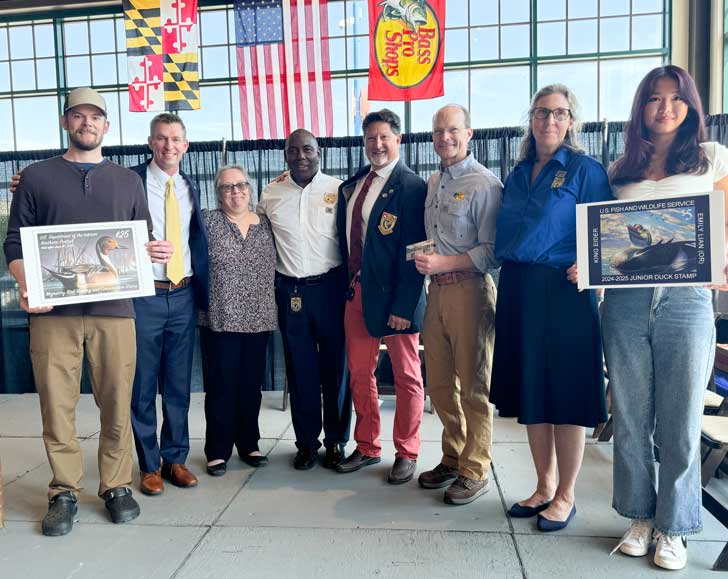
The national winner of this year’s art contest is Chuck Black of Belgrade, Montana, whose painting of a northern pintail was selected from 199 entries.
The Junior Duck Stamp artist is 17-year-old Emily Lian from Oregon, whose design will raise funds to support youth conservation education.
Interest in the stamp has skyrocketed in recent years as another competitor, Kira Sabin, created their TikTok account to explain the importance of the Duck Stamp and take followers on their journey to winning the national contest.
“If you’re a good hunter, you’re also a conservationist. It’s their money that has primarily supported the wetlands for decades,” Sabin explained in a thorough TikTok video, answering the frequently asked questions about the Federal Duck Stamp.
“98 cents to every dollar sold goes directly back to the land, and they raise about $40 million each year.”
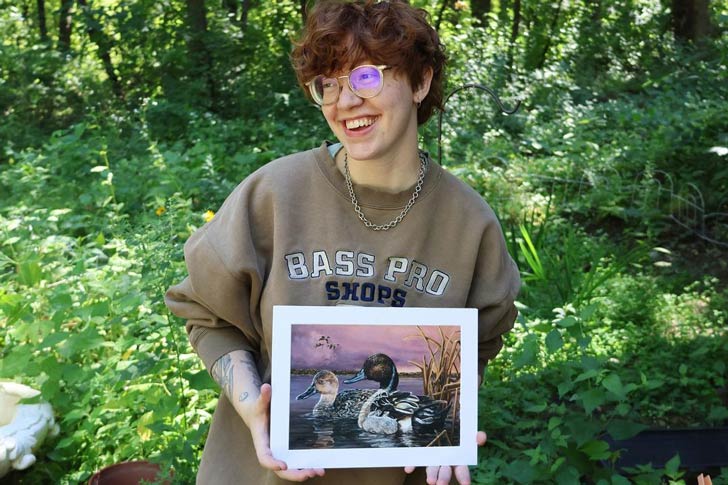
While Sabin did not earn the coveted spot this year, their work is still featured on the physical keepsake, with a drawing of the companion species to the winning duck printed on the souvenir stamp sheet issued by the USPS and Fish and Wildlife Service.
While post offices do carry these collectable stamp sheets, it should be noted that this stamp is not intended for postage, but rather as a permit to enter wildlife refuges (or just as a special keepsake to show one’s love of America’s wetlands).
Duck Stamps are required for waterfowl hunters as part of their annual license. Additionally, they are voluntarily purchased by birders, outdoor enthusiasts and fans of national wildlife refuges. A Federal Duck Stamp also acts as free admission to any national wildlife refuge.
Funds raised from Federal Duck Stamps will go toward the acquisition and lease of habitat for the National Wildlife Refuge System. And it’s not just the ducks that reap the benefits; thousands of other shorebirds, herons, songbirds, countless mammals, fish, native plants, and more, rely on the conservation of U.S. wetlands for their survival.
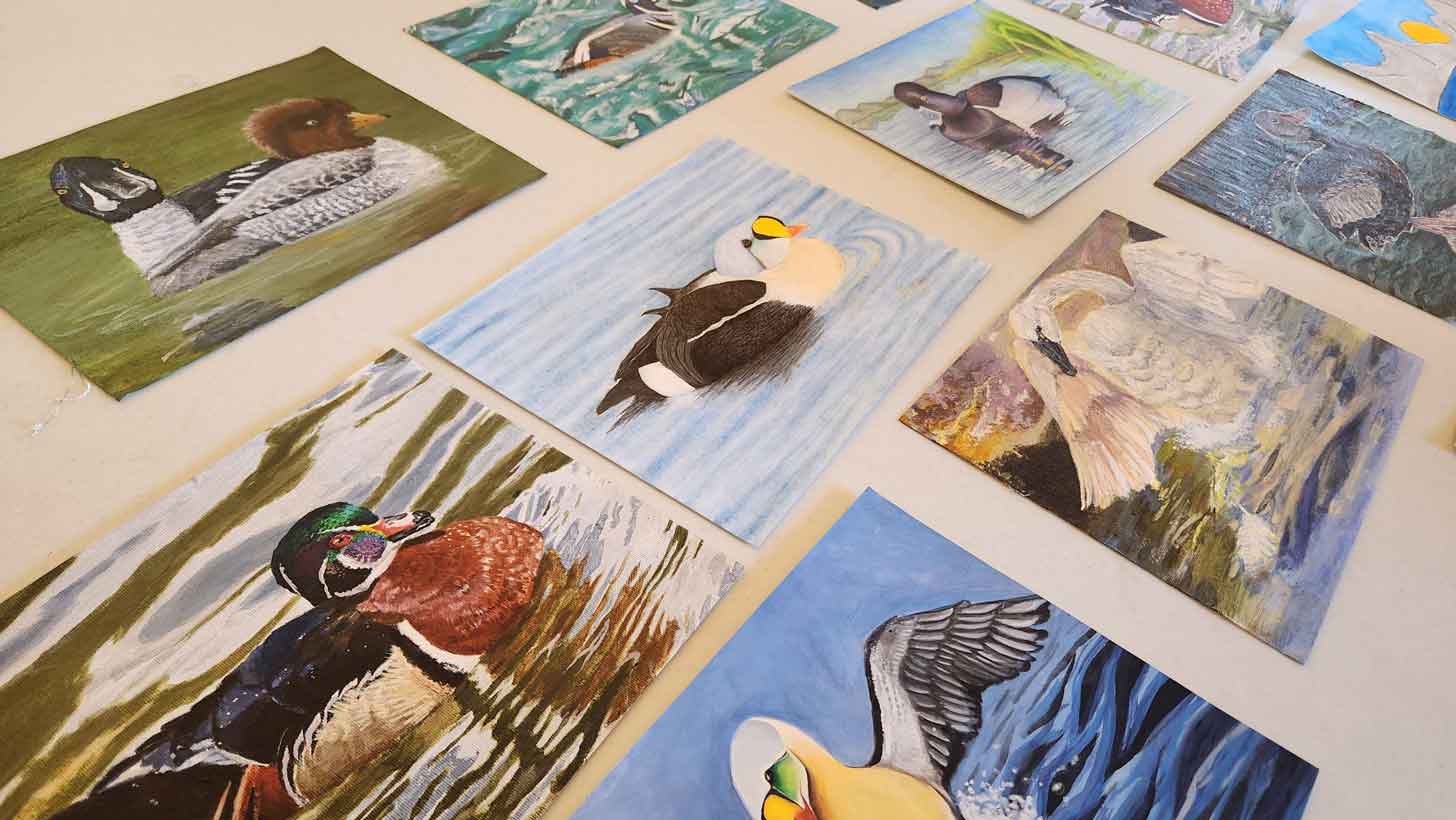
“As you know, the Duck Stamp is a conservation stamp,” Sabin said in a TikTok. “It’s a super easy way to support our wetlands, and you guys should all be cool and buy one.”
Indeed, anyone can purchase a Duck Stamp, but now it’s more accessible than ever.
For the first time this year, since President Biden passed the Duck Stamp Modernization Act of 2023 (yes, that’s a real thing), these $29 stamps are now available both as a physical keepsake, but also as an electronic pass.
Digital versions of the stamp are available on Amplex, and physical copies can be purchased online, at sporting goods and retail stores, some post offices, and national wildlife refuges.
And for the Duck Stamp enthusiasts like Sabin — who sells prints of their work and donates a percentage of earnings back to buying more Duck Stamps — the $29 price tag represents one of their favorite purchases all year.
“Birds have always been a constant in my life,” Sabin wrote on TikTok earlier this year. “Life becomes much more beautiful when you start to notice how many different kinds there are, how they act, how they spend their time, and how significant their small life is.”
Header image courtesy of Laurel Smith/USFWS
This week, a team of marine biologists released findings of a new sea creature slowly crawling its way across the deep ocean of the Gulf of Alaska.
The researchers — Francisco A Solís Marín, Andrea A Caballero Ochoa, Carlos A Conejeros-Vargas — are all professors at the Institute of Ocean Sciences and Limnology in Mexico, and have devoted their lives to marine exploration.
Their work, published in the Biodiversity Data Journal on June 26, describes a new type of deep-sea cucumber, a long, squishy animal with “pale pink violet” coloring and zig-zagging rows of 214 tube-like feet.
The “new species of Synallactes from the Northeast Pacific” is also known as the McDaniel sea cucumber.
Conejeros-Vargas and his team named the new animal after Neil McDaniel, a Canadian naturalist who specializes in the study of sponges, corals, anemones — and of course, sea cucumbers.
Like other wild sea cucumbers, the McDaniel sea cucumber roams the deep seafloor looking for a bite to eat.
They can be found at sea depths ranging from 70 feet to 1,400 feet — and they use their hundreds of feet to move and grab “bottom sediments with its peltate tentacles.”
According to Arnold Rakaj, a marine biologist at the University of Rome, sea cucumbers subsist on a steady diet of “fish waste, algae, and other organic matter” peppered throughout the sandy floor of the sea.
In recent years, researchers have begun to realize just how helpful sea cucumbers are when it comes to ocean health. They’ve even been called the “janitors of the sea.”
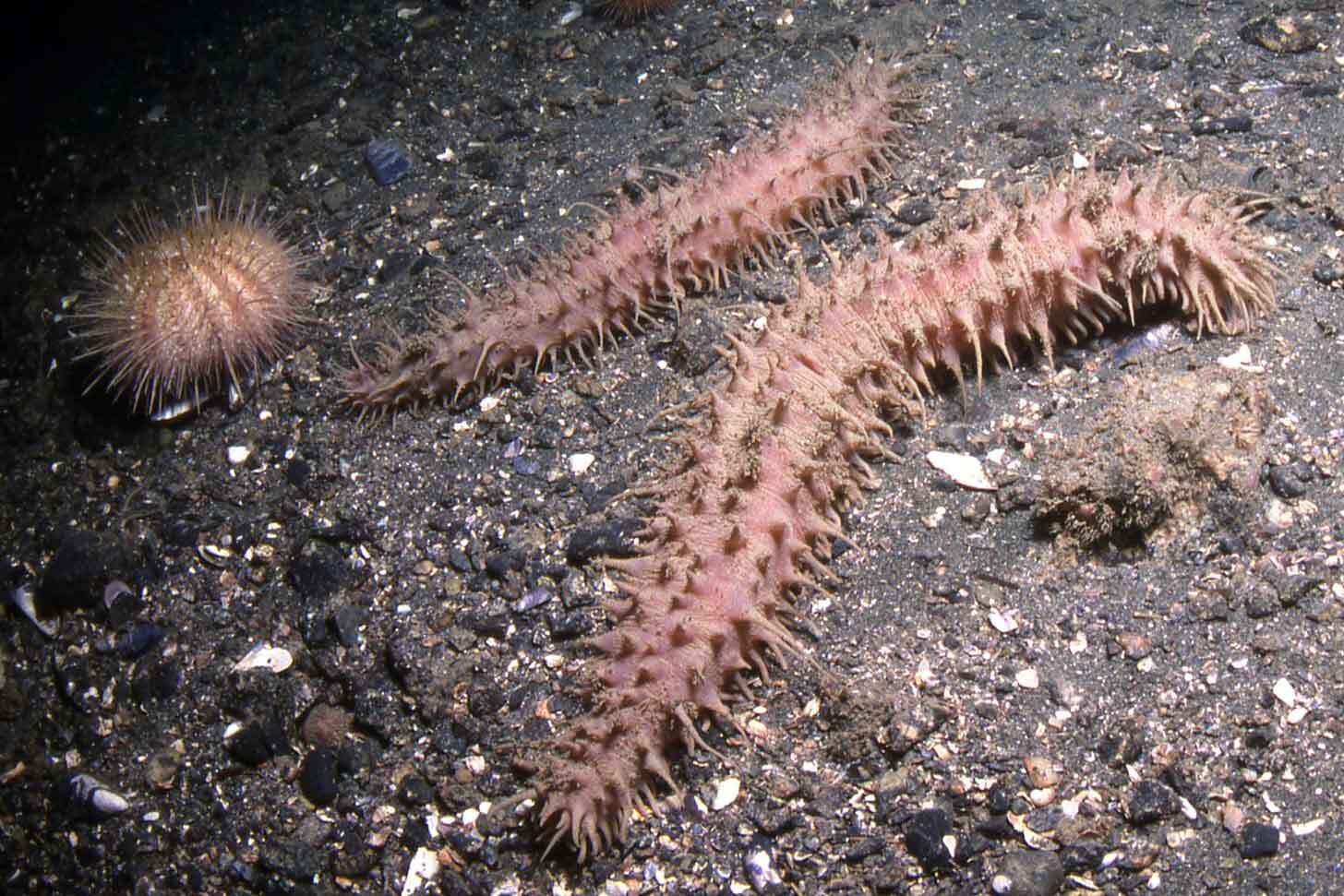
“Sea cucumbers have a very important role, they’re literally the underwater vacuum cleaners,” biologist Professor Ove Hoegh-Guldberg told Underwater Earth, as he took a deep ocean dive himself.
Hoegh-Guldberg pointed out how sea cucumbers filter and clean the seafloor as they move, recycling nutrients into sand that’s cleaner going out than it is going in.
“They get food at the same time as [they’re] keeping the sandy surfaces clean,” Hoegh-Guldberg said.
One of the by-products of the sea cucumber’s sparkly clean digestion is an increase in calcium carbonate (CaCO3), a compound that keeps corals alive and thriving.
Professor Maria Byrne, the director of One Tree Island Research Station at the Great Barrier Reef, said sea cucumbers counter “the negative effects of ocean acidification.”
“In a healthy reef, dissolution of calcium carbonate sediment by sea cucumbers and other bioeroders appears to be an important component of the natural calcium carbonate turnover,” Byrne explained to the University of Sydney.
Sea cucumbers have been on the decline due to overfishing and ocean pollution, but scientists hope to boost conservation efforts by spreading the word about the key role they play in their underwater ecosystems.
Fortunately, the discovery of this new species of sea cucumber hopefully signals that the tide is turning in the right direction for them — and their ocean neighbors.
“Sea cucumbers provide an extra level of insurance against the things that are causing coral decline,” marine ecologist Cody Clements told NPR this past spring.
“Doesn't mean it's gonna fix everything, but we want to give them as much of a fighting chance as we can.”
Header image via Nicholas D. / Flickr (CC BY-NC 2.0)
Getting to where you need to go is a matter of economic and social justice. Now, low-income Philadelphia residents are getting a boost.
In August, the city began a two-year Zero Fare pilot program, Next City reports, distributing 25,000 SEPTA Key cards (valued at $204 each) for unlimited free rides — and the majority of participants don't need to take any action to enroll.
"Transportation has been identified as a barrier for folks seeking employment, especially in Philadelphia, because of the high poverty rate," says Nicola Mammes, Zero Fare program director. Over 20% of Philadelphians live below the poverty line, and 50% of those households don't own a car.
The cost burden is real. Studies estimate that low-income Americans spend a higher proportion of their income on transportation: 30% of everything they take home after taxes. To address this need, other cities like Los Angeles are rolling out mobility wallets that allow people to spend a set amount of money every month on eligible forms of transportation.
Participants in Philly's Zero Fare pilot must be 18 to 64 years old, have an income at 150% or less of the federal poverty line, and be Philadelphia residents. The program is funded by the city for a total of $62 million till June 2025 with the twin goals of increasing mobility for low-income residents and investing in SEPTA, the regional transit authority for Southeastern Pennsylvania.
As of mid-April, participants have taken over 1.8 million trips.
A unique approach to enrollment and engagement
Unlike many similar programs, there is no need to apply. Instead, the city used a lottery system to select 90% of participants from a pool of eligible residents enrolled in a qualifying low-income benefits program. For the other 10%, the city worked with community-based organizations to reach those who might not be eligible due to immigration status.
This approach runs counter to how other types of benefits are normally distributed. Many similar programs require an application process to determine eligibility, which can prevent the people who most need the program from accessing it.
"The population that is eligible for this benefit — they oftentimes are hard to reach," Mammes says. "And really, that's also why we designed the program the way that we did — that it would be on us to figure out how to reach them."
Because people are automatically enrolled, the city is conducting extensive outreach to educate participants. First, the city sends a postcard notifying a participant that they've been selected and giving them basic information about the program. Then, the Office of Community Empowerment and Opportunity sends a series of text messages and calls them. If recipients don't use the card, then the city does another round of outreach to encourage adoption.
The program started with outreach in August 2023, then mailed out the first batch of 1,000 cards in September 2023, with distribution scaling up month by month to reach the 25,000 goal.
So far, there has been an adoption rate of about 50%, according to Mammes, with distribution and outreach still ongoing. If someone receives a card but doesn't use it even after additional attempts to reach them, the city can deactivate the card and pass along the benefit to someone else.
The program is only a two-year pilot, but the city is seeking more funding. "We'd love to see it expanded to be an entitlement," says Connor Descheemaker, coalition manager for Transit Forward Philadelphia. With only 25,000 total participants in a city with the highest poverty rate for a big city in the nation, the need is much higher.
"The more that we can have people just receive these entitlements, the more we're able to connect them to opportunity, give them the access to reach more jobs, reach more healthcare facilities, reach more grocery stores," Descheemaker says. "That's how we're getting new people on the system from the folks experiencing poverty."
Reaching Philly's immigrants and refugees
For 10% of participants, the city partnered with community-based organizations to reach people who might not be enrolled in a qualifying public benefits program. One of those organizations, the Southeast Asian Mutual Assistance Association Coalition, serves immigrant and refugee communities in Philadelphia.
"Our clients, they don't have U.S. citizenship," says Tammy Lam, the group's community resources coordinator. "To qualify for Medicaid and food stamps and all the public benefits, you have to have [a green card] within a certain amount of years, and then you may qualify or not based on income. So, it's very hard to get services."
So far, participants report that the pass has made it easier to get to medical appointments. "They say that that's very helpful. It is a major need in the city … So, it has made life a bit easier for these individuals."
Most of the organization's clients walk or use public transportation and pay with cash, according to Lam. This means that they pay more per ride. While a regular SEPTA fare is $2, cash customers pay $2.50 and don't get two free transfers. That means that cash customers could end up paying $7.50 for what would be a $2 trip.
"All these things add up, especially for folks who are unbanked or don't have access to the place where they can even purchase a SEPTA Key card," says Descheemaker.
Building trust through outreach and education
One of the challenges with the program is getting people to trust that it's real — yes, you can ride SEPTA for free. No, you don't have to pay anything. "We have gotten feedback," says Mammes. "Just more questions like, 'I got this in the mail, can you explain this to me? Why did I receive this benefit? … What is it gonna cost?'"
She hopes to offer more customer education going forward so that people who receive a card in the mail trust that there are no strings attached. "With anything new, you're gonna get people who are skeptical and have questions. And that's completely valid," she says.
Lam saw the same thing with her clients. "A lot of our clients are really scared … Some of them are here undocumented, and they're just trying to make a living and raise their families."
Lam hopes that in the future, the city can provide more support to partner organizations during the distribution process, including translation for clients who don't speak English. "No matter how much you reassured people, they were still scared, like, 'Oh, am I going to get deported if I get this card? Will people know that I'm using it? Is the government tracking me?'"
According to Mammes, the city worked with partner organizations to develop a strategy for distributing the cards and hopes to adapt the process moving forward based on what the city learned in this first phase.
Bolstering ridership on SEPTA
Like transit agencies across the country, SEPTA is facing a fiscal cliff, with money from federal pandemic relief funds set to run out in July. The Zero Fare program is one way for Philadelphia to invest in SEPTA while encouraging new ridership as the agency struggles to return to pre-pandemic levels. The idea is to create a virtuous cycle where "ridership begets ridership," according to Mammes.
Unlike other cities, Philadelphia is extremely limited in its ability to directly fund transit, says Descheemaker, due to a state legislature split along partisan lines. "If you look at our FTA grant dollars, you'll see that we as an agency sector are disproportionately dependent on state subsidies," Descheemaker says. "In fact, we are preempted from raising dedicated local taxes or fees to raise money for transit."
The city has also invested in the Key Advantage program, giving all city employees SEPTA Key cards, another way to leverage local dollars to get people back on the system. Last year, the city reported that Key Advantage card holders were riding the system 13% more on average and using it on nights and weekends.
Increasing ridership through the Zero Fare program could enhance trust and safety in the system as a whole, adding "eyes on the street" according to Descheemaker. The more people ride it, the safer it gets; the safer it gets, the more people ride it.
"When people are alone on the system, or they don't see anybody who cares or seems to want to get involved, then they're not going to treat their area with respect if they don't feel respected while using it."
This story was produced through Next City's Equitable Cities Fellowship for Social Impact Design, which is made possible with funding from the National Endowment for the Arts.
This article was originally published by Stacker and was republished with permission.
Header image by Krtz07 on Shutterstock
Laundry might seem like one of the most run-of-the-mill chores, but its environmental impact can be dramatic.
HeySunday consulted scientific studies and reports from environmental agencies to determine the impacts of laundry on the environment and how we can help.
While pedestrian, many of our most routine tasks can have enormous implications on our ecological footprint as a society if we aren't mindful. For instance, many people leave the sink on while brushing their teeth.
It may seem quick and harmless, but it can account for four gallons of wasted water per session, according to Money.
Similarly, many households might unwittingly use laundry detergents that can pollute nearby water sources and be toxic to aquatic life, including phosphates and surfactants.
At last count, there were around 840 million washing machines in use across the globe. Even skipping 1 out of 6 loads could reduce 186 million tons of emissions, according to McKinsey's Fashion on Climate report in partnership with Global Fashion Agenda.
That said, not all spin cycles are equal. Individuals and personal households only account for a proportion of laundry. The average residential washing machine uses about 40 gallons of water per load for older washing machines, according to the Environmental Protection Agency. In contrast, newer models use 31 gallons per load.
The good news? All it takes is some tweaking of our daily habits and cleaning schedules to have equally as dramatic a positive impact.
By examining the common household staples — from our choice of detergent to whether our machines are front-loading — every person can reconsider if their laundry habits are eco-friendly and play a role in keeping the environment just as clean as their whites.
Here are 5 stats that reveal the environmental impact of laundry — and what you can do to make a difference:
Laundry is responsible for the release of almost 35% of all microplastics into the world's oceans
In 2022, global fiber production increased from 112 million tonnes the year before to 116 million tonnes, according to the Materials Market Report, close to 60% of which were synthetic fibers (e.g., polyester or nylon).
Most synthetic fibers that turn into microplastics don't do so during their manufacturing process but when worn and washed, especially the first few times we wash them.
Of the 14 million tonnes of microplastics on the ocean floor, an estimated 16% to 35% are from synthetic fabrics, tallying in at a whopping 200,000 tonnes to 500,000 tonnes entering the oceans annually, according to the European Environment Agency.
Thankfully, there are some easy choices consumers can make to minimize their microplastic contributions. For one, try to avoid fast fashion, as the clothing made by these companies tends to wear out and dissolve into microplastics quickly.
When possible, try to buy used clothes, as recycled fibers are less likely to shred even during washing, according to the International Union for Conservation of Nature.
Laundry is the second-biggest use of residential water

The average residential washing machine uses 31 gallons of water per load, and that's only if you have a newer one; older models (before 2003) tend to use closer to 40 gallons per load.
That's around a full bathtub of water for just one load alone.
However, many front-loading machines can use just 13 gallons of water per load.
Many front-load machines can wash over 20 pounds of laundry at a time (compared to 10 or 15 for a top-loader), amounting to about 45% less water usage for the same amount of clothing cleaned in a personal, top-loading machine, according to the EPA.
Many states and cities have incentivized using water-efficient washing machines and communal laundry spaces, including rebates for households that buy an efficient personal machine and owners of multiresidence housing units leasing multiple washing machines.
Washing machines are responsible for emitting roughly 26 metric tons of carbon dioxide and other greenhouse gasses every year in the US

The amount of greenhouse gasses emitted during washing in the U.S. annually is 26 metric tons — the equivalent of driving 66,497 miles in a gas-powered vehicle.
Thankfully, a very simple solution can help U.S. households cut way down on their emissions: dialing the temperature down a bit. Washing with cold water can save as much as 80% on energy usage.
Reducing the water temperature when washing our clothes by even a few degrees can noticeably reduce emissions.
A few months ago, the Department of Energy announced it had finalized efficiency standards for residential washing machines, with compliance mandated in U.S. households starting in March 2028.
These regulations are estimated to cut almost 14 million metric tons of carbon dioxide emissions that would otherwise be released into the atmosphere over the next three decades.
Clothes dryers account for roughly 4% of a household's total electricity usage annually

Despite being utilized far less frequently, clothes dryers suck up more than twice as much electricity annually as cooking or ceiling fans do within a household and over three times as much as microwaves or dishwashers.
That's because most dryers work in energy-inefficient ways by heating in air, heating the clothes, and then externally venting it. However, this doesn't necessarily have to be the standard:
In Europe, for example, many dryers work by recycling hot air rather than venting and reheating it. An even easier option is to do away with your clothes dryer altogether and revert to the simple method of using a clothesline or drying rack.
The DOE's new efficiency standards apply to clothes dryers and washers and will also become mandatory in March 2028.
Using energy-efficient dryers across U.S. homes is estimated to curb 57 million metric tons of carbon dioxide emissions over the coming 30 years.
Scented laundry detergents have been associated with releasing more than 25 volatile organic compounds through dryer vents

We all love that fresh — or flowery, or fruity — scent we familiarize with clean laundry, but it often comes at a high cost.
Scented laundry detergents are linked to seven types of hazardous air pollutants and two types of carcinogenic HAPs, often vented directly into the outdoors.
According to the National Institute for Occupational Safety and Health, carcinogens have no level of exposure at all that is safe for humans.
Story editing by Carren Jao. Copy editing by Paris Close.
This article was originally published by Stacker and was republished with permission.
Header image by Canva
As cities across the globe face record-high temperatures this summer, most of us are desperate to do anything for a little reprieve from the heat. Unfortunately, while potentially life-saving, cranking the air conditioning increases energy use (and raises your electricity bill, too).
Plus, having access to air conditioning is a privilege in itself.
For these reasons, architects and engineers have long been looking for ways to cool buildings without the use of electricity or chemicals.

So Indian architect Monish Siripurapu founded his company, CoolAnt, which utilizes design elements inspired by nature itself to cool buildings without electricity.
“Cooling is a necessity now, and the least we should try and do is not to let this necessity warm our planet,” Siripurapu writes on the CoolAnt website.
In India alone, studies estimate that the building sector is responsible for about 40% of the country’s total energy used each year, with figures expected to rise to 76% by 2040.
As the demand for air conditioning systems rises, experts like Siripurapu know that unless buildings are made more intentionally, the strain of this demand will lead to major resource and energy shortages.
“The need of the hour is not just to mitigate future changes to our climate, but to work together to adapt and to plan for the changes to come,” the website continues.
So, how has CoolAnt adapted?
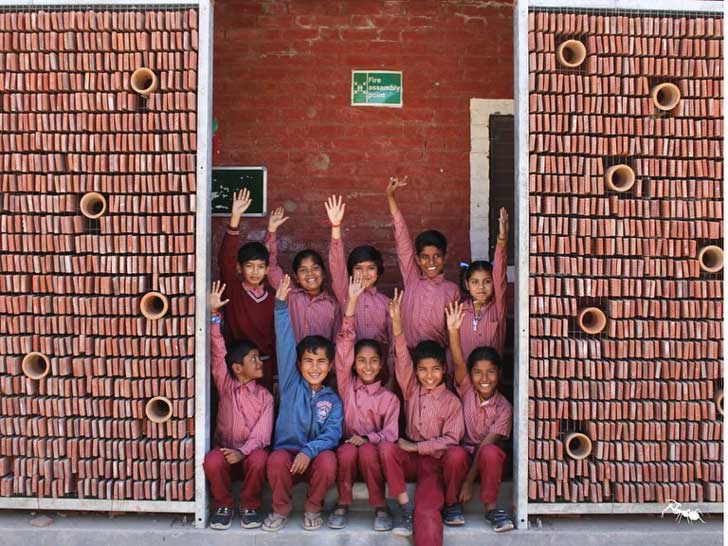
By using biomimicry seen in beehives and trees, CoolAnt has created walls made of several tiny pieces that use a combination of physics and material properties to help cool the building down.
In these walls, CoolAnt uses terracotta tubes that are reminiscent of the hexagonal cells seen in a beehive, or clay “AeroLeaf” tiles that are inspired by evapotranspiration in leaves.
“Traditionally, we used to have earthen pots for cooling water. We’re using the same system and technology for cooling air,” Siripurapu explained in a video for the UN Environment Programme.
“We are pouring the water on top of these tubes and letting the air pass through these terra cotta pots, and the air that comes out is naturally cooled.”

As the water in these tubes or tiles evaporates, it creates a cooling effect for the air in its environment — reducing the heat in a home or building — all without ozone-depleting or carbon-intensive chemicals like refrigerants.
Evaporative cooling like this has actually been utilized for centuries, in ancient civilizations which, of course, had no access to electric air conditioning systems.
“Traditional architecture has so much wisdom, knowledge, and methods that are really simple for solving simple problems like air conditioning and cooling,” Siripurapu said in the UN video.

Romans and Egyptians used to use wet, earthen materials to cool air, using porous jars or hanging wet materials on the doors of houses and tents.
Of course, CoolAnt’s tactics are much more modernized and also aim to incorporate a much more natural and inviting visual design compared to the industrial aesthetic of standardized air conditioning systems.
So far, CoolAnt has installed some of its projects across India. One such installation has cooled down classrooms for the education NGO Vidya & Child, while another helped keep over half a million people cool at an international science festival.
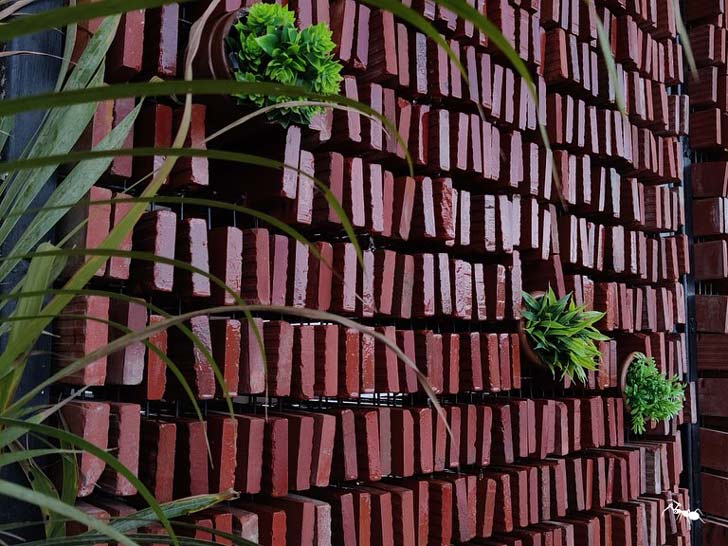
These systems are even already in use for government buildings, like the Army Cantonment in Jaipur, India, and in some private residences.
Other installations for commercial buildings are also being planned and implemented, including one in the Sardar Vallabhbhai Patel International Airport.
Additionally, CoolAnt hopes to create public art features, which will purify air in the environment around them. Showcases of CoolAnt’s work can be found in places like the Science Museum of London, and the company was recently featured on Shark Tank India for its innovations.

And these cooling systems are not just beneficial to the environment; they have provided jobs for local artisans who craft pottery using natural materials for cooling walls and installations. A recent public restroom project — Twin Toilets — was even made of “waste terracotta,” from construction debris or broken pots from the local potters’ village.
The terracotta materials are also conducive to adding greenery to a space, and growing moss and biofilm even helps to improve air quality in the spaces where these walls or installations are assembled.
Plus, CoolAnt offers all of its research on natural cooling solutions as OpenSource materials, so architects and engineers around the world can implement similar solutions.
“This is what we want to stand for,” Siripurapu told the UN. “To combine art, nature, and technology into design and make products accessible to everybody.”
Header images courtesy of Pixabay and CoolAnt
Growing up, Micah Hendler gravitated toward musical communities where he “wouldn’t be picked on.” As a self-described “pretty awkward” guy, singing was the one thing that made him feel confident and included.
Also during his adolescence, Hendler was untangling what he described as a “very one-sided narrative about Israel and Palestine,” that he was taught in his early years. He went to a summer camp called Seeds of Peace, which gathered teams from conflict regions for a dialogue program.
And then something clicked: What if these two things — music and dialogue — could be used together? What if music was dialogue?

Based on the photo of Hendler on his website, where he flashes a kind smile and wears a graphic T-shirt with an image of a guitar that reads Woody Guthrie’s signature “this machine kills fascists,” it’s clear he’s found his answer.
“I quickly learned I had the power to create spaces of belonging for people,” he told Good Good Good.
Hendler — who had grown up studying Hebrew — pursued an education in music, international studies, Arabic, and cultural traditions in college.
His senior research thesis was focused on whether his experience at that summer camp could be replicated on the ground in Jerusalem.
Bridging divides between East and West Jerusalem
Jerusalem, a holy city for nearly all major world religions, was divided into two sections by the United Nations in 1948.
West Jerusalem’s population mostly consists of Israelis (many of whom are Jewish), and East Jerusalem is made up mostly of Palestinians (many of whom are Muslim or Christian). Israel claims the whole of Jerusalem as its capital, while Palestinians claim East Jerusalem as the capital of a future, unoccupied state.
Jerusalem is a hub for people of all religious backgrounds — and represents a particularly fertile ground for the decades-long conflict between Israel and Palestine.
Hendler founded the Jerusalem Youth Chorus in 2012, with the aim to bridge the gap between youth living in East and West Jerusalem.

“The longer I did dialogue work, the more I saw that music, and specifically singing groups, could play the same kind of role in building community and creating a shared identity, even in these contexts where people are ostensibly in existential conflict with one another,” Hendler said.
“Music is a communication technology.”
He has grown JYC for over a decade, but when Hamas attacked Israeli civilians on October 7, 2023 — and Israel’s occupation in Palestine subsequently escalated to its most violent extremes — the future of the organization hung in the balance.

Hendler said he and his team were prepared to hit the brakes, but after a few remote meetings with families and singers, everyone came to a consensus: The chorus was needed now more than ever.
“Everybody said in one voice: ‘we have to keep meeting,’” Hendler said.
“Over the last 12 years, some parents have been very supportive, some of them have been sort of neutral, and some have been outright a problem or have pulled their kids for political or religious reasons. But the fact that all of the parents were like ‘This is vital. This is good for my child,’ they really stepped up to help make it happen.”
Hendler said the chorus is usually made up equally of singers from both East and West Jerusalem, or “as close to half-and-half as possible.” That means finding a shared space to rehearse requires support.
Parents began organizing carpools to help singers from both parts of the city safely reach their weekly practices. While the majority of Israel’s bombardment of Palestinians has taken place in North Gaza and Rafah, Jerusalem is certainly not free of risk. The singers know that.
“There’s been a remarkable rate of commitment of people on both sides to this,” Hendler said, proudly sharing that the JYC has met every week since October 7.
Music as a shared language
And the meetings are largely the same as they’ve always been. Each gathering begins with a dialogue exercise, which is followed by a music rehearsal, and then rounded out with another session of dialogue.
Hendler calls the singing both a “warm-up” and “cool-down” from the dialogue process.

Some of these conversations have included story-sharing from grandparents who were forcibly removed from Palestinian villages in 1948, or talking about the traumas of the current moment — all with the help of professional facilitators who guide young people through conflict.
“Maybe they had a difficult experience on the way to rehearsal. Maybe they were stopped at a checkpoint. Maybe there was a bomb threat on the train. Maybe they were tear-gassed. All of these things have happened to our singers. Maybe they’re coming in a way that’s a bit on edge, a bit distrustful … because someone literally made them feel afraid for their lives on the other side,” he said.
“And then they come, and there’s a way in which singing is this sort of attunement to each other. The way that it reverberates in our body, and the way you’re creating something beautiful together … it rearranges us.”
In fact, following the October 7 attacks, the group’s high school chorus penned a moving piece called “A Different Way.”
Hendler and Amer Abu Arqub, the executive director of the JYC, introduced the song — which is sung in English, Arabic, and Hebrew — during a TED Talk in April of 2024.

“We reject war, occupation, and terror. And instead, we decided to sing for peace, justice, inclusion, and equality,” Abu Arqub said. “At JYC, we don’t share the same opinions, and we disagree and have hard conversations about them every week. But what we do share is a shared future, despite what politicians say.”
“We know that as a Palestinian and Israeli chorus, we don’t single-handedly have the power to stop the war,” Hendler added. “But we also know that the reason war continues is because people feel that there isn’t a different way.”
Together, they said: “We are the different way.”
“When the day is done, what will be left behind? / Only you and me, with our futures intertwined,” the JYC sang in a recorded performance. “We live within the wars / we feel each other’s pain / Because of you, I know / We must choose a different way.”
That common bond, while strengthened by current events, has been at the heart of JYC since its inception. In fact, Abu Arqub was a member of the chorus 10 years ago, and like many other staff members, went from alum to leader.
“Last year, I was so proud to step into the executive director role with a vision to create a youth singing movement,” Abu Arqub said, “to help youth find their voices across Israel and Palestine, as I found mine.”
A common goal to create peace
At this point of inflection, Hendler said the organization is growing and eager to work with other groups of people who want to replicate the healing work of music and dialogue in the face of conflict. But, he cautioned: This work has to be done correctly.
It’s critical to have dialogue space in peace-making work, he said, but it’s also vital to have the “connective tissue” of creativity and humanity — like music.
“Where’s the soul in this? Where are you as a human being and not just as a political representative?” Hendler posed.
Conversely, if a group is only attempting to bridge their divides through music, he said it can “do damage to sing and then pretend that that’s enough.”

The place where singing and bridge-building come together? With a common goal. For JYC singers, that goal is maintaining their important relationships and agency as young people — but also to succeed in creating good and meaningful music that can reach other parts of the world. To create “a soundtrack for the revolution,” as Hendler put it.
“If you think about any of the research that’s been done on intergroup conflict, you need a common goal,” Hendler explained. “That’s key, because then people feel like we have to succeed at this thing together. It redefines ‘who is us?’”
The JYC has had many milestones in its 12 years, including collaborations with artists like Ziggy Marley and Andy Grammer, as well as performances on late-night shows in the U.S. The group was also featured on “America’s Got Talent,” and was about to embark on a tour in late October 2023 — before things changed.

Though the world around them is in disarray, the JYC knows the potential of their voices — especially to be a blueprint to anyone else looking for a way out of intolerance and hate.
“What’s making me hopeful is the fact that the chorus is thriving right now,” Hendler said. “And it’s not because the singers, the staff, all of us aren’t experiencing a whole lot of trauma. But it’s because we’ve decided that there’s a different way to live in response to that trauma — a way that doesn’t recreate it for other people. That is a source of immense power.”
A version of this article was originally published in The Music Edition of the Goodnewspaper.
Get your own Goodnewspaper by becoming a good news subscriber today.
Two weeks ago, Yellowstone National Park made headlines when a mother grizzly bear was spotted out and about with five cubs in tow — the biggest grizzly bear cub litter ever seen in the park.
Grizzly bears in that region of North America typically only have one to three bear cubs a litter.
Frank van Manen, the leader of the Interagency Grizzly Bear Study Team, said it was possible that an “adoption” event had occurred, in which two mothers give birth in the same year, and one ends up taking on the sibling’s cubs.

In an interview, van Manen told Wyofile that if the bears had all been born in the same litter, it would be the first five-cub litter “recorded in the history of the Greater Yellowstone Ecosystem.”
“Whether it was an adoption or whether it truly is a five-cub litter, it just amazes me that every year there’s some new surprise to us, even after intensively studying this population for more than 50 years,” van Manen said. “I just think that’s cool.”
Grizzly watcher Bill Hamblin said that in the weeks that have followed, the mother has only been spotted with four cubs, and that it’s possible that one of them may have sadly passed away.
Since then, Hamblin told the Cowboy State Daily that he spotted the mother grizzly “on five different occasions” with the remaining cubs, and they were in good health.
On top of this record sighting, Hamblin is baffled by the sheer number of cubs that have been spotted so far in 2024.
Since they started emerging in the spring, the total count of unique grizzly bear cubs spotted has ticked up to a whopping 18 — triple the average number.
“That’s more than we’ve ever seen,” Hamblin said.

In the U.S., grizzly bears are protected as a threatened species. After federal-led efforts to remove grizzly bears throughout the 20th century, they were nearly driven to extinction in 1975.
Fortunately, when they gained protection under the Endangered Species Act, the bears began rebounding. Due to federal conservation efforts and the implementation of “critical recovery zones,” they have continued to increase in population.
Hamblin is happily surprised by the 18 cub sightings so far in 2024, and feels like it’s a good sign of the grizzly’s continued recovery.
Like fellow grizzly fan van Manen, Hamblin has spent decades observing the bears. He lives in Idaho Falls, Idaho and makes the trip out to Yellowstone every spring with his friend Gary Gaston to photograph and observe the bears from a safe distance.
“I like to sit back, sometimes a mile or two away, with powerful binoculars or spotting scopes and just watch the bears’ natural behaviors,” Hamblin said.
When they’re not dining on elk calves — and sometimes bison — the bear families have been spotted by Hamblin and Gaston on high ridges, digging around for their favorite snack: roots.
“You can always see the mother bears digging around,” Hamblin smiled. “And then the little ones see what mom is doing, so they start doing it too.”
Header image via Byrdyak / Wikimedia Commons (CC BY-SA 3.0)
Wish you could read more good news? Subscribe to the Goodnewspaper to get a beautiful print newspaper filled with positivity delivered in the mail every month.
Roughly 10% of the Earth’s land surface is covered by glacial ice, making the melting of these surfaces especially worrisome in the face of climate change.
And they’re melting at an alarming rate.
This contributes heavily to rising sea levels, which increases coastal erosion, and can lead to more frequent and life-threatening storms like hurricanes and typhoons. Combine this with warming air and ocean temperatures, and it’s not just the polar bears that face an unsettling future.
While studying this component of the climate crisis doesn’t exactly solve the issue, it does help experts better understand how the planet will respond and adapt to climate change.

Dr. James Bradley, an expert in Arctic Biogeochemistry at the School of Biological and Behavioral Sciences at Queen Mary University of London, embarked on a study with his research team to better understand the Arctic's rapidly changing landscapes.
As glaciers retreat due to global warming, they expose new landscapes and microorganisms that have lain dormant for thousands of years, covered in sheets of ice. These teeny-tiny lifeforms “colonize” the rock exposed in the ice-melting process to collect nutrients for their survival.
In turn, this forms new soils and ecosystems.
Dr. Bradley’s team set out to explore the formation of these new soils and ecosystems, traveling to Svalbard (a group of islands between the North Pole and Norway’s northern coast, well above the Arctic Circle).
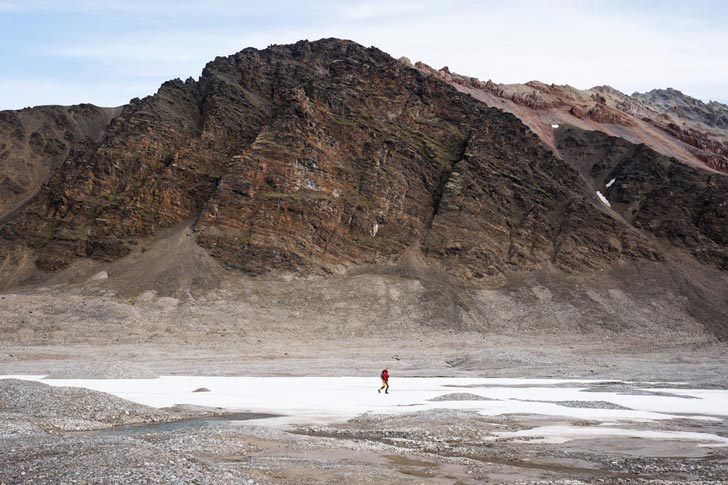
According to Inside Climate News, this area is the northernmost settlement in the world and has been called “a canary in the coal mine of climate change,” as it is warming more than two times faster than any other areas of the Arctic — and five to seven times faster than the rest of the planet.
If there’s a place to understand how melting glaciers impact Planet Earth, Svalbard is it.
The research team spent most of their time studying the Midtre Lovénbreen glacier valley, which Bradley had first studied in 2013.
“A decade ago I was walking on top of the ice and drilling ice cores into the glacier,” he said in a statement for the university. “When we returned in 2021, the glacier had shrunk and instead of ice there were barren, seemingly lifeless soils.”

His team analyzed barren landscapes that offer virtually no support to any form of life. Below-freezing temperatures, rocky terrain, and a lack of sunlight during winter don’t exactly make for a successful community garden, for instance.
But underneath a layer of dark, cold night are microorganisms like bacteria and fungi that have the power to create new life — and capture carbon.
The research team — which was made up of scientists from Germany, Switzerland, and the United States — gathered soil samples from the area and brought them back to the laboratory.
They discovered that each sample contained incredibly diverse communities of microbes, and published their findings in the journal Proceedings of the National Academy of Sciences.
“These are some of the most pristine, delicate, and vulnerable ecosystems on the planet, and they are rapidly colonized by specialized microbes, even though they are subject to extremes in temperature, light, water and nutrient availability,” Dr. Bradley explained.

Investigating the composition of the soils using DNA analysis and measuring the cycle of carbon and nitrogen flowing through it, the researchers concluded that microscopic fungi found in the Arctic provides fertile ground for new life.
“We found that these specialized fungi are not only able to colonize the harsh Arctic landscapes before any other more complex life,” Dr. Bradley said, “but that they also provide a foothold for soil to develop by building up a base of organic carbon which other life can use.”
Fungi is known to be well situated to store carbon in soil, compared to bacteria. The ratio of fungi to bacteria is key, as more fungi mean more carbon sequestration in the soil, while bacteria generally leads to more carbon emissions.
“In high Arctic ecosystems, the variety of fungi is particularly high compared to that of plants, which increases the likelihood that fungal communities could play a key role there as ecosystem engineers,” explained one of the study’s author’s Professor William Orsi, from Ludwig Maximilian University of Munich, Germany.

Essentially, these researchers — who braved the barren cold, unpredictable wildlife, and dangerous conditions of the Arctic — have concluded that these fungal populations hold the key to making more accurate predictions about our vital Arctic ecosystems.
Indeed, they found the earliest indicators that the fungi left behind by melting glaciers might just be the building blocks to new life on a warm planet — or at least, the carbon keepers of the future.
“Our results demonstrate that fungi will play a critical role in future carbon storage in Arctic soils,” Professor Orsi summarized, “as glaciers shrink further and more of Earth's surface area is covered by soil.”
Header image courtesy of James Bradley/The Bradley Lab
Pygmy blue whales have long been a mystery to marine biologists, spending the majority of their lives underwater and swimming far from shore.
But on July 4, the Australian Institute of Marine Science released findings of a baby pygmy blue whale that was spotted off the Ningaloo coast along the East Indian Ocean.
Scientists were delighted by the discovery, which marks the “youngest-ever” pygmy blue whale ever photographed.

Spotter pilot Tiffany Klein came across the calf and her mother in Australian waters while she was out on a research and tagging mission for AIMS and the Centre for Whale Research.
“Previously, I’ve seen them later in the year, around September or October, and traveling south,” Klein told AIMS.
“These calves were about half the size of their mother, whereas this one was only about a third of the size, which is still around six to seven meters [approximately 20 feet].”
Micheline Jenner is a marine biologist at the Centre for Whale Research who has been tagging pygmy blue whales since 2019. She told AIMS that this latest sighting of northern migration is “very interesting.”
“Slowly but surely over the years we are placing more pieces in this pygmy blue whale puzzle,” she said.
One of the bigger parts of the “puzzle” is exactly where pygmy blue whale mothers calve, or give birth.
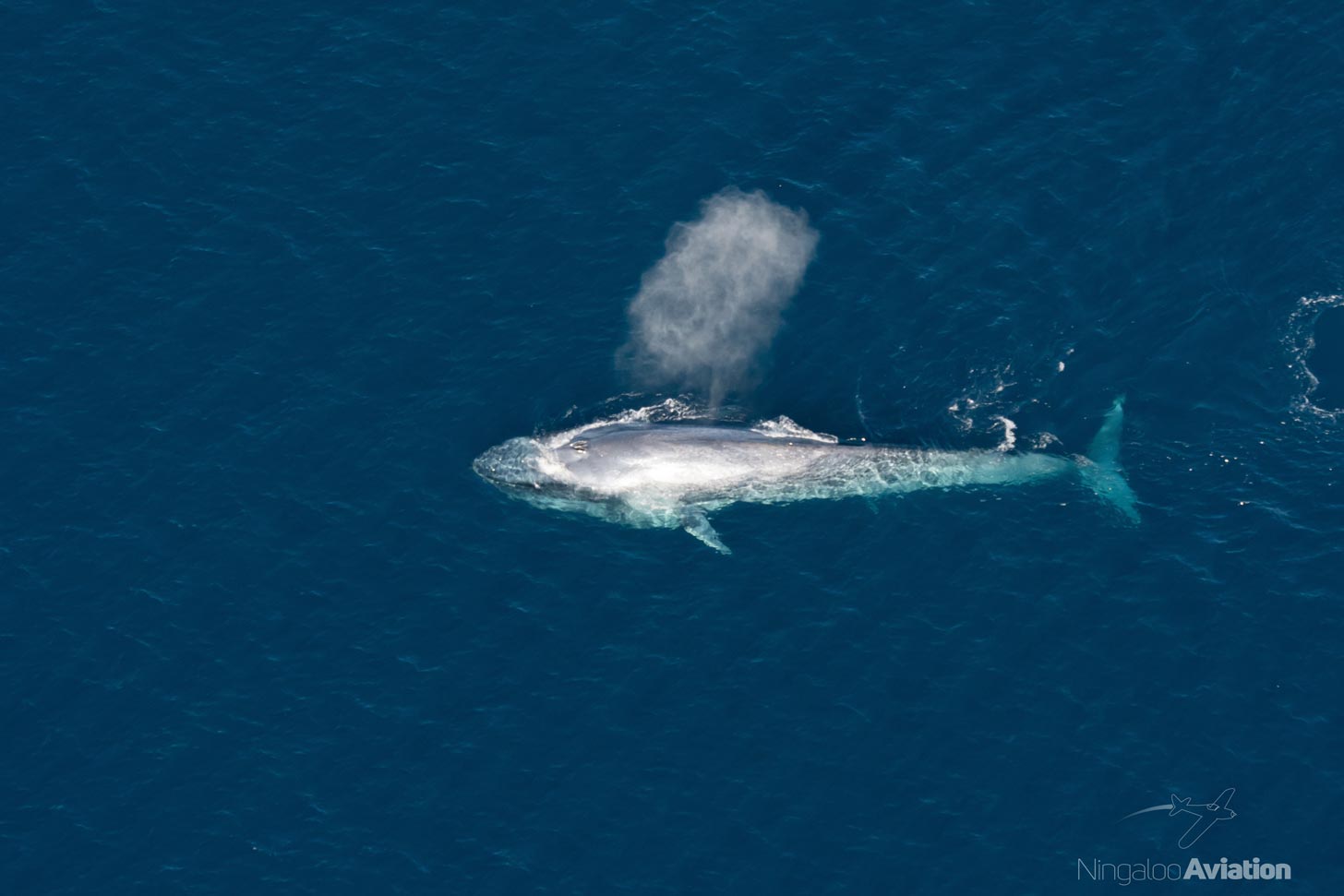
Little is known about the reproduction and birth of this type of blue whale, which is slightly smaller in size than its relative that spans 80 to 90 feet in length.
As marine biologists learn more about pygmy blue whales, they gain renewed confidence in protecting the species.
In the International Union for Conservation of Nature, the subspecies of blue whale is globally listed as “data deficient,” due to their elusive nature.
But down under in the Southern Hemisphere, the Australian Environment Protection and Biodiversity Conservation Act lists them as endangered.
“Pygmy blue whales are difficult animals to tag, because they move through the water so quickly and because they only emerge for a few quick breaths before diving again for 15 to 20 minutes at a time and resurfacing,” said AIMS lead research scientist Michele Thums.
On this latest expedition — in which the weeks-old “bundle of joy” was spotted — the scientists were able to successfully tag and track six pygmy blue whales by satellite.
“It is really wonderful to have tagged six on this trip, providing us with precious data on their movements,” Thums said.
Header image via AIMS / Tiffany Klein (CC BY-NC-ND 4.0)
Aside from their combined superpowers to educate, entertain, and advocate on the Internet, brothers Hank and John Green have a multi-million dollar e-commerce side hustle.
A multi-million dollar e-commerce side hustle that donates all profits to charity.
The first product they offered was a sock subscription called the Awesome Socks Club, and then a coffee subscription called the Awesome Coffee Club. After that came Sun Basin Soap, and then Keats & Co Tea.
But a recent announcement makes the Green brothers’ original product available to a wider audience: Kids!

The Awesome Socks Club is now available in youth sizes and is the first explicitly kid-friendly product to hit the Good Store, the online platform where all of these products live.
Every item sold in the Good Store supports an ongoing partnership with Partners in Health, a global health nonprofit that provides vital medical care to areas facing poverty and inequality.
“The founding goal of the Awesome Socks Club was to support building the Maternal Center of Excellence in Sierra Leone, a hospital tackling medical injustice at its root,” the Good Store website reads.
“Since 2020, we’ve donated $8+ million dollars through Partners in Health for the construction of the hospital and comprehensive training and staffing.”
The kid’s sock collection will be no different.

Matching with the adult sock options, the kid’s socks will be designed by a different independent artist each month and produced by Pacific Manufacturing, with ethics and sustainability in mind.
Starting at $13.75 per pair, the Awesome Socks Club subscription allows bundle deals so the whole family can match while giving back.
Thanks to the support of Good Store shoppers, as well as annual fundraising events like the Project for Awesome, ground was broken for construction of the Maternal Center of Excellence in April 2021.
In a video in 2023, John said that Nerdfighteria (the online community most engaged with the brothers’ work), along with PIH, had raised $40 million for the hospital over the course of three and a half years.
“This will be the world-class healthcare center moms and kids deserve in Kono,” he said.

The MCOE will be a fully functioning maternal and pediatric teaching hospital in Sierra Leone’s Kono District, which has the world’s highest maternal mortality rates.
PIH has also improved existing maternal care available at Koidu Government Hospital, equipping the facility with 24-hour electricity, a blood bank, a fully stocked pharmacy for labor and delivery, and training for clinicians to improve their skills and provide better patient care.
A webpage for the MCOE shares: “With the support of John and Hank Green and their incredible community, PIH continues to expand this transformative work.”
As construction continues on this life-saving hospital, these “awesome” kid’s socks are just one way Hank and John Green hope to continue making a difference.

“To the thousands of you who donate monthly… and the thousands more who’ve made one-time gifts, to the people who’ve brought attention by sharing this project with friends and family: This is the change you’re making,” John said in 2023, from the building site of the MCOE.
“The kind of dignified, high-quality healthcare that everyone deserves is coming to Kono — and with it, generational change.”
Outside of the MCOE, Good Store products also contribute to other public health initiatives, like fundraising for accessible testing and treatment for tuberculosis, as well as cancer treatment, around the globe.
“You need socks, and you’re going to have to buy them from someone,” said Hank in a TikTok video promoting the Awesome Socks Club. “You might as well buy them from someone who donates 100% of the profit to charity.”
Header images courtesy of John Green, Good Store, and Hank Green
Every day the Good Good Good team collects the best good news in the world and shares it with our community. Here are the highlights for this week!
If you want to get good news in your inbox every day, join the Goodnewsletter — the free daily newsletter designed to leave you feeling hopeful.
The Best Positive News We’re Celebrating This Week —
Portugal just received approval to build its largest-ever wind farm, complete with environmental safeguards
Portugal’s government just gave environmental approval for the country to build its largest-ever wind farm — once completed it will support the energy consumption of 128,000 homes every year.
The wind farm will join forces with one of Europe’s largest hydroelectric projects, making it a true (and literal) powerhouse.
The company behind the project says it also plans to introduce environmental safeguards around the wind farm, including no new road construction, planting native species and fruit trees, managing forests, restoring ponds, and installing bat nest boxes.
Why is this good news? While construction won’t happen for this wind farm until early next year — any and all projects that take the world a (large or small!) step closer to a decarbonized grid and net-zero carbon emissions is worth celebrating. Especially in this case, since it’s adding on to an existing, massive clean energy facility.
Violent crime in the U.S. declined by over 15% in the first three months of 2024 — and the murder rate could see its largest annual decline ever
New statistics show that in the first three months of the year, violent crime dropped by 15.2% in the United States compared to the same time period in 2023. Murders declined by 26.4%, aggravated assaults by 12.5%, and robberies by 17.8%.
These declines held true in every region in the U.S. — and this latest data shows that the “historic decline” in violent crime we saw in 2023 is continuing this year.
Additionally, if the decline in the murder rate continues at its current pace, the U.S. could be on track to see its largest-ever annual decline.
Compared to 2023, murders in the first five months of the year have dropped by more than 40% in cities like New Orleans, Boston, Baltimore, and more.
→ Read more
Despite a rise in fires, deforestation in the Amazon rainforest is at its lowest level since March 2018
Deforestation in the Brazilian Amazon continued to plummet in May, reaching the lowest level since March 2018. Deforestation that month was around 501 square kilometers — or about 147 times the size of Central Park in New York City.
That may sound like a lot (it is!), but it represents a 54% decline from the same time last year. Year to date, 1,182 square kilometers of the rainforest have been cleared — down 40% from this point in 2023.
This good progress is despite the simultaneous rise in forest fires due to extreme drought.
→ Read more
More good news for the Amazon:
- A court in Suriname stopped development on hundreds of thousands of hectares of Amazon rainforest occupied by local and Indigenous people.
- Members of nearly 40 Indigenous communities in northern Peru are using tech tools to track and report illegal deforestation in the Amazon.
- An Indigenous-led initiative is working to protect 80% of the Amazon in Peru and Ecuador by 2025, consisting of 35 million hectares of rainforest.
- Indigenous groups in Colombia are training the next generation to defend and preserve the Amazon.
Downtown Denver joins a growing list of U.S. cities opting for a drone show instead of fireworks for the 4th of July
Instead of fireworks, Denver’s annual 4th of July celebration, Indy Eve will feature a drone show instead of fireworks. It will also feature two different projected light shows.
Also featured in the local celebration will be small businesses, food trucks, DJs, and a live performance from the Colorado Symphony Brass & Percussion Ensemble.
Recognizing the impacts of fireworks on veterans with PTSD, wildlife, air pollution, litter, and more — the city is part of a growing movement of communities reimagining what Independence Day celebrations can look like.
→ Read more
More drones doing good:
- Nepal is using drones to speed up tuberculosis testing in mountainous, rural areas and help slow the spread of the world’s deadliest disease.
- Sweden is the first country to use drones to deliver life-saving emergency medical care to people in need — beating ambulances to the scene.
- Earlier this year, cities across the globe opted for drone light shows to provide more eco-friendly Chinese New Year celebrations.
Collaborative conservation efforts are helping save one of the most endangered wildcats in the world
Endemic to grasslands in southern Brazil, Uruguay, and northeastern Argentina, the Muñoa’s Pampas cat is one of the most endangered felines in the world.
With fewer than 100 left in the wild, experts warn it could go extinct within 10 years as its natural habitat is cleared for agriculture.
Still, extensive conservation efforts are underway to save the species, like adopting ranching methods that preserve the grasslands, creating a captive-breeding program, and developing a tri-national conservation agreement.
What’s the nuance? Extreme flooding in the region has paused many of these efforts, once again reminding us of the intersecting issues that climate change brings. Still, experts are hard at work shifting their efforts to protect this endangered species.
A biologist single-handedly brought a struggling butterfly species back to San Francisco
Although the California pipevine butterfly was still common near the coast and in the Sierra foothills, they had all but disappeared from San Francisco. In the city, the species’ host plant — the California Pipevine — was extremely sparse.
Native butterflies have “really tight relationships with native plants” — some literally feed on a single native plant. Such is the case with the pipevine butterfly.
Wanting to see them back in his hometown, Tim Wong found the plant in the San Francisco Botanical Garden in Golden Gate Park and was allowed to take home a few clippings of the plant.
Then, he sourced 20 California pipevine swallowtail caterpillars and brought them to feed on their favorite plant in his garden. They began pupating, forming a chrysalis, hatching, and laying eggs — fully supported in their new backyard habitat.
Wong says it best: “Improving habitat for native fauna is something anyone can do. Conservation and stewardship can start in your very own backyard.”
More good news of the week —
A Wisconsin park just enhanced accessibility with new ‘track chairs’ to help visitors with disabilities enjoy the trails. Earlier this year, the park also introduced water wheelchairs that can float in the water, allowing visitors to enjoy the park’s lake, too.
[Related: National parks are expanding their adaptive excursion offerings so people with disabilities can better enjoy the parks, too.]
After they were forced to close on Sundays due to budget cuts, NYC libraries got funding back to reopen. After months of public outcry and pressure from the City Council, the libraries’ budgets were fully restored and they’ll once again be open to provide important services every day of the week.
A package of bills in Michigan will help address racial disparities in maternal health care. The legislation goes beyond implicit bias training to fix racism in maternal health care and would require the state to gather data on bias and racism that could occur in care during pregnancy and after birth.
Setting a new standard for sustainable construction and tribal partnerships, Portland’s airport just got a forest-first makeover. The soaring, nine-acre ceiling has lots of natural sunlight streaming in and feels a bit like walking through a forest.
In a historic win for children’s rights, Sierra Leone just banned child marriage. Long fought for by activists, the law criminalizes marrying girls under 18 years of age and prescribes jail terms of up to 15 years for offenders.
Injected just twice a year, a new antiviral drug prevented all cases of HIV in a trial of over 2,000 women. The Phase 3 trial result was better than all existing antivirals tested simultaneously and could lead to greater uptake and HIV treatment than daily pills.
New data shows that renewable sources made up the majority of electricity generation in the EU in 2023. Thanks to the rapid installation of new solar and wind projects, renewables accounted for 44.7% of all electricity production generated in 2023, a 12.4% increase from 2022.
The White House announced a first-of-its-kind strategy to reduce food waste. Food waste expedites climate change, and the government is looking at strategies to extend the food shelf life, create more composting facilities, and urge companies to donate more food.
In its elections tomorrow, Britain is set to elect its most ethnically diverse parliament ever. Regardless of who wins in the general election, a record number of ethnic minority MPs will win seats — for the first time better reflecting the country’s diversity.
Scientists just discovered a new 200-legged animal that’s cleaning up deep sea trash. Like other wild sea cucumbers, this one roams the seafloor looking for a bite to eat at depths ranging from 70 feet to 1,400 feet.
NASA is using powerful satellites to monitor endangered species around the world. The satellites can monitor vegetation health in almost real-time, helping identify potential habitats for endangered species, like tigers, to migrate or be reintroduced to.
Since 1934, USPS Duck Stamps have raised $1.2 billion for wildlife conservation. Doubling as a beloved art tradition, the annual stamp has helped conserve over 6 million acres of wetlands habitat on national wildlife refuges around the country.
Hungarian hogs are helping preserve the UK’s most endangered butterfly habitat. The hogs are also called “living lawnmowers” and are helping create ideal breeding conditions for the High Brown Fritillary butterfly.
A group of teen girls created groundbreaking new AI technology to help reduce wildlife collisions on roadways. A project created by four teen girls in Colorado uses AI and infrared technology to alert drivers of oncoming wildlife.
A “major milestone” for the species, wildcat kittens were just born outside captivity in Scotland. Groups have been working to rescue the cats from extinction in the UK, and it’s potentially the first time they’ve been more outside captivity in the country in more than 5 years.
Conservationists are working to save the giant, ancient crabs that live beneath Rome. The only freshwater crustaceans indigenous to Italy, experts hope to garner appreciation for these giant Roman crabs.
After decades of advocacy work, the world’s largest wildlife crossing is under construction in California. A collaborative effort by wildlife activists, government agencies, and private donors, crews broke ground on the crossing on Earth Day two years ago, and the crossing is on track to open by early 2026.
Bangladesh has seen the highest number of olive ridley turtle eggs this year thanks to extensive conservation action. Breaking a four-year record, the country saw a 43% increase in the number of eggs.
For the first time since 1943, American white pelicans are nesting on a small island in Utah’s Great Salt Lake. Showing the power of water conservation efforts, their return is promising both for the wetland environment and for the population as a whole.
When “The Avengers” hit theaters in summer 2012, Marvel Studios shattered box office records around the globe.
Grossing over $1.5 billion worldwide, the superhero film kickstarted newfound enthusiasm for comic book adaptations and catapulted the cast of actors into a new stratosphere of success.
Because of its global acclaim, the film was subsequently dubbed in over a dozen languages — including French, Japanese, Mandarin, Spanish, and Hindi — by an international cast of actors.
But on June 14, Disney Plus did something unprecedented. The platform released a Lakota dub of the film — recorded by the original cast of the Avengers.
“This project came out of my relationship with the Lakota people, and it was this fun thing that they wanted to do,” Mark Ruffalo said in a Marvel Entertainment featurette. “[They said:] ‘Let’s do a Lakota dub of ‘The Avengers.’”
Ruffalo plays Bruce Banner, and his greener alter-ego, Hulk, in the Marvel team-up movie.
The actor has worked extensively with Native American communities to highlight systemic injustice, champion Native land rights, and amplify tribal voices through Protect the Sacred.
“I’ve been hearing about the work they’ve been doing to revitalize the language, you know there’s not a lot of people left who can speak it,” Ruffalo said.
Lakota — also known as Lakhota, Teton, or Teton Sioux — is an Indigenous language spoken primarily in the northern plains of North Dakota and South Dakota.
According to the Endangered Languages Project, only 2,000 people speak the language today — a decline of 66% across the last decade alone.
“Our ancestors, they were punished for speaking our language,” Lakota teacher Ray Taken Alive explained in the featurette.
“Our language went kind of underground, it was spoken in bedrooms when the matrons weren’t there at boarding schools, it was spoken in dark rooms where nobody could hear them, but it was still spoken.”
Ruffalo reassembled the majority of his “Avengers” castmates for the dub: Robert Downey Jr. (Iron Man), Scarlett Johansson (Black Widow), and Chris Evans (Captain America).
Cyril “Chuck” Archambault of Standing Rock, who served as an executive producer of the Lakota dub, said that the cast was professional and thoughtful during the dubbing process, and that everyone was respectful of the film’s mission to preserve Lakota culture.
“Our idea was to put the language back into the homes of our people,” Archambault said. “To be able to have them bond in such a way that they’re having fun watching a movie and be totally integrated with the language of our people.”
According to the featurette, it was also a fun challenge for the cast to tackle.
“That is just so slick!” Downey Jr. exclaimed from a recording booth, as he watched back footage of his dub. “What a beautiful language.”
“It’s a daunting language,” Ruffalo said. “There’s sounds that we just don’t have in our own language that they have in theirs. But once you start to get them it feels really good.”
“It’s not lost on us that the original Avengers all came back together to do this project, and how amazing that is,” said Taken Alive.
Taken Alive and Archambault also employed a full cast and crew of tribal members to work as supporting characters, sound engineers, and language experts.
Taken Alive said this project, which has taken years to produce, has been monumental for the “sustainability” and “capacity” of Indigenous culture.
“You have the most famous film franchise in the world, and some of the most famous actors — and celebrities and characters — speaking our Lakota language, that was once banned,” he continued.
“I think a really beautiful thing from the project is our language doesn’t have to hide anymore.”
Watch the full-length behind-the-scenes featurette below:
Header image via Marvel Entertainment / Disney Plus
Before they have even begun, the 2024 Olympic Games in Paris have already made history. After announcing that Paris 2024 will be the first-ever Games to achieve gender parity, the International Olympic Committee has also announced an expansion of services for athletes that could change the game.
This year, in a partnership with longtime sponsor P&G, the Olympic Village will be home to its first-ever nursery.
According to a press release from the IOC, the nursery will “provide a comfortable and convenient environment for athlete parents to spend time with their babies and young children during the Games.”
The nursery includes a designated space for childcare, as well as access to diapers, wipes, and other essentials.
The advocacy of Allyson Felix — the most decorated track and field athlete in history — was instrumental in bringing this accommodation to life.
“I just knew how difficult it was to compete at the top level after I had my daughter,” Felix told CBS News.

She added that when she joined the Athlete’s Commission at the IOC, she “really wanted to be that voice for athlete moms and just take away one less thing for them to worry about in the pressure of competition.”
Felix’s colleagues at the IOC share her sentiments.
“Many athletes are balancing their sporting careers and family. I know how this feels as I competed at the 2014 Olympic Winter Games as a mother with a young child,” said IOC Athletes’ Commission Chair Emma Terho. “Pregnancy and motherhood don’t have to mean a career end for female athletes.”
Felix also added that she sees the nursery as “a shift in the culture” for women athletes.
“I think it really tells women that you can choose motherhood and also be at the top of your game,” she told CBS News.

The nursery will be located inside the Athlete Village Plaza, where all of the athletes live during the Games. Open from 9 a.m. to 9 p.m. daily, athletes and caregivers can enter the nursery using a requested pass from their representative National Olympic Committee.
These rules will allow there to be enough space for infants and toddlers throughout the day.
Additionally, the IOC shared that P&G will also support other services in the Olympic Village, including a salon, laundry rooms, and a dental clinic. Complimentary menstrual products will also be available in restrooms throughout the Village.

“I think we’re moving in the right direction,” Felix told CBS, of inclusivity for women in athletics. “We’ve really pushed to be in a better place. We’re seeing so many athlete mom role models for the younger ones to look to, and I hope we continue to find ways to better support these women.”
Outside of sports, the retired U.S. sprinter has long been an advocate for parents — especially moms. Most recently, she received a $20 million grant from the Melinda French Gates Foundation to put toward Black maternal health.
“I’m looking forward to deploying this money to organizations that are doing urgent work in this space and will really get it to members of the community that are most at risk of complications, and even death, during pregnancy,” Felix told CBS News. “I’m so humbled to receive it and I’m excited to put the money to good work.”

Felix is also well known for her contract disputes with Nike, which according to a 2019 New York Times op-ed from the athlete, offered her a 70% pay cut and refused protections during Felix’s pregnancy.
“If I can't secure maternity protections, who can?” Felix wrote. “What I’m not willing to accept is the enduring status quo around maternity.”
Felix’s advocacy prompted Nike to announce a new maternity policy for its sponsored athletes, guaranteeing compensation for the 18 months surrounding childbirth.
Now retired and eager to support the next generation of parent athletes, Felix will be at the 2024 Games in a whole new capacity.
“This is the first time in two decades I won’t be competing, so there’s a bit of loss and grief, but also some excitement for this new chapter,” she told CBS News. “I’ll be bringing my whole family to take in the Games.”
Header images courtesy of Mohan (CC BY 2.0) and P&G
Summer is a time for educators and students to recharge. For educators, this opportunity to reflect and regroup often includes planning for how to support students in the next school year. It is becoming increasingly important that this support involves helping students navigate the impacts of the climate crisis.
Doom and gloom discourses encountered at school and through multimedia exposure risk evoking worry, fear, anxiety and hopelessness.
To enhance a growing understanding of complex climate emotions, we think it’s important to notice feelings like climate anxiety and climate trauma, among others.
We, a group of teacher-educators, are concerned about how teachers address students’ experiences of climate change, and the supports needed to do so well.
Encountering climate trauma
The Substance Abuse and Mental Health Services Administration, an agency within the U.S. Department of Health and Human Services, describes trauma as “an event or circumstance resulting in physical harm, emotional harm, and/or life threatening harm [and] … has lasting adverse effects on the individual’s mental, physical, emotional health, social and/or spiritual well-being.”
Extending from this definition, we highlight that climate trauma has long-lasting adverse effects which persistently impact people’s overall well-being. Climate trauma can result from knowing about or experiencing climate change crises.
Canadian youth experience climate emotions like fear, sadness, anxiety and helplessness. In a recent survey by Lakehead University researchers of 1,000 youth between the ages of 16 to 25 across Canada, almost 80 per cent of youth reported climate change affects their mental health.
We think it’s critical for educators to consider how young people are susceptible to symptoms of climate trauma, including anxiety, depression, PTSD and substance use disorders.
For Nathalie, one of the authors of this story, concern about symptoms of climate trauma hit home when her 10-year-old came home from school with a declaration: “I am not going to have kids. I am not bringing kids into a world that is going to blow up,” referring to what he was learning about the climate crisis.
Pessimism about having children due to the bleakness of the future is a sentiment that’s becoming more common among youth. According to research from the United States, so is it among women of color.
Forward-looking stories
How teachers encounter and address narratives of trauma and associated complex feelings influences how students think about their lives and futures. Being able to shape forward-looking stories amid potentially traumatic experiences is paramount.
When that ability is interrupted, individuals, and/or communities are negatively affected. Lacking forward-looking stories (that is, amplifying narratives that the world is going to end) causes an understandable sense of alarm.
Preliminary research insights
We are researchers in a preliminary qualitative study. We inquired with five Saskatchewan teachers, who have varying years of experience and school settings, to explore how some of their teaching approaches aim to hold space for complex climate emotions.
We met with each participant and talked about their practices teaching climate change education, how they approach associated climate emotions and how they shape possibilities for nurturing hope. We were particularly curious about how teachers and students foster hope collectively to envision possible futures and better worlds together.
Our initial analysis of this data points to pressing directions for teachers and school system leaders as they contemplate plans for the upcoming school year.
Heavy weight on students
Teachers we spoke with acknowledged students are being asked to cope with, and solve, a global crisis they did not create. The effects of possible annihilation weigh heavily on young people, and can affect students’ capacities to learn.
Teachers implemented personal reflection and emotional regulation strategies as part of their trauma-sensitive climate change education practices.
Engaging in climate change education in ways that carefully respond to their own and students’ complex climate emotions is fundamental.

Recommended professional development
Providing professional development about trauma-sensitive climate change education would benefit current teachers and people studying to become teachers. Possibilities for professional development include:
1. The importance of learning outside
Teachers said moving away from the structures and competition of indoor classroom settings was important. Being outside decreases student anxiety and increases students’ sense of community and belonging. This also invites students to enact good relationships with the land and each other and presents opportunities for educators to ethically embed Indigenous and place-based perspectives in teaching and learning.
2. Interdisciplinary inquiry
Teachers commented on how climate change education is often relegated to science curriculum and instead is best done experientially across all subject areas. Interdisciplinary inquiry learning requires a rethinking of how to design student learning experiences, activities and assessments.
3. Questioning climate action
Field trips and encouraging individual actions at home (like asking students or families to reduce their carbon footprints) can be useful for inspiring hope, but these do not always address climate change itself. Professional development opportunities need to encourage teachers to engage students with the societal systems and structures that are causing the climate crisis. Strategically choosing climate actions for social and ecological justice is crucial. While students’ action projects can generally make them more hopeful, this comes with a reminder: inadvertently tasking kids to “save the planet” can have harmful mental-health effects. Balancing truth telling with trauma sensitivity is necessary.
4. Sharing hopeful stories
Rather than teaching doomsday clock narratives, it is more helpful to share concrete examples of community-led climate mitigation, adaptation and financing initiatives. Sharing stories of hope and climate action can guide students to imagine better futures while knowing the truth about climate change and its widespread ecological, community and personal impacts.
Future thinking
We call for more complex understandings of the social, emotional, psychological and spiritual impacts of climate change education, which we have come to understand as truthful hope. Truthful hope attends to both forward-looking stories and complex climate emotions in the practice of trauma-sensitive climate change education.
The participants in this study showed us, repeatedly, how hope is individual and collective, but also complicated. Since young people are living with ongoing climate change experiences and exposures to fear-based apocalyptic narratives, how climate change education happens is central to this endeavor.
Our research findings to date will shape grant applications and direction for follow-up studies.
How climate change education happens
As we continue to analyze the qualitative data from teachers, we wonder: How might trauma-sensitive climate change education affirm the rights of nature and invite students to act in solidarity with, and express gratitude for, the Earth and all inhabitants?
We all need to do this ongoing trauma-sensitive climate change education, together.
This article by Nathalie Reid, Audrey Aamodt, and Jennifer MacDonald, all from University of Regina, was originally published by The Conversation.

Everyone seems to know Diane Lewis on The Avenue — and those who don't stare at her like they want to.
She is something of a local activist for the residents of Hartford, Connecticut's Upper Albany neighborhood, a majority-Black area peppered with more than a dozen churches and seven Caribbean restaurants across a one-mile section of Albany Avenue, better known as just "The Avenue."
The sight of Lewis walking down the street is hard to miss. On a chilly Thursday in April, she wears a knee-length, striped sweater dress enveloped by a red wine-colored fur coat. She glides off the sidewalk and through busy intersection after busy intersection seemingly unfazed by the oncoming cars — or the photographer and two reporters from The 19th struggling to keep up behind her.
"Y'all cross the way y'all cross," she suggested with a laugh. "I can't wait."
Periodically, Lewis stops when she sees a familiar face. Each time she asks their thoughts about a law she advocated for that made phone calls and email free in Connecticut's prisons and juvenile facilities two years ago this summer. The enthusiastic responses to her question reveal the depth of relief in this community, which has been hit hard by mass incarceration.
"Yoooooo!" said Hartford resident Ivelisse Correa, reflecting on the years before free prison calls. "OK, so my dad went to jail, right, and you don't have no idea how much debt we racked up. You've got children, you've got parents, you've got siblings who, through no fault of their own, it's either go into debt or cut off communication with this loved one."
Correa's father went to prison for three and a half years when she was a freshman in high school, and a number of her friends and neighbors faced similar circumstances. A report based on 2020 data found that Upper Albany had one of the highest incarceration rates in Hartford — 1,917 per 100,000 people, or more than four times the rate statewide.
At the same time, the neighborhood's median household income is about $24,000, and more than 30 percent of families live in poverty. A $5 prison phone call chipped away at the little money people have for essentials like food, rent, medicine and clothes.
In the two years since the law Lewis championed went into effect, the free phone calls and emails from prisons have been "life changing," Correa said. "I've spoken to my friends that I've been able to stay in communication with," she said. "I really wish that I had this as a kid, but I'm grateful that there's going to be other children who can stay in touch with their parents."
As Correa speaks, Lewis nods in agreement. Her advocacy in prison phone justice began after her 17-year-old son went to prison in 2004. At the time, Lewis didn't know anything about how the prison phone call system worked, but she knew she needed to talk to her son every day. Hearing from him became a bit of an obsession for her. It was the only way she knew he was safe.
Each 15-minute call cost her between $3 and $5. She usually called her son four times a day, which amounted to about $100 per week or $400 a month give or take. More than 20 percent of her $2,000 monthly paycheck went to calls with her son. Sometimes, Lewis was late on her bills and her utilities were cut off. She would often work all day and skip eating lunch to save money. The daily phone calls were first priority, she said.
During those years, Lewis also paid thousands of dollars in legal fees for her son's case and cared for her sister's three kids. She doesn't remember exactly how she pulled it off. "You just do it," she said. "It was a struggle because you have to do without stuff and as a mother, that's what you do."
That's what mothers do.
Lewis repeated those words multiple times in interviews with The 19th and Connecticut Public, and it's a conviction that other women throughout Upper Albany embody. In this community, it's difficult to find someone who hasn't been touched by incarceration, Lewis said. There's a sisterhood of mothers with incarcerated children who look out for one another. If one of them needed a few dollars to make a call to their kid inside, the others would step up to make it happen.
In many ways women, particularly Black women, are the oxygen masks for a population that has been largely forgotten by society. An estimated 1 in 4 women around the country has a loved one in prison. They are often providing the financial and emotional support for these loved ones and many do it while also caring for children at home.
"The stories of people who would come forward sharing about the burden that these calls had created for them and their families were disproportionately Black women in Connecticut," said Brian Highsmith, an academic fellow in Law and Political Economy at Harvard Law School who helped with Connecticut's free prison calls campaign. "That story is different for every family, but what is shared across those stories is the gendered and racialized harms of this system."
In 2019, Lewis connected with Bianca Tylek, a lawyer who founded the nonprofit organization Worth Rises, which had successfully campaigned for free jail calls in New York City and San Francisco. Tylek wanted Connecticut to be the first state to allow for free prison calls. Worth Rises built a coalition of local advocacy groups, researchers and family members like Lewis to push for the legislation.
To Lewis's surprise, the measure passed in 2021 and went into effect the following year. She still remembers the excitement in Upper Albany as word spread about the new law. Messages of praise flooded her social media, email and cell phone.
"I didn't experience any free phone calls because my son had come home a few months prior to the legislation, but the emails I got, the texts I got from Black women were amazing," Lewis said.
For years, this community had felt ignored or disregarded by politicians and government institutions. "You know how it feels when nobody don't pay you no attention? Then all of a sudden they think, 'Oh, God, they must have really been thinking about us to have passed this bill,'" Lewis said.
With the Connecticut law, Worth Rises and the activists made history by taking on the multibillion-dollar privatized prison telecom industry, which runs costly prison communication networks in most states. Connecticut officials evaluated proposals from a number of vendors but ultimately decided to keep using its telecom provider Securus, one of two companies that together account for about 70 percent of the correctional telecommunications market in the United States.
This means that Securus remains responsible for the management and maintenance of telephone and messaging platforms and infrastructure inside the state's prisons. The key difference with the new law, however, is that the burden of paying for the emails and calls has shifted from incarcerated people and their families to the state.
Connecticut's law helped to ignite a wave. Soon after, California, Colorado, Minnesota and Massachusetts passed similar legislation. State legislators in Virginia, New York state, New Jersey and Hawaii have also considered bills this year.
To measure the impact of Connecticut's law since its passage, The 19th and Connecticut Public interviewed two dozen people, including currently and formerly incarcerated people, family members, government officials and advocates. People in prison answered our questions using the same official email platform they use to talk to their relatives and friends on the outside. Two years in, they remain overwhelmingly grateful for the free communication, the improvements their families have seen in their finances and the quality of the relationships they have been able to maintain.
"Now we get the six 15-minute calls a day, [there are] many days that I just gab with my mom as she enjoys her morning coffee gossiping like if I was home and calling her," wrote June Seger, who has been incarcerated since 2002. "It has helped not only with her chronic depression and loneliness, but mine also. I feel that this free calls has been a godsend."
However, the system has its challenges.
Interviews with advocates and emails that The 19th and Connecticut Public received from incarcerated people revealed that those in prison are not always allowed to make use of their allotted 15 minutes per call. One of the main reasons is that the quality of the connection is so poor at times that the call either drops or they can't hear what the other side is saying. Several people in prison also complained that correctional staff sometimes cut off their calls intentionally.
Over five months of reporting, The 19th and Connecticut Public reached out to the Connecticut Department of Correction more than 15 times by phone, email, Freedom of Information requests and an in-person visit to ask for data, comment and information about the way the free prison communication operates. Officials provided some of the requested data and policies, but declined to speak on the record for this story.
Separation takes its toll on women and their children
The free prison email and phone calls came too late for Tracy Shumaker, pictured above, and her three kids. She spent 18 years at Connecticut's all-women York Correctional Institution and was released in June 2022, less than two weeks before the changes to communication went into effect.
Her kids were 2, 7 and 12 years old when she was arrested. When she got out of prison, they were 20, 25 and 30.
In April, at her apartment in New Britain, Connecticut, 11 miles outside of Hartford, Shumaker rummages through a large plastic bin filled with photographs. Some of the images register experiences she lived, like a visit with her teenage daughter inside the prison. Other pictures — a small school portrait of her youngest son's first girlfriend and another of her oldest son with his high school prom date — capture moments she pieced together from stories family and friends told her over two decades.
Shumaker said she tried her best to maintain contact with family from prison, but her mother and sister lived paycheck to paycheck and could only afford a single 15-minute call once a week or once every other week when money was tight. That could only do so much to keep Shumaker informed as life outside moved forward.
"My sister had extra mouths to feed because she had my kids. My mother is working just to make ends meet. And then you only get like two minutes with each of your kids because you got a 15-minute phone call. When you got three kids and a mother that is crying, it's hard," Shumaker said.
As the years went on Shumaker felt distance growing between them. Soon, her children resorted to saying a quick "Hey mom, what's up?" before passing the phone to another family member. After everything her kids had been through surrounding her incarceration, Shumaker said she did not want to force them to talk to her — even if that meant allowing them to drift apart.
At one point, her daughter played lacrosse in an athletic complex next to York Correctional Institution. On days that she could hear children playing on the fields, she wondered if her daughter's voice was one of them.
As soon as Shumaker was released from York, she started to work on mending her relationships. Though things have been improving, the process is slow and complicated. There's anger, resentment and also general discomfort to work through. After the years of lost time, Shumaker has had to get to know her now-adult children again.
"We have to make room for each other. They lived this life for 20 years. I've lived a solitary life for 20 years behind bars. So I can't go, 'OK, now Mommy's home.' I'm just letting it naturally become what it is," she said.
Shumaker thinks that if she and her children could talk on the phone for free while she was in prison, things might have turned out a little differently today. The relationships with her kids could have been stronger.
Nearly 60 percent of women in U.S. prisons are mothers, and the separation is devastating for both them and their children. The Centers for Disease Control and Prevention classify having an incarcerated parent as an "adverse childhood experience," a traumatic event that can put children at risk for chronic health problems, mental illness or substance abuse during adulthood.
Limited phone calls or visits can worsen these issues, but the cumulative cost often leaves families with limited options, said Aileen Keays, manager of the CT Children with Incarcerated Parents Initiative at the University of Connecticut.
"Families were talking to us about having to make a choice about keeping the lights on, or keeping money on the phone tab so that their loved one can call them every day," she said. "These kids, they worry so much about their parents, so these phone calls are just essential."
Then, there's the profound mental health toll the isolation takes on mothers. Most women enter custody with a history of trauma like domestic violence or sexual abuse. They also experience higher rates of serious mental illness that put them at more risk of psychological harm behind bars.
"When I first arrived here at York I did not talk to anyone via telephone. All my contact was through mail and visits," wrote Vanessa Ortiz, who has been incarcerated in Connecticut since 2010 when her son was 3 years old.
Her family could not afford the calls, she added. "So many women including myself have tried to take their lives because the emptiness one feels is crucifying."
Worth Rises set their sights on reform in Connecticut after state Rep. Josh Elliott met Tylek at a conference in 2017 and suggested working together. At the time, Connecticut had one of the most expensive prison phone call rates in the country, $3.65 for a 15-minute in-state call. Elsewhere in New England, the rates were $1.50 in Massachusetts, $1.35 in Maine, $0.71 in Rhode Island, $0.59 in Vermont and $0.20 in New Hampshire.
In 2018, Connecticut families collectively paid about $13 million in prison calls to Securus. Of that amount, the company had an agreement that allowed the state government to take about $7 million.
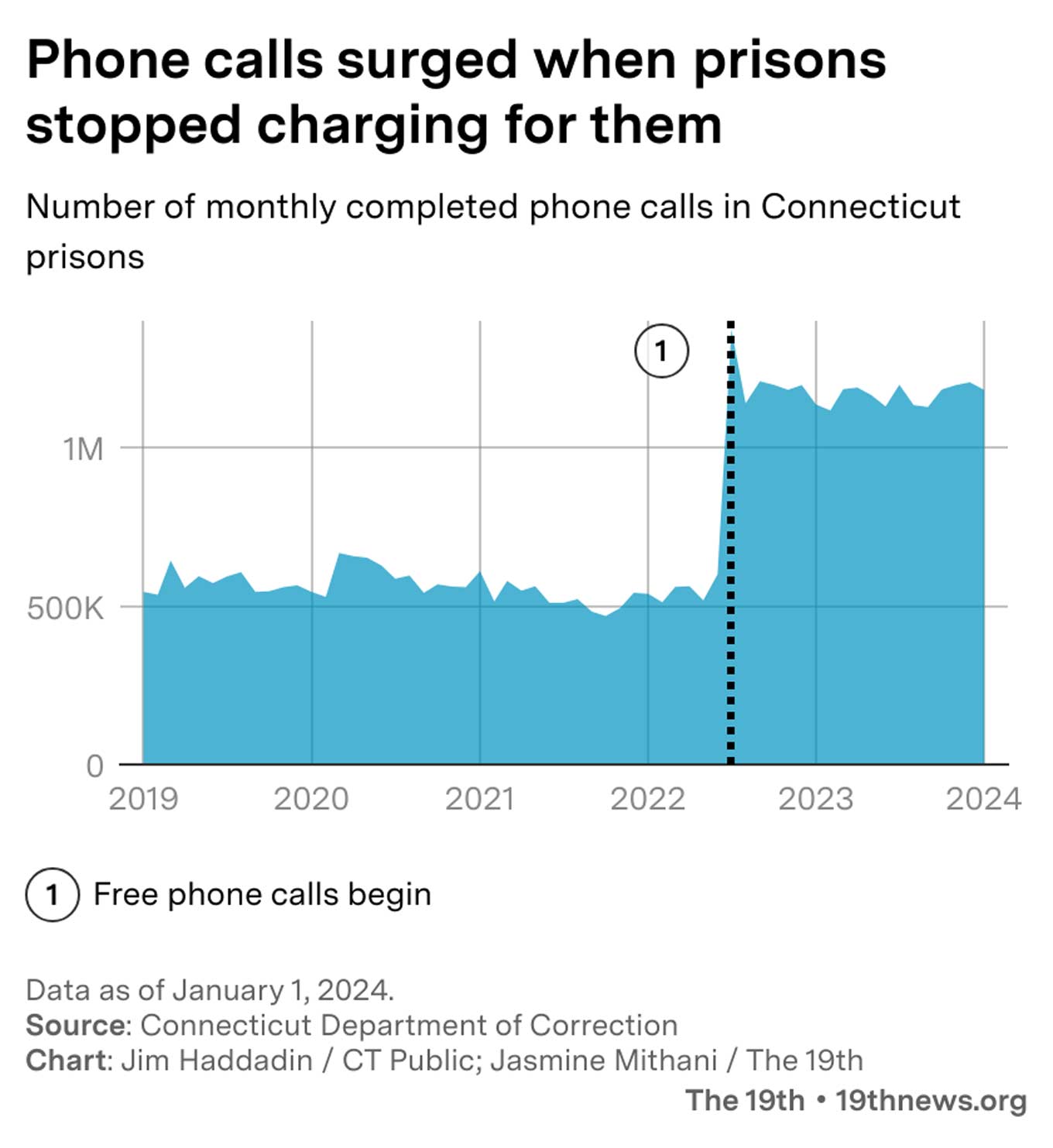
Local organizations helped free phone call efforts
While having conversations with Elliott, Worth Rises was simultaneously building momentum on free prison calls in cities — first New York in 2018 and then San Francisco in 2019. For the first statewide campaign in Connecticut, Tylek said it was important to work with a network of local organizations and helpful to have Elliott as a partner to help navigate the legislature.
"Every single person we talked to had a very specific individualized concern that we needed to address," Elliott said about their meetings with Democratic and Republican lawmakers. "We wanted to win over every single person that we could."
They pointed to research indicating that consistent phone calls and visits during incarceration improves the success of reentry into society after prison and reduces recidivism. They highlighted that incarcerated people might have fewer clashes with each other or with correctional officers if they are able to talk to their loved ones regularly over the phone.
The most powerful argument to lawmakers, however, came from the families themselves, who are most commonly the ones paying for prison phone calls — and 87 percent of those footing the bill are women, Tylek said.
"That's what typically moves the most number of people, because regardless of where you are in partisanship, everybody believes in family and everybody believes in children," Tylek said.
In June 2021, free prison calls became law. The rollout began a year later.
"Hello, this is a prepaid call from … an incarcerated individual at Garner Correctional Institution. This call is not private, it will be recorded and may be monitored … "
Denise Paley listens patiently to the familiar automated message that she's heard nearly every day for four years. She follows the prompt and presses 1 on her cell phone.
"Thank you for using Securus, you may start the conversation now."
"Hi honey, how you doing?" Paley says to her 22-year-old son.
She pauses, listening. "Okay, were you able to get any Tylenol?"
Her son has been feeling sick for the past few days and Paley wonders out loud if it could be a stomach bug. They then move on to other subjects. She asks him what genre of books he wants her to send him. He asks her whether he'll ever go to college. She reassures him that he will. At 15 minutes sharp, the call ends.
"It just cuts off," Paley says.

Calls are critical for family communication
These calls have become the norm for Paley, pictured above on a call with her oldest son, but they never actually feel normal. He has been incarcerated — without a conviction — since 2020. His case stalled while he underwent evaluations at a state hospital, and he received a diagnosis of schizophrenia only after his lawyer hired an outside organization for a medical evaluation. Paley said there have been other setbacks that have slowed down her son's case.
In 2022, a judge ruled that Paley's son was competent to move forward with legal proceedings. Last August, he rejected a plea deal that came with a 13-year prison sentence. He now awaits a trial date, hoping that his mental health diagnosis, past history of nonviolent behavior and time served in prison will help his case, Paley said.
Phone calls have been critical for Paley, her husband and their youngest son, who is 18 years old, throughout these years of stress. She knows they are more privileged than most families. The cost of prison calls was never prohibitive for them and she has been able to talk to her older son most of the days he has been behind bars, even before the calls were free.
But there are times when the calls are less consistent. The COVID-19 pandemic started soon after Paley's son entered custody, bringing with it a surge of infections and deaths among incarcerated populations around the country, lockdowns in and outside prison, and restrictions on visitations and calls.
Paley's son was having hallucinations and needed treatment, but it took years for medical providers to find a combination of medications that worked. Like many incarcerated people with serious mental illness, he spent stretches of time in what correction officials call "restrictive housing," which is essentially another term for solitary confinement.
State correction officials, including those in Connecticut, claim to use solitary confinement not only as a form of punishment, but also as a way to protect incarcerated people. This practice disproportionately affects those with mental illness and transgender people who face unique threats to their safety. A 2023 report by the Connecticut Sentencing Commission found that 39.7 percent of unsentenced people like Paley's son in the state have "active" mental health disorders compared with 25.8 percent of those who are sentenced.
The Connecticut Department of Correction's policy for restrictive housing does not mention phone call or email access. Officials did not answer reporters' questions asking whether phone privileges are taken away from people in solitary confinement.
A 2022 law meant to reform Connecticut's use of solitary limits the number of days a person can be kept in isolation. It also requires that people in restrictive housing receive a minimum of two hours outside of their cells, including an hour of recreation time. This should include time for phone calls.
Paley said, however, that during one of her son's recent times in solitary confinement, she did not hear from him until he returned to the general prison population five days later. According to Paley, department officials told her that he declined to leave his cell to shower or make calls. Her son told her that he was not allowed to.
"Part of the reason he calls me every day is because he knows that we are just so worried," she said. "So where else is my mind gonna go? That he's dead, that he's injured, that something happened. That's where my mind goes."
For families with fewer financial resources than Paley's, these periods of silence and uncertainty were much more common before Connecticut prison calls became free. Incarcerated people disproportionately come from low-income backgrounds. A 2018 report from the Brookings Institution found that boys who grew up in families earning less than $14,000 a year were 20 times more likely to be imprisoned in their early 30s than children from wealthy families.
The inability to pay for communication often left families in the dark, sometimes for years, about what was happening inside the prisons, and whether their loved ones were safe inside.
After decades of outcry from activists about the harms of corporate influence in the carceral system, Connecticut was the first state to offer a blueprint for taking on the privatization of prison services nationwide. Unlike other states, Connecticut and Massachusetts are the only ones that cover costs for all prison communication — phone calls, video calls and electronic messaging. California, Minnesota and Colorado have only made prison phone calls free.
Official state data show the impact of the change in Connecticut. In June 2022, one month before calls became free, there were 600,656 from people held in correctional facilities throughout the state. In the first month the law went into effect, that number increased by 128 percent, to 1,373,276 calls, according to state figures provided to The 19th and Connecticut Public. There were 1,182,274 calls in January, the most recent month for which figures are available.
The state also began providing individual tablets to all incarcerated people in 2021. The tablets can be used to make calls, send emails and access some educational materials for free, and to purchase a limited number of movies, games and music.
Nationwide over the past five years, Securus has distributed 600,000 tablets and spent $600 million to install closed wireless network access and security protections at correctional facilities. In an email, Jennifer Jackson-Luth, senior director of communications for Securus's parent company Aventiv Technologies, said the tablets "help bridge the digital divide."
The work of building out infrastructure for emails, phone and video calls inside prisons is more complex than traditional communication services, Jackson-Luth added, but she did not provide details on those complexities.
The incarcerated people who wrote to The 19th and Connecticut Public said it is easier to make calls from a tablet than to have to rely on the two or three landline phones for them in prison. Even with the flexibility they offer, many advocates view the tablets as another opportunity to overcharge for otherwise inexpensive services, like e-books or music.
The state negotiated a three-year contract with Securus — down from its previous seven-year contract — that runs through August 2026 at a rate of $30 per incarcerated person each month for phone calls and $15 per person each month for emails. Tylek believes the state could have negotiated a less expensive rate. However, she said having a shorter contract enables state officials to change telecom vendors if needed.
These costs are now supported by $9.5 million taken from the state's general fund in fiscal years 2024 and 2025 — $6 million to cover phone calls and $3.5 million for electronic messaging. An additional $888,011 per year goes toward adding 15 additional correctional officers.
The state Department of Correction allows calls and messages during specific windows of time throughout the day. On paper, people are permitted to speak by phone for up to 90 minutes per day, but that time is broken up into six 15-minute calls. (That specific structure of capping at six calls is not part of Worth Rises' design, Tylek said.)
In practice, incarcerated people and advocates who work with them told The 19th and Connecticut Public that people in prisons are not credited for any minutes they do not use if a call drops from poor connection or organically ends before the 15 minutes allowed. Landline phones in prisons have long-standing connectivity issues that make for poor, barely intelligible calls. The new tablets have their own connection problems that also lead to dropped calls.
"It's an implementation error more than anything else," Tylek said. "Six 15-minute calls is what people are allowed by the DOC. That adds up to 90 minutes. But if you make a phone call, and you're only on the phone for five minutes, that counts as one of your calls. In theory this shouldn't be the case because it means you still have 10 minutes left."
Incarcerated people also say that prison staff sometimes purposefully cut off their calls before they reach the maximum time, and staffers withhold calls for a month or more when they want to sanction people.
"There is a daily hassle trying to call our loved ones," wrote one incarcerated woman who asked for her name to be withheld from the story to avoid potential retaliation from corrections staff. "The staff have taken it upon themselves to withhold the wall mounted phones as a way to bully us into performing duties outside of our responsibility. According to the directive, the phone is to be available from 7:00 a.m — 10:00 p.m. The staff never comply with this directive."
Overall, the incarcerated people that reporters emailed with said they would like to have their full 90 minutes of calls each day, stronger WiFi and larger windows of time to make calls and send emails. They also want more flexibility to add new numbers to the list of people they are permitted to call. Currently they can only change the numbers on their list at the beginning of the month.
Lewis said Connecticut still has a long road ahead to improve conditions for the roughly 10,500 people in the state's prisons. Her work on this free prison calls bill broadened her understanding of these harsh realities, but it also gave her hope about the power of her voice and the collective action of her community.
"You get one win and then you see that, 'Wow, that I could do this,' and then you see so much more stuff that needs to be done. So you just go out there and you do it," Lewis said, speaking about her advocacy work. "You want to make sure that your children and grandchildren, especially, have a different place to live than you did — a better place."
This article was originally published by Stacker and was republished with permission.