When my oldest son was born in July of 2008, I thought I could easily balance my career and my desire to be far more engaged at home than my father and his generation were. I was wrong.
Almost immediately, I noticed how social policies, schools and health care systems all make it difficult for dads to be highly involved and engaged at home. Contradictory expectations about work and family life abound.
As a fatherhood researcher with four kids of my own, I am convinced that fathers are transformative figures for children, families and communities.
But a man’s mere presence, paycheck and willingness to punish misbehaving children is not nearly enough. Many of the benefits of fathering for children come from dads being nurturing, loving and engaged in all aspects of parenting.
When fathers are caregivers – when they provide emotional support and act affectionately toward their kids – the effects go well beyond growth, development, good health and solid grades. My research shows the benefits also include having children who value emotional intelligence, gender equality and healthy competition.
Nurturing versus stoic dads
Thinking about the broad impact fathers have, I analyzed how fathering affects different social values – such as a belief in gender equality – in May 2021.
Surveying more than 2,500 American fathers 18 and older, I found that involved fathering has a long-lasting impact on the personal principles and cultural perspectives of children.
In my survey, the differences between the least nurturing and the most nurturing fathers are stark.
Surveyed fathers who reported that their own fathers were highly withdrawn tended to be hypercompetitive, emotionally stoic and unappreciative of women’s contributions outside the home.
In contrast, surveyed fathers who said they had highly nurturing dads were much more likely to achieve their goals in a healthy manner, be more emotionally open and believe in equitable partnership.
How dads instill values
Several decades ago, many fathers were unwilling or unable to provide their children with emotional support or physical care. Instead, they focused on bread-winning, children’s discipline and simply being present in the home.
These traditional norms left many contemporary fathers ill-equipped for modern parenthood. Contemporary social norms set broad expectations for fathers: rule enforcement and economically supporting the family while also providing for children’s physical and emotional needs.
Broad paternal involvement with kids is important because dads have unique effects on kids. Children’s values, beliefs, emotional expression and social development are strongly associated with fathering. Kids are better regulated emotionally, more resilient and more open-minded when their fathers are involved in their education and socialization.
Boys, for better and worse, often mirror the habits, interests and values of their own fathers.
My colleague Scott Easton and I found that how one’s father behaves is especially powerful given that cultural, social and institutional norms about fatherhood are much weaker than they are for motherhood.
For example, mothers have traditionally been known for showing children affection and providing emotional support. Social expectations for these behaviors are not well defined among fathers. As a result, dads have a much larger impact on their sons’ fathering behaviors than moms have on their daughters’ mothering behaviors.
Positively, this means that a sizable portion of men replicate the best attributes of their own fathers – such as being loving and affectionate. Negatively, this means bad behaviors – such as extremely harsh discipline – are sometimes repeated across generations.
However, some men compensate for their own fathers’ poor or nonexistent parenting by forming their own ideas and values about parenting.
Men often replicate the best attributes of their own fathers – such as being loving and affectionate.
Benefits for all
The findings from my survey build on decades of research on the benefits of positive fathering. And these advantages aren’t just for children.
Mothers and other parenting partners are healthier and happier when fathers are highly engaged with their kids. Men who care for and support their kids benefit too – with improved self-image, life purpose and relationships. And communities gain increased trust and safety from the relationships built when fathers positively participate in their kids’ activities, schooling and social networks.
Valuing supportive fathers
How can American society ensure that healthy competition, emotional openness and respect for women are widespread among future generations of men and fathers? Part of the answer is by valuing loving, supportive fathering.
That means more support for fathers in workplaces, public policy and institutions. Paid family leave, flexible work arrangements and integration of fathers into prenatal and postnatal care are all effective ways to encourage fathers to be more involved.
Many fathers increased their share of child care tasks during the COVID-19 pandemic. These shifts may become permanent, ultimately changing cultural values around parenting and gender roles.
Society also needs to provide clearer messaging to fathers about what does and does not work in parenting. For example, my colleagues and I have shown that men who believe they should be nurturing parents are more involved in their children’s lives.
Fathers who demonstrate healthy masculine traits like assertiveness and strong goal orientation also tend to be sensitive, engaged parents.
Thus, there are many routes to transformative fathering. And this is not simply behavior for biological fathers.
Fatherhood is broadly defined, and people often look to nonbiological father figures like relatives, stepfathers, foster fathers and unrelated mentors.
All men who support and care for children have a critical role to play in instilling positive social values in future generations.
This article by Kevin Shafer from Brigham Young University and was originally published by The Conversation.
Header images courtesy of Unsplash

The time fathers devote to child care every week has tripled over the past 50 years in the United States.
The increase in fathers’ involvement in child rearing is even steeper in countries that have expanded paid paternity leave or created incentives for fathers to take leave, such as Germany, Spain, Sweden and Iceland.
And a growing body of research finds that children with engaged fathers do better on a range of outcomes, including physical health and cognitive performance.
Despite dads’ rising participation in child care and their importance in the lives of their kids, there is surprisingly little research about how fatherhood affects men.
Even fewer studies focus on the brain and biological changes that might support fathering.
It is no surprise that the transition to parenthood can be transformative for anyone with a new baby. For women who become biological mothers, pregnancy-related hormonal changes help to explain why a new mother’s brain might change.
But does fatherhood reshape the brains and bodies of men – who don’t experience pregnancy directly – in ways that motivate their parenting?
We set out to investigate this question in our recent study of first-time fathers in two countries.
Pregnancy’s effect on a new mom’s brain
Recent research has found compelling evidence that pregnancy can enhance neuroplasticity, or remodeling, in the structures of a woman’s brain. Using magnetic resonance imaging, researchers have identified large-scale changes in the anatomy of women’s brains from before to after pregnancy.
In one study, researchers in Spain scanned first-time mothers before conceiving, and again at two months after they gave birth.
Compared with childless women, the new mothers’ brain volume was smaller, suggesting that key brain structures actually shrank in size across pregnancy and the early postpartum period.
The brain changes were so pronounced that an algorithm could easily differentiate the brain of a woman who had gone through a pregnancy from that of a woman with no children.
All across the brain, these changes are visible in gray matter, the layer of tissue in the brain that is rich with neurons.
Pregnancy appears to affect structures in the cortex – the most recently evolved, outer surface of the brain – including regions linked with thinking about others’ minds, a process that researchers call “theory of mind.”
Mothers also show brain changes in the subcortex – the more ancient structures nestled deeper within the brain that are linked with more primitive functions, including emotion and motivation.
Why do these structural brain changes happen after pregnancy?
Researchers believe these brain changes may facilitate mothers’ sensitive caregiving of newborns, who demand constant attention and cannot verbalize their needs.
Indeed, when mothers see photos or videos of their own infants, it activates many of the same brain regions that changed the most across pregnancy. It seems plausible that new mothers’ brains change in ways that help them to respond to and care for their newborns.
But what about fathers? They do not experience pregnancy directly, but may take care of the new baby, too.
Dads’ brains change, too
As with practicing any new skill, the experience of caring for an infant might leave a mark on the brains of new parents.
This is what neuroscientists call experience-induced brain plasticity – like the brain changes that occur when you learn a new language or master a new musical instrument.
A sparse but growing body of research is observing this type of plasticity in fathers who experience the cognitive, physical and emotional demands of caring for a newborn without going through pregnancy.
In terms of brain function, for instance, gay male fathers who are primary caregivers show stronger connections between parenting brain regions when viewing their infants, compared with secondary male caregivers.
To learn more about plasticity in new dads’ brains, our research groups at the University of Southern California in Los Angeles and the Instituto de Investigación Sanitaria Gregorio Marañón in Madrid, associated with the BeMother project, collaborated on a new study.
We recruited 40 men – 20 in Spain and 20 in California – and put each into an MRI scanner twice: first during their partner’s pregnancy, and again after their baby was 6 months old. We also included a control group of 17 childless men.
We found several significant changes in the brains of fathers from prenatal to postpartum that did not emerge within the childless men we followed across the same time period. In both the Spanish and Californian samples, fathers’ brain changes appeared in regions of the cortex that contribute to visual processing, attention and empathy toward the baby.
What remolds a new father’s brain?
The degree of brain plasticity in fathers may be linked with how much they interact with their baby.
Although fathers in many parts of the world are increasingly taking part in child care, paternal involvement varies widely across different men.
This range of involvement may explain why we found more subtle brain changes in these fathers compared with those observed in first-time mothers.
In fact, brain changes in fathers were almost half the magnitude of the changes observed in the mothers.
Social, cultural and psychological factors that determine how much fathers engage with their children may, in turn, influence changes to the fathering brain.
Indeed, Spanish fathers, who, on average, have more generous paternity leaves than fathers have in the U.S., displayed more pronounced changes in brain regions that support goal-directed attention, which may help fathers attune to their infants’ cues, compared with Californian fathers.
This finding raises the question of whether family policies that boost how much time dads spend on infant care during the early postpartum period may help support the development of the fathering brain.
On the flip side, perhaps men who show more remodeling of the brain and hormones are also more motivated to participate in hands-on care.
Much more research is needed to tease out these questions and to figure out how best to intervene with fathers who may be at risk of having trouble adjusting to the parenting role.
Despite the importance of fathers to child development, funding agencies have not tended to prioritize research on men becoming dads, but this may start to change as more findings like these emerge.
Future studies with more detailed measures of postpartum caregiving can reveal more about parental brain plasticity in both men and women.
This article by Darby Saxbe from University of Southern California Dornsife and Magdalena Martínez García from Instituto de Investigación Sanitaria Gregorio Marañón IiSGM was originally published on The Conversation.
Header image by Humphrey Muleba on Unsplash

The Fourth of July can be a miserable day for dogs. The fireworks make scaredy-cats out of many canines.
That’s because dogs, like humans, are hardwired to be afraid of sudden, loud noises. It’s what keeps them safe.
Some dogs, though, take that fear to the extreme with panting, howling, pacing, whining, hiding, trembling and even self-injury or escape.
And, unlike humans, they don’t know that the fanfare on the Fourth is not a threat. Dogs hear the fireworks and process it as if their world is under siege.
How a dog responds to noises may be influenced by breed, with German shepherd dogs more likely to pace, while border collies or Australian cattle dogs are more likely to show their fear by hiding.
While we veterinarians don’t know exactly why some dogs are afraid of fireworks and others not, many dogs that react to one noise often react to others.
Therefore, early intervention and treatment are essential in protecting the welfare of these terrified dogs.
Here’s how you can protect your dog from fireworks:
How you can protect your dog from fireworks:
Take your pet to the vet.
If your dog is afraid of fireworks, the first step is to have your veterinarian evaluate him or her, especially if your dog’s noise sensitivity is relatively new.
One recent study found a link between pain and noise sensitivities in older dogs, indicating that muscle tension or sudden movements in response to a loud noise may aggravate a tender area on the body and thus create an association between the loud noise and pain, causing fear of that particular noise to develop or escalate.
Create a “safe haven.”
Create a “safe haven” in your home with a secure door or gate, preferably away from outside windows or doors.
Close the blinds or curtains to reduce outside noises, and play some classical music to help reduce stress by creating a relaxing environment for your dog during the show. A white noise machine or box fan may also help reduce anxiety, along with a pheromone like Adaptil sprayed on bedding, a bandanna, a collar or from a diffuser plugged into the wall.
Get your dog noise-canceling headphones.
Consider noise-canceling headphones such as Mutt Muffs to muffle the sounds and further reduce noise sensitivities.
Find a food your pet will love.
This could be cut pieces of boiled chicken or squeeze cheese.
Sit with your pet and feed him with each boom.
You can also use a long-lasting food-dispensing or puzzle toy to release food continuously during the show. This is to help your dog make a positive association with the noises for the future.
Provide gentle pressure.
Consider anxiety wraps, fabric wraps that exert a gentle pressure on your dog’s body.
These may help to lower heart rate and other clinical signs of fear and anxiety, operating on the belief that they swaddle a scared animal and thus calm its fears.
These work best, however, in conjunction with a complete behavior treatment plan including medication or behavior modification, or both.
Show some love.
When it comes to comforting your dog, the jury is still out. It is difficult, however, to reinforce an emotional response with comfort.
Therefore, it is OK to pet your dog when frightened by a noise event so long as the dog appears to be comforted and not more distressed by the attention.
This article by Christine Calder from Mississippi State University was originally published on The Conversation.
Header images courtesy of Mutt Muffs, editing by Good Good Good

The world is filled with good news, but it's not always easy to find. We’re here to help
Every day, Good Good Good’s team of journalists, nonprofit experts, and do-gooders seek out the best good news in the world.
We share these with our community here on our website, in our popular daily newsletter, on social media, and in our monthly print newspaper.
Here are the highlights for this week!
The Best Good News We’re Celebrating This Week —
Helping address food insecurity, a San Francisco neighborhood just opened its first free grocery store
Modeled after a traditional grocery store, the District 10 Community Market is now officially open for shoppers. Rather than footing a major bill at checkout, though — its customers won’t pay anything.
While food banks typically offer pre-packaged kits of food for people, this grocery store offers a more dignified shopping experience by allowing people to choose their food items.
The market serves low-income community members who meet certain criteria, and shoppers must obtain a grocery card from a partnering nonprofit to utilize the market.
Why is this good news? Food insecurity is a major issue in the U.S. (and around the world). In addition to addressing that issue, this kind of shopping experience reduces stigma, results in less food waste (people “buy” what they’ll actually cook and eat, rather than items being chosen for them), and helps donors understand what people most appreciate and need.
The U.S. installed more solar capacity in the first quarter of 2024 than it did in all of 2018
The U.S. saw the most solar manufacturing growth in the nation’s history in the first quarter of this year, with a total installed capacity of 200 gigawatts.
Making up an incredible 75% of all new electricity-generating capacity added to the grid in Q1, a record 11.8 gigawatts of new solar capacity came online.
A new report found that total manufacturing capacity also increased to 26.6 gigawatts in Q1, a significant jump from 15.6 gigawatts in the previous quarter.
The same report also found that the U.S. added more new solar capacity in 2023 than initially reported: over 40 gigawatts. It projects the U.S. will install another 40 gigawatts total this year.
For the first time in Brazil’s history, a traditional fishing community is now managing a state park’s services
For the first time in Brazil, a traditional community is managing and operating visitor facilities inside a state conservation unit.
The Caiçaras, a traditional fishing peoples, of Cardoso Island have lived in what is today Ilha do Cardoso State Park since the 19th century. A year ago they won a landmark court decision that found it was unconstitutional to bar them from bidding, given that it was on their territory.
In a public-community partnership with the São Paulo state government, the community mow formally manages accommodation services for visitors, cafeterias, education trails, a crafts shop, and a visitors’ center.
Why is this good news? Between the creation of Ilha do Cardoso State Park in 1962 and the end of Brazil’s military regime in 1984, the 400 families living on the island faced constant intimidation to leave.
In a poetic turn of justice, those families are now more integral to the land than ever before — and history shows us that’s good news for the planet and for people.
Ahead of this year’s record-breaking hurricane season, climate scientists are helping Caribbean families protect their homes
The 2024 Atlantic hurricane season is officially here and forecasts project high numbers of storms.
To help with preparations, a group of climate scientists formed the Caribbean Climate Adaptation Network to connect scientists with communities and governments in the U.S. Virgin Islands and Puerto Rico.
With a unique understanding of the coastal-urban environment, they’re on a mission to integrate human-made systems, such as buildings and infrastructure, with natural systems, such as the atmosphere, ecosystems, and oceans — all of which face unique challenges in the face of climate change.
They’ve worked on upgrading outdated electricity infrastructure to more resilient systems like solar power, particularly small-scale rooftop installations that can power individual homes and businesses during grid outages.
[Related: While its neighbors didn’t fare so well after Hurricane Ian in 2022, one Florida community never even lost power.]
They’re also tracking sea and land temperatures to better protect people from extreme heat and more intense hurricanes. The network hopes to expand its efforts throughout the entire Caribbean.
→ Read more
The world’s largest solar farm is now online in China — now home to the three largest farms in the world
Generating about 6.09 billion kilowatt hours of electricity every year, the world’s largest solar farm is now connected officially to China’s grid.
Located on 33,000 acres in the desert in northwestern Xinjiang, the solar farm’s production capacity could power 2.03 million electric vehicles annually.
China is home to the top three largest solar farms in the world, and this latest is part of the country’s “megabase” plan to install 455 gigawatts of wind and solar. The farms are located in lower populated areas and send energy to major urban centers.
What’s the nuance? Xinjiang is also a hub for producing polysilicon, a critical material used in manufacturing solar panels. There have been growing calls for transparency in the region’s supply chain due to reported mistreatment of Uyghur Muslims and other ethnic minorities.
→ Read more
A major appliance company has donated hundreds of like-new refrigerators to food banks around the U.S.
Whirlpool’s Feel Good Fridge program takes damaged or returned fridges, refurbishes them, and provides them to food banks and agencies in need of storing perishable goods.
Fridge units in the program are sourced from customers who return a refrigerator to a store, or from warehouses where an appliance may have been damaged in transit or at another point in its early life cycle.
Since the program launched in 2021, it has donated more than 900 refurbished refrigerators and delivered more than 250,000 pounds of food to partner agencies, reaching more than 25,000 food-insecure families. Thanks to a new partnership, it’s expanding to 10 more U.S. cities.
Why is this good news? In recent years, unsettling details about where merchandise goes after it’s returned have surfaced, leading consumers to be more thoughtful with their purchases and companies to make an effort to lessen their wasteful impact.
Returns also have a major impact on the planet — up to 24 million metric tons of carbon emissions are attributed to e-commerce returns each year.
→ Read more
Scientists uncovered a way to convert blood types — opening the door to universal blood donation
In a newly published study — and a medical breakthrough 40 years in the making — researchers shared the findings of a new technique taking the world one step closer to making blood types universal.
Using enzymes produced by bacteria (that almost all of us have in our guts already!), the scientists were able to strip red blood cells of antigens and sugars that create distinctions between blood types.
The blood types of donors and recipients need to match because the recipient’s immune system might attack and destroy the new blood cells, which could be fatal. Universal blood could also help curb mistakes like ABO-mismatched transfusions.
Why is this good news? This news is especially exciting to celebrate today on World Blood Donor Day, since last year the American Red Cross announced it’s facing severe blood shortages — which means life-saving surgeries, transfusions, and more are put on hold. This news could swiftly solve those shortages and bring life-saving blood to people in need.
To improve access to health care, nurses are going door-to-door in Baltimore to bring primary care to residents
A new program in Baltimore called Neighborhood Nursing aims to solve a major issue in the city: people missing out on primary preventative health care to catch medical issues before they turn into bigger, more expensive problems.
Aiming to “turn primary care on its head,” Neighborhood Nursing’s team of nurses and community health workers meet people where they’re at with free health checks.
They make weekly visits to lobbies of three apartment buildings in a predominantly Black neighborhood that’s been disadvantaged by decades of discriminatory housing policies.
The idea is modeled after a similar program first tried in Costa Rica, which saw people struggle to access preventive primary health care, especially in poor and rural areas — much like the U.S. is seeing now.
It worked spectacularly in Costa Rica — and they’re hoping to see similar results in Baltimore, too.
More good news of the week —
Beating their target, Coldplay announced their carbon footprint after two years of touring is 59% lower than their previous tour. The band used creative solutions like kinetic dance floors, recyclable LED wristbands, and traveling by train.
[Related good news: Billie Eilish solidifies her “sustainable pop star” status by paying for fans’ public transportation and solar-powering her Lollapalooza set.]
The Department of the Interior just announced $130 million in funding to revitalize land in coal communities. It’s part of a larger plan to clean up legacy pollution and create good-paying jobs and economic opportunities for coal communities amidst the clean energy transition.
The New York Audubon Society just officially changed its name to sever ties with its namesake’s anti-abolitionist slave owner. Acknowledging John James Audubon's contributions to art and ornithology, the organization’s members voted to change their name to NYC Bird Alliance.
New accordion-style solar panels are designed to endure extreme weather and harsh environments. They can withstand wind speeds up to 166 mph, ideal for hurricane-prone places like Puerto Rico, which is getting a shipment later this year.
Austria is creating the first-ever photovoltaic highway where you can drive at 155 mph and recharge your car. First, they’re working on an innovative solar roof design that not only harnesses the sun’s energy but also ensures optimal protection and functionality.
A city in Spain is turning cemeteries into the country's largest urban solar farm. The project has been dubbed RIP, Requiem in Power, and was launched this month with the first photovoltaic panels installed.
To protect honeybees, Seoul just banned a widely-used pesticide suspected in causing their population decline. At least 7.8 billion honeybees, more than 15% of the total population, prematurely died or disappeared between September and November 2022, and neonicotinoids are a prime suspect.
[Be(e) the good: In addition to cutting out the use of pesticides, here’s a way you can help protect bees where you live!]
Sam Smith just launched a new LGBTQ+ charity to give queer artists a “safe space” to be themselves. Called The Pink House, Smith said it will “be a useful resource for all queer people, to work towards helping secure a happy home for all.”
Ireland just expanded its free contraception program to include women between the ages of 32 and 35. Helping improve access to contraception, the country’s Free Contraception Scheme was first introduced in September 2022, initially for those aged 17 to 25, and expanded to include 26-30-year-olds in 2023.
As part of a rewilding project, three endangered horses traveled 3,000 miles to a nature preserve in their native homeland. Considered the last “truly wild” horse in the world, the Przewalski’s horse population is slowly growing after they disappeared from the wild completely in the 1960s.
Thirty years in the making, construction is now underway on the world’s largest wildlife crossing. Located over a busy highway in California notorious for animal-car collisions, the state just announced the crossing is on track to open in early 2026.
Critically endangered northern hairy-nosed wombats were just relocated to a new forest in Australia. Successful conservation and breeding efforts have led to a 1,000% increase in its numbers, with about 400 total now in the world.
In a historic first for any professional sports league, the Stanley Cup Final games will be broadcast in American Sign Language. The first fully immersive viewing experience for the Deaf community by a professional sports league, “NHL in ASL” is available for every game of the series.
Making history in a number of ways, a trans woman was just crowned Miss Maryland USA. Bailey Anne Kennedy broke almost every barrier that existed in the state’s pageant history, including being the first married, Asian American, and trans woman winner.
Researchers have developed oral insulin drops that could replace injections for people with diabetes. In the works for three years, the drops are placed under the tongue and absorbed into the body, eliminating the need for needles.
The WNBA is seeing record in-person attendance alongside record-breaking TV viewership. Since the start of the season, more than half of all WNBA games have been sellouts — a 156% increase from last year — and WNBA arenas were filled to a 94% capacity — up 17% from last year.
Colorado’s 42 state parks will now offer blind visitors an app to help them safely explore on their own. The Aira app is an accessibility-assist tool, which uses the camera on a smartphone to connect users to a live, professionally-trained agent.
[Related: Several national parks have significantly increased their adaptive excursion offerings this summer.]
A women-led group of forest rangers in Indonesia is leading patrols in the jungle to combat deforestation. Much like the team preventing rhino poaching in South Africa, their efforts are working and they’re now sharing their strategies with other women-led groups striving to protect their forests across the country.
USPS just released a new sea turtle stamp collection to honor the conservation efforts behind six endangered sea turtle species. The book of stamps includes six different designs featuring different species that are dependent on U.S. coastal waters for their habitat and survival.
Despite having less capacity, Amtrak is on track to break ridership records in 2024. Ridership was 20% higher in the first seven months of Amtrak's budget year that began Oct. 1, and ticket revenue was up 10% versus the same period in 2023.
New fast chargers can charge more electric vehicles to 80% in just 15 minutes. While electric vehicles come with a slew of positive benefits, one of the drawbacks for many consumers is how long they take to charge — these new chargers help solve that.
If you want to get good news in your inbox every day, join the Goodnewsletter — the free newsletter read by 50,000 people every day. It’s designed to leave even the most cynical news reader feeling more hopeful about the state of the world.
Food’s role in climate change has emerged as one of the defining challenges of our time. The journey of a steak, fruit or salad from the vast expanses of agricultural lands to the plates on our tables leaves a significant footprint on the environment.
At the heart of this challenge is the prodigious use of fertilizers and a growing global population’s increasing demand for meat.
As earth, climate and atmospheric scientists, we track global greenhouse gas emissions and just published the most comprehensive assessment yet of a powerful greenhouse gas from food production: nitrous oxide, or N₂O.
After carbon dioxide and methane, N₂O is the most consequential greenhouse gas humans are releasing into the atmosphere. While there is less N₂O than carbon dioxide in the atmosphere, it is 300 times more powerful at warming the planet, and it remains in the atmosphere, holding in heat, for over a century. Today, atmospheric N₂O levels are about 25% higher than before the Industrial Revolution, and they’re still rising at an accelerating rate.
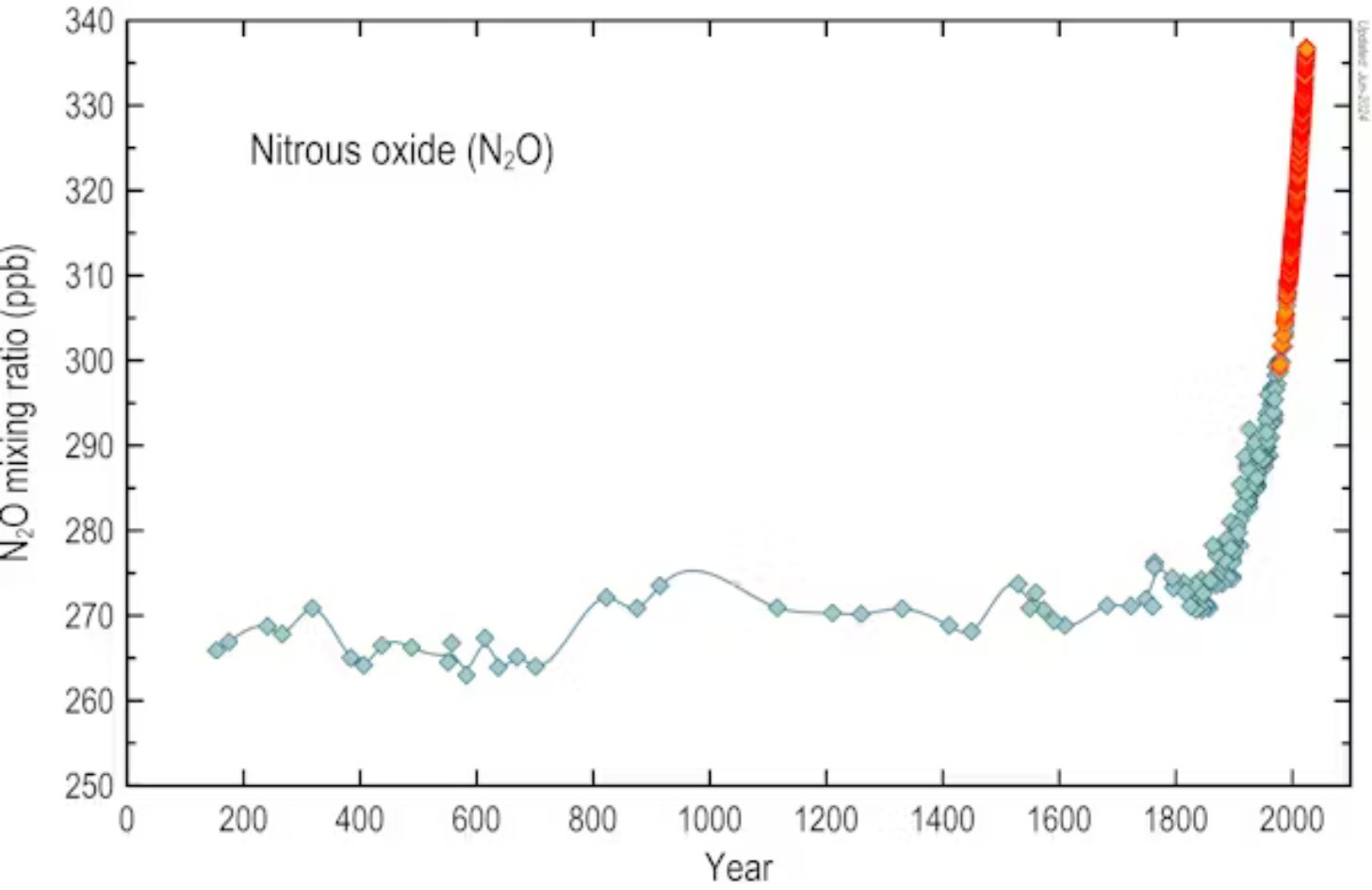
We found that, globally, fertilizers and the management of livestock manure are leading the increase in N₂O emissions and its rapid accumulation in the atmosphere. This is more than a climate problem. N₂O also depletes the ozone layer, which protects humans from harmful solar radiation. And nitrogen runoff from fields pollutes waterways, increasing harmful algal blooms and creating oxygen-depleted dead zones.
The growth of N₂O emissions is alarming, but people today have the knowledge and many of the technologies needed to reverse the trend.
Where do N₂O emissions come from?
Prior to the Industrial Revolution, natural sources of N₂O from microbes living in forest soils and in the oceans were roughly equal to natural sinks that consumed N₂O in the air, so N₂O atmospheric concentrations were relatively constant.
However, the human population and its demand for food have grown rapidly, throwing that natural equilibrium out of whack.
We found that human activities alone have increased N₂O emissions by 40% over the past four decades, with agriculture contributing approximately 74% to the total anthropogenic N₂O emissions.
The biggest human sources of N₂O are agriculture, industry and the burning of forests or agriculture waste.
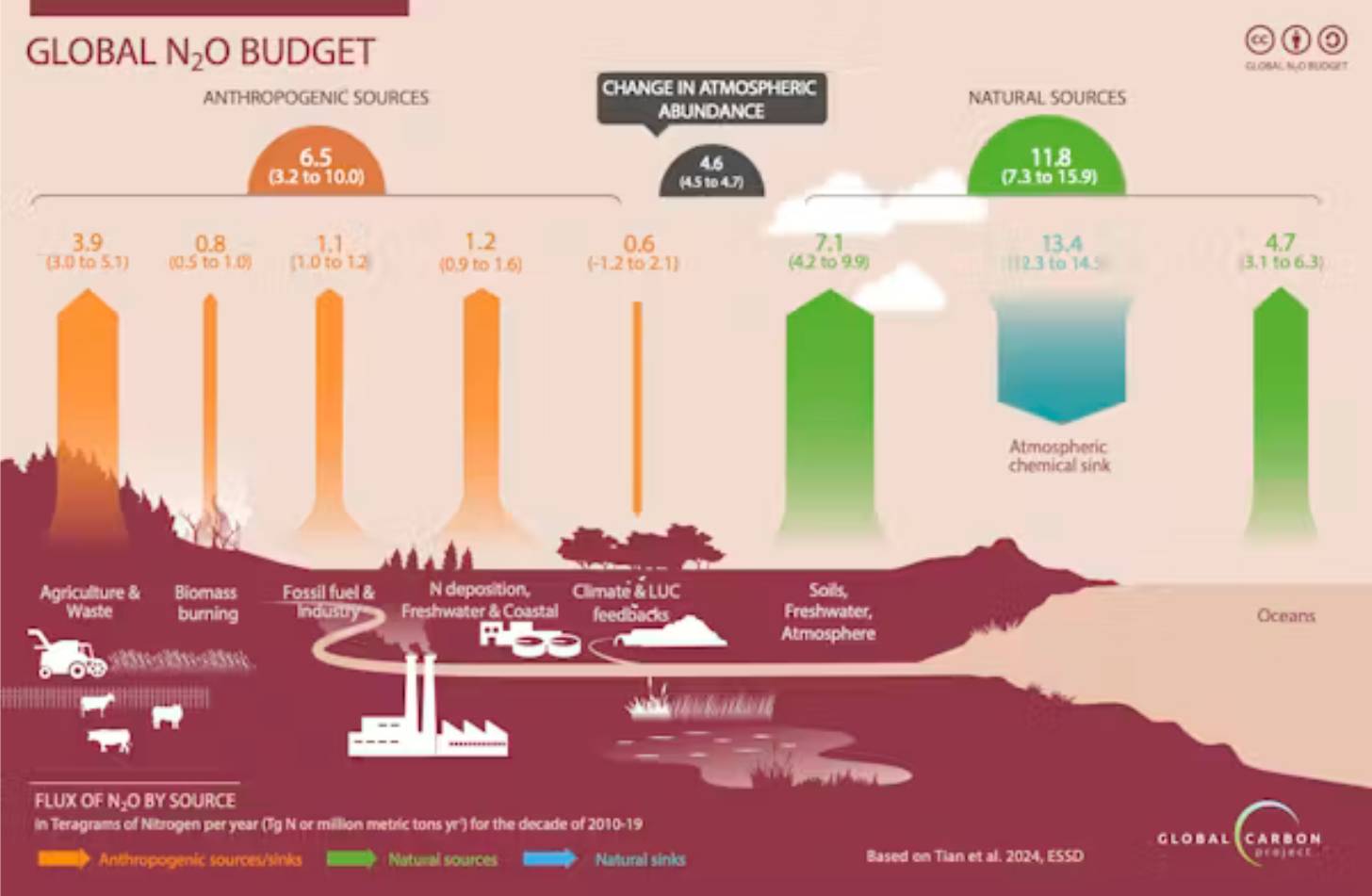
Nitrogen fertilizers, widely used in agriculture, are one of the biggest contributors. Fertilizers are responsible for 70% of total agricultural N₂O emissions globally. Animal manure from intensive animal farming contributes around 30%. A smaller source but one that is rapidly growing is aquaculture, such as fish farming, particularly in China where it has increased twenty-fivefold in the past 40 years.
In addition to farming, industrial processes such as production of nylon, explosives and fertilizers, and the combustion of fossil fuels also contribute to N₂O emissions, but to a lesser extent than agriculture.
N₂O emissions by country
Emissions vary greatly country to country for a number of social, economic, agricultural and political reasons.
Emerging economies, such as China and India, have had strong increasing N₂O trends over the past four decades as they boosted agricultural productivity to meet their growing populations’ food demand.
How big emitters' nitrous oxide emissions have changed
Human-produced nitrous oxide emissions are predominantly from agriculture, but also from fuels, industry, waste and burning forests. One teragram (Tg) is 1 million metric tons.
China is the largest producer and user of chemical fertilizers. Its Action Plan for Zero Growth in Fertilizer Use by 2020, issued in 2015, has helped cut those N₂O emissions. However, its industrial N₂O emissions have continued to rise.
In Brazil and Indonesia, cutting down and burning forests to make room for crops and livestock, coupled with increasingly intensive farming practices, has exacerbated nitrogen losses from natural sources and amplified greenhouse gas emissions.
Africa has opportunities to increase food production without increasing nitrogen fertilization. However, Northern African countries more than tripled their emissions growth in the past two decades, primarily due to a substantial growth in the livestock population in Africa.
A few regions, however, have been able to curtail some of their N₂O emissions with more sustainable practices.
Nitrous oxide emissions by source, 1980-2020
Agriculture, largely fertilizer and livestock manure, is the largest source of human-produced nitrous oxide emissions. While many countries' emissions have grown, Europe's overall have fallen. Measured in millions of metric tons.
The European Union, Japan and South Korea have all successfully reduced anthropogenic N₂O emissions over the past 40 years, although they remain major emitters on a global scale; reductions have largely come from the chemical industry in the 1990s. Their nitrogen use in agriculture has also become more efficient; however, they still have work to do. Their emissions from direct fertilizer and manure application have declined only slightly and have recently leveled out.
In the U.S., agricultural emissions continue to creep up, while industrial emissions have declined slightly, leaving overall emissions rather flat.
How to reduce N₂O emissions
Addressing the challenge of reducing N₂O emissions requires a combination of policy interventions, technological innovation and individual actions. For example:
- Policies can encourage farmers to adopt nitrogen-efficient practices, optimize fertilizer use and reduce N₂O emissions and other forms of nitrogen pollution through a variety of incentive programs.
- Precision agriculture techniques, including the use of remote sensing and satellite GPS-guided equipment, can help farmers vary the rate of fertilizer applied to optimize nutrient management and minimize nitrogen losses, thereby reducing N₂O emissions.
- The development and adoption of nitrogen-efficient fertilizers, such as controlled-release formulations and nitrification inhibitors, also offer promising ways to reduce nitrogen runoff and curb N₂O emissions from agricultural soils.
- Similarly, innovations in livestock management, such as dietary supplements and improved waste management practices, can reduce the amount of N₂O from cattle.
- Industries, particularly production of nylon and fertilizers, can install existing, affordable technologies to abate nearly all of their N₂O emissions. That’s an easy win for implementation and the climate. Most of the world has already done so, leaving China and the U.S. responsible for most of the remaining industrial emissions of N₂O.
- Consumers can also make plant-based foods a larger fraction of their diets. You don’t need to become vegan unless you want to, but reducing the frequency and portion sizes of meat and dairy consumption can be healthy for both you and the environment. Eco-friendly practices like composting food wastes and reducing fertilizer use on lawns also help.
Overall, a holistic approach combining policy, technology and individual actions is needed to address N₂O emissions and combat climate change. With governments, industries and citizens all working toward a sustainable future, these strategies can help ensure food security and environmental sustainability for future generations.
This article by Hanqin Tian from Boston College, Eric Davidson from University of Maryland, Baltimore, Pep Canadell from CSIRO, and Rona Louise Thompson from Norwegian Institute for Air Research was originally published by The Conversation.
Header image by Hasan Hasanzadeh on Unsplash

Wastewater surveillance hit the big time during the height of the COVID-19 pandemic, when officials started using this technique to monitor local virus levels. But my colleagues and I had been exploring wastewater’s promise as a public health tool years before anyone had heard of SARS-CoV-2.
My environmental virology lab based at Michigan State University has been in a partnership with the city of Detroit and the Great Lakes Water Authority since 2017, when we started testing municipal wastewater from Wayne, Oakland and Macomb counties to survey viral diseases in the Greater Detroit community.
Imagine you want to identify a potential emerging infectious disease in an urban area before it becomes an outbreak. Could you collect clinical samples from everyone in the community on a regular basis and test them all for every possible virus? No, that’s an impossible task.
Instead, we collected municipal wastewater, as a representative composite sample from the community, and tested that with advanced molecular methods to reveal endemic and emerging virus-related diseases circulating in the area.
We identified viral genomes related to multiple gastrointestinal, respiratory, blood-borne and vector-borne diseases excreted by the population.
We identified herpesviruses, including rare species, and we identified hepatitis A outbreak peaks via wastewater analysis that appeared before peaks in clinical samples.
The ongoing project in Detroit shifted to monitor SARS-CoV-2 in 2020. Our team, which then expanded to include the local health departments, practicing engineers and the Michigan Department of Health and Human Services, was able to identify COVID-19 peaks in the metro Detroit population five weeks before the delta variant surge was visible in positive COVID test data.
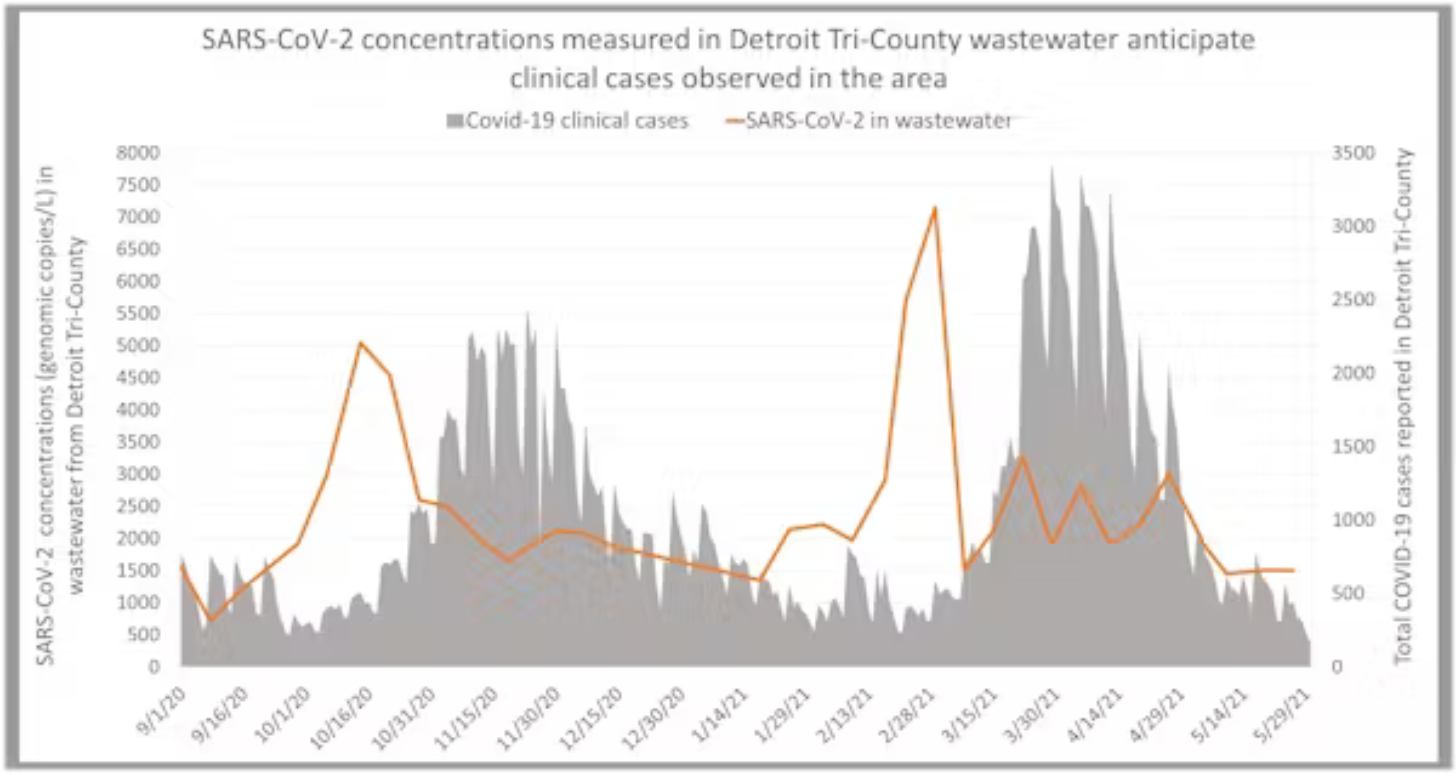
Our team is continuing to expand and improve our methodology to screen for the presence of endemic and emerging communicable diseases circulating in the metro Detroit population and to predict when and where surges will occur.
Data hidden in what goes down the drain
Wastewater is a mixture that contains anything that goes down the drain from the toilet, the shower, the laundry, the dishwasher or the sink. In most cities, stormwater and water used in industrial processes also end up in the wastewater.
Municipal wastewater contains viruses and other pathogens excreted by anyone with an infection, even at the early stages before symptoms develop.
These microorganisms are diluted in a large amount of water and mixed up with soap, personal care products, road runoff and many other chemicals and impurities.
The drop of blood or saliva that a clinic would test for infectious agents is much more concentrated and much less contaminated with other molecules.
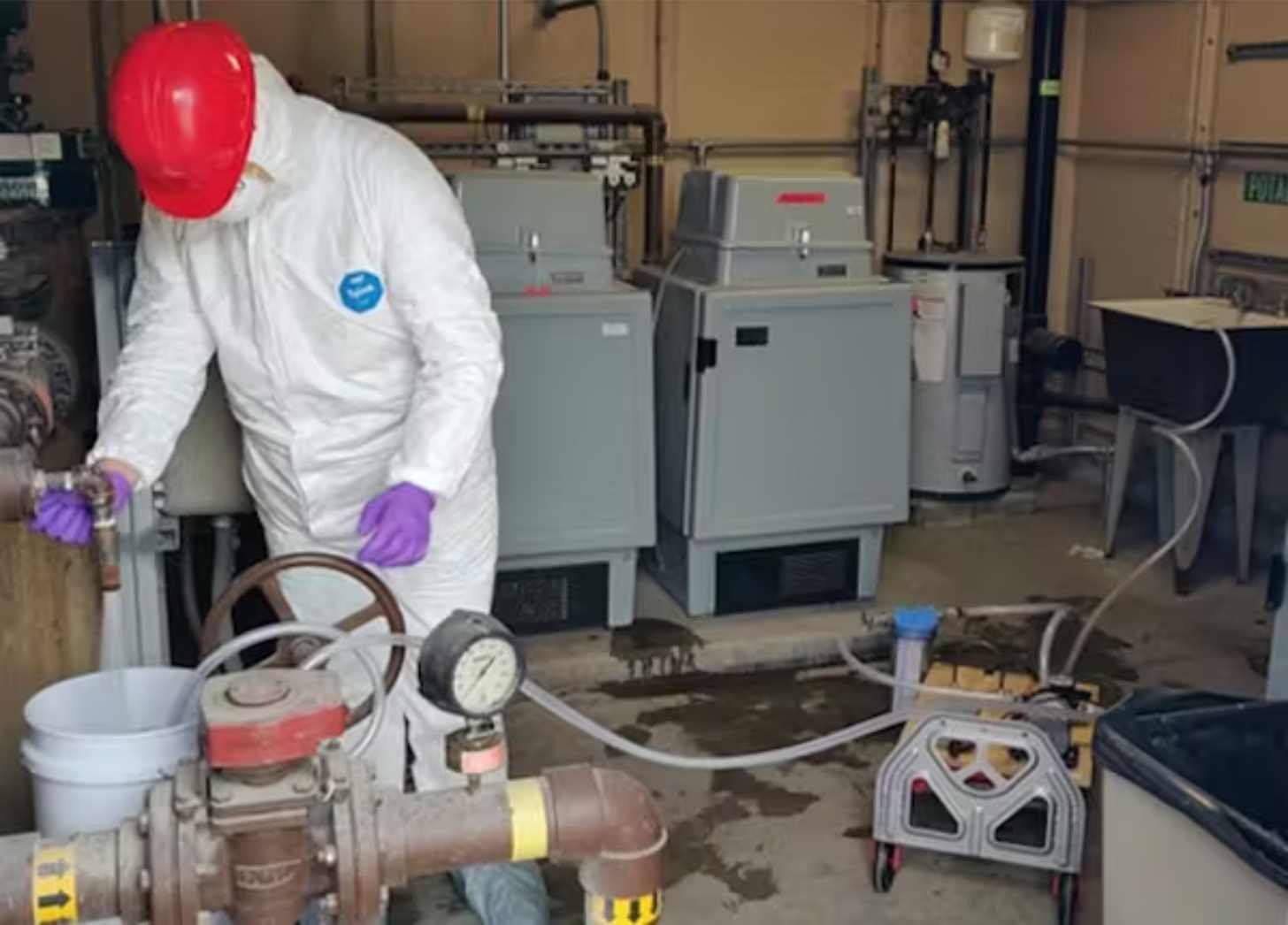
Looking for emerging human viruses in wastewater is like trying to find a needle in a haystack.
We concentrate and isolate viruses in the wastewater samples.
We then extract any DNA or RNA that’s in the samples and analyze it with molecular methods such as PCR and next-generation sequencing, looking for genes related to viruses.
Those genetic codes indicate which viral infections are present in the population that produced the wastewater.
Beyond confirming a pathogen’s presence
It’s one thing to identify that a certain virus is present in a community. But it’s a trickier task to figure out how a particular wastewater level translates to how many people are sick or to compare infection levels between communities. How quickly will a surge of people start turning up sick once a wastewater peak is spotted?
To predict the timing of outbreak peaks, scientists consider multiple variables, including how much virus a typical patient sheds, how long people shed the pathogen after infection, the onset and duration of clinical symptoms, and how long the pathogen has been in the wastewater collection pipes. Using all these factors, we relate wastewater readings to metrics of clinical disease.
In addition to complex models that predict variation over time and peaks of clinical cases, we developed simple methods for data analysis that can be used for decision-making by public health officials. We also tracked the time lag between SARS-CoV-2 concentrations in wastewater and clinical metrics.
An important step is connecting a particular viral reading in wastewater with the number of people who live in the area served by that sewer system. We use molecules produced by the human body to calculate how many people’s wastewater feeds into our sample.
For example, using metabolites such as creatine, 5-HIAA and xanthine, we calculated per capita COVID-19 trends by relating their levels with viral levels. This process allows for comparisons between communities.
Screening for the next outbreak
Ultimately, public health officials want to get ahead of any looming outbreak. To this end, our team developed a ranking system for prioritizing which reportable diseases future wastewater surveillance should focus on.
Clinicians are legally required to report dozens of diseases – ranging from chickenpox and COVID-19 to meningitis and measles – to the health department when they’re diagnosed. Keeping track of these reportable diseases lets officials count and record cases and trends.
Our ranking system is one of the first of its kind. We use 12 factors, including clinical trends in specific geographic locations and knowledge of how contagious particular germs are.
Knowing which communicable diseases are heating up in a particular community allows officials to prioritize resources and efforts toward monitoring and preventing their spread.
In the Detroit area, for instance, we found that certain diseases, including some sexually transmitted infections, ranked higher than in the state of Michigan as a whole. It makes sense to allocate resources to addressing them in a targeted way.
We also developed a sequencing and bioinformatics protocol, a step-by-step process that screens for potential viral-related sequences that may be circulating in the community.
It’s a way to broaden surveillance beyond the usual diseases that medical providers must report to officials when diagnosed.
This tool can provide an early warning to officials if something new or unexpected shows up in wastewater.

Solidifying the science of wastewater surveillance
Wastewater surveillance has proved itself as an epidemiological tool. But even though wastewater-based epidemiology has made significant advances in technology, methods and applications, more needs to be done to integrate the multiple efforts across the nation.
For accurate outbreak forecasting, wastewater surveillance databases should be integrated with clinical data metrics, behavioral, social and demographic information, as well as data that indicates population mobility.
Close partnerships with local health departments are crucial, since local epidemiologists are the ones who will use surveillance efforts to make decisions.
This article by Irene Xagoraraki from Michigan State University was originally published by The Conversation.
Header image by Irene Xagoraraki, CC BY-ND

For most people, the best electric vehicle charge app is likely already either in your vehicle or on your smartphone. Navigation systems on modern electric cars offer the ability to search for charger locations near you.
Many EV automakers have apps of their own, which offer several convenient features for locating and paying for public chargers.
But these stations aren't always operating, so Edmunds recommends having a backup EV charger app to help you locate other chargers in the area — ultimately to help assuage potential range anxiety from an inconsistent charging infrastructure.
Our partners at Edmunds curated the best EV charging apps available, ranked in no particular order.
The Best EV Charging Apps
EV charge station locating apps
PlugShare
Finding a charging station is great. But what if it's broken, unreliable or in an inconvenient location?
That's where PlugShare comes in. It encourages user feedback, which can help narrow down which chargers you might want to use.
It can also prevent you from wasting time by going to a charger that hasn't been operable for some time.
Think of this app like Yelp for electric vehicle chargers.
PlugShare provides a wealth of information on chargers across North America. It also has a trip planner tool, which allows you to input your vehicle, its maximum range and its starting range.
The route planner is useful, and it provides a handful of options and filters but it's not as detailed as either EV Navigation or A Better Route Planner. That said, the all-in-one combination of routing and reviews of the chargers you'll stop at can come in handy.
You won't use the following applications to map out your road trip route, but they can be extremely useful for finding EV chargers and using them once you get there. These apps make payment easier and can offer discounted rates for members.
EV automaker charging apps
Tesla
Tesla's app allows you to find and use its Supercharger stations around the country. Once your account is set up, the billing is handled automatically.
For now, most Superchargers are exclusively for Tesla owners, but that is set to change in the coming months as the automaker opens its service to all EV owners.
The app also allows you to monitor the progress of charging, see what the costs are in real time, and get notified when the charging is complete.
Rivian
The Rivian app not only shows you its own "Adventure Network" series of DC fast chargers, but it also shows the locations of Tesla and other third-party chargers.
Directions to a charger can be programmed in either the app or in the vehicle's navigation system. The benefit of going to a Rivian-branded charger is that you don't need an additional app to pay for the charge session.
The Rivian app also offers the same charge progress tracking and notifications to give you all the details on your charge session.
Lucid
Lucid has a partnership with Electrify America, whose charge stations will appear in search results within the app, in addition to those from Tesla and other third-party charger companies. Lucid drivers can send directions to the vehicle to begin navigation the moment they get inside the car.
When an Electrify America station is selected, you can plug in and pay for the session without needing an additional app.
Charge stations from other brands can still be navigated to, but you'll need a credit card or additional app to pay for them.
Like Tesla and Rivian, Lucid's app will track the progress of a charge session and notify you when it is complete.
Third-party charge station apps
ChargePoint
It's the largest charging network in the United States, though the vast majority of its stations have Level 2 chargers. You can locate, check prices and pay for charging all within the app.
EVgo
It has fewer stations than ChargePoint and Tesla, but they offer almost exclusively fast charging. EVgo's app has many of the same features as other charge apps (station locator, pricing and payment), but one key difference is that the company offers rewards for members, which can be redeemed later for charge credits.
If you will be using public chargers often and there's an EVgo station near you, it's worth looking into the company's paid monthly plans, which EVgo says can save users up to 30% a month in charge fees.
Electrify America
EA is one of the largest third-party charge station companies in the country. Like EVgo, EA specializes in fast charging stations.
Electrify America has partnered with several auto manufacturers, such as Volkswagen and Ford, to provide a certain amount of free charging when you buy one of their vehicles.
This may help sway your purchase decision if you have EA chargers near you.
There are more EV charging apps out there from smaller companies that are also worth looking into.
If you notice a certain charger brand pop up in several locations near you, there's a good chance it has an app, which might provide some savings or help you locate more stations.
This article was originally published by Stacker and was republished with permission.
Header image by 24K-Production / Shutterstock
What’s the tea on Hank and John Green?
Well, since last August, the author-activist-educator-entertainer brother duo has been behind a do-good e-commerce platform called Good Store.
All of the profits they make go toward charitable endeavors, like building a women’s hospital to fight maternal mortality in Sierra Leone. This is done through a long-term partnership with global health nonprofit Partners in Health.
Along with subscriptions for staples like socks, coffee, and soap, the Good Store has just announced a new product line: loose-leaf teas.

The tea brand under the Good Store umbrella is called Keats & Co, aptly named after the romantic poet, John Keats, who, according to Good Store General Manager Brandi Jessup, died of tuberculosis, or TB (along with many of his contemporaries).
“Tea will be the first Good Store subscription that donates money to a cause outside of the Maternal Center for Excellence,” Jessup told Good Good Good.
“We’re working with Partners in Health again on this project. All proceeds go towards comprehensive solutions to diagnose, treat, and prevent TB in vulnerable communities that they serve.”
TB is a cause near and dear to John Green’s heart; he has committed millions of his own money to fund solutions for the world’s deadliest infectious disease, has educated thousands on the subject, and has even worked with his fan community — Nerdfighteria — to demand change from corporate health giants like Danaher and Johnson & Johnson.
This new endeavor is just another way to move the needle forward when it comes to TB.

“Tea is a moment to stop, to breathe, to ponder. It’s a place in your day to slow down,” Jessup said.
“We know we wanted to develop a product line that donated to TB testing and research. When you pour yourself a cup of our tea, we hope you stop, read some Keats, take a deep breath. And as you exhale, know that someone is breathing alongside you with lungs unburdened — because with a small purchase, you are part of something Good.”
To start, Keats & Co will offer six (poetic) blends of tea: Evensong Chai, Moonlit Mint, Blue Fields Earl Grey, April Meadows Green, Bright Star Breakfast Blend, and Golden Fire Ginger.

The line also includes accessories like a tea strainer and a glass mug.
Professional tea mixers helped develop a broad range of teas, that include caffeinated and caffeine-free options, as well as a mix of black, green, and herbal teas.
This professional sourcing partner is Lake Missoula Tea Company, which is based in Hank Green’s home of Missoula, Montana — and is values-aligned with the mission of Good Store.
“Lake Missoula has been working for 12 years to develop meaningful relationships with farmers across the world,” Jessup said.
“They are diligent about sustainable growing practices and only work with farms who are giving back, both to the environment, and their communities.”
The teas come from several different farms, with leaves blending together from India, Nepal, and Colombia, for example.

“In India we are working with a women owned farm committed to developing safe passages for endangered elephants to migrate, sectioning off large portions of their land as elephant corridors,” Jessup said.
“The farm in Nepal works closely with the Red Panda Network to protect habitat and offer sustainable high paying jobs to their community as an alternative to poaching. And our farm in Columbia is the only tea farm in the area! They are a sanctuary for birds and work with local biologists on native bird surveys.”
Aside from the exciting give-back collaboration, tea was also an obvious choice for this next Good Store venture, since John is more of a coffee lover (as clearly illustrated by his enthusiasm for the Awesome Coffee Club), and Hank tends to gravitate more toward tea.
Above all, though, the Good Store team was simply eager to find another high-quality everyday product that could do a little good.
“All of our products are designed to delight, and this tea is genuinely just so good,” Jessup said.
“You can taste the quality and care that went into the growing and blending of these teas. Lake Missoula has given us a product line that is easy to brew, even for someone brand new to tea, that is great hot or cold, and that will be a staple in your cupboard. And add to that the fact that 100% of profit goes to charity; what’s not to love?”
Keats & Co teas are available now for one-time purchases, subscription bundles, or as a sample pack.
Header photos courtesy of Hank Green, Good Store, and John Green
This story was originally published by Grist. Sign up for Grist’s weekly newsletter here.
A reservoir is many things: a source of drinking water, a playground for swimmers, a refuge for migrating birds. But if you ask solar-power enthusiasts, a reservoir is also not realizing its full potential.
That open water could be covered with buoyant panels, a burgeoning technology known as floating photovoltaics, aka “floatovoltaics.”
They could simultaneously gather energy from the sun and shade the water, reducing evaporation — an especially welcome bonus where droughts are getting worse.
Now, scientists have crunched the numbers and found that if humans deployed floatovoltaics in a fraction of lakes and reservoirs around the world — covering just 10 percent of the surface area of each — the systems could collectively generate four times the amount of power the United Kingdom uses in a year.
The effectiveness of so-called FPVs would vary from country to country, but their research found that some could theoretically supply all their electricity this way, including Ethiopia, Rwanda, and Papua New Guinea.
“The countries around the world that we saw gain the most from these FPVs were these low-latitude, tropical countries that did not have a high energy demand in the first place,” said Iestyn Woolway, an Earth system scientist at Bangor University and lead author of a new paper describing the findings in the journal Nature Water.
“It meant that if only a small percentage of their lakes — this 10 percent — was covered by FPVs, it could be enough to fuel the energy demand of the entire country.”

For developing countries, floatovoltaics could be especially powerful as a means of generating clean electricity. Instead of building out more planet-warming infrastructure running on fossil fuels, like gas-fired power plants, fledgling economies could run panels on land and water, in addition to other renewables like wind and hydropower.
With solar power comes autonomy: Utilities don’t have to rely on shipments of fossil fuels, but can tap into the abundant power of the sun.
Floatovoltaic solar panels — which have been proliferating globally, from California to France to Taiwan — are the same ones found on a rooftop. “It’s the same electrical system, same panels, same inverters,” said Chris Bartle, director of sales and marketing at Ciel and Terre USA, which is deploying floatovoltaic systems.
“We’re just providing a structure that floats to mount that electrical system.” The solar rafts are anchored either to the bottom of the water body or to the shore, or both, to keep them from wandering.
In many ways, solar panels and bodies of water can benefit one another. Photovoltaics get less efficient the hotter they get, so having them floating on a lake or reservoir helps cool them off.
“Because of the cooling effect, we see increased efficiency of the systems,” said Sika Gadzanku, a researcher at the National Renewable Energy Laboratory in Colorado, who studies floatovoltaics but wasn’t involved in the new research. Returning the favor, the panels provide shading, reducing evaporation. If floatovoltaics are spread across a reservoir, that could mean more water would be available for drinking.
If a reservoir is equipped with a dam for hydroelectric generation, the floatovoltaics could hook into that existing transmission infrastructure. (Countries like Kenya, for instance, are building out more of this hydroelectric infrastructure already.)
That could save local governments money because they wouldn’t need to string new transmission lines from the floatovoltaics to the nearest city.
In the event of a drought, when water levels drop too low to generate hydropower, the panels could still operate as backup power.

To do their new modeling, Woolway and his colleagues began with over a million lakes and reservoirs around the world big enough and deep enough for floatovoltaics. Then they whittled those down based on critical qualities.
For one, the body of water couldn’t dry up, beaching the panels, or freeze over for more than six months a year, entombing the panels in ice and damaging them. The lake couldn’t be protected by law, either, like as a natural refuge. And the site had to be near a human population that could use the generated power.
A remote lake, by contrast, would require long transmission lines to connect a faraway city to the floatovoltaics. This doesn’t necessarily rule out the technology for more remote communities of people living near an otherwise suitable lake.
In fact, floatovoltaics could be particularly potent there as a way to provide clean energy. These cases just weren’t included in the scope of this modeling.
Regardless, all those characteristics considered, the team ended up with 68,000 feasible locations in 163 countries. They found that on average, countries could meet 16 percent of their energy demand with floatovoltaics, but some places could generate a lot more.
In Bolivia, for instance, floatovoltaics could provide up to 87 percent of national electricity demand, and in Tonga, they could meet 92 percent.
The potential is much lower in the United States, however, meeting just 4 percent of energy demand — even though the country has a plethora of large lakes and reservoirs, overall energy usage is extremely high. In less-sunny climes, like northern Europe, the effectiveness of floatovoltaics drops, but Finland could still satisfy 17 percent of its electricity demand with floating panels.
“The regions or the countries that we saw had the highest potential had these two critical variables, in that they were close to the equator, or were at high elevations, so they received high amounts of incoming solar radiation,” Woolway said. “And secondly, they had large water bodies.”
Covering 10 percent of a 100-square-mile lake, for instance, would end up with a lot more solar panels than covering the same percentage of a 10-square-mile lake. “We considered 10 percent to be a reasonable surface area coverage without having a devastating impact on the ecology and the biodiversity,” Woolway said.
“If you were to cover the surface 90 percent with solar panels, there would be no light going into the water itself.”
This is where the new science of floatovoltaics gets tricky, as there’s still little data on the potential environmental and social downsides of these floating systems. Scientists are investigating, for example, whether the floats might leach harmful chemicals or microplastics into the water.
And keep in mind that these ecosystems are solar-powered, too: Light fuels the growth of aquatic vegetation, which feeds all kinds of other organisms. If a floatovoltaic system cuts off too much of that light, it might reduce the food supply, and hinder plants’ ability to produce oxygen. “You’re changing light penetration, and that’s the most fundamental physical variable for an aquatic ecosystem,” said Rafael Almeida, a freshwater ecosystem scientist at the University of Texas Rio Grande Valley, who studies floatovoltaics but wasn’t involved in the new study.
“If you don’t have enough light, and you’re reducing oxygen concentrations in that system, and that may cascade through the food web, potentially impacting fish.” At the same time, early research suggests that the panels can counter the growth of harmful algal blooms that make water dangerous for people to drink.
Scientists are still trying to figure out what amount of coverage can still produce enough power to justify the monetary cost of deploying floatovoltaics, while not incurring ecological costs.
Each body of water is its own unique universe of chemical and biological interactions, so the same coverage on two different lakes might have dramatically different effects.
“Would 10 percent be enough to cascade into system-wide changes?” asks Almeida. “These are things that we really don’t know.”
Researchers also need more data on how effective the panels are at reducing evaporation, and therefore how much water a given system might actually save. “What we are yet to fully understand is that so many of the existing floating solar systems that have tried to collect data on this have been smaller,” Gadzanku said.
“So it is more: How do potential evaporation savings scale as you build larger systems?”
Humans rely on bodies of water in many ways other than for drinking. Subsistence fishers rely on them for food. And owners of lakefront properties might bristle if they think floating solar panels would cut their property values.
Still, Almeida says, this new research identifies where floatovoltaics might work, and how much energy they might provide given local conditions.
“I think that now what we need,” said Almeida, “is understanding — out of these suitable sites — which ones are really the low-hanging fruits.”
Header image by Dennis Schroeder via National Renewable Energy Laboratory
On a bright morning in early January near the confluence of the San Joaquin and Tuolumne rivers in Central California, John Cain looks out over a small, curved lake.
The trees are mostly bare for winter, but Cain, senior director of conservation of the nonprofit organization River Partners, points out to Reasons to be Cheerful for this article, that the wild landscape in front of him is buzzing.
Bright white egrets swoop lazily down into the water while terns whiz by in the air. A California rose bush clings onto bright red rose hips. The low-lying plain across the water is dense with gray branches of adolescent trees.
For more than four months last year, as California was inundated with a series of major storms, this part of Dos Rios Ranch Preserve, about 20 miles west of Modesto, was submerged under water.
That's exactly what it was designed for.
And when the floodwaters recede, Cain says, "It's just an explosion of life out here."
Rewilded riverside habitat: flooded farmland to California's next state park
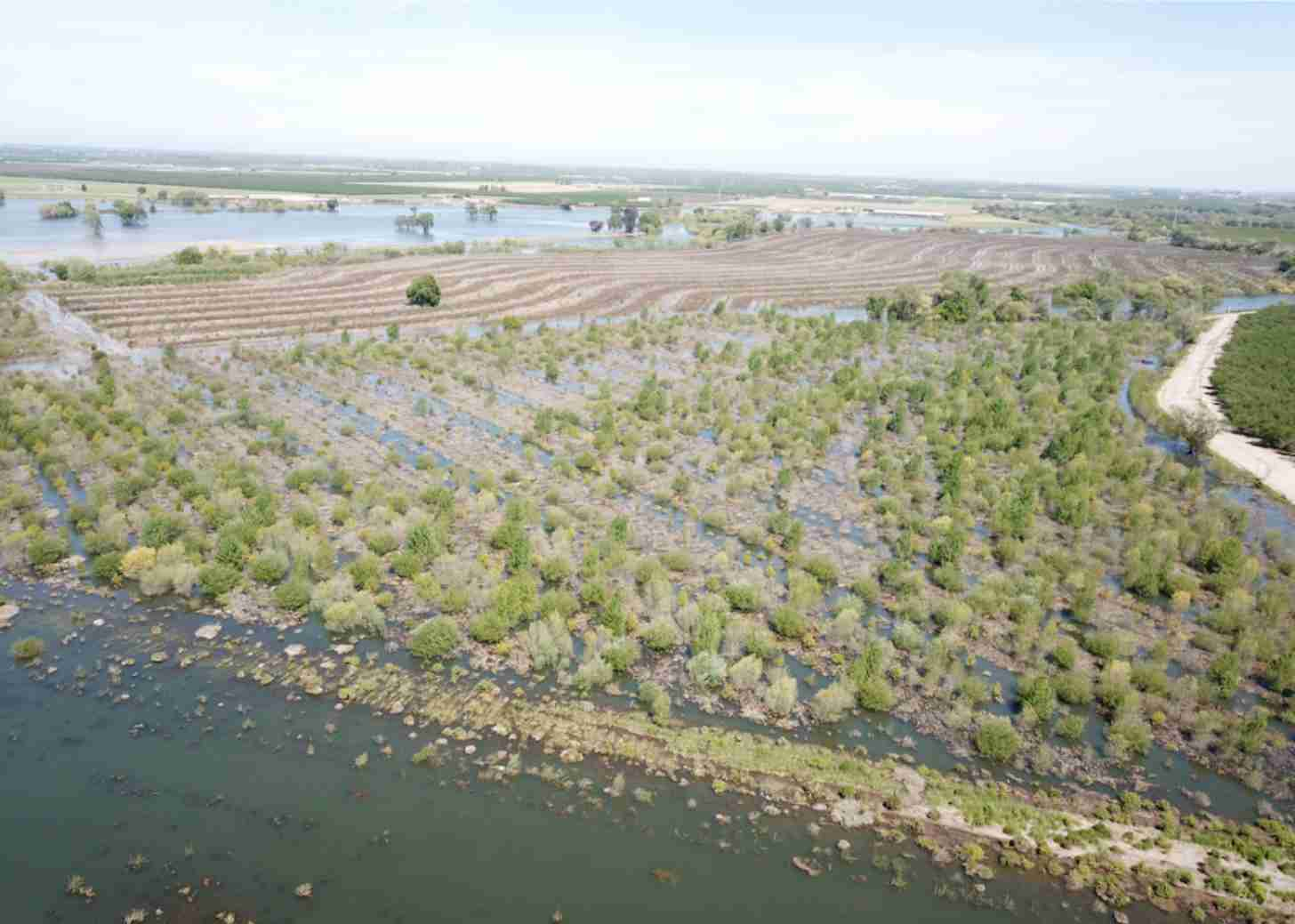
Until a little more than a decade ago, this area was productive farmland, used for growing crops like tomatoes, alfalfa, melons and almonds. Now it's set to be California's next state park after a restoration project spearheaded by River Partners converted the ranch into rewilded riverside habitat.
As climate change has doubled the likelihood of flooding in California, and is projected to increase runoff from storms by as much as 200 percent to 400 percent, this restored floodplain is proving to be a promising approach.
Not only does the area help buffer downstream communities from flood damage, it also maximizes environmental benefits from high waters.
"When we step back from the river, when we give the river more room, flooding actually is a very productive process for the ecosystem," says Cain. "It recharges groundwater. It filters polluted water. It nourishes riparian forests that support all kinds of wildlife. It's alive."
California's Central Valley doesn't get much rain, but the 400-mile-long region is naturally shaped by water. Before human intervention, rivers fluctuated with flow from the towering Sierra Nevada range to the east. But over the last century and a half, rivers have been tamed by dams and constricted by levees as land was converted for agriculture and urban development.
Some 95 percent of the region's native riparian and wetland habitat has been lost.
Even as rivers have been engineered with the aim of reducing flooding, communities and farmland have remained vulnerable. Bill Lyons, whose family owned Dos Rios Ranch for about 25 years, says that it was good farmland. But he recalls three times when the ranch was impacted by major flooding, resulting in loss of crops, erosion damage, and debris scattered across farmland.
Lyons' family — which has been farming for four generations and has a century of history in this region — has long been committed to stewardship of the land. They are concerned with supporting the health of the environment, he says. So the family was interested when River Partners approached them about buying Dos Rios Ranch.
"We looked at it from a point of view that probably its highest and best use would be to be returned to a natural state," Lyons says.
In 2012, River Partners purchased the property and began restoration work along eight miles of river. Berms that had been built to protect farmland from high water were removed.
To date, more than 350,000 trees and shrubs have been planted. River Partners uses existing irrigation infrastructure on former farmland to help young vegetation endure hot dry summers as it gets established. About 1,600 acres have been rewilded so far, and restoration work is ongoing on another 500 acres on an adjacent former farm.
Pausing on a rough single-track road that runs atop higher ground through the preserve, Cain points out a long, shrubbery-covered berm that gently slopes down to the floodplain about three yards below the road. It's a ramp designed for riparian brush rabbits, an endangered species that has moved in at Dos Rios.
The slope allows them to escape to higher ground when the area floods. To the right of the ramp, birds flit between bare branches of densely planted trees. To the left, a low-lying grassy meadow is primed to take on high water.
When the San Joaquin River overflows onto the field, it offers an abundant feast of zooplankton and tiny bugs for juvenile salmon, which studies show grow faster on floodplains than in the river. Instead of aiming to benefit any single species, the restoration was geared toward creating a varied ecosystem.
"It's a more resilient landscape that supports a greater diversity of life," Cain says.
A variety of wildlife thrive throughout the year
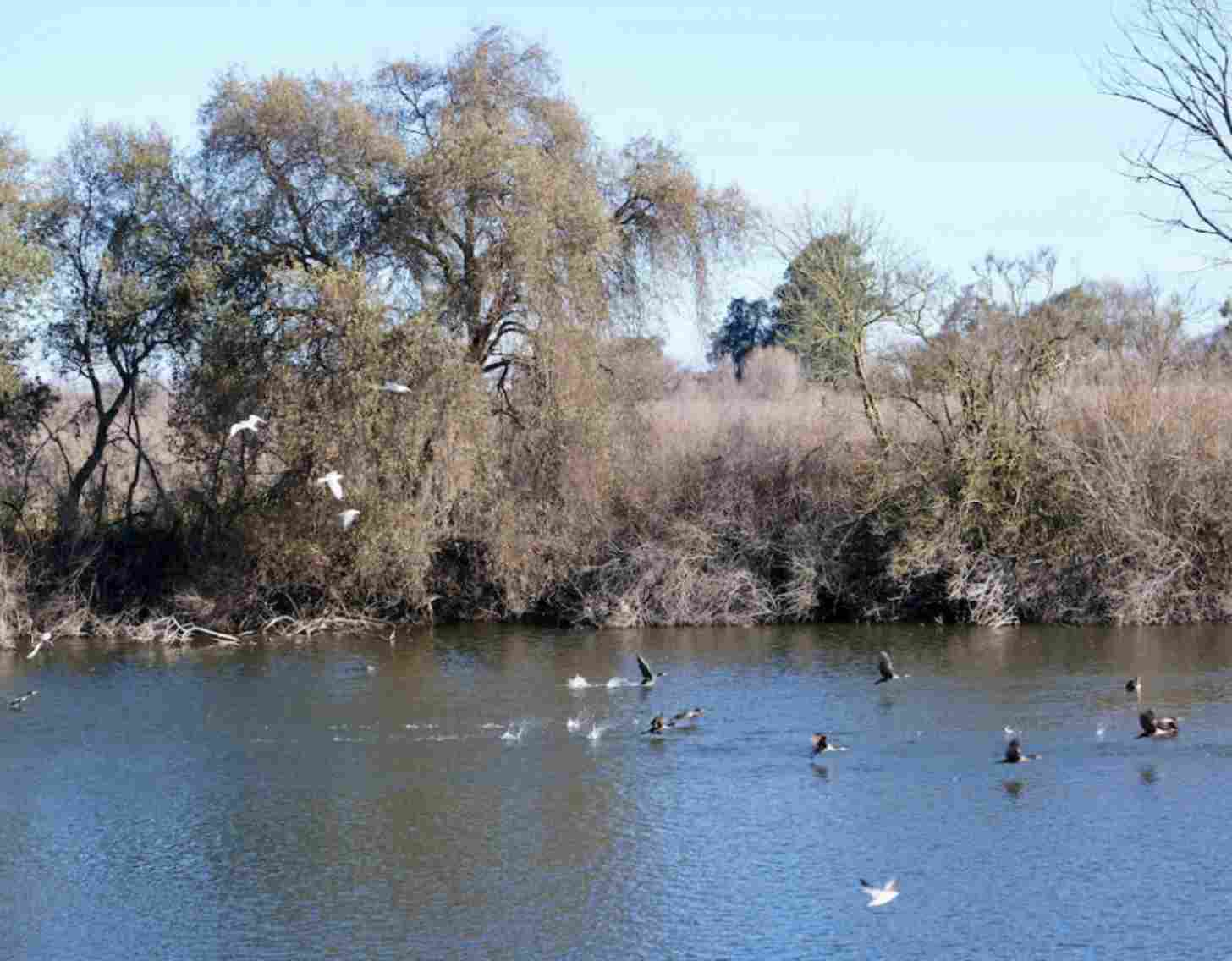
The preserve hosts migratory Aleutian cackling geese, a formerly endangered species that's on the rebound. Beavers have been spotted, as well as deer, which hadn't been seen in this area for about 60 years, according to River Partners.
Over the last decade, the restored floodplain quickly showed signs of success in supporting wildlife. And in 2023, the area got a chance to show how it performed in heavy flooding.
Lilia Lomeli-Gil walks by piles of branches and brush a few feet away from the backyard fences of houses on the edge of the small town of Grayson, across the river from Dos Rios Ranch Preserve. The debris was left by high water last winter, she explains, as the river overflowed near this small community, home to many farmworkers.
The record-breaking precipitation that hit California last year was devastating for some communities. Thousands of people were evacuated when a levee broke along the Pajaro River, 50 miles southwest of Grayson.
In Grayson, residents watched the rising river warily. A few families evacuated out of precaution, according to Lomeli-Gil, co-founder of the Grayson United Community Center. The water came up within a couple feet of several houses, she says, but the town didn't sustain major damage. She attributes that to the floodplain restoration work.
"I can only imagine if … River Partners had not opened up the levees," she says. She believes giving the water room to spread out helped the town avoid flood damage. "I think that made a difference."
Awareness has been growing that California's old flood management approach of confining rivers has not been working, according to Brian Johnson, a board member of the Central Valley Flood Protection Board.
But during the winter and spring of 2023, the Dos Rios project proved that floodplain restoration is an effective flood control approach.
"You need to give the water a safe place to go," he says, "or it'll go to a place that's not safe."
Across the Central Valley, similar projects are in development, he says. Cost is a limitation — the board's recommended flood protection measures, including projects like Dos Rios, have an estimated price tag of $25 billion to $30 billion. But those measures could avoid around $1 trillion in damages from major flooding. The permitting process can also be slow and a hurdle. But Johnson says there's a lot of opportunity to develop similar floodplain habitat restoration projects across the valley.
"In order for it to work at a system-wide scale, we want to be doing it in a bunch of different places," Johnson says.
Floodplain restoration can also help California weather drought, which is predicted to become more intense with climate change, according to Cain. Not only does growing native vegetation require less water than agriculture, when floodwaters spread across the land, the water seeps down into the groundwater, recharging overdrawn aquifers.
For all its benefits, this type of floodplain restoration isn't appropriate everywhere, according to Joshua Viers, a watershed expert at University of California, Merced. Dos Rios is well-suited because the confluence of the two rivers makes for dynamic conditions that are particularly good for habitat restoration.
In other parts of this heavily agricultural region, other approaches may be more appropriate, he says.
Certain crops, like grape vines, can handle some flooding, which also benefits groundwater stores. Some types of farming can be incorporated into habitat restoration; rice fields can support salmon. According to Viers, using a range of different approaches can help manage flooding and support ecosystems along California rivers.
"You can't do all things in all places," Viers says. "If you can string these together, you can have mutually reinforcing benefits."
There are also social benefits to habitat restoration: Through the Grayson United Community Center, Lomeli-Gil has been working to engage Grayson residents with Dos Rios and surrounding restored natural areas. Several locals have gotten jobs with River Partners planting vegetation. And now, California State Parks is aiming to open the new state park to the public later this year.
"It's in our backyard, so how blessed will we be," Lomeli-Gil says.
As other floodplain projects are in development across California, Dos Rios is still expanding.
Cain walks along furrows on a plowed field on former farmland adjacent to Dos Rios.
Instead of crops, this plot will soon be planted with young native trees and shrubs. Cain checks little white labels on sticks that mark where each new plant will go: a Modesto ash, box elder, and, his favorite, elderberry.
Cain and his colleagues at River Partners have set a long-term goal of restoring 100,000 acres in the San Joaquin Valley. That would restore about 10 percent of the wetlands that used to be in this area.
On the other side of the bare field, two large wonky Vs of Aleutian cackling geese fly by. Even though they are hard to see from such a distance, their characteristic honks echo across the field.
This article was originally published by Stacker and was republished with permission.
Header image by Elizabeth Hewitt for Reasons to be Cheerful
These days, it seems like there’s an awareness holiday for everything. Fortunately, there’s a lot to celebrate!
In California, a new holiday is going to the dogs (and cats… and hamsters).
On June 1, the California Animal Welfare Association, the San Francisco Society for the Prevention of Cruelty to Animals, and the American Society for the Prevention of Cruelty to Animals teamed up to host the first-ever California Adopt-a-Pet Day.

(The California State Senate even passed a resolution proclaiming the day a real holiday across the state).
The event, which included more than 170 participating animal shelters across the state, was a resounding success, sending a total of 3,609 pets to their forever homes.
That total is made up of 1,977 cats, 1,541 dogs, and 91 other critters (including rabbits, guinea pigs, and more).
Organizers originally had a goal of 2,024 adoptions.
“On June 1, we saw just how important our animal shelters are to the people of California,” Dr. Jennifer Scarlett, the CEO of the SF SPCA, said in a statement.
“They heard our call to action and responded in kind. As a result of this event, thousands of households are now enriched by having a special pet in their lives, and our shelters received the support and attention they deserve.”
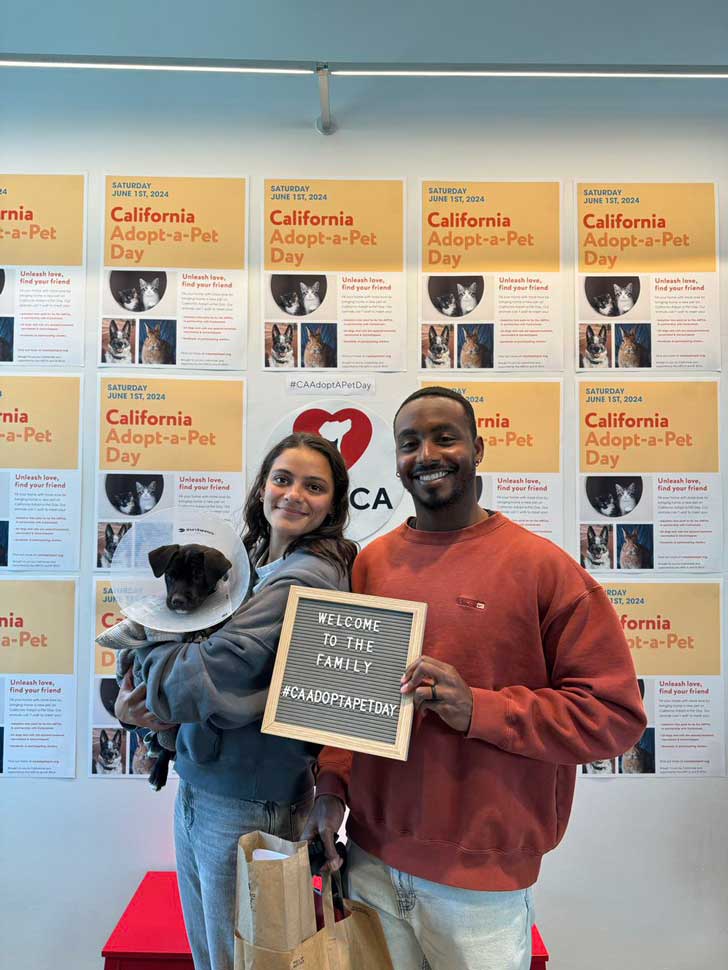
The ASPCA covered the cost of adoptions, making it easier for community members to welcome a pet into their lives, while still financially supporting the animal rescue organizations in the area.
This is especially important, as California shelters have faced a large influx of animals in recent years. Experts attribute this to ongoing economic hardships, like finding pet-friendly housing and affordable veterinary care.
According to a statement about the event, California has one of the highest rates of renters in the country, and housing is one of the largest barriers for families being able to keep or adopt a pet.
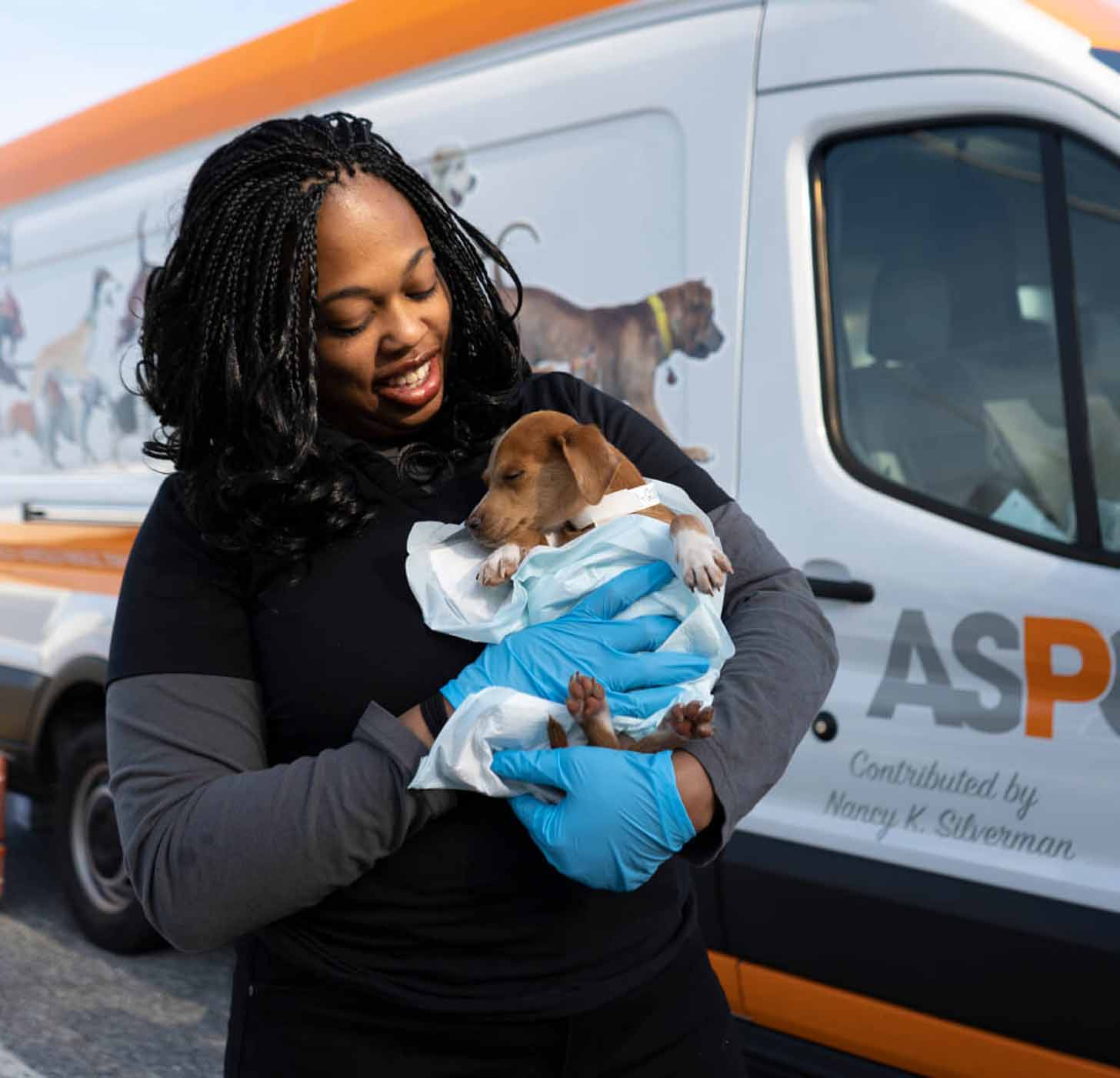
It’s clear to the animal lovers: Something’s gotta give.
“The success of California Adopt-a-Pet Day underscores the tremendous appeal of shelter animals and the unique power of the human-animal bond,” Matt Bershadker, president and CEO of the ASPCA, said in a statement.
“It also is an inspiring message to shelters, pet owners, and the animal welfare community that when we come together, we can make change for animals in need.”
For many new pet parents, this was the first time they visited their local shelter — and the first time they adopted a shelter pet. The Calaveras Humane Society in Angels Camp, California, for instance, said June 1 set a new one-day adoption record for their organization.
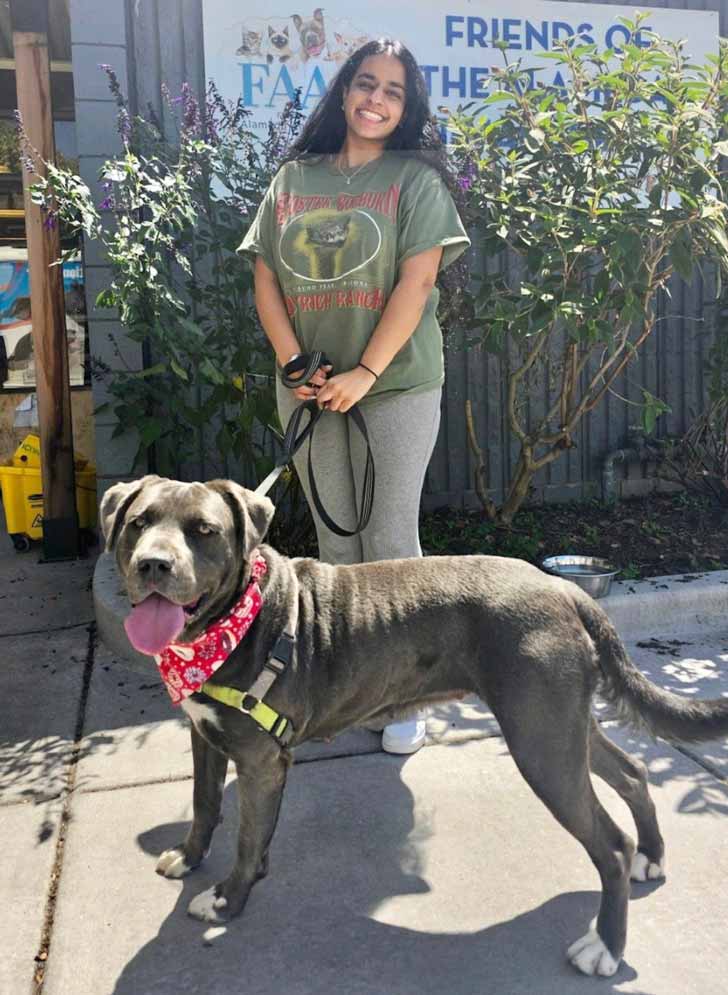
“Our shelters are overcrowded with a variety of wonderful animals just waiting for people to come and meet them,” Jill Tucker, the CEO of CalAnimals, said. “It is our greatest hope that members of the public will visit shelters first when they are ready for a new pet.”
One such case was that of Nelly, a 3.5-year-old mastiff mix, who had been in the care of Friends of the Alameda Animal Shelter for 1.5 years. But when she met Sahiba Singh — who drove 40 minutes to meet Nelly after seeing her on social media — the rest was history.
“She jumped out at me immediately. I read that she was shy and needed a quiet home. We have that. I had to meet her,” said Singh. “She’s so happy here, and we love her so much. We’re going to give her a lifetime of reasons to wag.”
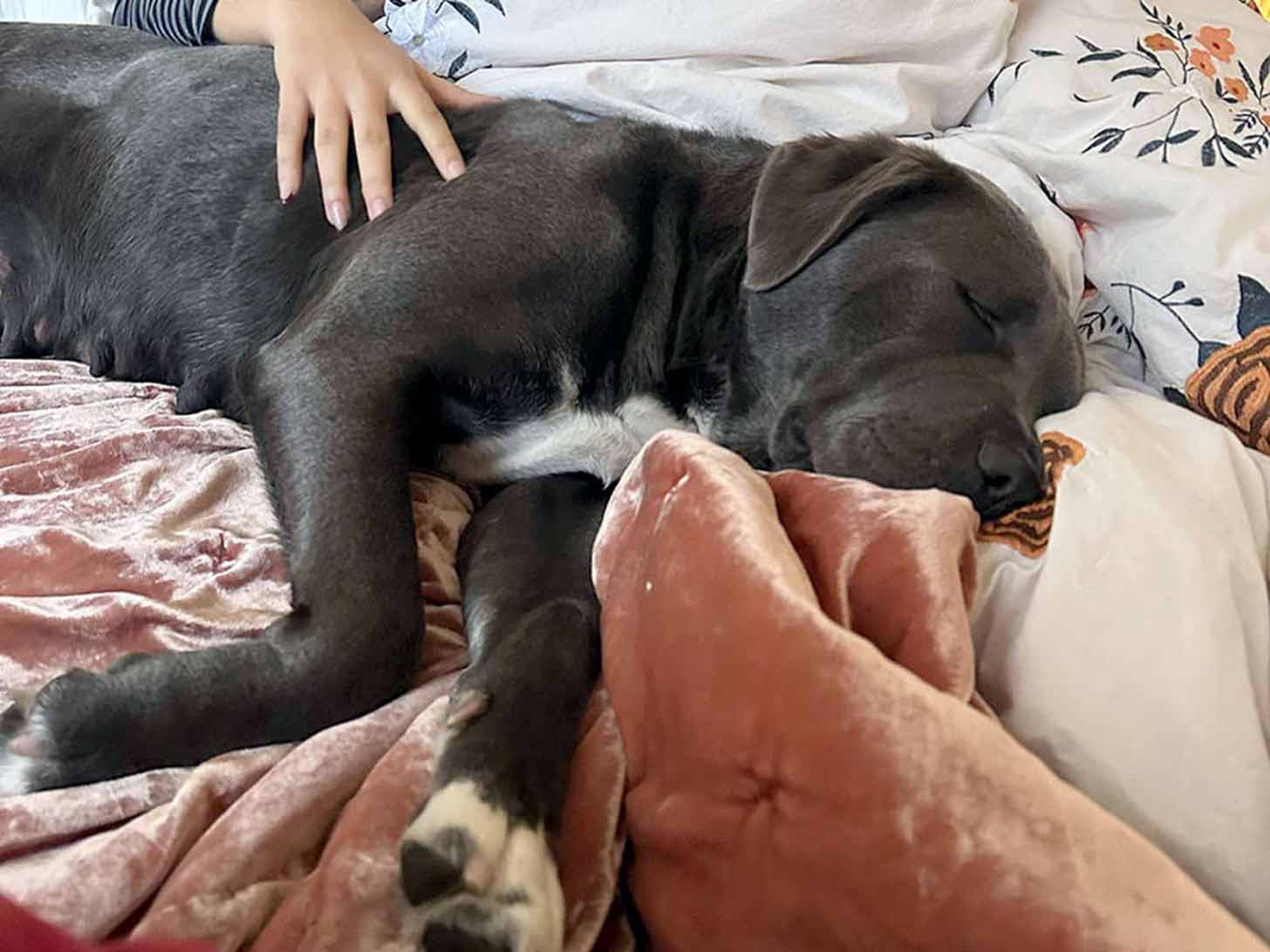
Nelly, along with her 3,608 fellow adoptees, is proof that pet adoption makes a real impact. While the next annual California Adopt-a-Pet Day won’t take place again until June of 2025, animal welfare activists have made it clear that every day is a good day to adopt a pet from your local shelter.
Better yet, every day is another opportunity to work together to help animals find their fairy-tail ending.
Bershadker said it best: “Knowing that 3,609 shelter animals found homes in a single day when national and local animal welfare groups work together is proof that collaboration is key to saving more lives not only in California but across the country.”
Header images via Haven Humane Society and ASPCA
This story was originally published by The 19th and was republished with permission.
It was a simple wave that changed things for Frankie Leigh.
Last summer’s Douglas County Pride festivities were wrapping up. It had been eight hours in near 90-degree heat, eight hours of picketers yelling at Leigh that they were going to hell. And just as the crowds were scattering, a protester called to Leigh.
“See you next year!”
Leigh couldn’t help but laugh. “It was that realization of like, I am going to see you every year,” Leigh said. “And I’ll probably see you in the grocery store and at the school board meeting and at these other places, too.”
Roseburg, Oregon, a rural coastal town three hours south of Portland, with a population just over 23,500, is relatively small. The people condemning Leigh to hell were their neighbors.
Leigh had been asked to help protect the 2023 Pride event by serving as a buffer between protesters and attendees.
De-escalation in protest is generally understood as working to calm tensions and reduce conflict. But not everyone doing that work has the same idea about what that looks like. In some cases, de-escalation teams stand as a physical barrier between protesters and event attendees.
In other instances, they try to talk with protesters. The goal is generally to keep everyone safe.
Leigh was learning that sometimes this didn’t mean acting as security, but doing actual outreach. That might mean making time and space to listen to hate speech. It might mean offering food or water.
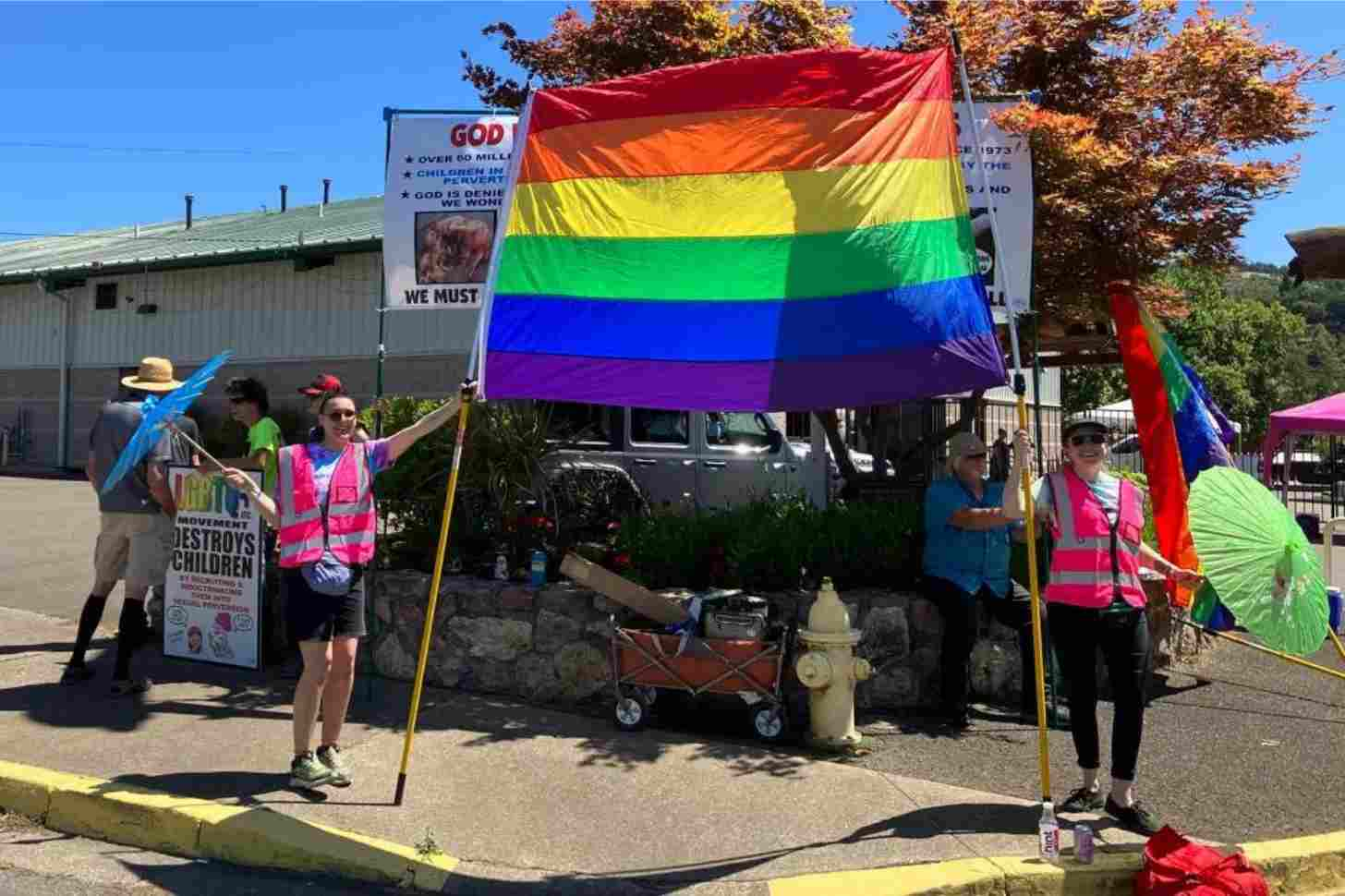
Leigh, a psychologist who was raised Mormon, has put that lesson about outreach into practice.
This June, they joined a group of experts working with Interfaith Alliance and the Southern Poverty Law Center training religious organizations to protect Pride events nationwide.
After undergoing Zoom trainings this spring, the members of some 120 faith organizations will fan out across more than 50 Pride events in 16 states to de-escalate the actions of extremist anti-LGBTQ+ hate groups.
Maureen O’Leary, senior director of field and organizing at Interfaith Alliance, said the goal is to have faith communities use “faith as a bridge and not a bludgeon.”
“We are pulling pieces out of the narrative that you know, anti-LGBTQ religious activists would like to claim, that it is faith versus LGBTQ identity,” said O’Leary, an Episcopalian.
The project, named “Faith for Pride,” is in its third year. It is difficult and sometimes dangerous.
National LGBTQ+ media organization GLAAD reported that the United States saw 145 hate incidents at Pride celebrations last year alone. Six were categorized as assault. In one instance, a woman was killed at a gas station outside of Austin, Texas, after a man allegedly yelled homophobic slurs at her.
Those incidents have come against a backdrop of increasing anti-LGBTQ+ legislation, particularly bills targeting transgender people.
In the last two years alone, state legislatures have considered 1,197 anti-transgender bills. Of those, 129 have passed.
Advocates contend that this has fueled attacks against queer Americans, especially during Pride Month.
In Naples, Florida, organizers of the community’s Pride fest were forced to move this year’s drag show indoors for the safety of performers and attendees.
Amy Perwien, a member of the Interfaith Alliance of Southwest Florida, attended the festivities in Naples on June 8 both as a community member and volunteer observer for Interfaith Alliance. Outside, picketers waved signs telling attendees to repent, or that “Jesus Christ does not accept you as you are.”
“I have made a choice to see the signs, hear the words, and turn that into motivation for advocacy,” said Perwien.
Perwien has come to speak out at Pride events and school board meetings. She is a member of the steering committee for Interfaith Alliance of Southwest Florida. She acknowledges that the work in Florida is difficult, but she also feels like it’s making a difference.
“I get asked a lot if the tide is turning, and what I usually say is that I see cracks,” Perwien said. “I saw things fail this current legislative session that I believe last year would have passed.”
In February, a bill that would have banned pride flags on government buildings failed in committee. Another bill that banned talking about LGBTQ+ identity in the workplace didn’t even get to committee. In June, a federal judge struck down restrictions on gender-affirming care for adults and minors.
In some cases, the threats are more severe than just anti-LGBTQ+ rhetoric. Leigh, who co-founded a group called Pride Peacebuilders last year specifically to do de-escalation work at LGBTQ+ events, has come face-to-face with armed protesters and angry mobs and been in tense standoffs between pride-goers and demonstrators.
Leigh advises trainees to defuse the protesters by offering them cold bottled water or even a listening ear, and against photographing or recording them.
Jai Davis, faith organizer for Equality Georgia, is participating in this year’s Faith for Pride initiative. They said they have found de-escalation to be a powerful tool in their work for years.
Earlier this year, Equality Georgia enlisted faith leaders from across the state to oppose a “religious liberty” bill that advocates say would have empowered businesses to discriminate against queer people. The clergy held a news conference and spoke with lawmakers, pressing them to vote against the bill.
“It was just such a powerful moment. I asked faith leaders ranging from rabbis to Episcopalian priests to Baptist preachers, who came out,” Davis said. “To me, when the legislators heard that story or heard those narratives, it de-escalated a lot.”
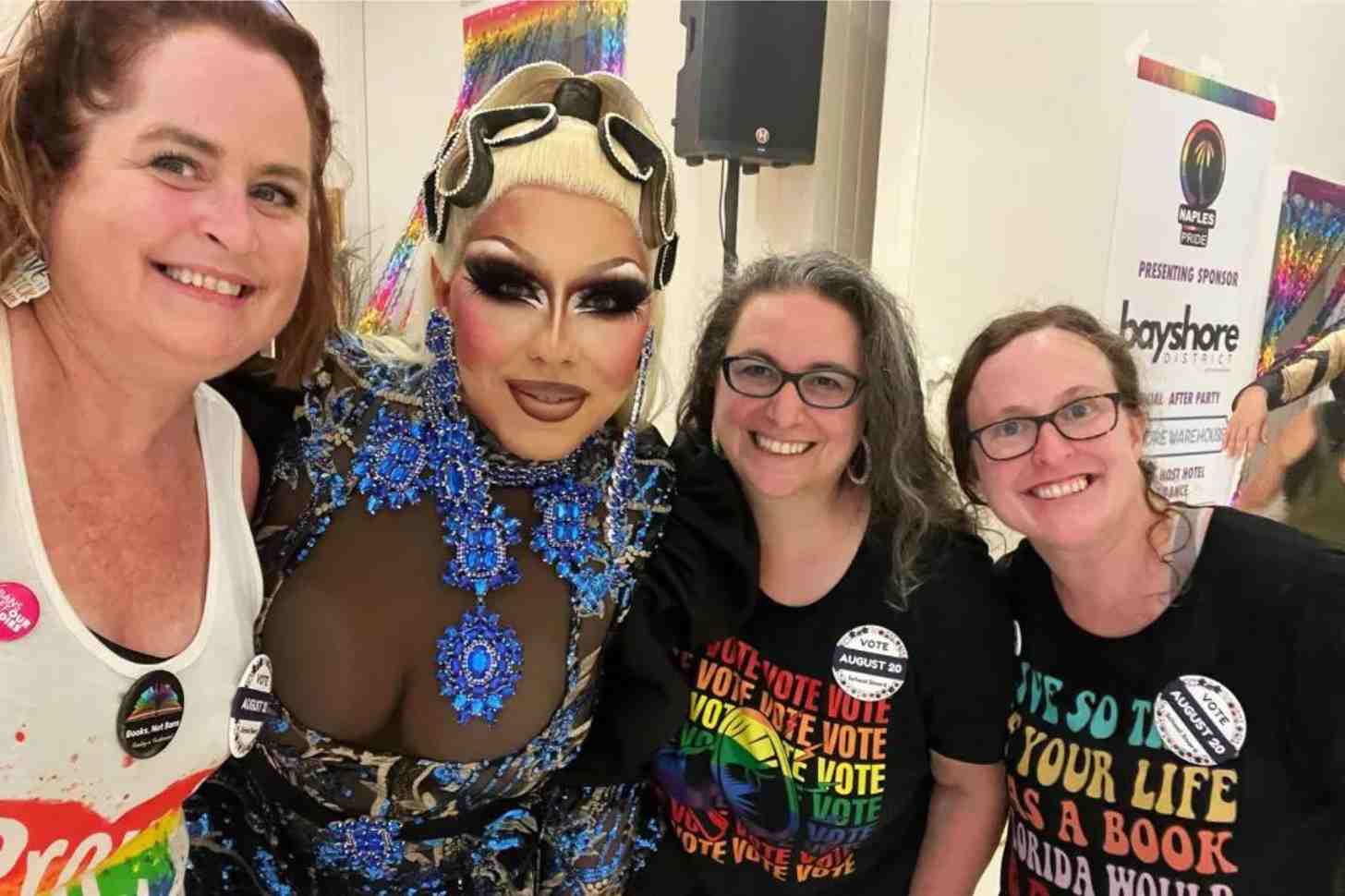
Equality Georgia has used these tactics over and over to defeat every anti-trans bill introduced in 2024, 13 in total. In August, national LGBTQ+ nonprofit Lambda Legal will honor the group for what it called a “heroic” effort in stopping the bills.
Now, Davis says their organization will put those values into practice during June, especially in faith communities of color where many LGBTQ+ people might want to keep their ties to their congregations.
Many of the faith leaders attending pride are LGBTQ+ clergy. A good number, however, are straight allies or the parents of queer youth. They are looking for ways to show up in an increasingly fraught world. Their primary goal is to keep attendees safe from the rising vitriol and violence at these events.
“That is informed by real research and has a lot of grounding in the real needs that folks are facing on the ground,” said O’Leary.
“It kind of became this, like, I’m listening to your transphobic, yucky stuff you’re saying off to the side, and trans kids who are coming to pride, or families who are coming to Pride, don’t have to be the ones to hear it,” Leigh said.
O’Leary and Leigh teach that anti-LGBTQ+ protesters show up at Pride because they are suffering. They cite Dr. Geoffrey Cohen, a Stanford psychologist, who argues that people stay in hate groups because they are seeking belonging and meaning.
Those hoisting signs might not be hate group organizers, but people recruited by their churches, Leigh adds.
That approach is not always popular among LGBTQ+ people who feel threatened and traumatized by hate speech.
“I get a ton of pushback from people in the LGBT community, and some folks who are like, ‘Hey, I want to yell at the protesters,’” said Leigh. “Especially, like, for young queer people, if you need that, if that’s healing for you, that’s okay.”
While some with Interfaith Alliance attend to de-escalate, others are simply there to observe.
Southern Poverty Law Center has tasked community members like Perwien with reporting back on the presence of hate groups at such events, so that the groups can monitor threats against the community.
The role of religious organizations in de-escalation is hardly new. History shows that while religious conflicts have spurred violence and war, religious leaders have also promoted peacebuilding practices across centuries.
Those are the kinds of stories Leigh is eager to put into a world where it so often seems that hate groups monopolize the narrative on faith.
“The narrative that’s out there about pride right now is pretty scary stuff,” said Leigh. “People are asking me very simple questions, and then framing it as, ‘How do we fight hate?’ I don’t even see it that way. … What you see is hateful behavior, I see as people’s needs going unmet.”
Header image by Ted Eytan (CC BY-SA 2.0) — October 8, 2019 SCOTUS Protest for LGBTQ+ Equality, Washington, DC
Though Frederick Douglass remains the most well-known abolitionist to visit Ireland in the decades prior to the American Civil War, he was not the only one.
As many as 30 Black abolitionists and activists also traveled to Ireland between 1790 and 1860. Olaudah Equiano was one of them. Born in Africa, Equiano was kidnapped when he was about 10 years old. But he later purchased his own freedom, wrote a bestselling autobiography and arrived in Ireland in 1791 as a guest of the United Irishmen, a group of radical nationalists.
Another was Sarah Parker Remond, who came to Ireland in 1859 and stayed with the same family who had hosted Douglass 14 years earlier. Having for the first time experienced equality, she could not bear to return to America.
Instead, she completed a degree at a college in London and moved to Italy, where she trained as a medical doctor. Both Equiano and Parker Remond worked closely with Irish abolitionists.
Even before Douglass arrived in Ireland in 1845, he was aware of the rich tradition of Irish men and women involved in the transatlantic movement to bring an end to the U.S. system of enslavement.
In particular, he was an admirer of the Irish nationalist leader Daniel O’Connell. A vocal critic of enslavement, O'Connell had played an important role in bringing it to an end in the British Empire in 1833.
The making of an abolitionist
Born into enslavement in Maryland in 1818, Frederick Augustus Washington Bailey met his enslaved mother only a handful of times before she died. It was generally assumed that his father was the white owner of the plantation.
At the age of 20, Frederick escaped to New York, where he changed his surname to Douglass.
Although he could have continued on to Canada, where he would have been safe, he chose to remain in the U.S. and become involved in abolitionist activities. Despite having received no formal education, Douglass proved to be a dazzling orator who had firsthand experience of enslavement.
Douglass’ primary motive for traveling to the United Kingdom in August 1845 was to avoid being returned to enslavement. Seven years earlier, Douglass declared himself free. But under American law, he was still designated as a “fugitive slave” and, therefore, could be captured at any time.
By the age of 27, his fame had grown, thanks to his lectures for the American Anti-Slavery Society and the success of his autobiography, which he had published in May 1845.
Clearly, he was a thorn in the side of slavery and those who supported the institution.
In the year before he visited Ireland, Douglass wrote:
“The real, and only-to-be-relied-on movement for the abolition of slavery in this country, and throughout the world, is a great moral and religious movement. The work of which is, the enlightenment of the public mind, the quickening and enlightening of the dead conscience of the nation into life, and to a sense of the gross injustice, fraud, wrong and inhumanity of enslaving their fellow-men.”
The struggle in Ireland
Douglass left America reluctantly, as he was married and a father to four young children.
Two days after arriving in the port of Liverpool, Douglass traveled to Ireland, where a leading Irish abolitionist, Richard Webb, had offered to reprint Douglass’ autobiography to provide him with some much-needed income. Douglass had intended to spend only a few days in Dublin but ended up staying four months after receiving such a warm welcome.
During this time, he gave almost 50 lectures throughout the country. Despite his arduous schedule, he referred to these months as the “happiest” period of his life:
“I live a new life. The warm and generous co-operation extended to me by the friends of my despised race … and the entire absence of everything that looked like prejudice against me, on account of the color of my skin – contrasted so strongly with my long and bitter experience in the United States, that I look with wonder and amazement on the transition.”
Part of Douglass’ transition was based on Irish leader O'Connell’s political approach and belief in universal human rights:
“I am the friend of liberty in every clime, class and colour. My sympathy with distress is not confined within the narrow bounds of my own green island. No—it extends itself to every corner of the earth. My heart walks abroad, and wherever the miserable are to be succoured, or the slave to be set free, there my spirit is at home, and I delight to dwell.”
O’Connell had won political rights for Catholics, who were traditionally regarded by the British establishment as second-class citizens in Ireland. The comparison was not lost on Douglass, who wrote in an 1846 letter to well-known American abolitionist William Lloyd Garrison:
“I see much here to remind me of my former condition, and I confess I should be ashamed to lift up my voice against American slavery, but that I know the cause of humanity is one the world over. He who really and truly feels for the American slave, cannot steel his heart to the woes of others; and he who thinks himself an abolitionist, yet cannot enter into the wrongs of others, has yet to find a true foundation for his anti-slavery.”
Return to America
In January 1846, Douglass left Ireland to lecture in Scotland and England. While there, he became homesick, longing to see his family again.
A group of Irish and British women provided a solution. They raised the money and completed the legal process to purchase Douglass’ freedom.
Douglass returned to America in April 1847 as a free man. But his newfound status did not protect him from experiencing prejudice and segregation.
Five years after his return home, Douglass delivered one of his most scathing attacks on American enslavement:
“What, to the American slave, is your Fourth of July? I answer: a day that reveals to him, more than all other days in the year, the gross injustice and cruelty to which he is the constant victim. To him, your celebration is a sham.”
The long arc of history
In the years following the end of the American Civil War, Douglass’ influence as an international champion of human rights continued to grow.
He revisited Ireland in 1887, but this time as an American citizen who owned a passport and was allowed to cross the Atlantic in a first-class cabin.
Douglass explained that the reason for the trip was “to look on the faces of people who had been kind to me 40 years earlier.”
Sadly, most were dead.
During this visit, Douglass announced his support for Irish nationalists and their long struggle for independence.
Back home, Douglass continued to lead the battle against “the hidden practices of people who have not yet, abandoned the idea of Mastery and dominion over their fellow man.”
For Douglass, continued resistance was necessary, and he invoked three words that he had learned from O’Connell when in Dublin in 1845: “Agitate, agitate, agitate.”
This article by Christine Kinealy from Quinnipiac University was originally published by The Conversation.

Late last year, New York City made headlines when it all but banned Airbnbs and other short-term rentals within city limits.
Reasons to be Cheerful reveals that in August of 2023, Airbnb had more than 25,000 short-term rentals listed in the city.
Tenant groups across the city accused short-term rental platforms of hollowing out neighborhoods and causing already-high rents to grow even higher.
"You would see tourists on the streets in neighborhoods where there weren't any hotels," recalls New York-based artist and activist Murray Cox. The sound of rolling suitcases could be heard at all hours. Once tight-knit communities began to feel lifeless.
When Cox ran the numbers on his own neighborhood — Bed-Stuy in Brooklyn — he found about 1,000 listings. Cox also heard horror stories from other parts of the city.
"People would move into a building and then find that the building was full of tourists day in and day out," he says. "In some cases, they would be so uncomfortable they'd feel forced to leave."
So, in September of 2023, New York City decided to do something about it. A series of bold requirements capped the total number of short-term rentals (STRs) and limited guests to just two at a time. They required STR operators to be primary homeowners — and to be present in the home while hosting.
The city also promised to enforce those requirements, a move that would wipe out nearly 90 percent of active listings at the time.
Though it may sound revolutionary, New York's crackdown isn't the first of its kind. In fact, it's part of a growing trend — one largely spearheaded by much smaller towns.
Over the last decade, communities from Irvine, California, to Durango, Colorado, have implemented clever regulations, taxes and zoning policies to hobble the STR market — or, in some cases, eliminate it altogether.
As the success stories pile up, a growing body of research points to the dramatic positive impacts of policies like these, including lower rents, more equitable housing markets and the promise of a sustainable tourism economy.
When Airbnb was founded more than a decade ago, it was heralded as the harbinger of a new sharing economy. In theory, home-sharing platforms — including Airbnb, Couchsurfing, VRBO, FlipKey and Homestay — would put underutilized bedrooms to use, matching budget-conscious travelers with locals in need of a little extra cash.
The system would funnel tourism dollars into small towns in a more equitable way. It seemed like a win-win. But within a few years, one clear loser emerged: communities.
"It didn't take very long for people to realize the sharing economy was basically a scam," explains Cox, who later went on to found data-sharing platform Inside Airbnb. "People weren't using that car that was sitting in the driveway to drive Uber. And people weren't just renting out a sofa or a spare bedroom."
Instead, people saw an economic opportunity they could invest in. And they started buying whole homes to rent out on Airbnb.
In many cases, speculators and investment companies were buying multiple homes expressly for short-term rental use. A spokesperson for Airbnb notes that "the majority of Airbnb hosts in the US share just one home on Airbnb to help supplement their income and welcome guests whose spending supports billions in tax revenue and economic activity for communities."
According to an analysis Cox performed in 2022, about two-thirds of Airbnb rentals in the US are in a property portfolio, which means the host owns and rents more than one property.
At the time, he found nearly 23 percent of Airbnb hosts had two or more homes or apartments listed on the site. That made up 607,085 listings — or 63 percent of entire-home listings. And the top one percent of operators have more than 300,000 Airbnb listings among them — a stat that points to huge conglomerates gobbling up the market.
These days, Airbnb isn't just a way to share underutilized bedrooms; it's big business.
Right now, about 90 percent of Airbnbs in Bozeman, Montana, and Nashville, Tennessee, — both popular vacation spots — are whole homes. Both Bozeman and Nashville are also relatively small towns with exploding local populations and limited housing stock. That means that every home set aside for a year-round STR listing is a home unavailable to local residents struggling to find — and afford — housing.
As the Airbnb spokesperson notes, "Experts agree the chronic, decades-long underproduction of new housing supply is driving today's housing affordability challenges." But in extreme cases, the STR explosion has been a contributing factor in forcing longtime locals to move away. The so-called "Airbnb Effect" can hollow out once-vibrant communities.
This effect is most visible in popular vacation hot spots. In Hawaii, for example, out-of-towners have bought up so many homes that few are left for Native Hawaiians.
"On Maui alone, 52 percent of homes are sold to nonresidents, and 60 percent of condos and apartments have gone to investors and second homeowners," writes Stanford researcher Noah Jordan Magbual in a recent report. "The once indigenous population of the Hawaiian archipelago are now outcasts in their own home."
The Airbnb Effect also impacts bigger urban areas. In 2015, one study found that STRs had sucked at least 10 percent of New York's available housing off the market. Another New York study showed that this reduction in supply led to rent increases of up to hundreds of dollars per year. In Barcelona, the effect is even more severe, with rents rising by seven percent and housing costs rising by up to 17 percent in popular neighborhoods.
For some cities, the proliferation of STRs has become more than just an economic issue; it's existential. That's especially true in New Orleans, the longtime home of Jeffrey Goodman, an urban planner and consultant who specializes in STRs.
"We were one of the earlier cities to experience the growth in short-term rentals," Goodman says. "And we're in a unique place because so much of what we sell is culture. It's art. It's food. But the people who make the art and cook the food and play the trumpets have a hard time living here." So, if the locals who make New Orleans special are forced to move away, what's left?
"There are a lot of cities asking themselves this question," says Goodman. "Are we a city anymore or are we just Disneyland?"
According to Goodman, the Airbnb Effect is stronger in small communities, like mountain towns or beach towns, which tend to have limited housing stock, high home prices and little flexibility to adapt to fluctuations in housing availability. That may be why small towns were among the first to fight back.
In 2014, Durango — a town of 20,000 in southwestern Colorado — passed a series of regulations to combat what one local newspaper called "The Airbnb Apocalypse." The town, an adventure epicenter for mountain bikers, climbers, skiers and other outdoor sports enthusiasts, isn't just a tourist magnet.
It's also home to Fort Lewis College, a premiere university for Native American students and Colorado locals. That was an experience Durango was anxious to protect.
Durango's 2014 regulations banned STRs outright in student neighborhoods. They also limited STRs to two percent of the housing stock elsewhere.
"In doing this, the city made it clear that preserving student housing took precedence over any money they were going to get from tourism," says Goodman.
Today, city planning officials say the program has been a huge success.
"Durango led the way in creating effective guardrails to protect the community from being overrun with STRs," says Scott Shine, director of Durango's Community Development Department. Today, he says, STRs make up just 1.4 percent of the city's total housing stock. They just aren't really an issue anymore.
A year later, Santa Monica — an affluent California beach town of 90,000 — passed its own ordinances, banning STRs offering stays of less than 30 days for an entire home.
The city also extended its 14-percent hotel tax to STR operators and made it illegal to operate them without a valid business license.
According to one estimate, the ordinance has since dropped the city's number of Airbnb listings by 61 percent.
San Francisco enacts platform-accountability policies to end the Airbnb Effect

Many of these novel STR policies look great on paper, but the truth is that they're hard to enforce. Few cities have spent more time thinking about this issue than San Francisco.
San Francisco-based housing activist Dale Carlson first heard about the Airbnb Effect back in 2014, when the city was undergoing a major housing affordability crisis. When he learned that nearly five percent of the city's limited housing stock was devoted to Airbnbs, he decided to get involved.
Carlson helped bring together a coalition of tenants, hotels and property rights groups. By 2015, they'd successfully lobbied for a city ordinance that required hosts to register their STRs, have a business license and pay hotel taxes. But it wasn't enough.
"We still ended up with 15,000 or 16,000 listings," Carlson says. So, his group asked voters to get behind an entirely new concept: the principle of platform accountability.
"The idea is that [the rental platform] can list and or rent anything it wants, but it can only collect a booking fee on the stuff that's legal," Carlson explains. If passed, the ballot measure would put the onus on Airbnb — not the city — to police unregistered and therefore illegal listings. Airbnb fought the initiative, and it fought hard.
"We were defeated in the ballot. Airbnb spent close to $10 million—they outspent us 20 to 1," Carlson says. But despite the heavy spending, Airbnb barely eked out the win. "So many people had told us, 'You're never going to beat them because they're too big and powerful,'" Carlson says. "But suddenly they didn't look so powerful. And we didn't seem so vulnerable."
Carlson's coalition reworked the initiative and tried again. The next time, the ballot measure passed. Within a few months, Flipkey listings in the city had dropped by about 90 percent, and short-term Airbnb listings plunged by about 75 percent, according to some estimates. Cities across America were watching. Others, like Boston and New York, ultimately adopted platform-accountability policies of their own.
Another important aspect of San Francisco's policy is that hosts can only use their primary residences as STRs. According to Carlson, that's dramatically limited speculative purchasing.
"All the folks who were buying up units or renting units and then subletting them on Airbnb — that's all gone," he says.
A few years later, Irvine, California, enacted an even more severe policy — with more dramatic results. In 2018, the city banned all short-term rentals under 30 days and hired a fintech firm to track down and report scofflaw hosts.
This ban more than halved the number of Airbnb properties. As of 2023, rents in the city had dropped by up to three percent, according to a recent study. That saves tenants about $114 per month on average.
Choosing the right STR regulations can be very location-dependent, says Goodman, the city planning consultant. Some towns might need a combination of ordinances, while complete bans might work better in others. But according to Michael Seiler, the College of William and Mary researcher who led the Irvine study, we now have strong evidence that limiting STRs can indeed reduce rents. And, he says, it's likely that Irvine's solution could be successfully applied in other towns.
"If I was another policy maker in a sister city, I would say let's at least try it," he says. "Because we've shown that it does work here."
New York hasn't been the only city to act in recent years. In 2023, Bozeman passed regulations forcing STR platforms to ask for operators' permit numbers.
The policy makes it difficult for bad actors to list their homes illegally, and makes it easy for the city to double-check that listings are appropriately registered and legally operating. Bozeman also mandated that STRs be primary residences — not second homes purchased as rental properties.
There may also be some market solutions around the corner. A cadre of startups are taking up Airbnb's original mission and reworking it into a more holistic, community-friendly approach.
New platforms like Trusted Housesitters and ReFlat are making it easier to find mutually beneficial housing swaps, while millennials are bringing time-shares back into vogue in Colorado ski towns.
In the future, these regulatory and entrepreneurial solutions could work together to give travelers affordable lodging options — without sacrificing the needs of local communities.
"A lot of people will say Airbnb is here to stay, but New York City shows you that's not necessarily the case. When they decided to enforce their housing laws, it was really effective," says Cox. "New York City's approach is a good model to show that we can be as restrictive as we want. It's up to us."
This article was originally published by Stacker and was republished with permission.
Header image by WorldPictures on Shutterstock
In 1924, the Blairgowrie, Rattray and District Angling Association was formed to give anglers of Scotland’s River Ericht a community to call home.
In the generations since, it has become one of Scotland’s oldest angling clubs, encouraging the responsible fishing of salmon, sea trout, brown trout, and other fish — as well as the stewardship of their beloved natural areas.
Never has this been more true than on the organization’s centennial, as they have purchased the salmon fishing rights of a four-mile stretch of River Ericht to help conserve and protect Scotland’s endangered salmon.
With this purchase, BRDAA’s leadership hopes to improve water conditions and continue its efforts of trash cleanup, tree planting, managing invasive species, and monitoring salmon stock.
The river runs through the town of Blairgowrie and is integral as a spawning tributary in the River Tay system — the country’s largest river system. It’s a spot in which members of the 300-member BRDAA have been fishing for generations — a place they know and love well.
“BRDAA deserves great credit for taking this step at a critical time for our salmon,” George Thompson, of the Scottish Gamekeepers Association, told the BBC. “It demonstrates the passion hard-working local people have for the species and a way of life.”

The four-mile stretch will be called Macpherson Fishings; named after the Macpherson family, who sold the rights to the BRDAA. The late Sir William Macpherson was a lifelong supporter of the association and was heavily involved in the local community as a judge.
His children, Jamie and Annie, told The Courier that they were determined that the river should belong to the people who love it most.
“The fact that it coincided with the centenary year is a wonderful bonus,” Jamie said.
While BRDAA leadership is optimistic about their role in the crusade to save Scotland’s salmon, they’re fighting an uphill — or upstream — battle.
According to Jon Gibb, a coordinator for the Salmon Scotland Fund, the wild Atlantic salmon was officially classified as an endangered species in Scotland in 2023.
“This keystone species is under very serious threat from a wide range of impacts, both in the river and at sea,” Gibb said in a statement. “Any projects to further understand those impacts and mitigate against them are urgently required.”
The anglers who have fished these waters for years confirm that they’ve seen a change in the landscape, pointing to a history of water extraction for industrial purposes, with salmon stocks falling as a result of low water levels.
BRDAA former president David Hogg, 75, joined the organization in 1962 and remembers the vast salmon population of the Ericht.
“There is no doubt salmon are in decline, nationally. When you think of the numbers that used to come up here in the late 70s and early 80s — the Spring run especially — there is no comparison,” Hogg said in a statement.
But salmon stocks are falling in rivers across the country, with numbers at their lowest since 1952, according to the latest Scottish government figures.
While this milestone for the BRDAA provides hope, it’s only one step towards progress.
“This is not just an issue on the Ericht. I believe there are about 260 rivers in Scotland which all have issues preventing the easy passage of migratory fish,” River convener Grant Kellie said in a statement for the Scottish Gamekeepers Association.
“The Scottish government needs to step up at this moment in time and get this implemented so we can get the fish back to where they should be.”
A Scottish government spokesperson told the BBC that a wild salmon strategy is being implemented over the next five years to “tackle the wide range of pressures salmon face in the freshwater, coastal, and marine environment.”
This, the spokesperson said, “includes an investment of over £1.25 million from the Scottish government in 2023 for the protection and recovery of wild salmon.”
This new purchase, the BRDAA hopes, will help legitimize their efforts to the government and help to streamline its official strategy, saying they will leave “no stone unturned” in the recovery of wild Atlantic salmon on the Ericht.
“It’s something for the whole of Blairgowrie to be proud of,” Kellie told The Courier.
“We all want to make sure there’s a future for the river.”
Header image by Neil Williamson (CC BY-SA 2.0)
The Iberian lynx is one of the rarest cat species in the world, and it’s officially off the endangered species list after 20 years of hard-won conservation efforts.
The wild cat, with its trademark “beard,” black-tipped ears, and bobbed tail, resembles its close relative, the bobcat. Roughly 30 pounds and twice the size of the average housecat, the Iberian lynx is native to Spain, Portugal, and southern France.
In 2002, the species was nearly brought to the brink of extinction. In Spain, only 94 Iberian lynxes remained. In Portugal, they disappeared entirely and were declared locally extinct.
The main cause of the Iberian lynx’s decline was its disappearing food source. The Iberian lynx, a keystone species, is an apex predator that prevents overconsumption of vegetation by regulating local prey species like deer, foxes, and rodents.
In the early 2000s, its preferred prey — rabbits — were affected by agricultural production, as well as breakout epidemics of myxomatosis and haemorrhagic disease. As local rabbit populations plummeted, so did the lynx.
The Iberian lynxes were also largely affected by poaching and the construction of major highways, which fractured their habitats. According to the World Wildlife Fund, the high-speed roads unfortunately led to a significant amount of lynx deaths — 22 in 2014 alone.
After the big cat species was threatened with near extinction, nature scientists and animal advocates rose to the challenge.

Over two decades, conservationists focused on breeding and protection projects — for lynxes and rabbits alike — and also restored natural habitats like woodlands, scrublands, pastures along the Iberian peninsula.
Thanks to these conservation efforts, the Iberian lynx population increased twenty-fold.
A census from 2023 reported more than 2,000 adults and juveniles alive today — and the big cat is now labeled as “barely vulnerable” according to the IUCN Red List of Threatened Species.
“It's a really huge success, an exponential increase in the population size,” Craig Hilton-Taylor, head of the IUCN Red list unit, told The Associated Press.
Since 2010, the WWF has orchestrated more than 400 releases of Iberian lynxes into the wild throughout Spain and Portugal, and their protected land area has leapt from just 173 square miles to 1,281.
“We have to consider every single thing before releasing a lynx, and every four years or so we revise the protocols,” said Ramón Pérez de Ayala, species project manager for Spain’s chapter of the WWF.
In a press statement, LIFE Lynx-Connect project coordinator Francisco Javier Salcedo Ortiz thanked the many people and organizations who came together to save the Iberian lynx.
“[This] is the result of committed collaboration between public bodies, scientific institutions, NGOs, private companies, and community members including local landowners, farmers, gamekeepers and hunters,” said Ortiz.
“[It’s] the greatest recovery of a cat species ever achieved through conservation.”
Header image via LYNXEXSITU (CC BY 3.0 ES)
Standing amid rows of juicy, lime green lettuce and chunky florets of broccoli, Jose Paiz appears as if he could be the owner of a modern, high-tech farm. But the crops thriving here, in the suburbs of Mexico City, are part of a 1,000-year-old tradition.
"My ancestors were doing this before even the [Spanish] Conquistadors arrived in Mexico [in 1519]," says Paiz, while crouching down to pick up a handful of powdery soil from the "chinampa," or "floating garden," on which we are both standing.
These highly productive man-made island-farms, which can be found floating on lakes across the south of Mexico's capital, date back to the time of the Aztecs or perhaps even earlier — and now proponents say that these ancient engineering wonders could provide an important, sustainable food source as the city faces historic drought.
"My grandparents taught me the methods," adds Paiz, 32, (pictured below) who is the fifth generation of his family to be a chinampero working in San Gregorio Atlapulco, a traditional working-class neighborhood about 10 miles south of the center of Mexico City.
According to Reasons to be Cheerful, experts say that these chinampas, which have been recognized as a UNESCO World Heritage site, are considered one of the most productive agricultural systems in the world.
The artificial islands are built by gathering large amounts of soil from the bottom of the lake and placing it on top of reeds, grasses and rushes in a mass that rises above the water. F
armers then plant a fence of "ahuejotes," which are Mexican willow trees, around the plot to naturally protect against erosion.
This system means that the chinampa's soil is constantly enriched by nutrient-filled sediment flowing in from the surrounding ditches and canals, yielding multiple harvests every year.
"In terms of agriculture, they are one of the best examples of how humans can work with nature," says Lucio Usobiaga, founder of Arca Tierra, an organization providing local farmers in the area with technical and entrepreneurial support.
A centuries-old system

One of the first traces of the chinampas dates back to the 14th century, when the Aztecs arrived at the region of what is now modern-day Mexico City. There, they founded the settlement of Tenochtitlán — which would become one of the most powerful cities in all Mesoamerica — in the Valley of Mexico.
But as the Aztecs soon discovered, the valley's boggy, lake-filled landscape was difficult to cultivate or build on. So they devised an ingenious plan to adapt to the surroundings: the chinampas.
A 2013 paper by North Carolina State University professor Matthew Teti found that in the 16th century, chinampa farms could produce 13 times as much crop as dry-land farming in the same area — a system that provided food for hundreds of thousands of people. Chinampas, the study said, are "one of the most intensive and productive agricultural systems ever devised."
"Aztec planners created these vital waterways as integral to the existence of its cultural, physical, and spiritual, urban identity, rather than draining the water and excluding it from the urban experience," it continued.
In the case of Paiz, the age-old system is still reaping rewards today. He says that his 7,000 square meters of chinampa, for example, can produce as much as 100 kilograms of broccoli per day — which is sold alongside the yields of fresh herbs, spinach, chard, radishes, corn and kale at local markets in the south of Mexico City.
"I'm proud to be continuing the tradition of my ancestors," he says.
Meanwhile, according to Arca Tierra, their network of seven producers in the region cultivates over 40,000 square meters of land, employing a total of 27 workers in the field and producing 3,650 kilograms per month. At some farms, as many as 95 varieties of vegetables and herbs are cultivated, underlining the fertility of the method. The production brings in over $4,000 per month in crop sales.
"At the beginning, it was mainly a commercial endeavor to source organic produce close to the city," says Usobiaga, who supplies restaurants in Mexico City and began working with chinamperos in 2009. "But I learned they are very important in many regards and have historical and cultural importance."
The design of the chinampas is particularly efficient in its use of water, which it can absorb and retain from the surrounding canals for long periods as well as allowing crops to draw from the groundwater directly, reducing the need for active irrigation.
This could prove hugely valuable for Mexico City and its 22 million residents, since water supplies have fallen to historic lows due to abnormally low rainfall partly attributable to climate change. And lessons learned from the chinampas could potentially help cities around the planet: the UN World Water Development 2024 Report found the number of people lacking access to drinking water in cities will likely reach two billion by 2050.
"The technical aspects of agriculture are innate to every place," says Usobiaga. "But the way of thinking that created the chinampas, that sensibility, has to be appreciated and valued: To work with the flow of nature, the flow of the seasons. That is what we have to use to get us out of the problem we are in."
The unique wetlands ecosystem is also home to two percent of the world's and 11 percent of Mexico's biodiversity, including the critically endangered axolotl, or Ambystoma mexicanum, an incredible salamander-like amphibian that is able to regenerate every part of its body — even parts of its vital organs such the heart and brain.
Meanwhile, the chinampas also provide a host of other benefits: they filter water, cool the city, sequester carbon, offer green space for locals, and are now a popular destination for tourists who take boats along the picturesque waterways.
One of the most productive agricultural systems in the world

The value of the chinampas was underlined during the COVID-19 pandemic, when, as the city's major markets ground to a halt, the chinampas were able to provide healthy, locally-grown food. In some cases, sales more than doubled.
"People began to search for healthier food," says David Monachon, a social sciences researcher at the National Autonomous University of Mexico who has researched the chinampas as a sustainable food source. "There was this focus on local economy and community. Many people didn't make this connection before."
Yet despite their immense value, the chinampas are under threat: rising urbanization means the chinampa landscape is being built on; pollution is dirtying the waters that feed them; younger generations are losing interest in agriculture; and agro-industry is undercutting the small-scale producers in a price war.
"There are a lot of challenges and problems," says Monachon, who is supporting a local cooperative of chinamperos to sell their goods via the Mercado Universitario Alternativo, or Alternative University Market. "But chinampas could feed the city."
Now, only 20 percent of the 2,200 hectares of chinampas are in use, and only about 2.5 percent are being actively cultivated for farming food — the rest is being used for growing flowers and tourism. But Arca Tierra is helping to restore the chinampas — five hectares to date — and is training 15 young students in the required skills to cultivate them — the second, six-month cohort — while also carrying out research on the most effective techniques and productive crops to use on them.
"We have demonstrated that it can be done on a small scale," says Usobiaga, who believes chinampas have the potential to produce enough of crops like lettuces, herbs and broccoli for all of Mexico City. "But the chinampas need support and investment from the government to scale up production."
Chinampas could feed the city

At Xochimilco market, the largest in the area, there is clear evidence of appetite for a resilient, local food system and signs that this ancient Aztec tradition can still bear fruit. The market bustles with traders and customers, spilling from the covered area out onto the streets.
"There are a lot of challenges and problems," says Monachon, who is supporting a local cooperative of chinamperos to sell their goods via the Mercado Universitario Alternativo, or Alternative University Market. "But chinampas could feed the city."
Now, only 20 percent of the 2,200 hectares of chinampas are in use, and only about 2.5 percent are being actively cultivated for farming food — the rest is being used for growing flowers and tourism. But Arca Tierra is helping to restore the chinampas — five hectares to date — and is training 15 young students in the required skills to cultivate them — the second, six-month cohort — while also carrying out research on the most effective techniques and productive crops to use on them.
"We have demonstrated that it can be done on a small scale," says Usobiaga, who believes chinampas have the potential to produce enough of crops like lettuces, herbs and broccoli for all of Mexico City. "But the chinampas need support and investment from the government to scale up production."
At Xochimilco market, the largest in the area, there is clear evidence of appetite for a resilient, local food system and signs that this ancient Aztec tradition can still bear fruit. The market bustles with traders and customers, spilling from the covered area out onto the streets.
Rosa Garcia, 47, is rushing around delivering lettuce, spinach, cilantro and broccoli to her 14 clients of the day. The produce, grown at her one-hectare chinampa at San Gregorio Atlapulco, is in high demand. Garcia says that each day her family-run farm can earn as much as 1,000 to 1,500 Mexican pesos ($60 to $90).
"I've been doing this since I was a girl," says Garcia, ticking off the orders as they are dispatched. "It's a system that works. Why do anything different?"
This article was originally published by Reasons To Be Cheerful (via Stacker) and was republished with permission.
Header image by Peter Yeung for Reasons to be Cheerful
Artificial intelligence has lived rent-free in the minds of Wall Street traders, workers, and even parents with school-aged children over the past year as new tools emerge almost daily.
Many AI developments have sparked resistance and anxiety, dredging up concerns that they could replace well-paying jobs or erode the quality of education. However, some advancements promise to promote equity and accessibility through new technologies, including AI-powered voice-to-text transcription.
accessiBe analyzed data from captioning service 3Play Media to show how error rates in automated closed captioning are declining. This is a promising development for a future in which closed captions might be more efficiently produced and more widely available.
The report draws from more than 100 hours of transcription content representing an array of speaking accents and locales and draws on transcriptions in higher education, tech, consumer goods, cinema, sports, and other industries.
For many, closed captions are a helpful tool — and one that an increasing number of Gen Z and millennials prefer when watching videos, according to a 2023 YouGov survey, with respondents saying they enhance their concentration or help them understand thick accents.
Transcribed captions also make videos accessible to the estimated 15.5% of U.S. adults with difficulty hearing, per 2022 National Health Interview Survey data, and Congress requires video programming distributors to include them on TV programs.
Transcribing is manual work.
For decades, creating captions for live TV and other video content has been the work of the more than 20,000 workers in the closed captioning and court reporters services industry.
AI has fueled the rapid advancement of audio transcription tools in consumer and corporate software. Apple plans to introduce AI transcription to its voice memos and notes apps in the next update to its iPhone operating system, iOS 18. The update would potentially bring instantaneous transcription to phone apps used by more than 2 billion people.
Other companies like Zoom have also added AI-powered features, including AI transcription of video calls.
Several of the most prominent providers of the AI engines behind these services have seen their AI become even more accurate in the last year, according to a recent study by 3Play Media.
Tools making the most significant improvements in word errors

As shown in the chart above tracking word error rates, Google and IBM's audio transcription AI performed worse in 2023 than in 2022.
Google Standard had a 28% error rate while Google Video had a 14% error rate — an increase of 2 percentage points and 0.7 percentage points since 2022, respectively. Meanwhile, IBM Watson had a 25% error rate, a 1.5 percentage point error increase since 2022.
However, other platforms saw slight improvements with lower error rates over the same period, including Rev AI (-3.4 percentage points), Microsoft (-0.91 percentage points), and Speechmatics (-1.11 percentage points). They all had a 10% or less error rate for 2023.
Other transcription tools tracked include Assembly AI (8% error rate), the multilingual OpenAI Whisper: Large (8% error rate), and the English-only OpenAI Whisper: Tiny (15% error rate), all of which didn't have 2022 data to make a year-over-year comparison.
Word error rates describe the number of times a transcription engine might interpret the wrong word in an uploaded audio file. Generally, the models 3Play Media analyzed made some progress from 2022 to 2023 in reducing the number of word errors they make, but not in all cases.
Another factor that affects AI's reliability for transcription is its frequency of punctuation errors, which affect readability. In this realm, OpenAI's model is most accurate, but it is still only 85% reliable.
Open AI offers multiple speech recognition models of varying complexity and power. The "tiny" version only performs English language transcription, whereas its large model is multilingual. The company launched these for the first time in 2022, and 3Play Media only studied them for the 2023 year.
AssemblyAI's speech recognition tool was also more recently released and has no comparable prior-year data. Developers trained its 2023 speech recognition software on 1 million hours of audio — it is also capable of English language transcription.
In a testament to how quickly advancements in the space are moving, Assembly released a successor just this year based on 12 times the training data, and which it advertises as multilingual and "hallucinates" 30% less often than OpenAI's competing service.
AI hallucination refers to large language models' tendency to invent misstatements in their output. In a chatbot, this might look like a confidently stated fact that isn't true. These remaining shortcomings and the current state of AI development make using it for accessibility reasons difficult.
That's a major drawback for companies that take accessibility and the surrounding laws and requirements seriously, giving them pause before entirely handing the reins to AI for transcribing audio.
Pure AI transcription still isn't fully compliant with the ADA

Despite their advancements, AI transcription tools still aren't on par with human accuracy. People in the production loop often must make substantial edits to comply with legal guidelines for web content accessibility under the Americans with Disabilities Act.
It's generally accepted that to achieve ADA compliance, websites should follow the Web Content Accessibility Guidelines that outline best practices for auto-generated captions.
Having humans manually review automated captions helps ensure that a video's information is fully and accurately represented, for example.
Even as AI companies advance toward more accurate models, the dream of instantaneous on-demand captions for Americans with disabilities may still be a ways away.
This article was originally published by Stacker and was republished with permission.
Header image illustration by Stacker and Shutterstock
— The great-billed seed finch (Sporophila maximiliani), thought to be the most trafficked endangered bird species in Brazil, has long been coveted in the caged-bird trade, which has caused the local extinction of the species over most of its former range in the Cerrado savanna.
— One conservation project is working to conserve the species holistically through research and environmental education, while collaborating with bird keepers and breeders to bring the species back to the wild.
— With support from these experts and local communities, the species is being reintroduced in the Cerrado within the Grande Sertão Veredas region between the states of Minas Gerais and Bahia.
As the door of the wire enclosure is unlatched, a small coal-black bird hops forward.
For a moment, it perches at the threshold and cocks its head quizzically at its newfound liberty, then flits into the undergrowth of the surrounding savanna.
Within just a few minutes, its mate, a chestnut-brown female, follows suit.
These two great-billed seed finches are part of a decades-long conservation project that aims to reintroduce one of Brazil’s most endangered species into a part of the Cerrado grassland that used to be its home before poaching for trade wiped out the birds.
Sentenced by song
A native of savanna ecosystems, the great-billed seed finch (Sporophila maximiliani) , feeds on flowering grasses and sedges, particularly on sword grass (Paspalum virgatum) and plays an important role in seed dispersal.
Although it occupies a broad range across parts of Bolivia, Venezuela, Suriname, the Guianas and Brazil, it’s rare wherever it occurs and is categorized as endangered on the IUCN Red List.
In Brazil, where the species clings on in small areas of the Cerrado and the southern Brazilian Amazon, it’s considered critically endangered.
Even optimistic population estimates are dire, at fewer than 2,500 mature individuals and no more than 250 in any given population.
According to Luis Silveira, curator of ornithological studies at the University of São Paulo’s Museum of Zoology, the situation may be far worse: “A few years ago, there were probably no more than 100 wild birds left in all of Brazil.”
While habitat loss and fragmentation resulting from agricultural conversion are believed to have impacted the great-billed seed finch, its greatest threat comes from its popularity as a caged bird.
Despite its plain appearance, with monochrome plumage and a bulky beak, which inspired its local name bicudo, or “big beak” in Portuguese, the male’s song — a silky warble used for territorial defense and attracting females — has made it one of Brazil’s most coveted songbirds.

Traffickers employ networks of poachers to locate and trap males in the wild in Brazil and, increasingly, in neighboring Bolivia, then sell them illegally in rural towns and cities across the country.
“People have been keeping bicudos since at least the 19th century for their song and singing competitions. Like all rare things, these birds tend to bring prestige to their owners who will pay high prices to own them,” Silveira says.
The average price for a great-billed seed finch is $800, but male birds that exhibit exceptional singing prowess may sometimes fetch up to $8,000.
Though the birds can be legally bought and easily bred in captivity, the high demand and lucrative profits to be made from the sale of great-billed seed finches have led to a thriving black market for wild-caught birds.
“We can see the impact of trafficking on the species in the data and it’s alarming,” says Nadia Moraes, science coordinator of Freeland, an NGO that monitors and combats wildlife trafficking.
“From our reports based on annual interceptions of wildlife trafficking rings, the bicudo is the most frequently seized endangered bird in Brazil and ranks second in the number of confiscated individuals.”
Due to these pressures from poaching, male birds have disappeared from many localities, leaving populations heavily skewed or, in some cases, entirely composed of females.
“There are now large stretches of available habitat, with all the typical species of the veredas [Brazilian humid grasslands], except for the bicudo, which has gone locally extinct,” Silveira says.
A conservation project takes flight
In 2008, ornithologist Flavio Ubaid, now a researcher at the State University of Maranhão, began a long-term field study to map the distribution of the great-billed seed finch in Brazil.
But after three years of exhaustive searches in national parks and protected areas across the country where the species had occurred historically, he found barely a trace of the birds.
“It was a wake-up call,” Ubaid says. “We realized that the bicudo had been under so much pressure over the years from poaching that there were almost none of these birds left in the wild.”

Subsequent analysis by Ubaid and his colleagues suggested that the species’ population had suffered a 90% decline. This galvanized efforts by the ornithologist, along with Silveira and biologist Gustavo Malacco, to create in the late 2000s Projeto Bicudo, a conservation initiative aiming to avert the species’ extinction in the wild.
“There were thousands of these birds in captivity, so we knew that the first place to begin was to establish connections with aviculturists,” Ubaid says.
Allies in aviculture
Research from 2020 showed that, according to IBAMA, Brazil’s federal environmental protection agency, there were more than 181,000 captive great-billed seed finches in the possession of more than 49,000 registered breeders of the species in Brazil. Most of these bird owners are concentrated in the country’s southeast, mainly in the state of São Paulo.
“Most breeders keep and sell these birds legally, so they are not the enemy,” says Malacco, the biologist. “But there are some hobbyists who don’t respect the law and will do anything to obtain these birds, and that’s what drives trafficking.”

Still, it wasn’t hard for the conservationists to find allies among the registered breeders by appealing to a mutual love of the bird.
“They have expertise with this species, everything from its husbandry to veterinary care to genetics, so they are indispensable for our project,” Malacco says.
One breeder who’s become involved in Projeto Bicudo is João Paulo, based in Bauru, São Paulo. “The reintroduction project brought a lot of hope and optimism about breeding these birds for the preservation of the species,” he says.
Picking the right birds for reintroduction is essential. Working with captive and confiscated birds, the team has to ensure not only the selection of the healthiest individuals and a diverse gene pool, but also to screen out hybrids — a challenge as bird growers commonly cross-breed great-billed seed finches with closely related species to produce offspring with better singing abilities.
“I select birds for captive breeding based on my knowledge in breeding and management, which I’ve acquired over many years of breeding,” Paulo says.
Reintroduction efforts began with a pilot project in São Paulo state, but bureaucratic challenges and habitat conditions pushed the team to find an alternative site: Port Cajuero, a private natural heritage reserve, or RPPN, in the Grande Sertão Veredas region.
Bringing back the ‘big beak’
The Grande Sertão Veredas, on the border between the states of Minas Gerais and Bahia and named after a famous novel by the writer Guimarães Rosa, spans 230,853 hectares (570,450 acres) of sprawling Cerrado savanna.
“We decided on the reserve because it met all of our criteria,” Ubaid tells Mongabay. “It was within the historic range of the species, habitat conditions were optimal for reintroduction, and pressures from poaching were nonexistent.”
Historically, conditions in the park hadn’t always been so hospitable for the bird. For more than half a century, the species had been locally extinct due to poaching. “When I was a child, it was common for people to trap the bicudo to sell,” says Anizio Costa de Nogueira, a farmer and lifelong resident of the park. “But there came a time when there weren’t any left to catch, and we didn’t see them again.”
The local community quickly embraced the conservationists’ proposal to reintroduce the bird and for residents to participate in the conservation efforts. In 2018, the first great-billed seed finches were released into the reserve. “People were happy to see them return here after so long,” Costa de Nogueira says.
Since then, more than 300 of the birds have been released into the park. Post-release monitoring has shown that most of the birds have adapted well to the wild and have even begun to breed and nest. However, the team has yet to observe a hatchling grow to maturity, though not for lack of effort by the birds.
“There’s been a lot of nest predation by rodents and opossums, which is a natural occurrence in the wild,” Ubaid says. “Seed finches suffer high chick mortality from predators, but the hope is that as we release more birds, we’ll see more fledglings survive.”
To achieve this aim, a captive-breeding center has been established within the park, expediting breeding and releases. Every month, an average of three breeding pairs are reintroduced into the reserve after a period spent in an enclosure to adapt them to the sights and sounds of their natural habitat.
“By 2030, we hope that the reserve’s population will be self-sustaining,” Malacco says.
In addition to its work with the great-billed seed finch, the project aims to generate an income for the reserve’s community through ecotourism and training locals as bird-watching guides. The team has ambitions beyond its efforts in Grande Sertão Veredas.
“Our long-term goal is to ramp up our reintroduction efforts across Brazil,” Ubaid says, “and to bring the bicudo back to other regions where it has disappeared.”
This article was originally published by Mongabay.
Header image by Flavio Ubaid.
Policymaking, a process by which governments make decisions about how to address social issues, is shaped by various factors, such as the political climate, socioeconomic conditions and cultural and historical backgrounds.
Some factors are obvious, others not. Often, policy is made by groups of people working together — advocates, regular citizens, lobbyists, lawmakers.
Less often, there’s a single person who emerges as the key figure in making new policy.
One of those people is Erin Merryn, a mother and social worker originally from the Chicago suburbs who endured abuse as a child. Her efforts as an adult ultimately resulted in 38 states passing legislation named Erin’s Law that aims to prevent child abuse through education of children in schools.
As scholars who study how public policy is made and implemented, we sought to answer questions raised by the adoption of this new policy, in light of the advocacy of one woman.
Why did some states adopt Erin’s Law but not others? How do different state legislatures respond to interactions with what public policy scholars call a “policy entrepreneur” like Erin Merryn?
Laws were reactive
Erin’s Law, by and large, requires the teaching of prevention classes on child sexual abuse and exploitation to students in kindergarten through eighth grade, as the New York state law, for example, now mandates.
Child abuse in the United States became a major public concern after the publication of “The Battered-Child Syndrome” in 1962. The book significantly raised social awareness of child abuse and highlighted the crucial roles that social workers, physicians and educators play in identifying and protecting children at risk.
However, meaningful state-level actions to address the problem were limited until Erin’s Law was enacted. Prior to Erin’s Law, much of the legislative response was limited to mandatory reporting of child abuse after it had occurred, which did little to prevent or detect abuse.
Erin’s Law was different — it aimed to prevent abuse before it starts through education, which is a proactive approach, rather than a reactive approach that focuses on abuse that has likely already happened.
In explaining how policies are adopted by government, political scientist John W. Kingdon emphasized the pivotal role of policy entrepreneurs like Merryn in pushing for a solution or drawing attention to specific policy problems. Kingdon wrote in 1984 that policy entrepreneurs are “advocates who are willing to invest their resources — time, energy, reputation, money — to promote a position in return for anticipated future gain in the form of material, purposive or solidary benefits.”
Policy entrepreneurs act as catalysts for making new policy by introducing new ideas, attracting media attention, building networks with legislators and providing them with essential information and perspectives. They persist in their efforts, even in the face of initial opposition.
Erin’s journey
As detailed in her book, “An Unimaginable Act” published in 2013, Merryn was sexually abused when she was 6 years old and suffered through continued abuse until her teens. This horrific experience encouraged Merryn to become a social worker.
After getting a master’s degree in social work, writing multiple books about her experiences and dedicating years to social work, Merryn felt compelled to seek broader and systemic change through nationwide legislation.
She left her job as a social worker and began touring state legislatures and engaging in advocating publicly for policy changes across the U.S. From 2011 to 2018, Merryn visited 36 states and spoke in legislatures a total of 111 times.
The first state in which Merryn tried to get the new policy adopted was her home state of Illinois, where she teamed up with a Republican state lawmaker, Sen. Tim Bivins. After four months of extensive research, they completed the initial draft of Erin’s Law.
In November 2010, Merryn was invited to the Illinois State Capitol, where she delivered short testimony on the need for the law. Her testimony led the way for the policy to be adopted, and on Feb. 14, 2011, Gov. Pat Quinn signed Erin’s Law into effect.
Normally, policies are adopted when state legislators come together in regular sessions and debate in committees about the policy.
With a deluge of information provided by their staff, lobbyists or their constituents – often all three – capturing state lawmakers’ attention can be extremely hard for members of the public.
However, Merryn was able to gain lawmakers’ attention and consideration by employing a powerful story and passion — and, of course, with some luck.
Typically, Merryn’s visits came after her outreach to legislators via emails explaining Erin’s Law. This was often followed by lawmakers’ invitation to her to testify before legislative committees.
These invitations to testify, though, were sparked in other ways, too.
Merryn’s testimony in Michigan emerged from a conversation with a senator’s aide at a family wedding. In New York, when Erin’s Law stalled in the Legislature, a phone call from actress Julianna Margulies to Mayor Mike Bloomberg led to Merryn getting time with state lawmakers.
We believe that Bloomberg’s support provided Merryn with the policy allure needed to capture the attention of state lawmakers. And in Pennsylvania, her testimony came at a time when the Legislature was reeling from the Jerry Sandusky scandal, in which a longtime Penn State assistant coach was accused of, and found guilty of, sexual abuse of children.
Merryn faced multiple roadblocks along the way, but her perseverance played an important role in the widespread adoption of Erin’s Law. Her recognition as the 2012 Glamour magazine “Woman of the Year” further boosted her visibility and impact as she continued the advocacy.
Policy entrepreneurs get results
In our research, we have found that state legislatures frequently visited by policy entrepreneurs are more likely to adopt the new policy and do so more quickly compared to those with fewer or no visits from such individuals.
Merryn’s visits, interactions and speaking engagements not only furnished legislatures and legislators with new information but also reframed the issue in a more politically palatable manner. Erin’s Law was presented as a protective, preventive and empowering approach for children, rather than a reactive one.
The influence of policy entrepreneurs relies on how well the issue they are advocating for aligns with the political landscape of the state. Merryn’s advocacy had a greater chance of helping legislation get passed in liberal states than conservative ones.
In liberal states, more funds are spent on education, health and public safety, and preventing children’s victimization is a policy priority.
Where there is alignment between policy entrepreneurs and legislators, they forge a symbiotic relationship, mutually aiding each other in achieving their goals. Policy adoption for policy entrepreneurs and likely gains in popularity for legislators can translate into electoral gains.
A policy entrepreneur’s success at getting a policy adopted by the legislature depends on the nature of the problem being addressed. Erin’s Law was more promptly adopted in states grappling with severe child abuse problems, demonstrated by increased incidents, reports and investigations.
It also was more promptly adopted in states with more female legislators. Women in legislatures are known to stress more heavily what are often seen as “women’s issues,” including children’s and families’ needs, domestic violence and social welfare.
In those states where Erin’s Law has not yet been enacted, ongoing efforts to pass the legislation, including media engagement, lobbying, petitions and testimonies, are often led by Erin Merryn herself, along with legislators and child protection organizations.
This article by Sanghee Park from Indiana University and Joel Vallett from Southern Utah University was originally published by The Conversation.
