Chile’s soon-to-open Cape Froward National Park, which borders the Strait of Magellan, is a beautiful expanse that’s home to condors, seals, penguins, and humpback whales.
And now, thanks to a recent wildlife expedition, local experts know that the 300,000-acre national park is also home to another species of animal — one that, until very recently, remained hidden amongst the mountaintops around Cordes Bay and Fortescue.
It’s the elusive huemul deer: A shaggy-coated, short-legged Andean deer with single-branched antlers.
The huemul deer is one of the most endangered large mammals in the southern hemisphere, having lost 99% of its population to hunting and habitat loss.
When it comes to Cape Froward’s vast acreage, more than 231,000 acres were donated by Rewilding Chile and Tompkins Conservation, organizations that are working hard to protect some of Chilean Patagonia’s most vulnerable creatures, including the huemul deer.
“Throughout history, the huemul deer population has been associated with the coast here,” Miguel Lopetegui, a park ranger of the Chilean Forestry Service, said on behalf of Rewilding Chile. “Gradually, we decided to employ a helicopter to bring our teams to the highlands of these remote areas.”
That corner of the park — which the team called “roadless” and “pristine” — is one of the few places in South America untouched by human activity.

But it’s also treacherous, with large swaths of the mountain range completely inaccessible by foot.
“It’s twice the effort without the helicopter,” explained Benjamin Caceres, Rewilding Chile’s Magallanes region conservation coordinator. “More food, bigger carrying loads, and more equipment.”
Cristián Saucedo, the wildlife director at Rewilding Chile, said that their helicopter expedition focused on two main sectors of the future national park to look for signs of the huemul deer’s presence.
They didn’t have to wait long.
“It was surprising to arrive at the mountaintop via helicopter and see a huemul right there,” Lopetegui laughed. “This was our welcome, which left us very excited and energized.”
When the team started exploring the area, they realized that a huemul deer herd had left quite the impression on the local terrain.

“With so many footprints surrounding us, we were sure there had to be more of them,” Lopetegui said.
The deer tracks led them to another group of deer, which they observed through their binoculars.
“In actuality,” Saucedo said, “there weren’t just two, but five deer, all very tame.”
By the end of their brief expedition, Saucedo and Lopetegui counted 10 — a huge tally, considering that there are fewer than 1,500 huemul deer left in Chile and Argentina.
“We’ve been immensely fortunate to have been able to gather this data and to have found this group in very good condition,” Saucedo said.

“Geographic barriers have … prevented humans from reaching this area, and thanks to that isolation we can honestly say that the huemul deer here are well preserved,” Lopetegui added.
Celebrating their mission as a massive success, Saucedo said that the data his team collected strengthens Rewilding Chile’s mission to preserve “large-scale conservation corridors” and give local species a higher chance of survival.
“This fills us with hope for Cape Froward as the southernmost refuge of the huemul deer,” Saucedo nodded, “and it gives us strength and reaffirms the importance of working in this region.”
You may also like: This huge flightless bird was facing mass extinction. Then Argentina and Chile struck a deal
Header images via Rewilding Chile / Tompkins Conservation
Throughout his career, acclaimed director Sir Peter Jackson has lifted many of J.R.R. Tolkien’s fantastical creations off the page and introduced them to the silver screen through the “The Lord of the Rings” and “The Hobbit” trilogies
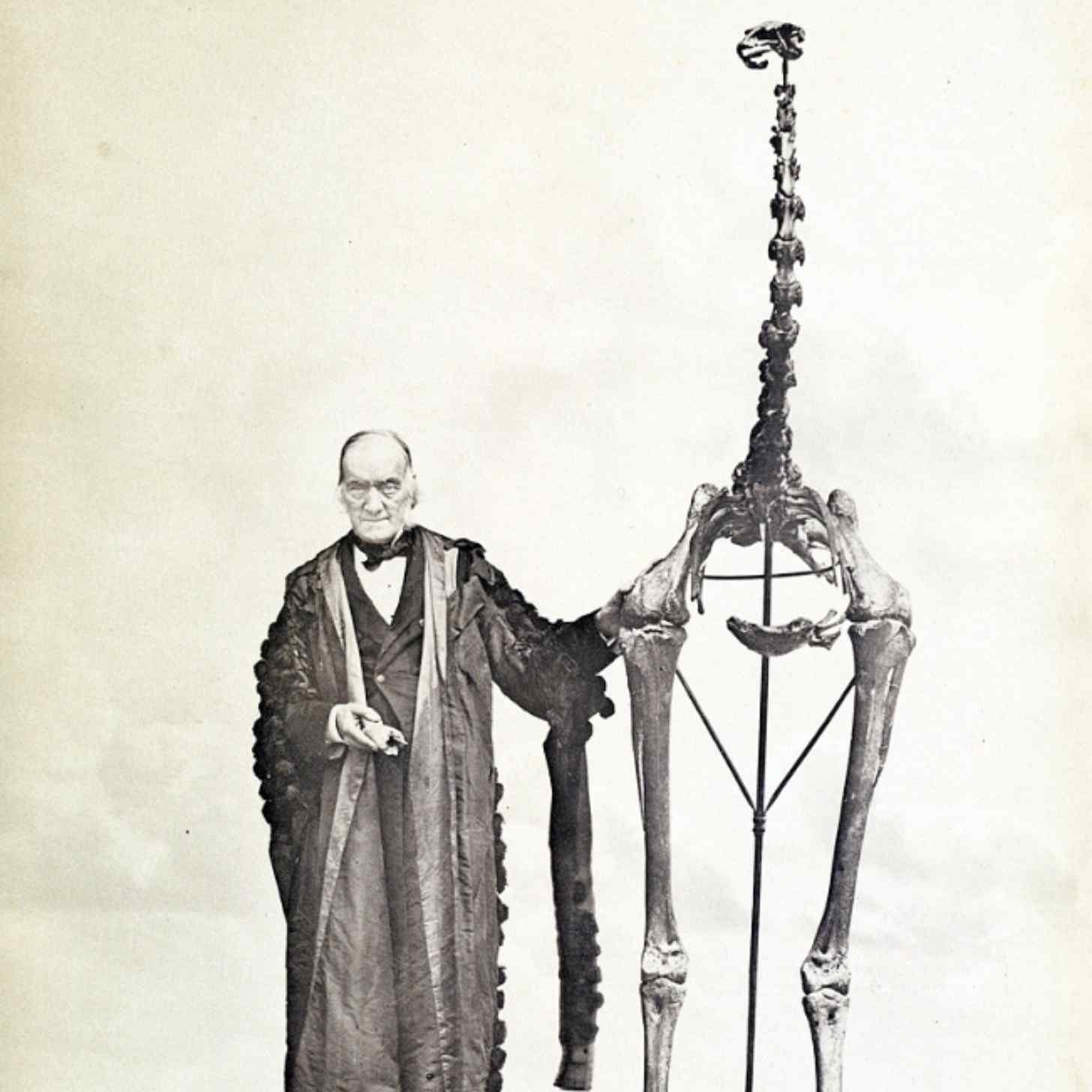
But after years of bringing giant eagles, balrogs, ents and more to audiences around the world, Jackson’s focus has turned to another creature, one that once roamed the earth over 600 years ago: the moa.
Estimated to have stood at 12 feet tall, the moa is widely considered to be the tallest bird that ever lived.
The now-extinct species of flightless birds was once endemic to New Zealand and has long captured Jackson’s imagination as a native Kiwi.
“The movies are my day job, and the moa are my fun thing I do,” Jackson told the Associated Press. “Every New Zealand schoolchild has a fascination with the moa.”
Colossal Biosciences made headlines in October 2024 with their Dire Wolf De-Extinction Project, in which they successfully bred gray wolves that possessed key characteristics of the dire wolf species that lived approximately 13,000 years ago.
Inspired by their debut project, Jackson is now working with Colossal to bring the ancient moa back to life through subfossil sourcing and genetic engineering.
On July 8, Jackson and his partner donated $15 million to the project.
Jackson has also been crucial to introducing Colossal to moa experts that he’s met through his personal hobby of moa bone collecting. To date, Jackson’s personal collection has grown to over 300 bones.
In a statement thanking Jackson for this support, Colossal CEO and co-founder Ben Lamm said: “There is so much knowledge that will be unlocked and shared on the journey to bring back the iconic moa."
According to Colossal, the project will be advised and directed by Māori scholars at the University of Canterbury’s Ngāi Tahu Research Centre. The center, which was created in 2011, is an intellectual hub that supports the tribal development of the Māori people of southern New Zealand.
Recently, Colossal went on an expedition to explore local cave sites known for their moa subfossil deposits (remains that are not yet fully fossilized).
On the trip, Ngāi Tahu archaeologist Kyle Davis remarked that the project to revive the moa has “really reinvigorated the interest in examining our own traditions and mythology.”
“Our earliest ancestors in this place lived alongside moa and our records, both archaeological and oral, contain knowledge about these birds and their environs,” Davis said in a press statement. “We relish the prospect of bringing that into dialogue with Colossal’s cutting-edge science as part of a bold vision for ecological restoration.”
“We are honored to contribute our advanced computational and genetic engineering capabilities under the direction of the Ngāi Tahu Research Centre,” Lamm said, in recognition of the center’s support.
“This partnership represents a new model where indigenous leadership guides scientific endeavors, recognizing that traditional ecological knowledge and cultural context are essential to responsible de-extinction and species preservation efforts.”
The moa project is currently in its infancy, but it is not without reproach.
According to the Associated Press, Duke University ecologist Stuart Pimm has many concerns surrounding the project.
“Can you put a species back into the wild once you’ve exterminated it there?” said Pimm, who is not involved with the project.
“I think it’s exceedingly unlikely that they could do this in any meaningful way…this will be an extremely dangerous animal.”
The Dire Wolf De-Extinction Project was also subject to criticism within the scientific community, with the main point of contention being that the same resources should be used to protect existing species.
Other experts argued that genetic engineering cannot truly bring a species back to life.
“There is no current genetic engineering pathway that can truly restore a lost species, especially one missing from its ecological and evolutionary context for hundreds of years,” Philip Seddon, a professor of zoology at the University of Otago in New Zealand, told the Science Media Center. “Any end result will not, cannot be, a moa — a unique treasure created through millennia of adaptation and change.”
In the face of criticism, Colossal has stated that their moa de-extinction project aims to benefit critically endangered birds along the way, by providing valuable data on the development of artificial eggs.
“There will be undoubted great advances in knowledge along the path towards de-extinction,” Trevor Worthy, a vertebrate paleontologist — who is unaffiliated with Colossal — told Live Science on July 10.
“We will get knowledge of the target animals' DNA and for extinct groups such as the moa this will potentially [be] very interesting regarding their evolution, relationships, [and more].”
You may also like: A secret population of the most endangered large mammal in South America was just discovered in Chile
Header image via Colossal Biosciences
This summer, for the first time in the department’s history, women outnumbered men in the Richmond Fire Department’s latest slate of new recruits.
For Captain Jamila Flowers, it’s a historic milestone.
“When I first came in, I was the 11th female hired,” Flowers, who joined the department in 2001, told WTRV Richmond in early July.
With more than two decades of experience under her “duty” belt, Flowers now works as the fire department’s training captain.
Through the years, she’s helped both men and women navigate the academy’s training.
“Back [in 2001], you know, this was not a sought-out field for females, and it still isn’t, but more and more we're seeing more and more females,” Flowers said.
For Flowers, her department’s latest class stands out in particular: 59% of the 22 graduates were women.
“I was like, man, there's more females than it is males,” Flowers said.
The backgrounds of the freshman firefighters vary from person to person, but many shared an interest in medical training and public service before they ever set foot in the academy.
“I did a little EMS before this, and doing that, I saw a lot of firefighters,” said one recruit, Za'nae Salam. “I work alongside them, and it was just something that I thought would be challenging and I'll grow.”
“I used to work in crisis mental health,” said Salam’s peer, Rowan Lacey. “And I really loved helping people, but also really loved the crisis side of things and the fast pace.”
After joining the academy, Salam walked into her first class expecting a male-dominated atmosphere.
“When I first wanted to be a firefighter, I didn't see many women as firefighters,” Salam said, “so [to] come in and see my classmates, like a lot of women, it made me excited.”
To qualify as a firefighter at the Richmond Fire Department, all graduates must attend a 24-week Fire Recruit Academy, which includes both EMS and Fire-Rescue training.
The program, which is physically demanding, includes fire suppression tactics, use of hazardous materials, driver training, and rescue preparedness.
The training also involves a two-story burn building and an artificially constructed maze designed to simulate actual fire conditions.
“My first time actually putting a fire out, that was probably the best day of my life,” Salam said.
Salam and Lacey hope that their presence in the crew will inspire the next generation of female firefighters.
“I think that representation is really good, and it's going to be amazing to have us out in the field and be like that for other young women [who] want to join,” Salam said.
“If you're willing to work hard, physically and work hard mentally, anyone of any gender can do this job,” Lacey agreed.

You may also like: The number of women leading US business schools is on the rise
Header image via The Richmond Fire Department
Every day the Good Good Good team collects the best good news in the world and shares it with our community. Here are the highlights for this week!
If you want to get good news in your inbox every day, join the Goodnewsletter — the free daily newsletter designed to leave you feeling hopeful.
The Best Positive News We’re Celebrating This Week —
The largest floating solar farm in Europe is now in operation in France
A floating solar farm, called Les Îlots Blandin, is now officially operating at the site of a former 127-hectare gravel extraction pit that shut down in 2020.
With more than 135,000 solar panels, it’s the largest floating solar farm in Europe. It will generate enough power for 37,000 people and prevent 18,000 tons of carbon dioxide emissions annually.
Floating solar panels come with unique benefits like better performance and possibly an expanded life span thanks to the cooler water below. Additionally, they prevent water evaporation, which is especially helpful in areas that experience drought.
Why is this good news? This massive solar installation is a critical step forward in the global clean energy transition. Plus, while floating solar farms work in natural bodies of water, this installation on a former industrial site that was no longer in use means there’s also no impact on marine life.
Billie Eilish pushes music labels to ‘upcycle’ 400,000 unsold T-shirts into new merch — and you can buy some now
→ Read more
After years of advocacy from a survivor, Texas passed a new law that closes a loophole in the state’s sexual assault laws
A sexual assault survivor and advocate, Summer Willis brainstormed ways to raise awareness about sexual assault after realizing how difficult it was to prosecute cases due to a loophole in Texas law.
Lawmakers in the state had been working to pass legislation to fix this flaw, and Willis started running — and crawling — marathons to garner awareness and support.
House Bill 3073, also known as the Summer Willis Act, was officially signed into law last month, amending that loophole and clarifying the definition of consent.
→ Read more
A group of first responders from Mexico arrived in Texas to help with flood rescue and recovery efforts
Over the Independence Day weekend, catastrophic flooding hit six counties in central Texas, where at least 80 people have been killed. In Kerr County alone, officials have reported 75 deaths.
To aid recovery and relief efforts, more than 20 firefighters from Ciudad Acuña, Mexico and Fundación 911 arrived in the area and got right to work alongside the Mountain Home Fire Department.
In addition to having extra boots on the ground, the first responders are also providing drones and other technology to help locate Texans who are still missing.
Why is this good news? In moments of crisis like this, the more people helping find survivors, the better. These helpers heeded that call, even amid tense political discourse around immigration and the intensifying efforts to detain Mexican migrants in the U.S., the search and rescue team put on full display its belief in “solidarity without borders.”
An 89-year-old celebrated his birthday with a rowing challenge to raise money to help save Britain’s historic rainforests
Lifelong explorer and author Robin Hanbury-Tenison rang in his 89th birthday by rowing 22 miles to help restore Britain’s historic rainforests — land he’s long had a deep, cherished connection to.
He completed his journey, raising a total of £64,030 from nearly 500 supporters for the Thousand Year Trust, a charity dedicated to tripling the amount of temperate rainforests in the United Kingdom.
While short of his goal, Hanbury-Tenison’s “game-changing” amount raised will further the trust’s efforts to restore a 5,000-year-old habitat that is under more threat than tropical rainforests.
→ Read more
Mayors in England are implementing an “unprecedented plan” to help children walk, bike, or scoot to school safely
Twelve regional mayors in England signed a joint pledge to “work together to improve our streets for everyone, for the benefit of the health, wellbeing and connectedness of our communities” by creating a “national active travel network.”
The first phase of the plan focuses on helping children walk, bike, or scoot to school through the creation of a combined 3,500 miles of routes linking schools to homes, town and city centers, and transport hubs.
It’s also part of larger efforts with Active Travel England, and is backed by the country’s chief medical officer, who said it could “significantly improve” public health for an estimated 20 million people total.
Why is this good news? Not only does car-alternative transportation help people stay more active, it leads to cleaner, healthier air overall. But first, the infrastructure to get around without a car needs to exist and be accessible — England is working towards that.
Japan’s foreign aid budget has more than doubled in just five years
In the last few months, countries like the United States and the United Kingdom have announced large cuts to foreign aid. One country is doing the exact opposite.
Since 2018, the amount of foreign aid Japan has given has more than doubled, from $8.6 billion to $19.3 billion in 2023. That increase brought Japan’s aid budget to 0.44% of its gross national income — for comparison, the United States gave 0.24%.
Foreign aid saves and improves millions of lives all over the world through health programs, food aid, humanitarian assistance, and more — and a little bit goes a really long way in improving human well-being, making it an incredible investment.
→ Read more
Kids across Texas raised thousands of dollars for flood relief with lemonade stands
In the wake of the devastating loss of an estimated 27 campers and counselors at Camp Mystic, an all-girls summer camp on the banks of the Guadalupe River, young Texans are serving up support for the camp and the families through lemonade stands.
A 14-year-old raised $600, 9-year-old twins raised over $5,000, and one kid’s stand even linked to a GoFundMe — which has now surpassed $440,000 in donations — all with 100% of proceeds benefiting campers and families at Camp Mystic.
Why is this good news? It can feel overwhelming to do something to help that seems small in comparison to a tragedy as devastating as the Texas flooding. But these seemingly small acts of generosity, where all you need is a table and pitcher of lemonade, really matter … and they add up to make a really big difference.
→ Read more
Scientists host ‘science fair of canceled grants’ on Capitol Hill to fight funding cuts
→ Read more
After decades of conservation efforts, Maryland is now home to one of the biggest populations of bald eagles in the U.S.
Today, Maryland’s Chesapeake Bay is home to the highest concentration of bald eagles in the contiguous United States, a momentous milestone that has been a long time coming.
The bald eagles’ population rapidly declined in the early 1970s due to illegal hunting, habitat loss, and widespread pesticide use. They were classified as endangered under the Endangered Species Act in 1967, and those protections eventually led to their removal from the list in 2007.
But local conservation efforts continued, and for the last two decades, the Maryland Bird Conservation Partnership has coordinated a nest monitoring program for bald eagles in the state. Their efforts have led to the bald eagle’s population growing by over 250%.
→ Read more
The world’s first malaria treatment for babies has now been approved for use
While malaria treatments for children exist, there have been none specifically made for babies and small children weighing less than 10 pounds. Instead, those patients were treated with drugs designed for older children, presenting a risk of overdose.
Now, this “treatment gap” is going to be filled with the world’s first malaria treatment specifically for babies and very young children. A new medicine has been approved and will be rolled out to regions with the highest rates of malaria within weeks.
The drug company that developed it plans to introduce it largely on a not-for-profit basis.
Why is this good news? In 2023, malaria was linked to around 597,000 deaths globally — almost all of them were in Africa, and around three-quarters were children under five years old. This new medicine reaching those who need it most will be life-saving.
→ Read more
Teen siblings raised $620K for cancer research in just 7 weeks, while one was battling leukemia himself
→ Read more
While the gender gap persists, men in the U.S. are spending a record-high amount of time on housework
In 2024, men spent an average of 100 minutes per day doing household activities like laundry and cleaning, a record-high amount as captured by the American Time Use Survey.
While the gender gap persists, with women doing 40% more household work than men in 2024, that gap is slowly closing. In the first year of the survey, women worked an hour more than men on the home — in 2024, it was 40 minutes more.
If this path of progress continues, time spent on housework would be equal by around the year 2066. While it’d be great if that were more like 2026 — this progress, however slow, is better than that gap not closing at all!
→ Read more
More good news of the week —
Scientists are developing menstrual pads containing nanotechnology to provide Pap-smear-free cervical cancer screening. While a new at-home, self-testing option was recently approved by the FDA, the Canadian researchers believe science can be doing even more to improve comfort and access to help women feel more comfortable, and therefore, more likely to catch cervical cancer before it spreads.
Sweden is the first country in the world to ensure all egg-laying chickens are cage-free without any laws requiring it. While the country does have stricter legislation when it comes to how many chickens farmers can raise per plot of land, this latest milestone comes on the heels of grassroots activism and public pressure from consumers, not government legislation.
In an environmental wildlife conservation success, piping plovers have made a dramatic recovery in Maine. In 1981, according to Maine Audubon coastal bird biologist Sophie Garland, the state had 10 pairs of plovers nesting on its beaches. This year, there are 174 pairs.
Astronomers and conservationists in West Texas are working to protect the world’s largest “dark sky reserve.” Recent research shows the night sky in North America is getting brighter every year — on average, researchers say, you can see about 10% fewer stars than the year before.
❤️ Supermarket chain H-E-B, which started as a little shop in Kerrville, announced its plans to support flood relief in the community — plans that are already in action. (Instagram)
❤️ Animal rescue groups are working to recover and reunite pets lost in the floods.
❤️ From baby skunks to rabbits, Austin Wildlife Rescue has saved around 70 wildlife following the flooding.
❤️ Two counselors at a branch of Camp Mystic helped keep campers safe, calm, and prepared to evacuate.
❤️ A veteran-led disaster relief organization is providing rescue and recovery support in Kerr County. (Instagram)
❤️ World Central Kitchen is providing food and much-needed supplies to first responders and people impacted by the floods. (Instagram)
Mexico’s Senate unanimously approved a nationwide ban on dolphin and other marine mammal shows. The legislation was the result of a three-year effort sparked by public concern and outrage over animal welfare violations, and was personally prioritized by President Claudia Sheinbaum, who called it essential to prevent animal abuse.
Surgeons in the U.S. completed the first-ever fully robotic heart transplant. The patient recovered quickly thanks to reduced surgical trauma and lower risk of infection, and the procedure marks a significant leap in robotic cardiac surgery, offering new hope for patients with advanced heart failure.
The River Seine in Paris reopened to public swimming for the first time in a century. The long-polluted waterway is finally opening up as a summertime swim spot following a 1.4 billion euro — $1.5 billion — cleanup project that made it suitable for Olympic competitions last year.
Family and friends reunited at the border between Ethiopia and Eritrea for the first time in five years. Separated by the closed border since the outbreak of the 2020 conflict and political tensions, the move to reopen a section of the border was organized by local activists and community figures without the official backing of the authorities on either side.
Women are leading a construction boom in Somalia, as its capital city rebuilds after decades of war. Two young women engineers, for example, are overseeing the construction of a 10-floor apartment complex, issuing instructions to their team of workers, who are all men.
In a “breakthrough” for the technology, Norway launched a flagship large-scale carbon capture and storage project. The technology has struggled to find a viable economic model, but is still seen as crucial to curbing climate change. This project will prevent 400,000 tonnes of CO2 from escaping into the atmosphere each year and be a model for other projects.
Spain announced sweeping ocean protections that aim to balance marine conservation with sustainable development. The announcement includes two new large-scale Special Protection Areas for Birds and proposals for important Community Sites of Interest, protecting 3,180,882.91 hectares, with 2,965,913.24 of them previously lacking any environmental protection whatsoever.
After years of delay, South Korea ratified an international treaty meant to safeguard international adoptions. The significant policy shift comes decades after sending tens of thousands of children to the West through an aggressive and poorly regulated adoption system.
Portugal’s capital city launched a citywide reusable cup scheme to reduce plastic waste. With the potential to remove 25,000 discarded cups every night, Lisbon is the first European capital to implement an initiative that aims to combat plastic waste, reduce emissions, and introduce a smart reuse model in the city’s restaurant sector and bustling nightlife.
Michael Jordan opened his fourth free clinic for people who are uninsured or underserved in his home state. Located in East Wilmington, North Carolina, this fourth Michael Jordan Family Medical Clinic is 7,300 square feet and boasts twelve patient rooms and was built in partnership with Novant Health.
One of the last sea lions impacted by a toxic algae bloom was released in California. In the spring, Southern California experienced one of the longest toxic algal blooms on record, which sickened at least 1,500 animals in the region and the Marine Mammal Care Center took in nearly 400 sea lions and dolphins in just a few months.
Olivia Rodrigo paid for her entire band and crew to have therapy while on tour. Studies show people working in the music industry are “more prone to mental health problems than the general population”, with musicians being “up to three times more likely to suffer from depression” due to factors like financial pressures, isolation, hectic schedules, addiction, and more.
🧠 Related: Spotify partnered with Noah Kahan, Chappell Roan to provide free therapy to small artists
A new implantable device could save diabetes patients from dangerously low blood sugar. For people with Type 1 diabetes, when glucose levels become extremely low, it creates a life-threatening situation for which the standard treatment of care is injecting a hormone called glucagon, and this device could be especially helpful at night or for children.
The result of a “comprehensive, evidence-based public safety strategy,” Baltimore has had its fewest homicides in 50 years. Historic reductions in violent crime have led to a 22.7% decrease in homicides and a 19.6% decline in non-fatal shootings, and the city’s mayor acknowledged “that there is much more work to do and our success makes me commit even further to doing it.”
A secret population of one of the most endangered animals in South America was just discovered in Chile. The stout, shaggy-coated huemul deer is highly endangered in the southern hemisphere, but a recent helicopter mission revealed that they are thriving in a future national park.
For the first time, renewables generated more electricity than coal in Poland. It’s a major milestone for the company’s clean energy transition progress, as Poland still ranks among the world’s most emitting economies both per unit of GDP and energy consumption.
In a bipartisan effort, Minnesota legislators funded $800,000 in outdoor education grants for grade school students. Minnesota joins states such as Oregon, Washington, and Maine in passing similar legislation, and the money will be available to the state’s five accredited outdoor schools to fund overnight outdoor learning experiences for students.
The Ryan Coogler film “Sinners” has had a landmark year. When the flick first hit theaters in April, it quickly became one of the highest-grossing horror films ever produced.
The movie — which blurs the lines between period drama and vampiric horror — also earned praise for its inventive depiction of Black history and culture.
On July 4, “Sinners” made headlines again when it became the first film ever to offer Black American Sign Language interpretation through a streaming service.
“Accessibility within streaming is not a one-size-fits-all approach,” Naomi Waibel, Warner Bros. Discovery’s senior vice president of global product management, said in a press release.
“Our goal at Max is to make these great stories accessible to all audiences in a way that is authentic to the content and the communities we serve,” Waibel continued.
“‘Sinners’ with Black American Sign Language is an example of how culturally nuanced access can enrich the viewing experience for our audiences.”
Other HBO Max titles on the app that currently offer sign language interpretation include “The Last of Us,” “Barbie,” and “Godzilla x Kong: The New Empire.”
Streaming options that feature ASL and BASL translations are accompanied by a sign language symbol depicting two hands signing the word “interpreter.”
In a recent Instagram video, deaf social media star Nakia Smith announced that she had been handpicked as the BASL interpreter for “Sinners.”
“I know many of you are thrilled that the Sinners movie is out on HBO Max!” Smith signed.

“Why Black American Sign Language?” she asked. “‘Sinners,’ it happened during Jim Crow — just like BASL started during Jim Crow. So I think that’s really cool.”
The divergence of Black American Sign Language and American Sign Language was largely driven by the segregation of schools in the American South throughout the 19th and 20th centuries.
Although schools were legally desegregated in 1954, the style, structure, and syntax of BASL continued and are still practiced today.
“Black American Sign Language is a dialect of American Sign Language,” Smith told Netflix’s Strong Black Lead in 2021. “It’s still a language.”
Smith went on to explain some of the nuances that differentiate ASL and BASL.
“With BASL, we sign with both hands,” Smith signed to the camera, “and ASL is more like one hand.”
Smith also pointed out that certain signs are signed entirely differently.
“Like in ASL, this is Christmas,” Smith signed, swiveling the letter “C” with her right hand while her left arm was held out parallel to her chest.
“In BASL, this is Christmas,” Smith explained, moving two pointer fingers to the left as they bounced in tandem.
Smith said that she reached an untapped audience when her first BASL video went viral.

“I felt like a lot of people didn’t know about ASL. … They were really curious and wanted to learn more about BASL and history,” Smith recalled. “I told my grandfather that the video went viral, and he said: ‘Really? Keep going!’”
Smith has been heartened to see the interest in BASL spike in recent years.
“My favorite comment I saw was, ‘Can we preserve this language too?’” Smith signed.
Smith’s impact on HBO Max goes beyond her on-screen interpretation for “Sinners.” Right now, on HBO Max, viewers can even choose Smith as a profile icon — a feature that people were excited to point out on TikTok.
One top comment read: “The translator is the main character!”
“She's a bit unknown to most watchers, but some would say she's the hero of the story,” one viewer replied.
“This is HUGE,” another commenter wrote. “Black American Sign Language has never been used in a mainstream setting! This movie is incredible and I'm glad it's even more accessible!”
See Nakia Smith break down of the differences between BASL and ASL:
According to Time Magazine, an average of 27.4 million diapers are discarded every year — and that’s just in the U.S. alone.
When facing a plastic crisis of that scale, where do you begin?
That’s the question that Tero Isokauppila has been working on for years. Isokauppila is a 13-generation family farmer and mushroom expert from Finland.
After becoming a first-time parent, Isokauppila wanted to find a better alternative for disposable diapers.
When he started looking into it, the prospects were bleaker than he expected.
“If we talk about disposable diapers, every one of those is in a landfill,” Isokauppila said in an interview with Mushroom Revival host Alex Dorr. “We create more to circle the Earth a few 100 times every year, and there are zero biodegradable diapers.”
“All of the ‘eco diapers’ are green washing, and…there's bunch of examples using plant-based materials that take yield from food production, but also create even more micro plastics and perform worse on the baby, creating more more rashes and blowouts.”
After moving to Austin, Texas, Isokauppila co-founded HIRO Technologies — a startup that has been developing “mycodigestible” products that break down soft plastics in landfills.
“Imagine a world where nature can help heal nature, where you can be confident that your discarded plastics are actually being broken down, not polluting our world and our bodies,” Isokauppila and his team wrote in their 2024 Kickstarter.
“15 years ago, scientists first discovered plastic-eating fungi in the Amazon and have continued to study them ever since,” Isokauppila said, referring to the fungus Pestalotiopsis microspora that Yale University researchers discovered in 2011, which breaks down plastics like polyurethane.
Plastics like the liners in diapers.
So, after four years of research, they created HIRO Diapers: Diapers that contain fungi pouches, which “wake up” in landfills two weeks after disposal. Within a year, the fungus breaks the diaper down completely.
“What we can do is actually break down really recalcitrant — meaning really hard to break down — pollutants, stuff that sticks around for a long time,” Danielle Stevenson, the head of research and development at HIRO Technologies, told Mushroom Revival.

“A lot of decomposer fungi use carbon as their food source, right? So they can break down even complex polymers, such as those found in plastics and other petroleum-based products that end up as pollutants.”
“This is a lot better than the conventional way that we remediate or clean up pollution in the environment, or deal with hazardous waste and other waste by…digging it up and dumping it somewhere else,” Stevenson reasoned.
“The exciting potential to work with fungi here is that instead of just moving the pollution around and not really solving the problem, not really dealing with it, we can work with fungi to actually, you know, deal with the pollution on-site.”
Following a successful Kickstarter launch, HIRO diapers are currently available for purchase online.
But when Isokauppila studies mushrooms in the lab, he sees a world of possibilities that go far beyond baby bottoms.
“If we can break down a diaper, we can break down anything,” Isokauppila told Fast Company. “Once we’ve gained enough market share, we can partner with other brands and bring this technology to the world.”
Header image via Pixabay Creative Commons CC0 1.0 Universal Public Domain
Elizabeth Villano is a former national park ranger who worked for the National Park Service for six years. This year, after the Trump administration conducted mass layoffs in the agency, her contract was not renewed.
Although she had posts in various parks and monuments over the years, most recently, Villano was a climate change training ranger, whose duties included helping the NPS create materials to integrate climate science into its operations, land management, and public educational programming.

Now, she’s manning bake sale tables.
Last week, Villano represented the advocacy group Resistance Rangers — made up of on- and off-duty national park rangers advocating for the protection of the NPS and public lands — at a bake sale in Denver, Colorado.
She was joined by another advocacy group, Mountain Mamas, which mobilizes mothers living in the Rocky Mountains to advocate for the climate, clean air and water, and public lands.
“We’re here today at a bake sale for public lands, we are here because the youth have said, ‘we have seen the danger to public lands and we’re going to fight for them,’” Villano told the Colorado Times Recorder.
“The youth are doing more than our politicians are doing. We’re here because there is a $267 million cut that has been taken from the National Park Service and they’re proposing to take $1.2 billion more from it.”
The Trump administration has indeed proposed a 30% cut to NPS funding in the next fiscal year, which would be the largest in the service’s history.

The National Park Conservation Association said that these cuts would jeopardize the “protection, maintenance, and operation of our more than 430 national parks across the country,” and added that the proposal also includes the potential to turn some national park sites over to states and remove them from the NPS entirely.
“This is the most extreme, unrealistic, and destructive National Park Service budget a president has ever proposed in the agency’s 109-year history,” Theresa Pierno, the president and CEO of the NPCA, said in a statement in May. “It’s nothing less than an all-out assault on America’s national parks.”
The bake sale, which most certainly would not raise those billions of dollars, was more of a symbolic gesture to spread the word about these proposed budget cuts and garner support for public lands.
Family members and local kids connected to Mountain Mamas joined Villano with treats and informational pamphlets along Denver’s South Platte River. They called it the “Public Lands Can’t Run on Crumbs” Bake Sale.
“While we hope everyone enjoys some treats today, we are here for a very serious reason because our public lands are under attack,” Sara Kuntzler, the Colorado State director of Mountain Mamas, told attendees.
“These are historic cuts and, as you will hear today, these agencies are already underfunded and understaffed.”
The group expressed their desires for elected officials to stand up for national parks and public lands, but they also encouraged attendees to take a stand in their own way — even with efforts as small as a bake sale.
“The number one thing that needs to be done is by the average person,” Villano said. “The average elects representatives who are supposed to follow our lead, and the average person, no matter if you lean blue or red or independent, loves public lands.”
She pointed to the example of senators removing a provision to sell public lands in the recently passed “Big Beautiful Bill,” after elected officials were met with pressure from constituents across the political spectrum to protect these natural spaces.
“We want these places protected, and our politicians are selling our inheritance,” Villano continued at the bake sale. “They’re leaving the leadership up to the kids who are trying to run a bake sale for a $1.2 billion budget deficit. … You can’t just feed the National Park Service crumbs and expect us to run a marathon on it. That’s what they [this administration] are trying to do.”
Young people who were part of the bake sale effort also spoke up, addressing a crowd from behind a chocolate chip cookie-laden table.
“I’m here today at the ‘Public Lands Can’t Run on Crumbs’ Bake Sale because I think everyone here has some kind of fond memory that center around the beautiful outdoors,” high schooler Claire Naumer said, adding that climate change is one of the “biggest worries” of her generation.
“Everyone should have the chance to grow up outside and experience the natural beauty we’ve been blessed with,” Naumer continued. “Unfortunately, because of environmental, economic, and political factors, many kids in this country may not be able to explore the outdoors.”
She also added that the outdoors cannot be protected without the “amazing” NPS rangers, U.S. Forest Service workers, and other federal employees.
Although it’s unclear how much money the bake sale raised, attendees and hosts left with a mutual respect and renewed hunger to protect public lands.
Villano told Denver7 News that she is hopeful that their message will reach more young activists in future generations.
She said: “Those are our future stewards.”
You may also like: Federal budget cuts are impacting national parks. Here are 5 ways you can help
Header image courtesy of F. Delventhal (CC BY 2.0)
This story was originally published by Grist. Sign up for Grist’s weekly newsletter here.
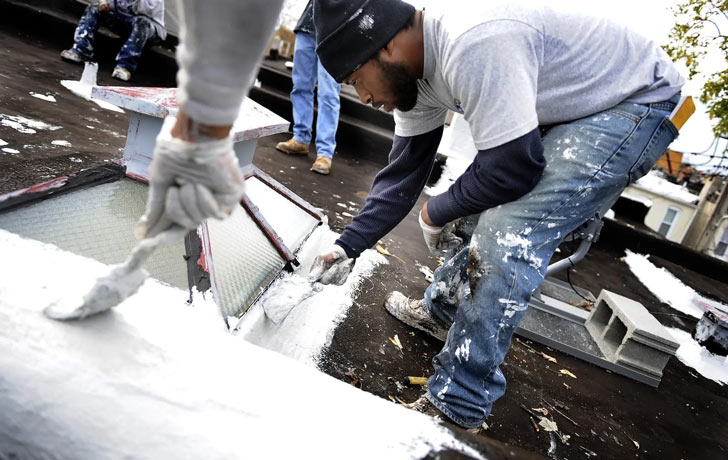
Walk outside into 100-degree heat wearing a black shirt, and you’ll feel a whole lot hotter than if you were wearing white. Now think about your roof: If it’s also dark, it’s soaking up more of the sun’s energy and radiating that heat indoors. If it were a lighter color, it’d be like your home was wearing a giant white shirt all the time.
This is the idea behind the “cool roof.”
Last month, Atlanta joined a growing number of American cities requiring that new roofs be more reflective. That significantly reduces temperatures not just in a building, but in the surrounding urban environment.
“I really wanted to be able to approach climate change in the city of Atlanta with a diversity of tactics,” said City Council member Liliana Bakhtiari, who authored the bill, “because it’s far easier to change a local climate than it is a global one.”
Because cities set their own building codes, they can regulate roofs regardless of the whims of the Trump administration, which is aggressively rolling back climate policies. Experts say cool roofs are a simple, relatively cheap, and effective way to save people from extreme heat.
“I like to say that reflective materials transform rooftops from problem to power,” said Daniel J. Metzger, a senior fellow at Columbia Law School’s Sabin Center for Climate Change Law. “Cool roofs give homeowners the power to improve health outcomes and air quality while saving money on their own energy bills.”
Other cities, including Chicago, Los Angeles, and New York, have also passed cool-roof ordinances, but they often only cover flat roofs, like you’d see on a commercial building. Atlanta’s ordinance covers all roofs, though it only mandates that new ones be made cool — it’s not forcing anyone to rip theirs off if it’s not time to replace. So it’ll take some time for every roof in the city to change, but Atlanta is also rapidly growing with new construction.
“It’s going to be kind of a gradual, ongoing, but ideally a permanent response to rising temperatures,” said Brian Stone, director of the Urban Climate Lab at Georgia Tech. “This is pushing Atlanta into one of the more forward-looking cities.”
The Smart Surfaces Coalition — a nonprofit that works with cities to enact cool roof ordinances — estimates that Atlanta’s new building code will cool the city overall by 2.4 degrees Fahrenheit during peak summer temperatures, and by as much as 6.3 degrees in the city’s hottest neighborhoods. It further calculates that over a 35-year period, the ordinance will result in $310 million in energy savings, due to residents having to run their air conditioners less.
“It’s a super cost-effective way to make the city healthier, more competitive, cut energy bills, and protect jobs,” said Greg Kats, founder and CEO of the Smart Surfaces Coalition.
A cool roof is a passive technology that keeps working on its own. For the flat roof of a commercial building, a simple coat of white paint will do. Manufacturers also make special cool roof shingles that reflect more sunlight.
Whatever the strategy, cool roofs are no more expensive to install than traditional ones, and can even be cheaper. They also extend the life of a roof because there’s less wear and tear of the material expanding in the heat, then contracting when it cools down.
Like any other city, Atlanta is struggling with the urban heat island effect: As a summer day wears on, the built environment of asphalt, brick, and concrete absorbs more of the sun’s warmth. This raises temperatures perhaps 20 degrees Fahrenheit above the surrounding countryside, where there’s more vegetation releasing water vapor to cool the air. At night, that stored heat slowly releases from a city, keeping temperatures abnormally high into the morning.
The urban heat island effect gets especially bad in lower-income neighborhoods, where there’s typically less tree cover than in richer areas.
“These folks are getting the triple whammy,” said Mark Conway, a council member who sponsored Baltimore’s cool roof ordinance. “Not only is it hotter in those areas of the city, but then also, they don’t have the trees and the shade to help them, nor can they pay for the AC.”
The urban heat island effect gets extra dangerous during heat waves that stretch several days, because human bodies can’t get a break from relentlessly high temperatures. The stress builds and builds, in particular imperiling those with asthma and heart conditions, as the body tries to pump more blood to cool itself off. Infants and the elderly are also at higher risk because their bodies don’t cool as efficiently as other people.
Accordingly, extreme heat kills twice as many people in the United States each year as hurricanes and tornadoes combined.
While getting more air conditioners into more homes will help save lives as cities get hotter, it’s not a cure-all. For one, the units use a lot of energy, and Atlanta’s residents already deal with some of the highest energy burdens in the country, meaning a significant proportion of their income goes to electric bills.
Two, air conditioners actually make urban heat worse: They work by extracting heat from indoor air and pumping it outside — that’s why you feel a blast of hot air if you walk by one of them. And if the grid goes down because too many people are running their AC and other appliances at once, everyone’s now at much higher risk.
“When a house loses power, if its only intervention to stay cool is air conditioning, it’s very likely that people inside of that home are going to quickly overheat,” said Grace Wickerson, senior manager of climate and health at the Federation of American Scientists, a nonprofit think tank.
At the same time, American cities are complementing cool roofs with more trees — Cleveland, for example, has set a goal of getting all its residents within a 10-minute walk of a green space by 2045. Trees provide shade and also release cooling water vapor, like rural vegetation does. Parks and gardens also soak up rainwater, preventing flooding.
“There’s just a long litany of good reasons to plant as many trees as possible, and cool roofs don’t take away from that,” Metzger said. “They work together to overall cool the city.”
Header Image by Mark Gail of The Washington Post via Getty Images and Grist
Looking for a three-bedroom, two-bathroom home, with granite countertops and a finished basement? What about a fenced-in yard? Or the pitter patter of puppy feet on hardwood floors?
For realtor DJ Soucy of St. Petersburg, Florida, selling homes isn’t just about finding people their dream house — but growing their families.
Since October 2020, Soucy has offered a special promotion to his clients: He will cover the cost of a dog adoption at a local shelter with every home sold.

In fact, every DJ Soucy For Sale sign comes with a tagline: “Free dog with every home sold.”
A collaboration with Pet Pal Animal Shelter, Soucy helps connect home buyers to pets in need of their own forever home at no cost, which also helps reduce overcrowding in the local shelter.
The idea came to him when he was out on the job, and his husband sent a photo of their own pup, “slumped over the couch looking out the window, wondering when I was coming home,” Soucy told ABC Action News in Tampa.
“It just got me thinking, I spend all this time trying to help people find the perfect home,” he continued. “Wouldn't it be cool if I could help animals, dogs, in particular, find a way home?”

He reached out to Scott Daly, the executive director of Pet Pal, and since then, his initiative has resulted in donations exceeding $50,000 and countless adoptions.
After closing on a house, clients will hear from a member of Soucy’s team to discuss a potential adoption of a cat or dog from Pet Pal.
According to the Soucy Group’s website, buyers have a “generous six months post-closing to visit Pet Pal Animal Shelter and go through their application process.”
The shelter gets to have final approval in placing a pet in a new home, but once everything is settled, the DJ Soucy Group covers the cost of any adoption fees.
For folks who aren’t ready to adopt a pet, Soucy directs the adoption fee to the shelter as a $200 donation in the client’s name.
“Either way,” Daly told ABC Action News, “the animals win.”
Every month, Soucy visits the shelter with a check in-person, donating funds from buyers who opted not to adopt.
“They always like to show me exactly where that money’s gone and how it’s helped,” Soucy told ABC Action News.
Daly added that most donation dollars are spent on medical and operational costs to keep the no-kill shelter up and running.
Plus, the clients love it.
“I've yet to have anybody who wasn't interested in it, who didn't think it was fantastic and a great cause,” Soucy said.
In fact, Soucy has found so much success — philanthropic and business-wise — that he is working with other real estate agents across the country to integrate a similar give-back component to their work, even equipping them with a marketing playbook.
“At the DJ Soucy Group, we believe everyone deserves a perfect home,” an Instagram post from the realty group reads, “including our four-legged friends.”
Header images courtesy of DJ Soucy Group
Without spoiling the movie, it’s fair to say that the rambunctious terrier/superdog in James Gunn’s “Superman” film is something of a scene-stealer.
The adorable canine companion named Krypto is a key character in the latest “Superman” installment, and as it turns out, he was inspired by filmmaker Gunn’s own rescue dog, Ozu.

While Krypto — donning a signature red cape and “Superman” insignia on his dog tag — is a CGI pup, Ozu was the physical model for the computer-generated canine.
While Ozu’s movements and likeness are key components of what became Krypto, his behavior also played a role.
“He immediately came in and destroyed our home, our shoes, our furniture — he even ate my laptop,” Gunn has written of the unruly rescue dog. “It took a long time before he would even let us touch him.”
Ozu was adopted shortly after Gunn began writing the “Superman” script.
“I remember thinking, ‘Gosh how difficult would life be if Ozu had superpowers?’ and thus Krypto came into the script and changed the shape of the story as Ozu was changing my life,” Gunn said.

While Krypto is something of a “foster situation” for Clark Kent (the dog canonically belongs to Supergirl, the cousin of Gunn’s titular superhero), the creative minds behind the movie are excited to see that the superdog is inspiring viewers to consider adopting a dog of their own.
In fact, according to the dog training app Woofz, as reported by The Wrap, Google searches for “adopt a dog near me” jumped 513% after the opening weekend of “Superman.” The search “rescue dog adoption near me” also increased by 163% in the same time.
This also comes after a promotion with nationwide rescue Best Friends Animal Society partnered with Warner Bros. Pictures to waive adoption fees at shelters across the country from July 1-10, leading up to the film’s release.
During this time, Best Friends Animal Society reported that 454 pets were adopted across the country.
Even some of the film’s cast members got in on the dog-loving action, with actress Maria Gabriele de Faria — who plays “The Engineer” in the film — adopting a 5-month-old rescue pup at a recent screening, which included adoptable pups.

“This Superman movie was inspired by Director James Gunn’s dog, Ozu, a rescue dog that changed his life,” Faria said on the red carpet. “It is a dream to me to mix such a huge, important movie with something [animal rescue/adoption] that is personally so important to me.”
During the event, she fell in love with Jude, who now joins two previously adopted cats that Faria rescued while filming the movie.
“We celebrate Maria Gabriela de Faria and Jude’s adoption story,” said Julie Castle, the CEO of Best Friends Animal Society.
“All across the country adoptable cats and dogs are looking for their own superheroes and we believe each of them should have a heroic ending just like Jude. We hope that this story will inspire people across the country to use their superpowers to save lives.”
As for Gunn and Ozu, the love just keeps on flowing.
“This film has been a barrage of blessings for me; this one may be the greatest,” Gunn reacted to the increase in adoption interest.
“Ozu has no idea any of this is happening but, if he did, he’d be proud.”
Header image courtesy of Warner Bros. Pictures
Recently, the big cat conservation organization Panthera strategically placed hidden trail cameras throughout Tangkulap Forest Reserve in Malaysia.
Their goal: capture the elusive, and endangered, flat-headed cat on camera.
Instead, they found stunning proof that the Eurasian otter — long thought eradicated in the region — was alive and well.
It marked the first sighting of the species in 11 years.
“This remarkable sighting was actually an unexpected discovery made during a survey conducted by Panthera,” Thye Lim Tee, the project coordinator for Panthera Malaysia, said in a press release.
“Remote-sensing cameras, often called camera traps, were strategically placed,” Lim said, “and during this survey, they captured the first photographic evidence of the Eurasian otter in Malaysia since 2014.”
“This shows how dedicated research, even when targeting one species, can lead to groundbreaking findings about the broader biodiversity of an ecosystem.”
Lim explained that it was not uncommon for local otters to be photographed on trail cameras and sorted into “by-catch” files in Pathera’s general archives.
But the team at Panthera knew almost immediately that this otter sighting was special.
“This otter data was specifically re-examined and compiled in collaboration with the Malaysian Otter Network,” Lim said.
“This focused review was undertaken in preparation for a presentation on the endangered hairy-nosed otter at the International Otter Congress, which was held in Peru from February 24-28, 2025,” Lim noted.
“It was during this rigorous review process for the Congress that the IUCN Otter Specialist Group scrutinized our collection of ‘unidentified otter’ images, leading to the definitive confirmation of the Eurasian otter's identity in the photograph.”
The Malaysian Nature Society established the Malaysia Otter Network in 2020. In the last five years, they’ve been working closely with the International Otter Survival Fund to drive otter conservation efforts in Southeast Asia.
“We hold regular meetings and often share information and exchange data on otters,” Ahmad Ismail, the president of the Malaysian Nature Society, told Free Malaysia Today. “We also hope to create more public interest so that there’ll be more activists and citizen scientists.”
“Since otter conservationists around the world face common issues, networking and collaboration is important,” Ismail added.

The Malaysian Nature Society has also been pivotal in monitoring otter movements in local regions and supporting critical studies on the species through the Malayan Nature Journal.
In June, researchers Jayasilan Mohd-Azlan & Sally Soo Kaicheen published data in the scientific journal, attributing the regional decline of otters in Sarawak, Malaysia to extensive habitat loss.
“Otters are often considered as bioindicator species in protecting wetlands due to their sensitivity to environmental degradation, including poor water quality, reduced aquatic food quality, and habitat disturbance along water bodies,” Mohd-Azlan and Kaicheen wrote in the Malayan Nature Journal.
“This ecological vulnerability is only further exacerbated by the decline of peatland habitats in Malaysia. Only around 2.2% of petland remains, further threatening wetland specialists like otters.”
In their study, Mohd-Azlan and Kaicheen expressed the urgency of otter conservation, especially for Eurasian otters.
“Otters are among the least-studied species in Malaysia, with limited knowledge concerning their ecology,” the researchers emphasized.
“The scarcity of records highlights the need for further research and conservation efforts for otters in Malaysia.”
Chee Yoong, of the Malaysia Otter Network and IUCN Otter Specialist Group Otter Specialist Group agreed that otters play “a huge role” in the freshwater ecosystem of Tangkulap.
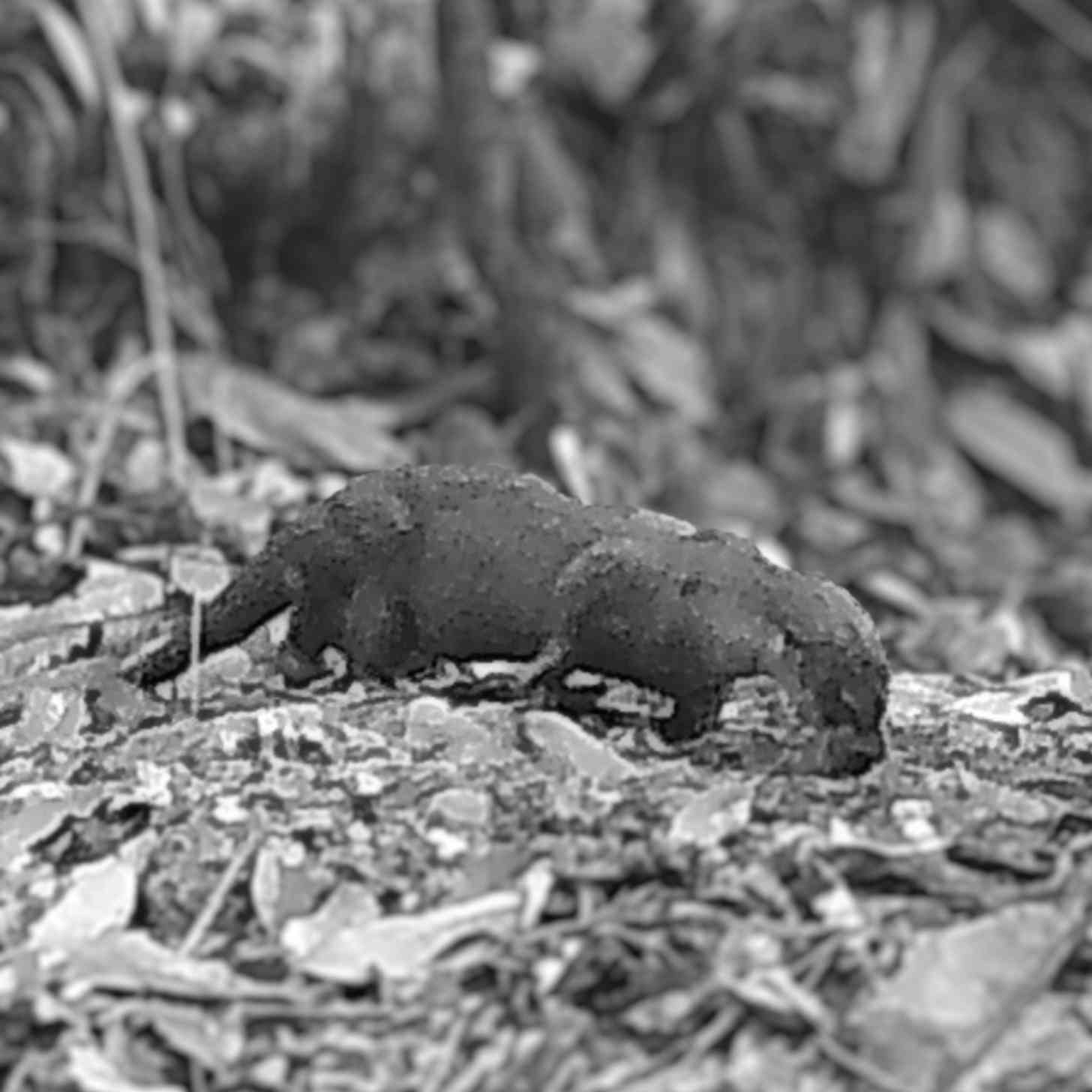
“The discovery of the fourth species in Tangkulap indicates the habitat is abundant in prey and serves as a safe refuge — potentially for many other wildlife species as well,” Yoong said. “It is essential to conserve these species, especially in the face of habitat fragmentation.”
As zoologists around the world collect further data on the semi-aquatic animals, Panthera underscored the importance of the recent Eurasian otter sighting.
“The discovery of the Eurasian otter in Tangkulap is especially significant because it uniquely designates this site as the only location in Malaysia known to support all four of the country's otter species,” Lim said, referring to the smooth-coated otter, hairy-nosed otter, and Asian small-clawed otter species also native to the region.
“This distinction alone emphasizes its great ecological importance and confirms its role as a key conservation priority.”
You may also like: Rare 'buffalo bear' species captured on trail cameras in Thailand
Header image via the Sabah Forestry Department
The Coral Triangle is the largest system of marine protected areas in the world. Home to more than 500 corals and 2,500 coral reef fishes, the triangular waters surrounding the Philippines, Malaysia, Indonesia, East Timor, Papua New Guinea and Solomon Islands are globally renowned as the “Amazon of the seas.”
According to the World Wide Fund for Nature, also known as the World Wildlife Fund, the Coral Triangle hosts 76% of world’s coral species, 37% of the world’s coral reef fish species, and three-quarters of all species of mollusks including octopuses, sea slugs, cuttlefish and giant clams.
In addition to countless dolphins, turtles, seahorses, whales, and more, the Coral Triangle is also home to two new species of sea slugs that were just discovered by explorers scuba diving off the coast of North Sulawesi in Indonesia.
The two squishy species, known as the Phyllidia ovata and Phyllidia fontjei, are both remarkably distinct in color.
The former has protrusions that are white and yellow, as if it is dotted with a smattering of “sunny side up” eggs, while the latter shares the same color pattern of a clownfish.
“The [fontjei] is white with a narrow, granulated, orange mantle margin followed by a wide white band, a narrower black line, and then a white ring that also forms an elevated ridge on its inner margin,” lead author Heike Wägele and his peers observed in their study, which was published in the scientific journal Zoo Keys on July 14.
When it came to naming the species, the researchers derived the “ovata” slugs species from the latin ovatus, which means “egg-shaped,” in reference to the slug’s body shape and color pattern.
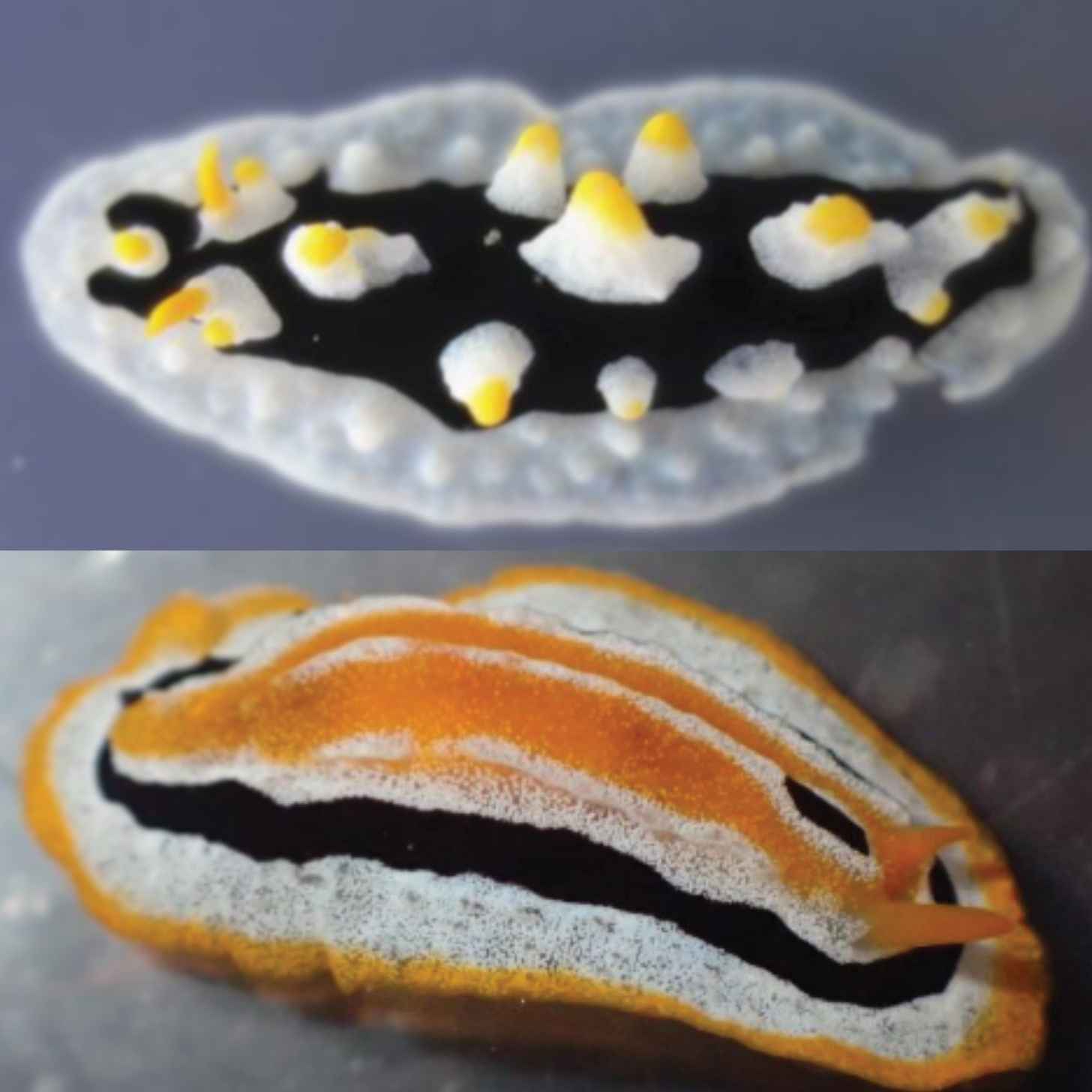
And, in a bittersweet fashion, the “fontjei” sea slug was named after the researchers’ late friend and colleague, Professor Fontje Kaligis.
“We name this species after our dear colleague Professor Dr. Fontje Kaligis from Sam Ratulangi University, Manado, who initiated our Indonesian co-operation on describing marine Heterobranchia diversity around North Sulawesi,” Wägele and his research team noted.
“He passed away in September 2017, too early to see all the publications resulting from the joint collecting efforts. He enabled the extensive biodiversity studies in North Sulawesi and thus greatly extended our understanding of sea slugs in this area.”
Sea slugs are often overlooked in broader discussions of marine conservation, but they are a key part of ocean health. They graze on algae and seaweed to prevent overgrowth, and serve as prey for fish, crabs, and lobsters.
Furthermore, their sensitivity to pollution and changes in temperature also make them indicator species — when sea slugs start to disappear, researchers know that an ecosystem isn’t faring well.
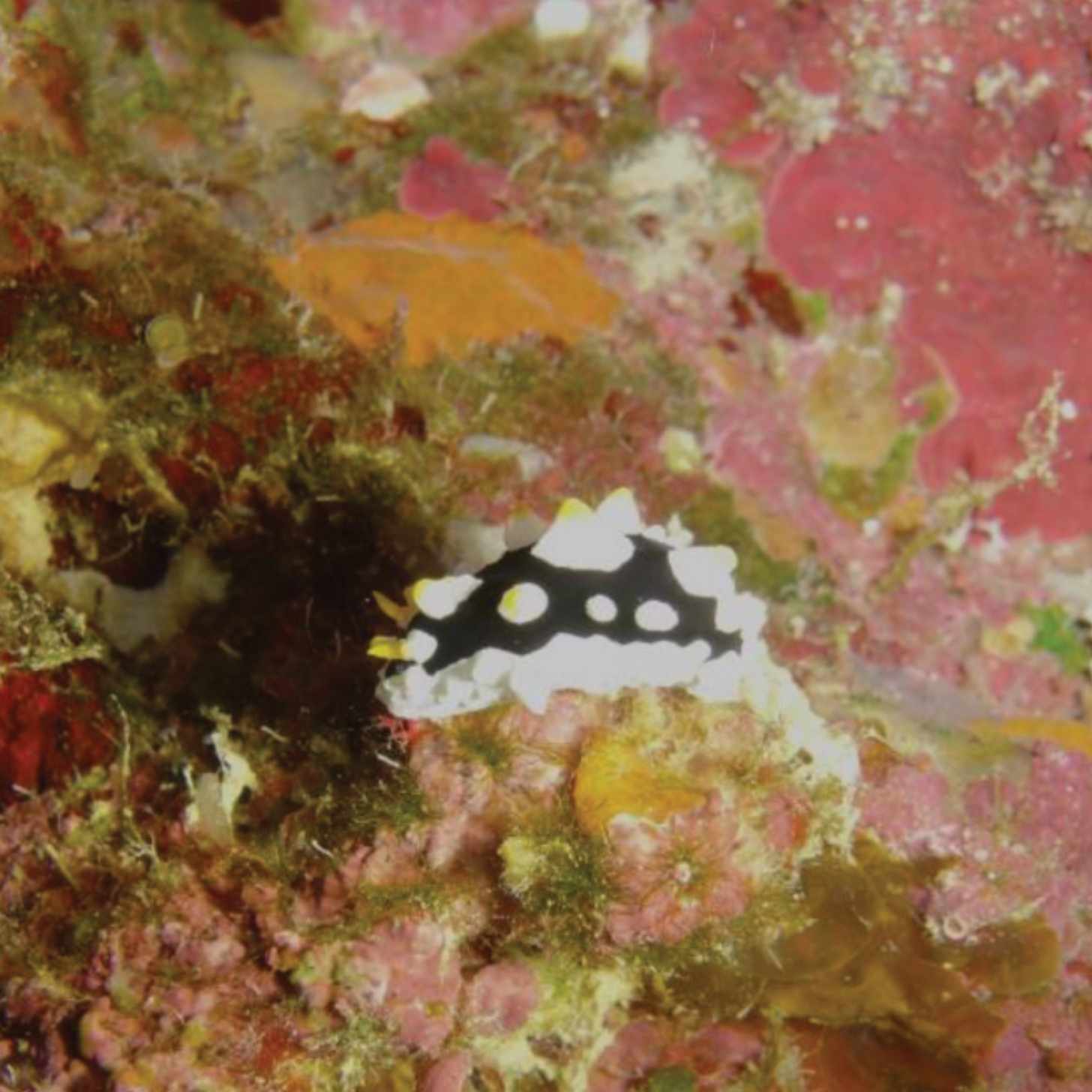
With their discovery, Wägele and his colleagues have identified two more reasons to keep the Coral Triangle thriving.
For 16 years, the WWF, The Nature Conservancy and Conservation International have done their part to help.
In 2009, the three organizations formed the Coral Triangle Support Partnership — a coalition that works in tandem with neighboring countries to protect the region’s fragile coral reef systems and the many species that swim, scuttle, and grow in its waters.
“The six governments of the Coral Triangle region made a commitment to safeguard their marine resources and ensure income and food security for the millions of people who depend on them,” the WWF wrote in a mission statement.
“The Coral Triangle Support Partnership focuses on policy, fisheries management, marine protected areas and climate change adaptation.”
Russ Mittermeier, the former president of Conservation International, said that the coalition was born out of shared sense of urgency.
“If we are going to be serious about conservation of marine biodiversity and especially the diversity of critically important and extremely fragile coral reef systems, there is simply no place on Earth like the Coral Triangle where coral diversity exceeds that of the Caribbean, for example, by an order of magnitude,” Mittermeier emphasized.
“For this reason, our three organizations have decided to focus on this region at a level never before achieved in marine conservation.”
You may also like: A new animal with 200 legs was just discovered, and it's sucking up deep-sea trash
Aerial Panorama of Pulau Bangka in North Sulawesi, Indonesia. Header image via MaRo-Visions (CC BY-SA 4.0)
When Jesús Morales — also known as Juixxe on TikTok — drives down a street in Los Angeles, excitedly honking and shouting a hearty “Amigo!,” the migrant day laborers in the area waiting for a chance to pick up some work have no idea what they’re in for.
Morales has been supporting street vendors, day laborers, and housekeepers in his community for the past three years, paying them to take the day off and join him on viral outings, or buying out their street carts so they can take a week off.
In a recent video, two day laborers get in the back of his car and one asks, “What are we going to do?”
Morales replies: “We’re going to have some fun.”

He and a friend, whom he calls “the boss for the day,” offer them $250 and some swim trunks, followed by a quick cut away to the men joyfully riding an inner tube down a waterslide.
Donning bright blue sunglasses and grinning from ear to ear, the men spend the whole day having fun and cooling down in the summer heat.
At the end, Morales asks: “Did you regret hopping in the car?”
“No!” they reply emphatically.
He hands them each $1,000 more in cash, but behind the scenes, after he’s posted the video, his millions of followers are contributing to a GoFundMe, which has raised nearly $25,000 in additional funds for the two men.
“I'm creating this fundraiser to help these two day laborers (names withheld for their safety) stay home during these uncertain times,” Morales shared on the GoFundMe.

“We recently met them at a Home Depot looking for work, just a week after that location had been raided. Many of their fellow hardworking companions had been detained … yet these two are still out there seeking work because they need to support themselves and their families.”
“My hope is to raise as much as possible and split the funds evenly between them so they can take time off, stay safe, and care for their well-being,” he continues. “Your donation will go directly to these two individuals, providing much-needed income and allowing them the chance to stay safe and off the streets during a time of heightened risk.”
This fundraiser works in tandem with Morales’s Echándole Ganas Foundation Giving Circle to provide financial support and resources for immigrant workers.
To date, the community has given away over $500,000, according to the nonprofit’s donation page, with a goal to “triple that number by the end of 2025.”
It is a time of exceedingly heightened uncertainty for migrant workers, as the Trump administration carries out countless Immigration and Customs Enforcement raids, often leading to mass deportations enforced without due process.
Morales’s work is not only joyful, but also necessary to protect and uplift the immigrant community.

He has taken others on trips to baseball games, to Disneyland, and even skydiving. But he is only able to provide a short break.
“We never really take things seriously, but then we do get serious,” Morales recently told The Los Angeles Times, referring to the behind-the-scenes conversations he has with his subjects. “They’ll start really speaking about their struggles and their journey.”
Although his contributions can be life-changing, he has learned even more about the barriers migrant workers face while trying to help them. For instance, he and his audience helped raise $97,000 for an elderly fruit vendor in L.A.
But because she didn’t have the right documentation, it took them about four or five months to set up a bank account for her to get her the money.
“I’m surprised we were able to make it happen,” Morales told The Los Angeles Times. “It took a lot of loopholes.”
Although he said these outings and individual donations can feel like a “Band-Aid to the wound,” he’s been trying to make a greater impact and educate himself about the challenges immigrants face, now more than ever.
Part of the funding that is gathered through his nonprofit’s giving circle goes toward helping vendors pay for permits to sell their products, as well as the goal of creating a vendor lot for small businesses to safely set up and make a living.
@juixxe Sin miedo al éxito. ❤️ @Alex Ojeda 🇲🇽 ♬ original sound - Jesús
“With your contributions, we hope to find sustainable jobs for day laborers, help vendors start their own small businesses, and continue to sustain themselves through entrepreneurship,” Morales writes.
Supporters can donate as little as $1 a month, with tiers of $8 and $15 monthly donations also available.
And based on the comments on his videos, it’s the kind of collective support people want to be a part of.
“Please never stop doing this,” one person wrote beneath the video of the two men at the waterpark.
“They woke up that morning thinking a ‘good day’ would be doing exhausting work for little pay in uncertain safety,” another added. “Instead they made $1,000 having fun. What a well-deserved reprieve.”
To sum it all up, another commenter said: “This is how human beings should treat each other.”
Header images courtesy of Juixxe/TikTok
In Uganda, millions of youth aged 15-30 face high unemployment rates due to varying levels of education.
Additionally, over 600 tons of plastic waste are poorly disposed of in the country, which has no waste disposal system for plastic bottles. In turn, these bottles clog pipes, flood city centers, and end up in waterways.
At the same time, a growing population and mounting infrastructure issues leaves Ugandans in need of more housing. And considering the low monthly income of most rural Ugandans, helping people find opportunities to improve their health and economic stability needs a unique approach.

With all of these factors in mind, in 2022, David Monday founded Pendeza Shelters. The startup helps build homes, shelters, and other structures out of eco-bricks and other sustainable materials that are weather-resilient and offer an opportunity for upward mobility for the most marginalized members of the community.
“‘Pendeza,’ meaning ‘beautiful’ in Swahili, reflects the company’s dedication to constructing durable, attractive, fireproof, and temperature-regulated alternative housing solutions for disaster-affected populations,” the company’s website shares.
These populations include refugees, people who have lost their homes to floods, and women in need of social support.

“Beyond housing construction, Pendeza Shelters empowers affected communities by providing training in waste management processes and construction skills, thereby improving their overall well-being,” the website continues.
“Through these initiatives, Pendeza Shelters not only addresses immediate housing needs but also promotes sustainable practices and community resilience in the face of environmental challenges.”
One such example is through a partnership with Gejja Women Foundation, a Ugandan nonprofit that empowers marginalized women and girls through business development, educational support, training in sexual and reproductive health, and more.
One of Gejja’s programs is the Safe Girl Initiative, which trains young women in the manufacturing of reusable sanitary pads. This offers an eco-friendly and cost-effective menstrual hygiene solution to girls in need, while empowering women through gainful employment.

Safe Girl employs women with disabilities, and they work at the Gejja Women Foundation Empowerment Room, built by Pendeza Shelters. The center both trains young women in the program and stocks the menstrual products.
“We started in 2018 with two women tailors producing 100 kits a month,” the Safe Girl Initiative shares on its website. “To date we have 24 women at the Mpigi production site, and these produce up to 50,000 kits annually.”

The women’s empowerment shelter is a sister location to Gejja’s Skilling and Production Rooms, which were also built with the support of Pendeza Shelters.
In this case, however, women involved with the nonprofit were the ones collecting, sorting, compacting, and constructing the structure, gathering 18,000 plastic bottles to bring it to life.
“Pendeza Shelters is supporting marginalized groups of people while empowering them financially to support their families and change the mindset that most of them have towards plastic waste,” Monday shared with MIT Solve.
“We have provided direct jobs to over 230 women and youths in different communities who participate in different plastic handcraft. Others serve on contract as waste pickers, sorters, compactors, and builders.”

The efforts of Pendeza Shelters then have a ripple effect: As more people learn how to build these structures and manage plastic waste, the more impact they can have in neighboring communities.
Women and young people learn how to dispose of plastic waste responsibly and share their knowledge with others. Additionally, some start their own small businesses by upcycling collected plastic into bags, earrings, pen holders, and even their own eco-bricks.

Local masons also support the construction of upcycled houses and are available to work as contractors or provide troubleshooting in the build.
“Knowledge of upcycling and recycling is spread from peer to peer,” Monday continued with MIT Solve. “As each community reaches sustainable acceptance, Pendeza Shelters reach out to other communities for monitoring and evaluation.”

So far, Pendeza Shelters has been behind the development of 40 plastic bottle structures across Sub-Saharan Africa.
According to Monday, the company is able to make 20,000 eco-bricks per month, with the average construction period taking just three months to hand over to a client.
And for clients like Gejja Women Foundation, having a safe and sustainable place to grow can make all the difference.
“A project like this wouldn't have been possible without the dedication and hard work of Pendeza Shelters and the women,” a Facebook post shared about the Skilling and Production Rooms. “They poured their hearts into making this vision a reality.”

Now, the Gejja community is building a new cottage to expand their work.
“By turning plastic bottles, scattered across our communities and harmful when burned, into eco-bricks,” the nonprofit shared, “we’re getting rid of plastic waste and keeping our immediate environment clean and healthy at the same time.”
Header image courtesy of Pendeza Shelters
At Shelter to Soldier, 1-year-old lab mix Raider has been undergoing “special training” since April of this year.
It’s all for one very exciting job: to become the first-ever “morale dog” to join active-duty Marines and sailors on USS Makin Island.

For the past decade, the San Diego nonprofit has trained shelter dogs as psychiatric service animals for United States veterans.
When the training director, Nicky Moore, started bringing therapy dogs to Navy ships for special outings, the crews had one request.
“Every single time it was like, ‘I really wish we had a dog that stayed on board.’ Like, ‘Can we take this dog on deployment with us?’ And so we just kind of were like, ‘Actually yeah,’” Moore told NBC San Diego.
Raider was the perfect fit.

Adopted from Labs and More Rescue, he’s been highly focused on training for the past few months and will now join a team of five handlers — in his own room on board — to reside on the ship full-time.
Since April, he’s been training to go to the bathroom on a “potty patch,” learning how to wear booties to protect his feet from hot surfaces, wearing eye protection, and just getting used to all the noises on the ship, Moore explained.
He’s also been learning all kinds of commands and preparing to receive first aid and be groomed by his handlers.
If all goes according to plan, Raider is set to join the Makin Island Naval Base San Diego at the end of next month. When the base deploys, he’ll go with them.
His official title is indeed “Morale Dog,” with the initiative “designed to support the emotional wellness, morale, and mental health of sailors and marines,” according to a Facebook post from Shelter to Soldier.

He will offer support through “structured interaction, presence, and engagement,” and, like other Shelter to Soldier ambassadors, will support trauma recovery therapy, participate in group sessions, visit service members’ families, and offer moments of connection and care “when it’s needed most,” according to the nonprofit.
“The need for mental health support among active-duty Navy service members is more urgent than ever,” Shelter to Soldier continued in the Facebook post.
“Raider’s role aboard the USS Makin Island helps address this crisis by fostering camaraderie within the crew, reducing operational stress, and increasing awareness for shipboard wellness and behavioral health services.”

Morale dog services appear to be unaffiliated with the official Department of Defense, with Shelter to Soldier thanking individual donors for sponsoring Raider’s placement in their social media posts.
Additionally, Raider’s training has been going so well that other ships — and sponsors — have been inspired to partner with the organization for the same purpose, according to another recent social media post.

Lady, another black lab rescue from the same organization that saved Raider, has begun training to support the USS Boxer.
“She’s already a star,” the organization added.
You may also like: Dogs offer stress relief, even in tele-therapy settings, according to new study
Header images courtesy of Shelter to Soldier/Facebook
As climate change continues to rear its destructive, uncertain head, canine companions are playing a vital role.
There are conservation dogs sniffing out invasive species in nature preserves, helping to clean contaminated waterways, and even avalanche rescue dogs that save people in the great outdoors.
Most of these dogs are bred for greatness and train their whole puppyhood to work in these roles.
But a recent study from Virginia Tech wondered: Can everyday dogs do the same?
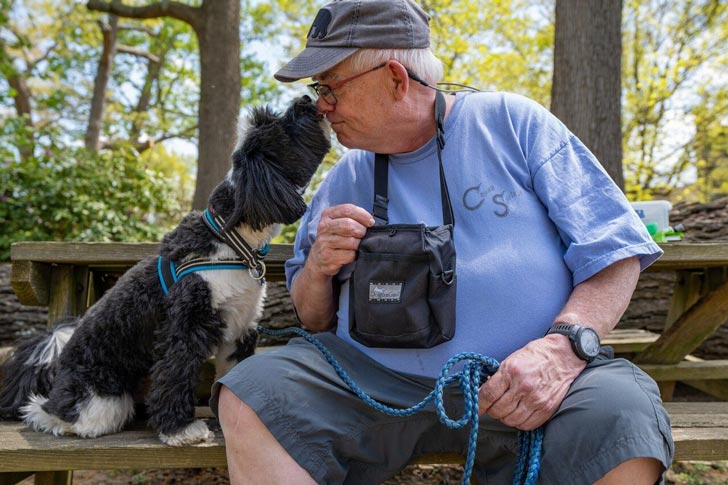
In the study, Virginia Tech conducted a first-of-its-kind experiment to see if citizen dog-handler teams can achieve species detection rates comparable to those of professional conservation dogs.
Over 1,000 dog owners expressed interest in the study, with more than 40% of them having prior experience in sport scent detection or other related activities.
Sport scent detection is a recreational activity in which dogs find hidden scents in training classes, and sometimes, competitions.
Ultimately, the researchers selected 182 canine-citizen teams across the U.S. to participate in their trial to see if everyday people and pets could effectively detect the “elusive” egg masses of the spotted lanternfly.
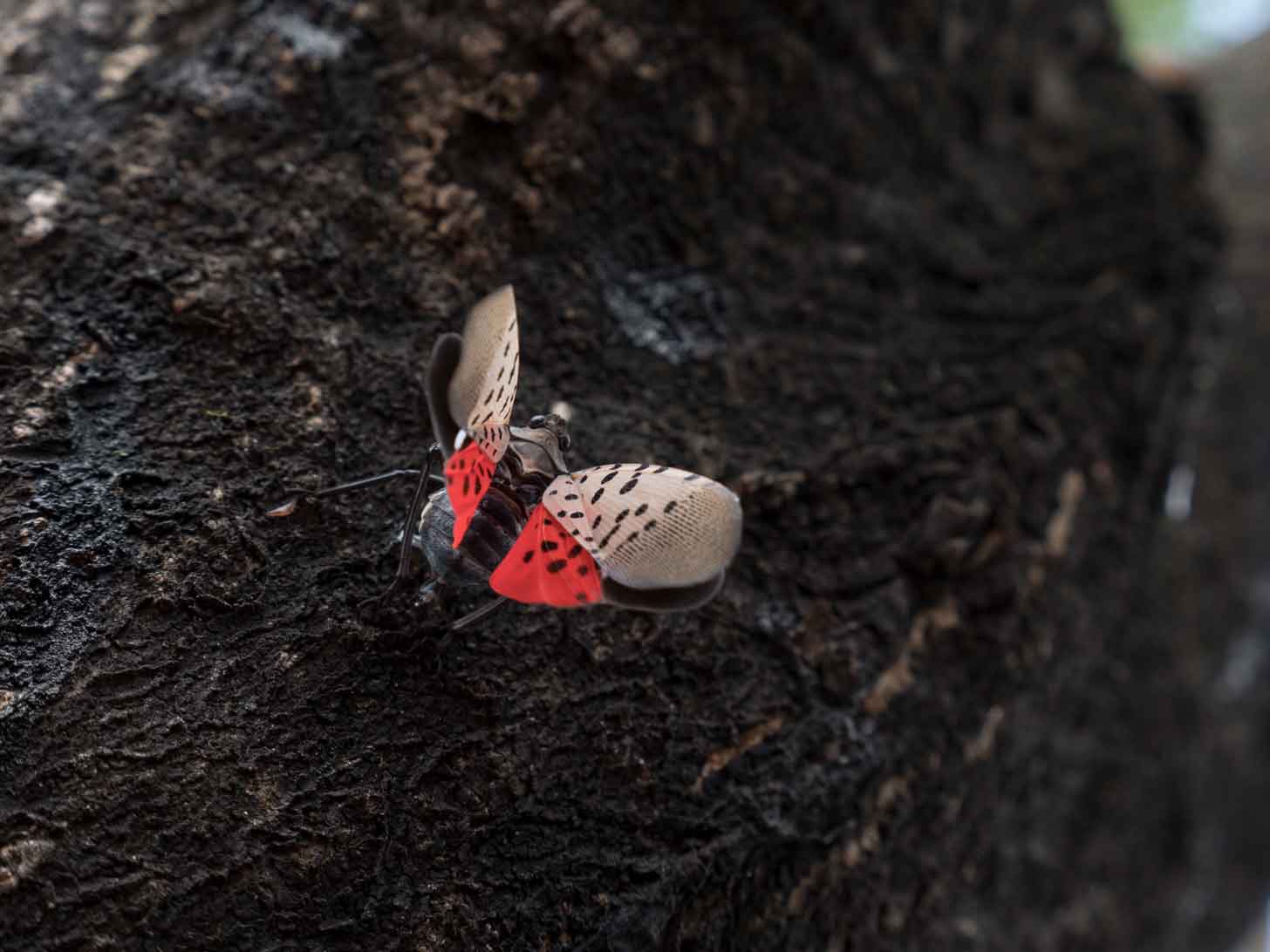
The species is an invasive insect that has been damaging farms and forests across the eastern and central United States since it was first found in Pennsylvania in 2014.
In the years since, the species — native to Asia — has spread rapidly to 18 states, where lanternflies lay eggs on trees, stone, lumber, and even cars and trailers.
To eradicate the threat, it’s important to catch the egg masses early, but according to the study’s co-author, Mizuho Nita, “finding them is like searching for a needle in a haystack.”
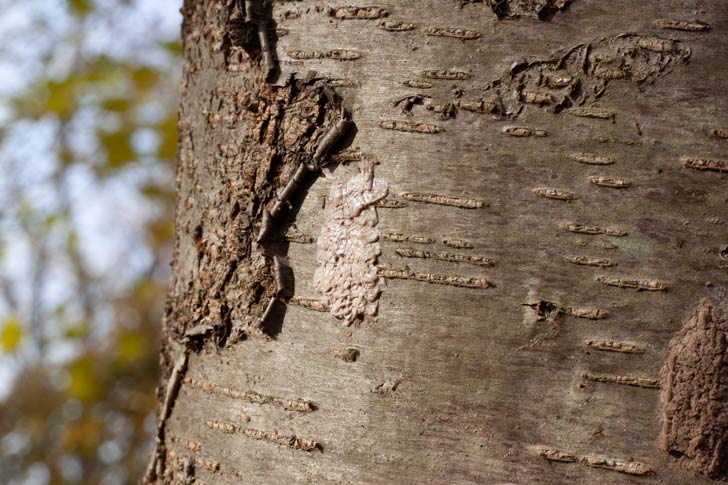
With their keen sense of smell, dogs can be trained to sniff out the egg masses without disturbing the environment. Professional detection dogs do this with high accuracy, but there are not nearly enough of them to tackle the mounting concern of the invasive species, an article for the university explained.
“What if we tapped into the tens of thousands of dog owners already doing scent detection as a hobby around the country?” the researchers asked.
So, with 182 citizen scientists and their furry friends on board, researchers provided them with “devitalized” or non-hatching egg masses as a training aid. The participants trained their dogs at home or in small groups with the help of a local trainer to learn how to identify the invasive species.
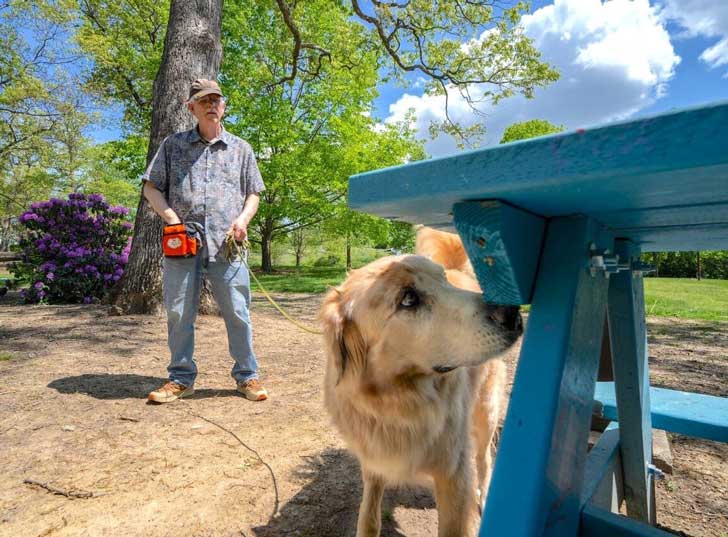
“Anytime you can stimulate your dog, it’s good for them,” participant Bill Wellborn said, of his 7-year-old Tibetan terrier, Pepe.
“Pepe obviously enjoys it. And it’s a way we can take dog skills and training to help our community.”
Wellborn and Pepe — and the other participating teams — worked in sessions multiple days a week for several months, with dogs eventually tested in two environments.
In a controlled indoor environment, the dogs had to complete an odor recognition test, in which they identified the box with the spotted lanternfly egg masses from multiple boxes with other items and scents.
The dogs that passed this test then advanced to a field test outdoors, where they were required to find the same scent outside, with other competing smells.
They correctly identified the egg masses 82% of the time in the controlled tests and 61% of the time in field trials. Although the field test number dropped, it’s still a better score than human-only searches.
“These teams demonstrated that citizen scientists and their dogs can play a meaningful role in protecting agriculture and the environment from invasive species,” Sally Dickinson, the study’s lead author, said in a statement.
“With proper training, dog owners can turn their pets into powerful partners for conservation.”
For the dogs that passed both tests, 92% were successful in finding live egg masses with minimal extra training, according to the researchers.
“There are thousands of people out there doing scent work with their dogs just for fun,” Erica Feuerbacher, an animal behaviorist and a co-author on the study, said.
“What Sally’s study shows is that this can be more than a hobby — these citizen-scientists and their dogs can be a valuable resource for fighting the spread of an invasive pest.”
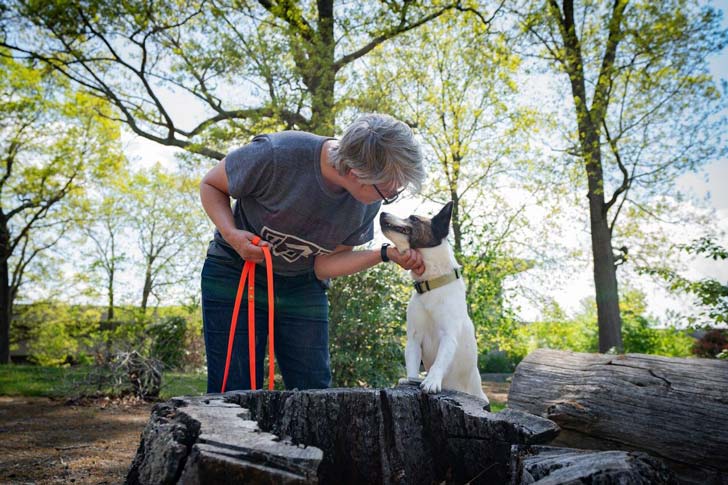
The dog handlers agree.
“Being able to do the same thing for the greater good — for citizen science — adds another layer we didn’t have before,” Katie Thomas, a participant, shared about her pit bull mix, Finch.
And now, with a proven concept, the future is bright for dog owners who want to bond with their pets and do a little more good.
“This research is about more than detection,” Dickinson concluded. “It’s about empowering people to work alongside their dogs to protect the places and communities they care about.”
You may also like: 'Feces-sniffing' dog trained by veterans gets new job cleaning contaminated waterways
Header image by Clark DeHart for Virginia Tech
Every day the Good Good Good team collects the best good news in the world and shares it with our community. Here are the highlights for this week!
If you want to get good news in your inbox every day, join the Goodnewsletter — the free daily newsletter designed to leave you feeling hopeful.
The Best Positive News We’re Celebrating This Week —
Low-traffic zones in London have reduced deaths and injuries by a third
The goal of low-traffic neighborhoods, or LTNs, is to make smaller residential roads more friendly for biking, walking, and other pedestrian activities by stopping through-traffic of motor vehicles. They’ve been used in the UK for decades, but were expanded in 2020.
Now, a new study found that London’s LTNs reduced road injuries and deaths by 35% within their boundaries compared to roads that did not have them. This amounted to the LTNs preventing more than 600 road injuries, including 100 involving death or serious injury.
And while one of the main critiques of LTNs is that they just push and concentrate dangerous traffic to nearby roads, the study also found that this did not happen.
Why is this good news? People deserve to have options for how to get around. Car-centric infrastructure and communities make alternatives like biking and walking more dangerous — plus, they result in poorer air quality.
→ Read more
A ‘scrappy’ network of volunteers in a Massachusetts town is protecting its neighbors from ICE
In June, solar power was the EU’s largest source of electricity for the first time ever
Overtaking nuclear and wind, solar power was the European Union’s largest source of electricity for the first time in history last month — and coal fell to an all-time low.
Record sunshine and more solar installations pushed solar ahead to generating 22.1% of the EU’s electricity, up from 18.9% in June 2024. Nuclear made up 21.8% and wind 15.8%, while coal fell to 6.1%.
Demonstrating “how rapidly the EU’s power system is changing,” at least 13 countries in the EU recorded the highest-ever monthly solar generation — that included Germany, Spain, and the Netherlands.
‘Sinners’ is now the first film to offer Black American Sign Language through a streaming service
When “Sinners” first hit theaters in April, it quickly became one of the highest-grossing horror films ever produced — and it earned praise for its inventive depiction of Black history and culture.
When it was released on HBO Max earlier this month, the movie made headlines again, becoming the first film ever to offer Black American Sign Language interpretation through a streaming service.
The divergence of BASL and American Sign Language was largely driven by the segregation of schools in the American South throughout the 19th and 20th centuries. And even with desegregation, the style, structure, and syntax of BASL continued and are still practiced today.
Why is this good news? Offering films in various languages is important for making art and entertainment available and accessible to everyone. There are important nuances that differentiate BASL from ASL, and it’s important to offer it, too.
An estimated 27 billion diapers are discarded annually — these ‘mushroom diapers’ might lighten the load
The share of U.S. adults who say immigration is “a good thing” for the country just hit a record high
According to a new Gallup poll, 79% Americans today say immigration is “a good thing” for the country — up from about 64% just a year ago, and a record high point for the last 25 years.
Even among Republicans, positivity about immigration rose dramatically in the last year, from just 39% saying it was “a good thing” last year — to 64% today.
Only about 2 in 10 U.S. adults said immigration was a bad thing, down from 32% last year, and the share who want immigration “decreased” dropped from 55% to 30%. The poll also showed decreasing support for the Trump administration’s mass deportations.
Young indigenous kayakers made a historic river journey after the ‘largest dam removal in US history’
For decades, Native people called for the removal of dams and the restoration of the Klamath River near the border of Oregon and California. Finally, four dams and three reservoirs were removed last year in the world’s largest dam removal project.
Leading up to the dam removal, Ríos to Rivers’ Paddle Tribal Waters project had been helping Native youth reconnect to the ancient river — teaching them to whitewater raft so that Native people would be the first to journey down the newly restored river.
And that historic journey is now complete: Youth from the Yurok, Klamath, Hoopa Valley, Karuk, and other tribes paddled 310 miles over a month from a Klamath River tributary to the Pacific Ocean.
Why is this good news? The Klamath River is a source of deep cultural significance for the Native tribes living in its basin, who see it as a living person they depend on and protect. Once the third-largest salmon-producing fish on the West Coast, before the dams, it also provided them with an abundance of food.
Following budget cuts and layoffs, national park rangers host a bake sale to take on $1.2 billion deficit
People diagnosed with dementia are living longer than ever
Thanks to advancements in early detection and improvements in treatment and customized care, the life expectancy for people with dementia is longer than ever.
A new study analyzed data on more than 1.2 million people living with dementia globally. It found that in five of the eight regions studied, representing 84% of test subjects, people diagnosed with dementia have a lower risk of premature death.
Not only is this data good news for families of loved ones with a dementia diagnosis, both in planning for their care and in enjoying more time with them, but it helps doctors and policymakers develop better treatment plans and health care policies.
France built a new bike and pedestrian crossing off the side of an old railroad bridge
Connecting the car-free city center of Albi, France, to a new development across a river is a stunning new bike and pedestrian crossing that repurposes an old railway bridge.
Rather than creating entirely new infrastructure for the crossing, architects attached it to a viaduct that’s still in use by trains today.
Previously, people were only able to get to the other side of the river via a narrow, car-filled bridge located further down the river.
Why is this good news? Creating communities that work better for people doesn’t mean starting from scratch. Creatively using existing infrastructure to make it better and more functional for human beings — not cars — can be our default.
Buy one, get one: This realtor offers a free shelter dog with every home sold
There were fewer boating deaths in the U.S. last year than in more than five decades
The U.S. Coast Guard announced that in 2024, there were 556 boating-related deaths in the U.S., down 1.4% from 2023 and fewer than any year in more than five decades.
The leading causes of the fatalities were operator error, boaters improperly trained on the rules of water safety, and alcohol.
Before the Safe Boating Act was enacted in 1971, the number of boating deaths was 20.6 per 100,000 registered vessels. Last year, that number was 4.8 per 100,000 — demonstrating how the improved safety measures have been instrumental in saving lives.
→ Read more
Switzerland just launched the world’s first solar power plant on active railways
A pilot solar power project in Switzerland is making use of the unused space between railway tracks by installing solar panels to collect solar power — even with trains using them.
The initial project involves deploying 48 panels on 100 meters of active railway. It will have a capacity of around 18 kilowatts and is expected to produce 16,000 kilowatt-hours per year.
Ultimately, the solar tech startup behind the project wants to “produce energy between the rails and re-inject it into the traction current of the trains so that it is practically 100% self-propelled.”
Even better: The company’s initial proposal was rejected back in 2023, and it’s since addressed safety concerns and made other improvements, like installing cleaning brushes on trains to remove dust and debris as they pass over the panels. The panels are also removable to make track maintenance easier.
TikToker pays migrant day laborers to join him at a waterpark for the day — and his followers gave them $20K more
→ Read more
Every year, 230,000 babies are protected from HIV thanks to treatments reducing mother-to-child transmission
A decade ago, over 500,000 families had a baby contract HIV — most of those infections passed from mothers who had HIV themselves. Now, that number has dropped to 130,000 families.
The introduction of anti-retroviral drugs and other treatments have led to this dramatic decline. When a mother takes ART during pregnancy, it dramatically lowers the risk of passing on HIV — and sometimes, giving it to the baby within the first few weeks of life helps, too.
Thanks to these improved treatments — and ensuring they’re accessible to those who need it, like mothers with HIV, through programs like PEPFAR — almost a quarter of a million HIV cases in babies have been averted every year.
More good news of the week —
A U.K. court upheld a Cayman Islands law legalizing same-sex partnerships. In the original case, the Cayman Islands’ courts ultimately ruled that the right to marry extended only to opposite-sex couples, but that same-sex couples were entitled to legal protection “which is functionally equivalent to marriage.”
Amid U.S. Forest Service funding cuts, volunteer hikers are helping care for their beloved trails. The Spokane Mountaineers is just one group cleaning up and building trails all over the Inland Northwest. Its members are walking slowly and picking up trash, digging trenches to reroute water, and cutting fallen trees.
The Pittsburgh City Council unanimously passed three bills extending protections for LGBTQ+ residents. Two of the bills were designed to de-emphasize the enforcement of any future law restricting the LGBTQ+ community from participating in otherwise legal activities and create avenues for reporting medical discrimination.
Drones are helping clean up Mount Everest’s trash-covered slopes in record time. The drones are part of a growing effort to clean the slopes of the mountain, not only speeding up the process but also reducing the danger for the Sherpas carrying decades worth of garbage down the treacherous peak.
New Jersey passed a new law that will expand free preschool and full-day kindergarten statewide by 2030. Among other things, the legislation establishes a three-year preschool cost-sharing pilot program, a committee to guide preschool expansion, and requires the state’s Education Department to provide annual expansion grants.
A study found that smartphone bans in schools in the Netherlands have improved learning. A survey of more than 300 secondary school leaders reported that children found it easier to concentrate, the social environment and interactions between students were better, and some said results had improved.
Gisele Pelicot, whose landmark case led to reforms in France’s rape laws, was awarded the country’s highest civilian honor. Pelicot gained recognition and admiration as a symbol of women’s rights in France — and all over the world — after she courageously testified publicly about the decade-long sexual abuse she endured from her ex-husband and strangers.
An underwater turbine that has been spinning for 6 years off Scotland’s coast is a breakthrough for tidal energy. Keeping a large, or grid-scale, turbine in place in the harsh sea environment for that long is a record that helps pave the way for bigger tidal energy farms and makes the technology more appealing to investors.
Bosses in the UK will be banned from using NDAs to silence employees and cover up misconduct at work. The government’s overhaul of workers’ rights will create one of the toughest protection regimes in the world, giving millions of workers, including those in low-paid jobs, more confidence that inappropriate behaviour like discrimination and harassment in the workplace will be dealt with.
An Indian American teen created an AI-powered app to help protect elderly individuals from online scams. Tejasvi Mano was inspired to create the app after her 85-year-old grandfather was nearly the victim of an online phishing scam, seeing it as the younger generations’ duty to help older generations navigate the digital world.
Record volumes of solar power generation helped stabilize Europe’s grids through a recent heatwave. In the peak days of the heatwave, solar delivered up to 50 GW of power in Germany alone, generating more than one-third of the country’s electricity, and its 14 GW of battery storage and 10 GW of pumped storage stored some solar to use after sunset.
Ozzy Osbourne collaborated with chimpanzees on abstract expressionist painting to raise funds for an ape sanctuary in Florida. Osbourne paints for peace of mind, and while he doesn’t usually sell them, he made an exception to raise funds for Save the Chimps, a sanctuary for chimpanzees who have been rescued from animal testing labs, poorly run zoos, and wildlife traffickers.
Related: Osbourne’s farewell concert on July 5 raised $190 million for charity
Community-based volunteer patrolling efforts in Brazil’s Amazon reduced environmental crimes by 80% in a decade. The study also found there was no clear decline in environmental violations detected by government-led operations outside those protected areas, suggesting that community-based patrols were more effective.
Thanks to the canine companion in the “Superman” film, interest in dog adoption has skyrocketed 500%. Krypto is a key character in the latest “Superman” installment, and while he’s created with CGI for the film, he was inspired by the director’s own rescue dog, Ozu.
The founder of the Miami Tropical Botanical Garden raised enough funding to save the property from development. Private investors stepped in to help Casey Zap raise the money to purchase the land that holds the lush three-acre garden, saving it from being turned into a high-rise or retail development and preserving it within the Little Haiti community.
A Ukrainian doctor drove a child’s heart through a Russian attack to perform a life-saving transplant. As the Ukrainian authorities called on people to hide in bomb shelters and basements amid intensifying attacks, the doctor made a 10-mile drive across Kyiv while missiles and drones were flying around.
MIT engineers developed a new type of bionic knee that can help people with above-the-knee amputations. It’s directly integrated with the user’s muscle and bone tissue, and can help people with above-the-knee amputations walk faster, climb stairs, and avoid obstacles more easily than they could with a traditional prosthesis.
Boston opened a new park honoring a Black transgender woman who was murdered near the area in 1998. The Rita Hester Green is a “joyful, inclusive space made for connection and year-round fun, featuring a dog park, flexible event lawn, quiet corners, and playful natural buffers,” the landscape design firm said.
New legislation in Missouri bans the state from seizing foster children’s benefits to cover the cost of foster care. Previously, over 1,200 foster children's benefits, totaling over $10.6 million, were used to fund their care. The bill also bans child marriage and stops child sex abusers from using non-disclosure agreements to silence their victims.
YouTube is no longer paying creators for AI-generated videos, focusing monetization on “original” and “authentic” content. The new policy draws a hard line around what counts as monetizable content, and anything that relies too heavily on automation for “easy money” is getting cut off from ad revenue.
In a 2022 survey of 3,000 U.S. adults, more than one-third of respondents reported that on most days, they feel “completely overwhelmed” by stress. At the same time, a growing body of research is documenting the negative health consequences of higher stress levels, which include increased rates of cancer, heart disease, autoimmune conditions and even dementia.
Assuming people’s daily lives are unlikely to get less stressful anytime soon, simple and effective ways to mitigate these effects are needed.
This is where dogs can help.
As researchers at the University of Denver’s Institute for Human-Animal Connection, we study the effects animal companions have on their humans.
Dozens of studies over the last 40 years have confirmed that pet dogs help humans feel more relaxed. This would explain the growing phenomenon of people relying on emotional support dogs to assist them in navigating everyday life. Dog owners have also been shown to have a 24% lower risk of death and a four times greater chance of surviving for at least a year after a heart attack.
Now, a new study that we conducted with a team of colleagues suggests that dogs might have a deeper and more biologically complex effect on humans than scientists previously believed. And this complexity may have profound implications for human health.
How stress works
The human response to stress is a finely tuned and coordinated set of various physiological pathways. Previous studies of the effects of dogs on human stress focused on just one pathway at a time. For our study, we zoomed out a bit and measured multiple biological indicators of the body’s state, or biomarkers, from both of the body’s major stress pathways. This allowed us to get a more complete picture of how a dog’s presence affects stress in the human body.
The stress pathways we measured are the hypothalamic-pituitary-adrenal, or HPA, axis and the sympathoadrenal medullary, or SAM, axis.
When a person experiences a stressful event, the SAM axis acts quickly, triggering a “fight or flight” response that includes a surge of adrenaline, leading to a burst of energy that helps us meet threats. This response can be measured through an enzyme called alpha-amylase.
At the same time, but a little more slowly, the HPA axis activates the adrenal glands to produce the hormone cortisol. This can help a person meet threats that might last for hours or even days. If everything goes well, when the danger ends, both axes settle down, and the body goes back to its calm state.
While stress can be an uncomfortable feeling, it has been important to human survival. Our hunter-gatherer ancestors had to respond effectively to acute stress events like an animal attack. In such instances, over-responding could be as ineffective as under-responding. Staying in an optimal stress response zone maximized humans’ chances of survival.
More to the story
After cortisol is released by the adrenal glands, it eventually makes its way into your saliva, making it an easily accessible biomarker to track responses. Because of this, most research on dogs and stress has focused on salivary cortisol alone.
For example, several studies have found that people exposed to a stressful situation have a lower cortisol response if they’re with a dog than if they’re alone – even lower than if they’re with a friend.
While these studies have shown that having a dog nearby can lower cortisol levels during a stressful event, suggesting the person is calmer, we suspected that was just part of the story.

What our study measured
For our study, we recruited about 40 dog owners to participate in a 15-minute gold standard laboratory stress test. This involves public speaking and oral math in front of a panel of expressionless people posing as behavioral specialists.
The participants were randomly assigned to bring their dogs to the lab with them or to leave their dogs at home. We measured cortisol in blood samples taken before, immediately after and about 45 minutes following the test as a biomarker of HPA axis activity. And unlike previous studies, we also measured the enzyme alpha-amylase in the same blood samples as a biomarker of the SAM axis.

As expected based on previous studies, the people who had their dog with them showed lower cortisol spikes. But we also found that people with their dog experienced a clear spike of alpha-amylase, while those without their dog showed almost no response.
No response may sound like a good thing, but in fact, a flat alpha-amylase response can be a sign of a dysregulated response to stress, often seen in people experiencing high stress responses, chronic stress or even PTSD. This lack of response is caused by chronic or overwhelming stress that can change how our nervous system responds to stressors.
In contrast, the participants with their dogs had a more balanced response: Their cortisol didn’t spike too high, but their alpha-amylase still activated. This shows that they were alert and engaged throughout the test, then able to return to normal within 45 minutes. That’s the sweet spot for handling stress effectively. Our research suggests that our canine companions keep us in a healthy zone of stress response.
Dogs and human health
This more nuanced understanding of the biological effects of dogs on the human stress response opens up exciting possibilities. Based on the results of our study, our team has begun a new study using thousands of biomarkers to delve deeper into the biology of how psychiatric service dogs reduce PTSD in military veterans.
But one thing is already clear: Dogs aren’t just good company. They might just be one of the most accessible and effective tools for staying healthy in a stressful world.
This article was written by Kevin Morris and Jaci Gandenberger from the University of Denver, and was originally published on The Conversation.
Header Image by Marek Szturc on Unsplash

You might not actually break your mother’s back if you step on a crack on the sidewalk, but cracks and holes in concrete are a persistent and expensive problem in the construction industry.
Despite concrete being the most widely used building material on Earth, its cracks — big or small — can lead to catastrophic structural issues, even leading to the collapse of a building, bridge, or highway.

Even worse, the production of cement is energy-intensive and contributes significantly to carbon emissions, especially when large, costly repairs are required.
So, Dr. Congrui Grace Jin, an assistant professor at Texas A&M University’s Department of Engineering Technology and Industrial Distribution, envisioned a way for concrete to heal its own cracks, like your own skin might recover from a cut.
Jin was inspired by nature to make this vision into a reality, developing a synthetic lichen system that enables concrete to self-repair.
Usually, concrete is made by mixing crushed stone and sand with powdered clay and limestone, and finally, adding water to harden the mixture. Although it is strong enough to withstand skyscrapers and industrial vehicles, cracks from natural weather cycles can absorb liquids that weaken structures.
The hardest part about mitigating damages is discovering cracks before they become a problem, especially if they are on highly used roads and structures.
For years, scientists like Jin have studied the use of microbes in self-healing concrete, but they still require extensive human involvement.
“Microbe-mediated self-healing concrete has been extensively investigated for more than three decades,” Jin said in a statement, “but it still suffers from one important limitation — none of the current self-healing approaches are fully autonomous since they require an external supply of nutrients for the healing agents to continuously produce repair materials.”

So, Jin and her fellow researchers turned to lichen, a symbiotic system of fungi and algae — cyanobacteria — that form “a self-sustaining partnership,” allowing it to thrive in the natural world, even in harsh conditions.
It would be the ideal material to test as a means of fully autonomous repair.
Jin and fellow researchers used two key materials: Cyanobacteria, which turns air and sunlight into food, and filamentous fungi, which produce minerals that seal the cracks.
The microbes survive on just air, light, and water, and when paired together, are able to grow and produce crack-filling minerals in concrete. At least, that’s what Jin’s latest research, published in Materials Today Communications, concluded.
The fungi and cyanobacteria combination collected calcium ions to make calcium carbonate, a mineral that can fill in concrete cracks. It’s also the material that makes eggshells, seashells, coral, and chalk.

Researchers tested three microbe pairings, and all three grew well in a lab setup that only had air and light, with no additional nutrients.
From there, they tested how well the microbes performed, including criteria for light absorption, weight, metabolic activity, and the health of the cyanobacteria.
The results found that the paired microbes were healthier and more productive than when they grew alone and were able to form calcium carbonate in concrete samples.
“Inspired by nature, this study explores an innovative self-healing approach in which synthetic lichen-like microbial communities are created for sustainable production of CaCO3 precipitates and biopolymers to heal cracks in concrete,” the study’s conclusion reads.
“It has been tested and confirmed that three such co-culture systems can grow very well solely on air and light in an inorganic liquid medium without any additional carbon or nitrogen source.”
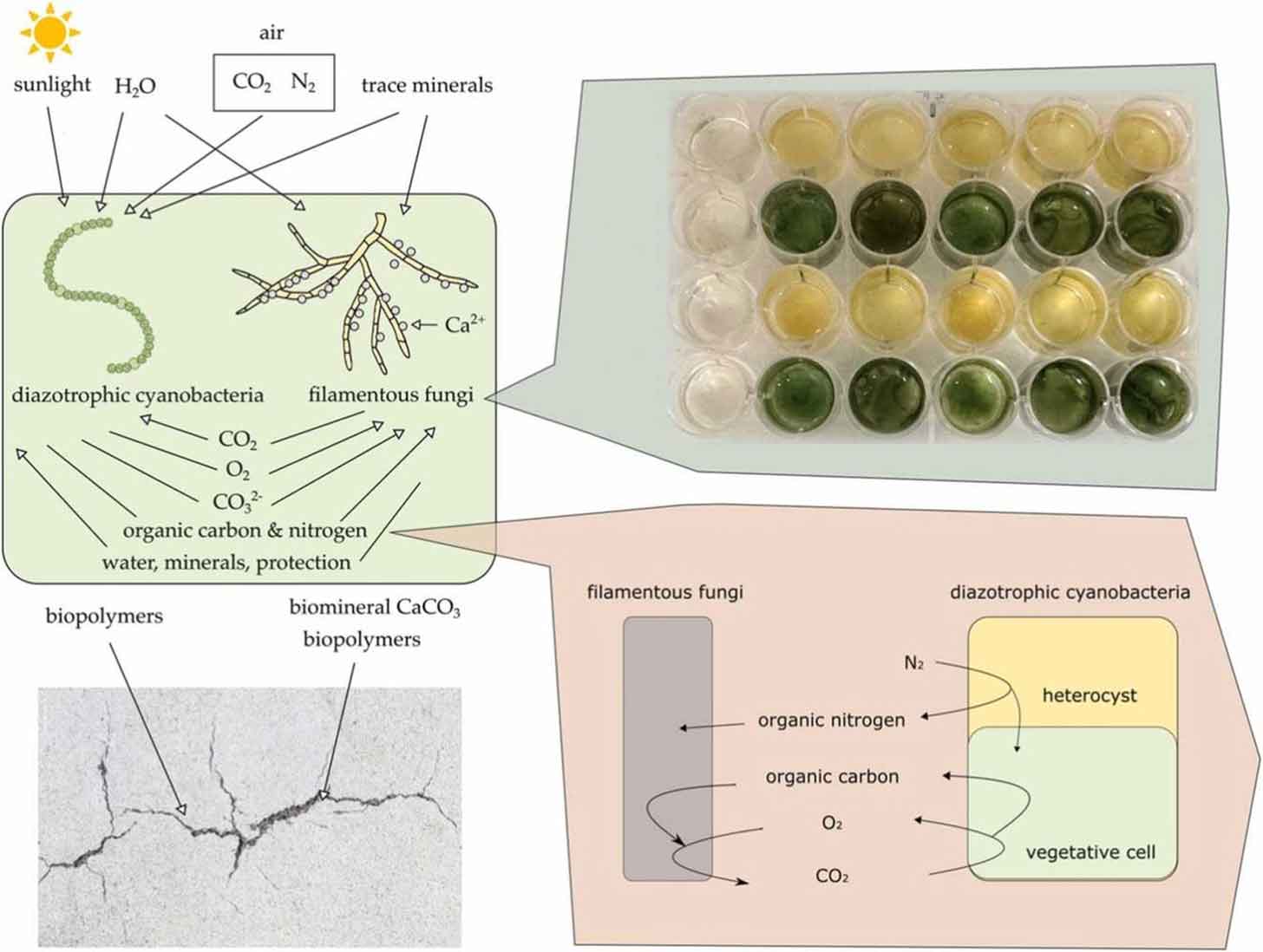
Now, Jin is collaborating with other Texas A&M professors in social science departments to better understand public perception about using living organisms in construction.
After all, lichen is a complex organism, and using it as a construction material could come with complications.
Together, they will weigh the real-world ethical, social, environmental, and legal considerations involved in applying this research to actual infrastructure development.
Still, the findings of this research could transform building and construction sectors for good.
“This groundbreaking research has far-reaching potential and applications,” a statement from Texas A&M reads.
“Concrete that can heal itself could significantly reduce maintenance costs, extend its longevity and even protect lives through increased safety. It can also have a dramatic impact in all areas of sustainable construction, including space infrastructure.”
Header image by Sreehari Devadas on Unsplash
It’s fair to say that the video game developers of “Crash Bandicoot” took some creative liberties when it came to capturing the likeness of the Australian marsupial — especially when it comes to Crash’s bright red fur and trademark jean shorts.
In reality, bandicoots are typically gray, brown, or cream-colored and look more akin to shrews. Their V-shaped faces are framed by large, rounded ears, a pronounced nose, and twin rows of tiny, sharp teeth.
Unfortunately, several species — including the eastern barred bandicoot and southern brown bandicoot — are endangered due to habitat loss and mounting threats from predators like wild cats and foxes.
But in recent years, conservationists have raised particular alarm surrounding the decline of a third species: the shark bay bandicoot.
The shark bay bandicoot, which is the smallest species of bandicoot, once thrived across the broad expanse of the Australian landscape.
Now, with fewer than 3,000 left in the wild, the species’ reach is much more restricted. Today, they are largely relegated to their namesake region — Shark Bay — on the islands of Bernier, Dorre, and Faure in Western Australia.
Thankfully, in August 2023, ecologists at the Australian Wildlife Conservancy stepped in to help the vulnerable marsupials.

Together with the help of the New South Wales National Parks and Wildlife Service, the AWC released 66 shark bay bandicoots into the Pilliga State Conservation Area: a 5,800-hectare (roughly 14,300 acres) enclosure that’s free from feral predators like cats and foxes.
It marked the first time that shark bay bandicoots ran free in the region in more than 150 years.
Then, in August 2024, the AWC team returned for a headcount.
Armed with bait balls made of peanut butter, oats, and fish, the ecologists attracted 85 bandicoots out into the open. Remarkably, 41 were adult females in “breeding condition,” and 44 were bandicoot younglings born on the Pilliga reserve.
The conservationists cheered: Their reintroduction plan was working.
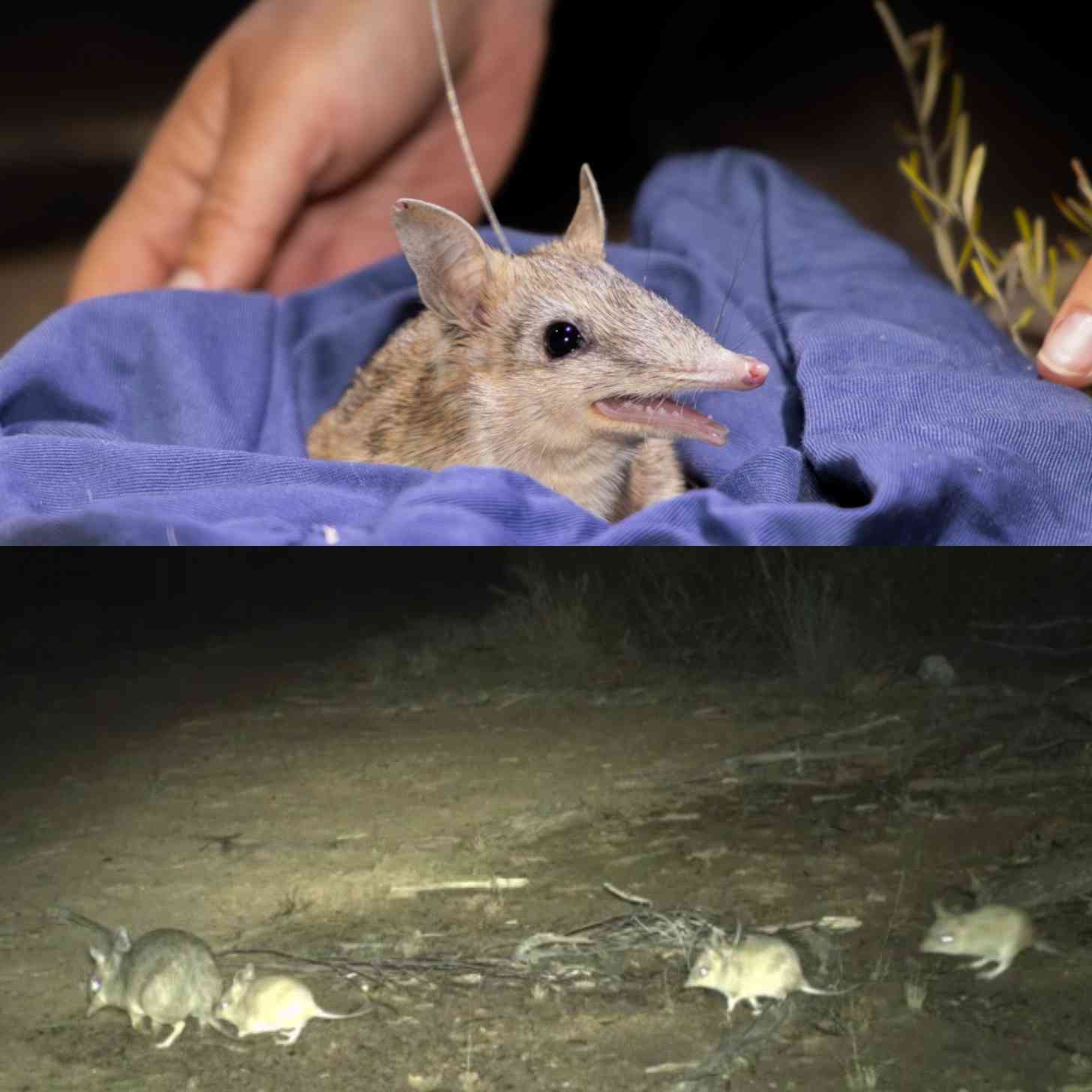
This summer, the AWC found more reason to celebrate. As Maisie Duffin, a field ecologist for the AWC, flitted through countless camera images from Pilliga trail cameras, she came across further proof that the shark bay bandicoots were thriving: A family portrait of a mother bandicoot with three babies in tow.
“It definitely made our day seeing the photo of the three young bandicoots scurrying to keep up with their mum,” Duffin said in a press release. “We were sifting through thousands of motion sensor camera images when we came across that gem.”
“Aside from being completely adorable, it gave us great confidence that the bandicoots are breeding and that the population in the Pilliga is growing.”
David Kelly, the manager of threatened species at the National Parks and Wildlife Service, celebrated the news as well, recalling the August day he spent in Pilliga, releasing the initial 66 shark bay bandicoots to their new, protected habitat.
“Having been involved in the initial reintroduction of the shark bay bandicoot to the Pilliga, it is exciting to see them now breeding,”
Kelly said.
“[It’s] a promising sign that they are well on their way to establishing a viable, self-sustaining population.”
Header image via Hayley Charlton-Howard / Australian Wildlife Conservancy