In 2001, New York City auctioned off thousands of taxi medallions, each worth nearly $200,000. Several immigrants saw this as an opportunity to operate their own vehicle and as a pathway to financial stability.
In the following years, the involvement of predatory lenders inflated the market prices of taxi medallions up to $1 million thereby propelling the collapse of the medallion scheme.
With the emergence of Uber and Lyft, taxis couldn’t compete. In 2014, the taxi market crashed causing medallion debts to surge. Several taxi drivers owed nearly $500,000 to their lenders.
Following the medallion market crash, financial despair deeply impacted many taxi drivers. By the end of 2018, eight taxi drivers died by suicide.
The New York Taxi Workers Alliance (NYTWA) composed of nearly 25,000 members, under the leadership of Bhairavi Desai, has been advocating for the lives and livelihood of taxi drivers since 1996.
For at least two decades, NYTWA in collaboration with elected officials, community leaders, and taxi drivers have been advocating to restructure the medallion debts and to make more equitable agreements between lenders, the city, and taxi drivers.
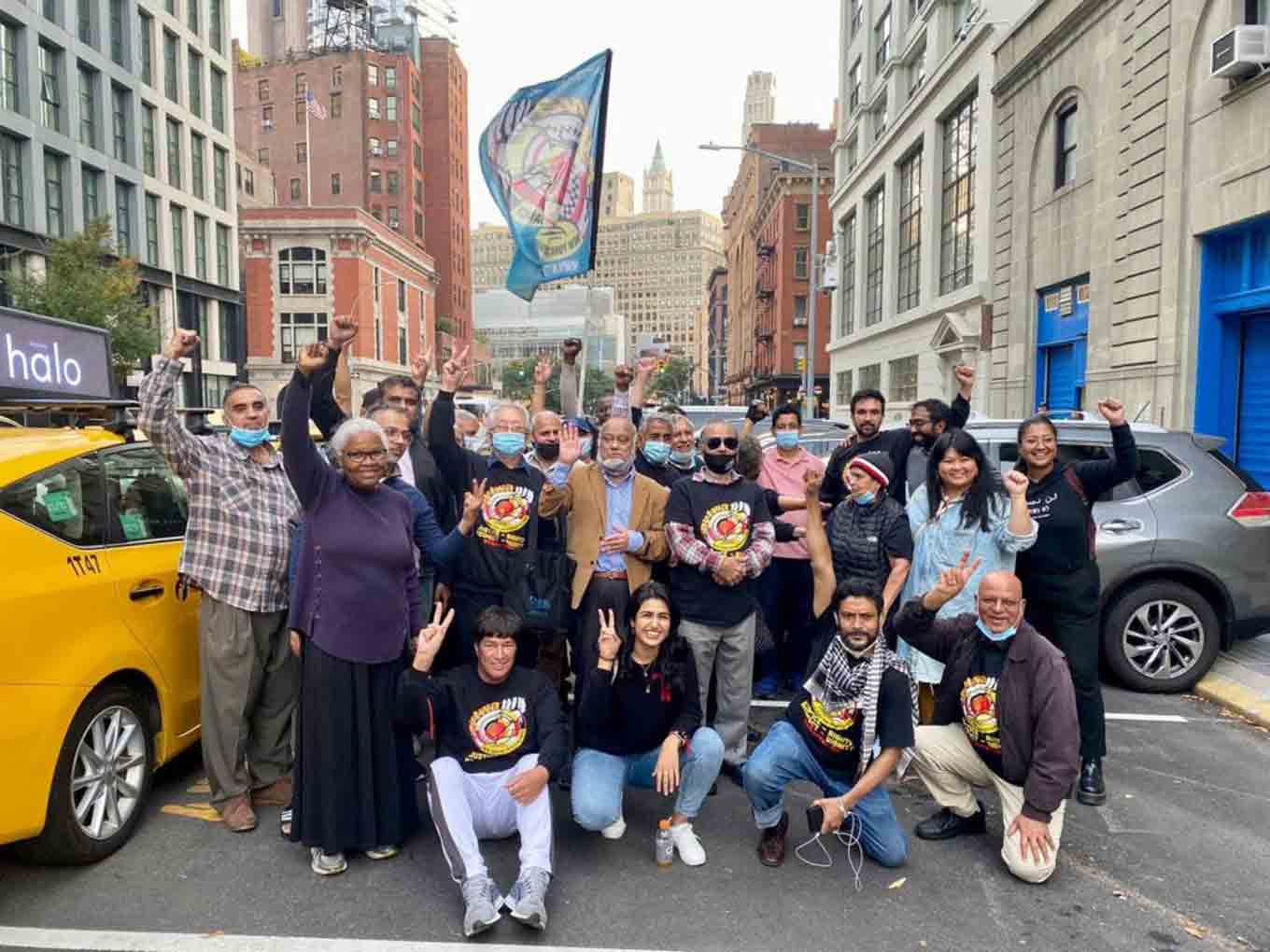
On 3 November 2021, the taxi drivers broke their 15-day hunger strike, to celebrate a debt relief plan involving a city-backed taxi medallion guarantee along with a maximum debt limit of $170,000 for each driver.
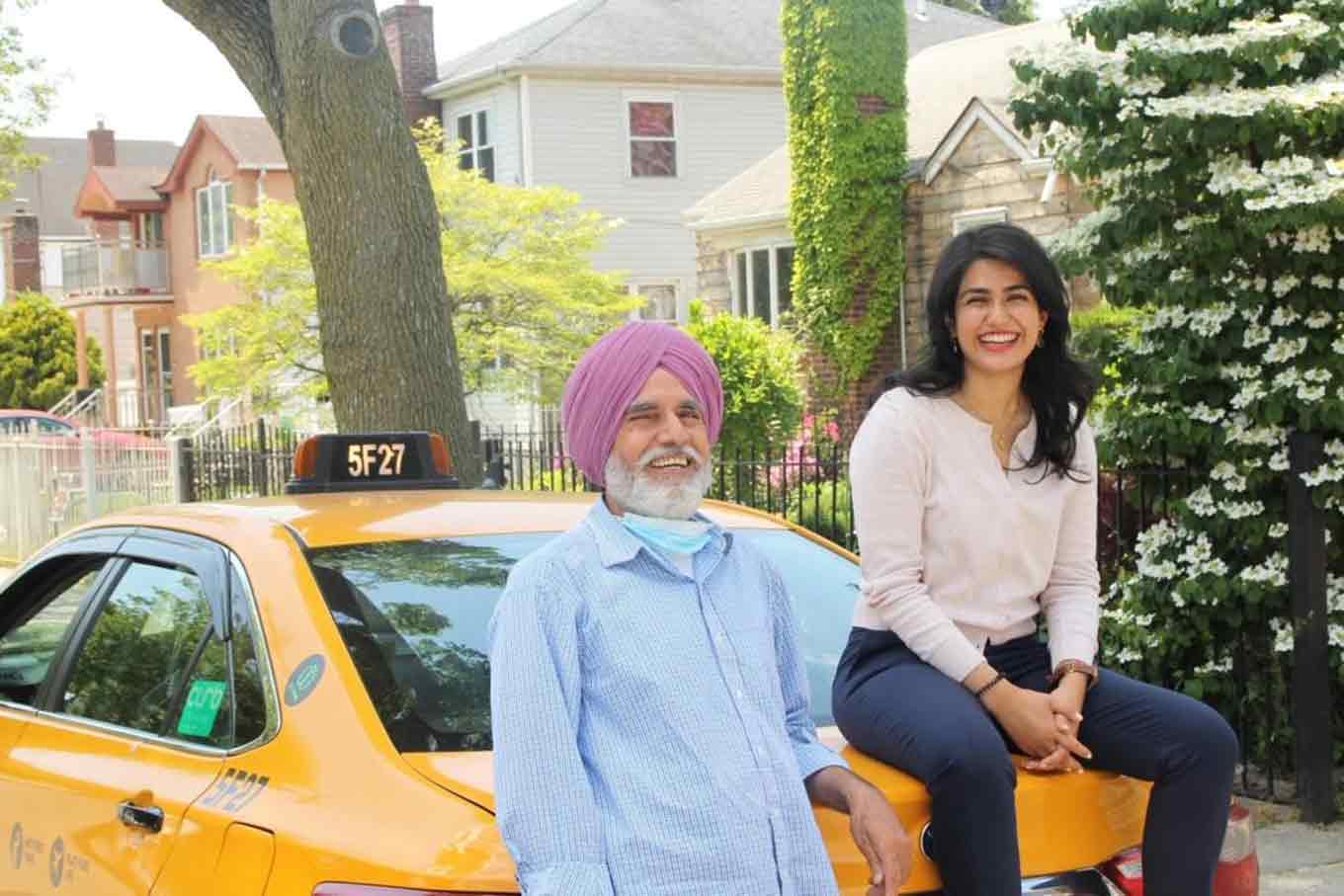
Jaslin Kaur was a supporter at the forefront of the historic Taxi Medallion Protests. Jaslin was born and raised in East Queens, New York to Punjabi, Sikh immigrant parents.
She is a community organizer and a former candidate for the New York City Council.
Read Varshini Balaji interview with Jaslin Kaur for Born This Way Foundation's Channel Kindness:
A Conversation with Jaslin Kaur on Community Organizing, Kindness, & Leading With Tenacity
Varshini: Hi Jaslin! First, thank you for taking the time to speak with me! I’m excited to learn more about your journey. To get us started, could you please tell me a bit about your upbringing and an instance that was particularly poignant in propelling your interest in community organizing?
Jaslin: I grew up in an immigrant, working-class household in Queens, New York. I think growing up in one of the most diverse places in the world meant that I was always around people who looked like me or had similar experiences. I felt a sense of community growing up. I think I was raised in a very progressive household, too.
For my parents, moving to New York from a rural part of Punjab, India really set us up for a lot of disenfranchisement but also opportunity to raise their children with principles of solidarity, dignity, and opportunity.
Also, my father is a taxi driver so I saw firsthand how much it takes to achieve what is offered to you as the “American Dream,” so to speak.
For me, one of the really radicalizing parts of my life was seeing how hard my parents worked. That wasn’t just about inspiring me to work hard, it was more about how much their rights were being taken away from them? How much is the city willing to make a profit off of their exploited labor?
These questions launched me to run for city council in the first place because I knew that their story was not unique. My parents’ stories were not isolated instances of exploitation.
I also did a lot of organizing supporting survivors of sexual harassment and assault on college and high school campuses. I joined an organization called Know Your IX, that really became a political home for me early on.
They really helped me learn what it means to protect your civil right to an education and help other students realize that cause too. It was my first entirely youth and volunteer lead movement of learning what activism and advocacy look like.
For me, it’s community-based power building that is key in recognizing that our fights are interlinked.
Also, when I turned 18 was when the taxi medallion market crashed. That was a life-changing moment for me. My family became dependent on me; we were propelled into financial ruin and financial crisis. We were put onto food stamps. I had to drop out of university because of the economic impacts of the taxi medallion market. That hurled me into a universe of understanding systems of power just through personal experience.
Varshini: Thank you for sharing, this is really inspiring. As I mentioned earlier, I have been following the taxi medallion protests, which involved a series of different kinds of protests, including a hunger strike over a period of 15 days with leaders, allies, and organizers.
You also participated in the hunger strike and stood in solidarity with the taxi drivers. There were also a lot of South Asian leaders involved in this movement. So what do you think are the potential and possibilities of community organizing?
Jaslin: We elected the very first South Asian members of our city council just this year (2021) alone. For me, it’s not just about representation for the sake of checking off a box, it’s about wielding our political power to have our demands met.
For me, when I ran for city council in my district, [I noticed that] we have a diversity of Sikh Punjabis, Muslim Bangladeshis, people who have not been activated quite yet. These are people who vote every four years because it’s their civic duty but they never had a civic engagement mindset of what it means to elect somebody who is going to champion you.
[My team and I] increased voter turnout in our district by 30%, and we overwhelmingly won the South Asian vote across our district because we campaigned in people’s languages.
Policy and organizing events are so much easier to digest when someone is speaking your language.
I realized that this work can be done intergenerationally, too. So I am 25 years old, but I had people my father’s age, in their 50s and 60s, knocking doors and talking to their neighbors. That’s what makes politics personal, it brings the fight to your doorstep and shows you that you are in control of winning victories, like the taxi medallion debt relief plan.
Seeing role models of my own like Zohran Mamdani, Shahana Hanif, Shekar Krishnan, who were leading this fight and committing to the fight, not just to get the vote but to organize people around it, was really transformational.
Voting is not just a singular act that you do every four years, it’s a constant engagement in the politics of your life, it’s about survival, especially for the taxi drivers.
Varshini: In preparation for our chat today, I was reading your interviews and listening to the podcast episodes that you’ve been on. I was particularly struck by how vulnerable you are. T
he stakes are high, you get a lot of visibility, and this is a deeply political space. The risks are also high.
How did you build your capacity to be vulnerable in such a public way?
Jaslin: You’re right, there is a lot of risk. When a young woman of color cries, the responses are: “Oh, that’s immature” or “She doesn’t know how to handle her emotions.”
I think vulnerability is a point of political necessity. If we don’t share exactly how much the state has failed us, we depersonalize issues, we decouple ourselves from the opportunity for liberation.
I’ll never forget that I met this woman who lives 10-15 minutes away from my house. We were knocking doors, and I believe she was Guyanese. I knocked on her door and introduced myself. I was talking about my experience with the taxi medallion crisis and how hard that was. She, then, immediately started sobbing. She got very emotional and was looking at the card I handed to her, which is the pamphlet for our campaign.
It turns out that while I was in a massive amount of financial debt with the taxi industry, she had been in a massive amount of medical debt because of a health emergency while she was a healthcare worker, and couldn’t afford the medical treatment.
This reminded me that we are never more than 10-15 minutes away from somebody who is in a very similar struggle.
That’s what vulnerability is about — being able to connect with somebody on something that might not be exactly the same but shows how the system is not working.
Varshini: That’s a powerful anecdote, thank you for sharing. Despite the persistent challenges of this work, why do you still do this work? Why is this work meaningful or important to you?
Jaslin: I think organizing and building community relationships for a goal that you might never live to see but approaching it with a tenacity like it could happen tomorrow is what sustains me. That’s what keeps me going. You never know just how close you are.
Look at the New York Taxi Workers Alliance; they have been shutting down streets since the 90s and it’s 2021 now, and they just won the taxi medallion debt relief fight. It’s very hard to see just how long it might take to get these victories, but they are necessary. It’s not just about one victory, it’s about the people you mobilize.
I also deeply believe in the inherent good in people, that they are able to redeem themselves and support their local communities. That’s what I’m fighting for at the end of the day.
The work that we do and why we organize points to a deep fight for justice. People have been deeply impacted, and I want everyone to have the rights to housing, healthcare, and education–the most basic needs.
Every single person deserves that no matter what. I think that’s what keeps me going.
Varshini: We at Born This Way Foundation are active advocates for kindness and bravery. Your journey exemplifies these two qualities.
I’m curious if you can share a bit about what kindness and bravery mean to you. Could you also share an anecdote or story of when someone’s kindness impacted you?
Jaslin: I think being kind and brave, especially when it’s inconvenient, is one of the most important times when you have to exercise it. It’s very easy for us to shut other people out and to cast people aside, but for me, kindness and bravery is also about solidarity and hope.
I think about Mariame Kaba who said, “Hope is a discipline but solidarity is a practice.”
We have a deep commitment to each other because our destinies, our fates, and our dignities are inherently intertwined. So for us to be kind to each other is investing in each others’ liberation and for us to be brave is to bring to light how much these struggles have not only impacted us but challenge these systems that disenfranchise us.
There are so many random acts of kindness that it’s really hard for me to choose one, but I think one that sticks out was when I met a NYTWA member, Tariq. He was distributing copies of his daughter’s poetry book – the first page he showed me was a poem about carrying the struggles of your immigrant family.
She [Tariq’s daughter] included an illustration of her father’s taxi. I was so moved, and saw myself in her work — he was clearly so proud of her. It was so moving that he wanted to share a part of his family with everyone at City Hall.
I also realized that there are so many different ways to do the work, whether it’s art, public speaking, or direct action.
Varshini: I love that! I love that you are expanding the idea of what kindness looks like. We don’t necessarily think of kindness in spaces and relationships that are challenging or in moments of conflict.
I love this notion of infusing kindness even in moments that are hard. I also echo the sentiment of practicing critical, deep, and intimate kindness.
So to wrap up, could you please share what advice you have for youth who are interested in getting politically engaged but don’t know where to begin or youth who might be afraid of the consequences of getting politically involved? What suggestions do you have?
Jaslin: I’ll cheat a little and share a piece of advice that someone else gave to me, which is that you want to be able to look at yourself in the mirror every single day and like what you see.
Take that kind of integrity to every single thing you do. I’ve had to take a lot of political risks in my life but I don’t see them as “risks,” I see them as opportunities to be on the right side of history. It’s helped me meet so many other people who share my vision.
I also think it’s really important for young people to find a political home — organize with your neighbors, organize people in your workplace, those are some of the most important places where you can find a very hyperlocal fight for justice that’s near you.
Those are some of the most life-changing conversations you will ever have. Do not be afraid to be tenacious, to be strong with your demands, and do not water down your message for anybody. I think we lose a lot by making our goals, ambitions, and dreams conditional for other people’s comfort.
Have big dreams, and go for them.
There will be a lot of people who will try to stop you, but there is a reason why they are pushing back, and it’s because you are challenging systems of power. That is always the right thing to do.
We have a lot of power inside us. It’s time to stop saying that we are the future because we are right here, we have always been here.
It behooves us to be ambitious, unapologetic, and unafraid of the work that we want to do.
Varshini: Thank you so much, Jaslin! Thank you for your clarity, vision, and incredibly inspiring journey. I know it hasn’t been easy at all by any means but thank you for the work you’re doing!
To learn more about Jaslin and her work, follow her at @jaslinforqueens on Instagram and Twitter.
This interview was originally published by Channel Kindness.
The term “toxic positivity” has received a good deal of attention lately. Coming off the back of the “positivity movement” we are beginning to recognize while feeling happy is a good thing, overemphasizing the importance of a positive attitude can backfire, ironically leading to more unhappiness.
Yes, research shows happier people tend to live longer, be healthier and enjoy more successful lives. And “very happy people” have more of these benefits relative to only averagely happy people. But pursued in certain ways, happiness or positivity can become toxic.
Our research, published in The Journal of Positive Psychology and involving almost 500 people, was inspired by these apparently inconsistent findings – pursuing happiness may be both good and bad for our well-being. We aimed to uncover a key ingredient that turns positivity toxic.
You might also like: Best Toxic Positivity Quotes
Expecting the best, feeling worse
Some studies have shown that when people place a high value on their own happiness it can lead to less happiness, especially in contexts where they most expect to feel happy.
This tendency to expect happiness and then to feel disappointed or to blame oneself for not feeling happy enough, has been linked to greater depressive symptoms and deficits in well-being.
As the line to a cartoon by Randy Glasbergen depicting a patient confessing to his psychologist puts it:
I am very, very happy. But I want to be very, very, very happy, and that is why I’m miserable.
However, researchers have also observed when people prioritize behaviors that maximize the likelihood of their future happiness — rather than attempting to directly increase their levels of happiness “in the moment” — they are more likely to experience improvements (rather than deficits) in their levels of well-being.
This may mean engaging in activities that provide a sense of achievement or purpose, such as volunteering time or completing difficult tasks, or constructing daily routines that support well-being.
This work suggests pursuing happiness indirectly, rather than making it the main focus, could turn our search for positivity from toxic to tonic.
Valuing happiness vs. prioritizing positivity
We wanted to find out what it was about making happiness a focal goal that backfires.
To gain a better understanding, we measured these two approaches to finding happiness: valuing happiness versus prioritizing positivity.
People who valued happiness agreed with statements such as “I am concerned about my happiness even when I feel happy” or “If I don’t feel happy, maybe there is something wrong with me”.
People who prioritized positivity agreed with statements such as “I structure my day to maximize my happiness” or “I look for and nurture my positive emotions”.
We also included a measure of the extent to which people feel uncomfortable with their negative emotional experiences. To do this, we asked for responses to statements like: “I see myself as failing in life when feeling depressed or anxious” or “I like myself less when I feel depressed or anxious”.
People who expected to feel happy (scoring high on valuing happiness), also tended to see their negative emotional states as a sign of failure in life and lacked acceptance of these emotional experiences. This discomfort with negative emotions partly explained why they had lower levels of well-being.
On the other hand, people who pursued happiness indirectly (scoring high on prioritizing positivity), did not see their negative emotional states this way. They were more accepting of low feelings and did not see them as a sign they were failing in life.
What this shows is when people believe they need to maintain high levels of positivity or happiness all the time to make their lives worthwhile, or to be valued by others, they react poorly to their negative emotions. They struggle with these feelings or try to avoid them, rather than accept them as a normal part of life.
Pursuing happiness indirectly does not lead to this same reaction. Feeling down or stressed is not inconsistent with finding happiness.
What makes positivity toxic?
So, it appears the key ingredient in toxic positivity is not positivity itself, after all. Rather, it is how a person’s attitude to happiness leads them to respond to negative experiences in life.
The prospect of experiencing pain, failure, loss, or disappointment in life is unavoidable. There are times we are going to feel depressed, anxious, fearful, or lonely. This is a fact. What matters is how we respond to these experiences. Do we lean into them and accept them for what they are, or do we try to avoid and escape from them?
If we are aiming to be happy all the time then we might feel tough times are interrupting our goal. But if we simply put a priority on positivity, we are less concerned by these feelings – we see them as an ingredient in the good life and part of the overall journey.
Rather than always trying to “turn a frown upside down”, we are more willing to sit with our low or uncomfortable emotions and understand that doing so will, in the long run, make us happy.
Learning to respond rather than react to these emotions is a key enabler of our happiness.
Our reaction to discomfort is often to get away and to reduce the pain. This might mean we employ ineffective emotion regulation strategies such as avoiding or suppressing unpleasant feelings.
If we do, we fail to engage with the insights unpleasant experiences bring. Responding well to these experiences means getting “discomfortable” — being comfortable with our discomfort. Then we can be willing to feel what we feel and get curious about why those feelings are there. Taking this response allows us to increase our understanding, see our choices, and make better decisions.
As the saying goes: “Pain is inevitable. Suffering is optional”.
The remarkable fact is that children still draw pictures during war. Their expressions are invaluable for documenting war and its impact, and it’s important to study them.
“They still draw pictures!”
So wrote the editors of an influential collection of children’s art that was compiled in 1938 during the Spanish Civil War.
Eighty years later, war continues to upend children’s lives in Ukraine, Yemen, and elsewhere. In January, UNICEF projected that 177 million children worldwide would require assistance due to war and political instability in 2022. This included 12 million children in Yemen, 6.5 million in Syria and 5 million in Myanmar.
The Russian invasion of Ukraine in February 2022 added 7 million more children to this number. To date, more than half of Ukraine’s children have been internally or externally displaced. Many more have faced disruptions to education, health care, and home life.
And yet they, too, still draw pictures. In March, a charity called UA Kids Today launched, offering a digital platform for kids to respond with art to Russia’s invasion and raise money for aid to Ukrainian families with children.
As a scholar who studies the ways wars affect societies’ most vulnerable members, I see much that can be learned from the art created by kids living in war-torn regions across place and time.
A century of children’s art
During the Boer War — a conflict waged from 1899 to 1902 between British troops and South African guerrilla forces — relief workers sought to teach orphaned girls the art of lace-making. During World War I, displaced children in Greece and Turkey learned to weave textiles and decorate pottery as a means of making a living.
Over time, expression has replaced subsistence as the driver of children’s wartime artwork. No longer pressed to sell their productions, children are instead urged to put their emotions and experiences on display for the world to see.
Novelist Aldous Huxley hinted at this goal in his introduction to the 1938 collection of Spanish Civil War art.
Whether showing “explosions, the panic rush to shelter, [or] the bodies of victims,” Huxley wrote, these drawings revealed “a power of expression that evokes our admiration for the childish artists and our horror at the elaborate bestiality of modern war.”
Herbert Read, a World War I veteran and educational theorist, organized another show of children’s art during World War II. Unlike Huxley, Read found that scenes of war did not dominate the drawings he collected from British schoolchildren, even those exposed to the London Blitz. In a pamphlet for the exhibition, he highlighted “the sense of beauty and the enjoyment of life which they have expressed.”
While the shows discussed by Read and Huxley differed in many ways, both men emphasized the form and composition of children’s artwork as much as their pictorial contents. Both also expressed the view that the creators of these drawings would play a critical role in the rebuilding of their war-torn communities.
A political tool
As with the children’s war art made during Huxley and Read’s time, the images coming out of Ukraine express a mix of horror, fear, hope and beauty.
While planes, rockets and explosions appear in many of the pictures uploaded by UA Kids Today, so do flowers, angels, Easter bunnies and peace signs.
The managers of this platform — who are refugees themselves — have not been able to mount a physical exhibition of these works. But artists and curators elsewhere are beginning to do so.
In Sarasota, Florida, artist Wojtek Sawa has opened a show of Ukrainian children’s art that will be used to collect donations and messages from visitors. These will later be distributed to displaced children in Poland.
The War Childhood Museum, based in Sarajevo, Bosnia-Herzegovina, had recently concluded traveling exhibitions in Kyiv and Kherson when the Russian invasion started. The museum’s managing director, who has spoken out strongly about the need for cultural heritage protection in war, was able to retrieve several dozen artifacts from these shows a few days before the fighting commenced.
Those toys and drawings, which tell the story of children’s experience during Russia’s previous effort to gain control of the Donbas region in 2014, will be featured in shows opening elsewhere in Europe in 2022.
By capturing the attention of journalists and the public, these exhibitions have been used to raise awareness, solicit funds and inspire commentary.
However, children’s art from Ukraine has not yet played a role in political deliberations, as it did when peace activist Fred Branfman shared his collection of drawings by Laotian children and adults during his 1971 testimony before Congress on the “Secret War” the U.S. had been conducting in Laos since 1964.
Nor is it yet clear whether this art will play a part in future war crimes trials, as the art of Auschwitz-Birkenau internee Yahuda Bacon did during the 1961 trial of Adolf Eichmann.
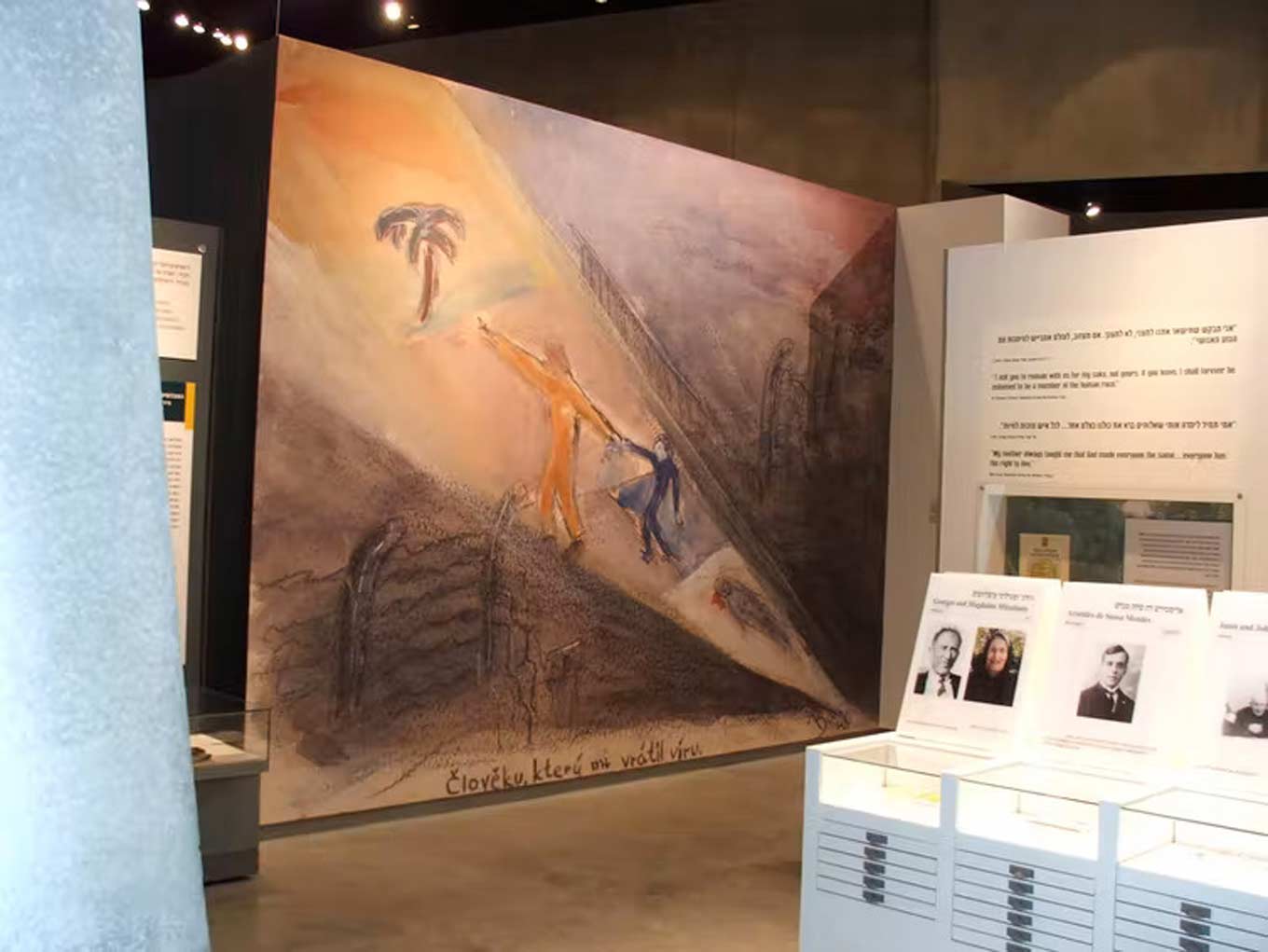
Windows into different worlds
Art historians once thought children’s drawings, no matter where they lived, revealed the world in a way that was unshaped by cultural conventions.
But I don’t believe that children in all countries and conflicts represent their experiences in the same way. The drawings of children imprisoned in Nazi concentration camps during World War II are not formally or symbolically interchangeable with drawings made by children exposed to America’s bombing campaign in Laos. Nor can these be interpreted in the same way as images produced by Ukrainian, Yemeni, Syrian, or Sudanese children today.
To me, one of the most valuable features of children’s art is its power to highlight unique aspects of everyday life in distant places, while conveying a sense of what can be upended, lost or destroyed.
A Laotian child’s drawing of a horse that “ran back to the village” from the rice field after its owner was killed by a bomb offers a small window into the lives of subsistence rice farmers.
The desert landscapes and urban architecture of Yemen are equally distinctive, and Yemeni children’s drawings highlight those differences even as they express aspirations that viewers around the world may share.

The challenges of preservation
As an academic who has also worked in museums, I am always thinking about how artifacts from today’s conflicts will be preserved for exhibition in the future.
There are significant challenges to preserving the drawings and paintings young people produce.
First, children’s art is materially unstable. It is often made on paper, with crayons, markers, and other ephemeral media. This makes it dangerous to display originals and demands care in the production of facsimiles.
Second, children’s art is often hard to contextualize. The first-person commentaries that accompanied some of the Spanish Civil War drawings and most of the Laotian images often provide details about children’s localized experience but rarely about the timing of events, geographic locations, or other crucial facts.
Finally, much children’s war art suffers from uncertain authorship. With few full names recorded, it is hard to trace the fates of most child artists, nor is it generally possible to gather their adult reflections on their childhood creations.
By noting these complications, I don’t want to detract from the remarkable fact that children still draw pictures during war. Their expressions are invaluable for documenting war and its impact, and it’s important to study them.
Nevertheless, in researching children’s art, it is necessary to reflect that scholars and curators are — like the child artists themselves — often working at the limits of their knowledge.
You might also like: Meet the organizations rebuilding housing for families in Ukraine
Did you know that the US is losing 36 million trees every year?
Several organizations have stepped up with creative solutions to save the wood, reduce carbon emissions and create jobs.
Urban areas in US cities are estimated to lose an average of 36 million trees every year. This results in economic losses of up to $786 million and risks having an adverse impact on already worsening climate change.
The worse part? Many of these trees are considered “waste” and sent off to landfills. “More wood from cities goes into landfills than is harvested from US National Forests,” says J. Morgan Grove, a research forester at Baltimore Field Station, USDA Forest Service.
“40% of this wood can be reused for furniture, flooring, outdoor play areas, mulch, compost, soil improvements, bioenergy and even carbon sources for growing mushrooms.”
That’s what “reforestation hubs” are doing: Saving urban trees from heading to landfills by finding new ways to repurpose the wood. These wooden products can be sold to fund further tree plantations. This cycle reduces urban wood waste, saves money, helps increase forest cover, and most importantly, keeps carbon out of the environment.
“If we recycled all the trees that came down in US cities each year, roughly 20 million tons of carbon could be kept out of the atmosphere, equivalent to taking over four million gas-powered cars off the road for a year,” says Ben Christensen, CEO and co-founder of Cambium Carbon, a New York-based startup working on reforesting America by creating the aforementioned wood repurposing-reforesting cycle.
Reforestation Hub, an initiative by The Nature Conservancy (a global environmental organization) and American Forests (a US-based forest conservation nonprofit), estimates up to 133 million acres of formerly forested lands in the United States could be reforested, absorbing 333 million metric tons of carbon per year, which is equivalent to keeping 72 million cars off the road. That’s why the organization calls it “a low-tech, scalable and proven solution to climate change.”
Creating a Circular Economy
Organizations like Cambium Carbon play a huge role in making this circular economy possible.
For instance, Cambium Carbon works at three critical points:
- Saving the trees from ending up in landfills when they’re first cut down or have fallen.
- Collaborating with millers and sawyers who can use the “wasted” wood.
- Working with architects, builders, and furniture brands who provide the market to incentivize salvage.
This way, fallen urban trees go from being a “landfill filler” to a valuable commodity that creates resources for increasing the declining forest cover in US cities.
The organization claims to have diverted more than 45 tons of wood from landfills, moving about 291,000 board feet of wood or roughly 489 tons of finished product.
They’re now starting a new furniture line with Sabai Design, a sustainable furniture brand in Philadelphia, and planting new trees with the Sacramento Tree Foundation and the Baltimore Tree Trust.
Their goal is to plant one billion new trees across the U.S. by 2030, the team mentioned in an interview with Next Pittsburgh.
Cambium Carbon is not alone. Other organizations like Cities4Forests and the Arbor Day Foundation are working with local officials to create the nation’s first reforestation hubs by 2022 through a TNC Natural Climate Change Solutions Accelerator Grant.
Is the Solution Worth the Costs?
While collecting fallen trees from urban spaces and using them to make locally-sold wooden products sounds like the perfect idea to reduce wastage and make supply chains more sustainable, all of this is easier said than done.
One drawback is that the barriers and costs of these alternative wood waste programs may outweigh the benefits, says Melissa McHale, associate professor of Urban Ecology and Sustainability, UBC Faculty of Forestry.
“Many cities lack the space to store, sort and process the wood waste, and the cost of creating a space like this, in terms of dollars and time, is prohibitive,” says McHale, who also served on the leadership team for the United States Forest Service’s Denver Urban Field Station (USFS DUFS).
“Many cities do not have the ability to maintain and remove all of their problem or dead trees and depend on private companies to do so. Private companies, especially the smaller businesses, often do not have the time and equipment needed to remove a tree whole and transport it wherever it needs to go.”
Fortunately, several organizations are stepping up with resources and ideas to make the wood repurposing process more efficient. For instance, Reforestation Hub maps out “relatively low-cost and feasible options to restore forests.”
The web-based tool highlights several key areas for affordable reforestation like large open patches within forests, croplands with challenging soils, and post-burn landscapes.
It also offers handy access to reforestation resources like links to find a professional forester, find your state’s urban and community tree coordinator, and access published articles on cost-effective tree planting.
Beyond helping the planet for years to come, initiatives like these also support local communities. Cambium Carbon has created a national network of local producers and national buyers to purchase locally salvaged, locally milled wood, which further funds local tree planting.
For example, the communal tables in the entrepreneurship hubs on Towson University’s campus are made of wood that would have otherwise gone to waste.
Similarly, the trellis in the Visit Baltimore HQ office was made using “waste” now repurposed into what the team calls “Carbon Smart Wood.”
“It’s a big opportunity to put people first and to have projects that are not just good for the planet but are really good for communities,” CEO Ben Christensen said in an interview with the Arbor Day Foundation.
“[We’re] creating systems that are helping to address problems like lack of employment and helping to support economic recovery coming out of COVID.”
Cambium Carbon has employed 25 workers while also creating additional employment and partnership opportunities for several local carpenters and woodworkers through their sales and inventory management platform, Traece.
Since the wood is sourced, repurposed, and sold locally, workers in the region find more projects (like working on the Towson University tables) and resources (companies buying the new wooden products) to generate revenue that they wouldn’t have access to if the fallen trees just went to a landfill.
Juneteenth, short for June 19th, commemorates the day the last remaining enslaved people in the U.S. — in Galveston, Texas — received word that the Civil War had ended and they had been liberated by the federal orders in President Abraham Lincoln’s Emancipation Proclamation.
The year was 1865 — two and a half years after Lincoln's proclamation.
In the following years, the anniversary of this event was celebrated and honored in Galveston with prayer and family gatherings.
Now, Juneteenth is celebrated annually through backyard parties, community parades, memorials, delicious meals, and more.
Over time, as the descendants of the more than 250,000 enslaved individuals in Galveston began migrating to other parts of the country, the Juneteenth tradition spread. In 2021, it officially became a national holiday.
In 2026, administrative calendars show that at least 33 states and the District of Columbia will mark Juneteenth with a paid day off for most state government workers.
Ultimately, Juneteenth has become a time of sharing stories of Black resilience, resistance, liberation, and joy.
It also provides an opportunity for all of us to deepen our understanding of the United States’ history, empathize with and advocate alongside our Black neighbors, and pave the way to a brighter, more just future for all Americans.
While these actions are important year-round, it’s especially important to recognize Juneteenth this year, as the Trump administration rolls back federal diversity, equity, and inclusion practices and even attempts to bar observances of holidays like these.
We’ve created a guide on how to thoughtfully celebrate and recognize Juneteenth this year:
By the way, some of the links in this article (like books!) are affiliate links, which means if you make a purchase after clicking a link, we may earn a commission at no extra cost to you. Thank you!
How To Celebrate Juneteenth: Resources, Ideas, & Activities
Learn
Learn the history of Juneteenth.
Juneteenth has been celebrated for hundreds of years — but many don't know the full context and history of the annual holiday. Now is the perfect time to learn.
We recommend turning to The Smithsonian’s National Museum of African American History and Culture website, which offers blog posts on the legacy and celebration of Juneteenth and so many more resources, like reading lists, digital toolkits, and music recordings.
Learning from today’s scholars and academics, like LaTaSha Levy, an assistant professor of American ethnic studies at the University of Washington, is a great way to learn more about Black joy, community connection, and reeducation.
If you’re more of an auditory learner, we recommend listening to our podcast episode with Pulitzer Prize winner and professor Gordon-Reed as she discusses Juneteenth’s history and how we can keep it alive all year round. Her book, On Juneteenth, is a short, beautiful, insightful read.
Watch a documentary about slavery.
It’s important to note that though the U.S. ended chattel slavery, slavery is still legal (and continues to this day) via a loophole in the 13th Amendment.
A great resource to learn more about this loophole in the 13th Amendment is the documentary 13th on Netflix.
Experts and activists see this loophole as directly linked to the current U.S. prison system, which incarcerates Black people at disproportionately higher rates and profits off their labor.
The documentary provides the origins of this loophole, where we are today, and how we can act to end this modern-day slavery.
Visit a museum.
Museums are the time capsules of society, allowing us to see, hear, and (sometimes) touch history. We learn about generations past in a way that other forms of learning might not communicate as well.
Many American museums embrace Juneteenth as an opportunity to celebrate, honor, remember, and educate. Here are a few (of the many) museums and cultural centers that are celebrating Juneteenth this year:
- The Smithsonian’s National Museum of African American History & Culture, Washington, D.C.
- Museum of the American Revolution, Philadelphia, Pennsylvania
- Louis Armstrong House & Museum, Queens, New York
- Please Touch Museum, Philadelphia, Pennsylvania
- Rochester Museum & Science Center, Rochester, New York
- Lincolnville Museum & Cultural Center, St. Augustine, Florida
- Troy University Rosa Parks Museum, Troy, Alabama
- Hosanna School Museum, Darlington, Maryland
- Houston Museum of African American Culture, Houston, Texas
- The Museum of Fine Arts, Boston, MA
- America’s Black Holocaust Museum, Milwaukee, WI
- California African American Museum, Los Angeles, CA
- Charles H. Wright Museum of African American History, Detroit, MI
- The National Civil Rights Museum at the Lorraine Motel, Memphis, TN
- The National Underground Railroad Freedom Center, Cincinnati, OH
- Northwest African American Museum, Seattle, WA
Read books written by Black authors and poets.
Juneteenth is a celebration of liberation, joy, and of course, storytelling.
The Smithsonian’s National Museum of African American History & Culture is one of many organizations sharing Juneteenth reading lists that you can dive into, but here are a few other quick recommendations to consider:
- “A Black Woman’s History of the United States” by Daina Ramey Berry & Kali Nicole Gross (Bookshop) (Amazon)
- “Stony the Road: Reconstruction, White Supremacy, and the Rise of Jim Crow” by Henry Louis Gates (Bookshop) (Amazon)
- “Four Hundred Souls: A Community History of African America, 1619-2019” by Ibram X. Kendi & Keisha N. Blain (Bookshop) (Amazon)
- “The Weary Blues” by Langston Hughes (Bookshop) (Amazon)
- “African American Poetry: 250 Years of Struggle & Song” edited by Kevin Young (Bookshop) (Amazon)
- “High on the Hog: A Culinary Journey from Africa to America” by Jessica B. Harris (Bookshop) (Amazon)
- “Libertie: A Novel” by Kaitlyn Greenidge (Bookshop) (Amazon)
We also have a separate article on great books to add to your TBR list in honor of Juneteenth.
Listen to audiobooks written or narrated by Black authors and poets.
We love Libro.fm and its mission to support locally owned bookshops through audiobook purchases. (Plus, it’s a great Amazon alternative.) In honor of Juneteenth, they’re highlighting Black-owned bookstores, Black authors, and Black narrators.
Listeners can browse through their extensive library and find content aimed at empowering, learning, and celebrating the Black experience. Plus, you can sign up to make sure the profits from each audiobook purchase go directly to a Black-owned bookstore.
Visit a national park.
National parks are free to visit on Juneteenth, and you can explore a number of beautiful public lands or humbling national monuments as you embrace the storied history of the United States.
Take Action
Advocate for racial justice.
Whether it’s advocating for voting rights, anti-discrimination policies, improved and inclusive school curriculum, reparations, or another meaningful policy, it’s important to continually advocate for racial justice on all levels.
Call your elected officials, support Black candidates running for office, and dedicate some time to applying your anti-racism education to real-world change.
Support Black-owned businesses.
A simple way to celebrate Juneteenth is by supporting Black creators and entrepreneurs.
The Center for American Progress reported that “while Black Americans make up 13% of the U.S. population, they own less than 2% of small businesses with employees. By contrast, white Americans make up 60% of the U.S. population but own 82% of small employer firms.
Help close the racial disparities in business by finding and supporting independent Black business owners online or in your community.
Eat at Black-owned restaurants.
Early Juneteenth celebrations revolved around food and music. A great way to continue this tradition and celebration is by choosing to eat at Black-owned restaurants.
EatOkra is an app and website that connects “foodies to Black restaurants and culinary events while amplifying the dining experience for and by Black communities.”
As always, be sure to tip well.
Buy a gift card from a Black-owned restaurant.
A valuable way of supporting Black-owned restaurants beyond Juneteenth is by purchasing gift cards. Although many small businesses appreciate the influx of customers on Juneteenth or Black History Month, many, unfortunately, only see support on national holidays.
Let’s change that.
Support Black-owned restaurants by popping into their businesses and buying gift cards for friends and family members (or for yourself!).
Donate to Black-led nonprofits and community organizations.
Black-led organizations have long been the backbone of activist communities across the country.
We can celebrate Juneteenth by donating to nonprofit organizations that understand the needs of the Black community and use their resources to address them as best as they can. This also includes mutual aid funds and initiatives that support direct action in our very own neighborhoods.
You can also explore more Black-led organizations to support via Giving Gap’s incredible website. They curate incredible Black-led nonprofits and organize them by cause and state.
Here are some other Black-led organizations to consider donating to this year:
- Howard Institute for Advanced Study
- Equal Justice Initiative
- National Juneteenth Museum
- Color of Change
- The Solutions Project
- Colorlines
- The Confess Project of America
- The Loveland Foundation
- The King Center
- The Audre Lorde Project
- Sister Song
- Black Lives Matter at School
- Anti Police-Terror Project
- Thurgood Marshall College Fund
- Black Outside
- Black Artists & Designers Guild
- Marsha P. Johnson Institute
Celebrate
Attend a Juneteenth walk or parade.
Many cities across the country host Juneteenth events or parades, so keep your eyes on your community’s calendars to find one near you.
You can also register to attend Opal’s Walk (virtually or in-person), a 2.5-mile walk that honors the 2.5 years it took for the official word of the Emancipation Proclamation to reach the enslaved people of Fort Lee, Texas.
In 2016, at age 89, activist Opal Lee hosted the first walk in the hopes of educating the country about Juneteenth. Now you can walk alongside her in Texas, or participate on your own in solidarity!
Host a backyard party with traditional foods.
Gathering around food is a tradition nearly every culture has, and eating good food for Juneteenth is no exception! This is a great time for a community barbecue or cookout, often with traditionally significant foods like pork, jerk chicken, and other favorite barbecue sides.
Most meals include a drink or dish that is red in color, representing the resilience of enslaved people. You might see items like hibiscus tea, strawberry punch or soda, strawberry pie, or red velvet cake on the proverbial menu at Juneteenth gatherings.
Enjoy Black TV and movies.
While you should definitely be diversifying your viewing and listening queues all year long, Juneteenth is a great opportunity to enjoy TV and movies by Black creators.
Here is a quick (but not comprehensive) list of recommendations for your viewing pleasure.
TV Shows:
- Abbott Elementary
- Queens
- Lovecraft Country
- Woke
- I May Destroy You
- Colin in Black & White
- Black-ish
- Grown-ish
- Atlanta
- Forever
- The Get Down
- Insecure
Movies:
- Moonlight
- Get Out
- Black Panther
- Summer of Soul
- Judas & The Black Messiah
- Miss Juneteenth
- King Richard
- John Lewis: Good Trouble
- Soul
- Just Mercy
- Sinners
- I Love Boosters
- Nickel Boys
Read good news about racial justice.
Celebrating any holiday or awareness month also means celebrating good news. We’re all about good news at Good Good Good — it’s kind of our thing.
Every month, we make a monthly Goodnewspaper, every day, we send out a Goodnewsletter — and we also have a whole library of good news stories about racial justice to inspire you and help you learn something new.
- This organization aims to clear the records of over 14 million Americans
- An artist created an “encyclopedia of invisibility” to share forgotten and neglected stories
- Black woman develops 'Black Amazon' app to help shoppers find Black-owned businesses
- New York Workers Justice Project empowers women of color
- A Detroit community is bringing together Black and Brown birdwatchers
- A majority-BIPOC therapy collective is disrupting the mental health field
- This figure skating-STEM school hybrid breaks barriers for girls of color: 'They are changemakers'
- 'Dancing with the Stars' finalists make Black history in show-stopping ensemble dance
At Work
Give your employees time off — or additional pay — for Juneteenth.
Since Juneteenth is now a federal holiday, many employers take this opportunity to give their employees time off and use this time to educate and raise awareness about the holiday.
However, it’s important that these celebrations or days off are a meaningful and authentic initiative, and not just a box a company checks off on their calendar.
Employers can also use Juneteenth as a way to give back to the community by hosting a philanthropy event, participating in a community service initiative, or offering the day as a “volunteer time-off” event for employees to get involved in their communities.
Some companies have even given their employees paid volunteer time off so they can participate in area protests or rallies.
Create an informative email auto-response
If your company is closed for Juneteenth, create an email auto-response that shares why the company is closed and why Juneteenth is important.
Continuing to share information with people about the historic significance of this holiday is a great way to further stand in solidarity with your Black team members.
Highlight Juneteenth in your newsletter.
Although it would be great if everyone could provide their employees with time off, many small businesses or essential workers are not afforded the option to take a day off or offer the various benefits that larger corporations might.
However, and similar to drafting an informative email response, utilizing your current email marketing platforms is a great way to share more about Juneteenth.
This could mean including a sentence or two — or an entire section — in your newsletter acknowledging Juneteenth and how readers can thoughtfully celebrate. (Maybe even share this article as a resource).
Turn your good intentions into real change.
Workplace actions should go beyond just celebrating Juneteenth or other holidays and awareness months. If you want to help ensure that your good intentions are actually helping, it’s going to take intentionality and expertise — and an unapologetic investment in diversity, equity, and inclusion.
The book “The Diversity Gap” is a great place to start.
At Home
Talk to your kids about race.
People often tie a lot of their beliefs and values to what they learned at home growing up. We can help celebrate Juneteenth by having conversations around the dinner table about what this day means to the Black community and how we can show support.
For children of all racial identities, Juneteenth can be a time for learning about slavery in the U.S., the resilience of Black Americans, and the bravery it took to end slavery. It can also be a time to just learn about the history of racism in general and how oppressive systems still deeply harm Black communities today.
We recommend turning to the National Museum of African American History and Culture’s kid’s guide on understanding and celebrating Juneteenth, as well as their guide on talking to children about race.
Save funds for regular donations.
If your kiddos have an allowance or lemonade stand, chances are, you’re hoping to teach them the value of money. Extend that conversation to include discussions of community care, mutual aid, fundraising, and wealth redistribution.
These topics can feel like big or confusing ideas, but encourage your children to save some of their money in a special jar that they can use to support an organization or community member of their choice down the road.
You don’t need to give them a full explainer on capitalism (or do, we won’t stop you!), but you can teach them how to use their privileges in ways that help their neighbors.
Perhaps you can head to the library and research different fundraising ideas, read about various causes or social movements, and make this a learning experience for the whole family.
At School, For Teachers
Access free educational resources on American slavery.
Children spend their formative years (and a huge chunk of their daily lives) in the classroom retaining information, learning how to think independently, and asking questions.
Though slavery in America is a hard subject to teach in the classroom, there are organizations focused on making it easier for educators to access age-appropriate tools and resources to teach American history.
Learning for Justice helps educators and students reduce prejudice by providing free educational resources — articles, guides, lessons, films, podcasts, webinars, frameworks, and more — to help foster shared learning and reflection for educators, youth, and the general public.
You can also check out this article and this article about teaching about slavery.
Add books on Juneteenth in your classroom library.
Providing students with free, easy access to racially diverse literature through school or in-class libraries is a great way of providing independent learning opportunities in the classroom.
However, we know that many school districts across the U.S. suffer from funding disparities — especially within low-income areas. As a result, many children (and consequently their teachers) are left with a limited selection of books, school supplies, and educational materials.
The First Book Marketplace provides educators, librarians, and others working with low-income children with thousands of free and affordable high-quality, brand-new books, educational resources, and basic needs items at highly affordable prices — or for free.
Once you’ve found the perfect route for acquiring these books, here are a few recommendations to add to your classroom library:
- “Juneteenth For Mazie” by Floyd Cooper (Bookshop) (Amazon)
- “Opal Lee and What it Means to Be Free: The True Story of the Grandmother of Juneteenth” by Alice Faye Duncan and illustrated by Keturah A. Bobo (Bookshop) (Amazon)
- “Crossing Ebenezer Creek” by Tonya Bolden (Bookshop) (Amazon)
- “Shaking Things Up: 14 Young Women Who Changed The World” by Susan Hood (Bookshop) (Amazon)
- “All Different Now: Juneteenth, the First Day of Freedom” by Angela Johnson and illustrated by E. B. Lewis (Bookshop) (Amazon)
- “One Crazy Summer” by Rita Williams-Garcia (Bookshop) (Amazon)
- “Big Papa and the Time Machine” by Daniel Bernstrom, illustrated by Shane W. Evans (Bookshop) (Amazon)
The New York Public Library and Boston University also have great recommendation lists for you to dive even deeper!
On Social Media
Share photos of past or present Juneteenth celebrations.
Social media can be a powerful tool to share Black stories, celebrations, and history with the world.
Share your Juneteenth celebration with your community or access the Smithsonian’s National Museum of African American History & Culture Social Media Toolkit to help share more insight on what this day means to you and your family.
Amplify Black voices.
If you are not a part of the Black community, don’t make it about you. Don’t post on social media about all the amazing things you’ve done as an ally.
Instead, virtually listen, learn, and support Black voices by amplifying their content.
As An Ally, To Show Support
Don’t make it about you.
Just like Pride isn’t about having a gay best friend, Juneteenth is not about your anti-racism journey as an ally. While we use the term “celebrating,” this day holds grave historical and cultural significance that can be deeply painful for many Black community members.
Don’t wish folks a “Happy Juneteenth!” like it’s Halloween or a birthday party. Don’t post on social media about all the amazing things you’ve done as an ally. Don’t co-opt Black spaces, unless you are explicitly invited to events (and even then, consider what that means and what privilege you hold).
Listen. Learn. Redistribute wealth. And, with all the love and respect in the world, shut up for a minute.
Do something to make a Black person’s life easier — with their consent
Consider what you have to offer (time, money, a meal, a letter of recommendation, an hour of childcare), and use your skills to support a Black friend or community member. However, make sure you aren’t doing the white savior thing, and confirm that your support is wanted and welcomed.
Don’t leave your anti-racism work behind after Juneteenth.
We hope that this guide is a launch pad — or a refresher — for your anti-racism work, but we also hope that you will keep the momentum going after Juneteenth passes this year.
It’s important to celebrate the progress we’ve made and the strides society has taken to uplift and emancipate our Black neighbors. Still, we know that systemic oppression doesn’t just disappear once a year.
Hire diverse creatives year-round, support Black artists and creators, keep reading and learning from brilliant Black scholars and storytellers, support Black businesses and restaurants, allocate financial resources to make consistent charitable contributions, celebrate other Black holidays every month, and continue your role in the fight for liberation all days of the year.
This article was first published in June 2022 and is updated every year.
Word on the street is that pets are the new kids, plants are the new pets, and candles are the new plants.
We know, it’s a little confusing, but if you’re a candle fanatic (like most of the Good Good Good team), we want you to know that we see you.
You’re the kind of person who practices good candle etiquette (always trim the wick and let the candle burn for long periods of time so it doesn’t tunnel — bonus points if you use an electric lighter), and you may be known to pop a candle container in the freezer so you can clean it out and reuse it.
Maybe you have an allegiance to a certain candle brand, or maybe you love to shop around to find just the right scent for each room in your home. Either way, if you’re anything like us, you want to make thoughtful decisions and shop sustainably in your pursuit of the perfect candle(s).
We’ve compiled a list of some of our favorite eco-friendly, sustainable candles for this very purpose. Some of them were personally reviewed by members of our team, and the others were researched and vetted by other candle lovers across the Internet.
First, some facts about candles and sustainability.
By the way, some of the links in this article are affiliate links, which means if you make a purchase after clicking a link, we may earn a commission at no extra cost to you. Thank you!
Are candles bad for the environment?
As much as a candle might smell like it’s good for you, a lot of times, factory-made grocery store or department store candles can be made with harmful products, such as paraffin.
Paraffin wax creates toxic benzene and toluene chemicals as it burns, and breathing them in can be harmful to your health, as well as the environment. Paraffin is also a by-product of petroleum refinement, therefore contributing to global reliance and burning of fossil fuels.
Many of these candles also contain artificial dyes and fragrances, which can also release harmful particles and small amounts of carbon dioxide into your home, and therefore, the environment.
Another polluter from candles are the containers they come in. Most times, when a candle finishes its life cycle, folks will chuck the whole container in the trash, along with the small well of leftover wax and metal pieces.
What makes a candle eco-friendly?
So, what kind of candles are good for the environment?
We recommend sourcing candles made with natural and organic waxes, like soy wax, beeswax, coconut wax, and rapeseed wax — rather than mass-manufactured candles which are often made with paraffin wax. Wicks are also important, so look for cotton, hemp, or wooden wicks.
As far as candle containers go, keep your eyes out for containers you know you could reuse or recycle after cleaning them out.
Our favorite eco-friendly and sustainable candles on the market
La’ F.E.M.

Where to buy: Made Trade
What’s good: From a BIPOC women-owned company, this candle is made with eco-friendly ingredients. Each candle is phthalate, paraben, and sulfate-free, as well as free from animal testing.
Details: Hand-poured in California, candles are made with naturally fragrant essential oils, a coconut and soy wax blend, and unbleached cotton wicks. Vessels are a high-quality recycled glass that can be reused or repurposed.
Price: $34
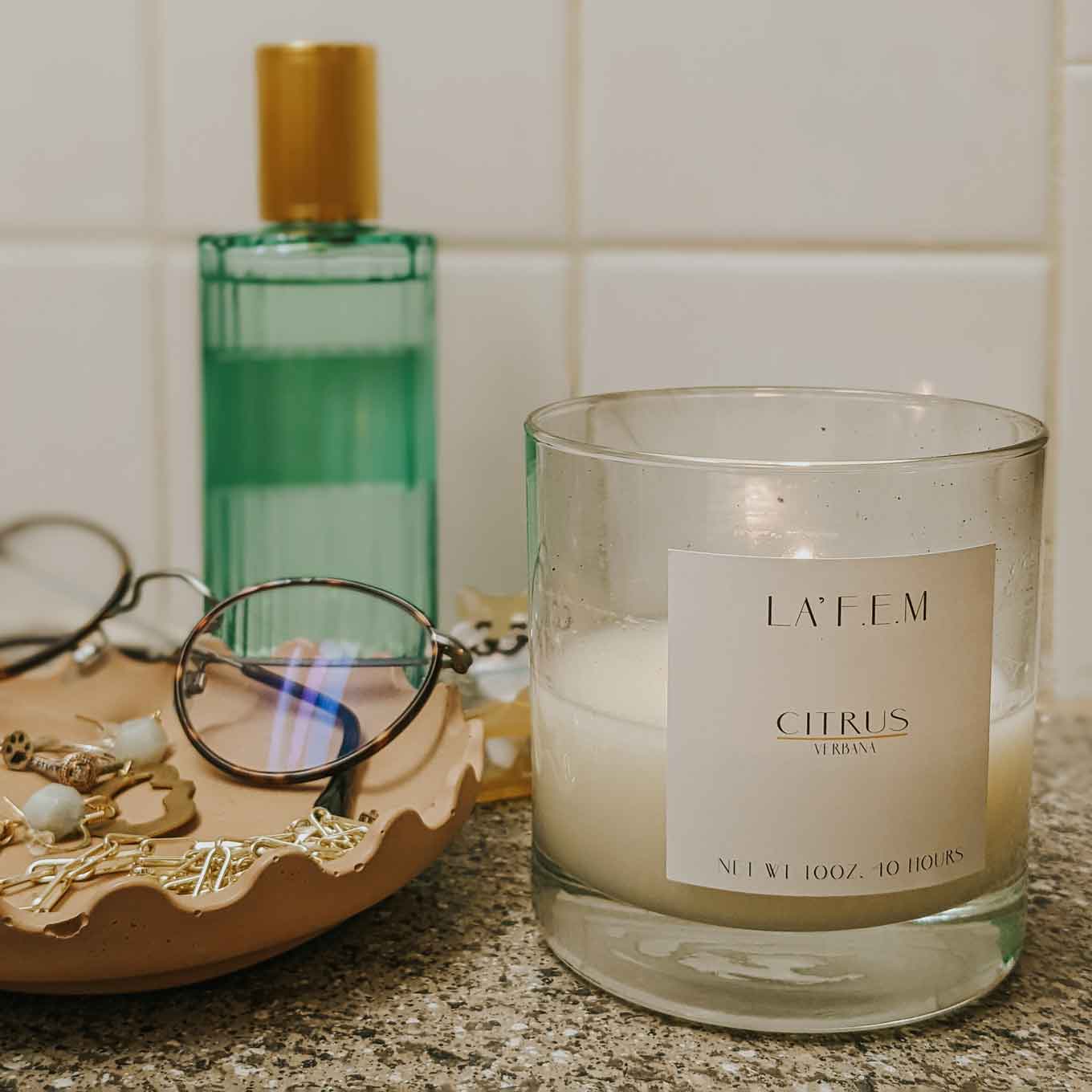
Kamrin’s Thoughts:
- Packaging: This candle came in a simple white cardboard box with a minimalist label.
- Scent: I received a Citrus candle, with citrus and verbena elements. I really enjoyed the fresh vibes it added to my home, and it was perfect for a spot in the bathroom or kitchen.
- Burn time: 40 hours
- Why it’s special: I love that this candle is from a BIPOC women-owned brand with an emphasis on sustainable luxury.
Other Notes: La’ F.E.M. candles are made in small batches by a BIPOC women-owned company, but they’re also sold through Made Trade, which is a Climate Neutral Certified e-commerce platform dedicated to ethically-elevated goods. It’s exciting to see this candle line among their collection of sustainable products!
→ Shop the La’ F.E.M. Citrus candle online.
The Refillable Plant-Based Candle from Grow Fragrance

Where to buy: Grow Fragrance
What’s good: According to Grow, they were the first to create a 100% plant-based candle — which ensures your candle is better for the environment and smells better than traditional petro-chemical candles.
Details: Your first candle order from Grow will come with a gorgeous white vessel and a separate candle “insert” in a recyclable aluminum container. The vessel will then be infinitely reusable as you continue to use their refillable candle inserts — eliminating waste and saving you money.
Each candle is toxin-free and they have full ingredient transparency on their site. (You can read through a list of everything inside your candle.) They also thoughtfully source the wick and vessel.
These candles offer a complex scent, and are toxin-free and safe for your home.
Price: $34 for the vessel and insert — and then refills are just $20

Branden’s Thoughts:
- Packaging: There was no plastic to be found in my shipment. Grow uses paper-based tape on a cardboard box — and instead of using bubble wrap, they wrapped each candle in a recyclable corrugated paper packaging for padding. My candles arrived safely and sustainably.
- Scent: So far I’ve tested the Lavender and Bamboo scents and love them. I’m already looking forward to ordering their limited edition Sea Salt Neroli insert refill soon.
- Burn time: 40-45 hours
- Why it’s special: I love burning candles, but I struggle with the leftover container at the end.
This candle finally solves that problem for me. I can continue to reuse the candle’s vessel forever — and the only “waste” is the recycled and recyclable aluminum insert that slides into the vessel.
Aluminum is among the most infinitely recyclable materials — and recycling aluminum saves roughly 90% of the energy used to create virgin aluminum.
Plus, the vessel has a small hole in the bottom — which means that if I ever decide to retire it, it can perfectly transition into a small planter with a drainage hole.
Other Notes: Grow Fragrance is a member of 1% for the Planet (just like Good Good Good!) and is a certified B Corporation. Their products are manufactured in the United States and are all Leaping Bunny certified. They pay their employees a living wage — and only partner with manufacturers that do the same.
→ Shop Grow candles online at Grow’s website.
P.F. Candle Co.
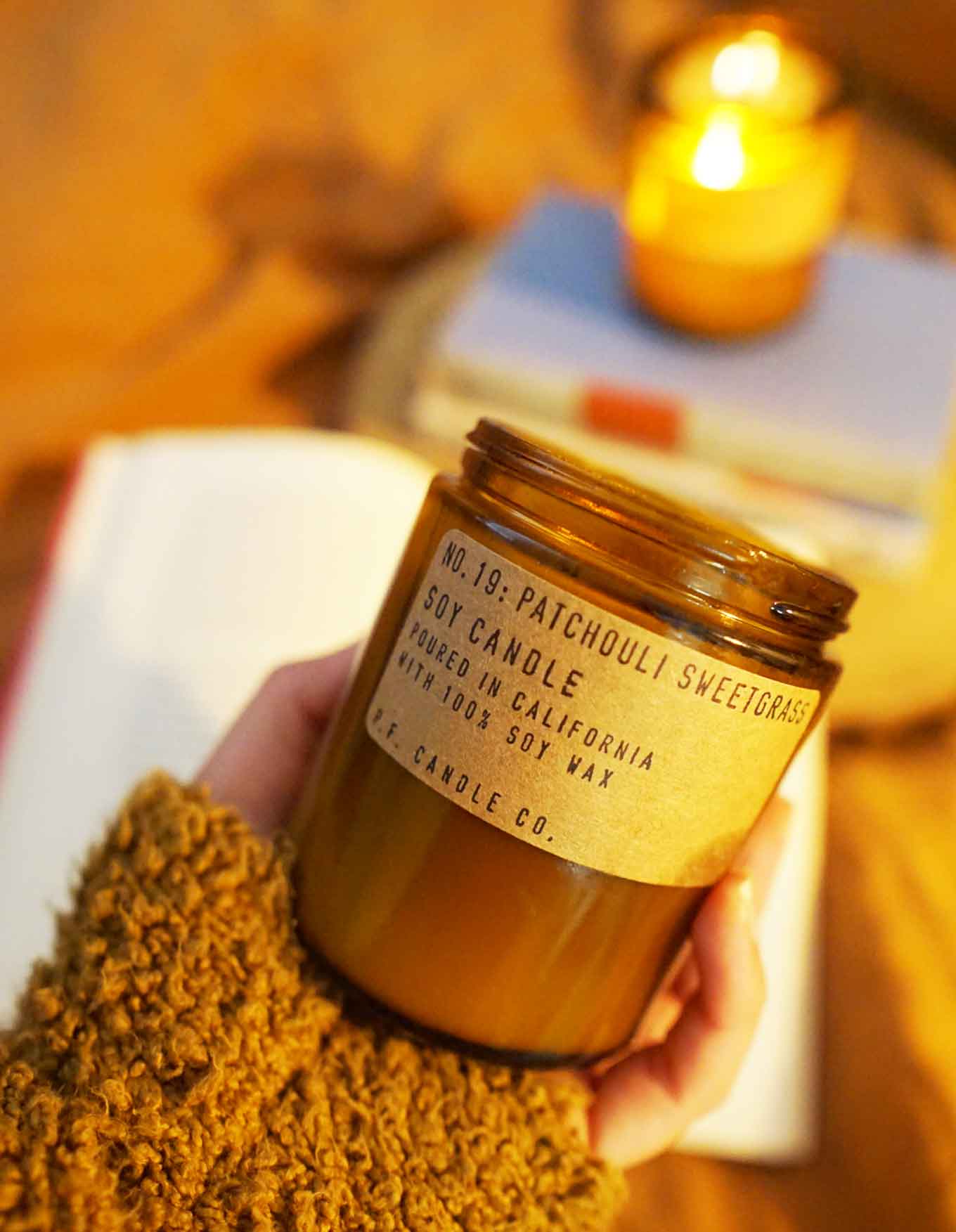
Where to buy: P.F. Candle Co., Urban Outfitters,
What’s good: All P.F. products are developed, produced, tested, and packed in Los Angeles, CA (we love to see a low-carbon supply chain!). P.F. uses sustainable and eco-friendly ingredients to provide a safe burn for all of their candle shoppers.
Details: P.F. candles are made with 100% domestically-grown soy wax, vegan, cruelty-free, and phthalate-free. The candle I reviewed, Teakwood & Tobacco, is within the “woody” fragrance family.
Price: $24
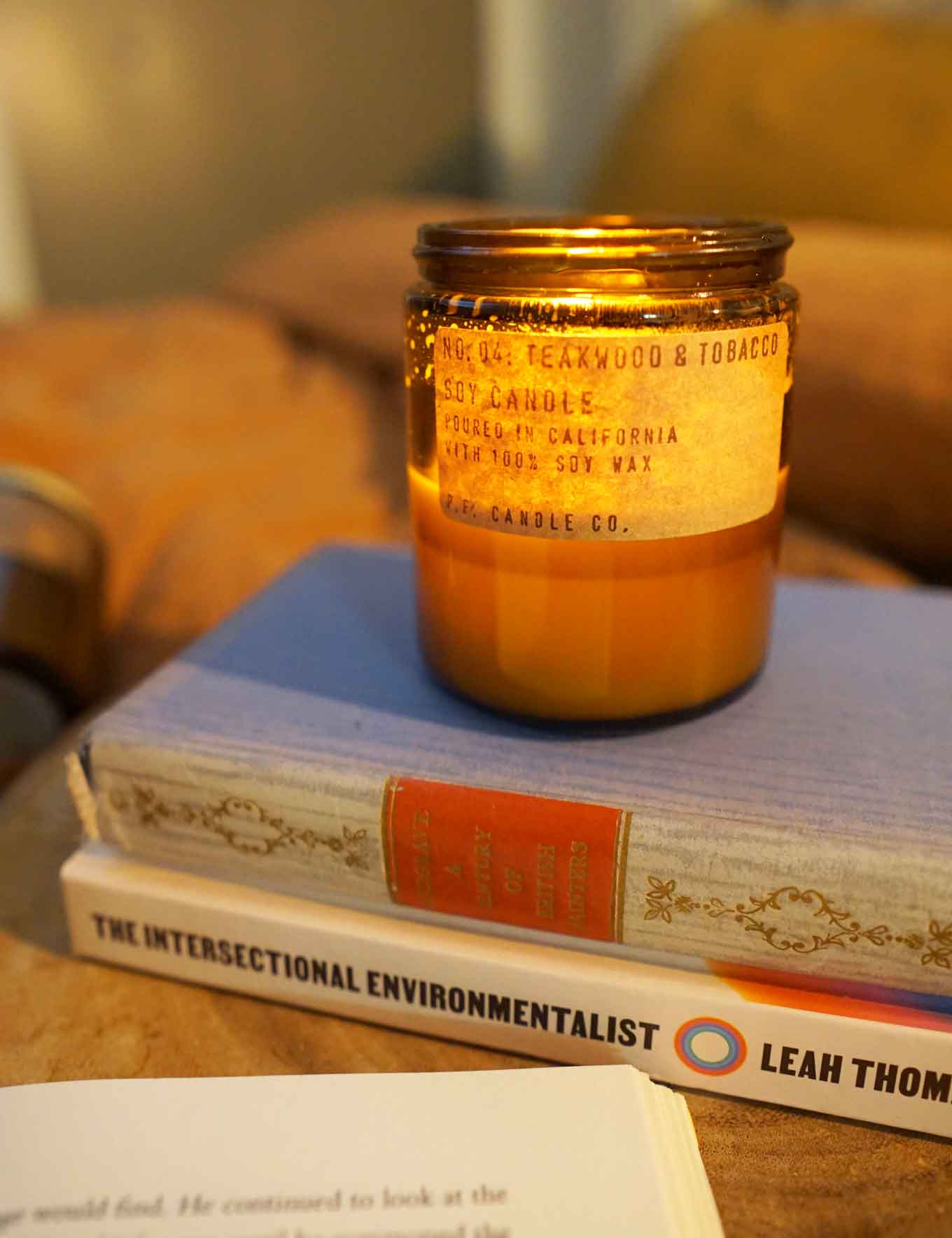
Amanda’s Thoughts:
- Packaging: My candle came mindfully packaged in plastic-free corrugated bubble wrap and a simple cardboard box. As I unwrapped the candle, I was met with an apothecary-like amber jar, complete with a brass lid, and kraft label. I knew this vessel would fit right in with my place!
- Scent: I received the Teakwood & Tobacco Soy Candle, with subtle woody elements. I’m a big fan of anything that smells like I’m bundling up in a remote log cabin. This scent isn’t overwhelming (some leather-teak candles can be) and I absolutely love how you can also catch a subtle whiff of orange!
- Burn time: 40-50 hours
- Why it’s special: From its mindful packaging to the company’s sustainable supply chain, to the scent itself, this candle keeps sustainability at the forefront while giving us the coziest sensory experience.
Other Notes: P.F. Candle Co is also Climate Neutral Certified! It is so reassuring to know that when you use their candles, you are being a responsible consumer.
→ Shop for candles online at P.F. Candle Co.
Wellness Candles From Atmosphere Three-Sixty
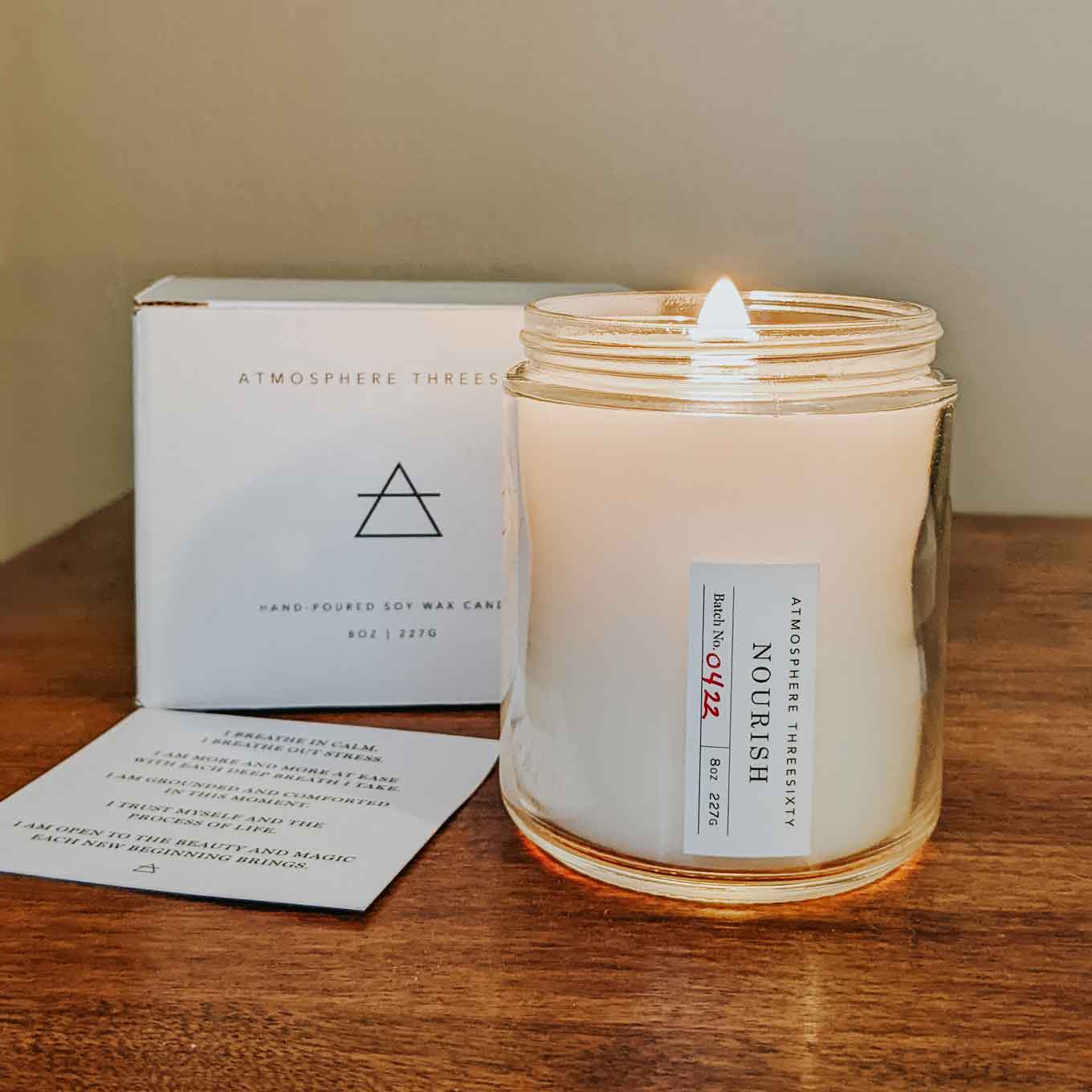
Where to buy: Atmosphere Three-Sixty
What’s good: Atmosphere Three-Sixty is another BIPOC woman-owned brand that was created to be a healing sanctuary. Their line of candles is an extension of their mission to “help women heal through intentional living and mindfulness.”
Details: Hand-poured in small batches in a glass vessel, this candle is made with soy wax, a wooden wick. The Nourish candle, in particular, is designed with the intention of cultivating a nurturing and grounding space and includes a reiki-attuned clear quartz point, designed to help you connect to yourself and amplify divine intention.
Price: $18-29
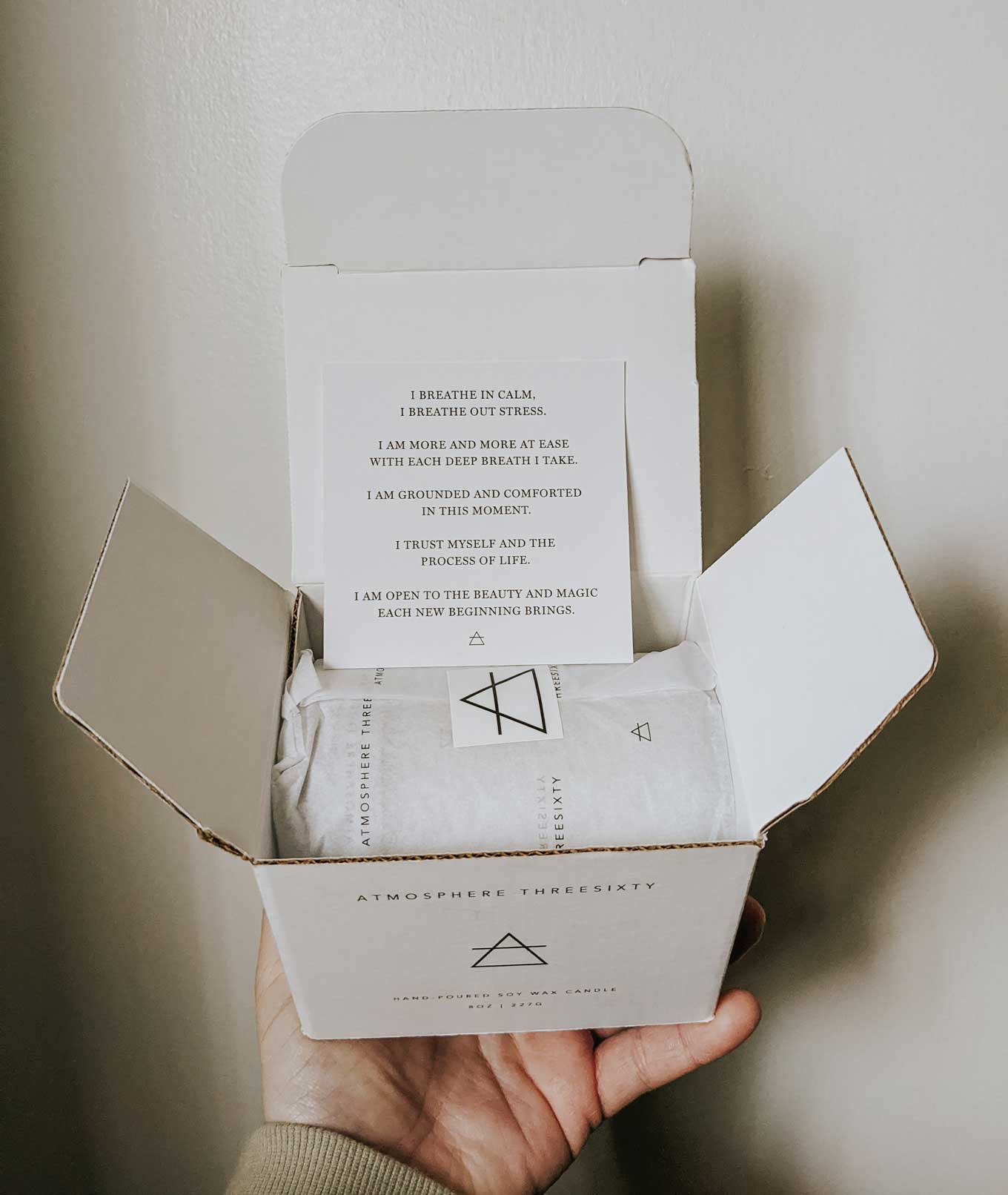
Kamrin’s Thoughts:
- Packaging: This candle is thoughtfully wrapped in tissue paper and placed in a small cardboard box.
- Scent: I tried the Nourish candle, which includes notes of rose, lily of the valley, and sandalwood. This woodsy and floral scent combines perfectly to create a grounding fragrance.
- Burn time: Not listed on the candle or website.
- Why it’s special: This candle came with a lovely affirmation card that accompanies the relaxing scent and healing crystal.
Other Notes: This is definitely my new favorite candle. The scent is delightful, I love hearing the crackle of the wooden wick, and the strength of the fragrance permeates my entire apartment. I love to light it when I sit down at my desk to work.
→ Shop wellness candles online with Atmosphere Three-Sixty.
More recommended environmentally-friendly candle brands
Ranger Station: Whiskey Glass Vessels

Where to buy: Ranger Station, Amazon
What’s good: Ranger Station candles are hand-poured in Nashville, Tennessee into high-quality whiskey glasses. Buy a few of these and now you have all of your sustainable glassware covered (after you’ve burned through all 30 hours.) Each candle comes with a perfectly paired cocktail recipe to enjoy once the candle has burned through.
Details: Made with a premium soy wax blend and natural essential and fragrance oils. Each standard 8-ounce whiskey glass candle burns for at least 30 hours.
Price: $36
United By Blue: Keepsake Vessels

Where to buy: United By Blue
What’s good: United By Blue’s cozy candle collection comes in beautiful ceramic keepsake vessels that can be easily repurposed for household use.
Details: Made with 100% soy wax. Vessels can be used for household use after wax burns away, as all glazes are lead-free and food and microwave-safe.
Candles come in five scents: Wild Bramble, Mountain Peak, Tioga Woods, Log Cabin, and Surf, in both 14 and 18-ounce options. 14-ounce candles have a burn time of 65-80 hours, while 18-ounce candles burn for 75-90 hours.
Price: $30-40
Paddywax National Park Candles: Giving Back
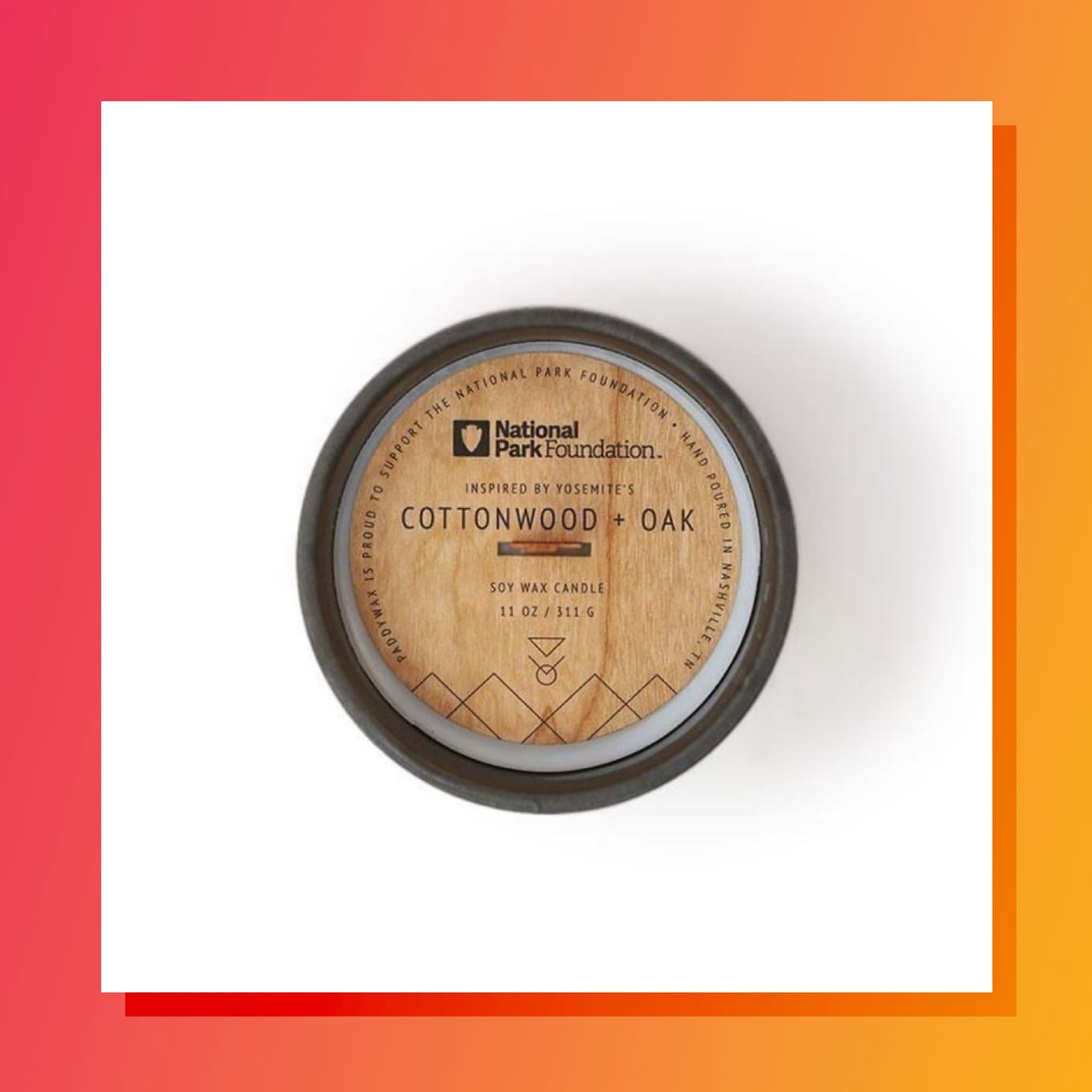
Where to buy: Paddywax, Amazon, Urban Outfitters
What’s good: This collection of Paddywax candles was designed to represent America’s national parks. The reusable textured vessels are inspired by the landscapes of these national parks, and each candle comes with a visitor’s guide to the place they represent.
Best of all, Paddywax gifts a minimum donation of $30,000 to the National Park Foundation — making these a great gift for anyone who loves national parks.
Details: Paddywax national park candles are made with a clean-burning soy wax blend with no phthalates or formaldehydes. Paddywax uses vegan fragrance oils and cotton wicks and are designed with a second life in mind.
National park fragrances include Yosemite, Glacier, Yellowstone, Acadia, Great Smoky, Grand Canyon, and Olympic. They are all 11 ounces and burn for about 65-75 hours.
Price: $42
Paddywax Eco Candles: Soy Wax
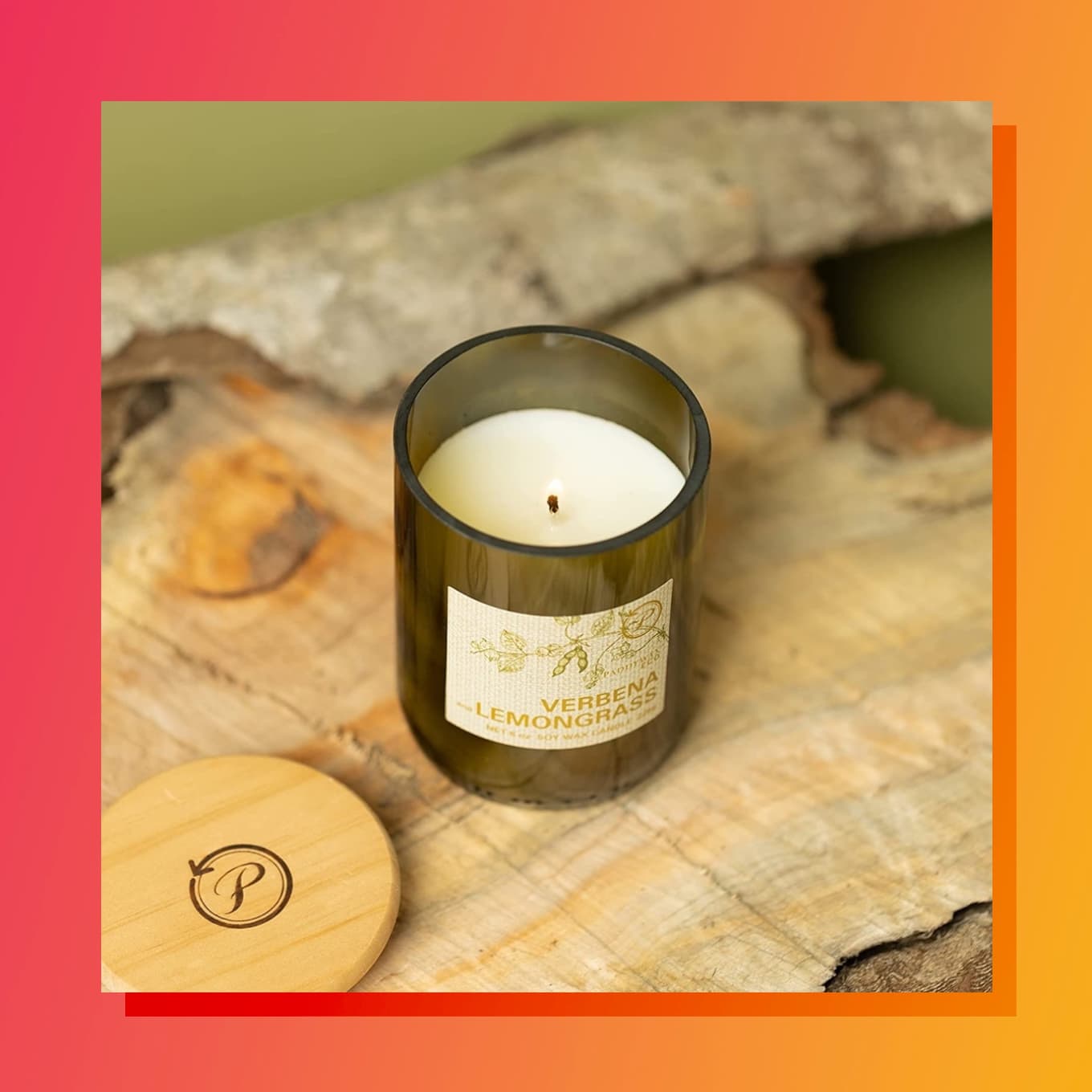
Where to buy: Paddywax, Amazon, Urban Outfitters
What’s good: This Paddywax collection candle was made with eco-friendliness in mind. Poured in upcycled glass vessels, the company encourages shoppers to repurpose them further by using them again after burning the candle.
Details: Paddywax Eco Candles are made with a clean-burning soy wax blend with no phthalates or formaldehydes. Paddywax uses vegan fragrance oils and cotton wicks and are designed with a second life in mind.
Eco scents include scents like Tobacco and Vanilla, Basil and Cucumber, or Mandarin and Lavender. They are all 8 ounces and burn for up to 56 hours.
Price: $28
Wax Buffalo: Small-Batch

Where to buy: Wax Buffalo
What’s good: Wax Buffalo candles are poured in reusable vessels, and local shoppers can return their glass containers and lids to the brick-and-mortar shop for discounts on their purchases. They also have a candle lab where candle-lovers can create their own dream candles.
Details: Hand-poured in small batches in Lincoln, Nebraska, Wax Buffalo candles are made with 100% domestically sourced soy wax and a premium blend of plant-based and phthalate-free, ethically-sourced fragrance oils. Classic candles come in 9 and 16-ounce containers.
Price: $24-36
Eco Candle Co: Earth Friendly
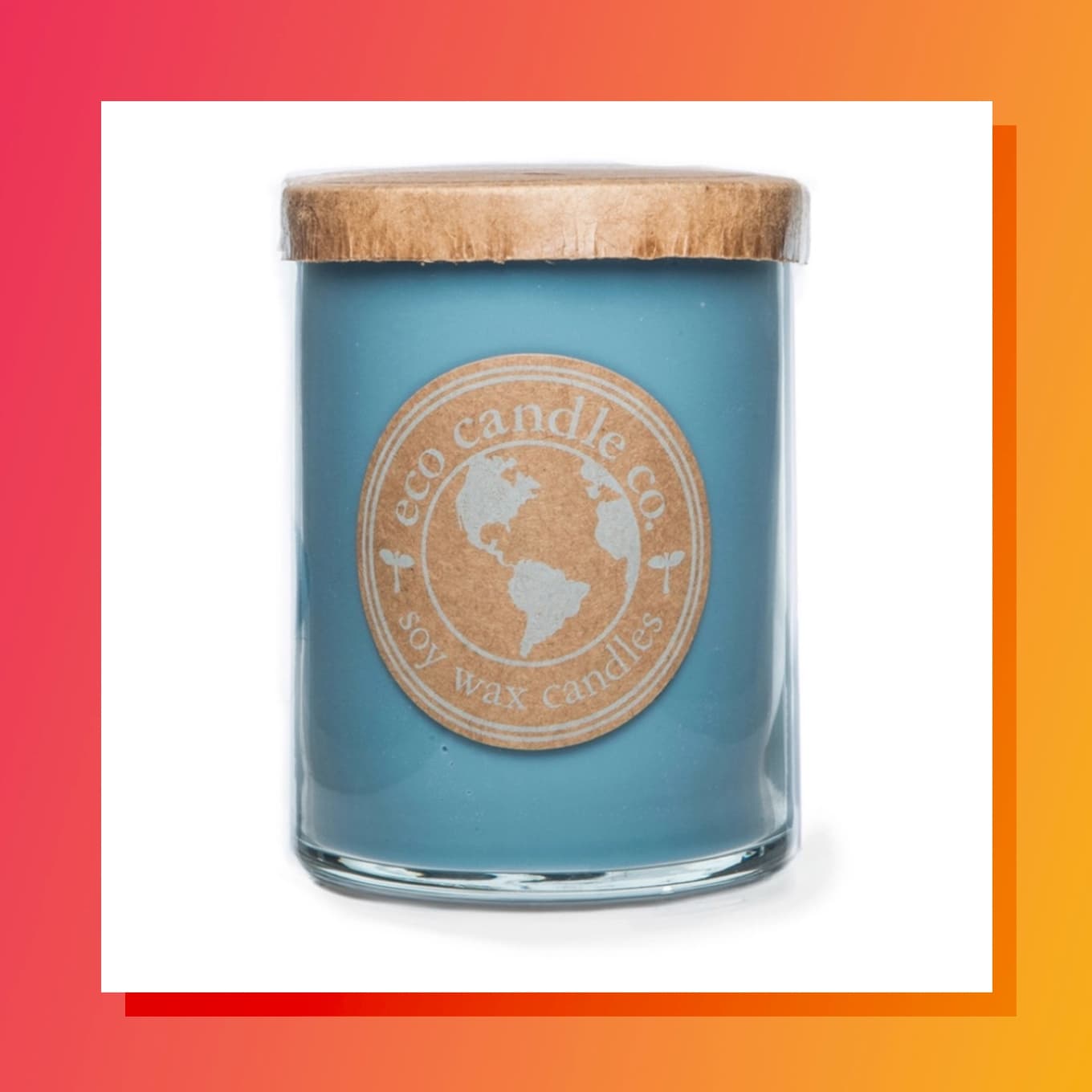
Where to buy: Eco Candle Co., Amazon
What’s good: These candles are packaged in recycled glass jars with paper lids and are made with midwest-grown soybeans for 100% pure soy wax.
Details: Hand-poured in Wisconsin, these soy candles use phthalate-free fragrances and essential oil blends, as well as natural paper, cotton, or hemp wicks. With a variety of scents from Blueberry Patch to Herb Garden, candles range from 6 to 26 ounces.
Price: $12-32
Uma: Non-Toxic

Where to buy: Uma, The Detox Market
What’s good: Uma is a beauty and wellness brand made with precious botanicals grown in India and built around the 5000-year-old wisdom of Ayurveda. All ingredients (and all products from Uma) are sustainably farmed, organically grown, vegan, and cruelty-free atop the company’s 100-acre meadow.
Details: Drawing inspiration from Ayurveda, Uma’s candles are intended to impact the overall environment and wellbeing of their customers through aromatherapy. Made with coconut wax and organic essential oils, candles are packaged in an 11-ounce glass vessel and have a burn time of 75 hours.
Price: $68
Good & Well Supply Co: Recyclable
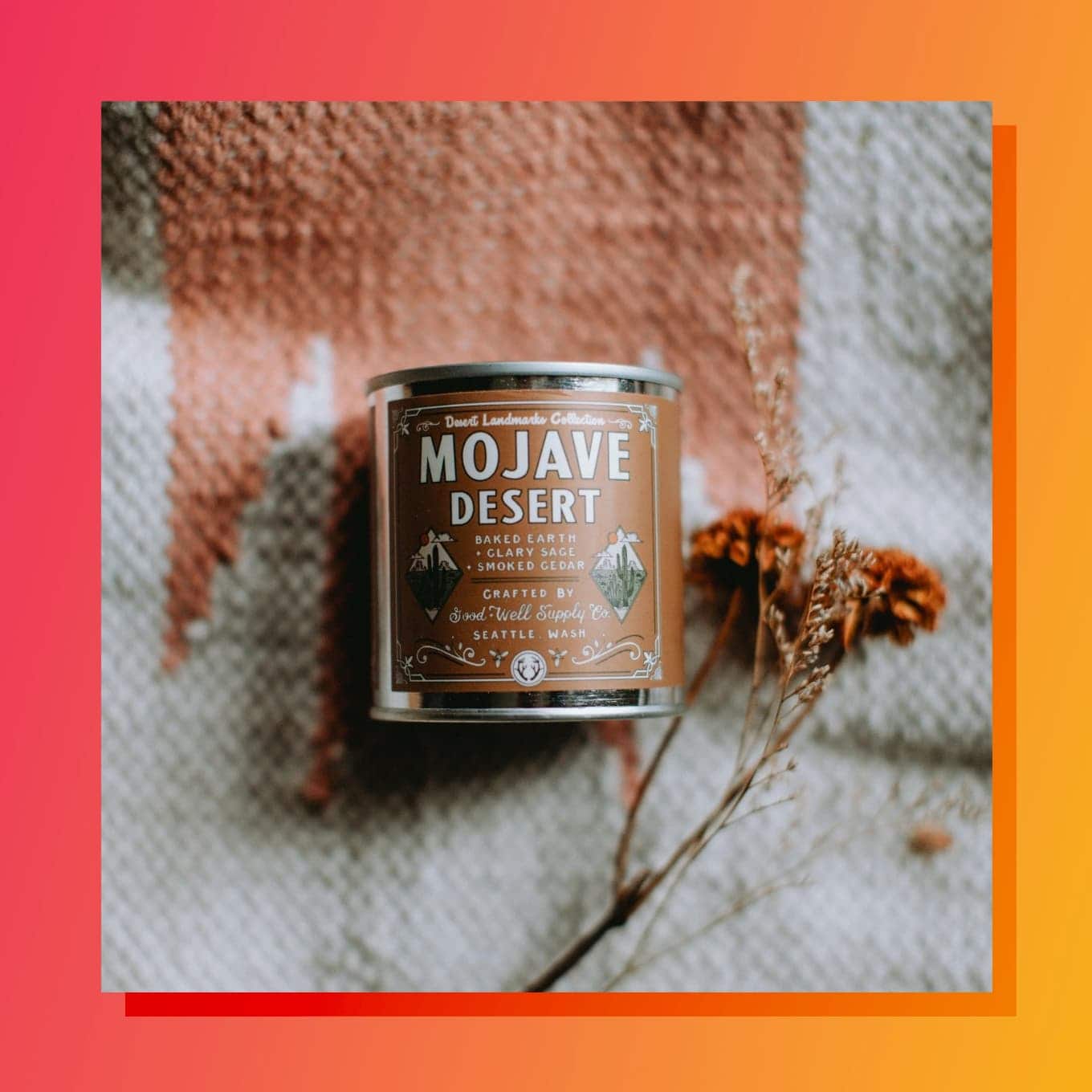
Where to buy: Good & Well Supply Co., Uncommon Goods, Luminary Emporium
What’s good: Good & Well Supply Co is dedicated to “good smells done well.” The company is deeply dedicated to ethical craftsmanship and donates 2% of its annual revenue to nonprofits that protect and conserve national parks and public lands, such as the National Park Foundation, Wilderness Society, Black Outside, and Earthjustice.
This year, Good & Well partnered with One Tree Planted to plant a tree for every product sold. Its National Park candle collection is 100% recyclable in aluminum and paper packaging. Other collections — like their vintage canteen candles — come in vessels that can be practically reused.
Details: All Good & Well candles are made with materials from the United States, including soy wax, balsa wicks, and American-made oils.
Price: $26-50
Hyggelight: Growing Candles

Where to buy: Hyggelight, EarthHero
What’s good: The founders behind Hyggelight are “hygge-inspired and plant-obsessed,” leading them to optimize a candle that creates an atmosphere of coziness, and not at the expense of the environment.
The Growing Candle leaves users with a repurposed pot of wildflowers with zero waste to discard. Customers light and enjoy their candles, and when they’re done, they plant the seed paper label that came with the vessel and watch wildflowers bloom.
And don’t worry if you accidentally discarded your first seed paper label; Hyggelight will send you a new one for free!
Details: Created with 100% soy wax, natural fragrances, and a cotton wick, each candle is in a different handmade terracotta vessel, all between 8 and 15 ounces. Customers can select from a list of scents, including classics like lavender, sandalwood and vanilla, lemongrass, and more.
Price: $30-40
Calyan Wax Co: Supporting Survivors

Where to buy: Calyan Wax Co., Amazon
What’s good: Calyan Wax Co’s mission is to support human trafficking survivors through the sale of natural candles. Five percent of Calyan’s revenue is donated to trusted and vetted nonprofits that uplift human trafficking survivors. Calyan has donated over $226,000 to date.
Details: Calyan’s fresh-scented candles are made with all-natural vegan soy wax that is phthalate-free and infused with essential oils. These candles include a cotton wick.
Candle vessels range from glass jars and tumblers to metal tins.
Price: $14-30
Mia Harlow Organics: Sculptural

Where to buy: Mia Harlow Organics, Five Nine
What’s good: Every time you make an order with Mia Harlow Organics, one tree is planted with One Tree Planted! All of the packaging used is recyclable, biodegradable, or reusable. In addition, any defective candles are melted back down and made into another candle or sold in a discounted sample sale.
Details: Mia Harlow candles are gorgeous, colorful sculptural candles and dining candles that will add dimension and personality to your space.
All candles are made with a unique blend of vegetable biodegradable wax, and are clean, vegan, and cruelty-free.
Price: $24-36
Arbor Made: Zero Waste

Where to buy: Arbor Made
What’s good: These candles come in a reusable candle jar. And we don’t just mean it’s a glass vessel you can repurpose; these containers have a special feature that allows you to pop out your nearly nonexistent candle remnants in one clean motion and replace it with a new wax refill from Arbor Made. Reusable jars have a lifetime guarantee, and Arbor Made hopes to be “the last candle you ever buy.”
Details: Arbor Made candle refills are made with non-toxic soy wax and are vegan and cruelty-free. At this time, Arbor Made offers four candle refill options: unscented, Spiced Timber, Mellow Breeze, and Petals Abloom.
Each scent also corresponds with a reputable charity that Arbor Made supports with each order, such as: One Tree Planted, Ocean Conservancy, Pollinator.org, and Clean Air Task Force.
The 8-ounce candle refills burn for 30-35 hours.
Price: $34-78
Folklore Candle Co: Storytelling Candles
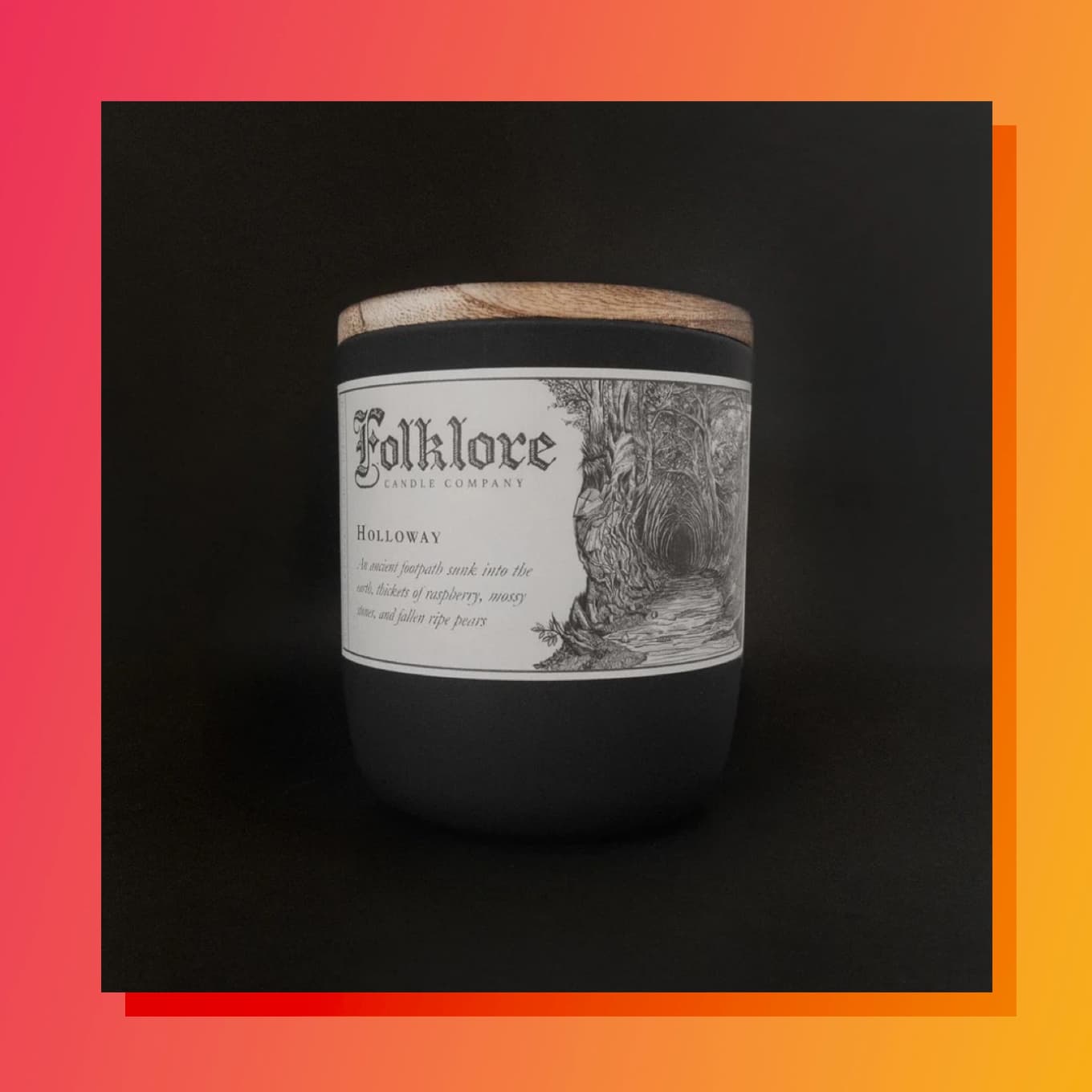
Where to buy: Luminary Emporium
What’s good: Folklore candles are made with eco-friendly ingredients in a Canadian studio. Their unique scents and approach to aroma aim to evoke rich storytelling for the consumer, with scents named Hedge Witch or Old Gods.
Details: Small-batched and hand-poured with hand-blended bespoke fragrances, these candles are made with paraffin-free soy wax, and a lead-free cotton wick. All candles are vegan, paraben-free, and phthalate-free. Available in both 2-ounce and 10-ounce options.
Price: $11.99-37.99
Heirloomed: Keepsake Vessel

Where to buy: Heirloomed, Five Nine
What’s good: Heirloomed candles are made with eco-friendly ingredients, but their main selling feature is that each vessel can be turned into a keepsake gift. All of Heirloomed’s Keepsake Candles have a special memory sticker for the candle gifter or recipient to write a special memory associated with the scent.
Details: Hand-poured by the Heirloomed team in their Atlanta, Georgia studio, each soy candle is contained in a glass vessel and is wrapped in high-quality kraft wrap. Thoughtfully blended scents include titles like Old Soul, Harvest, and Deep Ocean. Each candle is 8 ounces and burns for 35 hours.
Price: $28
Vellabox: Subscription Box

Where to buy: Vellabox
What’s good: Vellabox is a candle subscription company that sends you eco-friendly candles with your preferences in mind. Subscribers begin by taking a quiz to share their scent preferences and areas in their homes where they like to burn candles.
Details: Vellabox offers three subscription plans that vary in size and burn time: 4 ounces for 25 hours of burn time, 8 ounces for 50 hours of burn time, or 16 ounces for 80 hours of burn time. Scents also vary based on personal preferences.
Vellabox also has individual candles for sale in scents like Sangria, Cucumber Detox, or Soft Vanilla.
Price: $12-29
Evermore London: Rapeseed Wax

Where to buy: Evermore London
What’s good: Evermore London specializes in luxury vegan rapeseed wax candles hand-poured into hand-blown recycled glasses by skilled artisans in the UK.
Details: Evermore candles are made with natural fragrances and rapeseed wax that is phthalate-free. Scents include titles like Tides, Moon, Grove, or Venus. All candles are 300 grams (about 10.5 ounces) and burn for up to 60 hours.
Price: £55 (or about $67)
Other ways to collect candles sustainably
Make your own candle.
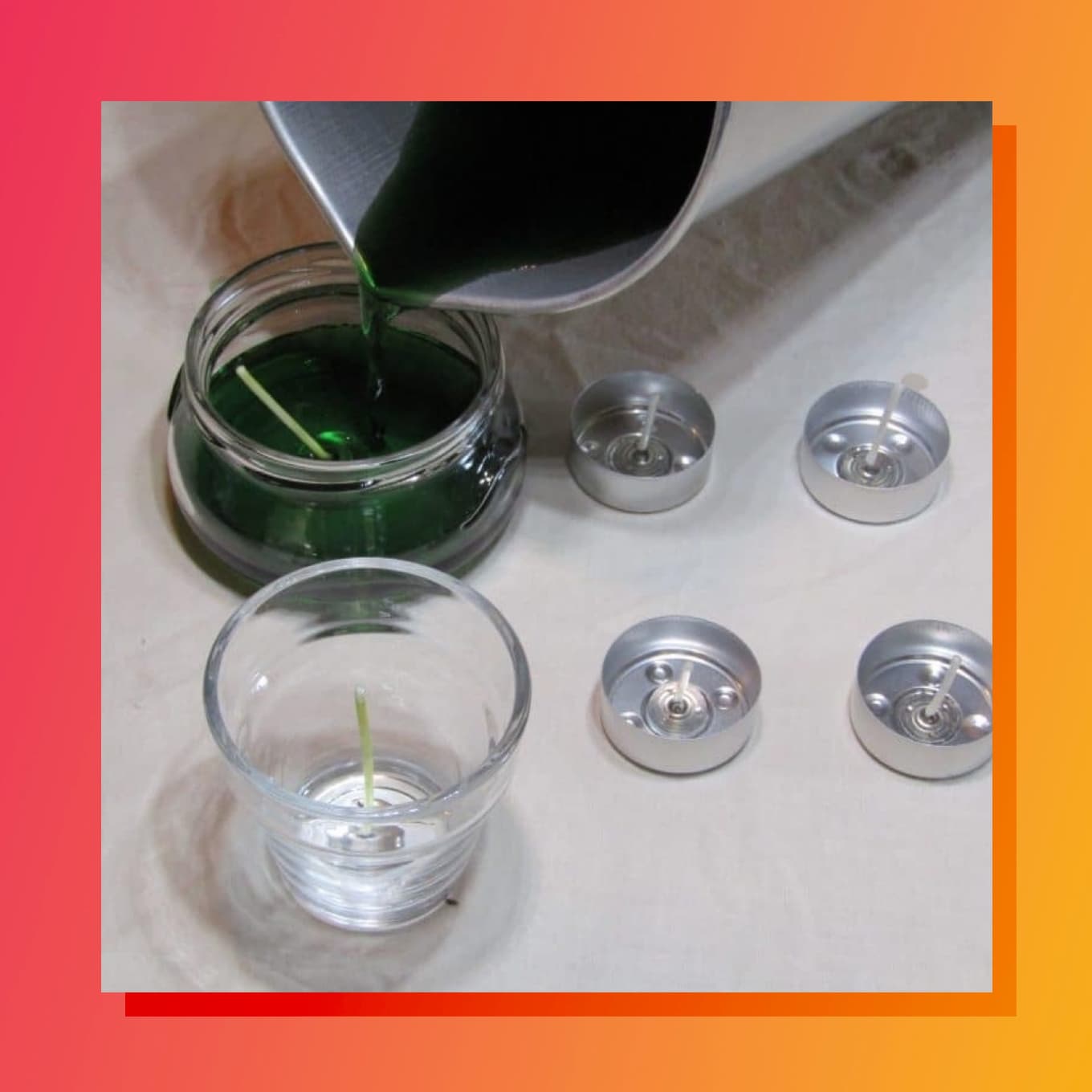
If you’re a DIY champ or looking for a new hobby, consider making your own candles! There are plenty of ‘how to make candles’ resources online, and if you turn out to be a pro, you can save money and resources by reusing containers and using bulk eco-friendly ingredients in your own time.
Buy gently-used candles.
You might not immediately gravitate towards a gently-used candle during your thrifting trips, but this can be a great place to find super affordable candles to add to your collection.
Our tips? Read the label to ensure the ingredients are eco-friendly (remember those waxes and wicks from earlier!), and even if they’re not, now you can purchase a reusable candle jar for 50 cents and all you need to do is clean it out.
Garage sales or estate sales are also good places to look for candles. Many times, these will be candles that have been lit once or twice and someone didn’t care for the fragrance. You may also be able to find brand-new candles for sale in these places, so keep your eyes peeled!
Shop candles from local artisans.
We think all of our suggestions are pretty fantastic, but the most sustainable way to shop for your candles is to buy them from local artisans (bye, shipping fares — and hello, reduced carbon footprint!).
Explore your local farmer’s market, boutique, or makers fair to find your next favorite scent.
Looking for more eco-friendly products for your home? Check out our ultimate guide.
Bryan Stevenson is a lawyer and activist who has dedicated his life to fighting for justice for the poor and marginalized. He is the founder and executive director of the Equal Justice Initiative, a non-profit organization that provides legal representation to those who have been unfairly incarcerated.
Stevenson's work has brought him into contact with some of the most difficult cases and circumstances imaginable. Yet, he remains hopeful and committed to his cause. In his book Just Mercy, he writes: “Each of us is more than the worst thing we've ever done.”
What can we learn from Bryan Stevenson about mercy and justice?
First, we can learn that mercy is always possible. No matter how terrible the crime or how hopeless a situation may seem, there is always the possibility of forgiveness and redemption. Second, we can learn that justice is not always about punishment. Sometimes, the best way to achieve justice is to show compassion and understanding. Third, we can learn that hope is essential. Hope gives us the strength to keep fighting for what is right, even when the odds seem insurmountable.
Bryan Stevenson's work reminds us that there is always reason to hope for a better future. His example shows us that it is possible to fight for justice with compassion and mercy. We can all learn from his example and strive to make our world a more just and merciful place.
Read these quotes to get inspired by Bryan Stevenson's wisdom — and to find the motivation to make a positive difference in the world.
The Best Bryan Stevenson Quotes
Famous Quotes
“Each of us is more than the worst thing we’ve ever done.”
— Bryan Stevenson
“I’ve come to believe that the true measure of our commitment to justice, the character of our society, our commitment to the rule of law, fairness, and equality cannot be measured by how we treat the rich, the powerful, the privileged, and the respected among us. The true measure of our character is how we treat the poor, the disfavored, the accused, the incarcerated, and the condemned.”
— Bryan Stevenson
“When you experience mercy, you learn things that are hard to learn otherwise. You see things you can't otherwise see; you hear things you can't otherwise hear. You begin to recognize the humanity that resides in each of us.”
— Bryan Stevenson
“The opposite of poverty is not wealth. In too many places, the opposite of poverty is justice.”
— Bryan Stevenson
“We all have a responsibility to create a just society.”
— Bryan Stevenson
“You don’t change the world with the ideas in your mind, but with the conviction in your heart.”
— Bryan Stevenson
On Justice
“Love is the motive, but justice is the instrument”
— Bryan Stevenson
“It is about how easily we condemn people in this country and the injustice we create when we allow fear, anger, and distance to shape the way we treat the most vulnerable among us.”
— Bryan Stevenson
“It is a paradox for a society that talks about freedom & equality to be so comfortable with having the highest rate of incarceration in the world. We’ve got 4% of the planet’s population, but nearly 25% of the planet’s imprisoned. And nobody seems to feel bad about that.”
— Bryan Stevenson, on With(in) podcast.
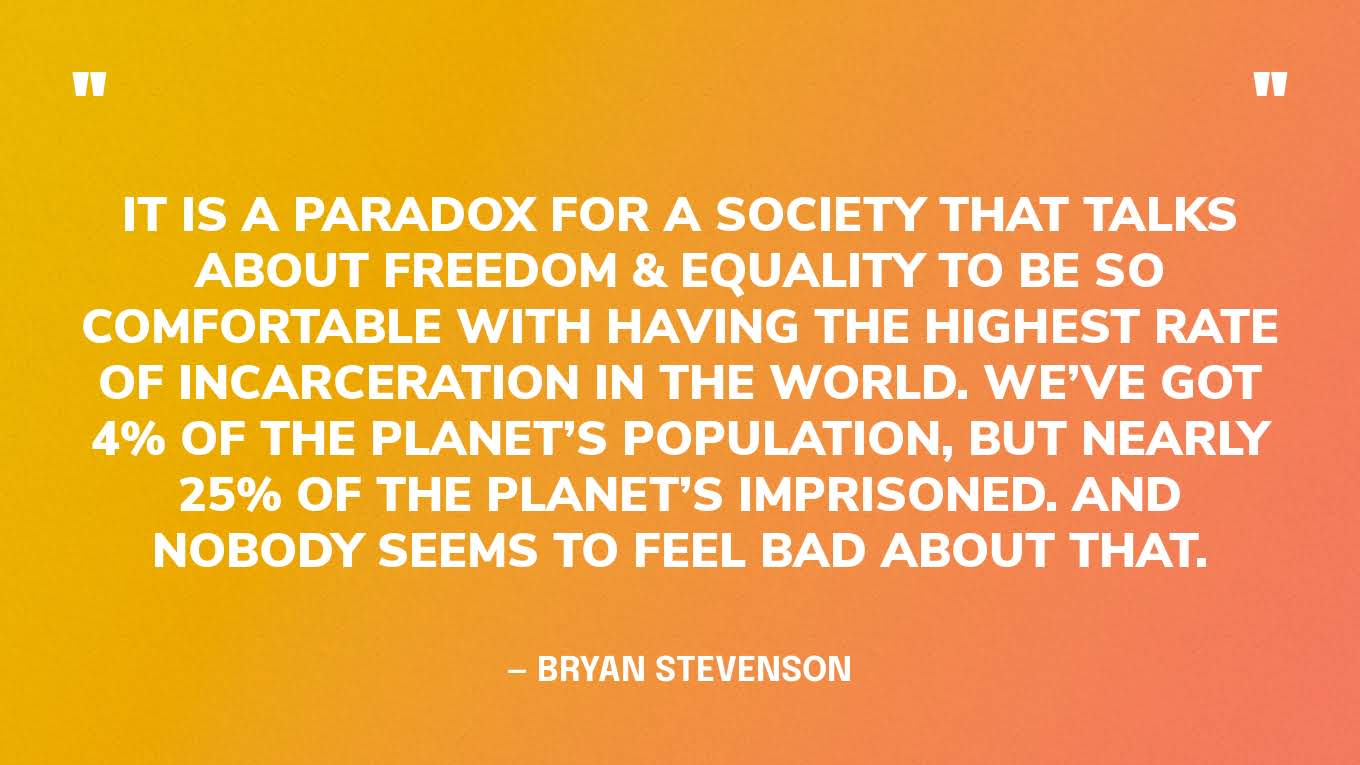
“I may be old, I may be poor, I may be Black, but I’m here. I’m here because I’ve got this vision of justice that compels me to be a witness. I’m here because I’m supposed to be here. I’m here because you can’t keep me away.”
— Bryan Stevenson
→ Read more of the best quotes about justice
On Mercy
“Mercy is most empowering, liberating, and transformative when it is directed at the undeserving. The people who haven’t earned it, who haven’t even sought it, are the most meaningful recipients of our compassion.”
— Bryan Stevenson
“Sometimes we’re fractured by the choices we make; sometimes we’re shattered by things we would never have chosen. But our brokenness is also the source of our common humanity, the basis for our shared search for comfort, meaning, and healing. Our shared vulnerability and imperfection nurtures and sustains our capacity for compassion.”
— Bryan Stevenson
“I decided that I was supposed to be here to catch some of the stones people cast at each other.”
— Bryan Stevenson
“We've submitted to the harsh instinct to crush those among us whose brokenness is most visible.”
— Bryan Stevenson
But simply punishing the broken — walking away from them or hiding them from sight — only ensures that they remain broken and we do, too. There is no wholeness outside of our reciprocal humanity.”
— Bryan Stevenson
“It’s when mercy is least expected that it’s most potent — strong enough to break the cycle of victimization and victimhood, retribution and suffering. It has the power to heal the psychic harm and injuries that lead to aggression and violence, abuse of power, mass incarceration.”
— Bryan Stevenson
→ Read more quotes about ending the death penalty
On Hope
“The kind of hope that creates a willingness to position oneself in a hopeless place and be a witness, that allows one to believe in a better future, even in the face of abusive power. That kind of hope makes one strong.”
— Bryan Stevenson
“I know that some have been through more than others. But if we don’t expect more from each other, hope better for one another, and recover from the hurt we experience, we are surely doomed.”
— Bryan Stevenson,
“Hope is kind of an orientation of the spirit; it’s how you position yourself in places where there’s a lot of despair.”
— Bryan Stevenson, on the podcast Person Place Thing with Randy Cohen.
“Hopelessness is the enemy of justice. Hope allows us to push for word, even when the truth is distorted by the people in power. It allows us to stand when they tell us to sit down, and to speak when they say be quiet.”
— Bryan Stevenson
“But if we don't expect more from each other, hope better for one another, and recover from the hurt we experience, we are surely doomed.”
— Bryan Stevenson
→ Read more of the best quotes about hope
On Motivation
“There's always something we can do. Whatever you did, your life is still meaningful.”
— Bryan Stevenson
“It can be a challenge, but my legacy, at least for the people who came before me, is you don't run from challenges because that's more comfortable and convenient.”
— Bryan Stevenson
“We are all implicated when we allow others to be mistreated.”
— Bryan Stevenson
“When we create the right kind of identity, we can say things to the world around us that they don’t actually believe makes sense. We can get them to do things that they don’t think they can do.”
— Bryan Stevenson
“You should not underestimate the power you have to affirm the humanity and dignity of the people around you. When you do that, they will teach you something about what you need to learn about human dignity, but also what you can do to be a change agent.”
— Bryan Stevenson, on On Being with Krista Tippet podcast.
More Quotes
“Always do the right thing even when the right thing is the hard thing.”
— Bryan Stevenson
“There is no disconnect around technology and design that will allow us to be fully human until we pay attention to suffering, to poverty, to exclusion, to unfairness, to injustice.”
— Bryan Stevenson
“Somebody has to stand when other people are sitting. Somebody has to speak when other people are quiet.”
— Bryan Stevenson
“We have a choice. We can embrace our humanness, which means embracing our broken natures and the compassion that remains our best hope for healing. Or we can deny our brokenness, forswear compassion, and, as a result, deny our own humanity.”
— Bryan Stevenson
As some lawmakers extend thoughts and prayers, firearms continue to impose a greater toll on Black communities
As the number of mass shootings has surged beyond the number of days in 2022, President Joe Biden addressed the country in a televised primetime speech Thursday to advocate for policy solutions and urge lawmakers to “finally do something” about the nation’s gun violence epidemic.
Following the massacres of 10 Black people in New York, 19 children in Texas, and four employees at a hospital in Oklahoma, Biden told viewers that the Second Amendment is “not absolute.”
He called for raising the minimum age to purchase a firearm from 18 to 21, strengthening background checks, and passing “red flag” laws that allow authorities to temporarily limit gun access for people who pose a threat to themselbuyves or others.
Biden is also calling for a ban of assault-style rifles and high-capacity magazines. The gunmen behind the New York and Texas shootings were 18 years old, and while too young to buy alcohol, they purchased their assault-style rifles legally. The now-deceased Texas killer made at least two trips to a firearms dealer and seamlessly purchased long guns shortly after his birthday. The gunman from Oklahoma’s shooting purchased an AR-15 style rifle hours before he killed two doctors and two others on May 31 before he died by suicide.
“Guns are the number one killer of children in the United States of America. The number one killer. More than car accidents. More than cancer,” Biden said Thursday, sourcing a recent U.S. Centers for Disease Control and Prevention report.
“For God’s sake, how much more carnage are we willing to accept? How many more innocent American lives must be taken before we say ‘enough’? Enough.”
After every senseless mass shooting, some lawmakers utter the overused phrase of “thoughts and prayers” while others demand stronger gun laws. As lawmakers teeter-totter in Congress, Black and brown communities continue to fall victim to gun violence disproportionately.
American deaths from gun-related injuries rose to the highest level on record in 2020, the most recent data available from the U.S. Centers for Disease Control and Prevention. The agency reported that more than 45,000 people were killed — 54% were suicides and 43% were murders.
Black men were far more likely to become victims, with a rate of nearly 35 firearm-related deaths per 100,000 people. Black women also had higher rates of death than women of other races and ethnicities.
Most alarming, 9.5 out of every 100,000 Black children and teens were killed with a gun — “a rate four times higher than the rate for White children and teens,” according to 2015 data analyzed by the Children Defense Fund. A Black child or teen was killed with a gun every 7 hours and 25 minutes, the report found.
While background checks have dominated the gun-control conversation, other solutions also are getting attention.
Here’s a look at a few solutions to gun violence that anti-violence advocates and elected officials have been touting:
1. Gun buyback programs
Gun buyback programs have been implemented in cities across the country, including communities in New York, Chicago, and Boston. The don’t-ask-don’t-tell systems allow anyone to walk into a designated location and turn in any form of an operable or inoperable firearm in exchange for a monetary amount.
These gun collection events have been in existence since the 1970s. In 1974, more than 13,000 guns were turned in in Baltimore over a three-month period, for $50 each.
The programs are usually held in collaboration with local prosecutor offices and police departments. For example, the Brooklyn District Attorney’s Office along with the New York City Police Department have hosted several gun buyback events over the past decade, and at one event collected close to 300 weapons.
Brooklyn District Attorney Eric Gonzalez said his office has conducted two gun buyback programs this year and believes that “constant engagement with communities to prevent violence is bearing fruit.”
Gonzalez said in a statement leading up to the office’s second gun buyback event that shootings in Brooklyn have decreased “by nearly 25% so far this year, following a 20% drop in 2021.” The event resulted in 69 recovered firearms — the largest collection under Gonazlez’s leadership, according to Oren Yaniv, a spokesman for the prosecutor’s office.
The May 21 event took place at Emmanuel Baptist Church in Clinton Hill, where anonymous contributors were offered $200 bank cards and an iPad per gun or assault rifle, while supplies lasted. Participants who turned in rifles, shotguns, and air guns received $25 per gun, up to a maximum payout of $600. The first event netted 39 weapons.
It’s a drop in the bucket when considering that there are more guns circulating in the U.S. than there are people. According to the Small Arms Survey, there are an estimated 393 million privately owned guns nationwide, or about 120.5 weapons per 100 Americans.
There’s little information to show that gun buyback programs have been effective in combating gun violence in the U.S., because they “have occurred infrequently and on a relatively small scale,” according to Gun By Gun, a nonprofit organization that advocates for gun buyback programs.
But the group noted that a mandatory gun buyback program in Australia in the 1990s, which pulled more than 600,000 guns off that country’s streets, was followed by a substantial decline in homicides and suicides.
The uniquely lenient gun laws in the U.S. also could counteract efforts to reduce the prevalence of firearms on American streets. In an op-ed this month for the New York Daily News, Gonzalez expressed concern that his office’s efforts to reduce gun-related crimes may be in vain if the U.S. Supreme Court overturns a New York state law that “restricts the concealed carrying of handguns to those who can show a special need.”
“The court’s decision, which would impact more than 80 million Americans in states with similar laws, could flood our city with an influx of legal guns, exacerbating already unacceptable levels of violence,” he wrote.
“More guns in our urban neighborhoods would be especially devastating to Black and Brown communities, who already suffer disproportionately from gun violence.”
Related: Read quotes about bringing an end to gun violence
2. Community activism
While officials debate gun laws and attempt to reduce weapons on the streets, community activists have used boots-on-the-ground efforts to raise awareness and prevent gun violence.
Every first weekend in June, in recognition of National Gun Violence Prevention Day, people across the country wear orange while participating in demonstrations and community service events, a campaign that started in remembrance of 15-year-old Hadiya Pendleton, who was fatally shot in 2013 on a Chicago playground.
In Georgia, 100 Black Men of Atlanta Inc. relaunched an anti-gun violence campaign in April that uses billboards and social media awareness, as well as collaborations with the public school system, to drown out the sound of gunshots with a flood of messaging against gun violence.
The Black Child Legacy Campaign, based in Sacramento, California, was established after a 2013 Blue Ribbon Commission report found that firearms were used in the deaths of 70% of Black children who were killed by a third-party (someone other than their primary caregiver).
The organization launched efforts to provide job training, violence prevention, and community service for “high risk” youth.
The BCLC touts the work of the Office of Neighborhood Safety in Richmond, California, which reported a 71% reduction in gun violence between 2007 and 2016 by using individuals who were once in the criminal justice system as “neighborhood change agents” who intervene when interpersonal conflicts arise, providing nonviolent solutions and resources to prevent violence.
In New York City, the 14-year-old community organization Save Our Streets (S.O.S.) also has used a boots-on-the ground approach to reduce conflict and all forms of violence, which organizers say contributed to a reduction in shooting victims in the Bronx.
As with mass shootings, there are typically red flags that proceed street violence, said James Brodick, director of community development and crime prevention for the Center for Court Innovation, which operates S.O.S. That’s when members of S.O.S., who are from the community and have built trust, step in to defuse the situation before police get involved.
“The people who shoot are getting younger and younger, which is really unfortunate,” Broderick said. “They don’t understand the ramifications of what they’re doing or they feel such a sense of hopelessness that they’ll say, ‘I had nothing to lose and actually the gun is giving me power in my community.’ ”
Brodick said communities need to provide young people with more opportunities that prevent them from feeling like they have nothing to lose, but everything in life to experience and gain.
“Until we make long-term, deep investment in addressing issues around trauma, addressing issues around economic mobility, we’re going to have the same conversations over and over and our communities will continue to be overpoliced,” Brodick said.
Related: Learn more about what you can do to help stop gun violence
3. Suing gun manufacturers
Guns that were legally or illegally purchased or trafficked contributed to more than 19,000 homicides in 2020, according to the CDC. Historically, when a product has been found to cause harm or death to an individual, it is taken off the shelves or recalled — yet federal law prevents gun manufacturers from being held liable if their product is used in a crime.
On Thursday, Biden called for repealing the immunity that protects manufacturers and gun retailers from being held liable. Biden said he also believes gun owners should be held responsible if they haven’t kept their firearms locked away in a safe, as in the case of Ethan Crumbley, whose parents were also charged for giving their son easy access to their firearms before he killed four students at a Michigan high school.
There are signs that a shift could be coming. In 2019, the U.S. Supreme Court gave the families of the 2012 Sandy Hook Elementary School massacre the greenlight to sue Remington, the gun manufacturer of the rifle used by the gunman. This February, the company settled the lawsuit with the families of 20 first-graders and six teachers victimized by the shooting for $73 million.
The families told The Associated Press that their focus was “on preventing future mass shootings by forcing gun companies to be more responsible with their products and how they market them.”
Gun violence not only affects the victims directly involved with a shooting — it financially impacts the broader community, which picks up the tab for medical bills, mental health care, and other consequences.
Everytown for Gun Safety, a nonprofit gun violence prevention organization, published a study in February 2021 that found that “federal, state, and local governments are spending a combined average of $34.8 million each day to deal with the aftermath of gun violence across the country.”
Ronald Adrine, a board member with anti-violence organization Futures Without Violence, said he hopes the Supreme Court will continue to move in the direction of accountability for the damage guns cause, but “given the direction that this Supreme Court is going in, I don’t hold out a lot of hope in the short term.”
When lawmakers offered “thoughts and prayers” after Sandy Hook, Adrine said he “pretty much gave up hope” that any gun control laws would ever happen in this country.
“I think that eventually this carnage is going to get to the point where the vast majority of American citizens, who have already let it be known that they want some sort of common sense approaches to gun control, will assert themselves and form some kind of organization or movement that will actually be able to counterbalance the passionate organization of the small number of folks who want no gun control,” said Adrine, a former municipal court judge based in Cleveland. But, he added,
“Until that happens, we’re not gonna see anything that’s going to turn this around.”
Related: Learn what actions you can take to stop school shootings
A state chapter of environmentalist Bill McKibben’s Third Act marches on big banks to shut off funding for the Mountain Valley Pipeline and other fossil fuel infrastructure. One rally participant realized, “Oh my gosh, it’s my turn.”
Bill Muth still remembers the angst that enveloped him one day in October 2018 while he listened to a radio broadcast about the anticipated onslaught of planetary havoc from climate change.
“Phew!” the Virginia Commonwealth University literacy professor fumed on his long-ago drive home to Richmond from Washington, D.C. “I hadn’t been paying close enough attention. I was absolutely floored.”
The shock of that United Nations report motivated Muth to begin folding carbon pollution themes into lessons and assignments he designed for teachers. It also gave him an inkling that he likely wouldn’t be settling into a quiet retirement.
Fast forward four years for living proof that the contemplative 71-year-old is indeed making purposeful noise.
At a James River overlook on the morning of June 3, he was steeped in Richmond’s Rally for Appalachia. It was at the tail-end of a two-week human phenomenon, Walk for Appalachia’s Future, amplifying the region’s demands for renewable energy and environmental justice.
“The MVP is DOA,” a lithe and chipper Muth hollered while beating out a rapid rhythm with two drumsticks on a hollow five-gallon plastic water bottle.
Roughly 50 voices, a chorus of young and old, repeated the line against the Mountain Valley Pipeline as they departed their staging area along the river that put Richmond on the map.
The call and response continued as the marchers toted banners along the Kanawha Canal, then slightly uphill for a few blocks.
We’ll not let you look away
Mourn the loss of soil and life
Confronting Appalachian strife
Multiple chants later, they arrived at their destination — the towering steel and glass Wells Fargo Bank at the downtown James Center. What’s now the corner of Cary and 10th streets is where canal boats turned around in the 19th century.
Why that spot? Wells Fargo is the No. 1 funder of the Mountain Valley Pipeline construction partners. In a nutshell, the protesters were pleading with the bank to “divest from the climate apocalypse” by halting the flow of money to the long-delayed and noncompliant MVP and instead “invest in a livable planet.”
“How does Charlie make his green?” Muth yelled as the demonstrators gathered on the grassy corner in front of the bank for a speech-filled, mock tribunal of Wells Fargo CEO Charlie Scharf.
He’s a fracking funding fiend.
How does Charlie make his moola?
Underwriting fossil fuela!
While rally attendees were a multigenerational mix, the majority skewed older. Like Muth, they’re members of Virginia’s relatively new chapter of Third Act, a national climate justice organization Bill McKibben launched last September so “experienced Americans” age 60 and up could commit what the late U.S. Rep. John Lewis classified as “good trouble.”
One of Third Act’s campaigns is Bug the Banks. The idea is to pressure the big four — Wells Fargo, JPMorgan Chase, Citibank, and Bank of America — to stop lending billions to corporations that build oil and gas pipelines and other fossil fuel-centric projects.
In Richmond, Third Act elders seemed especially invigorated at the start of the rally when McKibben, the indefatigable founder of 350.org, joined them digitally “from an airport layover somewhere.”
No doubt young people are leading today’s climate movement, McKibben told his eager listeners. Despite that, “it’s not OK to take the direst problems the world has ever faced and turn them over to 17-year-olds.”
Along the rally route, Muth laughingly classified his drum-banging as “rage therapy.” But it was clear from a pre-event conversation that his commitment to nonviolent protesting is no joking matter.
“All of the science should have changed everything,” he said about the series of warnings released by the U.N. Intergovernmental Panel on Climate Change. “Why wasn’t this a collective epiphany?
“It still baffles me how an individual or a corporation could turn away. I’m trying to channel that bewilderment into anger and use it to motivate me into direct action.”
‘I can’t not do this’
Muth began inching toward activism as his teaching career was winding down. He retired last spring.
As much as he admired the stalwarts who wrote letters, lobbied politicians, and spoke out at hearings ever since Mountain Valley was just a line on a map in 2014, he knew those activities wouldn’t sustain his peripatetic self.
Attending a training session on nonviolent direct action in West Virginia before the pandemic shutdown awakened Muth to the “upside to anarchy that I didn’t know existed.” Cities might have been the focal point for social justice shortcomings at the time, but he realized the suffering in rural regions was on par or even worse.
“I can’t not do this,” he said about his Third Act alliance. “We have to figure out how to convert despair into something else.”
For a reflective soul such as Muth, protesting isn’t as simple as donning a demeanor as impenetrable as steel and hopping from one demonstration to the next. He admitted to craving a tiny light, a small inspired way to move forward in such precarious times.
“We are at a cosmic moment,” he said. “We need a new way to make sense of that and also get perspective on who we are, who we need to be, and our relationship to Earth, to each other, and to consumption.”
He has utmost respect for not only the heroic acts of the tree-sitters who temporarily blocked MVP construction but also fellow Third Acters such as Deborah Kushner.
Third Act activist Deborah Kushner and Virginia Commonwealth University environmental sociology professor Travis Williams listen to a rally speaker. Both of them also spoke at the event. (Credit: Elizabeth McGowan)
Gray is her superpower
Kushner, 67, who marched on Friday, has been arrested a handful of times for acts of civil disobedience, three related to gas pipeline construction and permitting in Virginia.
One of those incidents, in June 2021, shut down an MVP construction access road for a day. As part of a blockade, Kushner chained her rocking chair to the trunk of a decrepit police cruiser.
That arrest, sandwiched between two other East Coast climate protests orchestrated by “seasoned” demonstrators, recharged Kushner’s belief in elder power.
“Clearly, something was in the air,” said the Atlanta native who moved to Virginia 22 years ago.
That June 30 blockade prompted her to send a photo of her in the rocking chair to a McKibben staffer at the nascent Third Act national headquarters. Soon, she was invited to serve on a coordinating committee for what evolved into Virginia’s chapter of Third Act.
“Virginia was one of the first three state chapters,” she said. “We knew what we wanted to do.”
Kushner wasn’t always so bold. She had retired early from a state social services job in 2017 to dedicate time to climate action.
However, being in the spotlight is antithetical to Kushner’s reclusive nature so earlier on she worked behind the scenes to impede the Atlantic Coast Pipeline, which was canceled in July 2020.
Severe back pain in fall 2020 curtailed her activities until early spring 2021 when attending an anti-MVP rally in Giles County rejuvenated her spirit.
She was so emotionally rocked by the storybook loveliness of the Southwest Virginia mountains and streams that the epiphany moment is emblazoned in her brain.
“I realized that, ‘Oh my gosh, it’s my turn,’” she recalled about her rededication to direct action. “It hit me that this is our time. While some might see us as an oddity at a protest, elders have some sort of clout and we need to capitalize on it.”
Not only are elders a force to be reckoned with, she said, but they can offer reinforcement for younger protesters by exiting their comfort zone.
“I consider gray to be a superpower,” she said.
Baby boomers have a huge stake in pushing banks to pivot their investments toward clean energy, she said. After all, she added, older generations control 70% of the wealth tied to the big four banks.
“It’s not OK anymore to fund a climate disaster,” said Kushner, who moved to Staunton in Augusta County from Nelson County two years ago. “We can become a formidable army of people saying no because this is a fight for the planet.”
And that’s not the sole benefit, she emphasized. In-person gatherings provide a sense of community and solidarity as people try to emerge from the stifling online world of COVID-19.
Blocked at the bank
Members of Third Act’s Virginia chapter were no rookies upon arriving at Wells Fargo’s doorstep last Friday.
The master plan called for masked protesters to enter the lobby and drop flowers on a tarp. Then, Muth would deliver a two-page letter to the bank manager spelling out their ultimatum — that “underwriters of the climate catastrophe” stop channeling money to fossil fuel projects by the end of the year.
Since February, they had delivered that climate message to five other Wells Fargo and JPMorgan Chase branches in Northern Virginia, Blacksburg, Charlottesville and Richmond. Receptions by bank managers had been varied — one actually hid from them — but they had always been allowed to gather in the lobby to state their case.
Close to noon, however, they were barred from entering the expansive Wells Fargo lobby.
An employee informed Muth via phone that the bank was closed — even though other people continued to come and go. The situation didn’t change when Muth informed the bank that he was a Wells Fargo customer.
Not to be deterred, the protesters spread a trail of daisies on the red brick plaza and followed it to a space several feet from the bank’s front doors.
There, three James Place security guards, a trio of Richmond police officers along Cary Street, and some stray bystanders witnessed a brief ceremony centered on songs and soil.
That dirt had been blessed earlier at a consecration ceremony shortly after McKibben spoke. Since late May, participants in Walk for Appalachia’s Future had collected vials of soil from iconic sites in West Virginia, Virginia, and North Carolina, roughly along the route where the 303-mile Mountain Valley Pipeline has despoiled the landscape.
Muth also had been intent on delivering a quart jar of blended soil to the Wells Fargo manager.
Alas, it was not to be.
“Today exceeded my expectations,” Muth said about the rally, the walk’s penultimate event. Still, he was disappointed that a bank representative “couldn’t look me in the eye and talk.”
As demonstrators slowly dispersed, the gentle caveat McKibben issued three hours prior reverberated among them.
“I’m not going to promise you you’re going to win all of these fights,” the activist author had noted. “This is an ongoing battle and you are in the heart of it.”
In the last year in the UK, the number of people sleeping rough rose by 7%. In Germany, the last two years saw a 35% increase in the number of homeless while in France, there has been an increase of 50% in the last 11 years.
These are Europe’s three biggest economies, and yet they haven’t solved their housing problem. Across Europe, the picture is much the same.
Except in Finland.
There, the number of homeless is steadily decreasing. So what have they been doing differently?
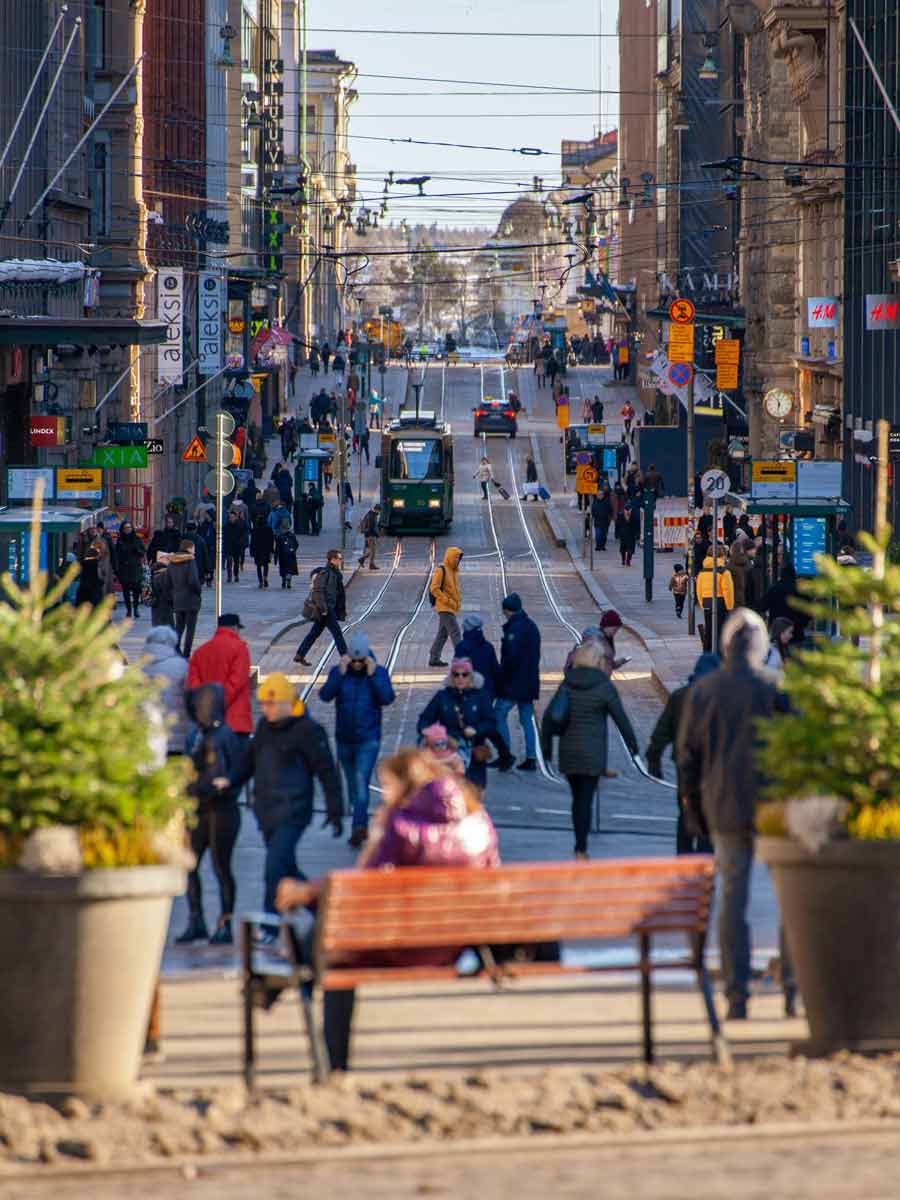
An ideology
The Finns have turned the traditional approach to homelessness on its head.
There can be a number of reasons as to why someone ends up homeless, including sudden job loss or family breakdown, severe substance abuse or mental health problems. But most homelessness policies work on the premise that the homeless person has to sort those problems out first before they can get permanent accommodation.
Finland does the opposite - it gives them a home first.
The scheme, introduced in 2007, is called Housing First. It is built on the principle that having a permanent home can make solving health and social problems much easier.
The homeless are given permanent housing on a normal lease. That can range from a self-contained apartment to a housing block with round-the-clock support. Tenants pay rent and are entitled to receive housing benefits. Depending on their income, they may contribute to the cost of the support services they receive. The rest is covered by local government.
Since the scheme started, thousands have benefitted.
Constant support
At the same time as being given a home, they receive individually tailored support services.
For instance, anyone can reserve an appointment with a housing advisor and receive advice in things like problems with paying the rent or applying for other government benefits.
There are also financial and debt counseling services to help people manage their finances and debts.
Much of the support can be provided in their own home.
Housing First works so well because it is a mainstream national homelessness policy with a common framework, according to Juha Kaakinen, Chief executive of Y-Foundation, a social enterprise that provides housing to Housing First. It involves a wide partnership of people: the state, volunteers, municipalities and NGOs.
More affordable housing
Chronic housing shortages contribute to homelessness. In Finland, increasing the supply of affordable rental housing was a critical part of the approach.
Finland used its existing social housing, but also bought flats from the private market and built new housing blocks in order to provide homes.
There are no more homeless shelters in Finland. They have all been turned into supported housing.
It all costs money, but it saves more
“All this costs money,” admits Kaakinen. “But there is ample evidence from many countries that shows it is always more cost-effective to aim to end homelessness instead of simply trying to manage it. Investment in ending homelessness always pays back, to say nothing of the human and ethical reasons.”
The savings in terms of the services needed by one person can be up to 9,600 euros a year when compared to the costs that would result from that person being homeless, he adds.
No consensus
Not everyone in Finland was happy with the new policy.
Firstly, many of those working with the homeless objected to the idea that they should receive a home first, without having to sort out any of their problems first.
But Housing First argues that it’s much more difficult to solve any problems without having a roof over your head. In the words of one person who benefitted from the scheme: “Homelessness also meant daily alcohol use. It was not so much about getting drunk, but a way to pass the time. When I’ve had an apartment, I’ve spent several months without drinking. You can’t get sober when you’re homeless, no one can.”
And in residential areas where new housing blocks were established, many residents were unhappy. They were worried that it would adversely affect their neighborhood.
Part of the approach of Housing First is that a sense of community is very important. For instance, when a new housing block is built, much work is done in the local neighborhood at the same time.
That includes keeping the local community informed through open house events, encouraging residents to interact openly with the local community as well as working in the local community picking up litter and taking care of the neighborhood's green spaces.
When a new supported housing unit opens, it typically takes about two years for the area to get accustomed to the unit and its residents. It takes about the same amount of time for the unit’s residents to adjust well to the environment.
Another issue with the policy was that it didn’t seem to be reaching women. Women’s homelessness has not decreased, even though homelessness and long-term homelessness in general has. Consequently, closer attention has been paid to solving and finding solutions to women’s homelessness.
Can this work abroad?
The Y-Foundation believes that the model can be replicated in Europe, even though housing conditions vary.
In the UK, a study by the homeless charity Crisis found that a policy of this kind in the UK could be more than five times as effective and nearly five times more cost-effective than existing services.
But a recent Government report concluded that, whilst the work of Housing First in Finland was to be commended, “we believe that resources should be focussed on supporting more mainstream efforts to tackle homelessness and prevent instances of entrenched homelessness.”
Kaakinen says: “There is no quick fix to all life situations but a solid base provides the foundations upon which to improve the welfare of the homeless. The first step in change is the change in attitudes.”
This story by originally published on World Economic Forum.
In recognition of LGBTQ+ Pride Month in June, The Conversation reached out to Jonathan Alexander — an English professor with a scholarly interest in the interplay between sexuality and literature — for recommendations of young adult fiction books that feature LGBTQ+ characters.
What follows is a list that Alexander — who serves as the children’s and young adult fiction section editor for the Los Angeles Review of Books — considers as “must-reads” for this summer.
Related: Get inspired by alternatives to Amazon for books and alternatives to Audible for audiobooks
Best LGBTQ+ YA Books To Read:
1. “Juliet Takes a Breath”
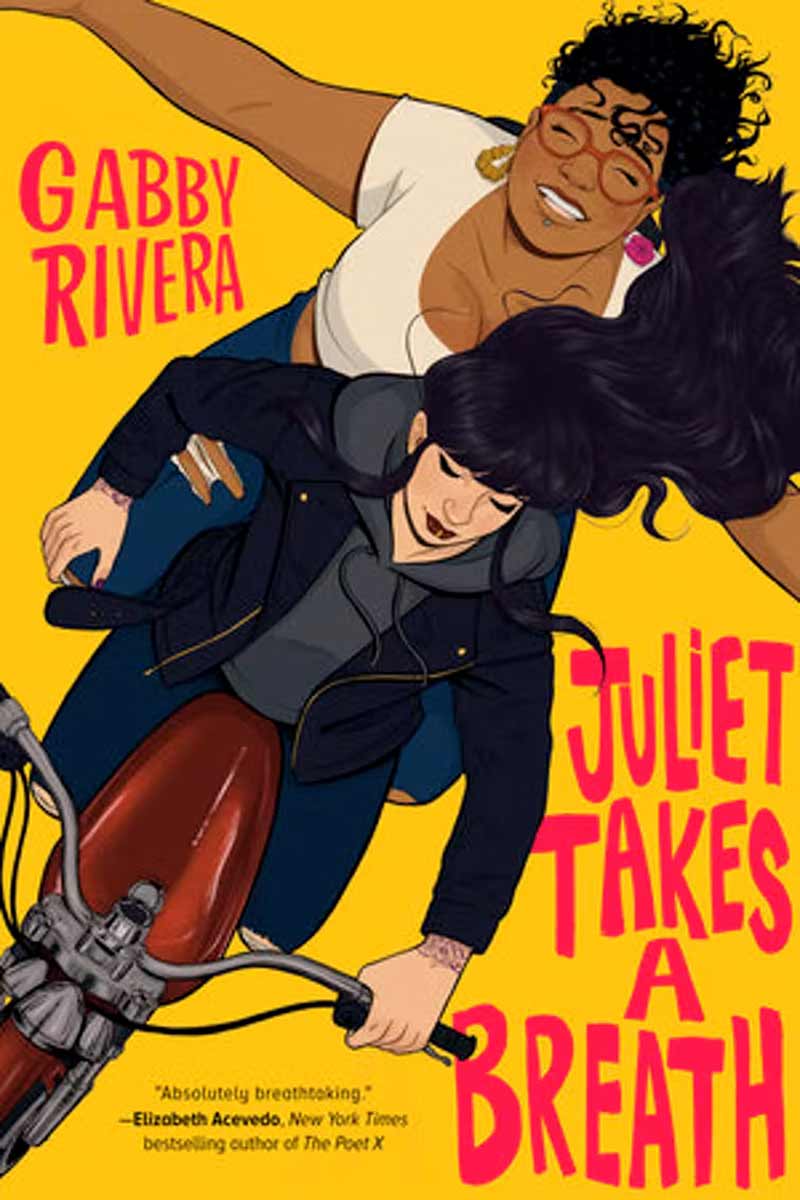
Written by Gabby Rivera, this novel focuses on the experiences of Juliet, a Latina lesbian living in New York who takes an internship to serve as the research assistant for a famous white feminist writer, Harlowe Brisbane, living in Portland, Oregon.
Juliet heads to Portland, a bit unsure of herself and still trying to figure out what being a lesbian will mean for her life, particularly given how unsettled her mother is at the prospect. She hopes that Harlowe will help her out. Complications ensue.
“Juliet Takes a Breath” is a super-smart book that challenges readers by looking carefully and critically at feminist and feminist-of-color histories and interactions.
2. “Heartstopper”
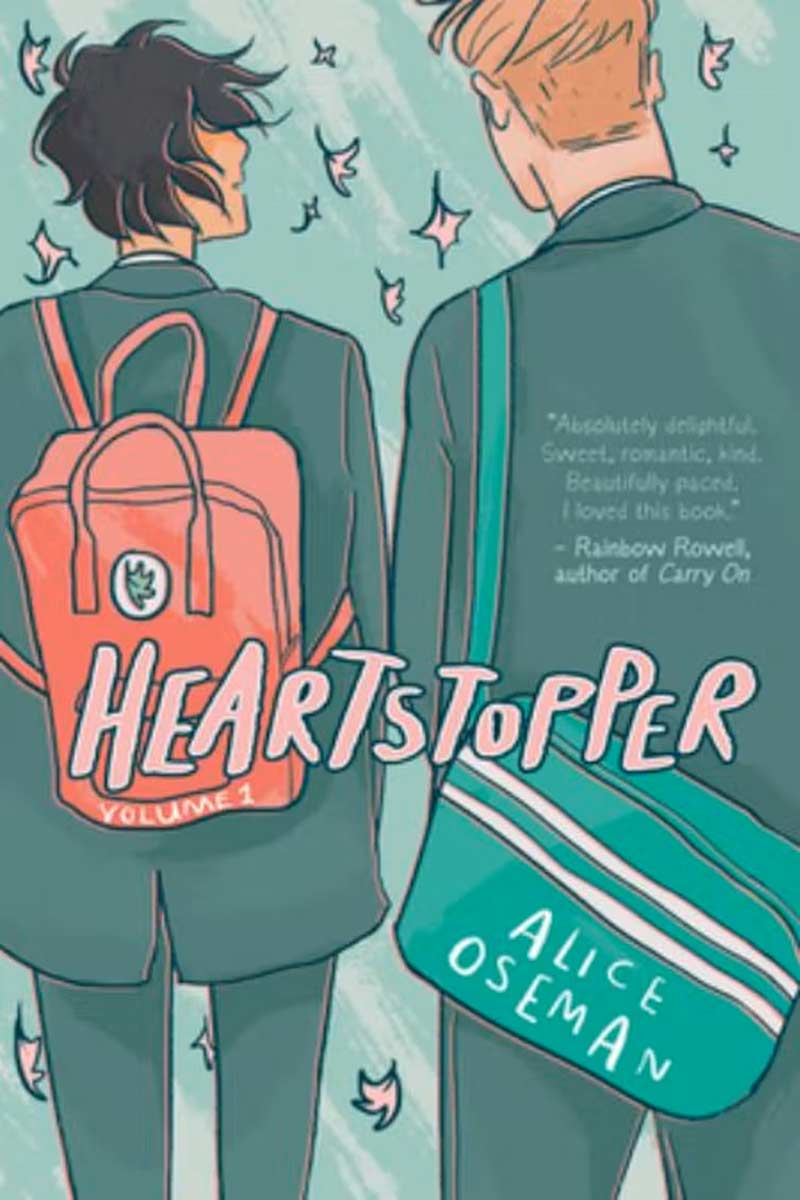
This book is getting a lot of attention as a television series. What you might not know is that the heartwarming queer story began as a webcomic and then morphed into a series of immensely popular graphic books.
Originally written by Alice Oseman, the narrative focuses on the burgeoning relationship of Charlie and Nick. Charlie is an “out” teenager at his school, and he falls in love with the charming and sporty but not-so-sure-of-his-identity Nick.
What makes “Heartstopper” engaging — and even groundbreaking — is how it presents sexuality as an identity for some but a possibility of exploration for others. Charlie knows he’s gay, but Nick might be gay or bi; he’s still figuring it out.
Validating sexuality as fluid and even changeable seems like an important next step in representing intimacy, love, and identity itself as complex experiences.
3. “Felix Ever After”
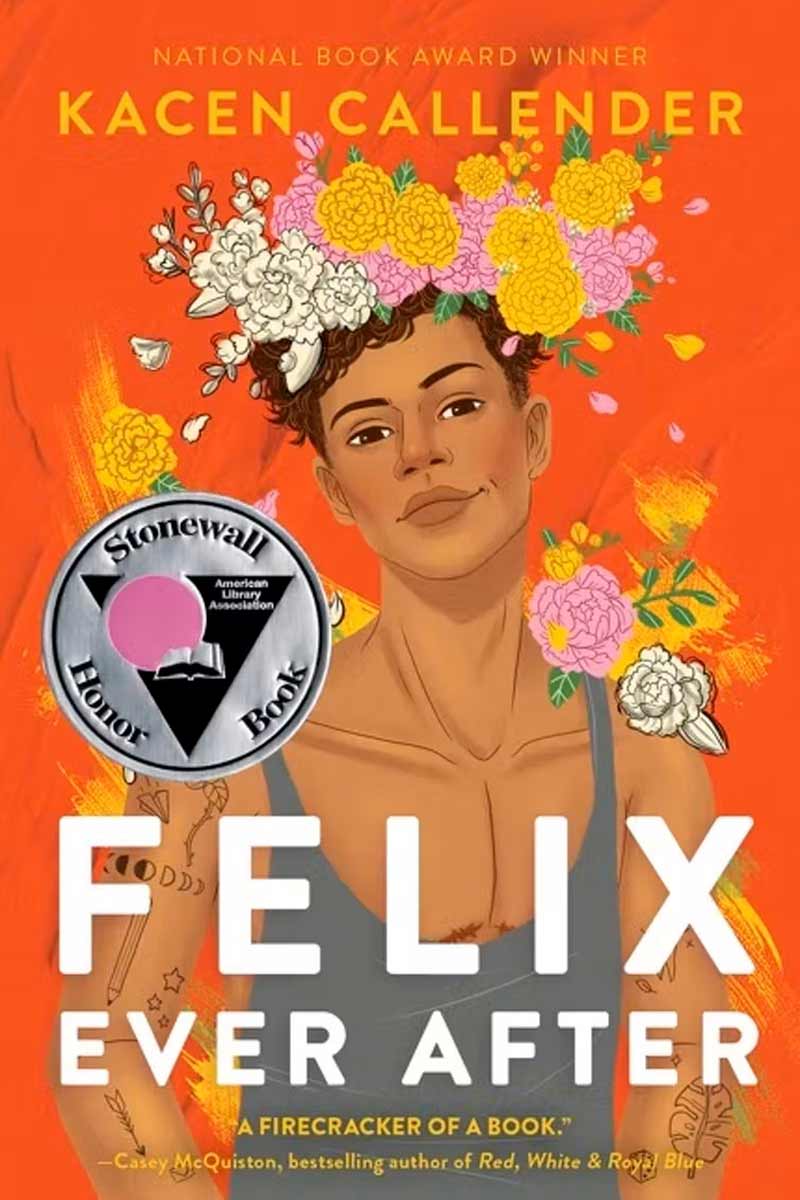
This work of fiction by Kacen Callender also refuses to shy away from complexity. Felix is a young African American trans boy trying to make his way through a summer arts program.
A talented young person, he is still struggling somewhat with his gender identity, despite having commenced his own transition. He eventually finds the term “demiboy” while researching gender identity and comes to identify with this term as an apt description of his deeply felt sense of gender.
A challenging but immensely relatable book, “Felix Ever After” also presents frankly the experience of transphobia while ultimately offering readers a message of empowerment for those working on their gender identity.
4. “The House in the Cerulean Sea”

This book by TJ Klune follows very much in the vein of young adult books that feature the presence of young people with magical abilities trying to make their way in a world of “normals,” or people who do not have such abilities and fear those who do.
Such a narrative formula, popular in young adult fiction as it sets up dramatic conflict between two distinct groups, gets a twist in Klune’s novel.
The narrative is told primarily from the point of view of Linus Baker, a nonmagical caseworker who is assigned the task of visiting and inspecting various orphanages or homes that house magical youths who have been taken from their parents and relocated to be raised separately.
This is much like Native peoples’ children across the North American continent being relocated to white-run schools throughout the 19th and early 20th centuries to assimilate them into white society and culture.
What makes “The House in the Cerulean Sea” particularly queer is not just the queerness of many of its characters, including Linus, but the ways in which it shows us how outsiders have generally been ostracized, and how many outsiders have in turn learned to embrace their queerness, not just to survive, but to thrive.
5. “The Outsiders”
This is a “classic” or older work of young adult fiction, one of the first written by a relatively young person for other young people: S.E. Hinton. She started writing the book at age 16.
For those who say this isn’t a queer book, on the surface, no, it’s not. But many contemporary readers, including many of my students, have picked up and enjoyed the book from a queer perspective, “queering” it in the process.
Set in rural Oklahoma, “The Outsiders” concerns a group of working-class teen boys. These “greasers” are always rumbling with the “socs” or “socials,” the middle-class preppy kids. The book’s focus on class conflict still resonates, but even more so does its portrayal of intimacy between the boys.
While they are never overtly sexual, there’s something delightfully warm, caring and intimate about these relationships that could serve as a model for young men today, whether or not they are questioning their gender or sexuality.
Read — or reread — “The Outsiders” and think about how gender roles continue to change and as humanity evolves in its understanding and acceptance of what is “normal,” and what should be.
The nearest laundry facility to North Flint’s Good Church is technically just under three and a half miles away, but Lead Pastor Leo Robinson II rounds up.
After all, if most of your parish relies on public transportation, three and a half miles might as well be four — or 30 — when it comes to doing a load of laundry.
“There’s no laundromat in a four-mile radius,” Robinson said, standing in the church’s basement and soon-to-be affordable laundromat, Good Laundry. “Over 75 percent of our people in this area depend on public transportation, so you can only imagine taking all of your clothes, getting on the MTA to go to the laundromat to sit for three or four hours to do your laundry, and then come back on that bus route. That’s taking up most of your day.”
As a pastor, Robinson is naturally animated. He punctuates his sentence by listing each part of the laundry process with his hands. He touches his index finger on the word “clothes”; his middle finger on “go”; his ring finger on “back.”
Robinson is also meticulous. Before moving into the church building at 1034 E. Holbrook Ave., he and his wife, Mio Robinson, commissioned a study of the neighborhood so as to better understand the community Good Church planned to serve.
That study is why Robinson can so readily talk about the neighborhood’s demographics, socioeconomic position, and, in this case, relative distance to essential services.
“And let’s say you’re a single mom or a single dad: what are you going to do with the kids when you’re there?” he finished, dropping his hands altogether—a gesture of exasperation he’s seen from residents too.
Good Church is not yet two years old, but Robinson and his wife have already found themselves an integral part of their North Flint community.
During the height of the COVID-19 pandemic, Good Church participated in food distribution events at surrounding apartment complexes, and it was during that time that the couple learned of the area’s need for a laundromat.
“We started doing food because everybody during COVID was relying on the schools for food,” Robinson said, adding that the schools only offered breakfast and lunch. “So we started going into these areas to offer dinner and they were like, ‘Food is great, but we really need a place to do our laundry.’”
Robinson had never considered a nearby, affordable laundry facility could be of greater importance than dinner, but he has since learned about “hygiene poverty” — or the condition of being unable to afford hygiene products — and its effects on the Flint community.
“People are actually having to choose between clean clothes and basic needs,” Robinson said, noting that common government assistance programs, like SNAP, do not cover most hygiene supplies. “And that breaks my heart.”
So, in an effort to help all residents, not just Good Church members, who make the choice between buying food or detergent each day, Robinson and his wife set to work on building a laundry facility in the church’s basement.
Now, they’re nearly ready to welcome folks in for Good Laundry’s first spin cycles.
"It’s a big deal."
— Lead Pastor Leo Robinson II, Good Church
Aside from the inconvenience and cost, Robinson mentioned for adults, there are studies connecting limited access to clean clothes to lowered school attendance and chronic absenteeism for young people — absenteeism largely caused by bullying or lowered self-esteem.
In turn, that absenteeism can lead to lowered numeracy and literacy rates, higher levels of suspension and a higher likelihood of high school dropout — all trends school representatives have talked about with Robinson since he began work on Good Laundry.
“In our three-mile radius, we have Flint schools, Beecher schools, and also Kearsley schools,” Robinson said. “And all three schools are struggling with absenteeism… All of them say a lot of the kids aren’t coming because of their dirty clothes.”
Robinson said he spoke to social workers who said his laundry facility could help the schools out “tremendously,” so he feels an added pressure for Good Laundry to be successful.
“One counselor said that she takes kids’ clothes home herself to wash them,” Robinson said. “So I know it’s a big deal.”
Clean clothes being a “big deal” for Flint’s youth is something Linnell Jones-McKenney can attest to directly.
Jones-McKenney is the Community Outreach Director for the Sylvester Broome Empowerment Village (SBEV), a converted North Flint school that offers enrichment programs in academics, athletics, and the arts for children ages five to 17.
Jones-McKenney said SBEV began its Wash and Dry program in April 2018 after staff realized that many of their student-athletes were unable to clean their clothes between practices.
“What we came to understand was that a lot of times the kids had on the same clothes,” she said. “Not only did they have the same clothes, but those clothes hadn’t been washed.”
So SBEV installed a donated washer and dryer to help provide students with clean clothes while they were onsite.
Jones-McKenney said the program offered kids new shorts and shirts to play or practice in — which they would sometimes keep — and washed those clothes between each session so every participant could start activities in a clean outfit.
“It was very successful,” Jones-McKenney said, adding that she felt the program helped SBEV’s athletes look and feel their best. “We knew that that was important to that kid. His eyes lit up when he came out of the bathroom, changed.”
But Jones-McKenney’s experience at SBEV, which has since changed its laundry program thanks to the purchase of athletic uniforms, is not a stand-alone success.
As reported by Chalkbeat, a Detroit school dealing with chronic absences implemented a laundry program in 2018 and saw a 10 percent decrease in absences and a 60 percent decrease in suspensions.
Additionally, in 2015, Whirlpool launched its Care Counts laundry program, which installs washers and dryers in schools. In its first year, Whirlpool reported that 90% of tracked students had improved attendance, and today the program is in 134 schools across 34 states.
The outside success stories are encouraging, but Robinson said it’s the personal stories he’s encountered that remind him Good Laundry will be a real help for Flint’s young people.
“We found out that there was a kid in our youth program that we have to drop off,” Robinson said. “One day he wants us to go past his house several times, so he can get dropped off last. We honor that, and ask him, ‘Why?’”
Robinson paused, remembering.
“Because he wants to ask the driver can he go to his friend’s house to wash clothes,” he said. “I see it. God keeps confirming these moments for us that we did the right thing—that we’re doing the right thing.”
"We thought we were just meeting the need, but it really became another business."
— Lead Pastor Leo Robinson II, Good Church
Though renovations for Good Laundry are nearing their final stages —water hook-ups are visible and commercial grade washers and dryers have been secured — Robinson said he’s aware there are limitations on the impact his facility can have.
“We already know the eight machines that we’re going to put in here — it’s already not going to be enough,” Robinson said.
He and his wife calculated that between the number of machines and the facility’s estimated hours of operation, having four washers and four dryers would equate to supporting a little over 100 families’ laundry needs per week.
While that seems like a significant number, Robinson said, that’s assuming an average family of three, just a week’s worth of clothing, and that the facility will be available when the families can come—which cannot be guaranteed as machines will likely need to be scheduled out to ensure equitable access.
“We thought we were just meeting the need,” Robinson said of his learnings so far. “But it really became another business.”
Robinson said that after accidentally creating a whole new enterprise, he decided to learn the laundry industry to manage it properly.
However, he realized quickly that his aims for Good Laundry were not the same as most stand-alone laundry businesses.
“I almost got shut out of the laundromat conference because I’m the only one there that’s not trying to make this huge profit,” he said with a laugh. “I just want to open up a laundromat to help people. What’s the cheapest way? And there’s no table to talk with people about that.”
Robinson said he wants to keep his laundry facility affordable for anyone who needs it, though it cannot be free because he has real costs to operate it.
“We want to be low cost,” Robinson said, noting that he has to consider utilities, like water and electricity, and labor, as the couple plans to hire two to three staff members to help run the operation.
Robinson estimates that he can achieve all of this — utilities, labor, some surprise costs — while operating at a seven percent profit, though he wasn’t set on a cost per load just yet. Nothing is quite certain until the machines start whirring.
“If I break even at the end of the day, I’m good,” Robinson said of his goal for Good Laundry. “That’s not the standard business model, but that’s what we’re doing.”
"It doesn’t have to be always churchy."
— Lead Pastor Leo Robinson II, Good Church
Robinson is hopeful to open Good Laundry by the end of June, but said he’d settle for August before students return to school.
“What I learned at the laundromat conference is that even though we’re open—let’s say we open now—for people to get the rhythm of coming here, it’s going to take about a month or two,” Robinson said. “So in order for us to impact the schools like we want to, to impact the pattern of life like we want to, we want to be open before school really gets started, so there’s enough time to establish that relationship, that trust.”
In the meantime, Robinson and his wife are working to continually secure funding through pitch competitions and their website while thinking of other ways to make Good Laundry the best facility it can be for all who use it.
Alongside the laundry area, the Robinsons are converting another portion of the church basement into a space for Good Laundry guests to wait, relax, fold clothes, or hang out.
Robinson said if that area can also be a space for learning they’ll try to help with that too.
“In those two or three hours that they will spend here, we want to have people come down and say, ‘Hey, what else do you need?’ Is it financial literacy? Is it tutoring? Is it that you want to work on your GED?” he said.
When asked if he’d do any preaching to Good Laundry guests, the Flint native laughed and said no, only if they want to come upstairs to Good Church.
“It doesn’t have to be always churchy,” Robinson said, signaling quotation marks with his hands, “churchy.”
“Spiritual health is awesome… but how can we get them to read the Bible if they can’t read?” he continued. “The average reading level is eighth grade around here, like let’s work on that. We don’t have to put a pulpit everywhere. Hopefully, our love is just showing love without a hook into it.”
Good Laundry will be located in the basement of Good Church at 1034 E. Holbrook Ave. on Flint’s north side. Robinson said they plan to continue to post progress updates on Good Church’s social media and website.
“If I can help a young kid just not have to go through the path I went through, it’s worth it,” Robinson concluded.
With that, Robinson adjusted his hoodie, “a kid from Flint” in white lettering across the chest, and went to help his wife pass out teacher appreciation gift bags at Good Church’s entrance.
A therapist collective is changing how mental health services are offered in Ridgewood, Queens
When Dawn Sánchez takes on a new therapy client, she’s upfront about the money stuff.
At the Alliance Psychological Services of New York, the out-of-pocket costs for people without insurance is, ideally, $80 or $90 per session. That money goes toward operating costs like an electronic health record as well as hourly pay for all the workers, set at $40 an hour.
But the therapy rate is flexible — a negotiable sliding scale based on the needs of the patient and decided by consensus among the rest of the therapists.
Some clients pay $30 per session. Another, currently between jobs, pays zero — something the group felt was worth it to avoid gaps in mental health care. Others pay $150, or more.
“There’s no secrets. There’s no exclusion. There’s no cliques,” said Sánchez, a Black and Latina licensed clinical social worker at the Alliance. The transparency in the client-therapist relationship creates a dynamic of trust, which grows from the structure Sánchez and her co-workers have built themselves.
The Alliance is a worker cooperative — a business owned by its workers with democratic decision-making processes. Though cooperatives can be hierarchical, the Alliance specifically operates as a non-hierarchical collective.
Worker-owners at the Alliance say the co-op model offers autonomy and sustainability to continue doing work they spent years training to do, while offering better, equitable care for the clients they serve.
“It’s empowering,” said Sánchez, who works part-time at the co-op while continuing a full-time job at a nonprofit. The co-op, which extends authority to workers regarding hourly pay, sick time, and the cost of their services, is a game changer. Basic things like having access to the organization’s bank account “shatters everything you’ve ever grown up with or seen.”
“You just feel,” she said, “like you’re trusted.”
How it started
In 2017, Billy Somerville had finished training to become a clinical psychologist.
But he quickly disliked what he saw in the field: paternalism toward patients, therapy as a luxury due to cost barriers, and a lack of transparency about money with patients and mental health professionals.
He set out to start a private practice to offer services that aligned with his values and goals as a therapist — a non-capitalistic approach that extends agency to clients. He soon realized he wanted to collaborate with others, and that’s when he learned about cooperatives.
In 2018, he launched the Alliance in Ridgewood, Queens, with his friend Kara O’Brien, who still leads administrative tasks and finances. Ten months in, he was able to bring on another therapist as a co-owner. Now, there are five therapists in total.
“What really appealed to me was we can work together in a horizontal way,” Somerville said. “We can afford trust to one another.”
It took some time and legal advice to make it work. In New York State, health professionals with different licenses can’t co-own the same entity or share profits, nor can licensed professionals and other non-licensed workers, like those who do administrative work.
The Alliance created an umbrella entity to encompass distinct professional limited liability corporations for each kind of license professionals have.
Building a sustainable work model
The flexible sliding scale costs of therapy and the control therapists have over their workloads have not stopped the Alliance from making enough revenue to increase compensation for workers.
Since first launching in 2018, the worker-owners have raised wages from $30 to $40 an hour. They offer sick days at $160 per day.
“It shouldn’t really be that shocking that cooperation can produce things that competition cannot,” Somerville said. “But in our cultural context, here in the U.S. in 2022, that is a shocking idea for some people that you don’t need the profit incentive or that you don’t need to be competing with each other in order to reach your best.”
Having autonomy over their work lives is also a factor in creating better conditions.
Claudia Maisch, a Latina licensed master social worker, chose to cap her caseload at 30 clients. The limit felt sustainable for her — a choice that didn’t exist in previous workplaces.
“You decide what is sustainable for you as a worker,” said Maisch. “Our goal isn’t to make as much money as possible and liquidate the business. The goal for us is how do we build a sustainable model that’s sustainable for workers where we get paid as much as we need to get paid in order to live comfortably [and] provide fees that are accessible.”
Breaking barriers
Three of the five therapists are people of color, a sign the model may disrupt the therapy industry, where psychologists are overwhelmingly white.
Social workers — most of whom intend to become licensed clinical social workers who can offer therapy services — entering the field are mostly women and more diverse than other health professions; recent graduates of Master of Social Work programs were about 66% white, 22% Black, and 14% Hispanic, according to a 2020 survey from the Council on Social Work Education. But the educational debt burden is worse for people of color.
Newly graduated Black and Hispanic social workers carried an average of $66,000 and $53,000 in debt, respectively, compared to $45,000 and $48,000 for white and non-Hispanic social workers, according to the council’s survey. That’s astronomical compared to social workers’ mean starting salary of $47,100.
“The therapy world in general is just very white to begin with,” Sánchez said. The cost of education and licensing is something people of color don’t often have access to, she said. She hopes a co-op model can attract more people to becoming mental health professionals, though it doesn’t solve all of the gatekeeping problems within the field.
Maisch says the business model may make starting a business more accessible to new therapists. “You are sharing the overhead costs with colleagues,” Maisch said.
The co-op model and burnout
Maisch is the newest therapist at the co-op. She’ll be a member for six months before transitioning to formal co-ownership.
After Maisch finished her master’s in social work last year, she interned at a domestic violence shelter offering services to women often living in small spaces with their children, dealing with day-to-day crises that made trauma-processing in therapy sessions difficult.
Her role during the pandemic was more like triage services, ensuring families had enough food to eat or scheduling drop-offs of basic necessities at the shelter. She saw her co-workers become overwhelmed, as they worked without adequate resources to meet clients’ needs and feared losing their jobs if grant money dried up.
In a private practice position after that, she felt her employer was scaling up too quickly, capitalizing on the pandemic-induced mental health crisis at the expense of working conditions for therapists.
“People would feel really under-resourced,” said Maisch. “It was wild.”
Health professionals are highly susceptible to burnout. During the pandemic, one study found about one in four social workers reported symptoms of post-traumatic stress disorder — seven times higher than a 2015 survey of social workers.
Research has found that mental health workers’ burnout symptoms are directly related to work dynamics and structures.
In 2018, a review of 62 studies across 33 countries found high caseloads to be consistently associated with higher rates of burnout, while “a sense of autonomy at work and perceived capacity to influence decisions that affect work” were associated with lower rates of burnout.
Ambiguity of a mental health professional’s role was found to be associated with increased emotional exhaustion in two studies.
A study looking at Black therapists’ burnout found that experiencing or witnessing cultural racism was significantly associated with burnout symptoms, as well as higher work hours per week.
Maisch is well aware of this dynamic. In a seminar for her master’s program, she argued worker co-ops could reshape the social work field by both improving working conditions, which would affect quality of care for clients.
Soon after she graduated, the Alliance was looking for another partner. She joined the team earlier this year, drawn to its transparency and non-hierarchical structure.
“The co-op model allows us to more fully align with our code of ethics — not just in theory and talking, but in practice,” Maisch said.
Fishing boats on the quay gently rock in the waves of the North Sea. They send their catch to processing plants by the wharf, where refrigerated trucks await out front. Commercial fishing dominates the port of Hirtshals on the Skagerrak strait in northern Denmark.
Just a few hundred meters away, however, an innovative company is challenging this centuries-old industry.
In a closed-loop system, Danish Salmon is raising salmon not in the sea, but on the land.
“We check the fish every day,” says the company’s production manager Arndt von Danwitz, flicking on his headlamp. With slight movements of his head, he illuminates perforated aluminum boxes that stand in a long basin through which cold water flows.
It’s cold in the room, too — about as cold as the air where you might find a Nordic mountain stream in winter, to “mimic nature as much as possible,” says von Danwitz.
In this frigid water, about 15 millimeters long and very thin, are the fish. They hatched just three weeks ago, and won’t be mature enough to harvest for another two years. “Salmon farming is for patient people,” he smiles.

For those who do have the patience, the rewards are substantial. The world is eating more salmon than ever. In 2021 alone, consumption increased by 13 percent.
The EU and UK were the largest markets, consuming 1.28 million tons. In the US, the appetite for salmon is also high — Americans ate some 634,000 metric tons of it in 2021.
Only one-fifth of all this salmon — over five million tons — comes from wild stocks. The rest is farmed, most of it in open net cages off the coasts of Norway, Chile, and Great Britain. Scotland, Canada, Iceland, Russia and the US also farm salmon this way.

But the method has consequences, often involving mass quantities of medicines, pollution, rampant pest infestation, high mortality, and the endangerment of wild stocks.
Danish Salmon, on the other hand, raises its fish in a closed water network that is pumped through biological purification systems every 40 minutes. A drum separates fecal matter and feed residues, which are sent to a nearby biogas plant and turned into green electricity, renewable natural gas and fertilizer. Bacteria break down the dissolved substances in the water of the breeding tanks, such as urine and ammonium. In addition, the plant enriches the water with oxygen.
“We thus remove 80 percent of the phosphorus and nitrogen from the water before pumping it back into the sea,” says von Danwitz — two substances that cause oceanic dead zones, and are produced in abundance by fish farms.

The seawater that streams through Danish Salmon’s breeding facility comes from the Skaggerak, a heavily trafficked strait of fishing and cargo ships between Denmark and Norway.
The water is biofiltered with sand, then treated with ultraviolet light, which prevents a parasite called salmon louse, which bites through fish skin to cause open wounds. Salmon louse can spread rapidly through dense populations of farmed fish, and outbreaks often controlled with insecticides, bleach, and disinfectants.
"With no chemicals whatsoever, Danish Salmon has been producing parasite-free salmon for nine years."
With no chemicals whatsoever, Danish Salmon has been producing parasite-free salmon for nine years. Nevertheless, a veterinarian checks in every month as required for the ASC seal for sustainable aquaculture.
Danish Salmon also eschews artificial pigments to color its salmon, and its closed system eliminates the need for antibiotics. “The use of antibiotics alone is prohibited by our bacterial culture for water purification, which has been built up over a long period of time,” says von Danwitz.
And needless to say, salmon farmed on land can’t escape into the wild.
This is a real problem. Norway reports an average of 450,000 escapes from its fish farms each year, and many more desertions go unreported. These fugitive fish mate with wild salmon, changing the gene pool.

Currently, 850,000 salmon ranging from one one-hundredth of an ounce to nearly nine pounds live in Danish Salmon’s tanks. As of August, that number is expected to increase significantly.
Next door, heavy machinery is adding capacity that will allow the company to produce two-and-a-half times as many fish. At present, however, even 1,100 tons of salmon per year is far less than the average 8,000 tons produced in a single open farm in Norway (several hundred of which exist).
"The cost of sustainable salmon is also about one-third higher than the conventionally farmed product. Nevertheless, demand for it — from caterers to supermarkets — always exceeds supply."
The cost of sustainable salmon is also about one-third higher than the conventionally farmed product. Nevertheless, demand for it — from caterers to supermarkets — always exceeds supply.
Though land-based salmon farming is rare, with a global production volume of roughly 10,000 tons, it is growing very quickly — by 30 percent in the past year. Not far from Danish Salmon, a new facility has just started production.
"Most of these farms are built where fresh salmon is consumed, depriving the fish of the wasteful habit of flying."
In Florida, Atlantic Sapphire plans to produce 220,000 tons annually by 2031 in a closed-loop system. Even high in the Swiss Alps, salmon swims on land. Most of these farms are built where fresh salmon is consumed, depriving the fish of the wasteful habit of flying. (Shipping salmon from Norway to the four most important Asian export countries results in 5.3 to 6.3 kilograms of CO2 emissions per kilogram of fish.)
But land-based salmon farming is resource intensive, too. Danish Salmon’s electricity bill includes seven to eight million kilowatt hours each year, mostly for cooling and pumping. The company gets this power from renewable sources, mainly wind.
In Danish Salmon’s new building, production is already expected to consume one-third less energy. In the next few years, the operators aim to save an additional 20 percent.

Danish Salmon’s CEO Kim Hieronymus Lyhne expects steep growth in onshore closed aquaculture. “It’s really just taking off,” he says. That’s also the assessment of the Japanese investors who recently financed Danish Salmon’s expansion.
“Land-based, closed-loop systems are seen as having great potential; they offer some advantages over open systems, and not just for salmon,” says Fabian Schäfer, an aquaculture expert at Germany’s Leibniz Institute of Freshwater Ecology and Inland Fisheries.
Some policymakers are also pushing the technology. Canadian Prime Minister Justin Trudeau wants to move all farmed salmon production in British Columbia from the sea to the land by 2025.
Already, more than half of the fish consumed worldwide comes from aquaculture.
For global fish stocks to survive, that share will likely have to grow even more.
More than one third of the world’s fish stocks are overfished, and the other two-thirds are largely at the limit of what they can produce.
A more sustainable future for the world’s salmon may be one in which fishing boats no longer bob picturesquely on the waves of the Danish Hirtshals.
Alexandria, Virginia, went fare free in 2020 and has seen ridership remain close to pre-pandemic levels.
With frequent service and plenty of money to fund the buses, the transit experiment appears to be working, for now.
Ever since Canek Aguirre got elected to the Alexandria City Council, he wanted to make the city’s bus transit service, known as DASH, free.
Growing up in Los Angeles, he fondly remembered a local bus service which only cost a quarter to ride. Going to college in Chapel Hill, the bus was totally free. Why not do the same in this prosperous city of almost 160,000 in northern Virginia?
In 2019, when Aguirre first began serving on the council, he didn't think the political will was there to go fare free. Instead, he proposed reduced fare or exemptions for some groups of people.
“I was trying to inch towards it, but in the back of my mind I really wanted to get to fare free,” says Aguirre. “Given the size of our community here in Alexandria, it just seemed very doable to have a fare-free system.”
Then COVID-19 hit, and the world changed. Heavy rail ridership on the Washington Metropolitan Area Transit Authority’s (WMATA) Metro, whose Yellow Line runs through Alexandria, fell off a cliff and still hasn’t even recovered 50 percent of its ridership. But the city’s buses were still seeing heavy use, as so-called essential workers in grocery retail, food service and health care continued going to work. Today the 11 DASH bus lines are at 95 percent of pre-pandemic ridership.
In 2020, as the pandemic raged, Alexandria Mayor Justin Wilson sent the City Council an email introducing the idea of eliminating bus fares. At a subsequent meeting held on Zoom, the measure was introduced with no fuss.
“I was super excited, but there was little fanfare,” says Aguirre. “When we announced it, we hardly got any emails or heard anything. There was zero debate. Me and the mayor were the only ones who said anything, but we totally nerded out. Then it was like, OK, next item.”
Many cities enacted fare-free transit options during the pandemic, both as a means to help essential workers and to limit interactions. But as life returns to a semblance of normal, some cities are backing away from the idea.
Almost two years later, however, Alexandria’s buses remain free.
For Dunia Esquivel, a server at a popular diner on Alexandria’s bustling King Street, the fare-free service is a delight. She rides the buses to and from work and appreciates that the city is maintaining the free service — unlike nearby Springfield, where she just moved from.“
I think it's really cool: Here you don’t have to worry about anything,” says Esquivel. “Or like if you are homeless or someone who doesn’t have any money, they can still ride for free.”
Alexandria already had one form of free transit before the pandemic, a “trolley” service aimed at tourists. It takes riders from the King Street Old Town Metro station to the waterfront and back, tracing most of the length of an avenue packed with restaurants, shops and cafes.
The trolley picks up riders at a hub next to the elevated Metro station, where Alexandria’s DASH buses and Metro buses also stop. Of the three, only WMATA charges fares anymore.
Ridership on Alexandria’s buses has surged back to almost pre-pandemic levels not only because of free fares. A redesign of the bus system that allowed for increased frequencies is an equally important part of the story.“
That's part of why we've had success with the bus system here in Alexandria, because we have some bus lines that show up every 10 minutes, others every 15,” says Aguirre. “People don't have to worry about what time it is, they walk out to the stop and know there will be a bus.”
The funds for all these improvements are not coming from operating support provided by the federal government during the peak of the pandemic. Alexandria was able to compete for funds from Virginia’s Department of Rail and Public Transportation, which allowed them to provide free fares for the next three years. Competitive monies from the Northern Virginia Transportation Commission are used to increase frequencies on the city’s bus lines and redesign the system.
An additional million dollars from the city’s general fund has also been put toward transit, but more will be needed in three years when the state funding runs out. Then the city will need to find room in the general fund for these services. Pre-pandemic farebox recovery was about $4 million, while the DASH service cost a
bout $23 million in 2020.State and regional funding has allowed Alexandria to avoid the conundrum at the heart of criticism of fare-free transit.
Skeptics say that fares are generally quite cheap and that for riders reliability and frequency are much more important. Funds could be better spent on more service. Who cares if a bus is free if it only comes once every 30 minutes?
But even some transit experts who doubt the concept of fare-free transit in big cities, where fare-paying riders provide a substantial portion of the budget, think the idea is worth experimenting with in smaller jurisdictions.
“In places with very low farebox recovery, there is an argument to be made for piloting and seeing what happens,” says Eric Goldwyn, assistant professor of transportation and land use at New York University.
“The main issue is what are the trade-offs? If you can manage to go fare free while also providing frequent, reliable service, that's really something.”
Aguirre is confident that Alexandria will have the money to continue funding frequent and free service. The city gets most of its revenue from real estate taxes, which have been robust throughout the pandemic.
The city is in the midst of a decades long growth spurt and the population is the highest ever. Valuations of properties are greater than during the pandemic too, so Alexandria policymakers won’t face the hard choices of more depressed municipalities.
For Aguirre, if Alexandria ends up having to choose between frequency and free fares, he would pick the former. But he isn’t convinced it will come to that even when the state and regional money runs out.
“[Metro] rail will always have a charge, but can we keep free for the bus,” wonders Aguirre. “Once we get further down the road, if we feel we have to bring back some charge for it, I would take that in consideration. But for me, the point of transit is to be as accessible as possible.”
For Terron Ingram, waiting for the bus after his shift at Home Depot, the free fares have been a nice perk. He says he rides the system even more than he used to because it's easy to use and free of charge.“
I definitely take advantage of them more because they are free,” says Ingram. “The fares were not bad, but it’s always better free. Keep it up!”
The bell rang a little after a gloomy dawn. As a trickle of A.P. Spanish students settled into their wooden desks, teacher Zachary Daniels powered up his smartboard. Behind him, the classroom wall was covered with translated verbs — Explico (explain), Escribe (write) — written on a large, white scroll.
For this morning’s lesson, Daniels asked the students to use a different kind of language, to look within and name a feeling. Did they walk through the doors feeling humiliated? Guilty? Peaceful? Were their outlooks tainted by hopelessness or brightened by hope?
It was late March and the world outside Paw Paw High School, located in a rural stretch of western Michigan, seemed increasingly threatening. The war raging in Ukraine was dominating airwaves and news feeds. A school shooting in Oxford, Michigan, had left four students dead. And Covid continued its inexorable march.
As Daniels spoke, he passed out a worksheet filled with 29 colorful, cartoon images of children’s faces, each expressing a unique mood. The worksheet guided the students to rate the intensity of their feelings on a scale of 1 to 10, and they jotted down their answers quietly.
“The way we think and feel and act affects the next situation that comes up,” Daniels told the class. “And that creates a cycle that can really impact the way that our days go.”
The mindfulness check has become a weekly ritual for the 650 or so students at Paw Paw High. Daniels wants his students to interpret their thoughts and feelings in a non-judgmental way. Mastering this skill will take consistent practice.
A mental health crisis intensifies
Teachers have been trained in the subjects they teach, but not in ways of helping students control their emotions or rewrite the stories they tell themselves. But since the mid-1990s, multiple studies have shown the benefits of social-emotional learning (SEL), a strategy that trains educators to nurture student wellness by helping them feel connected, engaged and supported while cultivating skills in self-management, social awareness and responsible decision-making.
As the Covid-19 pandemic brought shutdowns and quarantines, making students’ lives less stable and connected, it intensified a long-festering youth mental health crisis and left schools searching for answers. Making matters worse was a longstanding shortage of counselors and social workers. As the pandemic began, Michigan had the second worst student-to-counselor ratio in the country, with 671 students for every counselor, more than double the recommended caseload.
To address the problem, many Michigan schools adopted a homegrown social-emotional learning curriculum created by TRAILS — Transforming Research into Action to Improve the Lives of Students — a program that borrows techniques from cognitive behavioral therapy and was developed at the University of Michigan in Ann Arbor in 2013. In the aftershock of the pandemic, its popularity has grown and is now being taught in over 600 schools statewide.
Michigan Governor Gretchen Whitmer has included funding of $150 million to expand the TRAILS program in her proposed budget for the 2022-2023 fiscal year. The legislature is now debating the budget and typically tries to pass the education portion by July 1, when the fiscal year begins for school districts.

Inside the classroom of Erickson Elementary teacher Nikki Krings in Ypsilanti, Michigan. Photo: Erin Kirkland for Bridge Michigan
The program includes a three-tiered approach. Twenty brief lessons, geared toward K-12 students and rooted in the techniques of mindfulness, focus attention on thoughts and feelings to help a child choose to act with care. Elements of cognitive behavioral therapy help students disrupt the cycles of negative thoughts, feelings, and behaviors they go through when confronting a difficult situation.
The second tier is focused on small group, skill-building sessions led by school mental health professionals, and the third tier offers suicide risk-management training to school staff members.
Decades of scientific research has shown an emotionally healthy learner is a better learner. But school leaders, well before the pandemic, lacked the tools and capacity to tackle a student mental health crisis head on.
“They did not feel they were equipped to manage the sort of severity and volume of mental illness that was coming through the doors of counselors, social workers and school psychologists,” said Elizabeth Koschmann, a former school psychologist and adjunct faculty member at the University of Michigan Medical School who founded the program.
The goal of TRAILS, said Koschmann, who serves as its executive director, is not for teachers to dole out unwanted therapy to students. Nor is to replace counselors and social workers. Rather, it’s a way to help foster wellness inside schools and coordinate care for students who need extra help or treatment.
Schools are saying, 'We also need to take care of students’ mental health.'
— Elizabeth Koschmann, TRAILS Founder.
TRAILS’ lessons about feelings and self-management are supportive and often fun. But across the nation, a campaign against social-emotional learning has fomented anger among a vocal sector of parents, state lawmakers and conservative groups with ties to dark money, as MindSite News reported in April.
These groups have labeled SEL a masquerade for critical race theory (CRT), another culture war flashpoint, even though CRT is almost never part of a K-12 curriculum. The opposition led a school district in Utah to end its SEL initiatives earlier this year. Florida’s top education officials rejected over 50 math textbooks because their pages made references to SEL and what they describe as CRT. And a Minnesota group lambasted the district’s SEL lessons as a “child-indoctrination scheme.”
In Michigan, some parents have spoken out at school board meetings against the teachings of SEL skills, and one teachers’ union in Hartland is fighting the pushback.
“It’s a complicated moment in American education,” said Koschmann. “There’s a larger debate about how are we educating young people about questions like race and racism, and privilege and power in the country, at the same time, that schools are saying, ‘We also need to take care of students’ mental health.’”
Despite the backlash, educators and parents overwhelmingly support the teaching of SEL skills, one recent poll found.
In the past few months, however, a growing number of Paw Paw parents expressed fears over the teaching of social-emotional learning. Some worried the curriculum pushed critical race theory. In response, the district has hosted in-person and virtual community forums to clarify the curriculum’s purpose. Last month’s in-person forum attracted over a dozen parents. District leaders are not planning to abandon TRAILS and are being proactive as fears arise, said Corey Harbaugh, director of curriculum for the Paw Paw Public School District.
“There is a high level of concern from people who tie social-emotional learning to certain political agendas, even though we know that politics is not our business. Our business is taking care of the needs of students,” Harbaugh said. “Our parents and our community have to be at ease and support what we’re doing; otherwise, we’re fighting about it rather than working together.” He wants parents to understand, he said, that SEL “isn’t tied to any political agenda beyond giving kids what they need to feel connected, engaged, cared for.”
TRAILS training in the Upper Peninsula
Kristy Alimenti, a mental health services coordinator with the Delta-Schoolcraft Intermediate School District in the Upper Peninsula, said her district has facilitated training for over 60 teachers in TRAILS since last year. The limited preparation time required, ease of applying SEL skills to academic lessons and strong research base of the curriculum made it appealing to administrators.
In a rural area where access to mental health services is low and rates of anxiety and depression among students are rising, Alimenti said TRAILS gave staff more tools to tackle challenges before they escalate and may require deeper intervention.
“It allows us to also de-stigmatize the conversation around mental health and provide lessons that address a lot of what the students may be facing or experience in a more proactive and preventative way,” she said.
Visits to two districts, Paw Paw Public School District in rural western Michigan, and Ypsilanti Community Schools, an urban district, offer a sense of what these programs look like in practice.
Learning from Simon Says
It was a quiet, rainy morning at Erickson Elementary School in Ypsilanti, a diverse, low-income city near the Huron River that has shed thousands of manufacturing jobs. In room 127, the fifth-graders were getting a lesson on thoughts, feelings and behaviors. Halfway through, they stood up as teacher Nikki Krings laid out the rules of a reverse game of Simon Says.

“Simon Says, move forward!” Krings directed.
The students shuffled a few steps backward.
“Simon Says, thumbs up!”
The students flashed their thumbs down.
“Simon Says, make a really happy face!”
Some students grimaced, while one couldn’t help but give a goofy grin.
Krings and other Ypsilanti teachers were trained in TRAILS at the onset of the pandemic in 2020, at a time when they were fretting over whether they could preserve close connections with their students over computer screens from home.
Krings said the tools she learned helped her deescalate some students’ mental health problems, instead of relying on a social worker in the building. It also helped build a culture of empathy and understanding in her classroom, giving kids space to navigate their feelings.
As Covid risks eased and students flocked back to classrooms this year, Krings and other teachers at Erickson saw their students’ fears of the unknown grow.
In a city where people need more money, jobs, and affordable housing, many of the students were already in survival mode. The students at Erickson are predominantly Black, and most are economically disadvantaged. Some don’t always have food at home. Others bounce from home to home because their families can’t afford to stay where they are.
Black children disproportionately endure the pains of poverty and illness, and the mental health impacts that result. More than a third of high school students said in a national survey that they’ve been treated poorly or unfairly because of their race or ethnicity. Even before the pandemic, the mental health crisis plagued Black youth. Over the past decade, the firearm suicide rate more than doubled among Black, Latino, and Asian teenagers.

Krings has made room 127 a place where students can try to escape their troubles and be themselves. In addition to TRAILS, she teaches students about race and encourages discussion and acceptance of diverse gender identities. “It’s important for me, for them, to feel safe,” she said.
Alayah, a girl with tight cornrows and dangly braids, and Alex, wearing green and black glasses, gleefully followed each step of the reverse Simon Says amid a sputtering of giggles. (MindSite News is identifying them by their middle names to protect their confidentiality).
The two are good friends. Alayah likes Alex because he’s fun. Both want to get good jobs when they grow up. Alayah said her mom believes in her dream of starting a business. One day, Alayah said, she hopes to buy her mom a house and a car.
“People say they don’t want to go to school,” Alayah said later. “But I’m like, ‘You need school, so you can get a better education and a better job. So you can get somewhere in life.’”
After a few more commands, Alayah, Alex and the rest of the class sat down at their desks and listened closely.
“I want to challenge you,” Krings said. “When you’re feeling a really big emotion, something really bad, really frustrating, really scared, really embarrassed, I want you to think, ‘I’m going to pause real quick, and…recognize my feelings…I’m going to take it back and say, let me see (if) I can do the opposite.’”

Learning to avoid 'thinking traps'
In a classroom off of Paw Paw High School’s long main hallway, English teacher Allan Blank was delivering a rapidfire lesson on the perils of “thinking traps” – the moments when our minds jump to the wrong conclusions or ignore the good. On a wall, posters with memes of the teacher’s likeness include a headshot superimposed on the body of a surfer. The teacher relishes the light-hearted, Gen Z humor.
Blank asked the students to work in groups and come up with everyday dilemmas that foster thinking traps.
“Your friend stops texting you back,” one student said, then sketched out the negative thoughts that coursed through his mind: “They don’t want to be my friend. They didn’t text me back. They don’t like me.”
Blank gave each group two minutes to identify the feelings they outlined in their scenarios, and how those feelings inspire less loving actions. For example, thinking someone doesn’t like you can trigger feelings of sadness or tiredness.
“We don’t want to be stuck in the traps,” he told them. “We want to be able to reframe stuff positively, so we’re getting to a better place. And maybe our behaviors are changing as well.”
Then he gave them 30 seconds to reframe these hypothetical situations in an affirmative light.
Perched on a winding street, Paw Paw High School is located in a small town of mostly white, middle-class families. Lakes and small farms dot the countryside outside of town, and a historic winery stands in Paw Paw’s center square.
Despite the bucolic scenery, the district has been accused of fostering a culture of racial hostility. Six years ago, a group of local Native American activists called for the renaming of “Redskin,” the school mascot. Some in the community reacted angrily, even as accusations about a history of racist incidents in the schools emerged. In 2019, the ACLU filed a federal civil rights complaint against the district. A year later, the district dropped the controversial mascot name, eventually changing it to “Red Wolves.”

In the aftermath, the tensions over the mascot renaming created some rifts within the school community.
“During the divided times of the mascot change, one of the things we learned was that we don’t always know how to talk to one another, across divisions,” said curriculum director Harbaugh. He said social-emotional learning can also strengthen communication and relationships between the district and families.
Paw Paw public schools implemented TRAILS district-wide for the first time in the school year that ends this week. The lessons go beyond mindfulness to teach empathy and understanding of each student’s unique identity and background.
As curriculum director, Harbaugh has overseen the implementation of TRAILS and hopes it can transform Paw Paw schools. He encourages staff members, including janitors, secretaries and cafeteria workers, to buy into the concept, and the district pays stipends to those who get additional training. He believes the approach demands a team effort and must be consistent in order to be effective.
“Every adult (that) any child comes into contact with has been trained and has been asked to prioritize students’ social-emotional learning and health,” he said.
Before TRAILS, data revealed an alarming truth: Paw Paw students were more anxious and overwhelmed than ever.
The need is real. Last year, Tammy Southworth, Paw Paw High’s principal, talked with her staff about social-emotional learning after reviewing data that revealed an alarming truth: Students were more anxious and overwhelmed than ever, stuck in a realm of discomfort reinforced by social media.
“The way they were relating to each other, as well as to us, was different,” Southworth said. “When I was a teacher, I would say, ‘Whatever’s going on outside, whatever is happening at home, this is your safe space. Come to school, leave those things at the door.’” But now, she said, “they can’t get away from texts, alerts on their phones, reminders of what’s happening. So I think that just puts a whole different pressure on kids.”
So far, the rollout of TRAILS has meant working through some important challenges.
For some teachers, the lessons went beyond the scope of their jobs and the curriculum felt jarring. A few told Southworth they weren’t comfortable with TRAILS and didn’t want to take classroom time away from academics. Others were afraid.
“Honestly, there’s a fear, even for adults, to feel like you have to share your feelings with a group of kids,” Southworth said. “There was definitely a fear that kids were going to start opening up and sharing too much personal information, and the teacher was going to be like ‘I don’t know what to do.’”

Southworth told teachers they don’t have to encourage students to vent all of their emotions but could share their personal rating on a scale of one to 10.
Getting teachers to help students navigate their troubles and manage their emotions represents a vital shift, said Paw Paw Superintendent Rick Reo.
“It’s just a different way to think about things,” he said. “We assume kids are on board and ready to go, or at least, ‘they can put their mind to it.’ You know, it’s not necessarily true. We need to do some things to make sure we’re giving them the best opportunity to succeed.”
The district is figuring out how to track the lessons’ impact on academic outcomes. Southworth hopes TRAILS will help improve student attendance. Harbaugh said the lessons have already helped bolster students’ self-efficacy. In a recent district survey, more students said they “believed in their ability to tackle difficult school work.”
"This is just another way to let kids know that you're here, that 'I got your back'"
— Teacher Allan Blank
Blank, the English teacher, said the focus on mental health has helped him connect with students more intimately. Recently, he noticed a student being quiet and disengaged. After class, he asked the student if they needed any help.
“This is just another way to let kids know that you’re here. You care for them,” he said. “And when you can build those foundational relationships, and let them know that ‘I got your back’ sort of thing, they’re gonna be more willing to work with you, open up with you about things that may be happening in their lives.”
Learning to stop when you’re mad
Back in Ypsilanti, Alayah, Alex, and their teacher, Nikki Krings, left room 127 and walked to the school’s library, where colorful books line the shelves and windows offer a view of the playground. The three sat at a brown table to talk more about what they learned.

The exercise in reframing taught Alayah and Alex to rethink things, they said. “It’s helped me quite a bit,” Alex said. “Like when I’m mad, sometimes I just feel like I want to hit something or someone.” Now, he is able to stop himself.
Alayah said she better recognizes her frustrations and powers through. The other day, she started doing her math homework and got stumped on a problem. She didn’t know what to do.
“I came to school and asked for help instead of saying, “I’m not going to do it,” Alayah said. Before this year, she probably would’ve stayed quiet and answered the questions randomly.
Alayah and Alex are new to the school and to social-emotional learning. Alex said he has been moving and changing schools for as long as he remembers, each time starting over.
“It’s just hard for me to socialize,” he said. It’s also hard for him to keep friends “because I know I’m probably never going to see that person again.” He compares the experience to characters dying and coming back to life in a video game.
Attendance turbulence often leads to more behavioral challenges, which can affect all students trying to learn.
For both Alayah and Alex, the weight of grief has already taken hold, even before they’ve reached their teen years. “A lot of stuff happens in my family,” Alex said. “Like, I’ve lost two people.” His beloved dog also passed away.
“It’s just hard for me because I can’t think about the present,” he said. “I think about the future and I know the people I love will be gone.”
Alayah lost her father when she was 9. Last year, just before the school year started, her older brother passed away.
“It was hard for me to do, like, anything,” she said. Recently, she wanted to celebrate another brother’s birthday, to be there for him, bright-eyed and enthusiastic. She didn’t want to cry, remembering the other men in her life who were gone.
“I did cry on his birthday because it was so hard,” she said. “I’m pretty sure my brother and my dad didn’t want me to still be crying. They want me to go on.”
As they talked about these losses, their soft voices broke and tears streamed down their cheeks. School is a place where Alayah and Alex feel safe. When he’s there, Alex said, he tries to forget about home and be nice to everyone. For Alayah, it’s hard to open up, but she’s still trying to make friends.
The two fifth-graders grab some tissues to wipe their tears, and then walk with their teacher to the social worker’s office. On that quiet, rainy morning, naming feelings may have surfaced memories of trauma. But as they work through those memories, they know their teacher will be there for them.
For two hours on Friday afternoons, a group of high school students split between Stockton and Sacramento, California, hop on Zoom to discuss the book they’re reading. Though they’ve never gathered in person, these students have created a space where they feel comfortable being vulnerable and engaging in enthusiastic discussion.
What is this virtual literary society that encourages Black students to read and talk about literature that reflects the entirety of the Black experience? Aptly enough, it’s called Black is Lit, and it brings Black youths together, amplifies their voices, and enables them to fall in love with books.
One recent Friday, the students discussed the n-word and the history of the KKK, because it came up in their book selection “This Is My America” by Kim Johnson.
Tiffany Herndon, the culturally responsive projects plan manager at Aspire Public Schools who also founded the Black is Lit program in 2021, watched her students engage in academic discourse that was rooted in the book, while also applying it to their personal experiences and offering emotional support from the racialized trauma.
It was a moment of seeing all of the elements of her program come together.
“They were free to be their authentic selves without fear of judgment,” Herndon says of the students. “We’re talking about these hard hitting issues that impact the Black community and thinking of ways in which they want to go out and support and encourage change.”
More Than a Summer Reading Program
Literacy has an impact on the trajectory of your life outcomes
The Black is Lit program was inspired by the idea of having a summer reading program for Black students. Reading and language arts scores were down, and Herndon wanted to help — and make help accessible for students beyond her school.
So Black is Lit was born, inspired by the concepts of “Cultivating Genius: An Equity Framework for Culturally and Historically Responsive Literacy” author Dr. Gholdy E. Muhammad who says literacy is liberation and education is a form of empowerment.
“We really wanted to reintroduce that concept and that spirit back into the learning environment for our scholars, and disrupt like the disproportionate outcomes that we see for Black students across the nation and low Black student achievement,” Herndon says.
The discussions included textual and character analysis, and making real world connections to the text. From relating to and interacting with the book, Diorue Hodges, 16, said she has been able to translate those skills to other classes, as well as better articulate her thoughts on racial matters.
“I now know how to engage in those conversations without just shouting or getting angry really fast,” Hodges says. “I can have that discourse with my peers and educators now.”
The Pilot Program
In its pilot year, Black is Lit consists of 22 students attending Aspire Alexander Twilight Academy in Sacramento and Aspire Langston Hughes Academy in Stockton. In the fall, the program will be available at all of Aspire’s 6-12 schools.
The program will focus on one book each year, and this year’s pick, “This Is My America,” which focuses on mass incarceration and the prison industrial complex. Each book chosen will have a social justice lens and cover a topic that adversely impacts the Black community.
I wanted to do something more outside of school, and I want to do more advocacy for us as Black people.
— Nieja Harris, Apire Public School Senior.
Hodges said she’s gained a lot of insight, especially on the physical reactions to racism and discrimination. As someone who hasn’t experienced overt face-to-face racism, Hodges says she couldn’t understand why her mom, a dark-skinned woman, sometimes gets panicky or breaks down after racist interactions.
“In Black is Lit, we discussed that everyone has different reactions and approaches to racism,” Hodges says. “It did allow me to be more empathetic toward my mom and her feelings. And I was able to help her validate her feelings.”
'I Can Be Comfortable With Being a Nerdy Black Kid'
All three students who spoke with Word In Black said that wanting to be part of an academics-based Black student group was their motivation to join Black is Lit.
“This was one of the first clubs that I felt connected to or that I could relate to,” Hodges says. She was skeptical to join because of the time commitment and having to be vulnerable with her peers.
“We created an open and welcoming space. Other than [the Black Student Union], there wasn’t really many options for a safe space as a Black student that can just be myself unapologetically.”
William Ellington, 14, has always been a good reader, but he wanted a space where he could “be comfortable with being a nerdy Black kid.” Once the program is over, he’ll carry on the concept of literacy being liberation.
“I hope to maybe inspire other Black kids who feel like they might not be as smart or they might not be as able to articulate as other people when they’re just as able to, if not more than every other kid,” Ellington says. “And I really hope that this program helps inspire other kids to realize that.”
Though she just graduated, Nieja Harris isn’t leaving Black is Lit. While working toward her criminal justice major in college, Harris will intern with the literacy program because she “isn’t ready to leave.” Other than BSU, this gave her a space where her voice is heard.
“This is important to me because even though I know that I’m a senior and I graduated from high school, I wanted to do something more outside of school, and I want to do more advocacy for us as Black people,” she says.
Black is Lit Nationwide
Overall, Herndon wants her students to embrace the spirit that literacy is liberation and reconnect to how the Black community embraced education as empowerment. She also wants to reframe their learning experience.
“I want them to feel like they’re agents of change in their community and that they’re equipped to go out and be leaders,” Herndon says.
“My number one goal is to experience a learning environment that is culturally responsive, and understanding what it feels like when your identity is at the center and is uplifted and validated in your learning space.”
Going forward, Herndon wants to scale the program to the state level and then take it national.
Most importantly, Hodges says, the key is having an open space.
“We didn’t feel like our voices were being silenced.” Hodges says. “We were able to just express ourselves, and that’s not something that a lot of students get on campus.”
Related: Get inspired by alternatives to Amazon for books and alternatives to Audible for audiobooks
Carol Rosenstein was watching her husband, Irwin, slip away inch by inch. At one time he had been a brilliant lawyer, a lover of Broadway musicals, a world traveler. But after his diagnosis of Parkinson’s disease in 2006, he developed dementia, and slowly everything changed. His gait flattened to a shuffle. The sparkle in his eyes turned into a blank stare. His mood soured. Worsening matters, the medications he took caused hallucinations and extreme agitation. As communication grew more challenging, Carol felt the distance between them growing.
Then, in 2014, something happened. Irwin, who had been a gifted pianist since childhood, sat down at the piano and began to play. As his fingers floated through American classics like “Fly Me to the Moon,” “What a Wonderful World,” and “Try to Remember,”
Carol saw his posture straighten. The sparkle returned to his eyes. The husband she once knew came back, bit by bit, if only briefly. “I could see this human being resurrect and start to reconnect with his environment,” she says, “just like I had given him a dose of medication.”
Mystified, she called his neurologist and asked what was happening. “He said, ‘Carol, you are watching the power of music, changing brain chemistry.’”
That statement would go on to change not only their lives but the lives of countless others.
Music, it turns out, is medicine for the mind.
While it’s tempting to search for a woo-woo reason why music resonates with us so deeply, it’s not necessary.
For people like Concetta Tomaino, the effects can be explained by science and logic — even if there’s still a lot to learn. “I think I went past that magical, mysterious piece a long time ago,” she laughs.
Tomaino is one of the pioneers in this area; she has been researching how music affects all aspects of neurologic function for more than 40 years.
To her, the impact of music on the mind and body demonstrates how much of our makeup as human beings is based on rhythm, resonance, and perception, all of which connect us in a fundamental way to who we are.
“Everything in the world is a vibration of some kind,” she says. “Music is an extension of who we are, and that’s why it helps us reach people who seem to be disconnected because of illness or a traumatic brain injury.”
Tomaino spent decades as a music therapist, pursuing evidence-based research around music and the brain before volumes of such literature existed.
In 1980, she began working at Beth Abraham Hospital (now Beth Abraham Center) in the Bronx, New York, where she first met the consulting neurologist Oliver Sacks.
By then Sacks had already written Awakenings, an autobiographical book (and later a movie) about a group of encephalitis lethargica patients frozen in trancelike states, whom he “awakened” using a new drug, along with music.
Like Tomaino, Sacks was extremely interested in understanding more about the potential impact of music on patients. In 1995, the two co-founded the Institute for Music and Neurologic Function, where Tomaino remains the executive director, to better understand the ways that music helps people with neurological problems to move better and remember more.
The soundtracks of our lives resonate even more deeply because of the feelings that attach to certain music. Perhaps you associate a Beyoncé song with your first love, or Stevie Wonder with your wedding day.
Sacks, a legend who wrote many books on his patients’ neurological experiences, including Musicophilia, which delves into the effects of music, passed away in 2015.
His words on the topic remain as evocative and poetic today as when he spoke them in 1991 before the U.S. Senate’s Special Committee on Aging: “Though the nervous system is sometimes compared to a computer, I think it is much more like an orchestra or a symphony. I think we are musical through and through, from the lowest levels of rhythm in our nerve cells to the highest levels. There is a vast range of neurological disorders in which this inner music is impaired, and all of these can be transformed by the healing power of music.”
Music has a way of worming into the brain, whether it’s jingles you can’t forget or songs that really resonate. Many of us know exactly which insurance company is “on your side” and that “nobody doesn’t like Sara Lee,” thanks to catchy tunes.
The soundtracks of our lives resonate even more deeply because of the feelings that attach to certain music. Perhaps you associate a Beyoncé song with your first love, or Stevie Wonder with your wedding day. Maybe your grandma danced with you to Kenny Rogers, or your mom loved singing Aretha Franklin. Those songs aren’t just fleeting memories. They’re tied to strong, emotional moments and experiences in your own autobiography. And they’re not just stored in one area of the brain. Rather, Tomaino says they’re ingrained in the more fundamental mechanisms of brain processing. In other words, the music that we love actually becomes a part of who we are.
Because of that, when we hear those old, meaningful tunes even a half-century later, they stimulate multiple areas and networks of the brain — including areas that are relatively unharmed by a disease like dementia — and those long-ago memories resurface.
That’s why a person with memory impairment may not recall their daughter’s name but may remember all the lyrics to her favorite lullaby.
“It’s pulling from emotions, it’s pulling from feelings, it’s pulling from interpersonal associations, it’s pulling from a date or time or period of one’s life — historical things,” Tomaino says.
Music serves as a clue, coaxing the brain to fill in the blanks.
After her call with the neurologist, Carol Rosenstein began to wonder: If music could help her husband return to himself, even briefly, what could it do for others? A septuagenarian go-getter with a flair for the dramatic who belongs to the Rotary Club of Westwood Village (Los Angeles), Carol is a retired chiropractor and nutritionist with a master’s degree in psychology and a keen interest in the mind-body connection. She grabbed her Rolodex, told Irwin’s story to her friends in L.A., and invited other “like-minded” people to a night of making music together at a studio space in a private school.
About 30 people showed up. While most of them made small talk, Irwin and three other men, all of whom had neurological conditions, made a beeline for different instruments.
A man with Parkinson’s sat at the drums. Another, with Alzheimer’s, settled in at the piano. A third, who no longer spoke, pulled a harmonica out of the breast pocket of his jacket. Irwin gravitated toward the saxophone, an instrument he had played in his college marching band.
They didn’t converse, and they didn’t need to. As they started to play, music became their shared language.
“These four strangers became like soulmates in a sandbox,” Carol recalls. “Instead of buckets, shovels, and spades, they had musical instruments, and this was their second childhood. They found each other, they used the music, they bonded.”
Carol was so eager to keep the quartet’s energy going that she formed a band, called The 5th Dementia, and launched a nonprofit called Music Mends Minds.
The band’s “core four” grew to more than two dozen members and met regularly at Brentwood Presbyterian Church. Local and then national media got wind of it, and, in 2015, a story about The 5th Dementia aired on PBS NewsHour.
At her home near Seattle, Amy Huggins, 65, a member of the Rotary Club of Vashon Island, tuned in. Wholesome, earthy, with natural gray hair, Huggins is a gentle but fierce advocate for her husband, Alan, who had been diagnosed with early cognitive impairment at age 59.
As she watched the segment, she thought about Alan’s love of music, and how every Christmas he would make CDs for her and their daughter.
On the television, she heard Irwin Rosenstein talk about how music had brought meaning back to his life: “I have a purpose,” he said. “I’m not sure what the purpose is. It’s just that having something to do that is valuable is important.” She knew she needed to meet him and Carol.
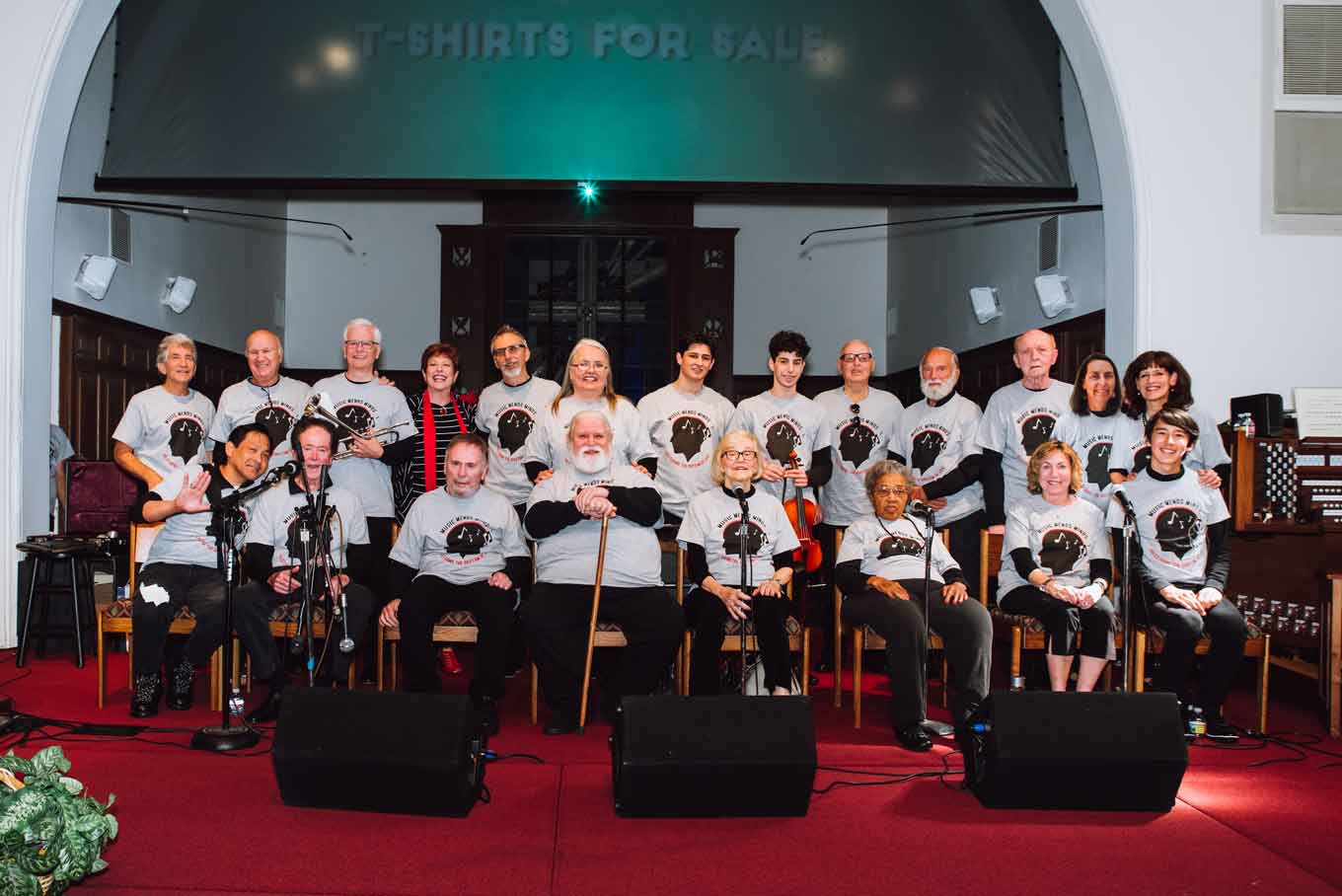
Huggins booked two plane tickets to Los Angeles so that she and Alan could see The 5th Dementia in action. What she saw gave her hope. Alan, a microbiologist, had been depressed because he couldn’t figure out what was going on in his own brain.
There in the church, he met people like him. Some could no longer speak, but they could still express themselves and find joy in music. Amy, in turn, talked with caregivers like herself, who shared stories of how music had elevated their loved ones’ spirits. “I got this very clear message,” she says. “This is what you need to do.”
When she returned to Washington, Huggins asked her Rotary club to make Music Mends Minds a service project. In September 2015, 75 people showed up to the launch, and a new band called the Island Rockers was born.
Alan passed away in 2016, and Huggins fell into a deep funk. In time, it was Music Mends Minds that brought her back. “I realized Music Mends Minds was the way forward,” she says. “Because it had helped Alan, it would help other people.”
She became an ambassador for the nonprofit, traveling to Rotary clubs in the region and giving presentations about what Music Mends Minds could do for people with dementia, Parkinson’s, stroke, and post-traumatic stress disorder. A number of those clubs started their own bands.
Huggins also traveled with Carol Rosenstein to Rotary conventions, where they established formal partnerships with the Alzheimer’s/Dementia Rotary Action Group (ADRAG) and the International Fellowship of Rotarian Musicians (IFRM).
Since its humble beginnings in 2014, Music Mends Minds has expanded with more than 20 bands around the globe, many of which are tied to Rotary clubs.
(Most of the bands are now meeting virtually because of the pandemic, and are led by a music therapist.)
In 2018, CNN named Carol one of its CNN Heroes.
David Clifton, a past governor of Rotary District 7950 (Rhode Island and parts of Massachusetts) as well as a founder and past chair of ADRAG, says that Music Mends Minds offers hope to people who need it most.
“This is something we need to spread around the world,” says Clifton. “It does, indeed, restore the rhythm of life, and becomes a way for people to communicate.”
Carol Rosenstein saw more and more scenes that reinforced the power of music: people who couldn’t remember their own names crooning Frank Sinatra; men and women who barely talked, playing instruments; older adults pushing aside their walkers to dance.
She also learned more about the science behind it, thanks to such academics as Michael Thaut, a professor of music and neuroscience at the University of Toronto who is now on the advisory board of Music Mends Minds.
Thaut has been researching how music affects the brains of people with Alzheimer’s in hopes of pinpointing ways to improve their lives. He says that scientists aren’t sure what causes Alzheimer’s, which is the most common type of dementia, and that while medications may treat some symptoms, there is no cure.
When a person has Alzheimer’s, the proteins in their brain don’t function normally, and that leads to the death of brain cells.
A person in the early stages of Alzheimer’s may forget words or repeat questions. In the end stages, they may experience delusions and forget how to do even the most basic tasks, like eating or walking.
According to the U.S. Centers for Disease Control and Prevention, as many as 5.8 million Americans have Alzheimer’s. By 2060, that number is expected to nearly triple.
Alan, a microbiologist, had been depressed because he couldn’t figure out what was going on in his own brain. There in the church, he met people like him. Some could no longer speak, but they could still express themselves and find joy in music.
In a study published in the Journal of Alzheimer’s Disease in 2021, Thaut and other researchers set out to see what happens in the brain when a person with mild cognitive impairment or early Alzheimer’s disease listens to their favorite playlist for an hour every day for three weeks.
At the beginning and end of the study, the 14 participants had brain scans and took neuropsychological tests that involved memory exercises.
To Thaut’s surprise, at the end of the trial the participants showed a small but statistically significant improvement in memory — something that is extremely unusual in people with Alzheimer’s or any type of dementia. Close examination of the brain scans revealed visible changes. Most notably, Thaut saw that measurable new connections had formed between different regions of the brain — highways, if you will, that actually changed brain plasticity and also improved function in relaying information. Thaut says the research shows that while music is in no way a cure for Alzheimer’s, it can provide a “cognitive boost.”
But not all music has the same impact. In another study published in 2020, Thaut and his colleagues compared brain activation when study participants listened to two different types of music: music that dated back at least 25 years, and music that was new to them.
What they found was that the different types of music activated different parts of the brain. With new music, brain activity appears limited to mostly auditory processing, but not deep processing. Familiar music, however, stimulated more regions more significantly in a way that is deeply encoded in the brain. Those regions are associated with emotion, cognition, and autobiographical memory, and are minimally affected by early-stage Alzheimer’s.
“This is one of the reasons, possibly, that some musical memories are preserved, because they’re encoded in such widely distributed regions,” Thaut says. “So the chance that some of the regions associated with music-based memories are preserved is just higher.”
While the “why” of it all isn’t yet fully known, Thaut says that mood and memory are closely connected, and networks of memories can become connected to mood “nodes.”
He describes it as a kind of classical conditioning: You hear a certain song that was important in your past and you automatically think of a certain time or event connected to the music.
When you listen to that music more frequently, it’s like a cognitive workout for the brain.
“When you drive these networks on a regular basis,” Thaut says, “you exercise those networks, and then the connectivity within these networks becomes stronger again.”
When those who live with and care for people with diseases such as Alzheimer’s and Parkinson’s seek out music and musical groups to help their loved ones, they often find the experience benefits them, too. And there’s research to support that.
For decades, Mary Mittelman, an epidemiologist who works at New York University as a researcher in the department of psychiatry, has been developing and studying social and psychological methods to help people with cognitive impairment and their family members.
In 2011, curious about the impact of music, she started her own chorus, called The Unforgettables, to investigate what rehearsing and performing in a concert could do for participants.
The initial chorus consisted of 22 people — 11 had memory impairment and 11 were their family caregivers. Mittelman’s published findings documented improvements in quality of life and communication not just for those with memory impairment but also for caregivers, who reported improved social support and self-esteem thanks to the chorus.
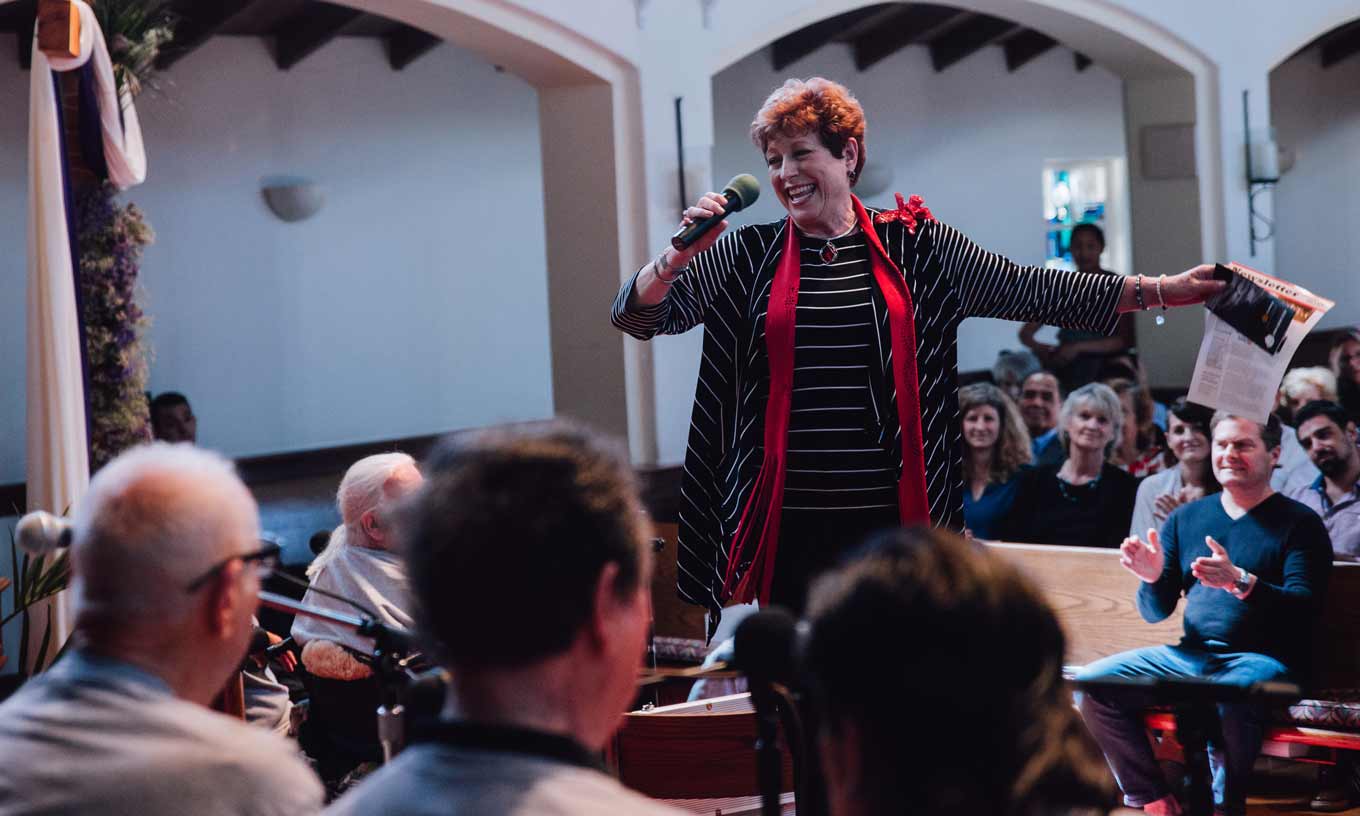
Anecdotes shared by the choral conductors stand out in Mittelman’s report. They saw couples holding hands and looking into each other’s eyes, “as though they were first dating.”
They would joke around. Song lyrics would bring back memories and spark conversations. Beyond those observations, Mittelman remembers watching transformations among participants: Some would arrive grunting, agitated. They would leave speaking in full sentences, calm.
She believes that the improvement is rooted in their rehearsals and performances — but it’s more than that.
People with dementia and their partners tend to withdraw socially for a number of reasons, one of which is the stigma around dementia: People don’t want to talk about their illness, and they may lose friends because of it.
In the chorus, however, everyone feels valued. They’re respected. They’re enjoying themselves and bringing joy to others as they prepare for a concert. “Here in the chorus,” Mittelman says, “there’s no stigma.”
For Mittelman, who is also on the advisory board of Music Mends Minds, this study is just the beginning. She’s applying for more funding so that she can conduct larger studies of the benefits of making music.
“I don’t think we know exactly what’s going on in their brains that they can learn new songs when they’re forgetting to brush their teeth,” she says. “We would like to find out.”
In the meantime, she wants more people to understand that health care for a person with dementia must include more than medical care, and that their quality of life can improve without medication. One way to make that happen is well within reach of all: music.
“It’s a language that everyone speaks on some level or another,” Mittelman says. “You don’t need to be a trained singer to get pleasure out of singing. You don’t need to be a trained musician to get pleasure out of making music. And having music in your life can bring you pleasure regardless of whether you have dementia or not.”
Irwin Rosenstein passed away in January 2021, 15 years after his diagnosis and seven years after rediscovering music. In those final days, Carol recalls, he could no longer speak and could not leave his bed or a wheelchair. His smile was a memory. He would look at his wife with a gaze that she refers to as the “Parkinson’s stare.”
Unless, that is, there was music.
All the way until the end, Carol made rhythm a part of their lives. As Irwin lay in bed, she would pick up two little egg-shaped shakers and play music and dance in front of him.
“He was like a corpse under his blankets. Then his arms would start to come out of the covers, his knees would start to lift, and before you knew it, he was dancing with me,” she says, smiling through her tears. “That’s how we said goodbye, because his brain was so connected to the rhythm of the music when everything else was gone.”
Music could bring Irwin back to the moment, back to himself. It also brought him back to Carol.
“It is painful to watch your beloved slip away inch by inch,” she says. “And if it weren’t for the music, I wouldn’t be sitting here today. As a caregiver and first responder, I can tell you, I would have never survived the journey.”
Rotary magazine, the official monthly publication of Rotary International, a service organization with 1.4 million members around the world. For more information, visit Rotary.org
On color-coded temperature charts, the Indian subcontinent is currently a sickly mauve. With summer still right around the corner, an unusually intense heatwave is threatening millions of people there.
Temperatures are expected to exceed 118.4°F on the border between Pakistan and India this week. A month ago, the heat broke a 122-year-old record. What can people do to weather the worst and prepare for a future of extreme heat?
For many Indians and Pakistanis, particularly in rural areas, the intolerable heat will slash the valuable hours available to work outdoors. According to research published by the Lancet, more than 150 billion work hours were lost in 2018 due to extreme temperature and humidity. This trend will have global consequences.
“Half of the world’s food is produced by smallholder farms with most of the energy input from physical labor carried out by the farmers,” says Mark Maslin, professor of Earth system science at UCL.
“As the world warms, there will be more and more days when it will be physically impossible to work outside, reducing productivity and food security.”
In cities, where an increasing share of the global population lives, there are opportunities to make streets more comfortable during bouts of extreme heat. One of the most popular, with wider potential benefits for wildlife seeking habitat, is urban greening — or making more space for trees and other vegetation amid the concrete sprawl.
But a study led by Cardiff University’s Mark O. Cuthbert, published in February, found that carpeting roofs and walls with greenery and weaving green corridors between expanded parkland can either subdue floods or mitigate heat, but it can’t do both in one city.
According to Cuthbert and his co-authors, Denis O'Carroll of UNSW Sydney in Australia and Gabriel C Rau of Karlsruhe Institute of Technology in Germany, the reason cities tend to overheat in hot weather and flood during heavy rainfall is the same.
The abundance of concrete and steel absorb and retain heat, while those same sealed surfaces “can’t act like a sponge to soak up and store rain, unlike the soil they’ve replaced”.
The researchers argue that greener cities in areas of high rainfall — such as around northern Europe and around the equator — are likely to offset stronger heatwaves because plants release water vapor during photosynthesis, which has a cooling effect.
The research team expects the benefits of urban greening to be less pronounced in drier areas where there’s plenty of energy from sunshine, but rainfall is more limited, like in cities in India and Pakistan.
But expanding green spaces in these places is still worthwhile, as this is where there is the greatest potential for water retention by soils, which can help to prevent floods.
A report published during COP26, the most recent UN climate change summit in November 2021, suggested that Africa is heating faster than other regions of the world. Abdu Mohiddin, an assistant professor at Aga Khan University in Kenya, says that by 2030 up to 118 million extremely poor people will be subject to the devastating impacts of drought and intense heat.
Mohiddin says the continent needs immediate financial and technological assistance to adapt to the warming environment, as well as research funding to assess who and where is most vulnerable.
What Helps?
Systemic Solutions
In these regions and others, designs and building techniques sourced from traditional architecture can offer some of the cheapest and most sustainable forms of relief.
Amin Al-Habaibeh, a professor of intelligent engineering systems at Nottingham Trent University, studies the ways builders have helped keep people cool for centuries in the Persian Gulf (another hotspot for intensifying heatwaves).
Here, homes built with limestone and other natural materials absorb moisture when it’s humid and release it through evaporation on hot and sunny days. This provides a slight cooling effect, Al-Habaibeh says. The sandy texture and color of the buildings also reflects a lot of solar radiation.
Narrow roads and alleys maximize shadows, while glass is scarce and windows small to maintain air flow but keep out the sun’s heat. Internal courtyards funnel hot air upwards at midday (when the sun is at its peak) and replace it with cooler air from the surroundings rooms, he says.
While ingenuity and solidarity can help communities adapt to increasingly brutal heatwaves, there is a limit, say Tom Matthews and Colin Raymond, climate scientists at King’s College London and California Institute of Technology, respectively.
“The range of weather humans can encounter on Earth — the ‘climate envelope’ — is shifting as the planet warms,” they warn. “Conditions entirely new to civilization could emerge in the coming decades.” That means heat extremes that exceed what humans can survive.
Personal Solutions
A 2021 study reported that one in three deaths caused by extreme heat since 1991 can be linked to climate change. If you find yourself in a heat wave, Chloe Brimicombe, a PhD candidate studying climate change and its consequences for human health at the University of Reading, has some advice for staying safe:
“Keep cool. If indoors, trying bathing your feet in cold water or have a shower … Close the curtains and open windows on the side not facing the sun,” she says.
Other measures that keep air flowing throughout the building include opening doors and turning on fans.
Brimicombe stresses that it’s very important to stay hydrated, as you lose a lot of water through sweat during heatwaves.
“Drink more often than you usually would, even when you don’t feel thirsty,” she says. And don’t forget to check on people who may need extra help.
“Look out for over 65s, pregnant women, children under five and those with medical conditions. These groups are all more vulnerable to heat. You should also avoid being in direct sunlight between 12pm and 3pm when the Sun is at its strongest.”
The Tap In Center in St. Louis County is one example of legal help that supports underserved people with open warrants.
It has saved hundreds from going to jail, so why aren't more counties copying it?
Early this year, George Harris (not his real name) had two pending court cases in St. Louis County. He was unaware of one of those cases due to a common error: The notice was sent to an address he no longer resides at. He missed his court date and the county issued him a warrant for failing to appear.
An open warrant meant that if Harris had any encounter with the police, he would be arrested and incarcerated at the St. Louis County jail — all because of a wrong address and a missed court appearance.
But this February, Harris visited the Tap In Center, a resource designed to address this very problem. Inside a local library, he worked with a volunteer attorney who heard out his issue and relayed it to the county prosecutor, who ultimately recalled Harris’s warrant.
“They helped me stay in the community, stay with my family and take care of my kids,” Harris says of the service. “I could have been locked up on that warrant.”
The Tap In Center is an experimental service that launched at the Florissant Valley Branch of the St. Louis County Library in fall 2020. At the center, volunteer attorneys work with people who have open warrants with the goal of recalling them.
In 17 months, nearly 300 residents were served and more than 300 warrants were recalled. This April, a second Tap In Center opened at the Lewis and Clark Branch of the St. Louis County Library to increase the impact.
The Tap In Center is one result of years of community organizing with the goal of reducing racial disparities in St. Louis’ justice system and lowering the jail population. One major player has been The Bail Project, which in 2018 began providing free bail assistance and community-based pretrial support.
The Bail Project’s served over 3,000 people and got the jail population low enough to lead to the passage of a 2020 bill to close the city’s medium-security jail.
In this work, bail advocates realized that much of the jail overcrowding was caused by people incarcerated due to open warrants. This isn’t unique to St. Louis — around the country, the most common type of warrant is issued by the court when someone fails to appear for their court date.
The Bail Project’s work intersected with the St. Louis County Safety and Justice Challenge, which began in 2015 following the police murder of Michael Brown.
In response to the DOJ investigation into the Ferguson Police Department, which found that municipal court practices exacerbated racial inequities in the St. Louis County justice system, members of the Safety and Justice Challenge prioritized the courts in their larger goal of keeping people out of jail.
In 2020, the groups came together to focus on the bench warrants issued due to failing to appear at a scheduled court date. “We started talking about what amnesty, or warrant forgiveness, could look like and who would need to be involved,” says Miranda Gibson, a grant manager at the St. Louis County Department of Justice Services who now coordinates the Tap In Center.
“There’s a common misconception that if someone doesn’t show up to court, they are flagrantly evading prosecution, running from the court or committing crimes,” she continues. “Usually it’s very benign, or just a misunderstanding — anecdotally, most people just don’t know they have a court case or a court date.” Court notices are sent to the address listed on someone’s identification card, which is frequently outdated.
To assess feasibility, the groups started talking with public defenders and judges who participated in the Safety and Justice Challenge. “We wanted to do it where we’d have the most buy-in possible,” Gibson says.
The goal was to convince county prosecutors, who’d make the final decision to recall warrants. “The program could not live without the prosecutors,” notes Gibson. “Ultimately it helps their caseload, they don’t want people out in the world with a bunch of warrants either.”
As they pushed for buy-in, they discussed potential locations. “The Bail Project was really good in framing why we’re doing this and pushing that it should not be at a government building like a jail or courthouse,” Gibson says.
William Newsome, a client support specialist for the Bail Project who now helps with the Tap In Center, notes that police departments across the country advertise “warrant recalls” only to arrest the people who come seeking support. “The issue was that no one was going to believe that they could access this service and not get arrested,” Newsome says.
The group was drawn to the library, and after some cold emails, the St. Louis County Library leadership was quickly on board. “We were looking at where the warrants were coming from, where there was a high area of open warrants, and then talking with the libraries who know their communities well,” says Gibson.
They settled on the Florissant Valley Branch, which is accessible to public transit, about a 10-minute drive from Ferguson, and serves patrons who have been impacted by warrants, arrests and over-policing.
The Tap In Center opened there in September 2020. Every Tuesday, between 6 and 8 pm, volunteer attorneys and a representative from the Bail Project meet with clients who have open warrants.
“We’re right downstairs where the kid’s library is; it’s very relaxed,” says Newsome. “The entire staff of the Tap In is making you feel like this is a safe space; no one is calling the police.” He adds that the team even thought out what they’d wear: “We dress comfortably … if you walk in and see a bunch of people in ties, you’ll get leery.”
During the service hours of the Tap In Center, the county prosecutor’s office is on hand to take calls from the volunteer attorneys. The prosecutors have the authority to make decisions on recalling a warrant that same night.
“We’re looking at the history of the case, we call the prosecutor, and the prosecutor tells us if they’re able to dismiss the warrant,” says Taylor Burrows, a volunteer Tap In attorney. “If the prosecutor has concerns [about dismissal], we go from there to address those concerns.”
“The answer is not always ‘yes,’” Gibson points out, “But we have had a lot of success.” The client can usually leave the Tap In Center after 20 minutes and know if the warrant is going to be recalled, and if so, know they will have another court date set.
There are 91 municipalities in St. Louis County, all with their own courtroom policies and rules around warrant recalls. “It is byzantine,” Burrows says. Some of the volunteer attorneys put together an exhaustive list of court procedures for each municipality, with the goal of streamlining the process.
“We want to understand their policies for warrant recalls, policies for payment plans, where people should direct questions, and what steps they should be taking to deal with their warrants,” Burrows says.
As the attorney addresses the warrants, a Bail Project representative offers wraparound services. “We tap our clients into community partners who do everything they may or may not need,” says Newsome.
“It’s all voluntary, you can come to the center and have a substance abuse problem but if you don’t want to deal with it, we won’t force you.”
Crucially, the Bail Project helps clients attend their new court date by signing them up for automated reminders and offering transportation.
According to anonymous testimony provided by Tap In clients, recalled warrants have a profound impact on their lives.
“It kept me out of jail, which allowed me to continue to work, stay in treatment, and mainly stay out of the system,” one client said. “Once you’re in the system, it’s hard to get out. You get no treatment when you’re in jail, so you guys really saved me from that.”
Another client missed their court date due to confusion. One day after they visited the Tap In Center, the judge recalled the warrant and scheduled a new court date.
“I didn’t know what was going on with the case at the time,” the client reported. “There was a miscommunication because of COVID, I didn’t intentionally miss anything, and you guys made it so I didn’t get locked up.”
Visits to the Tap In Center increased as word got out through word of mouth, outreach from all the participating partners, and direct referrals from judges, prosecutors, and attorneys.
But the team noticed that many of the clients weren’t coming from a neighborhood with a significant percentage of open warrants. So in April, the Tap In Center expanded to the Lewis and Clark Branch to serve that population.
With volunteer support and a free space provided by the library, the team feels this is an easily replicable service — it’s just a matter of getting judges and prosecutors on board.
“Just the fact that our prosecutor is open to looking at these cases is huge … I know a lot of prosecutors are not willing to do that, which is why we haven’t expanded beyond St. Louis County,” Gibson says.
“This could work in every community,” says Newsome. “Anywhere there’s over-incarceration, this can help.”