Advocates are inserting storylines into TV and radio shows to promote behaviors that could lead to social change. Just don’t call it infotainment.
When Aisha Bekele’s (not her real name) daughter was 14, she was abducted on her way to school, raped and forced to marry the man who did it. Scared the same thing would happen to her 12-year-old, Bekele kept her younger daughter at home in her southern Ethiopian village to protect her.
It was only when the mother of two heard a radio program about marriage by abduction on Yeken Kignit (“Looking Over One’s Daily Life”), a soap opera that was broadcast across Ethiopia between 2002 and 2004, that she learned that not only was the practice common in the region, it was also illegal.
Empowered by this knowledge, Bekele and a group of other villagers — many of whom had also listened to the show — came together to condemn the practice and work out ways to prevent it, and Bekele felt able to send her younger daughter to school again.
Bekele’s story is one of many that Population Media Center (PMC) tells to demonstrate the impact of its work. The U.S. nonprofit, which tackles social, health and environmental challenges using entertainment-education soap operas on radio and TV, has created more than 40 shows in over 20 languages since it launched more than two decades ago, broadcasting them to 50 countries and reaching more than 500 million people.
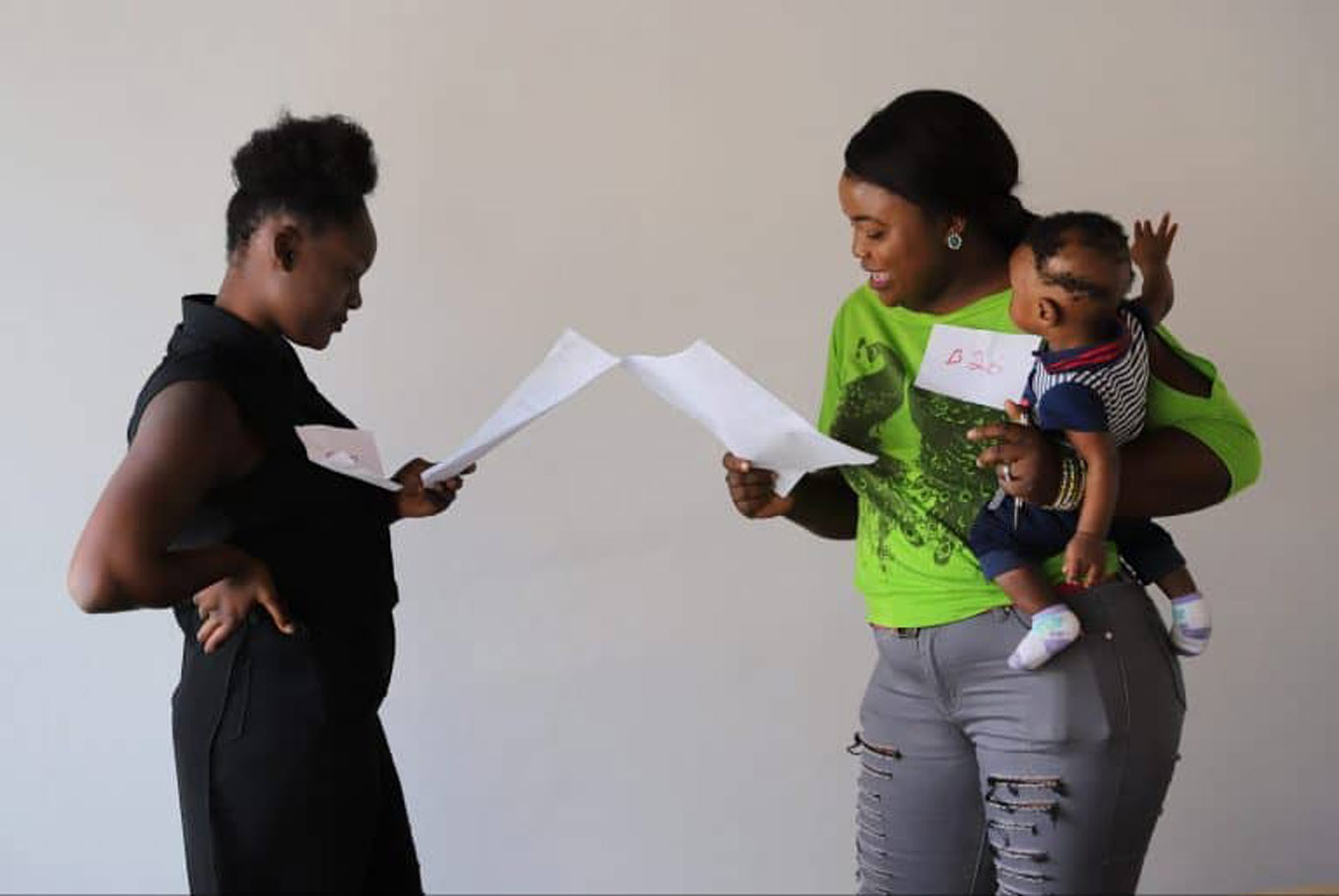
“People do not go home at night to listen to public health messages, they go home to relax and be entertained by the mass media,” says PMC founder William Ryerson. “Using charismatic characters in serial dramas to role model healthful behaviors has been shown over and over to influence large audiences to adopt new social norms.”
While the plotlines of programs like Yeken Kignit might appear straightforward, their simplicity belies the significant work that goes on behind the scenes. Before creating a new radio or TV soap, PMC researchers go into the field to do quantitative and qualitative research, interviewing culture experts to learn as much as they can about the place and its people, from the challenges they face to what they like to eat for breakfast.
Based on this ethnographic research, PMC chooses the main theme, or themes, of the show — Yeken Kignit’s marriage by abduction, for example — checking that the messages they intend to advocate align with government policies and programs available to the intended audience. If there is no reproductive health clinic in the broadcast zone, for example, PMC will not address reproductive issues that require visiting a clinic.
PMC then hires local writers, training them in an entertainment-education methodology established by Miguel Sabido, former vice president for research at Televisa, a Mexican media corporation. Sabido’s approach, founded on psychological principles of behavior change, gave rise to a communications strategy that uses mainstream media to educate the public on social and health issues. Among his accomplishments, his telenovela Ven Conmigo (”Come With Me”) is credited with increasing enrollment in state-run literacy classes by 63 percent to over 800,000 students.
Once PMC’s writers are trained, it is their job to develop a plot with three types of characters — positive, negative and transitional. The former advocate for positive values and negative ones criticize it, but it is the transitional characters, whose attitudes evolve over time towards positive values, who tend to be the most influential, according to Ryerson.
The shows are broadcast over at least a year, enabling such character development and giving audiences time to get accustomed to the messages.
“Parachuting a feminist leader to Sudan would be too radical,” says Ryerson. “It is better to bring permanent change in baby steps. If we do it too fast, the radio gets switched off and people get angry.”
To be as culturally relevant as possible each PMC show is produced by local professionals in the local language, played by local actors, and set across rural, urban and semi-urban locations so that everyone can identify with at least one of the characters. As the show evolves, the writers incorporate audience feedback and real-life events happening in the country in question into the storyline.
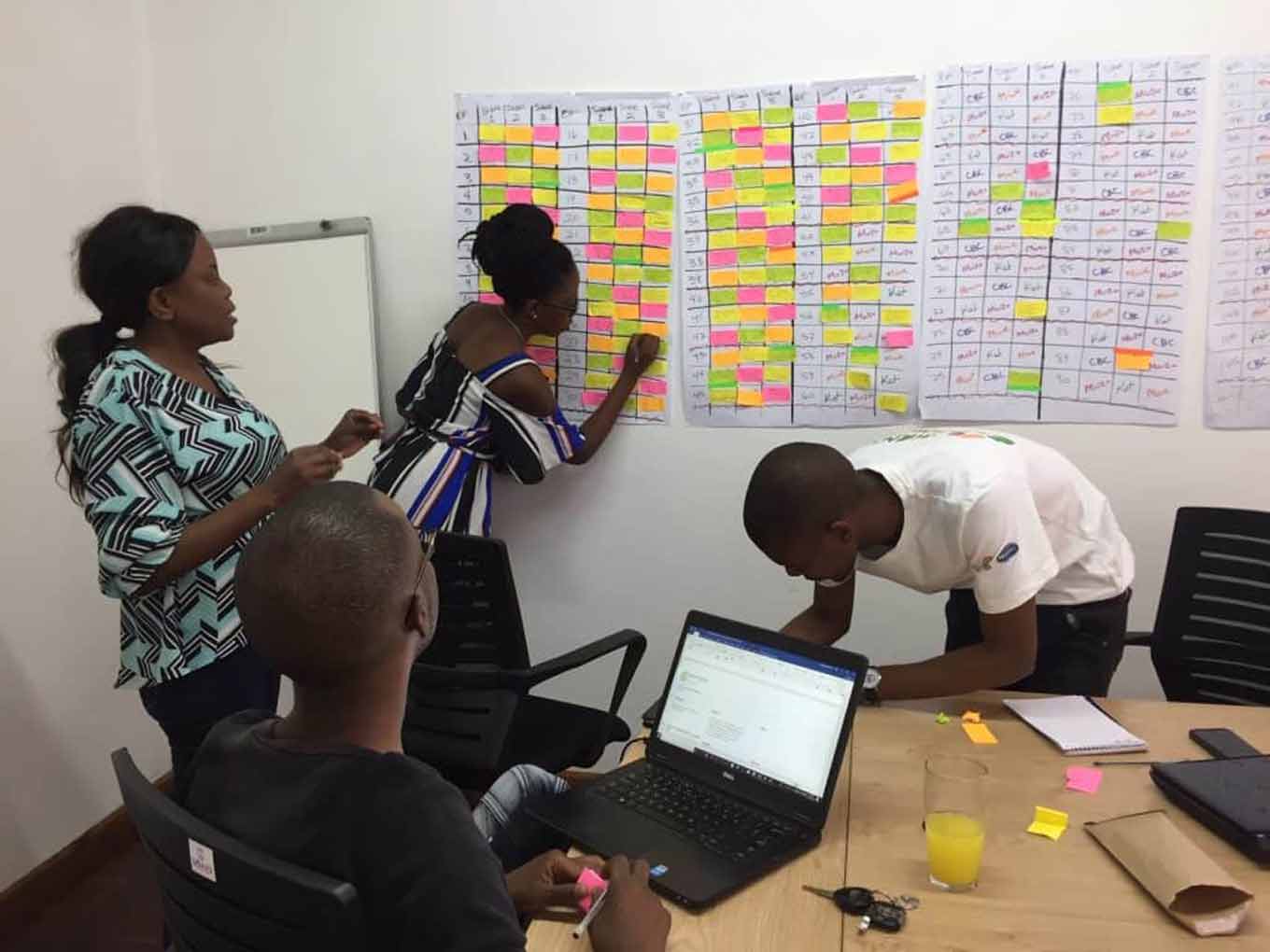
To measure the impact of its work, PMC uses a number of methods including nationally-representative household surveys conducted once a show has ended. These compare knowledge, attitudes and behaviors between listeners and non-listeners. The nonprofit also tracks use of a particular service, such as a health clinic, during a show’s broadcast to discern if the program is helping increase real-time demand.
While paying for the likes of prime time airtime and professional actors is more expensive than, say, a billboard campaign, PMC is convinced that the impact of their soap operas makes them a cost-effective way to bring about positive change in low-income communities.
Ruwan Dare (“Midnight Rain”), a PMC radio drama that aired in four northern states of Nigeria between 2007 to 2009, reached an estimated 12.3 million listeners (over 70 percent of the local population) and is believed to have led to 1.1 million new people adopting family planning methods, among other outcomes. Even though the show cost $1 million, funded in part by the David and Lucile Packard Foundation, PMC calculated that the cost per person for those who adopted family planning and attributed it to the program was only 30 cents.
As well as the measurable impacts of PMC’s work there are the anecdotal ones, such as the Burundian father who says that the popular three-season serial drama Agashi (“Hey! Look Again!”), which aired between 2014 and 2016 and which addressed family planning, reproductive health and HIV/AIDS, helped him talk with his family about issues normally considered taboo.
“There are things I don’t feel comfortable talking about,” he said in a video about PMC’s work. “The serial drama helps me educate my children.”
Entertainment-education has its critics among scholars who find fault with it for focusing too much on individuals and their power to change themselves rather than on complex sociocultural and economic underlying factors that might influence an individual’s behavior.
Critics also highlight that development communication interventions are based on the concept of modernization, a process through which countries adopt Western political, economic, cultural and health systems. They argue that the main factor that impedes development is not lack of knowledge but global patterns of power and exploitation as well as structural inequalities and power relations within countries.
While acknowledging these concerns, Shereen Usdin, a founding member of the Soul City Institute for Social Justice, which uses popular culture for social change (and which has no affiliation with PMC), says that entertainment-education isn’t itself a negative thing.
“Historically, many entertainment-education programs were used by the Global North to educate people in the Global South about issues such as family planning,” says Usdin. “Their agenda was questioned as to whether this was about fertility control or genuine interest in women’s reproductive rights. But people have learned from stories since time immemorial in all cultures. We have found that creating local stories that are not victim blaming and that focus not only on the individual is extremely powerful.”

Traditionally, PMC focused more on individual behavior change. In recent years, the organization, like many leading entertainment-education practitioners, has moved towards approaches that focus on structural barriers. PMC has also been trying to cooperate more with communications researchers to help them understand the importance of social norms.
For an upcoming project in Liberia, where a three-year ban on female genital mutilation was recently announced and national elections are scheduled to take place next year, PMC is working with an NGO on the ground to address gender equity, sexual and gender-based violence, and social cohesion and conflict resolution.
There are times when the impact of PMC’s work is immediately evident, as the story of Agness Kaonga, a 23-year-old mother of three from Zambia, demonstrates.
“I had my first child at the age of 16 and my second son came soon after that,” says Kaonga. “While listening to Kwishilya (“Over the Horizon”) I learned that I could use contraception to space my children and use the time to take better care of my two children. Our third son was born four years later, allowing us to save money for clothes, food and school equipment.”
In many cases, however, working to change norms can take a long time, says Joe Bish, director of issue advocacy at PMC.
“While our efforts may not be as immediately tangible as the work of other developmental organizations,” says Bish, “which may be providing health clinic services or building physical infrastructure like school buildings, we are trying to bring long-lasting, transformative impacts to the health and wellbeing of future generations.”
Zack Koscielny has only been in charge of livestock and crops for four years, but the freckled farmer has already become accustomed to successive dry spells, including one last year that put large swaths of the Canadian prairies in exceptional drought.
Then, this season, Manitoba was hit by a major spring blizzard and several Colorado lows that have caused flooding in the Red River Valley and brought unseasonably cold, damp weather that has delayed planting across the province.
“The weather’s been crazy,” says Mr. Koscielny on a chilly spring day on the fields of Green Beach Farm in Strathclair, three hours northwest of Winnipeg.
The uncertainty would be enough to deter most starting out. But Mr. Koscielny instead has decided to reimagine his family’s fourth-generation farm into something different in the prairies. Mimicking native prairie, his fields look “messy” as he intercrops instead of planting the tidy single crop fields of wheat and canola of his childhood. He puts his pigs and chickens out on the pasture and arranges for calves to be born outdoors, later in the season and far from a barn. It’s all an effort to restore the soil health here to buffer against the wild swings in weather — and the pessimism that prevails when it comes to the climate.
“It seems like a constant challenge with the weather. But I have a hard time blaming Mother Nature for it. That’s her job. And it’s our job to deal with it,” he says, adjusting his baseball cap as he rotates his two dozen yearlings to a new pasture to avoid overgrazing.
“Instead of all this ‘woe is me’ stuff, I think farmers have such an opportunity if they manage land properly and stop fighting Mother Nature.”

Mr. Koscielny’s approach is part of a global movement known as “regenerative agriculture,” a sweeping term that entails the many ways farmers can restore and nourish ecosystems while also growing food.
For years now, a small but increasing number of producers have been turning away from the traditional, linear supply chain approach to agriculture in favor of the way Mr. Koscielny is farming, using techniques such as rotational grazing, cover cropping, or even growing trees in pastureland.
Supporters say this form of agriculture leads to both better products and healthier soils. It also, according to a growing body of research, helps farmers both fight climate change and adapt to the extreme weather events caused by it.
Big stakes for global climate
Although it’s tricky to calculate exact numbers, groups such as Project Drawdown estimate that agriculture and land use are responsible for about a quarter of the world’s greenhouse emissions. And in Canada and the United States, government agencies put the percentage of greenhouse gas emissions caused by agriculture alone at around 10% — a figure advocates say may be conservative.
Regenerative practices, on the other hand, can turn agriculture into a climate solution, in part by storing more carbon in the soil.
Project Drawdown, for instance, estimated that regenerative agriculture could have a greater climate solution impact than either electric cars or geothermal heating.
But as important to Mr. Koscielny and his fellow farmers is how it can help protect against climate extremes. Thanks to everything from healthier bacteria and microbes within the soil ecosystem to deeper root systems, land tended by regenerative agriculture practices has the ability to hold more water.

“People who are doing regenerative practices are experiencing much lower drought impacts because they have soils that are better at retaining moisture overall,” says Cathy Day, climate policy coordinator for the National Sustainable Agriculture Commission in Washington.
And that matters here.
The prairies, home to 80% of Canada’s farmland, have grappled with drought for centuries. But scientists predict even drier conditions — alongside the kind of flooding that has put farms under water in southern Manitoba this spring — as a new norm in prairie life.
This year, a report from the United Nations’ Intergovernmental Panel on Climate Change zeroed in on the world’s agricultural systems, saying that global warming is already threatening food sources around the world, and that extreme weather will be the new normal for farmers.
The risk to North American topsoil
For farms across the North American Wheat Belt, the drought-flood cycle is particularly damaging. Parched, powdery soil does not absorb water quickly, so the water from torrential rains tends to rush across the surface, carrying even more topsoil away.
That’s what has happened in the American Midwest over recent years, where farmers accustomed to predictable rainfall patterns have suffered ruined fields and crops from both dry spells and extreme rains.
Here in Manitoba, last year’s drought caused several municipalities to declare agricultural disaster in the prairies. Farmer Larry Wegner in Virden, Manitoba, says he had to plan for raising fewer cattle to have enough forage through the winter, and he expects to face such decisions more frequently.
“In the prairies we’re going to see milder weather, so more water running in wintertime, which is rare for this part of the world. And we’re going to see drier summers. So we have to start thinking, how do I start planning ahead for that to make it better?”
Those questions will be centerstage at the Manitoba Forage & Grassland Association conference in November on regenerative agriculture — the fifth they’ll have held.
The meeting will bring in experts to discuss ways to improve soil health so that the ground holds more water in periods of heavy rainfall, and so there are reserves from wetlands in times of drought.
The principles behind regenerative agriculture date back centuries, to the way Indigenous peoples grew food before industrial agriculture. But it can be hard for farmers to transform their methods, says Brenda Tjaden, founder of the Manitoba consultancy Sustainable Grain. Farmers’ fields might look “messier,” she says.
There is currently no certification like a green label, since regenerative agricultural practices is a systems-based approach to land management so is harder to measure. “It doesn’t follow a particular regime,” she says. “Are there waterways close by? Are there any grasslands? Are there any trees in the vicinity?”

Indeed, one of the characteristics of regenerative agriculture is that it is place specific, says Lara Bryant, deputy director for water and agriculture with the Natural Resources Defense Council.
Working in harmony with a wet, southeastern U.S. ecosystem is far different from what a farmer would do in the dry Southwest, or the drought — and flood — battered Grain Belt.
That’s one of the reasons why, in a report her organization released in April, Ms. Bryant recommended increased policy support for regenerative agriculture training and mentorship, as well as increased financial support.
“We need to increase the support to farmers and ranchers at the beginning level,” she says. “And our policies need to not get in the way of regenerative agriculture.”
"Surprised how much progress we've made"
Mr. Koscielny grew up ecologically minded. His parents, who farmed part time, were long driven by locally grown food — a lunch spread around their table included garden-fresh salsa and purple potato and squash soups.
They’ve watched the farms grow around them and an industry demanding “bigger, bigger, bigger,” says his mother, Karen Gamey-Koscielny, whose family settled this farm in 1919.
“But if you don’t have good soil, you’ve got nothing,” says her husband, Jason Koscielny.
Their son Zack says that, when it came to choosing a career after earning a degree in agroecology at the University of Manitoba, he had no intention of going into monoculture-style grain production.
Instead he runs “five quarters,” or 800 acres, that has seen Timothy grass and a variety of vetches return. With big cracks forming on his hills last year, the rains this year are not replenished “by any stretch,” he says.
“But we’re just surprised how much progress we’ve made. And even with the dry conditions we’ve added animals every year of the drought.”
Regenerative agriculture, he says, is first off a practical measure to reduce inputs and increase margins. But it also digs deeper.
“It’s rewarding to be doing a job that can really be making a big difference on such a huge issue that most people just say, ‘Well, I don’t know how we’ll ever address that,’” he says.
“I think we’re front and center as far as having the ability to make change and make the difference.”
There's something to be said for maintaining a sense of hopefulness, especially in difficult times. Canadians know this all too well — and are simultaneously at the forefront of making the world a better, more optimistic place.
At Good Good Good, our goal is to cover every piece of good news that happens in the world, no matter how big or small. And time and time again, we come across incredible positive news stories coming out of Canada.
Here’s a roundup of our favorite positive good news stories from Canada. (We'll continue to add more stories to it over time.) We can't help but be hopeful about the future after reading these!
The Best Good News Stories From Canada
Innovative Legislation Bans Whale and Dolphin Captivity in Canada
A federal bill in Canada is phasing out the practice of holding cetaceans — such as dolphins, whales, and porpoises — in captivity, marking a major win for activists and politicians, who say it’s an important development for animal rights in the country.
“Many scientists testified to why it was critical that we stop keeping cetaceans in captivity,” said Elizabeth May, a Green Party leader who sponsored the bill.
“We understand why because they are obviously not akin to other animals, for instance, livestock. Cetaceans require the ocean, they require the space, they require acoustic communication over long distances.”
The bill bans the capture of wild cetaceans but does allow for rehabilitation and rescue of these animals. Additionally, breeding, import, and export are banned — except in cases of scientific research — and new animal cruelty offenses come into play related to the captivity of the animals. The bill plays a major role in clamping down on the marine mammal trade.
“This is a watershed moment for whales and dolphins, and powerful recognition that our country no longer accepts imprisoning smart, sensitive animals in tiny tanks for entertainment,” said Camille Labchuk, executive director of advocacy group Animal Justice, to the National Post.
This Man in Montreal Started a Movement To Remove Hateful Graffiti For Free
A grassroots effort in Montreal, Canada sprung up to spread peace and tolerance, and it's turned into a global movement.
Corey Fleischer was working at a graffiti removal company when he happened to notice a swastika spray-painted on a cinder block. Initially, he drove away, but he later returned and removed it in a matter of seconds. Now he locates and removes hateful graffiti throughout Montreal free of charge. He calls his movement Erasing Hate.
Armed with his #ErasingHate vest and a power washer, he drives throughout Montreal eliminating racist, homophobic, anti-semitic, and Islamaphobic symbols and phrases from public spaces such as walls and sidewalks, sharing his good deeds on Instagram along the way, with the support of his tens of thousands of followers.
A key component of the movement he started is to publicly share the location of hateful graffiti so members of the community can remove it. His followers often submit photos, and he shares them along with the graffiti's location, mobilizing people worldwide to swiftly take action to remove it. In many cases, the graffiti is gone in a matter of hours after Fleischer shares it.
These Women Are Working To Recruit More Stem Cell Donors From Black Communities
An effort to recruit stem cell donors within Black communities is being driven by a group of women who’ve had difficulty finding full genetic matches themselves.
For patients in need of stem cell transplants, such as those with leukemia and lymphoma, genetic matches are crucial — and are most commonly found within their own racial and ethnic groups.
The new Black Donors Save Lives campaign notes that fewer than 3 percent of those in the Canadian Blood Services stem cell donor registry are Black.
“That decreases their chance of finding a match,” campaign lead Sylvia Okonofua told CTVNews.ca. “It becomes a numbers game for Black people on the stem cell waiting list, where it’s like finding a needle in a haystack.”
Okonofua, a recent University of Regina biochemistry graduate, has her sights on becoming a hematologist and timed the virtual campaign to kick off during Black History Month. The campaign uses TikToks, shareable infographics, and even an original song on YouTube to reach a wide audience.
“It was ... frustrating to know that a patient from my community is so much less likely than other patients to be helped,” she told CTVNews.ca. “When you see that your people have a really, really low chance of being helped out, it takes you aback.”
She said part of the outreach involves having Black stem cell recipients talk about their experiences with the healthcare system and speak to the historical mistrust the Black community has toward the medical community.
For Dorothy Vernon-Brown, who helped inspire this month’s campaign, the effort is personal. In 2013, she was diagnosed with acute myeloid leukemia and was heartbroken to discover there were no stem cell matches in Canada's registry or internationally.
She ultimately received stem cells from her sister. The latter was a half-match and has been spreading information to Black Canadians ever since, through her advocacy group, Donor Drive for Dorothy.
“Stem cell transplantation is a miracle for patients, and I wish people knew how easy it is to be a stem donor,” she tweeted. “You could give someone an opportunity like my sister gave me, to be around and live the life I want. People want to live, so if that gift is in your hands, I appeal to you to see it as something significant to do in your life.”
There are two types of donation: One is a two-hour surgical procedure, and the other is a process similar to donating plasma. When you sign up for a registry, you generally agree to donate by either method. The patient’s doctor will determine which process is better for the patient.
Alberta Eliminated Fees For Addiction Recovery Programs
Addiction treatment can be costly for many people — fees can be thousands of dollars for inpatient facilities. But the government in Canada’s Alberta province just eliminated fees for people to attend the 72 licensed, publicly funded treatment centers in the province.
The $40 daily cost for room and board will be covered for everyone who does not have health insurance plans that would cover the cost.
“We are contributing to a transformational change in the sector,” associate minister of mental health and addictions, Jason Luan, told the Canadian news organization CBC. “Our major step forward, this milestone, will signal another best practice that we hope will lead the country with our numbers, with our evidence.”
Some families even sell their cars, empty their life savings, or take out second mortgages on their homes to pay for addiction treatment, according to CBC. But this shift makes good economic sense for all.
Luan said substance use cost Alberta $5.5 billion in 2014: to pay for health services, police, court and corrections costs, and in lost productivity. Every dollar invested in prevention can save another $12 down the road, he said.
Eliminating this barrier to treatment will hopefully encourage people who need help to pursue it. It's a win for the government and for people.
This Woman is Helping Find Missing Indigenous Women in Canada
The number of missing and murdered Indigenous women and girls is a national crisis, but it rarely gets the attention it deserves.
It's often coined as a silent crisis: In Canada, the Royal Canadian Mounted Police estimate that since 1980, 1200 Indigenous women and girls have gone missing or have been murdered — a figure that advocacy groups put far higher, at around 4,000.
Gladys Radek is one of the many Indigenous activists who have set out to raise awareness on this issue and spoken out about what needs to be done for these women and girls. She has a personal tie to the cause after her niece went missing in 2005; like the majority of women who disappeared in the area, her niece was an Indigenous woman who vanished without a clue.
To channel her grief into action, Gladys organizes walks across Canada as a human rights activist. She unites families and raises awareness about the ongoing violence against Indigenous women, collecting the names of missing and murdered women and girls along the way.
It's grassroots organizers like Gladys that are making a difference for Indigenous communities. Vicki Chartrand, a sociology professor in Quebec, cites Gladys' movement as vital to the cause. “It is the Indigenous grassroots who are doing the work and who are at the heart of the struggle,” she told Hello Giggles, comparing the work that grassroots organizers do of higher value than any governmental program.
While missing and murdered Indigenous women continue to be a global crisis, it’s worth noting that there are folks like Gladys who are taking the mission into their own hands — and fighting for those who cannot fight for themselves.
A Canadian University Implemented a Fall Reading Break After Years of Student Campaigning
After years of advocacy from students over concerns about mental health, the University of British Columbia implemented a three-day fall reading break for the first time, from November 10 to 12 last fall.
UBC was one of the few major post-secondary institutions in Canada without such a break, according to the university's Alma Mater Society.
Kin Lo, associate professor at the Sauder School of Business and chair of the UBC senate's academic policy committee, told CBC News there has long been a demand for such a break, primarily for mental health reasons.
“Coursework at an institution like UBC can be demanding,” Lo said. “[A reading break] may be a time to take a break from studying altogether and relax the brain a little bit.”
AMS president Cole Evans said the pressure of the fall semester can take a toll, particularly in November after a period that is heavy with mid-terms and assignments.
“This has been a long time coming,” Evans told CBC News.
The highest traffic for university counseling services has historically occurred in October and November, according to a 2019 report from the AMS.
The break will fall over Remembrance Day, with students getting an additional two weekdays off. UBC made the break possible by shortening the exam period from 16 to 12 days.
Michael Lee, an expert in student mental health and professor at UBC's department of occupational science and therapy, told CBC a fall reading break can improve campus well-being if implemented properly.
Quebec Man Donates Island To Conservation Efforts, Turning Down Money From Developers
When Thor Vikström emigrated from Sweden to Canada in the 1960s, he purchased the small island of Îl Ronde with one goal in mind: to preserve and protect it for generations.
Îl Ronde, considered a rare, ecologically diverse jewel, just so happens to be wedged between two of Quebec’s major urban cities: Montreal and Laval. For decades, developers eager to build highrises, roads, and bridges have pleaded to buy this island.
However, Îl Ronde isn’t just a longstanding home to the Vikström family. Still, it's a safe haven for various species, like map turtles — deemed a “special concern” by the Canadian government — that frequently rest and find undisturbed safety on the island’s natural shores.
“I don’t want money. I want the island to be an island, and I want the life that comes and goes here to have a home,” Vikström told The Washington Post. “No amount of money can ever buy it.”
Now 93 years old, Vikström has decided to donate his seven-acre nature reserve to Nature Conservancy of Canada, a private nonprofit conservation organization he trusts will continue to care for and protect this pristine island.
Together with various other environmental agencies, Nature Conservancy of Canada plans to add Îl Ronde to their preserved-nature park, which will be composed of 4,000 acres of protected forest and farmland.
These stories were excerpted from the Goodnewspaper — Good Good Good’s monthly print newspaper filled with good news. Whether you live in the U.S., Canada, or anywhere else in the world, you can become a subscriber today.
As climate disasters increase across the globe, standard seasonal changes like fires and monsoons have become extreme, lethal events, destroying communities and displacing millions.
As of June 21, over 9.5 million people have been impacted by monsoon flooding in Bangladesh and northeast India, according to Reuters. Most recent reports share that the worst floods have killed at least 69 people in the last two weeks.
Monsoons bring heavy rains to South Asia between June and October and can often trigger floods, especially in Bangladesh, which lies low in the Himalayas.
Although local emergency responders have been working to evacuate people and provide safe shelter, food, and water, the floods in the Sylhet region are the most severe floods the area has experienced in more than a century.
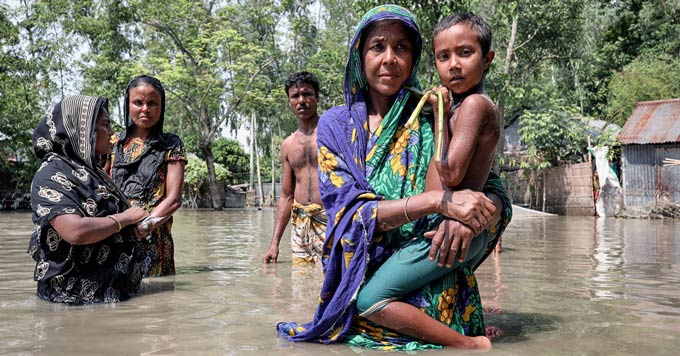
The United Nations children’s fund told Reuters that 90% of its health facilities have been inundated, and cases of waterborne diseases are increasing.
At least four million people, including 1.6 million children, have become stranded and without emergency supplies in Bangladesh. In neighboring India states Assam and Meghalaya, 4.7 million people have been forced out of their homes, and 330,000 are staying in shelters, the government told Reuters.
These areas have received 134% more rainfall than the average this time of year, according to India Meteorological Department.
As these horrific climate disasters loom, it can feel overwhelming and hard to help. However, just like in any heartbreaking global event, we will find the helpers. Below, find a list of small ways you can help those impacted by the floods.
7 Ways To Support Emergency Relief Efforts in Bangladesh and India
Spread awareness.
We get it; there is no shortage of heartbreaking and scary events happening in the news. Trust us. But spreading awareness about tragedies of this magnitude helps get international aid to the places where people need it most.
Share news about the floods, first-person accounts on social media, or resources to help (like this guide!) and help educate your network about this ongoing crisis.
Provide food by donating to World Central Kitchen
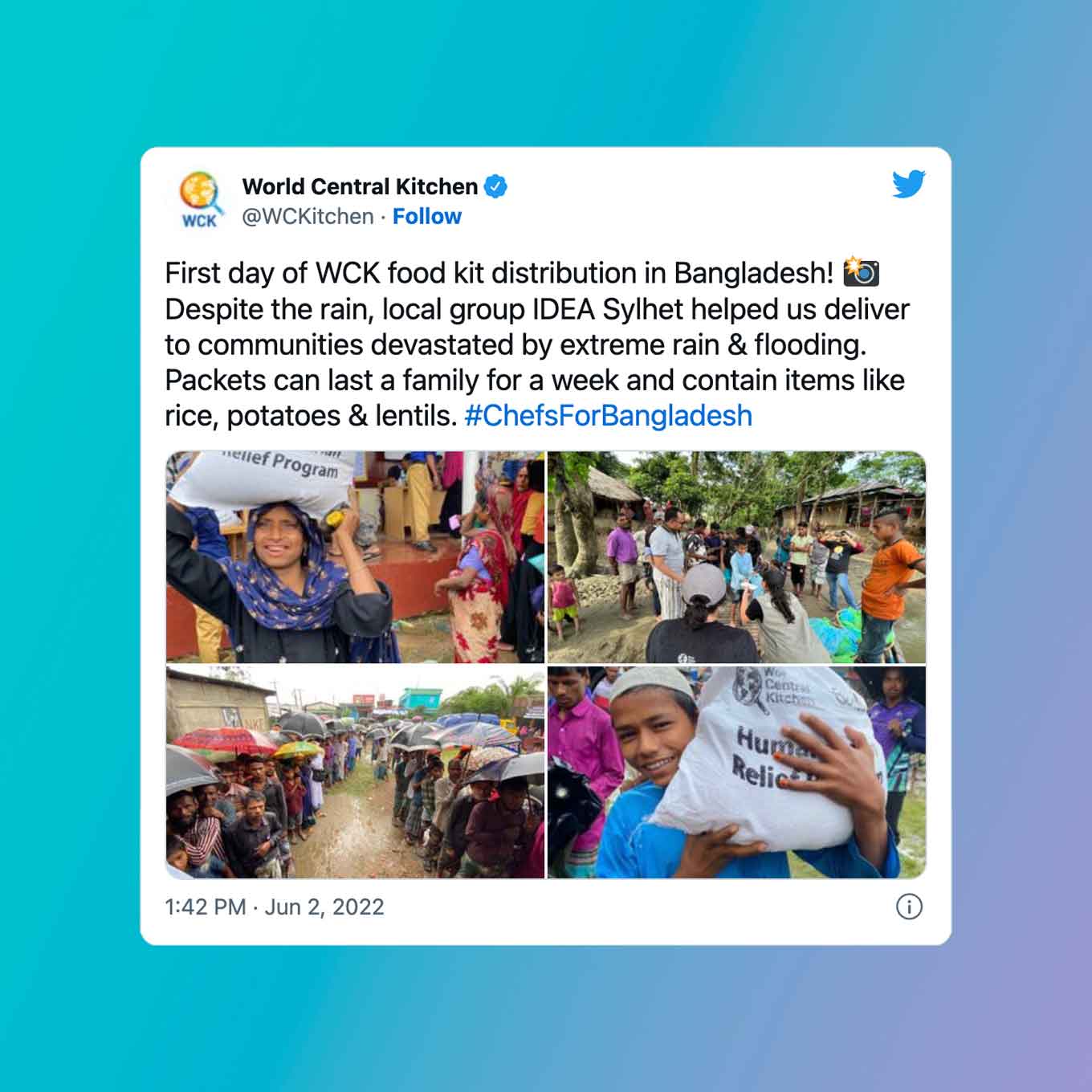
Bangladesh is currently facing significant food shortages as a result of the flooding. Thousands could be at risk of starvation and malnutrition if they don't get access to food (and clean drinking water).
World Central Kitchen is already on the ground providing free meals to people in need. WCK's unique model allows for a double impact. They provide food in the aftermath of disasters — and they do so by partnering with local food suppliers, chefs, and volunteers whenever possible. This ensures they're supporting the community economically, giving skilled locals the opportunity to turn their talents into impact, and, of course, also providing food.
In Bangladesh, they've already shared stories of partnering with a local fish trader for assistance navigating communities by boat, a local government council official for community organizing, and local women to cook and distribute meals.
You can support World Central Kitchen's work with a one-time or recurring donation.
Donate to crowdfunding campaigns.
Although financially supporting large nonprofits is a great way to provide emergency aid during climate disasters, individuals, communities, and small organizations on the ground need your immediate support.
If you can, donate to crowdfunding campaigns, which often use your support to immediately provide necessary resources, and are organized by people who are in the immediate vicinity and impact of the disaster.
You can find crowd-funding campaigns for those impacted by these disastrous floods by searching for terms like "Bangladesh floods" on GoFundMe, Just Giving, and Muslim Giving.
Even if you can only spare a couple of dollars or can share widely, your support can mean the difference between someone going hungry and making it to a safe shelter.
Donate to Islamic Relief
Islamic Relief is a humanitarian relief agency providing care amidst global emergencies, as well as conflict in areas like Afghanistan, Yemen, Palestine, and Syria.
Support Islamic Relief’s campaign as teams work to bring millions of South Asians to safety during the floods and repair vital infrastructure in Bangladesh and India.
Donate to UNICEF
UNICEF is urgently seeking $2.5 million in funding for emergency response in Bangladesh and India, as it provides life-saving supplies and services to children and families.
Working quickly, UNICEF has already dispatched 400,000 water purification tablets to support 80,000 households in the area with clean water for a week. Thousands of hygiene kits, water containers, and emergency medical supplies have also been distributed.
Help UNICEF continue this relief work with a donation.
Learn about the impact of climate change — and demand action.
Climate change is at the forefront of these ruinous weather events around the globe. In order to reduce these disasters and save lives (and the planet), we need to be well-versed in climate change and policy.
Learn more about intersectional environmentalism, and contact your representatives today to urge them to take action against the deadly impact of climate change.
Hold news outlets accountable for reporting on climate change
It’s always important to consume media with a critical eye, and climate change is no exception. In many extreme weather events, popular media does not often connect disasters to climate change, calling them “natural disasters,” instead of “climate disasters.”
There is nothing natural about this much devastation.
Words matter, and it is more important than ever to make sure folks are getting the accurate information they need to understand the seriousness of climate change.
Read our guide (and email script) to help constructively hold news outlets accountable for climate reporting.
We all know that social justice is important. It’s something we talk about, tweet about, and march for. But what does it really mean? And how can we make sure that we’re living it every day?
In this article, you’ll find some of the best quotes about social justice from people who have dedicated their lives to making the world a more equitable place. We hope they inspire you to do the same.m
P.S. You can read more quotes about justice, quotes about advocacy, and other positive quotes in our most popular quote roundups.
The Best Quotes About Social Justice
Famous Quotes
“I am no longer accepting the things I cannot change. I am changing the things I cannot accept.”
— Angela Davis
“Freedom and justice cannot be parceled out in pieces to suit political convenience. I don’t believe you can stand for freedom for one group of people and deny it to others.”
— Coretta Scott King
“We are all implicated when we allow other people to be mistreated. An absence of compassion can corrupt the decency of a community, a state, a nation.”
— Bryan Stevenson, Just Mercy: A Story of Justice and Redemption
“I am not interested in picking up crumbs of compassion thrown from the table of someone who considers himself my master. I want the full menu of rights.”
— Archbishop Desmond Tutu
Quotes on Activism & Taking Action
“When we identify where our privilege intersects with somebody else's oppression, we'll find our opportunities to make real change.”
— Ijeoma Oluo, So You Want to Talk About Race
“We have a right to protest for what is right. That’s all we can do. There are people hurting, there are people suffering, so we have an obligation, a mandate, to do something.”
— John Lewis
“When you get these jobs you have been so brilliantly trained for, just remember that your real job is that if you are free, you need to free somebody else. If you have some power, then your job is to empower somebody else. This is not just a grab-bag candy game.”
— Toni Morrison
“Power concedes nothing without an organized demand”
— Charlene Carruthers
“Don't sit around and wait for the perfect opportunity to come along — find something and make it an opportunity.”
— Cecile Richards, Make Trouble: Standing Up, Speaking Out, and Finding the Courage to Lead
“I think each village was meant to feel pity for its own sick and poor whom it can help and I doubt if it is the duty of any private person to fix his mind on ills which he cannot help. This may even become an escape from the works of charity we really can do to those we know. God may call any one of us to respond to some far away problem or support those who have been so called. But we are finite and he will not call us everywhere or to support every worthy cause. And real needs are not far from us.”
— C.S. Lewis
“Your vocation can be found where your greatest joy meets the world’s greatest need.”
— Frederick Buechner
“There may be times when we are powerless to prevent injustice, but there must never be a time when we fail to protest.”
— Elie Wiesel
“Our freedoms are vanishing. If you do not get active to take a stand now against all that is wrong while we still can, then maybe one of your children may elect to do so in the future, when it will be far more riskier — and much, much harder.”
— Suzy Kassem, Rise Up and Salute the Sun: The Writings of Suzy Kassem
→ Read more quotes about activism
MLK Quotes
“And I must say tonight that a riot is the language of the unheard. And what is it America has failed to hear? ... It has failed to hear that the promises of freedom and justice have not been met. And it has failed to hear that large segments of white society are more concerned about tranquility and the status quo than about justice and humanity.”
— Martin Luther King Jr.
“It may well be that we will have to repent in this generation. Not merely for the vitriolic words and the violent actions of the bad people, but for the appalling silence and indifference of the good people who sit around and say, ‘Wait on time.’”
— Martin Luther King Jr., A Testament of Hope: The Essential Writings and Speeches
“Returning hate for hate multiplies hate, adding deeper darkness to a night already devoid of stars. Darkness cannot drive out darkness; only light can do that. Hate cannot drive out hate, only love can do that.”
— Martin Luther King Jr.
→ Read more MLK quotes
bell hooks Quotes on Social Change
“Without justice there can be no love.”
— bell hooks
“There must exist a paradigm, a practical model for social change that includes an understanding of ways to transform consciousness that are linked to efforts to transform structures.”
— bell hooks, Killing Rage: Ending Racism
“Justice is possible without equality, I believe, because of compassion and understanding. If I have compassion, then if I have more than you, which is unequal, I will still do the just thing by you.”
— bell hooks
“Justice demands integrity. It’s to have a moral universe — not only know what is right or wrong but to put things in perspective, weigh things. Justice is different from violence and retribution; it requires complex accounting.”
— bell hooks
“The world would be a paradise of peace and justice if global citizens shared a common definition of love which would guide our thoughts and action.”
— bell hooks
→ Read more bell hooks quotes
Quotes For Students
“You have to get over the fear of facing the worst in yourself. You should instead fear unexamined racism. Fear the thought that right now, you could be contributing to the oppression of others and you don't know it. But do not fear those who bring that oppression to light. Do not fear the opportunity to do better.”
— Ijeoma Oluo, So You Want to Talk About Race
“In a society that functions optimally, those who can should naturally want to provide for those who can't. That's how it's designed to work. I truly believe we're here to take care of one another.”
— LeVar Burton
“Justice grows out of recognition of ourselves in each other — that my liberty depends on you being free too.”
— Barack Obama
Quotes on Social Injustice
“Prisons do not disappear social problems, they disappear human beings. Homelessness, unemployment, drug addiction, mental illness, and illiteracy are only a few of the problems that disappear from public view when the human beings contending with them are relegated to cages.”
— Angela Davis
“The death penalty is not about whether people deserve to die for the crimes they commit. The real question of capital punishment in this country is, Do we deserve to kill?”
— Bryan Stevenson, Just Mercy: A Story of Justice and Redemption
Quotes on Systemic Injustice
“Our problems stem from our acceptance of this filthy, rotten system.”
— Dorothy Day
“Colorful demonstrations and weekend marches are vital but alone are not powerful enough to stop wars. Wars will be stopped only when soldiers refuse to fight, when workers refuse to load weapons onto ships and aircraft, when people boycott the economic outposts of Empire that are strung across the globe.”
— Arundhati Roy, Public Power in the Age of Empire
“There is no such thing as nonracist or race-neutral policy. Every policy in every institution in every community in every nation is producing or sustaining either racial inequity or equity between racial groups.”
— Ibram X. Kendi, How to Be an Antiracist
On Maintaining Hope in the Face of Injustice
“When asked if I am pessimistic or optimistic about the future, my answer is always the same: If you look at the science about what is happening on earth and aren’t pessimistic, you don’t understand data. But if you meet the people who are working to restore this earth and the lives of the poor, and you aren’t optimistic, you haven’t got a pulse. What I see everywhere in the world are ordinary people willing to confront despair, power, and incalculable odds in order to restore some semblance of grace, justice, and beauty to this world.”
— Paul Hawken
“There is always light, if only we're brave enough to see it. If only we are brave enough to be it.”
— Amanda Gorman
"I want to be nurturing life when I go down in struggle. I want nurturing life to be my struggle."
— Zainab Amadahy
“The reality is this: If we don’t make time to close our eyes, breathe deeply, push beyond the binds we’re in, and visualize a day when they don’t exist, we can never truly be free.”
— Akiba Solomon & Kenrya Rankin
→ Read more quotes about hope
On the Injustice of Poverty
“Innovation comes, in science, by the people who are able to pull something apart with such insight and knowledge that they can then innovate, and they can create new — it’s how we make progress. And I think the same is true in the justice sector, that we cannot make progress in creating a more just society, healthier communities, if we allow ourselves to be disconnected from the people who are most vulnerable — from the poor, the neglected, the incarcerated, the condemned. If you’re trying to make policies in the criminal justice space but have never met someone who’s in a jail or prison, you haven’t been to a jail or prison, you’re going to fail.”
— Bryan Stevenson
“I think sometimes, when you’re trying to do justice work, when you’re trying to make a difference, when you’re trying to change the world, the thing you need to do is get close enough to people who are falling down, get close enough to people who are suffering, close enough to people who are in pain, who’ve been discarded and disfavored — to get close enough to wrap your arms around them and affirm their humanity and their dignity.”
— Bryan Stevenson
“In this increasingly interconnected world, we must understand that what happens to poor people is never divorced from the actions of the powerful. Certainly, people who define themselves as poor may control their own destinies to some extent. But control of lives is related to control of land, systems of production, and the formal political and legal structures in which lives are enmeshed. With time, both wealth and control have become increasingly concentrated in the hands of a few. The opposite trend is desired by those working for social justice.”
— Paul Farmer
→ Read more quotes about poverty
More Sayings and Slogans
“Rebellion is the only thing that keeps you alive.”
— Marianne Faithful
“The opposite of poverty is not wealth. In too many places, the opposite of poverty is justice.”
— Bryan Stevenson
“Public education does not exist for the benefit of students or the benefit of their parents. It exists for the benefit of the social order.
We have discovered as a species that it is useful to have an educated population. You do not need to be a student or have a child who is a student to benefit from public education. Every second of every day of your life, you benefit from public education.
So let me explain why I like to pay taxes for schools, even though I don't personally have a kid in school: It's because I don't like living in a country with a bunch of stupid people.”
— John Green
“I sometimes see people say that social change is impossible. But this is just not true. Social change is INEVITABLE. What isn’t inevitable is the timbre and shape of that social change, which we decide together.”
— John Green
“In these days of difficulty, we Americans everywhere must and shall choose the path of social justice…, the path of faith, the path of hope, and the path of love toward our fellow man.”
— Franklin D. Roosevelt
“By acting compassionately, by helping to restore justice and to encourage peace, we acknowledge that we are all part of one another.”
— Ram Dass
“Ours is not the struggle of one day, one week, or one year. Ours is not the struggle of one judicial appointment or presidential term. Ours is the struggle of a lifetime, or maybe even many lifetimes, and each one of us in every generation must do our part.”
— John Lewis, Across That Bridge: A Vision for Change and the Future of America
John Green is a bestselling author, podcaster, avid soccer fan, and popular YouTube creator. In 2014, he was named one of TIME Magazine’s 100 Most Influential People in the World.
John is the author of The Fault in Our Stars, Paper Towns, Looking for Alaska, An Abundance of Katherines, Turtles All The Way Down, and The Anthropocene Reviewed — many of which have been adapted for film and television.
Alongside his brother, Hank Green, John has been regularly creating YouTube videos for their channel, Vlogbrothers. They found early success on the platform, and have built an audience of fans who call themselves “Nerdfighters”.
While there are many characteristics that unite the Nerdfighter community (thoughtfulness, creativity, and curiosity, to name a few) they all share a common goal of “decreasing world suck.” (In fact, John and Hank Green co-founded the nonprofit, The Foundation to Decrease World Suck.)
The Green Brothers and their community of Nerdfighters have continued to decrease world suck:
- Together they’ve committed to raising $25 million to support maternal health in Sierra Leone through Partners in Health.
- They founded Awesome Socks Club, Awesome Coffee Club, and Sun Basin Soap to fulfill the fundraising goal
- Every year, they host The Project for Awesome, a 48-hour livestream fundraiser that’s raised more than $17 million for charity.
- And every year, John sports a mustache for Pizzamas to raise money for charity.
- They co-founded Crash Course, a free online education resource used by teachers and students around the world.
And that’s barely scratching the surface…
Most meaningfully, John Green is a great example of someone using their platform for good. His books and other creative endeavors — which often wrestle with the heaviness of the world while still maintaining a sense of meaningful hopefulness — have clearly connected with a community of people. And with that community he’s built, he continues to invite people to make the world a better place — in big and small ways.
We’ve collected our favorite John Green quotes — and we hope they help you feel less alone, inspired to make a difference, and imagine the world more complexly.
Update: We’ve added John Green’s most popular quotes from his fiction books to the end of this article!
Explore the best quotes from author, YouTuber, and soccer enthusiast John Green —
Famous Quotes
“The world may be broken, but hope is not crazy.”
— John Green
“We are at once far too powerful and not nearly powerful enough. We are powerful enough to radically reshape Earth’s climate and biodiversity, but not powerful enough to choose how we reshape them.”
— John Green
“I reread the work of my friend and mentor Amy Krouse Rosenthal, who’d died a few months earlier. She’d once written, ‘For anyone trying to discern what to do w/ their life: PAY ATTENTION TO WHAT YOU PAY ATTENTION TO. That’s pretty much all the info u need.’”
— John Green, The Anthropocene Reviewed
“A lot of times good news happens slowly and bad news happens all at once. And so we tend to focus on the bad news that’s crashing over us in waves, and not on the slow long-term work that people are doing together to try to make a better world for us to share.”
— John Green, in conversation with Steve Levitt on People I (Mostly) Admire
→ Read more quotes about good news
About Hope
“Hope is a funny thing because in a way it’s everywhere. Like, people will say ‘Everything happens for a reason’ or ‘It will all work out in the end’ — which are very hopeful sentiments — it’s just that they’re also, you know, bullshit. And for me anyway, they just don’t hold up in the face of real suffering. But I’ll tell you what does hold up for me. There’s an Emily Dickinson poem that starts out, ‘Hope’ is the thing with feathers - That perches in the soul - And sings the tune without the words - And never stops - at all.’
And you’ll notice that Emily Dickinson doesn’t say that one never stops hearing the song of hope — only that it doesn’t stop playing.
I’m really sorry that you’re in so much pain, and your pain is real, but the song of hope is still singing. And I know you can’t hear it, but someday soon you will.”
— John Green, on TikTok
“For me, finding hope is not some philosophical exercise or sentimental notion; it is a prerequisite for my survival.”
— John Green, The Anthropocene Reviewed
“Hope is the correct response to the strange, often terrifying miracle of consciousness. Hope is not easy or cheap. It is true.”
— John Green, The Anthropocene Reviewed
“Despair isn’t very productive. That’s the problem with it. Like a replicating virus, all despair can make is more of itself.”
— John Green, The Anthropocene Reviewed
“I still sometimes stop hearing the tune. I still become enveloped by the abject pain of hopelessness. But hope is singing all the while. It’s just that again and again, I must relearn how to listen.”
— John Green, The Anthropocene Reviewed
“I am highly suspicious of attempts to brightside human suffering, especially suffering that — as in the case of almost all infectious diseases — is unjustly distributed. I’m not here to criticize other people’s hope, but personally, whenever I hear someone waxing poetic about the silver linings to all these clouds, I think about a wonderful poem by Clint Smith called “When people say, ‘we have made it through worse before.’” The poem begins, “all I hear is the wind slapping against the gravestones / of those who did not make it.” As in Ibn Battuta’s Damascus, the only path forward is true solidarity — not only in hope, but also in lamentation.”
— John Green, The Anthropocene Reviewed
“I have a simple prayer at the beginning of this year, and every year: May this year justify our hope.”
— John Green
About Mental Health
“The body is always deciding what the brain will think about, and the brain is all the time deciding what the body will do and feel. Our brains are made of meat, and our bodies experience thoughts.”
— John Green, The Anthropocene Reviewed

“I really just can’t in good faith recommend chronically high levels of anxiety. I recommend almost everything I live with. Art. Telling stories in your head to entertain yourself. Parenting. Having a little speaker in your kitchen that plays Taylor Swift whenever you want. I heartily recommend all these things. But I just can’t get behind anxiety disorders.”
— John Green
“I must choose to believe, to care, to hold dear. I keep going. I go to therapy. I try a different medication. I meditate, even though I despise meditation. I exercise. I wait. I work to believe, to hold dear, to go on.”
— John Green

"Your now is not your forever."
— John Green

“I am very glad I lived through some hard days, so that I could have this one.”
— John Green, An Amazing Day
→ Read more quotes about self-care
→ Read more quotes about mental health
About People & Community
“When people we love are suffering, we want to make it better. But sometimes — often, in fact — you can’t make it better. I’m reminded of something my supervisor said to me when I was a student chaplain: ‘Don't just do something. Stand there.’”
— John Green, The Anthropocene Reviewed
“As the poet Robert Frost put it, ‘The only way out is through.’ And the only good way through is together. Even when circumstances separate us — in fact, especially when they do — the way through is together.”
— John Green, The Anthropocene Reviewed
“I think two of the fundamental facts of being a person are 1. We must go on, and 2. None of us ever walks alone. We may feel alone (in fact, we will feel alone), but even in the crushing grind of isolation, we aren’t alone.”
— John Green, The Anthropocene Reviewed
“Here’s my advice: Study broadly and without fear. Learn a language if you can, because that will make your life more interesting. Read a little bit every day. But more importantly, surround yourself with people who you like and make cool stuff with them. In the end, what you do isn’t going to be nearly as interesting or important as who you do it with.”
— John Green
“I sometimes see people say that social change is impossible. But this is just not true. Social change is INEVITABLE. What isn’t inevitable is the timbre and shape of that social change, which we decide together.”
— John Green
→ Read more quotes about making a difference
About Love
“I don’t know a perfect person. I only know flawed people who are still worth loving.”
— John Green
“You are helpful, and you are loved, and you are forgiven, and you are not alone.”
— John Green
“We all know how loving ends. But I want to fall in love with the world anyway, to let it crack me open. I want to feel what there is to feel while I am here.”
— John Green, The Anthropocene Reviewed
“Everything goes except the love you pour into others and the world.”
— John Green
About Life
“The world is what it is. But the world is also what you bring to it, and who you share it with.”
— John Green
“You can’t see the future coming — not the terrors, for sure, but you also can’t see the wonders that are coming, the moments of light-soaked joy that await each of us.”
— John Green, The Anthropocene Reviewed
“When you acknowledge that there is nothing repulsive or unforgivable or shameful about yourself, it becomes easier to be that authentic person and feel like you’re living a less performed life.”
— John Green
“High school is not destiny… The course of your life isn’t decided. Ever. Most of the time it’s not like there’s like one fork in the road and you choose one or you choose the other, there are hundreds of forks in the road every day that you’re alive. College is also not destiny… your twenties are not destiny! Your thirties are not destiny. Destiny is not something that happens all at once. It’s something that happens only in retrospect.”
— John Green
“Public education does not exist for the benefit of students or the benefit of their parents. It exists for the benefit of the social order.
We have discovered as a species that it is useful to have an educated population. You do not need to be a student or have a child who is a student to benefit from public education. Every second of every day of your life, you benefit from public education.
So let me explain why I like to pay taxes for schools, even though I don’t personally have a kid in school: It’s because I don’t like living in a country with a bunch of stupid people.”
— John Green, The Anthropocene Reviewed
“One of the strange things about adulthood is that you are your current self, but you are also all the selves you used to be, the ones you grew out of but can’t ever quite get rid of.”
— John Green, The Anthropocene Reviewed
“There’s not a lot of room for un-ironic emotion in contemporary culture. I think that irony is an important tool in dealing with the world as we find it. It’s a tool of protection, but it can also be a tool of incision to get to some truth. But along the way maybe we’ve lost some of what I think of as the power of straightforward emotion and earnestness and seriousness.”
— John Green
“Just a word of advice. Whenever you’re furious with your parents or you think they’re terrible, just remember, you vomited on them and they kept you.”
— John Green
“The ideas of directing attention outward, trying to imagine other people complexly, trying not to see myself as the center of the universe — these concepts have become important to me, and I hope they’re at work in my life on a minute-by-minute basis.”
— John Green
→ Read more quotes about humanity
About Reading
“Great books help you understand, and they help you feel understood.”
— John Green
“It seems to me that the great pleasure of human life is not in having an opinion, but rather in learning all the ways you are wrong, and all the nuances you failed to account for, and all the truths that turned out to be not as simple as you once believed. And it seems to me that one of the central pleasures of attending school is that you get to read with really well-informed people who can help welcome you into a complex world stuffed with rich and maddening ambiguity.”
— John Green
Short Quotes
“The only way out of the labyrinth of suffering is to forgive.”
— John Green, Looking for Alaska
“Disease only treats humans equally when our social orders treat humans equally.”
— John Green, The Anthropocene Reviewed
“We are never far from wonders.”
— John Green, The Anthropocene Reviewed
You might also like: The best quotes about public health to encourage health equity
You might also like: The best short quotes to motivate and inspire
On Art
“Art isn’t optional for humans.”
— John Green, The Anthropocene Reviewed
“Art is where what we survive survives.”
— John Green, The Anthropocene Reviewed
“One of the things I like about making stuff in the age of the Internet, is that people make stuff in response to it. You can see people respond to your work visually or musically or with writing.”
— John Green
“The work is a gift. And I like making gifts for people. And these are the gifts that I know how to make. I know how to write stories and I know how to make videos. That’s where I can make a difference. And I want to try to make that difference if I can. But I also need to make a difference in the lives of the people who are closest to me, because that’s the biggest difference you make... And that’s always going to be the very best use of your attention and your consciousness.”
— John Green, in conversation with Steve Levitt on People I (Mostly) Admire
→ Read more quotes about creativity
From His Fiction Books
Looking for Alaska
“We need never be without hope because we can never be irreparably broken.”
― John Green, Looking for Alaska
“If only we could see the endless string of consequences that result from our smallest actions. But we can’t know better until knowing better is useless.”
― John Green, Looking for Alaska
“Entropy increases. Things fall apart.”
― John Green, Looking for Alaska
An Abundance of Katherines
“What is the point of being alive if you don’t at least try to do something remarkable?”
— John Green, An Abundance of Katherines
“I just want to do something that matters. Or be something that matters. I just want to matter.”
— John Green, An Abundance of Katherines
“You don’t remember what happened. What you remember becomes what happened.”
— John Green, An Abundance of Katherines
Paper Towns
“It is easy to forget how full the world is of people, full to bursting, and each of them imaginable and consistently misimagined.”
― John Green, Paper Towns
“What a treacherous thing to believe that a person is more than a person.”
― John Green, Paper Towns
“I’m not saying that everything is survivable. Just that everything except the last thing is.”
― John Green, Paper Towns
“If you don’t imagine, nothing ever happens at all.”
― John Green, Paper Towns
The Fault in Our Stars
“You don’t get to choose if you get hurt in the world… but you do have some say in who hurts you. I like my choices.”
— John Green, The Fault in Our Stars
“As he read, I fell in love the way you fall asleep: slowly, and then all at once.”
― John Green, The Fault in Our Stars
“Sometimes, you read a book and it fills you with this weird evangelical zeal, and you become convinced that the shattered world will never be put back together unless and until all living humans read the book.”
― John Green, The Fault in Our Stars
“Some infinities are bigger than other infinities.”
― John Green, The Fault in Our Stars
“Grief does not change you... It reveals you.”
― John Green, The Fault in Our Stars
Turtles All the Way Down
“Your now is not your forever.”
— John Green, Turtles All the Way Down
“You’re both the fire and the water that extinguishes it. You’re the narrator, the protagonist, and the sidekick. You’re the storyteller and the story told. You are somebody’s something, but you are also your you.”
— John Green, Turtles All the Way Down
“We never really talked much or even looked at each other, but it didn’t matter because we were looking at the same sky together, which is maybe even more intimate than eye contact anyway. I mean, anybody can look at you. It’s quite rare to find someone who sees the same world you see.”
— John Green, Turtles All the Way Down
“True terror isn’t being scared; it’s not having a choice on the matter.”
— John Green, Turtles All the Way Down
“You remember your first love because they show you, prove to you, that you can love and be loved, that nothing in this world is deserved except for love, that love is both how you become a person and why.”
— John Green, Turtles All the Way Down
“The problem with happy endings is that they’re either not really happy, or not really endings, you know? In real life, some things get better and some things get worse. And then eventually you die.”
— John Green, Turtles All the Way Down
More Quotes
“We live in hope — that life will get better, and more importantly that it will go on, that love will survive even though we will not. And between now and then, we are here because we’re here because we’re here because we’re here.”
— John Green, The Anthropocene Reviewed
“Disease only treats humans equally when our social orders treat humans equally.”
— John Green, The Anthropocene Reviewed
“I don’t think injustice is caused by people loving refrigerators.”
— John Green, in a joke on Twitter about quotes being falsely attributed to him
“For the sake of everyone involved, I hope this email doesn’t find you at all.
But should it find you, I hope it finds you well.”
— John Green
“We cannot do the hard work of imagining a better world into existence unless we reckon honestly with what governments and corporations want us to believe, and why they want us to believe it.”
— John Green, The Anthropocene Reviewed
“I know the world will survive us — and in some ways it will be more alive. More birdsong. More creatures roaming around. More plants cracking through our pavement, rewilding the planet we terraformed. I imagine coyotes sleeping in the ruins of the homes we built. I imagine our plastic still washing up on beaches hundreds of years after the last of us is gone. I imagine moths, having no artificial lights toward which to fly, turning back to the moon.”
— John Green, The Anthropocene Reviewed
“Maybe our favorite quotations say more about us than about the stories and people we’re quoting.”
— John Green
DFTBA.
This article is a part of our ongoing series on Amazon Alternatives
Jeff Bezos initially founded Amazon as a bookselling empire, ultimately putting many physical bookstores out of business.
Amazon is able to leverage its massive scale to sell books for incredibly cheap. They’re able to slash prices (sometimes to a point of losing money) to ensure they have the lowest price — in the hopes of making the money back from other purchases and means. (RIP Barnes & Noble or your favorite local book shop.)
It’s a radical act to choose to buy books from a more ethical marketplace, knowing that you may be paying more than you’d pay with Amazon.
However, many smaller booksellers offer incredible exclusive products (signed copies, merch, and more), or even intimate events with your favorite authors. It’s worth it to know that a writer or indie publishing house you love can keep doing the work they love because you chose to spend a few extra dollars.
Choosing ethical and sustainable alternatives is a choice that thousands of people are intentionally making, in an effort to support other booksellers.
By the way, some of the links in this article are affiliate links, which means if you make a purchase after clicking a link, we may earn a commission at no extra cost to you. Thank you!
Here are a few thoughtful alternatives to Amazon for buying books:
Alternatives To Amazon For Books:
Local Libraries
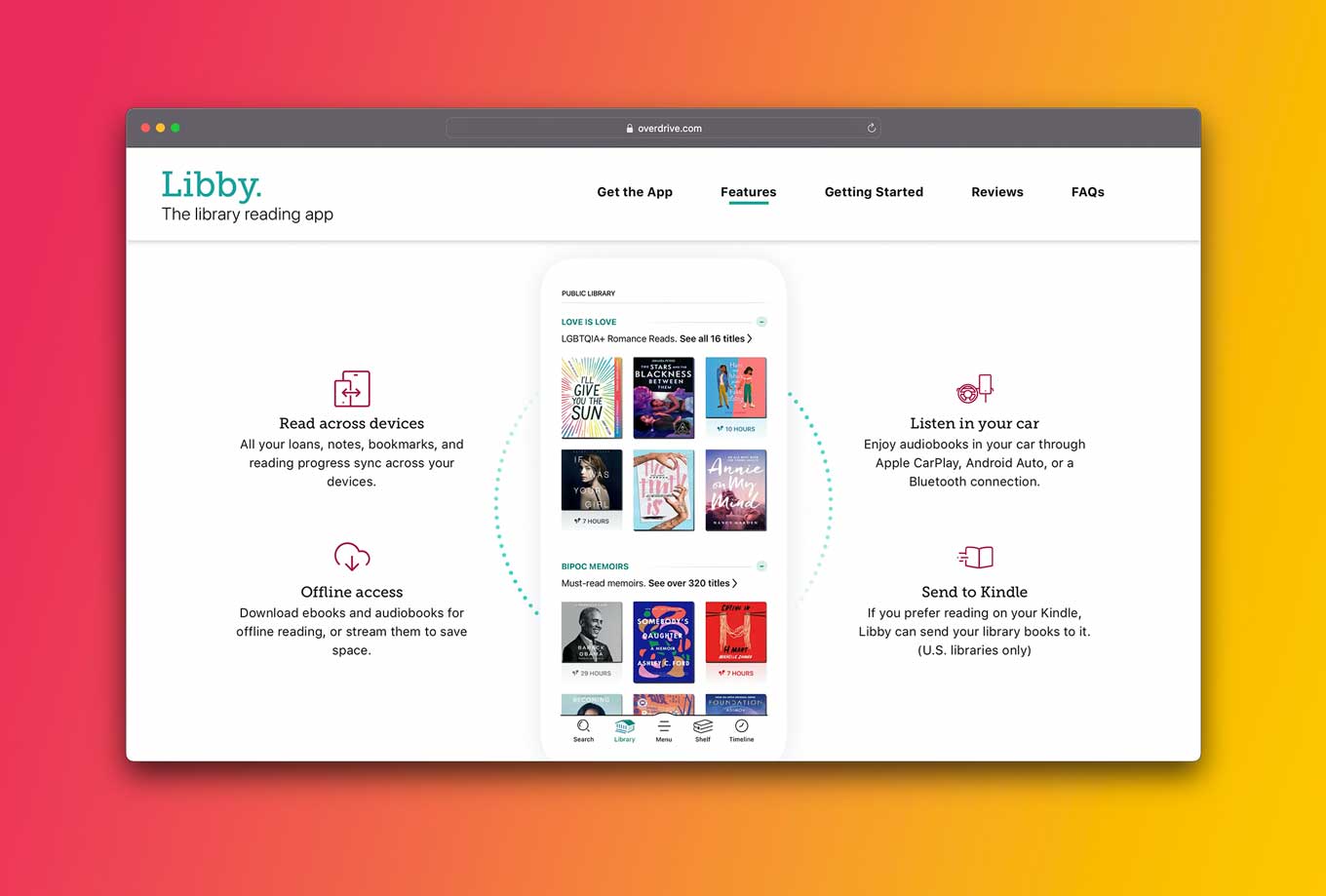
You don’t have to spend money to read books. Local libraries are absolutely amazing — and, of course, have a huge selection of books and resources.
And thanks to apps like OverDrive's Libby, you can actually check out your favorite digital ebooks, audiobooks, and more without ever leaving your home.
Download Libby, enter your library card details, and start checking out digital books for free!
(Fun fact: Our monthly good news newspaper, The Goodnewspaper, is available for free via Libby and OverDrive (thanks to our subscribers who make it possible). Just search for ‘goodnewspaper’ in your app to check it out through your local library.)
Bookshop.org

Bookshop.org is an independent bookseller that partners with local bookstores to allow you to support a local bookstore with every purchase.
When we make book recommendations at Good Good Good (here on our website or in our weekly Goodnewsletter), we usually link to Amazon (for convenience) as well as Bookshop.org and other non-Amazon platforms. On the occasions that we’ve tracked the clicks on these links, we’ve actually seen a significant increase in the number of clicks through to Bookshop.org and a decrease in clicks to Amazon.
Within our community, we’re definitely seeing a cultural change in people being willing to spend a little bit more money to make a meaningful difference with each book purchase.
Plus, Bookshop.org is 100% carbon neutral, as certified by Climate Neutral — just like Good Good Good.
It’s absolutely our favorite place to shop for books.
ThriftBooks

You can also check out ThriftBooks, an online bookstore that sells a wide selection of affordable used books. In addition to simply not supporting Amazon — buying second-hand books has the added benefit of decreasing the number of new books that need to be printed.
Count on ThriftBooks to be the best way to save money on books (as long as you’re not looking for popular new releases until they’re a few months old).
Shipping is the only thing that will get you, so just make sure you’re ordering several books at once to maximize your savings.
Powell’s Books
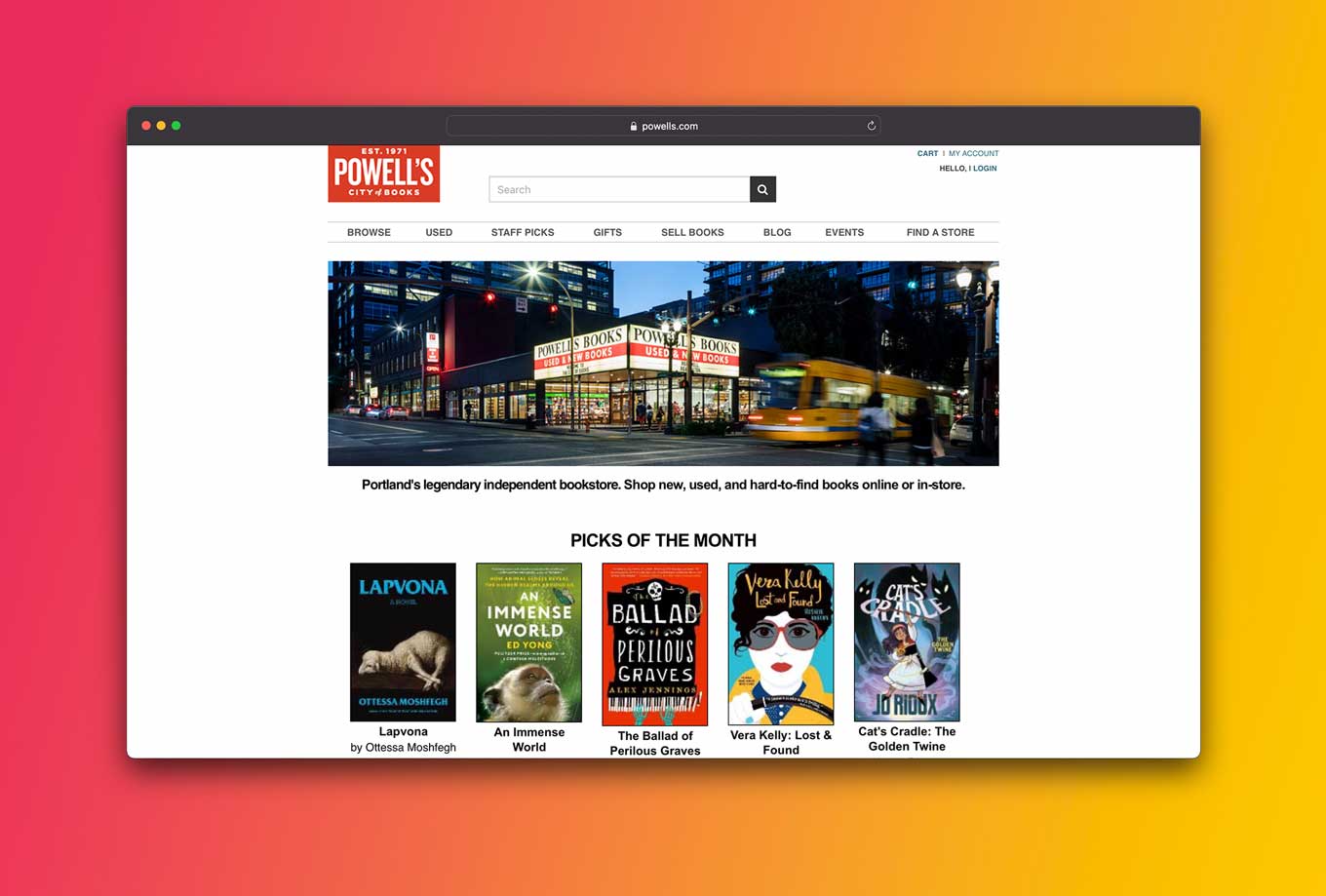
Most iconically known as the largest independent new and used bookstore in the world, this Portland, Oregon-based bookstore knows a thing or two about helping people find books.
They describe their mission as an independent bookseller as “promoting diverse perspectives, upholding the free exchange of ideas, championing the enduring power of books, and bolstering the great community of readers and authors we’re lucky to be a part of.”
For those who don’t live in Portland, their website is a fantastic way to get great service and prices on books. In fact, they launched their website in 1994, before Amazon launched theirs. Take that, Bezos.
Local Independent Bookstores

There are still countless local independent bookstores in communities all over the United States — and they would be thrilled by your support.
When you visit a small bookstore in person, you get access to world-class customer service, great recommendations on their favorite books, plus you're making a positive impact by keeping money in your local economy.
Most independent bookstores also have online stores — or you can even call them and ask them to order a book for you. Local bookstores are all about customer service.
IndieBound has compiled a searchable map of every single independent bookstore currently in business.
Hive
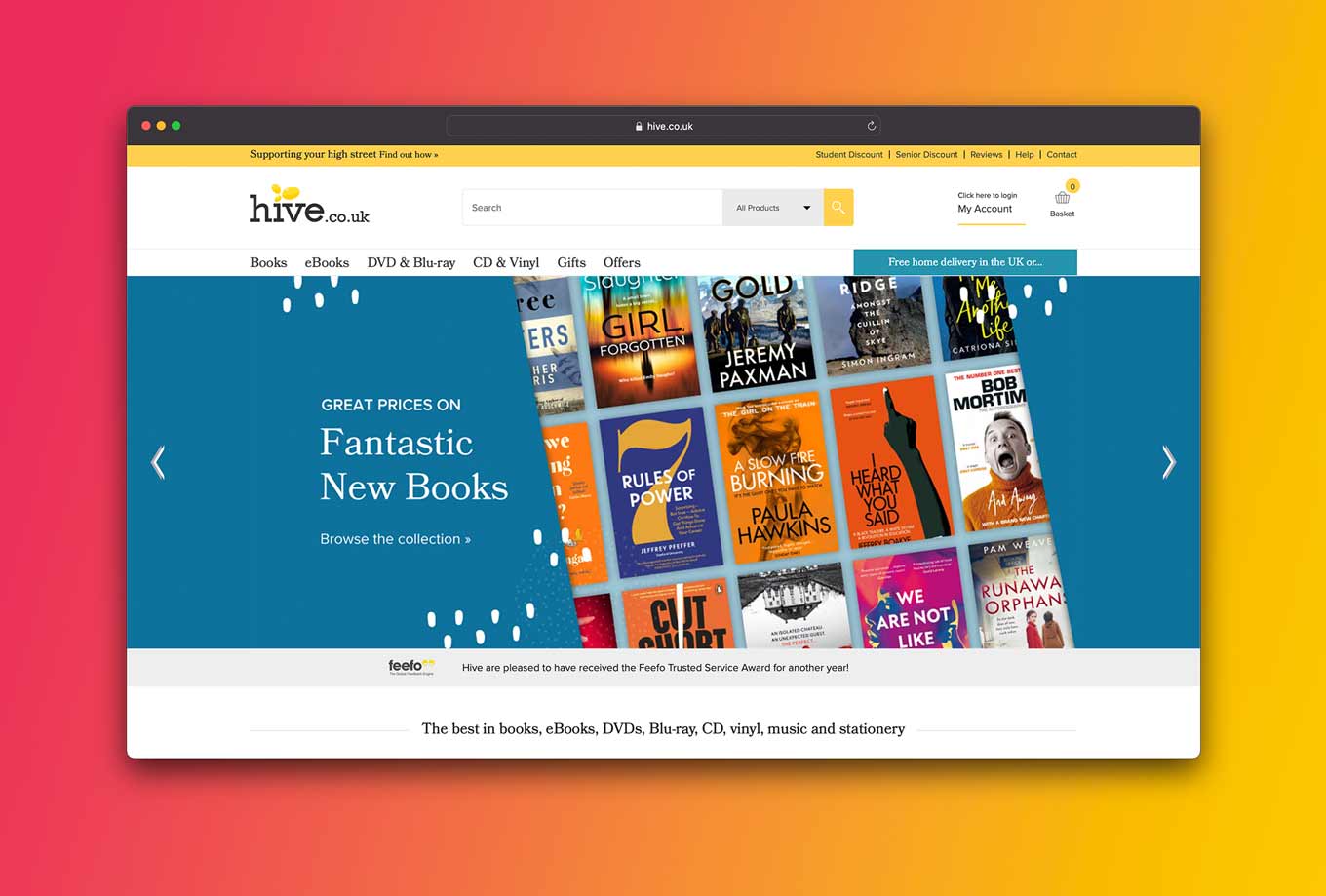
Hive is really similar to Bookshop.org — it’s an online bookstore that supports an independent bookstore of your choice with every purchase.
The main difference is that Hive is mostly geared towards a UK-based audience. They’re British-founded, offer free shipping to the U.K., and even give local independent bookstores a higher percent of the total sale when you opt to pick up the book in person at your chosen bookshop.
They also offer senior and student discounts.
Biblio
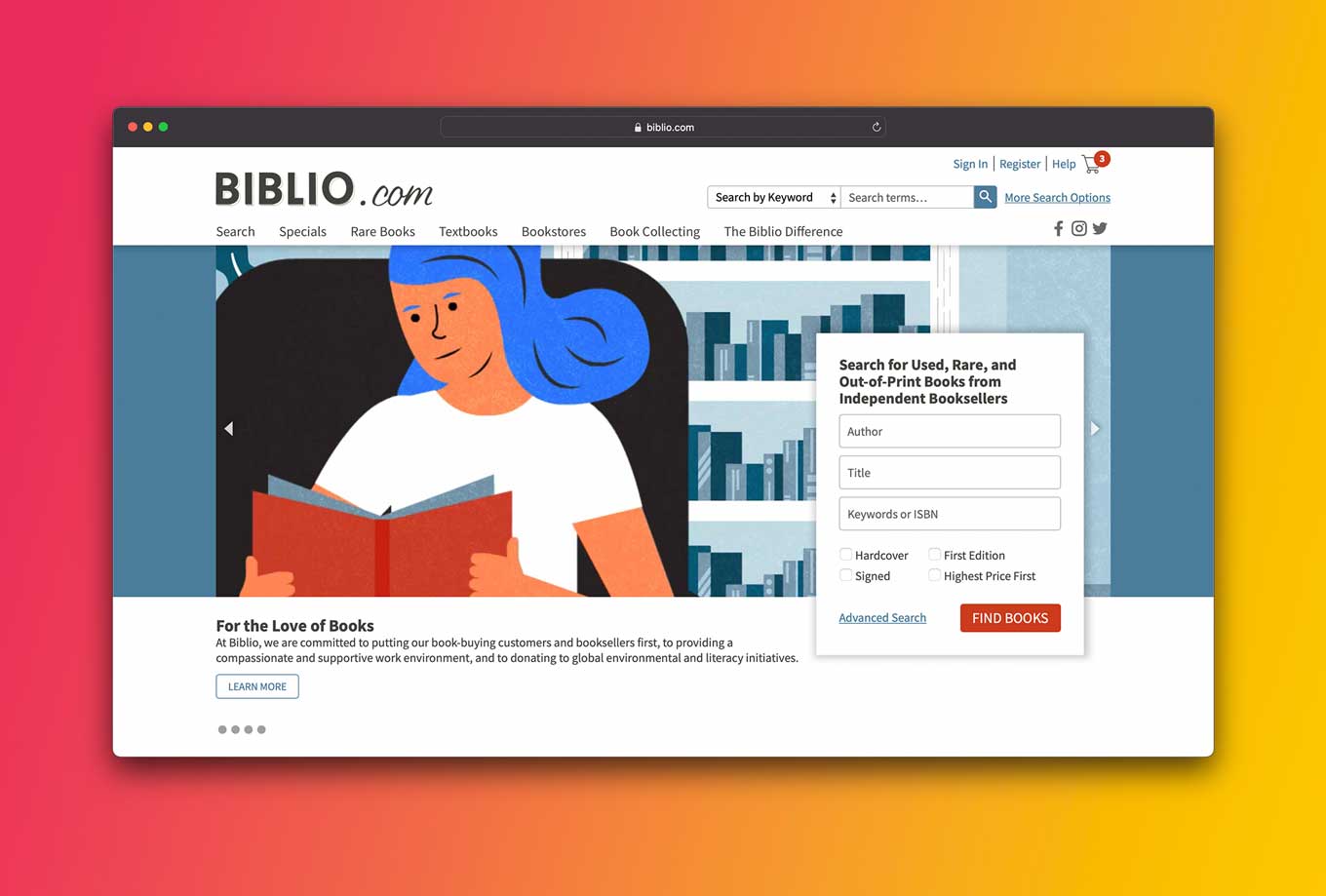
Founded in the year 2000, Biblio has long strived to focus on a triple bottom line, serving people and preserving the environment while they achieve a profit.
They originally focused on rare and used books but have since expanded to a broad collection of books. Still, if you’re looking for a first edition or an out-of-print favorite, Biblio almost certainly will have it.
Biblio claims to have been the first bookseller to offer carbon-neutral shipping to all customers for free, through their “ecosend” program, in partnership with Indigenous-led energy company, Native.
Biblio has also reportedly built at least 12 libraries in rural South America, as a part of a nonprofit founded by the sister of Biblio founder Brendan Sherar, Megan Padilla, who was previously a Peace Corps volunteer.
Better World Books

In 2001, a few college friends saw an opportunity to turn unwanted books on their Notre Dame campus into an opportunity to make a difference.
They requested book donations from students who had extra books or textbooks that they didn’t want or couldn’t sell at the end of the term. After six months they had collected 2,000 books, and resold them for $10,000. They turned around and donated the profits.
Since then, Better World Books has operated as a social benefit business, accepting donated books from individuals, libraries, and campuses and reinvesting its profits to fund literacy and education initiatives — all while keeping books from ending up in landfills.
According to their website, they’ve raised more than $28,430,000. Better World Books is a certified (and founding) B Corp and offers carbon-balanced shipping.
Libro.fm
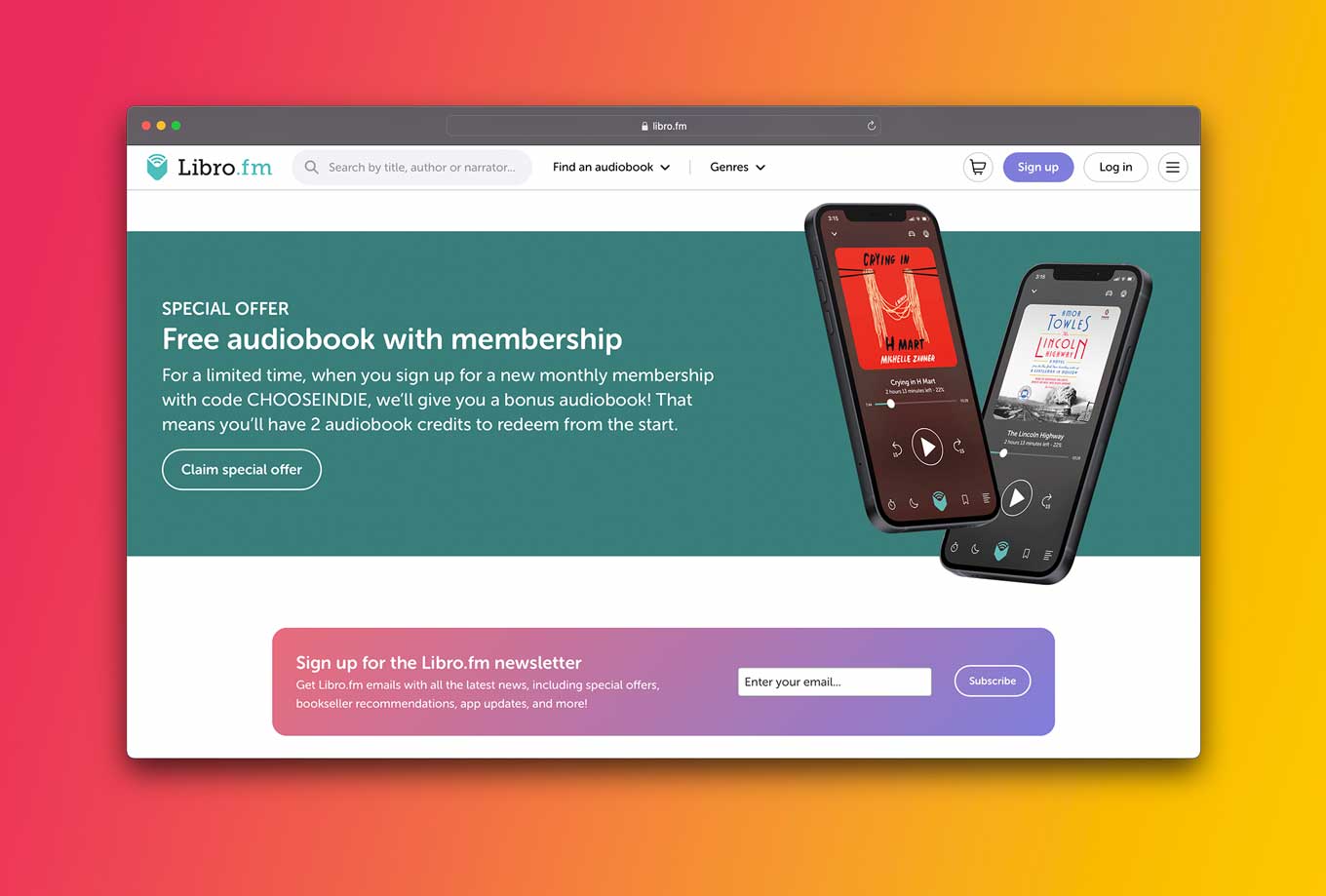
While most of these Amazon alternatives are focused on print books, Libro.fm specializes exclusively in audiobooks.
After realizing that independent bookstores didn’t have a way to participate in the growing market of audiobooks, the founders of Libro.fm set out to fix that.
Libro.fm offers all of the same core benefits as their Amazon-owned competitor, Audible — at the same price. But instead of your money going to a billion-dollar company, your money goes to support the local independent bookstores of your choosing.
They’re also a Social Purpose Corporation, are great about curating and highlighting fantastic books from underrepresented authors, and have a great app that makes it easy to listen to all your audiobooks.
→ Looking for more Audible alternatives for audiobooks? Explore our guide.
Notable Mentions
- While Abe Books is included in many ‘Amazon alternatives’ lists — it’s actually owned by Amazon. Go ahead and skip it.
- Oh — and it turns out that Amazon also owns Book Depository, ComiXology, Brilliance Audio, Booksurge, and Shelfari.
- Books-A-Million is often included as a good place to buy books, but after being named one of America’s worst companies to work for (and only marginally improving since then), we do not feel comfortable recommending them.
- While Barnes & Noble and similar big box stores have long been seen as bad guys (thanks, in part, to You’ve Got Mail) — this article lays out a compelling and complicated argument in favor of Barnes & Noble. While choosing an independent bookstore over a big box store is always better, you shouldn’t feel guilty about browsing their shelves.
- We’ve reviewed Rakuten’s Kobo devices, which are another good way to read books without Amazon.
- And we have a complete guide to all Kindle alternatives for ethical e-reading.
- If you’re into book-tracking, we curated a list of the best Goodreads alternatives on the market.
- As mentioned earlier, your local indie bookstore likely has a website that will allow you to order directly from them. Find yours and add it to your bookmarks.
No matter where you choose to buy your next book, know that your choice to support a bookshop that aligns with your values matters.
Not sure what your next read should be? Every month Good Good Good is reviewing our favorite new releases focused on building empathy, making the world a better place, positive mental health, and more. Check out the guide.
This article is a part of an ongoing series on how to minimize or eliminate Amazon use from our lives. We’re highlighting the best Amazon alternatives for those who have ethical, moral, or environmental qualms with the trillion-dollar company.
Not everybody realizes this, but Audible is an Amazon product.
While it’s convenient to be able to access spoken word entertainment like audiobooks and podcasts through a monthly subscription, Audible is actually harmful to the industry at large. Bummer, we know.
Most notably, when Amazon creates Audible Exclusive audiobooks — like Trevor Noah’s “Born a Crime” or Andy Weir’s “The Martian” — those audiobooks are not made available to libraries or bookstores to lend and sell. This harms accessibility.
And of course, any choice to purchase audiobooks from Amazon is a choice to give more money to a megacorporation and a missed opportunity to give that money to a company better aligned with your values.
Fortunately, there are easy-to-use Audible alternatives.
We've personally tested 100% of these recommendations, and are sharing our authentic reviews. Some of the links in this article are affiliate links, which means if you make a purchase after clicking a link, we may earn a commission at no extra cost to you. Thank you!
If you're short on time, here's a quick rundown of our top recommendations:
- Libro.fm — Just like Audible (same price, same audiobook offerings, great app), but it supports a local independent bookstore of your choosing
- Everand — Pay for a monthly subscription and get unlimited audiobooks
- Libby — Checkout free audiobooks through your public library
- Spotify — Listen to 15 hours of audiobooks each month, included with Premium
Audiobook Alternatives To Using Amazon’s Audible
Libro.fm
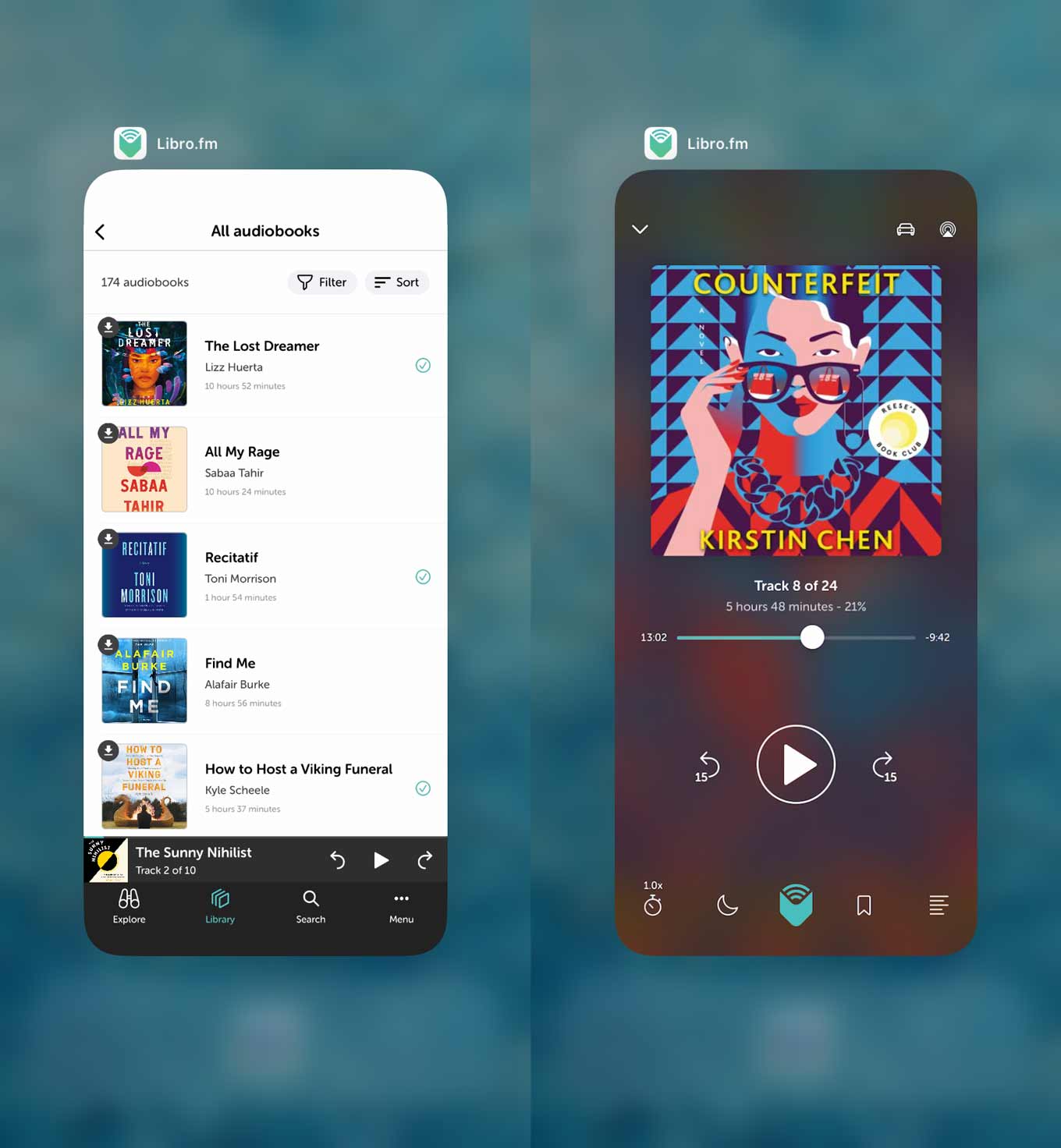
Libro.fm is the only audiobook provider that directly supports local independent bookstores.
Libro.fm is just like Audible in that there’s a monthly subscription (roughly $15, just like Audible), and you get a monthly book credit where you can actually own and keep the audiobook (similar to Audible), but for every book you download, you also get so support a local independent bookstore of your choosing (unlike Audible).
Outside of Audible Exclusives, Libro.fm has the exact same wide selection of audiobooks.
Libro.fm is at the forefront of supporting local bookstores and it’s one of the easiest swaps away from Amazon you can make.
Everand
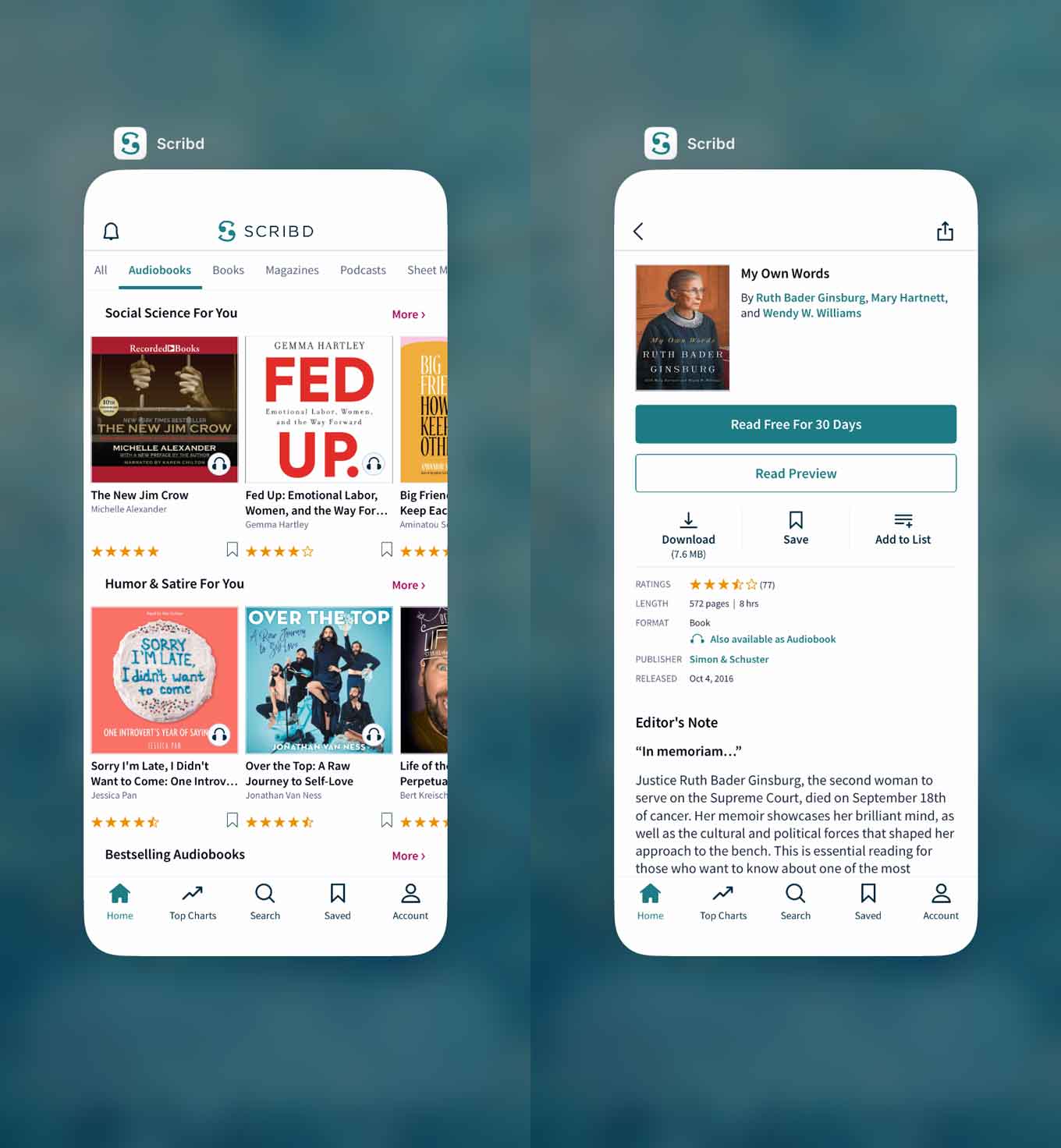
Everand — formerly Scribd —allows you to pay a monthly subscription and get access to unlimited audiobooks each month. While its selection isn’t as vast as Libro.fm’s catalog — it’s a great way to get easy access to enough popular audiobooks to fill your day with words.
If you’re heading on a roadtrip or you’re trying to beat last year’s reading goal, Everand is for you.
Libby
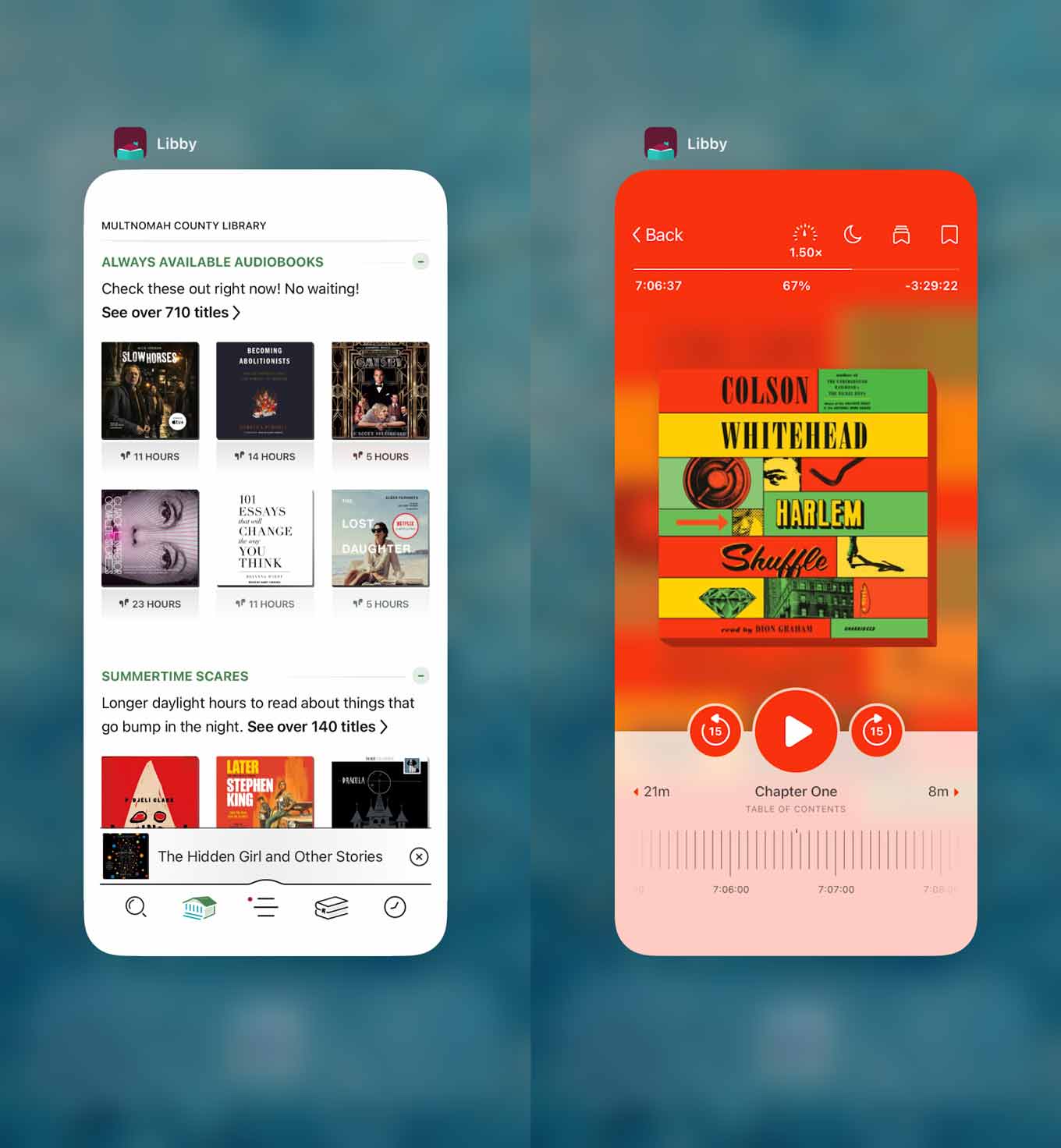
Libby (through its parent company OverDrive) partners with local libraries to provide free access to digital ebooks and audiobooks through your library card.
Just like checking out physical books at the library, there are a limited number of audiobooks available. If there’s a copy available, you can check it out immediately. If not, just join the waiting list.
While you may have to sit on a waiting list for a few weeks for new and popular books, Libby and OverDrive are ultimately the best ways to get access to audiobooks for free.
Spotify
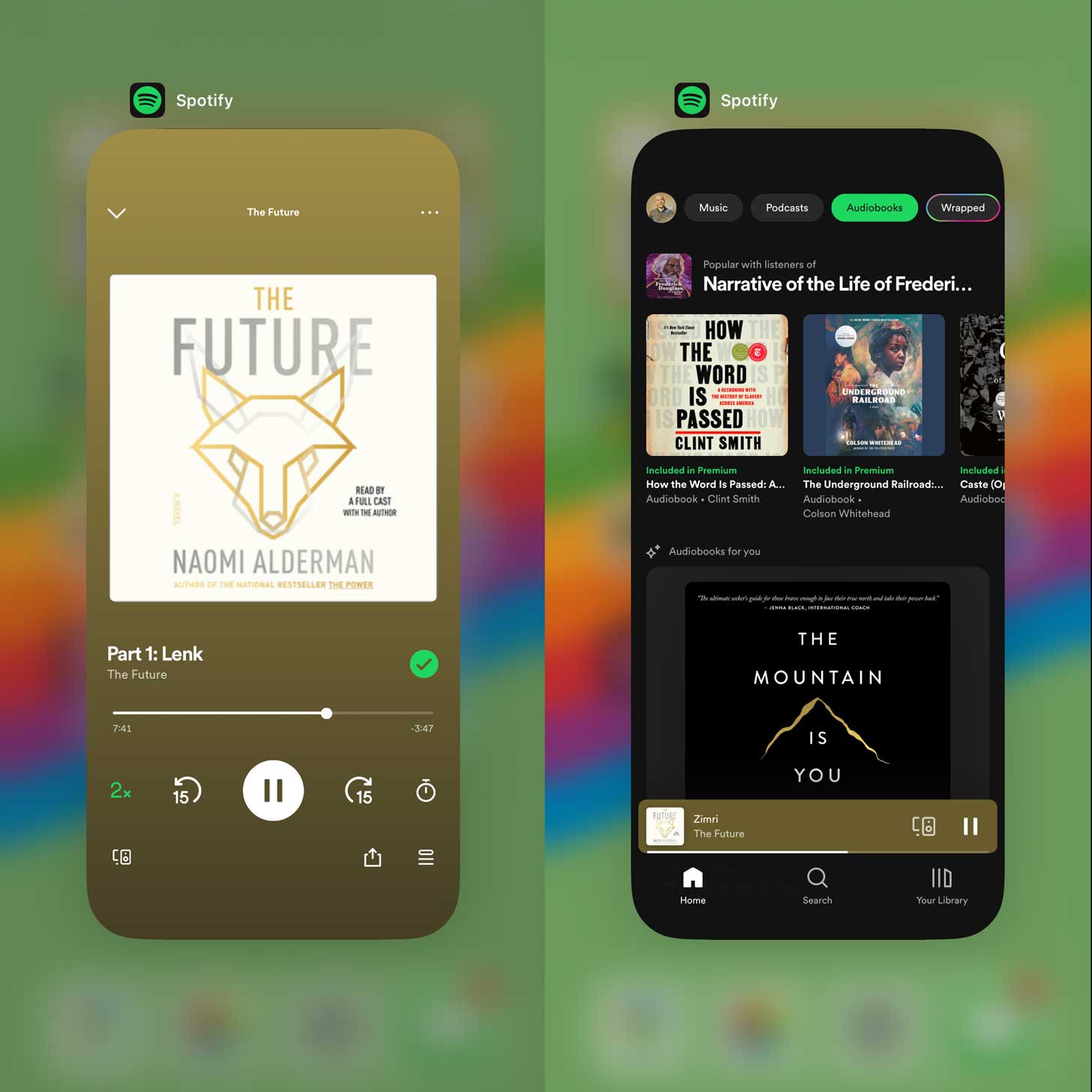
A newcomer to the audiobooks space, Spotify made big moves when the company announced that Premium subscribers would get access to 15 hours of audiobooks every month. (If you need more, you can pay for more hours in 10-hour increments.)
Spotify has a pretty solid selection of audiobook options — touting 150,000+ titles. Not every audiobook is available for free, but I’ve found this to be a great option for popular books with long waitlists on Libby.
You can get more value for your money by listening to your audiobooks at a faster speed. Spotify currently counts time by “hours listened” — not the recorded time.
Chirp
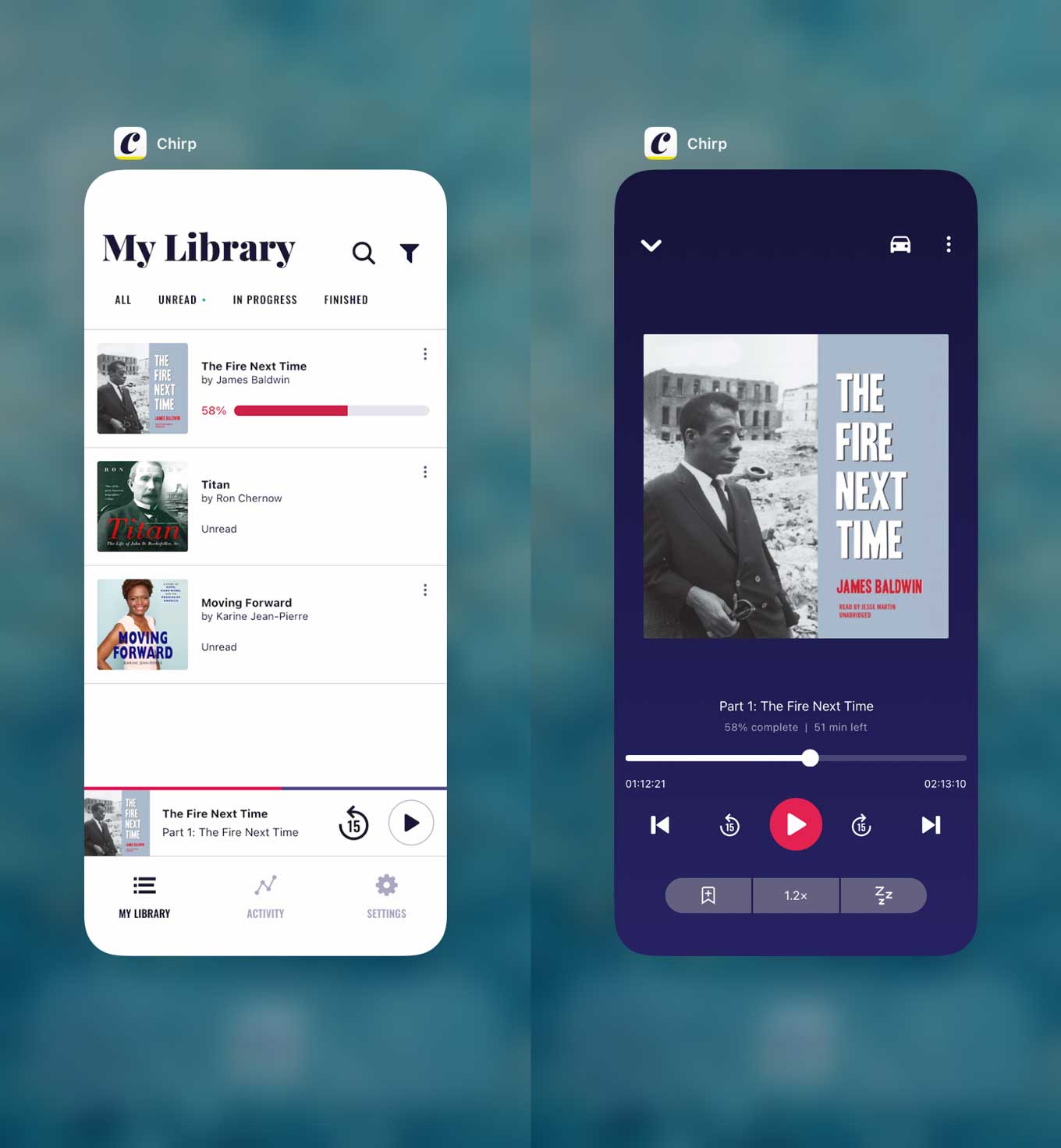
Chirp is an audiobook platform that lets you avoid subscription fees altogether. Instead of charging you monthly, they offer huge discounts on different audiobooks every day. We’re talking about $3 audiobooks here, people!
When you buy their discounted audiobooks, they’re yours to keep. Essentially, authors and publishers will often request that a certain title goes on sale for a limited time. That’s your chance to download it from Chirp. They also claim to offer discounted rates on non-sale audiobooks all year long.
It’s not just random books that get discounted, either. They have everything from newly-released New York Times bestsellers to tried and true classics. Plus, they have a money back guarantee on whatever audiobooks you buy.
You can explore all their offerings on their website — but we especially recommend subscribing to their newsletter so you never miss out on a deal.
Speechify
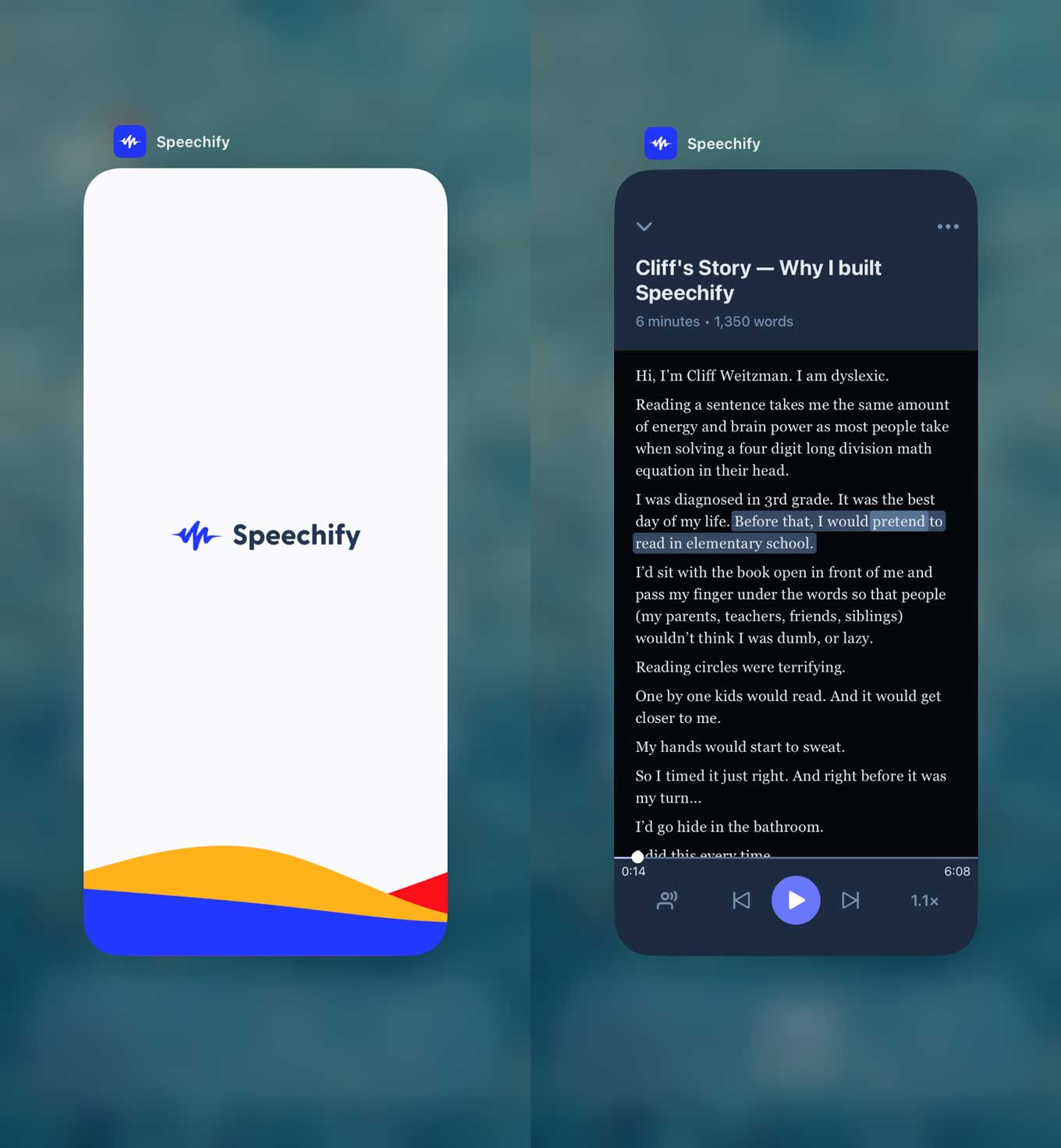
This one is a little bit more unique — but stick with us. Speechify is, ultimately, an accessibility tool that turns any text into spoken word.
The founder of Speechify, Cliff Weitzman, is dyslexic and describes how reading a sentence takes him “the same amount of energy and brain power as most people take to solve a long division math equation in their head.”
He learned how to code a tool that could help them — and now it’s available as a mobile app and browser extension.
If you’re drawn to audiobooks because you have ADHD, dyslexia, blindness or low vision, or whatever other reason — Speechify might be a helpful tool. Plus, if you buy an open-source audiobook or happen to have a PDF or digital version available — the app can read it to you. You can even choose the voice.
We’ve been trialing their tools and it’s genuinely impressive to hear how much better the simulated voices are than Siri or Alexa.
Physical CDs

Do you remember when the only way you could listen to an audiobook was to pop a new disc into the CD player every few chapters? (At least it was better than trying to keep your album of cassette tapes from melting when you left them in your car on a long summer road trip.)
Many publishers still make physical audiobook media available — it’s just a little bit harder to find. The easiest approach is actually to visit a used book store or thrift store and find their audiobook section. They likely have a lot of older CDs available — and we’ll bet they’re really cheap.
Hoopla
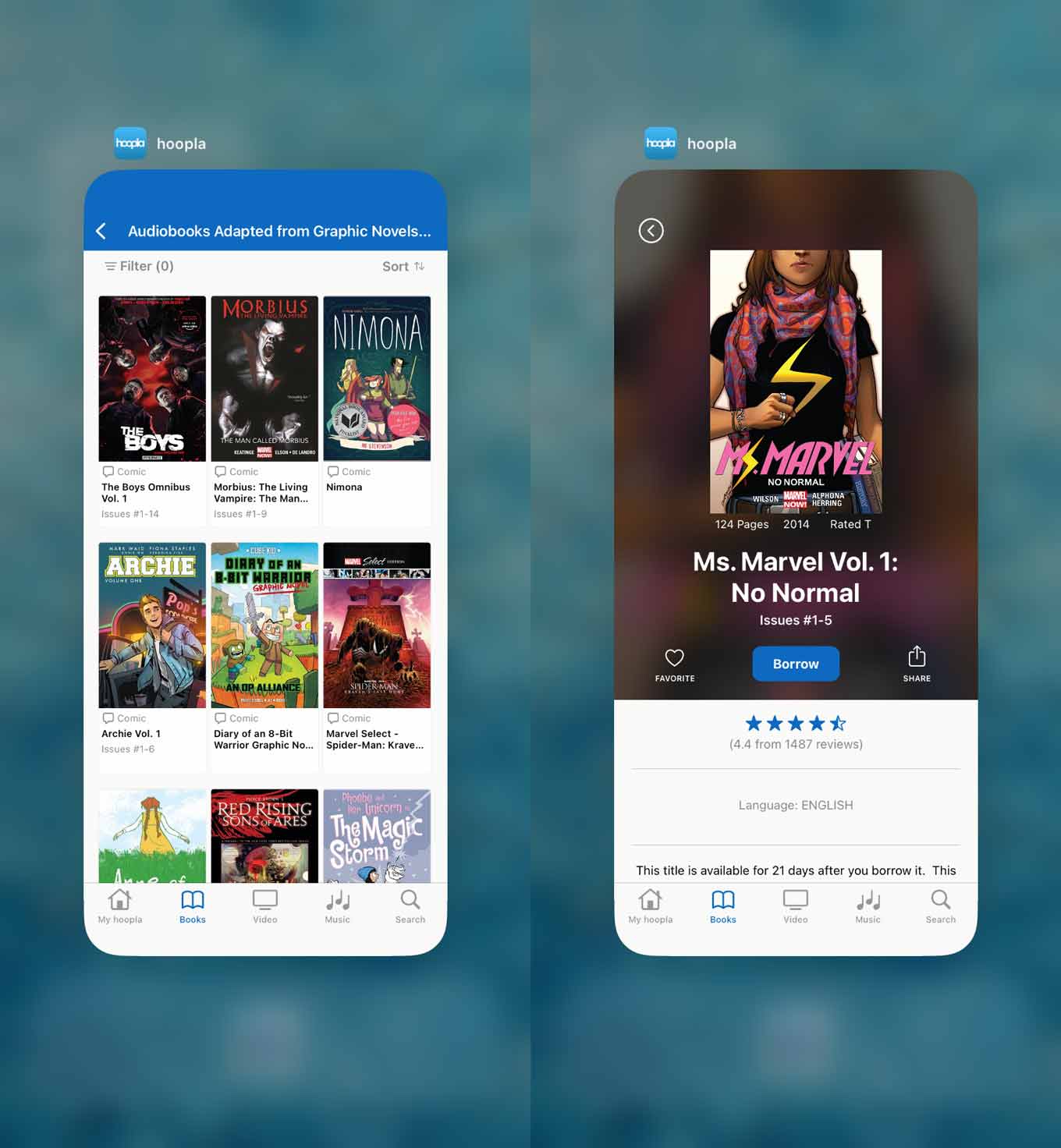
Like Libby, Hoopla is available through hundreds of libraries across the United States. It’s most well known for its TV and movie catalog (check out our article on Amazon Prime Video alternatives) but it also has a great selection of audiobooks and e-books.
Unlike Libby, Hoopla doesn’t have any waitlists. They don’t have quite as many audiobooks as other audiobook platforms, but it’s genuinely worth exploring anytime you’re looking for a new listen. (It's especially great if you love comic books and comic-related audiobooks.)
LibriVox
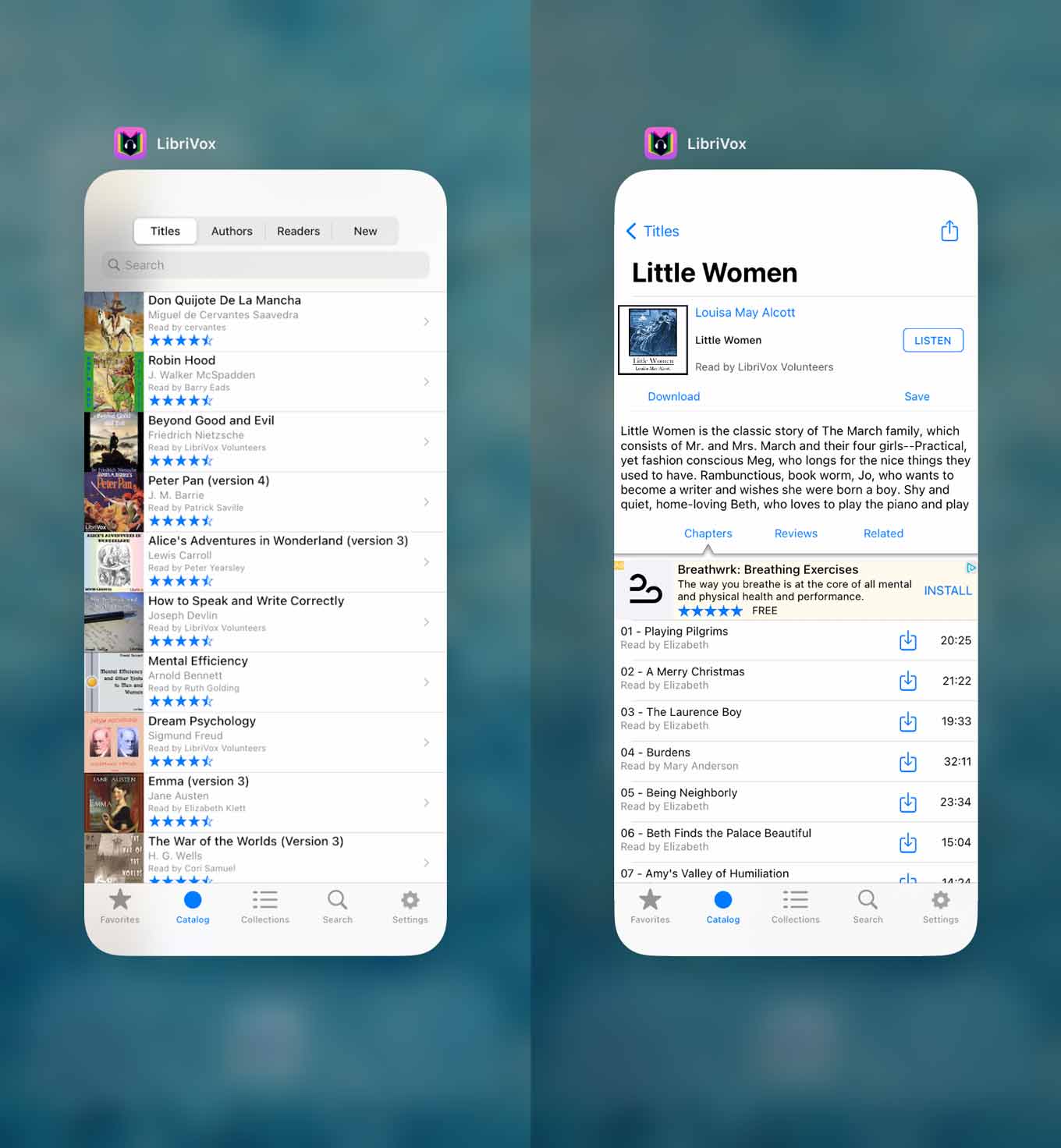
LibriVox is a nonprofit platform that makes public domain books available as audiobooks for free.
Once a book has entered the public domain, (because it’s 95 years old) the original copyright expires and the book now belongs to the public. Every year, a new batch of books enters the public domain (“The Great Gatsby” is a notable recent addition) and people find creative things to do with them.
LibriVox invites volunteers to narrate their own public domain audiobooks, upload them to LibriVox, and make them available for listeners for free.
While the quality can vary from book to book, it’s a really cool project, and a great way to explore older literature.
Audiobooks.com
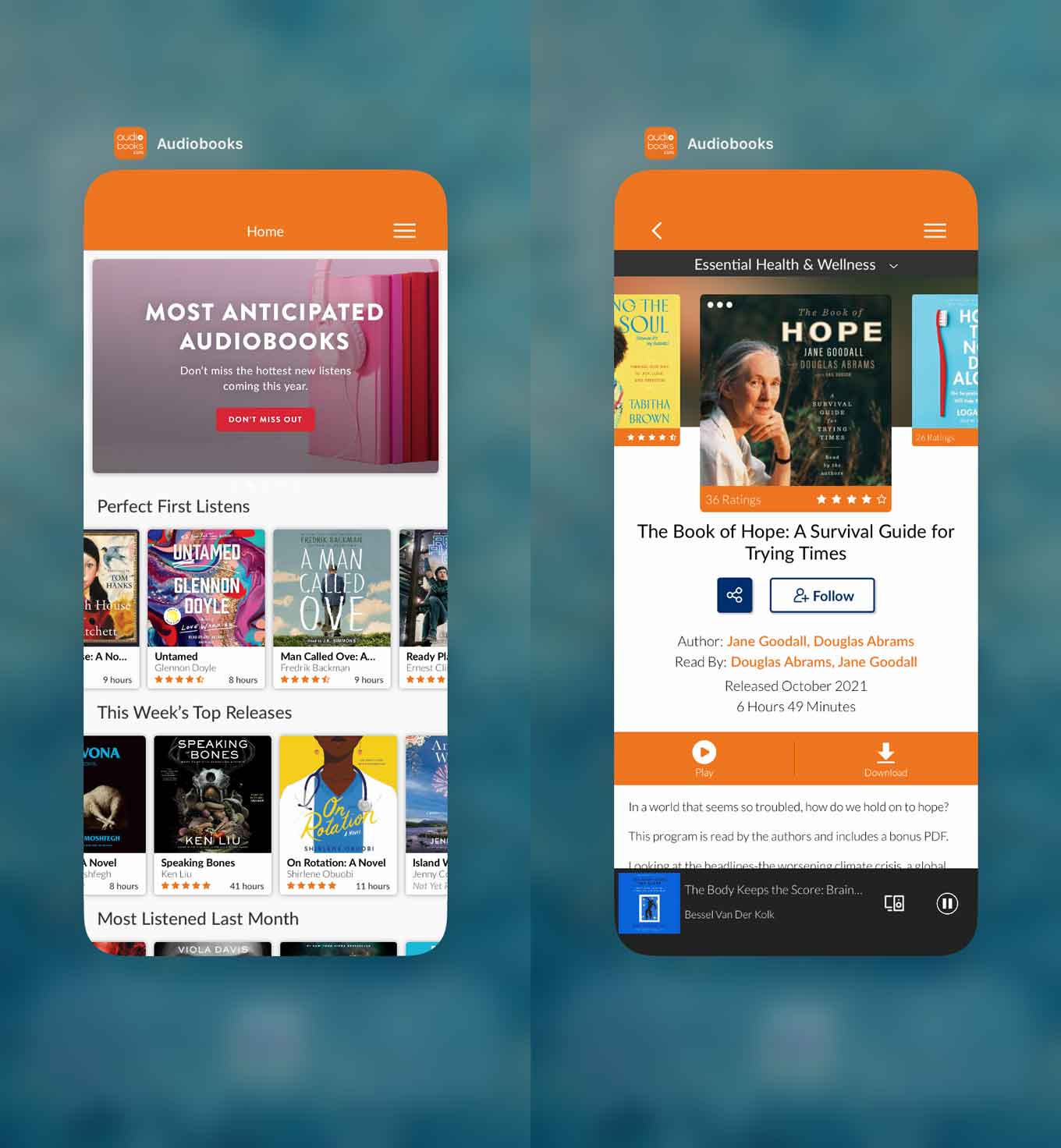
While there’s nothing special about Audiobooks.com, it gets the job done. Just like Audible, you pay a monthly subscription and get audiobook credits. They have a really wide selection of audiobooks, and a great quality app. As a VIP, you can get even more audiobooks each month. It’s definitely worth a free trial at the very least.
More Notable Competitors:
- Kobo Books — Free audiobook offer, most helpful for Kobo devices
- Nook Audiobooks — Free audiobook offer
- Google Play Books — Easy-to-use for Android users
- Apple Audiobooks — Easy-to-use for iPhone users
- eStories — Cheap subscription, but may not have new releases
- OpenAudible — Switching away from Audible? Keep your audiobooks.
→ Ready to get started on your next audiobook but don't know what to read? Check out our top Good Good Good-approved book recommendations.
→ Also love print books? Check out our favorite online bookstores that are not Amazon.
→ Or prefer digital books? Check out our favorite Kindle alternatives for e-readers.
→ You’ll need somewhere to track your favorite books of the year. Explore these Goodreads alternatives.
This article was originally published on July 1, 2022 — and has been continually updated since then.
At Good Good Good, we’ve been working on an ongoing series about alternatives to Amazon to help all of us detangle ourselves from the grasps of the trillion-dollar company.
While some Amazon alternatives feel more obvious, (like alternatives for books, audiobooks, Kindles, or even Goodreads) a less obvious way to opt out of Amazon is their video offerings.
And this is where things get tricky.
In 2010, Amazon launched Amazon Studios — a television and film producer and distributor that has since produced Emmy- and Academy Award-winning shows and films like Transparent, Manchester by the Sea, The Salesman, The Boys, The Marvelous Mrs. Maisel, and the new Lord of the Rings series.
Around the same time, Amazon launched Amazon Prime Instant Video as a digital streaming competitor to Netflix — where they would host Amazon Originals (produced by Amazon Studios) as well as licensed content from other platforms and studios.
Amazon Originals are available exclusively through Prime Video — which means there’s essentially nowhere else you can watch them, except through Amazon. But there are some ways to work around this.
If you’re a pop culture nerd but are also trying to keep your money from going to Bezos, this article is for you.
How to Watch Amazon Originals Without Supporting Amazon
If you’re heavily invested in the next season of The Marvelous Mrs. Maisel (who isn’t?), but want to minimize the money you spend with Amazon, you have a few options:
1. Subscribe ONLY to Prime Video
Your first option is to subscribe only to Prime Video without subscribing to a full Amazon Prime subscription.
It’s a cheaper rate, and not having easy access to Prime shipping will probably help minimize the temptation to order something random with 2-day shipping.
2. Just use someone else’s Prime account
Your second option is to piggyback on someone else’s Amazon Prime or Amazon Video subscription. If a roommate or family member has an account, you can watch your favorite movies and shows on their account without increasing Amazon’s total number of Prime members.
(You just need to make sure you’re following Amazon’s Household terms of service for who it’s appropriate for you to share an Amazon account with. We’re not endorsing breaking terms of service.)
3. Catch Amazon Originals in theaters
Your third option is to just catch Amazon Originals in the theaters when you can.
Unlike Netflix, which releases most of its films exclusively on Netflix, Amazon often releases its Amazon Studios films in theaters first — and then brings them to Prime Video later.
While seeing an Amazon Originals film like The Big Sick or One Night In Miami in theaters will still give some money to Amazon, you’ll also be supporting a local theater in the process.
(And by voting and calling your elected officials, you have more direct ability to ensure local employees are paid a living wage in your community.)
If you see a matinee, you’ll likely be spending less money than you’d spend on a monthly subscription anyway.
4. Buy a DVD
Your fourth option is to buy a DVD. Most Amazon Originals have historically been released as DVDs, which you can buy new or used from a website that isn’t Amazon.
Again, while some money will make its way back to Amazon, they’re going to get way less than they would from your monthly subscription.
Also, you can check and see if your local library has access to Amazon Original series and films on DVD.
How To Skip Amazon Prime Video Altogether
If you’re down to simply avoid Amazon Prime Video altogether, there is, of course, a limitless amount of streaming content available to you. Nobody can watch everything anyway.
While Amazon Originals are only available on Prime Video, a significant portion of their non-original catalog is also available on other platforms such as Netflix, Hulu, or HBO Max.
Plus, there are all of the other mainstream platforms like Apple TV+, Peacock, and Paramount+, which have a growing wide variety of their own shows and movies.
And don’t sleep on platforms like Kanopy and Hoopla — which are often available for free through your public library. There are also a few non-traditional streaming platforms like The Criterion Channel you can try out, too.
Alternatives to Amazon Prime Video:
- The Criterion Channel
- Kanopy
- HBO Max
- Apple TV+
- Netflix
- Hulu
- Disney+
- Peacock
- YouTube TV
- Discovery+
- Hoopla
- Paramount+
What about an alternative to Amazon Freevee?
In 2022, Amazon essentially rebranded IMDb TV into Freevee — a free streaming service with a limited catalog. While you don’t need an Amazon Prime Video subscription to watch Freevee, it’s a channel on Amazon Prime Video.
If you’re trying to loosen yourself from Amazon’s grasp, it’s best to avoid Freevee as well.
Unless you’re watching Bosch (Freevee created an original spinoff), there’s very little exclusive or original content on the platform.
You’ll likely have no problem finding great free alternatives through your local library’s streaming services or by signing up for any number of free trials from other streaming services. You’re not missing out on anything, we promise.
This article is a part of an ongoing series on how to minimize or eliminate Amazon use from our lives. We’re highlighting the best Amazon alternatives for those with ethical, moral, or environmental qualms with the trillion-dollar company.
While many people still prefer reading from print books, the pure convenience of digital books on an e-reader is hard to beat.
E-readers give you the ability to carry around unlimited books, have a built-in backlight that allows you to read at night without disturbing a partner, and might even encourage you to read more. Plus, an e-reader is an easy way to reduce your carbon footprint.
Here are the pros of having an e-reader:
- You can travel with a virtually unlimited number of books
- E-ink screens are glare-free, which is way better for reading outdoors than reading on a phone or tablet
- Built-in backlights don’t keep you awake but still allow you to read in bed or on a plane without fumbling with a bulky book light
- Battery life on e-ink devices is incredible. Charge your e-reader for a few hours and you’re good for weeks. Put it on airplane mode to last even longer.
- Read in a distraction-free environment. No more push notifications derailing your attention span.
The folks at Wirecutter described the benefits of e-readers well: “Nonreflective, electronic-ink displays give you a more paperlike visual experience (including enjoyable reading outdoors and less eye strain compared with an LCD screen), plus lighter weight and a significantly longer battery life. And a dedicated e-book reader offers fewer distractions — you won’t be tempted to switch apps to check Twitter or your email.”
We’ve been working on an ongoing series about how to detangle your life from Amazon’s grasp.
Everyone’s heard of Kindles — but if you want to ensure you’re not sending more money to Amazon, you might be looking for alternatives. We’ve got you covered.
By the way, some of the links in this article may be affiliate links — which means that Good Good Good may receive a commission if you make a purchase via our links, at no addition cost to you. Thank you!
Alternatives to the Amazon Kindle e-reader
Kobo

If you’re looking for a Kindle alternative, we’ve found that the best alt e-reader in the business is Kobo. Created by Rakuten, it’s nearly identical in features to the Kindle, and has nearly the same selection of ebooks — all within an affordable price range.
One especially nice feature is that Kobo devices have OverDrive built right in — allowing you to check out free library ebooks directly from your device.
Our top recommendations for the best models:
- Kobo Clara 2E (made with recycled plastic)
- Kobo Libra 2
- Kobo Sage
We reviewed Kobo e-readers to help reader pick the right device.
→ Explore the Kobo review
Boox
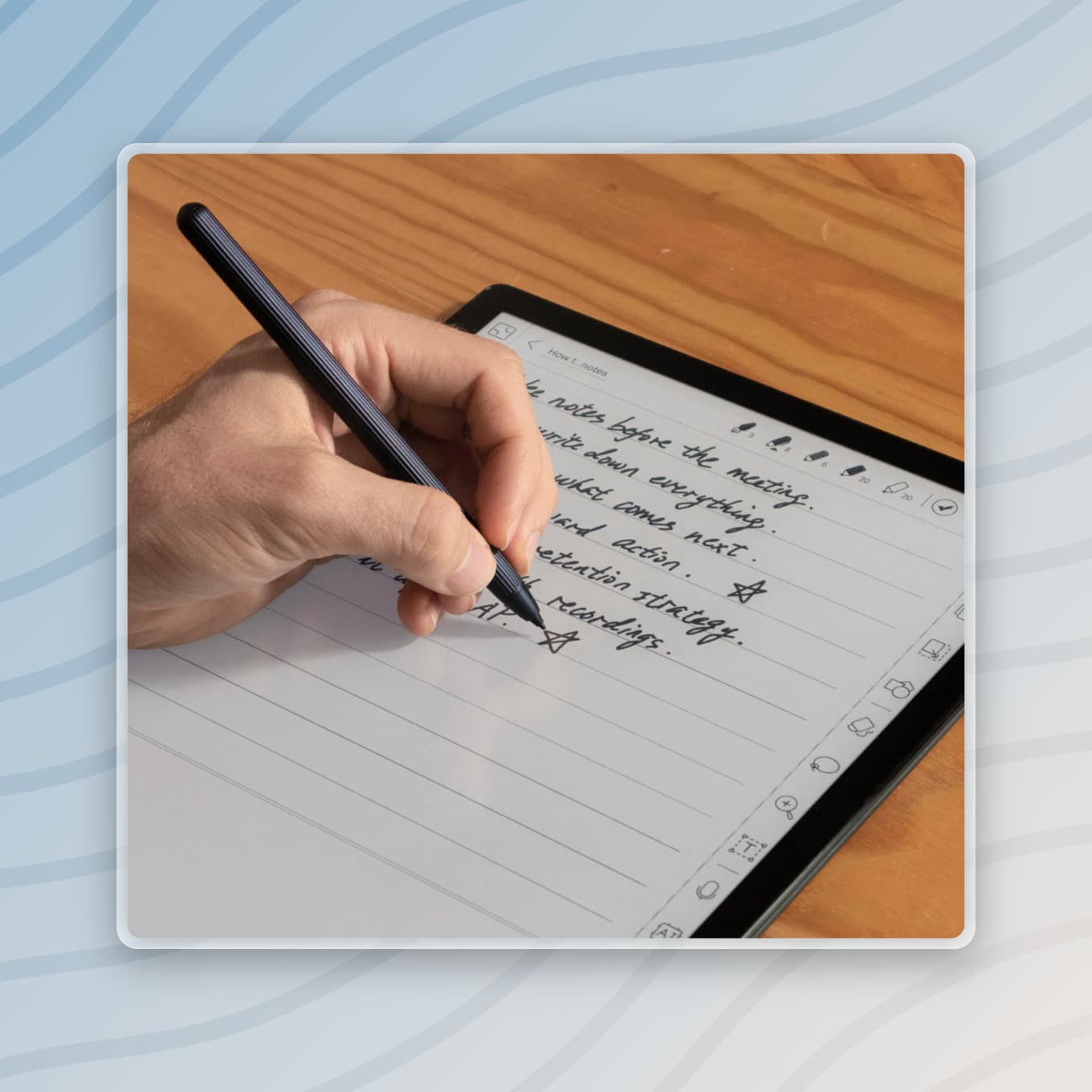
If you’re looking for a tool that goes above and beyond the capabilities of a Kindle, definitely check out Boox. Boox creates e-ink tablets with more bells and whistles. Think of them as an iPad competitor that’s easier on the eyes.
Whether you’re drawn to the larger-sized screens (perfect if you read large-format documents more than books), or you love that a few of their models come with an Android operating system (for downloading apps, doing note-taking, or even creating art) — Boox is definitely worth looking into.
Our top recommendations for the best models:
Barnes & Noble’s NOOK
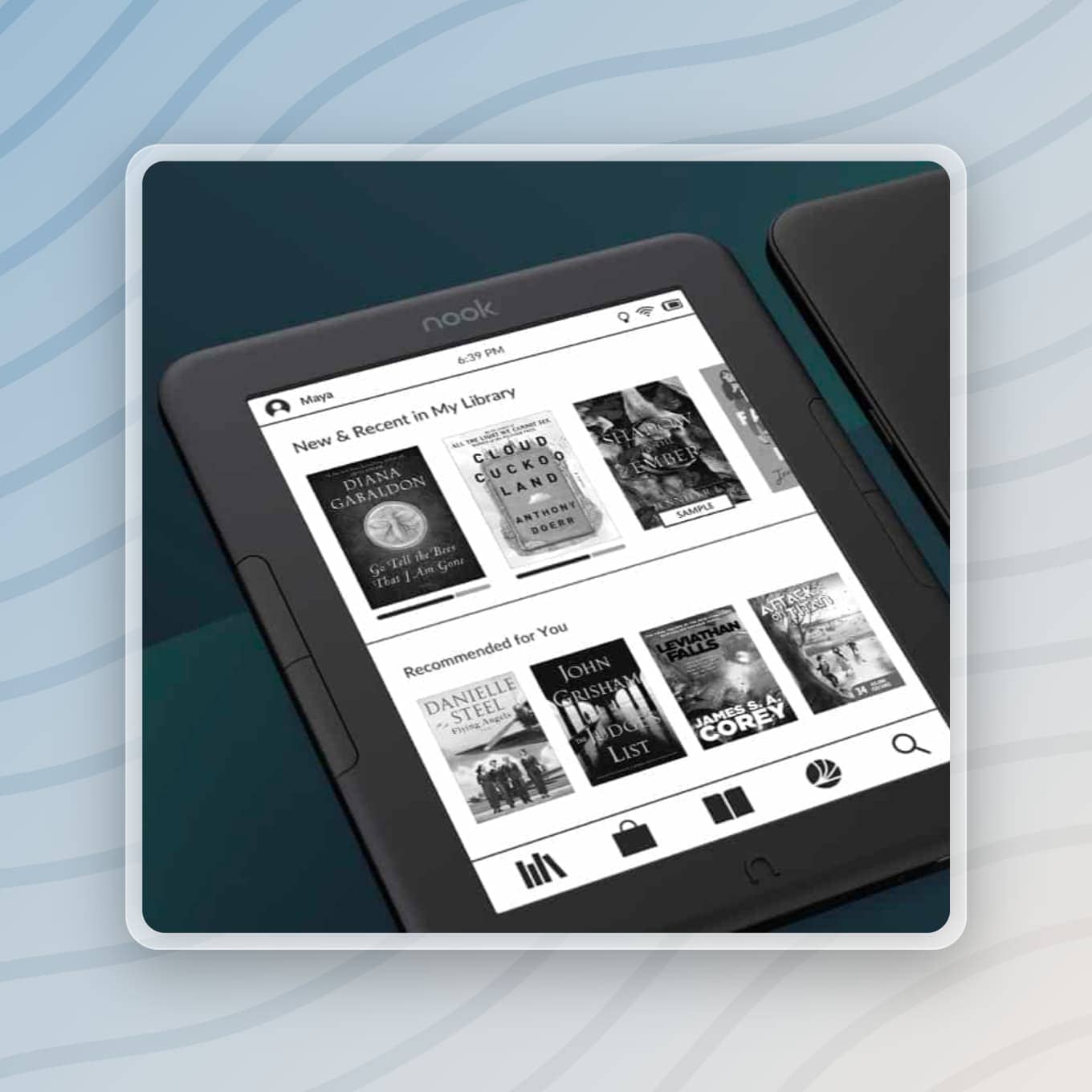
Originally launched in 2011, Barnes & Noble’s e-reader offering has had a lot of time to improve. If you’re fine with getting most of your ebooks from the Barnes & Noble store, a NOOK is a great Kindle competitor.
One bonus is that NOOKs run on a modified version of Android, and it’s possible to modify the device to allow for app downloads, customization, and more. (Contrast that with Amazon’s more tightly locked-down software.)
Our top recommendations for the best models:
- NOOK GlowLight 4e (their only current, quality offering)
- Older NOOK devices
Likebook
While not a household name, Likebook’s e-reader devices are packed with premium features at a budget-friendly price.
We love that their main offerings include the ability to download Android apps (making it easy to purchase books from ethical ebook stores or even read the news), allow you to shift the color temperature of the backlight (for a warmer, sleepier bedtime reading routine), and have high-res screens (for reading visual-driven books).
Our top recommendations for the best models:
Non E-readers
There are more and more devices coming out that work effectively as an e-reader, even though that’s not their primary intention.
Our top recommendation is:
- reMarkable - This e-ink tablet is ideal for people who want to take notes on a tablet that feels like paper. Fortunately, it also works great as an e-reader as a secondary function.
A Used Kindle
To be honest, the Kindle itself is hard to beat. If a non-Kindle e-reader alternative works well for you, go for it. But if you really feel like a Kindle is the way to go, it’s still possible to ethically use a Kindle device without supporting Amazon. Here’s our guide on how to do it:
How to ethically use a Kindle
It’s absolutely possible to own a Kindle and not contribute any money to Amazon’s bottom line. We’ll walk you through how to ethically buy a Kindle, ethically access ebooks, and make sure Amazon isn’t collecting data about you.
Buying a Kindle ethically
Kindle devices have always been inexpensive because Amazon ultimately wants to make money from you buying their ebooks.
This means that a lot of people have purchased affordable Kindles to test them out, only to find out that they don’t use them as much as they hoped. A lot of lightly used Kindles are available for an even bigger discount on eBay.
You can buy a Kindle without ever giving Amazon a dime — and reducing the environmental impacts of manufacturing new pieces of technology.
Using a Kindle ethically
Amazon’s profit from Kindles reportedly comes from two places, primarily: You buying ebooks exclusively through them — and through the collection of your data.
You can essentially eliminate both of these with enough intentionality.
Instead of buying your ebooks through Amazon, you have a few options for reading books through other means.
- If your local library uses Libby or OverDrive, you can simply connect your Kindle account to your local library and have all of your books sent over to your Kindle.
This is completely free.
Your books will stay on your Kindle for however long your checkout time is (usually 2-3 weeks) and will disappear after you’ve returned them. - If you buy DRM-free ebooks with a compatible format, you can actually just forward your ebooks to a special Kindle email address (Amazon calls it your “Send-to-Kindle Email”) and they’ll automatically show up on your Kindle.
When it comes to data collection, you can simply go into your settings and remove as much personal information as possible.
Under Settings, then Device Options, then Advanced Options, you can change your Privacy settings to stop the collection of personal data. You can also potentially Deregister your device (Settings, then Your Account) depending on which features you need access to.
You’ll also want to switch from Goodreads to a Goodreads alternative — because Goodreads is also owned by Amazon.
Ultimately, Amazon wants to use your data to try to sell you more stuff — so if you’re already trying to minimize the amount of money you’re spending with Amazon, you’re probably already winning.
Can you use Kindle alternatives with Libby?
Our team has fallen in love with our local libraries again — all thanks to Libby. Libby makes it easy for you to check out digital books from your library — and immediately transfer them over to your Kindle.
But what if you want to keep checking out books from your library — but don’t want to own a Kindle? Fortunately, we have some good news: Most of these Kindle alternatives work with Libby — and some of them are even better than the Kindle experience.
Here’s a breakdown:
- Kobo: New Kobos actually have an OverDrive app built into the device. (OverDrive is the company that makes Libby, and essentially works the same way.)
Simply follow Rakuten’s instructions to log into your library and get started.
We love that this allows you to check our books from your library without leaving your e-reader. - NOOK: On newer NOOKs you can simply download the Libby app from the app store. Not only will it let you read books without any sort of transfer process, it will also let you discover and check out books from your library directly from your device. For older devices, check out “Everything Else” below.
- Likebook: Likebooks run on Android and give you access to the Google Play Store, which means you can simply download the Libby app like you would on your phone.
- Boox: Like Likebooks, these devices allow you to simply download the Libby app from the app store.
- Everything Else: Even if your e-reader isn’t immediately compatible or is too old to work with Libby — you can always go to Plan B: Adobe Digital Editions. The tl;dr: Use this app on your computer to convert your library books into a format that works for your e-reader.
Alternatives to buying tech through Amazon in general
Shopping for technology can be done sustainably, as well (and without the help of handy dandy Amazon). There are other ways to get your gadgets and goods, but shopping local is best; you can use Locally to see what stores are available near you.
If you’re unable to shop in-person and appreciate Amazon for its online convenience, you can actually use eBay to shop for second-hand electronics and gadgets, so you can give a second life to products instead of needing a new product to be manufactured.
When it comes to card-based games, many of us are very likely to be familiar with Apples To Apples, Uno, or (the more mature) Cards Against Humanity.
And though there’s nothing quite like letting your inner competitive-self out, for those who are looking to swap out points for collective self-reflection, conversation card games might be your jam.
Conversation cards have become a go-to icebreaker tool for people seeking ways to foster connection away from their screens.
Whether you’re planning a dinner night, team bonding exercise, or intend on using it as a self-reflection tool, conversation card games have offered people a framework to embrace humanity, vulnerability, and develop better conversation habits.
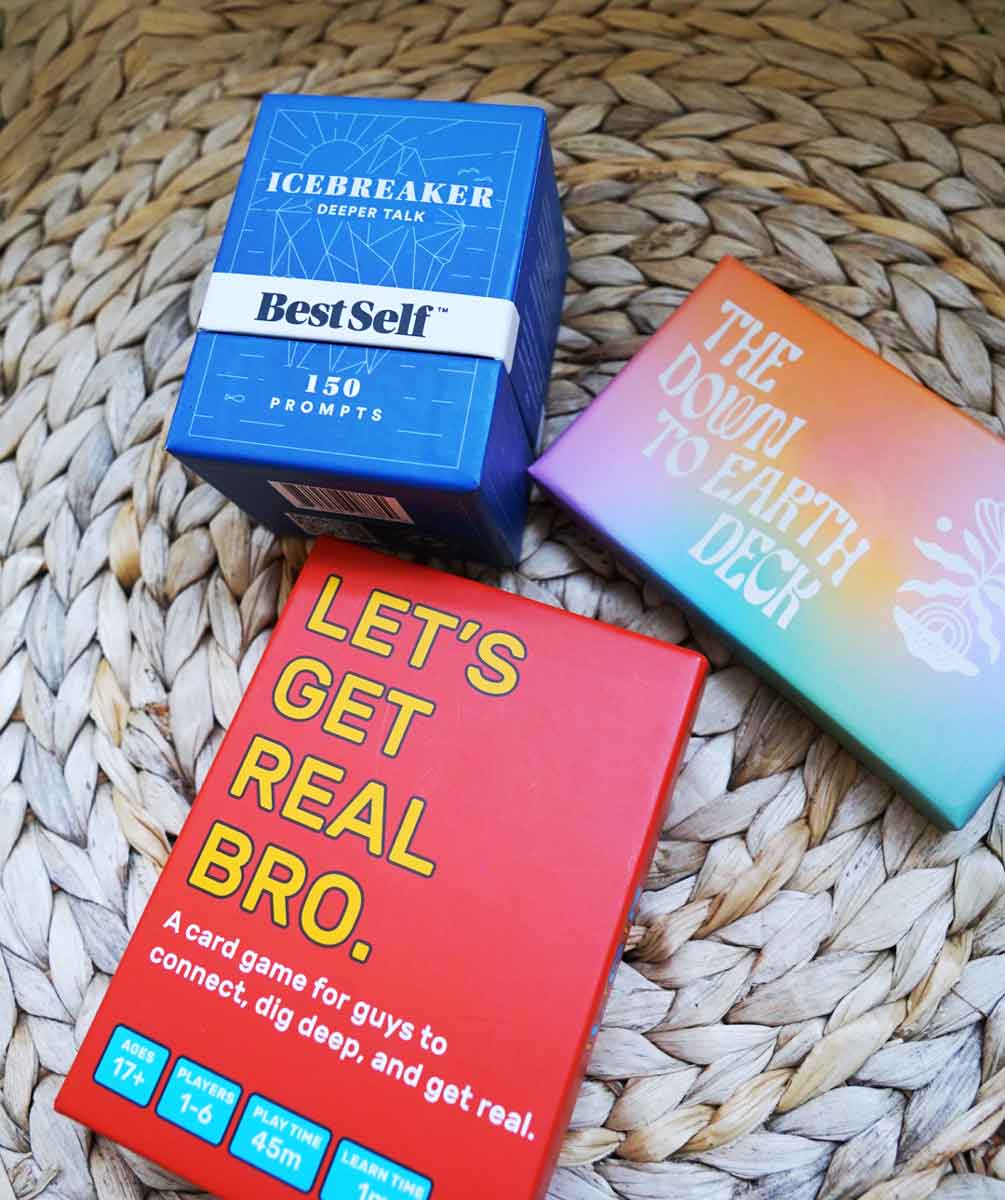
The best conversation card games ultimately challenge us to listen and empathize with ourselves and others. When played in a safe, affirming environment, we’re reminded how valuable it can be to courageously engage in hard conversations.
Conversation cards are one of the most entertaining and meaningful ways to stop and think about the world and people around us — and that’s when the magic happens!
We’ve scoured marketplaces, tested some of the coolest conversation cards in the game, and have ultimately curated a list of the best decks that we felt empower people to go out and do good in the world.
By the way, some of the links in this article are affiliate links, which means if you make a purchase after clicking a link, we may earn a commission at no extra cost to you. Thank you!
Our favorite conversation card games for adults:
BestSelf Co.

Where to buy: BestSelf Co., Amazon
What’s good: Whether you’re looking for inspiration to impact the world around you (check out their Impact Deck), an entrepreneur who needs a little help stepping outside of their comfort zone (Courage Over Comfort Deck is the way to go), or a parent seeking ways to help their children feel seen and heard (the Little Talk Deck is so sweet), there’s a pack that helps you create meaningful life habits that empower you to go out and do good in your community and workspace.
In partnership with Feeding America, every purchase you make at BestSelf provides a meal to someone facing hunger — because lack of food shouldn’t be the reason anyone can’t go after their goals.
Details: The Icebreaker Deck (which is the one we tested) contains 150 conversation prompts that spark meaningful discussions and move you from small talk to real talk (perfect for the kitchen table or the conference room).
This deck comes packed with six different categories: life, random, deep, experience, if you could…, and would you rather…
- Packaging and design: The box is small and easy to grab, throw in your bag, and bring along to a dinner with your partner, family, or friends.
- Sample questions:
— What do you regret not doing when you were younger?
— What book have you read recently that you would recommend and why?
— Would you rather have a rewind or pause button on your life? - Why it’s special: We love how most of the questions are general enough that you could ask them again and get a different answer — especially with some of the deeper questions, the cards could present an opportunity for vulnerability with loved ones.
Other Notes: Though we did enjoy our experience using BestSelf, we want to flag a “would you rather” question that came across as ableist: “Would you rather not have arms or legs, and why?”
It’s important to us that companies remove such language from their products. We hope that BestSelf Co. considers removing this question and similar questions from future print runs.
Update: Within 72 hours, the Best Self Co. team read this article and reached out to thank us for pointing this out. They said they're already working to edit this deck and exclude this card from future print runs. We're glad to see them taking action so quickly.
→ Shop the Icebreaker Deck on Best Self Co.
→ Shop the Icebreaker Deck on Amazon
→ Shop all Best Self Co. decks on Amazon
Let’s Get Real Bro
Where to buy: Let’s Get Real Bro
What’s good: Described as “Cards Against Humanity meets your therapist,” Let’s Get Real Bro (LGRB) is geared towards dudes (but playable by all). They aim to create space for men to talk about their feelings, emotions, and masculinity.
Their focus on men’s mental health support doesn’t end with the card game. With every purchase, they donate $1 to support men’s mental health, as well as offering one free month of therapy from BetterHelp!
Details: This deck comes packed with 90 questions (separated into three levels), six dry erase cards, and markers. Players take turns selecting a card while others jot down their responses. The first player to get to three points wins.
Ideal for 1-6 players and for ages 17 and up, each game comes with one free month of therapy from BetterHelp.
- Packaging and design: Consistent with its bold (obsessed with their color scheme) and sleek branding, LGRB does a fantastic job of giving us all the necessary details to play in a straightforward way. Its compact box makes it easy to have on hand.
- Sample questions:
— What’s your internal gas tank at?
— Describe your emotional state in the last week as a weather pattern or landscape?
— What’s the first thing you feel/think when you hear the term “male privilege”? - Why it’s special: I enlisted my partner, Andy, for his honest feedback! Andy is not one to share intimate emotions in group settings, so I thought this would be a great case study!
Though admittedly it felt awkward and a bit foreign to him (at first) he appreciated that LGRB eased players into the game with funny and interesting icebreaker questions!
The dry erase boards, markers, and point system make it a little more like a game and relieves a lot of pressure for players who don’t traditionally have these kinds of conversations.
Other Notes: Mental health (just like our physical health) is so important. I think it’s great that companies like Let’s Get Real Bro are trying to destigmatize mental health for men. I fully intend to gift this pack to every male-identifying member in my family!
→ Shop the Let’s Get Real Bro deck online.
We’re Not Really Strangers

Where to buy: We’re Not Really Strangers, Amazon
What’s good: WNRS is an essential card game for any conversationalist who is sick of the same small-talk or gossip that dominates their relationships. It provides thought-provoking prompts that will resonate with almost anyone and encourages healthy vulnerability for all.
Developed by photojournalist Koreen, We’re Not Really Strangers (WNRS) was inspired by conversations and questions asked when she was in the field as a photographer.
Details: The original WNRS set includes 150 carefully crafted questions and wildcards and is ideal for 2-6 players. The cards are arranged into three sections to help guide your conversations, and a pad and two pencils are included in the box.
WNRS has expansion packs for the card game, too! Folks can look for the Couples Edition, Family Edition, or even the Self-Love Edition (which I recommend as a great journaling tool!).
- Packaging and design: WNRS has a very simple design, sticking with the brand’s signature white and red color scheme to allow for the simple goal of reading questions as a means to connect with someone new.
- Sample questions:
— Do I remind you of anyone?
— How do our personalities complement each other?
— How are you, really? - Why it’s special: My ideal hang-out is sitting on the couch with a cozy beverage and a friend, ready and willing to talk about my feelings. WNRS is an awesome way to invite people into conversation and community without it feeling weird or awkward.
→ Shop the We’re Not Really Strangers card game on their website
→ Shop the We're Not Really Strangers card game on Amazon
Other recommended conversation starter games and decks:
Actually Curious

Where to buy: Actually Curious, Amazon
What’s good: Actually Curious is a family-led, Black-owned socially conscious business using the science and psychology of emotional connection to teach the tools of active listening and empathy.
Their team drew references from psychologists, journalists, crisis negotiators, game developers, their parents, and friends to develop a game that centers around empathy while getting into important topics. Expansion packs include Happy Hour, Culture, and Human Rights.
Details: Based on the science of trust-building and emotional intelligence, this deck has four levels that help you get more vulnerable as you build trust.
The Curiosity Edition consists of 52 pocket-sized cards and is produced with ethical labor and a sustainable paper supply.
Sample questions:
— What are you willing to fight for and why?
— What makes you unique?
— Name three things you’re grateful for and why?
rosewell: Dinner Parties

Where to buy: rosewell
What’s good: rosewell is a woman-owned business focused on creating considerate, inclusive, and welcoming conversations around intimacy. This sustainably-printed deck makes zero assumptions on sexuality, gender, or preference.
Details: This beautifully minimal black and white set features a collection of 50 questions on emotional, intellectual, and physical intimacy.
Sample questions:
— How do your morals impact everyday life?
— What is something that comes naturally to you?
— How do you approach opposing opinions?
Esther Perel’s Where Should We Begin - A Game of Stories For Couples

Where to buy: Esther Perel
What’s good: Created by therapist Esther Perel, (who you may know from her widely popular podcast “Where Should We Begin? With Esther Perel”) comes a card game that prompts conversations about stories we rarely share.
Details: This kit comes with 250 story cards, 30 prompt cards, and 12 tokens, and can be played with 2-6 players.
Sample questions:
— A person who doesn’t know they’ve impacted my life is …
— I’ve never shared the whole story about the time …
— The last thing I looked at that I wasn’t supposed to …
Flex Factory’s ReFlex #1
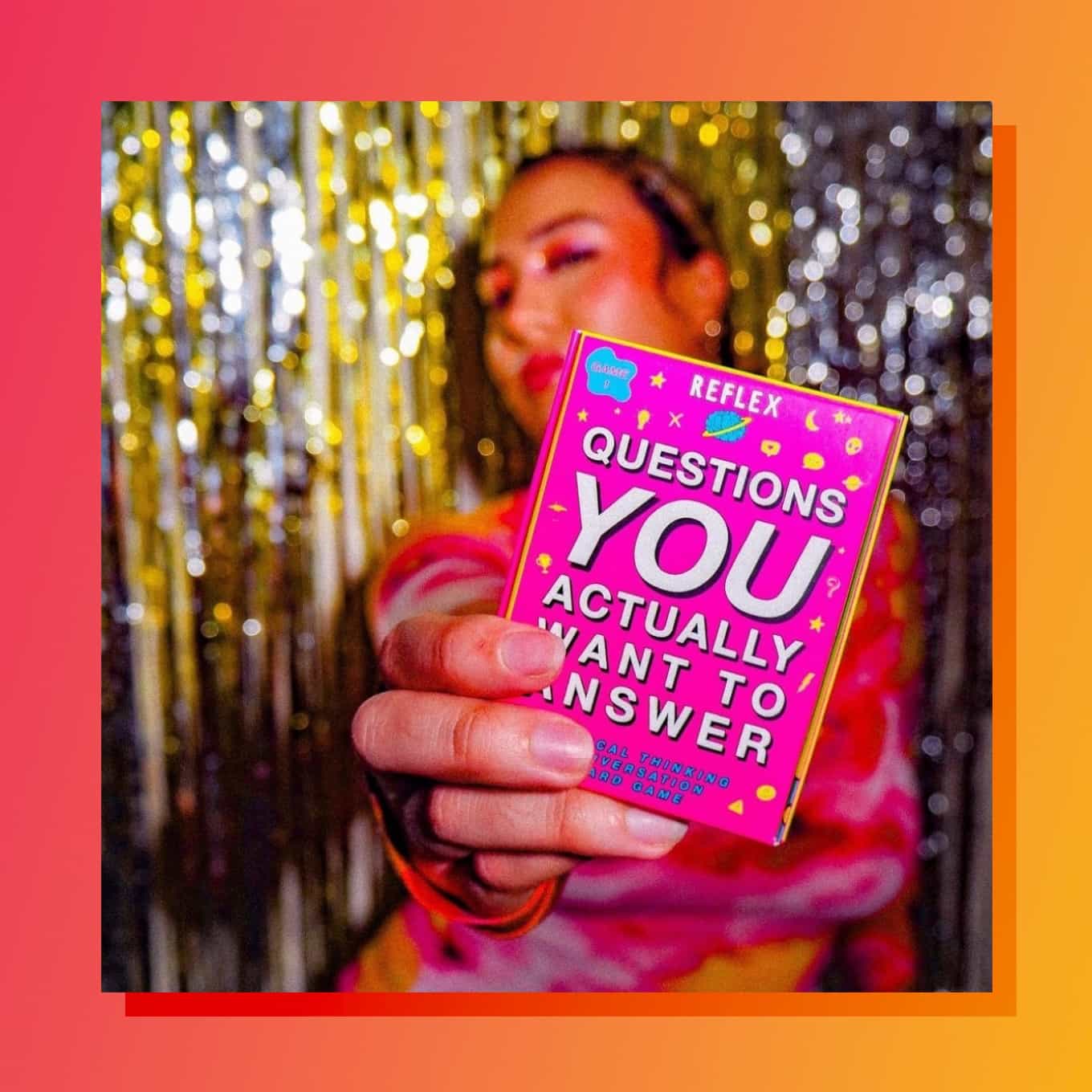
Where to buy: Flex Factory, The Lake
What’s good: This Black woman-owned small business seeks to create a conversation card experience that encourages refreshing banter and real connection through its ethically-made relationship-affirming decks. You can bust these cards out any time, any place, and with anyone (even by yourself as a self-reflection exercise).
Details: This water-resistant deck is for those who are sick of answering basic questions and want to go a little deeper. Complete with 49 prompts on love, life, death, politics, religion, career, and psychology.
TableTopics Original Edition Cube
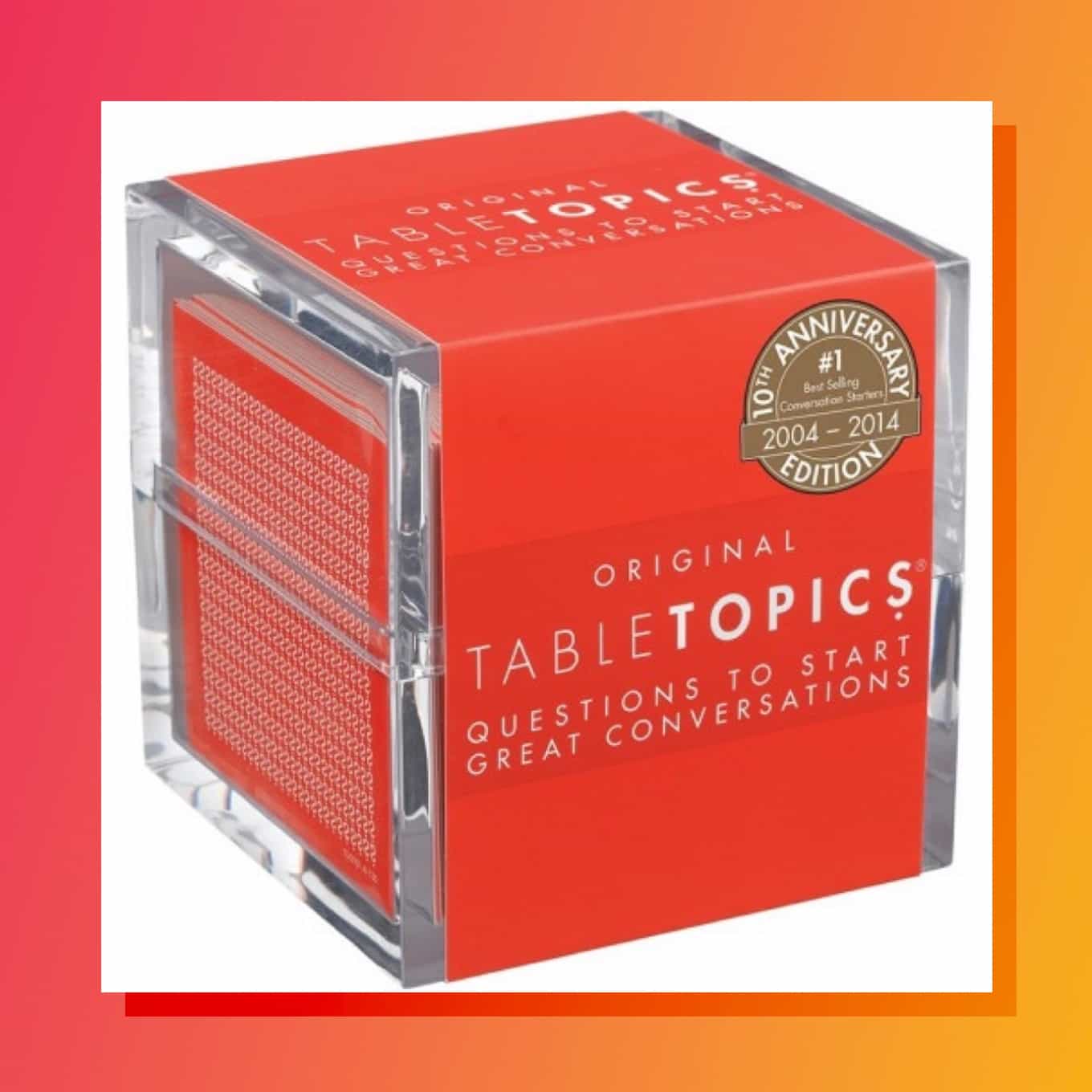
Where to buy: TableTopics, Amazon, Uncommon Goods, Barnes & Noble
What’s good: TableTopics has been developing award-winning conversation starter sets for the last ten years (including a pet expansion pack that I fully plan on adding to my conversation cards collection).
With over 35 products sold in specialty stores across the U.S., Canada, and the world, they got almost every social situation covered for you!
Details: Their ‘Original Edition Cube’ card kit comes with 135 cards filled with fun, thought-provoking prompts created for adults, but appropriate for ages 12 and up.
Sample questions:
— Is it more important to be book smart or street smart?
— If you could have front row seats to any concert, who would you like to see?
— If you could give all human beings one virtue, which would you choose?
Notable Mentions:
- We've also heard great things about Let’s Get Closer by Intelligent Change.
- We linked to Amazon for accessibility, but absolutely encourage you to shop directly from game-makers or Amazon alternatives. We've also discovered many of these card decks at IRL and online bookstores.
- Want to start having deeper conversations faster? Play a couples question game via lists of online questions.
- Aren't ready for a deep conversation but still want to get to know someone? Start with this list of ice breaker questions or conversation starters.
- Lastly, check out Good Good Good’s curated lists of deep questions to ask — a great resource for any great conversation.
July is Disability Pride Month!
For the past 36 years, July has been an important month for the disability community. The Americans With Disabilities Act was passed on July 26th, 1990.
That year, Boston became the first city to celebrate Disability Pride Day with a parade. Since then, cities across the country have followed suit with marches, pageants, and parades.
Disability is a spectrum encompassing a vast uniqueness of illnesses. However, it is important to recognize that, contrary to the societal norm, disability should not be seen as existing “without.”
As a proud disabled woman, I am reminded every day of the unique qualities that my Cerebral Palsy has allowed me to gain. I am empathetic, resilient, and skillfully adaptable.
A common misconception about Disability Pride Month is that it is trying to steal the spotlight from LGBTQ+ Pride Month. Disability and queerness are not mutually exclusive. The reality of disability is that we live in an infinite amount of intersecting identities. To celebrate disability is to celebrate queerness — and vice versa.
Disability Pride Month is a chance for the community I call home to show you all of our beauty. It is also a time for all disabled people to unapologetically celebrate our bodies as they are.
Whether you are disabled or an ally, Disability Pride Month is full of so much to celebrate.
Editor’s Note: This article was originally published in 2023, with some statistics and links updated each year.
By the way, some of the links in this article are affiliate links, which means if you make a purchase after clicking a link, we may earn a commission at no extra cost to you. Thank you!
How To Celebrate Disability Pride Month in July: Activities, Ideas, and More —
Learn
Learn about ableism.
Let’s get real: Living as a disabled person is hard. Not only is there the lived reality of having a chronic illness, but our society has a long way to go when it comes to dismantling the negative connotations around disability.
Diversability is an amazing platform founded by Tiffany Yu, an activist who became disabled at 9 years old. The company was founded by and for disabled people along with those who support us. This particular blog post of theirs does an amazing job of dissecting the origins of ableism.
Learn about Disability First language.
When talking about or describing people in the disability community, you’ll often hear two different phrases being used: “disabled people” and “people with disabilities.”
The interchanging nature of these phrases perpetuates the lack of autonomy disabled people have over how we are represented and seen.
With both being common, it’s hard to know which one is the most appropriate to use.
Many people learned that People First language (like “people with disabilities”) was most appropriate to use, because it centered the person first and foremost.
For years, though, the disability community has been pushing for the use of Disability First language. The phrase “disabled people” puts disability at the front and center of who we are, and gives us the agency to live authentically with our diagnoses.
People First language, or the phrase “people with disabilities” otherizes and separates our disabled identity from who we are. This language and the use of phrases like “differently abled” perpetuate the idea that disability is synonymous with “less than." We do not need different words to make disability more palatable.
This social media post from Disability Together and this often-cited article from the Autistic Self Advocacy Network are amazing at explaining the nuances of this issue.
People First vs. Disability First will continue to be a conversation within the disability community, as we are not a monolith.
Overall, when in doubt about which language to use, the best rule of thumb is to ask someone how they would like to be referred to. If you are in a situation where you cannot do that, Disability First language should be your default.
Read books by disabled authors.
There is no better way to learn about disabled people than from us directly. I’ve curated the best books written by disabled people about their experiences — across genres like fiction, nonfiction, romance, young adult novels, and children’s books.
→ Read the best books about disabilities
Follow disability activists.
We each have an opportunity to learn from disability activists — this month and all year long — to broaden our perspectives and deepen our understanding of the challenges faced by disabled individuals.
I’ve compiled a list of incredible disability activists fighting for increased visibility, policy changes, accessibility improvements, and social acceptance. Many of them share their work publicly through Instagram, newsletters, blogs, or books.
These are activists that each of us can learn from and support — offering a pathway for us to become better allies and advocates.
→ Meet the top disability activists to know
Watch “CODA.”
There has been a big wave of films centered around disability receiving critical acclaim. In 2022, “CODA” won the Academy Award for Best Picture.
CODA stands for Child of Deaf Adults. The film centers around Ruby, the only hearing member in her family. She rediscovers her passion for singing and wishes to pursue that in college. However, she struggles with gaining independence as her family depends on her to translate and keep their fishing business afloat.
This movie is a really beautiful depiction of the interpersonal realities of disability, as well as the importance of ensuring access for everyone.
→ Watch CODA on Apple TV+
Take Action
Call your elected officials and ask them to protect disability rights.
Throughout President Donald Trump’s second term in office, protections for disabled people have been threatened at every turn. From diversity, equity, inclusion, and accessibility rollbacks in federal agencies, to budgets designed to strip millions of their healthcare, the fight for disability rights is far from over.
The Good Good Good team has created a simple guide to help you contact your representatives. When calling your representatives be sure to tell them about the lived experiences of you, or your disabled friends and family.
Donate to organizations that center disabled people and the causes that impact us.
As mentioned above, there is not one intersection in which disability is not present. Whether it is gun violence, reproductive rights, or marriage equality, disabled folks are fighting for the bare minimum of equality.
Below are a few organizations that you can support to help in the fight for disability justice:
- Open Doors: Open Doors is based out of a long-term care facility on Roosevelt Island. Their work is centered around their Reality Poets. The entire collective is composed of disabled creatives who use spoken word and art to bring awareness to disability justice. Many of the founding poets are survivors of gun violence. Over the course of the pandemic, the program created the campaign #NursingHomeLivesMatter. This initiative has been influential in shining a spotlight on how nursing home residents have been endangered and forgotten during the pandemic.
- All Wheels Up: All Wheels Up works to create safe and accessible airline travel. Currently, they are the only organization in the world crash testing wheelchair tie-downs and wheelchairs for in-flight travel. Additionally, their Fly Safe Today program provides individuals with accessible in-flight safety equipment like the CARES Harness and the ADAPT swing for safe evacuations.
- Rollettes Los Angeles
The Rollettes are a wheelchair dance team. Founded by Chelsie Hill in 2012, two years after her spinal cord injury, their mission is to inspire women to be boundless through dance. The Rollettes hold all-inclusive dance classes for all abilities. Every year, they hold the Rolletes Experience which is a weekend-long event. The event features speakers with a spectrum of disabilities discussing various topics like motherhood, mental health, and more. Watch their dance highlight reel on YouTube. (You will not regret it!)
Celebrate
Attend a Disability Pride Month event.
Take to the streets and celebrate all things disability! Bedazzle your wheels, walker, or prosthetic, and do not be afraid. And allies — we want to see you too! Join the celebration because disability justice requires all of us.
Here are some notable events happening this year:
- California: Disability Pride LA
- Illinois: Disability Pride Parade
- Colorado: Disability Pride Celebration
- Maine: Disability Pride 2026
- Iowa: Disability Pride Prom
- New York: Disability Unite Festival
- New Jersey: Disability Pride & Inclusion Fair
- Pennsylvania: Disability Pride PA
- Maryland: Disability Pride Arts Fest
- Washington: Illuminate 2026
- Massachusetts: Boston Disability Pride Celebration
- North Carolina: Durham Disability Pride
- South Carolina: Disability Pride
- Wisconsin: Disability Pride Madison
Celebrate good news from the disability community.
There is so much inherent joy that exists within the disability community. Because we often face obstacles, our community is tight-knit and is always there to lend a helping hand.
Whether it is sharing excess medications with those that need them, finding and connecting with those with similar diagnoses, or exchanging recommendations on disability-positive doctors, we seek to ensure people that they are never alone
Here are some articles that showcase the true light-filled spirit of disability:
- Activists replaced Parisian Metro maps to prompt action for disabled riders
- Meet the dad who is creating bespoke 3D-printed toys for kids with disabilities
- Newly disabled people aren’t given a ‘how-to’ guide. Disability doulas are closing those gaps
- The Doll For All: Startup creates dolls especially for kids with disabilities
- Graduation rates for students with disabilities are improving in these states
- State-of-the-art adaptive ski & snowboard center gives disabled community a new adventure
- This national park just expanded its adaptive excursions, allowing disabled visitors to bike, camp & kayak
- This app makes it easy to find wheelchair-friendly restaurants & coffee shops (and downvote inaccessible shops)
- Viral 'Assume That I Can' Down syndrome PSA fiercely punches back against harmful misconceptions
- Interactive map crowd-sources 'neurodivergent-friendly' spaces across New York City
- First-ever Blind Barbie creates a 'sense of belonging' for disabled children
- Primark debuts adaptive clothing line designed by and for disabled people
At Work
Help ensure that your employer is disability inclusive.
Disability:IN is a nonprofit resource that consults with businesses to promote disability inclusion around the world. They offer tools and initiatives to help businesses become more inclusive and accessible.
As a third-party resource, Disability:IN also has a Disability Index that encourages companies to take data-driven action to improve their impact among disabled communities through this benchmarking system.
Learn more about the Disability Index and find the best places to work for disability inclusion.
Hire disabled people.
Disabled people are capable of anything. We are artists, doctors, CEOs, and anything that you can think of. It is not enough that companies are Equal Opportunity Employers if they do not actually hire disabled people.
Black Disabled Creatives is a platform created by disabled model Jillian Mercado.
Speaking to BuzzFeed News, Mercado said she “wanted to create a platform and a place where not only can creatives and brands hire these people, but people themselves who are submitting their work can get to know there’s a community like them, who are dedicated to their work, so that they can create a sort of community.”
For School
Teach students about disability justice using the “Crip Camp” documentary.
Nominated for an Academy Award for “Best Documentary Feature”, “Crip Camp” is a film about Camp Jened, a summer camp for disabled people. The film chronicles the stories of some of the camp attendees and how the conversations sparked there led to the modern disability justice movement.
A companion school curriculum, created by Dr. Bianca I. Laureano and Dr. Aiesha Turma, guides students in building their understanding of disability justice, ableism, and the importance of language in the movement,
Available in English and Spanish and tailored to Common Core Standards, it is an excellent addition to history and social studies curriculums.
Frequently Asked Questions
When is Disability Pride Month?
Disability Pride Month takes place every year in July. Disability Pride Month 2026 starts on July 1 and ends on July 31.
What is Disability Pride Month?
Disability Pride Month is celebrated every July in honor of the month that The Americans with Disabilities Act was signed in 1990. Disability Pride Month is a time for all disabled people to unapologetically celebrate our bodies as they are. Whether you are disabled or an ally, Disability Pride Month is full of so much to celebrate.
What are the Disability Pride Month colors?
There are no specific Disability Pride Month Colors. However, different disabilities do have colors associated with them to raise awareness. Some of these colors (blue, yellow, white, red, and green) are showcased in the Disability Pride flag.
What month is Disability Pride Month?
Disability Pride Month is celebrated in July every year. The Americans with Disabilities Act was signed in July of 1990, and that year Boston held the first Disability Pride Day celebration.
You might also like:
Katniss Everdeen didn’t just inspire a generation of girls to braid their hair; she taught them how to spot and fight oppressive systems.
Harry Potter didn’t just make kids believe in magic; he encouraged them to create their own.
The Avengers didn’t just make great action figures; they modeled what could happen when people work together to save the planet.
Of course, all of these stories and characters come with nuance and depth. And so do the fans who love them.
What is Fandom Forward?
Fandom Forward is an international nonprofit with a goal to “turn fans into heroes by using the power of story and popular culture to make activism accessible and sustainable.”
For 15 years, Fandom Forward was known as The Harry Potter Alliance. In 2021, thanks to J.K. Rowling’s fear-based transphobic messaging — and years of progress and activism leading to a much-needed change — the organization rebranded to Fandom Forward, to better include folks beyond a single story or fandom, and to be inclusive of the communities it serves.
Through experiential training and real-life campaigns, Fandom Forward develops compassionate, skillful leaders who learn to approach the world’s problems with joy, creativity, and a commitment to equity. The organization has had a major impact in countless areas, from LGBTQ+ equality, education and libraries, voting, and climate change, and they’re just getting started.
Fandom Forward is an excellent case study of the power of fandom and how ordinary people who love a movie, comic book, or series can become empowered activists who have critical conversations, create new solutions, and uplift one another in the fight for a better world.
How are people in fandoms doing good?
Katie Bowers, the managing director of Fandom Forward, has been involved with the organization in some capacity for her entire adult life, and has first-hand experience seeing how people with shared interests can come together for good.
“I think fan activism is a really good tool for seeing past a lot of propaganda and for working together with other people to imagine the kind of world we want and to work on putting that into action,” Bowers said.
“All these skills that you need to be a good organizer to be a civically-engaged human being — of understanding history, of being able to analyze people's motives and actions, of being able to be creative and imaginative and collaborative — people are learning it in fandom.”
With a variety of social justice projects under their belt, Fandom Forward has a lot to be proud of. Recent initiatives included a campaign to support Indigenous water protectors by hosting a viewing party, virtual action, and community building event in conjunction with an episode of Avatar: The Last Airbender.
“It’s something that’s fun and educational for fans, but it also helps to breathe a little bit of joy into the work that folks do,” Bowers said. “Activism is wonderful, but it’s also very draining and demanding, so we get to do something that is impactful and fun and joyful. It’s cartoon night. We’re all going to watch cartoons for justice.”
Another recent campaign was a gay pirate panel (for lack of a better term) with “Our Flag Means Death” star Vico Ortiz and other digital activists, who raised funds and took action against anti-LGTBQ+ bills sweeping the United States.
Over 500 attendees signed up for the digital event, where they watched a YouTube livestream hosted by “Our Flag Means Death” YouTubers, podcasters, fan creators, and the pirate of the hour, Vico Ortiz.
Additionally, participants took direct actions to fight anti-LGBTQ+ bills, and once they shared their actions on social media, they were awarded with an “official job” on the Fandom Forward pirate crew.
Additionally, Fandom Forward has a long-standing initiative to promote education and literacy. Book Defenders (formerly called Accio Books) is a campaign that has donated over 400,000 books around the world, secured millions in library funding for libraries in the U.S. and Canada, and has even helped build libraries, according to the Fandom Forward website.
Literacy advocacy is deeply important to the organization, as its foundation is on a love of books and storytelling, Bowers said. Although banned books have always been cause for concern, the issue has become more prominent in recent months.
This grassroots work is vital to the safety and freedom of people around the country, and Bowers says that fan communities are best equipped to fight these injustices.
Why do fandoms work as a way to mobilize activists?
In a time where it feels like there are more villains to fight than ever before, Bowers says fandom is the perfect vehicle for training and empowering activists of all ages — and Fandom Forward isn’t the only organization offering such insights.
The Fan Organizer Coalition is a community of fan organizers created by Fandom Forward, Black Nerds Create, and Pop Culture Collaborative, helping to build stronger relationships among fan organizers, share resources, and work to build equity.
Just recently, the coalition released a report of findings about fan organizing, which explores shared values, best practices, and shifting narratives.
Bowers shared in conversation what has been repeatedly explored in research and practice: Safe communities give us the power, the resources, and the energy to do more good.
She says that being a fan of something is a shortcut to finding your people; to organizing your community. For example, if you love “Star Wars,” and you meet another person who loves “Star Wars,” chances are, you can have a fruitful conversation about your favorite movies and characters, but you’re also connecting in a completely different way, too.
“We share the same values,” Bowers says. “Like, you see the world the way I do. You have the same feelings about war and empire that I do. You have the same feelings about acceptance and love and friendship that I do. So, of course it’s going to make it easier to make friends. It makes it easier to do community organizing.”
Talking about big issues through the lens of a plot or character arc disarms people. It helps break down the barriers to activism as something a favorite superhero would do, as something someone you admire would help you do, too.
“We’re borrowing a little bit of bravery from those stories and from those characters to help people tackle this stuff,” Bowers says.
Part of the fan organizing report findings points readers back to the fact that fandoms are rooted in a desire for belonging, that humans long to find themselves represented in stories and in groups to make meaning out of this big mess we call life.
“We’ve always told stories to make sense of the world. We don’t tell stories in the same way our ancestors did, about animals or being in the woods, or how the Earth got made, but we tell these huge cultural myths that are shared on a much larger scale,” Bowers says.
“‘Harry Potter,’ ‘Hunger Games,’ ‘Star Wars,’ ‘Star Trek,’ a million other things, are owned by corporations and are therefore worthy of a critical eye, but these are our shared stories right now. These are our shared cultural myths.”
Part of fan organizing, beyond raising funds, mobilizing voters, or reading banned books, is to create even better stories on this massive scale.
“Fan organizing is focused around specifically making franchises better, more diverse, more inclusive, more accurate,” Bowers says.
“That stuff matters. These are the stories we use to make sense of the world now, and if they’re not stories that are inclusive or accurate, then we’re making sense of the world with bad information.”
How fandoms teach us about inclusive community building
Fandom Forward has always been a safe and inclusive place for people of all identities. Still, when LGBTQ+ folks (especially transgender community members) were targeted by J.K. Rowling’s transphobic remarks, the organization knew it was time to refresh.
Bowers said over 1,000 members were included in the decision-making process during the organization’s rebrand, ensuring that folks of different marginalized groups and identities felt heard and could voice their ideas in creating a space where everyone could be authentically enthusiastic about the things they love.
“Fan spaces are not just free-for-alls,” Bowers says. “Whatever the political leanings of the space, there are going to be norms and language, and expected rules and behaviors people are very conscious about when cultivating that space. People are constantly having these community building discussions that are rooted in justice, and I think there’s a lot of thoughtful, intentional community building going on in fandom in a way that could be useful in other spaces in the real world.”
Fandom Forward, for instance, maintains that transphobia and racism are not welcome in spaces. Its values are rooted in joyful activism, the power of community, the development of practice, support, and love.
Clarifying norms and values are regular tasks, as members work to fine-tune their community building, to work through transgressions, and offer learning opportunities as they navigate both digital and traditional spaces, like Discord servers, convention halls, and Facebook groups.
Though it might seem like small potatoes, community building is a key part of mobilizing fan communities to help aboard and welcome new activists who are ready to reimagine a better world.
“The anti-trans stuff, the book bans, all of it ties into this fascist idea of there being a right and wrong way to be a human being,” Bowers said.
“And fan activism is a cool pushback to all of that because so much of fandom is about reimagining stories and saying: ‘What if the story was told this way?’ What if the character was like this?’ Fans constantly rework things and re-tell these stories. We know that there are so many valuable, important, valid ways to be a human being, to have your story told.”
You might also like:
Shortly before 6 p.m. on Monday, June 27, San Antonio authorities responded to a call from a worker who reported hearing a cry for help coming from inside a tractor-trailer on a city backroad.
Authorities at the scene found forty-six people dead in an abandoned tractor-trailer. According to Bexar County Judge Nelson Wolff, four more later died after being taken to nearby hospitals.
Among the dead were 39 males and 11 females — reportedly migrants.
Mexico’s Foreign Minister Marcelo Ebrard confirmed on Twitter that those identified among the dead were from Mexico, Guatemala, and Honduras.
Mexican officials could not confirm the nationality of the other 19 migrants found alive — many of whom are being treated for heat stroke and exhaustion — including four minors.
Fire Chief Charles Hood told the Associated Press that those taken to the hospital were hot to the touch and dehydrated.
With temperatures reaching up to 103 degrees and without water or air-conditioning — which local and U.S. authorities could find no signs of — those inside the trailer were subjected to unfathomable heat conditions.
Tragically, this is not the first time something like this has happened. In 2017, nine migrants were found dead inside a truck parked at a Walmart in San Antonio, and in 2003, 19 migrants were found in a sweltering truck southeast of the city.
Migrants — and immigrants — are subjected to much more than heat-related issues, though.
Whether fleeing poverty, violence, or persecution, they often have little to no choice but to leave their homes — some even abandoning ancestral lands — in search of safety and job opportunity.
Some pour their entire savings and risk their lives for the chance to provide futures for themselves and their families.
It’s worth noting that while much of the attention around migrant injustices in recent years has been centered around children and families, everyone deserves to have their basic human dignity upheld, and the right to safety.
From securing safe work and housing to accessing healthcare services, migrants are left navigating unfamiliar territory with limited to no resources.
Many of these problems and injustices result from an outdated and often inhumane immigration policy in the United States and systemic root issues in Central America.
Fortunately, change is possible. Organizations and advocates by the border have been diligently providing aid and working on immediate solutions.
We’ve collected a series of action steps each of us can take to help support migrant families at the U.S.-Mexico border.
How to make a difference for families, children, and all migrants at the U.S.-Mexico border:
Learn more
Watch a documentary about the current Texas-Mexico immigration crisis
Learn more about the treacherous passage that many migrants make through Brooks County, Texas — about 70 miles north of the border.
“Missing in Brooks County” a documentary directed by Jeff Bemiss and Lisa Molomot, paints a portrait of how thousands die of dehydration and deathly heat exposure, all to avoid the Border Patrol internal checkpoint near Falfurrias, Texas.
“Missing in Brooks County” is available for rent.
Listen to this Pulitzer-winning podcast episode
This American Life won the very first Pulitzer Prize ever given to audio journalism, for its "revelatory, intimate journalism that illuminates the personal impact of the Trump administration's 'Remain in Mexico' policy.'"
The winning episode, “The Out Crowd,” released last November, took listeners inside the lives of individuals on both sides of the Remain in Mexico policy.
Read a brief history of immigration at the Texas-Mexico border
Effective, solution-oriented action starts with understanding an issue’s origin. And though many of us may despise a history lesson, it’s hard to truly get to the root of any issue without doing some homework.
TIME’s article “The Situation at the U.S.-Mexico Border Can't Be 'Solved' Without Acknowledging Its Origins” is a great starting point.
Read about immigration law
If you’re interested in supporting migrant and undocumented immigrants in your community, The Immigrant Legal Resource Center (ILRC) is a great resource that provides a wide range of tools from experienced advocates.
Their Community Resources page offers free guides for immigration preparedness, legal service providers in your area, and “know your rights” cards — equipping you to advocate for migrants and immigrants.
Read “The Devil's Highway: A True Story” by Luis Alberto Urrea
As a Texan Latina who grew up by the border, I knew the obstacles and perils associated with crossing the border. I heard many of those stories first-hand.
However, it wasn’t until I read “The Devil's Highway: A True Story” by Luis Alberto Urrea, that I felt a deeper understanding and renewed sense of respect and advocacy for those who have perished and risked their lives for the hope of safety and security.
This horrific true story shares the journey that one group took through one of the deadliest regions on the continent: a place called the Devil’s Highway. Urrea takes his readers to the small towns and unpaved cities south of the border. It’s a sad but accurate portrayal of the journey many migrants take to get to cross the border, and I highly recommend adding this as a resource to gain deeper insight into the issue.
Donate
Donate to RAICES
RAICES is a Texas-based nonprofit organization that provides free and low-cost legal services to underserved immigrant children, families, and refugees.
Describing the United States’ current immigration and border policy as “intentionally dehumanizing”, the organization is fighting to release individuals from ICE detention centers, providing legal services to detained children on the border, and organizing staff, volunteers, and pro-bono lawyers to support immigrant families in the American legal system.
Your donation to RAICES will allow their team to continue fighting for immigration rights and defending the dignity of asylum seekers, immigrants, and refugees.
Donate to Sueños Sin Fronteras
Sueños Sin Fronteras is a Latinx- and people of color-led mutual aid collective working within the intersection of reproductive justice and immigrant justice.
They strive to provide equitable access to health care services for immigrant and undocumented communities in San Antonio, Texas.
Donations can be sent to Sueños Sin Fronteras via Venmo, Cash App, or PayPal. Funds go directly to their programs that include transportation access, community care, reproductive health services, and educational workshops.
Donate to Corazón San Antonio
The Corazon Migrant Shelter has become a survival mechanism in times of crisis or continued displacement for asylum seekers traveling through San Antonio.
Corazón San Antonio aims to provide free aid to migrating populations and access to compassionate care and support. You can donate to Corazón San Antonio’s local efforts to provide safe shelter, transportation, and meals to migrants.
Donate to solve root issues within Central America
While supporting immigrants once they reach the U.S. is important, it’s just as vital to ensure that there’s less need for people to put themselves in a dangerous situation in search of a safer, more secure place to live and work.
Donate to the United Nations Refugee Agency to support their work in solving the root causes within Central America that cause people to flee their home countries.
Take Action
Call your elected officials
It has effectively been decades since Congress passed any sort of meaningful immigration bills. A lot has changed since 1986, but Congress has continually failed to act.
Faith-based immigrant-rights organization, We Welcome, has made it easy for you to tell your legislators to support meaningful, bipartisan immigration reform.
They recommend contacting your elected officials (by phone or email) with a message like this:
Dear [Representative/Senator Name],
As a constituent, I urge you to permanently solidify the contributions of immigrants who are integral to our communities, and pass meaningful, bipartisan immigration reforms. I’ve been deeply disturbed by much of the rhetoric coming from lawmakers in recent weeks, which dehumanizes migrants and seeks to block asylum protections at the southern US border. I urge you to work across the aisle to find solutions that uphold human dignity and support the interests of the American people.
Approximately 78% of farmworkers, who have maintained our food supply and ensured Americans have food on their tables throughout the COVID-19 pandemic, were born outside of the United States. This includes the undocumented, temporary guest-workers, green card holders, and naturalized citizens.
About 130,000 Temporary Protected Status (TPS) holders are currently contributing as essential workers, and nearly 30,000 DACA recipients work in health care across the U.S., yet both groups face uncertainty surrounding their future in the United States.
I urge you to support legislation that would provide Dreamers and TPS holders with protection from deportation and an opportunity to obtain permanent legal status, and any legislation that would reform and modernize our current agricultural worker visa program, ensure workers are authorized, provide additional worker protections, and create a pathway to citizenship for current unauthorized agricultural workers.
Furthermore, I ask that you do not join in efforts to force the use of Title 42 as an immigration deterrent, but instead work to create permanent, bipartisan solutions that facilitate orderly border management while also protecting the legal right to seek asylum.
Now more than ever, I urge you to take long-overdue action to pass these needed immigration reforms.
[Your name here]
Volunteer on the border
If you live in a border state, you can use your time and energy to make a positive impact in person.
Historically, we’ve recommended volunteering with volunteering with Catholic Charities to care for unaccompanied minors in San Antonio.
Unfortunately (or, actually, fortunately), they’ve received overwhelming support and interest from volunteers — and currently do not need more volunteers.
We’ll update this guide when the opportunity to volunteer IRL becomes available in the future.
A mattress is a big purchase — and a very important one. According to the National Library of Medicine, we spend about one-third of our lives sleeping. In this regard, buying a mattress is kind of like buying a house — it’s where you spend a good chunk of your time!
It’s overwhelming to pick out furniture — especially when shopping online. You can’t Goldilocks your way out of it by having multiple cat-naps in the middle of a furniture store, but we took one for the team, and our Good Good Good crew actually tested out a majority of these mattresses!
If you’re on the hunt for a new mattress that meets the needs of you and your potential sleeping partner, is a sustainable choice for the environment, and will be worth the money, we’re here to help.
We’ve rounded up some of our favorite eco-friendly mattresses on the market to help you put your conscious consumer mind — and hopefully your body — at ease.
Oh, and if you're outfitting your entire bedroom, you might also like our deep-dives on:
- Sustainable Bed Frames
- Sustainable Mattress Toppers
- Sustainable Bedding
- Sustainable Dog Beds
- Sustainable Pillows
- Sustainable Weighted Blankets
But first, some facts about mattresses and sustainability!
What makes a mattress eco-friendly?
If you’re spending all this delightful dream time on a mattress, you want it to be good for you and good for the planet. Eco-friendly mattresses are mattresses made with quality materials that do not have detrimental effects on the health of the environment.
There are a few main components that make up a mattress, including latex or foams (the big mattress piece you think of), cotton or wool (the lining of the mattress that covers the latex or foam), and occasionally, coils or springs that give your mattress the bounce and support a shopper might be looking for.
Many standard mattresses that are not eco-friendly are made from foams and materials that contain petroleum, polyurethane, vinyl, PVC, or chemical flame retardants. These not-so-great chemicals are either made with crude oil — and other energy-inefficient sourcing processes — or emit volatile organic compounds (VOCs) like carcinogens.
They’re bad for the planet — and your personal health.
Latex, on the other hand, is a more eco-conscious material, but you’ll want to opt for natural latex, as opposed to synthetic latex, which is not recyclable and contains those yucky VOCs.
Eco-friendly mattresses are certified by trusted independent organizations that provide rigorous testing and regulations, such as the Global Organic Textile Standard (GOTS), Greenguard, Global Organic Latex Standard (GOLS), Made Safe, and others.
These certified standard organizations look at a mattress’s list of materials to ensure that they are made with durable natural fibers that will last a long time, including ethically-sourced cotton and wool. And, like we mentioned, eco-friendly mattresses use natural latex, which has better durability and decreased environmental impacts.
Hybrid mattresses usually include coils or springs made from recycled metals and wrapped in organic or recycled fiber materials like cotton or polyester. Each mattress will include different specs and information about support from these coils or layers, so read up to find the best fit for you!
All in all, when researching an eco-friendly mattress, be sure to look for a company’s sourcing and manufacturing processes, certified safe materials, and any other social responsibility or environmental impact work, such as financial contributions, climate neutrality, and more.
By the way, some of the links in this article are affiliate links, which means if you make a purchase after clicking a link, we may earn a commission at no extra cost to you. Thank you!
Our favorite sustainable mattress brands
The brands you see listed here sent members of our team a mattress to review for this article. (Our reviews are always honest. Receiving free products for testing never impacts our writing — and brands don’t get any influence on our editorial process.)
We broke down our reviews based on the mattress’s packaging, comfort, and assembly to help you make the best decision for your body, your wallet — and the planet.
Awara Natural Hybrid Mattress

What’s good: Awara’s Natural Hybrid Mattress is made with organic materials and comes trusted by a number of third-party sustainability champions like the Rainforest Alliance, Forest Stewardship Council, GREENGUARD, and Repreve. All latex used is free from ozone-depleting substances, flame retardants, mercury, lead, formaldehyde, and phthalates.
Additionally, for every purchase, Awara’s nonprofit partner Trees For The Future plants 10 trees in Kenya, Senegal, Uganda, or Tanzania. In 2021, 225,000 trees were planted thanks to Awara customers.

Details: This hybrid mattress is made with a luxurious combination of cozy organic New Zealand wool, silky organic cotton, and Rainforest Alliance-certified natural Dunlop latex from real rubber trees. Between this natural latex and recycled steel coils individually encased in cotton, the mattress improves air circulation and helps you stay naturally cool and comfortable all night long.
Warranty information: All mattress shoppers receive a 365-night trial and a lifetime warranty.
Price: $1,099 for a Queen

Megan’s Thoughts:
- Packaging: Awara’s packaging seems to be similar to the route other mattresses-in-a-box take: it’s vacuum-wrapped in layers of plastic. While this helps it to be much more compact for shipping, you still end up with a lot of plastic bag packaging. There’s a chance a plastic bag recycling collection point near you (like at Target or another grocery store) will accept this type of plastic in their bins, but unfortunately, this might end up going in the trash.
However, I did appreciate that Awara included a special cutting tool to cut through the plastic sheeting and help protect the mattress from getting nicked by a blade.
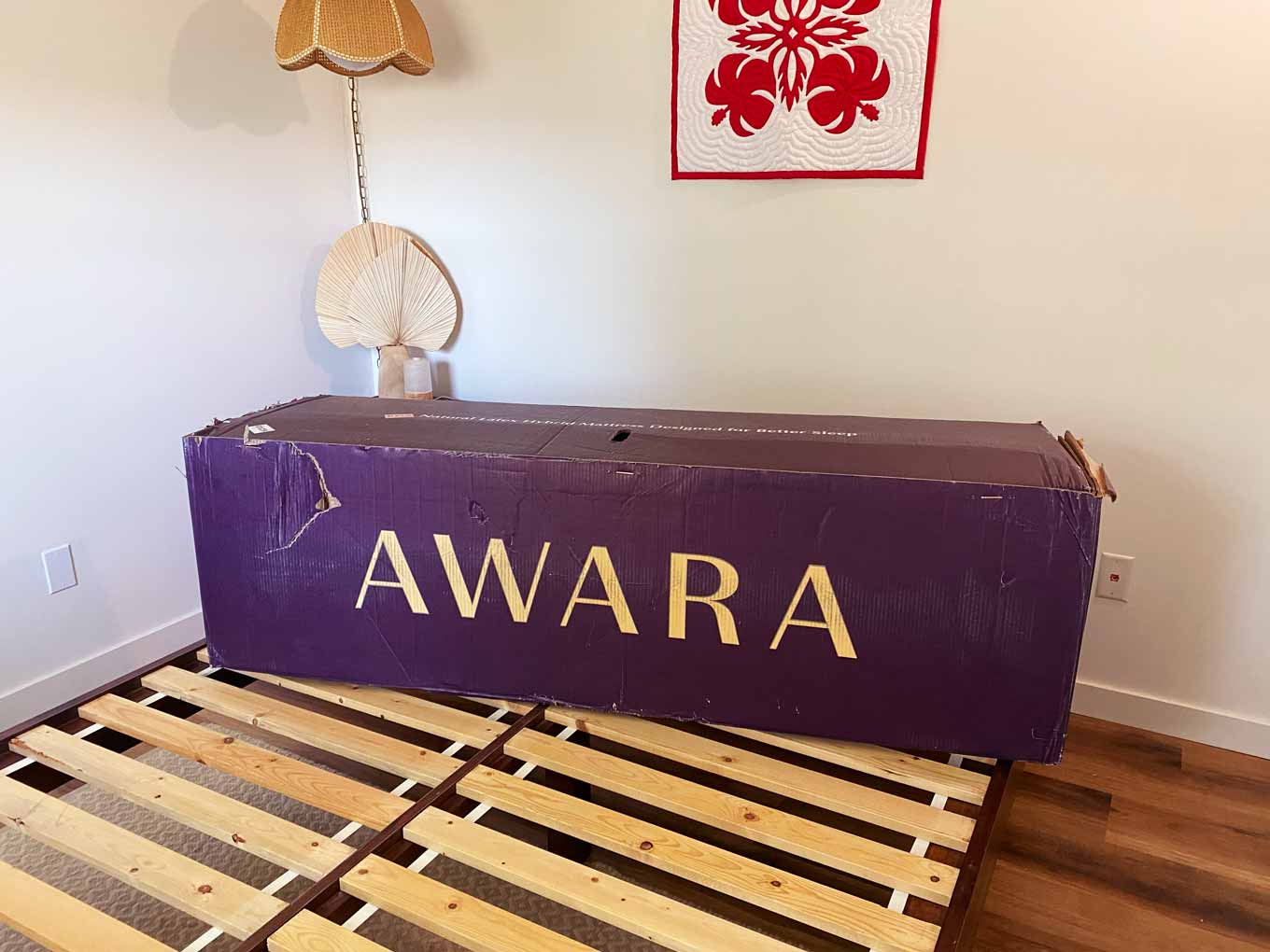
- Comfort: This mattress is so comfortable! My husband and I opted for one with an additional topper, so it erred more on the medium-firmness side. I love a mattress you can somewhat sink into rather than sit on top of, and this definitely feels like a soft, comfy, cozy cloud! Without the topper, it would likely be a bit more firm, so keep that in mind.
- Assembly: Assembly of our mattress was a breeze! Since it’s made with latex and high-quality wool, it’s definitely much heavier than your standard mattress, so having a partner to help unbox and situate the mattress on the frame is helpful.
Once you cut through the plastic wrapping, the mattress expands quickly. I’d say it expanded to its full size within an hour. Perfect for a post-furniture-assembly nap!
→ Shop Awara’s Natural Hybrid Mattress.
Spindle Organic Latex

What’s good: Spindle’s latex mattresses are a unique and well-made approach to the traditional mattress. Using organic latex and cotton materials, the Spindle actually comes with three layers (soft, medium, and firm, but chat with Spindle specialists to learn which layers might be best-personalized for you!) and an organic cotton fabric cover so you can position the layers of your mattress in different iterations until it works just for you.
This approach subsequently becomes more sustainable, as customers can reposition their layers or purchase a new layer at a discounted rate instead of buying a new mattress more often. Spindle is among the most expensive mattresses we reviewed — but this unique approach might end up helping your wallet (and the planet!) in the long run. For king-size mattresses, Spindle also offers a split-firmness option, too.
Details: Spindle mattresses are made with 100% organic latex, cotton, and wool with no chemical flame retardants or synthetic rubber. Latex foam is made from the sap of a rubber tree and provides a sleep surface that conforms to the body for a fully supportive experience.
Warranty information: All Spindle mattress shoppers receive a 365-day comfort guarantee, 10-year warranty, and a 25-year comfort life program, where customers can purchase mattress modifications (another layer of latex) at a 30% discount.
Price: $2,299 for a Queen

Kamrin’s Thoughts:
- Packaging: Because of the nature of there being multiple layers of latex in this mattress, it came in two boxes. All of the materials were rolled into condensed plastic packaging and were a beast to unbox. However, once my partner and I knew what we were doing, it was easy to unpack the full mattress.
- Comfort: The Spindle provides a comfortable night’s sleep but does sit a bit lower than a standard foam, hybrid, or box-spring mattress, as it has a nine-inch width, compared to the average 10 or 12-inch width of other mattresses.
After a few months of adjusting to a new latex mattress, I feel well-supported but definitely might try out a different firmness with the layers to continue to find the perfect fit. That’s what’s so cool about this product; it is made to work for me!
- Assembly: While you might assume there is little assembly involved in a mattress, the Spindle is a whole different story. I didn’t realize exactly what I was getting myself into when I unboxed the mattress, so I was glad to find a step-by-step assembly guide online to help select the right layers of the mattress to get them into the fabric cover correctly. Definitely schedule more time in your day for unpacking and setting up this mattress.

Other Notes: Before receiving my mattress, Spindle’s team set up a quick call to get to know my sleeping habits and make sure I was getting the right product for me. I learned about the different firmness levels, and together, we discussed the most comfortable settings for a good night’s sleep.
I wondered if I was getting special treatment because I was working on this article — so I asked them. While this kind of call doesn’t automatically happen for all customers, it’s available to anyone at request. Spindle encourages shoppers to call their customer support line to ask any questions before making this big purchase. You can even schedule a time to talk with someone directly on the website!
→ Shop Spindle’s Organic Latex Mattress.
Savvy Rest Serenity Mattress
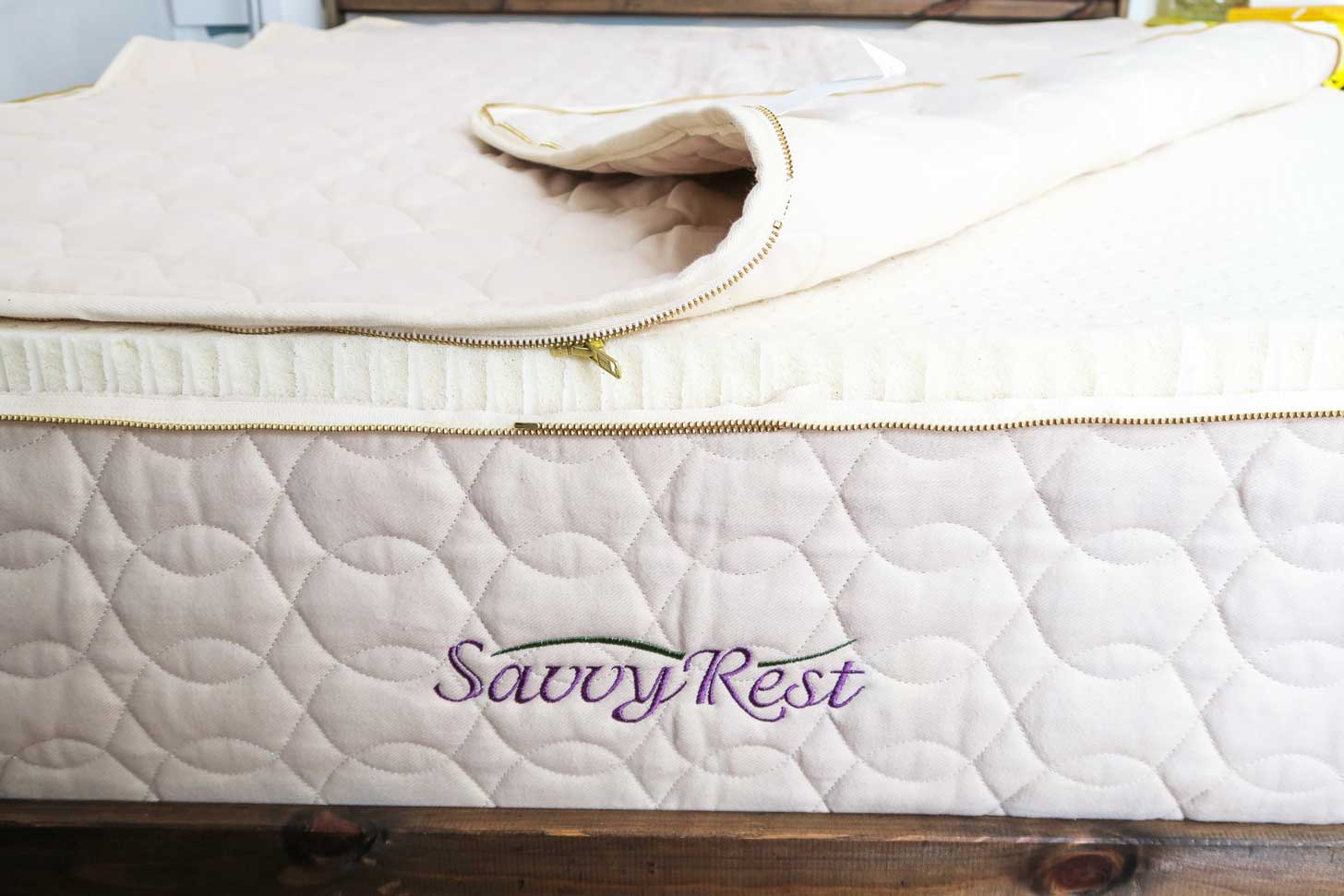
What’s good: Similar to the Spindle, Savvy Rest’s Serenity Mattress allows for total customization, so you can layer your all-natural latex mattress according to your desired preferences. With three layers of latex, all chosen to your desired firmness, this makes for a sustainable and long-lasting lifespan for your mattress.
While this big decision (and cost) might seem overwhelming at first, the brand has an in-depth guide to choosing your organic mattress layers, and will happily jump on a call if you need a little extra assistance.
Savvy Rest is also a certified B Corp and offers an employee stock ownership plan, prioritizing people and planet over profit. Additionally, Savvy Rest has a Safe Sleep Pillow program, which donates organic pillows to local domestic violence organizations to provide the most restful and reliving experience to women and children upon their arrival to a shelter or new home.
Details: Savvy Rest’s Serenity Mattress, like all of the brand’s bedding options, is made with pure natural dunlop or talalay latex, as well as certified organic wool. The materials are GOTS certified organic and made in a GOTS certified facility. The brand’s mattresses, pillows, and toppers are all Greenguard certified, as well, ensuring low chemical emissions.
Warranty information: Savvy Rest offers a 20-year limited warranty. Although the brand does not offer returns, there is a 90-day Latex Layer Exchange available if you need a little more help finding the perfect configuration.
Price: Starts at $2,699 for a Queen
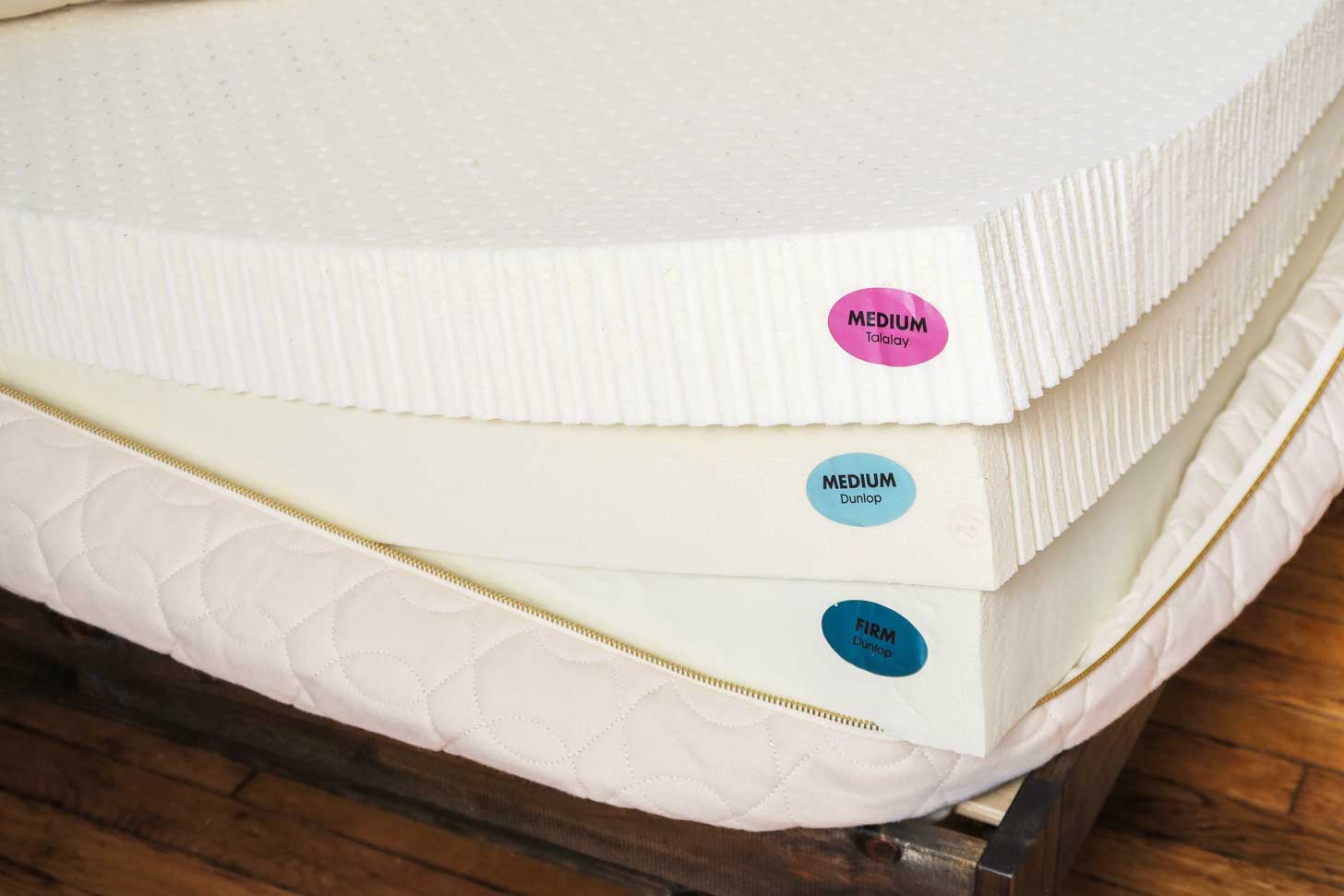
Johnathan’s thoughts:
- Packaging: The mattress came in three very large boxes, with one layer of latex in each box, plus the encasement for all of them inside one. Each of the layers was rolled up and sealed in a very large plastic bag (I think for sanitation purposes). Natural latex is pretty dense and therefore quite heavy when managing such large pieces, so I would definitely recommend having someone help you move the boxes/unpack the layers from their bags.
- Comfort: Since getting my new mattress, my sleep has been wonderful. I selected Medium Talalay latex for the top layer, Medium Dunlop latex for the middle layer, and Firm Dunlop latex for the bottom layer, as I prefer a slightly less soft sleeping surface. The whole mattress is quite soft and gives easily if you sit or apply pressure to one point, but laying down, when your body weight is better distributed, provides the perfect amount of support. I am usually a back sleeper, as sleeping on my side ends up twisting my back, but I’ve found myself curling up on my side more often and feeling the most comfort I’ve ever felt in that position compared to any other mattress I’ve slept on. The quilted casing is very nice quality fabric and stitching, and I think this mattress will last a good while. I really appreciate the ability to customize your own mattress based on sleeping preferences, and I also like knowing that if I find the top layer getting too soft, I can just rearrange them at any point down the line!
- Assembly: Assembling the mattress was quite difficult. The idea is to lay the mattress encasement on your bed frame, and then to stack each of the three layers on top of each other in the corresponding order of firmness. To do this alone proved itself to be very difficult, but I imagine it would still be quite difficult even with a helping hand.
The layers of latex are flexible and bendy and hard to lay down with intention, so it took many tries to get the layers stacked well and in place on the inside of the encasement, and even after having wrestled them all into the cover, I don’t think they are stacked the best they could be. It’s a snug fit, but once zipped up, you have a mattress! My instinct is to say it might be helpful to have the mattress preassembled upon shipping, but I imagine this is the best way Savvy Rest can do it to allow for the level of customization that they offer.
→ Shop Savvy Rest’s Serenity Mattress.
Saatva Latex Hybrid Mattress

What’s good: Established in 2010, Saatva was founded on the principle that everyone deserves healthy and restorative sleep in a quality bed. That’s why the brand is known for its eco-conscious latex mattresses.
The brand uses eco-friendly and certified organic materials in its mattresses, like ethically harvested natural latex, certified organic cotton covers, and coils made from recycled steel (though coils aren’t used in all of the mattresses!)
Saatva also manufactures all of its mattresses in the U.S., which are all then delivered flat and by-hand, so they aren’t shrink-wrapped in more plastic.
The brand partners with a solar-powered factory, is part of the Sustainable Furnishings Council, and plants trees with every purchase through Evertreen. To date, Saatva has planted more than 2,000 trees and offset more than 675,000 kilograms of carbon dioxide.
In addition to reforestation and sustainable farming efforts, Saatva has a number of giveback programs, like the donation of new mattresses to newly-housed folks in Texas through Austin Pathways.
Details: While Saatva carries a number of mattress options, our team tried the Latex Hybrid Mattress, which has a buoyant innerspring and latex design. Made with GOLS-certified organic natural latex, recycled steel coils, organic cotton, and treated with a nontoxic, botanical antimicrobial treatment, this mattress is safe for your home and the planet.
Warranty information: All Saatva mattresses come with a 365-night home trail, so you have plenty of time to decide whether you’ve found the right fit. If you’re not satisfied, Saatva will pick up the mattress and refund your money for a $99 processing fee.
If you are happy with your mattress, Saatva provides a “Friends For Life” warranty. If something happens to your mattress within two years, the brand will replace it free of charge. Three years or later, you’ll just pay a $149 processing fee.
Price: Starts at $2,195 for a Queen
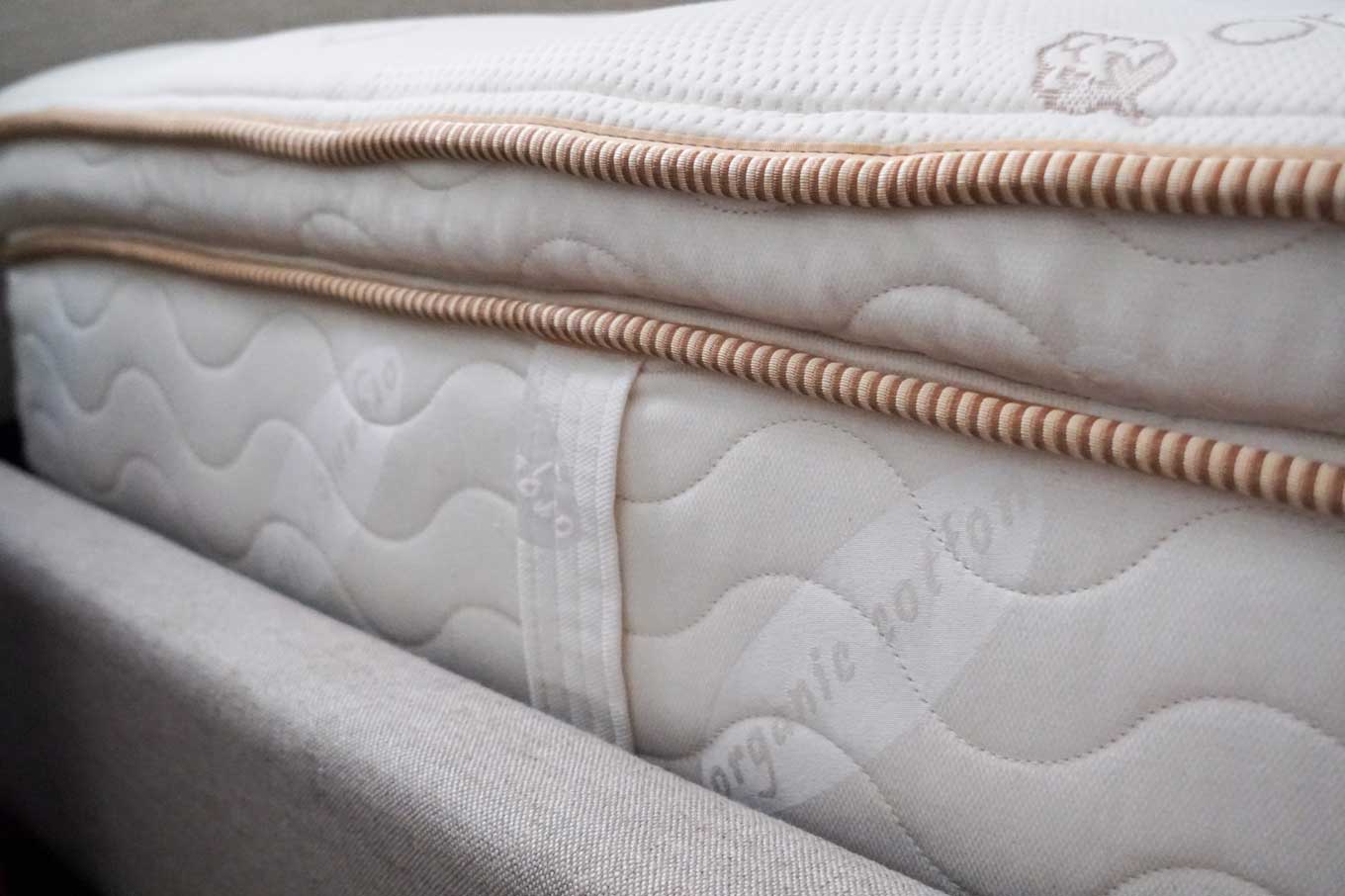
Jessica’s thoughts:
- Packaging: Saatva provides complimentary “white glove delivery” and installation of all its mattresses, which is a major plus! Their delivery team brought the mattress into our bedroom and set it up on our bed frame. They also didn’t leave any packaging/trash behind, so we really didn’t see how much packaging was involved.
- Comfort: I’ve been using this mattress for about a month and it’s been a major improvement from my previous mattress. The exterior fabric is so soft and cozy, I’m reminded every time I wash and change the sheets.
It is much thinner than I anticipated, but I love how low-profile it looks, and this makes it easy to get on and off of the bed. We have been primarily using the mattress with a topper, but if you like a firmer option, the mattress alone is probably what you’re looking for.
- Assembly: As mentioned, the delivery team took care of delivering and setting up the mattress. I simply received a text with a confirmation that they would be delivering on a certain day and time window.
They were very professional and extremely efficient in setting everything up. It was such a relief to not worry about any heavy lifting and moving. We decided to keep our old mattress to pass along to someone else, but I love that they offer the option to remove your old mattress if needed.
→ Shop Saatva’s Latex Hybrid Mattress
Avocado Eco Organic
What’s good: Avocado’s mission is to be one of the “world’s most sustainable brands.” All of its beds come highly-certified, and its factories and wood shops in Los Angeles are powered entirely by renewable energy. Additionally, Avocado is the world’s only Climate Neutral-certified mattress and bedding brand, and one percent of all of the company’s revenue goes to environmental nonprofits with the help of 1% for the Planet.
Avocado is also a certified B Corp, making the company legally required to consider the impact of its decisions on workers, customers, suppliers, community, and the environment.
It is worth noting that Avocado mattresses are specifically mentioned in a 2023 class action lawsuit claiming the brand is not as green as it claims. The suit hasn't been settled or closed yet, but it's definitely something to keep in mind as you're making your purchasing decisions.

Details: The Eco Organic mattress from Avocado is made with 100% GOTS and GOLS certified materials. With organic latex from the company’s own sustainable farms in India and Guatemala, as well as organic cotton and wool, and recycled steel coils, these mattresses are made to be affordable, sustainable, and comfortable. With no toxic chemicals, the Eco Organic is the winner of the 1% for the Planet Pinnacle Award and is endorsed by the American Chiropractic Association.
With a medium-firm feel, this particular mattress is ideal for side, back, and stomach sleepers. It provides pressure relief and contours to the body’s natural curves.
Warranty information: All Avocado shoppers receive a 100-night trial and a 10-year warranty. Before shopping, customers can also schedule a Zoom call to explore Avocado products in a showroom and experience a personal consultation.
Price: $1299 for a Queen
Branden’s Thoughts: Branden had some home renovations (ahem, his apartment flooded), so he’s just got his Avocado delivery! Stay tuned for his official review. In the meantime, we hope you’ll check out Avocado anyway because he already loves it and it already meets our “best of” list for sustainability factors, and we know customers have left some rave reviews.

Other Notes: If you checked out Avocado’s other mattresses in the last few years and found them to be a bit outside of your budget — (I know that was my experience) — there’s good news. Their Eco Organic mattress is their newest offering and it’s at their most affordable price point yet.

→ Shop Avocado’s Eco Organic Mattress.
Other environmentally-friendly mattresses
While Good Good Good team members haven’t gotten a chance to sleep on these mattresses (yet), we’ve spent time reading reviews, researching claims and certifications, and compiling some other great options for our readers. Absolutely consider these sustainable and ethical mattresses as you’re shopping.
DreamCloud: Luxury Hybrid
What’s good: DreamCloud’s mattresses are free from Ozone depleters, flame retardants, mercury, lead, heavy metals, and phthalates. They have also shown low volatile organic compound emissions for indoor air quality. This means DreamCloud mattresses are safe for you and for the planet!
Details: DreamCloud hybrid mattresses are made with a five-layer design, including a cashmere blend cover, as well as pressure-relief layers and targeted support layers made with high-density gel memory foam and coil systems.
Warranty information: The company offers a 365-night trial, a lifetime warranty, and free shipping for all mattresses.
Price: $999 for a Queen
→ Shop the DreamCloud Luxury Hybrid Mattress.
Birch Luxe Natural Mattress
What’s good: The Birch Luxe Natural Mattress is made with organic and responsibly sourced materials and is GREENGUARD Gold Certified, as well as Global Organic Textile Standard Certified, among other key certifications. The latex used in a Birch mattress is 100% natural and made from sap tapped from rubber trees in Asia, Africa, and Brazil, adhering to strict social, environmental, and economic standards.
Details: Made with organic cashmere, breathable layers, and non-toxic materials, Birch mattresses are certified safe from toxic chemicals and VOC off-gassing, meaning there are no harmful emissions from the materials used. By sleeping on a Birch mattress, you can rest easy knowing you purchased an eco-friendly product with the highest standards of safety and sustainability in mind.
Warranty information: Shoppers receive a 25-year limited warranty on their mattress purchase.
Price: $2,499 for a Queen
→ Shop Birch’s Luxe Natural Mattress.
Bear Original
What’s good: Bear’s Original Mattress is made with non-toxic organic materials in the United States. GREENGUARD Gold Certified and with an exclusive EcoFlex fiberglass-free fire barrier, the Original mattress is certified with rigorous standards for low emissions of pollutants, chemical exposures, and phthalates.
Details: Bear’s breathable celliant cover helps improve sleep, and various layers of foam work to relieve pressure and provide long-lasting durability, all while removing body heat. The Bear Original is made with graphite gel memory foam for a comfortable sleep surface.
Warranty information: Shoppers can enjoy a 120-night risk-free trial, lifetime warranty, and free shipping.
Price: $998 for a Queen
→ Shop the Bear Original mattress.
Happsy Organic Mattress
What’s good: Happsy’s Organic Mattress is described as a “mattress with a conscience,” featuring certified organic and sustainably harvested materials that are more biocompatible for a better night’s sleep. Eliminating all glues, adhesives, and harsh chemicals, and implementing organic design, these mattresses provide excellent support that’s simply better for you and the planet.
Happsy is a member of 1% for the Planet, and also financially supports a variety of sustainability initiatives, including Women’s Voices For The Earth, Kids For Saving Earth, Sustainable Furnishings Council, Organic Trade Association, American Sustainable Business Council, and Organic Consumers Association.
Happsy’s latex is also GOLS or Rainforest Alliance FSC Certified and is approved per the GOTS organic standard.
Details: Made with organic cotton, wool, certified latex, and pocketed springs, Happsy mattresses do not contain any fire retardants, adhesives, or polyurethane foam.
Warranty information: All shoppers receive a 120-night trial and a 20-year warranty.
Price: $1,399 for a Queen
→ Shop the Happsy Organic Mattress.
Seeking more sustainable home goods? Check out our guide! We also recently put together a guide to sustainable rugs.
We each have a role to play in giving back to our communities. A positive community can’t exist without some degree of interdependence — and positive communities thrive off of mutual care for one another. When we choose to intentionally make a difference for our community, we’re strengthening our communal bonds and creating a better environment to live.
Plus, it’s good for us, too. Giving back connects us to our fellow citizens, breaks up the monotony of life, and brings us a sense of joy and meaning. It even activates the brain’s reward center, lowering stress and helping us feel better.
At Good Good Good we’re all about celebrating good and doing good. If you’re looking for ideas on how to give back — we’ve got you covered:
Read These Ideas On How To Give Back To The Community
Shop local and support small businesses.
Studies have shown that small businesses are uniquely positioned to create meaningful jobs. Employees of small businesses are happier, as a whole, than their counterparts at big businesses.
When you choose to forego big marketplaces like Amazon, you get to support businesses that make a difference in the community, the economy, and the lives of employees. In fact, for every dollar spent at a small business, 68% comes right back into the community.
You already need to buy stuff, so choose to spend that money locally.
And if you do need to shop online, check out our list of the best Amazon alternatives for online shopping. There are even online bookstores like Bookshop.org and Libro.fm (for audiobooks) that allow you to select a local independent bookstore to support with every purchase.
Support local farmers.
Four million farms disappeared in the United States between 1948 and 2015 while, at the same time, total farm output doubled. This means that a huge amount of our food comes from an increasingly smaller number of giant corporations.
Ugh, we know.
You can help ensure that small, local farmers continue to exist (and thrive) by joining a CSA, visiting your local farmers’ market, or even visiting a local farm. Plus, your food is probably going to taste better anyway.
You can also download the Farmstand app, which helps you locate locally grown food, such as produce stands, farmer’s markets, and more.
Run for office.
The world needs more thoughtful everyday people to serve in elected positions. Every year, the U.S. House and Senate’s demographic makeup get closer to the demographics of the U.S. as a whole — but we still have room to go. Most federal elected officials are still wealthy, old, white men who identify as Christian — which doesn’t accurately reflect the life experiences of the communities they’re supposed to represent.
If you deeply care about your community, you can be a part of bringing important representation to the government — and creating positive change.
Of course, you don’t need to start with huge elected positions. Your local community needs people to serve in all kinds of positions: From city council and school board to soil and water supervisory roles.
Get energized about how you can and should run for office by listening to our podcast conversation with Amanda Litman, the founder of Run For Something. Then sign up via Run For Something’s site to get information and training on how to run for office.
Learn how to properly recycle.
Every community recycles a bit differently because every community has different waste management companies, facilities, machines, and government funding.
What’s recyclable in one city may not be recyclable in another. Many people with good intentions throw many non-recyclables into the recycling bin — an act dubbed ‘wishcycling’ — which ends up contaminating entire batches of recyclables.
Do a quick Google search to find out what you can recycle in your community (and maybe bookmark that page for easy access).
We’d also recommend making “cheat sheets” or sharing this information with your neighbors so you can all maximize your recycling efforts. (Someone in my community created an Instagram account specifically to help Portland residents know what to recycle.)
Pick up litter in your community.
Litter on the side of the road and in public parks is ugly. But it’s also bad for wildlife, expensive for your local government to pick up, and harmful to the environment.
When you choose to pick up litter, you get to have an outsized positive impact on your community.
The three best ways to do this: Adopt a block in your community, find a group in your community that does regular group cleanups, or simply pick up trash during your regular neighborhood walks. Even your dog can be an environmentalist on your next walk if you pick up your pet waste responsibly!
Share good news.
In a time where it’s easy to feel overwhelmed by or even cynical about the news of what’s happening in the world — it’s more important than ever to intentionally seek out good news.
Once you find good news, you shouldn’t keep it to yourself. Share it on social media, with your friends IRL, or even by creating a neighborhood zine.
The good news about good news is: We specialize in helping people find real good stuff going on in the world. Check out our recent good news stories, explore the best good news sites, good news apps, and good news podcasts, or even subscribe to our monthly print Goodnewspaper.
We’ve even seen people intentionally buy multiple Goodnewspapers each month so they can leave them around town for strangers to serendipitously find. As Alexis Rose would say, we “love that journey for you.”
Find an opportunity to volunteer.
While many of us imagine volunteering in terms of a shift at a soup kitchen, helping build a house, or some other sort of manual labor — the reality is that there are countless ways to volunteer.
The best way to volunteer is to find an opportunity to apply your unique skills and talents to an issue you care about.
Whether you’re volunteering your tech skills, your organizational skills, or even your ability to connect with people socially, you can make a meaningful difference in your community.
Call up a nonprofit that works on an issue you care about — and ask if you can apply your unique skills to make a difference.
One note: The key to volunteering is consistency — so pick a scheduled routine and stick to it.
Consider switching careers.
If volunteering isn’t enough for you, you might want to consider changing your career to something service-oriented.
It can feel heavy going to work each day knowing that your job isn’t making the world a better place (or might even be making the world worse). And while unethical jobs are profitable, jobs that help people and the planet can be deeply fulfilling.
Lots of people are moving towards more meaningful jobs — and you can join that movement. In fact, it might just change the way entire industries and workplaces function.
Donate to a food bank.
When many of us think of supporting a local food bank, we think of donating the canned goods that have been sitting in our pantry for too long or picking up a few extra non-perishables on our trip to the grocery store.
While this can be helpful, the best way you can help your local food bank is by donating money. Food banks get access to extreme discounts and can make the money stretch way further than individual people can. Plus, they’re able to source nutritious and fresh food to ensure they’re meeting the dietary needs of the people they serve.
Find your local food bank and donate money on a one-time or recurring basis. (You might consider volunteering with them too!)
Become a poll worker.
At a time when democracy feels more at risk than ever — it’s important for more citizens to step up and play a role in preserving it.
You can sign up to be a poll worker to help ensure that all elections are free and fair to all.
Call your elected officials.
Your elected officials are supposed to represent their constituents. (That’s why they’re called representatives, after all.) But they can’t know what their constituents think about important issues unless they hear from them.
Make it a point to look up who represents you (on a local, state, and federal level), add their phone numbers and email addresses to your phone’s contacts (bonus points if you add emojis for comic relief), and regularly call them about issues they need to care about.
Most elected officials will actually listen to your thoughts and take them into consideration. Seriously, calling your representatives works.
Explore our guide to contacting elected officials to find yours and learn more about the process.
Choose to bike or walk instead of drive, when you can.
You can play a role in reducing traffic, helping the environment, and improving your health by opting for emission-free transportation whenever possible. Public transit is great, too!
Some communities are safer for pedestrian travel than others. If your city doesn’t have safe bike lanes, sidewalks, or walkable neighborhoods, then this is something you can contact your local elected officials about.
Explore our whole guide on how to live without a car.
Volunteer to help animals.
Animal shelters are always looking for volunteers to help clean their facilities, feed and walk animals, and help bring in more funding. You can find a local animal shelter to volunteer with.
Better yet, if you’re able to provide a stable and safe home for a pet — please sign up to foster or adopt an animal. It’ll make two lives better: yours and your new (furry) friend.
Contribute to a mutual aid fund.
Mutual aid funds are an incredible way to care for your community. If this is a new idea for you, read our guide to what mutual aid funds are — but the tl;dr is: You can join grassroots efforts to help distribute money to people most in need.
Mutual aid funds are common after natural disasters as a quick way to respond to immediate needs before nonprofits and government agencies are able to respond — but they’re also a common way of supporting marginalized communities who are often ignored by traditional aid.
You can use this tool to find a mutual aid network near you.
Donate blood.
Donated blood helps people experiencing complications during childbirth, victims of gun violence or car accidents, people injured during natural disasters, and people going through surgeries.
The process is easy, isn’t painful, and you usually get to leave with a free snack.
The easiest way to give blood is to simply find a blood drive hosted by the Red Cross.
Become an organ donor.
If you want to take things to the next level, become an organ donor.
As of February 2021, there were more than 107,000 patients on the national transplant waiting list — with another person being added every nine minutes. By signing up as an organ donor, you can ensure your organs give someone else life.
Simply visit organdonor.gov to indicate to your state that you wish for your organs to help someone else when you die — or you can even donate a kidney right now.
Attend or host heritage and pride events.
Every community is filled with diverse people with a myriad of different life experiences — and that diversity should be celebrated.
Do some research and find out how your community celebrates heritage months, pride events, and other awareness celebrations.
Attend events for AAPI Heritage Month, volunteer with an LGBTQ+ organization in honor of Pride Month, support a Black-owned business during Juneteenth, learn how to make your town more accessible for Disability Pride Month, and more!
If your community isn’t doing something to honor the identities of your neighbors, join together to create something new and inclusive of those you care about.
Take an online bystander intervention training class.
When you see someone experiencing harassment or discrimination in your community, it’s important to know what to do. It’s natural to freeze up and stay silent — but bystander intervention trainings help citizens feel empowered to speak up and safely de-escelate the situation.
Listen to our podcast episode about the 5 Ds of Bystander Intervention and sign up for a training with Right To Be to play a role in keeping community members safe.
Donate to local nonprofits.
No matter where you live, there are hard-working, empathetic, mission-driven nonprofit organizations hustling to care for your community. And they need your help.
By donating to them (and especially by signing up for recurring monthly donations), you’re going to ensure they’re able to continue their important work.
Not sure where to donate? Think about the issues you care about most — whether it’s animals, LGBTQ+ rights, reproductive justice, refugee support, girls in STEM, or something else — and use Google (or Ecosia) to find an organization serving that purpose in your community. It’s as simple as that.
Put up a Little Free Library.
Little Free Libraries are a fun way to connect with your neighbors, share your love of reading, and increase access to books.
You can learn what it takes to start your own library in this guide from littlefreelibrary.org.
Host a Free Fridge.
Free Fridges are another great way to care for your neighbors — but instead of sharing books, you’re sharing food. They take a bit more work and they’re usually more of a team effort, but they can have a profound impact on ensuring that nobody in your neighborhood is going hungry.
Little Free Pantries also serve a similar purpose with non-perishable goods!
Explore this guide from Freedge.org about how to start your own.
Have more ideas on giving back to the community?
We're always interested in creative and inspiring ways to make a positive difference in your neighborhood, city, country, or world. Get in touch to share how you and your friends are making a difference. It might just turn into our next good news story.
Malala Yousafzai is a Pakistani activist who, at just 15 years old, was shot in the head by the Taliban for her outspoken advocacy for girls' education. After miraculously surviving the attack, she has continued to speak out about the importance of education for all children, regardless of gender.
In October of 2012, she became the youngest person ever to win the Nobel Peace Prize. Malala went on to write the bestselling book I Am Malala and co-founded the Malala Fund, a nonprofit organization that provides girls with access to quality education. She graduated from Oxford University in 2020.
Malala’s courage and conviction have made her a global symbol of resilience and hope, and she continues to work tirelessly towards ensuring that all children have access to education. Her story is an inspiration to us all.
Since 2013, the world has honored Malala's dedication to education by celebrating Malala Day every year on July 12th.
We've collected her best quotes about education, bravery, and fighting for what's right:
The Best Malala Yousafzai Quotes
Famous Inspiring Quotes
“We realize the importance of our voices only when we are silenced.”
— Malala Yousafzai
“One child, one teacher, one book, and one pen can change the world.”
— Malala Yousafzai
“Let us pick up our books and our pens, they are the most powerful weapons.”
— Malala Yousafzai
“When the whole world is silent, even one voice becomes powerful.”
— Malala Yousafzai
“There are two powers in the world; one is the sword and the other is the pen. There is a third power stronger than both, that of women.”
— Malala Yousafzai
On Feminism
“We must tell girls their voices are important.”
— Malala Yousafzai
“Our men think earning money and ordering around others is where power lies. They don't think power is in the hands of the woman who takes care of everyone all day long, and gives birth to their children.”
— Malala Yousafzai
“I remember when my friends and I would decorate our hands with henna on special occasions. And instead of drawing flowers and patterns, we would paint our hands with mathematical formulas and equations.”
— Malala Yousafzai, in her Nobel Peace Prize Lecture.
“In Pakistan when women say they want independence, people think this means we don’t want to obey our fathers, brothers, or husbands. But it does not mean that. It means we want to make decisions for ourselves. We want to be free to go to school or to go to work. Nowhere is it written in the Quran that a woman should be dependent on a man. The word has not come down from the heavens to tell us that every woman should listen to a man.”
— Malala Yousafzai
“I tell my story, not because it is unique, but because it is not. It is the story of many girls.”
— Malala Yousafzai, in her Nobel Peace Prize Lecture
“I had one hope for today: that Afghan girls walking to school would not be sent back home. But the Taliban did not keep their promise. They will keep finding excuses to stop girls from learning — because they are afraid of educated girls and empowered women.”
— Malala Yousafzai, in a tweet.
“All we are asking is for girls to be able to go to school, for women to be safer... we are not asking for a privilege, these are like basic human rights.”
— Malala Yousafzai, in a interview for BBC Politics.
Related: The best quotes to empower women — by women
Related: The best quotes for Women’s History Month and quotes for International Women’s Day
On Education
“Education is one of the blessings of life — and one of its necessities.”
— Malala Yousafzai, in her Nobel Peace Prize Lecture.
“Education is education. We should learn everything and then choose which path to follow. Education is neither Eastern nor Western, it is human.”
— Malala Yousafzai
“The extremists are afraid of books and pens, the power of education frightens them. they are afraid of women.”
— Malala Yousafzai
“I don't want revenge on the Taliban, I want education for sons and daughters of the Taliban.”
— Malala Yousafzai
“I don't want to be thought of as the ‘girl who was shot by the Taliban’ but the ‘girl who fought for education.’ This is the cause to which I want to devote my life.”
— Malala Yousafzai
“When someone takes away your pens you realize quite how important education is.”
— Malala Yousafzai
“I truly believe the only way we can create global peace is through not only educating our minds, but our hearts and our souls.”
— Malala Yousafzai
“I think of it often and imagine the scene clearly. Even if they come to kill me, I will tell them what they are trying to do is wrong, that education is our basic right.”
— Malala Yousafzai, before her murder attempt.
On Leadership
“I raise up my voice — not so I can shout but so that those without a voice can be heard... we cannot succeed when half of us are held back.”
— Malala Yousafzai
“Some people only ask others to do something. I believe that, why should I wait for someone else? Why don’t I take a step and move forward?”
— Malala Yousafzai
“It seemed to me that everyone knows they will die one day. My feeling was nobody can stop death; it doesn't matter if it comes from a Talib or cancer. So I should do whatever I want to do.”
— Malala Yousafzai
“I had two options. One was to remain silent and wait to be killed. And the second was to speak up and then be killed. I chose the second one. I decided to speak up.”
— Malala Yousafzai, in her Nobel Peace Prize Lecture.
On Bravery
“We were scared, but our fear was not as strong as our courage.”
— Malala Yousafzai
“I told myself, Malala, you have already faced death. This is your second life. Don't be afraid — if you are afraid, you can't move forward.”
— Malala Yousafzai
“My mother always told me, “hide your face people are looking at you.” I would reply, “it does not matter; I am also looking at them.””
— Malala Yousafzai
“At night our fear is strong... but in the morning, in the light, we find our courage again.”
— Malala Yousafzai
“Don’t be afraid — if you are afraid you can’t move forward.”
— Malala Yousafzai
→ Read more quotes about bravery and courage
On the Nobel Peace Prize
“This award is not just for me. It is for those forgotten children who want an education. It is for those frightened children who want peace. It is for those voiceless children who want change.
I am here to stand up for their rights, to raise their voice... it is not time to pity them. It is time to take action so it becomes the last time that we see a child deprived of education.”
— Malala Yousafzai, in her Nobel Peace Prize lecture.
“As far as I know, I am just a committed and even stubborn person who wants to see every child getting quality education, who wants to see women having equal rights, and who wants peace in every corner of the world.”
— Malala Yousafzai, in her Nobel Peace Prize lecture.
“I am those 66 million girls who are deprived of education. And today I am not raising my voice, it is the voice of those 66 million girls.”
— Malala Yousafzai, in her Nobel Peace Prize lecture.
“In my own village, there is still no secondary school for girls. And it is my wish and my commitment, and now my challenge to build one so that my friends and my sisters can go to school there and get a quality education and get this opportunity to fulfill their dreams. This is where I will begin, but it is not where I will stop. I will continue this fight until I see every child in school.”
— Malala Yousafzai, in her Nobel Peace Prize lecture.
“Why is it that countries which we call “strong” are so powerful in creating wars but are so weak in bringing peace? Why is it that giving guns is so easy but giving books is so hard? Why is it that making tanks is so easy, but building schools is so hard?”
— Malala Yousafzai, in her Nobel Peace Prize lecture.
Short Quotes
“If one man can destroy everything, why can't one girl change it?”
— Malala Yousafzai
“Life isn't just about taking in oxygen and giving out carbon dioxide.”
— Malala Yousafzai
“With guns you can kill terrorists, with education you can kill terrorism.”
— Malala Yousafzai
“Let us make our future now, and let us make our dreams tomorrow’s reality.”
— Malala Yousafzai
“If people were silent nothing would change.”
— Malala Yousafzai
More I Am Malala Quotes
“Kindness can only be repaid with kindness. It can’t be repaid with expressions like ‘thank you’ and then forgotten.”
— Malala Yousafzai
“I think everyone makes a mistake at least once in their life. The important thing is what you learn from it.”
— Malala Yousafzai
“The Taliban could take our pens and books, but they couldn’t stop our minds from thinking.”
— Malala Yousafzai
“There's nothing special about me. The only thing that’s different in my story is that my father did not stop me.”
— Malala Yousafzai, in an interview with The Economist.
“Let us make our future now, and let us make our dreams tomorrow's reality.”
— Malala Yousafzai
We all know that it’s not possible to change the world overnight — but that doesn’t mean we shouldn’t start working to create big change today.
Essentially, you can’t plant a forest all at once — you have to do it tree by tree.
This is the opportunity Ecosia offers us: the chance to make small changes that add up to huge impact.
By simply switching which search engine we use, each of us has the ability to fill the world with more trees… and, over time, entire forests.
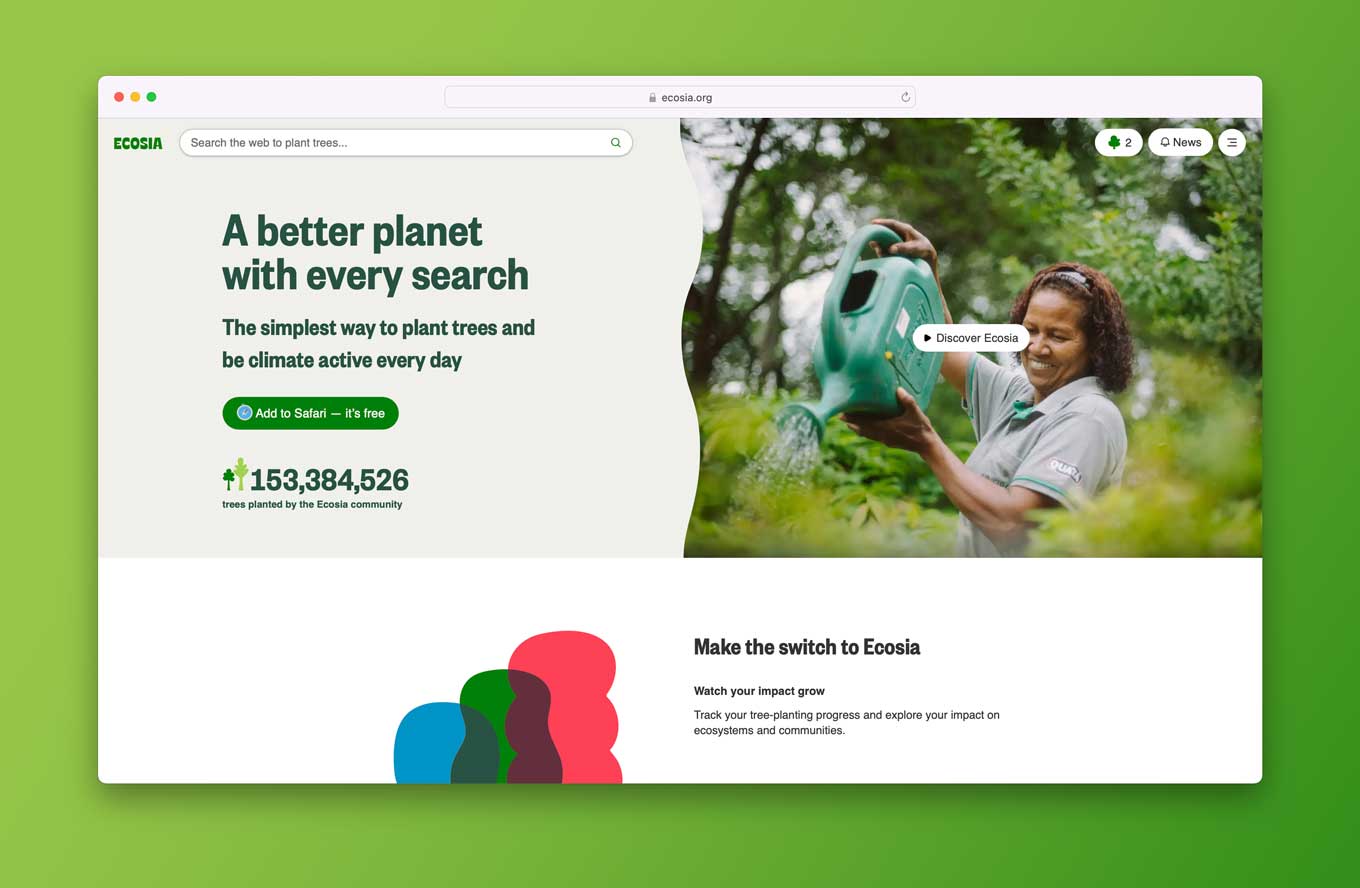
Sure, Ecosia might sound too good to be true. That’s why this article breaks down how Ecosia works, whether or not it’s legit, if using it actually plants trees, and what you can use instead if you’re so inclined. And because we’re all about good news, we couldn’t help but sprinkle some positive news stories in as well.
Let’s start from the top — what’s Ecosia?
What is Ecosia?
Ecosia is a search engine that plants trees every time you search. As a competitor to Google Search, Ecosia offers a way to make a difference by simply changing where you do your online searches.
The company makes its money from ads — the same way that Google and other search engines do — but instead of keeping the profits inside the company, Ecosia donates to organizations planting trees around the world.
Even Jane Goodall is a fan, saying: “Planting trees with Ecosia makes the world a better place — for local communities, chimpanzees, and for us all.”
The company was founded by German entrepreneur Christian Kroll in 2009. In the years prior to 2009, Kroll was traveling South America when he saw the devastating impact of deforestation. He knew he wanted to do something about it — and then sought out a business model that had limitless potential for generating revenue for tree planting initiatives. He mulled several options over, but ultimately decided to build a search engine.
Fast forward to 2022 — the search engine has reached 20 million monthly active users.
Most importantly, the Ecosia community has planted more than 150,000,000 trees since its founding — at the rate of nearly 1 tree per second.
How do you use Ecosia?
Ecosia is incredibly easy to use. In just a few seconds, you can easily switch your default search engine from Google to Ecosia and get started planting trees right away.

Here’s a breakdown of the many ways you can ensure that every search you make has a positive impact on the environment:
Change your search engine settings.
Inside of whatever browser you use for desktop and mobile, you can go into the settings and change your default browser settings.
For example, if you use Safari on your iPhone, simply go into your phone’s Settings app > then tap Safari > then tap Search Engine > and then select Ecosia.
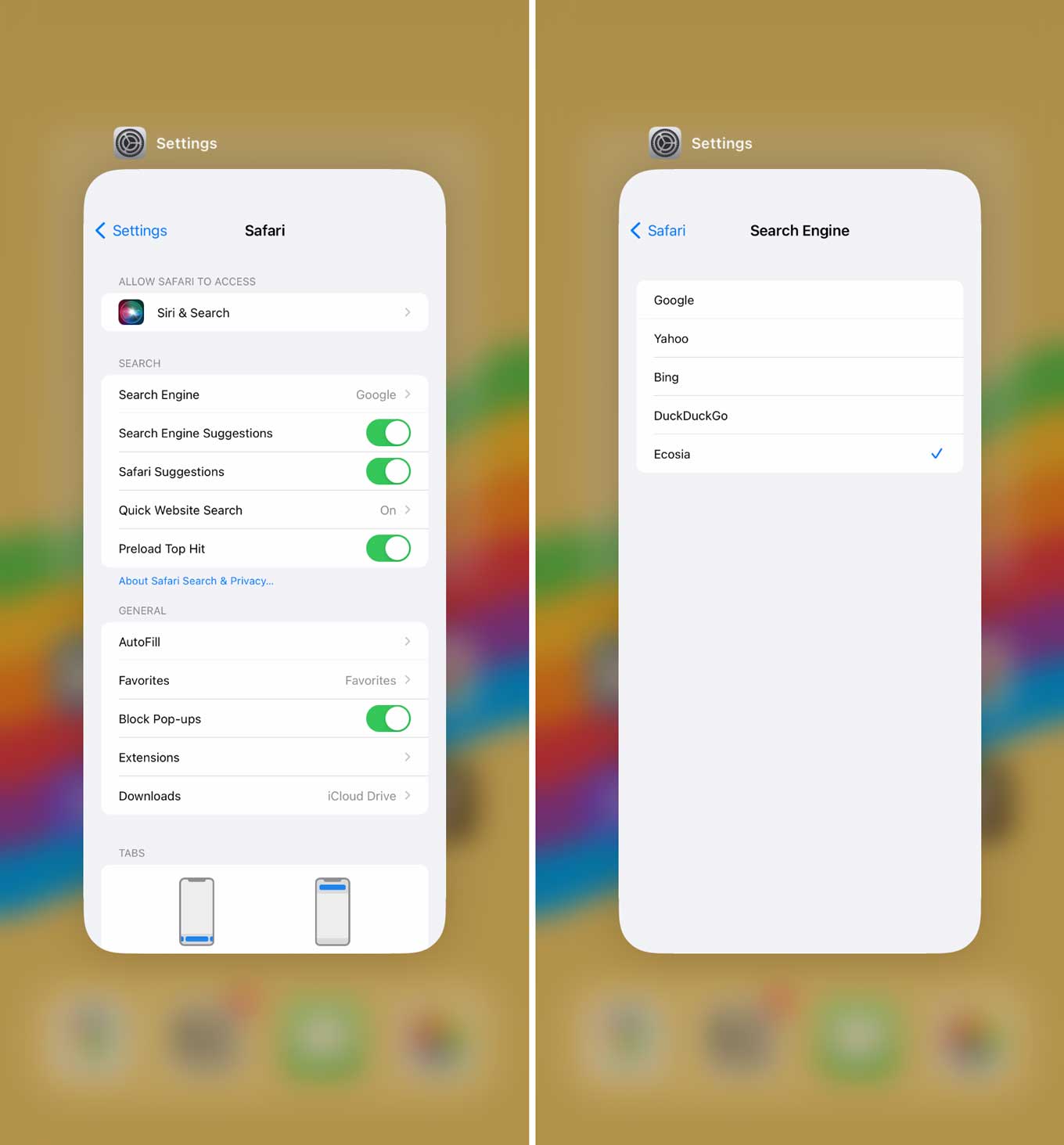
Similarly, if you use Google Chrome on your desktop, simply click the [...] in the upper right corner of your window > then click Settings > then click Search Engine > and then switch to Ecosia.
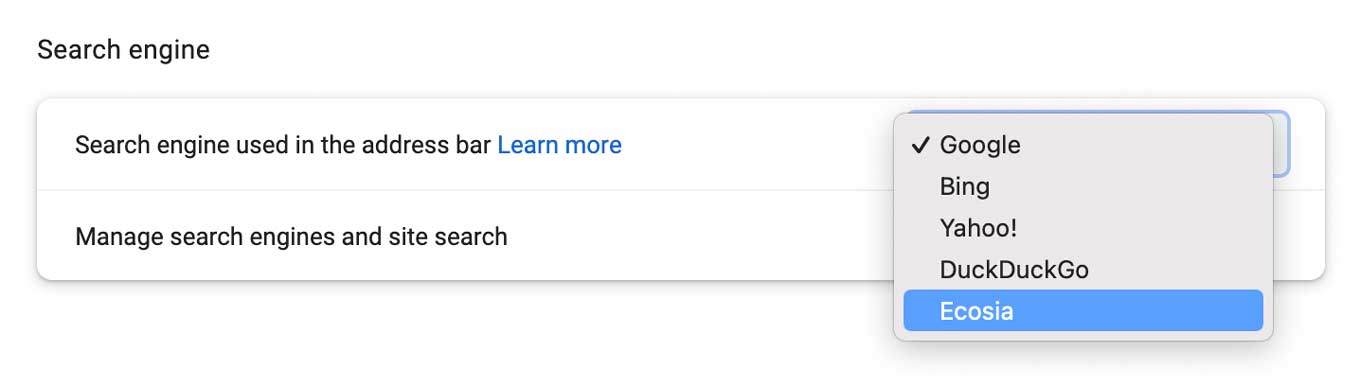
You can explore more walkthroughs of other browsers on the Ecosia Blog.
Install the browser extension.
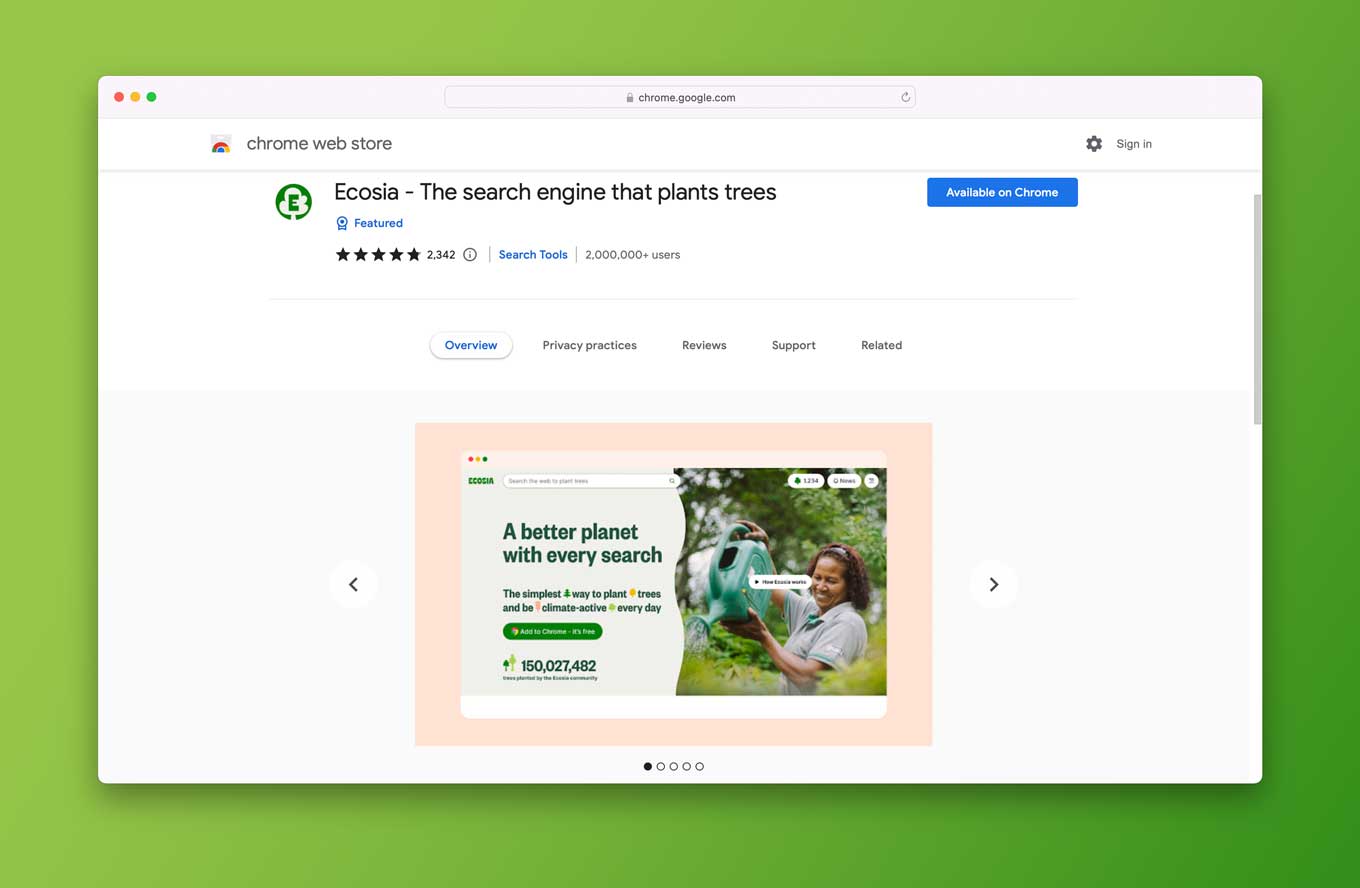
Similarly, you can install the Ecosia browser extension for Google Chrome or Firefox. It will change your default search engine in 2 clicks and, depending on your browser’s limitations, will set your New Tab page to also be Ecosia.
Download the mobile app.
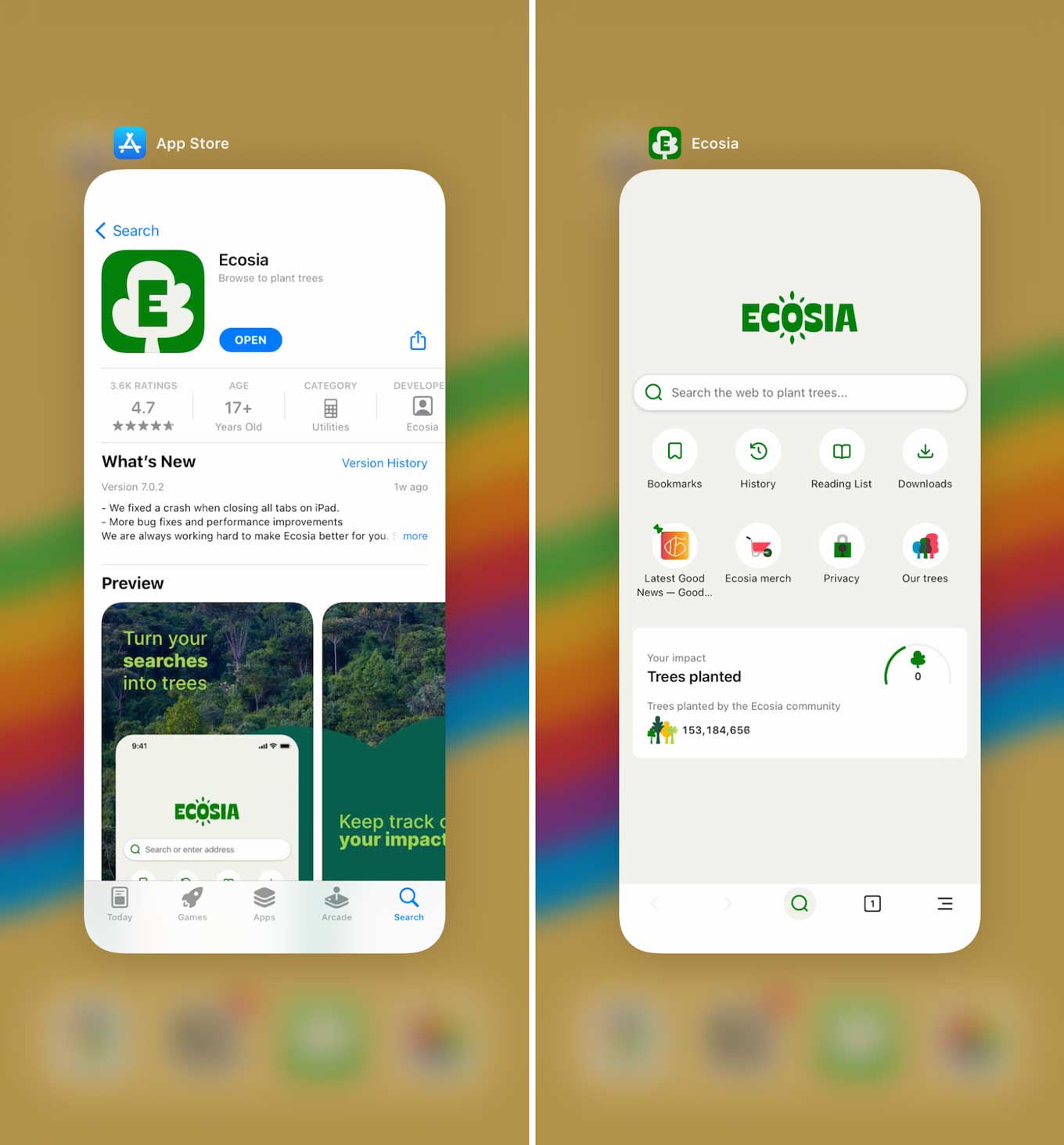
Ecosia also has a mobile app available for Android and iOS. Add the app to your home screen so you always reach for it when you go to search something. It can serve as your default browser, it can hold all your bookmarks, and it even has a built-in ad blocker (for the ads on webpages — but not searches).
Try freetree.
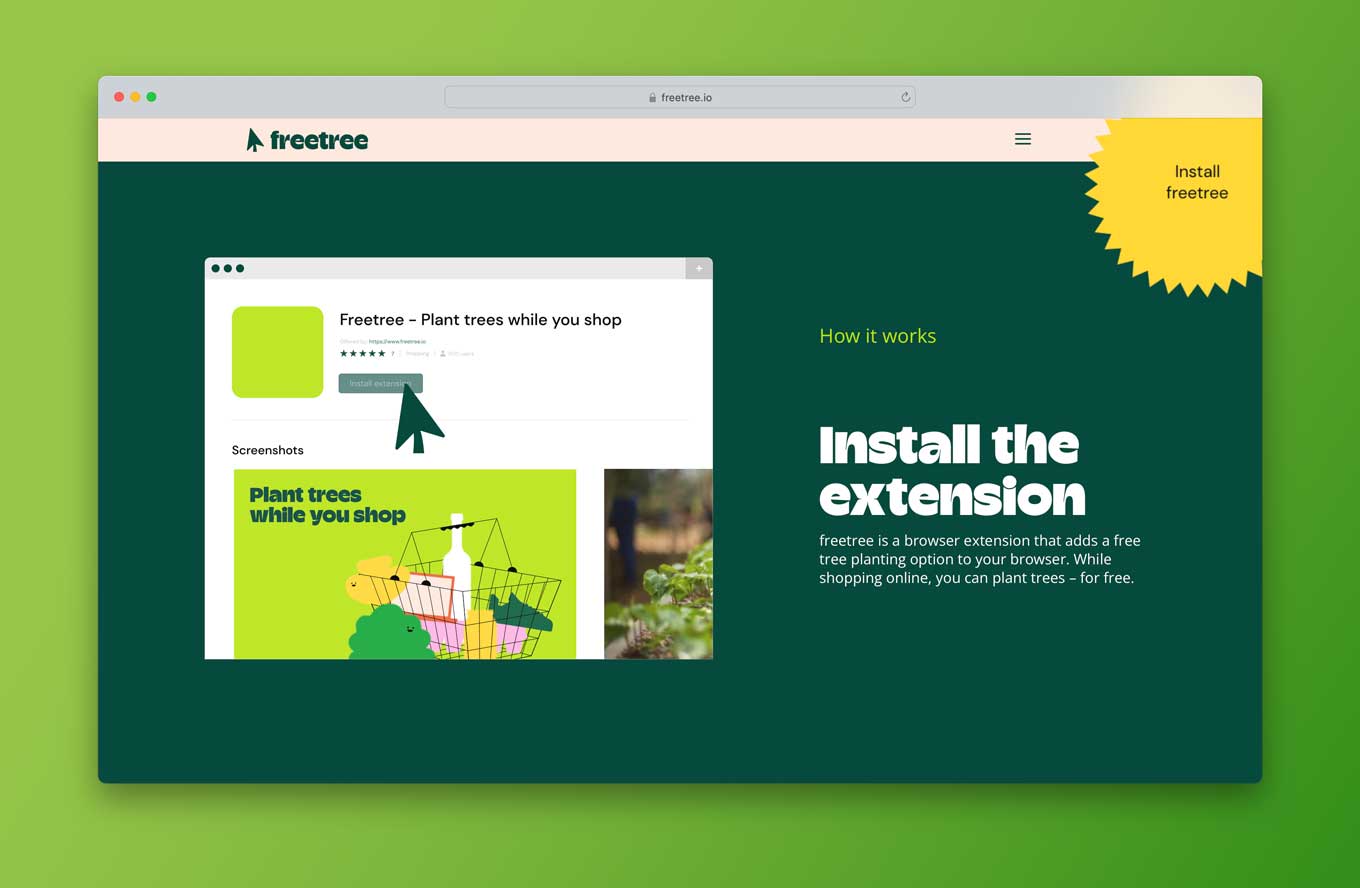
Ecosia has even branched out (pun intended) to allow you to plant trees when you shop — beyond just when you search. The new ‘freetree’ browser extension will, essentially, earn a commission on your everyday online purchases — and then Ecosia uses that commission to plant trees. Freetree works in the U.S., U.K., France, and Germany.
Get the Treecard debit card.
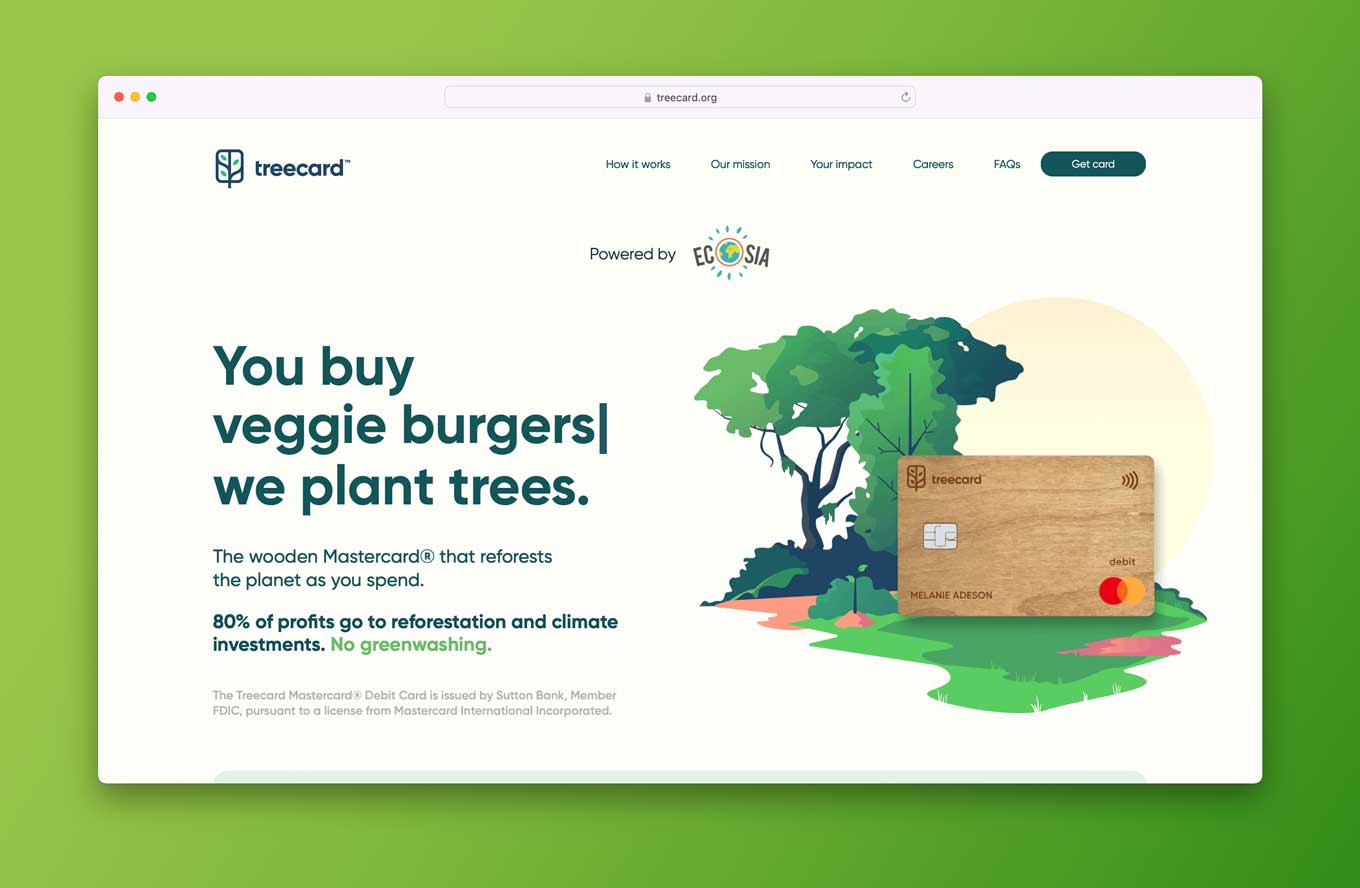
In 2020, Ecosia also launched a free debit card called ‘Treecard’. Uniquely, the card is made of sustainably-sourced cherry wood — and every purchase will go towards planting a tree.
All debit cards make a tiny amount of money from every transaction (because of transaction fees paid by sellers) and Ecosia will divert 80% of that money towards tree-planting efforts.
On average, spending $60 = one tree planted. This also diverts money away from traditional financial companies, which often invest their money in fossil fuels and other environmental hazards.
Ask your company to partner.
If you want to take things to the next level, ask your company to partner with Ecosia to plant trees. In 2021, Ecosia launched a holistic tree planting service for businesses of all types. And Ecosia has already brought on companies like Dr. Bronner on board. Learn more via the Ecosia Blog.
Is Ecosia legit — or fake?
Yes, Ecosia is legit. While most search engines are only in it for profit, Ecosia puts purpose at the forefront of its work. You can trust Ecosia because it donates 80% of its profits, is certified as a B Corp, and releases transparent monthly reports.
While many tree planting initiatives are being critiqued (validly so) for harming local ecosystems — Ecosia has been praised for its thoughtful approach to planting trees.

Rather than planting imported or invasive trees, Ecosia always plants native trees. The B Corp doesn’t plant trees simply for the sake of planting trees; it works to ensure the trees it plants can operate as a part of a functional, biodiverse, thriving ecosystem.
Ecosia experts take into account how the trees and local communities will interact, and even consider whether planting new trees is the right approach for a particular region (and sometimes use alternative methods, like sowing or natural regeneration).
You can trust Ecosia because the company is held accountable to a number of third parties and makes all of its numbers publicly available.
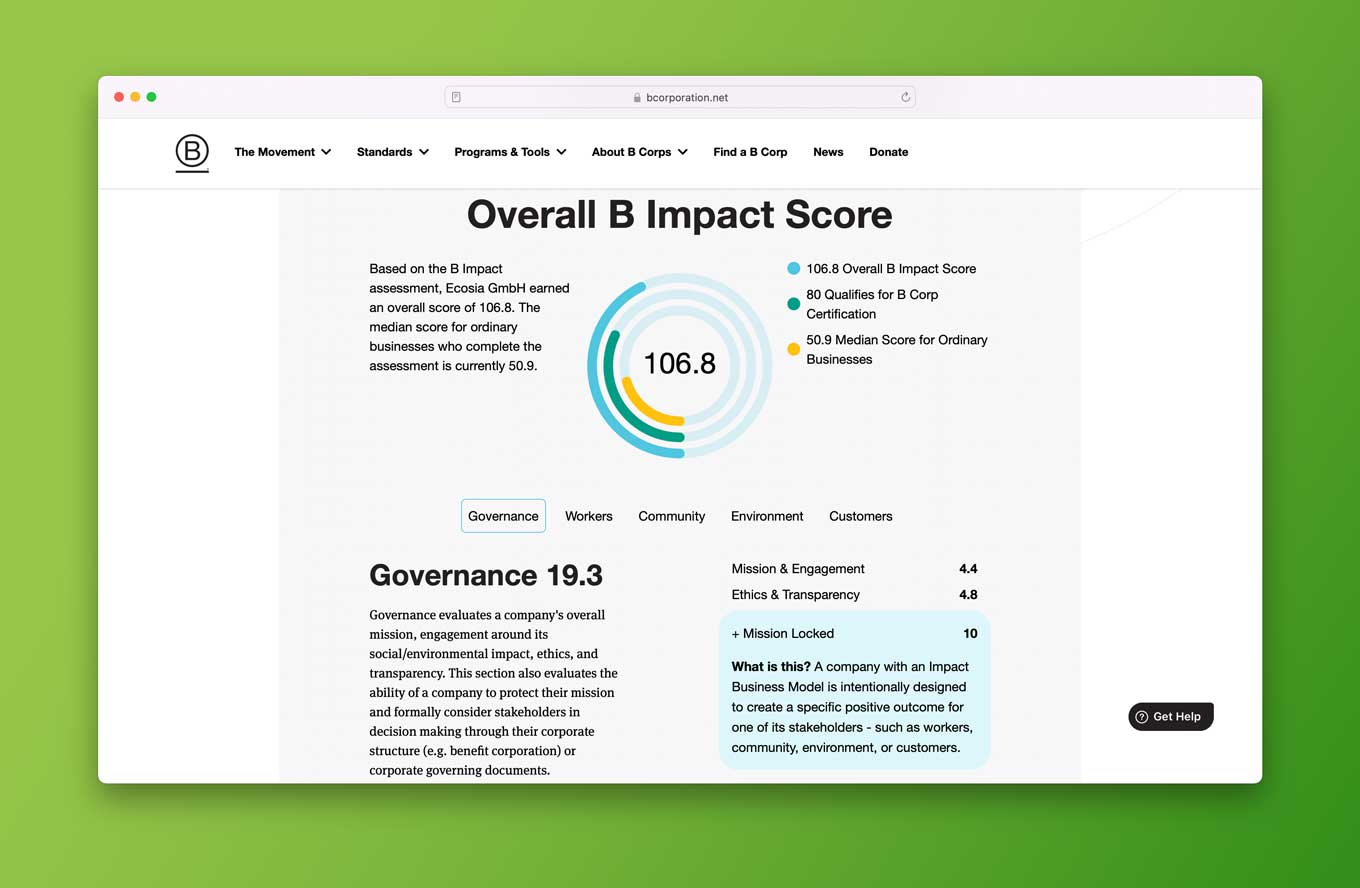
Ecosia was the first German company to become a certified B Corp. B Lab (the organization that certifies B Corps) evaluates mission-driven companies' governance and their impact on workers, communities, the environment, and customers.
Ecosia has consistently achieved high scores and was named “Best for the World” in 2015, 2016, 2017, 2018, 2019, and 2021.
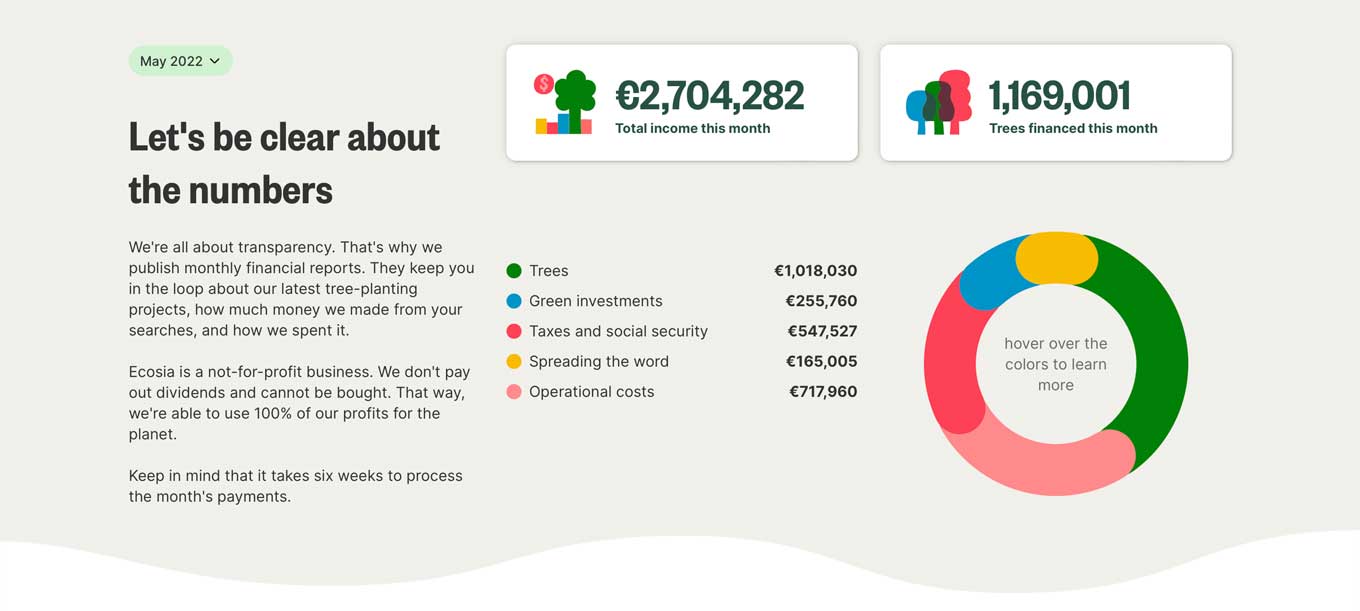
The company is also transparent about all of its numbers — publishing its financial reports and tree planting receipts every month. Ecosia’s stated goal is that the public would hold them accountable.
Ethical Consumer gave Ecosia an Ethiscore of 11 — double its score for Google.
Lastly, Ecosia is legally and permanently set up as a “steward-owned company” — which means that, according to Ecosia, “Shares can’t be sold at a profit or owned by people outside of the company” and “no profits can be taken out of the company.”
All of this ensures that Ecosia will forever be bound to its mission to use 100% of its profits for the planet — and be thoughtful about everything else company leadership does in the process.
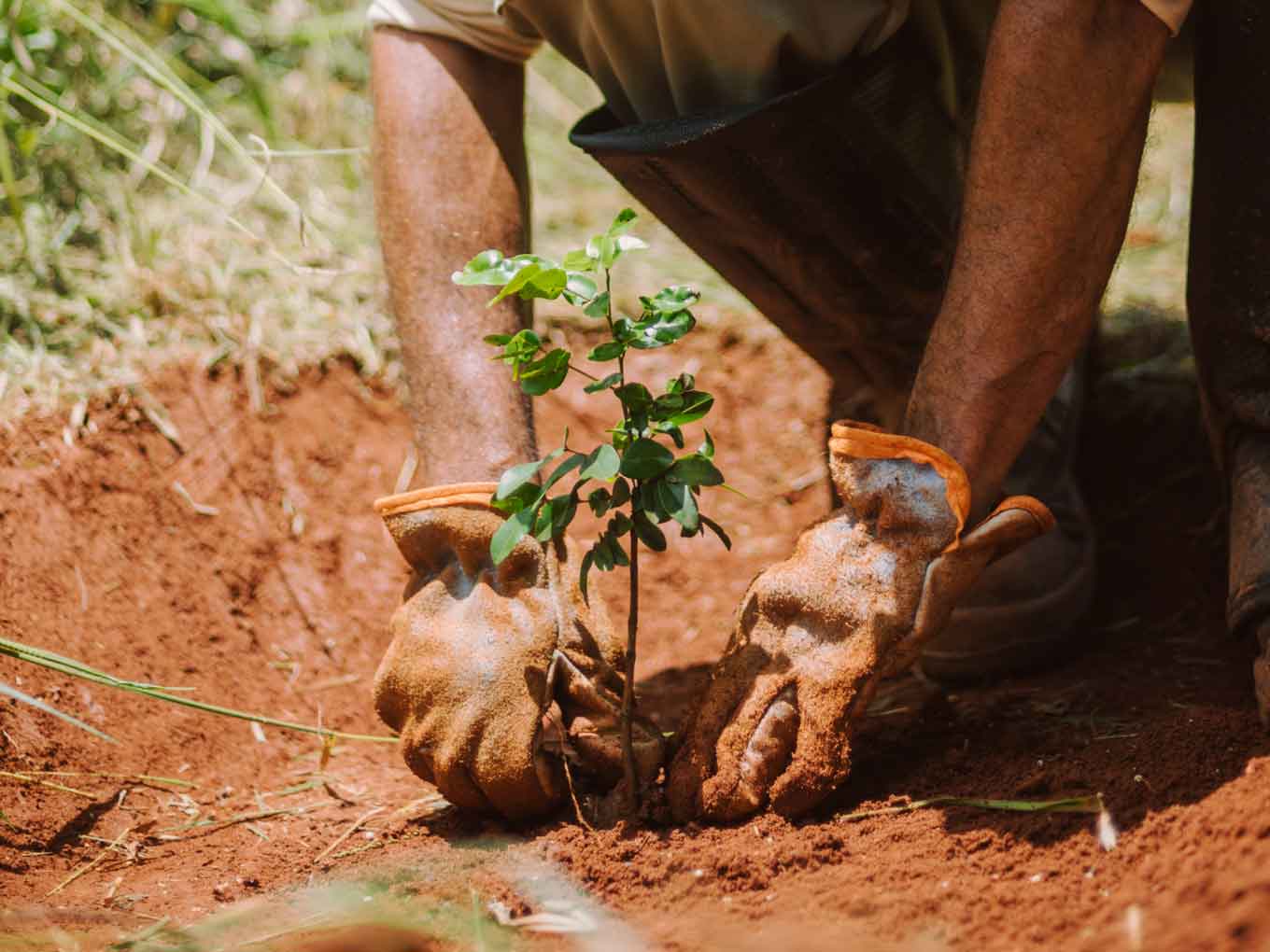
There have been some rumors going around the internet that Ecosia isn’t safe to use — or that it may even be a virus. These are false. Not only is Ecosia safe — Ecosia may be safer than Google. The company is also privacy-focused, refusing to collect and sell your data — ensuring it never goes anywhere. And no, Ecosia is not a virus.
Does Ecosia actually plant trees?
Yes, Ecosia actually keeps its promise of planting trees. While its Germany-based team isn’t traveling to 35+ countries to plant trees themselves — wouldn’t that be fun, though? — Ecosia provides funding to vetted, trustworthy planting partners who specialize in a particular community.
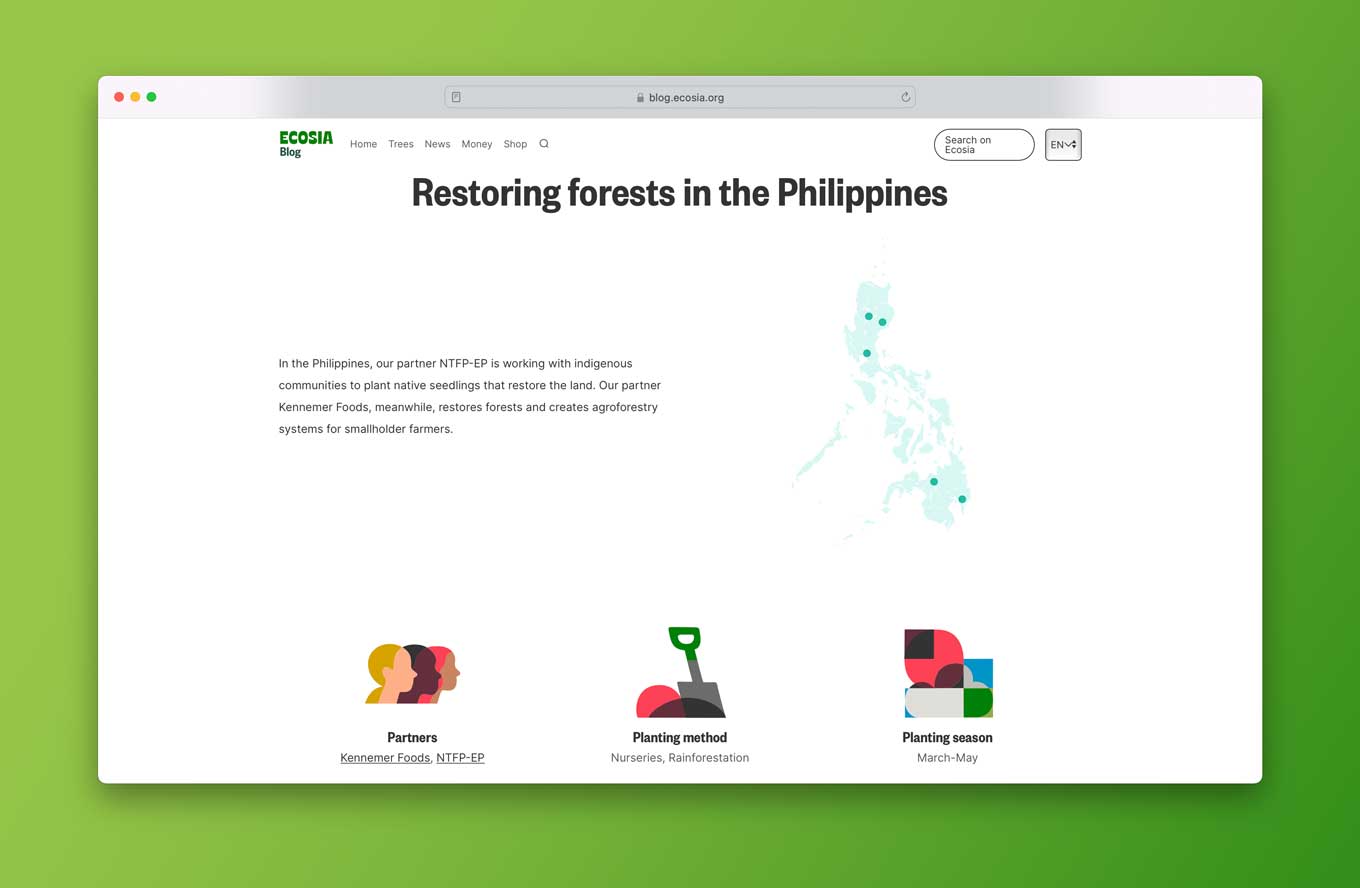
Take, for example, Ecosia’s efforts in the Philippines. Ecosia has a page on its website that walks you through everything you need to know about how trees are planted in this country.
The page shows that Ecosia partners with two organizations, Kennemer Foods and NTFP-EP, to plant trees via nurseries and rainforestation. They plant between March and May each year, and protect several species in the process, including the Visayan warty pig, Visayan spotted deer, Varanus mabitang, Visayan tarictic hornbill, and Writhed-billed hornbill.
The main threats to trees in the Philippines are logging, slash-and-burn, and invasive grasses — and the primary challenge is deforestation. The page even outlines the top tree species planted in the Philippines.
Ecosia has a page just like this for every country it works in.
How many trees has Ecosia planted?
As of July 2022, Ecosia users have helped plant more than 153,382,000 trees in more than 35 countries. During the first half of 2022, Ecosia searches funded an average of 2,964,259 trees per month.
Good news about Ecosia
Because Good Good Good is all about good news — we’d be remiss not to share a few good news stories about Ecosia in this piece:
- Ecosia allows all of its employees to engage in activism without using vacation days or sick time. And if an employee gets into legal trouble during their peaceful protests, the company is committed to supporting them. It has even gone so far as to say that “if reasonable, nonviolent civil disobedience should lead any Ecosia employee to be incarcerated, their time behind bars will be counted as work time.”
- Ecosia turned the large conference room in its Berlin office into a classroom for refugees who had fled Ukraine — even going as far as to hire teachers.
- After it was brought to Ecosia’s attention that some of its advertisements were appearing on (and therefore helping to fund) a homophobic YouTube channel, it immediately responded by canceling the advertisements.
- In 2019, Ecosia partnered with Earth Uprising to support microgrants for youth climate activists so that kids don’t have to pay out-of-pocket for activism expenses.
- In 2019, Ecosia also partnered with Fridays For Future to plant trees in honor of all attendees of the 2019 Berlin climate march.
Let’s talk about the differences between Ecosia vs. Google…
We all make dozens of internet searches a day — so the choice to switch from one to another isn’t something to be taken lightly. At the same time, it’s a small change that can have a profound positive impact on the world.
We’ve broken down some pros and cons of Google and Ecosia.
It’s worth sharing that Ecosia also has its own blog post dedicated to how it stacks up with Google.
Search Quality:
Google is the number one search engine in the world — for good reason. It has invested substantially into making search results incredibly relevant and helpful. Very rarely do any of us need to click Page 2 on a search results page — Google is just excellent about making sure that it shows you what you’re looking for on Page 1.
With that being said, the number two search engine in the world is Microsoft’s Bing. Bing has invested heavily into its search engine capabilities, and it’s pretty solid. Many users even prefer its results to Google.
Ecosia actually uses Bing for its search engine technology. Ecosia makes a few tweaks to style and results, but for the most part, you’re getting Bing search results — which, again, are pretty solid.
Sustainability:
Beyond planting trees (which we’ve covered thoroughly in this article), Ecosia goes above and beyond when it comes to sustainability.
Ecosia has heavily reduced its own carbon footprint and takes accountability for its supply chain as well. The green search engine produces enough renewable energy to account for all of its services — and then some.
In fact, according to Ecosia, “in 2020, Ecosia ran on 335% renewable energy and planted over 30,000,000 trees.” On average, each Ecosia search removes 1kg of CO2 from the air.
You can read all about this in the Ecosia annual Regeneration Report.
Google has made similar efforts that shouldn’t be discounted. The search giant has offset all of its carbon emissions since 2007, purchasing offsets to achieve carbon neutrality.
Still, there are criticisms of whether or not offsets are actually effective — or if Google is doing enough.
Ecosia found that “if Google invested an equivalent amount [as Ecosia] into renewables, enough renewable energy would be created to replace all EU coal power in two years and fossil gas power in an additional three years.”
On top of that, Google is not actually reducing its emissions, has run into hiccups, and only recently stopped creating AI technology that supports the oil and gas industry — for which more than 1,000 Google employees have protested.
We’re glad Google is making efforts to reduce its harm on the environment (and that it continues to help consumers think about their impact) but it’s clear that Ecosia takes the cake here.
Privacy:
Google’s primary business is, essentially, the collection and sale of user data. It has long been critiqued as one of the worst privacy offenders in big tech — and while it’s cleaned up its act a little bit recently, it’s still no privacy darling.
Ecosia says that privacy is central to its mission. You can significantly reduce the amount of data collected about you by switching from Google to Ecosia.
Ecosia does have to serve ads that are relevant to users, though — which means it has to pass along some information to advertisers. But Ecosia is able to make sure that information is anonymized, and related to searches, not user profiles.
In an interview with VentureBeat, Ecosia founder Christian Kroll said, “[Serving relevant ads is] the only way we make money. We’ve taken a privacy-centric approach to serving adverts to users — we don’t store searches permanently, and all searches are anonymized within a week. Many web services collect user data in order to sell it without asking your permission — we’ll never do this, and we don’t use external tracking tools either.”
According to VentureBeat, due to Ecosia’s partnership with Bing, the search engine must share the following data: IP addresses, what kind of browser you use, what version of the browser you’re using, what operating system you use, your country, and your language.
While this is way less data than Google shares, if you’re not comfortable with this information being used, then consider DuckDuckGo, which we outline at the end of this article.
Ads:
While you’ll see ads when you search with both Ecosia and Google, you’ll feel better about the ads you see on Ecosia, as you know you’ll be planting trees.
The ad quality between the two search engines is roughly equivalent. Though it’s possible for advertisers to specifically target Ecosia users (via Bing’s ad-buying tech) — which means that it might attract more ethical and sustainable companies who want to reach ethical and sustainable potential customers. Getting ads for brands that are aligned with your values is always preferable to ads from brands you hate.
Uniquely, Ecosia’s mobile app includes an ad blocker that hides ads on other websites — something that Google would probably never do.
Is Ecosia owned by Google or Bing?
Ecosia is not owned by Google. In fact, Ecosia partners with Google’s biggest search engine competitor: Bing. Bing manages all of the advertising that displays on Ecosia (which pays for trees to be planted). Bing does not own Ecosia, though — and Ecosia will never be sold.
What are some Ecosia alternatives?
Tab for a Cause
Tab for a Cause is a free browser extension that helps you raise funds for charity every time you open a new tab.
Just like Ecosia, Tab for a Cause generates money from advertisements (2-3 ads are displayed every time you open a new tab) and you can select from a list of nonprofits you’d like that money to go to.
You can learn more about Tab for a Cause in our ultimate review.
You can use Tab for a Cause and Ecosia. No need to pick just one or the other.
DuckDuckGo
If your primary concern is privacy (and not necessarily tree planting) — you might prefer DuckDuckGo. This search engine does not sell (or even collect) your data. Ecosia is solid on privacy — but DuckDuckGo takes it to the next level. Plus, it’s completely carbon-negative as a company, so your searches can remain sustainable.
OceanHero
While OceanHero seems to have fewer users than Ecosia, Tab for a Cause, and DuckDuckGo, its model is great and it seems it’s gaining momentum. The tl;dr is — for every 10 searches you make using the OceanHero search engine, the company will remove one piece of plastic from the ocean. (Similar to #TeamSeas!) If the ocean is your cause of choice, definitely check out OceanHero.
Amazon Smile
While we’re not the biggest fans of Amazon (see our guide to Amazon alternatives) — if you’re going to shop with the e-commerce giant, you might as well donate to a charity you care about. When you sign up for Amazon Smile, it will divert a percentage of the money you spend at smile.amazon.com towards a nonprofit organization of your choice.
Yep
While Yep isn’t available to the general public yet, the new search engine from Ahrefs has a lot of people talking. It’s poised to be a huge competitor to Google Search — but instead of keeping the profits for itself, it plans to give 90% away to online content creators. (This creates a whole new opportunity for impact-driven brands like ours — as well as sustainability blogs, nonprofits, and more to make money.) We’ll be keeping an eye on this new platform.
Notable Mentions:
We wanted to add a few more notes that came up in our research for this article. Of course, if you have any other thoughts, we welcome your opinion.
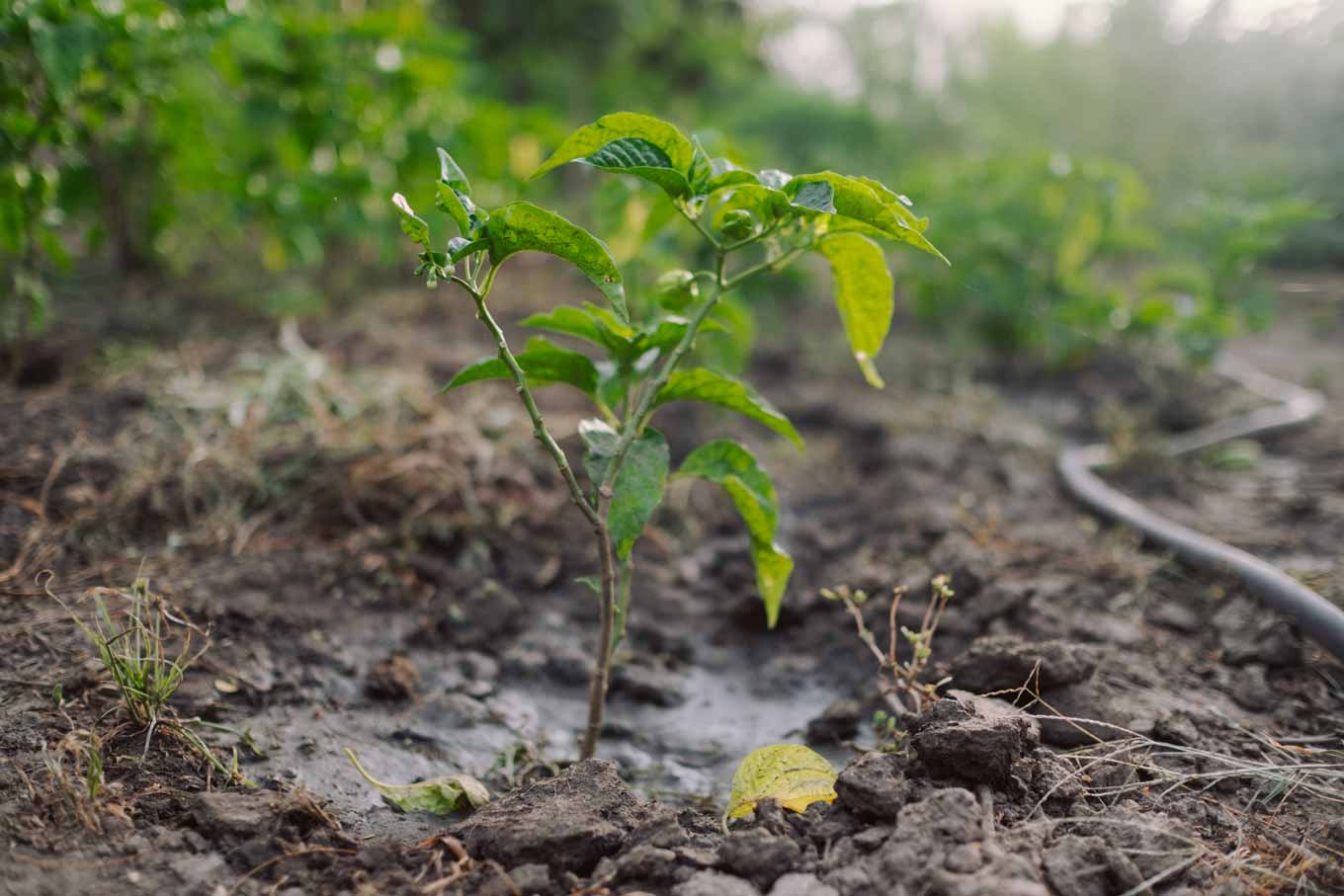
- Ecosia has a “shop” that allows you to give the gift of planting trees. Plant trees for anywhere between $10-$60 and you’ll receive a certificate of your giving — which you can give as a gift. You can even get specific, by donating trees that support urban equity, trees that empower women, or trees that help wildlife.
- One important note: Ecosia doesn’t simply plant trees because you used its service. The company makes money from users actually clicking on PPC (pay-per-click) ads. So if you see an ad that’s relevant to you, don’t be afraid to click it — but don’t randomly click ads, because Bing’s tech will detect it.
- According to a 2020 study, it takes roughly 45 searches to bring in enough revenue to plant one tree. All the more reason to set Ecosia as your default so you can slowly make progress.
- Planting trees isn’t just about the environment — it’s a justice issue. You can learn more about intersectional environmentalism in our guide.
- If you want to celebrate trees even more — check out our collection of the best tree quotes
From July 2021 to the end of the 2024 school year, PEN America recorded nearly 22,810 cases of book bans across 45 states and 451 public school districts.
These numbers represent a crisis of censorship that is only growing, especially targeting historically marginalized voices that share stories and lived experiences of racism and LGBTQ+ oppression.
Book bans erase history and represent the effort to silence those most underrepresented in literature.
But we know that diverse stories are essential. They validate the experiences of those who can see themselves in those stories and they encourage empathy and understanding in those who don’t. Reading is a powerful act of resistance and so many are scared of that power.
So, when it feels like our reality has crumbled into a dystopian nightmare, what do we do? We use the power of books, form our own team of heroes, and fight against censorship and for stories that matter!
Banned Books Week is an annual event that takes place from October 5-11 in 2025. Here are 14 ways you can fight book bans today and every day!
By the way, some of the links in this article (like books!) are affiliate links, which means if you make a purchase after clicking a link, we may earn a commission at no extra cost to you. Thank you!
Ideas and Activities on How To Fight Book Bans
Stay informed
Follow organizations such as the National Coalition Against Censorship, the American Library Association, We Need Diverse Books, PEN America, and the Comic Book Legal Defense Fund to stay up-to-date on everything happening with books and censorship.
They'll help you stay informed so you can take action during Banned Books Week all year long.
Read banned books.
One of the easiest (and most fun!) ways to support a banned book is to read it. Stories have power, and the more people who read a story, and share that story with others, the harder it is to silence that story.
While you’re at it, purchase the banned book from an independent bookstore and show the authors of banned books that we will continue to support them no matter what!
Check out PEN America’s 2025 Banned Books List to select one of the 10 of the most-challenged books from the last year:
- “A Clockwork Orange” by Anthony Burgess (Bookshop) (Amazon) (Libro.fm)
- “Breathless” by Jennifer Niven (Bookshop) (Amazon)
- “Sold” by Patricia McCormick (Bookshop) (Amazon) (Libro.fm)
- “Last Night at the Telegraph Club” by Malinda Lo (Bookshop) (Amazon) (Libro.fm)
- “A Court of Mist and Fury” by Sarah J. Mass (Bookshop) (Amazon) (Libro.fm)
- “Crank” by Ellen Hopkins (Bookshop) (Amazon) (Libro.fm)
- “Forever…” by Judy Blume (Bookshop) (Amazon) (Libro.fm)
- “The Perks of Being a Wallflower” by Stephen Chbosky (Bookshop) (Amazon) (Libro.fm)
- “Wicked: The Life and Times of the Wicked Witch of the West” by Gregory Maguire (Bookshop) (Amazon) (Libro.fm)
- “All Boys Aren’t Blue” by George M. Johnson (Bookshop) (Amazon) (Libro.fm)
Report banned books.
According to the American Library Association, as many as 82-97% of challenges (attempts to ban books) remain unreported. If you find out that a library, school, or institution is attempting to ban a book in your community, make sure it doesn’t happen in the darkness.
The American Library Association has an excellent resource for reporting censorship of books. Visit their website to fill out the information about a book that was banned to raise awareness.
You can also report book bans via PEN America through a simple form on the organization’s website.
Advocate on social media.
Post on social media about a banned book and advocate for why it shouldn’t be banned. Whether it’s a photo from your camera roll, a poem you were inspired to write, or a piece of art you created, visibility is such an important part of defending banned books.
Show (and tell) us why your favorite banned book shouldn’t be banned!
Your efforts will help ensure these silent and reported challenges become public challenges and are eventually overturned.
Donate to organizations making banned books accessible to all.
Support any of the following organizations, which work to ensure that reading materials stay accessible to all:
- PEN America
- American Library Association
- National Coalition Against Censorship
- Freedom To Read Foundation
- Little Free Library
- ACLU
- GLSEN Rainbow Library
Donate books to a community in need.
Lots of places in your community should be open to book donations like libraries, shelters, schools, or other nonprofits dedicated to literacy and education.
Where you donate books is up to you, but it’s important that you first confirm if the organization is able to accept the donations. Some organizations might also have specific requirements for donations or might be looking for books for certain age groups. Always make sure to ask what they’re looking for.
When it’s appropriate – and when the organization tells you it’s okay – donate banned books to increase accessibility to the book!
Find or contribute to a Little Free Library that stocks banned books.
Little Free Library’s new interactive book ban map makes it easy to find locations that intentionally include restricted titles for community members to find at no cost.
Look up some of these locations to “shop” for books, donate your own copies, or — if you can’t find a location in your area — create your own Little Free Library.
Host or attend a Banned Books Week event.
There will certainly be a wide variety of Banned Books Week events at your local libraries, which you can search on the ALA’s website, based on your location.
The last day of the week — October 11 — is Let Freedom Read Day, so be sure to keep your eyes peeled for any events or called to actions on that date, too!
Join (or start!) a banned book club.
Reading and discussing books with others give those stories power. In response to recent bans, book clubs solely focused on reading banned books are popping up all over the place.
Join one in your local community, or join a national club like the Author’s Guild Banned Books Book Club.
Volunteer your time.
Volunteer at your local library. (Libraries are important and amazing!) As a library volunteer, you can encourage supervisors and peers to support banned books and make sure they are available for members of your community.
Even better, join the board of your local library so you have a seat at the table when decisions around censorship are being made!
Attend PTA meetings.
Follow efforts to ban books in your area by keeping up with PEN America’s detailed reports — and by keeping your ears open in your own community.
After you’ve found a school or library that needs support in your area, send an email to decision makers expressing that you are against book bans.
If these restrictions are still being considered, the next best thing you can do is show up in person.
Whether it’s a PTA meeting, a school board meeting, or some other type of public forum, find out who makes the decision to ban books and make your voice heard.
As the National Coalition Against Censorship says, “Expressing your views on the book and why students should be allowed to read it would help to balance the objecting parents’ perspectives, making it more likely for school officials to take an objective decision, rather than pressured one.”
Contact the press.
The media is hugely important in spreading the news of book banning, and also influencing public opinion on the topic. If you know of book censorship happening in your community, contact the local press and ask them to write about it!
All reputable media outlets will have a contact page, tip line, or editors’ email addresses easily accessible. Another effective method is writing a letter to the editor explaining why this is such an important issue.
Write a supportive letter to an author of banned books.
Learning that a book you’ve written, a story that you’ve poured your whole self into, has been banned can’t be a good feeling. Plus, authors themselves are some of the fiercest advocates against book bans.
Take some time to write some supportive letters to the authors who are being targeted by these book bans and be sure to share with them what their book meant to you. Let them know that not everyone wants to censor their words.
The American Library Association has created a helpful guide full of resources on how to get involved.
Run for school board.
This is certainly the most daunting action on this list, but we think you’re up for the challenge! Arguably, the most direct way that you can stop book bans is to become part of those making the decisions.
Get connected with Run For Something — an organization that recruits and supports young progressives running for offices at all levels of government — to get started.
Good Good Good hosted the founder of Run For Something on the Sounds Good Podcast and she laid out all the reasons you should run for office. Most important: If you care, you’re qualified.
Frequently Asked Questions
When is Banned Books Week?
Banned Books Week typically takes place at the beginning of the American school year during the last full week of September or first full week of October. In 2025, Banned Books Week is October 5-11.
When was Banned Books Week started?
Banned Books Week was launched in 1982 thanks to the advocacy of Judith Krug.
What is the Banned Books Week theme for 2025?
According to the American Library Association, this year's theme is “Censorship Is So 1984.”
Who is the Honorary Chair for Banned Books Week 2025?
Pioneering actor, author, and activist George Takei has been named honorary chair of Banned Books Week.
When is National Reading Month?
National Reading Month is in October every year. You can read our guide on how to celebrate National Reading Month.
Header image courtesy of PEN America
In March 2020, when the pandemic first hit, Raharish Velu was living on the streets of downtown Dallas.
“They rounded us all up and took us to hotels,” Velu said of city officials and caseworkers. “We were all tested, and I tested positive, so I couldn’t leave my room. But once I got better, they let me out.”
Velu, 70, went back on the streets, where he’s lived for more than 20 years, but he found that survival has been harder than it’s ever been. Shelters are always full because they’ve had to reduce capacity to accommodate social distancing guidelines, he said, and the streets are getting crowded.
“Every day, someone new arrives,” he said this week while sitting on a bench at Akard Plaza, just outside city hall. “I’d say most lost their jobs or got sick, but they’ve never been out here before. It’s getting pretty bad.”
Since the start of the pandemic, states and localities across the country have received billions in federal aid to help reduce homelessness. But most areas have been slow to get the money to those in need, like Velu, in large part because the huge influx of dollars has overwhelmed agencies’ capacities.
Still, some have seen progress: In the Dallas area, more than a dozen nonprofits and government agencies joined forces last summer to launch a new program using the federal aid, aiming for successes that other localities could replicate.
The goal of the new Dallas R.E.A.L. Time Rapid Rehousing initiative is to place 2,762 people and families experiencing homelessness in permanent housing by September 2023. An estimated 4,570 people were without homes in the region as of March 2021, up 3% from 2020.
Rapid rehousing is a federally funded national program designed to reduce the amount of time a person is homeless by providing housing before other social services.
“This is the most ambitious plan to curb homelessness that Dallas has seen,” said Sarah Kahn, chief program officer at Metro Dallas Homeless Alliance, which leads the initiative and is the region’s largest nonprofit organization providing homeless services.
“I mean, this is a historic level of new resources and new dollars coming into our community that’s used to running on a scarcity model and often fighting for scraps. We have a very, very large infusion of resources that we need to move quickly.”
States and localities received more than $5 billion in federal stimulus money in the form of Emergency Housing Vouchers and Emergency Solutions Grants to help people experiencing homelessness during the pandemic.
Agencies and housing advocates nationwide are using the influx of funds to create new long-term solutions to homelessness, but relatively little of the money has gone out so far.
As of Jan. 6, less than a third of the $4 billion in Emergency Solutions Grants had been spent nationwide, according to the U.S. Department of Housing and Urban Development.
And only 11.6% — or 8,110 of 69,810 — of Emergency Housing Vouchers had been accepted by landlords nationwide as of Jan. 18, according to HUD.
States have until September of this year to spend the emergency grants and until September of next year to use their housing vouchers.
Challenges Elsewhere
California, which has the country’s largest homeless population, illustrates the difficulties.
A report by the state auditor found that California’s Department of Housing and Community Development did not give its partners access to the first round of federal Emergency Solutions Grants until December 2020, seven months after the federal government announced the funding.
That’s mostly because the department lacked the capacity to manage the grants and failed for a full year to hire a contractor to run the program, the report said.

That $316 million was 25 times the department’s typical yearly allocation, noted Geoffrey Ross, the deputy director of federal financial assistance. The department’s private partners struggled to expand housing capacity while meeting pandemic safety guidelines, he said.
The Dallas area likewise lagged in getting money out, but the new initiative has helped.
The city of Dallas received $19 million in Emergency Solutions Grants through the CARES Act and 490 Emergency Housing Vouchers through the American Rescue Plan Act, worth some $8 million, HUD data shows.
The city has used 26 vouchers, and as of last week, it has spent roughly $10 million of its funds and allocated the remaining $9 million, according to Christine Crossley, director of the city’s Office of Homelessness Solutions.
“I think most cities and most organizations have this issue where it’s amazing to have this money, and it’s needed, but there’s also only so many contracts and programs anybody can hold in a year,” she said. “
And you can hire more staff, but it’s also COVID, and there’s a shortage of people, so it’s kind of, well, we can spend it, but we might not be able to spend all of it simply because it’s just so much money to spend in so little time.”
The initiative’s total budget is $72 million, including $50 million from federal relief funds; $12 million in emergency vouchers allocated to Dallas, Mesquite, and Plano; and $10 million in funds from private donors, including the Meadows Foundation, Dallas Regional Chamber, and Lyda Hill Philanthropies. (Lyda Hill Philanthropies has also donated money to The Pew Charitable Trusts, which funds Stateline, where this article was originally published.)
Private donations are being used for landlord incentives, including extra rent, deposits, or money for repairs, according to Crossley.
One of the main problems nationwide is that landlords don’t want to lease to people using housing vouchers, because they often lose money while they wait for the housing authorities to inspect their rental units and process the lease, according to Myriam Igoufe, vice president of policy development and research at Dallas Housing Authority.
On behalf of the initiative, Igoufe and her team were tasked with creating computer software to coordinate all the agencies’ efforts while streamlining the application and housing process.
They spent more than a month last summer working 13-hour days to program content management software that could seamlessly coordinate 15 agencies and some 100 caseworkers.
“We knew we were designing something from scratch that other people were going to look at and say, ‘Look, it could be done,’ or, ‘See, we shouldn’t be trying to do this, we should use our money for something else.’”
Before this new system, it took weeks or months to get emergency voucher recipients into a rental property. But now, it takes only a few days.
“Without this investment in technology and automation, this would not be possible, not at this pace,” Igoufe said about the initiative.
'A Safe Place to Sleep'
On Monday, near the corner of Cadiz and South St. Paul streets, a large crowd of homeless people began setting up camp as the sun began to set. Joel Martinez Gregorio, 60, leaned against a building while weaving a belt out of neon-colored shoelaces.
He said he’s been living outside since he was hospitalized for three weeks with COVID-19 in September and lost his job. It’s the first time in his life that he’s been homeless.
“It’s been rough,” he said. “I’ve been trying to find work, but it’s hard, because I don’t sleep and I spend a lot of time just trying to find something to eat.”
He said people on the street have been talking about a new program that pays people’s rent for a year.
“That would be a godsend,” he said. “If I had a safe place to sleep and to leave my belongings, I know I could get back on my feet.”
This story was originally published by Stateline, an initiative of The Pew Charitable Trusts.