Marsha P. Johnson was a proud and outspoken member of the LGBTQ+ community before it was popular to be so. She was an advocate for drag queens, people of color, and transgender people, fighting for their right to be seen and heard.
Her activism led her to become one of the most influential figures in the gay liberation movement. Though her life was cut tragically short, Marsha's legacy remains an inspiration to us all.
The Best Marsha P. Johnson Quotes
Famous Quotes
“History isn’t something you look back at and say it was inevitable, it happens because people make decisions that are sometimes very impulsive and of the moment, but those moments are cumulative realities.”
— Marsha P. Johnson
“How many years has it taken people to realize that we are all brothers and sisters and human beings in the human race? I mean how many years does it take people to see that? We’re all in this rat race together!”
— Marsha P. Johnson
“I may be crazy, but that don’t make me wrong.”
— Marsha P. Johnson
“I don’t think you should be ashamed of anybody you know that has AIDS. You should stand as close to them as you can and help them out as much as you can. I’m a strong believer in that and that’s why I try to do that for everyone I know has the virus.”
— Marsha P. Johnson
On LGBTQ+ Rights
“You never completely have your rights, one person, until you all have your rights.”
— Marsha P. Johnson
“As long as gay people don’t have their rights all across America, there’s no reason for celebration.”
— Marsha P. Johnson
“Nobody promised you tomorrow.”
— Marsha P. Johnson
On Being a Drag Queen
“I was no one, nobody, from Nowheresville, until I became a drag queen.”
— Marsha P. Johnson
“I always just do drag. I never do it seriously.”
— Marsha P. Johnson
More Quotes
“We have to be visible. We should not be ashamed of who we are.”
— Marsha P. Johnson
“I’d like to see the gay revolution get started… If a transvestite doesn’t say I’m gay and I’m proud and I’m a transvestite, then nobody else is going to hop up there and say I’m gay and I’m proud — and I’m a transvestite for them.”
— Marsha P. Johnson
“Darling, I want my gay rights now!”
— Marsha P. Johnson
→ Looking for ideas on how you can celebrate Pride Month? Look no further than our guide.
→ Looking for more quotes? Explore our collection of the best LGBTQ+ Pride quotes.
Over the past few decades, the world has made great strides in the fight against poverty.
According to the World Bank, the number of people living in extreme poverty has declined from nearly 1.9 billion in 1990 to roughly 650 million in 2018. This is an incredible achievement, and it is due in large part to economic growth in developing countries.
However, there is still much work to be done.
Based on 2017 numbers from the World Bank, a little bit less than 700 million people globally were living on less than $2.15 a day, which is the new international poverty line as of fall 2022. And while this number has declined since 1990, it is still far too high.
In the United States, the official poverty rate was 11.4 percent in 2020. (The pre-pandemic rate, in 2019, was 10.5 percent.) The good news is that with 2020 being the exception, we've seen an annual decline in U.S. poverty rates five years in a row.) However, there are still about 37 million people living in poverty in the United States.
There are many causes of poverty, including conflict, disease, environmental degradation, and lack of access to education, food, and financial services.
But with continued effort and cooperation, it is possible to further reduce the number of people living in poverty and create a more just and equitable world for all.
In this article we've collected the best quotes from those leading the fight against poverty, working to create solutions that help support the global poor. And our hope is that after reading this article, you'll feel inspired to get involved and take action too.
Read the most powerful poverty quotes from leaders & activists leading change:
Famous Quotes
“Overcoming poverty is not a gesture of charity. It is an act of justice. It is the protection of a fundamental human right, the right to dignity and a decent life.”
— Nelson Mandela
“My work with the poor and the incarcerated has persuaded me that the opposite of poverty is not wealth; the opposite of poverty is justice.”
— Bryan Stevenson, social justice activist
“Where you live should not determine whether you live, or whether you die.”
— Bono, lead singer of U2 and founder of (RED) and ONE
“I believe in a world of justice and human rights for all. A world where girls can grow up free of fear of abuse. A world where women are treated with the respect and dignity that is their right. A world where poverty is not acceptable. My dear young friends, you can make this your world.”
— Ban Ki-moon

“Wars of nations are fought to change maps. But wars of poverty are fought to map change.”
— Muhammad Ali
“In a country well governed, poverty is something to be ashamed of. In a country badly governed, wealth is something to be ashamed of.”
— Confucius
“Surely it is impossible for us, as normal human beings, to watch children starve to death without making an effort to save them.”
— Eglantyne Jebb, founder of Save the Children

“In this increasingly interconnected world, we must understand that what happens to poor people is never divorced from the actions of the powerful. Certainly, people who define themselves as poor may control their own destinies to some extent. But control of lives is related to control of land, systems of production, and the formal political and legal structures in which lives are enmeshed. With time, both wealth and control have become increasingly concentrated in the hands of a few. The opposite trend is desired by those working for social justice.”
— Paul Farmer
Related: The best quotes about world hunger and feeding the poor
On Injustice
“Hunger is not an issue of charity. It is an issue of justice.”
— Jacques Diouf

"No matter how big a nation is, it is no stronger than its weakest people, and as long as you keep a person down, some part of you has to be down there to hold him down, so it means you cannot soar as you might otherwise."
— Marian Anderson
“I recognize that globalization has helped many people rise out of poverty, but it has also damned many others to starve to death. It is true that global wealth is growing in absolute terms, but inequalities have also grown and new poverty arisen.”
— Pope Francis
“Poverty is the worst form of violence.”
— Mahatma Gandhi
On Solutions
“Poverty is a very complicated issue, but feeding a child isn't.”
— Jeff Bridges
“When a poor person dies of hunger, it has not happened because God did not take care of him or her. It has happened because neither you nor I wanted to give that person what he or she needed.”
— Mother Teresa
“These days there is a lot of poverty in the world, and that’s a scandal when we have so many riches and resources to give to everyone. We all have to think about how we can become a little poorer.”
— Pope Francis
“This is the first generation in all of recorded history that can do something about the scourge of poverty. We have the means to do it. We can banish hunger from the face of the earth.”
— Hubert Humphrey
“Saving our planet, lifting people out of poverty, advancing economic growth… these are one and the same fight. We must connect the dots between climate change, water scarcity, energy shortages, global health, food security and women’s empowerment. Solutions to one problem must be solutions for all.”
— Ban Ki-moon
“If poverty is a disease that infects the entire community in the form of unemployment and violence, failing schools and broken homes, then we can’t just treat those symptoms in isolation. We have to heal that entire community.”
— President Barack Obama
“We think sometimes that poverty is only being hungry, naked and homeless. The poverty of being unwanted, unloved and uncared for is the greatest poverty. We must start in our own homes to remedy this kind of poverty.”
— Mother Teresa
“The opposite of poverty is not wealth; the opposite of poverty is enough.”
— Dr. Wess Stafford, President Emeritus of Compassion International
Related: The best quotes about activism from leading activists
Related: The best quotes about homelessness
On Supporting Poor Children
“There are those who believe justice and dignity are reserved only for some people. Those who believe it should be a challenge to vote or even walk down the street. The Supreme Court has now struck down a key section of the Voting Rights Act. Young men have died in police custody. And the growing heel of poverty has worn down harder on children of color.”
— Senator Elizabeth Warren
“35 million people in the U.S. are hungry or don’t know where their next meal is coming from, and 13 million of them are children. If another country were doing this to our children, we’d be at war.”
— Jeff Bridges
“Child labor and poverty are inevitably bound together and if you continue to use the labor of children as the treatment for the social disease of poverty, you will have both poverty and child labor to the end of time.”
— Grace Abbott
From World Leaders
“In this great country of ours, it is inexcusable that so many children grow up in poverty and despair. The well-being of our children must be the national priority and the responsibility of every individual.”
— Jimmy Carter

“Extreme poverty anywhere is a threat to human security everywhere.”
— Kofi Annan
“The test of our progress is not whether we add more to the abundance of those who have much; it is whether we provide enough for those who have too little.”
— Franklin D. Roosevelt
“As long as poverty, injustice and gross inequality exist in our world, none of us can truly rest.”
— Nelson Mandela
“If a free society cannot help the many who are poor, it cannot save the few who are rich.”
— John F. Kennedy
Muhammad Yunus Quotes
Muhammad Yunus is a social entrepreneur, banker, economist, and humanitarian leader who was awarded the Nobel Peace Prize in 2006 for his work in pioneering the concept of microcredit. He is also the founder of Grameen Bank, a leading microfinance institution. In addition to his work in microfinance, Yunus has been active in promoting social business ventures and corporate responsibility. He is an advocate for global poverty alleviation and has helped to develop several innovative initiatives to address poverty and social injustice. His work has helped to empower millions of people by providing them with access to financial services.
“Poverty is the absence of all human rights. The frustrations, hostility and anger generated by abject poverty cannot sustain peace in any society.”
— Muhammad Yunus

“If we want to help poor people out, one way to do that is to help them explore and use their own capability. Human being is full of capacity full of capability, is a wonderful creation. But many people never get a chance to explore that, never, no that she nor he has that”
— Muhammad Yunus
“If you go out into the real world, you cannot miss seeing that the poor are poor not because they are untrained or illiterate but because they cannot retain the returns of their labor. They have no control over capital, and it is the ability to control capital that gives people the power to rise out of poverty.”
— Muhammad Yunus
“I believe that we can create a poverty-free world because poverty is not created by poor people. It has been created and sustained by the economic and social systems that we have designed for ourselves; the institutions and concepts that make up that system; the policies that we pursue.”
— Muhammad Yunus

“People... were poor not because they were stupid or lazy. They worked all day long, doing complex physical tasks. They were poor because the financial institution in the country did not help them widen their economic base.”
— Muhammad Yunus
“One day our grandchildren will go to museums to see what poverty was like.”
— Muhammad Yunus
“Once poverty is gone, we’ll need to build museums to display its horrors to future generations. They’ll wonder why poverty continued so long in human society — how a few people could live in luxury while billions dwelt in misery, deprivation and despair.”
— Muhammad Yunus
On Faith As Motivation to Help People Who Are Poor
“The Bible insists that the best test of a nation's righteousness is how it treats the poorest and most vulnerable in its midst.”
— Jim Wallis

“There are people in the world so hungry that God cannot appear to them except in the form of bread.”
— Mahatma Gandhi
“To me, a faith in Jesus Christ that is not aligned with the poor...it’s nothing.”
— Bono, lead singer of U2 and founder of (RED) and ONE
“If this is going to be a Christian nation that doesn’t help the poor, either we have to pretend that Jesus was just as selfish as we are, or we’ve got to acknowledge that He commanded us to love the poor and serve the needy without condition and then admit that we just don't want to do it.”
― Stephen Colbert
“To live with Jesus is to live with the poor. To live with the poor is to live with Jesus.”
— Jean Vanier
“Make us worthy, Lord, to serve those throughout the world who live and die in poverty or hunger. Give them, through our hands, this day their daily bread; and by our understanding love, give peace and joy. Amen.”
— Mother Teresa
More Thoughts on Poverty
“Peace is not only the absence of war; as long as there is poverty, racism, segregation and exclusion we could hardly reach a world of peace.”
— Rigoberta Menchú Tum

“Poverty is not only about income poverty, it is about the deprivation of economic and social rights, insecurity, discrimination, exclusion and powerlessness. That is why human rights must not be ignored but given even greater prominence in times of economic crisis.”
— Irene Khan
“If I define my neighbor as the one I must go out to look for, on the highways and byways, in the factories and slums, on the farms and in the mines — then my world changes. This is what is happening with the 'option for the poor, for in the gospel it is the poor person who is the neighbor par excellence.
But the poor person does not exist as an inescapable fact of destiny. His or her existence is not politically neutral, and it is not ethically innocent. The poor are a by-product of the system in which we live and for which we are responsible. They are marginalized by our social and cultural world. They are the oppressed, exploited proletariat, robbed of the fruit of their labor and despoiled of their humanity.
Hence the poverty of the poor is not a call to generous relief action, but a demand that we go and build a different social order.”
— Gustavo Gutiérrez
“Just because a child’s parents are poor or uneducated is no reason to deprive the child of basic human rights to health care, education and proper nutrition.”
— Marian Wright Edelman
“We got to face some facts. That the masses are poor, that the masses belong to what you call the lower class, and when I talk about the masses, I’m talking about the white masses, I’m talking about the black masses, and the brown masses, and the yellow masses, too. We’ve got to face the fact that some people say you fight fire best with fire, but we say you put fire out best with water. We say you don’t fight racism with racism. We’re gonna fight racism with solidarity.”
— Fred Hampton
“If human beings are perceived as potentials rather than problems, as possessing strengths instead of weaknesses, as unlimited rather than dull and unresponsive, then they thrive and grow to their capabilities.”
— Barbara Bush, former First Lady

“Poverty is the parent of revolution and crime.”
— Aristotle, Greek philosopher
“It is a common condition of being poor… you are always afraid that the good things in your life are temporary, that someone can take them away, because you have no power beyond your own brute strength to stop them.”
— Rick Bragg
“An imbalance between rich and poor is the oldest and most fatal ailment of all republics.”
— Plutarch, Greek historian

“History is written by the rich, and so the poor get blamed for everything.”
— Jeffrey D. Sachs
“Anyone who has ever struggled with poverty knows how extremely expensive it is to be poor.”
— James Baldwin
In 2020, the most recent year with complete data available, 45,222 people died from gun-related injuries in the U.S., according to the CDC — more than any other year on record. That year, the most common types of gun deaths were suicide (54%), and murder (43%).
And in recent years, there has been a disturbing increase in the number and frequency of mass shootings.
While still significantly below the gun death rates in some Latin American countries, the gun death rate in the U.S. is much higher than most other countries. In 2016, the gun death rate was 10.6 per 100,000 people — much higher than in countries like Canada (2.1 per 100,000), Australia (1.0), France (2.7), Germany (0.9), and Spain (0.6).
In the first five months of 2022, there were more incidents of gun violence in the U.S. than there were days of the year. As of May 26, 2022, the 146th day of the year, there have been 213 mass shootings in the U.S., according to Gun Violence Archive.
Gun violence is clearly an issue; and one that is uniquely American. It’s also an issue we can all take action to prevent.
From having conversations about safe storage with family members, to getting involved with gun violence prevention organizations, there are so many things we can each do to prevent gun violence, school shootings, suicide, and more. Here are some ways to do that:
You can take action to stop gun violence — here’s how:
Learn
Educate yourself on gun violence in America.
Everytown for Gun Safety is a leader in the gun violence prevention space. On their website, you can learn about the wide-ranging issues surrounding gun violence, particularly how a lack of accountability allows the gun industry to avoid responsibility for its role in gun violence.
Learn from other countries’ responses to mass shootings.
Contrary to popular talking points, America isn’t the greatest at everything! As we mentioned earlier, America’s record on gun violence and mass shootings doesn’t stack up well against most other countries — we have a lot to learn from them.
In March 1996, a shooter killed 16, 5- and 6-year-olds and their teacher at a primary school in Scotland. Immediately after, U.K. lawmakers (not even just in Scotland) took decisive legislative action banning private ownership of most handguns, including a ban on semi-automatic weapons, and mandatory registration for shotgun owners. Since then, the U.K. has seen one mass shooting in 2010, and zero school shootings.
In April 1996 in Australia, an active shooter killed 35 people and wounded 23 more in what became the worst mass shooting in the country’s history. Shortly after, the Australian government introduced the National Firearms Agreement, which outlawed automatic and semi-automatic rifles, as well as pump-action shotguns. It also held a nationwide gun buyback program which resulted in more than 640,000 weapons turned in to authorities. The country hasn’t had a mass shooting since.
Following the 2019 mass shooting at two mosques in Christchurch, New Zealand, within days lawmakers banned “military-style” guns, and even gun retailers expressed their support for the ban, saying the “weapons of war have no place in our business — or our country.”
Read ‘A Kids Book About School Shootings’ by Crystal Woodman Miller.
Whether you’re a kid, have a kid, are an educator, or just an adult wanting to learn and do better — we could all benefit from reading A Kids Book About School Shootings by Crystal Woodman Miller.
A Kids Company About is currently giving the book away for free as an ePublication or PDF download.
Host an educational event in your community.
Ask your church, community center, or professional network to host an educational event about the impact of gun violence in America.
A great resource to get you started is Perceptions, a film and discussion series that confronts the complex social, political, and economic issues contributing to gun violence in the U.S.
View their calendar for upcoming events, view their faith-based gun violence prevention groups, and explore more resources.
Learn more about gun violence and mental health.
A notorious talking point following any mass gun violence event is the issue of mental health. Oftentimes, these talking points claim that violence is a byproduct of mental health issues, which is a common misconception.
According to Mental Health America, mental illness is not a predictor of violence towards others, but rather a predictor of suicide. Americans do face a truly heartbreaking reality about firearm deaths due to mental illness, but not in the ways we often see discussed by politicians.
In 2017, 60% of gun-related deaths in America were suicides (23,854) while 37% were murders (14,542). Gun safety laws support mental health care, and vice versa.
Use our guide to explore mental health resources and get support for yourself or someone else
Take Action
Call your senators and members of congress.
As elected officials in a representative democracy, your elected officials have the responsibility to use their time to introduce policies and laws that reflect the desires of their constituents. And around 90% of American citizens want to see, among other policies, universal background checks passed at the federal level.
While they’ve already been passed in the House, the Senate now has the opportunity to pass two resolutions to expand background checks on all gun sales: H.R. 8, the Bipartisan Background Checks Act of 2021, and H.R. 1446, the Enhanced Background Checks Act of 2021.
Here’s a really simple, straightforward way to ask:
“Hello Senator ________, My name is ________ and I am your constituent in ______________. I strongly encourage you to bring H.R. 8, the Bipartisan Background Checks Act of 2021 and H.R. 1446, the Enhanced Background Checks Act of 2021 up for a vote in the senate, and cast a supporting vote to swiftly pass both of these acts. Thank you for your work in representing me and all members of our state.”
And even if you believe your elected officials already agree with you, contact them anyway. Tell them you’re grateful for what they’re doing, to remind their colleagues that may not support the bills of the wide bipartisan support they have, and remind them of the gun responsibility policies you want them to keep fighting for.
Call 1-844-USA-0234 and enter your zip code to be connected with your representatives, use our complete guide to contacting your reps, or text RESIST to 50409 to contact them through Resistbot.
Call your governor and state leaders.
While there’s been a disturbing lack of action on gun safety policies at the federal level, there’s actually been an encouraging amount of progress on the local and state level.
Recently, a community in New York passed an ordinance requiring gun dealers to post signage with specific language about the public health risks associated with access to unsecured firearms; Illinois Governor J.B. Pritzker just signed a law to ensure that all firearms, including ghost guns, have serial numbers, which would better allow law enforcement to trace firearms used in crimes; and more.
State and local governments have the ability to pass a lot of the same policies — background checks on all gun sales, secure storage laws, red flag laws, and more — as the federal government does, but sometimes issues are more easily addressed on a local level.
Contact your state and local representatives to make your voice heard: Ask them to write, introduce, and pass laws that make it less easy to access firearms — while making it much safer for the community.
Vote.
Once you’ve encouraged your elected officials to make gun safety a part of their policymaking and policy platform, monitor how they write, co-author, and vote on legislation — at the local, state, and federal level.
You can see how your federal representatives voted on legislation at GovTrack.us or Congress.gov, and your local and state representatives through your state or city’s website.
If your current elected official won’t support gun safety policies that encourage responsible gun ownership, when they’re up for re-election — vote for the candidate that will.
Hold the gun industry accountable.
Holding industries accountable has been a key part of preventing and limiting the impacts of public health crises — we’ve seen this done with the tobacco industry.
To truly address gun violence in the U.S., it’s important to acknowledge the gun industry's role in manufacturing, selling, and marketing their products — and hold them to account for the harm they’ve caused Americans.
The Protection of Lawful Commerce in Arms Act shields the gun industry from nearly all civil liability for the dangers their products pose.
Contact your elected representatives and ask them to introduce stronger policy and increased funding to the Bureau of Alcohol, Tobacco, Firearms and Explosives — the federal agency responsible for regulating the gun industry.
Download the ‘Demand Action’ app.
Whether you have a little bit of time, or a lot of time, you can use Moms Demand Action’s ‘Demand Action’ app to work towards ending gun violence right now. With the app, you can connect with other concerned citizens in your area, track upcoming tasks and events, celebrate progress, and more.
Download ‘Demand Action’ for iPhone or Android and get started demanding action today.
Join a protest.
The amazing March For Our Lives activists who first mobilized after the high school shooting in Parkland, Florida in 2018 are taking to the streets once again.
On June 11, they will be leading a march in Washington DC, as well as a number of other U.S. cities. Visit their website to learn more, RSVP for a march, make a donation to fuel their mission, or find a march near you.
Wear orange on June 3rd—5th.
In January 2013, Hadiya Pendleton was shot and killed on a playground in Chicago. Soon after, Hadiya’s friends commemorated her life by wearing orange, the color hunters wear in the woods to protect themselves and others.
Wear Orange is now observed every June and thousands of people around the country wear orange to honor Hadiya and the more than 40,000 people who are killed with guns and approximately 85,000 who are shot and wounded every year.
In 2022, National Gun Violence Awareness Day and Wear Orange Weekend is Friday, June 3 through Sunday, June 5. Wear orange those days to raise awareness and honor survivors of gun violence.
Donate your gun to be decommissioned and repurposed.
A decommissioned gun is a gun that has been permanently changed so it can never fire again.
RAWtools is a nonprofit that decommissions guns, and repurposes them to make garden tools. Their mission is to “disarm hearts and forge peace,” which is driven “by our ability to make a choice about the tools we use to navigate conflict.”
They have a network of blacksmiths and pastors who are trained to decommission guns, which they then repurpose to make new, “life-giving” garden tools.
Those tools are then either given to a victim of gun violence or sold on their website, with proceeds benefiting groups working to prevent suicide and gun violence, their nonprofit organization, and their blacksmiths.
Donate your gun through RAWtools to be decommissioned and repurposed.
Encourage your local police department to host a gun amnesty or buyback event.
Around the country, police departments will occasionally host gun amnesty events, where community members can drop off guns, ammo, and fireworks, with no questions asked. These events help get unwanted guns and other dangerous items off the streets — safely and anonymously.
Additionally, some departments and organizations offer gun buyback programs, awarding community members financially for disposing of their firearms safely. Organization Gun By Gun encourages and facilitates these events, offering folks a chance to make a difference without waiting for political action.
Donate
Donate to Moms Demand Action.
Moms Demand Action is leading the fight against gun violence, and they need our support to keep up the good work. The nonpartisan nonprofit has more than 8 million supporters, chapters in every state, and are ready to hold elected officials accountable.
Their network of volunteers and advocates have helped pass background check laws in 21 states, laws that disarm domestic abusers in 29 states, laws that close the “Charleston loophole” (which allows gun dealers to sell guns without a background check, in cases where the FBI doesn’t complete a buyer’s background check within three days) in 19 states, and red flag laws in 19 states.
If you’d like to be even more encouraged by the progress they have made, look through Moms Demand Action’s timeline of victories.
Donate to support their revolutionary work.
Donate to March For Our Lives.
Four years ago, on February 14, 2018, a mass shooting at Marjory Stoneman Douglas High School in Parkland, Florida, took the lives of 17 people and injured 17 more.
Students were quick to mobilize and demand action from elected officials, organizing an official nonprofit: March For Our Lives (MFOL). Founders include students like X González, Cameron Kasky, David Hogg, Jackie Corin, and now, hundreds of local MFOL chapters have emerged, fighting to end the gun violence epidemic in America.
The goal: Stop school shootings and all gun violence in America. Through grassroots organizing, judicial advocacy, and the mobilization of youth activists, leaders at MFOL have seen their work materialize with unprecedented success in gun safety legislation.
Clearly and tragically, their work continues. Donate to support their ongoing mission to end gun violence.
Donate to elected officials with a plan to deal with gun violence.
Just like you need to vote for elected officials with a plan to deal with gun violence, you need to support their campaigns to get them on the ballot!
The good news is, Gun Sense Voter has taken the guesswork out of the picture and has compiled a list of candidates who support common-sense gun safety legislation. Search by state, office, or candidate name to find someone to support.
Donate to a mass shooting and trauma support group.
Formed by a group of Columbine survivors after the Aurora theater shooting in 2012, The Rebels Project is a nonprofit that supports and connects survivors of mass tragedy and trauma.
By offering a safe environment to share resources, experiences, and education, their work empowers survivors to find healing after gun violence.
Donate to uplift their mission or sponsor a survivor.
Donate to support the victims of gun violence.
We dream of a day where there are no longer daily victims of gun violence — but until then, people need our help. As we work to eliminate the systemic issues that lead to people losing their lives, may we not forget those directly affected.
GoFundMe vets and verifies fundraising campaigns on their platform. Make a donation to a stranger — every dollar makes a difference.
Five years into working at Farmington Correctional Center, chaplain Kalen McAllister – “Chap” for short – began to notice a pattern. A few weeks before they were released, men would walk through the chapel to her white-walled office, take a seat in a cushioned chair, and confide in her.
The familiar refrain? “I don’t even want to get out because I won’t be able to get a job.”
Ms. McAllister would offer support but soon realized counseling from inside the prison walls was only a partial solution. Change was needed outside, too. When she retired, she saw her opening: “On my way out the door, I said, ‘I’m going to do something to solve this.’”
In 2015, Ms. McAllister opened Laughing Bear Bakery in St. Louis, a nonprofit business where a criminal record is required to land the job.
For many returning citizens, the stigma of a criminal record means the consequences of a crime are paid long after time served. With the click of a mouse, employers can run a background check, and it’s perfectly legal to factor a criminal record into a hiring decision.
A criminal record can last a lifetime, making job reentry – and beyond – an uphill journey. At Laughing Bear Bakery, release from prison is a fresh start. Where other employers look at former prisoners and see only a risk of re-offending, Ms. McAllister sees multifaceted individuals on the road to a new and productive future.
She doesn’t even ask new hires what crime they committed: “I don’t care. Because for me, it’s this day forward.”
Leaven that makes the whole bakery rise
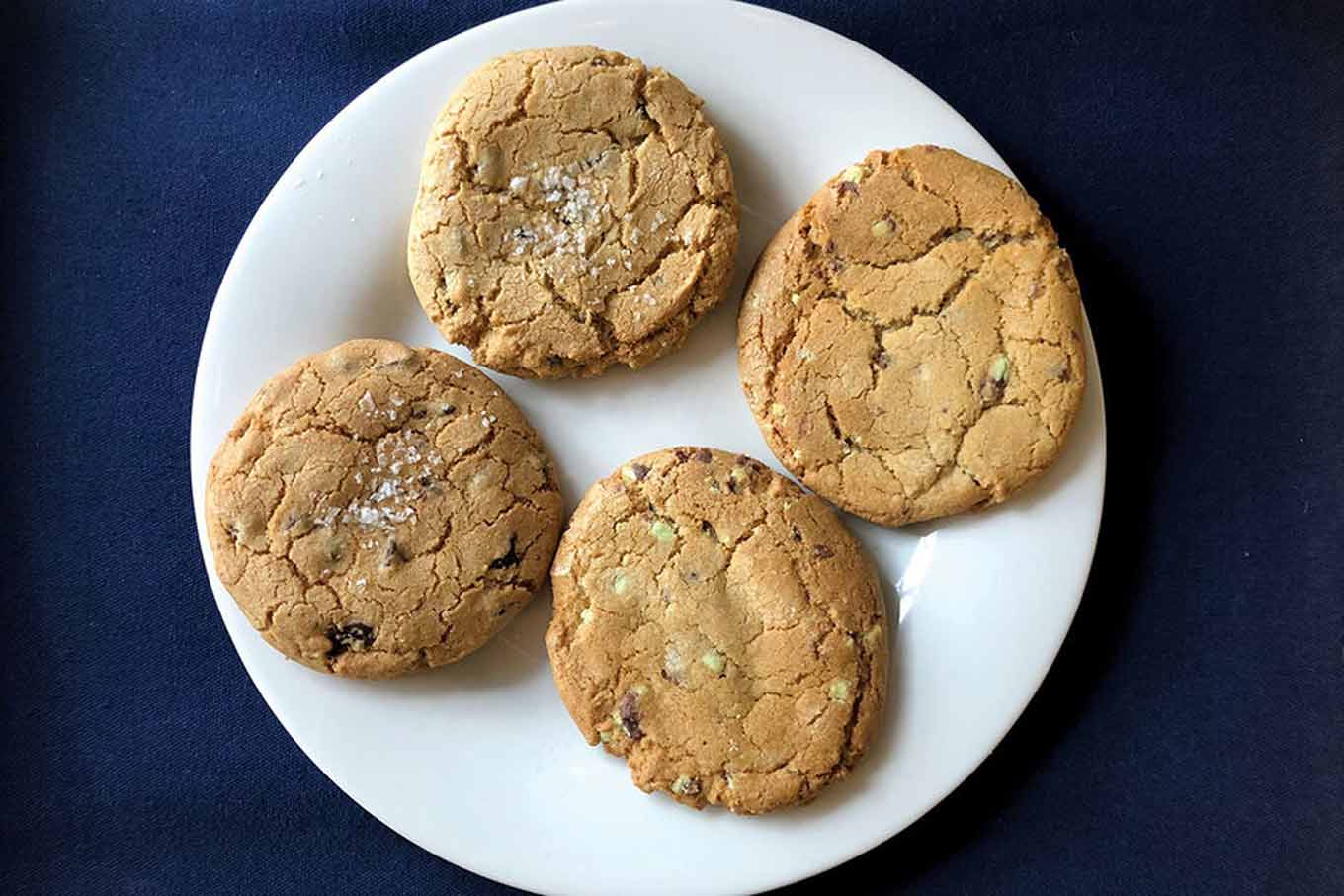
Much like the trial and error it took to perfect its signature recipes – from Granny Bear Cake, to Big O’s Chocolate Chip Cookies, to Study Buddy Banana Nut Muffins – the bakery took time to fully develop.
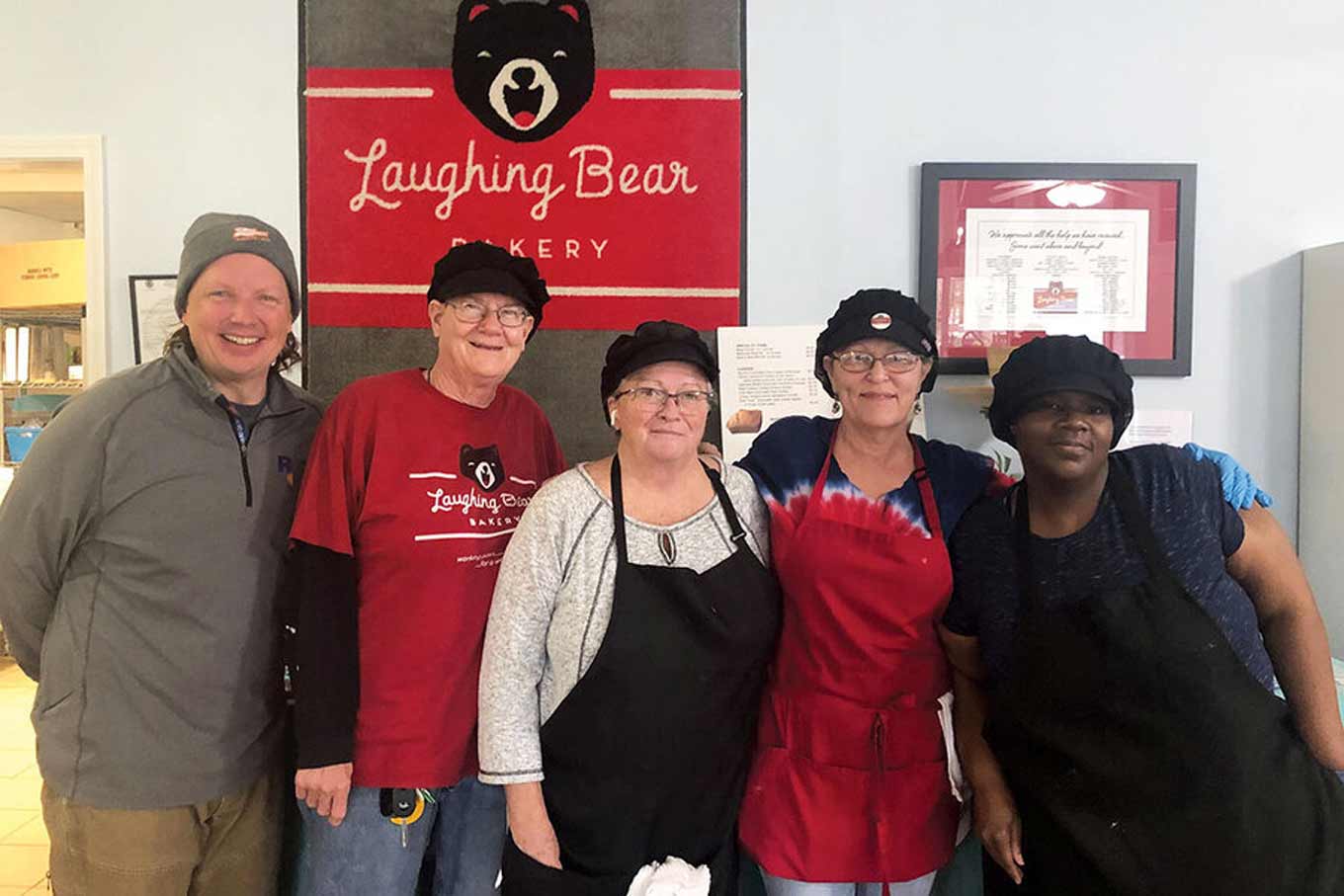
When it launched in 2015, Ms. McAllister had no customers, no equipment, and no supplies. But with $2,000 raised by writing a letter to friends, a permit from the health department, and two employees, she got to baking out of a rented incubator kitchen.
Within a few weeks, after she made payroll and rent, the money ran dry. “I’m sitting there going, ‘This is going to be the shortest business in history,’” Ms. McAllister says, a knowing twinkle in her eye.
Then, out of nowhere, a business CEO ordered 80 Thanksgiving pies, one for each of his employees. And so they stayed open a while longer, kept alive by an unexpected grant here, a big order there.
Now, Ms. McAllister sits at the front of Laughing Bear Bakery’s storefront, which opened in October 2021, scooping Bear Candy – corn puffs coated in brown sugar – into clear plastic bags. Sunlight streams through the windows, a stark contrast with the rented kitchen in a dark church basement they worked out of before.
Financial challenges still come up – the price of flour just doubled, rising operating costs. But the bakery is now open to the public two days per week, and it can pay employees a starting wage of $12 an hour for two to four days of work a week depending on the number of wholesale orders that come in.
Ms. McAllister is the leaven in the bakery’s growth: “Kalen just kind of inspires everybody to do their best,” says Vickie Delmas, who has volunteered at the bakery for four years. “She does without to make sure this place works.”
While Ms. McAllister takes no pay, her reward comes from seeing her employees figure out the recipe for their lives.
The stigma of a criminal record
It all starts with a hiring model that considers a crime to be just one part of a person’s past, instead of the whole of who someone is and has the potential to be.
Typically, a criminal record “is a stigma that overwhelms, that trumps, all other aspects of a person’s identity, especially when it comes to job search and employment,” explains Naomi Sugie, an associate professor of criminology, law, and society at the University of California, Irvine.
Across the United States, 37 states and more than 150 cities, including St. Louis, have implemented “ban the box” policies that delay background checks until after preliminary hiring steps. These policies aim to let other credentials and aspects of a person’s identity shine through first.
But in the end, the criminal record is still considered. There are only a handful of companies – like The Body Shop, a global chain, and Greyston Bakery in Yonkers, New York – that do not run background checks at all in the hiring process, and even fewer that reserve jobs for those with a record.
Ms. McAllister’s hiring practices may not make sense for all employers as they consider the risks of negligent hiring and occupational requirements. But Laughing Bear Bakery spotlights the transformative power of a clean slate.
After 15 years in prison, Eric Satterfield had two options for work experience on his résumé: jobs before prison or jobs in prison. Working at the bakery for a year helped him diversify and transition into a full-time job at a manufacturing center, which he balances with freelance graphic design work.
“When you come out of prison, you think 'everybody is thinking about why I went to prison.' And that’s not really true,” says Mr. Satterfield, who recently joined the bakery’s board of directors. “I think there’s a lot of people who are willing to give second chances, and the bakery helped me see that.”
Being able “to imagine a new self” is a key ingredient to successful reentry, explains Dr. Sugie. But it requires spaces like the bakery where returning citizens “are not always having to explain themselves in terms of their past mistakes,” she says.
In hiring, Ms. McAllister has her own key ingredient: “I’m looking for the people who are ready to change, who’ve said, ‘This isn’t working. I need to do something different.’”
Most of the time she gets it right.
Of the 37 employees the bakery has hired since 2015, Ms. McAllister only recalls asking three or four to leave, usually for drug use. She agonized for weeks before making the decision: It’s hard, she says, to let go of “that hope for that person.”
The journey doesn’t end once new hires earn their hairnet. Often, those coming out of prison haven’t had much work experience, and adjusting to professional standards isn’t easy.
For Ms. McAllister, it requires patience and dexterity. One worker may think they already know it all and have a hard time listening to instructions; another may be afraid to ask questions.
Earning trust is another hurdle, she explains: “They warm up to their peers real fast, and I’m kind of an unknown.”
She navigates it all with gentle corrections about which measuring cup is for dry ingredients and which is for liquids. Occasionally, there’s some sleuthing involved, like the time she caught an employee hiding out in the closet using their phone, which she doesn’t allow in the kitchen.
But in the end there’s “no magic,” she says, “just respecting them as human.”
Room to grow
As LaWanda Jackson cracks eggs into a mixing bowl the day before her first work anniversary, she remembers when she started: “They should have had a show, ‘America’s Worst Baker,’” she declares adamantly. “It would have been me.”
She had her fair share of baking woes. Like the time she forgot the baking powder for a Mother’s Day cake. And the other time the pie filling spilled over the entire oven.
But when she “didn’t get the boot,” she realized her employment contract with Ms. McAllister went deeper: “She will do anything to take care of us.”
It’s the type of care that can change a life trajectory. “When people truly care about you, you blossom,” says Ms. Jackson. “Your best self comes out. That is the truth. That is the absolute truth.”
As wildfires increase in intensity and frequency, a Canadian initiative is protecting the mental health of those on the front lines.
Wildfire season is back. Over the weekend, hundreds of firefighters fought to contain a wildfire in New Mexico that forced thousands of people to be evacuated and destroyed at least 166 homes.
In late April, more than 700 homes were evacuated as a "wall of fire" swept across parts of Arizona. Experts say such events are an early warning sign of what’s to come in the warmer months, with the situation heavily exacerbated by human-induced climate change and set to get even worse in coming decades.
The toll uncontrolled wildfires take on communities is enormous and well documented. Less discussed is the lasting, invisible mark these fires can leave on wildland firefighters after the wildfire season is over.
In Canada, definitions of safety for wildland firefighter crews have previously centered almost exclusively on physical safety. And mental health resources, where available, haven't been widely known, with any support offered predominantly limited to that provided after traumatic events.
But a new preventative form of peer support is helping Canadian crews address the cumulative stress of their jobs before they get to the point of mental burnout or breakdown.
"When you defuse these things properly, then you have the potential not only to mitigate negative things but to enhance positive things and growth and new directions," according to Erik Hanson of the BC Wildfire Service, who says he has experienced first hand the difference a preventative approach can make.
BC Wildfire launched Resilient Minds with help from the Canadian Mental Health Association in 2019 following two unprecedented wildfire seasons. It was adapted from a successful pilot program serving City of Vancouver firefighters in 2016.
In a few days of training, peer leaders learn to recognize and talk about early signs of stress among their ranks, as well as civilians, to help prevent further harm.
While similar preventative, peer-led models for mental health exist in the U.S., Resilient Minds is the first program of its kind to be offered in Canada and is slowly gaining traction across the country.
The need for mental health support is apparent. Structural firefighters — those who work in cities or towns — have been shown to experience post-traumatic stress disorder at two times the rate of the general population.
In turn, wildfire fighters are at higher risk of developing mental health conditions like depression, PTSD, and anxiety than the general public, according to Patricia O'Brien, a researcher and member of the PTSD clinical team for Veterans Affairs in Portland, Oregon, who adds that these conditions are often under-treated, if detected at all.
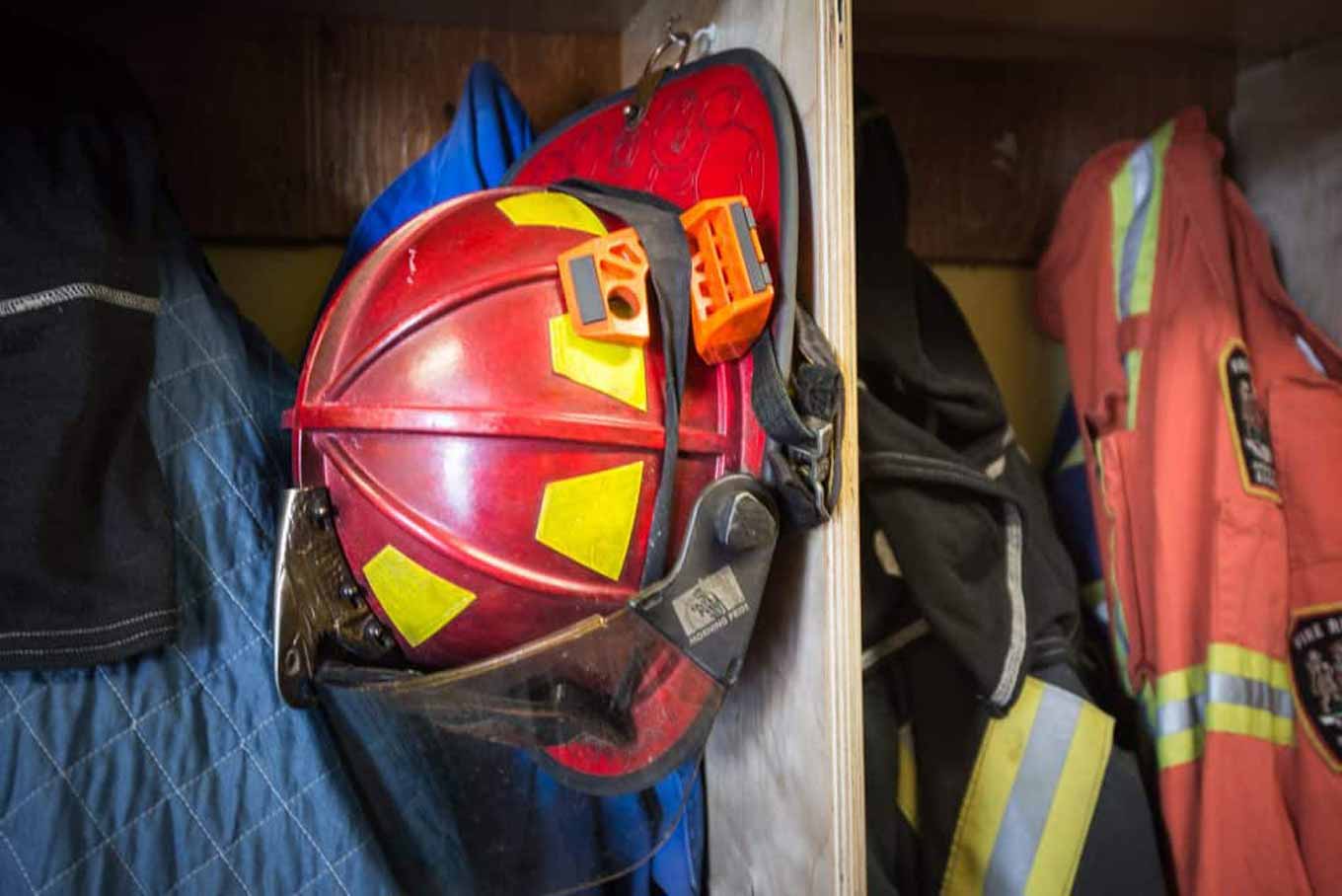
Since the 1990s, wildland firefighters have used what’s called Critical Incident Stress Management (CISM), an internationally recognized standard for debriefing and mental health support in response to traumatic situations, like an injury or death of a crew member.
But CISM is reactive, a form of emergency first aid. In contrast, Resilient Minds and programs like it aim to build resilience through early intervention, something Hanson and his colleagues argue is more vital than ever as climate change increases the rate and intensity of wildfires, and as communities sprawl into forested areas.
"In the not so distant past, Erik [Hanson] and I would have almost exclusively fought fire in the forest. And now we almost exclusively fight fires in and around communities," says Steve Lemon, who works with Hanson. "This has raised the stress response significantly."
Adding to the stress is the transient nature of wildland firefighters' jobs which can make it hard to connect with family, community, and healthy routines, all of which buffer mental health impacts, says O'Brien.
"They're in high risk environments for a big chunk of the year. They’re with a team of people that they may belong to… and then fire season ends and often people kind of go their separate ways."
For wildland firefighters, there's no avoiding potentially traumatic events. And mental and physiological responses like sleep disturbances, depression, anxiety, and substance use are normal reactions to abnormal events. What Resilient Minds seeks to do is support individuals to process stressful situations in healthier ways.
Take the 2021 wildfire season in British Columbia, which will forever be known as the year the village of Lytton burned to the ground just after the highest temperature in Canada was recorded at 49.6C.
As the long season came to a close, for the first time ever, crews across the province called in help to debrief. Not to review operations, or because of one traumatic incident in particular, but because "so much crazy shit happened," recounts Hanson. "We know that part of keeping healthy is talking about this stuff."
As well as communication, Resilient Minds helps wildland firefighters learn ways to manage stress through measures such as better sleep habits and healthy nutrition. They also cover what services are available, like CISM, counseling, and a dedicated crisis line. When team leaders go back into the field, they're able to help break a barrier of stigma that has contributed to so many wildland firefighters suffering in silence.
"I've known five people within wildfire who have chosen suicide. That has left a really profound impact on me," says Lemon, whose career spans 26 years. Forty-six first responders died by suicide in Canada in 2017 and this does not include those who are retired or no longer on the job.
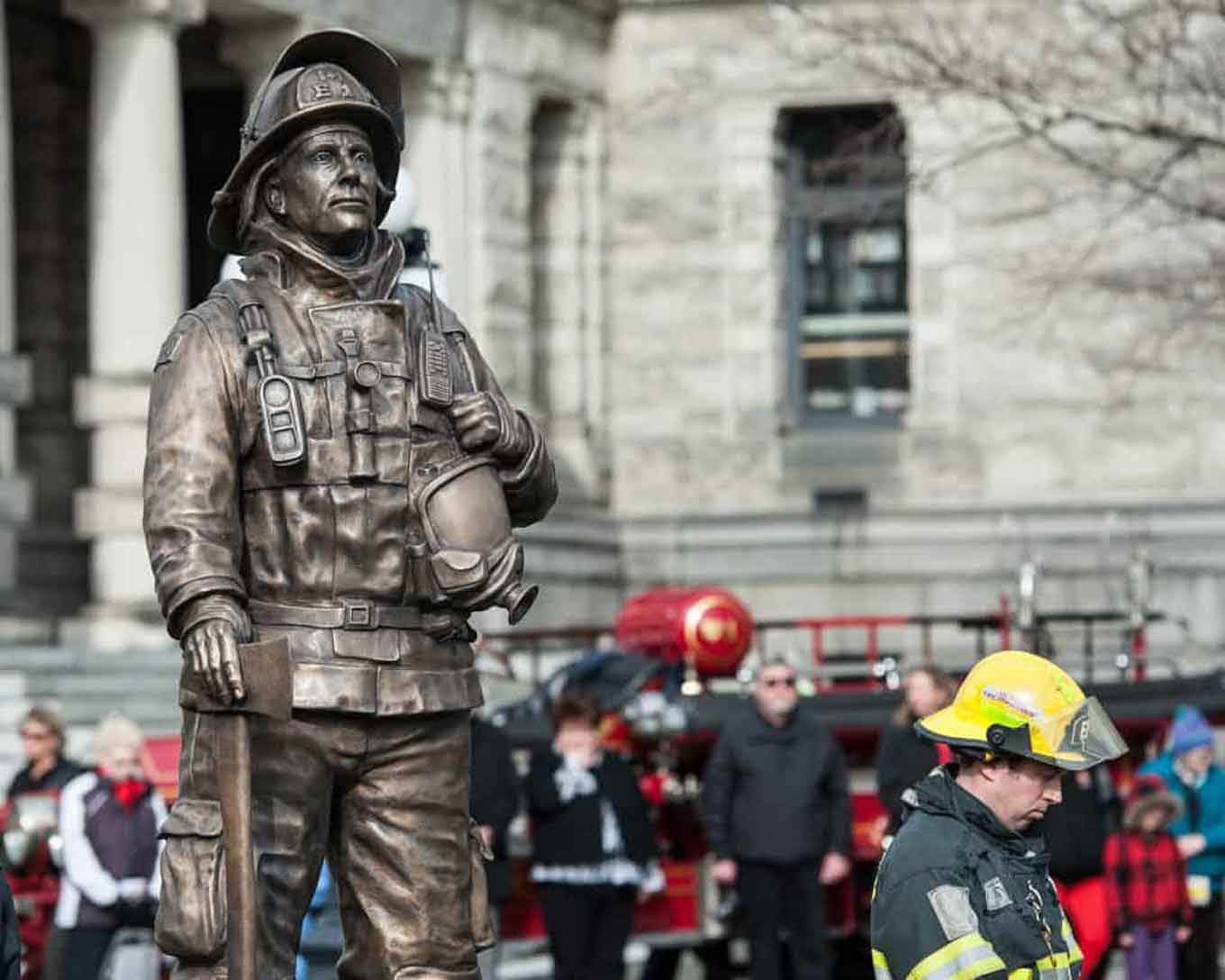
Today, the addition of two words to Lemon’s job title reflects a culture shift across the BC Wildfire Service — head of safety and wellbeing.
"We don’t profess to be counselors or therapists ourselves," he says. "But if coworkers can say, 'Hey, it looks like you’re struggling here. Can I get you some help to talk to a therapist or counselor?' That’s what we find the biggest benefit of it is."
While these supports are in their infancy, according to O’Brien, similar peer-based programs are on the rise. Comprehensive Wellbeing and Resilience is offered in the U.S.
In Ontario, they’ve adopted a Road to Mental Readiness training, which is used by the military. The long term impacts of these types of resiliency programs are still being studied. But they hold promise, especially when widely implemented before traumatic events.
At the outset of the Resilient Minds pilot study involving roughly 400 Vancouver firefighters, 30% reported having little to no knowledge about mental health. Coming out, nearly everyone surveyed reported feeling more prepared to respond to a colleague who may be struggling.
"Most workers will seek out support from people they know and from their community, before they will go to an outside therapist or counselor," says Lemon. Since the Resilient Minds training, he's noticed more leaders and supervisors in the field checking in with their staff to ask if there's anything they’re struggling with. "It really just kind of opens the door and allows people to say, 'I am feeling stressed,' or 'I am feeling burnt out.'"
In the past, says Hanson, the attitude was generally "let's just suck it up and go forward".
Today, he says, the volume of calls to their 24 hour safe reporting line has gone up dramatically.
Awareness is leading to new services, like phone apps and access to a mental health retreat for first responders called Honour House, and mental health conditions are now tracked as workplace injuries like physical wounds.
They aim to have one in five wildland firefighters trained with Resilient Minds across B.C., to mirror their supervisor structure. Though they have yet to reach the target in some regions, Hanson and Lemon are hopeful as they work to adapt the training for all new recruits.
"In many cases, just like if you irrigate a wound, it doesn't get infected and you don't have to worry about it. It just heals," says Hanson. "Ideally, if we put enough time and energy into Resilient Minds ahead of time, then people understand and they sort of see stuff coming."
U.S. renewables experts support the war-besieged country with tech hailed a 'game-changer' for disaster relief settings.
Two months ago the streets of Kyiv were desolate, the sounds of ordinary life replaced by near-constant air-raid sirens and its people either fleeing or confined indoors as Russian forces tried to take Ukraine's capital city.
Today normal life is slowly returning, and families and couples once again stroll the streets. But reminders of the war that still rages in the country are everywhere, from the anti-tank "hedgehogs" and concrete blocks dominating many of the city’s roads to the armed soldiers continuing to enforce a city-wide curfew.
Then there are the huge queues of cars stretching away from every remaining gas station as customers desperately try to re-fill their tanks. It's a scene currently being repeated across Ukraine and a stark indication of the acute fuel shortage the war-besieged country is facing.
During any conflict, fuel sources and power grids are a critical target for an invading force. In Ukraine, Russian missiles have attacked the country’s only fully-functioning oil refinery and a blockade of Ukrainian seaports means resupplying the country by tanker is not possible.
In April, Russian hackers targeted the Ukrainian power grid, attempting to cause a blackout that would have impacted two million people.
So it was that as the first missiles fell on Ukraine in February, American renewable energy experts Will Heegaard and Paul Shmotolokha lept into action to support Ukrainian hospitals — themselves believed to be the subject of a Russian "terror bombing" campaign — in anticipation of the fuel and power crises that they knew would soon take hold.
"You have to look at the vulnerability of the grid," says Shmotolokha, CEO of New Use Energy. "What we see in Ukraine is the physical damage to transmission infrastructure, to power generation. All those flying missiles that are going after diesel and gas supplies."
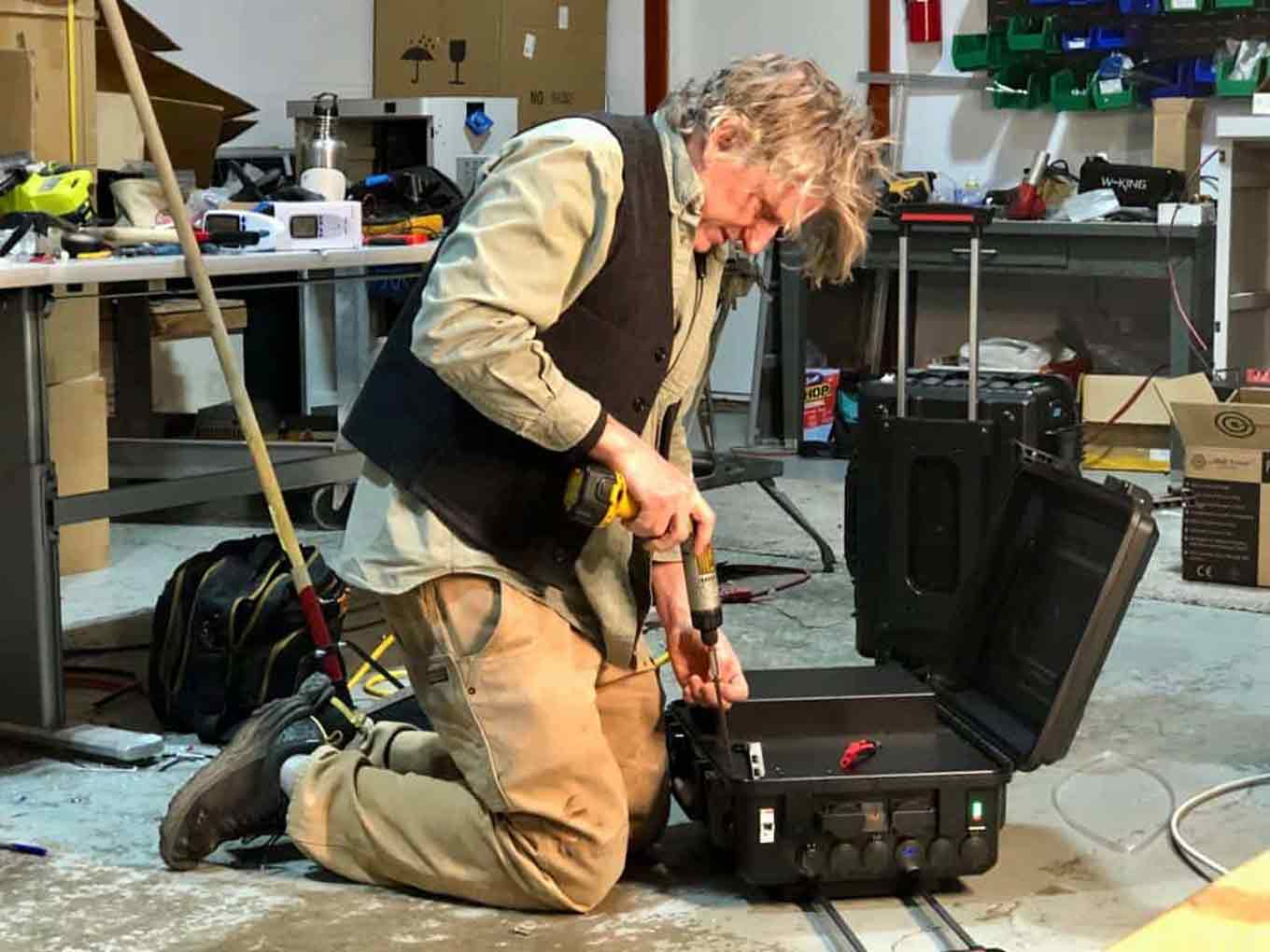
Shmotolokha is the son of Ukrainian World War 2 refugees and his wife grew up in Lviv, a city in western Ukraine. He met Heegaard, operations manager for the Footprint Project, in 2019 when they worked together on a solar microgrid project in Colorado.
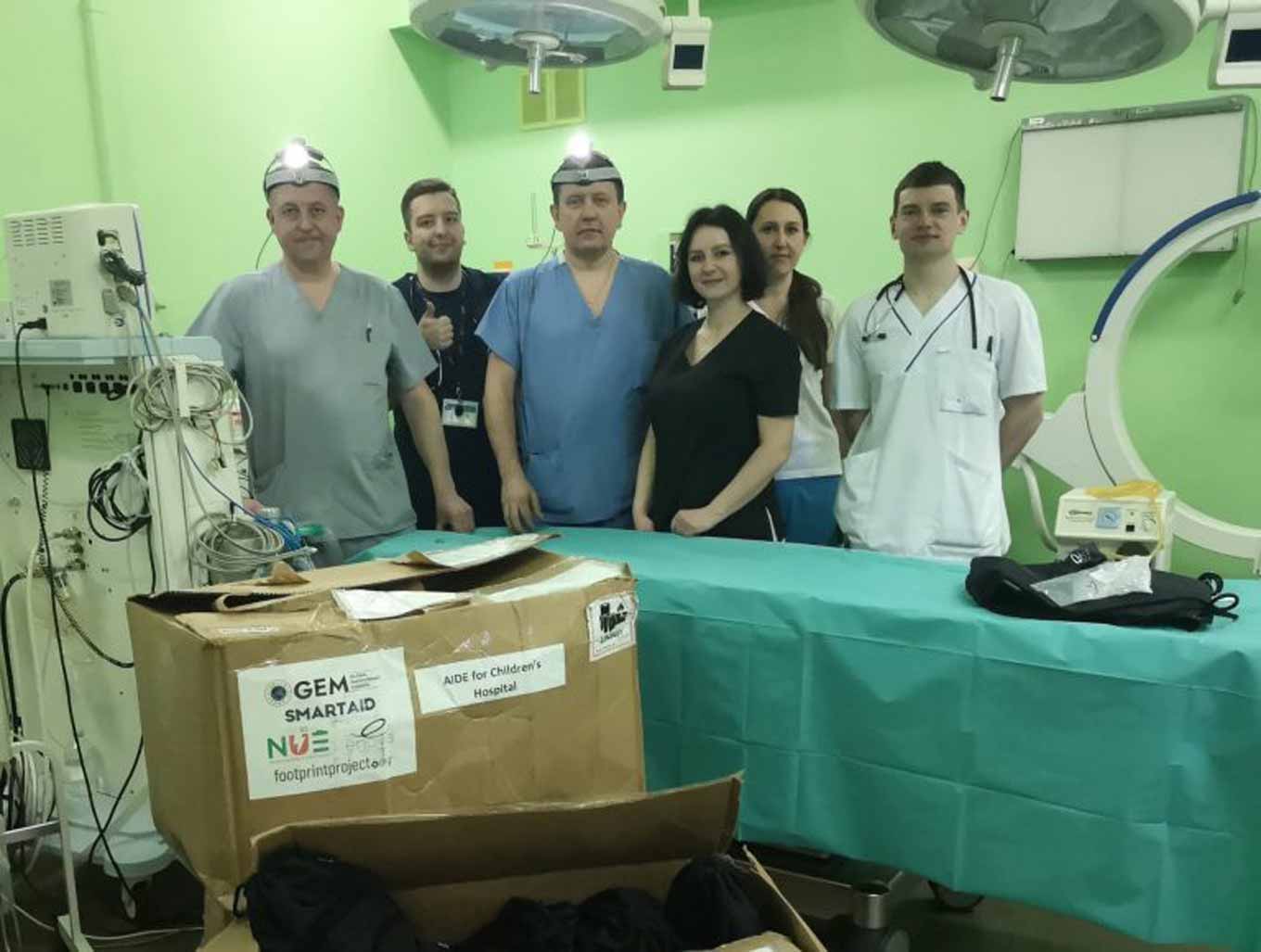
To date, the two have mainly worked on projects in the U.S., and never before in Ukraine. Leveraging their contacts network to establish transport routes into the country, and supported by disaster relief nonprofits on the ground, they began by sending LED lighting equipment and headlamps to hospitals, before expanding the program to include portable solar microgrids, which can recharge the LED kit as well as other essential medical and communications equipment.
They also sent microgrids to a refugee camp in Moldova, a country bordering Ukraine which suddenly found itself hosting tens of thousands of people fleeing the war.
It's these last items, the solar microgrids, which are being touted as a game-changer in disaster relief settings. Unlike diesel generators, which are traditionally used to provide emergency backup power but which can only produce energy in real time, solar microgrids such as those deployed by Heegaard and Shmotolokha can produce and store energy independently from the main grid without relying on dwindling supplies of fossil fuels.
Heegaard and Shmotolokha say they have now shipped more than two dozen 2kWh portable solar battery systems to 13 hospitals in cities all over Ukraine. In areas under heavy Russian bombardment, such as the city of Kharkiv, these solar microgrids are helping save lives.
"[The hospitals there] have intermittent power, they’re in the middle of operations and the lights are going out," says Shmotolokha.
It’s not necessarily the case that these hospitals don't have traditional generators, adds Heegaard. "But if you can’t access diesel then that fossil fuel generator becomes a giant, redundant paperweight."
And because a solar microgrid is a clean source of energy, there are a number of other benefits.
"Noise, fumes and localized air pollution — none of that exists with solar," says Heegaard, who explains that solar microgrids are therefore perfect for refugee camps. "Refugee partners we're working with are dealing with folks who have PTSD from the conflict and trying to sleep next to a really loud [diesel] generator isn’t helpful."
In a conflict where power sources may be targeted, a solar microgrid has the additional advantage of being less detectable than a diesel generator, both because it's quieter and because it gives off less heat. It also negates the need to store large amounts of highly flammable fuel.
But solar panels are not exactly inconspicuous. "Traditional glass panels reflect light so they could easily be targeted," says Heegaard. "But there are also flexible panels that don’t contain glass and just look like a black mat … All the units in Ukraine are flexible panel systems."
There are some disadvantages. Cooking and heating both draw huge amounts of power and will drain a solar-powered source quickly meaning, until the technology improves, there’s still a role for fossil fuels.
The microgrids supplied by Shmotolokha and Heegaard aren't intended to replace the entire power system of a hospital or refugee camp, but instead provide the resilience needed to withstand fluctuations in the traditional grid or the supply of fossil fuels.
"Our focus is on distributed power," explains Shmotolokha. "So instead of having one big generator, we might have four or five of our systems that can be wheeled around into different rooms. The ones that are already in Ukraine can run a WiFi computer station for 24 hours or a surgical suite with lighting for six to 12 hours, depending on how efficient their equipment is."
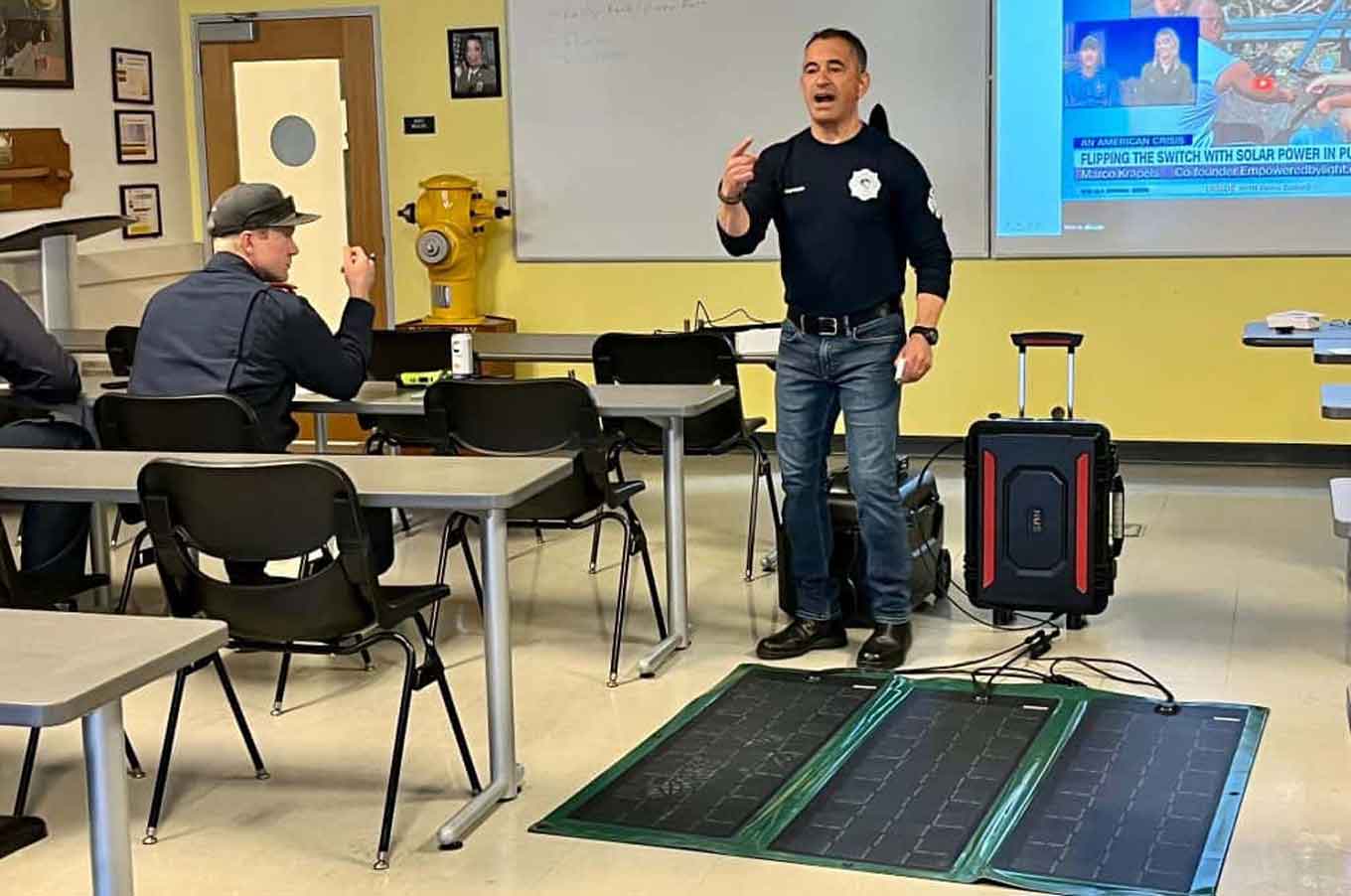
Sinéad Magill, a managing partner at Palladium, an international advisory and management company which has been running disaster response globally for the past 15 years, says that a key benefit of solar microgrids is that they allow local people to address local needs beyond immediate power supply issues.
"Unlike some aspects of a response, which can feel like a plaster on a bullet wound, these microgrids solve ongoing energy supply issues not just for the response but for the long term," she says.
Solar microgrids have already been tested in humanitarian situations, one of the most well-known examples being Elon Musk’s initiative to build huge solar microgrids in Puerto Rico after it was devastated by Hurricane Maria in 2017.
The project highlighted a number of problems in the context of disaster response, not least that to rely on solar power alone requires huge arrays of power-producing panels. Pictures of Hospital del Nino, a children's hospital in San Juan which was one of a number of sites to receive support from Tesla, show panels taking up nearly the entirety of the building’s car park, something that wouldn't go unnoticed by an enemy in a conflict zone.
Down the line it also became apparent that installation and upkeep are two very different beasts. Two years after Hurricane Maria, one reporter visited Puerto Rico, which he described as "a solar graveyard" where regulatory and maintenance issues had led to fields of unused and damaged solar panels.
But less ambitious projects have been a success. Smaller projects initiated after Hurricane Maria that aimed to power individual buildings rather than great swathes of the island produced much better results.
Months after the hurricane first hit, a solar microgrid was able to keep a community center functioning even when power for the rest of Puerto Rico was out.
Are solar microgrids the future of humanitarian response? In one sense, that future is already here. That said, there's still a place for more powerful diesel generators until solar technology further improves.
"It depends on what the mission is," says Shmotolokha. "If you're housing refugees in a stadium and you need to power the stadium lights, you're going to need a megawatt diesel generator. But if you want to run a community center that's distributing food, then we've already done that a bunch so no problem there. There’s a lot of innovation happening. What we're doing today, you just couldn't have done even two or three years ago."
You might also like: Meet the organizations rebuilding housing for Ukraine's IDPs
A Charlottesville business alliance is quickly progressing toward a goal of cutting carbon pollution by 45% by the end of 2025.
Successes include energy audits and a family-owned fossil fuel distributor's unlikely embrace of solar power.
As warnings about escalating climate disasters proliferate, it's tempting to pull the bedcovers up — way high — and stay in the dark.
Aware of that urge to hide, a nimble Charlottesville nonprofit has an antidote for the disheartened. The Community Climate Collaborative, or C3, is inviting Virginians to peek at its early success in weaning local businesses from fossil fuels.
Together, 16 members of the Green Business Alliance pledged last spring to cut their carbon pollution by 45% by the end of 2025. Just a year in, the alliance is upward of halfway there — already achieving a 28% reduction.
Thus far, calculations reveal that members have stopped spewing the equivalent of 4,800 metric tons of carbon dioxide, which translates to removing 1,000 cars from roadways for a year.
"C3 is tiny, but we’re trying to contribute," emphasized Coles Jennings, the nonprofit’s director of corporate sustainability. "There’s just too much urgency to the problem."
Alarmingly, business operations overlap with more than 65% of Virginia’s greenhouse gas footprint via transportation, manufacturing or commercial building energy use, according to Jennings’ review of state Department of Environmental Quality inventory numbers.
Jennings doesn't pretend that a relatively puny carbon curtailment in the foothills of the Blue Ridge Mountains will solve the global climate crisis. But, he noted, the alliance's esprit de corps can provide a glimmer of optimism.
That's why C3 aims to widen its regional reach and eventually duplicate its model statewide.
"These businesses are doing something that’s really hard," said Jennings, who joined the C3 staff in December. "By taking action, members become a collective business voice for climate. Then they feel more comfortable speaking out.
"That’s when they become influencers, pushing for climate measures."
Jennings, a professional engineer, said serving as a sustainability coach for alliance members has been the thrill of his energy consulting career because of their open-mindedness and commitment to progress.
For instance, he pointed to the willingness of InBio to follow through on recommendations suggested by an energy audit. By upgrading its heating and cooling systems, the professional laboratory services company trimmed its gas consumption by 40%.
"That was super validating for me," said Jennings, who conducted the InBio audit as a freelance contractor in 2019. "I know we’re not reversing climate change with one company’s gas usage, but it was a really cool personal moment."
He also boasted about how The Center at Belvedere, a nonprofit community gathering place for seniors, constructed a new airtight facility that’s 2.5 times as large as its old one, with the same carbon footprint.
On the renewable energy front, half of the alliance members have added a total of 640 kilowatts of solar arrays to their properties.
One of Jennings' favorite tales entails Tiger Fuel, a family-owned fuel distribution company that has, perhaps counterintuitively, championed eco-values by announcing it had acquired a solar company at the alliance's May 2021 launch in Charlottesville.
It's an unlikely avenue for a company that distributes heating oil and propane gas and operates a network of gas stations, car washes and convenience stores.
"Lots of companies in their shoes would look at climate action as a threat to their business and actively resist it," Jennings said. "But instead, they’re asking how they can get ahead of it."
'Busy as all get-out'
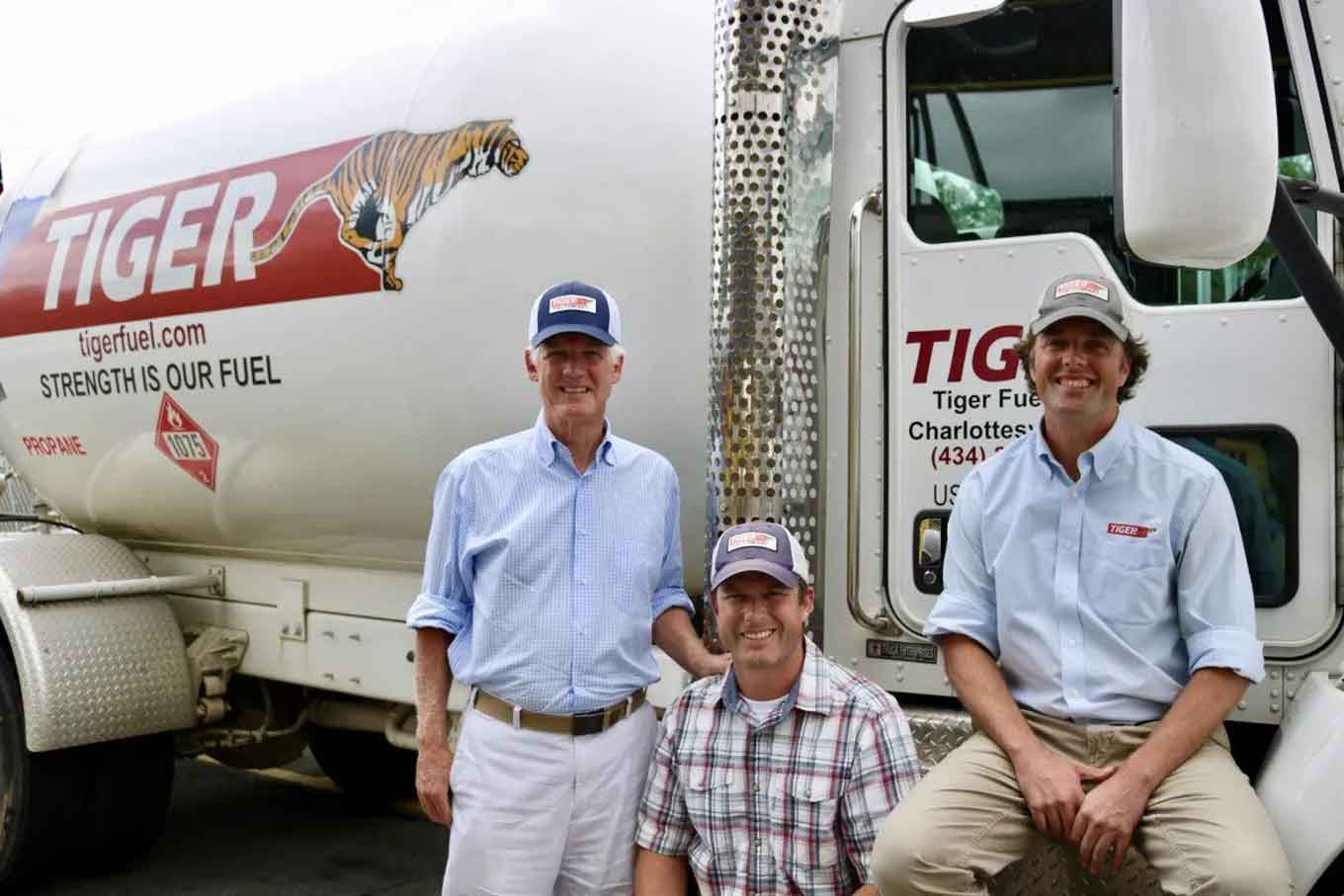
Life has been "busy as all get-out" in the year since Tiger Fuel purchased Charlottesville-based Altenergy and grew to 363 employees. The latter, rebranded as Tiger Solar in February, has offices in Virginia, Maryland, Washington, D.C, Idaho and Michigan.
"We are absolutely happy we did it and also proud," President Gordon Sutton said about branching into solar. "I don’t see a lot of people scrambling to do what we’ve done. It’s never been our intent to be a pioneer. It just felt right for us."
C3 first invited Tiger Fuel to the alliance table due to its decades of service in the region and its serious approach to reversing climate change.
As teens, Gordon and his younger brother, Taylor, had pumped gas, checked oil, and cleaned windshields as their father, David, guided the morphing of the company beyond service stations and fuel delivery. The sons both returned to Tiger Fuel after post-college adventures.
Six years ago, Gordon and Taylor, now chief operations officer, figured solar arrays would match Tiger Fuel's ideals when the price of panels and federal tax credits aligned to fit their finances.
By 2018, they hired neighboring Altenergy to install 17.5 kilowatts atop one store and two canopies sheltering gas pumps.
The brothers are in the midst of having Tiger Solar bedeck a mix of car washes, canopies, stores and one bulk facility with at least another 500 kW. Tiger Fuel would do 100% coverage, but not all canopies can support the weight of arrays and the company doesn't own the real estate at all 11 stores.
Gordon Sutton praised C3 for holding Tiger Fuel accountable for slicing its carbon footprint during a hectic year. The nonprofit deserves credit, he said, for strengthening bonds among enterprises that are secure enough to act quickly and ask one another for environmental advice.
For instance, Tiger Solar has completed a pair of solar installations — one 170 kW, the other 111 kW — at two Staunton dealerships owned by fellow alliance member Carter Myers Automotive.
"It's kind of fun to be engaged in an industry where there’s so much tailwind," Sutton said about the solar side of his venture. "It feels like every time we do a project, it's received with a lot of fanfare."
"People are paying more attention because, as a company historically engaged in the distribution of fossil fuels, we’re a bit of an outlier."
Still, while the laurels are welcome, the darts can sting. Sutton said he’s aware some solar competitors have tried to undermine Tiger Fuel's newest venture as a green sheen exercise.
"This is not some sort of hocus-pocus greenwashing thing," Sutton said about the dedication of Tiger Solar’s 50 or so employees nationwide. "This is real people doing real stuff in real time."
Altenergy, founded in 2004, had completed 1,700-plus solar projects totaling at least 42 megawatts. Tiger Solar has added 2.8 MW to that figure.
Sutton views that growth as a baby step. He is intent on extending Tiger's Virginia reach and also convincing owners of other competing fuel distributors, gas stations and convenience stores to join his solar fold.
"We are having conversations," he said. "None has yielded big results yet, but I’m confident they will."
Next? An appetite for more
C3 was adamant about crafting a program centered on smaller businesses because those with fewer than 500 employees are the backbone of Virginia's workforce.
The alliance also includes for-profits Red Light Management, WillowTree, Harvest Moon Catering, Quantitative Investment Management and accounting firm Hantzmon Wiebel; clean energy developers Apex Clean Energy, Sigora Solar and Sun Tribe Solar; Sentara Martha Jefferson Hospital and nonprofits Legal Aid Justice Center and CFA Institute.
Luring them to become the alliance's "freshman class" began with relationship-building because it’s not every day businesses trust a climate organization with their utility bills.
Energy usage metrics mined from those bills guided the individualized "emissions diet" plan for each business. Each participant began with a different baseline so they wouldn't lose credit for pre-alliance improvements.
Jennings is C3's chief data collector and reviewer responsible for providing participants with reports and updates.
"What's really exciting and unique is the community focus and flavor that’s missing in the Fortune 500," he said. "We're bringing in a whole range of businesses that otherwise wouldn't touch this stuff because they don't have the staff to do this type of analysis."
Jennings is fully aware some communities become hamstrung on climate action because well-intentioned and well-researched promises never evolve into doable plans. It can be an arduous and exasperating chore.
However, he figures his nonprofit's endeavor will only boost area efforts to curb emissions. Alliance members are crucial players if Charlottesville and surrounding Albemarle County are to slice planet-warming emissions by 45% (relative to 2011) by 2030.
With such an enthusiastic inaugural membership, Jennings is convinced the project will expand even after the final emissions measurements are released in spring 2026.
"They have such a common thread and an appetite," he said. "My hope is they'll ask 'What's next?' after outgrowing the core mission pledge."
Eventually, he envisions cracking tougher nuts, such as converting fleets to electric vehicles and forming overarching climate action plans that extend beyond carbon footprints.
In the meantime, he wants alliance members to buckle down on energy audits so they can maximize every electron of efficiency instead of leaping immediately to sexier solar.
"I came across this quote somewhere and use it all the time," he said. "'You have to eat your energy efficiency vegetables before you get your solar dessert.'"
This story was originally published by Energy News Network.
Janna Rivas smiled at the three men on the computer screen in front of her.
"So who wants to start us off with their check in today?" she asked cheerfully.
For a few moments, no one spoke. Then a man with long hair raised his hand.
"I am checking in today definitely with joy, grateful to be here again another week," he said, pausing as if searching for the right words.
"And a little bit of shame at the same time, that I’m having to do this," he continued. "I just wish I would have learned this approach before it was a necessity."
It was week four of Positive Solutions, a program of up to a year that aims to help people responsible for domestic violence change their behavior patterns and build healthy relationships.
Run by Monarch Services, a domestic violence intervention and prevention agency in Santa Cruz County, the program encourages participants to tune into their emotions, practice nonviolent communication skills and identify negative childhood experiences that may have led them to express emotions in a violent way.
The program reflects a growing movement among anti-violence advocates, domestic violence agencies and even lawmakers to find effective ways to break the cycle of abuse.
They argue that addressing domestic violence solely through the criminal justice system, such as by involving the police or incarcerating people, doesn't fix the problem or promote healing, and may actually cause additional harm.
But more holistic, trauma-informed approaches like Positive Solutions can give people a chance to process the deeper reasons for their behavior and allow them an opportunity to change.
"t just gives you chills," said Rivas, program manager at Monarch Services. "You're watching folks process and forgive themselves and each other. These guys are nodding and saying, 'Yes, that happened to me too. You’re not alone.'"
Since 1994, California has required people convicted of domestic violence and granted probation to attend what's known as a "batterer intervention program" certified by their county's probation department.
However, violence prevention advocates and researchers have long questioned whether these programs are effective, citing high dropout rates and little evidence that they stop people from reoffending. A 2005 report by the California Attorney General found that dropout rates are as high as 89 percent in some counties.
One criticism of these traditional programs is that they are overseen by the criminal justice system and, as such, tend to take a punitive rather than a healing approach. The style of many programs is authoritative and didactical, critics said, and often reinforces feelings of shame, alienating participants.
"You're just another person telling them what to do," said Dalia Ochoa, a facilitator for Positive Solutions who ran "batterer intervention" classes at a probation department before joining Monarch Services.
People of color, who research suggests are overrepresented in court-mandated batterer intervention programs due to societal inequities, also frequently mistrust interventions associated with the criminal justice system due to experiences of police harassment and brutality in their communities, experts said.
California's state auditor is scheduled to release an audit later this year on the effectiveness of California's domestic violence intervention programs, at the prompting of Assemblymember Timothy Grayson (D-Concord). And six counties (Napa, San Luis Obispo, Santa Clara, Santa Cruz, Santa Barbara and Yolo) are piloting alternative programs that experiment with different lengths and types of classes, using funding from an Assembly bill passed in 2018. The pandemic delayed some of the pilots, and it will take more time to determine the outcome, according to a report by the California State Association of Counties.
In the meantime, a handful of local nonprofits are taking up the helm.
The link between childhood trauma and domestic violence
Working with those responsible for domestic violence is new for Monarch Services. Since its founding in 1977 the agency has focused on serving survivors of intimate partner abuse by providing them with emergency shelter, crisis intervention and legal services.
At first glance, the idea of helping those who have committed violence, whom some traditionally viewed as "bad" people, seemed anathema to the organization's mission, said Co-Executive Director Kalyne Foster Renda. But three years ago, while consulting with survivors on a new strategic vision for the agency, staff heard the same request repeatedly.
"'I wish there was a program that could help my partner,'" survivors told Foster Renda. "'I want to stay with them.' Or, 'my kids are going to spend time with my ex-partner and I'm worried about the violence.' It kept coming up."
The Monarch Services team began scouring the state for a program they could implement. Most, like Monarch Services in the past, held fast to the belief that they should only help the victims of violence.
Then agency staff came across The Center in Placerville, a domestic violence intervention and prevention organization that developed the Positive Solutions program about five years ago and now works with about 90 men and women on any given week. They went to observe the program in action.
"We were blown away by the personal accountability that folks were showing, the support that was happening within the group — that's really the key to this program, is folks hold each other accountable," said Foster Renda.
"They allow for vulnerability, and there's really this pressure on folks to be honest and own their stuff and be able to communicate effectively, in a non-harming way. We thought, 'OK, this looks amazing.'"
Executive Director Matt Huckabay at The Center said his agency developed Positive Solutions after surveying hundreds of people who had been in a relationship where there was domestic violence and noticing that almost all of them had experienced high levels of abuse or neglect as children.
By uncovering this trauma during the program's weekly sessions, people start to better understand its impact on their behavior as adults, opening the door to healing and change, Huckabay said.
The program also teaches participants to tap into their full range of emotions and learn how to express them. Men especially have often learned as children to repress any emotion other than anger, Huckabay said. If they grew up in abusive households, its common for them to have faced physical violence or loss of affection from a caregiver if they showed emotions such as grief or hurt.
"They learned very early on to connect vulnerability (and) expressions of emotions to physical pain (and) absence of love," he said.
"Part of the success of the program is really creating a space for men to become very, very vulnerable. To express their feelings of hurt, of shame, their sadness, their grief, and to allow the processing of those emotions where it is viewed as being a strength, not a weakness."
Identifying suppressed emotions and experiences
Originally designed as an in-person program, Monarch Services is currently holding meetings on Zoom due to the pandemic.
Each Positive Solutions session is two hours long, with two trained facilitators. It begins with a check-in, where attendees choose from one of five "core" emotions to express how they're feeling — joy/happiness, shame, guilt, anger, or sadness — and explain why. They're also asked to note something they're grateful for.
After talking through any issues that come up, the facilitators introduce a topic for discussion, such as power and control in an abusive relationship, cultural norms around masculinity, or the intergenerational cycle of violence. In the most recent session, the topic was "Always do your best," one of "The Four Agreements" from the famous book of that name by Don Miguel Ruiz.
Participants are encouraged to identify how these issues have surfaced in their own lives. The facilitators' role is to help guide the conversation, ask questions to dig deeper, and propose new ways to address or reframe situations involving conflict.
However, they try not to dominate the conversation, or act as teachers or experts. Rather, participants are encouraged to support and guide each other.
"All of us are on a healing journey, all of us have trauma, all of us have things to learn and grow from," Rivas said. "That's why we are 'cofacilitators.' … We have resources to share, we have the training to identify where to go a little deeper, but the group will have a topic and it will flow based on what comes up."
Ochoa recounted how one man revealed that both his mom and a stepdad beat him as a child, and how he'd also regularly watched his stepdad hit his mom. Another participant began the program saying his childhood was fine, but a few weeks into the class shared experiences of sexual abuse.
At the end of each class, participants are asked to choose a "stretch" — something practical they will do in the week ahead to implement the skills they've been learning. The following week, they report back to the group how it went.
During the recent Positive Solutions session, one man shared the results of his most recent "stretch" — starting a conversation with his wife about the possibility of moving back in together. He didn't get the answer he wanted, he said, but recognized the point at which their dialogue was in danger of escalating into a fight and was able to instead walk away from the situation.
Another participant talked about how, for his stretch, he had been trying to come up with steps he could take to avoid saying something hurtful when he got angry. Rivas advised him to start by taking a deep breath and connecting to how his body feels to try to identify the real reason he is upset before he speaks. "Is it sadness, hurt, shame?" she asked.
"I bet if you said the real thing you were feeling or thinking, without judgement or defense or trying to be right, it would probably be a lot closer to a heart-centered response," she told him.
So far Monarch Services has worked with 10 men, including the current cohort, in Positive Solutions. It began with two 16-week pilot programs before launching the full program in March. Rivas and Ochoa said they hope to grow participation in the coming year. Feedback from participants has been very positive. Some have regained custody of their children or gained employment. From looking at calls for help to the agency and arrest records, it appears none have gone on to reoffend, they said.
The Center in Placerville, meanwhile, has more evidence that the program works. Out of 75 people who completed the course over the past two years in El Dorado County, only one was rearrested for domestic violence within a year of completing the program, Huckabay said.
Studies of other domestic violence intervention programs generally show much lower success rates, with anywhere between 14 percent and 62 percent of men reoffending after completing a program, according to a report reviewing multiple studies of batterer intervention programs.
Jesse James Jarvie, 31, of Santa Cruz is currently in the program at Monarch Services. Jarvie separated from his wife last year and was required to take a course on domestic violence as part of a restraining order against him.
He chose Positive Solutions on the recommendation of an attorney, and also because he felt drawn to the class’s focus on finding the root of the problem. Jarvie said he grew up in a verbally abusive household and didn’t realize until he did the class that verbal abuse — not just physical abuse — also counts as domestic violence.
"For me it was like, 'Oh, that's normal to get in an argument and say things you don't mean, and then apologize,'" he said.
"I literally thought arguing and fighting and saying mean things was just part of marriage in general. But it's not OK … I’m aware of that now."
Held 'accountable to showing up in new ways'
Positive Solutions does accept referrals from probation departments, courts, and children and family services agencies. But the approach is different, because it's focused on healing and the practical application of learning. The program emphasizes holding participants "accountable to showing up in new ways," Huckabay said.
"Behavior change requires more than just education," Huckabay added. "Education is a piece of it, but then there has to be a whole component of: 'What do I do next? What new tools do I get? Where are the new tools? How do I use them?'"
Monarch Services is also seeking to address other criticisms of traditional intervention programs: That they're not easily accessible to people looking for help controlling damaging behavior before it escalates to the point of arrest. They can also cost on average $25 each week for a year — which can create a financial hardship for participants, many of whom have limited incomes.
Both Monarch Services and The Center welcome participants who want to attend on a voluntary basis, not because they've been mandated to by the court. At Monarch Services, the program is free. The Center charges based on a sliding scale but doesn’t turn anyone away. Both organizations rely on outside donations to fund the programs.
Identifying best practices
Advocates and lawmakers are still trying to figure out exactly how to make intervention programs for domestic violence offenders more effective.
An overview of the research on "batterer's intervention" programs by UC Berkeley found that overall they "have not proven to be particularly effective, nor do they encourage individuals to seek intervention prior to arrest."
More "trauma-informed, whole person interventions" could be more successful, the researchers wrote. Other criticisms of traditional domestic violence intervention programs include that they are often unavailable or unwelcoming to non-English speakers, LGBTQ people or people living in rural areas.
California's lack of funding for programs for people responsible for domestic violence is one major barrier to making the programs more accessible, the report found. The state does not provide funding for these programs. Providers are supposed to make their money from the fees they charge participants, but many can't afford these fees and drop out. The fees also discourage people from participating in the programs voluntarily as a preventative measure, which could be more effective than waiting until someone is mandated to attend because of a run-in with the police or courts, the report said.
The researchers, who studied five states outside of California with innovative approaches to tackling domestic violence, identified best practices, including putting public health departments in charge of overseeing intervention programming for people who cause harm, rather than the criminal justice system. Programs should also be tailored to the cultural and linguistic needs of each community.
"Through this shift, California can uplift healing, strengthen communities, and move the needle towards realizing transformative justice," the authors wrote.
Michael Cochrane, co-chair of the Association of Batterers Intervention Programs, which represents programs in Los Angeles, said one problem is that standards vary from county to county and program to program.
He said there are competing philosophies among providers as to which approach is best — he estimated that about half favor the traditional, didactical approach, which he likened to school.
Others, including himself, prefer a "trauma-based" approach, which can include delving into childhood trauma. He hadn't heard of Positive Solutions, but said the program sounded like the latter.
"All domestic violence is generational," he said. "I've seen more success when you can break down how they got to where they are."
The Alliance for Boys and Men of Color, a California-based network of hundreds of community and advocacy organizations, is also calling for the state to move away from responses to domestic violence that are based in the criminal justice system.
The organization favors a restorative justice approach, which typically involves collaborating with the person who caused harm, the survivor, family, and community members.
More holistic supports for people that have caused harm are also needed, such as job training, substance use treatment and financial assistance, said Eric Morrsion-Smith, the alliance’s executive director. Other ideas include offering a helpline for people struggling with abusive behavior, which is already available in some countries.
Back at the Positive Solutions session, the participants were wrapping up by expressing how they now felt, and what they were grateful for. One man said he was ending the session with mixed feelings — both anger and joy.
During the session, he had talked about how upset he was that his estranged spouse wouldn’t talk to him.
Rivas gently pointed out that he could not force his former partner to do what he wanted, and that perhaps she didn’t talk to him because in the past he had made her feel unsafe.
On reflection, the man said he realized he was being unreasonable.
"I'm checking out with some anger toward my inner voice," he said. "I'm like, 'Woah. Why do I have this necessity to control her? And why (does)…my inner voice say she needs to forgive me in order for me to be happy?'"
But also, "I'm feeling the happiness, the joy, because I do know that I can change that," he said. "I'm happy that I have this awareness of what I need to work on, and I’m grateful again for this group today, for this really deep stuff."
If you or someone you know is experiencing domestic violence, contact the National Domestic Violence Hotline at 1-800-799-7233 for support and referrals, or text "START" to 88788.
A wildlife recovery effort in British Columbia, Canada, has successfully increased a caribou herd from 38 individuals to 113 in less than a decade, according to a new study.
— Two First Nations communities partnered with Canadian scientists, the government, and private companies to reduce predators and care for new calves in the short term, while restoring habitat in the long term by securing more than 7,000 hectares (17,300 acres) of land for caribou.
— Human interventions, including logging and energy infrastructure, are blamed for fragmenting caribou habitat and increasing predator numbers.
— The project involves killing wolves, a main predator of the caribou, drawing ire from some conservationists.
Caribou are proudly displayed on Canada's 25-cent coin, but in the wild, their populations are on the verge of annihilation. Carmen Richter from the Saulteau First Nations is working to change that.
She's part of an Indigenous-led conservation program whose interventions have led one caribou herd in western Canada to triple its population in less than a decade, according to a new study.
Starting in 2013, two First Nations communities in central British Columbia partnered with scientists and government officials to tackle the decline of the caribou (Rangifer tarandus), known outside North America as reindeer.
Environmentalists say the mix of traditional knowledge from Indigenous elders, hands-on community engagement, and Western science offer a model for improved conservation.
"Indigenous values are the captain that steers the boat, but … both systems are being used to benefit caribou," Richter, who has been a driving force on the project for years, said. "Western science has been heavily utilized, but it’s been led by Indigenous goals and ways of knowing."
That collaboration is paying off. The size of the Klinse-Za mountain caribou herd rose from 38 animals in 2013 to 113 this year, said the study published in March in the journal Ecological Applications.
"We had a feeling the caribou could be lost within our generation; this work sort of rewrites that narrative," said Clayton Lamb, a postdoctoral researcher at the University of British Columbia (UBC) and one of the study’s authors. "Indigenous elders talked about them once being as abundant as bugs on a landscape."
Down to business with maternal pens, armed guards
To try and rebuild the herd, the West Moberly First Nations, Saulteau First Nations, and the government hired a consulting firm, Wildlife Infometrics, to build special pens for expectant caribou mothers and their calves. The idea is to protect from predators during this especially vulnerable stage of their lives.
The work on occasion requires airlifting pregnant caribou by helicopter into the 6-meter-tall (20-foot) pens on snowy peaks in the Rocky Mountains.
Protected by electric fencing, the pens are made from landscape cloth, Lamb said. Indigenous guardians tend to the expectant caribou mothers and their babies once they're born, making sure they have enough food.
Members of the First Nations patrol the pens with guns to fend off wolves and other predators. Indigenous hunters on the ground, and government officials in helicopters, also shoot wolves to reduce their overall numbers. It’s unclear how many wolves have been killed in a bid to protect caribou, as the culling is done by both government contractors working from helicopters and Indigenous guardians on the ground, and collated data isn't kept in a central location.
After they're born in the spring and able to better fend for themselves, the caribou calves are release with their mothers from the pens, said Richter, who is a co-author on the research paper. As they grow, they’re monitored by scientists and First Nations members.
It's an intense operation. One caribou can consume an entire shipping container full of lichen annually, said Richter, who studies lichens as a biologist. Gathering the lichen requires careful planning and lots of work: it must be picked by hand to avoid damage and requires months to dry out.
Fortunately for the team behind the project, there’s plenty of help. Schoolkids from the two First Nations and a small army of volunteers spend weeks gathering the lichen, Richter said, working together outside to properly store and transport it so the pregnant caribou mums have enough food for their babies.
It's a time-consuming and expensive process that can’t continue indefinitely, but it has been working, said Darcy Peel, director of caribou recovery efforts for the B.C. Ministry of Forests, Lands, Natural Resource Operations, and Rural Development.
"This isn’t exclusively [a] B.C. issue; it’s a challenge across the country," Peel said. "In terms of the leadership of West Moberly and Saulteau … you can’t really measure that in terms of how it helps caribou."
The province spends about C$300,000 ($240,000) annually to help finance the project, he added.

The two First Nations and businesses have also contributed tens of thousands of dollars. Elected officials in the West Moberly First Nations and Saulteau First Nations did not respond to interview requests.
For Indigenous communities across British Columbia and beyond, caribou are culturally crucial as a historical food source used in key ceremonies. Before the 1970s, members of the First Nations used to work as guides, earning a living by helping tourists hunt the prized animals, Richter said.
Population declines led the First Nations to stop all hunting in the 1970s, she added, as industrial development, including roads, logging, and energy extraction projects, fragmented caribou habitat.
"Sadly, we have many species in decline in B.C., but caribou are a species that require an expansive landscape in which to feed, thrive, and raise their calves," said Sophia Cuthbert from the Habitat Conservation Trust Foundation, a B.C.-based nonprofit that’s not directly involved in the Indigenous-led project.
"Caribou and their calves have simply not evolved to a landscape like this, and mortality rates show this," she said in an email.
Landscape changes, including fewer trees, have led to more moose and deer moving into the area, Peel said. Wolves and other predators followed, hunting down caribou that were already suffering from habitat reductions.
Reestablishing a large land base to allow caribou to thrive again without human interventions is key to long-term success, Peel said. And there's been some movement in that direction.
In 2020, the two First Nations signed a deal with the federal and provincial governments to protect more than 7,000 hectares (17,300 acres) of additional land for caribou habitat. The communities had signed previous treaties with the government for their reserve areas, but that land base hasn’t been nearly enough for caribou herds to regenerate.
The new conservation area allows for camping, hiking, and other low-impact activities, but generally forbids hunting, snowmobiling, or new industrial projects, said UBC's Lamb.
The task over the next decade involves replanting trees on the protected land to rebuild an ecosystem conducive to the return of the caribou, he said.
"That sounds simple in practice, but we don’t have any examples yet of landscape restoration that would restore caribou," Lamb said.
Controversial wolf cull
While the caribou project has gained widespread support among many conservationists, it hasn't been without controversy.
Initially, some local non-Indigenous residents worried habitat restoration efforts would hurt the area’s resource industries, including forestry and energy extraction.
"We've joked that we are movie stars down south and villains up north," Richter said.
Wildlife conservation efforts are popular in big cities like Vancouver and Victoria, but more controversial in northern communities where resource extraction means jobs.
However, support for the project has grown among non-Indigenous residents in nearby communities, she added.
Some campaign groups have also opposed one key element of the initiative — the wolf cull.
While supporting Indigenous-led conservation efforts and the right of First Nations to determine their own land-use plans, Laurie McConnell from the B.C.-based advocacy group Pacific Wild opposes the killing of wolves to rebuild the caribou population.
"There is no clear science that says it is the predator management that is having an effect [on boosting caribou numbers]," McConnell said.
"If you are going to ask a species to give up its life to protect another species, you should exhaust all other methods of management first. I don’t think it's a lot to ask to have control group where maternal penning and feeding is used [without killing wolves to establish baseline data on the effectiveness of different options]" McConnell added.
Peel from the B.C. government disputes that. Reducing predator numbers has been demonstrated as a key conservation tool, he said, adding there is consensus among scientists that maternal pens and feeding alone won’t be enough to rebuild caribou herds from such a low level.
In the case of the Klinse-Za herd, wolf culling is largely credited with helping triple the size of the herd as the region’s wolf population has increased out of balance.
As caribou numbers slowly rebound, the First Nations hope to hunt one or two adult caribou annually in the next few years for ceremonial purposes, Richter said. Community elders are still discussing how to share such a small harvest, she added, as 21st-century conservation challenges butt up against traditional resource allocation systems.
As Canada grapples with its colonial policies, Richter said the project is an example of how reconciliation between Indigenous and non-Indigenous people can happen in real time: communities with different skills and backgrounds working together for a common conservation goal.
"Overall, the province is getting used to Indigenous-led conservation and its benefits," she said. "Indigenous-led doesn't mean it doesn’t involve other people."
June is Pride Month! This month-long celebration is an opportunity to celebrate the very human and very beautiful spectrum of gender and sexuality, all while coming together to fight for widespread equality and justice in the LGBTQ+ community.
Although Pride Month has become known for beautiful, boisterous rainbow parades throughout the country (and some not-so-aesthetically-pleasing merch from major corporations), the LGBTQ+ community celebrates this month in honor of a long, tumultuous history towards equal rights in the United States.
As Pride rounds the bend again this year, we are especially in need of some connection and authenticity.
In the face of over 500 anti-LGBTQ+ bills in state legislatures across the country, rollbacks of Diversity, Equity, and Inclusion programs, as well as bans on transgender athletes, military members, and life-saving gender-affirming care on a federal level, LGBTQ+ people deserve the space to rejoice, grieve, dance, and feel together in safety.
As you continue reading through this list of resources and ideas to celebrate in a thoughtful and meaningful way, remember to maintain systems of care and safety at Pride events, be especially thoughtful in your activism, and take care of yourself in the ways you need to continue fighting all the injustices this community faces.
While it’s important to learn more about and uplift the experiences of LGBTQ+ folks every single day, it’s helpful to have somewhere to start. We’ve created a guide on how to celebrate Pride Month this year.
By the way, some of the links in this article (like books!) are affiliate links, which means if you make a purchase after clicking a link, we may earn a commission at no extra cost to you. Thank you!
Scroll through for resources for: Learning | Action | Celebration | Work | School | Social Media | Allies | Closet
How To Celebrate Pride Month: Activities, Ideas & More
Learn
Learn about the first Pride.
Celebrating Pride cannot happen without acknowledging its roots. Pride Month honors the 1969 Stonewall Uprising in Manhattan. This uprising was a tipping point for the gay liberation movement in the U.S, as police raided a gay bar in New York City and its patrons fought back.
This action in New York prompted further organizing across the country, and LGBTQ+ folks mobilized in major cities, convening to create organizations like the Gay Liberation Front and Gay Activists Alliance.
A year later on June 28, 1970, the first Pride parade started at the Stonewall Inn, as LGBTQ+ activists organized the Christopher Street Liberation March. As hundreds began marching, supporters from the crowd joined them, and thousands marched across 15 city blocks.
You can learn more about the history of Pride (and LGBTQ+ history in general) by engaging with various resources from them, GLAAD, and Learning For Justice— or of course, by swinging by your local library.
It is also vital to keep in mind that LGBTQ+ history doesn’t just start with Stonewall. Brush up on your queer history, or learn about a whole new demographic of history-makers this month to honor all of those who have come before us.
Learn more about gender and sexuality.
AKA, learn about the L’s, the G’s, the B’s, the T’s, the Q’s, and everyone else in the community! (We’ve put together a guide to the definitions of LGBTQIA+)
Here are a few great organizations (this list is definitely not comprehensive) that offer free educational resources on their websites:
- National Center for Lesbian Rights: A national legal organization that protects and advances the civil rights of LGBTQ+ people through litigation, legislation, policy, and public education.
- The Center: The Center is a one-stop-shop for all things LGBTQ+ with resources for all kinds of intersecting identities within the LGBTQ+ community.
- Bi.org: A website that has dedicated over 20 years to providing resources about bisexuality and support for people who identify as bi+.
- National Center for Transgender Equality: An advocate organization that aims to change policies and society to increase understanding and acceptance of transgender people.
- Gender Justice League: A national organization that advocates for human rights for trans and gender-diverse people. Check out their resource guide!
- The Intersex Society of North America: Devoted to the effort to end shame, secrecy, and harm in intersex communities, this organization offers endless educational and advocacy opportunities.
- Asexual Visibility and Education Network: The world’s largest online asexual community, which includes a large archive of resources on asexuality
- PFLAG’s Online Academy: A hub for free, monthly educational resources to support LGBTQ+ people and their families
Read books by LGBTQ+ writers.
Get your queer studies materials right from the source! Or, just enjoy some awesome fiction that tells the stories of LGBTQ+ characters. There are so many awesome books out there.
Get started by searching through Libro.fm’s Pride collection of audiobooks or this list of recommendations:
- “How We Fight for Our Lives: A Memoir” by Saeed Jones (Bookshop) (Amazon)
- “All Boys Aren’t Blue: A Memoir-Manifesto” by George M. Johnson (Bookshop) (Amazon)
- “Queer Intentions: A (Personal) Journey Through LGBTQ+ Culture” by Amelia Abraham (Bookshop) (Amazon)
- “Greedy: Notes from a Bisexual Who Wants Too Much” by Jen Winston (Bookshop) (Amazon)
- “Nevada” by Imogen Binnie (Bookshop) (Amazon)
- “Felix Ever After” by Kacen Callender (Bookshop) (Amazon)
- “This Day in June” by Gayle E. Pitman (Bookshop) (Amazon)
- “Gender Queer: A Memoir” by Maia Kobabe (Bookshop) (Amazon)
Read about pre-Stonewall LGBTQ+ history.
Though Stonewall was a huge catalyst moment, LGBTQ+ history didn't start there. Read this article about queer history, beginning all the way back in 2900 B.C. — and taking us all the way through to the 1960s.
Learn what each Pride flag means.
Pride flags go beyond the standard rainbow flag or the newer Progress Pride Flag. In fact, there are dozens of unique Pride flags that represent various LGBTQ+ communities. Take some time to learn more about each Pride flag, their colors, their meanings, and their history.
Watch documentaries about LGBTQ+ folks.
Documentaries are a great educational tool to help us learn more about and empathize with people who have experiences vastly different from our own.
Here are a few documentaries that can better help us explore the realities of LGBTQ+ folks this Pride Month:
- Disclosure (Netflix)
- Always Jane (Prime Video)
- How To Survive a Plague (AMC+ on Prime Video)
- A Secret Love (Netflix)
- Pray Away (Netflix)
- Transhood (HBO Max)
- Kumu Hina (PBS)
Take Action
Call upon your elected officials to protect and uplift LGBTQ+ folks.
It’s been a rough few years in policy for the LGBTQ+ community, especially trans and nonbinary folks. It’s up to us to protect and advance the rights of queer individuals of all backgrounds — and to do so urgently.
Get started by calling or emailing your representatives and urge them to support pro-LGTBQ+ legislation.
Donate to organizations that support LGBTQ+ folks.
There are quite literally hundreds of organizations in the U.S. working to support LGBTQ+ communities, and they need your financial support now more than ever.
Here are just a few of the many organizations you can send your donations:
- The Trevor Project
- Glisten
- Transgender Law Center
- Human Rights Campaign
- Point Foundation
- Astraea Lesbian Foundation for Justice
- GLAAD
- The Ali Forney Center
- SAGE
- Lambda Legal
- Trans Lifeline
- National Center for Transgender Equality
- The Marsha P. Johnson Institute
- Black Trans Travel Fund
- OutCare Health
Volunteer for an LGTBQ+ nonprofit in your area.
If you can’t afford to donate, or you want to make your donation even more impactful, volunteer right in your community! Check out a crowd-sourced directory of LGBTQ+ organizations, or search for LGBTQ+ community centers in your area to get started.
Here are a few other great national organizations to volunteer with:
- The Trevor Project: As mentioned, the Trevor Project works to prevent suicide and support the mental health of LGBTQ+ youth. Volunteers are on the front lines helping these young people through tough times.
- GLAAD: GLAAD is always looking for volunteers who can help with the recruitment, management, leadership development, and support of their mission.
- Trans Lifeline: Trans Lifeline is a trans-led organization connecting trans folks to the resources they need to thrive. Volunteers build nonprofit experience, log required clinical hours, learn the ins & outs of community economic redistribution—and meet incredible trans people across the country.
Vote or campaign for elected officials who work to improve the lives of all members of the LGBTQ+ community.
Put those door-knocking and phone-calling muscles to work and mobilize for a candidate who supports pro-LGBTQ+ legislation! The Victory Fund works to build long-term LGBTQ+ political power by electing LGBTQ+ leaders at every level of government.
Meet their candidates and learn more.
Donate to gender-affirming surgery funds.
Redistribute wealth and help a friend or community member pay for gender-affirming procedures. If you have trouble finding a mutual aid fund or crowd-fund in your immediate circle, you can search for a fund to contribute to on GoFundMe, or support either of the following nonprofits:
- For The Gworls: For The Gworls is a Black, trans-led collective that curates and hosts parties to fundraise money to help Black transgender people pay for rent, gender-affirming surgeries, smaller co-pays for medicines and doctor’s visits, and travel assistance.
- Point of Pride: Point of Pride offers several gender-affirming programs, including an annual surgery fund, financial support for electrolysis, a free year of hormone replacement therapy, and free chest binders and shapewear.
Provide care and support to LGBTQ+ folks.
It’s been a rough year to be queer. Although our individual identities should be a point of joy and freedom, lawmakers across America have used them to maliciously pass a political agenda that criminalizes transness and queerness in ways that cause irreparable harm to the LGBTQ+ community.
As much as joy is an act of resistance, it makes sense if people need time to grieve and feel complicated feelings this particular June. First of all, don’t make the FOMO worse if someone swaps their body glitter for a day in bed; it is important that we validate all the nuanced experiences of Pride.
Secondly, make this month’s mission to build even stronger communities. Whether you’re among the LGBTQ+ community or an ally who loves LGBTQ+ fiercely, commit to showing up intentionally.
Make life a little easier for our trans siblings; create networks of community care and mutual aid to help folks access the things they need; celebrate your people even if they are keeping things more low-key. Any act of friendship or found family is vital to keep one another safe.
Celebrate
Attend a Pride event.
Grab the flags, get in your best outfit, cover yourself in glitter, and celebrate your true self! Pride events are held all across the globe; check out this global directory of Pride events by the International LGBTQ+ Travel Association.
Celebrate good news in the LGBTQ+ community.
It can be hard to find the good in the fight for true equality, but there truly is so much good happening in the LGBTQ+ community! Take it from us, we’re a good news media company that literally makes a monthly print newspaper filled with good news. (And you should subscribe!)
This month we have a brand-new Pride Edition of the Goodnewspaper available too!
When we fill our brains with reminders that there’s lots of good in the world, it helps us feel more hopeful about the future and encourages us to be a part of creating that better future.
Subscribe to a positive news email newsletter like ours, check out good news websites, good news apps, and good news podcasts, and do everything possible to make sure you’re exposed to hopeful news stories on a regular basis.
And, lastly, when you’ve found good news — make sure you share it with others too!
Here are a few positive news stories to get you started:
- You can support the LGBTQ+ community just by opening a new tab in your browser
- This drag queen hosted a drag show for the environment
- A study found suicides fell when gay marriage was legalized
- Pride attendees invited to play catch with supportive dads: 'You're doing great kiddo'
- NYC 'queer garden' is filled with non-binary and sex-changing plants
- Florida banned Pride crosswalks — so St. Pete lit up the sky with rainbow lasers instead
- And explore all of our LGBTQ+ good news articles
Listen to a playlist of music by LGBTQ+ artists.
Queer artists have been topping the charts in music these days! From Doechii, Chappell Roan, and Renee Rapp, to “If I Were A Fish” crooner Corook, there’s definitely enough awesome queer music out there for your next dance party.
Check out Spotify, Apple Music, or TIDAL for a playlist to use as your Pride Month soundtrack.
Activities At Work
Learn about (and avoid) rainbow washing.
Rainbow washing (sometimes referred to as pink washing) is the act of companies or corporations using Pride as an excuse to make a profit.
Writer Justice Audre defined rainbow washing as allowing “people, governments, and corporations that don’t do tangible work to support LGBTQ+ communities at any other time of the year to slap a rainbow on top of something in the month of June.”
This can manifest in many different ways; from using Pride or rainbows to push products, changing logos temporarily, using LGBTQ+ people as props in social media campaigns, to underpaying queer talent, fostering an unsafe or non-inclusive work environment, or running a Pride campaign while actively contributing to anti-LGBTQ politicians.
So… that’s exactly what your company is not going to do.
A good way to ensure that yours or your organization’s Pride festivities are truly helpful (and not for profit or good PR) is to ask the following questions:
- What is the reason we are getting involved in Pride?
- Are LGBTQ+ people involved in this event or celebration?
- Will we be prioritizing LGBTQ+ inclusion after Pride Month?
- Do profits go directly to the LGBTQ+ community?
- Does this celebration reflect the internal culture of our company or organization?
Ensure your workplace has equal rights protections for its employees.
With rainbow washing in mind, it’s not enough to not cause harm to LGBTQ+ folks during Pride; it’s the bare minimum. This is an excellent opportunity to ensure that your workplace is not only safe and inclusive for LGBTQ+ employees, but affirmative and celebratory.
Ensure that your workplace has equal rights protections in place for the LGBTQ+ community, and go the extra mile by advocating for stronger statewide and nationwide non-discrimination protections in the workplace.
A few small steps to ensuring LGBTQ+ inclusion are updating policies and handbooks to ensure non-discrimination of queer employees, implementing common usage of pronouns, and investing in effective training and education solutions that center LGBTQ+ experiences.
The Human Rights Campaign has a great list of the best places for LGBTQ+ folks to work in America.
Host an event to fundraise for LGBTQ+ organizations.
If your company or organization does a great job of caring for its LGBTQ+ team members, spread the love! Celebrate Pride by uplifting LGBTQ+ community members outside of your company through volunteer opportunities, donation drives, mentoring programs, and more.
Bonus points if you offer your team a paid volunteer day off to support an area nonprofit!
Activities In School (for Students and Teachers)
Start a Glisten chapter at your school.
What are often called “gay-straight alliances” are becoming more robust, inclusive, incredible community-building groups in schools across the country, thanks to Glisten, formally known as the Gay Lesbian Straight Education Network.
Glisten was founded by a group of teachers in 1990 to help create affirming learning environments for LGBTQ+ youth by powering student-led movements.
In addition to advocating for comprehensive policies, Glisten coordinates a network of 43 chapters in 30 states across the U.S. and supports student-led efforts in thousands of registered GSAs nationwide.
School leaders can find countless digital resources (for both teachers and students), as well as locate their area chapter — or start one yourself — on Glisten’s website.
Invest in quality LGBTQ+ educational training.
School boards and administration can use Pride Month as a wonderful opportunity to reevaluate their teacher training programs and invest in protecting, uplifting, and learning about LGBTQ+ students.
Glisten has a variety of professional development resources to get you started.
The Human Rights Campaign’s Welcoming Schools program also offers the country’s most comprehensive bullying prevention program that provides LGBTQ+ and gender-inclusive professional development training for Pre-K-12 educators.
Advocate for quality, comprehensive sex education.
According to the Center for American Progress, sex education is only legally mandated in 22 states, and of these, only 12 mandate teaching about contraception, and only seven require that the information be medically accurate.
This leaves students — especially LGBTQ+ students — with a laundry list of lingering questions. Comprehensive sex ed is needed for all students and contributes to decreased levels of prejudice against LGBTQ+ youth.
Start your sex ed advocacy journey with resources from the Sex Education Collaborative, The American Psychological Association, or Get Real.
Make sure students have access to affirming resources.
Even if your school district is far from some of the above milestones in LGBTQ+ youth protections, individual teachers can make a big impact.
In fact, a2017 National School Climate Survey from Glistenfound that the presence of supportive and affirming teachers leads to improved attendance, higher self-esteem, and improved academic achievements.
Designate your classroom as an LGBTQ+ safe space and ensure that your students have access to affirming resources about gender and sexuality. Gender Spectrum and The Safe Zone Project both have a great list of resources for all teachers to have on deck as they support their students.
Protect LGBTQ+ teachers by starting a Regional Prism Coalition.
Just like any other workplace, LGBTQ+ teachers face discrimination for their gender identities or sexual orientations. This burden is doubled as teachers work to protect and support their students amidst their own oppressive systems.
A strong resource for teachers and their students is Teach for America’s National Prism Alliance (NPA), which ensures LGBTQ+ teachers and allies are equipped with intersectional roadmaps on their quests to end educational inequity.
More than 25 Prism boards — support group networks for LGBTQ+ and allied educators — are scattered across the country, encouraging educators to find more ways to care for themselves while empowering their students to learn, question, and seek counsel when needed.
Learn more and consider launching your own regional Prism Coalition.
On Social Media
Follow LGBTQ+ creators (and pay them!)
You know the drill! No matter how inclusive and diverse your social media following lists are, you can always support even more brilliant creators. Follow LGBTQ+ creators, tip them for their work, subscribe to their Patreons, buy their merch, and all that other good stuff.
Not sure who needs to be included on your feed? We’ll get you started with this list of the best LGBTQ+ content creators and influencers who use their platforms for good.
Share mutual aid funds that uplift LGBTQ+ people.
It takes almost no time at all to uplift and share important information with your social media followers. One way to boost support for your LGBTQ+ community members is to share mutual aid funds that support gender-affirming surgeries, housing, and other necessities.
If you can, be sure to donate in support of these funds, too. It can sometimes be difficult to find mutual aid funds in your community, so to get started, you can search GoFundMe’s page to find folks who need funds for gender-affirming care.
Read GLAAD’s Social Media Safety Index.
Although many of us likely already reside in pro-LGBTQ+ bubbles in our online and in-person communities, the internet as a whole is often unsafe for people in marginalized communities.
It’s important to be thoughtful about issuing content warnings, setting boundaries online, and being watchdogs for your favorite creators by blocking and reporting harmful content or accounts.
GLAAD has also compiled an incredible resource: their 2026 Social Media Safety Index.
This groundbreaking index includes a baseline evaluation of LGBTQ+ user safety experiences across social media platforms like Facebook, Instagram, X, YouTube, and TikTok. It also provides industry recommendations, a listing of Anti-LGBTQ Online Hate Speech, and addresses harmful misinformation.
As An Ally
Don’t make it about you.
It’s so important that we are cognizant of our various privileges during Pride Month. Queer culture is not something for allies to co-opt, and it is especially not a celebration of the work you do as an ally. As much as we love, appreciate, and need you, Pride Month is not yours.
Pride is both a celebration of queerness and authenticity, as well as a time to honor, reflect, and grieve the lives of those the LGBTQ+ community has lost along the way.
As an ally, your job during Pride is to make spaces safe and affirming for people to be themselves, redistribute wealth to LGBTQ+ community members (especially Black and Brown trans folks), and learn more at every turn in order to better show up for your neighbors.
Also: the ‘A’ in LGBTQIA is for ‘asexual,’ ‘agender,’ or ‘aromantic;’ not ‘ally.’
Shop from queer-owned businesses.
A great way to show up for your LGBTQ+ neighbors is to support them financially. Shopping queer-owned businesses is also fun because you get the sweet dopamine release of buying something, and you can be happy knowing that your money goes right back to an LGBTQ+ business owner working their butt off every day.
While we wish we could list every awesome LGBTQ+ business, storefront, or product here in this article, we would probably break the Internet.
So, just like you can narrow your Yelp searches for Asian, Latinx, and Black-owned businesses, you can do the same to find LGBTQ+ businesses in your area!
You can also shop from businesses that actually support the LGBTQ+ community with their Pride collections.
Make an action plan to show up for LGBTQ+ people after June.
Pride Month is a great vehicle to bolster LGBTQ+ support in your community, but the need for affirming and knowledgeable allies does not end on July 1. Make an action plan to continue your work after this month of celebration ends.
Will you set up a recurring donation? Will you budget to support mutual aid funds once a week? Will you lead an initiative in your workplace? Show up to testify in your state legislature? Become a pen pal for incarcerated LGBTQ+ folks?
Perhaps you have been thinking about running for office, becoming a foster parent, or confronting your church leadership.
Sometimes we don’t always know what to do, but the answer is simple: You do whatever you can.
In The Closet
Some LGBTQ+ folks are not ready to come out this Pride Month. For whatever that reason is, we want them to know that it is A-OK to still be “in the closet,” questioning your identity, or processing all of these changes and realizations.
We hope that you are in a safe and affirming place, but we also hope that you know that there are still lots of ways for you to affirm your own identity without announcing it to the world.
Vice has a great article about ways to celebrate Pride when you aren’t publicly out, but here are a few options we came up with, too!
Wear subtle Pride merch.
A fun way of leaning into your Pride spirit is by sporting Pride merch or colors in a subtle way! While the most sustainable thing to wear is whatever color-coded items you have in your closet, here are a few small business listings if you’re looking to add something new to your repertoire:
- A very chill muscle tank from Levi’s
- These comfy, do-good socks that could truly just represent your love of bold colors from Bombas
- This fun, floral cotton bra from TomboyX for all those gardeners out there
Listen to LGBTQ+ podcasts.
Love wearing your headphones or AirPods to get lost in music? Try some podcasts, too! You can listen to some great affirming or goofy gay pods all in the privacy of your own headphones.
Here is a list of LGBTQ+ podcasts to add to your queue.
One more thing: Pride month shouldn't end in July. There are LGBTQ+ Pride days to celebrate all year long.
You might also like:
- The best LGBTQ+ Pride quotes — including quotes from Coretta Scott King’s advocacy for the LGBTQ+ community, iconic Harvey Milk quotes, and powerful Marsha P. Johnson quotes
- Our interview with LGBTQ+ leaders, educators, and activists about what LGBTQ+ people wish more people understood and more
- This article about the “rainbow railroad” helping LGBTQ+ refugees flee their dangerous home countries
- And also this month: Juneteenth! Here's our guide on activities and ideas for getting involved.
- Next month is Disability Pride Month! Learn more about the month and get ideas on how to celebrate!
Frequently Asked Questions
What are the Pride Month days?
Contrary to popular belief, LGBTQ+ Pride days are actually celebrated throughout the entire year — not just the month of June. For example, Transgender Day of Visibility is March 31, Agender Pride Day is May 19, and Bi Visibility Day is September 23.
→ You can explore all of these days and more in our Pride Days Calendar.
When is Pride Week?
Unlike Pride Month and specific LGBTQ+ awareness days, Pride Week is not a regularly celebrated holiday or event. Celebrations are usually spread out throughout the entire month of June — but some cities also host their own specific Pride Week locally, which vary by location.
What are some LGBTQ+ Pride Month quotes?
Some quotes to celebrate Pride Month include:
“We deserve to experience love fully, equally, without shame, and without compromise.”
— Elliot Page
“Every gay and lesbian person who has been lucky enough to survive the turmoil of growing up is a survivor. Survivors always have an obligation to those who will face the same challenges.”
— Bob Paris
“Being born gay, Black, and female is not a revolutionary act. Being proud to be a gay, Black female is.”
— Lena Waithe
“Everybody’s journey is individual. If you fall in love with a boy, you fall in love with a boy. The fact that many Americans consider it a disease says more about them than it does about homosexuality.”
— James Baldwin
→ Explore more LGBTQ+ Pride Month quotes in our curated guide
What are some facts about Pride Month?
- The first Pride flag, designed by gay artist Gilbert Baker, first flew on Gay Pride Day in San Francisco on June 25, 1978. These days, you’re likely to see the Progress Pride Flag, designed by non-binary artist Daniel Quasar.
- Pride events often take place in June, but there are many cities across the country that celebrate Pride at different times of the year, too! Many take place during October near National Coming Out Day.
- Stonewall was not the first gay uprising in the movement for queer liberation. In May 1959, a group of LGBTQ+ folks fought police inside LA’s Cooper’s Donuts.
- Brenda Howard organized the Christopher Street Liberation March and has since been considered the “Mother of Pride.”
- Bill Clinton was the first U.S. president to officially recognize Pride Month, which he did on June 11, 1999.
Hey, reader. Is it just me, or are things looking a little bleak at present. Whenever present is, for you personally. I’m assuming you’re reading this in 2022, and not some far-off, post-climate crisis utopia.
If you are, neat! Do pandas still exist? Fingers crossed.
At the beginning of the pandemic, there was a rallying cry from the comedy community that our work mattered “now, more than ever.” I’m not sure my improv team capital “m” Matters, let alone now more than before.

The last time comedy was considered a noble pursuit was back in the days of court jesters, whose role was to speak truth to power or, at the very least, cheer the king up enough that he wouldn’t invade Ukraine.
Still, there are those who are eager to consider comedians “modern-day philosophers,” a quality that has been attributed to everyone from Hannah Gadsby to Louis C.K.
It’s what Chapelle says every time we tell him to cool it on the transgender jokes. Even Joe Rogan (who is only considered a comedian by those who believe being a man with a microphone is qualification enough) garnered a lot of online support from people who insist he’s just trying to push the conversation forward.
My brand of comedy is mostly frogs and mommy issues, but to each their own.

I majored in Comedy Writing and Performance at a midwestern liberal arts college, which of the mistakes a young person can make is one of the more optimistic.
Don’t worry, I had a backup plan. I minored in poetry.
Risky financial decisions aside, I loved college. Sure, we spent our first-semester “foundations” course learning to juggle, an activity really only loosely connected to comedy (by way of clowns).
Luckily, by my second semester, we’d moved on to more practical work, like questioning the integrity of satire as a form for meaningful societal change and short-form improv.
Satire Is Just Fine, Thanks
A professor had us listen to an episode of Malcolm Gladwell’s “Revisionist History'' that I still catch myself thinking about. Gladwell asks if satire, using humor to ridicule human folly, actually works.
Has anyone’s racist uncle ever actually been swayed by an Onion headline? "South Park’s" goal was to “make fun of everyone.” Are we better for it?
Gladwell recalls Tina Fey’s “devastating” impression of Alaskan governor Sarah Palin during her 2008 campaign for the vice presidency. I was eleven but remember watching with wide eyes.
The internet was young and fun, and I passed around that YouTube clip a million times. But did their sketch work?
On a comedic level, sure. We laughed; I sent it to eight of my top MySpace friends. Or Facebook friends. I can’t remember which website I was addicted to back then.
Politically, I can’t say for certain if Fey’s impression was the tipping point for any Palinheads. I’d like to believe someone, somewhere saw that sketch and thought, “Fine. I’m voting for Obama.”
Still, the view from 2022 — a post-Trump pandemic world in a country that might lose abortion rights — doesn’t look as different as I’d hoped. Maybe political satire slowed fascism’s rise in the United States, but it certainly didn’t stop it.

When Trump was elected, comedians everywhere were asked, “You must love having him in office, right?” Why? Because the jokes wrote themselves? Because we got to wear worse wigs than in 2012?
Watching American politics play out more absurdly than any sketch I’ve ever written wasn’t fun. And that’s coming from the guy who wrote “Car Salesman Who Wants to Fuck The Cars.”
With “fake news” and rampant Internet misinformation, satire isn’t always easy to identify.
I can’t tell you how many TikTok comments I read a day that say something to the effect of, “I can’t tell if this is a joke or not.” Yes, even “Car Salesman Who Wants to Fuck The Cars.”
This isn’t a new phenomenon. Anywhere there are jokes, there are people misconstruing them. You've got Twitter.
Remember Stephen Colbert’s initial, conservative The Colbert Report host persona? There is a non-zero number of conservatives who earnestly loved that show, not because it caused them to think about the world in a new way, but because his character affirmed their closest held opinions.
The gap between his character and Colbert’s own perspective, a beloved attempt at biting political satire, was lost on them. You can lead a horse to water, but you can’t get it to impeach George Bush for war crimes.
Heavy, right? Are you starting to feel like satire is a flaccid balloon animal fighting a thousand toddlers with knives for hands? I get it.
But preaching to the choir isn’t nothing. As much as it feels cartoonishly optimistic to say, I like seeing tweets I agree with. I feel better after watching “The Daily Show” on my phone. My dad will send me a Vonnegut book, I’ll send him a Reductress article, and for a second, we’ll feel a relief that can only come from laughing at how bad things are.
Go back and watch a sitcom from the mid-twenty-tens. Listen to how many jokes sound weirdly off-color. Watch an episode of SNL from the nineties. “Community” and “30 Rock” are rife with homophobia and racism I barely remember.
Insecure comedians will claim this is proof that you “can’t say anything anymore,” but the bulk of us know that it means our opinions have been changed for the better. Progress is slow-going, but it’s going nonetheless. Shrug.
I wish satire could save us in the same way I wish recycling could single-handedly end climate change. Maybe I wouldn’t wish that as hard if I’d gone to doctor school instead of clown college.
Comedy is one tiny element of art’s vast, complicated pursuit of a better way of life.
I believe that whatever small piece of good you’re doing in your corner of the world is chipping away at our suffering. I do believe that. I have to.
A version of this article was originally published in The Pride Edition of the Goodnewspaper.
Get your own Goodnewspaper by becoming a good news subscriber today.
You're someone who cares about the environment. You recycle. You vote for candidates who take climate change seriously. You might compost. You try to buy products that are sustainably made. You turn down plastic bags at the grocery store because you brought your own tote bags.
And because of that, you feel weird about buying those tiny plastic bags for your dog — only to fill them with poop and throw them away.
You're looking for a more sustainable option. It’s what you, your dog, and Mother Nature deserve. And as a dog owner myself (meet Mirio!) I 100% feel you.
So what are our options for sustainable poop bags?
First, some back story:
Dog poop bags have a history of greenwashing
“Greenwashing” is a term used to describe what happens when a company or brand deceives customers about the sustainability or environmental impact of their products. (We have a whole article to help you spot greenwashing — check it out!)
Unfortunately, a number of pet product companies were busted for their greenwashing practices, and even faced legal ramifications, as they promoted pet waste bags as “eco-friendly” and “biodegradable” when, in fact, they were not.
In 2021, companies like Target, Chewy, PetSmart, and Petco were required to pay a combined $1.8 million in settlements to a number of California jurisdictions for this misleading marketing.
“Dog lovers who care about the environment are often targeted by misleading advertising about the environmental benefits of certain single-use plastic bags,” Alameda County District Attorney Nancy O’Malley said in a statement. “These settlements are a win-win for California consumers who want accurate information about the environmental impact of plastic bags and other plastic products they buy.”
Despite these companies quickly settling and remedying these “greenwashing” issues, it’s still important to stay informed as a consumer — especially when you are trying to find sustainable, ethical products to use every single day.
What does it actually look like to sustainably get rid of your dog’s poop?
In this article, we’re breaking down the most sustainable ways for you to pick up and dispose of your dog’s poop. And we’re not including any greenwashing.
Here’s what you need to know: any dog poop bag or product that you throw in the garbage will end up in a landfill. And once it’s there, it won’t break down (or worse, will still release methane into the atmosphere) — even if the packaging says it’s biodegradable or compostable. (We explain why this happens in the FAQ at the bottom of this article.)
With this in mind, our sustainable options are:
- Buy plastic bags that are made with more sustainable or recycled materials, so at least we aren’t throwing away virgin plastic.
- Actually compost compostable poop bags — either at home (safely) or at a commercial facility that allows this.
- Eliminate packaging altogether!
Fortunately, we dove into all of the products on the market and presented the best options for you to choose from.
We broke this article down into:
- Best compostable plastic dog poop bags
- Best non-plastic dog poop “bags”
- Best creative alternatives for getting rid of dog poop
- And some helpful FAQs at the end
By the way, all of these products were independently chosen and vetted by our team. Some of these links may be affiliate links, which means that if you make a purchase through one of these links, we may earn a commission, at no cost to you. Thanks for supporting our work of sharing good news and helpful resources!
The Best Compostable Plastic Dog Poop Bags
While many companies may try to convince you that their “green” poop bags do the job, there are a handful of truly compostable poop bags on the market. But, here’s the catch: they are typically only compostable through a commercial, municipal, or industrial composting facility; not in your at-home compost.
The other catch is that most composting facilities don’t accept pet waste in the U.S., so you’ll either have to separate the poop from the bag (you win Most In Love With Mother Earth if you do this), or look for a community or park composting program that will indeed accept your nugget of gold… erm, brown. You can also attempt to compost at home, but keep in mind precautions from the USDA.
A key way to know if these bags are truly biodegradable is if you look for the ASTM D6400 label on the packaging. Here are a few we found!
By the way, some of the links in this article are affiliate links, which means if you make a purchase after clicking a link, we may earn a commission at no extra cost to you. Thank you!
The Original Poop Bags

The Original Poop Bags are compostable pet waste bags that meet the ASTM D6400 Standard for Commercial Plastics. They can be composted along with organic waste in municipal composting facilities, though these facilities may not be available in your area.
Made out of plant fibers, vegetable oils, and starch, they are thick, leak-proof, and unscented. This means that even if you throw these in the trash, at least your bag wasn’t made with plastics.
They’re available on Chewy and Amazon.
Doggy Do Good Compostable Poop Bags

Doggy Do Good has a variety of compostable poop bags — with and without handles, on rolls and in a box; anything your pet parent heart desires. These bags are 38 percent vegetable-based and made in part with cornstarch and other bio-based components. They are certified for home compost by OK Compost, TÜV AUSTRIA, and the Biodegradable Products Institute (Canada Only).
A portion of proceeds from the bags also goes to animal welfare and environmental nonprofits. Doggy Do Good also provides information and precautions for at-home pet composting on their website.
They’re available on Amazon.
Eco Pooch Poop Bags
Eco Pooch compostable poop bags are made from plants and a compostable polymer-based proprietary resin. They meet the ASTM D6400 standards and are fully compostable in approximately 50-90 days in commercial compost facilities.
They are not intended for backyard composting, and manufacturers encourage shoppers to check with their local compost facilities to ensure they will accept pet waste.
They’re available from EcoSafe.
What are some biodegradable poop bag alternatives I can buy for my dog?
Like we shared earlier, no matter how “eco-friendly” your poop bags are marketed, most every bag you buy will likely sit in a landfill forever. Poop bags made from recycled materials are a step in the right direction, but after you toss that baby, the cycle stops there.
While we wish there was better news about actual sustainable poop bags, we have a great list of alternatives you can shop instead.
Pooch Paper

Pooch Paper could have been listed alongside our compostable poop bag options, but it’s a bit different in terms of use. Made from recycled paper fibers and topped with a coating made of corn, you pick up your pup’s poop with a sheet of Pooch Paper and crumple it up. The coating seals the poop in and keeps it where it belongs.
They’re available on Chewy and Amazon.
SCOOPEASY
The SCOOPEASY is an innovative poop scoop device made of recycled cardboard. With printed instructions on the device, you separate two cardboard pieces to create a scoop and a holder. After your ‘doo is secure, you can close the holder and utilize a built-in handle until you are able to discard the whole thing.
They’re available at Package Free Shop.
Flushable Dog Poop Bags: Doodie Flush

Give your dog another reason to follow you to the bathroom with flushable dog poop bags. Doodie Flush bags are leak-proof and disintegrate in water, meaning you can pick up your dog’s waste and flush it into any working septic system.
Made with polyvinyl alcohol, Doodie Flush bags are built to be durable yet easily composted upon flushing.
They’re available on Amazon.
Portable Pooper Scoopers

If you’re looking for a new dog accessory that maybe hasn’t landed on your wish list quite yet, there are a couple of options for portable pooper scoopers that you may want to try out.
These can be carried with you or even clipped to your dog’s leash to use when you’re on the go. The DOGBUDDY model shows a slot for a roll of poop bags, but if you’re able to scoop that poop and then toss it in a nearby trash can, you can avoid plastic entirely.
They’re available on Chewy and Amazon.
Similarly, the Doggie Walk Bags pooper scooper is basically like a pair of tongs for your dog ‘doo. If you have a smart way to dispose of your pet’s waste without a plastic bag, this is a great option to carry along on your walks.
They’re available on Chewy and Amazon.
You can also — gasp! — flush your dog’s doo-doo after picking it up and securing it in a scoop or other holder. It’s probably the weirdest option thus far, but it might just be the most sustainable.
What are some more sustainable alternatives for scooping pet waste?
There are some plastic items many of us purchase that we simply do not want to cut from our lives — the barrier between your bare hand and your dog’s poop is probably one of them. However, there are still a handful of (free!) alternatives you might want to give a shot when it comes to doo-doo duty.
Reused plastic from your day-to-day life
Did your online order come with some plastic packaging? Did you accidentally get a plastic bag at the grocery store? Do you have one of those “thank you” bags from your last takeout order? Get a small pouch or container and bring them along on your next dog walk!
Leaves
Autumn leaves are not just for aesthetic Instagram photos anymore! If there is an abundance of large leaves where you live, use one to pick up your pup’s next pile of poop. We get it; this one may feel a little more risky, but if you’re down to give it a shot, who are we to hold you back?
Junk mail
I may or may not have a history of handing my dog some junk mail sent by my least favorite political candidates as a bonus chew toy, but next time, I think I may just need to use it to pick up his poop.
Now, we’re not saying all political mailers are dog-poop worthy, but random fliers, expired coupon sheets, or other junk mail postcards could make a great poop bag alternative.
Just — don’t you dare use your Goodnewspaper.
A shovel
Of course, if you are picking up your pup’s poop on your own residence, reduce your use of plastic by using a shovel or pooper scooper instead of bags. There are a few portable scoops on the market (listed above!) that you can take for a spin on your next walk, too.
Frequently asked questions about dog poop bags and sustainability
How long do biodegradable poop bags take to decompose?
We hate to be the bearer of bad news, but biodegradable poop bags likely won’t actually decompose. At least, not in a landfill.
While most “biodegradable” or eco-friendly poop bags should take only about a year to decompose, this happens at a much, much slower rate in a landfill, thanks to a process called mummification.
Landfill mummification happens when more waste enters a landfill and compacts other waste around and below it. This new layer of waste blocks sunlight and oxygen, which removes the necessary factors of biodegradation. Once the waste is dried out and preserved — mummified, if you will — it is then unable to degrade at all.
That’s why, when you use those “eco-friendly” poop bags, it matters how you discard them, likely in a pet-waste-specific compost, like we explored earlier.
If composting isn’t an option for you, Rover suggests burying your pet waste. However, if you plan to do this, make sure you are in a safe space away from vegetable gardens and water sources and you bury your materials at least five inches underground.
Can you compost dog poop?
Many might assume that dog waste is not compostable. It definitely is — but only in the proper conditions. Dog poop is not safe to use in a compost that will be used for consumable vegetation. Pet waste can be home to all kinds of parasites and tapeworms that live in the soil for years, like E.coli, salmonella, ringworm, or tapeworm.
It is vital that you keep your dog waste away from your veggie gardens, or where your pets could get to it. However, dog poop is a safe soil additive for landscaping or revegetation, as long as you compost correctly. The USDA actually has a great guide to beginning your canine ca-ca compost to get you started.
What's a good sustainable dog poop bag dispenser?
Just like the clothes in your closet or the plates in your cupboard, the most sustainable product is the one you already have.
Perhaps you picked out an affordable one when you first adopted your dog, or maybe you got a freebie along the way. While they may not be the coolest or trendiest poop bag dispenser, it’s what you have, and the most sustainable option would be to use it until you can’t anymore.
With that being said, if you are in the market for a cool, sustainable poop bag dispenser, look no further than our top three picks that will work long-term:
United By Blue’s Dog Waste Bag Dispenser

United By Blue is a fashion brand that aims to do good through the use of sustainable materials, ethical manufacturing, and a zero-plastic policy. Their dog products are no different! United By Blue’s dog waste bag dispenser is shaped like a tiny backpack and has a zipper compartment of waste bags, treats, and a loop for hands-free attachment.
The dispenser is made from recycled polyester and aluminum hardware for a long lifespan of adventures with your best friend.
Wild One’s Treat Pouch
Though branded as a treat pouch, this walking bag from Wild One can fit treats, waste bags, your phone, keys, and any other necessary items you may need to carry on your walk. Made from 10 water bottles, the recycled knit body can be worn as a cross-body bag or fanny pack.
We love this option because it is a versatile pouch that can be used for more than just poop bags! It’s also stylish enough to wear outside of the walking trail. Wild One sent us a full walking kit, complete with a harness, leash, poop bag dispenser, and treat pouch. The items are well-made and easy to use, and as far as I can tell, both me and my pup were extremely comfortable.
We also mentioned Wild One in our guide to the best gifts for animal lovers.
Beco Pets Pocket Bamboo Poop Bag Dispenser
This bamboo poop bag dispenser from Beco Pets is made with a natural bamboo and rice husk blend and comes with 15 plant-based waste bags. It is shaped like an egg, and can be attached to a bag, belt loop, or backpack with its bungee clip.
The product is also packaged plastic-free.
We’ll also offer a reminder: The burden of saving the planet doesn’t rest entirely on your shoulders (or your pet poop disposal techniques). We all have a part to play through individual actions, but the best way you can move the needle for Mother Nature is to call for better climate policy from governments and genuine change from corporations.
Looking for more sustainable swaps? Explore our guide to the best eco-friendly products for your home (and outside your home), plus eco-friendly dog beds and gifts for animal lovers.
I grew up in San Diego, which hosts one of the largest Pride parades in America.
As a queer teen, I would sneak off to Pride parades with a group of older friends — one of which borrowed her parent’s car so that I could live my gay fantasy for an afternoon.
My friends, mostly straight cis-gals, were ready and willing to corroborate my story if my parents called asking whose house I was hanging out at.
In reality, I was in tiny short shorts flailing my limbs to Katy Perry’s “Firework.”
This year, Pride looks a little different for me: I’m no longer that boy who would lie about my whereabouts to privately live my queer truth, I’m now a newly realized trans woman living in Los Angeles with a large queer social media following.
Although this year I may still wear tiny short shorts and flail my limbs to Katy Perry’s “Firework” (no promises!), the main difference between then and now is honesty.
Honesty to myself, to my family, to my community.

Did I know back then that I was a woman? There was so much guilt and fear that it’s hard to say. My womanly aspirations were small and muddied. Those Pride parades in my teen years undoubtedly brought me closer to my truth and gender identity.
Initially, this year’s Pride felt like a finish line for me, an “I did It, I’m a woman!” celebration.
However, I don’t want to force the expectation of a finish line on myself, since gender and sexuality can be wildly fluid. Now I think of this year more like a goal post.
I’m looking forward to freely experiencing things, like picking out my outfit for this year’s festivities, and maybe even trading in the shorts for a skirt (I have loved leaning into my feminine style lately), as well as celebrating with loved ones.
Three years ago — pre-COVID and still male presenting — I was backpacking in Amsterdam the week before their Pride festivities. I met an 18-year-old queer Russian boy also traveling on his own. We were staying at the same hostel and decided to spend a day sightseeing together.
It was his first time out of Russia, and watching his face take in all of the rainbow Pride decorations lining the streets was what I can only imagine experiencing your child’s first trip to Disneyland is like.
His expression went between shock and joy, pointing at any rainbow flag in sight (there were many). He looked at me and said, “In my town, this would be illegal, you could be jailed. And if we were to show affection to each other, it could be even worse.”
My hidden trips to Pride parades as a teen felt less like suppression at that moment. I felt sadness, but also gratitude to be myself back home. So I took his hand in public and held it, the initial fear in his eyes softened to comfort, and he quietly cried as we walked hand in hand. I’ll never take my Pride experiences for granted after that day.
My queer journey has led me to new avenues (uh, hello, over 3 million TikTok followers!), and as a content creator, I have a newfound responsibility this Pride Month to use my platform to highlight the community as proudly as possible.
Though I don’t like to think of myself as an “influencer” or especially an “activist” (both of those words intimidate me for different reasons), I realize my voice matters.
I receive hundreds of messages from youth and adults, all expressing their gender identity hopes and dreams to me, and while I can’t respond to every message, knowing that my videos may give someone the confidence to live their truth is reason enough to continue.
Maybe next year, I’ll be more confident in labeling myself an influencer, or oof, even an activist.
For now, I am thrilled to be girl Dylan, living her truth, proudly, for anyone who wishes to watch.
Dylan Mulvaney is a trans actress, comedian, and content creator living in Los Angeles, California. Previously touring with Broadway’s Book of Mormon as “Elder White,” she turned to social media to find creativity once the pandemic hit. She now has over 10 million followers on TikTok, where she highlights her transgender journey in a series titled “Days of Girlhood,” which has received hundreds of millions of views. Dylan is currently writing and developing scripted content, and her greatest hope is to bring trans and non-binary stories to the stage and screen.
A version of this article was originally published in The Pride Edition of the Goodnewspaper.
Get your own Goodnewspaper by becoming a good news subscriber today.
We’ve heard the phrase so much it may almost sound trite: Representation matters. But the truth is, it really does. Whether people are seeking figures that look, act, or sound like them — in media, politics, or entertainment — representation holds a significant value to folks of marginalized identities.
Michael Morgan, a former professor emeritus at the University of Massachusetts at Amherst, and a long-time media researcher, puts it perfectly: “When you don’t see people like yourself, the message is: You’re invisible. The message is: You don’t count. And the message is: There is something wrong with me.”
For far too long, LGBTQ+ folks have been fed that negative messaging from media and pop culture, and if they did see compelling representations of their communities, they were often portrayed by straight actors, or in small cameos without dimension or depth.
That is why social media creates such groundbreaking power for LGBTQ+ creators to be their authentic selves on camera for major audiences. Of course, social media isn’t always the safest place for queer folks to exist, but that is why it is so vital we continue to support and uplift their work.
It is tremendously generous for LGBTQ+ folks to share their wisdom, education, energy, talent, and stories with their digital audiences, and we must uplift them in any way we can (follow, like, comment, share, and pay them all year long).
Here are just a handful of the best LGBTQ+ creators and influencers using their platforms for good on Instagram and TikTok:
Follow these LGBTQ+ creators who use their platforms for good:
On Instagram
Alok Vaid-Menon
@alokvmenon on Instagram | they/them
Alok Vaid-Menon is a non-binary author, speaker, comedian, and activist whose work explores themes of trauma, belonging, and the human condition. They are the creator of #DeGenderFashion: a movement to de-gender fashion and beauty industries, resulting in important conversations surrounding gender, beauty, and culture.
On social media, Vaid-Menon has over 1 million Instagram followers and uses their platform to continuously share insights into gender and fashion, anti-racism, and more.
A guest on numerous podcasts and television shows, their appearance on the “Man Enough” podcast went viral, after they shared a beautiful perspective on the urgent need for compassion. Vaid-Menon is also the author of three books: “Femme in Public,” “Beyond the Gender Binary,” and “Your Wound/My Garden.”
Pattie Gonia
@pattiegonia on Instagram | they/she/he
Pattie Gonia (AKA Wyn Wiley) is a queer drag queen environmentalist building community for LGBTQ+ folks, allies, and the planet. What started as a fun drag costume on a hiking trail turned into a platform of over 469,000 followers who care about coming together in the name of intersectional environmentalism.
Through brand partnerships with names like The North Face, Tazo, and Nuun, as well as speaking engagements and content creation with folks like Bill Nye and Jonathan Van Ness, Pattie Gonia uses her platform to spread awareness about climate change and inclusion in the outdoors.
Recently, Pattie, Teresa Baker, and José González launched the Outdoorist Oath, a nonprofit designed for outdoorist communities to think about the intersections of planet, inclusion, and adventure— and how they can uniquely show up for all three.
Sam Slupski
@theyaresam on Instagram | they/she
Sam Slupski is a non-binary writer, content creator, and fashion blogger in the Midwest. Known for their style of ease and comfort, Slupski engages with fashion outside of the gender binary and shares stories and insights about gender, mental health, chronic illness, relationships, and more.
Their Instagram platform became more active during the pandemic, as it allowed Slupski a new place to explore gender and fashion, alongside what has become an audience of over 25,000.
Before the pandemic, they toured their poetry around America and just recently announced that Game Over Books will publish their first book of poetry.
Nic Taliaferro
@nic.taliaferro on Instagram | they/she
Nic Taliaferro is also a non-binary writer, content creator, and fashion blogger. They are best friends with Slupski and share colorful looks into their “Nic-gendered” wardrobe, enabling intentional conversations about gender, living in our complicated bodies, and dressing for pleasure.
Taliaferro offers a digital personal style course called “Feel Good, Dress Better,” which empowers people of all gender identities and sexual orientations to align their identities with their closets.
With over 17,000 followers, Taliaferro is empowering queer femmes to embrace who they are — and dress like it, too.
Pınar Sinopoulos-Lloyd
@queerquechua on Instagram | they/them
Pınar Sinopoulos-Lloyd is an Indigenous environmental justice leader who helps queer nature lovers build upon their relationships with multiple species, wildlife, and a beautiful future. They share their stories and activism online to a community of over 49,000.
They and their spouse co-founded Queer Nature, a multidisciplinary nonprofit that stewards an earth-based queer community through activities and concepts like multi-species kinship, ancestral skills and rites of passage.
Their say their relationship with transness, hybridity, neurodivergence, Indigeneity, and belonging has guided their work in developing Queer Ecopsychology.
Sinopoulos-Lloyd is a founding Council Member of Intersectional Environmentalist as well as the Diversify Outdoors coalition.
Read Sinopoulos-Lloyd’s beautiful essay about their work, and how they have transformed ecological grief into a healing practice.
Sean Querino Snyder
@seanqsnyder on Instagram | they/them
Sean Querino Snyder is a non-binary, two-spirit dancer and activist who shares the spotlight with their partner Adrian Matthias Stevens. The two met on the powwow circuit years ago, and after being disqualified from a couple’s dance, launched them into activism.
Snyder and Stevens have become ambassadors for the two-spirit and LBGTQ+ communities, bridging conversations in both queer and Indigenous spaces. The pair has modeled for Nike campaigns, been featured in Vogue, and profiled in a documentary film: “Sweetheart Dancers.”
Snyder’s Instagram — where they have over 21,000 followers — is full of slices of life, as well as their beaded jewelry creations and dance videos.
Marquis Neal
@marquimode on Instagram | he/they
Marquis Neal is a queer model and fashion creator with an infectious smile. His content includes loads of “get ready with me” videos and outfits of the day, all tracked with irresistible pop music and bright colors.
His platform — home to over 27,000 followers — brings much-needed representation to social media for queer men of color and brings together “big babes who like to get dressed.”
Charlie Craggs
@charlie_craggs on Instagram | she/her

Charlie Craggs is a transgender actress and activist in the UK. Craggs gained popularity for her campaign, Nail Transphobia, which provided free manicures to folks and invited them to chat with a trans person, reducing transphobia and facilitating connections.
On Instagram, where she boasts over 43,000 followers, Craggs uses her wonderful wit and humor to share stories from her life and fight transphobia.
Craggs is also the editor of a compilation of essays called “To My Trans Sisters.” The book features words of advice from politicians, to musicians, to models, who impart their wisdom on transitioning into womanhood.
Casey Tanner
@queersextherapy on Instagram | they/them

Casey Tanner is a certified sex therapist who specializes in gender and sexual diversity, partnering with individuals, relationships, and institutions to empower meaningful change around gender and sexuality.
Their Instagram page is an extension of their clinical work, having safe and inclusive dialogues about sex, pleasure, and identity. With over 185,000 followers, Tanner playfully and thoughtfully explores topics from queer culture to gender-affirming pleasure.
They are also a host of the Safe Word podcast and the founder of the Expansive Group, a collective of professionals and therapists who empower people through relationships and sexuality.
On TikTok
Dylan Mulvaney
@dylanmulvaney on TikTok | she/they

Dylan Mulvaney is a trans actress, comedian, and content creator who is best known for her TikTok series called “Days of Girlhood,” where she highlights her transgender journey every day.
With over 3 million followers and 200 million views, folks everywhere are resonating with her queer joy and delighting in her girlhood milestones. (Like, how could you not? She’s the diamond of the season!)
Prior to breaking through on TikTok, Mulvaney toured with Broadway’s “Book of Mormon” as Elder White. When she’s not sharing her makeup routines or giving us an eager “outfit of the day,” Mulvaney is writing and developing scripted content, and her greatest hope is to bring trans and non-binary stories to the stage and screen.
And, guess what?! Dylan wrote an essay for our 2022 Pride Edition of the Goodnewspaper. Read her beautiful story about her first Pride Month as a woman!
Jeffrey Marsh
@thejeffreymarsh on TikTok | they/them
Jeffrey Marsh is a non-binary video content creator known for their spiritual and inclusive messages about healing, gender, and safe community.
Speaking to a community of over 617,000 and receiving over a billion views on TikTok, Marsh is a revolutionary non-binary leader guiding LGBTQ+ folks to a place of safe, unconditional self-love. Their best-selling self-esteem guide, “How To Be You,” combines memoir, workbook, and spiritual advice, serving as an extension of their thoughtful online content.
Portia Burch
@portia.noir on TikTok | she/her
Portia Burch is a queer Black TikTok creator who shares videos that educate and inform folks on anti-racism and LGBTQ+ rights. She centers her content around boundary-setting, unlearning, and getting comfortable with being uncomfortable.
With over 130,000 followers, the self-proclaimed “hella gay” TikToker reaches audience members who want to heal from systemic oppression, as well as those who want to be better allies.
Ty Deran
@mx.deran on TikTok | they/she
Ty Deran is a self-proclaimed “professional unicorn” who makes affirming, educational, and healing content for LGBTQ+ folks and their allies. Whether they’re teaching folks about the importance of pronouns, affirming their audience with mom POV videos, or belting out a show-stopping ballad, their content brings us hope, joy, and newfound knowledge.
With over 475,000 TikTok followers, Deran’s platform is certainly bringing a much-needed sparkle to social media.
Chaya Milchtein
@mechanicshopfemme on TikTok | she/her
Chaya Milchtein is reclaiming the automotive industry for femmes one TikTok at a time. Her platform offers much-needed and non-judgmental auto advice for LGBTQ+ folks and femmes who have long been excluded from — and exploited by — the industry.
On her website, Milchtein clarifies that she is not a mechanic, but more like a mechanic interpreter, who helps people understand their cars and feel empowered. Her platform is also a place where she explores other passions, such as plus-size fashion, radical body acceptance, travel, relationships, and more.
On TikTok, she has over 580,000 followers who love her women and queer-owned mechanic spotlights, automotive tips, and of course, her videos all about her queer lifestyle.
Zoe Staller
@zoestoller on TikTok | she/they

Zoe Staller is a queer writer, social worker, and digital creator with a passion for spreading LGBTQ+ knowledge, mental health visibility, and overall authenticity through social media.
She works to break the stigmas surrounding these topics, create free and accessible resources for education, and empower her community to be their truest selves. With over 34,000 TikTok followers, Staller confronts misconceptions, offers educational resources about various gender identities, and explores LGBTQ+ history and symbols on their page.
You’ve heard about mindfulness. Certainly, there’s a lot of talk about it these days. Wellness experts put a high premium on “being mindful,” whether you are practicing yoga, doing a guided meditation, or heading to the park for a tranquil walk alone. You probably have some of your own ideas about mindfulness, too.
When I’ve spoken about its importance, I’ve heard responses like: “Isn’t mindfulness for rich people who don’t have any real problems?” or “I think people who have time to meditate probably have less stress to begin with.” I even had one patient tell me, “Doc, I’m not going to be that guy who goes all-Buddha and starts chanting on a hill.”
It’s fair to say that mindfulness may not be what you’ve envisioned it to be. All stereotypes (and influencer hype) aside, mindfulness is all about conscious awareness. This means paying attention to yourself, including the way you breathe, and also paying attention to your environment.
We spend a good chunk of our lives on autopilot, letting our reflexes and habits guide us, without much thought about what we are doing or why we are doing it.
Think about the last meal you ate. Did you eat because you were hungry? Because it was noon and that’s when you usually have your lunch? Or did you sit down and really savor your meal, enjoying the taste of every bite, as well as the company of the people you were having lunch with?
It’s the latter example that really embodies mindfulness. What’s interesting is that as the human brain evolved, instinctual behaviors, like eating a meal, evolved alongside mood centers in the brain like the amygdala and the cortex.
As a result, eating wasn’t just about quieting hunger pangs or giving our body nutrients it needs in order to survive; it also was coupled with our mood, feelings, and emotions.
Simply put, mindfulness means really being plugged in to your life. It’s paying attention to your surroundings and actions. Breath work, yoga, and meditation are all considered mindfulness-based practices, because to truly reap their benefits, you need to have an awareness of your mind-body connection as you engage in them.
That’s how these activities might be different from lifting weights or going for a run. It’s also why yoga, in particular, is more than just a workout — despite what I thought the first few times I tried it. The truth, however, is that it’s possible to do just about anything with conscious awareness.
Many people do experience running or lifting weights as a form of moving mindfulness, especially when they are able to focus on their breath during a rep or the pattern their feet make as they hit the ground while racing along.
When you are practicing mindfulness, regardless of what you happen to be doing, you focus on being aware. You pay attention to what you are sensing, feeling, and experiencing in the moment, without shackling your-self to unnecessary judgment.
Yoga can cultivate that kind of awareness. The focus on your breath, for example, inhaling your body into an Upward-Facing Dog Pose, and then exhaling your way into Downward-Facing Dog, may help you learn to be more present in the moment by keying in on how your breath and body are working together.
Over time, those breaths do more than just move us through a yoga flow. They help us interact with our environments more intentionally with the same type of mind-body awareness.
During times when you feel anxious, when your palms are clammy, your thoughts are racing, and your heart feels like it’s pound-ing out of your chest, pay attention to your breath.
Feel the rise of your belly as you inhale and the air passing by the back of your throat as you exhale. Imagine that in the moment your breath is cleansing your mind of tension, worry, and stress. Pay close attention to how your body relaxes and your heart rate slows down. You may notice that after a few minutes you feel just a little bit better.
That’s the power of conscious awareness, and that’s also the power of breath.
You might also like:
- What's the difference between proactive and reactive self care?
- Ideas on how to celebrate Mental Health Awareness Month
- Need a therapist? We created the ultimate guide to help.
- Meet the art therapist using TikTok to help people heal & create
This excerpt is from the book The Self-Healing Mind by Gregory Scott Brown, M.D. You can get your own copy of this book wherever you buy books.
Copyright © 2022 by Gregory Scott Brown, M.D. Published by Harper Wave, an imprint of HarperCollins Publishers. Reprinted by permission.
Glennon Doyle is an author and activist known for her brilliant wisdom, brave storytelling, and bold activism. And, if you know us at Good Good Good, you know we love an incredible storyteller and activist who inspires us to celebrate the good and put even more good into the world.
Her books "Love Warrior," "Carry On, Warrior," and "Untamed" have become powerful manifestos for people around the globe working through pain and heartbreak to find freedom and empowerment — including Oprah, Brené Brown, Adele, and her very cool soccer player wife, Abby Wambach.
Glennon also runs a nonprofit called Together Rising with her sister, Amanda Doyle, and they have raised millions of dollars to support refugees, immigrant family reunification, and everyday American people who need help from their communities.
Her podcast "We Can Do Hard Things" combines Glennon's seemingly endless insight with brilliant research and lived experience from experts on topics like infidelity, sexuality, creativity, boundaries, and much more.
Read some of Glennon's many inspiring words of wisdom below:
The Best Glennon Doyle Quotes
Famous Quotes
“I’m not a mess but a deeply feeling person in a messy world. I explain that now, when someone asks me why I cry so often, I say, ‘For the same reason I laugh so often — because I'm paying attention.’ I tell them that we can choose to be perfect and admired or to be real and loved. We must decide.”
— Glennon Doyle
“Be messy and complicated and afraid and show up anyway.”
— Glennon Doyle
“If you ask a woman who she is, she’ll tell you who she serves and sometimes what she does. But that isn’t the whole story.”
— Glennon Doyle
“You are not here to waste your time deciding whether my life is true and beautiful enough for you. You are here to decide if your life, relationships, and world are true and beautiful enough for you.”
— Glennon Doyle
“The building of the true and beautiful means the destruction of the good enough.”
— Glennon Doyle
“Here is the world. Beautiful and terrible things will happen. Don’t be afraid.”
— Glennon Doyle
“What if love is not the process of disappearing for the beloved but of emerging for the beloved? What if a mother’s responsibility is teaching her children that love does not lock the lover away but frees her? What if a responsible mother is not one who shows her children how to slowly die but how to stay wildly alive until the day she dies? What if the call of motherhood is not to be a martyr but to be a model?”
— Glennon Doyle
On Doing Hard Things
“We can do hard things.”
— Glennon Doyle
“What I thought would kill me, didn’t. Every time I said to myself: I can’t take this anymore — I was wrong. The truth was that I could and did take it all — and I kept surviving. Surviving again and again made me less afraid of myself, of other people, of life.”
— Glennon Doyle
“I have learned that if I want to rise, I have to sink first. I have to search for and depend upon the voice of inner wisdom instead of voices of outer approval.”
— Glennon Doyle
On Life
“Life is a conversation. Make it a good one.”
— Glennon Doyle
“Here’s my hunch — nobody’s secure, and nobody feels like she completely belongs. Those insecurities are just job hazards of being human. But some people dance anyway, and those people have more fun.”
— Glennon Doyle
“This life is mine alone. So I have stopped asking people for directions to places they’ve never been.”
— Glennon Doyle
“To be alive is to be in a perpetual state of revolution. Whether I like it or not, pain is the fuel of revolution. Everything I need to become the woman I’m meant to be next is inside my feelings of now. Life is alchemy, and emotions are the fire that turns me to gold.”
— Glennon Doyle
“We are here to fully introduce ourselves, to impose ourselves and ideas and thoughts and dreams onto the world, leaving it changed forever by who we are and what we bring forth from our depths. So we cannot contort ourselves to fit into the visible order. We must unleash ourselves and watch the world reorder itself in front of our eyes.”
— Glennon Doyle
“Life is hard — not because we’re doing it wrong, just because it’s hard.”
— Glennon Doyle
→ Read more quotes about life
Quotes From Untamed
“You are here to decide if your life, relationships, and world are true and beautiful enough for you. And if they are not and you dare to admit they are not, you must decide if you have the guts, the right — perhaps even the duty — to burn to the ground that which is not true and beautiful enough and get started building what is.”
— Glennon Doyle
“The braver I am, the luckier I get.”
— Glennon Doyle
“Perhaps imagination is not where we go to escape reality but where we go to remember it.”
— Glennon Doyle
“Here’s to the Untamed: May we know them. May we raise them. May we love them. May we read them. May we elect them. May we be them.”
— Glennon Doyle
On Love
“I think of love and marriage in the same way I do plants — We have perennials and annuals. The perennial plant blooms, goes away, and comes back. The annual blooms for just a season, and then winter arrives and takes it out for good. But it's still enriched the soil for the next flower to bloom. In the same way, no love is wasted.”
— Glennon Doyle
“Trusting people is terrifying. Maybe if love is not a little scary and out of our control, then it is not love at all. It is wild to let others be wild.”
— Glennon Doyle
“The only meaningful thing we can offer one another is love. Not advice, not questions about our choices, not suggestions for the future, just love.”
— Glennon Doyle
“To me, intimacy is about communication. Through the written or spoken or physically expressed word, communicating is how we get into each other’s hearts and minds.”
— Glennon Doyle
“Because love is not something for which to search or wait or hope or dream. It’s simply something to do.”
— Glennon Doyle
“You do not have to agree with me to love me.”
— Glennon Doyle
“Grief is love’s souvenir. It’s our proof that we once loved. Grief is the receipt we wave in the air that says to the world — ‘Look! Love was once mine. I love well. Here is my proof that I paid the price.’”
“The amazing thing about love and attention and encouragement and grace and success and joy is that these things are infinite. We get a new supply every single morning, and so we can give it away all day. We never, ever have to monitor the supply of others or grab or hoard.”
— Glennon Doyle
On Pain
“Pain is mandatory for all of us. It’s what teaches us. Suffering is what's optional. That's what happens when we try to skip over the pain.”
— Glennon Doyle
“You can be shattered, and then you can put yourself back together piece by piece. But what can happen over time is this: You wake up one day and realize that you have put yourself back together completely differently. That you are whole, finally, and strong — but you are now a different shape, a different size.”
— Glennon Doyle
“If you are uncomfortable — in deep pain, angry, yearning, confused — you don’t have a problem, you have a life. Being human is not hard because you’re doing it wrong, it’s hard because you’re doing it right.”
— Glennon Doyle
“Pain is not tragic. Pain is magic. Suffering is tragic. Suffering is what happens when we avoid pain and consequently miss our own becoming. That is what I can and must avoid — missing my own evolution because I am too afraid to surrender to the process.”
— Glennon Doyle
On Friendship
“It is a blessing to know a free woman. Sometimes she will stop by and hold up a mirror for you. She will help you remember who you are.”
— Glennon Doyle
“I am a sensitive, introverted woman, which means that I love humanity but actual human beings are tricky for me. I love people but not in person. For example, I would die for you but not, like… meet you for coffee. I became a writer so I could stay at home alone in my pajamas, reading and writing about the importance of human connection and community.”
— Glennon Doyle
“People who are hurting don’t need avoiders, protectors, or fixers. What we need are patient, loving witnesses. People to sit quietly and hold space for us. People to stand in helpful vigil to our pain.”
— Glennon Doyle
On Parenting
“Life is not safe, and so our task is not to promise our kids there will be no turbulence. It’s to assure them that when the turbulence comes, we will all hold hands and get through it together.”
— Glennon Doyle
“A woman becomes a responsible parent when she stops being an obedient daughter.”
— Glennon Doyle
“A broken family is a family in which any member must break herself into pieces to fit in. A whole family is one in which each member can bring her full self to the table knowing that she will always be both held and free.”
— Glennon Doyle
“There is no greater burden on a child than the unlived life of a parent.”
— Glennon Doyle
“My children do not need me to save them. My children need to watch me save myself.”
— Glennon Doyle
“What if parenting became less about telling our children who they should be and more about asking them again and again forever who they already are? Then, when they tell us, we would celebrate instead of concede. It’s not: I love you no matter which of my expectations you meet or don’t meet. It’s: My only expectation is that you become yourself. The more deeply I know you, the more beautiful you become to me.”
— Glennon Doyle
“Don’t let yourself become so concerned with raising a good kid that you forget you already have one.”
— Glennon Doyle
On Activism
“Freedom is not being for or against an ideal, but creating your own existence from scratch.”
— Glennon Doyle
“An activist is anybody who, inside their life, family, or community, sees something that needs to change and acts on it.”
— Glennon Doyle
“If you sit with what pisses you off and breaks your heart, that will be a big red arrow pointing you towards purpose.”
— Glennon Doyle
“Freedom is not being for or against an ideal, but creating your own existence from scratch.”
— Glennon Doyle
“We are all bilingual. We speak the language of indoctrination, but our native tongue is the language of imagination.”
— Glennon Doyle
“I stopped being a quiet peacekeeper and started being a loud peacemaker. My anger was good.”
— Glennon Doyle
“Change is incremental, and it is sometimes quiet. And it is happening. I promise you it is happening.”
— Glennon Doyle
“Maybe we do not need all the answers today. Maybe today, we need only reach deeply within ourselves, see and affirm our undeniable dignity, and reaffirm a resolute commitment: We will never give up, We will never go away.”
— Glennon Doyle
You might also like: The best quotes about activism — from activists
On Self Love
“Your body is not your art — it's your paintbrush. Whether your paintbrush is a tall paintbrush or a thin paintbrush or a stocky paintbrush or a scratched-up paintbrush is completely irrelevant.”
— Glennon Doyle
“I will not stay, not ever again — in a room or conversation or relationship or institution that requires me to abandon myself.”
— Glennon Doyle
“When women lose themselves, the world loses its way. We do not need more selfless women. What we need right now is more women who have detoxed themselves so completely from the world’s expectations that they are full of nothing but themselves. What we need are women who are full of themselves. A woman who is full of herself knows and trusts herself enough to say and do what must be done. She lets the rest burn.”
— Glennon Doyle
“Be careful with the stories you tell about yourself.”
— Glennon Doyle
“The only thing that was ever wrong with me was my belief that there was something wrong with me.”
— Glennon Doyle
“I have met myself and I am going to care for her fiercely.”
— Glennon Doyle
You might also like: The best quotes about self-love
This month is LGBTQ+ Pride Month, a time to celebrate the progress that has been made by and for the LGBTQ community, while also recognizing that there is still much work to be done.
As we reflect on the progress that has been made, it is important to remember the voices of those who have fought for equality before us.
In honor of LGBTQ Pride Month, here are some of the best quotes from famous LGBTQ advocates and allies:
Don't forget to check out our articles about how to thoughtfully celebrate Pride Month, the top LGBTQ+ influencers doing good, and all of our LGBTQ+ good news stories.
Inspirational LGBTQ+ Quotes for Pride Month and Beyond
Popular LGBTQ+ Pride Quotes
“We deserve to experience love fully, equally, without shame, and without compromise.”
— Elliot Page
“We are powerful because we have survived.”
— Audre Lorde
“It is not our differences that divide us. It is our inability to recognize, accept, and celebrate those differences.”
— Audre Lorde
“You have to go the way your blood beats. If you don’t live the only life you have, you won’t live some other life, you won’t live any life at all.”
— James Baldwin
“We are not what other people say we are. We are who we know ourselves to be, and we are what we love. That’s okay.”
— Laverne Cox
On Coming Out
“Openness may not completely disarm prejudice, but it's a good place to start.”
— Jason Collins
“I can't give someone a playbook on how to come out, but I can help create a safe space for others to be heard and feel loved—just like the one my mom provided for me. I know who I am. I've lived in this body for the last 27 years, and I'm very confident in the power that I hold.”
— Mauree Turner
“I am not gay, but if I were, I would be the first one running out of the closet.”
— Dolly Parton
“Owning our story and loving ourselves through that process is the bravest thing we’ll ever do.”
— Brené Brown
Supportive LGBTQ+ Quotes
“Being born gay, Black, and female is not a revolutionary act. Being proud to be a gay, Black female is.”
— Lena Waithe
“Everybody’s journey is individual. If you fall in love with a boy, you fall in love with a boy. The fact that many Americans consider it a disease says more about them than it does about homosexuality.”
— James Baldwin
“I am a strong, black, lesbian woman. Every single time I say it, I feel so much better.”
— Brittney Griner
“The more I accept myself as a genderless human being, in a way, the more I’m loving my body.”
— Sam Smith
“I don’t love just men. I love people. It’s not about a gender. It’s just about the spirit that exudes from that other person you’re with.”
— Kesha
“I'm very fluid, and I think love is love. You can find it in any gender.”
— Demi Lovato
“I’m nonbinary, so I just don’t see myself as a woman, solely. I feel all of my energy. I feel like God is so much bigger than the ‘he’ or the ‘she.’ If I am from God, I am everything. I am everything, but I will always, always stand with women. I will always stand with Black women. But I just see everything beyond the binary.”
— Janelle Monáe
“So let me be clear: I'm proud to be gay, and I consider being gay among the greatest gifts God has given me.”
— Tim Cook
“To be yourself is truly a revolutionary act, and I think more and more people should try it, because it’s gotten me a pretty cool life.”
— Lena Waithe
“Maybe we can stop trying so hard to understand the gorgeous mystery of sexuality. Instead, we can just listen to ourselves and each other with curiosity and love, and without fear. We can just let people be who they are and we can believe that the freer each person is, the better we all are.”
— Glennon Doyle
For Youth
“There’s nothing wrong with you. There’s a lot wrong with the world you live in.”
— Chris Colfer
“I think it's important for parents to educate themselves, too, and be open, and realizing that your children are their own person and if they may or may not act the way you want them to in terms of gender expression that that's OK.”
— Laverne Cox
“No person is your friend who demands your silence or denies your right to grow.”
— Alice Walker
On Rights & Taking Action
“Every gay and lesbian person who has been lucky enough to survive the turmoil of growing up is a survivor. Survivors always have an obligation to those who will face the same challenges.”
— Bob Paris
“The more I’ve been able to learn about gay rights and equal pay and gender equity and racial inequality, the more that it all intersects. You can’t really pick it apart. It’s all intertwined.”
— Megan Rapinoe
“We have to do it because we can no longer stay invisible. We have to be visible. We should not be ashamed of who we are.”
— Sylvia Rivera, on LGBTQ+ activism
“People in this country who are in positions of privilege must learn to find ways of fighting for the just treatment of others, not by centering and platforming themselves, but by holding up the ones who are suffering.”
— Brandi Carlile
You might also like: The Best Quotes About Activism — By Activists
From Marsha P. Johnson
“We have to be visible. We should not be ashamed of who we are.”
— Marsha P. Johnson
“History isn’t something you look back at and say it was inevitable, it happens because people make decisions that are sometimes very impulsive and of the moment, but those moments are cumulative realities.”
— Marsha P. Johnson
“You never completely have your rights, one person, until you all have your rights.”
— Marsha P. Johnson
“Darling, I want my gay rights now!”
— Marsha P. Johnson
You might also like: The Best Marsha P. Johnson Quotes
From Harvey Milk
“All young people, regardless of sexual orientation or identity, deserve a safe and supportive environment in which to achieve their full potential.”
— Harvey Milk
“Once you have dialogue starting, you know you can break down prejudice.”
— Harvey Milk
“If a bullet should enter my brain, let that bullet destroy every closet door.”
— Harvey Milk
“Rights are won only by those who make their voices heard.”
— Harvey Milk
“Freedom is too enormous to be slipped under a closet door.”
— Harvey Milk
“If you are not personally free to be yourself in that most important of all human activities — the expression of love — then life itself loses its meaning.”
— Harvey Milk
“I was born of heterosexual parents. I was taught by heterosexual teachers in a fiercely heterosexual society. Television ads and newspaper ads — fiercely heterosexual. A society that puts down homosexuality. And why am I a homosexual if I’m affected by role models? I should have been a heterosexual. And no offense meant, but if teachers are going to affect you as role models, there’d be a lot of nuns running around the streets today.”
— Harvey Milk
You might also like: The Best Harvey Milk Quotes
From Coretta Scott King
“I believe all Americans who believe in freedom, tolerance, and human rights have a responsibility to oppose bigotry and prejudice based on sexual orientation.”
— Coretta Scott King
“I appeal to everyone who believes in Martin Luther King Jr.'s dream to make room at the table of brother and sisterhood for lesbian and gay people.”
— Coretta Scott King
“I still hear people say that I should not be talking about the rights of lesbian and gay people and I should stick to the issue of racial justice. But I hasten to remind them that Martin Luther King Jr. said, ‘Injustice anywhere is a threat to justice everywhere.’”
— Coretta Scott King
You might also like: The Best Coretta Scott King Quotes
From Politicians
“All of us who are openly gay are living and writing the history of our movement. We are no more — and no less — heroic than the suffragists and abolitionists of the 19th century; and the labor organizers, Freedom Riders, Stonewall demonstrators, and environmentalists of the 20th century.”
— Tammy Baldwin
“For a lot of my life, I was judged for my gender representation or my sexual orientation, or what people assumed of me; and every single time my goal has been to combat that and show my greatness.”
— Taylor Small
“I once worried that there was no place for trans people like me to participate in any way in our politics. Since coming out, though, I've seen that change is possible and I've learned that the only things that are truly impossible are the things we don't try. You can run, you can win and you can serve.”
— Sarah McBride
“When all Americans are treated as equal, no matter who they are or whom they love, we are all more free.”
— Barack Obama
“When we look back at the Stonewall uprising and activism that grew out of that moment, even the most basic progress seemed like it would take a revolution to achieve. So we had one. And that’s how we’ve made such enormous progress over the last 50 years. Today, we should remain inspired by the courage of the story of Stonewall.”
— Tammy Baldwin
You might also like: The Best Humanitarian Quotes From Humanitarians
More Short Pride Quotes
“Equality means more than passing laws. The struggle is really won in the hearts and minds of the community, where it really counts.”
— Barbara Gittings
“I've had to go against all kinds of people through the years just to be myself. I think everybody should be allowed to be who they are, and to love who they love.”
— Dolly Parton
“This community has fought and continues to fight a war of acceptance, a war of tolerance and the most relentless bravery. You are the definition of courage, do you know that?”
— Lady Gaga, to the LGBTQ+ community
“There’s no right or wrong way to be gay. No right or wrong way to come out. It’s your journey, do it the way you wanna do it.”
— Tan France
“The reason the rainbow flag endures is because people own it. It means something to them.”
— Gilbert Baker
“Pride is important because tonight someone still believes they're better off dead than being themselves.”
— Sterling Graves
Tucked away on a side street near downtown, the Mashkiki Waakaa'igan Pharmacy offers its Native American clientele the services of any ordinary drugstore — it dispenses critical medication and provides consultation on treatments.
But there are two key differences: Every Mashkiki patient gets prescriptions for free — with no out-of-pocket expense — and can access care that's conscious of cultural traditions.
Operated by the Fond du Lac Band of Lake Superior Chippewa, Mashkiki is a fully tribal-funded pharmacy for members of any federally recognized tribes living in the Minnesota counties of Hennepin and Ramsey, regardless of their insurance status.
It has nearly 10,000 registered patients and about 3,500 active patients, and those numbers are growing. According to the 2020 census, Native Americans make up about 1% of the population in the two counties, which are home to Minneapolis and St. Paul.
When Mashkiki opened in 2007, pharmacist-in-charge Kellie Milich was filling as few as seven prescriptions a day. Today, she and the other pharmacists are dispensing 300 to 400 prescriptions daily.
The pharmacy asks all its customers to try to get prescription insurance. A staff member will help them apply for Medicaid if needed. However, if customers can’t access insurance, the pharmacy serves them using tribal funds derived from enterprises such as gaming. Money never changes hands, and there’s no cash on-site.
"We do try to bill insurance in order to keep the program running, but if an insurance company doesn’t cover a medication that a patient needs to be on, Fond du Lac has decided that the patient’s health is more important than the payment," Milich said. "And so we just eat the cost of the medication."
This model isn't without challenges.
The pharmacy carries medications for most chronic conditions, but because of funding constraints, the pharmacy has a limited inventory of drugs. Milich said members of the 17-person staff reach out to providers to try to find substitutes for prescriptions they can't fill and is expanding the number of medications Mashkiki offers almost every month.
"It's a fine balance, you know," said Samuel Moose, the human services division director at the Fond du Lac Band. "We have to try to keep the doors open and the lights on. But it’s something we’ve been very successful at."
For more than 20 years, Moose has run tribal health care programs for Fond du Lac, which is part of the Chippewa tribe and has a reservation about a two-hour drive north of Minneapolis, near Duluth. Fond du Lac owns and operates two other pharmacies in other parts of the state. However, unlike Mashkiki, those two pharmacies use direct IHS funding.
The Indian Health Service — an agency within the U.S. Department of Health and Human Services — is responsible for providing care to Native Americans in more than 570 federally recognized tribes, but funding is limited, especially for those living away from reservations and in urban areas.
Most tribal members living in the Minneapolis area have difficulty securing prescription drugs through the IHS, as the nearest IHS facilities are all a couple of hundred miles from the city.
However, urban Natives living in Minneapolis can receive care from the Indian Health Board of Minneapolis, an urban Indian health center that offers both medical and dental services — but doesn't have a pharmacy.
Dr. Sheila Thorstenson, a dentist at the IHB, directs patients in need of prescription medicine to Mashkiki. "We've actually linked up a lot of people who weren't even aware that that pharmacy existed to having now a pharmacy where they can go and get their medicines," she said.
U.S. Sen. Tina Smith (D-Minn.), a member of the Senate Committee on Indian Affairs, noted that inadequate funding for Native Americans' health services is a longtime problem.
"It's striking to understand the scope of the problem if, when you adjust for inflation, the Indian Health Service budget has been flat since 1983," Smith said. "So the Indian Health Service spends less than $4,000 a year per user. That's the lowest of any federal [health] program. For perspective, at the high end you have Medicare, which is $12,000 a year."
Moose said Fond du Lac sought to help alleviate that disparity by funding the pharmacy. "We heard the stories," he said about people forced to make tough choices to save money. "Chopping pills in half and trying to look at how they’re going to eliminate certain expenses within their lives to afford their medication."
Milich has heard similar anecdotes from patients. "You hear every day about how high drug costs are," Milich said. "For a lot of our patients, if we weren't here, it would be a matter of, 'Do you spend your money on your insulin? Or do you spend your money on food?'"
Potawatomi tribal elder Roger Deragon said that using the pharmacy has been a great benefit to tribal members with diabetes. "I think if it wasn't for Mashkiki, I don’t believe a lot of our Native elders with diabetes would even be able to afford their insulin," he said.
Mashkiki also provides culturally competent care. For example, Mashkiki offers a smoking cessation program that focuses on commercial tobacco while acknowledging that some people will want to use tobacco for sacred ceremonial use.
"We want to keep their culture a part of their care as much as possible," Milich said.
Elder Kathy Mishow of the White Earth Band of Ojibwe said her husband got prescription care and regular follow-up services to quit smoking through Mashkiki. "They do it gradually, and they follow through with him, and he’s been smoke-free for almost two years now," Mishow said.
Also, Native Americans make up about half the staff, said Milich, who isn't Native.
That's reassuring for Native Americans, whose trust in national health care programs has been eroded by historical injustice and violence, Moose said. He said his aunt was sterilized against her wishes under the care of a federal program. "It's difficult providing services to this population because there's so much trauma," Moose said.
Moose grew up under the influence of Native health care — cultural drum ceremonies and Indigenous healing practices — and understands the need to combine Western and Native medicine.
"Our importance is making sure that we're spending time with our community, we're spending time with elders, we're spending time with people who have misinformation [about health care]," Moose said.
This is particularly important given that Native Americans "probably lead every health care disparity that we track," Moose said.
According to the IHS, Native Americans die from heart disease and kidney disease at higher rates than the general population, and they die from diabetes at three times the rate and from liver disease at five times the rate.
"It's really important for us to keep chipping away at that disparity" by pushing a patient-first focus and investing in Native health across the board, Moose said. "Unfortunately, we have a long way to go."
KHN (Kaiser Health News) is a national newsroom that produces in-depth journalism about health issues.
Together with Policy Analysis and Polling, KHN is one of the three major operating programs at KFF (Kaiser Family Foundation).
KFF is an endowed nonprofit organization providing information on health issues to the nation.
As many as 120,000 jobs could be created by stopping abandoned oil and gas wells leaking climate-warming methane into the atmosphere
— Government sets aside $4.7 billion to stop wells leaking methane
— Many abandoned well locations are unrecorded, unknown
— Sealing them properly could create tens of thousands of jobs
For years, the smell of gas wafting through the grounds of the Franciscan Village senior housing facility in Cleveland was a joke among its residents, although they did not realize where the odor was coming from. A few months ago they found out.
An old gas well left unused since the 1950s had broken its clay plug, and methane and other chemical compounds were seeping out, just a few dozen feet from the three apartment buildings making up the 176-unit independent living facility.
"There were a couple of chairs back there, and I’d just sit around and read or listen to the birds, and it was beautiful. And all of a sudden, you'd go, 'Oh my god, I’ve got to leave,'" said Susie Black, a resident for nearly eight years, recalling the nasty smell.
This year, construction at the facility uncovered the leaking well — and prompted quick action. Curtis Shuck, chairman of the nonprofit Well Done Foundation that has been plugging the well, pointed to two nearby buildings, both just 30 feet (9 m) away.
He was squatting under a large rig that would be used to drill out the culprit: a shallow hole with an old, six-inch (15-cm) metal pipe going down perhaps as far as 2,700 feet — no one was sure, he said.
For the first time, the U.S. government is giving such old wells major attention in an effort to curb environmental pollution, reduce climate-heating emissions of methane, and create green jobs.
In November, it allocated $4.7 billion to tackle the problem of the orphan wells nationally.
This month, officials released final guidance on how states could start applying for the money. Already 26 states — almost every one with documented orphan wells — have indicated they intend to apply for the grants, according to the Interior Department.
There are tens of thousands of old wells on federal lands nationwide, and at least another 130,000 on state and private lands, according to department official Steven H. Feldgus.

But, he told a congressional hearing last month, "the actual number is probably much higher."
The full number is unknown because for decades energy companies were not required to maintain or even record where their capped wells were located.
Adam Peltz, a senior attorney with the nonprofit Environmental Defense Fund (EDF), said there could be up to a million in total across the country.
Government officials, green groups, oil service workers, and others are now expecting a stampede of action throughout the coming decade, with implications for local economies, groundwater contamination, and climate change.
A federal program to plug a half-million wells could create as many as 120,000 specialized oil and gas industry jobs, according to 2020 research from Columbia University and Resources for the Future, a think-tank.
The Well Done Foundation has already been doing this work for a few years, pioneering a funding approach that uses carbon credits linked to curbing the wells’ methane emissions.
That morning, it had received its plugging permit for the Cleveland site — a process that would probably take a small crew a week or two.
Shuck, who set up the foundation in 2019 after three decades in the oil and gas industry, wrapped a large bag around the top of the pipe and timed how long it took to quickly inflate with escaping gases.
"This one is averaging about 5,000 cubic feet per day — a lot of impact to the environment," he explained.

Return on Investment
Oil and gas development in the United States began in the mid-19th century in Pennsylvania, noted Peltz of the EDF, and since then about 4 million wells have been drilled.
Operators have long been required to plug wells once finished, but "the system hasn’t worked right", he added.
Most of the new federal money will now go to the known backlog of orphan wells, but some will also help track down lost wells using drones, landowner reports, and more, said Peltz, who helped write the new legislation.
“These wells are everywhere, in every kind of urban, suburban, and rural setting. Around 9 million people live within a mile of these documented orphaned wells,” he said.
Other funds will seek to bolster preparations for plugging the 1 million wells still active today, up to three-quarters of which are already producing low volumes, Peltz said.
Energy production is today one of the largest drivers of changing land use in the United States, said Matthew D. Moran, a biology professor at Hendrix College.
Most oil and gas wells are on private land, so companies typically lease the rights to drill, and after the wells run out, the rights revert to the owner, he said.
“In many cases, an abandoned pad might be an acre in size, and nothing is going on. It’s an abandoned piece of land, and restoring it costs money,” he explained.
Last year he and other researchers estimated it would cost about $7 billion to restore 430,000 well sites on 800,000 hectares nationally — but found the financial benefits of doing so would be about three times higher.
Factoring in harder-to-quantify effects such as rising property values and attractiveness would yield even more — altogether adding up to probably five or six times the cost, the team estimated.
“We think that’s pretty concrete and direct to the economies in these places,” Moran said. “We consider this an investment.”
Work For Drillers
Back in Cleveland, Keith Moore was getting ready to do what his family has done for decades: drill oil and gas wells.
He has not drilled any new wells since 2014, however, with changing economics making small-scale operations unprofitable, he said.
Instead, for years, he and his crews have been doing the complicated work of plugging old wells.

“We un-drill them, that’s the best way to describe what we do,” he said, standing next to his equipment at the Franciscan Village site.
There was no formal record of the well here, said Donnald J. Heckelmoser Jr., chief executive of LSC Service Corporation, which manages the property.
“We always knew something was there, but never knew it was an orphan well,” Heckelmoser said.
Its discovery halted the construction of a new atrium that will cover the landscaped yard area, but with the capping underway, Heckelmoser felt the project was getting back on track.
As someone who oversees multiple properties and seeks to develop more affordable housing in the Cleveland area, he now knows what to do should the situation arise again.
“There’s a solution, and luckily we were able to find that,” he said.
After drilling out the well to its full depth, the hole is filled with concrete, which can take a few days to weeks, said Moore, who will do 15 to 20 such projects this year.
He recalled plugging wells in some crazy places, including a highway and a school gymnasium.
“If you took a shotgun and shot a map, that’s how many wells are left to be capped,” he said. "They’re anywhere and everywhere.”
This article was originally published by the Thomson Reuters Foundation, the charitable arm of Thomson Reuters, that covers the lives of people around the world who struggle to live freely or fairly.
Human beings are social animals. This means, almost as a matter of logical necessity, that humans’ quality of life is largely decided by the quality of their societies.
Trust is one key factor that helps shape societies — specifically, if individuals feel a basic level of trust in others, outside of their immediate friends and family, they are happier.
People lead better, happier, and more satisfying lives when people in their communities share high levels of trust.
Finland is the the happiest country in the world, for the fifth year in a row, according to the latest annual United Nations World Happiness Report, released in April 2022. The report uses data from Gallup world polls and measures the way people feel about their lives. It is not a coincidence that Finland also has one of the world’s highest levels of trust among people, known as interpersonal trust.
“Research has linked trust with economic growth, democracy, tolerance, charity, community, health, and happiness,” Lane Kenworthy, a political scientist and sociologist, writes.
As a scholar of happiness, I have written extensively about the nature and causes of happiness. My work, and research by others, confirms the general idea that greater levels of trust among people lead to more happiness.
There are specific reasons trust and happiness are so deeply connected.
How trust encourages happiness
The first reason is that people’s quality of life improves when they can reasonably assume the goodwill of others in their day-to-day lives. This kind of generalized trust may also promote other, more specific kinds of trust, such as trust in government.
In Finland, trust in other people — and in public institutions — is exceptionally high. In 2019, Finnish people reported high levels of trust in police, the government and one another.
Only 2.8% of people reported that crime was a major worry, demonstrating a lack of concern about trusting other people.
Denmark, Iceland, Switzerland and the Netherlands followed Finland as the happiest countries in 2021, according to this analysis. Like Finland, these countries have extremely high levels of both trust and happiness.
In a high-trust environment, people go about their lives with the easy assurance that others around them are generally honest and even benevolent. These sorts of strong human connections have been shown to promote happiness.
By comparison, in a low-trust environment, people are suspicious. They feel they must always be on guard, in case other people attempt to deceive, exploit or take advantage of them.
Afghanistan ranked as the least happy country in the 2022 World Happiness Report.
In 2019, two years before the Taliban overtook the country, Afghans reported feeling low satisfaction in public services like water quality, roads, health care and education. Most of those surveyed in Afghanistan also said in a 2019 Gallup world poll that corruption in government and business was endemic.
It takes no great insight to understand why high-trust societies tend to be happier than places where trust is low. People find it easier to build or strengthen connections to others when they generally trust everyone, from their acquaintances to their spouses.
Emotional energy
Trust also promotes happiness in more subtle ways.
Everyone has a limited amount of emotional energy. The more trusting a society is, the fewer emotional resources we must devote to everyday interactions. The less someone has to worry about being pickpocketed, for example, the more emotional energy they have available to spend time nurturing relationships with family, friends, co-workers and neighbors.
Research has shown that investment in community and these kinds of relationships is likely to pay off in the form of a happier life.
Equality matters
Finally, it is also important to consider how happiness is distributed among individuals across society. This is known as happiness equality.
Evidence strongly suggests that lower levels of happiness inequality within a society promote higher levels of average life satisfaction. The more equal a society’s distribution of happiness, the happier people tend to be.
So if more trust produces more happiness equality, and more happiness equality means higher levels of happiness itself, then trust should, once again, promote greater happiness.
A variety of factors are at work behind this connection. The most obvious one, perhaps, is that people generally care about the well-being of others.
Efforts to reduce inequality of happiness are likely to raise happiness for all.
This dynamic creates a cycle — the more we take the happiness of others into consideration, the more we appreciate life.