In 1978, Harvey Milk was elected to the San Francisco Board of Supervisors — making him the first openly gay elected official in the state of California.
Before becoming politically active, Milk ran a camera shop in San Francisco, where he continued to see injustice in his community.
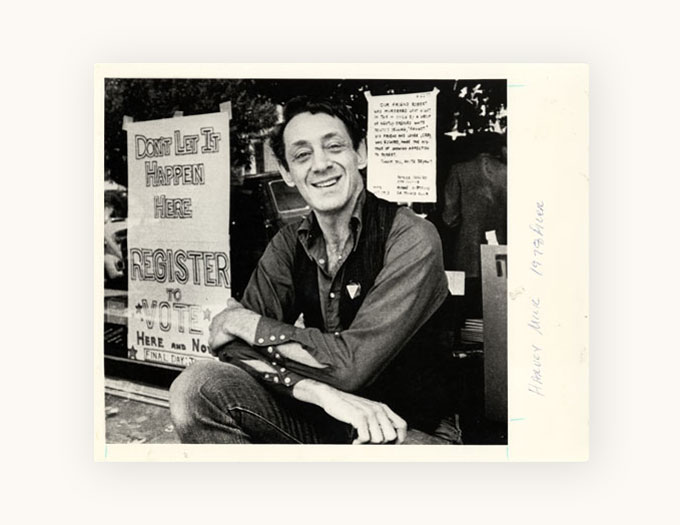
Homosexuality was horrifically criminalized, Milk met teachers who didn't have enough resources to teach their students, and local taxes on small businesses were seen as corrupt.
As he entered activism, community organizing, and politics, Milk became known as a champion of the rights of the LGBTQ+ community, minorities, immigrants, women, and children.
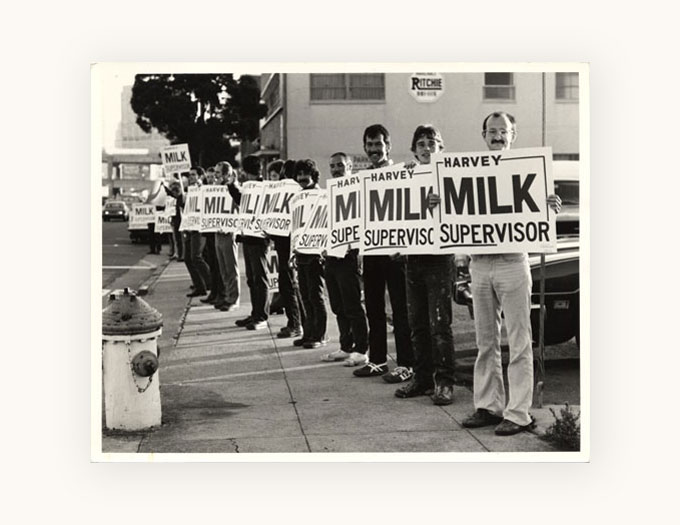
Milk was assassinated in November 1978. He left behind a legacy of activism and care — and has inspired thousands of people worldwide — politicians, activists, and individuals — who have taken steps to fight discrimination against marginalized groups.
We've collected his most meaningful quotes about politics, activism, the LGBTQ+ community, human rights, and hope —
The Best Harvey Milk Quotes From His Time as an Activist & Politician
Famous Harvey Milk Quotes
“Unless you have dialogue, unless you open the walls of dialogue, you can never reach to change people’s opinion.”
— Harvey Milk
“I fully realize that a person who stands for what I stand for, an activist, a gay activist, becomes the target or the potential target for a person who is insecure, terrified, afraid, or very disturbed with themselves.”
— Harvey Milk
“Once you have dialogue starting, you know you can break down prejudice.”
— Harvey Milk
“To sit on the front steps — whether it’s a veranda in a small town or a concrete stoop in a big city — and to talk to our neighborhoods is infinitely more important than to huddle on the living-room lounger and watch a make-believe world in not-quite living color.”
— Harvey Milk
“If a bullet should enter my brain, let that bullet destroy every closet door.”
— Harvey Milk
On Hope
“Hope will never be silent.”
— Harvey Milk
“You have to give them hope. Hope for a better world, hope for a better tomorrow, hope for a better place to come to if the pressures at home are too great. Hope that all will be all right. Without hope, not only are the gays, but the blacks, the seniors, the handicapped, the ‘us-es.’ The ‘us-es’ will give up.”
— Harvey Milk, in his iconic 1978 “Hope Speech”
“Hope is being able to see that there is light despite all of the darkness.”
— Harvey Milk

“If there's a message I have to give, it is that I found one overriding thing about my personal election. It's the fact that if a gay person can be elected, it's a green light. And you and you and you — you have to give people hope.”
— Harvey Milk, in his iconic 1978 “Hope Speech”
“I know that you cannot live on hope alone, but without it, life is not worth living.”
— Harvey Milk
On Human Rights
“It takes no compromise to give people their rights. It takes no money to respect the individual. It takes no survey to remove repressions.”
— Harvey Milk

“All men [people] are created equal. No matter how hard they try, they can never erase those words. That is what America is about.”
— Harvey Milk
“All young people, regardless of sexual orientation or identity, deserve a safe and supportive environment in which to achieve their full potential.”
— Harvey Milk
On Activism
“Rights are won only by those who make their voices heard.”
— Harvey Milk
“I cannot prevent anyone from getting angry, or mad, or frustrated. I can only hope that they’ll turn that anger and frustration and madness into something positive, so that two, three, four, five hundred will step forward, so the gay doctors will come out, the gay lawyers, the gay judges, gay bankers, gay architects I hope that every professional gay will say ‘enough,’ come forward and tell everybody, wear a sign, let the world know. Maybe that will help.”
— Harvey Milk
“If you elect more gay people, that gives a “green light” to all who feel disenfranchised, a green light to move forward. It means hope to a nation that has given up, because if a gay person makes it, then the doors are open to everyone.”
— Harvey Milk
“I finally reached the point where I knew I had to become involved or shut up.”
— Harvey Milk
→ Read more quotes on activism
On Politics
“Politics is theater. It doesn’t matter if you win. You make a statement. You say, I’m here, pay attention to me.”
— Harvey Milk

“If I do a good job, people won’t care if I am green or have three heads.”
— Harvey Milk
“I have never considered myself a candidate. I have always considered myself part of a movement, part of a candidacy. I considered the movement the candidate. I think that there’s a distinction between those who use the movement and those who are part of the movement. I think I was always part of the movement.”
— Harvey Milk
On the LGBTQ+ Community Coming Out
“Freedom is too enormous to be slipped under a closet door.”
— Harvey Milk

“Coming out is the most political thing you can do.”
— Harvey Milk
“We will not win our rights by staying quietly in our closets.”
— Harvey Milk
“I would like to see every gay doctor come out, every gay lawyer, every gay architect come out, stand up, and let that world know. That would do more to end prejudice overnight than anybody would imagine.”
— Harvey Milk
“Burst down those closet doors once and for all, and stand up and start to fight.”
— Harvey Milk
“If every gay person were to come out only to his/her own family, friends, neighbors, and fellow workers, within days the entire state would discover that we are not the stereotypes generally assumed.”
— Harvey Milk
“Gay brothers and sisters… You must come out. Come out… to your parents… I know that it is hard and will hurt them but think about how they will hurt you in the voting booth.”
— Harvey Milk
On Love
“If you are not personally free to be yourself in that most important of all human activities — the expression of love — then life itself loses its meaning.”
— Harvey Milk

“There are people I might have loved had they gotten on the airplane or run down the street after me.”
— Harvey Milk
“Go after her because that’s what you should do if you love someone.”
— Harvey Milk
“Be with her in meaningful ways because that is beautiful and that is generous and that is what loving someone is.”
— Harvey Milk
Other
“We must understand that the quality of life is more important than the standard of living.”
— Harvey Milk
“All over the country, they’re reading about me, and the story doesn’t center on me being gay. It’s just about a gay person who is doing his job.”
— Harvey Milk
“All men are created equal. Now matter how hard they try, they can never erase those words.”
— Harvey Milk
“The American Dream starts with the neighborhoods. If we wish to rebuild our cities, we must first rebuild our neighborhoods.”
— Harvey Milk
“I was born of heterosexual parents. I was taught by heterosexual teachers in a fiercely heterosexual society. Television ads and newspaper ads — fiercely heterosexual. A society that puts down homosexuality. And why am I a homosexual if I’m affected by role models? I should have been a heterosexual. And no offense meant, but if teachers are going to affect you as role models, there’d be a lot of nuns running around the streets today.”
— Harvey Milk
“Once they realize that we are indeed their children, that we are indeed everywhere, every myth, every lie, every innuendo will be destroyed once and for all.”
— Harvey Milk
“Let me have my tax money go for my protection and not for my prosecution. Let my tax money go for the protection of me.”
— Harvey Milk
→ Looking for ideas on how you can celebrate Pride Month? Look no further than our guide.
Dog lovers everywhere will be quick to tell you about how their dog makes the world a better place — or at least makes their home a better place. But science backs up the bark: affection from dogs really is medicinal.
A study published in March of 2022 reported that participants involved in an emergency room study reported decreased pain after experiencing 10 minutes of care with a therapy dog.
But what if the dog that provided affection to those who experience pain, illness, or discomfort could also support patients financially?
The Doug the Pug Foundation is a nonprofit developed by famous social media star Doug The Pug (well, by Doug’s parents, Leslie Mosier and Rob Chianelli) to bring joy and needed support outside of treatment to children battling cancer and other life-threatening illnesses.
You might also like: Meet the Top Pet Influencers Using Their Platforms For Good
Who is Doug The Pug?
Doug The Pug is a social media sensation with over 18 million followers across the Internet. Based in Nashville, the potato-shaped prince of pop culture has won a People’s Choice Award, been featured in music videos and animated films, and posts daily photos and videos from his puggy perspective.
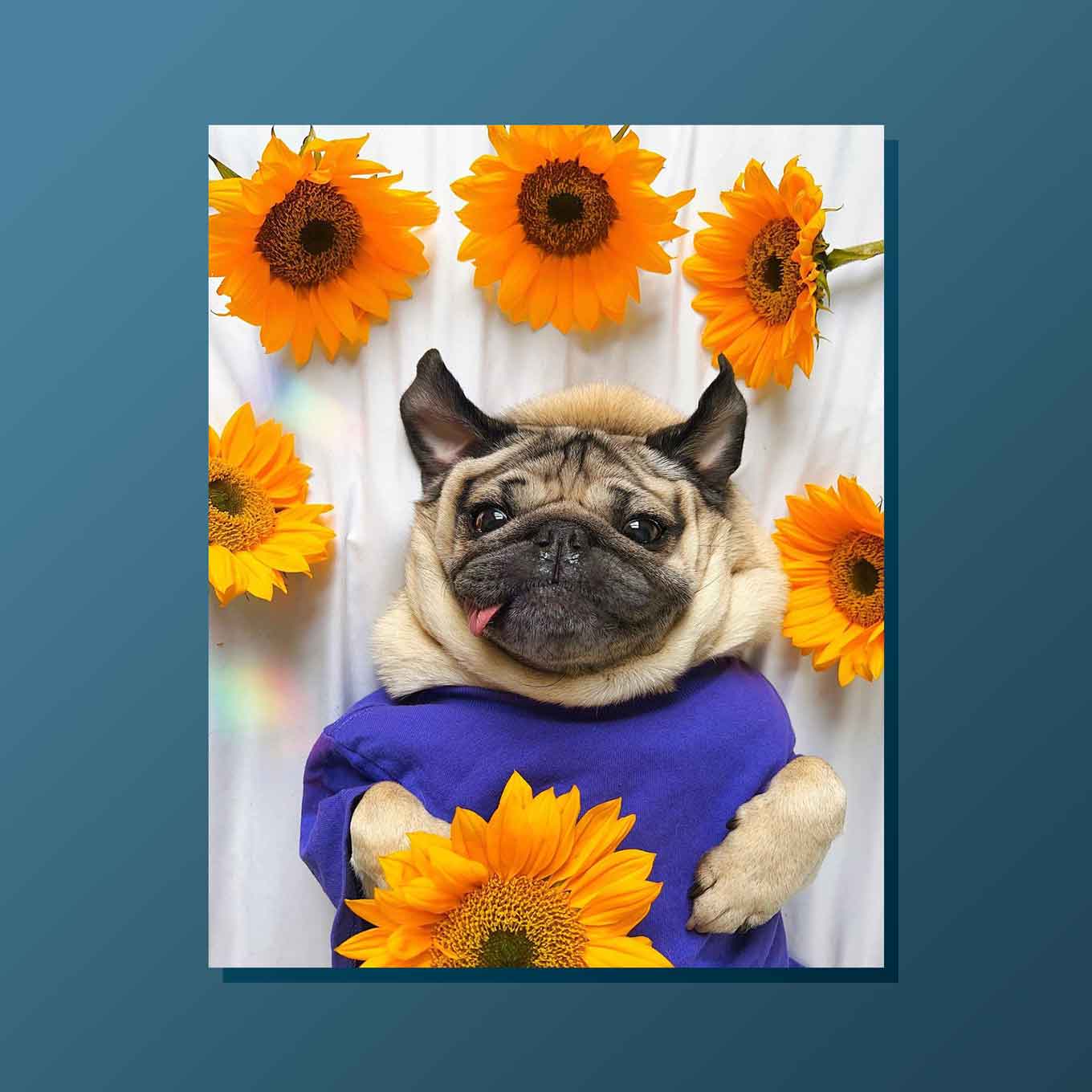
Doug’s digital presence was born out of his “momager” — Mosier’s — tendency to post cute photos of him for her friends and family to see. When she realized he was a natural in front of the camera, she got more creative, and their content went viral.
Since then, the Doug The Pug brand has been built on the idea of spreading joy and kindness to all, and now, to support children and families facing cancer and life-threatening illness.
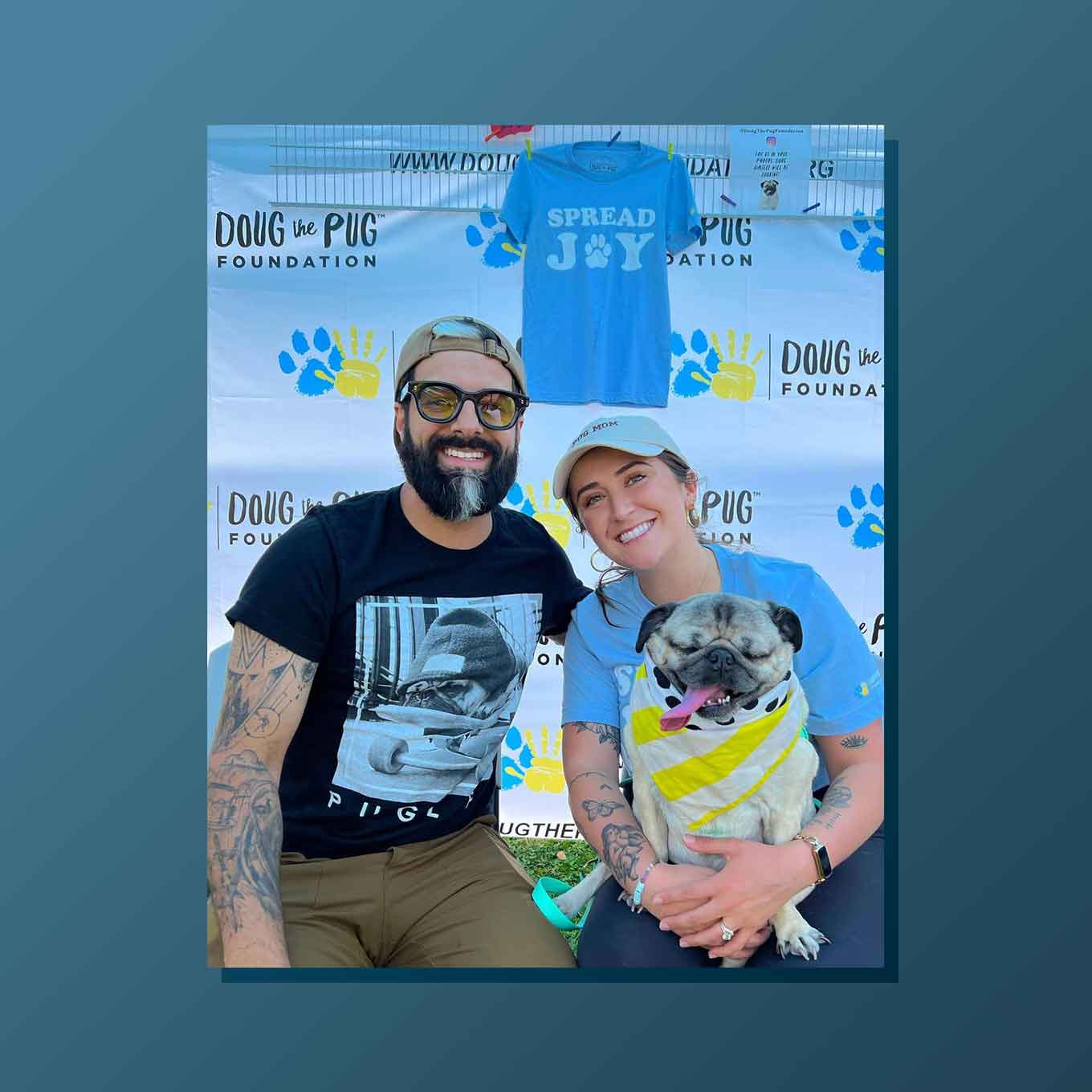
“There was definitely that factor that we were in the right place and the right time with going viral, but turning it into a brand is a lot of work,” Mosier said.
“We really aim to let Doug just be as much of a dog as possible, but to him, it’s not even work because he’s just having fun, going to the park, being in front of our green screen. It’s all about the connection you have with your pet.”
Meet the Doug The Pug Foundation
When Doug the Pug’s following began to rise, Mosier said she started receiving messages about his impact. Some were from folks who lost their pets and processed their grief with Doug’s content, while another was from a boy who said he watched Doug’s videos when he was getting chemotherapy treatments.
Soon, Mosier and Chianelli took Doug to visit the local Vanderbilt Children’s Hospital with Seacrest Studios, which brings creative media opportunities to children staying in the hospital, like singing along with musicians, producing a show — or visiting with their favorite social media super-dog.
Instantly, Leslie noticed Doug’s influence.
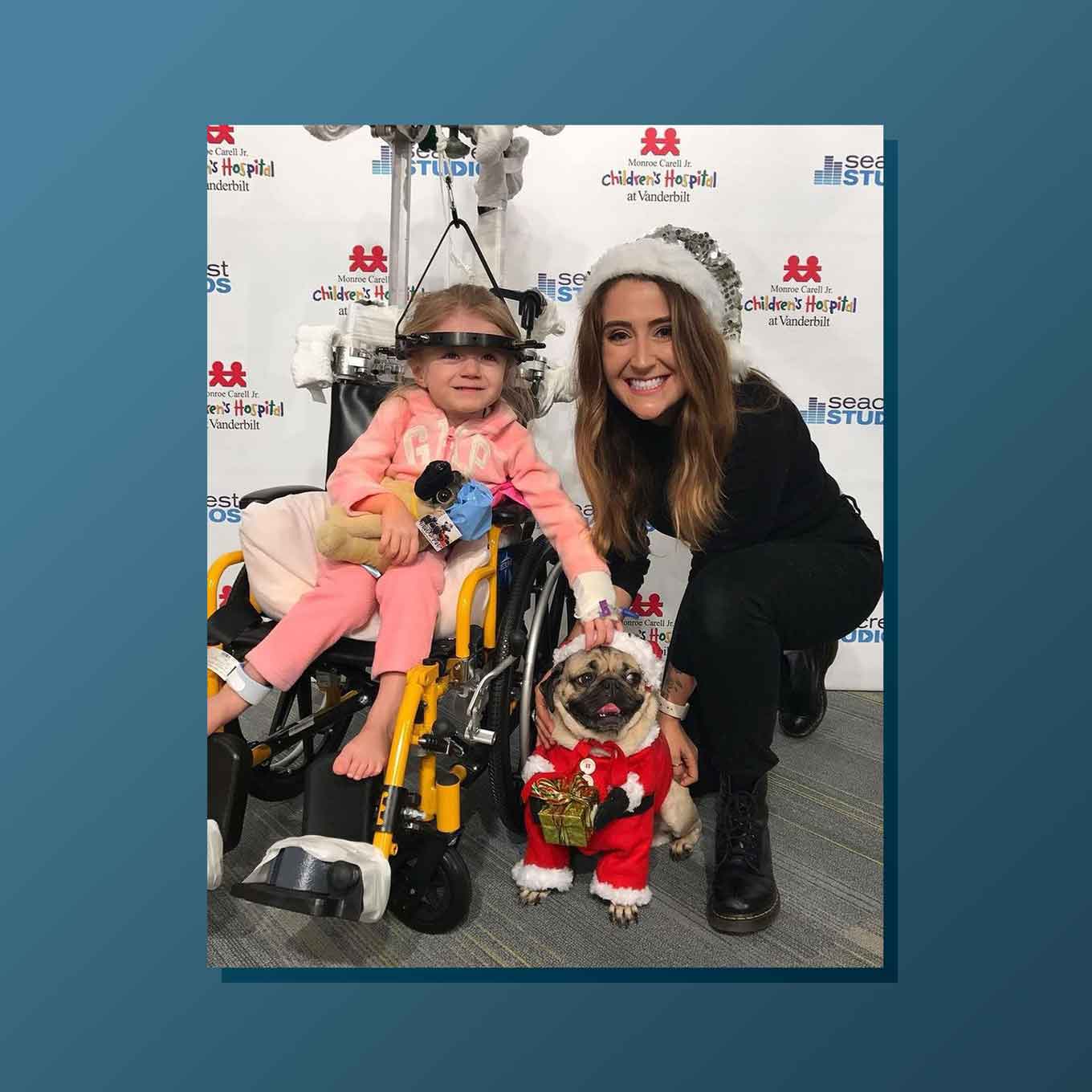
“From the very first time we were there, it was like, ‘oh, this is why we’re doing what we’re doing,’” she said. “It’s so much more than social media. Doug has this very beautiful quality of knowing who needs the most love.”
It was then that the idea of a charitable foundation began to take form. Years later, The Doug The Pug Foundation serves children and families through generous donations and partnerships with organizations like St. Jude Children's Research Hospital, Make-A-Wish Foundation, and Sing Me A Story.
The Doug The Pug Foundation serves families through hospital visits, helping families in need, and spreading joy and hope. Submissions from families or loved ones help determine who gets financial support from the foundation, which aims to provide relief to families outside of direct hospital treatment.
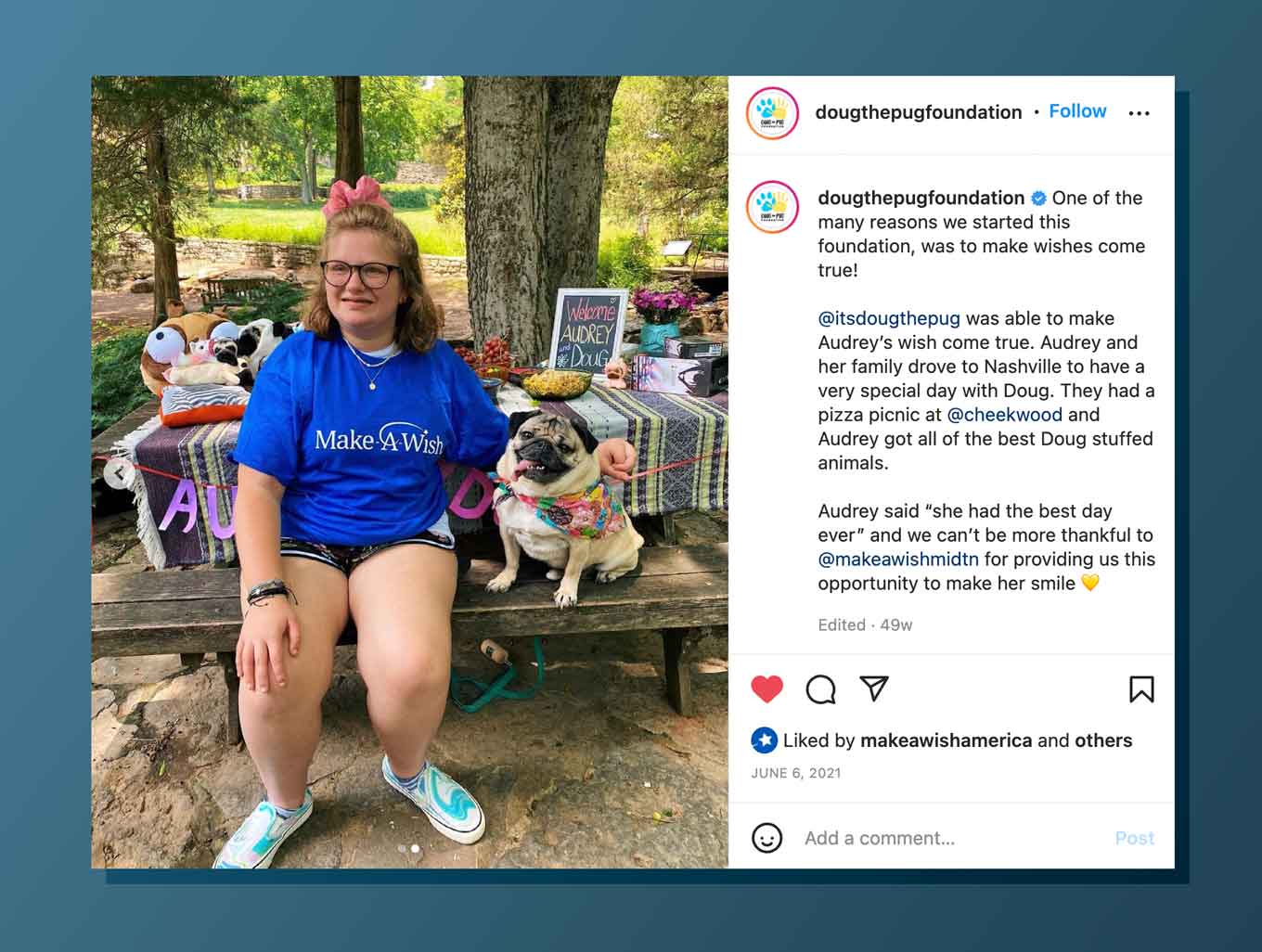
“We are able to use the funds we’ve raised to directly go to these families for expenses we don’t always think about,” Mosier said.
“For example, one of the recipients’ parents had to quit their jobs and get a second home near the hospital, which was hours away. It was a massive financial strain, so we were able to help them in whatever way they needed.”
Donations also support families in happiness and healing by using the funds to go on a trip to Disney World, or buy items that bring comfort during these difficult times.
“That’s just as important as paying the bills,” Mosier said.
Doug the Pug’s Impact
As part of bringing joy and healing to families and children impacted by cancer, the Doug the Pug team and supporters will send “Pug Love” packages to children in hospitals, has helped tell a young girl’s story through songwriting, and made a young girl’s dream of meeting Doug come true.
The first recipient of money from the Doug The Pug Foundation was a girl named Azaelea, whose family received over $15,000 fundraised by the foundation. Although Azaela lost her battle with cancer, the support her family received from the foundation made a world of difference.
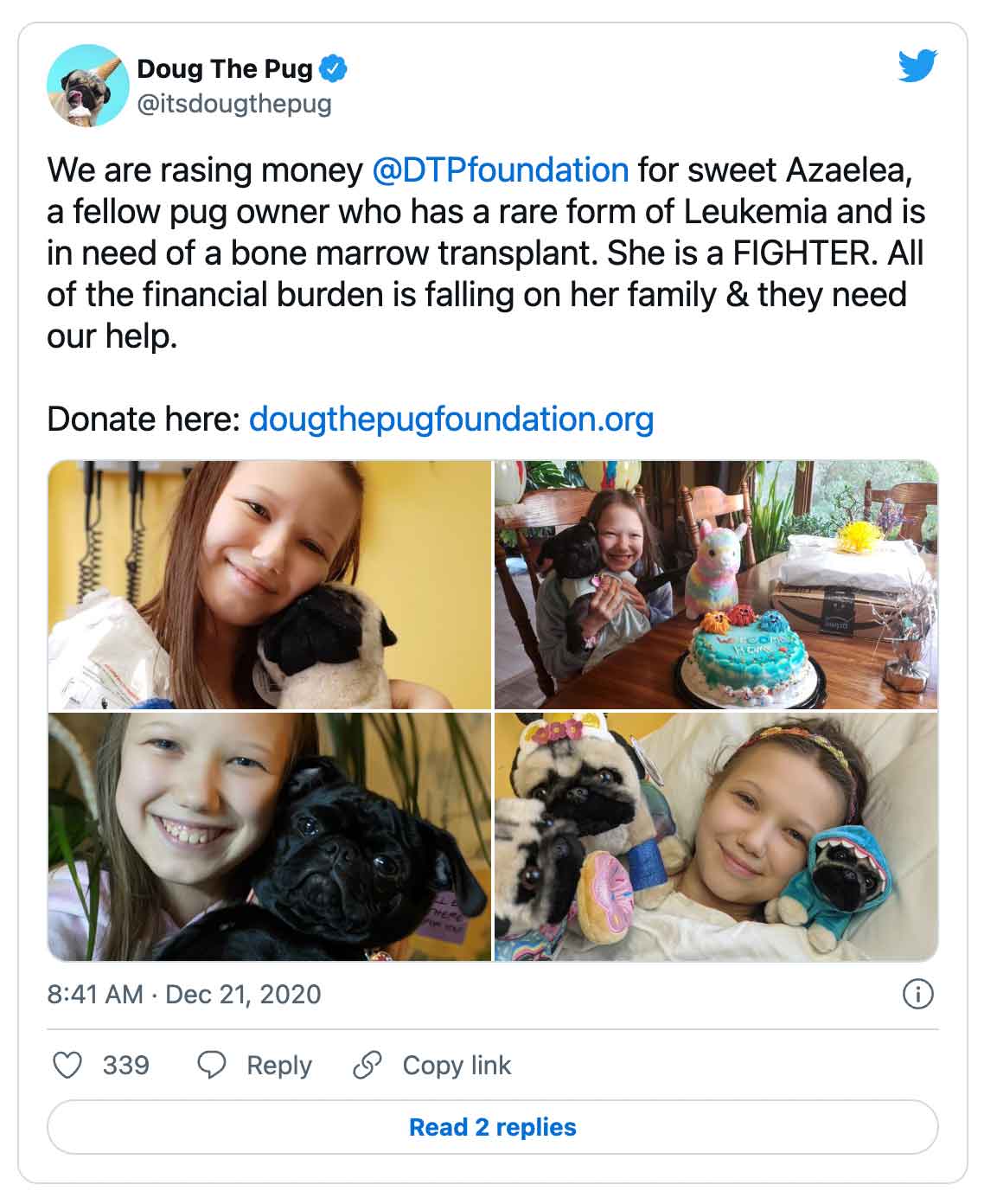
“I cannot properly express how meaningful this relationship was for Azaelea,” her mother, Jessica Bleichner, wrote on Facebook. “Azaelea’s last Christmas and long hospital stay were made so much better with the grant we received. It gave us the financial wiggle room to say yes to many things our girl wanted or needed.”
Mosier said that everything the foundation does now is to honor Azaelea, breathing her legacy into the work that uplifts and supports all other families like hers.
Mosier has encountered a number of parents who are grateful for the support Doug and his foundation have brought to their children.
“This one parent in Nashville came up to us after a hospital visit, and she said: ‘That's the first time I've seen my son smile in three months,’” Mosier said. “It’s one thing to see Doug's cute videos and photos, but to actually meet him, he knows who to go up to, who needs that joy.”
What Dogs Can Teach Us About Hope and Healing
The foundation’s impact has ripple effects and is especially important to Mosier, who has struggled with endometriosis for nearly a decade and found Doug to be an integral part of her healing.
“We need our brains to be operating on a low-stress level to heal in any sort of capacity,” Mosier said. “Seeing Doug with those children, I think there are these moments where we can focus on something good, and it’s all about joy. I’ll look at Doug and realize I just need to be like him. He’s just living life to live life, and that’s how it should be.”
"Seeing Doug with those children, I think there are these moments where we can focus on something good, and it's all about joy."
Mosier said she has learned a number of lessons from Doug and believes his penchant for joy can be a catalyst for his followers everywhere.
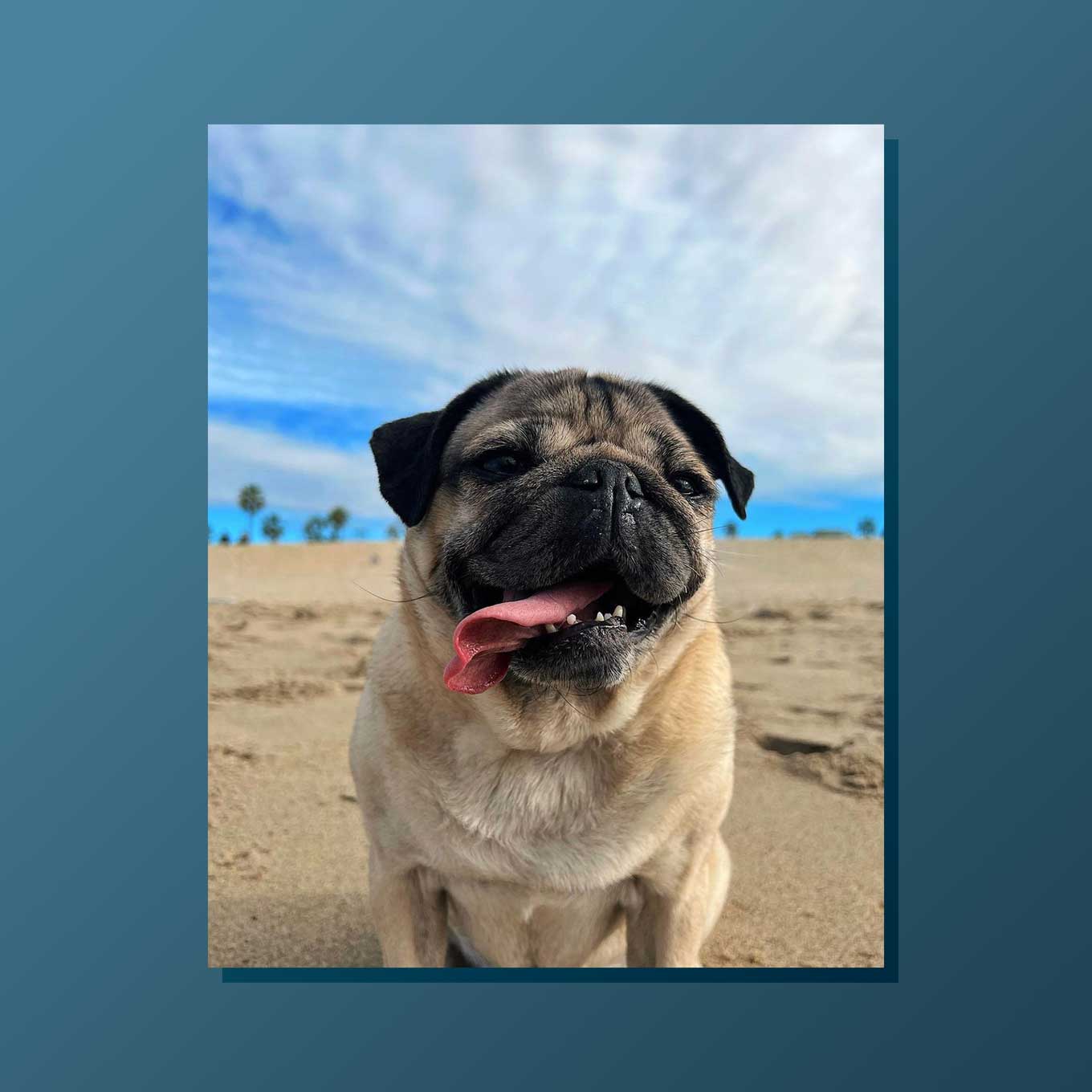
“I think animals teach us a really beautiful lesson to love everybody and every creature,” Mosier said. “When I need to see good, I will spend time with animals, because there is no ego, nothing external.”
She hopes that just like Doug can snuggle up to a child who needs the most love, others can sit with someone new at a lunch table, or extend a hand to a neighbor in need.
“There is always going to be a dark side of the Internet, and we all have the power to be the good side of the Internet,” Mosier said. “And Doug has really brought that out in us.”
You might also like these stories about pets:
- The Best Good News About Animals
- The Best Good News About Dogs
- WeRateDogs Raises Millions For Pets
- Marley's Mutts Prison Program Helps Dogs and People Who Are Incarcerated
You might also like these articles about cancer:
A version of this article was originally published in The Animals Edition of the Goodnewspaper.
Get your own Goodnewspaper by becoming a good news subscriber today.
It can be tough to stay positive sometimes. The news is full of depressing stories, and it seems like every day there's something new to worry about.
Plus, now that podcasting has exploded in popularity in recent years, we get to fill our ears with more bad news via our favorite daily news podcasts. Yay! (#sarcasm)
But don't worry, we've got some good news! Thoughtful, talented podcasters have worked to create the antithesis to the doom and gloom of the news — by highlighting positive things happening in the world.
We listened to dozens and dozens of episodes and compiled the best good news podcasts for you to subscribe to.
(This article includes Good Good Good partners, which means they may have paid a fee to be featured. All partners have been vetted and are podcasts we honestly recommend.)
These shows will remind you that there is still good in the world, and that we can make a difference if we work together.
So sit back, relax, and let these amazing podcasts inspire you to make a difference!
The Best Positive News Podcasts
The Good News Podcast

Apple Podcasts | Spotify | Website
The team at Cards Against Humanity made headlines when they announced that they’d be pivoting from just making best-selling card games to also making a good news podcast: The Good News Podcast.
(The company loves to do unconventional things with their stockpiles of cash, like buying land to stop Trump from building his border wall, raising $70,000 for the Wikimedia Foundation, or buying an island in Maine, making it publicly accessible, and naming it Hawaii 2 — to ensure rich people couldn’t build a house on it.)
The Good News Podcast is less wild and random than its parent company — and simply drops three episodes per week, at roughly 3 minutes long, each featuring one piece of good news.
Goodniks

Apple Podcasts | Spotify | Website
The trailer for Goodniks begins with an incredibly relatable statement: “We all want to do good in the world. Nearly all of us, at one time or another, imagined ourselves doing something noble or heroic. But most of us get derailed by life, by our careers, by our families.”
The podcast is an audio project exploring the meaning and journey of doing good in the world, interviewing 10 people (in 20-minute episodes) about how they ended up making a difference, in unique and compelling ways.
Whether you think of yourself as someone who does good — or you simply want to explore what it could mean for you to make a difference with the rest of your life, or simply for a season — this podcast is for you.
Sounds Good

Apple Podcasts | Spotify | Website
Since 2017, the team at Good Good Good has hosted hopeful conversations with optimists and world-changers about the great headlines we can be hopeful about — and, of course, how you can get involved and make a difference.
Each episode, featuring an activist, nonprofit founder, influencer, or creator, is centered around what it means to use your time and energy to make a meaningful impact, in a way that’s unique to you.
Episodes are evergreen, and the archives are full of inspiring stories to leave you feeling hopeful.
Squirrel News

Apple Podcasts | Spotify | Website
We mentioned Squirrel News as one of our favorite good news apps and we’d be remiss not to include their fantastic podcast in our podcasts roundup.
In the intro to the show, the hosts joke that it’s “the first and only show where a Jew in Los Angeles and a German in Berlin come together to solve the world’s problems.”
Each episode of their podcast elevates one story of a person or organization working to create a solution to a problem in the world — and the hosts and their guests discuss it through the lens of constructive solutions journalism.
Editor's note: A few months after publishing this article, Squirrel News invited our founder, Branden Harvey, to be a guest on their show to talk about the difference between 'real good' news and 'feel good' news and the founding of the Goodnewspaper. You can listen to the episode now.
The Joy Report

Apple Podcasts | Spotify | Website
If you care about the environment (and if you’re on our site, you probably do), it can be really easy to experience a sense of climate doom any time you read the news.
But the reality is, there truly is a lot of positive climate change news — you just have to know where to look. And once we’ve consumed a bit of climate optimism, it can help reignite our ability to take action and be a part of the solution.
The Joy Report is a podcast dedicated to sharing stories about climate solutions and environmental justice grounded in optimism through the lens of intersectional environmentalism.
“Movements fueled by joy are so much more sustainable than those that are propelled by fear, dread, and doom,” says host Arielle King. “And that’s why we’ve created The Joy Report, a fact-based and awareness-driven podcast aimed at keeping you informed on the stories you should know in the world of environmental and climate justice.”
That’s Cool News

This weekly podcast brings you positive news, but unlike other shows on this list, That’s Cool News is focused on one topic: STEM.
Host Adam Buckingham highlights major breakthroughs in the fields of science, technology, engineering, and math — and breaks down how these innovations are going to make the world a better place.
While the episode dives deep into tech, you don’t have to be “techy” to listen. Adam does a fantastic job making each episode accessible and interesting — and will leave you feeling optimistic.
The Optimist Daily Update

The Optimist Daily is another one of the top good news websites sharing positivity on the internet. Their delightful podcast features the top positive news of the day, every day.
The show’s co-hosts, Summers McKay and Kristy Janson, each bring their favorite good news stories to the episode, and then playfully discuss them.
Happy Headlines

Every single day, host David Beach releases an optimistic, two-minute episode, highlighting a happy headline you should know about.
Each episode ends with an encouragement to not only feel good, but to also do good: “Stay happy, stay healthy, and find a way… to make someone’s day.”
Good News Good Planet

This short, simple podcast delivers one new positive news story to your podcast feed each week.
Describing their show on their website, creators Mandy Stapleford and Gina Gargone say, “We deliver effective ‘short shots’ of apolitical, non-religious good news from around the world.”
The Daily Good

Apple Podcasts | Spotify | Website
Each episode of The Daily Good begins with a warm welcome from the host, followed by an encouragement to settle into good news by taking a deep breath. He then calmly, yet positively, walks through the best positive news of the day.
Episodes also feature other segments which highlight inspirational quotes, delightful music, fascinating facts, and other positive ideas.
More Notable Mentions

We wanted to be able to include a few more positive news podcasts worth highlighting in this roundup:
- Have You Heard The Good News? — This conversational podcast between two friends dives into their lives and the good news stories that they find interesting.
- The Newsworthy — While this daily news podcast, is focused on all kinds of news — every Friday, host Erica Mandy shares good news as a part of her “Feel Good Friday.”
- The Positive Truth — There’s no shortage of positive news on this podcast and it is a great fit for those who don’t mind the lower audio quality (which will surely improve over time!).
- Squabbit — This podcast doesn’t come out as consistently as it once did, but it’s still filled with positive news!
- The Happy Broadcast — This weekly show is one of our favorite happy news podcasts. It hasn’t aired a new episode since 2021, but its archives are filled with a whole lot of anxiety-free news.
Do you have a favorite good news podcast we missed? As always, reach out to let us know! We love hearing from you.
You might also like:
On Saturday in Buffalo, New York, a gunman targeted a grocery store in a predominantly Black neighborhood. He opened fire in the parking lot before proceeding inside the grocery store, killing 10 people and injuring three others. Eleven of the 13 victims were Black, and they were grandparents, fathers, sisters, friends, deacons, and all important members of their community.
The gunman was dressed in Army attire, and livestreamed the shooting on Twitch. In his manifesto, the gunman specifically referred to himself as a white supremacist and cited a popular racist conspiracy theory called “Great Replacement Theory” — leaving no doubt that this act of terrorism was fueled by hate, racism, and white supremacy.
Not only is this latest mass shooting (among others known to have occurred over the weekend) a grim reminder of the ongoing, pervasive threat of gun violence everywhere in the U.S., it’s removed an important food source and inflicted unnecessary trauma on an entire community of people.
As we process this heartbreaking news from near and far, we can all be a part of helping this community grieve and heal.
How you can help support the Buffalo community as they grieve, heal, and recover
Donate food to The Buffalo Community Fridge
Tops, the grocery store where the shooting took place, is one of only a few grocery stores in the neighborhood, and the only one within walking distance. The grocery store will be closed indefinitely, and while mutual aid and ride shares are helping, access to healthy, affordable food is no longer accessible for many in the community.
Many parts of Buffalo were already considered food deserts, and this closure compounds the problem.
Community members are encouraging donations to The Buffalo Community Fridge — a free fridge that plans to meet the needs of those affected by the decreased access to food.
They’re currently accepting food donations, but have said they’ve already received enough monetary donations and are no longer accepting non-food donations.
They currently have volunteers at 257 East Ferry Street helping to bag, distribute, stock, and clean the fridge — and offer support to their community.
Donate food, if you live nearby
Donate to local food access organizations
In a May 15th statement on Instagram, The Buffalo Community Fridge said, “We are no longer accepting monetary donations. We are sending an enormous thank you to our community. We will be re-distributing additional funds to our fridge network, The Rooted In Love Fridge, and other community organizations in need right now.”
They recommend donating to the following organizations and mutual aid funds:
Rooted In Love works to alleviate homelessness and support those who are underprivileged in the Western New York area by providing access to fresh produce and hygiene products free of charge.
Feed Buffalo is a Black women-led organization that heals, educates, and transforms food deserts into thriving communities by providing access to free locally-sourced, healthy, and halal food in a loving, judgment-free community space.
Feed More WNY provides nutritious food, friendship, and skills training and believes that solving hunger is intertwined with the struggle against poverty, injustice, and hopelessness, too. They hope to see a day when food access and equity are recognized as human rights.
Donate to organizations working towards racial justice in Buffalo
This shooting was, heartbreakingly, racially motivated and rooted in white supremacy. Racism needs to be completely uprooted from our cultures, systems, and minds — and we must implement justice in response to our country's years of racial oppression.
You can play a role in creating long-term justice and equity in Buffalo and beyond by donating to Black Love Resists in the Rust.
Black Love Resists in the Rust envisions “a Buffalo where communities are sustainable and have what they need to thrive without external assistance.” They do this through “embodied leadership, healing justice, political education, and transformational organizing.”
Your donations can help their long-term efforts. They’re also working, in the short-term, to compile a list of mental health professionals to provide more therapy appointments, offer support groups, and more.
Donate to Black Love Resists in the Rust
Donate to verified GoFundMe campaigns
A number of people and groups have organized GoFundMe campaigns to raise funds for those affected by the horrific shooting in Buffalo.
GoFundMe curated the top fundraising campaigns and verified them with their Trust & Safety specialists. GoFundMe has a “GoFundMe Guarantee” that ensures you can have the option of a full refund for up to a year if it turns out that a campaign wasn’t trustworthy or something wasn’t right.
These campaigns will directly support the victims of the shooting, their loved ones, and funeral costs.
Call your elected officials and demand they act to prevent future mass shootings
Though the gunman in Buffalo exhibited a number of “extreme risk” warning signs prior to carrying out this attack, the U.S. doesn’t have good systems in place for law enforcement, mental health professionals, or other authorities to intervene. And needless to say, our gun safety laws are extremely weak, and remain unchanged despite attacks like these.
And while gun lobbyists spend a lot of time and money getting politicians to not act on gun safety measures, gun safety and common sense laws are extremely effective and have strong bipartisan support.
Contact your local, state, and federal elected officials, share your concerns, and ask them to enact proven, popular solutions to prevent mass shootings: secure storage laws, extreme risk laws, and universal background checks.
(We previously created a resource on how to help stop school shootings. While this wasn’t a school shooting, the guide may also be also helpful in this situation.)
Donate to mental health nonprofits
Loved ones of the victims of the shooting and members of the Buffalo community are grieving right now and should have the option to receive mental health support.
A local dealership, West Herr Automotive Group, has committed to giving $300,000 for grief counseling and other services for the relatives of the victims who lost their lives.
Black Love Resists in the Rust partnered with Colored Girls Bike Too to create a mental health support fund to pay for ongoing mental health services needed in the community.
You can make a donation to a nonprofit mental health organization of your choice to ensure that mental health care is accessible to all, no matter the crisis, and no matter the location. Your donation can make a significant difference in the wake of future tragedies.
Explore general mental health organizations to donate to
Explore Black mental health resources to donate to
Fred Rogers once said: When I was a boy and I would see scary things in the news, my mother would say to me, “Look for the helpers. You will always find people who are helping.”
It's clear that, in the midst of this tragedy, Buffalo is filled with countless Helpers. Those of us outside of Buffalo can learn from and be inspired by these Helpers — and we can join in and become Helpers ourselves by supporting them.
You might also like:
— The Best Gun Violence Quotes To Inspire Change
— How the Hope Created By the Parkland Shooting Activists Lives On
So, you're seeking out positive quotes... We've got your back.
Sometimes, we all just need some uplifting words to carry us through a challenging moment — or to share in the hopes of helping someone else.
As experts on positive news, our team is constantly collecting the best quotes that remind us that the world is filled with goodness, and we can each play a role in making people's lives better. Today, we're sharing our quote collection with you.
As you read these quotes (which are divided up into easy sections) we hope you feel more hopeful — and that you also feel motivated to get involved and make a positive difference.
Scroll through, find some quotes that mean a lot to you, and don't be afraid to click on some of the links to our other curated quote articles.
Lastly, if you're wondering if things are going to be okay — rest assured that they will be.
Enjoy our roundup of the best positive quotes to leave you feeling more hopeful —
Positive Inspirational Quotes
Short Positive Quotes
“There is always light. If only we’re brave enough to see it. If only we’re brave enough to be it.”
— Amanda Gorman
“If you want the rainbow, you have to put up with the rain.”
― Dolly Parton
“Those who say it can’t be done are usually interrupted by others doing it.”
— James Baldwin
“Do your little bit of good where you are; it is those little bits of good put together that overwhelm the world.”
— Archbishop Desmond Tutu
“If it doesn't make the world better, don't do it.”
— Brad Montague
“When I was a boy and I would see scary things in the news, my mother would say to me, 'Look for the helpers. You will always find people who are helping.'”
— Fred Rogers
“We need joy as we need air. We need love as we need water. We need each other as we need the earth we share.”
— Dr. Maya Angelou
→ Read more short quotes
→ Read more quotes about caring
Quotes About Being Hopeful
“I do have reasons for hope: our clever brains, the resilience of nature, the indomitable human spirit, and above all, the commitment of young people when they’re empowered to take action.”
— Jane Goodall

“To be optimistic is to assume things will work out. To be hopeful is to realize things can work out if you work at them. Hope requires responsibility and agency; optimism relieves us of both. In rooting for your sports team, choose optimism. In rooting for democracy, choose hope.”
— Eric Liu
“Hope confronts. It does not ignore pain, agony, or injustice. It is not a saccharine optimism that refuses to see, face, or grapple with the wretchedness of reality. You can't have hope without despair, because hope is a response. Hope is the active conviction that despair will never have the last word.”
— Cory Booker
“The best way to not feel hopeless is to get up and do something. Don’t wait for good things to happen to you. If you go out and make some good things happen, you will fill the world with hope, you will fill yourself with hope.”
— Barack Obama
“Hope will never be silent.”
— Harvey Milk
“Being truthful about the state of our nation and world does not equal losing hope. Hope sees truth and still believes in better. That which dismisses or does not seek truth, but grins, saying ‘It will be okay,’ is naivete, not hope.”
— Bernice King
“Do not get lost in a sea of despair. Be hopeful, be optimistic. Our struggle is not the struggle of a day, a week, a month, or a year, it is the struggle of a lifetime. Never, ever be afraid to make some noise and get in good trouble, necessary trouble.”
— John Lewis
“Food, in essence, gives you hope that maybe tomorrow will be better. That’s why a plate of food is so important in those moments.”
— Chef José Andrés
“The world may be broken, but hope is not crazy.”
— John Green
→ Read more quotes about hope
→ Read more quotes about optimism
Happy Positive Quotes
“If you see someone without a smile today, give 'em yours.”
— Dolly Parton
“There is one thought that I feel can be helpful to grown-ups and children alike: Sadness isn’t forever. I’m not suggesting that we remind ourselves of this in order to lessen our grief. On the contrary. The knowledge that time does bring relief from sadness and that sooner or later there will be days when we are happy again may allow us to grieve more fully and deeply when we need to.”
— Fred Rogers
“Happiness is anyone and anything that’s loved by you.”
— Charles Schulz, creator of Peanuts
“Think of all the beauty still left around you and be happy.”
— Anne Frank
“Let us be grateful to the people who make us happy; they are the charming gardeners who make our souls blossom.”
— Marcel Proust
“Earlier in my life, I thought the things that mattered were the things that you could see, like your car, your house, your wealth, your property, your office. But as I've grown older I've become convinced that the things that matter most are the things that you can't see — the love you share with others, your inner purpose, your comfort with who you are.”
— Jimmy Carter
→ Read quotes about toxic positivity, to help maintain a healthy approach to hopefulness
Positive Motivational Quotes
“We can't just hope for a brighter day, we have to work for a brighter day. Love too often gets buried in a world of hurt and fear. And we have to work to dig it out so we can share it with our family, our friends, and our neighbors.”
— Dolly Parton

“You know you can always help to make each day a special day by just your being yourself. You grow in your own way; everyone does. That’s one reason each one of us is different and special and people can like us exactly as we are.”
— Fred Rogers
“Sometimes we face potential failure, and we have to remember to try anyway to find a way to reach our goal. We can overcome many global problems and build a better world if we all work together as a community”
— Jimmy Carter
“Inhale, exhale, it is well, it is well. All of this is a part of the story you will tell.”
— Morgan Harper Nichols
“You ask me about the past, you ask me about the future, the only way to be happy is to be living right now.”
— Yvon Chouinard
→ Read more humanitarian quotes from humanitarians
Positive Quotes About Life
“A joyful rebellion is you living differently not because you’re mad at how things are but because you are swelling with joy at the thought of how things could be.”
— Kid President
“Whenever you see darkness, there is extraordinary opportunity for the light to burn brighter.”
— Bono
“Humanity is good. Some people are terrible and broken, but humanity is good. I believe that.”
― Hank Green
“Don’t compare your beginning to someone else’s middle.”
— Jon Acuff
“Misery might love company, but so does joy. And joy throws much better parties.”
— Billy Ivey
“Learn from yesterday, live for today, hope for tomorrow. The important thing is not to stop questioning.”
— Albert Einstein
“Failure is an important part of your growth and developing resilience. Don’t be afraid to fail.”
— Michelle Obama
→ Read more quotes about peace
Positive Quotes For Women
“People are not sitting down, people are taking action. And women are at the forefront of these actions.”
— Joan Carling

“If you see something beautiful in someone speak it.”
— Ruthie Lindsey
“I still believe that women should get paid equal and should be treated with respect. I’m all about that. I don’t get out and have to preach it or march in the streets, I write about it.”
— Dolly Parton
→ Read quotes to empower women
→ Read Women’s History Month quotes and International Women’s Day quotes
Body Positive Quotes
“Since I don’t look like every other girl, it takes a while to be okay with that. To be different. But different is good.”
— Serena Williams

“To love yourself as you are is a miracle, and to seek yourself is to have found yourself, for now. And now is all we have, and love is who we are.”
— Anne Lamott
“To be beautiful means to be yourself. You don’t need to be accepted by others. You need to accept yourself.”
— Thich Nhat Hanh

“Each individual woman’s body demands to be accepted on its own terms.”
— Gloria Steinem
“I realize everybody wants what they don’t have. But at the end of the day, what you have inside is much more beautiful than what’s on the outside.”
— Selena Gomez
“You all can judge my body all you want, but at the end of the day it’s MY body. I love it and I’m comfortable in my own skin.”
— Simone Biles
→ Read the best quotes about self care
Positive Quotes About Change
“Change is made of choices, and choices are made of character.”
— Amanda Gorman
“I cannot prevent anyone from getting angry, or mad, or frustrated. I can only hope that they’ll turn that anger and frustration and madness into something positive.”
— Harvey Milk
“We are imperfect creatures. We are; that's what it is. But we should try reaching for the better you, the better me.”
— Sidney Poitier
“We change, and the world changes. Have trust in what you can do. Have trust in how fast we can change our world for the better.”
— Yoko Ono
“Progress is impossible without change, and those who cannot change their minds cannot change anything.”
— George Bernard Shaw
“History isn’t something you look back at and say it was inevitable, it happens because people make decisions that are sometimes very impulsive and of the moment, but those moments are cumulative realities.”
— Marsha P. Johnson
“I can't change the world but I can change the world in me.”
— Bono
“Never doubt that a small group of thoughtful, committed citizens can change the world. Indeed, it’s the only thing that ever has.”
— Margaret Mead
→ Read the best quotes about change
→ Read more quotes about justice and quotes about social justice
Staying Positive Quotes
“Just for the record darling, not all positive change feels positive in the beginning.”
— S.C. Lourie

“Stay positive and happy. Work hard and don’t give up. Be open to criticism and keep learning. Surround yourself with happy, warm, and genuine people.”
— Tena Desae
“We can choose to be hopeful, try and possibly fail or not be hopeful, give up and definitely fail.”
— David Hogg
“Optimism is a happiness magnet. If you stay positive, good things and good people will be drawn to you.”
— Mary Lou Retton
→ Read more quotes about optimism and quotes about hope
Love Quotes
“Love is at the root of everything. All learning. All parenting. All relationships. Love, or the lack of it.”
— Fred Rogers

“To love one another just may be the fight of our lives.”
— Amanda Gorman
“We are made for loving. If we don’t love, we will be like plants without water.”
— Sidney Poitier
“Living our life deeply and with happiness, having time to care for our loved ones — this is another kind of success, another kind of power, and it is much more important.”
— Thich Nhat Hanh
Positive Mental Health Quotes
“Life hurts and it’s hard. Not because you’re doing it wrong, but because it hurts for everybody. Don’t avoid the pain. You need it. It’s meant for you.”
— Glennon Doyle

“The advice I’d give to somebody that’s silently struggling is — You don’t have to live that way. You don’t have to struggle in silence. You can be un-silent. You can live well with a mental health condition, as long as you open up to somebody about it, because it’s really important you share your experience with people so that you can get the help that you need.”
— Demi Lovato
“There is hope, even when your brain tells you there isn’t.”
— John Green

“Mental health problems don’t define who you are. They are something you experience. You walk in the rain and you feel the rain, but you are not the rain.”
— Matt Haig
“We don’t have to do all of it alone. We were never meant to.”
— Brené Brown
→ Read more quotes about mental health
→ Read more quotes about depression and suicide
Positive Spiritual Quotes
“A single individual is enough for hope to exist. And that individual can be you.”
— Pope Francis

“If I am hungry, that is a material problem; if someone else is hungry, that is a spiritual problem.”
— Paul Farmer
“Yes, you must live life beautifully and not allow the spirit of the world that makes gods out of power, riches, and pleasure make you forget that you have been created for greater things: to love and to be loved.”
— Mother Teresa
Quotes About Positive News
“Everyone has inside of him a piece of good news. The good news is that you don't know how great you can be! How much you can love! What you can accomplish! And what your potential is!”
— Anne Frank

“The good news is that every morning we have the choice; not to be controlled by circumstances nor our past but by purposely designing our day, hence our lives better. Not to react to life but to respond with love.”
— Bernard Kelvin Clive
“It's good to remember that in crises, natural crises, human beings forget for awhile their ignorances, their biases, their prejudices. For a little while, neighbors help neighbors and strangers help strangers.”
— Dr. Maya Angelou
→ Read more quotes about good news and quotes about bad news
Quotes About Making a Positive Difference
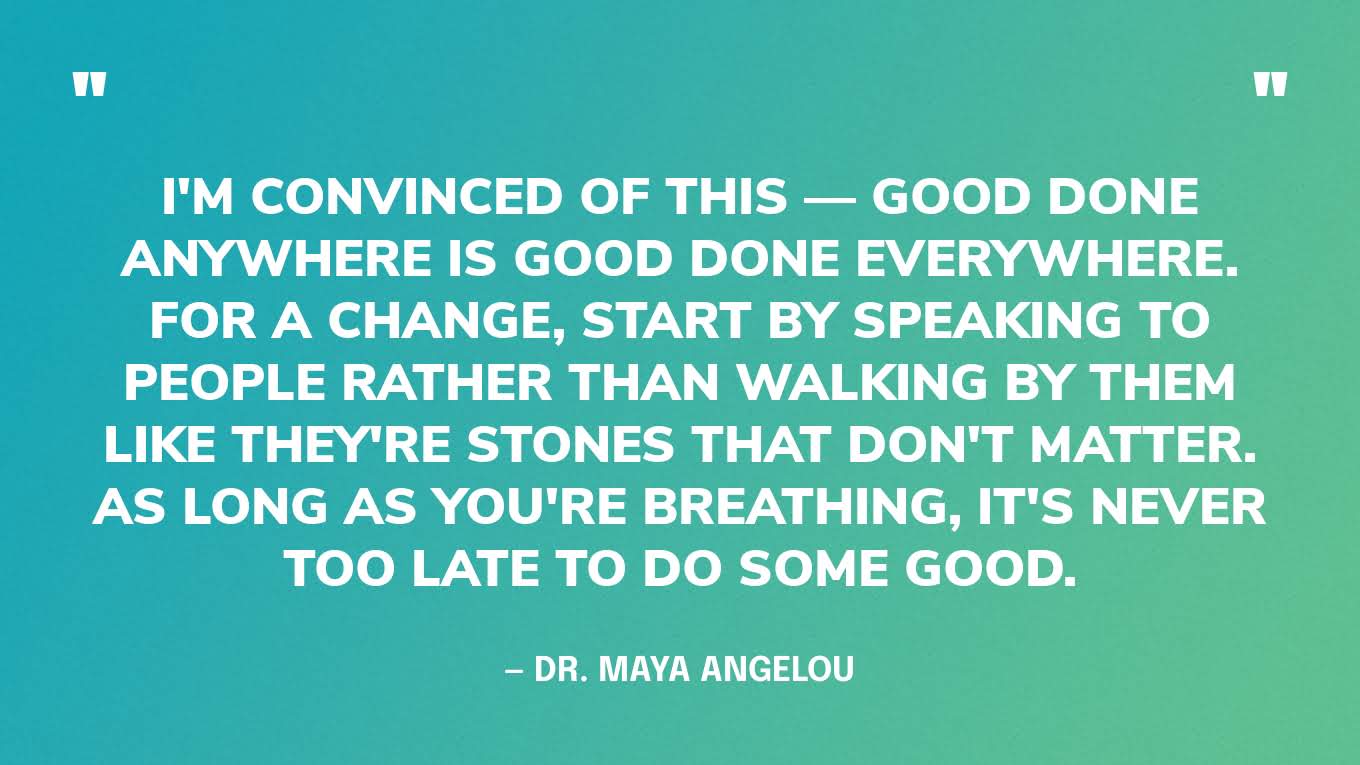
“I'm convinced of this — Good done anywhere is good done everywhere. For a change, start by speaking to people rather than walking by them like they're stones that don't matter. As long as you're breathing, it's never too late to do some good.”
— Dr. Maya Angelou
“Human progress is neither automatic nor inevitable... Every step toward the goal of justice requires sacrifice, suffering, and struggle; the tireless exertions and passionate concern of dedicated individuals.”
— Martin Luther King, Jr.
“The best thing to do with the best things in life is to give them away.”
— Dorothy Day
“Stand for something or you will fall for anything. Today’s mighty oak is yesterday’s nut that held its ground.”
— Rosa Parks
“I am no longer accepting the things I cannot change. I am changing the things I cannot accept.”
— Angela Davis
“Remember: things can be bad, and getting better.”
— Hans Rosling
→ Read more quotes about activism
→ Read more quotes about making a difference
→ Read more quotes about giving
Quotes About Kindness
“Be kind, for everyone you meet is fighting a harder battle.”
― Ian MacLaren
“It takes courage to be kind.”
— Dr. Maya Angelou
“Wherever there is a human being, there is an opportunity for kindness.”
— Seneca
“Be kind whenever possible. It is always possible.”
— The Dalai Lama
“If we are asking for the world to be kind, we must first ask what are we doing to add more kindness to the world. If we are asking for the world to be more loving, we must first ask what are we doing to add more love to the world. We are the vessels for the things we seek.”
— Joél Leon
“It takes so much energy to be mean. It takes much less to be nice.”
— Leah Thomas
→ Read more quotes about kindness
→ Read more 'good day' quotes
Quotes About Inner Strength & Staying Strong
“Inside of a ring or out, ain’t nothing wrong with going down. It’s staying down that’s wrong.”
— Muhammad Ali
“Stay strong. Stay true to yourself and to who you are because there is a community out there. It may not be in your town or perhaps even in your family, but you are wanted and you are loved and there are places in the world where you will be safe and supported.”
— Emma Walton Hamilton
“I can be changed by what happens to me. But I refuse to be reduced by it.”
— Maya Angelou
→ Read more quotes about staying strong
→ Read more quotes about healing
Smile Quotes
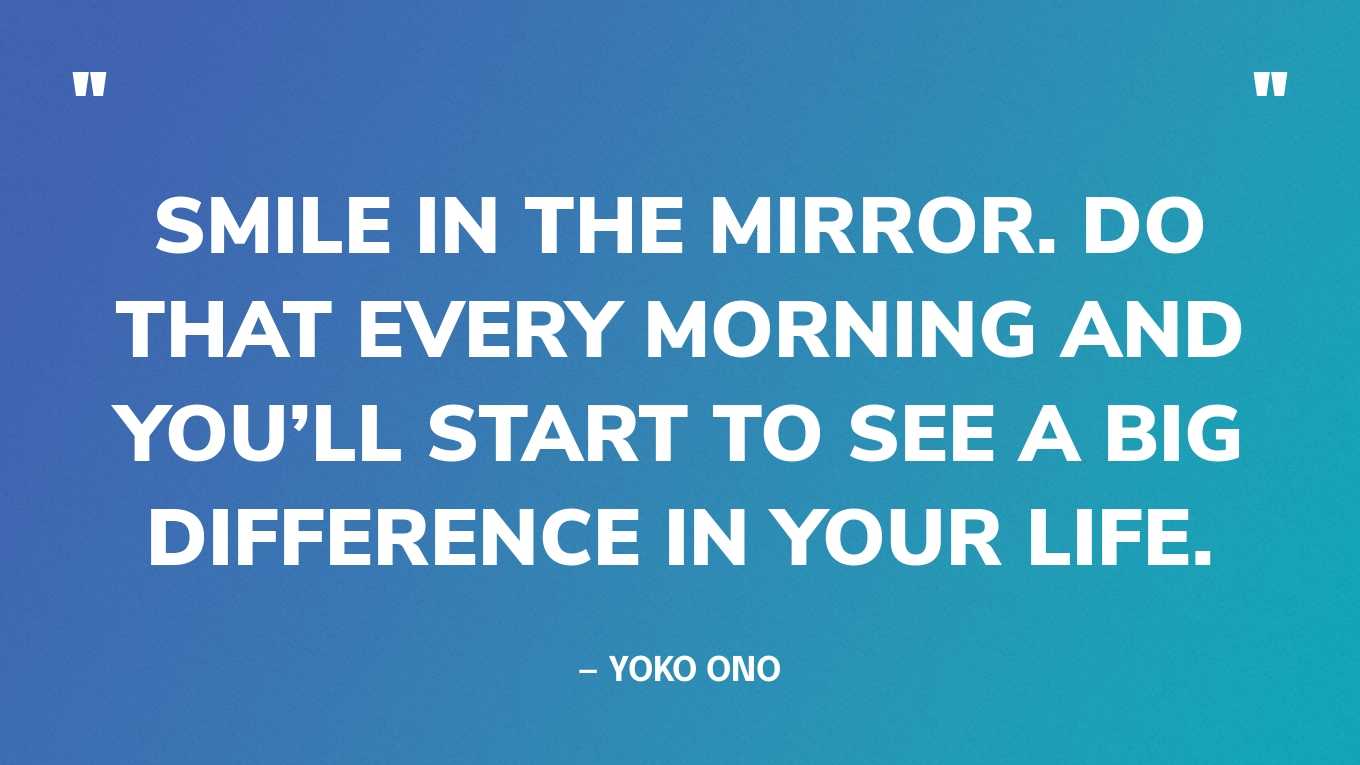
“Smile in the mirror. Do that every morning and you’ll start to see a big difference in your life.”
— Yoko Ono
“A simple smile. That’s the start of opening your heart and being compassionate to others.”
— The Dalai Lama
“Keep smiling, because life is a beautiful thing and there’s so much to smile about.”
— Marilyn Monroe
“Peace begins with a smile.”
— Mother Teresa
“If you have only one smile in you, give it to the people you love.”
— Maya Angelou
“Sometimes your joy is the source of your smile, but sometimes your smile can be the source of your joy.”
— Thich Nhat Hanh
→ Read more quotes about smiling
Positive Sports Quotes
“Start where you are. Use what you have. Do what you can.”
— Arthur Ashe

“I think the reason why I'm the person who I am today is because I went through those tough times when I was younger.”
— LeBron James
“I've never scored a goal in my life without getting a pass from someone else.”
— Abby Wambach
“It’s important for everyone to stand up for what they believe in.”
— Lewis Hamilton
“With a defeat, when you lose, you get up, you make it better, you try again. That’s what I do in life, when I get down, when I get sick, I don’t want to just stop. I keep going and I try to do more. Everyone always says never give up but you really have to take that to heart and really do never definitely give up. Keep trying.”
— Serena Williams
As the campus crisis grows, colleges try out new strategies and messengers
When the campus alert system at the University of California at Los Angeles notified students of a possible shooter this February and directed them to shelter in place, senior Meera Varma found herself surrounded by frightened students.
She told the alarmed undergrads hunkered down in the dorm it was okay to be scared – a technique she’d learned in a mental health training.
"Residents told me they were really nervous, they didn’t know what to do," said Varma, a resident advisor at the dorm. "I validated their feelings and told them you’re not alone in feeling scared. I told them I appreciated that they trusted me and wanted to come to me." She then assured them that she could refer them to the counseling center once the danger was over.
The tool that Varma used, which goes by the acronym VAR — validate, appreciate, refer — was created by a national mental health organization for students called Active Minds. The group teaches thousands of students the crisis intervention technique each year in 600 campus chapters.
Varma, who spent two years as the UCLA Active Minds education committee director, first heard about the group when she was so deep in mental distress that she wasn’t sure she was going to get out. "I didn’t see a point to living," she recalled.
A native of Burbank, California, Varma became extremely depressed in high school and began self-harming, then formed a plan to die by suicide just before her 18th birthday — a plan she never went through with.
"I almost didn’t make it to 18, but I’m grateful that I’m here right now," said Varma, who will turn 22 in April.

Varma is one of a growing group of college students who are struggling with their mental health. Recent headlines about college suicides, from star soccer player Katie Meyer at Stanford to clusters at St. Louis University, West Virginia University, Vanderbilt University, and others, have stunned the country. Suicide is now the second most common cause of death on college campuses, and more than 1,000 college students kill themselves each year — triple the rate from the 1950s.
The mental health crisis on campus was growing long before Covid-19. Data from the Youth Risk Behavior Survey compiled by the Centers for Disease Control and Prevention show that levels of persistent sadness and hopelessness, as well as suicidal thinking, planning, and attempts among adolescents rose steadily from 2009 to 2019.
Then came online classes and school closures, campus lockdowns, and the disruption of normal college social life, exacerbating the problem.
The 2021 Healthy Minds Study report, an online survey of more than 103,000 college students, found that over the previous year, 41% reported clinical levels of depression, 34% showed symptoms of anxiety, 13% considered suicide, and 1% attempted suicide. But this spike in despair was not just a product of the pandemic, said Sarah Lipson, one of the report’s principal investigators.
"An online survey of college students showed that 41% reported clinical levels or depression and 13% had considered suicide."
— 2021 Healthy Minds Survey
"Really high levels of depression and anxiety" were present before the pandemic, and had climbed 2% to 3% every semester since 2015, said Lipson, an assistant professor of health law policy and management at Boston University School of Public Health.
The U.S. Surgeon General’s advisory on the youth mental health crisis, issued in December, reported that pre-pandemic, "an alarming number of young people struggled with feelings of helplessness, depression, and thoughts of suicide.” With the stress of COVID-19, the report said, “the effect on their mental health has been devastating."
College administrators have scrambled to expand mental health services, with some adopting a "web of care" approach that tries to prevent students from reaching a crisis point.
Many are developing innovations that reach beyond the counseling center, including telehealth therapy, mental health check-in apps, advisor and faculty training on suicide prevention, and peer support groups — as well as simple but important changes, such as printing the Suicide Prevention Lifeline phone number on the back of student ID cards.
On the ground, however, students say their experience with mental health support is mixed. Caroline Knowles, a senior at Vassar, got a quick appointment at the school’s counseling center when she needed to see a therapist for persistent anxiety.
But a friend who requested a safety check on a student believed to be self-harming got a meager response.
"The school sent someone to knock on her door, and a complete stranger asked, 'Are you OK?'" Knowles said.
"Of course, the girl said, 'Yes I’m fine, leave me alone,' and that was that. It’s a flawed system."
In addition, some campus counseling centers close down over the holidays, stranding students without a trusted place to call for help.
Enlisting faculty and staff to prevent suicide
Melody Moezzi is an Iranian-American writer, professor and mental health activist with three books under her belt, including Haldol and Hyacinths: A Bipolar Life, and The Rumi Prescription. But in graduate school, she had a severe encounter with mental illness that almost stilled her voice forever.
In Moezzi’s last semester of graduate school at Emory University, she was severely stressed. She’d been diagnosed with major depressive disorder — a diagnosis that turned out to be wrong — and was given antidepressants as she worked to complete degrees in law and public health.
Then an administrator suggested she might not graduate according to her desired timeline, and she decided, as she put it, "to check out." Fortunately, she survived.
"Looking back on it, I think, what a stupid reason to kill yourself," she told MindSite News. "I have a wonderful husband, I have a wonderful life. Things were not objectively going wrong."
Now an author, attorney and visiting professor of creative writing at University of North Carolina Wilmington, Moezzi tells her students to ask for help if they are in crisis, something she was too proud to do. She also advocates giving faculty and staff better tools to recognize a student in distress.
In an op-ed for Inside Higher Ed, Moezzi wrote that evidence-based suicide prevention training like QPR — question, persuade, refer — should be mandatory for university staff.
The technique is meant to help a professor or staff member recognize the signs of a student in crisis and ask critical questions at a moment when it may be lifesaving.
She uses the technique frequently, and has offered to take students to the emergency room or the university counseling center. She ended up driving one student to the emergency room after they answered "yes" to the question, "Are you thinking of hurting yourself?"
Yet suicide prevention programs like QPR are not mandatory at Moezzi’s university — nor at many others. Active shooter drills are mandatory — a fact she finds ironic, since mass shootings account for 1% of gun casualties and suicides for 60%.
In Inside Higher Ed, Moezzi concludes: "Failing to mandate suicide prevention training at colleges and universities in spite of these statistics isn’t just misguided or negligent. It’s ignorant and reckless."
Nine hundred miles from Moezzi’s school, a team of psychologists at Loyola University in Chicago are piloting another approach. The goal: to reach students before they get to a crisis point by enlisting academic advisors to connect with students about their state of mind.
Colleen Conley and her team at Loyola designed a short "motivational interviewing" curriculum that advisors can use during a routine meeting. Advisors help students reflect on their goals and ask if they might benefit from any changes: Are they getting enough sleep or drinking too much? Is it affecting their mental health? How might the student make a change?
Early results show a promising trend, Conley said. Students interviewed in this way are more likely to seek counseling services, and motivational interviewing is linked to behavior change. Plus, she said, it gets students to discuss mental health at an appointment they’re already attending.
"We found that if we could work even five to ten minutes of talking about well-being into a meeting that was already happening, that was so much easier than relying on students to schedule a separate appointment," Conley said.
In Winston-Salem North Carolina, Wake Forest University uses an app called Timely Care to provide 24/7 access to a mental health professional for students in crisis.
The app also makes it easy for students to schedule non-urgent counseling appointments and provides coaching on diet, nutrition, exercise, and sleep.
As colleges work to support student mental health, there’s still a lack of evidence on what works best, said Boston University’s Lipson, partly because each campus is different.
"While a public health approach is the starting point for addressing mental health at colleges and universities, there isn’t a one-size-fits-all approach," she said. "What works for one campus may not work for another."
One approach that seems both popular and effective, however, is peer support.
When peers are the 'first line of defense'
When a friend told Kelly Maguire, a senior at Florida Gulf Coast University in Fort Myers, about a crisis they were experiencing, she knew how to respond: "Thanks for telling me about this," Maguire said. "Could I walk with you to the counseling center right now?"
Maguire, now president of the campus chapter of Active Minds, went through her own mental health crisis during freshman year. Anxiety, depression, and suicidal ideation became unmanageable. Now Maguire wants to make it normal for friends to talk about struggles.
Peer recognition is often the first line of defense, said Amy Gatto, senior manager of higher education and evaluation at Active Minds. Research has shown that peers may be "the single most potent source of influence" during college.
Active Minds was founded by Alison Malmon, whose brother had kept his deepening depression and psychosis a secret for years and committed suicide during his senior year of college.
Now Active Minds reaches students through mental health fairs and student liaisons, spreading the message that talking to friends when you’re struggling is no sign of weakness.
The group’s "Send Silence Packing" campus events events include more than 1,000 backpacks — one for each of the roughly 1,000 campus suicides that occur each year.
The backpacks include personal stories from families and friends of suicide victims and encourage students to reach out if they need help.
When a suicide does occur, more schools are adopting research-backed postvention strategies, with the aim of preventing further suicides in a new, high-risk group: suicide loss survivors.
When two suicides rocked the University of North Carolina-Chapel Hill campus last year, senior Ethan Phillips — who knew of more than a dozen kids’ suicides in his county while he was in middle school — helped spread the word about counseling resources for students.
For many college students, parents are often the last to know if they are suffering from mental health issues or failing academically. Gina Burton only found out after her son, Graham, committed suicide in 2018 that he had been in great distress and failing four classes at Hamilton College, according to a story in the New York Times.
"Would you care to shed some light on this?" Ms. Burton asked in an angry email to the academic dean, according to the Times. "If this is what drove Graham, I don’t think I’ll be able to cope."
Many parents don’t know they can be left out of a student’s mental health treatment entirely due to due to health and education privacy laws — HIPAA and the Family Education Right and Privacy Act — that afford privacy to adult students, said B. Janet Hibbs, an adolescent clinical psychologist in Philadelphia.
Hibbs recommends that parents and students sign these crucial forms before students head to school so families can have access to health information.
In her experience, few college counselors include the family in students’ therapy, Hibbs said – a major missed opportunity. "The familial context can be a tremendous resource," she said.
In fact, when Hibbs’ own son had a severe depression during his freshman year that ultimately led him to take a medical leave of absence, the counseling office and faculty were unable to communicate with each other because of privacy protections.
Failing to mandate suicide prevention trainings for faculty while requiring active shooter drills is "ignorant and reckless," says Moezzi, who notes that mass shootings account for 1% of gun casualties and suicides for 60%. — Melody Moezzi, visiting professor at UNC-Wilmington
Many students are unaware of available mental health resources, according to university counselors contacted by MindSite News.
"The challenge with a larger campus is just letting students know what’s available to them," said Aesha Uqdah, a clinical psychologist and director of the Counseling Center at the University of Louisville.
"The word has to spread a lot farther to reach 23,000 people — there are students who probably don’t know where the counseling center is. Students can walk in and talk to someone that day if they’re in a crisis. But people hear we have a waitlist — which we don’t for urgent care — so they don’t even try."
As more struggling students seek care, universities are scrambling to add resources — but money and staff alone will not solve the crisis, said Marcus Hotaling, president of the Association for University and College Counseling Center Directors.
"This is not a problem we can hire our way out of," Hotaling said. "For many students, we need to solve a problem. The goal of therapy is not to need therapy, but to develop the coping skills and the life skills to address anxiety and depression. We need to be leaning into solutions."
Expanding suicide prevention education
Meera Varma, the UCLA senior who helped calm the nerves of her dorm’s rattled undergraduates, is spreading the word about mental health on campus.
When Varma was first diagnosed with anxiety and depression, her immigrant family had a difficult time understanding her diagnosis and treatment. "There isn’t even a word in Hindi for 'stigma,'" she said. Now she’s got her whole family, even her grandparents, using the VAR technique and talking openly about their mental health.
Risks are not the same across demographic groups. The suicide rate for Black children younger than 13, according to the CDC, is almost twice that of white children. Other groups, like the LGBTQ community, also suffer higher rates of suicide risk.
Lily Brown, director of the Center for the Treatment and Study of Anxiety in the Perelman School of Medicine at the University of Pennsylvania, is part of a new research group aimed at studying those disparities and developing more targeted interventions.
While Penn’s INSPIRE Center will look at all age groups, Brown and her colleague José Bauermeister will focus on college students in particular.
They’re working on a low-cost intervention for college students that is brief and technology-based — a life-skills app for students who are a sexual or gender minority.
"People who identify as LGBTQ tend to report that, when they’re struggling with isolation, they get really depressed," Brown said. "Finding ways to cope with discrimination, finding ways to build a social network, and finding ways of building positive emotions are the core targets of this project."
Meanwhile, Varma, who is graduating in May, will stay on at UCLA to get a master’s degree in social welfare and mental health policy. Her involvement with Active Minds, the JED Foundation and the American Foundation for Suicide Prevention, has her looking toward a career in mental health.
"I feel like people are intimidated to start conversations about suicide," she said.
"As a person who has been suicidal, and who almost lost their life to suicide, I know what it’s like to be nervous to talk about it. I want to work to create policy changes around suicide prevention. Because it is something that’s preventable."
There’s nothing quite like a cute photo of a puppy or kitten to bring the Internet together. Chances are, you or someone in your close circle of friends has created an Instagram account for a pet, following in the footsteps of famed furry friends like Doug the Pug, Grumpy Cat, or Jiff Pom.
While all pet accounts bring a much-needed joyful reprieve in our chronically online existence, some of these accounts have gone beyond “feel good” and into that “real good” world.
Whether it’s supporting other animal welfare efforts, giving us a new language to talk about our day (ahem, it’s definitely a Bones Day), or raising funds to fight childhood cancer, many of our favorite animal influencers are using their followings to help others and do more good.
Meet these animal influencers (or animal-loving influencers!) who are bringing us more smiles — and are actively making the world a better place.
Meet These Inspiring Animal Influencers Giving Back:
The Best Dog Influencers Who Give Back
WeRateDogs (@dog_rates on Twitter)
Followers: 9.2+ million
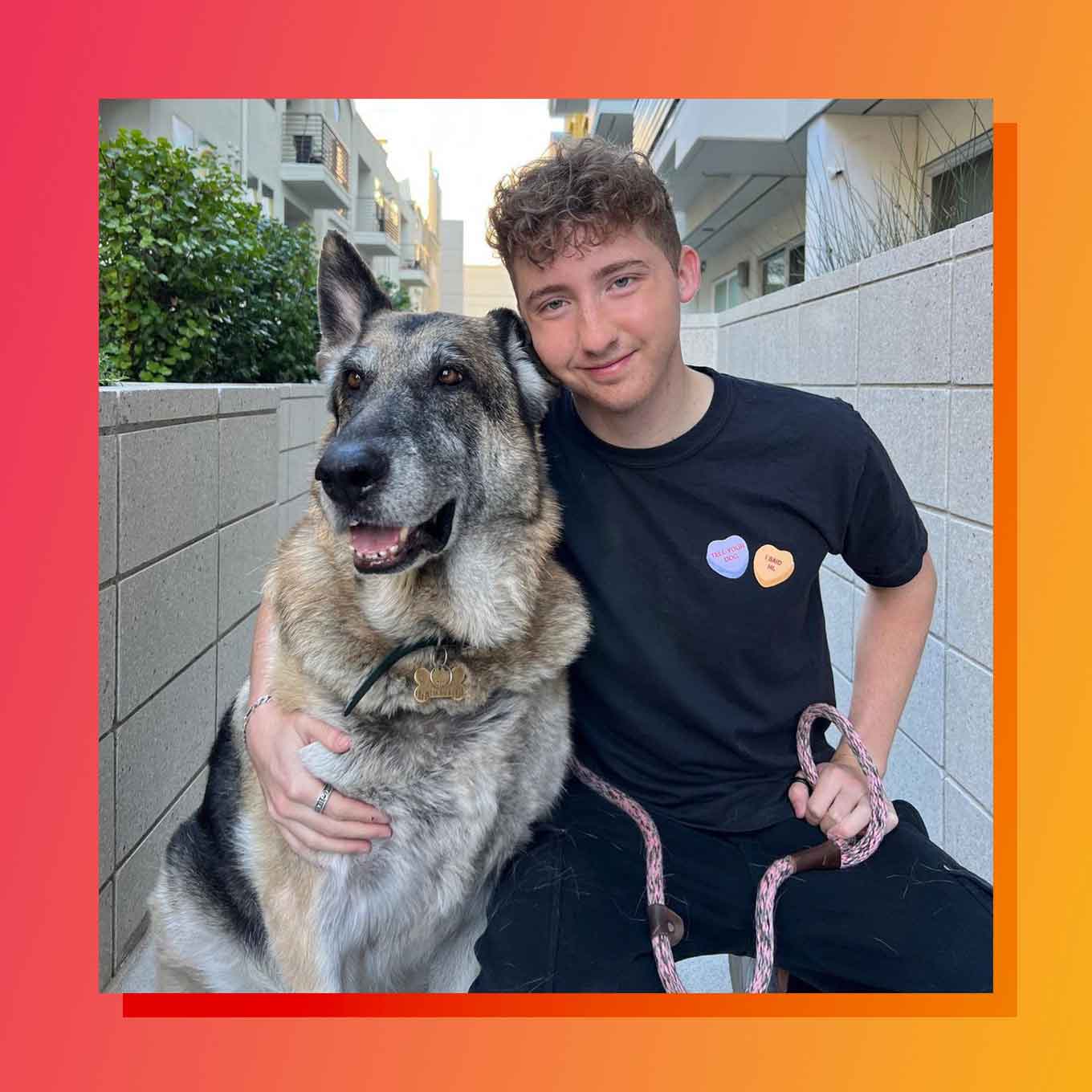
With over 9 million Twitter followers, you’ve likely stumbled across at least one official dog rating by WeRateDogs, the Internet’s unofficial purveyor of all the dog photos.
Created by Matt Nelson in 2015 with the goal to make people smile, the account awards ratings to Very Good Boys and Girls that usually exceed 10/10 (with very highly coveted 15/10s reserved for especially outstanding dogs).
After gaining some serious traction, Nelson realized the platform could be used to help dogs in need. As quickly as his following skyrocketed, he began promoting a GoFundMe campaign every Friday for a dog in need of financial support. Together, the community has raised over $2 million to pay for dogs’ medical bills. Dog parents can apply by sharing their campaigns via a digital form.
Additionally, Nelson started the 15/10 Foundation, which raises funds to support adoptable dogs "whose behavioral or medical needs prevent them from finding their happily ever after."
Supporters can make a one-time donation or become members to sponsor dogs in need of loving homes.
Read our full feature article on WeRateDogs’ positive impact
Doug The Pug (@itsdougthepug on Instagram)
Followers: 3.8+ million
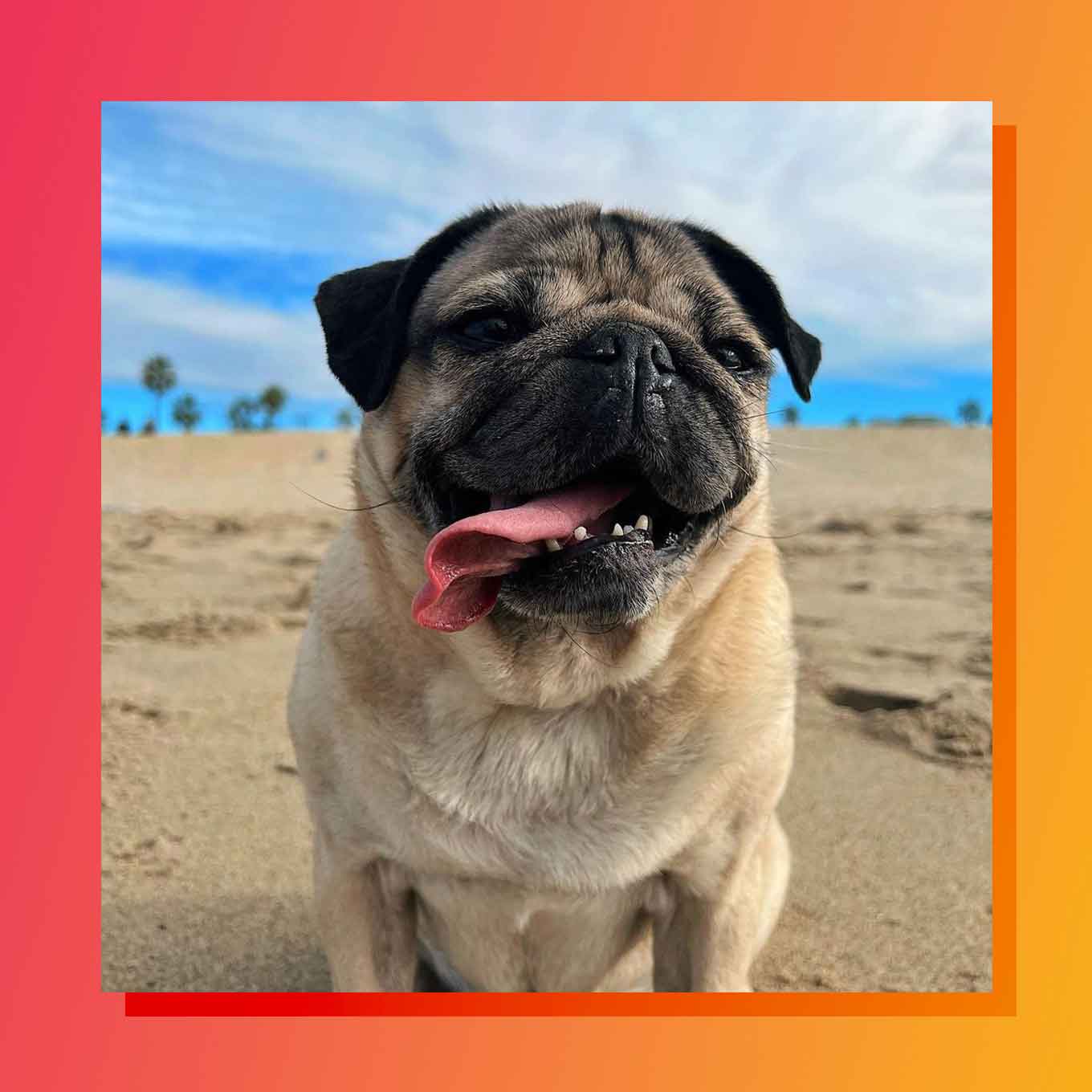
Doug the Pug, the little Nashville-based, potato-shaped prince with nearly four million Instagram followers, recently launched the Doug The Pug Foundation.
After taking Doug to visit cancer patients at a local children’s hospital, his parents — Leslie Mosier and Rob Chianelli — realized the real reason behind Doug’s social media stardom, and launched the Doug The Pug Foundation, which supports children and families battling pediatric cancer.
“Doug has this very beautiful quality of knowing who needs the most love,” Mosier said. “We realized we could actually use Doug’s social platform to raise good money to help these kids.”
In addition to hospital visits, the foundation raises funds for children and families who need financial support and gives them direct assistance to cover expenses of any kind.
“There is always going to be a dark side of the Internet, and we all have the power to be the good side of the Internet,” Mosier said. “And Doug has really brought that out in us.”
Read our full feature article on Doug the Pug’s positive impact
The Dogist (@thedogist on Instagram)
Followers: 4.1+ million
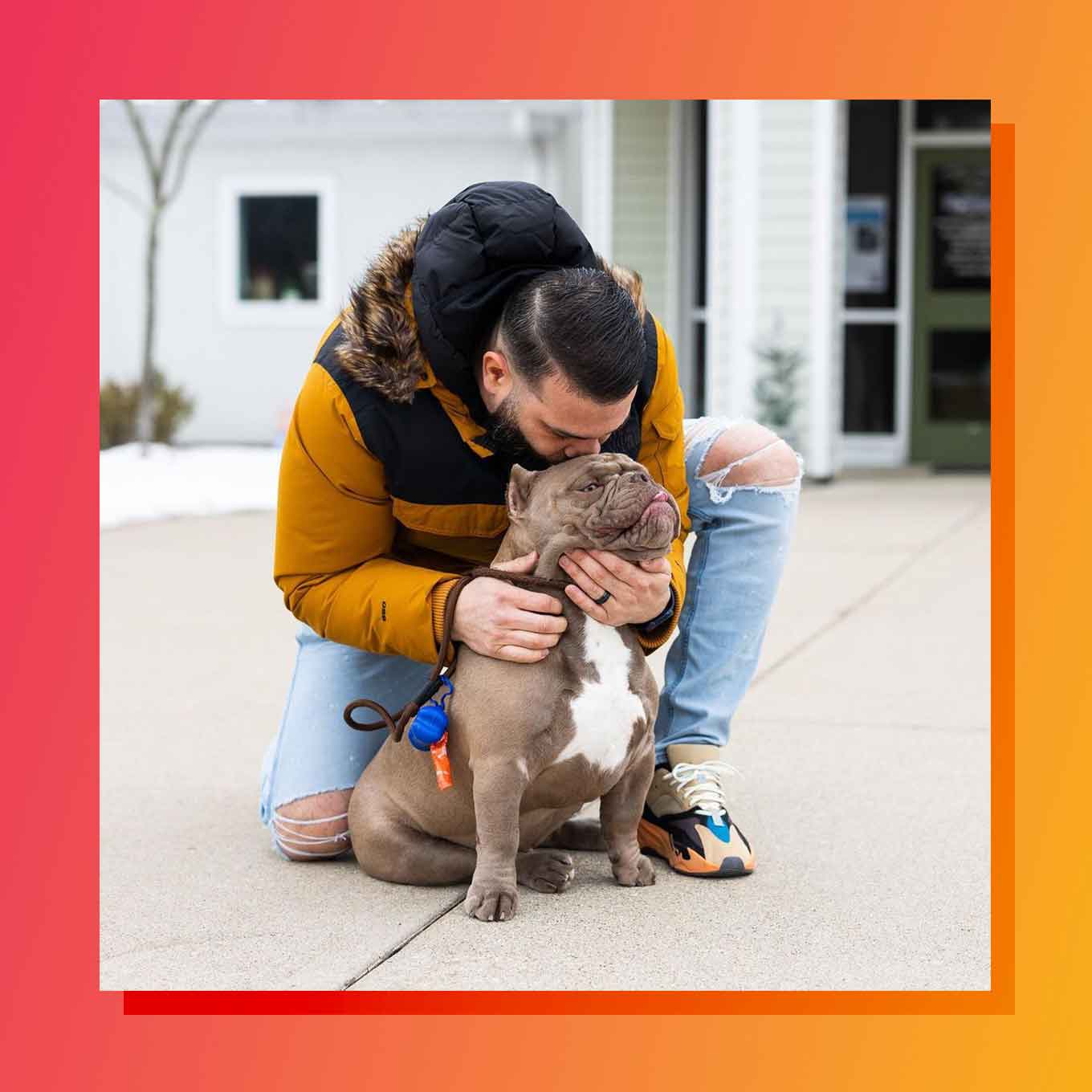
The dog-friendly equivalent to Humans of New York, The Dogist is the brainchild (erm, fur child?) of Elias Weiss Friedman. With over four million Instagram followers, the platform has grown in spades since its inception in 2013, now adding a philanthropic arm: The Dogist Fund.
The fund serves worldwide nonprofit efforts for dog rescue and rehabilitation through donations, merchandise sales, and volunteer opportunities. In 2021, givers raised over $70,000 for dogs in need.
On Instagram, The Dogist also shares success stories of dogs adopted through the organizations supported by The Dogist Fund.
Josh The Doodle (@joshthedoodle on Instagram)
Followers: 299,000+
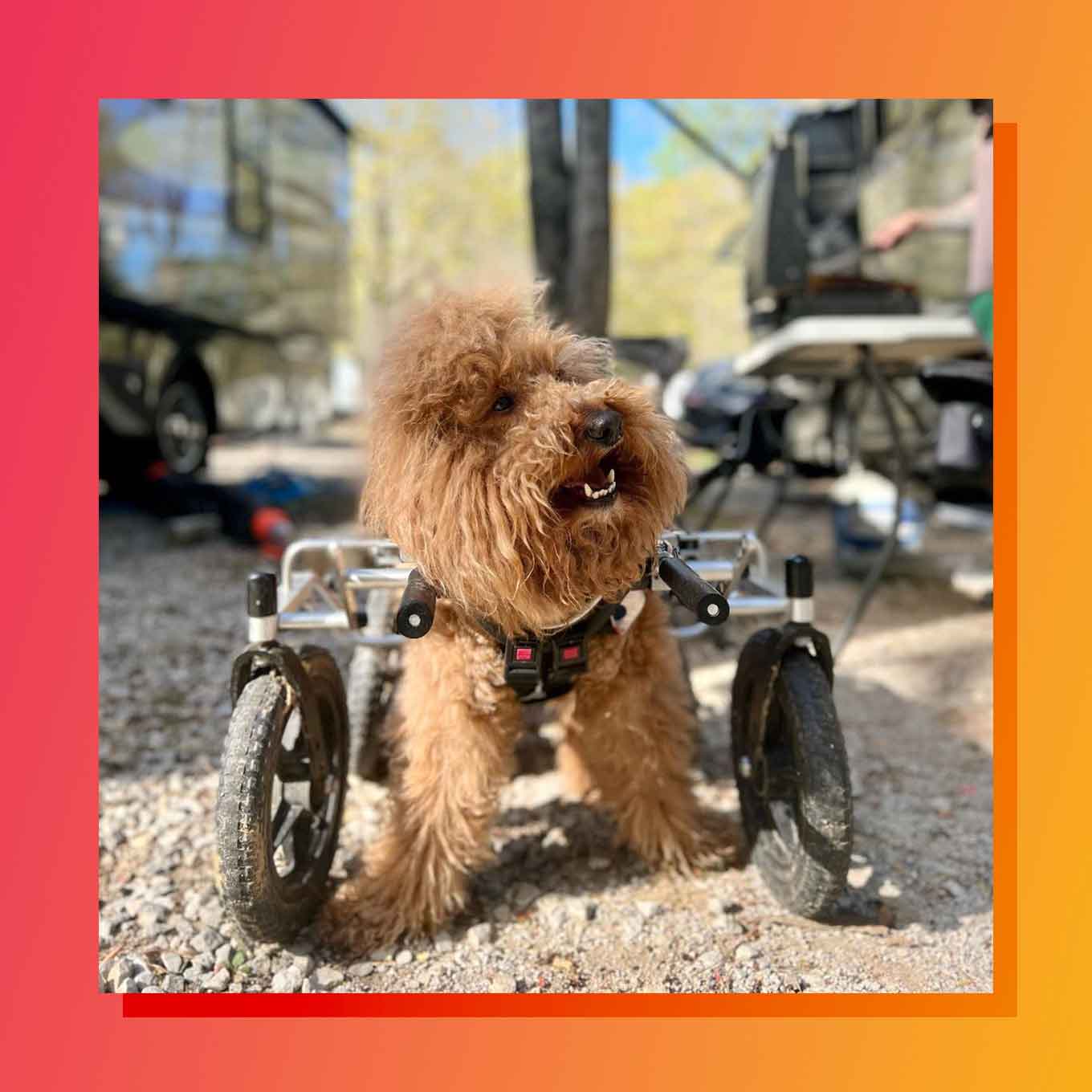
Josh is a golden doodle on a mission to spread awareness and acceptance for canines with disabilities. He and his “service human” Kimberly started the Be Like Josh Foundation, which specializes in the rescue, rehabilitation, and advocacy of dogs with neurological disabilities.
Through adoption and fostering, physical therapy, mobility aids, and behavioral training, the foundation supports all kinds of diverse dogs and gives them and their humans the tools they need to thrive in loving homes.
“We like to empower our adopters, and in turn, they empower the dogs that they adopt from us,” the Be Like Josh Foundation website reads. “Each dog should be set up for success, supported, and empowered. We also provide support to our adopters by coaching them on how to welcome a pet with special abilities and by building lasting relationships with the adoptive families in the process.”
Noodle The Pug & Jonathan Graziano (@jongraz on TikTok)
Followers: 4.5+ million

Famous for their “bones or no bones” series, where owner Jonathan Graziano wakes his sleepy geriatric pug, Noodle, every morning, this duo has quickly risen to TikTok stardom.
(Don’t worry about any pug competition here; Doug the Pug and Noodle are friends!)
With that fame has come a slew of opportunities; from a children’s book, to countless brand deals, and media features. Folks dressed up as a no bones Noodle for Halloween, and his official merch store churns out on-brand products faster than he can lay back down in bed.
However, Graziano’s main goal in Noodle’s pup platform is to encourage folks to adopt older dogs. In fact, the state of New York even proclaimed an official “Adopt A Senior Pet Month” in November of 2021, thanks to Noodle’s influence.
“I adopted Noodle at seven and a half years old, which is a lot older than most people adopt their pets,” Graziano shared with the New York State Senate. “I’m so happy that what we have been doing has been resonating with people. I would encourage anyone who is considering adopting a pet to consider adopting an older pet, because they have just as much love to give you.”
Graziano and Noodle also send donations to various organizations supporting senior dogs.
Update: Noodle passed away at the end of 2022. The internet is mourning, but fans are consoling one another with the reminder that Noodle would want us to honor his life by having “bones days.”
Cat Influencers Making The World A Better Place
Lil BUB (@iamlilbub on Instagram)
Followers: 2.4+ million
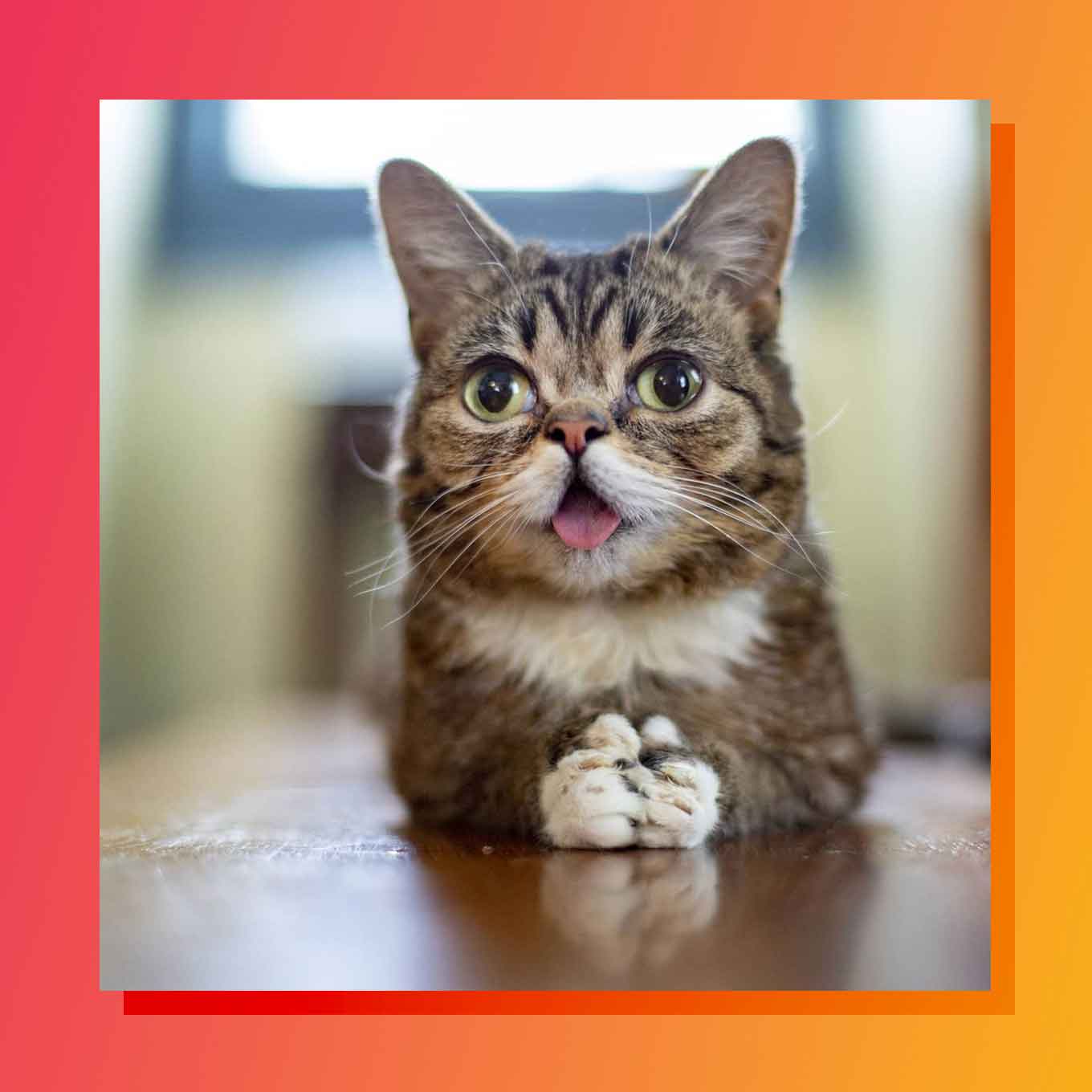
Lil BUB, though now in cat heaven, continues to make a big impact. The cat, who passed away in 2019, was known for her pronounced features, with big green eyes and a small wagging tongue.
She was a disabled cat who had a number of lifelong conditions, but despite her challenges, lived a pampered life — and ultimately amassed a major social media following.
Her human, Mike Bridavsky, was inspired by her personality and spunk and decided to start Lil BUB’s Big Fund.
The Fund was born out of a desire to advocate for special needs companion animals and build a community celebrating the human-animal bond. The fund provides grants to shelters and creates special needs foster program initiatives around the country.
Prior to her passing, BUB’s platform raised over $700,000 for animal welfare and continues to do this work to honor her legacy. Lil BUB’s Instagram page is still active, but so is her brother’s: Mister Marbles, another adorable, unique cat.
Rexie Cat (@rexiecat on Instagram)
Followers: 657,000+
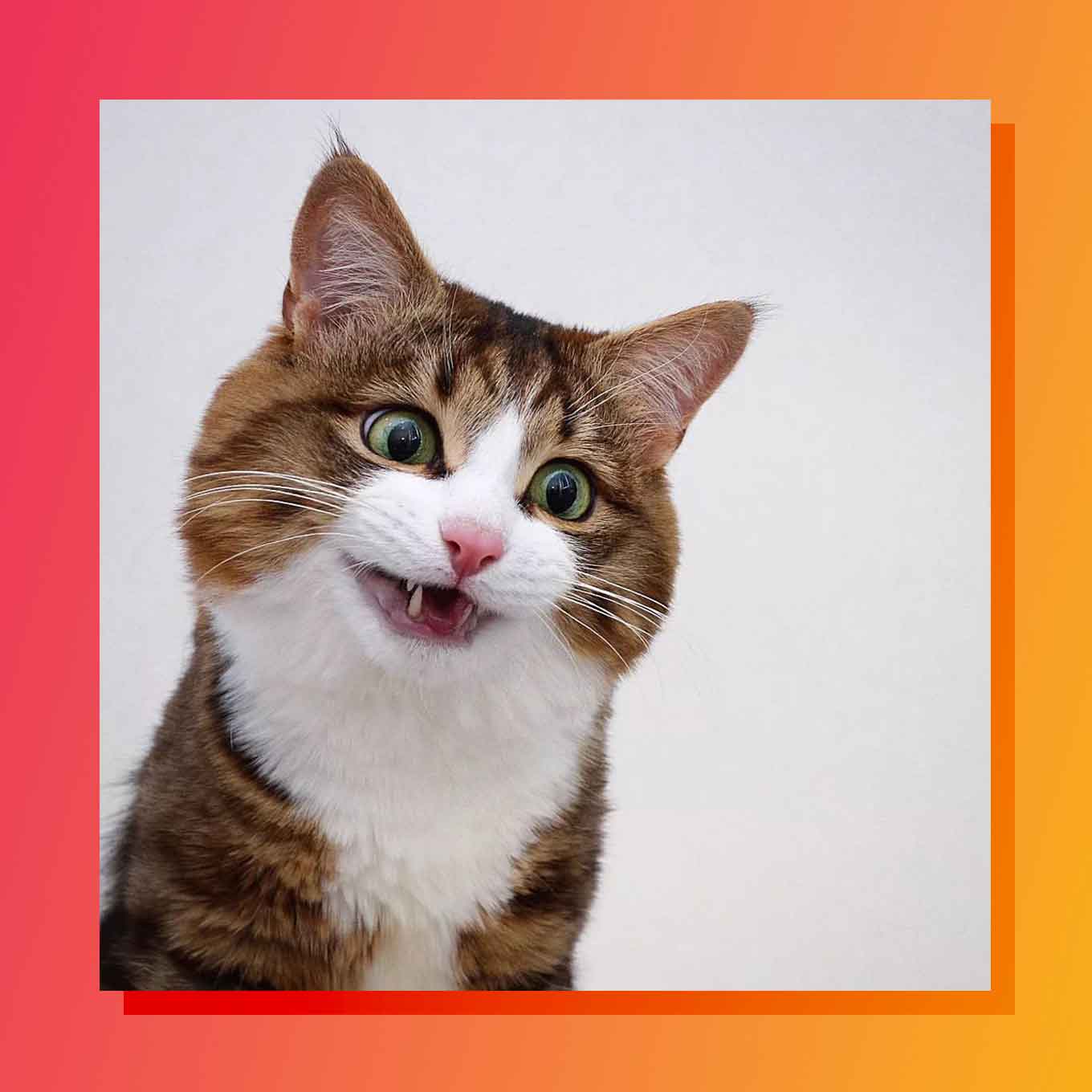
Rexie Cat is a self-proclaimed “living cat emoji” with distinct facial expressions that make for adorable social media content. Rexie is also a “handicat,” and only has two working feet. His social media platform, curated by his owner, Dasha, creates visibility for disabled cats and encourages folks to adopt pets who may need just a bit more love.
Showing glimpses behind the scenes into Rexie’s care, or just tidbits of his fun-loving personality, Dasha hopes his page empowers people to save disabled animals.
“They’re always determined and are full of strong spirit, so it’s plain wrong to put them down,” Dasha shared with Modern Cat. “People often are in such a hurry to put them down, but these cats are a great example of how you can overcome difficulties and enjoy life, even if you fall short physically a little.”
Monty & Molly (@monty_happiness on Instagram)
Followers: 663,000+
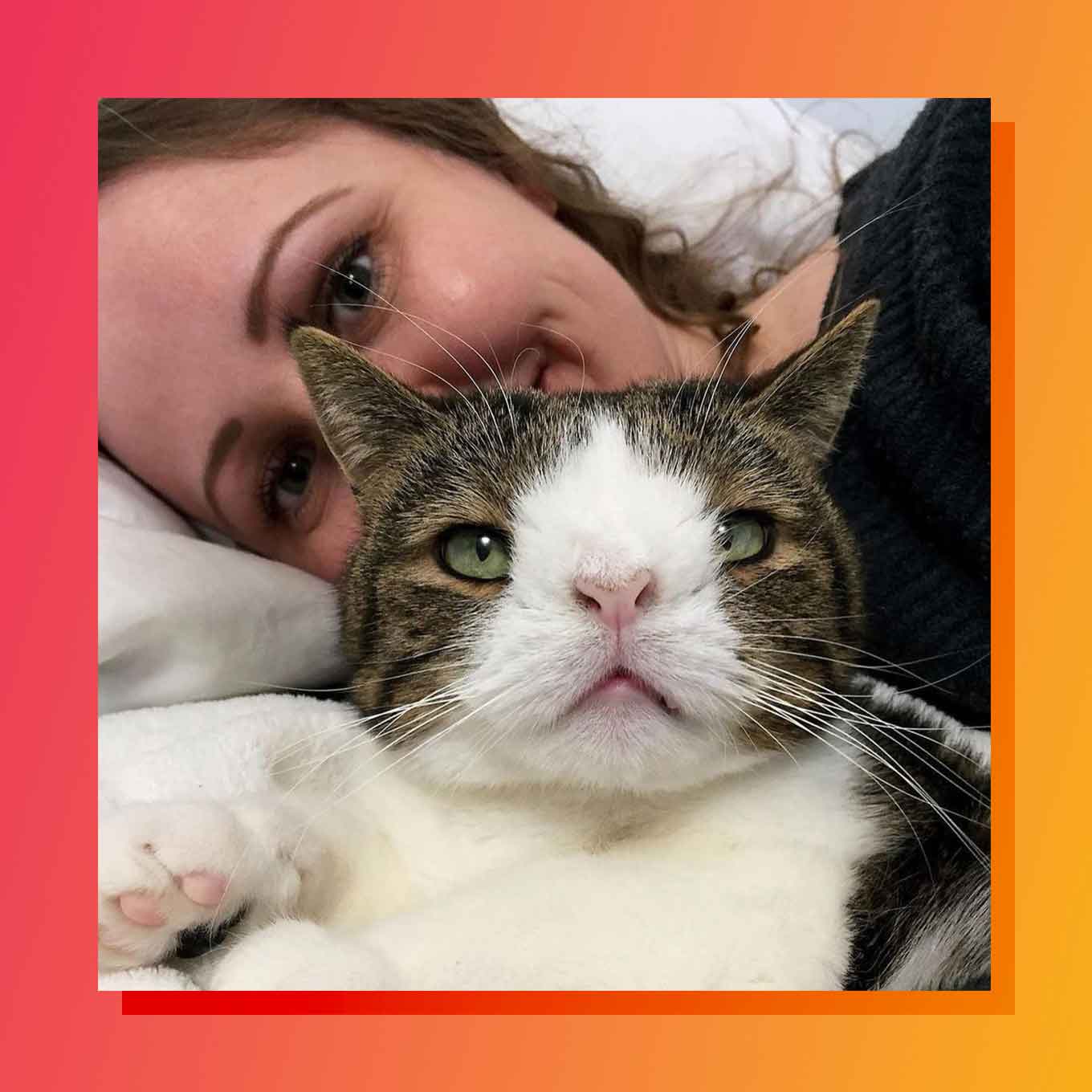
Monty and Molly are two fabulous felines who live with chromosomal abnormalities, making them look slightly different from typical cats. These abnormalities also contribute to other health conditions, like diabetes.
Their mom, Fenjah Mogensen, shares their daily adventures on platforms like Instagram and TikTok, hoping to encourage others to love and adopt other cats with disabilities.
That’s not it, though! Mogensen recently launched a platform called My Best Friend, which is an app (still in beta testing) that will allow those who live with mental health conditions such as anxiety, depression, ADHD, OCD, and panic attacks, to access resources and assistance.
The app will include mood trackers and a journal, informational and relaxation videos, and a “panic button” for instant help in the event of a panic attack. Inspired by her companionship with Monty and Molly, Fenjah wanted people to be able to always have a best friend by their side.
Mackenzie the Cat + Her Human, Angela (@angrafus3 on TikTok)
Followers: 535,000+
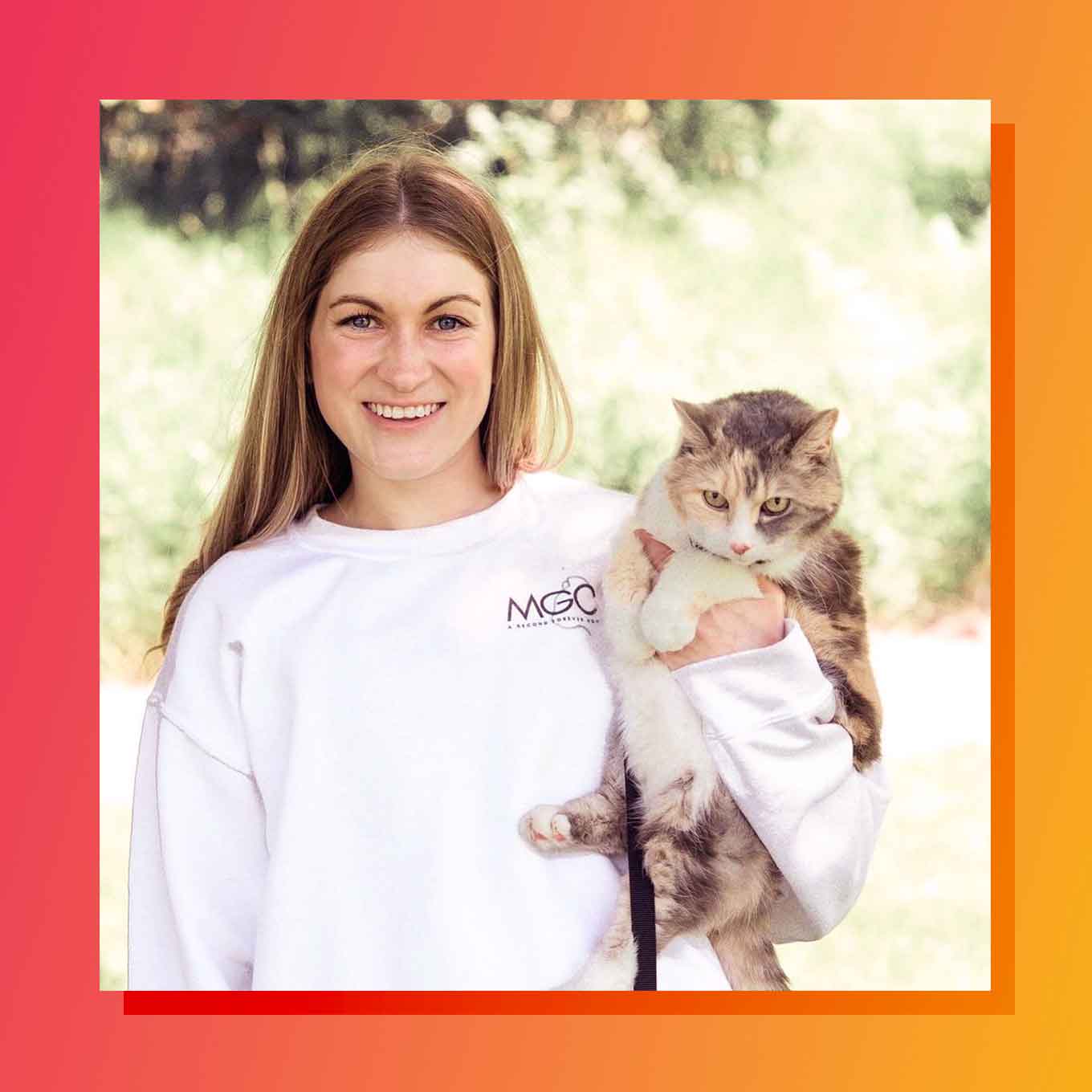
Angela Rafuse inherited her grandfather’s cat, Mackenzie, when he passed away in 2019. She quickly fell in love with her temperamental personality and began sharing videos of Mackenzie on TikTok, gaining traction and adoration from cat lovers everywhere.
Rafuse realized that she wasn’t alone in her story and wanted to help seniors or those living with terminal illnesses find second loving homes for their pets, instead of sending these beloved animals to shelters. My Grandfather’s Cat was born — launched on Rafuse’s grandfather’s birthday in 2021.
In the first six months of operating, the organization helped more than 25 cats and dogs find second forever homes, growing into a team of 10 volunteers across Canada. In February of 2022, Rafuse’s mission was turned into a registered charity by the Canadian government.
Rafuse and volunteers organize new, loving homes for these animals before their owners pass on, though the goal is to keep them in their first owners’ care for as long as possible. Adoptables and their new potential caregivers are heavily vetted to ensure a smooth adoption.
“Through sharing videos of Mackenzie on TikTok, I heard countless stories of how many seniors worried about what would happen to their pets when they moved to a retirement home or, heaven forbid, passed away,” Rafuse writes on the My Grandfather’s Cat website. “I’ve always believed you can be the change you want to see in the world, and My Grandfather’s Cat is the embodiment of that. We are making a difference, one adoptable at a time.”
“Wild” Animal Influencers Using Their Platforms for Good
Juniper Foxx (@juniperfoxx on Instagram)
Followers: 3+ million
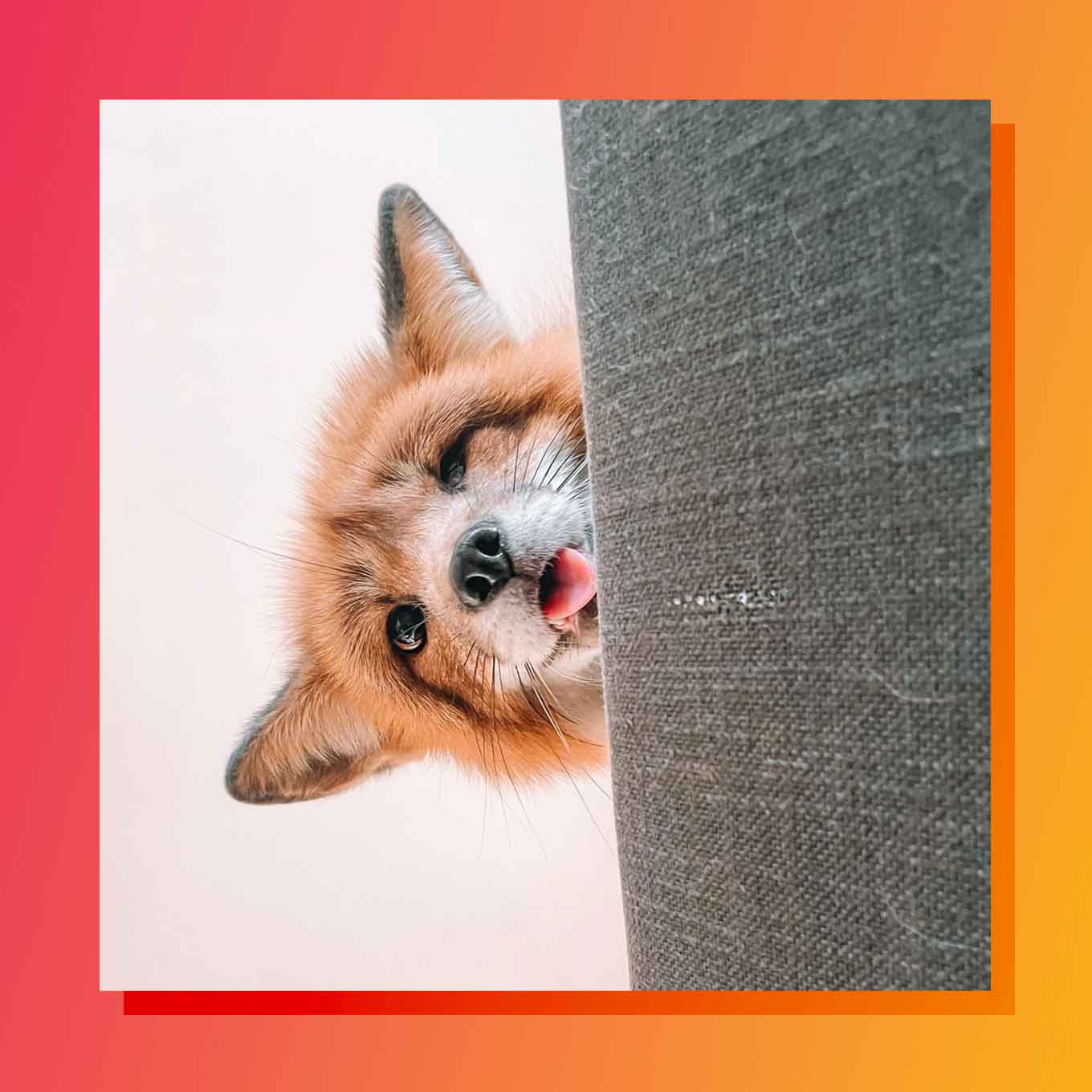
Juniper is a North American red fox living in a home full of other rescued exotic animals, like other foxes, possums, and sugar gliders. Their adventures are well-documented on Instagram, where they have over three million followers.
Their caretakers raise funds and foster other adoptable animals, spreading information and resources, all while providing vet care, housing, and proper diets for neglected and injured exotic animals.
Hamlet The Piggy (@hamlet_the_piggy on Instagram)
Followers: 330,000+
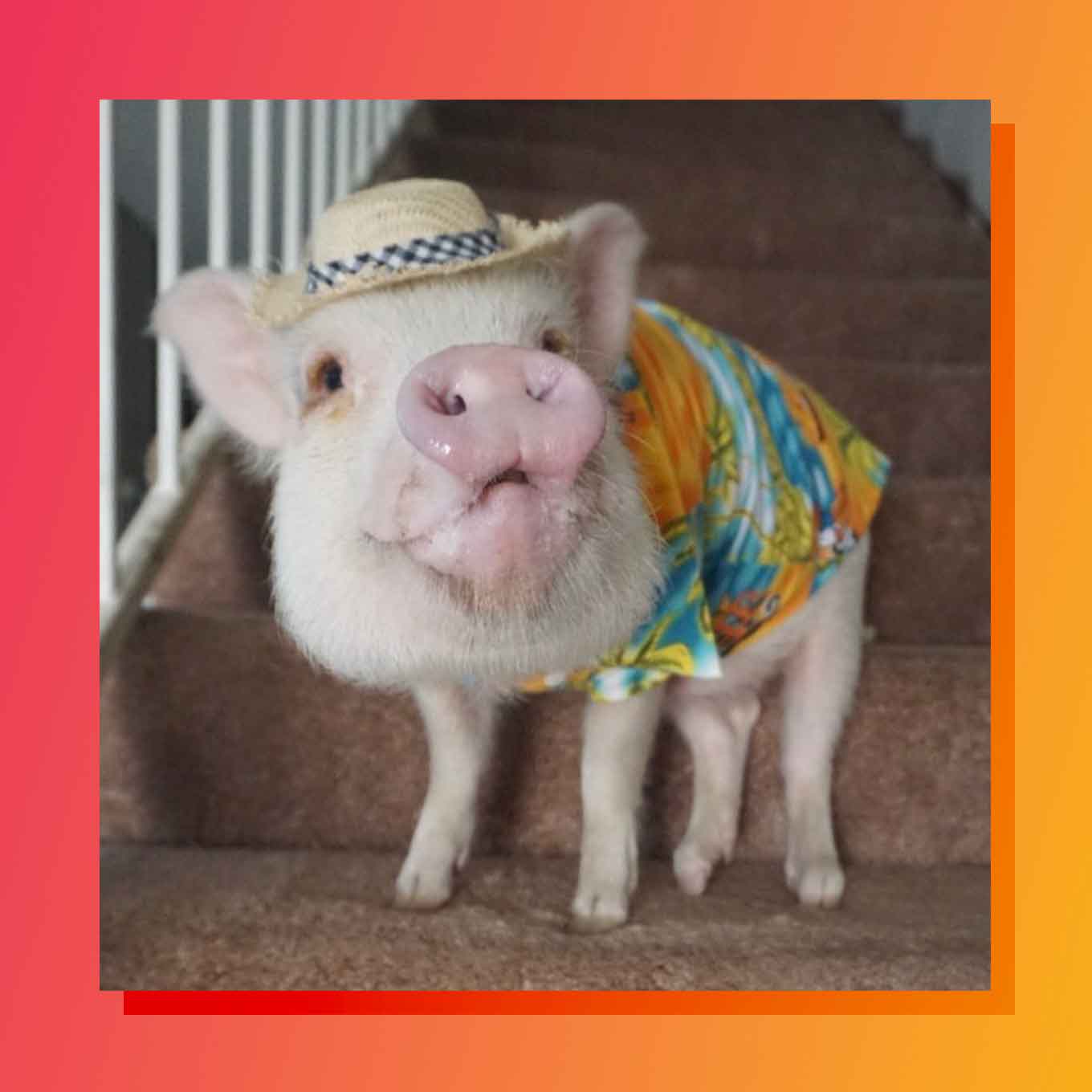
Hamlet the pig is a therapy pig who serves her mom, Melanie, who has epilepsy. She can often be spotted wearing chic glasses and silly looks on Instagram, where she has over 330,000 followers.
Aside from her duties as a therapy pig and social media starlet, Hamlet works with Penelope’s Purpose to help abandoned pigs receive necessary care and adoption, as well as Best Buddies Nashville, to support those with intellectual and developmental disabilities.
Kristyn Plancarte (@k_passionate on TikTok)
Followers: 855,000+
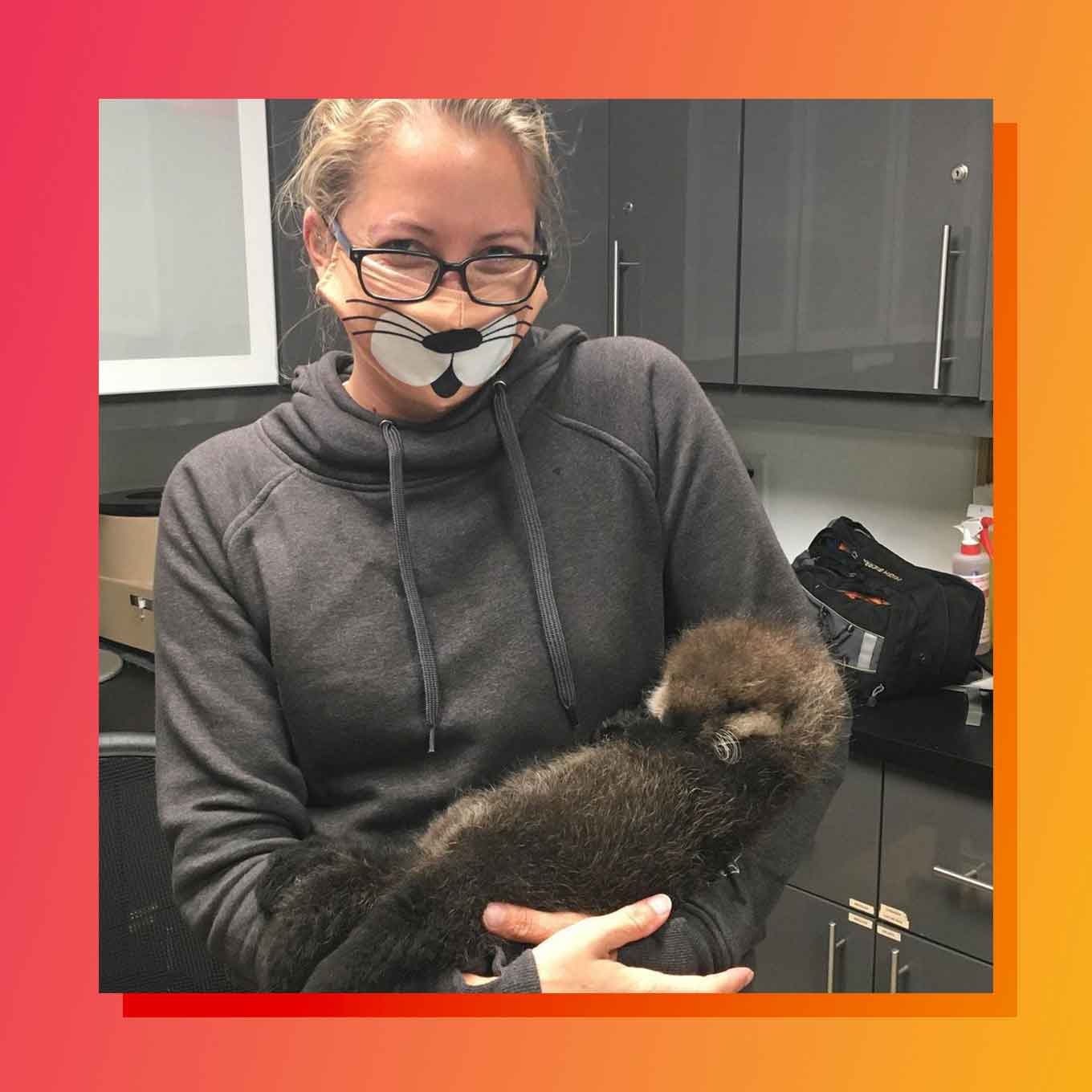
Kristyn Plancarte (known as KP) is a marine biologist and animal behavior expert who shares glimpses into her wild life on social media. When the pandemic closed a number of marine life facilities, she took to Twitch to start streaming and educating folks about marine life, especially the relationships she shares with animals like walruses, sea lions, and sea otters.
She also creates in-depth YouTube videos, including her “Dive Deeper” series that explores a number of conservation issues, animal facts, and marine mammal rescue initiatives. In 2021, she also used her platform to raise over $35,000 for ocean conservation organizations by supporting them on her Twitch streams each week.
“Everyone who sees a sea otter or beluga whale up close ends up forming some sort of connection to them,” Plancarte writes on her website. “It’s my job to build on that connection and use it to educate people about these wonderful animals and the fragile ecosystems they call home.”
You might also like:
- 12 Famous Veterinarians Who Inspire Us to Do Good
- 'Marley’s Mutts' Prison Program Pairs Dogs With Inmates – Healing Both
- The Best Good News Stories About Dogs
- Conservation Efforts Are Actually Saving Humpback Whales
- Reasons to Be Happy: Animal News
- Top Reasons to Adopt a Dog
- This Man Has Saved Over 20,000 Animals With Custom-Made Prosthetics
A version of this article was originally published in The Animals Edition of the Goodnewspaper.
Get your own Goodnewspaper by becoming a good news subscriber today
Nerdy Positive News Story Alert:
Biodegradable banana “paper” can protect potato seeds from potato cyst nematodes, sharply increasing potato size and yields, new research finds.
Reported in Nature Sustainability, the recent study shows the banana paper helps disrupt signals between the plant and the worm, blocking pathogen infestation and growth.
Potato seeds planted inside the paper — with and without miniscule amounts of a worm-killing chemical called abamectin — grew larger and more abundantly than potatoes planted without the paper or in fields sprayed with abamectin alone.
Potato yields were up to five times larger than controls when the banana paper was dosed with 100 nanograms of abamectin — a tiny fraction of the amount normally sprayed on fields by farmers to protect potatoes.
"We knew that the banana paper would be successful, but not to this extent," says Charles Opperman, a co-corresponding author of the study and professor of plant pathology at North Carolina State University.
"We previously had some success increasing yam yields in Benin using this 'wrap-and-plant' method, but nothing on the order reported here with potato."
Potato cyst nematodes are a global scourge that can cause severe damage to potatoes; in some areas in Africa potato yields declined by 60% after infestation, the researchers say.
"The beauty of this approach is that it is straightforward, inexpensive, and sustainable."
Researchers in the university’s department of forest biomaterials made the paper from the aqueous slurry of banana waste product, says Tahira Pirzada, a study coauthor and postdoctoral research scholar in the department of chemical and biomolecular engineering.
When the water is removed from the slurry, long sheets of flexible banana paper form. A paper cutter trims the paper into small pieces that can wrap around potato seeds; those packages are then planted.
In field tests designed to test the banana paper’s efficacy against the potato cyst nematode, researchers in Kenya grew potatoes four different ways: wrapped in banana paper dosed with low doses of abamectin; wrapped in banana paper without abamectin; without any banana paper but in fields sprayed with abamectin; and in control fields without banana paper wraps or chemical treatment.
The results showed that the banana paper — with or without the worm-killing chemical — effectively prevented potato infestation in the field and increased potato yields and size. Potato root systems also were denser with the paper.
To further test the paper’s role, the researchers also performed lab studies that exposed the pathogen to the chemicals from the potato plant’s roots, known as the root exudate, with and without the banana paper.
Juliet Ochola, the study’s lead author who worked on the lab studies in Kenya and is now an NC State PhD student in plant pathology, says the banana paper adsorbed these chemicals and held them fast.
"Nematodes love these chemicals; they stimulate the nematode’s growing process and inform the nematode about the best locations to infect the plant," Ochola says.
"But the banana paper—with or without doses of abamectin—disrupts the signaling between the potato and the nematode. The nematode can’t detect those compounds, so it doesn’t grow and it doesn’t know where to infect the plant."
The researchers are currently testing the "wrap-and-plant" technique on other vegetable crops, including yams, sweet potatoes, and cassava, and are looking to commercialize the technology, which could drive economic development in Africa.
"The beauty of this approach is that it is straightforward, inexpensive, and sustainable; farmers can adopt it on a smaller scale," Pirzada says. "No chemicals are used in the paper-making process. This is the way forward."
Collaborators in Kenya at the International Institute of Tropical Agriculture (IITA) and the International Center of Insect Physiology and Ecology (ICIPE) are coauthors of the study.
Support for the work came from NC State; CGIAR Research Program for Roots, Tubers, and Bananas; the Bill and Melinda Gates Foundation; the Norwegian Agency for Development Cooperation; the United States Department of Agriculture, Agricultural Research Service; and the International Center of Insect Physiology and Ecology’s core donors: Swedish International Development Cooperation Agency, the Swiss Agency for Development and Cooperation, Federal Democratic Republic of Ethiopia, and the Kenyan Government.
This story was originally published by Futurity.
Header image created by Good Good Good in collaboration with DALL-E AI.
Threatened by development, five bodies of water are suing the State of Florida, making the unprecedented argument that nature has legal rights, too.
Mary Jane is a looker. Her curves hug the Isle of Pine Preserve to the southeast of Orlando, Florida, nearby residents enjoy her coolness for kayaking, and her body of water is part of rather spectacular wetlands that connect her to her twin, Lake Hart. She is also the first lake in the U.S. to make waves by filing a lawsuit.
Beachline South Residential, a developer, wants to take advantage of the region’s growing popularity and convert nearly 2,000 acres of wetlands, pine flatwoods and cypress forest just north of the lake into apartments and offices.
So Mary Jane, Lake Hart, two other local waters, and a marsh in Orange County have done what most Americans who feel existentially threatened would do: They’ve lawyered up.
“We must protect this environmental treasure,” says Chuck O’Neal, the human who filed the lawsuit against the developer and the state on behalf of Mary Jane and her fellow plaintiffs in April 2021 while he was chairman of the Florida Rights of Nature Network.
“Right now, there is a building boom that is leveling forests at record rates and destroying large swaths of nature. It’s important that local governments have the right to protect their environment.”
O’Neal grew up in Orange County and watched developers cement over much of the county, not least with the arrival of Disney World in the 1970s.
Passionate about the local waterways, he launched Speak Up Wekiva in 2013, a campaign to galvanize support for the state’s wildlife and flora. At the time, the Floridian businessman believed the rights of nature movement was “too radical,” but he changed his mind after several weather events in 2018 caused severe water contamination and massive fish die-offs.
“At that point I understood that we needed to change the legal system fundamentally.”

What O’Neal is attempting with the lawsuit on behalf of the water is not just another environmental lawsuit against an eager developer. Asked why he wasn’t filing a traditional lawsuit, he responds that what’s needed is a shift in perspective.
“The current laws are stacked against nature because nature is viewed as property. When you buy a property, you can do whatever you want with it. Our planet needs to take into account that these natural bodies of water, forests, and animals have a right to live.”
Looking at the history of the constitution, O’Neal believes it’s time to expand the definition of rights. “When the Constitution was written, only a certain few people were rights-bearing, generally white property-owning males. The point is that we need to instill rights in our legal system for nature.”
O’Neal is not alone in this belief. In November 2020, Orange County voters approved a charter amendment to protect the “rights of nature” by a margin of nearly 90 percent.
“And that in Florida, where people don’t agree on anything,” he exclaims. “The amendment grants nature four rights: the right to exist, to flow, to be protected against pollution, and to maintain a healthy ecosystem. That, paired with the human right for all citizens to have clean water, went on the ballot, and passed in 2020 with 89 percent of the votes. I consider this monumental for a county of 1.4 million people.”
By advocating for earth laws, O’Neal is taking a page from the playbook of Indigenous Peoples all over the planet.
“I was taught that water is alive. It can hear. It holds memories,” Kelsey Leonard, the first Native American woman to earn a science degree from Oxford University, explained in her viral TED Talk, “Why lakes and rivers should have the same rights as humans.”
The Indigenous leader and Harvard-educated expert in water science would have loved to name her talk “Why nature should get more rights than humans,” she says via Zoom from the University of Waterloo in Ontario, where she is a professor in the Faculty of Environment.
“Humans have a fascination with trying to play God, to dominate nature. Well, nature has something to say about that. Through earth law, we’re trying to remedy the harms past legislation has created.”
Leonard points out that Indigenous folks like herself were not citizens within the U.S. until 1924, meaning her Shinnecock ancestors were not citizens under the law.
Indeed, the definition of a legal “person” has been evolving. Over the last decades, the American legal system expanded legal personhood to slaves, women, children, and corporations.
“As a Shinnecock woman and a legal scholar, I question the moral compass of the Western world where you can grant legal personhood to a corporation but not nature,” Leonard says.
“If you can grant that to a corporation, why not the Great Lakes? Why not the Mississippi River? Why not the many waterways across our planet that we all depend on to survive?”
According to Leonard, the visible destruction of climate change with its wildfires, droughts, and floods drives home the insight for many people that human “dominion” over the earth has devastating consequences if no one is authorized to speak up for nature and its creatures.
“The status quo has allowed us to destroy nature,” she states. “If we are maintaining the status quo, we are not going to do what we need to address climate change. We are at a pivotal point.”
In 2008, Indigenous Peoples led Ecuador to become the world’s first country to formally recognize the “Rights of Mother Earth,” a ruling that the Global Alliance for the Rights of Nature (GARN) and others subsequently used successfully against a construction company that dumped rubble into a river. As a result, the government was forced to clean up the river. Any citizen in Ecuador can now go to court on behalf of nature.
“Rather than treating nature as property under the law, rights of nature acknowledges that nature in all its life forms has the right to exist, persist, maintain and regenerate its vital cycles,” asserts GARN.
Recognizing the inherent right of nature to remain intact would be a wholesale shift of perspective after centuries of regarding it as a resource to be owned, used, and exploited.

In 2017, four rivers in Colombia, India, and New Zealand won legal rights, including the Whanganui River, the longest navigable river in New Zealand. The Māori fought for more than a century against the British Crown to save the Whanganui River and finally reached agreements over the last decade that recognize personhood of the waterway and a former national park known as Te Urewera.
In a novel decision, the courts decided that neither the Māori nor the Crown owned the river but that the river is its own being. The Māori and the New Zealand government agreed to share guardianship of the environment.
The U.S. is far behind in these efforts but some communities have started the process. For example, Pittsburgh, Pennsylvania, passed an anti-fracking law that includes the provision that, “Natural communities and ecosystems… possess inalienable and fundamental rights to exist and flourish.”
Some version of nature rights laws now exist in about 20 countries, including Canada, Bolivia and Uganda, as well as half a dozen Tribal Nations in the U.S. (including the Ponca Tribe of Oklahoma, the Yurok and the Menominee) and dozens of cities and counties.
“This process is one of democratization,” Leonard says. “The majority of the world’s religions and cultures have always acknowledged that water is living.” She also believes that earth laws will enable communities to address the threat of climate change much more swiftly and comprehensively.
Ultimately Leonard, and the rights of nature movement more broadly, is calling for nothing less than a fundamental shift in our relationship with our environment, using a responsibility-based legal framework instead of a property rights-based one.
“We can start to honor the original treaties between Indigenous Peoples and non-Indigenous Peoples for water protection,” she says.
“We can appoint guardians for the water that ensure the water’s rights are always protected. We can also develop water quality standards that have a holistic approach, that ensure the well-being of the water before our human needs. And moreover, we can work to dismantle exclusive property ownership over water.”
If you look at it from this perspective, granting nature rights isn’t a new idea at all. For millennia, people considered themselves as part of the natural world.
Despite these convincing arguments, Mary Jane et al. have little chance of winning in court. As soon as Orange County voted for the bill of rights for its waters, state legislators snuck a last-minute amendment into a sewage bill that prohibits local governments from granting legal standing to a “part of the natural environment.”
O’Neal is waiting for the upcoming hearing on April 26 to see if his case will be dismissed before it has even started. The governments of India as well as courts in Ohio have similarly struck down regional attempts to establish earth laws.
“That’s why it’s important to build consensus, a broad network,” Leonard says. “It is not something that should only be on the shoulders of Indigenous Peoples. It’s about transforming hearts and minds.”
Despite its challenges, O’Neal, like Leonard, believes that the movement might be as hard to stop as a mighty river. “Nothing can stop an idea whose time has come.”
There's no doubt that Yvon Chouinard is a force to be reckoned with. As the founder of Patagonia, one of the most sustainable outdoor brands in the world, Chouinard has spoken out on a variety of environmental issues over the years.
From promoting adventure as a way to reconnect with nature, to urging businesses to take responsibility for their environmental impact, Chouinard has some strong thoughts on how we can all help protect our planet.
Here are some of our favorite quotes from this legendary outdoorsman:
The Best Yvon Chouinard Quotes About Living a Thoughtful & Sustainable Life
Famous Quotes From the Founder of Patagonia
“I have a little different definition of evil than most people — When you have the opportunity and the ability to do good and you do nothing, that's evil. Evil doesn't always have to be an overt act, it can be merely the absence of good.”
— Yvon Chouinard

“I've found the cure for depression is action.”
— Yvon Chouinard
“How you climb a mountain is more important than reaching the top.”
— Yvon Chouinard
“To do good, you actually have to do something.”
— Yvon Chouinard
“You ask me about the past, you ask me about the future, the only way to be happy is to be living right now.”
— Yvon Chouinard
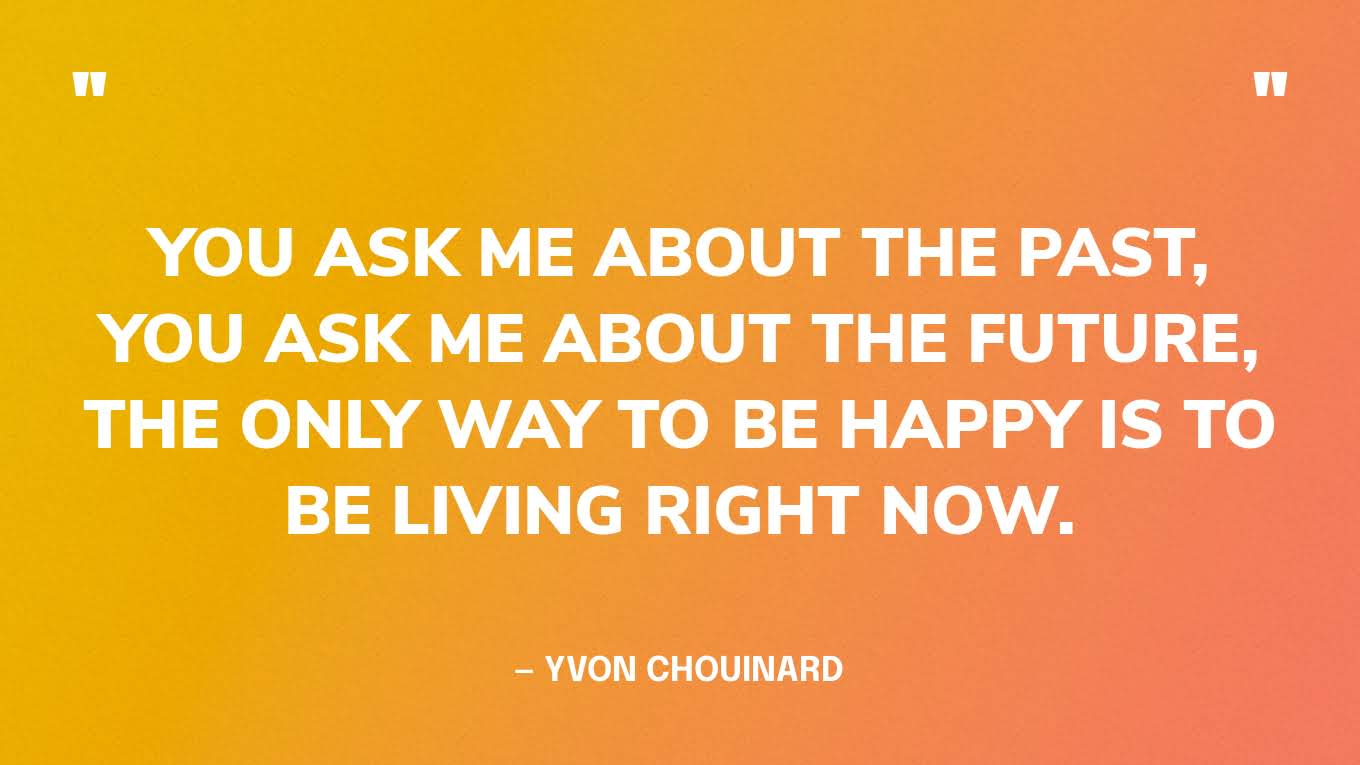
“There’s no difference between a pessimist who says, “Oh it’s hopeless, so don’t bother doing anything.” and an optimist who says, ‘Don’t bother doing anything, it’s going to turn out fine anyways.’ Either way, nothing happens.”
— Yvon Chouinard
About Sustainability
“We’re a part of nature. As we destroy nature, we destroy ourselves. It’s a selfish thing to want to protect nature.”
— Yvon Chouinard
“There is a beginning and end to all life — and to all human endeavors. Species evolve and die off. Empires rise, then break apart. Businesses grow, then fold. There are no exceptions. I’m OK with all that. Yet it pains me to bear witness to the sixth great extinction, where we humans are directly responsible for the extirpation of so many wonderful creatures and invaluable indigenous cultures. It saddens me to observe the plight of our own species; we appear to be incapable of solving our problems.”
— Yvon Chouinard
“Everything we personally own that’s made, sold, shipped, stored, cleaned, and ultimately thrown away does some environmental harm every step of the way, harm that we’re either directly responsible for or is done on our behalf.”
— Yvon Chouinard
“Traveling is my form of self-education. Every stream I fish now is not as good as it used to be. If you keep your eyes open as you travel around, you realize we are destroying this planet.”
— Yvon Chouinard
About Business
“The secret to happiness is to be working at your passion. If you want to be miserable, lead a desperate life like everybody else where they drag their asses to work every day because they hate their job.”
— Yvon Chouinard

“It’s always been difficult for us to lead an examined life as a corporation. I’ve always felt like a company has the responsibility to not wait for the government to tell it what to do or to wait for the consumer to tell it what to do, but as soon as it finds out it’s doing something wrong, stop doing it.”
— Yvon Chouinard
“The whole purpose of an adventure is to gain some spiritual or emotional insight. When you compromise the process, you compromise the gain.”
— Yvon Chouinard

“Who are businesses really responsible to? Their customers? Shareholders? Employees? We would argue that it’s none of the above. Fundamentally, businesses are responsible to their resource base. Without a healthy environment, there are no shareholders, no employees, no customers, and no business.”
— Yvon Chouinard
“Doing risk sports had taught me another important lesson — never exceed your limits. You push the envelope and you live for those moments when you’re right on the edge, but you don’t go over. You have to be true to yourself; you have to know your strengths and limitations and live within your means. The same is true for a business. The sooner a company tries to be what it is not, the sooner it tries to ‘have it all,’ the sooner it will die.”
— Yvon Chouinard
“Hiring people with diverse backgrounds brings in a flexibility of thought and openness to new ways of doing things, as opposed to hiring clones from business schools who have been taught a codified way of doing business.”
— Yvon Chouinard
“I think risk is important. I don’t care if it’s a great financial risk or a physical risk. You only get out of something what you put into it and the fact that you are willing to risk something means that you are going to get a lot more out of it.”
— Yvon Chouinard

“When I die and go to hell, the devil is going to make me the marketing director for a cola company. I’ll be in charge of trying to sell a product that no one needs, is identical to its competition, and can’t be sold on its merits. I’d be competing head-on in the cola wars, on price, distribution, advertising, and promotion, which would indeed be hell for me. Remember, I’m the kid who couldn’t play competitive games. I’d much rather design and sell products so good and unique that they have no competition.”
— Yvon Chouinard
“Everything we make pollutes. The most responsible thing we can do is to make each product as well as we know how so it lasts as long as possible.”
— Yvon Chouinard

“There’s no such thing as sustainability. There are just levels of it. It’s a process, not a real goal. All you can do is work toward it. There’s no such thing as any sustainable economy. The only thing I know that’s even close to sustainable economic activity would be organic farming on a very small scale or hunting and gathering on a very small scale. And manufacturing, you end up with way more waste than you end up with finished product. It’s totally unsustainable. It’s just the way it is.”
— Yvon Chouinard
About Adventure
“Real adventure is defined best as a journey from which you may not come back alive, and certainly not as the same person.”
— Yvon Chouinard
“The word adventure has gotten overused. For me, when everything goes wrong — that’s when adventure starts”
— Yvon Chouinard
“Surfing and climbing are both useless sports. You get to be conquistadors of the useless. You climb to the summit and there is nothing there. And you could hike to the top from another direction. How you get there is the important part. It’s the same with surfing.”
— Yvon Chouinard
About Simple Living
“The hardest thing in the world is to simplify your life; it’s so easy to make it complex.”
— Yvon Chouinard

“Going back to a simpler life based on living by sufficiency rather than excess is not a step backward. Rather, returning to a simpler way allows us to regain our dignity, puts us in touch with the land, and makes us value human contact again.”
— Yvon Chouinard
“I drive old cars, all my Patagonia clothes are years and years old, I hardly have anything new. I try to lead a very simple life. I am not a consumer of anything. And I much prefer sleeping on somebody’s floor than in a motel room.”
— Yvon Chouinard
“There’s a movement for simplifying your life: purchase less stuff, own a few things that are very high quality that last a long time, and that are multifunctional.”
— Yvon Chouinard
“We’re not citizens anymore. We’re consumers. That’s what we’re called. It’s just like being an alcoholic and being in denial that you’re an alcoholic. We’re in denial that each and every one of us is the problem. And until we face up to that, nothing’s going to happen.”
— Yvon Chouinard
More Sayings
“The solution maybe for a lot of the world’s problems is to turn around and take a forward step. You can’t just keep trying to make a flawed system work.”
— Yvon Chouinard

“Fear of the unknown is the greatest fear of all.”
— Yvon Chouinard
“A master in the art of living draws no sharp distinction between his work and his play; his labor and his leisure; his mind and his body; his education and his recreation. He hardly knows which is which. He simply pursues his vision of excellence through whatever he is doing, and leaves others to determine whether he is working or playing. To himself, he always appears to be doing both.”
— Yvon Chouinard
“The revolution starts at the bottom.”
— Yvon Chouinard
Featured image created in collaboration with DALL·E 2 AI.
The Akashinga unit, the country's first armed, all-women anti-poaching unit, says it aims to change the face of conservation
— Akashinga unit aims to save wildlife and empower women
— Ranger jobs offer good incomes for poor women
— Some criticize army-style nature conservation
Sharai Tunhira frowns with focus as she runs through drills with her all-female patrol team - each woman armed and ready for the many men they catch poaching wildlife in their corner of northern Zimbabwe.
Despite the risks of the job, she says joining the military-style unit has given her the chance to protect the wildlife she loves while also earning a decent livelihood in a rural area where many poor women struggle to make ends meet.
"Here I am occupied and empowered. I do not depend on a man to survive," said Tunhira, 25, who joined the team in 2021 after years of eking out a living as a cleaner and vegetable seller.
The Akashinga unit – aka 'The Brave Ones' in the Shona language – says it aims to change the face of conservation as the country's first armed, all-women anti-poaching unit.
The unit is a rarity in a sector dominated by men.
One in five African rangers is female, according to a 2016 World Wildlife Fund survey of 570 rangers, though the continent has a handful of female teams including South Africa's Black Mambas and The Lionesses rangers in Kenya.
Established in 2017 by Damien Mander, an Australian ex-commando, Akashinga has since grown to a total of 200 heavily-armed rangers who patrol eight reserves in the Lower Zambezi Valley under contracts with three district councils.
Wildlife
Zimbabwe is home to some 80,000 elephants, about a fifth of Africa's total, conservationists estimate. Numbers have declined sharply in recent years, mostly due to poaching, illegal hunting, and drought.
The Zambezi Valley, which spans the border with Zambia, is home to thousands of elephants as well as lions and cheetahs.

Military-style units such as Akashinga are controversial. Some conservationists have said armed rangers using battle tactics have harmed and intimidated local residents in wildlife areas and fail to tackle the root causes of poaching.
Akashinga is part of the International Anti-Poaching Foundation (IAPF), a non-profit founded in 2009 by Mander. The IAPF says the unit focuses on protecting wildlife via community engagement, from improving sanitation to creating jobs.
Mander said IAPF did initially focus on defending the area it protected but such criticism is outdated, with a shift to recognizing conservation as a social issue that involves educating and empowering the community.
"We used to be an organization that was extremely law enforcement focused ... We had helicopters, drones, and military hardware," he said.
"We do not have that now. This is less antagonistic."
He defended the Akashinga unit's continued use of semi-automatic and bolt action rifles as there is a real threat of poachers being armed with automatic weapons and the women should be prepared for the worst.
"For us not to train the rangers, whether men or women, to deal with the threat they will face will be irresponsible. We will be sending them to danger," he said.
Having women as rangers "generally de-escalates tension", said Mander, while teams that work in their home communities help foster productive relationships with residents.
The IAPF says since 2017, Akashinga rangers have made more than 300 arrests without firing a shot and helped drive an 80% downturn in elephant poaching in the Zambezi Valley, while wildlife sightings are up by almost 400%.

Its figures could not be independently verified but Ability Gandawa, lawmaker for Hurungwe North, which includes the Phundundu Wildlife Park, said animal sightings had increased.
"I am impressed by their solid effort to educate the community not to hunt wildlife," he said.
"The effort has since made it possible to significantly reduce poaching in my area."
Economic Benefits
What is not in doubt is the benefit to the women rangers, who include survivors of domestic abuse, child brides, and girls who dropped out of school.
Rangers earn the equivalent of between $300 and $1,500 per month, a good salary in a country where teachers earn an average of $120 per month.
"I had no idea that I would work in a formal setting as most jobs are for educated people," said Tunhira, cradling a rifle, describing how her family could not afford for her to finish school.
Margaret Darawanda, 24, another ranger and a single mother to a three-year-old daughter, recalled life pre-patrol when she depended on her mother, herself a poor farmer.
"The opportunity of becoming a ranger came when I needed it the most," she said.
"I am now able to look after my mother, my child, and my community," she said, her sights now set on university.

Mander said 95% of Akashinga's rangers come from within 20 km of the area they protect, with their salaries spent locally to the benefit of a wider area.
"We want to be a beacon of progression in the conservation industry," he told the Thomson Reuters Foundation.
"The idea is for Akashinga to be a stepping stone towards women's goals and following a career path."
Domestic Abuse
The IAPF aims to grow Akashinga to 1,000 rangers protecting 20 nature reserves by 2026. Some said the unit gave them a safe haven after fleeing abuse, and a sense of solidarity as they support each other.
Esther Goboza, 22, applied to join the rangers to escape an abusive marriage. Her husband, in a bid to stop her from becoming a ranger, burnt her national identity card, a requirement for the job application.
"They gave me the opportunity. My husband even came to the training camp to take me home but I stood my ground," said Goboza, who is now divorced.
Tracy Mukuni, 32, quit her police job to join the unit as a trainer because she wanted to support other working women.
"It was about my passion to help my fellow women to achieve their goals," said Mukuni, a sergeant instructor who trains rangers in fitness, bush survival skills, and ethics.
"Out there they come face to face with armed poachers who are strong ... These women need to be brave and skilled to protect wildlife. They also need to look after each other."
Reporting by Farai Shawn Matiashe; Editing by Sonia Elks and Katy Migiro. Originally published by Thomson Reuters Foundation, the charitable arm of Thomson Reuters, that covers the lives of people around the world who struggle to live freely or fairly.
When Sam Wasser was a young biologist studying baboons in Tanzania, he never imagined he would one day lead an international force cracking down on the smuggling of illegal goods, from elephant ivory to pangolins and timber.
Yet fighting transnational criminal organizations, or TCOs in law enforcement parlance, is exactly what he’s doing today, all because of his passion for animals.
And because he discovered how to extract DNA from elephant poop.
Today, Dr. Wasser is a professor at the University of Washington in Seattle. But in 1989 he was observing environmental stresses on baboons when Tanzania launched Operation Uhai ("freedom" in Swahili). That mission involved six months of intelligence-gathering and then a "brutal crackdown" on elephant poaching rings. Tanzania battles a reputation for being among a handful of worst offenders in Asia and Africa that fuel the illegal ivory trade.
In the 1800s, Dr. Wasser explains, an estimated 5 million elephants roamed Africa. From 1979 until 1989 governments around the world instituted ivory bans, but much of the damage had been done and the population had dropped to just 600,000.
Operation Uhai "literally stopped poaching in the country, where it was the worst in Africa," he adds. But that victory also had unexpected consequences.
"All of a sudden our baboons started to be killed by leopards at an incredibly high rate," Dr. Wasser says.
He and his colleagues had been studying three troops of baboons. "Within six months the troop of 20 were all killed, and by about a year and a half later the two troops of 70 were down to about 12 animals each," he says.
The team realized the leopards had mostly ignored the local baboon fare while feasting on the remains of elephants left by poachers, who took only the tusks.
The decline in elephant carrion and subsequent decimation of the baboon troops "made me realize how significant poaching really was on all levels," he says, "and on all the other species that were similarly affected by the ecological cascade of events."
Elephant families, broken by poaching
A self-described "animal nerd," Dr. Wasser points out that elephants are "some of the smartest animals around," he says. "They can recognize themselves in a mirror. You can put a spot on their forehead, and they’ll look in a mirror and they'll wipe it off. That’s a high cognitive ability." But "we lost over 100,000 elephants from 2007 to 2015. There are currently an estimated 415,000 elephants remaining in Africa."
Dr. Wasser explains that poachers often go back and kill members of the same elephant families – so frequently that he believes it creates a form of elephant PTSD.
Elephants also exhibit a strong interest in their dead. "They’ll go and they’ll just explore the carcasses of elephants. They know it’s dead. They know who it is that died," he says, "and they have tremendous social bonds. Their family members keep getting killed, over and over."
"It’s just too hard to watch, and the fact that we’re developing ways to potentially stop it — it keeps me going."
For the baboon studies, Dr. Wasser used hormones from animal dung to help understand their reproductive successes or failures. That work led Dr. Wasser to think, "You know, I could apply these tools to elephants. I realized that feces are really easy to collect, especially from an elephant that has a massive poop. You could then go and collect dung samples from elephants across the continent, genotype all the samples, and essentially create a DNA map," he explains. "And we could then get the DNA from the ivory to match to the map."
It sounds straightforward today. Yet no one then had yet figured out how to collect DNA from elephant dung or tusks. Nevertheless, by 1997 Dr. Wasser had cracked the code and published one of the first papers on extracting DNA from elephant feces, and "right around the same time we were moving forward to see if we could develop methods to get DNA out of ivory."
Dr. Wasser’s team got its first break in 2005: Bill Clark, chair of Interpol's Wildlife Crime Working Group, asked for help analyzing a shipment of ivory intercepted three years earlier in Singapore. It had been the largest seizure of ivory to date, about 6 tons, which included 40,000 carved hankos — also called chops — small pieces of ivory used throughout Asia to ink one’s name or seal on correspondence. Each would fetch about $200 retail, making the hankos alone worth $8 million.
Until Dr. Wasser and his colleagues employed their emerging science to analyze that seizure, the biologist says "everyone" believed these tusks were coming from all across Africa. But, using their dung-to-DNA analyses, "that’s not what we found."
Dr. Wasser's game-changing work helped law enforcement realize the ivory was coming from a small number of specific areas in east and west-central Africa — yet was being shipped out of ports on either side of the continent.
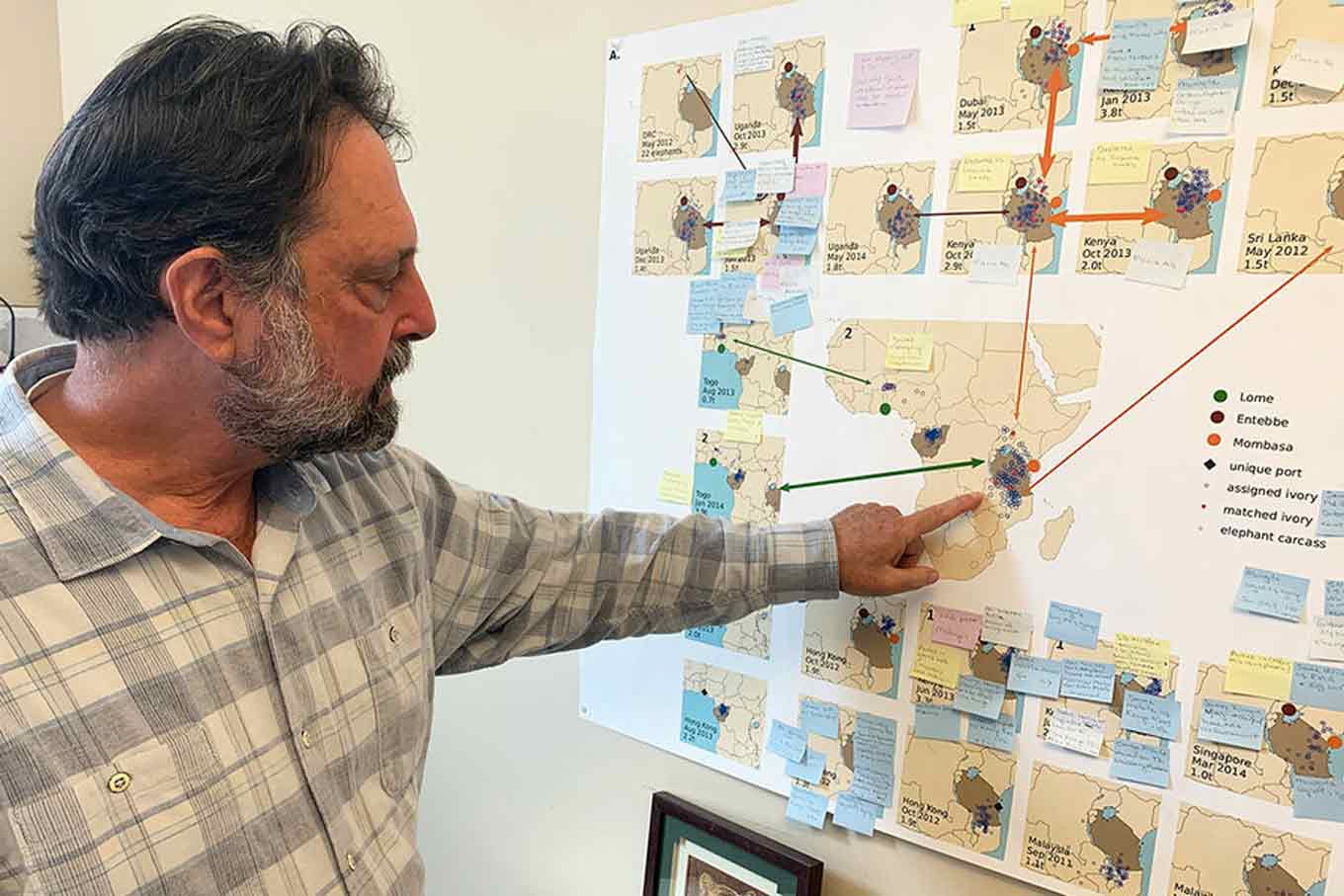
To illustrate, he rises quickly from his desk and points at a map of Africa on his office wall. Different colored dots mark where tusks came from and out of which port each was shipped. His finger moves from dot to dot: "If it’s orange, it means that it was containerized in Kenya. If it’s maroon it means it was containerized in Uganda."
His finger keeps moving, pointing to the dates of different seizures and blue dots pinpointing the ivory’s origin.
Identifying poaching hot spots
"People don’t understand the intricate structure in wildlife crime," explains Rod Khattabi, a former homeland security agent who now runs the Justice Initiative for the Grace Farms Foundation, which partners with Dr. Wasser to train law enforcement agencies in Africa. (Mr. Khattabi and Dr. Wasser are set to travel to Africa later in May to train authorities fighting poachers – Mr. Khattabi in ways to go undercover and Dr. Wasser showing them how DNA fits into investigations as well as prosecutions.) Wildlife criminals operate like independent cells, which makes arresting disparate elements of the syndicate tougher.
"That’s why Sam is so critical – because he can connect the dots," Mr. Khattabi says. "He'll tell me, 'Rod, this stuff is coming from Rwanda' even if it shipped out of Togo. He can almost pinpoint where the elephant got killed."
Serendipitously Dr. Clark, the now-retired Interpol agent who worked with Dr. Wasser across Africa, had trained as a biologist. In 2005, he "went to Sam because I understood that the techniques he was pioneering offered important tools in helping investigate elephant poaching and ivory trafficking in Africa," he says. "Sam’s work identified the poaching hot spots."
Dr. Wasser's sleuthing has expanded beyond elephants. "The work that we were doing with the illegal ivory trade — we realized it was relevant to all of these other species that are all coming out of Africa," he says. "Same problem: transnational criminals shipping it on containers — and us needing to really get the transnational criminals."
In 2021, with funding from the Washington State Legislature, Dr. Wasser and his colleagues formed the Center for Environmental Forensic Science. "There were also other tools that other scientists were using that could complement what we’re doing," he says. "Now we’ve got over 40 scientists from the University of Washington alone that are part of our center" using an array of synergistic methods including isotopes, chemistry, and handheld DNA detectors to fight a spectrum of crimes.
Counting that initial seizure, Dr. Wasser's team has analyzed roughly 70 seizures, "about 111 tons of ivory," which Dr. Clark says "provided a lot of prima facie evidence prosecutors use."
Almost a billion seagoing containers travel the globe annually, Dr. Wasser says, yet only 1% or 2% get inspected, and corruption in ports and governments further reduces enforcement.
Criminals with systems for smuggling ivory are perfectly positioned to traffic other contraband. Smugglers sometimes hide ivory, narcotics, and pangolins, thought to be the world’s most-poached animal, in shipments of illegally harvested timber.
"It’s all connected," Dr. Wasser says of the TCOs, insisting that collaboration among those fighting these criminals is vital: "Look, either you collaborate or wave goodbye" to species after species.
Part of why Dr. Wasser developed the Center for Environmental Forensic Science was to coordinate efforts among local as well as national governments, universities, and non-governmental organizations, marshaling their complementary skills to battle well-organized transnational criminals.
"I’ve long had the opinion that Sam deserves a Nobel Prize, but the Nobel Committee doesn't give it to his type of work," says Dr. Clark. "There's a big void in recognizing people who contribute to the future of planet Earth."
Dr. Wasser, though, seems more concerned with elephants than awards. "What drives me now is seeing the damage that these criminals are causing to nature," he says, "and the fact that they’re getting away with this – and wanting to really fix it."
Finland's oldest city has slashed emissions by more than half and is now looking to heat from sewage to get to net zero
— Turku aims to mark 800 years with carbon neutrality
— Emissions cut 55% since 1990 in a shift away from coal
— "Money smells," says the mayor of heat pumps at the sewage plant
Famed for its medieval castle and lofty cathedral, Finland's oldest city is winning admirers for a less likely attraction as it strives to be one of the world's first carbon neutral cities by 2029 - a sewage treatment plant.
The underground plant, located in a cavern beneath the Baltic Sea city of Turku, uses large industrial heat pumps to extract energy from waste flowing from the city's drains and sewers.
With urban areas accounting for 70% of the global greenhouse gas emissions that drive climate change, according to a U.N. panel of climate scientists, such innovative technology may be one path to slow warming.
It can also save money spent on fossil fuels - a growing concern in Europe as Russia's invasion of Ukraine disrupts natural gas supplies and hikes prices.
"Money smells, you know," Turku Mayor Minna Arve said of earnings from the Kakolanmaki wastewater plant, which has undergone several upgrades since opening in 2009. Officials from as far off as China have visited to learn about its technology.
Sewage sludge, extracted from foul-smelling treatment pools, is also trucked from the plant to an industrial facility to produce biogas, a replacement for natural gas.
Heat extracted from the wastewater is just a small part of the city's drive to phase out fossil fuels in favor of renewables including hydropower, wood pellets, and wind.
Arve said the 130-million-euro wastewater plant was her favorite example of how the city is harnessing previously untapped energy and boosting recycling to get on track for carbon neutrality to mark the city's 800th anniversary seven years from now.
Kakolanmaki generates enough hot water to heat homes for 12,000 people.
It produces almost 10 times more energy than it consumes, and has halved its annual carbon dioxide (CO2) emissions since 2017 to 10,000 tons, said Jarkko Laanti, a manager at Turun seudun puhdistamo Oy, the company that runs the plant.
Turku, Finland's oldest city and home to 200,000 people, aims to phase out the use of coal to generate energy this year.
Within seven years, the city's goal is that any lingering carbon emissions will be offset by expanding nearby huge pine forests that soak up carbon dioxide to grow.
"We've already reduced our emissions by 55% from the 1990 level, so it makes us even a little in front of the schedule," mayor Arve said, adding the economy had steadily grown in the period.
"I'm very confident we will reach the 2029 goal to be carbon neutral and then carbon positive," she said, adding that the Ukraine conflict was an additional incentive to act.
"If there will be a silver lining of the war in Ukraine for Europe it will be a speeding up of the green transition," she said.
Affluent from Effluent
In the Kakolanmaki plant, workers use bicycles to get around tunnels beside pools treating the waste, equipped with lifebuoys in case anyone falls in.
Like Turku, more cities are adopting heat pumps in wastewater systems, among them Cologne in Germany and Gothenburg in Sweden.
Turku won an award in 2020 from the European Covenant of Mayors, grouping thousands of local governments, as the best mid-sized city in Europe on climate action.
"Turku is very ambitious. It doesn't get much earlier than 2029," said Marion Guenard, senior officer of circular development at ICLEI, an association of more than 2,500 local governments in 125 countries.
Among other cities, Copenhagen in Denmark aims to be the first carbon neutral capital by 2025.
Turku, straddling the Aura River which usually freezes in winter, traces its founding to 1229 when it was mentioned in a document by Pope Gregory IX.
A former Finnish capital, it is known for its granite castle and its cathedral with a 102-meter (335-foot) tall tower, both dating from the 13th century.
Circular Economy
Guenard said Turku was especially innovative by stressing that creating a "circular economy", such as by recycling and eliminating waste, was a key goal of climate action and protecting biodiversity.
In a warehouse on the outskirts of the city, workers wearing breathing masks to protect against pollution sift through huge piles of waste textiles.
Finns discard an average of 13 kg (29 pounds) of textiles a year and they have often ended up in landfills or incinerated, said Tuomas Alijoki of recycling firm Lounais-Suomen Jatehuolto Oy.
Here, low-quality textiles are shredded and recycled into products such as floor tiles, furniture padding, or yoga mats.
Other items are sold by weight — in the shop that is part of the recycling plant, a pair of jeans costs about 3 euros.
Matthew Baldwin, manager of the EU 100 Climate Neutral Cities project — which includes Turku on a list issued in late April, said cities often have more ambitious climate goals than governments, but little say in designing national policies.

Wiggle Room
Baldwin, who is also a deputy director-general at the European Commission in Brussels, said the 100 cities in the project - which also include Lisbon, Dublin, Sofia, Munich, Paris, Athens, Bucharest, and Budapest - have "potential wiggle room" in meeting their goals.
Cities can usually only measure direct emissions within municipal boundaries such as energy used for heating, electricity generation, transport, and construction.
They exclude, for instance, harder-to-count emissions such as from food, steel, concrete, and other materials brought in from elsewhere.
In Finland, the Meyer Turku shipyard, for example, builds some of the world's largest cruise ships with many materials produced elsewhere.
Overall, Turku's climate neutrality pledge has slashed emissions monitored by the city to about 600,000 tons – roughly three tons for each inhabitant - from more than 1.2 million in 1990.
But total emissions per capita, counting everything from food to flights, in Turku are about seven tons.
To close the gap, Turku is encouraging citizens to shift lifestyles to comply with the toughest goal of the Paris Agreement to limit global warming to 1.5 degrees Celsius (2.7 Fahrenheit) above pre-industrial times.
New student residential halls have solar panels on the roof and state-of-the-art insulation. Students get five-minute sandglass timers to use when they have a shower to save water.
Big challenges for Turku include reducing fossil fuel emissions from transport in a region where many depend on cars.
Vidal Fey, a Finnish-German biologist and Turku resident, criticized the construction of an underground car park in the city center.
"It encourages people to drive to the city rather than bike or take the bus," he said, sitting on a bench by the Aura River.
Back at the wastewater plant, workers are proud of the purity of the water now flowing into the Baltic Sea, curbing pollution that in the past has caused toxic blooms of algae.
Jouko Tuomi, an engineer at the water treatment plant, points to a slogan on a company t-shirt: "Only the setting sun goes down untreated into the Baltic Sea."
Reporting by Alister Doyle; Editing by Laurie Goering and Helen Popper. This article was originally published by the Thomson Reuters Foundation, the charitable arm of Thomson Reuters, that covers the lives of people around the world who struggle to live freely or fairly.
They bought the house of their dreams in Winter Park, Florida. There was just one problem.
"Our yard is lifeless," says homeowner Brian Lewis, nudging a toe across the stony landscape. "So much gravel."
Lewis and his family are standing in their yard while a landscaping crew looks on with shovels poised. The crew is about to give the place a complete overhaul, replacing the gravel and the dry, depleted soil beneath with nutritious black compost into which they’ll plant a variety of attractive greenery that will provide a haven for bees and butterflies.
There is also a film crew present. The Lewis’ lawn makeover is being documented on "Flip My Florida Yard," a reality TV series that features households having their yards "flipped" by professional landscapers, transforming bare, haggard lawns into environmentally friendly oases. The show visits homes across Florida, from small urban developments and coastal, waterfront residences, to multi-acre rural properties.
A new reality series is using the HGTV method to tackle Florida’s water supply issues
The series has many of the elements typical of an HGTV-style home makeover show: A charismatic makeover team led by presenter and Emmy Award-winning director Chad Crawford, the time pressure of just eight hours to transform the locations, and a big reveal at the end of the day when homeowners return to see their renovated yards.
"Flip My Florida Yard" is the brainchild of Crawford, who says it was when he was doing an episode on lawn makeovers for another of his TV series, "How To Do Florida," that he realized how popular the topic was — and the scope that interest provides to encourage positive environmental action.
"Everybody has something about their yard they want to fix," he says. "Everybody has this desire to have someone else come in and show them what to do. We see these major environmental issues going on around us that a lot of us have no control over, but we as Floridians can control our yards. We can be environmentalists right outside our front door. That's really what the show’s about."
A central aim of the series is to show Florida homeowners how to conserve water, an issue that's becoming increasingly important as the state’s population swells.
Over the next four years, Florida is expected to gain an average of almost 310,000 people annually, "analogous to adding a city about the size of Orlando every year," say demographers. Between 2010 and 2070, it is estimated Florida will gain 15 million residents.
That growth is straining the state’s water supply, with water demands anticipated to rise at least 100 percent by 2070.
Sprawling development patterns and traditional landscaping, which is often dominated by water-guzzling varieties of turfgrass, contribute to much of that demand.
That’s where "Flip My Florida Yard" comes in.
The landscaping methods used on the show were developed by the University of Florida’s Florida-Friendly Landscaping Program, in partnership with the Florida Department of Environmental Protection.
They emphasize planting mostly native shrubs and grasses, which tend to require less water and less fertilizer, replacing portions of turfgrass with shrubbery beds, and installing water-efficient irrigation systems.
A recent study from the University of Florida found that "Florida-friendly" landscapes conserve 70 percent more water than traditional landscapes in their first year, and more than 80 percent over three subsequent years.
That can mean substantial savings for homeowners on their water bills.
And they don't have to devote extra time to caring for their yards, according to Tom Wichman, assistant director of the Florida-Friendly Landscaping Program, who says the study also found that mowing traditional landscapes and hand-weeding Florida-friendly ones took about the same time.
Over the longer-term, he added, the latter should actually take less time given that more mature plants will shade out the area beneath, reducing the volume of weeds.
Ultimately, the point of "Flip My Florida Yard" is to show homeowners how simple it can be to create and maintain a Florida-friendly lawn.
"People are a little scared because they just don’t know where to begin," says Wichman. "But it doesn’t have to be a huge project and it doesn’t have to be all at once."
Every episode brings in an agent from the local Extension office, which offers free resources and advice to homeowners on caring for Florida-friendly lawns.
The statewide Extension program, run by the University of Florida's Institute of Food and Agricultural Sciences, is "the best-kept secret out there," according to Wichman, who says too few people know that it exists.
The show is helping to change that. While it’s hard to pinpoint exactly how much impact "Flip My Florida Yard" is having relative to simultaneous awareness-raising efforts taking place, the Extension program has seen a significant uptick in traffic to its websites and other online resources since it began airing, and increased engagement with Extension agents around the state.
"Flip My Florida Yard" will gain a wider audience in its next season, which will premiere on PBS. The idea, says Crawford, is to return to some of the flipped yards to see how they've developed.
He hopes allowing viewers to see how Florida-friendly lawns look over time will start to change entrenched ideas of what "good landscaping" means.
"We have a standard in our mind that I call the pig-and-parsley standard," he says. "You have the house, which is the pig, and then you have the parsley, which is the hedge that goes around the house. Everything else is green grass. In our mind, that's good landscaping."
A Florida-friendly yard, on the other hand, features much more plant variety, which looks more aesthetically pleasing and has the added benefit of cooling and filtering pollutants from the air, improving soil quality, and attracting pollinators.
"The goal here is to recapture and reestablish some of the biodiversity we've lost in our yards," says Crawford. "When you have all that grass and just that shrubbery against the house, what you’ve lost is a lot of what was there before that house."
Whether they're actively thinking about biodiversity or not, Florida homeowners tend to be very enthusiastic about plants that attract butterflies, birds and bees to their yards, according to Dr. Laura Warner, a behavioral scientist at the University of Florida who studies sustainable landscape practices.
They are also very willing to purchase low-water-consuming plants, one study showed.
The same study also found that, when it comes to water conservation, Florida residents are most interested in learning about the issue as it relates to their own gardens and lawns — and least interested in larger-scale conservation efforts like watershed restoration and management.
That’s because people tend to feel less motivated about issues that seem more abstract to them, says Warner.
"You really have a personal relationship with what happens in your yard," she says. "You may enjoy the wildlife that comes there, you may enjoy the flowers, the different amenities that the landscape can offer you. As ideas get more removed from us, we feel less of a connection."
But "Flip My Florida Yard" is not about forcing that connection. The series is about showing people how to be responsible stewards of the piece of land that's right in front of them, whether it's five acres or five square feet, says Crawford.
"When you connect with your yard, you connect with nature," he says. "There’s something that happens there from a quality of life [perspective], from a mental perspective, that’s hard to quantify. And that’s the big change we’re seeing. We’re seeing the environmental impact of that yard, less water, fewer chemicals, but there's also a life impact that it's having on a family. To me, that's really, really cool."
There is no denying that the world is in a state of chaos. But amidst all the turmoil, there are moments of hope and inspiration.
Here are some of our favorite humanitarian quotes to help remind us that we can make a difference — great for celebrating World Humanitarian Day and every day.
We hope they provide you with some much-needed motivation during these challenging times.
Powerful Quotes from Famous Humanitarians
“When the whole world is silent, even one voice becomes powerful.”
— Malala Yousafzai

“It’s not about giving bread to orphans. It’s about building a bakery that can fit an orphanage and sell bread in the city.”
— Chef José Andrés

“A fundamental concern for others in our individual and community lives would go a long way in making the world the better place we so passionately dreamt of.”
— Nelson Mandela

“Do your little bit of good where you are; it is those little bits of good put together that overwhelm the world.”
— Archbishop Desmond Tutu
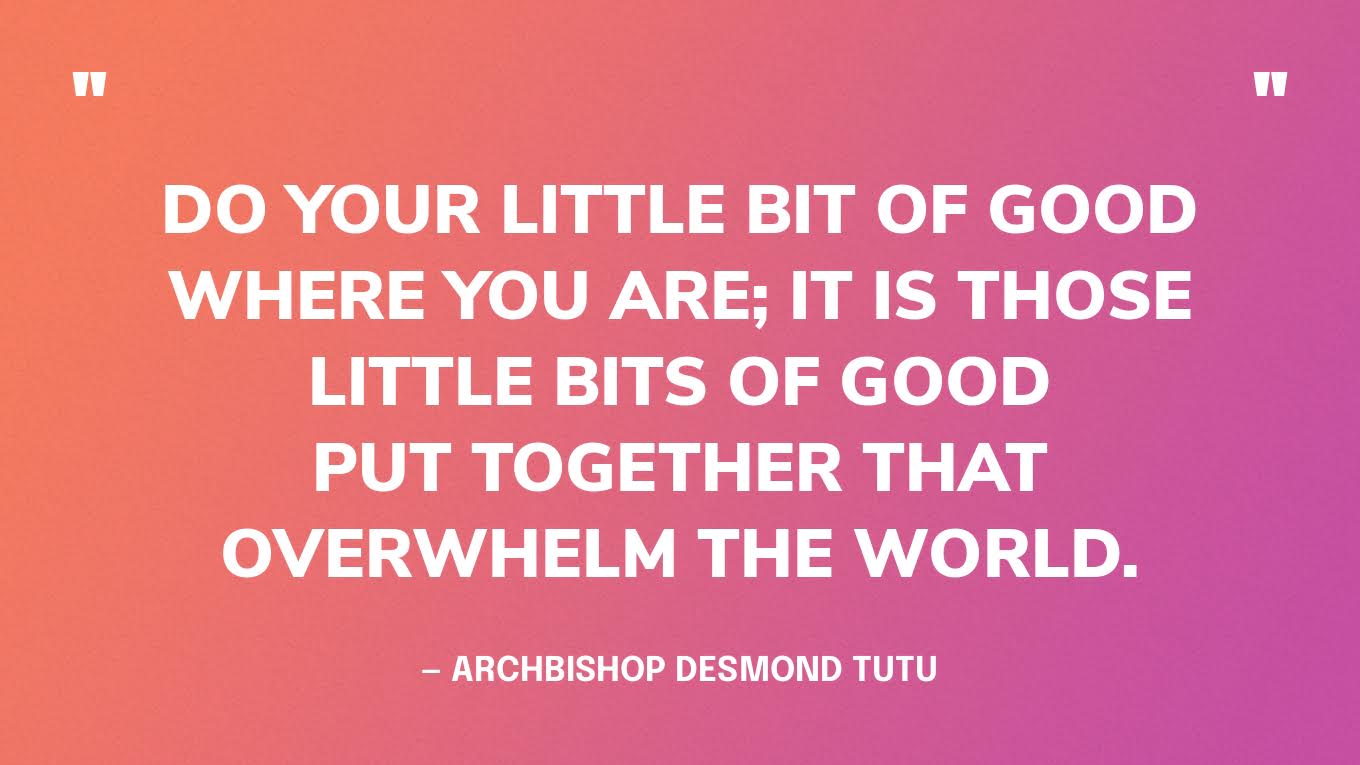
“The world is more malleable than you think, and it's waiting for you to hammer it into shape.”
— Bono

“Every action, no matter how small, is like drips on a rock—over time, they can carve a canyon through even the thickest, most immovable layer of rock.”
— Shannon Watts, founder of Moms Demand Action

“I do have reasons for hope: our clever brains, the resilience of nature, the indomitable human spirit, and above all, the commitment of young people when they’re empowered to take action.”
— Jane Goodall

“If you can’t feed a hundred people, feed just one.”
— Mother Teresa

“The need is great and so are the opportunities to make a difference.”
— Paul Newman

“Don’t expect change to happen overnight, even if it’s not always visible it’s making more impact than you think.”
— Emma Watson

“You don’t change the world with the ideas in your mind, but with the conviction in your heart.”
— Bryan Stevenson

“Make a career of humanity. Commit yourself to the noble struggle for equal rights. You will make a better person of yourself, a greater nation of your country, and a finer world to live in.”
— Martin Luther King Jr.

“You must not lose faith in humanity. Humanity is an ocean; if a few drops of the ocean are dirty, the ocean does not become dirty.”
— Mahatma Gandhi

“Optimism doesn’t mean that you are blind to the reality of the situation. It means that you remain motivated to seek a solution to whatever problems arise.”
— The Dalai Lama

“We must peacefully use the power of our voices and the strength of our numbers to demand changes in the judicial system so that brutality doesn't ever go unpunished.”
— Kim Kardashian

“It is a joy to be an artist, but it doesn't mean very much unless that work is somehow useful in some way and contributes to others.”
— Angelina Jolie

“We live in a world in which we need to share responsibility. It's easy to say 'It's not my child, not my community, not my world, not my problem.' Then there are those who see the need and respond. I consider those people my heroes.”
— Fred Rogers
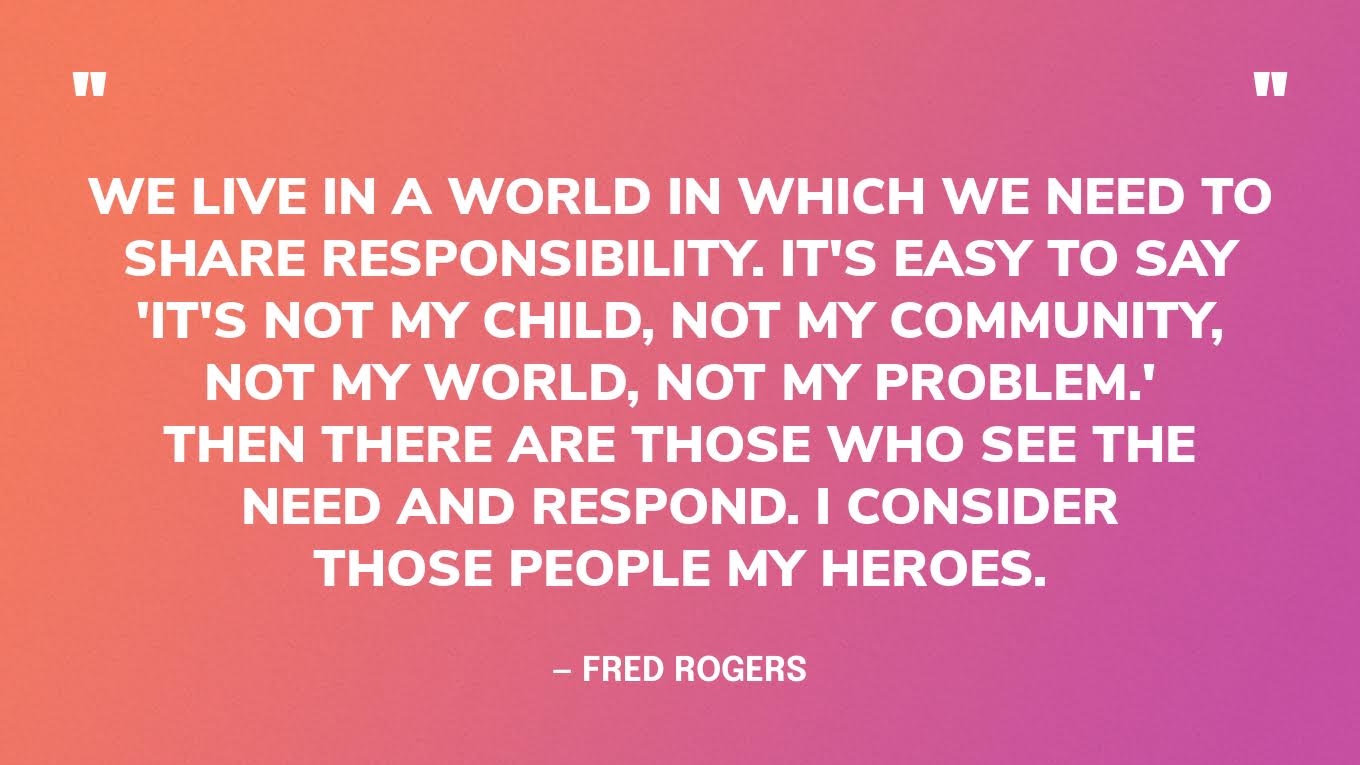
Looking for more? Check out these quotes about humanity.
These Republican states are passing clean energy bills in the name of freedom and economics.
In 2019, renewable power was having a moment — but not where you'd expect. Arkansas, South Carolina, and Utah, among the reddest of red states, passed landmark legislation paving the way for expanding solar and wind power.
The bills these states enacted were all sponsored by Republicans, passed by Republican-controlled state legislatures, and approved by Republican governors. They were also bipartisan bills, getting support from Democrats, too.
Many Republican legislators still deny the scientific consensus around climate change and oppose policies to address the problem outright. But a recent study found that these red-state successes weren't a fluke.
The analysis, recently published in the journal Climatic Change, shows that states approved roughly 400 bills to reduce carbon emissions from 2015 to 2020.
More than a quarter — 28 percent — passed through Republican-controlled legislatures.
"Even though some of these policies in red states might not be as ambitious as blue states, I just want people to know that things are happening," said Renae Marshall, a co-author of the study and a doctoral student at the University of California, Santa Barbara, who is researching ways to reduce political polarization around environmental problems. Marshall hopes that her study could be instructive for collaboration at the federal level, where attempts at bipartisanship tend to be less successful.
In late April, Senator Joe Manchin, the Democrat from coal-friendly West Virginia who tanked his party's climate and social policy package over concerns about government spending and inflation, started meeting with lawmakers to discuss a potential energy package that could muster up bipartisan support. At least five Republican senators have shown up so far, but securing the 10 Republican votes needed to pass a bill is a long shot. And if Democrats lose control of the House in the midterm elections, as expected, and possibly the Senate as well, any effort to pass climate legislation would require even more bipartisan cooperation.
If federal lawmakers followed the lead of their counterparts in Arkansas, South Carolina, and Utah, it could be a game-changer.
So what's causing the state-level breakthroughs on a highly polarized topic like climate change? It's partly a matter of Republicans defining climate action on their own terms, and partly a matter of economics.
Economic opportunity
Most of America's land is in red states — nearly two-thirds of it, going by last election's results. And that's space needed for things like installing wind farms and burying carbon underground.
"We really cannot win on climate change without including rural America in finding solutions," said Devashree Saha, a senior associate at the World Resources Institute in Washington, D.C.
But at the same time, Saha says, rural America has a lot to gain from renewable energy. Farmers can earn money by leasing land for wind projects, tax revenue from local solar farms can fund schools, and workers are needed to operate and maintain clean energy projects, creating new job openings.
Red states are already home to some of the largest clean energy projects. The biggest solar farm in the United States — a 13,000-acre project fittingly called "Mammoth Solar" — is being constructed in northern Indiana. Texas and Oklahoma are among the states that added the most clean power to the grid last year.
Although there's still a lot of resistance to these changes, Saha suggests that red states are doing more than you'd think to tackle the climate crisis.
"We often think of rural America as being very opposed to climate policies, but I think that's not a very accurate portrayal of what’s happening," Saha said.
Republican resistance to climate-friendly initiatives can start to soften if there's a strong economic case for them.
"Done right, we don’t need to lose U.S. jobs over this," said Senator John Curtis, a Republican from Utah, during a recent panel discussion on climate change and bipartisanship. "I think we can reduce greenhouse gas emissions and actually fuel our economy at the same time."
Expanding choices
While Democrats tend to lean toward mandates and regulation — say, ending the sale of gasoline-powered cars after 2030, a goal Washington state made recently — Republicans prefer climate legislation that expands choices, rather than limiting them, according to Marshall’s study.
Take the clean energy bill that passed in Arkansas in 2019. The Solar Access Act removed the state's ban on leasing land for solar farms, along with other solar-friendly measures, and ended up spurring new projects across the state.
"It’s a great day for the Arkansas consumer," said State Senator Dave Wallace, the Republican who introduced the bill, after its passage. "They will have more choices in the market now."
Another example is Utah's Community Renewable Energy Act, sponsored by Republican State Representative Stephen Handy. The act created a novel clean energy program for cities, encouraging them to adopt a goal of meeting their net electricity needs with 100 percent renewable power by 2030.
Handy developed the legislation with Rocky Mountain Power, the utility serving most of the state. He says the utility’s motivation was not necessarily about climate change, but about responding to the desires of its customers, who said they wanted clean energy. "It’s all about letting the free market innovate," Handy said.
Considering a broader set of technologies — like nuclear power and carbon capture — can also help drum up Republican support. Handy sponsored a bipartisan bill, which Governor Spencer Cox signed in March, that would allow the Utah Division of Oil, Gas, and Mining to establish regulations for capturing carbon from industrial facilities and storing it in the ground. "It never was opposed politically by either the Republicans or the Democrats," he said.
Avoiding 'climate change'
Some communication experts say that the term “climate change” has become so polarizing that, depending on the audience, you're better off avoiding it altogether. Consider the name of South Carolina’s 2019 bill that made it easier for solar power to expand: the Energy Freedom Act.
"The climate debate has become part of the culture war," said Josh Freed, who oversees the climate and energy program at the think tank Third Way. Some Republicans acknowledge the problem and are willing to discuss solutions, but rarely just to address the planetary crisis.
"As soon as it’s discussed within the context of climate for climate’s sake, they sort of retreat into their corner," he said. But that hostility can dissipate if you talk about "freedom," national security, or economics instead.
Republicans are also more likely to support legislation that avoids other "culture wars" issues. While Democrats have recently started using language related to racism and other social injustices in their policymaking, Marshall's study found that climate bills with bipartisan support were more likely to use language around "economic justice," meaning that they explicitly aim to help lower-income people.
Some political scientists argue that the best climate bills are the ones that don’t get much attention. So-called "quiet" policy tackles a planet-wide problem with hundreds of small tweaks, hidden away in broader congressional bills or departmental spending.
Without fanfare or attention from Fox News, these policies don’t blow up into polarizing debates. By the same token, they aren’t celebrated as political "wins" for Democrats, either. Instead, they fly under the radar, slowly shifting the country to a greener economy by giving tax credits for renewable projects or by installing charging stations for electric vehicles, for example.
Looking at the big picture of how climate policy has faltered in Congress over the last few decades, it's easy to miss the smaller successes, even when they make it through Congress. Manchin and Republican Senator Lisa Murkowski of Alaska co-sponsored the Energy Act of 2020, which included investments in renewables, energy efficiency, carbon capture, and nuclear.
It passed through a Democratic House and Republican Senate and was signed by President Donald Trump in December 2020. It also phased down the production of hydrofluorocarbons, "super-pollutants" that are thousands of times more potent than carbon dioxide at heating up the atmosphere.
It was one of the most important clean energy packages the country has passed in the last 10 years, Senator Curtis of Utah said at the recent panel on bipartisan climate action.
"We don't often tout enough our successes," he said. "There's so much work to be done in the climate realm, that rarely do we look back and say, 'Oh, good job.'"
At Benevolence Farm, residents live on site and help produce and sell food. Advocates say it's a way to address major gaps in the rural justice system.
The first time Katie Anderson learned of Benevolence Farm, she was sitting at the library — the one place she found solace while in prison. It provided a respite from thinking about her past, and quiet moments to envision a hopeful future.
"Writing out my goals was good motivation for me," Anderson said. "As a woman who has experienced severe domestic violence, my confidence was slim to none," she said.
Anderson built up her confidence as she read books on entrepreneurship. She said she got caught up in the justice system partly because of a dangerous relationship that chipped away at her self-worth, and landed in a North Carolina prison for nearly a year-and-a-half.
While flipping through a self-help book that day in 2019, a pamphlet for Benevolence Farm slipped out. The nonprofit, based in Alamance County, N.C., offers supportive transition after release from prison by providing safe housing, a guaranteed job, and other services — access to career-building classes, health appointments, and transportation — for incarcerated people who identify as women.
The project has transformed over the years, from a small CSA to an herbal focused garden that supports a growing business of handmade candles and body care products that the women sell at local markets and online.
Up to six residents at a time live rent-free in a three-bedroom house located on the 13-acre farm, which produces herbs and vegetables through a permaculture model.
The farm has a limit of two years for residents; some have lived there for a few months; others for the entire two-year period.
Residents work on the farm — from agricultural tasks to making and packaging products — Mondays, Wednesdays, and Fridays at a starting hourly wage of $15 — a four-dollar increase from the organization's 2020 wage, according to Benevolence Farm executive director Kristen Powers.
Anderson began the application process immediately after she found the pamphlet, and after she was released in spring 2020 — into a society newly navigating a global pandemic — she moved to Benevolence Farm.
"Bless [Powers'] heart, I am definitely a chatty person," Anderson said of the drive to the farm with Powers. "I don’t think she ever got the chance to get a word in. I gave her a huge download of who I am and what I wanted to change."
Anderson, a mother of four, stayed at the farm eight months the first time, then returned a few months later after a violent interaction with her abuser. She stayed six more months, easing her way back by moving into a house with another former Benevolence resident before moving into her own place in Alamance County.
"The fact that even in my darkest moments, these women were ready to receive my call…" Anderson’s voice trailed off and she stopped to take a deep breath, letting out a small cry.
"I'm sorry, but this makes me emotional," she said. "They literally saved my life. And not only that, they helped me rebuild a relationship with my children."

Since its founding in 2008, Benevolence Farm has grown slowly and steadily into a working farm and residence. In 2014, a community member donated a home and 13 acres in Graham, N.C.
As of May, Benevolence Farm has served 32 residents. Powers stresses the importance of quality of life for all who come through the farm.
"For a long time, we kind of had this branding problem that we quote-unquote only serve six people [at a time]," Powers said. "We serve six people intentionally and deeply and effectively."
Last year the program distributed more than $50,000 in living wages, according to Powers, mostly funded through individual donors. The program has helped access "thousands of appointments per year and thousands of nights of safe and secure housing to people who otherwise would not have it," she added.
Anderson had never worked in agriculture before, save for helping her grandmother in her garden. But it taught her how to pause in anxious, angry moments and regroup.

"I like to throw myself full-fledged into physical work so I don't have to deal with my emotional needs," she said. "But I let all my aggression come out physically so that I don't process it mentally. This gave me an avenue. I can go out here if I need the therapeutic time. Now I have the tools within me to utilize so that my aggression doesn’t take over me."
The Rural Justice Collaborative, a partnership between the nonprofit National Center for Courts and Rulo Strategies, a firm that facilitates partnerships across disciplines, recognized Benevolence Farm this year as an innovation site — a national model for justice-focused organizations. It's the only agricultural project among the honorees.
"Benevolence [Farm] is a model for reentry that celebrates women where they are," said Tara Kunkel, co-founder of the Rural Justice Collaborative.
The collaborative works to identify gaps in the rural justice system and organizes strategic collaborations across the country to reduce barriers to justice while eliminating the ways formerly and currently incarcerated people and their families are victimized.
Rural counties, despite lower crime rates in comparison to urban areas, are seeing rising incarceration rates. A 2017 report released by the Vera Institute of Justice and the MacArthur Foundation explored the growth of jails in rural America, revealing two primary reasons: rural jails have the highest national growth rates of pretrial detention, and financial incentives encourage rural jail systems to board individuals from other jurisdictions.
The report noted that access to critical criminal justice and community services may be spread thin, leading to "fewer judges to quickly hear cases, less robust pretrial services, and fewer diversion programs available to decrease jail use."
North Carolina ranks third in the nation for the most admissions in both local jails and state prisons, according to the Vera Institute. The pretrial incarceration rate has increased 42% in the state's 54 rural counties since 2008, compared to 33% in suburban counties.

Rural reentry after incarceration comes with distinct challenges as well, which Kunkel said could be improved with better access to basic necessities, including healthcare, health insurance, transportation, employment, and housing.
"When tailored to the rural context, such strategies have the potential to significantly reduce recidivism and promote wellness," she said.
Each year, 600,000 people from state and federal prison and 9 million people from local jails re-enter into communities. Within a three-year period, about half of them are reincarcerated and two-thirds are arrested again.
Alamance County is notoriously contentious for the way the justice system impacts people, particularly people of color. The protests against police brutality in the wake of George Floyd’s murder in 2020 launched a summer of tension that amplified racism in the rural county.
Powers remembers how the protests ignited conversations among residents and others about what makes communities safe.
"I know public safety has been thrown out a lot and people think law enforcement," she said. "We would argue that we are making our communities safer by making individuals safer by meeting their basic needs. We're also trying to reframe what community safety looks like and why everyone should be stakeholders and invested in reentry and talking what impacts incarceration has on individuals."
According to Benevolence Farm's 2020 annual report, 84% of former residents continue to live freely in the community. Most of the former Benevolence Farm residents stay in Alamance County.
"A lot of folks here, they turn back around and are supporting someone else who’s incarcerated," said Powers. "Often they're coming from communities that have been disproportionately affected by policing and jails and prisons. So they have a lot at stake there. Women bearing the brunt of that cost, whether they are the incarcerated individual or not."
Earlier this spring, echinacea and chamomile sprouted from raised beds at Benevolence Farm as chickens cooed nearby. The only man on site is a rooster named Mr. Hawkins.
Eden Gustavsen worked at Benevolence Farm from May 2018 to January 2019, after spending 19 months incarcerated at a prison in Swannanoa, N.C. She remembers arriving in Alamance County and being greeted by a homemade spaghetti dinner and a huge welcome banner.
"I felt like I was with family right away," Gustavsen said. She stressed the "ease" the house offered her, especially coming from the familiarity of being surrounded by people in prison to joining a smaller group with "common ground."

"It took me a long time to not feel like just an inmate with a number," she said. "I didn’t have my identity. I didn’t feel comfortable in clothes."
The farm work reminds her of growing up on her family farm in Vermont. Taking care of the chickens, building an irrigation system, driving the tractor — everything she did at Benevolence Farm felt familiar to her.
"Working with the dirt and the earth is really grounding. I felt free," she said. "Weeding helped me clear my head, gather my thoughts."
While living at Benevolence, Gustavsen finished her high school diploma, started college, got a car, found a new house to live in and obtained full custody of her daughter.
She has since married and now works at a local market managing the produce section and relationships between the store and local farms.

Anderson now works at Benevolence Farm as the Second Chance Alamance Project Manager advocating for formerly incarcerated women as they reenter the job market and more.
She's also starting her own nonprofit, Anderson’s Reentry Program, to help adults recently released from prison learn skills to better adapt to society.
"When you're a kid and screw up, how many chances do you actually get? But when you’re an adult, you don’t get those chances," she said.
"I matured later in life. It was difficult for me to process what I should be doing in my life, but that doesn’t mean I’m a bad person. It means I took a wrong direction. But look at me now. I am not that person anymore. We should support people’s dreams."
Powers said there are many stories like Anderson and Gustavsen on the farm.
"Yes, they're housed and employed and doing well, but then they also have the capacity now to do something extra," she said.
"When we think of the hierarchy of needs, self-actualization is kind of that pinnacle. So when we see folks able to give back, that's been really exciting for us to see — to still be in community with them in a meaningful way years after they’ve left the program."
For dozens of women in Pima County, Sarah Lee is like a fairy godmother.
She fields their texts and calls every day, soothing their worries about their babies, their bodies, their progress as parents.
Lee is a community health worker for Health Start, a statewide program that connects expecting mothers and their babies with a trained public health coach who finds them resources, provides information about their child's development, and serves as a sounding board for their questions.
Community health workers live and work in the same communities as the women in the program. They are trained on child development and pregnancy, but in this case, they work outside a traditional medical setting. They operate more like a well-trained friend who can address concerns and provide current information about what a mother or child could be experiencing.
For Health Start, the community health worker model serves as a less intimidating and nonjudgmental access point for prenatal and postnatal help for moms with risk factors that can complicate pregnancy and birth.
They keep mothers on track with prenatal care, helping them have a healthy birth, and then stick around for up to two years after a baby is born, helping the new parent adjust.
Arizona's Health Start program, to put it simply, works.
A recent study of the program showed it improved birth weights and immunization rates for children. Women in the program attended prenatal care appointments at higher rates.
But the program is relatively unknown — it sometimes struggles to find participants.
And while it receives a steady amount of state funding, the program can’t grow much beyond the 2,800 parents it serves each year, a tiny proportion of the babies born in Arizona annually.
Still, if more studies show the effectiveness of Health Start, it could become a national model for community health workers helping mothers before birth and for the two years after. Arizona officials in charge of the program want the idea to spread to other states.
Community health workers offer support "like talking to a friend"
Women are eligible for the program if they have one or more risk factors. These include both social and medical issues, such as marital status, living situation, race and ethnicity, education level, income, insurance type, previous complications during pregnancy, and maternal age.
In Pima County, Health Start also works with refugees and women in jail.
The program is based on the promotoras model, a grassroots movement that began in the 1960s in Latin America. Peer-education programs were created to train women in various health themes in rural areas. The program came to the United States through the U.S. Federal Migrant Health Act of 1962 and the Economic Opportunity Act of 1964.
A promotora is a community member with insight into local health and social issues who passes that knowledge onto others in the hope of promoting healthy living in the community.
Someone with a stack of degrees might intimidate a patient who has questions about her pregnancy or her child, especially if that patient isn't fluent in English or is new to the language. But a regular person who lives in the community with some specific training on pregnancy and early childhood can spend more time, in a less formal setting, to answer questions and provide resources.
Parents who go through Health Start become more confident at advocating for themselves and their children. They learn how to find and assess information to understand their children’s development and help them grow.
For Maricela Reiber, mom to 18-month-old Emiliana, having a community health worker to talk to helps her stay up to date on information and feedback about her daughter's milestones and the changes she’s going through. She's never been a mom before. She turned to Facebook groups at first and relatives whose methods seemed outdated.
Now, she gets worksheets from community health worker Lee, detailing what she should see her daughter do and how to react. The most recent one talked about behaviors her baby might do, like biting or throwing herself on the floor, and what those could mean.
Instead of being frustrated by those kinds of outbursts, the training showed her how to help her daughter through those situations by asking her to express her emotions as words.
But beyond the information itself, Reiber gets reassurance — that her feelings are normal, that she's doing her best, that there are people out there to help her when she needs someone to learn from.
And that reassurance has helped her grow more confident as a mother.
"Sarah Lee's always very supportive and encouraging and motivating," Reiber said. "And she's constantly offering that reassurance of, 'you're OK, you're doing a wonderful job, she's a happy little kid, she's taken care of.' And just having that validation has been great."
Kerri Reeves and her newborn son, Oliver, both nearly died during Oliver's premature birth. And after the 38-year-old’s pregnancy, she experienced pain beyond what she had after the first time she gave birth. She, too, turned to Lee.
Lee taught Reeves, who works as a social worker in oncology, how to better advocate for herself with her doctors. She answered questions about formulas and feeding issues.
Without Lee's guidance, Reeves would have had to spend countless nights doing her own new mother research online, an overwhelming prospect for a mother of several young children.
Reeves first started receiving services from Health Start two years ago, before her daughter Charlotte was born. Charlotte was advanced, easily surpassed expectations, and needed more stimulation. Oliver, who was premature, fell behind in some areas.
Lee helped with both, and will be able to provide services until Oliver is 2 years old.
"It feels like you're talking to a friend, but a friend with a lot of knowledge, confidentially." Reeves said. "I can tell her things that I would never dream of telling my doctor or that I would never utter out loud to a friend, and she gives you that encouragement to take action with that."
Innovative health approach leads to better outcomes
Researchers at the Arizona Department of Health Services, the University of Arizona, and Northern Arizona University evaluated 10 years of the program and its impacts on mothers and children.
Their study, released in December, concluded that Health Start is an innovation that can produce healthier babies and mothers in diverse populations across the state.
The study analyzed more than 7,000 participants against control groups and showed that families in the program had lower instances of low birth weights and preterm births.
Women in the program attended prenatal care appointments at higher rates. Children in the program had higher immunization rates. All of these factors improve outcomes for these families.
The program also saves the state money in the long term, the study concluded, as around 80% of the families in the program are on the Arizona Health Care Cost Containment System. Better preventative care means less cost to the state down the road.
The authors lauded the program's success and recommended that community health worker services be better integrated into clinical settings as well. The authors also said more visits, better transportation, and education on additional topics could strengthen Health Start.
So far, two studies have shown the program's successes. The state needs two or three more studies before it can be considered "evidence-based" by the U.S. Department of Health and Human Services, said Sara Rumann, the Health Start program manager at the Arizona Department of Health Services.
"If we were to be considered and deemed evidence-based by DHHS, we would be a model that other states could replicate and draw down the federal money, and use this particular Health Start model and put it in Nevada, for example, or New Mexico, for example," Rumann said.
Health workers create game-changing home checklist
Before the pandemic, many of the Health Start visits between the community health workers and families happened in person.
Now, there's a flurry of texts, emails, phone calls, and Zoom sessions to facilitate these meetings, though some are again returning to face-to-face.
To prepare for their monthly visits with clients, community health workers review the Health Start curriculum, choosing the appropriate topics to discuss. The curriculum includes information about safe sleeping for infants, a program called "All Babies Cry," car seat safety, oral health, and more.
But they don't just refer to Health Start's built-in curriculum. Lee and other workers also pull supplemental materials and resources to make sure they have as much information as possible for their clients.
Community health workers also refer to Health Start's Healthy at Home checklist, which they complete with clients when their children are about 5 months old, and then again between 18 and 24 months.
The checklist includes tips to keep babies and toddlers safe in the home while also addressing ways to keep adults safe and healthy, too, including simple checks like having smoke detectors in the home.
"As with all of our visits and curriculum, Healthy at Home is completed in a nonjudgmental way and offered as a tool," Lee said. "It’s ultimately up to the caregiver to decide what’s best for their own household."
Health Start screens new mothers for perinatal mood disorders, including anxiety and depression that can begin at conception and continue past delivery. Data shows these types of mood disorders can affect as many as 20% of women and are more common than gestational diabetes.
They screen for developmental delays in children, and while they can't make diagnoses, they can point out areas in which a child might benefit from some extra practice or help.
"Parents seem to really enjoy those. They get to show off the great things their baby has learned, and they get to see that the funny thing their baby is doing is actually a developmental skill," Lee said.
Community health workers also can be the first to flag signs of domestic abuse, and they are trained to talk to patients about what it is and looks like.
They educate families about the health-care system, particularly if they're new to the country, and consult monthly with a nurse practitioner or physician and early childhood and mental health specialists to review client concerns.
"A huge piece of this is connecting families with resources," Lee said.
Health Start seeks extended funding
Health Start began in Pima County in 1984 as a program administered by the University of Arizona College of Medicine’s Rural Health Office. The program, "Un Comienzo Sano/A Healthy Beginning," was created to address a steady increase in the rate of women who were receiving inadequate or no prenatal care.
At the time, Arizona was ranked 45th lowest in the nation for the number of women receiving adequate prenatal care.
In 1994, the state Legislature passed the Arizona Children and Families Stability Act, formalizing and expanding Health Start.
The program was initially funded through the state general funds and later through the Tobacco Litigation Settlement Fund. Since 2004, it’s been funded by Healthy Arizona Initiative lottery money.
The current model is effective, but like anything else, it’s not perfect, Rumann, of ADHS, said.
The program can’t really grow, since it receives about the same amount of funding every year. And it struggles to reach some rural communities simply because of the increased travel and cost of providing services.
"That limits our growth and capacity really in different areas of the state," Rumann said. "Coconino is my main area right now that's having struggles. We have a lot of families that need help in Page. When you get outside of Flagstaff, there's lots of families out there, but not much to draw on."
Transportation serves as an obstacle for many families that Rumann wishes Health Start could help address statewide.
Pima County provides bus cards to their families to use to get to prenatal or pediatrician visits, but the program itself doesn't have enough funding to offer transportation options to families enrolled in the program in other counties.
Lee, who works for the Pima County Health Department as a Health Start program specialist, said the program has changed over the years to meet the needs of the community, including the addition of services to the jail, which went into effect about five years ago.
The county also got permission to work with families who have children in Department of Child Safety custody, and Lee is particularly proud of the county's work with refugee populations.
Health Start consistently has used the same type of curriculum, but health workers can tailor it to meet each person’s individual needs or the needs of a specific community, Lee said.
"Community health workers are basically peers for people," Lee said. "They live in the community they’re working in, they may have lived experience and maybe have been on (Special Supplemental Nutrition Program for Women, Infants, and Children) or (Arizona Health Care Cost Containment System, the state’s Medicaid system). We understand what our clients are going through, to some extent."
While Lee has a bachelor's degree in family studies and human development, community health workers aren't required to have a college degree.
Lee — one of two community health workers serving Pima County — has a caseload of about 50 clients.
The county is currently looking for a third health worker to add to the team, but even with only two, there isn’t a waitlist to get into the program.
Families enroll in the program through referrals from various community resources, including doctors, social workers, and the International Rescue Committee.
If someone seems like a good fit for the program or expresses interest in signing up, they'll be referred to the program and someone from Health Start will reach out. Interested families can also contact Pima County Health Start on their own to get started.
Community health workers also do their own outreach to find more families. In March, Lee and others spent the morning at Tucson Medical Center's Be Safe Saturday, trying to get the word out about the program.
With community support, mothers grow in self-advocacy
Lee said she's seen in many of her clients the progress they've made in their confidence and parenting skills after a short time with the program.
"We are super lucky to get to do what we're able to do," Lee said. "I think it's a great model and I love that it's a peer that's working with families. I think that makes people feel a little more comfortable."
For Reeves, that self-advocacy, learned through Lee's help, was invaluable. It led to a diagnosis of and surgery to treat placenta accreta, after she brought it up with her doctor following discussions with Lee about the pain she experienced.
"I don't think I would have advocated for my own health as strongly as I did prior to surgery without Sarah Lee," Reeves said. "So it's not just for the kids, it's for the moms or dads as well."
In six months, once Reiber's daughter Emiliana is 2, she'll age out of Health Start's services. But she feels prepared for what comes next.
She now knows how to access services and find information that she may need to help herself or her daughter. Emiliana will be talking more and better able to communicate what she needs.
Reiber felt the program was so useful, she referred her best friend to Lee, too. If she has another child, she would definitely use Health Start again. And she's been telling everyone how much she’s learned.
"When I was telling my mom and family about it, they were like, 'I wish that we had that when you were a baby,'" Reiber said.
Justice is one of the most important ideals in our society. It's what we strive for in order to create a fair and equitable world.
But what does justice really mean? And how can we achieve it?
These are tough questions, but thankfully, plenty of inspiring people have tackled them head-on. Here are dozens of the best quotes about justice, from powerful leaders, thinkers, activists, and everyday people alike.
Read on to gain some insights and be inspired to pursue justice in your own life:
Quotes About Justice
Famous Quotes About Justice
“Injustice anywhere is a threat to justice everywhere. We are caught in an inescapable network of mutuality, tied in a single garment of destiny. Whatever affects one directly, affects all indirectly.”
— Martin Luther King Jr.
“Never forget that justice is what love looks like in public.”
— Cornel West
“Each of us is more than the worst thing we’ve ever done.”
— Bryan Stevenson
“Continue to speak out against all forms of injustice to yourselves and others, and you will set a mighty example for your children and for future generations.”
— Bernice King
“If you are neutral in situations of injustice, you have chosen the side of the oppressor. If an elephant has its foot on the tail of a mouse, and you say that you are neutral, the mouse will not appreciate your neutrality.”
— Archbishop Desmond Tutu
“Justice will not be served until those who are unaffected are as outraged as those who are.”
— Benjamin Franklin
“If you have come to help me you are wasting your time. But if you recognize that your liberation and mine are bound up together, we can walk together.”
— Lilla Watson
Environmental Justice
“Environmental injustice is a tangible, intolerable example of an exhibited moral laxity and minimal concern for healthy standards by corporations and political structures based on the race, ethnicity, and class of those being impacted.”
— Bernice King
“When we choose to protect others, we are also protecting ourselves. We cannot achieve climate justice, without uplifting and supporting all communities.”
— Intersectional Environmentalist
“A vibrant, fair, and regenerative future is possible — not when thousands of people do climate justice activism perfectly but when millions of people do the best they can.”
— Xiye Bastida
“We can't save the planet without uplifting the voices of its people, especially those most often unheard.”
— Leah Thomas
“Environmental justice, for those of you who may not be familiar with the term, goes something like this: no community should be saddled with more environmental burdens and less environmental benefits than any other.”
— Majora Carter
“Saving our planet, lifting people out of poverty, advancing economic growth… these are one and the same fight. We must connect the dots between climate change, water scarcity, energy shortages, global health, food security and women’s empowerment. Solutions to one problem must be solutions for all.”
— Ban Ki-moon
Related: The best quotes about the environment
Related: The best quotes about public health
Social Justice
“Quick reminder: Kindness and justice are not synonymous. Be kind. And advocate and work for justice. Lives depend on it.”
— Bernice King
“We have a right to protest for what is right. That’s all we can do. There are people hurting, there are people suffering, so we have an obligation, a mandate, to do something.”
— John Lewis
“Justice grows out of recognition of ourselves in each other — that my liberty depends on you being free too.”
— Barack Obama
“Ours is not the struggle of one day, one week, or one year. Ours is not the struggle of one judicial appointment or presidential term. Ours is the struggle of a lifetime, or maybe even many lifetimes, and each one of us in every generation must do our part.”
— John Lewis, Across That Bridge: A Vision for Change and the Future of America
“It takes no compromise to give people their rights… it takes no money to respect the individual. It takes no political deal to give people freedom. It takes no survey to remove repression.”
— Harvey Milk
“I am not interested in picking up crumbs of compassion thrown from the table of someone who considers himself my master. I want the full menu of rights.”
— Archbishop Desmond Tutu
“Man’s capacity for justice makes democracy possible, but man’s inclination to injustice makes democracy necessary.”
— Reinhold Niebuhr
Related: The best quotes about social justice
Racial Justice
“In a racist society it is not enough to be non-racist, we must be anti-racist.”
— Angela Davis
“A democracy cannot thrive where power remains unchecked and justice is reserved for a select few. Ignoring these cries and failing to respond to this movement is simply not an option — for peace cannot exist where justice is not served.”
— John Lewis, on the George Floyd Justice in Policing Act
“People don’t realize what’s really going on in this country. There are a lot things that are going on that are unjust. People aren’t being held accountable for. And that’s something that needs to change. That’s something that this country stands for: freedom, liberty and justice for all.”
— Colin Kaepernick
“No one is born hating another person because of the color of his skin, or his background, or his religion. People must learn to hate, and if they can learn to hate, they can be taught to love, for love comes more naturally to the human heart than its opposite.”
— Nelson Mandela
“The beauty of anti-racism is that you don’t have to pretend to be free of racism to be an anti-racist. Anti-racism is the commitment to fight racism wherever you find it, including in yourself. And it’s the only way forward.”
— Ijeoma Oluo
“As long as people can be judged by the color of their skin, the problem is not solved.”
— Oprah Winfrey
“If you’re calling for an end to unrest, but not calling out police brutality, not calling for health care as a human right, not calling for an end to housing discrimination, all you’re asking for is the continuation of quiet oppression.”
— Rep. Alexandria Ocasio-Cortez
MLK Quotes About Justice
“We shall overcome because the arc of the moral universe is long but it bends toward justice.”
— Martin Luther King Jr.
“As my sufferings mounted I soon realized that there were two ways in which I could respond to my situation — either to react with bitterness or seek to transform the suffering into a creative force. I decided to follow the latter course.”
— Martin Luther King Jr.
“It is not possible to be in favor of justice for some people and not be in favor of justice for all people.”
— Martin Luther King Jr.
“Returning hate for hate multiplies hate, adding deeper darkness to a night already devoid of stars. Darkness cannot drive out darkness; only light can do that. Hate cannot drive out hate, only love can do that.”
— Martin Luther King Jr.
“Human progress is neither automatic nor inevitable... Every step toward the goal of justice requires sacrifice, suffering, and struggle; the tireless exertions and passionate concern of dedicated individuals.”
— Martin Luther King Jr.
“Injustice anywhere is a threat to justice everywhere.”
— Martin Luther King Jr.
“One has a moral responsibility to disobey unjust laws.”
— Martin Luther King Jr.
Related: The best Martin Luther King Jr. quotes beyond the clichés
Malcolm X Quotes About Justice
“I’m for truth, no matter who tells it. I'm for justice, no matter who it is for or against. I’m a human being, first and foremost, and as such I'm for whoever and whatever benefits humanity as a whole.”
— Malcolm X
“The only way we'll get freedom for ourselves is to identify ourselves with every oppressed people in the world.”
— Malcolm X
“Nobody can give you freedom. Nobody can give you equality or justice or anything. If you’re a man, you take it.”
— Malcolm X
“You can’t separate peace from freedom because no one can be at peace unless he has his freedom.”
— Malcolm X
“I am neither a fanatic nor a dreamer. I am a Black man who loves peace, and justice, and loves his people.”
— Malcolm X
James Baldwin Quotes About Justice
“It is certain, in any case, that ignorance, allied with power, is the most ferocious enemy justice can have.”
— James Baldwin
“Not everything that is faced can be changed, but nothing can be changed until it is faced.”
— James Baldwin
“If one really wishes to know how justice is administered in a country, one does not question the policemen, the lawyers, the judges, or the protected members of the middle class. One goes to the unprotected — those, precisely, who need the law’s protection most! — and listens to their testimony.”
— James Baldwin
“Ask any Mexican, any Puerto Rican, any Black man, any poor person - ask the wretched how they fare in the halls of justice, and then you will know, not whether or not the country is just, but whether or not it has any love for justice, or any concept of it. It is certain, in any case, that ignorance, allied with power, is the most ferocious enemy justice can have.”
— James Baldwin
“Words like ‘freedom,’ ‘justice,’ ‘democracy’ are not common concepts; on the contrary, they are rare. People are not born knowing what these are. It takes enormous and, above all, individual effort to arrive at the respect for other people that these words imply.”
— James Baldwin
Related: The best James Baldwin quotes that still resonate today
bell hooks Quotes On Social Justice
“Without justice there can be no love.”
— bell hooks
“If we want a beloved community, we must stand for justice.”
— bell hooks
“Feminist politics aims to end domination, to free us to be who we are - to live lives where we love justice, where we can live in peace. Feminism is for everybody.”
— bell hooks
“Justice is possible without equality, I believe, because of compassion and understanding. If I have compassion, then if I have more than you, which is unequal, I will still do the just thing by you.”
— bell hooks
“Justice demands integrity. It’s to have a moral universe — not only know what is right or wrong but to put things in perspective, weigh things. Justice is different from violence and retribution; it requires complex accounting.”
— bell hooks
“The greatest movement for social justice our country has ever known is the civil rights movement and it was totally rooted in a love ethic.”
— bell hooks
“Feminist thinking teaches us all, especially, how to love justice and freedom in ways that foster and affirm life.”
— bell hooks
“The world would be a paradise of peace and justice if global citizens shared a common definition of love which would guide our thoughts and action.”
— bell hooks
Related: The best quotes from bell hooks about love, justice, and community
Quotes About Equality and Justice
“Overcoming poverty is not a gesture of charity. It is an act of justice. It is the protection of a fundamental human right, the right to dignity and a decent life.”
— Nelson Mandela
“Women’s rights are not only an abstraction, a cause; it is also a personal affair. It is not only about us; it is also about me and you. Just the two of us.”
— Toni Morrison
“Freedom and justice cannot be parceled out in pieces to suit political convenience. I don’t believe you can stand for freedom for one group of people and deny it to others.”
— Coretta Scott King
Short Quotes For Students
“When you see something that is not right, not fair, not just, you have to speak up. You have to say something; you have to do something.”
— John Lewis
“Love is not passive. It is active, transformative, and just.”
— Bernice King
“If now isn’t a good time for the truth, I don’t see when we’ll get to it.”
— Nikki Giovanni
“Justice is doing for others what we would want done for us.”
— Gary Haugen, on Sounds Good
Related: The best short quotes
On Fighting For Justice
“When we identify where our privilege intersects with somebody else’s oppression, we'll find our opportunities to make real change.”
― Ijeoma Oluo, So You Want to Talk About Race
“Freedom is not a state; it is an act. It is not some enchanted garden perched high on a distant plateau where we can finally sit down and rest. Freedom is the continuous action we all must take, and each generation must do its part to create an even more fair, more just society.”
— John Lewis
“I am no longer accepting the things I cannot change. I am changing the things I cannot accept.”
— Angela Davis
“There may be times when we are powerless to prevent injustice, but there must never be a time when we fail to protest.”
— Elie Wiesel
“Nothing can stop the power of a committed and determined people to make a difference in our society. Why? Because human beings are the most dynamic link to the divine on this planet.”
― John Lewis, Across That Bridge: Life Lessons and a Vision for Change
“To refuse to listen to someone’s cries for justice and equality until the request comes in a language you feel comfortable with is a way of asserting your dominance over them in the situation.”
― Ijeoma Oluo, So You Want to Talk About Race
Related: The best quotes about activism
Food Justice Quotes
“My work with the poor and the incarcerated has persuaded me that the opposite of poverty is not wealth; the opposite of poverty is justice.”
— Bryan Stevenson, social justice activist & death penalty abolitionist
“For me, an area of moral clarity is: you're in front of someone who's suffering and you have the tools at your disposal to alleviate that suffering or even eradicate it, and you act.”
— Paul Farmer
“Every gun that is made, every warship launched, every rocket fired, signifies in the final sense a theft from those who hunger and are not fed, those who are cold and not clothed.”
— Dwight D. Eisenhower
“We know that a peaceful world cannot long exist, one-third rich and two-thirds hungry.”
— Jimmy Carter
“Why should there be hunger and deprivation in any land, in any city, at any table, when man has the resources and the scientific know-how to provide all mankind with the basic necessities of life? There is no deficit in human resources. The deficit is in human will.”
— Martin Luther King Jr.
“Saving our planet, lifting people out of poverty, advancing economic growth…these are one and the same fight.”
— Ban Ki-moon
“Hunger is not an issue of charity. It is an issue of justice.”
— Jacques Diouf
Related: The best quotes about hunger
Related: The best quotes about poverty
Restorative Justice Quotes
“If our social justice is guided by retribution, we will simply perpetuate the use and abuse of power to inflict violence.”
— Jamie Arpin-Ricci
“We are not to simply bandage the wounds of victims beneath the wheels of injustice, we are to drive a spoke into the wheel itself.”
— Dietrich Bonhoeffer
“Justice and revenge are not the same thing.
Justice is a continuum that includes accountability, change toward preventing further injustice, strategic hope, etc.
As my father said, ‘Justice at its best is love correcting everything that stands against love.’”
— Bernice King
“Restorative Justice is respect. Respect for all, even those who are different from us; even those who seem to be our enemies. Respect reminds us of our interconnectedness, but also of our differences. Respect insists we balance concerns for all parties. If we pursue justice as respect, we will do justice restoratively.”
— Howard Zehr
“Forgiving is not forgetting; it’s actually remembering — remembering and not using your right to hit back. It’s a second chance for a new beginning. And the remembering part is particularly important. Especially if you don’t want to repeat what happened.”
— Archbishop Desmond Tutu
“People respond in accordance to how you relate to them. If you approach them on the basis of violence, that’s how they will react. But if you say, we want peace, we want stability, we can then do a lot of things that will contribute towards the progress of our society.”
— Nelson Mandela
“The restorative justice movement is grounded in values that promote both accountability and healing for all affected by crime.”
— Mark Umbreit
“Justice will not be served if we maintain our exclusive focus on the questions that drive our current justice systems: What laws have been broken? Who did it? What do they deserve? True justice requires, instead, that we ask questions such as these — Who has been hurt? What do they need? Whose obligations and responsibilities are these? Who has a stake in this situation? What is the process that can involve the stakeholders in finding a solution?”
― Howard Zehr, The Little Book of Restorative Justice
“Retributive theory believes that pain will vindicate, but in practice that is often counterproductive for both victim and offender. Restorative justice theory, on the other hand, argues that what truly vindicates is acknowledgment of victims’ harms and needs, combined with an active effort to encourage offenders to take responsibility, make right the wrongs, and address the causes of their behavior. By addressing this need for vindication in a positive way, restorative justice has the potential to affirm both victim and offender and to help them transform their lives.”
— Howard Zehr, The Little Book of Restorative Justice
“An eye for an eye will make the whole world blind.”
— Mahatma Gandhi
“Through non-violence, courage displaces fear; love transforms hate. Acceptance dissipates prejudice; hope ends despair. Peace dominates war; faith reconciles doubt. Mutual regard cancels enmity. Justice for all overthrows injustice. The redemptive community supersedes systems of gross social immorality.”
— Rev. Dr. James Lawson, Jr.
“Restorative justice expands the circle of stakeholders—those with a stake or standing in the event or the case—beyond just the government and the offender to include victims and community members also.”
― Howard Zehr, The Little Book of Restorative Justice
“For it isn't enough to talk about peace. One must believe in it. And it isn't enough to believe in it. One must work at it.”
— Eleanor Roosevelt
“Violence produces only something resembling justice, but it distances people from the possibility of living justly, without violence.”
— Leo Tolstoy
“Peace is not the absence of conflict but the presence of creative alternatives for responding to conflict — alternatives to passive or aggressive responses, alternatives to violence.”
— Dorothy Thompson
More Motivational Quotes
“If you tremble with indignation at every injustice then you are a comrade of mine.”
— Ernesto Che Guevara
“Justice and power must be brought together, so that whatever is just may be powerful, and whatever is powerful may be just.”
— Blaise Pascal
“Justice consists not in being neutral between right and wrong, but in finding out the right and upholding it, wherever found, against the wrong.”
— Theodore Roosevelt
“The dead cannot cry out for justice. It is a duty of the living to do so for them.”
— Lois McMaster Bujold
“Never pray for justice, because you might get some.”
— Margaret Atwood
“Peace and justice are two sides of the same coin.”
— Dwight D. Eisenhower
“We can say ‘Peace on Earth.’ We can sing about it, preach about it or pray about it, but if we have not internalized the mythology to make it happen inside is, then it will not be.”
— Betty Shabazz
“Where justice is denied, where poverty is enforced, where ignorance prevails, and where any one class is made to feel that society is an organized conspiracy to oppress, rob and degrade them, neither persons nor property will be safe.”
— Frederick Douglass
“Man's capacity for justice makes democracy possible, but man's inclination to injustice makes democracy necessary.”
— Reinhold Niebuhr
“Truth never damages a cause that is just.”
— Mahatma Gandhi
“It is in justice that the ordering of society is centered.”
— Aristotle
“Love is not a weak, spineless emotion; it is a powerful moral force on the side of justice.”
— Bernice King
Every day, more than 110 Americans are killed with guns — and more than 200 more are shot or wounded.
Guns are the leading cause of death for children and teens in the United States.
And every week there's a new mass shooting in this country.
This problem is, heartbreakingly, uniquely American.
But this problem doesn't have to remain a problem forever. It's possible to create a change.
We've collected the best quotes about putting an end to gun violence once and for all. Our hope is that these words will help motivate you and others to create the change we need to see.
Change can only come with protests, phone calls to our elected officials, voting out politicians who won't take action, and a collective culture shift of people ready to get off the sidelines.
Read and share these quotes, get involved in ending gun violence, and create a better future for our country.
Read and share these quotes about preventing gun violence in America —
Motivational Quotes On Gun Violence
“Don’t let anyone tell you that these bad things happen and then everyone goes back to “normal.” … You don’t have to be ‘everyone.’ Stay with the grief. Stay with the anger. Stay troubled by it all. Stay open-hearted to those who grieve. Stay tuned to those working for change.”
— Morgan Harper Nichols, artist

“We can choose to be hopeful, try and possibly fail or not be hopeful, give up and definitely fail.”
— David Hogg, cofounder and board member at March For Our Lives
“Only with gun violence do we respond to repeated tragedies by saying that mourning is acceptable but discussing how to prevent more tragedies is not. But that’s unacceptable. As others have observed, talking about how to stop a mass shooting in the aftermath of a string of mass shootings isn’t ‘too soon.’ It’s much too late.”
— Ezra Klein, co-founder of Vox & columnist for The New York Times
“I want more politicians to lose their jobs to do the right thing. Maybe your service is not about continually winning elections but winning the right one so you can make a brave once in a lifetime choice.”
— Taylor Schumann, author of When Thoughts and Prayers Aren't Enough
“We are so sure we know what freedom is in America that we cannot imagine a world in which true freedom might come after sacrifice of personal rights. Freedom is sending your kids to school with confidence that they will come home at the end of the day.”
— Taylor Schumann, author of When Thoughts and Prayers Aren’t Enough
“I don’t have a lot of words today, except to say that there is a concerted effort right now to convince you that “nothing can be done.” It is designed to make you give in to the exhaustion of this moment. Don’t believe it. It’s a lie. We have power if we mobilize it.”
— Sherrilyn Ifill, civil rights lawyer
“We can decide we’re no longer willing to accept the violence. We can turn our pain into action. What you decide to do today can save a life — maybe your child's, maybe your own.”
— Jennifer Rosen Heinz, writer, activist, and founder of Outside Voice — in an article for Parents
“Gun violence feels too big, too powerful to stop. But it’s not too big for you to take some real, meaningful actions. You control what you decide you can live with, and what you can't. You can choose whether you do something, or do nothing. You are not powerless.”
— Jennifer Rosen Heinz, writer, activist, and founder of Outside Voice — in an article for Parents
“I want to live in a country where my presence is not seen by some as an existential threat. But this feels like a fantasy. I want to walk past the school where my son will attend kindergarten next year and see a place that will keep him safe. But this is impossible. We live in a country that has failed us. Where legislation is written — and erased — by the gun lobby. Where manipulations and distortions of Second Amendment rights prevent politicians from enacting any semblance of sensible laws that would at least attempt to prevent this. Where claims about what our Founders wanted supersede the slaughter we see right in front of us. Where the cocktail of easily accessible guns and the normalizing of extremist views makes nowhere feel safe. There is no other country in the world where this happens. And the fact that it does happen, and happens with such frequency, is reflective of a choice that has been made. But just because a choice has been made doesn’t mean that different choices aren’t possible. Different choices are possible.”
— Clint Smith, in The Atlantic
“I don’t ever want you to be satisfied with incremental progress, but I want you to demand it.”
— Senator Chris Murphy
“Let this radicalize you, and not lead you to despair.”
— Mariame Kaba, founder of Project NIA
“As a nun, I’m expected to offer thoughts and prayers, and indeed I do. But that’s not enough. We must rise up and take action together to stop this violence. This can’t keep happening.”
— Sister Helen Prejean, Catholic nun & death penalty abolitionist
Famous Quotes About Stopping Gun Violence
“It takes a monster to kill children. But to watch monsters kill children again and again and do nothing isn’t just insanity — it’s inhumanity.”
— Amanda Gorman
“Why is it that giving guns is so easy, but giving books is so hard?”
— Malala Yousafzai
“Hopelessness is not hard. Hopelessness is a resignation – a luxury folks might have if their children were not being sacrificed on the altar of profits and power. Hopelessness is not the way of people who do hard things. Hope can do hard things.”
— Glennon Doyle
“Only in America can one be pro-death penalty, pro-war, pro-unmanned drone bombs, pro-nuclear weapons, pro-guns, pro-torture, pro-land mines, and still call yourself ‘pro-life.’”
— John Fugelsang
“Gun control? We need bullet control! I think if every bullet cost five thousand dollars, we wouldn’t have any innocent bystanders.”
— Chris Rock
“If guns don’t kill people, why do we give people guns when they go to war? Why not just send the people?”
— Ozzy Osbourne
“This strife among ourselves wastes our energy and destroys our unity. My message to those of you involved in this battle of brother against brother is this — Take your guns, your knives… And throw them into the sea!”
— Nelson Mandela
“I do not accept that we cannot find a common sense way to preserve our traditions, including our basic second amendment freedoms and the rights of law abiding gun owners, while at the same time reducing the gun violence that unleashes so much mayhem on a regular basis.”
— Barack Obama
Quotes From Shane Claiborne
“When the Second Amendment was written, guns fired 1 round a minute. Now they can fire over 100. Guns have evolved over the years. So should our gun laws.”
— Shane Claiborne
“There’s folks that say we don’t have a gun problem, we have a heart problem. We realize we’ve got both a gun problem and a heart problem. God heals hearts and people change laws and we need to think of it as both of those.”
— Shane Claiborne, to the LA Times
“Not many people get argued into thinking differently, but experiences and stories move us, especially when we have the humility to listen and view the world from a different lens, from someone else's eyes.”
— Shane Claiborne, Beating Guns: Hope for People Who Are Weary of Violence
“We need a new approach to reducing gun violence. Rather than demonizing gun owners, perhaps we should focus on cutting funds from the gun profiteers. Instead of concentrating on the issue of rights, maybe we should approach it as an issue of conscience.”
― Shane Claiborne, Beating Guns: Hope for People Who Are Weary of Violence
“Our fundamental starting point, with guns and everything else, is this: What policies help us live well together? What's best for the most? What's good for the common good? What policies are vital for humans to thrive? We are not just thinking individualistically but as ‘polis,’ as a people — less about ‘I’ and ‘me’ and more about ‘we’ and ‘us.’ There is something that unites us that is deeper and more profound than all the stuff that divides us. Something unites us across party lines and blows all the labels and categories out of the water: our shared humanity.”
― Shane Claiborne, Beating Guns: Hope for People Who Are Weary of Violence
Quotes From Shannon Watts
“If arming more people meant that we would be safer, we would be the safest country on earth.”
— Shannon Watts
“These extremists are afraid their guns will be taken away — we’re afraid our children will be taken away,”
— Shannon Watts, to Reuters
“We'll not be intimidated, we'll not back down.”
— Shannon Watts, to Reuters
“A mom fighting to protect her children was way more powerful than a gun lobbyist fighting to protect gun manufacturers’ profits.”
― Shannon Watts, Fight like a Mother: How a Grassroots Movement Took on the Gun Lobby and Why Women Will Change the World
“If… you're part of the 50% of America who hasn't been impacted by gun violence, great. Wonderful. It is coming to your community. No one is going to get out of this unscathed. We all have a part to play in changing this dynamic.”
— Shannon Watts, on MSNBC