Just about a year after Greta Gerwig’s iconic “Barbie” movie hit the airwaves, Mattel has introduced some new historic dolls to its world-renowned catalog.
Today, shoppers can bring home their own Blind Barbie — the first in existence.
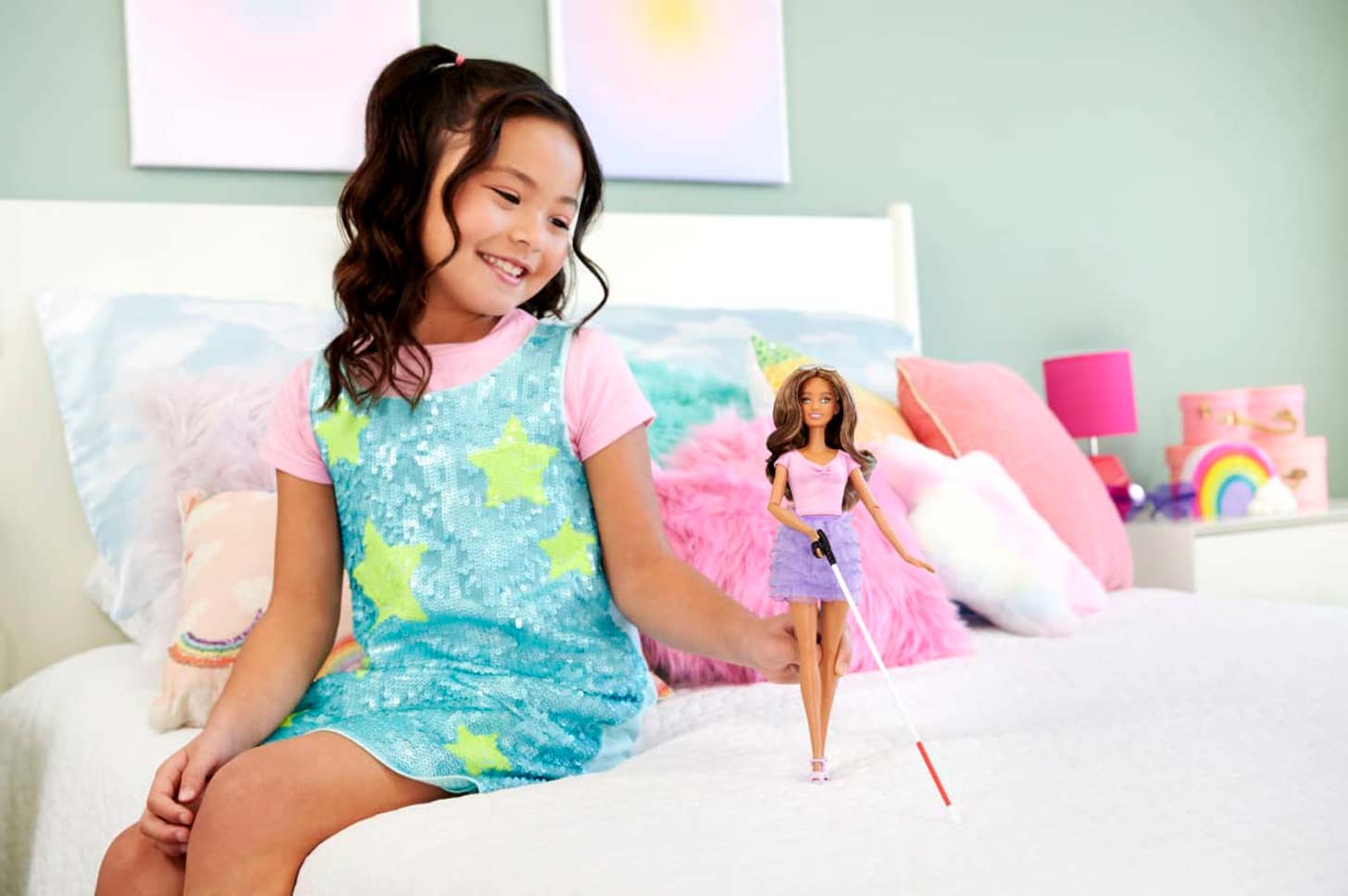
As part of the brand’s 65th anniversary Fashionista line, the doll was created in partnership with the American Foundation for the Blind to ensure that the doll accurately depicts individuals with blindness or low vision.
Counseled by AFB, this newest Barbie iteration includes some key characteristics, including:
- A white and red cane with a “marshmallow tip” (and elbow articulations that make it easy to navigate with the cane)
- Sunglasses that are both functional and stylish
- Textured and vibrant fabrics, chosen after testing with blind and low-vision children who enjoyed the textile and high-contrast play experience of this Barbie’s clothes
- Velcro fasteners and elastics to help make dressing the doll easier
- ‘Barbie’ written in Braille on the packaging of the doll
- A thoughtfully designed eye gaze facing slightly up and out to reflect the “sometimes-distinct” eye gaze of a blind individual

“It was an honor to collaborate with Barbie on the development of the blind Barbie doll,” said Eric Bridges, CEO and president of AFB, in a statement.
“By increasing representation and promoting awareness about the experiences of blind individuals and those with low vision, our shared goal is to inspire boundless opportunities for everyone, ultimately leading to a world of greater accessibility and inclusion.”

This new Fashionista line also includes a Black Barbie doll with Down syndrome.
The first Barbie with Down syndrome was introduced by Mattel in 2023 and was created in partnership with the National Down Syndrome Society.
For this new member of the Barbie family, NDSS once again worked with toy designers, connecting Barbie with a focus group of Black individuals from the Down syndrome community.
“NDSS is thrilled to introduce a second Barbie doll with Down syndrome. Having this doll launched alongside the new Barbie doll with Blindness marks another important step in expanding representation for the disability community,” said Kandi Pickard, president and CEO of NDSS, in a statement.
“We are proud to partner with Barbie as they grow to reflect our diverse and beautiful world.”

With the help of NDSS and its focus group, Barbie designers chose key characteristics to include, such as:
- Accurate physical representations of people with Down syndrome, including a shorter frame, longer torso, and low muscle tone
- A single line in the doll’s palms, a characteristic often associated with people with Down syndrome
- Rounder shape, smaller ears, and a flat nasal bridge in the face sculpt of the doll
- Braided hair texture, one of the key features requested of the Black Down syndrome community
- Blue and yellow colors and symbols to represent Down syndrome awareness in Barbie’s outfit
- Pink eyeglasses, representing individuals with Down syndrome who often experience vision difficulties
These small details seem subtle but are deeply important to the communities they represent.
“We recognize that Barbie is much more than just a doll; she represents self-expression and can create a sense of belonging,” Krista Berger, senior vice president of Barbie and global head of dolls, said in a statement.
“We proudly introduce a new blind Barbie doll and Black doll with Down syndrome to our Barbie Fashionistas line, reinforcing our commitment to creating products that represent global belonging and inclusivity in the doll aisle.”
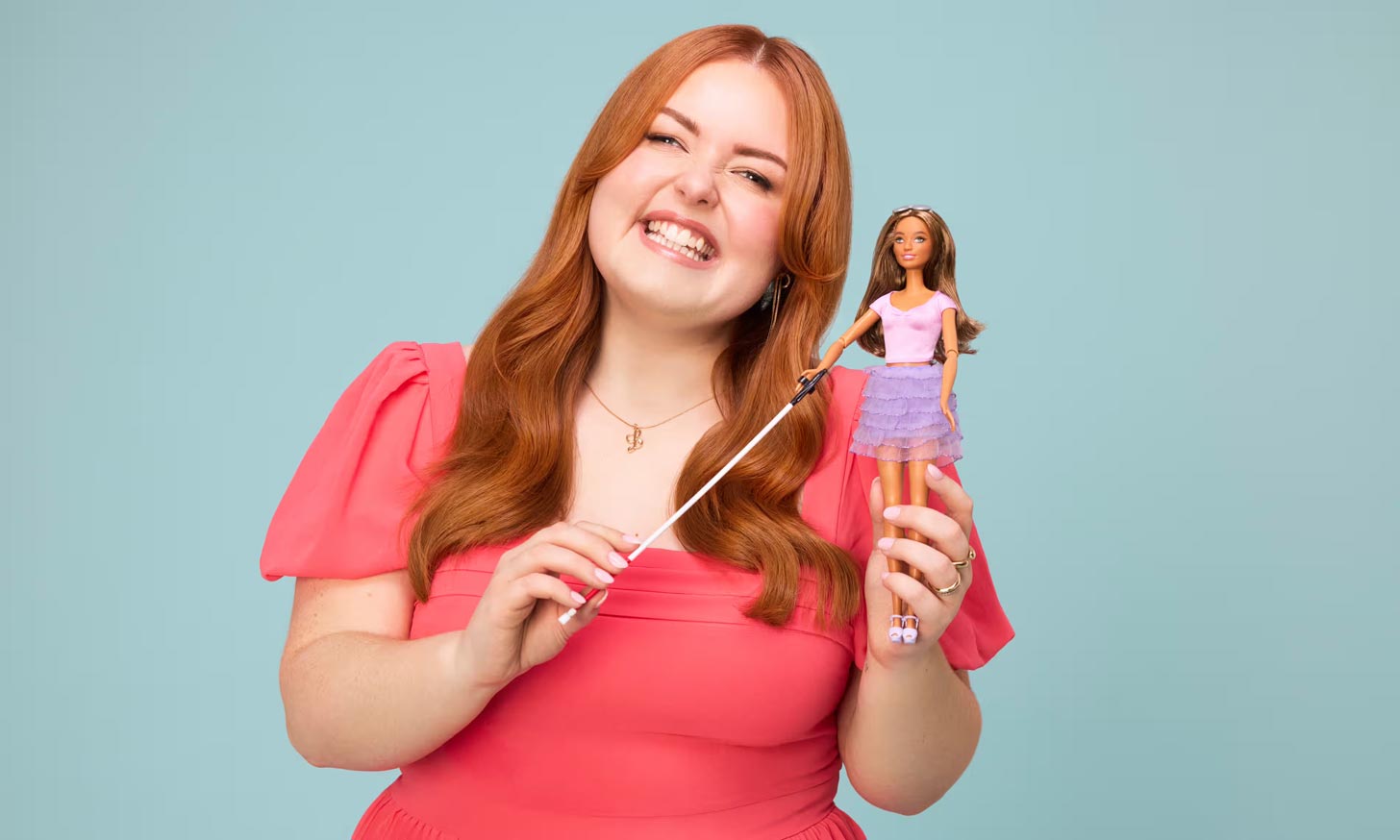
One of the first people to meet these new Barbie dolls was Lucy Edwards, a disability activist and British broadcaster who is Blind and appears in Barbie’s new marketing campaign as an ambassador for the doll.
Edwards told the Guardian that the launch of the doll “means everything to me.”
“As a teenager, I felt isolated by losing my eyesight and not seeing role models like me,” she continued. “I was embarrassed by my cane — but knowing Barbie had a cane would have made me feel so differently about mine and helped me feel less alone on my journey to accept and embrace my blindness.”
Along with these new additions to the 2024 Barbie Fashionistas line, the series includes more than 175 looks that feature a variety of skin tones, eye colors, hair colors and textures, body types, disabilities, and fashions.

The collection includes dolls with vitiligo, dolls that use a wheelchair or prosthetic limb, a doll with hearing aids, and a doll without hair.
All Barbies in the Fashionista collection, including the new Blind Barbie and Black Barbie with Down syndrome are available to purchase for $10.99 each.
“We are delighted to introduce these dolls…” Burger continued, “to further our mission for every young girl to feel represented and celebrated through Barbie.”
For women of all ages — like Edwards — the new doll appears to be a resounding success.
“I literally cannot believe this! The most popular doll in the world has a long white cane,” Edwards said in a video. “It is cool to be disabled and it is cool to be blind.”
Header images courtesy of Mattel
Your canine companion might be known to pick up a few unsavory finds on a walk, like, say, a spare chicken wing or cigarette butt — usually at the expense of their own health.
However, there’s a new “dog” on the block whose entire job is to dispose of that unsafe litter.
Meet VERO (Vacuum-cleaner Equipped RObot): a four-legged cleaning machine who is currently cleaning up Italy’s beaches.
Invented by the Dynamic Legged Systems unit at the Italian Institute of Technology in Genoa, VERO’s primary function is to suck cigarette butts off the ground.

Cigarette butts are some of the most pervasive pieces of beach debris — and are a particularly dangerous form of litter, leaching toxic chemicals into the environment for years. It’s estimated that over 4.5 trillion cigarette butts are simply tossed onto the ground every year.
So, VERO has a big job to do.
The robot has a commercial vacuum mounted on its back, with four hoses for “legs” that attach to each foot. Its custom 3D-printed nozzles allow the robot to move across the ground without tripping.
And best of all? VERO is capable of autonomously locating litter on the ground and deciding how to engage with things using its feet.
The design of VERO is based off of the AlienGo “robo-dog” from Chinese company Unitree, and while it doesn’t move quite as nimbly as Unitree’s designs — it still shows exciting promise.
Here’s how it works: First, operators find an area for VERO to clean and provide the robot with an exploration path to follow. Using onboard cameras and a neural network to detect cigarette butts, VERO sets off to suck up the cigarette butts in the vicinity.
The tricky part — aside from the robot’s need to filter out items that are supposed to be on the beach — is calculating a safe and stable position for the rest of its body while it uses one leg to suck up the found item. While it takes some processing, VERO is able to do this process on sand, stairs, or other uneven surfaces without falling over — and without stopping.
VERO’s creators say this is the first time that the legs of a legged robot are being used “concurrently” for motion, as well as a different task.
“Litter removal is often carried out manually by humans, which inherently lowers the amount of waste that can be effectively collected from the environment,” IIT’s researchers shared in their study on the robot, published in the Journal of Field Robotics.
“This is the first time that such a design and method was presented and successfully tested on a legged robot.”
Researchers conducted tests of VERO in six different outdoor environments and found that it could successfully collect just under 90% of cigarette butts.
While this is an exciting use case for the planet and its beautiful beaches, researchers suggest that VERO represents many other potential uses, like spraying weeds in crop fields, inspecting cracks in buildings, planting seeds, and more.
Having four legs capable of doing different tasks or holding different tools opens up a world of possibilities. But… maybe don’t hold that against your own dog.
Header image courtesy of Italian Institute of Technology
This story was originally published by Grist. Sign up for Grist’s weekly newsletter here.
Barbara Kingsolver has been weaving her concern about the environment into her books ever since she started writing novels in 1988. Her 2012 novel Flight Behavior explored how climate change might affect the monarch butterfly, and the 2007 nonfiction work Animal, Vegetable, Miracle recounted her family’s experiment eating only food grown near their home in Virginia.
She recently applied this skill to a new, much shorter genre: pledge-writing. The coordinators of the American Climate Corps — President Joe Biden’s signature green jobs program — invited Kingsolver to pen the promise new members would recite when sworn in. “I told them, ‘This will be the first vow or pledge I’ve written since my wedding vows,’” Kingsolver said.
Last month, the first 9,000 members of the Climate Corps committed to Kingsolver’s oath:
I pledge to bring my skills, respect, and compassion to work every day, supporting environmental justice in all our communities.
I will honor nature’s beauty and abundance, on which we all depend, and commit to its protection from the climate crisis.
I will build a more resilient future, where every person can thrive.
I will take my place in history, working with shared purpose in the American Climate Corps on behalf of our nation and planet, its people, and all its species, for the better future we hold within our sight.

The inaugurated members have spread across the country to install clean energy, restore habitats, and build trails. The Biden White House expects to employ 20,000 young people over the first year of the program, inspired by the Civilian Conservation Corps, which President Franklin D. Roosevelt launched in the 1930s to help the country recover from the Great Depression.
Kingsolver believes that the reimagined version will make history, too, calling it “one of the most exciting things that’s happening in the country right now.” In a call with Grist, she discussed her vision for the American Climate Corps and how it connects to the themes in her novels: nature, empathy, and class.
This interview has been condensed and edited for clarity.
Q. What was the thinking behind the language you used in the pledge?
A. In less than 100 words, I tried to bring in the most important parts of this initiative — that it’s about respecting and bringing justice to communities, it’s about respecting and honoring the environment and our connection with it, and it’s about taking a part in history. I read it aloud to myself as I worked, because a pledge is more like poetry than anything else. It has to sound right spoken aloud, and it has to sound like you mean it. Like a wedding vow!
Q. You’ve said that you believe writing can promote social change. Is that part of why you wrote this?
A. Words are what I have to offer. That’s my way of giving blood. I think that advocacy and literature are two very different things, and this was a chance to really jump on advocacy, which I’m delighted to do. I feel this rising sense of worry and paralysis among younger generations as they look at the world they’re inheriting. And I’ve always thought that worry can be a paralyzer or an engine that puts you to work, and that you’ll go farther and feel better if you put your worry to work.
Q. I know you’ve been writing about climate change in your novels for a long time. What have you learned about how to communicate about it in an approachable way?
A. I think the most important thing to remember, no matter who you are, whether you’re a policymaker, or a novelist, or just a friend or a relative entering a conversation, is that nobody likes to feel judged. People take information from sources that they trust, and trust involves respect. So if you open a conversation with the words “you idiot,” that conversation is already over.
I write with the assumption that my readers are all at least as smart as I am. I never talk down because there’s no reason I should. I might have some fact that other people don’t have, or some skills that other people don’t have, and likewise, they have facts and skills I don’t have. So I go into this as an equal exchange. I think that if more people remembered that on social media, the world would be a happier place.
Q. In Demon Copperhead, your most recent novel, a through line that surfaces is how coal companies have exploited Appalachian communities. Can you talk about what inspired you to write about climate change, and if the history of the region had anything to do with that?
A. Well, I’m a rural person. I grew up playing in the woods as a largely unsupervised child. So, the woods, the fields, the water, the river — this is always going to be part of my world. I don’t think of the world as a place of only human interest and occupation. I think of myself as a species among the species. I studied biology, so I have this awareness that every breath I take, the oxygen that I breathe, was manufactured by trees. So, it’s going to be part of my writing, always. It’s part of my thinking, always.
Q. Poverty and class are often central themes in your books. Thinking about the Climate Corps, part of its purpose is to revitalize areas of the country that have long been neglected. What role do you hope it will play?
A. I think this is a really class-conscious endeavor, encouraging kids from everywhere, from every class, in every geographic part of the U.S., rural or urban, to have opportunities to engage with conservation, to engage with the future in this way, and to be really clear that enjoying the environment is not a privilege of the elite.
This story was originally published by Grist. Sign up for Grist’s weekly newsletter here.
In northwestern Montana’s Swan Valley, a pile of about 100 small logs, 10 feet long or so, sits neatly stacked, ringed by berry bushes, a few white wildflowers, and towering larch trees.
Surrounding the logs are several acres of U.S. Forest Service land, which was thinned of dead, downed, and dense understory trees last year to reduce wildfire risk.
The log pile that remains is too small to be processed into lumber, plus the sawmill just down the highway recently closed. So the wood may get sent to a pulp mill, if the price is right. Or it may sit in the forest for years. Smaller limbs may be burned in a prescribed fire.
But Ning Zeng, a climate scientist at the University of Maryland, is sizing up the pile, too. He sees another solution: burying the logs, and all the planet-heating gases they’d otherwise release, underground.
That’s the idea of a carbon sequestration technique called wood vaulting. Forests throughout much of the western U.S. are overgrown, full of tangled trees and brush that’s primed to burn.
The Forest Service’s wildfire crisis strategy calls for removing excess vegetation on up to 50 million more acres of federal, state, tribal, and private lands by 2032.
Scientists and climate tech companies alike say wood vaulting could help store some of the carbon dioxide equivalent, in the form of flammable vegetation, that the Forest Service must deal with in the coming years — an estimated 2.2 billion metric tons.
That’s roughly as much CO2 as cement production worldwide emitted in 2016, and as much as forests globally removed from the atmosphere last year.
“There’s more wood in the forest than markets for it to go,” said research forester Nate Anderson, who studies product supply chains for the Forest Service’s Rocky Mountain Research Station in Missoula. Valuing the carbon stored in wood vaults could change that.
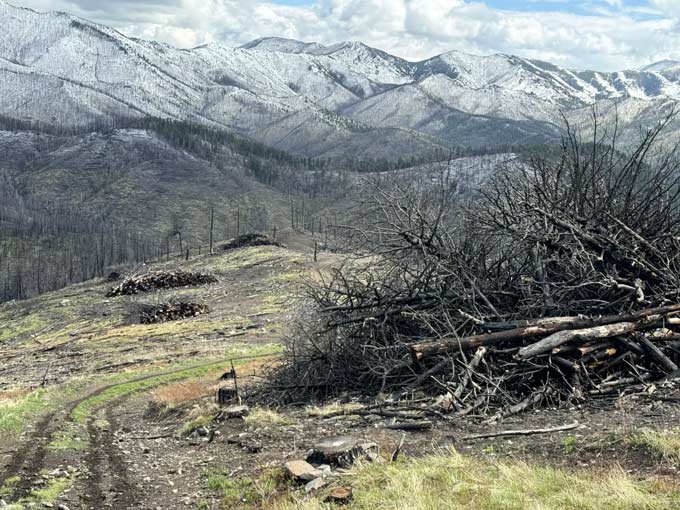
If done properly, burying the debris could help limit the release of greenhouse gases that warm the atmosphere and contribute to climate change. “I don’t see any reason why it can’t be actually quite significant and reach millions of tons of carbon dioxide sequestered per year, in the U.S. alone,” said Sinéad Crotty, the director of the nonprofit Carbon Containment Lab.
Daniel Sanchez, a professor who studies CO2 removal at the University of California, Berkeley, agrees. “Wood vaulting is a newly emerging approach that we think is relatively low-cost and relatively scalable,” he said.
Investors, including Bill Gates, have poured millions of dollars into jumpstarting wood vaults in recent years. A handful of small-scale sites are in progress across the country, including in Maryland, Nevada, Texas, and Colorado.
The Department of Energy recently awarded $50,000 for two companies, including Zeng’s Carbon Lockdown Project, to construct a wood vault in Montana — one of many carbon dioxide removal, or CDR, pilot projects to receive funding.
According to the 2023 Intergovernmental Panel on Climate Change’s Synthesis Report, CDR technology — which can include direct air capture technology, land-based carbon sinks, and more — is an “unavoidable” component of limiting warming to 1.5 or even 2 degrees Celsius, which experts say is necessary if we are to avoid irreversible effects of climate change.
Wood vaulting is conceptually simple: Dig a hole with an excavator and bury small trees, woody debris, and other plant materials that aren’t large or valuable enough to sell. The vaults resemble a layer cake of trees, gaps filled with dirt, and more trees stacked on top, finished off with a frosting of topsoil.
Once companies acquire biomass, not just any hole will do. The intrusion of water, oxygen, and even termites could compromise a vault’s durability by encouraging decomposition.
Digging vaults in clay or silty soil, away from groundwater, is thought to be best practice. (Some alternative methods actually submerge the wood in water entirely, but that’s less common.)
Conditions inside the vault must remain stable — ideally in perpetuity, without human intervention — for projects to uphold their promises.
The same kinds of sensors already used in landfills can be installed to monitor data like oxygen, moisture, and methane levels over time.
Digging holes 15 to 25-plus feet deep can mean disturbing soil, destroying habitat, or removing nutrients from the landscape — all potential downsides of wood vaulting — so companies are considering using already-degraded locations, like old industrial sites or mines. (Several also have plans to rehab wood vault sites after trees are buried, planting the soil with native seeds for pollinator habitat or grazing use.)
The ideal location for a wood vault is near the source of its biomass, which cuts back on transportation emissions and logistics. Enough labor to transport biomass and construct vaults, plus some sort of protection that they won’t just get dug up in a few decades, are other key factors.
Another concern with wood vaulting is that it may incentivize more logging than necessary. But so far, the industry is focused on burying the leftovers of wildfire risk reduction treatments, as well as trees that have already burned or were hazard trees removed from urban environments.
Guidelines from Stripe Inc.’s Frontier fund, one of the leading funds that purchases carbon dioxide removal credits from startups, recommends the leftovers of wildfire risk reduction projects as a sustainable source.
The science to know how long these vaults could keep CO2 out of the atmosphere is still in the works.
“We want to be as clear-minded as possible when promising anything around durability,” Crotty said. If done properly, Sanchez thinks vaults might be able to store CO2 for hundreds to thousands of years; companies share numbers that range from 100-plus to 1,000-plus years.
While it’s hard to say exactly how long wood vaults may be able to store carbon, previous discoveries hold clues. A bulldozer on Carbon Lockdown Project’s Canada site found a red cedar log buried deep in the soil; Zeng still has it in his office today.
He says further analysis (yet to be published in a peer-reviewed journal) confirmed it was 3,000 years old but had only lost 5 percent of its carbon.
Another way to analyze wood vaulting’s potential is by comparing how much carbon it can store to other more established techniques. Wood vaulting’s carbon yield is high compared to that of biochar, a charcoal-esque soil amendment that comes from partially combusted organic material.
Biochar can retain about 30 percent of its biomass’ original carbon, while wood vaulting is thought to store over 90 percent, according to Sanchez.
Wood vaulting is also fairly cheap compared to other methods. Calculations from one of Zeng’s test sites found it cost $105 per metric ton of CO2, mostly in transportation costs. For comparison, the average cost of biochar in California is $400 per metric ton of CO2, and direct carbon capture technologies can cost anywhere between $600 to $1,000 per metric ton of CO2.
“That’s the transformative aspect of this idea compared to many other biomass utilization strategies,” Zeng said. “It is going to come down to economics.”
Several companies are currently trying out wood vaulting, mostly on private land. Zeng created the Carbon Lockdown Project, which began with a research site outside Montreal, in 2013. He’s now working on a property in Maryland for trees removed from urban settings that would have otherwise been mulched.
Then there’s Mast Reforestation, a company that seeks to replant forests after they burn for carbon credits. CEO Grant Canary said he’s especially interested in burying the already-burned trees that create a hazard for workers and the tiny saplings they plant.
The company plans to store between 5,000 and 20,000 metric tons of CO2 equivalent that come from trees on hundreds of acres of recently burned private land in central Montana. Mast Reforestation is partnering with Zeng’s Carbon Lockdown Project on the site, and Canary said construction may be underway as soon as the end of 2024 or early 2025.
As a winner of the Department of Energy’s prize, the project promises over 17,000 carbon dioxide removal credits to the federal government by the end of 2028.
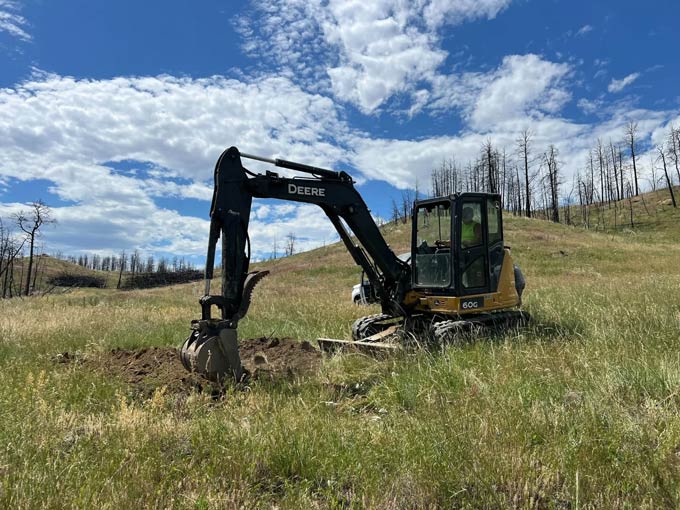
Also out West, Kodama Systems is in the permitting phase for a wood vault to store about 1,000 metric tons of CO2 equivalent in western Nevada. Material could be in the ground as soon as later this year.
Arid rangelands in this area are considered prime for wood vaults; researchers at the Carbon Containment Lab also say the Four Corners region of Arizona, New Mexico, Colorado, and Utah has high potential for wood vault development.
Carbon Containment Lab scientists partner with companies, including Kodama Systems, to collect their own independent data.
So what’s needed to turn wood vault projects from the handful of pilot sites that currently exist to a carbon dioxide removal technology at scale? More science to verify longevity and storage claims, more money to jumpstart additional projects, and more buyers of carbon dioxide removal credits.
While companies and scientists have their sights set on working with the Forest Service someday, government land management agencies are notoriously slow to try something new, meaning a public-private partnership on wood vaults is still far off.
For Zeng, standing in the middle of the woods, seeing everything from mill infrastructure to potential wood vaulting sites in Colorado, Montana, and beyond was illuminating, fusing theory with practice on the ground.
“I got really encouraged on this trip,” he said. “The dots are getting connected.”
While wood vaulting is not a single-handed solution for overgrown forests, wildfire risk, and a rapidly warming climate, it may be a simple solution to sequester some carbon and reduce wildfire risk, too.
Banner image: Courtesy of Carbon Lockdown Project
According to the UN World Water Development Report, nearly half of the world’s population experiences severe water scarcity for a significant part of the year.
As water availability becomes a more pressing issue, people have grown more conscious of water usage and where exactly freshwater is going.
Surprisingly, agriculture uses roughly 70% of the year’s freshwater withdrawals, with no signs of slowing down, according to the report.
A catch-22 emerges: the planet needs water to produce crops, which is vital for feeding the global population. But as the majority of the world’s water is used to grow crops, the demand for water ever increases.
One solution? Change the way we grow crops.
“In an era of smart watches, smart refrigerators, smart juicers and ‘smart’ just about everything, I’d like to introduce smart soil,” said TikTok creator Drift0r, “which causes plants to grow 138% bigger crops, while using 40% less water.”
The smart soil was developed by a team of clean energy and micro-scale engineering professors at the University of Texas at Austin.
By infusing the soil with hydrogel-material — a water-based substance specially developed by professors in their lab — the gel is able to draw water vapor from the air and infuse it into the rooted plant.
This latest hydrogel invention was inspired by a prior UATX study, by the same group of professors, which proved that low-cost hydrogel could literally “pluck drinking water from desert air.”
Referencing the team’s study, which was spotlighted in New Atlas, Drift0r went on to explain how the smart soil process works.
“It’s actually very simple,” The content creator said. “At night, the hydrogel literally takes the moisture out of the air and holds it. But during the day, as the temperature — and a variety of other weather conditions change — it releases that, rehydrating the soil…and it makes plants grow happier and healthier.”
He also said that a vital part of the cycle involved the release of calcium chloride, an inorganic compound that increases the growth and quality of plants.

In early July, the smart soil passed lab trials with flying colors.
The next step is seeing how the hydrogel-infused soil performs in the real world, in longer field studies.
At a time where 17 countries — including India, Botswana, Lebanon, Iran, Jordan, and more — suffer from what the World Resources Institute refers to as “extremely high baseline water stress,” emerging inventions like this could have a positive ripple effect on reducing water scarcity around the globe.
“The global water scarcity coupled with a growing population has an immediate impact on food security,” said Guihua Yu, one of the lead authors of the UATX study.
“This new class of hydrogels offers a promising solution to meet the pressing needs of water scarcity and efficient nutrient uptake in modern sustainable agriculture.”
When Drift0r learned that 70% of the world’s freshwater is pumped into agriculture, he was floored.
@drift0rtv Smart Soil grows 140% bigger plants while using 40% less water #smartsoil #soil #farming #agriculture #agtech #science #plants #gardening #news ♬ original sound - Drift0r
“Imagine if we could cut that down in half, as low as 35%,” the content creator said. “That would be great.”
As his video came to an end, Drift0r admitted that he would stay tuned to any unintended drawbacks to this smart soil solution.
But even as he shared the news with a healthy dose of skepticism, he saw incredible promise in the agricultural endeavor.
“We do know that the smart soil is working,” he stressed.
“It’s temperature and cycle adaptive, it’s energy efficient, and it helps the crops grow bigger, which I’m all here for.”
Header image via Markus Spiske (Public Domain)
Israel Prime Minister Benjamin Netanyahu’s Congressional address has been hotly contested, with Vice President (and presidential hopeful) Kamala Harris and more than 30 other lawmakers electing not to attend the address on Wednesday afternoon.
A warrant for Netanyahu’s arrest has been requested by International Criminal Court Prosecutor Karim Khan, though it has not been issued, according to the Associated Press. Still, many lawmakers and civilians alike do not feel comfortable endorsing his visit to Capitol Hill.
“For him, this is all about shoring up his support back home, which is one of the reasons I don't want to attend,” Democratic Senator Chris Van Hollen told reporters. “I don't want to be part of a political prop in this act of deception. He is not the great guardian of the U.S.-Israel relationship.”
For those sitting out, however, there was another option on Wednesday afternoon: To hear from Israeli and Palestinian peace activists.

The Center for American Progress coordinated a panel featuring Maoz Inon and Aziz Abu Sarah, Israeli and Palestinian peace activists, respectively. The duo have worked together since October 2023 to advocate for peace between Israel and Palestine, including giving a shared TED Talk, and speaking before Pope Francis, to heed the call for an end to the bloodshed.
Nadav Weiman of Breaking The Silence, an Israeli nonprofit made up of former IDF soldiers who work to raise awareness about the dire consequences of military occupation, was also part of the event.
On Wednesday before the event, Inon shared a statement to members of the press.
“Our vision is clear: It’s time for a policy change,” he wrote. “Instead of sending Israel weapons and tools of destruction, it's time to send Palestinians and Israelis tools of reconciliation. Instead of marginalizing peacemakers, it's time that they sit at the negotiation table.”
Representatives Pramila Jayapal and Jim McGovern both gave remarks, which segued into a discussion moderated by the leaders of CAP and Win Without War, an activist group looking to turn American foreign policy toward peace instead of militarism. The event took place at the same time as Netanyahu’s Congressional address.
While the meeting in DC was not televised, Allison McManus, the managing director of national security and international policy at CAP, live-tweeted the event on X (formerly Twitter).

Rep. Jayapal began by acknowledging the efforts of these peace activists, adding that “every lawmaker present in this room is here because they are dedicated to learning what is necessary for peace,” according to McManus.
“As Israel's primary security partner and a primary funder of its weapons, the United States has the responsibility and leverage to forge a path toward peace,” Rep. Jayapal continued.
Rep. McGovern chimed in: “Amid so much heartbreak — for hostage families and for Palestinians caught in the crossfire…” he said that he came to this event to “hear a message of hope in how to move forward.”
Others seemed to have followed his lead, with a room full of protesting representatives, including Illinois Reps. Robin Kelly and Jan Schakowsky, who both contributed to the discussion towards the end of the panel.
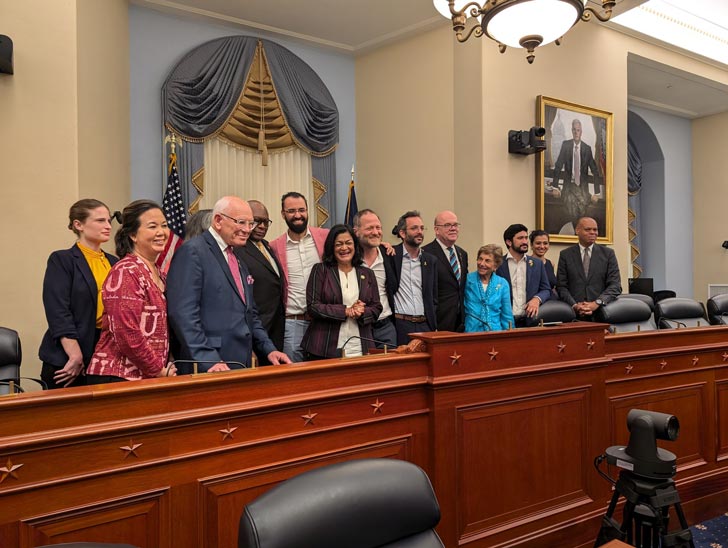
Before diving into the panel, moderator Patrick Gaspard, the president of CAP and former U.S. Ambassador to South Africa, made one thing clear: “Speaking up today is a choice and a protest against the policies of the current Israeli government,” he said.
Weiman, a former Israeli soldier, exemplifies this choice. He said that the orders he was given as a member of the IDF “subjugated Palestinians, but… didn’t make Israelis any safer.”
He added: “As an Israeli, I am calling on my government to reach a ceasefire, to bring home the hostages, and to allow aid to come into Gaza.”
Weiman also spoke about the devastating loss of his mentor on October 7, and he and Inon joined hands. Inon lost both of his parents in Hamas’s attacks, as well.
Abu Sarah added that his brother was killed through torture in an Israeli prison.
Now, @shaghdoosti opens our panel with @AzizAbuSarah and @maozinon. Maoz lost both of his parents on October 7 and Aziz lost his brother to torture in an Israeli prison.
— Allison L McManus (@AllisonLMcManus) July 24, 2024
After October 7, Aziz contacted Maoz to share condolences.
"I lost my parents, but I won a brother." pic.twitter.com/xBQW7OPXwH
All three of these men have committed to peace activism instead of revenge. For instance, when Inon’s parents were killed on October 7, Abu Sarah reached out to offer condolences. It was that connection that led them to become partners in the fight for peace.
“I lost my parents,” Inon said, “but I won a brother,” as he wrapped his arm around Abu Sarah and put his hand to his chest.
The pair has worked with their peacemaking and tourism backgrounds to host educational tours throughout the region, partnering with local groups and vendors in both Israel and Palestine to provide a full, nuanced picture of the region’s history.
Most recently, on July 1, they co-hosted a peace gathering called “It’s Time” with 50+ area NGOS. Over 6,000 Israelis and Palestinians were in attendance, making it the largest peace gathering Israel has seen in the last 30 years.

“We revitalized the peace camp,” the duo said about the event in a statement shared with Good Good Good on Wednesday.
“One of the things that Israeli governments have been saying for decades is that there is no Palestinian partner on the other side. You can argue and yell that they’re wrong — or you can show that there is a partner, that we’re here,” the statement continued.
“The existence of us together is the greatest threat to the extremists, who claim that war, bombing, and killing are the only way. We are demonstrating what the alternative is, what the road to peace will look like. When people find a meeting point, it’s the biggest antidote to extremism.”
Ultimately, the duo’s first step toward peace is direct: for the U.S. to stop providing weapons to Israel.
“I’d love to see the U.S. invest much more in radical peace work on the ground,” Abu Sarah said during the panel, pointing to the contrast between the funds spent on weapons, versus funds spent on aid and reconciliation between both Israel and Palestine.
Even with a divided Congress split between two spaces in Capitol Hill on Wednesday, Inon and Abu Sarah believe uniting for a common goal is achievable.
At the top of their trip to DC, Inon and Abu Sarah spoke on CNN’s “Amanpour & Company,” sharing their call to action.
“If there are only three words that I would be able to share here in DC, it’s that peace is possible,” Inon told CNN, repeating himself for emphasis.
“Peace is possible.”
Header images courtesy of Allison McManus © MEDC and CSPAN
Nikki Hiltz, a 29-year-old nonbinary middle-distance runner, is ready to take the Olympics — and transphobia — by storm.
Earning their ticket to Paris, Hiltz ran the second fastest time ever of any American in the women’s 1500-meter race at the U.S. Olympic Trials last month. (They will also compete in the women’s category in Paris).
Making headlines for their major milestone, Hiltz took it all in stride, posting a playful TikTok video that garnered thousands of supportive comments like “U-S-THEY.”
But that doesn’t mean it’s been easy to make history.
Hiltz, who also identifies as transgender, since they have a gender identity that doesn’t align with what they were assigned at birth, joins a small group of trans Olympians, who were first welcomed to the Games in 2004.
As trans athletes grapple with the nuanced — and often politically charged — issues of sex and gender identity in sports, Hiltz has seen their fair share of hurdles, including hateful comments, misgendering, and doubt of their genuine abilities.
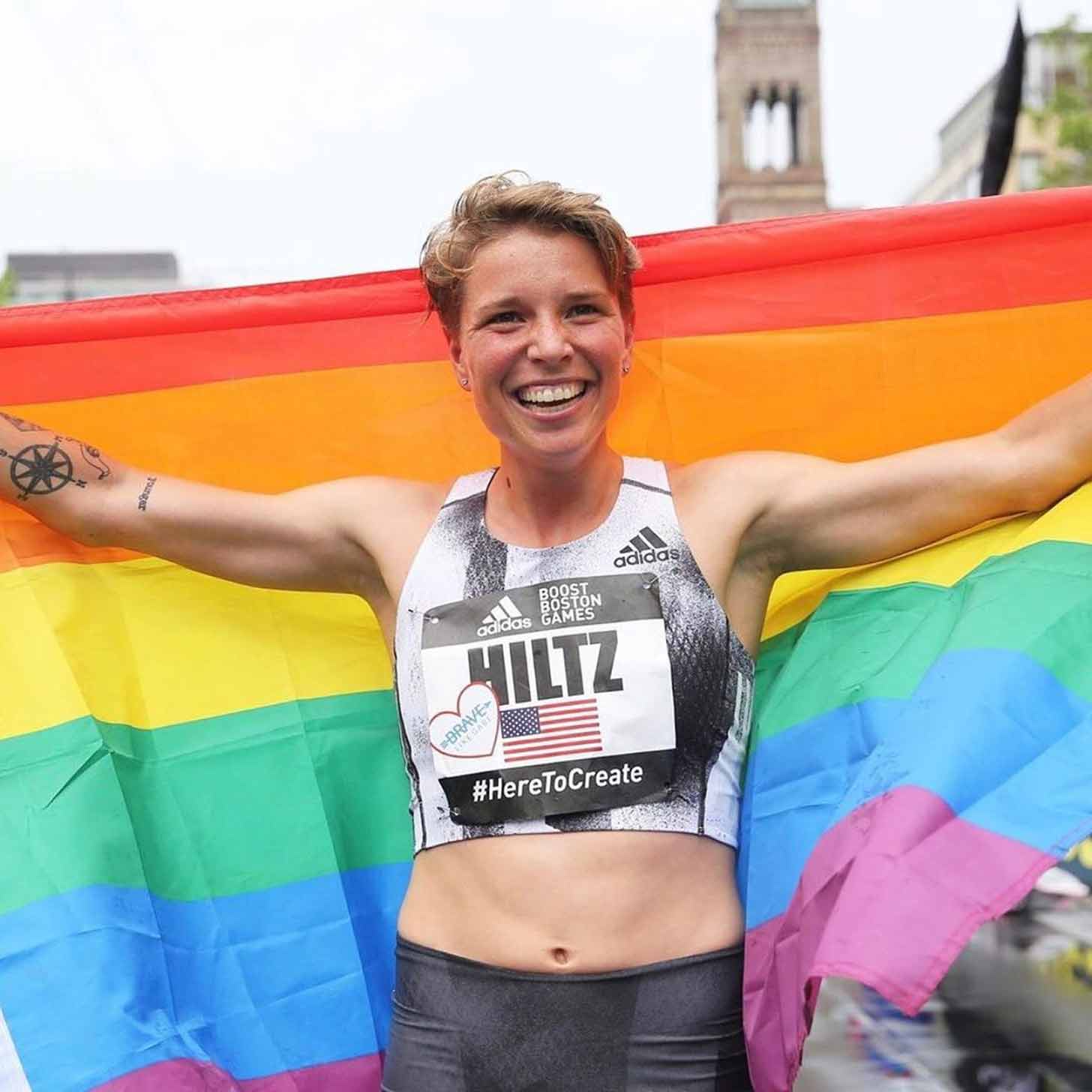
But in an interview with NBC’s Kara Goucher, Hiltz just has one message for people who are confused or upset by their participation in the Games.
“It’s not about comprehension; it’s about compassion,” Hiltz said. “If someone’s asking you, ‘hey [my name is] Michael but I want to be called Mike,’ you say ‘oh okay’ and you have compassion for them. It’s the same thing. I’m in the women’s category, you know, I was assigned female at birth, but I don’t want to be called she/her. My pronouns are they/them. Like, it’s not that deep.”
Hiltz also knows first-hand how that compassion makes a difference. Their running career had already been in full swing when they came out on Transgender Day of Visibility in 2021.
“At that point, I had enough representation of other trans people to not be afraid to show up and take up space,” they told Goucher. “It was such a relief to show up as myself… the best way I describe my gender is fluid. I don’t identify as a man or woman — somewhere beyond and in between that space.”
One of the most impactful moments in their athletic career has been the sports world “catching up” and using their correct pronouns more seamlessly over the years, they said.
Hiltz told Goucher about a race they ran last year that culminated in a disappointing performance — but also a joyful realization.
“I had kind of a rough performance; I was seventh. I always like to go back and watch my races, especially when it doesn’t go my way, to be like ‘okay where can I learn? Where did I make a tactical error?’” they explained.
But when they went back to watch the race, they realized it was the first time the commentators didn’t get their pronouns wrong at all.
“They got it the whole time. It turned kind of a poor performance into such a special race,” they said.
@nikki_hiltz Thank you @NBC Sports 🫶🥹 #nonbinary #trackandfield #theythem ♬ The Light - The Album Leaf
While it was personally meaningful to Hiltz, they hope it had a greater ripple effect for anyone watching at home.
“Maybe someone is a trans person or nonbinary and wanting to go by different pronouns and, you know, that gave them the hope, like ‘oh, I can show up in my place of work and people can affirm my gender,’” they said.
“I just think sports is such a beautiful place that we’re setting the stage for what’s possible in every work environment, as well.”
Those moments in sports that exist beyond the performance of an athlete, Hiltz has demonstrated, are what move the game forward for everyone.
“It’s for the next generation,” they told Goucher in the interview.
They referred back to their mom, who grew up in an era before the enactment of Title IX and couldn’t play sports growing up.
“She grew up in a world where she didn’t see a lot of women in sports, and I grew up in a world where it’s crazy to think that a woman couldn’t play sports in college or high school,” Hiltz said.
“I want that for my kids. I want it to be so crazy to them to think, ‘What? People had pronouns and people didn’t get them right?’ or ‘Trans people weren’t allowed in sports?’ That’s what I’m pushing for. And that’s what keeps me motivated… to show up as myself.”
Header images courtesy of Nikki Hiltz and Team USA
Several species of seals live around and on Antarctica and regularly dive more than 100 meters in search of their next meal.
These seals are experts at swimming through the vigorous ocean currents that make up the Southern Ocean.
Their tolerance for deep waters and ability to navigate rough currents make these adventurous creatures the perfect research assistants to help oceanographers like my colleagues and me study the Southern Ocean.
Seal sensors
Researchers have been attaching tags to the foreheads of seals for the past two decades to collect data in remote and inaccessible regions.
A researcher tags the seal during mating season, when the marine mammal comes to shore to rest, and the tag remains attached to the seal for a year.
A researcher glues the tag to the seal’s head — tagging seals does not affect their behavior. The tag detaches after the seal molts and sheds its fur for a new coat each year.
The tag collects data while the seal dives and transmits its location and the scientific data back to researchers via satellite when the seal surfaces for air.
First proposed in 2003, seal tagging has grown into an international collaboration with rigorous sensor accuracy standards and broad data sharing.
Advances in satellite technology now allow scientists to have near-instant access to the data collected by a seal.

New scientific discoveries aided by seals
The tags attached to seals typically carry pressure, temperature and salinity sensors, all properties used to assess the ocean’s rising temperatures and changing currents.
The sensors also often contain chlorophyll fluorometers, which can provide data about the water’s phytoplankton concentration.
Phytoplankton are tiny organisms that form the base of the oceanic food web. Their presence often means that animals such as fish and seals are around.
The seal sensors can also tell researchers about the effects of climate change around Antarctica.
Approximately 150 billion tons of ice melts from Antarctica every year, contributing to global sea-level rise. This melting is driven by warm water carried to the ice shelves by oceanic currents.
With the data collected by seals, oceanographers have described some of the physical pathways this warm water travels to reach ice shelves and how currents transport the resulting melted ice away from glaciers.
Seals regularly dive under sea ice and near glacier ice shelves. These regions are challenging, and can even be dangerous, to sample with traditional oceanographic methods.
Across the open Southern Ocean, away from the Antarctic coast, seal data has also shed light on another pathway causing ocean warming.
Excess heat from the atmosphere moves from the ocean surface, which is in contact with the atmosphere, down to the interior ocean in highly localized regions.
In these areas, heat moves into the deep ocean, where it can’t be dissipated out through the atmosphere.
The ocean stores most of the heat energy put into the atmosphere from human activity.
So, understanding how this heat moves around helps researchers monitor oceans around the globe.
Seal behavior shaped by ocean physics
The seal data also provides marine biologists with information about the seals themselves. Scientists can determine where seals look for food. Some regions, called fronts, are hot spots for elephant seals to hunt for food.
In fronts, the ocean’s circulation creates turbulence and mixes water in a way that brings nutrients up to the ocean’s surface, where phytoplankton can use them. As a result, fronts can have phytoplankton blooms, which attract fish and seals.
Scientists use the tag data to see how seals are adapting to a changing climate and warming ocean. In the short term, seals may benefit from more ice melt around the Antarctic continent, as they tend to find more food in coastal areas with holes in the ice.
Rising subsurface ocean temperatures, however, may change where their prey is and ultimately threaten seals’ ability to thrive.
Seals have helped scientists understand and observe some of the most remote regions on Earth.
On a changing planet, seal tag data will continue to provide observations of their ocean environment, which has vital implications for the rest of Earth’s climate system.
This article by Lilian Dove, from Brown University, was originally published by The Conversation.

Europe is in the midst of a heat wave, and while Olympic athletes in Paris for the 2024 Summer Games might be spared the worst of it, the weather will still be hot.
As global temperatures have risen, major sporting events like the Olympics and FIFA World Cup have had to adapt to high heat and extreme storms to keep athletes and fans safe and allow the games to go on.
Olympic organizers have moved events such as marathons to early mornings and even to cooler cities. FIFA, the governing body for world soccer, pushed the 2022 Men’s World Cup back from its usual time in June to late November so it could be held in Qatar.
The heat risks and the environmental impact of major sporting events have led some people to question whether these events should be held at all.
But as someone who studies sport management and sustainability in an area I coined “sport ecology,” I believe that radical approach misses the benefits, including the Olympics’ ability to promote sustainable actions to the public worldwide.

How rising global heat affects the Olympics
Sports have good reason for caring about sustainability: Climate change can put athletes’ and fans’ health at risk and even put the future of some sports in doubt.
Winter sports face the greatest threats from climate change as temperatures rise and precipitation changes, dramatically shortening winter sports seasons in many areas. In 2022, the Beijing Winter Games had to artificially create snow so it could have ski runs at all. The International Olympic Committee has delayed its decision to select Winter Games host cities for 2030 and beyond because of the uncertainty of winter sports.
In the summer, global warming fuels extreme heat and storms that can affect the quality of the competition and the health of the athletes and spectators.
Major sport federations and leagues, as well as the Olympics, have responded to the risks by delaying competitions to cooler times of day or year, implementing water breaks and offering more player substitutions.
Organizers of the Tokyo Summer Games, held amid a fierce heat wave in 2021, had preemptively moved the marathon to Sapporo, more than 500 miles north of Tokyo, so athletes could run in cooler weather. They also delayed competitions during the Games to avoid extreme heat and excessive rain.
Olympic progress toward sustainability
Any large event like the Olympics can produce vast carbon emissions through its construction, transportation needs and energy use.
That impact, and the risks it creates for sports and their athletes, are why sustainability has been a pillar of the Olympic charter since 1996 and is a focus of its planning for the future. In 2012, the London Olympics pioneered a new international certification standard, ISO2012, which provides guidelines for any large event to make more sustainable choices, from construction to catering.
The 2024 Paris Games, from July 26 to Aug. 11, and Paralympic Games, Aug. 28 to Sept. 8, are certified to the latest standard, and organizers are taking many steps to reduce their climate impact.
The organizers plan to power the events’ operations with 100% renewable energy from wind and solar.
They are using existing venues when possible, had new ones built with low-carbon concrete and recycled materials, and brought in thousands of seats made of recycled plastic.
All furniture and temporary buildings approved for the Games also must have a contractually guaranteed second life, rather than going into a landfill.
All of the competition venues are on public transportation, allowing for fewer vehicles in the streets.
Even the food is targeted for a 50% emissions cut compared with the average meal by increasing the use of plant-based foods.
The Paralympics will use the same venues and housing in the weeks that follow.
That doesn’t mean the 2024 Olympics won’t have a large carbon footprint, however, particularly as many spectators and athletes arrive by plane. But the organizers are aiming for the construction and operations emissions to be half those of the London and Rio Games in 2012 and 2016.
World’s fair of sustainability
The Paris Olympic Games is an example of what large sporting events can do to reduce their impact on the environment and promote sustainability solutions to a global audience. Spectators will experience sustainability firsthand, and organizers will promote the Games’ sustainability efforts.
Such campaigns can influence people’s everyday behaviors and even increase their advocacy for sustainability in their home communities.
Suggestions to reduce the scale and size of sports events or even eliminate commercialized sports, ending spectator sports as we know them, overlook the ability of sports to influence and change human behavior.
Sustainability is a constantly evolving process of learning from the past to improve for the future.
The 2024 Olympics’ strategies, building on those used in previous events, and what Paris learns in carrying them out, will also help in planning for future events, including the 2028 Summer Games in Los Angeles.
In essence, the Olympic Games, the largest sporting event in the world, is a sport sustainability world’s fair. It highlights what is possible for a sporting event through collaborations with international corporations to reduce its environmental impact. And it influences others to follow suit, whether that is other sporting events, leagues and federations or spectators from around the world.
This article by Brian P. McCullough, from University of Michigan, was originally published by The Conversation.

Imagine your midday snack turning into a “toad-ally awesome find.”
That’s what happened for a Woodhouse’s Toad near Meade, Kansas last month, when, likely misidentifying it for a worm, the amphibian attempted to snack on a New Mexico Threadsnake.
These snakes (sometimes called “blind snakes”) are a threatened species in the state of Kansas and only grow to be about five to eight inches long. To an untrained eye, they also look nearly identical to a common worm, with a pinkish-tan in coloration and tiny black eyes.
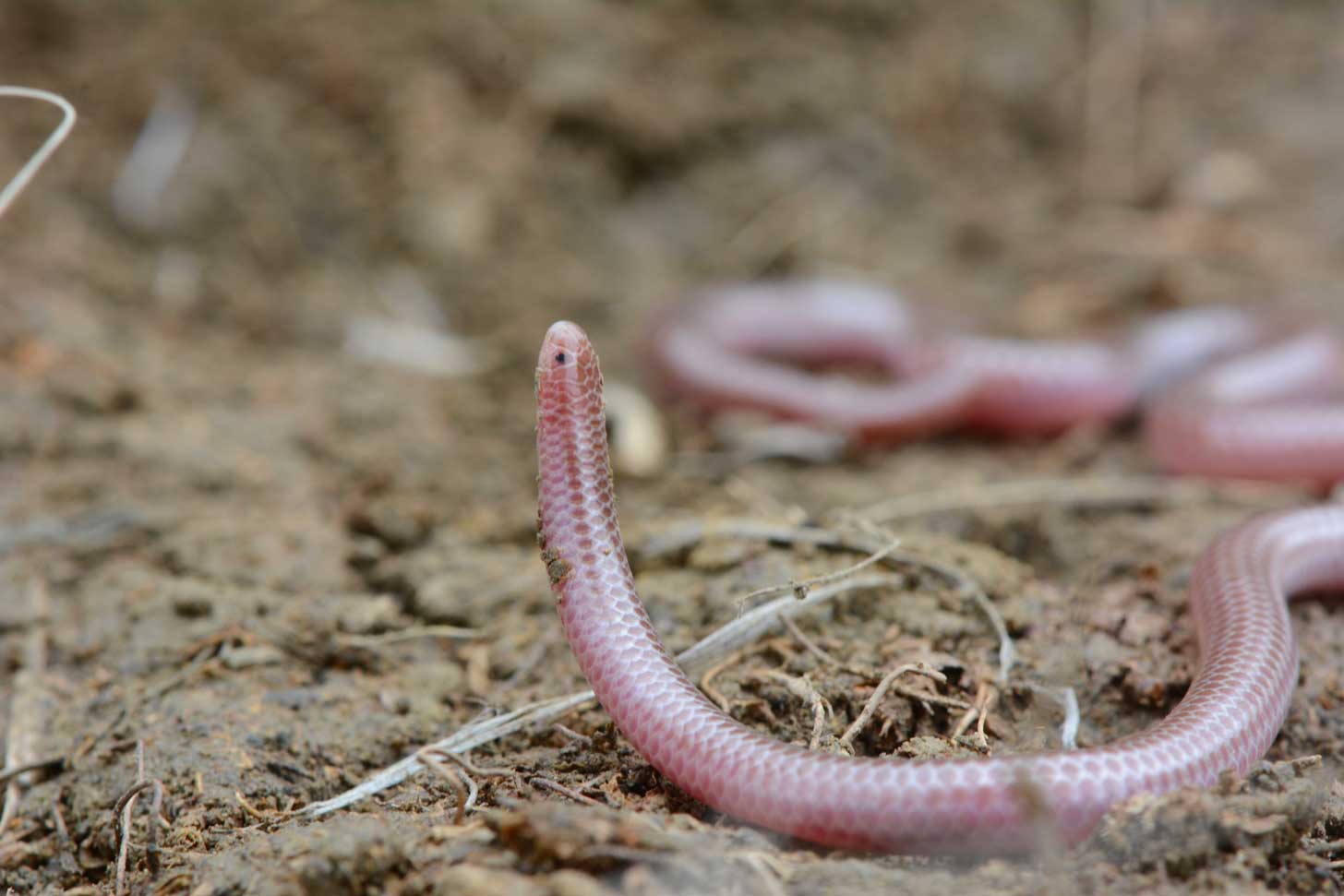
Biologists from the Kansas Department Wildlife & Parks’ Terrestrial Crew were in the field in June, out “road-cruising,” or surveying an ecosystem for nocturnal reptiles and amphibians when they found the duo.
This effort is done to protect and learn more about the area’s nocturnal species when they gravitate toward the heat of the road at nightfall.
“KDWP Ecological Services Division’s Biodiversity Survey and Assessment Program has one terrestrial and two aquatic survey crews that focus mainly on collecting data on Species of Greatest Conservation Need as designated within the Kansas State Wildlife Action Plan,” KDWP Ecological Services Director Chris Berens told KSNT News.
“Due to the elusive and fossorial nature of this species, not much information [or] data is available for them. Through these surveys, KDWP is hoping to collect data on the Threadsnake’s habitat preferences and geographic distribution that will better inform conservation efforts.”
That makes this find especially lucky, as the survey team was able to find the toad attempting to snack on the small snake — before it was lost to the belly of the beast.
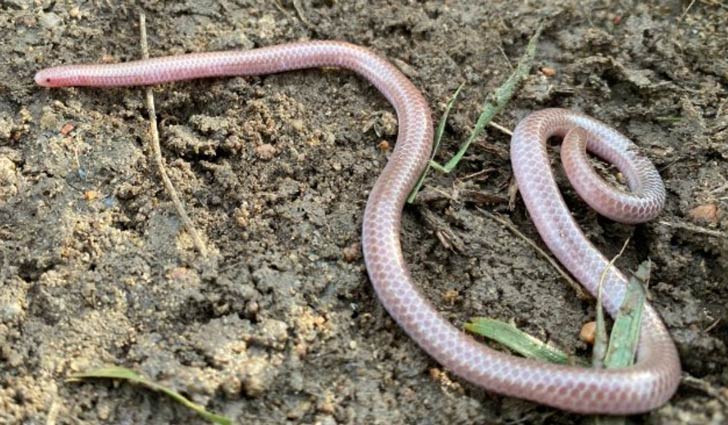
“These snakes are nocturnal and easy to miss with their worm-like appearance, so imagine the surprise when our survey crew captured a Woodhouse’s Toad trying to snack on the very species our crew was searching for,” a social media post from KDWP shared.
New Mexico Threadsnakes are usually found in the south central and southeastern counties of Kansas, along the Oklahoma state line, according to the KDWP.
They are also found in other parts of the southern United States, like New Mexico, southern Colorado, western Texas, western Oklahoma, eastern Arizona, and in some parts of Mexico.
While it does not seem to have any federal designations, the species is protected by the Kansas Nongame and Endangered Species Conservation Act, and according to Berens, KDWP teams have found just 10 snakes so far in 2024.
Fortunately, if you’re an ophidiophobe, it’s worth noting that New Mexico threadsnakes are harmless; their defensive behaviors include writhing, releasing musk, and poking with their harmless tail spines.
Header image courtesy of Kansas Department of Wildlife and Parks
Every day the Good Good Good team collects the best good news in the world and shares it with our community. Here are the highlights for this week!
If you want to get good news in your inbox every day, join the Goodnewsletter — the free daily newsletter designed to leave you feeling hopeful.
The Best Positive News We’re Celebrating This Week —
A new report found that renewables will officially surpass coal in energy production next year
Due to an increase in heatwaves around the world, the International Energy Agency’s new report predicts electricity demand will see record-high growth rates.
Not only are renewables tasked with replacing fossil fuels — they’re also needed to meet that rise in electricity demand. And they’re up to the task: the IEA predicts the amount generated by renewable energy sources will increase from 30% in 2023 to 35% in 2025.
While solar will meet around half of the growth in demand on its own in the coming years, combined with wind, it will meet three-quarters of the growth. Thanks to explosive growth in renewable electricity generation — the IEA predicts it will officially surpass coal next year.
→ Read more
More good climate news:
- Telling them to “stop acting as enablers to planetary destruction,” the UN called on advertising and PR agencies to drop their fossil fuel clients.
- A neighborhood in Massachusetts was selected for the country’s first-ever geothermal heating & cooling network.
- A crucial raw ingredient in the fight against climate change, an innovative aluminum plant will reduce CO2 by 75% and double production.
- Small island nations won a major international legal victory that puts more pressure on large governments to curb their carbon emissions.
One in five cars sold this year will be battery-powered — with a record 17 million total sold
Electric vehicles are breaking sales records all over the world. According to new estimates, 17 million new fully electric or plug-in hybrid vehicles will be sold this year — up from 13.7 million last year.
China still leads the world in EV sales, with over 10 million fully electric and plug-in electric vehicles expected to be sold this year alone. Estimates show that battery-powered vehicles could make up 45% of total car sales in the country.
Globally, over one-fifth of vehicles sold will be fully electric or plug-in hybrid this year — in 2018, it was around 2%. And companies are taking notice by ramping up production of EVs.
While we still have a long way to go to enjoy the environmental (and health) benefits of a world filled with electric vehicles, this is incredible progress to celebrate — and continue.
In another historic milestone, the 7th person in the world has now likely been cured of HIV
Joining just six other people in the world, a man in Germany has likely been cured of HIV. Treated for leukemia with a stem cell transplant in 2015, he’s now the seventh person in the world to be in remission.
Since he stopped taking antiretroviral drugs in 2018, there has been no HIV detected in his body, leading experts and scientists to believe he has officially been cured.
To catch this HIV was initially a death sentence, but today, thanks to antiretroviral and pre-exposure prophylaxis drugs it can be kept in check. While scientists keep inching closer to one — like in this case — there is still no cure.
What’s the nuance? A stem cell transplant is a risky and complicated procedure — often too risky to offer as a cure for everyone with HIV. Still, each time scientists cure a new case, they are given invaluable insights to lead them closer to a cure for everyone.
Mattel just unveiled two new inclusive Barbies, including the first-ever Blind Barbie
One year after Barbie hit the big screen, Mattel just introduced some new historic dolls to its world-renowned catalog, including the brand’s first-ever Blind Barbie.
As part of the brand’s Fashionista line, the doll was created in partnership with the American Foundation for the Blind to ensure that the doll accurately depicts individuals with blindness or low vision.
This new Fashionista line also includes a Black Barbie doll with Down syndrome. Like the first Barbie with Down syndrome that was introduced in 2023, this one was created with the National Down Syndrome Society as well as a focus group of Black individuals from the Down syndrome community.
More good Barbie news:
- Part of its Inspiring Women Series, Mattel made a Jane Goodall Barbie out of recycled ocean-bound plastics.
- Ahead of the 2024 Olympics, Mattel released a series of nine dolls honoring trailblazing women athletes around the world with one-of-a-kind Barbies.
- An all-women and majority women-of-color orchestra has been bringing the “Barbie” concert experience to life this summer across the country.
Oregon just launched a program providing families with a new baby a free at-home visit with a nurse
As part of a new statewide program called Family Connects, any family in Oregon with a new baby can get up to three no-cost visits at home with a trained nurse.
On those visits, the nurses do all the normal check-ups for the baby, while the parents can ask questions, share frustrations, or receive comfort during a time when they’re feeling most exhausted and overwhelmed. Participants say it’s helped their mental health, too.
Based off a program developed in North Carolina, research shows Family Connects has many significant benefits, including a decline in trips to the emergency room by new parents.
Why is this good news? The U.S. has one of the highest infant and maternal mortality rates of all wealthy countries. While new parents visit pediatricians, the visits are infrequent and often short. Oregon’s program hopes to bridge that gap to help address those high mortality rates.
An Israeli and Palestinian peace activist duo spoke to lawmakers while Netanyahu addressed Congress
Vice President (and presidential hopeful) Kamala Harris and more than 30 other lawmakers elected not to attend Israeli Prime Minister Benjamin Netanyahu’s address to Congress yesterday.
For those that sat out, there was another option: To hear from Maoz Inon and Aziz Abu Sarah, Israeli and Palestinian peace activists, respectively.
The duo have worked together since October 2023 to advocate for peace between Israel and Palestine, including giving a shared TED Talk, and speaking before Pope Francis, to heed the call for an end to the bloodshed.
Ahead of the event, Inon shared, “Instead of sending Israel weapons and tools of destruction, it's time to send Palestinians and Israelis tools of reconciliation. Instead of marginalizing peacemakers, it's time that they sit at the negotiation table.”
The room was filled with lawmakers looking to “hear a message of hope in how to move forward.”
The Paris 2024 Olympics organizers have promised to make them the ‘greenest’ Games in history by halving its carbon footprint
With a promise to halve the carbon footprint of London 2012 and Rio 2016, the Paris 2024 organizing committee has implemented a number of initiatives to reach its sustainability goals.
While London built six new stadiums, and Rio built 10 permanent and seven temporary, only two of the 35 stadiums hosting events will be new in Paris. Plus, they were built using “low-carbon construction methods” and featuring recycled local plastic waste.
Paris is also using the same recycled cardboard beds that Tokyo 2020 famously used in its Olympic Village. Additionally, spectators and the Games’ workforce will enjoy double the proportion of plant-based ingredients, as well as 80% of ingredients sourced locally.
What’s the nuance? It remains to be seen if these initiatives will add up to a halved carbon footprint, and the Games have one significantly more challenging hurdle to consider: spectator travel can account for around 80% of a sporting event’s total emissions. Still, the sustainability efforts, while imperfect, are a standard-setting point of progress to celebrate.
A nonbinary runner on Team USA is helping ‘set the stage for what’s possible’ and calling for compassion
Nikki Hiltz is a 29-year-old nonbinary middle-distance runner, who earned their ticket to Paris by running the second-fastest time ever of any American in the women’s 1500-meter race at the U.S. Olympic Trials last month.
But as trans athletes grapple with the nuanced — and often politically charged — issues of sex and gender identity in sports, Hiltz has seen their fair share of hurdles, including hateful comments, misgendering, and doubt of their genuine abilities.
In an interview, Hiltz had one message for people who are confused or upset by their participation in the Games.
“It’s not about comprehension; it’s about compassion,” Hiltz said. “If someone’s asking you, ‘hey [my name is] Michael but I want to be called Mike,’ you say ‘oh okay’ and you have compassion for them. It’s the same thing.”
And Hiltz, who joins a growing group of LGBTQ+ Olympians, knows that message goes so much further than the Games, saying, “I just think sports is such a beautiful place that we’re setting the stage for what’s possible in every work environment, as well.”
More good news of the week —
The first comedy club in the U.S. for sober-curious guests just opened in Boston. SoBar Comedy serves non-alcoholic beers and mocktails, crafted in collaboration with Dray Drinks, the city’s first non-alcoholic bottle shop.
An endangered fish just gained critical habitat protection in Tennessee. Threatened by invasive fish, droughts and severe floods, and livestock intrusion, the minnowfish will be protected in 1.5 acres of spring pools and 11.4 miles of flowing springs across six counties.
To help solve Namibia’s housing crisis, a sustainable development project is building homes with mushroom waste and weeds. Taking an innovative approach, the project notably uses encroacher bushes that push out grass and other vegetation and impact the groundwater supply.
The U.S. government announced its plans to phase out purchasing single-use plastics. The government is the largest purchaser of consumer goods in the world, and this new initiative could make a real impact on plastic pollution.
The world’s largest study on guaranteed income programs found that people took better jobs, went back to school, and more. Right away, the data clearly showed that cash helped people spend more on their basic needs — in addition to helping them find a “sense of self.”
In an exciting milestone for the endangered species, four zoos in North America have welcomed newborn red pandas. The adorable animals are threatened by habitat loss, human interference, and poaching, but conservation and research institutions around the globe have stepped in to protect them.
New data shows Thailand’s tiger population has doubled over the past two decades, thanks to the country’s rangers. In addition to efforts to restore key habitats and water sources, long-term efforts to strengthen systematic ranger patrols have helped control poaching.
The U.S. EPA has awarded $4.3 billion to greenhouse gas emission reduction projects in 30 states. The money will go to 25 projects targeting emissions from transportation, electric power, commercial and residential buildings, industry, agriculture and waste and materials management.
A U.S.-based company just made a breakthrough in hydropower generation with its “fish-safe turbines.” While dam removal projects have been shown to revive fish species, these turbines could be another solution for generating clean energy while protecting river ecosystems.
Nearly 12,000 acres of land were just returned to a Native American tribe in Minnesota. The Leech Lake Band of Ojibwe Reservation Restoration Act was signed into law in 2020, reversing a land seizure by the U.S. Bureau of Indian Affairs in the 1940s.
New “smart soil” is dramatically reducing the amount of freshwater required to grow food. Professors at the University of Texas at Austin have engineered a new type of gel-infused soil that helps plants water and feed themselves, growing 138% bigger crops while using 40% less water.
The largest co-located solar and battery storage system in the U.S. is now officially operational. The Gemini Solar + Storage project in Nevada features 1.8 million bifacial solar panels and enough battery storage to provide 1,400 MWh of clean power after the sun sets.
Paris 2024 is the first time in history the Olympics will achieve gender parity. Out of the 10,500 athletes participating in the Games, there will be 5,250 men and 5,250 women, as well as a more even distribution of medal events.
Thanks to initiatives promoting less car use, Paris has seen a 40% decline in air pollution ahead of the Olympics. The city closed more than 100 streets to cars, tripled SUV parking fees, removed around 50,000 parking spots, and constructed over 800 miles of bike lanes since 2014.
For the first time in history, the Olympic Village will have a nursery for athletes with children. A result of the advocacy of Allyson Felix — the most decorated track and field athlete in history — the nursery has a dedicated space for childcare, as well as diapers, wipes, and other essentials.
Paris is turning an industrial neighborhood into the Olympic Village — and it will become permanent housing post-Games. The new low-carbon, mixed-use neighborhood is located in a part of the city that needs more housing, and it will eventually have bus stations, bike paths, a park, and retail space, too.
Threatened with violence and death, Afghanistan’s first woman breakdancer is competing on the Olympics Refugee Team. Though she faced intense obstacles to do it, Manizha Talash is now living her biggest dream since breaking was announced as a new Olympics category.
Hailing from 11 different countries, 37 athletes will compete in Paris as part of the Refugee Olympic Team. The team was created for the Rio Games in 2016 as a symbol of hope and to raise awareness about the global refugee crisis.
Despite the Taliban banning women from sports, two sisters will compete in cycling under Afghanistan’s flag. The duo grew up in Faryab, one of the most remote and conservative provinces, where it was practically unheard of to see women on bicycles.
On July 27, Clyde Valentín has a long, wonderful day ahead of him.
His morning starts in Chicago, IL, attending an art summit at Malcolm X College (filled with piñatas, dance classes, poetry workshops, and more) before he hops on a plane to attend the AMERI’KANA outdoor music festival in Kansas City, MO.
The surprising part? Both cities — and 16 more across the country, from Honolulu, HI to the Bronx, NY — are simultaneously celebrating the same thing: One Nation/One Project’s ambitious nationwide project Arts for Everybody.
This one day, July 27, has been nearly a year in the making.
“It's been joyous and challenging and really, really complex, as you can imagine,” Valentín, the Founder and Co-Artistic Director of One Nation/One Project, said in an interview with Good Good Good.
“We're partnering with community leaders and institutional leaders across the country.”

A public arts event on this scale hasn’t occurred since October 27, 1936, when 21 stages — across 17 states — simultaneously premiered Sinclair Lewis’ play “It Can’t Happen Here” to protest the rise of fascism.
That nationwide collaboration was born out of the Federal Theater Project — a program that Valentín and his team (Lear deBessonet, Nataki Garrett, and Dr. Jill Sonke) hope to emulate with Arts for Everybody with the prompt “There’s No Place Like Home.”
Each city has its own interpretation of the event: Hawai’i is hosting 11 artistic showcases held across Hawai’i Island. Edinburg, TX is holding a Frida Kahlo arts festival. And Oakland, CA is leading an interactive data exhibition and art workshop that promotes racial equality.

Four days before the event, celebrities like Samuel L Jackson, Jay Ellis, Craig Robinson, Jerry Trainor, and Akilah Hughes joined together in a PSA for Arts for Everybody, with the hopes of getting the message out across the country.
But for Valentín, the scope of the project extends far beyond July 27.
“We're thinking about our own respective legacy via the archive of content that we're creating from storytelling aspects,” he told Good Good Good.
“We have a podcast that we're producing, we have all these video assets,” he continued. “We have research papers that will get published via peer review. We have a publication that we're going to produce that will incorporate research…we're going to put a bunch of stuff out there in the world still between now and the end of the year and a little bit into next year.”
And for many of these cities, the very infrastructure of their communities will be reshaped by Arts for Everybody.

For example, Valentín mentioned an intra-governmental collaboration between the program and Chicago’s Department of Cultural Affairs and Special Events, where 10 artists are redesigning behavioral health centers.
“They want to transform those very dry, sterile clinics into true resource service for community members,” Valentín said. “And they're looking to the artist to be in communication with the staff and the clients in those facilities, to help imagine and inform what those places become over the next five or 10 years.”
Valentín also pointed to Gainesville, FL, and how their Arts for Everybody celebration — the Summer (You)th Celebration! Arts, Culture & Health Day — was inspired by tangible community measures to reduce gun violence.

Over many months, Valentín watched as the young people of Gainesville helped inform anti-gun violence efforts and directly aided in parks and recreation programs — all while getting paid by the city.
“The city started off wondering about the value of taking an approach to public health issues like gun violence via arts and culture,” Valentín said. “And now they're looking to build a city owned and operated cultural arts center in the middle of their downtown.”
Valentín is excited for all of the positive ripple effects that will come from Arts for Everybody, but he also wants to enjoy all of the fun that awaits him on July 27.
“[We’ll catalog] our own reflections in real-time, because we don't want to lose that learning,” Valentín said. “Our whole goal, to me, is that this work continues.”
Header image courtesy of Scout Tufankjian
When Chuck Peeks lost his wife last month, he wanted her legacy to be remembered. Now, thousands on the internet — along with a staggering amount of hospital guests — help her story live on.
Peeks’ wife, Kara, passed away in June, just before her 43rd birthday. She was a healthy mother of three, but suddenly had breathing difficulties and collapsed at the start of the summer, according to Newsweek. Kara was diagnosed with a pulmonary embolism and slipped into a coma, soon to be tragically declared brain-dead.
She was an organ donor and was kept alive by support systems before being taken to her “Honor Walk,” which occurs when these donors are wheeled in a gurney to the operating room, as hospital staff, family, and loved ones stand in the hallway to bid them goodbye.
Kara’s Honor Walk — which Peeks shared on Reddit last month — wasn’t limited to her beloved husband and children but actually broke the hospital’s record.
“Forty-seven of our friends, family, and coworkers showed up to shatter the prior record,” Peeks wrote on Reddit, with an accompanying video. The hospital’s prior record was 40 guests during an honor walk.
Including hospital staff, Kara was bid a fond farewell by 80 to 90 people.
Kara’s “walk-off” song was “Ode To My Family” by The Cranberries, which played while dozens of people lined up in the hospital’s hallways to honor and cherish her last special moments.
“My oldest picked her ‘walk off’ music,” Peeks wrote on Reddit. “Spot on perfect for her.”
The video of this emotional moment has received 65,000 upvotes on Reddit since it was posted last month, with thousands of supportive comments.
“I work in the Organ Procurement field and thank you and your wife for the gift that will be given to save others,” one commenter wrote. “Sorry for your loss. May you find some solace in knowing a part of your loved one will live on.”
Another added: “It’s one thing to be a superhero in life; it’s next-level to be a superhero in death.” Peeks replied, adding: “She was a superhero in life as well. She worked with special needs children at the elementary school that all three of our kids went to.”
Dozens of others shared stories about how organ transplants gave them more time with their own loved ones, providing empathy for Peeks and his family, while also offering sincere gratitude for this act of generosity.
“I was moved greatly by the experience and was immensely proud,” Peeks told Newsweek, adding that he felt “everyone needed to see her selfless act.”
He also said he hopes Kara’s story inspires others to become organ donors, who save thousands of lives in the United States every year.
According to Donate Life, there are over 100,000 people on the national transplant waiting list. One organ donor can save up to eight lives; donating a cornea can restore two people’s sight; and donating tissue can help up to 75 people.
“There are many comments on the post saying that because of her, people are willing to, or already have, changed their donor status, which is amazing,” Peeks told Newsweek. “If you can, be an organ donor; it doesn't cost anything to save so many lives.”
Header images courtesy of Chuck Peeks/Reddit
Ceramic artist Stanley Tong set out on a project to answer one devastating question: “How much damage does gun violence really do?”
To explore this query, he decided to literally shoot his work with a series of guns.
“I figured there’s no better way than by using real guns and real bullets on my artwork,” Tong said in a recent TikTok video.
The results are his collection of pots and vases that were all sculpted by Tong, many of which resemble urns. While the clay was still wet, Tong shot them from 20 or 30 feet away, creating heartbreaking “entrance and exit wounds” in the sculptures.

He used a variety of weapons, including a .357 Magnum, .22 Long Rifle, a .9mm handgun, and more.
“Clay doesn’t heal,” Tong explained. “So this is how much energy a .357 Magnum really has when that impact is frozen in time.”
The pieces were also pit-fired, which is different from the well-known kiln method. It includes digging a hole in the ground, burying the pottery alongside combustibles like sawdust and gunpowder, and lighting them on fire.
(This feels like a good time to mention that you probably shouldn’t replicate this project at home.)

“A really cool thing that happened is the lead from the bullets actually oxidized in the pit fire,” Tong pointed out in his video. “You can see that it left all these interesting yellow marks.”
The resulting pots are both sobering and stunning, showing permanent marks of damage both inside and out of the vase’s silhouette. Most apparent are the massive ‘wounds,’ which even after firing, look as though they’ve been torn open with reckless abandon. Which — of course — they were.
Tong explained his process in another video, too, which shows how he used a .22 Long Rifle to shoot a piece seven times.

“It’s really difficult to tell from this pot what the exit and entrance [wounds] are, so the way I tell is by looking inside the pot… because as the bullet comes through, it blows out this back wall of clay and splatters it along the interior of the pot.”
Shot alongside two other pieces, one urn also shows “collateral damage” splatters from the gunshots of another sculpture. Another piece in the collection began as a small urn shape, and after being shot, was no longer recognizable.
“Obviously, clay is not a real one-to-one representation of any specific substance… but it’s a vehicle for the metaphor I’m trying to create,” Tong said. “Even if you aren’t directly shot by the bullets, being adjacent to a gun violence incident can still scar you forever.”

The visceral nature of Tong’s collection — aptly titled “Thoughts & Prayers” — forces viewers to engage with the devastating reality of gun violence, knowing that these massive wounds are more often inflicted on human bodies than in clay.
“The interesting thing is that we’re so desensitized to gun violence, you know?” Tong said in his TikTok. “We see movies all the time; it’s on the news way too much.”
The collection was shown in a solo exhibition by the artist, where he held a silent auction to raise funds for Sandy Hook Promise, a nonprofit formed by the family members of those killed at Sandy Hook Elementary School in December of 2012.
The poetry of “using pieces that were created through gun violence to actually raise money for gun violence protection” was important to Tong, who raised a total of $1,685 for the organization.
@stanleytongceramics Sharing a bit more insight around my series Thoughts and Prayers, featuring my favorite piece from the set! It's hard to share the thought process behind my work in just photos, so I wanted to make a video! I love how the clay showcases destruction in the form of sculpture. The inside of the piece is cratered from the impact, and the piece really captures the energy. I really love this piece! Disclaimer: all firearms were used in a safe and controlled manner throughtout this process. I do not condone use of firearms in an unsafe manner. #art #ceramics #contemporaryart #contemporaryceramics ♬ original sound - StanleyTongCeramics
And as the behind-the-scenes process of the “Thoughts & Prayers” series reaches a wider audience on social media, Tong’s artistic approach to addressing this issue seems to be resonating in a powerful way.
“Brilliant,” one TikTok commenter wrote on Tong’s page. “Ceramics is one of the oldest art forms, there’s almost nothing more innately human than pottery.”
Header images courtesy of Stanley Tong/TikTok
Rebecca Chobat has been finding ways to make low-cost meals fulfilling and delicious for years, under her TikTok account @dollartreedinners.
From stretching $5 across three dinners to cooking a $20 Christmas dinner (for a family of six!) the home chef transforms Dollar Tree ingredients into meals that are legitimately mouthwatering.
And with every video, a swell of positive comments pour in.
“Thank you very much,” one viewer commented beneath her viral Christmas recipe. “We were going to go without Christmas dinner this year, but won’t have to now.”
“I love that!” Chobat responded. “Please share how it turns out!”
At first, Chobat started filming cooking videos to challenge herself creatively, but over time she realized just how vital her recipes were for families across the country.
“I started it for fun, and over time I talked to the people who utilize it as a resource and got a better understanding of their reasoning and challenges,” Chobat told Scary Mommy last spring.
“Through those conversations, I've adapted my content to better meet their needs.”
In her latest TikTok series, Chobat decided to tackle her hardest challenge yet: stretching $100 in groceries across 90 meals. Over the course of 30 days, she made breakfast, lunch, and dinner every day on the shoestring budget.

It wasn’t easy. The month involved a lot of food prepping, fruit freezing, and scouting grocery stores like Dollar Tree (and Food Lion) for sales every few days.
But she did it.
“We made it!” Chobat said on July 25, grinning ear to ear. “The full 30 days on $100, without going over budget. In fact, I still have some change left…I made it 30 days with 39 cents left to spare.”
Watching Chobat’s videos, it’s clear that she prides herself on sustainability and transparency.
She includes taxes when she calculates her shopping trips. And when she buys ingredients for a video, she doesn’t go beyond those resources, even if she had them in her kitchen cabinets at home.
She sticks to the list.
For example, when she ran out of flour during her “$100 over 30 days” series, she took unused bread crusts from sandwiches she saved, and ground them into bread crumbs.
“When you’re making a menu, try not to pick out just a random handful of meals,” she advised in one video. “Try to find recipes with similar or overlapping ingredients, or find multiple uses for everything that you buy.”

In another video, Chobat responded to a select few viewers who questioned the lack of seasoning in some of her recipes.
“I get a lot of comments from people who are concerned about the fact that I don’t add seasonings, or garlic powder, or things like that to my food,” Chobat said. “But I’ve talked to a lot of people, I’ve done a lot of research, I’ve worked with food banks and food pantries to know that these items are not as common in households as you may think.”
Chobat is constantly putting herself in the shoes of others, who might not have extra pocket change to spend on “kitchen staples” that some people take for granted.
“I have to consider whether the cost outweighs the benefit,” she said.

Chobat also knows that “cooking fatigue” is real — especially for people working one (or two, or three) jobs. Some viewers simply don’t have the time or energy to make the recipes that she shares, and she wants her videos to be helpful for everybody.
“I always try to integrate a few ‘I don’t feel like cooking’ options into my regular grocery shopping,” Chobat explained, admitting that she gets cooking fatigue sometimes too.
@dollartreedinners We made it! 30 days (90 Meals) on a $100 Budget! #dollartreedinners #budgetmeals #nowastecooking #howtoeatforcheap #extremebudgetmeals ♬ original sound - Dollar Tree Dinners
So, why center so much of her content around Dollar Tree ingredients?
In food deserts across America, Dollar Trees may be the only option for some shoppers. And if there’s other stores in the area, Dollar Tree is often still the cheapest one (even with their baseline increase to $1.25 an item).
According to the last U.S. census, 37.9 million people live below the poverty line. That’s one in 10 Americans.
For a lot of viewers, Chobat’s videos are not just helpful. They’re empowering. They’re vital.
“I don’t think people are giving you enough props for how important the work you are doing is,” one viewer commented when she finished her 30 day challenge. “This is what accessibility looks like.”
“This was probably the most honest series I’ve seen on TikTok,” praised another.
“Thank you so much for sharing with all of us,” read a top comment. “Your hard work means so much to so many of us.”
If you'd like to watch Rebecca's videos from her "$100 in 30 days" series and try any recipes for yourself, her playlist can be found here.
Header images via Rebecca Chobat / TikTok
If you’ve owned a dog, you’re likely familiar with the yellow patches of grass they leave in the wake of their favorite potty spot.
This is caused by the nitrogen compounds in dog urine, which can burn the grass.
However, as the movement to ‘rewild’ lawns and gardens has folks ditching traditional turf grass for native plants, you may begin to see another landscaping feature designed with your dog in mind.

“We put those rocks there. And when dogs are walking down, their eyes can see this thing, and when they get closer, they’re like, ‘Oh, Larry peed there. Bob peed there. I gotta pee there,’” Andy Smerczak-Zorza of Chicago’s Ravenswood Neighborhood Association explained in a now-viral Instagram Reel.
“We found that it keeps, like, 90% of dogs out of your garden.”
Those rocks Smerczak-Zorza speaks of are colloquially called “pee-pee rocks,” and are meant to mimic a fire hydrant for dogs who like to mark their territory on a walk.
Dog urine can damage native plants by causing plant cells to lose water or contribute to a higher concentration of chemicals in the soil where the dog urinates.
Thus, providing dogs with another alternative easily redirects them away from those vital native plants and grasses, without forcing them to hold it.
Plus, pee-pee rocks are a lot more aesthetically pleasing than other alternatives.
“Rather than putting up a massive wall or fence, this just makes it kind of smart and easy,” Smerczak-Zorza continued in a video that has now been viewed over a million times.
“So if you get a big rock, put them on the corners of your garden in the city. It'll keep a lot of dogs out. It won’t keep them all out, but they’ll keep a lot of them out.”
Some tips for maximizing the impact of a pee-pee rock? Choose one that has a more vertical shape, resembling a tree, pole, or fire hydrant that a dog may naturally be drawn to.
You can also place them in all of the accessible corners of your lawn or garden, which may inspire a dog to mark the boundaries of its ‘territory.’
Lastly, find a leader of the pack to christen the pee-pee rock first, which will signal to other dogs — both male and female — that this is an ideal spot to leave their mark.
On the Ravenswood Neighborhood Association’s post, many shared their own anecdotal evidence of the pee-pee rock’s success.
“In my neighborhood in Portland, someone installed a couple ‘pee rocks’ recently,” one commenter wrote. “And it seems to be working.”
“We have a pee rock in our yard,” another added. “This made so much sense… and we observed this to be totally true.”
Someone called it an “intentionally placed public restroom” that “prevents property damage,” and another summed it up perfectly, a la “Field of Dreams.”
“If you place it,” the commenter wrote, “they will pee.”
A University of Miami College of Engineering researcher has one goal: To help modern cargo ships go green.
This, however, is no easy feat. The World Shipping Council estimates that 6,000 container ships travel the world’s oceans every day, each bringing the risk of air pollution, oil spills, underwater noise, and wildlife collisions along with it. Depending on their size, cargo ships can also consume between 150-400 metric tons of fuel per day.
GeCheng Zha, a professor of aerospace engineering and the director of the Aerodynamics and Computational Fluid Dynamics Lab at the University of Miami wondered: What if these ships were powered by wind?
Of course, traditional wind sails could not handle the demand of today’s shipping industry, but a new type of sail definitely could. So Zha has set out to create stationary cylinder sails that promise to reduce ship fuel consumption (and cost) by up to 90%.

“What’s old is new again,” Zha said in a statement. “With the technological advancements of today, wind-assisted propulsion is an efficient alternative to diesel engines. And the major advantage is that it’s environmentally friendly — an effective way to decarbonize the shipping industry that’s responsible for about 3% of global greenhouse gas emissions.”
To achieve this, Zha’s giant cylinder sails would be mounted on the decks of cargo ships. These cylinders would suck in, pressurize, and eject air in different directions, generating ‘thrust,’ or momentum.
Each cylinder is designed to be several stories high but would be lowered to allow ships to pass beneath bridges and navigate through ports and can be retrofitted to be added onto nearly all existing ships.
Though Zha has published his research through the University of Miami, his invention is being developed through a startup: CoFlow Jet.

Zha’s cylindrical designs use a twist on the Flettner rotors developed in the 1920s. Flettner rotors are large rotating cylinders that produce thrust at the proper angles when air passes over them. Zha’s cylinders, however, do not rotate.
Rather, the cylinder takes in a small amount of air from the intake, then pressurizes it with a device called an impeller, and then expels the air through an outlet to generate a pressure imbalance.
This creates a substantial amount of thrust and is extended through the full length of the cylinders — which, as a reminder — are several stories tall.
On large cargo ships, Zha said the cylinders could cut fuel consumption by as much as 50% — and by up to 90% on smaller ships.
Though he is still in the design and simulation phase of these sails, Zha is confident in his work to redefine sails for the modern age.
“The shipping industry has had a tendency to resist change because diesel engines are so powerful,” Zha said. “But now, with pressure mounting, either willingly or unwillingly, it will have to change.”
The pressures he speaks of are rising fuel costs, as well as increasing government regulation from the International Maritime Organization requiring shipping companies to go carbon neutral “by or around” 2050.
According to the University of Miami, similar technology is already being used on some vessels — about 30 cargo ships out of a global fleet of about 60,000 utilize wind propulsion through sails made of aluminum, fiberglass, or carbon fiber.
By the end of this decade, the International Windship Association estimates that nearly 11,000 ships may be utilizing wind propulsion.

And Zha believes his cylindrical designs to be “much more efficient” than existing sails, adding, “We would be capable of achieving greater thrust.”
As his research gains speed alongside the urgent need to green the shipping industry, Zha’s next step is to secure funding to develop a prototype.
“We’ll get there,” he said in a statement. “With about 90% of the world’s trade traveling by ship, this technology is a ‘windfall’ of an idea.”
Header image courtesy of CoFlow Jet
Martin Wikelski, the director of the Department of Migration at the Max Planck Institute of Animal Behavior in Germany, came up with the idea to create an “internet of animals” back in 2001: A global system of animals that wear sensors and could be tracked remotely, to help researchers better understand the world of wildlife.
His motivation was to quietly follow migration patterns and ecological experiences of the world’s most fascinating species: Tiger sharks on shorelines, flight-paths of sharp-shinned hawks, or even the landscape conditions of critically endangered antelopes.
This would be done by attaching super-small, solar-powered trackers to these animals — some weighing less than a paperclip. He also planned to attach the items to some inanimate objects, like ocean plastic waste, or even glaciers.

Wikelski compared them to “Fitbits for wild creatures,” according to MIT Technology Review, allowing researchers to monitor the animals’ heart rates, body heat, sudden movements, as well as temperature, humidity, and air pressure in their environments.
The signals from these “Fitbits” would be received at the International Space Station and beamed back down to Earth, where researchers would produce a map of the animals’ path in nearly real-time.
In 2018, the project finally came to fruition, and ICARUS (International Cooperation for Animal Research Using Space) was born.
After years of working alongside designers, engineers, and government officials from across the globe, Wikelski’s first ICARUS receiver made its way to the Russian Space Agency’s arm of the ISS. It was the result of a €50 million (nearly $54 million) investment from the German Aerospace Centre and the Russian Space Agency.

The “Internet of Animals” finally went live in March 2020, but mechanical issues on the Russian craft took the system down. It was brought back, and a coalition of international researchers were able to receive data from roughly 3,500 tagged animals, according to Yale 360.
But in early 2022, Russia’s war on Ukraine began, the West cut ties with the country, and ICARUS came to an abrupt end.
Wikelski — ever persistent — wrote in his recent book “The Internet of Animals: Discovering the Collective Intelligence of Life on Earth,” that “making people aware of the incredible beauty and richness of what’s happening out there,” has made his efforts worthwhile.
Though, he “had no clue how many pitfalls there would be.”
Despite immense frustrations, Wikelski’s team hoped to continue working with the German Aerospace Centre, but in the final hour, ICARUS was left out of budget negotiations.
Wikelski refused to give in. ICARUS is now scheduled to launch in its newest iteration in 2025.

Now, Wikelski and team plan to launch five small CubeSats — miniature 10-centimeter cubic satellites that are lightweight and relatively inexpensive. They will be launched using private companies, funded by the Max Planck Society.
Scaling down dramatically from its original €50 million investment, the new era of ICARUS will cost about $1.57 million upfront, and will have an annual operating cost of about $160,000, according to Yale 360.
“ICARUS has flown back into space,” Wikelski said in a statement in July. “And now, we have an even better view of life on Earth than before.”
In recent years, Wikelski’s team has adapted the new system to shrink the animal tags and designed new ways to affix them to animals, which means they will now be able to study even more species. They are also eager to begin using AI to help interpret data.
“We’ve taken advantage of technological leaps over the last years to streamline our operations,” Wikelski added. “Now, scientists can communicate with sensors much more efficiently via the ICARUS receiver in space.”
Of course, in the span of over two decades, other researchers and AI enthusiasts have developed similar animal tracking systems — meaning that this once “fringe” idea might even surpass its inventor.
But Wikelski wants to go big.
“The dream is an ongoing cohort of say 100,000 animal sentinels that help us humans measure, understand, and mitigate our changes to this planet,” said Walter Jetz, co-director of the center and professor of Ecology and Evolutionary Biology and of the Environment at Yale University.

ICARUS has officially caught the sights of NASA, which is already part of a five-year project to explore satellite animal tracking.
“We’re very much focused on developing future mission concepts that will come after the current set of ICARUS missions,” Ryan Pavlick, a researcher in remote sensing at NASA’s Jet Propulsion Laboratory, told MIT.
Right now, those missions include “architecture studies” that help build out the technical systems of partners like the US Fish and Wildlife Service, as well as the United States Geological Survey.
Of course, the full nature of ICARUS is to be a worldwide resource — which many conservationists are eager to see brought to life.
Ellen Aikens, a biologist at the University of Wyoming, who did her postdoctoral research on animal migration under Wikelski, told Yale 360 that ICARUS could serve as a “democratizing force” in her field.
“Folks that have a smaller budget or are working on species that are a bit more obscure and there’s not as much funding behind can start to get the same kind of information, baseline info, about where those [animals] are going,” she said.

And that’s not to mention the enormous benefit the technology could have in the face of climate change and biodiversity loss.
Researchers of all stripes have different reasons to be excited about the tech; from tracking zoonotic diseases or charting behavioral disruptions in animals before a natural disaster, to simply seeing where endangered species go when no one is around to follow them.
“As [animals] move these vast distances, they can collect detailed environmental information in places that are difficult to monitor,” Aikens told Yale 360.
“[They] can take a pulse of the planet and be detectors of change and help us understand the health of the environment.”
With a long and winding history to get to this point, Wikelski is eager for the animal kingdom to be seen with fresh eyes.
“We’ve spent the last year optimizing sensor design and building in advances in AI,” he said in a statement. “What we have now is akin to a quantum leap forward: a system that helps the animal tell us their most important stories.”
Header image courtesy of Quang Nguyen Vinh/Pexels
Washington is considering dipping its toes in the world of offshore wind turbines. By 2026, the state will likely decide whether to take a plunge.
But that depends on whether Washington voters decide to retain the state’s cap-and-invest program, which raises money from carbon-producing companies to invest in green energy and pollution mitigation.
An offshore turbine is a windmill-like turbine that looks and operates like the ones found on land — only much bigger.
Most offshore turbines are along the coasts of Europe and East Asia. The United States has two commercial-sized offshore wind turbine farms capable of producing a total of 42 megawatts, compared to the worldwide production 64,300 megawatts.
The first American offshore project was Block Island, 12 miles south of Rhode Island, which went online in 2016 with five turbines to generate 30 megawatts.
In comparison, Washington’s largest proposed land turbine project — in the Horse Heaven Hills south of Kennewick — would build 100 to 222 turbines to generate between 236 megawatts and roughly 1,150 megawatts. Its exact size is still being debated at the state level.
The United States has 58 offshore projects on the drawing board, mostly off the Atlantic and Gulf of Mexico coasts. Meanwhile, the Eastern United States has extensive capabilities to manufacture offshore turbines.
California and Oregon have eight projects in the pipeline. Hawaii has two. Officially, Washington has none. It does have two unsolicited proposals that are currently just sitting.
Last October, Gov. Jay Inslee announced the beginning of a public/private partnership to explore creating a wind turbine industry in Washington, including the possibility of turbines offshore. “The jobs created in this supply chain could be enormous. … This can create a supply chain that can go in many different places,” Inslee said at that time.
Last spring, the state legislature allocated $625,000 to study developing an offshore wind turbine industry.
Of that, $375,000 would go to Washington Maritime Blue, a nonprofit cluster organization formed to develop an ocean-based economy, to conduct outreach, workshops and studies on developing a turbine supply chain.
The rest — $250,000 — would go to the state Commerce department to start mapping plans to develop that same supply chain.
The two efforts are to identify gaps and needs to develop this industry, said Cassidy Fisher, joint innovation program director for Washington Maritime Blue.
But this state money is not guaranteed. The money comes from Washington’s cap-and-invest program, which faces a November referendum on whether to repeal it.

The cap-and-invest system aims to decrease carbon emissions and finance climate change mitigation measures across the state.
Under the program, carbon-emitting corporations — like oil and gas companies and utilities — bid on state allowances for the pollution emitted by their facilities.
The money raised in the auction is earmarked for projects and programs aimed at lowering the carbon footprint.
If the repeal vote is successful, the $625,000 in this appropriation disappears. It is not scheduled to go into effect until Jan. 1, 2025.
Fisher estimated that the studies could take a year to a year and a half to complete, depending on the scope of the research contract.
While the United States’ existing commercial-sized offshore wind farms produce 42 megawatts, projects on the drawing board total 52,687 megawatts for 2023 — up 15% from 2022 with the addition of proposed Gulf of Mexico projects. Thirteen states have plans to install more than 112,000 megawatts of offshore wind capacity by 2050.
Offshore wind turbines have been around since 1991. Chinese, British and German ventures account for at least 75% of the world’s offshore turbine power.
Offshore winds are usually faster and more consistent than land breezes. Offshore turbines have traditionally faced less public opposition than land windmills.
The downside is that offshore turbines are more expensive to install than land turbines — American offshore wind projects cost $4,000 per kilowatt to build in 2023, compared to $1,363 per kilowatt for land wind farms, according to the U.S. Department of Energy’s 2023 Offshore Wind Market Report.
Land wind development typically takes two to three years from inception to commissioning, with development costs ranging from $1 million to $2 million per project. An offshore wind farm typically takes five to ten years to develop, requiring $10 million to $50 million in costs, said a 2019 World Bank Group report.
That same report said: “Over time, offshore wind evolved into a distinct, specialized technology. Offshore turbines are now specifically designed to reduce maintenance requirements given the relatively high cost of marine access. At the same time, offshore wind farms are subject to fewer limitations faced by onshore wind, including land use pressures, concerns about views, and transportation/infrastructure constraints. As such, they have evolved to become the largest pieces of rotating machinery on the planet, capable of generating much higher capacity factors than their onshore cousins.”
The Department of Energy also expects costs to increase. “Supply chain constraints, high inflation, and rising interest rates have resulted in significant project cost increases of 11%—30% during 2022,” the department said in a 2023 report.
There are two basic types of offshore turbines — those with their foundations placed on the ocean floor up to 160 feet deep, and those that float, attached to the ocean floor by cables that can reach to 3,280 feet deep.
A state’s control over the ocean extends 12 nautical miles from the coast. The West Coast has much deeper waters than those off the Eastern United States and Europe, which would make floating turbines more likely.
Unintended effects
Building wind farms in the ocean could also have the side effect of increasing fish in their vicinities, though more studies are needed on how offshore turbines affect the marine environment, said Mark Severy, a research engineer specializing in renewable energy systems with Pacific Northwest National Laboratory in Richland.
Plankton, mussels, barnacles and fish tend to gather around the foundations of fixed turbines, which does not cause any significant harm and tends to attract fishermen, Severy said.
He also noted that underwater cables carrying electricity from the turbines to the shore tend to have magnetic fields extending a few feet from them, which could attract fish, but not harm them.
Rhode Island’s Block Island turbine farm has become a popular fishing spot because fish like to hover around underwater structures, according to news reports.
Last January, Rep. Larry Springer, D-Kirkland, introduced a bill to have the University of Washington study what would happen to the coastal ecosystem if offshore wind turbines are installed.
The proposed study would have looked at whether offshore turbines attract or repel fish and marine life. It would also study the effects of construction and operations on water cloudiness, noise, vibrations, thermal matters and disruptions to electromagnetic fields.
The proposed study also would have looked at how turbines affect upwelling, which occurs when winds blow parallel to a coastline. This pushes surface waters offshore and brings up colder water from the deep, encouraging the growth of plants such as phytoplankton, a key food that attracts more fish.
“The issue for me is that we simply get it right,” said Springer in a Jan. 19 hearing on his bill before the Washington House Agriculture & Natural Resources Committee.
“We need science so we can develop a no-harm solution, said Dale Beasley, representing the Coalition of Coastal Fisheries and the Columbia River Dungeness Crab Association, at the same hearing.
The bill stalled in committee.
While scientists have a decent understanding of offshore turbines’ effects on marine life, Severy said there’s more to learn.
“There are always more questions,” Severy said.
This article was originally published by Crosscut. Crosscut is a service of Cascade Public Media, a nonprofit, public media organization. Visit crosscut.com/donate to support nonprofit, freely distributed, local journalism.
A town hall attendee in Maine took the opportunity to personally thank U.S. Sen. Bernie Sanders this past weekend for pressuring pharmaceutical giants to curb the sky-high prices of inhalers, lifesaving devices that millions of Americans with asthma rely on to breathe.
"I do want to thank you because I just called last week to order my asthma medication, my inhaler. And I've always been used to paying $300, and when they told me $20... I was amazed, and I couldn't understand why," the woman said during the event in Bangor on Saturday.
"So I did a little research and I saw where you and President Biden have been working very hard. And because of that, I now pay $20 instead of $300."
In January, Sanders (I-Vt.) and several Democratic members of the Senate Health, Education, Labor, and Pensions (HELP) Committee launched an investigation into what they described as "efforts by pharmaceutical companies to manipulate the price of asthma inhalers."
The lawmakers found that AstraZeneca was charging $645 in the U.S. for the same inhaler it was selling for less than $50 in the United Kingdom.

By March, AstraZeneca, GlaxoSmithKline, and Boehringer Ingelheim — the three largest manufacturers of inhalers in the world — had each agreed to cap the out-of-pocket costs of their inhalers at $35.
The price-cap announcements also came after the Federal Trade Commission (FTC) challenged some of the companies' inhaler-related patents, accusing the firms of abusing the patent system to prevent generic competition and keep prices elevated.
"Wanna know why I've worked for Bernie Sanders for 25 years? Moments like this," Warren Gunnels, Sanders' staff director, wrote in response to the interaction in Bangor. "Hearing a woman tell Bernie the cost of her inhaler fell from $300 to $20 and knowing she is one of the millions with asthma who benefited financially from our efforts to take on the greed of Big Pharma."
Watch the interaction between Sanders and the local resident:
Last year, asthma inhalers in this country cost as much as $649.
— Bernie Sanders (@BernieSanders) July 28, 2024
So, @POTUS and I worked together to lower the cost of this critical medication.
Today, millions of Americans with asthma pay no more than $35 for their inhalers.
Listen to what one patient had to say: pic.twitter.com/KPO6vnZctj
Sanders' event in Bangor was part of a weekend swing through Maine and New Hampshire aimed at rallying "working-class voters around an aggressive progressive agenda," as the senator's team put it.
During a rally in Portland, Maine on Saturday, Sanders formally backed Vice President Kamala Harris' bid for the White House and said that "the progressive movement... has got to do everything we can to get out on the streets, to knock on doors, get on phones, get on social media, and do everything that we can" to help her defeat Republican nominee Donald Trump in November.
I want to thank the 800 people in Portland, Maine who joined me this morning at a high-energy rally.
— Bernie Sanders (@BernieSanders) July 27, 2024
We must defeat Trump, elect VP @KamalaHarris, and create a government that works for all, not just the 1%. pic.twitter.com/l4CJnfo9yI
Sanders has urged Harris, the presumptive Democratic nominee, to place a working-class agenda at the heart of her presidential campaign as tens of millions of people across the United States struggle to afford housing, food, medicine, and other necessities as living costs remain high and wage growth slows.
"Homelessness, already at a record high last year, appears to be worsening among people with jobs, as housing becomes further out of reach for low-wage earners," The Washington Post noted last week.
"The latest round of point-in-time counts—a tally of people without homes on one given night — shows a discernible uptick in homelessness in many parts of the United States, including Southeast Texas (up 61% from a year ago), Rhode Island (up 35%) and northeast Tennessee (up 20%)."
The local Portland Press Herald reported that Sanders used his Saturday rally to push "Harris and other lawmakers to support — and voters to demand — a slew of progressive policies," including Medicare for All, a federal minimum wage increase, and a revival of the boosted child tax credit that briefly cut U.S. childhood poverty in half.
"We have more income and wealth inequality than we've had in the history of this country," Sanders said. "Sixty percent of our people are living paycheck-to-paycheck. We have the highest rate of childhood poverty of almost any major nation on Earth. We are the only major nation not to have a national healthcare system."
This article was originally published by Common Dreams and republished with permission.