In August 2023, when wildfires decimated Maui, Hawaii, helpers near and far pitched in to help the community. Among them was Jaron Lukas, the CEO of Yumwoof, an air-dried dog food company based in Austin, Texas.
A small startup in the very saturated pet market, Lukas hadn’t yet forayed into philanthropy, but the wildfires inspired him to donate $30,000 worth of dog food to pups in need.
The experience was so pivotal that he finally had his eureka moment: Yumwoof would create a digital dog food pantry to help feed dogs in times of crisis or critical financial situations.
“Much like a physical food pantry helps communities feed people in financial hardship, our digital pantry is a resource helping those in severe financial difficulty feed their dogs,” Yumwoof’s website said.
So, how does it work?
“When disasters take place, we select a local 501(c)3 to partner with as our boots on the ground who can provide faster relief to dogs in need,” Lukas explained in an email to Good Good Good.

This is exactly what Yumwoof did in response to the wildfires, partnering with the Maui Humane Society to distribute the donation to 3,000 local dogs.
“When we see a disaster has taken place and it's likely that dogs have been displaced, we will reach out to local charities in the area to see who needs assistance,” Lukas continued. “We’ll then make a donation of Yumwoof dog food based on the need and circumstances.”
In addition to disaster relief, Yumwoof also has a history of supporting people in financial need. Last year during the SAG-AFTRA strikes in Hollywood, the company offered discounted dog food vouchers to help shoulder the burden for striking workers.
Lukas also made it clear that the company welcomes any nonprofit to reach out for help at charity@yumwoof.com, regardless of disaster or crisis.
To continue offering free dog food, though, the small and scrappy company had to get, well… scrappy.
The funds allocated for these charitable endeavors come from one very specific not-for-profit purchase on Yumwoof’s website: dog poop bags.

“Once we made this huge donation of dog food [to the Maui Humane Society], it was clear to me that I wanted to keep doing this and expand our ongoing efforts. However, as a small company, we don’t have the financial resources to constantly take large losses like that,” Lukas said.
“So that’s why I was focused on developing a way to use the capitalistic system to raise money for the Yumwoof Dog Food Pantry — which resulted in our Charity Dog Poop Bags.”
The bags — aptly listed as Charity Poop Bags — are reportedly biodegradable and made with plant-based materials, so they naturally decompose without losing the necessity of being leak-proof and mess-free.
They also don’t bring in any profit to the company, with every sale being directed right back into the food pantry.
“The idea to use poop bags as a way to raise funds for the pantry came to me in a flash of inspiration while walking my dog. Poop bags are something all dog parents need, and they're not core to our food business — so we aren’t as concerned about maximizing profits,” Lukas said.
“Because of this, I realized I could create Charity Poop Bags as a way to build brand awareness (which still helps our food business) while doing good in a not-for-profit way at the same time.”

Lukas also found appeal in the ubiquitous nature of the bags; he said any store — like a gift shop or outdoor supply store — could carry these poop bags, even if they don’t normally sell pet food.
That said, if folks already have their stock of doo-doo bags, they can also donate directly to the food pantry, building Yumwoof’s bank of charitable funds.
“Nothing has made me prouder than Yumwoof feeding thousands of dogs in Maui last year,” Lukas said in a press release announcing the food pantry.
“Pet parents can now contribute to environmental sustainability while supporting our pantry, ensuring that dogs in need receive high-quality nutrition.”
To purchase Charity Poop Bags or donate directly to the food pantry, visit Yumwoof’s website.
The links in the previous sentence are affiliate links — which support our work sharing positive news like this. Everything in this article is independently written and free from bias.
Header image courtesy of Yumwoof/Jaron Lukas
Life often has us looking for easier solutions to the mundane chores we must address around the house — and YouTuber ChrisFix is here with one you won’t soon forget.
The car handyman shared a simple rust-cleaning trick to help folks save money and reduce waste using just a few kitchen staples: Ketchup and vinegar.
“This rust removal process is super easy and removes every speck of rust,” he wrote in the video’s description.
All you’ll need for this project? Soapy water, vinegar or ketchup, a plastic container, and baking soda.
Substances like vinegar contain a diluted solution of acetic acid, which is produced by fermentation and oxidation of natural carbohydrates. Since ketchup also contains these acids and carbohydrates, they both work to dissolve the oxide in metals, and therefore, remove rust.
ChrisFix demonstrated the process with both ketchup and vinegar, though you’ll only need one or the other to get the job done.
The first step, he showed, is to use soapy water to clean off any grease that may have accumulated on the surface of the metal you’re trying to clean. Easy enough!
When using vinegar, he demonstrates how to submerge the object in vinegar inside of a plastic tub or container. He said you’ll see it working if you see “hydrogen bubbles bubbling off the rust.”
With ketchup, us DIYers can simply squirt the condiment onto the object we’re cleaning, and make sure it’s covered well.
Whether using ketchup or vinegar, the next step is to let the tools soak for about four to six hours. After this, ChrisFix advises adding baking soda to water and cleaning the items to neutralize the acid.
He also recommended spraying the tools or parts with a light oil like silicone spray to prevent future rust, though this step is optional.
The end result? Tools that are good as new.
How does this help?
Just like any DIY cleaning tip with found ingredients, this rust removal hack is genius for saving people money and eliminating waste.
Instead of tossing rusty old tools, a quick day at the spa extends the lifespan of metal objects and keeps your gear out of the gutter. It also keeps you from spending unnecessary money on retail rust removers that might not even do the job as well.
Some traditional rust removers may also contain toxic chemicals that are harmful to the environment and your health, meaning the simple ketchup or vinegar ingredients in your pantry may also keep your workbench safer.
What do people think?
ChrisFix’s comment section was filled with grateful responses from viewers.
“Ahh yes, finally, a use for all my leftover ketchup packets,” one person wrote, adding a fire emoji.
Another commenter chimed in: “Didn’t realize it was this easy.”
“Too cool, this video came just hours after wondering how to get rust off,” another added. “Thank you!”
“Straight to the point. Amazing directions and editing as always,” another commenter said. “I'm going to try this [on] my 30+-year-old wrench set.”
Watch ChrisFix’s video for the full how-to:
Header image courtesy of ChrisFix/YouTube
There are several electric cars with solar panels available today — some recharge the smaller 12-volt battery that runs your air conditioning, while others can top you up with a few miles of electric range — but at this time, no commercially available solar panels are capable of fully powering an electric vehicle.
That said, reports Edmunds, this concept isn't as far away as it might've been 20 years ago. Here's why:
In theory, the dream of solar energy is an exciting one. You put a few square meters of solar panels somewhere that gets a reasonable amount of exposure to that big, bright ball in the sky and, hey, you've got free limitless electricity to power your car, house or business.
But in practice, many hurdles must be overcome for an electric car to run fully on solar energy.
Which electric cars have solar panels?
Fisker Ocean
Fisker's Ocean promises a lot, and, according to Edmunds' testing, delivers very little, but one thing that it does have is a solar roof on its most expensive Ocean Extreme trim. Fisker says this roof, with its distinctive pattern, can generate up to 1,500 miles of range per year or up to 2,000 miles in ideal conditions. That's just over 4 miles of range per day on the low end and nearly 5.5 miles per day on the high end.
Fisker Karma/Karma Revero
Much like his latest efforts with the Ocean SUV, Henrik Fisker's previous automotive experiment shot for the moon when it came to trying to change the automotive landscape. The Karma was a plug-in hybrid with an impossibly long, low and lean body with a small solar roof. As with other small solar roofs, it didn't do much — offering just 200 watts of charging, it would take upward of a month to charge the car's 20-kWh main battery under average conditions.
Toyota Prius Prime
The current generation Prius Prime has a neat trick up its sleeve if you tick the options boxes just right. For about $600 (or as part of other packages) you can get a solar panel roof, which replaces the glass roof of the standard car. This roof will not only help to charge the Prius' main battery, but it can also power accessories such as the air conditioning while you're driving provided there's enough sun to do so. While it may not add much range to your EV-only driving, it is priced low enough to consider adding.
Hyundai Ioniq 5
Some trims of the Hyundai Ioniq 5 in international markets have solar panels built into their roof structures. Hyundai estimates that, under ideal conditions, this roof adds around 3 miles of range per a day. That might not seem like much on a car with an EPA-rated range of up to 303 miles, but it's more than the roof would otherwise be doing without it. If your commute is only a few miles, there's a chance you'll be spending even less time plugged in. The panels can also combat any minor drain or self-discharge issues if the car just sits parked.
Nissan Leaf (first generation)
Nissan's Leaf was the first truly mass-market electric car for American buyers. Some of you might not remember that it had a small solar panel built into its roof to help ensure that its 12-volt accessory battery was always topped up. In practice, it may not have been that effective because many owners took to websites like Reddit to complain after finding their Leaf's 12-volt battery dead.
Hyundai Sonata Hybrid (seventh generation)

Starting in 2019 with its radically styled seventh-generation Sonata, Hyundai decided that it was time to go all in on efficiency and added a neat little 204-watt solar panel to the roof of the Limited trim of the Sonata Hybrid. As with other modern solar roof setups, it can power both the main battery and the 12-volt battery.
Powering the whole car
The first big hurdle with powering a car with solar energy is efficiency.
While the sun hits the atmosphere of the Earth with a whopping 1.31 kilowatts per square meter (a rate known as the solar constant), a huge portion of that energy has been lost by the time it gets down to us on the surface.
The solar energy ends up at about 340 kilowatts per square meter on the surface, averaged over the whole planet.
For context, if you had a 1,000-watt microwave oven, you'd need just shy of three hours of solar energy from one square meter of surface area to run it. It seems simple enough, but it gets more complicated from here.
The most common way of capturing solar energy is to use solar panels. There are other ways, but they're not really designed for consumer-level use. Solar panels aren't perfectly efficient technology, as much of the energy collected is lost to heat. The most efficient panels today generate power from about 22.8% of the sunlight it collects.
According to EnergySage, you will need about seven to 12 solar panels to charge an electric vehicle at home.
Given that each panel is roughly 5 by 3 feet, there simply isn't enough solar power being generated — or real estate on the vehicle for enough panels — to provide the energy needed to fully power a moving vehicle.
Where solar makes sense
While your average five-passenger electric car with plenty of range may not make sense as a solar-powered vehicle, there are some situations where solar is a great way to go.
Take microcars, for example. They aren't especially popular in the U.S., but they make a lot of sense for young drivers in famously cramped European cities.
You also have the golf cart-like Squad solar-powered car by Squad Mobility. This little car features an aluminum exo-frame, tires that stick out in front of and behind the body to reduce parking dings, swappable batteries, and enough solar power on the roof to add up to 18.6 miles (29.9 km) of range in ideal conditions. It can do so thanks to its lightweight and low top speed, which is why it can be driven by people as young as 16 in the Netherlands, where Squad is based.
Future vehicles promising solar driving
Just because today's technology doesn't support a vehicle powered exclusively by the sun doesn't mean that tomorrow's technology won't, or even that companies aren't trying to find ways to make it work now.
Two big names making big solar claims are Aptera and Lightyear:
Aptera has been working on its odd insect-like three-wheeled EV for over a decade and has been inching toward a production-ready vehicle.
Lightyear, meanwhile, has touted a cool-looking and expensive four-wheeled solar-powered EV called the Lightyear 0, but it canceled production in favor of a cheaper, less extravagant version called the Lightyear Two.
Even big companies like Mercedes-Benz are testing the waters of solar power with prototypes like the Vision EQXX, which debuted back in 2022.
Not only does the EQXX look super futuristic and cool, but it has a target efficiency of better than 10 kilowatt-hours per mile, leading to a potential 1,000-mile (1,609-km) total range.
A company with Mercedes' resources and engineering prowess seems a lot more likely to figure out the solar car situation and put it into production, so this is one to keep an eye on.
This article was originally published by Stacker and was republished with permission.
The United States has named its 430th national park, and it’s not the beautiful nature preserve you’re probably picturing.
Instead, the new site, located in Marfa, Texas, marks the historical preservation of the Blackwell School, a schoolhouse built in 1909 that segregated Mexican American students for decades.
While the school was a historical site, it is now part of the National Park Service — the seventh national park designated under President Biden. This designation permanently protects the site, telling the history of Texas school districts that still impact Mexican American children today.

“Today’s designation of the Blackwell School as our nation’s newest national park ensures that the rich history and cultural heritage of this significant place is preserved for future generations,” Interior Secretary Deb Haaland said in a statement.
“This site is a powerful reminder of our nation’s diverse and often complex journey toward equality and justice. By honoring the legacy of Blackwell School, we recognize the resilience and contributions of the Latino community in our shared history.”
The story of the Blackwell School is one founded on the concept of “separate but equal” education. While many may know this concept for its prominence in the segregation of Black Americans throughout the 19th and 20th centuries, it was also used to segregate Mexican and Mexican American students from white Americans, between 1889 and 1965.

“A complete history of America must include everyone’s story. The designation of the Blackwell School National Historic Site is an important step in telling a more diverse and inclusive history of the Mexican American experience in our country,” said Director of the National Park Service Chuck Sams.
“We are grateful for the dedicated efforts of many to save and share the story of the Blackwell School and its students in order to honor the alumni, family members and Hispanic communities affected by these practices.”
The site’s new designation was authorized by the Blackwell School National Historic Site Act, signed by the president in October 2022.
Consisting of the original 1909 adobe schoolhouse and a smaller 1927 classroom building (known as the Band Hall), the buildings contain photographs, memorabilia, and interpretive displays with quotes and stories from students and teachers.

Similar to other new national park sites — including the Amache National Historic Site in Colorado, the Emmett Till and Mamie Till-Mobley National Monuments in Illinois and Mississippi, and the Brown v. Board of Education National Historic Park in Kansas — this historic site hopes to reckon with the more complicated and shameful parts of U.S. history.
White House Council on Environmental Quality Chair Brenda Mallory said that the Biden administration is “committed to preserving and protecting sites that lift up communities that have historically been left out of our national story.”
The Blackwell School Historic Site is currently open to the public with limited hours and services. Moving forward, the NPS will work with The Blackwell School Alliance, a nonprofit founded by the school’s alumni, to provide visitor services.
Mallory continued: “By establishing this new national park under President Biden’s leadership, the National Park Service is further demonstrating this Administration’s commitment to protecting places that help tell a more complete and inclusive story of our nation’s history.”
Header image courtesy of Sara Button/The Blackwell School Alliance
Conservation dogs are working dogs that are trained to assist humans in their efforts to protect wildlife.
Using their superior sniffers, these dogs can identify invasive species, spot contaminants in a community or ecosystem, or even fight wildlife trafficking by detecting ammunition, snares, or rhino horns.
These dogs are heroic frontline workers representing the best of the animal kingdom — but they all have to start somewhere.

For the anti-poaching team at Dogs 4 Wildlife, that “somewhere” is the Yorkshire Wildlife Park.
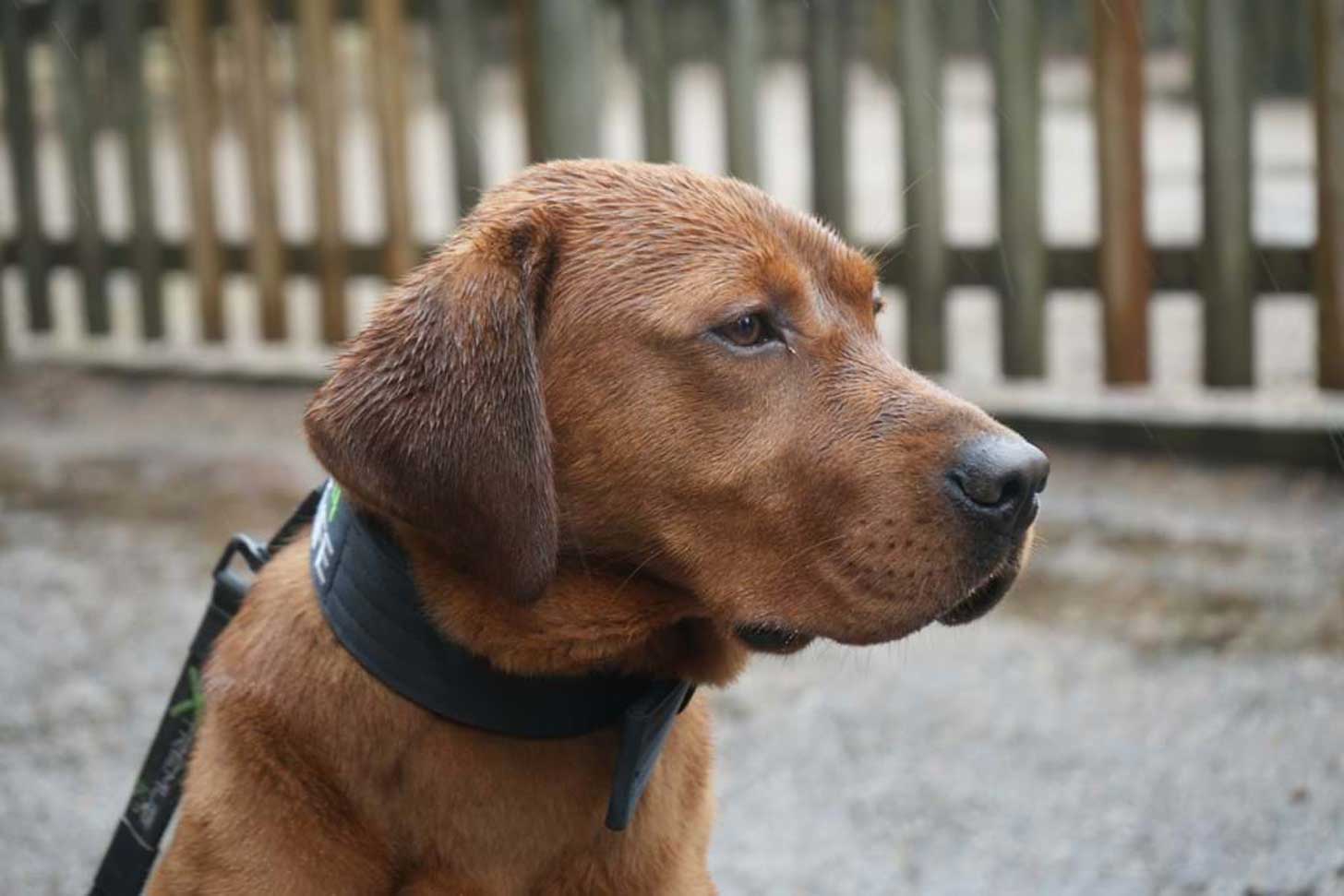
Last week, Fudge (a 2-year-old cocker spaniel) and Rocket (a 15-month-old fox red Labrador) went on a little training field trip to the UK-based zoo to practice ahead of their deployment to Southern Africa.
The dogs were joined by Darren Priddle and Jacqui Law, founders and directors of Dogs 4 Wildlife. Their work consists of training highly skilled dogs to join anti-poaching canine units that protect endangered species all across Southern Africa.
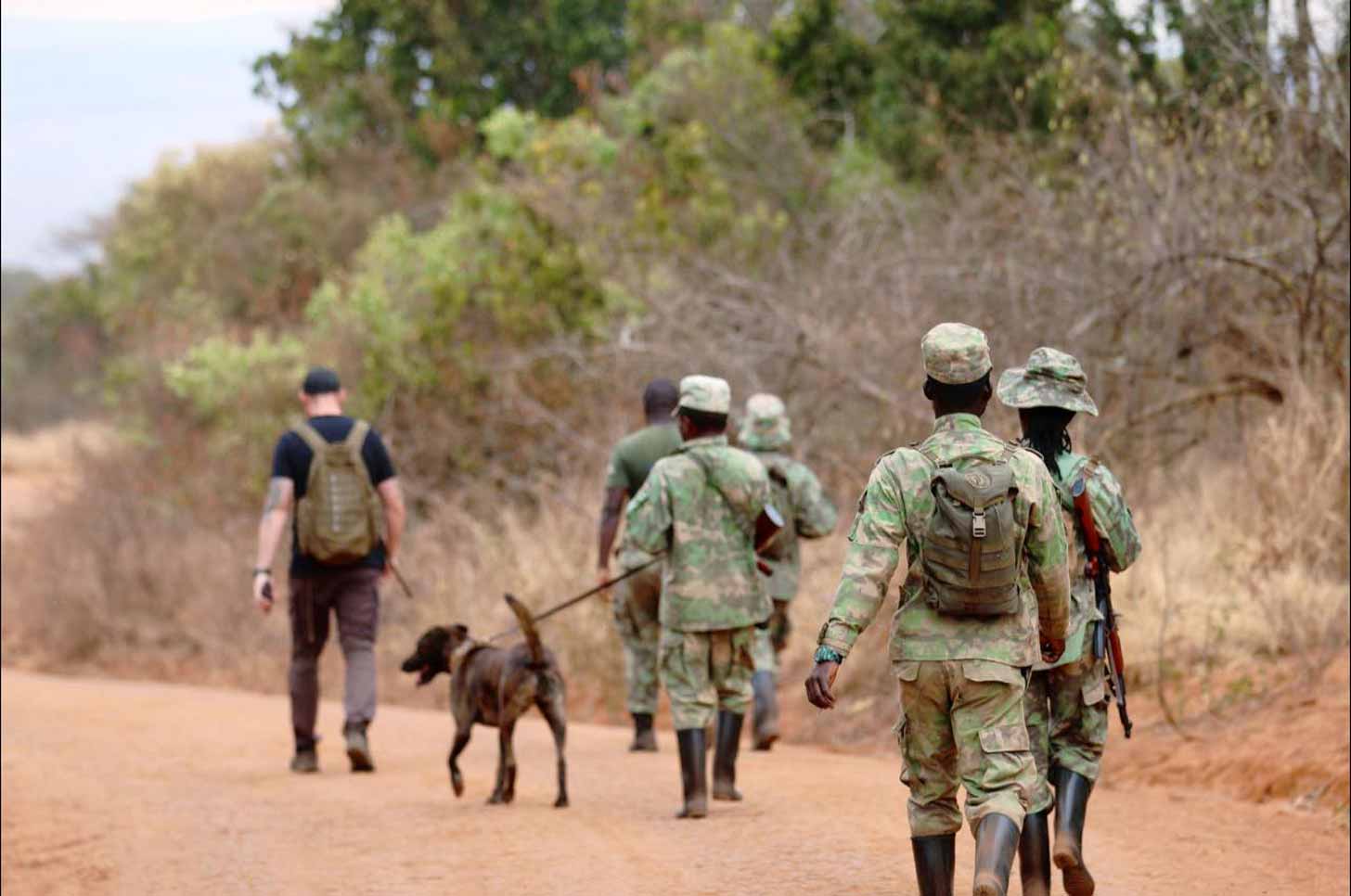
Bringing the pups to Yorkshire Wildlife Park is key to their training, as they are able to familiarize themselves with animals like leopards, tigers, rhinos, giraffes, and zebras — the same species they’ll be protecting in the field.
(The dogs also met polar bears, though they likely won’t encounter those particular furry friends again in the wild.)
“Being able to desensitize our conservation dogs to the sights, sounds, and smells of some of the wildlife they will go on to protect and conserve is vital to their effective development,” Priddle said in a statement.

Once they complete their training, Rocket and Fudge will join a team of 15 other canines working in wildlife areas in countries like Zimbabwe, Tanzania, Mozambique, South Africa, Rwanda, and Gabon.
There, they will serve alongside rangers to protect these newly befriended species from poachers.
Rocket is also training to become a detection dog, meaning he will be gainfully employed at airports and border checkpoints to sniff out rhino horn or animal skins from criminal traffickers.
While poaching is certainly not the only contributor to biodiversity loss, it is a major crisis in Southern Africa. Last year alone, national government agencies counted approximately 499 rhino poachings across Africa — more than double than the year before.
These dogs — who boast the ability to reduce poaching incidents by as much as 75% — are needed more than ever.
And the role of local organizations like the Yorkshire zoo makes their success possible.
“Yorkshire Wildlife Park puts conservation at the heart of all its activities, working with the Wildlife Foundation, the charity based at the park,” director Neville Williams said in a statement.
“It was really exciting to meet the dogs and hear about their future role helping conservation — every little gain in the fight for conservation is a step forward.”
While Rocket and Fudge are likely just eager to be along for the ride, Priddle and Law are grateful for every ounce of support for their training.
“We are extremely grateful to Yorkshire Wildlife Park for allowing our incredible dogs access to what is an amazing and diverse environment,” Piddle said.
“Working collaboratively to help safeguard the planet’s wildlife and educate our children to the value of our planet’s natural environments is the key to a sustainable future.”
Header image courtesy of Yorkshire Wildlife Park
July 13 marked the end of another “Shark Week,” a shark-centered television event that’s aired annually since 1988.
And as soon as the week came to an end, the executives at Warner Bros. Discovery began searching for a new host for 2025 — one that could make network history.
In an interview with Variety, U.S. networks chief marketing officer Karen Bronzo said that she “absolutely foresees female hosts in the future.”
In the history of the show, a woman has never hosted the program.
When “Shark Week” first aired, it was originally run without a host altogether — sans a surprise appearance from “Jaws” screenwriter Peter Benchley in 1994.
But in 2000, “Shark Week” adopted a host format under the tutelage of British naturalist Nigel Marven.
In the 24 years since, hosts have run the gamut of scientists, athletes, actors, and even “Mythbusters” stars.
The most memorable “Shark Week” hosts include Shaquille O'Neal, Dwayne Johnson, Les Stroud, Craig Ferguson, Andy Samberg, Jason Momoa — and most recently — John Cena.

That is not to say that women haven’t been featured on “Shark Week” in the past, and their work should definitely be celebrated.
Mainstays like marine biologists Dr. Alison Kock, Ornella Weideli, researcher Lindsay Graff, and diver Cristina Zenato have been pivotal to program favorites like “Shark Storm,” “Sharktacular,” and many more — but the majority of the shows primarily focus on male experts, researchers, and divers.
This is at odds with the reality of ocean experts at work today. According to self-reported statistics from Career Explorer, 69% of marine biologists in the field today are women.
This metric wouldn’t surprise the women at BYU-Hawaii, who vastly outnumbered their male classmates in the university’s marine biology program in 2022.
“I feel like naturally, we have a very nurturing side to us as women, and I think we have a love and care for the planet and animals,” BYUH senior Luckaia Strand told Kealakai.
But outside of the classroom, the students met real-world gender gaps. When BYUH student J Ungos interned at the Brevard Zoo in Melbourne, FL, she clocked that all of the curators and directors were men, even though women made up half of all zookeepers.
“It felt very male-dominated,” she said.
When it comes to career gaps in marine biology, nonprofit Women In Ocean Science is hoping to tackle “gendered issues in marine science” and empower women across a variety of ocean-related fields.
“Supporting women is protecting the ocean,” reads the mission statement on their website. “We’re creating an international movement to elevate the female voices working to protect our marine environment.”
As “Shark Week” starts pre-production and planning for summer 2025 — so quickly after this year’s wrap — Bronzo said that she and other executives aren’t afraid to make waves.
“One of the things we’ve always been very conscious of, especially in bringing on the other experts that we have with the host,” Bronzo said, “is making sure that we have diversity, that we have women voices, that we have diverse voices.”
Header image via Terry Goss / Wikimedia Commons (CC BY-SA 3.0)
In 1992, Siamese crocodiles were listed as ‘virtually extinct,’ as wild populations dwindled from decades of poaching.
Hunted for their soft, reptilian hides used in the fashion industry — and facing habitat degradation — the crocs were brought to the brink.
But now, they’re back in style — and not for the runway.
Fauna & Flora, a nonprofit that works on the frontlines of Siamese crocodile conservation, has announced that the largest population of the endangered species has hatched this century, welcoming 60 babies in Cambodia’s Cardamom National Park.
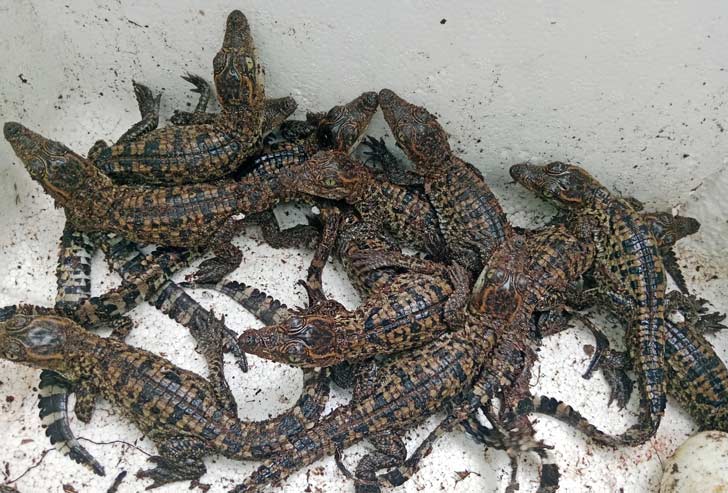
Although the baby crocs — with olive green scales and a distinctly bony crest atop their heads — just appeared Earth-side, their foray back into the wild has been decades in the making.
After their declared extinction in the 1990s, a tiny group of crocodiles were rediscovered in the remote Cardamom Mountains of Cambodia in 2000.
According to the New York Times, the Indigenous population of the Chorng people had protected the crocs for years, considering them sacred to their culture.

In the decades since, Fauna & Flora has worked with these local people — along with government agencies — to formally protect the species. The Siamese crocodile is smaller and less aggressive than its other saltwater crocodile relatives, and the local people who care for them often swim in the rivers where the crocs dwell.
Pablo Sinovas, the country’s director at Fauna & Flora told The New York Times that Siamese crocodiles “are a charismatic, large predator, so they naturally fascinate humans, and they have cultural importance.”
“If we’re able to conserve Siamese crocodiles, which requires the conservation of wetlands they inhabit,” he continued, “then by default we’re conserving the biodiversity that depends on those wetlands.”

This conservation work includes breeding initiatives and efforts to build safe and sustainable habitats for the crocs within Cardamom National Park, where they can be shielded from threats like deforestation and poaching.
A communal effort, their hard work paid off and in May of this year, locals discovered three nests in an area where captive-bred crocodiles had never been released before. They immediately reported the nests to Fauna & Flora’s conservation teams, who worked with local community wardens to protect the nests around the clock.
Miraculously, just a few days later, two other nests were discovered in the national park.
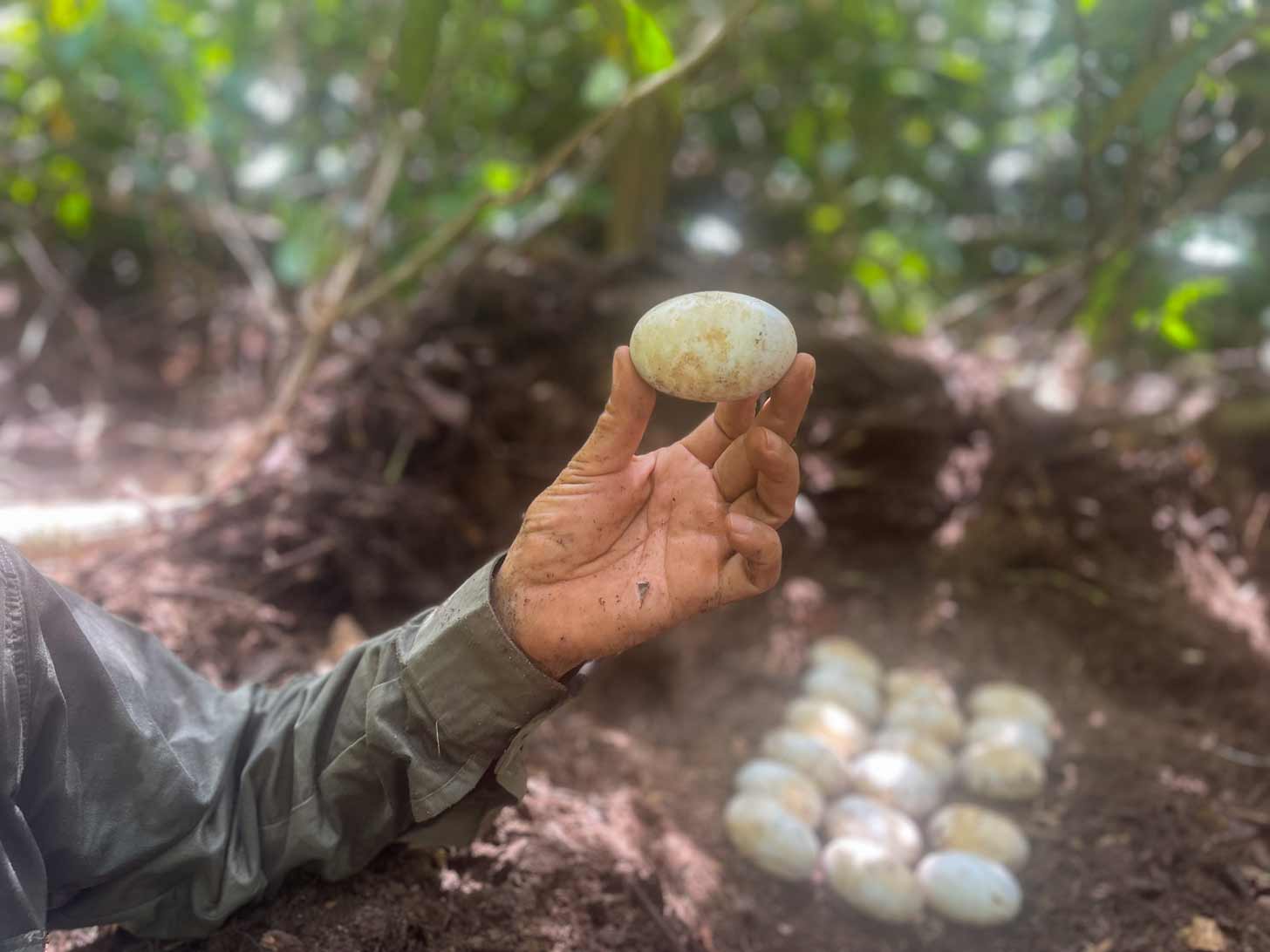
“At the end of June, a total of 60 Siamese crocodile hatchlings successfully emerged from these nests,” a Fauna & Flora press release reads, calling it “an incredible result for conservationists and a real sign of hope for the future of this species.”
Toy Chorn is a community warden who helped discover and protect the nests.
“This discovery indicates that our conservation efforts have paid off,” he said in a statement. “I believe that with our ongoing conservation efforts, the population of Siamese crocodiles will continue to increase in the future.”
Siamese crocodiles were once widespread throughout Southeast Asia, and experts now calculate that there are just a few hundred of them left in the world, many residing in Cambodia. As part of Fauna & Flora’s efforts, 196 Siamese crocodiles have been released into the wild since 2012 — and this new crop of crocs represents an exciting breakthrough.
“The recent discovery of wild nests emphasizes the vital importance of safeguarding this area,” Sinovas said in a statement. “With only a few hundred individuals estimated in the wild, the hatching of 60 new crocodiles is a tremendous boost.”
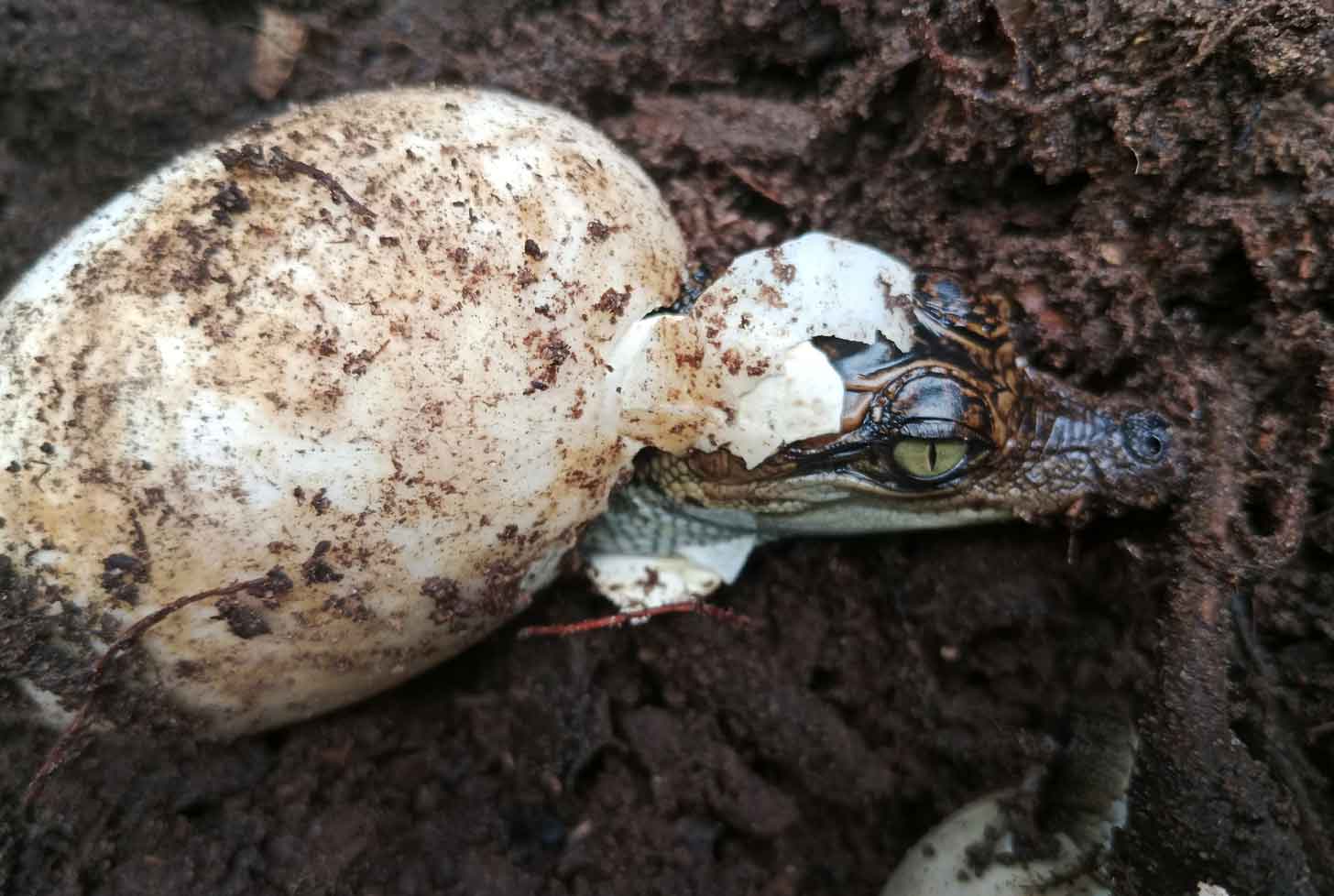
Now, locals and experts will monitor the health of the babies, breed them in captivity, and then plan to release them into suitable habitats across the Cardamom Mountains. Local community members will continue to regularly patrol the mountains after the crocs are released to ensure their safety.
The Siamese crocodile is still considered critically endangered by the International Union for Conservation of Nature. But the natural resilience of the species, combined with the collaborative and dedicated efforts of their human keepers, makes for an optimistic new chapter in their story.
“This successful endeavor demonstrates the positive impact of our collective work, as Siamese crocodiles now reproduce independently, forming new nests and offspring in their natural habitats,” Dith Tina, Cambodia’s Minister of Agriculture, Forestry, and Fisheries, said in a statement.
“It reinforces our commitment to conserve Cambodia’s diverse biodiversity for generations to come.”
Header image: © Bros Pov / Fauna & Flora
Outside the thrill of competition, the best and most emotional moments of the Olympics are the medal ceremonies, where champions and their supporters revel in their victories and take home a reminder of their monumental achievements.
Paris is no exception.
Designed by luxury jeweler Chaumet and made by France's official mint, Monnaie de Paris, each of the winners' medals is infused with 18 grams of iron directly from the Eiffel Tower — a reward for athletic achievement and a memorable token of Parisian iconography.
The City of Light isn't the only Olympic host to make its subtle mark on the Olympics. The tradition of awarding three distinct medals started 120 years ago at the 1904 St. Louis Olympic Games.
Contrary to their appearance, gold medals are mostly silver (and only contain about 6 grams of real gold), while a bronze medal is roughly 95% copper.
The host city's organizing committee designs the medals, mostly featuring the Olympic rings and Nike, the Greek goddess of victory.
Historically, the United States and Russia have earned most of these medals — but in each of the last six Summer Olympics, the People's Republic of China has finished as a top-three medal finisher.
What will the results be this year? That's up for debate. But one thing is certain: The International Olympic Committee will distribute 5,084 medals for the Olympics and Paralympics.
The awarding ceremony presents them in front of festive crowds, representative flags, a three-tiered podium, and a concluding national anthem — pomp and circumstance that most athletes only dream about experiencing.
Whether athletes earn gold, silver, or bronze souvenirs, they know they will forever be hailed as Olympic champions.
To celebrate the upcoming Games, SD Bullion used Olympedia data to look at medal designs for the Summer Olympics since 1976 and which countries won the most each year. Countries are sorted by total medal points.
Explore the last 50 years of Summer Olympics medal designs
Montreal 1976

Leading countries:
- Soviet Union: 49 gold, 41 silver, 35 bronze
- United States: 34 gold, 35 silver, 25 bronze
- East Germany: 40 gold, 25 silver, 25 bronze
On its obverse side (aka the head-facing side of a coin), Montréal's medal contains the goddess of victory holding a crown and a winner's palm, a featured design ever since Florentine artist Giuseppe Cassioli created it for the 1928 Olympics in Amsterdam. Made by the Royal Canadian Mint, the reverse side showcases a plain laurel crown and the rings, an intentionally bare design but all the better for its simplicity.
Moscow 1980

Leading countries:
- Soviet Union: 80 gold, 69 silver, 46 bronze
- East Germany: 47 gold, 37 silver, 42 bronze
- Bulgaria: 8 gold, 16 silver, 17 bronze
Only 80 nations competed in the Moscow Olympic Games (the result of boycotts), leading to some distorted medal numbers. Similar to Montréal, the Soviet capital kept the same Nike design on one side but also added some more simplistic symbols and signifiers on the reverse: an Olympic bowl, an eternal flame, and the Games emblem in the upper right-hand corner.
Los Angeles 1984

Leading countries:
- United States: 83 gold, 61 silver, 30 bronze
- West Germany: 17 gold, 19 silver, 23 bronze
- Romania: 20 gold, 16 silver, 17 bronze
Like the previous two Summer Games, Los Angeles maintained the same medal composition (gilt silver, silver, and bronze) for first, second, and third place, respectively, along with the same Nike pose on its obverse side. But the reverse is an intricately crafted depiction of a celebratory crowd carrying an Olympic champion, whose right arm is raised in celebration with the Olympic stadium as a backdrop.
Seoul 1988

Leading countries:
- Soviet Union: 55 gold, 31 silver, 46 bronze
- East Germany: 37 gold, 35 silver, 30 bronze
- United States: 36 gold, 31 silver, 27 bronze
Seoul mixed up the medal composition in 1988, inserting its first-place medal with 92.5% gold gilt and more than 5 grams of real gold. The second-place medal was made of silver and bronze, while the third-place medal contained bronze, zinc, and copper. The outline of a dove, the symbol of peace, with a branch in its mouth adorns the reverse side, as do three Taegeuk patterns from the Korean flag.
Barcelona 1992

Leading countries:
- Unified Team: 45 gold, 38 silver, 29 bronze
- United States: 37 gold, 34 silver, 37 bronze
- Germany: 33 gold, 21 silver, 28 bronze
At 70 millimeters in diameter, Barcelona's medal is about 10 millimeters larger than its predecessors. The obverse side contains a more modern depiction of Nike along with the inscription "XXV OLIMPÍADA BARCELONA 1992." On the reverse, it centers Barcelona's official emblem (a vague athlete), designed by sculptor Xavier Corberó.
Atlanta 1996

Leading countries:
- United States: 44 gold, 32 silver, 25 bronze
- Russian Federation: 26 gold, 21 silver, 16 bronze
- Germany: 20 gold, 18 silver, 27 bronze
To celebrate the 100th anniversary of the Olympic Games' renewal, Atlanta's medals—made by Reed and Barton—all contain "Centennial Olympic Games" around the outer edge of the reverse side. Within it lies a "Quilt of Leaves" olive branch pattern with Atlanta's Olympic emblem (stars shaped like an eternal flame) crafted by Malcolm Grear Designers.
Sydney 2000

Leading countries:
- United States: 37 gold, 24 silver, 32 bronze
- Russian Federation: 32 gold, 28 silver, 29 bronze
- People's Republic of China: 28 gold, 16 silver, 14 bronze
Though the obverse still carries the traditional Nike design, designer Wojciech Pietranik blended the city's signature opera house exterior and eternal flame with smoothed-out edges for the reverse. The undefined lines help accentuate the darker-edged, five-ring logo, making its 68-millimeter diameter really pop.
Athens 2004
Leading countries:
- United States: 36 gold, 39 silver, 26 bronze
- Russian Federation: 28 gold, 26 silver, 36 bronze
- People's Republic of China: 32 gold, 17 silver, 14 bronze
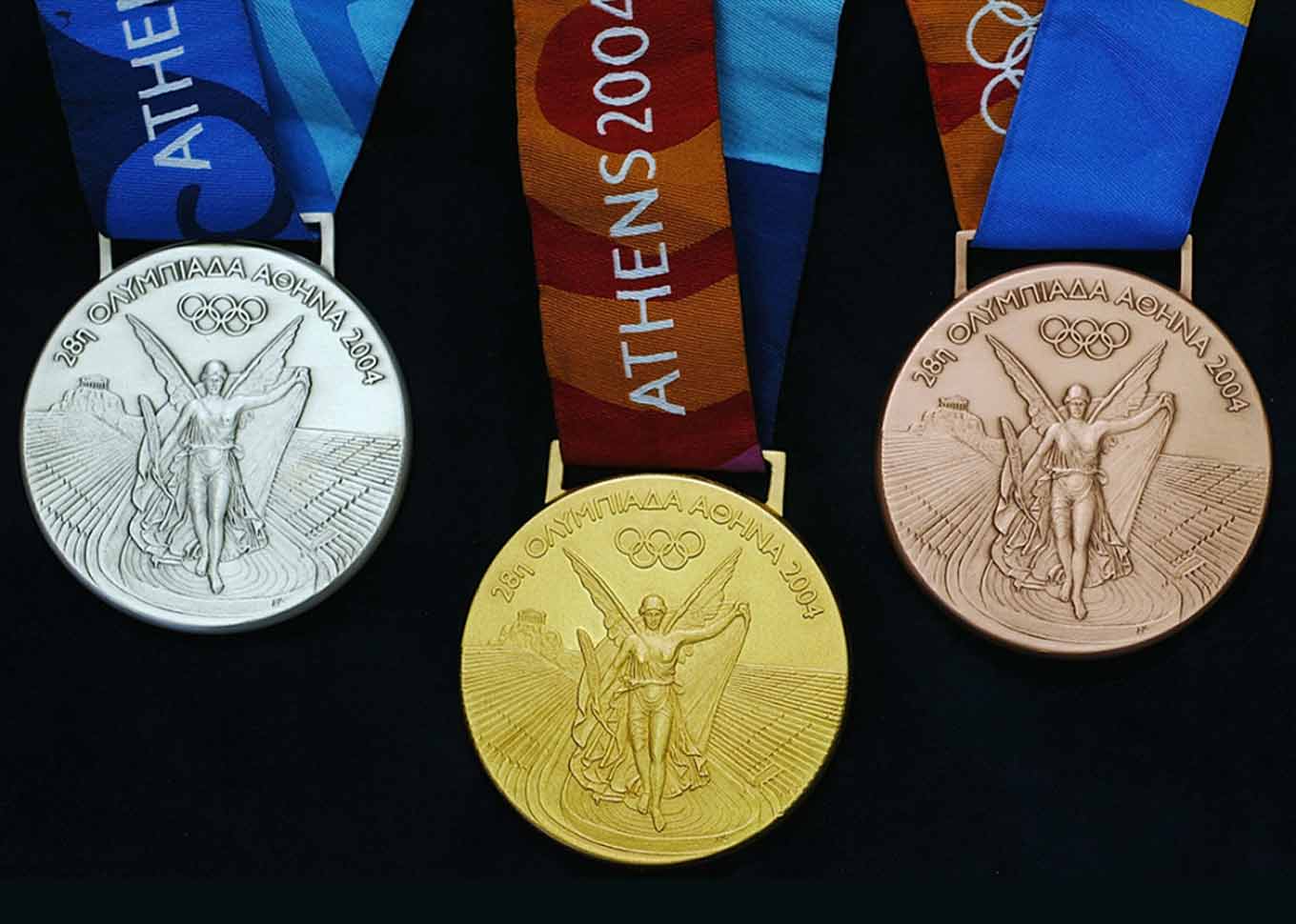
In a refreshing change from tradition, the obverse displays Nike flying into the stadium (as opposed to sitting), the first big design alteration since the Amsterdam Olympic Games in 1928. The reverse side contains three primary elements: the eternal flame, the opening words of Pindar's Eighth Olympic Ode, and the Athens Olympic emblem. The flying Nike would become the standard obverse design for future Olympic medals.
Beijing 2008
Leading countries:
- United States: 36 gold, 39 silver, 37 bronze
- People's Republic of China: 48 gold, 22 silver, 30 bronze
- Russian Federation: 24 gold, 13 silver, 23 bronze
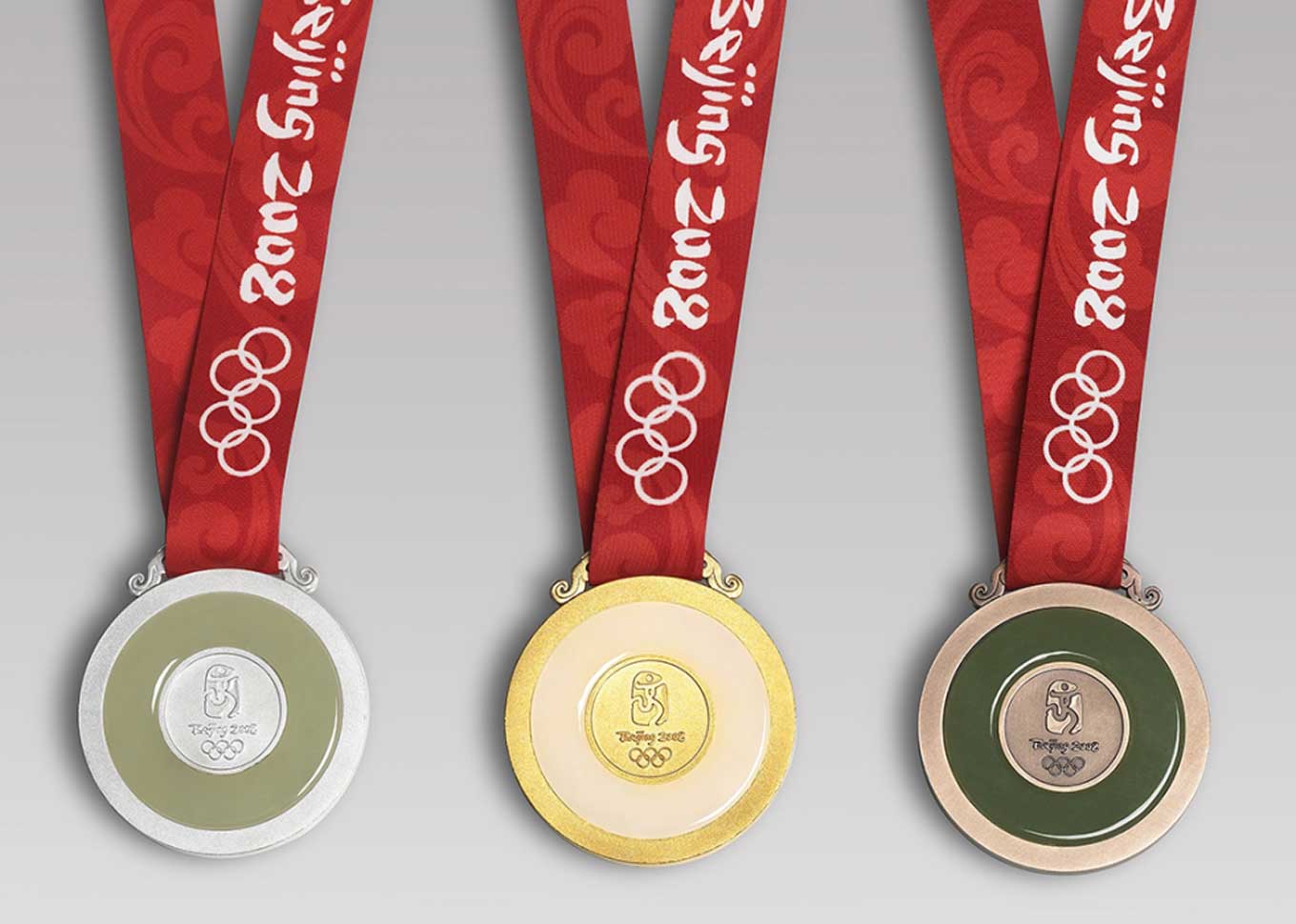
For the first time in Olympic history, the Beijing Games incorporated jade into its medals. The stone's inclusion was inspired by "bi," carved jade discs with a center hole that have been used as artistic objects in China for thousands of years. The medals reflect the Chinese virtues of ethics and honor. The jade is on the reverse side, with a small circular centerpiece where the Beijing Olympic emblem lies.
London 2012
Leading countries:
- United States: 48 gold, 26 silver, 30 bronze
- People's Republic of China: 39 gold, 31 silver, 22 bronze
- Great Britain: 29 gold, 18 silver, 18 bronze
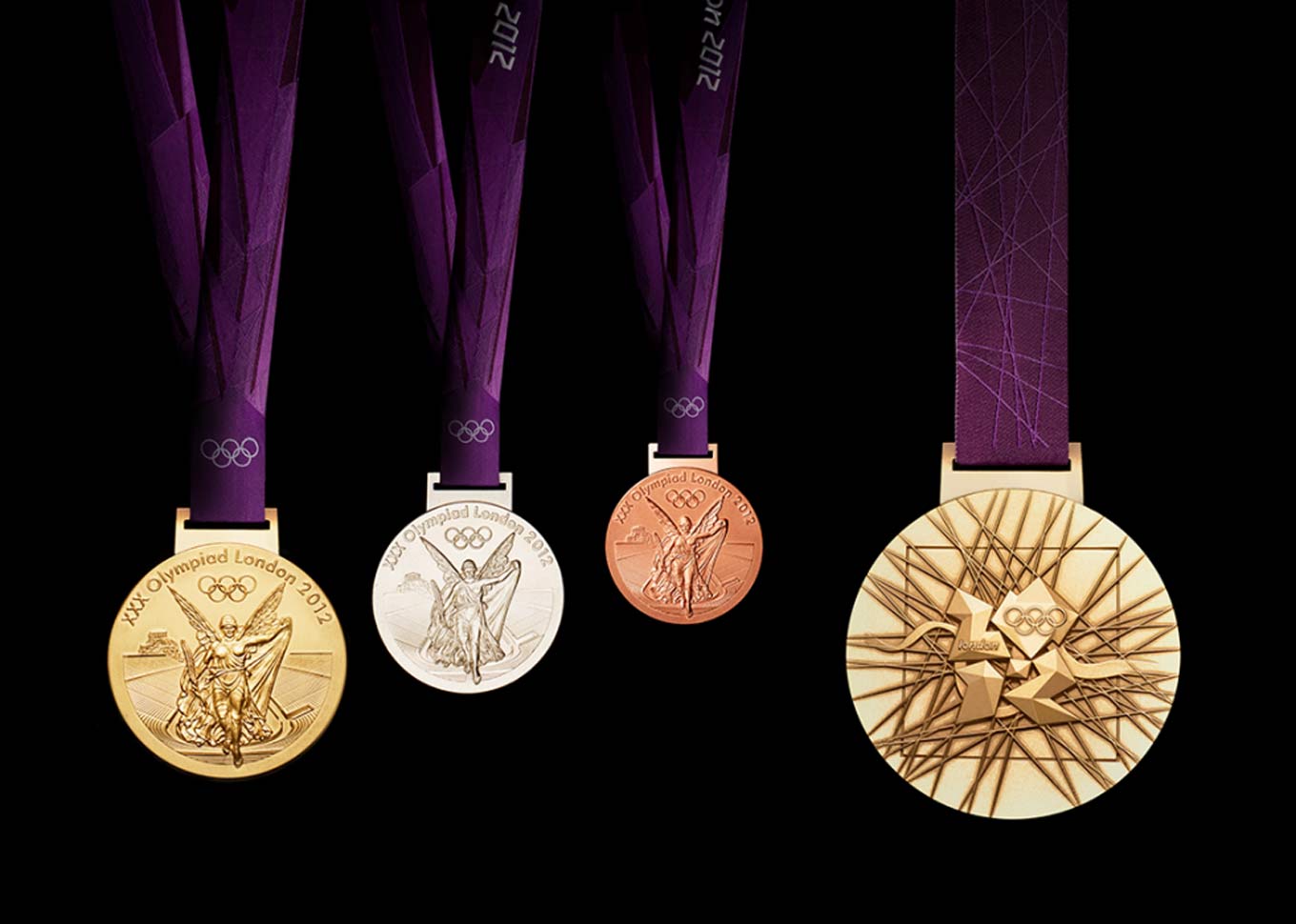
Thanks to London's 85-millimeter medal diameter, medal designers David Watkins and Elena Votsi had a bigger canvas to work with. They used it to create something more abstract on the reverse side, with an interlocking grid pattern and a ribbon representing the Thames tying the design together. A square helps balance the medal's circular shape, drawing the eye toward the London Olympic emblem in the center.
Rio de Janeiro 2016
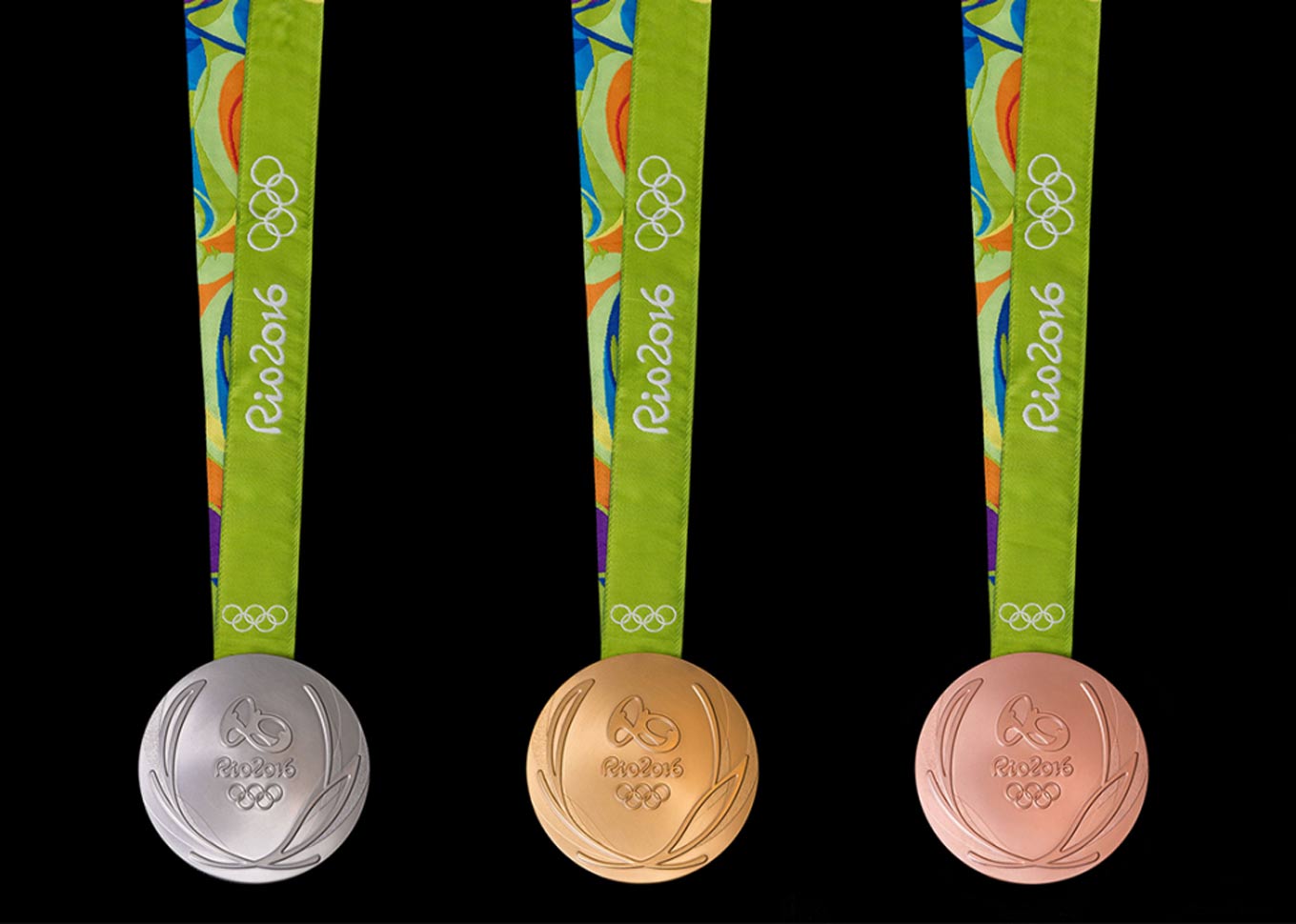
Leading countries:
- United States: 46 gold, 37 silver, 38 bronze
- Great Britain: 27 gold, 23 silver, 17 bronze
- People's Republic of China: 26 gold, 18 silver, 26 bronze
One of the more simplistic designs of the century, Rio's medal boasts two wreaths of laurel leaves, meant to signify victory. But the medal's composition is more interesting. With the idea of sustainability front and center, Brazilian designers used 30% recyclable material for the silver and bronze medals. Meanwhile, the gold medals met strict environmental laws, using recycled silver from leftover mirrors, waste solders, and X-ray plates.
Tokyo 2020
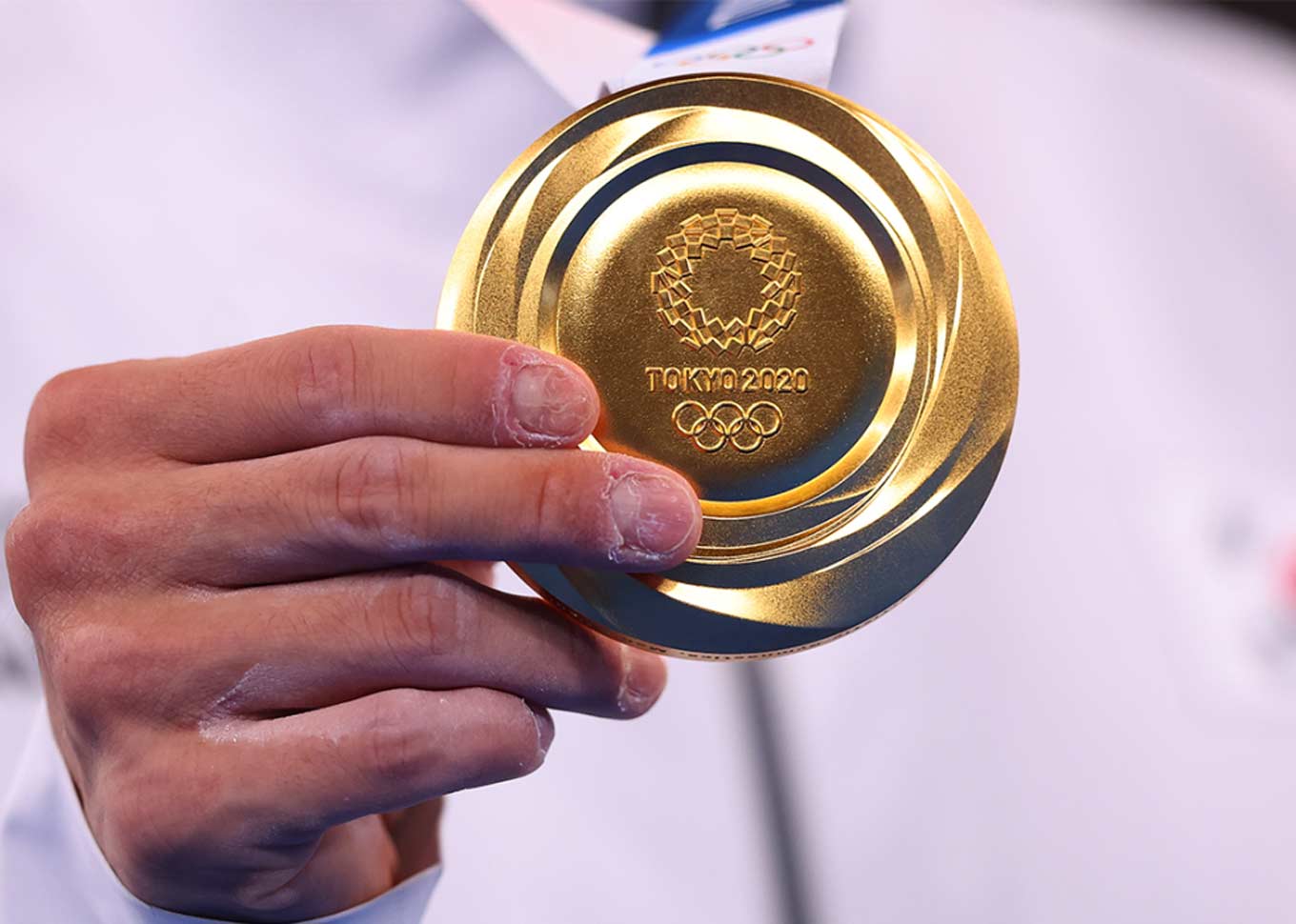
Leading countries:
- United States: 39 gold, 41 silver, 33 bronze
- People's Republic of China: 38 gold, 32 silver, 19 bronze
- Russia Olympic Committee: 20 gold, 28 silver, 23 bronze
Junichi Kawanishi won a nationwide competition, which included other professional and student designers, to create the look of Tokyo's medals. The reverse side features the city's Olympic emblem surrounded by layers of elevated rings that reflect patterns of light meant to represent the energy of Olympic athletes and fans. Like Rio's sustainable practices, Tokyo ensured its medals used metal extracted from recycled consumer electronics over the previous two years.
Banner Image: Paris 2024 Olympics gold medal. (Thomas Samson/AFP via Getty Images)
This article was originally published by Stacker and was republished with permission.
More than half of stroke survivors do not receive rehabilitation after the first days of advanced stroke care. Instead of living for months or years with visible or hidden disabilities, stroke survivors can take advantage of new techniques of advanced rehabilitation to improve their function and freedom.
One condition, called spatial neglect — in which a person’s three-dimensional reality and spatial movements are distorted on one side — is particularly underdiagnosed and undertreated among those who have suffered strokes and other brain injuries.
The Conversation asked neurologist A.M. Barrett and optometrist Kevin Houston, both from UMass Chan Medical School, to explain what causes spatial neglect and how to recognize it.

What is spatial neglect?
Some stroke survivors struggle when navigating the world around them. They walk, sit or stand in a tilted or unbalanced way. Even looking to the side may be challenging. This condition, known as spatial neglect, is a common occurrence after a brain injury.
About half of those in the first weeks and months of stroke recovery have spatial neglect; it is more common after a right brain stroke. Unlike other paired organs, the brain is functionally specialized, and the right brain is dominant for visual-spatial computations and actions.
Although spatial neglect can be accompanied by visual problems or paralysis, especially on the left side of the body, it is a separate problem that makes driving, reading, returning to work and daily self-care many times more difficult.
Most of us take for granted the ability to move and react effortlessly to what is happening around us. But these things are difficult for people with spatial neglect. Their internal map of the three-dimensional world is unreliable on one side.
How common is spatial neglect?
In some people, spatial neglect goes away with time. But in the U.S., 350,000 people live with spatial neglect for six months or longer. That number is likely higher — perhaps three times as high — but there’s no way to be certain; it’s estimated that fewer than half of those with spatial neglect are diagnosed and treated.
How can you recognize spatial neglect?
A person with spatial neglect may be unable to steer a wheelchair straight ahead and instead may steer to the right in tight circles. When putting a shirt on, they may put their right arm through the sleeve but not the left, or vice versa. Or they may lay out their medications, but only reach to one side, so they may take only half of their medicines for that morning. Someone with spatial neglect may inadvertently sit on their affected arm, or let it hang off the side of the wheelchair.
When chatting with a group, a person with spatial neglect may turn to the wrong person to respond. This is because their spatial system, which tells them who just spoke based on that person’s location, is disoriented. The spatial system is also critical when helping us react to a sudden event, like a car swerving out of its lane toward us when we’re driving.
One reason why this condition goes undiagnosed is because caregivers don’t see the postural and movement changes in spatial neglect as a specific brain problem. Instead, when they see the person sitting persistently turned, or leaning and tilting to the right, they just respond intuitively, with assumptions that the person is unmotivated, depressed or has an intellectual problem caused by the stroke.
Caregivers may also think these unusual movements are part of the weakness caused by stroke. However, people who only have weakness will compensate. They usually do not turn or lean to one side persistently.
Most disturbing for those with spatial neglect: The internal alarm system that helps them detect everyday mistakes is off. They are unaware they are having difficulties walking, reacting, moving or responding, so they don’t see the need to ask for help. This has a devastating effect, not only on their perception of the world but on their dignity.
What causes spatial neglect and how is it related to stroke?
There are networks and way stations in the brain, specialized in managing how our body interacts with the three-dimensional world. Spatial neglect occurs when these networks, or the wiring connecting them, go offline after a stroke.
For example, if someone points to something — like a sign they want someone else to see — a “ballistic system” in their brain sets a target and bearing so that the movement is aimed correctly. But if a person with spatial neglect tries to point to a sign, they may point incorrectly, perhaps to the right side of the sign.
This aiming error can cause falls as stroke survivors try to get up from a chair, walk or turn, sometimes even pulling down the person trying to assist them. These accidents can devastate their recovery and freedom.
How does it differ from limb paralysis or vision loss?
It is not weakness or paralysis on one side of the body that causes unbalanced posture and movements. Instead, someone with spatial neglect is not aware they are leaning or veering. From their perspective, movements are targeted straight ahead.
Those with spatial neglect often have vision problems too, but that doesn’t mean anything is wrong with their eyes. They can see. But because of their stroke, their brain ignores some of the visual information.
If spatial neglect is treated, the patient may be able to adjust for their vision issues and regain independence in daily life much more successfully.
What are the promising treatment options?
Treating spatial neglect through an approach called prism adaptation therapy actually increases the patient’s ability to move and track the affected limb, and can even reduce pain affecting the bad side.
The therapy is simple to administer, using off-the-shelf optical prisms over 10 therapy sessions of 20 minutes each. Essentially, a stroke survivor wears goggles during the session and practices aiming their spatial movements. The therapist will ask the patient to repeatedly point to and touch a dot placed on the table in front of them, or ask the patient to repeatedly mark the center of a line. This appears to correct the rightward-turning tendency after spatial neglect.
Prism adaptation therapy has been recommended by the American Heart Association and American Stroke Association, and our group has provided this treatment to patients for more than 15 years.
After prism adaptation therapy, the ability of most patients to aim movements toward the neglected side is greatly improved. Our therapists have measured the increase in leftward movements after even one treatment session.
Other types of therapy for spatial neglect involves far more than 10 treatments. These sessions are more labor-intensive and require extensive training for providers. Such types of treatment are difficult to scale and unlikely to reach the hundreds of thousands of people diagnosed with spatial neglect.
How can I find a specialist?
First, ask your doctors and therapy providers about treatment for spatial neglect. Neurologists specialized in rehabilitation, other rehabilitation physicians, speech language pathologists, occupational or physical therapists or optometrists specializing in visual rehabilitation might offer prism adaptation therapy. Make sure your provider is offering a treatment that is evidence-based.
Our group is currently receiving research funding from the Veteran Administration for a large national study to identify the people who might receive the most benefit. We hope the study will also provide doctors with a better understanding of the brain networks that are critical for treatment success.
This article by A.M. Barrett and Kevin Houston, both from UMass Chan Medical School, was originally published by The Conversation.

In late spring, estuaries along the U.S. Gulf Coast come alive with newborn fish and other sea life. While some species have struggled to adjust to the region’s rising water temperatures in recent years, one is thriving: juvenile bull sharks.
We study this iconic shark species, named for its stout body and matching disposition, along the Gulf of Mexico. Over the past two decades, we have documented a fivefold increase in baby bull sharks in Mobile Bay, Alabama, and a similar rise in several Texas estuaries, as our new study shows.
Despite the bull shark’s fearsome reputation, baby bull sharks are not cause for concern for humans in these waters.
While adult bull sharks are responsible for an occasional unprovoked attack, baby bull sharks haven’t fully developed the skills needed to hunt larger prey. And you’re still far more likely to be killed by bees, wasps or snakes than sharks.
The fascinating life of a young bull shark
Most sharks are fully marine and spend their entire lives in the ocean. Bull sharks, however, are one of a handful of shark species that use freshwater environments as nurseries.
Baby bull sharks have been found in the Alabama River, 75 miles north of the ocean, and up the Mississippi River as far as Illinois. They have evolved to tolerate fresh water by reducing the need for salts and urea in their bodies compared to marine sharks, and actively taking in more salts through their food and across their gills.
In Texas, young bull shark numbers have been increasing in estuaries like Galveston Bay and Sabine Lake over the past 40 years, particularly where rivers like the Trinity, Sabine and Neches intersect with these ecosystems. These areas may offer protection from predators, such as bigger sharks.

The presence of bull sharks in these estuaries also contributes to their health and stability.
Because bull sharks frequently move between freshwater and marine ecosystems, they can act as mobile links that connect these two aquatic environments. Bull sharks often feed in one environment, salty water for example, and then rest and excrete nutrients in freshwater bays.
Feeding and resting in different locations can improve the ability of these ecosystems to withstand disturbances like warming weather conditions, because if one habitat is disturbed, the other is still supported.
Like a spider web, food webs are connected by many intersecting threads. The more threads, the stronger the web. The use of both freshwater and marine habitats by bull sharks increases the number of these threads through their predator-prey interactions, thereby strengthening the ecosystem.
Waters are warming
As the planet warms, coastal ocean temperatures are rising. In the Gulf of Mexico, water temperatures have risen more than 3 degrees Fahrenheit (more than 1.5 degrees Celsius) due to climate change.
On a global scale, warming waters are harming more fish species than they are helping.
Higher temperatures increase food requirements and stress levels, while making fish more susceptible to disease and reducing the survival of their young.
A variety of fish populations in the Gulf of Mexico, including mullet and flounder, have declined as warmer conditions affected their spawning.

At the same time, the waters used by baby bull sharks have expanded in part due to this warming, creating a dynamic habitat.
An easy way to understand how sharks use dynamic habitat is to capture them with nets and measure the characteristics of the surrounding environment.
In our sampling data, we could see that the mean annual water temperatures on the Alabama and Texas coasts increased at the same time the bull shark populations rose.

In coastal Alabama, we found that the relative abundance of baby bull sharks has increased fivefold over the past 20 years. Slight increases in temperature over that time provided the best explanation for this population increase.
Of all the temperatures recorded in that study, there was no maximum temperature threshold detected for baby bull sharks. So far, at least since 2003, it’s been “the warmer the better” for a baby bull shark.
We observed a similar trend in coastal Texas from Sabine Lake to Matagorda Bay, where warming estuaries supported increased abundances of baby bull sharks up to eightfold over the past 40 years.
Warmer waters allowed baby bull sharks to remain in their natal estuaries longer during their first year before overwintering in the Gulf of Mexico, increasing their survival to the next life stage.

Collectively, our recent studies indicate that warming waters are currently beneficial for young bull sharks. But just like your favorite dessert, too much of a good thing can be detrimental.
All animals, including bull sharks, have maximum and minimum temperatures at which they can function. If temperatures get too hot or too cold, this can lead to problems, whether through direct stress on the shark’s bodily functions or on its ecosystem at large.
Some of our previous work from Florida shows that baby bull sharks will leave coastal nurseries in response to episodic cold snaps to avoid cold-stress. Sharks that didn’t leave died. The same may be true for hot temperatures, although conditions have not yet reached that point in the Gulf of Mexico based on our research.
A changing world
It’s clear that climate change is altering coastal ecosystems. Our work shows the direct benefit to young bull sharks, but how the observed population growth is affecting other species in the coastal estuaries remains to be seen.

The rise in bull sharks may affect other fish species, including bull shark prey like mullets, drums, herrings and catfish. More bull sharks could eventually mean fewer of the fish that humans rely on. In warmer water, sharks burn more energy.
Ultimately, tracking how the distributions of species like bull sharks change over time remains a critical priority for understanding future shifts in fish populations and the health of our coastal ecosystems.
This article by James Marcus Drymon, Lindsay Mullins, both from Mississippi State University, and Philip Matich, Texas A&M University, was originally published by The Conversation.

Every day the Good Good Good team collects the best good news in the world and shares it with our community. Here are the highlights for this week!
If you want to get good news in your inbox every day, join the Goodnewsletter — the free daily newsletter designed to leave you feeling hopeful.
The Best Positive News We’re Celebrating This Week —
The world’s first hydrogen ferry is officially in service in San Francisco
In a milestone for sustainable transportation, the Sea Change ferry is now officially running in the San Francisco Bay Area.
Providing an entirely different experience from a traditional diesel ferry, the Sea Change is quiet and emits only heat and water vapor — because it’s fueled by hydrogen.
The Sea Change can travel up to 300 nautical miles at speeds of up to 15 knots. It can hold 75 passengers and is no more expensive to ride than its counterparts. It’s also the only vessel where you can literally drink the exhaust — the water vapor supplies a drinking fountain onboard.
What’s the nuance? Most hydrogen is still made from fossil fuels, so it’s not fully “clean” — yet. The Sea Change ferry will use hydrogen fuel that is available locally, but eventually, designers hope it could use green hydrogen, which is made from water and renewable electricity.
→ Read more
Deforestation in Colombia fell to a 23-year low in 2023
Thanks largely to a decline in environmental destruction in the Amazon, deforestation in Colombia fell 36% in 2023 — to just over 792 square kilometers. Down from around 1,235 square kilometers in 2022, that figure represents a 23-year low.
One of the most biodiverse countries in the world, Colombia is home to thousands of plant and animal species — but continues to lose habitat to deforestation every year.
But 2023 was an encouraging year, especially in the country’s Amazon region, which typically drives its deforestation rate. Deforestation there declined 38% to around 443 square kilometers — down from 712 in 2022.
While the country acknowledged the “really good news,” it noted that the battle against deforestation continues: it’s on track to rise in 2024 due to dry conditions exacerbated by El Niño.
→ Read more
In a breakthrough for HIV treatment, a new drug trial showed a twice-annual injection is 100% effective against infection
A large clinical trial in South Africa and Uganda has shown that a twice-yearly injection of a new pre-exposure prophylaxis (PrEP) drug gives young women total protection from HIV infection.
This breakthrough gives great hope that we have a proven, highly effective prevention tool to protect people from HIV. Alongside greater advocacy, funding, and access to treatment, it could help continue the declining rates of HIV/AIDS cases and deaths globally.
There were 1.3 million new HIV infections globally in the past year. While that’s fewer than the 2 million infections seen in 2010, it’s still above the HIV new infection target that UNAIDS set for 2025 (which is fewer than 500,000 globally).
→ Read more
More good HIV/AIDS news:
- Putting it ahead of schedule to end the country’s epidemic, the rate of new HIV infections in Namibia is five times lower than it was in 2002.
- Grassroots AIDS activists helped fight for and win access to affordable HIV treatments for people around the world.
- After a groundbreaking treatment, a 53-year-old man in Germany became the fifth person to be officially cured of HIV.
- While antiretroviral drugs can keep HIV in check, a small biotech company in San Francisco is working on a cure for HIV using gene editing.
A mother fought tirelessly to get free phone calls and emails in Connecticut’s prisons
Diane Lewis’ community has been hit hard by mass incarceration. Data from 2020 showed Upper Albany had one of the highest incarceration rates in Hartford — 1,917 per 100,000 people, or more than four times the rate statewide.
At the same time, the neighborhood’s median household income is about $24,000, and more than 30 percent of families live in poverty. A $5 prison phone call chipped away at the little money people have for essentials like food, rent, medicine, and clothes.
Lewis’ advocacy for prison phone justice began after her 17-year-old son went to prison in 2004. Knowing the importance of staying connected, she usually called four times a day, and with each 15-minute call costing her between $3 and $5 — she was spending about $100 per week.
Two years ago, Lewis finally won her years-long fight to make phone calls and email free in Connecticut’s prisons and juvenile facilities. In that time, the free phone calls and emails from prisons have been “life-changing” for families — and incarcerated people.
With over 500 nests, sea turtles just made a comeback and broke a 42-year record in Florida
With its sandy beaches and subtropical waters, Florida is home to one of the largest loggerhead sea turtle nesting populations in the world.
Despite living up to 70 years, loggerheads have been on the decline due to ocean pollution, human interference, and the gradual destruction of their nesting habitats. They’re protected as a threatened species under the Endangered Species Act.
But on the Gulf coast of Florida, Anna Maria Island just celebrated a huge milestone for sea turtle conservation when volunteers counted 546 nests on the island, breaking a 42-year record for the island.
And it’s thanks to conservation efforts that happened 25 years ago.
→ Read more
More good sea turtle news:
- Georgia recently made history with the state’s largest-ever endangered sea turtle release.
- Thanks to extensive conservation efforts and local awareness, Bangladesh has seen the highest number of olive ridley turtle eggs this year.
- Researchers and locals are using technology and tradition to study and protect sea turtles in one of their most critical nesting grounds.
Continuing to gradually increase, wind power surpassed coal in electricity generation in both March and April
In March and April of this year, wind power generated more electricity than coal in the U.S. The Energy Information Administration expects wind power generation to fluctuate in the coming months, but maintain its steady increase overall.
The U.S. now has more than 74,500 wind turbines, with about 3,000 new turbines built every year since 2005.
And while wind power only represents about 10.2% of total U.S. energy production, it accounts for almost half of all renewable energy production.
This good progress comes even as offshore wind development faced setbacks last year. It also comes as new air pollution regulations signal the end of the notoriously “dirty” coal industry in the U.S.
→ Read more
A court just ruled that pollution violates the rights of a river in Ecuador
Part of a growing movement to legally recognize the “rights of nature,” Ecuador is one of a few countries whose constitution enshrines the rights of places like the Machángara River.
Now, a court just issued a “historic” ruling that pollution has violated the rights of that river, which runs through the country’s capital, Quito. The government must now develop a plan to clean up the river.
The city of 2.6 million dumps varying contaminants into the river, and with a lack of wastewater treatment, has a devastating impact on people, wildlife, and the surrounding environment.
→ Read more
More good news for protecting nature:
- With 15 reserves across Ecuador, a group is protecting 10% of the planet’s bird species, adapting its approach based on local conditions and threats.
- Indigenous groups are protecting 80% of the Amazon in Ecuador and Peru, preserving endemic species and preventing approximately 2 billion metric tons of greenhouse gas emissions.
- Guardianship of a 532-acre redwood forest in California was returned to the Sinkyone tribes, protecting endangered species and what’s left of California’s old-growth forest.
Thought to be extinct in 1992, 60 new baby Siamese crocodiles have hatched in Cambodia
In 1992, Siamese crocodiles were listed as ‘virtually extinct,’ as wild populations dwindled from decades of poaching. In addition to habitat degradation, the crocs were hunted for their soft, reptilian hides used in the fashion industry.
But now, in “a real sign of hope,” the largest population of the endangered species has hatched this century, with 60 babies born in Cambodia’s Cardamom National Park.
Most recently, locals discovered three nests in an area where captive-bred crocodiles had never been released before. And miraculously, just a few days later, two other nests were discovered in the national park.
Look for the helpers: The crocodiles’ comeback has been decades in the making. After their declared extinction, a tiny group was rediscovered in the remote Cardamom Mountains in 2000 — where the Indigenous population of the Chorng people had been protecting them for years.
Thanks to 13 young people, Hawaii agreed to take “groundbreaking” action to decarbonize its transportation system
A group of 13 young people in Hawaii argued the state was violating their constitutional rights by building infrastructure that exacerbates greenhouse gas emissions and climate change.
While the latest in a growing movement of young people taking their climate cases to court, it’s reportedly the first-ever youth-led climate case calling for zero emissions in transportation. And they recently won their case, with the state agreeing to take action to decarbonize its transportation by 2045.
The youths accused the state of prioritizing highway construction and similar projects that guarantee the use of fossil fuels, rather than those that reduce emissions.
Had it gone to trial, it would have been just the second trial in the U.S. from young people arguing that a state’s actions violated their right to a safe, healthy future.
More good news of the week —
There was a significant decrease in the number of countries that still have the death penalty in 2023. Despite a rise in executions, close to three-quarters of the countries in the world have now abolished the death penalty in law or practice.
A second critically endangered pangolin was just born at the Prague Zoo in less than two years. In addition to being the most trafficked animal in the world, due to habitat loss and deforestation, all eight species of pangolins have been struggling for survival across Asia and Africa.
Scientists are using AI and machine learning models to forecast water quality issues caused by toxic algae blooms. Now reported in all 50 states, blue-green algae blooms have grown in intensity and frequency due to climate change and rising water temperatures.
Researchers just found the cause of the life-threatening disease lupus, which could lead to a cure. Impacting millions of people worldwide, lupus is an autoimmune condition that occurs when the immune system attacks the body’s ordinary cells.
A newly approved pneumonia vaccine offers significantly more protection than other vaccines. Pneumococcal infections are responsible for over 150,000 hospitalizations for pneumonia and 2,000 cases of meningitis in the United States annually.
A breakthrough new drug could help reverse even more opioid overdoses. Naxolone is one of the most common and effective opioid overdose treatments, but it’s only effective for about 2 hours, and fentanyl can last in the bloodstream for up to 8 hours.
The first-ever elephant herpesvirus vaccine was just injected in a 40-year-old elephant at the Houston Zoo. Elephant endotheliotropic herpesvirus has been the leading cause of death in Asian elephants born in North America since 1980.
A coal plant that operated for 100 years in Michigan is now being turned into a giant battery. Once it’s built, the new battery storage system will be the largest stand-alone energy storage site in the Great Lakes region.
AI-powered trash cans are helping restaurants, buffets, and caterers cut down on food waste. The world wasted 1.05 billion tons of food in 2022, leading to almost five times the emissions of the aviation sector — nearly a third of that waste came from the food service industry.
An organization has set up 10 “period pantry” locations stocked with free supplies across Tampa, Florida. While Florida doesn’t have a “tampon tax,” many people in the state still experience period poverty and stigma around menstruation.
A UK brewery is helping cut reoffending rates by teaching formerly incarcerated people to brew beer. Tap Social Movement’s proven success is being hailed as a possible template for ways to ease the unprecedented overcrowding in UK jails.
Researchers have found a way to recycle old solar panels into lithium-ion batteries. The “game-changing” discovery uses silicon, which is more abundant and capable of making a more energy-dense battery than current commercial methods.
America just named its 430th national park, and it honors a complex time in U.S. history. It joins other historic sites that reckon with the more complicated and shameful parts of U.S. history, like the Amache National Historic Site and the Emmett Till and Mamie Till-Mobley National Monuments.
New AI-powered software is transforming pregnancy scans and boosting maternal health care in Africa. Eliminating the need for a specialist to administer an ultrasound, pregnant women are incentivized to receive care earlier, helping improve maternal health care in the country.
In the first sport in the world to award competitors for sustainability, Team Great Britain just took first place. The high-octane sport SailGP is the only grand prix with 2 winner podiums — one for the fastest of the season and the other for the most environmental impact.
Part of a nationwide initiative to plant 100 million mangrove trees drones are distributing seeds in the United Arab Emirates. The drones distributed over six million seeds last year as part of the effort to restore the country’s coastal mangrove forests.
Every country in the world has now banned the use of leaded gasoline in cars. The world started adding lead to gasoline in the 1920s to improve efficiency and engine performance, before lead was proven to be a toxic pollutant, particularly for children.
A study found that as the coronavirus evolved, the odds of developing “long COVID” dropped — especially for the vaccinated. Among vaccinated people, 53 out of 1,000 developed long COVID up to a year after infection during the delta variant and only 35 during omicron.
Larry Kraft is a homemade ice cream aficionado. Kristin Robbins went to the same graduate school as a recently retired colleague. And it turns out that both Robbins and Sandra Feist care deeply about how social media impacts kids.
It's exactly these types of personal discoveries and connections that these members of the Minnesota legislature have made with each other through the Civility Caucus.
Launched in 2017 after a workshop on building trust through civil discourse at an annual legislative conference, Minnesota's Civility Caucus is designed to bring members of the state House and Senate together across the aisle.
The idea is simple: By getting to know members of the "other side" as people, rather than as presumed adversaries with stereotypically held beliefs, more effective, bipartisan legislation will get done.
Next City reports that there are similar efforts on the federal level, like the Problem Solvers Caucus and the Congressional Civility and Respect Caucus, as well as a broader civility in government initiative in New Hampshire, but Minnesota's state caucus stands alone.
Although Republican Rep. Robbins clarifies that it can't quite be said that bills have been passed just because of the caucus, she and one of her co-chairs, Democratic Rep. Sandra Feist, have co-sponsored a current bill on student cell phone use in schools.
"It provides a place for members of both parties of both the House and the Senate to have time together, to get to know each other as people. That relationship-building leads to a foundation of trust that then helps get the leg work done when you're negotiating, when you're looking for a bill author," Robbins says.
"When you have a relationship with someone personally, then you have someone you can go to for help getting a hearing or identifying someone else who might be interested in a bill."
Bill Doherty — a professor of family social science at the University of Minnesota and co-founder of Braver Angels, a nonprofit dedicated to addressing partisan animosity in the U.S. — has given presentations to, and held workshops with, the Civility Caucus. He says that the establishment of such forums are valuable for creating a better political climate.
"Having these caucuses, even if it's hard to point to concrete changes and successes, is important because we're at least naming a problem of rancor and polarization," Doherty says.
The Civility Caucus, which is coordinated by the state's Office of Collaboration and Dispute Resolution, meets monthly during sessions. Robbins says that the free lunch is a big draw for busy legislators, a welcome reprieve from the granola bar she usually eats between meetings most days. And staffers aren't allowed, just legislators themselves.

The first meeting of a session usually kicks off with an ice breaker, something like asking each member to share something surprising about their district. In other meetings, they share challenges or opportunities in their districts. "What was interesting about that was, going around the room, you realized that we're all having similar challenges in our districts, rural or urban," Robbins says of a common divide across Minnesota politics.
In March's meeting, the caucus took a different approach to the food element with a classic Minnesota hot dish potluck. "You see a different side of people when they bring grandma's recipe," she adds.
For Doherty, the success of caucuses like this one rely on a foundation of communication skills for dealing with difference and disagreement.
"We use a term called achieving accurate disagreement," he explains. "Accurate disagreement occurs when each of us knows what the other is saying and why, from their perspective, they're saying it." Accurate disagreements (versus distorted disagreement that comes from people thinking or assuming they know the reasons why someone else is disagreeing with them) is the fertile ground from which commonalities can emerge.
Take the issue of school funding. Democrats might assume that Republicans oppose a school funding bill because they don't care about kids' education, he says. In reality, the hesitation might be around a lack of accountability for how and where funding is being spent. With an accurate understanding of what the disagreement is, a potential solution like building more accountability into a funding bill can help lead to a bi-partisan outcome.
With these skills and built-in opportunities to get to know each other as individual people, cooperation can start to emerge again. "Every legislator and member of Congress we've talked to says that part of the lack of civility and cooperation is a decline in informal opportunities to connect," Doherty says.
Digital lawmaking during COVID-19 was a challenge for the Minnesota caucus, one they're still working to recover from. Prior to the pandemic, the caucus averaged 40 to 50 attendees per every meeting. "Since then, I'd say we now get 15 to 20 people. A big loss is that … we've now had two classes of legislators that didn't experience the pre-COVID ways we got work done," Robbins says.
She adds that this year's November election will make it too difficult, but an idea that's been floated is hosting Civility Caucus events in a member's district and inviting spouses. "We're trying to do more things in the interim rather than just, 'See you next year,'" Robbins says.
This article was originally published by Stacker and was republished with permission.
— Camera-trapping data revealed in a new study show a steady recovery of tigers in Thailand’s Western Forest Complex over the past two decades.
— The tiger recovery has been mirrored by a simultaneous increase in the numbers of the tigers’ prey animals, such as sambar deer and types of wild cattle.
— The authors attribute the recovery of the tigers and their prey to long-term efforts to strengthen systematic ranger patrols to control poaching as well as efforts to restore key habitats and water sources.
— Experts say the lessons learnt can be applied to support tiger recovery in other parts of Thailand and underscore the importance of the core WEFCOM population as a vital source of tigers repopulating adjacent landscapes.
The tiger population density in a series of protected areas in western Thailand has more than doubled over the past two decades, according to new survey data.
Thailand is the final stronghold of the Indochinese tiger (Panthera tigris corbetti), the subspecies having been extirpated from neighboring Cambodia, Laos and Vietnam over the past decade due to poaching, habitat loss and indiscriminate snaring.
Persistent markets for tiger skins, bones and other body parts used in traditional medicines in China and Vietnam drive poaching and illegal trade, which present the main threat to the big cats.
Fewer than 200 tigers are thought to remain in Thailand’s national parks and wildlife sanctuaries, only a handful of which are sufficiently undisturbed and well-protected to preserve breeding tigers.
The most important of these protected areas for tigers is the Huai Kha Khaeng Thung Yai (HKK-TY) UNESCO World Heritage Site, which comprises three distinct reserves out of the 17 that make up Thailand’s Western Forest Complex (WEFCOM). Together, these three reserves — Huai Kha Khaeng Wildlife Sanctuary, Thungyai Naresuan West and Thungyai Naresuan East — account for more than a third of the entire WEFCOM landscape.
Now, a new study published in Global Ecology and Conservation documents a steady recovery of tigers within the HKK-TY reserves since camera trap surveys began in 2007. The most recent year of surveys, which concluded in November 2023, photographed 94 individual tigers, up from 75 individuals in the previous year, and from fewer than 40 in 2007.

Healthy tiger families
The study findings reveal that the tiger population grew on average 4% per year in Hua Kha Khaeng Wildlife Sanctuary, the largest and longest-protected of the reserves, corresponding to an increase in tiger density from 1.3 tigers per 100 square kilometers, to 2.9 tigers/100 km2.
“Tiger recoveries in Southeast Asia are few, and examples such as these highlight that recoveries can be supported outside of South Asia, where most of the good news [about tigers] appears to come from,” said Abishek Harihar, tiger program director for Panthera, the global wildcat conservation organization, who was not involved in the study.
Among the camera trap footage gathered in HKK-TY over the years were encouraging scenes of healthy tiger families, including one instance of a mother tiger and her three grownup cubs lapping water and lounging in a jacuzzi-sized watering hole. The tiger family stayed by the water source for five days during the height of the dry season.
The team of researchers from Thailand’s Department of National Parks, Wildlife and Plant Conservation, the Wildlife Conservation Society, Kasetsart University, and India’s Center for Wildlife Studies deployed camera traps at more than 270 separate locations throughout the HKK-TY reserves, amassing 98,305 days’ worth of camera-trap data over the 19-year study period.
Using software that identifies individual tigers by their unique stripe patterns, they built a reference database of all known tigers frequenting the three reserves. A total of 291 individual tigers older than 1 year were recorded, as well as 67 cubs younger than 1 year.
Ten of the tigers were photographed in more than one of the reserves, indicating their territories straddled the reserve boundaries.
The authors conclude that each of the three reserves has a solid breeding tiger population and that, taken together, the HKK-TY landscape is a vital source of tigers that could potentially repopulate surrounding areas where they’ve been lost.
This is supported by cases of known HKK-TY tigers dispersing into neighboring parts of WEFCOM and even across the border into Myanmar.

Conservation efforts pay off
Anak Pattanavibool, study co-author and Thailand country director at the Wildlife Conservation Society, told Mongabay that population models that take into account the full extent of suitable habitat available to tigers within the reserves and the likelihood that some tigers inevitably go undetected by camera surveys indicate there could be up to 140 tigers within the HKK-YT landscape.
Anak told Mongabay the tiger recovery is a clear indication that conservation efforts are starting to pay off. In particular, long-term action to strengthen systematic ranger patrols to control poaching as well as efforts to boost the tigers’ prey populations seem to be working, he said.
“Conservation success takes time. At the beginning we didn’t have much confidence that it would be possible [to recover tiger numbers], but we’ve been patient,” Anak said. For him, the turning point came in 2012, when authorities arrested and — with the aid of tiger stripe recognition software — prosecuted several tiger-poaching gangs operating in Huai Kha Khaeng.
“These cases sent a strong message to poaching gangs and they stopped coming to these forests,” he said.
Although ranger teams have detected no tiger poaching in the HKK-TY part of WEFCOM since 2013, isolated incidents have occurred in peripheral parts of the forest network. In early 2022, for instance, authorities arrested five people and confiscated two tiger carcasses in Thong Pha Phum National Park in Kanchanaburi province, close to the border with Myanmar.
Effective law enforcement is paramount, Anak said. “The important point is to maintain the quality of the protection system. If something happened to undermine it, the situation could revert back to weak protection and poaching could start happening again.”
Such an eventuality would prove catastrophic for tigers and their prey. “When tiger poaching happens, it can happen quickly and quietly. So very suddenly, the tigers can disappear,” Anak said, adding that authorities should take the survey results as a sign to keep doing what it’s doing.
“The budget, the number of park rangers and the patrolling system are all good just now. They are creating a stable situation for the tigers.”

Intensification of ranger patrols, in terms of both numbers of personnel and their coverage of the reserves, has helped tip the balance in favor of the tigers, Anak added. In 2007, ranger patrols typically encountered six or seven poaching camps per 1,000 km (600 miles) of foot patrols, he said, whereas now, they encounter just one or two.
Thailand operates the SMART (Spatial Monitoring And Reporting Tool) wildlife monitoring and antipoaching patrol method, a system that was honed over the years from elephant-monitoring protocols. Under the SMART system, ranger teams simultaneously collect wildlife field sign data while out on antipoaching foot patrols.
It’s now implemented throughout the country’s network of protected areas and has been widely acclaimed for its capacity to help park managers pinpoint poaching and other human-related threats and adapt protection measures accordingly.
“The good thing about Thailand is that the government invests a big budget on forest protection and park rangers,” Anak said. He estimates the country’s protected areas are guarded by roughly 20,000 patrol staff, with 52 ranger stations in the HKK-TY landscape alone.
“It’s quite a big force and its quite unique [in comparison to neighboring countries],” he said. “It’s like a green army to protect the forest and wildlife in Thailand.”
Harihar from Panthera said he agrees with the authors that law enforcement is vital to reduce poaching, which is by far the main threat to Southeast Asia’s tigers, he said. However, he added that it’s not possible to directly attribute the tiger recovery in the WEFCOM reserves to enforcement action.
“The law enforcement metrics evaluated [in the study] are broad metrics that indicate higher patrol coverage, effort, and detection of threats, but do not evaluate how the law enforcement program reduced the threat,” he told Mongabay in an email.
He added that to learn lessons on how law enforcement can help restore tiger populations, more targeted evaluation studies are required.

Ungulate prey resurgence
Prior research has long linked the recovery of tiger populations to the presence of their prey species: large ungulates such as sambar deer (Rusa unicolor) and banteng (Bos javanicus) and gaur (Bos gaurus) wild cattle. A female tiger can have three to four cubs per year, but they can only survive if there’s sufficient food to eat.
Such large prey species are globally threatened, however, and fast disappearing from landscapes across Southeast Asia, including Thailand. Studies have concluded for years that even within well-protected, intact areas of WEFCOM, the tiger population can grow no further due to a lack of prey.
But evidence of healthy populations of several tiger prey species is beginning to emerge. In a separate new study, a team of Thai researchers including several of the same authors show that populations of sambar and banteng have more than doubled in recent years within Huai Kha Khaeng Wildlife Sanctuary.
The authors attribute the recovery to antipoaching efforts and restoration of their key grassland habitats and water sources.
Surveys based on transect sampling and field sightings revealed that between 2007-2008 and 2021, the population density of sambar increased from two to four individuals per 100 km2, and banteng from fewer than one to two individuals per 100 km2. They also document that the density of muntjac deer almost tripled over the same time period. Meanwhile, wild pig and gaur densities remained stable.
Another recent study documents the first ever records of banteng dispersing out of Huai Kha Khaeng into the adjacent reserve, Thung Yai West. Taken together with previous evidence of their dispersal into Mae Wong National Park to the north, the authors say it’s clear that the banteng population in Huai Kha Khaeng is an important reservoir for repopulating the wider landscape and could in fact be home to the largest banteng population in the world.
“When we started this work in 2005, it was very hard to see banteng,” Anak told Mongabay. “But now, you can see herds of 30 or 40 of them in Huai Kha Khaeng. There is even a wildlife tourism project focused on them in the forest buffer zone.”
The ungulate recovery is also good news since scientists consider them proxies for wider ecosystem health. Recent research from Sumatra, for instance, found that sambar deer were consistently associated with a greater richness and diversity of other mammal species. Therefore, their recovery in WEFCOM might indicate a healthy overall system.

Connectivity for wider recovery
Sustaining the recovery of the growing population of tigers in HKK-TY will also depend on their ability to repopulate nearby areas from where they’ve disappeared. As wide-ranging and territorial species, tigers need extensive connected networks of safe forests that enable them to move across landscapes to maximize their genetic diversity and adaptability to climate change and other disturbances.
According to Harihar from Panthera, conservation actions at a sociopolitical level are required when it comes to boosting such connectivity. “Strengthening local economies and relying less on forest resources, avoiding infrastructure development in critical habitats and having policies that encourage compliance of nature-friendly land uses can be vital,” he said, adding that Thailand “has the right political will” to recover tiger populations on a wider scale.
While teams have sighted roughly 20 tigers in the Dong-Phayayen Khao Yai Forest Complex in the east of Thailand, close to the border with Cambodia, WEFCOM in the west is the hotspot of the country’s tiger recovery efforts.
Given the HKK-TY tigers will be a key source of animals repopulating empty forests in WEFCOM, Anak said he’s hopeful they can further boost the populations living there. He said he would like to see the tiger population density rise from its current level of roughly 3 tigers per 100 km2 to 5 tigers per 100 km2.
“That would be about 350 tigers in this core part of WEFCOM,” he said.
At that point, tigers could not only repopulate other areas of WEFCOM, but also potentially move into suitable forests across the border in Myanmar, Anak said. The latest figures released by Myanmar authorities, in 2019, estimated the number of tigers remaining in the whole country at 22 individuals.
“Some NGOs set camera traps over the border in Myanmar, and they find some [tigers], but not in enough abundance to come into Thailand,” Anak said. “In reality, it will be the opposite situation, that tigers from here might be able to recover the tiger populations in Myanmar if the situation allows.”
This article was originally published by Mongabay.
Header image: An adult male tiger in Huai Kha Khaeng Wildlife Sanctuary. (Thailand Department of National Parks, Wildlife and Plant Conservation/WCS Thailand)
Hurricane Beryl devastated the Caribbean and Gulf Coast of the United States earlier this month, killing and injuring dozens, costing millions of dollars in damage, and leaving millions without power for days on end.
Thousands of volunteers, humanitarian groups, and government agencies have stepped in to help, and Houston, Texas native Megan Thee Stallion is among them.
The 29-year-old rapper announced earlier this week that her foundation — the Pete & Thomas Foundation — would partner with Texas nonprofit Bread of Life Inc. to provide emergency generators for senior citizens in need.
“It’s been painful to watch the elderly population in Houston suffer without electricity during these devastating storms,” she shared in a statement for the foundation.
“That’s why we wanted to partner with Bread of Life to take a strategic approach to this problem and secure generators to help protect our senior citizens. We need to do our part to provide our elders with the best resources to withstand future emergencies.”
So far, the joint effort — dubbed the Emergency Power Program — has distributed 10 generators and supplies to seniors and their families, according to a statement shared on the Pete & Thomas Foundation social media pages.
Bread of Life is a Houston-area nonprofit that has long provided resources and support to the city’s most vulnerable groups.
“Through our partnership with Megan Thee Stallion and her Pete and Thomas Foundation, we hope to provide generators to senior personal care homes this hurricane season,” Bread of Life founder Rudy Rasmus said in a statement.
“Our goal is to provide generators to our most vulnerable seniors ahead of storms or other events that knock out power so there is no interruption in service.”
More resources for Houston locals recovering from the storm can also be found on the Pete & Thomas Foundation website.
This new partnership builds on the work Megan Thee Stallion (or, Megan Pete, as she’s known off-stage) has engaged in for years.
“The mission of the Pete and Thomas Foundation is to catalyze resources to effect meaningful and positive change in the lives of women and children, senior citizens, and underserved communities in Houston, Texas and across the globe,” the foundation explains on its website.
In 2022, for her 27th birthday, she announced the Pete & Thomas Foundation, which is named in honor of her parents. At this time, she disbursed grant money to fund cancer care, mental health, and food insecurity.
The foundation’s website shares that it has helped over 14,000 people throughout the past two years. This includes holiday give-back events for single mothers, as well as an Emergency Hardship Assistance Fund, which provides resources for Houston neighbors in need.
Pete also created an initiative called Hotties Helping, where her fans are able to search for volunteer opportunities across the country.
Before creating her foundation, in April 2020, Pete donated supplies, money, and tablets to residents of Park Manor Skilled Nursing Facility, to help senior citizens communicate with their loved ones during COVID-19 lockdowns.
She also donated $1.2 million to Bread of Life in 2020, which came from the proceeds of her “Savage Remix” with Beyoncé (also a Houston native).
This current disaster response certainly hits close to home for the “Mamushi” singer, but it’s clear her love for Houston will always be at the core of her philanthropic endeavors.
In 2022, when she was recognized by the city’s mayor for Megan Thee Stallion Day on May 2, she promised on Instagram: “I will continue to give back to the city that made me who I am today.”
Header image courtesy of Valerie Albert (CC BY 4.0)
On July 18, beloved comedian Bob Newhart passed away at 94-years-old, leaving behind a treasured legacy.
In addition to his many stand-up comedy specials, Newhart was also an acclaimed actor. From popular sitcoms like “The Bob Newhart Show” and “The Big Bang Theory” to his performance as Papa Elf in “Elf” (2003), Newhart left an indelible mark on the world of show business — one that has kept people laughing for decades.
Just a year ago, in April 2023, Newart’s wife Ginnie passed away shortly after they celebrated their 60-year wedding anniversary.
Together they leave behind four children and ten grandchildren, and the family noted a special request in Newhart’s obituary.
In lieu of flowers, they are encouraging fans to donate to his “favorite charity:” St. Jude Children’s Research Hospital.
Over the course of 60 years, St. Jude’s research has helped increase the overall childhood cancer survival rate from 20% to 80%.
In 2021, an investigation was published by ProPublica, questioning how the pediatric treatment and research facility disseminated donations throughout the organization. ProPublica reported billions of dollars going "unspent." According to both the investigation and the nonprofit’s financial reports, these funds could be attributed to St. Jude’s reserve fund.
Regardless, St. Jude has been instrumental in the treatment of childhood cancers, sickle cell disease, and blood and immune disorders around the globe - while footing the bill for families.
The Newhart family’s request follows their father’s lifetime of support for good causes. The actor was an active philanthropist throughout his career, and often utilized his comedic talents to play emcee at an array of benefits.
Select events spanned from collegiate dinners that raised $1.3 million for student scholarships to celebrity fundraisers that raised $350,000 for The National Children’s Cancer Society.
Newhart was also known for his unflappable, deadpan style, which was often delivered with a stammer — an attribute he personally adored.
“My own private theory is that stammerers have so many ideas swirling around their brains at once that they can't get them all out,” he wrote in his memoir “I Shouldn’t Even Being Doing This.”
In the hours following his passing, words of love poured out from his co-stars, friends, and fans — speaking not only of his humor, but his enormous heart.
I had the great pleasure of working with Bob and being his friend. He was as kind and nice as he was funny. He will be missed. pic.twitter.com/xYYyZpN54m
— Carol Burnett (@imcarolburnett) July 18, 2024
“I had the great pleasure of working with Bob and being his friend,” Carol Burnett wrote on X, formerly known as Twitter. “He was as kind and nice as he was funny. He will be missed.”
“Bob Newhart was as funny as they come,” said Judd Apatow, who directed a short documentary about Newhart and longtime friend Don Rickles. “The best stand up, the best situation comedy star, the kindest soul.”
Actress Kaley Cuoco, who worked with Newhart on the set of “Big Bang Theory,” said that she’ll never forget working with her “icon.”
"What a dream it was to witness the genius that was Bob Newhart,” Cuoco wrote in an Instagram story. “He was classy, kind, generous and absolutely hilarious.”
Editor’s note: This article has been edited to include a link to St. Jude’s financial reports
Header image via by Alan Light (CC BY 2.0)
Keeping people in cities healthy, especially in poorer neighborhoods, is challenging. One simple, effective, and scientifically proven prescription for better health is planting more trees.
The idea of planting more trees in urban environments is so simple, affordable and effective that it’s hard to understand why we aren’t applying it more urgently, especially with mountains of evidence to show how much good trees can do.
Environmental epidemiologist Mark J. Nieuwenhuijsen provided an easy way to remember how important they are: the 3-30-300 rule, which suggests that for optimal health, everyone should be able to see at least three trees from home, live under a neighborhood canopy of at least 30 per cent tree cover and within 300 meters of a green space of at least one hectare.
Trees and urban health
While trees are beautiful and certainly benefit the environment, the most practical argument for planting more is that they provide a demonstrable public health benefit, both in the preventive and therapeutic sense.
As a physician and researcher, that’s something I say with the confidence of experience, but there is also powerful evidence behind the assertion.
Here are 10 ways planting more trees in cities makes people healthier:
- A meta-analyses showed that an increase in vegetation was significantly associated with two to three per cent lower odds of mortality from cardiovascular disease. These studies included data from 18 countries and over 100 million people.
- By improving health, trees reduce the cost of health care, allowing a strained system to take care of more people.
- Trees help reduce ground-level concentrations of urban air pollution, especially in areas with high pollution concentrations, as such improving air quality.
- Trees provide shade that cools hot urban environments, including buildings with no air conditioning. Less heat in summer means fewer premature deaths.
- Trees promote healing. A study in a Pennsylvania hospital compared post-surgery outcomes for gallbladder patients who recovered in rooms with a treed view to patients in rooms facing a brick wall. Those with a treed view had shorter stays and needed fewer pain medications overall.
- Trees improve mental well-being. A published study showed that people who walked 90 minutes in a natural setting experienced less repetitive negative thinking, or rumination, which is corrosive to mental health. Spending time in natural environments has also been shown to be helpful in alleviating the symptoms of post-traumatic stress disorder, anxiety, depression and anger disorder.
- Trees are an important element of outdoor environments that support physical activity.
- People who live among trees and other greenery get more sleep, which directly benefits physical and mental well-being.
- Playing regularly in green spaces is linked to milder symptoms for kids with ADHD (attention deficit hyperactivity disorder).
- Adding trees is strongly associated with reduced crime, while removing trees is strongly associated with increased crime.

Bringing trees to hospital patients
My medical practice includes serving vulnerable patients through the Shelter Health Network and at a chronic-care hospital, both in central Hamilton, Ont. At the former, I work mainly with men coping with homelessness, addiction and, typically, mental health issues such as major depression, post-traumatic stress disorder and anxiety.
At St. Peter’s Hospital, I work with frail elderly people and other patients whose continuing health-care needs are too great for residential facilities.
When patients arrive at the facility and see the treed courtyard and the forested face of the nearby Niagara Escarpment, they often tell me they feel better already.
Just blocks away, though, it’s all too easy to find desolate tracts of sun-bleached pavement and bleak, nearly treeless vistas where people live, work and go to school.
In 2012, biologist Lorraine Ironside and I started Trees for Hamilton and our charitable organization continues to advocate for, and assist with, planting trees on the grounds of medical-care facilities, such as our long-term project to plant 70 trees on the inner-city grounds of Hamilton General Hospital.
The idea is that when patients can’t get to trees, we bring trees to them by planting what we call a health-care forest.
So far, the group has co-organized 80 events and planted 5,000 trees with the help of more than 500 volunteers. Our members have made presentations to community and academic groups about the benefits of trees and organizing similar projects.
Using the knowledge and experience we have developed there, we have since started a related national effort called Canadian Health Care Forests, partnering health-care professionals with tree-planting charities across the country to get more trees planted on the grounds of hospitals and clinics.
These organizations are, in turn, associated with several groups that advocate and raise money for tree planting, or which plant trees directly.
Trees in Canadian cities
It’s not always easy to find urban places to plant more trees. We have found that a surprising number of homeowners, for example, are not interested in having trees in their yards, because they drop leaves, twigs, cones and bud covers — stuff that needs to be cleaned up. We try to show them how it’s more than worth the trouble.
Parks and parkettes downtown could use more trees, but sometimes communities don’t want them because they’re worried about providing cover for crime. That could maybe be true for bushes and evergreens, but deciduous trees don’t obstruct the view in a meaningful way.
Even after urban trees are planted, it can be challenging to protect them. “Weed-whacking” is a distinct threat to tender young trunks, especially on public property, as is the lack of watering. These problems are simple to solve, though, compared to the human problems that a healthy tree canopy helps to address.
In Hamilton, we have about 20 per cent urban tree cover overall — only half as much in the most challenged neighborhoods — with a goal to reach 40 per cent by 2050, aided by free trees from municipal and non-profit programs. Getting there would require planting about one million new trees.
Nature Canada’s September 2022 report, Bringing the Canopy To All, found a range of coverage in other Canadian cities, including 20 per cent in Montréal, 28 per cent in Toronto, 23 per cent in Vancouver and eight per cent in Calgary.
Bringing these numbers up to 30 or 40 per cent will be challenging, but it’s far from impossible to reach such a goal.
If people in every city could make a priority of planting more trees, the benefits for all would be lasting and apparent, far exceeding the cost.
This article by Myles David Sergeant, from McMaster University, was originally published by The Conversation.

Faced with declining membership, aging buildings, and large, underutilized properties, many U.S. houses of worship have closed their doors in recent years. Presbyterian minister Eileen Linder has argued that 100,000 churches may close in the next few decades.
But some congregations are using their land in new ways that reflect their faith — a focus of my urban planning research. Some are repurposing their property to provide affordable housing, as the housing crisis intensifies across the country.
Take Arlington Presbyterian Church in Arlington, Virginia. In 2016, the church sold its historic stone building to the Arlington Partnership for Affordable Housing to construct a 6-story complex with 173 apartments, known as “Gilliam Place.” The building still houses space for the congregation, as well as La Cocina, a bilingual culinary job training facility and cafe. In Austin, Texas, St. Austin Catholic Parish is partnering with a developer to build a 29-story tower providing 200 beds of affordable student housing, in addition to new spaces for ministry.
Other houses of worship are pursuing similar projects today.
Same mission, new projects
Faith-based organizations have been building housing for many years, but generally by purchasing additional property. In recent years, however, more houses of worship are building affordable housing on the same property as the sanctuary.
This can be done in a variety of ways. Some congregations adapt the existing sanctuary and other faith-owned buildings, while others demolish existing buildings to construct a new development, which may or may not have space for the congregation. Another option is to build on excess property, like a parking lot.
Depending on how a development deal is structured, a faith-based organization may receive proceeds from the sale of its land, or from leasing their property to a developer — funds which they can then spend on ministry or on a new space for worship. If a new development includes space for the congregation, sometimes they rent out those spaces when the space is not being used for worship, which can also financially benefit the congregation.
Faith-based organizations often see these projects as a way to do “God’s work.” In some instances, they include community services beyond the housing itself.
Near Los Angeles, the Episcopal Church of the Blessed Sacrament in Placentia partnered with a nonprofit affordable housing developer — National Community Renaissance, also called National CORE — to develop 65 units for older people. The complex also includes a 1,500 square foot (140 square meter) community center. The city’s diocese has a goal of building affordable housing on 25% of its 133 properties.
For some congregations, these are mission-driven projects rooted in social justice.
In Washington, D.C., Emory United Methodist Church redeveloped its property and constructed The Beacon Center — which has 99 affordable housing units, community spaces, and a commercial kitchen that provides job training for recently incarcerated people — while preserving the sanctuary.
In Seattle, the Nehemiah Initiative is working with Black churches in the Central District, a historically African American neighborhood, to redevelop its properties into affordable housing to keep residents from being displaced.
Potential to evolve
Churches have also experimented with different housing models.
In St. Paul, Minnesota, the Mosaic Christian Community, which is affiliated with the Church of the Nazarene, partnered with an organization called Settled to construct tiny homes on church property, including a bed, loft, kitchen and small closet.
Peace Presbyterian Church in Eugene, Oregon, sold its property to the affordable housing nonprofit SquareOne Villages to develop Peace Village, a 70-unit development.
Peace Village uses a hybrid ownership structure that combines a limited-equity cooperative with a community land trust, and separates the cost of land from the cost of housing. SquareOne owns the land, but leases the land to the cooperative and then leases or sells housing to its members, who also manage the land — a partnership meant to keep the land affordable.
As states and cities struggle to provide affordable housing, studies have been conducted from Nashville to New York City on the amount of land faith organizations own, and their potential as housing partners.
In the D.C. metro area, for example, the Urban Institute found almost 800 vacant parcels owned by religious organizations. In California, a report from the Terner Center at University of California, Berkeley found approximately 170,000 “potentially developable” acres of land owned by religious organizations and nonprofit colleges and universities.

Legal reforms
Houses of worship trying to build housing can run into a number of challenges, including zoning. Some congregations face difficulties changing zoning codes to a new land use, minimizing parking requirements, or increasing housing density.
In response, many states and municipalities have reformed laws and ordinances. Washington State legislators approved a bill in April 2019 that gives religious organizations a density bonus for building 100% affordable housing on faith property — which permits an increase in the allowable number of units constructed. The same year, San Diego reduced or in some instances removed parking requirements for organizations building affordable housing in areas near public transportation hubs.
In October 2023, California lawmakers passed a bill to permit religious organizations and higher education institutions to bypass local permitting processes in order to build affordable housing on their property.
In March 2024, at the federal level, Sen. Sherrod Brown of Ohio introduced the “Yes, in God’s Backyard Act.” His “YIGBY” proposal would provide technical assistance to faith organizations interested in building affordable housing.
YIGBY vs. NIMBY
Another challenge facing houses of worship that want to develop affordable housing is community opposition.
In addition to being spiritual centers, houses of worship can be important neighborhood anchors that provide social services and space for community events. They can be aesthetically pleasing and sometimes historically significant.
In New York City, for example, West-Park Presbyterian Church has been battling the community for almost a decade over its desire to redevelop the property. The historic church is a designated historic landmark, and requires millions of dollars in repairs, which the congregation says it cannot provide.
Instead, the congregation would like to build a mixed-use facility that would include housing, as well as space for the congregation to continue providing arts programs and community activities. Under the city’s landmark regulations, however, a designated property cannot be demolished or altered.
Even when a redevelopment project faces no legal barriers, finding the needed skills or funding can be difficult. Nonprofit housing intermediaries such as Enterprise and the Local Initiative Support Corporation have formed technical assistance programs for organizations that want to create affordable housing, including houses of worship. Other nonprofit groups like Bricks and Mortals, Partners for Sacred Places and the Faith Leadership Campus, which is sponsored by Trinity Church Wall Street, also provide advice on the development process.
Despite the challenges, many houses of worship are constructing housing and changing the way people think about faith-based organizations’ role in their communities.
When thinking about the redevelopment process, Arlington Presbyterian member Jon Etherton told me, “the call from God to create, do something about affordable housing was bigger than the building itself.”
This article by Nadia A. Mian, from Rutgers University, was originally published by The Conversation.

Picture a candy cane, a stack of sticky notes, or five paperclips strung together — that’s the average size of a Florida grasshopper sparrow.
Native to Florida — and found nowhere else on the planet — the small sparrow is named for its buzz-like birdsong, which resembles the distinct “tick tick pzzzzzzzz” of a flying grasshopper (the same bug that coincidentally doubles as its favorite food).
In the 2010s, this teeny bird species teetered towards the brink of extinction due to habitat loss and degradation.
In 2019, it was estimated that as few as 100 birds were left in the wild.
Fortunately, after experts sounded the alarm about the Florida grasshopper sparrow’s rapidly shrinking population in 2014, conservationists began a captive breeding program through the Florida Fish and Wildlife Conservation Commission.
This July, after a decade of conservation efforts, they released their 1,000th bird into the wild.
“The recovery and release program diverted the extinction of the Florida grasshopper sparrow,” Adrienne Fitzwilliam, FWC’s lead sparrow research scientist, told The Guardian.
The rewilding efforts have been carried out across three grassy prairies throughout central Florida: Three Lakes Wildlife Management Area, Kissimmee Prairie Preserve State Park, and the Avon Park Air Force Range.
Over the years, the released birds have flourished. With binoculars in hands, experts return time and again to monitor the nesting couples, counting 40 in places where there were once just 11.
“These little birds represent a big beacon of hope that our commitment, partnership and holistic approach can save vulnerable wildlife from the brink of extinction,” said Andrew Walker, president of the Fish and Wildlife Foundation of Florida, in an interview with the Guardian.

Captive breeding programs, especially with birds, can be a tricky endeavor. Success is not simply measured by the number of birds that a program raises, but the broader efforts undertaken to ensure that released birds can thrive once they’re released.
The captive breeding program in Florida wouldn’t be possible without the preservation efforts that have been launched in the state, from the prairielands to the Everglades.
Florida also has one of the highest rates of prescribed burns in the country — annually burning a controlled 2.1 million acres of forests — to reduce the risk of wildfires, improve forest health, and promote increased seed and flower production.
Overall, Fitzwilliam feels like he can finally breathe a sigh of relief, after the rewilding efforts have proven fruitful.
“The fear was we might just be expediting their demise by bringing in proven breeders, so to see these birds making it in the wild, breeding with wild birds and other release birds, and their offspring going on to breed, has just been incredibly rewarding,” said Fitzwilliam.
“At the time there was a lot of anxiety about if we’re doing the right thing,” Fitzwilliam added. Looking back now, he knows they made “the right choice.”
“It is a really good feeling.”
Header image via via Ryan Mandelbaum (CC BY 4.0)
For four zoos in North America, it’s time for a red panda birthday party.
The endangered species — which experts believe has declined by 40% over the past two decades — is legally protected in areas like India, Bhutan, China, Nepal, and Myanmar.
It is estimated that only 2,500 to 10,000 red pandas remain in the wild — and while their name may suggest that they are a bear species, they are actually the only living members of their own taxonomic family, Ailuridae.
With threats like habitat loss, human interference, and poaching, the conservation of the red panda is more important than ever.
Fortunately, conservation and research institutions around the globe have stepped in to protect the adorable auburn-colored, fluffy mammal.
Zoos in North America, Europe, and Asia, accredited through the Red Panda Network and Association of Zoos and Aquariums breed these long-tailed cuties in hopes of rebounding their populations.
“As they decline in the wild, growing and maintaining self-sustaining populations in zoos is a high priority as a hedge against extinction and to learn more about species biology,” the Smithsonian’s National Zoo & Conservation Biology Institute explained.
This summer, zoos in North America have welcomed red panda cubs in a number of exciting milestones for the species. Here are a few to celebrate:
Meet Pilatus, the first red panda born at Chattanooga Zoo in 8 years
On June 11, 2024, the Chattanooga Zoo welcomed its first red panda cub in eight years: Pilatus. The male newborn is the son of resident red panda Saffron, and her mate Avi, who was the last red panda born at the facility.
Pilatus was named after the same aircraft that carried his mother to the zoo where he was born.
“Saffron has been a wonderfully dedicated and attentive mother, so we have been able to leave the cub in her care over the past month while keeping a close eye on our nest box cameras to ensure that Saffron and her cub remain healthy,” said Darde Long, president and CEO of Chattanooga Zoo, in a statement.
On July 3, the zoo’s veterinary staff briefly retrieved Pilatrus to conduct wellness checks, where he weighed in at 441 grams. Keepers say he is healthy and growing as expected. And later in July, the zoo announced Pilatus’s debut to visitors.
“Pilatus is a joy for us and the Chattanooga community,” the zoo shared on social media, “but he is also an important addition to the Red Panda Species Survival Plan, which aims to increase populations of this endangered species.”
Toronto Zoo welcomes twin red panda babies in June, another newborn in July
It’s been an eventful summer for Toronto Zoo’s red panda population. On June 13, two cubs were delivered in a nest of bamboo made by mom Sakura, where veterinarians kept an eye on things via camera.
Sakura had an unsuccessful breeding season last year, and was deemed in “retirement” from the Red Panda Species Survival Plan, but ended up having what the zoo called a “passionate goodbye” with her former mate, Arun. And thus, she became a mom to two healthy cubs.
“We are so excited to welcome these endangered red panda cubs to the Toronto Zoo family,” Dolf DeJong, the zoo’s CEO, said in a statement.
“Red pandas are an endangered species due to illegal hunting and habitat loss, so contributing to sustaining their managed populations in accredited zoos is a wonderful way to educate our guests about the conservation efforts of this extraordinary species.”
In another exciting turn of events, another cub was born to first-time mom Paprika on July 13, the third red panda birth in over 25 years — all of which happened this summer.
“Paprika and her cub will not be viewable to the public at this time as we allow them privacy as the cub continues to grow,” a press release from the Toronto Zoo shared.
Seneca Park Zoo’s newest addition is thriving, even without support from mom
The Seneca Park Zoo, located in Rochester, New York, announced that the zoo’s female red panda, Raji, gave birth to a new cub on June 27.
Raji quickly moved on to abandon her cub, which zoo veterinarian Dr. Chirs McKinney said is “not uncommon for first-born cubs of red pandas.”
The zoo’s veterinarian team has been bottle-feeding the cub and said that the cub was able to nurse briefly, which is key to its survival.
“The first thirty days are crucial, and the cub is being monitored and fed around the clock,” the zoo’s director Steve Lacy, said in a statement. “This adorable red panda is gaining weight appropriately, and we are excited to share this great news with the public.”
Since zoo teams are caring for the new addition, visitors might be able to get a peek at the red panda through the animal hospital’s viewing glass, but of course, its health and safety are the top priority.
“Every tiny paw step they take fills us with hope for the future of their species,” the zoo shared on social media.
Michigan’s Potter Park Zoo announces rare red panda cub, born in June
Potter Park Zoo, located in Lansing, Michigan, announced their own red panda cub, born on June 19 of this year — the third successful litter of mom Maliha and dad Degan-Reid.

During the cub’s initial wellness exam, it weighed in at 185 grams, and another checkup will be conducted in the coming weeks to determine its sex.
“Maliha is doing wonderfully as a mother. She’s very attentive and has been caring for the newborn with great dedication,” said Annie Marcum, the carnivore area lead keeper at the zoo, in a statement. “The cub is actively nursing and growing well.”
A press release about the new cub states that this birth is a milestone for Potter Park Zoo — and for the conservation efforts of the species as a whole.
Header image courtesy of Chattanooga Zoo
When a car’s headlight goes out, replacing the bulb can be a no-brainer — whether you get professional automotive assistance or decide to tackle it yourself.
But when the headlight cover itself gives you trouble, it can be much more costly to replace the assembly (with estimated costs ranging from $30 all the way up into the thousands).
So when headlights fog up, from dirt, road debris, and clogged water vapor, it can be tempting to put car maintenance on the back shelf.
However, it’s not something drivers should put off, especially when foggy headlights make it so much harder to drive safely at night.
Fortunately, for car owners who want to cut costs — and live sustainably — there’s a hack you can try at home that simply takes an orange, a bit of baking soda, and some elbow grease.
Bee, a British Puerto Rican TikTok creator, came across the orange-and-baking-soda hack online, and decided to give it a try herself.

“Okay so this is crazy,” Bee said in the TikTok video, showing viewers the front of her car.
“Look at what they looked like before,” Bee said, pointing at her right headlight. “Horrible and yellow.”
Bee then swiveled the camera over to her left headlight, which was noticeably cleaner.
“I saw this hack that if you use an orange and some baking soda, you can get it to look like this,” Bee said.
She proceeded to share the process on camera, sprinkling a handful of baking soda on the open face of half an orange and scrubbing it generously against the dirty headlight.

In less than a minute, as the acidic reaction worked wonders, both headlights looked as good as new.
“This is crazy, it works!” Bee exclaimed, before going back in to wipe it clean with a microfiber towel.
So next time you’re struggling to see when you drive at night, see if your headlights just need a little TLC (and vitamin C).
Check out Bee’s full video below:
@simplybiancaalexa Cleaning hack for old yellow headlights. All you need is an orange and some baking soda!! #cleaninghacks #fyp #viralhacks #cleanheadlights #cleanheadlighthack ♬ original sound - Bee 🐝
Header images via Bee @simplybiancaalexa / TikTok