Every day the Good Good Good team collects the best good news in the world and shares it with our community. Here are the highlights for this week!
If you want to get good news in your inbox every day, join the Goodnewsletter — the free daily newsletter designed to leave you feeling hopeful.
The Best Positive News We’re Celebrating This Week —
The Missing in America Project has provided thousands of dignified burials for “unclaimed” veterans
Heartbreakingly, veterans who die alone, without connections to friends and family, have piled up on the shelves of county morgues and funeral homes for decades.
Since 2007, the Missing in America Project has provided thousands of them with dignified burials.
Their work involves combing through lists of unclaimed remains at funeral homes and morgues, and then spending years trying to verify veteran status of those they suspect might have served in the military. When a veteran is found, volunteers begin the search for family.
The Department of Veterans Affairs estimates about 21,000 veterans are awaiting burials, some dating back to the Civil War — though the Missing in America Project believes that number falls short by tens of thousands.
→ Read the stories of five unclaimed veterans
In an “exciting development,” the world’s first stem-cell treatment restored vision in four people
Three people who received groundbreaking stem-cell transplants are still seeing substantial improvements in their sight more than year later. A fourth person who received a transplant also saw improvement, but it did not last.
The four patients all had severe vision impairment and were the first int he world to receive transplants made from reprogrammed stem cells to treat damaged corneas.
In the latest published results, researchers describe their restored vision as “impressive” and “an exciting development” — and that the overwhelming success warrants more transplants.
Why is this good news? While it’s important to design a world that’s equitably accessible for blind and visually impaired people, it’s also very exciting to see progress being made to restore vision in those who would like the option. These medical advancements no doubt have an impact on other related medical research, too.
Gophers were given one day to revive Mount St. Helens — and their impact on its ecosystem has lasted decades
A middle school student invented a water filter that uses animal bones and just won a top STEM prize
Last summer, middle schooler Tina Jin was alarmed to learn that over 2 billion people lack access to clean drinking water.
With her heart set on finding a solution, Jin found inspiration in an unlikely place: on her dinner plate, in the tiny, porous holes of leftover bones.
With about 130 billion kilograms of animal bones produced worldwide each year, often discarded, inspiration struck. Jin spent the last year perfecting a dual solution that would reduce excessive bone waste — and increase access to clean drinking water.
For months, she saved bones from family dinners and tested their honeycomb-like structures to create a natural water filtration system.
There were no women in leadership positions for the COP29 climate conference — until they demanded a seat at the table
The annual global climate conference, COP29 started this week in Azerbaijan. Until very recently, the conference’s organizing committee was made up exclusively of men.
In response, 75 women leaders from varying industries launched the Women Leading on Climate Initiative and demanded the Azerbaijani president include women.
And their demands were met: the president expanded the now 55-person committee to include 12 women. While the group has not achieved gender parity, it’s significant progress.
Why is this good news? Women make up half the global population, and not having their perspective and insight — especially when they’ve long been at the forefront of climate action — represented at a conference that will undoubtedly (and arguably, disproportionately) impact them is more than an oversight.
While representation should be even better, it’s a notable and important improvement — and a reminder that speaking out against injustice matters.
Voters in Washington overwhelmingly elected to save the state’s landmark climate law
On Election Day last week, voters in Washington faced a ballot initiative that would repeal the state’s Climate Commitment Act, the most ambitious price on carbon in the country.
Overwhelmingly, with 62% rejecting the repeal, voters elected to keep the cap-and-trade law that has already raised more than $2 billion. That money has been used to clean up transportation, shift to clean energy, and for climate adaptation.
Not only would the ballot measure have removed the state’s price on carbon pollution — it would have prevented it from ever implementing a similar policy in the future.
Why is this good news? Carbon pollution has devastating health implications for people and for the planet, and while putting a price on it isn’t a cure-all for those negative impacts, it is a deterrent. This vote is also a hopeful reminder that climate action will progress, even if the incoming presidential administration plans to roll back incentives and environmental protections.
→ Read more
An 8th grader invented an accessible braille reader that could help people save thousands of dollars
When 14-year-old Yash Mehta visited his grandfather, who helps run a school for the blind, in India — he wondered why none of the students had access to modern electronic braille readers.
He was told that most braille readers cost upwards of $3,000 (with some priced as high as $15,000) — and he knew he wanted to help. He wanted to make an electronic braille reader that anyone could afford.
Exceeding his goal to make a model that costs less than $50, he invented a small model that cost $20 and a larger model priced at $35.
Mehta’s invention is critically important, since “there are currently 36 million visually impaired individuals around the world” and that’s projected to increase by 55% over the next 30 years.
On top of that, 89% of blind people live in low- and medium-income countries, so affordability is as essential as access.
The Onion bought Infowars and plans to relaunch the site with an anti-gun violence organization
Most notably including the website Infowars, the media empire of conspiracy theorist Alex Jones was just officially purchased at auction by the satirical newspaper The Onion.
Jones was court-ordered to liquidate his assets to pay a $1.5 billion settlement to the families of those killed in the Sandy Hook Elementary School shooting, which he repeatedly and falsely called a hoax on his platforms.
The Onion, which had the backing of Sandy Hook families in making the purchase, says it plans to relaunch it as a parody site alongside educational material from Everytown for Gun Safety, a national anti-gun violence organization founded after the shooting.
Why is this good news? Alex Jones and Infowars caused an unexplainable amount of trauma and heartbreak for Sandy Hook families, and we’ll let a victim’s parent take this one: “The dissolution of Alex Jones’ assets and the death of Infowars is the justice we have long awaited and fought for.”
A Denver man is creating cold weather kits to help his neighbors experiencing homelessness
The city of Denver recently got its first round of heavy snow and winter weather of the season — with snow falling for 72 hours straight.
This inspired Denver resident Spencer Barnes to start working on a project to help his neighbors without a safe, warm place to ride out the winter.
In 2020, he created 50 cold-weather kits to give out to unhoused members of his community — and this year, he wants to make even more. He made an Amazon wish list and within days, everything was purchased.
He has enough supplies to make 250 cold-weather kits, including blankets, hats, gloves, and food.
More good news of the week —
A new study confirmed that service dogs can alleviate some symptoms of post-traumatic stress disorder for veterans. Those with service dogs had a better quality of life, milder depression and anxiety, and significantly lower odds of still meeting the diagnostic criteria for PTSD.
A building in Detroit was transformed into permanent housing for veterans experiencing homelessness. Four organizations in the city and a national partner used their relationships and data to reduce homelessness toward “functional zero.”
Women veterans are receiving more benefits and care from the VA than ever before. Progress is attributed to legislative measures and ongoing initiatives such as the PACT Act and the new Women's Health Research Collaborative.
The VA’s work to end veteran homelessness is also working — and its success could provide answers for civilians, too. Part of the long-term success of reducing the number of unhoused veterans is the Veterans Affairs’ pledge to end it — as well as the funding to cover the costs of that goal.
A nonprofit provides professional clothes to veterans so they can re-enter the workforce with confidence. While federal law requires government agencies to establish employment assistance centers, veterans are still left behind when it comes to acquiring new job skills, building confidence, and starting a new life mission.
A nonprofit connects military members with volunteers to care for their pets while they’re on deployment. Dogs on Deployment also provides financial assistance for military pet owners, promotes responsible, life-long pet ownership — and keeps beloved animals out of shelters while their owners are away.
Combat diving veterans are using their skills to protect and restore ocean health. Faced with needing a new mission, Force Blue connects the specialized skills of these veterans with the world of coral reef conservation for the betterment of both.
Equipped with tail lights, smart LED, motion-tracking, and crash-detection tech, a new helmet could be life-saving for cyclists. An estimated 47,000 bicyclists are injured — and 850 are killed — in traffic crashes every year in the United States.
On Election Day, voters in Maine overwhelmingly approved a ballot measure to limit political spending, specifically “dark money.” The measure started super PACs, which cannot contribute to or coordinate with a candidate directly but can raise and spend unlimited amounts of money for their candidate of choice.
Istanbul just became the largest city to provide free public transportation to unemployed residents. The Turkish city of 16 million people implemented the program to remove barriers to finding a job and help boost employment rates.
The USDA is eliminating “junk fees” for low-income families when purchasing school lunches. Schools will not be allowed to charge online processing fees to students eligible for free and reduced-price meals starting in the 2027-28 school year.
Researchers found that LED-lit surfboards and wetsuits can help prevent shark attacks. While shark attacks are quite rare, the fear people have about a “Jaws-” like encounter is very real — and this research helps keep swimmers and surfers safer.
For the first time in over a decade, a critically endangered antelope was born at a UK safari park. After years of poaching, it’s estimate there are fewer than 100 eastern mountain bongos left in the wild, so the calf’s birth is a significant conservation success story.
In a key migratory pathway, a Texas metro area reduced light pollution to save birds from colliding with buildings. The Dallas-Fort Worth metroplex is the third most dangerous area for avian migration nationwide, and the “Lights Out” initiative has already proven to successfully reduce bird casualties.
Australia just announced the appointment of its first-ever anti-slavery commissioner. With an estimated 41,000 people living in modern slavery in Australia, the former senator’s role will be to address exploitative practices such as forced marriage and deceptive recruiting.
A proposed network of subsea power cables that will power millions of homes in Europe just received final approval. The cable projects will link Great Britain to power grids in Germany, Ireland, and Northern Ireland to help share renewable electricity across borders and help Britain meet its green energy goals.
Veteran homelessness in the U.S. has reached a record low, decreasing by 7.5% since 2023. While not a single veteran should experience homelessness in the country they sacrificially swore to defend, it’s important to celebrate this progress as we work toward making the number zero.
Dolly Parton just made a $4.5 million investment in the Nashville Public Library’s early literacy program. Parton has long been an advocate for childhood literacy, and this latest investment is the largest in the Nashville Public Library Foundation’s 27-year history.
The UK just implemented “safe zones” around abortion clinics to protect the well-being of patients. The 150-meter (almost 500-foot) protected area is now in effect outside of all abortion clinics in England and Wales to help ensure patients are better protected from harassment or distress.
Researchers in Australia are urging the public to “let one rip.”
A new community science project from Australia’s national science agency CSIRO is recruiting members of the public to track their “flatulence data” to help researchers better understand gut health nationwide.
They made it easy — and private — with a simple mobile app called Chart Your Fart that allows users to do exactly as the name suggests.

CSIRO research dietitian Megan Rebuli said that while some can find farts embarrassing and uncomfortable (or perhaps, comedic fodder), “healthy bodies are meant to let them go.”
“Passing wind is a natural occurrence and a sign that our digestive system is working as it should, to expel excess gas that is produced from breaking down and processing the food we eat,” Rebuli said in a statement.
That natural occurrence, however, does happen more often for some. A 2021 CSIRO gut health study found that over 60% of Australians reported experiencing “excessive flatulence,” with up to 43% reportedly experiencing it most days.

The Chart Your Fart app asks people aged 14 and older to track their gas for at least three days in total to provide researchers like Rebuli with the data to better understand the “frequency and characteristics” of the gut health symptom.
In fact, app users are asked to track the “quantity” and “quality” of their flatulence, also marking attributes like stench, loudness, duration, linger, and detectability.
“Talking about diet often leads into discussion about the other end of eating,” Rebuli continued. “Different foods, medical conditions, or even the way we chew, or swallow can have an impact on how our body processes the excess gas, leading to different smells, frequency or even volume.”

Ultimately, the data compiled will help create a chart of what “normal” flatulence may look like among different groups of the population.
According to Rebuli, the average person typically passes wind between seven and 20 times a day, though it varies on the types of food people eat, how much fiber they’re taking in, and plenty of other factors.
“This is the big question – what is normal?” she told The Guardian. “We really want to get some good quality, comprehensive data to try to pin down that number.”
And there’s no research method quite as dependable as simply asking people to talk about their toots.
“Research is only as good as the data we have, and we want to work with as much of our diverse Australian community as we can to drive innovation in health and wellbeing research and deliver meaningful outcomes,” the project’s lead and CSIRO behavioral scientist Dr. Emily Brindal said.
“We want to showcase the potential of public-led research and ask the community to come on board with shaping our future health and wellbeing science.”

An approach like this enables people to feel comfortable enough to bring personal experience and observations to the table, better informing research — and ideally, improving health outcomes for all.
“We rely on the public to share their experience with us for so much of our health and wellbeing research, but we also want to hear what research the community wants us to do,” Brindle continued.
“It is about keeping it real and relevant, but why not have some fun too?”
Header image courtesy of CSIRO
We all know a dog dad, cat lady, or pet parent who always has their furry, scaly, or feathery friend on the brain. And that’s amazing! The world needs more people who love animals and take good care of them.
But how do you show those people you care about them when gift-giving holidays roll around again?
Take it from me, a woman so obsessed with her dog that we wear matching outfits on a far too regular basis: Any gift that makes our pet’s life better makes our life better, too.
So, here are a few of our favorite gifts that give improve the well-being of our most beloved animal companions — and make the pet parents in your life feel special, too.
By the way, some of the products and links in this article are partners and affiliates, which means if you make a purchase after clicking a link, we may earn a commission at no extra cost to you. Everything in this article was independently and honestly written by the Good Good Good team. Thank you!
The Best Gifts for Pets & Their Parents This Holiday Season
The Kind Pet Natural Dog Toy Bundle

Good riddance to the polyester and poly-filled plush toys that threaten to clog your pup’s intestines! This natural dog toy bundle is not only healthy for pups and the planet but will have them playing for days to come.
It includes a natural hemp dog bone with zero toxic dyes and a 100% organic cotton rope toy that is perfect for tossing, fetching, and flossing with its all-natural fibers.
→ Shop: The Kind Pet
Explore more sustainable pet products!
The Kind Pet Organic Cat Kicker Toy

With the dogs covered, your feline friends surely deserve a safe and sustainable toy of their own, too.
This hemp and cotton cat kicker toy is filled with organic catnip and will keep your kitty entertained for hours.
Cats often exhibit a “bunny kick” behavior, grabbing a toy with their front paws and kicking with their hind legs. But a good kicker toy is key to keep them physically and mentally stimulated without destroying your furniture.
This toy is also full of buckwheat hulls for some extra crinkly fun!
→ Shop: The Kind Pet
Sunbean Matching Outfit

Whether it’s a stylish sweater combo, or a colorful sweat set, Sunbean has a wide array of matching sets so you can ensure your loved one and their pet will be strutting in style.
Everything the brand makes is 100% cotton, and Sunbean is Asian-woman owned and operated.
→ Shop: Sunbean
Scratch-Off Pet Journal

For the person who is always taking their dog on adventures or creating culinary delights for their cat, this journal provides 50 scratch-off prompts to create even more precious memories with their pet.
The guided journal features writing and photo prompts, as well as new activities, colorful illustrations, and meaningful quotes.
→ Shop: Uncommon Goods
PetFriendly Calming Diffuser

Whether your gift recipient has a rescue dog or scaredy cat, this calming diffuser is vet-approved for relieving fear, stress, and anxiety. It contains 3% calming pheromones and 97% inert ingredients, covering up to 700 square feet.
You can even sign your friend up for an auto-delivery to replace the diffuser every 30 days, so their pets can stay calm as they curl up in their favorite nap spot.
→ Shop: PetFriendly
Earth Rated Dog Refresh Mist

Every dog owner knows the most egregious thing they could do to their pup is give them a bath.
But just like us humans have dry shampoo, Earth Rated has made dogs their own version: A sweet-smelling Refresh Mist.
This deodorizing spray hydrates skin, eliminates stinky odors, and tackles tangles in those long-hair breeds. If your friend is always complaining about their smelly pooch, this no-rinse option that smells of white tea and basil will become their new go-to.
It is also free of harsh chemicals like parabens, sulfates, and alcohol!
Conscious Step Socks That Save Dogs & Cats

Conscious Step creates stylish, sustainable, and cause-centered socks that are vegan, GOTS Organic, and Fair Trade-certified. Every pair gives back to a dedicated nonprofit organization.
But, for the pet parents in your life, you’ll probably want to opt for the Socks That Save Dogs or the Socks That Save Cats, both of which support Best Friends Animal Society.
→ Shop: Conscious Step
Explore loads of other socks that give back!
Embark Dog DNA Test

If you’ve got a dog lover in your life or, let’s face it, if you are the dog lover in your life, the Embark Breed & Health Test is the best gift you can give this holiday season.
It’s fun, informative… and way more exciting than yet another squeaky dog toy.
Embark answers one of life’s biggest questions for rescue pup parents: “What breed is my dog?” But it’s more than just a breed reveal! You’ll get health and trait insights and even a chance to find your pup’s relatives.
→ Shop: Embark | Chewy | Amazon
Lambwolf Collective Baguette Dog Toy

This Baguette Dog Toy is the cutest, most enriching toy to add to any pup’s collection.
It includes squeakers (because those are a must), as well as snuffle pockets to fill with a dog’s favorite treats. It’s the perfect activity for any canine’s brain, plus the toy itself will look aesthetically pleasing in any home.
Lambwolf Collective is also owned by women and donates a portion of all of its sales.
→ Shop: Lambwolf Collective
Laptop Cat Scratcher

Calling all work-from-home cats! This is the perfect gift for anyone whose feline friend can never seem to leave them alone during the workday.
A laptop-shaped scratching pad will provide hours of enrichment for kitties and is made out of cardboard to be fully recycled when they’re all done.
Plus, it makes an iconic gift.
→ Shop: Uncommon Goods | Amazon
Grounds & Hounds Coffee Co. Coffee Beans

Grounds & Hounds Coffee Co. boasts that “every cup helps a pup.” In fact, 20% of all profits from the brand’s organic and eco-friendly coffee blends, merch, and hot cocoa go directly to rescue organizations that save shelter dogs.
Since its inception, Grounds & Hounds has helped provide 4.2 million meals, 24,000 toys, and 22,250 vaccines to shelter dogs in need.
Help pups and give the delicious gift of a cuppa joe all at once.
→ Shop:Grounds & Hounds Coffee Co. | Amazon
Explore more gifts for animal lovers that give back!
Mila Cares Air Purifier With Critter Cuddler Filter

Between shedding and allergens, it’s hard to avoid all the excess dander that comes from our beloved furry friends. An air purifier is a must!
Mila Cares has a smart, sleek system that connects to a mobile app to help measure air quality in a given room, adjust speeds and functions, and also includes a life-saving carbon monoxide detector.
The best part? There are various filters to choose from to meet your needs — with the Critter Cuddler option clocking in as the best pick for pet parents. No more sneezing!
→ Shop: Mila Cares
Wild One Walk Kit

When it comes to comfort and style, Wild One’s walking sets definitely take the cake (or… the biscuit).
Made with durable and easy-to-wash materials, these leashes and harnesses are built to last — and look good.
Better yet, with each purchase, Wild One sponsors the rescue of a pet. Partnering with 12 rescues across the country, they hope to save a dog a day.
Who Gives A Crap Recycled Dog Poo Bags

Who Gives A Crap might be known for their eco-friendly toilet paper, but now, they have an option to make doo-doo time more sustainable, too.
Their new recycled dog poo bags are made from 100% recycled plastic and are leak and tear-resistant. A pack comes with 200 bags in a cardboard dispenser that is also fully recyclable.
Plus, Who Gives A Crap donates 50% of profits to clean water and sanitation initiatives around the globe. Imagine that — your dog’s business making a difference for people who need access to vital services!
→ Shop: Who Gives A Crap
Explore more recycled poop bag options!
Poop Loops

Now, using recycled poop bags is fine and dandy, but it’s also vital that we properly dispose of that waste when outdoors. Poop Loops are a great — and stylish — way to make poo pickup even easier.
They simply attach to your dog’s leash, your bag, or any other accessory you already have on hand. After you scoop your dog’s waste, you just attach the bag to the loop until you find a trash can. This one makes a perfect stocking stuffer.
Custom ‘Badly Drawn’ Pet Portrait

Everyone deserves a piece of art that honors their most precious relationship: The one they have with their dog or cat.
These custom pet portraits are colorful, playful, and perfect for showing off the unique personalities of our goofy animal friends.
→ Shop: Etsy (Dog Portraits) (Cat Portraits)
Uncommon Goods Pawcasso Art Kit for Pets

What if they want to make a work of art all their very own? Well, there’s a gift for that too.
This Pawcasso Art Kit helps dogs or cats embrace their inner vision, a la “Furida Kahlo.” It comes with enough materials for two paintings, including canvases, paints, and plastic bags that will keep pets nice and tidy as they express their creative vision.
→ Shop: Uncommon Goods
Header images courtesy of Sunbean, Wild One, and Conscious Step
“Ink Master” contestants have taken on a lot of wild tattoo themes throughout the course of the show’s 16 seasons, like turning blurry photo references into masterpieces and tackling “armpit days.”
But in the latest episode of “Ink Master,” the tattoo artists — a mix of “rookies” and “veterans” — took on a much sweeter challenge: tattooing service dogs on their humans.
To test their precision skills, the competing artists were paired with portraits of service dogs, and then judged blindly for their work in a double-elimination challenge.
As each client introduced their service dogs, they talked about their experiences with PTSD, chronic pain, limited mobility, low vision and blindness, and how crucial their dog’s training was to giving them autonomy — and even saving their lives.

“I’m looking for a color portrait tattoo of my service dog Whiskey,” said “Ink Master” guest Mike Underwood.
“I suffer from seizures as a result of PTSD. Whiskey is an expert in seizure detection, nightmare alerts, and medication retrieval.”
“Wow,” replied the show’s host and Good Charlotte lead vocalist Joel Madden.

With each introduction, the “Ink Master” artists were blown away by the dogs, with some even being moved to tears.
“This is Vespa,” said Connor Downer. “I’m looking for a color portrait on my upper arm. I have a progressive neurological condition, she helps with mobility and alerts.”
Another guest, Alexandra Chauran, was looking for a color portrait tattoo of her service dog Nipper.
“I’m a breast cancer survivor and I’m also a person with a lived experience of schizophrenia,” Chauran explained.
“He gives me back my independence by letting me know when a real person approaches me, letting me know when there aren’t real people present — and helping me find my phone because I hallucinate that too.”

The episode, titled “At Your Service,” premiered on Paramount+ on November 13 and is available to stream now.
When the episode aired, an official clip made the rounds on TikTok and Instagram, and several guests from the episode took to social media to talk about their experience on the show.

“That's Vespa and me,” Downer commented on the “Ink Master’s” official Instagram, beneath the clip of introductions. “She has saved my life in more ways than one and has given me independence despite my prognosis.”
“What a fun experience!” wrote another “Ink Master” guest, Georgia, through her dog’s account @maggie_the_seeing_eye_dog. “It was amazing to meet everyone and be surrounded by other great pups.”
“We loved meeting Whiskey!” Chauran commented, through her dog’s account @servicedognipper.
“One of the coolest experiences of my life,” Whiskey’s owner Underwood recalled in his own Instagram post. “Every single person I met was amazing and so damn cool, but I gotta give it to my artist @itsjadeink.”
“Whiskey will only be here for 12-15 years. This tattoo is a lifetime,” he wrote. “Thank you doesn't seem enough.”
The full episode can be viewed here. Watch a clip from the episode below:
@inkmastertv Thank you for your service 🫡🦮 #InkMaster #tattoo #tattooideas #dogs #dogsoftiktok #servicedog ♬ original sound - Ink Master
Header image courtesy of Angel Lynne/Paramount+
If you’re a pet owner, you already know that your beloved companion deserves the world. Of course, the holidays are no exception.
Chewy Claus, Chewy’s Santa-adjacent giving program is back, allowing you to submit holiday letters to the head elf up North.
This year, the brand is “spreading more cheer than ever,” delivering gifts, donating food and supplies, and making wishes come true for pets in need.

Pets (and their paw-rents) are encouraged to submit their wishlists to Chewy Claus up until December 24 this year. For every letter submitted, Chewy will donate one pound of food to its nonprofit partners — up to 600,000 pounds.
While your dogs or cats may be writing Chewy Claus for a shiny new cat tree or a big bag of their favorite snacks, they can also defer their holiday gift and instead ask for an extra pound of food to be sent to pets in need.
This year, for every wish submitted, Chewy Claus will donate five meals to an animal in need. If the wish comes through the Chewy app, that gift gets boosted with an additional five meals. So far, 6,157,570 meals have been donated through Chewy Claus.
“More often than not, when there are people who are struggling a little bit, they will feed their pets before they feed themselves,” said Lynda Marpole, a representative of the pet food donation program Care & Share, which works with nonprofits like Best Friends Animal Society to help keep pets and people together.
“The whole focus of my program is to help the people that need a little bit of extra help, so we can keep the pets and the families together,” Marpole added. “There are people whose whole emotional and mental well-being is dependent on their pet, so it’s a win/win situation” for both pets and their people.

“Chewy Claus is dedicated to spreading joy during the happiest time of the year,” said Orlena Yeung, chief brand officer at Chewy.
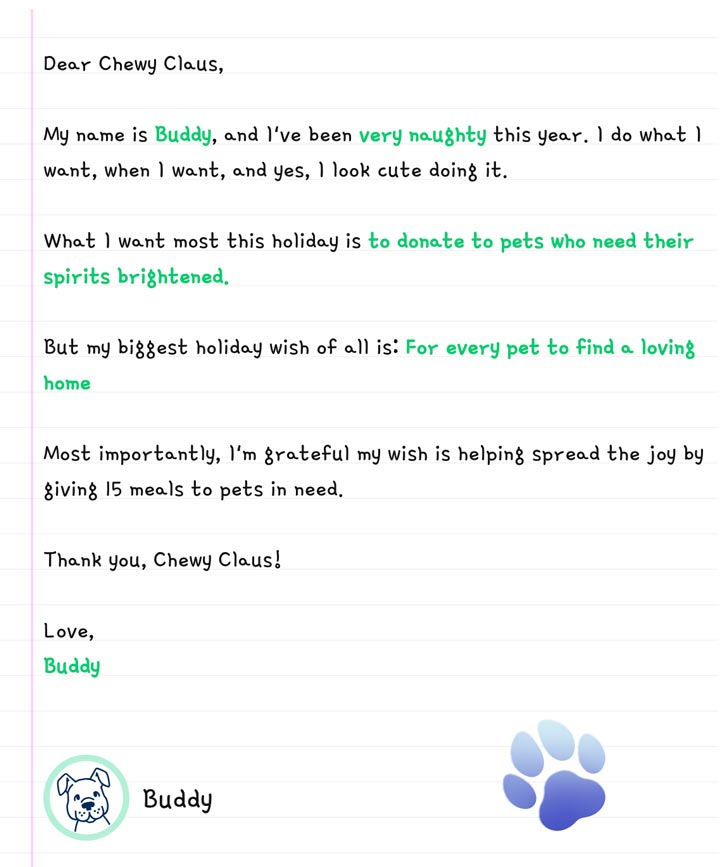
“When we received thousands of letters from pets asking for homes, we knew we had to help. There’s no better way to celebrate the season than by uniting pets with loving families — whether they’re first-time pet parents or welcoming a furry friend back home.”
Since the Chewy Claus program began in 2022, more than a million pets have written letters. But among their wishes for tasty treats and festive toys, one item — homes for all of the pets living in shelters and rescues — continues to be the most sought-after gift.
“As we head into the winter holidays, shelters and rescue organizations across the country are filled with adoptable dogs and cats that deserve loving homes,” said Julie Castle, CEO, Best Friends Animal Society.
Folks interested in adopting can find participating shelters on Chewy’s website and make a plan to adopt during the holiday weekend.
With dire overcrowding in shelters across the country, this act of goodwill and generosity can make a difference in the lives of countless animals.
“Adoption is the most important step everyone can take to save the lives of shelter pets, and free adoption initiatives like this from Chewy Claus make it that much easier for people to consider bringing home a new best friend,” Castle said.
“We can’t think of a better time of year than the holiday season to make a pet’s wish for a loving home come true.”
Header images courtesy of Chewy
According to Feeding America, one in eight people face hunger in the state of South Carolina every day — and one in six of those are children.
“Those statistics are the unfortunate baseline for many families in South Carolina,” Tim Pearson, Duke Energy’s South Carolina state president, said in a statement.
“That’s why it’s important for Duke Energy to support the organizations who do the great work to fight hunger across our state.”
Throughout November, Duke Energy and the Duke Energy Foundation are donating over $500,000 to more than 50 feeding programs through Giving Tuesday on December 3 (the Tuesday after Thanksgiving).
The funds will provide crucial support to local organizations like Mill Village Farms, Second Harvest Food Bank of Metrolina, FoodShare South Carolina, and many more during a critical time.

Communities throughout South Carolina are still reeling from the impacts of Hurricane Helene, which tore through the east coast in late September and destroyed tens of thousands of households and businesses.
In South Carolina alone, thousands were left without power and access to clean drinking water for weeks on end and 49 people were killed — marking the deadliest disaster in state history.
In late October, the Federal Emergency Management Agency released a report on repairs and progress made so far — and how much was still left to do.
“We’ve made great progress over the past 30 days, but our work is not done,” Brett Howard — FEMA’s federal coordinating officer for South Carolina — said in a press release, noting that over 204,000 households had been helped so far.
“FEMA remains on the ground, side by side with local and state partners, ensuring that recovery remains steady and effective for the affected families and communities in South Carolina.”
As recovery continues on a federal level, Duke Energy is using their resources to help local organizations throughout their monthlong campaign.
On November 7, Duke Energy even joined Mill Village Farms, WYFF and Bon Secours Wellness Arena in hosting a “Yam Jam” in Greenville, SC, in which 170 volunteers bagged nearly 50,000 pounds of sweet potatoes for Thanksgiving food boxes.

“As we enter the holiday season and navigate the ongoing effects of Hurricane Helene, Mill Village Ministries is doubling down on our commitment to food access for every resident in our community,” said Dan Weidenbenner, executive director of Mill Village Farms and Mill Village Ministries.
“In these challenging times, we’re grateful for the dedicated support from Duke Energy, allowing us to reach even more neighbors with the healthy food they deserve.”
With the project in full swing, Pearson said he hopes that this year’s campaign will give families the support they need as the nonprofits and feeding programs continue their shared mission: eliminating food insecurity in their state once and for all.
“They are fighting the good fight every day in our communities,” he said, “but they cannot do it alone.”
To donate to the cause, you can text “FEED” to 80888.
Header image via U.S. Department of Agriculture (CC0 1.0)
Along with the likes of Ida B. Wells, Naomi Osaka, Celia Cruz, and a sorority of other history-making women, Mattel has just announced the newest member of Barbie’s Inspiring Women Series: Maria Tallchief.
Tallchief was a member of the Osage Nation and a trailblazer in the Native American community who left an indelible mark on ballet history as America’s first prima ballerina.
The new Barbie has been released just in time for Native American Heritage Month.

The dancer died in 2013, but her legacy will be immortalized through the doll, which was designed with the help of Tallchief’s daughter, poet Elise Paschen.
“Mattel has been so thoughtful in this whole process,” Paschen told PEOPLE. “I would say to them, ‘No, the arm isn’t like this. It’s more like this,’ and they were very sensitive and attuned to all of the recommendations that I had as her daughter.”
The Barbie doll wears Tallchief’s outfit from a pivotal performance in The Firebird at the New York City Ballet. She was the company’s very first prima ballerina and went on to raise the profile of American ballet on the international stage. She danced for decades and retired from the stage in 1966, when she settled in Chicago.

There, she went on to serve as the artistic director of the Chicago Lyric Opera Ballet and was the founder and artistic director of the Chicago City Ballet.
She has since been inducted into the National Women’s Hall of Fame in 1996, received the National Medal for the Arts in 1999, and was posthumously inducted into the National Native American Hall of Fame in 2018.
Tallchief is also featured on a U.S. quarter released last year.

“Maria demonstrated that determination knows no bounds, and her unwavering commitment to Native American and female empowerment makes her story one Barbie is delighted to share to inspire generations of girls to pursue their dreams and embrace their limitless potential,” said Krista Berger, senior vice president of Barbie and global head of dolls for Mattel, in a statement.
Tallchief’s accomplishments went beyond ballet, as Paschen said she was deeply proud of her heritage, which is seamlessly integrated into the design of the Barbie. Her full name — in her native language — is printed on the back of the doll’s box.

“Her name is Wa-Xthe-Thonba, which means two standards,” Paschen told PEOPLE. “I’m very excited. This is a language that the Osage Nation has resuscitated, and it’s also on the U.S. quarter, and now it’s on the Barbie packaging, and now will be in the hands of millions of children, too.”
This mirrors Tallchief’s commitment to her name, too, which Paschen said she was pressured to change, especially as Russian ballerinas rose to prominence during her time on the stage. Her resilience and dedication to her heritage has stuck with Paschen.

“She encouraged me to pursue my own dreams as a poet, and it brings me joy that her story can inspire other young girls to discover their passions and pursue them,” Paschen told The Oklahoman.
“There is immense value in honoring your own heritage while also breaking down barriers through the power of artistic self-expression — whether it is through dancing, writing, or another passion — and I hope this doll instills that power in everyone.”
In addition to this inspiring message, Tallchief’s impact will continue, as Mattel facilitates a donation to the Center for Native American Youth, as part of the Barbie DreamGap Project.
These efforts have been lauded by the Osage Nation, as well. Principal Chief Geoffrey Standing Bear shared pride in both Mattel and the Tallchief family to “ensure future generations learn” about Tallchief’s “remarkable life.”

“Maria Tallchief was an extraordinary person with immense talent who remained grounded in her Osage culture,” Standing Bear said in a statement.
“She remains a guiding light for many across the globe, especially here at home on the Osage Nation Reservation. Her many accomplishments exemplify that you can achieve your dreams with hard work and determination.”
Header images courtesy of Mattel Domain
Eniola Shokunbi was only 8 years old when the COVID-19 pandemic spread across the United States.
Four years later, the Nigerian-American tween was tasked with a unique class project: create an invention that would combat future airborne viruses.
With cardboard, duct tape, and four furnace filters in hand, Shokunbi outfitted a simple box fan into a working air filter.
“The air goes through all the sides,” she told NBC News. “And it comes out of the top, so it filters in and out.”
The prototype was given rainbow wings, a paper beak, and round eyes as a nod to her school's mascot: a colorful owl.
At first, her invention — which cost $60 to assemble — just caught the attention of her teacher. Then, when Shokunbi and her classmates at the Commodore MacDonough STEM Academy built and installed the air filters (minus the feathers and owl accoutrement) at her school, the school board took notice.
By mid-October, the Environmental Protection Agency (EPA) stepped in, testing its efficiency and finding that Shokunbi’s design made the grade.

“It showed that the air filter took out over 99% of viruses in the air,” Shokunbi said. “And that it was effective.”
That’s when the state legislature took notice, too.
“I’m just blown away by these kids,” Connecticut State Senator Matt Lesser said. “Eniola is fabulous. She wows every room she’s in front of, she’s a real rock star.”
On October 22, Connecticut’s State Bond Commission approved $11.5 million in funding for University of Connecticut’s Supplemental Air Filtration for Education Program, with the intention of constructing and installing Shokunbi’s filter system in public schools in the state.
Shokunbi has big dreams for her invention. One day, she envisions schools across the country carrying her filters, improving the air quality of students everywhere.

“I want them to go to school knowing that they’re safe, that they’re healthy, that they can learn,” Shokunbi said. “I really love explaining to people and seeing their faces, seeing them realize that this could change so many lives.”
For Shokunbi, her design was inspired by living through the reality COVID-19 — and leaning into curiosity instead of fear.
“A lot of people, they don’t realize sometimes, that the only thing standing between them and getting sick is science,” Shokunbi said. “If we’re not investing in that, then we’re not investing in the kids’ future.”
Header image via Eniola Shokunbi
A research team at RMIT University in Melbourne, Australia has crafted a unique new approach to civil engineering by using textile waste and carpet fibers to create sustainable concrete.
Their approach not only diverts clothing and carpet waste from landfills — which is urgently needed when it’s estimated that the world produces 92 million tons of textile waste every year — it also makes for stronger concrete.
In their study, published in the Construction and Building Materials journal, lead author and engineer Chamila Gunasekara explained that concrete made of reclaimed clothing scraps and textile waste reduced early-age shrinkage cracking in concrete by up to 30% — which also improves the strength of the concrete overall.
“Cracking in early-age concrete slabs is a long-standing challenge in construction projects that can cause premature corrosion, not only making a building look bad but also risking its structural integrity and safety,” Gunasekara explained in a press release for RMIT University.
Scrap carpet fibers, on the other hand, can be used to “increase concrete’s strength by 40% in tension” and “prevent early cracking."
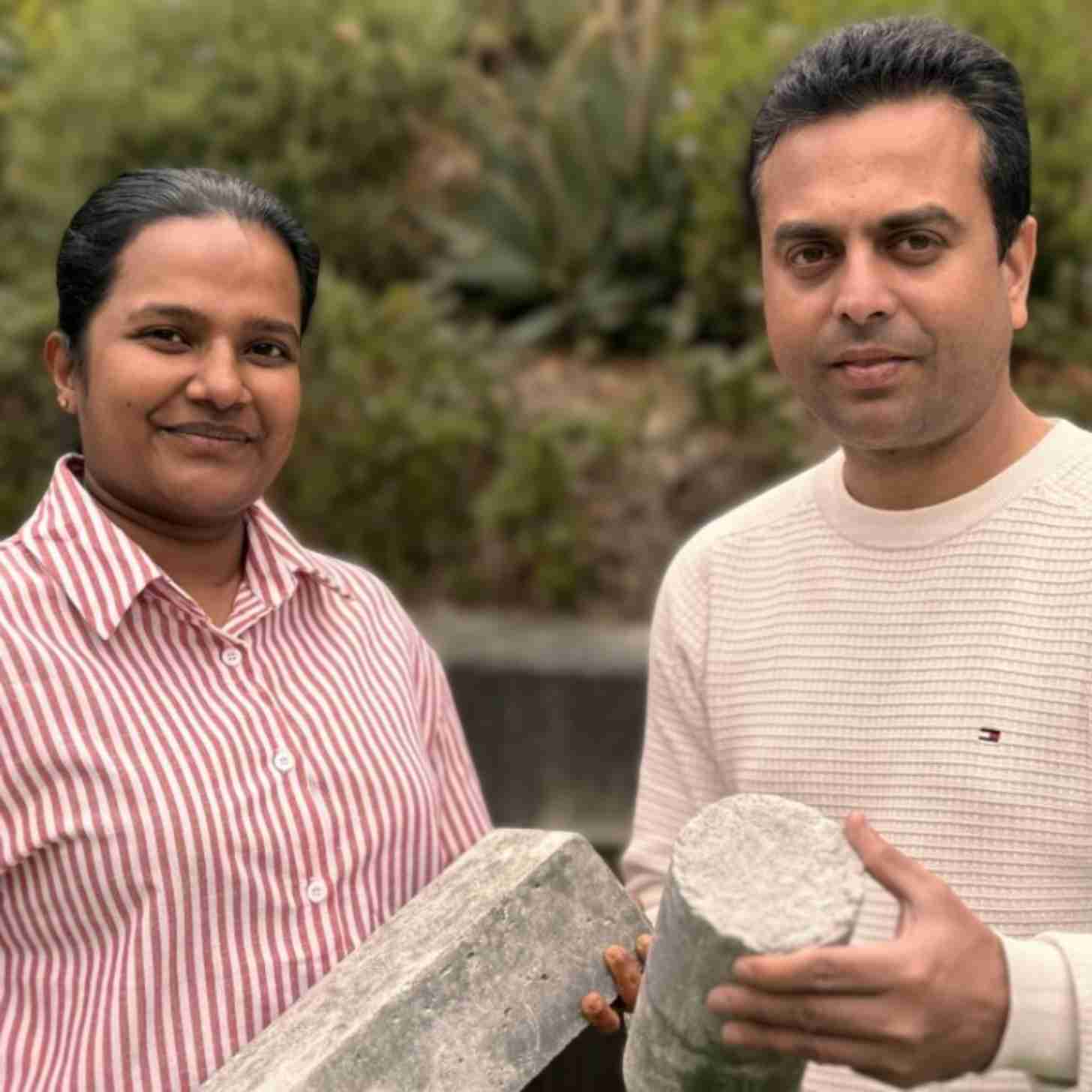
For years, Gunasekara and his team have been hard at work in the laboratory to take their idea from drawing board to reality.
Recently, their concrete samples were put to the test, and they all measured up to Australian standards for engineering performance and environmental requirements.
In testing their processing technique against an array of materials, they even discovered that they could repurpose old firefighting uniforms, which are notoriously difficult to recycle.
“Up to 70% of textile waste would be suitable for conversion into usable fibers, presenting an opportunity in the materials supply chain,” said Shadi Houshyar, a textile and material scientist at RMIT’s school of engineering.
Soon, the “carpet” concrete will enter the next phase of development, where it will get tested in the field. There, Gunasekara and his team will see if his invention will stand the test of real-world living.

Throughout the engineering process, Gunasekara has stayed motivated by the desire to address environmental waste, which has ballooned in recent decades due to improper disposal practices and the increased production of fast fashion.
The problem hits close to home. Australia, he pointed out, is the second largest consumer of textiles per person in the world, after the U.S.
“[Our] study demonstrates the potential of carpet fiber-reinforced concrete as a sustainable solution,” he wrote, “offering enhanced mechanical properties, shrinkage mitigation, and effective utilization of carpet waste, addressing critical issues in construction and waste management sectors.”
Header image via The Royal Melbourne Institute of Technology and The Bees / Flickr (CC BY-NC 2.0)
We already know the guy in the big red suit is timeless, but he might have a bit of competition.
The United States Postal Service has also been fulfilling the holiday wishes of children across the country for over a century.
For 112 years, Operation Santa — a program run by the USPS — has encouraged members of the public to “adopt” a wishlist and donate toys to children in need.

This year, the Postal Service’s elves have upped the ante through a partnership with Toys R Us, debuting an online e-commerce catalog that makes the fulfillment of gifts even easier for donors.
The new site has streamlined the letter-to-gift process, allowing participants to shop for the ideal gift and ship it from the comfort of their homes with just a few clicks. It’s called, aptly, Santa’s Gift Shoppe.
Although Toys R Us remains a notable name in American households, the company filed for bankruptcy about seven years ago. In more recent years, however, it has made somewhat of a comeback, with pop-up toy shops inside of department stores and more.
This e-commerce pivot marks the company’s ongoing revival, with Operation Santa participants shopping the brand’s online catalog, which includes a selection of popular toys and gifts to fulfill the wishes of letter-writing children across the country.

“USPS Operation Santa has connected communities through holiday goodwill for over a century,” said USPS Marketing Vice President Sheila Holman in a statement.
“This year, through our collaboration with Toys R Us, we’re thrilled to bring an easier way for generous people to make a difference. With the launch of this new e-commerce platform, we’re making it simpler than ever to help fulfill wishes and spread holiday joy.”
USPS also shared in a press release that this integration will hopefully be the start of a larger online catalog to include more products to further the impact of Operation Santa, such as books or clothing.
But for now, the joy of a brand new toy is certainly a great way to spread hope and love this holiday season.
“At Toys R Us, our mission is to bring joy to children, and what better way than to surprise them with gifts from Santa,” Gary Haas, vice president of e-commerce at Toys R Us said.
“Through this new e-commerce platform, generous individuals can easily adopt a letter to Santa and help create magical moments for a new generation of Toys R Us kids.”
How to submit an Operation Santa letter
Submitting a letter through Operation Santa is as easy as visiting the project’s website. Writers do not need to register online but will have to send a physical letter to Santa, which must be postmarked by Dec. 9.
Whether kids and families want to get crafty or use the provided templates from the USPS, the agency recommends being specific with asks, like listing specific books or game titles and including clothing sizes.
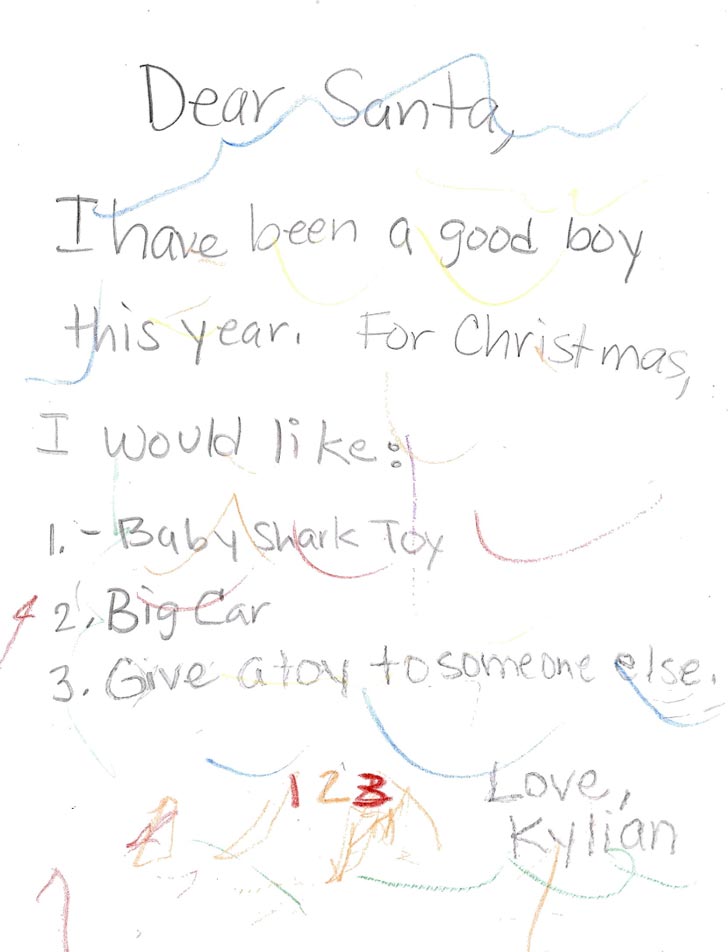
All letters need to include the writer’s first and last name, as well as a complete return address. From there, envelopes will need a postage stamp and can be addressed to:
Santa
123 Elf Road
North Pole, 88888
The letters are brought to Santa’s mailroom, where personal information is redacted and uploaded to the USPS website to be adopted by a generous member of the public.
How to adopt an Operation Santa letter
People can visit the online platform to read letters, select their favorites, and shop online. (Letters are also available in both Spanish and English, which can be sorted with a filter on the Operation Santa website.)
Those who want to do this must register online and create an account. Once verified, each person can adopt up to 15 letters.
All “adoptions” are digital, and while the new virtual integrations make it easy to ship items through USPS, people can still send gifts themselves by bringing a scannable code to a post office location.
Just like all holiday shipping, however, there are deadlines to keep in mind! Dec. 16 is the last call to adopt letters and is also the recommended date for shipping items.
“Generous individuals who adopt Santa letters can reconnect with that nostalgic feeling of being a Toys R Us kid — sharing that sense of wonder and delight with a new generation when they receive their gifts from Santa,” Holman told USA Today.
Last year, nearly 30,000 Santa letters received a response, and Holman added that the program is “more vital now than ever” for struggling families, adding that “it’s a reminder of the power of kindness and connection.”
Header image courtesy of Cottonbro Studio/Pexels
Across the globe, nearly four billion people do not have access to clean water, according to UNICEF. That’s two-thirds of the global population.
While poverty, injustice, and environmental impacts are at the heart of this issue, scientists also hope to bring innovation to the water scarcity crisis, ensuring that people have access to the vital necessities of life.
A team of researchers has developed a new crystalline material that can harvest water from fog without any energy input.

The researchers, from Jilin University, NYU Abu Dhabi’s Smart Materials Lab, and the Center for Smart Engineering Materials, were inspired by desert flora and fauna, which survive in arid conditions with the help of surface structures that capture moisture from the air to be processed through their bodies.
These structures have both hydrophilic and hydrophobic properties. Water is attracted to hydrophilic areas, and droplets accumulate and are transported through hydrophobic areas. So, researchers were curious: Outside of desert beetles and lizards, could this be replicated?
Well, their findings have now been published in the Journal of the American Chemical Society. In their research, they chose three chemically versatile organic compounds to grow “elastic organic crystals.”
From there, they tested how each of these materials interacted with airborne water, or fog. That’s how they created a new water-collecting material, which they named Janus crystals.

The Janus crystals contain both hydrophilic and hydrophobic regions, capturing water from humid air and then collecting that water in a receptacle.
“The earth’s atmosphere contains an abundance of untapped fresh water, but we desperately need materials that can efficiently capture and collect this humidity and condense it into potable water,” said Professor of Chemistry Pance Naumov, in a statement.
The crystals did just that. Plus, their narrow and light-translucent bodies made it easy for the researchers to monitor the collection of water and fog droplets in real-time.
Of course, many other methods to get potable water into the hands of people who need it are already in practice. Desalination, for instance, is a widely used method to separate salt from saltwater. However, it is highly energy-intensive.
The Janus crystals, on the other hand, require zero input of energy, which the researchers say could potentially “provide an endless source of clean water.”

Other porous organic crystals have also been studied for this purpose, but the Janus crystals are the most efficient method seen yet, combining both water collection and water delivery at once.
“The crystals developed by our team not only capitalize on the mechanical compliance and optical transparency of organic crystals, but also pave the way for the design of active, self-sensing, and efficient surface-active harvesters,” Naumov explained.
It is unclear what steps may come next in further testing and implementation of the Janus crystals, but Naumov and his team understand the potential they have unlocked.
“When used at a larger scale,” he said, “[This] can help us combat water scarcity at a societal level.”
Header image courtesy of Linfeng, et al.
If you’ve ever thought about the amount of energy — or waste — that is generated for your family’s hearty Thanksgiving dinner, there’s a new tool to help you reduce your carbon footprint.
Or, uh, your carbon turkey leg.
Ndustrial, a software company that uses AI to help energy-intensive industries make smarter climate decisions, has launched a first-of-its-kind Turkey Tracker to outline the journey these Thanksgiving birds take “from farm to fork.”

Complete with maps, graphs, and a “cornucopia” of data on the carbon emissions created by these birds, users can explore the turkey supply chain and learn more about how they can reduce energy costs for the big day.
In the United States, 210 million turkeys are produced every year, and 46 million of those are consumed on Thanksgiving alone. The average turkey weighs over 30 pounds and is shipped over 1,500 miles from more than 2,500 turkey farms to millions of tables across the country.
This tracker translates all of this data into a single turkey’s journey, following the fictional feathered friend from Mayberry, NC to Plymouth, MA.

As users follow along, they can zoom in on things like the turkey’s diet on the farm, how many hours it spends on a diesel-powered truck, the energy used to refrigerate the bird, and more.
“Ndustrial’s turkey tracker shines an oven light on the critical variables that shape carbon emissions and costs for one of the most popular and symbolic foods in America: the Thanksgiving turkey,” Ndustrial co-founder and CEO Jason Massey said in a statement.
“It’s stuffed with all of the fowl-facts businesses and consumers need to know about the turkey supply chain, offering insights on ways we can improve the emissions of a turkey’s journey across the U.S.”
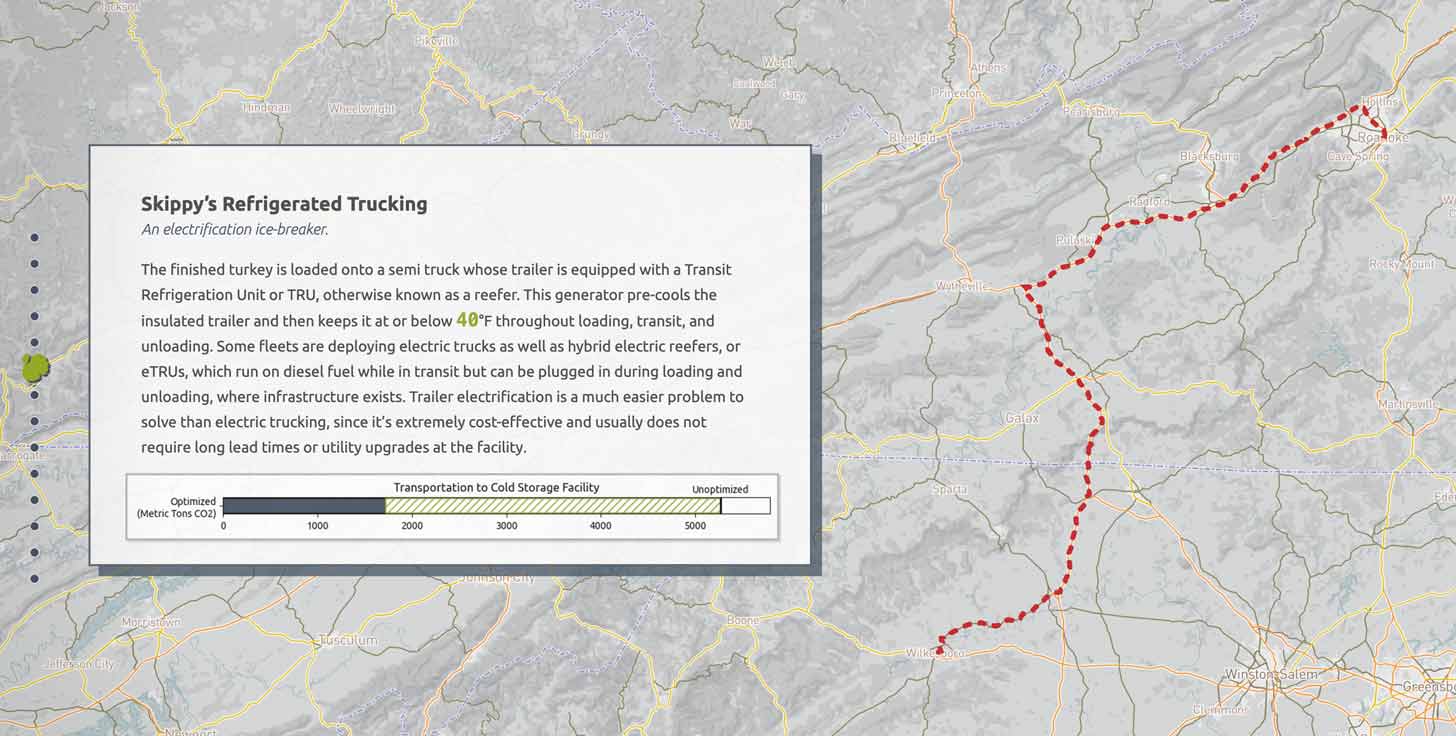
All of the data in the tracker is compared to a more “optimized” version, which considers energy-efficient alternatives that can be employed to the turkey’s journey instead.
This includes things like short-haul electric trucks, solar powered processing plants, trailer electrification for refrigerated transit, and even small changes in temperatures and logistics to optimize the energy required for safe storage.
The tracker even considers energy efficiency in grocery stores, advocating for LED lights, freezer doors, and motion sensors to save energy.
And most applicable to us everyday eaters, the tracker reminds folks how they can make their turkey’s journey even more efficient, like consolidating trips to the grocery store and being mindful about food waste.
“Buy local and natural options if you can, choose efficient transportation where feasible, and always use the leftovers,” the tracker reads. “Minimizing food waste is one of the most important things we can all do.”

Ndustrial does use AI to measure optimizations for industries, like the turkey supply chain, which has its own environmental drawbacks. That said, folks can still use this tool to make their own choices about how they intentionally mitigate harm to the environment.
“Consumers are hungry to understand the environmental impact of their purchasing decisions now more than ever, but want the information to be served up to them on a silver platter,” Massey said.
“Factors like buying organic; going local; or roasting, smoking, or deep-frying are all important considerations, which is why we’ve designed this tool to bring simplicity back to the Thanksgiving dinner table.”
Header images courtesy of Kaboompics/Pexels and Ndustrial
For nearly 35,000 years, the remains of a long-extinct saber-toothed cub lay preserved in permafrost in the Indigirka River basin of Yakutia, Russia.
In 2020, a team of Russian scientists stumbled upon the cub and freed it from the ice so that they could examine it, and on November 14, they finally made their findings available to the public.
“It’s a fantastic feeling to see with your own eyes the life appearance of a long-extinct animal,” chief researcher Alexey V. Lopatin told CNN after his work was published in Scientific Reports. “Especially when it comes to such an interesting predator as the saber-toothed cat.”
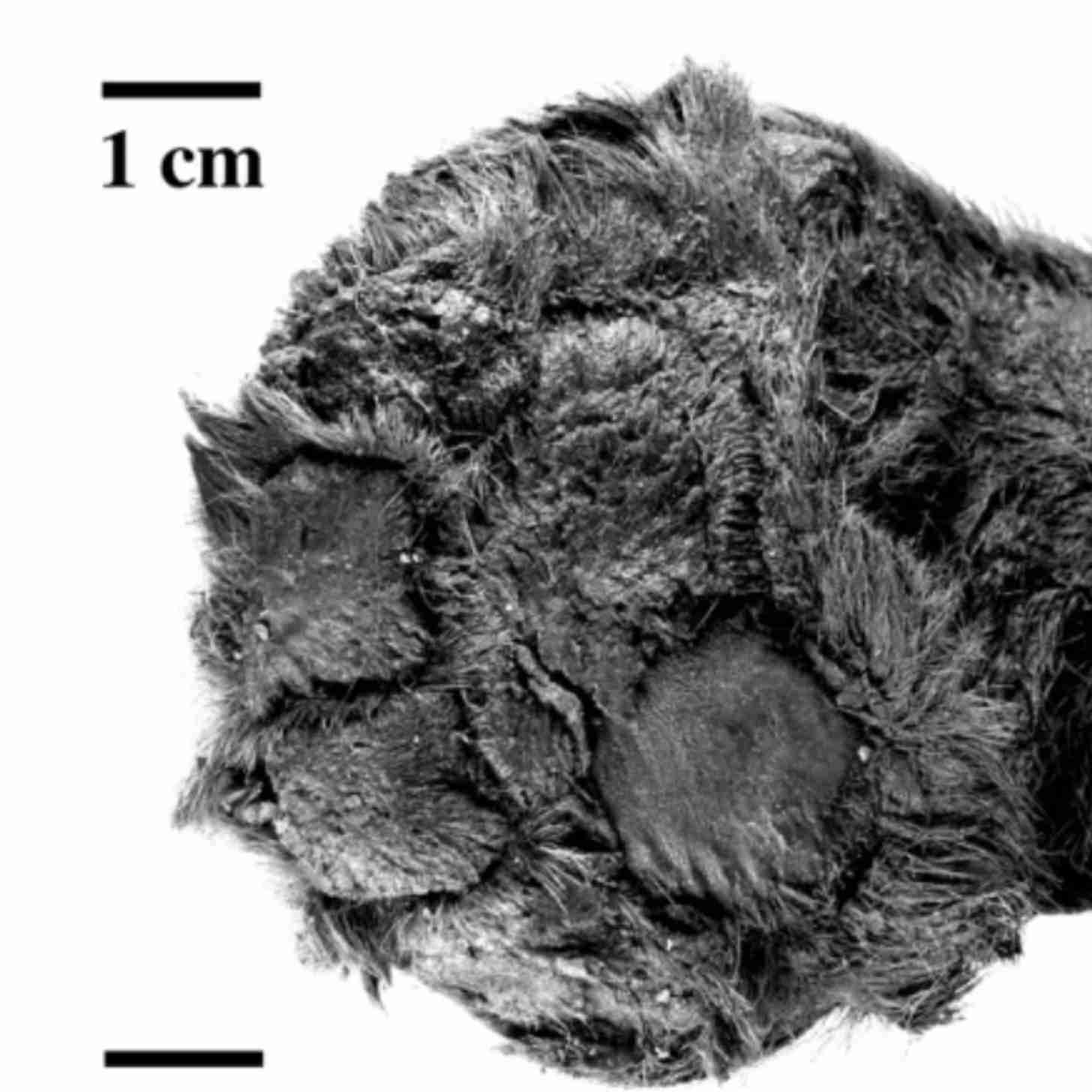
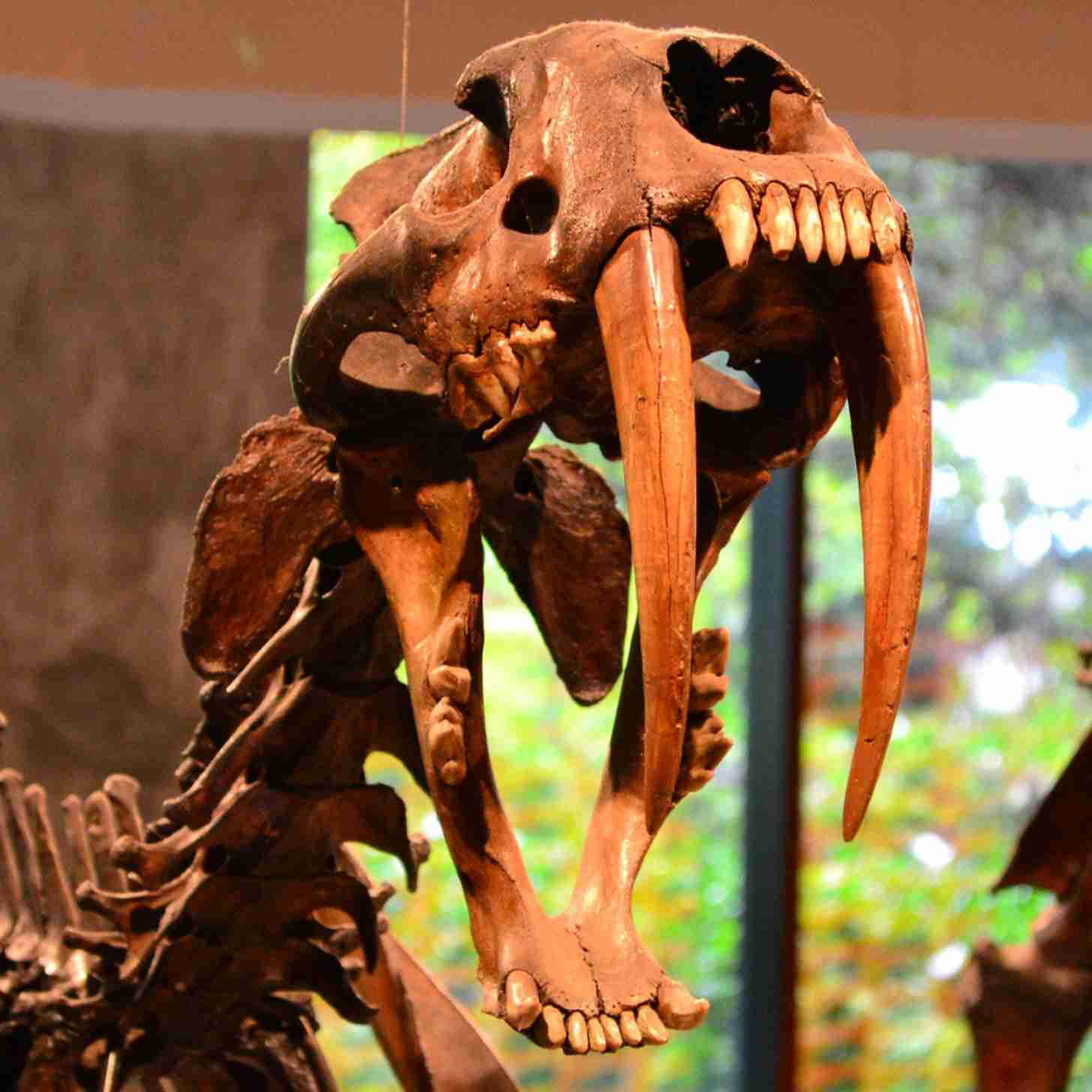
The saber-toothed cat, commonly referred to as the saber-toothed tiger, is a prehistoric carnivore known for their 8-inch canines — but this cub was frozen in time at only 3 weeks old, and still had its “baby teeth.”

The researchers were blown away by the mummified specimen, from its soft fur to the “toe beans” on its front paw pads. Amazingly, the entirety of the cub’s head, torso, and forearms survived across thousands of centuries due to its preservation in permafrost.
The cat belongs to the extinct subfamily Machairodontinae and is a distant relative of the big cats of today. In their report, Lopatin emphasized the importance of their discovery.
“For the first time in the history of paleontology, the appearance of an extinct mammal that has no analogues in the modern fauna has been studied,” Lopatin and his colleagues wrote.
The closest approximation to a discovery on this scale happened in 2013, when scientists unearthed the fossil of a Panthera blytheae, a previously unrecorded species with ties to the modern-day snow leopard.
Graham Slater, the scientist who examined the fossil firsthand, told Smithsonian Insider that the species solved “a missing link” in the timeline of “big cat evolution.”
“Scientists are now closer to understanding the evolutionary origin of big cats and are gathering data about their habitat,” Slater said, explaining that the fossil indicated that ancient big cats lived nearly 6 million years ago — 2 million years earlier than scientists previously estimated.
In their research, Slater and his colleagues studied how the Panthera blytheae adapted to the environmental challenges of its time, which informed the projected sustainability of contemporary snow leopards.
The discovery also brought heightened awareness to the conservation of snow leopards, which were on a dramatic decline.
Thanks to education campaigns centered on helping humans and leopards coexist with each other, significant progress has been made in habitat protection and species conservation over the last decade.
In 2017, conservationists celebrated a huge milestone when the International Union for Conservation of Nature moved the snow leopard from endangered to vulnerable on its Red List of Threatened Species.
As of now, it’s unclear how the latest big cat discovery — of the mummified saber-toothed cub — will inform future conservation efforts. But paleontologist Jack Tseng believes that a “treasure trove of information” awaits them.
“It’s rare to find bones of this lineage in the first place, let alone soft tissue associated with it,” Tseng told CNN.
“I don’t know if other paleontologists’ minds are as blown as mine, but it’s like reality changes now that we’ve seen this.”
Header image via Marcus Herzberg
Perfluoroalkyl and polyfluoroalkyl substances (PFAS) are everywhere.
These substances — which are often referred to as “forever chemicals” because they can take up to 1,000 years to naturally break down — appear in domestic products, fire extinguishers, food, and water.
And they are known to cause health issues in reproductive, developmental, and cardiovascular systems, as PFAS have been found in bloodstreams, semen, and can even build up in the liver. “Forever chemicals” are also linked to various cancers and diabetes.
While countless climate and health experts have sounded the alarms, and scientists work tirelessly to devise solutions to remove these chemicals from our products and environments, policy is also needed to combat the impacts of PFAS on public health.

Fortunately, this year, at least 16 states have adopted 22 PFAS-related measures to either reduce or ban them from products or hold companies to account for the harm their products have caused.
Of those 16 states, at least 11 have enacted laws to restrict the use of “forever chemicals” in everyday consumer products or firefighting foam. This includes bans on PFAS in apparel, cleaning products, cookware, cosmetic products, and menstrual items.
In other states, lawmakers have passed measures that require companies to pay for testing or cleanup of these chemicals, disclose the use of PFAS in their products, and mandate the development of PFAS alternatives, according to reports from Stateline.
The states that banned PFAS in some products this year include:
- Alaska
- California
- Colorado
- Connecticut
- Maine
- Maryland
- Massachusetts
- New Hampshire
- New Jersey
- Rhode Island
- Vermont
And in Kentucky, Minnesota, New York, Virginia, and Washington, other PFAS-related measures were adopted.
All of these bills — which range from regulations of PFAS in firefighting and medical equipment to regulating wetlands impacted by “forever chemicals” — can be reviewed in their entirety on a bill tracker by Safer States.
Safer States is an alliance of environmental health groups focused on toxic chemicals. Since 2007, the group has reported that 30 states have approved 155 PFAS policies, with a large number of those policies emerging in the past five years.
And in Maine, lawmakers are preparing to pass the first-ever total ban on PFAS in consumer goods, which would take effect in 2030.

“Over the past two decades, the knowledge of PFAS health effects has really exploded,” Jamie DeWitt, a professor of environmental molecular toxicology at Oregon State University, told Stateline.
“We now know that they’re linked with different types of cancer, suppression of the vaccine antibody response, liver damage, elevated cholesterol and developmental effects.”
These statewide actions echo sentiments from the federal government, as well. Earlier this year, the United States Environmental Protection Agency created new standards to limit PFAS in drinking water, giving water systems five years to comply with the new rules.
“Impacted communities have been raising the alarm bells and tirelessly organizing for these drinking water protections for years. This is a landmark decision that will save countless lives,” said Dana Colihan, a co-facilitator of the National PFAS Contamination Coalition.
While most agree with the need to keep water uncontaminated, there are some opponents of bills targeting industries, arguing that PFAS compounds help enable products to be non-stick, waterproof, or fire-resistant.
With that in mind, however, most companies have been willing to comply.

“When California restricted PFAS in textiles, all of a sudden you saw companies like REI saying, ‘We can, we’re going to do that. We’re going to move to alternatives,’” Sarah Doll, national director of Safer States, told Stateline.
While consumers still have the free will to shop from brands they trust to be safe, these kinds of regulations are especially vital for industries that create products people need.
“There are some consumer products where you can say, ‘I don’t need to buy that because I don’t want PFAS,’” Vermont state Senator Virginia Lyons, told Stateline. “But it’s really tough to say that [about] a menstrual product.”
Sen. Lyons was the chief sponsor of a bill that unanimously passed in Virginia in April, banning the manufacture and sale of PFAS in cosmetics, menstrual products, incontinence products, artificial turf, textiles, and cookware.
While it’s unclear what kind of progress may be made in reducing, banning, or researching “forever chemicals” under new leaders, individuals can continue to limit their own exposure to PFAS by avoiding plastics, seeking out PFA-free products, and supporting legislation at the local level.
Header image courtesy of Mali Maeder/Pexels
Earlier this year, 17-year-old Zabeer Zarif Akhter earned a coveted spot in The Stockholm Junior Water Prize — an international competition hosted by the Stockholm International Water Institute in Sweden.
In the competition, students from ages 15 to 20 are tasked with developing research projects and building inventions that tackle the world’s leading water challenges, including pollution, drought, and water scarcity.
Akhter’s focus? Contamination.
In his home country of Bangladesh, a shocking 49% of the country’s drinking well water has unsafe limits of carcinogenic arsenic, which can cause skin lesions and cancer in the bladder and the lungs.
Climate change has worsened the water contamination crisis, with an uptick in cyclones and torrential monsoons causing devastating floods throughout the country.
In August, floodwaters displaced 1.24 million Bangladeshi families from their homes, as countless households became breeding grounds for bacteria and parasites, spreading waterborne illnesses.
“The prevalent issue of waterborne diseases in Bangladesh, primarily stemming from bacteria in water sources, necessitates innovative solutions,” Akhter wrote in his 20-page application for the competition.
To tackle this pressing issue, Akhter invented a first-of-its-kind water purification system that uses ultraviolet radiation and plasma sterilization to remove pathogens like E. coli, TC toxins, and Fd bacteriophage from the water.
Remarkably, the water purifier is made entirely from electronic waste including recycled laptop batteries, damaged circuit boards, abandoned driver motors, and even parts from an old TV.
Electronic waste is notoriously hard to break down, and it is one of the fastest-growing solid waste streams in the world, with an estimated 62 million tons produced each year.

“In this project, the components used were all reusable parts from various devices or home appliances,” Akhter explained.
“By utilizing electronic waste, this project not only showcases an innovative approach to resource management but also highlights the importance of recycling and reusing materials to reduce environmental pollution.”
The invention is also solar-powered, which makes it more sustainable. And it also ensures that it’s accessible to the people who need it most: those living in flooded regions that lack power.
“The incorporation of solar panels for charging not only enhances sustainability but also holds the potential to significantly improve water purification in flood prone areas of Bangladesh and [the] world, reducing the incidence of water-borne diseases,” Akhter wrote in his paper.
Tanvir Ahmed, a civil engineering professor who served as a jury board member for the Stockholm Junior Water Prize in Bangladesh, told the Business Standard that Akhter’s invention is successful on countless levels.
“This breakthrough represents a significant stride towards sustainable, environment-friendly and cost effective water management practices, heralding a new era in the fight against water pollution,” Ahmed said.
In August, at the Stockholm Junior Water Prize in Sweden, Akhter’s invention did not take home the top prize — but he did represent his country with pride.
Back home, the Bangladesh Stockholm Junior Water Prize authority said: “This young visionary has triumphed with his groundbreaking water innovation, inspiring us all with his commitment to a sustainable future.”
Header image via Pok Rie
Across the Western United States, wildfires fueled by climate change have destroyed more than 33 acres since 2020, according to the National Interagency Fire Center.
With an uncertain future amid rising temperatures and ongoing climate disasters, agencies, volunteers, and businesses are stepping in to protect their beloved forests — by collecting pine cones.
As Brian Kittler, chief program officer for the Resilient Forests program at the nonprofit American Forests, told CBS News, if nothing is done to restore a forest in the wake of a wildfire, the area becomes more vulnerable to future fires.
And thus, a vicious cycle begins.
“There’s basically no live trees, and there’s no natural regeneration happening,” Kittler explained.
“The more that we lose forest, we’re losing our clean air and clean water, our ability to remove carbon from the atmosphere and address climate change.”

So, trained experts like Kittler’s team, as well as everyday nature lovers, go on the hunt for pine cones, hoping to replant trees and stave off future disasters.
In Southern Oregon’s Fremont-Winema National Forest, scavengers armed with burlap sacks, climbing rope, and motorized lifts get to work sourcing seeds.
Once they have a collection of cones, they’re brought to a nursery, where seeds are extracted and grown into seedlings. One million of those will plant about 4,500 acres of new forest, per CBS News.

While this work is vital, experts say the program alone will not restore forests, as dryer, hotter, and more arid conditions sweep the planet.
Plus, it takes about 20 years for seedlings to grow to maturity. In a race against the climate clock, forests are running out of time — and acreage.
So, pine cone hunters are specifically sourcing seeds from more “drought-tolerant” tree species.

In Oregon, logging companies have been enlisted by the U.S. Forest Service to source these cones — and land ripe for replanting.
And in Darrington, Washington, folks can collect cones for cash, trading in their finds with the nonprofit Glacier Peak Institute, which works with companies like Silvaseed to reforest the fire-impacted lands.
“We’re collecting the broadest range of genetic diversity possible from the forest,” Kea Woodruff, a general manager at Silvaseed, a tree farm focused on reforestation in Washington, told Fox 13 News.
“Under whatever future scenarios happen in the landscape, whether it’s climate change, whether that’s disease, whether that’s a new species, new types of biodiversity, we had the seed we’re collecting that captures all that range of diversity so we can put trees back into the landscape in the future,” she added.

For all of these seed sourcers, the future is what it’s all about.
Looking at the seedlings, Kittler told CBS News, he sees “the forests that will be walked through by our children and our children’s children.”
For Woodruff, she knows her community is vital in not just replanting forests, but protecting tree species as a whole.
“One of the things that’s happening in wildfire is it’s burning the seed bank,” Woodruff told Fox 13.
“Wildfire is essentially destroying the seeds of the future, so that’s why… we need to do something right now — because some of these landscapes, once those forests burn, that seed source is lost forever if we don’t bank it now.”
Header image courtesy of Apaha Spi/Unsplash
Harris Reed is a British-American fashion designer, model, and creative director who has worked with the likes of Harry Styles and Troye Sivan.
And now, his creations are taking on a whole new life: As Mattel’s first gender-fluid doll.

“The Witch Weaver” is the newest member of the Monster High doll family, a punky and gothic younger sibling to Barbie. Donning red hair, fangs, and spiderweb tattoos, the doll embodies a supernatural spirit of transformation.
But for Reed, it is far from mythical.
“My biggest dream as a designer and as a queer activist is about inspiring the next generation, so I think the fact that kids can see a doll and find a bit of hope and curiosity is so amazing,” Reed told Women’s Wear Daily.
The designer identifies as gender-fluid, which is when someone does not identify solely as male or female, and their gender identity changes over time. Reed currently uses he/him pronouns.

On Instagram, he said this project with Mattel was two and a half years in the making.
“As [a] kid I remember, like so, so many others, not being able to find a doll that I could see myself in,” Reed wrote in a caption, accompanying some high-fashion photos with the doll.
“I struggled so deeply in finding who I was, that was until I remembered coming across the Monster High dolls and their playfulness and over-the-top clothes.”
Reed went on to say that their choices as a 7-year-old at Toys R Us were between a G.I. Joe or Barbie.
The Monster High dolls symbolized something else.
“The combinations of other worldly identities made me feel seen,” Reed said of the dolls, who are often dressed in more campy, avant garde attire, compared to the other dolls on store shelves.
Reed’s doll is no exception.
“The Witch Weaver joins the extraordinary Monster High family and… embodies that we should be allowed to discover who we are and transform and weave through our identities,” Reed wrote.
The Witch Weaver wears flared jeans, a harlequin blouse, and ornate golden and crystal accessories. It embodies Reed’s signature design codes, personal style, and even his favorite Monster High doll from childhood: Lady Gaga.
“I was obsessed with how she gave everyone what we all wanted, which was not just a doll of her,” Reed told Women’s Wear Daily. “We wanted a character. We wanted someone with magical power.”

With Mattel giving Reed the stage to play with magic, he hopes it will make an impact for youth everywhere.
“With everything going on in the world right now,” Reed concluded on Instagram, “it’s so important that the next generation knows they can do anything they want, and more importantly, can be anything they want.”
The Witch Weaver doll will be on sale to the general public November 22, 2024.
Header images courtesy of Mattel and Harris Reed
According to researchers from the University of Oxford, up to 87% of flowering plant species depend on animal species for their pollination. They mainly rely on the help of insects like bees and butterflies, of course, but a surprisingly vast range of mammals serve as pollinators as well — like bats, rodents, sugar gliders, and mongooses.
Until now, only small- to medium-sized mammals have been known to aid in pollination, which boosts floral production and diversity and stabilizes local food chains across the world.
But a new study released by researchers at the University of Oxford revealed that Ethiopian wolves — also known as red jackals — could be the first large mammal to contribute to predator pollination.
Sandra Lai, a University of Oxford-based senior scientist with the Ethiopian Wolf Conservation Programme, and her colleagues cataloged their findings in a study, which was published in The Scientific Naturalist.
“Here, we report the visitation to inflorescences of the Ethiopian red hot poker by a large carnivore, the Ethiopian wolf, in the Bale Mountains of southern Ethiopia,” Lai wrote.
“Wolves were observed foraging for nectar on K. foliosa flowers, which deposited relatively large amount of pollen on their muzzles, suggesting they could contribute to pollination.”

In various photographs, taken by Carine Lavril and Adrien Lesaffre, an Ethiopian wolf can be seen lapping up the pollen on several “red hot poker” flowers, which look just like their namesake.
Lai hopes that these new findings inspire fascination and heightened awareness about these fox-like wolves, which are on the decline.
Due to habitat fragmentation and increasing exposure to rabies and canine distemper, the Ethiopian wolf is listed as endangered by the International Union for Conservation of Nature.
Today, fewer than 500 are known to exist in the wild.
“These findings highlight just how much we still have to learn about one of the world’s most-threatened carnivores. It also demonstrates the complexity of interactions between different species living on the beautiful Roof of Africa,” Lai said in the press release after their research went public.
“This extremely unique and biodiverse ecosystem remains under threat from habitat loss and fragmentation.”
In the study, the researchers also noted the appearance of social learning, as juvenile wolves were observed following their parents into the flower fields to get a taste of the nectar.

For now, it is unclear how the nectar foraging directly impacts their habitat on a larger scale, but researchers are optimistic about the untold ways the wolves are benefiting their environment.
Claudio Sillero, founder of the EWCP, said that she’s tasted the sweet nectar of the Ethiopian red hot pokers before and that it’s “pleasantly sweet.”
“When I later saw the wolves doing the same, I knew they were enjoying themselves, tapping into this unusual source of energy,” Sillero said in the press release.
“I am chuffed that we have now reported this behavior as being commonplace among Ethiopian wolves and explored its ecological significance.”
Header image via Adrien Lesaffre.
With limited land to store and collect water, Singapore is considered to be one of the most water-stressed countries in the world.
As water scarcity became a mounting concern for the country in the 1990s, Singapore’s national water agency — the Public Utilities Board — took a three-pronged approach to the issue: “collect every drop” of rainwater, desalinate seawater, and reclaim used water as much as possible.
The last approach yielded NEWater: high-grade reclaimed water produced from treated wastewater.
Today, that same water is being used to make a craft beer called NEWBrew.
Brewerkz, the Singaporean brewery behind NEWBrew, turned quite a few heads when they handed out free cans at the 2024 United Nations Climate Change Conference in Baku, Azerbaijan this past week.
NEWBrew, which was colloquially dubbed “sewage brew” by attendees, caused quite a stir as people realized they were drinking recycled wastewater — and actually liked it.
“I didn’t know. I was really surprised,” Ignace Urchil Lokouako Mbouamboua, an international relations student from Congo, told the Associated Press.
“I can even suggest that they make more and more of this kind of beer,” Mbouamboua added, going in for his third can.
“It’s fresh, light, cool,” agreed Peter Rummel, another climate talk attendee. “It has a nice flavor.”
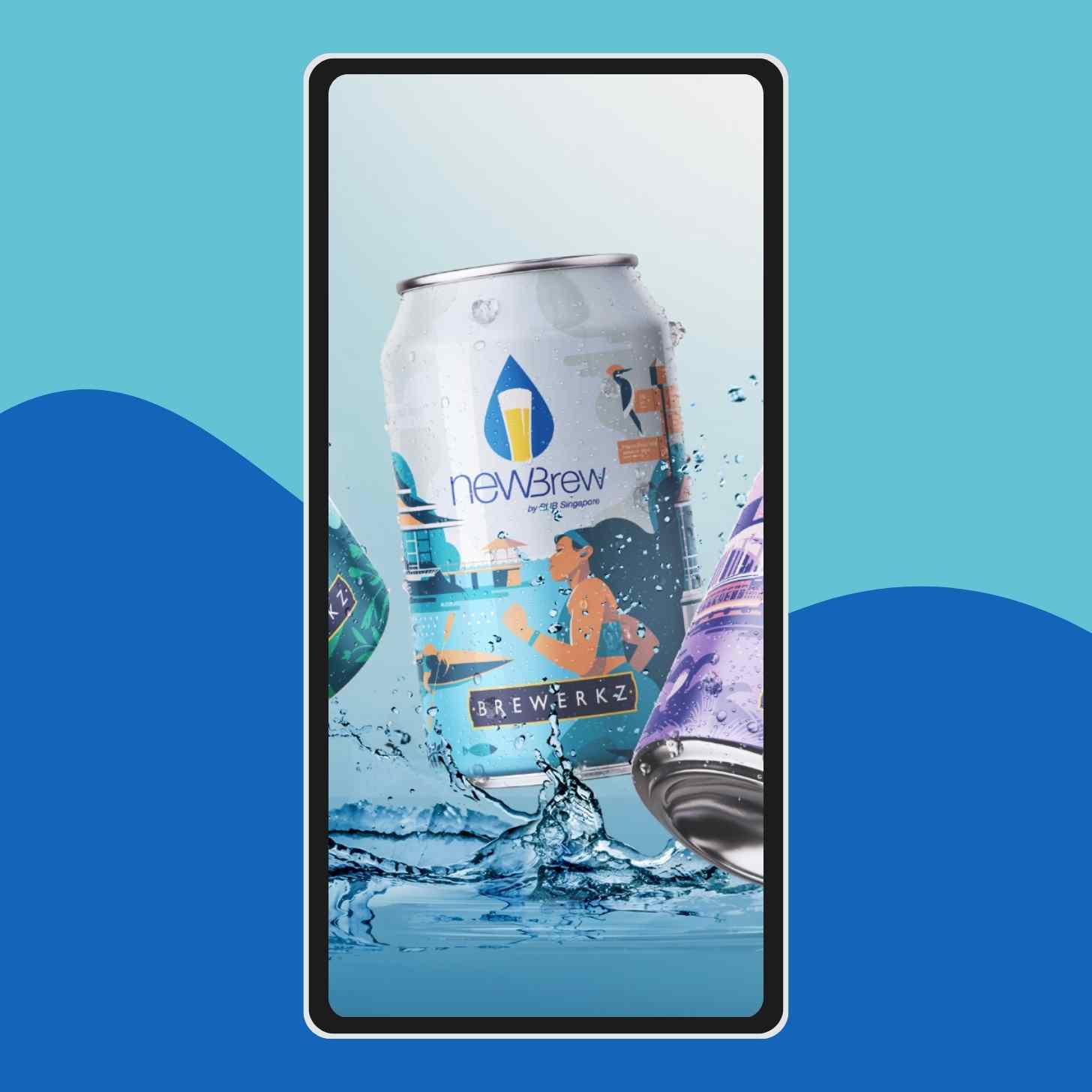
Ong Tze-Ch’in, the chief executive of the Public Utilities Board, said NEWBrew was developed by Brewerkz in 2018 to showcase the country’s treated wastewater during International Water Week.
In 2022, they produced another line. And they’ve continued producing it every year since, with greater fanfare each time.
“It’s part of the acceptance of the use of recycled water, which in general is a difficult topic,” said Ong. “We did many things to drive it.”
On its own, NEWater doesn’t always go down easy.
“They think it tastes funny,” Ong told the AP. “When put into a beer, it changes the mindset. Most people can’t tell the difference.”
Since the craft beer’s debut in 2018, the production of sustainable beer from recycled wastewater has grown in popularity, from San Francisco’s Epic OneWater Brew to the Czech Republic’s ERKO beer.
A statement on the Brewerkz website reads: “[We have] an opportunity to cast the spotlight on climate change impacts such as droughts and floods, which threaten the world’s freshwater supply.”
Header image via Ketut Subiyanto / Pexels
Every day the Good Good Good team collects the best good news in the world and shares it with our community. Here are the highlights for this week!
If you want to get good news in your inbox every day, join the Goodnewsletter — the free daily newsletter designed to leave you feeling hopeful.
The Best Positive News We’re Celebrating This Week —
So big it can be seen from space, scientists just discovered the world’s largest coral colony
During an expedition in the Solomon Islands archipelago, scientists thought they were looking at a shipwreck below the surface — but once they swam closer — they discovered it was a huge, sprawling coral.
Longer than a blue whale, Earth’s largest animal, the coral colony was 112 by 105 feet — the largest ever recorded in the world. Scientists estimate it’s around 300 years old and made up of nearly a billion coral polyps working together as if they are one organism.
From above, the colony could have easily been mistaken for a boulder or shipwreck, which is why they describe it as “hidden in plain sight.”
→ Read more
More good news for coral reefs:
- Scientists discovered heat-tolerant coral in the Great Barrier Reef, offering hope for the reef’s future.
- Researchers in Florida are working to restore coral and protect coastal communities with artificial reefs.
- Scientists discovered a new, rare coral species off the coast of the Arabian peninsula.
For the first time since the 1970s, U.S. manufacturing jobs have made a full recession recovery
While still a far cry from the all-time high of 19.4 million manufacturing jobs in 1979, there was an “unusually strong” increase in manufacturing jobs between 2019 and 2023 — marking the first time manufacturing employment has recovered fully from a recession since the 1970s.
In 2023, there were about 12.9 million manufacturing jobs — slightly more than the last peak in 2019.
Manufacturing overall has been on a growth track since 2010, and while the pandemic interrupted that progress, both the CHIPS and Science Act and Inflation Reduction Act helped it quickly recover — increasing both pay and new jobs.
Notably, the recovery was driven by manufacturing jobs in small urban areas in states like Nevada, Utah, Arizona, and Florida.
Raising the minimum age to 18, Colombia just voted to outlaw child marriage
Though it must still be signed into law by its president, Colombia just voted to change a law that allowed minors as young as 14 to get married with parental consent.
The new law would raise the minimum age to marry to 18 years old — outlawing child marriage in the country. Colombia follows Sierra Leone, which also banned child marriage earlier this year.
The law was initially proposed in 2023 using the slogan, “They’re girls, not wives” and aims to help prevent young girls from missing out on educational and development opportunities, and from being subject to violence.
Why is this good news? Though the number of child marriages has dropped globally over the past few years, child marriage is still a relatively widespread practice worldwide, impacting around 12 million girls per year. This new law could help those numbers decline even further.
→ Read more
After her dad was diagnosed with cancer, a teen started a nonprofit to give books to children battling cancer
When Emily Bhatnagar discovered her dad had stage 4 thyroid cancer, she found comfort in her favorite thing: reading.
To honor her dad, she decided to make a difference for others who were going through a dark, challenging time. She launched a neighborhood book drive to collect books to give to children battling cancer — hoping to give them the same comfort reading gave her.
In the years since, Bhatnagar’s efforts have grown into a nonprofit, For Love and Buttercup. It’s provided more than 15,000 books to DC-area hospitals for children undergoing all kinds of medical treatments.
Thanks to a new partnership, the USPS’s Operation Santa is making toy donations more seamless than ever
For 112 years, Operation Santa — a program run by the USPS — has encouraged members of the public to “adopt” a wishlist and donate toys to children in need.
Letters are now officially up for adoption, and with them, the Postal Service announced a new partnership with Toys R Us, debuting an online e-commerce catalog that makes the fulfillment of gifts even easier for donors.
The new site has streamlined the letter-to-gift process, allowing participants to shop for the ideal gift and ship it from the comfort of their homes with just a few clicks.
Why is this good news? While the USPS’s program already did so much good to help families in need around the holidays, this new partnership expands the potential for doing good and bringing joy to children during the holidays even further.
→ Read more (including some sample letters!)
After 60 years, Staten Island’s St. Patrick’s Day parade will include LGBTQ+ groups
After a long-fought battle, the Richmond County St. Patrick’s Day Parade Committee just announced that it will allow LGBTQ+ groups to march in the annual celebration for the first time.
The borough represented potentially the last St. Patrick’s parade in the world to have continued this exclusionary ban. In March, The Pride Center of Staten Island will finally get to march under its own banner alongside other community organizations.
The community had long been frustrated by the exclusion of LGBTQ+ groups, it even organized its own separate, inclusive parade.
The change was reportedly thanks to new leadership on the committee, along with public pressure, and represents an important point of progress for representation of the LGBTQ+ community, both in this community and around the world.
Los Angeles unanimously passed a “sanctuary city” ordinance to protect its immigrant community
The Los Angeles City Council unanimously voted to approve a “sanctuary city” ordinance that prevents city resources from being used for immigration enforcement and city departments from voluntarily sharing information on people without legal status with federal immigration authorities.
The city joins dozens of others who have moved to legally protect immigrant communities, and in this case, it’s in anticipation of “mass deportations” promised by the incoming presidential administration.
While the city already has protections for immigrants in place, this move would codify it into city law — an important step for a city with a large immigrant population.
Why is this good news? Among other things, “sanctuary cities” help immigrants feel safe and able to report crime, like domestic violence, without fear of deportation. That threat causes many immigrants to live in constant fear of being separated from loved ones, only to be “sent back to a place we had fought so hard to escape.”
And while some argue that immigrants pull resources away from citizens in need, studies show that they actually contribute significantly to the country and make our communities better.
Brazil was just re-verified as a measles-free country
Helping the Americas recover its status as a region free of endemic measles — which was first achieved in 2016 — Brazil has now been re-verified as free of measles, rubella, and congenital rubella syndrome.
Brazil saw a measles outbreak beginning in 2018, and endemic transmission of the virus resumed in 2019 with more than 21,700 cases reported.
National, state, and local efforts to strengthen routine vaccinations, testing, and more resulted in the last case of endemic measles by June 2022. And with no transmission for at least one year — it officially achieved measles-free status.
This re-verification milestone shows the country’s “strong commitment to public health and protecting its population from vaccine-preventable diseases.”
Denmark announced plans to plant 1 billion trees and convert 10% of its farmland into forest
In what it’s calling “the biggest change to the Danish landscape in over 100 years,” lawmakers in Denmark just approved a plan to plant 1 billion trees and convert 10% of farmland into forest and natural habitats.
The plan is part of a larger, national effort to reduce fertilizer usage and the negative environmental impacts of agriculture.
The government will spend $6.1 billion over the next two decades to acquire land from farmers. A large portion of the forests will be planted on low-lying soils, which are especially damaging to the climate.
Even better: Denmark, which is also leading the way in creating fully recyclable wind turbine blades, is implementing these initiatives under its new Green Tripartite Ministry, created after a green deal was reached earlier this year between farmers, industry, labor unions, and environmental groups — a true collaborative effort to take significant climate action.
→ Read more
A teen invented a solar-powered water purifier — made entirely of electronic waste — to help people impacted by floods
In Bangladesh, a shocking 49% of the country’s drinking well water has unsafe limits of carcinogenic arsenic. Climate change has worsened the water contamination crisis, with an uptick in disasters causing devastating flooding.
Earlier this year, floodwaters displaced 1.24 million Bangladeshi families from their homes, which became breeding grounds for bacteria and parasites, spreading waterborne illnesses.
To tackle this pressing issue, 17-year-old Zabeer Zarif Akhter invented a first-of-its-kind, solar-powered water purification system to remove pathogens from the water.
Remarkably, the water purifier is also made entirely from electronic waste, which is notoriously hard to recycle, and it is one of the fastest-growing solid waste streams in the world.
More good news of the week —
Volunteers are bagging 50,000 pounds of food for Thanksgiving dinner for Hurricane Helene victims. Communities throughout South Carolina are still reeling from the impacts of Hurricane Helene, which destroyed tens of thousands of households and businesses.
After nearly being wiped out by disease, an endangered frog is now thriving across Yosemite National Park. Yellow-legged frogs were one of an estimated 500 frog species impacted by the disease, but are thriving again thanks to a conservation and reintroduction program.
Protesting a law that would have eroded Indigenous land rights, Māori lawmakers in New Zealand interrupted the vote with a Haka. About half of the lawmakers present, as well as members of the public, joined in the Haka, a ceremonial Māori dance that demonstrates pride, strength, and unity.
Mattel just unveiled its newest Barbie representing America’s first prima ballerina and member of Osage Nation. With the release of the doll, unveiled for Native American Heritage Month, Mattel will also make a donation to the Center for Native American Youth.
Connecticut just invested $11.5 million to bring a 12-year-old’s affordable air filter design to schools in the state. The middle schooler’s design was inspired by living through the reality of COVID-19 — and her dream is for it to be installed in schools around the country to improve air quality for students as they learn.
A nonprofit that helps women run for office reported a 743% increase in U.S. women looking to get involved post-election. Addressing the low representation of women in government in the U.S., She Should Run helps women run for office to bring their unique perspectives to important decision-making.
In a “fundamental shift” to protect children, eight countries just pledged to ban corporal punishment. Corporal punishment includes physical force used to cause some degree of pain or discomfort, however light, as well as non-physical forms of punishment that are cruel and degrading.
A Minnesota city is clearing the medical debt of 32,000 of its residents. Prioritizing those with the highest need, St. Paul is using federal funds to wipe out $40 million in medical debt obligations through the nonprofit Undue Medical Debt.
Inspired by desert plants and animals, a “smart crystal” harvests water from thin air and could help combat water scarcity. Nearly four billion people, two-thirds of the global population, do not have access to clean water, and while poverty, injustice, and environmental impacts are at the heart of this issue, innovation can help, too.
The discovery of a long-extinct saber-toothed tiger cub is now helping inform big cat conservation efforts today. Russian scientists discovered the 35,000-year-old remains of the cub preserved in permafrost, and after freeing it for study in 2020, they just released their findings.
Missouri’s medical marijuana program just contributed another $6.5 million to veteran services in the state. That amount brings the cumulative total to more than $46.4 million since October 2020, generated from fees and taxes on medical marijuana which are designated to support health and care services for veterans.
The first submarine designed with women sailors in mind just joined the U.S. Navy fleet. With about 40 women on board, the USS New Jersey’s crew is historic and marks a significant milestone for the success of its sailors since the Navy lifted the ban on women on submarines in 2010.
Mattel just debuted its first-ever gender-fluid doll modeled after fashion icon Harris Reed. Reed said growing up, he couldn’t “find a doll that I could see myself in,” until he came across “the Monster High dolls and their playfulness and over-the-top clothes.”
A study found that patches of wildflowers in urban areas are just as good for insects as “natural” meadows. Typically a hostile environment for wildlife, these small areas were found to have just as high a concentration of pollinators — proving the effectiveness of prioritizing green space in city centers.
Following a gender equity lawsuit, hundreds of women faculty members at the University of Colorado Boulder will receive back pay. As part of the $4.5 million settlement, the university will also conduct equity reviews every three years, and make wage information available to the public.