One of Australia’s rarest birds is the forty-spotted pardalote: a tiny, 4-inch bird with a yellow face, olive rump, and white-spotted feathers.
Although it was once a common find, the forty-spotted pardalote took a steep dive in the 1990s and was officially listed as endangered in Tasmania's Threatened Species Protection Act of 1995.
By 2010, its population had declined by 60%. Now found only on a smattering of Tasmanian islands, the petite bird has continued to face mounting threats in the years since, from habitat loss, bushfires, and predators like sugar gliders and laughing kookaburras.
Then, scientists uncovered yet another threat in the form of a deadly parasite: The screwworm fly (Passeromyia longicornis).
By laying eggs in the nests of forty-spotted pardalote nestlings, the emerging maggots can burrow into chicks, paralyzing them. Flystruck pardalote nestlings rarely survive.
Fortunately, people like Dr. Fernanda Alves exist.
And alongside scientists at the Australian National University's Difficult Bird Research Group, they are doing their best to help the endangered birds bounce back.
Together, Alves and her peers have taken a multi-pronged approach to aiding the species. One initiative involves restoring white gum trees throughout the region.
The forty-spotted pardalote is the only Australian bird known to feed on sap from the tree’s bark, which comes off in powdery white ribbons.
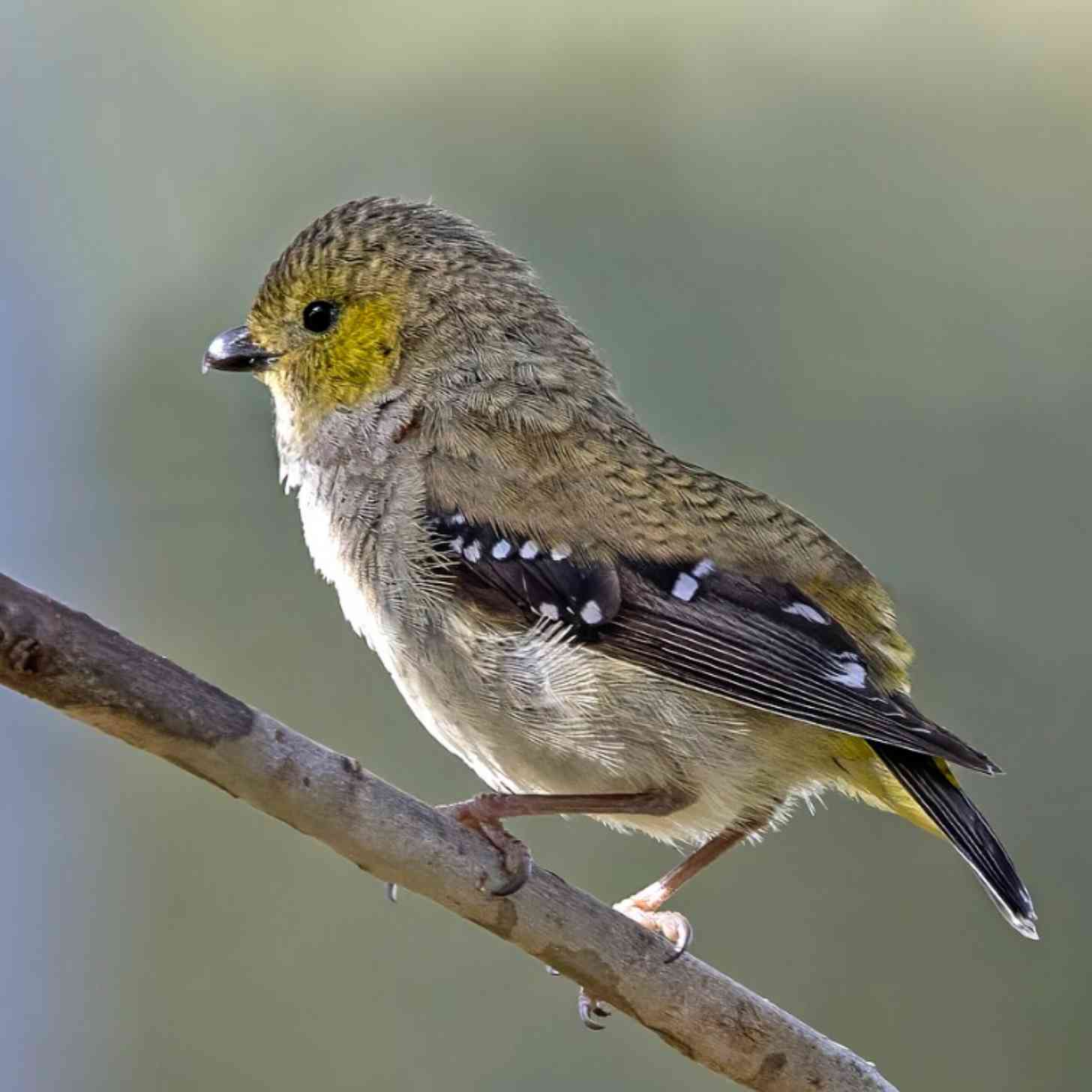
“They have a little hook on their beak,” Alves told the Australian Broadcasting Company.
“And they can make incisions on the leaves of white gums so the white gums will produce extra manna, which is like a sugary exudate that they use to feed themselves and feed the chicks.”
Alves said that the forty-spotted pardalote’s primary threat is “habitat clearing.” And as white gum forests have disappeared, so have the birds.
“Once that habitat is gone, then there's nothing you can do,” Dr Alves said.
Restoring the white gum forests is just one part of the country’s 10-year national recovery plan for the birds. The other step involves eliminating the screwworm flies.
“Infestation can be really bad, if it's in high numbers, the whole brood will die within three days,” Alves said.
At first, a former PhD student sprayed nests directly with a bird-safe insecticide to kill the native parasites — a method that proved effective.
“But when I started my PhD, we wanted to transfer some of the work to the birds because it's really hard to climb trees to get to some of the natural hollows,” Alves explained. “So, I had this idea to set up what we call a feather dispenser.”
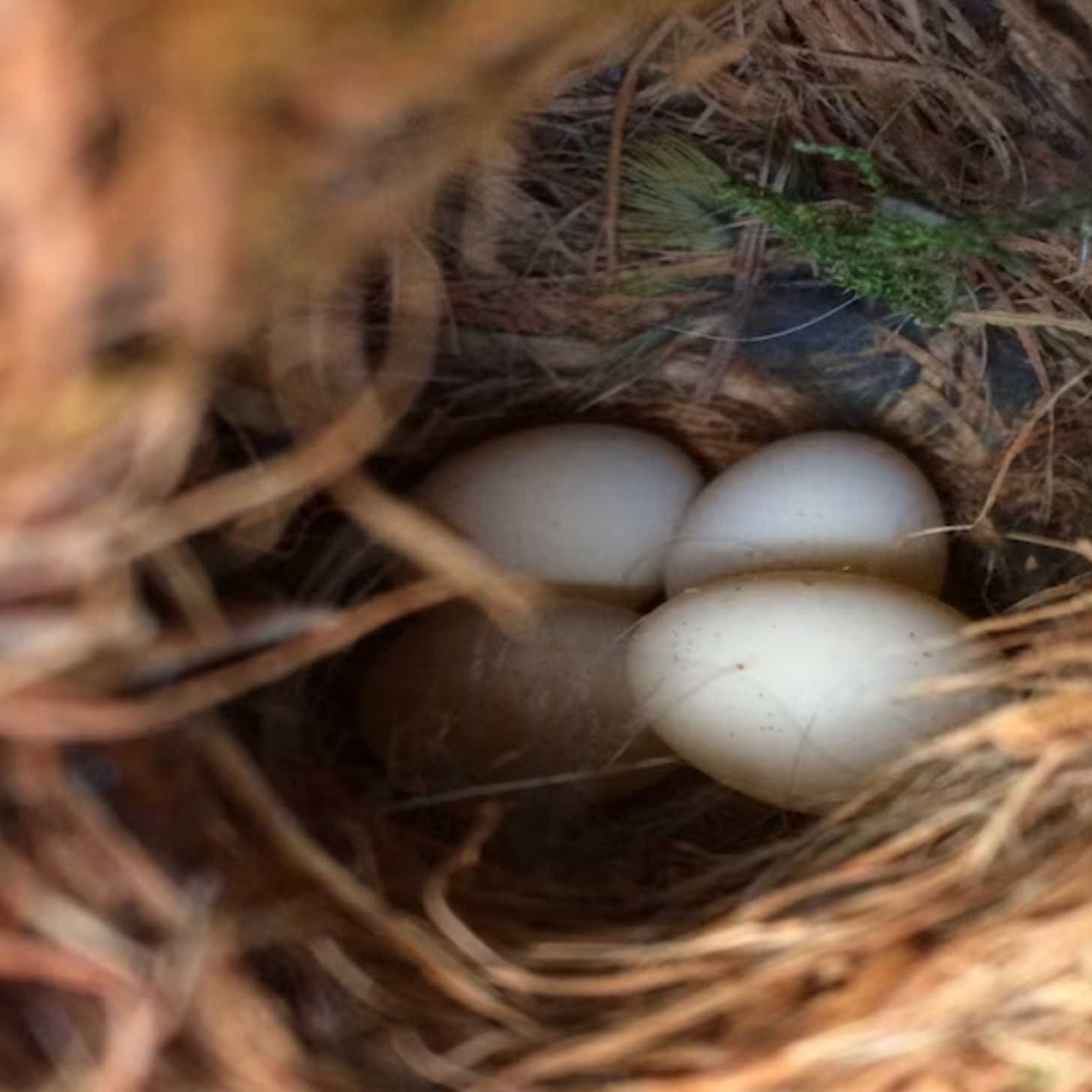
To dispense the feathers, Alves and her team filled specialized cages with sterilized chicken feathers — sprayed with insecticide — and left them under tree canopies where pardalotes were known to nest.
Now, instead of climbing in and out of tree hollows, the scientists have watched as the birds collect the feathers for nestbuilding.
And it worked.
“They had a 98% survival of the chicks,” Alves said.
She told the Australian Broadcasting Company that it’s not a perfect solution, but it has proved vital as they continue their life-saving research.
“It's a temporary way to mitigate the problem, to buy us time to learn more about the parasitic fly and maybe come up with other ideas to maybe help the pardalotes,” she said.
You may also like: A biologist successfully saved these endangered frogs from a deadly disease by building them tiny 'frog saunas'
Header image via Dean Hohn
In North America, it’s not unheard of to stumble across a moose in the forest. But in Romania, the towering mammal has been locally extinct for centuries.
That’s why scientists were blown away by a recent moose sighting in Transylvania this winter — a sighting confirmed by Rewilding Romania, a conservation group that is part of the larger Rewilding Europe initiative.
“We are officially announcing an important discovery for Romania's wildlife: the confirmation of the presence of moose (Alces alces) in Hunedoara County,” Rewilding Romania wrote in a Facebook post dated December 10.
“This confirmation comes as a result of a report received the other day from Andreea Vasilescu regarding the observation of this species. The images received at that time did not have the necessary quality to confirm the species with certainty.”

“As a result, today, our field team was mobilized to verify and document the presence of the species,” the post continued, beside video footage of a moose walking in a field. “Colleagues managed to locate and confirm the presence of the moose through direct observation and filming.”
Moose — which are one of the largest land mammals in North America, second only to bison — can be highly influential on their surrounding habitat.
By feeding on young saplings like willows and birch, they can clear the way for other plant species to grow, which encourages biodiversity.
“Moose are an ecosystem engineer in the forest ecosystem, and strongly impact everything from the species composition and nutrient availability in the forest,” Gunnar Austrheim, an ecologist at the NTNU University Museum, told Phys.org.
When it comes to the surprise sighting in Transylvania, Rewilding Romania promised to work with local authorities to ensure the protection of the moose as they continued monitoring the area.

“Although it is currently unknown where it came from, it is known that there are stable moose populations in Ukraine and Poland,” the organization said.
“Also knowing that moose can cover great distances and that they tend to disperse, there is a possibility that this specimen comes from one of the 2 countries, being only in transit in this area.”
“In the past, there were stable populations in several countries in Europe, including Romania, being a species native to our country, but which disappeared over time,” Rewilding Romania explained. “In this context, it is gratifying that we see the natural return of a species to an area where it once lived.”
You may also like: This mammal vanished from Ohio nearly 200 years ago. Trail cameras just captured footage of it
Header image via Marek Ślusarczyk (Creative Commons Attribution 3.0 Unported)
Kawuneeche Valley, located in the western part of Rocky Mountain National Park, has seen better days.
An overpopulation of overgrazing moose has forced beavers out of their natural habitat, and the loss of natural beaver-built water systems has led to extensive degradation.
Jeremy Shaw, a research scientist at Colorado State University, told the National Parks Conservation Association that the region is “too far gone” for beavers to bounce back on their own.
That’s why he’s leading a team of “human beavers” to create 29 man-made dams that mimic beaver behavior.
“We’re trying to jump-start it,” Shaw said. “Our play here is to give them the best habitat we can, and then hopefully they build up their population.”
Beaver-based restoration techniques first popped up in the early 2000s, when scientists in Oregon created 100 “beaver dam analogs,” which in turn inspired local beavers to build dams of their own.
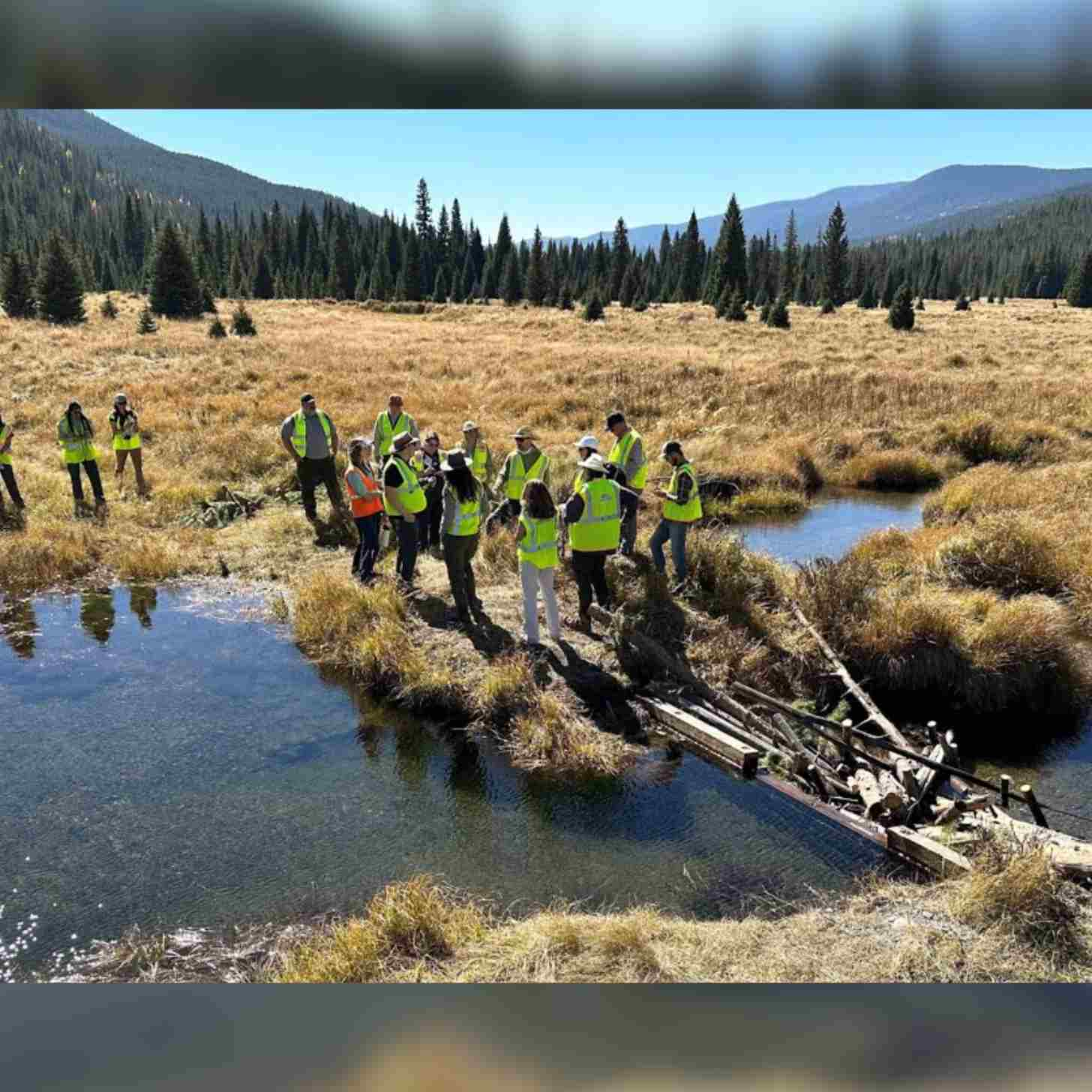
Rangers implemented a similar program in Great Basin National Park to great success — the BDAs kept erosion at bay, protected local cutthroat trout species, and helped native beavers bounce back.
In addition to protecting the flora and fauna of Rocky Mountain National Park, Kimberly Tekavec, a source water protection specialist in Colorado, said that beaver restoration techniques help humans, too. She estimates that the efforts will also safeguard clean drinking water for more than 1 million Coloradans.
“There are so many benefits that this project serves,” Tekavec said.
A version of this article originally appeared in the 2025 National Park Edition of the Goodnewspaper.
Header image via Deborah Freeman (CC BY-SA 2.0)
Minneapolis church Iglesia Dios Habla Hoy primarily serves a Hispanic congregation. When Pastor Sergio Amezcua noticed his community growing especially vulnerable to an intense surge of Immigration and Customs Enforcement officers in the area, he knew he had to do something.
“They’re afraid to go out. They’re not going to work. And some of them are starving,” Amezcua told KARE 11 News.
“It looks like they're responding to a hurricane catastrophe,” he said of the hundreds of volunteers packing non-perishable goods for the community. “But it is a mental catastrophe what the government is doing with us in Minnesota.”
The efforts began in mid-December, when ICE agents began infiltrating the Twin Cities.
“We know that the current situation has made it difficult for many to go out or meet basic needs. As a church, we want to be close to you and demonstrate Christ's love in practical ways,” DHH shared in a Facebook post on December 8. “If you are in need of pantry delivery right now, we are here to serve you.”

Included in the post was a link for people to sign up for free grocery delivery. Those affected include people who are legal citizens and residents of the area, though their immigration status is of no concern to apply for assistance.
“They don’t have to go out if they’re scared,” Amezcua told KARE 11.
Within two days, hundreds of boxes of groceries had already been packed. And 2,000 people had signed up for help.
“Thanks to God, thanks to Manna Market, thanks to all the volunteers from the church and the people from the community who came and showed up to distribute in the middle of a storm, distributing 200 boxes,” Amezcua said in a video on December 10.
“Yes, it is not an easy task, but I know that the families who needed them received them. Now, today we are going to put together more boxes.”
They haven’t stopped since.
And with escalating ICE tensions across Minnesota, the effort has only grown.
As of Martin Luther King Jr. Day , about 24,000 families have registered for help. Amezcua told MPR News that the church has delivered 12,000 boxes of groceries in about six weeks. These days, they are packing 1,300 boxes a day with the help of around 400 volunteers.
“They need help,” Amezcua told MPR. “We still have a lot to do.”
The church purchases the food through donation networks like Second Harvest Heartland and The Food Group, and many community members have supported the efforts with monetary donations. Amezcua said they plan to continue for as long as there is a need.
“From a conservative pastor, what Donald Trump and the White House is doing is horrible, and we feel betrayed by him,” Amezcua told KARE 11.
“Our immigrant community, and Latinos, especially Somalis, are going through hell,” he added. “That’s not the America that we know.”
But the outpouring of support from volunteers and community members proves to Amezcua there is a path forward — one defined by love and goodwill.
Even the local police force has been of assistance, Amezcua said.
“We’re really grateful to the local authorities, like the mayor. And the chief of police, Brian O'Hara, has been sending [community service officers] to help us distribute food to our Minneapolis residents,” he told MPR News.
“We’re doing it by the grace of God,” he added, “and by the help of thousands of volunteers that we have in our network.”
Locals interested in volunteering can go to the Minneapolis church at 5728 Cedar Avenue South on Mondays, Wednesdays, or Fridays. Once there, they will go through a security protocol and get started packing goods.
And anyone interested in donating can support the church’s efforts through its website.
“You are not alone,” the church shared in its original social media post in December. “We are praying for you and your household.”
You may also like: Amid ICE crackdown, this Minneapolis sex shop has transformed into a donation center for neighbors in need
Header image by Julia M Cameron via Pexels
In the United Kingdom, the National Health Service provides most medical care for free to all legal residents.
While this model is less financially burdensome than what many United States citizens are accustomed to, wait times and overcrowding in hospital systems can make it extremely difficult for people to access care when they need it.
In recent years, A&E, or accident and emergency, units have been overwhelmed by people in mental health crises.
In 2024, 250,000 people went to an A&E experiencing mental health crises, with one in three waiting more than 12 hours, according to The Independent.
On top of this, the Royal College of Emergency Medicine estimated that around 320 patients a week may have died in England last year due to excessive waits for hospital beds in these departments.

So, the NHS is doing something about it.
In 2025, they opened a network of specialized clinics, which provide 24/7 support for patients feeling suicidal or experiencing symptoms of psychosis or mania.
The new services also include a “full and holistic assessment” of a patient’s mental health needs.
The idea is to address the root causes of a crisis, like homelessness or substance use issues, connecting patients to an action plan or additional resources for their overall well-being. And it all happens in 10 minutes, guaranteed.
“Anybody who walks in is seen by a mental health specialist within 10 minutes,” mental health nurse Toti Freysson, who manages one of the new London locations, told The Times.
“Normally in A&E, they would have to wait for hours, surrounded by the noise and the chaos. Most of the people we see have suicidal thoughts. Here, they can come in and sit with their families. We are able to intervene early and link them up with treatment in the community. It means we can get them home much sooner.”
You may also like: Albany trials 'street psychiatry' program, giving homeless New Yorkers prescriptions on the spot
A version of this article was originally published in The 2026 Mental Health Edition of the Goodnewspaper.
Header image by SHVETS production via Pexels
In Harlem, New York — a city with a population mostly made up of Hispanic, Latino, and Black families — white-dominated sports like figure skating are especially out of reach.
Enter: Figure Skating in Harlem.
The nonprofit offers sliding-scale figure skating classes and tuition to girls of color. Beyond breaking barriers for skating, FSH also offers academic and leadership classes, college and career support, and social-emotional learning opportunities.

FSH goes even further, connecting students to social justice and community activism efforts to help instill a sense of responsibility in social change.
“Our students live in the real world, and at FSH, they are changemakers,” founder and CEO Sharon Cohen told Beyond Sport.
“They are encouraged to use their voices effectively and to persuasively fight injustices; simply by participating in a predominantly white sport, they are on the vanguard of equity issues.”
The organization has been operational for nearly three decades and has hosted competitive synchronized skating competitions for the last 19 years.
Skaters’ stories have even been highlighted in a five-part docuseries called “Harlem Ice” on Disney+, shining a light on FSH’s efforts to reduce barriers to entry in the figure skating world.
Figure skating itself has proven to be a successful modality in building empowerment and discipline.

An estimated 84% of FSH students moved up one testing level and 90% showed an improved competency in STEM concepts after getting involved with the sport, on top of their increased determination and physical well-being.
“FHS is the best program for the young ladies of Harlem,” FHS parent Allison Neal Springett said. “Self-esteem building, team building, and social awareness — the opportunity afforded [to] them is amazing.”
You may also like: Youth soccer club forms teams based on skill level – not sex or gender: 'The kids let go of the binary'
A version of this article was originally published in The 2025 Sports Edition of the Goodnewspaper.
Header image courtesy of Figure Skating in Harlem
Widely regarded as one of the world’s most influential skateboarders, Tony Hawk paved the way for the sport to become what it is today. In his retirement, though, Hawk has pivoted to philanthropy.
Through his nonprofit, The Skatepark Project, Hawk has helped fund the construction of nearly 700 public skateparks across all 50 states. Since 2002, the organization has awarded $13 million to fund these parks, which are enjoyed by an estimated 17 million people annually.
But Hawk’s goal isn’t just to give people a safe place to access action sports like skateboarding. Part of the organization’s mission is to give young people the tools they need to create their own spaces.

“We’re not just helping to build skateparks. We’re also working to build community in entirely new ways,” Hawk said in a video for the nonprofit.
“Through its fellowships and advocacy training programs, The Skatepark Project is empowering the next generation of diverse skate advocates and creating skateparks and skate spaces within their own communities.”
The connective tissue of skateparks is not isolated to the U.S. The nonprofit has also provided financial and educational support to skate programs in Afghanistan, Cambodia, and South Africa.
Over the years, other grassroots skate organizations in areas affected by war have emerged as well, providing young people with the space and guidance they need to “shred.”
In Gaza, the nonprofit SkatePal provides free programming and skate lessons to youth in Palestine, even amid occupation.
Over the last 11 years, SkatePal has built four skateparks in Palestine, run summer camps for young skaters, and even established programs for girls to encourage their involvement in the sport.

“Skateboarding is not for a specific type of person,” Malak, a local volunteer in Ramallah, shared on the organization's website. “Skateboarding is for everyone, no matter what religion, color, or place.”
In recent months, much of SkatePal’s funding has gone toward basic necessities for skaters and community members struggling to survive and rebuild amidst war. Aside from keeping people safe, they are gathering resources and distributing gear and equipment to partner organizations like skateboarding.ps and Gaza Skate Team.
Despite massive obstacles, SkatePal’s Instagram page is full of happy-faced kids and teens practicing kickflips on miraculously still-standing structures.
“It’s a tool to escape everything,” Mahmoud Kilani, the 23-year-old founder of skateboarding.ps, told DAZED Magazine.
“It’s the feeling of freedom, having this board under your feet that you can do whatever you want with. Because we don’t have freedom here. We are surrounded by walls. Sometimes we can’t go to the park because they say we can’t, so we take our boards and we go skate somewhere else. It’s just a break from the occupation.”
A similar grassroots skateboarding development has emerged in Mukono, Uganda.
There, a teenager founded the Uganda Skateboard Society to bring skateboarding to impoverished areas in his community by building skateparks and offering free lessons and gear to hundreds of youth.
“Skateboarding has existed … in Uganda, but no one was there to promote it and get companies or individuals to come on board to make the youth more interested,” co-founder Gerald Gose told Jenkem Magazine. “So we decided to make it the DIY way.”

While giving youth a place to skate safely is a priority, Grose said the community-building aspect makes him most excited about the organization.
When one skater couldn’t pay his school fees, the community fundraised to get him an education. The USS skatepark, which resides in a low-income neighborhood, has also given youth an outlet to grow something they care about and avoid criminal activity.
“When I leave here, I hope to be able to look around and say we have done a good job and made a good foundation for the future,” Gose, who is now the head coach of Uganda’s Olympic skateboarding team, said in a statement.
“I believe Ugandan skateboarders have the potential, and we have set goals for what we intend to achieve.”
You may also like: Youth soccer club forms teams based on skill level – not sex or gender: 'The kids let go of the binary'
A version of this article was originally published in The 2025 Sports Edition of the Goodnewspaper.
Header image courtesy of Uganda Skateboard Society
Bethany Presbyterian Church in Spokane, Washington had been considering utilizing a portion of its building as affordable housing for newly-arrived immigrants in the community for a while.
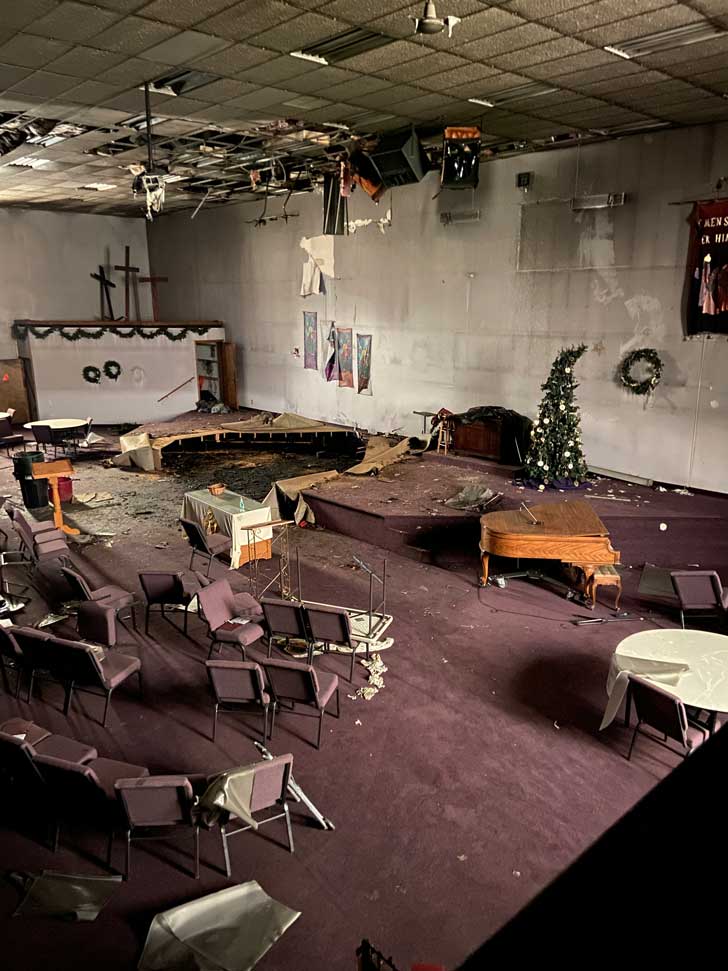
But then, in January 2022, a two-alarm fire changed everything. The Spokane Fire Department determined that the cause of the fire was an “overloaded circuit” in the church sanctuary. Fortunately, no one was injured.
“We are reminded God is with us no matter our situation … The Bethany congregation is a very resilient group of folks, a very faithful group of folks who are inwardly strong and outwardly focused on our neighbors and on our community,” a statement on the church’s website reads.
“As much as we liked our building, we are reminded again and again: The people of God are the church.”

Since 2022, church members have worshipped at a neighboring Presbyterian Church, and the county’s firefighters have used the old building as a training resource.
Congregation leadership and a rebuilding committee have also been figuring out what the rebuilding process would look like.
Through insurance claims and standard rebuilding and repair procedures, they realized this time presented the perfect opportunity to finally create the affordable housing project the church had long dreamed of.
“It could probably be rebuilt and renovated, but nobody liked the building to start with. That was one of the steps and feasibility we looked at. Could we demolish that building and financially recover enough funds out of [the] insurance settlement to build the apartments and a new sanctuary?” Brian Royer, the chair of the rebuilding committee, told Presbyterian Church USA in a video.
The church has partnered with a local housing nonprofit, Proclaim Liberty, to sponsor what they call The Bethany Project, a $12 million community campus that will include a small sanctuary, a community center, and two apartment buildings.
“It really all fell into place when Proclaim Liberty was willing because they knew the whole process, and they were willing to walk the road with us. That just sealed the deal,” Royer said. “It was a God thing. The Holy Spirit put us together.
Offering 22 units, half of the apartments will be open to low-income families through THRIVE International, a nonprofit that supports immigrant and refugee resettlement in Spokane. The other half of the units will be offered to Spokane’s Family Promise, a homeless shelter in the area.
“We haven't lost hope, and we’ve never lost our sight for what we need to do,” Sharon Smith, a member of the rebuilding committee, told KREM2 News.
“We’re having [a] dialogue right now about what could be helpful. How can we walk side by side and help these people get their families safe and sound?”
Smith said the community center will include a communal kitchen, classrooms, and a playground.
“As many congregations across the nation see dwindling attendance, congregations are finding new ways to put their missions into action. Bethany Presbyterian Church is taking the devastating fire at their church to find new ways to provide housing to the homeless and other low-income families,” a vision statement for The Bethany Project reads.
“As a congregation, they have been ‘homeless’ themselves for the last two years. Their compassion, experience, and commitment have led them to this use of their property.”
According to a report on the church’s website, the land was dedicated to the project in the fall of 2025, and demolition will come next. The idea is that the estimated funding package for the project will close in June 2026, and construction will follow.
Smith told KREM2 that the hope is that the project will be completed by Easter of 2027, and that the church is roughly $1 million shy of the project being fully funded.
“Whether it’s just next month or if it’s in six months … it will happen,” Smith said of the funding goal. “We’re very confident that what we're doing is the right thing.”
You may also like: Minneapolis church delivers groceries to 24K families amid ICE occupation: 'They don't have to go out if they're scared'
Header image courtesy of Bethany Presbyterian Church
The picturesque canals of Amsterdam are a sight to behold. The historic network of waterways, first built in the 17th-century Golden Age, is a UNESCO World Heritage site that attracts millions of tourists every year.
But they have also proved to be a dangerous place to traverse when it comes to Amsterdam’s beloved stray cat population, with 19 cats drowning in the first six months of 2025.
That’s when Dutch councillor Judith Krom, of the Party for the Animals, proposed a plan to install “fauna exit points” — tiny wooden staircases — along the canal walls, not just for cats, but for stray hedgehogs, frogs, and birds as well.
This came after Amersfoort, in the neighboring province of Utrecht, announced it was installing 300 “wildlife exit ladders” along its own waterways.
According to the Dutch outlet de Volkskrant, alderman Zita Pels had been intrigued by Krom’s proposal at first, but conceded that there was no budget for it.
That’s when Krom took a second look at the municipal budget — and found 100,000 euros ($116,994.50 USD) in unused funds. Funds that will now be directed towards building tiny staircases along the canals, thanks to approval from Amsterdam’s city council in July.
According to Eelco Miedema, operational manager of Animal Ambulance Amsterdam, they are already keeping track of where the most animal incidents occur to focus installation efforts in high-risk areas.
However, the flowing water means that a cat is often found far away from where it originally fell.
“[It’s] quite a puzzle,” he said, adding that he is in full support of the staircase proposal. “Every cat that can be saved by this is one less cat [lost].”
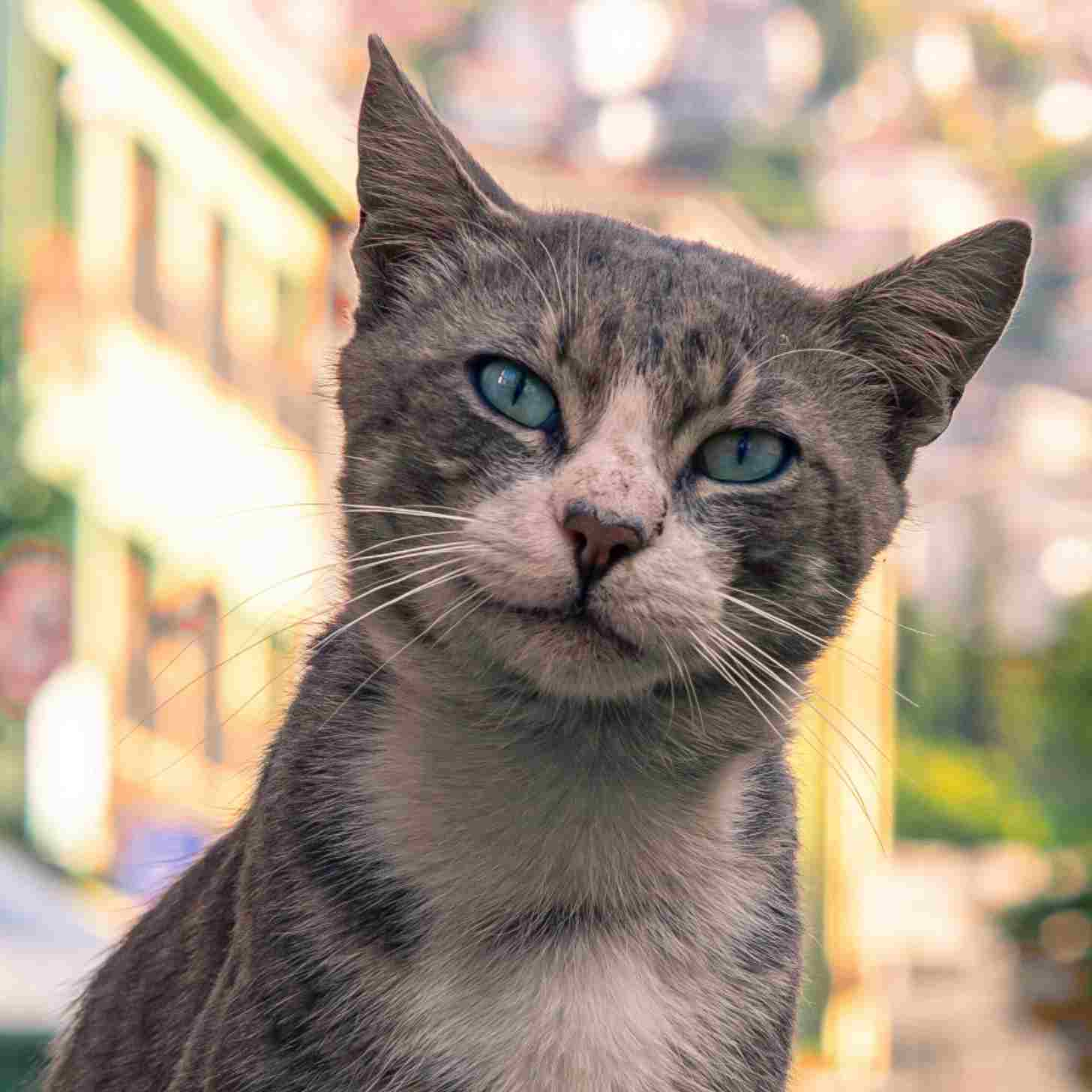
Maggie Ruitenberg, a behavior and welfare specialist at Katten Kenniscentrum, the Dutch Cat Knowledge Center, told de Volkskrant that cats typically end up in the water by accident.
“It often happens due to a startle reaction,” she says. “A cat is sitting on the edge of the quay, gets startled by a dog or a person, jumps backward, and falls into the water.”
And sometimes the incidents are tied to malicious intent.
"Unfortunately, some people find it funny to throw a cat into the water,” she chastised.
Although cats are adept at swimming, they can get exhausted quickly if their fur is weighed down by water.
“A cat ladder can then truly be life-saving, provided they are placed every few meters,” Ruitenberg explained.
“To stay afloat, an animal must have a body structure that allows it to simultaneously keep its head above water and form a horizontal line with its body, with its paws underneath,” she said. “Basically, just like a dog.”
So far, the locations have been determined based on reports from Animal Ambulance, eyewitness help from residents, and additional input from local ecologists.
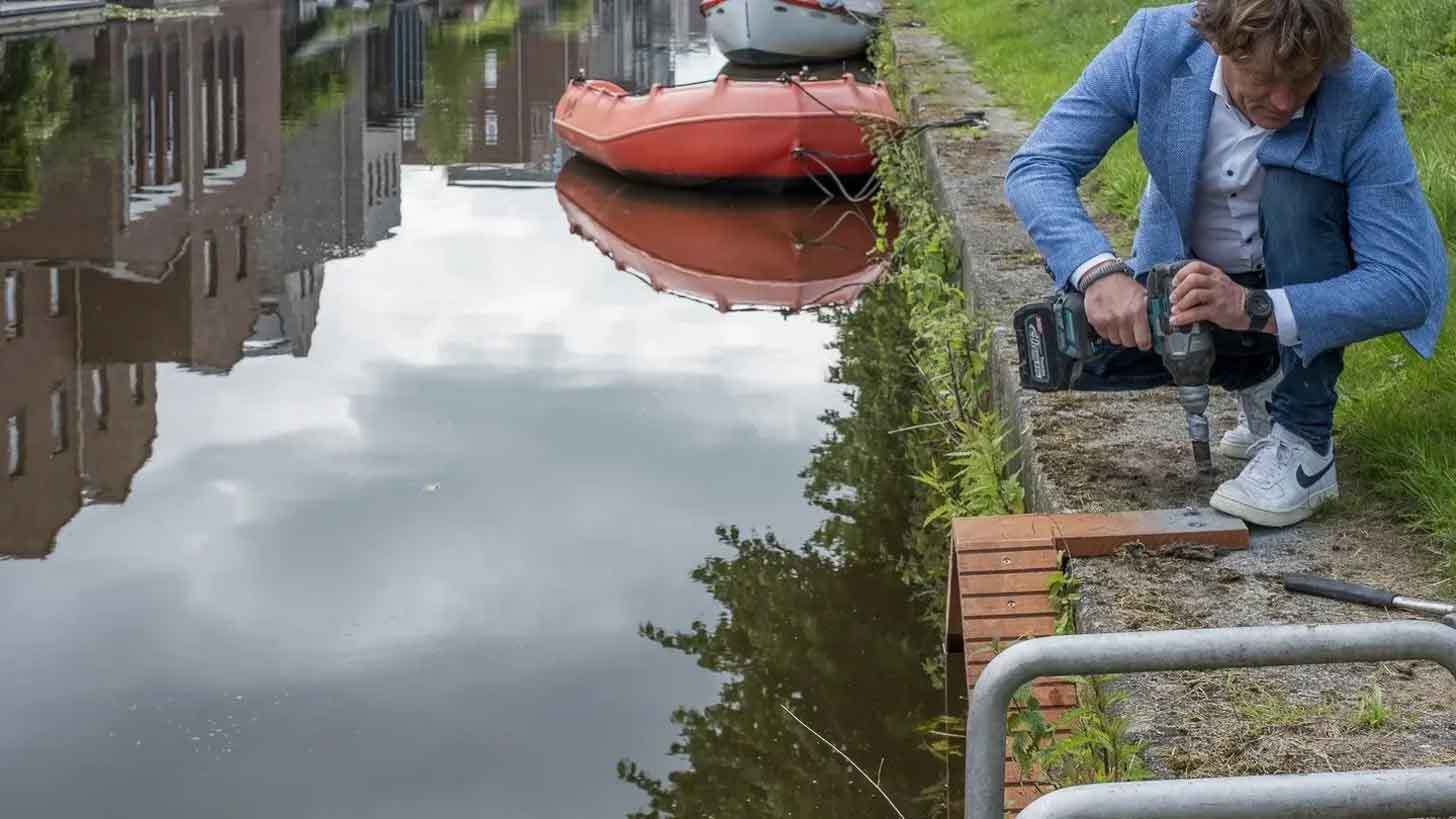
Ruitenberg has also lent her advice on where staircases would be most effective.
“In a panic, a cat will instinctively swim to the darkest, most sheltered spot, for example, under a bridge,” she said. “That feels safer for them than being in the middle of the open canal.”
Ruitenberg has been pushing for “floating platforms” as well.
“That significantly increases their chances of survival,” she said.
[Author’s note: Google Translate was used to translate original quotes from Dutch to English.]
You may also like: North America's 'largest wildlife overpass' is finally complete. It's expected to reduce wildlife-vehicle crashes by 90%
Header image via Unsplash (CC0)
As good as every dog is (and they really are very good), they come with a cost — and we’re not just talking about vet bills.
An average-sized dog generates about 770 kilograms of carbon emissions per year, and an even bigger one can reach up to 2,500 kilograms, according to Earth.org.
Much of this hefty impact comes from eating meat, with studies showing that dry pet food was responsible for up to 2.9% of global carbon emissions from the agriculture industry.
Of course, it’s not easy for people to persuade their dogs to suddenly practice Meatless Mondays or go vegan altogether. But, as veterinarians remind The Guardian, dogs are omnivores and will likely be none the wiser if what’s in their bowl is a few more veggies.
“As omnivores, dogs can enjoy the equivalent of two to three vegetarian meals per week,” Rebecca Linigen, the national director of animal welfare organization Four Paws Australia, told The Guardian.
There are plenty of produce options, lentils, and more that can be eaten as a standalone option or incorporated as a larger ratio in meat-based meals, as long as you consult your veterinarian and ensure your dog’s nutritional needs are still being met.

Linigen praised insect protein as another alternative to traditional meats, but added that the easiest way to reduce your pup’s impact on the planet is simply to not overfeed them.
The sheer amount of shopping and consumption involved with pet ownership has costs, too, similar to the impact we humans generate when we order from a certain big box retailer with 2-day shipping.
That’s why Michael Santiesteban started Secondhand Pet Supply, a nonprofit that focuses on reuse, upcycling, and recycling in the pet industry.
Based in Portland, Oregon, the nonprofit has several donation locations across the city and also partners with companies like Ridwell to collect supplies for its secondhand pet store.
Every item is inspected, cleaned, repaired, or upcycled before being resold, ensuring that nothing goes to waste and that everything is safe for a new furry friend to use.
By reducing the costs associated with buying pet supplies and keeping unwanted items out of landfills, the shop fills a need that other thrift or secondhand stores usually don’t.
@michael_santiesteban Donate or share: https://www.gofundme.com/f/support-secondhand-pet-supplys-mission Help us bring Secondhand Pet Supply to communities across the U.S.! We're raising funds to open 5 new locations that make pet ownership more affordable AND more sustainable. Your donation helps us: ✨ Cover rent ✨ Hire staff ✨ Provide startup grants ✨ Keep pet products out of landfills Let’s build a nationwide network of secondhand pet shops—for the planet, for your wallet, and for your pets. 🐶♻️🐱 #fyp #share #pets #sustainability ♬ original sound - Michael
“This is something I know a lot of communities need, and I really want to get at least one of these in every state in the nation,” Santiesteban said in a recent TikTok video.
He is currently in the process of fundraising to establish five more locations across the U.S., with a long-term goal of building “a national network of Secondhand Pet Supply hubs, supporting local communities, empowering small-scale sustainability, and making a real difference for pets and the planet.”
As for other everyday ways pet owners can scale their sustainability? It probably aligns with what you’ve already been doing: Keep your dog leashed so they don’t kill or injure area wildlife, pick up their poop, and shop with their future in mind.
Your love — and a safe planet to snuggle on — really are just about all they need.
5 Realistic Ways To Make Pet Parenthood More Eco-Friendly
Buy gently used pet supplies.
See if your local thrift store has a section for pet products! If they don’t, peruse local Facebook marketplace finds, buy-nothing groups, or start a group chat with your fellow pet parents to sell, trade, or upcycle the items you no longer need.
Shop sustainably for your treats and toys.
If you are looking to buy a new item for your pet, there are ways to shop more mindfully than at major retailers. In fact, we have a whole guide to help you find what you’re looking for.
Look at adoption as secondhand shopping.
Just like getting your consumer goods at a secondhand store is more sustainable than buying something brand new, adopting a dog from a shelter means you’re getting an existing pet in need of a home.
These pets are already using resources and deserving of your love, plus you get to help ease the burden on local shelters.
Scale back on snacks.
A 2023 study found that 59% of dogs are overweight in the U.S. As much fun as it is to spoil your pup, scale back on the food and treats and watch as your pet — and the planet — get a little bit healthier.
Try some new flavors.
If you are looking for some sustainable snacks, there are plenty on the market. Jiminy and Chippin make insect-protein dog treats, for example.
And to reduce food waste in general, Open Farm’s “Be Good Bites” are made from 30% upcycled food waste, and Table Scraps uses surplus ingredients for their dog treats too — both brands are Upcycled Food Association Certified.
You may also like: At this 'cuddle club,' senior dogs and senior citizens find companionship in each other
A version of this article was originally published in The 2025 Dogs Edition of the Goodnewspaper.
Header image by Mai Phuong Bui on Unsplash
As small businesses, churches, and entire communities speak out against the increased presence of U.S. Immigration and Customs Enforcement across the country, one coffee shop in Portland, Oregon drew a hard line on social media when it comes to protecting their immigrant neighbors.
“If I.C.E. shows up at our door, our baristas know how to properly refuse both entry and service,” Heretic Coffee posted on Instagram on January 12. “If they flash a warrant, we know exactly what to look for on that piece of paper. If they circle our parking lot waiting for customers to leave, we have an exit strategy that we don’t talk about publicly.”
“Y’all can sleep in our shop if they don’t leave,” they added. “We usually got burritos left over so dinner is on us.”
Josh, the owner of Heretic, told Good Good Good why he felt compelled to share their official stance on social media.
“It’s important that people know that we 1) know our rights, 2) Heretic is a safe place, 3) we will defend our community (both immigrant and American-born) to every single extent we legally can,” Josh explained via email.
“American or not, if you are in our shop, or our city — you are our family. And families protect each other.”
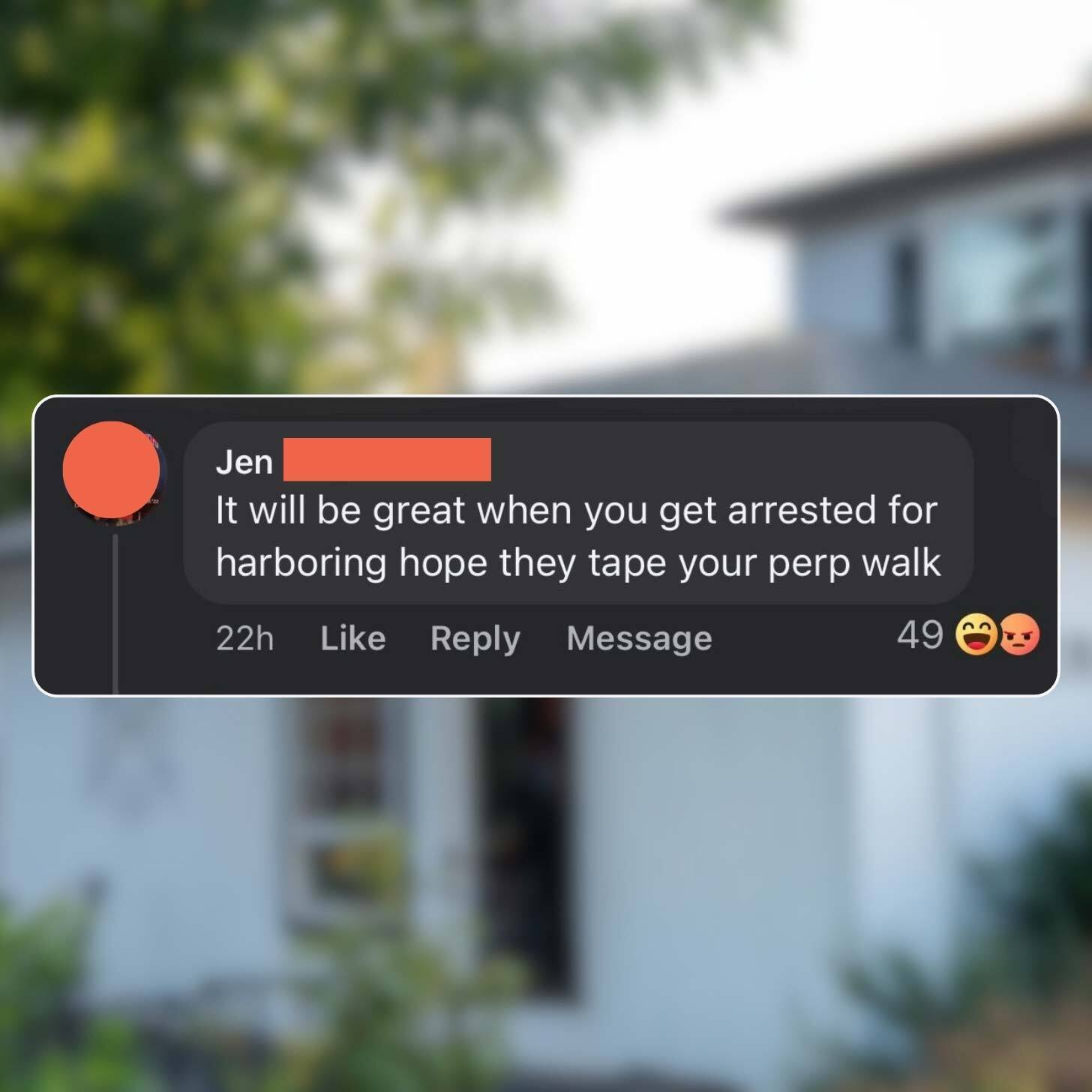
Despite an outpouring of support in the comment section, Heretic’s pledge prompted a reply from one individual who wrote: “It will be great when you get arrested for harboring hope they tape your perp walk.”
“Hey,” the coffee shop responded. “The missing punctuation in your comment has inspired us! Looks like we need to make some ‘Harboring Hope’ stickers. Maybe every sticker sold goes to feeding our immigrant neighbors?”
Within the week, Heretic partnered with Sticker Junkie to release “Harboring Hope” stickers — alongside “Everyone Is Worthy Of A Latte” stickers, which harkened back to another viral social media exchange that Heretic dealt with in November — promising that 100% of the profits “will be used to feed our immigrant neighbors in Portland, OR.”
By pairing the sticker campaign with Jen’s Pastries’ hand-frosted “paras todos” cookies (which means “for everyone”), Josh told Good Good Good that they were hoping to donate “close to $10,000” to the immigrant community.
For months, Heretic Coffee has made a habit of sticking up for neighbors in need.
On November 1, when SNAP benefits were suspended for an estimated 42 million Americans, they immediately began offering free “SNAP breakfasts” to anyone who asked.
“If your SNAP benefits are running out, then breakfast is on us,” the coffee shop posted to Threads.
“NO ONE should have to worry about their next meal. Portland fam, we know it’s not much, but we’ll do our best to keep you fed. Starting November 1st, each day 8 a.m. - 2 p.m.”
Heretic Coffee’s efforts quickly went viral, raising over $310,000 from more than 11,000 donors around the globe.
“Norway. Australia. Ireland. New Zealand. Egypt … and that’s just the emails I’ve been able to get to,” Josh posted to Instagram on October 30. “All around the country, there are coffee shops, restaurants, and cafes offering SNAP breakfasts, SNAP lunches, and SNAP dinners.”
“We’ve said it on every post — when the system fails us, it’s up to us to [take] care of each other,” he added. “And the world (yes, literally, the world) has done just that.”
By January 21, Heretic estimated that their donations had reached close to $380,000.
Although SNAP benefits have been reinstated in that time, many recipients have continued to bear the brunt of the Trump administration’s changing protocols as new eligibility requirements restrict funds nationwide.
And throughout it all, Heretic has continued offering SNAP meals to hungry neighbors.
“Today, 33 people didn't go hungry,” the coffee shop posted to Threads on January 20, adding to what’s become a daily tradition of updating followers on the amount of free SNAP meals provided.
When it comes to social media engagement, Heretic continues to be very active — and transparent about where their money is going — by sharing donation announcements to Black Futures Farm, Central City Concern, the African Refugee Immigrant Organization, JSIR, and more.
And every day, love wins out.
“90% of the comments are overwhelmingly positive; the other 10% is just very loud,” Josh told Good Good Good. “It’s also beautiful to see the positive comments do whatever they can to promote and support our work!”
You may also like: Minneapolis brass band founded after George Floyd's murder helps community heal once again
Header image via Heretic Coffee / Threads
In an attempt to study soil health, a group of scientists from Australia’s Flinders University planted microphones in the ground to see if the acoustics of ants and worms would be a solid indicator of biodiversity.
Not to fast forward to the end of the song, but … they were.
“It’s a bit like going to the doctor,” ecologist Jake Robinson told The Guardian. “They put a stethoscope on your chest, take a health check, listen to your beating heart. … We’re doing something similar in the soil.”
Since the tapping sounds of millipedes or gliding echoes of a snail are indiscernible to the human ear, the researchers set up microphones that picked up vibrations from contact with the dirt and then amplified the recording by 20 decibels.
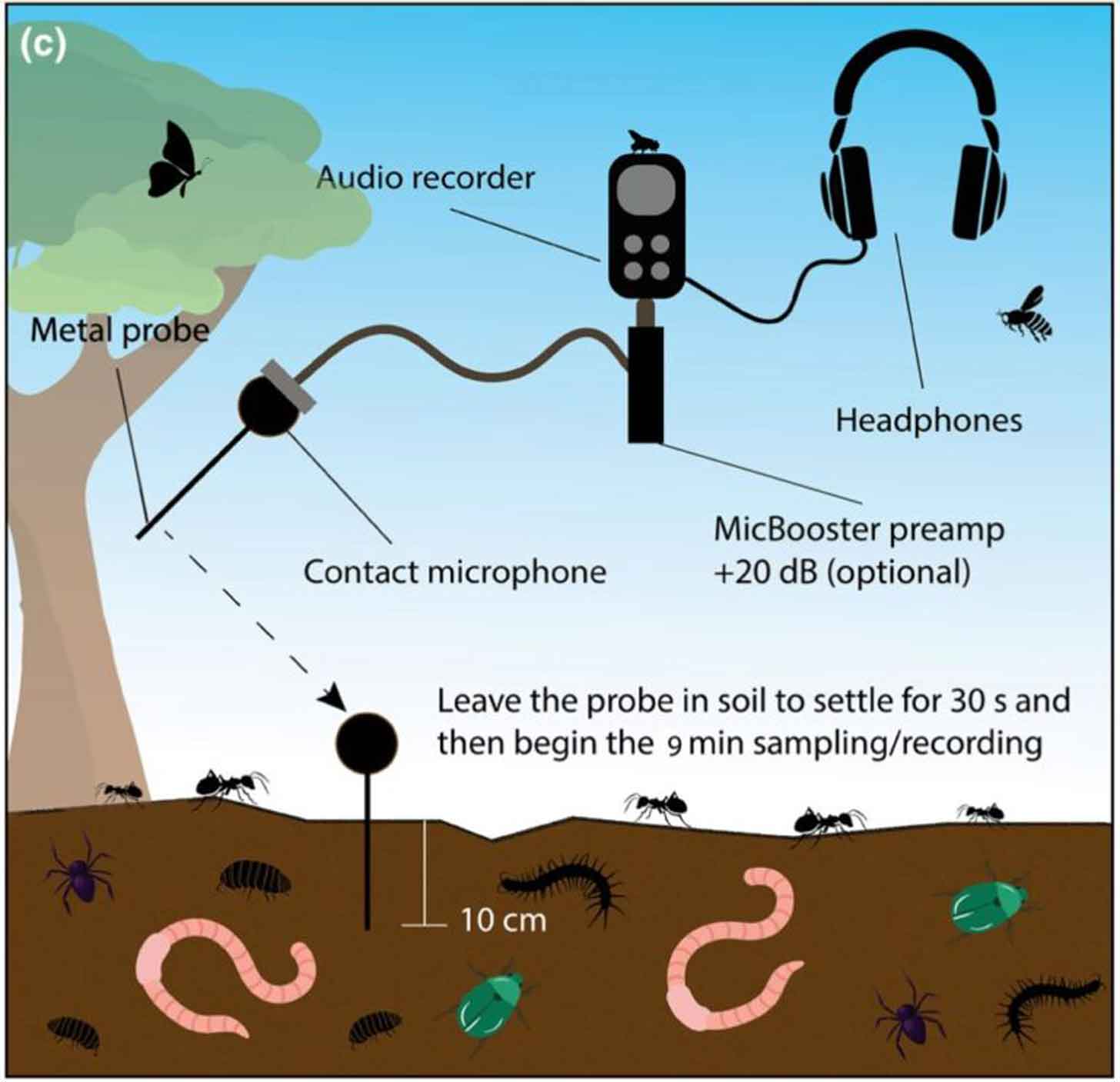
Land in Adelaide Hills in South Australia was filled with plants and tiny animals. It was also home to diverse “invertebrate instrumentals,” creating a soil symphony of crackles, pops, and clicks.
But unhealthy soil only made bland white noise, according to their research.
Because insects and other invertebrates build up soils and improve their nutrient content, their presence underground indicates whether the soil is healthy.
“It’s clear acoustic complexity and diversity of our samples are associated with soil invertebrate abundance — from earthworms, beetles to ants and spiders — and it seems to be a clear reflection of soil health,” Robinson said in a statement for the university.
“This technology holds promise in addressing the global need for more effective soil biodiversity monitoring methods to protect our planet’s most diverse ecosystems.”
Until now, traditional methods of studying soil health have included costly DNA tests, or disruptive traps and digging to identify these music-makers.
But the acoustic method could pave the way for researchers, conservationists, and farmers to detect — and fix — soil degradation with ease.
“Restoring and monitoring soil biodiversity has never been more important,” Robinson added, sharing that an affordable “rock” concert might be available to more people soon.
“We’re trying to democratize it, so everyone can just buy their own little recorder and microphone.”
You may also like: Amsterdam builds cat-friendly staircases along its canals to protect feline residents
A version of this article was originally published in The 2024 Animals Edition of the Goodnewspaper.
Header image courtesy of Flinders University
Harry Styles is back.
The international superstar announced his fourth studio album, “Kiss All The Time. Disco, Occasionally” last week, to be released on March 6.
And this morning, he upped the ante by announcing dates for his next international tour: “Together, Together.”

Styles will return to the stage with a seven-city residency, with 50 total shows in Amsterdam, London, São Paulo, Mexico City, New York, Melbourne, and Sydney from May through December of this year.
As fans dust off their feather boas and prepare for a new era, Styles remains committed to philanthropy. A press release from concert promoter Live Nation shared that Styles will support three nonprofit partners across the “Together, Together” tour.
They include:
- Choose Love, a humanitarian organization that delivers critical aid to people who need it most around the world
- LIVE Trust, an organization that protects and expands grassroots music in the United Kingdom
- HeadCount, an organization that registers concert-goers to vote
According to Live Nation, Styles has supported Choose Love for over a decade, providing essential services like food, shelter, and education across the globe. It’s unclear exactly how Choose Love will be supported on tour, but the press release states that they will “continue that work” with Styles.
LIVE Trust will specifically be supported on Styles’ London stops, with £1 from every ticket sold on the tour by Styles going to the nonprofit’s programs.
In New York, Styles will work with HeadCount — another organization with which he has a longstanding relationship — to register eligible fans to vote at one of 30 Madison Square Garden shows. Fans will be able to register at an on-site pop-up activation led by HeadCount.
Additionally, Styles will be working with Live Nation’s Green Nation “to engage with venues and tour partners on opportunities to reduce the tour’s environmental impact,” according to Live Nation.

Special guests joining Styles on tour include Robyn, Shania Twain, Fcukers, Jorja Smith, Jamie xx, Fousheé, and Skye Newman across select dates.
Those interested in buying tickets can learn more at Styles’ website. Dates for the “Together, Together” tour are below:
- Sat May 16 – Amsterdam, NL
- Sun May 17 – Amsterdam, NL
- Wed May 20 – Amsterdam, NL
- Fri May 22 – Amsterdam, NL
- Sat May 23 – Amsterdam, NL
- Tue May 26 – Amsterdam, NL
- Fri Jun 12 – London, UK
- Sat Jun 13 – London, UK
- Wed Jun 17 – London, UK
- Fri Jun 19 – London, UK
- Sat Jun 20 – London, UK
- Tue Jun 23 – London, UK
- Fri Jul 17 – São Paulo, BR
- Sat Jul 18 – São Paulo, BR
- Fri Jul 31 – Mexico City, MX
- Sat Aug 01 – Mexico City, MX
- Wed Aug 26 – New York, NY
- Fri Aug 28 – New York, NY
- Sat Aug 29 – New York, NY
- Wed Sep 02 – New York, NY
- Fri Sep 04 – New York, NY
- Sat Sep 05 – New York, NY
- Wed Sep 09 – New York, NY
- Fri Sep 11 – New York, NY
- Sat Sep 12 – New York, NY
- Wed Sep 16 – New York, NY
- Fri Sep 18 – New York, NY
- Sat Sep 19 – New York, NY
- Wed Sep 23 – New York, NY
- Fri Sep 25 – New York, NY
- Sat Sep 26 – New York, NY
- Wed Sep 30 – New York, NY
- Fri Oct 02 – New York, NY
- Sat Oct 03 – New York, NY
- Wed Oct 07 – New York, NY
- Fri Oct 09 – New York, NY
- Sat Oct 10 – New York, NY
- Wed Oct 14 – New York, NY
- Fri Oct 16 – New York, NY
- Sat Oct 17 – New York, NY
- Wed Oct 21 – New York, NY
- Fri Oct 23 – New York, NY
- Sat Oct 24 – New York, NY
- Wed Oct 28 – New York, NY
- Fri Oct 30 – New York, NY
- Sat Oct 31 – New York, NY
- Fri Nov 27 – Melbourne, AU
- Sat Nov 28 – Melbourne, AU
- Sat Dec 12 – Sydney, AU
- Sun Dec 13 – Sydney, AU
Header images courtesy of Live Nation and Johnny Dufort
As United States Immigration and Customs Enforcement continues its crackdown across the state of Minnesota following the death of local woman Renee Good, a growing resistance movement has blossomed.
With communities rallying to feed and fundraise for neighbors, and the organization of a statewide general strike planned for Friday, January 23, locals are showing up for one another with resilience and love.
But many are still turning to elected officials like Minnesota Governor Tim Walz to help shepherd them through a particularly dark time.
On January 20, seemingly as part of the Free America Walkout, crowds of protestors and supporters convened outside of the Governor’s mansion, where Walz and his wife, Gwen, stepped outside to speak with the constituents.
“Thank you for coming out in the cold,” Walz spoke into a megaphone shared by a member of the crowd.
He wore a red flannel and beanie, using the gate of the property as something of a soapbox.
“Thank you for standing up for our neighbors who don’t have a fence and who don’t have people to take them around and don’t have lawyers to defend them,” Walz continued.
In a video shared by a member of the crowd, people could be heard cheering, bundled in mittens and parkas, as they responded with their own “thank yous” to the governor.
“These are the moments for people to stand up. These are the moments that are not the easy one, but these are the moments where character comes out,” Walz continued.
The same day, he and other Minnesota officials were subpoenaed by the Department of Justice in a probe alleging that the state officials “conspired to impede law enforcement” amid the ongoing ICE crackdown.
@colleenbayer7 Gov Walz addresses the crowd that gathered in support around his residence. Tuesday, January 20, 2:25pm.#Wholesome #Walz ♬ original sound - Colleen Bayer
Still, Walz made it clear where he stood, sharing a story from his time in Congress.
“I served on the China Commission in Congress — ironically enough, as co-chair with Marco Rubio — but we used to bring in Chinese political prisoners, and we would ask them, ‘When we speak up and call out your government, is it bad?’ and they said, ‘Well, in the short run it’s bad because they torture us, but if you don’t speak up, they will torture us and forget about us,” Walz said, to a rapt audience.
“The idea right now is that we have to be speaking up. We have to call it out.”
Last week, Walz shared a statement urging protestors to remain peaceful in Minnesota, and he continued to share that sentiment again here.
“I can’t stress enough on this; We’re winning it because we’re doing it with Minnesota grit, Minnesota humor, Minnesota decency,” he said. “I spent a lot of time with John Lewis on nonviolent resistance. The resistance matters. We’re not telling people to be silent, but we’re not telling people to go out and cause problems; We’re going to cause good trouble.”
The “good trouble” concept was a cornerstone of Lewis’s civil rights activism and legislative career, and represented a call to action for peaceful, yet disruptive, protest against injustice.
“We have children having to hide in their home,” Walz said, adding that he recently visited the Anne Frank House in Amsterdam and that going there “felt like a warning.”
“I keep reminding people this: Everything that happened during that time was done legally, much like Jim Crow … but the people who were helping Anne Frank, they were the ones breaking the law.”
Then, he addressed the crowd: “For all of you on this … you know what’s right. You know what your neighbors are going through.”
You may also like: Minneapolis brass band founded after George Floyd's murder helps community heal once again
Header image courtesy of Colleen Bayer/TikTok
When Jessica Fujii was in kindergarten, she drew a picture of her future. In a “What do you want to be when you grow up?” booklet, she skipped ballerina and veterinarian, and wrote down something else entirely: sea otter biologist, complete with cartoon-like otters in the great tide pool at the Monterey Bay Aquarium.
Fujii grew up in California’s Bay Area, and trips to Monterey and its aquarium became a regular part of her childhood. She remembers paddling alongside her dad in a kayak on Monterey Bay, watching wild otters float on their backs as they cracked open crabs and let the shells sink. Back then, she mostly took their presence for granted.
Today, as a sea otter researcher and program manager at the aquarium, she knows how close California came to losing them — and how much now depends on the fragile population that remains.
Along Northern California’s coasts, sea otters help habitats endure climate impacts like warming oceans, shifting predator ranges, and harmful algal blooms by keeping underwater plant life healthy and supporting resilient ecosystems.
Fujii is still focused on individual sea otters, but she’s also tracking a bigger picture of these important creatures over time.
A comeback story with a twist
From Fujii’s vantage point on Monterey Bay, southern sea otters — the subspecies that lives along the central California coast — are both a conservation success story and a reminder of what’s been lost.
Once hunted to near extinction for their fur, they survived off the coast of California thanks to a tiny remnant population and, later, federal protections and hands‑on conservation work.
These days, there are only about 3,000 southern sea otters in California, and their geographical range has shrunk to roughly 13% of the coastline they historically occupied. Their numbers have been relatively steady for years, but their range hasn’t meaningfully expanded in about two decades.
Globally, sea otters live in coastal waters from Alaska across the North Pacific to Russia, but the southern sea otter is the only population found in California — and it’s the one scientists have studied most closely for its role in kelp forests, seagrass meadows, and coastal wetlands.
And over the past several decades, scientists have learned that these animals punch far above their weight, especially along the nearshore strip where land and ocean meet.
From cuddly to keystone predator
It’s easy to see why sea otters are often treated like stuffed animals brought to life. Fujii describes a tiny, five‑pound pup as “basically a furball … it’s kind of like holding a kitten” before their teeth and jaws develop.

But the illusion only lasts so long. One longtime aquarium volunteer said he “wouldn’t want to be stuck in a pool with an adult otter.” It’s a good reminder that beneath the fluff is a muscular predator built to crush crabs and urchins.
Ecologists describe sea otters as a classic keystone species, an animal whose presence has much bigger impacts on its surroundings than its numbers alone would suggest. Unlike many other marine mammals, sea otters don’t have a thick layer of blubber to keep them warm. Instead, they rely on extremely dense fur and a very high metabolic rate.
“It’s about two times higher than similarly sized terrestrial mammals,” Fujii said, and because they can’t store energy as blubber, they need to be consuming those calories every single day.
That constant need to eat — up to a quarter of their body weight daily — helps explain why their foraging makes them major players in nearshore ecosystems. What, and how much, they eat ripples outward through food webs, shaping whether the coast is dominated by thick underwater forests and meadows, or by stripped-down, degraded sea floors that are more vulnerable to climate pressures.
Keeping kelp forests alive in a warming ocean
In recent years, a prolonged bout of unusually warm ocean conditions — made more likely and more intense by climate change — has caused kelp forests to crash along much of California, leaving behind vast “urchin barrens” where little grows besides hungry purple urchins.
Around Monterey Bay, though, researchers found that sea otters ramped up their urchin eating in the remaining kelp beds, allowing those last patches of forest to hang on.
Left unchecked, urchins can mow down kelp beds and turn lush underwater forests into places where urchins have grazed away almost all the kelp. When otters are present and hunting, they thin out those urchins, giving kelp a chance to grow taller and thicker and to shelter a wide range of fish, invertebrates, and other marine life.
“Across much of their range, when sea otters consume urchins, they keep that population under control and limit how much grazing the urchins are doing on the kelp,” Fujii said. “That allows the kelp to flourish and be more abundant and provide homes for many other species.”
A recent study stitched together more than a century of kelp data along the California coast using old maps and satellite images. The analysis found steep losses in the floating kelp canopy in southern and northern regions where otters remain absent, but notable long‑term growth in kelp along the Central Coast — exactly where sea otter populations have rebounded.
Healthy kelp forests, in turn, absorb wave energy and soften the punch of storms that are projected to grow more intense with climate change, reducing erosion along vulnerable shorelines.
Scientists are still debating how much long‑term carbon storage kelp forests actually provide, said Fujii, since much of that kelp washes ashore and decomposes.
But when otters keep kelp alive, they also maintain rich, complex coastal ecosystems that are better able to absorb climate shocks than bare sea floors.
In Elkhorn Slough, cleaning up blue carbon habitats
The otter’s climate story doesn’t end in the open‑coast kelp forests.
As the ocean absorbs more than 90% of the excess heat from climate warming pollution and loses oxygen, many marine animals are struggling to cope with warmer, more acidic, less hospitable water.
Coastal plants and algae — kelp, eelgrass, and other seaweeds — are emerging as unlikely allies, drawing down carbon, buffering waves, and giving stressed species places to hide and feed.
In sheltered estuaries like Elkhorn Slough, a coastal inlet where freshwater meets seawater just inland from Monterey Bay, researchers have found that sea otters can help keep underwater sea grass meadows and nearby marshes intact. Around a hundred otters now make their home in the slough, one of California’s last great coastal wetlands and a hot spot for birds, fish, and other marine life.
The connection runs through the food web: Otters eat crabs. When crab numbers drop, tiny grazers like sea slugs survive and multiply. These grazers don’t eat the seagrass; instead, they scrape away algae that builds up on the grass blades. That keeps the meadows healthy even in estuaries loaded with pollution from fertilizers and other runoff.
The marsh connection works differently. When shore crab numbers explode, the crabs burrow into marsh banks and chew on plant roots. That destabilizes shorelines and speeds up erosion. By eating those crabs, otters slow the loss of marsh edges that protect nearby communities from flooding and storm surge.
All of this matters for climate because seagrass beds and adjacent marshes are “blue carbon” habitats — coastal ecosystems that soak up and lock away carbon in plants and underlying sediments while also stabilizing shorelines and supporting fish and birds.
California’s latest climate adaptation strategy explicitly calls out eelgrass as a blue‑carbon tool, part of a broader push to protect and restore coastal ecosystems that both store carbon and buffer people from rising seas.

Climate’s double edge: Ally and victim
Despite all the ways otters support coastal ecosystems, they’re not immune to the forces reshaping those places.
Fujii and her colleagues have documented a sharp rise in sea otters injured or killed by white sharks — often juveniles that deliver a single, exploratory bite and don’t even eat the animal. Research she worked on has linked those juvenile sharks’ northward shift to warmer waters, a trend expected to continue as the ocean heats up.
Aquarium researchers have also found that otters are more likely to be bitten in areas where the kelp canopy has thinned, potentially leaving them more exposed as they rest and forage near the surface.
At the same time, says Fujii, sea otters are increasingly exposed to harmful algal blooms that produce domoic acid, a harmful toxin. In otters, heavy exposure can cause sudden, fatal strandings, while lower‑level, chronic doses can quietly damage their hearts over time, leading to lethal heart disease years after an initial bloom has passed.
Fujii also worries about more frequent and intense storms, which can separate moms and pups and leave tiny, still‑dependent otters stranded on beaches.
The species is bolstering coastal ecosystems against climate pressures, while facing mounting climate threats of its own.
Why protecting sea otters matters for everyone
In 2023, the U.S. Fish and Wildlife Service decided southern sea otters would retain protection under the Endangered Species Act, reflecting how vulnerable the population still is. Unlike many other listed species, though, they still don’t have an officially designated “critical habitat,” even though their nearshore environment is clearly central to their survival.
Without more room to grow or formal habitat protections, even a seemingly stable population can be vulnerable.
“As we continue to see the impacts of climate change, the stress on this population will continue to pile on,” Fujii said.
Even if they were immune to the impacts of climate change, sea otters clearly won’t solve the climate crisis on their own. They won’t erase emissions or single-handedly save the coast.
But research over the past several decades has shown that they can shift the balance in the places they still inhabit, keeping kelp forests from collapsing into urchin barrens, maintaining seagrass meadows and salt marshes, and shoring up natural defenses that coastal communities will increasingly rely on as seas rise and storms intensify.
All this makes them more than just a charismatic species in need of saving.
“The hope is that by focusing on the recovery of this species, we can inspire protection of other animals and their habitats, and recognize the benefits people get when we protect those places,” Fujji said. “Basically, everyone wins when we protect otters.”
In a century defined by hard climate trade-offs, sea otters offer a reminder that some choices still deliver genuine win-wins: safeguard a beloved predator, and you safeguard the coastal habitats — and human communities — that depend on the same resilient, living shorelines.
Bonus: Sea otter cam
This article was originally published by Yale Climate Connections.
Header Image by Anchor Lee on Unsplash

As Americans increasingly report feeling overwhelmed by daily life, many are using self-care to cope. Conversations and social media feeds are saturated with the language of “me time,” burnout, boundaries, and nervous system regulation.
To meet this demand, the wellness industry has grown into a multi-trillion-dollar global market. A myriad of providers offer products, services, and lifestyle prescriptions that promise calm, balance, and restoration.
Paradoxically, though, even as interest in self-care continues to grow, Americans’ mental health is getting worse.
I am a professor of public health who studies health behaviors and the gap between intentions and outcomes. I became interested in this self-care paradox recently, after I suffered from a concussion. I was prescribed two months of strictly screen-free cognitive rest — no television, email, Zooming, social media, streaming, or texting.
The benefits were almost immediate, and they surprised me. I slept better, had a longer attention span, and had a newfound sense of mental quiet.
These effects reflected a well-established principle in neuroscience: When cognitive and emotional stimuli decrease, the brain’s regulatory systems can recover from overload and chronic stress.
Obviously, most people can’t go 100% screen-free for days, much less months, but the underlying principle offers a powerful lesson for practicing effective self-care.
A nation under strain
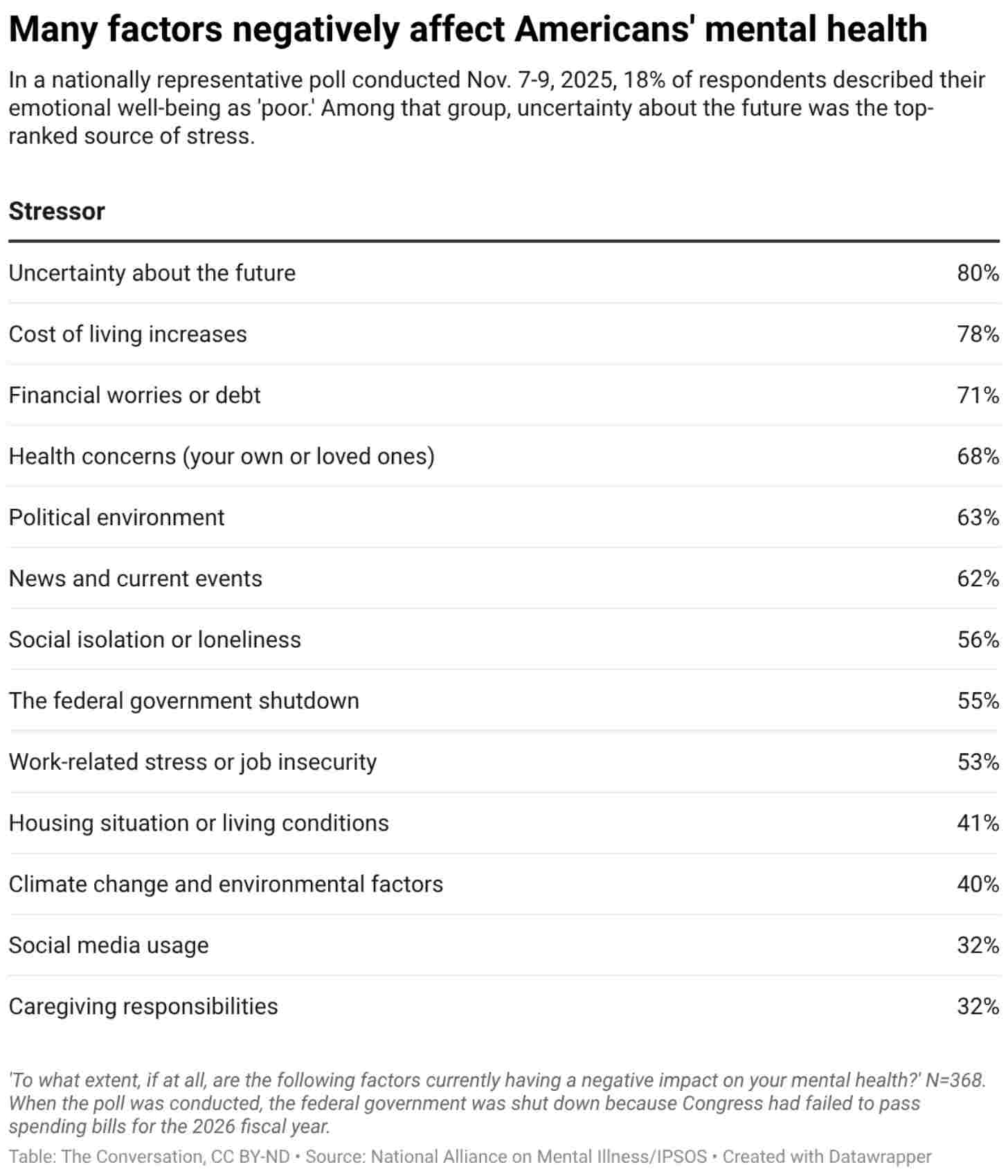
Americans’ self-rated mental health is now at the lowest point since Gallup started tracking this issue in 2001. National surveys consistently detect high levels of stress and emotional strain.
Roughly one-third of U.S. adults report feeling overwhelmed most days. Sleep disruption, anxiety, poor concentration, and emotional exhaustion are widespread, particularly among young adults and women.
Chronic disease patterns mirror this strain. When daily stress becomes chronic, it can trigger biological changes that increase the risk of long-term conditions like heart disease and diabetes. The Centers for Disease Control and Prevention reports that 6 in 10 U.S. adults live with at least one chronic condition, and 4 in 10 live with multiple chronic conditions.
How people try to cope
Many Americans say they actively practice self-care in everyday life. For example, they describe taking mental health days, protecting personal time, setting boundaries around work, and prioritizing rest and leisure.
The problem lies in how they use that leisure time.
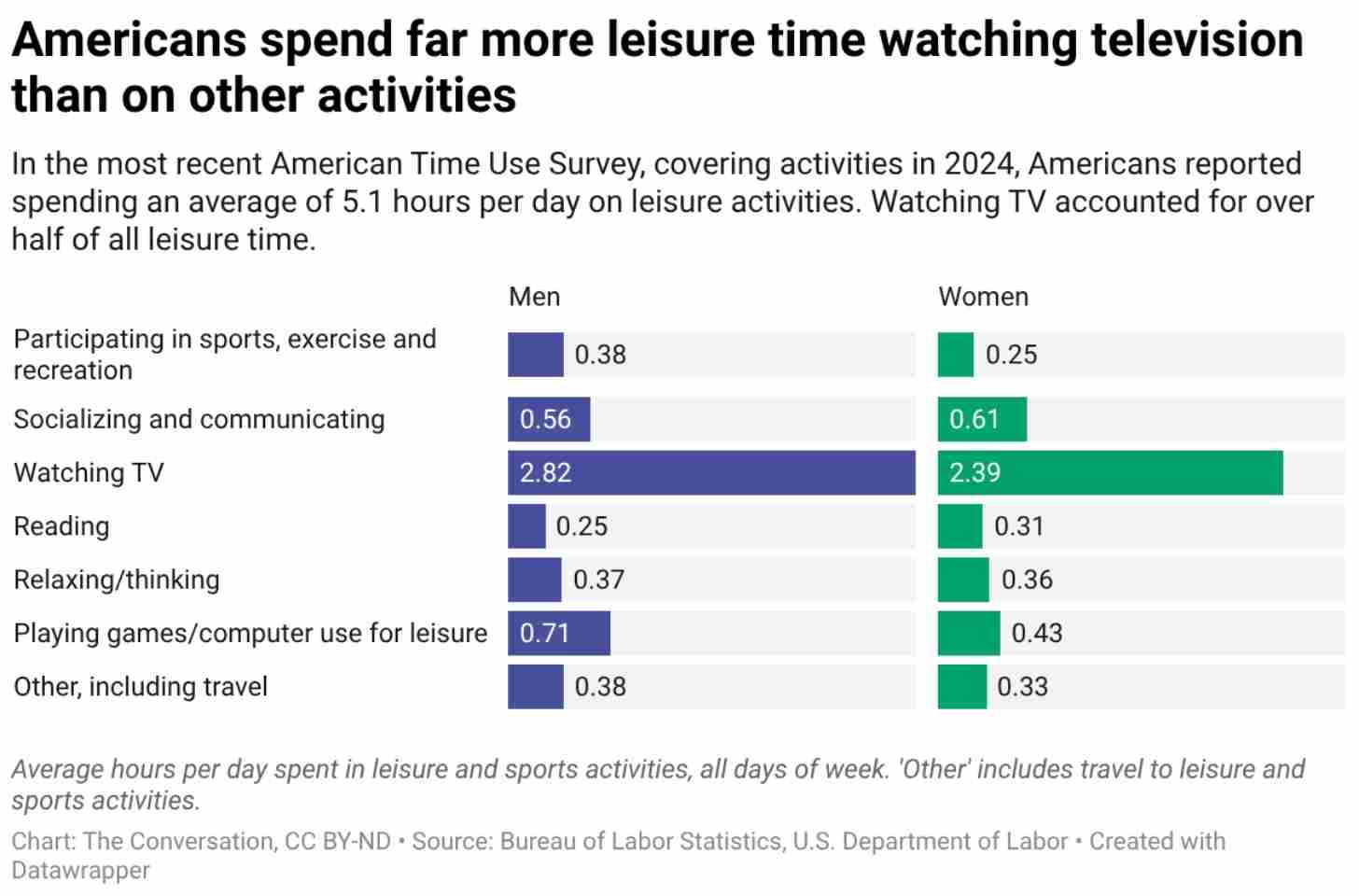
Over the past 22 years, the U.S. Bureau of Labor Statistics’ American Time Use Survey has consistently found that watching television is the most popular leisure activity for U.S. adults. Americans spend far more time watching TV than exercising, spending time with friends, or practicing reflection through activities like yoga. Other common self-care activities include watching movies and gaming.
Modern leisure time increasingly includes smartphone use. Surveys suggest that mobile phones have become the dominant screen for many Americans, with adults spending several hours per day on their phones.
For many adults, checking social media or watching short videos has become a default relaxation behavior layered on top of traditional screen use. This practice is often referred to as second screening.
Although many people turn to screen-based activities to wind down, these activities may have the opposite effect biologically.
Why modern screen use feels different
Pre-internet forms of leisure often involved activities such as watching scheduled television programs, listening to radio broadcasts, or reading books and magazines. For all of these pastimes, the content followed a predictable sequence with natural stopping points.
Today’s digital media environment looks very different. People routinely engage with multiple screens at once, respond to frequent notifications, and switch rapidly between several streams of content. These environments continuously require users to split their attention, engage their emotions, and make decisions.
This type of mental multitasking draws on the same neural systems people are often attempting to rest with leisure. The result is a far more fragmented and cognitively demanding environment than in the past.
Americans now spend approximately six to seven hours per day on screens across multiple devices. Splitting attention between more than one screen at a time, such as using the phone while watching television, is common. This juggling exposes people's brains to multiple streams of sensory and emotional input simultaneously.
Survey data also suggests that Americans may check their phones roughly 200 times per day. In doing so, they repeatedly pull their attention back to screens during routine moments.
Modern digital platforms are designed to maximize engagement. Algorithms tend to prioritize emotionally arousing content, particularly anger, anxiety, and outrage. These feelings drive clicks, sharing, and time spent on platforms. Research has shown that this design is associated with higher stress, distraction, and cognitive load.
When ‘rest’ doesn’t restore
Against the backdrop of daily hassles and competing demands, it can feel like relief to flip on the TV. Practices such as streaming or so-called bed-rotting — spending extended periods in bed while scrolling — often are framed as a form of radical rest or self-care.
Other common coping behaviors include leaving the television on as background noise, scrolling between tasks throughout the day, or using phones during meals and conversations. These strategies can feel restful because they temporarily reduce external demands and decision-making.
However, pairing rest with screen use may undermine the very restoration that people are seeking. Digital media stimulate attention, emotion, and sensory processing. Even while people are sitting or lying still, being on-screen can keep their nervous systems in a heightened state of arousal. It may look like downtime, but it doesn’t create the biological conditions for restoration.
How to wind down
Evidence suggests that mental relief comes not from adding new coping strategies, but from reducing the number of demands placed on the brain.
Here are some evidence-based strategies that support genuine restoration:
- Reduce digital multitasking, such as using your phone while watching television. This lowers stress and cognitive strain.
- Limit task-switching and interruptions. This improves focus and reduces cognitive fatigue.
- Spend time in low-stimulation environments, including quiet spaces and outdoor settings. This supports mood and emotional well-being.
- Unwind with analog or low-novelty activities, such as reading print, journaling, gentle movement, or device-free walking. These pastimes allow mental engagement without overload.
The goal is to intentionally reduce mental load, not to abandon all digital devices.
To improve well-being in our overstimulated society, it’s important to understand the difference between feeling as though you are unwinding and actually allowing your brain and body to recover.
In my view, fewer screens, fewer inputs, fewer emotional demands, and more protected time for genuine cognitive rest are important components of an effective wellness strategy.
This article was written by Robin Pickering from Gonzaga University and was originally published on The Conversation.
Header Image by SHVETS production via Pexels

In August 2024, the U.S. Department of the Interior reported that the National Park Service generated 415,000 jobs and contributed more than $55.6 billion to the nation’s economy in 2023 alone.
“This report illustrates the significant economic benefits national parks provide to nearby communities and the U.S. economy, and the value of our work to safeguard these public lands in the wake of the climate crisis, upgrade visitor experiences, and invest in park infrastructure and staff,” U.S. Secretary of the Interior Deb Haaland said in a statement.
And it’s not just national parks that are good for the economy. A 2024 economic impact report from the Trust for Public Land found evidence that municipal parks and “pocket” parks are good for business, too.
The report found that four out of five cities that had recently invested in their local parks — Atlanta, Boise, Boston, Minneapolis, and Plano — saw a surge in labor force growth, as well as higher rates of housing and office development.

Michael Halicki, the executive director of Atlanta-based nonprofit Park Pride, told local landscaping company HGOR that parks need to be protected, not just to create jobs, but to boost quality of life as well.
“We live in a city that has nature overflowing in many respects,” Halick said. “We have a great asset there, and I think it’s something that will certainly reward Atlanta in the future, the more that we’re protecting that nature and making sure that people have access to it.”
Header image via Chris J Mitchell / Pexels
As part of Minnesota’s “Day of Truth and Freedom” on Friday, January 23, clergy leaders in Minnesota are urging residents not to shop, work, or go to school in protest of the ongoing occupation of United States Immigration and Customs Enforcement across the state.
“What is happening here in Minnesota is a horror that we’re living through, but we’ve been organizing in preparation,” Minister JaNaé Bates told Sojourners.
Bates is the co-executive director of ISAIAH, a faith-based organization that has been helping to organize the day of action.
“It’s not completely a shock.”
Faith leaders join unions and labor organizers in what is effectively a day-long general strike across Minnesota communities. And a day prior, a clergy-led group called MARCH (Multifaith Antiracism, Faith and Healing) spread a call to action, asking faith leaders from around the country to make a pilgrimage to Minnesota.
“In the targeted violence against immigrant communities from Latine and Somali neighborhoods — where families are being torn apart by masked agents, where communities are organizing, resisting, and protecting one another, and where Renee Good’s life has been taken with reckless disregard for the preciousness of human life — we are witnessing an eruption of corruption, racism, and the worship of money over life itself, now threatening the soul of this nation,” MARCH shared in its call to clergy.
“We therefore call on clergy and faith leaders of all faiths, representative of every part of the country, to join us for a day of witness and resistance — a working convening rooted in accountability to impacted communities and designed to build the relationships, skills, and commitments needed for sustained action across the country.”
Organizers told Sojourners that between 400 and 500 clergy had registered, planning to march in freezing temperatures and holding teaching sessions with local Indigenous and civil rights groups.

Those who are local to the area or have already descended upon Minnesota are bundled up in the streets themselves, volunteering as legal observers to document the actions of ICE agents.
According to Religious News Service, about 200 faith leaders spread out across Minneapolis on January 22, carrying whistles and singing hymns from the Civil Rights Movement.
“You can only preach against ICE for so long before God calls you to get out of the pulpit and get to the streets,” Rev. Joshua Shawnee, from Inclusive Catholic Church in Tulsa, Oklahoma, said.
Where faith leaders could not travel to Minnesota, they are carrying out their own forms of resistance, including fasting in solidarity.
In Oakland, California, for instance, faith communities are urging a “solidarity fast” from noon on January 22 to noon on January 23.
“We will pray and fast in solidarity here in California to resist the violence inflicted on our own neighbors, friends, and families, while also sending our prayers with our Bay Area Faith Delegation traveling to Minneapolis,” organizers wrote in a planning document, shared by The Oaklandside.
As for Bates and the Minnesota-based leaders, their work is to continuing to hold firm in their beliefs — and their demands.
“In my faith, when it is time for one to go, we say to one another: ‘Peace be with you. You may go in peace,’” Bates said in an address earlier this week. “ICE, you may go in peace. You surely couldn’t stay in peace, and so we are asking that you leave in peace.”
She said ICE officers were “acting quite illegitimately,” and doing things “that are very illegal” and “against our constitutional rights,” concluding that “when illegal things happen, there should be consequences.”
“Our ask, our demand, especially as moral witnesses, especially as moral authority, is that we call you into your better self,” Bates continued, speaking directly to ICE. “The reality is, we know that no human being is irredeemable. No human being is beyond the touch of the almighty God. We are praying for you. We are praying for your soul.”
Bates added that this is why so many organizers from various traditions, including “Muslim, Jewish, Christian, Buddhist, Unitarian,” and more, were coming together in these efforts centered around “truth and freedom.”
In addition to providing space for community members to gather, lament, and practice “faithful action” together, she said, the January 23 activation comes with four demands.
“We have four demands that have been consistent since the killing of Renee Good,” Bates said. “The first is that ICE must leave Minnesota. The second is that the one who is very much responsible for the murder of Renee Good must be held accountable.”
“The third is that our congressional folks need to do their job,” she continued. “You have a job, and that job is to ensure that what is happening here … does not continue to happen here and should not happen in any state in our country. That means you must do all you can to freeze every single cent that this illegitimate agency is getting … it must stop, and you can stop it.”
ISAIAH and other faith groups have also been demonstrating in front of corporations that have contracts with ICE, urging them to divest from the federal government’s immigration agenda and support vulnerable communities. On the morning of January 23, the group live-streamed a demonstration opposing Delta Airlines’ connections to ICE.
Hundreds of clergy members and ISIAH organizers have also convened at Target headquarters to demand justice, singing hymns with a few lyrical twists.
“We can stay here all day, we shall not be moved,” they harmonized. “We are shopping elsewhere, we shall not be moved.”
Ultimately, Sojourners reported, this effort persuaded Target CEO Brian Cornell to agree to a meeting.
These mounting actions tie into the group’s fourth demand: “For all of our corporations and businesses to stand in alignment with the people of Minnesota,” Bates said.
While the demands of faith leaders are clear in their efforts to eliminate ICE and protect communities, the call is not motivated by some sort of political gain, but by what they claim as a religious imperative.
“This is not about anti-ICE activists,” Bates concluded in her impassioned speech.
“This is about our neighbors. This is about grandmothers. This is about teachers. This is about firefighters. This is about all of us who are hurting about what’s happening … We need to step up together. Let us all be grounded in that — in our God, in our faith, and in our witness. Amen.”
You may also like: Tim Walz urges 'good trouble' to protesters outside governor's mansion: 'Do it with Minnesota decency'
Header image courtesy of Faith in Minnesota/Facebook
According to the Office of Management and Budget, only 18% of Americans believe that their tax dollars are being spent “the right way,” while 27% admitted that they don’t know how their money is being spent.
But when tax season officially kicks off on January 26, a new tax return option will be available for North Carolinians — one that lets them know exactly where that money is going.
By checking a single box, taxpayers will be able to donate all or part of their tax refund to the N.C. Nongame and Endangered Wildlife Fund. They will join residents of California, Colorado, and Wisconsin as taxpayers who can directly fund conservation efforts that are matched by the federal government.
“Funds donated using the tax-checkoff program amplify those provided by a federal grant for species of greatest conservation need, including listed species in North Carolina,” Dr. Sara Schweitzer, assistant chief of The N.C. Wildlife Resources Commission’s Wildlife Management Division, said in a statement.
Schweitzer said that every $100 received through the program will be matched with $186 or grant funding, “truly boosting wildlife conservation in North Carolina.”
“Our dedicated and passionate biologists, agency partners, and volunteers work tirelessly to ensure wildlife and their habitats will persist into the future for North Carolinians to enjoy,” she said.
From the coastal plains of Wilmington to the rippling mountains of Asheville, the state boasts four eco-regions brimming with wildlife.

Furthermore, over 11% of North Carolina’s land is home to protected wildlife areas, from 14 National Park Service locations (including Cape Hatteras National Seashore, Blue Ridge Parkway), four national forests (Pisgah, Nantahala, Croatan, Uwharrie), and 11 national wildlife refuges.
Funds from the tax program will go towards wildlife monitoring efforts for endangered species such as the red wolf, the Hickory Nut Gorge green salamander, river frog, diamondback terrapin, and Northern gray treefrog.
Schweitzer said that the majority of conservation efforts will be centered on the state’s western Appalachian region, where vulnerable species are still recovering from the devastation of Hurricane Helene.
“In western North Carolina especially,” she said, “donations will help us address the immense impacts of Hurricane Helene on species such as the Eastern hellbender, bog turtle, gray bat, Carolina Northern flying squirrel and several high-elevation migratory birds.”
You may also like: These taxpayers overwhelmingly voted for a tax hike. It went toward boosting teacher paychecks
Header image via Keenan Adams (Public Domain)
In the wake of funding cuts and mass staff firings at national parks in 2025, over 60 major businesses joined together to rebuke Congressional rollbacks and prevent the large-scale sale of public lands.
In an address to Congress, the Brands for Public Lands coalition reminded lawmakers that their businesses “contribute to the $1.2 trillion outdoor economy” and that they had a vested interest in keeping public lands “publicly owned and accessible for generations to come.”
“A priceless and irreplaceable resource that can’t be reduced to a line item on a balance sheet, our public lands are intrinsically tied to the life-defining pursuits of climbing, skiing, and mountain sports that our company was built to serve,” Neil Fiske, the CEO of Black Diamond Equipment, expressed in a shared statement. “We are proud to stand with brands and public lands users of all types in opposition to these short-sighted proposals.”
In the end, their plea successfully pressured Congress to remove a provision from the 2025 Senate Reconciliation Bill that would have sold millions of acres of federal land.
The business coalition was formed by The Conservation Alliance, which is a collection of outdoor industry giants that give a portion of their profits back to nonprofits and conservation efforts. Since 1989, they have safeguarded over 124 million acres of land and 4,964 miles of rivers from industrialization.
“Threats to public lands are threats to the natural and cultural resources they protect, the millions of jobs and thousands of businesses they support, and the myriad communities they sustain,” said Paul Hendricks, the executive director of The Conservation Alliance.
“Together, our coalition of businesses can demonstrate why public lands matter for our communities and our economy.”
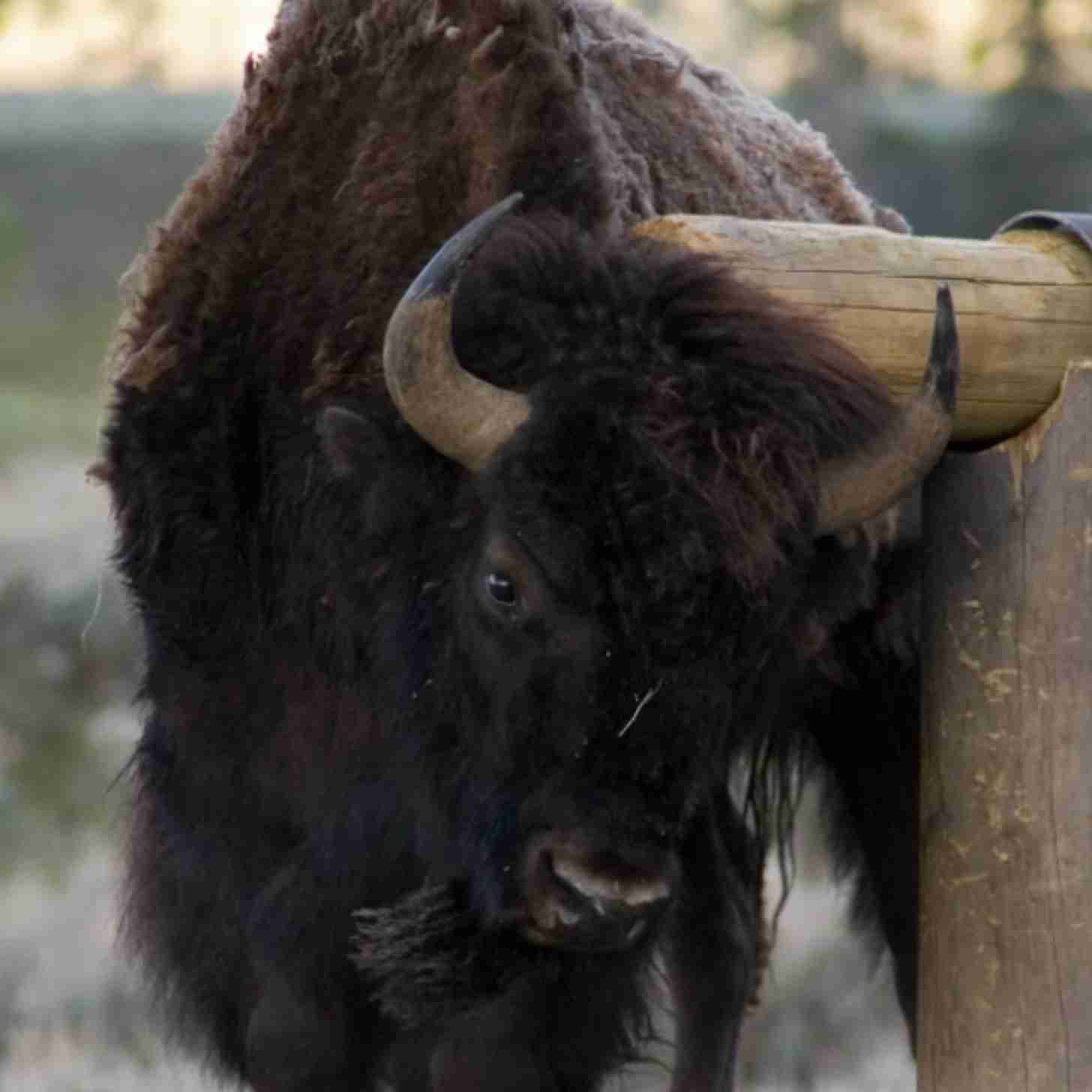
Businesses in the Brands for Public Lands
- Alpenglowsports - Tahoma, California
- American Outdoor Products - Boulder, Colorado
- Backbone Media - Carbondale, Colorado
- Backcountry Essentials - Bellingham, Washington
- Backcountry North - Traverse City, Michigan
- Bedrock Sandals LLC - Missoula, Montana
- Big Agnes, Inc. - Steamboat Springs, Colorado
- Black Diamond Equipment - Salt Lake City, Utah
- Burton - Burlington, Vermont
- CGPR - Marblehead, Massachusetts
- Cocona, Inc = Boulder, Colorado
- D.D. Bullwinkel’s Outdoors - Brevard, North Carolina
- Duct Tape Then Beer - Seattle, Washington
- Emerger Strategies - Charleston, South Carolina
- Engaged Coaching - Bend, Oregon
- Fjällräven North America - Louisville, Colorado
- Grassroots Outdoor Alliance - Cody, Wyoming
- GRAYL Inc. - Seattle, Washington
- Great Outdoor Store - Sioux Falls, South Dakota
- GU Energy Labs - Berkeley, California
- J&H Outdoors - Lexington, Kentucky
- Kavu, Inc - Seattle, Washington
- Klean Kanteen - Chico, California
- La Sportiva N.A., Inc. - Boulder, Colorado
- MeatEater - Bozeman, Montana
- NEMO Equipment, Inc. - Dover, New Hampshire
- Nester Hosiery LLC - Mount Airy, North Carolina
- Oboz Footwear - Bozeman, Montana
- Osprey Packs - Cortez, Colorado
- Outdoor Industry Association - Boulder, Colorado
- Outsize Consulting - Wolverine Lake, Michigan
- Pack Rat Outdoor Center - Fayetteville, Arkansas
- Patagonia - Ventura, California
- Peak Design - San Francisco, California
- Protect Our Winters - Boulder, Colorado
- Prima Terra - Ogden, Utah
- Puddle Creative - Portland, Oregon
- Ramsey Outdoor - Succasunna, New Jersey
- REI Co-op - Sumner, Washington
- Revolution House Media - Big Sky, Montana
- Roads Rivers and Trails - Milford, Ohio
- Rock and Snow, Inc. - New Paltz, New York
- Sanitas Sales Group - Lakewood, Colorado
- Saratoga Outdoors - Saratoga Springs, New York
- Shār Snacks - Austin, Texas
- SRAM, LLC - Chicago, Illinois
- Swen Products/Sven-Saw - Minneapolis, Minnesota
- The Base Camp - Billings, Montana
- The Forest Group - Lotus, California
- Toad&Co - Santa Barbara, California
- TripOutside - Durango, Colorado
- Verde Brand Communications - Durango, Colorado
- Walkabout Outfitter - Lexington, Virgina
- Zephyr Adventures - Red Lodge, Montana
Header image via Anne McCarthy / Pexels