On Tuesday, January 20, 2026 — the nine-year anniversary of the first Women’s March, a new era for the activism event will unfold nationwide.
Women’s March, 50501, FEMINIST, and other organizations are hosting the “Free America Walkout,” urging participants across the United States to walk out of work or school at 2 p.m. local time.
“Activists will organize walkout teams, contact neighbors and classmates, host mutual aid and community actions, and engage in public service as a way to block authoritarian violence and authoritarian rule against immigrants, families, and workers and make the stakes of this moment clear,” a statement from the organizers described.
They added that the action comes amid “a rapid series of escalations, including immigration raids, expanded militarization, attacks on workers and families, and the use of fear and force to silence dissent.”
It’s a stark call to action compared to the first Women’s March, held in 2017, when President Donald J. Trump was sworn into office the first time.
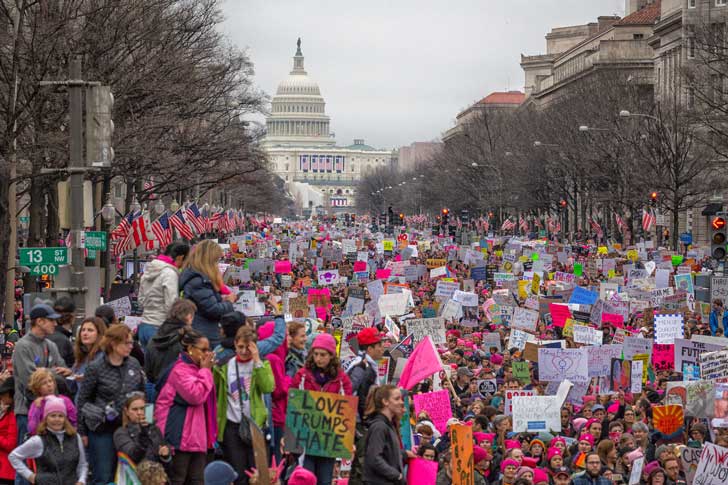
The original event mobilized a massive gathering in Washington, D.C., and a network of similar events in cities across the country. Thousands wore pink knitted “pussy hats” and carried signs reading remarks like “fight like a girl.”
In 2026, Rachel O’Leary Carmona, executive director of Women’s March, said the walkout strategy is an additional tool to support traditional protesting.
“The strategy of the walkout is to show the collective power of the people, organize across workplaces and communities, and make it visible what happens when people come together and withdraw labor, participation, and cooperation,” she told Good Good Good.
“Free America is using real action to test strength and build coordination as a response to the injustice that we are seeing towards our communities.”
So far, there are over 600 events on an interactive map of the country, in every state, and in Puerto Rico.
There are also international events being planned in Canada, France, Italy, and the Netherlands.
“Marches show how many people care. Walkouts show how much power we have,” the Free America website said.
“At this moment, visibility alone isn’t enough. We need action that tests our strength, builds coordination, and proves that non-compliance is a legitimate response to injustice. Global history shows us that a walkout does that. It moves us from expression to pressure, and from outrage to action.”

Carmona said each event will look different “depending on the community and local organizers.”
A vast majority of them will take place throughout the day or will begin at the 2 p.m. mark and include school walkouts; walkouts in which activists march to federal buildings, city halls, local courthouses, and capitals; vigils grieving the freedoms Americans have lost; sit-ins; and more.
On the Free America website, participants are encouraged to wear red, white, and blue.
Organizers said they expect tens of thousands of people to turn out across all of the planned events and see the walkout as a “collective escalation” to “prepare for bigger fights ahead.”
“It tests whether we can move together, organize across workplaces and communities, and build the muscle for non-compliance and action-based resistance,” an FAQ page for the event explained.
“Just as importantly, it brings us together to start building a Free America — a feminist America that is economically just, racially equitable, and safe for immigrants — alongside our coworkers, classmates, family, and friends.”
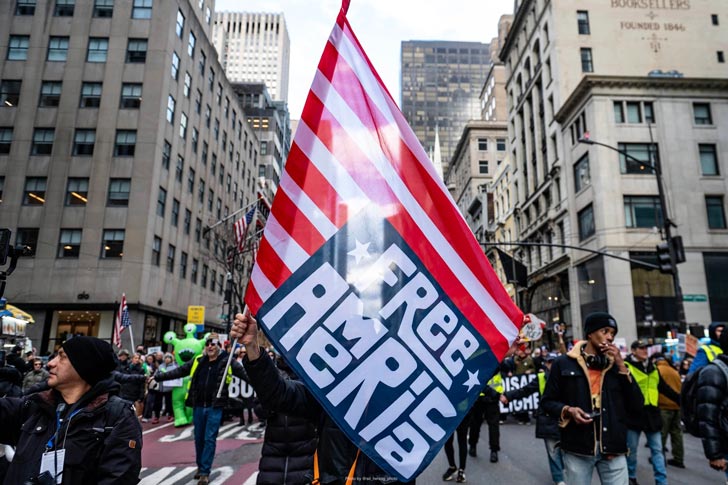
Walkouts typically come with more risk than a standard protest, since workplace rules, contracts, and labor protections vary from person to person and job to job. Organizers say students and workers should consult their institution’s policies or handbook, consult a union representative, and decide the best individual course of action to participate.
“In some workplaces, collective action is protected; in others, especially in at-will employment states, employers have broad discretion,” the event’s website shared, adding that people should never feel pressured to risk their livelihoods.
“Participation can include using your designated break time to step out briefly, joining a community-based gathering before or after work, wearing a symbol of solidarity, or organizing others by adding an event or meeting place to the map,” the website continued.
“Some workers are even participating by using paid time off, sick time, personal days, or unpaid leave. If your workplace is aligned and amenable to it, maybe you can even organize your managers to close up shop briefly!”
For those interested in joining the event, details can be found on the Free America Walkout website, and a reminder of protest safety and rights from the American Civil Liberties Union can be reviewed online.
“Authoritarianism runs on our obedience, and we’re withdrawing it,” Carmona said. “We walk out to disrupt business as usual, to build mutual aid and public service, and to prove that ordinary people still have the power to bend what looks immovable. We walk out because a Free America is the only America worth calling great.”
You may also like: Minneapolis brass band founded after George Floyd's murder helps community heal once again
Header image courtesy of Women's March