The life and legacy of the Rev. Dr. Martin Luther King Jr. have been the subject of ongoing debate ever since his assassination on April 4, 1968.
Today, those invoking King’s memory range from Black Lives Matter organizers and former President Joe Biden to Ukrainian President Volodymyr Zelenskyy. Educators trying to teach Black history call on his principles, even as their opponents claim that lessons about systemic racism go against King’s desire not to judge people “by the color of their skin.”
In an age of polarization, it is worth remembering that one of the pillars of King’s philosophy was pluralism: the idea of multiple communities engaging one another, acknowledging their differences and shared bonds, and striving to create what King called a “Beloved Community.”
As an African American philosopher who studies comparative religion, I am especially interested in what role religious pluralism played in King’s fight for civil rights in the United States of America and human liberation around the world.
A chorus of faiths
King’s worldview was deeply nurtured by his experiences in the Black Church, where the Bible’s stories of freedom and oppression are central. The Book of Exodus, for example, tells the story of Hebrew slaves seeking deliverance, and the message has been a frequent theme in Black hymns and preaching for centuries. In the Book of Amos, the prophet cries out, “Let justice roll down like waters” — which is a line King famously quoted in his “I Have a Dream” speech.
Building off the work of other pioneering Black Christians, King embraced interfaith leadership.
His mentor, Howard Thurman, who founded the Church for the Fellowship of All Peoples, traveled to India to meet with activist Mahatma Gandhi, who was Hindu.
Gandhi’s approach to nonviolent protest was also influential for Mordecai Johnson, president of Howard University, whose sermon on the subject after a trip to India in 1949 profoundly shaped King’s religious philosophy.
The religious diversity of King’s coalitions was evident in events like the 1965 March on Selma, where some participants were severely beaten by police on “Bloody Sunday.”
Marchers came from a chorus of faiths that included priests and nuns, Episcopal seminarians, high-profile Unitarian Universalists like James Reeb, who was murdered days later, as well as Jewish leaders like Rabbi Abraham Joshua Heschel.
Complementing his Black Church upbringing, King was inspired by wisdom across continents and cultures, from the Greek classics and Gandhi, to Buddhist leaders like Thich Nhat Hanh.
Despite their differing dogmas, he hoped leaders from across the religious spectrum and those of no particular faith would join efforts to promote economic and racial justice and stand against imperialism.
‘The great world house’
When King used the word “pluralism,” he assumed that its ideal of belonging had both religious and racial connotations.
For example, King praised the Supreme Court’s decision in Engel v. Vitale, which concluded that public schools could not sponsor prayers, and which segregationist Alabama Governor George Wallace opposed.
“In a pluralistic society such as ours, who is to determine what prayer shall be spoken, and by whom?” King said in a 1965 interview.
More than a decade earlier, during his time at seminary, King had written a paper exhibiting a keen awareness of Christianity’s connections with other faiths: “To discuss Christianity without mentioning other religions would be like discussing the greatness of the Atlantic Ocean without the slightest mention of the many tributaries that keep it flowing.”
Other vivid imagery like “the great world house” underscored how King interpreted all persons and all faiths as living in an interconnected web. Identifying common themes in the discrimination against Indian Dalits, the castes formerly known as “untouchable,” and the plight of African Americans in the U.S., King surmised, “I am an untouchable.”
He also saw parallels between the African American struggle for freedom and the work of labor unions such as the National Farm Workers Association.
“Injustice anywhere is a threat to justice everywhere,” King insisted.
King then, today, tomorrow
King wanted people to embody the highest forms of their own religion and morality. Religion at its best, he thought, promoted peace, understanding, love, and goodwill. This is true of “all of the great religions of the world,” he wrote in a statement for Redbook magazine.
Those were the kinds of ethics King hoped to fulfill in his own Christian ministry, as is clear in his wishes for what might be said at his own funeral.
“I’d like somebody to mention that day that Martin Luther King Jr. tried to give his life serving others,” he said. “I’d like for somebody to say that day that Martin Luther King Jr. tried to love somebody. … I want you to say that I tried to love and serve humanity.”
Yet King’s goal of a world without hunger, war, and racism remains unrealized. Poverty persists. War continues. Black people’s safety is still imperiled.
Resolving current social and political crises in America may require the real integration and power-sharing that King’s radical vision demanded.
However, the debate about King’s pluralist legacy is not only about him, but also about us. How do we want to be remembered? What world are we leaving future generations?
This article was written by Roy Whitaker from San Diego State University, and was originally published on The Conversation.
Header Image by Florida Memory on Unsplash

Martin Luther King Jr. has come to be revered as a hero who led a nonviolent struggle to reform and redeem the United States. His birthday is celebrated as a national holiday. Tributes are paid to him on his death anniversary each April, and his legacy is honored in multiple ways.
But from my perspective as a historian of religion and civil rights, the true radicalism of his thought remains under-appreciated.
The “civil saint” portrayed nowadays was, by the end of his life, a social and economic radical who argued forcefully for the necessity of economic justice in the pursuit of racial equality.
Three particular works from 1957 to 1967 illustrate how King’s political thought evolved from a hopeful reformer to a radical critic.
King’s support for white moderates
For much of the 1950s, King believed that white southern ministers could provide moral leadership. He thought the white racists of the South could be countered by the ministers who took a stand for equality. At the time, his concern with economic justice was a secondary theme in his addresses and political advocacy.
Speaking at Vanderbilt University in 1957, he professed his belief that “there is in the white South more open-minded moderates than appears on the surface.” He urged them to lead the region through its necessary transition to equal treatment for Black citizens.
He reassured all that the aim of the movement was not to “defeat or humiliate the white man, but to win his friendship and understanding.”
King had hope for this vision. He had worked with white liberals such as Myles Horton, the leader of a center in Tennessee for training labor and civil rights organizers. King had developed friendships and crucial alliances with white supporters in other parts of the country as well. His vision was for the fulfillment of basic American ideals of liberty and equality.
Letter from Birmingham Jail
By the early 1960s, at the peak of the civil rights movement, King’s views had evolved significantly. In early 1963, King came to Birmingham to lead a campaign for civil rights in a city known for its history of racial violence.
During the Birmingham campaign, in April 1963, he issued a masterful public letter explaining the motivations behind his crusade. It stands in striking contrast with his hopeful 1957 sermon.
His “Letter From a Birmingham Jail” responded to a newspaper advertisement from eight local clergymen urging King to allow the city government to enact gradual changes.
In a stark change from his earlier views, King devastatingly targeted white moderates willing to settle for “order” over justice. In an oppressive environment, the avoidance of conflict might appear to be “order,” but in fact supported the denial of basic citizenship rights, he noted.
“We merely bring to the surface the hidden tension that is already alive,” King wrote. He argued that oppressors never voluntarily gave up freedom to the oppressed — it always had to be demanded by “extremists for justice.”
He wrote how he was “gravely disappointed with the white moderate … who paternalistically believes he can set the timetable for another man’s freedom.” They were, he said, a greater enemy to racial justice than were members of the white supremacist groups such as the Ku Klux Klan and other white racist radicals.
Call for economic justice
By 1967, King’s philosophy emphasized economic justice as essential to equality. And he made clear connections between American violence abroad in Vietnam and American social inequality at home.
Exactly one year before his assassination in Memphis, King stood at one of the best-known pulpits in the nation, at Riverside Church in New York. There, he explained how he had come to connect the struggle for civil rights with the fight for economic justice and the early protests against the Vietnam War.
“Now it should be incandescently clear that no one who has any concern for the integrity and life of America today can ignore the present war. If America’s soul becomes totally poisoned, part of the autopsy must read ‘Vietnam.’ It can never be saved so long as it destroys the hopes of men the world over.”
He angered crucial allies. King and President Lyndon Johnson, for example, had been allies in achieving significant legislative victories in 1964 and 1965. Johnson’s “Great Society” launched a series of initiatives to address issues of poverty at home.
But beginning in 1965, after the Johnson administration increased the number of U.S. troops deployed in Vietnam, King’s vision grew radical.
King continued with a searching analysis of what linked poverty and violence both at home and abroad. While he had spoken out before about the effects of colonialism, he now made the connection unmistakably clear. He said:
“I speak for those whose land is being laid waste, whose homes are being destroyed, whose culture is being subverted. I speak for the poor in America who are paying the double price of smashed hopes at home, and death and corruption in Vietnam.”
King concluded with the famous words on “the fierce urgency of now,” by which he emphasized the immediacy of the connection between economic injustice and racial inequality.
The radical King
King’s “I Have a Dream,” speech at the March on Washington in August 1963 serves as the touchstone for the annual King holiday. But King’s dream ultimately evolved into a call for a fundamental redistribution of economic power and resources. It’s why he was in Memphis, supporting a strike by garbage workers, when he was assassinated in April 1968.
He remained, to the end, the prophet of nonviolent resistance. But these three key moments in King’s life show his evolution over a decade.
This remembering matters more than ever today.
Many states are either passing or considering measures that would make it harder for many Americans to exercise their fundamental right to vote. It would roll back the huge gains in rates of political participation by racial minorities made possible by the Voting Rights Act of 1965. At the same time, there is a persistent wealth gap between Blacks and whites.
Only sustained government attention can address these issues — the point King was stressing later in his life.
King’s philosophy stood not just for “opportunity,” but for positive measures toward economic equality and political power. Ignoring this understanding betrays the “dream” that is ritually invoked each year.
This article was written by Paul Harvey from the University of Colorado Colorado Springs, and was originally published on The Conversation.
Header Image by the Library of Congress on Unsplash

When a grizzly bear attacked a group of fourth- and fifth-graders in western Canada in late November 2025, it sparked more than a rescue effort for the 11 people injured — four with severe injuries. Local authorities began trying to find the specific bear that was involved in order to relocate or euthanize it, depending on the results of their assessment.
The attack, in Bella Coola, British Columbia, was very unusual bear behavior and sparked an effort to figure out exactly what had happened and why. That meant finding the bear involved — which, based on witness statements, was a mother grizzly with two cubs.
Searchers combed the area on foot and by helicopter and trapped four bears. DNA comparisons to evidence from the attack cleared each of the trapped bears, and they were released back to the wild. After more than three weeks without finding the bear responsible for the attack, officials called off the search.
The case highlights the difficulty of identifying individual bears, which becomes important when one is exhibiting unusual behavior. Bears tend to look a lot alike to people, and untrained observers can have a very hard time telling them apart. DNA testing is excellent for telling individuals apart, but it is expensive and requires physical samples from bears. Being trapped and having other contact with humans is also stressful for them, and wildlife managers often seek to minimize trapping.
Recent advances in computer vision and other types of artificial intelligence offer a possible alternative: facial recognition for bears.
As a cultural anthropologist, I study how scientists produce knowledge and technologies, and how new technology is transforming ecological science and conservation practices.
Some of my research has looked at the work of computer scientists and ecologists making facial recognition for animals. These tools, which reflect both technological advances and broader popular interest in wildlife, can reshape how scientists and the general public understand animals by getting to know formerly anonymous creatures as individuals.
New ways to identify animals
A facial recognition tool for bears called BearID is under development by computer scientists Ed Miller and Mary Nguyen, working with Melanie Clapham, a behavioral ecologist working for the Nanwakolas Council of First Nations, conducting applied research on grizzly bears in British Columbia.
It uses deep learning, a subset of machine learning that makes use of artificial neural networks, to analyze images of bears and identify individual animals. The photos are drawn from a collection of images taken by naturalists at Knight Inlet, British Columbia, and by National Park Service staff and independent photographers at Brooks River in Katmai National Park, Alaska.
Bears’ bodies change dramatically from post-hibernation skinny in the spring to fat and ready for winter in the fall. However, the geometry of each bear’s face — the arrangement of key features like their eyes and nose — remains relatively stable over seasons and years.
BearID uses an algorithm to locate bear faces in pictures and make measurements between those key features. Each animal has a unique set of measurements, so a photograph of one taken yesterday can be matched with an image taken some time ago.

In addition to helping identify bears that have attacked humans or are otherwise causing trouble for people, identifying bears can help ecologists and wildlife managers more accurately estimate bear population sizes. And it can help scientific research, like the behavioral ecology projects Clapham works on, by allowing individual tracking of animals and thus a better understanding of bear behavior.
Miller has built a web tool to automatically detect bears in the webcams from Brooks River that originally inspired the project. The BearID team has also been working with Rebecca Zug, a professor and director of the carnivore lab at the Universidad San Francisco de Quito, to develop a bear identification model for Andean bears to use in bear ecology and conservation research in Ecuador.
Animal faces are less controversial
Human facial recognition is extremely controversial. In 2021, Meta ended the use of its face recognition system, which automatically identified people in photographs and videos uploaded to Facebook. The company described it as a powerful technology that, while potentially beneficial, was currently not suitable for widespread use on its platform.
In the years following that announcement, Meta gradually reintroduced facial recognition technology, using it to detect scams involving public figures and to verify users’ identities after their accounts had been breached.
When used on humans, critics have called facial recognition technology the “plutonium of AI” and a dangerous tool with few legitimate uses. Even as facial recognition has become more widespread, researchers remain convinced of its dangers.
Researchers at the American Civil Liberties Union highlight the continued threat to Americans’ constitutional rights posed by facial recognition and the harms caused by inaccurate identifications.
For wildlife, the ethical controversies are perhaps less pressing, although there is still potential for animals to be harmed by people who are using AI systems. And facial recognition could help wildlife managers identify and euthanize or relocate bears that are causing significant problems for people.
A focus on specific animals
Wildlife ecologists sometimes find focusing on individual animals problematic. Naming animals may make them “seem less wild.” Names that carry cultural meaning can also frame people’s interpretations of animal behavior.
As the Katmai rangers note, humans may interpret the behaviors of a bear named Killer differently than one named Fluffy.
Wildlife management decisions are meant to be made about groups of animals and areas of territory. When people become connected to individual animals, including by naming them, decisions become more complicated, whether in the wild or in captivity.
When people connect with particular animals, they may object to management decisions that harm individuals for the sake of the health of the population as a whole. For example, wildlife managers may need to move or euthanize animals for the health of the broader population or ecosystem.


But knowing and understanding bears as individual animals can also deepen the fascination and connections people already have with bears.
For example, Fat Bear Week, an annual competition hosted by explore.org and Katmai National Park, drew over a million votes in 2025 as people campaigned and voted for their favorite bear.
The winner was Bear 32, also known as “Chunk.” Chunk was identified in photographs and videos the old-fashioned way, based on human observations of distinguishing characteristics — such as a large scar across his muzzle and a broken jaw.
In addition to identifying problematic animals, I believe algorithmic tools like facial recognition could help an even broader audience of humans deepen their understanding of bears as a whole by connecting with one or two specific animals.
This article was written by Emily Wanderer from the University of Pittsburgh, and was originally published on The Conversation.
Header Image by Becca on Unsplash

Ontario, Canada’s 18-year-old Ribal Zebian is no stranger to innovation. Last year, he made headlines for building a wooden electric vehicle while he was still in high school.
Now an engineering student at Western University, he’s set his sights on a new project: A modular home to help alleviate the housing crisis in his home city of London, Ontario.
“We have around 1,800 homeless people, and that number is rising, right?” Zebian said in an interview with CTV News.
He said he wants to help end homelessness, but that he’s also concerned about home prices in general and how they will continue to impact housing in the future.
“Essentially, what I’m trying to do is bring a home to the public that could be built in one day, is affordable, and still carries some architecturally striking features,” he told the London Free Press.
“We don’t want to be bringing a house to Canadians that is just boxy and that not much thought was put into it.”
So, he went to the drawing board and designed a modular home that can reportedly be assembled in just one day.

The home is made of fiberglass panels and thermoplastic polyethylene terephthalate, or PET, foam. He said these choices were made because of how sturdy and replicable they are.
“With fiberglass you can make extravagant moulds, and you can replicate those,” Zebian told CTV News. “It can be duplicated. And for our roofing system, we’re not using the traditional truss method. We’re using actually an insulated core PET foam that supports the structure and structural integrity of the roof.”
Zebian’s current prototype measures 8 feet by 5 feet by 8 feet. It’s a small shelter, but he said it can be scaled up to three times that size, adding that he hopes to begin a larger prototype in the coming months.
According to the London Free Press, Zebian does not see the homes as permanent dwellings but rather a transitional housing option to help get people off the streets.
“These could be removed from the ground … and you could, essentially, change your location,” he said.
But his design process didn’t end with a prototype.

The young innovator plans to live in one of his modular home builds for a full year beginning in May 2026. The goal is to work out any and all issues before actually taking the design to manufacturers. He wants to prove his invention can actually be deployed to help people facing homelessness.
“We want to see if we can make it through all four seasons- summer, winter, spring, and fall,” Zebian told CTV News. “But that’s not the only thing. When you live in something that long and use it, you can notice every single mistake and error, and you can optimize for the best experience.”
Modular homes — often called prefabricated homes — are not a new concept. Many housing organizations have leveraged easy-to-build tiny homes, often built in sections in a factory and later pieced together on-site, to mass-produce housing to confront homelessness or provide shelter in times of disaster.
But with the crisis on the rise, Zebian sees his prototype acting as a necessary addition to the existing homelessness solution infrastructure.
“We need to be quick; we need to be efficient,” Zebian told the London Free Press. “We can’t wait for new opportunities to come; we have to chase those opportunities.”
In the meantime, he is in talks with agencies supporting homeless individuals, hoping to use one of his prototypes as proof of concept for their intended purpose. And once he has lived in one himself, he plans to partner with manufacturers to mass-produce the model and get more people in homes as soon as possible.
Longtime affordable housing advocate Gary Brown is encouraged by what he sees so far.
“Are tiny homes the entire answer? No, but it’s a part of the solution,” housing advocate Gary Brown told CTV News. “I’ve seen quite a few going up in other cities, and it’s something London itself is kind of lagging behind a little bit.”
For Zebian, being a part of the solution is all he wants.
“My purpose,” he writes in his Instagram bio, “is nothing more and nothing less than serving humanity.”
You may also like: Teen creates Rubik's cube-inspired tiny home to help those experiencing homelessness
Header image courtesy of Ribal Zebian/Instagram
Next to the need for safe and supportive housing, people experiencing homelessness are also in desperate need of mental and behavioral healthcare.
To bridge the gap, Albany County in New York is implementing a new program designed to meet unhoused people where they are at.
The county has employed a team of six people: A nurse, a mental health clinician, a case manager, a mental health care advocate, a certified alcohol and substance abuse counselor, and a supervising mental health clinician.
Together, they are a street psychiatry team, working in public spaces to support people in need of care.

“Basically, we’re going to give them their prescription right there, right on the street to go get filled, so they can really get the help that they need,” Albany County Executive Dan McCoy said at a news conference for the program.
“We cannot address the homeless crisis without addressing the mental health crisis.”
While new to Albany, these programs are gaining traction across the country.
As of 2023, there were more than a dozen multidisciplinary teams like these, designed to provide psychiatric care to unsheltered homeless people, according to the American Psychiatric Association.
This approach also eases public safety concerns — one appreciated by all parties.
“Folks that are living on our streets … we need to meet them where they’re at. If we don’t get that clinic to them, we’re just going to continue to see disorder,” the county’s police chief, Brendan Cox, said.
“We can have this whole spectrum of responses that don’t always have to involve the police and start getting people the services they need and increase public health, increase public safety.”
You may also like: New study: Surprising mental health benefits came from Biden-era rental assistance
A version of this article was originally published in The 2026 Mental Health Edition of the Goodnewspaper.
Header image by LOGAN WEAVER | @LGNWVR on Unsplash
Every year since 2007, researchers have conducted the Healthy Minds Study, gathering confidential data about the mental and behavioral health trends of college students.
For the third year in a row, respondents reported decreased rates of depression, anxiety, and suicidal thoughts.
The 2024-2025 study recorded responses from more than 84,000 students at 135 colleges and universities. Results showed continuing declines, including severe depression dropping to 18% in 2025, down from 23% in 2022, and suicidal thoughts decreased to 11% from 15%.
“These sustained reductions tell me this is not a blip,” said Justin Heinze, a co-principal investigator of the study.
“Whether it’s distance from the pandemic, better institutional support, or something else driving the change, I think this is a promising counter-narrative to what seems like constant headlines around young people’s struggles with mental health.”

Staff and faculty at colleges and universities are also surveyed in the annual study. In 2025, about half of faculty and staff said they have conversations with students about mental health, with most saying they recognized worsening trends. However, about half of respondents said they were not confident in recognizing a student in distress.
“These findings underscore both the critical role that faculty and staff are playing in supporting students and the opportunity for institutions to provide training and resources that will strengthen their capacity to respond,” co-principal investigator Sarah Ketchen Lipson said.
“Bringing training into existing spaces where faculty and staff time is required also sends an important message by the institution that mental health is integral to the overall mission.”
Other researchers, like Sasha Zhou, noted that the findings showed disparities still exist among student groups, though research suggests there are solutions to bridge the gap.
“These disparities have been persistent in the last decade and underscore that there’s more work to be done to close the gap in mental health support,” Zhou said.
“Emerging research suggests that affinity-based peer support programs, curriculum-integrated psychoeducation, and adaptations of social/emotional learning approaches show promise in supporting the mental health of underrepresented or overlooked students.”
The study did also find that loneliness and a lack of optimism are still challenges plaguing most students, but mental health service use has remained stable over the last four years, with 60% of students who experienced depression or anxiety symptoms receiving clinical mental health treatment.
Figuring out how to meet students where they’re at will also continue to improve these rates, researchers suggest.
“While overall access to mental health services seems to be similar to previous years, the good news is that students are accessing an increasingly diverse array of resources,” said Daniel Eisenberg, another co-principal investigator on the study.
“Digital and mobile services are evolving rapidly and are now popular among students. An important challenge in the coming years will be to help students make sense of their many options and help them access something that will be a good fit for their needs and preferences.”
You may also like: To combat the youth mental health crisis, this school district lets students text a therapist for free
A version of this article was originally published in The 2026 Mental Health Edition of the Goodnewspaper.
Header image by Keira Burton via Pexels
In recent years, women have dominated sports headlines in a way they truly never have before.
The 2024 Paris Olympics achieved gender parity for the first time in the history of the Games.
In January 2025, the NCAA unanimously approved a women’s March Madness revenue-sharing plan to provide the same compensation the men’s teams have had since 1991.
Last year’s Super Bowl MVP, Jalen Hurts, proudly boasted an all-women management team, onboarding a new slew of fans for the Philadelphia Eagles — and spotlighting career role models for countless young women of color.
In major cities across the country, women are getting their own professional leagues. In 2024 alone, at least 20 teams had their inaugural seasons and three new sports leagues for hockey, volleyball, and professional soccer debuted. And it’s not slowing down, with professional women’s rugby expanding in cities like Denver, Boston, Chicago, Minneapolis, and more.
Even Google’s on board — the search engine now shows men’s and women’s sports updates side-by-side when searching for a team. It used to default to the men’s.
And of course, Ted Lasso himself recently announced the fourth season of the Apple TV+ hit will feature a women’s team (a very apt move considering the show’s star, Jason Sudeikis, can often be seen donning an “Everyone watches women’s sports” t-shirt).
But it took decades for this surge in viewership, support, funding, and success to find women athletes.
In fact, it was just over 50 years ago when iconic tennis player Billie Jean King skyrocketed to fame in 1973 when she won a particularly exciting title against then-No. 1-ranked player Bobby Riggs.
“Riggs claimed the women’s game was so inferior to the men’s game that even someone as old as he was could beat the current top female players,” King’s website describes.

Promoters dubbed the match “The Battle of the Sexes,” and 90 million people across the globe tuned in to watch King take home the victory. It was one of the most-watched television sporting events of all time and is still the most-watched tennis match in history.
“I thought it would set us back 50 years if I didn’t win that match,” King recalled. “It would ruin the women’s [tennis] tour and affect all women’s self-esteem. To beat a 55-year-old guy was no thrill for me. The thrill was exposing a lot of new people to tennis.”
A year later — shortly after the enactment of Title IX — King founded the Women’s Sports Foundation, which has spent the past five decades advocating for all women and girls to reach their full potential in sports. The foundation provides financial support for aspiring champion athletes, groundbreaking research, and educational programming to help communities get girls active.
“I’m so glad I’ve lived long enough to see changes, but we still have so much work to do,” King told SELF Magazine in February of last year. “We really are socialized not to trust our bodies.”
Despite incredible milestones in women’s athletics, King knows this story by heart.
“Girls are behind. We haven’t had as much attention given to us, in this area particularly,” she told SELF. “And I know it because I’ve lived it forever.”
The good news is that now, the tide is turning.
According to reports from UN Women, 73% of people now watch women’s sports, not too far behind the 81% that say they watch men’s sports at the same frequency. The kicker? Over half of women’s sports fans say they began watching within the last three years.
We also know the impact of sports on young women and girls. Research from WSF shows that playing sports has significant positive effects on both mental and physical well-being.
Sports are correlated with decreased levels of depression and anxiety, stronger peer relationships, greater levels of meaning and purpose, positive body image, and lower risks of diseases like cancer and osteoporosis.
It’s clear: Sports are good for girls — and girls are good for sports. So what needs to happen in the next 50 years to ensure that everyone continues watching, supporting, and growing women’s sports? Here are some pointers — and good news — to guide our next moves.
All women must be included in our efforts.
Policies targeting transgender athletes — especially trans women — have swept the country in both statehouses and executive orders from the Trump administration. The NCAA has followed suit, limiting competition in women's college sports to athletes assigned female at birth.
Sex and gender are far more nuanced than these policies make them out to be, and while lawsuits are fighting these discriminatory practices, our job as sports fans, athletes, and human beings is to continue to shift the culture in support of all women athletes.
“Sport can help break down barriers, create understanding, and provide a place to belong,” WSF wrote in a statement.
“It is the power of sport that spurs our mission for all girls and women to have equal access and opportunity to play, regardless of their race, ethnicity, gender identity or expression, sexual orientation, ability, zip code, or family income. We believe humanity wins when all girls and women, including transgender girls and women, have the opportunity to play.”
Women’s sports stories must be uplifted.
Any advancement in women’s athletics is also an advancement for the surrounding ecosystem, including media.
Investment in and airtime for women’s sports on mainstream outlets are vital to ensuring women’s sports stories are told equitably, and that fans have ample opportunity to tune in. But burgeoning forms of nontraditional media deserve the support of fans, too.
Coach Jackie J is a social media content creator who specializes in sharing snappy, entertaining women’s sports stories on TikTok and Instagram, looping in new and old fans alike.
She’s even shared her own backstory about being the only girl on a boy’s soccer team growing up — and how her resilience made her the women’s sports fan she is today.
@jcubedhax a huge lore drop #soccer #woso #germany ♬ Sinking Friendships - Jónsi
“The studies that come out about girls quitting sports always cite a fear of failure and a lack of confidence,” she said in a video. “But hear me when I say: There is nothing braver in the world than trying, especially when you don’t feel confident, and especially when you think you might fail.”
In the print media sphere, a magazine called “Snatch” is “a queer-owned media project at the intersection of women’s sports, art, and culture.”
Founded by Sofia Mitropoulos, it features schedules of women’s sports, a guide to trophies that champions of women’s tournaments might win, a map of women’s sports bars, and a back cover that reads: “It feels good to watch women’s sports grow.”
The first issue sold out within 24 hours of printing.
Women’s health and safety must be prioritized.
For women to feel welcome in athletics, their safety needs to be prioritized — simple as that.
While efforts continue to improve in mitigating abuse and harassment in sports organizations, other considerations are vital to keeping women in the game.
Recently, Yale Medicine announced a first-of-its-kind clinic called the Female+ Athletic Program, which will treat and study common sports injuries that disproportionately affect girls and women, like ACL tears, stress fractures, concussions, and overuse injuries.
A comprehensive team of doctors, physical therapists, sports psychologists, and more, will finally provide women-centered care to athletes.
“I have expertise in surgery, recovery from surgery, and the injuries that lead to surgery. But I don’t have a degree or training in nutrition, adolescent health or gynecology, nonoperative sports medicine or concussion, or psychology,” Dr. Corinna Franklin, the program’s director, said.
“For female athletes, all of these aspects intersect, which makes delivering comprehensive care very important for these patients.”

Another safety issue that uniquely impacts women athletes is cyberbullying, as elite athletes who compete in public-facing competitions are often subjected to sexist and racist remarks online.
Following online harassment during the 2024 Olympics, the global governing body World Athletics offered 25 athletes AI protection on their social media platforms. The AI service identifies potential security threats and filters out inappropriate content to keep athletes safe.
“Many athletes don't know how to react [to] abusive comments online, or measures to protect themselves,” said Valerie Adams, Chair of the World Athletics Athletes’ Commission.
“The more we continue to educate athletes on safeguarding measures, the more athletes will feel comfortable flying the flag for their countries and their sport — on the field of play, and online.”
Women must be given their own spaces to enjoy sports.
While die-hard women’s sports fans might have season tickets to their sporting arena of choice, casual fans are finding their niche among a growing coalition of women’s sports bars nationwide.
Togethxr, a media organization launched by four famous female athletes, created a map that highlights sports bars that exclusively show women’s events.

“In March of 2022, only one sports bar in the world was dedicated to celebrating women’s sports,” the Togethxr website says. Since then, 20 more have opened or will open soon.
“Being able to see somebody that's like us on television screens is huge,” Miranda Spencer, co-owner of Denver’s 99ers Sports Bar, told Westword when the bar became the first of its kind in Colorado in late 2024. “I'm happy we have it now, but I wish we would have had it as children, as well.”
Existing leaders must use their success to bring others with them.
Billie Jean King might have been one of the first iconic athletes who leveraged her athletic career for gender equality, but she certainly wasn’t the last.
Countless acclaimed women athletes are already shepherding us into the athletic world of the future, and with their guidance, future generations are sure to follow.

Take track and field star Allyson Felix, who famously and publicly stood up to Nike after the brand refused her pregnancy protections and allegedly attempted to pay her 70% less after she became a mother. Not only did that result in stronger protections for pregnant athletes at Nike and other brands, it was a catalyst of Felix’s work to curb gender inequality in sports.
After starting her own running shoe line and implementing the first-ever nursery at the 2024 Olympics, Felix launched Always Alpha, a sports management firm dedicated to women athletes.
Upon launching her new venture, Felix told Inc.: “For any woman who has been in this space and who has felt that they have not been focused on, or there hasn’t been a plan specific to them, we hope to be a home for them.”
You may also like: Ilona Maher gets her own Barbie doll, complete with broad shoulders, to inspire young athletes
A version of this article was originally published in The 2025 Sports Edition of the Goodnewspaper.
Header image courtesy of The Sports Bra
As of January 2026, at least half of U.S. states have laws barring transgender student-athletes from participating in school sports under the guise of competitive fairness.
Advocates of sports equity show that there are no competitive advantages — especially among pre-pubescent children and teens — for athletes who identify as trans.
Yet discriminatory laws have led to lower sports participation among young trans athletes — and have become a catalyst for harassment and intimidation of trans youth, who make up 1.4% of young people ages 13 to 17 in the U.S.
And these negative consequences can impact even the most “junior” of leagues.
Portland Community Football Club founder Kaig Lightner, a 44-year-old trans man, organizes youth soccer teams based on skill level, instead of sex or gender.

“When looking at this particular way of structuring sports, the kids themselves let go of the binary ideas of how girls play and how boys play,” the Oregon-based coach told The Guardian.
“I’ve had boys say to me, ‘I thought girls couldn’t play soccer, until I started playing here.’”
One PCFC parent told The Guardian that it was a life-saver for his trans daughter, who was originally told she’d have to join a boy’s league if she wanted to lace up her cleats.
PCFC offered her a safe spot on the team — and a jersey with a Pride flag on it.
“During her first soccer game she couldn’t even really run normally because she was squealing and skipping with joy down the field,” the parent said. “It’s the happiest I’ve ever seen her.”
PCFC welcomes players ages six to 18, so long as they promise to accept their fellow teammates.
The organization is also dedicated to making sports more financially accessible to all young people, moving away from a “pay-to-play” model and instead getting support from partner organizations at the local and national level.

“Too often, youth and families are forced to step away from organized and competitive sports because of the high costs associated with the pay-to-play model,” PCFC shares on its website. “This system hinders progress toward creating more accessible, diverse, and inclusive spaces when young people and their families are unable to participate.”
The club also offers “wrap-around” services, including a food pantry, language translation services, and rides to practice.
“Success grows when access is open, belonging is universal, and opportunities are shared,” PCFC’s website concluded.
By inviting diverse players into one space, experts say, PCFC makes a real, positive difference.
“When sports put together these positive relationships that help make us feel safe and practice being stressed but being able to deal with that stress, you’re truly building resilience in the biological definition of resilience,” said Megan Bartlett, founder of the Center for Healing and Justice Through Sport, and an expert in trauma recovery among children.
“In this country … making sports more accessible to these groups is a public health imperative.”
The kids playing sports don’t realize how vital it is — they are simply delighted to have a place where they can be themselves, trust their bodies, and run free.
“When we signed her up, nobody batted an eye. It felt normal,” the PCFC parent said. “And on the field, she’s just a kid who gets to be on a soccer team, who gets to play soccer with other kids.”
You may also like: Trans vs. cisgender rugby match protests athlete bans through friendly competition: 'We want you on our team'
A version of this article was originally published in The 2025 Sports Edition of the Goodnewspaper.
Header image courtesy of Portland Community Football Club
Terry McCarty was just six years old when he suffered third-degree burns to 70% of his body in a childhood accident.
After the accident, he was in a coma for two months, was hospitalized for a full year, and underwent 58 surgeries — along with endless bullying during his adolescence.
“After the accident I lived in a constant state of fear and uncertainty. I struggled to find work as an adult as people always told me I was a liability, and I had started to believe it,” McCarty told the Daily Mail.
“Becoming a fireman was a spur of the moment decision. I thought if I could do this, people would realize I could do anything.”
Located in Bellingham, Washington, McCarty joined the fire department and survived 12 weeks of grueling training, which included encountering fire again for the first time since he was a kid.

“In the end, I started to realize the fire didn't control me,” he said. “Why should I let fear take over my life?”
McCarty stayed on the firefighting force for two years before deciding to move on to a different role: working with the Burned Children Recovery Foundation at Camp Phoenix.
This program hosts an annual summer camp to provide youth burn survivors with counseling and peer support, as well as funding family support and financial assistance during burn recoveries.
“Fire robbed me of my childhood,” McCarty said. “I wanted to give these children a chance to experience being a kid.”
These days, although McCarty is no longer a firefighter, he organizes motivational speaking programs for firefighting groups and connects firefighters with burn survivors like him.
“As a firefighter, you see the worst of your community, and that could really do a lot of damage to your emotional and mental [health],” McCarty told People Magazine.
“I found a little bit of a niche on the outside of them to where I can still be kind of a part of that circle.”
You may also like: This Altadena teen raised millions for wildfire relief. A year later, she opened a community center for girls like her
A version of this article was originally published in The 2024 Courage Edition of the Goodnewspaper.
Header image courtesy of Burned Children Recovery Foundation
At least once a day for the last week, Minnesota State Senator Zaynab Mohamed, a 28-year-old Somali woman, has posted a video on Instagram.
“What’s up everyone,” she said in a recent post. “It is 12:38 p.m. and here is your update of the day.”
Her updates, if not dispatches from the frontlines of protests against Immigration and Customs Enforcement or coverage of school walk-outs, are a series of action items for community members to do their part to protect those most vulnerable amid ongoing ICE raids.
In one video, she wears a beanie that reads “We Love Our Somali Neighbors.” In another, her headline reads: “I want to show you what it means to be a Minnesotan.”

“For the last few weeks, at least multiple times a day, people ask me, ‘Zaynab, how are you doing? How are you taking care of yourself? How are you even standing?” she reflected in a recent video.
“When people ask me that … I think a lot about this African proverb that says, ‘When you pray, move your feet.’ I’m moving my feet. I’m doing what I can, one day at a time, one food drive at a time, one conversation at a time.”
In addition to being an elected official, Mohamed is part of a local community group called Somali Neighbors, which was formed in response to targeted immigration crackdowns against the demographic.
There are more than 100,000 Somali people living in Minnesota, and 95% of them are either naturalized citizens or born in the United States, according to the Post-Bulletin. Those who immigrated to the U.S. fled brutal civil war. And now, ICE has a target on their backs.
While major news outlets like CBS News report that the current ICE operations in Minnesota have led Somali community members to stay home out of fear, the footage on the ground shows a more nuanced picture.
For instance, a video circulating widely on social media shows Somali neighbors in the crowds of a peaceful protest, carrying foil trays of samosas to share with their neighbors.
“Thank you so much,” protesters cheered, as they walked by bundled in coats. “Stay safe. This is what we need.”
On the evening of January 7, after an ICE agent shot and killed local woman Renee Nicole Good, Mohamed and countless other community members gathered for a potluck.
“I just got some sambusas because people are out here, community is out here, passing food to each other,” Mohamed shared live from a potluck. “It’s pretty peaceful out here.”
Other Somali community leaders, like artist Ayub HajiOmar, haven’t been deterred by the growing ICE presence in Minnesota’s cities, telling the Post-Bulletin that a group of people who fled civil war aren’t “easily intimidated.”
“If you’re able to bounce your way back from that and make your way to one of the most prosperous areas in the world and become lawmakers, and become mayors, that shows just how resilient we are as a community,” he said.

HajiOmar has been able to continue visiting some small Somali restaurants, even with ICE in the area. At Muna Halal in Rochester, Minnesota, Somali customers dined as usual, telling the Post-Bulletin they know their rights.
“When you look at the numbers, when you look at the facts, there’s nothing to be afraid of,” HajiOmar said.
Considering that the majority of the Somali population is in the country legally, he added, “It looks like it’s politically motivated.”
Still, there is a risk to being in public with some 2,000 agents dispersed across the state. The fear many may feel is not unfounded.

But leaders like Mohamed, HajiOmar, and the members and volunteers of Somali Neighbors seem to believe that the work they must do for their community outweighs any anxiety that comes with it.
“Our work is grounded in a simple belief: showing up for neighbors in everyday life matters, especially during moments of heightened fear, misinformation, or division,” the Somali Neighbors website shares.
“Visibility, calm presence, and connection are powerful tools for building trust and reducing harm.”
You may also like: For Minnesotans afraid to leave home during ICE crackdown, this pizza joint delivers free food across the city
Header image courtesy of Somali Neighbors
In 2024, scientists finally pinpointed the deadly virus that has been infecting fungal genomes — and killing countless frogs and toads — for decades.
But that discovery was just the tip of the iceberg when it comes to curing chytridiomycosis, a disease that led to the extinction of 90 amphibian species entirely and infected 500 more.
Like many herpetologists, Australian biologist Dr. Anthony Waddle was eager to join the fight in protecting frogs and toads from the deadly chytrid fungus.
As a rising student at Macquarie University's Applied BioSciences in the Faculty of Science and Engineering, Waddle devised a unique way of protecting local frogs from the fungal disease.
“In the 25 years since chytridiomycosis was identified as a major cause of the global collapse of amphibian populations, our results are the first to provide a simple, inexpensive and widely applicable strategy to buffer frogs against this disease,” Waddle told the Lighthouse, Macquarie University's news journal.
So he built them masonry bricks with frog-sized holes and prescribed them a “spa treatment.”
“The whole thing is like a mini med spa for frogs,” Waddle said. “In these simple little hotspots, frogs can go and heat up their bodies to a temperature that destroys the infections.”
“As with many human diseases, such as influenza, chytridiomycosis is seasonal,” he explained. “Winter is a particularly vulnerable time for frogs, given there are few opportunities to heat themselves up.”
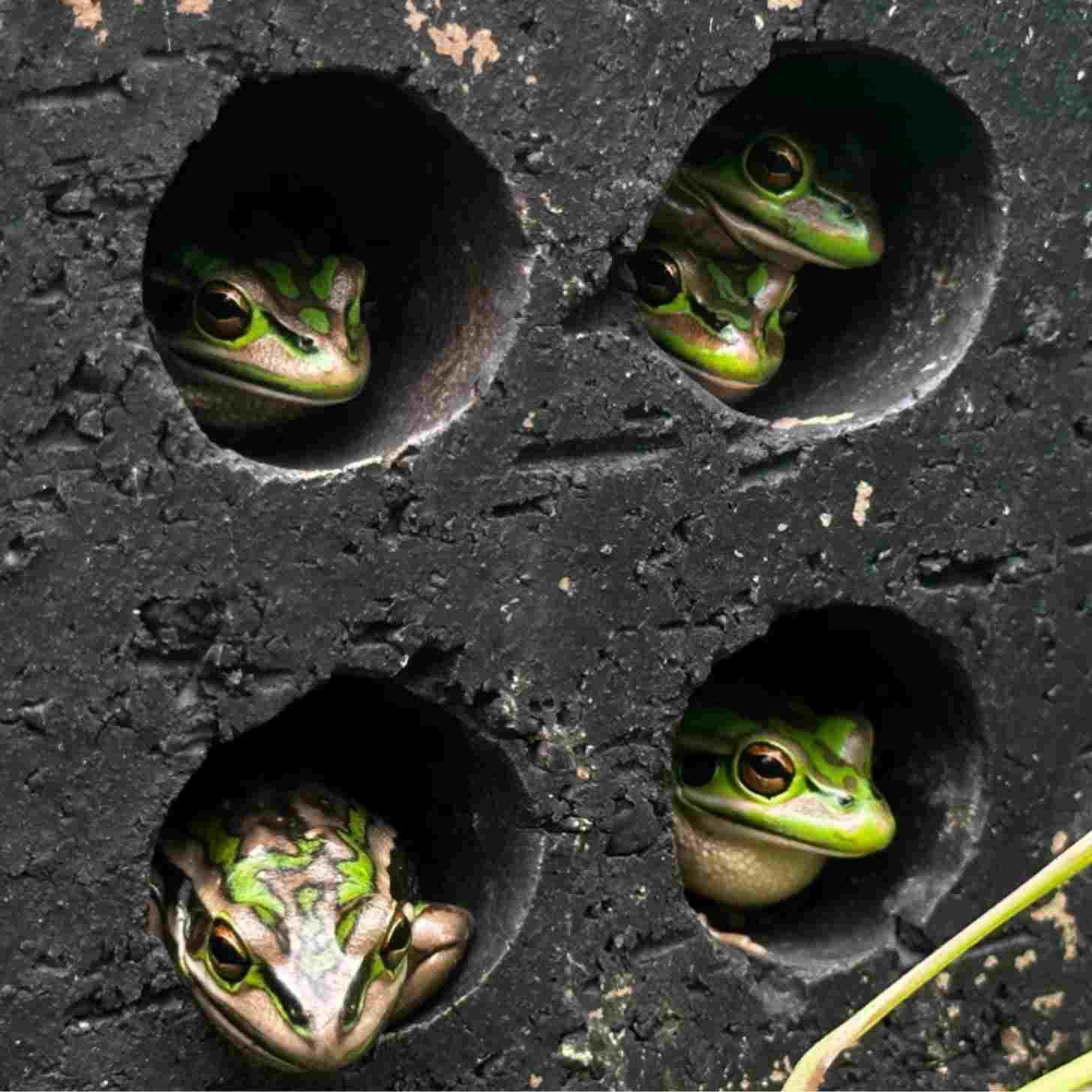
In addition to brick-and-mortar “saunas” which naturally draw heat from the sun, Waddle also constructed small greenhouses out of PVC.
“By making hot spots available to frogs in winter, we empower them to cure their infections, or not even get sick at all,” he said.
Waddles’ central focus of conservation is the green and golden bell frog, an endangered species that has lost more than 90% of its native range since the disease was introduced to the region in 1978.
“[They] used to be very common across eastern Australia,” he said. “They lived in letterboxes and backyards and really adapted to human settlements, before chytridiomycosis came and hammered the population.”
Fortunately, his frog saunas helped the endangered species turn a corner.
Not only were they hot enough to elevate frogs’ body temperatures and help them clear infections, but frogs that recovered in the saunas became resistant to chytridiomycosis and remained resistant, even as temperatures dropped for the winter.
“Our results provide a simple, inexpensive, and widely applicable strategy to buffer frogs against chytridiomycosis in nature,” Waddle and his peers wrote in their study, which was published in the scientific journal Nature.
“Habitat protection alone cannot protect species that are affected by invasive diseases, but simple manipulations to microhabitat structure could spell the difference between the extinction and the persistence of endangered amphibians.”
Acknowledging that frog saunas alone wouldn’t cut it, Waddle has also expanded his research to include immunization and synthetic biology.
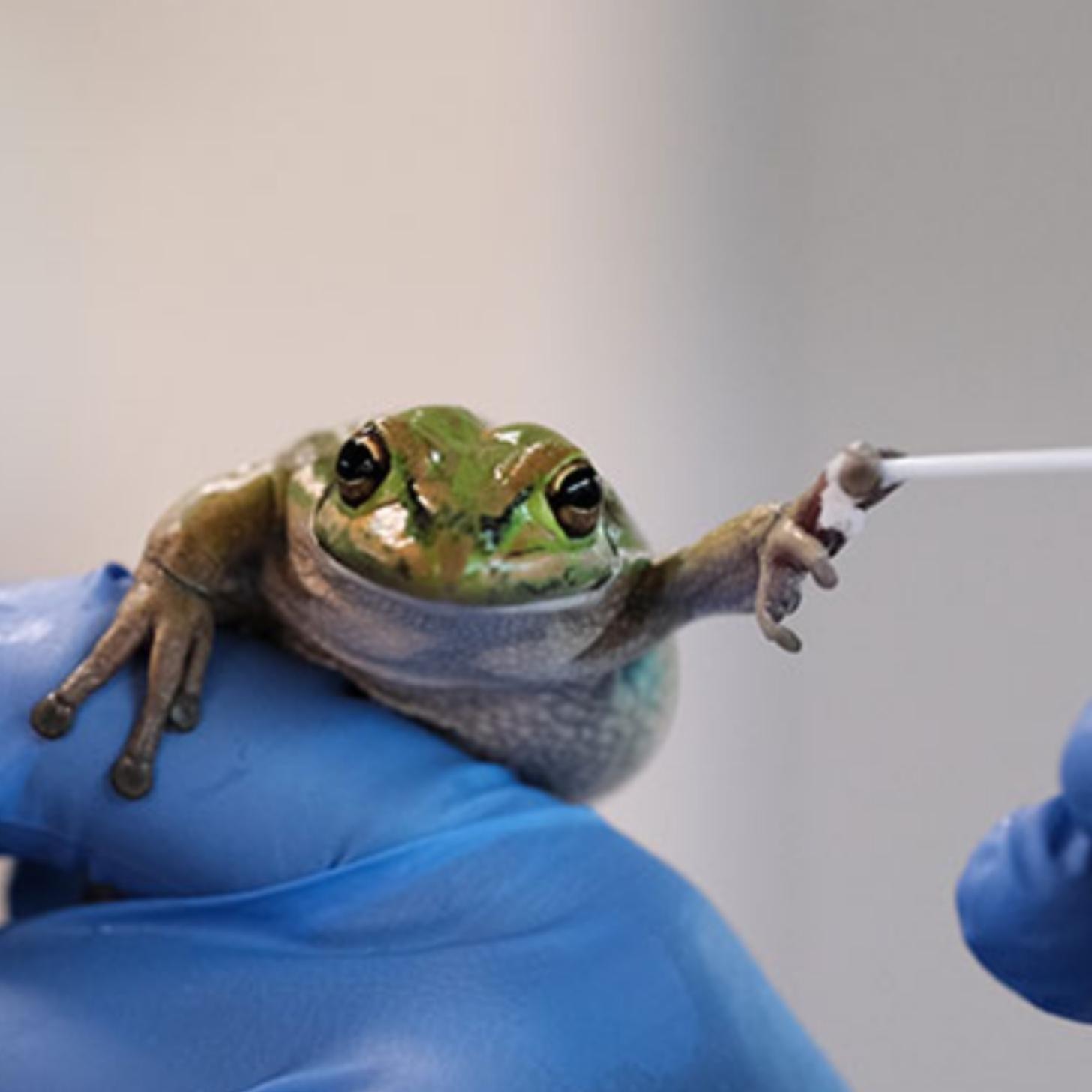
In addition to leading gene replacement trials, Waddle has spent the past year raising and vaccinating hundreds of green and golden bell frogs.
Waddle told the Guardian that when they are released, it will be “probably the largest input of frogs in that population in a decade.”
Last summer, Waddle was rewarded for his conservation efforts with the 2025 Future for Nature award.
With the prize money, Waddle opened two “frog hospitals” in Greater Sydney so that vulnerable frogs awaiting vaccination could stay there ahead of winter chytrid outbreaks.
He’s also delivering vaccinations across the east coast of Australia and working long hours in the lab to “unravel the genetic mechanisms that could be key to providing permanent solutions to the challenge of chytrid.”
“We need to future proof our conservation efforts and genetic resistance will be key,” he told Future for Nature.
You may also like: Tiny 'underwater hotels' for sea creatures help scientists collect 20 new species in ocean's twilight zone
Header image via Macquarie University
Animal-based food systems come with a huge carbon footprint. And we can’t just blame it on cow farts and sheep burps. Livestock production expends heaps of energy at every level: crops are grown and converted into feed for animals, which are then consumed themselves — instead of feeding consumers the plant-based food directly.
And a new study adds credence to the environmental benefits of going vegan. The study, published in Nature Food, reveals that vegan diets use 54% less water and contribute to 66% less biodiversity loss.
“It’s an important piece of work,” Diego Rose, a nutrition researcher at Tulane University, told WPLN News.
Rose published a study with similar findings in April 2023, after analyzing the carbon footprints of six types of diets: omnivore, vegetarian, pescatarian, vegan, keto-style, and paleo-style.
The nutritionist found that vegan diets had 40% less greenhouse gas emissions than vegetarian diets, 60% less than pescatarian, and 70% less than omnivore diets.
“Even accounting for changes in practices around the world, it’s still the case that eating less meat is better for the planet,” Rose said.

Globally, more and more people are considering going vegan — or at least adopting more plant-based food in their diet. Although surveys vary on the popularity of veganism, consumer sales tell a different story. Between 2017 and 2023, U.S. retail sales of plant-based foods jumped from $3.9 billion to $8.1 billion.
Rose sees it as a promising step forward.
“We, all of us, need to change our diets to be able to meet our climate objectives,” Rose said.
A version of this article originally appeared in the 2025 Food Edition of the Goodnewspaper.
Header image via Vanessa Loring
The Global Foodbanking Network is a nonprofit that supports food banks in more than 50 countries through food recovery and redistribution. In the fall of 2024, they released an annual impact report that broke down the year’s successes.
Their metrics showed that — in addition to providing over 1.7 billion meals to 40 million people in need globally — food banks also diverted an estimated 1.8 million metric tons of carbon dioxide.
By intercepting unspoiled food destined for the landfill, and redistributing food from local farms and wholesale produce markets, the 2023 report offered evidence that community-led solutions to addressing global hunger can also help protect the globe itself.
“Nearly a third of the world’s food is lost or wasted at the post-harvest, retail, and consumer levels, never reaching the people who need it,” the GFN team wrote in the report.
“Food loss and waste proves costly for producers, takes up space in landfills, and emits harmful greenhouse gases, intensifying climate change.”
Food waste occurs all the way down the supply chain: from unharvested crops to food that’s packaged and never eaten.

Supermarket chains are some of the worst offenders of food waste; habitually tossing imperfect food that’s deemed ugly, slightly damaged, or “nearly” expired — and sending it to landfills to rot and release methane.
“Food banks offer an effective solution to this problem,” the GFN report continued, “[by] partnering with producers and actors at all stages of the supply chain to recover wholesome surplus food and redirecting it to people facing hunger.”
A version of this article originally appeared in the 2025 Food Edition of the Goodnewspaper.
Header image via Julia M Cameron / Pexels
Same-sex sexual behavior is not just for humans.
In fact, as of today, scientists have documented more than 1,500 species that engage in same-sex sexual activities, including whales, penguins, fish, and sheep.
And a new study, published in the journal Nature Ecology & Evolution, scientists have shared the most comprehensive review of same-sex behavior in primates in scientific history.
The research analyzed data from 491 non-human primate species, including chimpanzees and macaques. Of those 491 species, they documented same-sex behavior in 59 and declared it “common” among 23.
They also explored the links between same-sex behavior and ecological conditions and social structures among apes and monkeys.
“Same-sex sexual behavior is widespread across non-human primates, but we see different patterns of social behaviors and interactions across the different species,” lead author Chloe Coxshall, of Imperial College London’s Georgina Mace Centre for the Living Planet, said.
“Our study shows how these patterns are influenced by environmental factors, as well as by the social systems that the primates live in.”

Past research has documented that macaques, bonobos, and chimps engage in same-sex behavior, but this new research provides a comprehensive review of these behaviors across various species and investigates what purpose they might serve.
The researcher’s finding suggests that same-sex behavior in primates developed through evolution as a way to allow the animals to reduce conflict and build bonds in complex social groups.
The behaviors were present in both male-male and female-female relationships, but they were more likely in species living in drier climates, with scarce food resources, or under greater pressure from predators.
Species with noticeable differences between males and females, longer lifespans, or complex social lives were also more likely to engage in same-sex behavior.
As a result, the researchers concluded that same-sex behavior may be helpful in forming alliances and maintaining cohesion within groups, even managing conflict and easing tension. It can therefore be seen as an evolutionary advantage, given that these behaviors likely stemmed from the need to navigate complex societies.
Vincent Savolainen, director of the Georgina Mace Centre for the Living Planet, said same-sex behavior can also act as a “currency” for some primates and is used to increase opportunities and share resources.

“What we found shows that same-sex is not like something bizarre, aberrant, or rare,” Savolainen said. “It’s everywhere, it’s very useful, it’s very important.”
Previous research of rhesus macaques has indicated that same-sex behavior could be heritable. Savolainen’s study concludes that although genetic predispositions may exist, the behaviors are strongly influenced by ecological and social pressures.
That said, the findings shouldn’t be translated onto LGBTQ+ humans.
“In humans, it may not be food scarcity or rigid social hierarchies that drive these patterns, but rather the pressures of modern social living,” the researchers wrote in the study.
But that doesn’t mean humans are completely unrelated.
“It would be interesting to explore further how different environmental and social factors have influenced how these behaviors have evolved in human societies as well in nonhuman primates,” Savolainen said in a statement for Imperial College London.
For now, in a field of study still seeking to understand the behaviors of our primate counterparts, the new study sure is illuminating.
“There was a time where people would think this is only happening when you put two baboons in a zoo that can’t do anything else,” Savolainen told Scientific American. “So, yeah, things are changing.”
You may also like: New study reveals that 1,300 new species have been added to the global mammal count
Header image by Nicole Arango Lang via Unsplash
As one of the co-founders of Food Not Bombs, a volunteer-run collective, Keith McHenry has been arrested nearly 100 times and spent over 500 nights in jail — all for feeding people without a permit.
His first arrest occurred on August 15, 1988, when McHenry and eight fellow volunteers were detained at Golden Gate Park in San Francisco for distributing free vegetarian meals to people experiencing homelessness.
The offense? A picnic ordinance violation.
“Right now there’s roughly over 50 cities that have actually banned or limited the distribution of free food in public,” McHenry told Responsible Eating and Living. “And it’s not limited to Food Not Bombs — but frequently Food Not Bombs is the target of these actions.”
McHenry said the laws surrounding food permits change constantly — and are severely limited in timespan.
“More recently we’ve seen new restrictions in Columbia, South Carolina where they are demanding we pay $125 a week for a permit,” McHenry said. “We have to apply for a permit every week to share food there. We’ve been sharing food there for decades.”
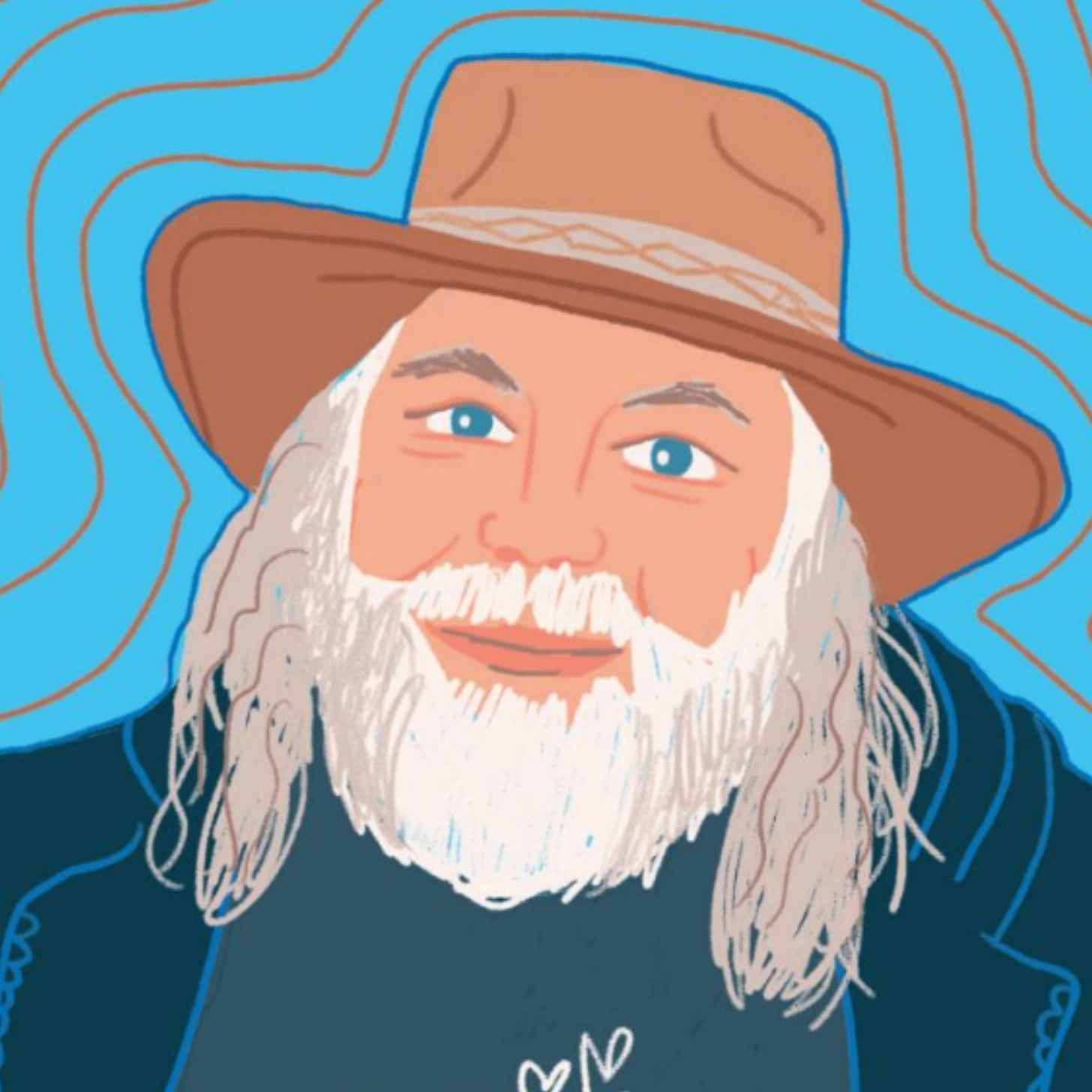
McHenry’s many arrests haven’t deterred him from his mission to give food to the people who need it most, including those displaced by war, political strife, and natural disasters. And he knows the work is far from done.
Nearly 40 years after Food Not Bombs was first founded, the organization now operates in 1,000 cities around the world. Though each chapter differs in size, scale, and operation, they are unified under the same mission statement: “Food is a right and not a privilege.”
A version of this article originally appeared in the 2025 Food Edition of the Goodnewspaper.
Header images via Food Not Bombs
“I’m pretty sure the sluts are gonna save us,” Instagram influencer Jess Olivia Fox said in a recent video.
She is referring to the folks at Minneapolis sex shop Smitten Kitten, who have mobilized to support neighbors amid a violent and unrelenting crackdown by the Trump administration’s Immigration and Customs Enforcement agency.
Over the last week, thousands of ICE agents have been deployed to Minnesota. In this time, a United States citizen was shot and killed by a federal agent, at least 2,400 people have been arrested by immigration officials, students have walked out of school in protest and in fear, and just last night, another person was shot in the leg after allegedly assaulting an ICE officer.
Minnesota Governor Tim Walz has called for peaceful protest and asked for the federal government to “end its occupation,” while President Trump threatened to invoke the Insurrection Act on Minnesota protesters.
In the throes of political debate, and at the mercy of an occupying force across the Twin Cities — and the surrounding metro area — community members are organizing rapidly.
Smitten Kitten, located in Uptown Minneapolis, is one group leading the charge.
“Normally, we’re selling adult toys, providing sex education, and [running] a business,” Mikayla, a representative of the shop, told Substack creator and social media journalist Jolly Good Ginger.
But, now, inside the shop, volunteers are organizing canned foods, diapers, clothes, and other essentials to be distributed to vulnerable community members.
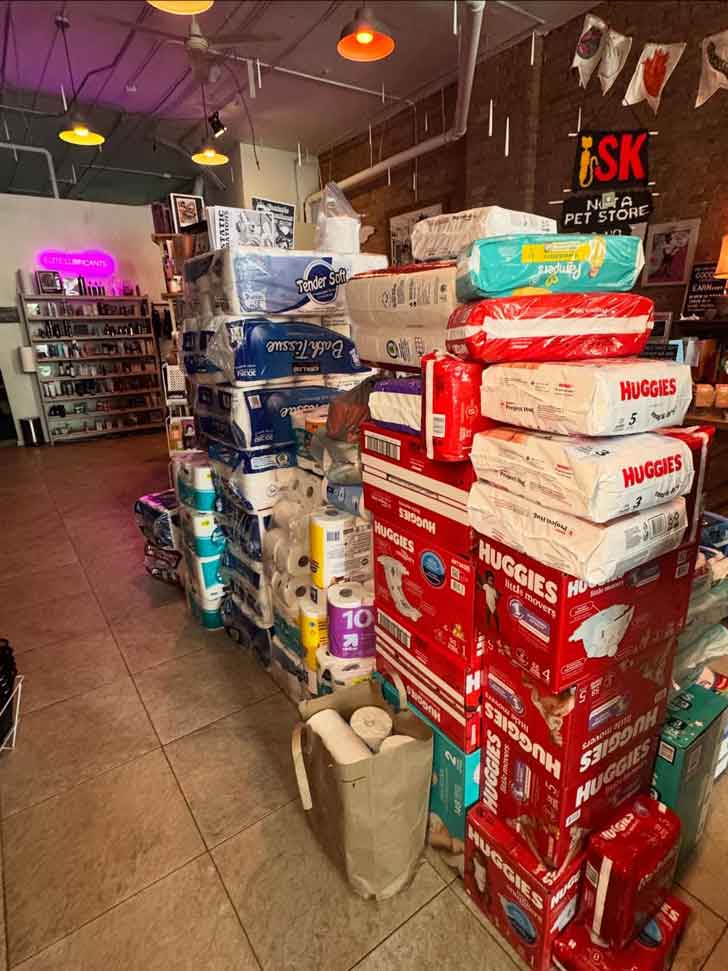
“We are raising funds and supplies for families that are stuck at home because they’re scared of the ICE presence in the city or their kids are out of school because the schools are closed down,” Mikayla explained.
“We’re just trying to make sure that everybody’s fed, every baby has a diaper on them that’s clean, and has baby formula. That’s all we’re trying to do.”
Every day, the shop’s Instagram page has been leveraging its platform to boost donation opportunities for community members in the area, sharing GoFundMe, Venmo, and Cash App campaigns.
“We’ve been filling them up, a couple grand at a time,” Mikayla said. “We’ve been trying to help people get their rent paid from not being able to work, get food in their refrigerator.”
Workers at the shop take to Instagram every day with a new ask.
“Hey guys, it’s Anne,” one person started a video. “I’m reporting live from Diaper Mountain. Usually we’re an adult store, but today we’re gonna be pushing Venmos of families that need resources immediately.”
It’s unclear how much has been raised in recent days, but even before the ICE crackdown escalated this January, Smitten Kitten was fundraising for immigrant community members.
In December, community members helped raise over $18,000 for Isuroon, a nonprofit that supports Somali women in Minnesota.
“Do you hate ICE? Do you love personal massagers? This Sunday … 100% of our profits at Smitten Kitten are going to securing immigration attorneys for 500+ local Somali and East African families at risk for deportation,” Anne said in a video in December.
In just one day, the community had raised $15,000.
“We broke a Smitten Kitten record,” Anne said. “We broke the record of how much we’ve raised in one day.”
That generosity has only amplified in the weeks since.
The shop is also partnering with neighboring businesses, like Wrecktangle Pizza, to make sure people are being fed. And volunteers are standing outside of the shop to protect anyone coming in or out from ICE agents in the immediate area.
“We have people reaching out to us who need help, and we have people reaching out who want to provide help,” JP, another representative of the shop, shared on social media this week.
And for Fox, who isn’t even local to Minnesota but is amplifying Smitten Kitten’s efforts, this grassroots community work reaches so much farther than Lyndale and Lake Streets.
“Right now, community and coming together and helping each other is probably the most important thing we can focus on,” Fox continued in her video. “And fight fascism, you know?”
“We built these platforms for a reason,” she concluded in her caption. “Now is the time to use them.”
You may also like: At risk to their own safety, Somali neighbors feed ICE protesters: 'This is what it means to be a Minnesotan'
Header images courtesy of Smitten Kitten/Instagram
In 2021, Minnesota brass band Brass Solidarity was formed in response to the murder of George Floyd — and the ongoing Black Lives Matter movement.
Their goal was simple: To bring people together to promote social justice through music.
For more than four years, the diverse group of musicians has met weekly on Mondays, performing in George Floyd Square, and occasionally at rallies and protests for a myriad of causes, as well as picnics and parades.
But on January 12, the Monday following the death of Renee Good, a local woman shot and killed by an Immigration and Customs Enforcement officer, the group gathered at a memorial for the fallen neighbor.
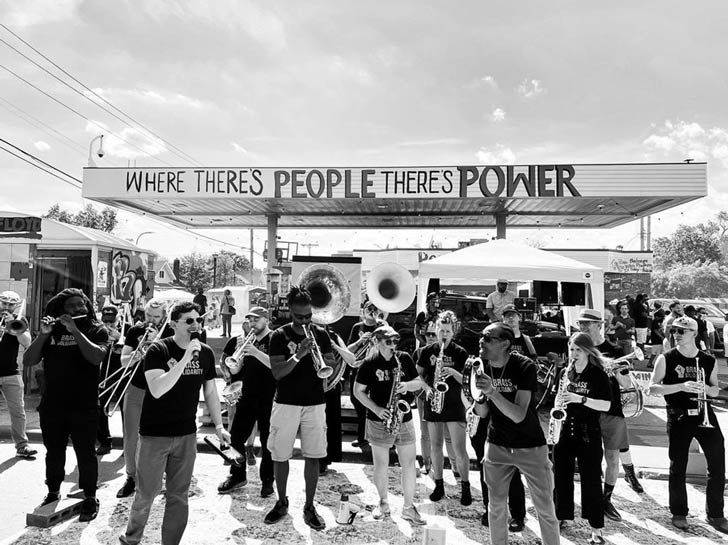
As sousaphones bellowed and tambourines jingled, a group leader, Alsa Bruno, sang into a megaphone, his voice raspy and passionate.
“I ain’t gonna let no scared ICE agent turn me ‘round,” he sang. “Ain’t gonna let no ‘fraidy cat ICE agent turn me ‘round. I’m gonna keep on walkin,’ I’m gonna keep on talkin’ … until freedom rings.”
A video of the performance has circulated on social media in the days since, with comments praising the “good trouble” and “good energy” of the band, saying that their music is “the antidote” to ICE’s occupation in the Twin Cities.
It’s a sentiment the group echoes.
“It was an honor to bring our gifts to Renee Good’s memorial space,” they shared in a social media post. “Grateful for the healing power of music!”
“What Brass Solidarity is, what it represents, is communal necessity,” Bruno said in an interview with City Cast Twin Cities. “We’re joining up at the site of George Floyd’s murder, just playing music to process … feelings with community. And it kept growing.”
Bruno believes this work is especially relevant in times of grief and crisis.
“Audre Lorde said it is the duty of the artist to make the rebellion irresistible,” Bruno said.
“By coming together in music, by coming together in dancing, even when we’re sad, by moving our bodies, by letting trauma not stay locked up inside of us, so we don’t stay trapped in our house with ulcers — instead of that, [we’re] offering ourselves the light of letting out our sound, just expressing.”
For Brass Solidarity, the performance of music is equally as important as the people coming together to express themselves and move through the emotions they find themselves at the mercy of. He said “literally anyone who wants to join can join” the band.
In a sit-down conversation with City Cast Twin Cities, Bruno continued speaking to the power of finding one’s role in a community and being a good neighbor.
First, he instructed his community members to be more open to “finding the silver linings,” positing that moments of joy help people move forward another day.
“What’s important for us as a community brass band is we make sure everyone knows it’s okay to not go today,” Bruno said, of people participating in Brass Solidarity — and participating in activism in general.
“That’s your courage,” he said, adding that sometimes “courage says … ‘Today what I’m gonna do is lock my doors … and what I’m gonna do is watch joyful TV and laugh loud.’ And I’ll hear my laugh echoing so loud, that when I come out of this house, I don’t feel like I’m skirting around, wondering if someone’s looking for me.
“Instead,” Bruno continued, “I am resourced enough to stand on my feet, and see someone with a vest and a megaphone, and talk to them. I’m resourced enough to love my dog enough to let them on a walk, I’m resourced enough to go get groceries for my neighbors who can’t. There’s more to do than just the big things.”
He said that, in a bombardment of so much “negativity,” kindness, joy, and love, make it significantly easier for people to show up and contribute in the best ways available to them.
And the best way for Bruno, it seems? Singing for all to hear.
“We are a cohort of immigrants, of strangers, who want to see this place be free, to see this place be a place where we all can sing,” he said at the memorial vigil. “Music plays the role of giving us a heartbeat that we can keep holding onto, so that we can protect ourselves, protect each other, just one more day.”
You may also like: Amid ICE crackdown, this Minneapolis sex shop has transformed into a donation center for neighbors in need
Header image courtesy of Brass Solidarity/Facebook
On Tuesday, January 20, 2026 — the nine-year anniversary of the first Women’s March, a new era for the activism event will unfold nationwide.
Women’s March, 50501, FEMINIST, and other organizations are hosting the “Free America Walkout,” urging participants across the United States to walk out of work or school at 2 p.m. local time.
“Activists will organize walkout teams, contact neighbors and classmates, host mutual aid and community actions, and engage in public service as a way to block authoritarian violence and authoritarian rule against immigrants, families, and workers and make the stakes of this moment clear,” a statement from the organizers described.
They added that the action comes amid “a rapid series of escalations, including immigration raids, expanded militarization, attacks on workers and families, and the use of fear and force to silence dissent.”
It’s a stark call to action compared to the first Women’s March, held in 2017, when President Donald J. Trump was sworn into office the first time.

The original event mobilized a massive gathering in Washington, D.C., and a network of similar events in cities across the country. Thousands wore pink knitted “pussy hats” and carried signs reading remarks like “fight like a girl.”
In 2026, Rachel O’Leary Carmona, executive director of Women’s March, said the walkout strategy is an additional tool to support traditional protesting.
“The strategy of the walkout is to show the collective power of the people, organize across workplaces and communities, and make it visible what happens when people come together and withdraw labor, participation, and cooperation,” she told Good Good Good.
“Free America is using real action to test strength and build coordination as a response to the injustice that we are seeing towards our communities.”
So far, there are over 600 events on an interactive map of the country, in every state, and in Puerto Rico.
There are also international events being planned in Canada, France, Italy, and the Netherlands.
“Marches show how many people care. Walkouts show how much power we have,” the Free America website said.
“At this moment, visibility alone isn’t enough. We need action that tests our strength, builds coordination, and proves that non-compliance is a legitimate response to injustice. Global history shows us that a walkout does that. It moves us from expression to pressure, and from outrage to action.”

Carmona said each event will look different “depending on the community and local organizers.”
A vast majority of them will take place throughout the day or will begin at the 2 p.m. mark and include school walkouts; walkouts in which activists march to federal buildings, city halls, local courthouses, and capitals; vigils grieving the freedoms Americans have lost; sit-ins; and more.
On the Free America website, participants are encouraged to wear red, white, and blue.
Organizers said they expect tens of thousands of people to turn out across all of the planned events and see the walkout as a “collective escalation” to “prepare for bigger fights ahead.”
“It tests whether we can move together, organize across workplaces and communities, and build the muscle for non-compliance and action-based resistance,” an FAQ page for the event explained.
“Just as importantly, it brings us together to start building a Free America — a feminist America that is economically just, racially equitable, and safe for immigrants — alongside our coworkers, classmates, family, and friends.”
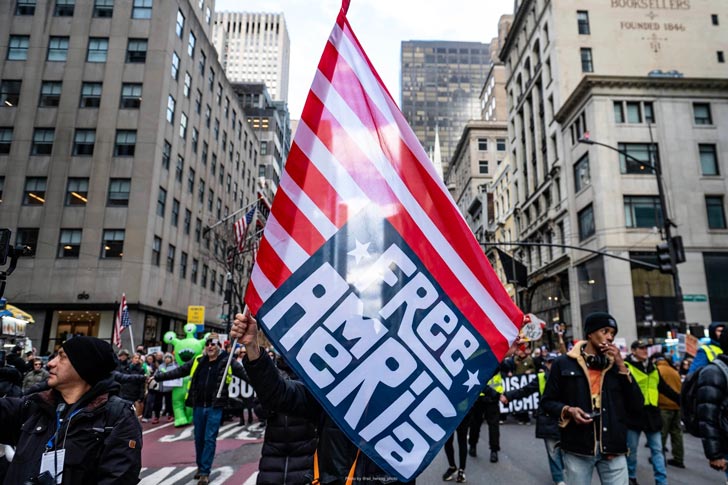
Walkouts typically come with more risk than a standard protest, since workplace rules, contracts, and labor protections vary from person to person and job to job. Organizers say students and workers should consult their institution’s policies or handbook, consult a union representative, and decide the best individual course of action to participate.
“In some workplaces, collective action is protected; in others, especially in at-will employment states, employers have broad discretion,” the event’s website shared, adding that people should never feel pressured to risk their livelihoods.
“Participation can include using your designated break time to step out briefly, joining a community-based gathering before or after work, wearing a symbol of solidarity, or organizing others by adding an event or meeting place to the map,” the website continued.
“Some workers are even participating by using paid time off, sick time, personal days, or unpaid leave. If your workplace is aligned and amenable to it, maybe you can even organize your managers to close up shop briefly!”
For those interested in joining the event, details can be found on the Free America Walkout website, and a reminder of protest safety and rights from the American Civil Liberties Union can be reviewed online.
“Authoritarianism runs on our obedience, and we’re withdrawing it,” Carmona said. “We walk out to disrupt business as usual, to build mutual aid and public service, and to prove that ordinary people still have the power to bend what looks immovable. We walk out because a Free America is the only America worth calling great.”
You may also like: Minneapolis brass band founded after George Floyd's murder helps community heal once again
Header image courtesy of Women's March
Eileen Higgins won a historic victory in December. She became the first woman ever elected mayor of Miami, as well as its first Democratic mayor since 1997.
Although the stakes in the city’s Dec. 9, 2025, runoff election were high, interest was not — 4 in 5 registered voters stayed home.
Low turnout is common in municipal elections across the country. While much of the nation’s political attention stays focused on Washington, the leaders who control the nation’s streets, schools, and neighborhoods are typically chosen by a small fraction of citizens.
Although many Americans can identify their U.S. senators or members of Congress, far fewer can name even one of their local elected officials, such as a city council member. To cite one example, a North Carolina study found that 86% of state residents could not identify their own elected leaders, including local government officials.
Turnout in local elections regularly falls below 20%, often leaving critical decisions in the hands of small, unrepresentative groups, creating an electorate that’s disproportionately white, elderly, and affluent.
My research as a political scientist suggests an overlooked factor explains why some people engage with their communities while others tune out: local patriotism, or how they feel about their town.
The power of local patriotism
For my book “Patriotism and Citizenship,” I commissioned a nationally representative survey of 500 Americans. We asked a simple question: How do you feel about the town you live in?
Those who responded could choose from five options, ranging from “hate it” to “love it.”
About half said they “liked” their town, 20% loved it, but a full quarter expressed no positive feelings whatsoever; 3% said they outright “hated” where they lived.
Such attitudes have real-world effects. Even after accounting for factors such as age, education, income, and general interest in politics, loving one’s town strongly predicted participation in local politics.

People who loved their town were more likely to attend city council meetings, contact local officials, volunteer for campaigns, and discuss local issues with friends. The same pattern held for civic participation — from volunteering with community groups to organizing neighborhood cleanups.
Local patriotism also correlated strongly with trust in local government.
Determining the stakes
To test whether these feelings actually change civic behavior, I ran two experiments.
Participants were first asked to identify the biggest problem facing their town. Some mentioned traffic congestion, others cited crime or homelessness. Then came the test: Would they donate $1 they’d earned for taking the survey to help solve that problem?

In the first experiment, one group was asked, “Thinking about feelings of love or hate toward your town, would you like to donate this $1 to help your town solve the problem that you just listed above?”
The other group received no such prompt about their feelings and was just asked to donate to solve the problem.
The results were striking. Among those primed to consider their feelings about their town, 18% gave away their payment. In the control group, just 3% donated — a sixfold difference.
A second experiment replicated this finding. When people were prompted to think about loving their town, 8% donated. Even asking them to consider feelings of hate led 5% to give. But in the control group with no emotional prompt? No one donated.
Why this matters for democracy
Local patriotism appears to address a fundamental puzzle in political science: why anyone participates in local politics at all. The time and effort required almost always exceed any tangible benefit an individual would receive.
But when people care deeply about their community, the calculation changes. The emotional reward of helping a place you love becomes a plus. The sacrifice feels worthwhile, not because it will definitely make a difference, but because you’re investing in something that matters to you.
This has important implications. The positive feelings people have toward their community translate directly into civic engagement, without the risk of increasing negative feelings such as jingoism or xenophobia.
For local leaders frustrated by low turnout and apathy, the message is clear: Before asking residents to show up, give them reasons to care. Build pride of place, and engagement will follow.
The good news is that local attachment isn’t fixed. My experiments showed that simply prompting people to think about their feelings toward their town could motivate civic action.
A few ways to foster local patriotism
Here are some strategies that can help foster local patriotism:
• Create civic rituals: Regular community events, from farmers markets to fireworks, build emotional ties to place.
• Celebrate iconic places: Whether it’s a waterfall, clock tower, or mountain view, promote the landmarks that symbolize your community. These shared images give residents a common point of pride and visual shorthand for what makes their town special.
• Bring children to community events and have them participate in local organizations: Parents who take their kids to town festivals, parades and events, or sign them up for youth art and sports programs, aren’t just keeping them entertained. They’re building the next generation’s emotional connection to place and creating civic habits that can last a lifetime.
The evidence shows that emotional connection to community is a powerful, but largely untapped, resource for strengthening democracy from the ground up.
In an era of declining civic engagement and deepening partisan divisions, fostering local patriotism might be exactly what the country needs.
This article was written by Sean Richey from Georgia State University, and was originally published on The Conversation.
Header Image by Land O'Lakes, Inc. on Unsplash

Every day the Good Good Good team collects the best good news in the world and shares it with our community. Here are the highlights for this week!
If you want to get good news in your inbox every day, join the Goodnewsletter — the free daily newsletter designed to leave you feeling hopeful.
The Best Positive News We’re Celebrating This Week —
Presbyterian churches in Pittsburgh canceled $14 million in medical debt for their neighbors
Congregants at more than 100 Presbyterian churches in the Pittsburgh area donated nearly $75,000 to cancel more than $14 million in medical debt for an estimated 12,500 Allegheny County residents.
The campaign was organized with Undue Medical Debt, which buys medical debts for pennies on the dollar — so each dollar donated can erase more than $100 in debt.
Recipients of the debt relief will receive a letter in the mail informing them their debt has been cleared.
Why is this good news? An estimated 690,000 Pennsylvania residents have outstanding medical debt, with an average amount of $1,000. Medical debt is one of the leading causes of bankruptcy, and these churches just brought immense relief to thousands of their neighbors.
→ Read more
You may also like: After his wife died, he raised $1M to honor her dying wish: Clearing the medical debt of strangers
How are we going to survive 2026? Here’s what 3 therapists recommend
→ Read more
‘GlamourGals’ group fosters community, builds empathy, and combats loneliness among high schoolers and seniors
With hundreds of chapters nationwide, GlamourGals members visit assisted living facilities to do makeup, nails, and crafts with the residents — but it’s a means to an end.
The group’s real aim is to combat social isolation, foster empathy, and build communication skills — and the benefits go both ways.
As one chapter president said, “I want to understand their experience. I want to talk to them and listen to what they have to say. That’s what we’re here for.”
→ Read more (Gifted link)
A Chinese energy company created the world’s first fully recyclable carbon fiber wind turbine blade
China’s Ming Yang Smart Energy just unveiled the “world’s first fully recyclable carbon fiber wind turbine blade,” a development that could bring the wind industry closer to a carbon-neutral, waste-free future.
The 110-meter blade is made of recyclable carbon fiber pultruded panels that are both strong and lightweight, and the carbon fiber can be completely recovered and reused.
Conventional wind turbine blades are currently difficult to recycle because their resin and fiber makeup are permanently bonded when they’re manufactured.
Why is this good news? One study estimates that the world will face 43 million tonnes of wind turbine blade waste by 2050. While scientists are working to develop better recycling processes, it’s still a lot of waste to tackle for an energy technology the world will need to rely on in the future — we need better solutions like this.
→ Read more
You may also like: Global efforts to repurpose wind turbine blades lead to innovative designs
This mammal vanished from Ohio nearly 200 years ago. Trail cameras just captured footage of it
Study finds that putting solar panels on land currently used to grow biofuels would produce enough electricity for all cars and trucks to go electric
Globally, the world dedicates an estimated 32 million hectares of land — about the size of Germany, Poland, or Italy — exclusively to grow crops to produce biofuels. And it’s projected to increase.
But if we were to put solar panels on that land, it would produce roughly 32,000 terawatt-hours of electricity each year. For context: The world generated 31,000 terawatt-hours of electricity in all of 2024, which means just putting solar panels on these 32 million hectares of land could produce enough electricity for current global demand.
Going a step further, the researchers found that if all the world’s cars and trucks were electric, this solar energy alone could power all of them.
→ Read more
A Minneapolis pizza joint is delivering free food to vulnerable families amid the ICE crackdown
As the Trump administration’s Immigration and Customs Enforcement crackdown ramps up across Minnesota — especially following a deadly shooting of a bystander named Renee Nicole Good last week — locals are rallying to support their neighbors.
Wrecktangle Pizza launched a “buy a pizza give a pizza to a family in need” deal to support their vulnerable community members — in just a few short days, they received $83,000 in donations to support their efforts.
Along with the donations, the local chain sold 2,291 pizzas between Thursday and Sunday, and said, “We couldn’t be more stunned - or grateful.”
Why is this good news? Wrecktangle’s co-owner said that nearly every local restaurant in their area has been negatively impacted by the presence of ICE, with so many afraid to leave their homes or go to work. Not only are these local businesses caring for people with a warm meal, but they’re keeping the spirit of community alive.
→ Read more
This Bronx teacher received $25,000 for ‘teaching excellence.’ Then he gave it all away
→ Read more
New study reveals that 1,300 new species have been added to the global mammal count
According to a new study, the number of living mammal species has increased by 25% since 2005 — meaning that more than 1,300 new species have been added to the scientific record.
That increase also “indicates an overall improvement in our understanding of how global mammals interact with their environments,” as the lead researcher put it.
Of those new species, 805 were newly described, and 774 were “splits,” or offshoots, of what was originally thought to be a single species.
→ Read more
In a major milestone, 70% of cancer patients in the U.S. now survive at least five years after diagnosis
The U.S. just reached a major new milestone in the fight against cancer, with seven in 10 people now surviving at least five years after diagnosis — up from just half in the 1970s and 63% in the mid-90s.
Cancer survival rates are measured at the five-year benchmark since the risk of certain cancers returning declines significantly if they haven’t come back within that time.
The American Cancer Society credits improved treatment options, earlier detection, and more with the historic achievement, estimating that 4.8 million cancer deaths were prevented from 1991 to 2023.
What’s the nuance? A major reason we’re celebrating this progress is all the research and funding that’s been invested in prevention, detection, and treatment — and federal funding cuts to cancer research (down 31% in the first five months of 2025) put continued progress at risk.
→ Read more
18-year-old student builds modular home designed to ‘end homelessness.’ He plans to live in it for a year himself
→ Read more
An Altadena teen raised millions for wildfire recovery — and opened a community center for girls
Avery Colvert was an eighth grader when the Eaton Fire tore through Altadena, California last year, destroying nearly 10,000 structures. It was the second natural disaster she’d survived — the first, flash flooding in Nashville, Tennessee, took her family’s home.
While her home was spared in the fires, her school was not — nor were the homes of some of her classmates. Wanting to help, she put out a call for donations on social media, and in addition to physical donations, she received millions of dollars.
Colvert founded Altadena Girls with her mother, and in October 2025, opened an 11,000-square-foot space offering free programming, supplies, and gathering areas for teen girls impacted by wildfires.
The hit TV series ‘Heated Rivalry’ inspired a real-life hockey player to publicly come out as gay
Jesse Kortuem is a real-life hockey player who gave up the sport out of fear he couldn’t reconcile his athletic career and his sexualty. Though his close friends and family knew he was gay, he just came out publicly on social media.
Kortuem credited the hit TV series “Heated Rivalry,” saying he felt compelled to share his story now “because I want to speak to the athletes out there who are still in the closet or struggling to find their way.”
Heated Rivalry was made in Canada and is streaming on HBO in the U.S. The six-episode series follows two closeted professional hockey players as they form a romance in secret.
Why is this good news? The NHL not only famously has no players who have publicly come out as LGBTQ+, but has gone so far as to ban teams from hosting Pride Nights and using rainbow tape (the latter was reversed after a player used it anyway). Nobody should be afraid to hide who they are or who they love — and advocates are hoping the series can lead to real change in the league.
→ Read more
Researchers ranked the carbon footprint of six types of diets. Here’s how vegans and vegetarians ranked
→ Read more
A Minneapolis sex shop transformed into a donation and community center for neighbors in need
Minneapolis sex shop Smitten Kitten has mobilized to support neighbors amid a violent and unrelenting crackdown by the Trump administration’s Immigration and Customs Enforcement agency.
In the very space where it’s normally “selling adult toys, providing sex education,” volunteers are organizing canned foods, diapers, clothes, and other essentials to be distributed to vulnerable community members.
Additionally, Smitten Kitten’s Instagram page has been leveraging its platform to boost donation opportunities for community members in the area, sharing GoFundMe, Venmo, and Cash App campaigns.
More good news of the week —
Celebrities wore ‘Be Good’ pins to protest ICE and honor Renee Nicole Good at the Golden Globes. Mark Ruffalo, Wanda Sykes, and Natasha Lyonne wore the pins on the red carpet, while Jean Smart and Ariana Grande donned them once inside the ballroom.
The GoFundMe for Renee Nicole Good’s family raised over $1.5 million total. Over 38,500 people contributed, many leaving kind sentiments with their donations, and once it surpassed the $1.5 million threshold, organizers paused donations.
Mattel unveils first autistic Barbie, complete with “stimming hands” and noise-cancelling headphones. Created over the course of 18 months in collaboration with the Autistic Self Advocacy Network, the doll aims to represent common ways autistic people may experience, process, and communicate about the world around them.
The New York Sirens announced the PWHL’s first game at Madison Square Garden. With a capacity of over 18,000 fans, the MSG game has a chance to set a new United States women’s hockey attendance record after Seattle most recently set the mark with 16,014 fans at Climate Pledge Arena.
Pedro Pascal and Bella Hadid raise $5.5M for Gaza and Sudan at star-studded fundraiser. Performances included a special cover of “69 Love Songs” by Chappell Roan and Lucy Dacus, a duet by Maggie Rogers and Shawn Mendes, as well as tunes from Clairo, Blood Orange, NONAME, Omar Apollo, Rex Orange County, and more.
Europe’s largest 3D-printed housing development was just completed in Denmark. Arranged into six buildings, the Skovsporet development is now home to 36 student apartments and sits around a shared courtyard with landscaped gardens and walking and biking paths.
Hawaii modernized its parentage law to strengthen protections for LGBTQ+ families. The new, landmark law replaces outdated, gendered assumptions about “mothers” and “fathers” with inclusive, gender-neutral definitions of parentage to ensure children of same-gender couples and diverse family structures are treated equally under the law.
NYC Mayor Zohran Mamdani swore in Lillian Bonsignore, the first out lesbian FDNY commissioner. During his remarks, Mamdani praised the decorated first responder for her “wealth of experience and vision for how to lead the FDNY” as well as “the respect she holds for this work and all those who do it.”
A soccer player in Argentina has turned plastic waste into 5,000 pairs of shin guards for kids in need. Tomás Machuca is the founder and CEO of Fenikks, which transforms plastic waste into shin guards and distributes them to 56 under-resourced communities throughout the country.
A new printer turns your voice into Braille labels for visually impaired people. The Nemonic Dot is roughly the size of a stack of drink coasters, a plastic square about 4.5 inches wide and 2 inches thick that connects wirelessly to your smartphone.
Samsung is adding dementia detection tools to future Galaxy wearable devices. Using signals picked up across future Galaxy devices like the Galaxy Watch and Galaxy Ring, Samsung said it will be able to flag potential mental decline early enough that people can decide whether it’s time to speak to a doctor.
AI is helping determine the impact of tourism on seals in Scotland. Newburgh beach in Aberdeenshire is home to hundreds of grey seals, and a university student is using AI to process data from drones that would typically take hours.
Risking their own safety, Somali community members are providing food for ICE protesters. “Our work is grounded in a simple belief: showing up for neighbors in everyday life matters, especially during moments of heightened fear, misinformation, or division.”
Welcoming trans kids, a youth soccer club forms teams based on skill level, not sex or gender. Discriminatory laws have led to lower sports participation among young trans athletes, but the Portland Community Football Club gives them a space to play.
A new bridge between the U.S. and Canada for cars, bikes, and pedestrians will open this year. Each side of the bridge connects with wider trail systems along the banks of the Detroit River, where waterfront redevelopment has included several charming parks to pass through.
A statue honoring a wrongly enslaved man was unveiled in a Louisiana town. Solomon Northup’s story is immortalized in his 1853 autobiography, “12 Years a Slave,” which was adapted in 2014 into an Academy Award-winning film.
Albany is trialing a “street psychiatry” program to give homeless New Yorkers prescriptions on the spot. Next to the need for safe and supportive housing, people experiencing homelessness are also in desperate need of mental and behavioral healthcare — the city’s “street psychiatry” team of care workers is helping.
An Indian city unveiled a pioneering new initiative for reducing fast fashion waste. Fast fashion is fueling a growing textile waste crisis in India, with over 7.8 million tons discarded each year — most ending up in landfills or incinerators.
At-home STD tests are offering new, more accessible options for screening and treatment. It’s positive news after cases of sexually transmitted infections reached alarming highs before and during the COVID-19 pandemic, which disrupted screening, education, and treatment for sexual health nationwide.
Last year, coal power generation in China and India fell for the first time since the 1970s. The “historic” moment could bring a decline in global emissions, as the simultaneous drop from the world’s largest coal-consuming countries has not happened since 1973.