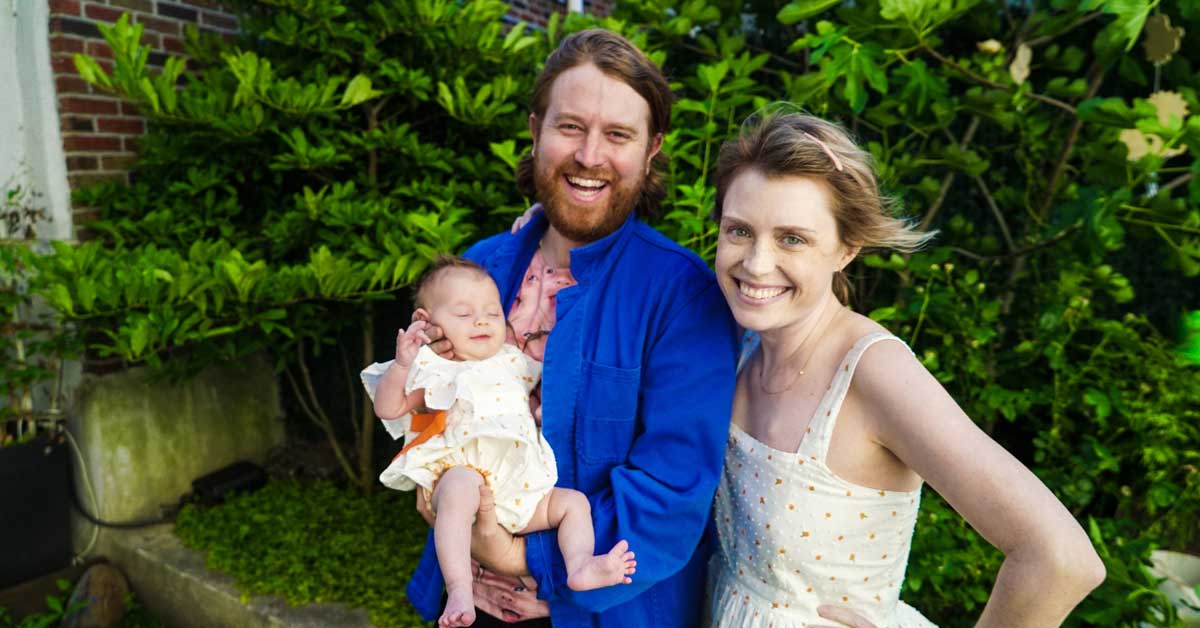
When Casey McIntyre was diagnosed with stage four ovarian cancer, her doctors gave her a 10-15% forecast that she’d live longer than five years.
When she died in November of 2023, her husband, Andrew Rose Gregory, posted on social media on her behalf, sharing a letter she had written during her final months in home hospice care. It outlined her story, as well as her memorial wishes.
“To celebrate my life, I’ve arranged to buy up others’ medical debt and then destroy the debt,” her final farewell letter stated. “I am so lucky to have access to the best medical care at [Memorial Sloan Kettering Cancer Center] and am keenly aware that so many in our country don’t have access to good care.”
Setting up a fundraiser with Undue Medical Debt (formerly RIP Medical Debt), Andrew created a fund in Casey’s name: The Casey McIntyre Memorial & Debt Jubilee.
Their goal was to raise $20,000, and about two months after the fundraiser was created, it hit the $1 million milestone. Now two years later, it sits at over $1.1 million.
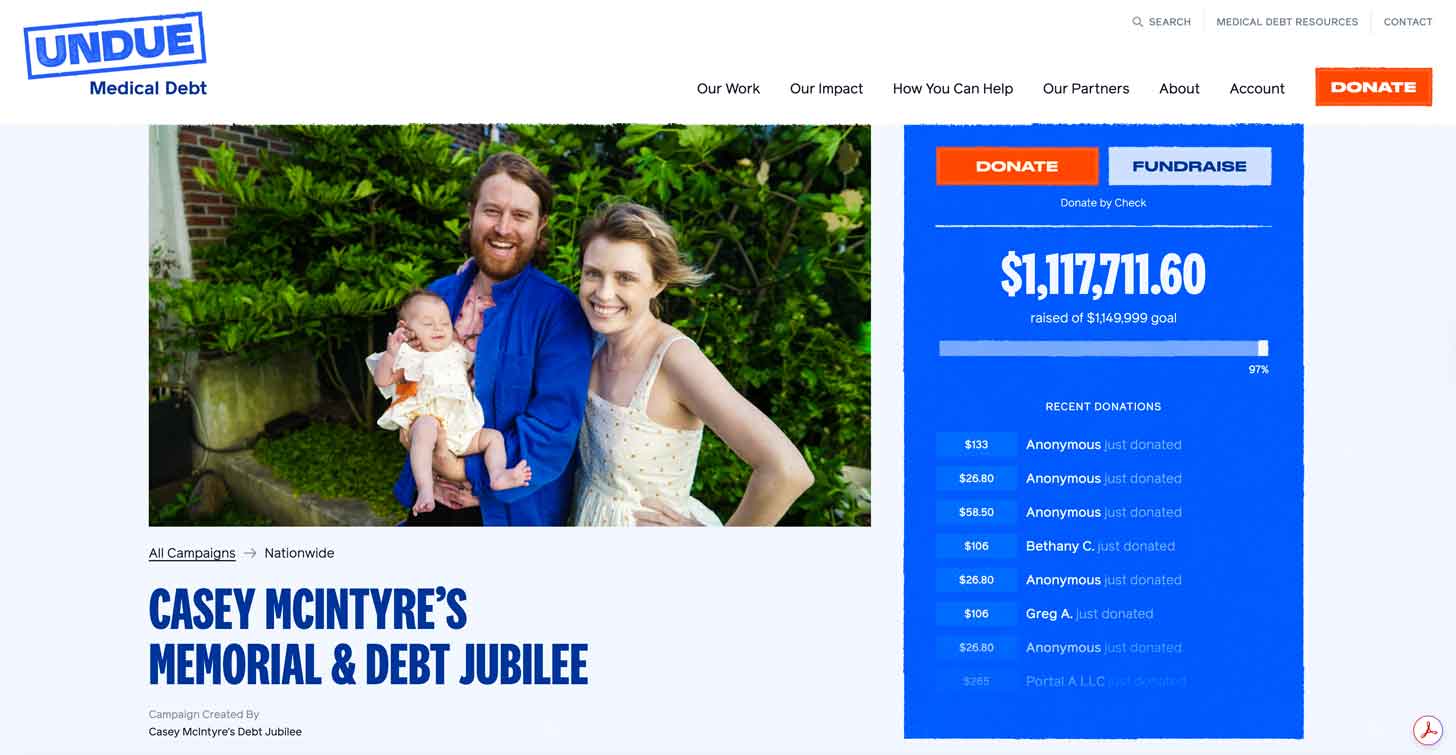
Thanks to Undue, which buys debt “at cost,” Casey’s fundraiser has erased $120 million of medical debt for 72,320 people in the tri-state area, where Casey, Andrew, and their daughter Grace, called home.
“Casey and I were extremely lucky. Our finances were being impacted by her cancer treatment, but not in a big way. She had extraordinarily good health insurance,” Andrew told Good Good Good in an interview.
“But we had met, through the cancer community at Memorial Sloan Kettering, people who are going into debt for their cancer treatment, people that are being bankrupted by their cancer treatment. You meet people who are deciding not to undergo cancer treatment because they know the cancer treatment would only give them so much time, and then that debt is going to be passed to their kids. That’s a calculation we’re making in our nation.”
The initial dream was to simply ease the burden of those calculations, but the success of the campaign represents something even bigger: both a massive amount of love for Casey, and a similarly universal desire for change.
Andrew said the fundraiser has led him to “a calling of sort” in the work to eradicate medical debt, while also, of course, providing a tether to Casey amid profound loss.
“When I talk to other people who are grieving, there’s a big fear that other people, and even you, are going to forget the person you love. And you are. You’re always forgetting the person you love, little parts about them, big parts about them,” he said. “But in some way, this reassures me that Casey is remembered in a bigger way.”
Their daughter, Grace, was just over one year old when Casey died. Although Andrew said she is “too young to remember her,” the story that came from this loss gives her something special to know about her mom.
“It’ll be a way that she can remember [Casey], not personally, but remember what Casey meant to other people,” Andrew added.
“Casey deeply believed that medical debt and the healthcare system that creates it are immoral, unnecessary blights on American society,” Andrew said in a statement for Undue Medical Debt. “May we live to see an America in which people are treated as patients rather than profit, an America in which healthcare debt no longer exists.”
Andrew told Good Good Good that he has found that the meaning of this accomplishment is not just in the destruction of debt, but in the creation of a better life for others — and the tending of Casey’s enduring legacy.
“It's odd to say, but the success of the campaign and the fact that so much medical debt has been forgiven in Casey's honor has brought me a lot of joy. And that joy is just in a separate place than the grief I feel about Casey. It's not like it's subtracting from the grief,” Andrew said.
“It's not like the deep, deep lake of grief I have about Casey's passing has gotten any shallower because of it. But it's like, at least I have this nice little field of flowers next to that lake.”
It’s a particularly potent metaphor, considering the song Casey chose to be played at her memorial was Stevie Wonder’s “Come Back As A Flower.”
“I wished that I could come back as a flower,” Wonder sings. “To spread the sweetness of love.”
You may also like: Giant holiday 'giving machines' are popping up in cities around the world. They've already generated $50M in donations
A version of this article was originally published in The 2025 Relationships Edition of the Goodnewspaper.
Header image courtesy of Andrew Rose Gregory