There’s a spot on the Ashoka University campus in Sonepat, Haryana, that was once just a barren patch of trees.
When tasked with transforming it into a bustling new food hall for university students, architect Apoorva Shroff didn’t just leave the trees be. She integrated them into a new outdoor canteen framed by 650 square meters of arching bamboo.
Her massive, winding structure — which offers a shaded canopy to 3D-printed kitchen stalls and recycled furniture — is called “The Hungry Caterpillar” in a nod to Eric Carle’s beloved book and the playful spirit she was hoping to imbue into the project.

“The idea was to transform the space into a food street with character, something that went beyond the conventional notion of a campus canteen,” Shroff told Architectural Digest. “Today, it’s not only a place to eat, but also to pause, interact, and reflect.”

Shroff, who enrolled in a bamboo school in Bali years ago, has a deep connection to the core material. For her, the woven bamboo design symbolizes “resilience, lightness, and continuity, the qualities we see both in nature and in learning.”
“The structure as a whole represents growth and interdependence,” she said.
Since Shroff founded Lyth Design — an architecture studio based in Mumbai — in 2022, she has made a point of sourcing construction materials with as little environmental impact as possible.

In “The Hungry Caterpillar,” for instance, Shroff used treated bamboo that helped sequester 350 tons of carbon dioxide.
She also worked with Playcycle to build the chairs and tables out of recycled plastic, and Micob India to 3-D print modular kitchens from concrete and assemble them onsite.

This December, her emphasis on creating beautiful architecture without compromising on sustainability earned her the Sustainable Design of the Year award at the Architect and Interiors India Aces of Space Design Awards 2025.
“The Hungry Caterpillar is quite unlike anything I’ve done before,” Shroff said when accepting her award. “It emerged from a vivid image after my first site visit. I imagined a cocoon nestled within lush canopies, symbolising safety, growth, and constant evolution.”

“The project was envisioned with responsible, conscious design at its core, where sustainability was the foundation,” she continued. “Beyond its form, the caterpillar represents learning, harmony with nature, and continuous growth. It holds a special place for me as a reflection of our commitment to meaningful, sustainable spaces.”
“Receiving this award and recognition is deeply gratifying and encourages us to continue pushing boundaries in conscious design.”

You may also like: See the first house made fully out of polycarbonate: 'It's LEGO for professionals'
Header image via Lyth Design
A study from researchers at the Norwegian University of Science and Technology uncovered an astounding truth: Every extra year of schooling — from primary school to university — lowers a person’s risk of mortality by roughly 2%, regardless of age, gender, or location.
“Education is important in its own right, not just for its benefits to health, but now being able to quantify the magnitude of this benefit is a significant development,” Dr. Terje Andreas Eikemo, the study’s co-author, told the Guardian.
The data solidified earlier findings from the Institute for Health Metrics and Evaluation.
That study, which pulled data from 3,110 counties between 2000 and 2019, marked the first comprehensive look at life expectancy by education at a county level across the United States.
Alarmingly, lead researcher Laura Dwyer-Lindgren found that the average life expectancy for those without a diploma ranged from 57.9 to 90.1 years — a 32-year disparity. Among college-educated individuals, life expectancies spanned 19 years, ranging from 75.2 to 93.9 years.

“Educational disparities in life expectancy are large, widespread, and increasing, both nationally and in most counties throughout the USA,” Dwyer-Lindgren emphasized in the study, which was published in The Lancet Public Health journal.
“Further research is needed to determine how both more equitable access to higher education and efforts to mitigate barriers to good health facing people with lower levels of education might result in better health and longer lives.”
A version of this article originally appeared in the 2025 Education Edition of the Goodnewspaper
Header image via Emily Ranquist / Pexels
Since 2023, Staten Island bodega owner Wail Alselwi — also known as “Wally” or “Island Ock” to the neighborhood he serves — has been cheering on local students through a program of his own making: “Grades for Grabs.”
It began when Alselwi struck a friendly bet with 12‑year‑old Zamier Davies: If he boosted his grades, he would earn a free Oreo milkshake.
Davies’s average climbed from the high 80s to the honor roll, and Alselwi held up his end of the bargain, documenting it in a TikTok that raked in millions of views.
In more of Alselwi’s TikTok videos, kids come in from all over to claim their rewards. One kid, a fourth grader named Maleek, traveled down from Pennsylvania with his report card reflecting a 97% grade average in hand. It earned him $100 and his pick of goodies from the bodega.
Quickly, Alselwi noticed that Maleek was only grabbing groceries for his family, like bread, eggs, and rice.
“Keep grabbing, keep grabbing,” Alselwi told Maleek. “Listen, you deserve this. You did good in school, okay?
“Thank you, Island Ock,” Maleek said shyly, returning with an armful of Flamin’ Hot Cheetos.
@islandock1 Diana and Diago #Islandockzacksfinest #schoolkidsreportcards #deliockyfoodnyccommunity #highschoolreportcards #fypシ゚viral ♬ original sound - island ock1
Alselwi told TODAY that he misses his own children back in Yemen and takes pride in helping his youngest customers shine.
"My biggest dream in my life is to bring my children, my own children, here to America," he told the Instagram account @nycdreamproject.
To sustain the effort, he set up a GoFundMe, which has raised $377,378 towards a $400K goal.
“Let’s say I’m giving them $100 or if I’m giving them snacks for free or a T-shirt, to me, that does not matter,” he said. “The most important thing is you celebrate them and you show them that you really care about their hard work.”

A version of this article originally appeared in the 2025 Education Edition of the Goodnewspaper.
Header image via @islandock1 / TikTok and @nycdreamproject / Instagram
On Wednesday, after Immigration and Customs Enforcement descended upon Minnesota in its latest in a series of immigration raids, an ICE officer shot and killed a Minneapolis woman, 37-year-old Renee Nicole Good.
Federal officials claim the shooting was an act of self-defense, however, multiple recordings of the incident show Good, a United States citizen and observer on the scene, driving away when asked. On Thursday afternoon, the Minnesota Star Tribune identified the ICE agent who shot Good as Jonathan Ross.
This is at least the fifth death and the ninth shooting to result from ICE crackdowns across the country since President Donald Trump took office in January 2025.
Following Good’s death, thousands of locals attended vigils and protests honoring her life and urging ICE to leave the state. Their calls were echoed by Minneapolis Mayor Jacob Frey and Minnesota Governor Tim Walz. And Colorado Governor Jared Polis, leader of Good's home state, has also called for a full investigation into her death.
"She was a compassionate neighbor trying to be a legal observer on behalf of her immigrant neighbors," Minnesota Attorney General Keith Ellison told NPR's Morning Edition. "That's what she was doing at the moment of her death. And she was a poet. She was a mom. She was a daughter. And I am deeply saddened by what happened to her and her family."
On her social media accounts, Good described herself as “a poet and writer and wife and mom” from Colorado, currently “experiencing Minneapolis.”
Good’s mother, Donna Granger, told the Minnesota Star Tribune that Good lived in the Twin Cities with her partner.
“Renee was one of the kindest people I’ve ever known,” Granger said. “She was extremely compassionate. She’s taken care of people all her life. She was loving, forgiving, and affectionate. She was an amazing human being.”
Good's father, Tim Ganger, also spoke to The Washington Post about his daughter.
“She had a good life, but a hard life,” Ganger said. “She was a wonderful person.”
In the aftermath of her death, supporters have also rallied to support Good’s wife and children as they “grapple with the devastating loss of their wife and mother,” according to a GoFundMe fundraiser.
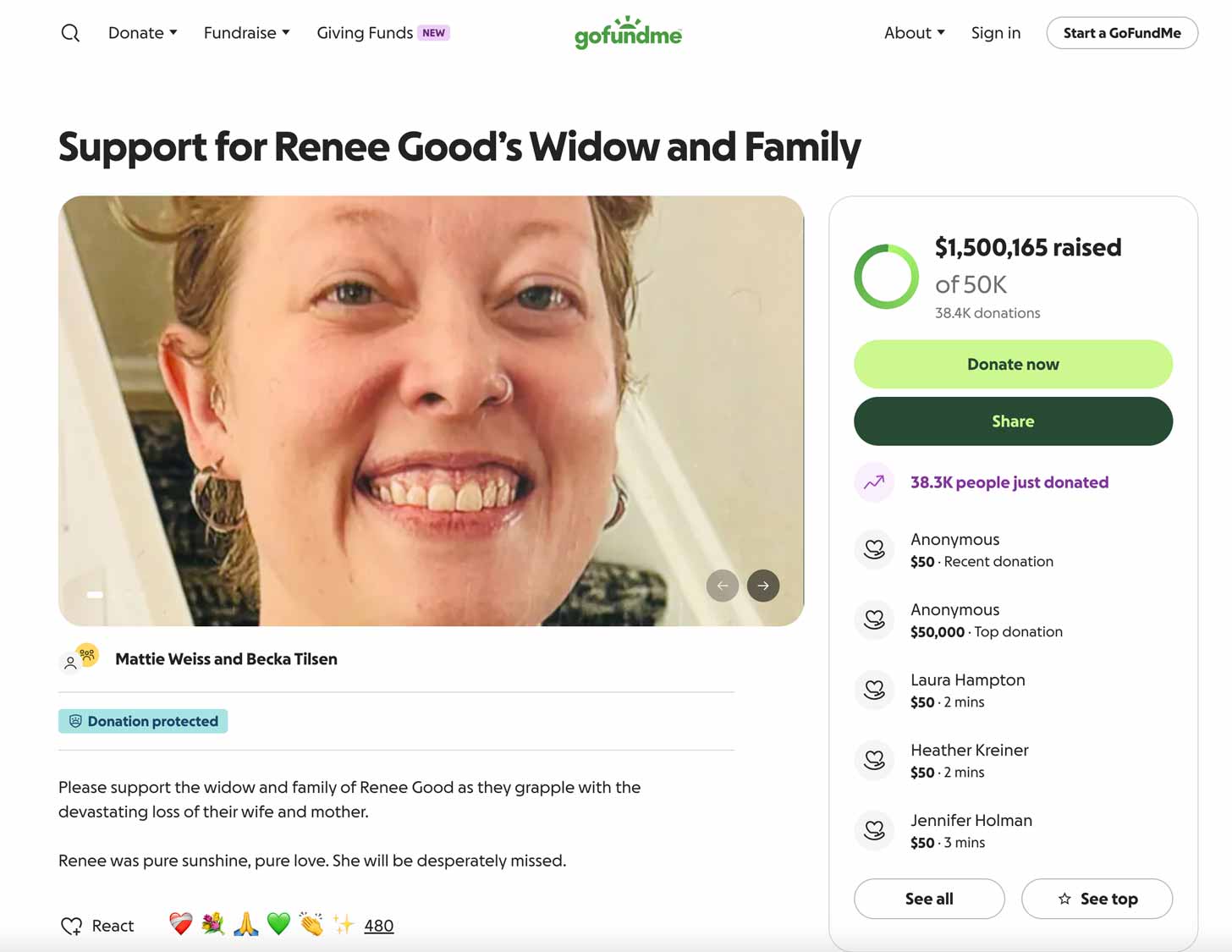
The fundraiser was created with an initial goal of raising $50,000, but has since surpassed $1.5 million, a mere two days after Good was shot and killed.
“Renee was pure sunshine, pure love,” the fundraiser, which was organized by Mattie Weiss, shared. “She will be desperately missed.”
A GoFundMe spokesperson confirmed to Good Good Good that the campaign has been verified, and another family friend, Becka Tilsen, was added as an administrator after the campaign surpassed $1 million in donations.
"Thank you. Thank you. Thank you. We are here brokenhearted and in awe of your generosity," Tilsen, who identified herself as a friend of the family, shared in an update.
"My family met Renee and Becca after they moved to town and [became] fast friends. We will be adding Becca, Renee’s partner, as a beneficiary as soon as possible. They will have direct access to all of these funds. Thank you again for your compassion. They feel this tidal wave of care, and it really matters."
According to the fundraiser, over 38,500 people contributed, many leaving kind sentiments with their financial donations. Gifts range from totals as small as $5, all the way to $50,000, and messages continue to pour in from across the globe, including Canada, Germany, the United Kingdom, Australia, Switzerland, and more.
“I didn’t know you or your family, yet as a fellow writer with the shared desire to stand for those in their time of need, it’s a safe bet we shared many values, our hearts likely beating to a similar cadence,” one person wrote. “Rest with power, grace, and love. We're folding those you love into our hearts, holding them in these dark moments and beyond for your loss is our loss.”
“What happened to Renee has been witnessed and felt far beyond one place. As a mother, I cannot imagine the pain of leaving a child behind in this world alone. That thought is unbearable,” another added. “I don’t care about left or right — this is not about politics. This is about humanity.”
Once the campaign reached the $1.5 million threshold, organizers paused donations.
"Thank you for your generosity. We’ve closed this GoFundMe and will place the funds in a trust for the family," Weiss wrote in an update. "If you’re looking to donate, we encourage you to support others in need. We’re truly grateful."
Organizers also reshared a statement Good's wife, Becca, shared with MPR News.
"First, I want to extend my gratitude to all the people who have reached out from across the country and around the world to support our family. This kindness of strangers is the most fitting tribute because if you ever encountered my wife, Renee Nicole Macklin Good, you know that above all else, she was kind," Becca said.
"We were raising our son to believe that no matter where you come from or what you look like, all of us deserve compassion and kindness. Renee lived this belief every day," Becca continued. "On Wednesday, January 7th, we stopped to support our neighbors. We had whistles. They had guns."
Becca went on to say that Good leaves behind three "extraordinary" children, the youngest just six years old.
"I am now left to raise our son and to continue teaching him, as Renee believed, that there are people building a better world for him. That the people who did this had fear and anger in their hearts, and we need to show them a better way," she concluded, adding a note of thanks for respecting the family's privacy.
"We honor her memory by living her values: rejecting hate and choosing compassion, turning away from fear and pursuing peace, refusing division and knowing we must come together to build a world where we all come home safe to the people we love.”
This article has been updated to reflect changes in donation totals.
Header image courtesy of ODU English Department/Facebook
In recent years, following the smash acclaim of the “Barbie” movie, toymaker Mattel has doubled down on making even more Barbie dolls that represent kids of all kinds, including a Blind Barbie, a Barbie with Down syndrome, and a diabetic Barbie.
Its latest rollout? A first-of-its-kind autistic Barbie.
Created over the course of 18 months in collaboration with the Autistic Self Advocacy Network, the doll aims to represent common ways autistic people may experience, process, and communicate about the world around them, according to a press release from Mattel.

With experts at ASAN, doll designers included unique features, including:
- A new face sculpt and an eye gaze where the doll’s eyes are shifted slightly to the side to reflect how autistic people may avoid direct eye contact
- Articulation at the elbows and wrists, “allowing for stimming, hand flapping and other hand gestures … as a way to process sensory information or to share excitement”
- Accessories, such as a pink finger clip fidget spinner, noise-cancelling headphones, and a symbol-based Augmentative and Alternative Communication tablet
- Sensory-sensitive clothing, including a loose-fitting purple dress, and flat-soled shoes to promote stability

“As proud members of the autistic community, our ASAN team was thrilled to help create the first-ever autistic Barbie doll. It is so important for young autistic people to see authentic, joyful representations of themselves, and that’s exactly what this doll is,” Colin Killnick, the executive director of ASAN, said in a statement.
“Partnering with Barbie allowed us to share insights and guidance throughout the design process to ensure the doll fully represents and celebrates the autistic community, including the tools that help us be independent. We’re honored to see this milestone come to life, and we will keep pushing for more representation like this that supports our community in dreaming big and living proud.”

The autistic Barbie joins Mattel’s 2026 Fashionistas collection, which features the brand’s most diverse range of skin tones, hair textures, body types, and various medical conditions and disabilities.
It hits shelves at the Mattel Shop and Target starting January 12, at a suggested retail price of $11.87. Mattel said it will have a larger rollout at Walmart nationwide in March.
In the meantime, Barbie is working with autistic advocates to celebrate their lived experiences and the milestone of the doll’s release.
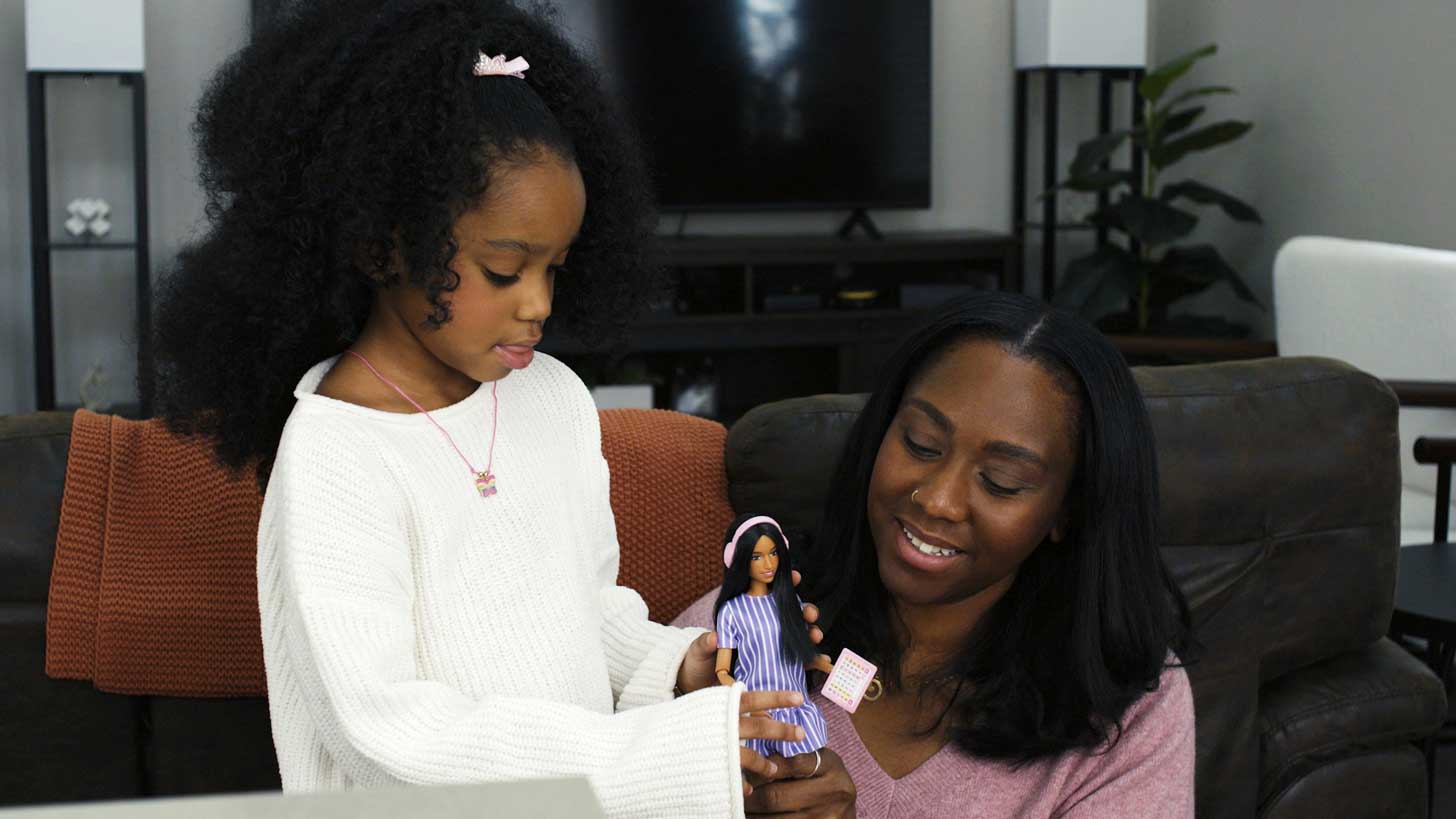
One pair of advocates includes Precious and Mikko Mirage. Mikko is a five-year-old, non-speaking autistic girl who communicates with her AAC tablet, and her mother, Precious, is an autistic woman who discovered her own neurodivergence while understanding her daughter’s. On their YouTube channel, The Gentle Life, they explore communication and share their journey as a neurodiverse family.
“Having a Barbie doll that represents autism feels like we’re being heard. It feels like inclusion and acceptance. Autism is often invisible and seeing a doll that truly represents parts of the spectrum makes us feel understood,” Precious said in a statement.
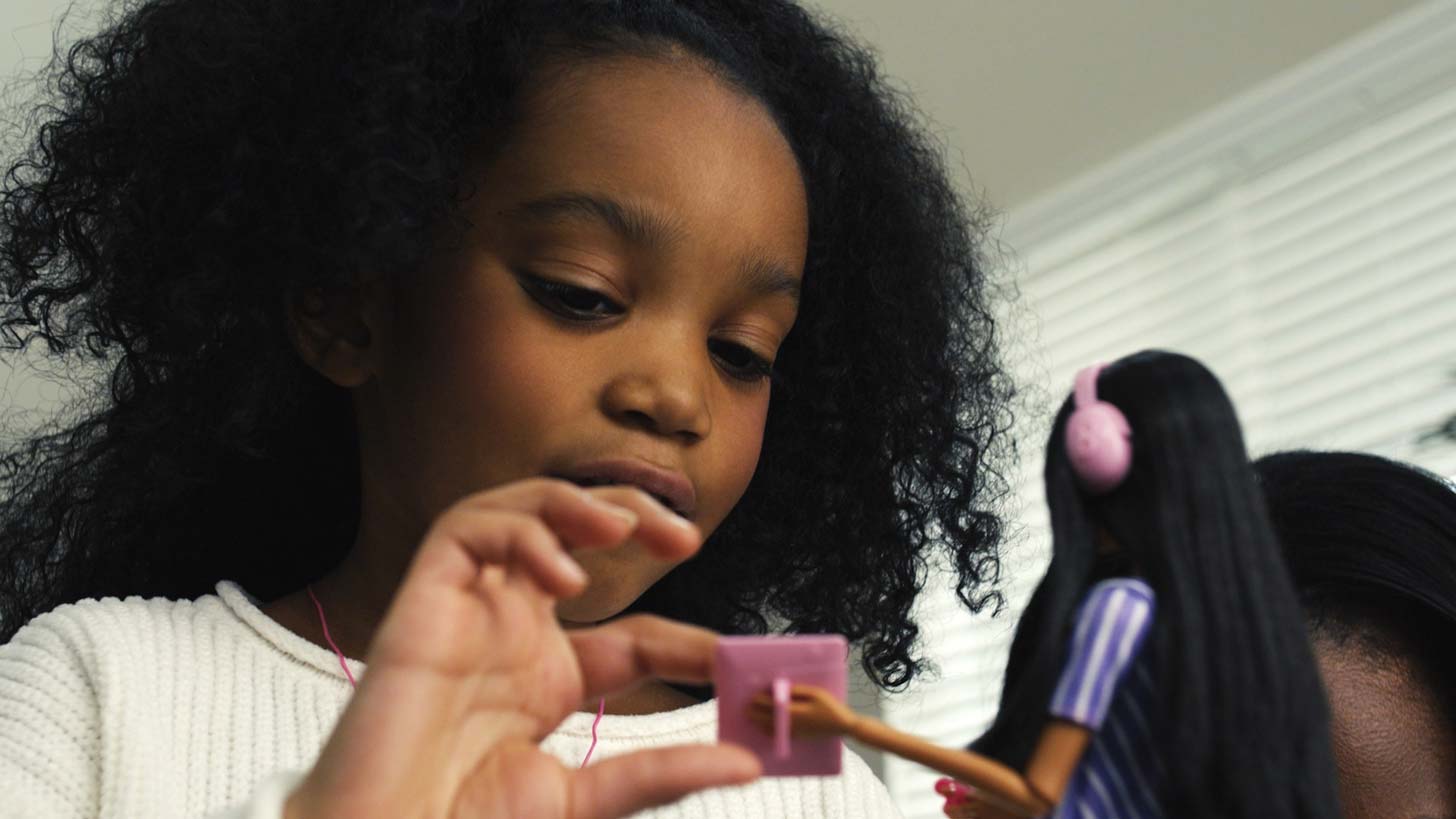
“When other families see this Barbie, I hope it helps bridge the gap. I hope they feel included in the conversation and in the spaces where neurotypical individuals already belong. Because we belong here too.”
Other advocates part of the campaign include Aarushi Pratap, an autistic fashion designer, and Madison Marilla from Netflix’s “Love on the Spectrum.”

“This Barbie can help autistic people feel understood,” Pratap said in a statement. “We can do amazing things and I want others like me to feel proud and express themselves.”
This doll represents a particularly special full-circle moment for Marilla, too, who has collected Barbies for much of her life.

“Dolls have always brought me comfort, stability, and joy. I’ve been collecting Barbie dolls since I was four years old, and now this autistic Barbie will be one of my favorites,” Marilla said in a statement.
“This autistic Barbie makes me feel truly seen and heard. I hope all the kids I’ve mentored feel the same when they see her and I hope people who aren’t autistic feel educated and gain a better understanding of autism when they see this doll.”
You may also like: Ilona Maher gets her own Barbie doll, complete with broad shoulders, to inspire young athletes
Header image courtesy of Mattel
This story was originally published by The 19th and was republished with permission.
Avery Colvert was an eighth-grader when the Eaton Fire tore through Altadena, California, a year ago this month, reddening the sky and destroying nearly 10,000 structures. It was the second natural disaster she’d survived; she was just 14 years old. Her family had lost their home in Nashville, Tennessee, to a flash flood in 2021, before they moved west.
This time, the catastrophe spared her house, but consumed her school. Familiar with the psychological toll such devastation can take, Avery posted an Instagram call for help tailored for peers who had been left homeless by the wildfire, which burned for over three weeks.
She asked for items to help her “friends feel confident and like themselves again!” — “clothes, personal items, beauty and hair care — stuff WE need.”
The plea, posted just three days after the fire broke out on January 7, 2025, quickly went viral. It has since garnered over 28,000 likes; earned support from celebrities such as Paris Hilton, Charli XCX, and Meghan, Duchess of Sussex; and led to the creation of the Altadena Girls nonprofit, an organization that, Avery said, gives girls permission to ask for what they need without apology.
“I always hear teenage girls say, ‘Oh, I’m sorry,’ like they feel they need to apologize for asking for too much,” Avery, 15, now a ninth grader, said. “At the beginning [of recovery], there was a lot of stigma around asking for help. Girls, after they lost their homes, they felt like it was embarrassing.”
But they don’t need to apologize or feel embarrassed — for asking for help or stating their preferences, Avery said. “It’s OK to say, ‘I like this sweater instead of that one.’ Girls are allowed to have opinions.”
Avery founded Altadena Girls with her mother, Lauren Sandidge. Sandidge said that no one seemed to be focusing on the teen girl experience in the wake of the wildfire, which occurred in tandem with the massive Palisades Fire 30 miles away in Los Angeles.
Through a pop-up boutique, Altadena Girls has supplied clothing, shoes, beauty products, and hair care to more than 5,000 girls and their families. The organization has distributed more than a million items in total. Last year, it hosted a prom for over 300 girls, and it also provided back-to-school supplies and social-emotional support for 500 more.

In October, Altadena Girls celebrated a major milestone: It opened an 11,000-square-foot community center offering free programming in nearby Old Town Pasadena.
What began as a social media request for donations turned into a movement that revealed how inclusive disaster recovery can be when girls are centered rather than marginalized.
Avery didn’t write her viral post with an endgame in mind.
“I don’t even know what I was thinking,” she said. “I was going through so many emotions at the time that my body just kind of went into fight-or-flight mode. It was like, ‘I’m just going to do this, and this needs to be done right now.’”
Twenty-four hours after her post appeared on Instagram, donations began pouring in, as well as offers for help from stylists, makeup artists, and fashion designers. Many of these professionals didn’t just give away products. They also volunteered their time and labor to the fire-impacted girls.
Sandidge recalled kneeling over, sorting through boxes of donations.
“Every time I looked up, there was someone with more donations,” she said. “And then they would stay. They could tell I was overwhelmed, and they would just stay.”
Woven through Altadena Girls is this sense of community. The organization is more than just about distributing goods to teen girls in need. It’s about creating a space where they feel supported. Sandidge said her own family — she also has a son — felt stabilized by this as the wildfire left them uncertain.
“It got us through those moments where we didn’t know what was going to happen,” she said. “The fires were still burning. Everyone felt that way.”
Through its permanent brick-and-mortar space, which opened on October 11, 2025 — International Day of the Girl — the hope is that Altadena Girls can continue bringing the community together.

“It was really cool, really exciting,” Avery said. “I still can’t believe we did it.”
The center includes music and podcast studios sponsored by Fender; quiet rooms for studying, journaling, or one-on-one conversations; a free boutique offering hygiene products, clothing, and school supplies; and a gathering area for community events.
The most popular space is the Sliving Lounge, a glittery pink room of nearly 1,000 square feet filled with collaging stations, Polaroid cameras, karaoke, movies, books, and vision boards. The name of the space, sponsored by Paris Hilton and her nonprofit, 11:11 Media, is a portmanteau of the words “slay” and “living.”
“It’s definitely our most popular thing,” Avery said. “Everyone ends up there.”
Avery wanted it “to feel like a girly explosion,” she said. “And they delivered.”

Journey Christine, a 12-year-old actress who lives a block away from the Altadena Girls community center, said she visits most weekends. She called the center “a blessing” to Altadena and Pasadena, parts of which the fire also ravaged. “It’s like my new home away from home,” she said.
Altadena Girls’ dance workshops — run in partnership with Dance and Dialogue, a non-profit organization that provides intergenerational, multicultural programming — are especially meaningful to Avery. A dancer herself, she has watched girls return to dance night after night.
“I’ve seen them grow. They got really good,” she said. “Dancing is so healing for me, and I’m glad other people get to discover that.”
Youth are not required to participate in any activity to spend time at the community center. “You can come in and learn guitar,” Sandidge said, but the priority is that their basic needs are met — they’re fed, they’re safe, they’re relaxed. “That’s when people can make good decisions.”
After the fire, Journey has grappled with having classmates, steady presences in her life, move to different neighborhoods and communities. At Altadena Girls, she has been able to catch up with peers who relocated.
“There are still people who haven’t moved back yet,” Sandidge said. “There are emotional needs that don’t go away just because the headlines do.”
Avery believes the fire didn’t just create new needs. It exposed existing ones, such as a lack of “a third space” for teen girls to meet during the digital age, with phones and social media replacing physical gathering spaces.
“For some teenagers, the internet is their third space,” she said. “But I think it’s important that we have a physical space that’s accessible to everyone.”

That Avery’s advocacy led to the center’s creation has felt empowering for Journey. “It’s really inspiring,” the seventh grader said. “It shows other kids that just because you’re young doesn’t mean you can’t make a difference.”
Avery’s belief that dignity is a core component of recovery has led to national recognition. She became the youngest winner of the TIME100 Impact Award, and Senate District 25 named Altadena Girls the 2025 California Nonprofit of the Year. At the 10th Hollywood Beauty Awards, which recognizes the artistry that influences beauty in film, television, and on red carpets, she received the Beauty Impact Award.
Avery’s request for beauty and hair care resonated on a profound level.
“She wanted to give something that wasn’t just socks and T-shirts,” said Pamela Price, the awards’ senior executive producer. “She wanted to give girls something that brought a little happiness during an uncertain time. People might think it’s superficial, but it’s not. Hair, makeup, skincare — those things affect how you feel. Avery was thinking about mental health.”

Journey said simple cosmetic items can make a world of difference for young girls.
“People might think losing your favorite lipgloss, eye liner, pair of jeans or hoodie is petty, but it’s not because those things help boost confidence,” she said. “It’s how we represent ourselves. It’s our sense of style. Avery and Altadena Girls get it.”
Avery still remembers the discomfort she felt when she received gift cards in front of her classmates after the Tennessee flood that destroyed her home. “I felt embarrassed. Guilty.” That memory inspired her to prioritize the dignity of teen and tween girls in the wake of the Eaton Fire.
A year later, her nonprofit isn’t attracting the same level of national attention it did immediately after the disaster. Sandidge said that she understands the waning focus, having lived through a similar dynamic after the Nashville flood.
“It’s naturally what happens,” she said. “Everyone comes around. There are headlines. People want to help. And then the intensity dies down.”
But the long-term needs of disaster survivors related to mental health, stability and belonging don’t simply vanish, she said, a notion that research bears out. A 2021 study on California’s deadly Camp Fire in the International Journal of Environmental Research and Public Health found that direct exposure to wildfires significantly raised the risk of PTSD and depression six months afterward.
As Altadena Girls enters its second year, maintaining its momentum and making it more accessible are top of mind. The center is currently open three evenings a week, with plans to expand to full-time hours.
“We want to keep it free,” Sandidge said. “And it’s not free to run.”
The organization is also forming a teen advisory board, a critical step, according to Avery. “It has to be for girls, by girls,” she said. “We need their feedback.”
In time, Sandidge hopes the space allows girls to plan their futures without the shadow of the wildfire and the trauma that accompanied it. “I want them to make decisions based on who they are,” she said. “Not what they lost.”
Header Image courtesy of Altadena Girls
In 2021, during the Biden administration, Congress created the Emergency Rental Assistance program to prevent evictions among low-income renters during the COVID-19 pandemic.
While the period of performance for the program ended in September 2025, the federal government had provided over $46 billion to support housing stability for eligible renters during the four-year period, especially to renters of color.
While the most immediate benefit of the program was the reduction in housing insecurity, a new study reveals that it also improved the mental health of low-income renters.
Wei Kang, an assistant professor in UC Riverside’s School of Public Policy, led the study, which was published this week in the journal “Health Affairs.”
“Using a national dataset, we found that housing assistance helped low-income renters — who are among the most vulnerable populations — feel better and get mental health treatment when needed,” Kang said in a statement.
“This demonstrates the importance of government programs in a time of crisis.”

The analysis was drawn from the United States Census Bureau’s Household Pulse Survey data, which had been collected between 2021 and 2023. The survey includes questions about respondents’ mental health status and whether they had recently sought care.
Comparing survey responses from two groups — those who had received rental assistance and those who had applied but not yet received it — Kang found that rental assistance recipients experienced a noticeable drop in symptoms of anxiety and depression.
They were also more likely to seek mental health services when experiencing symptoms.
About 46% of assistance recipients reported symptoms of anxiety within the two weeks prior to being surveyed, 9.1% lower than those who had not yet received rental assistance. And 38% of aid recipients reported feeling depressed, which was an 8.1% improvement over those who were without government help.
As for those who sought mental health treatment, an increase was modest but still meaningful.
Among people awaiting rental assistance, 16.2% had reported recently seeing a mental health professional, but those who had already received assistance were 6.5 to 7.9% more likely to seek out counseling.
“The research found that the ERA program reduced mental distress in two ways: first, by directly alleviating the fear of eviction, and second, by freeing up financial resources for health-related needs,” a statement from UC Riverside explained.
Those who received rental assistance first saw improved housing security, but then that stability led to a decreased threat of eviction, and therefore relieved a major source of stress.
Anxiety symptoms were especially improved, the study concluded, since renters no longer had to worry about losing their homes.
Additionally, researchers saw that households that had rent covered were able to redirect funds toward other essentials like co-pays for doctor visits, prescription medications, and transportation that helped them reach mental health services.
“For those struggling to make ends meet, this shift in financial priorities proved crucial,” the statement said.
Kang added that the findings “offer strong evidence that housing aid is also a form of health care intervention,” and argued that economic relief programs like the ERA program should not only be seen as fiscal policies but also tools for public health.
“What’s really interesting is that people in our field often worry about the unintended consequences of government programs — and that they’ll be bad, such as fraud or waste,” Bruce Link, another researcher on the study and a professor of public policy and sociology, said.
“But to the contrary, here are what might be deemed ‘unintended positive consequences’ that went beyond the intended effect of helping people stay securely housed.”
You may also like: Yes, tiny homes for the homeless actually work — and a new study shows they're more effective than group shelters
Header image by Chandler Hilken on Unsplash
For 12 years, Ohio residents have called in at least 40 sightings of a sleek, slender-bodied mammal traipsing through the state.
But it wasn’t until December 13 that Cleveland Metroparks — a series of nature preserves in Greater Cleveland, Ohio — confirmed that they had verifiable proof that fishers had returned to Cuyahoga County.
Until then, it had been nearly 200 years since the mammal had officially returned to the state.
“Earlier this year, a fisher (Pekania pennanti) was recorded on a wildlife camera in Cleveland Metroparks and identified by Andy Burmesch, Cleveland Metroparks Wildlife Management Coordinator,” Cleveland Metroparks shared in an Instagram post.
“The Ohio Division of Wildlife confirmed that this sighting in Cleveland Metroparks is the first record in Cuyahoga County since the species originally disappeared in the 1800s.”
Fishers, also known as fisher cats, are a type of forest-dwelling mammal with furry brown coats and long, cat-like tails. As a mustelid, fishers belong to the same family of animals that includes weasels, otters, badgers, martens, ferrets, polecats, and wolverines.
In their Instagram caption, Cleveland Metroparks said that fishers had been “extirpated,” or completely wiped out, of Ohio by the mid-1800s due to “unregulated harvest and loss of habitat.”
Throughout the United States, fishers face varying degrees of endangerment. In California, the Southern Sierra Nevada fisher population is federally listed as endangered, while fishers on the West Coast and throughout the Northern Rockies have been submitted for federal protection.

According to the National Park Service, healthy fisher populations reflect “a well-functioning, mature environment.”
“Fishers also help control rodent populations, both large and small species, and have been reintroduced in some parts of the country to help keep in check forest-stand damaging porcupines,” the National Park Service said in a press release.
“They increasingly appear to be filling, at least partially, a niche left vacant when top-tier predators (wolves and mountain lions mostly) were extirpated from the region.”
For Ohioans, the trail camera footage is a promising sign of the rare animals’ return to the region.
“This is tremendously exciting, as this is yet another extirpated native Ohio mammal species to be documented for the first time in Cleveland Metroparks,” Cleveland Metroparks said in December.
“The return of fishers and other extirpated species like otters, bobcats and trumpeter swans are a result of conservation efforts and emphasize the importance of our healthy forests, wetlands, waterways, and natural areas in Cleveland Metroparks.”
You may also like: Conservationists delighted by jaguar sighting in Arizona: 'They’re finding what they need'
Header image via Cleveland Metroparks/Instagram
This year, Bronx high school teacher Alhassan Susso received $25,000 when he was honored with the FLAG Award for Teaching Excellence, a prize given to New York City teachers who inspire “learning through creativity, passion, and commitment.”
And he immediately gave it all away.
For years, Susso has been raising funds for a teacher-of-the-year prize in his home country of Gambia. The prize is offered through a nonprofit he started, the Namie Foundation, which is named after his grandmother.
“The truth is, I took $45,000 out of my retirement,” Susso told the New York Times, in reference to the nonprofit’s starting budget of $75,000. “We worked hard to raise the rest from friends and family.”

For months, Susso had been preparing an application to receive a public diplomacy grant through the U.S. Embassy in Banjul, Gambia.
In May, the application webpage disappeared. A representative from the State Department told The New York Times that the public diplomacy awards had been pulled for review “to determine their alignment with the administration’s priorities.”
So when Susso received his own prize money in June, he said it was a “no-brainer” putting it towards the Namie Foundation’s teacher-of-the-year prize.
For Susso, it’s not just about rewarding hardworking teachers in critically underfunded school systems. As someone who is legally blind in one eye and losing sight in another, it’s also about funding programs that help disabled students thrive.
“Disability is stigmatized [in Gambia],” Susso said. “People who are disabled can be successful if they are given the proper support.”
A version of the article originally appeared in the 2025 Education Edition of the Goodnewspaper.
Header image via Yan Krukau / Pexels
In the small town of Lakeview, Oregon, residents are trying out a creative approach to their city’s tax revenue deficit: Tasteful nudity.
Last year, the town couldn’t afford to remove snow across all of its streets and intersections, but a new snowplow would have cost thousands.
Instead of forcing everyone to pay more taxes, 12 brave townsfolk decided to bear it all.
Well, not exactly all.
Organized by Jess Calvin and Margot Dodds, residents came together to create the 2026 Outback Naked calendar, a fundraising tool to bolster funds for their struggling town.
They were inspired by the 2003 movie “Calendar Girls,” a film based on the true story of middle-aged Yorkshire women who made a nearly-nude calendar to raise funds for leukemia research.
And, when Dodds proposed the idea at a Lakeview Town Council meeting over the summer, she brought in an example from Vermont, in which a “Men of Maple Corner Calendar” raised $56,000 for a town’s community center.
“We have some brave members of the community who are willing to become vulnerable to support their town,” Dodds told the Lake County Examiner.
“Our models will be unclothed but strategically covered, nothing visible that wouldn’t be seen at the pool. We are looking for beautiful photographs that showcase people having fun in the Oregon Outback.”

After soliciting photos from the community (those interested could simply send a submission to Dodds via email) and working with volunteer photographers, the full year was complete, mostly comprised of middle-aged and elderly models.
The calendars went on sale in November 2025.
According to CBS News, the “tasteful and discreet” calendars, which sold for $25 a pop, have raised over $13,000 so far.
And Lakeview could use the help.
The town has faced decreased revenue from its alcohol sales, lodging, and property taxes, as well as the bankruptcy of a company that constructed a natural gas pipeline, according to The Oregonian.
Lakeview even faced a potential government shutdown in 2025, with increasing debts that have led to increased water bills for residents and cuts to city jobs.
“Outback Naked Calendar 2026 is created to support the high-desert Town of Lakeview in eastern Oregon, which has had devastating loss of tax revenues,” the calendar’s online store shared. “100% of profits go to a dedicated account for snowplowing.”
While it’s unclear if the funds raised from the calendars will fully cover the cost of snow removal, it certainly makes a dent — and inspires a laugh.
@cbseveningnews When the small town of Lakeview, Oregon, couldn’t afford full snow removal last winter, a dozen local volunteers posed for a tongue-in-cheek nude calendar to raise money. #news #oregon #tax #donation #calendar ♬ original sound - CBSEveningNews
“What I see in this calendar is a renewal of good feeling. That although we are poles apart in our ideology, we can still appreciate each other, sit next to each other at the restaurant, theater, concert, ball game, or … banquet,” a resident, Marie Lee, shared on Facebook.
“A feeling that someone is going to come along who can make the budget sheet balance. That we’ll find the money for snow removal and fixing the potholes, etc., that we’ll find a way to absorb the price of groceries, that members of Congress will eventually stop their temper-tantrums. That power hungry people on both sides of the aisle, and across oceans, will see there is no power to be gained when they threaten destruction of each other.”
“A 2026 Outback Naked calendar ought to be buried in a time capsule to remind future generations to laugh at each other every now and then,” she concluded. “That we ought to take time for just plain fun.”
You may also like: Strippers are now the No. 1 donor of toys to children's hospital in Portland. This year, they broke their own record
Header image by Annette Goeres for Lakeview Oregon
U.S. Navy veteran Jameeka Green Aaron has technological expertise that stretches over 25 years. In 2024, she was named the Chief Information Security Officer at Headspace — a mental health app with over 70 million users — but her work goes far beyond consumer identity safety and data breach recovery.
As a mentor in the U.S. State Department’s TechWomen program and board member of the National Urban League Young Professionals and the National Society of Black Engineers, Green Aaron is a vocal activist who consistently uses her platform to advocate for diversity and inclusion in tech.
“Every single time in this country [that] there has been a false arrest for AI identification, the person has been Black. Every single time,” Green Aaron emphasized in a speech at the University of California, Berkeley.
“It’s never been more important that we understand the importance of diverse perspectives and representation in technology,” she cautioned her peers.
“AI is built on representation. That could be really great for us, or it could be a really awful future for us … It is my job to make sure that people understand the risks that are at hand.”

Despite a high proficiency in digital literacy, Green Aaron has never lost sight of the human beings behind the screens. Throughout her career, she has stressed the importance of thinking about the “users” of the technology, rather than the tech itself.
“My job is to protect people,” she said. “My job is not to protect databases. It’s not to protect technical resources. It’s not to protect nameless, faceless things.”
A version of this article originally appeared in the 2025 Technology Edition of the Goodnewspaper.
Header image via Thirdman / Pexels
If there is one thing most people wouldn’t want to stumble across in the forests of the Philippines, a giant spider would probably be one of them.
But a pile of bird droppings probably wouldn’t be far behind.
And one scientist appeared to come across both during a research expedition assigned by the Russian Federation’s Ministry of Science and Higher Education.
Well, one posing as the other.
In 2025, arachnologist Mikhail M. Omelko came across a rare bird-dropping crab spider, a spider that can mimic the likeness of a pile of bird poop.
“These spiders are often referred to as bird-dropping crab spiders due to their remarkable mimicry as their body shape and coloration closely resemble bird droppings on leaf surfaces,” Omelko wrote in a new study, which was published in the scientific journal ZooKeys on October 24.
“To enhance this deceptive appearance, these spiders construct a thin white silk patch on a leaf and place insect remains within it; the spider itself rests in the center of this structure.”
Omelko works at the Federal Scientific Center of East Asia Terrestrial Biodiversity at the Russian Academy of Sciences in Vladivostok, Russia. His expeditions have led to numerous new species identifications since 2020.

According to his latest study, this is the first spider in the Phrynarachne genus found in the Philippines.
Remarkably, the new species of Phrynarachne gorochovi, or bird dropping crab spider, doesn’t just mask itself to resemble a harmless pile of bird poop — it also pulls off the magic trick of smelling like one too.

“In addition to this striking morphology and behavior, Phrynarachne spiders emit a distinct foul odor that attracts insects such as flies,” Omelko observed.
Crab spiders are named after “crabs” for a number of reasons: the flatness of their back, the length of their two front legs, and their sideways movement.
Like most spiders, crab spiders benefit their surroundings by eliminating pests — in this case, flies — and helping natural flowers around them grow.
This new species of crab spider, in particular, is yellow with several dark brown spots and bumps across its body and carapace.
This spider is just the latest in a string of exciting discoveries in the last year, including a red “oddball” velvet ladybird spider with never-before-seen features and a methane-eating deep-sea spider found 3,000 feet below the ocean’s surface.
You may also like: A new species of spider with 'never-before-seen features' was discovered in Southern Morocco. It looks like a Pokémon
Header image via Asenka79 CC BY-NC 4.0
Every day the Good Good Good team collects the best good news in the world and shares it with our community. Here are the highlights for this week!
If you want to get good news in your inbox every day, join the Goodnewsletter — the free daily newsletter designed to leave you feeling hopeful.
The Best Positive News We’re Celebrating This Week —
England passed the ‘biggest’ animal welfare reforms ‘in a generation’ impacting hens, pigs, puppies, and more
As part of “the most ambitious animal welfare strategy in a generation,” England will end the use of hen cages and pig farrowing crates, ban trail hunting and puppy farming, and more by 2030.
Pig farrowing crates contain sows during birth and nursing to stop them from rolling onto their young, but prevent them from moving around at all. And while battery cages for chickens had already been banned in the UK, it gave rise to “colony cages” in their place.
While an estimated 80% of hens in the UK are already free range, experts say the new laws are further “raising the bar for farmed animal welfare.”
What’s the nuance? Critics worry the move would harm domestic farmers, who would be forced to compete with farmers not held to the same rigorous standards. For that reason, advocates are already requesting the law be expanded to impose the same standards on imports.
This climate solution is sitting in America’s trash — and it has bipartisan support
→ Read more
For their 50th wedding anniversary, this couple asked for donations to their local dementia charity
Marion and Sandy Ironside of Gamrie, Scotland hosted a party to celebrate 50 years of marriage in the same venue where they had wed decades prior — and they also made it a charitable event.
In lieu of gifts, the Ironsides asked their family and friends to donate to Alzheimer Scotland, a dementia support organization with Dementia Resource Centers in 25 locations across Scotland.
With about 75 guests, they raised a total of £1,005 for the organization, which was unveiled with a large, ceremonial check.
Dutch university students created a modular electric car that ‘you can repair yourself’
A team of students built an electric car that comes with a built-in toolbox and components that can be easily repaired or replaced by the car’s owner.
It was developed in the Eindhoven University of Technology’s TU/ecomotive group, which focuses on developing sustainable vehicle concepts. This concept, called ARIA — which stands for Anyone Repairs It Anywhere — is a “modular electricity city car that you can repair yourself.”
The students developed it to challenge current manufacturing practices and “show the automotive industry that sustainable and practical design really is achievable.”
Why is this good news? While the Right to Repair movement has been gaining momentum around the world, it’s still prohibitive for everyday people to repair their things — especially big investments like cars. This innovation could help shift the automotive industry toward a more sustainable, circular model — and help consumers.
You may also like: Europe is guaranteeing citizens the ‘right to repair’
This Swedish company is giving its employees money and time off to hang out with their friends
The U.S. ended 2025 with the largest one-year drop in homicides ever recorded
Based on preliminary data, 2025 was on track to end with the largest one-year drop in U.S. homicides ever recorded — a trend that held in both large and small cities.
The year was projected to end with a roughly 20% decrease in homicides nationwide, and “even taking a conservative view” of 16%, “you’re still looking at the largest one-year drop ever recorded.”
Experts say, overall, crime levels appear to be “back to normal” after surging during the pandemic.
→ Read more
New federal guidelines expand cervical cancer screening options with an at-home, Pap smear alternative
New federal guidelines for cervical cancer screening from the U.S. Department of Health and Human Services include a self-collection option that allows some women to test themselves at home instead of going to a doctor for a pelvic exam.
Additionally, the new option will be required to be covered by private insurance beginning in January 2027.
The option to continue to get a traditional Pap smear will remain, but the expanded guidelines “empower women to make this choice for themselves.”
Why is this good news? Whether due to cost, comfort, or proximity to a doctor’s office, cervical cancer screening is still inaccessible for many people. Expanding the options people have will make it easier for people to get tested and potentially receive a life-saving diagnosis.
You may also like: This new at-home cervical cancer test aims to replace traditional pap smears — and it’s backed by Serena Williams
This couple donated all 46 acres of their backyard to be turned into affordable housing: ‘How hard could it be?’
→ Read more
Electric vehicles now outnumber diesel cars on Norway’s roads — 97% of new cars sold are EVs
Norway set the world’s most ambitious target for ending fossil fuel car sales in 2025, and after supporting that goal with real policy change, it basically achieved it.
With 179,549 new passenger cars registered in the country in 2025, 172,232 of them were fully electric vehicles, or 95.9% — up from 88.9% in 2024. And 2,751 of them were plug-in hybrids, meaning 97.5% have a plug.
Zooming in on just the final month of the year, in December alone 97.6% of vehicles sold were all-electric. Additionally, in early December, electric cars officially overtook diesel cars on Norway’s roads.
→ Read more
One year after its launch, New York City’s congestion pricing has reduced air pollution by 22%
Congestion pricing went into effect in New York City on January 5, 2025, and it’s already resulted in 23.7 million fewer vehicles, traffic delays down 25%, and a 22% drop in air pollution within the “congestion relief zone” alone.
Traffic injuries are also down 15%, with pedestrian fatalities down at least 15%, levels not seen since 2018. Plus, honking and vehicle noise complaints are down 45%.
Despite controversy and ongoing challenges to the program, proponents say it’s clearly “overwhelmingly successful.”
Even better: It’s also raising money for transit projects, and $1.75 billion has already been allocated to things like modernizing subway signals, which are a major cause of subway delays.
New study finds the reason for why warm hugs feel so good. It could shape future mental health treatments
A new study found that a vegan diet can reduce a person’s carbon footprint by 46%, without sacrificing nutrients
While research has shown that moving from a typical Western diet to a vegan diet can have serious health benefits by lowering the risk of premature death from noncommunicable diseases by as much as 21% — a new study calculates its environmental impact, too.
The study found that switching to a vegan diet can reduce greenhouse gas emissions by 46%, land use by 33%, and water use by 7%. Notably, it also met nearly all essential nutrient needs.
The study results demonstrated “the environmental and health advantages of plant-based diets compared with the omnivorous baseline.”
A GoFundMe to support Renee Nicole Good’s family raised over $700k, over 18k people donate
On Wednesday, after ICE descended upon Minnesota in its latest immigration raid, an ICE officer shot and killed a Minneapolis woman, 37-year-old Renee Nicole Good.
In the aftermath of her death, supporters held vigils and protests — and rallied to support Good’s wife and son as they “grapple with the devastating loss of their wife and mother,” raising over $700k and counting.
“Renee was pure sunshine, pure love,” the fundraiser shared. “She will be desperately missed.”
Why is this good news? What happened to Good is horrific, and while there shouldn’t even be the need to organize a fundraiser for her family at all — thousands coming together to generously show their care and support is something to celebrate. It’s also an important reminder that when we come together, we can make a huge difference for our neighbors.
NYC bodega owner inspires kids to get good grades by giving out free food: ‘My dream is to bring my own children here’
→ Read more
Denver’s homicide rate fell by 48% in 2025 to one of the city’s lowest totals in decades
In 2025, Denver police recorded 37 homicides, down from 70 in 2024 — a 48% decline and one of the lowest totals since 1990.
The city’s police chief credited the dramatic decline to a combination of faster police response, medical intervention, and long-term prevention strategies.
Saying they didn’t need to “over-police communities,” some of those strategies included working with community organizations, making infrastructure updates like improved lighting, and more.
More good news of the week —
A French ban on “forever chemicals” is now officially in effect. The ban targets a wide range of cosmetics and clothes and will also require French authorities to regularly test drinking water for all kinds of PFAS.
Tiny “underwater hotels” for sea creatures helped scientists collect 20 new species in the ocean’s twilight zone. Some of the new species included a goby fish with a visible skeleton, a yellow-dotted sea slug, an orange cardinalfish, and a baby octopus marked with polka dots.
New research shows that up-to-date COVID vaccination is still the best way to prevent severe illness. The latest research found that receiving a vaccine in the last six months was 72% effective at preventing hospitalization and 67% effective at preventing the most serious outcomes.
Teachers around the country are helping reverse the course of literacy rates that declined significantly during the pandemic. They’re joining forces with universities, nonprofits, and families to create what researchers call a “literacy ecosystem,” a community-based approach that prioritizes early intervention, one-on-one coaching, and ensuring that books are freely available in students’ lives.
An Indiana church launched a $1M campaign to build homeless shelter, putting every dollar “toward construction.” Impact Ministries in Boonville, Indiana launched the campaign after seeing “the power of compassion in action,” having already helped 24 homeless community members find housing.
More than 200 medical students in Gaza just celebrated their graduation despite two years of war. (Video) A graduation ceremony was held on the grounds of the Al-Shifa hospital, which had been besieged and destroyed by Israeli forces three times since 2023.
Construction on a Florida expressway that will charge EVs while driving is starting this year. Part of State Road 516 Lake/Orange Expressway is already under construction, but a 1.6-mile segment that will include technology to charge electric vehicles will begin in 2026.
In a win for animal welfare, Ohio became the 11th state to restrict the use of gestational crates for pigs. Prior to the regulatory changes, some farmers would house breeding sows in the pens for the entire gestation period, leaving them unable to turn around, move freely, or extend their limbs fully for a period of several months or even years.
The first registry for people convicted of domestic abuse in the U.S. is now in effect in Tennessee. Named after a woman killed by her ex-boyfriend, who had an extensive record of domestic violence allegations, “Savanna’s law” requires the state to maintain a database of people who have been convicted of or pleaded guilty to at least two domestic violence offenses.
Laila Edwards is set to make history as the first Black woman to play Olympic ice hockey for Team USA. Playing both forward and defense, Edwards made her national team debut two years prior, at just 19, becoming the first Black woman to play for the U.S. women’s hockey team and the first Black woman to win the IIHF Women’s World Championship.
A Minneapolis suburb opened a lottery to help residents pay for e-bikes. Most of Edina, Minnesota’s carbon pollution comes from buildings and transportation, so the city created a climate action fund using fees paid by local utilities to help residents pay for these kinds of energy-saving projects.
Two Orlando city commissioners painted rainbow medians along an urban trail. Painted in response to the removal of the Pulse nightclub rainbow crosswalk, the newly painted medians transform small stretches of concrete into visible statements of support and remembrance along the trail.
A “hero” saved 10 young people from the Swiss ski resort fire by forcing open an emergency door. Paolo Campolo raced from his home in Crans-Montana to Le Constellation bar after his daughter called him, frantically pleading for help.
California’s first 3D-printed neighborhood is nearly complete, and the homes are weather- and fire-resistant. The homes aim to do it all: Resist climate change, provide affordable housing, and act as a blueprint to scale 3D printing to mitigate the housing shortage statewide.
Officials unveiled the first urban cable car connecting an isolated suburb of Paris to the city. The first-of-its-kind project is aimed at cutting travel times and improving links between isolated neighborhoods and the metro network.
Studies have found that vaccines have many “off-target” benefits, like reducing the risk of dementia. (Gifted link) A recent meta-analysis found reduced risks of dementia after vaccination for an array of diseases, showing how the “downstream effects” of vaccines “are key tools to promote healthy aging and prevent physical and cognitive decline.”
Missy Elliot donated $50,000 to fight food insecurity in her Virginia hometown. Over the years, Elliot has provided socks and shoes to hundreds of elementary school students, helped families with rent relief, and donated more than $60,000 in toys to families in need throughout Portsmouth.
New York’s governor announced a plan to provide free child care statewide for children under five. Gov. Kathy Hochul announced a partnership with New York City Mayor Zohran Mamdani to provide free child care for 2-year-olds in the city, with the state covering the full cost of the first two years of the initiative without raising any new taxes.
Spotify confirmed ICE recruitment ads are no longer running on the platform. Last October, the streaming service drew criticism and saw users boycott the platform for running the ads on the platform as part of the Trump administration’s $30 billion investment to hire at least 10,000 more deportation officers by the end of 2025.
For the second year on record, zero rhinos were poached in a rhino stronghold in India. India is now home to some 4,000 rhinos, having once fallen to as low as 1,800 individuals, and almost all of them are located in the stronghold of Assam.
Brazil is now the largest, most populous country in the Americas to eliminate mother-to-child transmission of HIV. The historic milestone reflects the country’s long-standing commitment to universal and free access to health services, anchored in a strong primary health care system and respect for human rights.
On Saturday, January 10, a handful of beloved artists traded their Golden Globes pre-games for a benefit concert in support of humanitarian aid in Gaza and Sudan.
Led by Sudanese-Canadian poet Mustafa and hosted by Bella Hadid and Pedro Pascal, the show, called Artists for Aid, was the third edition of the fundraiser.
The night brought in a total of $5.5 million in support for the Sudanese American Physicians Association and the Palestinian Children’s Relief Fund.
About 20 artists and performers, along with thousands of ticket-buying attendees, supported the event. Performances included a special cover of “69 Love Songs” by Chappell Roan and Lucy Dacus, a duet by Maggie Rogers and Shawn Mendes, as well as tunes from Clairo, Blood Orange, NONAME, Omar Apollo, Rex Orange County, and more.

Palestinian American and Sudanese American poets Noor Hindi and Safia Elhillo also performed, in what The Los Angeles Times called “the night’s most overt performances addressing the current crises.”
“I always knew that an artist’s power did not come from their musical knowledge,” Mustafa said to kick off the evening. “I always knew that an artist’s power comes from the expansion of their empathy.”
One aid organization that benefited from the show, the Palestinian Children’s Relief Fund, said the evening “showed how global solidarity can become real action, sending a powerful message of care and hope to children who have endured so much in both Palestine and Sudan.”

In fact, two children who were evacuated from Gaza for life-saving treatment, Diaa and Ayham, were in attendance at the concert.
“We were especially moved to see [them] … thriving and strong once again, just as we wish for all the children we serve,” the PCRF shared on social media.
“All funds raised will go directly toward supporting children served by PCRF and the Sudanese American Physicians Association, providing life-saving care where it is most needed in Palestine and Sudan.”

Co-host Bella Hadid used the opportunity to speak about her own experience as a Palestinian.
“For me when I talk about Palestine, I think about my Baba,” Hadid said in an intimate moment on stage, speaking about her father, who was born in Nazareth but later became a refugee.
“When you talk about walking in your truth, that’s something he’s done. Something my Baba always taught me was to always walk in love. He never taught me hate. It was always about compassion, gratitude, and understanding of history.”
“I was raised on the memory of the country he had abandoned. He brought Palestine with him into this crowd tonight. Every Palestinian here is a part of my Baba’s heart, part of the Hadid family’s heart.”

Her co-host, Pedro Pascal, also has a long history of activism. He tied a myriad of causes together in a touching speech between performances.
“Once you see it, it’s impossible to look away. From Sudan, to Palestine, from the Indigenous of this country, to the displaced in Al-Fashaga and Rafah, all of our suffering is connected,” Pascal said.
“All of our searching for home is connected. We are each other’s magnitude and bond.”
You may also like: 'Hacks' star Hannah Einbinder raises $60K for Gaza doctors on Instagram
Header image courtesy of The Palestinian Children’s Relief Fund
Tomás Machuca is the founder and CEO of Fenikks, an Argentinian organization that transforms plastic waste into shin guards and distributes them to 56 under-resourced communities throughout the country.
“In Argentina, 57% of children and adolescents live below the poverty line,” Machuca told Beyond Sports after he was honored by the International Olympic Committee for his work in sports sustainability.
“It is difficult for their families to put food on the table and, even more so, to be able to provide them with the necessary elements to practice sports.”
The young football player, now 24, started the company when he was just 16 years old.
“In a training session, my shin guards broke, and there was no money left at home to buy new ones. I decided to find a way to make my own,” Machuca said.
“I took a bucket that I had lying around in the backyard, cut it with a saw, molded it with my grandmother’s hair dryer — which burned — and added a design with images of my family that I made in paint.”
Those modest, homemade shin guards would later inspire a larger goal of upcycling waste to help young athletes in need.
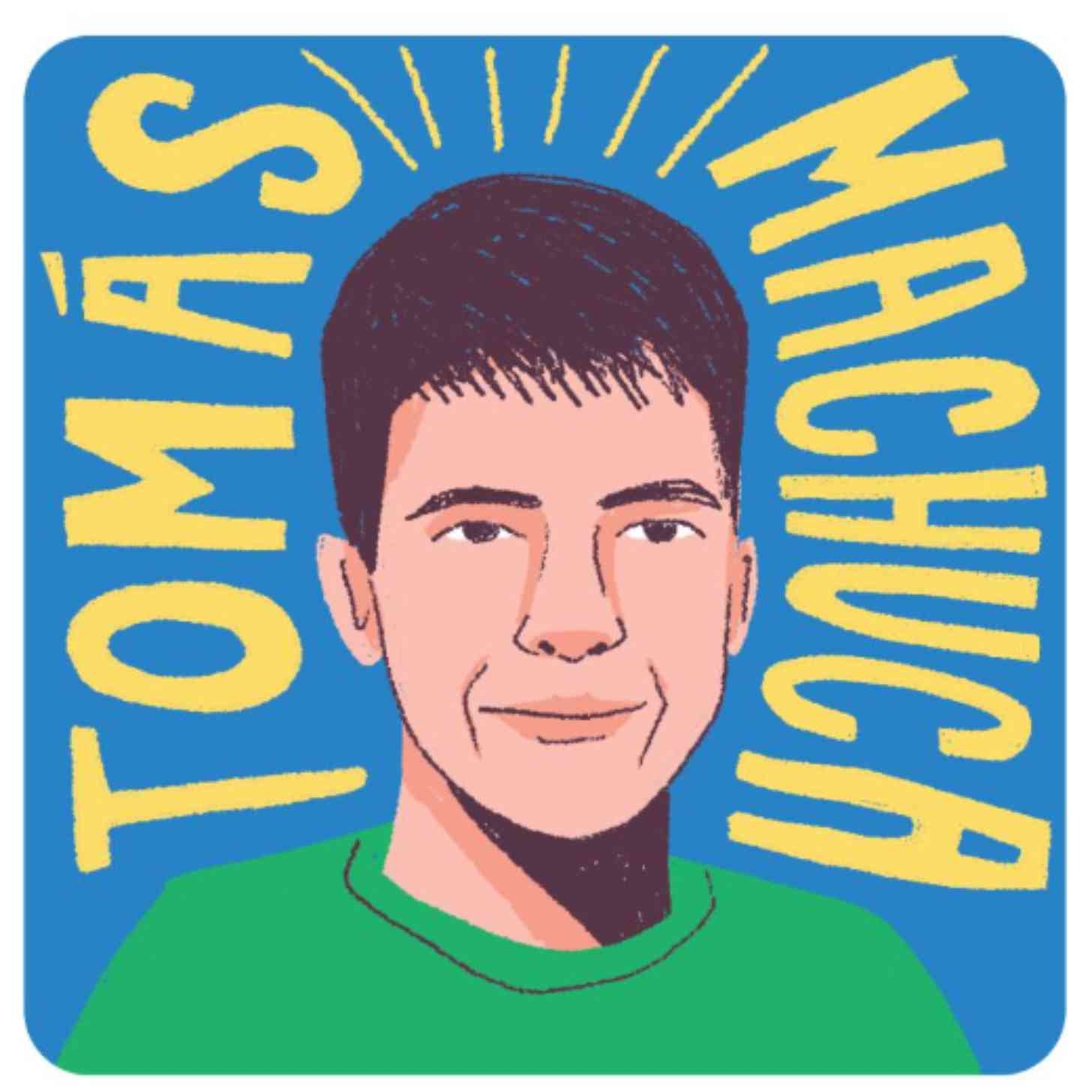
In the past five years alone, Fenikks has recycled more than 2,000 kilograms of plastic waste and delivered more than 5,000 pairs of shin guards to young athletes throughout Argentina.
“We work so that in every neighborhood where a child plays barefoot, we can share the importance of caring for and maintaining the cleanliness of living spaces and provide sports equipment of all kinds,” Machuca said.
A version of this article originally appeared in the 2025 Sports Edition of the Goodnewspaper.
Header images via Tomás Machuca
This year, startup OneCourt ushered blind and low-vision basketball fans into a new era of sports viewing by introducing new, free-to-rent haptic feedback devices at Sacramento Kings and Portland Trail Blazers games.
OneCourt allows users to watch the game “through their fingers” by relaying real-time data to tablet-sized devices. Through unique, buzzing patterns, fans can track team possession and follow the ball’s movement across the court.
“We believe that sports are for everyone and at OneCourt, we have created an intuitive tactile broadcast that makes sports more enjoyable for fans of any age, background, or visual ability,” Jerred Mace, founder and CEO of OneCourt, told the NBA.
“Every team in every league should adapt this device,” blind TikTok creator Ferraro said, grinning ear to ear as he tried the device at a Trail Blazers game. “I can’t explain how life-changing this is as a blind spectator.”

Major stadium builds sensory-friendly space for football fans
Kylie Kelce, weekly podcaster and wife of retired Philadelphia Eagles star Jason, is well acquainted with the roar of a packed stadium. She also knows it's not an ideal environment for every football fan.
"When you are in a stadium and the noise is so loud and so many things are happening, you really don't have any control over the way the sound or the stimulation is coming in,” Kelce told Good Morning America.
With a solution in mind, Kelce collaborated with the Eagles Autism Foundation and the Children’s Hospital of Philadelphia to debut a mobile sensory-friendly unit at Lincoln Financial Field filled with plush bean bags, soft lighting, and wall art that begs to be touched.
Consulting health professionals said individuals with dementia, PTSD, and extreme anxiety all stand to benefit from the space, too.
"To be able to come into this space — it's quiet, it's calm,” Kelce said. “You have all of these distractions [and] you can just sort of send your brain somewhere else for a little bit.”
The NHL is all hands-in on ASL
On June 5, 2024, the Stanley Cup Final aired on television in American Sign Language, marking the first time that a major sports league aired its broadcast with ASL commentary.
As the game played on the screen, deaf ESPN broadcasters Jason Altmann and Noah Blankenship delivered live color commentary and play-by-play analysis — all in ASL. Beneath game footage, the “NHL in ASL” broadcast also had a “crowd intensity meter” that measured the arena’s noise level for viewers at home.
“I watched it and I will tell you — fascinating, so fascinating, having it in ASL,” signed die-hard hockey fan Jerry Trayner, in an interview with ABC News Detroit. “I am so happy the NHL did this.”
Since the Stanley Cup Final, Altmann and Blankenship have continued their ASL coverage throughout hockey season.
"This is about the Deaf community being validated, being seen, and what can we do to create a positive impact and change the Deaf community moving forward," Altmann said.
Adaptive baseball league knocks inclusion out of the park
When players step out on the Miracle League baseball diamond in Auburn Hills, Michigan, they’re not stepping on grass. They’re stepping on synthetic rubber turf, which makes it easier for disabled athletes to find their footing and for wheelchair users, like Coach Mason Kaiser, to mentor on the field.
“I get to help other kids or other young adults that are just like me,” said Kaiser. “I know that I can help these kids and these parents through some of their toughest times.”
Kaiser started playing in the Miracle League of Michigan over 20 years ago. According to the Detroit Free Press, when the league’s first season debuted in 2004, it started with just four teams and 40 players.
Today, it serves 400 players across four leagues.
Through cushioned turf, wheelchair-accessible dugouts, brightly painted bases, and “buddy” systems, Miracle League makes its programs adaptive so players with various physical and intellectual disabilities — like Down syndrome, cerebral palsy, and vision impairment — can play.
Their biggest adaptive policy? Slowing down the clock. In Miracle League, every player takes a turn at bat and runs the bases, no matter their pace.
A version of this article originally appeared in the 2025 Sports Edition of the Goodnewspaper.
Header image via OneCourt
As the Trump administration’s Immigration and Customs Enforcement crackdown ramps up across Minnesota — especially following a deadly shooting of a bystander named Renee Nicole Good last week — locals are rallying to support their vulnerable community members.
One such example is local pizza chain Wrecktangle Pizza.
“F—k ICE, eat pizza, and we love you,” representatives of the pizza joint and nearby sex shop, The Smitten Kitten, started a video on Thursday.
Here, they announced they were teaming up for a community initiative.
“We, at Wrecktangle, at all locations for the rest of the weekend, are going to donate one pizza for every single pizza sold, to families and friends that are affected by the increased ICE presence in Minneapolis,” one representative said.

In the caption, they noted that they are “set on volunteers” who would deliver pizza and other goods to people unable to leave home, but added: “We could really use some help raising funds to keep the momentum and keep people safe inside during these disturbing and uncertain times.”
Wrecktangle leaders said they started with $2,000 in donations from family and friends, and figured if they posted their Venmo information, they might be able to double that.
The support exceeded their expectations.
In addition to the collection of non-perishable foods and home essentials, two days later, they announced that they had received over $83,000 in donations.
Along with the donations, the local chain sold 2,291 pizzas between Thursday and Sunday.
“We couldn’t be more stunned — or grateful,” they shared on social media.

During this time, they distributed 600 pizzas, non-perishables, and toiletries to vulnerable families, adding that “we have been working only with volunteers we personally know and trust to ensure the safety of our community.”
But thousands more meals are being made and prepared for free delivery as quickly as possible.
Wrecktangle co-owner Breana Evans told Bring Me The News that nearly every local restaurant in their area has been negatively impacted by the presence of ICE.
“We have staff, coworkers who are directly affected and scared to come to work,” Evans said. “It’s not fair for our friends to be scared to provide for their families and make a living. We know how to make food. So, we said, let’s just start making food.”
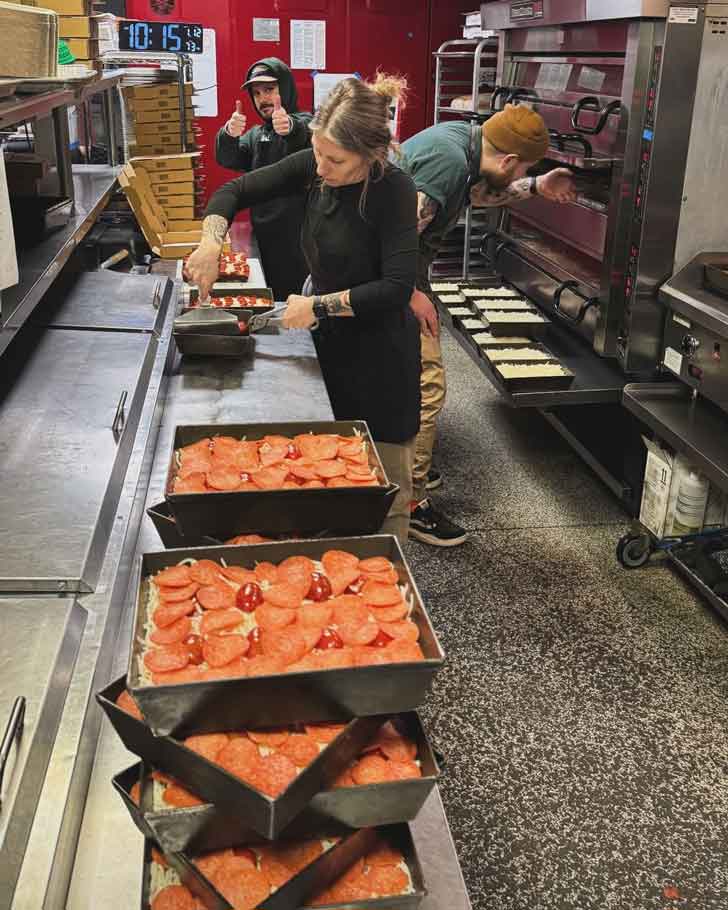
The company began donating their 13-inch frozen pizzas privately by connecting with their network of neighboring businesses and organizations. But then they realized the community could expand their efforts even wider.
Trusted volunteers were sent off to deliver free pizzas and meal kits, and others came to the shop to help assemble the goods.
“I think that’s a testament to our community and that there’s more good in the world than this horrible bad that they’re making us go through,” Evans said.
After meeting an immediate need to distribute food, Wrecktangle owners are working to figure out how to best use the funds they raised to help the community.
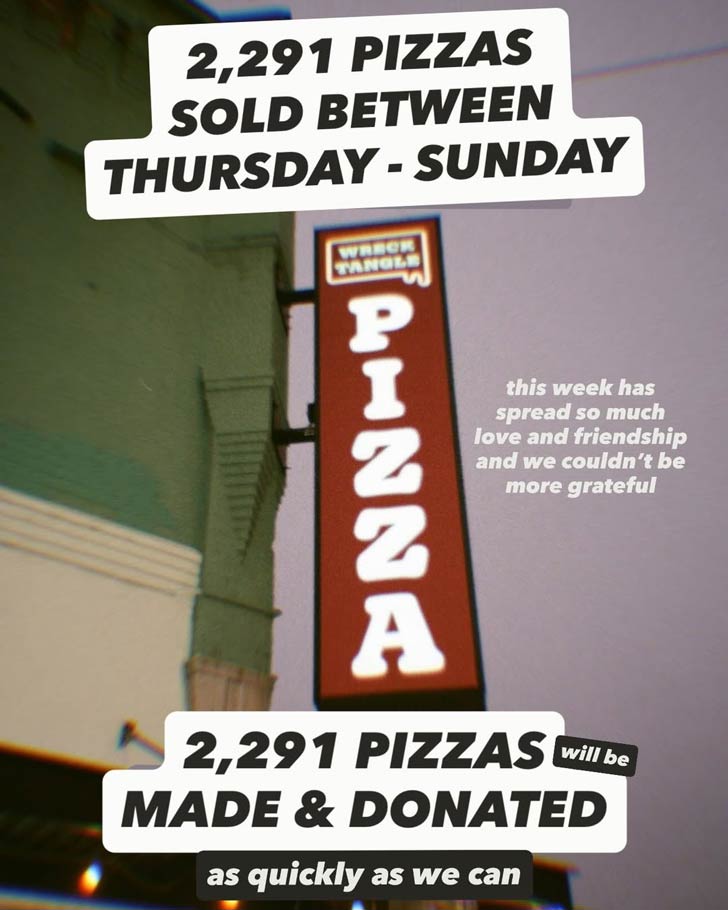
“We are working hard with nonprofit organizations to make sure these funds do the most good. We have not yet touched a cent,” they shared on social media. “As soon as we have updates as to specifically where your kindness is going, outside of purchasing food and home products, we will keep you thoroughly updated.”
And on Sunday, to finish out the campaign, Wrecktangle encouraged supporters to spend their money with other local restaurants. For one day only, they accepted emails containing a photo of a receipt from any Minnesota restaurant, and an additional meal was donated on their behalf.
“A lot of our community wants to come back to work, and we need to make sure these restaurants can help support their staff,” Evans said in a social media video. “We need you to be there.”
As of Monday morning, Wrecktangle shared on an Instagram story that they received 176 emailed receipts, which translates to 176 more meals for vulnerable community members.
“This week has spread so much love and friendship,” the company added in an Instagram story. “And we couldn’t be more grateful.”
You may also like: Amid ICE raids, Chicago cyclists buy out tamale carts and distribute food to people in need: 'Go home and be safe'
Header image courtesy of Anna Shvets/Pexels
According to a new study published in the Journal of Mammalogy, the number of living mammal species has increased by 25% since 2005 — meaning that more than 1,300 new species have been added to the scientific record.
Just a few mammals in that crowded class include new creatures like the mouse opossum (Marmosa chachapoya) of the Peruvian Andes, the olinguito (Bassaricyon neblina) of Ecuador, and the dwarf shrew (Crocidura stanleyi) of Ethiopia.
“Our recognition of 25% more mammal diversity now than 20 years ago indicates an overall improvement in our understanding of how global mammals interact with their environments,” Dr. Nathan Upham, lead researcher and Arizona State University professor, told A-Z Animals.
“Each species is genetically unique, not interbreeding with their close relatives, and thus presumably doing something unique on the landscape — specializing in different food or habitat type or location of activity,” he explained.
Upham’s research centered on a series of mathematical equations.
Since 2005, the Mammal Diversity Database has listed an additional 1,579 species.

Of those new species, 805 were newly described and 774 were “splits,” or offshoots, of what was originally thought to be a single species. 226 species were also merged after new evidence came to light.
In total, that means 1,353 species have been discovered since 2005, amounting to an average of 65 new mammal species being introduced to the scientific record every year.
In his interview with A-Z Animals, Upham emphasized that species are not evolving at a faster rate; they are simply becoming easier to find and identify.
“Next-generation DNA sequencing technologies have dramatically lowered the cost of obtaining DNA across the genomes from hundreds of individuals simultaneously,” Upham said.
Upham’s spotlight on mammalian research is supported by a larger, separate study published in Science Advances by John Wiens, a professor in the University of Arizona Department of Ecology and Evolutionary Biology.
Together with his fellow researchers — Xin Li, Ding Yang, and Liang Wang — Wiens estimated that 16,000 new species are discovered each year.
“These thousands of newly found species each year are not just microscopic organisms, but include insects, plants, fungi, and even hundreds of new vertebrates,” Wiens told the University of Arizona.
In 2025, Wiens also spearheaded research on the rate of species extinction and found that it lags significantly behind new species identification.
“Our good news is that this rate of new species discovery far outpaces the rate of species extinctions, which we calculated to about 10 per year,” Wiens said.
“Discovering new species is important because these species can’t be protected until they’re scientifically described,” he added. “Documentation is the first step in conservation – we can’t safeguard a species from extinction if we don’t know it exists.”
You may also like: This mammal vanished from Ohio nearly 200 years ago. Trail cameras just captured footage of it
Header image via Helgen K, Pinto C, Kays R, Helgen L, Tsuchiya M, Quinn A, Wilson D, Maldonado J
In 2025, a student-led team of researchers at Tohoku University in Japan discovered a massive Physalia, or Portuguese man o’ war, that boasted a striking blue cobalt color.
Upon close examination, it turned out to be a new species.
And they came across it by happenstance.
“I was working on a completely different research project around Sendai Bay in the Tohoku region, when I came across this unique jellyfish I had never seen around here before,” student researcherYoshiki Ochiai told Tohoku University. “So, I scooped it up, put it in a ziplock bag, hopped on my scooter, and brought it back to the lab!”
According to Professor Cheryl Ames of the Graduate School of Agricultural Science and the Advanced Institute for Marine Ecosystem Change, the new species is named Physalia mikazuki, or “crescent helmet man-o-war” as a nod to Date Masamune, a Japanese samurai warrior who bears a crescent moon on his helmet.
The students published their work in Frontiers in Marine Science on October 30. The study’s lead author, Chanikarn Yongstar, said the new jellyfish creature presented their team with an interesting challenge.
“It was a very involved process recording all the unique body structures that distinguish it from the other four species of Physalia,” said Yongstar.
“I looked at each individual part, comparing its appearance to old tomes where scholars drew out the jellyfish anatomy by hand. A real challenge when you look at just how many tangled parts it has.”
Kei Chloe Tan, who led the DNA analysis, said that their team also had to puzzle out how the jellyfish ended up off the coast of Japan in the first place.
The Physalia mikazuki marks the first Physalia ever spotted in the Tohoku region.

“Our morphological and DNA analyses confirmed that these specimens represent a new species distinct from its tropical relatives,” Kei Chloe Tan said. “[It] is an exciting finding in and of itself, but we still had questions about how it got here.”
To meet their conclusion, the students ran computer simulations on how objects drift in ocean surface currents and speculated that warm water from the far-off Kuroshio Current may have carried the jellyfish to Sendai Bay, where Ochiai had plucked it from the water.
“I ran a particle simulation — which is like dropping bright red beach balls in the water, then making data-based estimations to track where they will end up days or months later,” explained student researcher Muhammad Izzat Nugraha.
“We were excited to find that in our simulation, all the beach balls essentially made a trail from Sagami Bay up to right where we found the ‘crescent helmet man-o-war’ in the Tohoku region.”
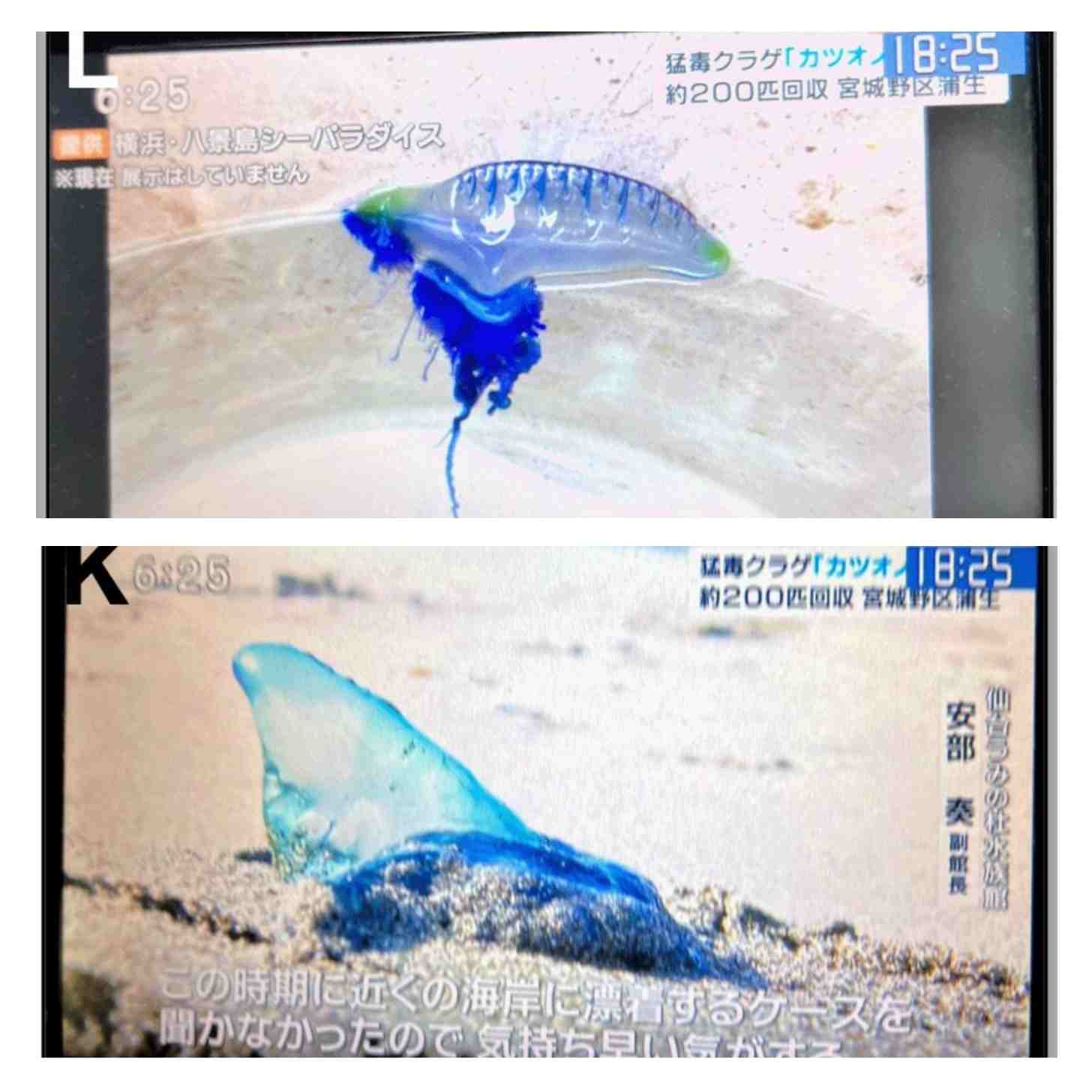
Despite colloquially being referred to as jellyfish by the scientific community — and the world at large — Portuguese man o’ wars actually bear a misnomer. They are not jellyfish but rather a siphonophore: A colony of individual organisms called zooids moving and working together.
Curiously, although each zooid in a colony is morphologically different, they all share identical genes and cohabit as a single individual.
Like many types of jellyfish, Portuguese man o’ wars are highly venomous. Despite the harm they pose to humans, they are quite beneficial to the ocean’s health.
Through nutrient cycling, they redistribute nutrients to lower trophic microorganisms in their environment.
They also play an important role in the underwater food web as prey for endangered loggerhead turtles.
“These jellyfish are dangerous and perhaps a bit scary to some,” said student researcher Ayane Totsu. “But [they’re] also beautiful creatures that are deserving of continued research and classification efforts.”
You may also like: A new species of spider with 'never-before-seen features' was discovered in Southern Morocco. It looks like a Pokémon
Header image via Kris Møklebust / Pexels
More than 50 years after the assassination of Martin Luther King Jr., the United States remains divided by issues of race and racism, economic inequality, as well as unequal access to justice. These issues are stopping the country from developing into the kind of society that Martin Luther King, Jr. fought for during his years as a civil rights activist.
As a result, King’s words and work are still relevant.
I study the civil rights movement and the field of peace geographies. Peace geographies thinks about how different groups of people approach and work toward building the kind of peaceful society King worked to create. Americans faced similar crises related to the broader civil rights struggles in the 1960s.
So, what can the past tell us about healing the nation? Specifically, how can we address divisions along race, class, and political lines?
Martin Luther King Jr.’s understanding of the role of love in engaging individuals and communities in conflict is crucial today. For King, love was not sentimental. It demanded that individuals tell their oppressors what they were doing was wrong.
King’s vision
King spent his public career working toward ending segregation and fighting racial discrimination. For many people, the pinnacle of this work occurred in Washington, D.C., when he delivered his famous “I Have a Dream” speech.
Less well-known and often ignored is his later work on behalf of poor people. In fact, when King was assassinated in Memphis, he was in the midst of building toward a national march on Washington, D.C., that would have brought together tens of thousands of economically disenfranchised people to advocate for policies that would reduce poverty.
This effort — known as the “Poor People’s Campaign” — aimed to dramatically shift national priorities to address the health and welfare of working people.

Scholars such as Derek Alderman, Paul Kingsbury, and Owen Dwyer [explain] how King’s work can be applied in today’s context. They argue that calling attention to the civil rights movement can “change the way students understand themselves in relation to the larger project of civil rights.” And in understanding the civil rights movement, students and the broader public can see its contemporary significance.
Idea of love
King focused on the role of love as key to building healthy communities and the ways in which love can and should be at the center of our social interactions.
King’s final book, “Where Do We Go From Here: Chaos or Community?” published in the year before his assassination, provides his most expansive vision of an inclusive, diverse, and economically equitable U.S. nation. For King, love is a key part of creating communities that work for everyone and not just the few at the expense of the many.
Love was not a mushy or easily dismissed emotion, but was central to the kind of community he envisioned. King made distinctions between three forms of love which are key to the human experience: “eros,” “philia,” and most importantly “agape.”
For King, eros is a form of love that is most closely associated with desire, while philia is often the love that is experienced between very good friends or family. These visions are different from agape.
Agape, which was at the center of the movement he was building, was the moral imperative to engage with one’s oppressor in a way that showed the oppressor the ways their actions dehumanize and detract from society. He said,
“In speaking of love we are not referring to some sentimental emotion. It would be nonsense to urge men to love their oppressors in an affectionate sense[…] When we speak of loving those who oppose us […] we speak of a love which is expressed in the Greek word Agape. Agape means nothing sentimental or basically affectionate; it means understanding, redeeming goodwill for all men, an overflowing love which seeks nothing in return.”
King further defined agape when he argued at the University of California at Berkeley that the concept of agape “stands at the center of the movement we are to carry on in the Southland.” It was a love that demanded that one stand up for oneself and tell those who oppress that what they were doing was wrong.
Why this matters now
In the face of violence directed at minority communities and of deepening political divisions in the country, King’s words and philosophy are perhaps more critical for us today than at any point in the recent past.
As King noted, all persons exist in an interrelated community, and all are dependent on each other. By connecting love to community, King argued there were opportunities to build a more just and economically sustainable society that respected difference.
As he said, “Agape is a willingness to go to any length to restore community… Therefore, if I respond to hate with a reciprocal hate, I do nothing but intensify the cleavages of a broken community.”
King outlined a vision in which we are compelled to work toward making our communities inclusive. They reflect the broad values of equality and democracy. Through an engagement with one another as its foundation, agape provides opportunities to work toward common goals.
Building a community today
At a time when the nation feels so divided, there is a need to bring back King’s vision of agape-fueled community building and begin a difficult conversation about where we are as a nation and where we want to go. It would move us past simply seeing the other side as being wholly motivated by hate.
Engaging in a conversation through agape signals a willingness to restore broken communities and to approach difference with an open mind.
This article was written by Joshua F.J. Inwood from Penn State, and was originally published by The Conversation.
Header Image by Unseen Histories on Unsplash
