On Oscars night, “The Last Repair Shop” took home the Academy Award for best documentary short and inspired a flurry of donations for the music repair program featured in the doc.
The doc short, which is currently available to stream on Disney+, is a love letter to young musicians in the Los Angeles public school system and the craftspeople who repair their instruments for free.
Directing duo Ben Proudfoot and Kris Bowers accepted the award alongside 11-year-old violinist Porche Brinker, a student featured in the documentary.
In his acceptance speech, Bowers — who composed the scores for “Green Book” and “The Color Purple” — talked about the importance of investing in today’s youth and removing barriers to music education.

“LA is one of the last cities in America to give public school students free and freely repaired instruments,” Bowers said as he accepted the award. “We need to fix that because musical education isn't just about creating incredible musicians; it's about creating incredible humans.”
The doc follows four craftspeople (Dana Atkinson, Paty Moreno, Duane Michaels, and Steve Bagmanyan) as they oversee the maintenance of over 80,000 instruments, and highlights how their work enriches the lives of students in LA public schools.
After receiving their nomination, Bowers and Proudfoot launched a fundraiser to support the LAUSD Education Foundation’s music education program and the very repair shop featured in the doc.
“We're thrilled to announce a $15 million capital campaign to help shore up the repair shop,” Proudfoot told reporters. “You can go to thelastrepairshop.com right now. Everybody watching — $5, you know, $10, anything — everything helps, and I think it goes to show the power of the short documentary.”
According to the public fundraiser website, the money will go toward program costs, support staff, and a new apprenticeship program for rising students to learn repair skills firsthand.
Hours after the Oscars aired, $9,000 was raised with a public donations goal set at $5 million.

A press release noted that Bowers teamed up with Searchlight Pictures to make the first gift of the campaign by donating a restored 1913 Steinway & Sons K-52 upright piano to Third Street Elementary School — the same school that Bowers attended as a kid.
“I came up learning piano on an LAUSD upright,” Bowers said of the donation. “I know firsthand what having access to a working instrument can mean for a young kid who yearns to express themselves through music.
“We are so excited that the LAUSD Education Foundation and The Broad Foundation have been inspired by our film to launch this worthy campaign that will change the lives of young Angelenos for generations to come.”
Header image by Molly O’Keeffe/Breakwater Studios
Freddie Tucker joined the army because he needed a job. He ended up making friends and seeing the world.
He finished his service in 1983. Many years later, he faced hardship and stayed in a homeless shelter in Detroit, a harrowing period. After work, he would sit in his car until evening came.
Tucker was determined to find a more comfortable way to live. Thanks to a mental health counselor, he learned about a recently renovated 60-unit apartment building for military veterans like himself.
These days, his life is on the upswing. In August 2022, he was the first veteran to move into the building located in Highland Park, Michigan, a small city within the borders of Detroit. This shift gave the army veteran a reason to smile.
“From where I was till now, it’s like night and day because this is an opportunity that I chose to be in,” Tucker says in an online video. “It’s just everything I need.”
The building, operated by nonprofit Detroit Rescue Mission Ministries, gives veterans like Tucker a much needed permanent housing option while stripping away some long-standing rental barriers, such as bad credit or a record of evictions, depending on their circumstances.
These barriers often hinder veterans going through a rough phase from securing an apartment.
On top of that, as more veterans like Tucker move into the complex, the city is a step closer to achieving a key goal in the fight to curb veteran homelessness.
Detroit is one of more than 100 communities in the United States that’s joined “Built for Zero,” a national campaign led by the nonprofit organization Community Solutions that’s supporting efforts to achieve what’s called “functional zero” through a data-driven methodology.
Each community has a functional zero threshold, or the average number of people exiting homelessness each month. Reaching functional zero for a population means keeping the number of people experiencing homelessness below that threshold, so the number of people who are experiencing homelessness at any time does not exceed a community’s record of securing housing for at least that many people in a month, per the campaign.
Detroit is hoping to reach functional zero for veterans experiencing homelessness.
One study reveals more military veterans are among the homeless population compared to non-veterans. In Michigan, veterans of color are also overrepresented in the overall veteran homeless population, and the state is seeing an uptick in homelessness among older service members. At the Highland Park property, tenants range in age and gender.
A lack of low-cost housing in the downtown area creates challenges for some veterans searching for a place to live, reinforcing the necessity of permanent options with minimal barriers. Once they are housed, veterans gain more stability and security, and get on a path to improve their health and well-being, so they can focus their attention on other parts of their lives, like employment or education.
Already, the collaboration and coordination among nonprofit organizations, government agencies, service providers, and more in Detroit has borne positive results.
“We’ve had a significant reduction in veterans [experiencing homelessness] over the past few years,” says Jennifer Tuzinsky, a social worker and the Health Care for Homeless Veterans coordinated entry specialist within the Detroit VA Medical Center’s homeless programs department.
The department aims to end homelessness among veterans by connecting them to medical and mental healthcare, support services and permanent housing programs. Tuzinsky serves as a liaison for Detroit’s VA homeless programs and the community while also helping oversee the functional zero effort.
The number of veterans experiencing homelessness in Detroit dropped from 348 in 2017 to 119 as of September, representing about a 70% decline, according to an analysis by Community Solutions.
That data comes from the Homeless Management Information System (HMIS), which collects client-level data and data on providing housing and services to people at risk of and experiencing homelessness, according to the U.S. Department of Housing and Urban Development (HUD).
As part of Built for Zero, communities incorporate this data into what’s known as by-name lists.

A by-name list includes information about each person in a community experiencing homelessness, such as health and housing needs, collected in real-time and with their consent.
Providers in Detroit working with veterans are trained to input this information into the HMIS. Data consolidation from the HMIS and other local partners combined with outreach to people who may be disconnected from supportive services, has helped communities identify people experiencing homelessness and support them along their path to finding stable housing.
Using this approach creates a more comprehensive picture of the homelessness crisis in a community, helping providers connect people to resources more quickly and efficiently, according to a Community Solutions spokesperson.
As those numbers began to drop, Tuzinsky and others noticed that there was a surplus of transitional housing beds, more than was needed. The Highland Park property was converted from transitional housing to permanent housing, providing a low-cost, low-barrier option for veterans while helping fill a critical housing gap.
That conversion was funded by the U.S. Department of Veterans Affairs Grant and Per Diem (GPD) program, which provides funding for community agencies assisting veterans experiencing homelessness. Additionally, the Rocket Community Fund and the Home Depot Foundation gave donations to pay for the renovation of the units, which have kitchenettes, as well as updated common areas.
In 2018, key stakeholders working to address veteran homelessness in the area began discussions about repurposing the Highland Park property. Eventually, a memorandum of understanding outlined the partnership between Community Solutions and Detroit Rescue Mission Ministries.
Design and construction on the building was underway in 2020. Two years later, Tucker moved into his apartment. That collaboration and coordination was crucial in making the permanent housing option a reality and reducing the number of veterans experiencing homelessness in the city.
“I think we built a community where we trust one another and we openly communicate,” Tuzinsky says. “That does not always happen. It takes a lot of work.”
“We have those conversations and we talk about what was working and what was not working,” Tuzinsky adds.
Other boons for tenants at the Highland Park property: veterans may apply to a shorter-term housing assistance program or a longer-term voucher program if they’re struggling financially. The complex accepts both types of assistance to help pay for rent, Tuzinsky says. Right now, rents for studio apartments range from $639 to $670 a month.
“We can leverage different funding sources or supports for the veterans really depending on what their needs are, if it’s financial case management, if it’s connection to other resources for employment,” says Diandra Gourlay, the vice president of social services for Volunteers of America Michigan, a nonprofit organization that provides shelter, food and other services for veterans, affordable housing for older adults, and support services for families in need. At the organization, Gourlay oversees veterans programs.
“Our goal is to get them into housing and get them settled,” Gourlay says. “And work with them to graduate to living independently without financial assistance.”
The Highland Park apartment building is an example of providing a permanent housing option veterans need and want to live in, which involved considerable outreach and feedback from the veteran community. More work needs to be done, Tuzinsky says, to prevent veterans from interacting with the homeless response system in the first place.
A group of community partners and VA staffers are currently working on a recidivism project that will supply deeper insights and develop better supports for veterans who interact with the system multiple times. Making sure veterans have access to information and resources before they become homeless is another route to prevention.
“If a veteran gets behind on rent, the sooner they reach out to us the better chance we have of helping them remain in their housing,” Tuzinsky says. “Sometime[s] by the time they connect with services, it’s too late. We want to connect with them before it reaches that point.”
Right now, there’s momentum, and ongoing collaboration is key to keeping veterans off the streets for good.
“It’s really a whole community effort to just work through and overcome the challenges that we as a system may have created in the past,” Tuzinsky says. “Because we know homelessness is traumatic.”
This article was originally published by Next City.
Florida Congressman Maxwell Alejandro Frost made headlines in 2022 when he was elected at age 25 — the first Gen Z member of Congress. But that milestone was not the beginning of his political career.
The Orlando organizer was first moved to action on the issue of gun violence, specifically following the Sandy Hook shooting in 2012, and later, a shooting that rocked his home state in Parkland, Florida in 2018.
He joined his peers in the March for Our Lives movement to call on elected officials to take action against gun violence and became the organization’s National Organizing Director.
He also served as a volunteer lobbyist for the Newtown Action Alliance and was a national organizer with the ACLU, tapping into his own experiences as a gun violence and police violence survivor, and advocating for other issues like access to health care and climate action.
Now, he’s in his second year in Congress, doing the same work — albeit, in a much different environment.
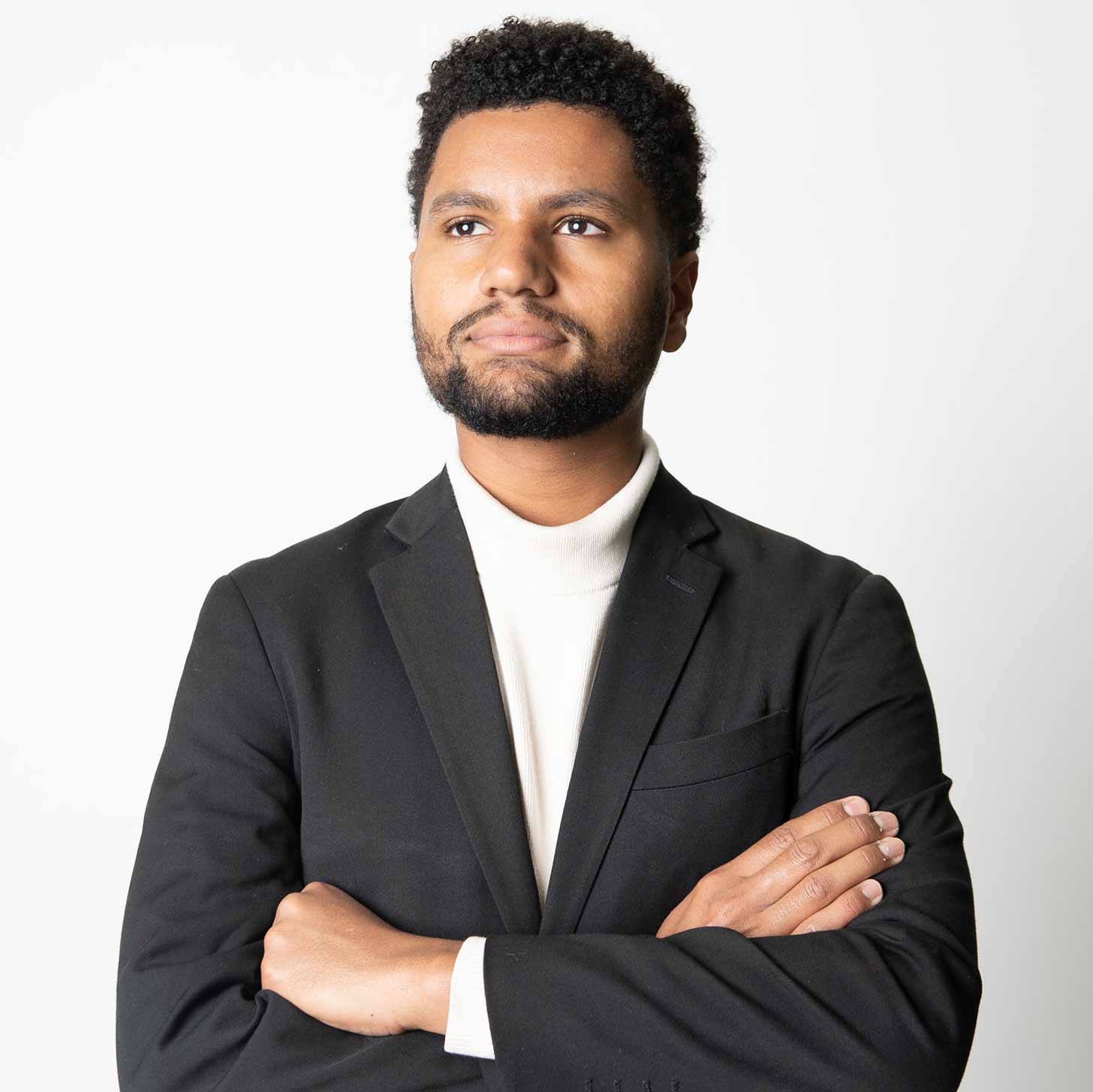
Good Good Good sat down with Rep. Frost for a conversation about youth civic engagement, successful organizing tactics, and where he finds hope amid the hard work of building a better future.
This interview has been edited for length and clarity.
In conversation with Congressman Maxwell Frost
Kamrin Baker, Good Good Good: To get started, I would love to hear a bit about your story and what compelled you to run for office.
Rep. Frost: Well, I got involved in politics at a young age. When I was 15 years old, the reason I got involved in the first place was really because of gun violence. Ending gun violence has been the charge of my life, of my teen years, and moving on as an organizer.
It was the Sandy Hook shooting that really pushed me to action. I came home after the vigil that happened in D.C. for that shooting and just started learning how to organize around gun violence. I remember my first petition I did at my school, I didn’t know much about policy and stuff, so I just made a petition that said “Sign to End Gun Violence.” It wasn’t like an ask or anything. I gave it to my principal who was like [grimaces].
But it was the first time I had ever identified a problem and looked around and said, “We have what we need here to organize with my peers and build power together.”
And then I started working on campaigns right out of high school for candidates and justice-oriented campaigns. It was just mentioned to me by some friends, like “Hey, you should look at running for Congress,” very casually. I said “hell no” and moved on. I was like, “I’m not running for Congress. Is he crazy?” But sometimes people say something and it plants a seed in your mind.
They planted that seed and I kept thinking about it for a while. And then I decided to run, and I guess I made the right decision because I’m here and talking to Good Good Good.
KB: I know a lot of young people who care about politics are often illustrated as apathetic or angry, but I’d love to know some ways you’ve seen young people mobilize successfully.
Rep. Frost: There’s a place for every emotion in every movement. Who am I to be like, “You cannot organize with anger or love or sadness,” you know? Ultimately, I think the feeling that gives us the most longevity as a movement and as people is organizing from a place of love.
It’s things like loving the oppressed more than you hate the oppressor, sitting with your emotions of anger and finding ways to morph it into radical love. I just think you last longer in this work.
And there’s a lot of examples. You can just look at any massive social movement that is based from a place of trauma. Just thinking about what followed the death of George Floyd. I mean, everyone just saw a Black man get lynched on freaking Twitter and hit the streets with righteous anger. And as the months went on, fewer and fewer people were on the streets.
And now, you have this group of people who are activated because of that. Now, you ask them, and they say “we’re still angry,” but it’s morphed into more of a thing where it’s more like “let’s help our people. We count on us.” And you have more longevity when you approach things like that.

So I would never tell someone to not organize using anger. Anger, a lot of times, is that emotion that will push us out to be involved in an issue in the first place. But finding opportunities to center the people we’re looking to help and build power with, versus just the target, or the oppressor, in that instance, I think just gives us the tools that we need to do this for a long time.
The fact of the matter is there is no successful social movement that was successful overnight. It’s the culmination of generations of work. And when it happens, the world will feel like it happened overnight. And those of us who’ve been doing the work for a while, we’ll just look at each other and crack a smile because we know it was anything but overnight.
I want to make sure people don’t misunderstand me, too. I’m not saying that we don’t need [change] now. But it’s also good to understand everyone’s different roles in this movement. Our impatience and our demand to fix things now helps us move things in a faster way. So we should never let go of that.
I always look at these caveats because people feel like you’re either an accelerationist and you want everything now or, or you are an incrementalist and you don’t believe in transformational change. But if you really study the way that movements have been successful, both things work at the same time to get us what we need faster.
KB: Has your perspective changed at all, as someone who started as an organizer and is now in this role in a long-standing, policy-focused institution like Congress?
Rep. Frost: Like I said, everyone plays a role, and we need good people who share our values everywhere. It’s in business, it’s in the arts, it’s in culture, it’s in protesting, direct action, it’s in mutual aid, it’s in the system in politics, it’s staff, it’s media. We need people who share our values, who want to see the world through the eyes of the most vulnerable in every facet of society.
I’ve operated outside of the system and in collaboration with the system throughout my career as an organizer, whether it’s through Black Lives Matter here in Orlando or through the arts, which is something that’s really important to me.
Now, I’ve stepped into this new role where I don’t see myself as above or more important than anyone else’s role, but just a different place that comes with different considerations and different ways of operating, but yet still looking at the same values and same general goals.
Generally, we want to progress and be in a place where people’s basic necessities are met in this country so we can end gun violence, defeat the climate crisis, etc. In that way, I still see myself as an organizer.
During my race, so many of my opponents would say, “well, he’s just an organizer. He’s not ready for Congress.” Now I’m here, a year into the job, and I think we’ve had a very successful year, especially for a freshman office in the minority.
But sometimes when I go vote, I’ll take a seat and I’ll sit back and watch people. And the House floor is like a little organizing fishbowl. It’s all organizing. We’re advocates. We’re not executives. We’re not the CEO of the city. We are organizers for our towns and cities.
We organize to get money, we organize to pass legislation, and we use our voice to message and make sure that we’re advocating on behalf of our constituents. It sounds, to me, like I’m being an organizer — just an elected organizer.
So, in fact, being here has made me believe that we need more organizers here [in Congress]. And let’s be clear, I don’t mean organizers for whom organizing has been their entire career. You can be an organizer and a teacher. You can be an organizer and a nurse. You can be an organizer and a musician.
It’s not about needing more people who professionally organize here, even though that would be nice. We need people who have that spirit of what it means to be an organizer and build collective power with the people around you; the people around you at home and the people around you in D.C.
KB: What changes need to be made to make running for office more accessible or even more appealing to the next generation?
Rep. Frost: We need [young] people to run for office. It’s not the only element, but it’s an essential element in building power politically. But there are real institutional changes we need to make.
[Running for office] isn’t built for young people. It’s not built for poor, working people. It is incredibly difficult. You can go into financial ruin running for office. In fact, that’s the thing that I was doing, and thank God I won.
My North Star is I believe we need publicly funded elections where no one fundraises at all. I mean, we always talk about big money in politics. I don’t think money and raising money should be an element in politics at all. Or, I like some weird ideas I’ve heard, too, things like democracy dollars, where every citizen gets a certain amount of money they can donate to a candidate.
These are cool ideas that help level the playing field for candidates and for citizens to have a voice in this, because right now, to have a voice in politics, you either need to have a lot of people power behind you or a lot of money behind you. It leaves out a lot of the folks who do not have the capacity or time to organize because they’re working on surviving.
So we need publicly funded elections, but we also need to do everything we can to make it easier to run for office. If I had a family that I had to take care of, I would have dropped out of my race four months in.
There came a point where I was houseless for two months. One of those months, I lived in an Airbnb and I emptied my savings account to do that. And the other month, I was actually just couch surfing and sleeping in my car.
And at the time, I was a 24-year-old guy with no kids. I could do that — not that I should have to — but if I had kids and stuff, that’s the point where I would have decided, probably, to quit.
Right now, this is set up for people who are already wealthy. Running for Congress is a full-time job. So you can either keep your other job and not dedicate all your time toward [your campaign] and risk losing because it really requires all your time, or you quit your job and you live off credit cards and do what you can, which is what I did.
But I don’t think people should have to do that for saying “I want to represent my people.”
KB: What is your advice for bridging generational divides? Or how do young people get older people to take them seriously?
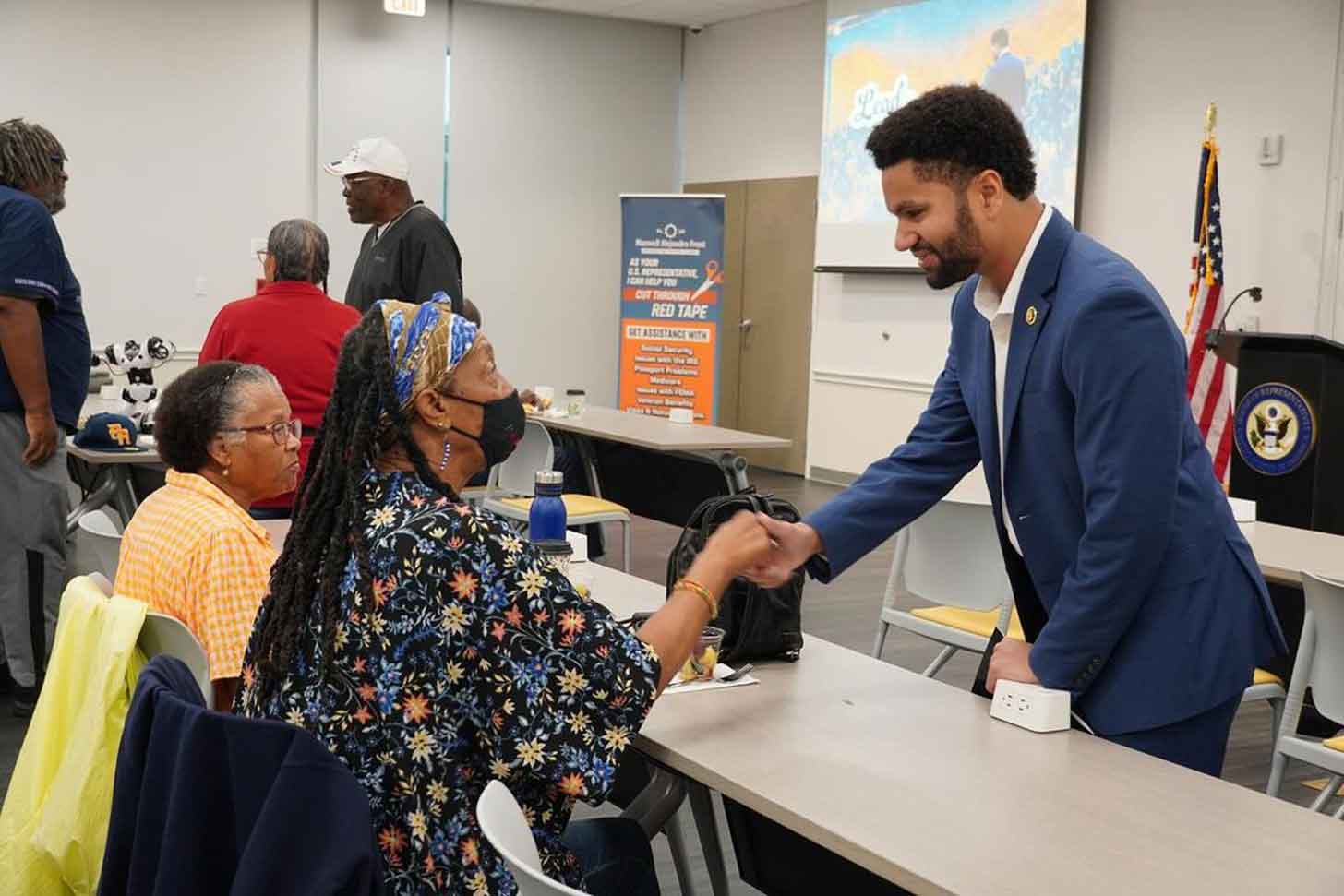
Rep. Frost: Organizing in multi-generational coalitions is really the key to this. I think people assume that I’ll be the type to say, “We need no old people in office; just young people.” Well, no, right? Our government is supposed to represent our country. I believe the way we treat our seniors and elders is really indicative of the values of our country.
For me, it’s less about having less “old versus young,” even though we need a lot more young people in office. It’s more about the fact that we really want our government to look like our country and have the freshest ideas or approaches.
Gen Z, the cool thing about our generation, is we have a very entrepreneurial spirit, but it’s also the bad thing about our generation, too, because we tend to maybe say, “I want to do something,” and rather than looking at what’s already being done, we might just start our our own thing.
You see a million Gen Z political nonprofits all doing the same thing, so the question is like, “okay, well, the people who have been doing this work, how are you working with them and building with them?” And I think working with older folks is a big part of that.
I’ll give you an example. The second bill I introduced was the Save Through Medicare Act, which is a climate crisis bill. It’s a bill to protect our seniors, a health care expansion act. And when I did that press conference, I invited the Sunrise Movement, and we announced it at a senior center.
It was a multi-generational coalition around this piece of legislation everyone believed in. Things like that help us, I think, get to a place where we get taken more seriously, but also because we give people a reason to take us seriously.
KB: I see you as someone who ran for office because you felt that you needed to, in order to change your circumstances. I know some politicians may have gotten into this work for other reasons, or just because they wanted to be in a position of power.
Do you think that reflects your experience? And do you think that kind of urgency for social change will drive more young people to run for elected office?
Rep. Frost: A lot of young people come up to me and say, “I want to run for Congress.”
I used to work in music, so I’m used to going up to managers and artists being like, “Do you have any advice?” And they go, “Keep grinding.” I never wanted to be a “keep grinding” person.
I think because we’re such an ambitious generation, we have a lot of people who might want to run for office just to hold office. And so, whenever someone comes up to me — especially someone around my age — and they say they want to run for Congress, I’ve actually decided to give them a little pause. I’m not trying to be an asshole or anything, but what I want to do is make sure people can answer that question: Why?
For me, when I first thought about running for Congress, I couldn’t succinctly answer that question, and that’s why I put it off and said no. I took time to speak with people and speak with myself, essentially, and get to a place where, yes, I could answer that question, and I was running for real reasons.
We don’t want a ton of Gen Zers running for office who have more ambition than they have passion. So, what are you passionate about? Why are you running? Are you running to just be a member of Congress?
I didn’t run to be the first Gen Zer in Congress. Maybe I’d bring it up on some fundraising calls because it was a good hook to raise money, but when I was out in the community, I wasn’t knocking doors saying, “Hey, vote for me because I’ll be the first Gen Z.” So that can’t be the reason you run either, I don’t think.
What issues or experiences do you care about? Why you — in this place, at this time?
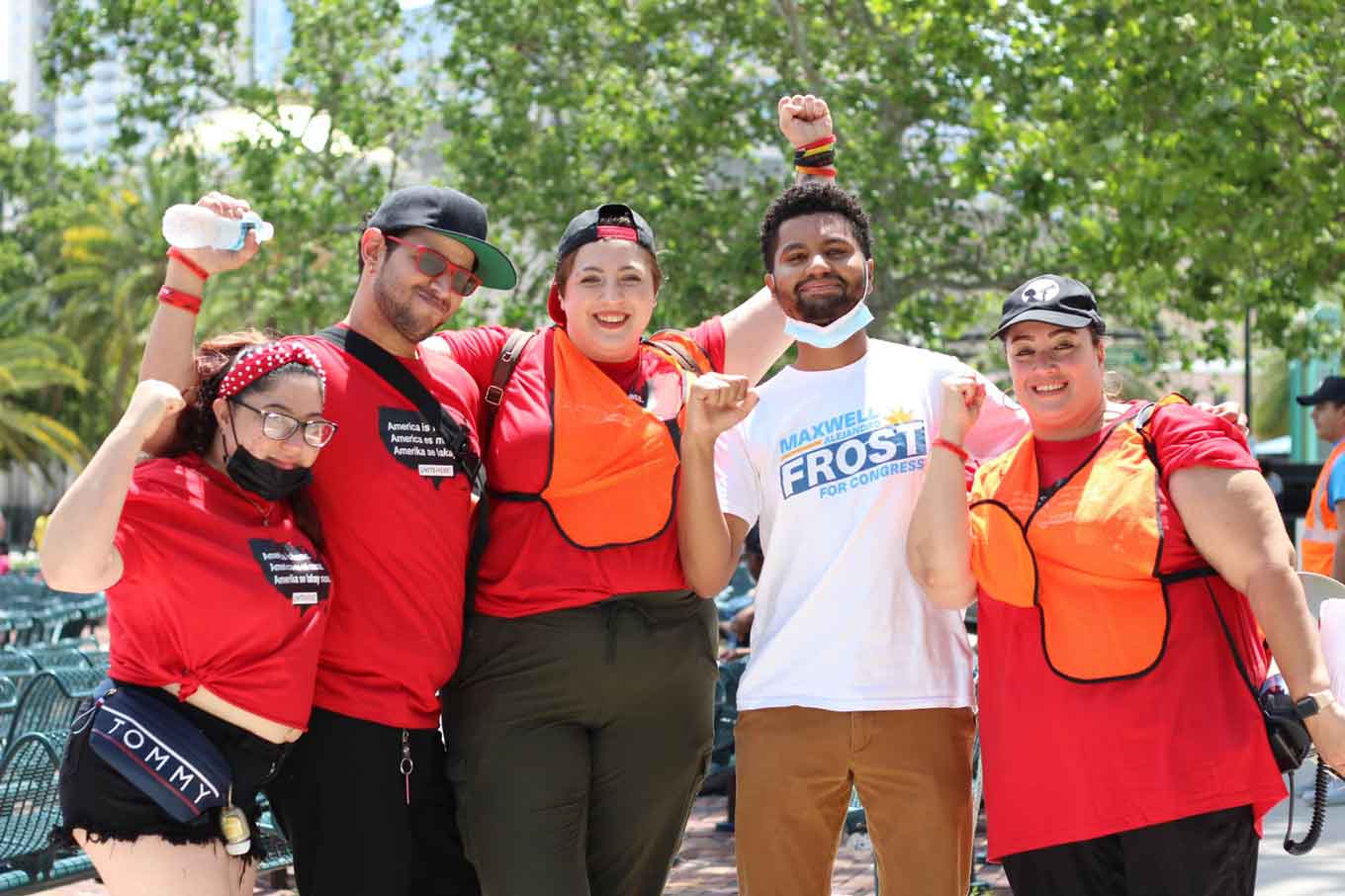
I want to see more young people in office, but I just want to make sure it’s people who are really passionate about issues and come from a place of humility.
And I’m not saying, “oh, only people who have been through the ringer can run.” No, we need a diversity of people, but people who understand that it’s a team sport, it really is. When you’re in a legislature, it’s a team sport. You don’t make any decisions on your own that become law.
We have such a celebrity culture in politics, too, which can be really toxic because it appeals to this group of people who want to run for office just to hold office. This is really difficult work, and that’s why we need people here who are willing to be here for a while and have their heart and their head in the right place.
KB: All of that being said, what gives you hope?
Rep. Frost: Really, honestly, what gives me a lot of hope is the young people in our country. Gen Z is the most progressive generation in the history of our country. It’s an impatient generation that has grown up viewing the traumas of the world through social media and has people scratching their head saying, “What the hell is going on and how come this stuff hasn’t been addressed?”
Gen Z is the most politically active generation in the history of our country, too. So I just know that we can build a lot of power.
Look, I don’t claim to be the Gen Z spokesman, but the numbers don’t lie. It shows that we’re a generation that wants, for the most part, generally, health care for everybody, to end gun violence, and defeat the climate crisis.
Gen Z and millennials were a third of the electorate last election. Half of Gen Z can’t even vote yet, and we’re already the most politically active generation in the history of our country.
The question is, in 10 years, in 20 years, as we become older, does that change policy in the United States? I come from a place of believing we’ll change things for the better. I think we will keep strong on our beliefs. I’m very optimistic for the future of this country. I know it’s weird to say with everything going on, but that’s where I’m at.
A version of this article was originally published in The Civic Engagement Edition of the Goodnewspaper.
Get your own Goodnewspaper by becoming a good news subscriber today.
The International Olympic Committee is going for gold when it comes to gender equality.
This year’s Olympics in Paris will be the first in history to achieve numerical gender parity on the field of play.
What does that mean, exactly? There will be an equal number of female and male athletes participating in the largest sporting event in the world.
According to the IOC, out of the 10,500 athletes participating in the Games, there will be 5,250 men and 5,250 women.
These numbers are spread out more evenly than ever before, with gender parity for 28 out of 32 sports, as well as a more even distribution of medal events.
There will be 152 women’s events, 157 men’s events, and 20 mixed-gender events — meaning over half of all medal events will be open to female athletes.
“In today’s world, no organization or country can afford to leave the skills of 50% of the population behind – either in sport or in society at large,” Tomas Bach, the IOC President, said in a statement. “That is why the IOC is committed to closing the gender gap on and off the field of play.”
These efforts began significantly in 1996 when the IOC enshrined the promotion of women as a formal mission in the Olympic Charter. The Tokyo 2020 Games were the most gender-balanced to date, with 48.7% of competing athletes identifying as women.
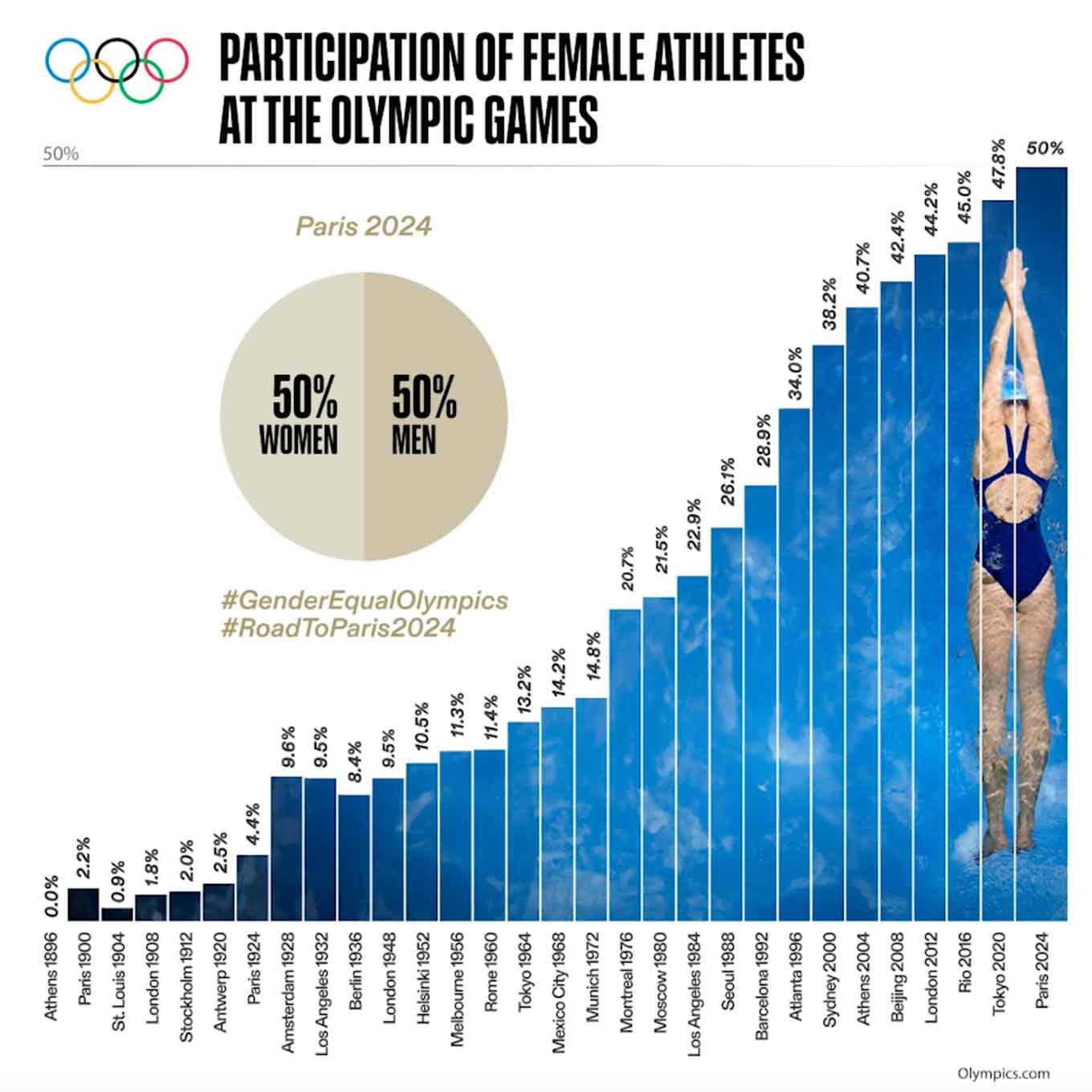
While the 50-50 gender split of the 2024 Games is an enormous achievement, made possible by a number of decades-long initiatives to curb inequality in the Olympics, the number of players on the field doesn't exactly mean that gender equality has been achieved.
“While we have seen improvements in gender equality in sport, we need more, and quickly,” Marisol Casado, the chair of the IOC Gender Equality Working Group, said. “We can’t just arrive at 50-50 representation in competition and say the job is done.”
Fair scheduling, equal media coverage, and increased visibility
As part of its ongoing efforts to empower women athletes, the IOC created a major “Portrayal Guidelines” report in 2021, which pointed to three major challenges for women’s sports.
These include underrepresentation in media, lack of recognition, and the fact that many participants are identified as “women, females, wives, or mothers” before they are acknowledged as athletes.
The report also provided a myriad of statistics about women’s athletic media coverage. Its findings indicated that a humbling 4% of sports media content focused on women athletes, as well as the sad reality that women made up just 20% of accredited media professionals at the Games.
This isn’t exclusive to the Olympics, either. A lack of media coverage of women’s athletic events has even prompted women to open their own female-centered sports bars to showcase women’s events — since folks can hardly find them anywhere else.
But with this gender parity milestone, the IOC is continuing its efforts to ensure fair scheduling and equal media coverage of women athletes.
For instance, gender balance is now a factor in the development of the Olympic competition schedule, ensuring male and female competitors get equal broadcast time during the busiest viewing hours of each day.
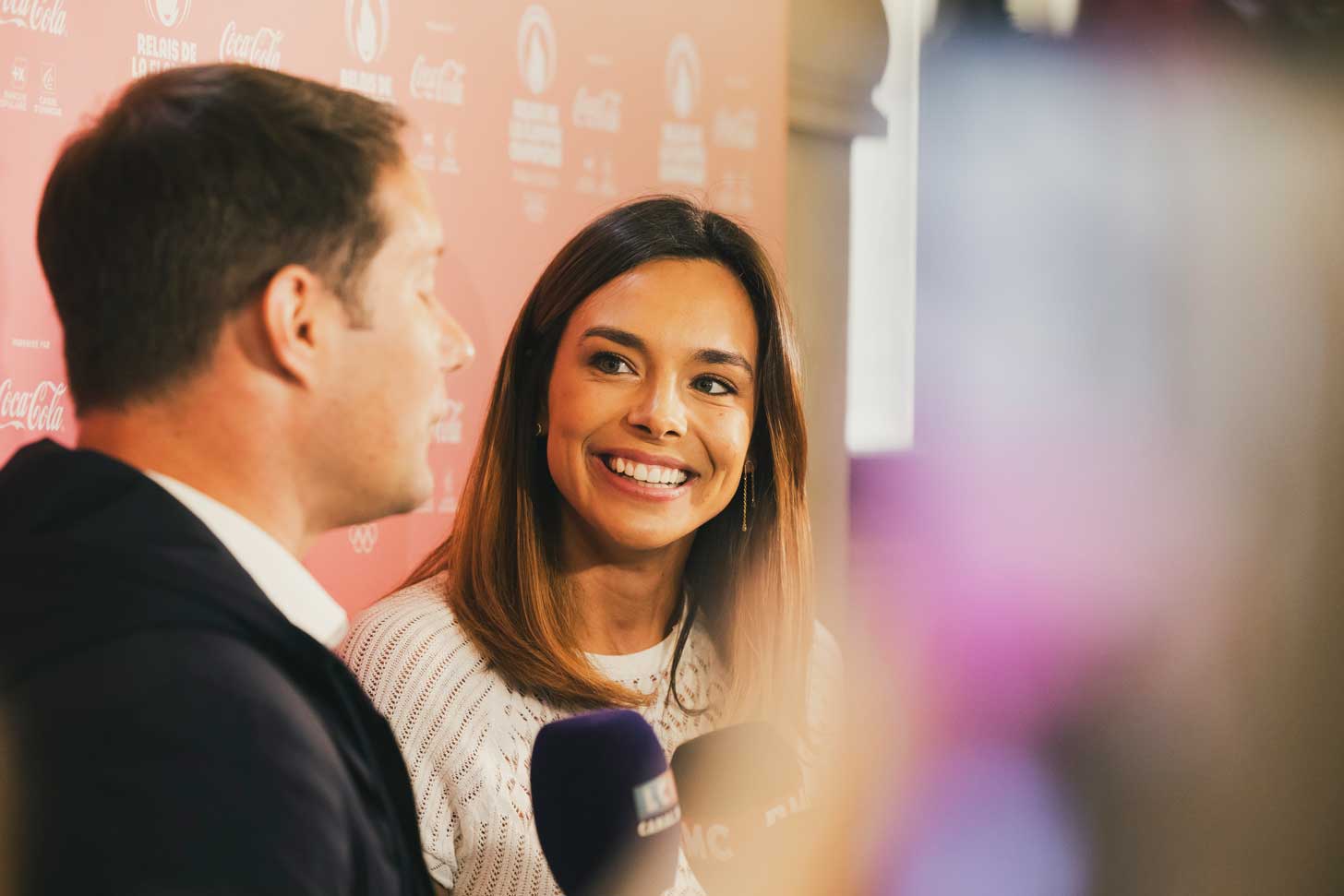
“Supporters of women’s sport often look to the media for coverage in the hope it will raise the profile of women’s sport,” Nancy Lee, the gender equality advisor for the IOC, said in a statement. “But if women’s events are not scheduled proportionally, there can’t be equal coverage.”
This is no easy feat. Developing the schedule across all sports events and venues can take approximately five years. The process also involves four major committees — the IOC, the Organizing Committee for the Olympic Games, all International Sports Federations, and the Olympic Broadcasting Services — to achieve.
Aside from the goal of gender equality, organizers must consider factors like sports regulations, transport logistics, operational considerations, sporting priorities for the host country, and of course, time zones across the globe.
One change audiences may notice in 2024 is the new arrangement of combat and strength sports, with men and women’s competitors alternating, instead of having women’s and men’s competitions scheduled at two separate times of the day.
“You might ask why this makes a difference for gender balance, particularly since broadcast coverage spans global time zones,” Lee said. “It’s important because alternating events between men and women illustrates fairness and confronts the myth that women’s sport is less important.”
The IOC is also hiring more female staff in broadcasting positions for Paris 2024, including 35 new female commentators, which will raise the percentage of women in that role to nearly 40%.
This represents a nearly 80% increase since the last summer Games in Tokyo, and an over 200% increase since Rio 2016.
That aforementioned set of Portrayal Guidelines from the IOC is a major addition to the coverage of Olympic events.
The guidelines are issued to content creators and media outlets, providing clear and consistent direction on how to cover the Olympics in an inclusive way. They also encourage media professionals to create databases of female experts, athletes, coaches, sports scientists, and more.
“Sport has the power to shift how women and minorities are seen and how they see themselves,” the guide’s introduction reads.
“As leaders, communicators, content creators and media outlets within the sports movement, we set the tone as to how sportspeople and athletes – globally – are … portrayed, across all forms of media and communication.”

Another exciting component of visibility for women in the upcoming Games is that this year’s Olympic marathon route takes inspiration from the Women’s March of 1789. This historical tribute is dedicated to the women who walked from Paris to Versailles to protest against food scarcity — a turning point in the French Revolution.
Paris is also working to improve how women are perceived in athletics, even choosing a woman’s face for its unique 2024 Olympic logo and renaming some sports facilities for the Games.
“Because equality also involves visibility, the renaming of these sports facilities with women’s names is a key challenge,” Tony Estanguet, president of Paris 2024, said in a 2023 statement.
“We thank the local authorities working with us who, through these symbolic actions — which are not only strong but also concrete — contribute to making sport more inclusive and equal.”
Continuing progress
As exciting as all of this progress is, the IOC still has plenty of work ahead to fully realize gender equality on the world’s playing field.
Of course, it’s important to note that these efforts of gender equality are already incomplete when only viewing progress through the binary lens of male versus female, excluding an important group of talented athletes who are non-binary or transgender — and are systematically excluded from sports.
Disagreements about “biological” differences or advantages between cisgender and trans or non-binary athletes come from the same systems that continue to enforce different requirements between men’s and women’s events.
For instance, male and female competitions still differ when it comes to things like lengths of races, weight categories, what equipment is used, judging standards, uniforms, and more.

“It’s about looking at the Games with a broad understanding of gender equality,” Michele Donnelly, who teaches sport management at Brock University in Ontario, told The 19th. “[I’m] taking the broader perspective of gender equality to understand it beyond numerical equality, to actually look at the conditions of participation.”
There are also major gaps in gender in leadership roles at the Olympics. While the Tokyo 2020 Olympics were touted as a triumph for gender parity, only 13% of coaches were women.
To address this issue, the IOC has continued to work in partnership with International Federations to open up more coaching roles to women. This also includes the Women in Sport High Performance Pathway program, which aims to provide training to 100 female coaches leading up to the Paris Games.
While many programs and initiatives, including these leadership programs and an increase of mixed-gender events, continue to grow under the IOC, gender equality remains a goal reached by incremental progress.
This year’s milestone in gender parity is just one way the global sports community is celebrating its universal love of the game.
“They’re the same gestures, the same medals, the same emotions; It’s the same desire to win, the same pride, the same power to inspire all those watching,” Estanguet, the president of Paris 2024, said in the IOC’s Portrayal Guidelines report. “It’s not women’s sport; it’s sport.”
Header images: (C) Paris 2024, IOC/Tullio M. Puglia, and IOC/Greg Martin
A cave-dwelling aquatic salamander called an olm has been poking its head above water in Italy — a rare sight for scientists.
A study, published last month in Ecology, captured observations of the pale amphibians in above-ground springs in Doberdò del Lago, Italy. One spring contained olms 64% of the observed time.
When handled, the research team noted that the serpentine animals were “plump” from grubbing down on soil-living earthworms, a newfound delicacy to creatures long accustomed to underwater worms and snails.
This new development in behavior could potentially stem from water pollution and habitat disturbances from land use above cave systems. Both of these ecological occurrences have caused the population of olms to decrease across Italy, Bosnia, Croatia, and France. The blind, eel-like salamander is also currently on the Slovenian Red list of endangered species.
Olms have captivated scientists for centuries. In a 17th century account, a Solvenian naturalist believed the specialized salamander to be the offspring of dragons, leading to its moniker as a “baby cave dragon.”
Olms are umbrella predators in their environments, meaning that even just their presence signals that their ecosystem is stable, and the water quality is healthy. These recent discoveries mean scientists are hopeful about efforts to protect and learn from these fascinating creatures.
Like other tailed amphibians, olms are also known for their “extreme ability to regenerate,” and the continued study of them in biomedical fields could revolutionize surgical practices for the better.
“By learning the mechanisms of efficient regeneration as know it in tailed amphibians, we’re not going to make the arms grow back, but it will help us understand, or better understand, the healing processes, procedures, pre-surgery procedures, that will reduce hospital stay,” said Rok Kostanjšek, a biologist at the University of Ljubljana in Slovenia.
“This would be a biomedical application of these insights that we’re gaining by analyzing the genome of such unusual animals.”
In appearance, the olm closely resembles the smiley, beloved “water monster” called an axolotl, but they are separate species who live in different continents: olms in Europe, and axolotls in Mexico.
Both are frilly-gilled aquatic salamanders with vestigial traits (like tiny limbs) that are neotenic, which means that they retain juvenile features into maturity.
However, the olm drastically diverges in resemblance to axolotl when it comes to its long, winding body. Also, the average lifespan of an axolotl is 10 to 15 years, but olms are outliers: scientists have estimated that they can live up to 100 years.
Perhaps even more surprisingly, researchers believe that they spend the majority of their lives relaxing, only moving when necessary.
In an interview with Science News, Eötvös Loránd University zoologist Gergely Balázs said that olms are largely solitary and can go years without eating.
“They are really good swimmers,” Balázs said. “[They] could move around and try different spots to see if the neighbor is nicer, or there’s more prey… And they just don’t do it.”
Olms, which have been described as the “couch potatoes” of the animal world, are notably low-energy.
Across a decade, Balázs and his team tracked the underwater movements of 37 olms. One particular olm that he tracked in 2016 stayed in the exact same spot for 2,569 days.
Don’t worry about grabbing your calculator: That’s seven years.
“If you’re a salamander trying to survive in this… food-poor environment and you find a nice area to establish a home or territory, why would you leave?” posed cave biologist Matthew Niemiller.
To scientists coming back from their research study in Italy, it looks like some olms will leave home for the right snack, which is highly relatable indeed.
Learn more about this species and the organizations currently working to conserve it by following the Zoological Society of London.
Header image courtesy of the Smithsonian Channel
Believe it or not, it’s already been two years since Dylan Mulvaney first graced TikTok For You Pages with her “Days of Girlhood” series, in which she documented the process of her gender transition.
Since then, Mulvaney has become a household name, accumulating over 10 million TikTok followers.
To celebrate the two-year milestone of her transition, as well as honor the painful parts of the past year, Mulvaney — who has a background in musical theater — released a new single.
It’s aptly titled “Days of Girlhood,” and all profits it earns through Pride Month will be donated to The Trevor Project.
“I also want to celebrate the Trevor Project, which is an incredible organization offering crisis management resources to the LGBTQ youth,” she said in an Instagram video in collaboration with the nonprofit.
“I also wanted to let you know that every time that you stream my song or use it on a social media app, any profits that I make through Pride Month, I will be donating to the Trevor Project.”
Building on themes of support and resilience in the LGBTQ+ community, Mulvaney’s song is an upbeat anthem to all the women who have uplifted her thus far in her transition.

“Every day, every night / rise and shine, yeah, all mine / thick or thin, I’ll be alright / got my dolls by my side,” she sings atop a meaty guitar track and bounding bass line.
It’s an appropriate celebration for a year that Mulvaney said consisted of a lot of pain.
“I think the theme of this last year was pain. And it's not a bad thing, but it was so contrasting to the joy and ecstasy that I experienced in those early days, that it was almost comical, but also heartbreaking at times,” she said in the aforementioned video.
“I was trying to protect myself while also realizing that my actions could directly affect a lot more people than just me. And feeling that pressure build, I would often shut down and disassociate. But other times, I owned my pain, and I grew a thousand times stronger.”
Mulvaney’s most notable brush with pain came last spring when she shared a brand partnership with Bud Light. Quickly, the brand experienced boycotts from anti-trans customers and dropped Mulvaney from the partnership, leading to relentless online harassment for the singer and digital creator.
She recounted months of healing that came after this harassment (harassment that continues even this week, as Lady Gaga was met with hateful comments after posting a photo with Mulvaney).
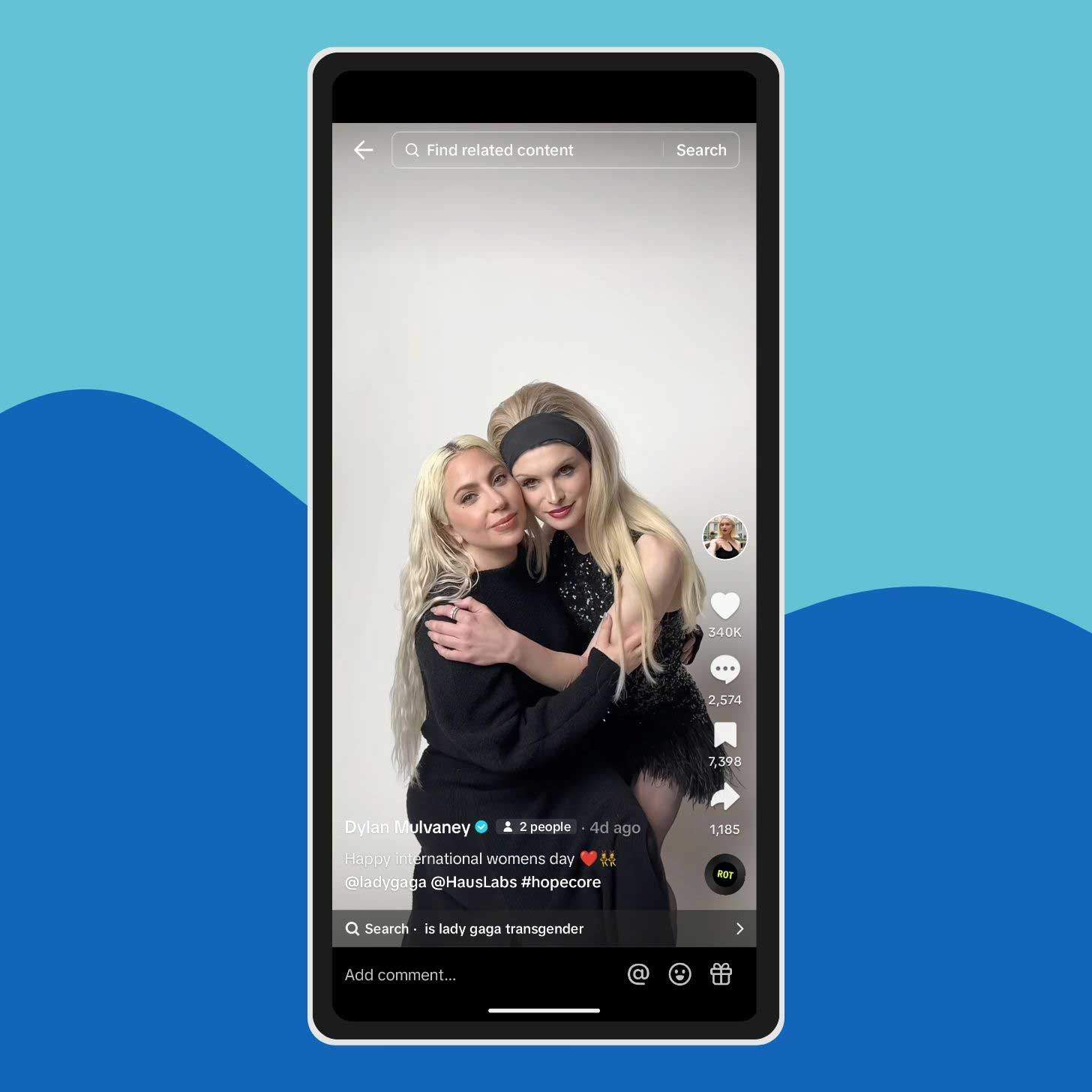
Mulvaney said she has spent the past year building meaningful relationships, embracing her earnestness, and learning what “hyper-feminine” things she truly loves — not just what she thinks she needs to embrace to feel validated in her transness.
“This might be the most ridiculous thing I have ever said, but stay with me: Going blonde, like, saved my life,” she said. “I needed to do something that made me feel I had power over my body.”
Now, with her Barbie-inspired hair and joyfully pink aesthetic, Mulvaney has pivoted to consulting work, helping brands work to be more effective and responsible allies to the transgender community.
“I feel really responsible for the onslaught of transphobia that retroactively became corporations pulling support from queer and trans talent last year,” Mulvaney said in her Instagram video.
“I want to use what I went through as a way to help companies and executives learn what not to do when including trans people in their marketing campaigns.”
She also spoke about how she wants to make Broadway and musical theater more inclusive to trans performers, as well as a list of other desires for the year ahead.

“I would like to see some healing in the media and some olive branches. I would like for transness to be less political, no more anti-trans bills, no politician’s platforms debating our existence,” she said. “I want everything to hopefully be okay eventually. We're getting there.”
Comments flooded in under the video, from celebrities and everyday fans alike.
“You inspire me so much,” actor Joe Locke commented. “I’m so glad you’re in my life, my Dylan.”
“Love you so much sis,” Oscar-winner Ariana DeBose added. “Exceedingly proud of and for you, boo!”
A fan chimed in: “2 years of girlhood but a whole life of Queening.”
The Trevor Project — which honored Mulvaney as its Suicide Prevention Advocate of the Year in 2023 — also had some words of encouragement.
“We are so very proud to get to witness you in your journey through girlhood,” the organization wrote on Instagram. “Dylan—thank you for all you’ve taught us.”
Rounding out her video, Mulvaney vulnerably discussed her own mental health and drew a poignant contrast between her inner journey and the cheery exterior illustrated in her new song.
“Happiness is something that I will wait for again, even if I’ve lost it for a little while, because I know it’s coming,” she said. “Because that’s what I haven’t lost: the hope. I still have it. Isn’t that a beautiful thing?”
Header images courtesy of Dylan Mulvaney/TikTok and Spotify
The next time you visit your favorite park, you might notice a Chronolog sign prompting you to take a picture. But this photo isn’t meant for social media — it’s for improving wildlife conservation efforts on a global scale.
Chronolog is rapidly installing signs in parks, wetlands, and nature reserves around the world topped with phone-sized mounts, so that nature lovers can take picturesque landscape photos and submit them to community time-lapses.
According to the program’s website, the 100,000-plus photo submissions have helped improve wildlife conservation efforts by allowing researchers to monitor nature sites from afar.
Use cases include restoration projects conducted using citizen-backed data collection for erosion, water quality, wildfire and storm recovery, and animal migration.
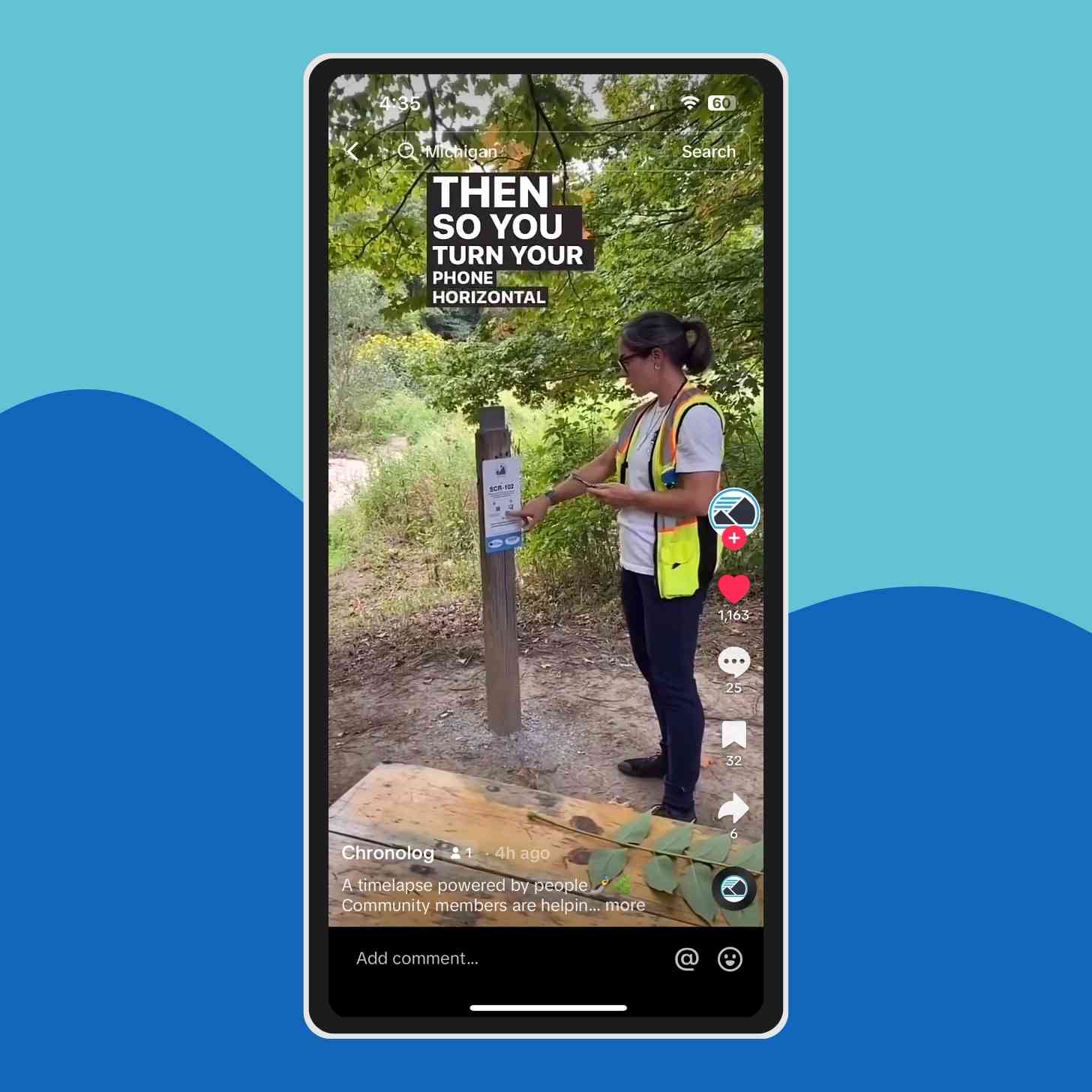
Chronolog recently shared a TikTok video in which a volunteer showed viewers how to participate in the community project.
“Take your phone, making sure that your camera is on top, place it in this groove right here, and it’s gonna give us a picture of the lake,” explained the volunteer, as the camera looked out on a lake in Virginia’s Beaverdam Park.
The volunteer reminded viewers to submit photos to Chronolog’s email address (upload@chronolog.io), which is provided on the sign alongside a unique subject heading specific to each monitor site.
“That’s going to help us monitor for erosion, wildlife — such as our migratory waterfowl who’ve started arriving — and it’s going to help us protect our natural resources here in Gloucester county,” shared the volunteer.
@chronolog.io People-powered time lapse of nature🤳🌄🦢 The community of Gloucester, Virginia is helping monitor the tundra swans and buffleheads of Beaverdam Park with just their smartphones! Tag your favorite park if they should do this 💚 #CommunityScience #ParticipatoryScience #CitizenScience #Chronolog #CoolChronolog #OptOutside #GloucesterCounty ♬ original sound - Chronolog
Nature-loving visitors can now help track the patterns of tundra swans and buffledams of Beaverdam, but the project is bigger than any one park.
Chronolog has an online record of its community-made time lapses, so that anyone around the world can click around and spot birds in Shenandoah National Park or see golden fauna bloom on a reserve in Cape Town, South Africa.
Associate professor Jon Schmitkons — who manages a network of six Chronolog stations at Binghamton University — said that the beauty of the tool is that it encourages people to interact with their local park sites.
“In reality, there are probably ways you can collect data more efficiently,” Jon told Bing U News. “But then there’s the community engagement side of things, and that’s where the Chronologs are really useful: getting people to go out there and see sites they wouldn’t normally see or learn more about the places they walk past every day.”
Nature lovers hoping to install a Chronolog in their community can complete this interest form online.
Header image courtesy of Jay Huang
This story was originally published by High Country News.
All over the world, conversations about climate change and solutions to it are happening, at conferences, in documentaries, in offices, even over coffee.
Climate scientists, government officials, tech entrepreneurs and others all have opinions about how humans should address the crisis, but many of them are leaving out something important: the experience and knowledge systems of the land’s original stewards — Indigenous peoples.
High Country News’ Indigenous affairs team has compiled three short profiles that center Indigenous people and their knowledge in the climate realm.
The profiles showcase the efforts and expertise of people who are working, in one capacity or another, to address climate concerns through data and knowledge sovereignty, promoting the act of close listening, and helping everyone involved understand the power and truth of Indigenous ways of knowing and experiencing landscapes.
They continue the work of their ancestors and remind us to take the time to really listen — not just to Indigenous stewards like them, but also to each other, and to the environment itself.
How 3 Indigenous women are leading the way on climate change
Amelia Marchand (Colville)
By B. “Toastie” Oaster
“Indigenous people have so much to give, if people would just stop taking it,” said Amelia Marchand, senior tribal climate resilience liaison at the Affiliated Tribes of Northwest Indians (ATNI) and a citizen of the Confederated Tribes of the Colville Reservation.
“For so long, our knowledge has been extracted.” Science and academia, she explained, have a history of taking intellectual property from communities that do not benefit from its use.
Through her work at ATNI, Marchand guides climate scientists in conducting research equitably — by, for example, making data sovereignty or intellectual property agreements with Native communities before making use of Indigenous knowledge.
Ethically engaging with tribes, she said, requires ensuring that scientific research aligns with the priorities of tribal communities. Too often, state and federal agencies treat tribes as ordinary members of the general public. “Tribal nations are not a stakeholder group,” she explained, noting their status as governments.
“Tribes are rights holders, not an interested party.”

Having recently relocated from the Colville Reservation to Kānaka Maoli lands on O’ahu, Hawai’i, Marchand now conducts trainings with tribes, universities, nonprofits and government agencies like the U.S. Geological Survey, working to develop climate strategies that include Indigenous priorities. “It’s advocating and educating at the same time,” she said.
Marchand said that while it may be possible to survive climate change without Indigenous leadership, that scenario is not a good one for the future. “It’s business as usual, with more of the same terrible history that’s led us here,” she said.
A better future will require a focus on equity.
“It’s interesting, the place where humanity finds itself, because we have all the tools — the technology, the wealth, the brainpower — to initiate those changes,” Marchand said. “What we lack is the political will.”
And Native leaders know how to implement traditional practices in a good way. As an example, she noted that in September, Interior Secretary Deb Haaland (Laguna Pueblo) revised four climate-related Interior Department policies, all of which now refer to Indigenous knowledge. Marchand credits “Auntie Deb” with implementing this knowledge at a federal level in a way that’s not extractive. “We, as a whole, would not be as far without her,” Marchand said.
Through ATNI, Marchand has had a hand in crafting policy resolutions that might influence states like Washington and Idaho, or perhaps pass up the chain to the National Congress of American Indians and on to the U.S. Congress.
Concerning more boots-on-the-ground changes, Marchand has also cofounded the L.I.G.H.T. Foundation, a nonprofit that supports native plant conservation and gathering traditions for Pacific Northwest tribes.
Working with climate sustainability students from Western Washington University, she’s used lessons about the protection of native plants and pollinators to talk to students about sovereignty, drawing attention to the braided nature of climate, conservation and Indigenous rights.
Lydia Jennings (Pascua Yaqui and Huichul)
By Anna V. Smith
The global shift toward renewable energy is fueling growing demand for copper, lithium and manganese, minerals that are often found near tribal reservations or on sacred ancestral lands. At the same time, Indigenous knowledge is increasingly sought by governments and scientists to inform land management and climate research.
Lydia Jennings’ research sits at the nexus of these two tensions: She’s a soil microbiologist studying mining and natural gas sites near tribal communities.
Jennings, who is Huichul and a citizen of the Pascua Yaqui Tribe, splits her time between the very different biomes of Phoenix and Durham, North Carolina, as a postdoctoral researcher at Arizona State University’s School of Sustainability and a research fellow at the Nicholas School of Environment at Duke University.
In both roles, she’s deeply interested in how federal agencies and policies include tribal nations’ priorities and concerns. “We value Indigenous knowledge when it comes to healing the ecosystem, but don’t really value Indigenous knowledge when it comes to the proposal of a new mining site,” said Jennings.
Jennings was first drawn to the stories that soils tell when she worked as an environmental toxicologist at UC Davis. Traveling from the Tijuana River to the California-Oregon border, she noticed that soil pollution varied widely. Her research focused on a major source of environmental harm: hardrock mines and the tailings they leave behind.
“We’re talking about all these ideas and concepts around climate change and integrating more Indigenous knowledge, and that’s a beautiful idea.”
Part of her dissertation at the University of Arizona dealt with the Rosemont Mine in the Sonoran Desert, a proposed copper mine southeast of Tucson, on a site that overlaps the ancestral lands of Jennings’ own tribe, as well as the Tohono O’odham Nation, the Hopi Tribe and others.
If approved, it would be the third-largest copper mine in the U.S. Jennings’ work underlined the importance of Indigenous rights in consultation and land management. That work catalyzed her interest in data sovereignty and the way Indigenous knowledge and information is shared.
“We’re talking about all these ideas and concepts around climate change and integrating more Indigenous knowledge, and that’s a beautiful idea,” Jennings said. “We need to also know that there are rights that communities have to protect that data, to be able to steward that data in the same way that they steward their ecosystems.”
That philosophy extends to climate research and tribal consent. In her current research with the Lumbee Tribe in North Carolina, Jennings is working with Ryan Emanuel, an assistant professor at Duke University and a citizen of the Lumbee Tribe, on environmental health concerns over methane gas emissions near the community.
The important thing, she said, is that “it’s work that upholds the questions and concerns a tribal nation has,” instead of being driven entirely by researchers from outside the community.
“It’s all really being led from community members themselves, and those who have a much longer understanding of both problems — the challenges — but also community dynamics and community-based solutions,” Jennings said.
When facing large-scale problems like climate change or influencing federal policy, Jennings looks to the past for strength to figure out solutions.
“We’re in a place where you have to make a lot of tough decisions, but it’s not the first time Native nations have ad to make those decisions, and it won’t be the last,” she said.
Jennings often thinks about the decisions prior tribal leaders had to make when confronting world-upending changes like colonization. “For better or for worse,” she said, “it’s a continuation of those responsibilities.”
Robera Tuurraq Glenn-Borade (Iñupiaq)
By Joaqlin Estus
Iñupiaq Roberta Tuurraq Glenn-Borade’s passion for bringing Iñupiat knowledge to Western science stems from her childhood in Utqiaġvik, formerly known as Barrow, Alaska.
“My dad was a whaling captain and a sea ice scientist, and sometimes he would take me out to where the scientists in Barrow were deploying their instruments. But I noticed while I was growing up that there is a little bit of a cultural barrier between the scientists that were coming in and our Iñupiat people,” she said.
The researchers would describe things that were already obvious to the people: “For example, explaining to us what permafrost is when we already have an understanding of what that is,” Glenn-Borade said.
She said scientists used to disregard Indigenous knowledge. In the 1970s, the federal government imposed a harvest quota of zero bowhead whales, a crucial food source for the Iñupiat, due to low population estimates.
The Iñupiat knew that the population counts were wrong, because they didn’t include whales traveling under the ice. After the Iñupiat took over the count, “the quotas were updated to reflect a strong bowhead whale population, and the U.S. government began to take the voices of Indigenous folks in Alaska more seriously,” Glenn-Borade said.
In college, Glenn-Borade trained as a geoscientist and learned about research in other parts of Alaska: “I felt like I had a perspective I could share that could help bridge these two worlds.”
“I find hope in the strength of Iñupiat culture.”
In January 2022, for her master’s thesis at the University of Alaska Fairbanks, Glenn-Borade published a story map — a digital map and narrative — that showcased the photos, data and voices of local observers across the state along with Western scientific information.
Entries about stormy weather, for example, appeared with a chart on the multi-year trend of increasingly wet summers, as well as a vignette from Iñupiaq Bobby Schaeffer of Qikiqtaġruk (Kotzebue) from September 2021:
“We had two storms go by back-to-back, producing gobs of rain and howling winds. ... Rising river and creek waters will cause more erosion. South winds will bring in storm surge and huge ocean waves will batter the beaches and cause more erosion on permafrost hills. ... Hunting efforts have been hampered by a lot of wind and rain.”
Now, Glenn-Borade is the project coordinator and community liaison for the Alaska Arctic Observatory and Knowledge Hub (A-OK), a partnership of communities in Arctic Alaska. The hub gives observers in several villages a platform to share their observations, knowledge and expertise on Arctic environmental change with each other as well as with other scientists.
In addition to warmer temperatures, locals are seeing changes in the sea ice and in the wind, along with increased coastal storms. “Yes, we have changes that are going on,” Glenn-Borade said. “Yes, there are struggles.
However, we are still able to harvest healthy animals. We’re still able to go out and practice our cultural traditions, our subsistence activities. We’re still here, and we’re going to continue to be here.
“I find hope in the strength of Iñupiat culture,” Glenn-Borade said. “That’s where I know we’re still able to have a positive attitude about things, because we still do… We’re living it.”
As far as solutions to climate change go, she said, “I have opinions about whose guidance and perspectives we should seek. For me, that’s the people who are living with these changes every day.”
High Country News is an independent magazine dedicated to coverage of the Western U.S. Subscribe, get the newsletter, and follow HCN on Facebook and Twitter.
It’s no secret that beloved author, YouTuber, and global health advocate John Green has an infatuation with tuberculosis.
He’ll be the first to tell you that TB is the world’s deadliest disease — and it is entirely curable.
Still, due to inequalities in access to diagnostics, treatment, and care, the World Health Organization estimates that 10 million people across the globe are infected by TB every year. Of those millions, 1.6 million still die each year — especially in high-burden countries, like India, Indonesia, China, and the Philippines.
“I kind of see this [the fight against TB] as the biggest bet of my life,” Green said in a recent YouTube video. “A bet that we simply don’t have to accept a world where so many people are dying of a disease that no one should die of.”
With the help of Green, government agencies and public health advocates have announced a major investment to bring “truly comprehensive TB care to regions in Ethiopia and the Philippines.”
Over the next four years, a new project will bring over $100 million to fight TB in Ethiopia and the Philippines.
An additional $1 million will be pledged each year by Green and his family (which includes his brother, Hank Green) to help fund the work being done in the Philippines, which has the fourth-highest burden of TB globally.
“We hope this project will be both a beacon and a blueprint to show that it’s possible to radically reduce the burden of TB in communities quickly and permanently,” Green wrote in a newsletter to TB activists and supporters on Thursday. “It will also, we believe, save many, many lives.”
In the newsletter, Green broke down the funding. The Ministry of Health in the Philippines has provided $11 million per year in matching funds to go alongside $10 million provided by USAID and the annual $1 million donation from the Greens.
“This $22 million per year will fund everything from X-Ray machines, medications, and GeneXpert tests to training and employing a huge surge of community health workers, nurses, and doctors,” Green explained.
These professionals are calling themselves TB Warriors, and their work will include screening for TB, identifying cases, providing curative treatment, and offering preventative therapy.
This is called the Search, Treat & Prevent Strategy, which Green explained to his YouTube audience earlier this week.
His audience — thousands of people around the globe who call themselves Nerdfighters — have been loyal supporters of Green’s work to end TB over the years.
Last summer, their community organizing — informed by the long-time practices of groups like the Stop TB Partnership and Doctors Without Borders — successfully enabled large corporations like Johnson & Johnson and Danaher to make their TB products more accessible.
Nerdfighters rallied around the #PatientsNotPatents campaign to urge Johnson & Johnson to not renew a patent, making bedaquiline — a life-saving TB drug — available to low- and middle-income countries.
And their work with the #TimeFor5 campaign continues, as advocates work to convince Danaher to lower the price of its innovative GeneXpert testing cartridges, which are vital to the diagnosis of TB.
One reason this new project is even possible, Green wrote, is “both the cost of diagnosis (through GeneXpert tests) and the cost of treatment with bedaquiline are far lower than they were a year ago.”
“That is due to public pressure campaigns, many of which were organized by Nerdfighteria,” he continued, praising his fanbase for their volunteer organizing work.
The millions of dollars he and his community have been able to invest in this work also come from grassroots campaigns, like this year’s Project For Awesome fundraiser.
Green has also raised funds for other global health-related causes through the charitable endeavors of the Good Store, an online shop that donates all of its proceeds to Partners in Health.
But as of now, Green said he is not asking for further donations.
“Hank and I will be funding this partnership with a few people in Nerdfighteria who are making major gifts,” he wrote in the newsletter.
But he did have one ask for his community.
“I am asking you to continue pressuring the corporations that profit from the world’s poorest people to lower their prices,” he said. “I’ve seen some of the budgets for this project, and it’s absolutely jaw-dropping how many more tests and pills are available because of what you’ve done as a community.”
Left header photo by Marina Waters, courtesy of John Green / Right header photo courtesy of the CDC
Earlier this year, a new study was released about the declining quality of search engines, answering to the popular critique that “Google is getting worse.”
While Google continues to release new updates to combat spam and misinformation, other search engines are stepping in to provide folks with another option — one that, while still imperfect, at least does a little good.
Just like Ecosia, the search engine that plants trees every time an Internet user types an inquiry in their search bar, there’s a new Google alternative that conscientious web surfers may want to try out: Karma.
Karma is the world’s first search engine dedicated to protecting animals and biodiversity. This is done through ad revenue from sponsored links, which are already widely promoted on traditional search engines when users search for something online.
The difference? Karma donates 100% of its proceeds to nonprofit partners: Re:wild and Humane Society International.
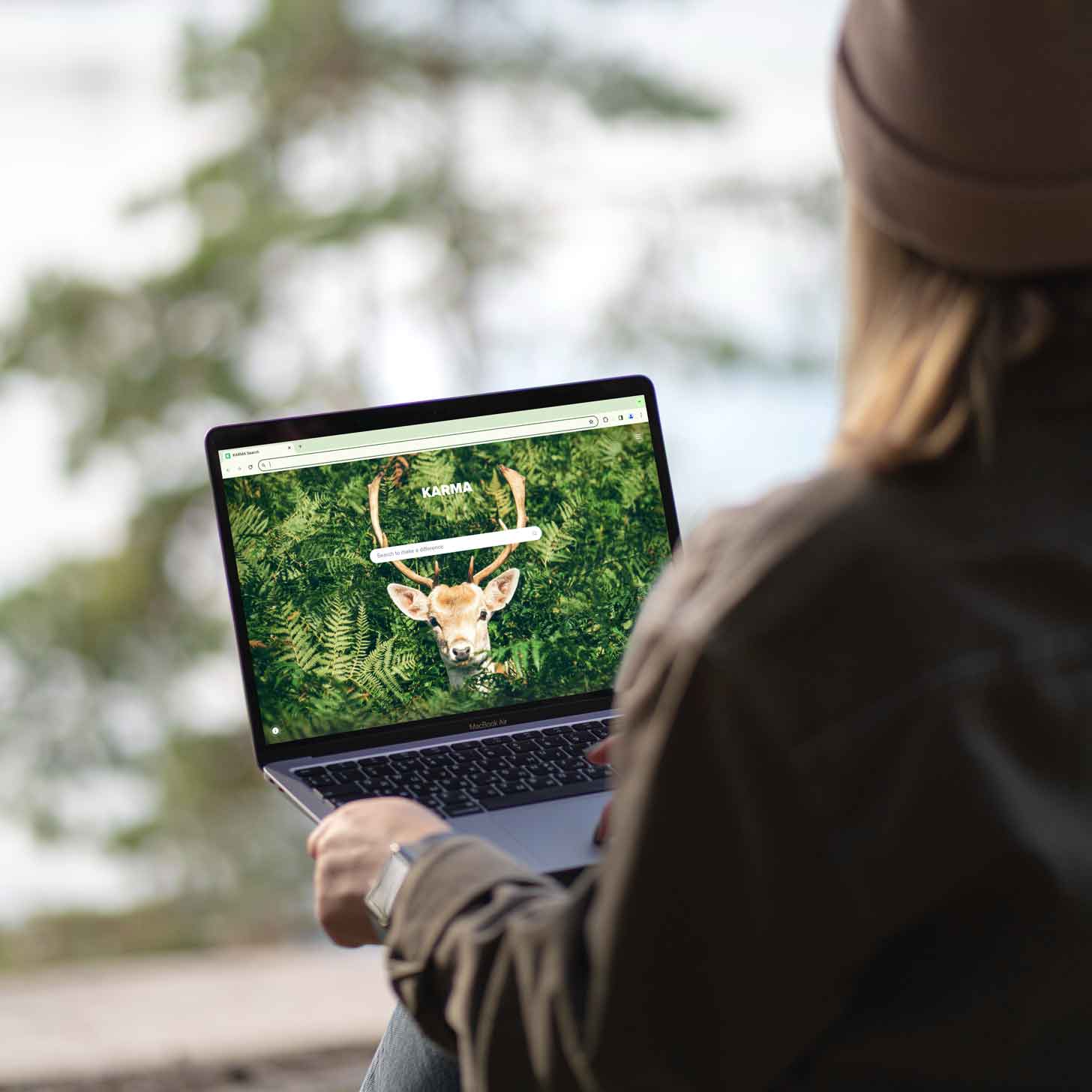
“Search engines are used daily by all internet users, making them the most scalable tools to have an impact. With Karma, we are providing internet users with the opportunity to be part of the solution in just a few clicks,” Yann Kandelman, cofounder of Karma, said in a press release.
“If just 1% of Google users were to use Karma as their default search engine instead, we’d be able to donate $1 billion per year to our nonprofit partners.”
Karma was first launched in France in 2022 and is finally operational in the U.S. as of this month. It can be downloaded as a Google Chrome, Safari, Firefox, or Edge extension, as an app on both iOS and Android, or simply accessed through karmasearch.org.
Karma is based on the search engine Brave Search, meaning its web indexing is fully independent from Google and Bing. It also supports ad blockers and anti-tracking extensions and does not permanently store search histories or resell personal data, according to a press release.
In France, Karma has received enthusiastic feedback, with more than 150,000 downloads and an average rating of 4.7 stars from users. By branching out to North America, Karma expects to raise $100 million over the next three years.

In a time when protecting biodiversity is more urgent than ever, these funds will be essential to organizations doing important work for animal conservation.
“Conserving biodiversity is not just about saving individual species,” Carrie Hutchison, director of marketing and brand for Re:wild said in a statement. “It’s about maintaining the complex ecosystems that sustain life on Earth.”
Karma also has a unique “Learn & Act” feature, which curates a news feed on biodiversity and animal rights, allowing users to maximize their impact by signing a petition, learning more about starting a vegan diet, or participating in a citizen project to help with wildlife efforts in their area.
This adds to the overall value it brings to its nonprofit partners.
“By working with companies like Karma, which are supporting our conservation work and expanding our reach, we can protect more of the world’s irreplaceable places for biodiversity, and inspire a global community to act for the wild,” Hutchison said.

Karma is also reportedly discussing future partnerships with several American nonprofits to complement its work with Re:wild and Humane Society International.
“Your internet searches with Karma can help fund our vital initiatives such as banning the sale of real fur, ending some of the most inhumane factory farming practices, and creating a more compassionate world for all animals,” Nick Jones, executive director at Humane Society International UK, said in a statement.
Ultimately — just like other tech solutions like Tab for a Cause — Karma wants everyday people to be able to partake in small solutions that could make a big difference.
“The word karma is derived from the Sanskrit karman, which means action. So the concept of karma is about cause and effect. As a search engine, we’re not reinventing the wheel, we’re reimagining what it can do,” Karma’s website reads.
“Karma strives to be part of a new kind of world ecology, a community of conscious individuals who are ready to find inclusive ethical solutions to every problem.”
Header image courtesy of Karma
“Hey bartender. You assume that I cannot drink a margarita, so you don’t serve me a margarita, so I don’t drink a margarita,” says actress Madison Tevlin in the new viral ad campaign ASSUME THAT I CAN. “Your assumption becomes reality.”

The ad — made by CoorDown and Indiana Productions — goes on to lay out all of the limitations placed on people with Down syndrome that occur when parents, teachers, and peers operate on outdated assumptions — and what happens when those limits stop.
“Assume that I can live on my own, so I live on my own,” continues Tevlin. “Assume that I can hit harder, so I hit harder. Assume that I can learn Shakespeare, so? I learn f—ing Shakespeare!”
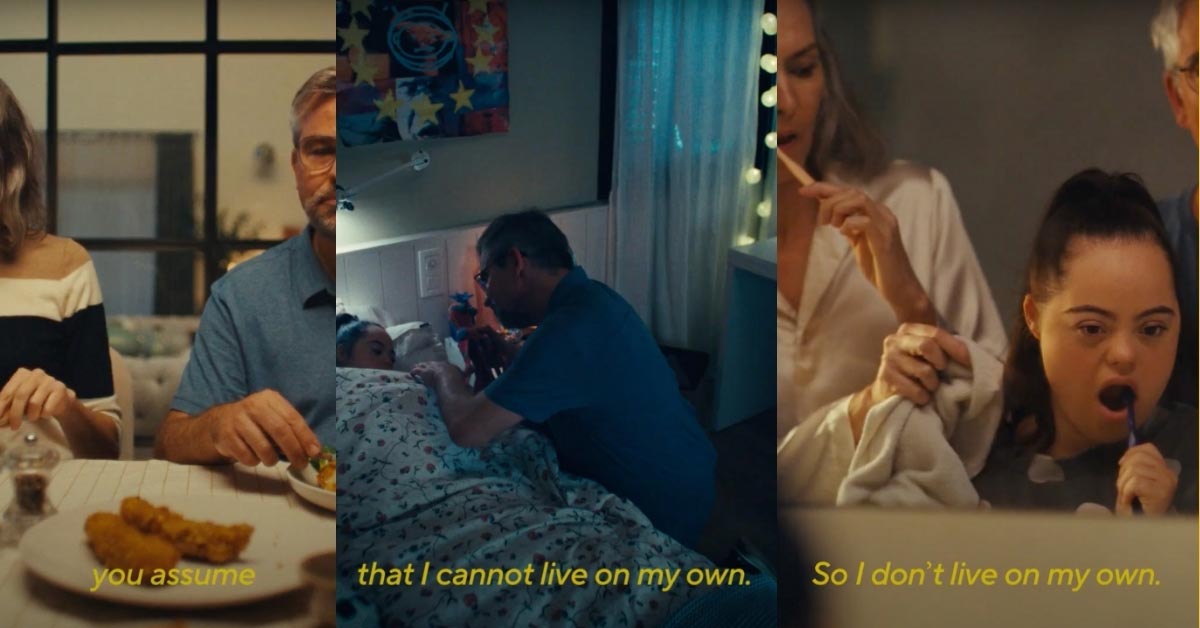
Tevlin, who starred in Woody Harrelson’s sports comedy “Champions”, also wrote an essay for Porter that addressed the limitations that have been placed on her since birth.
“When I was born, the doctor told Mom and Dad that life would be hard for me,” wrote Tevlin. “They were told that I may never talk or walk, and I may never be able to hold a job. If only that doctor could see me now. I certainly talk and I definitely walk. In fact, I just walked a red carpet.”
Down syndrome impacts each individual on a spectrum of cognitive and social levels, but they are typically treated as a monolith.
Instead of being given a range of support and accommodation, people with Down syndrome are often drastically underestimated, infantilized, and even ridiculed based on other’s lowest assumptions — at home, in schools, and even in the medical system.
For years, Indiana Production has been working with CoorDown — an Italian nonprofit that advocates for those with Down syndrome — on PSAs that are tied to World Down Syndrome Day on March 21.
Since 2012, the holiday (which is represented by the digits 3-2-1) has been celebrated worldwide as a nod to the syndrome’s triplication of the 21st chromosome.
Made in partnership with the Canadian Down Syndrome Society, Down Syndrome Australia, Fundació Catalana Síndrome de Down, and many more, the “ASSUME THAT I CAN” commercial and awareness campaign is truly a global collaboration.
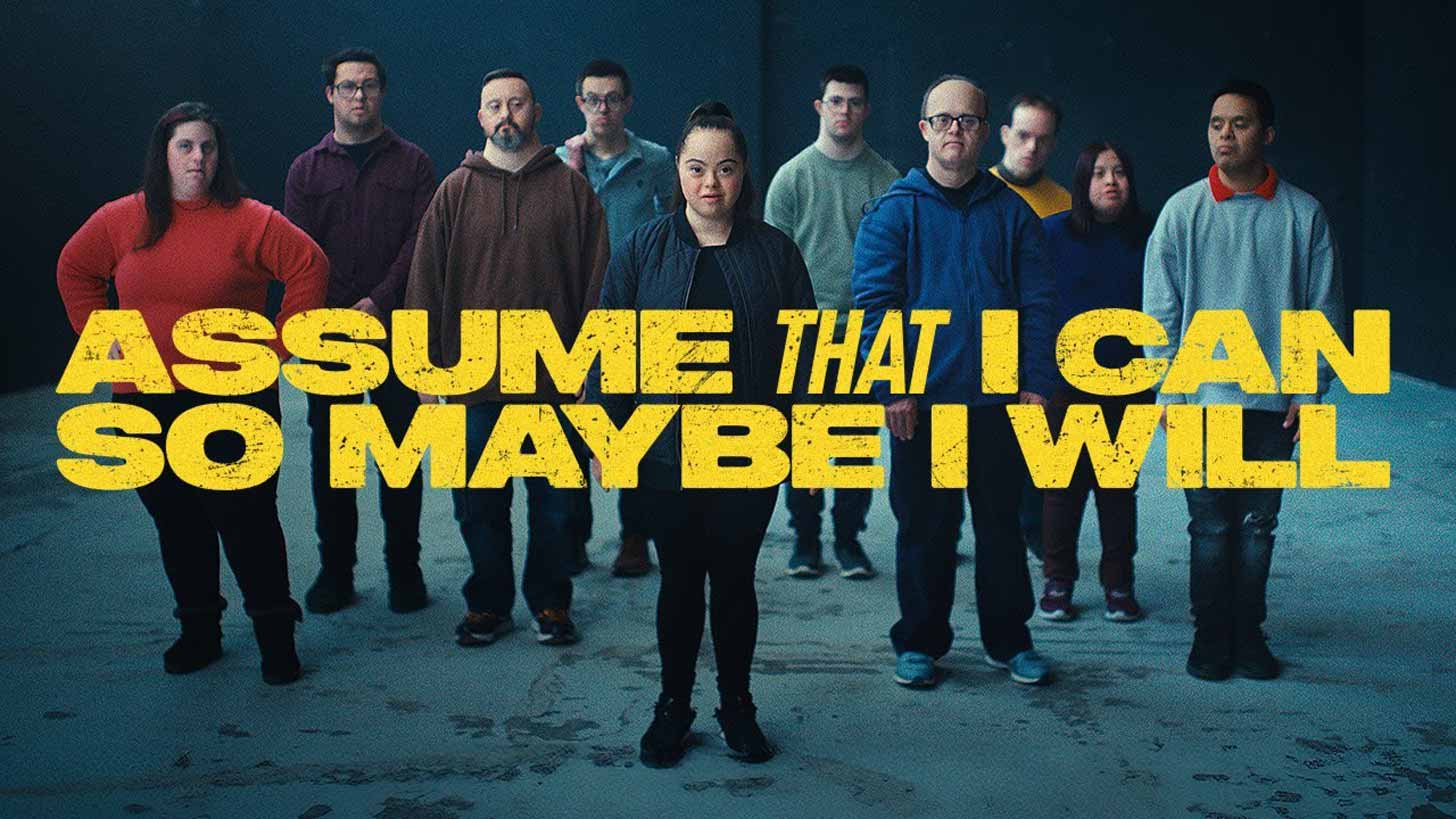
When it came to this year’s video, Karim Bartoletti — a managing director and executive producer at Indiana Production — adopted its message into “every aspect of production.”
“‘You assume that I will shoot this campaign like any other commercial that deals with disabilities?’ ‘You assume we cannot find an actor or actress that can carry the weight of the whole film on his or her shoulder?’” posed Bartoletti. “If we want to create awareness and break boundaries through the work that we create and produce, we need to do it ourselves.”
“We assumed we could and we certainly did, because it certainly shows in the originality and power and creative strength of this year’s CoorDown World Down Syndrome Day campaign.”

The PSA was also made in partnership with SMALL, an ad agency based in New York. When making the commercial, SMALL’s executive directors Luca Lorenzini and Luca Pannese said that they took inspiration from a speech 25-year-old Marta Sodano delivered to the United Nations in 2019.
Sodano’s speech, titled “Leave no one behind in Education,” touched on the frustration and injustice she felt growing up in a world held back by stereotypes.
“I discovered that in psychology there is a concept called ‘self-fulfilling prophecy,’ whereby a teacher who thinks that a student cannot understand would just act accordingly and therefore they would not teach the student,” said Sodano. “And there you go: the prophecy self-fulfills.”
“But in my opinion, there are no difficult or easy concepts, there is always a simple way to explain things. If I think of all the things that were not explained and taught to me, well I really get angry.”
That same righteous anger is channeled in the “ASSUME THAT I CAN” video, as Tevlin fiercely challenges viewers to step outside of their preconceived notions.
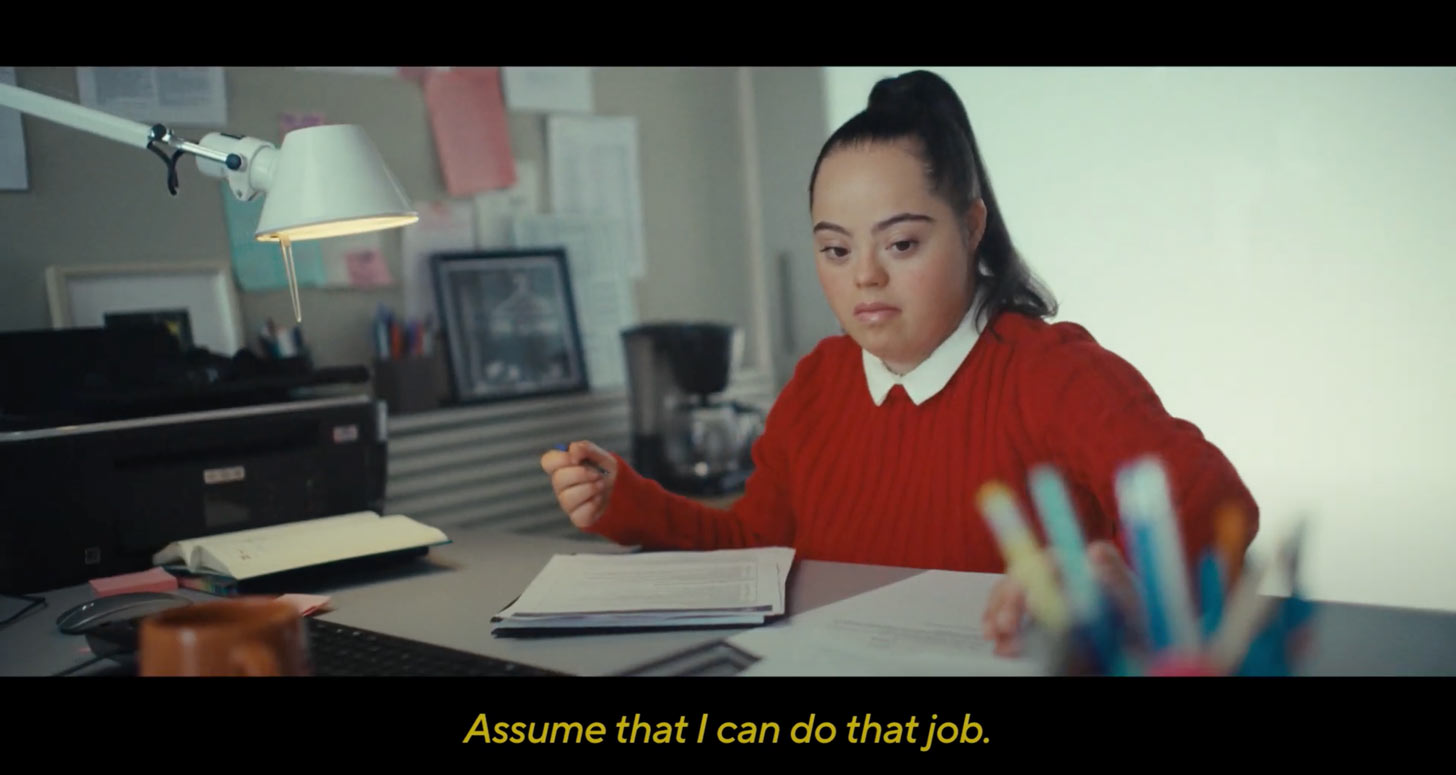
Posted on March 14, the video is spreading across every facet of the internet, with a TikTok clip already garnering 4.2 million views. The response across all mediums of social media has been overwhelmingly positive.
“This is just so good,” wrote one commenter on Facebook. “People with disabilities are constantly underestimated!”
“Wish my parents had seen this,” said one Reddit user.
“If you don’t give people opportunities, how will they ever grow?” asked an Instagram user.
“I’m an adult with Cerebral Palsy and use a wheelchair, and I can relate to this too,” another person commented on TikTok. “People with all disabilities are beautiful and we can do anything!”
YouTubers and best friends of over 30 years, Rhett McLaughlin and Link Neal are no strangers to sharing revealing details about themselves on the Internet.
Hosting their beloved show “Good Mythical Morning” for over a decade, the duo has become known for their vomit-inducing snack creations, sharing their most embarrassing moments, and even getting vasectomies together after turning 40.
But in a new video, they take viewers somewhere they’ve never seen before: Their colons.
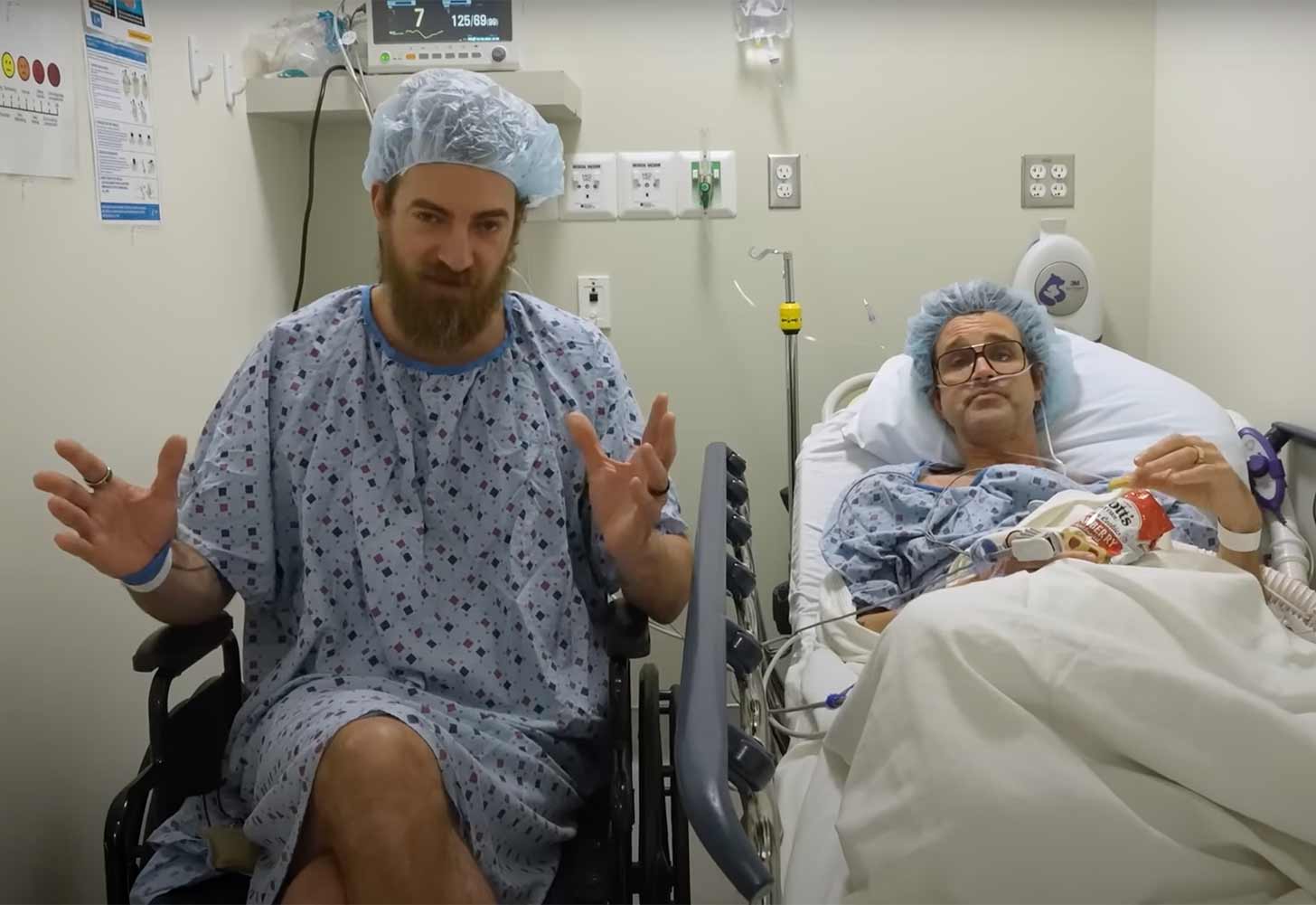
“We got colonoscopies,” Link said at the start of the video.
“Together,” Rhett clarified.
From there, a nearly 20-minute video ensues of the pair going on the intimate — and very important — journey.
“Recently, we both hit an important milestone: passing age 45, which means it's time to get butt-scoped,” Link said.
“Well, the technical term is colonoscopy, wherein a doctor explores your large intestine with a little camera to check for signs of cancer polyps, gastrointestinal abnormalities, missing puzzle pieces — it could be anything,” Rhett added, with a bit of humor.
Since they decided to undergo this procedure together as a bonding experience, they called it a “brolonoscopy,” and even fist-bumped with their doctor.
“This is Colorectal Cancer Awareness Month,” the duo’s doctor, Peyton Berookim, MD, of the Gastroenterology Institute of Southern California, said at the start of their appointment.
“You guys are putting a huge spotlight on this, and you will definitely save some lives.”
Link retorted, in his hospital gown: “And that spotlight is going to be right up our butts.”
Fortunately for squeamish viewers, the video was edited thoughtfully and does not reveal anything too visually upsetting. It seems to be doing the trick; in just one day of the video being available on YouTube, it has reached more than 450,000 viewers.
And amid laughs spurred by anesthesia, and the classic banter between Rhett and Link, those viewers will likely come away knowing a lot more about colon cancer — and potentially even feeling more confident about getting a colonoscopy of their own.
Prior to going in for the procedure, Link asked how often folks should get colonoscopies.
“It depends on what I find,” Dr. Berookim said. “If I find polyps, which are abnormal growths, we're going to remove them. By removing the polyps we're preventing colon cancer. Cancer starts from a polyp and turns into something ugly.”
According to the World Health Organization, colorectal cancer is the third most common cancer and the second leading cause of cancer-related deaths worldwide.
Often, this type of cancer is diagnosed at advanced stages when treatment options are limited, meaning regular screenings are vital for early detection and prevention.
The importance of these routine screenings was displayed loud and clear in the video. During their procedures, both Rhett and Link had a few small polyps removed, which were found to be benign.
Although the experience was a little uncomfortable, and it’s always anxiety-inducing to be screened for cancer, the pair helped each other by providing witty commentary from the sidelines and highlighting what it looks like to have a robust support system when it comes to taking care of one’s health.
And once they were finished, they shared their parting wisdom — snacking on hospital cookies and Capri Suns — to over 18 million subscribers.
“I’m glad we did this,” Rhett said, recovering beside his friend.
“Schedule your colonoscopy,” Link exclaimed. “Do it. What’s your reason not to?”
“It’s actually kind of fun,” Rhett said. “Look how much fun we had.”
Header image courtesy of Mythical Entertainment/YouTube
Every day the Good Good Good team collects the best good news in the world and shares it with our community. Here are the highlights for this week!
If you want to get good news in your inbox every day, join the Goodnewsletter — the free daily newsletter designed to leave you feeling hopeful.
The Best Positive News We’re Celebrating This Week —
In a historic first, scientists just successfully 3D-printed human skin tissue into open wounds
In a historic first, scientists at Pennsylvania State University have successfully 3D-printed living human skin tissue directly into the open wounds of rats.
While it doesn’t sound very pretty, this bioengineering milestone could pave the way for major innovations in reconstructive surgery — or even human hair treatments.
The idea of bioprinted skin is not new — scientists have previously 3D-printed thin layers of skin — but Ozbolat’s team shares that they are the first to print a full “living system of multiple skin layers.”
Why is this good news? Current methods of skin and hair reconstruction — like skin grafts — often result in scars, meaning this discovery could lead to a more seamless treatment for humans.
→ Read more
Thanks to ‘systematic progress’ in the 2010s, some European Union countries have already hit their 2023 sustainable energy goals
While every single member of the European Union have made progress toward reaching 2030 sustainable energy goals, several countries have already reached their targets.
The goals are in alignment with the United Nations’ seventh sustainable development goal of providing access to “affordable, reliable, sustainable, and modern energy for all” by 2030.
New research from Polish economists found that Sweden was the closest overall to achieving the goal — then Denmark, Estonia, and Austria. Significant progress was shown in Cyprus, Latvia, and Belgium — and the most improved was Malta.
Several countries had also already reached 2030 targets in at least one of the indicators — and they did so back in 2021. For example, Spain, Malta, and Portugal have already reached the target average amount of energy consumed per person in a household; and Denmark, Ireland, and Luxembourg hit the energy productivity target — which looks at the size of an economy compared to its energy consumption.
The achievements are thanks to “systemic progress” that happened decades ago across EU member states.
→ Read more
The Oscars attention for ‘Oppenheimer’ led activists to create a new campaign to advocate for nuclear disarmament
This weekend, ‘Oppenheimer’ both took home seven Academy Awards and renewed a cultural conversation about nuclear weapons.
Prior to the big awards show this weekend, the Nuclear Threat Initiative, a global nonpartisan nonprofit aimed at reducing nuclear threats on humanity, launched a new public service campaign: Make Nukes History.
Beyond spreading awareness, the campaign includes a quiz for folks to “test their knowledge on nukes,” as well as an action guide, which prompts supporters to learn more, support communities harmed by nukes, and ensure they are registered to vote.
Why is this good news? Today, 13,000 nuclear weapons are held by nine countries — with some being 80 times more powerful than the ones created by Oppenheimer and his team. This campaign aims to empower people to make that reality history with a simple message: Oppenheimer may have started this, but we can end it.
A man is recording every bird in Ireland — and raising awareness about Ireland’s ecological crisis
Seán Ronayne was interested in birds from an extremely young age. Now, his “total immersive obsession” with birds and bird songs has made him Ireland’s most well-known ornithologist.
He’s on a mission to record the sound of every bird species in Ireland — he’s collected 10,000 recordings so far, identifying 194 of the more common species.
He’s also a passionate advocate for biodiversity and ecological awareness — an important topic in Ireland right now, as it’s “one of the most nature-depleted countries in Europe.” According to Ronayne, the country has lost 90% of its wetlands, and is left with just 1% of native tree cover.
It puts Ronayne’s work at an important intersection: documenting the country’s native birds as their habitats dwindle — 63% of them are at risk of extinction.
Ronayne said “the response to what I am doing has made me more optimistic,” and that people largely “want to be guided” to make a positive difference.
For the first time in history, the Olympics will achieve gender parity at Paris 2024
This year’s Olympics in Paris will be the first in history to achieve numerical gender parity on the field of play — meaning there will be an equal number of female and male athletes participating in the largest sporting event in the world.
Out of the 10,500 athletes participating in the Games, there will be 5,250 men and 5,250 women. There will also be a more even distribution of medal events, with 152 women’s events, 157 men’s events, and 20 mixed-gender events. That means over half of all medal events will be open to female athletes.
Additionally, the IOC is changing up the arrangement of some events, and hiring more female staff in broadcasting positions, including 35 new female commentators to raise the percentage of women in that role to nearly 40%.
What’s the nuance? While the 50-50 gender split of the 2024 Games is an enormous achievement (made possible by a number of decades-long initiatives), the number of players on the field doesn't mean that gender equality has been achieved: women are still far underrepresented in media, recognized as “wives, mothers, females” before “athlete,” and more.
The first aid ship carrying 200 tons of food supplies is now on its way to Palestinians in Gaza
The first in what could become a “maritime highway” bringing continuous aid to people in need in Gaza, a ship filled with 200 tons of food from Chef José Andrés’ World Central Kitchen is now on its way across the Mediterranean Sea from Cyprus.
Since Gaza has no functioning port, workers with World Central Kitchen are building a jetty to receive the aid once it arrives. If the delivery is successful, World Central Kitchen has 500 more tons ready to follow.
World Central Kitchen has a network of 60 kitchens across Gaza and, has already provided more than 35 million meals to an estimated 1.7 million displaced Palestinians.
Why is this good news? According to the United Nations, one quarter of the population in Gaza (576,000 people) are one step away from famine. The situation is so desperate, deliveries are needed daily — and since land deliveries have been challenging, WCK is hopeful this could lead to more frequent food deliveries and prevent any more deaths from starvation.
From the sale of Yeezy shoes, Adidas is donating $150 million to anti-hate organizations
After ending its longtime relationship with Ye, the rapper formerly known as Kanye West, in 2022, Adidas was still left with $1.3 billion worth of Yeezy shoes in warehouses. It decided to sell some of those remaining shoes — and is doing something good with sales.
The company just announced it has already or is planning to donate more than $150 million from the sales of the shoes to organizations fighting antisemitism and other forms of hate.
So far, it’s made donations to the Anti-Defamation League and the Philonise & Keeta Floyd Institute for Social Change, which is run by social justice advocate Philonise Floyd, George Floyd’s brother.
→ Read more
A high schooler invented a solar- and AI-powered trap for invasive lanternflies
The spotted lanternfly is an invasive insect that’s destroyed New Jersey’s local agricultural industry for years. It’s also been found in 17 other states, where it feeds on plant sap, causing the plants to become stressed and making them more susceptible to disease.
Selena Zhang first noticed the moth-like bugs at a local market and wanted to help get rid of them, without the ecologically damaging impacts of other preventative measures — like insecticides (bad for pollinators!) and sticky bands (bad for birds, small animals, and other insects).
After weeks of field observation, hundreds of photos, and with a patio umbrella from her backyard, Zhang created the ArTreeficial: a solar-powered, self-cleaning, artificial intelligence-driven “tree” that lures the spotted lanternfly. It then quickly eliminates the bug using an electronic mesh.
The umbrella structure mimics the tree of heaven, which is a known host plant of the insect. It also emits an incense made from the tree’s essence to lure them, and a double-electric net uses AI to recognize when a lanternfly has landed on the trap.
→ Read more
More good news of the week —
A sign language interpreter taught Mark Ruffalo, Lily Gladstone and other nominees how to sign the titles of Oscar-nominated films. Representation and accessibility are popular for a reason; they drastically improve the experiences of countless movie fans with disabilities.
A new Carnegie Hall concert series is designed specifically for attendees’ mental health. According to a sweeping 2019 World Health Organization report, making and listening to music is associated with reduced stress, anxiety, and loneliness.
The world’s largest psychology group just confirmed that gender-affirming care saves lives. The American Psychological Association just issued a near-unanimous resolution saying it was fully supportive of gender-affirming care and equally opposed to bans on the medical practice.
Following its Oscars win, “The Last Repair Shop” documentary short inspired a flood of donations for young musicians in Los Angeles. The city is one of the last in the country to give “free and freely repaired” instruments to its public school students.
Calls for a “green” Ramadan are reviving Islam’s long tradition of sustainability and care for the planet. To encourage Muslims to be more mindful of environmental impact, mosques are increasingly ditching single-use items, with some banning the use of plastics altogether.
“Round up for charity” checkout counter campaigns have raised millions of dollars to support scholarships, cancer research, and more. In 2022 alone, charities raised $749 million nationwide through so-called point-of-sale donations, a 24% jump from 2020 and proof that donations do make a difference.
Thanks to restoration efforts, a study found “full recovery” of reef growth within four years. It also found that efforts to restore coral reefs not only increase coral cover, but they can also bring back important ecosystem functions, and surprisingly fast.
President Biden just called for an unprecedented investment in education, including free preschool. His budget proposal addresses the most pressing post-pandemic education issues, like better mental health care for students and staff and making college affordable and attainable.
Bald eagles were just seen nesting in Toronto for the first time in the city’s recorded history. The birds’ presence is proof of the improving health of the city’s green spaces, since they are highly sensitive to environmental disturbances.
Dylan Mulvaney just dropped a new single for her ‘Days of Girlhood’ TikTok anniversary, with profits benefiting The Trevor Project. The single celebrates the two-year milestone of her transition and honors the painful parts of the past year.
The Department of Defense and Veterans Affairs will now provide access to IVF regardless of marital status or sexual orientation. Under the new policy, anyone who has service-connected infertility can use the program — previously, only married, heterosexual couples using their own sperm and eggs could participate.
Breaking the record as the highest single donation ever, a philanthropist just donated $58 million to the ALS Association. The gift was from the late Hugh Hoffman, who passed away in March of 2023, as a way to ensure other families don’t lose their loved ones to ALS.
John Green just announced a $1 million annual donation to fight tuberculosis in the Phillippines. Tuberculosis, though entirely curable, is still the world’s deadliest disease — 1.6 million people die from it each year because of inaccessible testing and treatment.
A clever photo frame campaign is popping up at local parks and giving nature enthusiasts the opportunity to help protect local wildlife. Chronolog’s 100,000-plus photo submissions have helped improve wildlife conservation efforts by allowing researchers to monitor nature sites from afar.
To help tackle poverty, Flint, Michigan is giving every new mother $7,500 in cash aid over a year. The program is the first of its kind in the country and will help support families in a city with one of the country’s highest rates of child poverty.
While anti-trans bills aiming to ban gender-affirming care for minors — and even eliminate trans people from public spaces — are sweeping state legislatures across the United States, anti-trans rhetoric has also infiltrated other countries, like the United Kingdom.
In fact, England’s National Health Service recently decided to stop prescribing puberty blockers for transgender youth, giving anti-LGBTQ+ lawmakers the confidence to introduce similar ideas in Parliament.
For instance, former UK Prime Minister Liz Truss introduced the Health and Equality Acts (Amendment) Bill.
If passed, this would define sex in law as biological, outlaw gender-affirming care for trans youth in private clinics, and impact all manner of social justice issues, like trans participation in sports, access to gender-affirming restrooms, and more.
This bill would be especially dangerous to trans youth.
While LGBTQ+ advocates were outraged by the NHS’s decision to stop prescribing puberty blockers, the extreme waitlist for gender-affirming care already had many families and young people turning to private practice to treat gender dysphoria, which is still allowed under the recent decision from the NHS.
Truss’s bill would make obtaining private gender-affirming care for minors illegal.
Fortunately, members of the country’s Labour Party kept Truss’s bill from advancing last week by using what is now being called the “Ferret Filibuster.”
Members of Parliament, instead of debating the bill, spent nearly five hours discussing another matter: What to name a pet ferret.
“I’d like to put on record that my brother had a ferret called Oscar,” MP Sarah Champion said.
MP Maria Eagle replied: “Well, she has that now on the record. I don’t know, really, what else to say about that except that I am sure that Oscar brought her brother great joy, and that’s what pets do. I’m sure there are many other ferret owners who might attest to the same thing.”
Other MPs — even those of Conservative backgrounds — joined in to discuss other pets.
“Pets often help keep people sane when they are under pressure in their everyday pursuits, so it would be remiss of me not to put on the record the names of my three dogs, Tessa, Barney, and Maisie, and the name of my cat, Parsnip,” MP Mark Spencer contributed.
He then mentioned the names of 40 other pets.
While Truss’s bill was not formally defeated by this entertaining filibuster, it has been moved to a debate on March 22 — at the bottom of the priority pile. According to reporter Erin Reed, this means it is not likely to be heard.
The event also caused quite a stir on social media, positioning the ferret as an “overnight symbol of trans resistance,” according to X (née Twitter) user @SpillerOfTea.
“i haven’t felt positive about labour for a while, but filibustering liz truss’ anti-trans bill by talking about ferrets is sublime,” another X user chimed in, sharing screenshots of a transcript from the filibuster.
“There is an undercurrent of ridiculousness that courses through Britain,” @DeeTweets00 said. “As terrible as things can be in this country, which other nation on earth will filibuster a bill by discussing ferrets?”
Filibusters — especially those delaying harmful bills against trans youth — are not a new phenomenon.
Members of the Nebraska legislature used the tactic last year, and recent efforts made headlines in West Virginia, in which Democrats aimed to defeat a bill (similar to the one introduced by Truss across the pond) by proposing dozens of amendments for debate.
Although many LGBTQ+ advocates continue to seek safe, accessible care for all trans folks — and especially trans youth — this silly, yet strategic move repositions hope on the horizon.
“Apparently, dogs, cats, and ferrets have saved the UK from the latest bout of ever-escalating transphobia,” @tspacker posted on X. “Thank you for your service.”
Left and right header images courtesy of parliamentlive.tv, center image courtesy of Nickolett Emmert/Pexels
Anyone who has ever visited their gynecologist for a cervical cancer screening — the dreaded “pap smear” — will tell you that it is a rather unpleasant experience, with an archaic device at its center.
The speculum, or the device that allows providers to examine one’s cervix during one of these exams, hasn’t been updated since the 1940s, though many modern redesigns have been in the works for a while.
While these screenings are vital to the health of those with cervixes, the vulnerable — even traumatic — experiences folks have at the gynecologist (or the sexual trauma they may come to their appointment carrying) can make the appointment seem like a Herculean task.

In fact, even though screenings are proven to lead to early detection and have reduced rates of cervical cancers over the past 50 years, the percentage of women overdue for their screenings has increased over the past five years.
This means, in the United States, one in four women are not up-to-date on their cervical cancer screenings.
Although these statistics are often due to a lack of accessible health care or knowledge about the importance of screenings, experts know that making these tests more approachable is a major step in improving cervical health at a large scale.
So — startup Teal Health has created an innovative new at-home screening device designed to make the experience much more comfortable.
Meet the Teal Wand, an at-home self-collect device that the brand says is “designed to comfortably fit all bodies.” The wand has a ⅝-inch diameter, similar to a standard tampon, as well as a soft sponge — not a bristly brush many may be used to.
While the self-screen is not the exact same thing as a pap smear, it promises to collect all the important information needed to screen for HPV and cancerous cells.
“Self-collect screening detects HPV, which infects both vaginal and cervical cells. It differs from a pap test, in that it is more sensitive for detecting pre-cancers and cancers, and can be detected accurately in both cervical and vaginal cells without the need for endocervical sampling,” Teal explained in an Instagram comment.
“The HPV assays used for this testing have undergone extensive testing to be sure the accuracy is adequate.”
With accuracy in mind, the Teal Wand seems much more preferable to clinical trial patients. Teal Health’s initial study of the device found that 97% of women who used the want said it was “easy” or “very easy to use.”
Additionally, 92% of study participants also said they would choose this at-home collection method over clinician collecting, though 87% said they’d be more likely to get screened if the Teal Wand was an option at their clinician’s office.
Right now, the Teal Wand is in clinical trials for FDA submission in over 15 locations across the U.S., including Johns Hopkins, Yale University, and the University of Colorado.
“It is absolutely critical that the rigorous standards of the FDA are met in order to keep women healthy and prevent cervical cancer,” Teal Health said in a statement. “Teal’s study and the caliber of the institutions working with us are a testament to our commitment to safety and efficacy.”
As the startup works to make the product widely available, pending FDA-approval, it recently announced an $8.8 million seed round from investors, including Emerson Collective, Serena Ventures, Metrodora Ventures, and Felicis Ventures.

If Serena Ventures sounds familiar, that’s because its managing partner is tennis champion Serena Williams.
"For far too long women have been disenfranchised by their current healthcare experiences,” Williams said in a statement about the investment, “with women of underrepresented communities feeling an increased strain on their access and options surrounding healthcare.”
Williams’s VC firm specializes in funding diverse women founders — and Teal Health fits the bill, with a women-led team positioning CEO and co-founder Kara Egan at the helm.
Another backer of Egan’s startup is Metrodora Ventures’ managing partner and former First Daughter Chelsea Clinton.
“Solving massive and critical health issues, including adherence to a national cancer screening, requires innovative solutions with expertise across the entire healthcare landscape,” Clinton said in a statement.
Although the Teal Wand seems to be pioneering a breakthrough in gynecological practices, at-home cervical cancer tests are the norm in other countries around the globe, including Australia, Finland, France, the Netherlands, and more.
In fact, the Australian government introduced self-screening tests in July 2022. Because of the widespread availability of such tests — and HPV vaccines — Australia is on track to eliminate cervical cancer as a public health concern by 2035.
“Women want and deserve a better option, one that gives them control over their own bodies,” an Instagram post from Teal reads.

This sentiment is echoed in comment sections, as people share their experiences about finding access to care, experiencing excruciating pain at past screenings, and the need for inclusivity of diverse experiences in medicine.
“As a result of a [sexual] assault I didn't go to the gynecologist. If I had something like this I would have kept up on my health and perhaps would not have stage-four cancer,” one person wrote in the comment section of the company’s Instagram page. “My daughters will have more tools for preventative health. I love this!”
“With access to care issues across the US.. worsening, this could be a game changer for those struggling to get basic screenings,” another person wrote.
“Thank you for creating solutions for ladies with pelvic floor conditions like myself,” another Instagram user shared.
Once the Teal Wand is FDA-approved, folks will be able to request a testing kit, ideally at no cost. Then, it will be shipped to their homes, where they will find easy-to-follow instructions to collect their sample. Live support will also be available if needed.
After sending their sample back to the lab, folks will be contacted by a medical professional to review their results or proceed with follow-up care.
For those desperate for an alternative to the traditional pap smear in the U.S., it’s now just a matter of time.
“The self-collection approach enables us to revolutionize the screening process and design it for the modern woman,” Egan said in a statement.
“We’re thrilled to have such incredible partners and participants help us execute on this life-saving screening option in the United States, prioritizing and respecting a woman’s needs, time, and preferred experience.”
On March 18, a tower of 1,900 boxes of Girl Scout cookies — bursting with Tagalongs, Thin mints, Do-si-dos, and more — was loaded up and divied out to those in need across the valley of Phoenix, AZ.
The Girl Scout cookies were purchased and donated by a group of twenty small business owners. For a decade, the businesses have pitched in to support the Arizona Cactus-Pine Girl Scouts in tandem with their local community organization St. Vincent de Paul.
SVDP feeds and clothes those in crisis, offers free medical care and workforce programs, and has an ambitious initiative to end homelessness for 2,025 locals by 2025.
Ten years ago, the small business owners came together to donate a few boxes to SVDP, and the effort grew from there. This year’s donation will feed thousands.
Dave Burns, owner of Burn Pest Elimination, is one of the local business owners behind the donation. He said the annual tradition is an opportunity “as a small business to just give back to the locals.”
“All you got to do is put a little bit together with a few people, and all of a sudden — it becomes a lot,” Burns added in an interview with FOX 10 Phoenix.
Patrick Donaldson, the chief operations officer of SVDP, said that the massive load of cookies — worth around $12,000 — will be given out to area shelters and campuses across the state as an additional treat to daily meal services.
“We serve 7,000 hot meals a day as well as thousands and thousands of pounds a week that get distributed in food boxes,” Donaldson told 3 TV/CBS 5. “So these will go in our dining rooms and out to homeless shelters.”
Eight-year-old scout Eva Riley worked with the business owners to close the sale on behalf of local Girl Scout Troop 3886.
“I was surprised and excited,” Riley told FOX 10 Phoenix.
Riley’s $12,000 sale to SVDP is one of many examples of the Girl Scouts reputation of mixing scouting and badge-earning with community services.
Charitable initiatives include everything from the “Beyond Bars program” that finds avenues for incarcerated mothers to participate in their daughter’s troop, to Troop 6000 — a program that supports Girl Scouts and their families in the New York shelter system.
On top of numerous official programs, a few Girl Scouts have had individual standout moments this year, just like Riley.
In West Plains, Missouri, Girl Scout Troop 7156, made “Birthday in a Bag” donations for struggling families.
The bags included disposable cake pans, cake mix, frosting, and decorations, in recognition that families living in poverty deserve to celebrate their birthdays too.
And back in Arizona, Riley can barely contain her excitement for the 1,900-box donation.
For scoring such a big win for her troop, Riley has a few Girl Scout rewards coming her way, including a party at Build-a-Bear Workshop. But above all else, Riley is proud of playing a part in a community effort that will help others.
“I think it’s going to make them really happy, and that makes me really happy,” Riley said.
Header images courtesy of Arizona Cactus-Pine Girl Scouts and St. Vincent de Paul Phoenix
While many now know the Met Gala as that “Monday night in May” where regular folk get to ooh and ahh at social media feeds, taking in the artistic fashions of the celebrity elite, the event has been a cultural mainstay since 1948.
The Met Gala started as the “Costume Institute Gala” as a fundraiser for the newly founded Costume Institute at New York City’s Metropolitan Museum of Art.
However, it has since emerged as an emblem of grandiose social status when Vogue editor-in-chief Anna Wintour took over as the Gala’s chairperson in 1995.
With the exclusive nature of the event bringing together only the wealthiest tastemakers, critics have pointed out flaws in the Met Gala’s, well, exclusivity.
As pop culture continues to evolve, greater inclusion and representation has finally become a priority for the event — but only to an extent.
Only in 2021 was there a shift toward more BIPOC representation, and commentators were clear to express their desire for more efforts to increase diversity and inclusion at the event.
This year’s hosts include a wide variety of fashion and entertainment stars, such as Zendaya, Bad Bunny, Jennifer Lopez, and Chris Hemsworth. But while racial representation may be increasing, one group is consistently left out of the spotlight.
Disabled attendees, specifically those who use wheelchairs, have no choice but to forgo the iconic photo op on the Met Gala’s stairs.
“For decades, the worlds of entertainment, art, and fashion have remained stubbornly closed to the disabled community,” Hannah Diviney, the editor of Missing Perspectives, a media company platforming diverse voices, wrote.
“As a disabled person who uses a wheelchair, I don’t feel seen or represented by the Met Gala, and it’s a feeling that extends to other areas of my life,” disability justice activist Daphne Frias added in an essay.
Diviney and Frias have kicked off a campaign: #YourMoveMET, calling on the event organizers to reimagine the Gala to include attendees who use wheelchairs with intention.
“As support for greater representation, inclusion, and diversity reaches new heights, we think it’s high time the gates of power, prestige, and visibility represented by the Met Gala — particularly the iconic steps photo moment — are open to us who use a wheelchair, too,” Diviney wrote.
While the museum is wheelchair accessible, and disabled attendees have been able to enter the Gala through back doors and other passageways in the past, their exclusion from the centerpiece — The Met Gala steps — continues to communicate the exclusion of disabled people.
“Disabled bodies have historically been marginalized, rarely considered desirable or fashionable,” Frias wrote. “Fashion provides a platform for me to own the narrative of my body and be seen on my own terms. Many of us view our mobility devices as natural extensions of our bodies and fashion. We want to be celebrated, not hidden.”
There are certainly some wins across the industry that make Diviney and Frias confident in this campaign. Increases in the hiring and celebration of disabled models, like Jillian Mercado, for instance, brings Frias hope.
Additionally, the Costume Institute at the MET unveiled an exhibit called “Women Dressing Women” this winter, which showcases women designers from 1910 to the present. This exhibit marks the first time a mannequin in a wheelchair has been featured in the Institute.
Even more meaningfully, the mannequin was made to resemble a Black, transgender, disabled model, Aaron Philip.
Earlier this year, Frias herself was even photographed by Annie Leibovitz, perhaps the most famous photographer in Vogue history.
Still, she calls herself “cautiously optimistic.”
“The representation of disability in the exhibit must not be a tokenized gesture — superficial progress that masks previous transgressions,” she wrote. “Unfortunately, the Gala remains an exclusive and inaccessible space.”
Under the umbrella of Missing Perspectives, the #YourMoveMET campaign is calling on supporters to tag the event’s hosts on social media, speak up about the issue, and ultimately, make history at this year’s Gala.

“We're calling for a rethink around the Met steps and want to push for ramps and other infrastructure to be considered, so that people who use a wheelchair can appear on the carpet for the iconic photos,” Diviney wrote.
Frias acknowledged that critics may argue that implementing accessibility modifications would “compromise the Gala’s aesthetic,” but maintains the need for there to be a seamless and accessible option for all.
“[Our] campaign to make the Met Gala accessible isn’t just about making sure that folks of all abilities can attend,” she wrote in an Instagram post. “It’s truly about ushering this global event into a new era of inclusivity.”
The campaign’s demands are clear: Attendees who use wheelchairs deserve the same entrance and experience as everyone else.
“Why should we uphold an institution that fails to celebrate everyone and include all bodies?” Frias wrote. “It’s imperative that the barrier of the steps can be addressed in a way that allows us to attend — without being cast aside from the other guests.”
As the organizers continue to seek support from their respective audiences, both the museum and Vogue have yet to comment.
Regardless, Diviney and Frias remain steadfast in their mission to rethink and redesign this cultural event.
Their dream is to increase accessibility for attendees, yes, but also to reimagine what’s possible for the millions of disabled viewers who are tired of feeling stuck on the sidelines.
“Curating my outfits allows me to transcend the label of ‘the girl in the wheelchair;’ Instead, I can also be ‘the girl with the great wardrobe,’” Frias wrote, about her own relationship to fashion.
“These identities are not mutually exclusive. We can be both fashionable and disabled.”
Author, activist, and entrepreneur John Green has just been named a “TB Elimination Champion” by the U.S. Centers for Disease Control.
Green, who is a vocal advocate for accessible global health care, has taken the global issue of tuberculosis and brought it into mainstream American consciousness.
While educating about the history and impact of TB, which is the world’s deadliest infectious disease, Green also reminds his audience that there is indeed a cure — people just need access to it.
He has mobilized his fanbase — Nerdfighteria — to use grassroots social media pressure campaigns to urge corporations like Johnson & Johnson and Danaher to lower the cost of TB treatments and diagnostics.
“In 2019, he visited Sierra Leone and learned about the global impact of TB disease, caused in part by the high cost of medication,” the CDC explained in a brief profile about the author.
“John and his fanbase launched the social media campaign ‘Patients Not Patents’ to advocate for pharmaceutical companies to allow the sale of generic bedaquiline.”
Most recently, Green announced an annual $1 million donation to support work to reduce TB in high-burden countries like the Philippines.
His consistent passion for TB elimination is what led to this honor from the CDC, but it wouldn’t have been possible without his fanbase. Nichole Ezell, a passionate Nerdfighter and mastermind behind the online group Nerdfighters Against TB, nominated Green on behalf of the entire community.
“This is an opportunity for John to be recognized for the hard work he has done bringing attention to tuberculosis in the United States,” Ezell told Good Good Good.
“But I also just want to thank him for bringing it [TB] to our attention. As someone who created this group, this is a cause that’s now near and dear to my heart.”
Ezell, along with thousands of other fans, have become dedicated organizers, bringing others into the fold to find “sustainable solutions for the TB crisis worldwide.”
This includes continuing active pressure campaigns to reduce the cost of care, creating websites with step-by-step information for newcomers to the movement, and donating money through fundraisers like the Project for Awesome.
“We are trying to create momentum to help a lot of people and limit that global TB burden,” Ezell said. “Overall, we just try to decrease the amount of people who suffer from TB.”
Green, who has worked in partnership with a number of TB experts and action groups like Doctors Without Borders, the Stop TB Partnership, and Partners in Health, is just one member of the massive community effort to eliminate this disease.
In fact, the 2024 CDC TB Elimination Champions include a list of over 25 helpers who are contributing to the issue — both in the U.S. and abroad — in their own ways.
“The CDC U.S. TB Elimination Champions Project provides an opportunity to recognize accomplishments and learn best practices from individuals who are making significant contributions to eliminating TB in the United States,” the CDC’s website states.
“We are sharing these inspiring success stories… and hope that they help and inspire others.”
Those interested in learning more and staying up-to-date with Green’s TB-related work can subscribe to the new TB Fighters newsletter.
Header images courtesy of vlogbrothers/YouTube and the CDC Division of TB Elimination
— Recent giant anteater sightings in Rio Grande do Sul state indicate the species has returned to southern Brazil, where it had been considered extinct for more than a century.
— Experts concluded that the giant anteater ventured across the border from the Iberá Park in northeastern Argentina where a rewilding project has released around 110 individuals back into the habitat.
— The sightings emphasize the importance of rewilding projects, both to restore animal populations in specific regions and help ecosystems farther afield.
— Organizations across Brazil are working to protect and maintain current giant anteater populations, including rallying for safer highways to prevent wildlife-vehicle collisions that cause local extinctions.
Playing back hours of footage from a camera trap set in Espinilho State Park in the south of Brazil in August 2023, Fábio Mazim and his team banked on possible sightings of the maned wolf or the Pantanal deer and had their fingers crossed for a glimpse of a Pampas cat (Leopardus pajeros), one of the most threatened felines in the world.
What they didn’t expect to see was an animal long presumed extinct in the region. To their surprise, the unmistakable long snout and bushy tail of a giant anteater ambled into shot.“
We shouted and cried when we saw it,” the ecologist from the nonprofit Pró-Carnívoros Institute told Mongabay. “It took a few days to grasp the importance of this record. A sighting of a giant anteater was never, ever expected.”
Last seen alive in the southwest of the Rio Grande do Sul state in 1890, the giant anteater (Myrmecophaga tridactyla) has since been spotted 11 times since August 2023, although the scientists are unsure whether it’s the same one or different individuals. However, the sightings confirm one clear fact: The giant anteater is back.
It's a huge win for the environment. Giant anteaters play an important role in their ecosystems, helping to control insect numbers, create watering holes through digging and are prey for big cats such as jaguars and pumas.
The habitat of the giant anteater stretches from Central America toward the south cone of Latin America.
Its conservation status is “vulnerable,” although it is considered extinct in several countries, including El Salvador, Guatemala and Uruguay, as well as specific regions such as the states of Rio de Janeiro, Espirito Santo, Santa Catarina and (until now) Rio Grande do Sul in Brazil and the Cordoba and Entre Rios regions in Argentina.

In the last six months, the giant anteater was spotted on camera 11 times in the Espinilho State Park in the state of Rio Grande do Sul in Brazil. It was the first time in 130 years that the species has been seen alive there.

Yet not only is it a triumph for conservationists to see these animals returning to Brazilian biomes, it’s also a surprising mark of success for a rewilding program about 150 kilometers (93 miles) away in neighboring Argentina.
Rewilding Argentina’s biomes
Iberá National Park in Corrientes province in northeastern Argentina is a 758,000-hectare (1.9 million-acre) expanse of protected land comprising a part of the Iberá wetlands with its swaths of grasslands, marshes, lagoons and forests. The region was once home to just a handful of giant anteaters after habitat loss, hunting and vehicle collisions decimated the population.
Since 2007, the NGO Rewilding Argentina, an offspring of the nonprofit Tompkins Conservation, has been reintroducing the species back to the area, most individuals being orphaned pups rescued from vehicle collisions or poaching.
So far, they have released 110 giant anteaters back into the wild. Nowadays, several generations inhabit the park, transforming it from “a place of massive defaunation to abundance,” Sebastián Di Martino, director of conservation for Rewilding Argentina, was quoted as saying in an official statement.
The project has been so successful that the giant anteaters appear to be venturing farther afield and moving to new territories beyond national borders, such as Espinilho State Park in Brazil’s Rio Grande do Sul region.

It’s almost certain that this animal [in Espinilho State Park] has dispersed from the province of Corrientes, in Argentina, as part of the population reintroduced in the Iberá wetlands,” Flávia Miranda, president of the NGO Tamanduá (Anteater) Institute in Brazil and a giant anteater expert, was quoted as saying in an official statement. “The geographical proximity and the morphological characteristics we observed in the animal lead us to this conclusion.”
Walking such long distances isn’t out of the ordinary for large mammals, even for giant anteaters that don’t have particularly large territories, Mazim said.
To verify the origin of this giant anteater in Rio Grande do Sul, Mazim and independent researchers veterinarian Paulo Wagner and biologists Maurício Santos, Moisés Barp and Yan Rodrigues will carefully capture it and conduct a harmless genome test to check if it belongs to the same group.
Experts now hope that a giant anteater population can reestablish itself naturally in Espinilho State Park without the need for human intervention.

“The giant anteater returning to Rio Grande do Sul shows the success of the work done in Argentina and how it’s viable, possible and important to do rewilding and fauna reintroduction projects,” Mazim said.“It is also an indication that the management of conservation units and also the agricultural areas of the ecosystems are working,” he added. “Because if large mammals are coming from one region and settling in another, it is because there is a support capacity for them. It is an indication of the health of the environment.”
Protecting populations
Rewilding is an effective way of building up diminished giant anteater populations. Education and working with local communities can then help maintain these numbers. This is exactly what the Wild Animal Conservation Institute (ICAS) in Brazil’s Pantanal is doing.
About 1,400 km (870 mi) away from Espinilho State Park, conservationists in the Brazilian state of Mato Grosso do Sul are working to protect current populations of giant anteaters in the Pantanal wetlands and Cerrado savanna by studying and improving human-wildlife coexistence.

The Pantanal is vulnerable to climate change, which can provoke prolonged wildfires in the region. In the Cerrado, half the habitat has been replaced by pastures for cattle and soybeans as well as fragmented by a network of roads that increase the mortality of large mammals from vehicle collisions. Giant anteaters have poor vision and hearing and struggle to escape from fast-moving vehicles.
“When roadkill is added to other problems such as habitat loss, fire and conflict with domestic dogs, it becomes an aggravating factor,” Arnaud Desbiez, founder of ICAS, told Mongabay.
According to data collected from the roads of Mato Grosso do Sul, Desbiez and a fellow researcher estimated that approximately 40 giant anteaters die from vehicle collisions for every 100 km (62 mi) of paved road per year.
People are also impacted: Research from the National Initiative for the Conservation of the Brazilian Tapir found that between mid-December 2023 and mid-January 2024, five people in Mato Grosso do Sul died due to vehicle collisions with tapirs, South America’s largest mammal.
“These roads are causing local extinctions,” Desbiez said. “Our models show that they decrease population growth rates [of giant anteaters] by more than 50%.”
Surveys have found that truck drivers don’t intentionally run over wildlife but have little time to brake, rendering speed limits and wildlife signs ineffective. “The most efficient technique is getting animals off the road,” Desbiez said, by constructing fences in highway areas of critical stretches of wildlife accidents, he added.
While some progress is being made to include collision-prevention barriers on new roads, a lack of political will and funding are slowing the process down, experts say.
Conversations with the local community and educational initiatives are also key to building better coexistence between people and giant anteaters.
In 2023, a study revealed how a set of superstitions in rural Pantanal related to giant anteaters contributed to people’s negative feelings of the animal.
Of the 259 people interviewed by researchers, almost 40% saw giant anteaters as a symbol of bad luck and expected something negative to happen after seeing one, such as failing to hunt and fish or getting ill and experiencing general misfortune.
The repercussions of these feelings ranged from dodging the footprints to clobbering the animal, the research found, although no one admitted to killing one.
By understanding these beliefs, ICAS conservationists have created educational materials to help dispel myths and build better relationships between people and giant anteaters.

"When we’re talking about threats, people’s perception of a species is absolutely key to conservation,” Desbiez said. “People are less keen to try to protect something that they have a negative perception of than a positive perception.”
Concerted efforts to protect giant anteater populations are essential if this animal is to be saved, which includes international cooperation, especially across Brazil and Argentina as well as nearby Uruguay, which is close to both Iberá Park and Espinilho State Park and could also eventually see giant anteaters return from the Iberá rewilding initiative. “It can’t only be a national project,” Mazim said.
Mazim and his team are collaborating with Tamanduá Institute and Rewilding Argentina to better understand the population in Rio Grande do Sul and expand searches for anteaters in nearby Uruguay, where the anteater is currently considered extinct.
“It’s not an easy world for giant anteaters,” Desbiez said. “There are so many threats these animals have to face.” But there’s a glimmer of hope for the species with the recent successes of rewilding projects, and experts hope with cooperation and education, the current population can be maintained and thrive.
This article was originally published by Mongabay.
In the largest study of its kind, scientists have discovered that a blood test detecting specific proteins could predict dementia up to 15 years before a person receives an official diagnosis.
The researchers found 11 proteins that have a remarkable 90% accuracy in predicting future dementia.
Dementia is the UK’s biggest killer. Over 900,000 people in the UK are living with the memory-robbing condition, yet less than two-thirds of people receive a formal diagnosis. (Editor’s note: This article was originally written for a UK-based audience, but is still applicable to U.S. readers.)
Diagnosing dementia is tricky and relies on various methods.
These include lumbar punctures (to look for certain telltale proteins in the cerebrospinal fluid), PET scans and memory tests. These methods are invasive, time-consuming and expensive, putting a heavy burden on the NHS. This means that many people are only diagnosed when they have memory and cognitive problems. By this point, the dementia may have been progressing for years and any support or health plan may be too late.
Those with undiagnosed dementia, and their families, cannot attend clinical trials, have an organized healthcare plan or access essential support. So improving dementia diagnosis would provide earlier support and give patients a longer, healthier and more prosperous life.
In this latest study, researchers at the University of Warwick in England and Fudan University in China examined blood samples from 52,645 healthy volunteers from the UK Biobank genetic database between 2006 and 2010. Over the ten- to 15-year follow-up period, around 1,400 developed dementia.
The researchers used artificial intelligence and machine learning to analyze 1,463 proteins in the blood. They identified 11 proteins associated with dementia, of which four could predict dementia up to 15 years before a clinical diagnosis.
When combining this data with more regular risk factors of age, sex, education and genetics, the dementia prediction rate was around 90%.
These proteins found in the plasma (the liquid component of blood) are biological markers for the changes that occur in dementia sufferers over a decade before clinical symptoms first appear. They act as warning signs of the disease.
Why these proteins?
The four proteins most strongly associated with all-cause dementia, Alzheimer’s disease (accounting for 70% of all dementias) and vascular dementia (accounting for 20%) are GFAP, NEFL, GDF15 and LTBP2.
Scientists showed GFAP to be the best “biomarker” for predicting dementia. GFAP’s function is to support nerve cells called astrocytes.
A symptom of Alzheimer’s disease is inflammation, and this causes astrocytes to make a lot of GFAP. Consequently, people with dementia display increased inflammation, resulting in higher levels of GFAP, making it a prominent biomarker.
The study showed that people with higher GFAP were more than twice as likely to develop dementia as people with low levels. Smaller studies have also identified GFAP to be a potential marker for dementia.
NEFL is the second protein that is most strongly associated with dementia risk. This protein relates to nerve fiber damage. Combining NEFL or GFAP with demographic data and cognitive tests significantly improves the accuracy of dementia prediction.
Proteins GD15 and LTBP2, both involved in inflammation, cell growth and death, and cellular stress, are also strongly linked to increased dementia risk.
But despite the study’s discovery, other scientists warn that the new biomarkers require further validation before they can be used as a screening tool.
The bigger picture
Other initiatives are also promoting the adoption of blood tests as a widespread screening method in diagnosing dementia, including the Blood Biomarker Challenge, a five-year project aiming to use NHS blood tests to diagnose diseases that lead to dementia by looking at traces of brain proteins leaked into the bloodstream.
The exciting advent of new dementia drugs such as lecanemab and donanemab, not yet approved for use in the UK, has the potential to slow the progression of Alzheimer’s disease.
Patients seeking lecanemab or donanemab treatment would require an early-stage diagnosis of Alzheimer’s disease. Alzheimer’s Research UK estimates that only 2% of patients undergo such diagnostic testing.
The study shows that blood tests are an effective way to detect dementia early by identifying specific proteins, providing the patient with the best possible opportunity to receive life-changing treatment.
Early diagnosis of dementia would result in a more effective treatment. A simple blood test has the potential to replace the costly, time-consuming and invasive tests currently used for dementia patients, ultimately improving the quality of many lives.
This article by Rahul Sidhu, from the University of Sheffield, was originally published by The Conversation.
