The world’s coral reefs are close to 25% larger than we thought. By using satellite images, machine learning and on-ground knowledge from a global network of people living and working on coral reefs, we found an extra 64,000 square kilometers of coral reefs — an area the size of Ireland.
That brings the total size of the planet’s shallow reefs (meaning 0-20 meters deep) to 348,000 square kilometers the size of Germany. This figure represents whole coral reef ecosystems, ranging from sandy-bottomed lagoons with a little coral, to coral rubble flats, to living walls of coral.
Within this 348,000 km² of coral is 80,000 km² where there’s a hard bottom — rocks rather than sand. These areas are likely to be home to significant amounts of coral — the places snorkelers and scuba divers most like to visit.
You might wonder why we’re finding this out now. Didn’t we already know where the world’s reefs are?
Previously, we’ve had to pull data from many different sources, which made it harder to pin down the extent of coral reefs with certainty. But now we have high resolution satellite data covering the entire world — and are able to see reefs as deep as 30 meters down.
We coupled this with direct observations and records of coral reefs from over 400 individuals and organizations in countries with coral reefs from all regions, such as the Maldives, Cuba and Australia.
To produce the maps, we used machine learning techniques to chew through 100 trillion pixels from the Sentinel-2 and Planet Dove CubeSat satellites to make accurate predictions about where coral is — and is not. The team worked with almost 500 researchers and collaborators to make the maps.
The result: the world’s first comprehensive map of coral reefs extent, and their composition, produced through the Allen Coral Atlas.
The maps are already proving their worth. Reef management agencies around the world are using them to plan and assess conservation work and threats to reefs.

Where is this hidden coral?
Our maps have three levels of detail. The first is the most expansive — the entire coral reef ecosystem. Seen from space, it has light areas of coral fringed by darker deeper water.
Then we have geomorphic detail, meaning what the areas within the reef look like. This includes sandy lagoons, reef crests exposed to the air at low tide, sloping areas going into deeper water and so on.
And finally we have fine detail of the benthic substrates, showing where you have areas dominated by coral cover.
Coral can’t grow on sand. Polyps have to attach to a hard surface such as rock before they can begin expanding the reef out of their limestone-secreting bodies.
Some of our maps include fine detail of benthic substrates, meaning where coral is most likely to be and the substrates (seafloor) available to the polyps, such as existing coral, sand, rubble, or seagrass.
It’s a crucial time for the world’s coral reefs. We’re discovering the full extent of shallow water reefs — while other researchers are finding large new black coral reefs in deeper water.
But even as we make these discoveries, coral reefs are reeling. Climate change is steadily heating up the sea and making it more acidic. Coral polyps can’t handle too much heat. These wonders of biodiversity are home to a quarter of the ocean’s species.

In good news, these maps are already leading to real world change. We’ve already seen new efforts to conserve coral reefs in Indonesia, several Pacific island nations, Panama, Belize, Kenya and Australia, among others.
This article by Mitchell Lyons and Stuart Phinn, from the University of Queensland, was originally published by The Conversation.

The United States Department of Veteran Affairs has just announced an exciting new milestone: The department has set an all-time record for benefits delivered to women veterans.
According to a press release from VA, 702,557 women veterans are receiving disability compensation benefits from the government — an increase of about 26% from five years ago.
A vast majority of women veterans who apply for disability benefits — 89% — have received those benefits for at least one condition, totaling in an average of $26,809 in compensation per year from VA.
Additionally, women veterans are the fastest growing group of people served at VA, as the department serves more women veterans in its health care system than ever before.
“Women veterans have fought in every war since the American Revolution, but they have not always been able to access the care and benefits they’ve earned and deserved,” Tanya Bradsher, the first woman veteran deputy secretary of VA, said in a statement.
“But now, at VA, we’re making sure that those days are over.”
The sharp increase in benefits and care delivered to women veterans in the past few years is largely due to the PACT Act, which President Biden signed into law in August 2022, VA shared.
What is known as the largest health care and benefit expansion in VA history, the PACT Act has allowed the department to expand care and benefits to millions of veterans who were exposed to toxins and other hazards during their service.
This includes expanded eligibility for veterans of the Vietnam, Gulf War, and post-9/11 eras. It also requires VA to provide a toxic exposure screening to every veteran enrolled in VA health care.
The more people with access to VA care, the more women veterans will get the support they need, too.
Over the past two years, VA has expanded breast cancer screenings and mammograms for veterans with potential toxic exposures, as well as facilitated the increase of a number of reproductive health measures, too.
Some examples are access to contraception, abortion care and counseling, as well as in vitro fertilization and one-on-one maternity care for women veterans.
“These record numbers demonstrate that we’ve made tremendous progress in recent years, but they are still just the beginning,” Bradsher continued. “We won’t rest until every woman veteran is coming to VA.”
The future of care for women veterans
To continue improving these rates, the White House recently announced a new Women’s Health Research collaborative to advance women’s health research and evidence-based care for all women, and especially those who are members of the Armed Forces.
The Executive Order signed by President Biden on March 18 will allocate $12 billion to new women's health research at the National Institutes of Health.
It also encompasses the work of VA and the Department of Defense to advance key research for health issues specifically affecting service women and veterans.
“These directives will ensure women’s health is integrated and prioritized across the federal research portfolio and budget,” a statement from the White House said, adding that the new initiative “aims to fundamentally change how we approach and fund women’s health research in the United States.”
Expanded programs require bolstered support staff to guide veterans through these offerings. In every regional office, VA has veteran coordinators and a Women Veterans Program Manager, who provide specific assistance to those seeking support.
Women veterans can also call, text, or chat online with the Women Veterans Call Center at 855-829-6636 to get help and find available resources and services in their area.
“To all the women veterans out there, we encourage you to … apply for your earned benefits today,” VA under secretary for benefits Josh Jacobs said in a statement.
“We will do everything in our power to serve you, just like you’ve served our country.”
Header image courtesy of the U.S. Department of Veteran Affairs
EV charger installation is a very broad and varied topic and, unfortunately, often one that lacks clear-cut answers.
Every home is different and will likely require unique installation details, so the costs associated with setting up EV charging at home will vary.
For many newer homes, installing an EV charger may cost just a few hundred dollars. But for many other homes, including older ones, the price of getting EV charging capability can easily run into the thousands.
Sounds expensive? Well, it can be. And most likely, that's your main motivator for installing an EV home charger yourself. Before you do, you should know that there are tax credits that can help alleviate the costs of the charger and installation.
There is a federal tax credit that covers up to 30% of total charger and installation costs, up to $1,000. Additionally, there are often state-level — and sometimes even county- or city-level — credits that can be combined with the federal credit.
Because of the hazards of working with electricity, many homeowners choose a professional EV home charger installer.
But if you're still interested in installing your own EV charger at home, our partners at Edmunds can help with the step-by-step preparation process.

A simple 5-step checklist to install an EV charger at home:
Step 1: Determine whether your home's amp service size is adequate
The first thing you should know is the size of the house's electrical service in amps.
The minimum you will find in many older homes is 100-amp service and that's generally not sufficient for adding an EV charger to the home's electrical circuit.
Consider 200-amp service as the minimum you will need to run an EV charger at home along with your refrigerator, washer and dryer, and heating and air-conditioning systems.
If you don't have at least 200-amp service, you will need an electrician to get more electricity flowing into the house, as well as probably upgrading the electrical panel that contains your home's circuit breakers.
This is the aspect of home EV charger installation that can be very expensive — up to several thousands of dollars.
Many older homes lack 200-amp service, so be sure to get at least a few quotes from electricians to find out what this potentially expensive work will cost.
Step 2: Choose the right charger
Right now, the most powerful home EV chargers are rated at 80 amps, and if you have a large electric SUV or pickup, such as a GMC Hummer EV or Ford F-150 Lightning, that's probably what you will want for overnight charging capability.
For a compact or midsize EV, such as a Hyundai Kona Electric or Tesla Model Y, 40-50 amps will more than suffice for overnight charging.
Check out our guide on how to get the best home charger for your plug-in car to help you determine the best EV home charging setup for your needs.
Step 3: Choose the location for the charger
When choosing the location for your home EV charger, there are many options. As long as your cord reaches your car, you have a multitude of places to select from.
We recommend installing an EV charger indoors whenever possible, but because the unit and cord are water- and weather-resistant, installing outdoors doesn't have to be a deal-breaker.
However, be sure to consider the distance your charger is installed from the house's main circuit panel.
The closer in proximity, the less wiring will need to be fed between the two, which means lower cost. Popular places to install an EV home charger are both inside and outside of the garage, in the driveway, or on the back wall of the property.
Also, exercise common sense: Don't flaunt your charger in public view, if possible. Don't put yourself at risk of vandalization or theft.
Step 4: Install the charger
You will need to get 240-volt power to the charger, which can be accomplished either through a hardwired connection or via a NEMA 14-50 outlet — the kind your dryer is likely plugged into.
A hardwired connection should be considered necessary for anything over 40 amps coming through the charger, and due to the batteries in many EVs only getting larger, it may be wise to go with a hardwired connection so that you can install a higher-power charger later if necessary.
Step 5: Inspection
Once it's installed, you should make an appointment with your local municipality to have the charger installation inspected to ensure it's up to code.
This should be considered an essential step, not just for compliance with local laws but also to make sure the installation is safe.
There is a lot of electricity coursing through your home charger setup, so ensuring the installation was done correctly and up to code should be considered a mandatory final step.
In conclusion
Home EV charging is absolutely the way to go — if your living situation is compatible.
The cost of charging at home is pennies on the dollar compared to filling up with gasoline. Home charging is fundamental to keeping EV running costs significantly lower than for gas-powered cars; without it, running an EV by relying on public charging can be nearly as expensive as running a gasoline-powered vehicle.
This article was originally published by Stacker and republished with permission under a CC BY-NC 4.0 license.
According to a recent study published in Frontiers in Public Health, car safety research and innovations are dramatically outdated. Although male drivers typically sustain more injuries than women in car accidents, women’s injuries are more severe — and fatal.
“We found that vehicle crash injury patterns and injury severity differ between men and women,” said Dr. Susan Cronn, a researcher and lead author for the study. “We also show that women are arriving to the trauma bay with signs of shock more often than men, regardless of injury severity.”
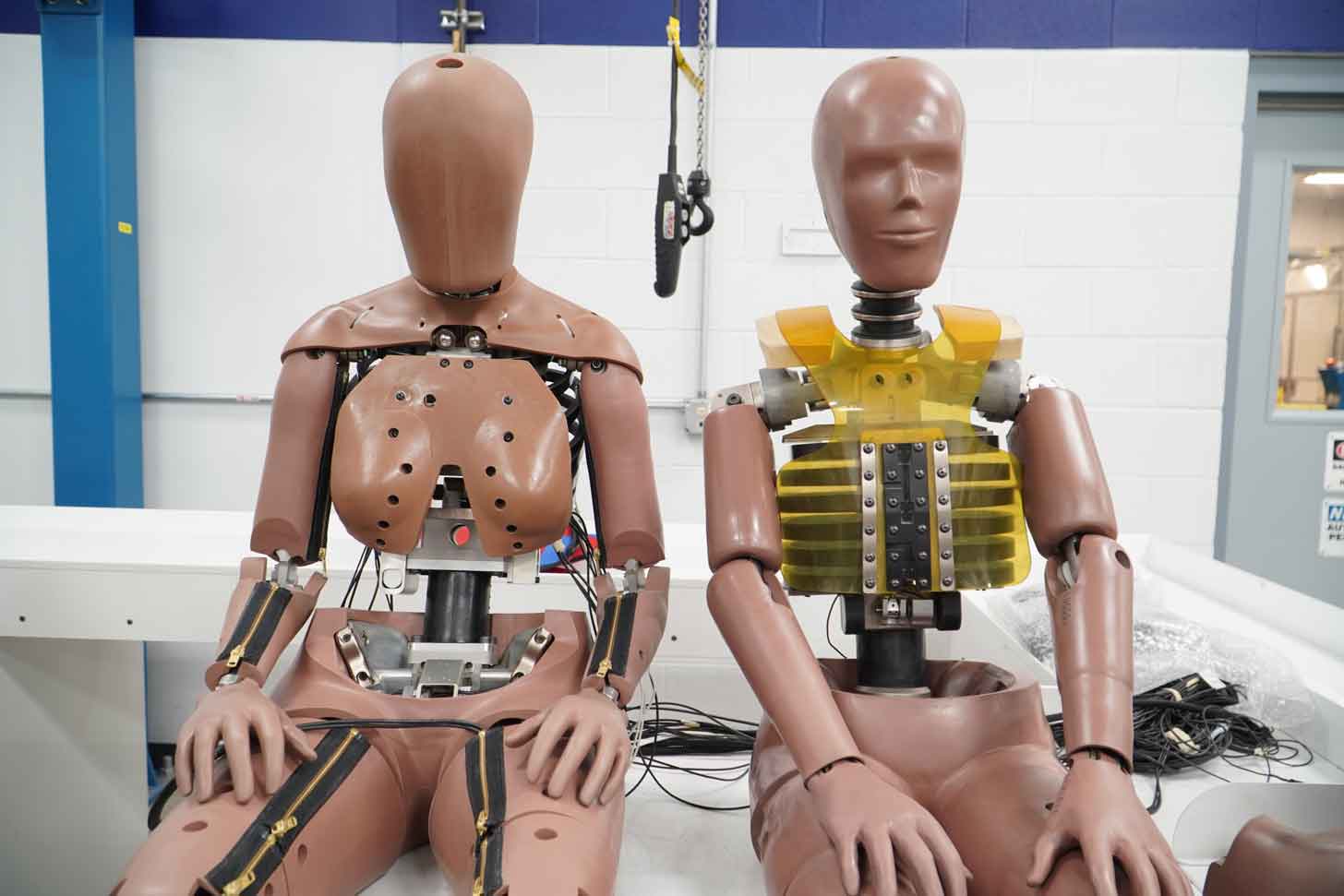
According to the National Highway Traffic Safety Administration, the standard model for a male crash test dummy is 5’9” and weighs 170 pounds. Two female crash test dummies are currently used and are 4’11” and weigh between 97 and 108 pounds. These are based on an outdated 1970s model that only represents 5% of women.
Furthermore, despite the fact that almost 50% of drivers are women, female test dummies are often sidelined to the passenger side — or don’t participate in the test at all — drastically reducing available data on potential harm to female drivers.
“I think the root of this paper highlights a simple question: Are we doing everything possible to protect and care for all people equally?” said Dr. Christopher J. Wolff, of Cleveland Clinic Akron General in Ohio.
This data by Frontiers further verifies insight from a 2023 Government Accountability Office report that stipulated that crash test dummies “represent a limited range of body sizes, do not reflect some physiological differences between males and females, and do not have sensors to collect data in the lower legs.”
Fortunately, as pressure mounts from multiple findings, the NHTSA has begun taking measures to update female crash test dummies to more accurately represent the passengers (and drivers!) operating emerging car models.
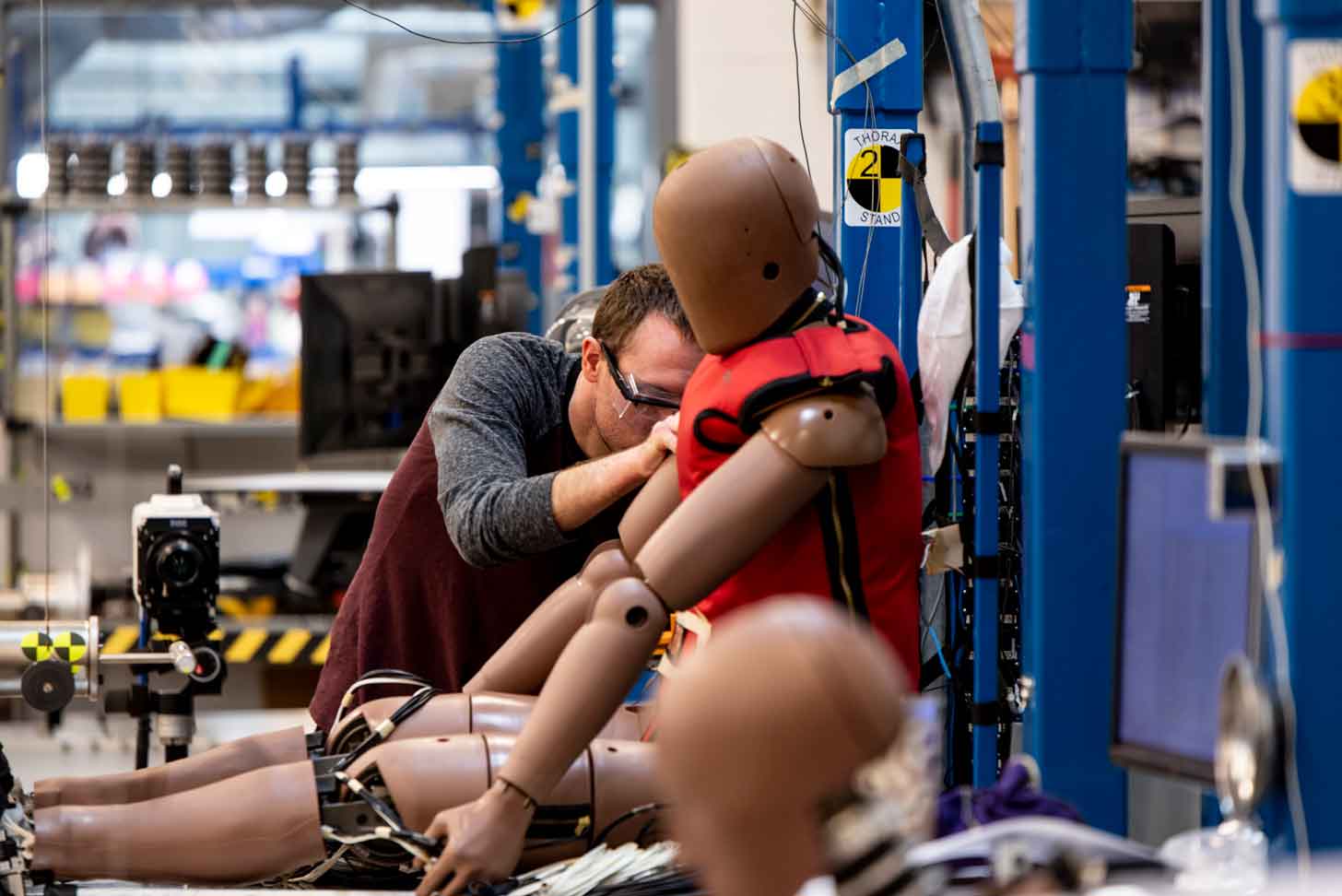
Based on the GAO’s recommendations, the NHTSA has collaborated with Humanetics to correct gender disparities in vehicle safety. The high-tech global company has already manufactured the THOR-5F: a more advanced version of the female crash test dummy.
Progress is here, but perfection awaits. The models are not much different in size to the 1970’s models, but they better reflect the female anatomy, with breasts, a pelvic bone, and predictive sensors.
“Our goal and our mission is to save lives and make a difference,” Humanetics CEO and President Chris O’Connor told ABC News. “We developed this test equipment to represent the current injuries and fatalities being experienced.”
Former U.S. Congresswoman Susan Molinari, who now co-chairs Verity Now, uses her platform to advocate for vehicle safety for all.
“We’re talking about thousands of lives and serious injuries that can be saved if we employ female crash test dummies in our ratings systems with regard to crash test worthiness for cars,” Molinari told FOX 6 Now.
As the Humanetics female crash test dummies await federal approval, the compounding studies from GAO and Frontiers have pressured scientists and technicians to take a more thoughtful approach to car safety measures, so that everyone feels safer on the road.
Header image courtesy of Humanetics
Kermit the Frog is known for his dream of finding the “Rainbow Connection,” but the Muppet’s latest adventure has him connected to a different discovery: The fossilized skull of a 270-million-year-old ancient amphibian ancestor.
The skull was uncovered in the Smithsonian’s National Museum of Natural History by a team of researchers at George Washington University. They described the fossil as a “new species of proto-amphibian” in a paper published in the Zoological Journal of the Linnean Society.
It’s only fair, then, that they name this prehistoric amphibian after the most famous frog of our modern times: Kermit.
The specimen’s full government name is Kermitops gratus. Calvin So, the lead author of the new paper, said naming it as such is an opportunity to engage everyday people in the discoveries made in the often hidden-away halls of museum collections.

“Using the name Kermit has significant implications for how we can bridge the science that is done by paleontologists in museums to the general public,” So said in a statement.
“Because this animal is a distant relative of today’s amphibians, and Kermit is a modern-day amphibian icon, it was the perfect name for it.”
It’s not just about banjo-playing antics for this Kermit, though.
Although it may seem counterintuitive, discoveries of ancient species are helpful to scientists working to learn more and protect the animals that roam the earth today.
“The early fossil record of amphibians and their ancestors is largely fragmentary, which makes it difficult to understand how frogs, salamanders and their kin originated,” a press release from the museum explained.
“Adding relatives like Kermitops into the fold is essential for fleshing out the early branches of the amphibian family tree.”

Researchers on the study hope that this discovery of an exciting ancestor hiding in plain sight will inspire others to take a look at their own museum’s fossil collections — to piece together clues from the distant past to better understand how we got to this current iteration of life on earth.
In fact, the Smithsonian’s enormous fossil collection provides avenues of study in DNA, environmental changes, biodiversity, evolution, and more.
For instance, learning more from the mass extinction of species during an era of global warming known as the Paleocene-Eocene Thermal Maximum, scientists can better understand how climate change can impact the health of an entire species.
“Fossils test our understanding of how the planet works — they contain clues that improve our ability to predict climate, in both the past and in the future,” Scott Wing, a paleobotanist who has worked with the Smithsonian since 1984, wrote in a blog post.
“I hope people of the future will look back on us and see that we learned the lessons of deep time.”
The discovery of Kermitops gratus
The fossil that is now known as Kermitops was discovered by late paleontologist and curator Nicholas Hotton III in Texas in 1984. Hotton worked in the museum’s paleobiology department for nearly four decades, spending much of his time excavating fossils in the Red Beds of north central Texas.
Kermitops was just one of his many finds — which included more fossilized remains of ancient reptiles, amphibians, and precursors to modern mammals — and was stored in the museum’s National Fossil Collection.
Then, nearly 40 years later, it caught the eye of Arjan Mann, who teamed up with So to figure out who this skull belonged to.
They identified the skull as one that belonged to a temnospondyl, a diverse group of primitive amphibian relatives that lived for over 200 million years. But this particular specimen was unique enough to be the basis of an entirely new genus — thus the playful new name.
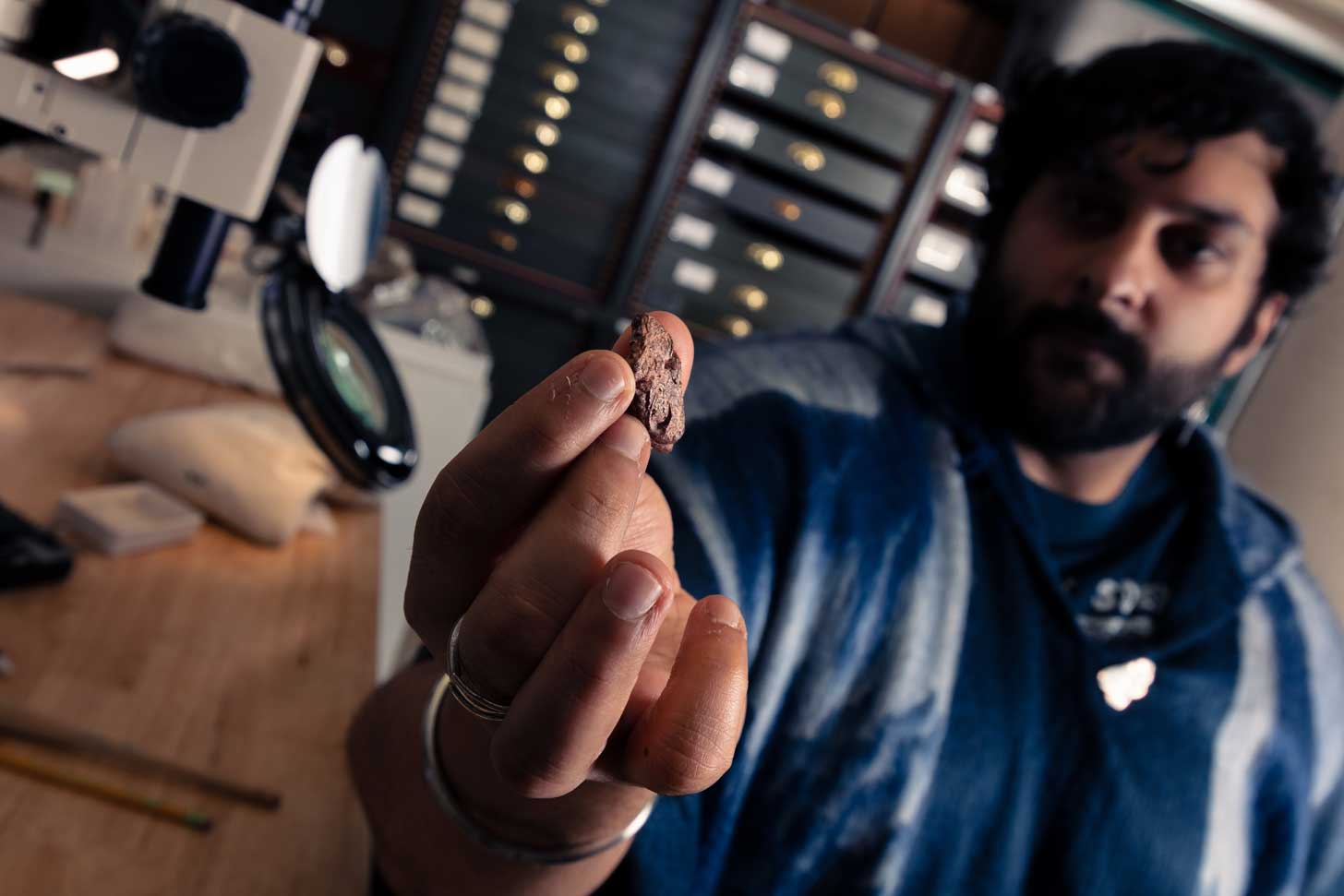
“Kermitops offers us clues to bridge this huge fossil gap and start to see how frogs and salamanders developed these really specialized traits,” So said.
This project is the latest collaboration between the Smithsonian and George Washington University, which provides students with access to collections and resources, allowing them to make major discoveries just like this.
Plus, as amphibians of today face multiple threats — from disease to habitat loss and pollution — learning more about where they come from could open up a world of knowledge to protect them.
“Paleontology is always more than just dinosaurs, and there are lots of cool evolutionary stories and mysteries still waiting to be answered,” Mann said. “We just need to keep looking.”
So, while this ancient skull can’t sing a tune, maybe this community of passionate researchers — and their discoveries — is really who Kermit was talking about when he sang about “the lovers, the dreamers, and me.”
Header image courtesy of James D.Tiller/Smithsonian
Zoe Saldaña, Sigourney Weaver, and Kate Winslet are pros at underwater shoots. The actresses made headlines last year when they revealed the intricate training and breathing techniques involved in filming “Avatar: The Way of Water” — with Winslet reportedly holding her breath for seven minutes and 15 seconds.
Recently, the cast took the plunge again ahead of World Water Day, but not for “Avatar 3” (which is currently in post-production). This time they teamed up for an underwater photoshoot in the name of ocean conservation.
Prints from the photoshoot — shot by photographer Christy Lee Rogers and commissioned by “Avatar” director James Cameron — can be viewed and purchased on Roger’s website.
100% of net proceeds will go directly to The Nature Conservancy, a global nonprofit focused on marine conservation, land preservation, and climate justice.
For Rogers, shooting underwater is second nature. The photographer has made a name in the fine art world by mixing color, light, and fluid movement to craft her pieces.
“I learned from my father a deep respect for the water and ocean while growing up,” Rogers shared. “My hope is that we find a quick solution to keep our water clean, fresh and alive, so that all life can thrive here on this planet. That’s what this project is for me: a part of that solution.”
The photoshoot is an extension of Disney and Avatar’s “Keep Our Oceans Amazing” initiative, an ongoing campaign first launched in December 2022 alongside the release of “Avatar: The Way of Water.”
In support of TNC, the companies pledged to protect ocean animals and their habitats, highlighting threatened and endangered species that include beluga whales, whale sharks, manatees, sea lions, hawksbill sea turtles, and more.
In a press release tied to the campaign, Melissa Garvey — Global Director of Ocean Protection at The Nature Conservancy — stressed the importance of creating a “healthier ocean for all.”
“The entire planet depends on the health of our ocean to support and sustain it,” said Garvey. “The ocean produces half the air we breathe, provides livelihoods for billions of people, and is home to more than half of all life on earth. We need to do our part to protect it.”
Header images courtesy of Christy Lee Rogers
Author and global health advocate John Green has done a lot to fight tuberculosis, the world’s deadliest infectious disease.
From grassroots organizing alongside his “Nerdfighteria” fan community to make diagnostics and treatments more accessible, to pledging an annual $1 million donation to TB care in the Philippines, Green has seemingly become the spokesperson for (or rather against) the disease.
Now, he’s educating more people, so they too can understand the implications of TB through a new online lecture.
“Crash Course Tuberculosis” is now available to watch for free online.
“The story of tuberculosis spans far wider than most realize. The disease has left its mark all through human history worldwide and throughout global cultures — with impacts on contemporary fashion, geography, and so much more,” Crash Course posted on X (formerly Twitter) earlier this month.
“In this long-form deep-dive, host John Green will teach us about tuberculosis from a historical, cultural, and scientific perspective.”
“Crash Course,” is a show created by Green and his brother Hank, who founded the production company Complexly, to bring dozens of in-depth, engaging educational videos to life for over 15 million subscribers.
Years ago, the show’s only hosts were John and Hank.
However, with the scaling of Complexly — as well as initiatives like Study Hall (which actually allows viewers to turn their YouTube time into college credit), and funding from the Crash Course Coin — a full team of hosts, educators, and animators now make up the majority of Complexly’s air time.
John’s return to the “Crash Course” screen will be the first in a series of “Crash Course Lectures,” which he says are “long, deep-dives into a specific topic with unbelievably beautiful graphics.”
Brooke Shotwell, a communications coordinator at Complexly added in an email to Good Good Good: “A Crash Course Lecture is an individual long-form video that dives deep into a topic in a multidisciplinary way. In contrast, ‘Crash Course’ series are multi-episode courses on a broader topic; they include episodes that cover specific learning objectives.”
For example, she said, the show’s 50-episode biology series has episodes that run 10-15 minutes, and one of the most recent episodes covers DNA structure and replication, specifically.
“The new lecture format will allow ‘Crash Course’ to stretch in some new ways and allow us to cover topics that we know people are curious about,” Shotwell said.
“We’re also excited to welcome guest lecturers to write and host these lectures, give them a chance to present their POV on why they think seaweed, or statistical models, or a particularly deadly infectious disease is critical to know about, and why it is so fascinating.”
It makes sense for that first deep-dive to be about Green’s greatest area of interest.
“If you’ve followed John Green on any internet platform for the past few years, you’ll know that… he has done extensive research into the topic, and has also led an incredible community effort through TB Fighters to make change,” Shotwell said.
“Ultimately, the message is of hope and urgency that activism and awareness will change what happens next.”
The 50-minute lecture, which premiered with a viewing party and live chat where viewers could connect with Green, takes learners on a winding road to learn about TB from a historical perspective, and how we got to the contemporary moment.
It also explores the science behind the disease, including the causes, symptoms, and treatments — as well as the current factors limiting the effective treatment of TB across the globe.
“In the lecture, John Green stresses that we can choose to live in a future where no one dies of tuberculosis,” Shotwell said. “We hope this lecture will help people see that possibility, and work together to make it a reality.”
While the lecture is sure to be an exciting deep-dive for Nerdfighters who are already engaged in the fight to eliminate TB, it seems to have been made intentionally to reach curious minds of all kinds.
“Whether someone is studying nursing, history, public health, or human rights, or is simply a curious person who wants to learn something new and fascinating about their world, they’ll get something out of ‘Crash Course Tuberculosis.’” Shotwell said.
“We hope everyday learners enjoy these lectures, and that viewers are inspired to continue learning… even after the video ends.”
Header image courtesy of Complexly
Every day the Good Good Good team collects the best good news in the world and shares it with our community. Here are the highlights for this week!
If you want to get good news in your inbox every day, join the Goodnewsletter — the free daily newsletter designed to leave you feeling hopeful.
The Best Positive News We’re Celebrating This Week —
Wind turbines are being recycled into bike shelters, high-speed rail lines, power line poles, and roofs
Like many good things in life, wind turbines don’t last forever. But while 85% of an existing turbine is recyclable, disposing of retired turbine blades presents more of a challenge because they’re made of materials that can’t easily be recycled.
In order to not add a new waste problem to a sustainable solution, the renewable energy industry is getting creative. And as it turns out: life-expired wind turbine blades have lots of potential uses because the very materials that make them hard to recycle also make them durable and strong.
Engineers are already using them to build bicycle shelters, bridges, reinforce concrete, and more.
Why is this good news? Sustainable solutions aren’t truly sustainable if they create new long-term waste issues, and it’s estimated that by 2050 there will be 2 million tonnes of wind turbine waste needing safe disposal.
It’s very good news that folks are investing the time and energy to think about the entire lifespan of materials we use to capture wind energy — including solutions for when blades can no longer be used for their primary purpose.
A viral Down syndrome ad campaign fiercely punches back against harmful misconceptions
“Hey bartender. You assume that I cannot drink a margarita, so you don’t serve me a margarita, so I don’t drink a margarita,” says actress Madison Tevlin in the new viral ad campaign ASSUME THAT I CAN. “Your assumption becomes reality.”
The ad goes on to lay out all of the limitations placed on people with Down syndrome that occur when parents, teachers, and peers operate on outdated assumptions — and what happens when those limits stop.
The series of PSAs — truly a global collaborative effort — are tied to World Down Syndrome Day coming up on March 21.
Why is this good news? Down syndrome impacts each individual on a spectrum of cognitive and social levels, but instead of being given a range of support and accommodation, people with Down syndrome are often drastically underestimated, infantilized, and even ridiculed based on other’s lowest assumptions.
This campaign writes a new, better narrative for viewers to adopt.
Women are more involved and represented in politics than ever before
Women in the 18th and 19th did not have the right to vote or hold legislative office, and only those of royal descent led their countries — that changed significantly and dramatically throughout the 20th century.
When Kuwait extended the right to vote to women in 2006, women could officially vote in every country in the world — except those with no universal right to vote for anyone.
Another key marker of political equality is representation in political office, which women were excluded from through the early 20th century. That shifted over time until by the early 2000s, a handful of countries achieved between 40 and 50% women parliamentarian representation.
And while there were no women leading countries through the middle of the 20th century, that has changed significantly recently — more than a third of countries have now had a woman leader (and more than a quarter have been democratically elected).
While we still have a long way to go before we achieve political equality — some of the best progress throughout history has happened over decades and centuries. And this progress is worth celebrating — especially during Women’s History Month!
The first utility-scale offshore wind farm in the U.S. is now open and powering 70,000 homes in New York
Achieving a major milestone for clean energy in the U.S., South Fork Wind is officially complete and all 12 of its turbines are producing enough electricity to power around 70,000 homes in New York.
Construction on this first utility-scale offshore wind farm started last year, amidst setbacks for the industry overall. New York also has a goal to build 9 GW of offshore wind capacity by 2035, which would meet about 30% of the state’s electricity demand.
It’s the most ambitious goal in the country, which just got one step closer to reality. Or as one expert put it: “Now the question is no longer if we can, but how fast we can.”
→ Read more
More good clean energy news:
- Cities around the U.S. are turning old landfills into solar farms, with around 300 completed so far and the capacity to power millions of homes.
- In the name of freedom and economics, even the most conservative states are passing landmark clean energy legislation to pave the way for expanding solar and wind power.
- New research indicates that an exponential surge in solar, wind, and battery capacity is putting the world on track to reach ambitious net-zero goals by 2030.
- To respond to the climate crisis, a company is “greening” the millions of existing buildings in America.
The European Union Parliament just passed the world’s first regulations to mitigate the risks of artificial intelligence
While countries like China and the U.S. have implemented some AI laws, the European Union just passed the “first and only set of binding requirements to mitigate AI risks” in the world.
The AI Act classifies AI products according to risk and imposes rules based on the product’s capacity to harm society. Those that have a higher risk, have stricter rules.
As AI sees exponential growth and profits, it has also raised valid concerns around things like bias and privacy. The creators of the law say it will make AI more “human-centric” — and is just the start of what regulations around the technology could look like.
Why is this good news? While the risks surrounding the most concerning uses for AI are valid, that shouldn’t stop the technology from being used for good — like to eliminate the world’s deadliest infectious disease, help with wildfire recovery, and save ecosystems critical to mitigating the climate crisis.
These new rules will help protect those beneficial, life-saving use cases — and prevent potential bad actors from using the tech to cause harm.
California’s Yurok Tribe just became the first Native people to manage land with the National Park Service
Under a historic “memorandum of understanding” signed this week, the Yurok Tribe of California officially became the first Native people to manage tribal land with the National Park Service.
The Yurok had 90% of its land taken in the mid-1800s during the gold rush, and it will now get 125 acres of land — named ’O Rew in the Yurok language — back. It will be a new gateway to the iconic Redwood national and state parks.
The historic agreement is a step in righting those historic wrongs, and “starts the process of changing the narrative about how, by whom and for whom we steward natural lands.”
→ Read more
More good news by and for Indigenous people:
- The LANDBACK movement is working to return stolen lands back to Native peoples.
- Through DeTours, Hawaii’s Indigenous communities are working to educate settlers and tourists alike on Hawaii and its colonial past and present.
- A 532-acre redwood forest along California’s north coast was returned to the guardianship of the Sinkyone tribes and has been renamed Tc’ih-Léh-Dûñ.
A Dallas-based business owner is helping millions of refugees and other underserved people get essential healthcare
Just two weeks after seeing a news report about Cambodian refugees escaping the Khmer Rouge “Killing Fields” 45 years ago, Ron Post raised $250,000 and had 28 volunteers ready to set off for Thailand to help in a refugee camp.
The sight of the emaciated body of a teenage girl at the refugee camp on the news moved him into action — and despite having no medical background, Post wanted to help. That was the start of Medical Teams International, which now serves approximately 3 million refugees at eight different camps.
Medical Teams also has free mobile clinics providing care for about 25,000 people each year — including underserved folks in Oregon and Washington. The clinics are completely free, and licensed doctors, dentists, and nurses volunteer their time to provide care.
They’ve been operating the mobile clinics since the 80s, and most recently in 2021, provided mobile COVID-19 vaccination and testing services specifically in rural communities.
More good news of the week —
A YouTube creator created a way to recycle the “printer poop” from 3D printers. The power of 3D printing has been used to do a lot of good, from extend the lifespan of damaged goods, personalize toys for children with disabilities, or even build schools and bridges.
After realizing New Orleans had no way to recycle glass, a college student founded the city's first glass recycling plant. Glass half full collects glass and converts it to beach-like sand which is then used for disaster relief, eco-construction, and more.
At a prison in Panama, a new recycling program is helping clean up the facility and rehabilitate inmates. Incarcerated folks at La Joyita participate in EcoSólidos to collect, separate, recycle, and sell waste — and earn reduced sentences.
Keeping it out of landfills, a Brooklyn-based nonprofit is helping the East Coast recycle textile waste. FabScrap has partnered with Urban Outfitters, Nordstrom, and more and saved around one million pounds of fabric from the landfill.
A Volkswagen-partnered battery maker just pioneered a new way to recycle batteries. 24M Technologies’ process reduces production costs by up to 40% and improves the batteries’ energy density, safety, and recyclability.
YouTubers Rhett & Link got colonoscopies together to spread colon cancer awareness. The “Good Mythical Morning” hosts were their usual comedic selves as they underwent the procedure to help educate fans.
Three million shipwrecks around the world have become helpful habitats for underwater life — from microbes to sharks. Shipwrecks conjure tales of sunken treasure and unsolved mysteries — but can also be biological treasures for thriving underwater communities.
Hundreds of people lined up for a free adoption event after nearly 200 dogs were found at a Florida home. The animals had not been neglected, but their elderly owner could no longer take care of them and agreed to put them up for adoption.
Backed by Serena Williams, a new at-home cervical cancer test aims to replace traditional pap smears. With promising trial results and pending FDA approval, the Teal Wand aims to empower women with greater control over their health care.
To help limit the “excesses” created by fast fashion, France's lower house just passed an environmental surcharge law. Key measures in the package aimed at curbing the negative impact of fast fashion on the planet include a ban on advertising for the cheapest textiles and an environmental charge on low-cost items.
A new tick-killing pill could be a major breakthrough in preventing Lyme disease. A new, early-stage trial showed that it can kill ticks on people 24 hours after taking the drug, with the effects lasting for up to 30 days.
A new activist campaign is calling on the Met Gala to be inclusive of attendees in wheelchairs. #YourMoveMET calls on event organizers, including Anna Wintour and Zendaya, to reimagine the Gala to include attendees who use wheelchairs with intention.
Canada will no longer use a devastating poison to kill “land predators,” like wolves, bears, and coyotes. Strychnine causes the animals that consume it to die slow and painful deaths, and ending its use will help protect wildlife in the entire ecosystem.
A new project in Massachusetts is testing a future for gas utilities without fossil fuels. Environmentalists hope the country's first gas utility-led networked geothermal system can be a model for other gas utilities to wean themselves off of fossil fuels.
Women veterans are receiving more benefits and care from VA than ever before. Progress in the department is attributed to legislative measures and ongoing initiatives such as the PACT Act and the new Women's Health Research Collaborative.
EU countries just backed a new law to enforce stricter checks on forced labor and environmental damage. The European Supply Chain Act will apply to companies with over 1,000 employees and annual revenues of over $490 million.
The EPA is imposing the strictest limits on greenhouse gas emissions from light-duty vehicles in U.S. history. It’s the Biden-Harris administration’s biggest climate move yet, and will further solidify and accelerate the EV transition.
The term “orphan-crushing machine” became popularized in 2020, when a tweet went viral.
“Every heartwarming human interest story in America is like ‘he raised $20,000 to keep 200 orphans from being crushed in the orphan-crushing machine’ and then never asks why an orphan-crushing machine exists or why you'd need to pay to prevent it from being used,” X (formerly Twitter) user @pookleblinky wrote.
Essentially, the “orphan-crushing machine” is a metaphor for any “heartwarming” stories you may encounter in the news that focus on how an individual or group of individuals help alleviate the immediate impacts of social injustices, while ignoring or glossing over the root causes of them.
Every heartwarming human interest story in america is like "he raised $20,000 to keep 200 orphans from being crushed in the orphan-crushing machine" and then never asks why an orphan-crushing machine exists or why you'd need to pay to prevent it from being used.
— Anosognosiogenesis (@pookleblinky) September 25, 2020
We’ll give you a couple of examples.
In 2018, a news story went viral, with people describing it as “heartwarming.” It celebrated teachers pooling together their sick days to give to a colleague with cancer.
But many readers went on to critique the systems making it difficult for this teacher to have what he needed, suggesting instead that he should be able to access resources and paid time off from his employer or local government.
Perhaps you’ll recall any number of headlines about children donating their allowance to help unhoused community members.
These stories celebrate kids doing good while completely glossing over the fact that in a wealthy country like the United States, it shouldn’t be necessary for children to donate their money to ensure that community members have access to safe, affordable housing.
More recently, a story of a college football player giving his scholarship to a teammate garnered headlines. The teammate, who was donating plasma to earn money for school, tried to get a scholarship of his own, but the National Collegiate Athletic Association said it had reached its maximum annual disbursement of these funds. So, his friend surrendered his scholarship dollars instead.
While this is a kind and generous act between teammates, critics argued that people should not have to sell plasma to attend college or compete in collegiate athletics.
If you’d still like a few more ideas to get the full picture, there’s an entire Subreddit devoted to pointing out the orphan-crushing machine in action with over 150,000 members.
In fact, many have adopted a shorthand version of the phrase “orphan-crushing machine” to critique these kinds of narratives. An increasingly common phrase shared in relation to these “feel-good” stories is “peak OCM.”
It is used as a way to communicate frustration that small wins are celebrated, rather than systems-wide progress.
The orphan-crushing machine metaphor can be helpful in communicating the issue we see in so much reporting (even in some of our own good news articles): There is only so much celebrating that can be done when systemic injustices continue to actively harm the people and communities at the heart of these stories.
For instance, when a celebrity raises millions of dollars for, say, a humanitarian crisis, that is a great act of compassion that will certainly help people in need. But it doesn’t eliminate the war or climate disaster or public health emergency that created a humanitarian crisis in the first place.
That being said, the metaphor leaves little room for nuance.
Of course, most people want to ensure world peace, eradicate homelessness, provide equitable health care for all, or ensure people in all careers have access to paid sick leave to get the medical attention they need.
But while people actively fight for a more just and equitable future, we all still have to exist on the continuum of where we actually are and where we want to be.
And creating a better future cannot be done without acts of community, which often look a lot like these headlines: People doing what they can with what they have. People sharing their dollars and sick days to make someone else’s life easier.
It’s a catch-22: We can’t have systemic change without small, individual acts of generosity, and small, individual acts of generosity alone will not create systemic change.
The reality we have to reconcile, then, is that two things can be true at once. It’s time to destroy the orphan-crushing machine, but if a few kids can be saved in the process, that also reduces the harm caused by the orphan-crushing machine.
On a logistical level, this looks like embracing nuance in reporting. Reporters who share these feel-good stories have a responsibility to explain why a story is considered heartwarming — and to share relevant information to fully illustrate the barriers at hand.
They have a responsibility to report on both short-term and long-term solutions. They have a responsibility to ask why solutions are needed in the first place.
And this doesn’t always happen. It makes sense why many people may have a disdain for good news, which can be delivered in ways that ignore nuance or barely explain the ‘why.’
But that doesn’t mean that all stories of hope and inspiration are feeding the orphan-crushing machine.
Ultimately, it is possible to celebrate and rage at the same time. It is possible to find joy or relief in incremental progress while simultaneously fighting against injustice.
In a world that so often compels us to pick only one — hope or despair — allowing both of these things to be true is a radical act of acceptance that grounds us in reality and sustains lasting change.
Good Good Good reports on meaningful good news and ways to make a difference. Subscribe to the Goodnewsletter — our daily email newsletter. Or get good news journalism delivered in the mail, by signing up for our monthly print newspaper — delivered worldwide.
This story was originally published by Grist. Sign up for Grist’s weekly newsletter here.
Feeling guilty about all those blue-and-white plastic Amazon bags piling up around the house? Fear not — they can be recycled! At least, that’s what the packaging says.
For years now, Amazon’s plastic bags, bubble-lined mailers, and air pillows have featured the ubiquitous “chasing arrows” recycling symbol along with the words “store drop-off.”
The idea is simple: Since most curbside recycling programs don’t accept this type of plastic — it’s too expensive to process and can clog machines — consumers can instead leave it at retail stores across the country. From there, this plastic, known as “film,” will go to a specialized facility and be turned into new products.
The problem, however, is that the system doesn’t seem to be working.
An investigation published Tuesday by the nonprofits Environment America and U.S. Public Interest Research Group, or U.S. PIRG, suggests that only a small fraction of Amazon’s plastic packaging makes it to a material recovery facility, the term for operations that sort glass, metal, plastic, and other items for recycling.
The packaging is much more likely to end up in a landfill, incinerator, export terminal, or in the hands of a company that downcycles plastic film into things like benches.
The report adds to a growing body of evidence suggesting that store drop-off programs are an ineffective solution to the escalating plastic pollution crisis. According to environmental groups, these programs help justify the ongoing production of single-use plastic, helping manufacturers and retailers evade accountability while alleviating consumer guilt.
“The store drop-off system is really not working, and plastic film is not recyclable,” said Jenn Engstrom, state director of U.S. PIRG’s California chapter and a co-author of the report.
To find out what happens to Amazon’s plastic packaging, U.S. PIRG and Environment America attached small tracking devices — mostly Apple AirTags — to 93 bundles of Amazon plastic packaging marked for store drop-off and deposited them at retailers in 10 states.
These stores, which were listed in an online directory, included mostly supermarkets like Safeway, Sprouts, Publix, Fred Meyer, QFC, and Whole Foods, although some bundles were placed at outlets like Kohl’s or Home Depot.

The report authors were able to determine the fate of about half the bundles, since, as expected, many of the trackers likely died before reaching a final destination. Of those that survived, 13 went to a landfill, two went to a waste incinerator, and three went to the Port of Los Angeles, suggesting that the bundles were destined for processing or disposal overseas.
Only four trackers eventually made their way to a material recovery facility that sorts plastics for recycling. U.S. PIRG and Environment America said they were able to contact three of those facilities: Two specifically said they do not accept Amazon packaging, and the third said it accepts only paper and cardboard.
Two dozen trackers ended up in the hands of Trex, a company that makes benches and decking out of discarded plastic. But U.S. PIRG and Environment America question whether Trex is using Amazon packaging in its products; the contents of store drop-off bins are often littered with food and beverages, likely rendering this plastic too contaminated to use in manufacturing.
Trex did not respond to Grist’s request for comment, but a similar company reports getting 70 to 80 percent of its plastic from “back-of-the-house shrink wrap,” referring to the material wrapped around shipping pallets, which tends to be cleaner than postconsumer plastic.
Meanwhile, a Trex executive told Bloomberg News last year that there is not enough demand for recycled material to make store drop-off successful.
“All the claims the companies are making are just greenwashing,” he told Bloomberg. “Recycling’s failed.”
While USPIRG and Environment America’s investigation may be the largest of its kind, it isn’t the first to find flaws in the store drop-off system. Last year, Bloomberg tracked 30 bundles of packaging and wrappers marked with the store drop-off icon and found that 13 of them — more than 40 percent — ended up at U.S. landfills.
Just four made it to locations that can recycle plastic. A similar effort from ABC News found that about half of 46 bundles of plastic bags went to landfills and incinerators, while only four went to facilities “that say they are involved with recycling plastic bags.”
Jan Dell, an independent chemical engineer and founder of the environmental nonprofit The Least Beach Cleanup, has been deploying her own trackers too.
Since December 2022, she hasn’t traced a single bundle of film labeled for store drop-off to U.S. facilities that can turn the material into new bags. Twelve bundles have been sent to a landfill or waste station, and one to an incinerator. Four appeared to have traveled to Mexico, Vietnam, or Malaysia, countries that generally lack adequate recycling infrastructure.
“They’re absolutely lying with these labels,” Dell said. The store drop-off system has “never worked, it was never true.”
The labels in question are produced by an initiative called How2Recycle, which began selling them to big companies in 2012 — supposedly to clear up confusion among consumers and retailers about which products could be recycled.
The initiative issues several versions of the recycling icon, with the one marked “store drop-off” reserved for products, like plastic bags and film, that aren’t accepted in curbside recycling programs.
The store drop-off labels direct consumers to How2Recycle’s website, which links to a directory of retail locations with collection receptacles.
Until last year, that directory was found at BagandFilmDirectory.org and featured more than 18,000 locations — but the consulting firm managing it shut it down following ABC News’ investigation, citing a lack of “real commitment from the industry,” as well as insufficient funding.
Many of the locations listed did not actually have a receptacle, while the Target and Walmart locations appeared to be disposing of, rather than recycling, much of the film they received.
“There’s more of an illusion of stuff getting recycled than there actually is because there is an imbalance in supply and demand,” Nina Butler, CEO of the consulting firm, told ABC News. How2Recycle now links customers to a different directory hosted at Earth911. How2Recycle did not respond to Grist’s request for comment.
As scrutiny has increased over the use of the store drop-off label, some companies have pledged to stop using it altogether. Mondelez, which owns brands including Oreo and Ritz, said in March 2023 that it plans to phase out the label by 2025.
Dell said she’s also noticed the label’s disappearance from packaging sold by Target and Georgia Pacific, a company that sells toilet paper, paper towels, and other pulp products. Target and Georgia Pacific did not respond to Grist’s request for comment.
Amazon, for its part, did not respond to Grist’s questions about its use of the store drop-off label. When Dell asked the company, during a Zoom meeting in 2020 that she shared with Grist, to provide evidence that its packaging is widely recycled through the store drop-off program — as required by California law — an Amazon spokesperson told the state recycling commission that the company has “really high confidence that store drop-off is a solution that is available in California.”
Pat Lindner, Amazon’s vice president of mechatronics and sustainable packaging, told Grist that the company has no control over how its packaging is handled “once it has been disposed of by municipalities or recycling centers.”
A spokesperson said the company is investing in better recycling infrastructure while also reducing plastics use overall.
As of last year, for example, Amazon has eliminated plastic from shipments delivered in Europe, likely in response to EU regulations banning several categories of single-use plastic. The company also eliminated plastic packaging in India after Prime Minister Narendra Modi pledged to ban single-use plastic nationwide by 2022.
In the U.S. last year, Amazon launched an automated fulfillment center in Euclid, Ohio, that uses paper exclusively instead of plastic packaging, and the company said it’s ramping up a program to ship items in their original packages instead of extra plastic ones.
The company also said in a 2022 sustainability report that it was “phasing out padded bags containing plastics in favor of recyclable alternatives,” but the spokesperson did not address Grist’s request to clarify the timeline for this transition.
Environmental advocates agree that Amazon has made progress, but say it should be doing more to reduce the hundreds of millions of pounds of single-use plastic trash it generates every year — and that it should remove the How2Recycle symbol from its packaging.
In California, where state legislation often sets a national standard, a truth-in-advertising law signed by the governor in 2021 may soon restrict the use of store drop-off labels unless companies can prove that the system is effective.
A separate law will require single-use plastic packaging sold in the state to be demonstrably recycled at least 65 percent of the time by 2032, a threshold that may push manufacturers toward paper, which is far easier to recycle.
Despite internet rumblings that Greta Gerwig and Lily Gladstone were overlooked at the Oscars, it’s undeniable that the two powerhouses still had an incredible year.
As both writer and director, Gerwig pulverized box office records with “Barbie” and Lily Gladstone just swept awards season with 36 awards for her breathtaking performance as Mollie Burkhart in “Killers of the Flower Moon.”
After rightfully earning their flowers, the two seem happy to pass out their own.
This fall, Gerwig, Gladstone and other industry titans — Chloe Zhao, Emma Corrin, Eva Longoria, Jane Campion, Janicza Bravo, and Lilly Wachowski — will select eight filmmakers to win a life-changing $50,000 grant.
The Netflix funded “Proof of Concept” program, in partnership with Cate Blanchett’s Annenberg Inclusion Initiative, invited 1,200 applicants to submit story ideas for their dream projects, with emphasis on supporting the perspectives of women, trans, and nonbinary filmmakers.

The selected winners will receive the grant, alongside a one-on-one mentorship from one of the eight mentors on the selection committee. Together, the winners will work with high-profile producers, directors, and actors as they each produce a new original short film.
“This committee is a stellar group of filmmaking talent,” said Netflix chief content officer Bela Bajaria. “Each of these visionaries has moved audiences around the world, and I look forward to seeing how their support paves the way for future filmmakers.”
Blanchett said that with the right tools, the filmmaker’s shorts could potentially lead to feature length films and full series television programs.
“Providing tangible financial and career support for filmmakers who often get overlooked will not only give them a fantastic launchpad to success, it will also expand the future of film and television,” Blanchett said in a press statement.
According to the initiative, 85% of total applicants were women, 8.5% were transgender, and 2% were nonbinary. The pool of people was also incredibly diverse, with 52% of applicants identifying as people of color.
After the flood of applications poured in, Blanchett joined her Annenberg co-founders — activist Stacy L. Smith and producer Coco Francini — in releasing a joint statement.
“Filmmakers from these communities are currently overlooked for the top jobs, but when we reached out, they answered our call to action,” the three founders said. “The overwhelming response to Proof of Concept is a demonstration to the entertainment industry that there is a vast group of underrepresented talent ready to graduate to large-scale filmmaking.”
“Our goal now is to select, support and showcase eight individuals among this remarkable array of voices and prove that they are ready to be invested in.”
Each creator on the selection committee — from “Zola” director Bravo to “The Crown” actor Corrin — has spoken out about the importance of inclusion and diversity. The “Proof of Concept” program reconfirms their commitment to using their platforms to uplift others.
Notably, after making history as the first Native American to be nominated for Best Actress at the Oscars, Gladstone was eager to share her success.
Gladstone told the New Yorker: “If I've kicked the door in, I'm just trying to stand here and leave it open for everybody else.”
Header image courtesy of Netflix
— The negative climate impacts of mining the cryptocurrency Bitcoin have grown rapidly over time, with carbon emissions per coin multiplying 126 times from 2016 to 2021.
— During that window, the climate damage of mining one Bitcoin averaged 35% of a coin’s value, similar to the environmental costs of unsustainable products like crude oil and beef.
— Reducing Bitcoin’s massive carbon footprint may require international regulation unless the cryptocurrency shifts to a more energy-efficient mining system.
With no physical form, the digital currency Bitcoin can feel all but invisible to those who don’t use it. However, its harmful climate impacts are all too real – and they’re getting worse.
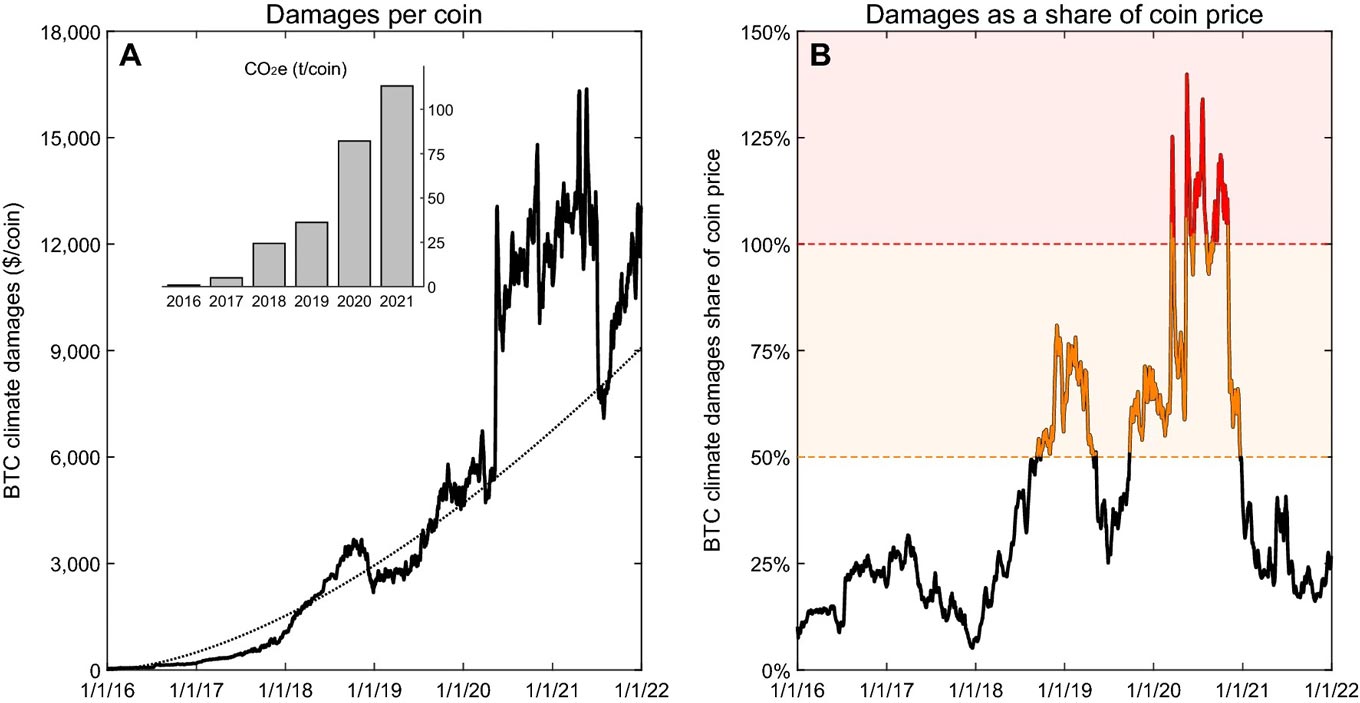
Emissions from mining the cryptocurrency have skyrocketed, researchers reported recently in Scientific Reports. From 2016 to 2021, the carbon footprint of mining a single Bitcoin multiplied a staggering 126 times. In that window, Bitcoin mining caused an estimated $12 billion in global climate damages.
“We find no evidence that Bitcoin mining is becoming more sustainable over time,” said economist Benjamin Jones of the University of New Mexico in a statement. “Rather, our results suggest the opposite: Bitcoin mining is becoming dirtier and more damaging to the climate.” (Jones and his two coauthors declined interview requests from Mongabay.)
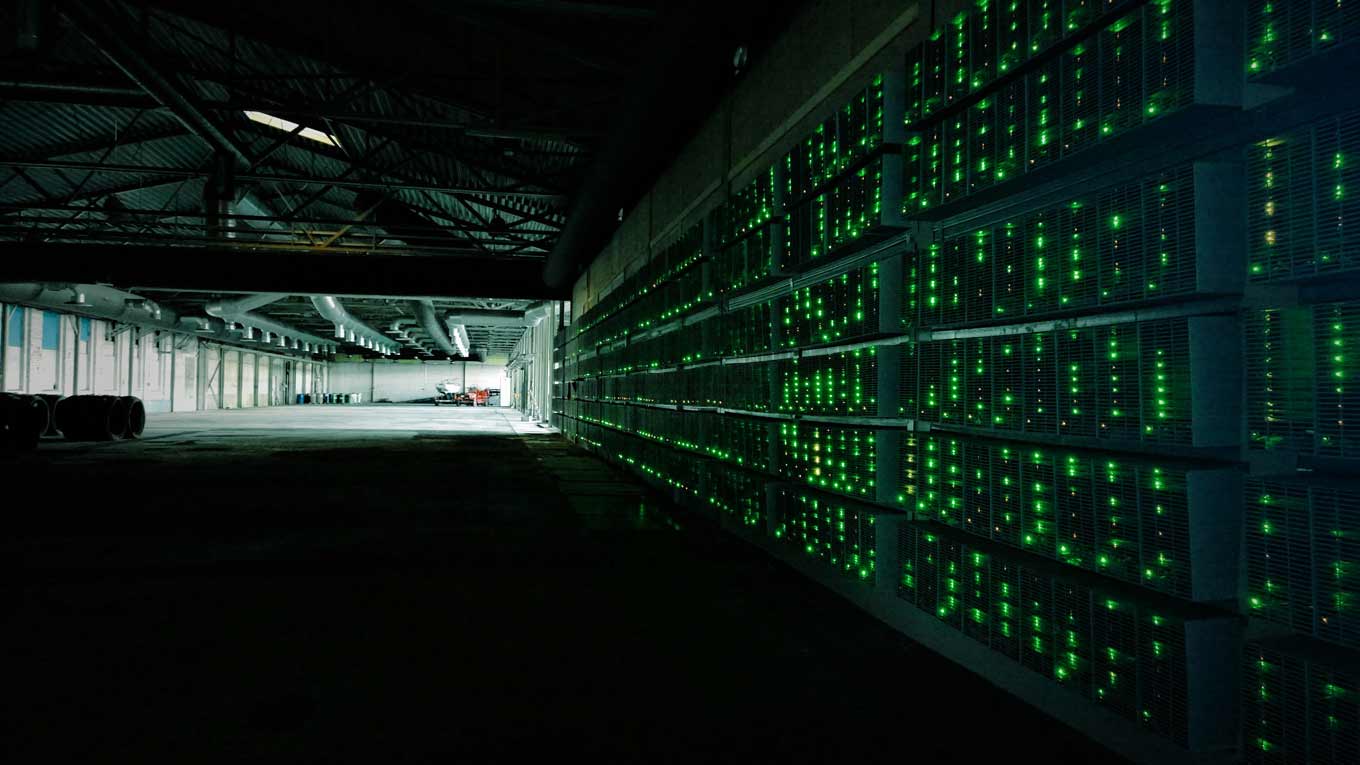
When someone buys or trades Bitcoin, computers in the network compete to solve a complex numerical puzzle. The winning computer then validates the transaction, earning its owner new Bitcoin. This process is called “mining.”
The computing power needed to mine Bitcoin, by far the world’s largest cryptocurrency by value, comes at a cost. Bitcoin in 2020 used 75.4 terawatt-hours of electricity — more than the country of Austria. Most of that electricity comes from burning fossil fuels like coal and natural gas, the researchers said.
To estimate the resulting climate impacts, Jones and his team analyzed how Bitcoin’s electricity demand fluctuated from 2016 to 2021. Based on where miners operate and how those places produce electricity, they found, mining a coin in 2021 emitted 113 metric tons (111.2 imperial tons) of carbon dioxide on average, up from just 0.9 metric tons in 2016. Assuming each metric ton of carbon dioxide causes $100 of environmental damage — a figure similar to those used by other researchers — then each Bitcoin mined in 2021 dealt over $11,300 of climate damages.
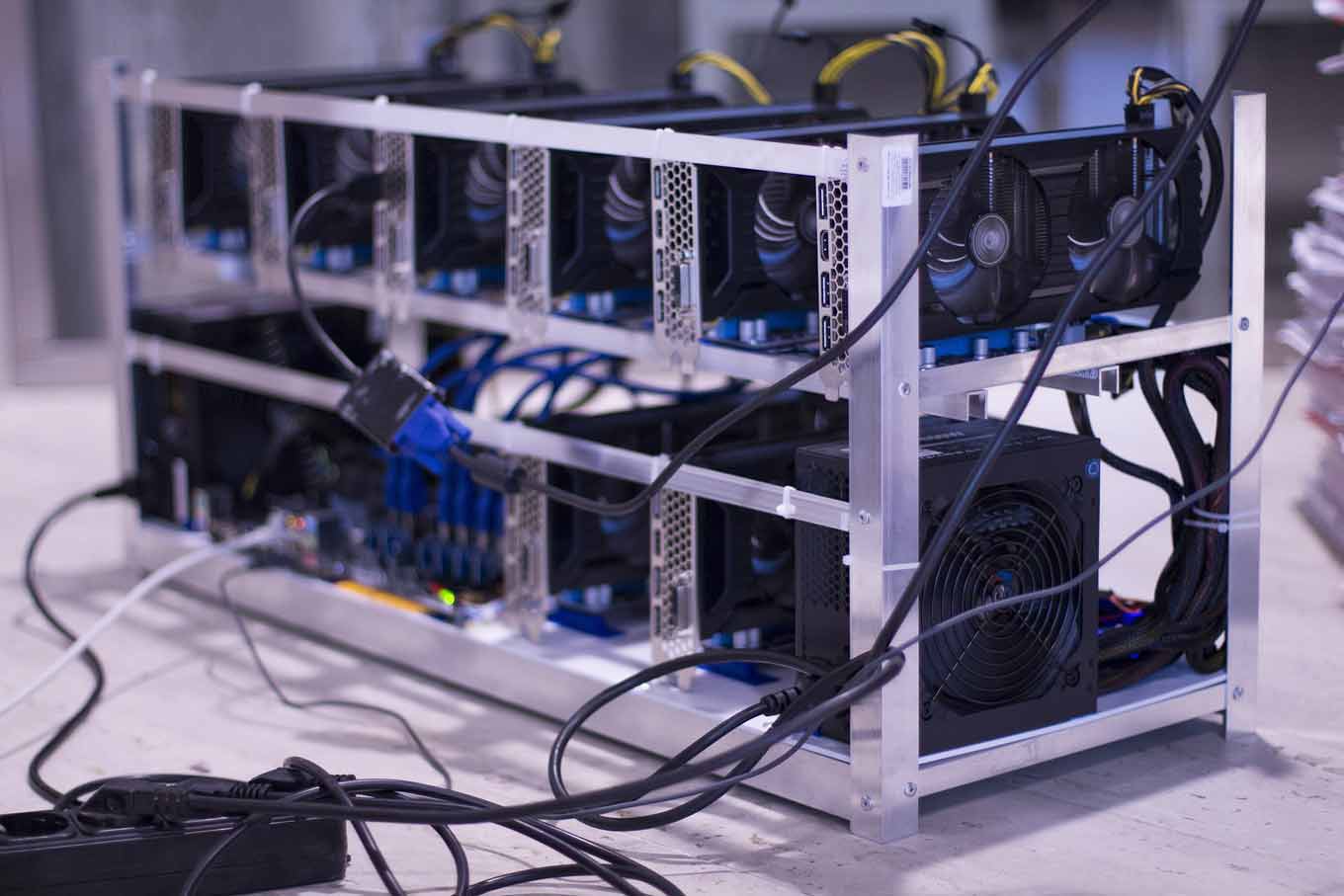
The trend arises from Bitcoin’s competitive “proof-of-work” mining system, the researchers said. As more miners join the fray and use more powerful computers to compete, electricity usage shoots up. And to keep those miners from generating new Bitcoin too quickly and lowering its value, an algorithm raises the difficulty of the mining puzzles, demanding more electricity to solve them as time goes on.
Experts expect climate damages to continue as long as dirty fuels like coal remain cheap, especially given recent drops in Bitcoin’s value. The cryptocurrency fell from an all-time high of almost $69,000 per coin in November 2021 to just over $16,500 per coin a year later.
“Miners will start going from renewable energy to dirty energy, to coal power, just to increase their profit margin,” said finance professor Larisa Yarovaya at the University of Southampton, U.K., who was not involved in the study.
Between 2016 and 2021, offsetting the climate damages of mining a Bitcoin would have cost 35% of that coin’s value, on average. By this standard, Bitcoin ranks alongside unsustainable products like crude oil and beef.
Judging Bitcoin’s climate damages in terms of its value, however, may not be the most reliable strategy.
“This is such a speculative asset,” said Giovanni Compiani, a professor of marketing at the University of Chicago who was not involved in the study. Bitcoin’s value, Compiani said, swings dramatically and doesn’t always reflect the coin’s actual usefulness — but mining it always generates emissions.
Cryptocurrency doesn’t have to be so damaging, the authors noted. Ethereum, the second-largest crypto network, recently adopted a “proof-of-stake” system that randomly selects participants to process transactions.
In contrast to Bitcoin’s system, this approach eliminates competition between miners, reducing the number of computers at work at any given time. The move makes Ethereum less secure but will likely cut its energy use by over 99.9%.

Switching to proof-of-stake would involve moving Bitcoin’s blockchain, the digital ledger documenting all transactions, to a different system. The crypto giant has no incentive to attempt such an onerous engineering feat, Yarovaya said.
That leaves regulation. But when China banned cryptocurrency last year, many miners there moved to the U.S. and Kazakhstan — where they sourced a greater portion of their electricity from gas and coal power.
“If there’s just a shift in the activities from one country to the other, then this doesn’t really solve the problem,” said Compiani. “Ultimately, the emissions are global.” Creating a climate-friendly crypto culture, he said, will require international coordination.
This article was originally published by Mongabay on December 5, 2022.
Nutrition is among the most critical issues of our time. Diet-related illnesses are shortening life spans and the lack of conveniently located and affordable nutritious food makes it hard for many Americans to enjoy good health.
Physicians are also alarmed by nutritional trends they see among the nation’s most vulnerable people: children.
I think that this situation would frustrate Black nutritionist Flemmie Pansy Kittrell if she were alive today. Throughout a trailblazing career that spanned half a century, she worked to enhance food security and to improve both diets and children’s health — under the umbrella of home economics.
While you might view home economics as merely a set of practical skills concerning cooking and budgeting, in the mid-20th century it applied scientific concepts to improve home management, strengthen parenting skills and enhance childhood development.
Kittrell went further, by making the case for healthy and strong families a tool for diplomacy.
While researching Black women’s global activism for rights and freedom, I became aware of Kittrell’s work on behalf of the U.S. State Department, women’s organizations and church groups. I was struck by her pragmatic approach to foreign relations, which emphasized women, children and the home as the keys to good living and national and global peace and security.
I was also stunned by the Black nutritionist’s commitment to shattering traditional assumptions about home economics and improving the health of low-income families around the globe, especially for people of color.
Humble roots
Kittrell, the eighth of nine children born to a sharecropping family, grew up in Henderson, North Carolina. She began working as a nursemaid and cook when she was only 11 years old.
In 1919, Kittrell enrolled at Hampton Institute, a small historically Black Virginia college that later became Hampton University.
A professor encouraged her to major in home economics. She initially rejected the suggestion, claiming the home was “just so ordinary.” Kittrell reconsidered once she learned about Ellen H. Swallow Richards, the first woman to attend Massachusetts Institute of Technology and one of the nation’s earliest female professional chemists.
Kittrell realized that the field was about more than cooking and sewing. Furthermore, women who majored in the subject could then pursue sciences that were closed to them because of their gender.
With a growing belief that the home and family were the basis of society, Kittrell chose to major in home economics rather than political science or economics.
Nutrition and Black families
After her 1928 graduation, Kittrell briefly taught at a high school before becoming the director of home economics and dean of women at Bennett College, a historically Black college in Greensboro, North Carolina. During a 12-year tenure there, she created a nursery center that trained parents and provided child care.
The center also served as a laboratory for experimenting with different teaching techniques.
Kittrell drew on this research when she became the first Black woman to earn a doctorate at Cornell University. In her 1936 doctoral dissertation, she argued that the health of Black families could be improved by focusing on infant feeding practices and parental education. She was the first Black woman to get a doctorate in nutrition at any college or university.
In 1940 she returned to Hampton. During World War II, Kittrell and her students taught local families how to ration and substitute food. The home economics department also joined female students in hosting evening activities, including dances for Black military trainees and their families.
Four years later, Kittrell became the head of Howard University’s home economics department. She remained on that faculty for 28 years.
Taking advantage of Howard’s Washington, D.C., location, Kittrell persuaded national leaders that home economics could help transform society at home and around the world. She spent so much time working and traveling for the U.S. government that one biographer called her “a good will ambassador with a cookbook.”

“Hidden hunger” at home and abroad
In 1947, the State Department sent Kittrell to Liberia to conduct a nutrition study. Her efforts supported an American commitment to strengthen diplomatic and military with countries around the world.
In her follow-up report, Kittrell explained that while food shortages and hunger were not significant issues, more than 90% of Liberians suffered from vitamin deficiencies, resulting in “hidden hunger.” Though she did not invent the term, she was among the first to draw widespread attention to the issue at home and abroad.
Arguing that what happens in one place often occurs in others, Kittrell implored the U.S. to examine diet issues at home.
In 1949, she published a study comparing the diet and food choices of Black and white Americans. She showed that the illnesses that many Black Americans experienced were tied to racial discrimination in housing, employment and medical services rather than poor decision-making. In later years, academic, professional and activist organizations similarly applied this intersectional lens to nutrition campaigns.
Nutrition and democracy
American foreign policy leaders found Kittrell’s pragmatic and balanced approach indispensable in forging alliances during the Cold War.
In 1950, Kittrell persuaded the State Department’s Fulbright program to send her to India, which had recently won its independence from the U.K. She returned there in 1953 under a government program that provided technical expertise to newly independent nations as a form of diplomacy.
In the 1950s, Kittrell traveled across Africa to improve relations with African states that had criticized the U.S. for boasting of its freedoms while denying basic civil rights to many of its citizens.
In September 1958, the nutritionist traveled to Ghana, the first West African country to gain independence from a colonizing power. She met with Ghanaian political leaders and members of women’s organizations, delivering lectures on home economics and the value of higher education for women.
Ghanaians asked Kittrell about racial incidents, including the 1957 Little Rock crisis, in which a white mob tried to stop nine Black students from integrating a public high school. Kittrell cast this incident, which violated the Brown v. Board 1954 Supreme Court ruling that rendered segregation in public schools unconstitutional, as a Southern dilemma rather than a national one.
She also optimistically emphasized Black Americans’ progress since emancipation and contended that the U.S. Constitution would prevail in ensuring equality.
An appetite for justice
Though Kittrell’s answers sidestepped larger issues of discrimination at home, she claimed to reject U.S. boosterism in her thinking about cross-cultural interactions, family and society.
She argued that newly independent nations had much to teach Americans. Even more, Kittrell claimed to see herself not as a representative of the U.S. but as “a citizen of the world.”
A closer look at Kittrell’s activities reveals that she maintained a strong appetite for justice. Even as a dedicated bureaucratic infighter, Kittrell was willing to move beyond these bounds.
In 1967, for example, she protested apartheid in South Africa, the system of segregation that oppressed that country’s nonwhite communities and privileged a white minority. Incensed by American inaction, Kittrell became one of five Americans to stage a fly-in — an impromptu trip in which she and her colleagues sought to enter the country without visas to dramatize their protest.
In a 1977 interview with the Black Women’s Oral History Interviews Project of the Harvard University Radcliffe Institute, Kittrell hinted that she was engaged in other acts of protest, slyly suggesting that she “was very fortunate not to have gotten into more trouble.”
Three years later in an interview for a faculty profile with Howard University, Kittrell boldly claimed that she had not been “afraid to speak against evil as I see it.”
These statements suggest that she was more of a strategist and activist than many people at the time believed.
Head Start
Kittrell kept traveling extensively in the 1960s.
She took trips to Russia and several African countries on behalf of the United Nations and professional, women’s and religious organizations, such as the Women’s International League for Peace and Freedom and the United Methodist Church.
Kittrell also increased her focus on the needs of U.S. children.
In the 1960s, 1 in 5 U.S. children lived in poverty. With the conviction that good living began at a young age, Kittrell expanded Howard University’s nursery program with a deeper focus on parents, whom she contended were the key to stronger families.
That center became an early model for the Head Start program, which emerged as part of Lyndon B. Johnson’s War on Poverty.

Refusing to “sit still enough to hold hands,” Kittrell never married or had children.
Instead, as her archival papers at Howard University’s Moorland-Spingarn Research Center show, she dedicated herself to assisting others by cultivating strong families through nutritious habits and healthy children.
This article by Brandy Thomas Wells, from Oklahoma State University, was originally published by The Conversation.

Students with disabilities represent 15% of public school students who, despite education reforms, are less likely to graduate on time or at all.
Marker Learning used data from the National Center for Education Statistics to explore how graduation rates for students with disabilities compare to overall rates from the 2014-2015 school year to the 2019-2020 school year.
Data from NCES reveals significant improvements in graduation rates for these students in the years leading up to the COVID-19 pandemic.
Nationwide, the graduation rate for students with disabilities was 71% for the 2019-2020 school year, up from 65% five years prior. Nonetheless, this was roughly 16 percentage points lower than that of the overall student population, an issue likely exacerbated by the pandemic.
Under the Individuals with Disabilities Education Act, an inclusive education law in the United States, public schools are required to provide support to students with disabilities from birth through high school. More than 8 million children with disabilities have benefited from IDEA, which Congress passed in 1975 with the understanding that disabilities are a "natural part of the human experience and in no way diminishes the right of individuals to participate in or contribute to society."
Disabilities covered by IDEA can present in many ways, including specific learning disabilities like dyslexia, developmental disorders like ADHD, or other impairments that affect energy levels and alertness; autism spectrum disorder; depression and emotional disturbance; speech, hearing, and visual impairments; traumatic brain injuries; impairments to movement like cerebral palsy; and intellectual disabilities.
To qualify for inclusive education, it must be proven that any one or a combination of these disabilities makes learning difficult for the child, according to Understood, a nonprofit advocating for those with conditions that impact learning and thinking. However, 3 in 5 students in inclusive education spend 80% or more of their school days in classes with the wider student body, according to the NCES.
The No Child Left Behind Act, signed in 2002 by former president George W. Bush, is a more recent piece of legislation aimed at improving outcomes for students receiving inclusive education and children from low-income and racially underrepresented families. Though it is generally controversial and has mixed outcomes, it requires more accountability and transparency with achievement and graduation standards.
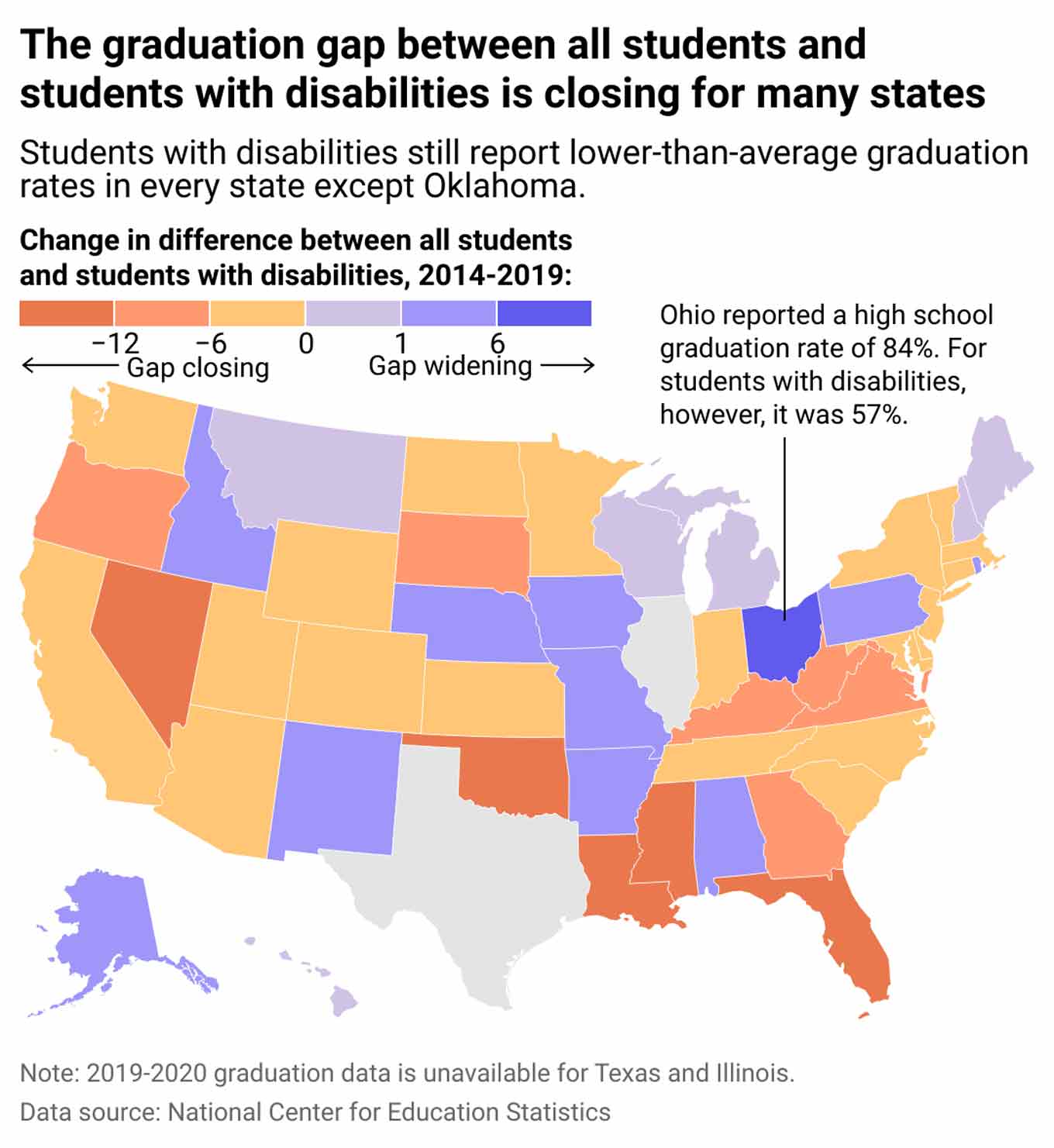
Students with disabilities' graduation rates are largely getting closer to overall averages
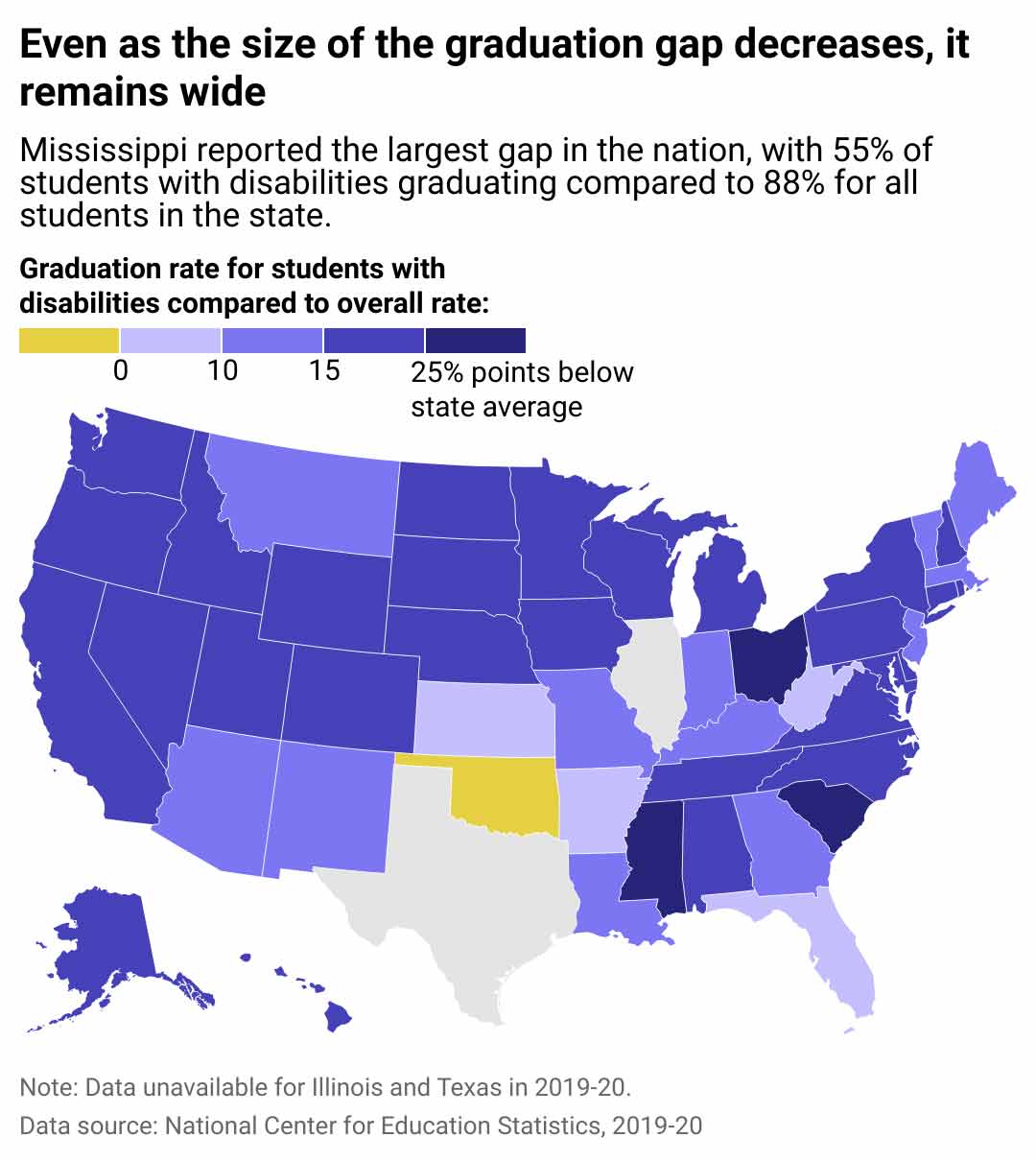
This graduation rate gap is shrinking in most states. Oklahoma, Nevada, Florida, and Louisiana have seen some of the most dramatic improvements between 2014 and 2019, according to NCES data. Yet, despite progress, the gap still exists.
New York, for example, has lessened the disparity since 2014. According to the New York State Education Department, however, by 2020, around 3 in 5 students with disabilities graduated compared to more than 80% of the overall student population. And while a larger portion of students with disabilities remained enrolled after four years than before, a slightly greater portion dropped out compared to the overall student base.
The state has been working to improve those statistics by engaging with students' families, providing inclusive activities, tailoring curriculum to student needs, and developing behavioral support systems.
States including Alabama, Idaho, Rhode Island, Nebraska, and Ohio are trending in the wrong direction. In response, Ohio rolled out an initiative using data-driven approaches to provide early warnings for students at risk of not graduating or dropping out.
Progress still needs to be made
In some states, the graduation gap between students with disabilities and the statewide average is as high as 25%.
In Mississippi, where the disparity is greatest, nearly half of students receiving inclusive education don't graduate, according to NCES. Experts and parents say systemic problems contribute, pointing to inadequately trained teachers, low expectations, and a lack of soft-skills training, like communication.
Roughly half of U.S. schools provide students with disabilities an alternate way to graduate. Twenty-seven states offer high school diplomas or altered tests, according to the NCES. However, those alternative routes aren't always included in overall graduation rates and don't guarantee the same job and higher learning opportunities.
The next few years will reveal whether, despite the aftermath of the pandemic, public schools not only managed to maintain the success they've built but further closed the gap between students receiving inclusive education and the rest of the student body.
This article was originally published by Stacker and republished with permission under a CC BY-NC 4.0 license.
This morning, tragedy rocked Baltimore, Maryland when the Francis Scott Key Bridge was struck by a passing cargo ship and collapsed.
At the time of publication, eight people — all construction workers who were on the bridge working on pothole repairs — were believed to have fallen into the frigid waters of the Patapsco River upon the bridge’s collapse.
While search and rescue is underway, and two people have already been rescued, viewers at home can breathe a small sigh of relief knowing that first responders were able to keep even more people from falling into the depths below.

A mayday call was issued right before the container ship struck a pillar of the bridge, which Maryland Governor Wes Moore says “saved lives” ahead of the collapse early Tuesday morning.
Because of the crew’s swift action, local authorities were immediately notified of a power issue, and officials were able to stop some vehicles from crossing the bridge before the ship made contact with the bridge.
“Once notification came up that there was a mayday, literally by being able to stop cars from coming over the bridge,” Moore said in a press conference this morning.
“These people are heroes. They saved lives.”

As experts piece together the full timeline of the accident, the governor is clear that there was enough time to allow police to stop traffic on Interstate 695, which prevented “at least some” vehicles from being on the bridge as it snapped and gave way.
According to FOX 10 Phoenix, Key Bridge carries the interstate across the river east of downtown Baltimore, with as many as 35,000 people crossing each day.
“We’re thankful that between the mayday and the collapse, we had officials who were able to begin to stop the flow of traffic so more cars were not up on the bridge,” Moore continued.
Early indications suggest that because of this closure, no traffic was crossing the bridge when it collapsed. Some vehicles used by the road crew that had been parked on the bridge have appeared to plunge into the water, but it remains unclear how many vehicles or passengers were impacted.
At the time of publication, the search continues to piece together what exactly happened — and save the lives of at least six other missing people.

Gov. Moore has declared a state of emergency and said the local government is working to deploy federal resources. The Maryland Transportation Authority said all lanes were closed in both directions on I-695.
“The investigation is still going on to find out how many people were in that situation, but the thing that we do know is that many of the vehicles were stopped before they got on to the bridge, which saved lives in a very, very heroic way,” Gov. Moore said.
“We are thankful for the brave men and women who are carrying out efforts to rescue those involved and pray for everyone's safety.”
Header photo courtesy of Baltimore City Fire Department Rescue 1 Team
On the heels of her highly celebrated initiative to fund abortion nonprofits during the first U.S. leg of her tour, Olivia Rodrigo is taking a slightly different approach in Canada.
Tonight, before taking the stage in Montreal for her Guts World Tour, the singer posted a video on her Instagram stories.
“I wanted to take a second and talk about the next cause I’m going to be supporting as part of my initiative, Fund 4 Good,” she said, her sparkly eyeshadow shimmering.
“For all the Guts World Tour dates in Canada, I’m going to be donating a portion of my proceeds from ticket sales to Women’s Shelters Canada.”
Rodrigo is performing the “Guts” show for two nights in Montreal, then heading to Ontario this week. She’ll return to Canada in the fall to play another show in Vancouver.
Similarly to her support of abortion funds in the U.S., the Fund 4 Good will uplift the work of the organization, as well as encourage fans and supporters to donate.
“Women’s Shelters Canada supports over 600 shelters across the country,” Rodrigo said in her video. “They help women and children who are fleeing abuse and violence.”
The nonprofit calls itself a “strong, unified, pan-Canadian voice on the issue of violence against women,” and provides tools for hundreds of shelters and organizations, so they can channel as much of their energy into helping women as possible.
“With our voice, we help increase awareness to ensure that politics, legislation, and regulations are informed by the experiences and insights of our members — the provincial and territorial shelter networks,” Women’s Shelters Canada’s website reads.
“All of this helps to ensure the women, children, and gender-diverse people who turn to shelters and transition houses in their times of need receive the most effective and compassionate support possible.”
The funds donated by Rodrigo and her fans will go towards sharing resources, improving transitional housing, amplifying policy and advocacy work, providing immediate needs for clients, and maintaining Sheltersafe.ca and Techsafety.ca — two websites with resources for women seeking safety.
Rodrigo did some educating of her own before bidding fans adieu.
“Abuse can take many forms. It can be physical, it can be online, it can be emotional, it can be financial, it can be psychological,” she said. “This is a very important cause to me.”
The “Obsessed” singer also posted a link for supporters to learn more and donate.
Women’s Shelters Canada reposted her brief video to its stories, as well. With a purple heart emoji — Rodrigo’s signature color — the organization shared its gratitude: “Thank you for your support!”
The morning after her first show in Montreal, the organization shared a post to its Instagram feed.
“Women’s Shelters Canada is thrilled that Olivia Rodrigo is supporting us on the Canadian leg of her Guts World Tour,” the post’s caption reads.
“Olivia’s support is allowing us to continue supporting women’s shelters and transition houses across the country and work towards ending gender-based violence.”
The Fund 4 Good is a global initiative that will follow Rodrigo across the world as she continues on her 75-stop tour.
“Fund 4 Good works to support all women, girls, and people seeking reproductive health freedom,” the singer said before taking the stage on the first night of the tour.
“The fund will directly support community-based nonprofits that champion things like girls' education, support reproductive rights, and prevent gender-based violence.”
Header images courtesy of Olivia Rodrigo/Instagram
With anti-LGBTQ+ bills continuing to sweep the nation — and an impending election on the horizon — the mental health of LGBTQ+ community members is in dire straits.
This is on top of the mental health challenges LGBTQ+ folks — especially youth — face day-to-day, fighting stigma, social isolation, lack of familial acceptance, and more.
According to a 2023 survey from The Trevor Project — a nonprofit that works to prevent suicide in LGBTQ+ youth — 41% of LGBTQ+ young people seriously considered attempting suicide within the past year, with transgender, nonbinary, and/or people of color reporting higher rates than their peers.
Even more frustrating is that 56% of LGBTQ+ young people who wanted mental health care during that time were not able to get it.
Fortunately, FOLX Health and Crisis Text Line have entered the chat.
FOLX is the first of its kind; a nationwide LGBTQ+ digital healthcare service provider that helps LGBTQ+ people access virtual primary care, hormone replacement therapy, PrEP, and more in an affordable and safe way.
Founded in 2020, the platform has quickly grown to offer more services, including an HRT Care Fund, which redistributes financial resources from allies to support trans, nonbinary, and intersex folks who need hormone replacement therapy.
Most recently, FOLX has begun to expand its mental health services. One major way this is done is through a newly announced partnership with Crisis Text Line, a nonprofit that provides free, confidential, 24/7 text-based mental health support and crisis intervention.
Now, LGBTQ+ individuals seeking support can text FOLX to 741741 to reach a live volunteer crisis counselor. Support is available in both English and Spanish, and according to a press release, over 50% of Crisis Text Line texters identify as LGBTQ+.

The new partnership has an especially meaningful inception story, too. It was initiated by the FOLX Health VP of Engineering, John Moore, who volunteers as a crisis counselor with Crisis Text Line. Knowing that FOLX would be expanding its mental health services, he realized this service would be vital to those offerings.
While other similar platforms are available — like Trans Lifeline, for example — more mental health support for more queer folks is a net-good.
“In a healthcare landscape ill-equipped to meet our needs, FOLX is committed to forging a comprehensive healthcare haven accessible to all,” Liana Douillet Guzmán, CEO of FOLX Health, said in a press release.
“Our partnership with Crisis Text Line ensures that no matter what the circumstance or where you are, our members have a direct line to trained, mental health counselors when they need it.”
The text line is available by text message, web, and WhatsApp and claims to connect users with a live, trained crisis counselor within five minutes.
It also comes at an especially necessary time. After the tragic death of Nex Benedict, a transgender teen in Oklahoma, the state saw a dramatic increase in crisis calls, with 69% of users citing the tragedy as the impetus for their distress.
Although LGBTQ+ youth should never have to experience such trauma, ostracization, or fear for their lives, tools like Crisis Text Line provide a much-needed resource in the tool belt to protect queer kids.
“We are honored to… ensure [FOLX users] receive free, confidential and nonjudgmental mental health support anytime of the day,” Dena Trujillo, CEO at Crisis Text Line, said in a statement.
“Together, we champion inclusivity, amplify voices, and create safe spaces where every individual’s journey to healing and self-discovery is supported.”
Along with the new text line, FOLX has rolled out other mental health services, like medication counseling, mental health courses, support groups and events, and virtual therapy for users in California, Colorado, and Florida, with more states on the way.
According to a press release, FOLX found that 59% of members who had suicide ideation before using the platform did not have suicide ideation in follow-up counseling.
Plus, 39% of FOLX members had an improvement in their quality of life score within three months.
“At FOLX Health, we recognize the disproportionate challenges our members face, with mental health issues occurring at rates four to five times higher than the general population,” Douillet said.
“And yet, we’ve found that our affirming and expert care focused on the needs of the queer community has led to transformative outcomes.”
At the end of the day, experts from both organizations are hopeful that this new partnership will lead to even greater increases in well-being, as LGBTQ+ youth are lovingly shepherded through an especially challenging time in their lives.
A joint statement from FOLX and Crisis Text Line said: “[This partnership] is an impactful step in creating access to mental health support for the LGBTQIA+ community like never before.”
Header image courtesy of FOLX Health
The potoo is making the rounds again online, after a family stumbled upon the bird in a rare daytime encounter. Their subsequent TikTok clip skyrocketed to 5 million views overnight.
The video is raising awareness about the peculiar bird, which looks like a Studio Ghibli creation sprung to life.
After captivating viewers with its googly eyes and crackling voice, people went scrambling to the comments section to say, “That’s a Pokemon,” “He looks like he’s about to give me a quest,” and “That bird scared the potoo out of me.”
What are potoo birds?
Despite their bulbous eyes and curved bill, potoos — also called “ghost birds” — are not owls but nightjars (a bird family that extends to nighthawks and frogmouths).
Yet similarly to their distant owl relatives, the potoo is also nocturnal and adept at blending into its surroundings. Their gray and brown plumage help them slip into the shadows as they perch perfectly still — preferably on a branch stump — and wait for prey and watch over its nest.
There are seven species of potoo exclusively found throughout the Neotropics (Mexico, Central and South America, and the Caribbean). During the day, the transformative bird can appear very skinny, with an elongated body and upturned beak. At night, they ruffle their feathers to make themselves appear bigger to predators.
@pubity The NOISES it makes 🔊😭 #Pubity ♬ original sound - Pubity
In an Animalogic video, host Aranya Iyer explained that potoos have a few evolutionary adaptations “that make them unique to other birds.”
“Their bill opens from ear to ear and the inside has bright coloration, which is thought to attract insects,” Iyer said. “The upper mandible has a tooth-like protrusion that helps them grab prey. Despite having a pseudo-tooth and a pointy bill, they don’t rip their prey apart, they just swallow it whole.”
On average, potoos range from 30 to 70 centimeters, which is roughly the size of a pigeon. Potoo sounds range from species to species, from melancholic cries to whistling toots. The distinctive wailing of the great potoo species led to the creation of an ancient legend from the Shuar people of the Ecuadorian Amazon, which tells the story of a woman-turned-bird who cries out for her husband each night, after he was transformed into the moon.

Why are these birds important?
Potoos pose no risk to humans and happily sit in the middle of their native ecosystem as an important link between predator and prey.
Predators that rely on potoos for food include capuchin monkeys, weasel-like tayras, and forest falcons. They themselves are a predatory species that feasts on flying invertebrates and helps keep local insect populations in check.
As insect lovers, potoos are particularly fond of moths — but have been said to eat anything that flies into their yawning mouth, including bats.
Are potoos endangered?
Although potoos are not currently endangered or at risk, all seven species are currently on the decline due to deforestation and habitat loss.
In an article for the New York Times, journalist Elaine Chen explained that habitat loss is a “major factor” for the decline of bird populations across the Neotropics.
“Around 13%of forest in Latin America and the Caribbean has been lost in the last 30 years, primarily because of agriculture and cattle ranching,” Chen wrote. “Brazil accounts for most of that loss, but Guatemala alone lost more than 26% of its forests…from 1990 to 2020.”
In South America alone, deforestation has landed beloved birds on the endangered species list: macaws, conures, a variety of penguins, and many more.
Across the Neotropics, conservation efforts have surged to save rainforests and jungles that are vital to animal conservation.
One Belizean conservationist, Elma Kay, is fighting to save the Belize Maya Forest, a once-massive rainforest that is rapidly vanishing as trees are hacked and slashed to make way for expanding agriculture.
With a coalition of other conservation organizations, including The Nature Conservancy, Kay helped coordinate a $76 million deal to buy a strip of land in the Maya Forest Corridor and protect the 236,000-acre reserve and the countless wildlife species that live there.
“There are projects that are easy to do and can be done and those that are hard, but we must do,” Kay told re:wild. “The corridor is one we must do even if it takes us another decade, not just for Belize but for the region, and we still need all the support we can get.”
Header images courtesy of Animalogic and Pubity/TikTok
— While toilet paper use is ubiquitous in China, North America, parts of the EU and Australia, its environmental impact is rarely discussed. Environmentalists recently began urging people to be more aware of the real price paid for each roll — especially for luxury soft, extra-absorbent TP made from virgin tree pulp.
— Though not the global primary source of tissue pulp, large tracts of old-growth forest in Canada and Indonesia are being felled today for paper and tissue products, impacting biodiversity and Indigenous communities. Eucalyptus plantations to provide pulp for TP are mostly ecological deserts, and put a strain on water supplies.
— The environmental impacts of toilet paper occur all along its supply chain. Making TP is an energy- and water-intensive process, and also requires toxic PFAS and other chemicals. Upon disposal, toilet paper can become an insoluble pollutant that resists wastewater treatment and adds bulk and chemicals to sewage sludge.
— Many large tissue makers are investing in improved technologies to lighten this impact. But emerging markets in the developing world, beyond the reach of environmental watchdogs, are raising alarms. Bidets, recycled paper, bamboo, sugarcane and other alternative pulp sources offer more environmentally friendly options.
Toilet paper is so common in some countries it’s only noticed when it’s not there, as exemplified by the panic buying that prompted shortages when the COVID-19 pandemic began in 2020.
Thought to be in use in China since the sixth century, inventor Joseph C. Gayetty patented the first U.S. commercial “medicated paper” in the 1850s. Since then, demand has soared in many places, bolstered by rising population, urbanization, shifts in demographics, changing hygiene practices, and lifestyle choices influenced by advertising.
Still, only 25-30% of the world uses TP today; the rest rinse with water or use other means. Regardless, by 2023, yearly revenue in the toilet paper sector (dry and wet toilet paper) totaled $107.4 billion, with sales of nearly 46 million metric tons, a market expected to grow annually planetwide by 5.92%. The most revenue is generated in populous China, amounting to $22.33 billion in 2023, where growth is forecast at 7% per year until 2027, according to Statista analyst Apurva Janrao.
With so much TP flying off the rolls, “People need to start thinking about [the sector’s] environmental impact,” says AidEnvironment researcher Okita Miraningrum.
Those adverse effects pop up along the entire supply chain, from sourcing in native forests and on eucalyptus plantations; to energy-, water- and chemical-intensive manufacturing practices; to transport and packaging; and to the final flush, after which waste TP can tax sewage treatment facilities.
A big red flag: the link of some toilet paper sourcing to the loss of old-growth forests.

Deforestation: The hard reality of soft toilet paper
In concept, toilet paper is simple. It’s made of cellulose fibers plus chemicals to glue it together, explains industry expert Greg Grishchenko, a retired mechanical engineer who spent more than four decades in the tissue production industry. The fibers are mostly sourced from trees, but can also come from recycled paper or alternative sources like bamboo.
However, Grishchenko emphasizes that to make the softest, whitest TP — qualities cherished by more and more consumers — you need virgin pulp, made from forest or plantation trees. (The more the paper is recycled, he explains, the shorter the fibers become and the less usable they are.)
As the demand.) for high-quality, soft, absorbent toilet paper rises among customers focused on hygiene, cleanliness and comfort, sourcing from trees, forests and plantations is set to increase, say analysts. Meanwhile, environmentalists caution that the need for virgin pulp is having dire consequences and, according to the Natural Resource Defense Council, already “taking a substantial toll on forests around the world.”
When AidEnvironment, a research consultancy, noticed more deforestation in Indonesia was taking place for timber, pulp and paper than for palm oil, it launched an investigation into the world’s tissue paper companies and their forest management practices, says AidEnvironment program director Christopher Wiggs.
Their report notes that as of 2020, Brazil, Canada, the U.S., Indonesia and Chile are the world’s largest pulp exporters.

The trouble with plantation-sourced TP
Eucalyptus plantations in Brazil, the largest exporter of pulp suitable for tissue production, are known worldwide for providing the best-quality fiber, critical for tissue softness, and for premium-quality products offered at higher profits.
In 2020, Brazil exported 15.6 million metric tons of pulp as part of an expanding tissue production and export industry. Nearly 48% went to China, about a quarter to Europe, some 15% to the U.S., and the rest to other countries.
The rapid expansion of eucalyptus plantations in Brazil and elsewhere has divided environmentalists. A few support pulp exporters’ claims that eucalyptus plantations help curb the global climate crisis by storing carbon.
Others note this carbon storage is only for a limited time, with trees cut and pulped every eight years or so. The use of native trees to make pulp, or their cutting to establish plantations also promotes deforestation.
Other problems arise because invasive eucalyptus, a tree native to Australia, is a water hog and rapidly sucks up groundwater, intensifying water loss in countries like Brazil, or in Africa, where climate change-driven drought has become a serious problem.
Eucalyptus plantations also lack species richness. In addition, if the trees are treated with synthetic chemical pesticides, herbicides and fertilizers, they can pollute groundwater.
Lastly, pulpwood companies in Brazil have been accused of expelling traditional and Indigenous people from their claimed lands, and of other inequities.
In Canada, the world’s second-largest pulp exporter, industrial logging, including for pulpwood, is taking place in some of the world’s last remaining old-growth boreal forest, home to Indigenous communities, as well as caribou, pine marten and billions of songbirds.
Industrial logging is reportedly claiming more than a million acres of boreal forest annually, much of this driven by the need for pulp. Canada is the world’s largest producer of northern bleached softwood kraft (NBSK) pulp, favored for virgin pulp tissue production.
Approximately half of Canada’s NBSK pulp goes to making tissue products.
U.S-.based paper companies are under consumer pressure to decrease their use of virgin wood pulp, especially from Canadian boreal forests. Kimberley-Clark, for example, one of three tissue companies with the largest U.S. market share, has set a target to reduce its use of natural forest fibers (primarily from northern boreal and temperate forests), by 50% by 2025 compared to a 2011 baseline.
Its website calls this goal “challenging,” but when asked why, company spokesperson David Kellis could add no further details.

Tropical rainforests in Indonesia and Malaysia are also being logged or converted into plantations to produce pulp. A 2023 Greenpeace report found that one of the world’s largest pulp and paper companies, Indonesia’s Royal Golden Eagle (RGE) Group, has a pulp mill in China that uses wood from companies known to have cleared large tracts of tropical rainforest and endangered orangutan habitat in Kalimantan, the Indonesian portion of the island of Borneo.
Though Greenpeace could not link the tissue industry directly to active deforestation, Wiggs says AidEnvironment found the timber and paper industry lacking in the enhanced transparency found more recently with palm oil buyers. “There’s very little transparency,” he says.

Powering the production of toilet paper
Toilet paper’s largest environmental impact, according to some research, derives from the massive amount of electricity needed by manufacturing facilities to heat pulp, water and chemicals, and then to dry the resulting rolls of paper.
Carbon emissions from such plants, of course, depend on how each is powered — whether from the electrical power grid, or a mill heat source — and if the electricity comes from fossil fuels or sustainable choices. The energy efficiency of factory machinery also plays a role.

A Poland-based study, where the power grid is mostly reliant on coal, found that the largest overall environmental impact of toilet paper production (for both virgin and recycled pulp) comes from electricity use, along with considerable water emissions, solid waste, and air pollution.
After the flush
Toilet paper impacts accumulate as the product is packaged and transported, and finally used and disposed of.
A study published by the American Chemical Society last year found that toilet paper should be considered a “potentially major” source of per- and polyfluoroalkyl substances (PFAS) entering wastewater treatment systems.
With multiple adverse health effects in humans and wildlife, these “forever chemicals” are added when converting wood into pulp. Recycled toilet paper, too, can be made with fibers that come from materials containing PFAS.

Others note that toilet paper is one of the major insoluble pollutant components released into wastewater treatment plants. The fibers are a troublesome component of sewage sludge, requiring a high treatment cost and high energy use. In countries without waste treatment facilities, toilet paper can end up entering directly into waterways.
Lightening the load of toilet paper use
Reducing all these environmental impacts requires action by a variety of actors working along the supply chain, with solutions as varied and complex as the industry itself.
A first TP solution is to install and use a bidet, which squirts a spray of water to clean the behind. A life-cycle assessment found bidets to have a lower environmental impact than toilet paper in categories ranging from climate to human health, resource and ecosystems (but not water). Other researchers have pointed out that the logic of such a switch depends on local water availability and sanitation systems.
A second alternative is to use less toilet paper, and falls on individual consumers. Janrao of Statista notes that Europeans and U.K. residents lead in toilet paper consumption. Others point out that U.S. households use three rolls a week on average.
A third possibility: make the switch to recycled paper. A comparison of manufacturing greenhouse gas (GHG) emissions from toilet paper made from virgin pulp and recycled fiber showed that, though demands for both thermal energy and electricity are higher for recycled paper during manufacturing, GHG emissions from virgin pulp are about 30% higher than from recycled paper (emitting 568 kilograms of CO2 equivalent more per kilogram of tissue paper) because of the added impact of wood pulping.

Toilet paper made from alternative sources like bamboo or sugarcane are also gaining attention. However, Grishchenko points out that many non-wood fiber brands are sourced in Asian countries, including China and India, and shipping to users halfway round the globe in the U.S. or EU generates a large carbon footprint.
Innovative alternative tissue sourcing is also being done closer to most TP consumers. Essity, for example, among the world’s nine largest tissue paper manufacturers, inaugurated a facility to produce pulp from wheat straw at its Mannheim, Germany, factory in 2021, says Michaela Wingfield, the firm’s central region communications director.
This breakthrough technology uses less water and energy in production. “Initial calculations indicate that the unique Essity straw pulp has a 20% better environmental footprint than tissue made from wood fibers,” Wingfield says. The tissue is also as soft, white and strong as that made from wood fiber.
Other environmentally sound manufacturing initiatives include installation of onsite co-generated heat and power to decrease reliance on the national power grid.

Western companies with more sustainability-aware customers are cleaning up their act, AidEnvironment’s Wiggs says. The biggest driver of deforestation now, he notes, is in emerging markets, particularly Asia.
According to the U.N.’s Food and Agriculture Organization, consumption of wood pulp has slowed in recent decades, mainly due to decreasing consumption of newsprint, writing and graphics papers. Instead, in future, demand for pulp will likely be driven by the need for packaging and hygienic tissues in Asian, EU and Northern American markets.
They note that the most significant market growth is expected to occur in the Asian subregions, where production capacities for wood pulp have increased “massively” since 2000.
Environmentally sound policies and regulations need to be applied across the whole pulp and paper industry, and in countries where it operates, AidEnvironment’s Miraningrum says. Wiggs adds, “the immediate goal would be more transparency in the timber industry.”
Critics are also calling for more awareness by civil society, meaning that, perhaps, it’s time to bring toilet paper into the conversation.
This article was originally published on Mongabay.
Surely, by now, you’ve caught on to the “bow trend” taking social media, runways, and everyday outfits by storm.
There have been endless think pieces about “hyper femininity” and over a million TikTok videos posted under the hashtag #coquette, as little pink ribbons are tied around everyday objects.
But UK band The Last Dinner Party doesn’t really care about that.
In fact, they’re using the trend to do a little good.
The group — comprised of five young women and non-binary folks who met as English literature students in Brixton — has been called “the UK’s hottest new band” by the New York Times, and has a reputation of “pissing off the right people,” per Rolling Stone.
Its members — Abigail Morris, Georgia Davis, Emily Roberts, Lizzy Mayland, and Aurora Nishevci — have just begun their whirlwind tour, starting in Canada and the United States this Spring.

While their tunes are full of “gothic,” “indulgent,” and “decadent” indie rock sounds that certainly tap into a delicious element of feminine rage, kindness is still at the forefront of their tour.
Earlier this week, the band took to Instagram to announce a give-back initiative that will accompany their North American shows.
“Good folk of America and Canada! We extend our deepest gratitude for your gracious hospitality as we embark on this month-long shindig,” they wrote in a caption.
“In the spirit of reciprocity, we unveil our newest endeavor: Ribbons For Provisions, a pursuit along our North American voyage.”
The photo accompanying the post includes a bundle of ribbons in bright, effeminate colors, with a script font printing the band’s name.
“Join us as we unite with local food banks in each locale. Bring forth a donation, and in return, receive a token of our esteem — a cherished ribbon to adorn and share,” the caption continues.
Upon each show day, the band also promised to share the food bank that they’d be supporting to their Stories, with a link sharing the most sought-after items to donate.

Audience members with donations then get a small token of appreciation, which — these days — can be tied into very special currency: a dainty bow.
Fans — who skew in a demographic of mostly young women — flocked to the comments to share their enthusiasm to support the cause (and collect their extra-special piece of merch).
“Well done guys,” one commenter wrote. “A really thoughtful initiative that I’m sure will do really well.”
“Love this,” another wrote. “I’ll be there with food to share.”
Many other comments expressed similar sentiments: “What a neat idea.”
Some food banks they’ve supported so far are City Harvest in NYC, and Grandma’s Love in Brooklyn.
🎀 RIBBONS FOR PROVISIONS 🎀
— The Last Dinner Party (@lastdinnerparty) March 26, 2024
NYC! If you are attending our show at Webster Hall tonight, we encourage you to bring canned goods for @CityHarvest
List of their most-needed items 🤍 https://t.co/j7Pms0tNZl pic.twitter.com/k8bTy07YXk
This also comes on the heels of a recent benefit concert that raised £15,000 for UK-based nonprofit War Child, which works to protect the rights of children in areas of conflict like Gaza and the Democratic Republic of Congo.
“We urge you to continue to donate to causes like these,” the band wrote in a social media post following the concert. “Links are always available at our merch tables, so if you buy some merch, consider also contributing to aid funds.”
The Last Dinner Party is certainly not the first band to use its platform for good, joining the ranks of Olivia Rodrigo, whose Guts World Tour is donating to abortion funds and women’s shelters throughout North America.
Taylor Swift also made headlines in 2023, as she quietly donated to food banks throughout the country during the first leg of her monumental Eras Tour.
But as The Last Dinner Party — with viral hits like “Nothing Matters” begin their own ascent to worldwide recognition, a small, meaningful project like this has the potential to make a real difference.
After all, when asked about the themes of their music — which often confront patriarchy, or illustrate elaborate, theatrical stories about Roman emperor Caesar Augustus (yes, seriously) — the band made it clear to the New York Times that while aesthetics are important, they make way for something even more meaningful.
“This isn’t just corsets,” Morris told the Times. “It’s Trojan horse pop music.”
Header images courtesy of The Last Dinner Party/Instagram