Nearly 70% of Muslim Americans say they always give zakat, a yearly donation of 2.5% of one’s wealth that Islam encourages, during Ramadan according to a new study I worked on.
Ramadan is a month-long period of fasting and spiritual growth during which Muslims refrain from all food, beverages and sexual activity from dawn to dusk.
Our Muslim Philanthropy Initiative research team at Indiana University surveyed 1,136 Muslims across the country in 2023 to assess the connection between Ramadan and zakat. We also looked into demographic differences in Muslim giving tied to Ramadan.
We found that women, married couples, those who consider themselves to be very religious, people with incomes in the $50,000-$75,000 USD range, people in their 30s, and those who are registered to vote are most likely to give the bulk of their zakat during Ramadan.
Why it matters
Billions of Muslims across the world observe Ramadan.
Zakat, one of the five pillars of Islam, is aimed at redistributing wealth and alleviating poverty within the Muslim community. Muslims can give to the poor, people who owe big debts, stranded travelers and those seeking to free people from slavery or captivity to meet the requirements of zakat.
Muslims often offer zakat during Ramadan through fundraising at iftars, which are gatherings held at sunset where people break their fast together.
Nonprofits that are not led by Muslims tend to focus their fundraising efforts on giving in December and important secular days for campaigns, such as Giving Tuesday. But if these organizations don’t do outreach to Muslims during Ramadan they are less likely to raise money effectively from a small but generous population.
Muslim-led U.S. nonprofits do spend a significant amount of time and money on fundraising during Ramadan. But they may not realize the importance of stepping up their efforts to seek zakat from Muslims in their 30s, women, married couples, active voters and those who regularly pray at a mosque.
In previous research projects, we’ve found that U.S. Muslims support both Muslim and non-Muslim nonprofits, donating at least $4.3 billion in 2021, including about $1.8 billion in zakat.

What’s next
We are partnering with Islamic Relief USA, the largest Muslim-led humanitarian charity in the United States which serves people in the United States and internationally, and our colleagues at Indiana University’s Lake Institute on Faith and Giving to conduct annual surveys of Muslims in the United States to better understand Muslim giving starting in 2024.
We’re also conducting surveys and focus groups across the world to have a global understanding of Muslim giving. We aim to release data from Pakistan, Kuwait, Jordan, Turkey, Qatar, Indonesia, Malaysia, Japan, South Korea, Bangladesh, Tanzania, Ethiopia, Bahrain, Kyrgyzstan, Italy, Bangladesh and India, in addition to the United States by the end of 2025.
What still isn’t known

Additional research is needed to better understand what motivates these donors to give during Ramadan, how much money U.S. Muslims give to charity during Ramadan and the best ways for nonprofits led by Muslims and non-Muslims to engage donors who are moved to support charitable causes during Ramadan.
The Research Brief is a short take about interesting academic work.
This article was written by Shariq Siddiqui of Indiana University, and originally published on The Conversation.

It’s 2024, and we’re exhausted. People across the globe are being forced to move through the unaddressed and ongoing collective trauma of recent years, while still being expected to maintain an air of normalcy.
It’s like we all have these pie charts in our brains, uniquely divided into categories we are all asymmetrically familiar with: COVID-19, violent conflict, climate change, systemic injustice, financial collapse, our own personal relationships and adversities — you can surely draw your own diagram.
Despite — or in light of — what’s going on in the world, some days, the biggest chunk of that chart belongs to U.S. politics, the upcoming presidential election in particular. And it’s a slice of pie many of us are not exactly drooling over.
“There is clearly some disillusionment,” Bridgett King, an associate professor of political science at the University of Kentucky and a former voting rights researcher at the Brennan Center for Justice, told Good Good Good — citing dissatisfaction with U.S. presidential candidates and lower voter turnout at primary elections than previous years.
However, even if we’re disillusioned by our systems, unhappy with our candidates, or feel excluded from the voting process altogether, voting is still important, and it deserves at least a little bit of our brain space.
“Voting is an individual act that has collective consequences. Voting is an opportunity for individuals to come together as a collective and express their preferences for parties, candidates and policies,” King said.
“It is a tool that can be used to express satisfaction or dissatisfaction and communicate to those in power that both individuals and communities are paying attention to what our elected officials are — or are not — doing.”

King also noted that races for positions in local jurisdictions are particularly important, as one vote really could decide the outcome of an election.
Becky Bullard, a Texas-based organizer and creator of the platform Democrasexy, sees voting as a necessary function of democracy, even if it isn’t always exciting.
“Gloria Steinem has this quote that I love. She says, ‘Voting is not the most we can do, but it’s the least we can do,’” Bullard told Good Good Good.
“Voting … is harm reduction. We are operating within the system that we're in for now. And to disengage from it entirely means that the people who have the power who are harming us already are just going to stay there or level up.”
But what about the need to change that unjust and ineffective system?
With a highly polarized two-party approach, and historical disenfranchisement that makes it hard for many to even submit their ballots in the first place, does voting within this flawed system even make way for change and transformation?
“I would push back on the idea that one election cannot change how systems function,” King said. “Changes in partisan composition of state legislatures can dramatically reshape policy-making in a state.”
She continued: “Results of a school board election can reshape what education looks like in a district. There is clear evidence that each election does in fact matter in ways that directly affect how individuals interact with and experience government and institutions.”
In order to make those changes, we need to feel like they’re possible.

Bullard’s work is about taking the markedly unsexy world of democracy and making it so — what she calls “hiding the vegetables in the cupcake.” She wants people who feel zapped of energy to know that they can participate in so many fulfilling, timely ways beyond a single election.
She has done this by hosting support groups to talk about the way political systems cause harm and throwing themed activism dance parties that call for tarot readings and costumes.
“The beautiful thing that I have seen happen is people come to those meetups feeling so heavy, but we unburden ourselves, a little bit, of the things that are weighing on us,” Bullard said of the political events she’s hosted.
“Suddenly, we feel powerful. We’re like ‘oh, it’s not just me. A lot of us are feeling this way.’ It’s that honest, vulnerable community building that will help us be strong enough to move forward.”
So, for those of us who are exhausted from the constant, fractured view of our individual pie charts, the solution might just be to slice things up and share.
Civic engagement doesn’t work when we see it as a chore we take on by ourselves, but when we believe in the power of collective action.
“To me, it is not an option to completely disengage in the way the world currently is. I love conversations about breaking it all and rebuilding it, and I also believe that there is a future that we can work towards where everything works for everybody,” Bullard said.
“It won't be in my lifetime, but I believe it's possible. So I'm going to work toward it because I know that we can get there.”
A version of this article was originally published in The Civic Engagement Edition of the Goodnewspaper.
Get your own Goodnewspaper by becoming a good news subscriber today.
When Beyoncé released “Texas Hold ‘Em,” the first single from her new country album, “Cowboy Carter,” it elicited a mix of admiration and indignation.
This is not her first foray into the genre, but it is her most successful and controversial entry. With “Texas Hold 'Em,” Beyoncé became the first Black woman to have a No. 1 song on the country charts. At the same time, country music stations like KYKC in Oklahoma initially refused to play the record because it was “not country.”
Many non-listeners stereotype country music as being white, politically conservative, militantly patriotic and rural. And you can certainly find artists and songs that fit that bill.
But the story of country has always been more complicated, and debates about race and authenticity in country are nothing new; they’ve plagued country artists, record companies and listeners for over a century.
As someone who researches and teaches Black culture and country music, I hope that Beyoncé’s huge profile will change the terms of this debate.
To me, Beyoncé’s Blackness is not the major bone of contention here.
Instead, the controversy is about her “countryness,” and whether a pop star can authentically cross from one genre to the next. Lucky for Beyoncé, it’s been done plenty of times before. And her songs are arriving at a time when more and more Black musicians are charting country hits.
Cross-racial collaboration
Americans have long viewed country music – or, as it was known before World War II, hillbilly music – as largely the purview of white musicians. This is partly by design. The “hillbilly” category was initially created as a counterpart to the “race records” aimed at Black audiences from the 1920s to the 1940s.
But from the start, the genre has been influenced by Black musical styles and performances.
White country music superstars like The Carter Family and Hank Williams learned tunes and techniques from Black musicians Lesley Riddle and Rufus “Tee-Tot” Payne, respectively. Unfortunately, few recordings of Black country artists from the early 20th century exist, and most of those who did record had their racial identity masked.
Johnny Cash’s mentor, Gus Cannon, proves a rare exception. Cannon recorded in the 1920s with his jug band, Cannon’s Jug Stompers, and he had a second wave of success during the folk revival of the 1960s.
Similarly, the genre has always included a mix of Anglo-American and Black American musical instruments. The banjo, for instance, has African roots and was brought to America by enslaved people.
In the case of “Texas Hold ‘Em,” which begins with a lively banjo riff, Beyoncé has partnered with Grammy- and Pulitzer Prize-winning MacArthur Fellow Rhiannon Giddens, America’s foremost contemporary Black banjoist and banjo scholar. (I would argue that this choice alone undercuts objections about the track’s country bona fides.)
Different tacks to navigate race
By releasing these tracks, Beyoncé joins performers like Charley Pride and Mickey Guyton – country stars whose success has forced them to confront questions about the links between their racial and musical identities.
Pride, whose hits include “Kiss an Angel Good Mornin’,” “Just Between You and Me” and “Is Anybody Going to San Antone?,” became, in 1971, the first Black American to win the Country Music Association’s Entertainer of the Year award. In 2000, he was the first Black American inducted into the Country Music Hall of Fame.
But throughout his career, Pride resisted attempts to emphasize his Blackness. From his 1971 hit “I’m Just Me” to his 2014 refusal to discuss his racial “firsts” with a Canadian talk show host, Pride consistently strove to be seen as a country artist who happened to be Black, rather than as a country musician whose Blackness was central to his public persona and work.
At the other end of the spectrum is Guyton, who gained recognition and acclaim for songs like her 2020 hit “Black Like Me” – a frank, heartfelt commentary on the challenges she’s faced as a Black woman pursuing a career in Nashville, Tennessee.
Both Pride and Guyton reflect the zeitgeists of their respective decades. In the wake of the civil rights struggles of the 1960s, Pride’s “colorblind” approach enabled him to circumvent existing racial tensions.
He chose his material with an eye toward averting controversy – for example, he eschewed love ballads, lest they be understood as promoting interracial relationships.
At the start of his career, when his music was released without artist photos, Pride made jokes about his “permanent tan” to put surprised white concertgoers at ease.
Guyton’s work, on the other hand, resonated with the national outrage over the murder of George Floyd and tapped into the celebration of Black empowerment that was part of the ethos of Black Lives Matter.
And yet I cannot think of another Black musical artist with Beyoncé’s cultural cache who has taken up country music.
Some might argue that Ray Charles, whose groundbreaking 1962 album, “Modern Sounds in Country and Western Music,” brought legions of new listeners to country artists, is a forerunner of Beyoncé’s in this regard.
Without diminishing Charles’ significance, I believe Beyoncé’s new album outshines Charles’ landmark recording.
Black country in the 21st century
Over the past five years, in addition to the buzz over Lil Nas X’s “Old Town Road,” a significant number of Black musicians – including Darius Rucker, Kane Brown and Jimmie Allen, to name a few – have charted country hits.
The Black Opry Revue, founded in 2021 by music journalist Holly G, produces tours that bring together rising Black country musicians, giving each more exposure than performing individually could.
Luke Combs’ cover of Tracy Chapman’s “Fast Car” topped the country charts and made Chapman the first Black woman to win the Country Music Association’s Song of the Year award. Their performance of the song at the 2024 Grammys went viral, demonstrating both the fluidity of genres and the power of collaboration.
Beyoncé’s loyal fan base, known colloquially as “the Beyhive,” has already propelled “Texas Hold ‘Em” to the top of the pop and country charts. While there may continue to be pushback from traditionalist country music gatekeepers, country radio executives holding sway over national broadcast networks are calling Beyoncé’s new songs “a gift to country music.”
As more and more listeners hear her directive to “just take it to the dance floor,” perhaps the sonic harmony of the country genre will translate to a new way of thinking about whether socially constructed categories, like race, ought to segregate art.
And what a revolution that would be.
This article by William Nash, from Middlebury, was originally published by The Conversation.

Many Americans likely know the surface-level facts about immigration in the United States; that U.S. cities are struggling to accept migrants, the legal system is deeply broken, migrant labor is overwhelmingly exploited, and new laws continue to put migrant communities in danger.
But Los Angeles-based artist noé olivas wants folks to get up close and personal with the immigrant experience.
olivas (who keeps his name lowercase for the same reason as renowned artist and activist bell hooks) is rounding out an exhibition called Gilded Dreams at Inglewood, California’s Crenshaw Dairy Mart Gallery.
The exhibition, which will be on display through Sunday, March 31, focuses on the interdisciplinary artist’s interest in what he calls “the poetics of labor.”
It’s built around the main piece; a sculpture (Gilded Dreams, 2024) depicting a gold chain-link fence with a cut-out of a Saguaro cactus.

“The piece is very clearly a commentary on the border between the U.S. and Mexico, but it also references the practice of human caging through immigration detention or incarceration,” olivas told Good Good Good.
“The cut-out, while humorous, is also a real invitation to defy these systems and transform them through the practice of abolition. While the work talks about these real hardships of immigration, it also makes space for empowerment through action, leading to both self and collective liberation and healing.”
That collective liberation and healing is central to the Crenshaw Dairy Mart, a gallery which olivas co-founded with artist alexandre ali reza dorris and artist and abolitionist Patrisse Cullors.
The pillars of the art collective and gallery are “abolition, ancestry, and healing,” ensuring that all works that move through the space evoke those concepts.
In the Gilded Dreams exhibition, olivas embraces ancestry by utilizing his family’s archive of tools, like tire pieces from a mold of his family’s 1987 Ford Ranger truck.

“My work is a reflection of my family’s immigration experience. It speaks to the poetics of labor and the working class in proximity to harmful systems such as the prison industrial complex, imperialism, and capitalism,” olivas said.
Other pieces in the collection include a performance work called The Great Spirit Will Come Again (2022) which is dedicated to the late artist James Luna, and Keep Your Head to the Sky (2024), an oil painting on upholstered burlap. This work again employs found objects and collected materials to construct a textured and layered experience.
“Utilizing an urban vernacular rasquachismo, olivas employs his family’s archive of tools, objects, and other collected materials to construct sculptures that meditate on the intended material use of these objects while also transforming them into spiritual icons capable of forging a path towards freedom,” a press release for the exhibition explained.
While these evocative works may make the audience feel uncomfortable or angry, all of them also carry with them a sense of hope and liberation.

“Practicing abolition at CDM, we believe borders are harmful to our society and ecosystem,” olivas said. “I hope the future of immigration is centered on care and ends the practice of disposability of the human beings that have often left their homes because of the U.S. government’s impact on their homelands.”
The biggest conduit of optimism? olivas said it’s the connective tissue of community.
“The most rewarding part has been working with my community to make this project possible,” he said. “Working with my partner and curator Ana Briz, CDM team, my artist assistants, and my gallerist, Charlie James and his team, has been very special for me. I feel supported. It’s been very meaningful.”
As the exhibition comes to a close — but olivas continues his years-long practice of creating around themes of immigration and labor — his hope is that migrant communities find freedom.
And as politicians continue to operate from a place of control and competition, his view of the world depicts something different.
“What always gives me hope are the children in our family and community. There is an Ifa proverb from the sacred Odu-Ifa that says ‘the doll-carrying masquerade who bears the Agba drum fiercely and repeatedly to perform rituals because of children,’” olivas said.
“When we are fighting for a world that practices abolition, we are building a better world for our children, to live a better life with dignity and respect. We are creating a kinder world that moves with care.”
Header images courtesy of noé olivas/Charlie James Gallery
Children’s literature character Amelia Bedelia is the personification of the meme: “a little confused, but she got the spirit.”
The character, created by Peggy Parish in 1963, is a maid who constantly misunderstands the tasks given to her by taking directions very literally.
In a recent TikTok video, the Milwaukee Public Library highlighted their expansive programming with a slew of classic Amelia Bedelia joke set-ups that included bulb planting (with actual lightbulbs), dressing a salad (in baby clothes), and “sewing” seeds (with a needle and thread).
“Make no mistake, you can learn a thing or two at library programming for all ages,” read the video’s caption.
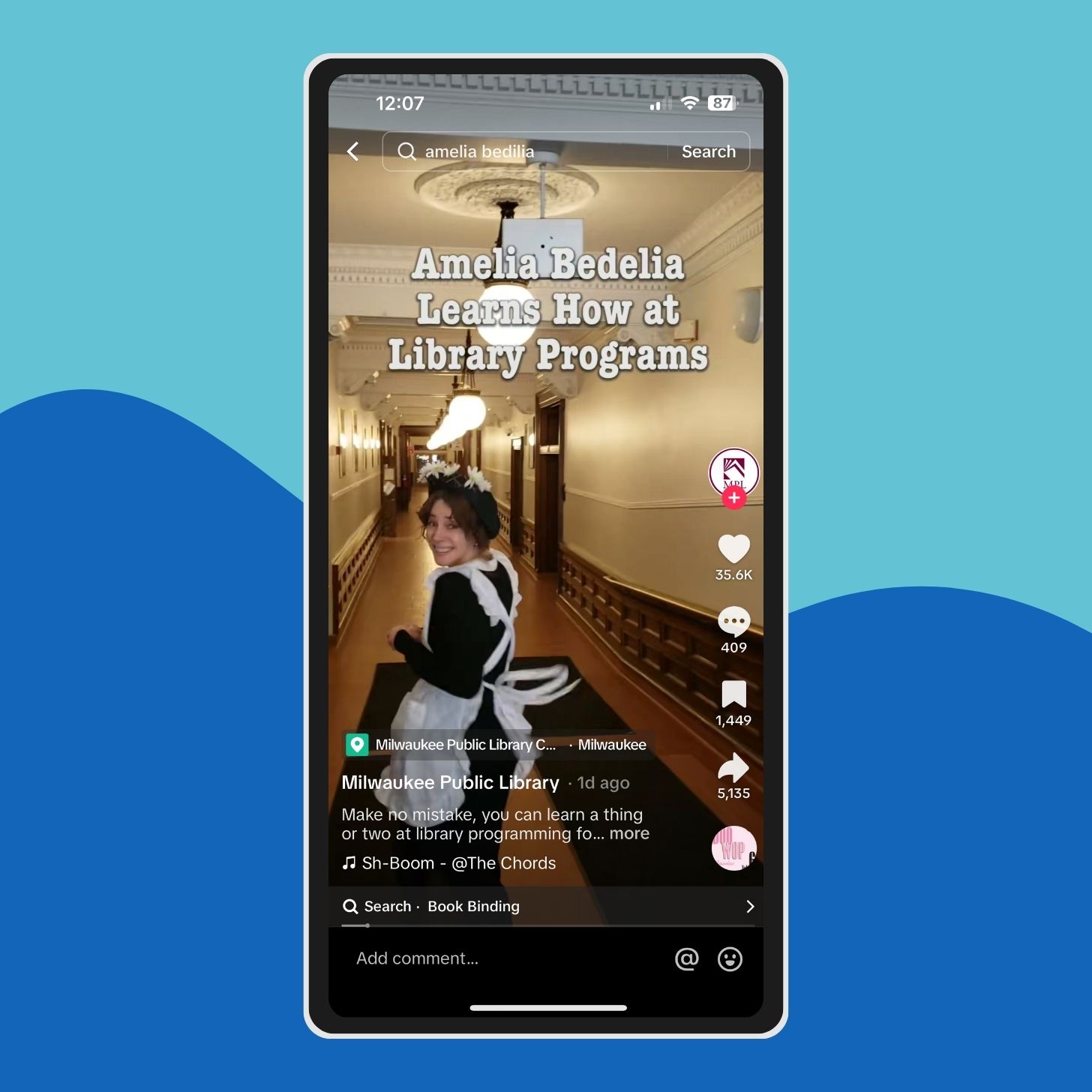
The video, which at time of publication was up to 200,000 views, playfully mined Amelia Bedelia jokes in a clever way to spotlight the countless resources public libraries have to offer.
Everyone knows that you can borrow books and media from their local public libraries, but many people would be surprised by the full extent of free classes and opportunities available to them in their own communities.
At the Milwaukee Public Library, for instance, upcoming programs include English tutoring, storytelling sessions for the Deaf and hard of hearing, and a community craft supply swap — where people can trade unused yarn, jewelry, and art supplies with their neighbors.
But free resources and skill sharing events are not unique to a singular library — they’re a feature at nearly every public library across the U.S., and they’re often underutilized.
These days it takes five seconds to add something to an online cart and get it shipped to your door. Hyper-consumerism, coupled with the lingering social isolation during COVID-19 lockdown, have made people reluctant to rely on each other for resources.
@milwaukeepubliclibrary Make no mistake, you can learn a thing or two at library programming for all ages. Visit mpl.org/calendar to see our programming offerings. #AmeliaBedelia #BookCharacters #Cosplay #ChildrensBooks #BookTok #LibraryTikTok #TheChords #Nostalgia ♬ Sh-Boom - The Chords
That’s why Katie Cerqua, the Virginia Beach Public Library Programming Community Outreach Manager, told WTKR that libraries are more important than they’ve ever been.
“The library really lets you try something…new before you determine if it's something you want to explore more,” Cerqua said. "At our Princess Anne Area Library, we have a library of things. And so, you can go and check out a surfboard or we can check out technology. So, things you might want to try before you buy, the library is really great for that.”
The Thomas Crane Public Library in Quincy, Massachusetts has a similar “library of things” catalog that includes everything from 3-D printers and pickleball paddles to kitchen mixers and camping tents.
Quincy library director Sara Slymon said that the concept behind the library of things is both economically and environmentally sustainable.
"Our homes are full of equipment we hardly use, although it might be useful for occasional specific tasks," Slymon shared in an interview with The Patriot Ledger. "Wouldn't it be better to share among all of us?"
So, the next time you want to borrow a sewing machine, rent a tent, or “plant a bulb,” check in with your local library first. They might have what you need, at the low, low cost of totally free.
Header images courtesy of The Milwaukee Public Library/TikTok.
Think about how much you engage with decisions made by your local government.
Perhaps you take the bus to work, your water bill goes up, or you finally succumb to a speeding ticket, thanks to a new fleet of police cruisers in your neighborhood. Now think about how much you were able to engage with the decision-making process that got you to these results.
Chances are, unless you work in a certain field — or you’re able to leave work or find childcare on a random Tuesday afternoon to attend a city council meeting — your ability to know what’s going on with your municipal government at any given time is limited, to say the least.
The Documenters are here to provide an alternative. A network of newsrooms and community organizations, the Documenters train and pay hundreds of people to attend under-reported public meetings and publish the results, so everyday citizens aren’t left in the dark when local elected officials are making big decisions.
Reporting on major issues such as development, finance, education, and more, Documenters make original notes, live-tweet threads, and multimedia reports easy for the public to access.
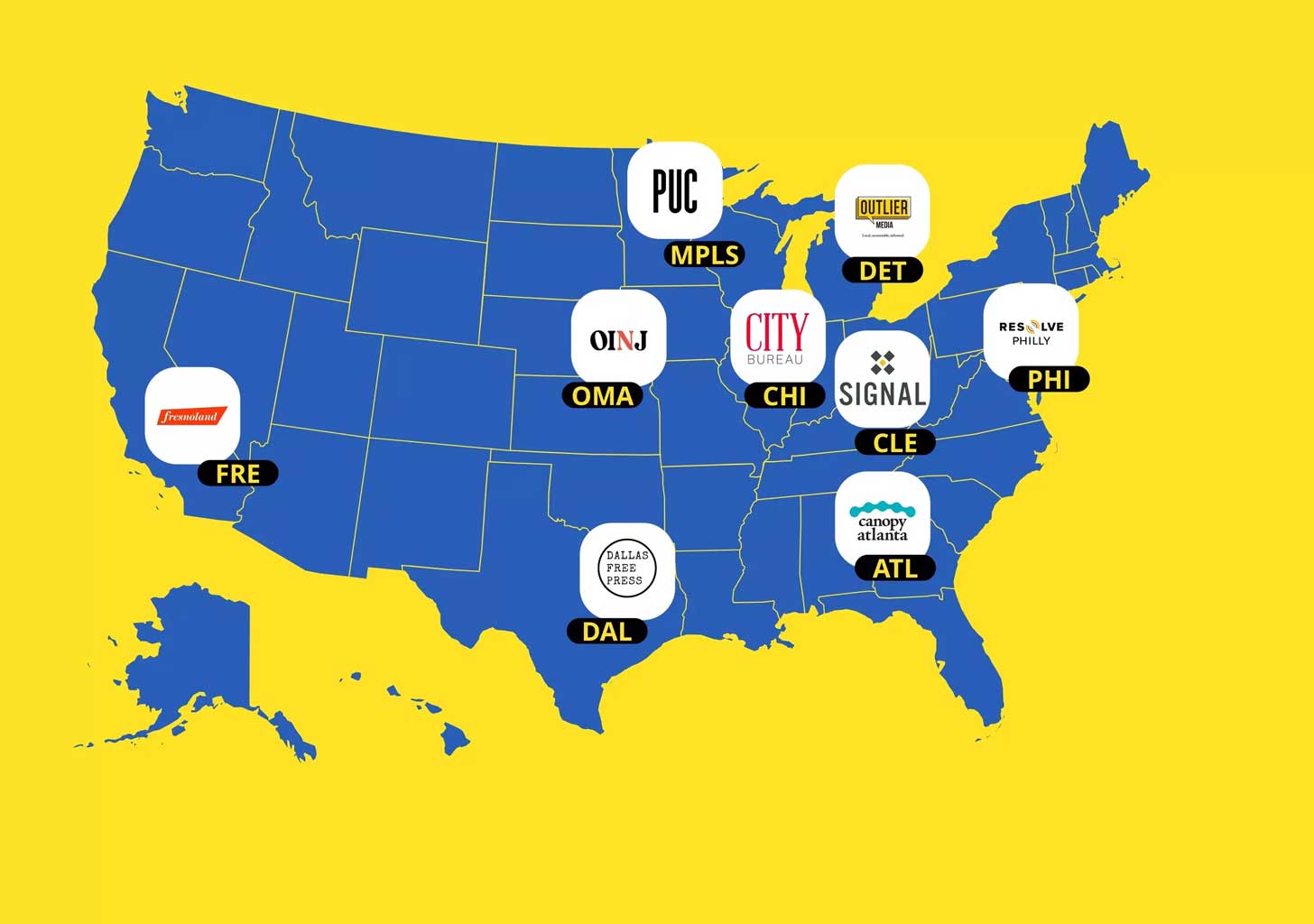
The program was developed by City Bureau, a nonprofit newsroom in Chicago, in 2018 and has since expanded to 15 cities, including Atlanta, Omaha, Fresno, Dallas, and more.
“How are your tax dollars spent? What are your elected officials doing? Are they listening to you? What is the process? That, as a Documenter, is what you have to show people,” Susan Carlotta Ellis, a City Bureau journalist, shares on the organization’s website.
The Documenters themselves are everyday people who are able to devote their time and energy to this work, receiving journalism training to support them as they collect vital information in their communities. Many of them are students or retirees who have flexible schedules.
Over 2,200 Documenters have been trained, and over 5,000 public meetings have been covered since the network’s inception. Plus, all of their work is free for public use, so it can be republished and shared widely for full transparency.
Documenters aren’t just an extension of local journalism but also work to make civics more approachable by hosting workshops, dissecting budgets, examining elections, and learning how the government works. Some organizers call it their “civic side hustle.”
“Together, we’re creating a new public record to help shine a light on the decisions being made in our cit[ies],” an explainer video for the organization says. “Because you deserve to know.”
A version of this article was originally published in The Civic Engagement Edition of the Goodnewspaper.
Get your own Goodnewspaper by becoming a good news subscriber today.
Every day the Good Good Good team collects the best good news in the world and shares it with our community. Here are the highlights for this week!
If you want to get good news in your inbox every day, join the Goodnewsletter — the free daily newsletter designed to leave you feeling hopeful.
The Best Positive News We’re Celebrating This Week —
Doctors Without Borders just launched a new, unprecedented global initiative to diagnose and treat tuberculosis in children
Under new recommendations from the World Health Organization, a patient-centered approach to tuberculosis will help with both early detection and treatment, as well as improving treatment options. The new treatments are shorter, while still being effective, especially for very young children.
To implement these new recommendations, Doctors Without Borders just launched a new global initiative to improve diagnosis and treatment of TB among children and prevent new cases. Called “TACTiC” (for “Test, Avoid, Cure Tuberculosis in Children), the initative will be brought to over a dozen countries in Africa and Asia.
TB is the world’s deadliest infectious disease — and it’s entirely curable. An estimated 10 million people across the globe are infected every year, primarily children, and 1.6 million still die each year.
Why is this good news? Not only Doctors Without Borders’ initiative (which it has long been fighting for) to implement the new testing and treatment recommendations save lives — it will result in shorter treatments for children, which helps their families by reducing travel costs, follow-up time, and providing a better treatment experience overall.
New data shows it’s gotten easier for people to vote in the U.S. since 2000
According to new data from the Center for Election Innovation & Research, voting in the U.S. has gotten easier in the last two decades. Since 2020, more voters have gained access to early voting — and now, nearly every state offers some form of early in-person voting and mail-in voting to all voters.
Despite efforts to restrict access to voting in some states, nearly 97% of voting-age citizens across the country now have the option to vote before Election Day — huge progress for improving access to voting.
In total, 46 states and Washington, D.C. offer early in-person voting — and 37 of those also offer mail-in voting to all voters, no excuse required.
The data also showed that as voters gain access to ways of casting their vote — they use them. And in a country where voter turnout is still relatively low compared to the rest of the world, improving access to voting methods helps improve voter turnout and representation.
The site of Pennsylvania’s former largest coal plant will soon be home to the state’s largest solar farm
The Homer City coal plant, once the largest in the state of Pennsylvania closed its doors in July of 2023. Now, thanks to a $90 million grant, 2,700 acres of the land will be home to the state’s largest solar farm.
The Mineral Basin Solar Project will be a utility-scale solar farm producing enough clean energy to power 75,000 homes. Its the first in a series of similar projects planned in the region on former coal mine sites over the next five years.
The project is moving forward thanks in part to federal funds in the Bipartisan Infrastructure Law, which allocates $550 billion in federal funds to improve the country’s infrastructure — including investing in clean energy.
More good solar energy news:
- Over the past 10 years, solar energy has experienced growth every year in the United States, and as of 2021, there is enough capacity installed to power 23 million homes.
- Covering California’s 4,000-plus miles of canals with solar panels would reduce evaporation of precious water, help meet the state’s renewable energy goals, and save money.
- Addressing a critical issue faced by many reservations, a Native-led company is installing solar farms for Tribal nations across the U.S.
Moments before the Baltimore bridge collapsed, officials who heard a “mayday” call quickly stopped more cars from crossing
Early Tuesday morning, tragedy rocked Baltimore, Maryland when the Francis Scott Key Bridge was struck by a passing cargo ship and collapsed. First responders quickly started search and rescue for at least eight people who fell into the frigid waters.
Thanks to a mayday call, officials were also able to help keep even more people from falling into the depths below. Because of the crew’s swift action — local officials were able to stop some vehicles from crossing the bridge before the ship made contact.
Maryland’s governor said their heroic actions “saved lives” by giving police enough time to stop traffic on Interstate 695 — preventing an even worse tragedy from occurring.
Why is this good news? Aside from saving countless lives, the quick thinking and action from the ship’s crew and officials on land is an important reminder that, while tragic things happen, there are always people doing their part to make a difference.
And we have no doubt that the Baltimore community will continue to do so as it navigates the impacts of this tragedy (and we’ll continue telling you about them, too).
In 10 years, toxic chemical releases declined by 21% in the U.S.
The EPA just released its 2022 Toxics Release Inventory National Analysis and it had some good progress to report: environmental releases of TRI chemicals were 21% lower than 2013, including a 26% decrease in air releases.
The analysis also found that facilities managed 88.5% of their TRI chemical waste through “preferred” methods like recycling.
The analysis notably includes reporting on 180 kinds of PFAS — also known as “forever chemicals” — and the report found that facilities made 1.2 million pounds of PFAS waste. While this seems like a lot (it’s still too much!) — it was an 8% decrease compared to 2021.
Additionally, future reports will be even more accurate and transparent: there will no longer be an exemption for facilities that use a “small amount” of PFAS.
While tracking this kind of data isn’t necessarily the most exciting thing ever — it’s incredibly important and helpful information for communities, policymakers, and other stakeholders. Not only is the information made publicly available, allowing folks to easily see what kind of pollution they may be exposed to where they live, it also offers a clear look at which communities are seeing a disproportionate amount of it — critical for environmental justice.
Lawmakers in Thailand just passed historic legislation recognizing same-sex marriage
Paving the way for it to become the first country in Southeast Asia to do so, lawmakers in Thailand just passed historic marriage equality legislation. Technically an amendment, around 400 members of the country’s 500-member house voted to pass it.
Now, the legislation heads to the Senate and Prime Minister for approval. Prime Minister Srettha Thavisin has made it a central issue, so the legislation is expected to pass.
When the changes take effect, the country will become the third in Asia to recognize same-sex marriage registrations for those 18 and older, along with rights to inheritance, tax allowances, child adoption, and more.
→ Read more
More good LGBTQ+ news:
- Stopping hateful rhetoric in its tracks, a transgender TikTok creator is responding to transphobic comments with joy.
- Originally a website, a new, free app provides a global map and directory of LGBTQ-owned businesses.
- In a place where LGBTQ+ folks face stigma and threats, Kenya's LGBTQ+ soccer team offers a ‘safe space’ for lesbian players.
- A survey of 92,000 transgender folks found that they’re “happier than ever” post-transition.
A new study found that a blood test can predict dementia years before an official diagnosis
In the largest study of its kind, scientists have discovered that a blood test detecting specific proteins could predict dementia up to 15 years before a person receives an official diagnosis — with a remarkable 90% accuracy.
Dementia is the UK’s biggest killer. Over 900,000 people in the UK are living with the memory-robbing condition, yet less than two-thirds of people receive a formal diagnosis.
This medical breakthrough is significant, because those with undiagnosed dementia, and their families, cannot attend clinical trials, have an organized healthcare plan, or access essential support. Improving dementia diagnoses would provide earlier support and give patients a longer, healthier, and more prosperous life.
→ Read more
More recent medical breakthroughs:
- Backed by Serena Williams, a new at-home cervical test looks to replace pap smears and make the life-saving test much more affordable and accessible.
- New AI breakthroughs are changing the accuracy and speed of diagnosis and treatment plans for patients with cancer and heart defects around the world.
- In a historic first, scientists successfully 3D-printed human skin tissue into open wounds, paving the way for major developments in reconstructive surgery.
A real estate agent and community housing organization are partnering to help voucher holders in New York City get housing
In 2016, the longtime, Brooklyn-based social services provider Neighbors Together recognized a need in their community: voucher holders were having trouble finding housing due to source-of-income discrimination.
Advocacy and education turned into more hands-on action when they looked to start working with a real estate agent.
Suzanne Adler had previously worked with voucher holders and had been “disgusted” at how they were treated by her fellow agents and landlords. She applied to work with Neighbors Together to make a difference.
In addition to helping voucher holders actually find housing, Adler and Neighbors Together host workshops and gatherings to dismantle bias against voucher holders, who are often stigmatized as “bad tenants.”
Against the backdrop of an affordable housing shortage, and in a city where half of apartments are held by agencies, they hope their work creates a more equitable and sustainable housing environment where tenants, agents, and landlords work together — not against each other.
→ Read more
More good news of the week —
To help improve vehicle safety, updated female crash test dummies will more accurately represent the people operating emerging car models. Women are more likely to sustain fatal injuries in car crashes, and new crash test dummies could help change that.
The EPA just banned chrysotile asbestos, the last type of asbestos still used in the U.S. Exposure is known to cause lung cancer, mesothelioma, ovarian cancer, and laryngeal cancer — and asbestos is linked to more than 40,000 deaths annually just in the US.
Canada just implemented new protections for a coral reef that scientists say “shouldn’t exist.” The coral reef is the latest in a string of instances in which Indigenous knowledge has directed researchers to areas of scientific or historic importance.
A new Netflix committee is awarding life-changing grants to trans, nonbinary, and female filmmakers. Industry giants like Greta Gerwig and Lily Gladstone joined the committee to award $50,000 grants to eight underrepresented filmmakers.
The UN Security Council approved a resolution calling for an immediate ceasefire in Gaza and release of hostages. While the council has no means of enforcing the resolution, it is a sign of progress — especially after many past resolutions, which would help allow more aid to reach the region, have failed to pass.
Chemists just developed a first-of-its-kind “self-healing” plastic that is also biodegradable. The chemistry is a bit over our heads, but the plastic can be produced at room temperature in water, which is much more energy efficient and doesn’t require toxic solvents.
A new investigation is calling for accountability regarding the recyclability of Amazon’s plastic packaging. The report adds to a growing body of evidence suggesting that store drop-off programs are an ineffective solution to the escalating plastic pollution crisis.
The Biden-Harris administration announced a $180 million investment in school energy infrastructure. It will help school districts implement energy upgrades, lower energy use and costs, improve indoor air quality, and foster healthier learning environments.
In Australia, volunteer-led rewilding projects are helping restore degraded habitats in cities. The projects are also providing opportunities for people to connect both with their neighbors and with the planet.
Olivia Rodrigo is donating to women’s shelters during the Canadian leg of her Guts World Tour. Rodrigo’s Fund 4 Good will support Women’s Shelters Canada, whose 600 nationwide shelters help women and children fleeing abuse and violence.
Tennessee just became the first state to protect musicians and other artists against AI. The Ensuring Likeness Voice and Image Security Act is an updated version of the state's right of publicity law and includes AI-specific protections.
A new wireless electric vehicle charging pad can fill a car’s battery as fast and efficiently as a wired plug. The groundbreaking technology makes way for the possibility of fast, efficient, and convenient charging by parking in a designated spot.
A first-of-its-kind mental health hotline is hoping to reach more LGBTQ+ youth in crisis. Created in partnership with Crisis Text Line, FOLX is a nationwide LGBTQ+ digital healthcare service provider that helps LGBTQ+ people safely and affordably access care.
A rare daytime sighting of a “ghost bird” is going viral on TikTok, raising awareness of a species in need of protection. While potoos are not currently endangered or at risk, all seven species are currently on the decline due to deforestation and habitat loss.
Washington just became the seventh state to require LGBTQ+-inclusive curriculum in schools. A new law requires public schools to teach the “histories, contributions, and perspectives” of marginalized groups, including people of color, disabled people, and LGBTQ+ people.
This April, in recognition of Autism Awareness Month, LEGO is partnering with KultureCity to make stores more accessible for all LEGO lovers.
In an official announcement video for the LEGO Group, KultureCity executive director Uma Srivastava talked about the nonprofit’s collaboration with LEGO House in Denmark and stores across North America.
“KultureCity is a nonprofit focused on sensory inclusion and accessibility,” said Srivastava. “We train employees to be more empathetic for those who have sensory needs that might vary from person to person.”
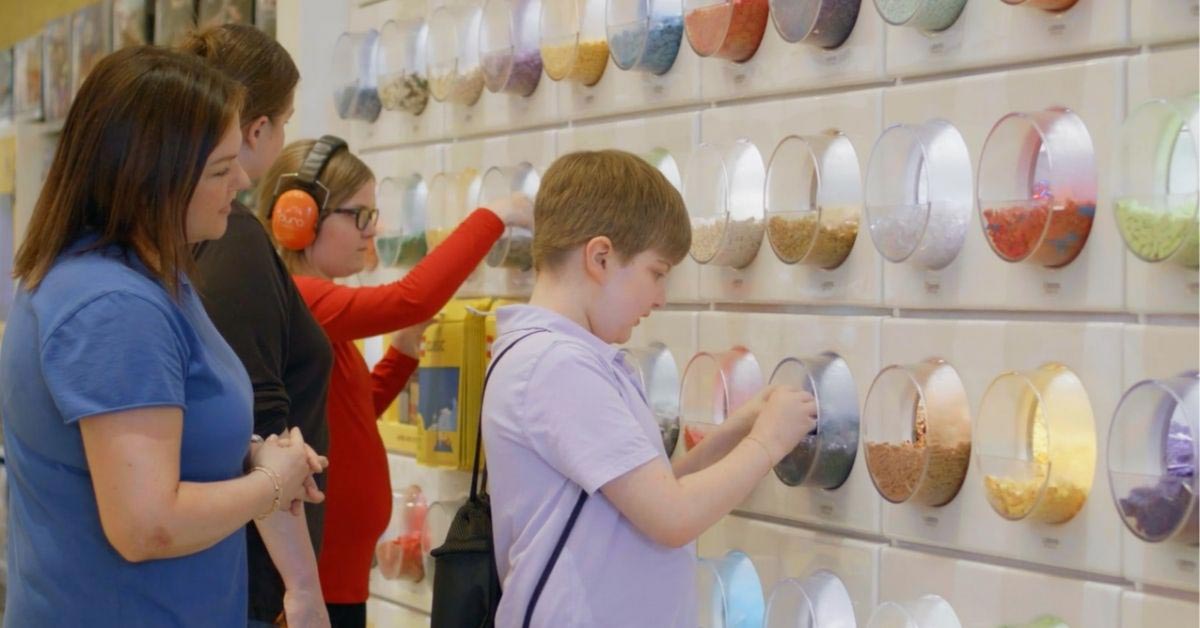
The KultureCity stamp of approval comes with all-new comprehensive staff training across the board and ensures that every LEGO store offers “sensory bags” created by a team of research professionals and neurodivergent developers.
“The sensory bags include noise-reducing headphones, a visual cue card that helps individuals better communicate, three different types of fidget tools, strobe-reduction glasses — these help filter out a lot of bright lights — and a VIP lanyard,” Srivastava explained. “These lanyards help staff better identify that somebody has a sensory need.”
Duanys, a LEGO store manager in Flatiron, New York City, said that he’s already seen how the training and inclusion initiative has reshaped shopping experiences for customers.
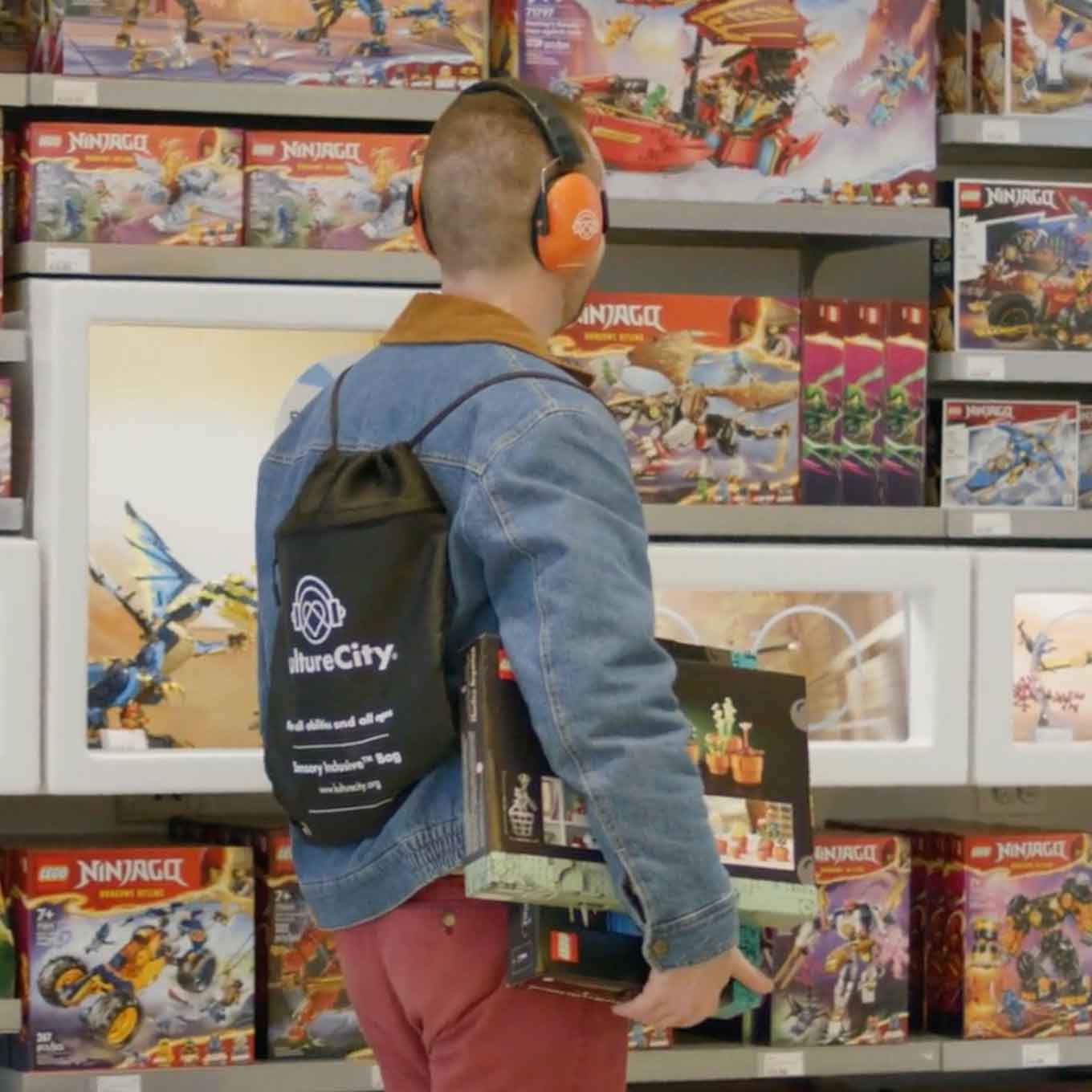
“The KultureCity training equipped us to meet our guests where they’re at,” Duanys shared. “There might be somebody out there who might not be confident to walk into the LEGO store, but now they’ll be more inclined to come in.”
“There’s so much you can do,” said Liam, a pre-teen LEGO fan who got an early look at the new shopping experience. “There [are] limitless possibilities.”
Life-long LEGO customer Sean said that the added accessibility measures would have been life-changing for him when he was a kid.
“Every person wants to feel a part of a community, every person wants to feel that a public space is for them,” Sean said.
“If I’m going through a difficult moment and I feel myself struggling, knowing that I can trust somebody in the store and that they’re educated, they’re understanding, and they’re willing to help — it can’t be replaced.”
LEGO isn’t afraid to put their money where their mouth is. This year, the LEGO Foundation’s Play for All Accelerator program disbursed over $11 million in grants to five organizations that center on the development of innovative toys, products, and services for neurodivergent children around the world.
Gina Gómez de la Cuesta — a clinical psychologist and founder of the organization Play Included — said that the impact from LEGO’s funding has been monumental.
“By applying learning through play specifically designed for the practical needs of our community, neurodivergent children are encouraged to strengthen collaboration, communication and problem-solving skills,” Gómez said in a company statement. “It also provides an opportunity for schools to encourage self confidence in difference and build towards a foundational change, needed for a more inclusive world that celebrates and enables our uniqueness.”
LEGO has been an industry leader in accessible play for years. Their latest efforts in social inclusion coincides with the mass production of LEGO Braille bricks sets for those that are blind or have low vision.
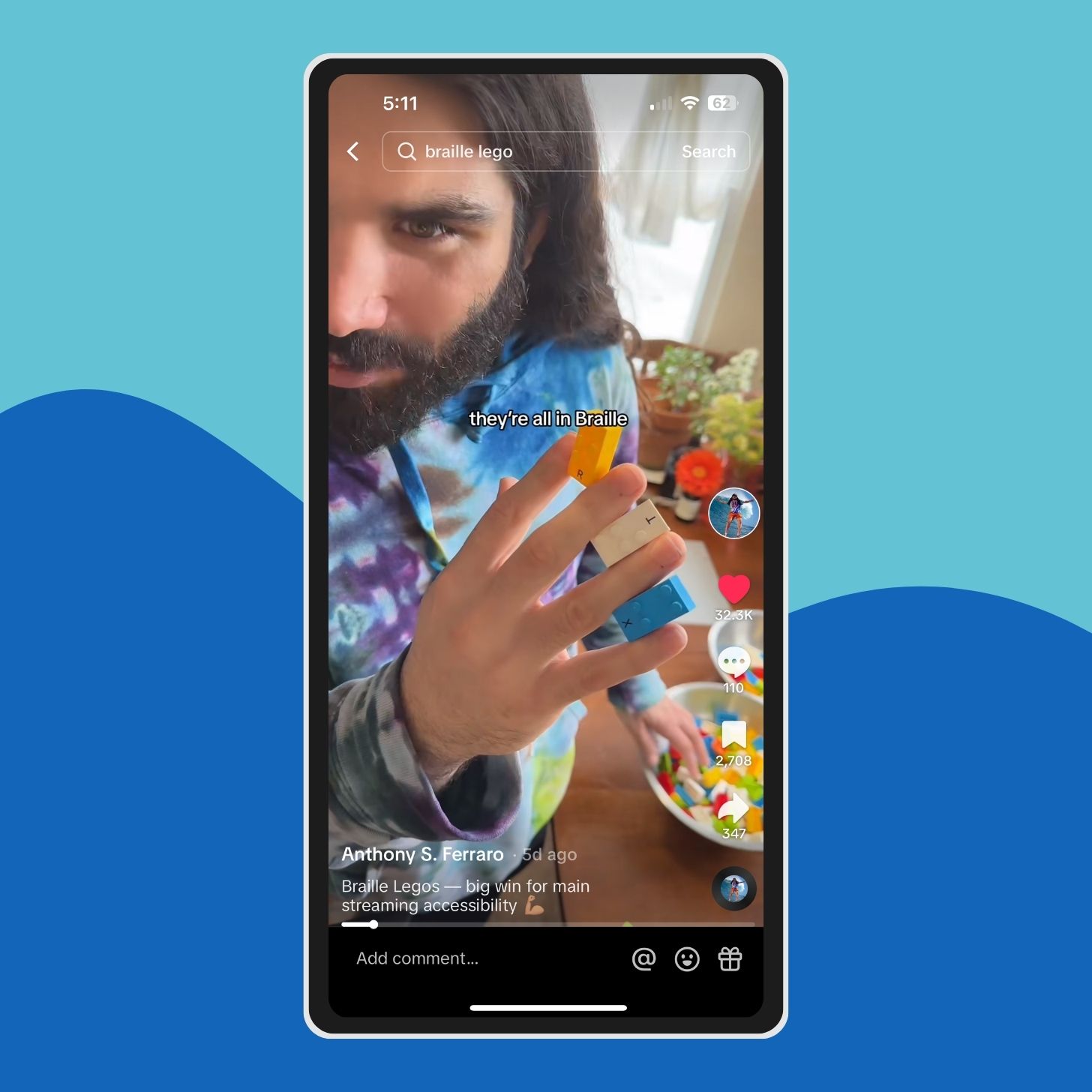
“It’s been a fantastic journey collaborating with children, families and experts from around the world to develop the product and activity packs,” said Rasmus Løgstrup, LEGO group lead designer on LEGO Braille bricks. “We know this is a strong platform for social inclusion and can’t wait to see families get creative and have fun playing with Braille together.”
Blind content creator Anthony S. Ferraro recently shared a TikTok video about the joy of using LEGOs to leave notes for his wife and potentially teach his baby daughter Braille.
“You don’t understand how epic this is,” Ferraro said as he combed through bowls of LEGO bricks. “My whole life I’ve wanted to play with these things.”
Header image courtesy of LEGO
It doesn’t take long for an Olivia Rodrigo album to outline a thesis statement about the experience of being a young woman in America.
In fact, both of the pop singer’s records start with a punchy opener that dramatically, energetically calls attention to the nearly unmanageable experience of girlhood and womanhood.
Her first album, “Sour,” kicks off with the teen girl anthem “brutal,” where Rodrigo shares:
“I’m so tired that I might / Quit my job, start a new life / And they'd all be so disappointed / 'Cause who am I, if not exploited”
Two years later, with the release of her sophomore album, “GUTS,” Rodrigo opens with the sarcastic and all-too-universal “all-american b—.”
She sings, atop a seething electric guitar: “I'm a perfect all-American b— / With perfect all-American lips / And perfect all-American hips / I know my place, I know my place, and this is it”
And, as much as her lyrics resonate with all of the young, gutsy feminists out there, many of her actions also align with the call for gender equality.
While Rodrigo continues to make headlines for supporting reproductive health care and charming fans with new tunes like “obsessed,” here’s a walk down memory lane to celebrate the many times the 21-year-old star gave us all a lesson in feminism.
Olivia Rodrigo’s history of feminism
She announced the Fund 4 Good alongside the Guts World Tour to support women everywhere.

At the start of Rodrigo’s major, 75-stop “Guts World Tour” in February, she announced an initiative that would financially support community-based nonprofits at every stop, championing girls' education, reproductive rights, and the end of gender-based violence.
The project is called the Fund 4 Good, and most notably, includes partnerships with abortion funds across the United States — some of which even made headlines for distributing emergency contraception at some of Rodrigo’s shows. (Sadly, Rodrigo’s management nixed this particular activation, but abortion funds are still tabling at her U.S. shows).
On her Canada stops, the singer is donating funds to a network of women’s shelters, as well, aiming to support women and children fleeing violent situations.
She recommended some essential feminist reading.

In a livestream last fall, Rodrigo recommended Mikki Kendall’s best-selling book, “Hood Feminism: Notes from the Women That a Movement Forgot.”
“The last book I read is this book called ‘Hood Feminism’ that’s so good. … I really recommend it,” Rodrigo said in the stream. “It’s, like, a very intersectional feminism book. It’s awesome.”
The book, which is a collection of essays by Kendall, explores issues that have been glossed over by mainstream feminism, such as food insecurity, access to quality education, living wages, and medical care, to paint a fuller picture of what the future of feminism must consider.
She speaks boldly about reproductive justice at her live shows.
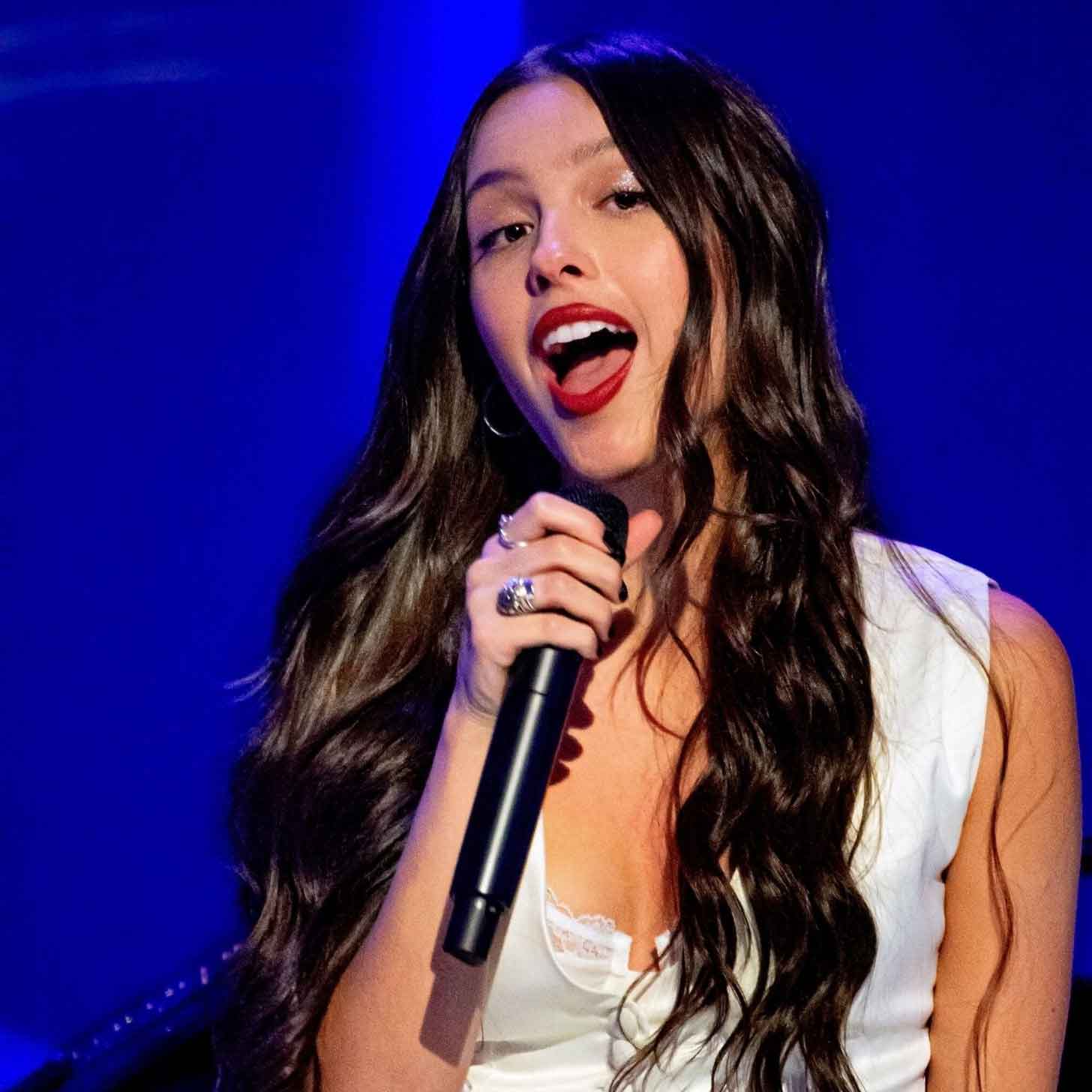
A little over a month prior to the Supreme Court’s 2022 Dobbs decision, which overturned Roe v. Wade, a leaked opinion from the judicial branch made the rounds, indicating what was ahead.
While Rodrigo was on tour in Washington DC in May 2022, she spoke candidly about the projected ruling.
“Because we’re in DC, I couldn’t pass up the opportunity to say how heartbroken I am over the Supreme Court’s potential decision,” Rodrigo said on stage.
“Our bodies should never be in the hands of politicians. I hope we can raise our voices to protect our right to have a safe abortion, which is a right that so many people before us have worked so hard to get.”
Including in an impassioned speech about the Supreme Court with Lily Allen.

In a similar fashion, in June 2022, just following the Supreme Court’s decision to overturn Roe v. Wade, Rodrigo took the stage at Glastonbury with pop icon Lily Allen to sing Allen’s 2008 hit “F— You.”
Before singing the song, Rodrigo gave an impassioned speech regarding the Supreme Court’s decision, putting reproductive care like abortion access in danger across the country.
“I’m devastated and terrified that so many women and so many girls are going to die because of this,” Rodrigo said, noticeably emotional.
“I wanted to dedicate this next song to the five members of the Supreme Court who have showed us that at the end of the day, they truly don’t give a s— about freedom.”
The crowd cheered enthusiastically and Allen held up her middle fingers as Rodrigo rattled off the names of those SCOTUS judges.
“This song goes out to the justices Samuel Alito, Clarence Thomas, Neil Gorsuch, Amy Coney Barrett, and Brett Kavanaugh,” Rodrigo said, matter-of-factly. “We hate you.”
In the fall of 2023, she told the Guardian that before her set — and bold declaration — she considered her “young girl fans,” and knew she had to say something.
“That’s actually why it’s so important,” she said. “I would love, if I was a little girl, to see someone stand up for future-me like that.”
She has tweeted about social justice issues.

While Rodrigo was still working as an actor with Disney — during Donald Trump’s presidency — she tweeted a number of times to express her disdain for his leadership, as well as reposting messages from activist groups like March for Our Lives.
These were shared during the height of the Black Lives Matter movement in May and June 2020.
She also posted about her support of the Black Lives Matter movement, sharing a link to resources that would support and amplify the cause.
“Please continue to act and support,” she wrote in May 2020. “This can’t just be a moment — this will never end without a fight.”
She collaborates with and supports other women artists.

From the start of her career, Rodrigo has been vocal about her respect and admiration for other women in the music industry. And as her star power continues to grow, she is collaborating with them!
From an interview with Alanis Morisette, to performing with legends like Sheryl Crow, and uplifting women and LGBTQ+ opening acts like Chappel Roan, Remi Wolf, and The Breeders.
She advocated for public health at the White House.

The world briefly stood still when Olivia Rodrigo posted a selfie with President Joe Biden in July 2021, but it wasn’t your run-of-the-mill celeb selfie. Rodrigo was at the White House to advocate for public health, encouraging young people to get COVID-19 vaccines.
As women — especially women of color — are neglected by health care systems, Rodrigo’s inclusion in this campaign signaled a thoughtful attempt to combat misinformation and empower folks to take advantage of a free form of care.
She even joined Anthony Fauci to read some tweets about getting vaccinated.
“Olivia RodriGO to the vaccine clinic,” she read, laughing. “All of the funny puns as long as you’re getting vaccinated. That’s great, whatever it takes.”
She consistently and unapologetically expresses rage (and joy!) as a young woman of color.

As a Filipino American, Rodrigo is a symbol of a new wave of diverse, chart-topping women artists. Fighting both patriarchal and white supremacist standards for beauty, success, and even how one expresses emotions, her presence goes deeper than a head-banging hit.
The singer unapologetically invites other women to feel and express their full range of emotions, free of stereotypes or shame, especially with the aforementioned track “all-american b—” as their soundtrack.
When the song came out in 2023, many young women took to TikTok to express their gratitude that Rodrigo was able to so clearly capture the righteous anger many young women experience.
“It’s like the inner dialogue of a woman … going home and being completely exhausted and filled with rage that you have to put on some show [not only] to take care of yourself and keep yourself safe, but also please those around you,” 21-year-old Grace Ogden told Teen Vogue upon the release of the song.
Header photos courtesy of Olivia Rodrigo/Instagram and The White House
When you think about helping animals and volunteering for a shelter, you probably think of tasks like cleaning kennels, picking up pet poo, or even using your photography skills to encourage folks to adopt a dog.
But Wesley Swainston, a dog trainer and content creator, likes to do something a bit more engaging.
Swainston volunteers at Adoption First Animal Rescue in Jacksonville, North Carolina, where he goes for runs with hard-to-adopt-dogs.
Many of his running companions have been returned to the shelter for having too much energy, poor behavior, or even running away.
However, with realistic videos showcasing some training tips — and offering the dogs a chance to expend their energy — Swainston proves that these pups just need a little love, patience, and adventure.
A recent video of his went viral, garnering over five million views on both TikTok and Instagram. He starts off with a succinct and compelling call to action. “Come run with shelter dogs no one wants to adopt,” the title of the video reads.

From there, Swainston greets his buddies in their kennels, and shares some information about them. There’s Cindy, who was returned twice for “having too much energy,” or Rooster, who was brought back to the shelter for “running away too much.”
The rest is simple: Swainston leashes up the pups, and they go for a run around the neighborhood.
“I’m telling you, if you want to get into running, this is the way,” he says, jogging. “I’m about to hit a PR right here!”
In another video, he shares the reasoning behind this approach.
“The reason I started running with shelter dogs is because as a volunteer trainer it is extremely difficult to work with a dog that has no energy outlets,” Swainston explains. “ I love running and I love training dogs, [so I] might as well combine the two.”
While Swainston has gained some popularity for his daily run videos on social media, there are plenty of organizations around the country that help runners with shelters nearby do the same thing — like Miles & Mutts, or Dallas’s D90 Runners program.
“When high-energy dogs get the exercise they need, they have a higher quality of life, are less susceptible to illness, behave better in their kennels, and have higher chances of adoption,” Dallas Animal Services wrote about the D90 program.
“Each participating dog runs one mile, which may seem small to seasoned runners, but it makes a world of difference to a shelter pup.”
Whether they were inspired by Swainston or were already eager to lace up their shoes, commenters on the creator’s videos also had some big ideas to help adoptable dogs in need.
“What a brilliant idea for high school track team[s] or individual run teams,” one commenter wrote on TikTok.
“They should advertise high energy dogs at marathons,” another suggested.
Ultimately, though, folks were just grateful to see someone giving some animals the space they deserved to run like the wind.
“As a shelter employee who often takes out dogs on our hikes, I appreciate you showing the kennel behaviors that often turn adopters off as normal and totally fixable with love, time, and effort,” one commenter said. “This is what I wish I could show everyone.”
“Not all heroes wear capes,” another commenter said. “Some wear waist-attached leashes.”
Header images courtesy of Wesley Swainston/TikTok
Seasoned U.S. voters who have spent election after election furiously Googling candidates while standing in line at the polls might be the first people to tell you that it’s not exactly easy — or pleasant — to feel like a prepared, informed, and engaged citizen.
The barrier to entry is even more difficult for folks who are new to voting, aren’t citizens, or have just moved to a different city.
What do words like ‘jurisdiction’ mean? What does a school board even do? Who do I call about this pothole in my neighborhood? Why should I vote for this guy with all the signs up around town?
Enter: Citizenly, an Oregon-based startup making those questions a whole lot easier to answer.
The Citizenly platform provides a “complete, accurate, and continuously updated database of every politician in the country, from the president, down to every small city council, local school board, and rural special district,” which, up until now, simply has not existed.
Upon making a free account on the platform, a user can input their address and will quickly be presented with a list of all of the elected offices that represent them — as well as who occupies those offices, how to contact them, how long is left in their term, their party affiliation, and much more.
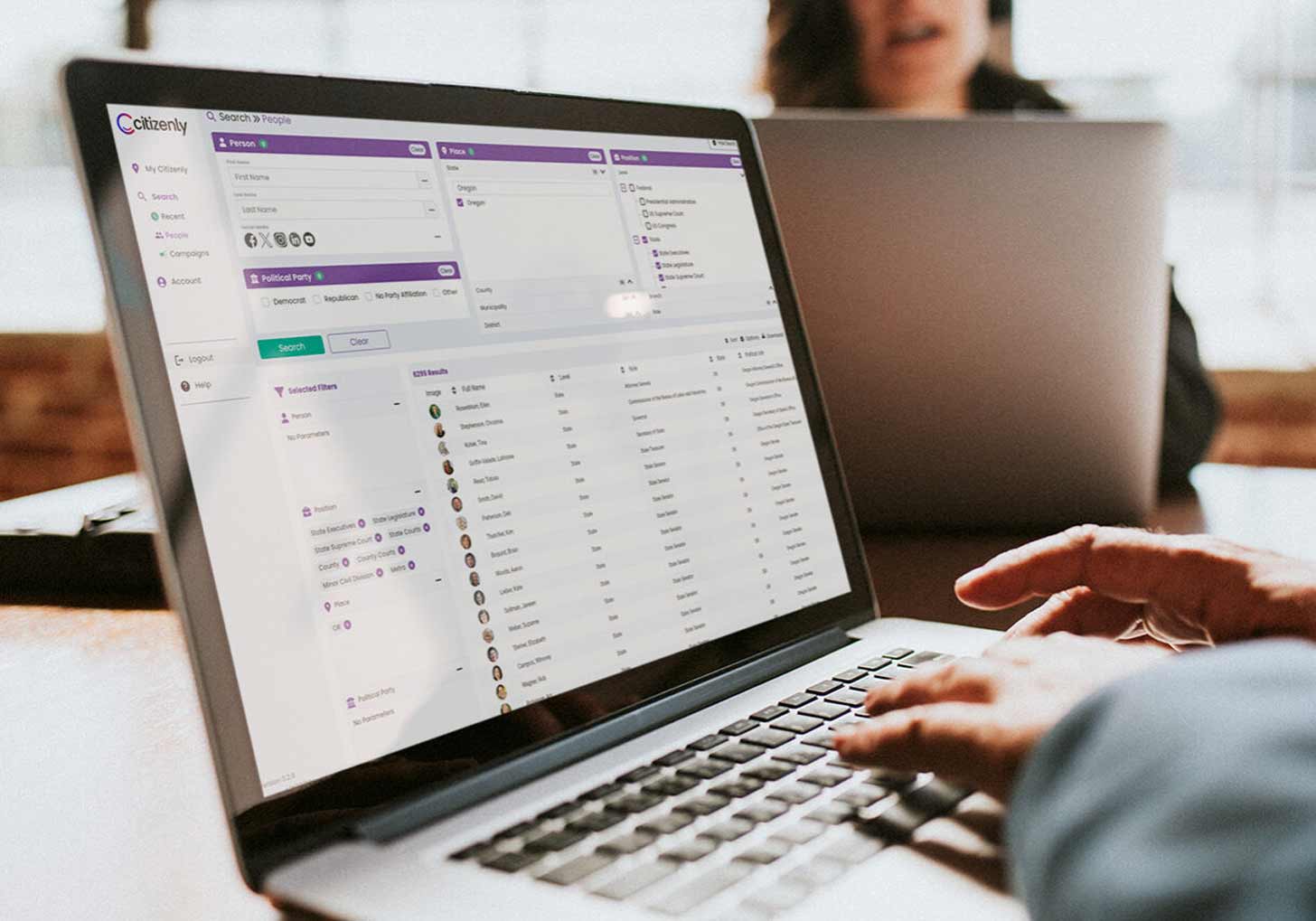
All information is presented in the same format, with an emphasis on “standardizing public data,” as Citizenly’s director of analyst operations, Evan Kersten, said.
“This is public data, and it must be delivered in a way that engenders public trust,” he told Good Good Good.
After having their identities confirmed, elected officials and candidates are able to add minimal personalized details to better address their constituents, such as changing their profile photo, adding a bio, and listing their priorities.
A paid version of the platform is also available to advocacy groups and businesses looking to engage more directly with elected officials.
“I want this to be as useful for the governor of my state as it is to my mom,” Kersten said. “I want there to be value across so many different types of engagement with these systems.”
The platform aims to make it easier for candidates to get their names in front of communities without paying gobs of money, and for community members to feel empowered to communicate with elected officials — especially in hyper-local settings.
“Our public tagline of ‘improving the experience of being a citizen,’ that’s a semicircle. And the other half of this is improving the experience of governing,” Kersten said. “You need both. And I think we are really making a concerted effort to address both parts of that circle.”
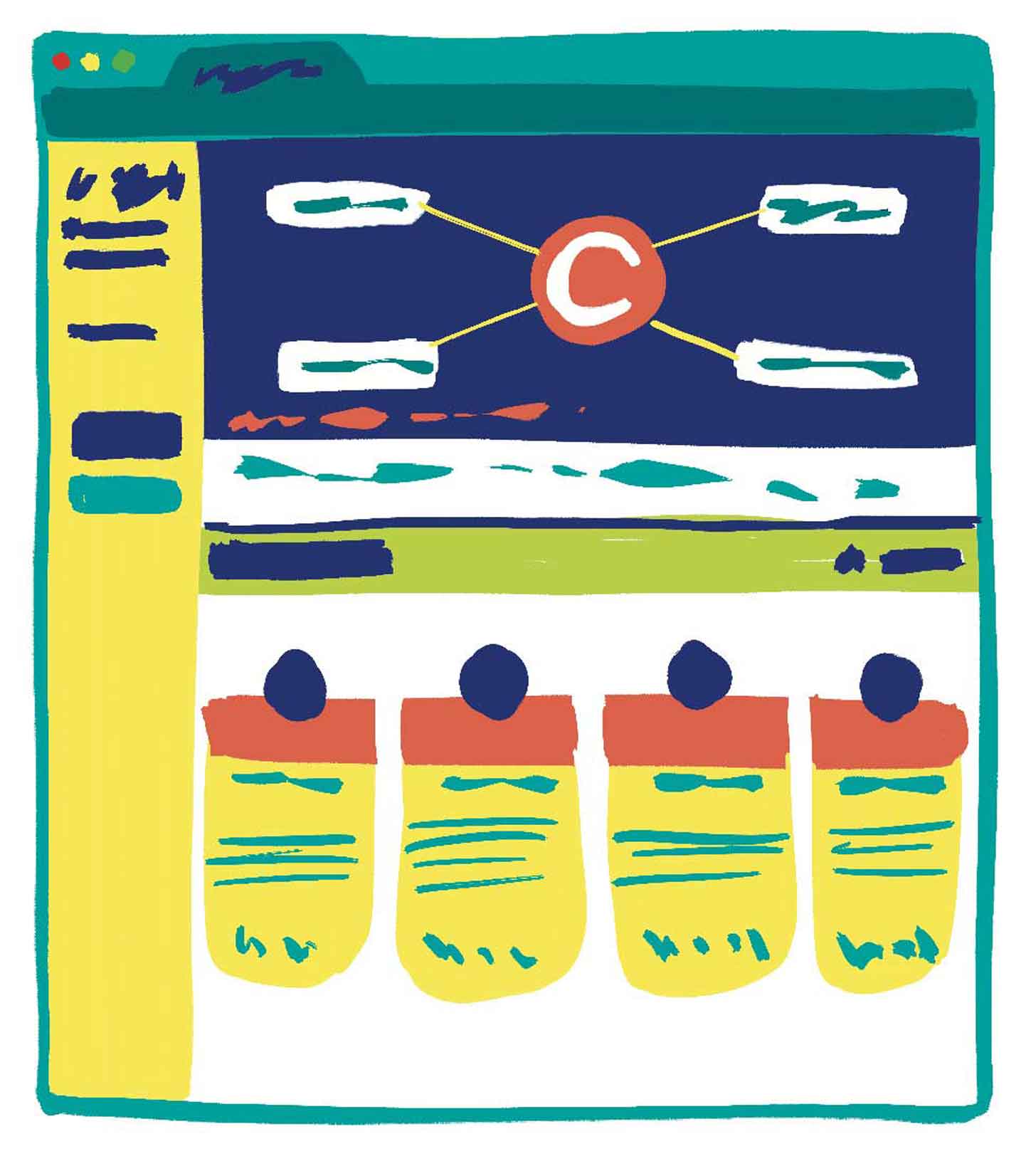
Right now, Citizenly is in beta mode for Oregon residents, though thousands of data sets are available for other parts of the country. Kersten said that the goal is to ensure that 99% of all data available on Citizenly is accurate. With hundreds of thousands of elected offices across the country, this is no easy feat.
That being said, the platform is continuing to expand successfully with larger national data sets, and users outside of Oregon are still welcome to make an account, check out what’s available, and anticipate even more information leading up to the 2024 election.
Users can also keep an eye on the status of Citizenly’s accuracy rate, which is available to view as a notice on the bottom corner of a user’s page.
While upcoming elections are a major catalyst for civic engagement, Kerston said he ultimately views Citizenly as a path to autonomous, accessible education.
He reflected on his own experience, obtaining a graduate degree in public administration, spending his career in policy and government affairs — and still being confused and overwhelmed by these systems.
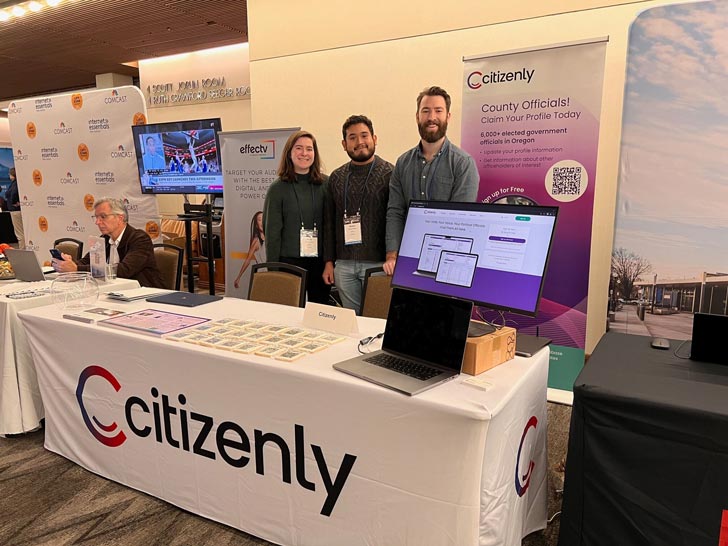
“My goal is for Citizenly to make a measurable impact on people’s ability to be an informed constituent, so that they feel they can understand the functions of some of these government entities and don’t feel scared off by some of the terminology,” he said.
“It’s about how you can engage with those concepts in a way that actually matters for your day-to-day.”
With an individualized approach and a straightforward delivery of information, Kersten hopes that Citizenly can be the missing puzzle piece that creates a more full, nuanced picture of civic engagement.
“Everybody deserves a shot at knowing this stuff, and it’s really hard to know sometimes,” he said.
“I’m hopeful that we can do a lot better with getting information in front of people in a way that makes sense — and relates to their sense of place, and their sense of personal responsibility to that place. There’s a need for that, and I think it’s possible to do it.”
A version of this article was originally published in The Civic Engagement Edition of the Goodnewspaper.
Get your own Goodnewspaper by becoming a good news subscriber today.
Most of the estimated 300,000 babies born every year with sickle cell disease, an inherited red blood cell disorder, live in sub-Saharan Africa in nations where there are few resources to treat them.
As an assistant professor of biomedical engineering, I am working to reduce the likelihood that children born with sickle cell disease will die from stroke, one of the most common complications.
Sickle cell disease, whose name reflects the disease’s sickle or crescent moon shape of red blood cells, can affect any major organ, but my primary concern is its effect on the brain. It causes a lower oxygen level and abnormal blood flow in the brain, which is associated with a high risk of stroke.
Without treatment, 11% of children with sickle cell disease will have a stroke before they turn 20 years old.
The mortality rate for children younger than 5 years old is 50% to 80%.
The majority of sickle cell patients share an African heritage.
The places where malaria rates were high historically have the highest sickle gene frequency because it provides protection against the mosquito-borne disease.

Fewer resources for screening
In an advanced nation like the U.S., children are more likely to receive stroke-risk screening and start a regular blood transfusion therapy if the need is there.
In sub-Saharan African nations, there are few resources for screening. The current screening tests use an ultrasound system called a transcranial Doppler to identify elevated blood flow to the brain. But they aren’t affordable, and only a few hospitals in sub–Saharan Africa have certified operators.
My goal, thanks to a US$426,000 grant from the National Institutes of Health for a three-year study, is to develop a low-cost, light-based device that can noninvasively measure brain blood flow in children with sickle cell disease and determine an affected child’s risk of stroke.
The plan is then to disseminate this device to southern African countries, increasing the number of children who get access to the screening protocol.
Saving families the anguish
Not only would a low-cost testing solution allow an underserved community’s needs to be addressed, but it would save countless families the anguish that comes with a diagnosis.
Patients have a chronic shortage of healthy red blood cells, are more susceptible to clots when their abnormal sickle-shaped blood cells pass through small blood vessels, and experience tremendous pain from that. In fact, pain is the top reason that sickle cell patients go to the emergency room or hospital.
This article by Paul (Seung Yup) Lee, from the Kennesaw State University, was originally published by The Conversation.

Breast cancer is the most commonly diagnosed cancer among women in the U.S. and is currently one of the leading causes of cancer deaths.
Earlier diagnosis and treatment lead to better prognoses for breast cancer patients.
But mammograms have proved to be less effective for those under age 40, as their breast tissue is denser and screening and biopsies can be unpleasant to endure.

In breast milk and blood serum, researchers, including those in my lab group, have identified proteins that are involved in tumor development. Eventually, biochemists like my colleagues and I hope we can use these cancer-related proteins to create a biomarker panel that physicians can use to detect breast cancer earlier, therefore aiding in diagnosis and treatment.
Proteins as biomarkers for what’s happening
Researchers can analyze the proteins present in a variety of tissues, from biopsies of tumors to biological fluids including blood, saliva, urine, tears or breast milk.
This technique is an example of studying a sample’s proteome — all the proteins in a particular cell, organism or species.
The field is called proteomics.
Proteomics can be a powerful tool when researchers compare the proteomes of individuals from different groups, such as in blood from healthy people versus those with breast cancer. This kind of case-control comparison can identify a single protein or a group of proteins and their variants that are specific to one condition.
That’s what my colleagues and I are looking for: proteins that are present only in the samples from people who have breast cancer. Scientists call them biomarkers because they signal that a patient has a particular condition.
Once our candidates are verified by large-scale clinical trials that include many patients, we hope that particular proteins can then be used to assess someone’s future risk of developing the disease.
Doctors can currently use biomarkers for breast cancer to gauge a patient’s response to treatment.
For instance, the molecules cancer antigen 15-3 (CA 15-3) and carcinoemybronic antigen (CEA) are elevated in breast cancer patients, so monitoring their levels can let physicians know whether treatment is working.
Inherited variants of the BRCA1/2 genes can increase the likelihood of developing cancer; they can act as biomarkers in screening for cancer risk.
None of these biomarkers aid in diagnosis of breast cancer, though.
Researchers prefer proteins as cancer biomarkers over the genetic materials DNA and RNA because proteins provide a snapshot of what is happening in a patient’s body at the time a sample is collected.
DNA and RNA can tell you whether a certain gene is turned on or off, but not the active form of the protein it codes for or the relative abundance of proteins.
Protein analysis can also reveal changes the protein has undergone and protein-protein interactions that can alter the way a protein functions.

Benefits of milk and serum biomarkers
Breast milk and blood serum are two bodily fluids that can be collected noninvasively and that give information about what is happening in the body when collected.
Breast milk contains secreted proteins, immune cells and sloughed cells of the milk ducts.
During lactation, the breast is actively working to create milk to feed an infant. Any abnormalities in the breast milk reflect the current situation in the body.
Some proteins in breast milk also circulate throughout the body and can be found in blood serum as well.
Serum is the liquid part of the blood after red blood cells have been removed. It contains all the same proteins found in the blood, minus the clotting factors, therefore allowing circulating protein levels to be monitored.
Narrowing in on a serum-based biomarker would mean it could be used to screen every woman, not just one who is currently lactating.
The proteins we’ve found in breast milk and identified as being out of whack in breast cancer are involved in the cancer cells’ ability to divide, multiply and spread throughout the body. They all promote disease progression.
My colleagues and I currently consider these breast milk proteins to be a draft biomarker for breast cancer.
Our group is currently working on using blood serum to identify proteins that could be involved with breast cancer.
Moving from breast milk to blood serum would allow people of any age and reproductive status to be screened for the disease, rather than just those who are lactating.
This article by Danielle Whitham, from the Clarkson University, was originally published by The Conversation.

Life goes on, even in prison. And for 11 men in Sonoma County Jail, a new music program proved to be one of the most rewarding experiences of their lives.
For nine weeks, they attended a class on the work of Ludwig van Beethoven and learned how to write their own original compositions in coordination with the Edith String Quartet — a group of four Julliard-trained musicians.
The students came from a variety of backgrounds; one had never attended a live concert before. That same student took to the class quickly, and could soon name chords by ear as they were plucked and played by the quartet.
“It's a challenging concept even for trained musicians and he just got it immediately,” Edith String violinist Gabrielle Despres told The Press Democrat. “I think it was just really beautiful.”
The program came together through a collaboration between Five Keys — a nonprofit charter school that offers high school and higher learning classes in prisons — and the nonprofit Project: Music Heals Us.
After two months, the class came to a fitting end as the Edith String Quartet brought the students’ compositions to life in a concert attended by the students and a small crowd of family and friends. The concert was broadcast live over Zoom to the 60 residents at the Santa Rosa jail.
The students watched intently, some with tears in their eyes, as they heard their end-of-semester creations played back to them for the first time.
“Hey, let this guy out of jail!” One student called out after one of his classmate’s compositions came to a close. The composer of that particular piece had started the class with no previous knowledge of writing or reading music.
“I hope to continue with this myself,” another student said. “Maybe I’m the next Hans Zimmer, who knows?”
@pressdemo The hums and harmonies from the string quartet flowed up and down, and the picks and plucks sharply exited the speakers into a classroom at the Sonoma County Main Adult Detention Facility. Eight incarcerated men and a small crowd listened March 25 as a quartet — Juilliard School students on two violins, a cello and a viola — performed eight pieces, each composed by one of the inmates. Fluttery movements and fluid melodies dissipated wanting, dissonant chords and bled into sharp and distinct dynamics. The composers had written some comments, including “cartoony” and “life is risky but never boring,” in their sheet music that dictated the vibe and emotions to be expressed in the music. The performance in New York City was broadcast live to the Santa Rosa jail via Zoom. Read more at the link in our bio. #MusicfortheFuture #sonomacountyjail #projectmusichealsus #edithstringquartet #classicalmusic ♬ original sound - The Press Democrat
Since 2014, Project: Music Heals Us has held free workshops and performed concerts for hospice care patients, refugees, retirement home residents, incarcerated men and women, and people experiencing homelessness.
Specifically, PMHU’s Music for the Future prison program has offered digital music courses, held over 100 in-person prison engagements, and taught over 2,000 participants how to read, write, and compose music.
This year, PMHU began offering in-unit courses and interactive programs on Rikers Island and Vernon C. Bain jail barge teaching music classes, lyric workshops, and even improv jam sessions.
PMHU’s website is brimming with hand-written testimonies from grateful students who were touched by the concerts that brought their work to life.
“I sat in a crowd made up of men who society considers to be the least and lowly things of the earth, and was brought along on a journey of tragedy, self-discovery, and eventually triumph,” one student wrote.
“You played that day for men who have been pushed and pulled apart by a life that seems to ignore their wants with silence. You brought a gift.”
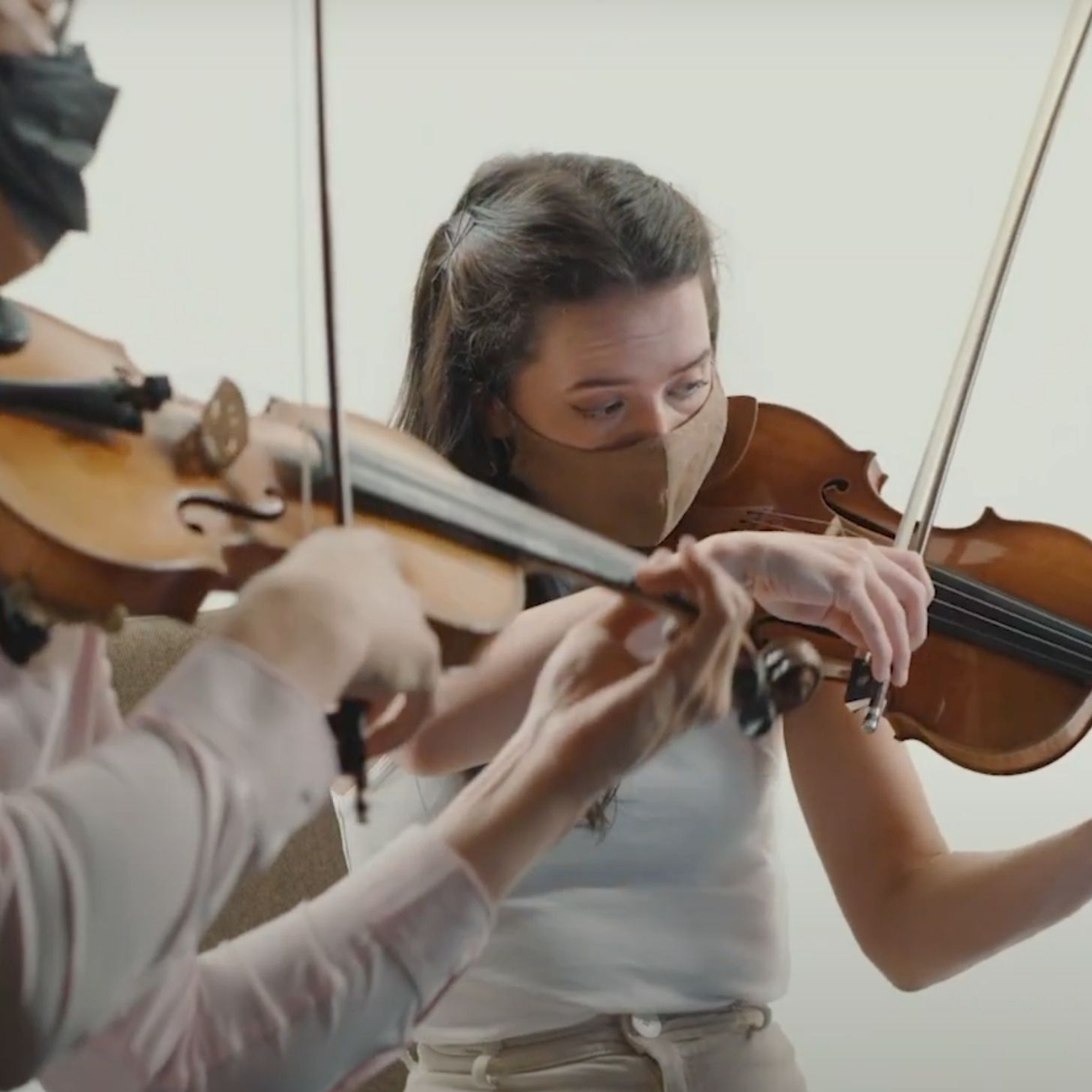
In the documentary “The Sound of Us,” director of arts education for the NYC Department of Correction Tommy Demenkoff said the Music For the Future programs are meant to combat the “dark” and “punitive” nature of mass incarceration with respect and dignity.
“While there is a social justice movement in this country — and laws are changing, things are evolving — right now there are people that are incarcerated,” Demenkoff said.
“My role in being here is to help right now, and that’s what I do with teams of artists and musicians who come to our facilities to perform and run workshops,” Demenkoff continued. “Offering that is important in this moment.”
Header image screenshot via @pressdemo on TikTok
Those of us who live with anxiety have likely had the realization that we’ll always have a little extra stress following us around than others on any given day.
While that tether to anxiety can certainly feel like more of a ball and chain than a friendly puppy on a leash, the relationship each of us has with mental health is a complex experience — one that is certainly worth navigating.
Haley Weaver — the artist behind the popular Instagram account @haleydrewthis, and the mental health newsletter Haley Wrote This, has just released a poignant, playful book all about this relationship.
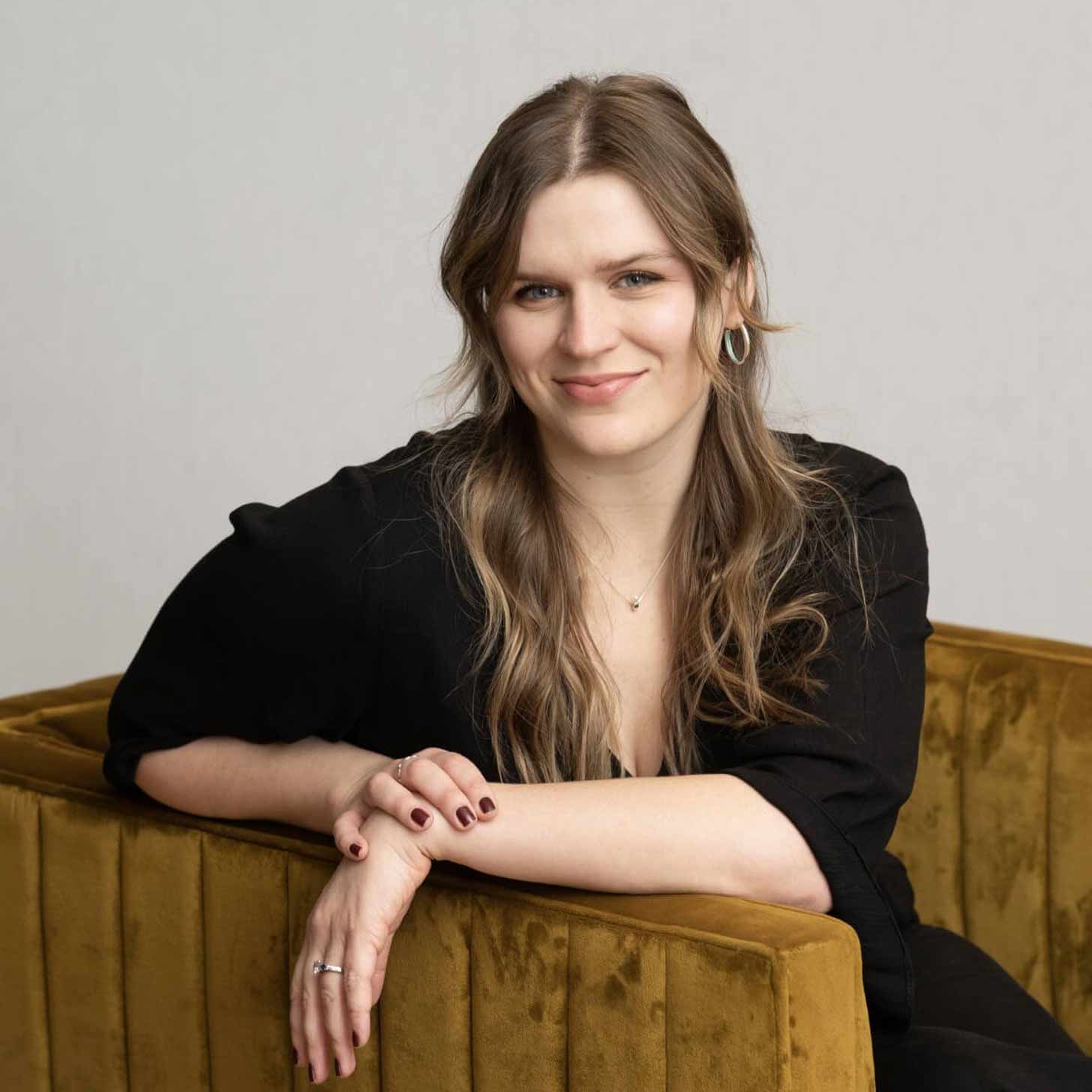
It’s called “Give Me Space but Don’t Go Far: My Unlikely Friendship with Anxiety,” and it’s full of personal stories, relatable anecdotes, and comics that make anxiety almost seem adorable. Almost.
Weaver shared the following comics and excerpts from her book to help all of us Nervous Nellies feel seen, understood — and maybe even a bit more in control of our anxiety.
The best Haley Weaver comics about living with anxiety
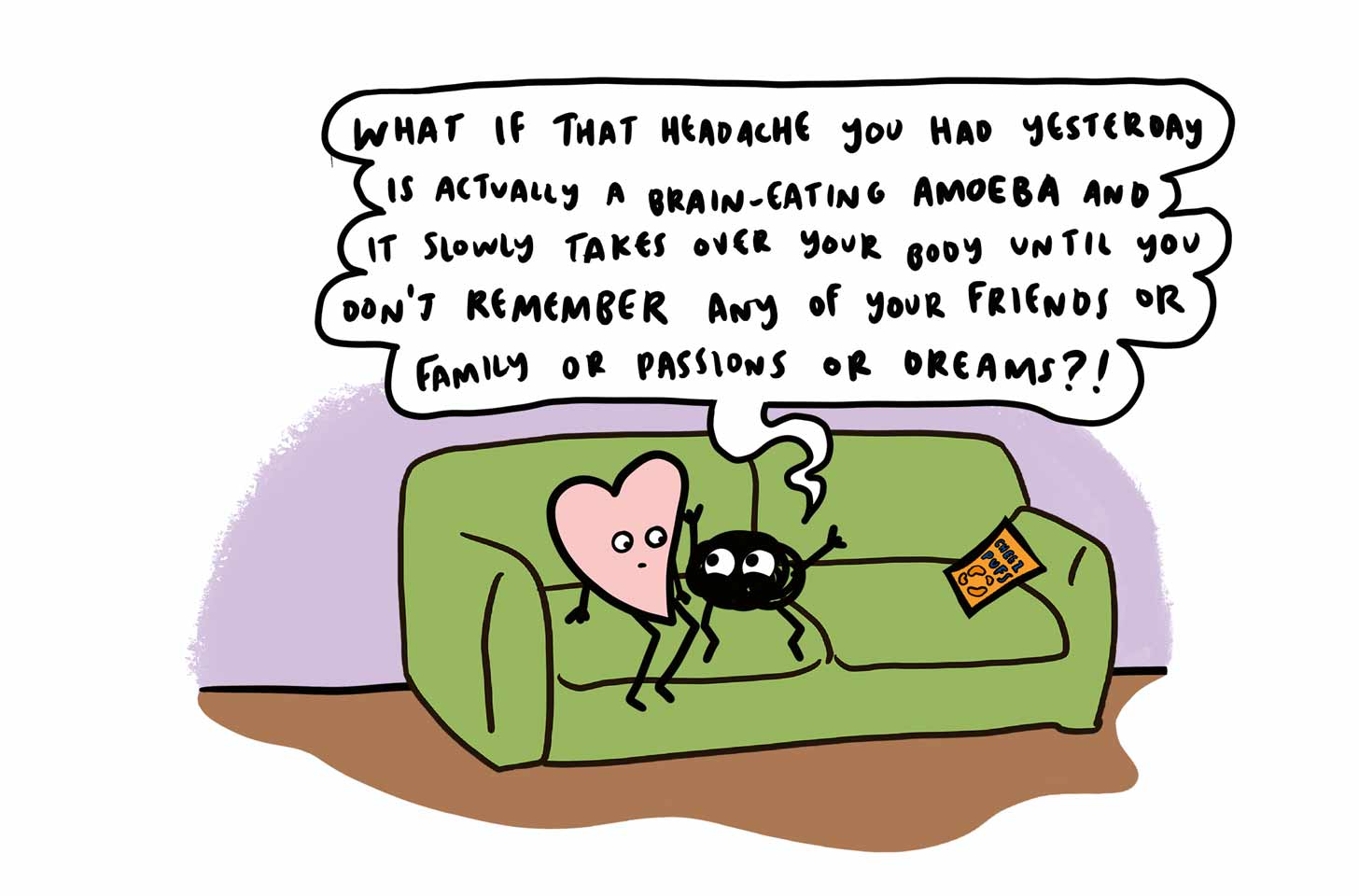
The brain-eating amoeba
If anyone asks if you’ve been Googling your symptoms, just show them this comic instead.
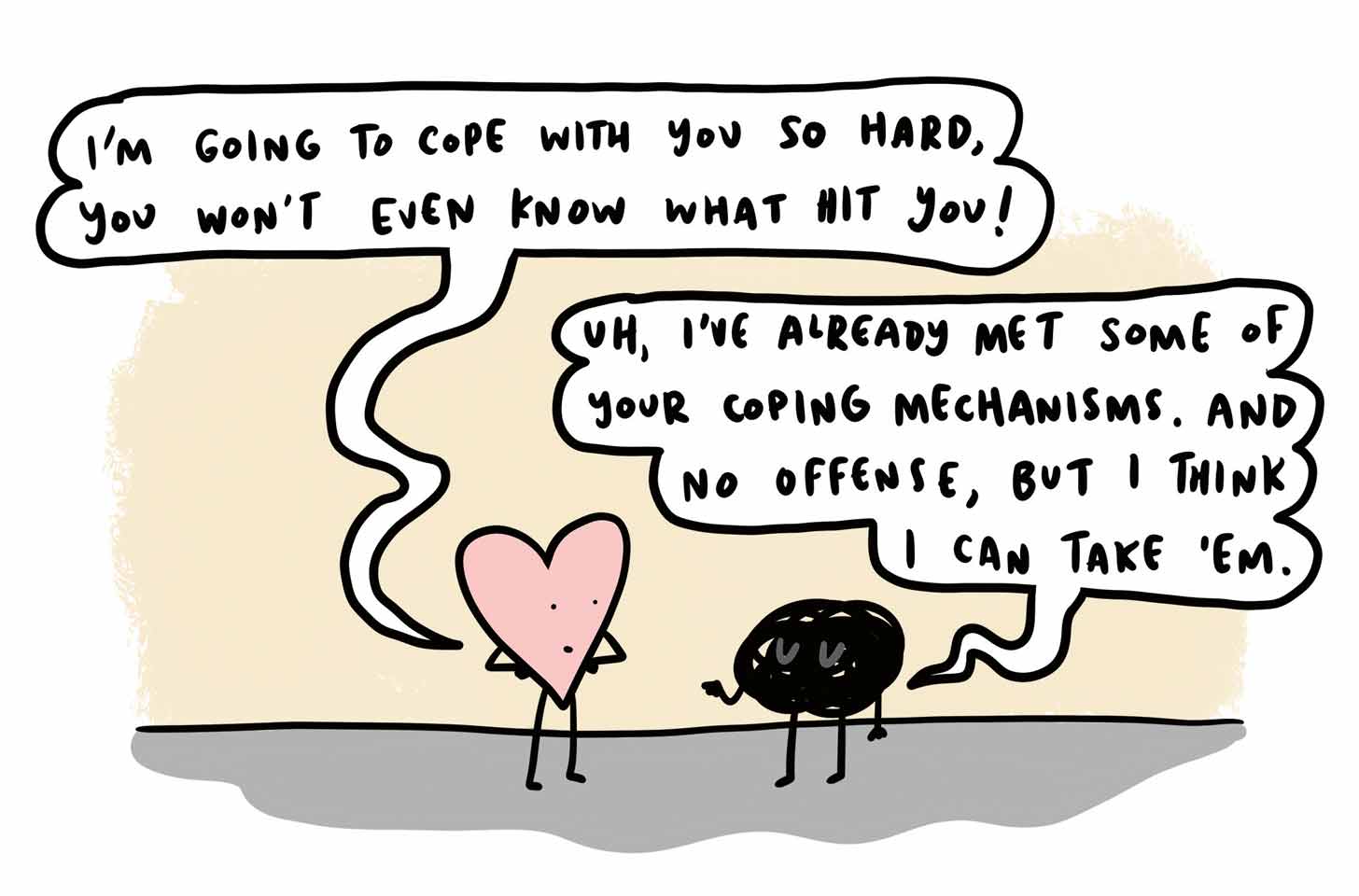
Confidence in your coping skills
It’s always such a relief when you feel like you’ve finally conquered something … only for your anxiety to say “wait a minute, I think I’m actually more qualified to take this on.”
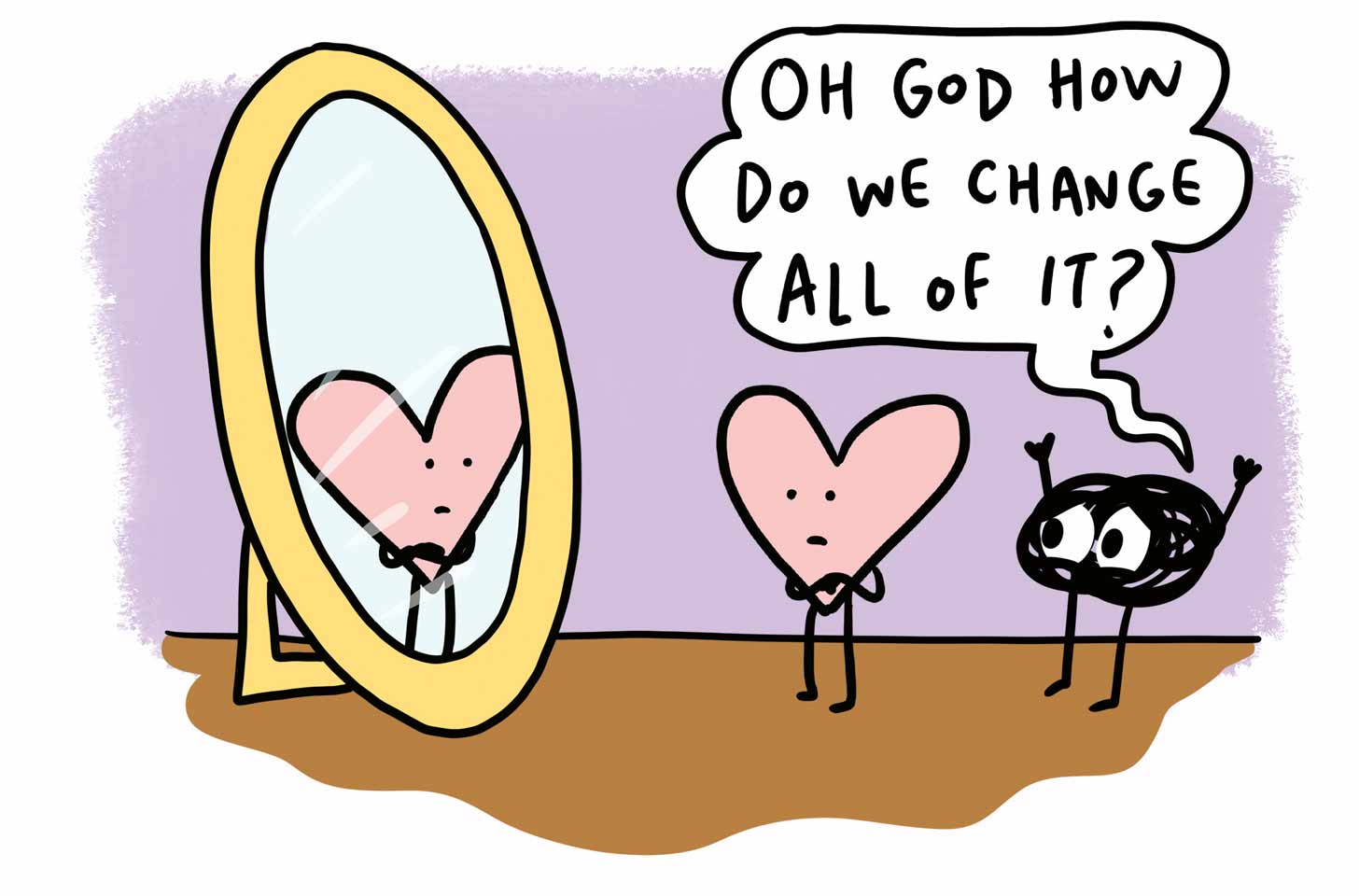
An out-of-body experience
Somehow, anxiety always seems to be around when you’re trying on clothes, doing your hair a different way, or even making new friends. Like, who asked you?!
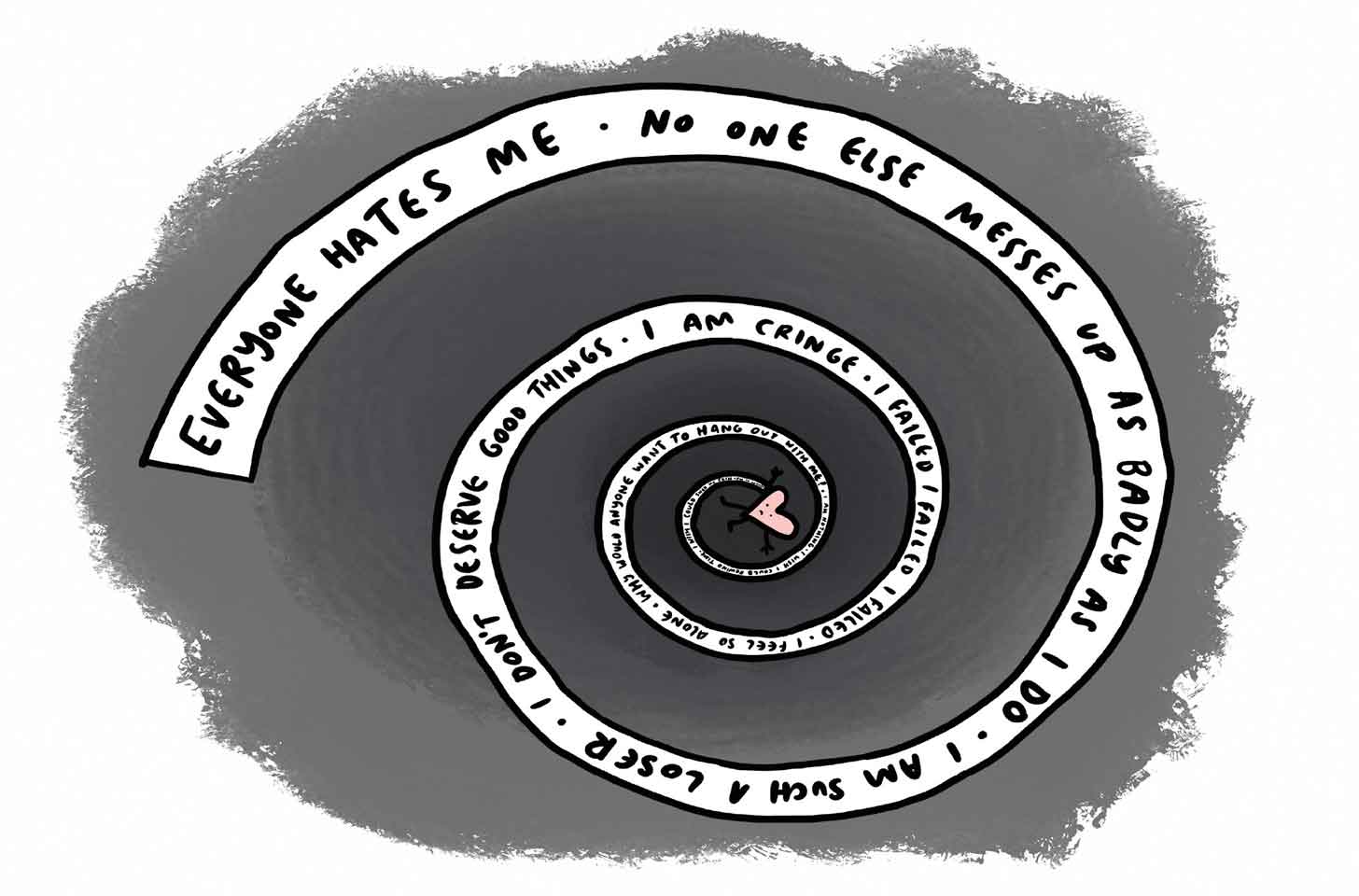
The spiral
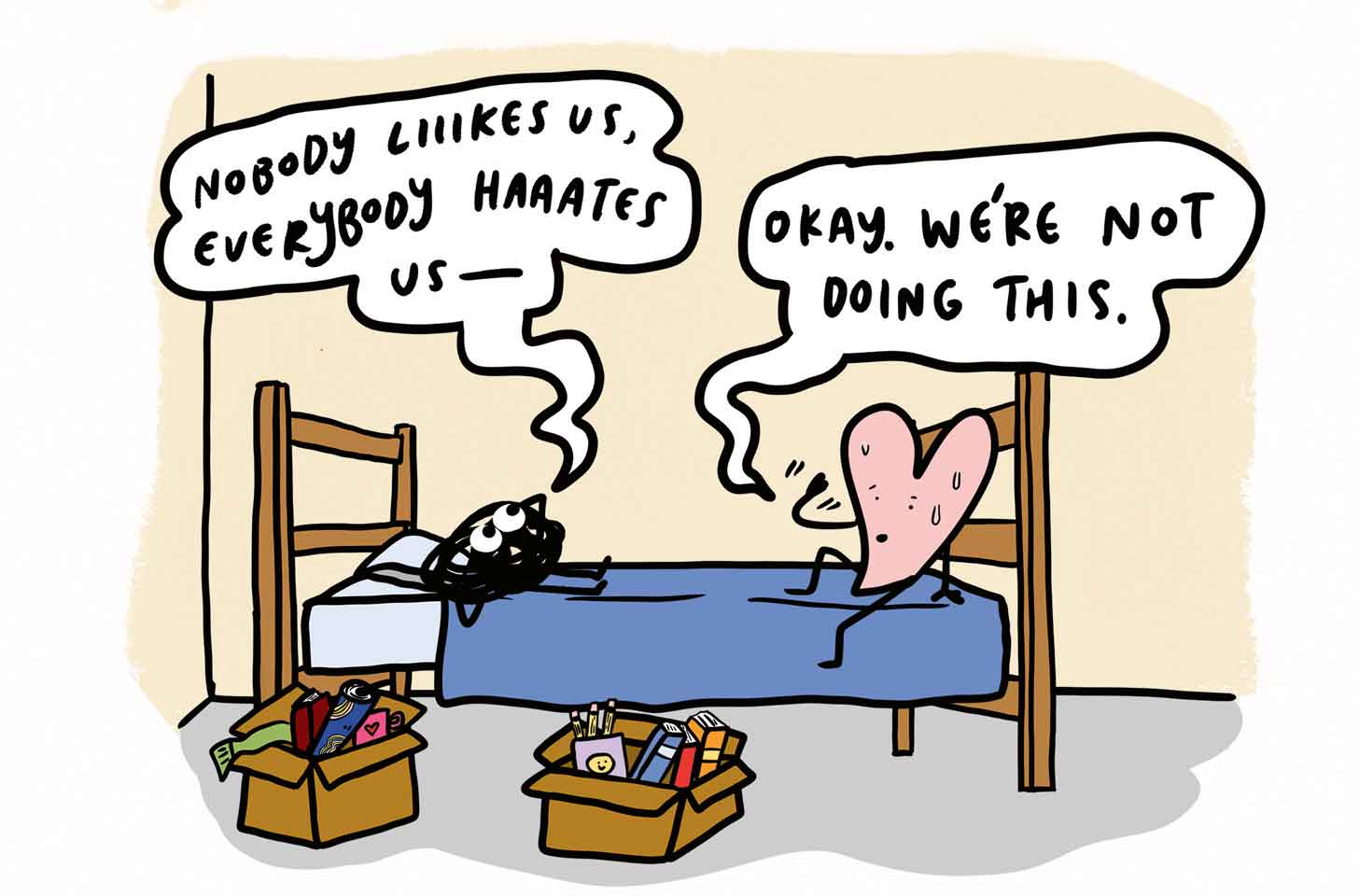
First lesson in panicking: One anxious thought always leads to another. And to another… and another… and another.
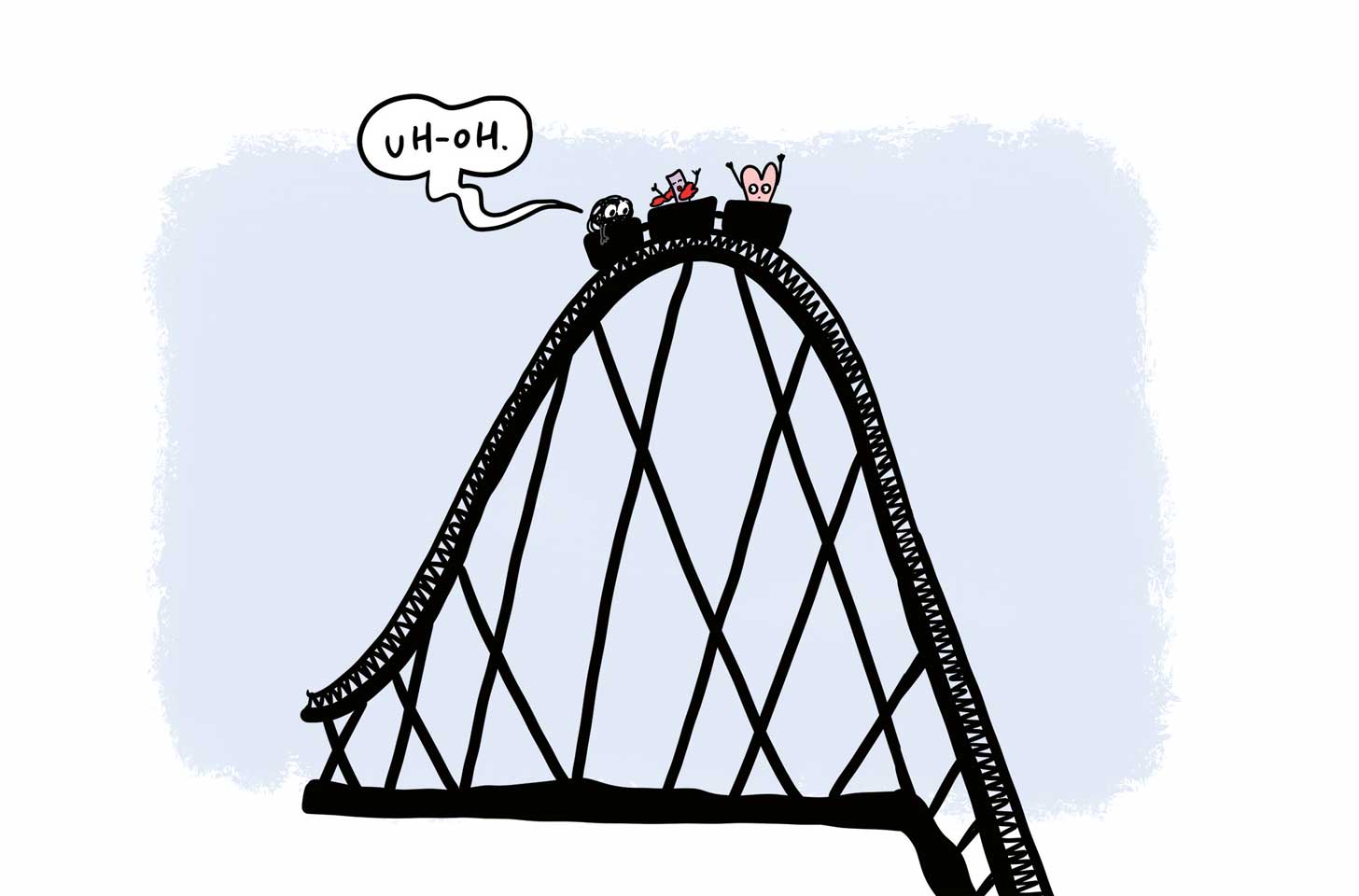
That heart-sinking feeling
The moment of realization when a panic attack hits, or an anxious thought fills you with dread? Just like being on the top of a rollercoaster.
Liar, liar
Anxiety just looooves it when you come home after a fun night with beloved friends and suddenly they can make you feel like you actually did everything wrong.
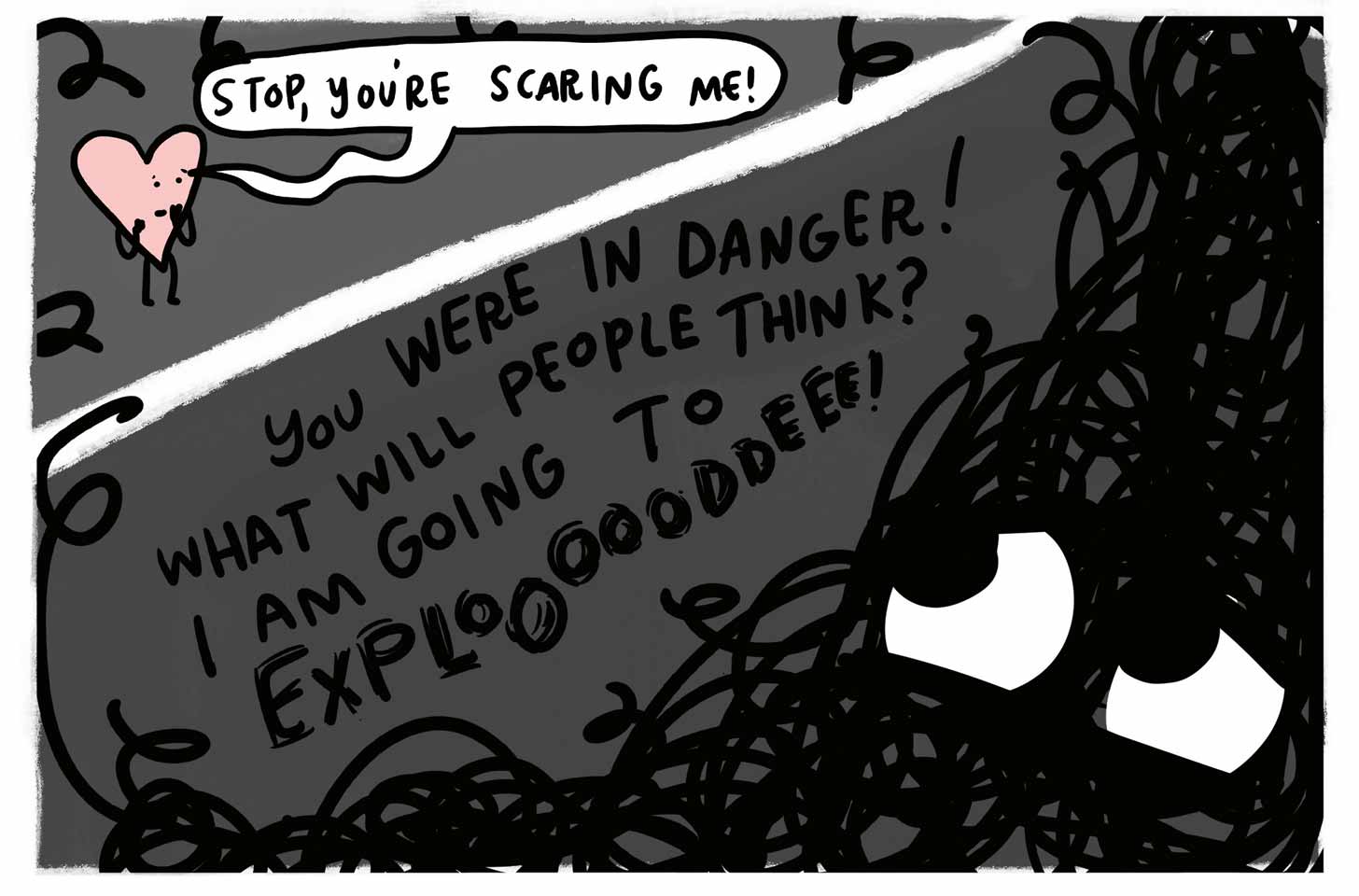
A big, dark tornado
Sometimes anxiety spirals get so big and so meaty that it’s hard to ever find your way out. Sometimes they get so overwhelming that you begin to realize that what you’re really scared of is the anxiety itself.
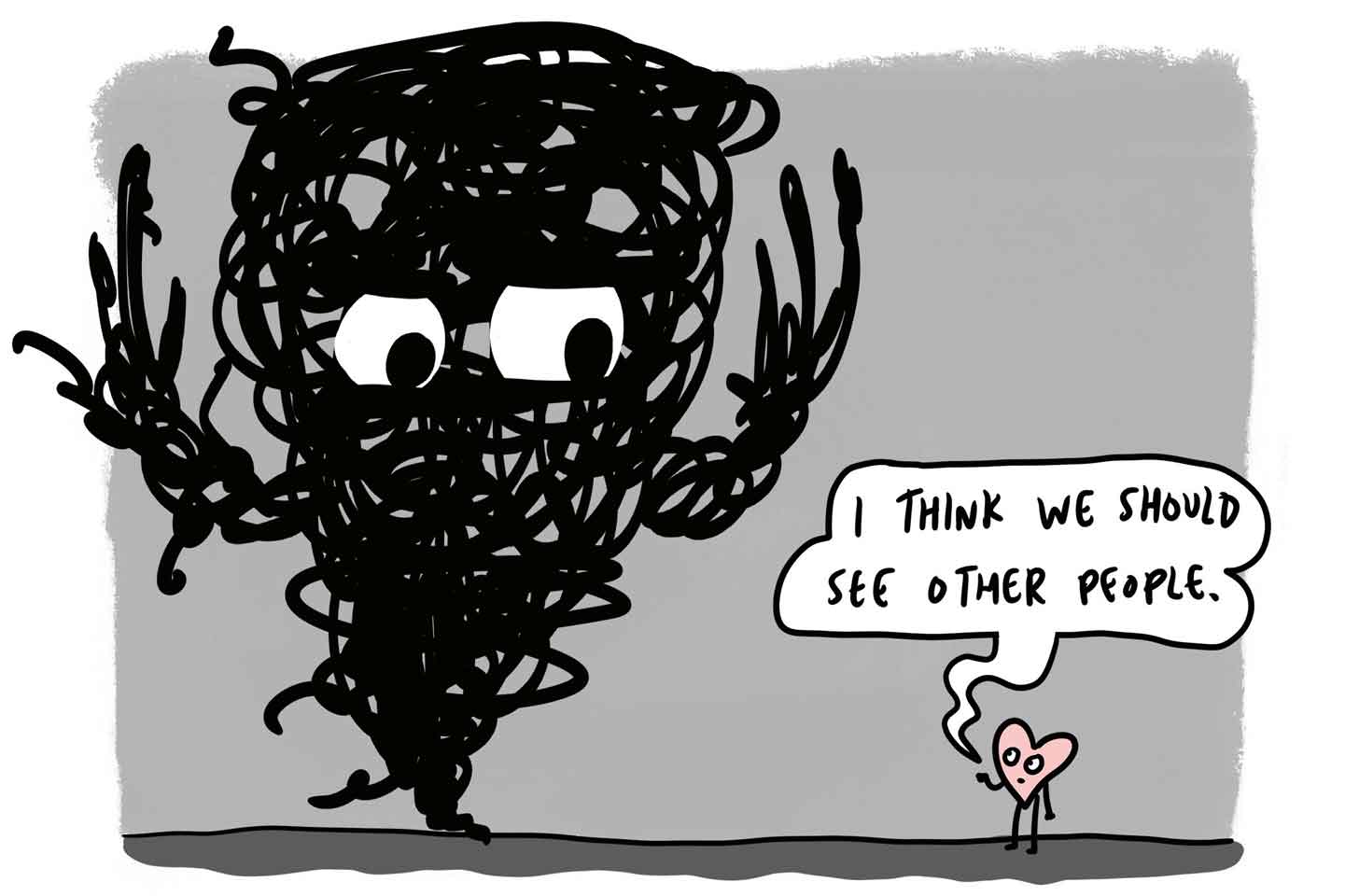
Setting boundaries
Once you emerge from those dark storms, the clouds always part, and you realize that you really do have the strength and wisdom to decide what feelings deserve your attention.
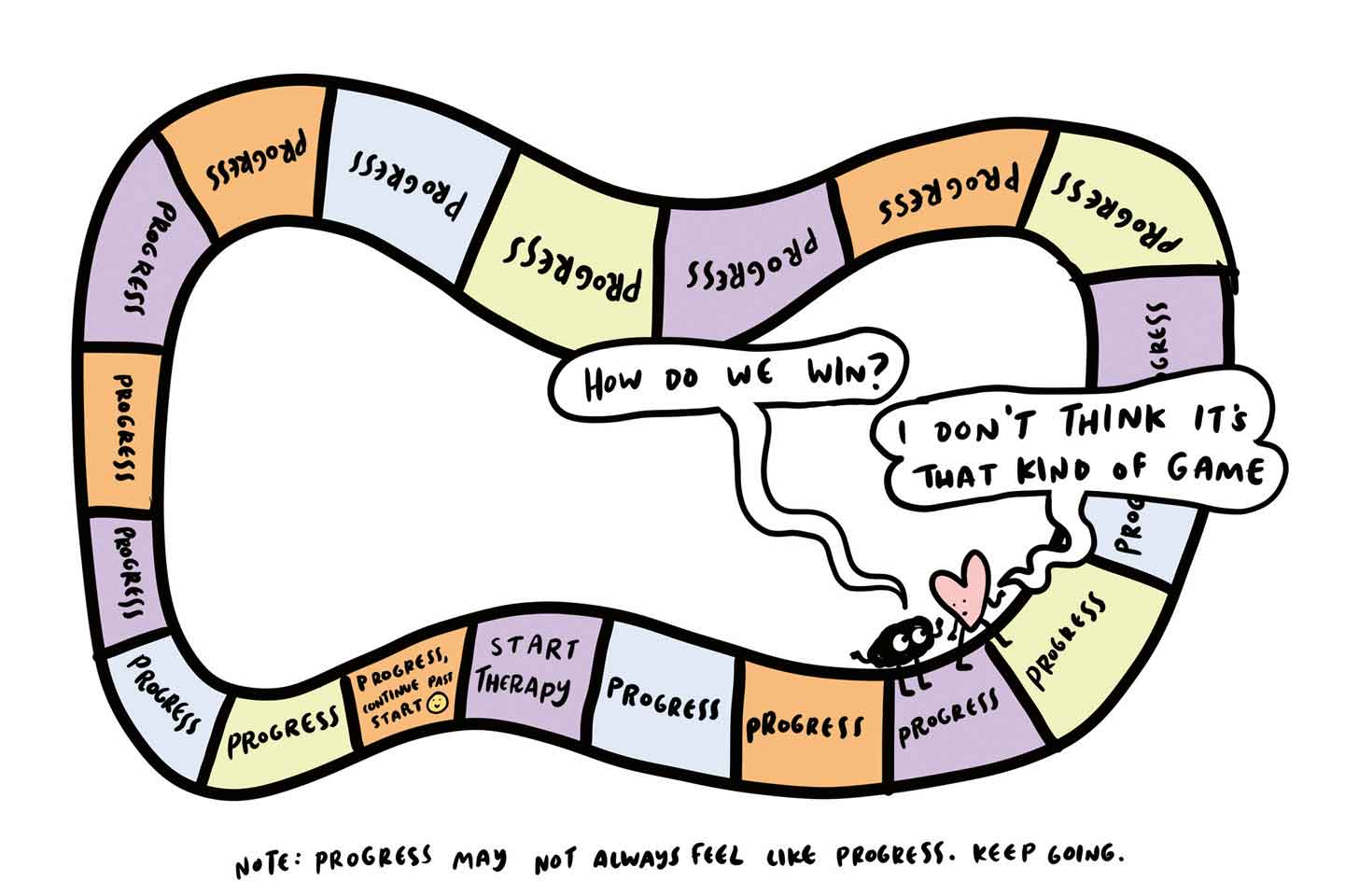
The game of life
Even when healing isn’t linear, you can keep stepping in the right direction — one that leads to a deeper, fuller, and more beautiful life, even with anxiety by your side.
You can learn more and explore more of Haley Weaver’s work at haleydrewthis.com or @haleydrewthis. Check out her new book, “Give Me Space but Don’t Go Far: My Unlikely Friendship with Anxiety,” wherever books are sold.
Header image courtesy of Haley Weaver/Penguin Random House
TikTok trends come in all shapes and sizes: dance routines that low-key feel so hard they must have been created by a professional choreographer, “de-influencing” popular products in the name of reducing wasteful consumerism, and even using filters on “get ready with me” videos for a good cause.
Gone the way of de-influencing, a new trend has taken hold on the social media app that could have tangible implications socially and culturally. It’s called “micro-feminism.”
Essentially: It’s the small, subtle changes someone might make — especially in the workplace — to fight gender inequality.
“Instead of like, standing up, burning your bra, and screaming at people, it’s like little acts that make men pissed off,” TikTok creator Katie Wood said in a video about the subject. “And it’s my favorite f—ing thing to do.”
Wood then goes on to rattle off some ways she does this in her job as an attorney.
For instance, she said, if somebody at her job says “I have to talk to the board,” or the chairperson of the board, CEO — you name it — she will always reply with “let me know what she says.”
“Always she,” Wood emphasized. “By default.”
Of course, feminism, too, comes in all shapes and sizes, but the gist of the movement is that people of all genders deserve to be liberated from oppression. While “bra-burning” and “standing up and screaming” can certainly be useful tactics to meet this goal, practical, everyday actions like these also make a difference.
In fact, they are likely a response to “microaggressions,” or the small, daily ways someone may experience oppression (Think: this clip of a man assuming a woman was a flight attendant, when seconds earlier she had indeed introduced herself as a pilot.)
@katiewood____ as always, I am for the girls 🎀 #microfeminism #feminism ♬ original sound - katie wood
Wood is not the only creator making the rounds on TikTok to discuss micro-feminism.
Creator Ashley Chaney asked viewers what their favorite “micro-feminism” act is, after she shared how, if she is emailing a group of people, she will always address the email to the woman first, and the man second.
Both Wood and Chaney’s original TikToks are abuzz, as thousands comment with ideas of their own.
“I write real estate contracts, and I always put the wife’s name first,” one commenter wrote. “The husbands question it a lot, even though it makes zero difference to the contract — just their ego.”
“I addressed my wedding invitations as ‘Mrs. & Mr. Jane Smith,’” another wrote.
“When a group of male coworkers complete some kind of project or presentation I say ‘great job gentlemen’ or ‘great job boys’ in the same way professional men say ‘great job ladies/girls,’” one user shared.
“When I send emails I no longer say ‘I just wanted to reach out…’” another person said. “Saying just diminishes the importance of my message.”
While these small actions are exactly that — small — seeing thousands of women come together to share them and discover which other tiny ways they can reclaim their power seems to be empowering more than just colleagues on the other end of an email.
Plus, as major corporations cut their diversity, equity, and inclusion programs, fighting back against harmful stereotypes are vital to regaining equal footing in the workplace — and hopefully, reminding employers why DEI work is so necessary.
“This comment section made me realize we are all making small steps each day,” one TikTok user said. “And it deeply matters.”
Header images courtesy of @facebrook, @katiewood____, and @iamashelychaney/TikTok
This story was originally published by Grist. Sign up for Grist’s weekly newsletter here.
When you live far from the sprawling fields befitting utility-scale solar and wind farms, it’s easy to feel like clean energy isn’t coming online fast enough. But renewables have grown at a staggering rate since 2014 and now account for 22 percent of the nation’s electricity. Solar alone has grown an impressive eightfold in 10 years.
The sun and the wind have been the country’s fastest growing sources of energy over the past decade, according to a report released by the nonprofit Climate Central on Wednesday. Meanwhile, coal power has declined sharply, and the use of methane to generate electricity has all but leveled off.
With the Inflation Reduction Act poised to kick that growth curve higher with expanded tax credits for manufacturing and installing photovoltaic panels and wind turbines, the most optimistic projections suggest that the country is getting ever closer to achieving its 2030 and 2035 clean energy goals.
“I think the rate at which renewables have been able to grow is just something that most people don’t recognize,” said Amanda Levin, director of policy analysis at the National Resources Defense Council, who was not involved in preparing the report.
In the decade analyzed by Climate Central, solar went from generating less than half a percent of the nation’s electricity to producing nearly 4 percent. In that same period, wind grew from 4 percent to roughly 10. Once hydropower, geothermal, and biomass are accounted for, nearly a quarter of the nation’s grid was powered by renewable electricity in 2023, with the share only expected to rise thanks to the continued surge in solar.
The vast majority of the nation’s solar capacity comes from utility-scale installations with at least one megawatt of capacity (enough to power over a hundred homes, according to the Solar Energy Industries Association). But panels installed on rooftops, parking lots, and other comparatively small sites contributed a combined 48,000 megawatts across the country.
“One thing that surprised a lot of different people who’ve read the report in our office was the strength of small-scale solar,” said Jen Brady, the lead analyst on the Climate Central report.
With residential and other small arrays accounting for 34 percent of the nation’s available capacity, “it lets you know that maybe you could do something in your community, in your home that can help contribute to it,” Brady said.
Still, the buildout of utility-scale solar farms continues to set the pace for how rapidly renewable energy can feed the country’s grid. According to Sam Ricketts, a clean energy consultant and former climate policy advisor to Washington Governor Jay Inslee, solar’s growth was driven by production and investment tax credits that President Barack Obama extended in 2015 and President Joe Biden expanded through the Inflation Reduction Act, or IRA.
Beyond these federal incentives that allow energy developers to claim tax credits equivalent to 30 percent of the installation cost of renewables, state policies that proactively drive clean energy or promote a competitive market in which the dwindling price of renewables allow them to outshine fossil fuels have been critical to ratcheting up growth.
Yet, even with the accelerating expansion seen in the last decade, more investments and incentives are needed.
“As rapid as that growth has been, how do we make it all go that much faster?” Ricketts asked. “Because we need to be building renewables and electricity at about three times the speed that we have been over the last few years.”
Achieving that rate of buildout is critical for achieving two of President Biden’s climate goals: cutting emissions economy-wide by at least half by 2030 and achieving 100 percent carbon-free electricity by 2035.
To realize those goals, the nation must reach 80 percent clean energy by 2030. “I dare say it’s even more important, for the time being, than 100 percent clean by 2035,” Ricketts said. Hitting that benchmark, he said, will require more federal and state policy pushes. Levin agrees.
“The IRA does a lot,” she said, “but it is not likely to do everything.”
The IRA has the ability to push renewable energy from roughly 40 percent of the nation’s energy mix, when nuclear is included, to more than 60 percent — or, in the most optimistic of scenarios, 77 percent.
But for the growth in capacity to be integrated into the system and utilized, the grid needs to be able to transmit electrons from far-off solar fields and wind farms to the places where they’re needed.
While the transmission conversation most often revolves around building new lines and transmission towers, Levin notes that recent technology advances have made it possible to address half of these transmission needs simply by stringing new, advanced power lines on existing infrastructure that can handle bigger loads with fewer losses, in a process called “reconductoring.”
The other challenge that comes with building out clean energy is learning how to handle the way wind speeds and sunshine fluctuate. While this is often levied as an argument against their reliability, Levin points out that a host of solutions exist — from expanding battery storage to adjusting loads when demand spikes — to ensure they’re reliable. The challenge is adopting them.
“Utilities are risk averse,” she said, “and their commissions can also be risk averse. And so it’s getting them to be comfortable with thinking about the way that they provide electricity and the way that they manage their system a little differently.”
Editor’s note: The National Resources Defense Council is an advertiser with Grist. Advertisers have no role in Grist’s editorial decisions.
Header image by Jane Tyska / Getty Images via Grist
Last year, amid an enormous wave of anti-transgender bills sweeping the nation, trans TikTok duo Mercury Stardust (@mercurystardust) and Jory (@alluringskull) set a major goal of raising $1 million for gender-affirming healthcare.
By hosting a livestream on Trans Day of Visibility, the creators spent 30 hours entertaining fans, discussing important LGBTQ+ topics, and racking up donations — which resulted in doubling their goal and raising $2 million.
All funds went to their nonprofit partner Point of Pride, which provides financial aid and direct support to trans folks in need of health and wellness care.
This year, the duo planned to go even further, announcing a fundraising goal of $4 million. This would be done, again, through livestreams, over the course of a three-day fundraising campaign on the weekend of March 29, 30, and 31.
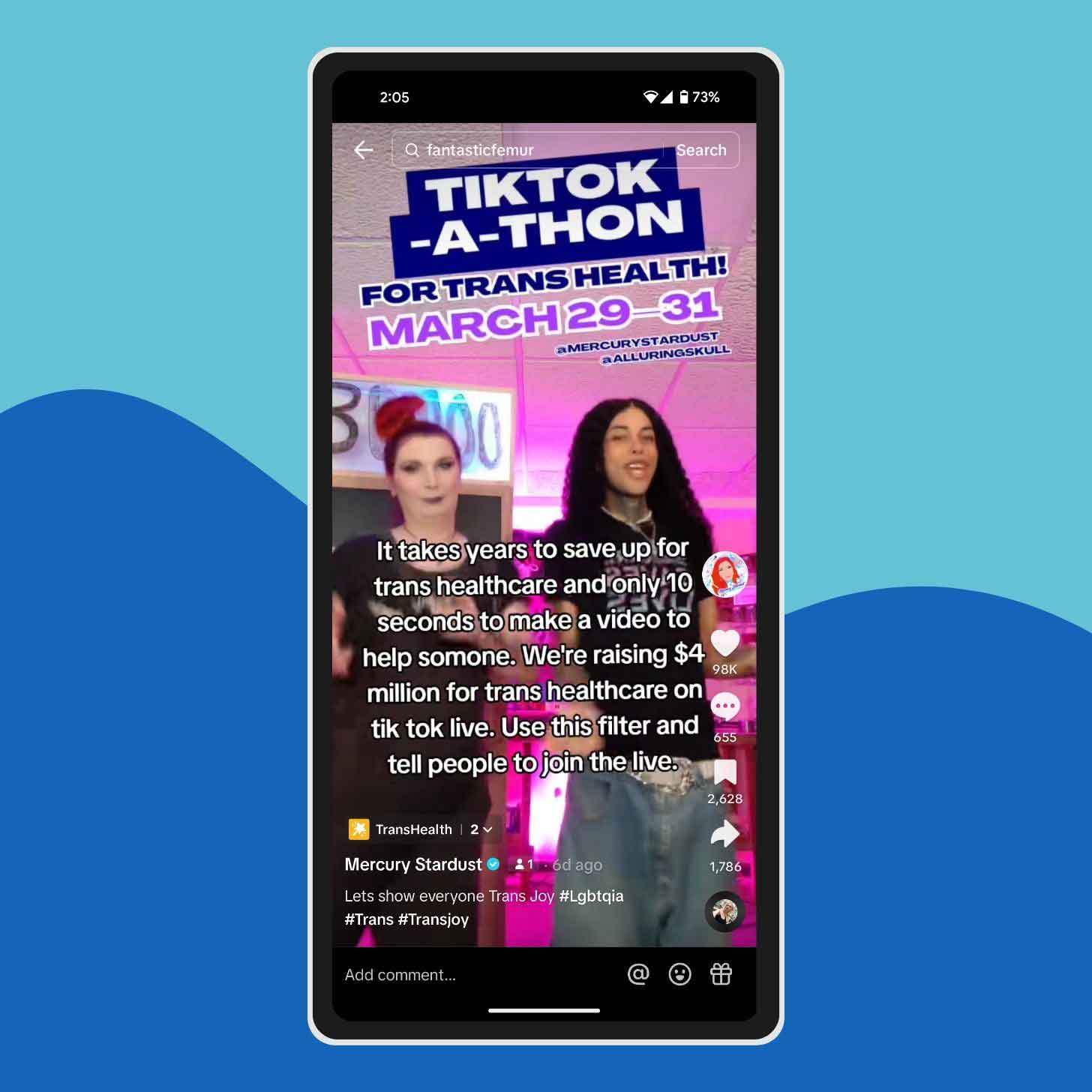
But trolls had other plans.
Although Jory and Stardust took to TikTok with great enthusiasm — and with the support of friends like Dylan Mulvaney and Under The Desk News — they were repeatedly banned from TikTok Live, following organized reporting and hate campaigns from “trolls.”
Despite the setbacks, they were flexible, moving to other accounts, continuing to stream on YouTube and Twitch, and finding ongoing support through other LGBTQ+ content creators. But they were banned over a dozen times from a myriad of accounts.
“Do not allow people to stifle our voice,” Stardust said in a video when she first got banned over the weekend. “Do not allow people to tell us what we can and cannot talk about, or [stop us from] trying to help trans people where they’re at with what we’ve got.”
These livestreams first started on TDOV in 2022, when Stardust — who calls herself the “Trans Handy Ma’am” and makes videos about trans visibility and accessible home repairs — raised $120,000 during a stream.
But as she and Jory have both gained popularity on the app, they have also faced endless harassment. In fact, Jory announced that this would be her last year co-hosting the livestream, as a result of the hate she had received online.

Sadly, the duo did not reach their $4 million goal by Sunday evening — but that has not stopped them from doing a world of good.
At the time of publication, the fundraiser has reached over $1.6 million, from over 36,000 individual donors.
Jory and Stardust — and their many TikTok friends — have continued to livestream when possible, and Stardust posted an announcement the other day, sharing what changes were being made to the fundraising campaign.
“We have decided to focus on hitting 2 million dollars and hit the same goal as last year,” Stardust wrote. “I’ll be on live until we hit 2 million, no matter how long it takes me.”
She took a brief break and had some work-related travel plans but said the livestream would be back in action this upcoming weekend.

“From the bottom of my heart, it means a lot to me. Whether [sic] you donated $1 or $5,000. Whatever you could give is what you could afford, and that is such a beautiful thing to see,” Stardust continued.
“It's not the amount that so many of us should be inspired by, but the number of people who continue to believe in this cause. Thank you to every single one of you.”
Similarly to how she does throughout her livestreams, Stardust made it a priority to highlight the work of Point of Pride.
Last year, donations from the livestream resulted in the following milestones for the organization:
- Over 300 people were able to receive gender-affirming surgery, with 100% of their fees covered by Point of Pride
- Over 4,000 people were able to receive a gender-affirming chest binder or femme shapewear
- Over 120 people received a free year of hormone replacement therapy and access to telehealth
- Over 190 people received a grant of $1,250 to go towards permanent hair removal services
This year’s donations will go towards the same services, which Point of Pride says reach recipients who are “trans youth, folks with disabilities, and folks living in rural or un-affirming regions.”
@mercurystardust We are getting close to hitting 2 million tonight. Join the live and watch it happen!!! #Lgbtqia #trans @Point of Pride ♬ original sound - Mercury Stardust
As much as Jory and Stardust would have liked to reach their ambitious $4 million goal, supporters took Stardust’s message to heart and stayed optimistic about the outpouring of support they had received in the face of so much transphobia.
“I am so proud of you for not giving up,” one supporter wrote in an Instagram caption. “I hope you absolutely SMASH the new goal. And next year? Even BIGGER.”
“Your dedication and perseverance and ability to pivot despite all of the organized hate is truly impressive,” another commenter said.
Another simply added: “Can’t stop trans joy!”
While the next phase of the fundraising campaign will not be in full swing until this weekend, Stardust made one thing abundantly clear: this year’s fundraiser is still a win.
“We are making a difference, and true differences cannot happen overnight,” she wrote. “It happens with a consistent effort of compassion and commitment to those around us.”
Header images courtesy of Mercury Stardust/Instagram and TikTok
Earlier this week, 34 turtles made history in the state of Georgia.
On Wednesday, conservationists and marine biologists marked their largest sea turtle release on state record, as 33 Kemp’s ridley turtles and one green sea turtle were released off of Jekyll Island.
But these turtles aren’t native Southerners; they were brought from a number of aquariums up north: New England Aquarium and the New York Marine Rescue Center in New York, Mystic Aquarium in Connecticut, and Atlantic Marine Conservation Society in Boston.
The New England Aquarium called it a “remarkable cross-organization collaboration,” featuring the help of Turtles Fly Too, an organization that transports endangered sea turtles to new locations.
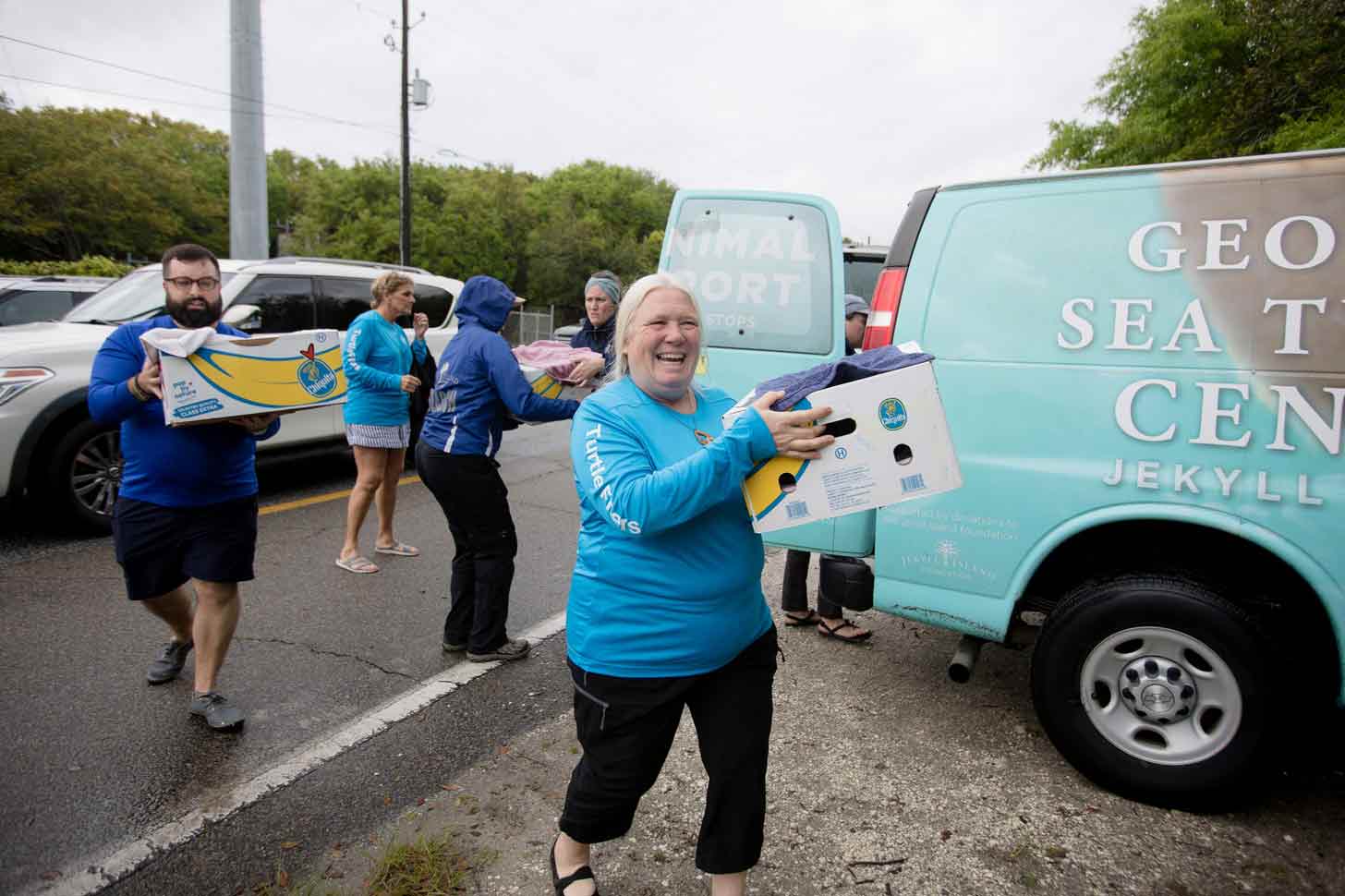
These 34 turtles had previously spent the past few months at these aquariums, undergoing care for hypothermia-related conditions, like pneumonia, dehydration, and trauma, according to a press release from the New England Aquarium.
This happens every fall and winter, as hundreds of cold-stunned sea turtles — many of which are endangered Kemp’s ridley turtles — wash up on the beaches of Cape Cod.
With rapidly changing temperatures, many turtles struggle to escape Cape Cod Bay before succumbing to hypothermia. Fortunately, turtle-loving staff and volunteers patrol these beaches to help transport stranded turtles to aquariums, taking them in for months of rehab.
“It was so rewarding to have this group of sea turtles released on Jekyll Island after being nursed back to health by the New England Aquarium and our partner organizations,” Adam Kennedy, director of rescue and rehabilitation at the New England Aquarium, said in a statement.
“These turtles that stranded late last year have certainly received wonderful care and are fully recovered as we send them back home.”
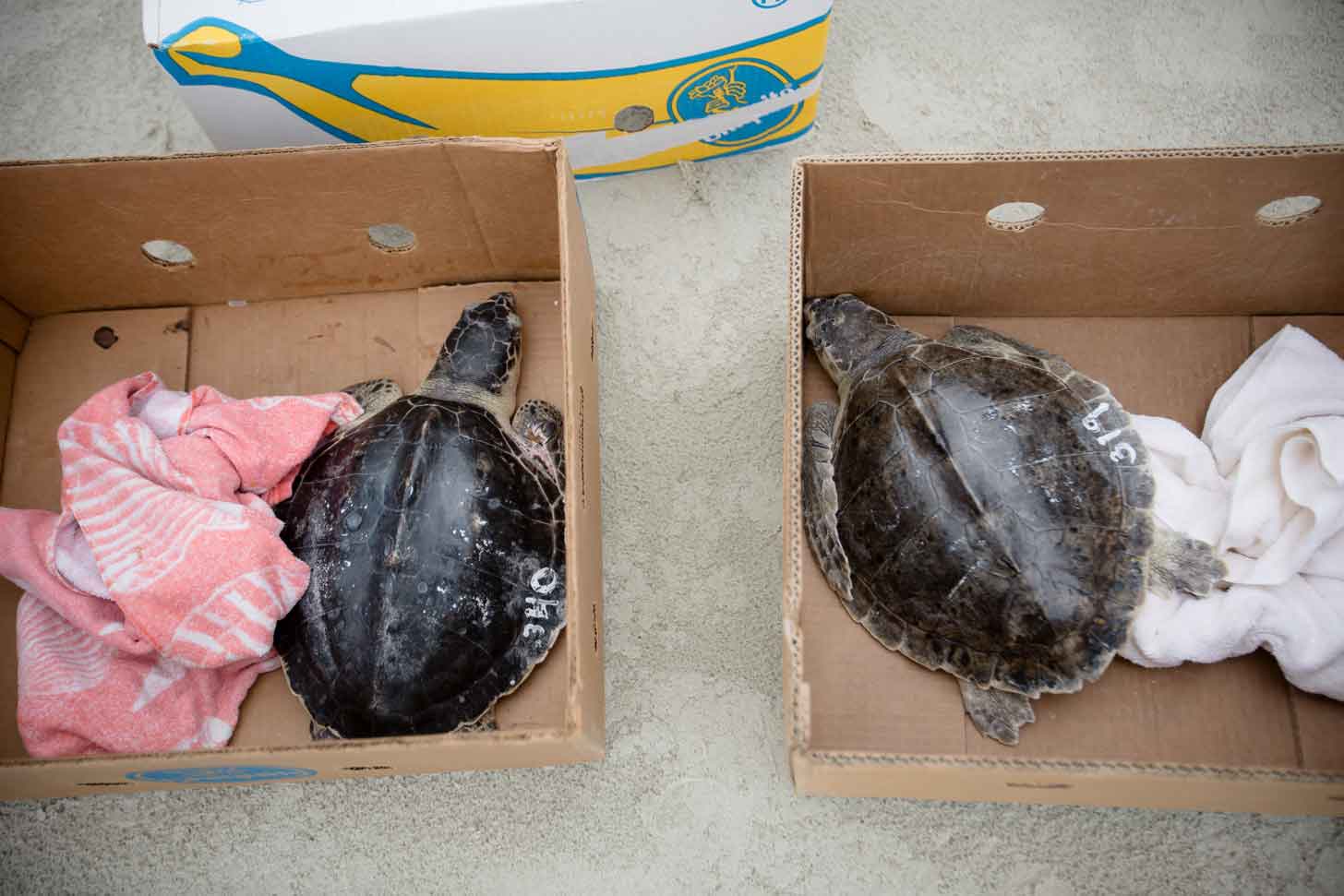
Eleven of the turtles came from the New England Aquarium, including some crowd favorites named Mulberry, Mayflower, and Delphinium.
The effort was coordinated by the Georgia Sea Turtle Center at Jekyll Island. Additionally, dozens of staff members from the agencies involved came to support the project and cheer on the turtles as they were carried into the warm ocean waters.
“Our waters are just now warm enough that we can release animals,” Rachel Overmeyer, the rehabilitation program manager at the Georgia Sea Turtle Center told WJCL News.
“Releases are just so special because it's what we put our blood, sweat and tears into, and it's what we do every day. It is what we work for. So to be able to see them released is really exciting.”
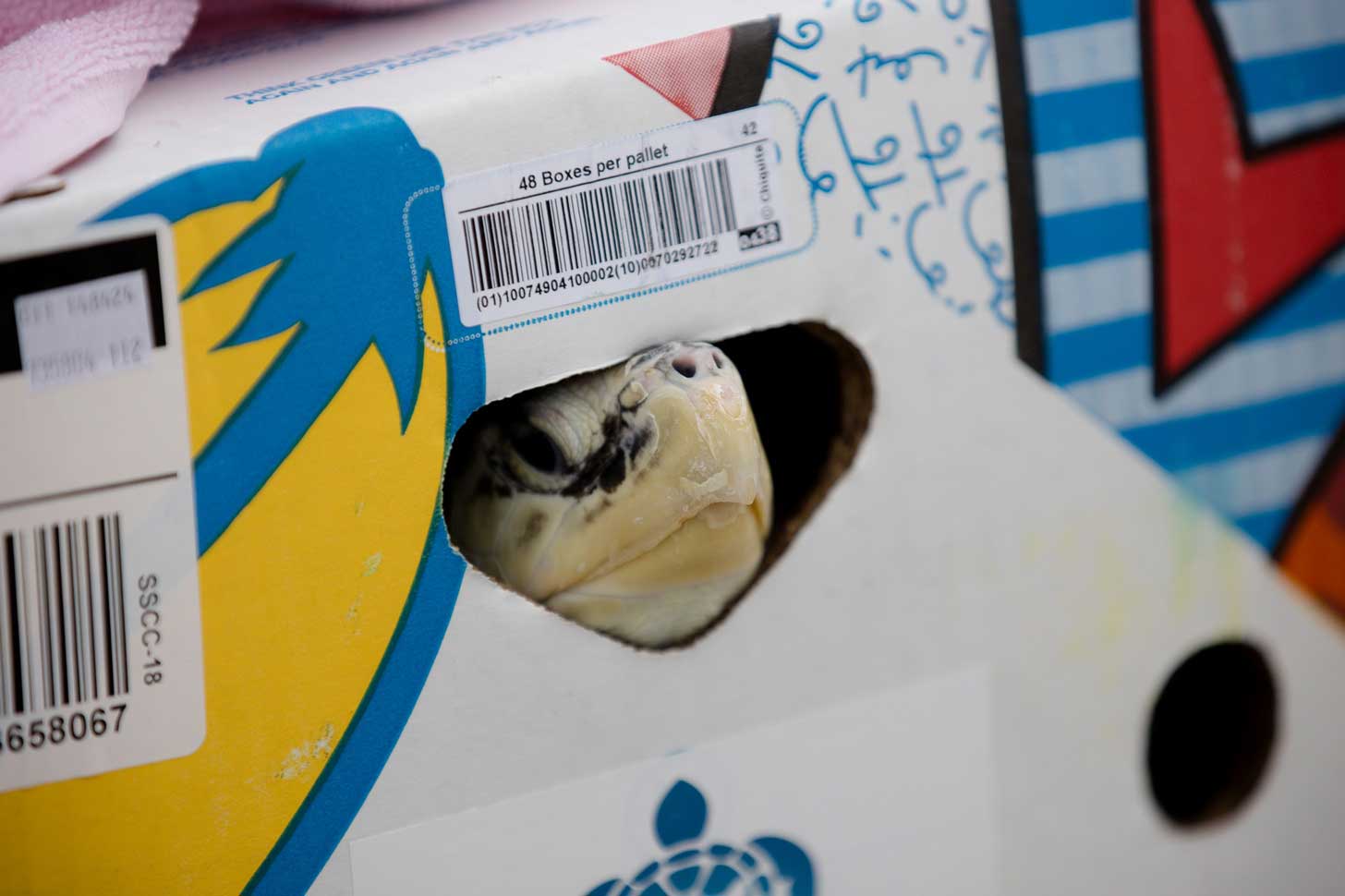
Not only is it exciting to see a crew of turtles return to their rightful home under the sea, but it’s exciting because the Kemp’s ridley turtle is the most endangered turtle species in the world, according to Oceana.
“The rehabilitation and release of just one critically endangered Kemp’s ridley sea turtle can have a huge impact on the population,” said Sarah Callan, manager of Mystic Aquarium’s Animal Rescue Program, in a statement. “We are grateful to play a part in the critical conservation efforts for this species.”
In addition to this annual effort to rescue, rehabilitate, and release these rare reptiles, the New England Aquarium, the National Aquarium, and the South Carolina Aquarium are working with a number of congressional representatives on a bipartisan bill called the Sea Turtle Rescue Assistance Act.
“While all six species of sea turtles found in the U.S. are protected under the Endangered Species Act, there is little federal support directly available to organizations engaged in conservation efforts,” a press release from the New England Aquarium explained.
“The bill would help institutions continue to provide the rescue, rehabilitation, and research needed to help these animals.”
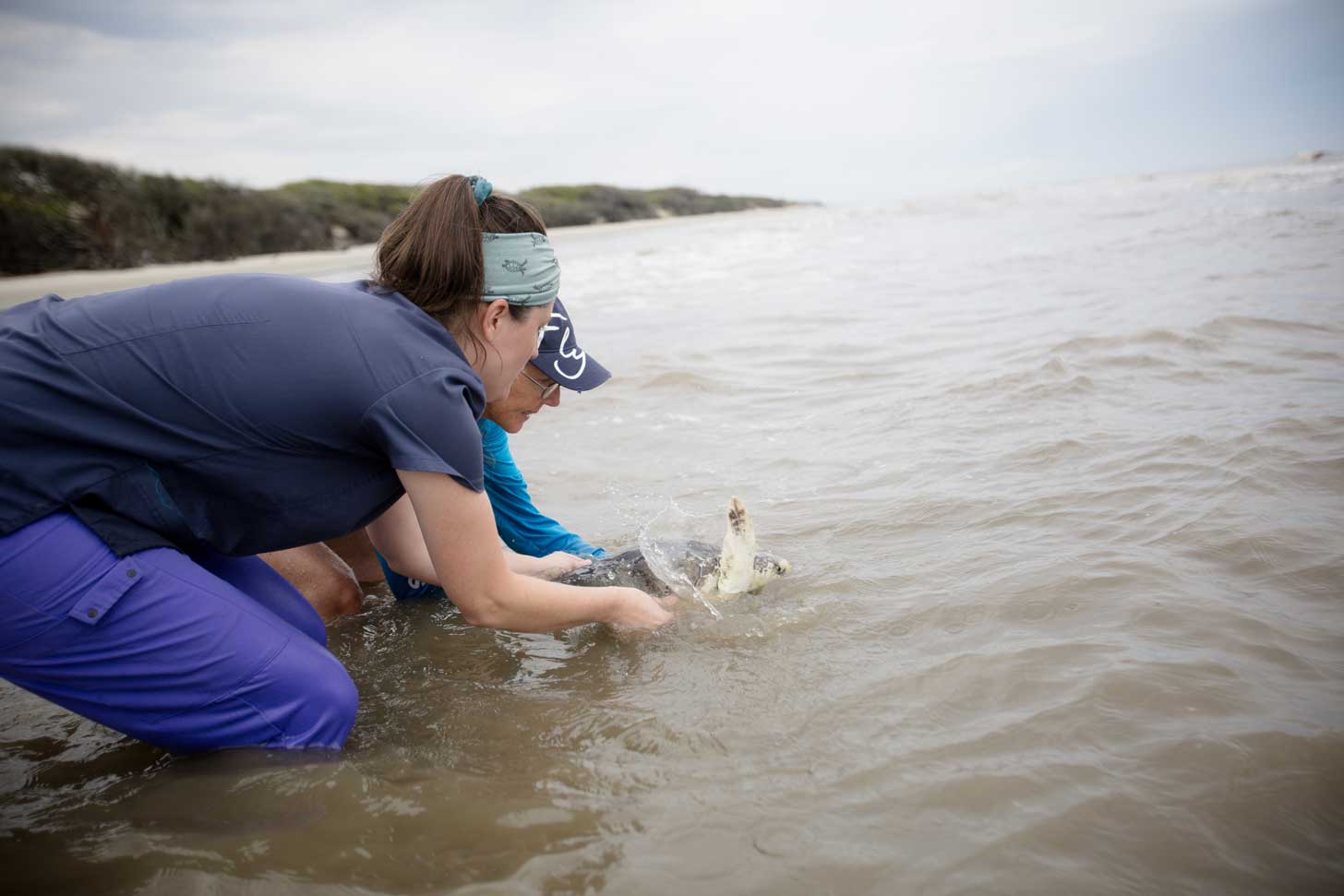
While these 34 turtles are emblematic of a major victory off of Georgia’s shores, experts hope they are also indicative of a more proactive future for sea turtles across the country.
Michelle Kaylor, director of the Georgia Sea Turtle Center said: “Through collaborative efforts, we can ensure the successful rehabilitation and return of these magnificent creatures to their natural habitats, safeguarding their future for generations to come.”
Header image courtesy of Turtles Fly Too
Board game lovers are likely familiar with “Catan” — the line of modern strategy games that take place across time and space (even in the “Game of Thrones” realm of Westeros) and task players with trading resources to survive.
But their latest board game “Catan: New Energies” hits a lot closer to home.
The new game, set to release in spring 2024, is set in modern day and challenges players to settle their land while mitigating environmental disasters and navigating overpopulation. If pollution levels reach too high, the game ends for everyone.
Before Klaus Teuber — the original designer of “Catan” — passed in August 2023, he sat down together with his son Benjamin and designed “Catan: New Energies.”
“As we designed this game, my dad said, ‘A game is an experience—not a lecture,’” Benjamin Teuber said in a press statement. “Therefore, we are not telling players how to act best; we're inviting them to learn and draw their own conclusions through play.”
They wanted to implement the harmful impacts of real-world issues like flooding, air pollution, and environmental pollution every time players draw a brown token.

Fortunately, the game invites players to exchange resources for “research” cards so that they can build renewable power plants, draw green tokens, and reap the benefits of clean energy.
The real world diverges from the game play in one central aspect: renewable energies today are more affordable than fossil fuels like coal and natural gas.
“It’s always the same challenge—to wrap this huge complexity of an outside environment into a board game,” Benjamin Teuber admitted in an interview with Fast Company. “That has been very much the challenge here, because on top of that, I’m not a scientist.”
Even so, the Teubers and the Catan company at large wanted to make sure that they could minimize every environmental aspect of the manufacturing process. This meant ensuring that the game was made from sustainably sourced wood and paper and cutting plastic — even shrinkwrap — out altogether.
“Of course, that means yeah, it’s a little more expensive,” said Kelli Schmitz, director of brand development at Catan Studio. “It’s not a cheap game — it can’t be. I think that just illustrates the point of the game, making those conscious decisions where you can. Nothing’s going to be perfect, but all those things add up to something that is better than what it was before.”
Like most modern strategy games, “Catan: New Energies” is still competitive. But Klaus Teuber always wanted to foster cooperation in his creations, from the moment he made “Settlers of Catan” in 1995.
“You cannot destroy someone's building,” Klaus Teuber once told NPR. “It's impossible. You have to communicate.”
Of course, only one person will achieve the most victory points, but in order to win the game, players have to trade resources and learn to live alongside each other on the island.
That point is even more prescient in “Catan: New Energies,” where the risk of pollution marks the end of the game for everyone at the table. And that’s the message Benjamin and Klaus wanted to convey in the last game they made together.
“The outcome of this game won’t change the world,” said Benjamin Teuber. “But maybe your way of thinking will change, and you can later go and change the world.”
Header image courtesy of CATAN GmbH / CATAN Studio