Every day the Good Good Good team collects the best good news in the world and shares it with our community. Here are the highlights for this week!
If you want to get good news in your inbox every day, join the Goodnewsletter — the free daily newsletter designed to leave you feeling hopeful.
The Best Positive News We’re Celebrating This Week —
In a unanimous vote, Sacramento just declared itself a ‘sanctuary city’ for transgender people
Ahead of yesterday’s Transgender Day of Visibility, the Sacramento City Council voted unanimously on a resolution to declare the city a “sanctuary city for transgender people.”
Effective immediately, no city resources will be used to criminalize trans folks who are looking for transition-related care or to cooperate with other jurisdictions enforcing laws in places where the care is criminalized.
The resolution goes a step beyond state law, sending “a powerful signal to everyone in our community that we are a safe place for everyone.” Major medical associations in the U.S. support this kind of transition-related care, deeming it medically necessary.
Why is this good news? As lawmakers across the country are increasingly working to limit gender-affirming care, effectively denying trans folks the right to exist, Sacramento paving the way for people to get the life-changing (and even life-saving) health care they need without fear is important progress.
LEGO just announced new accessibility standards at its stores to make them more inclusive for all
April is Autism Acceptance Month, and LEGO just announced it’s celebrating by partnering with KultureCity, a nonprofit focused on sensory inclusion and accessibility, to make its stores more accessible for all LEGO lovers.
In addition to all-new comprehensive staff training, every LEGO store will offer “sensory bags” created by a team of research professionals and neurodivergent developers. They include noise-reducing headphones, a visual cue card, and more.
A store manager said they’ve already seen how the training and inclusion initiative has reshaped shopping experiences for customers — and their neurodivergent customers echo those sentiments.
What’s even better: Already this year, the LEGO Foundation’s Play For All Accelerator program has disbursed over $11 million in grants to five organizations that center on the development of innovative toys, products, and services for neurodivergent children around the world. LEGO also recently started mass-producing Braille bricks.
→ Read more
More people care about climate change around the world than you might think
Data shows that globally, a significant majority of people in countries around the world both worry about climate change and support policies to address it. At the same time, this level of concern is also consistently underestimated by most people.
In recently published research, 59,000 people across 63 countries were surveyed and 86% said they believed in climate change — that action was needed, humans caused it, it was a serious threat to humanity, and/or a global emergency.
Even in the country with the lowest agreement, 73% still agreed it was a serious threat.
More research surveyed nearly 130,000 people across 125 countries, and 89% wanted to see more political action for climate change, and 69% said they’d contribute at least 1% of their income to support efforts to address climate change.
Not only is it encouraging to know that the majority of your friends, family, and neighbors (all over the world!) agree that climate change is a major issue — but this knowledge can also help governments, companies, and even individuals take meaningful climate action.
Phoenix just passed a historic ordinance to protect outdoor workers from extreme heat
The Phoenix City Council just unanimously passed an ordinance that requires employers to give outdoor workers easy access to rest, water, and shade, to receive training to recognize signs of heat stress, and more to protect them from extreme heat.
The ordinance will impact thousands of workers in the country’s hottest city, which saw a record 31 consecutive days of over-110-degree heat last year. With climate change intensifying these extreme temperatures, these requirements are more critical than ever.
The new extreme heat protections are thanks to the advocacy work of unions and local workers and will impact workers in engineering, construction and airport projects, and other city services.
Why is this good news? Intersecting with racial justice, data shows the risk of death from heat stress for Latine workers is over three times higher than their peers. And while representing about 32% of the population, 40% of outdoor workers are Hispanic or Black.
→ Read more
By making a small change to its book design, a major publisher has saved thousands of trees
HarperCollins is one of the four major book publishers in the world, and its designers recently set out on a mission to reduce the carbon footprint of each book they publish by reducing paper.
The publisher’s designers set out to maximize both page space and readability, and so far their tweaks have made a massive difference: the company has saved 245.6 million pages — equivalent to 5,618 trees.
The new, more intentional, planet-friendlier design was an intensive process of testing fonts, spacing, and more to develop the new design standard. Ultimately, they landed on fonts that also use less ink, which is better for the planet, too.
→ Read more
More good news about trees:
- Worldwide tree cover has grown by 2.24 million square kilometers — the size of Texas and Alaska combined — in the last 35 years.
- Tree-free paper made from what would otherwise be a wasted material is saving both forests and farmers in Washington.
- ‘Reforestation hubs’ are saving trees from heading to landfills by finding new ways to repurpose the wood, which in turn saves money, helps increase forest cover, and more.
After a decade of explosive growth, nearly one-quarter of U.S. electricity now comes from renewables
While it can be hard to see when you don’t live right next to a solar or wind farm, renewables have actually grown at a staggering rate since 2014 — and now account for 22 percent of electricity in the U.S.
In the past decade, solar went from generating less than half a percent of the nation’s electricity to producing nearly 4 percent. In that same period, wind grew from 4 percent to roughly 10.
Once hydropower, geothermal, and biomass are accounted for, nearly a quarter of the nation’s grid was powered by renewable electricity in 2023, with the share only expected to rise thanks to the continued surge in solar.
What’s even better: The Inflation Reduction Act is poised to kick the growth curve even higher with expanded tax credits for manufacturing and installing photovoltaic panels and wind turbines, so the most optimistic projections suggest that the country is getting ever closer to achieving its 2030 and 2035 clean energy goals.
Despite transphobic trolls, a TikTok creator raised millions for gender-affirming care in honor of Trans Day of Visibility
Now in its third year, TikTok creator Mercury Stardust’s annual livestream — co-hosted by Jory — raises money for Point of Pride, which provides financial aid and direct support to trans folks in need of health and wellness care.
After raising $2 million last year, this year they set out to reach $4 million over the course of a 3-day livestream in honor of Transgender Day of Visibility. But trolls had other plans.
Although Jory and Stardust took to TikTok with great enthusiasm — and with the support of friends — like Dylan Mulvaney and Under the Desk News — they were repeatedly banned from TikTok Live, following organized reporting and hate campaigns from “trolls.”
Despite the transphobic attacks, they were flexible and continued streaming on various platforms. And while they were banned over a dozen times from a myriad of accounts — they still raised $1.6 million to help trans folks in need.
And they’re not stopping: Stardust promised to keep the fundraiser going until they reach their new goal.
More good news of the week —
India’s government is replacing “minimum wage” with “living wage” by 2025. Often higher than minimum wages, living wages are defined as the income needed to meet basic needs like housing, food, healthcare, education, and clothing.
A Los Angeles-based artist is helping folks get up close and personal with the immigrant experience. Uncomfortable and infuriating, hopeful and liberating, noé olivias’ new “Gilded Dreams” exhibition goes beyond the surface-level facts about immigration in the United States.
Researchers in the UK figured out how to diagnose bowel cancer without biopsies. The medical breakthrough would eliminate the need for a risky, invasive procedure that can result in infection and limits to what it can capture.
A building in Detroit was transformed into permanent housing for veterans experiencing homelessness. Four organizations in the city and a national partner are using data to reduce homelessness toward “functional zero.”
Thousands of farmers in Africa have reforested a combined area about seven times the size of Manhattan in less than 10 years. The TREES program helps farmers swap monoculture crops for biodiverse forest gardens, which provide food, protect the soil, and improve tree cover.
Every new mom in Flint, Michigan is getting cash aid for an entire year. The city has one of the country's highest rates of child poverty, and is rolling out the new benefits to wipe out deep poverty during a crucial time for child development.
volunteering with hard-to-adopt shelter dogs. Many of the dogs he cares for have been returned to the shelter for having too much energy, poor behavior, or even running away.
To fight a severe outbreak of the fever, Brazil is releasing millions of anti-dengue mosquitos. The country has recorded 1.6 million probable cases since January – the same number reported for all of last year – and 491 confirmed deaths.
Five years after hundreds washed up dead onshore, the West Coast’s grey whale population has recovered. The total number is now between 17,400 and 21,300, an increase from an estimated 13,200 to 15,960 whales last year.
An Oregon-based startup is making it easier for people to be informed citizens and thoughtfully engage with politics. The Citizenly platform provides a “complete, accurate, and continuously updated database of every politician in the country.”
When budget cuts threatened their local library, the Salem community came together to give it overwhelming support. The effort brought teens, librarians, and other community members out to support continued funding for the Salem Public Library.
The Interior Department is investing $25 million to protect and maintain two wetland areas in the Southwestern U.S. The Yuma East Wetlands and Topock Marsh in Arizona are both important for resilience and drought mitigation.
As part of the country’s major health care reform, women in Canada will get free contraception. The Canadian government will cover the cost of the most widely used contraceptive methods for nine million Canadian women of reproductive age.
A network of newsrooms and community organizations gets people to attend under-reported public meetings and publish the results. Their efforts help make sure everyday citizens aren’t left in the dark when local elected officials are making big decisions.
Scientists discovered solar-powered technology that converts salt water into drinking water with zero emissions. By maximizing available solar power for water production, scientists produced drinking water cheaper than ever before in lower-income countries.
Many people in the U.S. will have an opportunity to witness nearly four minutes of a total solar eclipse on Monday, April 8, 2024, as it moves from southern Texas to Maine. But in the U.S., over 7 million people are blind or visually impaired and may not be able to experience an eclipse the traditional way.
Of course they, like those with sight, will feel colder as the Sun’s light is shaded, and will hear the songs and sounds of birds and insects change as the light dims and brightens. But much of an eclipse is visual.
We are a planetary scientist and an astronomer who, with funding and support from NASA’s Solar System Exploration Research Virtual Institute, have created and published a set of tactile graphics, or graphics with raised and textured elements, on the 2024 total solar eclipse.
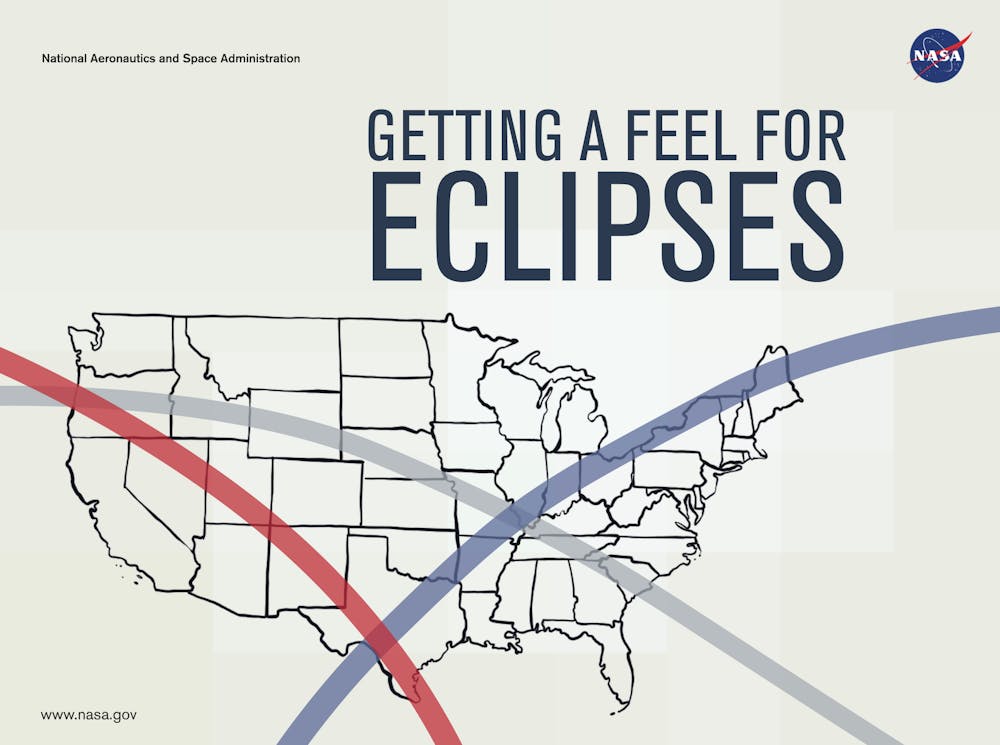
The guide, called “Getting a Feel for Eclipses,” illustrates the paths of the 2017 total, 2023 annular and 2024 total solar eclipses. In a total eclipse, the Moon fully blocks the Sun from Earth view, while during an annular eclipse, a narrow ring of sunlight can be seen encircling the Moon.
The tactile graphics and associated online content detail the specific alignment of the Earth, Moon and Sun under which eclipses occur.
To date, we have distributed almost 11,000 copies of this book to schools for the blind, state and local libraries, the Library of Congress and more.
Why publish a tactile book on eclipses?
NASA has lots of explanatory material that helps people visualize and understand rare phenomena like eclipses. But for people with visual impairments, maps and images don’t help. For tactile readers, their sense of touch is their vision. That’s where this guide and our other tactile books come in.
Over 65,000 students in the U.S. are blind or visually impaired. After working with several of our students who are totally blind, we wanted to find out how to make events like eclipses as powerful for these students as they are for us. We also wanted to help our students visualize and understand the concept of an eclipse.
These aims resulted in the three tactile graphics, which are physical sheets with textures and raised surfaces that can be interpreted through touch, as well as online content.
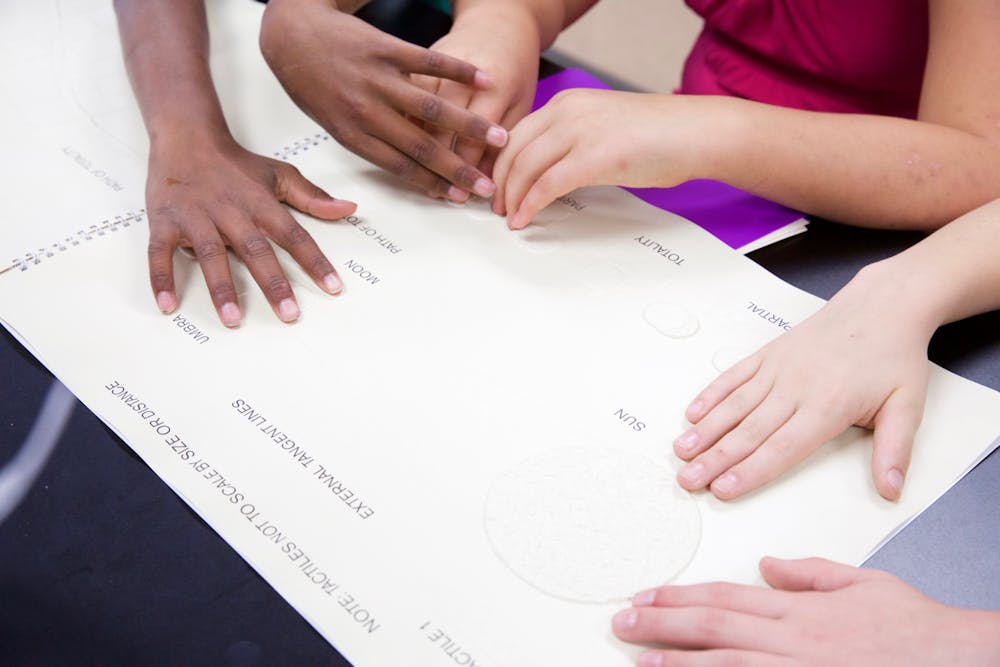
The first tactile graphic models the alignment of the Earth, Moon and Sun. The second illustrates the phases of an eclipse as the Moon moves in between the Earth and Sun to full totality, and then out of the way. The third includes a map of the continental U.S. that illustrates the paths of three eclipses: the Aug. 21, 2017, total eclipse, the Oct. 14, 2023, annular eclipse and the Apr. 8, 2024, total eclipse. We used different textures to illustrate these concepts.
Each book includes a QR code on the front cover, outlined by a raised square boundary. The code links to an online guide that leads the user through the content behind the graphics while also providing background information. With the online content, users may opt to print the information in large font or have it read to them by a device.
Although initially created to assist visually impaired audiences, these books are still helpful resources for those with sight.
Some students can see but might learn better when able to explore the tactile parts of the guide while listening to the audio.
Often it’s helpful for students to get the same information presented in different styles, with options to read or have the content information read to them.
How are the books made?
We hand-make each book starting by identifying which science concepts the user will likely want to know, and which illustrations can support those concepts.
Once identified, the next step is to create a tactile master, or model, which has one or more raised textures that help to define the science concepts. We pick a set of unique textures to use on the master to signify different items, so the Sun feels different than the Earth. This way, the textures of the graphics become part of the story being shared.
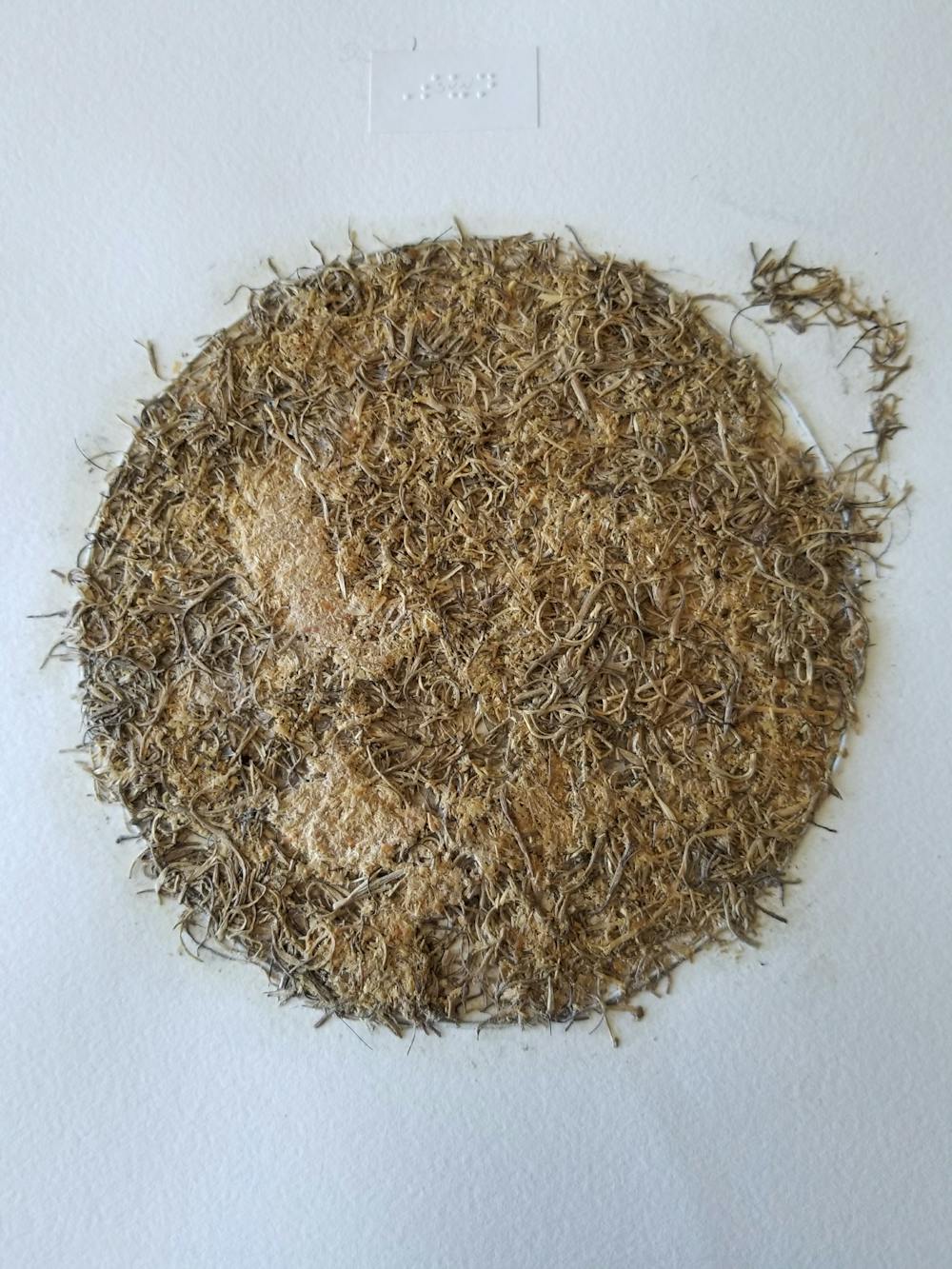
For example, in a model of the Sun’s surface, we use Spanish moss to create the dynamic texture of the Sun.
In past projects, we’ve used textures like doll hair, sand and differently textured cardboard to illustrate planet features, instruments on spacecraft, fine surface features and more.
Then, we add Braille labels for figure titles, key features and specific notes.
Once we’ve finished making the masters and laying out each page, a small family print shop – McCarty Printing in Erie, Pennsylvania – prints the page titles and key feature labels on Brailon, a type of plastic paper.
Once printed, we place the masters and the Brailon sheets on a thermoform Machine, which heats up the sheets and creates a vacuum that forms the final tactile graphics. Then, we return the pages to McCarty Printing for binding.
Viewing and experiencing the eclipse
Like fully sighted people, people with partial vision should avoid looking directly at the Sun.
Instead, everyone should use eclipse glasses. If you don’t have eclipse glasses, you can use an indirect viewing method such as a colander or pinhole projector.
As the eclipse approaches totality, take time to enjoy your surroundings, feel the changes in temperature and light, and note how the animals around you react to the remarkable event using another of your senses – sound.
This article by Cassandra Runyon from College of Charleston and David Hurd from Pennsylvania Western University was originally published by The Conversation.
Header photo courtesy of the European Space Agency

On April 7, musician Chappell Roan took to her Instagram to invite fans to stop by her merch table at upcoming tour dates and drop off friendship bracelets for a good cause.
“We are taking donations at the merch table,” Roan wrote in an Instagram story caption. “Drop off Chappell/LGBTQ+ themed friendship bracelets. We resell them and 100% goes to the charity below: mercyusa.org.”
Mercy-USA for Aid and Development is a nonprofit organization that provides humanitarian aid, healthcare, and access to clean water to causes on a global scale.
Mercy-USA is currently raising emergency funds for relief in Gaza, as well as promoting a monthly, trifold campaign to benefit families in Gaza, Yemen, and Syria on the brink of famine.
According to their website, Mercy-USA has partnered with the United Nations Relief and Works Agency (UNRWA) for 15 years “supporting education and healthcare projects, as well as responding to emergencies like this one.”

Why friendship bracelets?
Last year sparked a renaissance for friendship bracelets, as the Taylor Swift song lyric “make the friendship bracelets, take the moment and taste it” inspired Eras tour attendees to bring bracelets and exchange them with fellow fans.
The trend soon caught with concert fans at large as they crafted colorful, themed bracelets in anticipation of Beyoncé, Noah Kahan, and Olivia Rodrigo shows.
Roan and her band opened for Rodrigo during the first leg of her GUTS tour — which has already done its fair share of giving back.
What causes has Roan supported in the past?
In February, Rodrigo launched a reproductive rights initiative at the tour’s kickoff in California, with a portion of Rodrigo and Roan’s GUTS Tour ticket proceeds benefiting Fund 4 Good.
“Fund 4 Good works to support all women, girls, and people seeking reproductive health freedom,” Rodrigo said in an Instagram live announcement. “The fund will directly support community-based nonprofits that champion things like girls' education, support reproductive rights, and prevent gender-based violence.”
In March, Rodrigo announced that ticket proceeds from tour stops in Montreal and Ontario would go to Women’s Shelters Canada, which provides resources and shelter for women seeking safety from abuse.
“Abuse can take many forms. It can be physical, it can be online, it can be emotional, it can be financial, it can be psychological,” Rodrigo shared in an Instagram story. “This is a very important cause to me.”
While Roan’s ties to Rodrigo’s fundraisers are more recent examples of her advocacy work, Roan has been using her platform to amplify social justice movements for years.
Since her single, “Pink Pony Club” propelled her to stardom in 2020, the singer has done concert benefits and raised funds for a number of nonprofits including The Trevor Project, The GLO Center, and For The Gworls.
“Let’s redistribute our funds to the trans community right now,” Roan said in an interview with Teen Vogue last summer.
“Let’s make sure our trans community is okay on rent. Let’s have each other’s backs right now. Let’s be safe and watch out for each other. Give with your heart but also give with your wallet and your time.”
Header image via Jason Martin / Flickr (CC BY-SA 2.0 DEED)
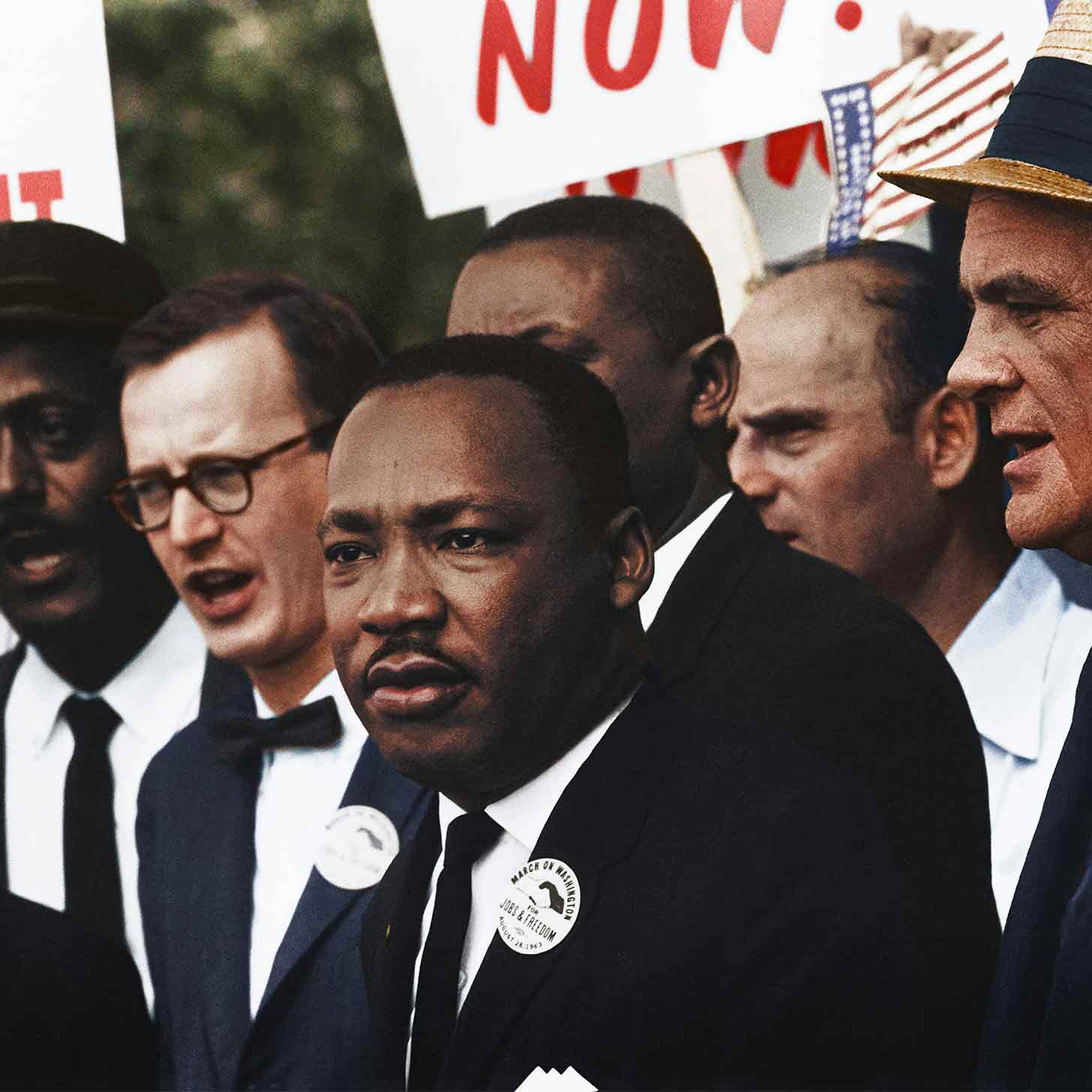
On April 3, 1968, standing before a crowded church, the Rev. Martin Luther King Jr. painted his vision for justice. “I’ve seen the Promised Land,” he said. “I may not get there with you. But I want you to know tonight that we, as a people, will get to the Promised Land.”
Twenty-two hours later, he was assassinated.
King’s prophetic words express the virtue of hope amid hardship. He was not optimistic that he would reach the “Promised Land,” yet he was hopeful about the ultimate goal.
In conversation, “hope” and “optimism” can often be used as synonyms. But there’s an important gap between them, as psychology research suggests.
One of the most common tools to measure optimism asks people how much they agree with statements such as, “In uncertain times, I usually expect the best.” Those who strongly agree are regarded as highly optimistic.
But optimism can rely on a sense of luck over action. Self-help books on optimism are lined with hacks – like imagining your greatest possible self or focusing on the best-case scenario.
My psychology research studies how people perceive hope and justice. Long-term hope is not about looking on the bright side. It is a mindset that helps people endure challenges, tackle them head-on and keep their eyes on the goal – a virtue that King and other community leaders exemplify.
We, not me
Hope is often defined in psychological research as having strong will to succeed and plans to reach a goal.
Hope is stronger than optimism at predicting academic success and people’s ability to cope with pain. Plenty of scientific evidence suggests that hope improves individuals’ health and boosts their well-being.
But branding hope as a self-improvement tool cheapens this long-established virtue. Hope has benefits beyond the self. Thus, many psychologists are expanding the study of hope beyond personal success. My research team defines this “virtuous hope” as striving toward a purposeful vision of the common good – a hope often shaped by hardship and strengthened through relationships.
Many leaders, including King, have channeled that lesson to inspire change. Centuries of spiritual and philosophical work describe hope as a virtue that, like love, is a decision, not a feeling.
The myth of time
King wasn’t known for looking on the bright side or expecting the best from others. He faced repeated waves of criticism, and, at the time of his death, fewer Americans approved of him than of the Vietnam War.
In “Letter from a Birmingham Jail,” King lamented the optimism of moderate white Americans who said they supported his goals but took little action. There is a “strangely irrational notion that there is something in the very flow of time that will inevitably cure all ills,” he wrote. “Actually, time itself is neutral; it can be used either destructively or constructively.”
He chastised society for believing that improvement would simply happen on its own. When he said, “The arc of the moral universe is long, but it bends towards justice,” he was not describing its natural trajectory, but what people have the power to change. You cannot expect greener pastures if they are not tended today.
The Revs. Ralph Abernathy and Martin Luther King Jr. greet supporters as they are released from jail in Birmingham, Ala., on April 20, 1963.
King was not alone in leveraging virtuous hope for justice. Brazilian educator Paulo Freire described hope as an “existential imperative” that promotes action. Nelson Mandela, who spent 27 years in prison, called hope a “powerful weapon.”
Forged in adversity
What makes hope a virtue is not its ability to promote happiness and success but its commitment to a greater good beyond the self.
I study virtuous hope in a South African Zulu community, where there are few reasons for optimism. South Africa has the world’s steepest inequality. Unemployment is high, and social mobility is low. This is the part of the country where HIV is most widespread, with the percentage near 50% in some communities.
We studied several people seen as embodying hope, based on their reputation and community suggestions. These individuals demonstrated an unwavering focus on striving for a better future, often unglued from expectations of personal success.
One local farmer nominated by his community struggled to buy seeds for his crops but still helped others apply for grants to buy them. Even when his own future was uncertain, he was not hoarding. He described his hope as a commitment to help others. His hope is not a positive expectation but a moral commitment.
Our interviewees did not describe hardship as a suppressor of hope but as its context to grow.
One unemployed young woman said she had applied for jobs for four years and would continue, though she was not naïve about the tough future. She said applying for jobs and reading to her child were her acts of hope. Her hope didn’t expect a quick improvement, yet it warded off paralysis.
Many of our interviewees anchored their hope in their Christian faith, as did King. King often referenced St. Paul, one of the first Christian writers, who wrote, “Suffering produces endurance, endurance produces character, and character produces hope. Now this hope does not disappoint us.”
Hope, in other words, plays the long game: enduring suffering with integrity. Like King’s, it manifests in hardship and is refined in adversity. Hope enables communities to march for justice and democracy even while tasting the danger of dictatorship, apartheid or oligarchy.
Hope knows it may take another generation to reach the Promised Land, but it acts today to bend the moral arc toward justice.
This article was written by Kendra Thomas of Hope College, and originally published on The Conversation.

Yesterday, approximately 32 million people in North America came together to gaze upon the total solar eclipse, all united by the collective awe of a major celestial event — and the day’s must-have accessory: eclipse glasses.
These glasses — which were distributed from some retail locations around the United States, or from local libraries and eye doctor’s offices — are key to avoiding damage to the eyes when looking up at the sun. Simply put: If someone wants to enjoy the eclipse, these glasses are required.
While it was easy to find these futuristic cardboard glasses around the country (folks could even get them for free with a themed drink from places like Sonic or Smoothie King), they are not as easily accessible in other places around the world — places that also experience special, humanity-affirming celestial events.
In fact, Latin America will be the site of an annular eclipse this upcoming October, and Eclipse Glasses USA is collecting those gently used souvenirs from folks who enjoyed yesterday’s show among the stars.
The annular eclipse will take place on Oct. 2, 2024, with a “ring of fire” passing over parts of the Pacific Ocean, southern Chile, and southern Argentina.
Through the company’s Eclipse Give Back Program, folks can send their undamaged glasses to be donated to schools in Latin America for the upcoming eclipse. “Undamaged” means that they will accept glasses without any scratches, punctures, or tears.
“The beauty of this donation program lies in its global reach. Solar eclipses are not limited to one region or country; they occur at different times across the world,” the company writes on its website.
“By collecting and redistributing eclipse glasses, Eclipse Glasses USA ensures that children in various countries can marvel at this celestial event without risking their eyesight.”
Those who want to ship their used glasses to the cause have until August 1 of this year to do so, mailing them to the following address:
Eclipse Glasses LLC
PO Box 50571
Provo, UT 84605
And if you’re ready to stock up ahead of time for the next total solar eclipse over North America in 2044, Eclipse Glasses USA also has a “5 for 1 program,” which donates one pair of eclipse glasses for every five-pack of glasses sold. As of this April, the program has donated over 30,000 glasses.
“Eclipse Glasses USA’s donation program is more than just a charitable initiative. It’s a movement that aims to bring people together, irrespective of geographical boundaries, under the vast canopy of the universe,” the company writes.
“It’s about sharing, caring, and ensuring that the wonders of the cosmos are accessible to all, especially the curious minds of the future.”
Aside from making sure these safety tools are free and accessible to folks in other areas of the world, this is also a way to practice sustainability — especially as we marvel at the beauty of living here on Earth.
“Gather your communities, collectively pull your money together and ship them down in one container so you’re not wasting carbon emissions, and reuse those glasses,” sustainability TikToker Dominic Gambaiani said in a video.
“If we all shared more resources, we could change our mindset and live more sustainably.”
Other ways to donate or recycle eclipse glasses
Since most eclipse glasses are made from cardboard, they can be easily recycled by punching out the lenses. However, if you want to leave it to the professionals, there are a variety of ways to donate or recycle your used glasses.
- Drop off your glasses at all Warby Parker locations across the country by April 30 to donate them to Astronomers Without Borders
- Find a donation location on this list of community partners that work with Astronomers Without Borders
- If your local library distributed glasses, check to see if they are accepting return donations
- Hold onto them! The American Astronomical Society says modern eclipse glasses do not expire and will last until 2044, as long as they comply with the ISO 12312-2 certification and are not damaged
Header image courtesy of Adam Smith on Unsplash
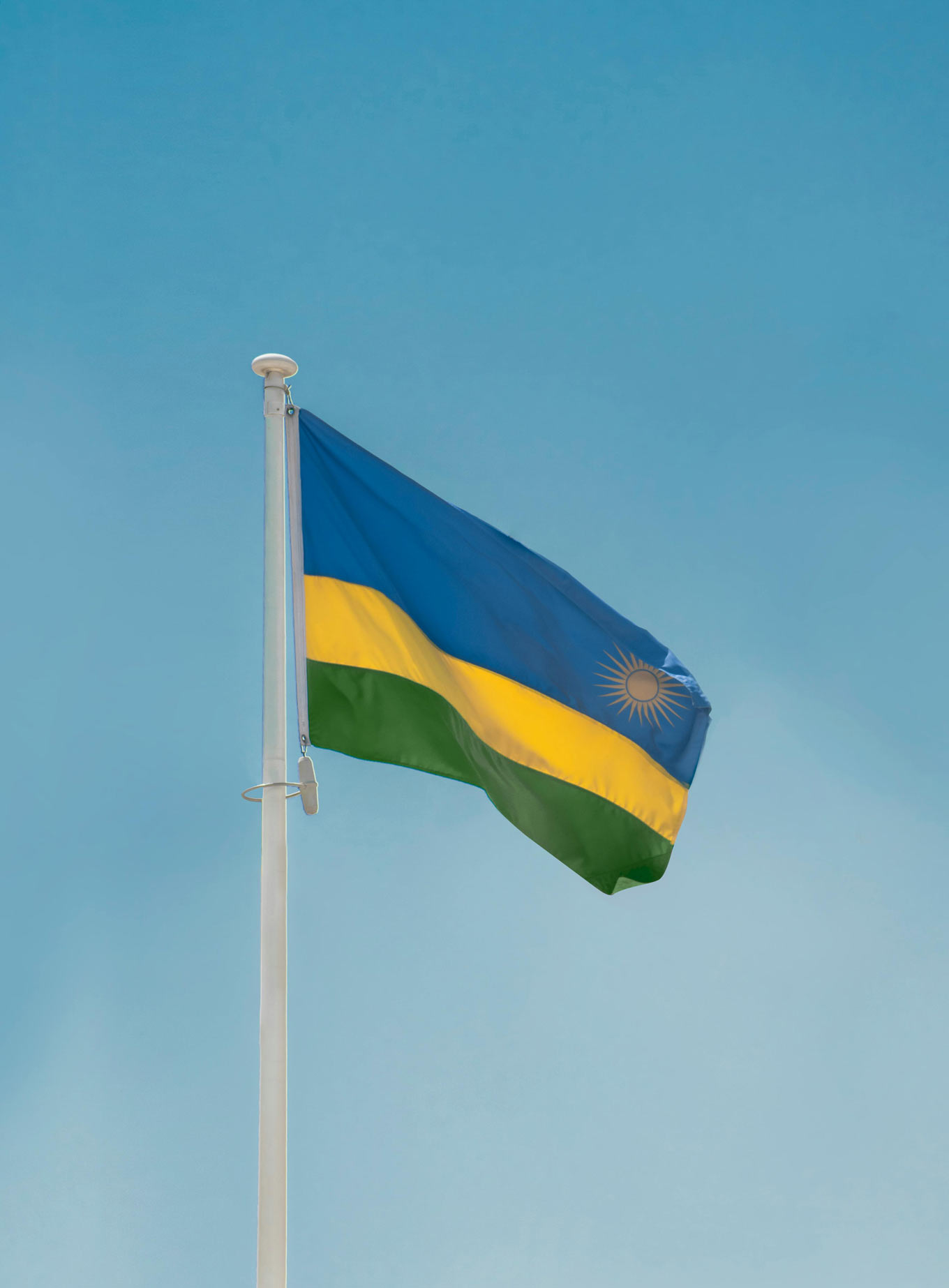
It’s 30 years since a genocide ripped through Rwandan society, leaving up to a million Tutsi and non-extremist Hutu dead.
Every year in early April, the country enters a 100-day period of commemoration during which Rwandans are asked to remember and reflect on historical divisions between the country’s main ethnic groups: Tutsi, Hutu and Twa.
This is done under the banner of Ndi Umunyarwanda, loosely translated as “I am Rwandan”.
This post-genocide unified ideology follows the governing Rwandan Patriotic Front’s interpretation of the country’s history. It views Tutsi, Hutu and Twa as a form of socio-economic division rather than being rooted in ethnic differences.
Some western scholars, such as Filip Reyntjens, Alison Des Forges and Catharine Newbury, dismiss this interpretation of history.
They argue that ethnicity was always an important aspect of Rwandan society and not a colonial construct.
In my view, based on 16 years of research on Rwanda and its public policies post-genocide, they miss an essential aspect of why Ndi Umunyarwanda exists. It was designed as a mechanism for the country to move on from its past divisions and prevent a repeat of the genocide.
During recent fieldwork in Rwanda (December 2022 to March 2023 and August to September 2023), I paid particular attention to whether Ndi Umunyarwanda had taken hold in the new generation of Kigali’s residents. I attended multiple social gatherings with Kigali’s growing middle class of Rwandans between the ages of 24 and 35.
During conversations with 50 millennials and Gen Zs, it appeared that the government’s wish for the youth to accept Ndi Umunyarwanda had been effective. Attendees had little desire to bring up what they classified as their parents’ divisions and instead saw each other as fellow Rwandans.
In my view these conversations illustrate the success of Ndi Umunyarwanda and, more broadly, the Rwandan government’s desire for post-genocide social reconstruction.
But among Rwanda’s older generation, the fear of a resurgence of ethnic tensions remains alive.
Many within the Rwandan government are concerned that not enough time has passed to foster a unified identity that can fully expel an ideology that wrought so much carnage.
In particular, the government is acutely sensitive to the activities of the militia group, the Democratic Forces for the Liberation of Rwanda, based in neighboring Democratic Republic of Congo (DRC).
The 2,000-strong armed force includes people known to have been perpetrators in the genocide.
The war on the border
In Kigali, there’s been growing nervousness about the wave of violence in eastern DRC. The Congolese army has been accused of cooperating with the Democratic Forces for the Liberation of Rwanda, which is made up of remnants of Rwanda’s past genocide forces.
This has driven Rwandan concerns about increased military supplies to the group, and it being given political legitimacy.
However, the threat it poses doesn’t stem from its military capability — the group has little strategic, operational or tactical capabilities to defeat the Rwandan army and seize control from Paul Kagame’s government.
Rather, its perceived threat stems from the views held by the people who make up the force.
These fears have been further stoked by the actions and language being used by officials in Felix Tshisekedi’s government against the Banyamulenge population.
This group historically originated from Rwanda but has lived in the DRC for generations.
Over the past two years, violence against them — often from the DRC’s army and the Democratic Forces for the Liberation of Rwanda — has escalated.
The language coming from the Congolese government is worrying Rwandan policymakers. Congolese minister of higher education Muhindo Nzangi and government spokesman Patrick Katembwe, for instance, have openly called for the persecution of the Banyamulenge.
Rwandan foreign minister Vincent Biruta has said the language of ethnic hatred against the Banyamulenge that’s coming from Congolese officials reminds him of the language used by perpetrators just before the 1994 genocide.
The language coming from the DRC is worrisome for Rwandan policymakers as it not only threatens the Banyamulenge, but also follows patterns that afflicted Rwandan society. But how serious is the threat to Rwanda’s post-genocide social reconstruction of Ndi Umunyarwanda?
Rwandans hold confidence in their government and military to protect them from security threats, including from the Democratic Forces for the Liberation of Rwanda.
Nevertheless, the ideology these threats contain is seen as the primary risk of returning Rwanda to its past divisions.
In my view, this risk is rather low. But concern still remains within the government, as well as among those who experienced the genocide.
Their memories of divisionism and ethnic-based hatred still influence their concerns of Rwandan security and its future.
Deep-rooted scars
Many within the Rwandan government, especially in the inner circles of power, either fought to end the genocide or were victims of it.
The deep-rooted scars of their experience influence their desire for national social re-engineering.
Many are still nervous that the past Hutu extremist ideology that promoted divisions and hatred, which the Democratic Forces for the Liberation of Rwanda promotes, could override the progress made by Ndi Umunyarwanda.
The comfort of scapegoating others for one’s problems is often tempting.
With the 30th commemoration, Rwandan embassies and high commissions will engage with the Rwandan diaspora.
There will be national events in Kigali, but most will be held in local villages and towns to remember the past and help foster a united future.
They need not look far to see the warning signs of how society can slip into scapegoating and how this can lead to violence. The increased violence and ethnic-based language in eastern DRC are a steadfast reminder.
While the physical threats from across the border cannot be dismissed, internally Rwanda is closer to Ndi Umunyarwanda unity than genocide divisions.
This article by Jonathan Beloff, from the King's College London, was originally published by The Conversation.

Following a series of confusing and disturbing assaults on women in New York City in previous weeks — in which mysterious men would walk up to young women and punch them in the face — some American women took to TikTok sharing how women in other parts of the world are confronting gendered violence and inequality.
And what has been taking hold in South Korea since about 2019 — following the debut of Cho Nam-Joo’s novel “Kim Jiyoung, Born 1982” — has been reinvigorated on social media for women around the world: The 4B movement.
The 4B movement represents four strategic “nos” set forth by Korean feminists: No dating (biyeonae), no heterosexual sex (bisekseu), no heterosexual marriage (bihon), and no child-rearing and childbirth (bichulsan).
“Many who vow to follow 4B defend the no dating and no sex rule as their response to the intimate violence and nonconsensual porn crimes that hit the headlines daily,” journalist Hawon Jung writes in her book “Flowers of Fire: The Inside Story of South Korea's Feminist Movement.”
Intimate violence and nonconsensual porn crimes? Indeed; South Korean women have long been oppressed by patriarchal systems the same way many women in the U.S. have. But as the #MeToo movement gained traction in America, so too did the #WithYou movement in Korea, as women began to fight back against harassment and lack of autonomy.
South Korea's Gwangwhamun plaza was the site of mass anti-corruption rallies in 2016 that led to the ouster of then-leader Park Geun-Hye. Now thousands of women gathered here to protest against another "social evil" plaguing the country - rampant online voyeurism targeting women. pic.twitter.com/q1x47luvoU
— Hawon Jung (@allyjung) August 5, 2018
“Sexual harassment and sex-based crimes are rife, especially with hidden cameras that secretly film women in almost every imagineable space, from public transportation to bathrooms in offices and schools,” Jung wrote. “And even in the privacy of their own homes.”
This lack of privacy and bodily autonomy is only one arm of what Korean women fight against.
The country has recorded the largest gender pay gap in the Organization of Economic Cooperation and Development’s annual survey since 1996.
Women are confronted with extremely harsh beauty standards — and the country is seen as the world’s capital for cosmetic surgery.
Abortion has been illegal in most circumstances for decades.
Nearly 80% of women have been sexually harassed at work, per a 2015 study from the South Korean government.
Workforce discrimination and outdated familial expectations require mothers to handle all childcare and household responsibilities.
The current president, Yoon Suk-Yeol is attempting to close down the country’s Ministry of Gender Equality and Family.
Patriarchy is the law of the land.
So, 4B has become the resistance.
How do people participate in the 4B movement?
Publicly identifying as a feminist is still heavily taboo in Korean culture, so the 4B movement is made of members who identify themselves online as “anonymous women,” typically keeping personal or identifying information private.
But between digital conversations and IRL rallies, the movement advocates for women to reject societal expectations as a protest against patriarchy.
And beyond that, it’s about individual women making individual choices to not participate in society as it stands now.
“We see this opting out kind of running throughout East Asia. It’s this idea that marriage is no longer required to have a good life. You can have a job. You can make money on your own. And in fact, it is not only no longer required, it might actually stifle your life because of gender relations within the household,” Demographer Jennifer Sciubba said recently on an episode of “The Ezra Klein Show.”
“In these low fertility societies, it seems to be the case that women are not willing to reproduce the current social structures. They are not working for them to a huge degree, to the point that they are willing to opt out of this idea of marriage and having children, and seek a different path for themselves.”
While 4B itself is too new to be entirely responsible for the country’s current demographics, South Korea is already in dire straits when it comes to a declining birth rate.
South Korea currently holds the lowest fertility rate in the world, with projections estimating that it will drop to 0.68 this year — compared to the global average of around 2.4. Experts even say that the country’s population of 51 million may halve by 2100.
Not only do these numbers threaten the general population, but they also pose major consequences for the country’s economy and military strength.
While the government has attempted to make change with some initiatives — spending the equivalent of $270 billion in childcare and childbirth subsidies — many South Korean women still see having children as too much of a risk in the success-driven but equality-starved country.
“Practicing bihon means you’re eliminating the risks that come from heterosexual marriage or dating,” Yeowon, a 26-year-old Korean office worker, told The Cut in a recent article.
@wtfaleisa Replying to @user9720585462941 ♬ original sound - wtfaleisa
More candidly, a TikToker named Alesia posted earlier this year explaining the movement. “It’s hilarious because all the men, and the government, are like ‘oh my god what do we do?’” She said.
“South Korean women have been very clear from day one… like ‘hey, either you get your act together, or we are literally eliminating all of this. We’re shutting it down.’”
What is the impact of the 4B movement?
Due to the anonymous and varied nature of 4B, it’s unclear how many people identify as members of the movement, with estimates anywhere from 5,000 to 50,000 followers, according to The Cut.
Regardless, the movement has been polarizing. Jung writes in her book that anti-feminists call 4B participants — or young women in general — “mentally diseased,” following “antisocial ideology.”
While declining birth rates are certainly concerning — and can be even more distressing upon understanding the nature of this social justice campaign — 4B has ultimately put the onus on men to answer for the systems they have created and upheld.
“The patriarchal norms in South Korea, given its economic status and the educational level of its women, are so relentless that the resistance against it tends to be just as intense,” Lee Na-Young, a sociology professor at Seoul’s Chung-Ang University, said in Jung’s book.
“Movements like 4B are a message of warning that women would boycott romantic relationships unless society and men change.”
On the other hand, women and those who are pro-4B are calling for the movement to extend beyond the borders of South Korea. As the principles of 4B take hold online, women from around the world are curious what this sort of organized action could do on a global scale.
Even influential political voices, like former Florida Congressional candidate Pam Keith, could see the movement traveling west.
“I’m going to say this once: 4B movement,” she tweeted earlier this month. “Keep coming for our rights, GOP.”
As governments — including the U.S. — continue to eliminate choice from women, 4B is the result of women leveraging the choices they do still have.
“For me, ‘no marriage’ is not just a lifestyle,” Kang Han-Byul, a 35-year-old Korean woman who follows 4B, told Jung in an interview for “Flowers of Fire.”
“It’s a way of trying to bring down patriarchy.”
For Kang’s mother, Helen Kim, who had spent most of her life adhering to misogynistic gender roles and self-sacrifice, the movement is one of hope.
“My daughter and her generation is different and should be different. Our daughters deserve better,” she said in the book.
“I hope my daughters will live a happy, fulfilling life, finding inspirations from friends and growing old together with them in a world that respects a more diverse way of life.”
Header image courtesy of Hawon Jung/X
Since the 1960s, the world has seen a spike in the number of natural disasters, largely due to rising sea levels and an ever gradually increasing global surface temperature.
The good news? We’re getting better at helping each other when disasters strike.
According to a recent study from Our World In Data, the global toll from natural disasters has dramatically dropped in the last century.
“Low-frequency, high-impact events such as earthquakes and tsunamis are not preventable, but such high losses of human life are,” wrote lead authors Hannah Ritchie and Pablo Rosado.

To conduct their research, Ritchie and Rosado gathered data from all geophysical, meteorological, and climate-related disasters since 1900. That includes earthquakes, volcanic activity, landslides, drought, wildfires, severe storms, and mass floods.
In the early-to-mid 20th century, the average annual death toll from disasters was very high, often climbing to over a million.
For example, the study cites that in 1931, 2.7 million people died from the Yangtze–Huai River floods. In 1943, 1.9 million died from the Bangladeshi famine of 1943. Even low-frequency events had extreme death tolls.
“In recent decades we have seen a substantial decline in deaths,” Ritchie and Rosado observed. “Even in peak years with high-impact events, the death toll has not exceeded 500,000 since the mid-1960s.”
Why has the global death toll from disasters dropped?
There are a number of factors at play in the improvement of disaster aid, but the leading component is that human beings are getting better at predicting and preparing for natural disasters.
“We know from historical data that the world has seen a significant reduction in disaster deaths through earlier prediction, more resilient infrastructure, emergency preparedness, and response systems,” Ritchie and Rosado explained in their study.
On April 6, a 7.2 magnitude earthquake rocked the city of Hualien in Taiwan. Days later, as search and rescue continues, the death toll currently rests at 16.
Experts have praised Taiwan for their speedy response and recovery, and attributed the low death toll to the measures that Taiwan implemented after an earthquake of similar strength hit the city 25 years earlier. Sadly, on that day in 1999, 2,400 people died and 11,000 were injured.
In an interview with Al Jazeera, Wang Yu — assistant professor at National Taiwan University — said that event, known as the Chi-Chi earthquake, revolutionized the way Taiwan approached natural disasters.
“There were lots of lessons we learned, including the improvement of building codes, understanding earthquake warning signs, the development and implementation of earthquake early warning (EEW) systems and earthquake education,” said Wang.
Those same sensors and monitoring systems allowed authorities to create “shakemaps” during Hualien’s latest earthquake, which helped them direct rescue teams to the regions that were hit the hardest.
This, in conjunction with stronger building codes, regular earthquake drills, and public education campaigns, played a huge role in reducing the number of deaths from the event.
And Taiwan’s safeguards on April 6 are just one example of recent measures against disasters. Similar models in strengthening prediction, preparedness, and recovery time have been employed around the world when it comes to rescuing victims of floods, wildfires, tornados, and so on.
What else can we learn from this study?
When concluding the findings from their study, Ritchie and Rosado emphasized the importance of increasing safety measures for everyone.
Currently, there is still a divide between populations with high gross national income and populations living in extreme poverty.
Even low-income countries that infrequently have natural disasters have a much higher death rate because they are vulnerable to collapse, displacement, and disrepair.
“Those at low incomes are often the most vulnerable to disaster events; improving living standards, infrastructure, and response systems in these regions will be key to preventing deaths from natural disasters in the coming decades,” surmised Ritchie and Rosado.
“Overall development, poverty alleviation, and knowledge-sharing of how to increase resilience to natural disasters will therefore be key to reducing the toll of disasters in the decades to come.”
The California condor — the largest bird in North America — went extinct in the wild in 1987.
But a new bundle of joy has just hatched at the San Diego Zoo, thanks to the conservation efforts of the San Diego Zoo Wildlife Alliance.
The birth of this new chick marks the 250th egg to be hatched at the zoo. It was born to mom Mexwe, and dad Xol-Xol, the first California condor brought into human care under the California Condor Recovery Program in 1982.

When Xol-Xol was brought to the zoo, the population had dropped to a low of just 22 birds, making this milestone — over 40 years later — especially exciting.
“Reaching this milestone feels incredible,” Nora Willis, senior wildlife care specialist at the San Diego Zoo Wildlife Alliance, said in a press release.
“Seeing the success… of the California Condor Recovery Program as a whole is really inspiring. There’s still a long way to go but being part of this and helping the species recover is life-changing.”
The chick, whose sex is not yet determined, has been named Emaay (pronounced “eh-my”), a Kumeyaay word for “sky.”
Before hatching, Emaay (the egg version), was placed in an incubator to be closely monitored by a care team. The egg was also taken to a nearby medical center for a CT scan after a brief concern for “malposition,” but was given a clean bill of health and returned to Xol-Xol and Mexwe for hatching.

Wildlife care workers monitored infrared cameras around the clock, as the proud parents welcomed Emaay into the world from the privacy of their nest. Emaay was born on March 16, but just made their debut with a “hard launch” announcement nearly a month later.
Under the recovery program at the zoo, Xol-Xol has fathered 41 chicks since 1993 — many of which have been reintroduced to their native habitat. Emaay is expected to join them in 2025.
According to the Cornell Lab of Ornithology, there are now approximately 275 free-flying condors in California, Utah, Arizona, and Baja California — and the conservation work of the San Diego Zoo Wildlife Alliance has definitely played a role in this ongoing recovery.
“The resurgence of the California condor is a conservation success story,” the zoo shared in a press release. “Today, there are more than 560 living California condors, with over half free flying.”

The International Union for Conservation of Nature lists the bird species as Critically Endangered, with populations increasing. However, major threats to their survival include lead poisoning, habitat loss, and emerging diseases, exacerbated by climate change.
Beyond the San Diego program, there are four other reintroduction sites in the U.S., working to ensure these birds can return to their native habitats in Northern Arizona, Big Sur, Redwood National Park, and Los Padres National Forest.
The San Diego Zoo Wildlife Alliance also works with partners in Mexico to restore the California condor population in the Sierra de San Pedro Mártir National Park in northern Baja California, Mexico, where condors lived until the mid-1950s.
Tribal governments have also been integral in the preservation and reintroduction of California condors, like the Yurok Tribe in Northern California.
Cross-partnership conservation efforts between tribal nations, the federal government, and conservation organizations like the San Diego Zoo Wildlife Alliance are vital to the future of the species.

According to the Yurok Condor Restoration Program, they “endeavor to reestablish an apex scavenger that has been absent for more than a century, restore the balance and biodiversity that existed prior to Euro-American colonization of the region, and promote a thriving ecology for the benefit of wildlife and humans.”
As threats to the species continue, those living in areas where the California condor flies freely should observe from a distance to limit human disturbance when encountering the birds on public lands.
That being said, if you do spot one in the wild, you can always visit condorspotter.com to see who it is.
And if you’re too far to see them in the sky, you can always check out the zoo’s Condor Cam — and maybe even catch a glimpse of baby Emaay.
Header image courtesy of the Zoological Society of San Diego
UNICEF has just appointed its newest ambassador: Actress, author, and human rights activist Aria Mia Loberti.
Loberti made her acting debut in the Netflix miniseries “All The Light We Cannot See,” which is based on the Pulitzer Prize winning novel of the same name.
She landed the role after a worldwide search for the perfect actress — starring as an activist with low vision, who sends secret messages via the radio during World War II.
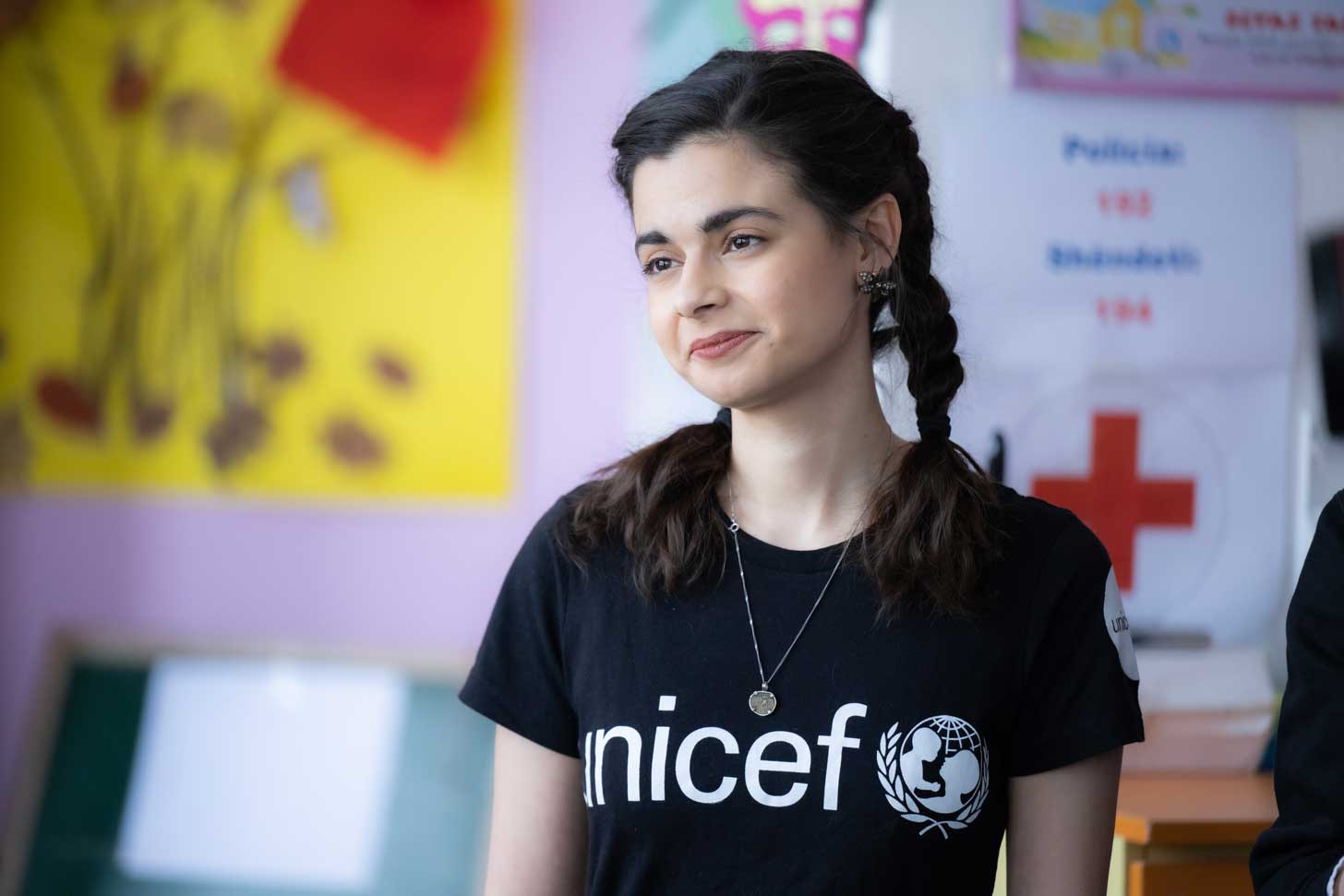
But her work to help others goes beyond the screen. Loberti began working with UNICEF USA in 2022, traveling to Kosovo to see the organization's work, and supporting the efforts to pass the READ Act Reauthorization in the United States.
The READ Act Reauthorization requires the U.S. government to update and report on its strategy to improve foundational literacy and numeracy in basic education for every child.
Prior to acting, Loberti was a Ph.D. candidate and Fullbright Scholar, having spent her childhood advocating for her own educational rights and access as a legally blind student.
“I faced abuse, neglect, and lots of hardships as a child, but I had loving parents to come home to, to fight for me and teach me how to advocate for myself. Many aren’t as lucky,” Loberti wrote in an Instagram caption after speaking at a UNICEF gala last fall.
Her challenging but triumphant background makes her work with UNICEF that much more meaningful.

“When I decided to explore acting, I knew that I wanted my journey to be grounded in purpose,” Loberti said in a statement for the organization.
“Working with UNICEF USA, having the honor of being named the newest Ambassador and being trusted with the responsibility of lifting up the voices of every child is exactly that purpose and is an overwhelmingly full circle moment for me.”
Alongside access to education, Lobarti is passionate about the environment and elevating the voices of young people who are most impacted by climate change.
In fact, this announcement comes while she is advocating on Capitol Hill for equitable access to education for women and girls disproportionately affected by the climate crisis.
“I will always work to ensure that every child has the right to a quality education,” Loberti said in a statement. “But until children have a clean planet to learn on and are not being displaced by the climate crisis, we must use our collective voice to demand climate action now.”
She joins the ranks of other high-profile ambassadors who have worked with the organization, like Millie Bobby Brown, Selena Gomez, Priyanka Chopra Jonas, and Liam Neeson, among others.
“We are honored to welcome Aria Mia Loberti to our family of UNICEF Ambassadors,” said chief marketing officer of UNICEF USA Shelley Diamond.
“Aria’s deep experience in the advocacy world makes her uniquely qualified to elevate the work UNICEF does to ensure that every child is healthy, educated, protected, and respected.”

Loberti has shared moments of her experience visiting Kosovo with UNICEF, where she learned from youth advocates about using their skills to develop climate solutions in their communities.
“I implore you to listen to these innovative voices, give them a seat at the table, and ensure they have the resources they need to transform ideas into action,” she said.
By bringing Loberti on board, UNICEF makes that call to action count, giving the actress the space to do more good for children near and far.
“I envision a world where every child is safe, loved, and seen and can live their life to the fullest,” Loberti wrote in November 2023.
“I hope someday stories like mine are no longer needed to be beacons of hope for a brighter future; a future where our most valuable resources — our children and our planet — can flourish.”
Maggie Rogers is known for her inventive pop music and distinct sound that, years ago, stopped Pharrell Williams in his tracks.
Today, she dropped her third studio album “Don’t Forget Me,” which she said is one to “belt at full volume alone in your car.” It’s classic, she claims, but with a loose, silly twist.
But when it comes to her tour — which is named after the new record — Rogers isn’t reinventing the wheel.
In fact, she’s taking it old school and opening up in-person box offices to sell tickets.
“Come buy a concert ticket like it’s 1965,” she said in a recent social media video.
Starting today, Friday, April 12, Rogers is kicking off what she calls “Box Office Week,” in which fans can visit box offices around the country to score tickets to the singer’s upcoming arena tour.
Rogers herself will also be in four cities selling tickets directly to fans — in New York City, Philadelphia, Boston, and Chicago.
Following ticket sales in these four cities, she will also be playing intimate shows to perform “Don’t Forget Me” live for the first time.
This isn’t the first time fans have had this kind of access to the artist.
“On the last album, I decided to go old school and sell tickets in person, in an effort to combat bots, reduce fees, and get tickets directly into your hands at the best price,” Rogers wrote in a newsletter to fans on Thursday.
“That process was so fun and so successful that I’m doing it again.”
Not only is it especially fun for fans to make a day of their concert ticket shopping — but it’s a lot less exploitative.
Fans of Rogers — many of whom fall under the same demographic as Taylor Swift fans — may recall the chaos of attempting to purchase tickets to the record-shattering “Eras Tour” in the fall of 2022.
From day-long wait times to buy tickets to sky-high “dynamic pricing,” the controversy sent Ticketmaster to an antitrust hearing in the U.S. Senate, and fans took the conglomerate to court over the messy experience.
And it’s not a one-time situation. Between scalpers and resellers, venues, promoters, and corporate ticket-selling platforms, the cost of concert tickets overall has increased by 34% since 2018, according to Apollo Academy.
A lot of that has to do with online fees accumulated by companies like Ticketmaster.
One way to combat the misery of waiting in digital queues or going into debt to see a favorite live performer? Getting people to their local venues.
Rogers is still selling tickets online, but by giving fans a chance to shop IRL, she says, “you can go to the local box office to choose your seats and buy your ticket for a special in-person price.”
Part I of her tour will kick off this spring and summer, with Part II (the leg for which she is selling tickets this week) beginning in October.
While some fans critique the approach, citing an inability to take time off from work or travel to box offices to buy tickets in-person, many acknowledge that it’s a step in the right direction in an industry that consistently takes advantage of fans’ desire to attend shows.
“Nobody is doing it like you, Maggie,” one fan commented on Instagram.
“This is amazing, and I think every artist should do it this way,” another said.
“This gives me hope for the music industry,” another supporter added on TikTok.
And another TikTok user summed it up succinctly: “Maggie Rogers the legend that u are!!!!”
See Rogers’ upcoming tour dates below:
“Don’t Forget Me” Release Shows
4/13 — New York, NY @ Irving Plaza
4/14 — Philadelphia, PA @ Theatre of Living Arts
4/16 — Boston, MA @ Paradise Rock Club
4/19 — Chicago, IL @ House of Blues
“The Don’t Forget Me Tour, Part I” Shows
5/4 — Charlotte, NC @ Lovin’ Life Music Fest
5/23 — San Diego, CA @ Gallagher Square at Petco Park
5/24 — Phoenix, AZ @ Arizona Financial Theatre
5/27 — Morrison, CO @ Red Rocks Amphitheatre
5/28 — Morrison, CO @ Red Rocks Amphitheatre
5/31 — Irving, TX @ The Pavilion at Toyota Music Factory
6/1 — The Woodlands, TX @ The Cynthia Woods Mitchell Pavilion
6/3 — Rogers, AR @ Walmart AMP
6/5 — Indianapolis, IN @ Everwise Amphitheater at White River State Park
6/7 — Cincinnati, OH @ The ICON Festival Stage at Smale Park
6/8 — Milwaukee, WI @ BMO Pavilion
6/9 — Sterling Heights, MI @ Michigan Lottery Amphitheatre
6/11 — Alpharetta, GA @ Ameris Bank Amphitheatre
6/14 — Manchester, TN @ Bonnaroo
6/16 — Columbia, MD @ Merriweather Post Pavilion
6/19 — Raleigh, NC @ Coastal Credit Union Music Park
6/20 — Charleston, SC @ Credit One Stadium
6/22 — Miami, FL @ FPL Solar Amphitheater
“The Don’t Forget Me Tour, Part II” Arena Shows
10/9 — Austin, TX @ Moody Center
10/15 — Philadelphia, PA @ Wells Fargo Center
10/17 — Boston, MA @ TD Garden
10/19 — New York, NY @ Madison Square Garden
10/22 — Toronto, ON @ Coca-Cola Coliseum
10/24 — Chicago, IL @ United Center
10/25 — Minneapolis, MN @ Target Center
10/29 — Seattle, WA @ Climate Pledge Arena
10/30 — Portland, OR @ Moda Center
11/1 — San Francisco, CA @ Chase Center
11/2 — Inglewood, CA @ Kia Forum
Header images courtesy of Maggie Rogers/Instagram
Grad season came early for Fundación Dominicana de Estudios Marinos (FUNDEMAR), a coral reef restoration organization based out of the Dominican Republic.
The nonprofit is the first of its kind to officially complete training with SECORE (SExual COral REproduction) — a coral diversity and breeding program that’s setting new standards for coral conservation.
FUNDEMAR is not only “graduating early.” It’s also top of its class.
Within the last five years, it has been crucial to restoring coral reefs throughout the Caribbean, and has cultivated eight different species, including the notoriously hard-to-breed Pillar coral.
“Since 2019, we have been able to outplant over 40,000 coral substrates in total, each with several tiny corals growing on them, to degraded reef areas,” Rita Sellares, FUNDEMAR's Executive Director, told Science X.
“At our current production rate, which has increased by 1000% since the program started five years ago, we now expect to contribute annually with 20,000 substrates with coral recruits to our reefs in need.”

SECORE’s Director of Technology and Implementation Aric Bickel said that these ocean conservation victories are all thanks to the team’s tireless hours spent planting seeds, monitoring reefs, and fostering floating nurseries called Coral Rearing In-situ Basins (CRIBs).
“In just five years, FUNDEMAR has grown their Coral Seeding program from the ground up to probably the largest in the world,” said Bickel.
These restoration efforts come at a dire time, as pollution mounts, acidification rises, and stony coral tissue loss disease (SCTLD) ravages coral reefs.
What exactly is stony coral tissue loss disease?
Currently, over 20 known coral species in at least 20 countries have been afflicted by SCTLD.
In an interview with the Smithsonian’s National Museum of Natural History, Valerie Paul — head scientist at the Smithsonian Marine Station in Florida — said that once the SCTLD infection takes hold, it’s only a matter of weeks before an entire colony of coral polyps is wiped out completely.
“It just eats the coral tissue away,” said Valerie Paul, head scientist at the Smithsonian Marine Station in Florida. “The living tissue sloughs off and what is left behind is just a white calcium carbonate skeleton.”
Paul teamed up with Blake Ushijima — an assistant professor at the University of North Carolina Wilmington — to lead a study on how to combat the ailment. Together, they singled out a bacterial probiotic (McH1-7) that could slow and even stop the progression of SCTLD in great star coral.
It will take a lot of tinkering and trial-and-error to replicate that success on a grander scale — but Ushijima and Paul believe it’s a good start.
“Between ocean acidification, coral bleaching, pollution, and disease there are a lot of ways to kill coral,” Paul said. “We need to do everything we can to help them so they don’t disappear.”
Header image courtesy of Patrick Nouhailler on Wikimedia Commons (CC BY-SA 2.0 DEED)
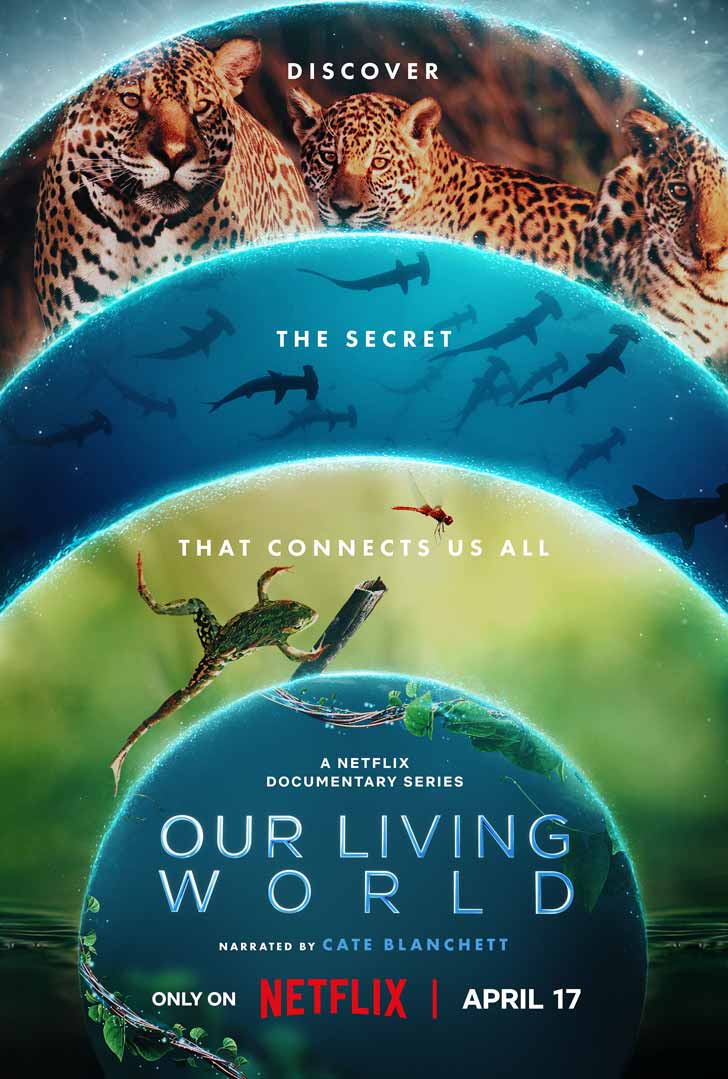
Earth Day is right around the corner, and Netflix is debuting a brand new nature docu-series to celebrate.
“Our Living World,” which is narrated by Academy Award-winner Cate Blanchett, is a four-part series that takes viewers through the magnificent untold stories of the connections between species across the globe.
Spanning continents and oceans and using eye-catching cinematic wildlife photography, the stunning visual tapestry of this documentary series gives viewers a front-row seat to the many special ecosystems that impact us all.
Created by producer Ben Roy of Freeborne Media and Wild Space Productions, the series is made by the same Emmy Award-winning team behind “Our Great National Parks.”
If you’re a fan of nature and climate documentaries, this one is certainly a can’t-miss. With a large body of similar work under names like the BBC, Discovery, National Geographic, and more, Roy said this project is especially engaging for viewers interested in the connections between species.
“This series is different because it ties all the amazing animal behavior we were lucky enough to capture over two years of filming into a bigger story,” Roy told Good Good Good.
“It reveals how the whole world is connected by a network of physical connections and webs of life, where animals’ behavior shapes their environment at the same time as these environments shape their animals.”
One major highlight of the series is how it captures the challenges of a “fast-changing planet.” But there is hope in those challenges, Roy emphasized.
“It… frames our case of animals not just as victims of this change, but as heroes with the power to help fight against it,” he said.
Some heroes in the series include hammerhead sharks migrating through the ocean to find a mate (and ensure ocean biodiversity); beavers’ migration patterns and their impact on dams across the northern frontier; the recovery of salmon species in the Pacific Northwest; and more.
“My favorite moments are those ‘mind blown’ moments where, for instance, we reveal that what happens on the African savannah has an effect in the Amazon, on the other side of the planet,” Roy said.
The interconnectedness of the project is what excites him most. It’s also likely what attracted Blanchett to the project. The beloved actress is a Global Goodwill Ambassador for UNHCR, the UN Refugee Agency, and a lifetime member of the Australian Conservation Foundation.
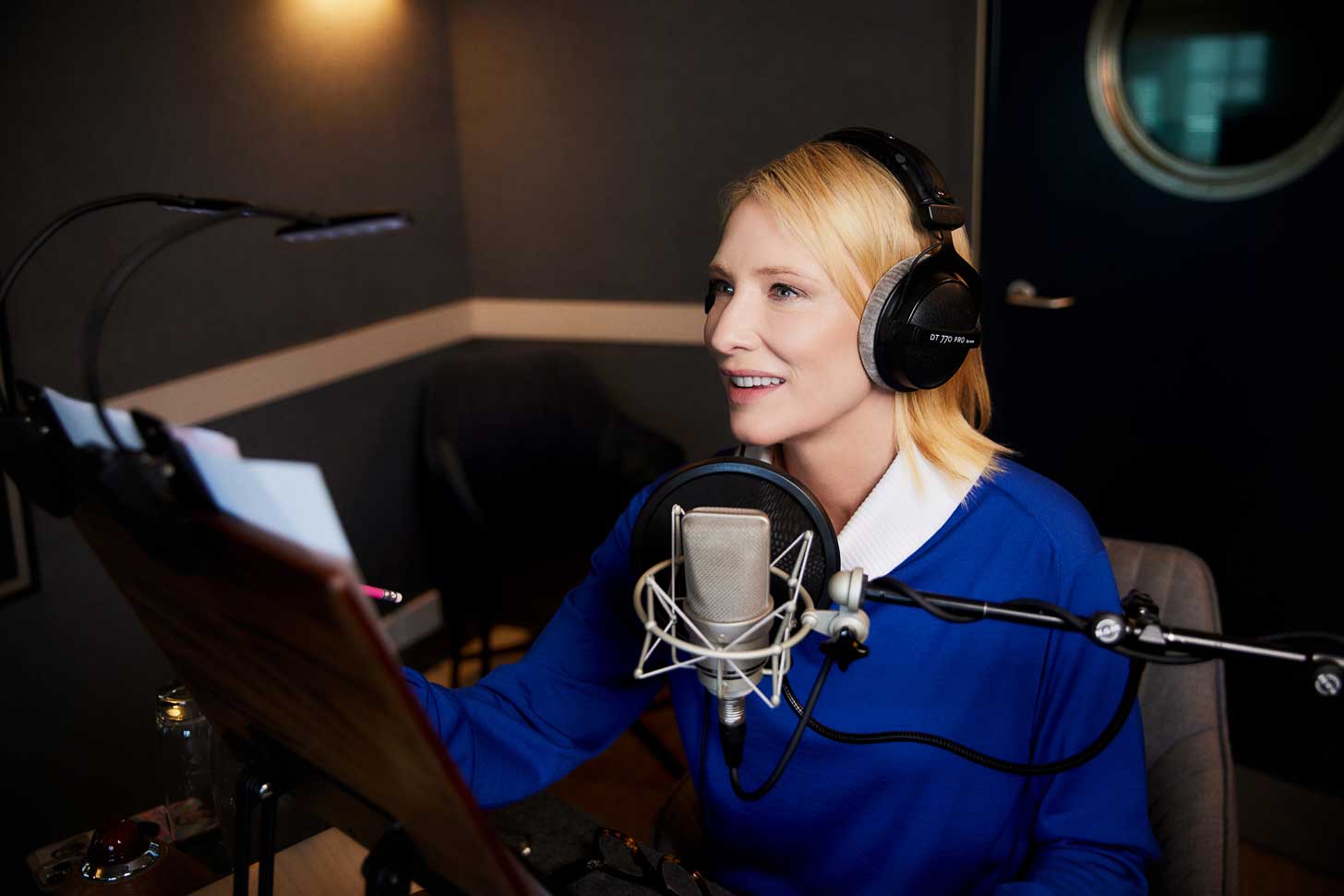
Blanchett is also a strong supporter of the Australian Wildlife Conservancy and hosts the podcast “Climate of Change,” which explores anxiety and optimism in the face of the climate crisis.
Roy said those themes will absolutely be on display in the four 50-minute episodes of “Our Living World.”
“I hope our viewers go away with a new appreciation of how everything in our world is connected. I hope they gain a fresh understanding of how we humans, and all our actions, fit into this bigger picture,” he said.
“And I’d like us all to take hope from the fact that we’ve got the most powerful force on Earth on our side: life itself.”
“Our Living World” premiers globally on Netflix on April 17, 2024.
At the end of the year, when your streaming platform of choice aggregates all your data to tell you who your most-listened to artist is, you might be surprised to see Mother Earth herself on the top of the charts.
Well, more specifically, NATURE.
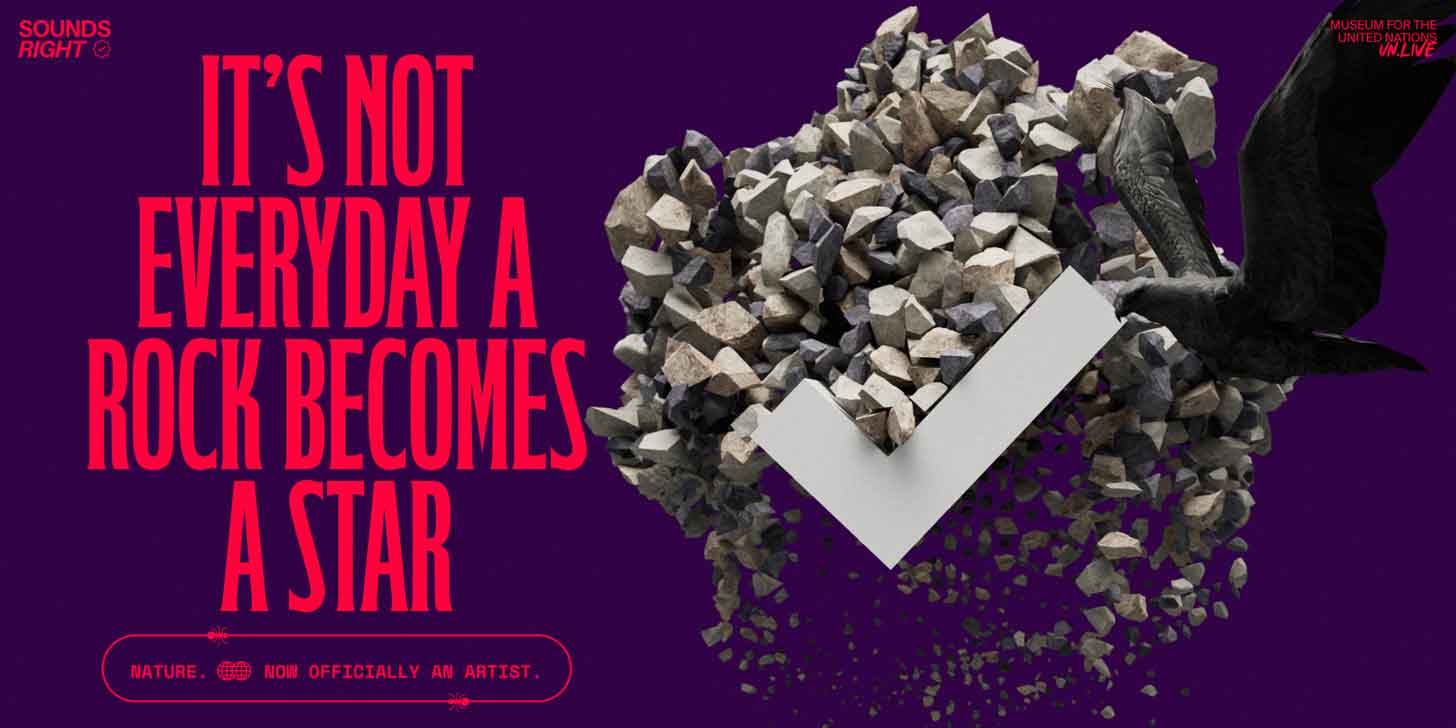
The Museum for the United Nations — UN Live has just announced the launch of Sounds Right, a global music initiative that enables nature to earn money from its own sounds.
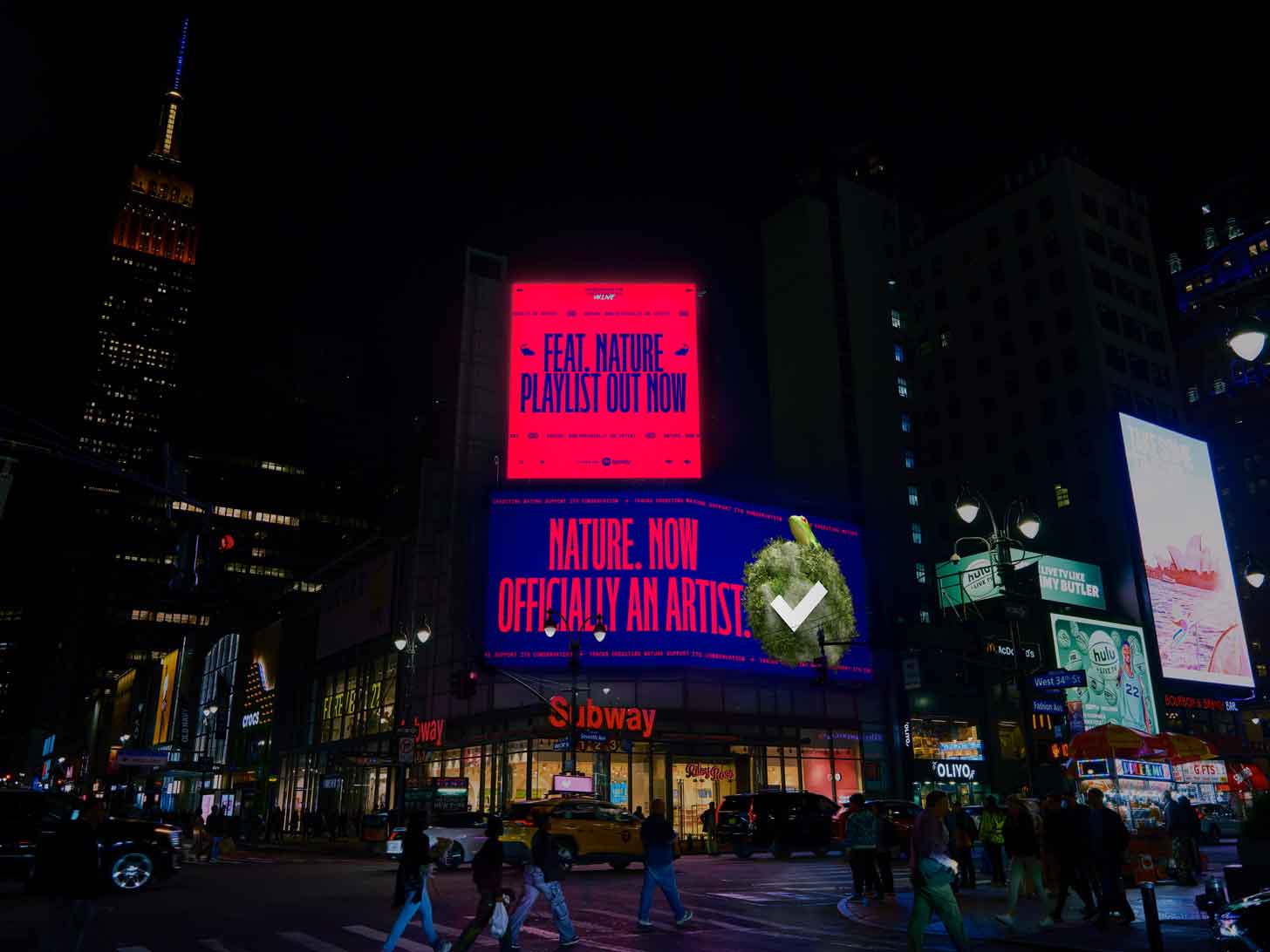
What does that mean, exactly?
Classic sounds like ocean waves, wind, rainstorms, birdsong, and more will now be recognized under an official artist — NATURE — on all major streaming platforms.
NATURE will have her own profile, and just by listening to music that features sounds of the natural world, music lovers and environmentalists alike will be able to fund conservation and restoration projects worldwide.
Gabriel Smales, the global program director of Sounds Right says this project has been in the making since 2019, when UN Live brought together a diverse group of over 40 musicians and environmentalists in Colombia to discuss creative ways to engage people in nature conservation.
This led to the formation of VozTerra, a music collective that works with Indigenous groups, sound artists, and the general public, to portray the importance of ecosystems throughout the Amazon, recording various natural soundscapes.
“It was through conversations around the projects in Colombia that the idea of green music was born,” Smales told Good Good Good.
“And later, the idea of directing royalties for nature sounds back to the environment.”
What is the ‘Feat. NATURE’ playlist?
The launch of Sounds Right includes the support of even more global artists, who will release new tracks — or have remixed their hits — to feature NATURE.
As of today, all tracks can be enjoyed on the “Feat. NATURE” playlist on Spotify, with all tracks available on major music streaming platforms.
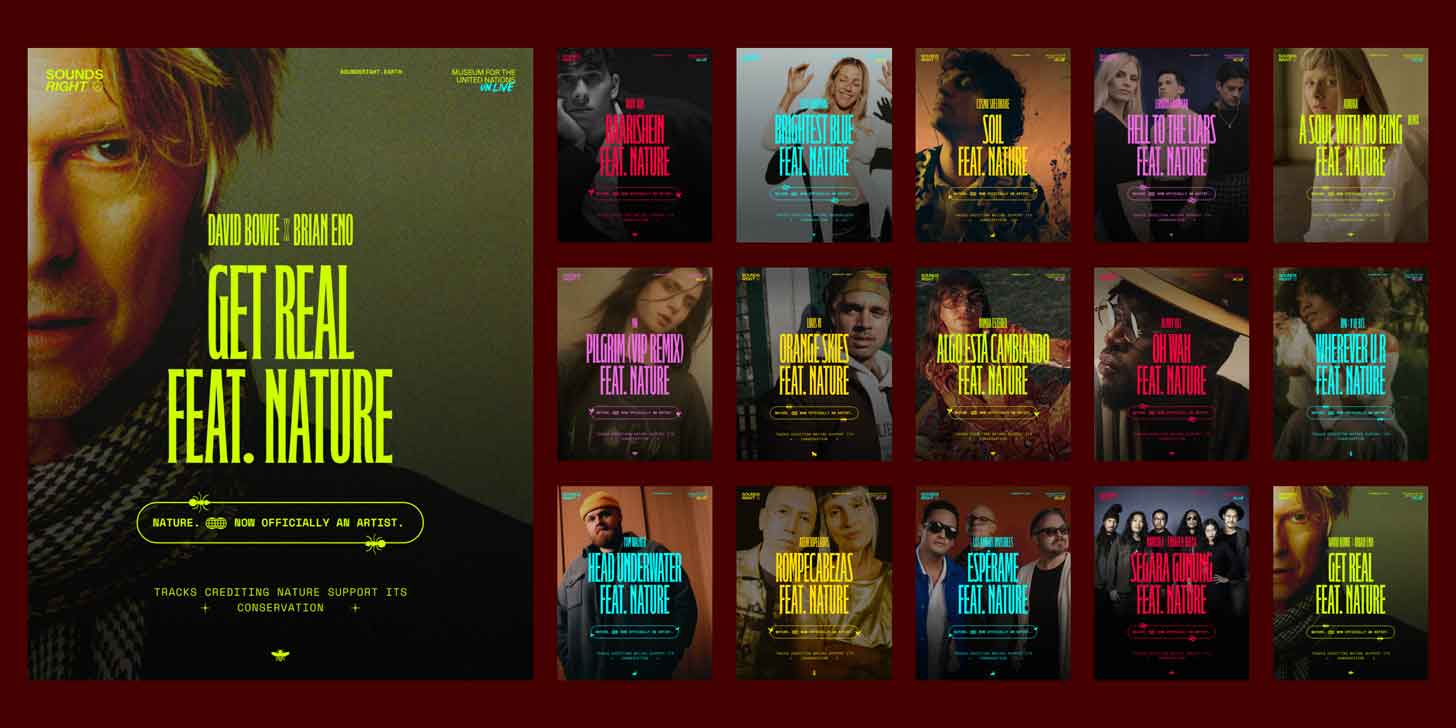
The artists include David Bowie x Brian Eno, Ellie Goulding, AURORA, UMI with V of BTS, Anuv Jain, MØ, London Grammar, Bomba Estéreo, Cosmo Sheldrake, Louis VI, Tom Walker, Aterciopelados, Blinky Bill, Navicula x Endah N Rhesa, and Los Amigos Invisibles.
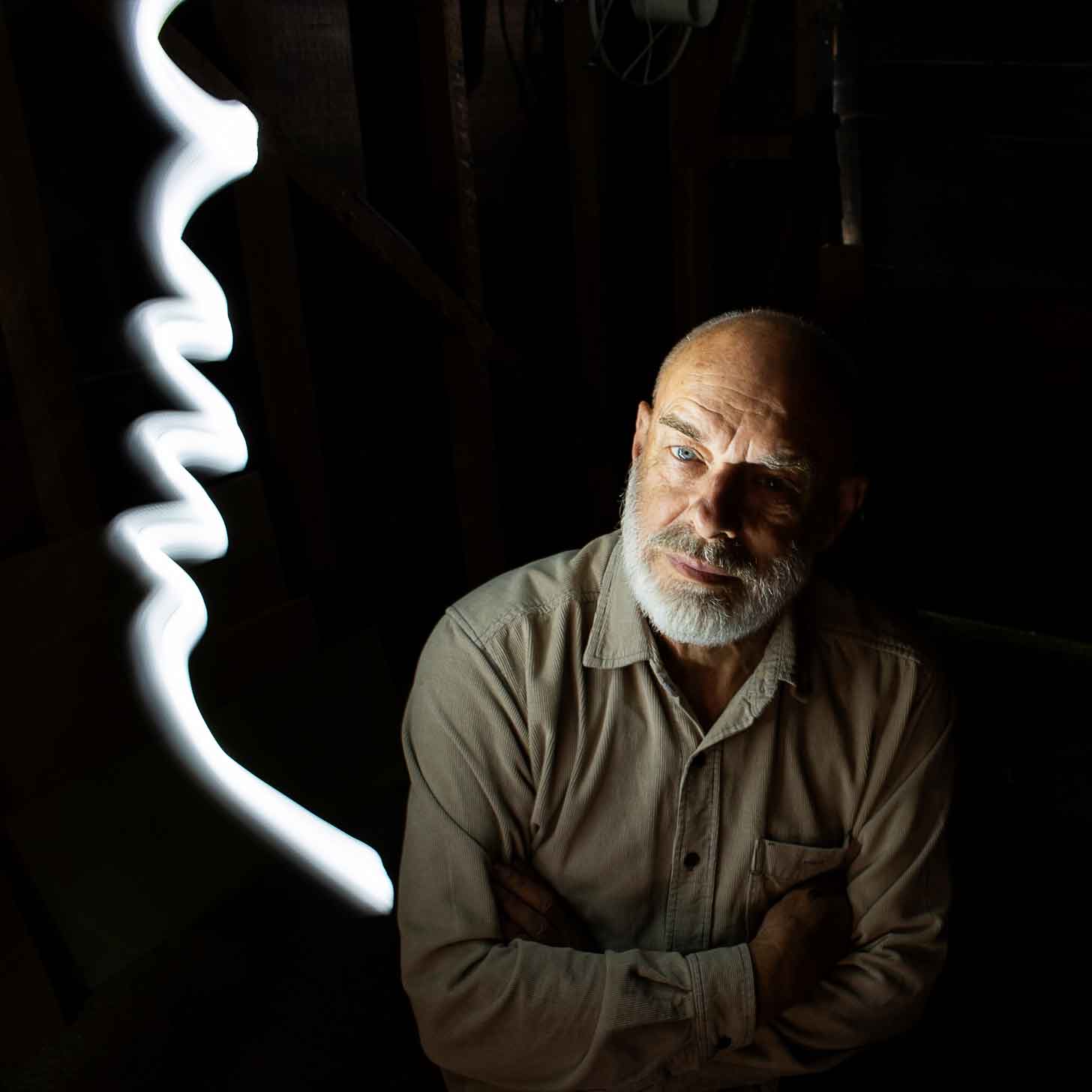
“Throughout my life I’ve wondered, how can I return something to the places I’ve taken ideas from,” Eno said in a statement. “Music started out as the sounds of the natural world, and Sounds Right creates a system to give back to nature, helping to preserve the planet, so that it can continue to inspire us for years to come.”
Eno’s collaboration with Bowie’s “Get Real” will feature the harsh cries of hyenas, rooks, and wild pigs.
Goulding’s “Brightest Blue — Nature Remix” uses sounds from the lush rainforests of Colombia.
Louis VI collaborated with an acoustic ecologist to create a track focused on the environmental destruction of forest fires, featuring sounds from the Borneo rainforest.

“Our first hope is… that fans resonate with music featuring NATURE and become fans of NATURE,” Smales said. “We have 15 amazing artists from around the world who are releasing new or remixed tracks that are enhanced by sounds of the natural world.”
Fans can also relax with ambient nature sounds by enjoying ecosystem recordings from The Listening Planet and VozTerra.
How does ‘Feat. NATURE’ benefit the environment?
NATURE’s royalties and donations to Sounds Right will be collected by UK and U.S. registered charity EarthPercent, which will then be directed to biodiversity conservation and restoration projects in threatened ecosystems around the world.
At least 50% of recording royalties from tracks by artists that feature NATURE will go towards the cause, and 63% of recording royalties from ambient nature tracks will do the same.
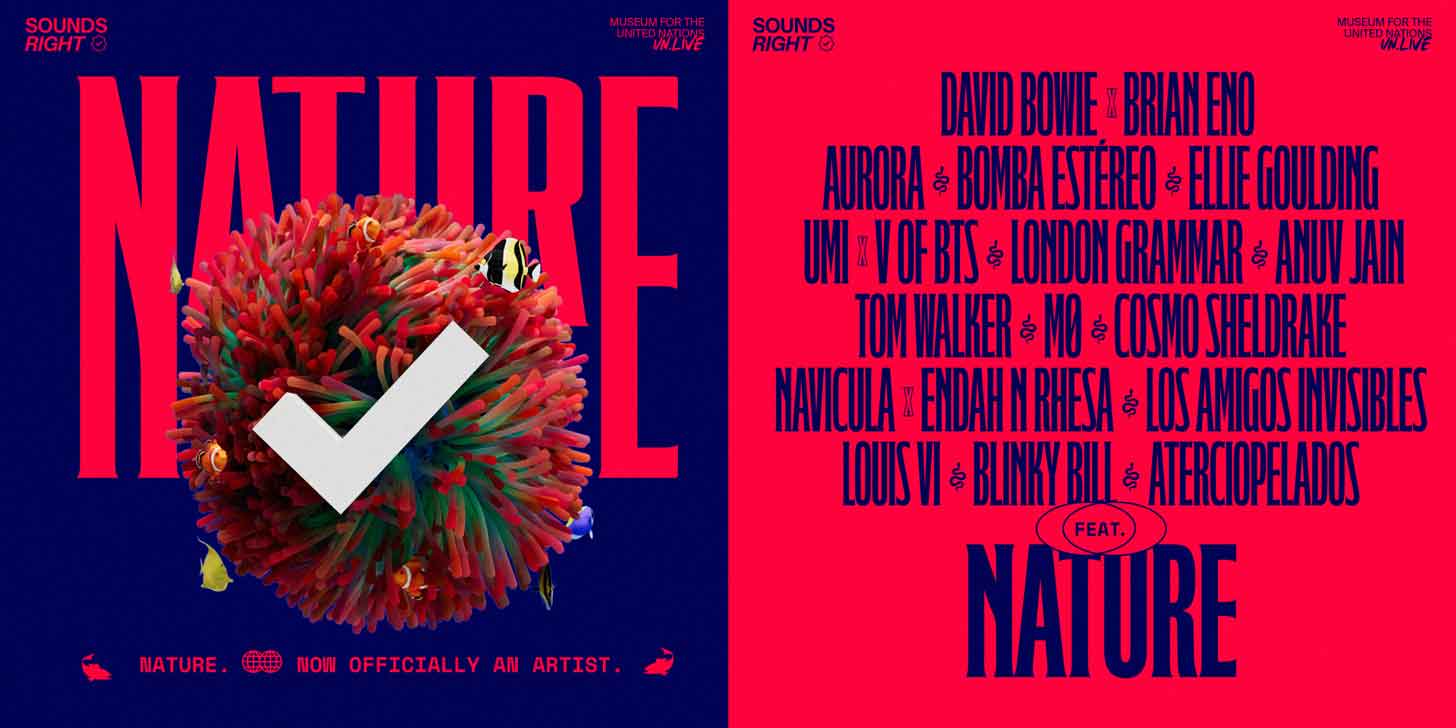
Funds will be distributed under the guidance of the Sounds Right Expert Advisory Panel, a group of world-leading biologists, environmental activists, representatives of Indigenous Peoples, and experts in conservation funding.
“What would nature spend her money on? First, she’d prioritize conserving and restoring ecosystems with the greatest levels of biodiversity and endemism,” Smales said.
The advisory panel has already identified “Key Biodiversity Areas” that will be supported in the following regions: Madagascar and the Indian Ocean Islands; Indo-Burma, India, and Myanmar; Sundaland; Philippines; Tropical Andes; and, the Atlantic Forest.
“Second, she’d want the money to be spent in the most effective and ethical way,” Smales continued, sharing that only rights-based projects with proven models of impact would be funded.
Lastly, he said, “in the absence of being able to speak for herself, she’d want to be represented by Indigenous Peoples who are some of her most critical guardians (who carry the biggest burden in protecting our natural world) as well as leading conservation scientists and practitioners.”

To make this happen, Smales explained, NATURE’s representatives will mostly “be from the Global South, since that is where most of the landscapes we hope to support are based.”
Mindahi Bastida is part of the Sounds Right advisory panel and is an Otomi-Toltec Leader.
“Biocultural heritage will greatly benefit from music royalties and donations,” he said. “In a way, it is about paying back to life systems that have inspired the human spirit through the magic of sound. The time has come to live in permanent reciprocity.”
While the initial Sounds Right action plan is already finalized, Smales said that in 2025, there will be an open call for any organization to apply for conservation funding, “so long as they meet our soon-to-be published criteria.”
While it takes a little while for royalties to accrue, Sounds Right and its project partners estimate that the project will generate over $40 million for conservation, with over 600 million listeners in its first four years.
How can I support this project?
In the meantime, everyday listeners can do their part by just tuning in to all NATURE has to offer. Fans will also be encouraged to take follow-up actions to conserve nature, like recording morning birdsong for biomonitoring, or opting for small changes to live a more sustainable lifestyle.
But Smales said there’s an even bigger opportunity in giving NATURE her own platform.
“To spark conversations about how nature can — and should — be valued in our society and economic model,” he said.
“More often than not, we have a purely extractive relationship with the environment. Sounds Right partners have created a simple mechanism that goes some way to properly valuing nature for its creative contributions to music.”
Katja Iversen, the CEO of UN Live, believes that pop culture and music have the power to engage millions in positive change.
“In a world where empathy is declining and many people often feel that their actions hardly matter, Sounds Right and UN Live meet people where they already are — on their screens and in their earbuds — with stories and formats they can relate to, and actions that matter to them,” she said in a statement.
“Recognizing nature as the valuable artist it truly is will be a game changer.”
Header image courtesy of Sounds Right/UN Live
Every day the Good Good Good team collects the best good news in the world and shares it with our community. Here are the highlights for this week!
If you want to get good news in your inbox every day, join the Goodnewsletter — the free daily newsletter designed to leave you feeling hopeful.
The Best Positive News We’re Celebrating This Week —
Georgia just made history with the state’s largest-ever release of endangered sea turtles
Last week, conservationists and marine biologists marked their largest sea turtle release in Georgia’s history, as 33 Kemp’s ridley turtles and one green sea turtle were released off of Jekyll Island.
But these turtles aren’t native Southerners; in a “remarkable cross-organization collaboration,” they were brought from aquariums up north, where they were undergoing rehabilitation for hypothermia-related conditions.
This happens every fall and winter, as hundreds of cold-stunned sea turtles — many of which are endangered Kemp’s ridley turtles — wash up on the beaches of Cape Cod.
Why is this good news? Not only is it exciting to see a crew of turtles return to their rightful home under the sea (after being cared for by incredible helpers!), but it’s also exciting because the Kemp’s ridley turtle is the most endangered turtle species in the world — and these kinds of conservation efforts are critical to their survival.
Graduation rates for students with disabilities are improving in several U.S. states
Data from the National Center for Education Statistics reveals significant improvements in graduation rates for students with disabilities in the years leading up to the COVID-19 pandemic.
Nationwide, the graduation rate for students with disabilities was 71% for the 2019-2020 school year, up from 65% five years prior, during the 2014-2015 school year.
Taking a closer look, the graduation rate gap is shrinking in most states, with Oklahoma, Nevada, Florida, and Louisiana have seen some of the most dramatic improvements between 2014 and 2019.
Still, more progress is desperately needed. In some states, the graduation gap between students with disabilities and the statewide average is as high as 25%.
In Mississippi, where the disparity is greatest, nearly half of students receiving inclusive education don't graduate. Experts and parents say systemic problems contribute, pointing to inadequately trained teachers, low expectations, and a lack of training in skill areas like communication.
Both federal and state policies are at work to continue improving these graduation rates.
In a transportation revolution, bicyclists now outnumber motorists in Paris
Using GPS trackers, Europe’s largest urban planning and environmental agency recorded the movements of 3,337 Parisians between the ages of 16 and 80 years old.
Whereas transportation in the suburbs happens primarily by car, the number of people traveling by bike into the city center “far exceeds” the number of motorists. That’s a massive change from even just five years ago.
The shift is thanks to a number of anti-car measures like reducing the number of parking spaces, restricting SUV access, closing roads to cars, and more. Paris is also implementing “15-minute city” concepts, ensuring key amenities are close by, which reduces the need to drive.
→ Read more
More good news about bicycling:
- In an effort to help meet the city’s climate goals, a new rewards program in Denver is paying residents who commute on bikes.
- Beyond offering tools, repairs, and secondhand parts, a worldwide movement of community bike workshops is helping build a culture of cycling in cities.
- As biking continues to gain popularity in the United States, bike share programs across the country are making it easier for people to take zero-emission transportation.
The EPA just finalized limits to reduce toxic pollution and protect communities around U.S. chemical plants
Impacting more than 200 chemical plants in the U.S. — and the communities around them — the EPA just announced a new rule to reduce toxic emissions linked to cancer-causing pollutants.
Under the new rule, toxic pollutants will be lowered by 6,200 tons per year, and emissions from ethylene oxide (used to make antifreeze, pesticides, and more) and chloroprene (synthetic rubber for shoes and wetsuits) will be reduced by 80%.
The guidelines around air pollution at chemical plants haven’t been updated since 2006, and will also require six toxic air pollutants to be tracked with much more detailed monitoring, as well as stronger monitoring at plants around leaks.
Why is this good news? While air pollution air isn’t good for anyone, this news is a win for environmental justice, too. Communities directly around these chemical plants bear the brunt of the negative health impacts of polluted air. With fewer toxic pollutants in the air, cancer diagnoses will drop, and “there will be lives saved.”
→ Read more
Global life expectancy increased by 6.2 years since 1990 thanks largely to declining deaths from diarrhea and stroke
According to a new study, over the past three decades, global life expectancy increased by 6.2 years. This incredible progress is thanks to a decrease in the number of people dying from some of the leading causes of death like diarrhea and lower respiratory infections.
The region with the largest increase in life expectancy, 10.7 years, was eastern sub-Saharan Africa, due to control of diarrheal diseases.
While the study had plenty of hopeful progress to report, it also detailed the impact of COVID-19, which replaced stroke as the second-leading cause of death globally.
While COVID-19 limited progress — especially in certain areas like Latin America, the Caribbean, and sub-Saharan Africa — progress in other causes of death still resulted in a higher life expectancy over the three-decade period.
Sharp drops in death from enteric diseases like diarrhea and typhoid increased life expectancy by 1.1 years, and from lower respiratory infections like tuberculosis by 0.9 years. There was also a lot of global health progress in preventing deaths from causes like stroke, neonatal disorders, heart disease, and cancer.
An ‘overly playful’ dog who failed the police academy is now heroically rescuing people after the earthquake in Taiwan
After failing to become a drug-sniffing dog because he was “overly friendly and playful,” a labrador retriever named Roger found his new purpose: rescuing people in the aftermath of earthquakes.
And after a 7.4 magnitude earthquake hit Taiwan last week, the strongest in 25 years, Roger was sent out on his seventh mission. The quake triggered deadly landslides and caused buildings to partially collapse.
Rescue dogs are critical in locating both stranded survivors as well as bodies. In this mission, Roger helped find one of the 13 people tragically lost in the earthquake.
→ Read more
More good dog news:
- Helping raise awareness for adoption, a TikTok trend highlights the before and after transformations of adopted shelter dogs.
- A Los Angeles-based nonprofit provides free veterinary care, treatment, and support to the pets of individuals experiencing homelessness or housing vulnerability.
- A group of seven avalanche rescue dogs help keep skiers safe at a Northern California resort.
In a historic action, the U.S. will require background checks for gun shows and online firearm sales
Closing the dangerous “gun show loophole” in U.S. gun law, the U.S. Justice Department just announced a historic new action to help prevent gun violence in the U.S.
Under the new, firearms sold on the internet and at gun shows will be subject to the same mandatory background checks as licensed gun dealers. Previously, anyone could purchase a gun via these avenues without a background check.
An estimated 22% of guns owned by people in the U.S. were purchased without a background check, and the new rule will require about 23,000 more individuals to be licensed to sell guns.
Why is this good news? The gun show loophole in U.S. gun law puts firearms into the hands of people who would not otherwise be able to purchase a gun at a licensed dealer. Closing this loophole will prevent gun violence and save lives by helping keep guns out of the hands of those who have done or plan to do to harm.
Storytellers are helping address childhood illiteracy in Pakistan with a “Stories on Wheels” program
In Pakistan, 77% of 10-year-old children are illiterate, and while education is free and compulsory, the country has the second-highest rate of children absent from school due to factors like prohibitively expensive books and uniforms.
But Mohammad Noman, one of two storytellers for the Kahaani Sawaari (Stories on Wheels) program, is helping change that.
Noman pedals an old ice cream cart through city streets, stops to read stories to children, and leaves behind books for them to borrow. The program is working to improve literacy rates in underserved areas of Karachi, the largest city in Pakistan.
Over the course of 18 months, Noman has visited 30 areas of the densely populated Lyari neighborhood of Karachi, which has more than 660,000 residents.
While Noman says the children have changed him, he has inspired them too: he knows of children who were inspired to enroll in schools after attending his reading sessions, and parents have reported a new love for reading among their children.
→ Read more
More good news of the week —
A planetary scientist and astronomer created a for visually impaired folks to experience the solar eclipse, too. In the U.S., over 7 million people are blind or visually impaired and may not be able to experience an eclipse the traditional way.
St. Paul, Minnesota’s public schools are tapping geothermal energy to cut emissions and building costs. New technology and federal incentives have helped convince the district that geothermal is among its best options for achieving its climate goals.
Oregon passed a first-of-its-kind “right to repair” law that bans parts pairing. Going further than other similar laws, Oregon’s prevents companies from implementing schemes that require parts to be verified through encrypted software checks before they will function.
Engaging fans for a good cause, Chappell Roan is using friendship bracelets to raise money for Gaza relief. Fresh off touring with Olivia Rodrigo, Roan encouraged fans to donate friendship bracelets at her tour merch table, reselling them to benefit Mercy-USA for Gaza relief.
Researchers found that using proteins in milk and blood could soon let doctors detect breast cancer earlier — and save lives. Breast cancer is the most commonly diagnosed cancer among women in the U.S. and is currently one of the leading causes of cancer deaths.
Canada’s First Nations are breaking ground on historic housing and community development projects. The Indigenous communities are reclaiming their land and defying NIMBYs to build the densest neighborhood in the country.
In a historic ruling, the European Court of Human Rights just ruled that human rights were violated by climate inaction. Taking “climate grannies” to another level, a group of older women in Switzerland won the court’s first-ever climate case victory.
Thanks to two generous donations, an Australian nature foundation just purchased a property to protect endangered native species. Two donations of $100,000 from professors helped Nature Foundation purchase a 200-hectare property home to malleefowl and other rare species in southeast South Australia.
A major insurance provider just announced it would no longer offer coverage for new oil and gas projects. It’s a significant policy shift since Zurich Insurance currently insures fossil fuel infrastructure spanning North Sea drilling to US natural gas terminals.
Dolly Parton’s free children’s book program is now expanding statewide in Virginia. Thanks to Dolly’s Imagination Library program, all children in the state up to the age of 5 will receive one free book a month through the mail.
A new genre of “protopian” shows is portraying a more hopeful future than the dystopias of the past. “A Brief History of the Future” is now airing on PBS, and its creator was inspired by her daughter who said she didn’t have a lot of hope for the future.
Three critically endangered lion cubs were just born at the London Zoo. Asiatic lions can now only be found in Gujarat, India's Gir Forest, and are especially susceptible to a disease epidemic or natural calamity because they only have one habitat.
In a milestone for the critically endangered species, a baby California condor has just hatched in San Diego. There are now approximately 275 free-flying condors in California, Utah, Arizona, and Baja California — thanks largely to the conservation work of the San Diego Zoo Wildlife Alliance.
The EPA just announced new limits on 'forever chemicals' in drinking water. PFAS chemicals have been used for decades to waterproof and stain-proof consumer products and are linked to a myriad of health problems, including cancer.
Thanks to soaring renewables, carbon market emissions in the European Union fell by a record 15.5% in 2023. The largest fall was in the power sector, which saw a 24% drop in emissions compared with 2022 levels thanks to an exponential surge in renewable energy development.
Recently, a team of biologists ventured into the heart of a Cambodian mangrove forest to survey the wildlife that lived within the winding thickets of tree roots and branches.
When they emerged from the forest — which spanned the Peam Krasop sanctuary and the Koh Kapik Ramsar reserve of Cambodia — the biologists were dumbfounded by the sheer number of animals they met on their expedition.
“We found 700 different species in these mangrove forests but we suspect we have not even scratched the surface,” said Stefanie Rog, lead author of the study, in an interview with The Guardian. “If we could look at the area in even greater depth we would find 10 times more, I am sure.”
Rog is a conservation biologist currently based in Phnom Penh, Cambodia. She has devoted her life to the study of mangrove forests and their beneficial effects on the environment and the vulnerable animal species they host.
“There is indeed a tendency to focus on the services the mangrove trees provide, like coastal defense, and the soil that benefits the climate by locking in high amounts of carbon,” Rog told Mangrove Alliance.
“At the same time, the value of mangroves for biodiversity conservation — as well as the services that animals provide to mangrove forest health — is often overlooked.”
The undervalued nature and beauty of mangroves is exactly what Rog was hoping to capture when she led her team on their latest expedition, and it was an undeniable success.
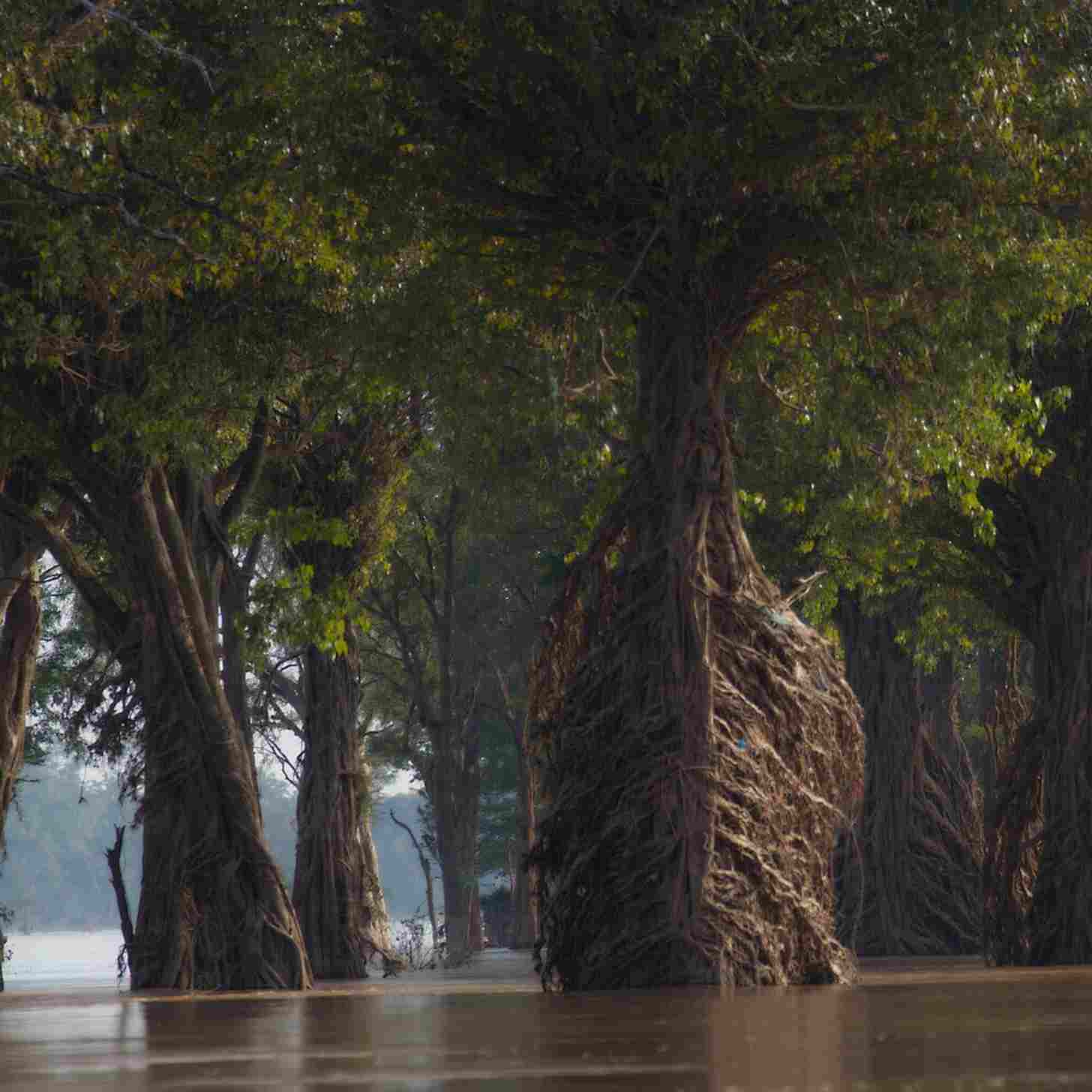
Of the 700 animals found, researchers recorded 74 species of fish and 150 species of birds, 15 of which can be found on the International Union for Conservation of Nature (IUCN) red list of threatened and endangered species.
They were especially ecstatic to spot two species in particular: the hairy-nosed otter — a rare Asian otter on the verge of extinction — and the endangered fishing cat: a stout, striped and spotted wild cat that loves to swim.
“It’s very rare to see a fishing cat and we have only found out that they are in the forest from the photographs taken by our camera traps,” Rog explained. “Mangroves are places of roots and mud and they are difficult for humans to get into, which is why they provide precious sanctuaries for these vulnerable animals.”
The survey was supported by the Fishing Cat Ecological Enterprise and Fauna & Flora International, an international conservation organization led in part by Sir David Attenborough, and it comes at a vital time.
In the last three decades alone, the world has lost 40% of its mangrove forests. Rog and her fellow researchers hope that this wildlife survey will bring attention to the importance of mangroves and how vital they are to the planet — and the menagerie of animals that call it home.
“Mangrove forests are beautiful, rich, mysterious, and harvest so much life. They are so much more than just an ecosystem that provides a carbon-saving service or coastal protection. They are actually beautiful in their own right,” Rog emphasized.
“For me, there is no better feeling than to be in this unique, mythical forest, knowing there is still so much more to explore – that there is another world waiting for further discovery.”
Header images via Tambako The Jaguar (CC BY-ND 2.0 DEED), Christian Pirkl / Wikimedia Commons (CC BY-SA 4.0 DEED), Rigelus / Wikimedia Commons (CC BY-SA 3.0 DEED)
Death isn’t exactly what most people consider dinner table talk.
Thinking about our individual, inevitable demise — or perhaps worse: the loss of the people we love most — is often something we aggressively push to the farthest corners of our minds.
For Alua Arthur, on the other hand, she’s got a lot to say.
Arthur is a death doula and end of life planner who leads a whole team of experts at her company Going With Grace. She is also a former director of the National End-of-Life Doula Alliance, and has solidified a reputation as the most visible death doula working in America today.
And she just published a book: “Briefly Perfectly Human: Making an Authentic Life by Getting Real About the End.”
Having worked with Chris Hemsworth — and thousands of everyday clients who are in hospice care, or just want to think more intentionally about their deaths — Arthur is “a friend at the end of the world,” according to Harper Collins.
In her memoir, she shares warm and generous stories about her work, provides meaningful and funny tidbits about the business matters of death, the emotional and sacred spaces between life and death, and how thinking about death can lead to a more meaningful life.
It’s like the extended version of her popular TED Talk, which we were fortunate enough to witness live at TED 2023 in Vancouver. Following her transformative Talk, Good Good Good sat down with Arthur to discuss her work.
Upon the release of her memoir, we hope this conversation provides more insight into the most important work we all find ourselves doing: Living and dying.
This conversation has been edited for length and clarity.
A Q&A with America’s favorite death doula, Alua Arthur
Branden Harvey, Good Good Good: Thank you for giving me a few moments of your life. I want to know: How should we be thinking about time — this thing that's precious and measurable?
Alua Arthur: Well, I think we can break it down into small little bits and try not to think of the totality of it, because that's really overwhelming.
If I can be with you right now, because we are just here right now, then that's good enough. I can worry about the next thing when it's time to do the next thing. But for now, I'm with you, Branden. We're going to spend our time, and then when we're done, I'll go do the other thing that I have to do.
I think breaking it down helps a lot. It helps it seem a little less overwhelming. But I also think that some of the ways in which we think about time is a fallacy. We know that it's limited, but some of us don't behave that way. We act like we've got all the time in the world, and we don't. Even though I think of time as an utter illusion, my time here is limited. Every tick of the clock, I get closer to my final tick. So, we need to behave that way.
BH: The time that I'm spending with you right now, it's exciting, it's energizing, I'm learning from you. But I also spent time emailing to get here. I spent time booking a train ticket to get here. These are all things that are not the cool part. It's not the part that I'm going to go home and tell my friends about. I'm going to tell my friends about how wonderful it was to speak with you.
How should we be thinking about those more mundane moments?
AA: I think part of the trick is, well, it's not really a trick. It's actually super basic.
But it’s not only being there for the emailing, but for me, sometimes I just check out that I have fingers that can click, click, click, click, click. The sound that my nails make against the keys sounds like music. The feeling of the key on my finger, the fact that I cannot figure out how to spell curriculum to save my life. It tickles me to no end.
If we can be with the minute, the micro in the activity itself. I think that allows us to be present with it.
I'm trying to figure out how I can get to this place, but in getting to that place, there's all these million little things I got to do to get there, and every single last one of them is utterly magical.
BH: If we zoom out a little bit, I think about members of our community who are fighting to make the world a better place. They are activists. They are world changers, they are educators, they are shaping people's lives and the planet around us. They, too, have some big moments. Then they, too, have the small things where they wonder, does this small step matter?
AA: Every little last bit matters. There's so much that I know that I'm not going to be able to change in my lifetime, but that has not absolved me of the responsibility of doing my part right now.
Racism? I don't know if I'm going to see the end of it in my lifetime. There's a lot of work that needs to be done. Does that mean that I don't challenge racist assumptions that come my way? No. It means that I call it to the extent that I have the energy for it. I call it when I see it.
Does it mean that the world may not be living in a relationship to their death by the time that I die? Does that mean that the work that I did was irrelevant? Absolutely not. I'm still going to do it. My activism is something I hold super core as a part of my identity.
I'm always pissed about the way we [as humans] do something, but mostly at its core, that’s because we're not being good to other humans. So what can we do to make [living] a better experience for other humans? I think that there's a bunch of little things that we can do that make a big difference in the long run. It takes every little last person, every little last word.
BH: You're awakening people to this idea of the importance of death doulas. Maybe a lot of people, for the first time, are finding out what a death doula is. For some people, it's even more basic; finding out what a doula is and then extrapolating from there.
Tell me about the work that you are doing, and the work your organization is doing, to make the idea of this more accessible to more people.
AA: A while ago, when I first got into the work, I was super gung-ho. I was trying to serve as many people as I could. And nobody was coming because they didn't know about what we did. And I was like, “what do you mean? Everybody should know. Everybody wants this. Everybody needs this. We need to do something about this.” And nothing was happening.
Then, I started doing some public education around it and started to talk to people about it. So, first and foremost, we need to educate folks about what doulas are, what death doulas offer, so they can come find us. That means that I spend a decent amount of my time doing that.
But also, when I'm teaching other death doulas, that means it’s not just one family I'm able to work with directly. If I'm in a room talking to 250 doulas, that's 250 people being impacted now. So we're trying to duplicate and replicate, to bring it alive in other folks so that they can also go and do it. It requires an army to change anything.
BH: And you're also working in such a personal space that it might have a lot of unique impact. So your work is also to create more people who can create more one-on-one connections.
AA: Absolutely. Also, a really key component is that we're all so different. Not everybody's going to hear the fact that they're going to die from me. They may think I'm too Black, or too bold, or too obnoxious, or too whatever.
But they might hear from you. They might be able to receive it from you. I'd rather as many people say it as possible because that's how change eventually happens.
BH: Similarly, what you are offering is a solution, but there's a problem that people may not know about. I mean, we all know we're going to die, but could you communicate what the problem is that a death doula is helping to solve?
AA: Support at the end of life. Somebody to just be there and walk alongside them. We have support for so many other things. You have a wedding planner. There are birth doulas or birth midwives. There are even professional cuddlers!
There are people that support other people doing all types of things, then why not the most basic of the human things that we will all do? Death is the most basic.
BH: What does society look like? What do interpersonal relationships look like? What do families look like… when everybody has access to end-of-life care and planning? How do things change?
AA: If everybody has access to death care and end-of-life care, I think we shift the major systems that oppress many people in life.
I'm way out there about this. But I believe firmly that if I, by showing up to support somebody in their death, can honor the totality of their lived experience — for all the things that it was, not just the things that I recognize or acknowledge or think are good, but for exactly who they were — if I can do that for them in death, why can't we do it in life?
We should be able to do it, but we need to practice. It's much easier, I think, to do it when people are dying.
It's a call to compassion at the deathbed that we can also do while we're living.
BH: What is a practice of this work that someone could take on now — hopefully long before they actually die?
AA: Oh, there's so many things. One small one is when you're in conflict with somebody, just remember that they're going to die.
And some people might be like, “Thank God. That b— gotta go.”
But some people might say, “Okay, maybe I can call myself in, or give them space to actually hear what they're saying, where they're coming from.” And then do it for yourself, too.
When we're hard on ourselves, when we're having a hard time getting something done, when we're stressed out, remember that you're going to die. And watch things fall into perspective real quick.
BH: If you were to even zoom out 20-ish years into the future, if your work grows and if people are inspired by this Talk and they take action and more doulas come into the world, what does a better world look like? What are you hopeful about?
AA: It looks like people living in a relationship to their death. It looks like people being okay to grieve, to feel pain, to feel sorrow, to talk about it, to know that they can be held there.
It means that people are allowed to be human, to have the full breadth of the human experience — not just the perfection and the highlight reel and the good stuff, but the stuff that's also really hard and difficult.
When we don't give space for that, I I think we do humankind a disservice because it is a part of the fabric of who we are.
So, now, can we honor it?
This year’s TED conference just kicked off in Vancouver, BC… with a slay.
RuPaul Charles, Emmy-award winning drag icon, author, producer, and artist took the stage for a new TED segment: “On The Spot.”
In a rapid-fire question and answer session, RuPaul stood on the equally iconic red TED dot, answering a series of questions with his signature comedy and flair.
Aside from questions like “define bravery,” or “what’s the best way to slay?” the titular host of “RuPaul’s Drag Race” discussed, of course, the importance of drag.
“The power of drag is like the Superman suit to Clark Kent,” he said. “It allows you to expand your idea of who you are, of what you are.”
The art of drag — the performance of exaggerated gender expression (like cross-dressing, dramatic makeup, or specific choreography) — has been around for centuries.
From ancient Egypt to Shakespearan plays, the history of drag has journeyed throughout human history — up to today’s modern iteration, like Drag Story Hour, and the universally beloved “Drag Race,” which has been on air since 2009.
However, last year, a number of states across the country introduced bills that would criminalize drag performances for viewers under 18.
Drag communities mobilized to protect their right to free speech — and emphasize that drag, and by extension, the queer community, aren’t a threat to young people.
So, as the LGBTQ+ community continues this push for basic human rights, RuPaul — and his drag empire — have become emblematic of a safe space for those who need a little extra fabulosity in their lives.
“It’s a very simple trick,” he said of drag’s power to help folks embrace their full identities. “And it works.”
While RuPaul joyfully evangelized the art of drag — “I recommend everyone try it tonight,” he said, almost as a command — his stop at TED comes amid promotion for his book, “The House of Hidden Meanings.”
The memoir, which debuted last month, has been a conduit for RuPaul to reach young people with other books by LGTBQ+ writers. Traveling the country with a colorful bus — aptly called the “Rainbow Book Bus,” the drag star promoted books targeted by book bans across the U.S.
This was created through his online bookstore, Allstora, which he said promotes underrepresented authors, hoping to fill a gap for LGBTQ+ authors and writers of color.

TED Talks are presented at TED’s annual week-long conference in Vancouver for an audience of approximately 2000 attendees. The Talks are later published to the TED website and YouTube — with some Talks being published within days or weeks and others being published months later. It’s unclear when RuPaul’s segment will be available to the general public online.
During his time on the TED stage, RuPaul mentioned how he had a unique path to influence, something he previously discussed with the New York Times.
“I wasn’t very good in school, but I read books and I watched television,” he told the Times in early April.
“Those are the ways I was able to find my ways in this great big world.”
And as RuPaul found himself at yet another milestone in his career — on the TED stage — he encouraged others to do the same.
“Know thyself. Be thyself,” he said. “You are the best version of you… you can slay that way.”
Good Good Good has been covering TED's annual conference and spinoff events — like TED Women, TED Next, and TED Countdown — as press since 2023. Our journalists watch TED Talks live and interview speakers after they get off stage, giving Good Good Good the opportunity to share stories like this before TED Talks are released online.
For about 20 years, all of the TED Talks watched online fell under the theme or tagline: “Ideas worth spreading.”
But as the major media company celebrates its 40th anniversary at TED2024 in Vancouver this week, it also celebrates a slight pivot in its branding.
On Monday evening, head of TED Chris Anderson unveiled TED’s new tagline: “Ideas change everything.”
“In a doom-scrolling era, it’s very easy for stuff to be regarded as dopamine hits,” Anderson said in a conversation with the press. “[TED] is not a dopamine hit. Our content matters.”
He said this new tagline is a “more confident assertion” of what TED is and what TED Talks mean.
“When you want to invest in lifelong learning, these ideas change you. These ideas change the world.”
Many long-time TED attendees shared that they welcomed the change, and that the new tagline better represented TED’s role in an online ecosystem where TED Talks compete against countless other sources of ideas. Some expressed that the word “spreading” had become taboo in a COVID-conscious world and were glad to see the updated tagline.
Others expressed indifference over the new tagline.
In a conversation with Good Good Good, one long-time TED supporter expressed concern over one word missing from the updated tagline: Worth. The supporter explained that TED’s removal of this word indicates that the organization doesn’t necessarily endorse every Talk given on its stage but will still platform influential speakers, even when a Talk’s thesis could be harmful.
But what exactly does this rebrand mean for the actual programming of TED’s flagship conference — and, by extension — its online content?
Anderson said the approach invites deeper thought about how TED happens.
“Which ideas do we bring to this stage?” he asked upon welcoming guests to the conference in Vancouver. “Good people can disagree deeply on what the best ideas are.”
The solution, he said, is to invite in a diversity of ideas and to, “listen respectfully, learn, debate, discuss, try to find some common ground.”
“This year at TED, we’re trying to do that more than we’ve ever done before,” Anderson concluded.

This choice to further the depths of discourse and human connection are already clear in the conference’s programming. The week in Vancouver kicked off with a conversation between Aziz Abu Sarah and Maoz Inon, who are Palestinian and Israeli peace activists, respectively.
Andrew Yang is scheduled to speak on “how to fix American politics,” and Utah governor Spencer J. Cox will discuss healthy disagreement in politics. Other “controversial” names on the 2024 program include Bari Weiss and Bill Ackman — billed as “provocateurs.”
Isaac Saul of Tangle News will also speak at the end of the week about the importance of non-partisan journalism. Saul’s popular newsletter curates perspectives from the right and left about controversial news topics — and then shares Saul’s own perspective to round out each piece.
And John and Julie Gottman of the acclaimed Gottman Institute will discuss how healthy couples fight — solidifying the conference’s undertones of moving through conflict and disagreement more seamlessly.
All of this comes on the heels of what Anderson himself would call a “storm” of feedback about a 2023 speaker, Coleman Hughes, who gave a Talk on “color blindness” at last year’s conference.
During a town hall forum at the 2023 conference, several TED attendees voiced concerns about platforming the idea of “color blindness” from the TED stage.
Months later, Hughes accused TED of suppressing his Talk after it was posted online — and even went as far as to critique the honesty of the “Ideas worth spreading” tagline. His article and subsequent interviews about the suppression elicited a personal response from Anderson on X — leading to further backlash online from both sides of the political aisle.
Learning from this experience, Anderson remained steadfast in his belief that disagreement is healthy on and off the TED stage.

The new tagline and programming approach, Anderson told Good Good Good, “has been a growing conviction as a result of a lot of the internal debate and discussion at TED about the right way to respond to the current moment.”
A current moment, he explained, which is rife with divisive political narratives, where meaningful connection gets lost to the tribal landscape of modern media.
“That whole incident [with Hughes] shows both how challenging it is and how important it is,” he said, emphasizing the value of spaces where intentional discourse can thrive.
In an audacious move — aligned with TED’s 2024 theme of “The Brave and The Brilliant,” it seems the TED team is eager to lean into differing perspectives.

“We’re determined to find our best way to present ideas in a way people can be heard and understood. And then, sure, yeah, critiqued,” Anderson added.
“We’re committed to figuring this out as a community. I think that’s how the future needs to be. Or the alternative is people just stop talking to each other, and I think that’s really dangerous.”
Outside of main stage Talks, the conference will offer additional programming for attendees to have conversations with other people, including small group conversations called “Brain Dates,” two town hall discussions during the conference, and professional facilitators for lunch conversations.
Monique Ruff-Bell, the chief program and strategy officer at TED shared that this attempt to build bridges in a heavily divided world is what TED attendees and fans love most about the company.
“TED… is a place where people want to have optimism,” Ruff-Bell said. “They want to connect and learn from each other. They want to understand the future of something. They want to be connected to humanity in a very different way.”
In a world where it’s easy to stay within an echo chamber or avoid discourse entirely, TED wants people to feel connected — even when they disagree.
“They believe in ideas, they believe in the possibility of a better future,” Jay Herratti, CEO of TED conferences, said of the conference’s attendees.
“They believe in solutions to problems and looking for them together. That’s a big unifier that really runs through all of TED. I think much of it happens here in community.”
Header photo: SESSION 1 at TED2024: The Brave and the Brilliant, on Monday, April 15, 2024. Vancouver, BC, Canada. Photo: Gilberto Tadday / TED
Good Good Good has been covering TED's annual conference and spinoff events — like TED Women, TED Next, and TED Countdown — as press since 2023. Our journalists watch TED Talks live and interview speakers after they get off stage, giving Good Good Good the opportunity to share stories like this before TED Talks are released online.
In line with TED’s new approach to include more diverging perspectives in its iconic TED Talks, the annual conference kicked off with what Head of TED Chris Anderson called “eavesdropping on a human conversation.”
Sitting across from one another — and facing each other, rather than the audience — Aziz Abu Sarah and Maoz Inon took the stage for the first Talk of the week.

Abu Sarah is a Palestinian peacemaker, author, and tourism entrepreneur with a background in conflict resolution, implementing education and peace initiatives across over 65 countries.
His brother was killed by Israeli soldiers when he was 19 years old.
Similarly, Inon is an Israeli social entrepreneur and peace activist who has founded several tourism initiatives within Israel and the Middle East.
His parents were killed by Hamas in the October 7 attacks in Israel.
Both of these men — who are so often reduced to the actions of their government or the historical conflict of their people — are friends.
“We met only once before October 7, but you were among the first to reach out, to send your condolences,” Inon told Abu Sarah, about the loss of his parents. “I will always love you for being there for me.”
Abu Sarah nodded solemnly, saying he was surprised by Inon’s response to his condolences after the October 7 attacks.
“You said you’re not only crying for your parents, you’re also crying for the people in Gaza who are losing their lives. And that you do not want what happened to you to be justifying anyone taking revenge,” Abu Sarah summarized.
“It’s so hard to do that; it’s so much easier to want revenge, to be angry. But you are a brave man.”
The two took turns sharing their stories, including photos of beloved friends and family who have lost their lives, or have lost dozens of family members in the months since October 2023.
They also spoke about their respective histories in bridge-building in the region. Having both created tourism businesses in the area, they wanted to invite context into the lives of Israelis and Palestinians who have long been blinded by the inherited conflict of their people.
“We cannot talk, we cannot meet, we cannot have a conversation,” Abu Sarah said. “There are roadblocks, there are checkpoints, there are walls that divide us, there are societal pressure[s] that makes us not being able to talk to each other.”
Prior to the escalated violence in October of last year, they organized Palestinian trips to Yad Vashem, Israel’s official memorial to the victims of the Holocaust — and Israeli tours of a town that was destroyed in the 1948 Nakba.
“We give a context, a place, where we can build a movement of citizen diplomats,” Abu Sarah said. “We can have a framework. We can say ‘how can I learn from you?’”
But clearly — learning from one another sounds nearly impossible in the midst of such unfathomable tragedy.
“I learned that we must forgive the past. We must forgive the present. But we cannot forgive the future,” Inon said.
“For many centuries, our stories were parallel,” he said of Israel and Palestine. “And the gap between them became wider and wider. But there is a miracle. Our stories meet. They meet in the future. We meet in the future that is based on reconciliation and recognition.”
That future is not free of anger and rage, Abu Sarah clarified. In fact, it’s rage that will fuel the fight for peace.
“I am very angry. Every time I read the newspaper, I’m angry. Every time I talk to one of my friends in Gaza, I am angry,” Abu Sarah said. “But the thing is… we do not let anger drown us in hate and wanting vengeance.”
“Instead, I think of anger like nuclear power. It can lead to destruction and it can make light. My hope is that we continue to use anger as a way to bring people together and ask ourselves, ‘what can I do to make things better?’”
This better-world-inspiring anger, Inon said, is called hope. He said that this feeling — along with the legacy of his parents and everything they instilled in him — are what keep him going.
“Hope is an action,” he said. “It’s not something you find, something you can lose. It’s something you are making.”
His formula to continue making hope in the Middle East? Creating a shared vision for peace.
While it’s unclear what exactly that vision looks — especially a vision that is equitable to both Israelis and Palestinians — these two men believe that it must start with a new approach.
“People look at us and think we are divided because you’re Israeli and I’m Palestinian,” Abu Sarah said to Inon.
“But if you must divide us, people should divide us as those who believe in justice, peace, and equality — and those who don’t yet.”
TED Talks are presented at TED’s annual week-long conference in Vancouver for an audience of approximately 2000 attendees. The Talks are later published on the TED website, YouTube, and TED podcasts — with some Talks being published within days or weeks and others being published months later. This TED Talk was published on Wednesday, April 17 — only 2 days after it was presented live. This article has been updated to include the embedded video.
Header image: Maoz Inon and Aziz Abu Sarah speak at SESSION 1 at TED2024: The Brave and the Brilliant, on Monday, April 15, 2024. Vancouver, BC, Canada. Photo: Gilberto Tadday / TED
Good Good Good has been covering TED's annual conference and spinoff events — like TED Women, TED Next, and TED Countdown — as press since 2023. Our journalists watch TED Talks live and interview speakers after they get off stage, giving Good Good Good the opportunity to share stories like this before TED Talks are released online.