— The Gola rainforest in West Africa, a biodiversity hotspot, is home to more than 400 species of wildlife, including endemic and threatened species, and more than 100 forest-dependent communities living just outside the protected Gola Rainforest National Park and dependent on the forest for their livelihoods.
— In the last few decades, logging, mining, poaching and expanding agriculture have driven up deforestation rates and habitat loss for rainforest-dependent species, prompting a voluntary REDD+ carbon credit program in 2015 to incentivize conservation and provide alternative livelihoods.
— One activity under the REDD+ project is shade-grown cacao plantations, which provide a wildlife refuge while generating income for cacao farmers in the region.
— Independent evaluations have found that the REDD+ program has slowed deforestation, increased household incomes, and avoided 340,000 metric tons of CO2 emissions annually — all while enjoying support from local communities.
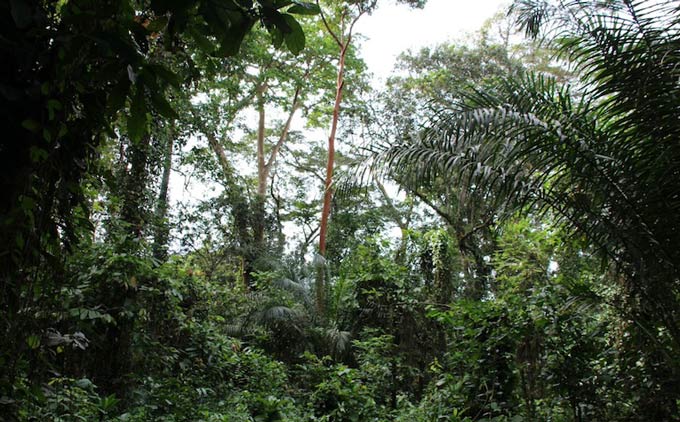
In eastern Sierra Leone, straddling the border of Liberia, lies Gola Rainforest National Park, one of the last remaining intact tracts of the tropical Upper Guinean forests in West Africa. Towering trees with massive buttress roots create a dense, emerald-hued canopy where monkeys hoot, malimbes chatter and hornbills flutter between the branches with their high-pitched honks and impressive wingspans.
Along the park’s fringes, 122 communities own small patches of the jungle within the four-kilometer-wide (2.5-mile) buffer zone. In the past, people here relied on these community forests to harvest timber and other forest produce, hunt for bushmeat and grow staple crops.
In the 1900s, logging and mining intensified in the region’s forests, including the area that would become Gola Rainforest National Park.
People cut down large swaths of trees in the buffer zone to grow cash crops like oil palm and cacao, from which chocolate is made. Poaching and encroachment in the forest increased during Sierra Leone’s civil war in the 1990s and into the early 2000s, further threatening the rainforest and its wildlife.
According to a 2017 geospatial analysis published by Purdue University in the U.S., such activities led to massive deforestation, with the Gola community forests losing more than 4% of their tree cover annually between 1991 and 2016.
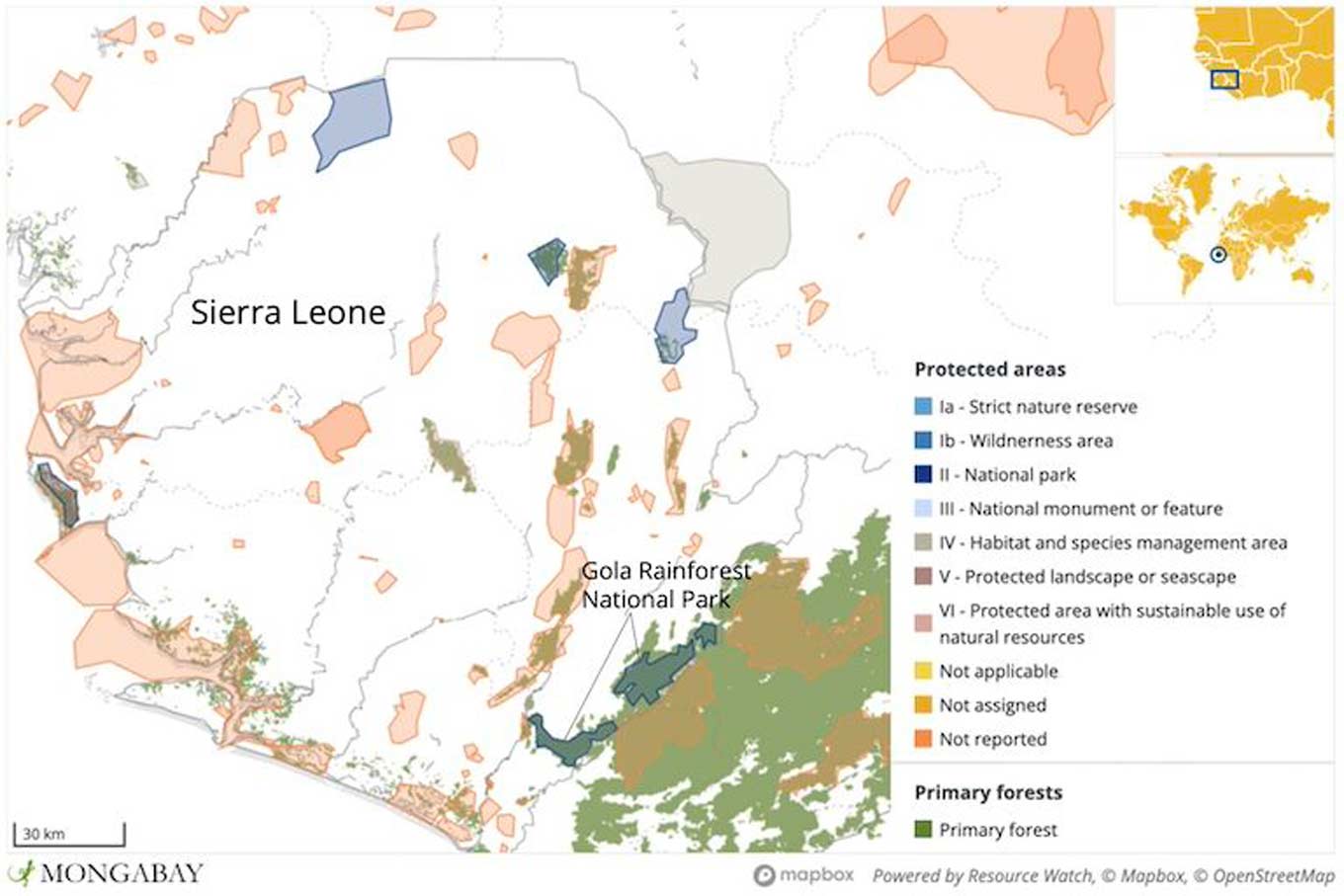
In 2013, a carbon credit project was launched in the Gola rainforest to stymie deforestation and provide a sustainable, alternate livelihood for forest-dependent communities. The 30-year project follows the United Nations-backed framework to reduce emissions from deforestation and forest degradation (REDD+) by managing forest resources sustainably and enhancing forest carbon stocks.
Companies, countries and other entities can purchase carbon credits through the program and use them to offset their emissions and meet the targets of the Paris Agreement, which aims to slow global warming enough to thwart its worst effects. In return, the forest-rich, low-income tropical countries receive monetary benefits for conserving their forests and safeguarding biodiversity.
The 30-year Gola REDD+ carbon project began as a collaboration between the U.K.’s Royal Society for the Protection of Birds (RSPB), which has been working in Gola since the 1980s; the Conservation Society of Sierra Leone (CSSL), one of the country’s oldest conservation organizations; and the government of Sierra Leone.
Their joint venture, the Gola Rainforest Company–Limited by Guarantee (GRC-LG), sells carbon credits and works with the forest-edge communities — the project’s beneficiaries — to enact conservation measures.
Gola rainforest: A biodiversity hotspot
Spanning more than 740 square kilometers (286 square miles), about twice the size of the U.S. city of Detroit, the picturesque Gola rainforest teems with life. More than 60 threatened species, including many endemic to the Upper Guinean forests, call these forests home.
“It is one of the richest biodiversity areas in the world,” says Fiona Sanderson, a principal conservation scientist at the RSPB who has studied the biodiversity of the Gola rainforest for more than a decade.
The rainforest harbors a dozen primate species, including Diana monkeys (Cercopithecus diana) and western red colobus monkeys (Piliocolobus badius), more than 300 species of birds, including endemic rufous fishing owls (Scotopelia ussheri) and yellow-casqued hornbills (Ceratogymna elata), and a dizzying array of butterflies.
The forest is also a refuge for western chimpanzees (Pan troglodytes verus), African forest elephants (Loxodonta cyclotis), pygmy hippos (Choeropsis liberiensis) and giant pangolins (Smutsia gigantea) — all of which are threatened.
“Some of them are fantastic specimens of nature [and] they are very, very attractive,” says Sierra Leonean conservation biologist Hazell Shokellu Thompson. “If we lose the Gola forest, we will certainly lose quite a number of these animals and birds in this region, not only from Sierra Leone but also from West Africa.”
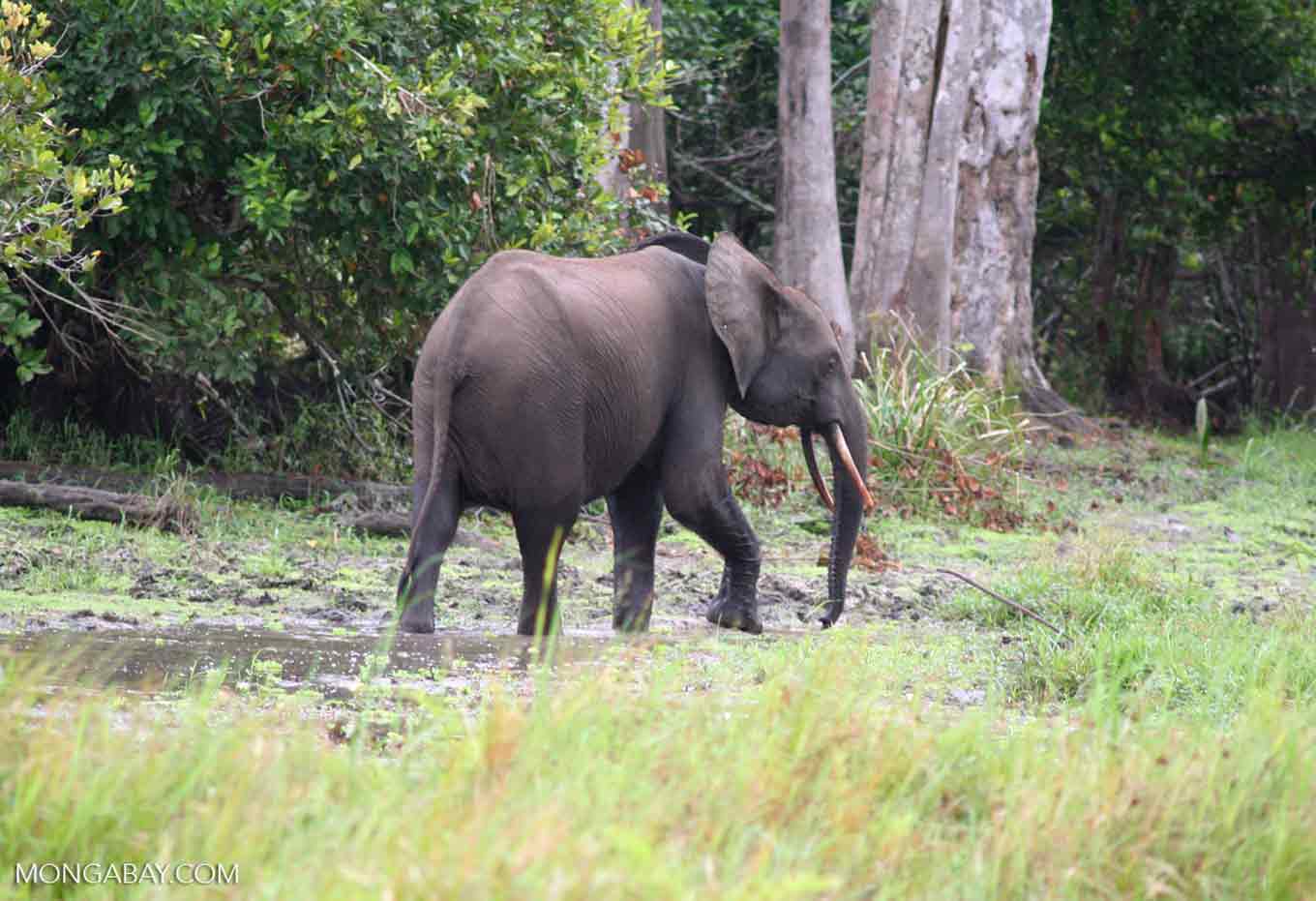
The rainforest stores some 19 million metric tons of carbon, and the REDD+ project is expected to result in emissions reductions of around 550,000 tons of CO2 per year. “It is a large tract of rainforest that is acting as a huge carbon sink,” Thompson says. “It is important for avoided emissions [and] for our battle against climate change.”
The REDD+ program aims to trade this stored carbon to save the rainforest and its impressive biodiversity.
Forest-friendly cacao: Reviving livelihoods and protecting forests
A major component of the Gola REDD+ project is establishing forest-friendly cacao plantations within the buffer zone around the national park. Although not a native species to the region, cacao has been grown in Sierra Leone since the British colonial era and is a crop that farmers rely on for income.
Nearly 70% of the world’s cacao comes from smallholders in West Africa, particularly Ghana and Côte d’Ivoire, where large swaths of forests are cut down to make way for monoculture plantations.
In partnership with the RSPB, the Gola REDD+ project encourages farmers to grow shade-loving cacao under the canopy of native rainforest trees such as Ivory Coast almond and African teak (iroko). Cacao relies on native insects, bats and birds for pollination and pest control.
According to the RSPB, 2,587 farmers living in the forest fringes cultivate more than 2,000 hectares (5,000 acres) of forest-friendly, shade-grown cacao as part of the REDD+ project. In 2020, 44 metric tons of cacao was grown in these farms. Apart from cacao, farmers also grow kola nuts, coffee and vegetables.
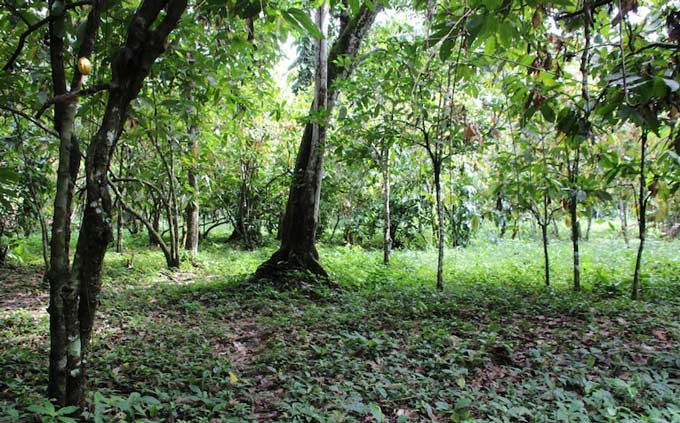
These agroforestry patches don’t just provide food and income for forest communities — they also act as corridors and habitat for wildlife in areas that would otherwise be cleared for conventional agriculture, according to the RSPB.
“What we are trying to do is flip it on its head,” Sanderson says of the forest-friendly cacao plantations. “It creates a kind of forest-like structure with the same native trees.” She says that more than 100 native tree species are found in these agroforestry plots, and nearly half of them have potential economic value — a key driver for agroforestry.
The cacao plantations are also a haven for wildlife, according to researchers. A study conducted by Sanderson and colleagues and published in Agriculture, Ecosystems & Environment in 2022 recorded more than 140 bird species in Gola’s shade-grown cacao plantations, of which nearly 60% were forest-dependent species such as hornbills.
Many plantations had more native species than the threshold required for sites to qualify as Important Bird and Biodiversity Areas — a designation given by BirdLife International that signifies the potential of a site for bird conservation. Chimpanzees, monkeys and forest elephants also venture into the cacao plantations to raid crops, much to the chagrin of local farmers.
As a cash crop, cacao generates revenue for farmers.
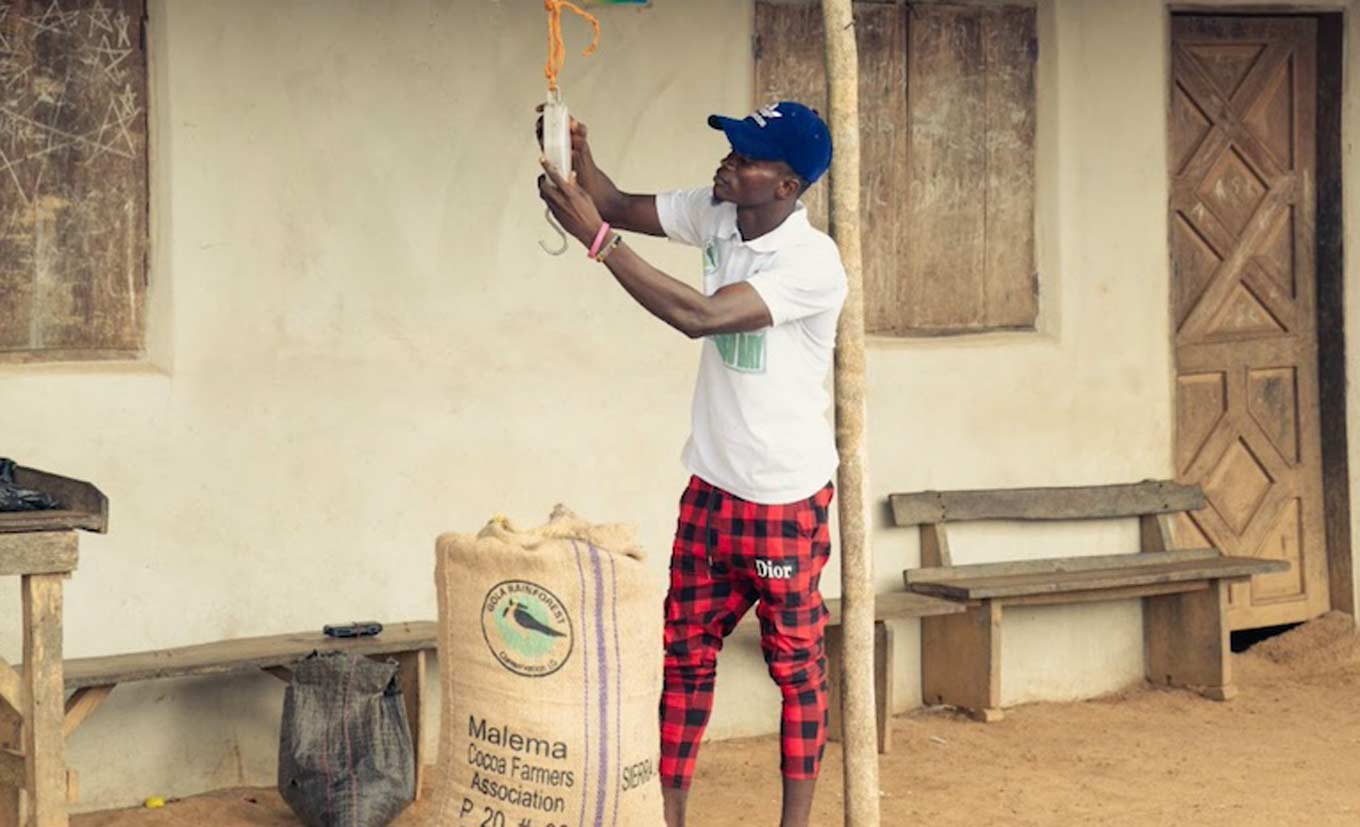
However, access to better-paying markets hasn’t been easy. As part of the Gola REDD+ project, the GRC-LG has set up cooperatives within the communities where farmers, as members, can sell their beans at a premium.
The beans are then exported to international markets, where their selling price is higher than what the middlemen visiting the communities offer. Through the cooperatives, farmers receive training on best practices to improve cacao yields and adopt forest-friendly cultivation practices.
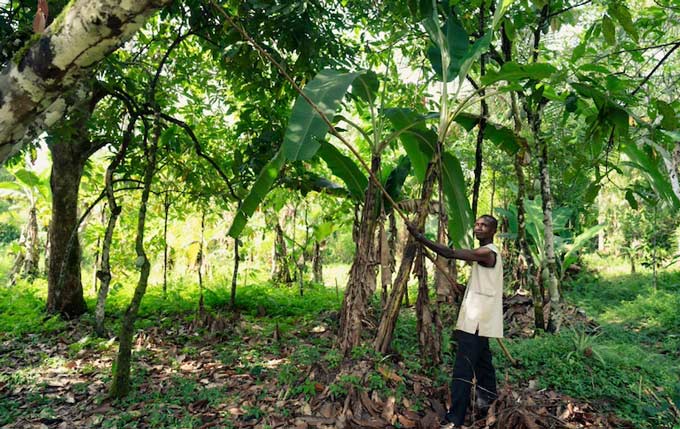
“Forest-friendly cacao is quite a unique program because it is encouraging shade-growing cacao by providing a premium or a bonus for farmers [which] incentivizes them to be a part of the program,” says social scientist Natasha Constant at the RSPB. She says preliminary results indicate cacao production contributes to 69% of farmers’ incomes.
“The merit in [shade-grown cacao] is that … the income generated through agroforestry cacao can be almost twice as high as that of monoculture.”
Benefits galore for forest-edge communities
Since the inception of the Gola REDD+ project, the GRC-LG has partnered continuously with the seven Gola chiefdoms and their member forest-edge communities in the spirit of obtaining free, prior and informed consent, as enshrined in the United Nations Declaration on the Rights of Indigenous Peoples (UNDRIP). According to GRC-LG representatives, paramount chiefs and the communities that are part of the REDD+ benefit-sharing agreement have the final say in how the funds are used.
“During the development of the REDD+ carbon project, we went into community consultation, participatory meetings and assessment,” says Fomba Kanneh, who heads the GRC-LG and who grew up in a Gola forest-edge community.
“We did [a] need[s] assessment with all the communities — looking into the historical profile of the area and what they used to do before the commencement of the program.”
As a result of these consultations, the Gola REDD+ project was expanded to provide scholarships, uniforms and books for students, set up a savings-and-loan scheme for women-owned small businesses, invest in building schools and hospitals, and provide training for farmers to increase their crop yields so they don’t have to slash and burn additional patches of the forest to feed their families. Growing forest-friendly cacao was also a choice the communities made.
“Before the REDD+ project, communities were involved in mining, logging and poaching for money, but now it is hard to access these resources,” Kanneh says. “So, the communities have agreed to develop a beneficiary agreement that pays a royalty for conservation.”
Kanneh adds that the GRC-LG has 56 rangers who regularly monitor and patrol the park for deforestation, logging, poaching, mining and other illegal activities.
Sheku Kamara, executive director of the Conservation Society of Sierra Leone, says the project links conservation to livelihood.
“The dependency on the forest is for people to get their livelihood. So if you can provide them something of an alternative, where they can increase their income, they will be less dependent on the forest,” he tells Mongabay. “Livelihood is a tool that we use in conservation.”
These principles have translated into results, according to a recently published 2024 study in Nature Sustainability that found that in its first five years, the Gola REDD+ project reduced the average annual deforestation rate in the buffer zone by 30% compared to areas that weren’t part of the REDD+ project.
This reduction in deforestation translates to 340,000 metric tons of avoided CO2 emissions.
“We’re not removing deforestation [through the REDD+ project]; we’re just reducing it,” study co-author Maarten Voors, an economist at Wageningen University and Research in the Netherlands and who is not affiliated with the Gola REDD+ project, tells Mongabay.
He attributes this reduction to forest-friendly cacao plantations. “To a large extent, they’re not clearing the dark green stuff — the important trees, the big ones that have sequestered a lot of carbon — they’re leaving those aside and doing other activities.”
The study also found that the reduction in deforestation didn’t affect people’s incomes. “We didn’t see win-win, but we saw a win-no loss,” Voors says.
The Gola REDD+ project isn’t without its challenges. Kamara tells Mongabay the carbon credit market tends to be volatile and can impact the revenues generated for the communities.
Bringing together over more than 100 communities with different priorities and needs requires years of hard work, trust and transparency in benefit-sharing. Shashi Kumaran, head of sustainable financing at the RSPB, says imparting financial literacy to farmers to manage their cacao farm business can be challenging.
Cacao yields, although promising, can vary, pushing farmers to resort to more lucrative but forest-harming activities like logging, according to the RSPB’s Sanderson. She adds that deforestation in the buffer zone can spike during periods of economic instability, as during the COVID-19 pandemic.
Despite these challenges, those involved in implementing the Gola REDD+ project say they see a bright future for it because the communities see the benefits and appreciate the efforts put in by the different partners.
“You don’t have conservation without people, and we want a landscape that delivers for everyone because the communities living within them are absolutely [an] integral part of the landscape,” Sanderson says.
This article was originally published by Mongabay.
Adrian Hill, director of the Jenner Institute at the University of Oxford and chief investigator for the R21 vaccine, tells Nadine Dreyer why he thinks this is a great era for malaria control.
What makes malaria such a difficult disease to beat?
Malaria has been around for 30 million years. Human beings have not.
Our hominoid predecessors were being infected by malaria parasites tens of millions of years ago, so these parasites had a lot of practice at clever tricks to escape immune systems long before we came along. Homo sapiens first evolved in Africa about 315,000 years ago.
Malaria is not a virus and nor is it a bacterium. It’s a protozoan parasite, thousands of times larger than a typical virus. A good comparison is how many genes it has. COVID-19 has about a dozen, malaria has about 5,000.
Additionally, the malaria parasite goes through four life cycle stages. This is as complex as it gets with infectious pathogens.
Medical researchers have been trying to make malaria vaccines for over 100 years. In Oxford it’s taken us 30 years of research.
How does the R21/Matrix-M vaccine work?
The four malaria life cycles are all hugely different, with different antigens expressed. An antigen is any substance that causes the body to make an immune response against that substance.
We targeted the sporozoites, which is the form that the mosquito inoculates into your skin. We were working to trap them before they could get to the liver and then carry on their life cycle by multiplying furiously.
Each mosquito injects a small number of sporozoites, perhaps 20, into the skin. If you clear those 20, you’ve won. If one gets through, you’ve lost. The bad news is you’ve only got minutes.
So you need extraordinarily high levels of antibodies that the parasite hasn’t seen before and hasn’t learnt to evolve against. Technologically it’s like having to design a car that’s 10 times faster than anything else on the road.
Luckily, there are no symptoms of malaria at that stage.

A child dies every minute from malaria in Africa. Why are children more susceptible than adults?
Children under five years old account for about 80% of all malaria deaths in Africa. The age you’re most likely to die of malaria in Africa is when you are one year old.
For the first six months you are protected largely by your mother’s immunity and the antibodies she transfers during pregnancy.
If you survive to age two or three, and you’ve had a few episodes of malaria and you are still alive, you’ve got a bit of immunity. This improves over time.
Some children get up to eight episodes in three or four months. They get quite unwell with the first, and three weeks later they’re having a second bout and so on.
Natural immunity doesn’t work until you’ve had a lot of different infections and that’s why adults are generally protected against malaria and don’t become very unwell.
Without malaria, children would be healthier in general — the disease makes you susceptible to other infections.
What about the pace of vaccine rollouts?
We’ve been disappointed that it’s taken more than six months to roll out the R21 vaccine since it was approved in October last year. There are millions of doses of R21 sitting in a fridge in India.
There are a lot of organizations and processes involved in standard deployment that don’t seem necessary.
Compare that to a COVID-19 vaccine from Oxford and AstraZeneca that was approved on New Year’s Eve 2020 and rolled out in several countries the very next week.
In the same year malaria killed more people in Africa than COVID-19 did.
The first malaria vaccine, the RTS,S, has already been given to millions of children in a large safety trial and the uptake has been really high, so large coverage can be achieved in Africa.
How big a role will vaccines have in the fight to eradicate malaria?
We really think we have an opportunity now to make a big impact.
Nobody is quite sure how many of the older tools such as insecticides and bed nets we need to carry on with. The advice is to keep them all.
But mosquitoes are building resistance to insecticides. Anti-malaria medication only lasts for days and parasites are building up resistance against these drugs as well.
There are about 40 million children born every year in malaria areas in Africa who would benefit from a vaccine. The R21/Matrix-M has been designed to be manufactured at scale. The Serum Institute of India, our manufacturing and commercial partner, can produce hundreds of millions of doses each year.
Another real advantage is its low cost. At US$3.90 a dose the R21/Matrix-M appears to be the most effective single intervention we can deploy against malaria
Worldwide there is US$5 billion currently allocated to fight malaria each year.
We’re optimistic that if this money is spent sensibly we can make a big difference. Buying 200 million doses of the R21/Matrix-M vaccine would cost US$800 million.
Being in the field I’m aware of other vaccines coming along. Some are targeting the blood stage and others the mosquito stage of malaria, which is very exciting. This looks like a great era for malaria control.
More than 600,000 people die of malaria each year. With low-cost, very effective vaccines being deployed we should be able to get this down to 200,000 or less by the end of this decade.
Then the endgame will be malaria eradication worldwide, which really should happen in the 2030s.
This article by Adrian Hill, from the University of Oxford, was originally published by The Conversation.

In 2024, many creative, independent workers find themselves at an impasse: Save money and time by working asynchronously from home, or find an expensive co-working space that allows for at least a little human interaction every week.
Well, as much as your pajama pants and separation anxiety-addled dog might not like it, experts suggest that people typically thrive in co-working spaces.
But after disastrous stories from WeWork and The Wing, those creative, values-driven business owners are trying to forge a new path for co-working.
One such case study is Place to B, a new co-working and collaborative space in Portland, Oregon. It was created by three founders of certified B Corps — companies that meet rigorous standards for ethical social, environmental, and governance practices in business.

Not exclusive to B Corps, the office’s memberships are open to a variety of people and organizations — so long as they share the same values.
“Place to B’s emergent nature makes it ideal for professionals who crave a sense of collaboration with like-minded people,” a press release for the co-working space shared.
“Founders and members alike are deeply driven to cultivate community among people who care as much about impact as they do about profit.”
Its website outlines who “belongs” in the space:
- Certified B Corps, Pending B Corps, or those currently in the process of certification
- 1% for the Planet members
- Benefit Corporations for Good Businesses
- Local B corp affiliates, like B Local PDX, Business for a Better Portland, and GlobalPDX members
- Values-aligned nonprofits
- Minority, woman, and LGBTQ+-owned businesses
- Worker-owned businesses
- Any other businesses that offer products or services that directly create positive outcomes for social or environmental justice
Whew, that’s a lot.
But the roughly 6,000 square foot space is excited to welcome these members, co-founder Erin Fish said.

“After years of envisioning, manifesting, and planning, we are proud and excited to announce the launch of Place to B,” Fish wrote on LinkedIn, calling it “an innovative and dynamic co-working space and member community.”
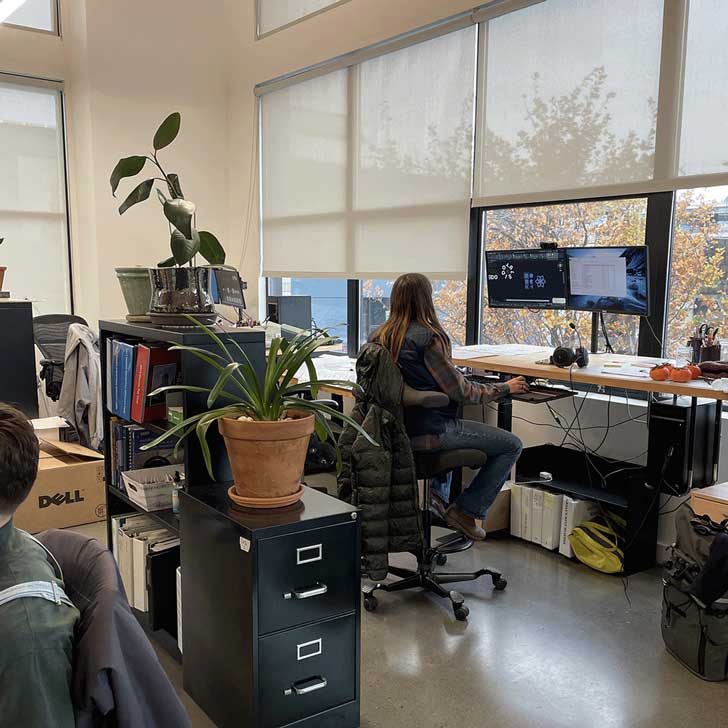
The space has been open since the start of February and began with seven organizations, like Fish’s own Wanderwell (a B Corp travel insurance company), and another co-founder’s Kaleido Studio (a climate-centric architectural design firm).
“I love the sense of community that is being created at Place to B and the excitement to return to office work,” Jenn Lanius, an architect at Kaleido Studio said.
She had been working remotely since the start of the pandemic, sharing that the return to the workplace had been slow.
“Several friends in other businesses have joined, and it has been fun growing the community. As a small office, it feels great to be part of a larger group of people who share similar values.”
Those shared values don’t stop at working next to a fellow B Corp. In the space’s kitchen, members can pour coffee from B Corp roasters, or sip on some tea from ethical tea makers.
Place to B also hosts networking and community events with groups like B Local PDX, Climate Curious, and Love Oregon.
A press release for Place to B said: “The founding team is hopeful that these programs… will boost awareness among professionals who usually assume that co-working spaces aren’t for them, and will find, in Place to B, a place where people, planet, and prosperity play essential roles in doing business for good.”
On top of this programming, the space is leased by Killian Pacific, a social impact real estate company, and has partnerships with community-oriented companies like Beneficial State Bank.

“The arrival of Place to B signifies a transformative moment for the neighborhood, promising to ignite further innovation and foster vibrant community engagement,” Nicole Stein, director of sustainability and social impact at Killian Pacific, said in a statement.
To build its membership, Place to B offers five different options. These offerings range from an individual flex desk, to a large, private office space that can accommodate up to five people.
The goal is to give these small, values-driven organizations the space to “grow or shrink” as needed.
“Yes, it’s a workspace, but it’s also a positive environment that provides a sense of community while allowing me to present myself openly and honestly,” Deborah Westlight, operations manager for the Oregon Clean Power Cooperative, said in a statement.
All members have internet access and wifi, member perks (like discounts and benefits), indoor secure bike parking, an exercise room and showers, access to a community/member directory, and of course, those tasty coffees, kombuchas, and sparkling waters.
The next item on the to-do list is to create an advisory committee of members to make the space “truly inclusive,” co-founder Kel Moody said in a blog post for Beneficial State Bank.
“We’re working with other people, and it doesn’t even have to be in our field. It actually might even be better if it’s within mission-aligned – ‘mission’ being that we care about the wellbeing of the planet, the wellbeing of people, and prosperity,” co-founder Corey Omey continued.
“Business does not have to be about competition. Competition can drive a lot of innovation, but collaboration can take us further.”
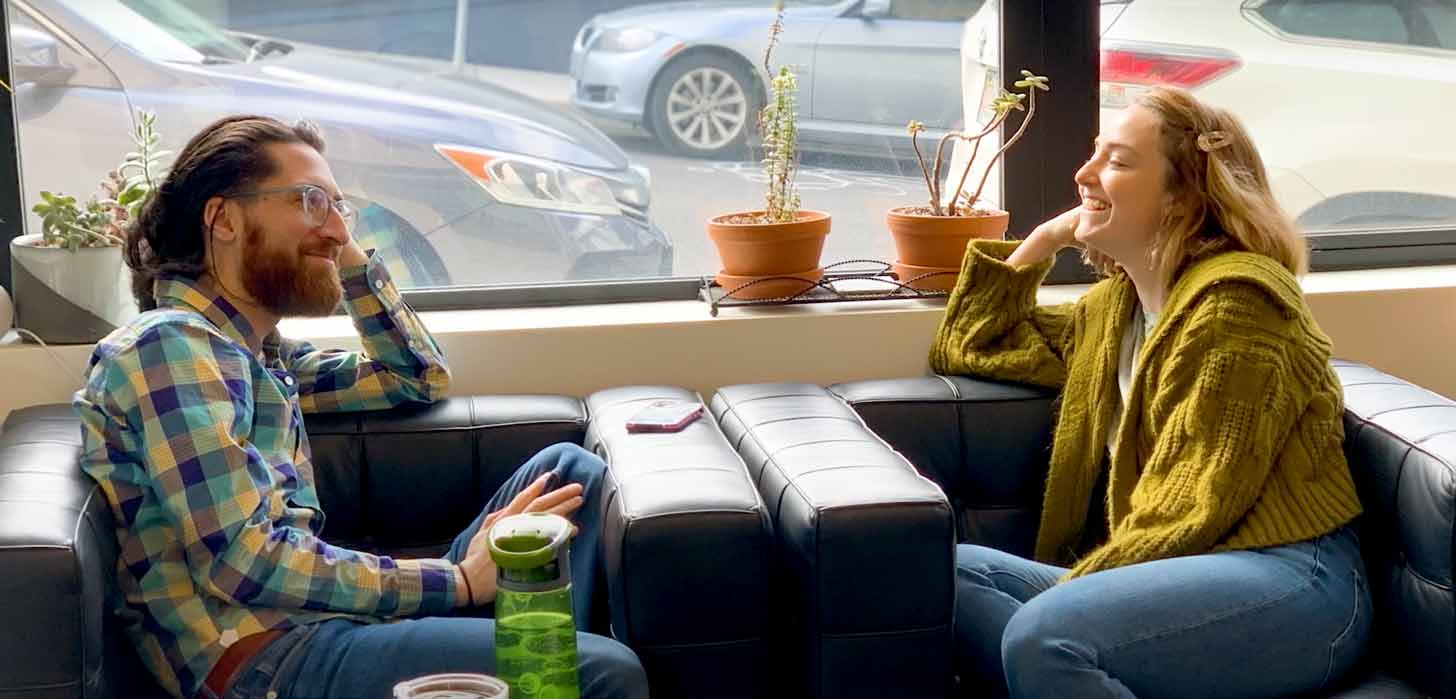
Ultimately, Place to B is designed to be a dynamic space for people who work better in community.
“This is the future of working: Together,” Ari Simmons, a community energy consultant who uses a flex desk in Place to B, said in a statement. “Not in silos.”
Header images courtesy of Place to B/B Lab
Anyone who has logged into a Spotify or Apple Music account — or heck, entered a public space — in the past week knows that Taylor Swift recently released a new album: “The Tortured Poets Department.”
But as the entire world listens to, studies, and comments on the eyebrow-raising 31 new tracks from Swift, a faction of her most dedicated fans have used it as an opportunity to do some good.
The Denver Gaylors, a community of LGBTQ+ Swift fans in Colorado, threw a flashy listening party for “TTPD” last week.

Although there were plenty of classic Swift signifiers (friendship bracelets, lyric analysis, and more), the event went beyond a typical fan gathering.
Together, the Denver Gaylors raised over $1,300 for femme, trans and nonbinary folks facing homelessness in the Denver area.
Although Gaylors (fans who like to juxtapose the singer’s music onto queer literature, themes, and history; noting that the megastar has neither explicitly confirmed nor denied an LGBTQ+ identity) occasionally get a bad rap, this localized group of fans just wants to do one thing: Foster community.

“Denver Gaylors started as a passion project by three queer friends who wanted to attend Taylor Swift events, but gayer. Not all Taylor-centric events feel welcoming and affirming for queer, trans, and nonbinary fans,” a Denver Gaylors member, Rose Bender, told Good Good Good.
But after their first few events, they realized there was an appetite for more, and with the release of “TTPD,” fans were abuzz.
“Taylor Swift fans know the excitement of waiting for a new album to drop, and there’s something special about having one of your first listens in community with fellow fans.”
The listening party included dissecting Swift’s newest tracks through BINGO games and brackets, a “TTPD” themed book swap with a local queer book shop, a flash sheet of tattoos from a local artist, a permanent jewelry station, photo ops, and raffle drawings full of goodies donated by LGBTQ+ and ally-owned businesses.
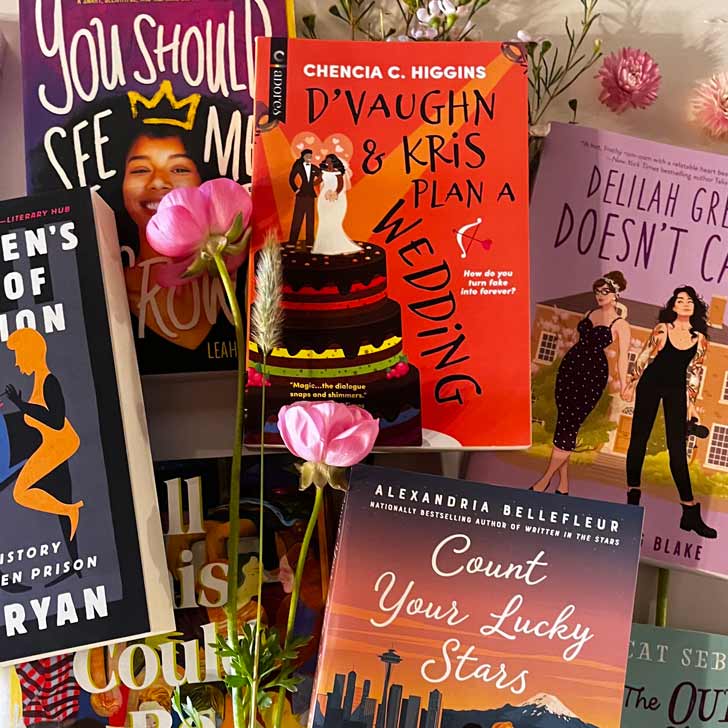
“As a queer, feminist bookstore we know how valuable LGBTQ-centric events are to our community and how much joy it can bring to be in a safe, fun space,” Dylah Ray, owner of bookstore Petals & Pages, told Good Good Good.
“Working together with other queer groups and businesses is so important to us to build a vibrant LGBTQ+ scene in Denver.”
Town Hall Collaborative, a women-owned event space in the city, also donated its space to the cause. Bender said this was especially helpful, since over 450 turned out on the evening of the listening party.
The sale of raffle tickets supported The Delores Project, a local nonprofit that provides support to femme, trans, and nonbinary Denverites experiencing housing insecurity.

“Y’all, we are so moved by how many of you showed up and supported The Delores Project and their amazing mission,” Denver Gaylors shared in an Instagram post. “We had 97 donors, 19 raffle prize winners, and raised a total of $1,300 dollars!”
“Our raffle was made possible by generous queer and allied businesses and artists who donated some really kick-ass prizes,” Bender added, to Good Good Good.
The Delores Project provides emergency shelter, rehousing, supportive housing, and behavioral health and wellness care to women, trans, and nonbinary members of the community.
With the help of donations, the organization is able to distribute gender-inclusive essentials to community members, as well as continue its work to provide affordable housing and free or low-cost services to those in need.
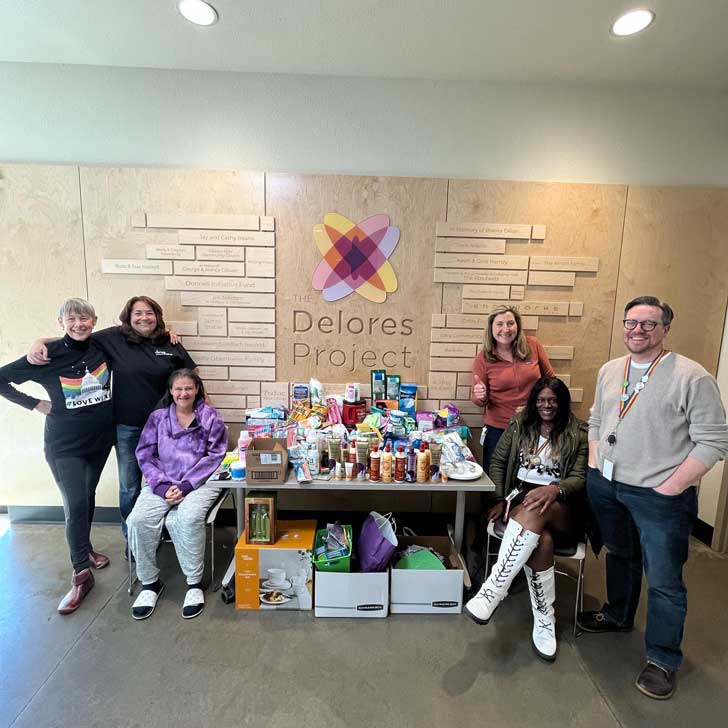
“The Delores Project has created a unique model that embraces trauma-informed care at every level and is leading the way in transgender inclusion, racial equity, and community engagement,” the organization’s website reads.
“It is through the generosity of people like you that our guests and residents are able to create paths to their stability.”
In addition to financial gifts and in-kind donations, the organization encourages supporters to host events to boost support — and that’s exactly what Denver Gaylors did.
“We were thrilled to amplify the work that Denver Gaylors did to raise money for the Delores Project which is such a valuable service for our community,” Ray, of Petals & Pages, added.
This is not the only time the group has raised funds for area nonprofits. Last year, for the release of “1989 (Taylor’s Version)” their listening party garnered a couple hundred dollars for a local mutual aid fund.
A listening party for “Speak Now (Taylor’s Version)” also brought in some generous donations for The Delores Project.
Overall, Bender recalled, as the group has grown — alongside Swift’s stardom — organizers know that working with other queer businesses, organizations, and artists is paramount in giving back to the community and investing in the sanctity of affirming spaces.
“Denver Gaylors is a passion project organized by audacious sapphics and executed fully by volunteers,” an Instagram post from the organization said.
Bender added: “We aim to make a space for LGBTQIA+ fans to shimmer.”
Header images courtesy of Taylor Swift/Universal Music Group and Denver Gaylors
Every day the Good Good Good team collects the best good news in the world and shares it with our community. Here are the highlights for this week!
If you want to get good news in your inbox every day, join the Goodnewsletter — the free daily newsletter designed to leave you feeling hopeful.
The Best Positive News We’re Celebrating This Week —
A team of biologists found more than 700 species of animals on a recent mangrove expedition in Cambodia
Recently, a team of biologists ventured into the heart of a Cambodian mangrove forest to survey the wildlife that lived within the thickets of tree roots and branches — and it was a resounding success.
The team found 700 different animal species — and suspect they didn’t even scratch the surface: “If we could look at the area in even greater depth, we would find 10 times more, I am sure.”
Of the 700 animals found, researchers recorded 74 species of fish and 150 species of birds, 15 of which can be found on the red list of threatened and endangered species.
Why is this good news? While mangroves are often (rightly!) hailed for their ability to provide coastal protection and locking in carbon, “the value of mangroves for biodiversity conservation as well as the services that animals provide to mangrove forest health — is often overlooked.” Not anymore.
Applications for the American Climate Corps are now open — with 2,000 positions to fill across the country
To celebrate Earth Day, President Joe Biden just delivered a very exciting announcement: Job applications for the American Climate Corps are now open.
To start, the program is recruiting over 2,000 positions in 36 states, Washington DC, and Puerto Rico. Eventually, the program will train and employ more than 20,000 people in climate-related jobs like installing solar panels, fighting wildfires, rebuilding wetlands, and more.
Additionally, through a new partnership with the North American Building Trade Union, members will also be eligible for a streamlined path to federal climate-related jobs upon completion of their service in the corps.
Why is this good news? The creation of the Climate Corps has been a key demand from activists and environmental groups. It’s modeled after a similar program that provided jobs for millions during the Great Depression, and importantly: all program participants will be paid, and most jobs don’t require previous experience.
→ Read more
Once a ‘biodiversity basket case,’ rare and endangered native bird species are now thriving in New Zealand’s capital
By the 1990s, many native bird species in Wellington, New Zealand were nearing local extinction due to human activity, habitat loss, and the introduction of pests.
Thanks to decades of conservation efforts, the city’s native birds are back and they’ve brought their birdsong with them. Since 2011, the average number of native bird species in the city’s parks and reserves has risen by 41% — with some species increasing by as much as 260%.
It’s also resulted in a positive feedback loop: the more residents encounter native birds day-to-day, the more inspired they are to protect them.
→ Read more
More good news happening in cities around the world:
- To cut food waste in half, Milan’s groundbreaking “zero waste” strategy is helping both people and the planet.
- Tuscon is planting a million trees to combat climate change and help improve the health of residents, wildlife, and the watershed.
- Border towns in Texas and Mexico are building a binational park instead of a wall, working together to turn a shared river into an ecological restoration project.
- Calling for 60% energy savings in residential buildings, Paris is making public housing both greener and more habitable at the same time.
Drivers and first responders helped save a person from a burning vehicle on the side of a major highway
Sam Orobovich’s car burst into flames after hitting a light pole and guardrail on the side of I-94 in St. Paul, Minnesota. With the driver’s side door tight against the guard rail, he was trapped inside — until people started pulling over to help him get out.
Dashcam videos show at least five people pulling on both the driver and rear doors and using roadside items to try and break the window to help Orobovich get out.
A Minnesota Highway Helper pulled up, successfully broke the window, and the group pulled Orobovich out of the window to safety away from the vehicle.
He issued a statement thanking the helpers, “I am alive today because several Good Samaritans and professional first responders saved my life. Fred Rogers used to say that whenever someone sees something scary, ‘Look for the helpers. You will always find people who are helping.’”
He went on to commend their uniquely heroic actions, choosing to risk their own lives by running towards a fiery car crash “that could explode at any moment” to help a stranger.
New mosquito nets have helped prevent 13 million malaria cases and thousands of deaths
This World Malaria Day comes with some incredibly good news: new, state-of the-art mosquito nets have prevented an estimated 13 million malaria cases and 24,600 deaths.
The New Nets Project distributed 56 million dual-insecticide nets from 2019 to 2022 in 17 countries where malaria is endemic to address insecticide resistance in some mosquitoes. The new nets were found to improve malaria control by 20 to 50 percent compared to standard nets.
While we’ve seen significant progress, in 2019 alone, 386,000 people in Africa still died from malaria, of which 274,000 were children under five. Annually, there are an estimated 200 million new cases in malaria-endemic countries.
More good news to celebrate on World Malaria Day:
- A new community care program has certified 10,000 women to fight malaria in Rwanda, where it’s the seventh-leading cause of death.
- The WHO recently approved the first-ever malaria vaccine — the first doses were administered earlier this year, and it’s going to save millions of childrens’ lives.
- Cape Verde became the first sub-Saharan African country to be malaria-free in 50 years.
The U.S. just broke ground on its first-ever high-speed rail line — it will connect Los Angeles and Las Vegas
Builders just officially broke ground on the first “high-speed” rail line in the U.S. Connecting travelers between Las Vegas and Los Angeles in under two hours, it could be completed by the end of the decade.
In addition to cutting down commute times and reducing greenhouse gases, it’s also believed that the new rail will open the door for the construction of an entire high-speed rail network across the U.S.
The train will travel at 186 miles per hour and attract an estimated 11 million passengers annually. The U.S. Department of Transportation estimates it could cut 400,000 tons of carbon dioxide emissions annually and create 35,000 new jobs.
→ Read more
More train-related good news:
- Reducing waste and cutting demand for new steel, retired wind turbine blades are being recycled into high speed rail lines, bike shelters, and more.
- A travel editor gave up flying to take ships, buses, bikes, and her own two feet instead — and found that “slow travel” is “simply wonderful.”
- To lower its emissions, Spain is banning short-haul flights on routes where there’s a rail alternative that takes less than two and a half hours.
Over the past 50 years, global immunization efforts have saved at least 154 million lives
A landmark study just found that global immunization efforts have saved an estimated 154 million lives over the past 50 years — the vast majority of which (101 million) have been infants. That’s the equivalent of around 6 lives saved every minute for the past 50 years.
Led by the World Health Organization, the study shows that immunization is “the single greatest contribution of any health intervention” to ensure babies enjoy long, healthy lives.
With the most significant impact on reducing infant mortality, the measles vaccination accounted for 60% of the lives saved. Notably, the polio vaccine has resulted in over 20 million people being able to walk today — instead of being paralyzed.
Vaccination against 14 diseases in total has “directly contributed” to reducing infant deaths by 40% globally over the past 50 years.
The study also found that for each life saved by vaccines, an average of 66 years of full health were gained — and 10.2 billion years total were gained over the full 50-year time frame.
More good news of the week —
Mother Earth will now receive royalties when you listen to nature sounds on major streaming platforms. Classic sounds like ocean waves, wind, rainstorms, birdsong, and more will now be recognized under an official artist — NATURE — on all major streaming platforms.
New York City just launched its “Open Streets” season with the largest-ever car-free Earth Day celebration. Across all five boroughs, 53 streets and plazas throughout the city were filled with public art and community programming instead of car traffic.
Netflix is celebrating Earth Day with release of a new docu-series called ‘Our Living World’ — narrated by Cate Blanchett. The four-part series is now streaming and takes viewers through the magnificent untold stories of the connections between species across the globe.
Seven countries are now generating 100% of their electricity from renewable sources. Another 40 countries generated 50% of their electricity from renewables, in what experts are calling an “irreversible tipping point” moment.
After years of being ravaged by disease, a nonprofit just successfully planted 40,000 coral substrates in the Caribbean. FUNDEMAR has been crucial to restoring coral reefs throughout the Caribbean, cultivating eight different species, including the notoriously hard-to-breed Pillar coral.
Helping restore waterways to their natural state, a record number of river barriers were removed across Europe in 2023. Connecting rivers helps wildlife travel and migratory fish reach breeding grounds, and removing dams allows water levels to vary, helping increase the diversity of plants and animals.
Providing clean energy via existing infrastructure, Germany has installed over 400,000 plug-in “solar balconies.” Different from rooftop solar, the balconies are a much smaller system containing one or two panels plugged right into an outlet.
An ultrasound clinic is using AI to detect types of breast cancer faster. The AI scan uses software that compares the images taken against roughly 200 million other breast scans, helping more quickly and accurately identify breast cancer, which is most curable when it’s detected early.
Revolutionizing conservation efforts, scientists just pinpointed a fungal virus harming frogs and toads. A new study identified a novel virus that has been impacting over 500 amphibian species for decades.
Reaching another clean energy milestone, California just went 9.25 hours using only renewable energy sources. Nearly every day for the past six weeks California’s electric grid has run on solar, wind, and other clean energy sources for hours at a time.
Farmers in Vietnam are reducing methane emissions by changing the way they grow rice. They’re using less water and a drone to fertilize the crops, which is both uniquely vulnerable to climate change and a contributor to it.
There are growing efforts in medicine among physicians to take women’s pain more seriously, especially in reproductive care. Recently surfaced stories, adjusting pain measurement approaches, investment in research, and more are helping drive the much-needed shift.
California just announced the creation of the first new state park in a decade. The 1,600-acre Dos Rios tract in the state’s crop-rich Central Valley is set to open on June 12 and become California’s 281st state park.
Drinking glasses of wine along the 26.2-mile route, a London marathoner raised $22,000 for a local hospice center. Tom Gilbey is a wine connoisseur and did a blind wine taste test for every mile he ran on the course to help raise funds.
The FTC just voted to ban noncompete agreements, freeing workers to pursue new jobs and start businesses. Noncompete clauses have restricted workers from freely changing jobs and the new rule will help promote career mobility, innovation, and competition.
The “most significant” environment deal since 2015, U.N. delegates are now negotiating the terms of the new global plastics treaty. It’s a critical opportunity to stop the fossil fuel industry’s pivot from transportation and electricity generation to plastic production.
Great Smoky Mountains National Park is opening a 'firefly lottery' for lucky winners to see a rare firefly light show. Synchronous fireflies illuminate summer nights in national parks across the U.S., prompting conservation efforts to protect the beloved insects.
The U.S. Department of the Interior is investing $36.9 million to clean up “legacy pollution” in Kentucky, Mississippi, and Missouri. The funding will be used to plug orphaned oil and gas wells to address environmental and safety hazards in the state.
This story was originally published by The 19th and was republished with permission.
Colorado’s prison system must now provide the same gender-affirming health care covered by state Medicaid, and trans women must have the option to be housed with other women. This change comes as a result of a class action lawsuit which includes Taliyah Murphy, pictured here, among others.
Taliyah Murphy, a transgender woman living in Colorado Springs, studies accounting and finance. She co-owns two small businesses with her fiancé and eventually wants to start a financial education nonprofit for marginalized people.
For Murphy, starting her gender transition helped her focus on her education as she developed her career — but she faced near-impossible barriers at every turn.
She started her transition while incarcerated with the Colorado Department of Corrections (CDOC), which repeatedly denied her gender-affirming care.
She had to make multiple appeals before she could access hormone replacement therapy, she recalls, and she experienced severe depression because she was unable to treat her gender dysphoria.
Even a recommendation by a CDOC psychiatrist wasn’t enough to qualify her for surgery.

Her safety was also compromised, she told The 19th. Murphy was denied transfer to a women’s prison, she said, and constantly harassed and misgendered by staff and inmates while housed in men’s facilities.
She endured sexual advances from other inmates and was punished through solitary confinement for speaking out when faced with threats against her life. Survival was exhausting.
“At one point for me, if I wasn’t at my job assignment, I didn’t really come out of my room a lot,” Murphy said. “I just wanted to stay away from the drama and any type of attempt to try to victimize me.”
Murphy is one of hundreds of transgender women with similar experiences in the state. Her story is included in a class action lawsuit filed in 2019 by the law firm King & Greisen, LLP and the Transgender Law Center.
According to the lawsuit, these women were frequently subjected to sexual and physical violence, and their requests for medical care were routinely ignored, in violation of the state constitution and Colorado Anti-Discrimination Act.
This March, that suit resulted in a groundbreaking legal agreement known as a “consent decree” that requires Colorado to overhaul how it houses incarcerated transgender women and provides medical care to all trans people behind bars.
Now, Colorado’s prison system must provide the same gender-affirming health care covered by state Medicaid, and trans women must have the option to be housed with other women.
While other settlements may mandate specific changes without any input from the government agency involved, in this case lawyers worked with Colorado officials to outline a legally binding agreement.
Experts hope it will serve as a model for comprehensive change for other states.
Transgender women across the country face life-threatening circumstances behind bars — and the majority of them are forced to live with men.
The roots of the case trace back to 2018 when a Black trans woman named Lindsay Saunders-Velez sued the Colorado Department of Corrections after she was sent to a men’s prison at age 19 and sexually assaulted.
She later worked with attorney Paula Greisen and the Transgender Law Center to file her case. During the legal team’s investigation into Saunders-Velez’s experiences, the attorneys learned that many others in Colorado shared similar problems.
“We started going to the prisons to meet witnesses and we were shocked at that time to learn that there were about 150 women living in men’s facilities,” said Greisen, who is now a partner with Greisen Medlock, LLC, a civil rights and employment law firm. Over time, that number more than doubled to about 350 women, resulting in the class action lawsuit that Greisen’s previous firm filed in November 2019 against Colorado’s governor and the state’s corrections department, in which Murphy is named as a plaintiff.
Saunders-Velez’s own case was settled in July of that year for $170,000. It did not allow her to transfer to a women’s facility, which she preferred, but she was allowed to serve the rest of her sentence in the men’s facility where she felt the safest. It also did not require broader changes to the state’s treatment of incarcerated transgender people.
The new consent decree, however, mandates systemic changes aimed at addressing trans women’s health and safety needs. These must be implemented in full by January 2025, although it allows for some flexibility if the Colorado Department of Corrections experiences staffing or budget shortages.
This agreement is unique because of the ways it addresses housing and care for incarcerated trans women.
Since 2003, the federal Prison Rape Elimination Act (PREA) has required that transgender, nonbinary and intersex people be assessed on an individual, case-by-case basis to determine the appropriate housing for them. But the ambiguity of the law’s language gives corrections departments broad discretion to make housing assignments for transgender people.
Many prisons require trans people to undergo gender-affirming surgery before they can be placed in a facility that aligns with their identity, yet accessing gender-affirming care within prison at all is often impossible or involves long wait times.
The World Professional Association for Transgender Health (WPATH) publishes internationally recognized standards of care for transgender and gender-diverse people. Frequently, however, prison facilities, including those in Colorado, deny trans people’s requests for care and housing that aligns with their gender identity.
To address these concerns, the CDOC has agreed to house transgender women in one of three areas, including two new units, depending on what the person wants.
These can include living in the general population at one of the state’s women’s facilities or the integration unit at the Denver Women’s Correctional Facility, which would help an incarcerated trans woman adapt before moving into the women’s general population.
Another option is living in the voluntary transgender unit at the men’s Sterling Correctional Facility, the largest prison in the state’s system.
Julie Abbate, a lawyer and advocate, said it is clear that a lot of thought and attention to detail was put into the Colorado agreement.
“This consent decree seems to have drawn on lessons learned in the field that if you just throw a bunch of people who have lived in a facility designated for men into a facility for women — without any kind of transition period or warning — then it can really be an awful situation,” she said.
Abbate worked for 15 years in the civil rights division of the Department of Justice and is now the national advocacy director for Just Detention International.
Shawn Meerkamper, managing attorney at Transgender Law Center, who worked closely on the Colorado lawsuit, said that the housing options laid out in the consent decree should help both transgender and cisgender incarcerated people adjust to new living situations.
The integration unit is meant to be a temporary place to ease the transition for everyone involved, they said — while the voluntary unit is meant for trans women who don’t want to leave the only prison system that they know and have experience navigating.
Having so many options for transgender women is unique, and is a significant achievement for state advocates, said A.D. Lewis, attorney and project manager for Trans Beyond Bars at the nonprofit Prison Law Office. Although PREA requires prison officials to ask transgender people how they want to be housed, none of his clients have ever been asked, he said.
“In the vast majority of prison systems, they will be housed by the external appearance of their genitals at the time of booking,” he said. Some trans women are placed into women’s facilities based simply on that criteria, while others are placed into solitary confinement or isolated from the general population — often because they are such a target for violence.
The Colorado consent decree outlines a process for making housing placement requests for transgender inmates and it sets deadlines for when the CDOC must respond. Any of the placement requests that are denied for the integration unit, voluntary transgender unit or women’s general population must be reviewed every six months.
The agreement also directs the CDOC to update its clinical standards for medical care and to work with an independent medical and mental health consultant to provide training for staff. It allows for flexibility depending on the type of medical care an incarcerated trans woman may want, Abbate said.
The policy provisions of the consent decree apply to “persons who have been, are, or will be incarcerated in the CDOC and who have, at any time, identified themselves to CDOC during their incarceration as transgender women,” according to the consent decree.
These changes will make transgender women behind bars safer, experts told The 19th — which is sorely needed, as the problems in Colorado are part of a pattern throughout the country. D Dangaran, director of gender justice at Rights Behind Bars, a non-profit legal advocacy organization, takes on legal cases for incarcerated transgender people who are being denied gender-affirming care and other needs.
Trans people behind bars are misgendered, deadnamed, forced to endure strip searches, they said — and these everyday violations of bodily autonomy are torturous.
“Violence occurs behind bars on a daily basis for all trans people, especially trans femme people,” they said.
Transgender people behind bars — particularly women housed with cisgender men — experience a disproportionate amount of sexual violence, harassment and assault in prisons. It is still rare for transgender women to be housed in women’s facilities, Dangaran said.
Researchers are in the early stages of understanding the outcomes of policies that aim to support incarcerated transgender people, since there are so few examples of inclusive policies to learn from, said Elana Redfield, federal policy director at the Williams Institute at the UCLA School of Law.
“There’s a huge need for more information,” she said. “On their experiences and particularly what policy changes actually make a real, concrete, measurable improvement for them.”
In California, such an experiment is currently underway. In 2020, the state passed a law that requires transgender women to be placed in a women’s facility if they ask to be. The law went into effect in 2021. Yet Lewis, who works closely with trans clients in California, said that in the three years since then, only 44 people have been approved for transfer out of hundreds who have requested it.
There is a huge backlog of requests and no formal administrative policy on how the state’s corrections department should address it.
“I think it would take over a decade for them to house the rest of the people that have requested to be reviewed for housing in a women’s facility. That’s just trans women,” Lewis said. “So we’re talking about pretty significant delays.”
Frequently, prison facilities only change their policies on housing or gender-affirming care if a lawsuit forces their hand, Dangaran said.
Donna Langan became the first federal prisoner to receive gender-affirming surgery in December 2022 after she sued the U.S. Bureau of Prisons, according to her lawyers.
In June 2022, Cristina Nichole Iglesias [won a case] to receive gender-affirming surgery while in federal prison. She received her treatment in 2023.
Even with a court win, implementation can be slow or further enforcement may be required.
Ashley Diamond sued the state of Georgia in 2015 after she was held in men’s prisons, where she reported being sexually assaulted multiple times and denied hormone treatments. In 2016 she won an undisclosed settlement, which prompted policy changes in Georgia.
Diamond sued again in 2023 because the state failed to provide her adequate health care or protect her from sexual assault after a second incarceration, according to her complaint. Ultimately, Diamond withdrew her second lawsuit, citing mental health reasons.
As for Murphy, she never got gender-affirming surgery while in prison. She was released in May 2020 and was able to get the surgery last year — since it was covered by Colorado Medicaid, she didn’t have to pay out of pocket for the expensive procedure.
The settlement reached alongside the consent decree also requires the state prison system to pay over $2 million in damages to members in the class action suit, which Murphy sees as an acknowledgment that the state did something wrong, she said.
The policies brought by the consent decree are going to make “some monumental and systematic changes in the system,” Murphy said. “I feel like it will be a catalyst for the rest of the country. A blueprint.”
Consent decrees, while legally binding, must also be monitored for enforcement. The limited data collection inside prisons can make the process of determining outcomes for transgender people a challenge, Abbate said. Surveying the affected women about their experiences is one important way to understand the effectiveness of a particular change, she said.
And in the Colorado case, if the state prison system falls out of compliance with the consent decree, they can be taken to court again. The Transgender Law Center will stay in touch with plaintiffs as well as with the outside experts who will help implement the new policies, in order to make sure the state is following through on its obligations.
These changes will show other courts what is required for incarcerated trans people to be safe, even if it’s not binding precedent in other states. The policy changes mandated by the Colorado consent decree are groundbreaking in their breadth, Dangaran said — and hopefully, those changes will play out more effectively than in California.
“If it’s what the people in Colorado really wanted and needed, that itself is going to create an impact that will have ripple effects — and that is a carceral intervention that could lead to a lot of good,” they said. “Or we could find after five years of this that it didn’t.”
When tornado sirens rang across parts of Nebraska and Iowa last Friday afternoon, residents did what they always do: Seek shelter. (And, in some instances, go outside to catch the twister on film.)
But this storm system was a lot more devastating than Midwesterners are used to seeing; in suburban Omaha and Elkhorn, Nebraska alone, at least 150 homes were damaged or destroyed.
One of dozens of reported tornadoes even registered as an EF-3, one of the most severe the area has seen in its history.
The tornadoes tore through homes and businesses for miles, through farms and into residential areas in Eastern Nebraska, before hitting an Iowa town.
Miraculously, no fatalities were reported in Nebraska, and less than two dozen people were treated in area hospitals, according to reports from the Associated Press. However, four people have died due to inclement weather in other Midwest states this weekend.
Regardless, the damage across the region left hundreds of residents without homes.
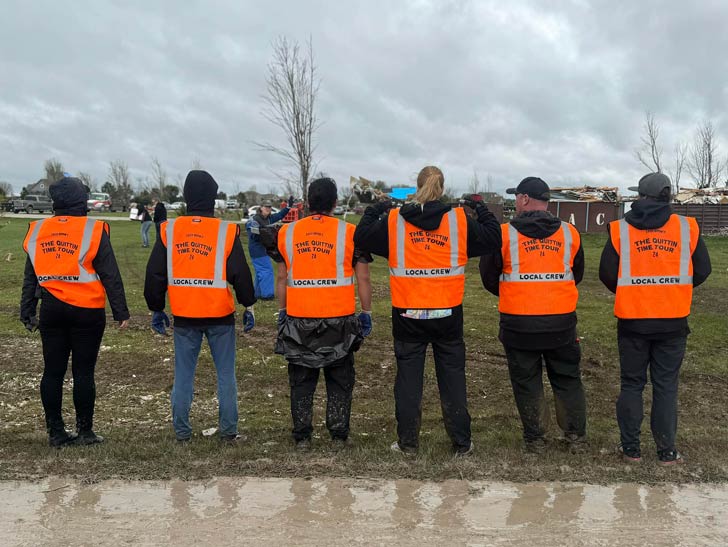
Instantly, the Nebraska community rallied. Churches and businesses opened their doors for shelter, resources, and support; vet clinics provided free care and microchip scans for animals; and volunteers showed up in swaths to help clean up the devastation.
Among those volunteers was country singer Zach Bryan, a Nebraska native who was coincidentally in the area for his “Quittin Time Tour.”
“As an American and someone who lived in Omaha for some pretty formidable years of my life, I want to offer some honest prayers and hopes to the communities affected by the tornadoes that tore through them,” Bryan wrote on Instagram.
“The band and I are standing with you guys as we are playing some shows in Omaha. I am so sorry to anyone that is having to deal with picking up the pieces of their homes and their lives. Without taking credit from the thousands of people lending a hand who have roots here, we love you so much and we’ll do all we can to help.”
Bryan was photographed by a number of community members as he lended a hand in an Elkhorn neighborhood, though according to some fans, he and his team asked people not to take photos, as he didn’t want any special credit for lending a helping hand.
“I can’t say I am a country music [or] Zach Bryan fan… but I will call myself a fan now due to his serving heart off the stage,” one community member, Mandi Brooks Chaplin, wrote on Facebook.
“Find your passion and don’t forget to serve your community when in need and not in need,” she added.
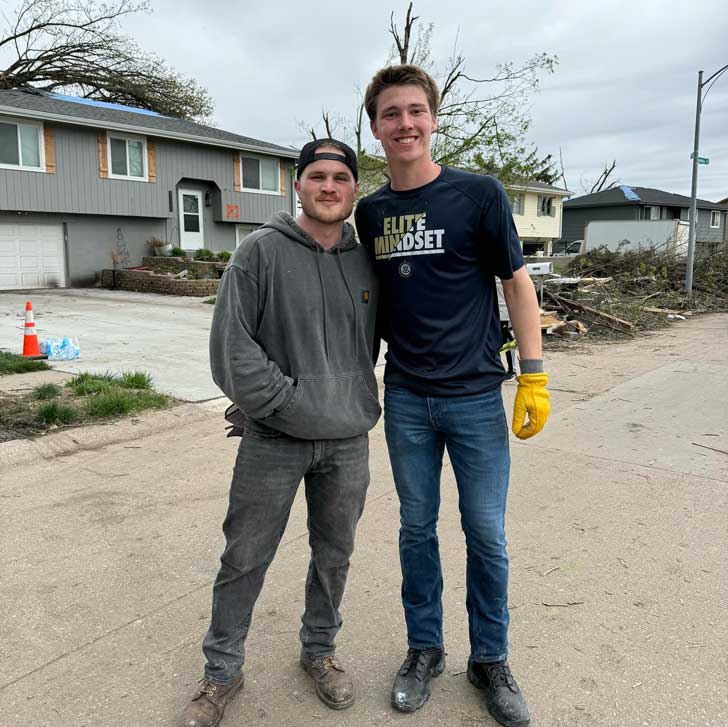
Her son, Mason, was able to get a photo with the country singer after volunteering alongside him all afternoon.
Another community member, Kristi Anderson, shared a photo of Bryan at work on Instagram.
“I was a fan before but now even more so,” she shared in her caption. “That’s country music star Zach Bryan and my son Gavin helping with tornado cleanup. What a great human!”
@maddox.nelson7 Zach Bryan helped our neighborhood clean up in Elkhorn, NE after the tornado. My daughter told me this video was better# #tornado #zachbryan #nebraska ♬ original sound - maddoxnelson7
Bryan’s Omaha concert is scheduled for tonight, Monday, April 29, and tomorrow, Tuesday, April 30, where many local fans will certainly gather — finding a much-needed reprieve from a long weekend picking up the pieces tornadoes left in their wake.
“Can’t wait to see him Tuesday,” one local wrote in a Facebook comment. “Thanks, Zach Bryan, for helping our community when you certainly didn’t have to.”
Header images courtesy of Zach Bryan, Mandi Brooks Chaplin, and Maddox Nelson
Our planet only has a decade left to prevent irreversible damage from climate change, but a group of comedians have a fairly good idea: “Let’s not die!”
On April 29, in West Hollywood, CA, a stacked cast of comedians are headlining a “Let’s Not Die!” show — and they’re embracing “climate doom” head on. The lineup includes Nick Kroll, Nikki Glaser, Aparna Nancherla, Esteban Gast, Maya May, and Sean O'Connor.
Proceeds from the event will go to Yellow Dot Studios, a nonprofit founded and led by Adam McKay, the director and writer behind a long list of credits that include “Don’t Look Up,” “Vice,” “Step Brothers,” “Anchorman,” and “Succession.”
In addition to their live fundraiser event, Yellow Dot Studios has produced a slate of filmed sketches in the last year, inspired by McKay’s “Funny or Die” sketch comedy roots.
In January, “I Think You Should Leave” star Tim Robinson teamed up with Yellow Dot Studios to film a sketch called “You Expect Me To Believe That?”
In the comedy sketch, Robinson plays a TV host named Ted Rack, who asks earth system scientist Henri Drake to level with him on climate-based research, in a way that “normal guys” like him can understand.
Another recent sketch — inspired by “The Game of Thrones” — features Rainn Wilson as a climate scientist who is attempting to educate the rulers of Westeros on the dangers of the “Big Oil Alliance:” Exxon Mobil, British Petroleum, Shell, and Chevron.
Time and again, Yellow Dot Studios uses comedy as a tool to take aim at the biggest forces behind pollution, greenhouse gas emissions, and environmental destruction.
In an interview with the Guardian, McKay said that the dialogue around climate-based research from the scientific community is often clinical and polite despite the urgency that it requires.
“It creates this kind of professional language that’s devoid of a lot of populist energy…of anger, sadness, laugh-out-loud comedy, absurdism,” McKay said.
Ultimately, for McKay, he envisions Yellow Dot Studios as a platform to engage with viewers on climate justice in a way that inspires catharsis and action.
And for any political leaders, lobbyists, and magnates watching, McKay is done with notions of “let’s make nice.”
“They only respond to pressure,” said McKay.
Well, pressure and a little pageantry.
The “Let’s Not Die!” event marks the first time Yellow Dot Studios has staged a live comedy event, but the headliners are no stranger to climate change jokes.
“I always say I don’t want kids [because] I don’t want them to suffer during the mass-extinction that climate change will soon bring,” Glaser posted on X, formerly known as Twitter.
“But then again it’d be nice to have a little person who looks like me to hang out with during all the mayhem & death [because] my phone probs won’t have service.”
Kroll also riffed on climate denial in a TikTok where he played “Greta Thunberg’s father.”
“Hello, it’s me, Greta Thunberg’s father Marc,” he said in a Swedish accent, as heart filters framed his face. “I just wanted to say I don’t agree with my daughter…climate change is a hoax. I love using plastic bottles. I think fossil fuels are the coolest fossils.”
Locals hoping to still snag tickets to the “Let’s Not Die!” live comedy show can visit the venue’s website.
For $30, a ticket will get attendees into what Yellow Dot Studios is calling a very “hot” show.
In an instagram caption, the organization teased: “This is going to be the hottest show since... [checks notes on 10 straight months of record hot global temperature, 390 days of record hot global oceans, 3 straight years of near-record low antarctic ice, highest CO2 in 3 million years]... it's gonna be hot!”
Header image courtesy of Yellow Dot Studios
As hosts of the beloved YouTube talk show “Good Mythical Morning,” Rhett McLaughlin and Link Neal have been trusted Internet figureheads for over a decade.
In recent years, the two have used their good-natured humor and inclusive approach to reach their fans — affectionately called “Mythical Beasts” — about important issues.
From hilariously informing viewers about colon cancer prevention to sharing a portion of their merch sales with nonprofits, they’ve proven that it’s possible to make entertaining content — and a difference — all at the same time.
This year, the duo has re-launched their voter registration platform: Vote Like A Beast.

“Vote Like A Beast is back,” Neal excitedly announced in a recent video, “...to provide you with a one-stop-shop to prepare to vote in this year’s election.”
The platform was created in partnership with Vote.org and features easy steps to register to vote, confirm one’s registration status, request a mail-in ballot, learn about candidates, and more.
“You can go to VoteLikeABeast.com right now to access nonpartisan tools to make sure you have everything you need to cast your vote and do so in a way that aligns with your point of view,” Neal continued.
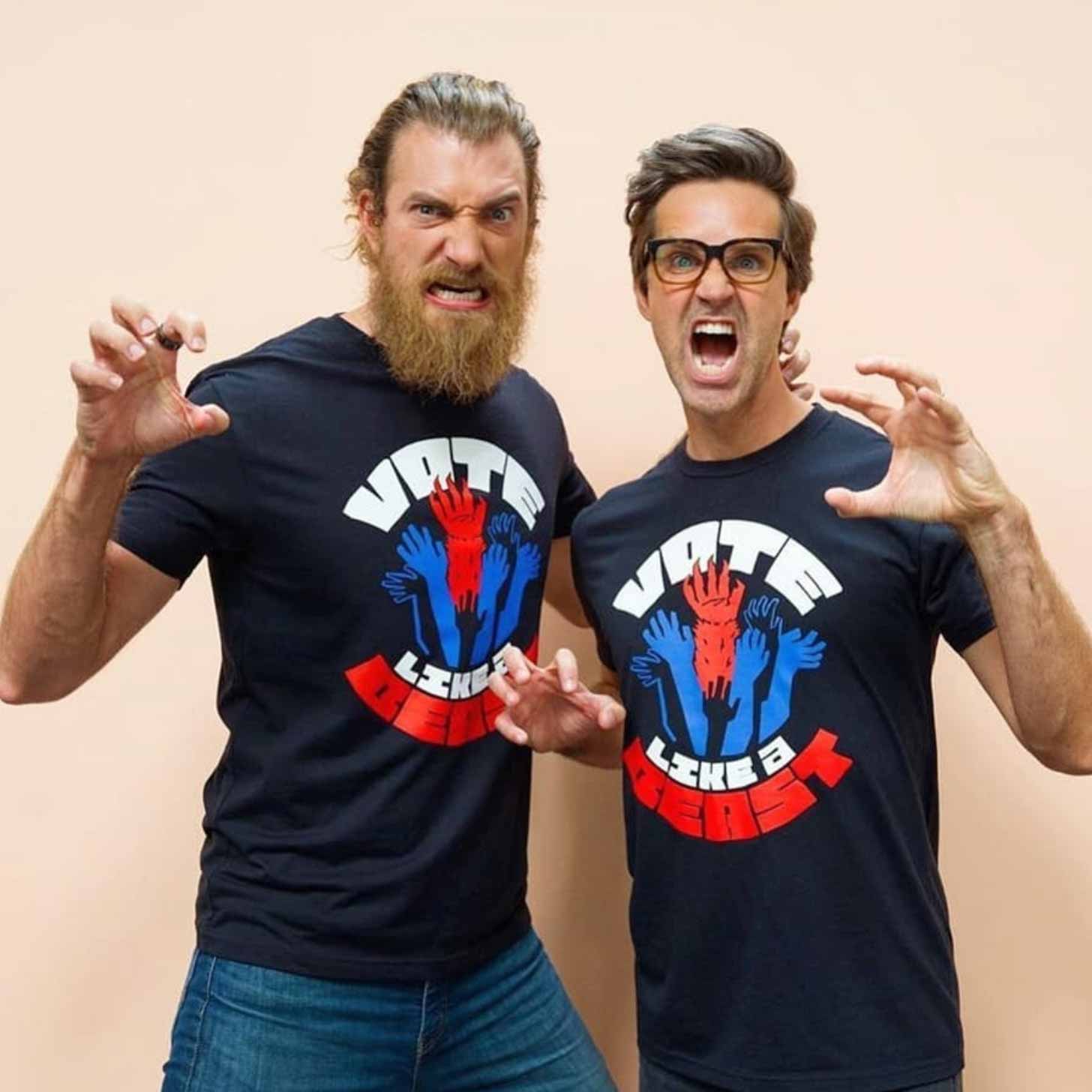
This is not the first time the platform has been accessible to viewers. Vote Like A Beast first launched ahead of the 2020 election, registering over 23,000 new voters in a time when registration efforts were especially pointed at young voters in a contentious race between Donald Trump and Joe Biden.
It’s no surprise the same efforts are being used again for what is being called a ‘Groundhog Day’ of a presidential election in 2024.
Curbing disillusionment among young voters
While the Mythical Beast audience spans generations, a census survey from three years ago showed that the majority of Rhett and Link’s viewers fall within the 25–34 age range.
Making up nearly one-fifth of the American electorate, voters aged 18–34 are crucial to the outcomes of this year’s elections. The only trouble? They’re feeling pretty disillusioned — if not entirely outraged — by the current political landscape.

In a poll conducted by the Harvard Opinion Project, which surveys young American voters, 41% of respondents indicated that they “don’t believe my vote will make a real difference.” This is an increase by 3% compared to their responses in the spring of 2020.
This kind of disillusionment is understandable, amid countless political issues that may seem insurmountable to a demographic of people who have been burned before.
But there are still ways to feel good about voting — even when things are looking bad.
“Voting is an individual act that has collective consequences. Voting is an opportunity for individuals to come together as a collective and express their preferences for parties, candidates, and policies,” Bridgett King, an associate professor of political science at the University of Kentucky, told Good Good Good last month.
“It is a tool that can be used to express satisfaction or dissatisfaction and communicate to those in power that both individuals and communities are paying attention to what our elected officials are — or are not — doing.”
Plus, the presidential election is not the only matter at hand. Voting in local elections can bring massive change on a smaller scale — and quickly.
Tools like Vote Like A Beast aim to reduce the barriers to civic engagement and provide young voters with the information they need to “research candidates and their stances at your local, state, and national elections,” Neal emphasized.
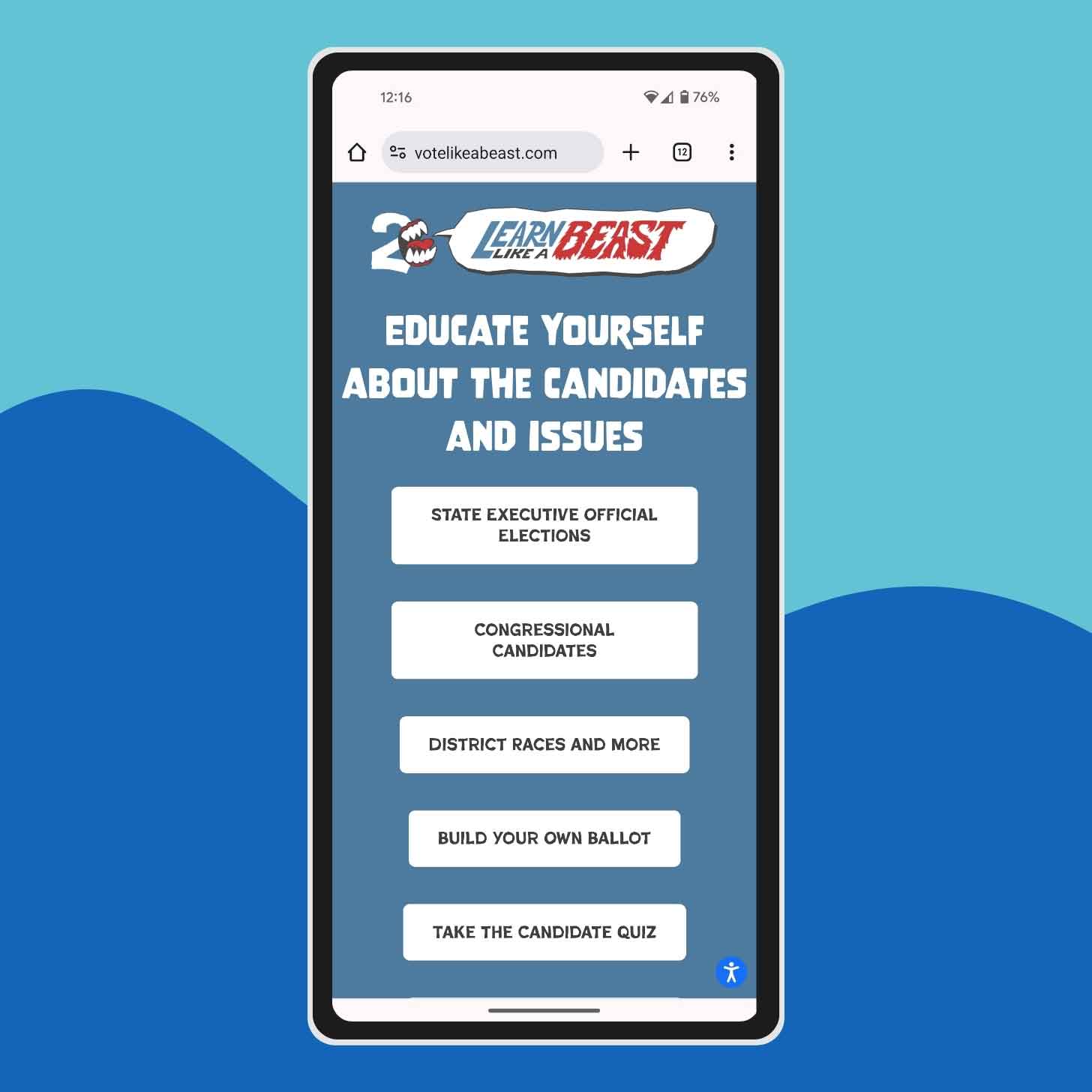
While a large percentage of young voters may not be eager to participate, they will still participate nonetheless.
“I take voting as a very serious privilege that I gladly make,” one fan replied to a social media post about Vote Like A Beast. “I have mobility issues so I get the Arizona early mail-in ballot.”
Vote Like A Beast also has some merchandise options for voters who may fall into a more optimistic headspace, including tote bags, buttons, and bumper stickers. All profits from these items will go to Vote.org.
📢 Vote Like A Beast is BACK! 📢
— Rhett & Link (@Mythical) April 29, 2024
Get informed about the candidates running for office and make YOUR VOICES heard on the issues YOU care about. Check out https://t.co/lSN4jfGitF! pic.twitter.com/w2XXpkSaOS
“Need ‘I voted like a Beast’ or ‘This Mythical Beast voted today’ sticker options,” another fan replied to Mythical on X (formerly Twitter). “Please and thank you.”
No matter the sticker design or the reason someone heads out to the polls, voting is just one element of civic engagement — one that requires people-power to work.
“We need everybody to make their voice heard on the most important issues that impact all of us,” McLaughlin said in an announcement video for the platform back in 2020, mirroring the messages young voters hear today.
“You can use these tools … to bring [your] energy and passion to the ballot box with informed and thoughtful consideration.”
Header images courtesy of Vote Like A Beast/Mythical Entertainment
Cinema is an ever-evolving medium to showcase art, talent, and lived experiences. But audiences will find that representation on the screen will be dependent on who is behind the camera.
White filmmakers have dominated American film since its inception, but over time, artists of color have been able to step in and share their stories and voices, giving viewers a glimpse of the many ways one could be American while straddling an Asian heritage.
The road to the now-increasing number of Asian American-centered movies was not without a few bumps. Whitewashed casting and blatant anti-Asian racism were prevalent in Hollywood, from the character of Fu Manchu to John Wayne portraying Genghis Khan and Mickey Rooney's infamous performance in "Breakfast at Tiffany's."
While whitewashing hasn't completely gone away — prominent examples being "Aloha" in 2015 and "Ghost in the Shell" in 2017 — the practice has gone out of fashion. Public backlash and an increased number of Asian creators on big Hollywood projects have helped turn the tide, with some actors stepping down from roles not meant for them, such as Ed Skrein exiting 2019's "Hellboy," and adaptations like Netflix's "Avatar: The Last Airbender" taking representation seriously when assembling an ensemble cast.
The result is a range of films that are authentic to Asian American experiences, showing off a mosaic of perspectives from several different cultures that have all made a home in the United States. "When you look at these films, for a certain segment of our community, watching these films was not just notable, it was life-changing because they affirmed that they belong, because it gave them context," Jeff Yang, author of "The Golden Screen: The Movies That Made Asian America," told the San Francisco Chronicle.
Stories can range from retellings of an immigrant family's experience in the United States to more fantastical stories rooted in Asian history or even a hybrid of both realism and fantasy. Whatever the case, Asian-based talent is on the rise, with fare including modern action movies, streaming romantic comedies, documentaries, and prestige award-winning dramas.
Our partners at Stacker scoured IMDb and Metacritic data to highlight 22 Asian American films. These movies stem from different cultures, including but not limited to Chinese, Japanese, Korean, and Indian Americans.

Watch these Asian American-centered films:
Chan Is Missing (1982)
- Director: Wayne Wang
- IMDb user rating: 7.1
- Metascore: 85
- Run time: 76 minutes
Hong Kong-born American director Wayne Wang has enjoyed an extensive filmmaking career, and it all started with his indie movie "Chan Is Missing." Shot in black and white, this offbeat take on a film noir takes place in San Francisco's Chinatown. The plot begins with the search for a missing man, but it soon transforms into a deeper examination of the Chinese American identity. There is also a meta-contextual element to the film, as it mocks the "Charlie Chan" trope and character from movies of the 1930s and '40s.
Mississippi Masala (1991)
- Director: Mira Nair
- IMDb user rating: 6.7
- Metascore: 78
- Run time: 118 minutes
The film "Mississippi Masala" explores an interracial romance between characters portrayed by Denzel Washington and Sarita Choudhury. The film includes some historical context, depicting the expulsion of Asians from Uganda by dictator Idi Amin in 1972. After Mina, a Ugandan Indian, is forced to leave her home with her family, she settles in Mississippi, eventually falling in love with a carpet cleaner named Demetrius. The cult film explores identity, xenophobia, and colorism through this fiery romance.
The Wedding Banquet (1993)
- Director: Ang Lee
- IMDb user rating: 7.6
- Metascore: Data not available
- Run time: 106 minutes
"The Wedding Banquet," a romantic comedy by Taiwanese filmmaker Ang Lee, centers around a gay Taiwanese immigrant man who ends up between a rock and a hard place. To satisfy his parents, the man decides to marry a Chinese woman, but when his parents unexpectedly come to Manhattan, he must hide his relationship with his male partner from them. Well-reviewed at the time of its release, the film was nominated for Best Foreign Language Film at the Academy Awards and was later added to the National Film Registry in 2023.
The Joy Luck Club (1993)
- Director: Wayne Wang
- IMDb user rating: 7.7
- Metascore: 84
- Run time: 139 minutes
Based on the book of the same name by Amy Tan, "The Joy Luck Club" was a landmark film featuring an all-Asian cast—practically unheard of for major Hollywood films at the time. The ensemble film follows the relationships between several Chinese American women and their immigrant mothers, focusing on their bonds and histories. The name of the film comes from the group of four women in the film who regularly meet to play mahjong and share stories.
Unfortunately, despite positive reviews, the casting accomplishment of "The Joy Luck Club" wouldn't be repeated until "Crazy Rich Asians" in 2018. Prominent actors who found further fame after the film include Ming-Na Wen and Tamlyn Tomita, both of whom played daughters in the film.
Maya Lin: A Strong Clear Vision (1994)
- Director: Freida Lee Mock
- IMDb user rating: 7.3
- Metascore: Data not available
- Run time: 105 minutes
Depicting the life of Chinese American artist Maya Lin, this documentary centers on the artist's struggles and triumphs in designing the Vietnam Veterans Memorial. The film won the Academy Award for Best Documentary Feature but faced some controversy, as the critically acclaimed documentary "Hoop Dreams" failed to garner a nomination in the category that same year. Even so, critics like Roger Ebert still conceded that "Maya Lin" was a strong and important documentary.
Snow Falling on Cedars (1999)
- Director: Scott Hicks
- IMDb user rating: 6.7
- Metascore: 44
- Run time: 127 minutes
A murder case is at the center of "Snow Falling on Cedars," which is based on an award-winning 1994 novel by David Guterson. The film takes place in 1950s Washington state, where post-World War II anti-Japanese sentiments are prevalent. A trial for the murder where a Japanese American man stands as the accused is central to the plot, and the prejudices of the townspeople emerge. While critics did not particularly take to the film adaptation, they agreed that it was well-shot.
Better Luck Tomorrow (2002)
- Director: Justin Lin
- IMDb user rating: 7.0
- Metascore: 67
- Run time: 101 minutes
Film commentators have given crime drama "Better Luck Tomorrow" credit for combating select Asian stereotypes in the early 2000s. Featuring a cast that includes a young John Cho, the film depicts suburban Asian American high schoolers who engage in acts of theft and murder, with the plot unraveling as consequences arise from their actions. Director Justin Lin went on to direct several "Fast & Furious" films and introduced the "Better Luck Tomorrow" character Han (played by Sung Kang) to the action series.
Saving Face (2004)
- Director: Alice Wu
- IMDb user rating: 7.4
- Metascore: 65
- Run time: 91 minutes
In this LGBTQ+ romantic comedy, a closeted Chinese American woman struggles to keep her budding relationship with another woman a secret when her mother unexpectedly moves in with her. The premise of the film comes from filmmaker Alice Wu's experience as a lesbian Taiwanese American. Although Wu took a break from directing until her 2020 film "The Half of It," "Saving Face" had a massive impact on Asian American women in Hollywood, including Ali Wong and Awkwafina.
The Namesake (2006)
- Director: Mira Nair
- IMDb user rating: 7.5
- Metascore: 82
- Run time: 122 minutes
Filmmaker Mira Nair once again tells a story about the immigrant experience in "The Namesake," which is based on a 2003 book by Jhumpa Lahiri. The story follows an Indian family comprising immigrant parents and American-born children; actor Kal Penn portrayed the son, Gogol, a departure from his usual comedic fare like "Harold & Kumar." "The Namesake" is a multigenerational narrative, and throughout the film, Gogol goes through many relationships and discovers more about his identity, and yes, his namesake.
Abacus: Small Enough to Jail (2016)
- Director: Steve James
- IMDb user rating: 7.1
- Metascore: 73
- Run time: 88 minutes
The compelling story of Abacus Federal Savings Bank is the subject of this PBS documentary. Flashing back to the 2007-08 financial crisis, the film examines the only bank to face criminal charges as a result of the subprime mortgage crisis, seemingly because it was "small enough to jail" rather than "too big to fail." The Chinatown bank was eventually able to clear its name in a long and arduous legal process, but its effects on its employees and the immigrant community it served were lasting.
Columbus (2017)
- Director: Kogonada
- IMDb user rating: 7.2
- Metascore: 89
- Run time: 100 minutes
John Cho portrays a scholar looking after his ailing father in "Columbus," written and directed by Korean American filmmaker and video essayist Kogonada. Cho's character strikes up a friendship with a young architectural enthusiast, and the film uses the imagery of modern buildings in Columbus, Indiana, as a metaphor for the emotions and experiences of the characters.
The Big Sick (2017)
- Director: Michael Showalter
- IMDb user rating: 7.5
- Metascore: 86
- Run time: 120 minutes
Comedian Kumail Nanjiani and his wife, writer Emily V. Gordon, wrote "The Big Sick" based on their real-life relationship. Nanjiani plays a fictional version of himself who deals with cultural clashes and inner turmoil after his girlfriend, played by Zoe Kazan, falls ill. The film garnered a Best Original Screenplay nomination at the Oscars.
Minding the Gap (2018)
- Director: Bing Liu
- IMDb user rating: 8.0
- Metascore: 89
- Run time: 93 minutes
The documentary "Minding the Gap" depicts three young men in the city of Rockford, Illinois, who navigate their complex familial and interpersonal relationships as they grow up, all while they bond over their love for skateboarding. The film explores themes of masculinity and trauma, and Chinese American director Bing Liu, as one of the subjects of his own film, turns it into a very personal story. The Hulu film received an Oscar nomination for Best Documentary Feature.
Crazy Rich Asians (2018)
- Director: Jon M. Chu
- IMDb user rating: 6.9
- Metascore: 74
- Run time: 120 minutes
Based on the bestselling book of the same name by Kevin Kwan, rom-com "Crazy Rich Asians" was reportedly the first English-language Hollywood movie with an all-Asian cast in over two decades since "The Joy Luck Club." Starring Constance Wu, Henry Golding, Gemma Chan, Awkwafina, and Michelle Yeoh, the story centers on Wu's character of Rachel Chu as she travels to Singapore and learns that the family of her boyfriend (Golding) is significantly wealthy. The film was a massive showcase of how an Asian-led film can be a cultural and box office powerhouse, although the development of a sequel has stalled for a few years.
Driveways (2019)
- Director: Andrew Ahn
- IMDb user rating: 7.2
- Metascore: 83
- Run time: 83 minutes
After director Andrew Ahn made "Spa Night," he decided to veer away from his personal experience as a gay Asian American and made "Driveways," a more intimate family drama. Hong Chau portrays a woman who arrives at the house of her late sister, intending to sell it. While she stays in the home, her young son develops an unexpected friendship with an elderly widower next door. A relatively quiet film, "Driveways" is full of subtle yet powerful moments and expresses the powerful bond that neighbors can form. Ahn would later make a more comedic film about LGBTQ+ Asian Americans with "Fire Island" in 2022.
The Farewell (2019)
- Director: Lulu Wang
- IMDb user rating: 7.5
- Metascore: 89
- Run time: 100 minutes
Starring Awkwafina as a Chinese American woman named Billi, "The Farewell" is a lighthearted drama that has Billi return to China to see her grandmother, or "nai nai." Although her nai nai has a terminal cancer diagnosis, the family elects not to tell her as a way of sparing her grief and anxiety. Cursed with the knowledge of their matriarch's illness, family members have a difficult time keeping their emotions in check around her as they try to enjoy their remaining time with her. The film, which is partially based on writer-director Lulu Wang's own grandmother, gained Awkwafina a Golden Globe win for Best Actress in a Motion Picture - Musical or Comedy.
Always Be My Maybe (2019)
- Director: Nahnatchka Khan
- IMDb user rating: 6.7
- Metascore: 64
- Run time: 101 minutes
Comedic actors Randall Park and Ali Wong portray two adults who had a brief and unsuccessful fling as teenagers in "Always Be My Maybe." In their adulthood, they cross paths again and still find a bit of spark between them. Directed by the creator of "Fresh Off the Boat," the Netflix movie is a distinctly Asian American rom-com—and to many viewers, it was because it featured Asian American characters doing very normal rom-com things. As a bonus, it even features Keanu Reeves in a small role playing himself.
Minari (2020)
- Director: Lee Isaac Chung
- IMDb user rating: 7.4
- Metascore: 89
- Run time: 115 minutes
Loosely based on the upbringing of writer-director Lee Isaac Chung, "Minari" follows a South Korean family who immigrated to rural Arkansas in the 1980s. The narrative mainly focuses on the young son David, who has a heart condition. His father (Steven Yeun) is strict and shows tough love, and his grandmother (Youn Yuh-jung) moves from South Korea to help look after the children.
For their performances, Yeun received an Oscar nomination for Best Actor, while Youn won the Oscar for Best Supporting Actress. Controversially, the film was only in the running for Best Foreign Language Film (instead of Best Motion Picture - Drama) at the Golden Globes due to the amount of Korean dialogue it had.
Shang-Chi and the Legend of the Ten Rings (2021)
- Director: Destin Daniel Cretton
- IMDb user rating: 7.4
- Metascore: 71
- Run time: 132 minutes
The first film in the Marvel Cinematic Universe with a mostly Asian cast, "Shang-Chi and the Legend of the Ten Rings" paid homage to kung-fu action movies. Starring Simu Liu as the eponymous character, and featuring Awkwafina, Michelle Yeoh, and legendary Hong Kong actor Tony Leung as the main antagonist, the film depicted a new version of the Ten Rings and did away with the "Mandarin" and "Fu Manchu" stereotypes from the comics. The MCU movie was one of the highest-grossing films of 2021.
Everything Everywhere All at Once (2022)
- Directors: Daniel Kwan, Daniel Scheinert
- IMDb user rating: 7.8
- Metascore: 81
- Run time: 139 minutes
The filmmaking duo simply called "Daniels" made their biggest and most bonkers film with the A24 hit "Everything Everywhere All at Once." With an all-star cast that includes Michelle Yeoh, Ke Huy Quan, Stephanie Hsu, and James Hong, the action-comedy starts with a tax audit and turns into a twisty and emotional multiverse story. It's A24's highest-grossing film, and it won seven Oscars, including Best Director for the Daniels; acting trophies for Yeoh, Quan, and Jamie Lee Curtis; and Best Picture.
Nam June Paik: Moon Is the Oldest TV (2023)
- Director: Amanda Kim
- IMDb user rating: 6.8
- Metascore: 79
- Run time: 107 minutes
There certainly aren't too many artists like Nam June Paik, a Korean artist who moved to New York City. Paik's work comprises some of the earliest examples of "video art," utilizing televisions and video tape recorders. Paik even reportedly coined the term "electronic superhighway" before the advent of the internet. The film comes from Korean American filmmaker Amanda Kim and features narration from actor Steven Yeun.
Past Lives (2023)
- Director: Celine Song
- IMDb user rating: 7.9
- Metascore: 94
- Run time: 105 minutes
Playwright Celine Song made her film debut with the semiautobiographical drama "Past Lives," which stars Greta Lee. The film follows a Korean American writer who reconnects with a childhood sweetheart from South Korea (Teo Yoo), whom she left after her family immigrated to Canada. As adults, they briefly meet up in New York City. The story centers around a Korean word and concept called "inyeon," which basically means "fate" even across one's previous lives. The film netted a Best Picture nomination at the 96th Academy Awards, and Song also received several nominations during that year's awards circuit—including a Best Original Screenplay Oscar nomination.
This article was originally published by Stacker and republished with permission under a CC BY-NC 4.0 license.
To work in nature conservation is to battle a headwind of bad news.
When the overwhelming picture indicates the natural world is in decline, is there any room for optimism?
Well, our new global study has some good news: we provide the strongest evidence to date that nature conservation efforts are not only effective, but that when they do work, they often really work.
Trends in nature conservation tend to be measured in terms of “biodiversity” — that is, the variety among living organisms from genes to ecosystems.
We treasure biodiversity not only for how it enriches society and culture, but also its underpinning of resilient, functioning ecosystems that are a foundation of the global economy.
However, it is well known that global biodiversity is decreasing, and has been for some time. Is anything we are doing to reverse this trend effective?
As part of a team of researchers, we conducted the most comprehensive analysis yet of what happened when conservationists intervened in ecosystems.
These were interventions of all types, all over the world. We found that conservation action is typically much better than doing nothing at all.
The challenge now is to fund conservation on the scale needed to halt and reverse declines in biodiversity and give these proven methods the best chance of success.
First, the less good news
Globally, biodiversity is being depleted by human activities like habitat clearance, overharvesting, the introduction of invasive species and climate change.
To arrest its decline, people in various places have taken measures including creating protected areas, removing invasive species or restoring habitats, such as forests and wetlands.
These efforts are interdependent with traditional stewardship of the world’s richest biodiversity by Indigenous people and local communities. And in 2022, governments adopted new global targets to halt and reverse biodiversity loss.
Our team, led by the conservation organization Re:wild, the universities of Oxford and Kent, and the International Union for the Conservation of Nature, analyzed the findings of 186 studies covering 665 trials of different conservation interventions globally over the course of a century.
We wanted to understand whether the outcomes of these conservation actions improved on what would have happened without any intervention.
Lots of studies have tried to compare the effects of conservation projects this way, but this is the first time such research has been combined in a single analysis to determine if conservation is working overall.
And now, the good news
What we found was extremely encouraging: conservation efforts work, and they work pretty much everywhere.
We found that conservation actions improved the state of biodiversity or slowed its decline in the majority of cases (66%) compared with no action. But more importantly, when conservation interventions work, we found that they are highly effective.
Examples from our far-reaching database included the management of invasive and problematic native predators on two of Florida’s barrier islands, which resulted in an immediate and substantial improvement in the nesting success of loggerhead turtles and least terns.
In central African countries across the Congo basin, deforestation was 74% lower in logging estates subject to a forest management plan versus those that weren’t.
Protected areas and Indigenous lands had significantly less deforestation and smaller fires in the Brazilian Amazon.
Breeding Chinook salmon in captivity and releasing them boosted their natural population in the Salmon River basin of central Idaho with minimal side effects.
Where conservation actions did not recover or slow the decline of the species or ecosystems that they were targeting, there is an opportunity to learn why and refine the conservation methods. For example, in India, removing an invasive algae simply caused it to spread elsewhere.
Conservationists can now try a different strategy that may be more successful, such as finding ways to halt the drift of fragments of algae.
In other cases, where conservation action did not clearly benefit the target, other native species benefited unintentionally. For example, seahorses were less numerous in protected sites off New South Wales in Australia because these marine protected areas increased the abundance of their predators, such as octopus. So, still a success of sorts.
We also found that more recent conservation interventions tended to have more positive outcomes for biodiversity. This could mean modern conservation is getting more effective over time.
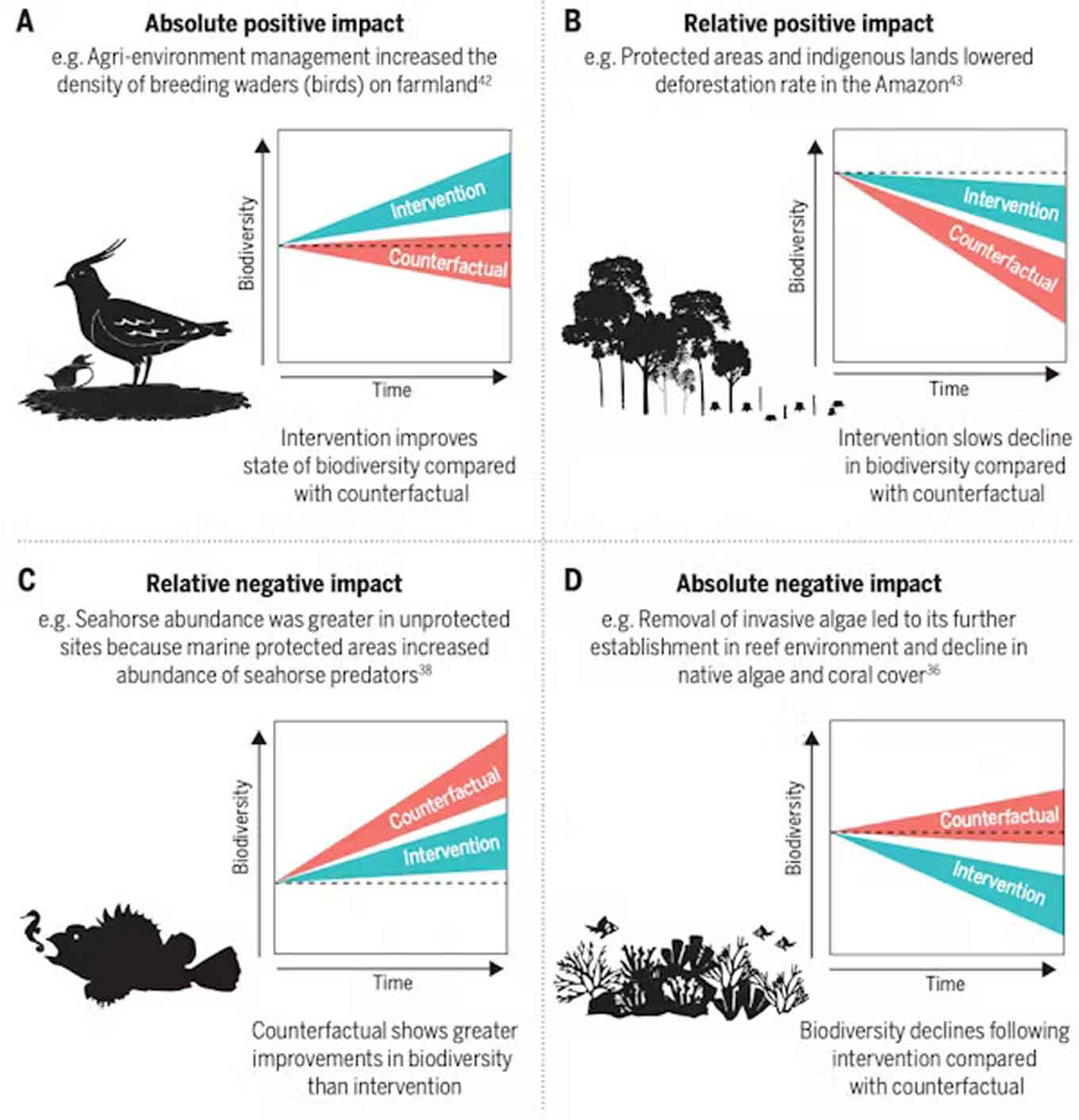
What comes next
If conservation generally works but biodiversity is still declining, then simply put: we need to do more of it. Much more. While at the same time reducing the pressures we put on nature.
Over half of the world’s GDP, almost US$44 trillion (£35 trillion), is moderately or highly dependent on nature.
According to previous studies, a comprehensive global conservation program would require an investment of between US$178 and US$524 billion.
By comparison, in 2022 alone, subsidies for the production and use of fossil fuels — which are ultimately destructive to nature as fossil fuel burning is the leading cause of climate change — totaled US$7 trillion globally.
That is 13 times the upper estimate of what is needed annually to fund the protection and restoration of biodiversity. Today, just US$121 billion is invested annually in conservation worldwide.
Potential funding priorities include more and better managed protected areas.
Consistent with other studies, we found that protected areas work very well on the whole; studies that highlight where protected areas are not working often cite ineffective management or inadequate resources.
More large-scale investment in habitat restoration would also help according to this new research.
Our study provides evidence that optimism for nature’s recovery is not misplaced.
Though biodiversity is declining, we have effective tools to conserve it — and they seem to be getting better over time.
The world’s governments have committed to nature recovery. Now, we must invest in it.
This article by Joseph William Bull, from the University of Oxford, and Jake E. Bicknell, from the University of Kent, was originally published by The Conversation.

In the wake of her popular campaign to fund abortion nonprofits on the U.S. leg of her Guts World Tour, and an exciting initiative supporting women’s shelters in Canada, Olivia Rodrigo just announced her do-good plans for Europe.
“For the entire European leg of the Guts World Tour, a portion of my proceeds from ticket sales will go to Women Against Violence Europe,” the pop star shared on her Instagram stories last night.
“WAVE’s goal is to enable all women and their children to live free from violence.”
The initiative is part of Rodrigo’s Fund 4 Good, a global fundraising project that highlights and supports the work of international nonprofits that expand girls’ education, support reproductive rights, and prevent gender-based violence.
“Fund 4 Good works to support all women, girls, and people seeking reproductive health freedom,” the singer said before taking the stage on the first night of the tour.
The Guts World Tour has 75 stops, and her first show in Dublin last night, Rodrigo will spend a total of 29 nights performing across Europe over the next two months.
During that time, like she mentioned, her ticket sales will be shared with WAVE, a collective of over 160 member organizations across 46 European countries.
“They offer specialized services like women’s shelters, helplines, rape crisis centers, and advocacy organizations,” Rodrigo continued in her video.
She also linked to a donation page for fans across the globe, bolstering her efforts to support WAVE’s mission.
On that donation page, the WAVE Network outlines the impact of these donations.
“Your contribution supports women and children to live free from violence,” WAVE writes on its website.
WAVE shares that donations help the organization strengthen the capacities of its member organizations. With bolstered funds, they can support their clientele, advocate for better legislation to effectively prevent gender-based violence, support funding for women’s specialist services, and collect crucial data about those services in 46 countries.
In the midst of the war in Ukraine, WAVE has increased its efforts to support women and children in crisis — many of whom have been displaced to new or temporary homes across the continent.
The group’s advocacy efforts also extend to refugees and immigrants of all backgrounds, who face increased risks of violence.
“Upholding the gender-specific nature and feminist principles of these services is not merely about prioritizing women; it is about acknowledging and rectifying hundreds of years of systemic inequalities and power imbalances which perpetuate gender-based violence against women and girls today,” WAVE’s executive director Stephanie Futter-Orel and President Marcella Pirrone, wrote in the organization’s annual report.
“WAVE’s commitment to advocating for the preservation and elevation of women's specialist services remains unwavering.”
So, while most fans flock to Rodrigo for her relatable break-up hits and sparkly aesthetic, she continues to succeed in her career full of feminist action, lifting up others who do this work on the ground every day.
Before taking the stage in Dublin, she shared one final call to action: “Join me in supporting this amazing cause: Women Against Violence Europe.”
Header images courtesy of Olivia Rodrigo/Instagram
Brain cancers remain among the most challenging tumors to treat. They often don’t respond to traditional treatments because many chemotherapies are unable to penetrate the protective barrier around the brain. Other treatments like radiation and surgery can leave patients with lifelong debilitating side effects.
As a result, brain cancer is the leading cause of cancer-related death in children.
Brain tumors in children frequently do not respond to treatments developed for adults, likely due to the fact that pediatric brain cancers are not as well-studied as adult brain cancers.
There is an urgent need to develop new treatments specific to children.
We developed a new messenger-RNA, or mRNA, cancer vaccine, described in newly published research, that can deliver treatments more effectively in children who have brain cancer and teach their immune systems to fight back.

How do cancer vaccines work?
The immune system is a complex network of cells, tissues and organs whose primary function is to continuously surveil the body for threats posed by foreign invaders – pathogens that damage tissues and make you sick.
It accomplishes this by recognizing antigens, or abnormal proteins or molecules, on pathogens. T cells that recognize these antigens seek out and destroy the pathogens.
Your immune system also protects you from domestic threats like cancer.
Over time, your cells sustain DNA damage from either internal or external stressors, leading to mutations. The proteins and molecules produced from mutated DNA look quite different from the ones cells typically produce, so your immune system can recognize them as antigens.
Cancer develops when cells accumulate mutations that enable them to continue to grow and divide while simultaneously going undetected by the immune system.
In 1991, scientists identified the first tumor antigen, helping lay the framework for modern-day immunotherapy. Since then, researchers have identified many new tumor antigens, facilitating the development of cancer vaccines.
Broadly, cancer vaccines deliver tumor antigens into the body to teach the immune system to recognize and attack cancer cells that display those antigens. Although all cancer vaccines conceptually work very similarly, they each significantly vary in the way they are developed and the number and combination of antigens they carry.
One of the biggest differences among cancer vaccines is how they are created. Some vaccines use protein fragments, or peptides, of tumor antigens that are directly given to patients.
Other vaccines use viruses reengineered to express cancer antigens. Even more complex are vaccines where a patient’s own immune cells are collected and trained to recognize cancer antigens in a laboratory before being delivered back to the patient.
Currently, there is a lot of excitement and focus among researchers on developing mRNA-based cancer vaccines. Whereas DNA is the blueprint of which proteins to make, mRNA is a copy of the blueprint that tells cells how to build these proteins.
Thus, researchers can use mRNA to create blueprint copies of potential antigens.
mRNA cancer vaccines
The COVID-19 pandemic brought significant attention to the potential of using mRNA-based vaccines to stimulate the immune system and provide protection against the antigens they encode for. But researchers have been investigating the use of mRNA vaccines for treating various cancers since before the pandemic.
Our team of scientists in the Brain Tumor Immunotherapy Program at University of Florida has spent the past 10 years developing and optimizing mRNA vaccines to treat brain cancer.
Cancer vaccines have faced significant challenges. One key hurdle is that these vaccines may not always trigger a strong enough immune response to eradicate the cancer completely.
Moreover, tumors are not made up of one type of cancer cell, but rather a complex mix of cancer cells that each harbors its own unique cocktail of mutations.
Our cancer vaccine seeks to address these issues in a number of ways.

First, we designed our vaccines by using the RNA of a patients’ own cancer cells as a template for the mRNA inside our nanoparticles. We also packaged our cancer vaccine inside of nanoparticles made up of specialized lipids, or fat molecules.
We maximized the amount of mRNA packaged within each nanoparticle by sandwiching them between lipid layers like the layers of an onion. In this way, we increase the likelihood that the mRNA molecules in our nanoparticles produce enough tumor antigens from that patient’s cancer to activate an immune response.
Also, instead of injecting nanoparticles into the skin, muscle or directly into the tumor, as is commonly done for many therapeutic cancer vaccines, our mRNA nanoparticles are injected into the bloodstream.
From there, they travel to organs throughout the body involved in the immune response to teach the body to fight against the cancer. By doing so, we’ve found that the immune system launches a near immediate and powerful response.
Within six hours of receiving the vaccine, there is a significant increase in the amount of blood markers connected to immune activation.
Looking to the future
Our mRNA-based vaccines are currently undergoing early-phase clinical trials to treat real patients with brain cancer.
We administered our mRNA-based vaccine to four adult patients with glioblastoma who had relapsed after previous treatment.
All patients survived several months longer than the expected average survival at this advanced stage of illness.
We expect to treat children with a type of brain tumor called pediatric high-grade glioma by the end of the year.
Importantly, mRNA vaccines can be developed to treat any kind of cancer, including childhood brain tumors.
Our Pediatric Cancer Immunotherapy Initiative focuses on developing new immune-based therapies for children afflicted with cancer.
After developing an mRNA vaccine for glioma in chidren, we will expand to treat other kinds of pediatric brain cancers like medulloblastoma and potentially treat other kinds of cancers like skin cancer and bone cancer.
We are hopeful that mRNA-based vaccines may lead to more children being cured of their brain tumors.
This article was written by Christina von Roemeling and John Ligon of the University of Florida and was originally published on The Conversation.

Airplane travel has a PR problem. Recent headlines of Boeing malfunctions, lost luggage nightmares, and overbooked flights are enough to make anyone rethink how often they travel by plane.
All of those headaches — coupled with the massive carbon costs of air travel — are driving up interest in sustainable travel by train, metro, and bus.
But in a modern era where people have to play the role of their own travel agent, traveling by train is not always the most intuitive or accessible option.
Fortunately, Chronotrains — an interactive map — is emerging as an alternative to resources like Google Maps, which may not always have the most reliable or up-to-date information on train services.
“This map shows you how far you can travel in less than eight hours by train in any city in Europe,” Sam Bentley said in a recent TikTok video. “All you need to do is hover your mouse over a city, and it will show you how far you can get in eight hours.”
Bentley also indicated how easy it was to adjust travel times on the website to see how far you can get to and from selected locations in two, four, or six hours.
“Paris is a strong one,” Bentley said. “Because of the Eurostar you can get all the way up to Edinburgh, and even down to Barcelona.”
From his home train station Birmingham, England, Bentley said that he could get to most places in the United Kingdom with ease — but he was also excited to see how quickly he could travel to Frankfurt, Germany.
“So if you wanted to travel a bit more eco-friendly around Europe, instead of flying, check Chronotrains out,” Bentley encouraged.
Curiosity surrounding eco-friendly travel has never been higher.
Inspired by environmental impact concerns raised by Greta Thunberg and David Attenborough, travel editor Helen Coffey took a flight-free pledge several years ago, and she’s never looked back.
“Every trip I’ve taken since swapping planes for trains, ships, buses, bikes and legs has been gilded with a giddy sense of adventure, bringing with it a real connection to place as I’ve passed through landscapes, not over them,” Coffey wrote.
“Going flight-free has introduced me to the appreciation that comes with arriving into a destination, buoyed up by a childlike sense of wonder, after a proper journey by land and sea.”
Coffey is not alone. According to a Sustainable Hospitality Alliance survey — where participants ranked travel factors by importance — interest in sustainability is at an all-time high amongst Gen Z and Millennial travelers.
Of those surveyed, price and location were leading factors, but sustainability certification (12%), resource management (11%), and sustainable resources (11%) still ranked above guest services (9%) and loyalty programs (5%).
Fortunately, resources like Chronotrains can make it easier for travelers to prioritize sustainable travel as they plan summer vacations, work trips, and whatever else lies ahead.
“I may have started traveling flight-free for the climate but I’ll keep traveling flight-free for the sheer joy of it,” Coffey wrote.
Header image courtesy of Vincent Guth / Unsplash
Last year, the American Red Cross announced that it’s facing severe blood shortages — consistent with global shortages of blood supplies — meaning life-saving surgeries, transfusions, and more are put on hold.
While more donors are definitely necessary, collecting the needed blood supplies is not as simple as a trip to your local blood bank. This is because we all have a different blood type.
In fact, there are 45 known blood groups, all of which are categorized based on the presence of certain antigens on red blood cells.
People might have A, AB, B, or O blood types, or have a positive or negative Rh type. So, for instance, if your blood type is A-positive, you can only receive A-positive blood.
Fortunately, the O-negative blood type is universal and compatible with any blood type, since it lacks certain antigens. Unfortunately, only about 7% of people have O-negative blood.
The reason donor and recipient blood groups need to match is because the recipient’s immune system might attack and destroy the new blood cells, which could be fatal.
The good news? Researchers have discovered a way to use enzymes to remove the sugars that make up some of those antigens on A and B blood cells. This means they are one step closer to making other types of blood universal.
In a study published in Nature Microbiology, researchers at the Technical University of Denmark (DTU) and Lund University in Sweden shared the findings of a new technique.
Using enzymes produced by bacteria (that almost all of us have in our guts already!), the scientists were able to strip red blood cells of antigens and sugars that create distinctions between blood types.
The enzymes they used come from the human gut bacterium Akkermansia muciniphila, which feed on the mucus that lines the inside of our guts (cute!). The complex sugars that cover that intestinal lining are very chemically similar to the antigens found on certain types of red blood cells.
“What is special about the mucosa is that bacteria, which are able to live on this material, often have tailor-made enzymes to break down mucosal sugar structures, which include blood group ABO antigens,” professor Maher Abou Hachem, the study leader at DTU, said in a statement.
“This hypothesis turned out to be correct.”

Researchers tested 24 enzymes to process hundreds of blood samples and found that their “enzyme cocktails” could remove type A and B antigens, as well as some variants that have, until now, been deemed unusable for transfusions.
“We are close to being able to produce universal blood from group B donors, while there is still work to be done to convert the more complex group A blood,” Abou Hachem said.
“Our focus is now to investigate in detail if there are additional obstacles and how we can improve our enzymes to reach the ultimate goal of universal blood production.”
A discovery 40 years in the making
The scientists behind this discovery built their study on work that began more than 40 years ago, when the idea to use enzymes as a way to generate universal donor blood was first introduced.
Since then, more highly efficient enzymes have been discovered. But as Abou Hachem said, there is still work to be done before they are used in clinical practice. Researchers are still not able to explain or remove all immune reactions related to the blood, so their work continues.
After all, it is life-saving work.
“Universal blood will create a more efficient utilization of donor blood,” professor Martin L. Olsson, the leader of the study at Lund University, said.
Universal blood will also help curb mistakes like giving ABO-mismatched transfusions, he said.
“When we can create ABO-universal donor blood, we will simplify the logistics of transporting and administering safe blood products, while at the same time minimizing blood waste,” he added.
The researchers have applied for a patent on their enzyme method, and according to DTU, expect to make further progress within the next three-and-a-half years.
This would lead to controlled patient trials, and hopefully, a scalable method of universalizing blood types that is viable for commercial production and clinical use.
Header image courtesy of Adrian Sulyok on Unsplash
Editor's note: This fundraiser has successfully raised more than $70,000. Learn more about this campaign’s success — and find out about future events.
Randa Jarrar and Ariana Bazlamit are Palestinian American activists living in the diaspora of their homeland.
Over the past few months, the two have been attending local organizing events in Los Angeles, brainstorming ways to help their people as violence, starvation, and displacement wage on.
“Randa had brought up the idea for a tattoo fundraiser,” Bazlamit told Good Good Good. “I had worked in the tattoo industry for years as a piercer, and the more I thought about it, the more tangible the idea felt.”

So, they started reaching out to their tattoo artist friends, and the Hibr project was born. Now, over 170 tattoo artists across the globe will be offering tattoos in support of Palestinians this weekend.
“Hibr” is an Arabic word meaning “ink.” Jarrar and Bazlamit wanted their culture to shine through the project and acknowledged the double meaning of ink as a tool for writers and activists who write resistance poems, memoirs, and more.
“It was important to us to include our Palestinian heritage in our name,” Bazlamit said. “Our only focus is our people, and we want that to be present in every facet of our project.”
But the beauty of Hibr is also in its widespread support from artists of all nationalities.
Independent artists from various international cities have created flash sheets filled with designs related to Palestinian culture or social justice. The profits made from these designs will be sent to Jarrar and Bazlamit, who said they will redistribute funds to folks on the ground in Gaza.

The first organization they said they will be supporting is Ele Elna Elak, a student-led organization that was created in 2018 with the help of Gazan journalist Bisan Owda.
Ele Elna Elak comes from an Arabic phrase meaning “what we own, you own.” The group has provided food and other basic necessities in the winter to families in need, and with the current escalated need in occupied Gaza, the group is working to help their community obtain vegetables, flour, and other necessary food supplies.
On a GoFundMe page, Ele Elna Elak said that its volunteers also raise funds to help families buy other staples like water, firewood, medicine, and clothes — all while trying to survive alongside their own families.
Bazlamit also said that funds from the Hibr project will be donated to mutual aid campaigns that support Gazans with aid or by paying evacuation fees. To expedite the process of fleeing the area, many families have created mutual aid funds or GoFundMe pages, which allow them to access donated funds more quickly than through the help of a registered nonprofit or NGO.
This does mean that traditional models of accountability found in registered nonprofits are not present in fundraising projects like Hibr. That being said, Bazlamit said that she and Jarrar will document every dollar raised and donated on their Instagram account to ensure transparency.
“It’s incredibly important to us that we instill confidence in our tattooers and clients alike. We have nothing to hide, so we plan to hide nothing,” Bazlamit said. “We are happy to share the receipts with the public, in hopes that we’re able to garner even more support for our people.”

The choice to donate to on-the-ground Palestinians comes after months of aid struggling to reach those who need it most.
“This was our number one concern with this fundraiser; actually getting aid to our people,” Bazlamit said. “The world has watched millions of dollars worth of life-saving aid held hostage at the border by the occupation for months.”
Using their existing connections in the U.S. and abroad — Jarrar just returned from an aid trip to Cairo — the pair is eager to leverage the support of the tattoo community to provide some support.
“Our only hope is that we can offer some sort of relief to our people right now, so we aim to enable those who want to help, the ability to help,” Bazlamit said.
And it’s abundantly clear: People want to help.

“I wanted to be involved because tattooing is a very effective fundraising tool,” Danni Parelman, an artist at Windhorse Tattoo in Kansas City, Missouri told Good Good Good.
“A lot of people want a ‘reason’ to get a tattoo. Their money going to help those in need is a good incentive for people to take the leap.”
Parelman has booked all of her available tattoo appointments for this coming Saturday.
“It will be a long day, but I’m glad to put in these hours,” she said. “Many have done much more with their time and their bodies. Tattooing is just one way artists can give to this cause.”
Thanks to the overwhelming support, there will be more than just one opportunity for tattoo artists — and supporters — to get involved with the project.
Originally, a single date — May 4 — had been set aside for the international fundraiser, but Jarrar and Bazlamit have now added two other specific dates for participating artists: June 1 and July 16.
Interested tattoo artists just have to submit a form to be part of the collective, which includes having their work shared on the Hibr Instagram account.
From there, they are free to set their own hours, tattoo sizes, and prices — keeping in mind that 100% of profits from these designs are to be donated.
Angela Smyth, a tattoo artist from Loveyland Studio in Calgary, Alberta, said that she learned about the fundraiser from some other local tattoo artists and “wanted to be involved instantly.”

Their designs are similar to others that have been shared by Hibr, including an olive branch, a peace dove, a watermelon, and some Tatreez designs — a traditional Palestinian sewing technique.
“I am focused on making work that shows tenderness to all living beings, as well as things that bring nostalgia,” Smyth told Good Good Good. “I wanted to include not only designs symbolic to Palestinian resistance but ones that represent the joy, pride, and love for their home.”
Smyth said that she hopes to tattoo up to 10 people this coming weekend but plans to keep the designs available to continue raising funds.
“I am forever moved by Palestine and its people, their dedication to the land and to each other, and overall, their hope,” she said. “This flash sheet is a love letter to them, and a wish for a free and happy Palestine.”
Header images courtesy of Ariana Bazlamit/Hbir
Since the nation's earliest days, Asian Americans, Native Hawaiians, and Pacific Islanders have played vital roles in shaping the United States. They have carved out communities in isolated swamps, built the country's first transcontinental railroad, pushed back against injustices, and so much more over the past few centuries.
Though these movers and shakers don't always make the history books, dozens of sites across the country tell their stories — and not just behind glass walls and verbose museum texts.
Yes, you might have to put in a little legwork to reach some of these places, but there's no time like the present to get to know more about the history and culture of people who have, in turn, helped shape American life.
Our partners at Stacker used information from the National Park Service and other sources to compile a list of historical sites, like 'Iolani Palace and Angel Island, where you can learn more about Asian American, Native Hawaiian, and Pacific Islander heritage.
This is by no means a comprehensive list; instead, you can use it as a starting point to find even more heritage sites like Kaunolu Village and Morro Bay. The AA & NHPI umbrella covers dozens of unique cultures, each with its own pivotal contributions to U.S. history.

Historical sites to learn more about Asian American, Native Hawaiian, and Pacific Islander heritage
Amache National Historic Site
If Amache National Historic Site sounds familiar, that's because it made headlines in February 2024, when this former incarceration site was announced as the country's newest national park. A collection of low-slung buildings in the southeastern Colorado prairies, Amache marks one of the darkest chapters in Asian American history.
Due to racially biased fears of treason during World War II, over 10,000 Japanese Americans were detained at Amache between 1942 and 1945. Visitors to Amache today can tour the reconstructed, WWII-era buildings and reflect on the stories of the thousands of detainees unjustly incarcerated here — and at the many other incarceration camps throughout the United States.
San Francisco's Chinatown
Though Chinatowns dot the U.S. from coast to coast, San Francisco's came first. Dating back to the 1850s, this district is not only the oldest Chinatown in North America but also one of the largest Chinatowns outside of Asia.
You'll find countless nooks and crannies to explore here, surrounded by colorful storefronts and historic temples like Tin How, which is dedicated to Mazu, a deity that early Chinese immigrants believed blessed them as they made the difficult journey from China to the United States. Many of these structures were built by some of the country's earliest Chinese immigrants, who settled here after entering the country via the nearby Angel Island Immigration Station (more on that later).
'Iolani Palace
Located on Honolulu's King Street, the imposing 'Iolani Palace once housed the last reigning monarchs of the Hawaiian Kingdom, including Queen Liliʻuokalani. King Kalākaua constructed this official royal residence (the only one in the U.S.) and political center in 1882, on the site of a previous residence built by King Kamehameha III.
The monarchy was deposed in 1893, but the palace remains an enduring symbol of Hawaiian pride. After a nearly 80-year period of being used as the capitol building, 'Iolani Palace has been restored to its former glory, serving as a center for Hawaiian history and culture today.
Butte-Anaconda Historic District
Commemorating what was once one of the largest Chinese American settlements in the Rocky Mountains, this Montana landmark encompasses the communities of Butte, Anaconda, and Walkerville.
As early as the 1860s, many Chinese immigrants flocked here to join the gold rush that had captivated the rest of the U.S. But after they were forced out of the mining industry due to anti-Chinese sentiment, they pivoted to set up shops and other businesses.
Many of those establishments have survived decades of racist backlash and can still be seen today in the Butte-Anaconda Historic District, including Pekin Noodle Parlor, the oldest continuously operating Chinese restaurant in the United States.
The Forty Acres National Historic Landmark
The labor rights movement is intrinsically entwined with Filipino American history, and there are fewer places where that's more evident than at The Forty Acres in Delano, California.
This property served as the headquarters for the United Farm Workers Organizing Committee, a collection of Filipino and Latino labor rights activists that included Larry Itliong and César Chávez.
After UFWOC leaders successfully negotiated with California grape growers for higher wages and better living conditions, The Forty Acres began providing essential services like health care and retirement resources to workers.
To learn more about the role of Filipinos in the labor rights movement, drive just five minutes to the Filipino Community Hall, where Itliong led Filipino farm workers to vote on the historic Delano Grape Strike in 1965.
Angel Island Immigration Station
Opened in 1910, Angel Island Immigration Station in San Francisco Bay was specifically designed to process immigrants from China, who were subject to entry restrictions under the 1882 Chinese Exclusion Act.
As a result, Chinese immigrants were often detained here for murky reasons over indefinite periods of time — in some cases, as long as two years. While many immigrants processed here were from China, people from over 80 countries such as Japan, Germany, Russia, and the Philippines also passed through the station's halls.
In the restored barracks rooms, visitors to Angel Island today can see the poems carved into the walls by detainees and learn more about the station's past.
Pågat
On the island of Guam, the archaeological site of Pågat is just as beautiful as it is historically fascinating. Visitors can explore extensive stone ruins, which once formed the foundations of a prehistoric village inhabited by the native Chamorro people.
When you're done looking at the ruins and other artifacts, visit the beaches and freshwater caves that may have attracted the settlement's earliest inhabitants. Indigenous people continue to conduct cultural practices at Pågat to this day, so always be mindful of your environment.
Golden Spike National Historical Park
Golden Spike National Historical Park in Utah commemorates one of the most significant events in United States history: the completion of the first transcontinental railroad, which connected the sprawling country from coast to coast. Driven in by Leland Stanford (yes, that Stanford), the symbolic golden spike (along with three other spikes) marked the meeting point of the Union Pacific Railroad and the Central Pacific Railroad, the latter of which was built in large part by Chinese immigrants.
In addition to information on the railroad and the 1869 completion ceremony, Golden Spike National Historical Park also preserves evidence of Chinese American railroad workers, whose often-unacknowledged efforts ushered in a new era for the United States.
Saint Malo
Even if you already know that Asian immigrants heavily influenced local fishing culture in the deep South, you might not know just how far back that influence extends. Believed to be the country's first permanent Asian American settlement, Saint Malo was once a thriving fishing community populated by Filipino immigrants, who built stilted houses above the Louisiana swampland as early as the 1760s.
Though a hurricane, unfortunately, destroyed Saint Malo in the late 19th century, you can still learn more about this early FilAm town by visiting its former location on the shores of Lake Borgne.
Wailua Complex of Heiaus
On Kauaʻi island in Hawai'i, Wailua River State Park dazzles visitors with its waterfalls and lush greenery, but it's much more than just a pretty place. The park hosts the Wailua Complex of Heiaus, a network of petroglyphs, pu'uhonua (places of refuge), and heiaus (places of worship) believed to have been used by early Hawaiian chiefs. This national historic landmark also falls on the Wailua Heritage Trail.
Explore Wailua River State Park on foot or aboard a kayak, and take some time to imagine how the Hawaiian people used to navigate this incredible landscape.
This article was originally published by Stacker and republished with permission under a CC BY-NC 4.0 license.
"Gerrymander," "blue states," and "red tape." These words populate headlines and newspaper articles regularly, with many writers taking their meaning for granted, but a look through history can reveal surprising changes in meaning over time.
In a political landscape challenged by personal interpretation, etymology can be a reliable narrator. Tracing a word's emergence and exploring the circumstances behind any changes in meaning offers a window into the surrounding historical context, offering insights into how it shaped today's broader discourse.
Moreover, for etymology buffs who have found their interests captured, understanding the paths words have taken can encourage participation and engagement with matters of public policy.
Some phrases emerged from, sparked, or shaped significant social movements, such as the term "identity politics," which was born of the Combahee River Collective. Some storied origins of terms, such as "faithless elector," reveal the convoluted ways of politics.
Meanwhile, words such as "woke" have been demonstrably co-opted for reasons that oppose their founding purpose.
Some turns of phrase have long histories; others, like "founding fathers," are surprisingly recent; and who knew "red tape" went as far back as the Holy Roman Empire?
Despite the differences in the terms' purposes and origins, each phrase has served a vital role in shaping the political world. In light of the ongoing political dramas that unfold globally each day, our partners at Stacker traced the origins of 20 words and terms used in political discourse using historical archives, research reports, and news articles.

The origins of 20 political words and terms
Founding fathers
While the term "founding fathers" may seem to predate American politics, it was only invoked for the first time in 1916 by then-Sen. Warren G. Harding during the Republican National Convention of the same year. He repeated the phrase many times throughout his political career, sealing it into the greater lexicon.
The term remains largely undefined. For example, one proposed criterion implies those who signed the Declaration of Independence, which leaves out George Washington and James Madison. Meanwhile, John Adams himself rejected the designation outright, writing that the titles "founder" and "father" "belong to no man, but to the American people in general."
Gerrymander
A "gerrymander" happens when redistricting a voting area favors a political party. Its origins came from Massachusetts Gov. Elbridge Gerry, who was a framer — but not a signer — of the Constitution. He also argued against electing congress members to the House of Representatives directly.
When Jeffersonian Republicans presented him with a redrawn map for a Massachusetts district in 1812, which encompassed more of their supporters, he signed the bill supposedly with reluctance. During a dinner party held by opposing party members, illustrator Elkanah Tisdale added monster features to the district map.
At the same time, poet Richard Alsop jokingly named his creation a "Gerry-mander." Today, the practice continues to produce amorphous districts — such as Pennsylvania's former Seventh Congressional District, nicknamed "Goofy Kicking Donald Duck."
Fair-fight district
A "fair-fight district" results when redistricting results in a voting area that favors no political party. When the New York legislature reapportioned the state's districts in 1982, it left the 22nd district with two incumbents approaching their election year: one Democrat and one Republican.
The district comprised rural farmlands encompassing parts of the Bronx, leading commentators to name the electorate in dispute as a "fair-fight district," printed in The New York Times for the first time on Nov. 1, 1982. Democrat Representative Peter A. Peyser ended up losing his seat to Republican Representative Benjamin Arthur Gilman.
Faithless elector
A "faithless elector" is someone in the Electoral College who votes against their party's nominee.
The first faithless elector, Samuel Miles, cast his 1796 presidential election vote for Thomas Jefferson against the will of his John Adams-supporting constituency. One of his constituents aired his grievances to the American Gazette in a letter to the editor: "Do I chuse Samuel Miles to determine for me whether John Adams or Thomas Jefferson shall be President? No! I chuse him to act, not to think!"
As of 2020, 23,507 electoral votes have been cast in American presidential elections, 90 of which were cast in opposition to the populace. Of those, 63 were cast for the other nominee due to the death of their opponent. In July 2020, the United States Supreme Court held in Chiafalo v. Washington that states are permitted to "penalize an elector for breaking his pledge and voting for someone other than the presidential candidate who won his State's popular vote."
Identity politics
Identity politics typically refers to the efforts of a group to rectify collective injustices suffered due to shared personal attributes, including race, gender, sexual orientation, religion, or culture.
The concept was born of the Combahee River Collective, established in 1974, which asserted that the ongoing feminist and civil rights movements did not adequately address the concerns of Black women and lesbians. The 1977 statement issued by the group sparked academic and social exploration into the concept of intersectionality as well.
Red tape
Red tape refers to excessive or rigid rules and processes that impede progress and decision-making, and there was a time when it was much more literal.
"Red tape" emerged during the Holy Roman Empire of Spanish King Charles V in the 16th century. His government allegedly used red ribbons to identify important documents, a practice carried out throughout the colonization of America and beyond. According to the National Archives, during the American Civil War, the War Department bought 154 miles of red tape in the fiscal year ending in June 1864.
Woke
Woke refers to a state of being that is attentive to social justice and civil rights matters.
While likening awareness of racial injustice to being "awake" predates the 20th century, the phrase "stay woke" was often used in Black communities as a reminder to be on one's guard, especially when it comes to dealing with law enforcement.
The earliest known use of the phrase began with Lead Belly, a pioneering folk and blues musician. In his 1938 song "Scottsboro Boys," he recounts the true story of nine Black teenagers who were wrongfully convicted of a crime for which they were sentenced to death. After the song and at the end of the recording, Lead Belly warns: "I advise everybody, be a little careful when they go along through Alabama — best stay woke, keep their eyes open."
The same term that helped amplify the Civil Rights Movement in America has since been co-opted to censor its history via legislation such as the Floridian "Stop W.O.K.E. Act," which prohibits some topics on race relations within the state's education system and workplaces.
Joe Six-Pack
A derivative — or arguably pejorative — version of John Q. Public, Joe Six-Pack was popularized by author Martin F. Nolan to refer to working-class Americans. In this case, "six-pack" refers to a half-dozen cans or bottles of beer.
In a 1970 article covering a Massachusetts state senator election between Joe Moakley and Louise Day Hicks, he described one of the former's campaigning strategies as "shouting in Joe Six-Pack's ear to wake up and face the [unsimplistic] facts of life."
Lame duck
In politics, a lame duck typically refers to a politician who loses influence after election defeat until the inauguration of their successor. With less accountability to the public, they tend to either accomplish very little or push unpopular initiatives through at the last minute.
Though it's a political term today, its use began in finance. The phrase originated around the 18th century, when British nobleman Horace Walpole referred to investors who defaulted on their debts.
"Lame duck" eventually made it across the pond, where it was used to describe temperance supporters who eventually left the movement. It then crossed over to politics and was finally used in a 1926 Grand Rapids Press editorial to describe how the outcome of senate elections could affect Calvin Coolidge's last years of presidency.
Dark horse
In 19th-century horse racing, "dark horses" were contestants bettors knew very little about since they had been trained in secret or "in the dark." The goal was to train them so well that it led to a surprise win and a maximized betting payoff. An early use of the term came from British novelist Benjamin Disraeli, who used the term in its horse-racing context for his novel "The Young Duke."
By the 1840s, the phrase moved to the political realm to refer to an unknown candidate being nominated after multiple rounds. In 1844, Democratic politicians could not agree on a candidate for the upcoming presidential election as they disagreed with Martin van Buren's opposition to annexing Texas. On the ninth ballot of the Democratic National Convention, they officially nominated "compromise candidate" James K. Polk, who defeated opponent Henry Clay in the election despite being lesser known.
Loose cannon
Muzzle-loading cannons, once very popular in naval artillery, weighed thousands of pounds, were mounted on wheels, and in the event of strike or turbulence, could break free of restraints and become a "loose cannon."
Former President Theodore Roosevelt feared becoming a similar hazard given his youth relative to his predecessors and lacking track record upon taking office following 25th President William McKinley's 1901 assassination. He supposedly expressed his concern to a journalist friend about one day becoming "the old cannon loose on the deck in the storm."
Echo chamber
Physical echo chambers date back to the 20th century when recording studios were modified to amplify echoes and reverberations. In a 1955 New York Times article, reporter Elie Abel described the circular, futile discussions between American and Chinese ambassadors as "…an echo chamber for rumors, one often contradicting the other."
This marked the first time the term was used to describe a closed environment in which members are exposed only to the same biased viewpoints they already hold, reinforcing their existing beliefs and developing resistance to outside perspectives.
Gridlock
The term gridlock, now often used to describe political stalemate due to a lack of consensus, has quite literal origins. It was first used to describe the type of traffic congestion that emerges due to a road network that is so crowded that no one can move ahead.
The term was printed in a more generalized political context in the Financial Times in 1983 about budget discussions: "The political 'gridlock' in Congress might mean that no budget resolution could be passed for fiscal year of 1984."
Culture war
This broadly encompassing term originates in 1871 and derives from the name of the seven-year-long conflict between the Catholic church and the government in Prussia: Kulturkampf. The conflict resulted in attempted assassinations of politicians, arrests of churchgoers, and riots.
University of Virginia sociologist and author James Davison Hunter redefined "culture wars" in his eponymous book "Culture Wars: The Struggle to Define America" to describe the polarization of the American electorate based on ideological worldviews.
Silent majority
The existence of a "silent majority" within a country implies that a majority of the population does not express their political beliefs. The phrase was once meant to refer to those who had already died, such as when Justice John Marshall Harlan used it to refer to Civil War captains who had "long ago passed over to the silent majority, leaving the memory of their splendid courage."
Former President Richard Nixon secured the term into the political lexicon, albeit with a different meaning, with his "Silent Majority" speech on Nov. 3, 1969, requesting support for the Vietnam War from "the great silent majority of my fellow Americans."
Grassroots
Unlike other fundraising or political efforts prioritizing members with the most resources and influence, grassroots movements begin from the local level, or "roots," working their way upward.
One of the first printed usages of the term appears in a 1904 newspaper. In reference to the strategy of prospective running mate Eli Torrance to incumbent President Theodore Roosevelt, a political organizer is quoted as saying: "Roosevelt and Torrance clubs will be organized in every locality. We will begin at the grass roots."
Lobbyist
Ulysses S. Grant is widely credited for coining the term "lobbyist" to describe the people who bombarded him with legislative requests while he tried to relax at the Willard Hotel during his 1869-1877 tenure.
However, the term originates in England and references the lobbies in the House of Commons where the public is permitted to congregate and speak with representatives, according to former editor-at-large for the Oxford English Dictionary Jesse Sheidlower.
Blue states and red states
In a truly patriotic dispute, the practice of referring to Democratic and Republican strongholds as "blue states" and "red states" begins with fireworks.
In 1900, the Chicago Tribune planned to light blue fireworks to signify Republican wins and red to signify Democratic wins on an election night.
A competing newspaper announced plans to set off fireworks with the opposite colors in an attempt at sabotage — blue for Democrats and red for Republicans — leading the Tribune to abandon their idea.
The terms took on new life following the mass adoption of color television. Former host of NBC's "Meet the Press," Tim Russert, is widely credited with popularizing these two phrases, which would solidify the color-coding of American electoral maps.
Pundit
"Pundit" derives from the Hindi word "pandit," meaning a learned or skilled person. It entered the English lexicon in the 17th century to describe Indian court officials who served as advisors of Hindu law to English judges.
The modern take on the term applies to many more people. According to Dictionary.com, a "pundit" is simply any person "who makes comments or judgments, especially in an authoritative manner."
Dog whistle
A "dog whistle" is a subtle call to action or statement that is coded or otherwise obscured to appeal to supporters and avoid detection by opponents. Of course, literal dog whistles predate the political usage of the term and refer to manufactured objects that produce a sound only canines can hear. During the civil rights period, it became a broader term to describe secret signals or languages meant to exclude others.
According to the Oxford English Dictionary, its figurative form first appeared in an October 1995 edition of The Ottawa Citizen: "On the lips of Premier Mike Harris, the term 'special interest' has the tone of epithet. It's an all-purpose dog whistle that those fed up with feminists, minorities, the undeserving poor hear loud and clear."
This article was originally published by Stacker and republished with permission under a CC BY-NC 4.0 license.
Humans love the coast. But we love it to death, so much so we’ve destroyed valuable coastal habitat — in the case of some types of habitat, most of it has gone.
Pollution, coastal development, climate change and many other human impacts have degraded or destroyed swathes of mangrove forests, saltmarshes, seagrass meadows, macroalgae (seaweed) forests and coral and shellfish reefs.
We’ve lost a staggering 85% of shellfish reefs around the world and coral is bleaching globally.
When healthy, these coastal habitats help feed the world by supporting fisheries. They are home to more than 100 species of charismatic marine megafauna, ranging from sharks to dugongs. They sequester carbon, thus helping to slow climate change. The list goes on.
Healthy coastal habitats are the gift that keeps on giving. We need them back, so there’s a lot of enthusiasm for restoring these habitats.
For example, we can plant mangroves, build new shellfish reefs and reduce pollution to help seagrass grow back.
But we want to recover more than just the habitats. We want the animals they support too. We need to know if restoration is helping animals.
We analyzed restoration projects around the world to assess how animals are benefitting. Compared to degraded sites, restored habitats have much larger and more diverse animal populations. Overall, animal numbers and the types of animals in restored habitats are similar to those in natural habitats.
So restoration works. But outcomes for animals vary from project to project. Not all projects deliver the goods. As a result, resources are wasted and humanity misses out on the huge benefits of healthy coastal habitats.

Animals can respond well to restoration
We collated over 5,000 data points from 160 studies of coastal restoration projects around the world.
Excitingly, animal populations and communities were remarkably similar to those in comparable undisturbed natural sites. For example, restoring seagrass off Adelaide’s coast brought back invertebrates, which are food for many fish species Australians love to catch, such as Australasian snapper. Invertebrate numbers here were comparable to nearby natural seagrass meadows.
Overall, our review found animal populations in restored coastal habitats were 61% larger and 35% more diverse than in unrestored, degraded sites. So restoration produces serious benefits.
Some projects recorded dramatic increases. For instance, after oyster reefs were restored in Pumicestone Passage, Queensland, fish numbers increased by more than ten times. The number of fish species increased almost fourfold.

And animals can occupy newly restored sites surprisingly quickly. Fish and invertebrate numbers in restored seagrass and mangroves can match those in natural sites within a year or two. This happens even though the vegetation is far sparser in restored areas.
Our study shows that efforts to restore coastal habitat certainly can help animals thrive.
Results are not guaranteed
Although restoration generally helped animals, good outcomes are not guaranteed. We found many projects where animal numbers or diversity barely increased. It was not clear why some projects were great for animals and others had lackluster results.
Some restoration sites could be in places where animals cannot easily find them.
In other cases, actions to restore the habitat may simply not work. Despite our best efforts, we failed to create suitable environments.
It could be that animals are returning to restored habitats, but we’re not capturing them with our monitoring.
We sorely need more consistent restoration outcomes. We may lose community support for restoration if, for example, it doesn’t deliver on promises of improved fisheries.
We are still working out how to restore coastlines effectively. Clearly, more work is needed to improve techniques and the monitoring of animal numbers.
Global alliances and groups are developing standardized frameworks to guide restoration practice and to report on project designs and outcomes. Such strategies and co-ordination promise to deliver more consistent benefits.
A new purpose-built shell washer will speed up the oyster shell recycling process at the Shell Recycling Centre at the Ningi Transfer Station as part of the Pumicestone Passage Shellfish Reef Restoration project. #NLP @AusLandcare
— Healthy Land & Water (@hlthylandwater) August 20, 2020
Read the full story: https://t.co/DucthF6x11 pic.twitter.com/iFzU5gwJtL
New technologies can improve monitoring
Monitoring animals and restoration outcomes in coastal habitats is challenging. These aquatic habitats are structurally complex, often impenetrable and hard to navigate, and can be dangerous.
New technologies, such as artificial intelligence (AI) and environmental DNA (eDNA), allow us to collect more and better data on which animals are present and how they use these habitats. We’re rapidly becoming less reliant on hauling in nets or diving down to count animals.
Artificial intelligence (AI) can be used, for example, to extract information from underwater cameras. We can monitor animals more often, in more places, for less cost.
AI algorithms were recently used to automatically identify, size and count fish in videos taken on restored oyster reefs in Port Phillip Bay, Melbourne. These data were then used to calculate increased fish productivity due to restoration efforts. And what an increase it was — over 6,000 kilograms of fish per hectare per year!
Combining underwater videos with automated data extraction provides a new, reliable and cost-effective method for surveying animals ethically and efficiently.
We still face major barriers to scaling up restoration to even get close to reversing our environmental impact on the coasts. Key concerns include ongoing climate change and policies and laws that hamper restoration efforts.
It can be difficult, for example, to get permits to restore habitat, with complex systems involving multiple organizations and arms of government.
Still, our synthesis shows some light at the end of the tunnel. Coastal restoration efforts are having substantial benefits for animals around the world. The evidence supports ambitious restoration targets and action.
This article by Michael Sievers, from the Griffith University, Christopher Brown, from the University of Tasmania, and Rod Connolly, from the Griffith University, was originally published by The Conversation.

— The decision follows campaigns coordinated by Kpop4Planet, a climate movement led by K-pop fans who protested Hyundai’s business with Adaro.
— Climate group Market Forces has estimated Adaro’s coal plants would emit 5.2 million metric tons of CO2 equivalent per year, and activists say Hyundai would be pushed further from reaching its goal of carbon neutrality by 2045.
— The campaign collected more than 11,000 petition signatures from K-pop fans in 68 countries.
South Korean automobile giant Hyundai has ended an agreement with Adaro Minerals, a subsidiary of Indonesia’s second-largest coal miner, PT Adaro Energy, to procure aluminum for its electric vehicle (EV) production.
Hyundai and Adaro Minerals signed the agreement in November 2022, and at the end of 2023, both agreed not to renew the agreement and “to explore other opportunities independently,” Hyundai said in a statement.
The decision came on the heels of campaigns by K-pop fans who urged Hyundai to back out of the agreement and to avoid sourcing aluminum from Adaro since it will be produced using coal power.
Upon signing the agreement, Hyundai described the aluminum as “green and low-carbon” because it would be produced using hydroelectric power. This, Hyundai said, would “accelerate” the transition to sustainable energy and help the company meet its net-zero emissions goal by 2045.
However, Adaro would only start producing aluminum using hydroelectric power in 2030. Before that, Adaro will build 2.2 gigawatts of coal-fired power plants to power its aluminum smelter in an industrial park, itself branded as “green,” in Indonesia’s North Kalimantan province.
The aluminum smelter and the industrial park, touted as the largest of its kind in the world, are a part of Indonesia’s bid to become a global production hub for EVs.
Since the smelter will rely on coal during at least the first five years of its operation, any purchase of aluminum from the company will be a violation of Hyundai’s Carbon Neutrality Principles.
Those principles require Hyundai to cut not just its own emissions, but also those emissions associated with assets it doesn’t own, such as the aluminum it plans to buy from Adaro, also known as Scope 3 emissions.
Climate group Market Forces estimated the coal plants would emit 5.2 million metric tons of CO2 equivalent per year, and if Hyundai continues the plan to purchase aluminum from this smelter, Hyundai’s Scope 3 emissions would increase by 3-6%.
This would push Hyundai further from achieving its target to achieve carbon neutrality by 2045.

Both Hyundai and Adaro didn’t explain the reason behind the decision to not renew the agreement, but Hyundai mentioned in its statement that it remains dedicated to the responsible and sustainable sourcing of materials.
Adaro Minerals director Wito Krisnahadi, meanwhile, said the company had signed agreements with other companies to buy up to 70% of Adaro’s aluminum production.
“This is in line with our commitment to participate in the government’s mineral downstream program to reduce Indonesia’s reliance on aluminum imports,” he said as quoted by Bloomberg Technoz.
The decision was welcomed by Kpop4Planet, a climate movement led by K-pop fans, which coordinated the campaign against Hyundai’s business with Adaro.
The campaign has managed to collect more than 11,000 petition signatures from K-pop fans in more than 68 countries.
“We are glad that Hyundai is now exploring sustainable sourcing of materials for their manufacturing in Indonesia,” said Nurul Sarifah, Kpop4Planet’s campaigner in Indonesia. “We hope Hyundai’s green investment contributes to the country’s ‘clean’ and ‘just’ energy transition and fossil-free EVs.”
However, there’s still more work to be done, she said.
“We, along with K-pop fans who care about our climate and future, will closely monitor Hyundai’s sourcing to see if the company continues on the right path towards its commitment to carbon neutrality,” Nurul said. “Dropping coal and using clean renewable energy, particularly solar and wind, is the only option to secure future customers.”
The Indonesian fans of the popular K-Pop boy band BTS, known as ARMY, also threw in their support for the campaign since BTS is the brand ambassador for Hyundai’s EV brand, Ioniq.
“We are profoundly grateful for the solidarity shown by ARMY in supporting the people of Indonesia, particularly supporting those in North Kalimantan,” said Shifra Lushka, community leader of BTS ARMY Indonesia Amino. “We hope Hyundai will continue its collaboration with BTS, advocating for truly sustainable EVs that don’t use fossil fuels harming our Earth.”
With the decision, Hyundai joined the growing list of companies and financiers who refused to conduct business with Adaro.
Adaro has reportedly struggled to raise money from international banks to finance the project.
In 2023, Adaro managed to secure 2.5 trillion rupiah ($155 million) and $1.5 billion in loans for the project from a group of five Indonesian domestic banks: Bank Mandiri, Bank Negara Indonesia (BNI), Bank Central Asia (BCA), Bank Rakyat Indonesia (BRI), Permata Bank.
But several global banks that had previously done business with Adaro now say they won’t finance the smelter. This includes Singapore’s DBS and OCBC, and the U.K.’s Standard Chartered.
These international banks and Hyundai’s decision send a clear signal that coal has no place in the transition from fossil fuels to renewable energy, said Nabilla Gunawan, a campaigner at Market Forces.
“The continuation of the smelter project that’s powered by coal-fired power plants is problematic,” she said. “All banks that are still considering to fund Adaro have to reassess the increasingly high climate and financial risks [that come from funding Adaro].”
This article was originally published by Mongabay.