Early in the misty morning on August 14, the rain-slick streets of downtown Atlanta were filled with nearly 500 Catholic sisters speaking in hushed, determined voices.
They were on what they call a “Pilgrimage of Hope.”
From 7 to 8 a.m., approximately 470 women of faith (and their supporters) prayed aloud along a 1.2-mile route, as 75 others joined them virtually.

Leaders guided readings, music, and periods of intentional silence. They paused at three locations, each of which was dedicated to one of the three issues they were in the streets to confront: Forced migration, climate change, and racism.
“As we filled the streets of downtown Atlanta with readings, song, and silent contemplative prayer, we prayed that this communal effort would contribute in some way to the efforts being made globally to create a better world for all,” a Facebook post by the Leadership Conference of Women Religious shared.
The hundreds of sisters were in town for an annual conference of the association of leaders of American Catholic women’s congregations. This year’s gathering has brought in hundreds of women religious leaders from 18 countries.
The Pilgrimage of Hope kicked off their time together. This gathering is even more impactful for the attendees, as Pope Francis declared 2025 a Holy Year or Jubilee, prior to his death. In observance, Catholics set aside this time for prayer, reconciliation, and pilgrimage.

“This is an initiative that is happening throughout the United States as a means of welcoming a variety of people to engage in this year of Jubilee,” Bridget Bearss, co-chair of the pilgrimage and LCWR’s associate director for transformative justice, told Religion News.
At the first stop, where the sisters prayed for the environment, they echoed the sentiments of the late Pope Francis’ “Laudato si,” an environmental justice manifesto that posits climate activism to be a calling from God.
“We are committed to deeply investing ourselves in being pilgrims on the journey on behalf of ‘Laudato si’,’ the themes of ‘Laudato si,’” Bearss added.
In another stop on the pilgrimage, the group prayed for immigrant communities.
Sister Susan Francois of the Sisters of St. Joseph of Peace in New York shared a brief glimpse into this moment in a TikTok video.
In her caption, she described the scene: “Hundreds of Catholic sisters in public witness in the streets of Downtown Atlanta praying to the Virgin of Guadalupe for our migrant brothers and sisters.”
@susanfrancoiscsjp Hundreds of #CatholicSisters in public witness on the streets of downtown Atlanta praying to the Virgin of #Guadalupe for our migrant brothers and sisters #migration #prayer #lcwr1025 ♬ original sound - Sister Susan Francois, CSJP
Francois said the walk felt particularly personal, per Religion News.
In the first six months of Donald Trump’s second presidency, as his administration has rapidly ramped up immigration enforcement, she and some of her other sisters have been gathering at an immigration detention center in nearby Newark, New Jersey to stand with families trying to reconnect with their loved ones.
“I met a 7-year-old girl last Saturday who was trying to visit her dad before he was deported to Ecuador,” Francois told Religion News.
“Their faces were in front of me, and I was just holding them especially in prayer and sending them love.”

The third stop in which the sisters paused and prayed was centered around racism.
“It was a very powerful experience,” Annmarie Sanders, the communication director of the LCWR, said.
“There’s lots of great poverty here in downtown Atlanta, so it felt like a wonderful opportunity for us to make public our commitment to work, particularly for those three issues, forced migration, climate change and racial equality.”
Members of other global covenants shared their photos and sentiments after the event, too.
“We pray for peaceful solutions to the problems in this country and this world,” the Sisters of St. Dominic of Amityville shared on social media.

While the gathering did not materially solve any of the problems the sisters marched for, they brought a large group of caring people to one place, for a spiritual reckoning not always seen in Christian circles.
“I think the belief that the power of our prayer could really make a difference,” Sanders added.
“To just see nearly 500 people coming together in that sense of faith to put more positive energy into the atmosphere — will hopefully influence the course of the world to create a more peaceful place.”
A full video of the event was streamed by the Catholic Climate Covenant and is still available to watch online.
You may also like: 'Sacred settlements' give homeless neighbors a house on church property
Header image courtesy of Sisters of St. Dominic of Amityville/Facebook
As night fell on the rural town of Ayun Pa, Vietnam in July 2022, a team of researchers stumbled upon an exciting new discovery.
In fact, they stumbled upon six of them.
During the nighttime survey, the researchers found six lizards with distinct bands, sprawling toes, and bulbous eyes. DNA research later confirmed that it was a new species.
“[It has] small, irregularly shaped dark brown blotches on top of head; nuchal band thin and interrupted; dorsal pattern with four irregularly shaped bands; [and] short stripes on the neck,” lead author Thuong Huyen Nguyen wrote in the study, which was published in the scientific journal Zootaxa on August 12.
Nguyen’s peers included fellow herpetologists Hong Bich Ha, Matthew Murdoch, Jesse Grismer, L. Lee Grismer and Vinh Quang Luu.
The reptile was dubbed Cyrtodactylus ayunpaensis, or the Ayun Pa bent-toed gecko, after the farming village from which it was found.
The researchers said that the pervading threats to the new species are “habitat loss, habitat fragmentation, and potential hunting by local communities to raise as pets.”
“Therefore, population assessments and the development of appropriate conservation strategies are urgently needed to ensure the long-term survival of these narrowly distributed species,” they emphasized.
There are estimated to be over 2,000 species of geckos, and new ones are constantly being discovered.
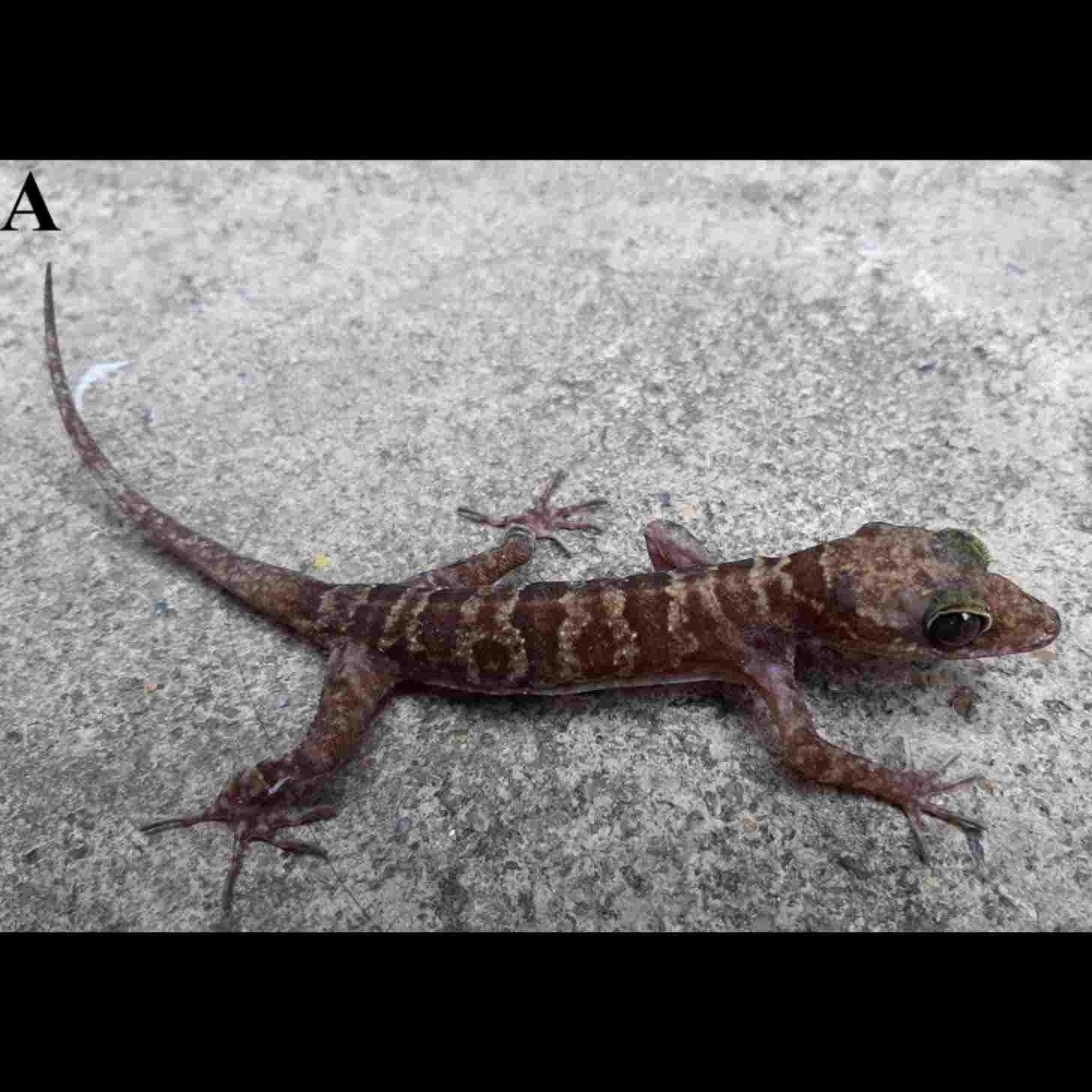
In September 2024, herpetologist Conrad Hoskin discovered the Simakal Pad gecko on Dauan Island during an expedition in the northern Torres Strait of Australia.
The two-inch long critter sported a slender snout and eyes that appeared gold in a certain light.
Simakal Pad geckos — and the newly discovered Ayun Pa bent-toed gecko — are a testament to the importance of geckos at large.
Whether they’re in Australian waterways or the Vietnamese countryside, geckos help the environment by snacking on insects and keeping pest populations in check.
Some geckos also double as natural pollinators. In 2019, a species of day gecko in South Africa was seen feeding on the nectar of plants, collecting pollen on their snouts, and rubbing it off at their next destination.
As researchers set off on more zoological expeditions around the globe, they become better at protecting new and existing species.

“I'm very interested in speciation and rapid adaptation, including to human-induced change like climate change and invasive species,” said Hoskin, who is an associate professor at James Cook University’s College of Science and Engineering.
“To date, I've done a lot of evolutionary biology and species discovery but I'm increasingly focusing on conservation projects.”
Like Nguyen and her peers, Hoskin hopes the allure of new species headlines draws heightened awareness to endangered animals around the globe.
“My research and teaching interests focus on biodiversity: what's out there, how we discover and describe it, how it arises and adapts through time, and how we can conserve it,” Hoskins said.
You may also like: Fanged creature found 'barking' on island mountain. It's a new species, and it’s worth protecting
Header image via Tycho / Wikimedia Commons (CC BY-SA 3.0)
Growing up in Biratnagar, Nepal’s industrial hub, 16-year-old Priyanshi Poddar has first-hand experience with the overwhelming piles of rubber waste that accumulate from local factories.
Witnessing this waste pollute local waterways, combined with the shattering impact of the 2015 Nepal earthquake, Poddar was driven to do something to help.
So, she started Project Saathi.

Saathi is a word that means “friend” or “companion” in Nepali, and that’s exactly what it continues to represent for Poddar.
“Saathi is a project dedicated to addressing homelessness and environmental degradation in Nepal,” Poddar explains on her website.
“By upcycling rubber remnants from the footwear industry into durable mats, we provide a dual solution: improving the living conditions of homeless individuals and reducing environmental pollution caused by rubber waste.”

She began by collecting the discarded rubber from local streets and landfills and then set up collection boxes for old footwear across the city. Then, Poddar and her team upcycle the waste into durable, multipurpose mats. (They also make new clogs, too.)
The mats are essential to people experiencing homelessness, people displaced by disaster, and families living in poverty. They provide a clean, insulated surface for sleeping, studying, and even playing, giving people a dignified place to land instead of a cold floor.
“My mission is to offer dignity and comfort to those in need while promoting sustainable practices in waste management,” Poddar added on her website.

“Through Saathi, I aim to inspire communities to collaborate on innovative solutions to local challenges, fostering a culture of compassion and environmental stewardship.”
Since Project Saathi’s launch in May 2023, Poddar has led 15 distribution drives across Nepal. In October 2023 — just a few months after launching — she partnered with the Nepali government to provide 200 mats as urgent relief following an earthquake.
Over 4,000 individuals have since benefited from the project, with over 1,000 upcycled mats and 2,500 pairs of clogs distributed to people in need.
The project has also successfully recycled over 250 kilograms of toxic rubber waste and prevented the release of approximately 3 metric tons of carbon emissions.

“With every mat distributed, we provide immediate relief to homeless individuals and contribute to a cleaner, more sustainable future for Nepal,” Poddar writes.
Just recently, she was recognized for her work as one of fifteen young environmental activists from across the globe, receiving first place in her age group in the 2025 International Young Eco-Hero Awards.
The awards, which are led by the nonprofit Action for Nature, recognize youth aged 8-16 who are taking steps to solve the climate crisis.
“While leaders worldwide struggle to protect the environment, global youth activists constantly remind us that transformative change often starts small. This year’s Eco-Heroes are another powerful reminder that the future of our planet is in good hands,” Beryl Kay, president of Action for Nature, said in a statement.
“By honoring the trailblazing work of young environmental activists worldwide, we are celebrating the hope, creativity, and passion we all need to harness in order to protect the Earth.”

Poddar’s award honors her commitment to sustainable solutions, as well as her leadership among young students like her.
She actively involves young people in her distribution drives and furthers educational efforts to understand how environmental degradation and social inequality go hand-in-hand.
Through her ongoing recognition, Poddar has also secured $3,000 in funding from the International Baccalaureate Global Youth Action Fund, which awards monetary support to students ages 12 to 19 who have a project or idea that will improve the world.
“Priyanshi doesn’t just apply for opportunities — she sees them through, even when the process is long, demanding, or uncertain,” her IB program coordinator, Prabin Rai, said in a statement.
“Priyanshi doesn’t wait for change to happen. She leads it.”

In the coming years, Poddar has ambitions to expand Project Saathi’s reach, with a goal to recycle over 400 kilograms of rubber waste and distribute 3,000 more mats by the end of 2026.
“Working on Saathi has been one of the most meaningful experiences for me,” Poddar said in a video for the 2025 Eco Hero Awards.
“From understanding local waste issues to seeing the real impact small actions can have, to me, Saathi is more than just mats. It’s about compassion and creativity coming together to care for both people and the planet.”
You may also like: Man invents 'backpack beds,' aims to give one to every person sleeping on the street in his city
Header image courtesy of Project Saathi
Some dogs, such as huskies, malamutes, and German shepherds, resemble their wolfish ancestors more closely than their corgi counterparts.
But wolfdogs are another animal entirely. Due to crossbreeding that largely dates back to the 1960s and 70s, they have a wolf ancestry that is much more recent.
“Typically, to be considered a wolfdog, an animal will have a minimum of 20% wolf heritage, and can have up to the legal maximum of 98% wolf heritage,” The Texas Wolfdog Project, an animal sanctuary based in Montgomery, Texas, explains on its website.
According to the Texas Wolfdog Project, there’s a vast range of behavioral traits that wolfdogs exhibit, which fluctuate based on the “content” of their wolf genes.
But overall, they tend to require more care than the average house pet.
The sanctuary is just one of many across the country that rescue abused and abandoned wolfdogs and ensure that they’re given proper care.
In fact, 1,200 miles north of the Texas Wolfdog Project, in Gleason, Wisconsin, another refuge has found a way to help wolfdogs thrive — all while helping veterans, too.
It’s through an innovative program called Apex Angels and Warriors.

“We bring in veterans who have PTSD or any other sort of mental health issues, and we are a non-traditional type of therapy for them,” founder Michelle Last told WJFW, a Wisconsin news outlet.
Since 2022, the sanctuary — which doubles as a nonprofit — has been serving local veterans by organizing playdates with their “pack,” which now consists of more than 30 wolfdogs.
Last’s mother and father both served in the Vietnam War. She opened up about losing her father to suicide after his battle with post-traumatic stress disorder.
“I made it my mission to help veterans,” Last said. “I didn’t want people to end up like my dad with no other option.”
One of those veterans is Jeff Yunk, an Army veteran who served two tours in Afghanistan.
“When I first got back, I had a hard time readjusting, went down some bad roads that I shouldn’t have been down,” Yunk explained.

Yunk recalls meeting Last at a veterans coffee event, when she came in to promote her first-of-its-kind program.
At first, he was wary of the idea of spending time with wolfdogs. Then he met them, and he felt himself change for the better.
“The wolfdogs and veterans have both been through trauma,” reads a mission statement on the nonprofit’s Facebook page. “And they help heal each other with patience, understanding, trust, and love.”
Yunk’s journey is a testament to that.
"When these wolf dogs click to someone, that's their go-to person. They will scent roll all over you. They will, they just go nuts for that one person," he said.
“People will say sometimes we’re crazy or sometimes we’re unpredictable or this and that,” said Yunk, who now volunteers at the sanctuary.
“Sit down with a veteran,” Yunk urged. “We’re not that bad, and neither are these dogs."

Header images via Apex Angels & Warriors Veteran / Wolfdog Healing and Education center
Every day the Good Good Good team collects the best good news in the world and shares it with our community. Here are the highlights for this week!
If you want to get good news in your inbox every day, join the Goodnewsletter — the free daily newsletter designed to leave you feeling hopeful.
The Best Positive News We’re Celebrating This Week —
Under a new, first-of-its-kind state law, companies that sell packaged products in Oregon are now financially responsible for recycling them
Oregon’s new Plastic Pollution and Recycling Modernization Act will hold companies that sell packaged products in the state financially responsible for helping the state collect and recycle the packaging.
In addition to holding companies responsible for the lifecycle of their products, the new law aims to modernize the state’s recycling system, bring more uniform curbside recycling statewide, add drop-off sites and bins, and expand access.
The RMA is the first in the U.S. to implement an Extended Producer Responsibility policy specifically on packaging, and other states are following its lead, including Minnesota and California.
Why is this good news? While it’s important for each of us to be a conscious consumer, corporations should be conscious producers, too. This law brings some much-needed accountability for companies to consider the full impact of the goods they produce — from the item itself to the packaging it arrives in.
Plus, when recycling rules vary by locality, it makes recycling confusing and people less likely to participate — this will help bring some clarity.
A student’s life-changing injury made him realize how ‘outdated’ fiberglass casts are — so he 3D-printed a better one
→ Read more
A Wisconsin restaurant exclusively hires teenagers — when its owner fell ill, those teens stepped in to save the business
The Urban Olive & Vine in Hudson, Wisconsin proudly makes a point of exclusively hiring teenagers. For years, owners Chad and Carol Trainor have supported them as they transitioned on to other opportunities.
But when Carol suddenly experienced a grand mal seizure, everything changed for the couple. She spent eight months at the MHealth Fairview hospital in Minneapolis — largely in a coma — and Chad rarely left her side.
Chad considered shutting down the business entirely — but their employees wouldn’t have it. He came to the restaurant at the crack of dawn to work out weekly schedules, but for the rest, their team of 30 teens took over — coming in early for opening, staying late to close up, and more.
→ Read more
A North Carolina nonprofit is donating hundreds of shoes to middle school students impacted by Hurricane Helene
In anticipation of the back-to-school season, Mountain Hope, a nonprofit in North Carolina, wanted to help students in a part of the state hit hardest by Hurricane Helene.
It held a shoe drive at a local outlet mall to collect 450 pairs of shoes to distribute to students headed back to school at Owen Middle School in Swannanoa. Any monetary donations it received would go toward purchasing shoes in missing sizes.
The nonprofit hoped it could help ease the stress of local families still “working on the basics” and recovering from Helene, almost a year later. It hoped it could help make shoes one less thing families had to consider for the new school year.
Why is this good news? Back-to-school season can cause incredible financial stress on families. For those still making ends meet to recover from the devastation Helene caused, any pressure this shoe drive and initiative can relieve is worth it. Even something as simple as new shoes for a new school year can make a big difference.
→ Read more
Auction breaks records, raises thousands to cover the cost of emergency medical care through the power of cheese
→ Read more
A bus driver in Oregon has donated 100 gallons of platelets over 30 years, saving an estimated 400 lives
When he was a young man in the United States Navy, David Schapiro would visit a local blood donation center with his friends in the service and then go out for a beer.
Once he moved to Oregon, he kept up the tradition, donating about every two weeks for nearly three more decades. Now 62 years old and a bus driver in Portland, Schapiro celebrated the donation of his 100th gallon of platelets to the American Red Cross, enough to save over 400 lives.
Schapiro specifically started donating platelets after learning they often help treat cancer patients, which struck a personal cord, since his sister has had cancer three times.
→ Read more
A new neighborhood in Texas brings 3D-printed affordable housing closer to reality in the U.S.
One of the world’s leading 3D-printing companies, Icon is constructing three new homes in Texas for low-income individuals as part of a larger 3D-printed community in Austin.
With hybrid construction, the first floor will be entirely 3D-printed and combine a living room, dining area, and kitchen, while the second floor will use traditional construction methods and include a bedroom and bathroom.
A $195,000 starting price tag might not sound affordable, but the other 3D-printed homes built nearby are priced around $350,000 and up to $1.3 million.
Why is this good news? While the rollout of this new home-building technology has been slow, its benefits hold true: they are more insulated, helping regulate temperature fluctuations and energy use, are resistant to water, mold, termites, and fire, and when a project finally gets underway, they’re much quicker to construct.
Add in the affordability element, and that’s good progress to celebrate.
States are putting guardrails around artificial intelligence, despite a lack of federal regulation
→ Here’s how
Death rates from cardiovascular disease have fallen dramatically in recent decades
While still the leading cause of death worldwide, the risk of dying from cardiovascular diseases has declined dramatically since 1950. In just the U.S., for people of the same age, the annual risk of dying from cardiovascular disease is now one-quarter what it was then.
Cardiovascular diseases refer to conditions that impact the heart and blood vessels, like heart disease and stroke.
This incredible progress is thanks to critical research, surgical advances, public health efforts, and lifestyle changes that have led to far fewer people dying from strokes or heart attacks. That decline is also seen across all age groups.
→ Read more
One of the world’s most plastic-polluted cities has now banned single-use plastics
Lagos, Nigeria is one of the world’s most plastic-polluted cities, contributing 870,000 tons of the world’s 57 million tons of plastic waste in 2024. And with its lack of a proper waste management system, much of it ends up in waterways, clogging canals and contributing to devastating flooding.
In an effort to tackle its plastic pollution crisis, last month the city implemented a new law banning the use of single-use plastics like cutlery, plates, and straws, with offenders at risk of having their businesses shut down.
What’s the nuance? Residents say that weak enforcement and a lack of affordable alternatives have weakened the effectiveness of the ban. Activists also say the city must pair the ban with “meaningful improvements in the city’s overwhelmed waste management systems.”
Still, the new law joins other efforts to manage pollution in the city, with a rise in private waste managers and sustainability groups stepping up to help, too.
→ Read more
4 out of 5 US troops surveyed understand their duty to disobey illegal orders, researchers find
Homophobic attitudes have declined dramatically in the U.S. and Western Europe
In 1984, one in three Dutch people believed homosexuality was “never or rarely justified” — in 2022, it was one in 16. In the U.S., that homophobic attitude dropped from a massive three-quarters of people to less than one-quarter.
Everyone should be free to decide for themselves who they love and are attracted to — and the data shows that a vast and growing majority of people agree with that assertion.
As Our World in Data notes, even using the word “justified” sounds strange today — and while keeping phrasing consistent helps render more accurate data, that it even sounds outdated further illustrates how much things have changed.
Rocky Mountain National Park just became the latest park to offer free all-terrain wheelchairs for disabled visitors
About 28 national park sites currently offer adaptive equipment and mobility devices for visitors to check out for free when they visit. But one especially popular location, Rocky Mountain National Park, recently announced an expansion of its accommodations.
Park upgrades include new accessible picnic tables, an accessible bus to transport visitors across the park, and free all-terrain wheelchairs. In the face of federal funding cuts, these changes were made possible by the support of the Rocky Mountain Conservancy, the nonprofit arm of this NPS site.
With the three additional wheelchairs, disabled visitors will be able “to experience Rocky in a way that would not be possible without them.”
Why is this good news? Disabled national park-goers have often been left behind when it comes to outdoor excursions — but national parks are for everyone. Parks like Rocky Mountain aren’t satisfied with meeting the bare minimum for accessibility; they’re constantly looking for ways to improve their offerings to be a welcoming place for all visitors.
Philadelphia is using AI cameras to keep bus lanes clear — fairness, trust, and transparency could make them even more effective
→ Read more
Amid growing health concerns, a record-low 54% of Americans say they drink alcohol
The percentage of U.S. adults who say they consume alcohol has fallen to a historic low of 54%, the lowest level in the nearly 90 years Gallup has been collecting the data.
Between 1997 and 2023, at least 60% of Americans reported drinking alcohol, and the previous low was recorded in 1958, when 55% reported drinking alcohol. The highest rate ever recorded was 71%, between 1976-1978.
This trend coincides with a growing belief among Americans that moderate alcohol consumption is bad for your health, reaching a majority at 53% for the first time ever recorded. Even those who do drink reported drinking less, less frequently.
→ Read more
More good news of the week —
To combat the city’s homelessness crisis, Seattle announced a plan to build 100 tiny homes. The city has already seen success with tiny home communities in various neighborhoods, so it’s investing even further in the initiative, with two new villages planned to open this fall that will add more units to the city’s shelter system.
New York City Public Schools and No Kid Hungry have been distributing free summer meals in all five boroughs. Food insecurity is a major problem in communities all across the U.S., whether or not school is in session. Some students depend on school meals as their only source of nutrient-dense food for the day — and that can’t end once the school year does.
A Tucson, Arizona zoo launched a cell phone recycling program that will help protect flamingos. In partnership with ECO-CEL, the zoo is now accepting used cell phones, tablets, and chargers with the goal of reducing the demand for new lithium mining, which threatens ecosystems where Chilean flamingos live.
Cities in Germany are offering subsidized taxi rides at night to improve women’s safety. The initiative comes as violence against women is rising in Germany. In 2023, crimes against females increased in all categories, with sexual offenses surging by more than 6%, reaching 52,330 reported cases countrywide.
Boston Public Library is using AI to make its archive of historically significant government documents more accessible to the public. Currently, the archives can only be accessed in person, but this new digitization project will enable users to search and cross-reference entire texts of documents dating back to the 1800s from anywhere in the world.
The first 3D-printed home made primarily from soil was just constructed in Japan. The housing industry has seen virtually no fundamental innovation in construction methods, materials, or structures for over 50 years, so a Japanese company looked to keep recycling, sustainability, and reduced carbon emissions at the forefront.
A new at-home spit test that measures hormone levels has been certified as a contraceptive and will roll out in Europe. The device from a Berlin-based women’s health tech company has been available as a fertility-monitoring tool, but it can now also be used to prevent pregnancy, after a study showed it was 92% effective, similar to birth control pills.
An animal shelter in Alaska launched a “borrow-a-dog” program to get dogs out of their kennels and into the community. Through Tails on Trails, volunteers can spend 48 hours of quality time with a dog, whether that’s going running, hiking, or just sitting on the couch and watching a movie.
Brad Paisley & Kimberly Williams-Paisley launched a free vet clinic to help Nashville pets and their parents. Veterinary care costs are especially prohibitive to lower-income pet owners, so the two teamed up with The Companion Project to host a pop-up and served over 200 local pets with essential veterinary care.
Boston launched a new pilot program to give young adults facing homelessness $1,200 cash every month for two years. Program participants will also receive two and a half years of supportive services, like a navigator who helps young people identify and access the resources they need, as well as financial coaching — but there will be no penalty for not using them.
Scientists developed a method that trains AI to detect costly invasive plant species more effectively. One invasive, leafy spurge is a noxious weed with small green flowers that can render whole hayfields inedible by crowding out native plants. Researchers estimate that it causes more than $35 million in losses annually in the country’s beef and hay production.
A French architect is creating durable, concrete-free bricks out of textile waste. Clarisse Merlet’s initial inspiration for recycling clothes did not stem from the textile industry’s significant waste but rather from the desire to construct bricks without using carbon-intensive concrete.
Illinois became the first state to block AI apps from diagnosing or giving therapy advice. In addition to placing landmark guardrails on how mental health professionals can use AI to support care, the law also closes a loophole that allows unlicensed persons to advertise themselves as “therapists.”
A Minnesota recycling company is building a facility that turns food waste into energy. Out of all of the trash households tend to throw away, food waste makes up about 24%, making it more than any other single material that ends up in a landfill. When that waste rots, it decays and emits methane, a powerful greenhouse gas.
A new heat-resistant plastic can be recycled endlessly without losing quality. In addition to being tested in aerospace circumstances, the material also shows promise in cars with its ability to regain shape after collisions, which could improve passenger safety and reduce the need for part replacements.
India achieved 50% of its installed electricity capacity from non-fossil fuel sources five years ahead of its 2030 target. The country’s renewable power output rose at its fastest pace since 2022 in the first half of 2025, while coal-fired generation declined nearly 3%, and the government is also pushing for battery storage, circularity for solar and wind components, and green hydrogen.
The world’s first large-scale affordable housing development built using 3D printing technology is opening in Texas this year. Houston is known as one of the most affordable major cities in the United States, but home ownership is still out of reach for many, due to a growing gap in what people can afford vs. how much housing actually costs.
An Alaskan nonprofit’s tiny home project is providing transitional housing for people experiencing homelessness. In Our Backyard launched the project to see if the model could work in Anchorage, and it’s been so successful, the city is already working on larger, duplicate projects in other locations.
Switzerland is the first country in the world to ban fur imports. In 2023, Switzerland imported more than $30 million worth of fur apparel and fur skins from around the world, but Human World for Animals says that if the ban is properly implemented, that number should become zero because all fur is produced through animal cruelty.
Scientists discovered an Arctic “lifeline” that could help delay the collapse of key Atlantic currents. A vital ocean current system has been slowing down due to rising temperatures and climate change, but a new study offers a glimmer of hope, suggesting that an unexpected back-up system in the Arctic could help maintain the system’s stability.
Hank Green — the beloved YouTuber, author, educator, and TikTok personality — is no stranger to a side quest.
The multi-hyphenate Internet-tainer and entrepreneur is a sock salesman, word game investor, and cancer survivor-turned stand-up comic who is often found creating new things for the good of humanity.

His latest endeavor is a productivity app called “Focus Friend.”
It is advertised as an “ADHD-friendly focus timer” in the App Store, where it has skyrocketed to popularity in recent days, currently sitting at #4 on the “free apps” chart, just ahead of Google.
“I think I forgot to tell TikTok about the best idea I’ve ever had,” Green started a new video.
“It’s an app that installs a bean on your phone. And the bean really wants to spend more time knitting,” he explained.
“You can focus for an amount of time, and that will allow the bean to make socks or scarves. And then you can trade those socks or scarves in for more furniture in the bean’s room.”

It’s a quintessential cozy game — “obviously, you want this,” Green ended his TikTok — but with the intention to “give people their time back.”
The app itself is free, but it does offer some in-app purchases. Those, Green said, are there for good reason.
In a follow-up video, he explained that the developer of the app, Bria, told him to consider advertisements in the app to offset the cost of creating it.
“And I didn’t really want to do that,” Green said. “The app is about giving people their time back. It’s about letting people be in control of their attention, not selling their attention to someone else.”

So, he and Bria decided to make a free app with no ads, leaving the choice up to the user whether they want to make purchases for their own beans.
“That doesn’t break the app. It’s not like it closes down if you don’t pay for it,” Green added. “But the people who do pay make it so that we can continue developing the app. And we have a bunch of ideas now that we have some income.”
Green himself has not publicly disclosed a diagnosis of ADHD, though two years ago, he did tweet: “People often ask if I have ADHD and, look, I don’t know what I have but, honestly, whatever it is…I think it’s great.”
Therefore, the app is for anyone — ADHD diagnosis or not.
“Perfect for anyone who struggles with long sessions of concentration,” the app’s description reads. “Focus Friend is for students and beyond."

The app also discloses that it does not collect or share any user data, to which Green said: “What would we need your data for?!”
Inside Focus Friend, users can find a live activity timer to see their progress when their phone is locked, activate a Deep Focus Mode that locks distracting apps during focus sessions, and break timers that are designed around the Pomodoro Method of productivity.
There are also hundreds of decorations to unlock and decorate the bean’s room, as well as skins to customize the user’s Focus Friend.
@hankgreen1 Your Deserve a Focus Friend
♬ original sound - Hank Green
Hank said his is a cat-bean named “Gummybean,” since his real-life cat is named Gummybear.
Those interested in downloading the app can do so via the App Store or Google Play.
This article may contain affiliate links. If you buy something after clicking a link, Good Good Good may earn a commission to support its work sharing meaningful good news — at no extra cost to you. Our reporting is free from bias and not influenced by brands. Thanks for your trust and support!
Header images courtesy of Hank Green/Bluesky and B-Tech Consulting Group LLC
Thirty years ago, Rita Ebel was in a car accident that left her with incomplete paralysis. In the decades since, the 67-year-old has gone through two divorces and survived cancer.
But Ebel, who is quick with a laugh and often wears a smile, prefers to look on the bright side of things.
“There is no situation that is just bad,” Ebel told Ability Magazine. “We all need to find this tiny good part in the negative circumstance ourselves.”
As an ambulatory wheelchair user, Ebel can walk short distances, but largely relies on her wheelchair to get around.
But in her hometown of Hanau, Germany, Ebel found that most businesses were inaccessible to her after her accident.
“The owners of the shops would always tell me that I could simply knock on the door, and then they will help me to get in,” Ebel explained. “They thought this wasn’t a problem.”
“However,” Ebel countered, “if you are an active wheelchair-user who is used to being independent, you aren’t going to stop in front of their door, knock, and ask for help.”
So she took matters into her own hands, building wheelchair ramps of her own design, not out of wood, concrete, or steel, but something more colorful: Lego bricks.
But at a time when select Lego sets regularly cost over $100, Ebel said that she was quickly priced out of her building materials.
“Getting the Legos is actually the hardest part,” Ebel said. “People who have Lego at home usually don’t want to give them up because it’s something that goes through all generations.”
“And if I do get Legos, the pieces are often not suitable for my ramps, because I need the basic building blocks, but these days most of the Legos belong to a ‘Lego Friends’ or ‘Star Wars’ set.”
So, she took to social media and did something she rarely allowed herself to do: ask for help.
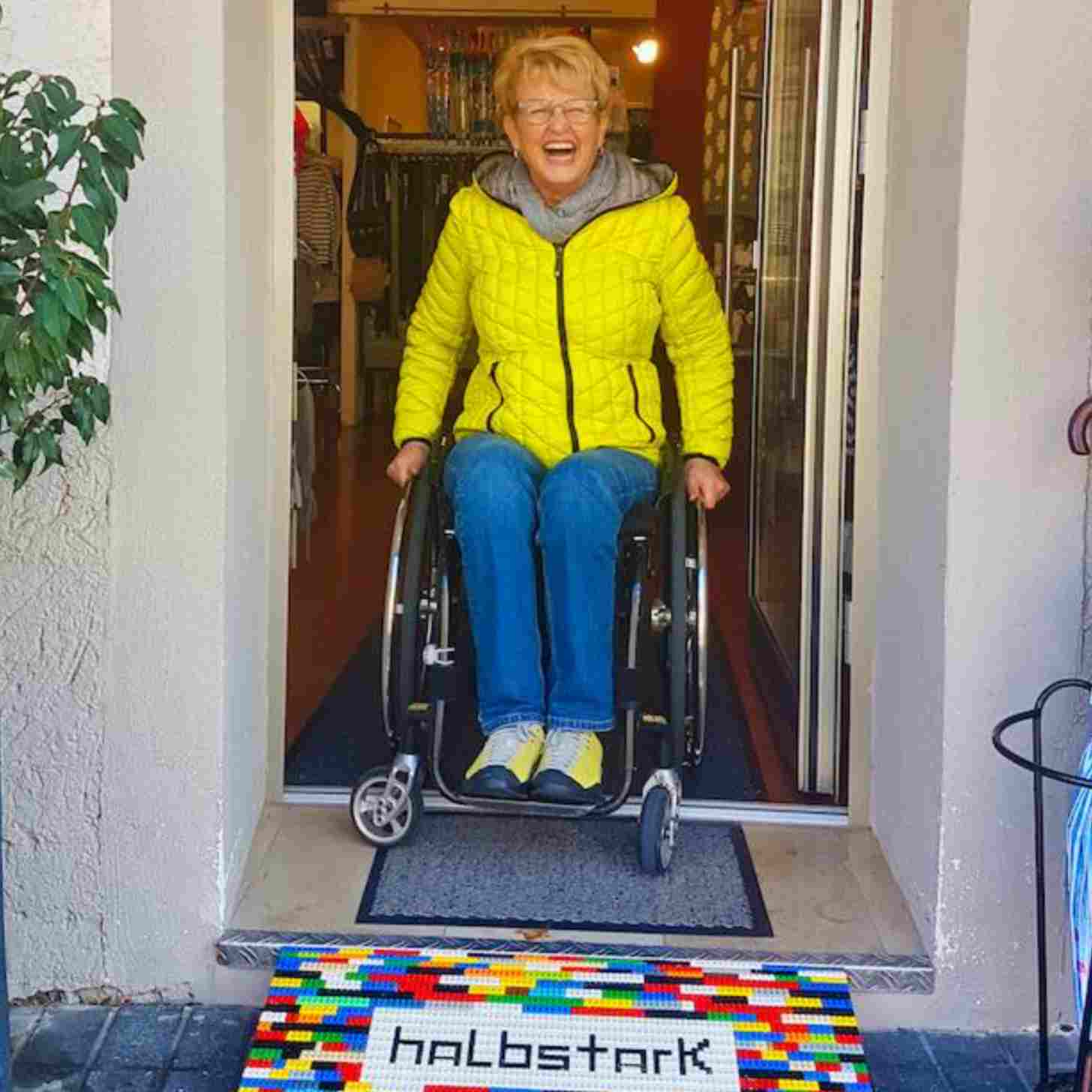
“[My first donor] asked how many pieces of Lego I would need to finish my very first ramp,” Ebel said. “I responded that I was afraid I might need around 1,000 Legos to begin with. Shortly after, he came to me with two huge boxes filled with Lego.”
Since her endeavor began in 2019, Ebel has made countless ramps and gained global recognition as “Lego Oma,” which is German for “Lego Grandma.”
She’s delivered ramps to sweets shops, breweries, pet shops, and everything in between, slowly making Hanau more accessible, brick by brick.
Legally, German laws mandate that official wheelchair ramps allow for a 6% incline or less. Ebel’s ramps don’t quite meet the mark.
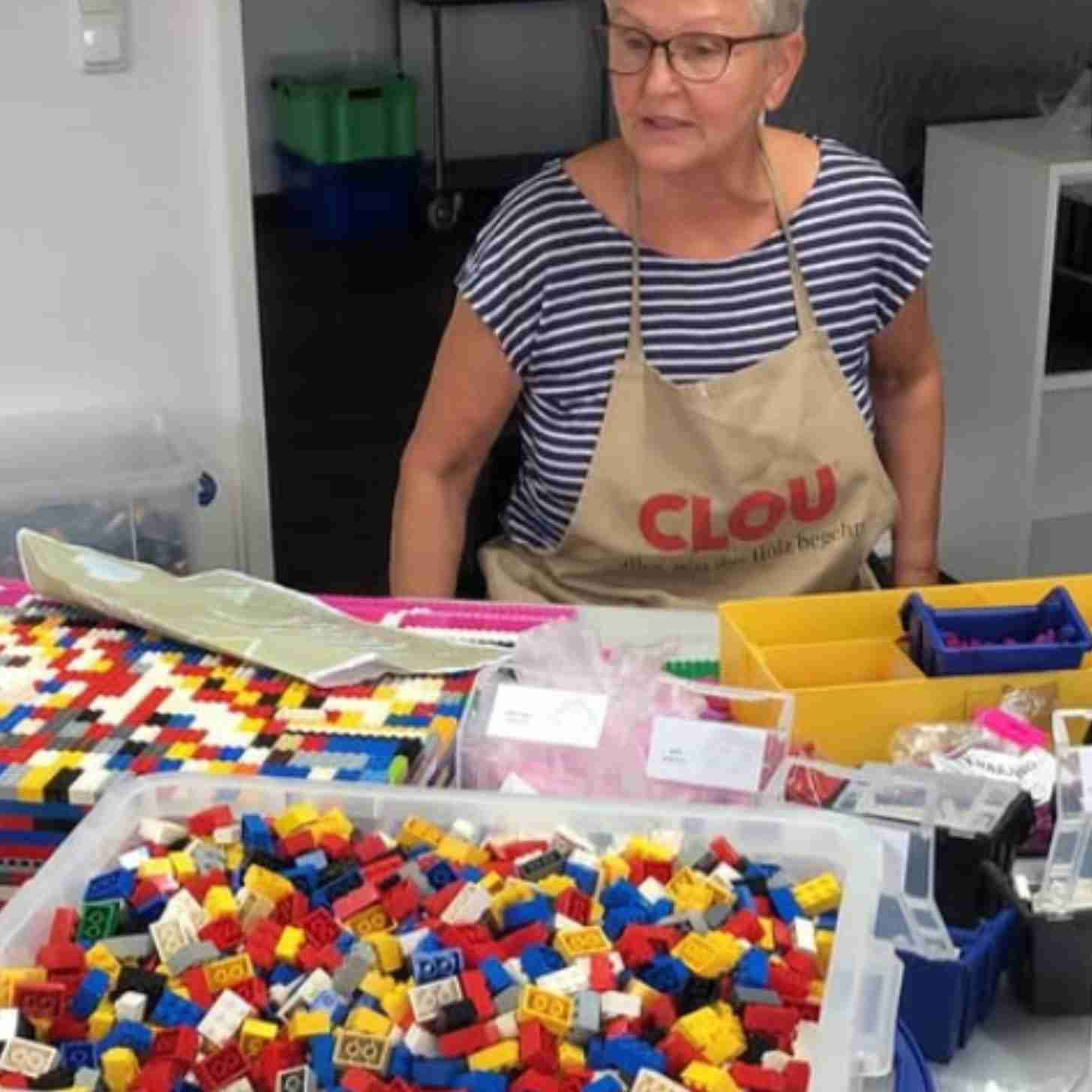
“This would mean that if the ramp has to overcome a 15-centimeter step, it could be a few meters long, and that’s often not possible because the sidewalk doesn’t offer enough space,” Ebel explained.
“So our ramps don’t qualify as wheelchair ramps, but all city officials support our work and don’t complain,” she added.
“But in the end, the wheelchair-users don’t care much about regulations if the ramp allows them to independently enter and exit the shop.”
Like many disability initiatives, the added accessibility benefits everyone in the community.
From parents with strollers to people on crutches, the ramps play a heavy role in whether customers even consider stepping into stores.
And the colorful patterns are a visual aid for those with low vision — an early cue that an incline is ahead.
Typically, it only takes Ebel three to four hours to build a ramp. But since the donations have poured in, it’s not necessarily a matter of time; it’s a matter of storage.

Fortunately, her landlord offered her a second basement room solely reserved for Lego.
And the donations keep coming.
“Earlier this month, I had a visit from the Terminal for Kids kindergarten [Rainbowland] from Babenhausen, who brought us their assorted Lego bricks,” Ebel posted on Instagram in February, alongside photos of her surrounded by beaming kindergartners.
“The children were very excited about the Lego ramp, driveway assistance, and the amount of Lego bricks in the workshop … Thanks again to the daycare for the Lego donation.”
You may also like: Three-footed turtle given 'new wheels' after museum staff gifts him a handmade LEGO harness
Header image via Rita Ebel / Ypiyush22 (CC BY-SA 4.0)
In a continued effort to address homelessness in Phoenix, Arizona, the city has turned to shipping containers.
Earlier this year, the City of Phoenix opened the Phoenix Navigation Center, or what architect Brian Stark calls X-WING.
It opens up 80 beds to people experiencing homelessness in an especially crucial time, as more and more people need access to cool, safe indoor spaces in summer weather.

“We’re committed to helping individuals who want to end their homelessness, and this center will navigate them to the right path,” Mayor Kate Gallego said in a statement.
“Aside from sheltering them from the upcoming heat, the center will provide opportunities for employment, mental and physical health care, and case management to keep them on track.”
Shipping container housing is not a new concept, but it is one Stark is eager to improve upon. His buildings are already abundant across Phoenix, but now, they represent a sustainable solution to the housing crisis.
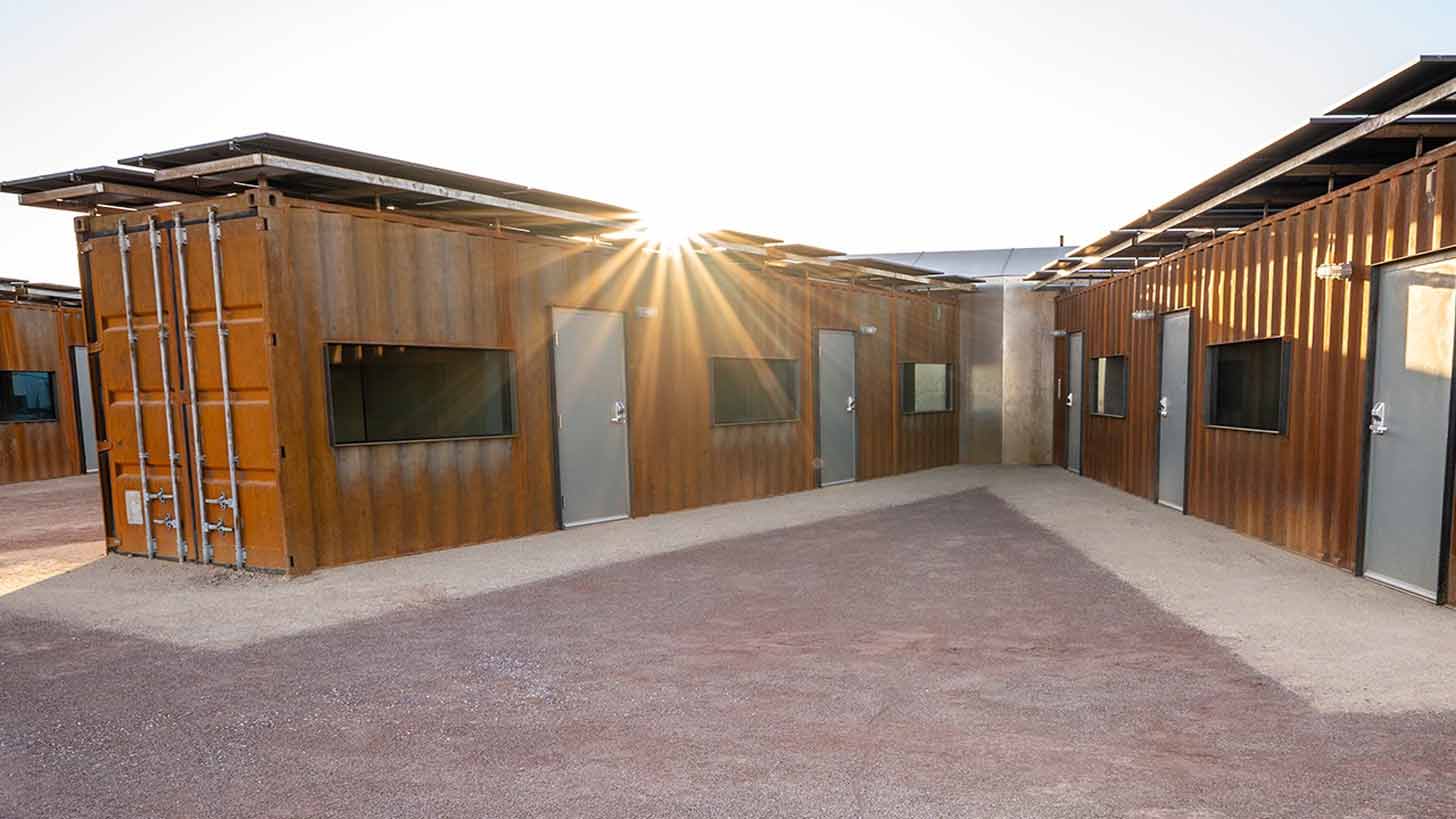
“We’re not consuming or producing that steel, it already exists,” Stark told CBS News. “There’s a huge ability to save. And that’s how I think we have to start thinking that way, is using what we have versus just keep on consuming.”
Stark’s architecture firm, Steel + Spark, designed X-Wing with the needs of residents in mind.
It consists of four 40-foot steel converted shipping containers that are placed in the shape of an ‘X,’ converging in the middle. Each container can sleep up to 20 people in private 5-by-8-foot rooms (with one resident per room), and they all offer central air conditioning powered by solar energy.

On the Phoenix property, there are two of these X-shaped facilities side-by-side, made of eight total shipping containers.
The buildings maintain their rustic appearance, with dark orange siding and steel details, but are topped with sleek solar panels. Combined with the X-shaped aerial view, the housing looks like something Wolverine might stay in on the set of a Marvel movie.
But the shape of the buildings isn’t just for looks. It also creates natural courtyards for residents when placed beside another unit, giving people a desirable place to stay and the city a quick and simple solution.
“We are grateful for the opportunity to help serve those experiencing homelessness through our partnership with the City of Phoenix,” Kathleen Santin, partner at Steel + Spark, said in a press release.
“The X-WING is a dignified, non-congregate housing solution. Solar powered by day, battery-powered at night, the X-WING is quick to market and delivered assembled.”

Indeed, the units only take one week to construct, offering a speedy option for a mounting crisis.
“We are continuously working to develop innovative solutions to end homelessness and create paths to permanent housing,” Mayor Gallego added. “Our partnership with Steel + Spark is a great example of that, and directly speaks to how the public and private sectors can work together to make an impact.”
St. Vincent de Paul and Community Bridges, Inc. will offer wrap-around services for residents at the facility. Guests who stay there must be referred to the shelter, which has 24/7 security.
The facility also includes shared restrooms, showers, and laundry services, as well as support like workforce development, life skills programming, companion animal services, and case management to help people end their homelessness for good.

“Solving homelessness takes a community effort, creativity, and a willingness to try new solutions," said St. Vincent de Paul chief program officer Jessica Berg.
“We continue to be grateful for the support from [our partners] and all community members who make our life-saving shelter and rehousing work possible.”
That work has made a world of difference for Jay Spicer, a resident who lives in an X-WING room with his dog, Dino. He qualified to stay in the new temporary shelter by staying sober for eight months and maintaining a job as a forklift operator.
“It is my space for now,” Spicer told CBS News. “We keep the door shut, it stays nice and cool in here.”
Extreme heat demands more indoor emergency shelters for people experiencing homelessness, Phoenix Vice Mayor Tassamin Ansari said.
“Placing the X-WING air-cooled containers, which accommodate singles and couples, for immediate use at a shelter with wraparound services will be critical in the city’s efforts to achieve more permanent housing exits,” Ansarai continued.

The success of this project has empowered Stark to continue using his shipping container designs for affordable housing. His firm is now working on a 105-unit apartment complex for unhoused or low-income senior citizens — also made out of shipping containers.
“It’s great talking to people who are living in the X-WING that say, ‘I can hear myself think for the first time, and I’m improving my life,’” Stark said.
“To be part of the solution is great, it's unbelievable.”
You might also like: Instead of a new jail, LA built a shipping container housing complex for homeless residents
Header image courtesy of the City of Phoenix
When the Schmidt Ocean Institute posts footage from its deep-sea dives, it rarely makes a splash outside of the world of marine science. Typically, the dive videos average 4,000 views.
But as researchers at the Schmidt Ocean Institute livestreamed their expedition of Argentina’s Mar del Plata Canyon over three weeks, it garnered over 17.5 million views in total.
“It’s been incredible to see how people of all ages have connected with the deep sea,” science team member Dr. Martín Brogger said in a statement.
Brogger, who works for CONICET, the National Scientific and Technical Research Council, and the Instituto de Biología de Organismos Marinos, said that his team was overwhelmed by the support.
“We received hundreds of messages from families, teachers and kids who felt inspired, surprised and even emotional watching the live broadcasts,” he said.
“Some young students told us they now dream of becoming marine biologists — an impact that goes beyond science by creating a shared sense of wonder and curiosity that can truly last a lifetime.”

To traverse the Mar del Plata Canyon, which is twice the size of the Grand Canyon, the team’s Remotely Operated Vehicle, SuBastian, dove to depths of more than 3,500 metres.
The stunning footage showed viewers dancing telescope octopuses, lurking lanternfish, clusters of “Barbie” pink lobsters, and much, much more.
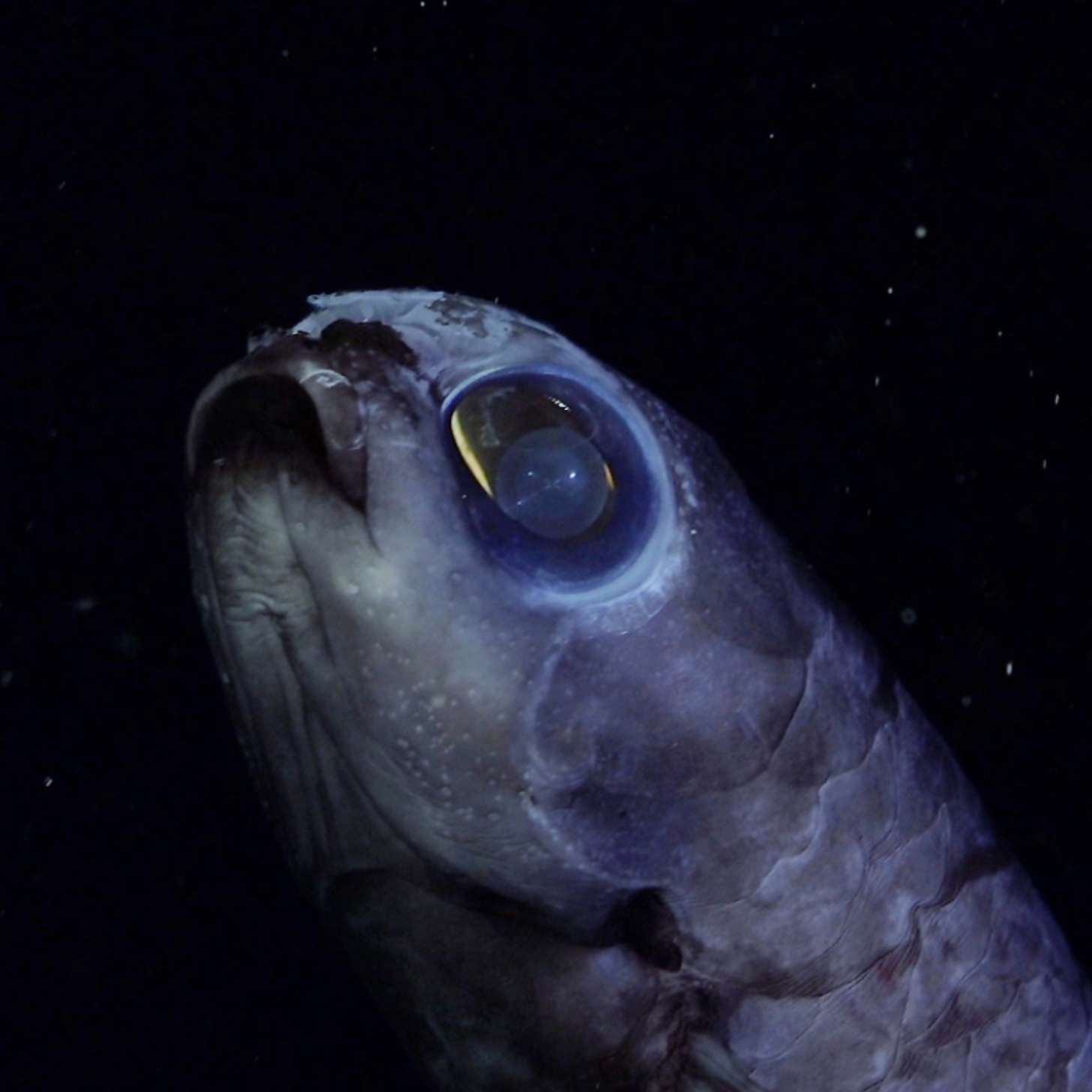
“This cruise underscores the power of ocean exploration and science in igniting the imagination,” said Schmidt Ocean Institute’s Executive Director, Dr Jyotika Virmani.
“It was inspiring for us to see Argentinians fall in love with their own deep sea, and we are grateful to the science team, who balanced the demands of seagoing science with their passion to share their research with millions.”
Outside of Argentina, the livestream went viral for another reason: a vibrant, pink starfish that resembled a certain cartoon character.

The researchers estimated that the expedition may have uncovered proof of nearly 40 potential new species, including never-before-seen “sea anemones, sea cucumbers, sea urchins, snails, corals, and crinoids, amongst others.”
However, detailed taxonomic work is required to confirm their status.
As the researchers launch into the next phase of discovery, they are celebrating the success of their livestream, as well as the curiosity it has inspired.

“The deep sea and its awe-inspiring life — from bright corals to mesmerising octopuses — has captivated an entire nation, thanks to a team of passionate scientists and the millions of people watching their work, via livestream,” said Wendy Schmidt, co-founder and president of Schmidt Ocean Institute.
“Argentina is showing the world the power of deep-sea exploration to not only spark wonder, but to remind us how much of our planet remains to be discovered and protected.”
You may also like: World Wildlife Fund releases decade-long report on the Congo Basin, sharing discovery of 742 new species
Header image: Telescope octopus. Image via ROV SuBastian / Schmidt Ocean Institute (Attribution-NonCommercial-ShareAlike CC BY-NC-SA)
In a new study, scientists at the University of Tokyo attached small backward-facing cameras to the bellies of 15 streaked shearwaters at Japan’s Funakoshi Ohshima Island.
They confirmed something that any beachgoer may already suspect: Seabirds poop.
A lot.
The team identified 195 “defecation events” in their footage, and learned that the seabirds overwhelmingly chose to poop while flying, rather than while swimming at the surface of the water. On average, the streaked shearwaters pooped mid-flight every four to 10 minutes.
“The footage captured far more frequent defecation events than I had expected,” the lead author, Leo Uesaka, told Discover Wildlife. “The fact that we were able to study this behaviour at all was a surprise in itself.”
Streaked shearwaters — which resemble seagulls, with slightly smaller bodies and more slender frames — are listed as Near Threatened on the IUCN Red List of Threatened Species.

As scientists uncover the mystery behind their daily habits, they’re in a better position to understand them — and protect them.
The authors also surmised that the seabird droppings are a boon to ocean health, with droppings potentially transporting beneficial nutrients huge distances across the big blue.
It’s a behavior found in whales, as well, through a process called “whale pump.”
As whales eat their way across the ocean, they leave essential nutrients, particularly iron and nitrogen, in their wake — essentially fertilizing the world around them as they swim.
“Feces are important,” Uesaka emphasized. “But people don’t really think about it.”
You may also like: Scientists believe penguin poop might be cooling Antarctica — here's how
Header image via Oscar Thomas (CC BY-NC-ND)
Dr. Laura Jacob, superintendent of the California Area School District in Coal Center, Pennsylvania, has 30 3D printers in her office.
While she does enjoy 3D printing as a hobby, these printers represent a mission much greater than Jacob alone; They are used to print violins for low-income students.
For schools, violins can cost $500 to $2,000 each, often representing hundreds of dollars in rental fees per family each school year. For the students attending schools in Jacob’s district, that’s just not a cost their families can afford.
“Over 70% of our students are low-income. So that means 100% of our kids receive a free breakfast and free lunch every single day,” Jacob told CBS News.

Regardless, she was determined to keep arts education alive for the students she serves. After seeing a video of the Ottawa Symphony Orchestra playing 3D-printed instruments, a passion took hold.
“I started tinkering. I found some models online. I'm not a computer scientist or an engineer by any means, but after a variety of failures, I found one that actually printed and it sounded good. It's a great start for kids,” Jacob told CBS News.
Each violin costs just $50 to make, and they are now offered free to any student who wants one, thanks to grant funding.
Plus, they’re perfect for beginners.
“How it sounds, how it responds, is a bit different,” music teacher and band director Noah Kilgus told Kidsburgh.

Although they don’t sound exactly like a traditional wooden string instrument, they are just as loud, much more durable, and easy to tune.
“You know, if they break, it's not a big deal. I can print the new part,” Jacob told WESA. “And to me, getting kids hands-on instruments is what gets them engaged in music. And so the more instruments I can get in kids' hands, the happier I am.”
“It’s very accessible, which is what music-making should be about,” Kilgus added. “It’s an opportunity for them to just experience and be exposed to music-making, even if it’s not at the highest level.”
So far, Jacob has printed 200 instruments, now teaching a weekly 3D violin club.
Each violin is made in about three days, with modified guitar pegs, real violin strings, and a wooden violin bridge and center rod, all attached to a plastic body. Kids joyfully learn the basics of their instruments on pink, purple, green, and blue companions.
“Usually, you don't get to pick the color of your violin, but if you're lucky, you will,” one fourth-grade student told WESA.
“And then after you play violin for three years, then you get a wooden violin on your third year.”
The students get to play on a wooden violin over time, growing into a more traditional and formal music education as they advance in their studies.
Another student expressed interest in playing the cello, and now Jacob is expanding her catalogue, albeit slowly, as she and the student attempt to learn how to play the new design together.
With the obvious cost benefit, the colorful foray into music classes boosts confidence for students, too.

“I feel like it makes you smarter because you have to learn notes and how long to put it on and what they mean,” student Ally Neil told CBS News.
“I feel like it makes you a better student, because if I can play the violin, I can do anything,” student Evie Dentino added.
For Jacob, just getting students to appreciate music makes it all worth it.
“It's that moment when you see them smile like that, that smile that comes out as they're starting to play and they create that sound themselves,” Jacob told CBS News.
The office jam-packed with printers is a small price to pay for that.
“I want to make sure that we do whatever it takes to put instruments in kids' hands. Whatever instrument they want, we want to put it in their hands,” Jacob told WESA.
“And this is one way to do it.”
Header image courtesy of California Area School District
Steffi Casimir calls herself “the Black girl podiatrist” in her TikTok bio, where she details her life in medical school, as well as one very unique extracurricular: Taking care of homeless people’s feet.
Studying to be a foot and ankle surgeon, it’s not far off from the work she will be doing once she graduates from Samuel Merritt University in Oakland, California.

Plus, she said, it’s often an overlooked part of helping people experiencing homelessness.
“Foot problems are one of the most common reasons homeless people end up in the ER. Providing free care … gives them relief, dignity, and a chance to walk forward with less suffering,” she shared in a TikTok.
“For those experiencing homelessness, feet are their only transportation. Walking miles each day without proper shoes or medical care leaves them vulnerable to wounds, infection, and pain. I volunteer to protect that foundation.”
Casimir volunteers with a local church that has a “mobile response unit” for homeless individuals, where they can access food, housing assistance, and healthcare in one place. Casimir sets up a makeshift “office” under a tent in a parking lot, with folding chairs and a table full of supplies.
Here, she provides a full pedal assessment, cleaning and dressing of wounds, trimming and cleaning of toenails, and taking care of calluses, corns, and any other issues that pop up.
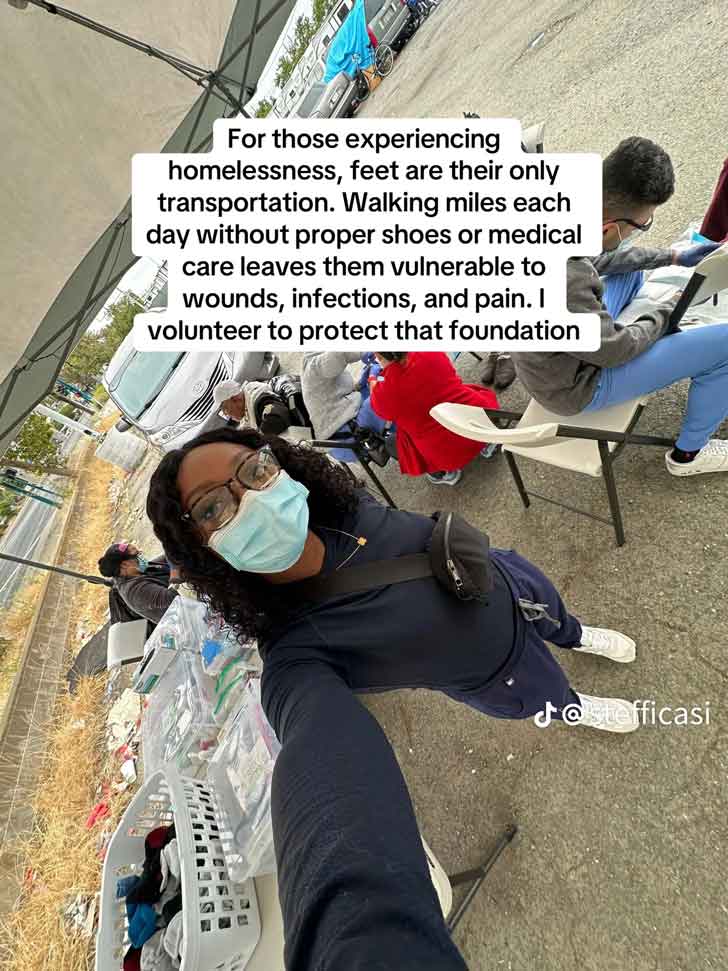
Then, patients are given lotions and anti-fungal creams, wound care and first aid supplies, and sometimes even walkers or boots to heal injuries. She also gives out brand-new socks and sneakers.
“Our patients often have unstable, open-toed shoes, so they are extremely grateful for a brand new pair of sneakers they can walk comfortably and effectively in,” she said.
And they aren’t just any shoes. Casimir and her team of volunteers always make sure they are the right size, using the Brannock device to get the right measurements for each patient.
Many of the supplies shared with patients are donated through an Amazon wish list that Casimir shares with her social media followers. After a recent video went semi-viral in the TikTok algorithm, strangers completely cleared the list.
“You guys bought out my entire Amazon wish list for the podiatry clinic,” she posted in a new video.
“You don’t know what this means to me or what it will mean to my patients this month. Our organization just lost the funding for supplies earlier this year. I will be adding more items, so my team can make hygiene kits for everyone that comes by the clinic.”

In addition to items specifically for the podiatry clinic, there are also essentials to include in a care kit for homeless folks, including snacks, gloves, combs, hand sanitizer, deodorant, and much more.
“A pair of socks, a snack, or even a toothbrush may seem small, but to someone in need, it’s comfort, dignity, and hope,” Casimir added.
And, on top of the care she provides, it can be life-saving.
“Homeless individuals often face diabetes, vascular disease, and neuropathy without access to regular care,” she explained in another video. “By treating their feet, I am not just easing pain; I’m preventing limb loss and potentially saving lives.”
She added that these folks also encounter conditions like fungal infections, ulcers, nail overgrowth, and painful skin breakdown without access to proper hygiene items and care.
“When you don’t have a home, every step is survival,” Casimir said. “Healthy feet mean mobility, independence, and the ability to seek food, shelter, and opportunity. That’s why I show up every month.”
You might also like: College students create 'laundry bus,' provide hygiene and dignity to homeless community
Header image by Jon Tyson/Unsplash
Robyn Yerian, 70, used to live in a two-bedroom tiny home that cost just $57,000.
In 2022, she was yearning for more connection — as well as some “passive income.”
So she took some money from her retirement savings, bought a 5-acre plot of land in Cumby, Texas, and is now the landlord and community leader of The Bird’s Nest, an all-women tiny home neighborhood home to 11 women ages 60 to 80.

Yerian spent about $150,000 in total to develop the property, and now there are 14 10-by-30-foot concrete pads, which are rented out to tenants at $450 a month. Here, they can put their R.V. homes or build their own tiny homes on their respective plot of land.
It’s a pretty sweet deal. 11 women live there now, with just one opening available.
“I've got about 500 people who want my last spot,” Yerian told Realtor.com
A majority of the women in the community are single — mirroring half of American women 65 and older. Many are divorced, one has never been married, one is a widow, and two are lesbians. Between all of them, they have 21 children and 24 grandchildren scattered around the country.

They are there to keep each other company, along with their nine dogs.
“We drive each other to doctor's appointments if needed,” Yerian said. “We look in on each other if someone has the flu or surgery. We are each other's therapists and sounding board.”
It’s what some women might consider a paradise — and that’s what makes it so hard to get in.
“In order to be considered here, you must meet me and the rest of the residents in person,” Yerian said. “Many of my tenants flew in for the process.”

That interview process is relatively informal, but Yerian said, people living on The Bird’s Nest property must be self-sufficient enough to stand on their own, but eager to support the other members of the community. They must love dogs. And they must agree to one of the biggest rules that came into existence back in 2022: No drama.
So far, it’s worked pretty well.
The mix of women is diverse and eclectic, especially among political views. They aren’t wealthy, but they also are not living in poverty. They are often retired, or recently laid off, and they face more difficult economic odds staring down a gender wage gap that, according to The New York Times, persists into retirement.

“According to the AARP, 64% of American women ages 50 to 64 who are not retired and not married have less than $50,000 in retirement savings, compared to 52% of men,” The New York Times reports. “Women’s Social Security payout is, on average, 20% less than men’s.”
Ultimately, despite any disagreements, Yerian wanted to create a community in which hard-working women could live independently, supporting and empowering one another, often coming in with little to no financial cushion.

“My goal is really to keep people out of nursing homes,” she told The New York Times.
And the residents of The Bird’s Nest don’t seem to want to fly far from home.
They cook and eat meals together. They work on home improvements as a team, with leaders hosting building workshops for women interested in learning how to use power tools. They make group outings to the grocery store and local restaurants. They tend to their gardens. They work on crafts.

They have financial independence without sacrificing companionship.
“I didn’t start out wanting to empower women — it evolved,” Yerian told Realtor.com. “I didn’t quite realize how many women are struggling in retirement. So now, I am always thinking of ways I can encourage women.”
She — and the women who surround her — hope the intrigue in their living arrangements inspires others to build something similar of their own.

“I have encouraged others to just go for it,” she added. “Quit saving that little bit of money and invest in a community. You will not get rich doing this, but it is a nice little cushion, and the sense of community is everything.”
You might also like: Storybook-inspired tiny home cottages bring neighbors together in this small town
Header image courtesy of The Bird's Nest/Facebook
- Researchers compared how genetically similar populations of Pocillopora corals cope with heat stress in Panama’s Gulf of Panama and Gulf of Chiriquí, both on the Pacific coast.
- The team looked at the entire holobiont — the coral’s symbionts, microbiome and physiology — in addition to its genome and environment, finding that the holobiont may play an outsized role in boosting the corals’ ability to cope with heat extremes.
- The team found that corals exposed to upwelling in the Gulf of Panama were better able to withstand higher temperatures, thanks in part to their microbiomes.
- The work points to the importance of better understanding how symbiotic relationships and microbiomes interact with corals to increase their resilience.
As ocean temperatures set new heat records, coral reef scientists are on a mission to identify which species and reefs can tolerate heat stress the best. But how and why do some corals cope with heat extremes better than others?
A research team led by the Smithsonian Tropical Research Institute in Panama investigated this question by studying not just corals’ genes and environment, but also their microbiomes.
By running a series of heat stress tests on two populations of Pocillopora corals — one from the Gulf of Panama and the other from the Gulf of Chiriquí, both on Panama’s Pacific coast — they found that corals exposed to upwelling in the Gulf of Panama were better able to withstand higher temperatures, thanks in part to their microbiomes. The study was published in June in the journal Current Biology.
A coral’s microbiome is made up of microorganisms such as algae and bacteria, some of which are considered “symbionts” that co-evolved to live within a host coral. Collectively, the microbiome, symbionts and host are called the holobiont.
The new study is the first in the Eastern Pacific to assess coral heat tolerance by looking at the entire holobiont, said Victoria Marie Glynn, an evolutionary biologist and lead author of the study, who at the time was earning her doctorate at McGill University in Canada.
“You cannot separate what the host is doing from what its microbiome is doing,” Glynn said. Microbiomes can influence gene expression and adaptation, for example. “All of that should be really thought of as a single unit — in this case, under climate change.”
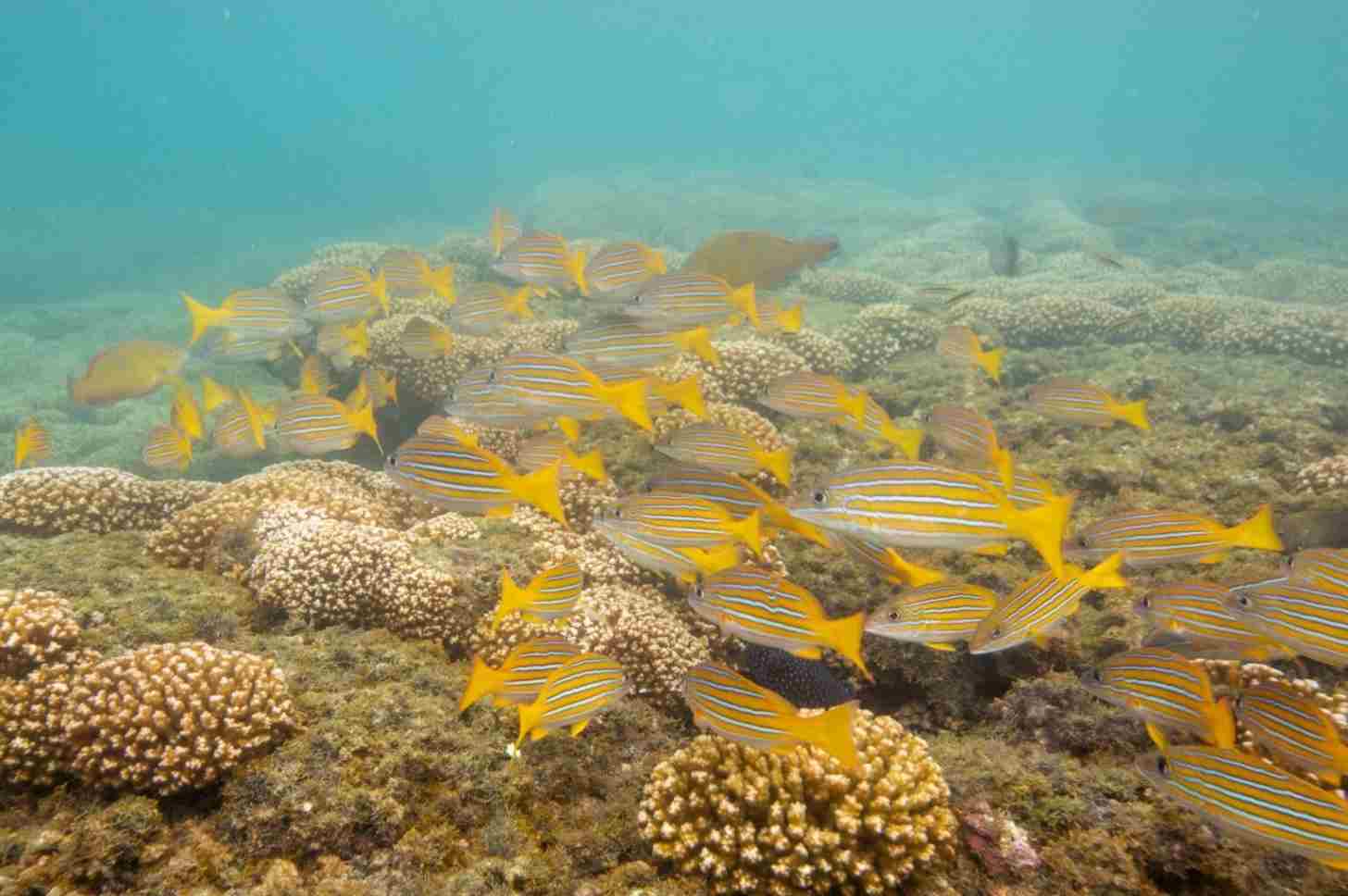
In the Gulf of Panama, a natural process called upwelling pushes cold water and nutrients from deep in the ocean to shallower areas, creating sudden spikes and dips in temperature.
But in the Gulf of Chiriquí, just 100 kilometers (60 miles) west, the water temperature stays relatively constant year-round. This one difference between the two gulfs, the team found, may play an outsized role in how well corals — and the symbionts in their microbiome — can tolerate heat.
The heat stress experiments happened over the course of just eight hours.
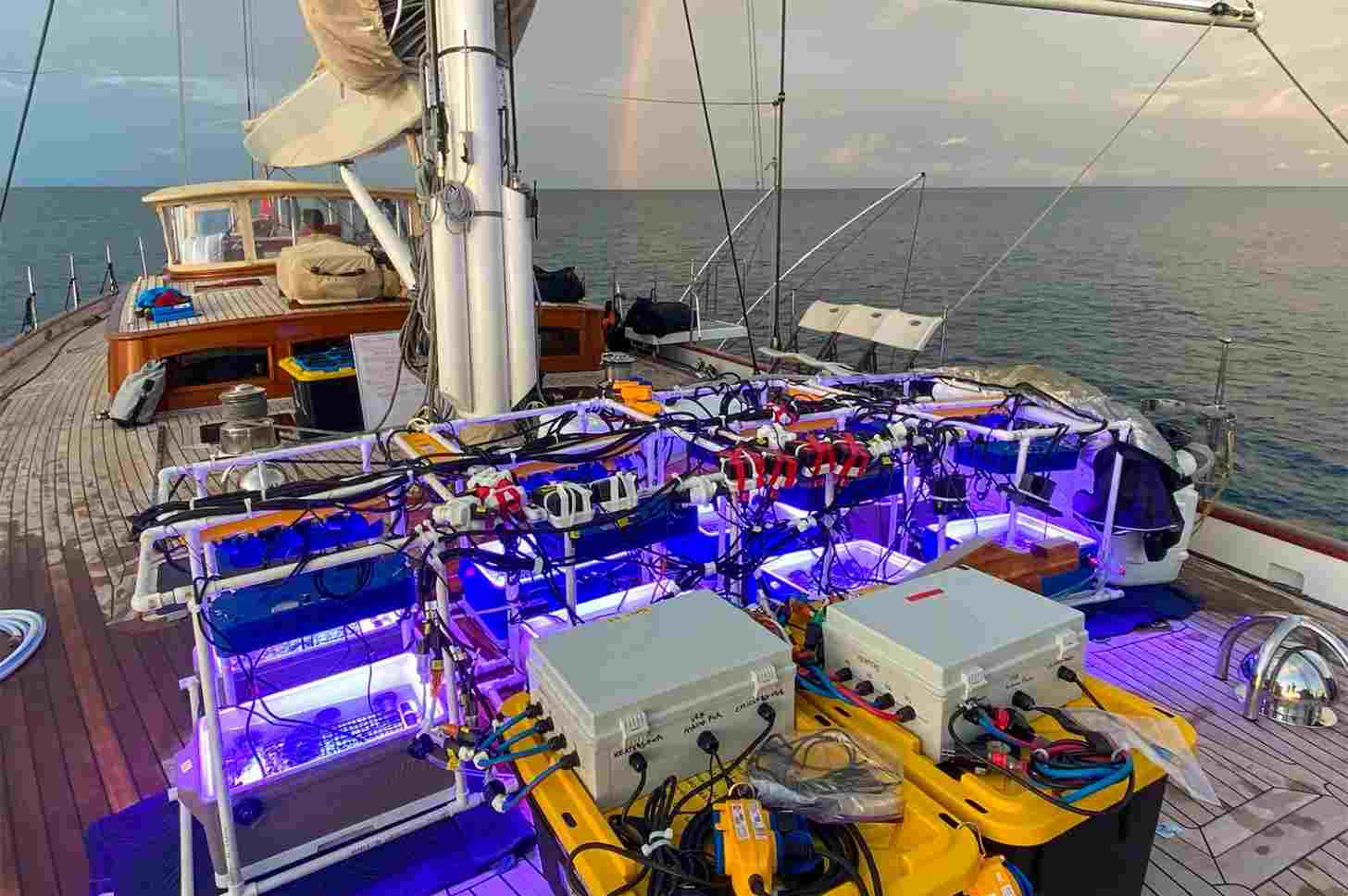
First, scientists collected live Pocillopora corals from six reefs — three from each gulf — and brought them on board a research boat. Then they added the corals to eight tanks pumped with local seawater, each at various temperatures ranging from 28.5-36° Celsius (83.3-96.8° Fahrenheit).
After eight hours of gradually raising the heat to each tank’s peak temperature, the corals sat in the tanks at 28.5° Celsius overnight, and the team took measurements the following morning.
The experimental setup the team used to test the corals’ heat tolerance is called the Coral Bleaching Automated Stress System, or CBASS — like a “cardiac stress test for corals,” said Dan Barshis, a coral biologist at Old Dominion University in the U.S., who co-developed CBASS but wasn’t involved with the recent study.
The tests are short but portable, making it possible to study live corals in real time straight from their native environment.
“What we’re trying to do is look for consistent patterns,” Barshis said, which requires studying different coral species in different environments across all oceans.
Upwelling is largely responsible for the resilience of the Gulf of Panama corals, the authors found, creating higher baseline levels of stress from the sudden hot and cold extremes. But also understanding the microbiome’s role was crucial, albeit tricky, to unlocking the mystery of how they can cope with such high temperatures.
Corals evolved symbiotic relationships with algae that in turn have all kinds of effects on their health and physiology, Glynn said.
“The coral actually has to suppress its immune system to allow this to happen,” she said. “It’s almost a controlled infection.”
But at high temperatures, and under high stress, this relationship with their algal symbionts breaks down. That’s when bleaching occurs, a phenomenon in which corals eject their symbiotic algae. While bleaching does not immediately kill coral, prolonged bleaching events can lead to weakening and death.
When temperature extremes induce a stress response from corals and the microbes living within them, they produce high amounts of reactive forms of oxygen-containing molecules. In large quantities, these molecules are harmful and can be a sign that bleaching is happening.
The Gulf of Panama corals, however, were better at producing enzymes that neutralize these molecules as a coping mechanism — similar to how antibodies protect the body from viruses, said Laura Fernandes De Barros Marangoni, a marine biologist at King Abdullah University of Science and Technology in Saudi Arabia and a co-author of the study. So, “when a heat wave comes, they’re more prepared to deal with it,” she said.
Scientists know that environmental, genetic, and symbiotic relationships are all important for heat resilience.
“But we don’t know [what’s] most important all the time,” Barshis said. “[Corals] seem simple, but they’re very complex communities of different organisms.”
The research team also noticed some key genetic differences in the Gulf of Panama populations. One gene, for example, seemingly helps corals determine whether their algal symbionts are healthy or dying. Another gene, meanwhile, seems to keep key developmental proteins intact during heat stress.
The research also shows that certain symbiotic relationships can help corals survive, even with the same genes as less successful populations, said Christian Voolstra, a coral biologist at the University of Konstanz, Germany, who reviewed the paper.
Voolstra highlighted another valuable takeaway: Once corals adapt to be much more prepared for heat stress, such as those in the Gulf of Panama, they should retain those beneficial adaptations and symbiotic relationships even if they spawn in calmer environments, such as the Gulf of Chiriquí.
This acclimatization response is similar to how humans cope with allergies by micro-dosing their exposure, he said, providing corals with a climate-change buffer.

In the Red Sea, for example, where Voolstra and Barshis originally co-developed and tested CBASS, corals in the southern part evolved resilience to high temperatures because the water is warmer. Over time, those corals dispersed their larvae, which gradually colonized northward, where the water is cooler.
“That pretty much leads to a situation where these northern Red Sea corals have a climate change insurance [policy] for the next 200 years,” Voolstra said. “I would interpret this study similarly.”
More recently, scientists discovered a thriving coral reef in Honduras’s abnormally hot and polluted Tela Bay, which similarly shows how corals can adapt to tough conditions. Combined, these studies reveal the importance of Central America’s reefs to understanding corals’ ability to adapt to harsh conditions writ large, Glynn added.
Coral resilience research is also crucial for helping scientists figure out which populations are best to prioritize for conservation efforts, and which beneficial traits can be boosted through efforts like crossbreeding in struggling corals, Marangoni said.
“The coral microbiome is just such an important element of these organisms’ resistance to thermal stress,” Glynn said. “If you just look at the coral by itself, you’re missing a lot of what’s happening behind the scenes.”
This article was originally published on Mongabay.
Header Image by Ana Endara, STRI.
Labor Day is a United States national holiday held on the first Monday of every September. Unlike most U.S. holidays, it is a strange celebration without rituals, except for shopping and barbecuing. For most people, it simply marks the last weekend of summer and the start of the school year.
The holiday’s founders in the late 1800s envisioned something very different from what the day has become. The founders were looking for two things: a means of unifying union workers and a reduction in work time.
History of Labor Day
The first Labor Day occurred in 1882 in New York City under the direction of that city’s Central Labor Union.
In the 1800s, unions covered only a small fraction of workers and were balkanized and relatively weak. The goal of organizations like the Central Labor Union and more modern-day counterparts like the AFL-CIO was to bring many small unions together to achieve a critical mass and power.
The organizers of the first Labor Day were interested in creating an event that brought different types of workers together to meet each other and recognize their common interests.
However, the organizers had a large problem: No government or company recognized the first Monday in September as a day off work. The issue was solved temporarily by declaring a one-day strike in the city. All striking workers were expected to march in a parade and then eat and drink at a giant picnic afterwards.
The New York Tribune’s reporter covering the event felt the entire day was like one long political barbecue, with “rather dull speeches.”
Why was Labor Day invented?
Labor Day came about because workers felt they were spending too many hours and days on the job.
In the 1830s, manufacturing workers were putting in 70-hour weeks on average. Sixty years later, in 1890, hours of work had dropped, although the average manufacturing worker still toiled in a factory 60 hours a week.
These long working hours caused many union organizers to focus on winning a shorter eight-hour workday. They also focused on getting workers more days off, such as the Labor Day holiday, and reducing the workweek to just six days.
These early organizers clearly won since the most recent data show that the average person working in manufacturing is employed for a bit over 40 hours a week, and most people work only five days a week.
Surprisingly, many politicians and business owners were actually in favor of giving workers more time off. That’s because workers who had no free time were not able to spend their wages on traveling, entertainment, or dining out.
As the U.S. economy expanded beyond farming and basic manufacturing in the late 1800s and early 1900s, it became important for businesses to find consumers interested in buying the products and services being produced in ever greater amounts.
Shortening the workweek was one way of turning the working class into the consuming class.
Common misconceptions
The common misconception is that since Labor Day is a national holiday, everyone gets the day off. Nothing could be further from the truth.
While the first Labor Day was created by striking, the idea of a special holiday for workers was easy for politicians to support. It was easy because proclaiming a holiday, like Mother’s Day, costs legislators nothing and benefits them by currying favor with voters.
In 1887, Oregon, Colorado, Massachusetts, New York, and New Jersey all declared a special legal holiday in September to celebrate workers.
Within 12 years, half the states in the country recognized Labor Day as a holiday. It became a national holiday in June 1894 when President Grover Cleveland signed the Labor Day bill into law.
While most people interpreted this as recognizing the day as a national vacation, Congress’ proclamation covers only federal employees. It is up to each state to declare its own legal holidays.
Moreover, proclaiming any day an official holiday means little, as an official holiday does not require private employers and even some government agencies to give their workers the day off.
Many stores are open on Labor Day. Essential government services in protection and transportation continue to function, and even less essential programs like national parks are open. Because not everyone is given time off on Labor Day, union workers as recently as the 1930s were being urged to stage one-day strikes if their employer refused to give them the day off.
Controversy: Militants and founders
Today most people in the U.S. think of Labor Day as a noncontroversial holiday.
There is no family drama like at Thanksgiving, no religious issues like at Christmas. However, 100 years ago there was controversy.
The first controversy that people fought over was how militant workers should act on a day designed to honor workers. Communist, Marxist, and socialist members of the trade union movement supported May 1 as an international day of demonstrations, street protests, and even violence, which continues even today.
More moderate trade union members, however, advocated for a September Labor Day of parades and picnics. In the U.S., picnics, instead of street protests, won the day.
There is also dispute over who suggested the idea.
The earliest history from the mid-1930s credits Peter J. McGuire, who founded the New York City Brotherhood of Carpenters and Joiners in 1881, with suggesting a date that would fall “nearly midway between the Fourth of July and Thanksgiving” that “would publicly show the strength and esprit de corps of the trade and labor organizations.”
Later scholarship from the early 1970s makes an excellent case that Matthew Maguire, a representative from the Machinists Union, actually was the founder of Labor Day. However, because Matthew Maguire was seen as too radical, the more moderate Peter McGuire was given the credit.
Who actually came up with the idea will likely never be known, but you can vote online here to express your view.
Have we lost the spirit of Labor Day?
Today Labor Day is no longer about trade unionists marching down the street with banners and their tools of trade. Instead, it is a confused holiday with no associated rituals.
The original holiday was meant to handle a problem of long working hours and no time off.
Although the battle over these issues would seem to have been won long ago, this issue is starting to come back with a vengeance, not for manufacturing workers but for highly skilled white-collar workers, many of whom are constantly connected to work.
If you work all the time and never really take a vacation, start a new ritual that honors the original spirit of Labor Day. Give yourself the day off. Don’t go in to work. Shut off your phone, computer, and other electronic devices connecting you to your daily grind.
Then go to a barbecue, like the original participants did over a century ago, and celebrate having at least one day off from work during the year!
This article was written by Jay L. Zagorsky from Boston University, and was originally published on The Conversation.
Header courtesy of Lee Myungseong on Unsplash

For years, the Denver Botanic Gardens marketing team has entertained fans with lily pad-weighing content, showing off the impressive nature of the Victoria Longwood Hybrid Water Lily in the ponds of the garden.
But in 2023, they invited other botanic gardens to join them and show off how much their water lilies could hold. The New York Botanic Gardens took the bait and posted a video, which went viral.
A year later, they decided to make an even bigger splash, with 13 other gardens participating in the now-official Water Lily Weigh-Off in 2024.

This year, at least 40 gardens across the globe have joined in on the fun.
The Victoria Longwood Hybrid Water Lily is a unique species, capable of holding many pounds of weight due to its complex criss-crossing vein system, which Denver Botanic Gardens experts called “life buoys.”
The aquatic plants are not endangered, but they are a hybrid of two threatened plant species.

A hybrid of the Victoria amazonica, which is native to the Amazon River basin, and Victoria cruziana, found in the Paraná-Paraguay River systems, these parent species are native to the warm waters of South America.
They are subject to the same ills that plague most of the area, including habitat degradation caused by illegal logging, mining, and human development; water pollution; and rising temperatures that could shrink the habitat of these lilies.
Many botanic gardens offer educational and conservation programming to study and preserve the genetic diversity of these species over time.
“The social media competition … provides a playful opportunity to educate the public about the fascinating world of aquatic plants, specifically the waterlily species V. amazonica, V. cruziana and Victoria ‘Longwood hybrid,’” the Denver Botanic Gardens shared.
“The leaves (lily pads or platters) of these tropical plants can grow up to a diameter of 10 feet and hold the weight of an adult.”
“This is possible due to the upturned leaf rims that keep water out and a network of hollow veins along the bottom of the leaf that are filled with air to support buoyancy,” they explained. “The large size and sharp spines on the underside of the leaves destroy plants that encroach on their space.”
@mobotgarden We're BACK for the #WaterLilyWeighOff25 hosted by our incredible plant pals at @denverbotanic! 🤝 Let's rewind for a sec. ⏪⏪⏪ Last year, our favorite water lily horticulturists, Claire & Greta, discovered that our beloved Victoria ‘Longwood Hybrid’ water lilies could hold 142 lbs., which made @mobotgarden the reigning champions of the 2024 Water Lily Weigh Off! 🏆 Fast forward to this year. ⏩⏩ Claire & Greta dove back into the ponds this summer to test how much weight our water lilies can hold. And the results??? 182 POUNDS 🤯🤯🤯 Can we be beat this year? Check out the weigh-ins of other great gardens from around the world by following #WaterLilyWeighOff25! 🌎 🎥 Nathan Kwarta #MOBOTGarden
♬ original sound - mobotgarden
Last year, the Missouri Botanical Gardens took home the “Water Lily Heavyweight Champion” trophy, with their entry holding 142 pounds before it started to sink.
“We mailed them a trophy, and they will pass it on to the 2025 winner,” Denver Botanic Gardens explained.
This year, the winner could be anyone.
Missouri once again shared an impressive entry, with this year’s weight clocking in at 182 pounds. They loaded up their lily pad with sandbags, bricks, and free weights, and added two cans of local beer for good measure.
Other contestants are also taking their own creative liberties and sharing a little local love in the process.
The Brooklyn Botanic Garden, for instance, partnered with local bakery Junior’s to see how many cheesecakes its lily could support.
Like most competitors, they start with a wooden base to support the onslaught of weight, which weighs about nine pounds.
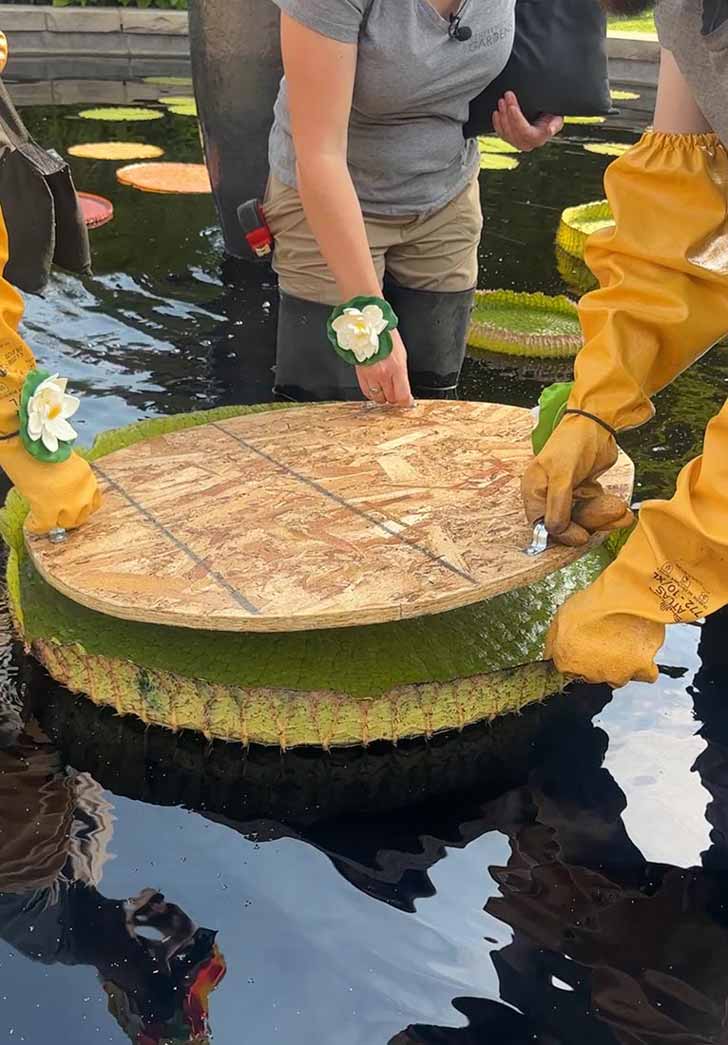
“Each of these cheesecakes weighs three pounds, and we’re going to see how many it can hold before things go south,” a representative of the Brooklyn Botanic Garden said in a social media video.
With seven total cheesecakes, weighing 21 pounds, on top of the nine-pound wooden board, they offered up a 30-pound entry.
At the Eden Project in Cornwall, U.K., botanists used traditional Cornish pasties as their weights.
And the Royal Botanic Garden Edinburgh topped their lily with a six-pack of Irn-Bru, a famous Scottish soft drink.
The third annual competition is going on now through August 24, with the winner to be announced on the Denver Botanic Gardens’ social media pages on August 28.
Participating gardens and zoos so far span across eight countries, and the 40 entrants can share their contribution via TikTok, Instagram, or Facebook.
While the competition is a fun way to connect with aquatic plant enthusiasts across the globe, it’s also a way to encourage newcomers to explore and support their local botanic gardens and protected natural areas.
@denverbotanic It is time for the Waterlily Weigh-Off! 🎉🪷 More than 40 public gardens and zoos will publish their entries this week! All confirmed participants will enter tomorrow and Wednesday, Aug. 19-20. Any other public garden or zoo with waterlilies of any kind are welcome join through Sunday, Aug. 24. The winner will be announced on Thursday, Aug. 28 on our channels, in collaboration with the winner. Follow #waterlilyweighoff25 ♬ PUMP UP OF THE BAILE - DJ LP
In fact, viewers are enraptured.
“I’m sat,” one person commented on a TikTok from the Royal Botanic Garden Edinburgh. “This is my Super Bowl.”
“I’ve never been more invested in water lilies,” another shared with Denver Botanic Gardens.
Some commenters have even shared that they have their own spreadsheets to track the diameter and load-bearing of each waterlily.
“Can I get the diameter?” one person commented on San Francisco’s entry. “For my spreadsheet.”
No matter how people engage with the contest, it’s a win for the folks who tend to the plants year-round.
“I think the biggest thing that we enjoy is that it’s an entry point for people to get excited about plants and learn about plants,” Denver Botanic Gardens’ former associate director of communications Erin Bird said last year.
“It’s part fun, like this goofy playful competition, then also part education, so it’s a really great way to introduce people to the wonder of plants.”
To see all of the available entries so far, check out the links below, and stay tuned to see the rest of the entries roll in before August 24:
- Atlanta Botanical Garden (Georgia, USA)
- Birmingham Botanical Gardens (England)
- Bok Tower Gardens (Florida, USA)
- Botanica, The Wichita Gardens (Kansas, USA)
- Brookgreen Gardens (South Carolina, USA)
- Brooklyn Botanic Garden (New York, USA)
- Cambridge University Botanic Garden (England)
- Chicago Botanic Garden (Illinois, USA)
- Cleveland Botanical Garden (Ohio, USA)
- Como Zoo Conservatory (Minnesota, USA)
- Conservatory of Flowers (California, USA)
- Denver Botanic Gardens (Colorado, USA)
- Desert City (Spain)
- The Eden Project (England)
- Franklin Park Conservatory and Botanical Gardens (Ohio, USA)
- Hortus Botanicus Amsterdam (Netherlands)
- The Hudson Gardens (Colorado, USA)
- The Huntington Library and Botanical Gardens (California, USA)
- Huntsville Botanical Garden (Alabama, USA)
- Longwood Gardens (Pennsylvania, USA)
- McKee Botanical Gardens (Florida, USA)
- Missouri Botanical Garden (Missouri, USA)
- The Morton Arboretum (Illinois, USA)
- Naples Botanical Garden (Florida, USA)
- New England Botanic Garden at Tower Hill (Massachusetts, USA)
- New Orleans Botanical Garden (Louisiana, USA)
- New York Botanical Garden (New York, USA)
- Powell Gardens (Missouri, USA)
- Royal Botanical Gardens Canada (Ontario, Canada)
- Royal Botanic Garden Edinburgh (Scotland)
- Royal Botanic Gardens, Kew (England)
- Royal Botanic Garden Sydney (Australia)
- San Diego Botanic Garden (California, USA)
- Sarah P. Duke Gardens (North Carolina, USA)
- Stellenbosch University Botanical Garden (South Africa)
- The Toledo Zoo (Ohio, USA)
- University of Bonn Botanic Garden (Germany)
- University of California, Davis, Botanical Conservatory (California, USA)
- University of California, Los Angeles, Mathias Botanical Garden (California, USA)
- U.S. Botanic Garden (Washington D.C., USA)
- Ventnor Botanic Garden (England)
Header images courtesy of Denver Botanic Gardens
On July 31, entomologist Peter Huemer put a century-long case of mistaken identity to bed.
In a study published in the scientific journal Alpine Entomology, Huemer collected and carefully studied 100 butterflies.
He found that a pink, yellow, and amber dappled moth long mischaracterized as the Carcina quercan, or widespread oak carcina moth, was actually its own distinct species.
“Carcina quercana…is one of the best known micromoths in Europe and has always been considered easy to identify due to its distinctive external features,” observed Huemer, who works at the Tyrolean State Museum Ferdinandeum in Innsbruck, Austria.
“Due to its striking appearance, it was historically described by only a few authors under different names, the last valid one about 150 years ago.”
By conducting extensive genetic surveys, Huemer confidently identified the moth as a “clearly separated new species,” which he named Carcina ingridmariae.
The discovery occurred in Northern Cyprus — a democratic republic roughly 40 miles south of Turkey that is often regarded as one of the most biologically diverse regions in the Mediterranean basin.

Huemer estimates that the Carcina ingridmariae’s population extends throughout the eastern Mediterranean, from Croatia and Greece to Cyprus and Turkey.
This is not the first time that Huemer has discovered a new species in the Mediterranean basin.
In November 2024, he helped researchers at Northern Cyprus’ Near East University identify a new type of night butterfly: Scrobipalpa chardonnayi.
“This new discovery, which sheds light on the unique biological diversity of Northern Cyprus, is an indicator of our university’s scientific capacity,” Dr. Tamer Şanlıdağ explained in an interview with Near East University.
“This international collaboration carried out by Prof. Dr. Özge Özden and Dr. Peter Huemer has once again demonstrated the impact of academic studies that transcend borders.”
Özden himself added: “This discovery, made at a time when species are rapidly disappearing, is very important for our country and world science.”
Despite their namesake, night butterflies are a common nickname for butterflies’ nocturnal relative, the moth.
Although moths are not romanticized in the same way that butterflies often are, they play an equally important role in the environment when it comes to transferring pollen and distributing nutrients.
They’re also key members of their local food webs, serving as prey for amphibians, birds, bats, and other small mammals.

Huemer is an expert when it comes to the underrated insect. In his 35-year-long career, Huemer has described more than 200 insect species, many of them moths, and contributed to over 400 scientific publications.
In a romantic turn of fate, his latest discovery also doubled as a 42nd wedding anniversary present for Huemer’s wife and frequent lab partner, Ingrid Maria.
“It is without doubt the prettiest species I have encountered in my long scientific career, even though it is still unnamed,” Huemer said in a press release.
Therefore, he said, it was “obvious” that the species should be dedicated to his wife.
“The new [species] is dedicated to my wife, Ingrid Maria, who for so many years accompanied and supported me during field work and long hours of analysis in the laboratory,” Huemer wrote in his report.
You may also like: New butterfly species wows scientists: 'This discovery reveals a lineage shaped by 40,000 years of evolutionary solitude'
Header image via Peter Huemer / Ferdinandeum
On August 13, famed football players Jason and Travis Kelce broke multiple records when their sports commentary podcast, New Heights, reached 1.3 concurrent livestream viewers — traffic so high that the livestream crashed at one point. In the days since, it’s garnered over 19 million views.
The reason for the staggering success? The episode marked the first time Taylor Swift joined her boyfriend, Travis Kelce, on the platform.
Despite the show’s reputation as a sports commentary podcast, the two-hour episode conversation ran the gamut from Swift’s new album announcement to breadmaking and — surprisingly — Kelce’s latest obsession: Sea otters.
“I want a wild animal,” said the younger Kelce brother, who plays tight end for the Kansas City Chiefs. “I want a wild otter so bad. I just want to, like, find these little creatures.”
Swift cushioned his statement by saying that Kelce doesn’t want to separate a wild otter from its mother in the wild.
Instead, he envisions befriending one “whose life he saved.”
“He wants to see an otter, and the otter is, like, ‘My paw is caught in a shell,’ and he’s, like, ‘I got you,’” Swift said. “And then the otter is, like, ‘thank you forever,’ with its little paws.”

Swift conjured the image of a future kayak trip where an otter might swim up to them.
“That’s what he wants, and I want it too, honestly. I mean, who doesn’t?” Swift asked.
It was an admission that launched a thousand memes, as aquariums across the country photoshopped images of their respective otters in the likeness of Swift’s upcoming album: “The Life of a Showgirl.”
If anything deserves to “go viral,” it’s sea otters. The California sea otter is currently listed as endangered under the Endangered Species Act, and the northern sea otter, off the coast of Alaska, is listed as endangered as well.
So Isabel Lara, communications director for the Monterey Bay Aquarium, saw an opportunity and seized it.
She told the San Francisco Chronicle that they reached out to Kelce’s team to offer a private tour of the site, which spans 143,748 square feet and over 200 exhibits.
“He’s joked about being his girlfriend’s plus one, and our person went along with the joke and said the invitation was for him but that he was welcome to bring a ‘plus one,’” Lara said.
Lara said that it would be ideal to partner with the famous couple ahead of Sea Otter Awareness Week, which runs from September 21 to 27.
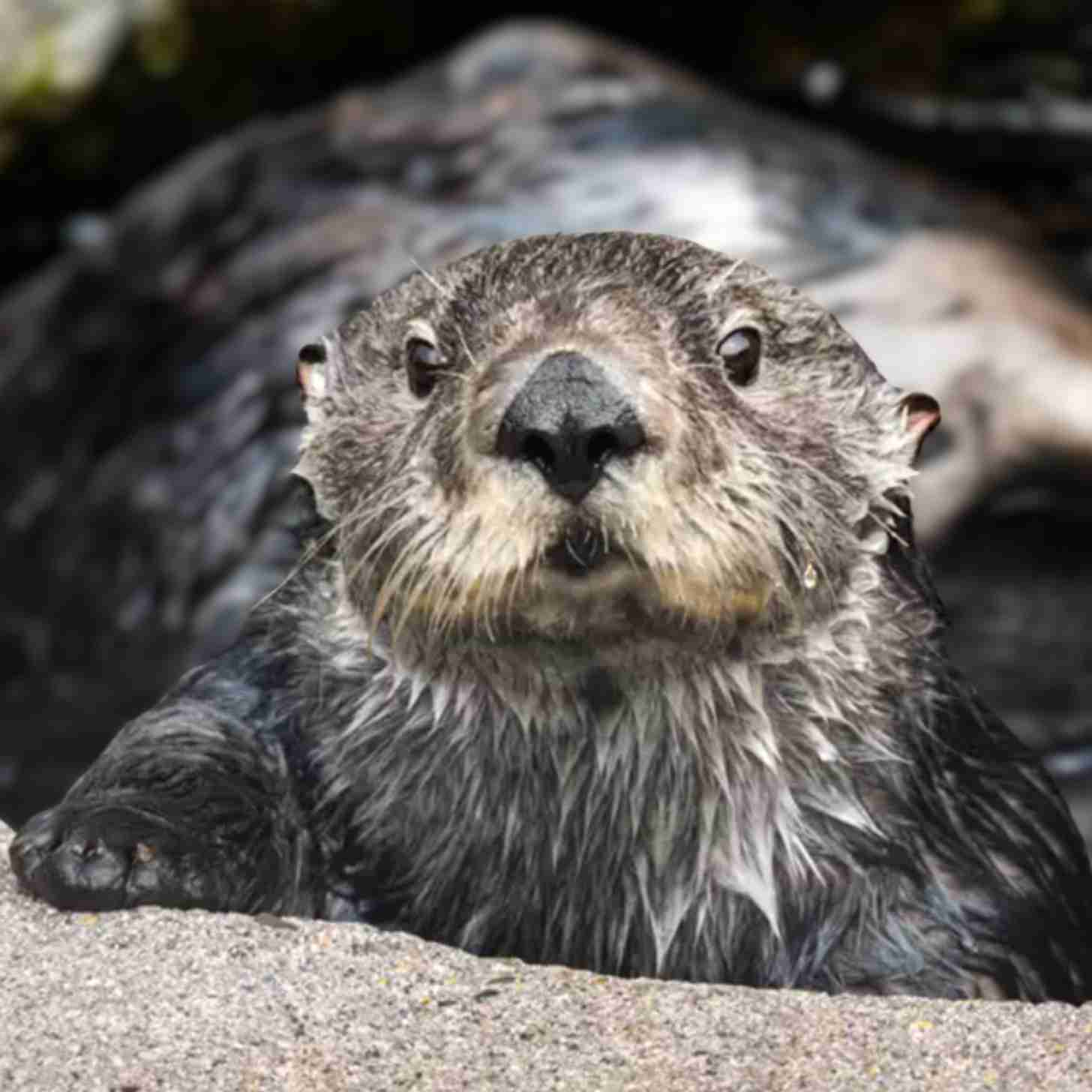
“We know Kelce is busy with his day job in September,” she added, in reference to NFL season, which kicks off September 4. “But if they want to do a special episode … we’d be happy to send them information.”
The Monterey Bay Aquarium currently has four non-releasable female sea otters in their exhibit, who serve as surrogate mothers for rescued sea otter pups through the aquarium’s Sea Otter Research and Conservation program.
“This work is crucial because sea otters are an important part of healthy marine habitat, helping to restore wetlands and protect kelp forests,” the museum said of their conservation work in a press release.
As the aquarium awaits Kelce and Swift’s reply, otter lovers need not wait for an exclusive invitation to see the marine mammals — they can get a glimpse of Opal, Ivy, Ruby, and Selka on the aquarium’s live cam, which runs daily from 7 a.m. to 7 p.m. online.
You may also like: Sea otters have become the unsung heroes of the sea, simply by snacking on sea urchins
Header image via YouTube / New Heights
On June 5, an elderly dachshund named Bam Bam was stolen from a backyard in the Logan Square neighborhood of Chicago.
“His owner, Angel Santiago, is legally blind due to glaucoma and now walks seven miles every day looking for his beloved service dog and handing out flyers,” Amy Pasalich, Santiago’s friend and advocate, wrote on a GoFundMe page — which has since accrued over $20,000 in donations.
“Chicagoland people, please keep an eye out for Bam Bam,” Pasalich advised. “And to anyone who considers donating, Mister Rogers' mom said it best: When there are scary things in the news to ‘look for the helpers.’ Let's be helpers!”
Santiago himself took to multiple news stations to spread the word.
“Let your eyes be mine and look out for Bam Bam for me, please. I beg of you to help me,” Santiago said.
A harrowing 72 days passed, as the story gained national — and global — attention. A reward of up to $6,000 was offered for the safe return of Bam Bam, with PETA contributing $5,000 to the efforts.
Then, finally, there was a breakthrough in the case.
On Tuesday, August 20, former police officer John Garrido, who runs the Garrido Stray Rescue Foundation, said he was notified about two unnamed people dropping off a dog at the 16th District Chicago Police Department.
Initially, the foundation had shared information about the missing animal as they do with any dog that comes through its doors, not knowing that the 14-year-old dachshund was the talk of the town (or rather, the entire Chicago area).
“The entire city has been searching for this dog,” Garrido said, after Bam Bam’s microchip confirmed his identity. “He is safe and sound. … I am told it was a happy reunion.”
When Santiago and Bam Bam were reunited, Garrido was quick to share the good news.
“Microchips save lives! Please microchip your pets!” The rescue wrote on their Facebook page on August 21. “Great work [to the] 16th District Chicago Police Department and all the volunteers that worked so hard to bring Bam Bam home. Team work makes the dream work!”
On August 20, Pasalich posted the long-awaited update.
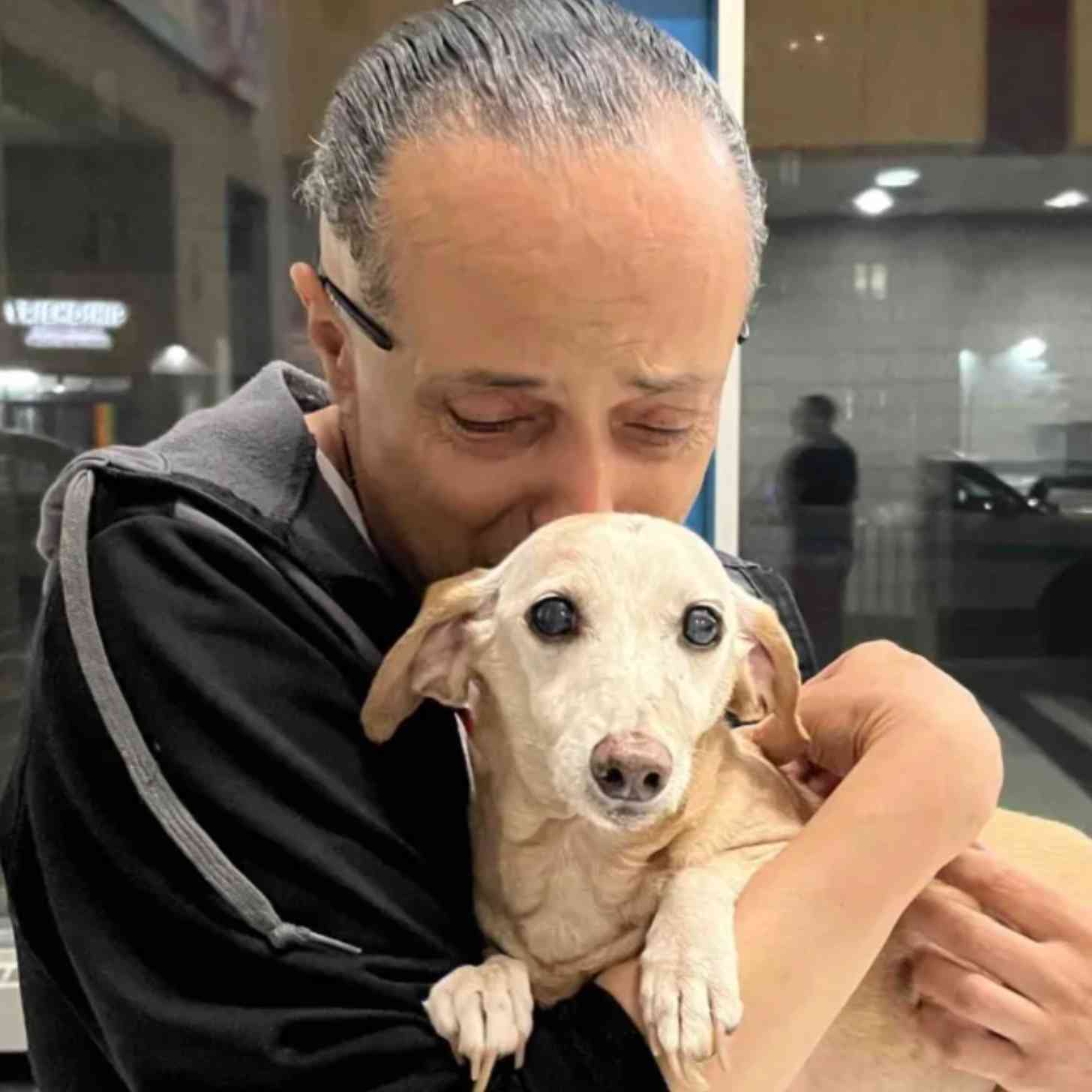
“Bam Bam and Angel are REUNITED!!”
“After a long and emotional nearly three months, Angel has finally been reunited with Bam Bam. The reunion took place on the evening of August 19th, and both are now safely back together.”
“Out of respect for their privacy, we won’t be sharing every detail, but what matters most is that Angel and Bam Bam are safe and together again.”
“Thank you to everyone who offered tips, support, and love during this difficult time,” she continued. “Your care and concern have meant so much.”
The news update soon went viral, matching the staggering response of the initial search.
“Finally, some happy news being shared,” one person replied to an ABC 7 Chicago headline on the matter.
“This is the greatest news! I spoke to Angel outside of Tony's on Fullerton right after Bam Bam went missing,” a local Chicagoan wrote on Instagram. “It was very clear he loves Bam Bam so much.”
Many comments pointed to how far the story had traveled.
“This has reached Greece,” one person wrote after NBC Chicago shared the news on TikTok. “It’s 5 a.m. and I’m crying for these two.”
PETA celebrated in turn with an announcement:
“The billboards reminding everyone of our $5,000 reward for Bam Bam’s return will now thank everyone who came together to hand out flyers, contribute to the reward, and pound the pavement in search of this beloved little dog.”
In tandem with the billboard update, PETA also sent a “Welcome Home” basket filled with toys and treats.
The organization added: “Working for this reunion brought out the best in the community, and it reminds us all to never be silent, as speaking up when an animal is in danger can save a life.”
You may also like: Meet Tiki, the 'extremely fearful shutdown foster dog' inspiring millions
Header image via GoFundMe / Angel Santiago
- Conservation organizations are employing Cabo Verdeans, who formerly hunted endangered and threatened sea turtles, as rangers who now monitor and patrol beaches.
- From 2007-24, illegal catches of female turtles on one island plummeted from 1,253 to a mere 20, while nesting sites of vulnerable loggerhead turtles increased sevenfold, according to data by a conservation NGO.
- Locals traditionally consume turtle parts, use them in traditional medicine and now sell them in black markets; however, conservation activities, legislation and tourism have led to a reduction in turtle harvesting, researchers say.
- Conservationists say threats persist for sea turtles from at-sea captures, industrial fishing and plastic pollution, and that stricter laws and increased participation of the fisher community in conservation activities are needed.
Seven years into patrolling on Cabo Verde’s islands, Roni Nelson Batista Ramos now protects endangered sea turtles on the beaches where he once poached them.
A few decades ago, he hunted sea turtles to feed his family, he says, since consuming turtle meat was a common practice among locals on his island. Back then, all he did was hunt turtles, and it was free food on the table, Ramos tells Mongabay.
However, after stricter conservation efforts and new legislation that criminalized killing threatened turtle species, poaching activities plummeted in the country. Many poachers were fined and struggled to adapt to a new life.
“I had turtle meat for personal consumption and never realized I could make a living out of conserving them,” he says. “But now, I guard them against the poachers, and it’s motivating to see how these efforts have driven positive impacts for their conservation.”
Ramos is among about a dozen former poachers who have been employed by conservation organizations to keep poaching numbers low on the country’s beaches.
According to the Turtle Foundation, illegal catches of female turtles on the island of Boa Vista have declined from 1,253 in 2007 to just 20 in 2024. Meanwhile, in the same period, loggerhead turtle nests on the island increased more than sevenfold.


Euclides Resende, managing director of Turtle Foundation, a conservation NGO involved in these patrols, says the drop in poaching, which feeds an illegal trade in turtle parts, is the outcome of “collective efforts by ranger-led patrols, fused with technology, that engages local people by creating jobs.”
Researchers also note that other factors, such as increased local employment in turtle-watching tourism, play a role.
However, away from the patrolled beaches, at-sea captures of turtles by fishers, who consumed or sold them, remained constant and their market value went up between 2008 and 2019, suggests a study published in Fish Biology and Fisheries.
The nesting population of loggerhead turtles in Cabo Verde is the third-largest in the world, after Oman and southeast Florida. Marine biologists estimate that approximately two-thirds of the nesting activity on Cabo Verde takes place on the island of Boa Vista.
Back at the sandy beaches of the island, Ramos patrols and supervises fellow rangers during the hatching season when loggerhead turtles (Caretta caretta) swim ashore to lay eggs from June to October. His team set up five camps across the island where they patrol around 31 kilometers (19 miles) of land on foot.
When the turtles visit at night to lay their eggs, rangers must stay vigilant around the clock.
“I cover at least 4-km [2.5-mi] walking patrols every night during the peak season. When we [rangers] spot a turtle, we inspect and record them, check their tags and tag them if they are untagged,” Ramos, also a camp coordinator at Turtle Foundation, tells Mongabay.

The turtle trade
Among the seven species of sea turtles, five species nest on Cabo Verde’s islands, such as the leatherback (Dermochelys coriacea), loggerhead (Caretta caretta) and hawksbill turtles (Eretmochelys imbricata), all of which are listed as endangered or vulnerable by the IUCN, the global conservation authority.
The loggerhead turtle, for example, comes ashore every two to three years during the hatching season to lay her eggs under the cover of sandy beaches.
But as the turtles come ashore at night, so do the poachers.
While Ramos previously hunted turtles to directly feed his family, sources say that hunting also supplies several black markets that trade the meat for human consumption or traditional medicine.
“Other turtle parts [don’t] have a higher demand than its meat, which sells for about three to seven euros [$3.40-$8] per kilogram [2.2 pounds] in the black market,” says Herculano Dinis, executive director at Associação Projecto Vitó, another turtle conservation NGO involved in patrols.

However, Resende estimates the price can go up to 12 euros ($13.70) per kilogram, depending on the buyer and seller.
“This is a part of both local and international trade, as reports show it is exported to countries like the U.S. and France.”
A few ongoing legal cases not seen by Mongabay indicate that the turtle meat is not only sold across the islands but also in the U.S., Dinis says.
People also driving the demand for turtle meat are Cabo Verdean emigrants who fly into the island for holidays from countries like the U.S, he says.
“This is a big incentive for local people to poach sea turtles to deliver the meat on demand to these emigrants or sell them in the black market,” he tells Mongabay.
Although laws exist to protect turtles, and poaching has decreased, current legislation is not always an effective deterrent, says Emilio Garcia Landin, a drone pilot at the Turtle Foundation.
He says there are high poaching trends in the northern part of the country and that poachers are likely to return even after they are caught.
“There are fines and imprisonments for turtle poaching, but the poachers mostly escape paying fines,” Landin says.
Although several NGOs involve local people in monitoring and patrolling areas to detect poaching activities, gaps in law enforcement when poachers are caught stand as a key challenge, says Samir Tavares Martins, biologist and founding member of BIOS.CV, a conservation and sustainable development association in Cabo Verde.
He also says he doubts that poverty plays a role in why locals eat turtles today. The use of the species’ parts for food and traditional medicine is an old tradition in coastal communities in West Africa.
“Active patrols and activities led by the NGOs have made a dent in the poaching problem, but given that the demand for meat is high among the emigrants, I think people who poach them may do it for easy income,” he says.
“No amount of fines or punishment can deter some poachers who illegally hunt for pleasure and extra money. So, it’s crucial to build strict laws, stronger collaboration with NGOs, and constant awareness of conservation that could help encourage behavioral shifts.”

Facing looming threats
Occasionally, poachers are aware of the timing of patrols, allowing them to determine when to approach turtles and nests. While rangers still patrol at night to deter poachers, the Turtle Foundation also established a dog and drone team in 2018, utilizing thermal and night-vision drones to enhance beach patrols.
“Drones in such cases help track poachers easily while securing rangers from any threats posed by the poachers,” Dinis says.
Apart from poaching and looming threats from urbanization, climate change, plastic pollution, and industrial fishing, he explains, bycatch poses a major threat to sea turtles.
He says these threats could intensify with the EU and Cabo Verde renewing the Sustainable Fisheries Partnership Agreement (SFPA), which allows 56 fishing vessels from EU member states to fish in Cabo Verde for five years as part of efforts to industrialize the sector.
While sustainable fisheries management is part of the agreement, and Cabo Verde tries to implement initiatives to conserve its marine protected areas, Dinis says the SFPA could have a huge impact on marine species, including the endangered sea turtles and species of sharks and rays, which are already facing impacts from bycatch and industrial fishing.
Under the SFPA’s protocols, there might be a possibility of certain economic gains, he says, “But if we risk losing the biodiversity that makes up the marine ecosystem, the sea and thousands of lives that depend on it will never be the same.”
Amid growing threats, Martins also says that increasing job security for local people could be part of the solution, while educating and empowering the local fishing community.
“Involving the fisher community is crucial,” he tells Mongabay, “because a lot of the information or alerts gathered on poaching activities and industrial fishing come from their local knowledge and observation.”

This article was originally published on Mongabay.
Header Image by The Turtle Foundation